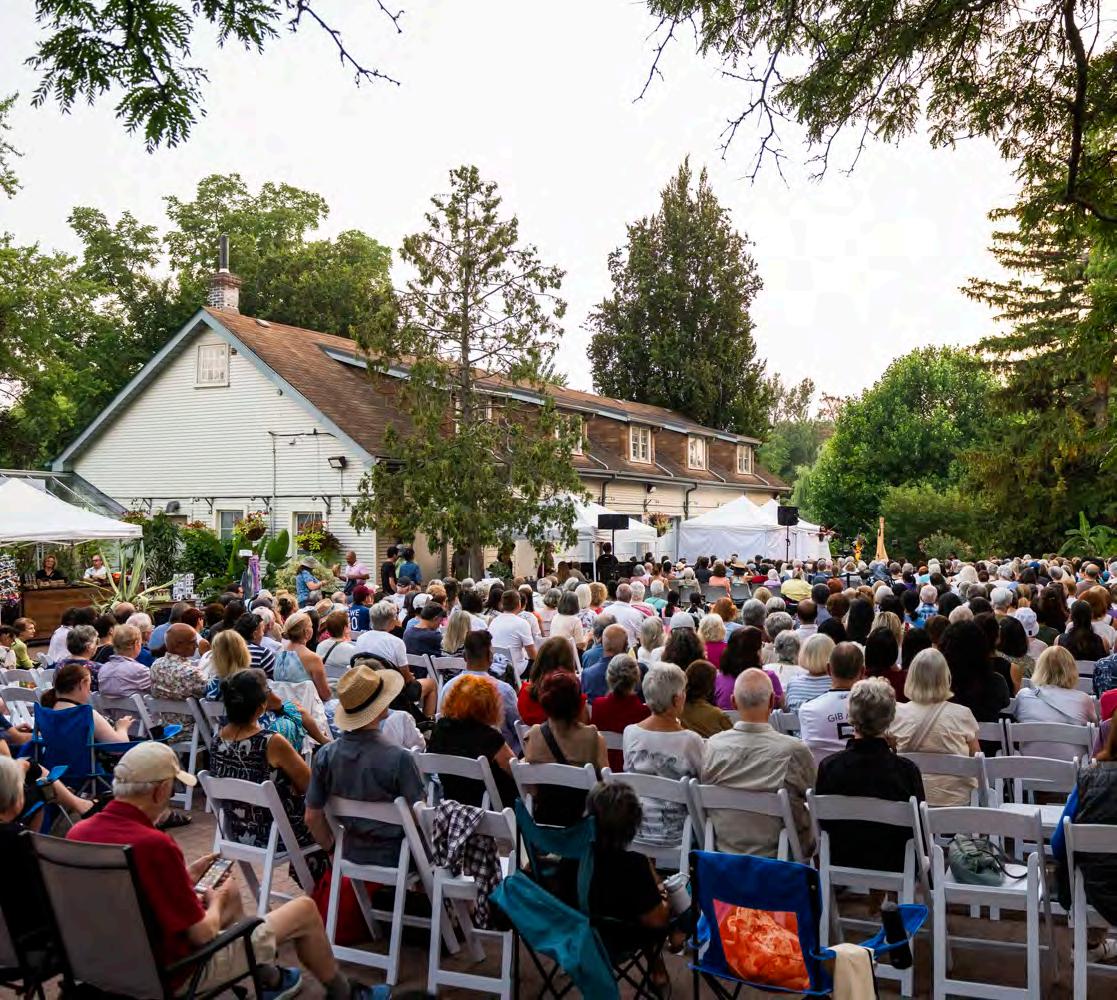
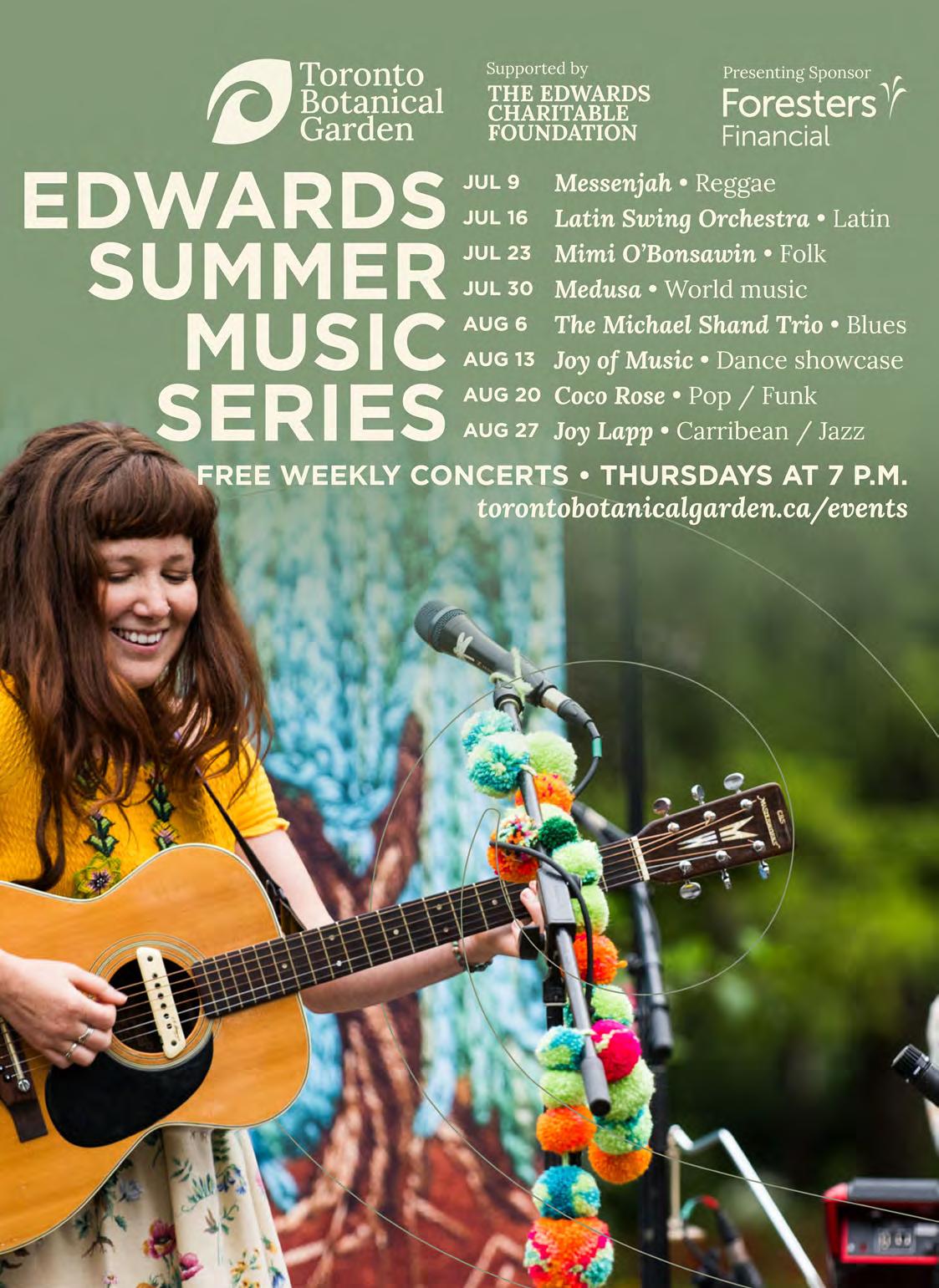
The Joy of Music Dance Showcase returns Thursday, August 13 as part of the Edwards Summer Music Series.
SUMMER 2026 •
[4] FROM THE GARDEN
[6] TBG GARDEN SHOP
Gift items by Canadian women entrepreneurs
[7] VOLUNTEERING
Deepening our relations
[8] LIBRARY Seed poster draws positive feedback
[11] WELCOME NEW STAFF MEMBERS
[12] PLANT PEOPLE
Eventually they begin to resemble the plants they love
[14] JANET DAVIS
Photographer launches book on Trees & Shrubs of Mount Pleasant Cemetery
[18] A PLACE OF LOVE & LOSS A season of discovery at Edwards Gardens and Toronto Botanical Garden
[26] CAPTIVATING PERFUME Sniffing out delightful scents provides respite for the soul
[30] BIIDAASIGE PARK
Industrial wasteland transforms into a stunning naturalized park on Toronto’s waterfront
[36] LIVING ECOSYSTEMS (PART TWO)
A garden that fits your life is more sustainable than one maintained out of obligation
[40] HISTORY OF GARDENING
Paradise Gardens
[42] CRITTERS IN THE GARDEN
The Eastern Coyote
[44] RECIPE CORNER
Mint Tea, the perfect beverage to welcome guests
[46] CONEFLOWERS
Low maintenance, longblooming native perennial
[50] BOOK SHELF
A plethora of summer reading gardening books
[53] PUZZLE PIECES
[54] GOOD THINGS ARE HAPPENING
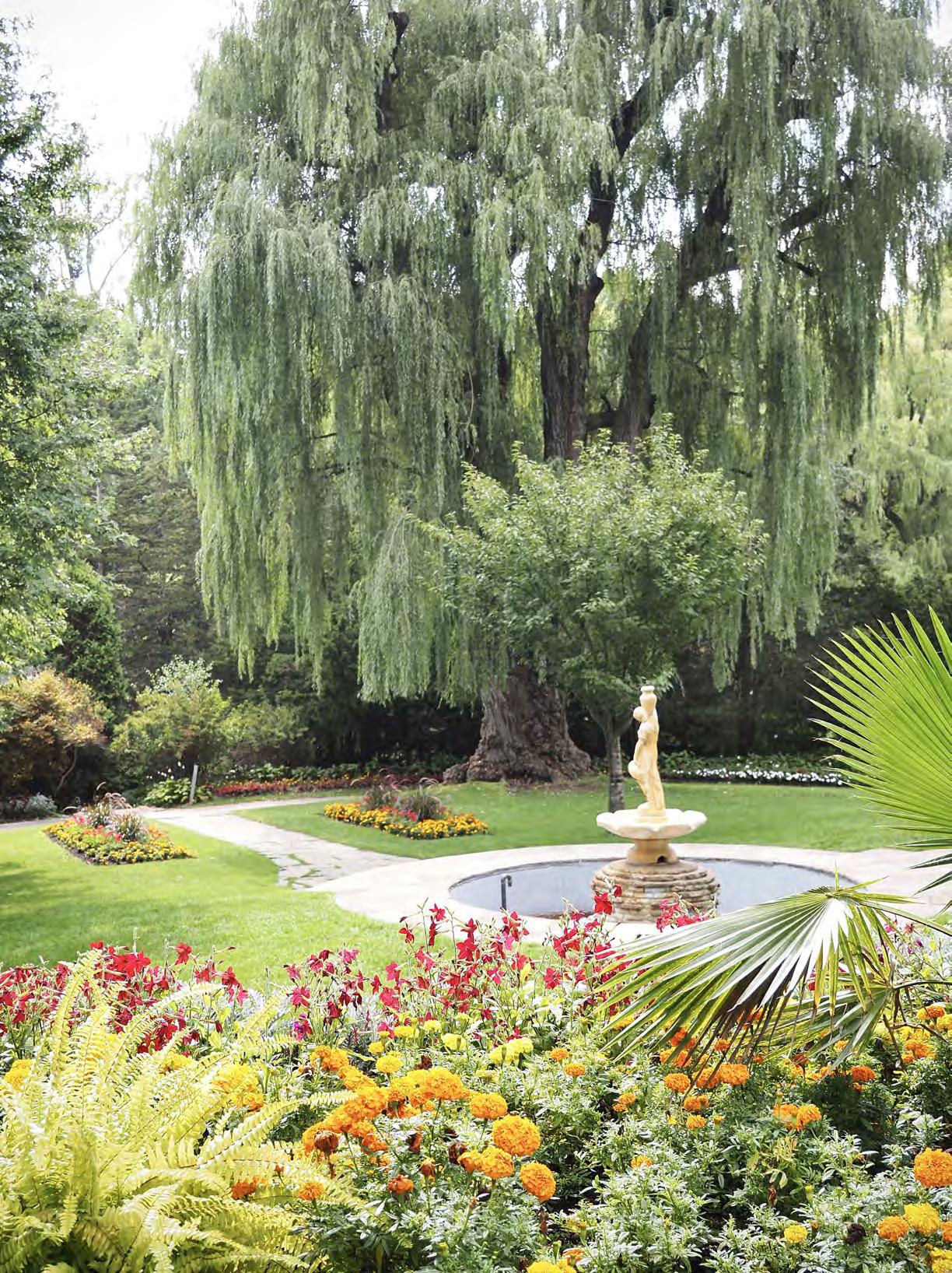
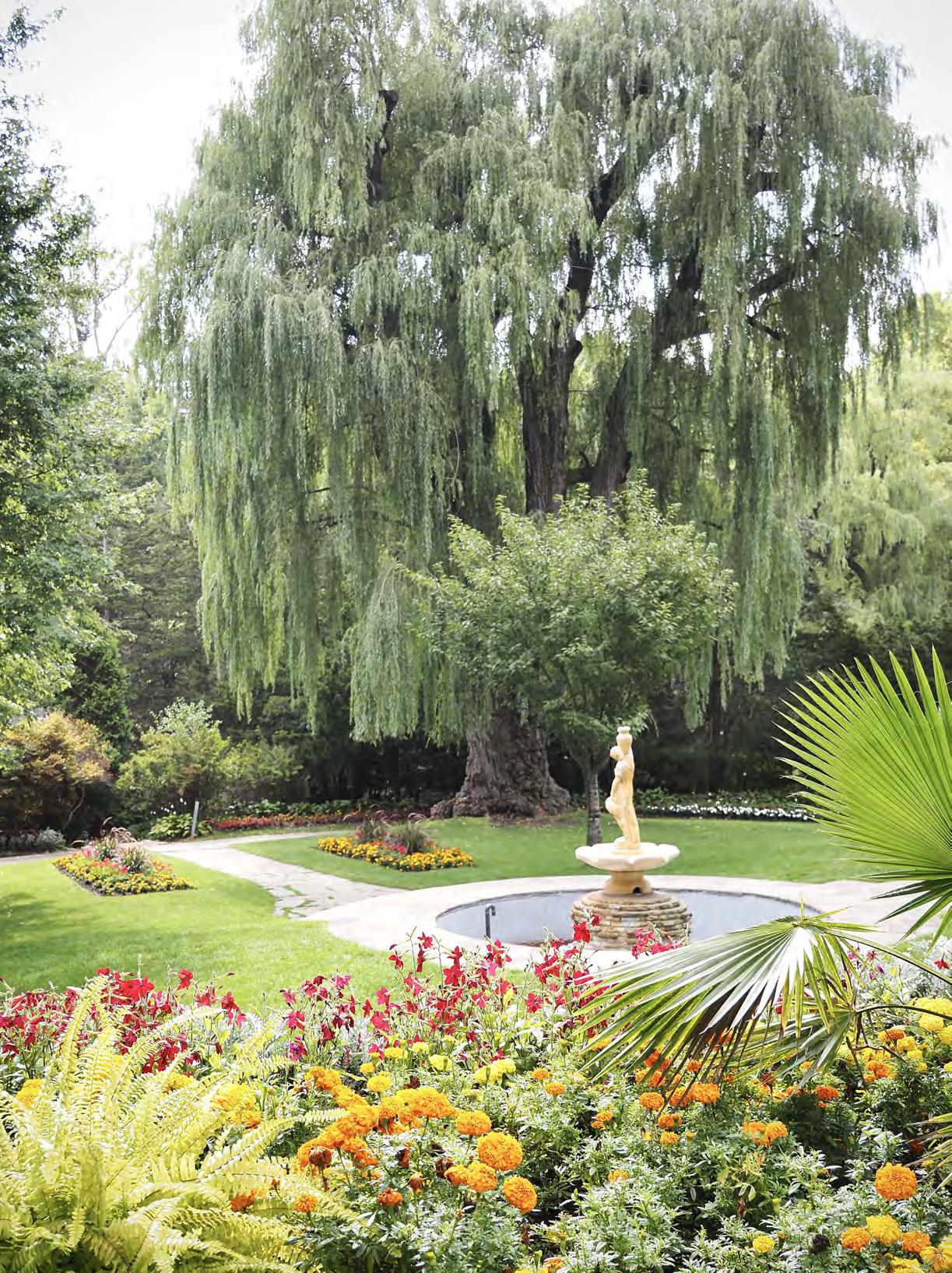
COVER: EDWARDS GARDENS ICONIC FOUNTAIN. PHOTO BY DAVID SCRIVENER. SEE PAGE 18.
THIS PAGE: JOIN THE CROWD FOR THE EDWARDS SUMMER MUSIC SERIES THURSDAYS AT 7 P.M. DURING JULY AND AUGUST.
FROM the Garden
HELP TBG REMAIN A WELCOMING, SAFE REFUGE FROM THE CONCRETE JUNGLE
IN MY ROLE as CEO, I often meet people who introduce themselves by telling me how many years they have been coming to Edwards Gardens and Toronto Botanical Garden, or the first time they came to the Garden, and their many recollections of exploring Toronto’s ravines. The stories of being connected to this place are abundant, and often include stories of visiting with family and friends, being young and in love, seeking relief in the ravine from the summer heat, finding calm when the world is noisy, coming to see the seasons change, being in nature and so much more.
In a recent conversation with team members, we were sharing what calls each of us as our “third-place”—the place we go to when we are not at work or at home. Some described very specific places—parks near our homes, libraries, trails we walk frequently, roaming neighborhood streets. Others outlined the qualities that make up their third-place—near water, trees overhead, familiarity, comfort, being recognized as a regular, feeling at home, the opportunity to choose our own adventure and vary our experiences with each visit. A very astute team member noted that third-places are under threat. In particular there is a rise of wannabe third-places that cost money to attend, making them inaccessible to some. And as city dwellers we may have limited connections to quality natural spaces as many parts of our urban spaces are concrete jungles.
The conversation amongst TBG team members reminded us how we continue to benefit from the legacy of those who came before us, guiding Edwards Gardens
and Toronto Botanical Garden to sustain generations with access to nature, community, beauty and refuge from the noisy world and concrete jungle.
Later this month, on June 23rd, we mark 70 years since Edwards Gardens opened as a significant addition to Toronto Metropolitan Parks. I have often pondered what Rupert Edwards and Tommy Thompson considered as they were laying the foundation of decisions that ultimately made way for the gardens and community space we rally around today. As leaders in creating urban parks, Rupert and Tommy may not have had the equation
People + Nature = Community + Well Being
to guide them, but through their leadership they opened the possibility that generations have come to know and expect.
As a TBG member summed it up quite simply during a recent conversation,“ without nature there is no health.”
As stewards of this space, we each have an important job to do—to continue making Toronto Botanical Garden and surrounding Edwards Gardens a welcoming, safe and accessible space for today and the future.
I invite you to lean in and say yes to continuing to support and champion Toronto Botanical Garden as a vital space for our community and the planet.
Stephanie Jutila TBG CEO
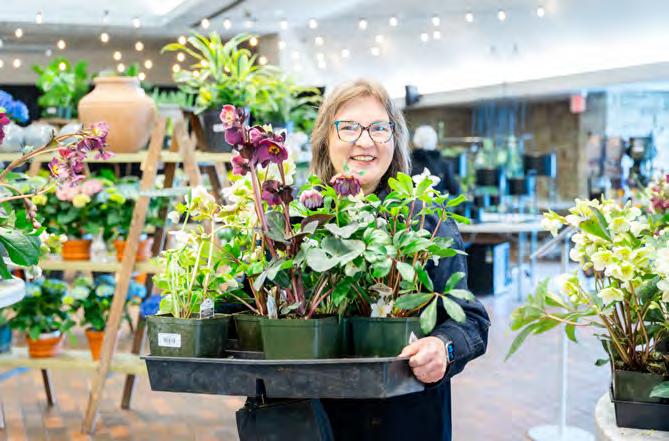
TBG CEO Staphanie Jutila at the TBG Hellebore Sale.
TBG GARDEN SHOP
| GIFT ITEMS BY CANADIAN WOMEN ENTREPRENEURS |
LOOKING FOR a meaningful, sustainable gift for someone special? Or just for yourself? The TBG Garden shop has curated a great selection of gift items this spring, all having something in common. These products were all created by Canadian Women Entrepreneurs!
For example:
1. Garden Pillows & Aprons by fashion designer Kate Austin in Toronto, who makes colourful, sustainable, casual clothes for women, featuring her original prints.
2. 100% Natural Yukon Wilderness Soaps by Kym Rempel, Anto Yukon in Whitehorse, whose soaps are named after local destinations and Canadian sites and made from locally sourced botanicals.
3. Gardening Your Front Yard by Tara Nolan, a garden, travel and outdoor lifestyle writer, and co-founder of the website savvygardening.com from Dundas, Ontario. The book features creative ideas for building patios and pathways and planning perennial and vegetable gardens.
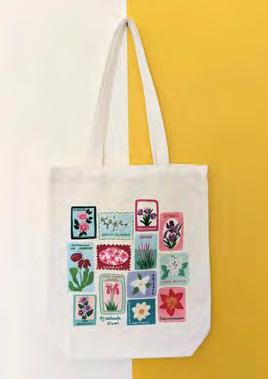
5. Totes & Cards by illustrator Nabeela Rumi in Edmonton. Nabeela, who works from her home studio says that she is inspired by Mother Nature for “her colours, textures and organic shapes.” 1 4 2 5 3
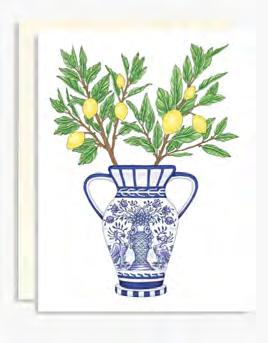
4. Totes & Cards by Toronto watercolour artist Krystina Plante feature designs from her original paintings. The 100 per cent cotton tote bags are machine washable. The handmade cards are a celebration of art and correspondence, of handmade and slow-made.
Monthly volunteer & staff community socials encourage connection
By Elvin Velasco Volunteer Services Coordinator
DeepeningOUR RELATIONS
THIS YEAR WE have launched monthly volunteer and staff community socials for us to get to know each other and learn something new through lighthearted social connection.
The intention is to connect volunteers and staff who don’t cross paths due to timing schedules.
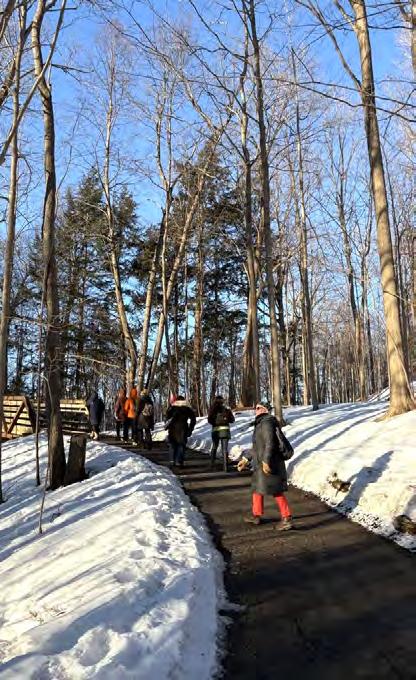
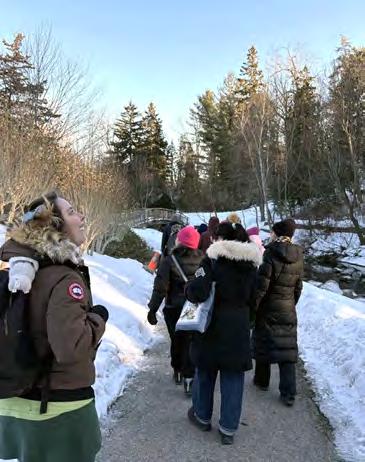
On Sunday, March 1st (for a late February gathering) volunteers and staff gathered for a forest bathing walk led by instructor and volunteer, Laura Bincik. We walked along Wilket Creek Ravine, while being encouraged to slow down, take notice and enjoy shared relations with nature.
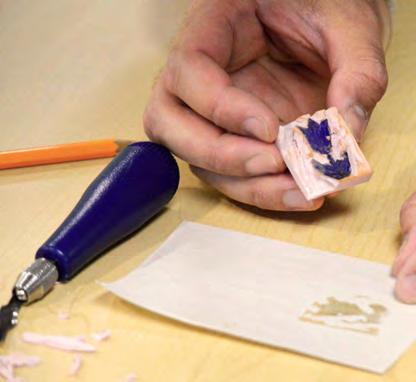
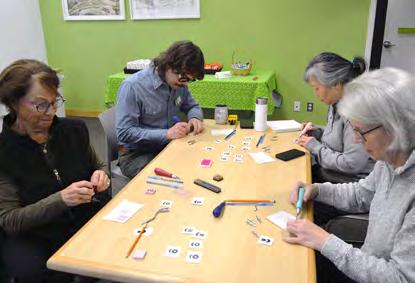
On Monday, March 16th, a linocut stamp making social took place, where I shared my creative passion and skills of linocut. Volunteers and staff reclaimed their creativity by trusting the process and turning their ideas into reality. We’re looking forward to more socials this year with volunteers and staff members.
SEED LIBRARY POSTER DRAWS POSITIVE FEEDBACK
By Lee Robbins Manager, Weston Family Library
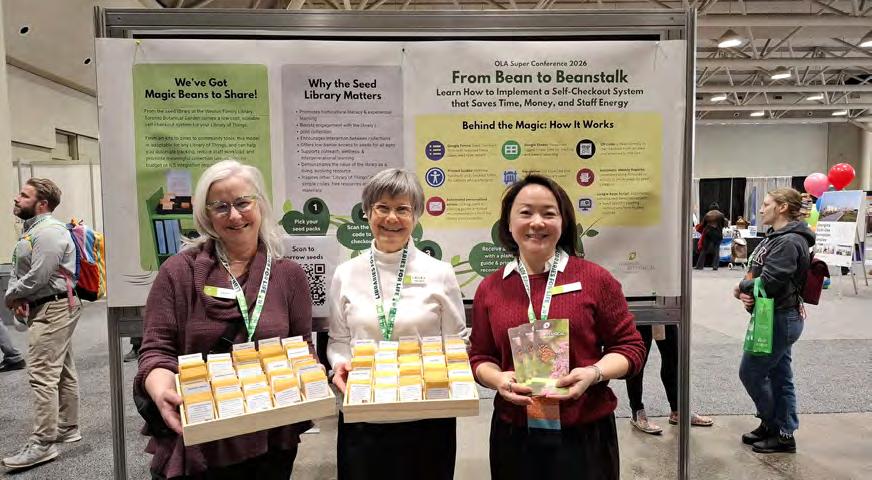
WESTON FAMILY LIBRARY (WFL) volunteers Vincci Ching and Laura Bincik and Library Manager, Lee Robbins were happy to share the Toronto Botanical Garden’s Seed Library in a poster session at the Ontario Library Association (OLA) Super Conference. The OLA is celebrating its 125th anniversary this year, and the conference is the largest library conference in Canada, welcoming over 5,000 attendees including speakers, authors and information professionals over three days this past January at the Metro Toronto Convention Centre.
The session was held on the EXPO floor and scheduled for one hour, but we ended up running overtime because of the steady stream of interest. Our poster, designed by Vincci Ching, gathered a keen crowd of librarians and library professionals who manage seed libraries or “lenderies” also known as “libraries of things” in their own communities. We spoke with more than 40 librarians from across the country—from Vancouver to Halifax Public Libraries. They were curious about how seed libraries are evolving and how they can help connect their communities through the sharing of tiny seeds. We presented a pilot concept for a low-cost, automated seed check-out system that connects seeds to knowledge. The system is designed to make things easier for both patrons and library volunteers. From a borrower’s
perspective, the flow is intentionally simple: pick your seeds, scan the QR code, submit a short online form with your selections and email address, and then check your email inbox. In return, you will receive a list of the seeds you borrowed, along with trusted planting guides from the Toronto Master Gardeners and curated book recommendations from the WFL collection, one of the most comprehensive horticultural print collections in the Greater Toronto Area (GTA).
Imagine borrowing clematis, ironweed or heirloom tomato seeds and receiving thoughtful reading suggestions to help you understand soil conditions, set up a balcony garden or increase the yield of your tomatoes.
Ideally, the borrower will return seeds once the original seeds have been planted, grown and produced a new generation of seeds.
We received great feedback from the conference organizers, who rated the presentation highly, and many positive comments about the concept and clarity of the poster.
The goal of this pilot is to promote horticultural literacy by connecting living materials with library collections. We are now exploring how to thoughtfully implement this system at the WFL. If you come across the new QR code, feel free to give us some feedback on your experience with it… By Vincci Ching, Laura Bincik and Lee Robbins
Laura, Lee and Vincci with seeds in front of the Seed Library poster that Vincci designed
WELCOME NEW STAFF MEMBERS
◗ TRISHA ATWOOD
Financial Analyst Trisha Atwood is an accounting and finance professional who enjoys supporting non-profit and community-focused organizations to simplify financial processes, stay organized and feel confident in their numbers. Being part of organizations that have a positive impact in the community is important to Trisha who values collaboration, clear communication and a practical, down-to-earth approach to finance.
“I feel connected to nature and gardens because of the calm and perspective they bring. I love spending time outdoors—especially camping under the stars—because it helps me slow down, recharge and feel more grounded. Just being in nature has a really calming effect on me,” she says.
Trisha is looking forward to connecting with others who share a love for nature and creating spaces that feel both peaceful and purposeful.
◗ MONICA CIMETTA
Guest Services Associate
Monica Cimetta, the new Guest Services Associate at the Toronto Botanical Garden has worked in customer service for the last five years in three different museums including the Royal Ontario Museum.
“I am very excited to bring my skills and abilities to the TBG team. My role is to act as an ambassador
and host for our garden, support our volunteers at the reception desk and help make each TBG event a success.”
Monica enjoys going for walks in nature and is looking forward to getting to know TBG members and visitors, and “sharing stories about how we found ourselves at Toronto Botanical Garden.”
◗ JULIA LINDSAY
Audience Engagement Intern
Julia Lindsay brings a strong mix of arts, marketing and hands-on visitor engagement experience, with a particular interest in the connection between ecology and creative practice. She holds an Honours B.A. in Art History from McMaster University and has worked across a range of cultural organizations, including the Museum of Contemporary Art Toronto, Hamilton Arts Council and Melt Studio + Gallery.
Most recently, Julia worked at the All in the Wild Gallery, a naturebased photography gallery in Alberta, where she combined art sales, visitor experience and environmental story telling thereby connecting visitors to wildlife and conservation through art. This approach will be especially valuable as TBG prepares for the second annual Plein Air Art Exhibition.
Julia Lindsay’s position is supported by the Young Canada Works graduate internship program with funding from the Canada Museums Association.
TRISHA ATWOOD
MONICA CIMETTA
JULIA LINDSAY
Eventually they begin to resemble the plants they love
By Sasan Beni Horticulturist
BEFORE I STARTED working at TBG, I had no idea there were so many plant societies out there... Before I entered the realm of horticulture and public gardens, my curiosities were people. Long before I immersed myself in the natural world, my inspirations were people. I wanted to write stories and fill them with the characters that I knew and loved, and the characters I couldn’t understand... Sometimes, a shoulder bumping into me on a crowded sidewalk would carry me home (figuratively speaking). I would think about them; who they were, where they were going, what was for dinner, where they found their warmth, their kindness. Was it in a book, a campfire, or even alcohol?
I’m still a people-watcher as much as I am a birdwatcher... I guess old habits die hard.
For a while now, I’ve been studying the plant societies that gather at TBG. They take over our building with their shows and sales, their monthly meetings...and I can’t help but think that all these people, in one way or another, begin to resemble the plants on their banners.
Members of the Orchid Society are shy, somewhat elusive: they need you to make room for their rainforests, and as you traverse through the colourful canopy in the Floral Hall, be careful not to trip on their aerial roots. Some people might use the word “finicky” to describe orchids, but they don’t know these plants people like I do.
And when the Cactus people show up, they don’t need your help setting up. They won’t need to borrow a hose, or be led to a faucet—they can find their own water. Chances are, they’re still hydrated from last month’s rain. There is a quiet patience about them that one can only acquire in a desert. And like true succulents, they never shy away from sharing themselves, shedding their leaves. They know that from loss comes growth; a leaf cut from its mother can still find its roots.
Bonsai Society members have an ancient way about them, like they’ve been windswept for centuries. They, too, know a thing or two about patience, and always have their pruners handy. They won’t hesitate to sacrifice
Before I entered the realm of horticulture and public gardens, my curiosities were people. Long before I immersed myself in the natural world, My inspirations were people.
a limb for the sake of art. Like harmony in deadwood, they find pride in their scars...
Members of the Native Plant society don’t want to talk about tropicals with me. They walk around with the weight of our ecosystem on their shoulders. They have no time for chitchat. Pushed to the brink by invasive plants, they’re on the front lines fighting back... and deep in their hearts, every pollinator has a home, every fallen leaf is habitat. Together they dream in the language of biodiversity.
In the end, we all become the things we love. Today, I am a weathered notebook on the cusp of a brand-new story...
D VIS J A N E T
Photographer launches book on Trees & Shrubs of Mount Pleasant Cemetery
By Lorraine Hunter Trellis Editor
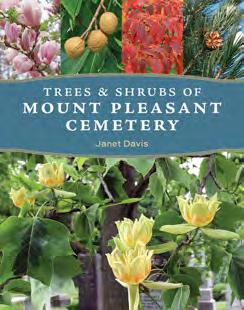
JANET DAVIS lives just seven minutes from Toronto’s historic Mount Pleasant Cemetery and she has been photographing the trees and shrubs there for over 30 years. As she is a renowned garden writer/photographer it’s no wonder that those photos are now featured in an engaging, full-colour book Trees & Shrubs of Mount Pleasant Cemetery, published by Firefly and commemorating the 200th anniversary of the Mount Pleasant Group of Cemeteries. Some 25 years ago Janet decided to pitch a publisher to do a book on the cemetery’s arboretum, but they turned her down. “Maybe it’s just as well,” she says, “as the images were on slides and had to be scanned. Now they are mostly digital which is both easier to work with and better.”
Not long ago, while talking to Firefly Publishing about a book on colour “I happened to mention that I had photos of
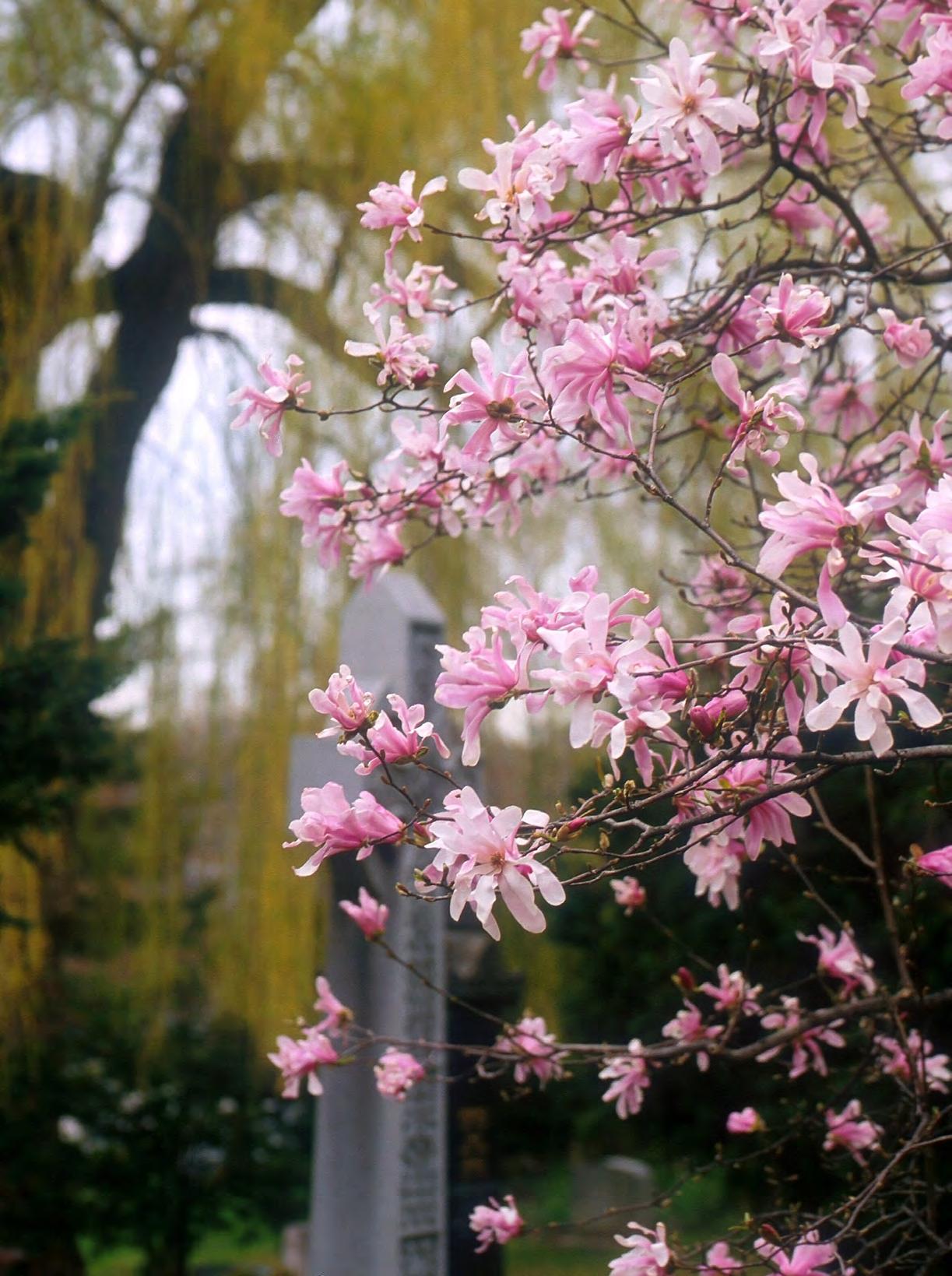
Magnolia x loebneri ‘Leonard Messel’ in Spring
Mount Pleasant Cemetery,” she said. “And they were interested in that. But that was July 15 and they wanted it by September 15 because of the anniversary.”
So, while her kids and grandkids were swimming and enjoying cottage life last summer “I was typing away in the kitchen,” she recalls. “But I made the deadline.”
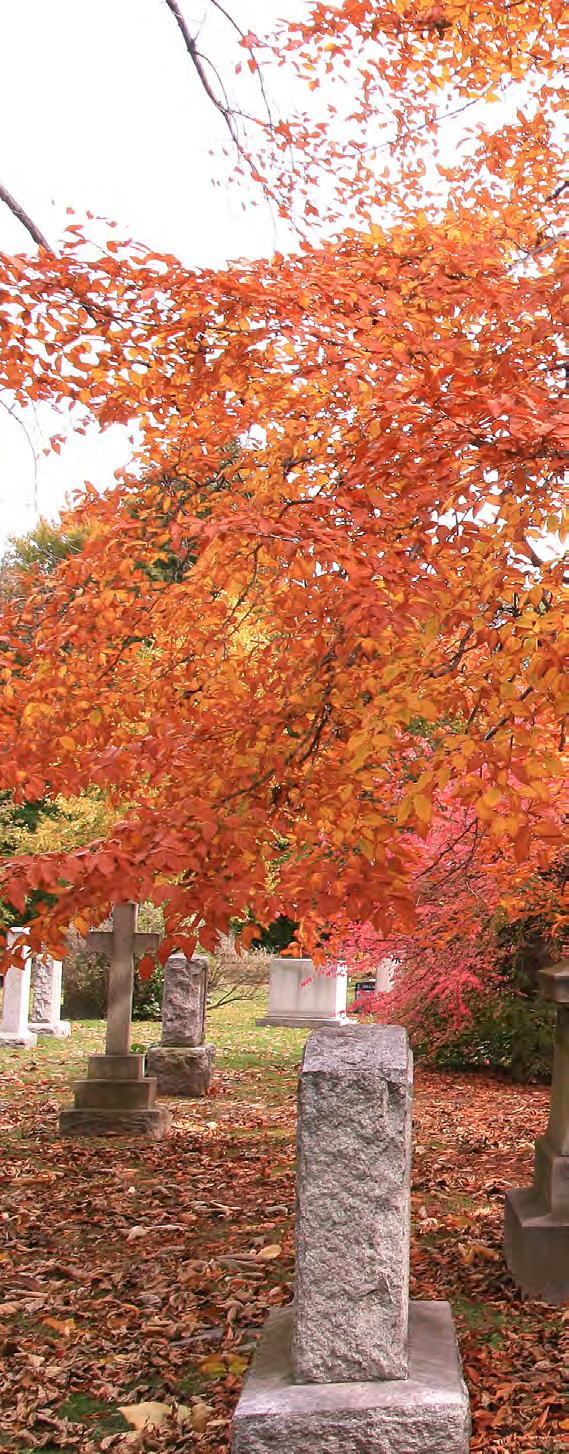
In addition to being the final resting place for many prominent Canadians including former Prime Minster William Lyon Mackenzie and insulin inventors Frederick Banting and Charles Best, the cemetery is an arboretum with over 600 species of trees. Just about anything that can grow in our climate can be found there from weeping willows to towering Carolina poplars, ginkos and maple trees. No wonder it has been designated a National Historic Site of Canada.
BTW did you know that Mount Pleasant Road was built and named after the cemetery—and not the reverse—and runs through the middle of the graveyard, splitting it in half?
Janet’s book is dedicated to former Mount Pleasant Group arborist Jack Radecki, with whom she had many conversations during her more than 170 visits to the site, and to current arborist Daniel Chevalier and “all the gardeners and groundskeepers who understand the importance of trees to our city”.
Trees & Shrubs of Mount Pleasant Cemetery was launched at the Toronto Botanical Garden on May 1, when Janet gave a slide presentation of some of her favourite trees at the cemetery. You can purchase the book at the TBG Garden Shop.
Janet Davis started taking pictures with a Pentax camera when her children were little. “I enjoyed it and when I started writing I took photos to accompany my articles. Eventually the photography took over.” (Incidentally, Janet’s first published article was printed in Trellis in 1988. Titled The Garden Diary it was about “charting nature’s progress in your own backyard.”)
Since then, she has become an award-winning freelance writer, photographer and blogger specializing in gardening, nature and travel. Her work has appeared in the Toronto Star and both the Toronto Sun and the National Post where she had weekly gardening columns. Her gardening photos have appeared in numerous books and magazines, on packaging materials and websites.
The other book that Janet was initially discussing with Firefly is about her real passion—colour-specifically, how to understand it and use it effectively in the garden, picking flowers, foliage and furnishings that work beautifully together. Choosing photos for the book from the thousands of plants and creative combinations in a rainbow of colours, Janet has photographs from the hundreds of beautiful gardens she has visited in her long career, a challenge on which she is currently working. A Garden Paint Box will be published in Spring 2027.
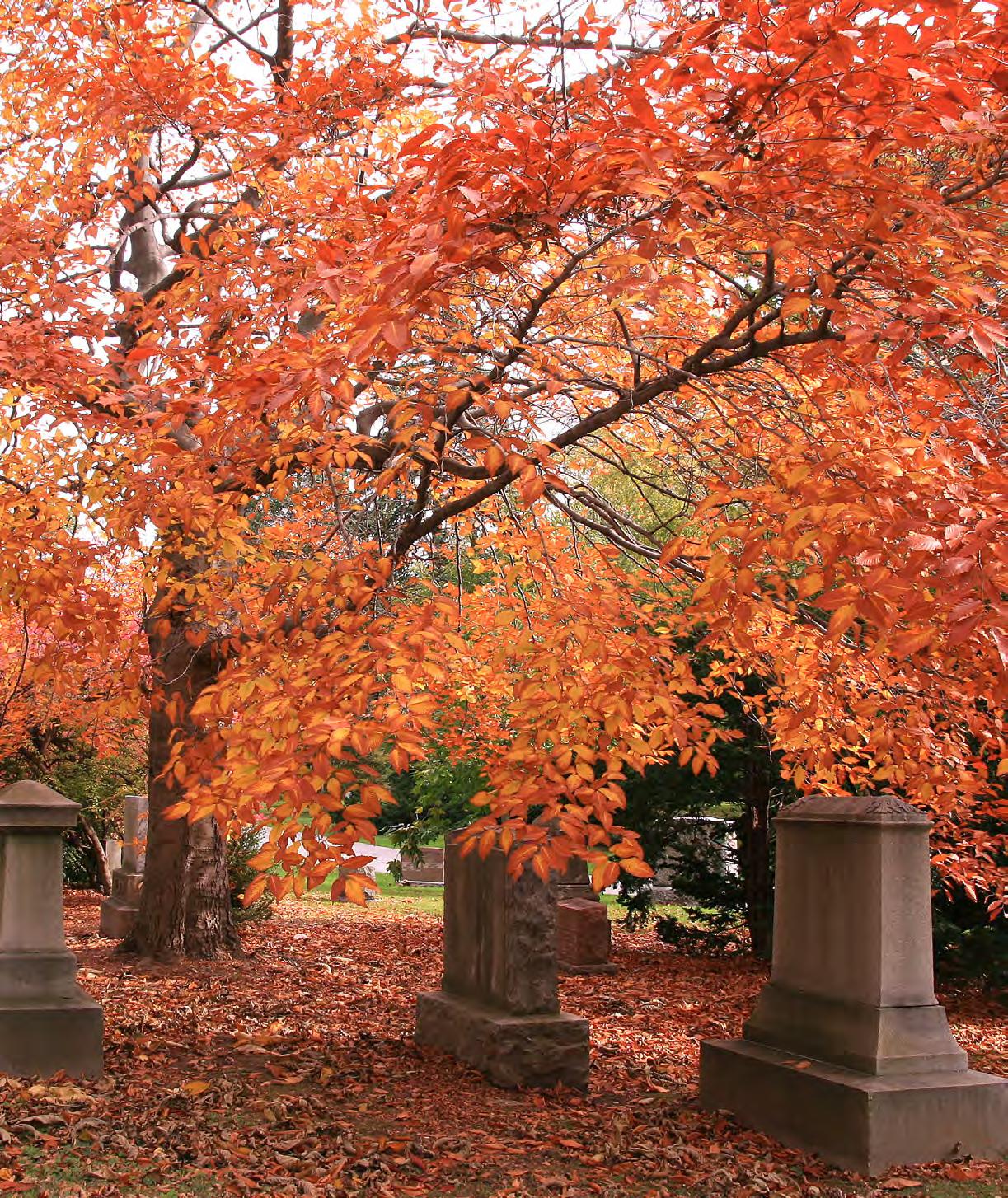
American Beech (Fagus grandifolia) in Autumn
A Season of Discovery at Edwards Gardens and Toronto Botanical Garden where strangers can linger, encounter one another and feel they belong
By Liann Dsouza and David Scrivener Photos by David Scrivener
a PLACE of LOVE & LOSS
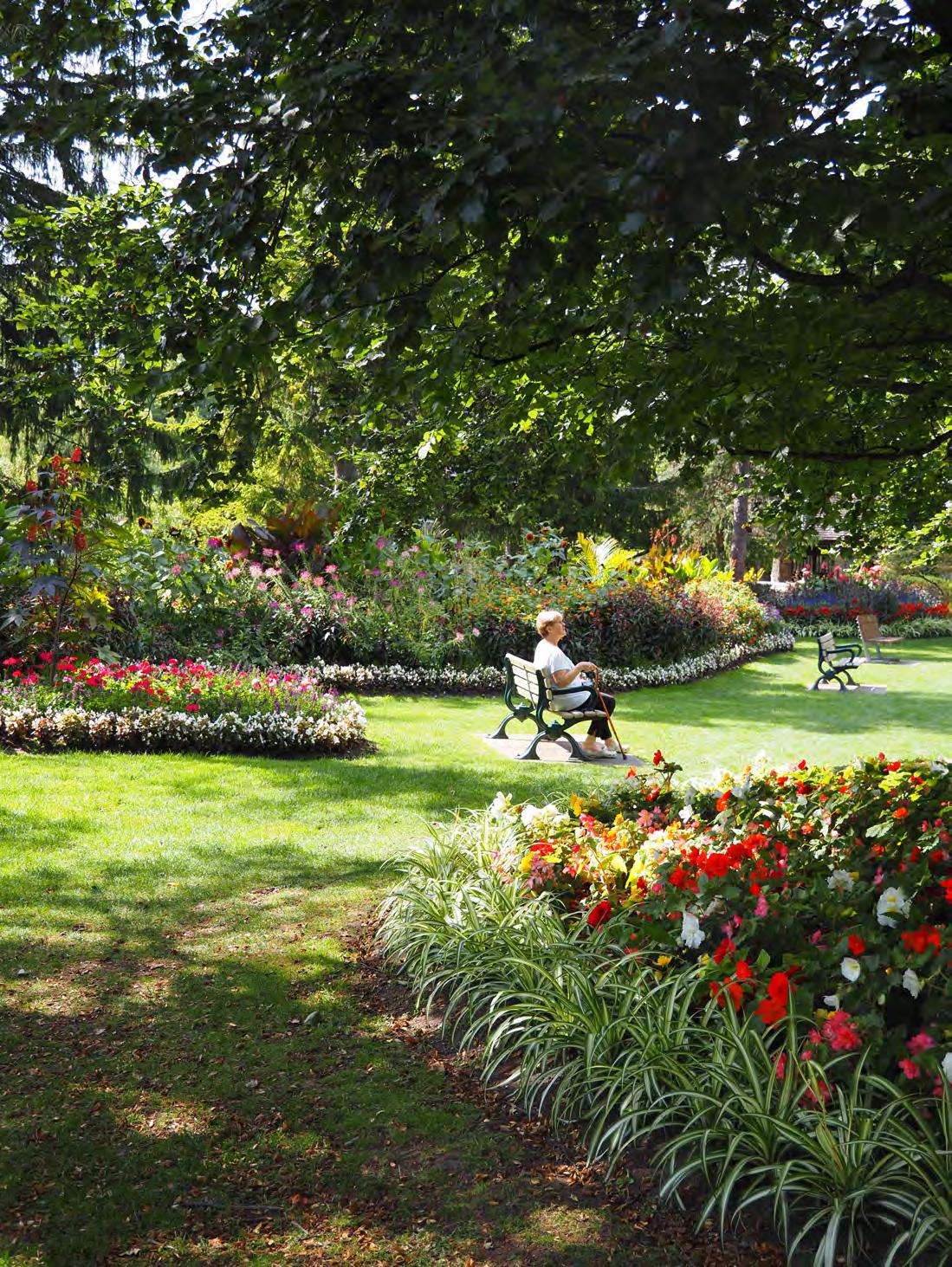
oN A COOL AUTUMN afternoon, three wedding parties wait their turn at the rustic bridge over the ravine at Edwards Gardens. A photographer adjusts her lens, capturing a couple framed by golden maples. Nearby, an elderly woman sits quietly on a memorial bench dedicated to someone’s beloved mother, watching leaves drift into the stream below. Further along the path, a young couple pauses by an old
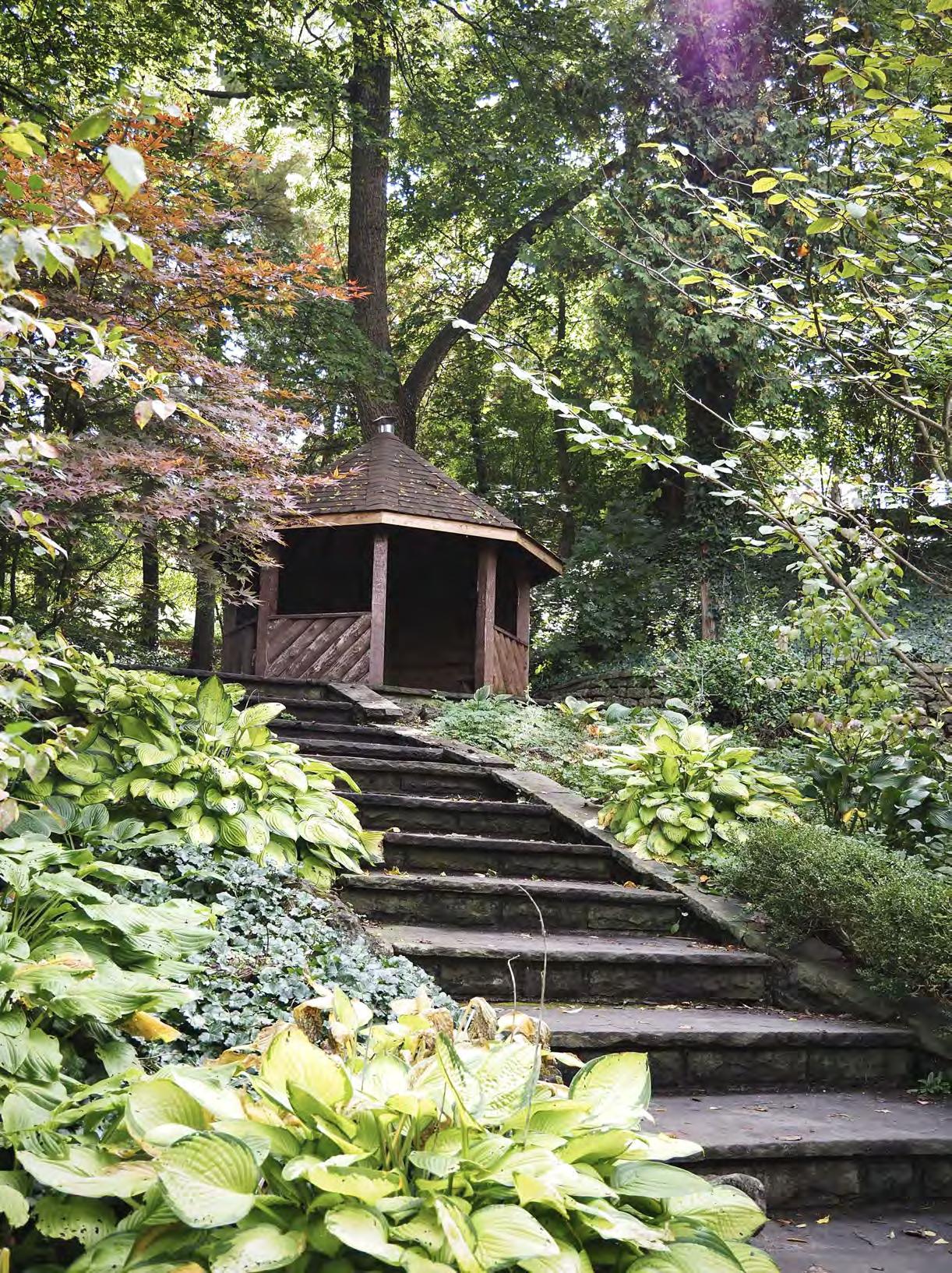
gazebo, their hands tracing carved initials in the weathered wood: initials that were probably etched decades ago by someone else in love.
This is the everyday choreography of Edwards Gardens and the Toronto Botanical Garden (TBG), a landscape where celebration and remembrance, joy and reflection, exist side by side without contradiction. Over the course of a fall semester, we set out to understand how these adjoining gardens function as shared civic spaces, and what we discovered surprised us. These 70-year-old grounds have quietly become something remarkable, a place where Toronto’s diverse communities mark life’s most meaningful transitions, from proposals to farewells, all within the same welcoming landscape.
Two Gardens, One Experience
ALTHOUGH EDWARDS Gardens and TBG operate under different management—the City of Toronto oversees Edwards Gardens, while TBG functions as a nonprofit—most visitors experience them as a single, continuous landscape. And that continuity matters.
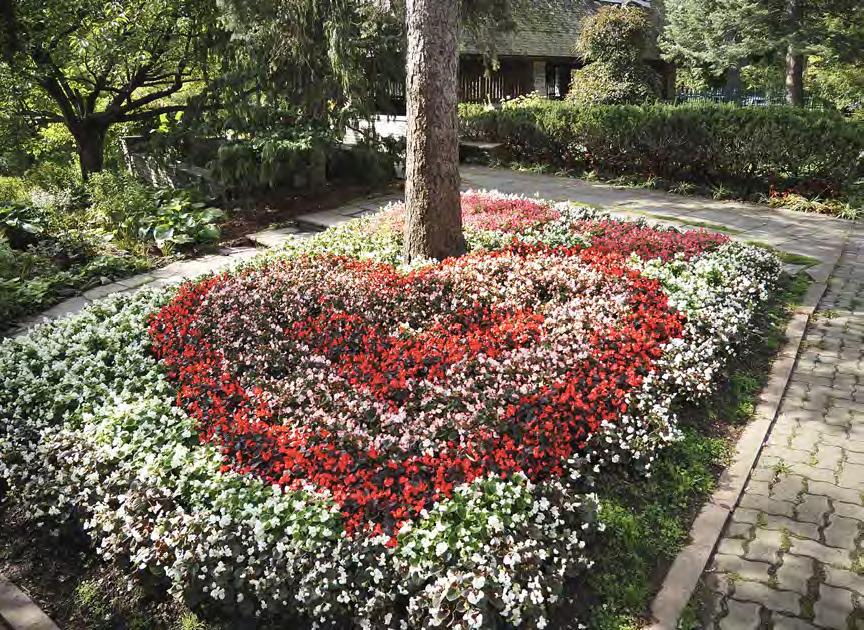
Edwards Gardens carries the formal vocabulary of English garden design, sweeping lawns, carefully framed views, arched bridges and the iconic Moriyama Pavilion. These structures function as ready-made stages for life’s
celebrations. The long staircase descending into the ravine, the bridges that arch gracefully over water, even the central fountain when it sits dry in autumn, all provide the axial symmetry and balanced compositions that make them irresistible to photographers.
Meanwhile, TBG takes a different approach. Here, naturalistic plantings dominate. Pollinator meadows buzz with late-season insects, rain gardens demonstrate water-wise design and demonstration beds showcase ecological practices. The emphasis is on habitat, succession and learning, a living classroom where seasonal change is not tidied away but embraced as part of the garden’s teaching mission.
“We’re trying to embrace the nature and the ecology around us,” explains TBG’s lead horticulturist Leslie Hockley during a conversation about the garden’s maintenance philosophy.
tHAT ACCEPTANCE of natural processes
shapes everything from which leaves get cleared, high-traffic paths, yes, meadow edges, no, to how decay is understood, not as neglect, but as renewal.
The coexistence of these two design approaches does something unexpected. It broadens who can find meaning here. Wedding parties gravitate toward the formal
structures, while birders explore the naturalized zones. Families spread picnic blankets on manicured lawns and contemplative visitors seek out quiet benches tucked among native plantings. The garden accommodates it all.
Hearts on Bridges, Initials in Wood
OUR MAPPING project revealed distinct patterns in how people express love across the landscape. Professional wedding photography concentrates overwhelmingly at a handful of photogenic landmarks: the bridges, the pavilion, the grand staircase. These locations offer the visual drama that marks life’s milestone moments, crossings, transitions, thresholds.
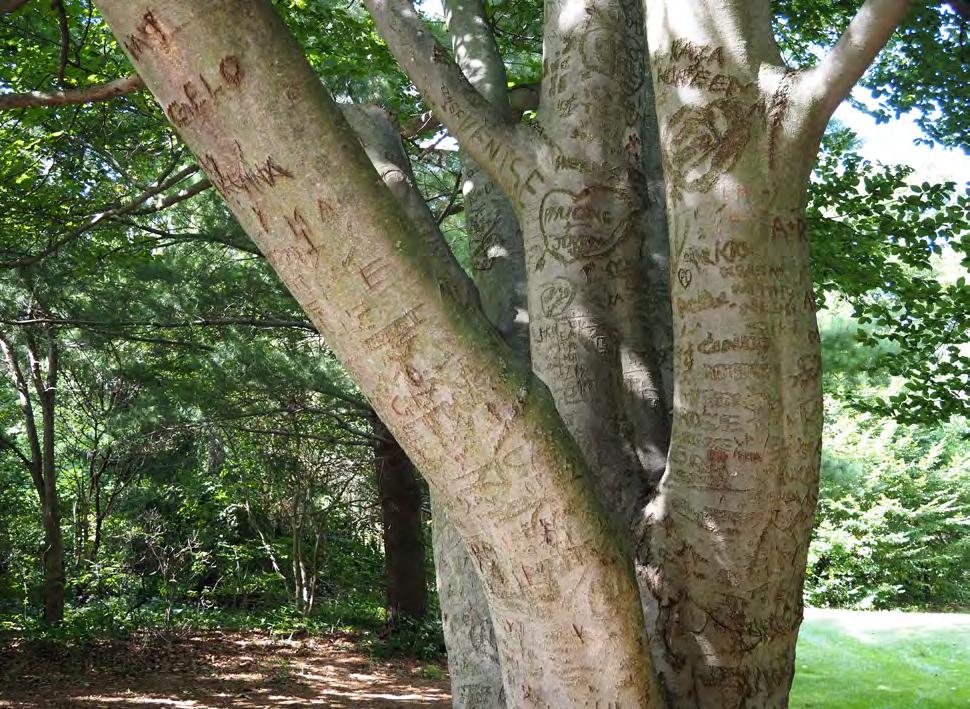
But romance takes a quieter form in less monitored corners. Carved initials appear on older benches, on the wooden gazebo near the stream and on select tree trunks in semi-secluded areas. “J + M 2018.” “Forever.” “Always.” These inscriptions cluster just beyond the main paths, in spots where privacy and impulse intersect.
Staff gently discourage carving, but the horticulturist acknowledges a surprising truth. Superficial bark wounds on healthy trees typically compartmentalize and heal. “The emotional weight these acts carry for visitors,” she notes, “often exceeds their actual horticultural impact,” unless, of course, someone targets a rare specimen.
The result is what we have come to think of as a palimpsest (written layers) of affection. Front-stage love is celebrated in the open, captured in professional photographs that will be framed and shared. Back-stage love is etched at the edges, small declarations that most visitors will never notice but that accumulate over time into the garden’s evolving folklore.
Remembering in Public MEMORIAL
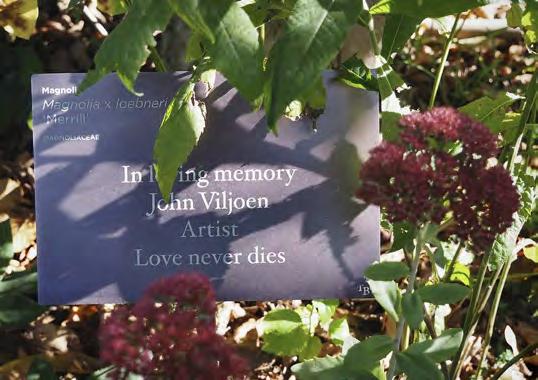
BENCHES, plaques and dedicated trees are distributed throughout both gardens which speaks to how deeply people want to anchor memory to this particular landscape.
But formal memorialization is only part of the story. Families also scatter ashes in quiet corners or around memorial trees, sometimes leaving small tokens, flowers, photographs, stones, in places that held meaning for someone they loved. While these practices are not officially sanctioned, they occur often enough that horticultural staff have developed an informal protocol. When ashes appear to have been placed, crews adjust their work to leave the area undisturbed.
This accommodation reflects a profound understanding of what the garden means to its community. It is not just a designed landscape to be preserved in amber, but a living space where private gestures of grief can coexist with public access.
Our autumn photo documentation captured this layering viscerally. Brittle leaf carpets under maples, stormfelled branches stacked by maintenance crews, fading annuals going to seed, the dry fountain collecting leaves beside meticulously tended beds. Seasonal decay was everywhere, and it was beautiful. What is cleared and what is left reveals the maintenance pattern, a deliberate
choreography
that balances tidiness with tolerance for natural process.
Elderly visitors and those using mobility aids often pause near memorials in reflective quiet. Families and wedding groups animate nearby spaces with laughter and movement. Joy and mourning, activity and stillness appear side by side, and somehow it works.
The Care That Makes Space
PERHAPS THE most important finding from our months of observation is this. Inclusive civic gardens depend as much on maintenance philosophy as on design. The decision to respect memorial areas, to tolerate benign inscriptions, to leave seed heads standing for winter interest, to gently redirect rather than punish—these small acts of care create the conditions that allow diverse communities to feel welcome.
The horticultural team at TBG and the parks staff at Edwards Gardens are not just maintaining plants. They are maintaining relationships between people and place. They plant, prune, repair, teach and guide. They inspect memorial plaques after storms. They try not to disturb suspected ash placements. They offer gentle correction when they encounter someone carving a tree, explaining the impact while recognizing the impulse.
This labour is both physical and emotional. And it is what transforms a beautifully designed landscape into genuine public space, a “third place” that is neither home nor work, where strangers from diverse backgrounds can linger, encounter one another, and feel they belong.
A Garden for All Seasons of Life
FREE ADMISSION helps, of course. So do accessible paths, bridges that accommodate mobility aids and benches positioned for rest and contemplation. But what makes Edwards Gardens and TBG truly inclusive is something less tangible, the way the landscape holds space for contradiction. It is a place where a couple can pose for their engagement photos on the same bridge where, years later, they might scatter a parent’s ashes. Where children chase each other across lawns while someone nearby reads a memorial plaque through tears. Where the carved hearts of teenagers long grown exist alongside the formal dedication of a bench to a life well-lived.
The gardens function, in the language of cultural theory, as a heterotopia, a place where different, even opposing,
social meanings coexist. Joy and grief. Celebration and mourning. Careful cultivation and intentional decay. The formal and the wild.
For over 70 years, countless visitors have marked beginnings here, honoured endings and continually returned. Through this repeated engagement, the space has come to belong to its community, and the community, in turn, has come to belong to the space. Carved hearts and polished plaques sit comfortably beside seed heads and leaf litter, forming an ecology where people and plants move together through visible cycles of growth, memory and change.
On that autumn afternoon when three wedding parties waited at the bridge, when the elderly woman sat in contemplation, when young lovers traced old initials, the garden was doing what it does best. It was holding all of it, the love, the loss, the laughter, the silence. It was being a place where Toronto can be fully itself, in all its messy, beautiful complexity.
And it was, as it has been for seven decades, simply and profoundly enough.
Liann Dsouza is a botanist, environmental scientist and volunteer at Toronto Botanical Garden. David Scrivener is a researcher whose work explores urban public spaces. This article is adapted from ethnographic research conducted for a project with Dr. Aditi Mehta in the Department of Geography and Planning at the University of Toronto in fall 2025.
SEND US YOUR MEMORIES Dear Readers: Do you have a special memory or reflection about Toronto Botanical Garden and/or Edwards Gardens? If so, please click here to share your story
Captivating
Sniffing out delightful scents provides a respite for the soul
By Carol Gardner
IS THERE ANYTHING more evocative than the sudden hint of a treasured scent? It brings up memories, emotions, whole scenarios that we thought we had forgotten. My dad always wore cologne––Old Spice––and whenever I encounter that scent (sadly, very seldom these days), I turn around to see if he’s there. It’s highly unlikely, as he’s been gone for 50 years, but
scent outwits logic every time. Some years ago, we had a 90-year-old friend who also always wore cologne and, after I commented on it, whenever we would meet, he would whisper, “I wore the cologne you like.” Ah, where has that kind of charm gone? Even fictional characters are known by their scent. Chief Inspector Armand Gamache, the hero of writer Louis Penny’s books, is known for his favourite sandalwood scent. But I digress…
IN THE SUMMER, we gardeners need to travel no farther than our own gardens to experience amazing scents, but, in a Canadian winter, our deprived senses seek something––anything––to fill the gap. Experimenting with perfume is a glorious alternative in any season. As Toronto-based global fragrance expert, Marian Bendeth says, “Perfume is like cocktails without the hangover, like chocolate without the calories, like an affair without tears, like a vacation from which you never have to come back.”
My grandmother wore the extravagantly named Cupid’s Breath; my mother was always enveloped in White Shoulders. Clearly, I had no choice. Beginning with a light lilac scent as a teenager, I proceeded through a number of other choices as I grew. However, I never found ‘the one’, so, on a trip to Paris, I signed up for a perfume workshop–L’ABC du Parfum (https://abcduparfum.fr) held by chemist and perfumer Marina Jung Allégret.
Ooh la la! Entering a lovely old apartment with high ceilings, large windows overlooking the city and a sprinkling of elegant antiques, I felt as if I had stepped into the past. There were seven other students, women of mixed ages and nationalities. We had at least one thing in common: we were all dead keen. The table set up in front of us was filled with hundreds of vials of essential oils––from flowers, fruits, woods and bark to resins and balsams, spices and seeds. It was like being a child in a candy store, knowing you can only have so many, but wanting them all.
We learned that perfumes are made up of three ‘notes’–30 per cent top notes, 50 per cent middle or heart notes and 20 per cent base notes. The top notes are the ones that create the first impression, and they are generally light and fresh, like citrus, fresh herbs and spices, fruits and light florals. They vanish quickly, yielding to the middle or heart notes that are more long-lasting––floral (rose, jasmine, ylang-ylang, geranium), herbal (lavender, mint, chamomile and spicy (ginger, cinnamon). The base notes are heavy––sandalwood, vanilla, patchouli, amber and musk—and provide more longevity. These are combined with jojoba oil or perfumer’s alcohol to act as a carrier and to enhance scent.
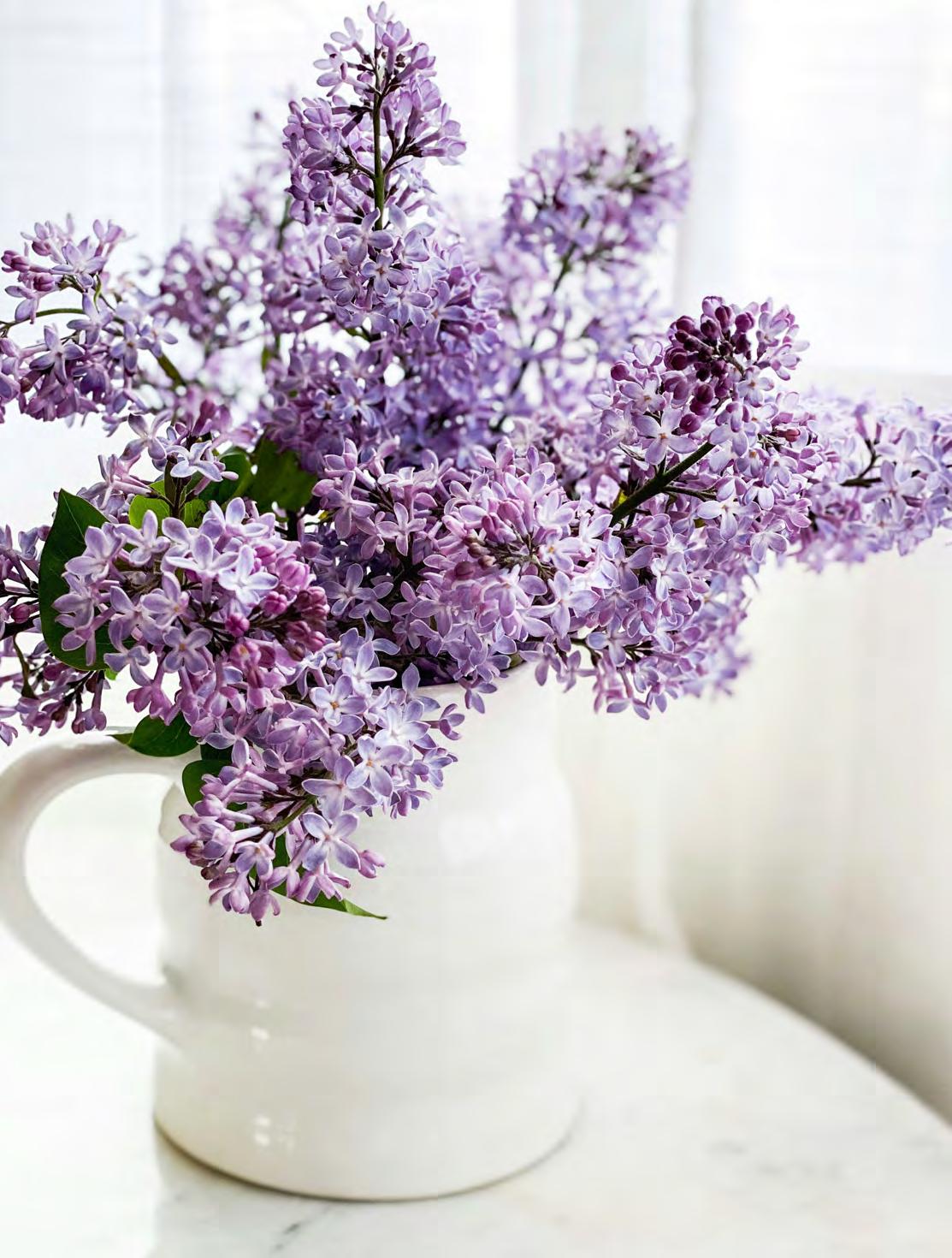
We began by sniffing the scents, keeping those we might want to use in separate vials. I wanted something light and reminiscent of spring, so I started with the floral scents––lily of the valley, jasmine, tuberose. Being a gardener, I figured those were the ones I would like, but, as lovely as those scents were, I found them too heavy for me. In fact, the final perfume I made was almost all fruits––pear, melon and citrus, with a little ginger and cinnamon thrown in. It was interesting to look around at the other students and guess what they had chosen….and, in many cases, I guessed correctly – the more glamourous of the women used the floral scents – not light and springlike, but heavy, dark and dangerous. Everybody’s perfume seemed a perfect match with their persona. I, au contraire, smelled like a bowl of fruit. Let’s not analyze that.
We all came away with the formula for our own perfume so that we could make it at home. I quickly learned that making it was much too expensive––good essential oils are not cheap, and, if you want a selection to choose from, you had better be ready to sell your car. I now order bottles from ABC (they keep everyone’s formula) and find that much less expensive.
USING SCENT IS, of course, not a new thing; it has been used since ancient times. Originally, it was thought to be a link between humans and the divine. It is said that Cleopatra insisted on having her ship’s sails coated with perfume, announcing her arrival with flair. Well, let’s face it, she was always a bit of a showoff. Much more recently, Coco Chanel’s original perfume, Chanel No. 5, is still earning a small fortune. It uses neroli (an essential oil extracted from the bitter orange tree), ylang-ylang (an essential oil extracted from the flowers of the tropical bergamot, jasmine and May rose ( generally grown in Grasse, the heart of the French perfume industry.
Speaking of Grasse, if you want to get into making perfume in a big way, there’s no better place to learn. The Grasse Institute of Perfumery https://www.grasse-perfumery.com has an 18-month course that will train you to be, as the French say ‘a nose’. Your nose is probably the only body part you’ll have left, as you’ll have to sell the rest to pay the fee of approximately $23,000 Canadian dollars.
However, there are a large number of perfume work shops offered in Toronto (just Google) for a much more reasonable fee. Besides, the soul needs an occasional respite from the harshness of the world, so why not treat yourself to a day sniffing out delightful scents?
“Everybody’s perfume seemed a perfect match with their persona. I, au contraire, smelled like a bowl of fruit.” -CAROL GARDNER
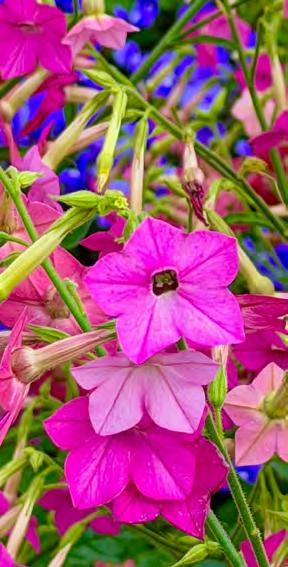
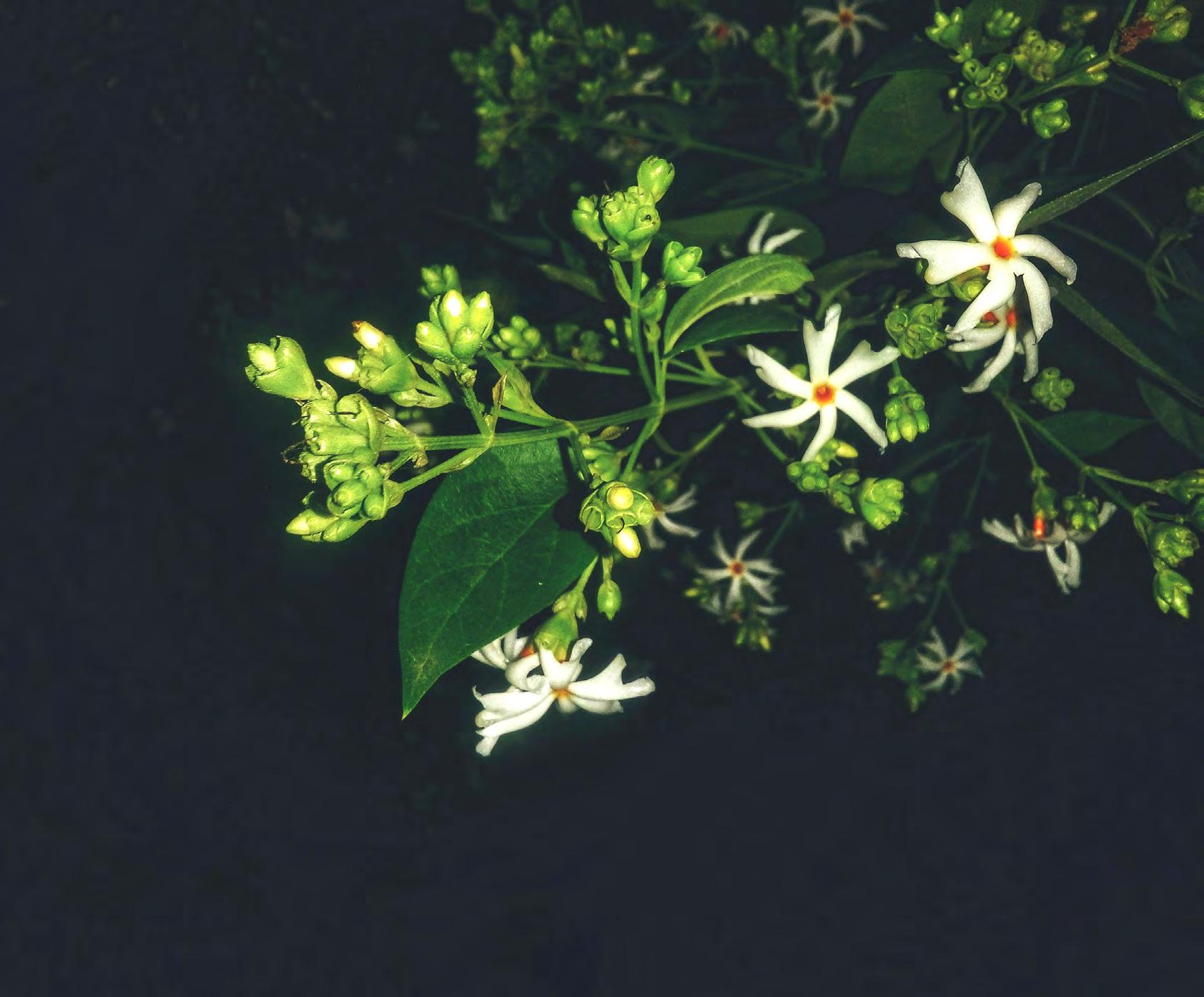
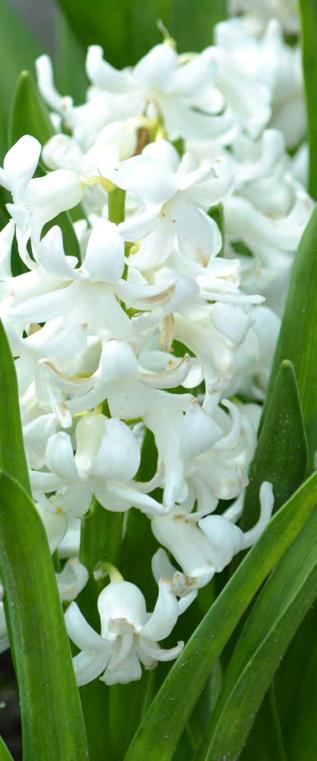
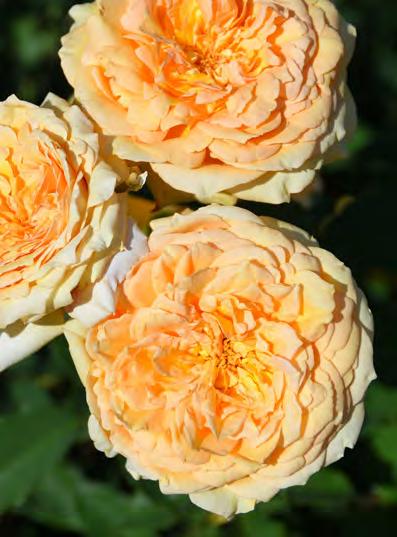
fragrant flowers
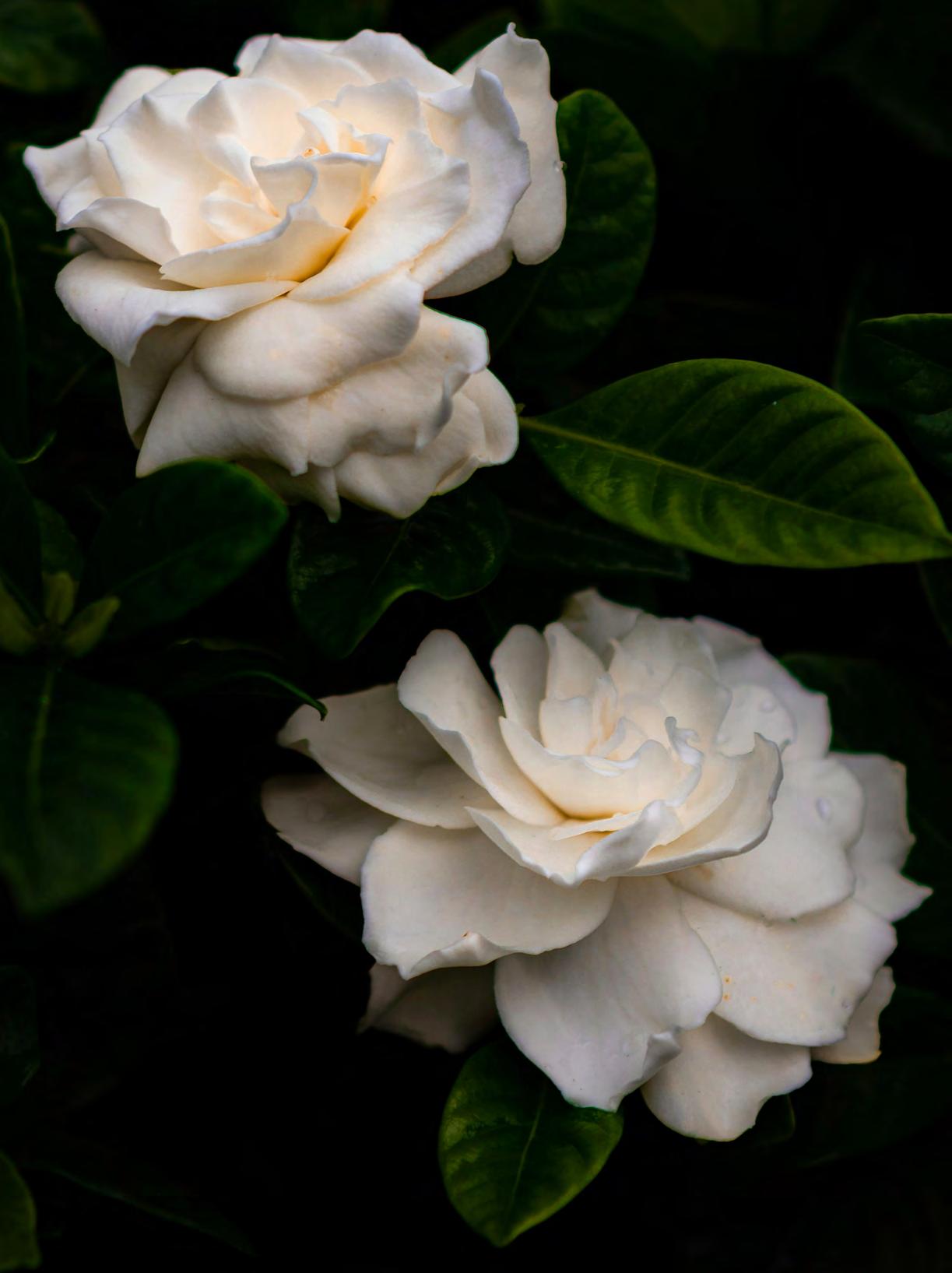
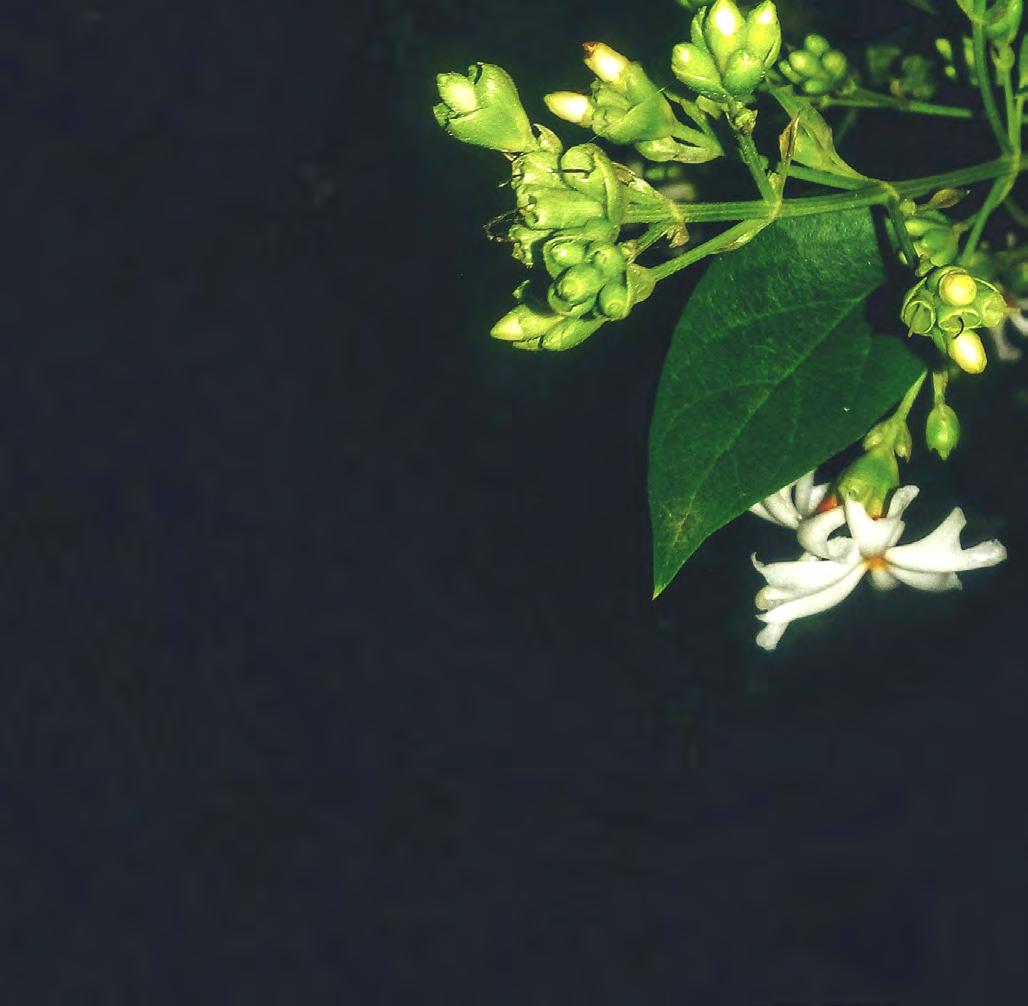
1. Hyacinth 2. Scented Roses
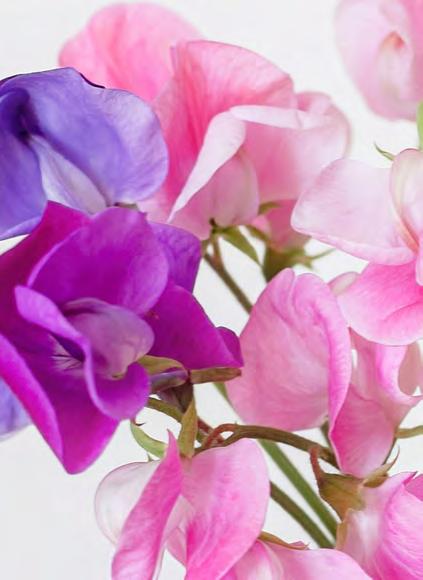
3. Sweet Pea 4. Russian Sage 5. Heliotrope 6. Night Blooming Jasmine 7. Nicotania
INDUSTRIAL WASTELAND TRANSFORMED INTO A STUNNING NATURALIZED PARK ON TORONTO’S WATERFRONT
“Is
this going to be worth it?” my husband asked skeptically as we headed south battling the Don Valley Parkway traffic on a sunny week day morning to the new Biidaasige Park at the Toronto waterfront. Several hours later on the way home, he had to
admit that
it was definitely worth it, and
that we
would be heading back—often—in the near and distant future.
PARK BIIDAASIGE
By Lorraine Hunter Trellis
Editor
WHETHER YOU are a walker, a runner, a cyclist, a paddle boater or a bird watcher you will love Toronto’s largest park to open in a decade. The kids, the grandkids, the grandparents and even the dog will love this new public green space.
A once derelict industrial wasteland at the foot of the Don Valley Parkway has been transformed into a new park system situated on what now looks like a natural waterway. This constructed landscape was built primarily for flood protection and will soon see residential development.
“SUNLIGHT SHINING TOWARDS US”
BIIDAASIGE (meaning “sunlight shining toward us” in Anishinaabemowin) Park covers more than 50 acres on an island carved out in the Port Lands with an additional 10 acres of park land set to open this summer. Located at 51 Commissioner’s Street near Cherry Street on Ookwemin Minising Island (meaning “place of the black cherry trees”), the park celebrates waterway restoration and reconstruction.
Prior to the 1890s, the Port Lands area was a marsh at the mouth of the Don River. In 1912 Keating Channel was completed to divert the Don westward into Toronto Harbour via a 90-degree turn. Subsequently, over decades, the marsh was filled in to create an industrial area. The 90-degree turn of the Don River made the area vulnerable to flooding, preventing redevelopment in the Port Lands.
In 2001, the federal and provincial governments along with the City of Toronto, created the Toronto Waterfront Revitalization Corporation to rehabilitate and develop the city’s waterfront. It created the Port Lands Flood Protection (PLFP) project. PLFP was born out of years of community advocacy, environmental assessment, a 2007 design competition and due diligence work to build the business case. The tripartite governmental funding was secured in 2017. Many of the industrial structures in the area were demolished in order to create a new river bed south of Commissioners Street. Construction for a new river channel was started in 2017.
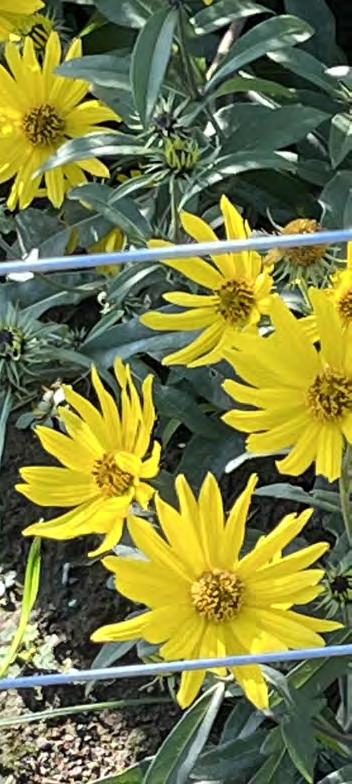
Maximilian’s Sunflower
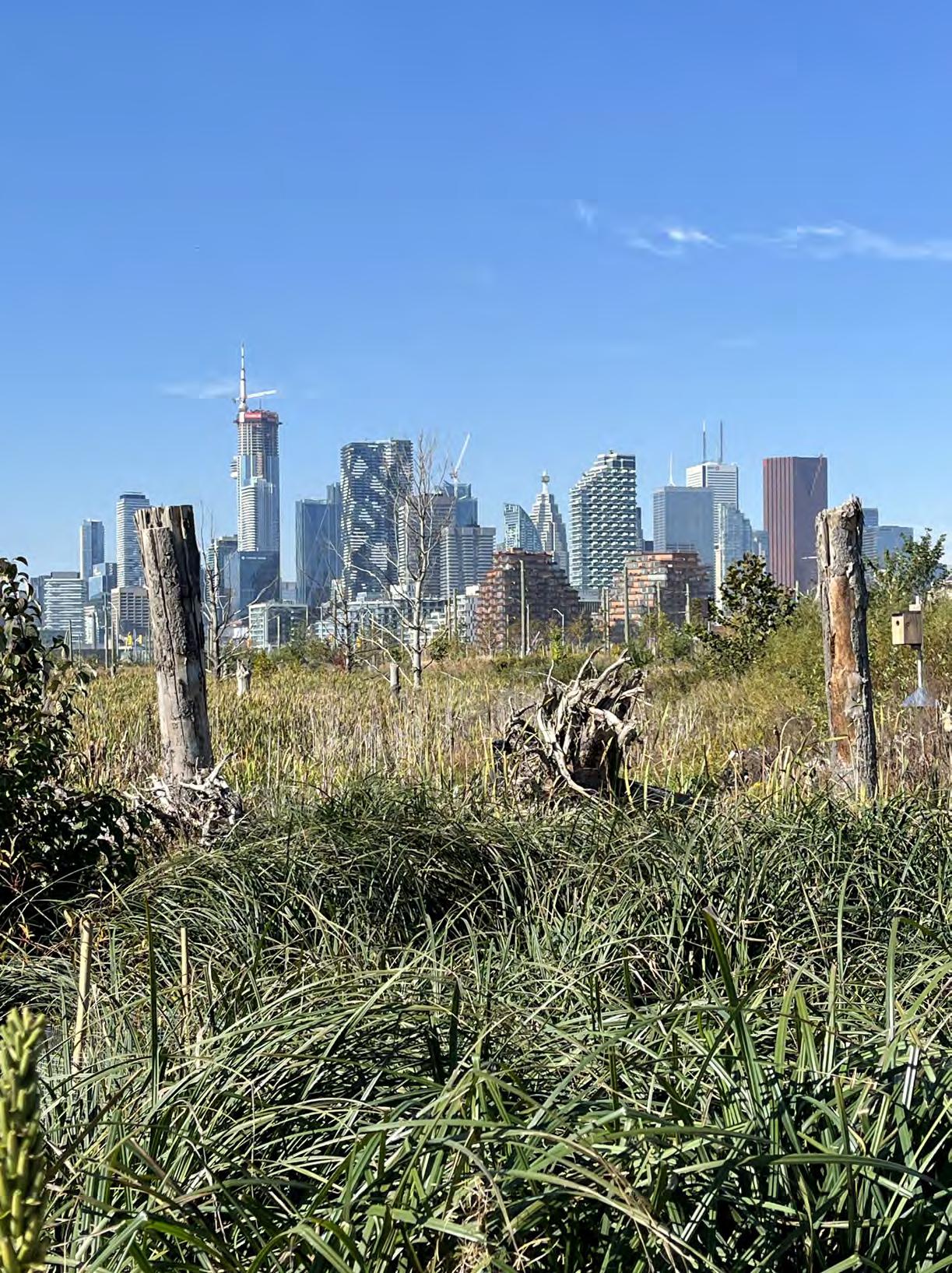
Downtown Toronto skyline from the Port Lands.
RIVER MOUTH REROUTED
AS PART OF the project, the mouth of the Don River was rerouted and naturalized, south and west into the Port Lands. The new river banks between Commissioners Street and Toronto Harbour became the park. Costing about $1.4 billion, it’s funded by the City of Toronto, the province and the federal governments, all partners in Waterfront Toronto.
Once an industrial wasteland, Ookwemin Minising is now safe for human and animal habitation. And it has not taken long for eagles, turtles, snowy owls, swans and redtailed hawks to move in.
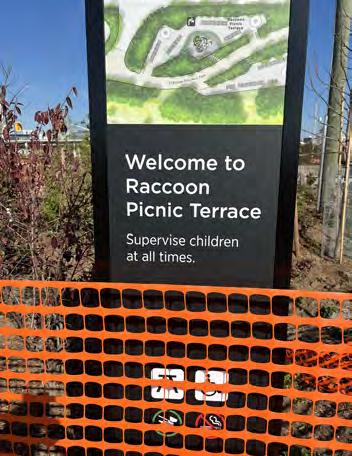
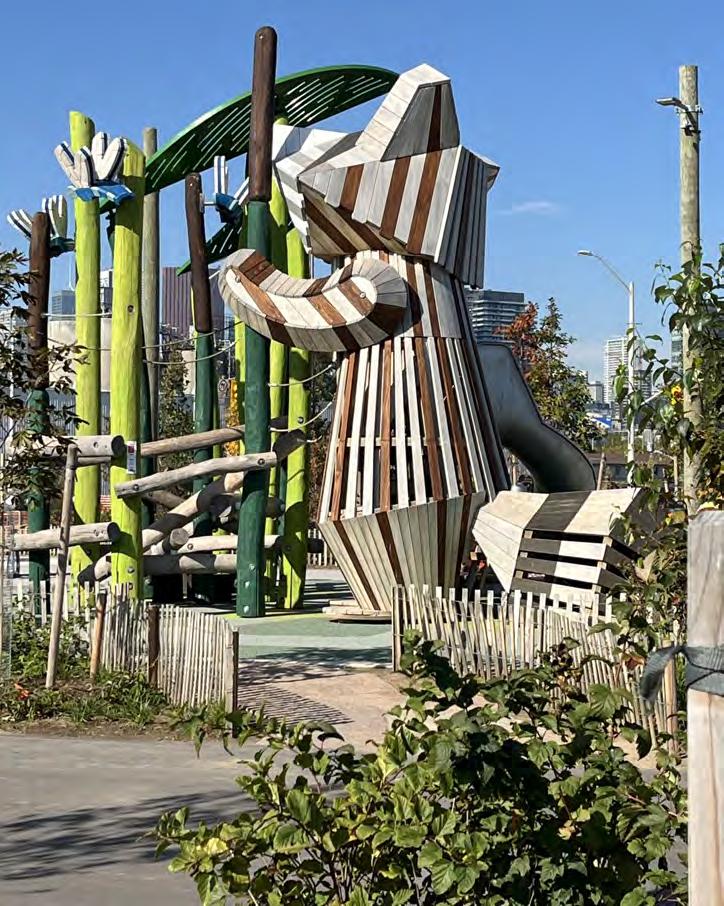
The first section of Biidaasige Park opened to the public last summer, marking the first public space to open on Ookwemin Minising, alongside the transformed Don River. The park has numerous picnic areas and barbecues and a children’s playground like none other, featuring larger-than-life animals and play structures including Snowy Owl Stage, Reaching Raccoon play structure, a zipline and a waterplay structure inspired by the Cheltenham Badlands near Caledon, Ontario.
There are recreational trails and cycling paths and The Don Greenway, a wetland ringed with a trail for bird
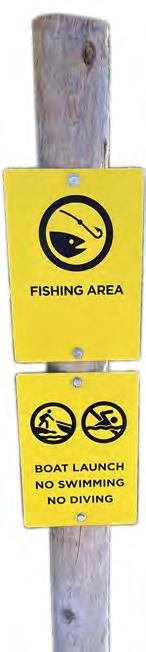
watching. Steps down to the river are for fishing and there is a pebble landing where you can launch a non-motorized personal watercraft.
The new green space includes 5,000 trees, 77,000 shrubs and two million herbaceous plants including native plants chosen in collaboration with indigenous communities to reflect the native ecology of the ecosystem and to represent plants that have medicinal and cultural significance for indigenous communities. Such species include Sacred Tobacco, White Sagebrush, Staghorn Sumac, Black Cherry, Sweet Grass, St. John’s Wort and more, highlighted in interpretive signage.
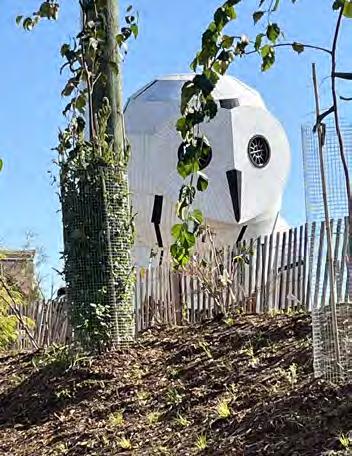
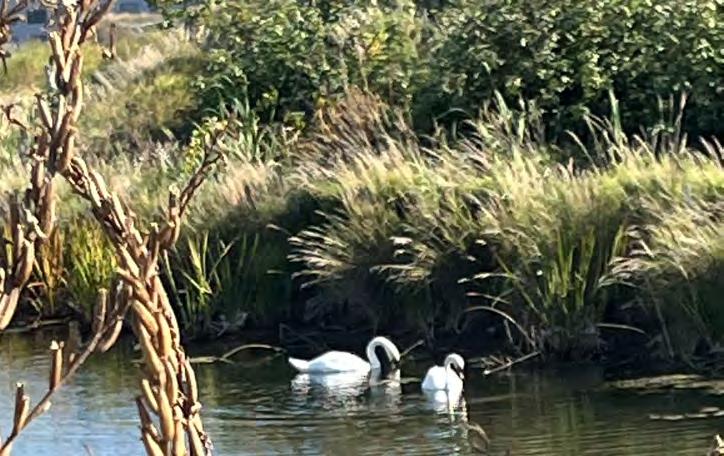
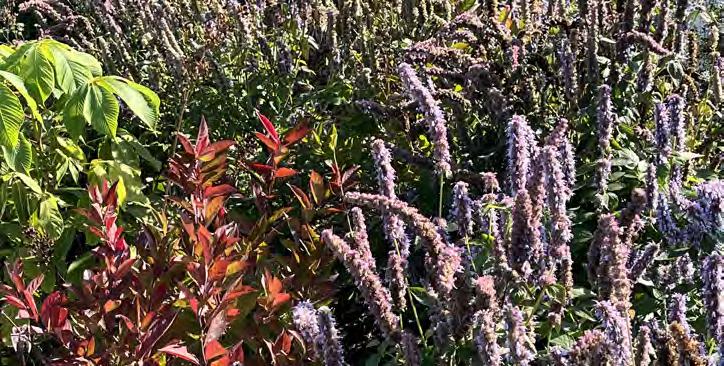
TOP LEFT: Snowy Owl Stage, a giant climbable structure. TOP RIGHT: Swans are among the many birds and animals that have moved into the park. ABOVE: The space includes two million herbaceous plants.
SIGNAGE HIGHLIGHTS HISTORY
INTERPRETIVE
SIGNAGE throughout the park highlights the Port Land’s history, the park’s construction, its unique physical, cultural and environmental features and its indigenous significance.
Outlooks throughout the park offer views of the Inner Harbour and Toronto Island Park, the Don River, Toronto skyline, Lower Donlands and Port Lands extending to Cherry Beach Clarke Beach Park and Tommy Thompson Park.
There are two off-leash dog areas, each with seating, K-9 rated artificial turf, accessible pathways and gates, water fountains and waste bins.
Since the asphalt is new at both the 800 sq metre area west of Cableway Canyon in the Adventure Playground and the 1,200 sq metre area east of the Old Fire Hall 30, paw protection for dogs is recommended.
And because the newly planted trees have yet to grow, there is limited shade, so sunhats, sunglasses, sunscreen and water bottles are recommended for human visitors. There are water filling stations in the park.
The new section of Biidaasige Park, west of the Cherry Street bridge, is expected to open this summer. Long term vision for the island includes:
• Over 12,000 new homes, more than 21,000 residents, nearly 3,000 jobs;
• Connecting the 60 plus acres of parkland delivered through the Port Lands Flood Protection (PLFP); plus, some 15 acres of additional parks still to be built on the island;
• Extending waterfront transit along Queen’s Quay East into the Port Lands with the Waterfront East Rapid Transit Line;
• A complete community with an elementary school, recreation centre, library and child care centres.
The Lassonde Art Trail a free immersive outdoor experience, opens this year with a mixture of permanent and temporary public art installed throughout the park system.
Parking is limited but the 114 Queen’s Quay bus stops there and the Martin Goodman Trail runs through it.
Reaching Raccoon play structure in
The Uplands play area.
“
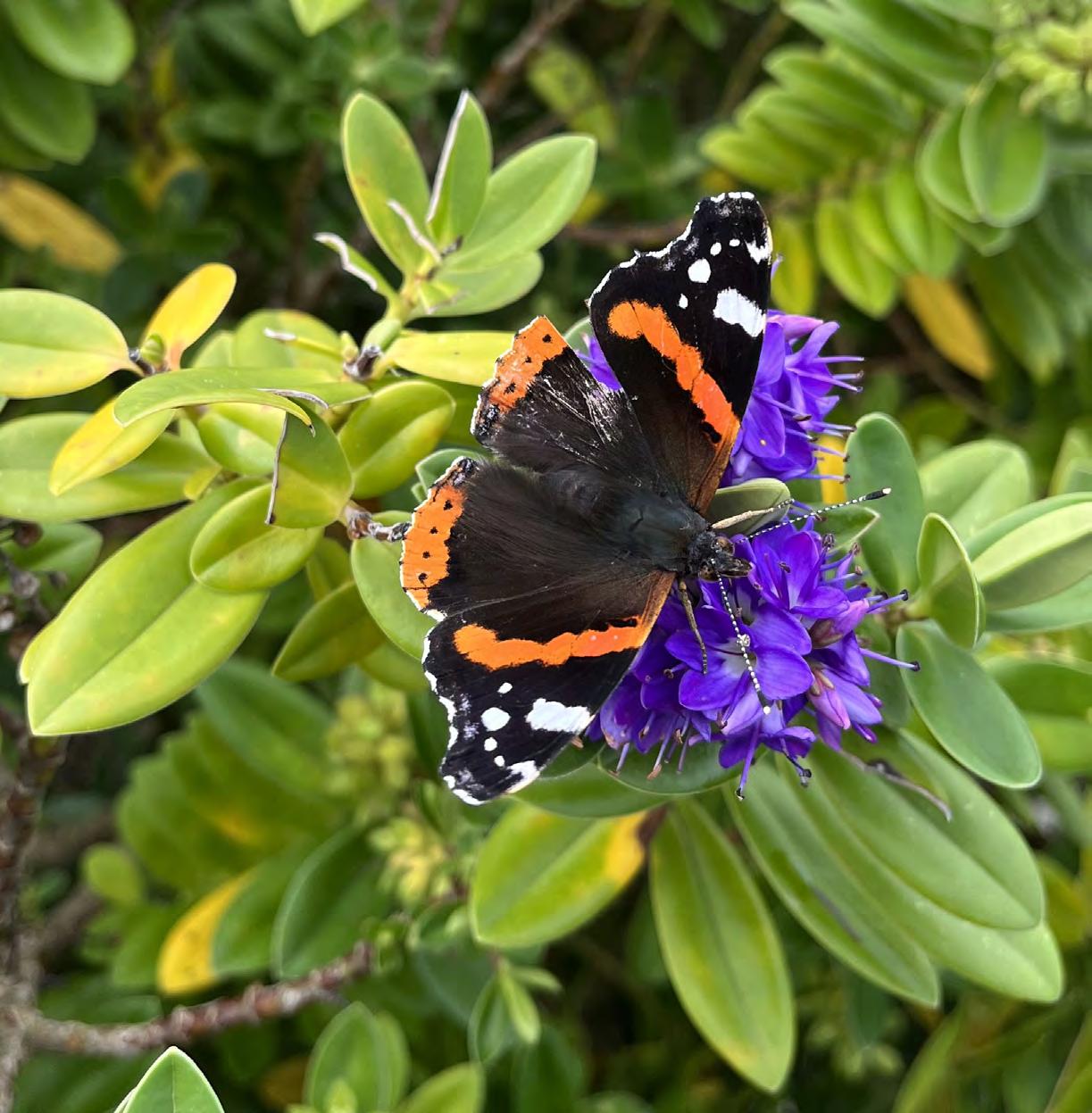
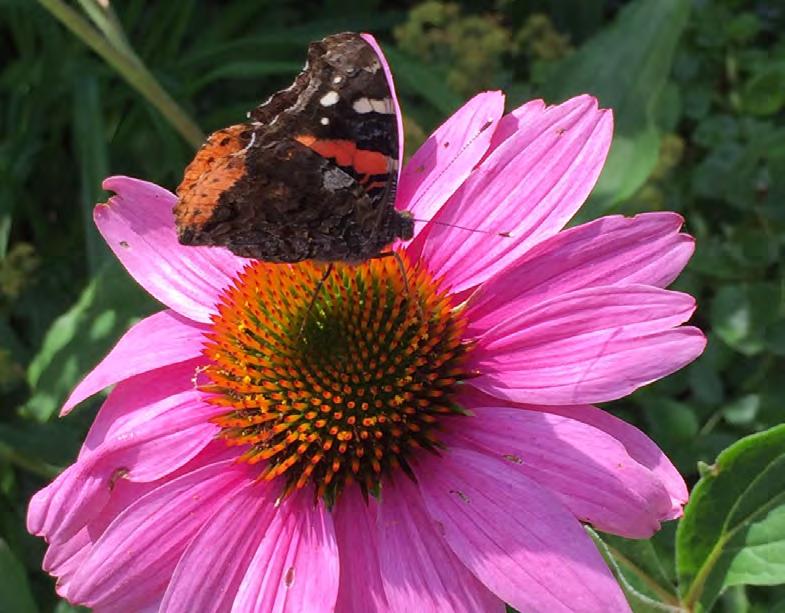
A Red Admiral Butterfly in a pollinator garden.
ecosystems living
Part Two
A slightly less tidy corner may suddenly feel more alive.
A garden that fits your life is more sustainable than one maintained out of obligation
By Patrick and Dorothy Smyth
GARDENERS HEAR a lot these days about what our gardens are supposed to accomplish. Plant this, and you’ll support birds. Plant that, and you’ll help biodiversity. The idea is appealing. It suggests that the choices we make in our own small spaces might ripple outward into something larger. But it can also leave people wondering whether they’re doing enough. Most of us have probably stood in our garden at some point and wondered whether what we’re doing really makes much difference.
So, what does a typical urban garden actually do? The honest answer is—it mostly shapes what happens right there. If you replace a closely mown lawn with shrubs, trees and flowering plants, you will probably see more insects. Birds may visit more often. A slightly less tidy corner may suddenly feel more alive.
Many gardeners notice this themselves. A new planting brings bees. A berrying shrub attracts robins. A small patch of flowers hums in midsummer. Those moments are real. They are some of the quiet rewards of gardening. But they are also local.
The larger patterns of biodiversity— the rise or decline of species across a region—are shaped by things far beyond any backyard: land use, development, climate, water systems and the connected habitats that allow wildlife to move across landscapes. A single garden doesn’t drive those forces.
◗ Support Bird Populations
The strongest claims about gardens helping biodiversity come from research linking plants, insects and birds. A well-known study looked at how many caterpillars were produced
Top: Home gardeners keep green spaces alive in cities. Bottom left: Gardens support insects, butterflies and birds. Bottom Right: Gardens allow animals to move across landscapes.
in different types of gardens and whether that might support chickadees raising young. Under certain conditions, gardens with lots of native tree and shrub canopy produced more caterpillars. From that finding, a popular message emerged: gardens can support bird populations. There’s truth in that idea, though the way it’s sometimes communicated can become oversimplified.
Birds rarely live within the fences of one garden. They move through neighbourhoods, feeding across many properties and green spaces. A garden can certainly be part of that landscape, but it is rarely the whole story. In ecology there is a difference between a place animals use and a place that sustains their populations. Most urban gardens fall into the first category.
And that’s perfectly fine. Where things become difficult is when possibility turns into expectation; when gardeners start to feel that their backyard must somehow compensate for ecological changes happening across entire regions. Urban ecology doesn’t really place that burden on individual households.
Gardens are first and foremost places where people meet the living world
close to home. They are where we notice the first bee of spring, watch the leaves turn or discover that a plant we thought was finished has quietly returned. Those experiences matter.
Home gardeners tend to keep planting; keep trees growing. They keep green spaces alive in cities— because they enjoy doing it. Over time, that persistence may be more valuable than any particular plant list.
A garden that fits someone’s life is more sustainable than one maintained out of obligation.
So perhaps the most useful way to think about it is this: A garden won’t solve biodiversity decline. But it can make a small patch of the world feel more alive—for the gardener, and for whatever creatures happen to pass through. A bee on a flower. A robin pausing in the branches. The quiet satisfaction of something growing where yesterday there was only soil.
And that is reason enough to keep gardening.
Readers may recognize Patrick and Dorothy Smyth as matching donors to our 2025 Hearts & Flowers fundraising campaign. We thank them for their steadfast support of TBG.
Top: Gardens are places where people meet the living world close to home. Middle: A patch of flowers hums in midsummer. Bottom: Home gardeners tend to keep planting because they enjoy it.
HISTORY OF GARDENING
PARADISE GARDENS
A testament to human ingenuity and the desire to create places of peace and reflection
By Lee Robbins Library Manager, Weston Family Library
GARDENS HAVE been part of human civilization for millennia and have created spaces where water, shade and ordered beauty provide places of refuge. Among the most enduring expressions of this concept is the Persian paradise garden, a landscape tradition that has shaped ideas of beauty and sanctuary for more than two millennia.
Unlike the grand estates of Europe, which often harmonize with their natural surroundings, Persian gardens were created in deliberate contrast to the environment around them. Much of Persia’s landscape was arid, harsh and sunbaked. The garden, therefore, emerged as a cultivated oasis protected by walls, which were a defining feature, with running water and shade as essential elements which
provided relief from the harsh climate. The very word paradise derives from the ancient Persian pairidaeza, meaning “enclosed garden”.
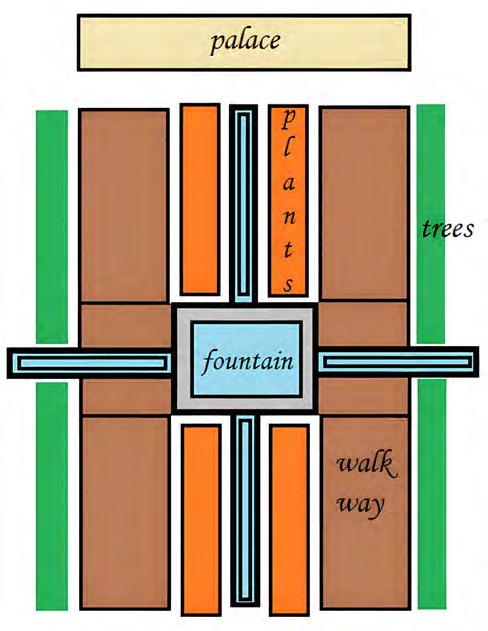
The framework of the classical Persian garden is the concept of the chaharbagh, or “four gardens”. This layout divides a square or rectangular space into four quadrants, a design that is both practical and symbolic. Water is the defining element of the
Classical chaharbagh Persian Garden design.
An 18th Century Persian carpet, based on the
garden plan
offered relief from intense sun, while pomegranate, fig, almond, apricot and olive trees provided nourishment as well as beauty. Roses, jasmine, grapevines and fragrant herbs softened the space with colour and scent. Every element in the design served multiple purposes: beauty, shade, food and symbolic meaning.
paradise garden. Rather than being dominated by flowers or elaborate plantings, these spaces revolve around the movement, sound and cooling power of water.
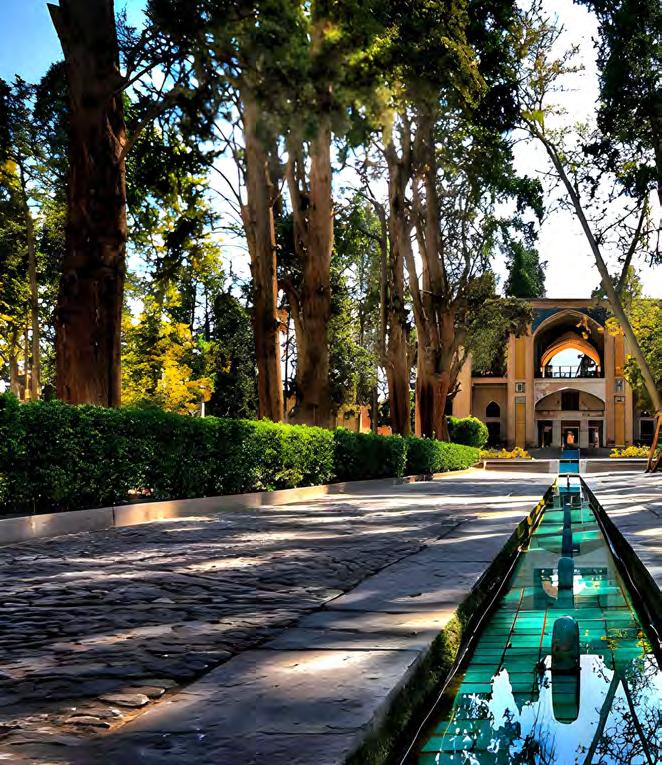
A spring-like fountain often marks the garden’s centre, sending water out through a network of slender channels known as rills. Dating back at least to 500 BCE (BC), these stone-lined rills carried water from underground qanats (aqueducts) from distant mountain springs, distributing it across the garden for both irrigation and natural air cooling. Rills were lined with stone, tile or brick, minimizing water loss to the arid ground and regulating the flow for maximum irrigation efficiency and aesthetics. They are functional and occasionally highly decorative, featuring colourful tile and detailed brickwork. They fill the gardens with movement, reflection and a sense of peace. A good example is the Fin Garden in Kashan, a UNESCO World Heritage site.
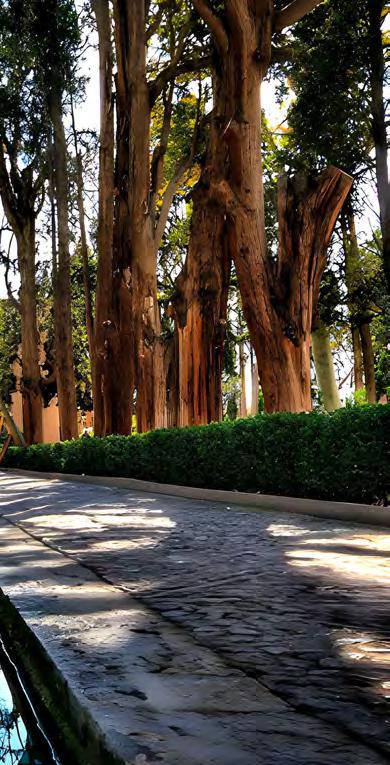
The planting design of these gardens balanced utility with sensory pleasure. Shade trees such as cypress and pine
Through many centuries, the influence of the chaharbagh endures. The photo of a Persian carpet from the 18th century is based on the classic four-square garden plan depicting four narrow canals joined in the centre by a decorative fountain. The canals are lined with green cypress trees, flowers and shrubs which are populated by colourful birds, all creating a scene evocative of a garden paradise.
The four-part geometry continues to inspire modern landscape architecture. A modern example is the Aga Khan Garden at the University of Alberta in Edmonton, Alberta. In contemporary design, the term chaharbagh is often used to signal balance, clarity and calm—qualities that remain as compelling today as they were in ancient Persia.
The paradise garden is more than a historical curiosity; it is a testament to human ingenuity and our timeless desire to create places of peace and reflection. Its core principles—order, shade, water and refuge—continue to inspire today’s gardens.
Present day Aga Kahn Garden, University of Alberta, Edmonton.
References
◗ Gardens of Persia by Penelope Hobhouse
SB458.5 Hob 2004
◗ The Persian Garden: Echoes of Paradise by Mehdi Khansari, M. Reza Moghtader and Minouch Yavari
SB458.5.Kha 1998
Example of a stone-lined rill from the Fin Garden in Kashan, a UNESCO World Heritage site.
four-square
CRITTERS IN THE GARDEN
EASTERN COYOTE
Descendants of the western coyote and interbred with wolves, they may be a separate species called the coywolf
By Megan Blacquiere Horticulturist
◗ COYOTES ARE ONE of the most successful carnivores in North America because of their ability to thrive despite decades of persecution from ranchers, landowners, farmers and government agents. They are distributed over most of the northeastern United States and southeastern Canada. The eastern coyote is a descendant of the western coyote. When humans exterminated native wolf populations, the western coyote expanded their range northeastward. Through this expansion, they
interbred with wolves in northern Ontario and Quebec, so the coyotes in eastern Canada are actually a coyotewolf mix. As a result of their wolf blood, the eastern coyotes are bigger than their western cousins. Research also shows that a small percentage of their genetic makeup includes that of the domestic dog. There is some debate in the scientific community over whether or not the eastern coyote should be viewed as a separate species and named the coywolf, with the scientific
name Canis oriens. Through the Integrated Taxonomic Information System, it remains listed as a coyote and has 19 recognized subspecies.
The eastern coyote is often described as resembling a medium-sized German Shepherd, sharing their erect ears and fluffy tail, but with grey or reddish-brown colouring and a whitish throat and belly. Sources vary on their average weight, stating ranges from 9 to 16 kilos
◗ HIERARCHICAL GROUPS
Communication is achieved through scent-marking, body language and vocalization. Vocalizations are used to communicate between family and strangers; defending territory, distress warnings, celebrating, locating family members, mating and mourning. In areas where large prey animals are available, coyotes tend to form a family unit known as a ‘group’. These groups are hierarchical and collaborative and consist of a mated pair, the previous year’s offspring and the current breeding season’s litter. In areas where the majority of available prey animals are small, coyotes tend to be solitary. They also tend to hunt in packs in the winter and become solitary during the summer. They can be found in natural and human-altered environments, including forests, fields, wetlands, suburban areas and cities. In cities, coyotes are most commonly seen in parks and ravines, although they may be spotted on residential streets or in backyards.
◗ MATES FOR LIFE
The eastern coyote is a monogamous species that mates for life. Courtship and mating occur from January to February. From January to April, the breeding female begins to prepare for the arrival of pups by digging a den or finding an abandoned den of a smaller borrowing animal, such as a badger or groundhog. They may also use abandoned buildings, hollow logs or rocky crevices as dens. Their dens are ideally located in secure and secluded
(20-35 pounds), 14.5 to 16 kilos (32 to 36 pounds), and 11 to 20 kilos (24 to 44 pounds).
These canids are omnivorous and opportunistic feeders with a diet consisting of snowshoe hare, white-tailed deer, rodents and birds. They also eat fruit, nuts, insects, fish and goose eggs, and coyotes in rural areas will sometimes attack livestock. They are most active after sunset and at night, with some activity during the day.
environments such as thickets, brush-covered slopes, or under rocky overhangs. As a safeguard and to maintain the secrecy of their movement and habits, they may choose to den in multiple locations and may even have multiple entrances for a single den. If any detection or disturbance of the den occurs, they may abandon it and find a new one.
The gestation period of the coyote lasts up to 62 days, with pups being born between April and May. The litter size is dependent on population density and food availability during the previous winter. From May to August, the pup-rearing period takes place, and for the first four to five weeks, the pups stay with their mother in the den. Mother and father work together to hunt and care for the young, with the help of the previous year’s offspring. At five to seven weeks, weaning takes place and the pups and mother leave the den. Coyote pups are considered full-grown at nine months. Gradually, as the pups mature, they become more independent and are seen travelling separately from their parents around mid to late summer. Coyotes can live up to 18 years in the wild, with the average lifespan being nine years.
◗ BENEFICIAL ROLE
Coyotes play a beneficial role in the ecosystem, and their presence as an apex predator is a sign of a healthy and balanced one. Through their opportunistic hunting behaviours, coyotes keep the populations of small mammals in check. This behaviour indirectly contributes to maintaining plant diversity since an overpopulation
of herbivores can cause vegetation damage and have detrimental effects on the local ecosystem. They also reduce the risk of disease transmission through their consumption of carrion and other organic waste, helping to keep urban spaces clean.
As humans continue to encroach on wildlife habitat, human and coyote interactions are on the rise and with that comes potential conflict. With this knowledge, it becomes ever more important for humans to understand the ecological role these canids play to foster a peaceful coexistence. We can make a difference through simple preventative measures, such as avoiding feeding or inadvertently feeding coyotes. This rule is important to maintain the health of coyotes and the safety of humans. Feeding causes habituation, which can lead to harmful interactions for both wildlife and humans.
Keeping your yard tidy can help to prevent unintentional feeding, including securing garbage cans, avoiding littering, keeping pet food indoors and cleaning up around bird feeders to avoid attracting rodents (or avoiding bird feeders altogether). Also, keeping your yard fenced with a fence that is at least 2 metres (6 feet) tall can help keep coyotes out. We must remain proactive to maintain a healthy coexistence between humans and our wild neighbours.
MINT TEA
The
perfect beverage to welcome guests
By Veronica Sliva
NAMED FOR A NYMPH
The word “MINT” derives from the Greek legend of a nymph named Mintha who inspired the jealousy of a goddess and was transformed to a lowly plant with an exquisite scent, while “spear” derives from the plant’s pointed leaves
WHEN I TOURED the Middle East several years ago, I noticed mint tea was served everywhere… in homes, cafes and shops.
In that part of the world mint tea is a cultural ritual that symbolizes hospitality, friendship and respect. It is often served to guests immediately upon arrival.
A very nice custom I thought at the time. So now, especially in the summertime when I have mint growing in my garden, I don’t need to agonize over which wine to serve or whether I can remember how to operate my husband’s fancy coffee machine. Instead, I serve my guests mint tea. Without exception this humble beverage is met with rave reviews.
MY RECIPE
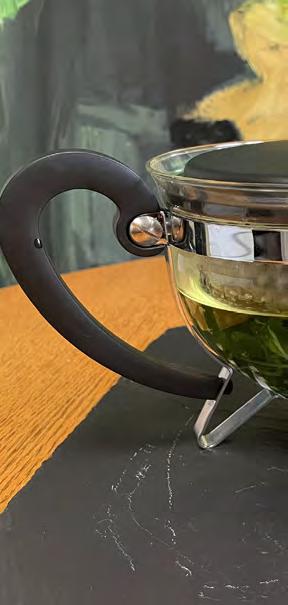
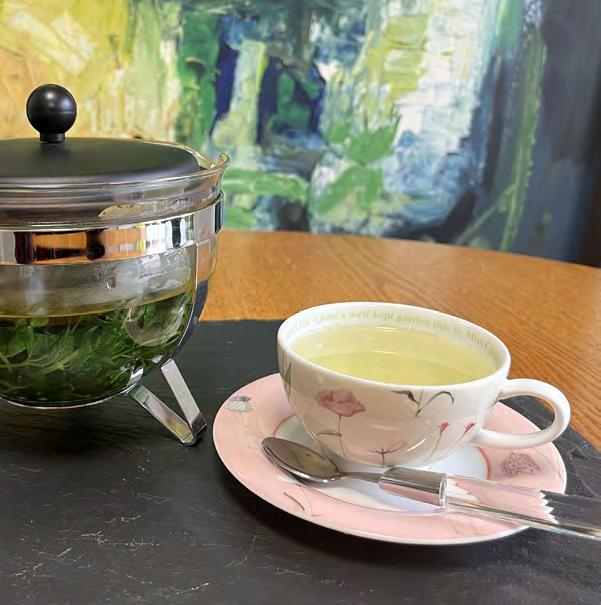
My recipe is simple… Into my special glass tea pot (the better to admire the vibrant green of the leaves), I squish a generous handful of mint leaves. Then I pour boiled water over the mint and let it steep for 3 to 6 minutes (depending on the strength I am going for). After which it is ready to be poured into cups. That’s it!
I find that freshly picked mint is sweet enough, but some people like to add a sweetener such as sugar, honey or maple syrup, so I always have some available too.
Mint tea is naturally caffeine free so you can drink it at any time of day. A bonus is that it is said to aid digestion.
If you want a hit of caffeine, you can add a “regular” bag of tea to the pot (think Tetley’s or Red Rose). Many people like it that way. I think it ruins the taste of the mint.
You may be tempted to use commercial mint tea bags purchased from the shops. Don’t do it. The leaves are dried and you will miss out on the rave reviews. Fresh mint always provides a more vibrant and flavourful tea than dried mint. Most supermarkets carry fresh mint, even in winter when the garden is sleeping, …it’s worth the splurge.
SO MANY MINTY FLAVOURS
There are an estimated 18 to 24 species of mint (Mentha). Some are sweet and mellow, while others are sharp and peppery. Menthol is the compound primarily responsible for the cooling sensation associated with mint.
Though any type of mint works for tea, the commonly used varieties are spearmint and peppermint. I prefer spearmint (Mentha spicata) because it has a milder, sweeter flavour due to its lower menthol content.
Canadian owned Richters Herbs in Goodwood Ontario has a wide selection of seeds and plants. Check their comprehensive online catalogue at https://www.richters.com/ get-our-catalog for lots of information.
GROW YOUR OWN
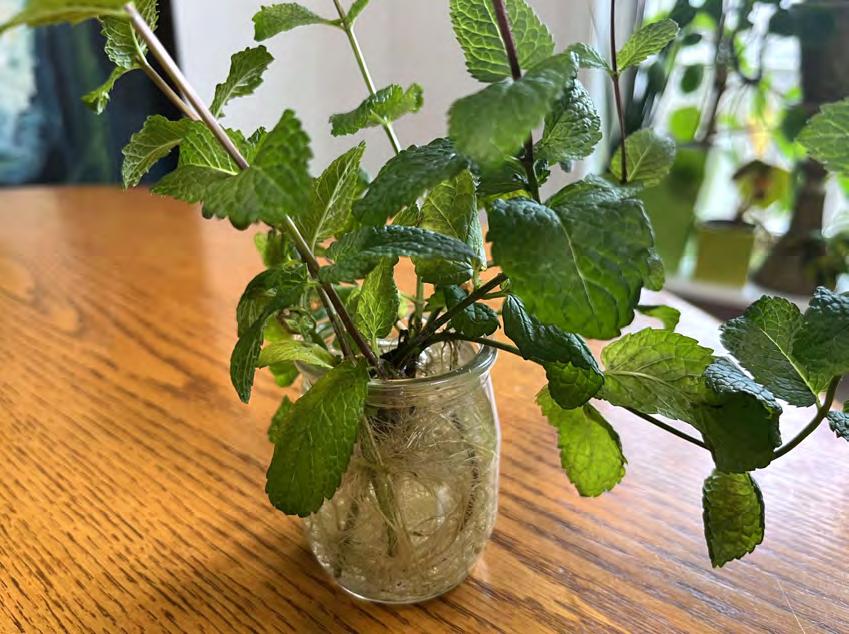
I WOULDN’T be without mint in my garden, but it is a thug. So, beware! Though easy to grow, it is an aggressive perennial that can quickly spread to take over your garden and is hard to eradicate if you let it get out of hand. I grow mine in containers. I never put any clippings into the compost because it will take off on me. I do, however, take cuttings in the fall. I plunk them in a glass of water and in a week’s time roots start to develop. I pot the rooted cuttings up in a commercial potting soil. Do not use “garden” soil as you risk bringing unwanted pests and weeds in along with it. I place the pots under grow lights (or in a sunny window) so that I can make mint tea all winter.
Usually, the plants I left outside during winter still in their containers “come back” in the spring.
MINT GROWING TIPS
• Soil and Light: Mint prefers moist, well-drained soil and likes partial shade.
• Regular Watering: Keep the soil consistently moist, especially during dry periods. Though I have neglected mine and it does manage to revive itself!
• Harvest Frequently: Regular harvesting encourages new growth and prevents the plant from becoming leggy.
• Fertilizer: Mint doesn’t require much fertilizer. A light application of compost or organic fertilizer in the spring is sufficient. I rarely bother.
DRYING MINT (IF YOU MUST!)
You can use your dried herbs for tea. But it won’t be the same as fresh!
• Harvest mint leaves in the morning after the dew has dried, when the essential oils are most concentrated.
• Rinse the leaves and pat them dry with a clean towel.
• Hang small bunches upside down in a cool, dark, well-ventilated area.
•Alternatively, use a dehydrator. Follow the manufacturer’s directions for herbs.
• When the leaves crumble easily, they are fully dried.
• Store them in an airtight container away from light and heat.
CONEFLOWERS
The original low maintenance, long-blooming native perennial
By Georgie Kennedy
WHEN I RECALL
late summer moments, I see a field of waving wildflowers. I remember a dance party at a friend’s farm, children chasing butterflies and walks by the river. Purples and golds shimmer in the afternoon sunshine, pollinators flit from flower to flower, feasting on nectar and pollen. Sadly, these images are at risk of becoming memories only. Habitats favourable to Ontario’s native meadow plants are shrinking daily due to human overdevelopment.
The good news is that many municipalities, including Toronto and the tree-surrounding regions, Peel, York and Durham, are taking steps to rewild former barren lawn areas of their parks. Yet, for the most part, urban and suburban lots remain empty uninspired spaces. The odd garden stands in relief, unusual for its explosion of shapes, colours and scents. Most are tended by courageous souls creating welcome havens for birds and other creatures. To join their naturalist ranks: grow native flowers in your front yard, your condo
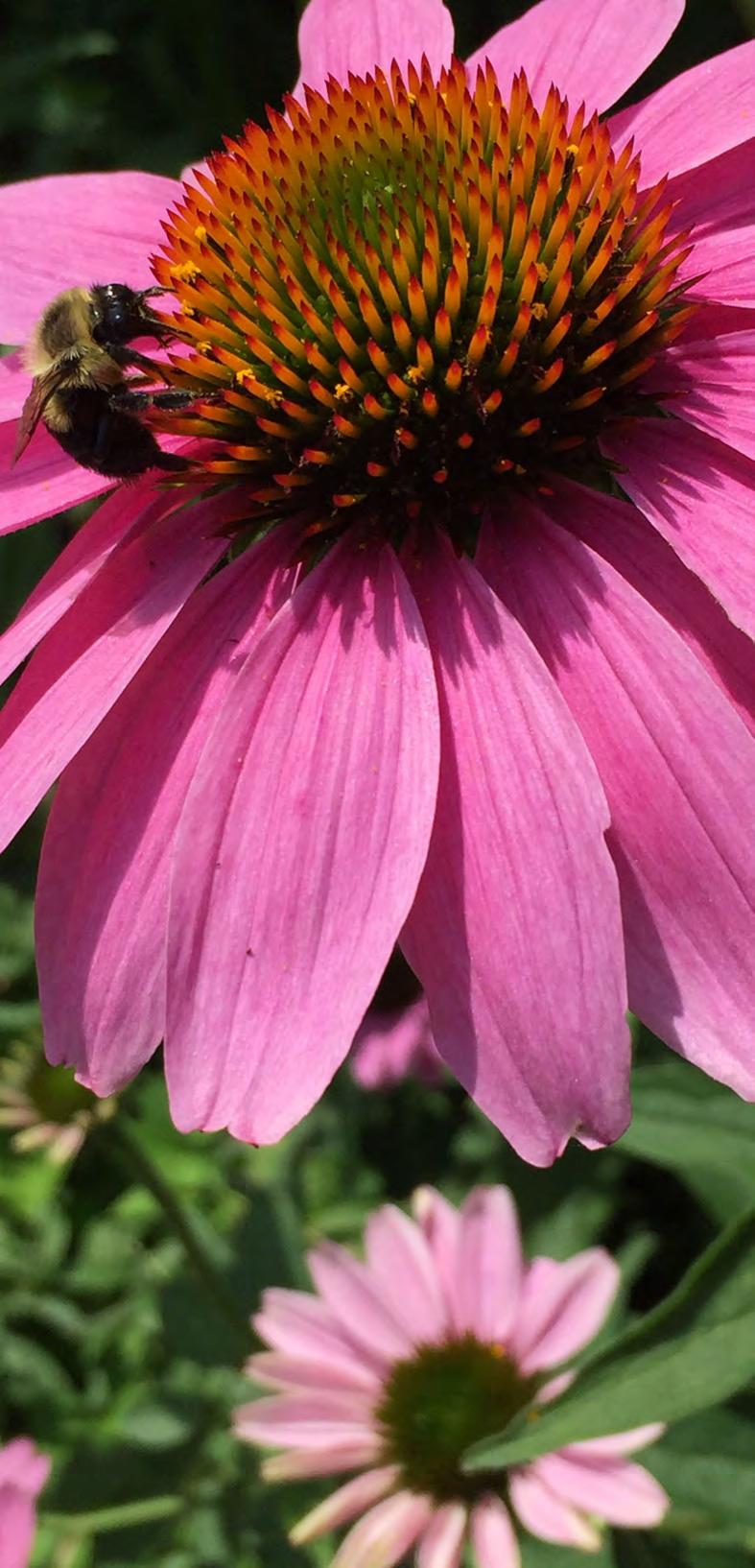
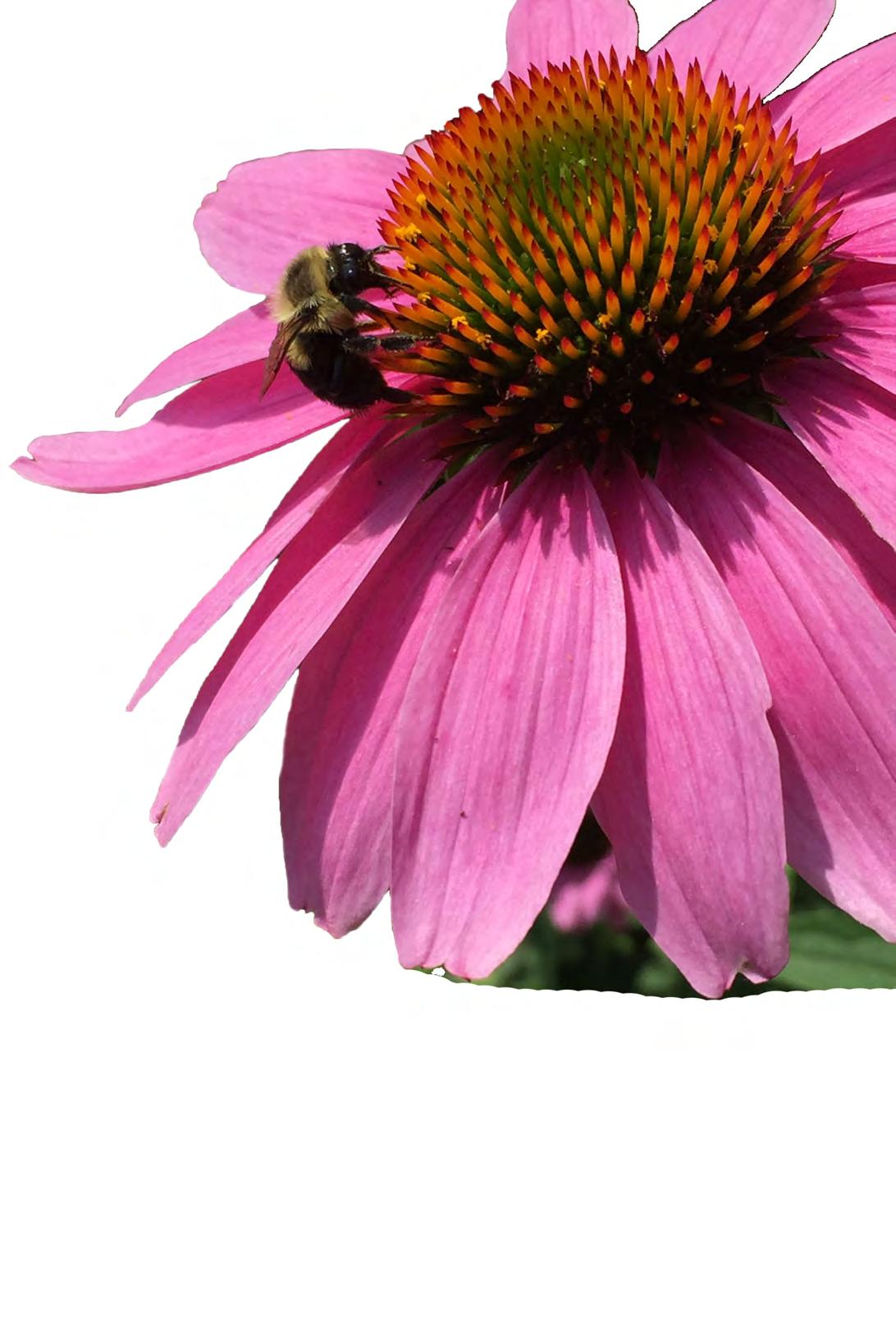
Coneflowers support wildlife, especially pollinators.
SPREAD THE WORD
BE A STEWARD of the Earth by spreading the good word about native plants. Encourage your neighbours to join you. Buy them some plants or give them some of yours. Be a guerrilla gardener: plant seeds in empty lots near you. Everything you need to plan and design a native garden and to understand all the floral inhabitants can be found in A Garden for the Rusty-Patched Bumblebee: Creating Habitat for Native Pollinators by Lorraine Johnson and the late Sheila Colla, Douglas & McIntyre, 2022. Check out Toronto Master Gardeners website and enter Native Plants for resources, sources and gardening guides. https://www.torontomastergardeners.ca/native-plants/ -Georgie Kennedy
garden, your cottage, your community garden, your balcony, in containers or even on the boulevard.
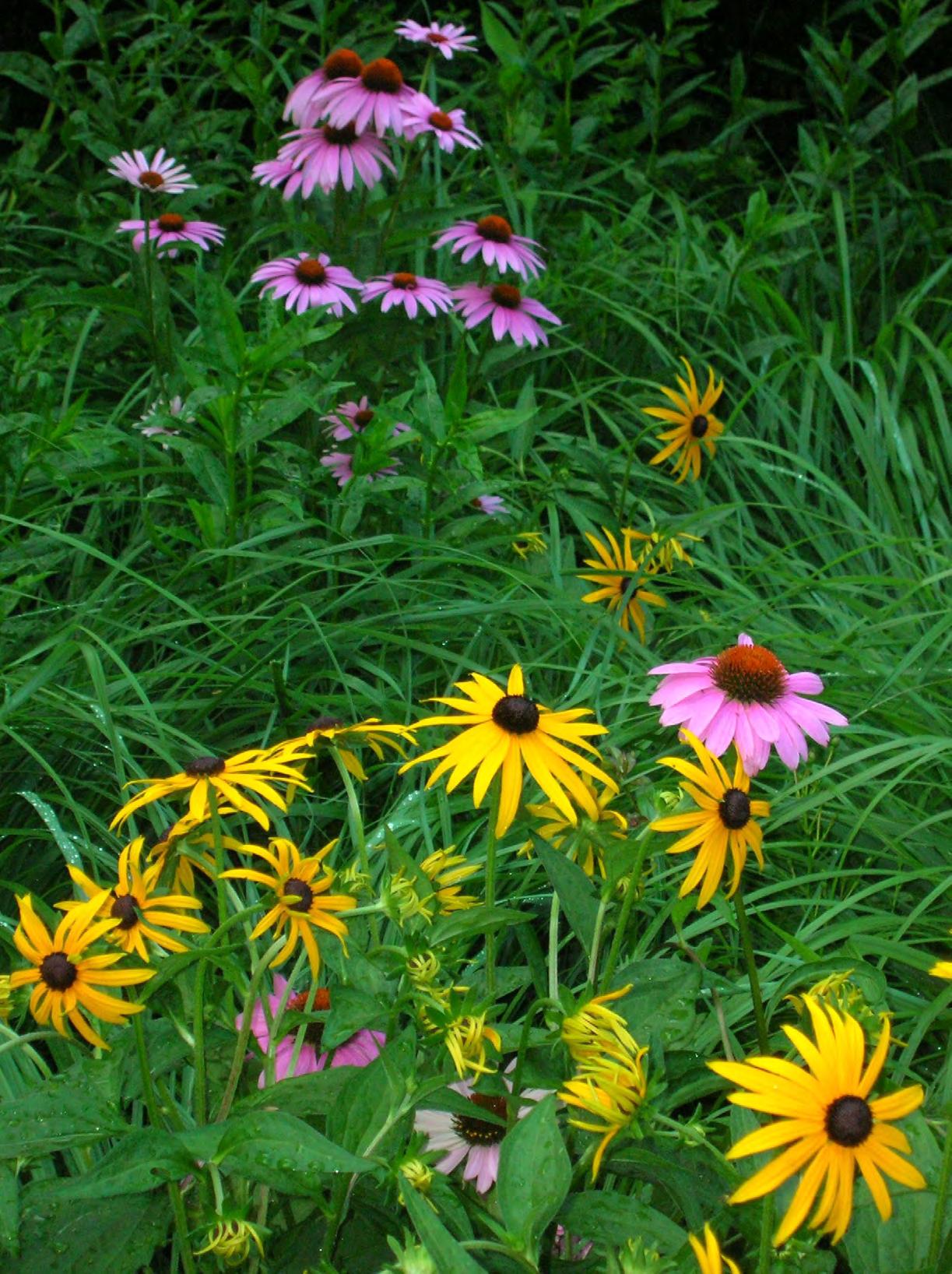
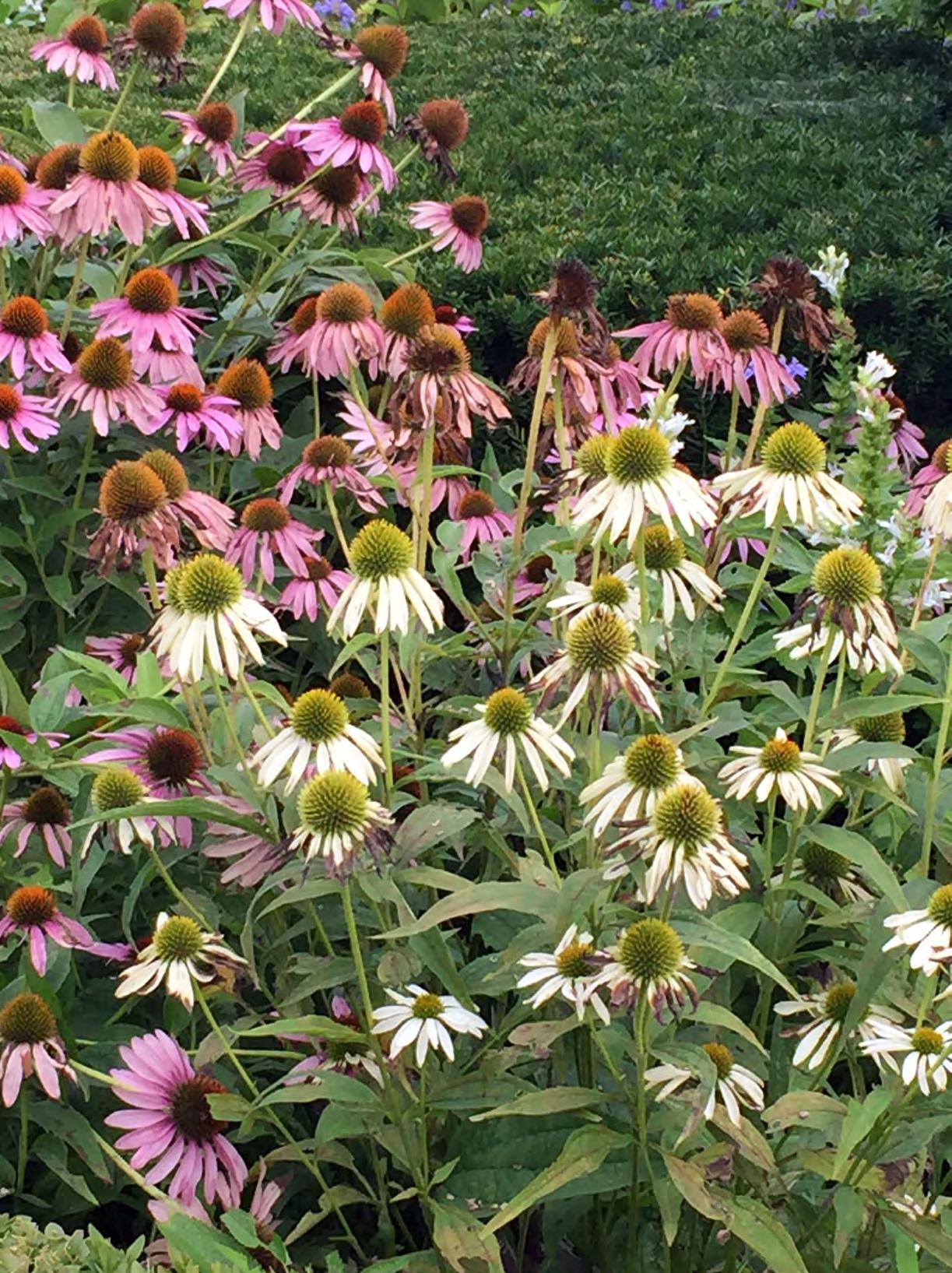
Planting native plants like the coneflower (Echinacea) makes our gardens look gorgeous while helping the birds, butterflies and bees. Not only do they support wildlife, especially pollinators, but they are perennials and can save you time and money as they will return each year and are drought-tolerant requiring no fancy fertilizers.
The distinctive coneflower has daisy-like petals and a stiff central cone. It’s Latin name Echinacea is from the Greek word echinos meaning hedgehog or sea urchin, referring to its spiny central disk.
Planting and protecting coneflowers can beautify your surroundings and bring lasting benefits to the entire community. Keep them near other indigenous plants of complementary colours, various heights, root depths and bloom times. Their underground systems communicate with each other and some taller plants actually shield shorter ones from wind damage. In other words, for native roots and shoots, the more the merrier.
| Coneflowers indigenous to our part of Ontario, of value to specialist bees and other pollinators:
• Pale Purple coneflower (Echinacea pallida) Sun, drought tolerant. Closely related to Purple
coneflower (Echinacea purpurea), popularly grown in the Toronto area but technically native to areas south of here.
• Narrow-leaved Coneflower (Echinacea angustifolia) with pink to purple drooping leaves. Sun.
| Not actually Echinacea, but sometimes commonly known as coneflowers:
• Grey-headed coneflower (Ratibida pinnata). Sun to partial sun, drought tolerant.
Most coneflowers will flourish and bloom for weeks in a well-chosen location. Their strong stems, distinctive upright cone centre and long petals make them excellent companions for other natives, such as: Common Milkweed (Asclepias syriaca), American harebell (Campanula gieseckiana), Fireweed (Chamaenerion angustifolium), Lance-leaved Coreopsis (Coreopsis lanceolata), Wild Bergamot (Monarda fistulosa) and Big Bluestem Grass (Andropogon gerardii).
You can source seeds and plants from recognized native seed suppliers and plant nurseries. Growing by seed is uncomplicated. Some will even flower in the first season sown. Coneflowers are the original low maintenance plant. Leave the stems for overwintering native bees. The stalks create magnificent silhouettes against the snow and can be cut down in late spring, after the insects have left their cozy homes.
Divide and multiply! If you’re fond of an established patch of coneflowers, you can have more without a costly trip to the garden centre. Spring is the ideal time to divide your patch into two or more clumps and move one to a fresh location.
Georgie Kennedy is a Toronto Master Gardener
Purple
BOOK SHELF
A Plethora of Summer Reading Gardening Books
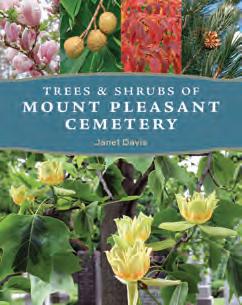
Trees & Shrubs of Mount Pleasant Cemetery
Reviewed by Veronica Sliva
Janet Davis is a well-known, award-winning Torontobased freelance garden writer and photographer. Over the past four decades she has contributed words and images to numerous publications. She penned a weekly gardening column for two Toronto newspapers, was an online garden editor and a blogger at www.thepaintboxgarden.com.
Living only a seven-minute drive from Toronto’s Mount Pleasant Cemetery, Janet has made the trip on at least
170 occasions in the past 30 years. Trees & Shrubs of Mount Pleasant Cemetery, Janet’s first book, is a gem.
The Introduction presents an historical perspective on the cemetery from its early beginnings to the present day as well as acknowledging the arborists and gardeners who look after the arboretum today.
The book is divided into sections: Spring, Summer, Autumn and Winter. As the year progresses, Janet captures the trees and shrubs at their peak with her gorgeous photography. The photos are accompanied with botanically accurate details and lots of interesting information. Rather than being overly technical, Janet’s writing is unfussy and clear, making the book an easy and enjoyable read.
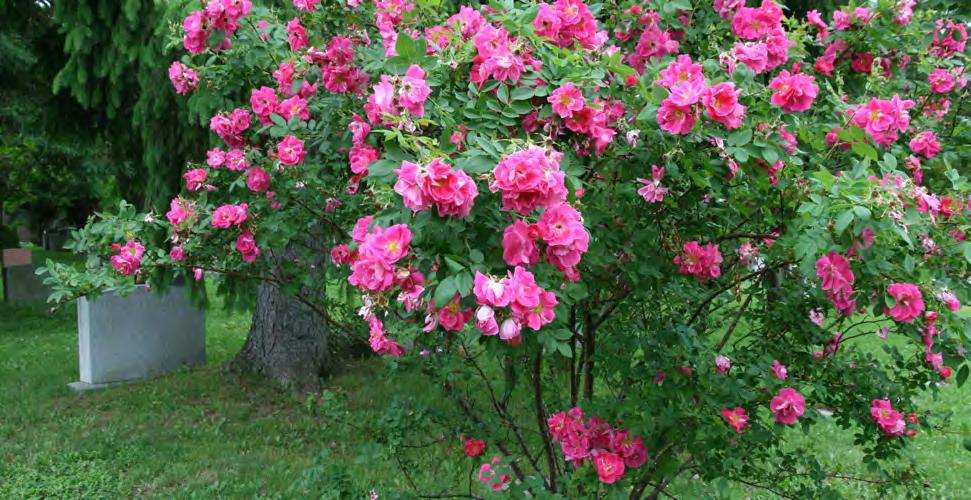
Pink shrub rose in Summer.
What I really loved about this book is its size. At 19 by 24 cm (7 by 9.4 in), it is slightly larger than a field guide, making it easy to tuck into a bag and take with you as you tour the arboretum. Janet’s book is like having a personal guide.
This book is for anyone who loves trees and shrubs. Though it would make a great gift, perhaps this is one you might consider giving yourself.
The book is published in spring 2026 to coincide with the 150th anniversary of Mount Pleasant Cemetery and the 200th anniversary of Potter’s Field and the inception of the Mount Pleasant Group.
Publisher: Firefly Books
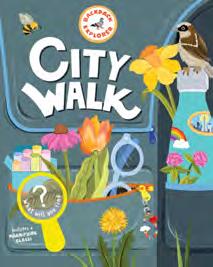
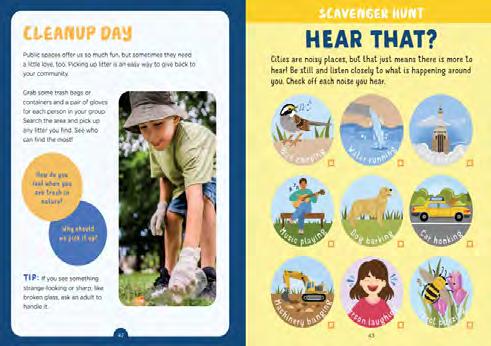
City Walk Backpack Explorer
Reviewed by Lila Yorke
City Walk Backpack Explorer by Kathleen Yale with design by Sophie Gerry and illustrations by Bethany Lord is a great resource book for people working with children up to about eight years old. Parents, babysitters and youth leaders would find this book helpful for planning screen-free outdoor excursions.
It offers all kinds of suggestions for free activities in the city from neighbourhood walks to local parks where they can fly the kites they have made themselves from instructions in the book, to birdwatching, urban nature art, plant identification and sidewalk chalk games like creating a treasure map.
This is a guidebook for kids who are more artistically inclined as well as those who are inquisitive and enjoy exploring. Art activities include making a building out of nature findings like sticks, bark, stones, acorn caps and more.
There are pages in the book where kids can check off the activities and earn sticker patches for completed tasks. There are nature and city-themed stickers, plus a magnifying glass to take a closer look at nature.
One in a series of Backpack Explorer books from Storey Publishing, this is a good book for young children but they would need supervision to complete many of the activities. The book is full of colourful photographs and illustrations. It has a durable, waterproof cover so can safely accompany readers on their city journeys. It even includes a suggested list of items to pack in your backpack for a day out exploring the city.
Publisher: Storey Publishing
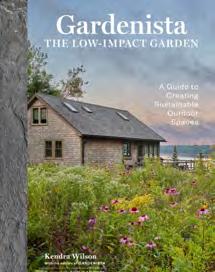
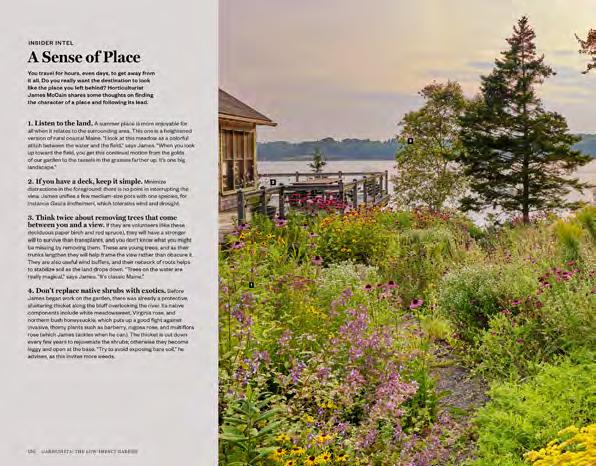
Gardenista, The Low-Impact Garden
Reviewed by Leanne Burkholder
Gardenista by Kendra Wilson is a visually stunning and informative book that offers inspiration for both seasoned and new gardeners looking to elevate their outdoor spaces while minimizing their environmental footprint. The book features urban, farm, prairie and desert gardens from the US, Canada, Australia and the United Kingdom.
Gardenista challenges readers to think beyond traditional gardening design and methods, drawing inspiration from the featured gardens. The homeowners featured designed gardens with minimal impact by preserving and working with the existing landscape, reducing hardscaping, reusing materials for walkways, seating or ornaments, nourishing soil through composting and planting more native species.
Growing from seed and establishing seed banks create low maintenance gardens that look after themselves. Getting to know and accept the process of the native plants allows the homeowners to embrace imperfection. Designs also emphasized ways to add beauty and at the same time support wildlife and pollinators with plant selection and placement, habitats and water features.
A central message of Gardenista is to find pleasure in creating an eco-friendly outdoor area that both suits your way of life and brings you happiness and relaxation. The solutions do not need to be complex and in fact design simplicity is emphasized. Less is more.
Publisher: Workman Publishing Company
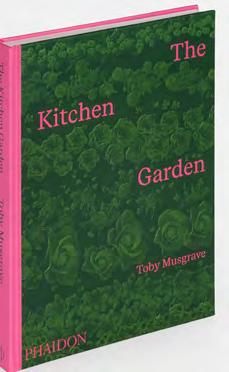
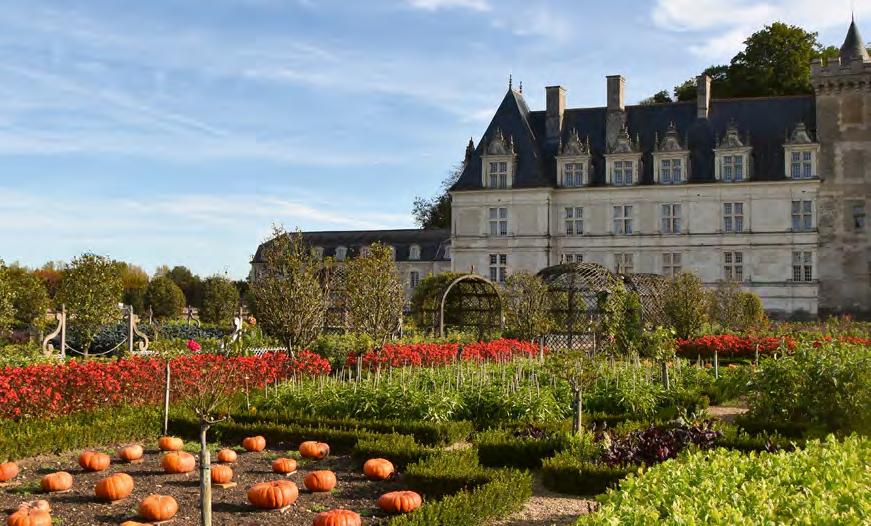
The Kitchen Garden
Reviewed by Carol Gardner
The Kitchen Garden by Toby Musgrave is probably the most informative book you will ever read about kitchen gardens. The author is a landscaper, author and expert in garden history. He writes about huge gardens around the world, often where you don’t usually think about kitchen gardens—Versailles, Kew, Granada’s Alhambra and many National Trust gardens, as well as many other private and public gardens. As well as clear and comprehensive pictures, there are sections on kitchen garden history, organic techniques, soil nutrition, protective cropping, espaliers—well, you get it—everything you need to know in order to plant a kitchen garden.
I would have liked to see pictures of smaller kitchen gardens as inspiration to those of us who don’t live in
Versailles. At least a few of the featured gardens are at ‘cookery schools’, it would have been nice to have a couple of recipes thrown in, but that’s a personal taste. I do, however, have a couple of criticisms, the main one being that the print is very, very small, straining older eyes. As I was reading the book, something was bothering me, but it wasn’t till the end that I realized what it was: this is written in the style of a school text book rather than a ‘normal’ gardening book. You can’t fault the writing—it’s exact and instructive—but, however inspiring the garden, there is no passion, no wit, no awe—just facts. Perhaps it reminded me too much of my long ago and not lamented geography classes!
All of that being said, I would buy this book in a heartbeat for anyone starting or improving a kitchen garden. The information is invaluable, the book is attractive and the author knowledgeable.
Publisher: Phaidon
PIECES PUZZLE
ROSEMARY’S BIRDS
Reviewed by Walter Sliva
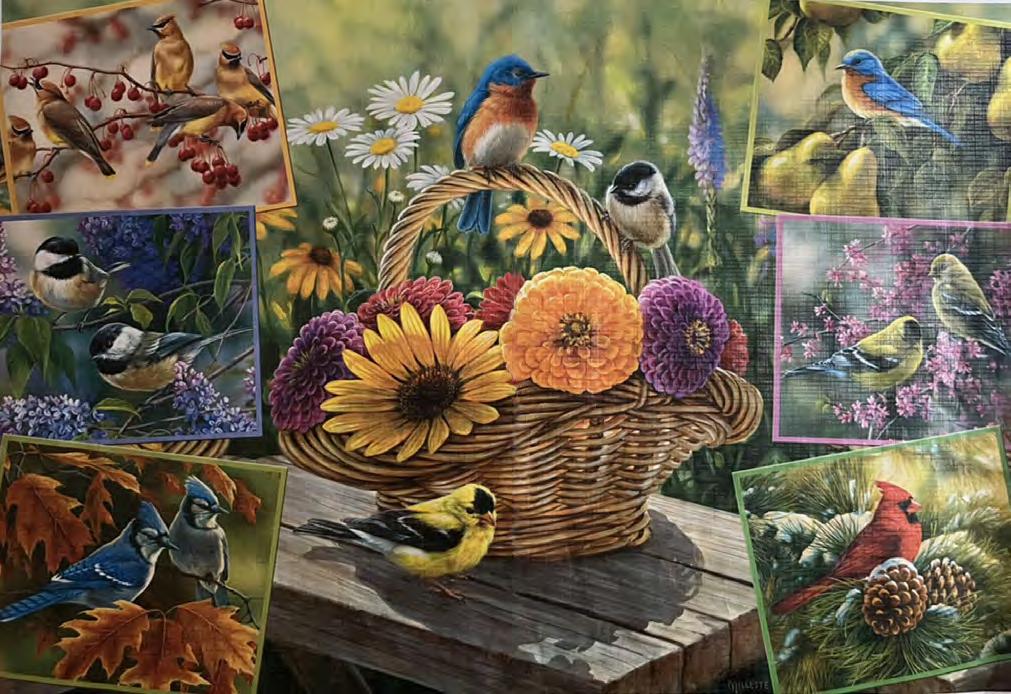
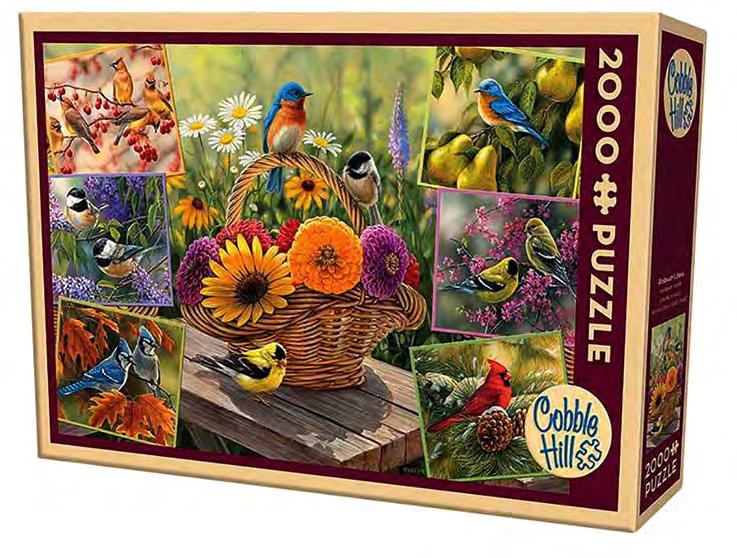
MY FIRST EVER 2,000-piece puzzle! This is a beautiful basket of freshly cut garden flowers, surrounded by six close-up photos of some of our loveliest backyard birds; a wonderful and colourful array of gorgeous birds and plants.
Artist, Rosemary Millette did an excellent job of combining complex details with large scale, contrasting shapes to make the puzzle composition interesting and challenging from start to finish. The puzzle itself is a massive 99.7 x 67.6 cm (39.25 x 26.625 in), the largest project I’ve ever worked on, but a real art piece when completed. We liked it so much, we glued it to a canvas picture frame and hung it in our garden shed, to enjoy for years to come.
If you’re tight for space to work on a puzzle, you might find this a challenge. Another challenge is separating out the daunting collection of 2,000 pieces into the smaller sections of the puzzle, many of which have a base of various shades of green. Patience and working out the subtleties of the colours win out in the end.
Cobble Hill created this puzzle with its usual museumquality standards, using the finest inks and varnishes in forming the random-shaped pieces, none of which are exactly alike.
Good Things Are Happening
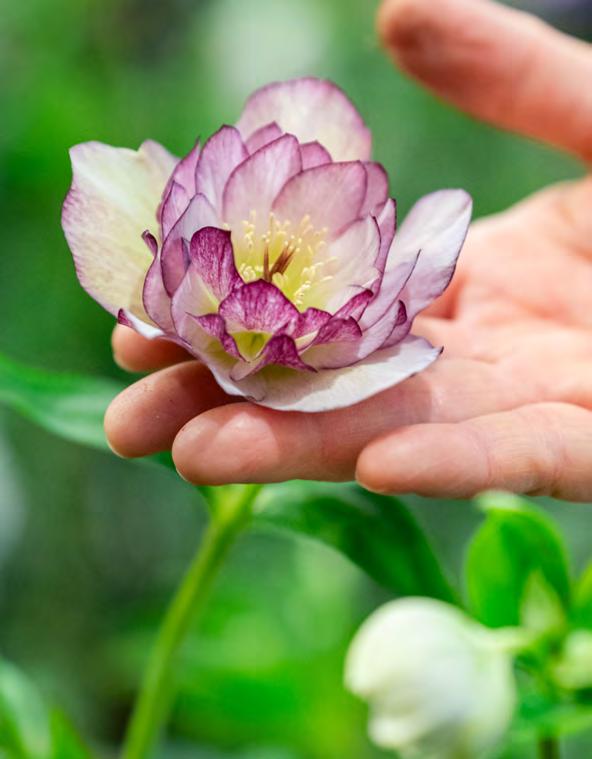
Hello Hellebores! Heavenly hellebores were once again the darlings of early spring at TBG. The perennial blooms burst from the frost just in time for the March 28 sale, where members, first-timers and even a former Governor General explored over 30 cultivars in Floral Hall, including Wedding Crashers, Mona Marble and Pippa’s Purples. Many cultivars were claimed entirely on pre-order, and over 1,000 plants in total were sold. While some hellebores flowered at TBG well into May, we can’t wait for next year, when their rich petals and pigmented stems will brighten our gardens once again.
TBG at One of a Kind Spring Show
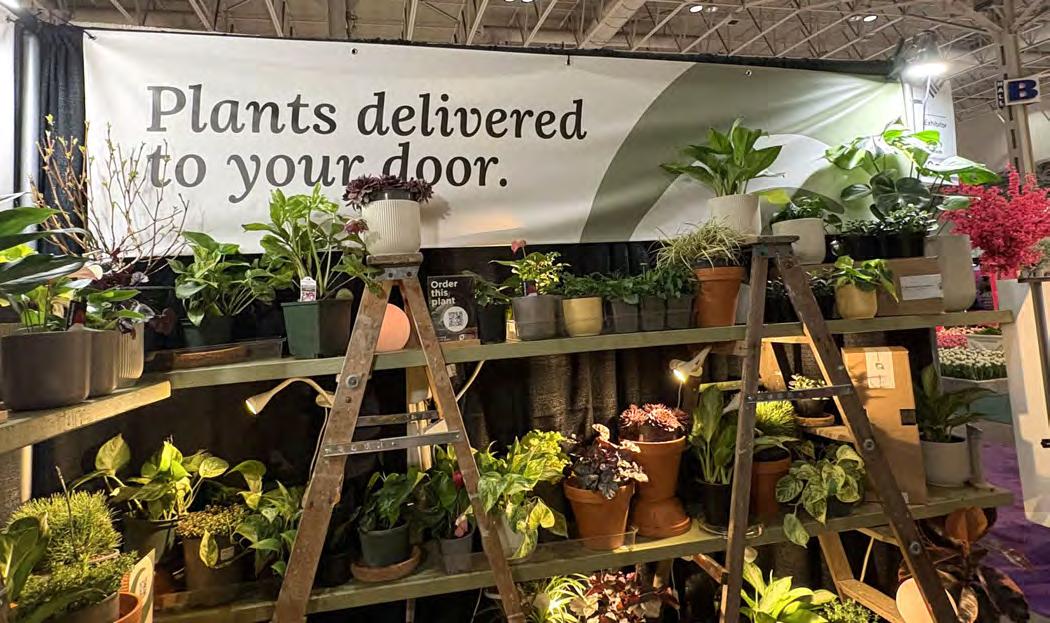
This year’s marked the first time the One of A Kind Show introduced a dedicated Garden Section, contributing to its largest and most vibrant Spring show since the pandemic— with 526 exhibitors and over 40,000 shoppers. TBG participated as an official partner with a very active on-site booth to build awareness of the Garden and launch the online plant shop—connecting with a highly engaged audience.
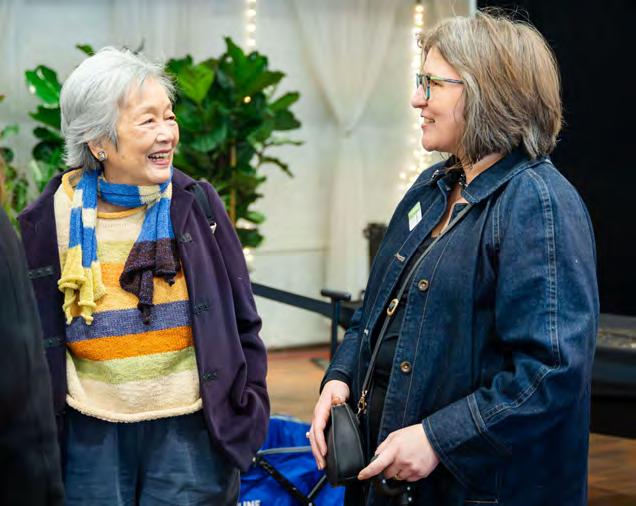
Former Governor General Adrienne Clarkson and TBG CEO Stephanie Jutila at the Hellebore Sale.
Fleurs de Villes
The Fleurs de Villes FLORA returned to Bloor-Yorkville this May, transforming the neighbourhood into a vibrant, open-air floral trail featuring more than 30 fresh floral installations. Toronto Botanical Garden was proud to be part of this year’s experience, presenting floral demonstrations by our Floral Design Graduate Students as part of the Fleurs de Villes JARDIN learning program and judging the ‘best in show’ installation. This collaboration highlights the Garden’s commitment to connecting people with plants through education, creativity and community, extending TBG’s mission beyond the garden and into the heart of the city.
Follow the Birds
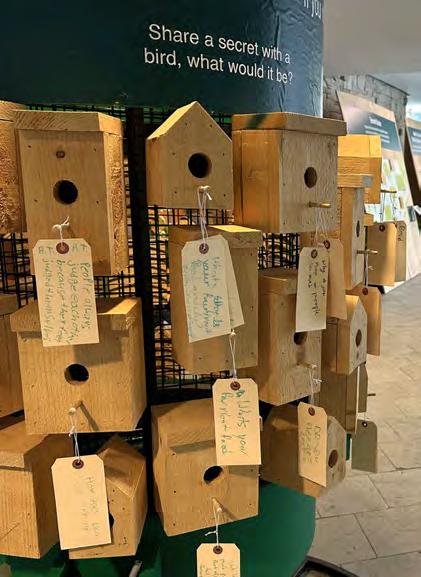
Share a secret, wish or heartfelt message with the feathered friends that call our garden and ravine home.
This interactive moving installation on wheels from the Museum of Toronto invites visitors to send a message— a thought, question, memory or quiet reflection—with and for the birds. The installation may be found in the TBG lobby or outside in the Garden. Just follow the birds!
Over the course of the summer, these small notes will capture the many ways we connect to one another, and to green spaces in the city, highlighting the interplay between urban living, nature and wildlife.
DANDELION CAFÉ
The Dandelion Café is open for the season, once again operating in the historic barn in the Edwards Gardens Courtyard. With a locally sourced menu and eco-conscious products, the Dandelion Café, run by Daniel et Daniel Caterers, is open from spring to fall for drinks, snacks and lunch as well as during the Thursday evening Edwards Summer Music Series during July and August.
TBG AGM JUNE 23
Mark your calendar for the Toronto Botanical Garden Annual General Meeting on Tuesday, June 23. Celebrating 70 years, the AGM will take place in the Floral Hall. Current members in good standing will receive an email invitation 10 days prior to the event.
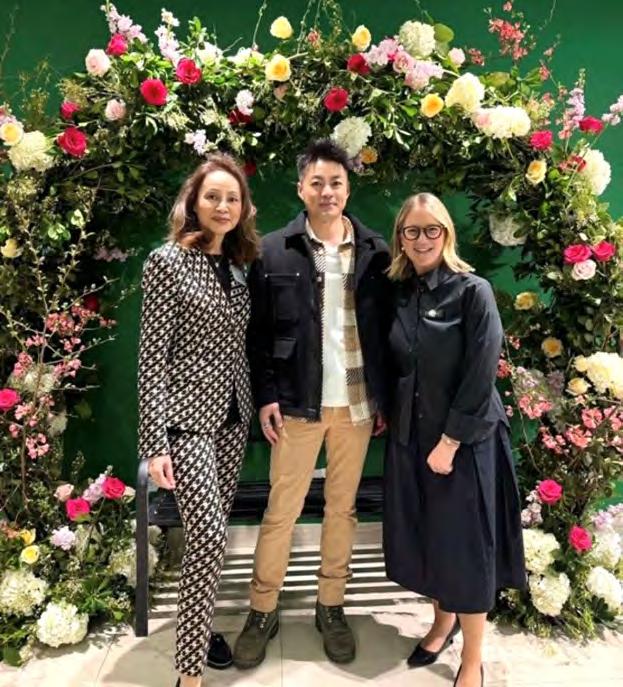
ABOVE: Judges for this year’s Fleurs de Villes included TBG Floral Design graduates Caprice Chow (TBG board member) and Kinson Chow shown here with Tina Barkley, Fleurs de Villes co-founder.
LEFT: Kinson Chow, Caprice Chow and Jenny Rhodenizer, TBG Director of Marketing and Audience Engagement, with a floral model.
Plant Sale an Outstanding Success
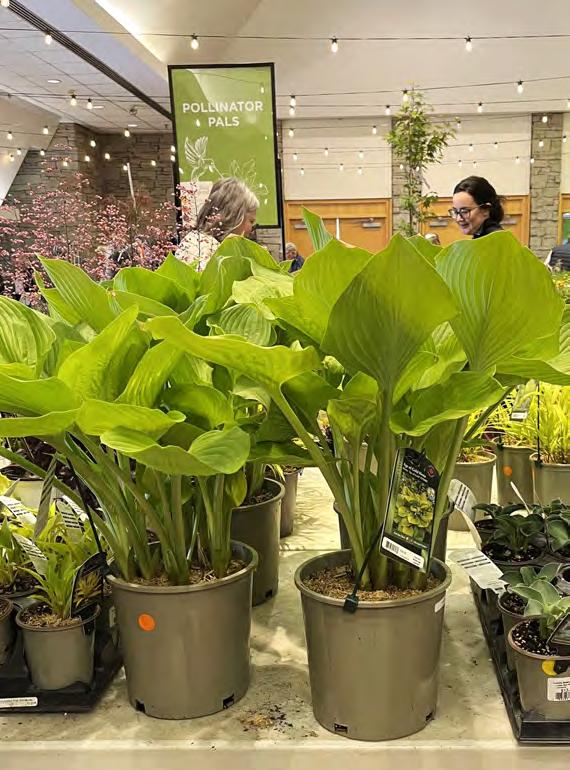
One again the TBG experienced record attendance at the annual Spring Plant Sale, welcoming shoppers from Friday to Sunday, May 22 to 24. A few new features this year included a Plant Sale Inventory detailing all perennials and shrubs available with “themed” areas such as Native, Pollinator, Foliage, Recipes (for sun, shade, etc), Succulents and General.
Thank you to all TBG staff and volunteers who helped to make this annual spring tradition another great success.
Something
Celebrating Mother’s Day at the Garden
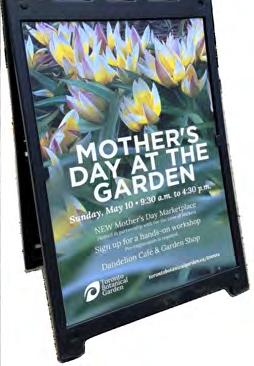
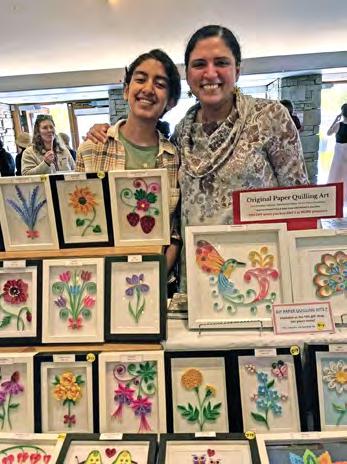
Toronto Botanical Garden was the place to be on Mother’s Day. The parking lot was full, three DIY Succulent Classes were sold out and a new Mother’s Day Marketplace was launched with more than 50 eco-conscious brands and local makers taking part in For the Love of Markets.
New, Yet Familiar
Toronto Botanical Garden has a newly refreshed brand, with a logo that’s more approachable and a colour palette that leans into earthier tones. It’s a subtle shift, but one that better reflects who TBG is today and the natural beauty that surrounds it. At the core, what the Garden stands for hasn’t changed—that when people connect with plants, something meaningful happens. We feel better, we’re more creative and more connected to nature and to each other. That belief continues to guide everything TBG does, and this refreshed look is a more authentic way to share how its belief applies to everyone.
It’s been more than 20 years since TBG’s last major evolution, when it became the Toronto Botanical Garden. Since then, we’ve grown alongside you, our members, supporters and community. We would love to hear how moments in the Garden have helped you thrive. Your stories encourage our team and community to continue our work, striving to be a garden where everyone can experience the benefits of connecting to nature and each other. Email socialmedia@torontobotanicalgarden.ca with your stories.
BOARD OF DIRECTORS
Tony DiGiovanni, Board Chair
Susan Grundy and Martin Ship, Vice Chairs Doris Chee, Secretary; Claudia Alvarenga, Treasurer; Gordon Ashworth, Past Chair
Barb Anie, Dianne Azzarello, Nicholas Brearton, Michele Chandler, Adeline Cheng, Caprice Chow, Ben Cullen, Lucie Gauvin, Margareth Lobo Gualt, Mark Pratt, Haig Seferian Ex Officio: Justin Hanna, City of Toronto; Deborah Maw, Garden Club of Toronto; Pat Ware, Milne House Garden Club
TORONTO BOTANICAL GARDEN IS A GARDEN FOR ALL
Your support and engagement are essential in developing an inspired plant place, an engaging learning environment and a dynamic community hub. We invite you to grow with us.
MISSION
Toronto Botanical Garden connects people and plants, fostering sustainable communities and developing reciprocal relationships with nature through lifelong learning.
VISION
Toronto Botanical Garden is a garden for all; a diverse community that recognizes the life-giving role of nature, working together for a more sustainable world.
SIGN UP FOR GARDEN ENEWS!
Receive the latest horticultural news and information on events, workshops, lectures and other horticultural happenings. Free registration at https://torontobotanicalgarden.ca
REGULAR HOURS OF OPERATION
VISITOR CENTRE: Open daily, 9 a.m. to 4:30 p.m.
GARDEN SHOP: Open daily, 10:30 a.m. to 4:30 p.m.
WESTON FAMILY LIBRARY: Weekdays, 10:30 a.m. to 4:30 p.m.
DANDELION CAFÉ: Located in the historic barn is now open
PARKING: $4.00 per hour. $16.00 daily maximum. TBG Members, FREE.
DIRECTORY
CEO Stephanie Jutila sjutila@torontobotanicalgarden.ca
WESTON FAMILY LIBRARY 416-397-1343 librarydesk@torontobotanicalgarden.ca
777 Lawrence Avenue East, Toronto Ontario M3C 1P2, Canada • 416-397-1341 fax: 416-397-1354 • info@torontobotanicalgarden.ca torontobotanicalgarden.ca • @TBG_Canada
By TTC
Via Line 5 Eglinton (Crosstown) take the 51 (A or B) northbound bus from Laird or Sunnybrook station or 162 bus from Lawrence Subway Station to Lawrence Avenue East and Leslie Street. The TBG is on the southwest corner.
EDITOR
LORRAINE HUNTER
DESIGN
JUNE ANDERSON
VOLUNTEER
EDITORIAL COMMITTEE
LEANNE BURKHOLDER
GEORGIE KENNEDY
JENNY RHODENIZER
LEE ROBBINS
VERONICA SLIVA
VOLUNTEER
PROOFREADERS
JACKIE CAMPBELL
CAROL COWAN
JANICE WINTON
JEAN MCCLUSKEY
ADVERTISING marketing@toronto botanicalgarden.ca
Trellis is published as a members’ newsletter by the Toronto Botanical Garden at Edwards Gardens 777 Lawrence Avenue East, Toronto, Ontario, M3C 1P2, 416-397-1341
Trellis welcomes queries for story ideas, which should be submitted to the editor for consideration by the Trellis Committee at least four months in advance of publication dates.
Opinions expressed in Trellis do not necessarily reflect those of the TBG. Submissions may be edited for style and clarity.