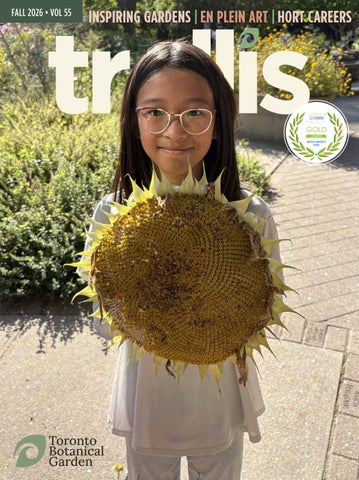
FALL 2026 • VOL 55
INSPIRING GARDENS | EN PLEIN ART | HORT CAREERS
“AUTUMN IS A SECOND SPRING WHEN EVERY LEAF IS A FLOWER.” ALBERT CAMUS
• TRELLIS WINS • GARDEN COMM SILVER LAUREL MEDAL OF ACHIEVEMENT Trellis has received a 2026 GardenComm Silver Laurel Medal of Achievement in the Publisher: magazine-consumer/trade category for our Winter 2025 issue. The international awards program recognizes individuals and companies that achieve the highest levels of talent and professionalism in garden communications. The 2026 competition drew 146 entries across 43 categories.
TRELLIS WON GOLD LAUREL MEDALS IN 2023 AND 2025 GardenComm, Garden Communications International is an organization of professional communicators in the green and garden industry.
inside FALL 2026 • VOL 55
[4] FROM THE GARDEN [6] WELCOME ERIKA GOTT New TBG Director of Development [7] LEGACY GIFTS Create a lasting impact [8] CITIZEN SCIENCE Where local sights aid science [10] LIBRARY Dusty discovery to active archive [12] MEMBERSHIP What the goldfinch taught me [14] SUMMER COHORT Interns & summer staff help a busy season be a success [22] PADDLE AND PROTECT Don’t Mess with the Don
[26] GARDEN CAREERS Perfect time to enter landscape trades [29] TBG GARDEN SHOP Handcrafted home decor from around the world [30] ROOTS AND THREADS Art fabric project celebrates sustainability, upcycling and creative reuse [32] THE GARDEN AS A STUDIO En Plein Air art in the Garden [40] NEVER TOO OLD – OR FRAGILE – TO GARDEN Special tools lighten the load [44] TULIP TIME Plant bulbs now for spring display
[50] GARDEN REFINED Paying tribute to the history of Playter Estates [58] LESSONS FROM ELLEN’S GARDEN Downtown garden evolved with hope [66] LONDON OPEN GARDENS RCP Garden of Medicinal Plants [70] GARDENS OF MADEIRA 5 botanical sites worth a visit [86] CRITTERS IN THE GARDEN Red Fox [88] HISTORY OF GARDENING [90] BOOK SHELF [93] PUZZLE PIECES
TORONTOBOTANICALGARDEN.CA
3
FALL 2026
[94] GOOD THINGS ARE HAPPENING COVER: FALL RAVINE FESTIVAL. CELEBRATE THE BEAUTY OF AUTUMN AT THE ANNUAL TBG EVENT, SATURDAY, OCTOBER 3 FROM 12 NOON TO 4 P.M. ABOVE: FISCHER PADDLES ALONG A NEW NATURALIZED OUTLET FOR THE DON RIVER THROUGH BIIDAASIGE PARK DURING A RECENT CLEANUP DAY WITH VOLUNTEERS FROM DON’T MESS WITH THE DON. SEE ARTICLE ON PAGE 22. PHOTO: NATALIE HARDER.
FRO M
t h e Ga r de n
TORONTO BOTANICAL GARDEN IS AN ESSENTIAL CONTRIBUTOR TO CAREER JOURNEYS
S
UMMER 2026 has brought a wealth of emerging career professionals to Toronto Botanical Garden, to add to the strength of our team of year-round passionate staff and volunteers. This was all made possible with seed funding from Canada Summer Jobs Program, Young Canada Works, Miziwe Biik, with additional support from the Garden Club of Toronto, Milne House Garden Club and contributions from generous donors. Top it off with the unmet demand for TBG’s naturebased summer camps, field trips, summer concert series, adult education and as a community gathering place— and we had a perfect moment to grow our team and our impact. With more people valuing nature as an essential component of urban life—TBG’s summer staff 2026 cohort came with intention to personally gain valuable on the job experience, while also giving back to the things that they are passionate about and value. Certainly, a tight job market for young professionals, and increased value being placed on lived experience to supplement traditional education—creates the perfect environment for TBG to stand out as a desired career stop for teacher candidates, those interested in horticulture and landscape trades, non-profit and arts and cultural careers.
For most of the year TBG operates as a small and mighty team of 17 fulltime employees, with a healthy balance of part-time variable hour employees, and volunteers who are essential to the Garden running a seven-day a week, year-round operation. Come summer our total staff headcount swells to 35 fulltime and 16 part-time. Without added seasonal staff, TBG would not be able to keep growing our number of learner hours, community programs and horticultural experiences. As the summer came to a close, I had the distinct opportunity to host our summer interns for an after work social. It was inspiring to hear firsthand about their career journeys that are well underway, and the ambitions of where they will be in five and ten years. The conversations reminded me of the many career experiences and mentors that helped me pursue a career in public horticulture. Out of curiosity I made a list of the key people and work experiences that helped me be ready to lead the Toronto Botanical Garden today. 30+mentors along the journey, 12 distinct horticulture career stops. Each one had an important role to play and allowed me to bring my passion for people and plants to a viable career path. To sustainably offer these positive career experiences for summer staff, along with our year-round staff—Toronto Botanical Garden requires ongoing support and funding (as not one of the funders mentioned at the top pays 100 per cent of the costs to hire the emerging career professionals). Know that when you support Toronto Botanical Garden through your donations, Garden Shop purchases, class registrations, memberships and beyond you are supporting more than the Garden we all love—you are investing in TBG being able to support viable career paths for summer staff and our year-round staff AND you are investing in the well-being of our community. Here is to doing what you love and giving back to a community that values nature-based experiences!
Stephanie Jutila TBG CEO
PS. Meet some of our recent hires on page 14, and hear why the Horticulture and Landscape Trades are a viable career path in Ontario and beyond on page 26. TORONTOBOTANICALGARDEN.CA
4
FALL 2026
What’s On Fall/Winter 2026 Toronto Gone Wild September through December • Open daily, 10:30 a.m. to 4:30 p.m. Explore the city’s multi-layered habitat — starring the animals, plants, and insects that call Toronto home. After visiting this exhibit you’ll emerge with a renewed appreciation for the interconnectedness of life in the city. Hosted in partnership with Museum of Toronto
Fall Ravine Festival October 3 • 12 to 4 p.m. Celebrate the beauty of autumn in the heart of the city. The Garden comes alive with seasonal experiences for all ages including a site-wide scavenger hunt, live music, nature activities, eco-stewards, and delicious fall flavours. This annual festival invites you to explore, connect, & embrace the vibrant colours and textures of the season in one of Toronto’s most beloved green spaces. Free Admission.
Plein Air Art Exhibition and Sale October 3 to 18 • Open daily, 10:30 a.m. to 4:30 p.m. Featuring over 40 local artists capturing the Garden’s landscapes, florals, and seasonal light in real time. The result is a stunning collection of original works that reflect the immediacy, colour, and atmosphere of the Garden and surrounding ravine. Guests are invited to explore the exhibition, meet participating artists, and purchase one-of-a-kind pieces that are the essence of the garden. Free Admission. Presenting sponsor
Hosted in partnership with Alexandra Sharma, Don Valley Art Group, Toronto Heliconian Club, Toronto Watercolour Society, Willowdale Group of Artists, Women Artists Association of Canada
Annual Holiday EcoMarket November 20 to 22 & December 18 to 20 • Fri, 2 to 6 p.m, Sat & Sun, 10 a.m. to 4 p.m. A sustainable, nature-inspired, relaxed shopping experience featuring over 100 planet-friendly vendors each weekend. Free Admission New this year: Second Floor Food Court with seating to work in community at an eco-friendly “Roots & Threads” community art initiative.
For more information, visit torontobotanicalgarden.ca/events
YOU BELONG HERE Invest in nature, learning and your community with a Membership at the Toronto Botanical Garden starting at $60/year. Members get perks like free parking, 10% off the Dandelion Cafe, all classes and the Garden Shop. Whatever brings you here, you’ll find a warm and inviting community waiting to meet you. Join online today by clicking this link.
WELCOME TBG’S NEW DIRECTOR OF DEVELOPMENT ◗ ERIKA GOTT
W
E’RE DELIGHTED to announce that Erika Gott, Certified Fund Raising Executive (CFRE) has joined Toronto Botanical Garden as Director of Development. Erika brings a distinctive combination of conservation expertise, proven fundraising excellence and genuine passion for connecting people with nature. Erika is a CFRE-accredited fundraising leader with seven + years building comprehensive development programs and connecting donors with inspiring causes. Most recently, as the inaugural Director of Advancement at The Mabin School, she cultivated a culture of philanthropy that achieved 100 per cent annual fund participation across staff, board and families, while securing the school’s first endowed funds for scholarships and bursaries. Previously, Erika’s career spans environmental stewardship and education: she designed and launched a national climate action program for schools at Canada’s Forest Trust, led sustainable seafood initiatives at Ocean Wise Conservation Association and engaged hundreds of community members in creating native plant gardens habitat with WWFCanada. Erika holds an Honours BSc in Biodiversity & Conservation Biology from the University of Toronto and an Executive Education Certificate in Circular Economy and Sustainability Strategies from Cambridge University. We asked Erika what excites her about this moment. She shared: “I’m excited to join the Toronto Botanical Garden at such an important time. To me, TBG is both a destination to experience nature and a multiplier of greenery across the City through education, inspiration and resources. As the Garden grows in footprint and impact, I hope we become a model for how communities can foster freely accessible spaces where people connect with nature and each other. Philanthropy is a beautiful opportunity to help fuel this mission and be part of making real change. I cannot wait to connect with all the incredible people who make this work possible.” TORONTOBOTANICALGARDEN.CA
6
FALL 2026
DEVELOPMENT
Legacy gifts create a
lasting impact By Melanie Lovering Former Director of Development
JOAN WILLIAMS was a longtime member of the Garden Club of Toronto and a dedicated supporter of the Toronto Botanical Garden. Throughout her lifetime, she sustained the Garden through her philanthropy, helping to ensure that future generations can continue to enjoy and benefit from this special place. As an only child with no siblings, Joan built a rich and meaningful circle of friendships throughout her life. During her time at the University of Toronto, she was an active member of the Kappa Kappa Gamma sorority, where she took on leadership and mentorship roles that reflected her generous spirit and commitment to others. Recently, Joan’s friend and sorority sister, Janet, who also served as executor of her estate, met with a member of the Garden’s development team to share memories of Joan's remarkable life. We learned that Joan enjoyed a highly successful lifelong career as executive assistant to a Canadian business executive, forming a trusted
and enduring professional partnership that lasted for decades. Gardening was one of Joan’s greatest passions, matched only by her love of the arts. “Joan left 100 per cent of her estate to 29 charities, including many well-known arts organizations,” Janet shared. Although Joan grew up in the city, she eventually fell in love with country
TORONTOBOTANICALGARDEN.CA
7
living and settled in Gormley, Ontario, sharing a heritage home with her friend, Jane. There, she created a beautiful home to entertain friends and fully express her passion for gardening. Her friends were delighted to receive her handmade dried-flower bouquets, filled with strawflowers and other beautiful blooms from her garden. The Toronto Botanical Garden is honoured to have been remembered in Joan’s legacy. We thank her, posthumously, for her extraordinary generosity and lasting commitment to the Garden. If you are interested in learning more about leaving a legacy gift to the Toronto Botanical Garden, please contact Erika Gott at 416-397-1372 or erika.gott@torontobotanicalgarden.ca. Legacy gifts are simple to arrange. By including the Toronto Botanical Garden in your will and referencing our charitable registration number, 11922 7486 RR0001, you can create a lasting impact that helps the Garden flourish for generations to come.
FALL 2026
CITIZEN SCIENCE
Spotted in the Garden a Female Cardinal. Left Top: Yellow Warbler Middle: Hummingbird Bottom: Mockingbirds
Where everyday observations become valuable scientific data By Emily Armstrong Development Associate, Sponsorship and Philanthropy
PHOTOS: SASAN BENI
W
HAT IF your next walk through the Garden could help shape the future of conservation? Imagine spotting an unusual insect, uploading a photo to an app and learning you've documented a species that hadn't been seen in your region for years. Or hearing a bird you've never noticed before, recording its song and contributing to decades of research showing that migration patterns are shifting as our climate changes. This is the world of citizen science, where everyday observations become valuable scientific data. Whether you're identifying birds, photographing pollinators, recording frog calls or documenting wildflowers, your observations can help researchers better understand biodiversity and environmental change. No scientific training is required, just curiosity and a willingness to look a little closer. While the concept of public participation in research has existed
for centuries, today's citizen science movement has grown rapidly thanks to technology. Free apps like iNaturalist, Merlin Bird ID and Zooniverse have made it easier than ever for anyone to identify species and instantly share their observations with researchers around the world. Together, volunteers collect millions of observations each year, helping researchers monitor wildlife populations, identify invasive species, track migration patterns and understand how ecosystems are responding to habitat loss and climate change. For Toronto Botanical Garden, citizen science is an important tool for understanding the wildlife that calls the Garden home. Every observation helps build a clearer picture of the birds, insects, plants, mammals and other species that make up our urban ecosystem, helping to inform how our gardens can be managed to support them. This spring, that work came to life as employees from Honda Canada
TORONTOBOTANICALGARDEN.CA
9
joined TBG for an afternoon of Bird Citizen Science. After learning about citizen science and how to identify some common local species, the group headed into the Garden to conduct a guided bird survey. Working together, participants documented the birds they observed, contributing valuable information to TBG's biodiversity records while gaining firsthand experience in community-based conservation. For many, it was their first experience participating in scientific research. By the end of the afternoon, they had not only contributed meaningful data but also discovered that citizen science doesn't end when the event does. The same skills they learned at the Garden can be used in neighbourhood parks, backyards, hiking trails and more. Wherever there are plants and wildlife, there’s an opportunity to be a citizen scientist. The next important scientific observation could happen anywhere—it might even be yours.
FALL 2026
LIBRARY
FROM DUSTY DISCOVERY TO ACTIVE ARCHIVE By Colleen Thumlert Weston Family Library Volunteer Librarian
CIVIC GARDEN CENTRE POSTCARD Some of my favourite items include the old Civic Garden Centre postcards. I created a file specifically for these pieces of TBG history. I am so grateful to the TBG member who mailed one to TBG. She found it while cleaning out her shelves at home. Let us know if you come across any!
BEFORE
I
T STARTED out as a rescue mission: A TBG Facilities staff member discovered boxes of old documents and random items in a rarely used office in the Moriyama building and alerted Lee Robbins, Manager, Weston Family Librarian and Library Volunteer Vincci Ching. Between the three of them, they moved the dusty boxes to the Weston Family Library workroom. BUT NOW WHAT?
As a recent graduate of U of T’s Master of Library and Information Science and specialization in Book History-Print Culture, I scheduled a ‘career chat’ in spring of 2025 with Lee to find out what had led her to the TBG Weston Family Library. After a lively conversation, Lee mentioned needing someone to organize and build an archive for TBG. She showed me the rescued boxes of materials including photos, newspaper clippings, scrap books, file folders, old maps and ephemera dating back to the 1950s. Having completed a few archiving projects as a graduate student, I eagerly signed up and trained to become an official TBG Library Volunteer so that I could help make the TBG Archive a reality.
AFTER
PHOTO: XXXXX XXXXXXX
THE PROCESS
My first steps included familiarizing myself with the extent of the materials and the history of TBG. Once I established a basic organizational structure of the items and documents, collected from a variety of previous staff, volunteers, and members over many years, with one box of items labelled “Contents of someone’s desk 1972, 1997-2001”, I proceeded with arranging the materials based on the type of contents and the topics which would be most applicable and meaningful to the TBG and its users, first focusing on materials from the 1950s to the 1990s. I went through each item, describing pertinent details such as titles, names, dates, material type and where it would be stored (file #, box # and shelf). I included keywords relating to the content of the item such as, Edna Gardner, Civic Garden Centre, Rupert Edwards, Milne Family, board members, Moriyama, golf course, rhododendrons, rockery, program names such as Hi-Fi Concerts, garden clubs and any other historical information highlighting TBG’s intriguing history. While processing items, I put fragile items in protective covers, built archival boxes for larger fragile scrap books
and placed photographs and aging newspaper clippings into protective archive-friendly sleeves. Printed items are now stored in archival quality files and boxes and larger items, such as the shovel used in a groundbreaking ceremony, are stored next to the archival boxes, along with awards, artworks and large format photographs. I created an extensive Excel spreadsheet as a finding aid, allowing for discoverability of fascinating items in the archive and the stories waiting to be told. ARCHIVING IS AN ONGOING ENDEAVOUR
Boxes of files and separate items continue to be identified and sent to the library workroom, keeping the TBG Archive an active and exciting place to volunteer. While it is a ‘work in progress’, this creates excellent opportunities for practicum students to practice their skills at archiving. Meanwhile, TBG staff are making use of the materials for their research needs and interests.
TORONTOBOTANICALGARDEN.CA
11 FALL 2026
MEMBERSHIP
WHAT THE GOLDFINCH TAUGHT ME ABOUT MEMBERSHIP By Adam Assimakopoulos Fundraising and Membership Intern
I
came across the American Goldfinch on a recent birding walk through Edwards Gardens. Dumbfounded by its radiant yellow shield and naughty chirp, it’s safe to say I’m no bird expert. I’m told by onlookers that the American Goldfinch is a recent arrival. Returning each July from a winter siesta down South, the American Goldfinch is one of the latest breeding songbirds in Edwards Gardens. A well-loved book from the Weston Family Library tells me that these birds are in relentless search of food year-round, with some goldfinches migrating over 1,000 miles to chase the sweet seed of thistles or dandelions. A shame, I thought, sitting on a bench outside the Dandelion Cafe, that anything should have to work so hard to enjoy the benefits of the Toronto Botanical Garden. As an intern in the TBG’s Development office, I spend a lot of time getting to know our members. I frequently converse with our community over the phone, dutifully mail out membership cards and take great pride in being the first point-of-contact for new faces. And while many of our veteran gardenlovers know TBG like the back of their hand (some, even better than I know it myself), I’m always dreaming of new ways to enrich the experience for new members. Drawing inspiration from the American Goldfinch – TBG’s latest, and hands-down most fashionable member – I took a thoughtful stroll through the garden to see TBG through the eyes of its community. What kinds of benefits, opportunities and experiences can be found within a five-minute walk through the Garden? Beginning at the arrival courtyard, making my way around the perennial border, and across to the Edwards courtyard, I witnessed three lessons from my new favourite bird. TORONTOBOTANICALGARDEN.CA
12
FALL 2026
PHOTOS: SASAN BENI
FIRST, as steadfast vegetarians and expert scavengers, American Goldfinches come to the garden for one thing – plants. Like our members, these spry yellow birds animate the TBG’s mosaic of grasses and trees with curiosity and attention. Our resident Horticulturist, Sasan Beni, tells me that he purposefully leaves a few thistle heads for the finches to snack on in the off-months. I became inspired to spotlight the membership benefits that get our community closer to the plants it loves. Members enjoy 10 per cent discounts at the Garden Shop, classes and workshops, and special perks at selected events. SECOND, as I meandered around the perennial border, I took notice of how the American Goldfinches work together. When paired up, these honeycoloured sopranos harmonize in nearly identical tunes. I became inspired by their expression of belonging and purpose. Our members are no different. Across the TBG Plant Sale, Through the Garden Gate and AGM events, members reflect the birds’ key virtue: Drawn at first by a passion for plants, a sense of community is what keeps our members in tune season after season. Finally, I concluded my trip under the welcome shade of the Dandelion Cafe, eager to gauge ONE LAST LESSON. I watched as the goldfinch dove cheerfully up and down in an undulating, wave-like style. I recall from my sojourn in the Weston Family Library bird section that this flight pattern is to optimize its energy expenditures in the event of unforeseen change. I began to reflect on the way TBG thrives amid constant transformation, and our members’ role in supporting the Garden in various ways. To feed this curiosity, members unlock a world of gardens via the American Horticultural Society Reciprocal Program. Like a goldfinch, membership means more than just being part of Toronto’s Garden for All – it’s the opportunity to connect with others, from garden to garden, energized by a love of plants and eager to get the most out of nature.
Fundraising and Membership Services intern Adam Assimakopoulos greets a TBG member at the Spring Plant Sale members’ preview.
TORONTOBOTANICALGARDEN.CA
14
FALL 2026
SUMMER COHORT Interns and summer staff help make TBG’s busy season a huge success By Schuyler Swartout Executive Assistant
E
VERY SUMMER, it’s not just the plants that are growing at Toronto Botanical Garden. Careers are growing too! This year saw TBG’s largest staff in history as we hosted record-breaking summer camps, concerts and events. Our crop of interns and summer staff made our busiest season a success, brought their unique talents to TBG and gained valuable experience and skills in their career journey. Toronto Botanical Garden would like to thank the Government of Canada, the Canadian Museums Association, and Miziwe Biik. Grants from these institutions helped make our 2026 internship program possible. In addition, Toronto Botanical Garden is grateful for support of our 2026 summer staff from the Garden Club of Toronto, the Milne House Garden Club and generous individual donors.
Horticulture interns Keeford Cross and Ash Thaya helped keep our garden green and growing throughout the summer. TORONTOBOTANICALGARDEN.CA
16
FALL 2026
Audience Engagement intern Julia Lindsay helped to stage TBG’s annual Edwards Summer Music Series and Marketing intern Luca Huising-Torrese catalogued TBG’s extensive image collection. TORONTOBOTANICALGARDEN.CA
17
FALL 2026
Guest Services interns Maya Zaman Khan and Thea Nappert and Guest Services associate Monica Cimetta helped TBG’s visitors get the most out of their visit to TBG and made sure events big and small ran smoothly. TORONTOBOTANICALGARDEN.CA
18
FALL 2026
Nature Educators L to R: Ethne Millar, McKenna Ramsay, Kate Hennessey, Jenna Kozlowski, Avery DeMarco, Darwyn Chang TORONTOBOTANICALGARDEN.CA
19
FALL 2026
Nature Educators top to bottom: Scott Gillespie, Julia Murphy, Claire Timmins. TORONTOBOTANICALGARDEN.CA
20
FALL 2026
Nature Educator Hajrah Shaikh welcomes our summer campers to the James Boyd Children’s Centre. TORONTOBOTANICALGARDEN.CA
21
FALL 2026
LEARNING
Paddle and Protect Taking time outdoors can lower stress, improve sleep and help our systems reset By Natalie Harder Director of Learning
DMWTD Executive Director Lawrence Warriner and a volunteer hold up a discarded shoe found during a recent Cleanup Day.
interview
WITH LAWRENCE WARRINER
T
HE DOG'S name was Cricket, and she may be the calmest creature I've ever met on a riverbank. She lay in the shade while her person, Lawrence Warriner, Executive Director of Don't Mess with the Don, and his team of volunteers made sure our group of 24 had life jackets, gloves and garbage pickers, then ran through a paddling and safety talk that felt more like a warm welcome than a briefing. This was Don't Mess with the Don's Paddle and Protect cleanup day at Cherry Beach, paddling out to Biidaasige Park—and it was the first time for me and my son Fischer.
looking for what doesn't belong—and there's something oddly meditative about it. My son, who's 14 and not always easy to pull away from his phone, was fully in it. At one point he told me a lot of his friends figure a paper cup is basically harmless, since it'll just break down eventually. Then he found three of them, still whole, wedged in the same spot they'd probably landed in months ago. He didn't need me to make the point. We weren't invisible out there, either. Hikers and runners along the trail kept calling out, “Oh wow, they're picking up trash,” and other paddlers paddled over to ask what
PHOTO: NATALIE HARDER
"MUCH OF THE TORONTO BOTANICAL GARDEN’S COMMUNITY LIVES, WORKS OR RECREATES IN THE LOCAL RAVINES AND WATERSHEDS" It was a first-timer session: a mix of people who'd noticed the trash piling up in our public spaces and wanted to do something about it, people newer to Toronto looking to meet others, and a few just curious to see the city from the water. Twenty strangers; one shared task. Once we were out on the water, we stopped to learn about the cliff swallows building their nests under the bridge—a kayak, it turns out, is a great vantage point for spotting them—and passed swans so used to paddlers that they glided alongside us without a second glance. Lawrence pointed out how Waterfront Toronto's Port Lands Flood Protection project, which carved a new, naturalized outlet for the Don through what is now Biidaasige Park, does double duty: protecting the city from flooding while giving fish, birds and other wildlife habitat to return to. When we reached our cleanup spot, the whole thing turned into something I didn't expect: a kind of reverse treasure hunt. Instead of looking for something valuable, you're
we were doing and how they could join next time. Lawrence mentioned, almost in passing, that corporate partners offer generous discounts on gear, which is how Don't Mess with the Don manages to run these days entirely for free. It's a small detail that says a lot about how the whole operation works: volunteer-powered, low-barrier and built so that showing up is the only requirement. What stayed with me wasn't just the trash we hauled out, though there was plenty. It was watching a group of strangers—some who'd just moved here, some who'd lived here their whole lives—end the morning as a small, temporary community, all because someone handed them a garbage picker and pointed them toward the water. We'll be back. And next time, I have a feeling my son will be the one convincing his friends to come along. For more information see dontmesswiththedon.ca
TORONTOBOTANICALGARDEN.CA
23
DMWTD Executive Director Lawrence Warriner explains what this volunteer group is all about Q: What inspired you to start Don't Mess with the Don, and how has the organization's mission evolved over time? Lawrence Warriner DMWTD started quite simply. I was doing a cleanup by myself on the singletrack trails and feeling overwhelmed by the amount of trash in the Don Valley when people started stopping and helping which I found amazing. I phoned two trail running friends, Sean and Irene, and said we should start cleaning up the valley and we would call it “Don't Mess with the Don”. They both said great. We decided to do a few clean ups and see what happened. DMWTD has evolved into many other programs over the years, all focusing on getting people outside and into our amazing green spaces. Q: Looking back, what accomplishments/projects are you most proud of? LW We feel proud of building such a large grassroots community that is so committed and giving. DMWTD has a connectivity and depth of programming with passion and stewardship that feels like “this is what the world should be”. Q: The Don Valley is often described as Toronto's ecological backbone. What makes this watershed so important to the city's environmental health? LW The Don Valley is an ecological corridor for people and wildlife that is unique in a major city. The health of the river, ravines and trails is reflective of the city’s health. When the Don was
FALL 2026
Q: What do you wish more Torontonians understood about the Don River and its ravine system? LW While the river and ravines are cleaner, and promising new spaces like Biidaasige Park are remarkable, when you look deeper into the health of the Don and the habitat and ecosystem within it, a much more dire picture appears. As with many urban green spaces, the wellbeing of the Don Valley is in crisis. The greenery is frequently not good and invasive species are endemic. Unless an area is stewarded, sadly it is almost certainly comprised 80 per cent or more of invasive species. The animals, insects and birds live in a very unhealthy place. Q: Community involvement has been central to Don't Mess with the Don's work. Why is volunteer stewardship so important? LW Stewarding the ‘Commons’ and not just our own gardens is critical. Misguided and reckless introduction of invasive plant species by previous, and sadly, current generations, has devastated our ecosystems. The loss of native habitat is so widespread that inaction means the Don Valley and other wild spaces lose more ground each season. It is a crisis hidden behind the colour green and sometimes unwittingly exacerbated by the plants we buy in our garden centres and plant in our gardens. Q: Have you seen people's relationship with the ravines change after participating in restoration activities? LW Absolutely. With group after group, I ask the same opening questions “What is a native plant?” and “What is an invasive species?” Few
people can answer either initially but after a day of stewardship, participants can not only answer both those questions but give examples of each from the work they have done that day. Q: Much of the Toronto Botanical Garden's community lives, works or recreates in the local ravines and watersheds. What restoration or stewardship projects near this area are you particularly excited about? LW DMWTD has partnered with Toronto Nature Stewards and the City of Toronto’s Urban Forestry for the past four years on Project Buckthorn which is a short distance from TBG. In the Toronto stewarding community, groups share many things. Volunteers cross pollinate: tools, ideas and knowledge are given freely and events are coproduced. Project Buckthorn has removed more than 15,000 buckthorn trees from Sunnybrook Park. DMWTD has a new such project ready to go this year in E. T. Seton Park. Q: What role do local residents play in protecting and restoring urban natural areas? LW Community means tending your garden by tending the community’s parks and ravines as well. Community means gathering for the common good and stewarding the places we go to run, walk, cycle. Whether it is a cleanup done by one person that might inspire others or joining a stewardship group like DMWTD, a reciprocal relationship of use and repair is fundamental to both our homes and our city’s natural areas. Q: Many people visit Toronto's ravines for recreation, exercise and relaxation. How do you see the connection between ecological restoration and community well-being? LW Trail running, hiking and kayaking all remind us that we are part of nature. When you are outside, hiking or walking your dog, that’s a great time to ask a few questions. What is that tree? What bird makes that call? DMWTD began when
TORONTOBOTANICALGARDEN.CA
24
we asked ourselves those very same questions and the answers were astonishing. We came to learn that oak trees were incredibly valuable to the Don Valley but that plant with all the seed pods that looked like beans was dog strangling vine and it was incredibly destructive. Q: How can connecting with nature close to home inspire people to care more deeply about environmental issues? LW When people start to understand the story of their local ravines and wild spaces they want to know more about the bigger story. Where do the butterflies go when they are not in the Don Valley? Where did this plant come from? These local questions lead to questions that are more global in scale. The story of our wild planet is a great one and we need to make sure it continues to be so. Q: What opportunities do you see for urban restoration and stewardship in Toronto over the next decade? LW The scale of intervention needed to restore our ravines is enormous. Every person who is willing to be part of that effort is critical to any chance we have at success. Our systems of ecological governance must accommodate this passion and willingness to help. DMWTD and other stewarding groups help channel and ignite this passion. Building partnerships between these groups and key stakeholders like TBG and the Brick Works as well as City of Toronto assets is the only possible road to success. Q: What gives you optimism about the future of Toronto's ravines? LW DMWTD is built on the foundation of optimism. TBG has hundreds of volunteers who bring hope and optimism with them every day. The idea that by volunteering one can join others to make our communities, the planet and yes, our ravines, better and healthier spaces, is the best hope one could ask for.
FALL 2026
PHOTO: DMWTD
polluted and full of trash we didn’t go there, or if we did, we felt distress, fear or shame. But so many people came together to rebuild and steward the Don that a visit now brings about different feelings. We feel joyous, healthier and I know that every day when I head out for my run I will find peace and community that fill me with hope.
“COMMUNITY MEANS TENDING YOUR GARDEN BY TENDING THE COMMUNITY’S PARKS AND RAVINES, AS WELL.” LAWRENCE WARRINER
TORONTOBOTANICALGARDEN.CA
26
FALL 2026
GARDEN
CAREERS Why now is the perfect time to enter the landscape and horticulture trades By Adam Assimakopoulos Fundraising and Membership Intern
PHOTOS: UNSPLASH, NASTASIA PAPPAS-KEMPS, ADAM ASSIMAKOPOULOS
JESS CONLEY TBG Horticulturist
“In such a climatically, ecologically, culturally important time, it is beyond vital to help people foster relationships with nature—all of its splendour and all of its human based issues. Greening cities works, and it starts in the hands of the people calling for change. But how can people call for change if they aren’t properly educated? Interpreting horticulture so people can connect with it in ways that resonate is important work, and it is a calling and a profession that needs as many voices as possible.”
T
HE LANDSCAPE and horticultural (L&H) trade is in constant transformation, not unlike a garden. Recently, the twin forces of climate change and the pandemic have sparked a heightened demand for outdoor spaces. In addition, demand for Canadian labour is high. In light of this change, the Federal Government recently pledged over $6 billion toward training and recruitment for emerging landscape and horticulture professionals. To get the scoop on all things landscape and horticulture, I sat down with three highly-skilled L&H professionals and got their insight on the state of the industry—careers, training, climate change and everything in between to find out why now is the perfect time to enter the L&H trades. Recent cultural shifts are changing widespread ideas about landscaping. “It’s much more than just cutting grass,” says Landscape Ontario Executive Director Joe Salemi. “All these adjacent industries help make the Landscape and Horticulture trades what they are.” Indeed, Landscape Ontario represents nearly 3,000 nurseries, garden centres and landscapers—over 40,000 people—from a variety of streams. Lighting technicians, irrigation experts, crew members and sales representatives are among the many opportunities for emerging talent. “This is not an industry on an island,” Salemi continues. “This is an industry that needs technical innovation to move forward.” As someone who joined Landscape Ontario with a background in software, Salemi understands the many entry points into L&H—many of which follow new pathways.
MEGAN BLACQUIERE TBG Horticulturist
“Public gardens make an important contribution in creating green spaces that can support a diversity of life through planting designs that provide food, resting places and habitat for pollinators and other wildlife. In doing so we can help to educate the public about the value of having more green spaces like this and how individuals can replicate this in their own gardens.”
PAUL ZAMMIT Professor of Horticulture at Niagara College, was a familiar
face in the Garden this summer. TBG’s Director of Horticulture from 2009 to 2019, Paul joined TBG staff for the summer as part-time Interim Lead Horticulturist.
And as L&H grows, the industry is urgently seeking new talent. “To say we could use a few thousand people right now is not an understatement,” Joe tells me. “The timing is so good because there’s so much work available.” Many Pathways
L Greatest Challenges
P
art of this evolution stems from a rapid shift in responsibility—one that is felt across the province. Paul Zammit, former TBG Director of Horticulture, is a career horticulturist and Professor of Horticulture at Niagara College, who celebrates the change: “Where we used to landscape design and install, I feel there’s an emergence of more caretakers. So as opposed to going in and cutting and pruning, we’re being much more conscious.” Indeed, rising global temperatures and increased rainfall are L&H’s greatest challenges and critical opportunities. Climate change is making our cities warmer and landscaping proves essential. Green spaces—along with water conservation, irrigation and invasive species management— demonstrate the significance of L&H to Ontario and the climate at large. How might climate change impact emerging professionals? In the eyes of Professor Zammit, “Production is becoming a bit more mechanized. We see the popularity of food production becoming a popular component of landscapes. And there’s aspects of the industry that simply didn’t used to exist—the whole social media aspect, the garden influencers, all of those. There are many, many components now that weren’t there until recently.”
&H hopefuls have a lot to look forward to. For Paul, handson experience is where the real learning begins. “Understanding the how and why gives you a better appreciation and respect for what you’re doing, and I think it makes L&H much more enjoyable and rewarding,” says Paul. While college, university and other classroom spaces offer vital theoretical groundwork, there are many ways to develop an L&H education. Apprenticeships, for example, encourage on-the-job learning. As early as Grade 11, students can leave high school and start working, learning and earning an income in a landscape or horticultural apprenticeship. Students qualify to receive a diploma after completing their apprenticeship. This is just one of the many available avenues for young professionals. I asked one of the Toronto Botanical Garden’s horticulturists, Sasan Beni, about his experience entering the field. “My story was a little bit different because it took me a while longer to get into it. I wasn’t straight out
SASAN BENI TBG Horticulturist
of high school then into horticulture. I always loved nature but I was in the arts. I was 30 when I went back to college for landscape management. Even then, I didn’t know that that was going to direct me into public gardens or horticulture. I wanted to work for provincial parks and be a park ranger. But horticulture and softscaping really appealed to me.” While unpredictability is common across the industry, Beni told me that uncertainty can often be the genesis of opportunity. “I went to Seneca college for Environmental Landscape Management and that’s a very broad program,” Beni explains. “You learn turf maintenance, a little bit of horticulture, a little bit of greenhouse maintenance and machinery. And then everyone goes into their different fields. Some people, like me, get into plants, tropicals and native ecosystems. So, it was good at opening your eyes into how many facets there are to this industry.” Curiosity is Key
T
he key to transforming a whirlwind of change into a gratifying career? “Curiosity,” Beni tells me. “Being curious about nature. Most people I went to school with who went on to become city gardeners had a curiosity about them toward noticing nature, wondering about nature. Not just plants, but the cohesion between birds and plants, and creating habitat. Those people really took this industry to heart. But if you’re not curious about things, you often won’t be positive about them. It’s those people who are looking for solutions that spot things they hadn’t noticed before. The garden is always changing. In order to be successful, you have to embrace that change within yourself, too.” So, as climate change rears its stubborn head, the L&H industry is adapting with more professional opportunities than ever before. And for those who wish to enjoy the garden in other ways, there is still wisdom to be found in finding balance amid volatility.
TBG GARDEN SHOP
| HANDCRAFTED HOME DECOR GOODS FROM AROUND THE WORLD | 1
LOOKING FOR unique home décor items for yourself or as gifts? This fall the TBG Garden Shop is featuring a number of individually crafted goods from across Canada and the world, including graphic prints inspired by nature, black and white hammered metal in a variety of medieval style patterns; and some exotic looking, dark bronze ornaments found in the garden.
2
1. Sobremesa hand painted pottery made in Tunisia is inspired by medieval patterns from Siena, Italy. 2. From Haiti Fair Trade, it’s Cactus: hammered metal artwork. Each piece is individually crafted in Haiti using recycled oil barrels. 3. Your Green Kitchen offers tea towels and tote bags hand printed in Nakusp, British Columbia. 4. And from McGowan & Rutherford, United Kingdom, there is the Sacred Heart Mirror in Dark Bronze Metal. SEE THEM ALL AT THE TBG GIFT SHOP.
Who Creates the Gardens We Love? Behind every thriving garden, park and public green space is a deeper connection to wellness, community and the natural environment. Skilled horticultural and landscape professionals play an important role in creating spaces that support mental well-being, encourage reflection and help people reconnect with nature.
Landscape Ontario’s Toronto Chapter is proud to support Toronto Botanical Garden and its continued commitment to horticultural excellence, education and fostering meaningful connections between people and the natural world.
TORONTO CHAPTER
LandscapeOntario.com
3
4
Roots THREADS AND
Community project invites the public to take part in an art fabric project celebrating sustainability, upcycling and creative reuse. By Julia Lindsay Audience Engagement Intern
T
WAAC has completed previous community-based projects HIS SEASON, Toronto Botanical Garden invites visitors to experience the garden in a new that explore themes of belonging and shared experience. way, through a collaborative art project that brings A recent artwork, Tied in Thread, was executed in a similar manner and presented at the Spadina Museum. The together artists, nature lovers, garden visitors piece brought together contributions from 40 artists and and the wider community. Inspired by the connections between people and the natural world, Roots and Threads resulted in 148 textile collages hand-assembled into a transforms the garden into a place where creativity grows large cohesive artwork. alongside planet-friendly practices and shared experiences. WAAC artists Deniz, Gerry and Janet will coordinate Presented in partnership with the Women’s Art and execute the project along with leading art workAssociation of Canada (WAAC), this new community shops at TBG’s Holiday EcoMarket, November 20 to 22 art initiative celebrates the many and December 18 to 20. During ways people connect with nature the EcoMarket, these artists will and one another. offer free, drop-in workshops Anyone interested in this where visitors can work on the winter-long activity is invited to textile patches for the installadonate clothing or fabric, take tion together, or sign out kits home a creative kit to work on to take home and work at their over the winter and/or eventually own pace. Gerry will introduce help create collage pieces. printmaking on fabric, Janet WAAC is a volunteer-led, will focus on lettering on fabric not-for-profit charitable organicombining with boro mendzation dedicated to public arts ing technique, and Deniz will education and supporting artists demonstrate fabric manipulation through scholarships, educational and textile collage techniques. programming, workshops and During the Holiday EcoMarket learning opportunities open to the visitors will also be able to shop public. It was founded in 1886 by a curated selection of planetpainter Mary Ella Dignam, who friendly holiday gifts, from origiwas a pioneer in Canada’s arts and nal artwork to handmade crafts, crafts movement and organized greeting cards and ornaments. Tied in Thread, Spadina Museum. the first ever all-women internaThose wishing to work on Assembled by Deniz Ergun Seker using tional art exhibition in 1900. their patches in community can community contributions. Led by WAAC artists Deniz also visit the Dignam Gallery, Ergun Seker, Janet F. Potter and Gerry Withey, Roots and WAAC’s headquarters, on select Thursday afternoons in Threads will culminate in a collaborative textile installation January 2027 to work on the project. As the collection created with members of the TBG community and disof patches grows, the three artists will collaborate to played in the Weston Family Library. Our community will thoughtfully design an installation that brings all of the be invited to engage with the project through the collection individual contributions together into one harmonious and repurposing of clothing and fabric, as well as weaving piece reflecting TBG. together individual artistic expression and collective creThis community-focused project celebrates sustaination, reflecting the relationships between people, plants ability, upcycling and creative reuse. The completed and place. In September the project will begin with the textile panel will be on display in Spring 2027 at the collection of textile donations (previously loved clothToronto Botanical Garden, coinciding with Earth Month. ing and fabrics). Items can be dropped off at the Visitor Engagement workshops will offer an eco-friendly activity Centre. These materials will be sorted and transformed for visitors during our Holiday EcoMarket. Through this into small creative kits, which visitors can take home and evolving collaborative artwork, visitors are invited to see work on throughout the winter months. Using these kits, themselves reflected within the Garden and to experience participants will create textile collage pieces inspired by a shared sense of belonging and connection by bringing TBG’s flora and fauna, landscape and architecture. new life to re-used materials. TORONTOBOTANICALGARDEN.CA
31
FALL 2026
This year’s 2026 Essence of the Garden Plein Air Exhibition and Sale will run from October 3 to 18 and will feature the work of 46 artists, all created onsite at TBG. All are welcome and admission is free. The exhibition can be viewed in the visitor centre from 10:30 a.m. to 4:30 p.m. daily.
How En Plein Air Artists Transform Nature into Paintings By Julia Lindsay Audience Engagement Intern
I
THE GARDEN AS A STUDIO
F YOU’VE ever gone walking at Toronto Botanical Garden or in the ravine, you may have seen people standing out in nature in front of an easel, paint brush in hand. These artists are practicing a centuries old tradition known as painting ‘en plein air’. The term was first coined in the mid-1700s and refers to the act of painting outdoors.
TORONTOBOTANICALGARDEN.CA
33
FALL 2026
LAST YEAR’S ESSENCE of the Garden exhibition, held at Toronto Botanical Garden was the first of an annual initiative aimed at highlighting the work of artists who work in this tradition. The October 2025 exhibition boasted over 70 works of art created outdoors and onsite at TBG and Edwards Gardens. This year’s show welcomes back a number of the same artists as well as new members of our community who find inspiration in the stunning natural beauty of the garden. Each artist captures moments of light, movement and the essence of the natural world in their own unique way. On a bright, sunny day in the garden, I had the good fortune to sit down with three artists who participated in last year’s show. Each had chosen to paint with watercolours that day, and picked their own spot in which to settle down for a couple of hours. I asked them each about the process of plein air, and watched as they created magic right in front of my eyes. Each artist has their own unique approach and history of working within this timeless tradition.
Alexandra Alexandra Sharma, artist and curator behind the Essence of the Garden exhibition, is a painter, printmaker, sculptor and art professor with a degree in Fine Arts. She comes from a family of artists and became immersed in art from an early age. She is always seeking to “capture the essence of the moment” and paints en plein air wherever she travels. She has studied at the Sorbonne in Paris, and Oxford University in Oxford, UK, has taught art at college and university in Toronto and more recently in Beaufort and on Hilton Head, SC. She has always been attracted to hidden or forgotten places as each one creates a narrative that reveals itself to her in small details–the play of light and shadow, colour, an unusual point of view, the time of day. See more of her work at alexandrasharmaart.com How would you help a total beginner start out a new plein-air painting, especially when there are so many things they could choose to paint? A.S. To pick a scene, I often tell people to pretend they have an old-fashioned film camera with only one shot. And then once I have that shot, I use my fingers to create a rectangle and
SHARMA
frame my composition. What do I see that’s interesting here? Start with just that one thing and begin to broaden out as you feel more comfortable. I start with doing a sketch of the composition using what’s called a China marker pencil, which is like a hard crayon. You can’t erase it, but that’s the point, you just have to redraw. Find your scene and then focus on what is most important. When I do start to lay down paint I start with the light parts and build
TORONTOBOTANICALGARDEN.CA
34
up to the darks. With watercolour, it’s easy to get dazzled by the darks, but it can be hard to balance them if you start very dark and bold. It’s hard to make watercolour lighter. You can lift paint if you have good paper, but you can never lift it so much that your paper will go back to being white. It’s also important to notice angles and directions of objects you’re looking at, and of course the proportions. For example, if I take the top of my pencil and hold it in front of the fountain, I can see how tall it is compared to the tree behind it. Do you ever take something home and use a photograph to finish it up in the studio? A.S. If I can’t finish it today, I will come back at the same time on a day that is similar, and keep working. What do you think the main difference is between working from real life vs a photograph? A.S. Well, the photograph is static; it doesn’t move. People often say “the branches are moving around, it’s not staying still,” and I say well yes, that’s the thing. They want something that’s going to stay still forever. Don’t
FALL 2026
be afraid to make adjustments based on how things move. I’ve worked from photographs before, but I had to work really hard to make it look alive. I don’t want to copy a photo or even use it for reference because I enjoy the challenge of capturing the moment while working outdoors. What kind of materials do you use? A.S. My China marker, a pencil and a soft eraser. My watercolour palette is made up of Winsor & Newton artist grade paints, tube form. I use sable brushes, but you can also get good brushes that are synthetic. Which medium is most accessible for beginners? A.S. Watercolour, and also watercolour pencils that work just like coloured pencils until you add water to them. They allow you to sketch with a bit of colour. Watercolours are very easy to travel with. I just bring water with me and three brushes. I tell people to travel light, because otherwise you will not do it. Make it accessible. What are some challenges people might run into when they’re working outside? A.S. Weather changes, so you have to be prepared. I often take an easel with me, and sometimes it’s so windy that you have to put your foot on it to keep it from blowing away. There are times when things get a little bit rough, and you have to just say, “Okay, I’ll stop today, but I’ll come back.” In terms of the exhibition at TBG, what do you think is the most exciting thing about working with so many different plein air artists? A.S. Seeing the results is absolutely fascinating because everybody brings their own view, their own creative strokes to what they see. We can all be painting the same site, and it all looks different. For me plein air is a solitary thing. I paint on my own, so to be able to exhibit with a group is exciting. An exhibition, specific to this area, had never been done before. And
there are so many artists working here. The idea that if someone were to see the exhibition, see a painting of a flower, love these flowers, and then they actually knew where to go in the garden to look for them, makes it even better. It’s not just an exhibition. It’s a way to bring the outside inside. Why do you think so many people choose to paint at TBG/Edwards Gardens?
TORONTOBOTANICALGARDEN.CA
35
A.S. The lay of the land is so varied. We’ve got hills, ravines, fabulous trees, beautiful flowers. There are gardens that are manicured, as well as wild areas. And there are also buildings. I love the old buildings. I’ve painted them many times. Because they’re not going to get tired of this, people are coming often, and every day it’s different.
FALL 2026
Lawrence
KAVANAGH
Lawrence has painted in watercolours since his early teens and is self-taught. He joined the Toronto Watercolour Society in 2016 and is now a Bronze Level Member (15 Juried Exhibitions). He is also a member of the Canadian branch of the International Watercolour Society. His work continues to evolve as he discovers new surfaces on which to paint and new tools to use. These in turn urge on experimentation and more colourful and expressive representations of nature and manmade interventions. Lawrence is a retired architect and project manager with his own firm based in Toronto. He is interested in the intersection of nature and human constructs such as bridges, roads, barns and the like. See more of his work at lawrencekavanaghart.com
What do you pack with you to go out painting? L.K. I have this neat little set of travelling brushes, and my paints and extra water. I have some water brushes as well. Last year I went on a trip to Newfoundland and all I needed was my bag of supplies and a little watercolour sketchbook. I painted everywhere I went and filled two sketchbooks with paintings.
Yupo. It’s a plasticized surface, and the paint just sits on top of it and flows. Working as an architect is a lot of drawing hard lines, and watercolour painting is my counterintuitive thing, to not have to do hard lines all the time. Today I’m part of the Toronto Watercolour Society, I joined years ago. There are around 140 members. We do demonstrations, workshops and I get to meet a lot of other people and learned so much working with and knowing other artists, especially in a particular medium. The tables are kind of turned now, to where people come to me to learn specifically about Yupo, which is kind of neat. I also studied artists from the past, such as J. M. W. Turner. I think he’s the greatest painter ever, and his 40,000 watercolours are incredible. I have books and books and books of his work. He’s been a great teacher. By studying the masters, you really learn how to see. For example, I observed how he uses different colours to offset distances: just by putting colours against each other, one recedes and the other comes forward. And is your preference always to work outside? L.K. To sketch absolutely. I probably do more drawing and sketching outdoors than I paint indoors. Sketching outdoors, I use soft pastels, sometimes I’ll go out on the water in my kayak and sketch. Sometimes I sketch outside in the middle of winter. How did you first start watercolour painting and did you receive a formal training in the arts? L.K. My mom painted in oils, but she bought me a set of watercolours when I was 12. I’ve just sketched, since high school, haven’t stopped. I’ve experimented a lot with painting and I’m kind of known for that now. I sometimes paint on a paper called
Do you find painting a bit solitary sometimes? L.K. You can work both ways. It’s kind of fun to paint and draw together. Other times it is very solitary and you just want to be in your studio alone with a record playing. There’s something about going out and just watching and learning from other people. There are so many different things you can do and ways you can paint.
TORONTOBOTANICALGARDEN.CA
37
What do you most like to paint? L.K. I love how in Turner’s nature paintings he always includes something to do with a person, or humanity. That’s why, as an architect, I always want to include a bit of humanity or manmade structures in my pieces. I love these gardens, because they’re such a mix. Even though the gardens look very natural, they’re pretty manmade in terms of how things have been planted. When I studied architecture, I always admired the gardens of renaissance France and England, which are very contoured. Within those contours, it would get very wild. I try to replicate that in my art. I like to put little bits of buildings in my work and even people sometimes. That’s why the ravines are so cool in Toronto, I love painting the bridges, and the reflections of the water. I love choosing views with pathways that meander off, using the pathway as a construct of the painting to draw the eye into your painting. That’s something I learned from Turner. If you could give a new plein air painter a piece of advice, what would it be? L.K. Take as little with you as possible. If you bring too much, by the time you get all set up, the light has changed. All you really need is a high-quality sketchbook, some paper, brushes and paint. I almost always do a values sketch first. I try to use a photo as little as possible. What’s your favourite tool? L.K. I have three favourite brushes: my angled square brush, a mop brush and then just a regular square one. The chiselled one helps me to do trees and a lot of the northern scenes which I often paint.
FALL 2026
Jo
Can you tell me about what supplies you’re using here? J.B. Well, I always come with more than I need. If I go out and just sketch, I have a little bag that I always keep in the car. I have a sketchbook, and my set of brushes including water brushes, as well as watercolour paper. Do you find it’s better to paint from life, or is it the same as working from a photo? J.B. They’re two different perspectives. If you do a painting outside and you take a photograph of it and go home to work on it some more, you get really picky. You go in and add all the little things that aren’t really there if you were looking at it in person. Working outside is very meditative. You don’t have any of the normal distractions, like your phone ringing. You can really go down the rabbit hole. Why do you like coming to the Garden to paint? J.B. I grew up in Australia, and my mother was a great gardener. She had bougainvilleas, frangipani, oleander, all of these plants which are here in
the Garden. So, when I come down here, it’s like coming home. Growing up, I also always lived around creeks. It takes me back. I first came to the Garden in 1968. I used to come down here a lot but I didn’t paint. I took a painting class with Overland School in the late 80s and I talked the artist who was teaching the course into bringing class down here to do plein air. We painted the little bridge that’s not there anymore, and that fountain over there. I think what’s so beautiful here is when you come down and all the flowers are out, the colours are so varied. There are various colours of trees, even red trees like the Japanese maples, and so many different shades of green. Even the peonies, after they’ve reached peak bloom, start to have these weird looking buds and they create all these abstract shapes. It’s really fascinating to paint. Just yesterday I discovered the yellow roses. They smell beautiful and almost every one had a bumblebee inside it getting nectar. It was just so busy. The ants and the bees, they’re gorgeous and they really like the perfume. So that was something.
TORONTOBOTANICALGARDEN.CA
38
You must notice so many more small details just by being outside and observing. J.B. The lesson I learned yesterday, is that because everything down here is so in your face, the beauty of the flowers and everything, when they’re not there, you find other things to look at. I was in the garden where they have the rockery and the iris, and they have all these little tiny plants. You find all of these little tiny things, or you look at things like the peony buds that a lot of people don’t notice. Do you usually start out with a pencil sketch, or do you paint first? J.B. No, I love to just go for it. I like throwing paint on paper. What would you tell a beginner who was just starting out? J.B. I would tell them to just go paint. Just go paint. What’s your favourite time to paint outside? J.B. It should be morning, but I’m not an early riser. So, I like this time of day (afternoon), especially in the summertime. My favourite time of the year is now (June) with all the flowers, but I also love the fall, because of the great colours. Just to come here in the winter is gorgeous, because you’ve got the white snow and all of those golden grasses and the brownish beds.
FALL 2026
PHOTOS: JULIA LINDSAY
Born in Australia, Jo Baumann has lived in Toronto since 1965. Her artistic endeavour was serendipitous and began in the latter part of the 20th century. During a computer course, on her way to becoming a writer, she stumbled upon Superpaint, a paint program, and became fascinated with it. She had to draw and paint objects by hand to enable her to reproduce them on the computer. A friend gave her some of her old watercolour paints and paper, and as they say, “The rest is history!” Although she paints in all mediums, watercolour is her passion. There is something magical about the medium that fascinates her. Nature provides a perpetual source of inspiration. See more of her artwork at jobaumann.com
BAUMANN
GARDEN ISSUES
NEVER TOO OLD—OR FRAGILE—TO GARDEN Special tools and accessories lighten the load and make the job easier By Carol Gardner
Wheelchair accessible raised beds with wide aisles make gardening easier.
What I learned is that the gardening business is well aware of people who, because of age or physical impairment, need tools to help make the job easier. Lee Valley Tools (leevalley.com), a Canadian company around since 1978, has risen to the occasion. They have any number of longhandled garden tools for just about any job. Memory foam knee pads, garden tools specifically designed for container gardens and a plethora of other thoughtful accessories can be found online or in their outlets across the country.
PHOTO: PEXELS
H
AS GARDENING become a pain—literally? After my last spring garden cleanup, I seriously thought about getting some regular garden maintenance help. Being a bit (okay—a lot) of a control freak about my garden, I phoned a local landscaper and then sat down at the computer to meticulously draw out the plan for all three of my small gardens, showing the placement of each plant. Nobody showed up for our planned meeting. What a relief! At that moment, I knew that I had to find a more hands-on solution.
SITTERS & KNEELERS
There is also a choice of many brands of sitters and kneelers. Some are very basic; others are the Rolls Royce of kneelers—with bags for various tools and all sorts of other attachments. They all have high barred sides so that it’s easy to get up and down. Some fold up, but they’re not so large that storage should be a problem. There are also sit-in rolling garden scooters that look like a lot of fun (fun being narrowly defined). There are basic models or scooters with adjustable height, and even swivel designs. Garden tools, even shovels, are available with light-weight and angled handles that keep the wrist in a natural position. Tools with brightly coloured handles are helpful for those with impaired vision. Lee Valley carries two types of long gloves for gardeners with delicate skin: protective pruning gloves and elbow length ‘mucking gloves’. Extended pruners are also available, but beware. I bought one and found that, yes, it can reach the back of the garden, but you have to be a weight-lifter to hold on to it for more than a minute. It’s probably not the kind of thing you should buy online; make sure you get to lift it before buying. Most of the time you can find the right tools made in Canada, but a company in the U.K. called Peta Gardening Tools (not the animal people) makes a wide range of Easi-Grip Garden Tools; they’re available locally and recommended by the Canadian Arthritis Society.
PHOTO ABOVE: CAROL GARDNER
FOLDABLE WAGON
My favourite new tool is a small, foldable garden wagon that can take a large number of plants or bags of soil. I noticed, at the last TBG plant sale, that a lot of people brought them; I was kicking myself that I hadn’t thought of it. Most gardeners will tell you that their least-favourite job is weeding. Not me. Once upon a time, I had a boss that I really, really disliked. I took out my work frustrations in the garden. While weeding, I told myself that every weed or piece of grass I pulled out was a hair from her head. Does that make me a sociopath? I don’t know, but it made me a really good weeder. Of course, I still weed—but I don’t enjoy the bending, having a wee bit of a problem with vertigo. Veritas® Tools Inc, the manufacturing arm of Lee Valley Tools, has designed Grandpa’s Weeder after a design that was invented in the early 1900s. It’s a tall weeder that doesn’t require any bending. You simply position it over the weed, step on a lever to put the claws into the ground and tilt the handle to lever out the weed. For those with vertigo, arthritis or wobbly back and knees, the thing is a godsend, and it’s available just about everywhere.
Steerable rolling seat.
TORONTOBOTANICALGARDEN.CA
41
FALL 2026
Raised bed accessible garden table.
VERTICAL GARDEN ACCESSORIES
Stackable pots, wall-mounted planters, trellises or hydroponic towers (for indoor gardening) are all available for those who want to garden vertically. Raised garden beds are a great solution for many people. The Backyard Urban Farm Company (bufco.ca) in Etobicoke designs and installs raised beds for all sorts of situations, including wheelchair accessible beds. In 2007, after viewing a dystopian film that painted a very bleak picture of nature, Arlene Hazzan-Green and Marc Green decided to overhaul their own garden, installing raised beds and planting them with heirloom seeds. By the fall, a new business was born. They now sell DIY kits, or for those who aren’t handy, they will design and install raised beds to your specifications. They aren’t strangers to the TBG, having run a series here on urban farming a few years ago. They also run their own workshops—described clearly on their web site.
Elbow length ‘mucking’ gloves.
Pruning gloves.
ATTITUDE IS ALL IMPORTANT
Perhaps the most important thing we can change is our own attitude. It’s tough to acknowledge that we can’t spend hours in the garden to complete a job. But we can easily decide to break up our work into smaller chunks. It will still get done without our bodies complaining too vigorously. When you’ve done your bit for the day, reward yourself with a nice cold beer (or lemonade, if you must) on the patio. Getting help with the odd job is pretty easy. When I have issues in a part of the garden that’s hard for me to access, I lure my very tall grandson over with the promise of his favourite food. Our previous neighbour was one of those guys born knowing how to do things, He volunteered to help me from time to time when he saw that I was struggling, and absolutely refused to take money. So, I made sure to keep a bottle of his favourite tipple on hand as a thank you. You can, of course, always hire somebody to help out from time to time. High school and university students are always looking to make some extra money and they can be quite good company. Last year, we hired a newly graduated arborist to deal with a recalcitrant tree. He was so happy to be working in his chosen field that he kept inviting me to look at it from various angles, explaining his pruning philosophy exuberantly. He was so refreshing to have around that I’m now looking for another tree that needs work! Even needing help can sometimes have its rewards, so carry on regardless.
TORONTOBOTANICALGARDEN.CA
42
FALL 2026
Rooted in care. For every stage of life. Our life insurance plans can help your loved ones: Pay off a mortgage Replace an income Fund a child’s education No medical exams.1 Easy applications. Plus, benefits2 after your coverage begins!
Call 1-833-918-5724 or scan the code to get an online quote!
Between 18 and 80? Healthy? “Hard to insure”? You can get covered. It’s easy!
Foresters Financial is delighted to be the first official community partner of the Toronto Botanical Garden. 1 Insurability depends on answers to medical and other application questions and underwriting searches and review. 2 Description of member benefits that you may receive assumes you are a Foresters member. Foresters Financial member benefits are non-contractual, subject to benefit specific eligibility requirements, definitions and limitations and may be changed or cancelled without notice or are no longer available. Canada Protection Plan and the logo are trademarks of Canada Protection Plan Inc. from Foresters Financial. No medical, simplified issue life and critical illness insurance underwritten by The Independent Order of Foresters or Foresters Life Insurance Company. Foresters Financial is a trade name and trademark of The Independent Order of Foresters (a fraternal benefit society, 789 Don Mills Road, Toronto, ON, Canada M3C 1T9) and its subsidiaries. 425305 CAN (11/25)
Parrot Tulips
TULiP TiME Plant bulbs now for a welcome spring display By Veronica Sliva
PHOTOS: TBG BORDERS AND CARPET BEDS: LORRAINE HUNTER; UNSPLASH
A AUTUMN means the cusp of winter is on the horizon and it’s time to think
about next year’s tulip display. If I am honest, I am all ‘gardened’ out by about September or October and prefer to resist picking up a trowel for any reason. Except, that is, when it comes to tulips. Right now, if you visit any garden centre, big box store, your local grocer, or even the dollar stores, there are bags and boxes of tulip bulbs staring at you with hard-to-resist portraits of what these small brown orbs will become. It’s a tease that draws me in every fall and I cave into temptation. Because tulips (and other spring-flowering bulbs) need a period of cold and dormancy so roots can develop in preparation for their spring display, I typically find myself in late October on my hands and knees, trowel in hand digging them in. When spring does finally arrive after what can seem like an endless winter, the display is so worth the effort that I am glad (and smug!) that I did pick up that trowel back in October to plant more tulips in the garden. TORONTOBOTANICALGARDEN.CA
45
FALL 2026
EARLY ORIGINS
Tulips are native from Central Asia to Turkey, including parts of the Himalayan mountains and steppes of eastern Europe and northwest China where they thrive thanks to hot summers and cold winters, the same type of climate we have here. The cultivation of tulips began in 10th century Persia, where they were celebrated in poetry and art. They caught the attention of European diplomats and botanists visiting Ottoman gardens in the 16th century. The Viennese ambassador Augier Ghislain de Busbecq sent tulip bulbs from Edirne, Turkey, to Austria in 1551, marking the beginning of their introduction to Western Europe. Dutch botanist Carolus Clusius played a key role in cultivating tulips in the Netherlands by establishing a garden at the University of Leiden in the 1590s. Embracing cultivation of tulips, they became a symbol of wealth and status and a period known as ‘Tulip Mania’ was in full swing by the early 17th century, (1634–1637). At its peak, the value of one rare tulip bulb soared to the cost of a grand canal-side mansion in Amsterdam, illustrating the extreme nature of the market frenzy before it collapsed. Tulips became an important part of Dutch art, literature and culture. Though tulips are cultivated all over the world, the Netherlands remains a major producer and exporter. To this day tulip culture is associated with the Netherlands.
TULIP CLASSIFICATIONS TULIPS ARE divided into 15 main groups based on flower shape, size and origin, each with different characteristics, and bloom times. There are thousands of varieties from which to choose. Modern tulip (Tulipa) varieties are the result of centuries of hybridization and selective breeding resulting in a wide range of shapes and sizes. Early, mid and late spring bloomers allow for extended flowering periods. Some tulips are ideal for cut flowers, while others are better for naturalizing or rock gardens.
THESE GROUPS INCLUDE: SINGLE EARLY Classic cup-shaped flowers that bloom in early spring, usually in bright colours especially red, yellow and pink. DOUBLE EARLY Peony-like blooms with multiple layers of petals; bloom in early spring. TRIUMPH Medium height with sturdy stems, good for cut flowers; bloom mid-spring. DARWIN HYBRID Tall, large flowers that have long-lasting blooms; bloom in mid to late spring. SINGLE LATE Elegant, long-stemmed; bloom in late spring.
LILY-FLOWERED Pointed petals that flare outward to resemble lilies; bloom in late spring. FRINGED Petals with fringed edges; bloom in mid to late spring. VIRIDIFLORA Interesting green streaks on the petals; bloom mid to late spring PARROT Exotic looking with vibrantly coloured frilled petals that resemble a parrot’s feathers, giving them their name; late bloomers. DOUBLE LATE Large, peony-like flowers; late bloomer.
TORONTOBOTANICALGARDEN.CA
46
FALL 2026
KAUFMANNIANA Early bloomers with low-growing, spreading habit - good for rock gardens. FOSTERIANA Tall, early bloomers with large flowers GREIGII Short, hardy tulips with mottled leaves; good for naturalizing; early bloomers. SPECIES Wild-type tulips, often smaller; adapt well to naturalizing. MISCELLANEOUS OR BOTANICAL Includes rare or hybrid types not fitting other categories.
Fringed Tulips
HOW TO GROW TULIPS PLANTING ◗ Plant bulbs 15 to 20 cm (6 to 8 in) deep, or about three times the height of the bulb. The pointed end should be facing upwards. ◗ For the best display, plant bulbs 8 to 10 cm (3 to 4 in) apart in groups of five to 10. ◗ Cover them with soil and press firmly to eliminate air pockets. Then water well.
SUN ◗ Situate tulips in an area that receives at least six hours of sun per day.
SOIL ◗ Well-drained soil is essential to prevent bulb rot. Tulips like a balanced mix of sand, silt and clay which is often referred to as loam or sandy-loam soil because it
retains moisture without becoming soggy or drying out too easily. If your soil is clay or sandy, to improve the soil’s structure, add some organic matter such as compost.
SQUIRREL PROBLEMS ◗ My garden is always overrun with squirrels, and my newly planted tulip bulbs often become a tasty treat for them. Some years ago, I learned that Acti-Sol fertilizer deters squirrels. This product is a Canadian brand and made of pure hen’s manure. I was sceptical at first. But with nothing to lose, it was fertilizer after all… and worth a try. To my surprise this stuff is quite effective. The trick is to not dig it in, but to sprinkle it on top of the ground where you planted the bulbs. Squirrels are
TORONTOBOTANICALGARDEN.CA
47
repelled by the scent and do stay away. Over time, the fertilizer eases its way into the soil, but by then the ground is frozen and the squirrels are less likely to get at the bulbs. Check it out Are squirrels eating your bulbs? - Acti-Sol.ca
MAINTENANCE AND AFTERCARE ◗ It is important to deadhead tulips once the flower is finished. ◗ Do not remove the leaves because they feed the bulb for next year’s blooms. ◗ Once the foliage turns yellow, it has done its job and then you can cut it back. This can take six weeks or more and yes, the dying leaves can look messy, but smart gardeners plant a perennial ‘ground cover’ that can disguise the tulips’ tattered appearance.
FALL 2026
TULIP DONATIONS PUT ON A SHOW AT THE TBG IF YOU VISITED the Garden this past spring, you may have marvelled at the wonderful sea of tulips on display. Wouldn’t we all like to have our tulip beds put on a show like that? I had a chat with Sasan Beni, TBG horticulturist, to find out more. Beni explained that TBG orders all their bulbs for the garden from Tradewinds International, a wholesale distributer that does not sell to the public. In late summer/autumn Tradewinds donates their overstock to TBG, not only tulips but a wide variety of bulbs, mostly perennial, which are spread throughout the grounds to settle in as perennials. The only place where all bulbs are dug out is in the carpet beds. Typically, they are pre-made mixes and are not as perennial as the others planted across the site. So, what happens to the bulbs that are dug out, you may ask? It turns out that some may be offered to the volunteers that help dig them out. Tradewinds has a retail sister site – Flowerbulbsrus. com with lots of information for home gardeners and is worth a look. —Veronica Sliva
TORONTOBOTANICALGARDEN.CA
49
FALL 2026
The Victorian-inspired house and garden (pictured in 2023 above and summer 2026 below) was developed over 25 years through successive layers of plants, pruning, experimentation and refinement, allowing it to acquire the character of a much older estate.
IN SPIRATIONAL
GARDENS
garden
REFINED •
Paying tribute to the history of Playter Estates By Leanne Burkholder TORONTOBOTANICALGARDEN.CA
51
FALL 2026
Owner Vlad Bregman, right, hired garden designer Seema Rizvi, left, not to reinvent the garden, but to deepen its character.
TORONTOBOTANICALGARDEN.CA
52
FALL 2026
Existing plants were moved and regrouped to better integrate the renewed design.
“I’M OUTSIDE SO MUCH MORE NOW BECAUSE THE GARDEN IS MORE ENJOYABLE—WITH ALL THE ADDED TEXTURE, FOLIAGE AND COLOUR.” VLAD BREGMAN
E
VEN MEMORABLE gardens evolve. Visitors to the 2023 Riverdale Through the Garden Gate tour may remember this Victorian-inspired home and garden. The property, tracing its history back more than two centuries, is set on three quarters of an acre and occupies one of the last surviving fragments of the original Playter farm built in the 1790s. It is the kind of place that lingers in the mind: a stately house set amid original farmhouse stables (now studios) from the early 1900s, a gazebo, a contemporary trellis over the garden path and a water feature. Japanese maples, clipped hedges and weeping trees provide structure and texture, while borders of flowering shrubs and evergreens dissolve into a shaded retreat beneath a lofty canopy surrounding a putting green. The homeowner, Vlad Bregman, developed the property over 25 years,
through successive layers of planting, pruning, experimentation and refinement, allowing the garden to acquire the character and maturity of a much older estate. Even so, three years after the garden tour, Vlad decided the landscape could offer more. To help realize that next chapter, he turned to garden designer Seema Rizvi, a lead designer for the new Rosehill Gardens.
SEASONAL ANIMATION SEEMA WAS immediately struck by the beauty of the estate. The beds, she said, were “carved out in lovely curves,” giving the garden a natural, harmonious feel. But a closer look revealed opportunities to elevate what was already there. The planting beds relied heavily on edging plants, leaving larger mulched areas behind them. The mature canopy cast heavy shade and closed in parts of the garden. And while the bones of the design were
TORONTOBOTANICALGARDEN.CA
53
FALL 2026
the execution together, starting with pruning the canopy and moving through to the colour scheme and plant selection,” says Seema. “Trust was established early on, and now I can pick up plants within the scheme without his input. This gives me a lot of creative freedom.”
ADDED TEXTURE, FOLIAGE AND COLOUR THE RELATIONSHIP, Vlad says, has become one of the pleasures of the project. “I completely rely on Seema,” he says. “She comes regularly with a car full of plants. I don’t always know what they are, and I don’t need to, because she follows the vision. I’ve also come to appreciate the sheer volume of plants needed for this type of space. I’m outside so much more now because the garden is more enjoyable—with all the added texture, foliage, and colour.” In the sunny beds, bluebeard, giant hyssop, coneflower and butterfly bush were added to complement existing lavender, black-eyed Susans and hydrangeas. Inspired by the glowing tones of a moonglow Japanese maple, Seema introduced yellow-gold accents through Japanese forest grass, hostas, euonymus and Japanese spikenard. Burgundy coral bells (Heuchera) echo the red notes of the Japanese maples
ABOVE: Wild foxes visit the garden. RIGHT PAGE: 1. Studios converted from original stables. 2. An urn full of hydrangeas. 3. Variegated Virginian creeper 4. Magnolia bloom 5. Colours and textures create rhythm, definition and movement. 6. Ornamental grasses and ferns. 7. The back of the house with shaded verandah. TORONTOBOTANICALGARDEN.CA
54
FALL 2026
PHOTOS: VLAD BREGMAN; LEANNE BURKHOLDER
strong, the planting lacked the foliage contrast and colour interplay needed to animate the space from one end of the season to the other. Her response was not to reinvent the garden, but to deepen its character. Working with the existing plant palette, Seema developed a scheme that would preserve the property’s sense of harmony while extending its visual interest throughout the growing season. Blue and silver foliage, yellow-gold accents, and shades of purple would create rhythm, definition and movement across the beds. Just as importantly, the plant selection was made with pollinators, birds and other wildlife in mind. The transformation began overhead. Arborists were brought in to lift the canopy and allow more light into the garden—an essential move that opened the space both literally and visually. An existing 200-year-old yew was carefully trimmed for better definition. From there, designer and homeowner worked through the early planning stages, from pruning decisions to the development of the colour story and the choice of plants. “I worked very closely with Vlad in the early planning stages to communicate my vision, and we worked through
1
3
4
6
7
2
5
Lily of the Nile (Agapanthus)
“SOMETIMES WHEN I’M PRACTICING ON MY PUTTING GREEN, I THINK ABOUT THE WATERING HOLE THAT WAS ONCE HERE, AND THE COWS AND HORSES THAT WALKED THROUGH WHAT IS NOW MY BACKYARD.” VLAD BREGMAN Closeup of the studios located where the stables once stood.
and barberry, reinforcing the garden’s layered colour story. Shadier areas received equal attention. Variegated lamium and brunnera create continuity in difficult low-light spots, while gold splash euonymus reads like dappled sunlight. Variegated Virginia creeper adds vertical interest along a fence, and an array of hostas play a steady supporting role throughout the garden. Existing plants were also moved and regrouped to better integrate the renewed design. Beds were widened, and a new planting bed was added along the front walkway. Evergreens continue to anchor the composition, giving the garden year-round structure. Japanese yews, macrophylla hydrangeas, azaleas and rhododendrons were added to strengthen that framework and increase the sequence of bloom. The garden better supports the local environment. Mature trees, layered plantings and seasonal blooms
transformed the property into a haven for pollinators, songbirds and other wildlife, demonstrating how urban gardens can function as both beautiful landscapes and living habitats. For Vlad, the garden is about more than design. “When I bought this lot, I wanted to build a place that paid tribute to the history of Playter Estates,” he says. “George Playter settled here in the 1790s and built the first home. The lot was farmland, and the former stables were part of the farmhouse that still exists on Playter Crescent, linking my garden to yesterday’s agricultural landscape. The Victorian (style) house I built, along with these gardens, feels like a legacy for the area. Sometimes when I’m practicing on my putting green, I think about the watering hole that was once here, and the cows and horses that walked through what is now my backyard.”
TORONTOBOTANICALGARDEN.CA
57
FALL 2026
L E S S O N S
F R O M
ELLEN’S GARDEN A downtown garden that’s evolved with hope By Emma Worley
ON A QUIET RESIDENTIAL street in West Toronto, Ellen Manney’s backyard feels like a secret that’s been taking shape for nearly four decades. As a friend and neighbour, I’ve always loved Ellen’s garden, but when I began working at Toronto Botanical Garden in 2025, my appreciation grew much deeper. I visited her on a sunny fall afternoon to talk about the fruits and flowers of her labour. TORONTOBOTANICALGARDEN.CA
58
FALL 2026
Younger gardeners, especially, want to know how a postage stamp city lot became a lush oasis.
Brown-eyed Susan (Rudbeckia)
Ellen’s husband musician Ken Whiteley working in the garden.
Patience, imagination and dedication made this garden.
YELLOW COSMOS
“People come back here and ask, ‘How do you do it?’” Ellen says with a smile. Younger gardeners, especially, want to know how a postage stamp city lot became a lush oasis. “If you really want to know,” she says, “we’ll sit down and I’ll explain it.” Her answer begins, not with plants, but with time. For 38 years Ellen and her husband Ken have allowed their downtown garden to evolve. Year by year, they’ve enriched the soil with compost, fallen leaves, sheep manure and seaweed, creating a living ecosystem beneath their feet. Healthy soil, Ellen explains, is the foundation of everything. “If you aerate the compost,” she says, “you’ll see hundreds of worms.” Those worms are more than composters; they’re collaborators transforming kitchen scraps into nutrient-rich castings that nourish the garden. I tell her about a beloved Toronto Botanical Garden volunteer, also named Ellen, with a shared passion
for worms. At TBG events, she carefully sorts food scraps before feeding them to her vermicompost bins. She even talks to the worms! Ellen is delighted by the other Ellen. She admires people who give themselves wholeheartedly to the living world. When her family first moved into the house, the backyard looked very different. There was a plum tree, a lilac, rugosa roses and a crumbling garage inhabited by rats. As their son Ben grew up, the garden grew with him. First, they built a treehouse in the plum tree, later came a deck, then winding paths and planting beds. There was no master plan, just patience, imagination and dedication. They engaged a landscape architect who helped establish the structure of the yard, but Ellen’s values laid the framework for the garden. “He wanted evergreens everywhere,” she laughs. “I said, No, sorry. We need vegetables. We need flowers. We need plants for bees and butterflies.”
TORONTOBOTANICALGARDEN.CA
61
FALL 2026
Worms in the compost nourish the garden.
Tomatoes thrive in Ellen’s garden.
A Magical Thing
ELLEN EMPHASIZES the importance of paying attention. She watches where the sun falls before deciding where tomatoes will thrive. She notices tiny volunteer seedlings that birds or wind have delivered. Some are carefully transplanted and others are left exactly where nature planted them. “It’s a magical thing,” she says. Volunteer sunflowers arrived beneath the bird feeder. A wild rose appeared unexpectedly in a pot. Rather than pulling it out, she gave it a home. Today, squirrels feast happily on its rose hips, leaving the tomatoes untouched. “You’re just giving them something they like more, so that they don’t eat what you like,” she laughs. “It’s a collaboration.” The collaboration extends to creatures many gardeners try to eliminate. Wasps are tolerated because they clean up the landscape. Earthworms are celebrated. Monarch butterflies arrive in remarkable numbers each autumn,
following a flyway that passes directly over the neighbourhood. As we talk, one monarch after another lands on the butterfly bush beside us. “Drink up, dearies,” Ellen says softly. “You have a long way to go.” She speaks about insects with genuine wonder. How does a monarch find Mexico? How do butterflies locate the plants they need across astonishing distances? She doesn’t pretend to know every answer. “It’s a miracle.”
Ellen with her son Ben.
An Act of Hope
“Beauty grows through patience, generosity and love.”
TORONTOBOTANICALGARDEN.CA
62
FOR ELLEN, gardening isn’t about controlling nature. It’s about making room for it. That philosophy reaches far beyond her yard. Organic gardening and farming, she believes, is both practical and deeply moral. “If you’re taking care of what you love,” she says, “you mustn’t poison it.” Every choice reflects a larger statement about how we live together on the planet. Feeding birds through the winter, composting kitchen scraps, saving tomato seeds, avoiding pesti-
FALL 2026
Monarch butterfly on butterfly bush (Buddleja)
cides—these aren’t just gardening techniques, they are expressions of care. “The underlying thing,” she says, “is to take care of what you love.” Perhaps that’s why Ellen describes gardening as an act of hope. Hope, Ellen believes, begins early. She traces it back to her own childhood in Brooklyn, where a neighbour showed her how to plant marigold and bean seeds. Soon after, she joined the Children’s Garden at the Brooklyn Botanic Garden, one of the first programs of its kind in North America, where city children were entrusted with their own plots of land.
Spectrum, an alternative middle school in Toronto. She wasn’t teaching gardening but she was teaching something just as important: curiosity, independence and engagement with the world. Students were encouraged to explore the city, pursue their interests and learn by doing rather than simply absorbing information in a classroom. Looking back now, she sees the connection. Whether tending a garden or helping young people discover who they are, the work has always been the same—creating the conditions for growth.
Nasturtiums attract beneficial insects
Before the children received a single seed, they had to prepare the soil. “We screened every pebble out,” Ellen recalls. “Only then did they give us the seeds.” She still remembers carrying home ten heads of iceberg lettuce with enormous pride. Later, she earned badges for pressing wildflowers, learned to mulch, worked in the greenhouses during winter, and discovered the satisfaction of caring for living things. “It was just fun,” she says. “But I learned so much.” Creating Conditions for Growth
THOSE EARLY lessons never left her. Years later, Ellen co-founded
That’s why Ellen believes every botanical garden should invest in children. She lights up when she describes the Brooklyn Children’s Garden and dreams of seeing more places where young people are given their own small piece of earth to care for. She smiles as I tell her about the amazing education initiatives at TBG’s teaching garden including camps, school groups and free programming for kids. “You have to have a relationship with the environment,” she says. “It’s the most important thing for children.” Watching a seed germinate, harvesting a tomato you’ve grown yourself, noticing the first monarch of the
TORONTOBOTANICALGARDEN.CA
64
season—these experiences create something deeper than gardening skills. They cultivate stewardship, wonder and belonging, qualities that last long after childhood. Ellen also finds hope in the present moment. She sees neighbourhoods slowly embracing pollinator gardens and organic growing. She delights in neighbours whose backyards, whether intentionally or not, have become safe corridors for butterflies, birds and bees. “Butterflies don’t see fence lines,” she says. “They just see greenery.” Listening to Ellen, I begin to realize that gardens reveal something about the people who tend them. “I feel like you can learn about a person from their garden,” I tell her. She pauses. “Yes,” she says. “That’s correct.” Her own garden reflects curiosity more than certainty. She calls it “the grand experiment.” Every season brings another opportunity to try something new. This year she grew orange cosmos that became much larger than expected, overwhelming neighbouring flowers. “I didn’t remember they got that big,” she laughs. Gardening, she explains, is much like making art. “It’s a 3D, moving, growing, dying canvas.” Artists, she says, must surrender some control. Gardeners must do the same. “If you’re always controlling, you don’t get unexpected things.” By the end of our afternoon together, I understand that Ellen hasn’t spent 38 years creating the perfect garden. She has spent 38 years learning how to pay attention. To sunlight. To soil. To worms. To butterflies. To the quiet intelligence of plants finding exactly where they belong. In a city where so much changes so quickly, Ellen’s backyard is proof that beauty grows through patience, generosity and care. Perhaps that’s the greatest lesson from Ellen’s garden. If we take care of what we love, it has an extraordinary way of taking care of us.
FALL 2026
PINK COSMOS
LONDON RCP Garden of Medicinal Plants offers living examples of medicine through the ages By Jackie Campbell
OPEN GARDENS
PHOTOS: LONDON COLLEGE OF PHYSICIANS; JACKIE CAMPELL
IMAGINE A GARDEN WITH MORE THAN ONE THOUSAND PLANT SPECIES ALL LINKED IN SOME WAY TO MEDICINE. As a gardener and a pharmacist, for me the Royal College of Physicians’ (RCP) Garden of Medicinal Plants was the highlight of this year’s London Open Gardens, an annual event that coincided perfectly with our early June vacation to the UK. The twoday fundraiser supports the work of London Parks & Gardens in protecting 4,000 green spaces. More than 100 London gardens or green spaces, many of which are private and usually closed to the public, were open, with several including private tours. Our guide, a retired physician, recounted many stories about the historic medicinal uses of plants in the garden, many of which were key in developing current medications. All the plant species growing in the garden, located adjacent to Regent’s
Park, are labelled for easy identification. The RCP publishes a comprehensive plant list with information on why each plant was selected, such as medicinal use (current or past, including whether authorized for use in the first Pharmacopoeia Londinensis), toxicity or named to commemorate a physician/significant person in medical history. (Note: the Pharmacopoeia Londinensis, published by the RCP in 1618, was the first officially approved list of all medicinal drugs known at the time in England, and included the effects of these agents and directions for use.) The garden is divided into sections, including several beds dedicated to plants used as medicines when the first Pharmacopoeia Londinensis was published.
There are additional themes dotted throughout the garden with colour-coded identifying labels: plants from which cancer treatments were derived, or those historically recommended to treat cancers; plants used to treat lung disorders (currently or in the past) and plants mentioned in Shakespeare’s works (these labels are engraved with verse excerpts). I found the history of some of the commonly used cancer treatments of great interest, e.g., taxanes from yews (Taxus baccata, Taxus brevifolia) and vinca alkaloids from Catharanthus roseus (Madagascar periwinkle). And who knew that etoposide is derived from podophyllotoxin, from American and Himalayan may apples (Podophyllum hexandrum and
Artemisia annua (sweet wormwood)
Atropa belladonna (deadly nightshade)
Catharanthus roseus (Madagascar periwinkle)
TORONTOBOTANICALGARDEN.CA
67
FALL 2026
P. peltatum)? Or, that Cremophor®, a solvent key in formulating certain medications including some chemotherapy agents, is derived from Ricinus communis seeds (castor oil plant). Our guide noted that a chemical derived from the sap of the petty spurge (Euphorbia peplus) was used topically to treat (pre-cancerous) actinic keratosis, but unfortunately was associated with increased risk of skin cancer at the treatment site, so was removed from the market worldwide in 2020.
THE GARDEN INCLUDES:
• ARTEMISIA ANNUA (sweet wormwood) – used to treat malaria since the 4th Century, it is the source of artemisinins, derivatives of which are still used to treat malaria. Named after the Greek goddess, Artemis. • ATROPA BELLADONNA (deadly nightshade) – the source of atropine, used to slow heart rate, decrease secretions, treat certain poisonings and in ophthalmology to dilate the pupil. A synthetic derivative is ipratropium, commonly used in lung conditions. • EUPHORBIA LATHYRIS (caper spurge) – named after Euphorbus, the Greek physician to King
Digitalis (foxglove)
Juba II of Numidia (now within Algeria andTunisia). • GALIUM ODORATUM (sweet woodruff) – used as an antiinflammatory and diuretic, and to flavour foods/drinks. • HEPATICA NOBILIS (liverleaf) used to treat liver ailments because the leaves resemble lobes of the liver; however, it caused jaundice. • PULMONARIA OFFICINALIS (lungwort) – the leaves looked like diseased lungs, used for lung disorders for a time. • RUSCUS ACULEATUS – used to clean off butchers’ blocks (hence the common name butcher’s broom) and in folk medicine to treat chronic venous insufficiency and edema, among other conditions. Its berries are toxic. • PRIMULA VERIS (cowslip) – Mentioned in Shakespeare’s Cymbeline; and ACONITUM (monkshood), in Henry IV, Part 2.
The RCP website includes a database of plants in its garden (https://garden.rcp.ac.uk/plants),
with links to detailed information about each plant, including nomenclature, medicinal use, and growing characteristics; in some cases, there are links to RCP podcasts. The College also publishes excellent resources that focus on the plants in the garden, including an exhaustive Plant List, Modern medicines from plants, Plants and the Lungs, Plants and cancer, and Shakespeare’s flowers. This garden is an absolute delight for gardeners and those interested in pharmacognosy. I am happy to report that this garden is open to the public year-round, for personal and guided tours. An interactive garden map, with links to plants in each bed, and detailed information about each, can help the keen visitor plan a tour of the garden (at https://garden.rcp. ac.uk/garden-map/ ) Remember to venture inside the RCP building, to see the striking collection of apothecary jars, dating from the 1640s. Jackie Campbell is a Toronto Master Gardener and a Pharmacist at Sunnybrook Health Sciences Centre, Drug Allergy Clinic
Euphorbia lathyris (caper spurge) TORONTOBOTANICALGARDEN.CA
68
Pulmonaria officinalis (lungwort) FALL 2026
Taxus brevifolia (Pacific yew)
Wall of pharma jars
TORONTOBOTANICALGARDEN.CA
69
Wet drug jars
FALL 2026
GARDENS of MADEIRA Five botanical sites worth a visit on this subtropical island Trellis Editor Photography and Story By Lorraine TORONTOBOTANICALGARDEN.CA 70 FALLHunter 2026
This page: Palheiro has ancient, mystical twisted trees. Left: Fire bush (Streptosolen jamesonii) at Palheiro
Talk about a garden holiday.
T
HE ENTIRE island of Madeira could be described as one big garden. In fact, it has been called the Garden Isle and it seems that almost anything will grow in its fertile volcanic soil and subtropical climate. In the main city, Funchal, you will see hibiscus and bougainvillea in flower almost all year long and Jacaranda, Spathodea campanulata (African tulip tree), Erythrina latissima (Broad-leaved coral trees) and Bauhinias (Orchid trees) in their seasons. There is even a flower commonly known as the Pride of Madeira or Boraginaceae (Echium candicans) with blue-violet flowers that grows in wet areas on grassy uplands and steep cliffs. There are also so many private and public gardens on this Portuguese island that you could visit a different one every day of the week and still have many more to see. For this article I will focus on five quite different botanical visits: The Monte Palace Garden, Palheiro Gardens, the Madeira Banana Museum, Boa Vista Orchid farm, Santa Catarina Park.
Tropical plants abound.
TORONTOBOTANICALGARDEN.CA
73
FALL 2026
MO N
EN RD
I
f you can only visit one garden in Madeira, make it the Monte Palace Garden. Situated in a prime location overlooking Funchal Bay, Monte Palace Madeira - Tropical Garden is a hidden gem that offers a unique combination of nature, art, heritage and culture. Located on the southern slope of the island, it celebrates the diversity of global flora in a 70,000 sq metre
PALACE G E A T
garden that offers a unique journey through different ecosystems and landscapes from around the world. The gardens are terraced so be sure to wear comfortable shoes and be willing to walk down paths and stairways from one level to another. Lakes, streams and waterfalls abound and such plants as azaleas, rhododendrons and hydrangeas offer seasonal colour.
TORONTOBOTANICALGARDEN.CA
74
Proteas, birds of paradise, clivias and cycads from South Africa along with bamboos and tree ferns from China and Vietnam exemplify the exotic flora growing here, reinforcing the importance of plant diversity. Large imposing trees include redwoods and magnolias from North America, araucarias from Australia and Portuguese olive trees. There is a garden dedicated
FALL 2026
Palms and ferns surround a pavilion.
Red tiled Chinese Walkway
Sculpture in Monte Garden
to the Laurisilva, the native forest of Madeira recognized by UNESCO as a World Heritage site. A repository of biodiversity, it contains many endemic plants and represents one of the oldest ecosystems. The Oriental Gardens are an homage to Chinese and Japanese culture
with Buddhas, pagodas, bridges and stone lanterns. There are koi carp in various sizes, exotic ducks, swans, peacocks and even flamingos throughout the gardens. A museum and contemporary art displays, sculptures, tiles and some 40 panels narrating the history of
TORONTOBOTANICALGARDEN.CA
77
Portugal are found throughout the site along with two cafes, a poncha bar and tea house. You can get to Monte Palace Garden from downtown Funchal by cable car (closed when we were there), taxi or local bus. It is open every day but December 25.
FALL 2026
PA
NS
O GAR EIR DE H L
Camillia Tree
P
erched 500 metres above sea level in the hills east of Funchal, Palheiro Gardens occupy an elegant and historically rich estate. Known for their botanical diversity and calming ambience, these gardens stretch across more than 14 hectares, are known for their rare plant collections and peaceful setting and are easier to navigate than the more rugged Monte Palace grounds. The estate was established by the first Conde de Carvalhal in the early 19th century. He planted a huge variety of trees and created the camellia collection, still dazzling visitors today. Now cared for by the Blandy family, the estate is home to some 650 plant species, including a variety of tropical and subtropical plants that thrive in its cool, misty microclimate. Themed areas include Camellia Avenue; the Rose Garden where old-fashioned roses are trained up the arches;
the Sunken Garden planted with such brightly coloured flowers as gazanias, ice plants (Lampranthus), freesias, ixias and nerines; the Main Garden, Long Border and Jardim da Senhora, formed of neatly clipped topiaries which look like clusters of peahens with fantails. This part of the garden, full of exotic plants and trees such as the Estreleira (Argyranthemum pinnatifidum), the Pride of Madeira (Echium candicans) a coastal shrub and the native Figueira-do-inferno (Euphorbia piscatoria Aiton) offers a place to rest and contemplate on one of many park benches. With centuries-old trees, sculpted lawns, lakes and panoramic views over Funchal, these gardens are attached to the Palheiro Golf Course, and are another must-see place for nature lovers and garden enthusiasts. A charming tea house offers snacks and lunch.
TORONTOBOTANICALGARDEN.CA
78
FALL 2026
There are many trees over 200-years-old at Palheiro Gardens
THE BAM –
USEUM AM N
EIRA BAN AD A M
Developing pseudostem
Banana seedlings
B
ananas are everywhere in Madeira. Hundreds of terraces along the south-facing slopes are devoted to banana plantations, from the gardens of humble cottages to the steepest cliffs of Ponta do Sol where the museum is located. Not exactly a garden but definitely another horticultural site worth seeing, the museum explores the history, cultivation and economic importance of bananas. With immersive and artistic installations, divided into thematic areas covering its history, transportation processes and nutritional role, the Madeira Banana Museum is a place to engage all five senses and explore the culture of the banana through the lens of art, using holograms, photographs and other dynamic exhibitions. The visit includes a tour of the experimental plantation
fields, featuring innovative banana bunch transport systems and greenhouses equipped with cutting edge technologies, where you can witness firsthand how the fruit is grown. You will learn that the banana plant is actually a giant herb, not a tree. It has no woody trunk but is composed of leaf sheaths gently wrapped together to form a pseudostem. Each pseudostem produces a single large purple banana flower that gradually unfurls to reveal rows of banana ‘hands’ with 10 to 20 individual fruits or ‘fingers’. And then there is the BAM bar where you can try such banana-based delights as banana beer and banana chips. The museum underscores the fruit’s importance today, noting that the banana is more significant to the island’s economy than Madeira wine.
TORONTOBOTANICALGARDEN.CA
80
FALL 2026
PHOTOS LORRAINE HUNTER; RICK MATSUMOTO
Banana “hands” and “fingers”
TORONTOBOTANICALGARDEN.CA
81
FALL 2026
Orchids flower all year round.
TORONTOBOTANICALGARDEN.CA
82
FALL 2026
BO
DS
TA ORC VIS H A I
Venus slipper orchid
A
nd for something completely different and a bit rustic the Boa Vista Orchid Farm is not really a garden, but more of a collection. In fact, is it said to have the best orchid collection on the island and includes many rare and unusual varieties. The orchid flowering season is year-round so there are always blooms to see. Showy blooms of Cattleyas, Cymbidiums and Paphiopedilums (slipper orchids) win trophies at the annual Madeira Flower Festival. There is also a comprehensive collection of Bromeliads as well as frangipani,
hibiscus, passion flowers, aloes and more. This is one of the last remaining walled stair terrace gardens of Funchal and draws water from the levada (irrigation channel) system. Founded in the 1960s and overlooking central and western Funchal, the Boa Vista is a family run business. The site has been owned by the Garton family for over 100 years. Open Monday to Friday from 9 a.m. to 6 p.m., it is closed on weekends. If you go by taxi be sure to tell the driver to take you right to the door as the climb up hill from the gate is extremely steep.
TORONTOBOTANICALGARDEN.CA
83
FALL 2026
SA N
K AR
CATARINA P A T
Top left: Coral tree (Erythrina crista-galli) Top right: Pond in the park. Bottom left: Sign in the park. Bottom right: Amaryllis (Hippeastrum vittatum)
T
his free public park in the centre of Madeira’s main town is one of the best places to take a stroll, eat your lunch or just sit and relax. Overlooking the port of Funchal, the park has an area of 36,000 sq metres. The huge lawn is surrounded by flowerbeds with countless species of trees, shrubs and herbs from all over the world. There is a small pond with an island created for the birds
that live here, to rest and nest, including ducks and swans. Created in 1966, this green space has statues in memory of Prince Henry the Navigator and Christopher Columbus, a children’s play area and the Chapel of Santa Catarina. On its western edge is the Quinta Vigia, official residence and office of the President of the Regional Autonomous Region of Madeira.
TORONTOBOTANICALGARDEN.CA
84
FALL 2026
Cliffside of Santa Catarina Park seen from the road below.
RED FOX Opportunistic omnivores whose diet varies with the time of year and food availability By Megan Blacquiere TBG Horticulturist TORONTOBOTANICALGARDEN.CA
86
FALL 2026
PHOTOS: RAJDEEP BOSE @WHENBOSECLICKS
CRITTERS IN THE GARDEN
◗ ALTHOUGH DEPICTED AS SLY, cunning, and devious creatures, red foxes are actually quite
reserved, timid and intelligent. Scientifically named Vulpes vulpes, they are part of the Canidae family, which includes members like the domestic dog, wolves and coyotes. The standard imagery of a red fox consists of a coat in shades of bright red to orange to red-brown, white under the throat and chest, black-tipped ears and legs and a white tip on its bushy tail. Interestingly, not all red foxes are red; a rare few have a genetic mutation called melanism, which results in their coats being black or silver. They have a long, pointed nose and erect, pointed ears, with long legs and a slender body. Their pupils are vertical, an adaptation that maximizes the capacity of light entering their eyes, providing them with excellent night vision. Other adaptations of the red fox include their large, fluffy tails that help keep them warm and the fur on their footpads that also provides warmth, stealth capabilities and aids in swimming. The red fox has one of the largest ranges of all land mammals. Found across Canada in every province and territory, and throughout much of the United States, Europe and Asia, they can be found in a variety of habitats, from urban to suburban. Red foxes are considered a synanthropic species, meaning they thrive in proximity to humans and benefit from human-modified environments and abundant food. In their natural environment, foxes are known to inhabit transitional zones between ecosystems, known as ecotones. These ecotones, such as the transition between a grassland and a forest, are spaces where wildlife from both habitats interact, resulting in a high density of resources for a species like the red fox. In general, foxes tend to be crepuscular in their behaviour, being most active during dawn and dusk. Although in urban settings, they tend to keep a more nocturnal schedule to avoid interactions with humans. Despite this, it is not uncommon to see foxes during the daytime if they are busy rearing their pups or if human-sourced food is available. Red foxes are opportunistic omnivores whose diet varies with the time of year and food availability. They are adept hunters, with their keen sense of sight, smell and acute hearing. They can hear even the faintest sounds from over 137 metres (150 yards) away and can detect the scent of small mammals hidden under dense vegetation. Small mammals make up the core of their diet. They will also consume eggs, amphibians, vegetation, fruits, nuts, insects and carrion. Red foxes also exhibit a behaviour known as caching, wherein they hide excess food to save for later.
Red foxes usually form monogamous mating pairs, with their relationship sustaining beyond the breeding season. They remain active throughout the winter, taking shelter in thickets and heavy bush. Fox pairs may have to separate if hunting is scarce in harsh winters, but will meet up again in late winter to early spring for mating. The choice of den can vary from an abandoned burrow, cave, hollow log, a patch of dense brush, or under a man-made structure. The gestation period lasts between 49 and 58 days, and the pups (referred to as ‘kits’) are born between March and May. Typically, a litter will comprise four or five kits. Kits are born weighing only 100 grams, totally blind and completely vulnerable.
“RED FOXES BUILD A STRONG FAMILY UNIT WITH BOTH PARENTS PLAYING A ROLE IN CARING FOR AND RAISING THEIR YOUNG.” When the kits are first born, and before their eyes open, the mother will be the primary caregiver. At two weeks of age, the kit’s eyes will open and they will begin moving around. At this stage, the father will watch over them while the mother goes off to hunt. At one month, the kit’s are weaned and will begin to explore outside the den. Both parents will guide them, playing with them and teaching them how to hunt. At three months, they can hunt for themselves. By the fall, the young have
TORONTOBOTANICALGARDEN.CA
87
gained their independence and will venture off on their own. Foxes do indeed benefit from living in proximity to humans, but the relationship is mutualistic in nature, as there are many benefits to humans as well. Foxes help maintain a balance in the population of small mammals, serving as natural and vital pest management in agricultural fields and urban areas. They also help to reduce disease transmission, keeping cities cleaner through their consumption of carrion and other organic wastes. With this knowledge, it is important that we as humans respect their boundaries and never try to approach, befriend, or feed them. Foxes instinctively fear humans and look to us as potential predators. Through accumulated ‘positive’ experiences such as being fed or closely observed, foxes learn that there are no negative consequences to being around humans, and their innate fear gradually diminishes, increasing the likelihood of conflicts and problems in the future. Intentionally or unintentionally feeding foxes can be detrimental to a fox’s well-being over time, teaching that it’s easier to approach humans for food rather than hunting for themselves. A fox exhibiting friendly behaviour towards humans may end up being trapped and relocated, or physically harmed or killed. The food fed to foxes will likely not align with their natural, balanced diet, thereby making them unwell, and feeding young foxes will interrupt their development and skill-building. Though the deed may be wellintentioned, it is best that we allow wildlife to remain wild and coexist in a manner that benefits all.
FALL 2026
HISTORY OF GARDENING
18TH & 19TH CENTURIES Early English landscape designs still admired today By Lee Robbins Manager, Weston Family Library Capability Brown landscape design for the East Lake Pavilion at Stowe, Buckinghamshire, England. ©National Trust Images/Andrew Butler
U
NTIL THE end of the 17th century, the English had no native garden style. Wealthy landowners looked to France and the Netherlands for formal, architectural layouts—symmetrical beds, clipped hedges and geometric parterres. Over the next two centuries, however, English gardens evolved dramatically, giving rise to some of the most influential landscape ideas still admired today. William Kent (1685–1748) is often considered the father of the English landscape garden. Rejecting rigid
formality, Kent drew on pastoral literature and landscape painting to create gardens that looked like idealized nature, which became known as the Picturesque style. These designs emphasized “structured informality”: sweeping lawns, irregular clumps of trees, winding paths and carefully placed focal points that looked natural but were artfully arranged. Largely popularized by Lancelot “Capability” Brown (1716–1783) and later by Humphry Repton (1752– 1818), the Picturesque style was a
TORONTOBOTANICALGARDEN.CA
88
romantic reaction to the stiff French manner. Brown favoured broad, naturalistic landscapes—lakes, rolling lawns and smooth sightlines—sometimes criticized for bringing lawns too close to the house. Repton, who followed Brown’s lead, made the style more adaptable. His famed Red Books* combined design sketches and practical plans for clients; he reintroduced terraces, balustrades, formal parterres and colourful flower gardens near the house, helping the style suit smaller estates and the rising middle class.
FALL 2026
During the Victorian era there was a horticultural revolution which led to garden fever. Plant hunters introduced hundreds of exotic species from around the globe. An early terrarium design, the Wardian case, helped protect the fragile transplants on long sea voyages, allowing palms, ferns and other tropical plants to reach English soil. Glasshouses and conservatories became fashionable, spurred by technological advances such as plate-glass windows and better plumbing, allowing gardeners to showcase rare specimens and extend the growing season, resulting in gardens of colour, variety and sometimes ostentation. By the mid-19th century, a reaction against Victorian excess emerged—the Arts and Crafts Movement, which favoured the unity of house and garden and valued craftsmanship and natural In the early 19th century, John Claudius Loudon (1783–1843) offered another direction: the Gardenesque. Loudon encouraged ‘bedding out’, spacing individual plants in clear, tidy beds and arranging them by height for visual effect. This approach fed into Victorian tastes: bedding-out schemes, massed seasonal displays and the exuberant “carpet bedding” that used plants to create intricate, tapestry-like patterns.
materials. Garden designers such as Gertrude Jekyll (1843-1932) rethought planting: she promoted herbaceous borders, softening paths and using colour theory to create harmonious schemes. Her collaborations with architect Edwin Lutyens (18691944) produced gardens in which architecture and planting complement one another. From the Picturesque lawns of Capability Brown to the rich colours of Victorian bedding and the crafted harmony of Arts and Crafts gardens, these two centuries saw remarkable shifts in taste, technology and plant variety. Modern gardeners can draw on all these traditions: use natural sightlines and focal points; plant for year-round interest; integrate the garden with the home; and balance bold colour with thoughtful design. (LEFT): A cartoon depicting Jekyll and Lutyens. https://gertrudejekyll.co.uk/ (BELOW): Hestercombe Gardens in Taunton, England, designed by Gertrude Jekyll and Edwin Lutyens
(TOP): A color plate in Robert Thompson’s The Gardener’s Assistant (1878) shows carpet bedding patterns complete with lists of plants to be used (BELOW): An example of carpet bedding from Wisley Gardens, Surrey, England. Creative Commons
*One of the Red Books is available to look at in the Weston Family Library. OVER SB 470.R47 Rep191976
References
◗ Capability Brown and Humphry Repton. by Edward Hyams SB469.9.Hya 1971
◗ Gertrude Jekyll and the country house garden : from the archives of Country Life. by Judith B. Tankard SB470.J45 Tan 201 ◗ Gardens of the arts and crafts movement : reality and inspiration. by Judith Tankard SB454.3.A76 Tan 2004
BOOK SHELF
A Plethora of Fall Reading Gardening Books
Medicinal Herbs of Canada, A Pictorial Manual
D
Reviewed by Lorraine Hunter
id you know that blue vervain can help restore calm in people who are anxious, stressed or depressed? That Solomon’s seal is one of nature’s best anti-inflammatory herbs for repairing sprains and broken bones? Or, that motherwort is a classic remedy for women’s problems, particularly for pain and menstrual disorders?
These are just a few of the 134 medicinal plants from across Canada featured in Medicinal Herbs of Canada, A Pictorial Manual by botanical artist and author Brenda Jones. This illustrated book will help you learn how to safely identify, and ethically collect and prepare the herbs growing in your own neighbourhood and beyond. With details on traditional uses as well as scientific research, Jones helps both new and seasoned plant lovers familiarize themselves with local wild plants and their best applications. Learn how to create an elderberry syrup to treat flu symptoms, a calming tea with lemon balm to help relieve anxiety or a cough syrup with white horehound and honey. Or, how to treat such ailments as anxiety, kidney stones, urinary tract infections, diarrhea, indigestion, headaches, hemorrhoids, high blood pressure and more with various preparations of herbal oils, poultices, teas and tinctures. The book includes a glossary of terms and a section on how to identify common poisonous plants and what to do if you encounter them. Brenda Jones has spent years roaming the woods and fields across Canada, gathering and studying herbs. Her research led to her first herb book Medicinal Herbs of Eastern Canada and eventually to her second Medicinal Herbs of Western Canada. Medicinal Herbs of Canada includes information from both of them plus 25 new additions to create a complete guide for foragers and amateur herbalists across the country. Nimbus Publishing
TORONTOBOTANICALGARDEN.CA
90
FALL 2026
“A garden is a grand teacher. It teaches patience and careful watchfulness; it teaches industry and thrift; above all it teaches entire trust.” – Gertrude Jekyll “Going direct to Mother Earth for our medicine and food is the healthiest practice we can have.” – Brooke Medicine Eagle This book would make a lovely gift for your favourite plant lover. Storey Publishing
Gardens That Can Save the World
S
Reviewed by Leanne Burkholder
taying optimistic about climate change and societal challenges can be tough. Gardens That Can Save the World by Lottie Delamain shows how community gardens, urban farms and landscape projects improve sustainability, rejuvenate neighbourhoods and drive social change. The book focuses on the transformative power of gardens and green spaces following the positive themes of “repair,
The Generosity of Plants, Shared Wisdom from the Community of Herb Lovers
A
Reviewed by Lorraine Hunter
nother homage to herbs is The Generosity of Plants, Shared Wisdom from the Community of Herb Lovers gathered by Rosemary Gladstar. This is an inspirational book of poems and sayings relating to the positive relationship of plants and humans. “A good quote can send the mind wandering, sum up a long, thoughtful conversation in a line or two, invite a deep dive into previously untraveled territory, and even challenge us to think a little differently,” writes the author and herbalist. Gladstar has been collecting short reflective musings for more than 50 years from various people, both famous and not, including her own grandmother. For example: “Plants are not simply one mass of green, they are tribes and individuals asking that we pay attention to their distinctive forms, needs, gifts, and lessons.” — Kiva Rose Hardin “Gardening provides many nuggets of wisdom if we can simply manage to keep the garden gates of our minds well-oiled.” – Juliet Blankespoor TORONTOBOTANICALGARDEN.CA
91
FALL 2026
and Loss to name a few. Each chapter addresses ways to use flowers to deal with various emotions and show their power in floral bouquets.
empower, nourish, heal and reimagine”. Featured projects are succinctly described with beautiful photos that support the stories being told. “Repair” covers urban renewal that revitalizes spaces, supports habitats, and improves air and water. “Empower” highlights garden projects building skills, hope and independence. “Nourish” shows how community gardens can use unconventional areas like rooftops or car parks for food access. “Heal” explores nature’s therapeutic role in hospitals, accessible spaces and children’s gardens. “Reimagine” discusses home gardens, technology, new infrastructure ideas and social enterprises enhancing inclusion. Gardens that Can Save the World demonstrates how creativity and determination in promoting nature can help address social and environmental issues—offering hope about the influence of large and small patches of green.
DID YOU KNOW: • Chamomile is for overcoming anxiety. • Snapdragons, roses, misty blue and dahlias tell someone “I’m here for you”. • Pincushion flowers clear away loneliness. • Sunflowers, rosemary and marigolds are good for mental wellness. • Pink and purple garden roses, mums, sweet peas and lavender congratulate someone expecting a baby. If you want to connect flowers with emotions, this is the book for you. It is a unique and interesting twist on floral design and the meaning of flowers. Running Press, Hachette Book Group
Publisher Timber Press
Flower Energy – channeling the healing power of blooms
J
Reviewed by Carol Gardner
enny Barker is known as the Flower Doctor because she thinks flowers are the best medicine. In her book Flower Energy she prescribes flowers to make people feel better, to bring joy, happiness and laughter to their lives. She wants you to look at a flower and feel its power and think of all the magical stories each bloom tells. Through stunning photographs and countless tips, Flower Energy – channeling the healing power of blooms teaches you to interpret and channel the messages each unique flower holds. The idea is that you’ll be empowered to channel these magical blooms with the exact combination of flowers to heal whatever might be ailing you or your loved ones. The book is divided into chapters such as Celebrations: Cheers to Life, Overcoming Negativity, Anxiety and Grief TORONTOBOTANICALGARDEN.CA
92
FALL 2026
TWO BEAUTIFUL BOTANICALLY THEMED 1,000-PIECE JIGSAWS Reviewed by Walter Sliva
The Flower Van
T
he Flower Van is a beautiful and bright snapshot of a delivery van loaded with bouquets of potted and freshly cut flowers. The surroundings are made up of a variety of old buildings, awnings and storefront signs, all highlighted by a nice array of flowers. The pieces are large enough and every part of the photo uniquely coloured, so each can be located in the sample photograph and properly positioned (without the dreaded trial and error). Before you know it, the composition fills in and the scene comes together. I generally am turned off when puzzles are too complex and detailed. This often means you must use trial and error in positioning every piece, and it becomes a frustrating and tedious process. I have worked on other Eurographics puzzles and generally found them intimidating because of the picture complexity. The Flower Van is a welcome exception. Eurographics was founded in 1987, with its head office in Montreal. It has grown to be a major player in the worldwide industries of art publishing, puzzles and toy manufacturing. Their puzzles cover an amazing variety of subjects, from fine art to botany, animals and history. The Flower Van is one of the Artist Series of Puzzles, ranging from a collection of kittens to a school of fish, to the frenzy surrounding an ice cream truck, a country laneway and a battle of dragons. Something for everyone!
E L Z Z PU ECES PI
TROPICALE
T
ROPICALE is one of a great variety of puzzles in Cavallini’s Vintage series, designed with lovely old images from their archives. The puzzles are packaged in a 10-inch cardboard tube with a muslin sack (plasticfree!), and depict a vast array of beautiful illustrations, with subjects ranging from minerals and maps to mushrooms, trees, butterflies, cacti, wildflowers and birds. Many are labeled with their common and scientific names. TROPICALE is a lovely collection of tropical birds and plants. Rather than a photographic snapshot of a garden or forest with its inhabitants, it is laid out in a museum-style of subjects, with focus on the detail and beauty of each individual subject. My only criticism is that the last 70 or so pieces were essentially identical, with only minimal differences in shape and size, so left me with a frustrating phase of ‘trial and error’ as I searched for the proper piece for each remaining space. I recently completed another Cavallini puzzle in the Vintage series: AUDUBON BIRDS VINTAGE PUZZLE – a beautiful depiction of 24 lifelike resident and migrant birds in Ontario. It’s another lovely collection of subjects, each concisely displayed and identified. Fortunately, from my perspective, it had a lovely background of natural vegetation which helped me locate each background piece without the frustrating ‘trial and error’. Cavallini puzzles are strongly constructed to hold their shape for years, but I find them less firmly interlocking than many other puzzle brands, which means that completed sections aren’t easily moved around without pulling apart. Nonetheless, they are beautiful works of art and a pleasure to work with. Cavallini Papers & Co. are based in California, and their puzzles are available at Weve.ca (an Ontario company), or on-line at Amazon or Cavallini.com.
TORONTOBOTANICALGARDEN.CA
93
FALL 2026
Through the Garden Gate: The Beach This June, our annual garden tour returned to The Beach and welcomed hundreds of garden lovers into the neighbourhood’s most stunning private gardens, celebrating creativity, connection and a passion for nature in the city. Visitors enjoyed a weekend of inspiration, discovering beautiful plant combinations, innovative landscape designs and hidden outdoor retreats throughout one of Toronto’s most charming neighbourhoods. Thank you to the homeowners who generously opened their gardens, over 100 volunteers who supported the event, Toronto Master Gardeners who shared their knowledge and to everyone who purchased tickets and experienced the tour, especially those who braved the rain on Sunday. Many thanks to our valued partners: Presenting Sponsor, Foresters Financial; Print Sponsor, The Printing House; Event Sponsor, Delmanor.
Good Things Are Happening Love Toronto. Love the Loop. Officially launched
in June, The Loop will be built with and for the world’s most diverse city. This groundbreaking 80 km network of trails will unite Toronto’s ravines and neighbourhoods. Along The Loop there will be ‘Hubs’ for trail users to gather and connect, supported by community partners and collaborators who are already active in the neighborhoods. The Don Mills Hub will be anchored by the Toronto Botanical Garden and Edwards Gardens, focusing on well-being and connections with nature. TBG is thrilled to be a part of this important initiative supporting Toronto’s Ravine Strategy. Find out more about The Loop. https://looptrail.ca/
Collaborative HUB Demonstration Don Mills Location: Wilket Creek Connecting the Don River, West Branch
Conceptual drawing of The Loop. TORONTOBOTANICALGARDEN.CA
94
FALL 2026
PHOTO: CEDAR WAXWING, SASAN BEN
Feather Friday The TBG social media team has unveiled a new campaign: Feather Friday. Every week, a different bird spotted at the Garden is featured in Friday’s Facebook and Instagram posts. The goal of the campaign is to highlight and raise awareness about the biodiversity present at the Garden, by spotlighting the feathery friends who call our garden and ravine home. From bright yellow cedar waxwings to tiny jeweled hummingbirds, each week’s bird feature is unique and shares a fun bird fact or two about that particular species. Those with bird photos captured at the Garden can use the hashtag #TBGFeatherFriday for a chance to be featured in a post on TBG’s social media channels.
Pride at the Garden Hundreds of guests celebrated Pride at the Garden in a new way that was a little more relaxed with blankets on the lawn, a little more green with a Queer Plant Swap and lots of good energy with a welcoming team of Drag Queens and Kings. The afternoon activities included a curated line up of Queer music artists hosted in partnership with SoFar Sounds and a Sparkle Bloom Bar where circus fairies bedazzled guests with glitter and fresh florals. This project is funded in part by the Government of Canada and supported by the City of Toronto’s Music Office.
Cedar Waxwing
GOOD THINGS ARE HAPPENING... CONTINUED
Messages For the Birds
This summer we invited visitors to share a secret, wish or heartfelt message with the feathered friends that call Toronto Botanical Garden home. This interactive installation invited guests to leave a thought, question, memory or quiet reflection for the birds, and hang them on a series of birdhouses. These messages captured the many ways we connect with one another, and with the green spaces and wildlife that make Toronto unique. Hosted in partnership with the Museum of Toronto.
Edwards Summer Music Series
Established in 2011, this popular free outdoor concert series attracts audiences from around the GTA. Eight Thursdays in July and August featured a diverse array of contemporary talent performing within the natural beauty of Edwards Gardens. Pre-concert activities rounded out the evenings with garden tours, a pop-up Garden Shop, Discovery Cart, free Plant and Seed Swaps and visits with the Plant Doctor. The Dandelion Cafe offered the perfect evening pairing with BBQ dinners, light bites and sweet treats. Generously supported by the Edwards Charitable Foundation and Presenting Sponsor: Foresters Financial
Sales Representative, ABR, SRES HALL OF FAME AWARD LIFETIME ACHIEVEMENT AWARD TORONTO MASTER GARDENER RE/MAX HALLMARK REALTY LTD., BROKERAGE
Direct 416.564.9450 @JoseeCoutureTorontoRealEstate
BOARD OF DIRECTORS Susan Grundy, Board Chair Mark Pratt, Martin Ship, Vice Chairs Nicholas Brearton, Treasurer; Doris Chee, Secretary; Tony DiGiovanni, Past Chair Barb Anie, Dianne Azzarello, Michele Chandler, Adeline Cheng, Caprice Chow, Stephen Faul, Lucie Gauvin, Margareth Lobo Gault, Jill Harrington, Michelle Holland, Haig Seferian Ex Officios: Justin Hanna, City of Toronto; Pat Ware, Milne House Garden Club, Darlene Frampton, The Garden Club of Toronto
TORONTO BOTANICAL GARDEN IS A GARDEN FOR ALL Your support and engagement are essential in developing an inspired plant place, an engaging learning environment and a dynamic community hub. We invite you to grow with us. MISSION Toronto Botanical Garden connects people and plants, fostering sustainable communities and developing reciprocal relationships with nature through lifelong learning. VISION Toronto Botanical Garden is a garden for all; a diverse community that recognizes the life-giving role of nature, working together for a more sustainable world.
DIRECTORY
MASTHEAD
CEO Stephanie Jutila sjutila@torontobotanicalgarden.ca
EDITOR LORRAINE HUNTER
EDUCATION 416-397-1355 education@torontobotanicalgarden.ca DEVELOPMENT 416-397-1372 development@torontobotanicalgarden.ca FACILITY RENTALS 416-397-1324 events@torontobotanicalgarden.ca GARDEN SHOP 416-397-1357 retail@torontobotanicalgarden.ca GARDENING HELP LINE Toronto Master Gardeners 416-397-1345 torontomastergardeners.ca GROUP TOURS 437-324-1377 programsupport@torontobotanicalgarden.ca
SIGN UP FOR GARDEN ENEWS!
Receive the latest horticultural news and information on events, workshops, lectures and other horticultural happenings. Free registration at https://torontobotanicalgarden.ca
HORTICULTURE 416-397-1358 horticulture@torontobotanicalgarden.ca AUDIENCE ENGAGEMENT marketing@torontobotanicalgarden.ca MEMBERSHIP 416-397-1483 membership@torontobotanicalgarden.ca
REGULAR HOURS OF OPERATION
VISITOR CENTRE: Open daily, 9 a.m. to 4:30 p.m. GARDEN SHOP: Open daily, 10:30 a.m. to 4:30 p.m. WESTON FAMILY LIBRARY: Weekdays, 10:30 a.m. to 4:30 p.m. Weekends, 12 noon to 4:00 p.m. DANDELION CAFÉ: Located in the historic barn PARKING: $4.00 per hour. $16.00 daily maximum. TBG Members, FREE.
TRELLIS MAGAZINE editor@torontobotanicalgarden.ca VOLUNTEER SERVICES 416-397-1349 volunteer@torontobotanicalgarden.ca WESTON FAMILY LIBRARY 416-397-1343 librarydesk@torontobotanicalgarden.ca
777 Lawrence Avenue East, Toronto Ontario M3C 1P2, Canada • 416-397-1341 fax: 416-397-1354 • info@torontobotanicalgarden.ca torontobotanicalgarden.ca • @TBG_Canada By TTC Via Line 5 Eglinton (Crosstown) take the 51 (A or B) northbound bus from Laird or Sunnybrook station or 162 bus from Lawrence Subway Station to Lawrence Avenue East and Leslie Street. The TBG is on the southwest corner.
Find us on...
DESIGN JUNE ANDERSON VOLUNTEER EDITORIAL COMMITTEE LEANNE BURKHOLDER GEORGIE KENNEDY JENNY RHODENIZER LEE ROBBINS VERONICA SLIVA VOLUNTEER PROOFREADERS JACKIE CAMPBELL CAROL COWAN JEAN MCCLUSKEY JANICE WINTON ADVERTISING marketing@toronto botanicalgarden.ca Trellis is published as a members’ newsletter by the Toronto Botanical Garden at Edwards Gardens 777 Lawrence Avenue East, Toronto, Ontario, M3C 1P2, 416-397-1341 Trellis welcomes queries for story ideas, which should be submitted to the editor for consideration by the Trellis Committee at least four months in advance of publication dates. Opinions expressed in Trellis do not necessarily reflect those of the TBG. Submissions may be edited for style and clarity. ©2026 All rights reserved. Reproduction in whole or in part is prohibited without the written permission of the Toronto Botanical Garden. Charitable registration number 119227486RR0001
Special offer for Trellis readers Save 25% off the newsstand price
1 Year only
and get the digital editions FREE!
1996-2026
$29.95 + tax
For 50 years, Harrowsmith has been Canada's #1 magazine for living simply and sustainably.
By subscribing, you’ll learn ways to enjoy -- and protect -our gorgeous country, and help inspire others to do the same.
Subscribe at: HarrowsmithMag.com/TBG