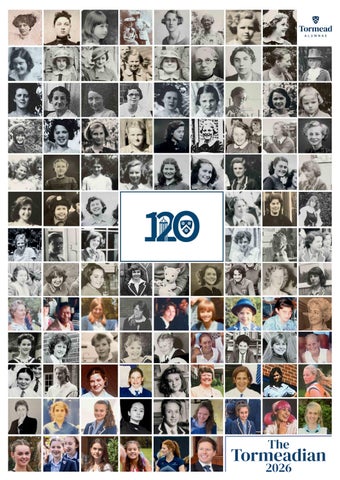
The
Tormeadian 2026
ALUMNAE
Contents
Welcome It is a pleasure to welcome you to the latest edition of The Tormeadian.
1
Welcome
2
Stay Connected Thank you
3
Be Part of The Tormeadian The 1905 Fund: Opening Doors
4
UK Junior Stockholm Water Prize
5
Rising Stars
6
Arkwright Engineering Scholarship Team Tormead Shines In Robotics
7
Gymnasts Crowned National Champions
8
Horizon Talks
11
House News
15
Lost and Found
16
Spotlight: Sarah Hammond
18
Class Reunions, Alumnae Afternoon Tea & Fizz
20
120 Years of Tormead
24
Teacher Interview
25
1905 Ball
26
Tormeadians Abroad
28
Abroad at Tormead
30
The Mind Behind The Business
31
Inspiring The Next Generation
32
Enrichment Award
We look forward to welcoming many more of you back in the coming year.
32
Careers Networking
Development and Alumnae Team
In our 120th year, there has been something especially heartening about seeing generations of alumnae reconnecting with one another and with the school, as seen at our recent Alumnae Afternoon Tea where old girls were given tours of the school by current Sixth Formers, strengthening the sense of community that has long been a defining feature of Tormead. At a time when securing that crucial first step on the career ladder is becoming ever more competitive, it is more important than ever that we continue to support both our current pupils and recent alumnae. We remain firmly committed to ensuring that our students are well prepared, well advised and well supported as they move beyond school. Indeed, many of our recent leavers have already benefited greatly from the generosity of Tormeadians who have given their time to mentor and advise. We are delighted to be extending this programme from September to include current Sixth Formers, connecting them with alumnae in their chosen fields. Our sincere thanks go to everyone who has supported the work of the Development and Alumnae team over the past year. Through fostering connections across generations and creating opportunities for engagement, the team has been able to strengthen and grow our alumnae community. Whether through mentoring, supporting networking events, contributing to this magazine, or attending reunions, your generosity makes a tangible difference.
1
The Tormeadian
Stay Connected Tormeadians and former staff are a vital part of the Tormead community, who enrich the lives of both current pupils and fellow alumnae with their voluntary and philanthropic support. By connecting with the school, our alumnae and former staff will receive regular newsletters, copies of The Tormeadian, event information, updates on school and alumnae news and fundraising appeals. Alumnae are free to choose which communications to receive and how they hear from us. To sign up, log on to ConnecTormead at https://tormeadian.tormeadschool.org.uk or by scanning the QR code.
The Development Office organises a packed calendar of events throughout the year including lunches, sporting events and reunions. If you would like to organise a special event for your year group, please contact alumnae@tormeadschool.org.uk. We hope to welcome you back to an event soon!
Thank You! On behalf of the Development and Alumnae Office, we would like to extend our sincere thanks to all our alumnae, former and current staff, parents, and donors for their continued support and generosity throughout the year. To mark Tormead’s 120th anniversary, each House was challenged to donate at least 120 items on every collection day throughout the academic year in support of Guildford Food Bank. We are delighted to share that the Tormead community exceeded all expectations, donating an outstanding 2,014 items over the course of the year. A heartfelt thank you goes to all our families and staff for their generosity and commitment to this initiative. These donations will help Guildford Food Bank continue to provide vital support to individuals and families in need, and we are incredibly grateful to everyone who contributed to this remarkable achievement.
2
We would also like to recognise and thank the Tormead Parents’ Association (TPA) for their hard work and fundraising efforts throughout the year, as well as the many parents who attended and supported their events. Funds raised have enabled the purchase of four new gazebos for the school, and the TPA continues to support the development of the Urnfield Pavilion through its ongoing fundraising activities. Finally, we extend our sincere thanks to all our alumnae who have generously contributed to the 1905 Scholarship and Bursary Fund. Their support helps ensure that a Tormead education remains accessible to talented pupils, regardless of their financial circumstances.
ALUMNAE
The 1905 Fund: Opening Doors When Tormead was founded in 1905, it was built on a belief in the transformative power of education. More than 120 years later, that commitment continues to shape every generation of Tormead girls. The 1905 Fund has been established to support scholarships and bursaries, helping talented and deserving girls access the exceptional opportunities that a Tormead education offers. Whether in the classroom, on the sports field, on the stage or through the many experiences that make school life so special, the Fund will help ensure that gifted young people can flourish and contribute to our vibrant community.
Be Part of The Tormeadian We would love to hear from you about any big events, such as marriages, births, moves abroad or job changes. If you would like to submit a photo to accompany your news, it can be included in the next edition of The Tormeadian. If you would like to get involved with Tormead life once more, you could become a mentor to a current member of our Sixth Form, deliver a Beacon Lecture to our academic scholars, or attend one of our careers events. Do you run your own business, and would you like to advertise in the Tormead alumnae newsletter?
Every Tormead girl has her own story—a teacher who inspired her, a lifelong friend, a sporting triumph, a role on stage, or the confidence to pursue an ambition. The 1905 Fund exists to help ensure that future generations of girls have the chance to write stories of their own. The 1905 Fund offers a range of tax-efficient ways to give, including Gift Aid where applicable. Every gift to the 1905 Fund, whatever its size, helps create opportunities for future generations of Tormead girls. If your time at Tormead shaped your life in any way, we hope you’ll consider supporting the Fund and becoming part of its story. Further information is available from the Development and Alumnae Office.
To find out more about any of these opportunities, please email alumnae@tormeadschool.org.uk
3
The Tormeadian
School News UK Junior Stockholm Water Prize Congratulations to Jess and Zara in Lower Sixth who came second nationally in the UK Junior Stockholm Water Prize. The UK Junior Stockholm Water Prize is an annual, national competition that serves as a prerequisite for the international round: the Stockholm Junior Water Prize. Every year, tens of thousands of students worldwide between the ages of 15-20 participate, developing innovative research projects addressing major challenges regarding water. These can be anything from raising awareness about the damaging effects of climate change to creating physical products that can be utilised in affected communities. Across the world, a growing “water gap” is emerging, where human demand for fresh water exceeds the capacity of renewable water resources. This imbalance indicates unsustainable water use and places increasing pressure on agricultural systems. Although global hydrological models track these trends on a large scale, their 10-kilometre resolution is too coarse to capture the local variation needed for effective irrigation decisions. In addition, many conventional irrigation systems rely on fixed schedules or resistive sensors, which can suffer from drift, often resulting in inefficient water use. To address this limitation, we developed a scalable precision irrigation system that delivers water according to live field conditions. The system uses parallel networks of low-power capacitive soil moisture sensors that continuously measure and transmit volumetric water content via LoRa (long range wireless communication) to a central receiver that dynamically controls irrigation through
4
use of sprinklers. Water is then applied only to areas of the field where the moisture falls below a defined critical percentage, enabling targeted irrigation. This system reduces groundwater depletion while providing stable, high-accuracy measurements, offering a scalable pathway towards more sustainable global water management. Zara and Jess (Lower Sixth)
ALUMNAE
Rising Stars: Tormead Students Earn Places at the National Youth Theatre Two Tormead students, Sophia (Lower Sixth) and Naru (Year 10), have been accepted into the prestigious National Youth Theatre of Great Britain following successful auditions in London. For over seventy years, the National Youth Theatre (NYT) has played a central role in nurturing young creative talent across the UK. Renowned for its exceptional training and opportunities, it has long been a stepping stone for many who go on to careers in the performing arts. Each year, thousands of aspiring performers audition, with only a small proportion offered places. Gaining entry is therefore a notable achievement, reflecting both dedication and outstanding potential. As Barbara Broccoli, James Bond producer and NYT President, has said:
“The National Youth Theatre is the bedrock of British talent… It provides a vital platform for young people from all walks of life to find their voice.” We warmly congratulate Sophia and Naru on this wonderful accomplishment and wish them every success as they begin their journey with NYT.
Outstanding Success for Year 11 Swimmer Ami Our warmest congratulations to Ami in Year 11 on her outstanding achievement in becoming the British Women’s U18 Junior Champion in the 200m backstroke. In addition to securing this prestigious national title, Ami has set a remarkable new long course record for the South East Region with an impressive time of 2:14.01, a testament to both her talent and relentless commitment to the sport. Ami’s success reflects years of dedication, discipline and perseverance at an elite level. Balancing the demands of high-performance training and competition alongside her GCSE studies is no small feat, yet she has managed both with exceptional maturity and determination. Her
achievements serve as an inspiration to her peers and a shining example of what can be accomplished with hard work and passion. We are immensely proud of Ami and look forward to following her continued success in the pool.
5
The Tormeadian
Arkwright Engineering Scholarship
Team Tormead Shines in Robotics League
Special recognition goes to Year 11 student Alison, who has been awarded a prestigious Arkwright Engineering Scholarship. These highly regarded awards support talented 16 year-olds through their A Level studies while helping to develop ambitions for careers in engineering.
This year, Team Tormead, led by Emily (Year 8), proudly represented the school in a highly competitive robotics league, facing 21 other schools in a series of challenging arena tasks. Demonstrating resilience, technical skill and impressive problem solving throughout, the team secured an excellent 6th place overall, having risen from joint 13th after the pre-competition stage. The competition began strongly, with the robot successfully navigating the arena, identifying a target box using fiducial markers, and returning it accurately to base. An early technical setback in the second round—caused by a broken servo motor—was swiftly overcome, with the team repairing the mechanism in time for the following day, showcasing both adaptability and teamwork under pressure. Day two saw continued determination and steady refinement of the robot’s performance. Emily’s focus and perseverance paid off, with the team achieving 2nd place finishes in the final two league matches. This consistent improvement carried through to a strong showing in the knockout stages. Overall, it was an outstanding and rewarding experience, offering students a valuable opportunity to apply engineering, coding and teamwork skills in a real-world setting.
Reflecting on the process, Alison said: “I applied after it was introduced at school. The application involved designing an engineering project proposal, and I focused on a product for the healthcare sector. I was then invited to an interview with an engineering specialist and a teacher from another school. It was nervewracking presenting to industry experts, but it was great preparation for future interviews.” After her A Levels, Alison hopes to study Biomedical Engineering at university and pursue a career in the biomedical science sector. “I hope one day to make a breakthrough that will help improve people’s lives,” she said. Recipients benefit from financial support, mentoring from industry professionals, and access to exclusive events run by engineering companies, universities, and trade associations. Alison is looking forward to the opportunities ahead. Tormead has a strong track record of success, with Alison becoming the tenth student in the past eleven years to receive an Arkwright Scholarship. Tormead staff support students throughout the rigorous and competitive application process, which includes an aptitude test, a detailed application and an interview for shortlisted candidates. Each year, around 2,500 students apply for approximately 600 scholarships, highlighting the significance of Alison’s achievement.
6
ALUMNAE
Gymnasts Crowned National Champions for Tenth Consecutive Year We celebrate the achievement of our outstanding gymnasts who competed at the Independent Schools National Championships in March. The team delivered an exceptional performance, achieving remarkable success both individually and collectively against strong national competition. In the U9 category, the team secured an excellent 4th place overall, alongside an impressive 2nd place in the group competition. The U11 team were crowned National Team Champions, taking 1st place and adding a further 1st place in the group event. The U15 team demonstrated strength and precision to claim 1st place in both the team and group competitions. In the Over 13 category, the team continued their success, earning 1st place in the team event and 2nd place in the group. Special recognition must also go to those gymnasts who achieved top-six individual national placings: U11
Over 13
U15
Miru – 1st
Sonia – 1st
Jess – 1st
Tianlin – 6th
Sienna – 3rd
Abigail – 5th
Niamh – 5th
Amelie – 5th
While these team and individual accomplishments are exceptional, the greatest achievement for the school lies in what they represent collectively. Winning a national title for ten consecutive years is a truly extraordinary accomplishment and reflects the sustained dedication, talent and commitment of our gymnasts and coaching team across all age groups. We are immensely proud of every gymnast who has contributed to this historic success.
7
The Tormeadian
Horizons Talk – Annabel Hulme for a range of prestigious, high-profile clients, including Dior, Fendi and Louis Vuitton. She spoke engagingly about the demands and excitement of working in such a fast-paced and competitive industry, as well as the invaluable experience she gained living and working abroad.
We had the pleasure to welcome Tormead alumna Annabel Hulme back to school to speak to our Sixth Form students about her inspiring and varied career journey since leaving Tormead in 2012. Annabel shared candid insights into the paths she has explored, reflecting both her creative passions and her willingness to embrace new challenges along the way. After leaving Tormead, Annabel went on to study at Loughborough University, where she graduated in 2016 with a degree in Textiles: Innovation and Design. With a clear ambition to work in the fashion industry, she pursued opportunities that enabled her to develop her creative skills at the highest level. This led her to Paris, where she secured an apprenticeship at the renowned Atelier Lebuisson ICM. During her time there, Annabel worked on developing and creating intricate embroideries
8
In 2020, however, Annabel made the bold decision to follow a very different path. Inspired in part by her mother’s career, she chose to retrain as a midwife, embarking on a new academic journey at King’s College London. Her dedication and determination saw her graduate with a First-Class degree in Midwifery, and she now works at Chelsea and Westminster Hospital. Annabel described her current role as both challenging and incredibly rewarding, highlighting the privilege of supporting women and families at such a significant moment in their lives. Our Sixth Form students found Annabel’s story both engaging and reassuring. Her experience demonstrated clearly that career paths are not always linear, and that it is entirely possible to change direction in pursuit of a more fulfilling future. Her message that “your future is not set in stone” resonated strongly, encouraging students to remain open-minded, resilient and confident in exploring their own ambitions. We are very grateful to Annabel for taking the time to return to Tormead and share her experiences, and for offering such thoughtful advice to our students as they begin to consider their own next steps.
ALUMNAE
Horizons Talk – Sir Jeremy Hunt On Friday 26th September, during our fortnightly Sixth Form Horizon session, Sir Jeremy Hunt, a senior politician and local Conservative MP for Godalming and Ash, came to Tormead to deliver a short speech and then answered many questions from the audience. Hunt talked about the benefits and downsides of his job as an MP as well as the changeable nature of politics. His experience as a politician started in 2005 when he was elected as an MP, and it transformed entirely when he was appointed as Secretary of State for Culture, Media and Sport from 2010-2012, Secretary of State for Health in 2012-2018 and then became the Chancellor of the Exchequer under Prime Minister Liz Truss in 2022. We found his experience of being Secretary of State for Culture, Media and Sport particularly interesting as he explained his initial anxiety about organising the upcoming London Olympics and his lack of sporting experience leading to a true interest in sport. His time as a minister in various Conservative governments led him to make many difficult decisions for the country, and it was a considerable opportunity for Tormead’s Sixth Form students to learn the rationale behind some of these decisions. During the question and answer segment of the talk, Hunt spoke of the dangers of the Russian/Ukrainian war and whether he had any regrets from his time in power. Hunt detailed his relationship with Keir Starmer (the current Prime Minister) and what he believed Starmer should do to improve the current political situation of the Labour party, giving a mature answer, saying that he truly wanted Starmer to succeed. Other topics he spoke
about were the question of tax on private schools and his methods of maintaining mental health whilst under such public scrutiny, to which he gave an incredibly honest answer that everyone appreciated. Students were particularly interested in the striking of junior doctors based on Hunt’s guidance as Health Secretary and the threat of Reform UK to the Conservative party. Having Sir Jeremy Hunt visit our school was an amazing privilege, and a great opportunity to learn more about working in the world of politics. Everyone thoroughly enjoyed it, and there was a lively discussion on topics everyone in the room cared about to some extent, whether that be decisions Hunt made regarding junior doctors or the current socioeconomic state of the world. Ruby & Ella, Upper Sixth
9
The Tormeadian
Sports Talk – Liz Cann Professional badminton player Liz Cann was welcomed to Tormead in October to speak to our Talented Performer Programme athletes about the importance of setting meaningful goals and developing a strong, positive mindset. Liz has enjoyed an outstanding career, becoming a five-time national champion and winning two Bronze medals at the Delhi Commonwealth Games. Drawing on her experiences of competing at the highest level, she shared valuable insights into the dedication, resilience and determination needed to achieve success in elite sport. Since retiring from competition, Liz has developed a passion for studying neurolinguistic programming (NLP) and mindset-enhancing techniques that help people perform at their very best. She now works with athletes and young people, equipping
10
them with practical tools to build confidence, overcome setbacks and fulfil their potential. Liz’s engaging and inspiring talk encouraged our athletes to think differently about the way they set goals. Rather than focusing solely on outcomes, such as winning a competition or achieving a personal best, she challenged them to adopt an identity-based approach, considering the kind of athlete and person they want to become, and the habits and behaviours that support long-term success. Her message resonated strongly with our students, who left feeling motivated, empowered and equipped with practical strategies they can apply both on and off the sports field. It was a fantastic opportunity for our Talented Performer Programme athletes to learn from someone who has experienced the highs of elite competition and has continued to inspire others through her work beyond sport.
ALUMNAE
House News Spring House Sports Day Tormead’s annual Spring House Sports Day, held on Thursday 26 March, brought the whole school community together in a lively celebration of sport, teamwork and House pride. With events taking place across both the main school site and Urnfield Sports Ground, pupils of all ages participated in a wide range of activities, from netball, hockey and football to rowing, cycling, gym and dance, as well as table tennis, dodgeball and diamond cricket. The inclusion of new activities this year further broadened participation, allowing even more pupils to contribute to their House’s success.
Following House briefings, competition got underway with energy and enthusiasm, which continued throughout the morning. At midday, pupils gathered for an upbeat cheerleading performance before enjoying lunch, with House spirit evident in the sea of colours and encouragement from the sidelines. In the afternoon, the focus shifted to Urnfield, where the atmosphere intensified for the final rounds of competition. The standard of play was excellent, with pupils demonstrating both skill and sportsmanship. The day concluded with a trackside presentation, celebrating achievements and announcing the overall House winners — a fitting end to an event that captured Tormead’s inclusive and spirited sporting culture.
11
The Tormeadian
House Music The much-anticipated House Music Competition made a vibrant return on the final day of the Spring Term, bringing with it a dazzling celebration of talent, creativity, and house spirit. Pupils and staff fully embraced this year’s ‘Disco’ theme, filling the stage with colour, energy, and unmistakable sparkle. The competition featured both a full house performance and a small ensemble piece with instrumental accompaniment, providing a wonderful platform for pupils to showcase their musical ability, teamwork, and enthusiasm. From dynamic choreography to confident, expressive vocals, the standard throughout was exceptionally high. Nelson lit up the stage with lively and spirited performances of ‘Le Freak’ and ‘Footloose’, while Nightingale delighted the audience with energetic renditions of ‘Hung Up’ and ‘Can’t Stop the Feeling’. Livingstone also impressed, delivering polished and engaging versions of ‘Ain’t No Mountain High Enough’ and ‘Blame It on the Boogie’. Wellington House emerged as this year’s champions, captivating the judges with powerful interpretations of ‘I Will Survive’ and ‘Dancing on My Own’. Their confident stage presence, musical precision, and cohesive performance secured them a well-deserved victory. The day was a resounding success and a joyful celebration of music, creativity, and community. Congratulations go to all pupils and staff for their dedication and hard work, and especially to Wellington House on their fantastic achievement.
12
ALUMNAE
House Fashion and Dance
Just before Christmas, we hosted our hugely popular annual House Fashion and Dance Show. Each House designed and created up to seven costumes using repurposed and recycled materials, showcasing impressive creativity, design flair and sewing skills.
Congratulations to Nelson and Nightingale, who shared first place in the Fashion competition. However, it was Nightingale’s additional victory in the Dance section that secured their place as overall champions of this year’s event.
The Houses embraced a variety of imaginative themes. Wellington paid tribute to some of their favourite Classical gods, with students appearing in togas and feathered wings. Nelson delighted the audience with a cast of Disney villains, including Scar and Cruella, who were met with enthusiastic cheers. Livingstone transported us back to 2020 with their ‘End of the World’ theme, featuring a memorable ballgown crafted from PPE, while Mr Wilkinson proved a convincing alien. Meanwhile, Nightingale invited the audience to solve a mystery with their ‘Who Dunnit?’ theme, complete with Sherlock Holmesinspired costumes and an interactive murder investigation.
13
The Tormeadian
House Drama This year’s House Drama Competition, held in October, was a wonderful showcase of creativity, humour and thought-provoking storytelling. Centred around the theme of Connection, pupils in Years 7–9 were challenged to devise performances that explored social issues through comedy, drama and imaginative narratives. Each House presented three original pieces, demonstrating the remarkable talent, ingenuity and teamwork that flourish at Tormead. From laughout-loud moments to more reflective themes, every performance brought something unique to the stage. Highlights from the afternoon included Nightingale House’s delightfully chaotic murder mystery, Nelson House’s comedy inspired by a Duke of Edinburgh expedition, and Wellington House’s production of United Nations for Biscuits, which tackled the age-old question: is a Jaffa Cake a biscuit or a cake? Livingstone House captivated the audience with a dramatic exploration of the ways in which advances in technology are shaping our social connections and everyday lives. Congratulations to Livingstone House, this year’s worthy winners. A huge thank you also goes to our wonderful judges: Tash, a Tormead alumna with a passion for drama and theatre performance, and Grant, a Producer and General Manager who has worked on numerous productions in London’s West End. Their expertise and enthusiasm helped make the event such a memorable success.
14
ALUMNAE
Lost and Found Lost…
Found…
As Tormead geared up to mark its 120th anniversary in 2025, we embarked on an exciting journey to reconnect with the many remarkable women who have walked through our corridors. To celebrate this milestone, we launched our “Lost Alumnae Campaign”, with the aim of reuniting with alumnae who may have lost touch with the school over the years.
Mandy Watts 1984
Charlotte Miller 1997
Jo Parker 1982
Babara Smith 1972
Briony Lee (Thomas) 2010
Christina Vale 2012
Anna Tactcil 2024
Izzy Hull 2025
Stephanie Zilka 1981
Marian Sage (Hefford) 1973
For over a century, Tormead has been a cornerstone of education in our community, shaping the lives of countless students who have gone on to achieve incredible things in all walks of life. From doctors and engineers to artists and entrepreneurs, our alumnae have made a mark on the world.
Alice Vranch 1993
This campaign was part of our wider celebration of 120 years of excellence. We know that many former students have moved away, changed careers, or simply lost contact with the school. With the continuation of this initiative, we aim to bring our alumnae community back together, sharing stories, experiences and memories that have contributed to the rich legacy of Tormead and the response so far has been wonderful. We would like to say, “welcome back!” to all of those who have rejoined the Tormead family over the past year. You can help us to make our 120th anniversary truly special by encouraging former classmates to reconnect. Together, let’s celebrate the past, present and future of Tormead.
Clare Marshall 1974 Sophie Bem 2006 Sharon Paulraj 1977 Caroline Egleston (Clements) 1977 Ali Lamont (Whatley) 1977 Ali Turna (Pugh) 1992 Steph Gage 2015 Gillian Wilson (Body) 1977 Clare Cummings (Spyrakis) 2004 Emilia Cavanagh 2022 Olivia Thomas 2018 Eilidh Mohamed 2025 Sally Donegani 1977 Georgette Anderson (Spencer) 2002 Amy Dixon (Cotton) 2004 Millicent Slater 2021 Sue Sanders 1977
Katie Darke 1998 Carolyn Foster 1976 Sarah Reid (McKenzie) 1990 Sam Perry 1997 Joanne Cowell 1995 Liz James (Chambers) 1982 Abbie Earnshaw 2024 Evie Gracey 2016 Frances Ryan 1993 Joanna Francis 1993 Nikki Kerrs 1993 Heena Parekh (Shah) 1977 Sarah Rushmore 1993 Lizzie Brookes (Molter) 2010 Ann Hutt (Sutcliff / Thomas) 1970
Annie Hammett 2019
Deborah Gray (Collett) 1990
Ella Taylor 2018
Andie Allin 2020
Daisy Munroe 2025
Zoe Forster 2026
Vicky Mason (Harston) 1996
Jennie Hogan 1989
Emily-Jane Ellery 1996
Juliet West 1981
15
The Tormeadian
Spotlight: Sarah Hammond I started at Tormead in the junior school in 1967. By the time I arrived in senior school, the amazing new state-of-the-art cookery department had been built, reigned over by Mrs McCurdy. We were all issued with a copy of Practical Cookery, which I still have, and started with boiling eggs. The room was set up with mini kitchens in which two of us worked at a time. We soon progressed to Swiss roll and chicken chasseur. What ever happened in that classroom moulded me for the rest of my life, little did I know it at the time. By the time I got to O Level Domestic Science, I had decided to go directly to Guildford Technical College to study hotel management, catering and institutional operations. I did not have the option to stay at Tormead for A levels; there were not the resources. However, I am a great believer that things happen for a reason in life. I left school set up for September at Guildford College. In the days I was at school there was something called the Lindgaurd Award. It was a financial award given by a really very special teacher. She lost all her family in prisoner-of-war camps and so generously gave to the next generation. Her award financed all the books I needed for my course and my knives, still treasured to this day. I must have been so naive, leaving an all-girls’ school and a very sheltered environment to join the catering world, which in those days was VERY male dominant. Only two girls amongst a sea of men, but I survived and I learnt. I left college to travel and my goodness, once you can cook you have a job all around the world! I cooked for a family in New York, a beach house in Barbados, Texas, California, a diversion in Australia to go grape picking (it paid better!), then Cape Town and New Zealand. When I returned home, within two weeks I had a job cooking lunches for directors in their big offices in the City. In those days, the offices had beautiful suites to entertain clients and there was a group of girls similar to myself who daily
16
went together to market and cooked three course lunches for the guests. I was with Lloyds insurance brokers, goodness knows how at 19 I bluffed my way into that job. My mother had run a private catering company while we grew up, so the great thing was I used to race home from work and then go and help cook for weddings and parties at the weekends. Eventually the catering got bigger and bigger and I could no longer do the two jobs, so I joined Mum full time along with my now husband. He is not a chef by any means. Every creative soul needs a business head behind them and lucky for me I had Chris. We ran a contract, we did weddings and big parties and we never stopped working. The truth is when you love what you do and when you have your own business it becomes your way of life. I have recently retired, but when I look back, I could never imagine where it would take us; from local family weddings and parties to palaces. When we had more work than we could cope with we did a joint venture with Rhubarb, a hospitality business in London. We became directors and shareholders. We won some amazing contracts from The Royal Albert Hall, The Walkie Talkie, and Ascot Racing Club, to name a few. In the Rhubarb years I took off my apron and led the team, we even flew 16 staff to organise the opening of Hudson’s Yard in New York. I could go on and on about how I loved my job, the people we employed were like family and fantastic. I smile as I write this because I have had such an amazing journey. Thank you Tormead for setting me on my way. My advice to anybody wanting a career in hospitality: It’s long hours, but you won’t realise it. It’s never boring, the sky is the limit, and it is so much fun. You can go from a 16-year-old leaving school to the boardroom of one of London’s largest highend companies and pinch yourself when you sit in a boardroom.
Seize the moment!
ALUMNAE
17
The Tormeadian
Class Reunions, Alumnae Afternoon Tea & Fizz We have been proud to host so many alumnae at Tormead over the past year for our Afternoon Tea & Fizz reunions. Held in both October and April, these gatherings provided the perfect opportunity to reconnect with old friends, revisit familiar surroundings, and celebrate the enduring Tormead community. In October, our reunion had an extra reason to celebrate as we marked the 120th anniversary of Tormead’s founding. To commemorate this milestone, guests were among the first to explore a special exhibition from our school archives, bringing together photographs, documents and treasured artefacts that tell the story of Tormead through the decades. From black-and-white class photographs and sports trophies to the original handwritten school magazine, each piece offered a fascinating glimpse into the people, achievements and traditions that have shaped the school over more than a century. Our April event made the most of glorious sunshine, with guests enjoying afternoon tea on the Horseshoe Lawn. Over sandwiches, cakes and a glass or two of fizz, conversation flowed as memories were shared and friendships rekindled. Sixth Form pupils offered guided tours of the school, and their enthusiasm, warmth and professionalism were greatly appreciated by our visitors. We were also touched by the generosity of alumnae who chose to support our Bursary and Scholarship Fund, helping to create opportunities for future generations of Tormead pupils. Thank you to everyone who joined us. It is always wonderful to see our alumnae back at Tormead, and we look forward to welcoming many more familiar faces – and new ones – to future reunions.
18
The Alumnae Afternoon Tea and Fizz event was a wonderful opportunity to welcome back alumnae to Tormead after several years or perhaps several decades, offering a chance to reminisce on guided tours and share fond stories of fun and mischief! It was truly lovely to bear witness to the nostalgia of so many former students, several of whom now have daughters and granddaughters of their own, and to hear the history of our school contextualised so vividly by those who experienced it firsthand. Though much has changed (the newly refurbished Sixth Form common room and library received rave reviews!) it quickly became apparent that the essential spirit of school has persisted, with one alumna recalling the happy, homely atmosphere which coloured her school days here. As a Lower Sixth student beginning to navigate the whirlwind of UCAS applications, degree considerations and the daunting prospect of parting with my second home, a Tormead family of which I have been a member for almost ten years, it is difficult to ignore the series of ‘lasts’ which we will slowly accumulate in this final stretch. And yet, as I stood atop the grand wooden staircase, observing a breadth of generations from the 1970s to 2020s, all equally delighted to recognise themselves and their teachers in the whole school photographs, it occurred to me that though these tender years may recede into faded memories, I will be a Tormead girl forever. Bee, L6
ALUMNAE
19
The Tormeadian
120 Years of Tormead In 2025, Tormead marked a remarkable milestone: 120 years since the small seed of an idea first took root and grew into the thriving, ambitious and highly respected school we know today. The story begins not with grand buildings or elaborate plans, but in the front room of Glebefields, a house on Lower Edgeborough Road. There, Mrs Wilkes, keen that her daughters should share their education with a circle of friends, engaged the talented Countess Zola-Wolaska as their teacher. What started as a modest private enterprise soon attracted attention, and the foundations of Tormead were laid. As word spread and the school’s reputation grew, so too did demand for places. The young school moved twice before finding its permanent home at Tormead House in 1914. By then, it had evolved into a small but flourishing community: close-knit, happy and, by contemporary accounts, possessing more than a little eccentric charm. The journey from those early beginnings was far from straightforward. Throughout its history, Tormead has been shaped by a succession of determined and visionary Headmistresses whose leadership carried the school through periods of uncertainty and change. Relocations, financial pressures, fluctuating pupil numbers and concerns over the school’s future were all challenges that had to be overcome. Yet, time and again, resilience and commitment ensured that the school not only survived but prospered.
20
The twentieth century brought its own trials, none more significant than the two World Wars. During the Second World War, Tormead was jointly led by Miss Irene Cole and Miss Bertha Williams, appointed in 1935 after the school was purchased by Miss Cole’s brother, Eric Cole. Eric Cole was already a notable figure in British industry. Through his company, E.K. Cole Ltd (ECKO), founded in 1924, he had built a successful business manufacturing wireless sets. As war approached, however, the company turned its expertise towards one of Britain’s most vital secret projects: the design and production of radar technology, which would prove crucial to the nation’s defence. Despite the upheaval of wartime, life at Tormead continued with remarkable determination. Lessons were maintained as normally as circumstances allowed. Air raid sirens occasionally interrupted classes, sending pupils to shelters on the school grounds that had been built thanks to generous donations from parents. While the wider world faced uncertainty, the school provided continuity, stability and a sense of community for its pupils. One incident in 1940 became part of school legend. When an incendiary bomb landed on the tennis court, Miss Cole calmly fetched a spade and extinguished the fire herself before it could spread. The archives reveal many fascinating glimpses into everyday life at Tormead during these years, not least the school’s longstanding connection with one of Britain’s most celebrated dance teachers.
ALUMNAE
For decades, Madame Vacani and later her daughter, Betty Vacani, brought a touch of theatrical elegance to the school. The Vacani name was already well known through the distinguished London dance school that trained generations of performers and members of the Royal Family, including Queen Elizabeth II, King Charles III and Princess Anne. Throughout the 1940s and 1950s, Miss Vacani travelled from London to Guildford every Tuesday to teach ballet, tap and ballroom dancing. In the summer months, lessons took place outdoors on the lawn, accompanied by “Tinkler”, the beloved school piano, wheeled outside for the occasion. During the winter, classes moved into the gymnasium. Former pupils remember these Tuesdays with particular affection. The annual dance displays, choreographed by Miss Vacani and performed beneath the walnut trees on the lower lawn, became one of the highlights of the school year. Blessed, it seems, by near-permanent sunshine in the memories of those who took part, these performances drew enthusiastic audiences and remain among the most treasured recollections of mid-century school life. The archives also offer reminders that Tormead’s history has not always been exclusively female. For a period, the school welcomed boys as well as girls. Logbooks record that around fifty boys began their education at Tormead, typically joining in kindergarten before moving on after a couple of years to local preparatory schools.
Many arrived because older sisters were already pupils. During the war years, some boys even boarded at the school and, in certain cases, shared rooms with their sisters. Their stories add another unexpected dimension to Tormead’s rich history. Among them was Peter Cohen, whose experience reflected the challenges faced by many families in 1939. Seeking safety away from London as war loomed, his family moved to Guildford. Peter and his sister enrolled at Tormead, becoming part of the school community during a period of enormous national upheaval. Although their time at the school was relatively brief, it formed an important chapter in their childhood and remains preserved within the school’s archival records.
A Home from Home For much of its history, boarding lay at the heart of Tormead’s identity. From the earliest years, boarders brought an international spirit to the school, reflecting the increasingly global outlook of many families in the early twentieth century. Census records from 1911 and 1921 reveal girls arriving not only from across Britain but also from France, Spain and India, bringing with them different experiences and perspectives. As the school’s popularity grew during the 1920s and 1930s, demand for places put increasing pressure on available accommodation. At Tormead House, younger boarders slept in dormitories of six, while older girls occupied attic bedrooms tucked beneath
21
The Tormeadian
the eaves. Even these modest arrangements evolved over time. In 1938, improvements included a dedicated sitting room for senior girls, created above the kitchen at the top of the back stairs, a small but welcome recognition of the growing maturity and independence of older pupils. By the 1960s, boarding had expanded beyond the main school site. Younger girls continued to live at Tormead, while older boarders were housed at Cranley Court on Cranley Road and at Lyncairn on Hillier Road. Both houses offered gardens and common rooms intended to provide a homely atmosphere away from family. Boarding life was rich and varied, encompassing everything from horse riding and fencing to weekend walks into Guildford for shopping and socialising. Yet, like many boarding schools across the country, Tormead experienced changing patterns of demand during the 1970s and 1980s. Numbers fell steadily, from 115 boarders in 1973 to only 50 by 1984. Recruiting resident staff willing to undertake evening and weekend responsibilities also became increasingly difficult. In 1986, parents were informed that boarding would close, with the final boarders completing their studies in 1988. This marked the beginning of a new chapter, with increasing focus on the needs of a growing and dynamic day-school community.
22
The People Who Shaped a School The history of Tormead is not only a story of buildings, headmistresses and milestones. It is also a story of remarkable individuals whose influence extended far beyond the classroom. Among them was Janet Villiers, appointed Senior Mistress of the Middle School in 1968, a role she held for twenty-one years. For years, girls delighted in receiving the tiny, knitted teddies she made as prizes, though few knew the extraordinary story behind them. Mrs Villiers’ childhood had been shaped by the Second World War. Her father, Lieutenant Commander George Villiers, was involved in vital wartime operations and possessed sensitive knowledge relating to the Norwegian heavy water plant, whose destruction became a crucial objective in preventing Nazi Germany’s atomic ambitions. Because the information was too dangerous to record in writing, Janet and her brother memorised key details. The family’s eventual escape to Britain, aided by the Norwegian resistance, was fraught with danger. Throughout the ordeal, Janet’s teddy bear, Argie, never left her side. One family story tells how, while travelling in a Norwegian fishing boat, Janet waved Argie at a British aircraft investigating the vessel. The sight of the unmistakably English teddy bear reportedly reassured the pilot that the occupants were
ALUMNAE
not enemy decoys. Whether by chance or providence, the family reached safety. The experience left Janet with a profound belief in the importance of childhood security, happiness and education. It also explains why, on Tormead’s first mufti day in 1983, she delighted pupils by arriving dressed as a lifesized teddy bear—a moment that perfectly captured her sense of humour and affection for the school community. Another much-loved member of staff was Miss Ethel Jones, whose thirty-three years of service left a lasting legacy. Teaching art and needlework with infectious enthusiasm, she inspired generations of girls to develop their creativity and confidence. Her commitment extended far beyond the classroom. As House Tutor of Wellington and later Joint Senior Mistress, she was a respected and encouraging presence throughout school life. Miss Jones believed passionately in exposing her pupils to the wider world of art. Every year she organised visits to major exhibitions in London, helping students engage directly with artists and works they might otherwise never encounter. Her influence continued long after her retirement. Following her death, the generous endowment she left to the school enabled the creation of the Ethel Jones Memorial Prize, first awarded in 2001 and among the numerous scholarships still awarded.
The Girls’ Own Voices One of the most charming discoveries in the archive is the earliest surviving school magazine, dating from 1909. Beautifully handwritten and illustrated, it offers a vivid glimpse into the interests and imaginations of Tormead girls more than a century ago. Filled with stories, poems, puzzles and observations on current affairs, the magazine was entirely the work of the pupils themselves. Only a single copy was produced and placed in the school library for communal enjoyment, accompanied by firm instructions that it should not be damaged, folded or soiled. In an era before photocopiers, printers or digital publication, each issue was a precious object.
23
The Tormeadian Like so much else, publication was interrupted by the outbreak of the First World War in 1914 and did not resume until 1937. When it returned, the magazine took on a different character. Compiled largely by staff, it became a record of school life, chronicling events, achievements and milestones. Yet pupils’ voices remained at its heart through contributions of poetry, prose, artwork and accounts of sporting successes. Together, the magazines form an invaluable record of changing school life across generations and reveal how much has changed and much has remained the same. The decades after the war brought significant growth and transformation. Demand for places steadily increased, particularly from the 1950s onwards, when applications consistently exceeded the number available. In response, the school embarked on a carefully planned programme of expansion and modernisation.
Buildings were added and adapted to meet changing needs, while the curriculum broadened to reflect new educational opportunities. The development of a thriving Sixth Form widened academic horizons and helped prepare pupils for a rapidly changing world. As society evolved, so too did Tormead, balancing innovation with the preservation of its distinctive character. Today, as Tormead celebrates 120 years of history, it does so not as a museum piece but as a living, evolving institution. From a handful of girls gathered in a drawing room at Glebefields to the vibrant school community of today, Tormead’s story is one of vision, perseverance and growth. Its past speaks of resilience, its present of excellence, and its future of the generations still to be inspired within its walls.
Teacher Interview – Julian Sykes What do you consider your greatest accomplishment? Organising and running a day with the Sixth Form for Ukrainian children and their parents. It was brilliant to see the children and their parents relaxing and playing with our Sixth Formers. It led to some of the Sixth Form going on to work with the local Ukrainian support group.
What advice do you have for students? Read fiction - there are so many fascinating stories and you will be able to see the world from a different perspective. Try My Antonia by Willa Catha or Freedom by Johnathan Franzen.
24
What is the hardest part of being a teacher? Students who are not as excited to study Politics and follow current affairs as I am.
What is the most enjoyable aspect of your job? Helping students, laughing with students and I really love D of E. Saying things like - ‘it’s giving top Tormead vibes’ and ‘if you don’t revise you are going to be cooked’ and ‘Oh my actual Tormead days...’
What advice would you give to your younger self? Join Tormead as soon as you can.
What do you do when you are not at school? I like playing Frisbee with my dog Monty and cycling.
ALUMNAE
1905 Ball
We were delighted to host our inaugural 1905 Ball on 10th October 2025 in support of Tormead’s scholarships and bursary programme. The evening was a sellout success, bringing together parents from Reception to Upper Sixth for a truly memorable night of celebration, fine dining and dancing. Guests were treated to a delicious three-course meal, followed by a lively programme of entertainment, including House-themed games and quizzes. After some spirited competition, Livingstone House emerged victorious. Funds were raised through drinks sales and a vibrant auction, and we are pleased to share that the event raised more than £4,300 to support current and future Tormead pupils.
stunning floral arrangements by Lots in Pots, both businesses owned by Tormead parents, while Revology Events provided invaluable support in bringing the evening together. The 1905 Ball was not only an unforgettable occasion but also a shining example of Tormead’s spirit of generosity, collaboration and philanthropy. We extend our sincere thanks to everyone who contributed to making it such a meaningful and successful event.
What made the evening particularly special was the remarkable sense of community behind it. Every auction prize was generously donated by members of the Tormead community. Catering was provided by Thyme and Lime, and the
25
The Tormeadian
Tormeadians Abroad Louisa O’Connor What motivated you to move abroad? When I finished at Tormead, I went to Leicester University to study applied geology. My first love was art, textiles and design, but I had a love of rocks too. I spent some time doing temporary work when I graduated, but I was left wanting to do something with my degree and realised that you need a postgraduate qualification to get ahead of a pool of people. Wanting to go into mining, I ended up going to Camborne School of Mines at the University of Exeter to study mining geology. It was a fantastic year, and it included an overseas field trip, which just so happened to be in Western Australia. I spent three weeks in a minibus with eighteen other students driving around going to mines and processing plants, passing through the most amazing scenery. It was everything I wanted to do. However, just applying for a job in Australia in mining was next to zero success, it wasn’t on the government ‘skilled migration list’ of must-have skills. I came home, qualified with a Master of Science and took a role in London. I worked for Arup doing engineering geology for the King’s Cross – St Pancras redevelopment, so more civil engineering than geology. It was a great experience, but it wasn’t what I wanted to do. During that time, I kept up with my friends from Masters (always a good thing to keep your network going!) and was told about a very well-funded research and development project at the University of Nottingham that was sponsored by top-tier mining companies. I figured that if I wanted to get to Australia and be guaranteed employment over there, that someone else would have to pay my
26
relocation… this was my chance, so I applied for a PhD opportunity. The research team needed someone to study minerals, which is my area of interest. The position was sponsored by Rio Tinto and I spent three years blowing up rocks in microwaves, looking at electromagnetics and interaction with rocks - it was great fun! I achieved my mission. I received my PhD, and I was offered a role and moved to Australia by myself in 2007.
What do you enjoy about your life in Australia? I enjoy many things in Australia. The opportunities for me are probably unavailable in the UK. Australia, as a place is amazing in terms of places to go, things to see and natural beauty, but each country has its own collection of positives. I live in Perth, the most remote city on the planet. Many skip over Perth or Western Australia when visiting and I think that is a shame. It’s a huge State, but well worth a visit. I haven’t always worked in industry; mining is cyclical and redundancy ebbs and flows; it’s the nature of demand. With that, you need to be resilient and adaptable. I have worked for several universities and been a lecturer and Dean of teaching and learning for the Western Australian School of Mines, a role I loved. These roles have all been through networking and keeping up with past colleagues, the key is to keep your network going. Above all, the thing I love most about being in Australia is my family. I am married to Greg, a funny, clever man who is a metallurgist, and I have a daughter Penny (13) and son Michael (11).
ALUMNAE
What do you miss about the UK? The obvious thing I miss about the UK is my family; I have a small family. I don’t see them often, but when I do it’s great. I especially miss my sister Clair, she’s a fantastic person. I have friends I rarely see too, that’s hard, but there are ways to stay in touch. One thing that strikes me with some frequency is history. Australia has a relatively short history, so returning to the UK and seeing wonderful old buildings, beautiful churches and villages is something that is very satisfying. I also miss the pomp and ceremony that is so intrinsic to the UK.
Any other comments for being overseas I would encourage anyone to take an opportunity to work overseas, if it feels right. There is always a moment when you are wondering if you are doing the right thing. When I flew out of Heathrow to Sydney, I knew so little about what to do, what it would be like etc. I soon made friends and got into the swing of things. I was well supported by my employer as well. I hadn’t set a time frame to be in Australia. For those unsure if they want to put roots down in a foreign country, then setting a timeframe may be a good idea, it sets your state of mind. If your time is open then there is a necessity to make opportunities happen, rarely do things fall into your lap. I have no regrets moving to Australia despite things and people I miss. It’s a wonderful place to bring up your family and a great place if you want to be in natural resources.
27
The Tormeadian
Abroad at Tormead Thea Zevenbergen In 1997, my Dutch family and I moved from Germany to England. For me, England was the third foreign country where I would go to school, after Belgium and Germany. So naturally, my parents and I presumed all would be well; we were used to moving around and switching languages and school systems. But things in England were different! Getting into a school uniform for the first time at age eleven was no small thing — I felt ridiculous. The only way my mum got me into the car was by promising that it would be fine when we arrived, because everyone would be dressed the same. This made sense, but turned out to be untrue. I soon learned that even when everyone wears the same clothes, the details can make a huge amount of difference. Starting with the shoes: I had the wrong ones. No heels and the leather was far too shiny. Things like skirt length and shape also mattered, I soon learned. Weirdly, the shapes of the skirts were not all the same. Didn’t everyone shop at Howzat? Anyway, by Upper 4 I had caught on and my uniform was finally up to standard. Walking into Tormead for the first time through the entrance hall where the Headmistress, Lady Honor Alleyne, had her offices was very impressive. I had never seen anything like it. Of course, I would soon learn that this was nothing compared to some English boarding schools like the one my brother went to (Cranleigh) but all the same, it made me realise I had stepped into a different world. A privileged world in which I would be taken care of as never before. Incidentally, that was the
28
only time I ever came in through the entrance hall, I was immediately informed that girls should go through the side entrance where the cloakroom was. The only other time I used the entrance hall was to collect my GCSE results a few years later. After being ushered out of the entrance hall that I was not supposed to be using, I found myself standing in the middle of Tormead with absolutely no idea where I was meant to go. Before panic had a chance to set in, Miss Gregson appeared. “Theodora? No English?” she asked, and from that moment on, I was saved. Within minutes she had delivered me to the correct classroom and enlisted a few girls to look after me. During those first few weeks, I was not left alone for even a second, and no one seemed to mind in the slightest. Soon enough, it stopped mattering how different the school was from what I was used to; it was the most welcoming start I had ever had. Tormead would go on to teach me to have the highest standards for myself and my surroundings. Academic success was presumed before I had even learned to thank the lunch staff for my jacket potato. Every effort I made was seen and encouraged, every mistake unfortunately also seen and corrected. At the end of my first year, I was awarded the ‘Progress and Perseverance’ prize, something we still talk about in my family today. My brothers have spent years laughing at me for receiving a prize that, in their view, amounted to not actually achieving anything. ‘A for effort’, as they like to say. My parents, on the other hand, were completely mesmerised
ALUMNAE
by the whole setting: hours of speeches, applause, and teachers in gowns, everything carefully coordinated. My friends in the Netherlands still will not believe that something like prize-giving ceremonies existed, let alone that we practised in advance. Each of us walking up on stage in alphabetical order and receiving detailed instructions on how to accept our prize properly. We would step forward, look the prize-giver (Mr Fitzgerald, a man whose name I will never forget, even though I cannot for the life of me remember who he actually was) straight in the eye, shake his hand, say ‘Thank you, Mr Fitzgerald’, and then leave the stage at an appropriate pace. The discipline at Tormead can seem a little silly to people from the Netherlands. Standing up when the teacher enters the room, always using the teacher’s name (the surname, definitely not the first name as we do here), even during morning registration when 25 girls would respond one after another, “Yes, Mrs Snel. Yes, Mrs Snel. Yes, Mrs Snel.” To those unfamiliar with it, it can seem excessive. In the Dutch school system, there is an assumption that politeness and discipline take away from enjoyment in school and from the relationship between teachers and pupils. I believe the opposite is true; it adds to it. And to learning how much more you can achieve when you hold high standards. I did not understand this when I arrived at Tormead, but I understood it when I left — and I have not forgotten it since.
29
The Tormeadian
Katherine Mollart: The Mind Behind the Business Was there a specific teacher that sparked your fascination with the human mind? Absolutely. My A-level Psychology teacher, Miss Rawstron, played a huge role in inspiring my interest in psychology. She brought the subject to life and encouraged us to think about why people behave the way they do. Her enthusiasm for the subject was infectious and helped confirm that psychology was something I wanted to pursue further.
What inspired you to bridge the gap between psychology and entrepreneurship? After qualifying, I worked my way into management roles within the NHS. While I valued the experience, I found I was spending less time working directly with patients, which is what I enjoyed most about psychology. Setting up my own practice allowed me to return to clinical work and make a direct difference to people’s lives. Private practice also gave me the flexibility to balance work and family life with young children, while offering clients a service that can be more responsive than NHS pathways, with shorter waiting times and therapy tailored to individual needs rather than fixed session limits and therapy models.
What is the most valuable soft skill or lesson you learned during your school years that you still use today? One of the most valuable lessons I learned at school was the importance of building positive relationships with people from different backgrounds and perspectives. Whether working with clients, colleagues or other professionals,
30
communication, empathy and the ability to listen are skills I use every single day.
What was the steepest learning curve you have faced when setting up your practice? The biggest challenge was stepping away from the security of the NHS and building a business from scratch. There is always the uncertainty of where future referrals will come from, and moving from a large multidisciplinary NHS team to working independently can sometimes feel isolating. Learning the business side of running a practice, while maintaining high clinical standards, was a significant adjustment.
What is the most fulfilling feedback or success story you have experienced through your business so far? The most rewarding moments are when clients tell me that therapy has genuinely changed their lives. Seeing someone who initially felt overwhelmed by anxiety, trauma or low selfesteem gradually regain confidence and start doing things they never thought possible is incredibly fulfilling. Knowing that I’ve played a small part in helping someone move forward is what makes the work so meaningful.
What advice would you give to current students with an entrepreneurial drive? Don’t wait until you feel completely ready before pursuing an idea. Be curious, ask questions and be willing to learn from mistakes. Entrepreneurship isn’t about having all the answers from the start; it’s about being adaptable, resilient and persistent. Most importantly, focus on solving a genuine problem or meeting a real need, as that’s where the best opportunities often come from.
ALUMNAE
Inspiring the Next Generation: Sixth Form Mentoring Programme Launches This Autumn We are delighted to be launching a new Sixth Form Mentoring Programme this autumn, connecting current students with members of our inspiring alumnae community. The programme will offer Sixth Formers the opportunity to gain valuable insight from alumnae who are currently at university or established on their chosen career pathways. Mentors will be matched with students based on shared interests, whether that is a particular university, degree course, career sector, industry, or simply a desire for general guidance and encouragement. Mentoring conversations may cover a wide range of topics, including university and course choices, application processes, workplace culture, industry trends, the growing impact of AI, and the skills and attributes employers are seeking in young people today. One alumna, who benefited from mentoring herself while in the Sixth Form, is now volunteering as a mentor for the programme. Reflecting on her experience, she said: “Having a mentor during Sixth Form was massively beneficial. Having an external perspective on university applications, degree courses and the wider engineering industry gave me confidence in the decisions I made about my future. It also helped me put setbacks into a wider career context and showed me the breadth of opportunities available. The insights I gained left me feeling far better prepared to make decisions about my own career, and I’m excited to now be able to offer that same support to current students.”
We are seeking alumnae who would be willing to commit to a short online mentor training session in September, an introductory Teams meeting with their mentee before the October half-term break, and three further online meetings across the academic year. This exciting initiative is a wonderful opportunity for alumnae to share their experiences, inspire confidence and help our Sixth Form students realise their potential. If you would like to get involved, please contact alumnae@tormeadschool.org.uk.
31
The Tormeadian
Enrichment Award Our annual Enrichment Award is open for applications
Andrea Byrne
This is an exciting opportunity to apply or nominate someone for our annual enrichment award. We would like to encourage alumnae to nominate themselves, or each other, if they would benefit from the support of the Tormead community. The award is worth £1,000 and is available to an alumna with a talent in any field, who is looking for support with a new project, to further their own professional or educational career, or is a businesswoman or novice entrepreneur requiring our support. We are looking to recognise the most deserving, outstanding women, who are driven to succeed in their chosen area. This year, we are incredibly proud to be able to give our Enrichment Award to Andrea Byrne (class of 1998).
Andrea intends to use her funds to continue to grow Women’s Academy Wales, an organisation she co-founded which provides transformative environments in which women can grow through personal and professional coaching, wellbeing and confidence building retreats and expert led workshops. It is Andrea’s hope that the Academy can be expanded nationwide. We wish Andrea the best of luck and cannot wait to hear about the success of Women in Wales. If you know someone you would like to nominate, or if you would like to nominate yourself, applications for the 2026/27 Enrichment Award are now open. Please send submissions to alumnae@tormeadschool.org.uk Deadline for submissions is 31 October 2026.
Careers Networking STEM We were delighted to welcome nearly 300 attendees to our biggest ever Career Networking evening in October. Pupils and parents from schools including Guildford County, George Abbot, RGS Guildford, St Peter’s and Weydon (Farnham) met with 36 speakers across seven rooms to hear about their career pathways in sectors including business, finance, medicine, veterinary and STEM. In our two STEM rooms, students heard about space strategy, defence drones, sustainability, AI, entomology, aviation and fire safety engineering. Barristers, solicitors and in-house lawyers discussed court cases,
32
mergers and acquisitions, intellectual property and employment law across two rooms. Students with an interest in risk, banking, accountancy, entrepreneurship, and corporate finance listened to a range of fascinating career pathways in our finance and business rooms. We welcomed hospital consultants with specialisms including oncology and surgery alongside a GP, an optometrist and equine veterinarian in our medicine and veterinary room. We are grateful to our fantastic parent and alumnae community who gave up their time to share their experiences and impart their knowledge at what was a varied and informative evening.
ALUMNAE
Creative In March, we welcomed local schools and a fantastic lineup of speakers to Tormead as part of our Careers in Creative, Performing Arts, Design and Sport Networking evening. From the delights of receiving new children’s books in the post daily whilst working for the BookTrust and working with amazing authors and illustrators as an editor, to the joy of travelling the world as regional director of marketing for Airbnb and speaking to Apple’s CEO Tim Cook about marketing Apple TV+ to European audiences, the participants in the Creative Careers room were inspired by our speakers to think big. Our Performing Arts Careers lineup included an experienced actor, a writer/comedian, and a film/TV director and playwright who imparted excellent advice to those interested in pursuing a career making or starring in theatre, television or film. From the challenges of freelancing to making the leap and starting a business, the variety of work environments and exciting projects on offer were endlessly appealing. Standout advice included embracing your individuality as the key to success in the creative industries.
The variety of projects our Design Careers speakers – an architect, an interior architect and an urban designer – work on was impressive. From large-scale long-term projects mapping out new towns, to reworking and refitting office buildings to a high client spec, to creating inspiring and effective educational spaces for special-needs schools, we learnt that a career in design can take you in many directions. However, all three guests spoke about having people at the centre of everything they design, with the most satisfaction gained from seeing their work improve people’s wellbeing. The variety continued in the Sport Careers room. From working to make people move better as a physiotherapist to helping them achieve more as a sports psychologist, from working to promote women’s rugby and cricket to heading up the men’s running business for Nike in Europe, our passionate guest speakers work in completely different roles but demonstrated that if you love a sector, you can find a place and an inspiring career. A huge thank you to our community of parents and alumnae for giving up their time to impart their experience, advice and guidance to the next generation.
33
ALUMNAE