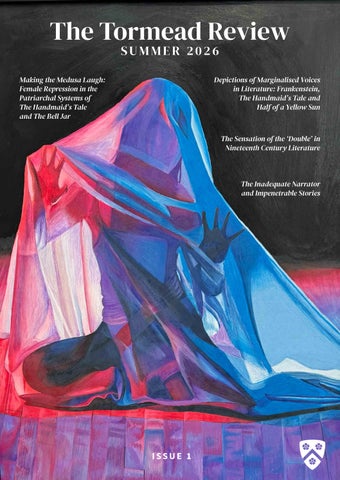
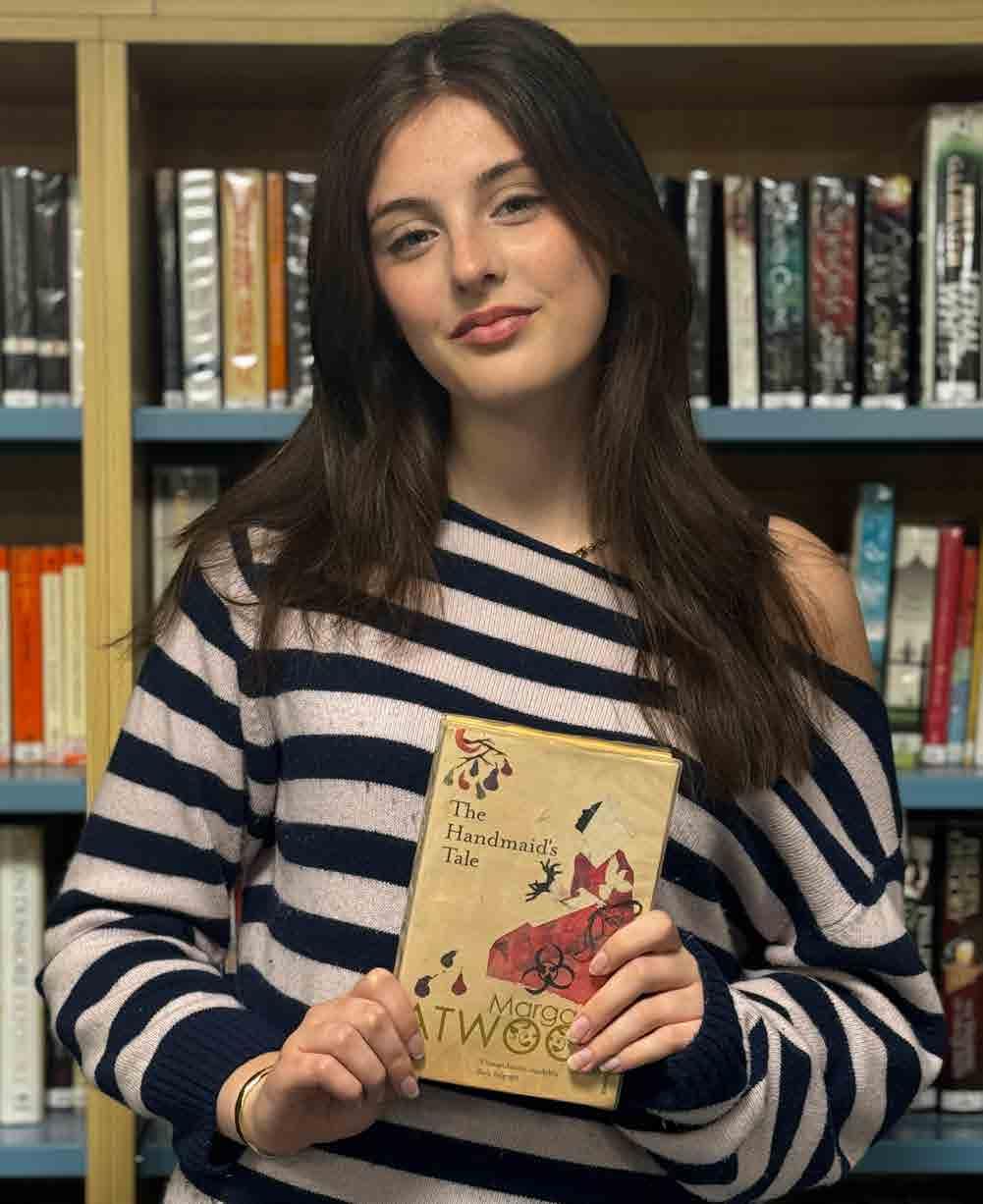
Making the Medusa Laugh: Female Repression in the Patriarchal Systems of The Handmaid’s Tale and The Bell Jar
Depictions of Marginalised Voices in Literature: Frankenstein, The Handmaid’s Tale and Half of a Yellow Sun
The Sensation of the ‘Double’ in Nineteenth Century Literature
The Inadequate Narrator and Impenetrable Stories
LETTER FROM THE EDITOR
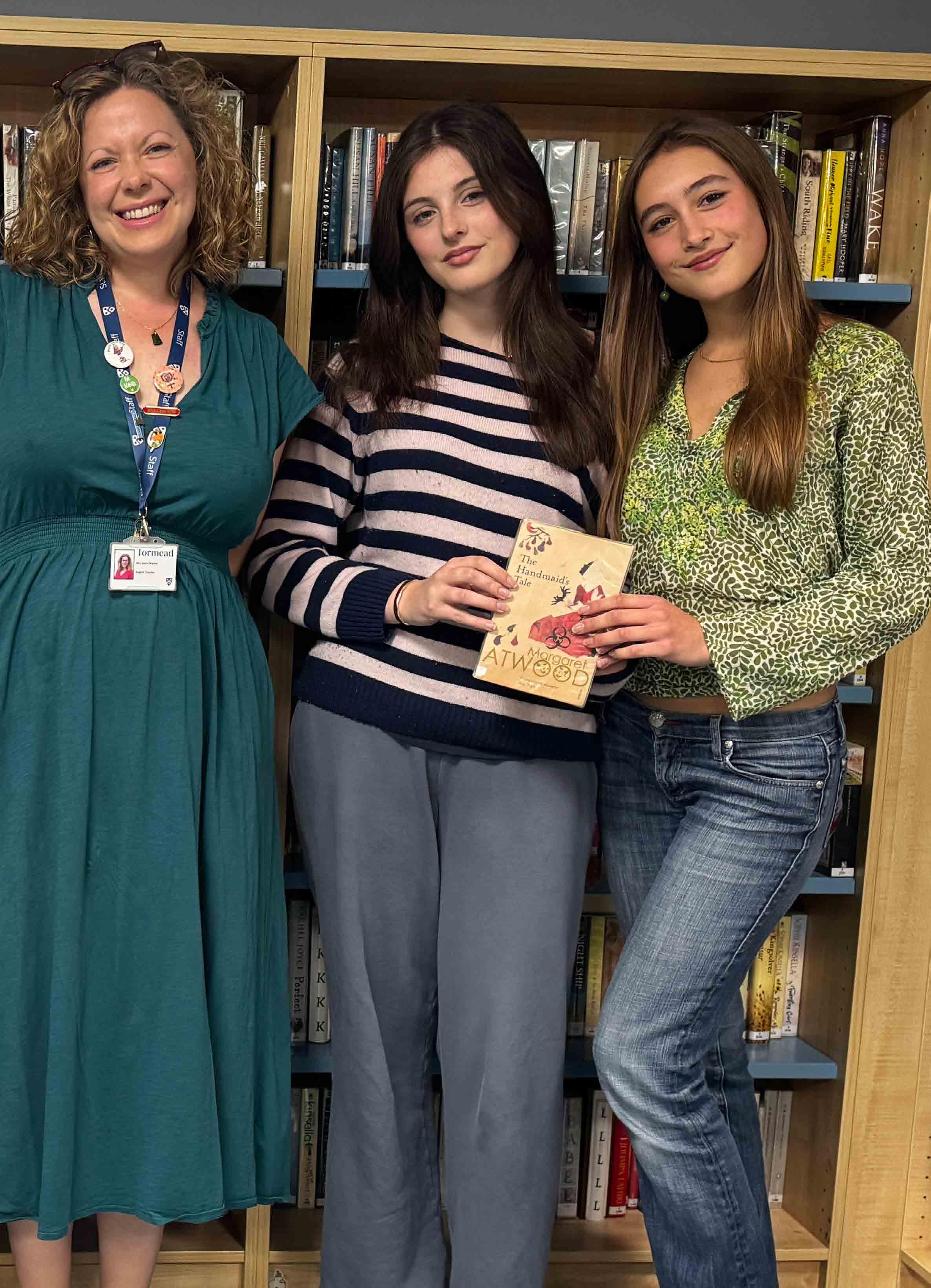
For our inaugural issue, these four Sixth Form English students were given free rein to investigate whatever subject they pleased relating to our class set texts. Much to my delight, they have all focused on our novels, The Handmaid’s Tale and Frankenstein, incisively, joyfully, and sometimes breathlessly bringing to bear their considerable analytical powers to delve deeply into both texts.
Also to my delight, they have, uninstructed, chosen a comparative literature tack, finding surprising and often satisfying connections between Atwood, Shelley, and some of their 19th century contemporaries, like Stevenson and Wilde; the more modern authors, Vonnegut and Plath; and even that powerhouse author of the modern day, Chimamanda Ngozi Adichie. Their passionate inquiries have taken them through Gothic tropes, postwar anxieties, systems of patriarchy, societal malaise, and postcolonial autonomy.
What might sound like four unrelated essays of literary criticism, upon reading actually reveals an underpinning anxiety about identity. Each student has independently picked out what is perhaps the most prevailing question of our two set texts, and certainly a central concern of literature: who am I? What bounds the self? Who gets to dictate the terms of selfhood? When everything you thought you were is forcibly removed or allowed to wither, does selfhood remain, even then?
These essays are arranged in a particular order to explore these notions of identity to greatest benefit to the reader. Sophia’s is first focusing on female selfhood in particular. While identity is externally violated, it is internally affirmed. She turns to Helene Cixous for the ultimate purpose in writing about female oppression: to turn and face it. And laugh. Emma’s is second, expanding our view to postcolonial concerns about voice, identity, and autonomy, urging us to recognise the authenticity of voices that seem foreign to our own. Identity becomes a violent concern of war, but also a literary question of recognition. Olivia’s is third, bringing us inward again in her psychological interpretation of the 19th century trope of doubling. The violence is only occasionally external, but continually internal as monsters and victims alike rend their psyches in flight from ‘evil’ and in pursuit of ‘good’, resulting in the failure to achieve either. Finally, Bee’s essay is fourth, an amalgamation of the concerns of the other three: is selfhood even possible–or worthwhile?– after experiencing inexpressible trauma? Like Sophia’s echo of Cixous’ advice to laugh, Bee closes this issue with a focus on absurdity. When the violation of identity is so inescapable that the self becomes impossible to find language adequate to express itself, perhaps absurdity comes closer. ‘Poo-tee-weet,’ and ‘Have you any questions?’ capture the impossibility of understanding suffering on such a grand scale. And, actually, to smile in the face of a monstrous threat is a very brave kind of hope.
Laura Wynne, Teacher of English
MAKING THE MEDUSA LAUGH: FEMALE REPRESSION
IN THE PATRIARCHAL SYSTEMS OF THE HANDMAID’S TALE AND THE BELL JAR
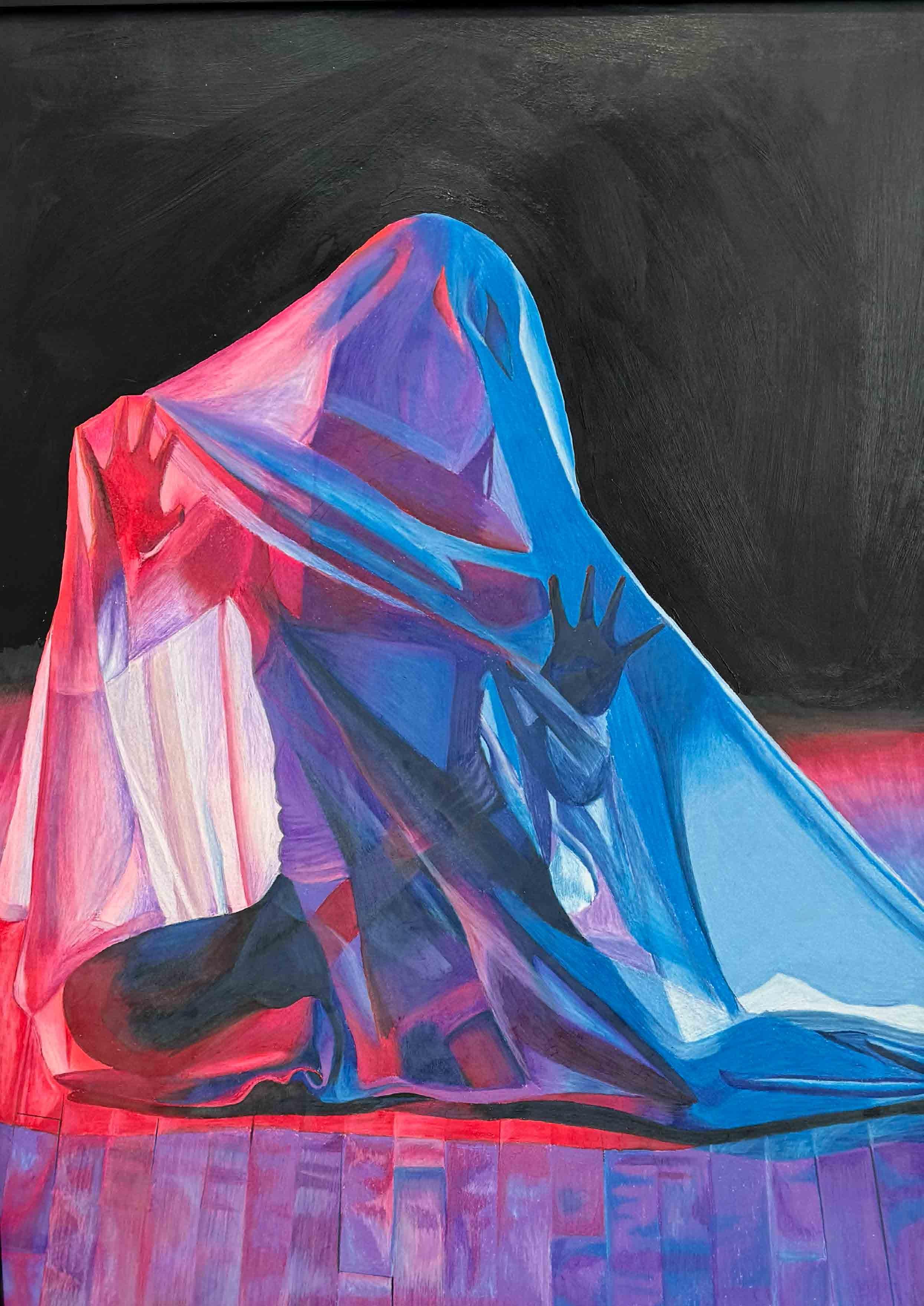
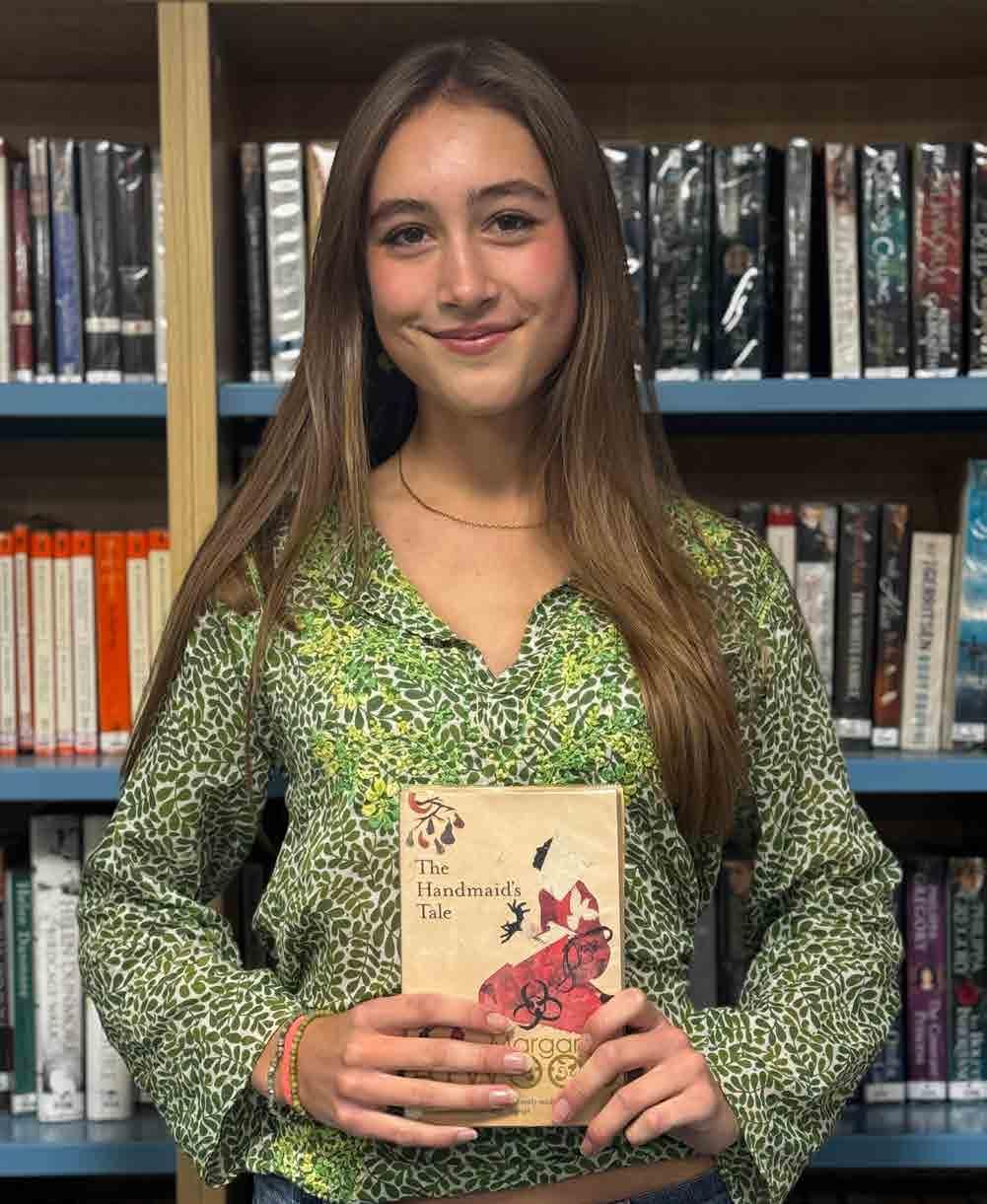
Both Margaret Atwood’s The Handmaid’s Tale and Sylvia Plath’s The Bell Jar interrogate the systematic erasure of female subjectivity within phallocratic regimes, yet they do so through distinct but converging metaphorical frameworks. Where Atwood externalises oppression through the totalitarian theocracy Gilead which regulates female autonomy, Plath internalises it through psychological fragmentation. In both, however, the female self becomes mutilated and estranged from its own body and voice. Through recurring metaphors of distortion and enclosure, Plath and Atwood dramatise the psychological effects of systems that reduce women to their reproductive or symbolic function. In doing so, they both participate in Helene Cixous’ thesis of “The Laugh of Medusa”: “Woman must write herself: must write about women and bring women to writing, for which they have been driven away as violently as from their bodies.”
Plath’s central metaphor of the “bell jar” encapsulates this condition of psychological suffocation. Esther Greenwood exists beneath a transparent yet impenetrable barrier that distorts the world, allowing the “stifling distortions” of the “bell jar” to become more than just a symbol of her mental condition but of cultural enclosure where the female experience is rendered both visible and inaccessible. Esther’s reflection, “to the person in the bell jar… the world itself is the bad dream,” underscores the extent to which her perspective on reality and life has become tainted and fundamentally altered. In the fifties, when Plath wrote the novel, the public defined mental illness in much narrower and more extreme terms, like “dangerous”, “dirty” and “cold.” Public conceptions of depression were suffused with fear and rejection. The fifties also saw a resurgence in conservative values where women were expected to prioritise marriage and motherhood over careers and personal progression. There was a sharp rise in psychiatric intervention for post-natal depression, including electroconvulsive therapy, reflective of society’s impulse to discipline rather than understand female suffering.
Atwood, writing under the Reagan administration in the 1980s, similarly interrogates the regulation of female bodies, yet she does so through a dystopic, overtly phallocentric regime rather than through a contemporary lens. In Gilead, Offred’s identity is systematically dismantled as she is reduced to her reproductive capacity - “we are containers, it’s only the insides of our body that are important”- as striking metaphorical constructs depict her alienation. When Offred describes herself as “a room where things once happened and now nothing does,” her identity is reconfigured as abandoned architecture, articulating how she is emptied of agency, vitality
MAKING THE MEDUSA LAUGH: FEMALE REPRESSION IN THE PATRIARCHAL SYSTEMS OF THE HANDMAID’S TALE AND THE BELL JAR
and selfhood. The metaphor of the “room” suggests occupation by external forces except for the “pollen of the weeds that grow up outside the window, blowing in as dust across the floor,” implying that her body is no longer hers but a space to be used for “reproductive purposes,” controlled and surveyed “under his eye.”
Both authors also engage deeply with the relationship between memory and pain. Offred’s reflection that, “[p]ain marks you, but too deep to see. Out of sight, out of mind,” suggests a form of trauma that is inscribed onto the body. Yet she chooses to detach this from conscious thought, perhaps suggesting that it has become so deeply entrenched in her reality that pain is indeterminable from her daily function. As pain is relocated from the mind to solely in the flesh, it is rendered omnipresent and unknowable. By contrast, Esther’s desire for “forgetfulness” to “numb and cover” her painful memories “like a kind of snow,” initially imagines memory and pain as something that can be softened and obscured; however, she ultimately acknowledges that her experience is a “part of [her]… [her] landscape.” Where Offred is alienated from her pain, Esther is inextricably bound to it, and in choosing to confront this, it is “born twice,” as trauma becomes constitutive of identity itself. Perhaps, in the light of our own day, this rings truer than ever. Our strife and struggles form the foundation of our beings. They may not be easy but ultimately, they forge the self.
This distinction is further illuminated through each text’s treatment of female collectivity. Esther’s observation, “What was there about us, in Belsize, so different from the girls playing bridge and gossiping and studying in the college to which I would return? Those girls, too, sat under bell jars of a sort” signals a growing awareness that her
condition, though arguably an extreme version, is not unique but rather symptomatic of a broader cultural malaise. Similarly, Atwood presents Gilead as a system that enforces rigid phallocratic hierarchies among women yet paradoxically unites them through shared subjugation: “does each of us have the same print, the same chair, the same white curtains, I wonder.”
Both texts also interrogate the illusion of choice afforded to women within patriarchal regimes. Plath’s fig tree metaphor vividly encapsulates this praxis:
“I saw my life branching out before me… from the tip of every branch, like a fat purple fig, a wonderful future beckoned and winked. One fig was a husband and a happy home and children, and another fig was a famous poet and another fig was a brilliant professor… I saw myself sitting in the crotch of this fig tree, starving to death, because I couldn’t make up my mind which of the figs I would choose. I wanted each and every one of them but, choosing one meant losing all the rest.”
This multiplicity becomes a source of anxiety rather than empowerment as she describes the figs beginning to “wrinkle and go black, and, one by one, [plop] to the ground,” reflecting a cultural moment in which expanding opportunities for women were not matched by structural support. In Gilead, by contrast, the illusion of choice is almost entirely eradicated. Offred’s claim that “there wasn’t a lot of choice but there was some, and this is what I chose” is deeply ironic, revealing the extent to which oppressive policy can be internalised and rationalised. This is also evident as she notes, “we are for breeding purposes,” akin to Plath’s assertion that “a man doesn’t have a worry in the world, while I’ve got a baby hanging
over my head like a big stick, to keep me in line.” In this context, female reproductive capacity becomes a mechanism through which patriarchal power structures disguise coercion as agency. In The Bell Jar, motherhood operates as a latent threat that circumscribes Esther’s imagined future, transforming what appears to be the opportunity for choice into anticipatory confinement as each “fig” is ultimately conditioned by an underlying cultural imperative that renders true autonomy unattainable. Similarly, in The Handmaid’s Tale, reproduction is not merely expected but systematised, with Offred’s body conscripted into a state apparatus that reframes sexual violence as duty. Her assertion of having “chosen” this exposes the insidious success of ideological control wherein phallocratic domination is internalised to an extent that is recognised as consent. Consequently, both authors reveal the rhetoric of choice functions less as a marker of freedom than as a strategy of containment, compelling women to participate in their own subjugation.
A particularly resonant point of convergence between The Bell Jar and The Handmaid’s Tale lies in their use of cardiac imagery as an irreducible assertion of selfhood. Esther’s acknowledgement that she can hear “the old brag of [her] heart. I am, I am, I am” is not merely a statement of existence, but a rhythmic affirmation of survival that emerges in the aftermath of psychological crisis. The insistent monosyllabic repetition of “I am” mimics the heartbeat itself as identity is no longer externally validated but internally generated through the persistence of life. Similarly, Offred’s heart “opening and closing, opening and closing, opening” articulates a parallel resurgence of the self. The present participles suggest continual motion as her identity “opens” after being repressed by the totalitarian structures of Gilead.
In the words of Helene Cixous, “You only have to look at Medusa straight on to see her. And she’s not deadly, she is beautiful and she is laughing.” It is precisely this act of confrontation, to reject distortion and subjugation, that both Margaret Atwood and Sylvia Plath demand of their readers. The Bell Jar and The Handmaid’s Tale do not merely depict female suffering; they expose the mechanisms that make such suffering appear inevitable and natural. What emerges is not simply a critique of patriarchal control, but a more unsettling recognition that oppression is most effective when it is internalised. To “Look Medusa in the eye” is therefore not an abstract feminist gesture but a radical realisation. It requires confronting the uncomfortable truths of our reality. However, these novels are not merely nihilistic as fleeting, undeniable, acts of resistance permeate the narrative. They suggest that even under the most oppressive conditions, a sense of self can be “born twice” if we only unveil the harsh realities of our existence, whether it is the mental depression that circulated in the 60s, the misogynistic conservative policies of the 80s or even the “great darkness” of our past. If these novels endure, as they have admirably done, it is not because they offer satisfactory resolution to these realities, but because they compel us to recognise that the “Medusa” they reveal is not merely monstrous, but familiar. Perhaps the most disquieting implication of these novels is that the action of confronting her is not confined to the worlds of Plath or Atwood but remains ongoing. In this manner, I urge you to question the narratives, structures and assumptions that regulate the existence of women, even in the “brighter light of our own day.” I compel you to face the darker facets of your life and boldly confront Medusa. And perhaps, you too shall be born twice.
Sophia, Lower Sixth
DEPICTIONS OF MARGINALISED VOICES IN LITERATURE: FRANKENSTEIN, THE HANDMAID’S TALE AND HALF OF A YELLOW SUN
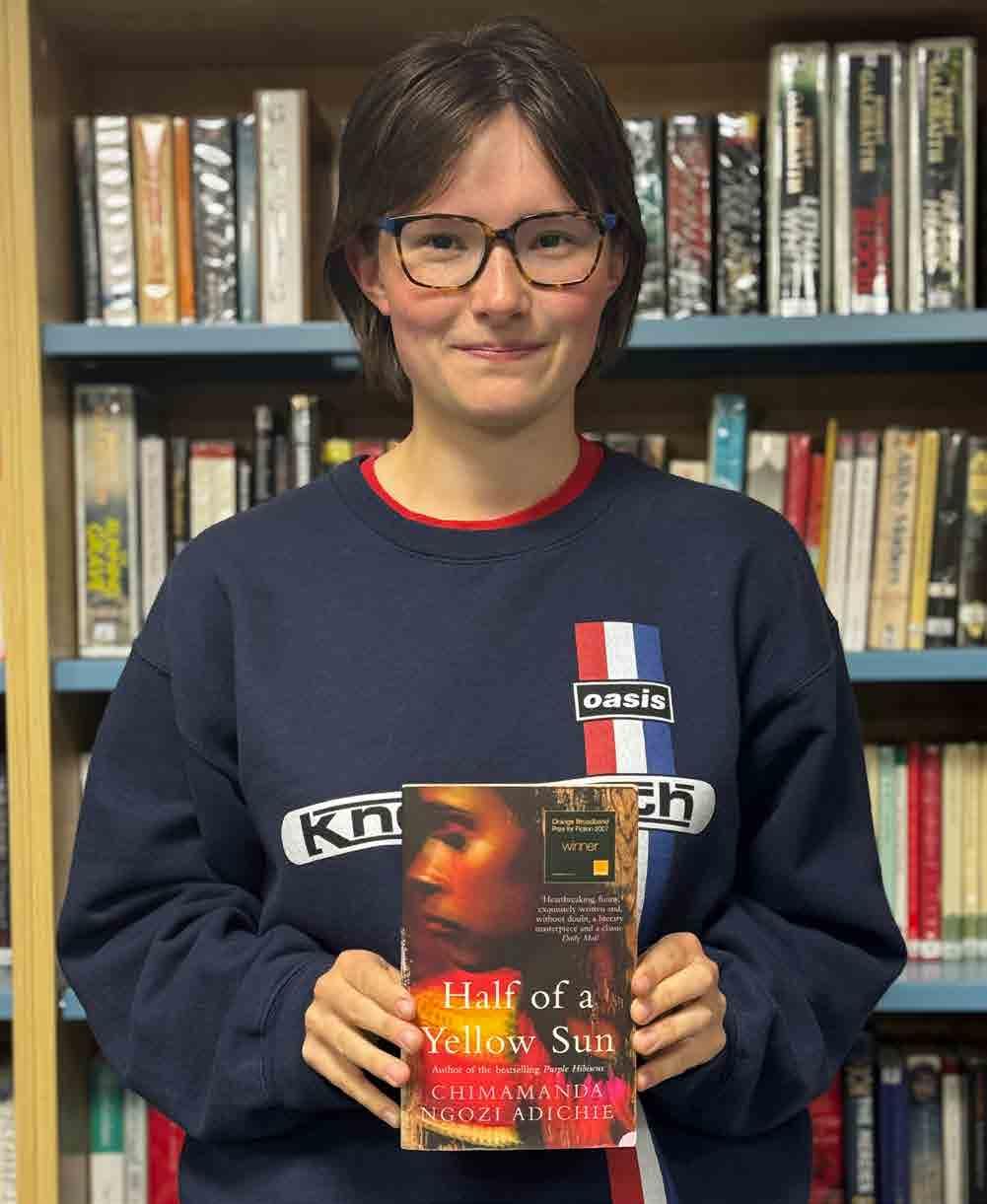
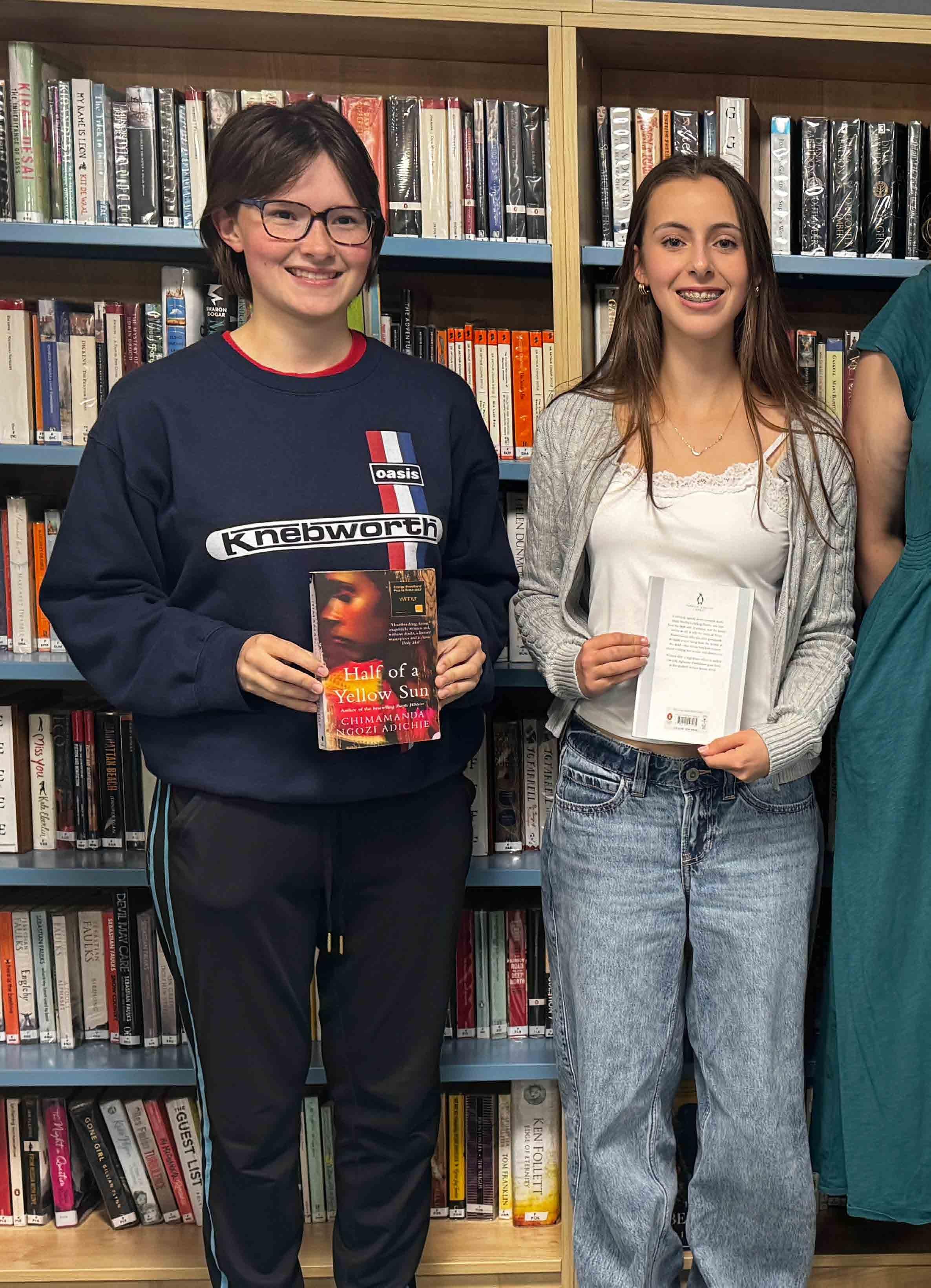
Over Easter I read the book Half of a Yellow Sun, by Chimamanda Ngozi Adichie. This was the first book of African literature I had ever read. That, partnered with the study of The Handmaid’s Tale and Frankenstein in English class, made me reflect on how voices commonly neglected in both Western literature and the mainstream media are portrayed. Two of the three authors, Margaret Atwood and Chimamanda Ngozi Adichie, are linked definitively to their marginalised protagonists, and the connection and personal aspects of this helps to amplify both authors’ message about the frequently ignored.
To examine these three texts in closer detail, let’s begin here: all three authors are from different countries with vastly different experiences and stories to tell. Shelley was a young Englishwoman
in the early nineteenth century; Atwood is a Canadian portraying a sideways world version of the USA in the 1980s; and Adichie is a Nigerian author with a central focus on the effects of postcolonialism on her country in the 1960s. Yet in completely different circumstances, all the books have protagonists (or in Shelley’s case, a morally grey antagonist) who use their different voices to exemplify how identity can be forged through rebellion.
Let’s focus on Adichie’s Half of a Yellow Sun first. The opening chapter is told through the lens of Ugwu, a young, impoverished boy working as the servant for a renowned academic. One of the opening paragraphs of the novel is “Ugwu did not believe that anybody, not even this master he was going to live with, ate meat every day.” Now, think how many other characters you have seen just like that in any book at all. I’d imagine that you would struggle to think of many. Furthermore, 4 of the 5 perspectives in the book are from Nigerian characters, with the remaining one an academic from England. This focus on the underdog, and probably on some of the most neglected voices in English (language) literature could be seen as empowering.
Additionally, by choosing to focus the novel on a war barely mentioned in Britain – the Nigerian Civil War of 1967-1970 – and focalise through the eyes of unfamiliar voices in British literature, Adichie reveals the responsibility of the former British colonialists for the neglect of these characters. The main point here, however, is that by choosing to focus a significant portion of the story on the character of Ugwu, Adichie could be using him to symbolise the identity, development, and crises
of Nigeria. She demonstrates how a young person in their blossoming days of independence, much like a newly independent country, goes through dark periods of battles and adversity to find his/ her identity.
Atwood depicts voices common in society, yet often ignored in dystopias: the female perspective. Many of Atwood’s narrative ideas are driven by feminist writings such as Cixous’s “Ecriture Feminine” (the Writing Woman) and the work of Simone de Beauvoir. Although neither of these influential writers are mentioned, Atwood effectively utilises and integrates their ideas into her novel, meaning that the main character Offred is able to resist within the regime with the ability to write herself into being: “The night-time is my time.” With only the power of words on her side, Offred is able to quietly rebel against the authoritarian Gilead regime. Although words do not seem your traditional form of rebellion, the loss of a basic human right and crucial skill enables the reader to realise what they have as a privilege, and perhaps to realise the horrors of what many people oppressed or impoverished around the world suffer with.
On the face of it, Offred is not your typical hero (in fact, Atwood herself said that she wrote Offred to be “cowardly”, as well as your “everyday woman”). By the end of the novel, the reader has had to learn and engage with her journey of survival of day-to-day life under totalitarianism. Her narrative is particularly effective as, by stripping Offred of her own identity, this renders her character symbolic in the novel. She is symbolic of all women neglected in both the fictional regime, but also women oppressed in almost every country globally.
Much like the symbolic voice of women in The Handmaid’s Tale, Shelley subtly uses the Monster as a device to represent the masses. The novel was written almost 30 years after the French Revolution of 1789, in which the ideas of freedom, liberty, and equal rights for everyone regardless of their background were drawn up. The Monster in “Frankenstein” is used as a symbol for the proletariat, which is also evident in his language when negotiating with Victor: “I demand it of you as a right which you must not refuse to concede,” and “my virtues will necessarily arise when I live in communion.” Furthermore, the description of the Monster as “an odious wretch” and a “fiend” serves to amplify the idea of the neglected masses. The masses are perhaps commonly seen as unattractive, ill-educated, or easily swayed. By using the Monster to personify these ideas about commoners, Shelley is in turn criticising the neglect of people as individuals.
On the surface of it, these three completely different novels show nothing in common. But on closer examination, we can see that these neglected voices are used to vocalise criticisms on their respective regimes and authorities. What is most symbolic about all of them, is how these characters can represent the authors’ own ideas about their own identity and warnings to the reader.
Emma, Lower Sixth
THE SENSATION OF THE ‘DOUBLE’ IN NINETEENTH CENTURY LITERATURE
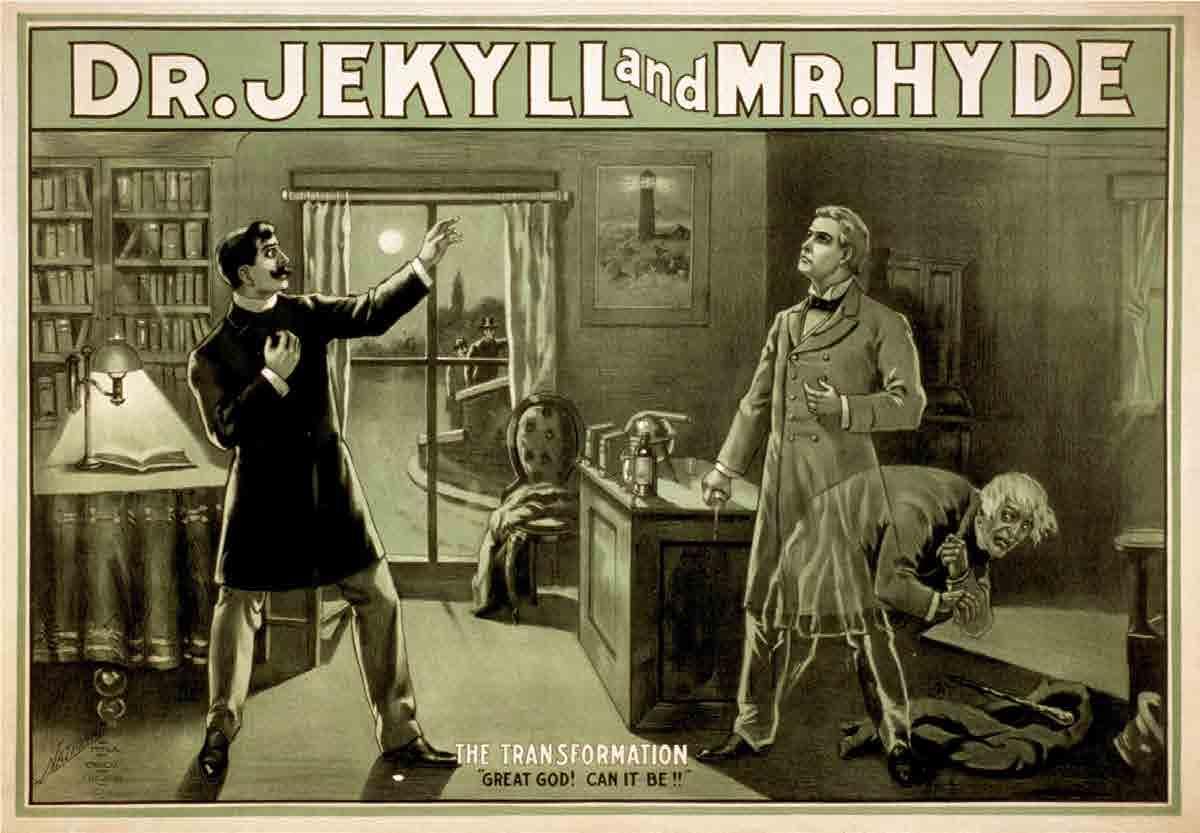
The sensation of the ‘double’ in nineteenth century literature is an expansion of the Gothic trope of the doppelgänger, or the ghostly figure that haunts the narrative. In this century there was an explosion in literary work exploring the implications of the ghost as a mirror of another character. The moral ambiguity created by the duality of the double is perhaps most obviously seen in The Strange Case of Dr Jekyll and Mr Hyde where Jekyll successfully divides the good and evil parts of his personality through the use of a drug. However, the double is not often so easily defined, and in cases such as Frankenstein and The Picture of Dorian Grey the double is only implied, not explicitly stated. I will discuss how the double is portrayed in these texts, and how it is used to either blur the lines of self or explore the impacts of moral delegation within the personality. I will also consider why the sudden interest in character duality evolved in the nineteenth century in
relation to the Enlightenment and Romantic eras that crossed over during this time of significant societal change.
Most scholars accept that a double in literary characterisation is the distinction between two definite personalities within a whole, and books often utilise this fractured sense of self as an exploration of moral obligation. Often in Gothic horror the villain is monstrous, and a monstrous appearance is very much reflective of a monstrous interior. This is particularly utilised by authors exploring the double as the stereotypically evil half tends to be a hideous manifestation of the original, like in The Strange Case of Dr Jekyll and Mr Hyde, Frankenstein and The Picture of Dorian Grey. The difficulty in the double comes at the division of the two halves, because good and evil are rarely definable. As I have previously mentioned, The Strange Case of Dr Jekyll and Mr Hyde explores the fairly obvious split between the good and evil in Jekyll’s personality which manifests as the murderous Mr Hyde. Dr Jekyll is fairly accepting of this divide in his personality and acknowledges that ‘all human beings, as we meet them, are commingled out of good and evil.’ However, other nineteenth century texts take a more nuanced approach, such as The Picture of Dorian Grey which explores how the moral corruption of the original is imprinted onto the purity of the painting until the painting mirrors the horror of Dorian himself. This raises the question of whether the painting is the evil duality, or whether Dorian is the evil one who is corrupting the innocent original as depicted in his portrait. As Craft mentions in his article ‘Come See About Me: Enchantment of the Double in The Picture of Dorian Gray’: ‘A viewing subject replicated in a mirror may be said to return to where he started, but not as he started.
For he starts as a human being... yet returns to himself as an image - being devoid of precisely this presence.’ This concept explains that in separating part of oneself as a sort of ‘double’ to allow internal reflection, you have irrevocably enlightened yourself to a point where you are changed by the revelation of your internal environment.
This is seen also in Frankenstein where Victor creates the Creature who becomes a physical manifestation of his selfish ambition. Victor is consistently presented as a narcissist through his lack of forethought for the consequences of his experiment, withholding evidence in Justine’s trial, and his assumption that on his wedding night the Creature must be trying to kill him and not Elizabeth. As Kohil expresses in her article ‘Gothic Horrors and the Double in Frankenstein’, this repressed selfishness seems to amalgamate in the psyche of the Creature who develops a lack of respect for those whom Victor refuses to take responsibility for. As Kohil says, this weakness of responsibility means ‘the creature, as an extension of the creator, overpowers him. This state allows him to control the creator and urges him to discover his evil part.’ This suggests Victor has been overcome by his ‘evil’ double through his inherent rejection of that half of himself, although he slowly comes to that realisation when saying ‘for I had committed deeds of mischief beyond description horrible.’ Jackson argues in ‘Narcissism and Beyond: A Psychoanalytic Reading of Frankenstein and Fantasies of the Double’ that ‘it is no accident that the monster is anonymous or that in the popular imagination it has come to be confused with Frankenstein himself and frequently given his name, for it is his grotesque reflection, his unnamed, unformed selves.’ Victor’s double is
a transgressive mirror of his own denied selfish desires which grow into a fully-formed enemy.
Consequently, Victor’s rejection of his double means it begins to incessantly haunt him until they become one and the same. As Kohil summarises, ‘both Victor and the creature are doubles: both of them have been rejected by their fathers; both of them lose their mates, and, due to this, both of them are vengeful.’ In refusing to accept the duality of his nature and enforcing the separation by trying to eradicate the Creature, Victor leads himself to his death. This is very similar to Dorian’s death, as he too rejects the monstrosity of his internal portrait and tries to destroy it – in turn destroying himself. This raises the question: how does Dr Jekyll, too, suffer the fate of being overtaken by his evil duality despite realising his responsibility to discover and unite himself, evident through his pun “‘If he be Mr. Hyde’ he had thought, ‘I shall be Mr. Seek.’”? Jekyll takes his fate into his own hands and takes preventative measures for the benefit of those around him; however, his previous assertion that he was able to control Mr Hyde is what leads to his downfall as he allowed the separate part of his nature to become too powerful. By separating it from the whole, the ‘evil’ part is not weighed down by moral obligation whilst the original self cannot truly free itself from ‘evil’.
To understand within the literary context how characters can assume a ‘double’, many authors revert to the same essential theory – that a duality is created in the formative years of youth and childhood. In Frankenstein, Victor hints at the emotional distance from his father, Alphonse, but also the heavy expectations that Victor would be Alphonse’s heir. In trying to please his father by going to Ingolstadt instead of following his
The Tormead Review
THE SENSATION OF THE ‘DOUBLE’ IN NINETEENTH CENTURY LITERATURE
passion for Agrippa’s theories, Victor creates a divide in his personality which eventually exhibits itself as the Creature. However, Jackson argues that Victor’s duality comes from the loss of his mother while he was still young and “by becoming an unnatural mother, ‘giving birth’ to another, who is a reflection of himself, Frankenstein is able to be the mother he lacks, to supply to himself his own need for a mother.” This perversion of the natural roles of reproduction is what creates a mitosis effect instead of a creation of a new being, as Victor is not biologically capable of creating a new entity but instead only extends a part of his own person. As Jackson says, “The monster functions as a parodic mirror image of Frankenstein: ‘My form,’ it mocks him, ‘is a filthy type of yours, made horrid even from the very resemblance,’” which exemplifies how the monster is a replication of Victor’s repressed childhood self. This is further implied through the Creature’s gradual growth and realisation of humanity, as the Creature begins as pure and innocent as Victor until circumstance forces him to realise the unfairness of reality without a parent. This is also true of The Picture of Dorian Grey as Dorian is corrupted by the influence of Lord Henry, and the portrait is created just as he meets his corrupter for the first time. This symbolically represents the moment of the creation of his duality, as his naïve childhood self is left in the portrait while he then goes on to destroy it through his actions and moral decay. So how does this vulnerable mental state fit with the Gothic genre and monstrous stylisation of the ‘double’? The horror aspect tends to come to the fore when the characters lose control of their alters, or doubles, and they enter the world to enact their essential desires – perhaps the most terrifying part of this being internal reflection on the horror the self is capable of.
Now we have established the basis for the nineteenth century ‘double’, it is important to realise how it became such a popular theme in this time. The nineteenth century was a transitionary phase between the scientifically focused Age of Enlightenment and the artisticallyinclined Romantic era. This clash of cultures bore some of the greatest art that explored the conflicts between science and nature, two things that had been expressed as mutually exclusive spheres. It is likely the concept of the ‘double’ stemmed from this division of culture between the science and the romantic, and the authors may be trying to capture the less positive aspects of societal progression. The Romantic era carried many anti-societal feelings that were further inspired by some recalibrations of the social ladder, such as the French and American Revolutions. Jackson argues that doubles are often created by a character “protesting against and even fantasizing the destruction of social codes, only to renew and confirm their validity,” which leads to the situation where “the narrative center, often the protagonist himself, is divided into two sides, one subverting and one upholding the dominant social order.” Shelley was an open Romantic who likely believed in Rousseau’s philosophies that nature is a pure state and society corrupts to the point that “everywhere man is in chains.” Through this idea, the sensation of the double could be an exploration of how man is composed of this struggle between natural existence and imposed societal constraints, and the inconsistency of the two stimulates a complete division in the person because the two truths cannot coincide. Jackson uses The Strange Case of Dr Jekyll and Mr Hyde as an example of this: “Jekyll as the Ideal I, censoring and judging those aspects of himself which are socially unacceptable and
projected onto Hyde.” This would imply that Jekyll is not divided morally into good and evil as originally supposed but instead is divided socially. Similarly, in Frankenstein the corrupting influence of man upon the Creature is made clear through the framed narrative, as the Creature shows how ‘the barbarity of man’ was what turned him into a monster. Again, in The Picture of Dorian Grey Dorian is originally described through natural imagery, but is soon corrupted by the sophisticated Lord Henry who thoroughly integrates him into society to the point he loses all connection to nature and becomes obsessed with the refinement of socialised art. Therefore, whilst the sensation of the ‘double’ is used as an extension of the Gothic genre to add horror to stories, the dual nature of man became such a popular theme to reflect the questions of society at the time, rather than a sole endeavour to reveal the moral ambiguity within the personality.
To conclude, the sensation of the ‘double’ in nineteenth century literature reflects the conflict between science and nature, whilst also being used to display a moral confusion in the character. This is such an effective trope for horror as it prompts a reflection of the reader on their own morality and reveals the true horror hiding under the surface by exposing it as an entirely separate entity. The duality of human nature is a terrifying thing because of how it challenges societal norms of correctness and the brackets of good and evil, blurring the lines between what is right and wrong. Consequently, the ‘double’ is an expression of Gothic horror, moral ambiguity and societal discussion.
Olivia, Lower Sixth
ResearchGate
Fiction and Its Phantoms: A Reading of Freud’s Das Unheimliche (The
Come See About Me: Enchantment of the Double in The Picture of Dorian Gray on JSTOR
Jackson, “Narcissism and Beyond”
“Uncanny”) on JSTOR
The Strange Case of Dr. Jekyll and Mr. Hyde | Summary, Characters, & Facts | Britannica
How Robert Louis Stevenson Created Jekyll and Hyde - Yale University Press London
THE INADEQUATE NARRATOR AND IMPENETRABLE STORIES
The worlds of Atwood’s The Handmaid’s Tale and Vonnegut’s preceding work Slaughterhouse Five possess uncanny similarities, not merely for the authors’ mutual exploration of the struggle to determine, or rather maintain a grasp on one’s true identity, but the acknowledgement that this psychological conflict is grounded in the seemingly inherent culture of American brutalism. Specifically, both grapple with the difficulty in separating such violence from the love, faith and patriotism in which corruption quietly takes hold.
As Tailor asserts in his interrogation of postmodernist influences in Slaughterhouse Five, the non-linear presentation of Billy Pilgrim’s narrative ultimately produces a ‘self-awareness [which] highlights the artificiality of storytelling and the limitations of representing reality through language’, reinforcing the notion that Vonnegut,
akin to Atwood, cautions his readers not to attempt to demystify or realign the scattered evocations of the traumatised veteran, but rather to recognise the insufficiency of facts to express unspeakable horrors committed by human hands. Indeed, the existential and outwardly apathetic tone in the Tralfamadorian’s axiom and Billy’s post-war perspective, ‘so it goes’, is not a reduction of lives lost but rather an acknowledgement that such is the nature of life. It is a feature proliferated so fiercely by societal initiatives such as war and the collateral sacrifice of the masses, that to mourn each violation individually would be to tear open the sagging membrane of grief, repulsion and suffering which continues to expand as the horrors of new oppression unfold across the world, from Palestine to Afghanistan to America itself. Just as the slaughterhouse becomes a perverse haven against the Dresden firebombing, a place of novelty jokes and absurd pantomimes, Offred’s detached, impersonal account of her ritualised rape and witty handling of disturbing subject matter establishes a sense of distance from the hideous realities of the characters’ torment. To fully comprehend these bleak truths would be to set in motion an eternal funerary intonation. Instead, Vonnegut and Atwood depict their protagonists’ resistance to being engulfed by this violence and repression, preserving their identities in unique manners, as Offred claims she ‘hoard[s] sanity the way people once hoarded money’. Akin to Vonnegut, Atwood endeavours to demonstrate that, ultimately, such a harrowing tale is no less potent for its unreliable and often inadequate narration - claiming that ‘this is all a reconstruction’ - but rather forces the reader to comprehend the implications of the novel and the emotion which it arouses in a more abstract manner beyond what can be basically divined
from a sanitised, statistical account. It is the intangible features of life, primarily love, which are truly valuable, far exceeding the significance of material goods when one is stripped of everything once believed necessary for survival.
This is also demonstrated in the ‘Historical Notes’ as Pieixoto is eager to stress the seeming insignificance of her experience for its ‘Problems of Authentication’, therefore stating that Offred ‘must be seen within the broad outlines of the moment in history of which she was a part’, perhaps echoing Stalin’s cold belief: ‘one death is a tragedy, one million is a statistic’. This cuts to the crux of the social flaw which Atwood seeks to highlight: in focusing so adamantly upon ‘decipher[ing]’ the “truth” of what occurred, we fail to acknowledge the emotional significance, the sentimentality, the love or perhaps lack of it, which so heartbreakingly characterises The Handmaid’s Tale. Indeed, it was this detached practicality and complete loss of intimacy which rendered Offred’s experience such an excruciatingly deprived one, one in which she ‘felt so lonely [she] could die’. Yet still, a sense of grasping at innocent oblivion is notably expressed through nature motifs, predominantly flowers in The Handmaid’s Tale and birds in Slaughterhouse Five, reminiscent of the impartiality of such organic forces in man’s self-imposed and equally destructive endeavours for dominion. ‘And what do the birds say? All there is to say about a massacre, like “Poo-teeweet?” Vonnegut’s decision to conclude his novel with an untranslatable question posited by an external party perhaps reflects the intent of Atwood’s ‘Historical Notes’, the ultimate perspective being from that of an observer attempting to comprehend the ineffable, abject suffering perpetrated by a people who appear,
in the classical sense of the word, civilised and advanced.
Returning to the key theme of identity, one becomes acutely aware that the protagonists’ attempts to find refuge and employ a veil of mental separation (a psychological survival method described by Vietnam veteran Musgraves as ‘turn[ing] a subject into an object’) from their predicaments are tragically futile. Violent imagery pervades their language on what is, perhaps, a subconscious level. Billy’s posttraumatic stress disorder is highlighted not merely in his descriptions of massacre or graphic mutilation, but rather his ‘breath like mustard gas and roses’, a vivid simile later discovered to have been derived from Billy’s recollection of ‘liquified’ corpses – the aftermath of Dresden. These experiences, akin to the recurring motif of ‘blue and ivory’ feet, belonging to both the hypothermic, lifeless bodies of displaced civilians and a senile, bare-footed Pilgrim at home in Ilium, demonstrate how death inhabits one’s soul. Billy’s perception of life is inextricably tangled with that of his time in service, infiltrating his being on a molecular level as, even decades removed from 1945, war seems to ooze from his very pores, creating a ‘big hollow man who was so full of loving echoes’, yet at the same time, perversely imagines ‘dropping bombs on those lights, those cities and those towns’. Similarly, Offred immediately establishes her reduction to a biological vehicle through the mundane illustration of her bedroom within the Commander’s home, reframed through a reproductive lens as she references the ornamental ceiling wreath as being ‘like the space in a face where the eye has been taken out’. This careful selection of language plunges the reader into a world rife with barbarism from
THE INADEQUATE NARRATOR AND IMPENETRABLE STORIES
the very outset, so much so that such an explicit image is conjured by the mind with ease, subtly connoting the rapid acclimatisation of the Gileadean populace to the abuse of human flesh. The mutilated ‘eye’ is also an apt reflection of the regime’s systematic diminishment of the public horizon. Their efforts aim to transform society into ignorant dependents, blind to the true corruption which entraps them. Even the ‘rug on the floor, oval, of braided rags’ can be interpreted as an extended metaphor for the handmaid herself, its form anatomically representative of the ovary, its state of being the careful constriction of discarded goods into a structured commodity befitting of Gilead’s patriarchal paradigms.
Ultimately, through the subtle haunting of their prose with the horrors of conflict and oppression, both Atwood and Vonnegut invite readers to question whether the parallel lives of the posttraumatic and pre-traumatic characters can truly exist, whether the alternate identities of ‘Mutt and Jeff’ (‘we were Mutt and Jeff in the war’) or Offred’s former, undisclosed name (before she became a mere patronymic extension of the Commander) can be neatly compartmentalised, or rather, as the novels endeavour to demonstrate, shape the contours of one’s psyche permanently. Where one’s experiences end and the self begins is a fragile balance, evidenced as Offred refers to ‘[her] room’, subconsciously accepting her position within the artificially constructed domestic sphere of Serena Joy and her husband as natural and personal, no longer an external character to be worn and removed like a garment; it is an intrinsic feature of her essence. Alongside the notion of a doubleidentity, violence permeates the respective existences of Offred and Billy, morphing into an
alternate dimension expressed literally through Billy’s ability to view America from a peripheral perspective (alongside the Tralfamadorians) and Offred’s increasing separation of her confined body and “self-autonomous” soul, observing a world in which brutality is no longer a source of moral diminution but, tragically, ‘just people, doing what people usually do to each other’, as Crichton observes.
When regarding how suffering is inflicted, it is necessary to observe the manner in which both hatred and adoration, pain and immense pleasure, the desire to own and to know on a molecular level, frequently bleed through the boundaries that separate them. This is what makes them undeniably human stories. Both novels present a plethora of morally ambiguous characters and protagonists which can neither be damned nor exonerated from accusation, highlighted in Slaughterhouse Five as Vonnegut’s father remarks ‘you never wrote a story with a villain in it’. For almost all the inhabitants of Atwood and Vonnegut’s novelistic realms, there is a tragic sense of the yearning to be known which is never quite achieved. This is demonstrated through characters like Weary, and even the brief glimpse of ‘Wild Bob’, his dying breath a disturbing attempt to retain a paternal joviality, clinging to the heroic dream and good-time-guy he evidently played before being reduced to a ‘drowning’ creature in a cattle truck. In contrast, Weary appears a disquieting and no less pitiful synthesis of childish aspirations distorted by his proclivity for aggression and brutality in his ‘crazy, sexy, murderous relationship’ with victims of his outbursts. Vonnegut perhaps demonstrates here the duality of man and the unique American paradox as one in which it is possible to be both a ‘sweet man’ and a ‘gun nut’. Consider Billy,
who leads a bizarre double life as both a fragile veteran prone to sudden bouts of ‘extremely quiet [...] and not very moist’ weeping, and simultaneously a member of the ‘Lions Club’, expressing pride as his son acts as yet another disposable US agent of violence in Vietnam. One senses a historical and complex relationship between the classic American dream of freedom and liberation, and the blaringly obvious nihilism of war. In essence, martial victory shares much with the bestial degradation of man, illustrated in Slaughterhouse Five: ‘I myself have seen the bodies of schoolgirls who were boiled alive in a water tower by my own countrymen, who were proud of fighting pure evil at the time.’ When considered through this lens, the notion that ‘Billy wasn’t even a Catholic’ and yet recalls the early trauma of ‘that ghastly crucifix’ in his childhood bedroom perhaps extends to imply the martyrdom instilled in young Americans, foreshadowing his purpose as a sacrificial lamb drafted to Dresden, and the archaic cycle of worship and conflict (heightened by Vonnegut’s working title, ‘The Children’s Crusade: A Duty Dance with Death’) in which Billy appears to be trapped, as both a man haunted by battle and yet simultaneously a condoner of its glorification in the ‘Lions Club’. Vonnegut in particular has mastered the language of the unspeakable; the futile wishes of man to characterise himself, his ‘total compulsion to evaluate himself justly’ (Miller’s Tragedy and the Common Man) and paradoxical loss of dignity and humanity in the effort. Ironically, both protagonists become extortionists to some degree in their respective battles - be they in a grand patriotic war or a series of clandestine meetings and hidden recordings - against the overarching puppet masters who exploit them. Thus emerges the question: at whom can we point the accusatory
finger, hold responsible for the suffering? The authors’ literary response: no such obvious demon exists.
Interestingly, both novels open with Biblical imagery, with Atwood’s selection of the Sufi proverb, ‘In the desert there is no sign that says: Thou shalt not eat stones’, and Vonnegut’s epigraph from the classic hymn Away in A Manger, concluding with ‘no crying he makes’. These are perhaps allusions to the disconcerting manner in which those in desperate or ‘reduced circumstances’ attempt survival. Billy becomes a martyr-like figure, reinforced by his stoicism and silent resolution to ‘feel nothing’. This results in an identity of emotional torpor. Atwood, too, delves into the conflation of violence and faith through the perverse ‘purity’ curated under the theocratic Gileadean regime, and the extreme conflict waged in its puritanical honour, branding handmaids the ‘shock troops’ of their ‘transitional generation’. Atwood’s careful selection of military vernacular places these women upon the metaphorical front lines of society, conditioned to embody machinal parts in the grand phallocentric mechanism orchestrated by the Brothers of Jacob, stoically enduring their service in this national reproductive experiment, similarly to Vonnegut’s conviction that the troops in his novel are primarily the ‘listless playthings of enormous forces’. Man’s sinister distortion of religious fundamentalism as a means of justification for totalitarian control and oppression in the holy name, claiming that ‘God is a natural resource’, is a sentiment perhaps echoed in Vonnegut’s ‘serious study of Christianity’ and the perverse reality of the Gospels, purportedly preaching that ‘before you kill somebody, make absolutely sure he isn’t well connected’. As in Gilead, firm devotion to ‘faith’
The Tormead Review
THE INADEQUATE NARRATOR
AND IMPENETRABLE STORIES
in one’s country and one’s idols paradoxically facilitates the destruction of ‘hope’, ‘charity’ and the capacity for love, a feature hardly unique to The Handmaid’s Tale but rather demonstrated historically through radical secularism and crusades. The intolerance engendered in utopian ideals all too often fosters a reverence for brutalism and terror as opposed to the unity of humanity.
Perhaps it is the unabashed and frequently bleak exploration of societal and theological backwardness which has contributed to the recent banning of both Slaughterhouse Five and The Handmaid’s Tale at Texas’ Katy Independent School District in August 2024, amongst thirtytwo other titles. Perhaps this proscribing is the greatest confirmation of the intense discomfort which inevitably accompanies the startling sight of our societal reflection in the literary mirrors of such novels. As the Trump administration engages in the systematic erasure of diverse historical landmarks, such as Harriet Tubman’s suffragism, from federal websites and supports the regression of women’s rights, as wars rage abroad and we enter what the New York Times posits as ‘an age of political violence?’, one can only recall Vonnegut’s witty suggestion that producing an anti-war novel is tantamount to attempting to ‘write an anti-glacier book’. Conflict permeates, and will, invariably, continue to permeate every stratum of our society, and yet, despite Giles’ assertion that formerly opportunity-laden spaces are destined to be ‘corrupted by an epidemic of violence and degradation [...] so debilitating to the people populating such infected spaces that any notion of redemption or escape is rendered illusory from the get-go’. However, the indefinite conclusions of The Handmaid’s Tale and Slaughterhouse Five
do attempt an offering of light; a culmination of those shards of humanity dispersed throughout the ragged recollections of trauma.
The passionate reader will likely be struck by what appears to be a particularly fatalistic view of life in a sphere the Tralfamadorians believe to have ‘no beginning, no middle, no end, no suspense, no moral, no causes, no effects.’
Indeed, Atwood’s speculative prose guides us down into the bowels of a covenantal society whose successors, including Piexioto and Crescent Moon, appear to entirely mitigate and even trivialise the hideous oppression of the Gileadean epoch, reducing Offred’s account to the likes of ‘crumbs’. Both are grounded in historical truth and continue to tremble with the cadence of humanity’s violent forays beyond the boundaries of ethics and civil rights. Though Willets asserts in The Activist History Review that ‘once collective memory has been washed of the stains of blood and battle, society finds something compelling and romantic about [war]’, the individual veteran, those figurative and literal prisoners of war (like Offred and Billy) remain in a perpetual state of liminality, or rather ‘unstuck in time’ (Slaughterhouse Five), unable to reconcile the pre- and post lapsarian dimensions they mentally inhabit. This is what renders both stories, in many ways, impenetrable. And yet, there is a decisive optimism in the closing of both novels – a subtle implication that, though undeniably shrouded and convoluted by societal and historical conditioning, human choice remains. Atwood offers this as Offred ‘step[s] up, into the darkness, or else the light’, expressing the plurality which characterises the human experience, one in which no universal ‘truth’ can be viewed as concrete in much the same way a utopic ideal can simultaneously embody
a dystopian nightmare. Drawing a parallel to chapter eighteen, there can be ‘no light without shadow; or rather, no shadow unless there is also light’. To prevent societal collapse, we must resist the prevailing perspective in which human value is determined superficially and extinguished through violence, and choose to believe in a salvation that is beyond the power of God to bestow. We must reach for, as Vonnegut poignantly writes, the miracle of possessing ‘wisdom always to tell the difference’. Likewise, Billy imagines the rewinding of time, tracing the bombings upon hapless civilians back to the very genesis of the torpedo itself, replanting the innocent raw materials used to construct the death tool into the earth, ‘so they would never hurt anybody ever again’. The final deployment of the bird motif ‘Poo-tee-weet?’ stands as a bold statement that, irrespective of the encroaching darkness, there remains the potential for redemption. Though the horrors of war and bitter oppression are irretractable, amidst the otherworldly silence a voice rises from the valley of ashes. It asks of us a question, and the question matters, for it is this that breathes humanity back into the wasteland.
Bee, Lower Sixth
SOURCES REFERENCED:
“Postmodernism in Literature: Examining Vonnegut’s Slaughterhouse-Five.” n.d. https://www.tometailor.com/articles/ postmodernism-slaughterhouse-five.
Abel, Marco. “Spatializing Violence, Violating Space: Towards a New Theory of Violence in Contemporary American Fiction.” The Spaces of Violence, by James R. Giles. South Atlantic Review 71, no. 3 (2006): 121–32.
http://www.jstor.org/stable/20064756.
Arthur Miller, “Tragedy and the Common Man,” from The Theatre Essays of Arthur Miller (Viking Press, 1978) Copyright 1949, Copyright 0 renewed 1977 by Arthur Miller. Reprint (by permission of Viking Penguin, Inc. All rights reserved.) Accessed at 19:46, 15/03/26