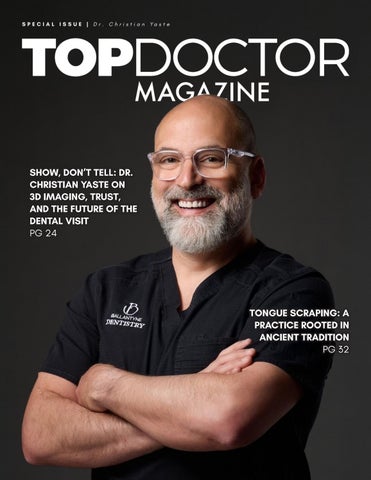
S P E C I A L I S S U E | D r . C h r i s t i a n Ya s t e
SHOW, DON’T TELL: DR. CHRISTIAN YASTE ON 3D IMAGING, TRUST, AND THE FUTURE OF THE DENTAL VISIT PG 24
TONGUE SCRAPING: A PRACTICE ROOTED IN ANCIENT TRADITION PG 32
“I don’t think it’s the future; it’s already here. Our patients expect that we are going to use whatever technology we can to make their experience better, and I think we should.” - Dr. Christian Yaste
A LETTER FROM THE EDITOR Our mission and purpose at TopDoctor Magazine is to foster connections within the health and wellness community
and empower our readers to make well-informed healthcare and lifestyle decisions. We pride ourselves on being the ultimate resource for interviews with health and wellness leaders, trending medical news, and healthy living topics. We understand that choosing a healthcare provider is a crucial decision. Our in-depth interviews with esteemed doctors and medical professionals aim to bridge the gap between them and their clients. By providing our readers with personal insights, philosophies, and areas of expertise, we facilitate a deeper understanding of the individuals responsible for your health and well-being. We also strive to highlight our outstanding practitioners, showcasing their dedication to their patients and contributions to the medical community. The field of medicine is constantly evolving, with new practices, therapies, and technologies emerging at a rapid pace. At TopDoctor Magazine, we strive to keep you updated on the latest advancements in the medical world. Our comprehensive coverage of trending medical news equips both doctors and patients with the knowledge they need to make informed choices about healthcare options. Building strong connections within the medical community is essential for enhancing patient care and driving medical progress. Our magazine serves as a bridge, connecting medical companies with doctors and vice versa. By facilitating these connections, we aim to catalyze collaborations that can lead to innovative solutions and improved healthcare outcomes for everyone. It is our firm belief that well-informed individuals make better decisions about their health. By providing you with insights into established and emerging medical trends and technologies, we empower you to take an active role in your healthcare choices. Whether you are a healthcare professional seeking to stay updated on the latest advancements or a patient eager to make informed decisions about your well-being, TopDoctor Magazine is here to support you. In every issue, we strive to uphold the highest standards of journalistic integrity, accuracy, and relevance. Our dedicated team of writers, editors, and medical experts work tirelessly to bring you well-researched and compelling content that is both educational and engaging. Moreover, our graphic design team is committed to delivering an aesthetically pleasing reading experience where captivating design seamlessly merges with informative content, ensuring each issue becomes an engaging journey of discovery. As we embark on this mission to serve as your trusted source of medical information and insights, we encourage you to join us on this exciting journey. Your feedback and suggestions are invaluable to us, and we look forward to hearing from you. Thank you for being a part of the TopDoctor Magazine community. Together, let us embrace knowledge, forge connections, and make informed decisions to lead healthier lives. With warmest regards,
Hannah H. Editor in Chief TopDoctor Magazine
CONTRIBUTORS Publication Team Publisher: John Hyland Editor in Chief: Hannah Davis Editorial Assistant: Jillian Fast
Creative Department Senior Graphic Designer: Laura Poyner Graphic Dessigners: Dylan R-N, Kyleigh Holder
Expert Contributors Biohacking & Longevity Expert: Lindsey O'NiellO'Keefe Contributing Authors: Jillian Fast, Riley George, Evelyn Flaharty, Ashleigh Quint
Executive Team Chief Digital Content Officer: David Lee Vice President of Development: Mark Carvalho Fractional Marketing Officer: Craig Handley Advisory Board: Dr. Arthur Katona, Dr. Francisco Cabal, Dr. Edmond Ng, Dr. Kianor Shah
TABLE OF CONTENTS 8 16
The Herbal Medicine Cabinet Consistency Is a Skill — Not a Personality Trait
24
Show, Don’t Tell: Dr. Christian Yaste on 3D Imaging, Trust, and the Future of the Dental Visit
32 36
Tongue Scraping: A Practice Rooted in Ancient Tradition Balance Dictates Healthy Aging
THE
Herbal
Medicine
Cabinet
NATURAL DEFENSES FOR FLU SEASON 8
WRITTEN BY: JILLIAN FAST As flu season approaches, it is not unexpected that people are eagerly getting ready to prevent sickness and boost their immunity. However it's crucial to understand exactly what we're employing to "protect" our bodies. Over-the-counter cold and flu medications, many of which are neon syrups and pills packed with artificial dyes, chemical fillers, and sweeteners, cost billions of dollars each flu season. Red 40, Blue 1, artificial flavorings, synthetic sweeteners, and other chemicals are frequently used purely for taste and appearance rather than for medicinal reasons. Yet, when their immune systems are weakest, individuals turn to and trust in these products. These common dyes and chemicals have been connected to sensitivity or inflammation in some people, which can put additional strain on the body while it is already attempting to heal. Instead of strengthening or fortifying your immune system, these products might worsen the situation by slowing the healing process and trapping you in a vicious loop of treating symptoms rather than promoting real healing.
HERBAL ALTERNATIVES A holistic approach provides a radically different worldview in this situation. Holistic wellness seeks to boost the immune system, lower systemic inflammation, and provide the body with the resources it needs to effectively and fully recover from illness rather than concentrating on muting symptoms.
ELDERBERRY Elderberry is an herb that should always be included in flu-season toolkits. Rich in antioxidants and flavonoids, elderberry has been widely studied for its ability to support immune response and help the body fight viral infections. Unlike most drugstore syrups, quality elderberry syrups or capsules are designed to support the immune system’s actual fight against the virus. Many people take elderberry at the first sign of symptoms, and some use it preventatively during high-exposure periods like travel or peak winter months.
OIL OF OREGANO Oil of oregano is often referred to in herbal and integrative medicine as a “natural antibiotic”, not because it behaves exactly like pharmaceutical antibiotics, but because it contains powerful antimicrobial compounds, especially carvacrol and thymol. These compounds have been studied for their ability to inhibit certain bacteria, viruses, and fungi. Unlike antibiotics that indiscriminately wipe out both good and bad gut bacteria, oil of oregano is typically used short-term to help the body control microbial overgrowth while the immune system does the deeper work of clearing the infection. It is commonly used at the first sign of a cold or flu, during sinus or throat infections, and during travel or high-exposure periods.
Top Doctor Magazine / Dr. Christian Yaste / 9
Due to its extreme concentration, oil of oregano should be used carefully and for short durations, preferably in enteric-coated capsules or properly diluted formulas.
ECHINACEA Where many conventional medicines attempt to shut symptoms down, echinacea is traditionally used to activate immune response, especially in the early stages of illness. It is most effective when taken at the first hint of a sore throat, fatigue, or sniffles. Rather than overriding the body’s signals, echinacea helps the immune system respond faster and more decisively, which may reduce both the severity and duration of illness. It can be taken via tinctures, teas, or capsules (usually short-term at symptom onset).
GARLIC IN HONEY One of the most time-tested ways to use garlic medicinally is garlic infused in raw honey. This simple remedy combines two powerful natural medicines: Garlic provides antimicrobial and immune-stimulating compounds (especially allicin). Raw honey has natural antibacterial properties and acts as a soothing carrier for the throat while also helping preserve the garlic. Together, they create a potent, but gentle, remedy that is often used at the first sign of a sore throat or cold, during flu season for daily immune support, and to calm coughs and throat irritation while still supporting immune activity Unlike many commercial cough syrups, this combination contains no artificial dyes, flavors, or chemical suppressants and it doesn’t simply silence symptoms. It supports the body’s immune response while also soothing irritated tissues. A teaspoon of the infused honey (with or without a small piece of garlic) once or several times per day during illness or daily during high-risk periods is most effective.
ONION IN HONEY Onion syrup is similar classic, folk remedy. It has been used for generations to calm coughs and support respiratory health, as onions are known to contain sulfur compounds and quercetin, both known for their antimicrobial and anti-inflammatory properties. When in combination with honey, this syrup becomes a gentle and effective alternative to commercial cough syrups. Take a spoonful as needed to aid with coughing, chest congestion, or throat irritation.
THYME Thyme has long been used in herbal medicine for coughs, bronchitis, and upper respiratory infections. It contains thymol, a compound known for antimicrobial and antispasmodic effects on the respiratory tract. 10
Top Doctor Magazine / Dr. Christian Yaste / 11
12
Thyme is especially useful when coughs are tight, spasmodic, or lingering. Incorporate it into a tea, tincture, or infuse it into honey for a soothing cough remedy.
LICORICE ROOT Licorice root is one of the most effective herbs for soothing irritated mucous membranes in the throat and lungs. It is demulcent, a coating and soothing substance, and also has antiviral and anti-inflammatory properties. It is particularly helpful for dry, painful coughs or sore throats. It can be consumed as tea or in herbal blends (note: not for long-term daily use or for people with certain conditions like high blood pressure).
GINGER AND TURMERIC Ginger and turmeric are not just effective as kitchen spices, they are also potent antiinflammatory medicinal plants. Ginger aids in circulation support, helps soothe sore throats, eases nausea, and helps break up congestion. Turmeric, through its active compound curcumin, helps calm systemic inflammation and supports overall immune balance. Instead of relying on synthetic pain relievers that stress the liver and digestive system, these herbs offer whole-body, gentle support during illness. Teas, capsules, broths, or generously seasoned food are all effective methods of use.
THE BIGGER PICTURE: SUPPORTING REAL RECOVERY Fever, mucus, fatigue, and inflammation are not design flaws of the body, but part of the immune system’s strategy. Where many drugstore products aim to dry up, shut down, or override these processes, herbal remedies aim to support and optimize them. Herbal medicine does not promise you will never get sick, but rather aims to reduce severity, shorten duration, and support deeper recovery, without burdening the body with unnecessary chemicals, dyes, and fillers. In a culture fixated on quick fixes, herbal medicine offers something more sustainable: a way to build resilience, respect the body’s intelligence, and support healing from the inside out.
Top Doctor Magazine / Dr. Christian Yaste / 13
Veteran owned and operated Pale Horse Coffee is unabashedly American and passionately loyal to their craft. Owner and chief operator Gray Livingston brings the core values he lived by during his 21 years of service in the U.S. Air Force to every level of the operation, from sourcing to roasting to shipping to brewing to service: “Integrity First, Service Before Self, and Excellence In All We Do.” At its inception, Pale Horse Coffee had four owners at the helm, all veterans of the U.S. Armed Forces.
Now Gray is the last man standing, or the “lone horseman” as he says. He continues to remain involved daily at both Pale Horse Coffee shops in Chesapeake, Virginia. Pale Horse Coffee prides themselves on roasting their own coffee in-house in small batches daily utilizing some of the best roasting technology on the market. Not only do they provide the freshest java to the local community but to coffee drinkers worldwide, including many U.S. military units deployed overseas.
“Country First, Coffee Second” is more than just a catchy tagline. Pale Horse Coffee puts this mission into action by donating to organizations dedicated to supporting active duty, veterans, law enforcement and their families, such as the Navy SEAL Foundation. Being veteran founded, owned and operated calls Pale Horse Coffee to a higher standard of service, quality and respect. At Pale Horse Coffee, you can expect friendly service, a family friendly atmosphere and the best damn coffee you’ve ever tasted.
CONSISTENCY IS A SKILL NOT A PERSONALITY TRAIT
Written by Ashleigh Quint, MIM, PICP-SCC Every January, the same narrative resurfaces: some people are “just disciplined,” while others simply lack motivation. By February, when gym attendance drops and nutrition plans fall apart, inconsistency is often framed as a personal failure. But this interpretation misses the science, and this misunderstanding has real consequences. When consistency is framed as a character flaw rather than a skill, individuals internalize failure rather than adjust the system around them. Over time, this erodes confidence, increases dropout rates, and reinforces the very patterns we are trying to change. Consistency is not a personality trait. It is a skill, one shaped by physiology, environment, stress load, and behavioral design. When we understand this distinction, adherence stops being a moral issue and becomes a solvable systems problem. What often goes unexamined is why consistency collapses, even in highly capable, intelligent individuals. The answer has far less to do with discipline and far more to do with how the body and brain respond to stress, recovery, and repeated demand.
Why Motivation Is the Wrong Metric Motivation is inherently unstable. It fluctuates with sleep quality, stress exposure, hormonal balance, and cognitive load. Research in behavioral psychology shows that reliance on motivation alone leads to short-term engagement but poor long-term adherence. This is especially true in high-stress populations, where decision fatigue and nervous system overload reduce follow-through. This pattern holds true across populations, including high performers. Athletes, often perceived as highly motivated, are not consistent because of willpower; they are consistent because of structure, accountability, and stability within coaching relationships. Scheduled training, external expectations, and consistent feedback create adherence first; motivation follows as a byproduct of continuity, not as its prerequisite. In both athletic and general populations, accountability functions as a stabilizing force, reducing decision fatigue, reinforcing behavior repetition, and sustaining consistency long after motivation naturally wanes. Consistency, by contrast, is built through repetition under supportive conditions. It is learned, reinforced, and sustained — not summoned on demand. When behaviors are repeated in environments that reduce friction
16
Top Doctor Magazine / Dr. Christian Yaste / 17
18
and cognitive load, they become neurologically efficient rather than effortful. Over time, this efficiency lowers resistance, increases follow-through, and allows adherence to persist even when motivation is low. In this way, consistency becomes a trained capacity, much like strength or endurance, developed through appropriate load, recovery, and support.
The Nervous System Drives Adherence One of the most overlooked factors in consistency is nervous system regulation. Chronic stress elevates cortisol, disrupts sleep, alters appetite regulation, and reduces cognitive flexibility. When the nervous system is overloaded, even simple routines feel overwhelming. In this state, missed workouts or dietary lapses are not failures of discipline; they are protective responses. The body prioritizes survival over self-improvement. Clinically, this explains why individuals under chronic stress often cycle between intense bursts of effort and complete disengagement. Without adequate recovery, consistency becomes physiologically unsustainable.
Consistency Thrives on Structure, Not Willpower Highly consistent individuals do not rely on willpower more than others; they rely on structure. Research in habit formation demonstrates that behaviors anchored to stable cues (time, location, routine) are significantly more likely to persist than those dependent on conscious decision-making. Try taking this approach: • Training at predictable times rather than ‘when you feel like it’ • Simplifying nutrition decisions through repetition • Reducing friction (access, preparation, complexity) The less cognitive effort a behavior requires, the more consistency occurs.
Load Management Matters More Than Intensity Another common reason consistency fails is excessive load — both physical and psychological. Programs that demand maximal effort, strict compliance, or constant novelty may work briefly, but may ultimately lead to burnout. Sustainable consistency requires load management: • Training intensity that matches recovery capacity • Nutrition strategies that stabilize blood sugar rather than restrict excessively • Expectations that align with life stress, not against it Progress does not require constant intensity. It requires continuity.
Identity Follows Behavior — Not the Other Way Around People often believe they must be consistent in order to act consistently. In reality, identity is shaped by behavioral repetition. Small, repeatable actions reinforce self-perception over time. When consistency is treated as a skill to be trained, rather than a trait to be judged, adherence improves. Missed days are viewed as feedback, not failure. Adjustments replace self-criticism. This shift is particularly important in medical and fitness settings, where shame-based narratives can undermine long-term outcomes. Top Doctor Magazine / Dr. Christian Yaste / 19
20
Clinical Implications for Health and Performance From a clinical perspective, reframing consistency as a skill, rather than a personality trait, fundamentally changes intervention design and outcome trajectories. When health and performance strategies are built around adherence capacity rather than compliance, patients and athletes demonstrate higher engagement, lower dropout rates, and improved long-term outcomes across training, nutrition, and rehabilitation. Programs that prioritize behavioral sustainability amplify their own effectiveness over time, creating a compounding effect in which small, repeatable actions lead to disproportionate gains in health markers, performance capacity, and injury resilience. In this model, outcomes improve not by increasing intensity or effort, but by increasing continuity, allowing physiological adaptations, neuromuscular efficiency, and metabolic regulation to accumulate predictably and with greater clinical reliability. For clinicians, coaches, and health professionals, reframing consistency has practical value. Patients and clients benefit when plans are designed around: • Nervous system capacity • Recovery availability • Behavior simplicity • Environmental support When adherence improves, outcomes follow, quite often without increasing effort. Consistency is not something people either have or lack. It is a trainable skill shaped by biology, structure, and support. When we stop asking patients to “try harder” and instead help them build sustainable systems, longterm health becomes achievable. For clinicians, this reframing matters. The consistency we bring — our steadiness, follow-through, and continued engagement — often becomes the bridge our patients need. When we remain consistent with them, especially when motivation fades, they are far more likely to internalize that stability and carry it forward themselves. In this way, consistency becomes shared, reinforced, and ultimately transformative.
Top Doctor Magazine / Dr. Christian Yaste / 21
PRECISION STORAGE. BUILT AROUND YOUR ROUTINE. Dedicated temperature-controlled storage for vials and pens.
PRECISION TEMPERATURE CONTROL
Set and view your selected temperature directly on the display.
DEDICATED
PRECISION
PORTABLE
Organized storage
Temperature control
Built to move
A DEDICATED PLACE FOR WHAT MATTERS. At home, at work, or on the move.
CLINICAL PARTNERSHIPS Bring VIALYX into your clinic or professional network.
SCAN TO EXPLORE PARTNERSHIP OPPORTUNITIES
Always follow the storage instructions provided for your specific medication or product.
WWW.VIALYXOFFICIAL.COM
Enter to win a $599 Lumara red light therapy mask. Nominate a doctor for TopDoctor magazine through the QR code below.
To learn more about the VISO mask and wholesale opportunities for medical practices, visit LumaraSystems.com/VISO or contact Lumara Systems directly at (408) 872-4800.
SHOW, DONT TELL
Dr. Christian Yaste on 3D Imaging, Trust, and the Future of the Dental Visit Written By: Riley George For 30 years, Dr. Christian Yaste has dedicated his career to transforming the way people experience dentistry. An accomplished clinician, author of two books and a clinical textbook on fixed full-arch dentistry, and a respected faculty member and advisor throughout the dental industry, his expertise extends far beyond the traditional dental practice. Across 25 of those years, he has built Ballantyne Dentistry around a specific kind of patient: adults with severe dental phobia. Opening the practice in Charlotte from the ground up in 2001, Dr. Yaste envisioned a safe space providing comprehensive cosmetic, sedation, implant, and full-arch reconstructive care for patients carrying past dental trauma. That anxiety is firsthand. As a dental student, Dr. Yaste was in a bicycle accident that caused significant dental and facial injuries. He has carried the anxiety from it ever since. Today, Ballantyne Dentistry has four doctors and a team of 30, maintaining a reputation for forward-thinking care and earning a spot on Fortune’s Top 100 Best Places to Work in Healthcare for three consecutive years. But, according to Dr. Yaste, the practice’s latest technological evolution isn’t about chasing gadgets or following industry fads. It is about a disciplined philosophy of care that answers a simple, unyielding question: Does it actually help the patient in the chair, benefit the team, and make sound business sense?
24
Twenty-Five Years of Choosing Technology Carefully Dr. Yaste has spent a quarter-century filtering innovations through a strict operational lens. Ballantyne Dentistry went digital with X-rays early, at a point when Dr. Yaste was told the practice was one of the first in Charlotte to do so, working with expensive, early-generation sensors because he believed digital imaging was where diagnostics were headed. Yet, for every technology adopted over the last 25 years, far more have been turned away at the door. “I have been putting technology into this practice for 25 years, and I have said no to far more of it than I have said yes,” Dr. Yaste explained. “There is a filter I run everything through, and I think it will be useful for other practice owners too.” That filter evaluates three core operational buckets. First, it examines the team, asking whether a new tool supports staff and genuinely improves their daily workflow. Second, it evaluates the patient experience, measuring how a potential investment affects patient comfort, trust, and clinical outcomes. Finally, it analyzes the business side, ensuring any adopted tool makes sound financial sense regarding profitability and ROI for the practice. One example of this filter in action was when the practice seriously considered bringing a lab in-house, with milling units and the equipment that comes with them. The economics were not what stopped it. The team was. It would have meant asking people to take on work they had not signed up for, or hiring for it, and the only room large enough to hold the equipment was the conference room, which is where the team actually gathers. That work is outsourced instead. Around the same time, that same filter said yes to 3D printing. The team wanted to learn it, as it let the practice do things faster and offer services it could not before, and the numbers worked—two adjacent technologies, one filter, opposite answers. When Dr. Yaste first encountered Diagnocat—an AI-powered dental software—at the International Dental Show (IDS) in Germany, it passed cleanly through every compartment of this filter by offering a tangible clinical, team, and patient benefit. If a technology cannot check all three boxes, Dr. Yaste notes, it is not worth looking at or investing in.
The Second Set of Eyes: Overcoming Human Limitations In modern dental workflows, a cone-beam computed tomography (CBCT) scan provides immense, multidimensional detail. However, human bandwidth is finite. Even the most seasoned, brilliant clinicians experience fatigue, distraction, or oversight after a long day of treating complex cases. Dr. Yaste views artificial intelligence not as a replacement for human judgment, but as an objective, tireless assistant that reviews data through a different lens than a tired human eye. “I can see certain things, but these two eyes don’t find everything,” Dr. Yaste noted. “Now instead of being dependent on me alone, we’re using software trained on large datasets of dental images that analyzes my patient’s scans.” Operating as an advanced diagnostic support tool, the platform automatically segments CBCT scans to generate 3D models of individual teeth, the maxilla and mandible, the maxillary sinuses, and other anatomical structures within the field of view. It acts as an unbiased second read, flagging suspected findings—such as areas of periapical radiolucency or root canal issues—for the dentist to review and verify. The software supports, highlights, and helps the clinician evaluate, but the dentist always retains the ultimate responsibility for making every clinical decision.
Top Doctor Magazine / Dr. Christian Yaste / 25
Rather than undermining professional expertise, Dr. Yaste finds that it reinforces it. “The computer doesn’t know who the patient is; there’s no bias,” Dr. Yaste said. “And when patients see that the computer found it too, they believe it.” Dr. Yaste also uses general-purpose AI tools, separate from his imaging platform, for parts of the job that have nothing to do with a scan. Medication review is one of them.
From Greek to 3D: Transforming the Patient Conversation For decades, traditional 2D X-rays presented a frustrating communication barrier in the operatory. Showing a flat, grainy radiograph to an untrained patient often resulted in blank stares, confusion, and polite nods, leaving a wide gap in understanding. “Patients don’t understand X-rays. It’s like they’re looking at something written in Greek,” Dr. Yaste explained. “But, when you show them a 3D image of their CBCT, all of a sudden it starts to make sense.” To illustrate this profound shift in patient trust, Dr. Yaste draws an analogy to the automotive industry. Decades ago, car owners took vehicles to a mechanic on blind faith, wondering if a recommended repair was genuine or necessary. Today, a mechanic plugs a car into a diagnostic computer, providing objective, visual data that removes subjectivity and builds immediate transparency. By utilizing 3D models generated from CBCT scans and supported by AI-assisted analysis, consultations at Ballantyne Dentistry have transformed from one-sided lectures into highly engaging visual collaborations. Patients lean forward in the chair to examine their own anatomical structures, leading to a deeper understanding of their oral health and, consequently, significantly higher case acceptance.
26
Bringing a Staff of Thirty Along: Managing Practice Culture Introducing advanced software to a bustling practice with a large staff can invite friction if mishandled. When Dr. Yaste first introduced artificial intelligence at Ballantyne Dentistry, his team initially hesitated because of the learning curve, software intimidation, and workflow disruptions. Overcoming this required intentionality and leadership. Dr. Yaste and his leadership team gradually introduced the staff to modular features, allowing them to see firsthand how the technology saves time, reduces administrative burdens, and helps patients understand their treatment needs. Even one of the practice’s most experienced hygienists, who was skeptical of adding another piece of software, became an advocate once she saw how clearly it shows a patient their own bone loss. “If you’re intentional about it and your team helps you, they’ll see the power behind the software and how it’s going to help patients, and they’ll get excited and want to use it,” Dr. Yaste said. For the younger associate doctors and newer clinicians joining Ballantyne Dentistry, the software serves as an invaluable, accelerated mentoring tool. By providing a consistent second read and literature-scouring capabilities, it boosts diagnostic confidence and helps younger clinicians reach peak clinical proficiency faster than they could on their own. Mentoring younger doctors to avoid historical mistakes and achieve excellence rapidly is one of Dr. Yaste’s core passions as he looks toward the future of his 30-year career.
What AI Is and What It Will Never Be As apprehension surrounding artificial intelligence persists across the healthcare sector, Dr. Yaste is quick to clarify boundaries. Many software companies and developers are cautious about making sweeping claims, wary of making dentists or patients feel that technology is usurping human authority. Dr. Yaste firmly agrees with this cautious stance.
Top Doctor Magazine / Dr. Christian Yaste / 27
28
“AI is not an excuse for using bad judgment,” Dr. Yaste emphasized. “It’s not something that replaces a doctor’s intuition, or what their treatment recommendations are, or their ability to come up with solutions. It’s just a way to streamline things, to save us time, and to find things that we may have overlooked.” Furthermore, Dr. Yaste notes its incredible power in literature review and administrative recollection. Utilizing ambient transcription tools during patient conversations allows him to capture comprehensive clinical notes without missing critical details. Pairing this with platforms that instantly scour global dental literature and research turns what once took days of manual searching into a 10-second query. Despite these advanced digital capabilities, technology has firm operational limits within a dental practice. It will not do your job for you; meaning it cannot prep a tooth, perform a filling, place an implant, or execute the physical, technical aspects of clinical dentistry. Similarly, it cannot replace hands-on manual skill or alter a clinician’s physical dexterity and surgical movements. Most importantly, it will never replace human empathy; the warmth, comfort, and psychological reassurance required to treat severe dental phobia remain exclusively human domains.
Staying Ahead of the Patient Expectation Curve As healthcare conversations increasingly turn toward artificial intelligence, Dr. Yaste urges his peers to look past the industry hype and evaluate tools based on rigorous clinical utility and evolving consumer expectations. Today’s patients are already using consumer AI tools at home to research symptoms, analyze health data, and evaluate conditions before they ever step foot in an office. Dr. Yaste notes that he would never want to be in a position where a patient walked into the operatory with more current information or deeper insights than the doctor treating them. “My patients are using AI right now,” Dr. Yaste observed. “They want to know what’s going on in their mouth. I don’t want to be in a position where my patient has more information than I do about their own condition.” Ultimately, Dr. Yaste emphasizes that AI is no longer a distant theoretical concept; it is a present-day reality accelerating at light speed. For dental practices aiming to stay competitive, efficient, and deeply trusted, adopting proven clinical AI isn’t optional. “I don’t think it’s the future; it’s already here,” Dr. Yaste concluded. “Our patients expect that we are going to use whatever technology we can to make their experience better, and I think we should.” Discover how Diagnocat is helping dental professionals enhance diagnostic confidence, streamline workflows, and build greater patient trust by visiting diagnocat.com and exploring the future of AI-powered dental care.
Top Doctor Magazine / Dr. Christian Yaste / 29
Tongue
A Practice Rooted
in Ancient Wisdom Written By: Riley
W
hile oral hygiene often revolves around brushing and flossing, a lesser-known but incredibly beneficial practice has gained attention in recent years: tongue scraping. Rooted in ancient Ayurvedic traditions, tongue scraping involves gently cleaning the tongue’s surface to remove accumulated bacteria, toxins, and debris. Beyond the immediate benefits for oral health, research and anecdotal evidence suggest that regular tongue scraping can contribute to overall well-being in unexpected ways.
The Science Behind Tongue Scraping
The tongue is a prime breeding ground for bacteria, dead cells, and toxins. Overnight, these substances accumulate on the tongue’s surface, leading to the notorious phenomenon known as morning breath. However, the benefits of tongue scraping extend far beyond combating bad breath.
Improved Oral Health
A 2005 study published in the Journal of Periodontology found that tongue scraping is more effective than tooth brushing alone in reducing the production of volatile sulfur compounds (VSCs) – the compounds responsible for bad breath.¹ By removing the bacteria that contribute to VSCs, tongue scraping plays a crucial role in enhancing overall oral hygiene.
Reduction of Bacteria and Toxins
Research has shown that the tongue harbors a significant amount of harmful bacteria that can contribute to various oral and systemic health issues. A 2017 study published in the Journal of Clinical and Diagnostic Research found that tongue scraping resulted in a significant reduction in the total bacterial count on the tongue’s surface, thereby minimizing the potential for oral infections.²
Enhanced Taste Perception
The tongue is responsible for detecting flavors, and a coated tongue can dull taste perception. By regularly scraping the tongue, individuals may experience an improvement in their ability to taste and enjoy food, as suggested by a study published in the Journal of Clinical and Experimental Dentistry in 2016.³
32
Prevention of Systemic Health Issues
The oral cavity is a gateway to the rest of the body, and maintaining oral health is integral to overall well-being. Research published in the Journal of Oral Microbiology in 2012 suggests that oral bacteria and inflammation may contribute to systemic conditions such as cardiovascular disease and diabetes.⁴ Tongue scraping, by reducing the bacterial load in the mouth, may play a role in preventing these broader health issues.
Tips for Effective Tongue Scraping Choose the Right Tool
Various tongue-scraping tools are available, including metal and plastic scrapers. Choose one that feels comfortable in your hand and has a gentle, curved edge to prevent irritation.
Scrape from Back to Front
Gently scrape your tongue from the back to the front, ensuring that you cover the entire surface. Be mindful not to press too hard, as this can cause discomfort and may damage taste buds.
Incorporate into Daily Routine
Make tongue scraping a part of your daily oral hygiene routine, ideally in the morning before brushing your teeth. This helps remove accumulated debris from overnight and sets a fresh foundation for the day.
Maintain Consistency
Consistency is key for reaping the full benefits of tongue scraping. Incorporate it into your daily routine, and over time, you may notice improvements in oral health, breath freshness, and overall well-being. Incorporating the ancient practice of tongue scraping into your daily routine can be a small yet powerful step toward enhancing oral health and overall well-being. Backed by scientific research, this simple practice offers benefits beyond the prevention of bad breath, including the reduction of harmful bacteria, enhanced taste perception, and potential systemic health implications. As we delve into the wisdom of traditional practices, tongue scraping emerges as a valuable addition to modern oral hygiene, reminding us that maintaining health can often be found in
Top Doctor Magazine / Dr. Christian Yaste / 33
PRIME FA M I LY
O F F I C E
THE PHYSICIAN EXIT REALITY
The offer says
$7.5 million. Your account may say
$2.5 million. An illustrative $7.5 million enterprise value can mean approximately $2.5 million in cash at closing. The rollover and earnout are not gone. They are consideration that arrives later, if the terms are met.
And you may still be in the exam room for up to four more years.
01
Build the multiple before the buyer arrives.
02
Position appreciation before value exists.
03
Architect capital before cash arrives.
W H AT Y O U R O F F E R L E AV E S O U T
Request a Private Physician Exit Architecture Review. www.primefamilyoffice.com principals@primefamilyoffice.com Illustrative only. Assumes $1.5 million adjusted EBITDA valued at 5.0x for $7.5 million enterprise value, less $0.75 million debt, 20% rollover, 15% earnout, 3% transaction costs, and 35% modeled tax on cash received at closing. Rollover and earnout are contingent or non-cash consideration and are not assumed lost. Actual valuation, deal terms, taxes, timing, and proceeds vary.
A New Era of Anti-Aging - Dr. Hinna Akhtar, DNP, FNP-C U.S. Army Veteran • Published Medical Author • Aesthetic & Wellness Expert
Photo: Jessica Schumacher
For Dr. Hinna, anti-aging goes far beyond aesthetics and how her patients look—it’s also about how they feel, function, and live each day. Her mission is to empower patients to take an active role in their health and approach aging with confidence. Drawing on her background in family practice, wellness, and aestheticsDr. Hinna integrates modern medicine, aesthetic treatments, nutrition, strategic fasting, physical activity, and a healthy mind and spirit to support wellness from the inside out. Her philosophy is simple:
Anti-aging begins with a healthier you.
Practicing at: BodyMD | Scottsdale, Arizona
BALANCE DICTATES HEALTHY AGING WRITTEN BY: EVELYN FLAHARTY
36
W
hen we think about healthy aging, most of us immediately think about eating nutritious foods, staying active, maintaining a healthy weight, and keeping our minds sharp. While these are all important pieces of the puzzle, there is one aspect of health that often gets overlooked until it begins to decline: Balance. It isn’t something we normally think about because it quietly works in the background every moment of every day. It allows us to walk across a room without hesitation, step off a curb, climb a flight of stairs, carry groceries, work in the garden, or even stand on one foot while putting on a pair of pants. We rarely stop to appreciate it because, for most of our lives, balance simply happens. As I’ve recently learned, however, balance is far more than just the ability to stand upright. It is one of the greatest predictors of healthy aging. It influences our confidence, our independence, our mobility, and ultimately our quality of life. Without good balance, even the simplest daily activities become more difficult, and our world can gradually begin to shrink. I didn’t fully appreciate this until earlier this year. About five months ago, after a leg workout at the gym, I noticed a nagging discomfort deep in my right glute. At first, I didn’t think much of it. I’ve spent decades strength training, and aches and pains are occasionally part of an active lifestyle. I assumed it would disappear after a few days. It didn’t. The discomfort lingered for nearly six weeks. Eventually, I contacted my physician, who referred me to physical therapy, and after an evaluation, I learned I had developed Piriformis Syndrome. The piriformis is a small muscle located deep within the buttock. Although it isn’t a large muscle, it plays an important role in helping to stabilize the hip and rotate the leg. Because the sciatic nerve runs very close to the piriformis, and sometimes even through it, a tight or inflamed piriformis muscle can irritate the nerve, causing pain in the buttock and even discomfort that radiates down the leg. Thankfully, my condition was diagnosed early, and with proper treatment, stretching, and strengthening exercises, it was completely reversible. I attended physical therapy three times each week for nearly three months. My therapist focused on strengthening my gluteus medius, one of the primary muscles responsible for stabilizing the pelvis. We worked on exercises such as clamshells, side-lying leg lifts, mobility drills, stretching, and flexibility exercises designed to improve my range of motion while reducing the workload placed on the piriformis muscle. I expected physical therapy to help relieve my pain. What I didn’t expect was the lesson it would teach me about balance. During one session, my therapist asked me to stand on one leg. Simple enough, I thought. Except it wasn’t. I quickly realized I couldn’t maintain my balance for very long. Then she asked me to perform simple movements while balancing on one leg—bending forward to touch the floor, tossing a
Top Doctor Magazine / Dr. Christian Yaste / 37
W
hen we think about healthy aging, most of us immediately think about eating nutritious foods, staying active, maintaining a healthy weight, and keeping our minds sharp. While these are all important pieces of the puzzle, there is one aspect of health that often gets overlooked until it begins to decline: Balance. It isn’t something we normally think about because it quietly works in the background every moment of every day. It allows us to walk across a room without hesitation, step off a curb, climb a flight of stairs, carry groceries, work in the garden, or even stand on one foot while putting on a pair of pants. We rarely stop to appreciate it because, for most of our lives, balance simply happens. As I’ve recently learned, however, balance is far more than just the ability to stand upright. It is one of the greatest predictors of healthy aging. It influences our confidence, our independence, our mobility, and ultimately our quality of life. Without good balance, even the simplest daily activities become more difficult, and our world can gradually begin to shrink. I didn’t fully appreciate this until earlier this year. About five months ago, after a leg workout at the gym, I noticed a nagging discomfort deep in my right glute. At first, I didn’t think much of it. I’ve spent decades strength training, and aches and pains are occasionally part of an active lifestyle. I assumed it would disappear after a few days. It didn’t. The discomfort lingered for nearly six weeks. Eventually, I contacted my physician, who referred me to physical therapy, and after an evaluation, I learned I had developed Piriformis Syndrome. The piriformis is a small muscle located deep within the buttock. Although it isn’t a large muscle, it plays an important role in helping to stabilize the hip and rotate the leg. Because the sciatic nerve runs very close to the piriformis, and sometimes even through it, a tight or inflamed piriformis muscle can irritate the nerve, causing pain in the buttock and even discomfort that radiates down the leg. Thankfully, my condition was diagnosed early, and with proper treatment, stretching, and strengthening exercises, it was completely reversible.
38
I attended physical therapy three times each week for nearly three months. My therapist focused on strengthening my gluteus medius, one of the primary muscles responsible for stabilizing the pelvis. We worked on exercises such as clamshells, side-lying leg lifts, mobility drills, stretching, and flexibility exercises designed to improve my range of motion while reducing the workload placed on the piriformis muscle. I expected physical therapy to help relieve my pain. What I didn’t expect was the lesson it would teach me about balance. During one session, my therapist asked me to stand on one leg. Simple enough, I thought. Except it wasn’t. I quickly realized I couldn’t maintain my balance for very long. Then she asked me to perform simple movements while balancing on one leg—bending forward to touch the floor, tossing a ball, reaching in different directions—and I struggled with every one of them. I was honestly surprised. I’ve spent years in the gym; I’m an IFBB Professional bodybuilder, and I strength-train five to six days every week, dedicating much of my time to maintaining my health and fitness. I considered myself strong. Yet despite all of that, I had neglected one important component of physical fitness: Balance. It was a humbling realization. Like many people, I had assumed that because I was physically fit, my balance would naturally be good. But strength and balance are not the same thing. They work together, but one does not automatically guarantee the other. That experience changed the way I think about healthy aging. As we grow older, our bodies naturally undergo changes. We gradually lose muscle mass, our joints become less flexible, and our reaction time slows. The communication between our brain, muscles, joints, vision, and inner ear becomes less efficient. These changes may be a normal part of aging, but they don’t mean we have to surrender our independence. This is where balance becomes so important. Balance is our body’s built-in protection system. Every time we walk across an uneven sidewalk, step off a curb, reach for something on a high shelf, or catch
Top Doctor Magazine / Dr. Christian Yaste / 39
ourselves after tripping over the family dog, our bodies make hundreds of tiny adjustments without us ever realizing it. Our muscles contract, our core stabilizes us, our eyes help orient us, and our brain processes all of this information in fractions of a second. When this system is working well, we barely notice it. When it isn’t, the consequences can be life-changing. Falls remain one of the leading causes of injury among adults over the age of 65. A single fall can result in broken bones, traumatic brain injuries, lengthy hospital stays, and months of rehabilitation. Unfortunately, many older adults never fully regain the level of independence they once enjoyed after a serious fall. I’ve witnessed this firsthand. Several years ago, my mother-in-law stepped off a curb and lost her balance. What appeared to be a routine misstep resulted in a traumatic head injury. Watching her health decline afterward was heartbreaking. It wasn’t simply the injury itself that changed her life. It was everything that followed. Her confidence diminished. Her independence became more limited. Everyday activities that once seemed effortless suddenly required assistance. That experience stayed with me. At the time, I viewed it as an unfortunate accident. Today, I understand that balance plays a much larger role than I once realized. Perhaps the greatest gift good balance gives us is independence. Think about your daily routine. Getting out of bed. Stepping into the shower. Walking through a parking lot. Carrying groceries into the house. Climbing stairs. Reaching into the kitchen cabinets. Gardening. Traveling. Walking on the beach. Putting luggage into the overhead compartment on an airplane. None of these activities happen without balance. Because these movements are so automatic, we rarely stop to think about them. However, each one requires our body to constantly shift weight, stabilize itself, and react to changing surfaces and environments. When balance declines, even ordinary activities become challenging. People begin avoiding situations where they feel unsteady. They stop taking walks. They avoid hiking trails or crowded places. They hesitate to travel. They become more cautious getting in and out of the bathtub or climbing stairs. Over time, fear begins replacing confidence. Ironically, this creates a dangerous cycle. When people become afraid of falling, they naturally move less. As activity decreases, muscles weaken, reaction time slows further, and balance continues to deteriorate. The less they move, the greater their risk of falling becomes. It doesn’t have to be this way. One of the most encouraging things I learned during physical therapy is that balance is a skill. Like strength, flexibility, and endurance, it can be trained. In fact, our brains and bodies are remarkably adaptable. Every time we challenge our balance, we strengthen the communication between our brain and our muscles. We improve coordination. We sharpen our reaction time. We build confidence. The key is consistency.
40
Top Doctor Magazine / Dr. Christian Yaste / 41
Since completing physical therapy, I’ve intentionally incorporated balance into my everyday routine. Sometimes I’ll stand on one foot while brushing my teeth, washing dishes, or waiting for my morning coffee to brew. When I put on my pants, I challenge myself to remain standing instead of sitting down. This continues to be very challenging. Good thing nobody is watching me. These aren’t complicated exercises. They don’t require expensive equipment or a gym membership. They’re simply small opportunities to challenge my body throughout my day and regular routines. Those little moments add up. Of course, I continue to strength train because building and maintaining muscle remains one of the best investments we can make as we age. Strong muscles support our joints, improve bone health, and help us perform everyday tasks with greater ease. But I now understand that strength alone isn’t enough. For me personally, this has become one of the biggest reasons I continue exercising at 71 years old. Independence. I don’t train because I’m chasing a certain number on the scale or trying to look younger. I train because I want to remain physically capable in my 80s and 90s. I want to continue traveling, gardening, carrying my own groceries, hiking beautiful trails, and climbing stairs without hesitation. Most of all, I want to maintain the freedom to live life on my own terms. That, to me, is what healthy aging is really about. Research continues to reinforce the importance of balance as we age. Studies have shown that the ability to stand on one leg is closely associated with overall health, mobility, and longevity. While no single test can predict how long someone will live, maintaining good balance appears to reflect how well multiple systems within the body are working together. When I first learned about this research, it certainly caught my attention. Here I was thinking I was aging exceptionally well, only to discover there was one area of fitness I had unintentionally ignored. Instead of becoming discouraged, I chose to see it as an opportunity. The beauty of wellness is that we are always learning. No matter our age, there is always something we can improve. That’s one of the reasons I love sharing my experiences. If my journey encourages even one person to start practicing balance today instead of waiting until after a fall, then sharing my story has been worthwhile. Healthy aging isn’t about perfection. It’s about making intentional choices that allow us to continue enjoying life for as long as possible. Sometimes those choices involve preparing nutritious meals, lifting weights, or going for a walk with a friend. And sometimes they’re as simple as standing on one foot while brushing your teeth. The important thing is that we keep moving, keep challenging our bodies, keep investing in our future selves—because every healthy choice we make today is a gift to the person we hope to become tomorrow.
42
Balance may never receive the same attention as strength training or cardiovascular exercise, but it deserves a place alongside both. It quietly influences nearly every movement we make and plays an essential role in preserving the independence, confidence, and freedom we value so deeply. As I’ve learned this year, healthy aging isn’t simply about living longer. It’s about continuing to live well. It’s about remaining active enough to say “yes” to the experiences that bring us joy. It’s about having the confidence to travel, garden, exercise, play with grandchildren, and continue embracing life with enthusiasm. At 71, I still have goals, adventures I want to experience, places I want to visit, and memories I want to create. Taking care of my balance is now part of that journey, and I hope it becomes part of yours too.
Top Doctor Magazine / Dr. Christian Yaste / 43
REFERENCES
AND
RESOURCES The Herbal Medicine Cabinet 1.
2. 3. 4. 5. 6. 7. 8.
9.
Ansary, Johura, Tamara Yuliett Forbes-Hernández, Emilio Gil, Danila Cianciosi, Jiaojiao Zhang, Maria Elexpuru-Zabaleta, Jesus Simal-Gandara, Francesca Giampieri, and Maurizio Battino. “Potential Health Benefit of Garlic Based on Human Intervention Studies: A Brief Overview.” Antioxidants 9, no. 7 (July 15, 2020): 619. https://doi.org/10.3390/antiox9070619. Iftikhar, Noreen, MD. “What Are the Uses, Benefits, and Side Effects of Garlic and Honey?” Healthline, January 7, 2026. https://www.healthline.com/health/garlic-and-honey. Key, Alyson Powell. “Health Benefits of Thyme.” WebMD, October 28, 2024. https://www.webmd. com/diet/health-benefits-thyme. Masaudi, Saad & Albureikan, Mona. (2012). Antimicrobial Activity of Onion Juice (Allium cepa), Honey, And Onion-Honey Mixture on Some Sensitive and Multi-Resistant Microorganisms. Life Science Journal. 9. Morgan, Kendall K. “Oregano Oil: Is It Good for You?” WebMD, February 16, 2026. https://www. webmd.com/diet/oregano-oil-good-for-you. Rd, Rachael Ajmera Ms. “Can Echinacea Help You Fight the Common Cold?” Healthline, December 6, 2019. https://www.healthline.com/nutrition/echinacea-for-colds#effectiveness. ———. “Can Ginger and Turmeric Help Fight Pain and Sickness?” Healthline, February 26, 2026. https://www.healthline.com/nutrition/turmeric-and-ginger. Ren, Yulin, Gunnar Meyer, Andrew T. Anderson, Kaitlyn M. Lauber, Judith C. Gallucci, Gary Gao, and Alan Douglas Kinghorn. “Development of Potential Therapeutic Agents From Black Elderberries (the Fruits of Sambucus Nigra L.).” Molecules 29, no. 13 (June 22, 2024): 2971. https://doi. org/10.3390/molecules29132971. WebMD Editorial Contributor. “Health Benefits of Licorice Root.” WebMD, November 29, 2022. https://www.webmd.com/diet/health-benefits-licorice-root.
Consistency Is a Skill — Not a Personality Trait For inquiries regarding speaking engagements, health, wellness, and strength, please contact Ashleigh Quint at IG @up_lift_gym or via email at Ashleigh@uplift-gym.com. 1. 2. 3. 4. 5.
Baumeister, Roy F., and John Tierney. Willpower: Rediscovering the Greatest Human Strength. New York: Penguin Press, 2011. Hall, Kevin D. “Energy Balance and Its Components: Implications for Body Weight Regulation.” The American Journal of Clinical Nutrition 104, no. 3 (2016): 667–678. Lally, Phillippa, Cornelia H. M. van Jaarsveld, Henry W. W. Potts, and Jane Wardle. “How Are Habits Formed: Modelling Habit Formation in the Real World.” European Journal of Social Psychology 40, no. 6 (2009): 998–1009. https://doi.org/10.1002/ejsp.674. McEwen, Bruce S. “Physiology and Neurobiology of Stress and Adaptation: Central Role of the Brain.” Physiological Reviews 87, no. 3 (2007): 873–904. https://doi.org/10.1152/physrev.00041.2006. Sapolsky, Robert M. Why Zebras Don’t Get Ulcers. New York: Henry Holt and Company, 2004.
Show, Don’t Tell: Dr. Christian Yaste on 3D Imaging, Trust, and the Future of the Dental Visit Discover how Diagnocat is helping dental professionals enhance diagnostic confidence, streamline workflows, and build greater patient trust by visiting diagnocat.com and exploring the future of AI-powered dental care. Tongue Scraping: A Practice Rooted in Ancient Tradition 1. 2. 3. 4. 5.
Pedrazzi, V., et al. (2004). Tongue-cleaning methods: a comparative clinical trial employing a toothbrush and a tongue scraper. Journal of Periodontology, 75(7), 1009–1012. Shetty, S. S., et al. (2017). Effectiveness of tongue scraping on morning bad breath—A randomized controlled trial. Journal of Clinical and Diagnostic Research, 11(9), ZC58–ZC61. Rukmini, N., & Vijayalakshmi, R. (2016). Effect of tongue scraping on oral malodor. Journal of Clinical and Experimental Dentistry, 8(2), e131–e135. Tonzetich, J., & Ng, S. K. (1976). Reduction of malodor by oral cleansing procedures. Oral Surgery, Oral Medicine, Oral Pathology, 42(2), 172–181. Fine, D. H., et al. (2012). The use of systemic markers to determine the pathobiology of periodontal disease and the development of a new classification system. Journal of Oral Microbiology, 4(1), 1–9.
Balance Dictates Healthy Aging You can find more from Evelyn through her website or social media channels: 1. 2. 3. 4. 5. 6.
Website: EvelynFlaharty.com YouTube: Evelyn Flaharty YouTube: Workouts With Evelyn Flaharty Instagram: ffmusclesandcurves TikTok: @evelynifbbpro Facebook: Evelyn Flaharty
1 in 4 Americans experience serious mental illness. What if you had a product that was clinically proven to significantly benefit 25% of people who walked through your door?
Backed by 70+ independent medical journal articles, including multiple double-blind, placebo-controlled studies. Clinically proven to improve: Emotional Regulation & Mood Stability
Attention & Focus
Free staff training on product features and research
Research-backed protocols for specific applications
Stress & Resilience
HardyNutritionals.com 1-855-955-1110 info@hardynutritionals.com
Cognition & Sleep
Apply for
Wholesale
Pricing