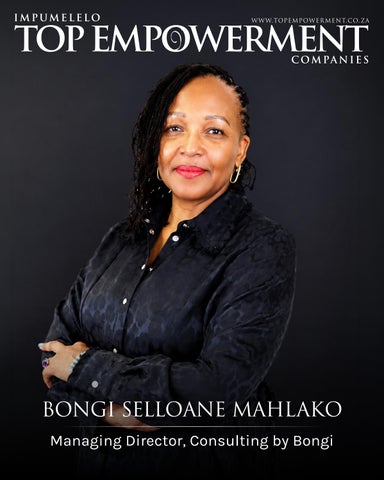
BONGI SELLOANE MAHLAKO Managing Director, Consulting by Bongi
www.topcomedia.co.za www.topcomedia.co.za 2 5 TH E D I T I O N
IMPUMELELO TOP EMPOWERMENT
2
#Celebrating 25 years
CONTENTS
REGULARS 6
Featured organisations
7
Contributors
8
Lee-Ann Bruce letter
9
Editor’s Letter
10
Foreword
COVER STORY 14
Honourable Parks Tau, Minister of Trade, Industry, and Competition
THOUGHT LEADERSHIP 22
Livhuhani Mukhithi, Director: B-BBEE Policy, Advocacy & Institutional Management, dtic
14 10
26
Videsha Proothveerajh, Director of Vodacom Business
30
Professor Bonang Mohale
34
Ravi Naidoo, CEO, Youth Employment Service
38
Eustace Mashimbye, CEO, Proudly SA
42
Monde Ndlovu, Managing Director, Black Management Forum
46
Reona Strydom, Technical Specialist, BEE Chamber
FEATURES 70
Employment equity compliance - Is your business inspection-ready?
72
Leadership lessons from success and failures of enterprise resource planning
76
Driving skills development for inclusive growth through strategic CSI
80
How ESD can change lives and make supply chains more resilient
4 IMPUMELELO TOP EMPOWERMENT 25 EDITION TH
82
Where is the “just” in the transition?
86
How Rassie Erasmus found strength in diversity
CONTENTS
CREDITS
CEO Ralf Fletcher
SECTOR OVERVIEWS
Director Van Fletcher
112 Financial Services 116 Retail
Head of Brand Lee-Ann Bruce
118 Business Services
Project Manager Justin Daniels
122 Manufacturing 126 Transport and Logistics
Key Account Managers McDonald Katema Dipuo Moagi Mickayla Abrahams Thulani Nhlapo Anneline Mohammedt
130 Construction 132 Agriculture 136 Insurance
AWARD WINNERS 140
Oceana Group, Top Empowered Business of the Year
144
Sindisiwe Dlamini, Top Empowered Business Leader of the Year
146
Patricia Tshitema, Richard Fletcher Entrepreneur of the Year
148
Honourable Minister Enoch Godongwana, Minister of Finance, Lifetime Achiever of the Year
152
Beverley Siwisa, Top Empowered Young Achiever of the Year
154 Vaxowave, Top Empowered Company: Digital Transformation of the Year
TOPCO STUDIO Group Editor Fiona Wakelin Deputy Editor Koketso Mamabolo Assistant Editor Shumirai Chimombe Designers Tashwell Brown Artizan Traffic Manager Daniël Bouwer Marketing Samila Nkhohla
INDEX
Research Manager Veronique Anderson
158 Listing of SA’s Top Empowered Companies 2026
Researchers Pelisa Sokomani Gary Petersen
POST-EVENT REPORT
Images iStock, Freepik, Unsplash
176 Top Empowerment Conference and Awards 2025
DISCLAIMER All rights reserved. No part of this publication may be reproduced, stored in a retrieval system or transmitted, in any form or by any means, electronic, mechanical, photocopying, recording or otherwise, without the prior written consent of Top Media & Communications (Pty) Ltd T/A Topco Media. Reg. No. 2011/105655/07. While every care has been taken when compiling this publication, the publishers, editor and contributors accept no responsibility for any consequences arising from any errors or emissions.
Head Office Top Media & Communications (Pty) Ltd T/A Topco Media Elkay House, 186 Loop St Cape Town Tel: +27 86 000 9590 Email: info@topco.co.za Website: www.topco.co.za
2 5 TH E D I T I O N
IMPUMELELO TOP EMPOWERMENT
5
UPFRONT | FEATURED CLEINTS
FEATURED CLIENTS BR AQ U NI
135
BV I C O NS U L TING EN G I N E E RS
49
C O NS U L TING B Y B O N GI
60
G O V E R NANC E C H E C K S A
79
LER ATO M R E AL E S T A T E
129
LI YE M A C O NS U L TI N G GROU P
102
LO C AL S TO R E S NAT I O N
125
M O TL ANAL O C H AR T E RE D A C C OU N T A N T S AND AU D ITO R S INC O RP O RA T E D
104
NE D B ANK
58
O C E ANA G R O U P
98
O L I K A C O NNE C T
85
P AM O D Z I U NIQ U E E N G I N E E RI N G
90
SAE L TR AD ING
93
SAL G A
100
SANL AM
25
SI HL O M I L E S E C U R I T Y S E RVI C E S
108
SI O C C O M M U NITY DE VE LO P M E N T T RU S T
64
T & T AC AD E M Y
115
T K Y E NG I NE E R I NG
97
T SL L E G AL
106
V ANTAG E AD V I S O R Y
57
ZA M ANI C H E M I C AL S
94
ZED A
37
6 IMPUMELELO TOP EMPOWERMENT 25 EDITION TH
CONTRIBUTORS | UPFRONT
CONTRIBUTORS
Professor Bonang Mohale Chancellor of the University of the Free State
Eustace Mashimbye CEO, Proudly SA
Frik Boonzaaier Human Capital Transformation Specialist, The BEE Chamber
Livhuhani Mukhithi Director: B-BBEE Policy, Advocacy & Institutional Management, dtic
Matebe Chisiza-Asukile social investment specialist and team lead (SI Analytics) at Tshikululu Social Investment
Monde Ndlovu Managing Director, Black Management Forum
Ravi Naidoo CEO, Youth Employment Service
Reona Strydom Technical Specialist, BEE Chamber
Thulani Dube Head of Innovation and Advancement Cornerstone Institute
Videsha Proothveerajh Director of Vodacom Business
2 5 TH E D I T I O N
IMPUMELELO TOP EMPOWERMENT
7
UPFRONT |HEAD OF BRAND
TOP EMPOWERMENT REPRESENTS THE LEADING EMPOWERED COMPANIES IN THE COUNTRY who not only drive economic value but also embody the principles of diversity, equity, and transformation in action. South Africa’s journey is a testament to resilience. We are a nation rich in diversity, bound by a shared history, and united by a common purpose — to build a future that is inclusive, just, and empowering for all. Over the years, I’ve witnessed significant strides in transformation, and while challenges remain, the momentum is undeniable.
A
When South Africa took on the esteemed role of G20 Presidency in 2025, under the powerful theme “Solidarity, Equality, and Sustainability,” we were reminded of our collective responsibility to build a nation - and a world where transformation is not only a goal, but a lived reality. These values are perfectly aligned with the mission of Top Empowerment, which for over two decades has celebrated the trailblazers who are actively reshaping the South African economy through inclusive and sustainable empowerment strategies.
s we mark this 25th edition of Top Empowerment, we celebrate more than just an annual publication — we honour a legacy rooted in vision, resilience, and transformation. The Top Empowerment brand is Topco Media’s longest-standing brand, and its origin is one of profound significance. It was launched with the support of a powerful letter of endorsement from the late President Nelson Mandela, facilitated with the help of Cyril Ramaphosa. This foundational moment laid the path for a platform that continues to champion economic inclusion and the advancement of truly empowered organisations in South Africa.
At this pivotal moment in our nation’s history, we can proudly say that black-owned and -led businesses are not just surviving—they are thriving. Across sectors, from finance and telecommunications to education and energy, we are witnessing a new wave of empowered leadership that is bold, resilient, and globally competitive. This
Top Empowerment has come to represent the leading empowered companies in the country — those
8 IMPUMELELO TOP EMPOWERMENT 25 EDITION TH
progress reflects the fruits of years of commitment to economic transformation, enterprise development, and policy frameworks that intentionally support transformation. Equality, as defined in the spirit of the G20 theme, means ensuring fair treatment, equal opportunities, and meaningful advancement for all regardless of race, gender, economic status, or geography. It also means actively confronting and correcting systemic disparities. In South Africa, that commitment is evident in the growing number of empowered enterprises now shaping our economy and society for the better. The companies featured in this edition exemplify this ethos. These organisations are not only aligned with the United Nations Sustainable Development Goals, but are living proof that transformation is good for business, good for communities, and essential for national stability and innovation. This year’s publication brings together thought leaders, pioneers, and changemakers who continue to redefine the landscape of transformation. It is a space for collaboration, celebration, and vision — and we are proud to walk this journey with all of you. Let us continue to empower, uplift, and lead — together.
LEE-ANN BRUCE | HEAD OF BRAND
ED’S LETTER | UPFRONT
#IT’S TOP EMPOWERMENT’S SILVER JUBILEE!
🎉
Turn three pages and there on a double page spread were messages of support from Madiba and now-President Ramaphosa:
W
e are 25 this year - please join us in celebrating our momentous silver anniversary in the pages of this bumper edition! Sometimes to give perspective to the present, it is good praxis to take a look in the rearview: In the year 2000, following a discussion with then-MP Cyril Ramaphosa on the importance of a publication to champion B-BBEE, the first volume of Impumelelo was published, focusing on South Africa’s Top 300 Blackempowered companies. Richard Fletcher, the founder of Topco Media, was still at the helm, and in his letter of thanks in the upfront section of the very first edition, he elucidated the purpose of the magazine – which still holds true today: “Impumelelo has been designed to identify and recognise excellence among black companies and entrepreneurs in South Africa.”
“A rising generation of black businessmen and women is entering the marketplace, both in their own companies and as members of the more progressive white organisations. They are setting out to create a new business world, one both national and international in its scope. They have the freedom now to achieve ‘Impumelelo’, which is the isiXhosa word for ‘success’, and the subject of this publication. – Nelson Mandela For 25 years Impumelelo: Top Empowerment Companies has tracked the changes, potential, growth, challenges and successes of transformation in South Africa – and while this is a journey with kilometres still to go, we have made momentous strides since 1994. This celebratory 25th edition’s front cover icon is Minister of the Department of Trade, Industry and Competition, Honourable Parks Tau and our Foreword is penned by BEE Commissioner, Tshediso Matona. Inside we have an impressive array of thought leaders, including Professor Bonang Mohale, Chancellor of University of Free State; Livhuhani Mukhithi, Director: B-BBEE Policy, Advocacy and Institutional Management, dtic; Eustace Mashimbye, CEO, Proudly SA; Monde Ndlovu, Managing Director, Black Management Forum
Ravi Naidoo, CEO, Youth Employment Service; Reona Strydom, Technical Specialist, BEE Chamber; Thulani Dube, Head of Innovation and Advancement Cornerstone Institute; and Videsha Proothveerajh, Director of Vodacom Business. For an in depth look at how key sectors in the economy are faring on their transformation journey, please turn to the important sector overviews and in keeping with our focus on celebrating success we bring you the winners of the headline Top Empowerment Awards. The featured articles cover important topics such as Enterprise Supply Chain Development; Transformation in Sport; Digital Transformation; the Just Transition; Skills Training and Development; and Employment Equity. Our publication would not be complete without the researched Index of Empowered Companies and a big thanks to the clients who share their success stories in these pages. From the amazing team - we hope you enjoy the read and look forward to seeing you next year.
2 5 TH E D I T I O N
FIONA WAKELIN | GROUP EDITOR
IMPUMELELO TOP EMPOWERMENT
9
10 I M P U M E L E L O T O P E M P O W E R M E N T 2 5
TH
EDITION
I ONNEERR | F O R E W O R D T TSSHHEEDDI SI SOO MMAAT TOONNAA, , BB- -BBBBEEEE CCOOMMMMI SI SSSI O
Foreword
THE TRANSFORMATION FUND: REVISITING THE HISTORICAL PROBLEM OF ACCESS TO CAPITAL FOR BLACK BUSINESSES
BY TSHEDISO MATONA, B-BBEE COMMISSIONER South Africa’s democratic transition was not only a political project, it was also an economic one. The promise of democracy carried with it the expectation that millions of black South Africans, long excluded from meaningful participation in the economy, would finally gain access to opportunities, ownership, finance, and productive economic activity. More than three decades later, the question of economic transformation remains one of the defining issues of our national discourse.
2 5 TH E D I T I O N
IMPUMELELO TOP EMPOWERMENT
11
AWARD WINNERS | ZINHLE THUPANA
T
his 25th edition of Impumelelo: Top
Broad-Based Black Economic Empowerment policy and
Empowerment provides an important
legislation must be understood against this history and
opportunity to reflect on the progress made,
the current lived experience of economc disadvantage
the challenges that remain, and the work still
and exclusion, and not as merely a compliance exercise
required to build a more inclusive and equitable economy.
or a narrow transactional arrangement. At its core, it was
It is fitting that this milestone edition is launched at a time
conceived as a mechanism to expand participation
when South Africa is once again engaged in a robust
in the economy, foster the growth of enterprises and
debate about the future of economic transformation and
entrepreneurs who are innovators and job-creators,
the instruments required to deepen inclusion.
and advance social and economic justice. The broader objective has always been to build an economy that
Since the dawn of democracy one of the most persistent
reflects South Africa’s demographics and shared
barriers confronting black businesses has been access to
aspirations, leveraging to the maximum our labour,
capital. This challenge did not emerge by accident. It is
human capital and natural endowments and talents.
rooted in a historical system that systematically excluded black South Africans from ownership of productive assets,
Development financing institutions (DFIs) such as the
access to finance, participation in formal markets, and
National Empowerment Fund, Industrial Development
opportunities to accumulate intergenerational wealth. While
Corporation and others play a critical role in advancing
democracy dismantled the legal architecture of exclusion,
the B-BBEE project towards an inclusive economy. Over
the structural effects of that exclusion continue to shape
the years, they have contributed significantly to the
economic outcomes today. The injustice of the past still lives
development and financing of black-owned enterprises
in the present, and its scars live the many gaps and different
across a range of sectors. Increasingly, this has involved
experiences of life in the country, and what it means to be a
leveraging partnerships with private financial institutions
South African.
to curate the “need-based” funding solutions as well as combining capital with mentorship, technical
The difficulty of accessing affordable and sustainable funding
support, and long-term developmental partnerships.
remains a major obstacle for many black-owned enterprises,
Transformation requires both policy intent and practical
particularly small and medium-sized businesses, township
implementation mechanisms capable of addressing
enterprises, women-owned firms, youth entrepreneurs, and
historical disadvantage in meaningful ways. For this
emerging industrialists. Many viable enterprises struggle not
reason, the role of DFIs needs to be strengthened for
because of a lack of innovation, ambition, or capability, but
enhanced impact.
because they remain locked out of the financial ecosystems that are critical for growth and sustainability.
Current discussions about the proposed Transformation Fund have placed B-BBEE under the spotlight in a way that could be the opportunity for shared ambition
“
for transformation, or otherwise default to a stagnant status quo. Much of the public debate has been about
Development financing institutions (DFIs) such as the National Empowerment Fund, Industrial Development Corporation and others play a critical role in advancing the B-BBEE project towards an inclusive economy
12 I M P U M E L E L O T O P E M P O W E R M E N T 2 5
TH
EDITION
technical details and the role of the proposed Fund, and about governance concerns. These debates are both necessary and healthy on consultative grounds in a constitutional democracy. However, sight must not be lost of the underlying structural issue the proposal seeks to address: the continued disadvantage suffered by many black businesses from meaningful access to capital and economic opportunity. The challenge before South Africa is therefore not whether economic transformation is necessary, but
TSHEDISO MATONA, B-BBEE COMMISSIONER
| FOREWORD
“
Sustainable growth depends on widening participation, unlocking entrepreneurial potential, supporting productive investment, and ensuring that the economy draws on the capabilities of all its people how best to achieve it in a manner that is effective,
Importantly, transformation must also focus
transparent, sustainable, and growth-enhancing.
on economic expansion through enhancing
Economic inclusion and economic growth are not
production capacity, innovation and
contradictory objectives. In fact, sustainable growth
competitiveness, and not be simplistically
depends on widening participation, unlocking
viewed solely through a redistribution lens. The
entrepreneurial potential, supporting productive
long-term success of empowerment lies in creating
investment, and ensuring that the economy draws on the
new industries, new enterprises, new opportunities
capabilities of all its people.
and new wealth for future generations.
Globally, societies that succeed in broadening economic
Top Empowerment’s celebration of its 25th edition
participation tend to build stronger and more resilient
is a source of inspiration and lessons learnt for the
economies over time. South Africa cannot afford an
important ongoing national conversation about
economy in which opportunity remains concentrated in a
inclusion, opportunity and the future of South
narrow segment of society while millions remain excluded
Africa’s economy. Over the years, the publication
from meaningful participation. Such exclusion undermines
has contributed meaningfully to debates around
not only social justice, but also long-term economic
transformation, leadership, enterprise development,
stability, investor confidence, and social cohesion.
and inclusive growth. It has provided a platform for reflection, engagement, and recognition of
At the same time, transformation policy must continually
individuals and institutions committed to advancing
evolve in response to changing economic realities. South
empowerment in practice.
Africa faces a complex set of contemporary challenges, including slow economic growth, high unemployment,
This milestone edition is therefore not only a
rising inequality, infrastructure backlogs, technological
celebration of progress achieved, but also a
disruption, and growing fiscal constraints. These realities
reminder of the responsibility we carry collectively
require innovation, collaboration, and policy approaches
to continue building an economy that is more
that are responsive to both economic inclusion and
inclusive, dynamic, and just. South Africa possesses
sustainable growth imperatives.
extraordinary entrepreneurial talent, resilience, and potential. The task before us is to ensure that these
The private sector, government, development finance
capabilities are not constrained by the enduring
institutions, labour, and civil society all have a role to play
legacies of exclusion.
in shaping a more inclusive economy. Transformation cannot succeed through legislation alone. It requires
The pursuit of economic transformation remains
partnerships that mobilise investment, support
central to the broader democratic project
entrepreneurship, expand industrial capacity,
envisioned in 1994. The work is unfinished, but the
develop skills, and create pathways for new entrants
objective remains clear: to build a South Africa in
into the economy. It also requires a national
which opportunity is genuinely accessible to all, and
commitment to ethical leadership, accountability,
in which economic participation reflects both the
and institutional integrity.
diversity and the promise of our nation.
2 5 TH E D I T I O N
IMPUMELELO TOP EMPOWERMENT
13
14 I M P U M E L E L O T O P E M P O W E R M E N T 2 5
TH
EDITION
MINISTER PARKS TAU, DTIC | COVER STORY
Parks TAU IN T ERVIEW WIT H
HONOURABLE
MINISTER OF TRADE, INDUSTRY, AND COMPETITION
B Y FIONA W AKELIN “Transformation over the next decade will be measured not by scorecards but by household income data, by youth unemployment figures and by the proportion of value-adding exports that carry a black-owned stamp.”
A
s our country navigates a rapidly changing geo-political landscape, the conversation around transformation, industrialisation, inclusive growth and competition has taken on renewed energy. Honourable Parks Tau’s Department of Trade, Industry and Competition carries the responsibility of driving both economic growth and meaningful participation in the South African economy. Since his appointment to this crucial role in 2024, Minister Tau has consistently argued that economic transformation remains both a constitutional imperative and a critical component of South Africa’s growth agenda. Under his leadership, the Department of Trade, Industry and Competition has sought to balance investment attraction, industrial expansion, localisation and
competitiveness with the broader objective of building a more inclusive economy. For businesses, investors and empowerment practitioners, the challenge is no longer simply achieving compliance, but ensuring that Broad-Based Black Economic Empowerment translates into sustainable enterprise development, meaningful ownership, industrial participation and long-term wealth creation. In this exclusive interview, Minister Tau reflects on the state of economic transformation in South Africa, the role of B-BBEE in driving inclusive growth, the opportunities and challenges facing black-owned businesses, and how South Africa can build a more competitive economy that delivers prosperity for all.
2 5 TH E D I T I O N
IMPUMELELO TOP EMPOWERMENT
15
Memorable milestones – and challenges
We entered into office at a time when the world was facing unprecedented geopolitical challenges and still recovering from the Covid-19 health and economic pandemic. The economic consequences of these seismic shifts have impacted South Africa while also presenting opportunities to maximise the priorities our alignment with the Global South. Being the resilient and anti-fragile nation we are, we have relatively managed to whether the local and international storms to, ultimately, advance the policies and programmes of the 7th Administration. Understandably, when we entered office, a number of sectors were under severe strain including Steel, Autos, Manufacturing and of course others impacted by the unilateral US Tariffs. As a result, our response was focused on placing these sectors on course for recovery, ensuring sustainability, and regaining industry goodwill in the short- to long-term. Indeed, the work we have done in executing our trade and export strategy has been bearing fruit. Our newly signed trade agreements with China (The China-Africa Economic Partnership Agreement) and the European Union (Clean Trade and Investment Partnership), as well as shifting our export focus to diversification has proven successful. Our ongoing negotiations with nations such as India, Brazil and the Gulf Cooperation Council are providing much greater market access for South African goods. This is backed by strong data from the South African Revenue Services which indicates that South Africa’s year-to-date trade surplus reached R89.3 billion for the period January to April 2026.
16 I M P U M E L E L O T O P E M P O W E R M E N T 2 5
TH
EDITION
This was more than double the R39.8 billion recorded during the same period the previous year. Another important milestone, was focused on governance by stabilising the Department itself and its Entities. This involved filling in vacancies at both management and senior official levels plus reconvening platforms for engagements with labour unions, industry associations and provincial governments.
Key priorities in accelerating inclusive economic participation
Given the cumulative challenges in the country, an immediate challenge was identifying the areas of work that required improvement that would see immediate impact, while planning for South Africa’s long-term economic growth. On the policy front, spearheading Industrial Policy was a priority along with catalytic pillars of driving inclusive economic growth through reprioritising spatial development (special economic zones / industrial parks), our trade diversification and derisking strategy. The reports of the B-BBEE commission highlighted some critical areas of immediate intervention. In the context of the dtic, the Enterprise and Supplier Development element of the scorecard stood out as an area of intervention. The Transformation Fund idea was birthed as a way to accelerate industrialisation linked ESD. Many non-compliant firms had little to no ESD plans and few were implementing any. The aggregation of potential ESD funds into a single fund would, according to our internal research, would be able to generate around R20 billion per annum, leading to
MINISTER PARKS TAU, DTIC | COVER STORY
the R100 billion target for the Transformation Fund over the medium term.
“Engagement with the diplomatic corps is pivotal to our work”
Trade does not happen in a policy vacuum. Every market we enter, every preferential agreement we activate, every investment conversation we open — all of it is built on relationships that have to be cultivated deliberately and maintained consistently. The diplomatic corps is where those relationships live. Ambassadors and high commissioners offer more than simply being ceremonial figures; they are market intelligence assets, door-openers, and credibility signals in their home countries. Our inroads into the Middle East — with the UAE, Qatar, and Saudi Arabia — were not accidental. They were the product of coordinated engagement between the Presidency, DIRCO, and the dtic. When we speak of South Africa as a destination of choice, those are not words that land on their own. They have to be delivered through trusted channels. The diplomatic corps is one of those channels. When we hosted the Sixth South Africa\Investment Conference, fifteen source markets and five continents were represented — that reach does not happen without sustained diplomatic groundwork. So when I say engagement with the diplomatic corps is pivotal, I mean it in the most practical sense: it is part of our investment architecture.
How important is it for South Africa to strengthen ties with its BRICS partners? Critically important — but the framing matters. South Africa does not align; South Africa diversifies. That is the distinction I want to be clear about. The share of world trade governed by WTO rules dropped from 80% to 72% in 2025. These shifts, driven by growing geopolitical tensions
“
On the policy front, spearheading Industrial Policy was a priority along with catalytic pillars of driving inclusive economic growth through reprioritising spatial development (special economic zones / industrial parks), our trade diversification and derisking strategy
and great-power competition, are creating uncertainty and weakening predictable rules-based trade. In that environment, no country can afford a single-track foreign economic policy. BRICS now comprises more than a quarter of the global economy and nearly half the world’s population. Our partnerships with Brazil, India, China, and the extended BRICS membership are not ideological — they are strategic. China remains our largest single trading partner. India is among the fastest-growing economies on earth. Brazil shares our interests in multilateral reform, in agricultural trade, and in advancing the Global South’s voice in institutions that were designed without us in mind. We have the foundation of a preferential trade agreement with Mercosur — the SACU-MERCOSUR PTA — covering more than a thousand tariff lines. We see it as a platform with much greater potential than has yet been realised. The point is this: the world is multipolar whether we like it or not. South Africa’s task is to build density and resilience across all those poles — BRICS, the EU, Africa, the Middle East, ASEAN — so that no single disruption can knock us off course.
The B-BBEE Act
B-BBEE was born as a corrective instrument in a country where the racialised exclusion of the majority from the economy was by design. The Act of 2003 gave us the architecture: ownership, management control, skills development, enterprise and supplier development, preferential procurement. That architecture was necessary. But architecture is not the same as transformation. Over two decades, we have seen real progress in certain dimensions. Black ownership of corporate equity has moved from under 5% in 1994 to roughly 30% today. The Black Industrialists Programme has backed over 1,200 ventures and mobilised meaningful capital into the manufacturing and productive sectors. B-BBEE transformation in 2026 extends beyond legislative compliance into ESG performance — investors and global clients now evaluate how companies contribute to equitable opportunity, fair pay and diverse leadership. But I will be honest about what has not worked. Compliance became an industry unto itself. Fronting flourished. Scorecards were gamed. Skills development points were claimed for training that produced no economic mobility. The gap between the letter of the law and the lived experience of black South Africans remained unconscionably wide. For too long, Enterprise and Supplier Development efforts have fallen short of their potential. Despite regulations requiring companies to allocate 3% of net profit after tax towards ESD, 39% of those funds do not reach their intended beneficiaries on an annual basis. According to analysis from independent analysts
2 5 TH E D I T I O N
IMPUMELELO TOP EMPOWERMENT
17
“
BRICS now comprises more than a quarter of the global economy and nearly half the world’s population. Our partnerships with Brazil, India, China, and the extended BRICS membership are not ideological — they are strategic
and the B-BBEE Commission itself, that lends itself to lost value for black firms of over R20 billion a year. That is not transformation — that is leakage. The evolution of B-BBEE over the next phase must be defined by outcomes, not compliance certificates.
Steps to ensure transformation moves beyond compliance and becomes a genuine driver of economic growth
The first step is structural: we are closing the gap between ESD funding and impact. Through the Transformation Fund, we are maintaining the principle of partnership between established businesses and emerging businesses — but we want to see much more impact and spending on relevant ESD activities that lead to growth and sustainability of black-owned enterprises and SMMEs. The second step is coherence. For too long, transformation instruments were scattered across departments, each running its own programme with its own reporting, its own metrics, its own definition of success. The Transformation Fund — administered through a Special Purpose Vehicle, with a board drawn from both government and the private sector, targeting R100 billion aggregated over five years — is an attempt to bring coordination and scale to what has historically been a fragmented effort. The third step is integration with industrial policy. Transformation that is not tied to productive capacity is not transformation — it is redistribution at best, and charity at worst. Our Black Industrialists Scheme is deliberately designed to direct support toward manufacturing, toward the sectors identified in our industrial strategy. When a black-owned firm enters a value chain in green energy components or automotive parts, that is transformation doing double duty: it advances equity and builds the industrial base at the same time. That is the model we are scaling.
SMMEs are key to the department’s strategy for sustained, inclusive development
They are the backbone of it. The National Development Plan is explicit: SMMEs are expected to contribute between 60% and 80% of GDP growth and create 90% of the
18 I M P U M E L E L O T O P E M P O W E R M E N T 2 5
TH
EDITION
11 million new jobs South Africa needs by 2030. Those numbers define the structural role that small and medium enterprises must play. The dtic’s industrial strategy is not built around large firms alone. Large anchor investments matter — they attract capital, they signal confidence, they create demand. But it is in the SMME ecosystem that jobs are actually created at scale, that local procurement becomes meaningful, that township and rural economies begin to breathe. Every Special Economic Zone we designate, including the proposed Vaal SEZ with its 817 hectares in the Sedibeng district, is an infrastructure investment in the environment that SMMEs need to operate and grow. Every SMME that enters a supplier development programme and makes it into a value chain is a data point that the model works. Our job is to multiply those data points.
Access to funding remains a major challenge
This is arguably the most persistent structural failure in the transformation project, and we have to name it plainly. A survey by FinMark Trust revealed that 87% of small enterprises in South Africa face disproportionate difficulties in securing funding. A well-capitalised banking sector exists in this country, yet it consistently prices black entrepreneurs out of credit markets or demands collateral that history has deliberately denied them. That is the gap government has an obligation to address. The dtic’s instruments include the Black Industrialists Scheme, which provides both financial and non-financial support for black-owned manufacturing enterprises. The NEF focuses on empowering majority black-owned businesses through equity investments, loans and business support. The Small Enterprise Finance and Development Agency at the department of Small Business Development provides funding to emerging businesses across various sectors. The Transformation Fund adds a new layer — aggregating ESD capital that has historically been dispersed and underutilised into a single, impact-oriented vehicle. The fund rests on five pillars: technical support and market access; improved accessibility for majority blackowned businesses, especially in townships and rural areas;
MINISTER PARKS TAU, DTIC | COVER STORY
financial and non-financial support including grants and loans; dedicated focus on township and rural economies; and productive sectors. The test is how this is delivered. And we are tracking that delivery.
Industrialisation is central to South Africa’s economic strategy. How is the department ensuring that blackowned businesses are integrated into industrial value chains?
Through deliberate design. Our industrial policy is organised around three pillars — Decarbonisation, Diversification, and Digitalisation — and transformation is embedded in each of them, not bolted on as an afterthought. In decarbonisation: the green economy is creating new value chains from scratch. Green hydrogen components, solar module assembly, battery storage systems — these are industries where no incumbent has a 30-year head start. That is a structural opportunity for black industrialists to enter at the ground floor, and we are designing our incentive programmes to ensure they do. In diversification: the Black Industrialists Scheme specifically targets businesses that do business in the manufacturing sector, with particular reference to industrial policy focus areas, and that create and own value-adding industrial capacity. The emphasis on value-adding is deliberate — we are not interested in creating black-owned trading companies that sit at the edge of a value chain. We want ownership and control at the productive core. The Omnibus Fast-Tracking Act and our SEZ programme are
further tools. A black-owned firm located in a designated SEZ, with access to infrastructure, tax incentives, and a pipeline of procurement from anchor investors, is a firm that can compete. The integration is structural; the incentive does the work.
Scaling
Scale requires three things that black entrepreneurs in South Africa have historically been denied: capital, markets, and networks. Government’s role is to address all three through strategic intervention. On capital: the dtic is driving a R700 billion investment pipeline spanning critical sectors, including transformative energy projects worth R339 billion. That pipeline creates procurement demand. Where we can designate local content requirements and B-BBEE compliance standards in those projects, we create demand-side pull for blackowned suppliers to grow. On markets: the Butterfly Strategy and our Export Support infrastructure are not only for large multinationals. We are working to ensure that black-owned firms — particularly those in agro-processing, manufacturing, and professional services — can access preferential trade frameworks like AfCFTA and SACU-MERCOSUR. An emerging exporter in Gauteng should be able to use those agreements. On networks: the InvestSA One Stop Shops — including the recently launched facility in the Northern Cape — are intended to be entry points not just for large investors but for
2 5 TH E D I T I O N
IMPUMELELO TOP EMPOWERMENT
19
any entrepreneur seeking to navigate the regulatory and support landscape. Access to information is itself a form of capital.
Public procurement
Public procurement represents an enormous and underutilised instrument of structural transformation. The Public Procurement Act seeks to create a single framework regulating public procurement across all organs of state, with the efficiency, cost-effectiveness and integrity needed — and explicitly to advance transformation and broadened economic participation. That last clause is important. Transformation is written into the purpose of the Act, not merely a secondary objective. The dtic’s role is to ensure that the B-BBEE and localisation requirements built into the preferential procurement framework are coherent, consistently applied, and actually reach their intended beneficiaries. The dtic’s responsibilities include ensuring compliance with the role of B-BBEE and localisation in public procurement. We are working across government — with National Treasury, the Department of Public Works, the Department of Mineral Resources and Energy, among others — to align procurement conditions in major infrastructure and energy programmes with transformation objectives. The key challenge is implementation consistency. The law exists. The framework exists. What we need is the machinery at every organ of state to enforce it with integrity and without the leakage that has historically characterised government procurement. That is a governance challenge as much as a policy challenge.
Sectors currently presenting the most promising opportunities for black-owned businesses Several are particularly compelling right now.
20 I M P U M E L E L O T O P E M P O W E R M E N T 2 5
TH
EDITION
Green industrialisation is the first. The energy transition is creating demand for components, installation, maintenance, and professional services across the renewable energy value chain. It is a sector where infrastructure investment is guaranteed over the medium term and where the dtic is actively designing entry points for black industrialists. Critical minerals and beneficiation is the second. South Africa holds the world’s largest known reserves of platinum group metals, manganese, chrome, and vanadium. The global race for battery materials and green steel inputs is South Africa’s opportunity — but only if we move up the value chain and ensure that black-owned firms participate not just in extraction but in processing and manufacturing. Agro-processing is the third. Agriculture and mining have both shown strong growth in the current cycle. The opportunity is in processing that output into higher-value products for both domestic consumption and export — food manufacturing, malt, spirits, packaged goods. These are sectors where capital requirements are lower and market access through AfCFTA is expanding. Digital services and ICT round out the picture. The growth of digitally deliverable services is outpacing goods exports globally. Black-owned tech firms, fintech startups, and digital service providers are positioned to participate in that growth, and the dtic is working to ensure that our IP and technology commercialisation infrastructure supports them.
Public-Private partnerships
The Renewable Energy Independent Power Producer Procurement Programme (REIPPPP) remains the model we hold up — and rightly so. It demonstrated that a well-structured, transparent, and predictable PPP
MINISTER PARKS TAU, DTIC | COVER STORY
“
Public procurement represents an enormous and underutilised instrument of structural transformation
framework attracts substantial private and foreign investment, creates jobs, and delivers public goods. The lesson from REIPPPP is not unique to energy; it is replicable across sectors wherever government can offer long-term contractual certainty. The Public Procurement Act confers on the relevant Minister the obligation to make regulations pertaining to PPPs, providing a unified legislative basis for partnership structures across government. The dtic is working to ensure that PPP models in industrial parks, SEZs, and manufacturing incentive programmes are structured to attract private capital while embedding transformation conditions from the outset. A PPP that does not include a genuine black equity participation requirement or a local supplier development component is, from our perspective, an incomplete instrument. The broader point is that South Africa cannot industrialise at the required pace on public resources alone. The R700 billion investment pipeline we are driving requires private capital, domestic and foreign, to move alongside public catalytic investment. The policy framework — SEZs, incentives, the CTIP with the EU, bilateral investment frameworks across our priority markets — is the architecture within which that private capital can move with confidence.
AfCFTA
The African Continental Free Trade Area - AfCFTA - is the single largest market creation event in the post-Bretton Woods global economy. A market of 1.4 billion people, a combined GDP of over three trillion dollars, and preferential tariff treatment for qualifying goods and services — this is the terrain that black entrepreneurs now have a right to enter. The trajectory is encouraging. South Africa’s exports under AfCFTA increased from R485-million in 2024 to R1.386-billion in the first seven months of 2025. By 2025, 24 African countries had begun trading preferentially under the agreement. The growth is real, and the momentum is building.
But for black-owned businesses to capture that growth, three things are needed. First, information: many SMEs do not know that AfCFTA preferences apply to them, what the rules of origin requirements are, or which markets are open. The dtic’s export support infrastructure has to reach them. Second, standards compliance: African markets increasingly require quality certification and standards alignment. Capacity building in this area is not optional — it is a precondition for market entry. Third, logistics: a competitive product cannot reach a customer in Nairobi or Lagos if port efficiency, customs processing, and transport corridors remain unreliable. Operation Vulindlela’s logistics reform work is therefore directly connected to AfCFTA realisation.
Looking ahead, what does meaningful economic transformation in South Africa look like to you over the next decade? It looks like an economy in which the demographics of ownership, management, and income finally begin to reflect the demographics of the country — not as a matter of policy compliance, but as the natural consequence of structural change that has created genuine economic mobility.
Concretely, it means black industrialists producing green hydrogen components for export to Europe under the CTIP. It means black-owned agro-processors sending malted barley and packaged foods into West Africa under AfCFTA preferences. It means a generation of black technologists whose firms are not just funded by ESD grants but are scaling, hiring, and competing globally in the digital economy. It means township economies that are nodes of productive activity, not margins of consumption. The just transition opens pathways for new black industrialists and designated groups — including black youth employment and black women’s leadership — in renewable energy and infrastructure. The digital economy must include black professionals, SMMEs and innovators, or we risk creating a new digital divide that simply replicates apartheid spatial and economic logic in a different register. The honest answer is that transformation over the next decade will be measured not by scorecards but by household income data, by youth unemployment figures, by the proportion of value-adding exports that carry a black-owned stamp. We have the policy instruments. We have, for the first time in many years, a growth trajectory. What is now required is execution with the same intensity that we have brought to the investment mobilisation work — and the same accountability.
2 5 TH E D I T I O N
IMPUMELELO TOP EMPOWERMENT
21
THOUGHT LEADERSHIP
22 I M P U M E L E L O T O P E M P O W E R M E N T 2 5
TH
EDITION
LIVHUHANI MUKHITHI | THOUGHT LEADERSHIP
B-BBEE LANDSCAPE EVOLUTION:
An opportunity for economic inclusion By Livhuhani Mukhithi, Director: B-BBEE Policy, Advocacy & Institutional Management, dtic
A
s South Africa enters the 23rd year of legislated
economic actors to the noble idea of economic
B-BBEE implementation, the architects of the
transformation. The Amended Broad-Based Black Economic
B-BBEE institutional and legislative blueprint
Empowerment (B-BBEE) Codes of Good Practice of 2013,
understood that it is not a silver bullet to remedy
which became effective in 2015, introduced a new
all socio-economic challenges bedeviling the fledgling
scorecard that had five elements: ownership, management
post-apartheid democratic order, but an instrument for
control, skills development, enterprise and supplier
economic redistribution and inclusion. This noble undertaking
development (ESD) and socio-economic development.
gave us the legislative and institutional frameworks that
As B-BBEE advanced, other instruments of B-BBEE
anchor South Africa’s efforts to ensure economic inclusion
implementation were introduced, and that includes the
that are explicitly backed by the equality principle (as
Equity Equivalent Investment Programme (EEIP). EEIP
contained in Section 9(2) of the Constitution of the Republic
has given practical impetus to ensuring that there is a
of South Africa).
tangible interface between B-BBEE and the country’s reindustrialisation efforts (with emphasis on emboldening
The evolution of B-BBEE policy, legislative framework and
elements such as skills development, ESD, research
institutional mechanisms has largely been triggered by the
and innovation).
continuous test of its efficacy in the face of unrelenting scrutiny and opposition to its implementation. With the early
To this effect, R10-billion worth of investment has been
iteration of BEE in the 1990s and early 2000s premised largely
made, with the major investment contributed by the
on ownership acquisition, was this focus not narrow and
automotive sector, a joint EEIP by vehicle manufacturers
limited to the ideal of economic redistribution and inclusion.
BMW, Ford, Isuzu, Mercedes-Benz, Nissan, Toyota and
The gravitation towards Broad-Based BEE proved that
Volkswagen. This investment aims to facilitate transformation
fundamental transformation of the patterns of ownership of
across the sector’s value chain through the provision of
the mainstream of the country’s economy was necessary.
access to funding, markets and capacity development for qualifying black owned entities.
This change of approach appreciated the power of elements such as Management Control, Skills Development and
This undertaking has given birth to the Automotive Industry
Enterprise and Supplier Development (ESD). Also contained
Transformation (AITF), From its commencement in 2020 until
in these changes was the codification of these elements
the end of 2024, the AITF had invested R600 million in 67
to enable measurement of contribution by mainstream
companies in the automotive value chain. There are other
For many organisations, this year represents a pivotal shift
2 5 TH E D I T I O N
IMPUMELELO TOP EMPOWERMENT
23
THOUGHT LEADERSHIP | LIVHUHANI MUKHITHI
large EEIPs by Caterpillar (R1.3-billion), Microsoft (R708-million)
These statutory creations are critical to B-BBEE
and IBM (R700-million) and most are focused on ESD, the
implementation, especially in these times where everyone
development of critical skills and research and development.
can easily claim to be an expert (mostly churning out misleading commentary on B-BBEE and its implementation).
These B-BBEE initiatives have taken from global best practices
Unfortunately, these tendencies fail to appreciate that
(learning from developmental states such as South Korea) to
B-BBEE has advanced substantially in terms of technical
give applied stimulus to the significance of B-BBEE partnerships
nature and it is now a niche area that has given birth to
for inclusive growth and support to the country’s industrial
technically competent practitioners and policy custodians
development. This is consistent with the path traversed
that are strewn across the country’s economic mainstream
by other developmental states in South East Asia. In this
and the organs of state.
context, countries such as South Korea have anchored their reindustrialisation drive on the close partnership between
B-BBEE at a crossroads. Over the last few years, it has been
policymakers and sectoral participants to ensure that
compounded by a plethora of implementation challenges.
industrial development support considers innovation, research
These challenges are diverse and they undermine its
and development, ESD, and skills development to help drive
implementation in different ways. A logical development to
the country’s economic growth.
this implementation dilemma, will address the fundamental architecture of B-BBEE that is moored on its voluntary
According to Klinger- Vidra et al (2019: 7) these partnerships
character in participation and contribution.
with policymakers value efforts to promote alternative forms of employment and economic output. At the same time, the
It is also important to update and strengthen the B-BBEE
support for high-technology entrepreneurship; policymakers
Codes of Good Practice to affirm its power in the realm of
should be compelled to adopt new tools (accelerators, funds
enforcement and compliance. The consideration of the
of funds, building clusters and promoting risk-taking cultures)
legislative review should also affirm the current institutional
to encourage support for small firms.
mechanisms such as the B-BBEE Commission to sanction and impose penalties to those who are subverting its practice.
In the South African context, the conception and
Through the legislative review, the strengthening of the
development of the Transformation Fund intends to cover the
B-BBEE institutional setting should consider the practical
support and finance gaps that are undermining the intensified
challenges affecting existing B-BBEE institutions and
uptake of black-owned enterprises in the mainstream
create an ecosystem that will empower and ensure
economic sectors through availing of cheap low interest
complementarities, and interdependencies amongst
capital, support in the building of capabilities and access to
institutions of B-BBEE implementation and support.
markets. These B-BBEE driven investments solidifies the agility of this economically redistributive tool for economic inclusion
The optimisation of economic inclusion remains sacrosanct
as the country continues to massify its efforts to support
as we traverse the path of unleashing the country’s
industrial development and reindustrialisation.
economic potential. Partnerships between the country’s mainstream economic actors and policymakers stand
The evolution of B-BBEE implementation is also anchored
to unlock the economic opportunities and drive inclusive
by an institutional setting whose sole mandate is to ensure
growth as we continue to support our reindustrialisation
its compliance and enforcement, Sectoral Transformation,
efforts. As the mulling on the future of B-BBEE enters the
B-BBEE accreditation and verification, B-BBEE advisory and
national discourse, it should not be burdened to carry
B-BBEE financial support. These institutional mechanisms have
additional socio-economic imperatives as the current
given substance, content and form, and legislative control to
architecture is adequate in its support to economic
our economic transformation interventions.
redistribution and contributing to our industrial policy.
24 I M P U M E L E L O T O P E M P O W E R M E N T 2 5
TH
EDITION
THOUGHT LEADERSHIP
26 I M P U M E L E L O T O P E M P O W E R M E N T 2 5
TH
EDITION
VIDESHA PROOTHVEERAJH | THOUGHT LEADERSHIP
THE CASE FOR AUTHENTIC PUBLIC-PRIVATE PARTNERSHIPS in building South Africa’s future Videsha Proothveerajh, Director of Vodacom Business
S
outh Africa faces challenges of unprecedented
creates predictable outcomes, but rarely transformative
complexity. Our water systems are losing nearly
ones. The private sector deploys technology, but without
40% of supply through inefficiency and theft.
a deep understanding of Government’s operational
Energy demand continues to outpace supply.
constraints. Government benefits from innovation but
Citizens need access to government services without
lacks the ongoing partnership needed to adapt as
visiting physical offices. Municipalities struggle to collect
circumstances change.
revenue while maintaining essential infrastructure. These aren’t problems that any single entity, whether
Disconnection inevitably emerges and promised benefits
government or private sector, can solve alone.
fail to materialise.
This reality has led to a growing recognition that
The most successful partnerships I’ve witnessed operate
public-private partnerships (PPPs) are no longer an
differently. They begin with an honest conversation about
option, but a necessity. We know that not all partnerships
real challenges, followed by collaborative problem-solving
are equal. The difference between those that transform
where both parties share expertise, risk, and commitment
societies and those that disappoint lies in the fundamental
to sustainable outcomes. Purpose comes before profit.
shift of moving from transactional relationships to genuine
Trust precedes contracts.
collaboration built on shared purpose and mutual trust.
Why traditional approaches fall short
Vodacom business’s partnership approach in practice
For decades, PPPs were often structured around a simple
Consider the Naledi Local Municipality smart metering
exchange: government identifies a need, the private
project in the North-West Province. Naledi faced a
sector provides a solution, a contract is signed, and both
crisis: electricity losses had reached 26%, far above
parties move forward separately. This transactional model
the sustainable 5% threshold. Revenue collection
The difference between those that transform societies and those that disappoint lies in the fundamental shift of moving from transactional relationships to genuine collaboration
2 5 TH E D I T I O N
IMPUMELELO TOP EMPOWERMENT
27
was declining, threatening the municipality’s ability to pay Eskom and maintain service delivery. Rather than Vodacom Business simply installing meters and withdrawing, we entered into a genuine partnership. This meant understanding the municipality’s operational reality, including their existing relationships with other service providers. It meant co-designing solutions with their teams, rather than imposing ours. It meant training local community members creating sustainable employment while building local capability. The result wasn’t just technology deployment, but institutional transformation. Naledi deployed more than 6000 tamper-proof smart meters and reduced electricity losses to below 5%, dramatically improving revenue collection. More importantly, the municipality now has the knowledge and confidence to manage this system independently and scale it further. But perhaps most significantly, the partnership was a proof-point to a template that demonstrates viability and proves ROI thereby encouraging other municipalities to embrace similar approaches. This is how innovation scales in the public sector: through proven examples and partnerships built on genuine collaboration.
The digital utility layer: Partnership as Platform Through our five-year partnership with the National Treasury, Vodacom Business is implementing an integrated digital layer across municipalities nationwide. This isn’t a series of isolated projects. It’s platform thinking recognising that energy, water, infrastructure, healthcare, education and citizen engagement cannot be managed in silos if we want to achieve sustainable outcomes.
28 I M P U M E L E L O T O P E M P O W E R M E N T 2 5
TH
EDITION
VIDESHA PROOTHVEERAJH | THOUGHT LEADERSHIP
This is how innovation scales in the public sector: through proven examples and partnerships built on genuine collaboration Our smart utilities management system provides
and through ensuring that benefits are shared
real-time consumption data that helps municipalities
equitably. When the Naledi Municipality integrated
manage supply and reduce waste. Our Citizen
smart meters with a secure banking app for
Engagement app opens two-way communication
electricity purchases, that wasn’t just a technical
between residents and local government, allowing
solution, but a threeway public private partnership
citizens to log complaints and track progress while
safeguarding citizen dignity and financial inclusion
providing government with real-time feedback on
alongside operational efficiency for the
service failures. Our Digital Water Tower initiative
municipality affected by Vodacom Business.
consolidates meter readings, consumption patterns and network maps into a single platform, enabling
The path forward
municipalities to detect leaks and manage
South Africa’s future depends on recognising
supply proactively.
that our most pressing challenges, energy security, water scarcity, inclusive economic
Individually, these technologies exist elsewhere.
growth, service delivery excellence, cannot be
But their power emerges when they operate as an
addressed by government acting alone or by
integrated system, supported by genuine institutional
the private sector pursuing independent
partnership between government and the private
advantage. They require genuine partnerships
sector. This model survives budget cycles, leadership
where both parties bring their distinct strengths,
changes and regulatory evolution because it’s
share risk proportionally, and commit to outcomes
embedded in operational practice, not dependent
that benefit society broadly.
on any single champion.
Trust as infrastructure
At Vodacom Business, we remain committed to being more than a technology vendor.
Effective PPPs recognise that technology is
We’re committed to being a genuine partner
only part of the solution. Trust is equally critical
listening as much as we lead, understanding
infrastructure. Citizens need to believe that
constraints before proposing solutions, and
smart meters provide transparency, not control.
staying invested in long-term transformation.
Municipalities need confidence that their private
When government and the private sector work
sector partners understand the long-term public
together authentically, guided by shared purpose
good, not just short-term commercial advantage.
and built on trust, the results extend far beyond
Government must trust that business partners will
project timelines.
operate with integrity and resilience. They reshape how societies function and This trust is earned through transparency, through
create foundations for sustainable progress that
staying committed when initial results disappoint,
works for all.
2 5 TH E D I T I O N
IMPUMELELO TOP EMPOWERMENT
29
THOUGHT LEADERSHIP
30 I M P U M E L E L O T O P E M P O W E R M E N T 2 5
TH
EDITION
PROFESSOR BONANG MOHALE | THOUGHT LEADERSHIP
SUCCESS MUST ALWAYS UPLIFT OTHERS By Professor Bonang Mohale
D
espite the Broad Based Black Economic
is incapable of any other manner of future. White people
Empowerment Act 53 of 2003, Liquid Fuels Charter
will never voluntarily dismantle the system that privileges
of 2003, Mining Charter of 2018, Codes of Good
them. It is Assata Shakur who reminds us that, ‘nobody in
Practice, etc. thirty two years into democracy,
the world, nobody in history, has ever gotten their freedom
poverty in South Africa still has a black, feminine and rural
by appealing to the moral sense of the people who were
face! The majority of cashiers, petrol attendants and waitrons
oppressing them.’
are still black. While the rest of the world is seized with 21st century challenges, South Africa, despite its enormous
Great Britain had three reasons for choosing to handover
potential, is not meeting basic needs like clean running water,
South Africa to white male Afrikaners (instead of to the
freedom from hunger, or safety and security.
black elite that was well educated and were much better farmers), namely, for the country to be a crucible of cheap
Even though South Africa has reclaimed the biggest
labour, forever; for Great Britain to have the first right of
economy in Africa status, our current $400-billion GDP is
refusal to the country’s raw gold and to forever determine
the same as it was in 2011 but the population has grown to
the price of diamonds through the creation of De Beers’
65 million people. It started right from the beginning when we
historically London-based “Central Selling Organisation”.
were so eager to attain our political liberation that we did not
Hence the land was not restored back to its original owners
think deeply and profoundly about how we were going to use
who were violently and forcibly removed, as well as not
this office to fundamentally transform the economic system
reversing the impoverishing spatial apartheid planning
to facilitate the participation of the majority of our people, in
that ensured that black people lived at least 40 kilometres
order for them to simply reach their (not even fullest) potential,
from their places of work, hence towns are still named
and reclaim their self-worth and self-respect. Because there is
‘Vergenoeg’ even to this day.
no nobility in being poor. Apartheid was a brutal, vile and savage system that As a result, we are the only African country that became
was violently enforced. Our most spectacular failure was
free and did not both substantially increase our educational
squandering the absolute two thirds majority and not
levels and exponentially increase the ownership of the
using it to, among others, dismantle the system that had
economy by the indigenous people by at least double digits.
been intentionally designed to impoverish black people.
History is replete with examples that privilege will only ever
By failing to improve the education level of black people,
concede what it must to retain its pursuit of accumulation – it
we have condemned our people to a life of poverty.
Imagine if we ALL genuinely focused on the principle of common purpose and greater good!
2 5 TH E D I T I O N
IMPUMELELO TOP EMPOWERMENT
31
Everyone has a choice, unless they are a victim, poor and
people ‘feel safe and have no fear of crime’ in all aspects of
have nowhere to go.
their lives.
A reflection of pivotal moments in the struggle of black
The NDP offers a long-term perspective. Its goal is to eliminate
people is quite instructive:
poverty and to reduce inequality by 2030. The document
The African National Congress (ANC) was formed on 8
tackles many of the issues that were identified in the National
January 1912, in Bloemfontein, as the South African Native
Planning Commission’s Diagnostic Report published in 2011.
National Congress (SANNC) to unite black (Africans,
It identified nine challenges: too few jobs, poor education
Coloureds and Indians) people, chiefs, and organisations
quality, inadequate infrastructure, a resource-intensive growth
against discriminatory laws and to fight for political, land,
path, spatial challenges, an ailing public health system, poor
and civil rights. It was established primarily to challenge the
performance of public service, corruption and deep divisions
exclusion of black people from political power following the
within society and proposed specific policies to address these.
creation of the Union of South Africa in 1910.
The Plan aims to ensure that all South Africans attain a decent standard of living through the elimination of poverty and
Later on, the Freedom Charter came into being in response to
reduction of inequality.
the unjust socio-political and economic status that persisted. It aimed at ushering a new course for South Africa by calling
The NDP was not the first post-apartheid policy document
for security, and an end to segregation geographically,
that attempted to tackle South Africa’s high levels of poverty
politically, economically, and educational. Adopted in 1955,
and inequality. The Reconstruction and Development
it served as a foundational blueprint for a democratic, non-
Programme (RDP 1993), Growth, Employment and Redistribution
racial South Africa, uniting diverse anti-apartheid movements
Programme (GEAR 1996), and Accelerated and Shared Growth
against white minority rule. It articulated popular demands
Initiative of South Africa (ASGISA 2006) were all designed to
for equality, land redistribution, and economic justice,
accelerate economic growth and reduce poverty.
aiming to replace the apartheid regime with a government representing all people.
The optimism generated by the ANC’s early successes must now, after 31 years of democracy, be tempered by a reality
These events, among others, culminated in our political but
check – over the last 15 years in particular, the material welfare
not economic liberation and birthed the Constitution of
of South Africans has declined across large parts of the income
South Africa (1996) as the supreme law of the land, serving
distribution strata and the most damage was done to the
as the cornerstone of the country’s democracy by replacing
poorest. It was the Nobel prize-winning economist Amartya
342 years of colonialism and apartheid’s parliamentary
Sen, in 1999, who defined development as the existence of
sovereignty with constitutional supremacy. The Constitution
three linked freedoms namely, political freedom, freedom of
is premised on three pillars: constitutional democracy,
opportunity, and economic protection from abject poverty.
social justice and fundamental human rights that ensure
When President Rolihlahla Nelson Mandela was inaugurated
accountability, and guide society towards equality, dignity,
as the first democratically elected president of the Republic
and unity.
of South Africa on 10 May 1994, his and many South Africans’ ‘political freedom’ had been realised but not the ‘economic
Released in 2013, the National Development Plan (NDP)
protection from abject poverty’.
2030 was approved and adopted by the government and received strong endorsement from the broader society.
We have all, collectively not succeeded in eradicating
Chapter 12 of the NDP, titled “Building Safer Communities,”
the long lasting legacy of apartheid! There is a need to
is a strategic document meant to guide policymaking and
establish the empirical and institutional baseline of where
budget allocation over twenty years; it frames safety as a
we currently are at with our transformative interventions,
fundamental human right and a prerequisite for social and
especially Broad Based Black Economic Empowerment
economic development, aiming for a South Africa where
(B-BBEE), to provide an authoritative account of the compliance
32 I M P U M E L E L O T O P E M P O W E R M E N T 2 5
TH
EDITION
PROFESSOR BONANG MOHALE | THOUGHT LEADERSHIP
record and enforcement landscape, and a review of the
•
Reduce our cost of capital
research evidence on ownership diversification and structural
•
Increase our global competitiveness, investments
outcomes in order to make a dispassionate assessment of
(FDI >3%) and growth and implement frictionless
what the framework must now do differently!
Africa Continental Free Trade Agreement (AfCFTA). Operation Vulindlela (OV) 2.0 is urgent, critical and
Only facts will allow us to objectively interrogate the degree
necessary as a prerequisite for growth.
to which B-BBEE has achieved broad-based redistribution of productive ownership, examine the concentration of
All social partners must now play a new and different
empowerment gains, the conditions enabling elite capture
role, especially because this outcome has demonstrated
and fronting, and the relationship between ownership
beyond any shadow of doubt that democracy, capitalism
transformation and productive investment, so as to better
and peace that do not benefit the majority, are
inform as to what institutional redesign is required for
themselves now at risk. Business must behave as a trusted
fundamental structural economic change. What will logically
advisor, a partner of choice that is doing everything in its
follow is to examine the role of development finance
power to ensure a capable state – business that is more
institutions in giving effect to the ownership and enterprise
objective, agile, independent, open, accessible, less
development objectives of B-BBEE, assess performance trends
arrogant, more accountable and responsive and not just
and portfolio impact, interrogate whether existing financing
demanding improved access and not just serving only
instruments adequately support the transformation of the
business interests; together with other social partners, the
means of production, and consider how impact financing can
sector must hold the government to account.
mobilise broad-based ownership at scale. It is urgent to ensure that all DGs are appointed Imagine if we ALL genuinely focused on the principle of
and confirmed to ensure more constructive
common purpose and greater good! What needs to be done
engagement on, among others, a 7th administration
is for all of us to assume a shared and collective ownership
that is committed to transformation; ethical leadership;
of the country’s future trajectory with a much more inclusive
good governance; service delivery; law and order; safety
approach. We need to:
and security; decarbonisation; greener steel; and a just
•
Extend trust and show up as a united front
energy transition!
•
Be explicit about how the problems of the country are
• •
•
• • •
going to be addressed
I am absolutely obsessed with education in the full
Service delivery and citizens must be front and centre of
understanding that academic certification and being
actionable programmes
educated will never make one rich. It was never meant
Thoroughly discussed and debated Cabinet decisions
to do that. Being educated simply makes one
that must usher in a fundamental change in both
employable. If you want to be rich, you must start a
direction and pace
business of whatever nature. You need to take some risks.
Root out and defeat state capture, inappropriate cadre deployment and ubiquitous ‘irregular, fruitless and
With big risks comes big rewards or sometimes mega pains.
wasteful expenditure’
Former President Uhuru Kenyatta accentuates this point
Implement an economic strategy that must prioritise
that, if you really love your children, get a business, not a
households and small businesses
job, because when you die your children cannot inherit
Pursue foreign policy based on the country’s best interest
your job, but they can definitely inherit your business. In
not beholden to ideology
fact, if you die on the job, your boss will replace you before
Give regulatory certainty and policy stability as well
your burial. If your family lives in a company house they will
as localisation and beneficiation that must precede
kick them out before they can say anything. So when you
global investment initiatives, focused on agriculture and
get home from work, don’t go and watch television. Go
manufacturing which are urgently needed
home and think of a business idea.
2 5 TH E D I T I O N
IMPUMELELO TOP EMPOWERMENT
33
THOUGHT LEADERSHIP
34 I M P U M E L E L O T O P E M P O W E R M E N T 2 5
TH
EDITION
YOUTH EMPLOYMENT | THOUGHT LEADERSHIP
YOUTH EMPLOYMENT This is how South Africa will ultimately solve youth unemployment By Ravi Naidoo, CEO, Youth Employment Service (YES)
W
hen we consider our soaring youth
technical competence as well as the entrepreneurial
unemployment figures, people often ask:
instincts and social networks that will make them job
where will the millions of jobs come from?
creators, not just job seekers?
The answer is that, ultimately, they come
from a growing economy. It is not about how much we
But there’s another important point that tends to get
spend on training or how many youth programmes
lost: youth employment services would be necessary
we have.
even in a fully employed economy. The jobs of the next decade will look very different to the jobs of today, and
But that’s not the end of the conversation. It’s where
we need young people who are ready – and well-
the more interesting question begins: how do we design
positioned – to work in and lead that economy.
youth employment programmes that actively help to grow the economy, rather than simply waiting for growth
Within this challenge, though, there is genuine reason
to arrive?
for optimism. If we can equip more young people to work confidently with AI and digital tools – through
This is how we think of our work at YES – not as a youth
micro-credentials that are faster and cheaper than
jobs programme, but as a talent pipeline programme
traditional training – South Africa has a real opportunity
deliberately structured to support economic growth.
to benefit from the shifting patterns of global economic activity.
Preparing young people for the world of work is the best endowment any country can make to achieve a
Government has broadly identified two sectors to
sustainable future.
prioritise: decarbonisation and digitisation. On the green side, South Africa needs to scale rapidly for
What skills will emerging sectors need? Where are the
electric vehicles, renewables and battery technology
leapfrogging opportunities? How do we get young
– the Eastern Cape’s entire economic future is tied to
people into workplaces where they can develop
how well we manage the transition away from internal
Within this challenge, though, there is genuine reason for optimism
2 5 TH E D I T I O N
IMPUMELELO TOP EMPOWERMENT
35
THOUGHT LEADERSHIP | YOUTH EMPLOYMENT
combustion engines, for instance. This is precisely why YES is written into the South African Renewable Energy Master Plan as the designated talent pipeline for the sector. On the digital side, South Africa is very well placed: our time zone spans the gap between Western and Eastern hemispheres, we speak English, and we have a strong financial services foundation. Global business services and
Global business services and IT present enormous opportunities, and AI literacy is fast becoming a baseline requirement not just in technology roles, but across logistics, manufacturing, banking and agriculture
IT present enormous opportunities, and AI literacy is fast becoming a baseline requirement not just in technology roles, but across logistics, manufacturing, banking
Two relatively straightforward policy shifts could address
and agriculture.
that backlog. The first is to place youth employment at the centre of the B-BBEE codes. After all, is it not repeatedly
Beyond these, both smart agriculture and mining – which sits
stated by politicians that youth unemployment is our most
on critical minerals the world urgently needs – offer further
critical challenge? If that is so, then it should be reflected
substantial opportunity. Across all these sectors, what is
as such in our actual policy priorities. Strengthening those
missing is a sustained pipeline of people prepared to
incentives significantly – as countries like China and Brazil
meet it.
have done – could, for example, scale YES participation from 2 000 companies to 20 000, and annual placements
Paradoxically, South Africa spends more per capita
from 40 000 to 400 000. Over a decade, that represents
on education than almost any country in the world,
four million additional young people with formal sector
yet our outcomes sit near the bottom of international
work experience.
rankings. The reason is not a lack of investment; it’s a structural disconnect between what the education and
The second shift is to guarantee work for young people
training system produces and what employers need.
in whose skills development taxpayers are already
Training, at present, produces certificates. What companies
investing. For example, redirect just 5% of the existing
need is employability.
R500-billion annual education and training budget towards employment outcomes – using it to subsidise the first year of
The consequences are visible at every level. More
employment for any company that hires a TVET graduate in
than 90% of TVET graduates struggle to find work,
a priority trade. Done well, with one-to-one matching from
and the majority are not studying the trades the country
the private sector, that 5% could generate a further four
most desperately needs – plumbers, electricians, water
million jobs over 10 years.
technicians. These are the very people who could fix the infrastructure constraints suppressing economic
That’s eight million additional youth jobs in total – and
growth. Reconnecting the supply side of education
critically, every one of them is pro-growth.
with the demand side of the economy is foundational to any serious strategy for reducing unemployment.
South Africa’s young people are not the problem to be solved; they are the most powerful resource we have to
The scale of the task demands clarity about what success
future-proof this country. What they need is not sympathy or
requires. Approximately 800 000 to a million people enter
short-term interventions, but interventions with an economic
the labour market each year, of whom somewhere
logic, the kind that unlocks talent pipelines, strengthens
between 300 000 and 400 000 find work. That means a
companies and future-facing sectors that will set our
structural backlog of around half a million people annually.
economy and our youth up for success.
36 I M P U M E L E L O T O P E M P O W E R M E N T 2 5
TH
EDITION
ZEDA | CLIENT INTERVIEW
“Africa’s greatest asset is its people”
F
rom short-term rentals to vehicle leasing and fleet management solutions Zeda’s service offering makes it a leader in integrated mobility solutions operating in 11 countries across sub-Saharan Africa. By adapting solutions to the diverse markets, Zeda is enabling access to mobility, using expertise and technology to provide customers with stellar service.
“Africa’s greatest asset is its people,” says Ramasela Ganda, the CEO of Zeda. The same is true at Zeda where the employees are brand ambassadors who embody the organisation’s customer-centric values. “As leaders, our responsibility extends beyond building successful businesses; it is about creating opportunities that enable individuals, communities and future generations to grow, thrive and realise their full potential.” How do you ensure diversity, equity and inclusion are at the heart of the company? At Zeda, diversity, equity, inclusion and belonging are embedded in how we operate, lead and grow the business. Our transformation journey is reflected across all levels of leadership and the broader workforce. Notably, 60% of Zeda’s top management consists of African female executives, a significant achievement in a corporate environment where African female executive representation remains underrepresented nationally. Overall female representation at executive level sits at 80%, compared to just 11% in 2019. This demonstrates deliberate and sustained investment in advancing women into senior leadership roles. This transformation is the result of intentional succession planning, leadership development and a commitment to building a leadership team that reflects both the organisation
and the demographics of the country. Our workforce of approximately 2 000 employees reflects the diversity of the markets in which we operate, across race, gender and lived experience. Within this context, we are also intentional about creating an inclusive environment for employees living with disabilities, who currently represent 2.7% of our workforce. These employees are integrated across different occupational and functional levels of the organisation, reflecting our belief that inclusion is not about concentration in specific roles, but about equitable access to opportunity across the business. Our focus remains on strengthening systems, accessibility and support to ensure that all employees can participate fully and meaningfully in the workplace. Beyond representation, we focus on equitable access to opportunity. In Zambia, for example, we have extended employee benefits such as medical aid and retirement contributions to ensure consistent and fair employee value propositions across our African operations. Inclusion is further strengthened through learnerships, internships and structured skills development programmes. As a mobility business, we also recognise that inclusion extends to access. Our emerging staff mobility subscription offering is designed to improve access to affordable mobility for our Brand Ambassadors, reinforcing our belief that mobility is a gateway to opportunity.
Ramasela Ganda Chief Executive Officer, Zeda
individuals, communities and future generations to grow, thrive and realise their full potential. My advice is simple: remain curious, embrace change and never stop investing in your personal development. The world is evolving rapidly, and those who continue learning, adapting and challenging themselves will be best positioned to lead in times of uncertainty and transformation. Most importantly, lead with purpose and integrity. True leadership is not measured solely by financial success, but by the positive impact we have on others. When you focus on creating value, empowering people and maintaining a long-term perspective, meaningful and sustainable success will follow.
Scan The QR Code
Message of inspiration Africa’s greatest asset is its people. As leaders, our responsibility extends beyond building successful businesses; it is about creating opportunities that enable 2 5 th E D I T I O N
IMPUMELELO TOP EMPOWERMENT
37
THOUGHT LEADERSHIP
38 I M P U M E L E L O T O P E M P O W E R M E N T 2 5 E D I T I O N TH
PUBLIC PROCUREMENT | THOUGHT LEADERSHIP
THE INTERSECTION BETWEEN PUBLIC PROCUREMENT AND B-BBEE By Eustace Mashimbye, Chief Executive Officer of Proudly South African
The landmark ruling by the Constitutional Court that declared the country’s procurement regulations, specifically the Preferential Procurement Regulations 2017, to be invalid and inconsistent with the Preferential Procurement Policy Framework Act (PPPFA), has inadvertently dealt a severe blow to efforts aimed at leveraging the state’s massive procurement war chest to drive local procurement and accelerate industrialisation in the designated economic sectors already earmarked for preferential procurement.
industries, sectors, and sub-sectors for local production with minimum local content thresholds. These sectors are identified to have a certain percentage of local content, meaning that goods from these sectors must be manufactured locally or a certain percentage of these goods must be manufactured locally, when considered for procurement by any organ of the state. We are of the view that the colossal procurement expenditure that the public sector has at its disposal can be deployed to turbo-charge industrialisation in the
W
designated sectors of the economy, where substantial investment has already been ploughed in anticipation
hile admittedly this momentous verdict
of a windfall of procurement opportunities. By giving a bias
was precipitated by the inclusion of
to sectors and sub-sectors that have local content, the
pre-qualification criteria as outlined
public sector will be putting these enterprises on
in the Broad-based Black Economic
an exponential growth trajectory, which in turn will
Empowerment Act, we hope that the inclusion of local
stimulate industrialisation and generate much-needed
procurement in any request for quotations (RFQ) would
job opportunities across the respective value and
provide impetus to the scaling up of local industries
supply chains.
down the value chain and accelerate the inclusion of home-grown companies in the state’s supply chain.
The state has a golden opportunity to enforce localised procurement across all spheres of government, at national,
This is borne by the fact that the Department of Trade,
provincial, and local levels, including within state-owned
Industry & Competition (dtic) has designated certain
entities. Currently, we are missing out on opportunities to
We are of the view that the colossal procurement expenditure that the public sector has at its disposal can be deployed to turbo-charge industrialisation 2 5 TH E D I T I O N
IMPUMELELO TOP EMPOWERMENT
39
THOUGHT LEADERSHIP | PUBLIC PROCUREMENT
harness the state’s substantial procurement expenditure to spur economic growth and create much-needed jobs. South Africa has embarked on expansive procurement undertakings in the past, including most notably the world’s biggest anti-retroviral drugs rollout to curb the HIV-AIDS pandemic. Despite proven local capacity and capabilities, local producers were not considered for substantial allocation of this lucrative contract. In hindsight, there was an opportunity to segment that contract to at least four
By leveraging their procurement spend to support local manufacturers, the public sector can play an enabling role in economic growth through expanding the tax base
leading local pharmaceutical companies, and the impact of this decision on production and job creation would have been enormous.
At Proudly South African, we believe that the public sector can support the efforts of the 2018 Presidential
Despite these legal setbacks, we believe that all is not lost.
Jobs Summit by increasing levels of local content in
We are mindful of the Constitutional Court ruling on the
our production processes and that the public sector
validity of the Preferential Procurement Act, however we
and state-owned entities can absorb increased
are greatly encouraged by the enactment of the Public
levels of localisation in the procurement of all
Procurement Act of 2024, which mandates the Minister
goods and services.
of Finance to prescribe sector-specific local content thresholds and compel any state-owned enterprise,
Many of our industries are buckling under the strain of
government department, or municipality to procure
an unprecedented influx of cheap imports, dumping
designated products and services with a minimum
and unfair trade practices. By leveraging their
percentage of South African input.
procurement spend to support local manufacturers, the public sector can play an enabling role in
As alluded to earlier, several forward-thinking entrepreneurs
economic growth through expanding the tax base
have already invested substantial capital expenditure
and generating more revenue for the fiscus to fund
to beef up their capacity in the designated sectors on
service delivery and social development initiatives. By
the back of expectations of increased state-led local
aggregating its demand in the previously designated
procurement, dating as far back as 2011 when the initial
sectors, the public sector will create enormous demand
list of designated sectors was announced. These local
to meet both local and export demand and place the
entrepreneurs are now facing financial ruin and cannot
economy on a meteoric growth trajectory. It is now up
recoup their investment due to the Constitutional Court
to the National Treasury to ensure that when introducing
ruling, which has resulted in many state entities not buying
the regulations aimed at giving effect to the enacted
local anymore, despite the opportunity to do so being
Public Procurement Act, this local procurement
possible through introducing procurement policies that
imperative is given the prominence it deserves as a
have these local content requirements at entity levels but
catalyst to creating jobs in labour-intensive sectors of
opting against doing so. These investments had materially
our economy, through the reintroduction of designate d
plugged the gap in local capacity.
sectors for local content as envisaged in the Act.
40 I M P U M E L E L O T O P E M P O W E R M E N T 2 5 E D I T I O N TH
THOUGHT LEADERSHIP
42 I M P U M E L E L O T O P E M P O W E R M E N T 2 5
TH
EDITION
MONDE NDLOVU | THOUGHT LEADERSHIP
THE ROAD LESS TRAVELLED A fifty year journey of transformation By Monde Ndlovu, Managing Director, BMF
T
he Black Management Forum (BMF) has
United States drafted codes that were intended to put
entered its 50th year of existence, and like most
pressure on US-based firms in South Africa to drive inclusion
organisations that have stood the test of time, it
of black people into their organisations. These codes were
also faces the test of the future. It is important to
then known as the Sullivan codes which were driven by
note, that the BMF does not act in singularity or purpose
six principles, namely: Non-segregation in the workplace,
in the broader transformation ecosystem, but it is part of
equal and fair employment practices, equal pay, initiation
the many stars which brighten up the sky that has been
of training programmes, improving the quality of life of
darkened by many years of socio-economic oppression
employees, and lastly, increasing the representation in
and subjugation.
management of black people.
It is therefore imperative to state the BMF was birthed
These codes were highly contested by US-based firms, and
by the cause of black people, in particular, the need to
the record of its impact during the era of disinvestment
drive economic prosperity within the black community
in the country remains in question. These codes were a
and break all barriers that impede economic progress.
forerunner to seeing black leaders working in international
Therefore, the black economic empowerment movement
companies. Some of the leaders and members of the BMF
was thus born as the engine of this cause, and overtime
at the time worked in these organisations, and in other
gave birth to different organisations that drove this agenda
international companies whose parent company was not
in their respective spaces.
in the US, the likes of Eric Mafuna, Dr Reuel Khoza, Don Ncube, Don Mkhwanazi, Lot Ndlovu, Cecilia Khuzwayo, just
The BMF entered the economic arena when black
to mention a few. The impact of these codes gave the BMF
managers weren’t recognised by the apartheid
impetus to organise around a unique cause to remove the
government, in fact, it was unlawful to be called a black
curtain and cloak of systemic racism in the workplace, and
manager. At the same time, Reverend Sullivan in the
deracialise management.
The BMF does not act in singularity or purpose in the broader transformation ecosystem
2 5 TH E D I T I O N
IMPUMELELO TOP EMPOWERMENT
43
The challenges we still face today are many, and the road ahead will need clearer focus and more courage for us all to create and shape an economy that looks, thinks, talks, and walks like us
In the BMF submission to the Truth and Reconciliation Commission of 1996, we advanced a few arguments in removing the unjust cloak: “There are very few companies, if any, who disinvested for reasons of justice and morality. In fact, foreign white companies and business people, especially from Europe, embraced apartheid almost upon arrival. The isolated and ineffectual positive action taken by individual business leaders or their organisations, was largely motivated by the need to ensure that their businesses were able to operate and profits were achieved, in spite of apartheid and because of apartheid”. We argued that the posture of business, despite a few isolated cases, was bereft of ethics and morality, and businesses did not genuinely care about the plight of black workers in their organisations. Black people who entered managerial roles were tightly managed and contained, not given authority and budget to make decisions. Others were “managers” in name but were violated and humiliated by top leaders in those organisations. Lot Ndlovu once told a story about how black managers were turned into ‘tea ladies’, who
44 I M P U M E L E L O T O P E M P O W E R M E N T 2 5
TH
EDITION
MONDE NDLOVU | THOUGHT LEADERSHIP
would bring tea to their bosses and, at the same
first human resources transformational model in
time, were the bridge between top leadership
South Africa, and companies that use the Patterson
and workers on the ground. Black management
grading system have embraced this BMF model.
was therefore sandwiched between being dehumanised by their superiors, and also called the
Challenges we still face today are many,
‘enemy’ by black workers on the ground.
but the road ahead will need clearer focus and more courage for us all to create and
The task was daunting, a radical shift in beginning
shape an economy that looks, thinks, talks, and
to enter spaces previously reserved for white
walks like us. Africans in top management in the
males and the predominant leadership culture
private sector still do not make up 50%, this
perpetuated by them. During the state of
number is still below 20%. The sectoral targets
emergency in the 1980s, the BMF began to think
themselves remain an ongoing challenge and we
differently about how it should champion its cause
have seen ongoing litigation. Top business leaders
in the country. The organsation argued that its
and the current dominant corporate culture
existence was a direct response to the dominant
seems to believe that transformation will happen
political environment, and that the only way
organically yet the many black leaders we have
black leaders would thrive would be when the
seen are a result of these transformational laws and
socio-economic environment changes and
initiatives. Without the transformation imperatives,
advances them.
our country would be even further behind in development, and this needs to be acknowledged
We argued earnestly for an alternate economic
by business.
order in South Africa, anchored in black economic empowerment. In the 1990s we crafted the
Business remains central to our society and its
Basotho Hat formula which would drive affirmative
development, it cannot be a bystander when
action, and created a blueprint to this effect.
the objectives of transformation are to create a
Today, the Employment Act and the Commission
different business community in the country that
for Employment Equity is a direct result of the
does business differently than other parts of the
BMF efforts. The late Tito Mboweni, who was also
world, which should be patriotic in its capitalistic
a member of the BMF, invited the organisation
sense. When we transform our organisations and
– when he was the Minister of Labour – to assist
businesses through ownership, management
the government in building the department’s
control, enterprise supplier development, skills
architecture and drafting key legislation. The
development and socio-economic development,
Basotho Hat Formula has been recognised as the
we are in effect creating markets of the future.
During the state of emergency in the 1980s, the BMF began to think differently about how it should champion its cause in the country
2 5 TH E D I T I O N
IMPUMELELO TOP EMPOWERMENT
45
THOUGHT LEADERSHIP
46 I M P U M E L E L O T O P E M P O W E R M E N T 2 5
TH
EDITION
REONA STRYDOM | THOUGHT LEADERSHIP
2026 GOING FORWARD: Turning B-BBEE compliance into real business value By Reona Strydom, Technical Specialist, the BEE Chamber
A
s we move through the second half of 2026,
are not obtained. At the same time, B-BBEE verification
South African businesses are under increasing
processes are increasingly emphasising substance
pressure to move beyond B-BBEE reporting
over form.
and scorecards towards genuine, measurable
transformation that supports both regulatory requirements
At The BEE Chamber, we support businesses in navigating
and sustainable growth.
these requirements pragmatically. Our role is not to advocate for every aspect of the legislation, but to help
2025 was a year of intense discussion around Broad-Based
companies interpret and implement it in ways that minimise
Black Economic Empowerment (B-BBEE). Key developments
risk while unlocking real commercial opportunities.
included the rollout of the Employment Equity Act with
Key priorities for businesses in the second half of
its sectoral targets, ongoing debates about the practical
2026 include:
implementation of the Codes of Good Practice, and the
•
Aligning B-BBEE and Employment Equity strategies –
introduction of alternative empowerment models. While
ensuring recruitment, skills development, procurement,
no wholesale restructuring of the B-BBEE framework was
and ownership initiatives reinforce one another rather
finalised, significant regulatory developments, particularly in
than operating in silos.
Employment Equity, has signalled increasing enforcement.
•
Targeted skills investment – focusing on areas critical
Looking to 2026 brings important developments. Draft
for future competitiveness, such as technology,
amendments to the B-BBEE Codes of Good Practice were
renewable energy, digital transformation, AI and
published for public comment earlier in the year (Government
green economy skills.
Gazette 54032, 29 January 2026). While these amendments
•
Robust Enterprise and Supplier Development – building
are not yet finalised, they provide a clear indication of the
genuine partnerships with Black-owned and Black
policy direction being considered by government.
women-owned businesses that strengthen supply chains and create long-term value.
From compliance to strategic impact
•
The draft amendments and emerging direction
For many organisations, this year represents a pivotal shift. The
•
The 2026 draft amendments introduce several notable
Employment Equity framework now ties representation targets
changes, with the most significant being the proposed
more directly to consequences, including potential limitations
Transformation Fund under the ESD element. This would
on access to state contracts where compliance certificates
allow qualifying contributions (potentially up to 3% of
For many organisations, this year represents a pivotal shift
2 5 TH E D I T I O N
IMPUMELELO TOP EMPOWERMENT
47
THOUGHT LEADERSHIP | REONA STRYDOM
Organisations that treat transformation as a strategic growth driver, rather than a pure cost of compliance, are better positioned to access new markets, talent pools, and innovation opportunities
•
NPAT for 20 points on the scorecard) as an alternative or
Practical accountability and mindset shift
complementary route to traditional ESD initiatives.
Leadership ownership is essential. B-BBEE KPIs should feature
Other elements under discussion include revised
on executive dashboards, with boards receiving regular,
procurement recognition targets (emphasising 100%
evidence-based updates on outcomes, not just points scored.
Black-owned, majority Black-owned, and Black womenowned suppliers) and adjustments to scorecard
The core question is evolving from “Are we compliant?”
weightings. These proposals remain subject to finalisation
to “What tangible economic participation and
following the public comment period, but they indicate a
capability-building are we achieving?”
policy direction toward centralised funding mechanisms Education remains critical. Misunderstandings about
alongside direct supplier development. Businesses should monitor these developments closely. While
the legislation often lead to inefficient or ineffective
the Transformation Fund may offer an additional compliance
implementation. Organisations need to ensure they receive
pathway with potential for collective impact, success will
practical guidance, verification support and strategic advisory
depend heavily on transparent governance, clear allocation
services to help them achieve compliant yet commercially
criteria, and verifiable outcomes. As a consultancy, we advise
sensible outcomes.
clients to model both traditional ESD and fund contribution scenarios to understand the strategic and financial
B-BBEE as a business imperative
implications for their specific operations.
B-BBEE is not without its challenges and legitimate criticisms. However, for companies operating in South Africa, proactive
Integrating transformation with broader goals
and intelligent engagement with the framework is a
Effective B-BBEE strategy in 2026 increasingly intersects
commercial reality. When implemented thoughtfully, it can
with Environmental, Social and Governance (ESG)
drive productivity, open markets, strengthen supply chains and
expectations, the Just Transition in the green economy, and
contribute to broader economic resilience.
digital inclusion. Investors and international partners are looking for credible evidence of inclusive growth, diverse
The second half of 2026 will test whether businesses, supported
leadership, and skills development that addresses South
by clear policy direction from government, can translate
Africa’s structural challenges.
transformation commitments into sustainable results. BEE consultancy must continue to be focused on assisting clients
Organisations that treat transformation as a strategic
to comply effectively, mitigate risks and where possible,
growth driver, rather than a pure cost of compliance, are
turn regulatory requirements into sources of competitive
better positioned to access new markets, talent pools,
advantage. South Africa’s economic future depends on
and innovation opportunities. Those that delay risk not only
inclusive participation. Businesses that approach B-BBEE
regulatory penalties but also competitive disadvantage.
strategically will be best placed to thrive in it.
48 I M P U M E L E L O T O P E M P O W E R M E N T 2 5
TH
EDITION
BVI | ADVERTORIAL
BVI Consulting Engineers
T
he BVi Group’s growth since its inception in 1967 has been a remarkable one. It was established as a multi-disciplinary engineering firm offering “traditional” consulting services in the fields of civil, structural, electrical and mechanical engineering. Today, the Level 1 BEE company has a 55% black ownership status and counts on its 300+ member team of professionals to deliver engineering excellence to private- and public-sector clients. The BVi Group prides itself in being a company well-rooted in Africa. The journey from 1967 to the present has taken BVi from a small, two-office start-up business to a nationwide organisation with local and international offices. The group added to its portfolio by providing Engineering, Procurement, and Construction Management (EPCM) services to its clients and adding the mining industry to its client base. Expansion across South Africa’s borders into the Southern African Development Community (SADC) region became a strategic focus. Since then, BVi has successfully completed numerous projects on neighbouring African soil. The BVi Group’s success is based on solid business integrity principles guided by our core values.
BVi’s corporate culture is founded on solid engineering principles. It combines quality and value for money to produce creative, target-related and effective solutions. Its professional services include: Civil, structural, electrical and mechanical engineering Engineering, procurement and construction management (EPCM) Project and programme management BVi is experienced in the full life cycle of projects from conception, through bankable feasibility, to implementation. With several offices already established around the country, BVi continues to develop its involvement in Africa and is constantly expanding internationally. Through intensive training, its Broad-Based Black Economic Empowerment policies, its management expertise and shareholding capacity, BVi endeavours to continue developing the company to become the market leader in the industry. BVi is a multi-disciplined company that offers efficient and professional services to the public and private sectors.
In executing its services, the focus is placed on: • • • •
Clients Employees Communities Quality
As a dynamic organisation, BVi focuses on controlled growth and on developing the knowledge and skills of its employees through ongoing training. In addition, management aims to be accessible and available to its employees at all times to ensure a motivated and goaloriented team.
BVi supports the principles of Broad-Based Black Economic Empowerment and exudes a passion for creating sustainable opportunities for underprivileged South Africans through its Corporate Social Investment Policies. 2 5 th E D I T I O N
Menlyn Corporate Park, Garsfontein Road (M30), Menlyn, Pretoria, 0181 PO Box 2967, Pretoria, 0001 www.bvi.co.za +27 12 940 1111 pta@bvi.co.za
IMPUMELELO TOP EMPOWERMENT
49
National Parks Fuel Prosperity in SA’s Rural Economy By Thandeka Nkambule, Chief Transformation Officer at Sanlam
Entrepreneurs in the areas surrounding our country’s invaluable national parks have been benefitting from a powerful initiative, The Sanlam SANParks Rural SMME Support Programme. The programme is a partnership between the Sanlam Group and South African National Parks (SANParks) and is aimed at boosting financial resilience and driving economic growth in areas around parks. This is done by offering interest-free funding to boost those businesses supplying goods and services to national parks. This support comes at an important time, as South Africa continues to rely on two powerful drivers of growth: small businesses and tourism. MSMEs – are the lifeblood of rural and local communities, injecting R900 billion into the economy. Yet, many still struggle to access affordable funding and larger supply-chain opportunities due to high-interest loans and rigid lending criteria. By helping bridge this gap, the programme is supporting inclusive and sustainable economic growth because when small businesses thrive and our national parks flourish, South Africa wins.
A Pioneering Solution for Rural Entrepreneurs South Africa needs alternative funding sources to unlock the potential of rural-based MSMEs. Interest-free loans have emerged as a successful solution to bridge the financing gap. The Sanlam SANParks Rural SMME Support Programme offers short-term, zero-interest loans to businesses that supply goods and services to national parks. Initially launched in the Kruger National Park and the Garden Route Parks, the initiative has rolled out across multiple national parks nationwide.
National parks are economic lifelines – but many rural businesses are
This includes a growing number of opportunities across regions, with funding
excluded from eco-tourism opportunities due to costly financing. This
continuing to scale year-on-year. In addition, the programme has generated
revolving fund bridges this gap, removing the burden of high-interest
R22.5 million in profits back into MSMEs and delivered R5.4 million in interest
debt and enabling local entrepreneurs to secure contracts. By prioritising
savings, enabling entrepreneurs to reinvest in their operations and expand
rural suppliers, it keeps value in the community – fuelling inclusive
sustainably. Notably, 34% of the funded businesses are women-owned, and
growth, conservation, and resilience. The partnership between Sanlam,
38% are youth-owned, helping to address societal inequalities.
with its expertise in financial risk management, and SANParks, with its platform and demand for services, highlights the power of public-private collaboration.
One inspiring story is that of Cynthia Odwa Majova, owner of
Making a Tangible Impact on the Ground
Sidomela Trading Enterprise in Plettenberg Bay. In 2025, she received a SANParks purchase order to refurbish staff houses at the Garden Route National Park. On the same day, she secured
The programme has distributed more than
R50M+ to
212 MSMEs across multiple national parks, supporting and creating
a zero-interest loan of R119 615, enabling her to complete the project and create 13 jobs in her community.
A Vision for Inclusive Growth Sanlam’s mission is to empower all Africans to be financially confident, secure and prosperous. We encourage other corporates to join us in unlocking local business potential and building a more equitable South Africa.
419 jobs Sanlam Life is a Licensed Life Insurer, Financial Services and Registered Credit Provider (NCRCP43)
Financial Planning | Retirement | Insurance | Health | I nvestments | Wealth | Credit
Transforma Equity Ownership Excercisable voting rights
Black people
Black women
53.11%
Economic interest
19.85% Black women
Black people
45.65%
1
19.85%
Management Control Black
Voting Rights
Black female
52.94% board
29.41% board members
members
Total employee base
26 722
South African employees
Black
83.73% employees
members
Black
2
Black employees
54.57% female
1.75% with disabilities
employees
Skills Development Spend
R131 million
on Black people
R8.2 million
on people with disabilities
R20.3 million
on unemployed Black people
3
Preferential Procurement Procurement spend on SMEs
R5.6 billion
Procurement spend on black-owned suppliers
R8 billion
Procurement spend on black women-owned
R4.8 billion
4
ation Highlights 2025 Enterprise and Supplier Development
5
R36 million
Grant funding and direct costs provided to Enterprise and Supplier Development beneficiearies
R372.5 million
Loan funding and investments provided to black-owned SMEs
Empowerment Financing
6
R27 billion
Investment in empowerment financing
Socio-Economic Development and Consumer Education
7
Spend on socio-economic development
R91 million
Spend on consumer financial education
R58 million
Access to Financial Services
8
725 000
policies provided to lower-income policy holders
SCO1202 5/2026
SABC Annual Report Overview by the Group CEO, Ms Nomsa Chabeli “Life can only be understood backwards; but it must be lived forwards.” - Søren Kierkegaard
SABC | ADVERTORIAL
I
n providing this overview to the SABC annual report, I am reminded of the philosopher Kierkegaard’s wisdom: the true value of experience lies not just in reflection, but in applying what we have learned to shape a better future. While our annual report contains comprehensive data on the year that was, my focus here is on four core insights, combining lessons learned with foresight to illustrate SABC’s current position and path forward: Content – greatest challenge and opportunity Business Model – no longer fit for purpose Legislative and Regulatory – inertia is life-threatening Our People – greatest asset and future-fit challenge Content remains the single biggest opportunity and challenge for the SABC Content is central to attracting and retaining audiences whether it is across the radio waves or the numerous screens through which our video entertainment and digital content is consumed. Over the past years, we have seen that when we invest in quality content, our audiences grow. In radio, a deliberate focus on our content in underperforming stations has contributed significantly to our market resurgence and growth experienced during the past year. Our focus on reducing reruns and introducing fresh content on S3 has likewise met with success. Our challenge however is that we have critical trade-offs to make regarding where to allocate our constrained finances. With no overdraft and a limited ability to borrow on financial markets, it is difficult to invest in compelling video entertainment content. Often these planned investments have to be delayed or shelved in accordance with
the reality of our financial position. This does not only impact us as a broadcaster, but it also has a knock-on effect on advertiser/market confidence and the economic fortunes of the creative sector providing much of the compelling content we flight. It impacts our ability to deploy resources to gather news and current affairs programming, as well as our ability to secure major sporting events of national importance. Over the past year, we have worked with our content partners to develop value sharing arrangements that leverage our channel assets without requiring upfront content investment. This has had mixed results and while we are clear that this is an important element in our programming mix, it is no substitute for our own commissioned content. Looking ahead, content remains a significant opportunity. The SABC ecosystem approach allows us to leverage content – initially aired on linear channels, then offered ondemand via SABC+, YouTube, social media and, where appropriate, sold to other broadcasters. This requires a nuanced view of a return on investment over time on the capital invested in content. With greater access to capital, we could invest in content and our own platforms that deliver optimal returns over time. Over the past year, we have had numerous conversations and engagements with financial institutions to strengthen the acquisition and development of content, ensuring we fulfil both our public service and commercial mandates. We are confident these efforts will deliver positive outcomes going forward. Our business model is no longer fit for purpose in today or tomorrow’s world The SABC’s business model was developed for a world that existed fifty years ago. It assumed that captive radio and television audiences would generate substantial commercial
revenue which could then fund the SABC’s public service mandate. The reality however is that the world has shifted fundamentally. The market has opened to both global and local competitors, none of whom have the same public interest obligation (and associated cost) as the SABC. Most also have access to capital for their future because of shareholder commitments and investments. This means that the SABC must run hard to attract everdecreasing advertising and sponsorship revenue in a hyper-competitive market, often without the means to acquire the compelling content for the right audiences that advertisers seek out. The shift of advertising spend from traditional broadcast to digital and social media has further eroded our revenue base. In response, we spent much time and energy in the past year redesigning our sales operating model. The model allows us to deliver great value to advertisers and sponsors. We are confident that its implementation in the current year will enhance our relevance and value in the marketplace. A major ongoing challenge is our limited access to funding and capital required by any large state or public sector organisation to finance the maintenance and replacement of obsolete, outdated or mission-critical assets. This includes our physical infrastructure (building, lifts, etc) and, critically, the digital infrastructure (including platforms, cameras, digital studios, outside broadcast units etc) vital for success in today’s world. Addressing this funding gap is a critical aspect of our business model innovation. It is essential that our shareholder responds to this issue in ways that provide us with the necessary support, including loan guarantees, to make access to financial markets possible. It has been clear for some time now that the current licence fee regime no longer has the legitimacy
2 5 th E D I T I O N
IMPUMELELO TOP EMPOWERMENT
55
ADVERTORIAL| SABC
intentionally seek to delay its progress. However, ASO requires that audiences have reliable alternatives to consume content, such as direct-to-home (DTH) and other technologies. Without these, the constitutional rights of South Africans to information will be infringed and that is not an action that the SABC can support. We call upon all role players to ensure that the resources are available to provide alternatives to South Africans impacted by ASO. The SABC is ready to help develop such solutions should it be called upon to do so but it does require access to the necessary funding to research further and deploy a necessary solution relevant to today and tomorrow’s world.
or relevance to South Africans and, in line with shifts globally, needs to be replaced by sustainable and equitable and sustained revenue streams. We have continued to focus time and management attention on optimising licence fee collections with some positive outcomes. These efforts have now reached a point of diminishing returns. The challenge is that the SABC cannot fully control or innovate its business model independently. Investing in high-impact content requires capital to stay ahead of audience demand. For us to change the licence fee amount and to shift to other sources of revenue requires both a new, innovative funding model and changes to the applicable legislation and regulations to make such a shift a reality. We welcome the DCDT initiating a process to develop an innovative funding model for the SABC and stand ready with our inputs to inform such deliberations. We also support the reintroduction of a new SABC Bill in parliament to make the necessary legislative changes.
It is also true that global digital platforms use SABC content without providing fair or even any payment. It is for this reason that we also urge our partners, including regulators, to fast-track – in line with global best practice – the introduction of enabling legislation of this critical issue. Our people remain our greatest asset and future challenge Every day, I am reminded of the incredible contribution made by the hard working and talented people of the SABC. Despite limited resources, they continue to soldier on and fulfil the SABC’s mandate against the odds. This is a testament to their belief in the transformative purpose of the organisation and its commitment to improving the quality of lives of all South Africans.
The inertia in our legislative / regulatory reform is life-threatening During the past year, the SABC Bill was withdrawn from parliament and there is currently no clarity on the way forward for the resubmission of the Bill. While the withdrawal of the Bill may have been well-intentioned, it has resulted in further delays to the legislative and regulatory reforms essential to the ongoing survival and financial sustainability of the SABC. It is critical that a clear way forward is established to provide certainty on how the legislative environment will be reshaped.
For the SABC to rise to the challenges and opportunities of the future, it must ensure that its people are ready and able to perform. This means continuously reskilling and upskilling our staff for the rapidly evolving digital era. Over the past year, we SABC launched an important initiative to better understand the drivers of employee engagement and to assess how changes in our
The past year also saw the delay of the analogue switch off (ASO), this time due to a court application by broadcasters including the SABC. The SABC supports the ASO process and does not
56 I M P U M E L E L O T O P E M P O W E R M E N T 2 5 E D I T I O N th
management systems and practices can deliver greater engagement. This includes a better understanding of the skills, knowledge and tools required for success in the future world of work. We will continue to honour and recognise the important contribution of our people going forward and will do all we can to support their developmental journeys. The past year has also seen much prominence given to government’s Medium Term Development Plan (MTDP) which requires public sector organisations to align with the noble direction it provides. This includes contributing to economic growth, job creation, improving quality of life and ensuring a capable state. The SABC stands ready to contribute to all these objectives and has shaped its Strategy and Corporate Plan accordingly. We also look forward to playing a pivotal role in contributing to President Ramaphosa’s call for a National Dialogue. Few public sector organisations are as eager and capable of contributing value to the people of South Africa and to deliver on these important goals which enables and unleashes us to take on these important tasks. With the right support, we are ready to rise to the challenges and opportunities presented. SCAN THE QR CODE to read the SABC Annual Report 2024/25
VANTAGE ADVISORY | ADVERTORIAL
Unlocking growth capital for South Africa’s SMMEs: Vantage Advisory’s flagship commitment to empowerment • • • • Luncedo Mtwentwe, Host of the SAICABiz Impact Podcast and Managing Director at Vantage Advisory
In South Africa’s evolving economic landscape, the role of small, medium and micro enterprises (SMMEs) has never been more critical. They are the heartbeat of job creation, innovation, and inclusive economic participation. Yet, despite their undeniable importance, one challenge continues to limit their growth potential: access to sustainable capital. At Vantage Advisory, we believe that true empowerment is not only about opportunity — it is about ensuring that businesses have the financial resources and strategic guidance to scale, compete, and thrive. That is why capital raising for SMMEs stands as one of Vantage Advisory’s flagship service offerings, supporting enterprises that are shaping the future of South Africa’s economy. Bridging the funding gap for high-potential enterprises For many entrepreneurs, raising capital is more than securing funding, it is navigating complex investor requirements, structuring bankable proposals, and aligning growth ambitions with the right financial partners. We play a pivotal role in bridging this gap by providing tailored capital raising solutions that connect SMMEs to:
•
Development finance institutions (DFIs) Private equity and venture capital networks Commercial lenders and structured finance partners Impact investors focused on transformation Corporate enterprise and supplier development funding channels
Our approach ensures that SMMEs are not only funded, but positioned for long-term sustainability. Strategic advisory beyond funding Capital alone is not enough. At Vantage Advisory, we recognise that SMMEs require strategic support to unlock meaningful growth. Our capital raising offering is embedded within a broader advisory framework that includes: • Investment readiness preparation • Financial modelling and v aluation support • Business strategy refinement • Accounting , governance and compliance structuring • Investor engagement and deal negotiation.
High-growth sectors aligned with national priorities By unlocking funding pathways, we contribute directly to building a more inclusive and competitive economy. A flagship service with national impact Vantage Advisory continues to strengthen its position as a trusted advisory partner in South Africa’s SMME ecosystem. Our flagship focus on SMME capital raising reflects our mission to enable enterprises with the resources, strategy, and confidence to scale sustainably. Because when SMMEs grow, communities prosper, jobs are created, and empowerment becomes measurable. PARTNER WITH VANTAGE ADVISORY Whether you are an entrepreneur seeking growth funding or an organisation looking to support enterprise development, Vantage Advisory offers the expertise, networks, and strategic insight to unlock real capital solutions.
Driving transformation through access to capital Economic empowerment is deeply linked to the ability of historically disadvantaged entrepreneurs to participate meaningfully in the economy. Vantage Advisory is intentional about advancing transformation by prioritising capital solutions that support:
COMPANY DETAILS B012 Innovation Worx, 88 Richards Drive, Halfway House, Midrand, 1685 +27 11 312 2639
Black-owned and women-led enterprises
Luncedo Mtwentwe: luncedo@vantageadvisory.co.za
Youth entrepreneurship
Vantage Advisory: info@vantageadvisory.co.za
Township and rural business development
www.vantageadvisory.co.za
2 5 th E D I T I O N
IMPUMELELO TOP EMPOWERMENT
57
NEDBANK | ADVERTORIAL
Fixing Forward:
How youth entrepreneurship is driving inclusive growth
S
Dr Nirmala Reddy, Head: Enterprise and Supplier Development, Group Transformation, Nedbank
outh Africa’s economic future depends on the meaningful participation of young people as builders of enterprise, employers of labour and contributors to inclusive growth. With youth unemployment remaining one of the country’s most urgent challenges, scalable and impactdriven interventions that move young people from dependency to entrepreneurship are no longer optional – they are essential. Nedbank’s Youth Empowerment Programme, implemented in partnership with Fix Forward, is demonstrating what effective youth enterprise development can achieve when skills development, access to markets and financial support are aligned with real economic opportunity. Launched initially in the North West Province, the programme was designed to equip youth-owned businesses operating in key trade and construction value chains with the tools required to formalise, grow and compete. Young entrepreneurs operating in sectors such as electrical work, plumbing, building, welding, paving and carpentry were taken through a comprehensive development journey that included entrepreneurship training, business plan development, compliance support, mentorship, supply-chain readiness and the procurement of essential equipment
through seed funding. The impact has been tangible. In its first phase, 80 youth-owned businesses supported through the programme created 180 jobs and achieved an average revenue increase of 71% by the end of the intervention. Encouraged by this success, Nedbank expanded the programme in 2025 to KwaZulu-Natal, Mpumalanga and the Western Cape, supporting a further 300 young entrepreneurs. To date, more than R13-million has been invested to develop 380 youth-owned businesses across four provinces. At the heart of the programme’s success is Fix Forward, an incubation partner with deep experience in supporting contractors from low-income communities to transition from the informal to the formal economy. Over the past seven years, Nedbank has provided more than R20-million in enterprise development funding to Fix Forward, benefiting 596 SMEs. These businesses have gone on to create over 1,000 jobs and collectively secured new business opportunities valued at approximately R80-million. Beyond the numbers, the programme has delivered meaningful social impact. Contractors have been able to invest in equipment and vehicles, reduce debt, improve household stability, fund tertiary education for family members and
2 5 th E D I T I O N
strengthen governance and compliance within their businesses. Many have become mentors, community leaders and role models, challenging gender norms within traditionally male-dominated industries and uplifting others along the way. Importantly, the programme demonstrates that youth empowerment is most effective when it is practical, market-linked and focused on long-term sustainability. By opening access to corporate supply chains and publicsector opportunities, young entrepreneurs are enabled not just to survive, but to scale and thrive. As South Africa looks for solutions to unemployment and inequality, initiatives like the Nedbank–Fix Forward Youth Empowerment Programme show that with the right partnerships and intentional investment, youth entrepreneurship can be a powerful driver of economic renewal and shared prosperity.
For more information visit: business.nedbank.co.za
IMPUMELELO TOP EMPOWERMENT
59
CONSULTING BYBONGI | CLIENT INTERVIEW
Bongi Selloane Mahlako Managing Director
PLEASE DESCRIBE THE END-TO-END SOLUTIONS OFFERED BY YOUR COMPANY We design and deliver integrated transformation solutions that move beyond compliance into lasting impact. Beginning with diagnostic assessments, we craft tailored strategies that combine skills development, leadership growth, and enterprise interventions. Our implementation is supported through accredited programmes and continuous measurement of outcomes. By working across individuals, enterprises, and corporates, we embed transformation into the way organisations grow and people thrive. Our focus is sustainable capability, expanded economic participation, and long term value creation, ensuring that transformation is practical, measurable, and deeply rooted in everyday performance. CONSULTING BYBONGI IS APPROACHING ITS 10TH ANNIVERSARY. PLEASE UNPACK THE COMPANY’S JOURNEY AND HOW IT HAS EVOLVED Consulting byBongi was born from a desire to bridge potential and opportunity. After two decades in corporate, my work in a business performance improvement environment exposed me to young graduates placed into high performance teams to learn through
observation and contribution. What stood out was their hunger and capability, alongside the realisation that many more existed beyond those structures without access. That moment clarified the need for a bridge; one that translates corporate standards into broader economic participation. What began as a one woman practice has evolved into a national network, unlocking capability and enabling individuals and enterprises to operate with confidence, excellence, and sustainable impact. WHAT ARE THE MOST SIGNIFICANT CHANGES YOU HAVE SEEN IN THE TRANSFORMATION LANDSCAPE OVER THE LAST 10 YEARS? The past decade has seen a meaningful shift from compliance driven approaches to more intentional, and impact focused transformation. Organisations increasingly recognise that scorecards alone do not deliver true inclusion or economic participation. The focus is moving towards measurable outcomes, sustainability, and building real capability. However, gaps still remain between policy and practice, with many initiatives still surface level. The opportunity lies in embedding transformation into systems, behaviours, and operations, while moving beyond transactional activity
and unlocking genuine economic value for individuals, enterprises, and communities. “PEOPLE GROWING, WORKPLACES THRIVING” – WHAT ARE SOME OF YOUR MAJOR SUCCESS STORIES? Our greatest successes are reflected in the shifts we see in individuals and enterprises. We have supported young professionals entering the workplace with uncertainty and seen them grow into confident contributors. In the enterprise space, we have worked with businesses that initially doubted their readiness for corporate opportunities, only to realise that small shifts in process, compliance, and communication can unlock access. These moments, where perception changes and possibility expands, are where transformation becomes real. They demonstrate that with the right alignment and support, growth is not only possible, but sustainable and far reaching. WHAT GIVES CONSULTING BYBONGI THE EDGE OVER THE COMPETITION? Our strength lies in addressing what often goes unseen; The gap between intention and execution. While transformation is frequently approached as a compliance requirement, we focus on the behaviours, systems, and standards that determine whether it works in practice.
2 5 th E D I T I O N
IMPUMELELO TOP EMPOWERMENT
61
Drawing from lived corporate experience, we translate highperformance environments into practical, accessible ways of working. We pay attention to critical details; how people communicate, how processes are structured, and how quality is maintained. These elements are often the difference between access and exclusion. This grounded, execution focused approach is what consistently sets us apart. WHAT TRENDS HAVE YOU NOTICED IN THE UPTAKE OF YOUR COURSES? We are witnessing a clear shift towards practical, application based learning that directly enhances workplace performance and employability. Organisations are prioritising programmes that deliver measurable outcomes rather than purely theoretical knowledge. There is
growing demand for integrated approaches that combine training with coaching, mentorship, and real world application. In addition, interest in entrepreneurship and enterprise development continues to rise, reflecting the need to expand economic participation beyond traditional employment. This signals a broader recognition of skills development as a strategic lever for both individual growth and long term economic sustainability. HAS THERE BEEN A NOTICEABLE UPSWING IN THE INTEREST IN YOUR ESG OFFERING IN THE LAST 5 YEARS? Interest in ESG has increased significantly as organisations recognise its alignment with transformation. The social pillar, in particular, connects directly with skills development, enterprise growth, and community
62 I M P U M E L E L O T O P E M P O W E R M E N T 2 5 E D I T I O N th
impact. More organisations are integrating ESG into their core strategies rather than treating it as a standalone initiative. This shift creates opportunities to design interventions that deliver both compliance and meaningful impact. Companies are becoming more intentional about contributing to broader societal outcomes while strengthening their own sustainability and long-term value. TECHNOLOGY MUST HAVE BEEN A GAME CHANGER FOR YOUR OFFERINGS - HOW HAS IT CHANGED YOUR BUSINESS MODEL? Technology has transformed our ability to scale and extend our reach. Through digital platforms, we deliver blended learning solutions that transcend geographic boundaries while maintaining quality and engagement. It has also strengthened our ability to
track and measure impact, providing clients with clearer insights into outcomes. While our work remains deeply human centred, technology is a powerful enabler, which is improving efficiency, increasing accessibility, and allowing learning and development to adapt to the evolving needs of individuals and enterprises. WHAT DO YOU ENJOY MOST ABOUT WHAT YOU DO? The most rewarding part of our work is witnessing transformation in real time; such as when an individual begins to see themselves differently, or when a business realises that what once felt out of reach is possible. These shifts, though subtle, carry profound meaning. Our work sits at the intersection of people, potential, and opportunity. It is not always simple, but it is deeply impactful. Contributing to
journeys that extend beyond immediate outcomes and shape long-term growth continues to inspire and ground the work that we do. WHAT EXCITING PLANS DO YOU HAVE ON THE HORIZON FOR THE GROWTH OF THE COMPANY? As Consulting byBongi approaches a decade of impact, our focus is on deepening and expanding our contribution. This includes scaling our digital learning capabilities, strengthening enterprise and community interventions, and further integrating our work across the transformation landscape. We are also intentionally growing our national footprint through teams and partnerships that extend our reach and relevance. What began as an individual practice has evolved into a broader ecosystem of contributors.
2 5 th E D I T I O N
The next phase is about expanding this ecosystem in a way that remains grounded, purposeful, and aligned to enabling meaningful, sustainable economic participation.
1011 Pretorius Avenue, Lyttelton Manor, 0157 www.consultingbybongi.co.za +27 12 667 4462 info@consultingbybongi.co.za
IMPUMELELO TOP EMPOWERMENT
63
SIOC COMMUNITY DEVELOPMENT TRUST
Building sustainable communities beyond mining
Community Relief
I
n South Africa’s rural communities, sustainable transformation requires more than corporate investment. It requires institutions with the vision to create lasting socio-economic value long after mining activity has ceased.
64 I M P U M E L E L O T O P E M P O W E R M E N T 2 5 E D I T I O N th
SIOC COMMUNITY DEVELOPMENT TRUST
For years, the SIOC Community Development Trust (SIOC-CDT) has demonstrated what meaningful development looks like in practice — delivering measurable impact across healthcare, education, enterprise development, youth empowerment, infrastructure, and community resilience in the Northern Cape and Limpopo. Established to uplift beneficiary communities beyond the lifespan of mining operations, SIOC-CDT has evolved into one of South Africa’s most impactful community development institutions — driven by accountable governance, strategic partnerships, and a commitment to inclusive growth. At the core of the Trust’s model is sustainability. Seventy percent of Trust income is allocated directly to community development initiatives, while 30% is strategically invested to ensure long-term funding for future generations. This disciplined approach enables SIOC-CDT to create enduring impact while strengthening community resilience over time. ADVANCING HUMAN DIGNITY THROUGH HEALTHCARE Healthcare inequality remains one of South Africa’s most urgent development challenges, particularly in remote and underserved communities. Through its integrated health and wellness programme, SIOC-CDT is improving access to accessible, effective primary healthcare while restoring dignity to thousands of vulnerable residents. The Trust’s mobile healthcare ecosystem combines technology-enabled healthcare delivery with specialist interventions in optometry, audiology, dental care, HIV and TB screening, mental healthcare, maternal health, and disability inclusion. The impact over the past three years has been transformational: • More than 16 000 healthcare screenings and treatments delivered • 651 cataract patients regained their eyesight • Over 4 400 beneficiaries received spectacles • Reached more than 29,631 beneficiaries through HIV and TB interventions. • Delivered over 16,000 health screenings and treatments through the Re a Fola Mobile Health Programme. • Conducted 3,979 mammograms and 3,422 pap smears. • Enhanced five healthcare facilities. • Trained 40 healthcare professionals. • Screened and supported 3,811 mental health beneficiaries. • Restored vision and improved quality of life through comprehensive eye care interventions. • Strengthened disability inclusion and rehabilitation support systems.
| ADVERTORIAL
By strengthening healthcare systems, increasing the number of healthcare professionals, and prioritising preventative care, SIOC-CDT is helping address long-standing wellness inequalities across rural South Africa. DRIVING INCLUSIVE ENTERPRISE DEVELOPMENT AND JOB CREATION Economic inclusion remains central to sustainable community development. Through its SME development and job creation initiatives, SIOC-CDT is enabling entrepreneurs — particularly women and youth-owned enterprises — to move beyond survivalist business models into scalable, thriving enterprises capable of creating sustainable employment. The SIOC-CDT business support programmes, Kgodiso Project and the Growth Fund has unlocked critical opportunities for emerging businesses through zero-interest purchase order funding, helping SMEs participate in larger supply chains and expand into new markets. To date: • Over R39 159 517 - million allocated to SMEs • Over 57 businesses support through the Kgodiso Project and Growth Fund initiatives • Significant local job creation achieved across beneficiary communities
Rural Health Intervention
Asbestos roof replacement project
2 5 th E D I T I O N
IMPUMELELO TOP EMPOWERMENT
65
Rural Health Intervention - Re a Fola Mobile Clinic
Scholarship Programme Learners
One notable success story is Letsogo Trading Enterprise CC, which created 46 new jobs following support from the programme. The Trust’s Thabazimbi Business Hub further strengthens local enterprise ecosystems through mentorship, incubation support, compliance assistance, business development training, and market access support in partnership with organisations such as SEDFA, NYDA, SARS, and CIPC. By reducing barriers to entrepreneurship and improving ease of doing business, SIOC-CDT is helping build resilient local economies capable of thriving independently over the long term. TRANSFORMING EDUCATION THROUGH OPPORTUNITY SIOC-CDT recognises that quality education remains one of the most powerful drivers of sustainable empowerment.
Impact Snapshot • 7,000+ matric learners supported • 1,210 bursary opportunities created • 226 graduates produced through the bursary fund • 650 students currently funded • 50 artisan trainees supported • 1,264 education practitioners developed (teachers, school leaders and ECD practitioners) Initiatives such as Access4Success and SciMathUS continue to create pathways into STEM careers for rural learners who would otherwise remain excluded from higher education opportunities. The Trust’s investment in school Wi-Fi rollout programmes is also helping bridge the digital divide and prepare learners for an increasingly technology-driven future.
Its education strategy focuses on strengthening the full learning pipeline — from Early Childhood Development through to tertiary education and employment readiness.
EMPOWERING YOUTH. STRENGTHENING COMMUNITIES In communities where youth unemployment and social vulnerability remain significant challenges, SIOC-CDT has created safe and empowering platforms for young people to develop skills, confidence, and leadership capacity.
Through strategic collaboration with education authorities and stakeholders, the Trust supports:
Through partnerships with loveLife and local stakeholders, youth centres established in Thabazimbi, Tsantsabane,
66 I M P U M E L E L O T O P E M P O W E R M E N T 2 5 E D I T I O N th
SIOC COMMUNITY DEVELOPMENT TRUST
School Uniform Support
Apprenticeship Programme
Deben, and Olifantshoek provide: • Skills and digital literacy training • Leadership development • Psychosocial support • Driver’s licence support • Health and GBV awareness programmes • Sports and recreational initiatives Impact Snapshot: • More than 134 244 youth visits recorded across the for youth centres in the past three years • Over 130 youth completed accredited skills programmes • Thousands engaged in employability and wellness initiatives • Over 148 learner’s and Drivers licenses facilitated across the centres, significantly increasing youth mobility and employability
Teacher Professional Learning Programme
| ADVERTORIAL
Bursary Fund programme
Through strategic investment, measurable impact, strong governance, and collaborative partnerships, the Trust continues to build healthier, economically active, and socially resilient communities across South Africa’s rural landscape. From restoring eyesight and supporting entrepreneurs to strengthening schools and empowering future leaders, SIOC Community Development Trust is demonstrating what impact driven sustainable community development looks like in practice. As South Africa advances its journey toward inclusive growth and socio-economic transformation, SIOC-CDT remains committed to creating sustainable impact — beyond mining, beyond infrastructure, and beyond generations.
These centres are helping shape resilient, confident young leaders equipped to contribute meaningfully to their communities and local economies. RESPONDING TO EMERGENT COMMUNITY NEEDS Beyond its primary focus areas, SIOC-CDT continues to invest in catalytic infrastructure and resilience initiatives that improve overall quality of life within beneficiary communities. Projects include: • School Wi-Fi rollout programmes • Road and bridge upgrades • The Babatas Water Project • Postdene asbestos roof replacement initiatives • Disaster relief response interventions • Food security and climate resilience support These interventions contribute to safer, healthier, and more connected communities while supporting broader sustainable development goals. BUILDING SUSTAINABLE COMMUNITIES BEYOND MINING At the heart of SIOC-CDT’s work lies a clear and compelling belief: sustainable development happens when communities are empowered to shape their own future.
CONTACT Tel: Kathu Office – +27 (0)53 723 1479 | Thabazimbi Office — +27 (0)14 772 1739 Address: Kathu Office – SIOC-CDT Office Park Block A, Ground Floor Corner Hendrick van Eck and, Ian Flemming St, Kameeldoring, Kathu, 8446 | Thabazimbi Office – 11 Jordan Street, Molies Building (Old Kumba Offices), Thabazimbi, 0380 Website: www.sioc-cdt.co.za Email: stakeholder@sioc-cdt.co.za Facebook: SIOC-CDT SA LinkedIn: SIOC Community Development Trust (SIOC-CDT)
2 5 th E D I T I O N
IMPUMELELO TOP EMPOWERMENT
67
68 IMPUMELELO TOP EMPOWERMENT 25
TH
EDITION
Feature
STORIES 2 5 TH E D I T I O N
IMPUMELELO TOP EMPOWERMENT
69
EMPLOYMENT EQUITY COMPLIANCE:
Enforcement is here - is your business inspection-ready? By Frik Boonzaaier, Human Capital Transformation Specialist, The BEE Chamber
South Africa’s first reporting cycle under the amended Employment Equity Act, now incorporating sectoral numerical targets, has officially closed. This signals the beginning of a significantly intensified enforcement period for employers across the country.
comply will carry heavy consequences. Fines for initial
T
a company’s Certificate of Compliance - a critical
contraventions begin at R1.5-million per offence and can climb as high as 2% of annual turnover. Even more serious for many organisations, not meeting numerical goals and targets immediately, threatens document that is often essential for tender eligibility
he Department of Employment and Labour
and stakeholder expectations around transformation.
(DEL) has been explicit: additional inspectors are actively being trained, which means
DEL’s position is clear: employment equity can no
the chance of a compliance inspection has
longer be treated as a once-a-year filing obligation.
risen sharply. When an inspection takes place, failure to
70 I M P U M E L E L O T O P E M P O W E R M E N T 2 5 E D I T I O N TH
Inspectors are looking for evidence of sustained,
EMPLOYMENT EQUITY COMPLIANCE | FEATURE
genuine advancement toward targets, not merely a neatly prepared annual submission. Businesses that approach the process on a reactive basis, postpone record-keeping, or fail to integrate monitoring into routine operations are placing themselves at considerable financial and reputational risk. The legal requirements are mandatory, and the implications of falling short are both swift and enduring.
When inspectors arrive, there should be no frantic searching, no missing records, and no gaps in the documentation. Only calm, organised proof of good faith and progress Similar detailed records are required for other justifications,
To succeed in this stricter enforcement landscape,
including the number of planned versus actual
companies must approach employment equity with the
vacancies, both for external recruitment and internal
urgency and structure it now demands. Responsibility for
promotions, and any impact from restructuring, mergers,
tracking progress toward numerical goals and targets
acquisitions, transfers, or broader economic factors that
should rest at executive level, be actively overseen by HR,
influenced outcomes.
and receive regular scrutiny from the Employment Equity Committee. This distributed accountability helps spot
Movement statistics in general, namely recruitments,
issues early and enables timely corrective steps before an
promotions and terminations, must be tracked
inspection exposes shortcomings.
meticulously, with clear justification available for any deviations from planned targets. Inspectors will expect to see not just numbers, but a defensible narrative supported
DEL places strong emphasis on genuine consultation.
by evidence.
Quarterly Employment Equity Committee meetings are considered the minimum standard. Inspectors will look
The most practical approach is simple: assume an
for concrete proof of these engagements: agendas,
inspection is coming. Build and maintain an up-to-date
attendance registers, and detailed minutes of every
compliance folder containing all the evidence outlined
meeting. Without this paper trail, even the most
above. When inspectors arrive, there should be no
well-intentioned efforts can be deemed non-compliant
frantic searching, no missing records, and no gaps in the
during an inspection.
documentation. Only calm, organised proof of good faith and progress.
When justifying deviations from numerical goals and targets, documentation becomes critical. Accurate
South African businesses now operate in an
recruitment records must be kept for every cycle, broken
environment where employment equity compliance
down by race, gender, disability status and EE level.
is actively policed and rigorously assessed. The cost of being unprepared is high – both financially through
These records should capture the total number of
fines and lost opportunities, and reputationally through
applicants, how many met the inherent requirements
damaged stakeholder confidence.
after initial screening, the number shortlisted, the number forwarded per round of the process, how many times
Those that treat the process with the seriousness it
recruiters searched externally for priority candidates, those
demands, embedding monitoring, consultation and
from the most under-represented designated groups,
documentation into daily operations will pass inspections
clear reasons and evidence for appointing non-priority
and position themselves as responsible employers fully
candidates, and the availability of priority candidates in
aligned with the legislation’s requirements and the
the internal pipeline.
broader goals of economic transformation.
2 5 TH E D I T I O N
IMPUMELELO TOP EMPOWERMENT
71
DIGITAL TRANSFORMATION:
Leadership lessons from success and failures of enterprise resource planning
Thulani Dube, Head of Innovation and Advancement - Cornerstone Institute
Digital transformation in South Africa has moved beyond buzzword status to become a defining priority for organisations seeking relevance, resilience, and growth in a complex and rapidly evolving environment. For executive leaders, the question is no longer whether to embark on digital transformation, but how to do so in a way that delivers sustained value while avoiding costly missteps.
L
eaders have to fundamentally rethink an organisation’s entire business model, operations, and culture through the use of digital technologies while ensuring that
it is not about isolated improvements but rather systemic change. Research consistently underscores that through such levels of innovative focus, leaders will reshape how value is created, delivered, and sustained across the business. An examination of the digital transformation successes
72 I M P U M E L E L O T O P E M P O W E R M E N T 2 5 E D I T I O N TH
DIGITAL TRANSFORMATION | FEATURE
and failures within the South African retail sector offers
This level of integration allows for faster decision making,
critical evidence based insights for executive leaders. In
improved operational efficiency, and the ability to respond
particular, analysing the contrasting trajectories of Shoprite
dynamically to market changes. Importantly, it also creates
Group through its innovation arm ShopriteX against the
the platform upon which more advanced digital capabilities
well documented Enterprise Resource Planning (ERP)
such as data analytics, artificial intelligence, and mobile
implementation challenges experienced by the SPAR
commerce can be built.
Group provides a valuable foundation for understanding how to effectively design, execute, and sustain digital
However, the presence of an ERP system alone does not
transformation initiatives within their own organisations.
guarantee success. The implementation process itself is
At its core, digital transformation is not about technology
characterised with complexity, risk, and organisational
adoption in isolation. It is about fundamentally rethinking
disruption. This is where the experience of SPAR becomes
how an organisation creates and delivers value in a digitally
particularly instructive. Its ERP rollout, particularly at the
enabled world. Many transformation efforts fail because
distribution centre level, encountered significant challenges
they begin with systems rather than strategy.
that led to operational inefficiencies, supply chain disruptions, and substantial financial losses. These challenges
Leaders often invest heavily in platforms, tools, and
were not simply technical in nature, they reflected deeper
infrastructure without first aligning these investments to a
issues related to integration, change management, and
clearly articulated business vision. In contrast, organisations
execution strategy.
that succeed tend to approach transformation as a holistic reconfiguration of their operating model. A model that must
For leaders, one of the most important lessons from
integrate technology, people, processes, and culture into a
SPAR’s experience is the danger of underestimating
unified strategy.
the organisational impact of digital transformation. Implementing a new ERP system is not merely a technical
Rather than treating technology as a support function,
upgrade. Leaders must consider a holistic needs assessment.
as did Shoprite, the company must ensure that it has
It requires a fundamental shift in how people work, how
embedded it at the centre of its business model. To ensure
processes are executed, and how decisions are made.
the cornerstone of success is laid, organisation leadership must consistently prioritise alignment between operational
When executive leaders fail to adequately prepare
needs and technological capabilities, ensuring that digital
their workforce, align their processes, or phase their
investments are directly linked to measurable business
implementation, the result can be severe disruption to core
outcomes. This approach will enable the organisation to
operations. In the case of the SPAR Group, the scope and
move beyond incremental improvements and pursue
velocity of the system rollout appear to have exceeded
transformative innovation across its value chain.
the organisation’s operational readiness and absorptive capacity. This points to a crucial lesson for strategic
One critical enabler of success is the establishment
leadership. It reinforces a critical insight that effective digital
of a strong digital core. Enterprise resource planning
transformation is contingent not merely on technological
systems, often viewed as back office infrastructure, play
ambition, but on the disciplined alignment between
a foundational role in enabling transformation at scale.
implementation pace and organisational capability.
Shoprite’s long term investment in ERP capabilities has
Without such alignment, even well intentioned initiatives
provided the organisation with real time visibility into
risk destabilising core operations rather than delivering
inventory, supply chains, pricing, and customer behaviour.
strategic value.
Research consistently underscores that through such levels of innovative focus, leaders will reshape how value is created 2 5 TH E D I T I O N
IMPUMELELO TOP EMPOWERMENT
73
In contrast, Shoprite’s approach to transformation has been characterised by a strong emphasis on internal capability building. The creation of ShopriteX represents a strategic decision to internalise digital innovation rather than rely solely on external vendors. This move reflects a broader shift in how leading organisations think about technology, not as a service to be procured, but as a capability to be developed and sustained. By building inhouse expertise in areas such as data science, software development, and digital product design, Shoprite has positioned itself to innovate continuously while adapting in real time to market shifts. Critically, this foundation has enabled downstream innovation. For example, through its on-demand delivery platform, Checkers Sixty60, benefits on accurate, real-time ERP data for inventory and pricing consistency. This distinction is critical for executive leaders. Digital transformation is not a one time project with a defined endpoint. It is an ongoing process of adaptation, reinvention and pivoting. Organisations that treat it as a finite initiative often find themselves falling behind as technologies and market conditions evolve. Those that invest in building enduring capabilities, on the other hand, are better equipped to respond to inevitable change and seize new opportunities as they arise. therefore plays a pivotal role in distinguishing successful Another key dimension of successful transformation
transformation efforts. Technology should not be deployed
is the ability to balance innovation with operational
for its own sake but it should be leveraged to enhance the
stability. Digital initiatives inherently introduce a degree
customer experience and deliver tangible value. Shoprite’s
of risk, particularly when they involve changes to core
digital initiatives have consistently focused on meeting
systems and processes. The challenge for leaders is not
evolving consumer needs, whether through improved
to eliminate this risk, but to manage it effectively through
convenience, greater accessibility, or more personalised
careful planning, phased implementation, and continuous
offerings. The rapid growth of its on demand delivery
feedback. Shoprite itself has experienced periods of
services is a testament to this focus, demonstrating
disruption during its transformation journey, particularly in
how digital capabilities can be harnessed to create
the early stages of system integration. What sets it apart,
competitive advantage.
however, is its ability to learn from these challenges, adapt its approach, and ultimately emerge stronger.
For South African organisations, the broader context adds another layer of complexity to digital transformation.
Leaders must always consider the customer during
Infrastructure challenges such as load shedding, connectivity
these digital transformation phases. Customer centricity
constraints, and economic inequality require leaders to
Without a shared vision and clear governance structures, even the most well funded initiatives can fall short 74 I M P U M E L E L O T O P E M P O W E R M E N T 2 5 E D I T I O N TH
DIGITAL TRANSFORMATION | FEATURE
The lessons from Shoprite and SPAR ultimately converge on a set of core principles that can guide executive leaders. First, digital transformation must be anchored in a clear and compelling business strategy. Technology investments should be driven by clearly defined objectives and measurable outcomes, not by trends or external pressure. Second, organisations must invest in building a digital foundation, ensuring that core systems are robust, integrated, and scalable. Third, transformation should be approached as an iterative process, with phased implementation and continuous refinement rather than a single large scale rollout. Equally critical is the need to prioritise people. Technology does not transform organisations, people do. Investing in skills development, fostering cross functional collaboration, and engaging employees throughout the transformation journey are all essential components of success. Finally, leaders must maintain an unwavering focus on value creation. Every digital initiative should be evaluated based on its ability to enhance the customer experience, improve operational efficiency, or unlock new revenue streams. As South Africa continues to navigate a rapidly changing economic and technological landscape, the importance think creatively about how digital solutions are designed
of digital transformation will only intensify. Organisations that
and deployed. At the same time, these challenges present
approach this challenge with clarity, discipline, and strategic
opportunities for innovation. Mobile first strategies, for
intent will be well positioned to thrive. Those that do not risk
example, have the potential to reach more underserved
falling behind in an increasingly competitive environment.
populations, while cloud based solutions can provide flexibility and cost efficiency in resource constrained
The contrasting experiences of Shoprite and SPAR serve
environments. A grasp on the environment is also extremely
as powerful reminders that digital transformation is neither
crucial for leaders in ensuring sustained success. Leadership
inherently successful nor destined to fail. It is shaped by
becomes a factor that cannot be ignored in determining
the choices that leaders make. It is directly aligned with
the success or failure of transformation initiatives. Executive
strategy, execution, investment, and culture. For executive
alignment is essential. Without a shared vision and clear
leaders, the mandate is clear, to move beyond viewing
governance structures, even the most well funded initiatives
digital transformation as a technological upgrade and
can fall short. Leaders must possess strategic courage and a
instead embrace it as a fundamental reimagining of
learning orientation that allows ease of pivoting. They must
how their organisations operate and compete. It is the
be willing to make difficult decisions, whether it involves
heartbeat of the organisation. Leaders must frame digital
reallocating resources, restructuring teams, or challenging
transformation as a business strategy enabled by technology
entrenched ways of working. Equally important is the ability
not a technology strategy searching for business relevance.
to foster a culture that embraces change, encourages
Leaders who understand this will not only navigate the
experimentation, and views failure as an opportunity for
complexities of the present but also lay the foundation for
learning rather than a setback.
sustained success in the future.
2 5 TH E D I T I O N
IMPUMELELO TOP EMPOWERMENT
75
SKILLS DEVELOPMENT
Driving skills development for inclusive growth through strategic CSI By Matebe Chisiza-Asukile, social investment specialist and team lead (SI Analytics) at Tshikululu Social Investment
76 I M P U M E L E L O T O P E M P O W E R M E N T 2 5 E D I T I O N TH
SKILLS DEVELOPMENT | FEATURE
Poverty, inequality and unemployment continue to deepen in South Africa, with nearly half of young people not in education, employment or training (NEET) .
I
the COVID-19 pandemic. In the context of constrained resources, rising unemployment and deepening inequality, CSI should be playing a bigger role. To make a meaningful impact it has to be strategic. There is a noticeable shift towards companies
n this context, skills development, especially
understanding CSI not only as a compliance or
for the green economy, has become a critical
reputational function, but as a core element of social
priority. Companies have an important role to
performance. We’re starting to see CSI’s enormous
play, not only through job creation and enterprise
potential to support inclusive growth and strengthen the
development but through social investment. When
management of long-term social and operational risk.
used strategically, corporate social investment (CSI) is a powerful lever to crowd in funding, address investment
Across sectors, CSI portfolios are increasingly prioritising
gaps, and drive systemic change.
systemic impact over surface-level change. Considered social investment by corporations can and does improve
Skills development and job creation are essential for
systems, which in turn are able to address economic ills.
driving inclusive economic growth. Despite ongoing
Strategic CSI treats social investment as disciplined, patient
efforts by government and other funders to increase
capital. It recognises social risks and prioritises opportunities
investment in education and training, the country
where companies can influence outcomes through
continues to experience acute skills shortages in
funding, partnerships, and sustained presence. Clear
critical areas, including mining and renewable energy.
theories of change link activities to measurable results,
South Africa’s JET Investment Plan emphasises the
enabling accountability and adaptive management.
need for reskilling and upskilling. In South Africa, skills
CSI is also increasingly being deployed as catalytic capital
development is a complex journey that begins with
within blended finance approaches. By absorbing early-
building foundational skills through basic education and
stage risk and strengthening delivery ecosystems, it can
developing these skills to meet anticipated labour force
crowd in commercial or development finance while
needs. A just transition also means building systems that
preserving social intent.
consider gender, inequality and social exclusion. This means that skills development programmes must be specifically designed to be equitable to ensure that noone is left behind. It’s no easy task, and achieving these objectives requires capital. CSI has been a crucial part of South Africa’s funding landscape for decades, and it remains a significant and resilient source of development capital, with a total CSI spend of R13.1-billion in 2025. However, government spend far outweighs CSI, and growth in
CSI has been a crucial part of South Africa’s funding landscape for decades, and it remains a significant and resilient source of development capital,with a total CSI spend of R13.1-billion in 2025
CSI expenditure has been nominal in the years since
2 5 TH E D I T I O N
IMPUMELELO TOP EMPOWERMENT
77
FEATURE | SKILLS DEVELOPMENT
For companies looking to drive inclusive growth through strategic CSI, investing in education and skills development is a top priority. Because no single solution can address the full complexity of these challenges, corporations can invest across multiple touchpoints to further their impact. At Tshikululu, for example, our clients invest in bursaries, capacity strengthening of tertiary institutions, vocational skills training and tailored support to young people to promote employability and work readiness. We take an integrated approach to social investment, integrating siloed programmes including, CSI, ESG and ESD into one social impact ecosystem. For strategic social investors, this means that, even in a development context with many competing priorities, investing in skills development for inclusive growth
We take an integrated approach to social investment, integrating siloed programmes including, CSI, ESG and ESD into one social impact ecosystem
can easily align with existing strategies, budgets and programmes. This approach just makes them more effective. Sustainable solutions are required to address poverty, inequality and unemployment in South Africa. CSI is an important part of the social impact ecosystem, and it still has untapped potential as a lever for lasting change. Corporate social investments do not need to be larger to be more effective. Instead, they must be intentional, well-
Taking CSI seriously as a funding lever emphasises
governed, and aligned to systems-level outcomes. The Just
the need for accountable delivery models that translate
Energy Transition is just one area where building future-fit
expenditure into sustainable community development.
skills is crucial to our economy and society. When executed strategically, CSI becomes a credible tool for investing in
Effectively developing, implementing and measuring the
skills development to build a resilient workforce and drive
outcomes of social impact requires companies to be
inclusive growth.
proactive and think beyond regulatory requirements and harm mitigation. Recognising that short-term, transactional giving is insufficient to address structural challenges, corporations are seeing the importance of impact measurement to prove sustainable outcomes. Intentional design, impact measurement, and independent verification distinguish strategic CSI from discretionary spending. Clear roles between funder, intermediary, and implementing partners strengthen accountability. This approach aligns with the principles of the King V Report, which emphasise sustainable value creation, responsible leadership, and stakeholder inclusivity.
78 I M P U M E L E L O T O P E M P O W E R M E N T 2 5 E D I T I O N TH
References: 1. HSRC, 2025. Spatial Insights Edition 16 | Unpacking NEET youth in South Africa: from census and QLFS data. 2. Presidency of the Republic of South Africa, 2024. South Africa’s Just Energy Transition Investment Plan (JET IP) for the initial period 2023–2027. 3. Trialogue , 2025. Trialogue Business in Society Handbook 2025 – 28th Edition. 4. International Council on Mining and Metals, 2022. Mining Principles — Principle 9: Social Performance. 5. Institute of Directors South Africa (IoDSA), 2026. King V Code on Corporate Governance for South Africa
GCSA | ADVERTORIAL
Governance Check SA (Pty) Ltd
Your Governance. Our Commitment.
I
n today’s complex regulatory environment, strong governance is no longer optional - it is essential. At Governance Check SA (Pty) Ltd, we believe governance is more than compliance checklists and deadlines. It is the backbone of a resilient, ethical, and future-ready business. Based in South Africa, we partner with organisations to turn legislative compliance into a strategic business advantage.
knowledge, systems, and tools needed to manage governance effectively and sustainably - now and into the future. Our consultants remain at the forefront of the governance landscape through continuous professional development and active industry engagement. This means you benefit from up-to-date insights, best practices, and regulatory changes - without the burden of tracking them yourself.
We support businesses of all sizes - from ambitious startups and growing SMEs to well-established corporations - by helping them understand, implement, and maintain compliance with South Africa’s legislative and regulatory framework. Our approach is practical, hands-on, and tailored to your business realities. We simplify governance so you can focus on what matters most: running and growing your business with confidence.
Our comprehensive service offering includes: • Company Registrations • Employment Equity Consulting • Skills Development Facilitation • POPI and PAIA Services • COID Services • Occupational Health and Safety Services • Policy and Procedure Development • Regulatory Audits and Reporting • HR and IR Compliance and Support • Ongoing Governance and Compliance Management
What truly sets Governance Check SA apart is our commitment to walking the journey with you. Our experienced consultants don’t simply provide advice from a distance; we work alongside you, offering clear, step-by-step guidance grounded in real-world understanding. We empower your business with the
that provide ongoing peace of mind and proactive compliance management. At Governance Check SA, we don’t just deliver a service - we build trusted partnerships. Our focus on education, upskilling, and client empowerment ensures you are not only compliant, but confident and in control. Let us take care of your governance and compliance equirements, so you can lead your business forward with clarity, confidence, and commitment.
Whether you require once-off assistance or long-term support, we offer flexible service models to suit your needs. Choose from ad-hoc services for specific challenges or monthly retainer options
2 5 th E D I T I O N
CONTACT DETAILS: Phone: (010) 825 6722 Email: admin@gchecksa.co.za Website: www.gchecksa.co.za SOCIAL MEDIA: Facebook: https://www.facebook. com/governancechecksa LinkedIn: linkedin.com/company /g-check-sa Instagram: @gcheck_sa
IMPUMELELO TOP EMPOWERMENT
79
Mondi Zimele CEO Nelly Ndlovu accepting the ESD award from Nedbank CFO, Mike Davis
THE POWER OF INCLUSIVITY
How ESD can change lives and make supply chains more resilient By Koketso Mamabolo
When Sabathile Tembe, mother of a chief in northern KwaZulu-Natal, is not performing her duties as Queen Mother, she is tending Eucalyptus trees which cover more than two dozen hectares of land. In her
80 I M P U M E L E L O T O P E M P O W E R M E N T 2 5 E D I T I O N TH
three decades working in the forestry industry she has built a contracting business, employing up to 100 seasonal workers and making a tangible impact on the lives of the people in her community.
ESD | FEATURE
H
er story is not unique. Across Zululand, thousands of small-scale timber growers are being drawn into formal value chains through one of South Africa’s most ambitious ESD
programmes. In order for us to understand why it works, we need to understand what ESD is and why it exists. The reforms to the B-BBEE scorecard over a decade ago made enterprise supplier development (ESD) the centrepiece of transformation policy with it accounting for more points than any other element. Companies with
The journey began when Mondi South Africa, the leading paper and packaging company, decided to source more Eucalyptus pulpwood from small-scale growers in rural communities instead of relying solely on its own commercial forestry operations
a turnover above R50-million are required to allocate 3% of their net profit after tax to this element, which is
approach. Mondi provides growers with free,
broken down into enterprise development and supplier
high-quality seedlings and growers receive ongoing
development. Failure to meet at least 40% of the target
training in forest best practice, chainsaw management,
can result in significant penalties and a loss of access to
and basic business operations. Black-owned and
public and private sector supply chains.
managed agency partners coordinate procurement, handle up-front payment to growers, and organise
The idea is to actively reshape the existing market instead
long-haul transport to the mill.
of merely selecting from it. The execution has not been as straightforward. In 2022 the B-BBEE Commission noted
Since the programme began, it has generated over a
that only 61% of set targets were reached. This was not
billion rand in revenue for small growers. In 2024 alone,
an isolated phenomena either because research found
more than a thousand growers supplied 194 00 tons
a consistent trend of poor performance over a five-year
of timber, generating R229-million in revenue in areas
period. Around a third of companies at the time had no
with high youth unemployment. The programme has
clearly defined ESD strategy to begin with.
created almost 2 000 jobs and approximately 60% of the growers are women.
But some businesses have got it right. Mondi Zimele’s Small Growers Development Program is one of them.
Mondi has taken its ESD programme even further by integrating environmental sustainability. In
Award-winning programme
partnership with CMO Group, the programme has
At the 2025 Oliver Top Empowerment Awards, the
provided dual Forest Stewardship Council and PEFC
programme’s success was recognised with Mondi Zimele
certification to participating growers. By 2024, there
taking home the Enterprise Supplier Development of the
were 991 growers who were dual-certified. By offering
Year award. The journey began when Mondi South Africa,
more for certified timber, the programme incentives
the leading paper and packaging company, decided
responsible land management.
to source more Eucalyptus pulpwood from small-scale growers in rural communities instead of relying solely on its
South Africa’s ESD framework has come a long way
own commercial forestry operations.
since the early days of B-BBEE. Mondi Zimele’s model shows what is possible when a business commits to
The programme has grown to include thousands of
genuine market integration. Such programmes provide
small-scale timber growers from across the Zululand region,
small businesses with reliable income and the businesses
from the Tugela River to Kosi Bay. What distinguishes it from
which implement them gain by having supply chains that
many ESD initiatives is the level of detail and the integrated
are resilient precisely because they are more inclusive.
2 5 TH E D I T I O N
IMPUMELELO TOP EMPOWERMENT
81
LESSONS FROM KOMATI
Where is the “just” in the transition?
By Koketso Mamabolo
In the Place of the Rising Sun is a small town which has seen the sun set on a significant chapter of modern South Africa. A few years ago the residents around the Komati power station suddenly found themselves as the test subjects of a global project to secure our future. While Mpumalanga is home to the bulk of the country’s power stations, Komati is significant because it has brought to the fore the link between energy and empowerment.
Going green The research is clear: South Africa is heading towards extreme events like drought, heatwaves and heavy rainfall. These events will be devastating, making it harder to end poverty, unemployment and food insecurity. Infrastructure will decay, incomes will be reduced, the cost of living will go up, and inequality will widen. While it may not seem like it, South Africa is a wellresourced country. But climate change threatens to change that. Rural areas and the biodiversity economy have much to lose. In agriculture, for example, millions
82 I M P U M E L E L O T O P E M P O W E R M E N T 2 5 E D I T I O N TH
ENVIRONMENTAL EMPOWERMENT | FEATURE
A key player in the shift to green energy is the IPP Office which has a two-part mandate. The first is to “enhance private sector participation in electrical power generation capacity.” The second part speaks to its role in contributing to national development objectives of smallholder farms face greater risk than their commercial
The economic development impact figures
counterparts. Job losses in the sector, a significant
from the third quarter of 2025 are encouraging:
employer, would have enormous knock-on effects for
B-BBEE spend was sitting at R122.7-billion; 38.6% of shares
rural communities.
were held by black people; 9.2% of shares were held by local communities; R4.6-billion was spent on
The marginalisation of the rural population has been
socio-economic development and ESD programmes.
a problem for the government since the dawn of democracy. The National Development Plan sought to
While the addition of new, clean generating capacity
address this with ambitious goals which are still as relevant
and the empowerment figures are welcome, the plume
today as they were more than a decade ago. By 2020,
stacks of Mpumalanga still loom large.
according to the plan, rural economies “will be supported by agriculture and, where possible, by mining, tourism,
Energy meets empowerment
agro-processing, and fisheries.”
Eskom’s Generation Continued Operations (GCO) shutdown plan involves reducing coal capacity
All of those sectors are affected by climate change. There
significantly over the next 50 years. Between 2029
is great potential in the socio-economic impact of eco-
and 2030 it will be reduced by 8 GW, followed by
tourism but this may not be realised. A study on the Kruger
another 15 GW between 2034 and 2042. Eskom has
National Park, for example, found that it will see 4% less
committed itself to a “responsible, inclusive, and
visitors by 2050 just because of extreme weather.
sustainable” process.
South Africa finds itself in the awkward position of being
According to the Integrated Resource Plan 2025, as
both victims of climate change and notable contributors.
Eskom prepares “for this shift, the utility is focused on
The bulk of our carbon emissions come from electricity
repurposing and repowering several coal-fired power
generation, dominated by Eskom.
stations to support cleaner energy solutions.”
This is where renewable energy comes in with its potential
Repowering stations with cleaner technologies has
to bring us to the green, low-carbon future we envision. We
already begun at Hendrina, Arnot, Camden, and
are in the midst of a transition, what is meant to be a ‘just;
Grootvlei. So the environmental safeguards are
transition, and South Africa is perfect for exploring how to
being put in place. What about the socio-economic
give meaning to the ‘just’ part.
safeguards? What about Komati, which was shut down in 2022? What about the people of Komati?
A key player in the shift to green energy is the IPP Office which has a two-part mandate. The first is to
In a 2024 study, researchers from the University of
“enhance private sector participation in electrical
Johannesburg found that residents in Komati had
power generation capacity.”
concerns over “job security, livelihood, well-being, community development and energy provision.”
The second part speaks to its role in contributing to national development objectives. Its most important initiative is the
The researchers acknowledged that there are
Independent Power Producers Procurement Programme
very few studies which have looked at the societal
which has attracted billions in private capital.
impact of the energy transition.
2 5 TH E D I T I O N
IMPUMELELO TOP EMPOWERMENT
83
FEATURE | ENVIRONMENTAL EMPOWERMENT
the timing was off, and that more collaboration is needed between stakeholders. Efforts to address these shortcomings are already underway. The Komati Just Energy Transition Community Engagement and Interventions and Co-Creation Project (K-JET CEICC) offers a model on how going green can be coupled with development. Funded by IKI JET in collaboration with Just SA, the project is implemented by Indalo Inclusive South Africa NPC. “Structured awareness” and co-creation workshops resulted in five enterprises being established. Led by the community around the closed power station, the enterprises are involved in “integrated crop farming, water purification, eco-briquettes, and sustainable textiles.” “The project is responding directly to calls for procedural
The Komati Just Energy Transition Community Engagement and Interventions and Co-Creation Project (K-JET CEICC) offers a model on how going green can be coupled with development
justice, local economic diversification, and inclusive participation in just transition processes.” K-JET CEICC brings NGOs together with local, provincial, and national government, including the Steve Tshwete Local Municipality, the Presidential Climate Commission, and the Department of Forestry, Fisheries and the Environment. The methodology is described as an “asset-based community development approach” which considers what the community has to work with rather than
“To be just, a transition must provide an atmosphere
what it lacks.
that encourages businesses, employees, investors, and consumers to support and drive the transition to ecologically
“It follows a structured four-stage process: awareness and
sustainable and inclusive economies and societies.”
exposure; innovation and co-creation; ownership and testing; sustainability and impact.”
The study showed that the transition process failed to include the people in the area surrounding the power
Through the project 150 residents of Komati now have
station. Community members were either against the
climate and just transition knowledge. For them the sun
decommissioning of the station or were unaware of plans
has not set yet, it has only begun to rise.
and discussions about it. Sources: JET Knowledge Hub Presidential Climate Similarly, the Presidential Climate Commission’s report on the
Commission | Energy Research & Social Sciences
decommissioning of the Komati power station found that
Journal| DFFE | The Conversation | World Resources
engagements with the community fell short of what was
Institute | Environmental Development Journal | IPP
required, that the scope of the transition was too narrow,
Office | IRP 2025
84 I M P U M E L E L O T O P E M P O W E R M E N T 2 5 E D I T I O N TH
OLIKA CONNECT | PROFILE
Olika Connect
Different by Design. Connected by Innovation. WHAT WE BRING
Don Narasimoolu Chief Sales and Marketing Officer: Olika Connect
ARE YOU READY FOR THE NEXT PHASE OF DIGITAL TRANSFORMATION? In today’s rapidly evolving digital world, organisations need more than just technology - they need a trusted partner that understands their business challenges, skills competency, reduces operational risk, and delivers innovative solutions that create measurable impact.
WHY ORGANISATIONS CHOOSE OLIKA CONNECT:
Strategy, innovation, and technical expertise to deliver solutions that are: • • • • • •
We simplify technology:
Reliable Secure Cost effective Scalable Easy to understand Built for the future
•
We deliver business value: •
PROVEN MULTI-SECTOR FOOTPRINT A comprehensive, referenceable history of Advisory and Consulting Services, Deploying Managed IT Services, Cloud Architecture, and Automation Systems within both highly regulated public institutions and competitive commercial markets.
•
WHAT WE DO
We ensure that every digital transformation project we deploy directly serves your operational efficiency, compliance requirements, and bottom-line growth. The word “Olika” - a Swedish adjective means diverse, distinct, and different - and that is exactly how we approach every client engagement. We do not believe in one-size-fits-all solutions. We design intelligent, scalable, and cost-effective ICT strategies tailored to your unique operational and business requirements. We help businesses, municipalities, and government institutions modernise their ICT environments through strategic consulting, cybersecurity, digital transformation, cloud solutions, DevOps, AI-driven services, and specialised engineering expertise.
We provide end-to-end ICT solutions that help organisations: • • • • • • •
Improve operational efficiency Strengthen cybersecurity posture Modernise infrastructure Accelerate digital transformation Reduce downtime and risk Improve service delivery Enable smarter decision-making through technology
Our solutions are aligned to operational goals, compliance requirements, and long-term growth strategies
We understand the public & enterprise sector:
WHO WE ARE Olika Connect is a B-BBEE Level 1 ICT Service Partner that helps private and public sector organisations adopt technology and drive innovation — with business KPIs in mind. By bridging the gap between advanced technology and tangible corporate metrics.
We make complex ICT environments simple, manageable, and business-focused
We work with organisations that require secure, scalable, and compliant technology environments capable of supporting critical operations
We focus on partnerships: •
We believe in building long-term relationships based on trust, reliability, accountability, and consistent delivery excellence.
Our core services include: • • • • • • • • • •
ICT strategy and advisory – EXCO, MANCO, OPCO, BizOps ICT skills evaluation and deployment Cybersecurity risk assessments AI as a service (AIaaS) Cloud and infrastructure solutions DevOps and specialised engineering Managed ICT services Hybrid and on-site ICT resources Procurement & technology consulting Connectivity solutions – mobile, fixed, wireless, satellite, IoT (Internet of Things) 2 5 th E D I T I O N
For more information Scan the QR code
Contact: 0817771081 WhatsApp: 0817771081 Email: don@olika-connect.com
IMPUMELELO TOP EMPOWERMENT
85
EVERYONE DESERVES A CHANCE How Rassie Erasmus found strength in diversity
By Koketso Mamabolo
On the 29th of June 1999, at the incomplete Millennium Stadium, mere months before the World Cup, Wales did something that would have been unthinkable a year before when they had lost 96 - 13 to the Springboks. This time out, they didn’t give Nick Mallet and his charges an easy day at the office. For the first time in their proud history Wales beat South Africa in a test match.
B
ut the match was also significant for another reason. As Rassie Erasmus notes in his book, Rassie: Stories of Life and Rugby, it was also the last time the Springboks
would field an all-white team. Western Province legend Breyton Paulse was on the bench and from then onwards every Springbok line-up has had at least one player of colour. But for many reasons the numbers have been a trickle and not a flood, despite the country’s demographics.
86 I M P U M E L E L O T O P E M P O W E R M E N T 2 5 E D I T I O N TH
TRANSFORMATION IN SPORT | FEATURE
Little did he know that he would go on to play a pivotal role in the story by rewriting the script
monitor him and follow his progress. We’d regularly check how his skills were developing, possibly get him placed at a better school, or find him a mentor, suggest a better diet, or help him at his school.” A decade later, when those players were in their twenties, Rassie was reaping the rewards of the seeds he’d sown by
The story of transformation in South African rugby features
winning with squads which included some of the players
similar bumps in the road found in non-sporting domains. As
who had come through the EPD pathway. The likes of
a result there have been a disappointing number of non-
double World Cup winner Damian Willemse, 2023 World
white players who have made it to the top. Players such as
Cup winner Canan Moodie, and other Springboks like
Kaya Malotana, Thando Manana, Owen Nkumane, Eddie
Salmaan Moerat and Jaden Hendrickse.
Andrews, Lawrence Sephaka, and Solly Tyibilika, were often exceptions in the late 90s and early 2000s. The pace of
But their work also had an impact on older players through
transformation has moved like a game on a muddy pitch.
the SARU Mobi-Unit which brought together a group of specialist coaches who would travel around the country to
Rassie remembers the game at the Millennium Stadium so
impart their knowledge and skills. It was through this work
clearly because he was at blindside flank that day. Little did
that they came across future World Cup winners Lukhanyo
he know that he would go on to play a pivotal role in the
Am and Makazole Mapimpi, who was already 23-years old
story by rewriting the script.
at the time.
From the bottom-up
What’s notable about both players is that the former is
It all started in 2012 when the sport’s local governing
a centre and the latter is a wing, much like many of the
body, the South African Rugby Union (now SA Rugby),
non-white players who have made it through to the top
appointed Rassie as high performance manager, part of
of the game. One of the old quips about South African
his responsibilities being the development of young players
rugby sides of the 90s and 2000s was that they were like
with transformation as a key objective.
albatrosses, white with black wings.
The next year he introduced the Elite Player Development
Jokes aside, one of the things that made Rassie different in
(EPD) programme and roped in his long-time lieutenant
his approach to transformation was that he was curious as
and friend Jacques Nienaber. Together with a group of
to why non-white players were more likely to play certain
managers they appointed scouts across the country to help
positions. Another Western Province legend, Gio Aplon,
them identify players at the under-15 level who they could
pointed out to him that the tendency to have a skillset
start working with.
suited for the outside back positions came from how players of colour learned the game.
“To make sure we were hitting transformation goals, we would pick three players for each position. If all three were
For kids from environments such as the ones Aplon,
white, we would keep picking until we had two black
Mapimpi, and Am grew up in, rugby was coming
players,” explains Rassie in his book.
together on a piece of grass or on the road, sometimes with a makeshift ball. Quite often they were playing the
“And if we then ended up with five players in one position,
minimal-contact form of the game, touch rugby, which
that’s the number we would go with. Our final group varied
favours certain skills and traits like fancy footwork, spatial
from 75 to 100 players. If a promising black player missed
awareness, acceleration and top-end speed, whether the
out because he wasn’t quite good enough, we would
kids are big or small. As Rassie explains, these kids were not
2 5 TH E D I T I O N
IMPUMELELO TOP EMPOWERMENT
87
What Rassie seems to understand that others before him have not is that a pure quota system at the top level has failed to transform the game because it focuses onthe end-goal instead of the pathway the players come through learning how to jump in lineouts, how to scrum, how to
with notable examples being Springbok Men’s assistant
maul, how to steal the ball at the breakdown. They were
coaches Mzwandile Stick and Deon Davids, as well Sharks
learning to be good wings and centres.
defence coach Joey Mongalo, and Springbok Women’s assistant coaches Laurian Johannes-Haupt and Bafana
The exception has perhaps been in the front row (think:
Nhleko.
Sephaka, Nkumane, Andrews, Tendai Mtawarira, Brian Mujati, Ox Nche, and Trevor Nyakane), where physical
What Rassie seems to understand that others before him
traits can offset the need for skills up to a certain level.
have not is that a pure quota system at the top level
What they all have in common, which allowed them to
has failed to transform the game because it focuses on
breakthrough at the test level, was that they had coaches
the end-goal instead of the pathway the players come
who taught them the techniques to match their physical
through. Before a player can become a Springbok they
traits, like Balie Swart who made Mtawarira into one of the
need the foundation of skills, conditioning, and mentorship.
most powerful scrummagers of his time. As he explains, the SA Schools squad needs to be It was the gap in skills and exposure which led to the mobi-
representative, and if you get that right then the under-20
unit to rural areas, where young players did not have
side, and eventually the Springbok side, will follow suit.
access to resources such as equipment and technical
Through the EPD pathway, Rassie and SA Rugby were
expertise. This development effort spread to coaches too.
securing the foundations, giving opportunities to players
In 2018 SA Rugby began working to fast-track elite black
who may have otherwise slipped through the cracks.
coaches by providing them with support and training, including working with industrial psychologists.
“I did it not because I thought one day I’m going to coach the Springboks. I did it because I [wanted to] do something
Diversity wins
to give people an equal chance. Wouldn’t South Africa be
There is still a lot to be done in the men’s game. The Sharks
a better place if everyone were given an equal chance?”
and Stormers are the only two professional sides in the country which consistently field teams with significant
“When it started producing fruit, I didn’t have to worry
numbers of players of colour. The Sharks also boast the
about transformation targets, because the right players
only non-white head coach among the elite sides in
were ready for the big time. Transformation is not a matter
former Springbok wing JP Pietersen.
of ‘white player out, black player in’. It’s about fair and equal opportunities. But first we had to create those
But there are green shoots in the local game overall. The
opportunities.”
women’s game is finally getting the resources it needs and has for a long time been a better representation of
In Rassie’s opinion, other countries see transformation for
the country’s demographics, with a black captain having
what it is: change. And change can mean making space
been appointed when Siya Kolisi was still in primary school.
for more people with out pushing others out. It is about
The number of black coaches working at the professional
accommodating people from other backgrounds and
level has also climbed considerably over the years
offering them a fair chance.
88 I M P U M E L E L O T O P E M P O W E R M E N T 2 5 E D I T I O N TH
TRANSFORMATION IN SPORT | FEATURE
“Transformation is not a matter of ‘white player out, black player in’. It’s about fair and equal opportunities. But first we had to create those opportunities”
put out, and how you get better, how you take ownership. You might not be the best player coming into the system. But, hell, if you’ve got potential, we’re going to coach the hell out of you until you’re good enough.” For Rassie, transforming the team and winning while
When he became Springbok coach he continued his effort
doing it is a proof of concept; it proves diversity
to transform South African rugby, by developing players
breeds success.
like Am and Mapimpi, who he would go on to cap as Springboks; by giving players like Sbu Nkosi and Aphiwe
“I think if we understand [that] if we take the
Dyantyi an opportunity when no-one thought they were
strength of our diversity, we are unbelievably
ready; by making the inspired choice of appointing Siya
blessed with different things that we can do but
Kolisi as captain.
other countries can’t do.”
“We said, listen, we’re going to change, we’re going to call
While Rassie said that he may not be able to
it ‘change,” he said after receiving an award from the FW
appreciate his place in history, he will certainly be
De Klerk Foundation. “And that is how we operate, how
remembered not just as the coach who brought
we select the team team, how we train, how we select the
trophies home, but also as the coach who gave
management. It’s going to be [based] purely on what you
everyone a shot at representing their country.
2 5 TH E D I T I O N
IMPUMELELO TOP EMPOWERMENT
89
Pamodzi Unique Engineering Strength in diversity
Sindisiwe Dlamini, CEO, Pamodzi Unique Engineering
P
amodzi Unique Engineering draws its primary strength from its diverse engineering expertise. Locally designed, engineered and manufactured products reach almost every sector of the industry, ranging from mining and rail to chemical, hygienic and agricultural.
90 I M P U M E L E L O T O P E M P O W E R M E N T 2 5 E D I T I O N th
PAMODZI UNIQUE ENGINEERING | ADVERTORIAL
Product range
WILFLO DOUBLE DIAPHRAGM PUMPS ... safe, simple and environmentally friendly This range is also known as the ‘workhorse’ of the mining industry due to its robust and easy to operate design. The ‘lube free’ units have been designed to operate with no oil. This makes it environmentally friendly, non-hazardous and suitable in the general industry for vast and diverse applications. This hard wearing, cost effective range is capable of pumping substances such as sludge, slurry, water and sewage.
ECO PUMPS ... flexible transfer solutions ECO range of ‘PD’ positive displacement, helical rotor pumps are used for various applications such as gold mining, explosive, chemical, pulp, paper and hygienic food transfer. The self priming pumps are designed to move viscous media or solutions with solids in suspension. This allows the product to fill a wide spectrum across various industries. ECO’s BG range of borehole pumps, designed to handle extremely deep boreholes, is ideal for agricultural, municipal and mining de-watering applications. The range comprises 10 models, which are capable of pumping up to 100 000 litres per hour. This rugged, reliable pump can be driven by all sources of energy thus making is highly suitable for the arduous African terrain.
PANTOGRAPHS ..... always on track BES has been servicing the Southern African rail industry and open cast mines with its specialist range of pantographs for more than 25 years. The range comprises railway, high speed railway and off-road pantographs. Units are specially designed for aerodynamic, higher traction efficiency,
Our renowned and established brands are distributed through an extensive network of local and international distributors.
PROFILE | PAMODZI UNIQUE ENGINEERING
Pamodzi Unique Engineering
P
amodzi Unique Engineering’s vision is to be a leading and reliable global engineering company through innovative products and solutions and draws its primary strength from its diverse engineering expertise. Our locally designed, engineered and manufactured products reach almost every sector of the industry, ranging from mining and rail to chemical, hygienic, construction and agricultural. Pamodzi Unique Engineering acquired its ISO 9001 accreditation in 1992 and has continued to manufacture in strict accordance with the specifications, thus achieving excellence and quality for its customer base. Its renowned and established brands are ECO and Wilflo Pumps and BES Pantographs which are available locally and internationally.
Fund, we comply with all necessary legislatures. Our company also recognises the need for developing staff to their full potential and fulfils its annual training programme with due consideration of the formal equity plan, B-BBEE compliance, career and succession planning.
necessary functional departments, including a technical hub. It uses the latest AutoCAD and Autodesk Inventor 3D computer modelling systems for research and development of customer solutions and product innovation, realising a concept from idea to final product.
Pamodzi Unique Engineering’s commitment to quality is top priority and we acquired our ISO 9001 certification in 1992. We have continued to manufacture in strict accordance with the specifications, thus achieving excellence and quality for our customer base. This is supported by a well-structured Quality Management System certified to the ISO 9001: 2015 specification. Our company has ISO 3834-2 Welding certification.
Our Socio-Economic Development (SED) Strategic Plan is to empower the local community through sustainable investments in digital literacy, academic excellence, and holistic social support systems.
Our manufacturing facility includes a fully equipped machine shop with CNC milling, turning, scrolling and a variety of other technologically advanced machinery. Its dedicated assembly and testing processes support its high-quality engineered products.
B-BBEE is very close to Pamodzi Unique Engineering’s heart, and our 100% black ownership and proud B-BBEE Level 1 status cements our company’s commitment to transformation. As a subsidiary of the Pamodzi Group which is a B-BBEE Level 1 company and partly owned by the National Empowerment
Pamodzi Unique Engineering operates as a stand-alone company with all the
92 I M P U M E L E L O T O P E M P O W E R M E N T 2 5 E D I T I O N th
Proudly South African
We provide a steadfast commitment to a diverse marketplace through our creative packaging solutions, industry-leading customer service and award-winning innovations.
Services
Our Vision
Architecture We maintain a solid reputation for delivering exceptional architectural plans and designs for various size corporates.
Interior design We offer space planning, professional floor layouts and efficient service delivery.
Facilities management Facilities management encompasses multiple disciplines to ensure functionality of the built environment by integrating people, place, processes and technology.
To produce premium practical corporate design solutions and set facilitiesmaintenance standards that will guarantee our path towards financial growth and sustainability.
Our Mission Putting the four pieces of our operations together • Administration • Service • Finance • Human Capital So that we can efficiently and successfully achieve our client satisfaction.
Pillars of our Vision Sales Our turnover will systematically increase year on year and maximize profits for our stakeholders.
SAEL Trading defines facilities management (FM) as a management discipline which fulfils people’s basic requirements at work, supports company’s primary processes and increases return on capital by economic use of facilities and services within the framework of planned, managed and controlled facility processes. Professional facilities involves the permanent analysis and optimisation of cost-relevant processes relating to construction-related assets, facilities and services provided on businesses, except the core business. As assets become more and more sophisticated to manage, the challenges on FM are increasing, both in terms of services to be provided and relating to the responsibilities
Services
Tenant installation Involves all stages of constructing and implementing plans from architects and interior designers.
Project management We have a highly qualified and experienced team of management staff that coordinates and manages all projects from start to finish.
To maintain the provision of a complete turnkey solution with exceptional quality, on time and within budget.
Our Clients Include
Staff Developing intrapreneurship qualities within our key employees and retaining them to sustain the business culture.
Strategy Maintain our network of strategic partners and nurture our suppliers, subcontractors to enhance our vision.
System To constantly evaluate our well researched processes andsystems in order to maintain innovative solutions.
PARTNER WITH US
+27 (10) 263 8810
www.sael.co.za
+27 (76) 336 2111
9 Peltier Drive, Sunninghill, Sandton 2195
info@sael.co.za
Duduzile Morobe
CEO, Zamani Chemicals 94 I M P U M E L E L O T O P E M P O W E R M E N T 2 5 E D I T I O N th
ZAMANI CHEMICALS | CLIENT INTERVIEW
PLEASE DESCRIBE THE GOODS AND SERVICES OFFERED BY ZAMANI CHEMICALS Zamani Chemicals is a South African chemical manufacturing company specialising in custom blending solutions, toll blending, and contract manufacturing. We manufacture a wide range of home care, industrial, and commercial chemical products, including detergents, cleaning solutions, powders, liquids, sachets, and tabletbased products. Our services extend beyond manufacturing to include packaging, repacking, warehousing, quality assurance, and supply chain support for our clients. We pride ourselves in offering tailored solutions that meet customer specifications while maintaining strict quality and safety standards. Our business model is built on reliability, operational excellence, innovation, and trusted long-term partnerships with both local and national customers. WHAT IS THE BACKSTORY OF THE COMPANY? HOW HAS IT GROWN OVER THE LAST 20+ YEARS? The story of Zamani Chemicals is one of resilience, courage, and determination. The company was founded in 2002 by five former Unilever employees who were retrenched and decided to take a leap of faith by investing their retrenchment packages into building a business of their own. What began as a small operation driven by hope, survival, and entrepreneurial spirit has grown into a respected South African chemical manufacturing company with a national footprint. At the time, several groups were given similar opportunities to start businesses after leaving Unilever, but over two decades later, Zamani Chemicals remains the last man standing - a testament to the company’s resilience, adaptability, and unwavering
“Some of the most powerful journeys begin in the most difficult moments.” commitment to excellence. Through difficult economic periods, industry changes, and operational challenges, Zamani continued to evolve, reinvest, and grow. From humble beginnings in Ekurhuleni, the company expanded its capabilities across custom blending, toll manufacturing, packaging, warehousing, and supply chain support. Today, Zamani Chemicals is recognised not only for its manufacturing expertise but also for its commitment to transformation, empowerment, sustainability, and ethical business practices. The company’s journey reflects the power of perseverance, partnership, and the belief that setbacks can become the foundation for extraordinary success. CONGRATULATIONS ON BEING A BEE-LEVEL 1 SUPPLIER – WHAT MEASURES ARE IN PLACE TO ENSURE THIS LEVEL IS MAINTAINED? Maintaining our BEE-Level 1 status is a strategic priority because transformation and inclusive growth are deeply embedded in our company culture and business philosophy. We actively support black-owned suppliers and SMEs within our supply chain while creating opportunities for skills
2 5 th E D I T I O N
development, employment, and leadership advancement. Over the years, we have intentionally increased female representation across operational and leadership roles and invested in workforce development through training, mentorship, and upskilling initiatives. We also maintain strong governance, compliance, and ethical procurement practices to ensure alignment with B-BBEE requirements. For us, transformation is not simply about compliance; it is about creating sustainable economic participation and building a business that reflects the diversity and potential of South Africa. YOU ARE ALSO ISO 9001:2015 CERTIFIED – PLEASE UNPACK WHAT THIS MEANS Achieving ISO 9001:2015 certification through TÜV accreditation was a significant milestone for Zamani Chemicals. This certification confirms that our quality management systems meet internationally recognised standards and that our processes are structured, measurable, and continuously improved. It means our customers can trust that we operate with consistency, accountability, and strong quality assurance controls across all aspects of manufacturing and service delivery. The certification also reflects our commitment to compliance, customer satisfaction, risk management, and operational discipline. In a manufacturing environment, quality and reliability are critical, and ISO 9001:2015 reinforces our ability to deliver products and services that consistently meet both regulatory and customer expectations while positioning us alongside global manufacturing benchmarks. WHAT HAVE BEEN YOUR MOST MEMORABLE MOMENTS THUS FAR? One of the most memorable moments in my career was being recognised as the 2025 Business Woman of the Year
IMPUMELELO TOP EMPOWERMENT
95
CLIENT INTERVIEW | ZAMANI CHEMICALS
Zamani evolve through operational transformation, sustainability initiatives, infrastructure investment, and workforce development has been deeply fulfilling and continues to inspire me every day.
“Manufacturing Capabilities Meets Strategic Partnerships”
IN YOUR OPINION, WHAT SETS ZAMANI CHEMICALS APART FROM THE COMPETITION? What sets Zamani Chemicals apart is our combination of agility, integrity, transparency, and people-centred leadership. We are not only focused on delivering quality products; we are focused on building trusted partnerships with our customers. Our ability to adapt quickly, customise solutions, and maintain high service levels gives us a competitive advantage. We also differentiate ourselves through our strong valuesdriven culture, commitment to transformation, and investment in sustainability and innovation. Not only do we value empowerment and long-term relationships, we live them.
recipient at the Black Business Quarterly Awards. It was an incredibly proud and humbling moment, not only for me personally, but for the entire Zamani Chemicals team. It represented years of hard work, resilience, and the collective effort of people who believed in building something meaningful together. Another major highlight was being nominated for both the Community Builder of the Year and Digital Transformation Award, where I received First Runner Up in both categories. Those recognitions were especially meaningful because they reflected not only business performance, but also our commitment to people development, innovation, transformation, and community impact. Being invited as a guest speaker at the 2025 Unilever Supply Chain Conference was also a defining moment in my journey. It was an opportunity to share our story, our challenges, and our vision for the future of South African manufacturing.
WHAT EXCITING PLANS FOR GROWTH DO YOU HAVE ON THE HORIZON? The future for Zamani Chemicals is extremely exciting. We are focused on expanding our African footprint with regards to our manufacturing capabilities, strengthening automation and process efficiency, and continuing to invest in sustainable operations. Recent investments in advanced bulk silo infrastructure, electric forklifts, and expanded packing facilities are part of our long-term growth strategy. We also see significant opportunities in product innovation, contract manufacturing, and market expansion within Africa and beyond. Our vision is to continue building a future-forward manufacturing business that competes at world-class standards while contributing meaningfully to Africa’s industrial and economic growth.
Internally, some of the most rewarding moments have been witnessing the growth of our employees, particularly women who have stepped into leadership roles and grown in confidence within the business. Seeing
96 I M P U M E L E L O T O P E M P O W E R M E N T 2 5 E D I T I O N th
PLEASE SHARE A MESSAGE OF INSPIRATION WITH OUR READERS We believe that some of the most powerful journeys begin in the most difficult moments. At Zamani Chemicals, our story was born from uncertainty, courage, and the determination to build something meaningful despite the odds. People should never allow setbacks, fear, or limitations to define what is possible for their future. Success is not built overnight. It is built through resilience, consistency, humility, and the willingness to keep showing up even when the path is difficult. There will always be challenges, especially when you are trying to grow, lead, or create change, but challenges often prepare us for opportunities we never imagined possible. Every challenge is an opportunity to learn, improve, innovate, and grow. Every partnership is a chance to create lasting impact and shared success. We all have a responsibility, and ability to shape a more inclusive, resilient, and globally competitive future for African industry.
+ 27 11 914 1941 + 27 11 914 1961 info@zamani.co.za salesmanager@zamani.co.za www.zamani.co.za
TKY ENGINEERING
|
ADVERTORIAL
TKY Engineering
Thriving on collaboration Mamokiba Makuwa, CEO of TKY Engineering Holding a B Tech in Management and an ISO 9001 Quality Management Systems Certificate from SABS, she has also pursued academic accomplishments in internal auditing, finance, human resources, tendering, and more - giving her a robust, well-rounded foundation in business and operational excellence.
E
stablished in 2013, TKY Engineering is a dynamic, black woman-owned business with a B-BBEE Level 1 rating. We specialise in the refurbishment and procurement of components for the mining and engineering sectors, delivering dependable, high-quality solutions tailored to meet the ever-evolving needs of our clients. Our commitment to excellence is anchored in our ISO 9001:2015 certification, implementation of ISO 45001, and ongoing preparation for Integrated Management Systems (IMS) accreditation — a testament to our pursuit of the highest standards in quality, safety, and operational performance. MANAGING DIRECTOR Mamokiba Makuwa is a trailblazing business leader and CEO of TKY Engineering, with over two decades of experience in the mining industry.
In 2013, she identified a critical gap in the engineering sector and turned it into an opportunity - establishing a business rooted in armature winding that has since flourished into a diversified and impactful enterprise. Through strategic growth and relentless determination, Mamokiba has built a powerful presence in the mining and engineering fields, creating a significant platform for women in mining, an industry historically lacking female representation. Her journey is one of innovation, leadership, and resilience, and TKY Engineering stands as a testament to her vision, now offering an expanded range of services and celebrating a trajectory of sustained success. She’s not just building a business; she’s reshaping an industry.
Driven by our vision to improve efficiency through reliable engineering services, and guided by our mission to be the one-stop engineering shop in the Eastern District Region and beyond, we continue to expand our capabilities and our impact. Our team of qualified professionals is our greatest asset. Through ongoing training and upskilling initiatives supported by MERSETA, we ensure our people are equipped with specialised skills that keep us ahead of the curve. At TKY Engineering, we don’t just provide parts - we provide progress.
For more information Scan the QR code
TKY Engineering thrives on collaboration. Through strategic alliances with trusted suppliers and partners such as the SAB Foundation, SEDA, Sandvik Mining, Two Rivers Platinum, and TLT Turbo, we gain advanced knowledge, technical insights, and the support needed for smooth and sustainable business growth.
2 5 th E D I T I O N
IMPUMELELO TOP EMPOWERMENT
97
TITO MBOWENI ENTERPRISE DEVELOPMENT PROGRAMME
SETTING INFORMAL MARKET FOOD VENDORS UP FOR SUCCESS
South Africa continues to face one of the highest unemployment rates globally, with youth unemployment remaining a critical concern. Sluggish GDP growth further compounds the challenge of creating meaningful job opportunities, particularly within township and informal economies. In response, Lucky Star, a brand under the Oceana Group, launched the Lucky Chow Enterprise Development Programme in 2019 - a programme dedicated to growing township food businesses and creating jobs by developing entrepreneurs’ culinary expertise and business management skills. In honour of the legacy of the late Minister Tito Mboweni, who shared a special connection with the brand and was a passionate advocate for entrepreneurship in local communities, the programme has subsequently been renamed The Tito Mboweni Enterprise Development Programme: Powered by Lucky Star.
Strategic Partnerships: Building Sustainable SMEs The success of this programme relies on partnerships with two key collaborators: the Hotel Training Academy (HTA) and A2Pay. Whilst HTA delivers practical culinary and foundational business training, equipping participants with the skills needed to thrive in the food industry, A2Pay provides commercial training, mentorship, and digital tools to help entrepreneurs operate more efficiently. Together, these partnerships deliver the knowledge, support, and technology required to grow sustainable small businesses and stimulate local economic activity.
THE TRIPLE DIVIDEND: WHY ADOLESCENT MENTAL HEALTH IS SOUTH AFRICA’S SMARTEST INVESTMENT In South Africa, many young people face violence, poverty, and inequality. The resulting toxic stress, compounded by limited support, harms brain development, health, learning, and future opportunities, with its impact passing to future generations. Founded in South Africa in 2009, Waves for Change (W4C) is a non-profit company that supports adolescents growing up in high-stress environments. From five beach sites across the Eastern and Western Cape, W4C has created safe, joyful “third spacesˮ where young people can practise coping skills, build resilience, and connect with caring peers and coaches. Through research and collaboration with global partners, W4C created the Take 5 Model to extend the reach of Surf Therapy and strengthen youth mental well-being support worldwide.
Together, Surf Therapy and Take 5 advance one mission: empowering adolescents to thrive.
Healing through the ocean
Surf Therapy fuses the rush and therapeutic benefits of surfing with the Take 5 routine to create a structured, evidence-based
Scaling resilience through physical activity and play
Developed and rigorously refined within Surf Therapy, Take 5 is a teaching framework that helps organisations scale physical activity
programme.
and play-based mental health programmes with confidence and ease.
How it works:
Adolescents are referred through schools, hospitals, and child and youth care centres.
How it works:
Coaches and facilitators learn nine essential protective coaching skills for working with vulnerable youth.
They attend weekly sessions for 10 months at one of five beach hubs.
Coaches learn to integrate the Take 5 routine into their existing work.
Each session combines surfing with the Take 5 five‑step routine: Energiser, Check‑in, Breathing, Play, Reflection. After 10 months, participants graduate into weekend Surf Clubs, maintaining lifelong connections with coaches, peers, and the ocean.
Waves for Change is working with the Department of Arts and Culture to integrate Take 5 into after-school programmes across the Western Cape. The partnership will reach over 800 coaches and 100,000
Since 2011, Surf Therapy has supported more than 10,000
children in the coming year. Outside of South Africa, Waves for Change is working in partnership with UNICEF to integrate Take 5 into
adolescents, trained 215 local coaches, and provided over
government-led after-school and in-school mental health programmes
100,000 nourishing meals annually.
in 5 countries across the African continent.
OUR IMPACT
How can you help?
Peer-reviewed studies show that Surf Therapy improves stress management and social behaviour outcomes for youth. Where W4C has a presence, Surf Therapy programmes are
Sponsor a Surf Therapy site and
now integrated with city-wide health referral systems.
connect hundreds of vulnerable children to the power of the ocean:
A Case Study with the Western Cape Government shows that Take 5 makes coaches more effective at building resilience with vulnerable youth. There is increased demand from government ministries and civil society partners to use the Take 5 model in 2026.
Learn more: www.waves-for-change.org | www.take-5.org
R2,000,000 per year. Sponsor the training of a partner to use the Take 5 model: R250,000.
March 2026 | Public Sector Leaders 31
Liyema Consulting Group Ayanda Mzondeki Founder & MD
LIYEMA CONSULTING GROUP | CLIENT INTERVIEW
PLEASE SHARE THE BACKSTORY OF LIYEMA CONSULTING GROUP Liyema didn’t start as a business idea in the traditional sense. It started as a shared belief between Nolundi and me - that access to meaningful work can change the trajectory of a family and entire communities. We built the business from our homes in Johannesburg with very little, but with a clear sense of what we wanted it to stand for. “Access to meaningful work can change a family’s trajectory, and that belief is what Liyema was built on.” When she passed away within the first year, continuing wasn’t just about keeping the business going. It became about honouring what we had started. Today, the business has grown across multiple countries, but that original intent still guides how we work and how we treat people. WHAT GOODS AND SERVICES DOES THE COMPANY OFFER? At our core, we are a human capital partner. We support our partners with contractor management, payroll, HR systems and executive placements, but the work doesn’t stop there. We often step in to help structure how talent is managed, especially across different regions. In practice, that means helping organisations navigate complexity whether it’s compliance, onboarding, or managing teams across borders. The focus has never simply been on filling roles. It’s about helping organisations build people systems that are resilient, efficient, and able to support long-term growth. HOW DO ESG PRINCIPLES INFLUENCE THE WAY LIYEMA OPERATES AND GROWS ACROSS DIFFERENT MARKETS? As we’ve grown across different regions and client environments, ESG principles have become increasingly important in how we think about long-term business sustainability, governance, and operational responsibility. Because we operate within the people and workforce space, many of these considerations naturally intersect with our day-to-day work particularly around ethical business practices, workforce
management, inclusion, compliance, and long-term organisational resilience. We believe ESG should remain practical and embedded in how businesses operate, rather than treated as a separate exercise. For us, it is ultimately about building a business that is sustainable, responsible, wellgoverned, and able to create longterm value across the ecosystems it operates in. LIYEMA CONSULTING GROUP SPANS AFRICA, EUROPE AND THE MIDDLE EAST WITH HEAD OFFICE IN JOHANNESBURG. WHAT ARE THE BENEFITS AND CONSTRAINTS OF OPERATING IN DIFFERENT REGIONS? Operating across different regions has been one of the most valuable aspects of our growth because it constantly challenges you to think beyond a single way of working. Every market comes with its own regulatory environment, business culture, pace, and expectations around talent. That requires a high level of adaptability, cultural intelligence, and operational discipline. We’ve learned to approach each region with respect for those differences, while still maintaining a consistent standard across the business. Strong local partnerships have also been critical. They help us remain grounded in each market, navigate complexity more effectively, and build solutions that are both commercially practical and culturally relevant.
the level of ownership and accountability that meaningful growth requires. Sustainable growth requires leaders to create space for others to lead, learn, and sometimes make mistakes. The important part is building a culture where teams can learn together, solve problems together, and continue growing together. WHAT EXCITING PLANS DO YOU HAVE FOR THE FUTURE? Looking ahead, our focus is on growing in a way that is intentional, sustainable, and impact-driven. That includes expanding into new markets, strengthening our technology capabilities, deepening strategic collaborations, and continuing to evolve how we support our partners across different environments. We are also working on collaborative initiatives such as Sonke Khula, which focuses on creating more structured pathways to economic participation at a community level. For us, growth has never only been about scale. Growth is impact. “The goal is not only to grow the business, but to grow the number of people, businesses, and communities that are able to participate meaningfully in the economy over time.”
HOW WOULD YOU DESCRIBE YOUR LEADERSHIP STYLE? I would describe my leadership style as clear, grounded, and collaborative. People need to understand where the business is going, but they also need the space and trust to contribute meaningfully to that journey. I stay closely connected to both the work and the team because I believe strong businesses are built through consistency, communication, and shared accountability. I value open conversations, honest feedback, and creating an environment where people feel supported, while also understanding
2 5 th E D I T I O N
Workshop17 Hyde Park Corner Cnr Jan Smuts Avenue and William, Nicol Drive, Hyde Park, Johannesburg, 2196 www.liyemagroup.com +27 11 484 9339 info@liyemagroup.com
IMPUMELELO TOP EMPOWERMENT
103
How Motlanalo is building South Africa’s next generation of audit professionals Motlanalo is demonstrating that empowerment is most meaningful when it creates jobs, develops young professionals, strengthens institutional capability and earns trust in the market. Recognised as a Top Empowered Company, the majority black women-owned challenger firm is transforming South Africa’s audit landscape by focusing on quality, skills development and contributing to the country’s economy.
Koko Khumalo
Founder and CEO, Motlanalo Chartered Accountants and Auditors Incorporated
I
n South Africa, true empowerment should be measured through the opportunities created for people. It should be seen in jobs, skills, leadership pathways and the confidence of young professionals who can imagine a future for themselves in the economy. Founded in 2017 by Koko Khumalo, Founder and Chief Executive Officer of Motlanalo Chartered Accountants and Auditors Incorporated, the firm has grown from a small Limpopo-based practice of 12 professionals into a nationally recognised challenger firm with more than 100 professionals in Gauteng, Limpopo, Mpumalanga and the Western Cape, 80% of whom are female and 74% under the age of 35. Motlanalo is a 99% black women-owned and managed professional services firm. Its growth reflects deliberate institutional choices made at the inception of the firm by its founder. Motlanalo was built to create access, develop talent and accelerate the transformation of South Africa’s audit profession. The firm produced its first Chartered Accountant (CA(SA)) within its first three years of business.
“Transformation must be lived to be meaningful,” says Koko. “It must show up in who we employ, who we teach, who we promote, who we trust with responsibility and how we hold ourselves accountable.” CREATING ACCESS TO THE AUDIT PROFESSION The audit profession plays a critical role in South Africa’s economy. It supports trust in capital markets and institutions, strengthens accountability, and gives confidence to boards, regulators, investors and the public. Talent is widely distributed across the country, but opportunity is not. The barriers to professional development are still firmly standing in the way of transforming the audit profession. According to the South African Institute of Chartered Accountants, in 2026 African black, coloured and Indian CA(SA)s represent 39.4% of its CA(SA) membership base, with African black CA(SA)s accounting for only 21.3% of the total. “Developing young professionals is not a sideline activity for Motlanalo,” says Koko. “It is one of the reasons the firm exists. Our responsibility is to ensure that our people become stronger, more confident and more capable professionals than when they arrived at Motlanalo.”
104 I M P U M E L E L O T O P E M P O W E R M E N T 2 5 E D I T I O N th
Since inception, Motlanalo has been deliberate about creating employment opportunities for young audit and business professionals. Through strategic partnerships and key client engagements, it provides training platforms and exposes emerging talent to complex business environments. The firm serves clients across complex and highly regulated sectors, including financial services, mining, telecommunications, pharmaceuticals, retail, real estate, higher education, state-owned entities, member-based organisations and non-profit organisations. Motlanalo also conducts audits on behalf of the Auditor-General South Africa. Strategic collaborations with global professional services firms such as EY have helped strengthen its technical capability and market credibility, while opening access to engagements that build real professional depth. Motlanalo is also accredited with the Financial Sector Conduct Authority. SKILLS DEVELOPMENT AS EMPOWERMENT IN ACTION Motlanalo’s leadership believes that youth employment must do more than place people into jobs. It must build capability. Young professionals need supervision, coaching, feedback, technical exposure and ethical grounding.
MOTLANALO | ADVERTORIAL
At Motlanalo, skills development is part of the firm’s identity. The firm’s values are Respect, Understanding, Trust and Accountability. Together, they form RUTA, which means “to teach” in Sepedi. At Motlanalo, teaching is not limited to formal training. It is embedded in how teams work, the hands-on guidance from the firm’s leaders, quality reviews and upholding professional and ethical standards.
“Our people must know that the responsibility for delivering excellence is not on someone else’s shoulders,” says Koko. “It is built in the work we do every day, through discipline, preparation, accountability and care. We must never treat opportunity casually. Every step forward carries the effort, sacrifice and courage of those who opened the way before us.”
“For us, empowerment is not only about representation,” says Koko. “It is about building a firm where black professionals, women and young people are developed, trusted with responsibility and held to the highest standards of quality.”
EMPOWERMENT THAT BUILDS INSTITUTIONS The firm’s Naledi 2030 strategy sets out its ambition to become South Africa’s leading majority black women-owned challenger firm, which aims to position Motlanalo as a credible alternative to the big four and second-tier firms.
Motlanalo credits its growth to this principle. Compliance, governance, professional standards and audit quality are treated as non-negotiable by its leadership. “Empowerment must strengthen confidence in the market. It must produce institutions that clients trust with work of consequence,” says Koko. BUILDING CONFIDENCE THROUGH QUALITY Motlanalo’s admission in 2025 as the first Sub-Saharan African member firm of PA Global marked an important milestone in its development as a professional services firm. PA Global is an international network of independent audit and consulting firms operating under a unified global quality and governance framework. The PA Global network offers Motlanalo’s professionals exposure to best practice, cross-border collaboration and broader technical development. Through the PA Academy and access to tools such as PA Analytics, Motlanalo’s professionals have access to world-class training, insights and technology.
purpose and given opportunities to demonstrate their abilities, and succeed. We are committed to strengthening South Africa’s audit profession through diligence, discipline and a duty of care,” says Koko.
“In a profession built on trust, judgement and accountability, South Africa needs more firms that expand access to the young and unemployed majority. It needs institutions that can develop young talent, build black women leaders and contribute to audit quality at the same time,” says Koko. Motlanalo’s growth story underscores the national importance of job creation, skills development and institutional transformation. Its vision is to promote cultural excellence in business, and its mission is to transform the audit landscape. Motlanalo’s recognition as a Top Empowered Company affirms a business model that links empowerment to employment, skills development, quality and institutional growth. “For Motlanalo, this is the real and hard work of transformation. It is the work of building a firm where young professionals and women leaders are developed with
2 5 th E D I T I O N
TOP
EMPOWERED COMPANY QUALIFIED COMPANY
2025
CONTACT INFORMATION: +27 (0)10 448 7793 info@motlanalo.co.za https://www.linkedin.com/ company/motlanalochartered-accountantsauditors-inc/ www.motlanalo.co.za
IMPUMELELO TOP EMPOWERMENT
105
ADVERTORIAL | TSL LEGAL
TSL Legal
Anchored in purpose. Rooted in customercentric values
F
or nearly three decades, TSL Group has stood as a powerful example of what purpose-driven entrepreneurship can achieve. Proudly South African and 100% black woman-owned, the professional services company has been delivering credible, solutions-oriented business outcomes since its founding in 1998. What began as a specialist debt collection and legal advisory firm has evolved into a multifaceted organisation serving clients across diverse industries, both locally and beyond South Africa’s borders.
At the heart of TSL’s success is its founder and Managing Director, Vasi GovinderPadayachy. An entrepreneur guided by resilience, vision and unwavering authenticity, Vasi built the company from the ground up with a clear nonnegotiable value proposition: integrity in action. Starting with a small team in the Johannesburg CBD, she grew TSL yearon-year into a trusted organisation that today employs over 200 people and delivers solutions across the public and private sectors. TSL’s reputation for excellence is deeply rooted in its people-first philosophy. Built on the values of professionalism, integrity and service, the company’s journey reflects the power of leadership anchored in purpose. As a full member of the Debt Collectors Council and ADRA, TSL has played a significant role in shaping South Africa’s debt collection landscape. Its approach challenges
traditional perceptions of the industry, focusing not on punitive measures, but on mediation, arbitration and rehabilitation, restoring dignity while ensuring sustainable recoveries. This philosophy has delivered tangible results. To date, TSL has successfully collected substantial amounts in outstanding debt, proving that ethical, customer-centric practices can co-exist with commercial success. By re-imagining debt collection as a pathway to financial empowerment and independence, the company continues to set itself apart in a highly regulated and often misunderstood sector. TSL’s national footprint includes head offices in Gauteng, regional offices in KwaZulu-Natal and Stellenbosch, and a newly established presence in Eastern Cape. Its comprehensive service offering spans data management, debt management, revenue enhancement, field services and legal advisory. These tailored solutions have earned TSL a diverse and impressive client portfolio, including leading financial institutions, telecommunications companies and municipalities. Transformation and meaningful change are embedded in the company’s DNA. Guided by the principle of Batho Pele — putting people first — TSL actively supports over 120 women and 100 youth, many of whom gain their first formal work experience within the organisation. Investment in people has remained a
106 I M P U M E L E L O T O P E M P O W E R M E N T 2 5 E D I T I O N th
cornerstone of the business since its inception, extending beyond the workplace through TSL’s dedicated learning platform, iLearn. The platform equips young South Africans with critical skills development and training opportunities, reinforcing the company’s commitment to nation-building. Looking ahead, innovation continues to drive TSL’s future. The company is investing in AI-powered tools, predictive analytics and real-time performance dashboards to enhance collection strategies and operational efficiency. At the same time, it remains firmly grounded in its founding vision. With a Level 1 B-BBEE rating, TSL’s commitment to transformation is not symbolic, but structural and sustained.
COMPANY DETAILS TSL House, 23 Republic Road, Randburg, Johannesburg 011 339 1467 info@tsllegal.co.za www.tsllegal.co.za
TSL LEGAL | CLIENT INTERVIEW
TSL Legal (Pty) Ltd.
Bavesh Padayachy (AIIASA),
Head of Department: Risk & Compliance
TSL Legal’s growth over 28 years showcases its ability to adapt within South Africa’s legal and financial sectors while upholding strong ethical standards. Founded as a specialised collections firm, it has evolved into a reputable legal recoveries and compliance organisation serving major financial institutions, municipalities, and multinational companies. Its key achievements include expanding nationwide, adopting digital management systems, enhancing regulatory compliance frameworks, and consistently achieving strong recovery results. Equally important has been the firm’s focus on investing in staff through training, youth empowerment programmes, and leadership growth. TSL Legal is known not only for its successful outcomes but also for conducting business responsibly, transparently, and sustainably. What gives TSL Legal the edge over the competition? What does “efficient and compassionate collection” mean in practice? TSL Legal’s competitive advantage lies in delivering high recovery performance while maintaining ethical, human-
As Head of Department: Risk & Compliance, what are your key responsibilities? My role involves developing governance systems that safeguard the business, clients, and consumers while supporting growth. This includes creating enterprise risk frameworks, ensuring compliance with POPIA and FICA, conducting internal audits, enhancing digital and operational controls, and fostering accountability across teams. I also handle vendor
“
TSL Legal’s competitive advantage lies in delivering high recovery performance while maintaining ethical, humancentred engagement.
“
The company was started in 1998. What have been some of the highlights over the last 28 years?
centred engagement. Efficient and compassionate collections use technology, legal expertise, and structured processes to resolve matters quickly and compliantly, while treating consumers with dignity and fairness. They recognise that sustainable recovery is built on integrity, transparency, and clear communication (our corporate values) rather than pressure-based tactics.
2 5 TH E D I T I O N
governance, facilitate compliance training, and lead ongoing improvement efforts aligned with global best practices. How do you ensure transformation is measurable rather than symbolic? Transformation gains significance only when it is integrated into performance systems and evaluated against tangible outcomes. At TSL Legal, this involves monitoring skills development, leadership cultivation, mentorship achievements, ROI on training investments, and supplier engagement, alongside operational metrics. These initiatives are connected to KPIs, reporting mechanisms, and ongoing reviews. Youth development efforts are judged based on career advancement rather than just attendance. Internal promotions are seen as evidence of structured growth rather than mere compliance. By embedding transformation into business strategies and accountability structures, it becomes sustainable and meaningful, enhancing organisational capacity and supporting broader economic inclusion. Please share a message of inspiration with our empowerment community. Empowerment is cultivated through consistency, discipline, and a proactive approach to responsibility early on. Don’t wait for senior titles to lead; instead, create value in every role you take. Develop technical skills, gain a clear understanding of how systems operate, and incorporate integrity into your daily choices. Growth occurs when you embrace discomfort and hold yourself accountable. Above all, never underestimate the influence of ethical leadership in fostering strong institutions within society. IMPUMELELO TOP EMPOWERMENT
107
Twenty years and counting Interview with Nomalanga Skosana, Director at Sihlomile Security Services
SIHLOMILE SECURITY SERVICES | CLIENT INTERVIEW
T
he security services sector has been growing rapidly over the last two decades and with the proliferation of companies a business such as Sihlomile Security Services stands out for the reputation it has built for its commitment to transformation and professionalism. While the industry is still male-dominated, Nomalanga Skosana, Director at Sihlomile Security Services, has seen progress in bringing more women into it and the company has placed making a contribution to people and their communities at the heart of its work. “Our approach to transformation is practical and visible in how we recruit, train, promote, and support our people every day,” says Nomalanga, who in this interview shares some of their highlights over the past twenty years and how they have embedded transformation into the organisation. YOU HAVE BEEN IN OPERATION FOR NEARLY 2 DECADES. WHAT TRENDS HAVE YOU NOTICED OVER THE LAST 20 YEARS? Since establishing Sihlomile in 2006, I have seen the security industry become more competitive, more regulated, and more client-driven. Clients now expect more than just physical presence; they want guards who are professional, trained, alert, and able to communicate effectively. The importance of soft skills such as integrity, discipline, and problem-solving has grown significantly. We have also seen increased demand for integrated security solutions, where human guarding works alongside technology such as CCTV, alarms, access control, and monitoring systems. Despite these developments, physical guarding remains essential because there is still no substitute for a trained security officer on the ground. PLEASE DESCRIBE THE SERVICES AND PRODUCTS PROVIDED BY SIHLOMILE SECURITY SERVICES. Sihlomile Security Services provides professional security services designed to protect people, property, and assets. Our core focus is physical guarding, we deploy well-trained security officers to
residential, commercial, industrial, and government sites. In addition to guarding, our company also offers a broader range of security services including armed and unarmed officers, VIP protection, armed response, assetsin-transit services, security audits, and risk management support. We also provide auxiliary services such as technical surveillance, close protection, and security awareness seminars. Our offering is built around reliability, professionalism, and client-specific security needs. WHAT HAVE BEEN YOUR MOST MEMORABLE SUCCESSES? One of our greatest successes has been growing Sihlomile from a vision into a respectable security company that has served clients across multiple sectors for many years. We are proud of the trust placed in us by institutions such as government departments, Private sectors such as Eskom, and other major clients, which confirms our ability to deliver at a high level. Recognition at the Standard Bank Top Woman Awards has also been a meaningful milestone, because it acknowledges not only our business growth but also our role in transformation. Also, the fact that we have continued giving back to the poor by adopting an orphanage called Phehela which takes care of the orphans in the area we operate our business in. Building a sustainable company that serves disadvantaged communities and contributes to economic participation is something I value deeply. HOW DO YOU ENSURE TRANSFORMATION IS EMBEDDED IN THE COMPANY? Transformation is central to our identity, not something we do only for compliance. As a 100% black-owned woman company, we are committed to meaningful participation in the economy and to creating opportunities for black South Africans. We employ people from local communities and rural areas, and we ensure that women and men have access to employment, training, and growth within the
2 5 th E D I T I O N
company. We also invest in skills development so that our employees can grow into stronger professionals and future leaders. Our approach to transformation is practical and visible in how we recruit, train, promote, and support our people every day. We also actively employ people living with disability in our office, because we believe transformation must include meaningful inclusion of all South Africans. We pride ourselves by giving new graduates internship opportunities and, where possible, absorb them into permanent positions so that they can gain experience and build long-term careers with us. By creating an environment where people are welcomed, supported, and given equal opportunity to contribute, we strengthen both our workplace culture and our commitment to social responsibility. WHAT EXCITING PLANS DO YOU HAVE ON THE HORIZON FOR THE COMPANY? We have exciting plans, especially as we continue to grow our security services and expand our impact. One of our most important projects is that we have now completed building our training school located in the rural area of KwaNdebele, Mpumalanga. This school is very close to my heart because it will create access for disadvantaged people who want to enter the security industry but lack proper opportunities. Through the school, we aim to offer learnerships, practical training, and a pathway into employment. This initiative reflects our long-term commitment to empowerment, skills development, and community upliftment.
649 Conrad Street, Silverton, Pretoria, 0184 012 023 4920
IMPUMELELO TOP EMPOWERMENT
109
11 0 I M P U M E L E L O T O P E M P O W E R M E N T 2 5
TH
EDITION
Sector
OVERVIEWS 2 5 TH E D I T I O N
IMPUMELELO TOP EMPOWERMENT
111
FINANCIAL SERVICES
Achieving growth and creating jobs through digital transformation By Shumirai Chimombe and Jessie Taylor South Africa has a robust financial services sector which is a cornerstone of the country’s economic landscape. The finance, real estate, and business services sector consistently represents the largest single industry in South Africa’s economy, generating approximately 22% to 23% of the country’s total Gross Domestic Product (GDP) National Treasury.
2025 Economic Performance Overview: •
•
Annual Growth: The finance and real estate industry experienced a 1.9% year-on-year increase in real value-added output for the full year 2025. GDP Contribution: This sector’s expansion was the single largest driver of the overall economy,
contributing \(0.5\) percentage points to the overall annual national GDP growth rate of 1.1%. • Quarterly Momentum: The sector saw strong momentum at the end of the year, with Q4 2025 economic activity in finance, intermediation, insurance, and real estate rising by 1.4% quarter-on-quarter - Statistics SA.
112 I M P U M E L E L O T O P E M P O W E R M E N T 2 5
TH
EDITION
The sector also provides direct and indirect employment to nearly 3 million South Africans and contributes about 25% of corporate income tax revenues. The Johannesburg Stock Exchange (JSE) is Africa’s largest and most liquid exchange, with over R20-trillion in market capitalisation. The sector provides broad access to financial services with over 90% of the
FINANCIAL SERVICES
| SECTOR OVERVIEW
South Africa’s major banks navigated complex operating terrain to deliver solid results in 2025, as geopolitics and macro tensions weighed on domestic conditions.
9.4% Combined headline earnings growth against FY24 to R152.5-billion
20% Combined ROE excluding Investec (FY24: 19.7%) 443 basis point (bps) - Net
interest margin - Capitec and Investec (FY24: 451 bps)
182 bps Credit loss ratio (FY24: 187 bps)
51% Cost-to-income ratio (FY24: 50.4%)
17.3% Common equity tier ratio (FY24: 17.2%) Source: Pwc South Africa
growth, and sustainability in South Africa’s economy. Pwc South Africa reports that the major banks continue to compete intensely on digital growth, with client acquisition and transaction volumes steadily rising, driven by mobile-first platforms. To this end, the major banks’ spend and investment patterns remain focused on transitioning and refining their core systems toward cloud compute capability. adult population using formal financial services, with 81% holding bank accounts and 78% engaged with non-bank financial institutions, according to the African Development Bank (AfDB) With the advent of digital transformation, the industry is experiencing a transformative
period fueled by technological advancements, digital adoption, and evolving consumer expectations. These changes have reshaped employment dynamics, increased demand for tech-driven skills, and highlighted the importance of transformation. As the sector embraces innovation and works to meet regulatory challenges, it holds the potential to drive inclusivity,
2 5 TH E D I T I O N
Digital adoption and innovation account for increased job opportunities
The shift towards digital platforms has led to a growing demand for professionals with advanced technological skills. Banks are increasingly seeking data scientists, behavioural economists, and engineers to support the integration of
IMPUMELELO TOP EMPOWERMENT
113
SECTOR OVERVIEW
|
FINANCIAL SERVICES
artificial intelligence and other digital innovations. Over the past decade, the financial sector has prioritised digitisation and customer self-service, resulting in the widespread adoption of banking apps and digital payment options. This investment has enabled banks to reduce costs associated with information management and has decreased the reliance on physical branch infrastructure. Between 2012 and 2019, traditional banks closed 695 branches, and this trend has continued, with further reductions in branch numbers observed in recent years.
Addressing greylisting compliance
Gross earnings paid to employees in the financial intermediation, insurance, real estate and business services industry •
In a statement in response to this significant move, National Treasury emphasised that although exiting the greylist is an important milestone and a demonstration of South Africa’s commitment to rebuilding the rule of law, it is only the start of a broader process to continue to strengthen key institutions, improve enforcement and governance processes, and ensure that such improvements are sustainable and that the country’s systems become increasingly effective in combating money laundering and proliferation financing.
R48.1-billion in September 2024
•
R43.2-billion paid in wages in September 2024
•
R2.3-billion paid in bonus payments in
Encouragingly, transformation within the sector continues. Independent research by the Association for Savings and Investment South Africa (Asisa), which oversees R8-trillion in assets, shows members exceeding most FSC targets.
September 2024 •
R2.6-billion paid in overtime in September 2024
Employment in the financial intermediation, insurance, real estate and business services industry
South Africa was officially removed from the Financial Action Task Force (FATF) grey list, on 24 October 2025. South Africa was placed on this list, formally called the list of “Jurisdictions under Increased Monitoring”, in February 2023 for not complying with international standards around the prevention of money laundering and proliferation financing.
R46.1-billion in September 2023
•
The spotlight often falls on large institutions, such as banks and insurance companies, due to their economic impact and employment size.
•
412 000 total employees in September 2024
•
395 000 full-time employees in September 2024
•
17 000 part-time employees in September 2024
While progress is evident in areas like ESD and socioeconomic development, the sector must accelerate its transformation efforts to address inequality, expand inclusivity, and meet South Africa’s broader socioeconomic goals.
BBBEE scorecard performance for the financial sector
Black Ownership: 91.29% of the target (up from 81%).
Management Control: 61% of the target (stagnant).
CREATING TRANSFORMATION THROUGH FINANCE
The South African banking and financial sector is internationally recognised for its excellence, but it faces some domestic challenges in achieving overall transformation. With over 10 000 licensed entities, including small brokerages and individual financial advisers, transformation progress is uneven. According to the latest Sanlam Transformation Gauge, 1076 financial sector companies achieved level 2 B-BBEE recognition, an improvement from the previous year, with key areas like Enterprise and Supplier Development (ESD) and ownership having made significant progress.
114 I M P U M E L E L O T O P E M P O W E R M E N T 2 5
TH
EDITION
Skills Development: 78% of the target (up from 76%).
Enterprise & Supplier Development (ESD): 90.56% of the target (up from 71%).
Socioeconomic Development (SED):
Exceeds target but declined slightly.
Sources: Sanlam Transformation Gauge | Statista | businesstech.co.za | National | Treasury | Lexology | Stats SA | Pwc South Africa | AfDB
T & T ACADEMY Integrity ignites, excellence excels
T & T Academy is a black-female owned headhunting firm specialising in placing critical and scarce skills positions as well as people living with disabilities. We are a level 1 B-BBEE contributor with 135% procurement recognition. At T&T Academy, we recognise the need to stay competitive in today’s dynamic business landscape. Our comprehensive services are designed to help businesses achieve their goals and thrive:
Trinity Lekwetsé Ncala CEO, T&T Academy
OUR COMPREHENSIVE SERVICES OUR COMPREHENSIVE SERVICES
Tailored to meet each client’s unique needs, our recruitment services ensure the perfect fit for your team, enhancing productivity and success this including finding people living with disabilities and candidates with scarce skills.
ENTERPRISE DEVELOPMENT& BUSINESS ADVISORY
We offer strategic insights and actionable solutions to navigate growth and development complexities, ensuring your business thrives.
TRAINING & DEVELOPMENT
As an accredited provider, we deliver customised training solutions to upskill your workforce and maintain a competitive edge, with programmes led by industry experts.
HR CONSULTING SERVICES
Our comprehensive HR Consulting Services focus on achieving organisational excellence effective HR management, including Workforce Planning, Performance Management, Employee Engagement, Compensation and Benefits, and Compliance as well as Risk Management. At T&T our core values are the foundation of everything we do, guiding our actions and our culture. These values reflect our commitment to excellence, integrity and personalised service, ensuring we deliver the best outcomes for our clients and candidates. We believe in the power of innovation, transparency and professionalism to drive success and build lasting relationships based on mutual respect. By empowering individuals and organisations to reach their full potential, our values not only define who we are but propel us towards our mission of connecting extraordinary talent with remarkable opportunities. OUR CORE VALUES ARE
Integrity
Excellence
Professionalism
Trust
Respect
Our holistic approach to Recruitment, HR Consulting, Training and Development empowers individuals and organisations to reach their full potential, driving sustainable growth and innovation.
Thank you for considering T&T Academy as your trusted partner. We look forward to contributing to your success.
(+27) 71 628 6534 (+27)81 360 1666
info@tandtacademy.co.za
www.tandtacademy.co.za
A dynamic landscape reshaped by an omnichannel boom
RETAIL
Shumirai Chimombe and Jessie Taylor Diversified retail is one of the most influential sectors of South Africa’s consumer economy, spanning clothing, food, health, household goods, and general merchandise. Its scale makes it a major driver of employment, supply chains, and everyday consumer access across the country.
Retail sales in South Africa increased by 2.6% year-on-year in March 2026, following a 1.6% increase in February. Higher sales were also recorded for: Household furniture, appliances and equipment (11.3% vs 8.8%) Pharmaceuticals and medical goods, cosmetics and toiletries (5.4% vs 6.4%); Textiles, clothing, footwear and leather goods (4% vs 4.2%). Sales declined for food, beverages and tobacco in specialised stores (-5.6% vs -5.3%). On a seasonally adjusted monthly basis, retail trade went up by 0.1%, after a revised 1.1% decline in the prior month. Retail trade sales grew by 2.8% in the first quarter of 2026 compared with the first quarter of 2025.
Source: StatsSA/Trading Economic
A robust growth in FMCG
NielsenIQ (NIQ) South Africa has released its State of the Retail Nation analysis for the first quarter of 2026, reflecting robust above-inflation growth in retail sales value and volume. The data for the report is based on NIQ’s comprehensive Retail Measurement Service (RMS), which is the largest retail (grocery) data source in the country and the only currency used by all of South Africa’s major retailers. The analysis reports that South African consumers spent more than R173.6-billion on fast-moving consumer goods (FMCG) reflecting a sales value increase of 6.5% compared to the same quarter last year. Food, the largest FMCG category, recorded a 4.5% increase in sales volume and a 7.2% increase in value terms, reaching sales of R28-1-billion year-over-year for the quarter. Snacking was among the fastest-growing segments, with volumes up 16.2% and sales value increasing 11.9% to R925-million. Baby food and care was the only category to record a decline, with sales value falling 2.1% to around R3.4bn Other key categories that delivered respectable growth: Sector
Value
Sales value growth Sales volume growth
Personal care and health
R52.9bn
4.9%
6.4%
Liquor
R25.9bn
9.7%
10.6%
Home and pet
R42.6bn
5.4%
4.7%
Beverages
R12.6bn
9.1%
19.9%
Tobacco
R7bn
11.5%
16.3%
116 I M P U M E L E L O T O P E M P O W E R M E N T 2 5
TH
EDITION
RETAIL | SECTOR OVERVIEW
E-commerce and changing consumer trends have reshaped the sector
According to the Online Retail in South Africa 2025 report, produced by World Wide Worx in collaboration with Mastercard, Peach Payments and Ask Afrika, South Africa’s online retail sector has moved firmly into its next phase of growth and maturity. Online retail in South Africa is expanding at more than ten times the rate of physical retail and is expected to account for at least 12% of the national market by 2027. Global entrants will add pressure, but regulatory changes and local resilience will limit their dominance. Over the past three years, South Africa’s e-commerce market has expanded from crossing the R100-billion mark in turnover to being on track for R400-billion and more than 1-billion transactions. Driven by mobile adoption, alternative payments and SME participation, what began as a lockdown survival channel has become an everyday necessity and one of the fastest-growing engines of retail and financial inclusion in the country. The report indicates that these findings align closely with the South African Reserve Bank’s Vision 2025, which calls for a modernised, secure and inclusive payments ecosystem. The rapid uptake of e-commerce and digital payments shows the sector is already moving in step with this vision.
Transformation challenges in the retail sector
When applying the Top Empowerment (B-BBEE Level 1–4) filter the qualifying group becomes limited. While large retail groups dominate the sector, not all consistently meet empowerment thresholds across their full operations. Some perform well in areas like employment or supplier development
but are weaker in ownership or overall compliance positioning. The sector is highly consolidated but not evenly transformed. A smaller group of retailers sits within the Top Empowerment range, while others remain partially aligned or outside it altogether. What separates the leaders is not size but how consistently they embed empowerment into jobs, supplier access, and formal retail systems. As a result, empowerment leadership is concentrated among a few retailers that integrate transformation into their operating models, not just compliance reporting. In this sector, empowerment is defined less by single metrics and more by how deeply inclusion is built into employment, procurement, supplier participation, and market access at scale. The Employment Equity Amendment Bill of 2020, effective from 1 September 2023, introduces sector-specific employment equity targets, which apply to the retail sector. Employers are incentivised to meet these targets by receiving compliance certificates, which are essential for securing state contracts. Non-compliant companies could face fines ranging from R1.5-million to R2.7-million. The retail and wholesale sectors in South Africa are facing significant challenges related to transformation targets, especially when it comes to the BroadBased Black Economic Empowerment (B-BBEE) scorecard. These sectors, along with manufacturing, are measured under the generic B-BBEE scorecard, which applies to industries that have not developed a specific sector charter. The retail and wholesale sectors are part of the broader group that faces the task of meeting sector-specific transformation targets, which have been difficult to achieve due to issues like inflation,
2 5 TH E D I T I O N
load-shedding, and weak economic growth. Companies in these sectors are working to meet BBBEE targets while also grappling with the constraints imposed by the broader economic environment. Despite the challenges, improvements have been seen in the transformation scorecard, with ownership rising from 75.2% to 81.52%, management control increasing from 58% to 71%, and skills development improving from 74.5% to 86.75%. However, Enterprise and Supplier Development (ESD) dropped to 73.65%, showing a slight decline. The wholesale and retail sector achieved Level 4 on the generic BBBEE scorecard for 2023, with varying percentages of targets achieved across different categories.
Generic B-BBEE scorecard performance for wholesale and retail trade
Socio-economic development: 76%
of the target achieved.
Black ownership: 75%
of the target achieved.
Management control: 51% of the target achieved.
Skills development: 72% of the target achieved.
Enterprise and supplier development: 76% of the target achieved.
Sources: Trading Economics|NielsenIQ (NIQ) South Africa|World Wide Wox|Statista |Statistics South Africa|Retail Sector Report|Sanlam Transformation Gauge
IMPUMELELO TOP EMPOWERMENT
117
BUSINESS SERVICES
Pivotal role in job creation and empowering growth By Shumirai Chimombe South Africa’s Global Business Services (GBS/BPO) market is well established and supported by world-class business infrastructure. Growing at 22% annually, the sector contributes significantly to the country’s GDP and is a major driver of economic growth.
South Africa has firmly established itself as a Global Business Services (GBS) destination, experiencing impressive year-on-year growth, and contributing significantly to job creation.
22%
annual growth
$2 783
billion export revenue between 2010 March 2025
The sector continues to attract international investments in sectors such as technology and communications, financial services, legal and healthcare and creating quality jobs. The sector supports several other high priority sectors including infrastructure, transport, hospitality and tourism. The sector continues to attract international investments in sectors such as technology and The sector continues to attract international
118 I M P U M E L E L O T O P E M P O W E R M E N T 2 5
TH
EDITION
investments in sectors such as technology and communications, financial services, legal and healthcare and creating quality jobs. The sector supports several other high priority sectors including infrastructure, transport, hospitality and tourism. According to Business Processing Enabling South Africa - (BPESA), the national industry association for South Africa’s global business services sector, the GBS/BPO sector
THE BUSINESS PROCESS OUTSOURCING (BPO) | SECTOR OVERVIEW
has experienced transformative growth, with its workforce growing from 65 000 in 2019 to an estimated 150 000 in 2024. Market revenue grew from USD 1.04-billion (approximately R18.9-billion) to an estimated USD 2.91-billion (just under R53-billion), in the same period, driven by significant investment from global players in recent years. This growth has been driven by a business-friendly environment, exceptional quality standards and continuous job creation. The UK remains South Africa’s largest source market for global business services delivery, with a 55% share in terms of headcount. The US market has grown rapidly, with 33% of globally focused workers servicing that market, up from just 1% in 2019. Australia and Europe – mainly Germany, France and Netherlands are also important source markets for the sector. The business services sector comprises companies that help other businesses function better - whether this is through research, compliance, HR, training, IT, or advisory services. They play a key role in improving decision-making, meeting B-BBEE requirements, building capability, and ultimately helping businesses run more efficiently and effectively. It is a behind the scenes sector but a critical one when it comes to performance and transformation and supporting l ong-term sustainability. According to BPESA, South Africa is globally recognised as a Centre
of Excellence for impact sourcing, championing transformation, diversity, equity, and inclusion (DEI). South Africa’s offshoring locations are concentrated in Cape Town, followed by Durban, while Johannesburg. Tshwane, East London, and Gqeberha are also leading locations offering a significant pool of entry-level talent and fostering the development of future workforce potential. According to InvestSA, with the anticipated drop intelecommunications costs, coupled with language skills capabilities and cultural compatibility, the offshoring services sector is expected to grow. Investment opportunities in the sector include: • Establishment of call centres • Back-office processing facilities • Provision of shared corporate services • Enterprise solutions such as fleet and asset management services • Legal process outsourcing • Evolution of the industry from voice-driven towards omni-channel delivery of services • Analytics solutions services enabled by South Africa’s skills capability, including root cause analysis, predictive analytics, knowledge process outsourcing and digital investment platforms National Value Proposition for SA’s GBS sector - as an investment destination and job creation.
2 5 TH E D I T I O N
Employment creation 173 944 new jobs created (2010 - March 2025) 500 000 projected jobs created by 2030 8,180 new jobs created ( FY Q3 - April to June 2025) 5,928 (72.5%) traditionally hired jobs 2,252 (27.5%) inclusive hiring jobs
Total 2020 – June 2025 headcount profile By ethnic group 61% Black 29% Mixed Race 8% Indian 2% White
By gender 5 588 (68%) Female
2 592 (32%) Male
Source - BPESA GBS Sector Job Creation Report April to June 2025
IMPUMELELO TOP EMPOWERMENT
119
In its National Value Proposition, the sector has set a target of creating 500 000 cumulative jobs by 2030, leveraging investment, infrastructure, and talent to drive global competitiveness. Launched in March 2025, the refreshed value proposition is part of BPESA’s drive to champion South Africa as a premier destination for Global Business Services, working alongside the Department of Trade, Industry and Competition (the dtic), InvestSA, Harambee Youth Employment Accelerator, and other government and industry stakeholders.
Some of South Africa’s GBS Value Proposition highlights include:
Infrastructure and enabling environment • One of the best ICT infrastructures in Africa, enabling seamless global connectivity • Global contact centre standards (ISO 18295) are based on South African best practices
•
Strong government support at national, regional, and sectoral levels
Mature industry and value-driven growth • Expertise in voice, omnichannel CX, and complex process management, with a shift towards tech-enabled, • high-value services • Deep domain knowledge in financial services People prowess • Access to a large, young, and highly trainable workforce fluent in English, with neutral accents and strong empathy levels • A leader in impact sourcing, a proven approach that boosts competitiveness while driving positive business and social outcomes Tactical advantage • Provides strategic access to the African continent through a
120 I M P U M E L E L O T O P E M P O W E R M E N T 2 5
TH
EDITION
regional GBS hub-and-spoke delivery model • Enables businesses to tap into Africa’s rapidly growing markets, unlocking new revenue opportunities and scalability • A resilient and future-ready business environment, fostering long-term growth and global service excellence. Source: South Africa’s GBS Value Proposition: Executive Summary, Everest Group, 2025
A major contributor to employment - particularly for young people
While contact centres remain the largest employers, the sector also benefits from an exceptional pool of multilingual, highly skilled professionals trained in areas such as finance and accounting, back-office processing and online tutoring, along with digital and Information Technology Outsourcing (ITO) services.
THE BUSINESS PROCESS OUTSOURCING (BPO) | SECTOR OVERVIEW
The latest BPESA GBS Sector Job Creation Report April to June 2025 reported that the industry added 8,180 new international jobs during this period.
programmes the sector enjoys is the Global Business Services (GBS) Incentive, administered by the Department of Trade Industry and Competition (dtic). This financial incentive is made available to companies that create jobs servicing international clients from South African operations, making South Africa a competitive destination for global business services.
A key driver of this growth is Impact Sourcing, an initiative that actively recruits individuals from marginalised communities, offering life-changing employment to young South Africans from low-income backgrounds. These inclusive hires made up 27.5% or 2,252 of the new jobs created during this quarter.
The primary objective is to create sustainable employment in South Africa through the servicing of offshore (international) clients and activities. The secondary objectives include creating employment opportunities specifically for young people aged 18 to 34, and contributing to the country’s export revenue through offshoring service income.
Consistent with previous quarters, youth workers (aged between 18 – 34 years of age) continued to make up the bulk of new hires in the quarter accounting for 90% of new jobs or 7,366 workers. These new youth workers are based in Western Cape (50.3% or 3,709), KwaZulu-Natal (29.8% or 2,192), Eastern Cape (11% with 810 new youth jobs), and Gauteng with (8.9% or 655 youth jobs). Diversity, Equity and inclusion (DEI) continues to be a key tenet of the South African GBS sector. This is reflected in the profile for new jobs created between 2020 and June 2025 where 61% of workers in the GBS sector are Black; 29% mixed race; 8% Indian; and 2% white. These percentages shifted more diversely between April to June 2025 with 66% of workers noted as being Black, 27%; mixed race, 6% Indian and 1% white. Women contact centre agents and knowledge workers continued to make up over half of the South African global business services sector
between April to June 2025 (68%) with the balance being men (32%). However, when looking at the entire reporting period between 2018 and June 2025, female workers consist of almost two-thirds of the workforce.
A supportive, enabling environment for GBS/BPO growth
South Africa provides a very strong enabling environment for the GBS/B{P industry, with various incentive programmes and key skills development initiatives to support the industry. One of the national incentive
2 5 TH E D I T I O N
“We believe the sector’s unique blend of cost-effectiveness, talent and infrastructure and its proven track record of success, competitiveness and maturity in this market will continue to attract foreign direct investment to our shores and drive inclusive growth for the country, As we work to attract significant investment and create substantial job opportunities, particularly for youth, developing a diverse, skilled, and future-proof workforce remains our highest priority to ensure sustained growth and long-term industry resilience.” BPESA CEO Reshni Singh.
Sources: BPESA | Cape Chamber of Commerce and Industry | Invest SA | Everest Group
IMPUMELELO TOP EMPOWERMENT
121
Driving industrialisation and economic growth
MANUFACTURING
By Shumirai Chimombe and Jessie Taylor South Africa’s manufacturing sector remains a vital contributor to the nation’s economic growth and industrialisation initiatives, contributing approximately 13% to GDP and employing over 1.6-million people. Despite challenges such as logistics constraints and energy disruptions, the sector continues to demonstrate resilience and adaptability, underpinned by strategic government support, technology adoption, and growing regional and global demand. The African Continental Free Trade Area has also increased opportunities to expand the country’s industrial base
122 I M P U M E L E L O T O P E M P O W E R M E N T 2 5
TH
EDITION
MANUFACTURING INDUSTRY | SECTOR OVERVIEW
13%
contribution to GDP
1.6-million
Manufacturing production increased by 0,9% in March 2026 compared with March 2025. The largest positive contributions were food and beverages (3,5%); petroleum, chemical products, rubber and plastic products (1,8%); and electrical machinery (11,9%) Seasonally adjusted manufacturing production increased by 0,8% in March 2026 compared with February 2026. This followed month-on-month changes of -1,8% in February 2026 and 1,7% in January 2026. Manufacturing production decreased by 1,0% Q1 2026 compared with the fourth quarter of 2025. Source: Stats SA
people employed
A cornerstone of the economy
The manufacturing sector’s nominal GDP is projected to grow at an average annual rate of 5.7% over the next decade. Between 2024 and 2025, total market capitalisation fell by 13.55%, declining from R557.22-billion to R481.72-billion. The downturn was led by pharma, speciality chemicals, and paper and wood sectors. However, the farm products sector surged by 145%. The packaged food sector increased by over R29.6-billion, up 37.46% with the largest contributions coming from two leading diversified food producers. Digital transformation is reshaping the manufacturing landscape, driving efficiency, reducing costs, and enhancing product quality. The adoption of Industry 4.0 technologies and smart factory solutions is unlocking new levels of operational efficiency and sustainability. Sustainability remains a key focus as the sector intensifies efforts to lower its carbon footprint and adopt greener practices to maintain global competitiveness. Meanwhile, procurement continues to play a pivotal role in advancing B-BBEE compliance. The government’s expenditure of R2.04-trillion in the 2022/2023 financial year underscores its commitment to inclusive growth and transformation in the sector.
Top manufacturing sectors in South Africa
Manufacturing Indaba 2026 highlights these four clusters as top manufacturing sectors •
Food & beverage - the largest sub-sector, comprising 22.3 % of total manufacturing sales in Q4 2023. It remains a consistent driver of growth with expanding domestic and regional market opportunities.
2 5 TH E D I T I O N
IMPUMELELO TOP EMPOWERMENT
123
SECTOR OVERVIEW
•
•
•
|
MANUFACTURING INDUSTRY
Basic iron & steel, non-ferrous metals, metal products & machinery comprises 20.9% of sectoral sales, including steel, aluminium, metal fabrication, and machinery. This sector supports key industries such as infrastructure, mining, and construction which are vital for Africa’s development Petroleum, chemical, rubber & plastic products - holds 20.1% of total manufacturing sales, with strong growth in petrochemicals and plastics. The sector is vital for South Africa’s industrial value chains and a significant export contributor. Automotive (motor vehicles, parts & accessories) - produces over 500,000 vehicles annually, contributing heavily to exports and value-added manufacturing. The sector is attracting significant investment in electric vehicle production through government incentives
According to Manufacturing Indaba, these four clusters collectively represent over 65 % of manufacturing sales in South Africa, with the Food & Beverage and Automotive sectors offering high investment and export potential. They also benefit from government incentives, including support for black industrialists and special economic zones, which are accelerating growth in strategic sectors. Despite power disruptions and logistics inefficiencies continuing to impact manufacturing operations, the sector is poised for recovery through increased localisation, adoption of advanced manufacturing technologies, and growing African market access under the AfCFTA. Strategic partnerships, investment in green manufacturing, and infrastructure development will be critical in unlocking the sector’s full potential. South Africa’s top manufacturing sectors are central to driving industrialisation, job creation, and
economic growth while positioning the country as a manufacturing leader on the African continent.
Renumeration in the manufacturing sector
Skills Development: 88% of the target. Enterprise & Supplier Development: 83% of the target.
Total gross earnings in September 2024 were
Socioeconomic Development:
R94 471 000
93% of the target.
The average monthly earnings in the manufacturing sector was R23 752 in September 2024
Working toward a transformed sector
Transformation in the sector remains a priority, with the generic Broad-Based Black Economic Empowerment (B-BBEE) scorecard reflecting improvements in areas like ownership and skills development. However, the absence of a sectorspecific Manufacturing Charter limits the clarity and focus on industry-wide transformation targets. This, combined with the economic climate, has left the sector grappling with both operational and regulatory pressures, underscoring the need for sustained support and innovative strategies to ensure its recovery and growth. In addition, the absence of a sectorspecific charter reflects the prioritisation of operational and survival strategies over long-term transformation frameworks.
B-BBEE Scorecard performance for manufacturing
124 I M P U M E L E L O T O P E M P O W E R M E N T 2 5
Black Ownership:
The underrepresentation of women, especially in top management positions, remains a challenge in the manufacturing sector. According to the Department of Trade, Industry, and Competition, of the total number employed in the South African manufacturing sector, women made up less than 25%, a notable decline from 35.4% in 2002. The manufacturing sector has historically been male-dominated, with barriers such as traditional gender roles, workplace culture, and limited access to technical training contributing to the low representation of women. Despite initiatives aimed at promoting gender equity, including skills development and empowerment programmes, the progress has been slow. This data suggests that women are underrepresented not only in craft and trade roles but across other areas of manufacturing as well, reflecting broader systemic issues within the industry. Efforts to improve these figures would likely require a combination of targeted government policies, private sector initiatives, and community-level interventions.
72% of the target. Management Control: 82% of the target.
TH
EDITION
Sources: Salam Gauge Report |Stats SA | DTIC | Manufacturing Indaba | PwC South Africa Manufacturing Analysis 2025
PROFILE | LOCAL STORES NATION
LOCAL STORES NATION | PROFILE
Local Stores Nation by creating a thriving platform that showcases the best of our community’s offerings. Our mission is to empower small and medium businesses to succeed by providing a robust and user-friendly platform that fosters growth, innovation, and customer satisfaction. We aim to build a vibrant sphere where local entrepreneurs can showcase their unique products and services, and customers can discover and enjoy the best of what our community has to offer. By doing so, we strive to create a more connected, prosperous, and fulfilling community for all.
Nthabiseng Lamola Founder and CEO, Local Stores Nation
VALUES At our core, we value community, integrity, and innovation. We believe in fostering a culture of trust, respect, and transparency, where every vendor and customer feels valued and supported. We prioritise quality, ensuring that every product and service meets the highest standards. We’re committed to empowering local businesses and promoting sustainable practices. Through continuous innovation and improvement, we strive to create a seamless and enjoyable experience for all users.
OUR COMPANY Local Stores Nation “House of Local Brands” was founded in 2025 by a self-made entrepreneur Nthabiseng Lillian Lamola. Rooted in the belief that local businesses are the backbone of economic sustainability and that by supporting and investing in local SMEs, we are not only creating jobs and stimulating economic growth, but also fostering a sense of community unity. Local Stores Nation is a multivendor platform/movement aimed to bring local businesses into one space, creating a safe and convenient shopping experience for consumers. With over a billion active websites globally, the digital landscape has become increasingly competitive, making it challenging for businesses to stand out and get noticed, more especially SMEs. As a result, many businesses struggle to reach their target audience, build brand awareness, and drive sales. Local Stores Nation was born to tackle this very challenge, providing a platform for businesses to thrive in a crowded landscape - to empower and give hope to SMEs.
Our values drive us to build a platform that’s not just a marketplace, but a vibrant community that celebrates local excellence. BRAND PROPOSITION At Local Stores Nation vendors can choose from two flexible options: sell products or list services, tailoring their offerings to their strengths. Local Stores Nation also offers monthly Networking Sessions Memberships where entrepreneurs, professionals and individuals meet monthly to unwind, share their business and life challenges, building meaningful connections and collaborations in ways that enhance support, visibility, and credibility within
VISION AND MISSION Our vision is to revolutionise the way local businesses connect with their customers
00 I M P U M E L E L O T O P E M P O W E R M E N T 2 5 E D I T I O N th
2 5 th E D I T I O N
their industries and communities.What’s more, we ensure the integrity of our platform by thoroughly backgroundchecking all listed companies, providing an added layer of assurance for customers. This comprehensive approach creates a safe, reliable, and vibrant ecosystem where businesses can grow and customers can shop with confidence.
Tel: + 27 12 140 0861 WhatsApp: +27 68 189 3706 admin@localstoresnation.co.za support@localstoresnation.co.za 10 Amarand Avenue Menlyn Maine Pengasus Building 1 Pretoria 0181 www.localstoresnation.co.za INSTAGRAM: https://www. instagram.com/localstoresnation TIKTOK: @localstoresnation Local Stores Nation (PTY) LTD (2025/291057/07)
WE ARE HOUSE OF LOCAL BRANDS
IMPUMELELO TOP EMPOWERMENT
125
TRANSPORT AND LOGISTICS
Connecting suppliers and clients across the SA’s provinces and international borders By Shumirai Chimombe and Jessie Taylor The transportation and logistics industry is integral to sustaining South Africa’s economy, The sector includes transportation, warehousing, distribution, freight forwarding, and supply chain management. It connects producers, distributors, and consumers across provinces and international borders and plays a critical role in enabling trade, driving industrial growth, and unlocking access to markets.
126 I M P U M E L E L O T O P E M P O W E R M E N T 2 5
TH
EDITION
TRANSPORT AND LOGISTICS | SECTOR OVERVIEW
The Quarterly Labour Force Survey (QLFS) - Q22025
Land transport survey, March 2026 - Statistics SA
The volume of goods transported (payload) increased by 1,6% in March 2026 compared with March 2025. The corresponding income increased by 4,4% over the same period.
1,12 million
Income from freight transportation increased by 2,9% in the first quarter of 2026 compared with the first quarter of 2025. The main positive contributors to this increase were agriculture and forestry primary products (44,5%) and parcels (26,7%) Seasonally adjusted payload increased by 1,0% in the first quarter of 2026 compared with the fourth quarter of 2025. Road freight increased by 0,7% and rail freight increased by 2,9%
people employed in the transport sector
732 000
in the formal sector
384 000
in the informal sector South Africa’s geographic position makes it a strategic logistics hub for the African continent. With access to key ports such as Durban, Cape Town, and Port Elizabeth, and an extensive road and rail network, the country serves as a gateway for regional and international trade. The logistics industry contributes significantly to South Africa’s GDP and employment, and it supports diverse industries including manufacturing, mining, retail, and agriculture by moving goods efficiently from suppliers to markets. According to Engineering News, South Africa’s freight and logistics industry is currently valued at USD 14.7-billion, and it is projected to grow at over 6% annually by 2030. South Africa and the continent are standing at a defining moment, as the sector has evolved rapidly with the rise of digital commerce. Although road freight remains the backbone of the transport sector, carrying over 70% of the country’s goods, the emergence of technological innovation, supply chain integration, and growing e-commerce is reshaping the industry, reflecting changing consumer preferences.
2 5 TH E D I T I O N
IMPUMELELO TOP EMPOWERMENT
127
SECTOR OVERVIEW | TRANSPORT AND LOGISTICS
Several key drivers of growth in the industry include: • Digital transformation: Advanced tracking, route optimisation, and real-time visibility have become essential.Emerging technologies such as AI, Internet of Things (IoT), and predictive analytics will further shape the future of logistics in South Africa enabling smarter forecasting, automated route planning, and enhanced safety standards. • Newly introduced reforms introduced by 2023 Roadmap for the Freight Logistics System in South Africa - which sets out to reform the logistics system in the long run - have resulted in rail and port systems being opened to greater private sector participation. This included the move toward open-access rail and the licensing of private train operating companies on strategic corridors. • The unprecedented growth of the Courier, Express and Parcel Services (CEP) market as a result of postal services - which was historically reserved for the South African Post Office - being open to competition. New players such as Amazon and Takealot have multiplied daily parcel flows. • Cross-border expansion: As trade between South Africa and neighbouring countries continues to grow under the African Continental Free Trade Area (AfCFTA) compliant, efficient cross-border logistics has become an essential part of the industry.
A new impetus for transport sector transformation
The sector has benefitted from the formation of a new Integrated
Transport Sector B-BBEE (ITSB-BBEE) Charter Council. This event marked the start of a dialogue to align the sector’s codes with the national Codes of Good Practice and to develop a transformative action plan. The sector’s progress has been hindered by a decade of delays in updating codes. The last effective work on the B-BBEE Charter occurred in 2009, and a previous council was dissolved in 2017 due to ineffectiveness. Subsequent efforts to re-establish oversight were repeatedly stalled, leading to a gap in monitoring and inconsistent measurement criteria. The sector, operating under these outdated codes, maintains a Level 4 recognition in the 2024 Sanlam Transformation Gauge, consistent with the previous year. The sector’s key performance elements revealed mixed results: ownership scores dropped to 61.08% of the target, while skills development and preferential procurement showed improvement. Socioeconomic development (SED), however, declined compared to last year. Gender equality remains a challenge in the sector. According to the Chartered Institute of Logistics and Transport: South Africa (CILTSA), women make up only 28% of the South African logistics and transport sector workforce.
Gross earnings paid to employees
Total Gross Earnings: R48.2-billion in September 2024
Basic Salary/Wages: R36.1-billion in September 2024
Bonus Payments: R1.2-billion in September 2024
Overtime Payments: R1.9-billion in September 2024
Transport sector performance metrics
B-BBEE Level Recognition: Level 4 (unchanged from 2023)
Ownership Score: 61.08% of target (down from 90% in 2023)
Management and Employment Equity: 66.32% of target (up from 55% in 2023)
Skills Development: 80.07% of target (up from 66% in 2023)
Preferential Procurement & Enterprise Development: 65.41% of target (up from 59% in 2023)
Socioeconomic Development (SED): 92.8% of target (down from above-target performance in 2023)
Sources: Bridgewater Logistics | Mordor Intelligence | Sanlam Gauge Report | South African Government | Statistics South Africa | Engineering News
128 I M P U M E L E L O T O P E M P O W E R M E N T 2 5
TH
EDITION
BRAQ UNI | CLIENT INTERVIEW
Braq Uni
Interview with Founder and CEO Gugulethu Zulu
F
or Braq Uni uniforms are an extension of a brand’s identity. Founded by Gugulethu Zulu, the 100% female-owned uniform and manufacturing company was established nine years ago and has positioned itself as more than just a supplier. Braq Uni offers their clients quality and consistency, which is important to maintain standards of professionalism for any business which values presentation. Serving a range of organisations from schools to hospitality groups, Braq Uni boasts both retail and manufacturing operations which enable the business to control quality and ensure reliable turnaround times. Here Gugulethu explains what makes the business unique. WHAT MAKES BRAQ UNI UNIQUE? What makes Braq Uni unique is our understanding that uniforms are more than clothing — they form part of a brand’s identity and professional presentation. Our approach combines manufacturing, branding, quality control, and customer experience under one business, with strong attention to durability, fit, consistency, and presentation. Another key differentiator is our balance between commercial growth and community impact. Through our 10K Kids one vision, we aim to partner with corporates and other organisations to help provide school uniforms to learners in need, while our EduFund T-shirt initiative supports schools through fundraising opportunities linked to development projects and learner support initiatives.
WHAT HAVE BEEN SOME OF YOUR MAJOR SUCCESS STORIES? One of our biggest success stories has been growing Braq Uni from a small business into a recognised uniform brand servicing schools, businesses, and organisations across multiple sectors. Since 2017, we have built a strong reputation for reliability, quality workmanship, and consistency in delivery. A major milestone was being selected as one of the top three winners in a corporate pitch competition hosted by one of the largest and most prominent global travel companies. We have also been recognised as a top empowered company and awarded the Collaborative Impact Award through the SAB Foundation Tholoana Enterprise Programme. HOW DO YOU ENSURE DIVERSITY, EQUITY AND INCLUSION ARE PART OF YOUR EVERYDAY PRACTICE? At Braq Uni, diversity, equity, and inclusion form part of our everyday culture and business operations. We are passionate about creating opportunities for individuals from different backgrounds, experiences, and skill levels, while building an environment where people feel valued and supported. We believe in developing people through practical exposure, skills development, and hands-on industry experience within our retail and manufacturing operations. Our commitment to inclusion also extends beyond the workplace through initiatives focused on schools, youth support, and community upliftment. Internally, we encourage a culture built on communication, accountability, teamwork, and mutual respect while maintaining high professional standards.
2 5 th E D I T I O N
WHAT ARE YOU LOOKING FORWARD TO IN 2026? Looking ahead to 2026 and beyond, we are focused on strengthening Braq Uni’s position as a leading South African uniform manufacturing and branding company. Our vision is centered around expanding operational capacity, improving infrastructure, investing in equipment and logistics, and building strategic partnerships that support long-term growth. We are also focused on growing our presence within the corporate, hospitality, and tourism sectors while continuing to deliver quality, consistency, and reliable service. Alongside business growth, we aim to further develop our community-driven initiatives through partnerships that support schools, youth development, and access to opportunities, while contributing meaningfully to local economic growth and job creation.
0117400220 /0788896327 info@braquni.co.za braquni.co.za Braq Uni. @braquni
IMPUMELELO TOP EMPOWERMENT
129
CONSTRUCTION
A key driver of job creation and economic inclusion By Shumirai Chimombe The engineering and construction sectors sit right at the centre of infrastructure delivery for South Africa’s roads, water, energy, and cities. Because most of the work is tied to the government and large corporations, B-BBEE compliance and transformation are not optional; they directly influence who gets the work.
Employment creation
2%
contribution to GDP
3%
The government is the largest funder and employer in the construction sector: in 2021, it funded 68% of the value of total projects (approximately R42-billion).
Total sector Gross Value Added (GVA) in Q42024
The 2025/26 national budget projected that public-sector infrastructure expenditure would be allocated more than R1-trillion over the Medium-Term Expenditure Framework (MTEF). Focus areas of this investment include:
1,359,074
R402-billion
average % growth for the last 10 years
R103,6-billion
people employed
Transport and logistics
14%
R219.2-billion
Energy infrastructure
women employees
R156.3-billion
16.5%
Water and sanitation
registered women contractors
130 I M P U M E L E L O T O P E M P O W E R M E N T 2 5
TH
EDITION
The construction sector is a key driver of job creation, socio-economic development and economic inclusion as it remains a labour-intensive sector. The industry continues to be a significant pillar of the South African economy, contributing about 2% to the national GDP, and employing approximately 1 359 074 people, which makes it the fifth-largest employer in the country. The sector has an important role in job creation and economic inclusion as it offers work opportunities for both skilled and semi-skilled individuals. The International Labour Organisation (ILO) reports that construction is the most male-dominated sector in the country with women representing only 14% of employees and 16.5% of registered contractors.
CONSTRUCTION | SECTOR OVERVIEW
Government continues to drive large scale infrastructure projects
With the Government’s commitment to revitalising the sector, the sector shows strong signs for potential recovery and expansion. The sector showed signs of recovery in 2022 and is expected to grow steadily in upcoming years, which can be in part attributed to substantial investments from the government’s Economic Reconstruction & Recovery Plan which aims to unlock over R1-trillion in new infrastructure investments. The infrastructure programme will prioritise network industries and aims to attract private sector investment in the delivery of infrastructure through public-private partnerships and providing catalytic funding through blended finance instruments. Infrastructure South Africa’s Construction Book 2025/26 states that although the construction sector has faced a prolonged period of slow growth and is yet to return to pre-pandemic levels, it remains a cornerstone of South Africa’s long-term development strategy. Its critical role in driving sustainable economic growth is clearly outlined in strategic frameworks such as the National Infrastructure Plan 2050 (NIP 2050). The NIP is a strategic vision and plan for the country that promotes dynamism in infrastructure delivery, addresses institutional blockages and weaknesses, and develops a prioritised national portfolio of catalytic projects and programmes designed to close the infrastructure investment gap.
Advancing transformation and B-BBEE
The National Development Plan produced by the Department of Public Works and Infrastructure emphasises that public infrastructure investment is central to achieving greater productivity and competitiveness, reducing spatial inequality and supporting the emergence of new job creating sectors. It is therefore one of the nonnegotiable foundations of transformation and inclusive growth. The construction of infrastructure generates employment and broadbased black economic empowerment opportunities, further contributing to the goals of the National Development Plan (NDP). The leading companies in the construction sector have firmly embedded transformation into how they operate - not just through ownership, but also in skills development, local subcontracting, supplier development, and how much real participation they create on projects. The sector is characterised by a small number of large-scale firms which lead infrastructure and building development, and a large number of micro, small- and medium- businesses that work as subcontractors to large contractors.
Sector recovery on the horizon
The data analytics and consulting company GlobalData anticipates that the South African construction industry will grow by 2.8% in real terms in 2026,
2 5 TH E D I T I O N
supported by the government’s favorable policies and investments in the infrastructure sector, along with allocations made in the country’s FY2026/27 Budget, which runs from April 2026 to March 2027. GlobalData projects that the South African construction industry will achieve an average annual growth rate of 4.3% from 2027 to 2030, supported by public and private sector investments in industrial, infrastructure, and energy initiatives, aligning with the government’s goal to add 11.3GW of solar, 7.3GW of wind, 6GW of gas, and 5.2GW of nuclear power by 2030. Furthermore, in February 2026, South Africa secured R144.2-billion ($8-billion) in financing from the African ExportImport Bank (Afreximbank) to support priority sectors, including energy, infrastructure, and mineral processing, marking a major boost to the country’s infrastructure funding capacity. The agreement also includes an investment of R54.1-billion ($3-billion) in a Transformation Fund aimed at supporting business and industrial development. This financing is expected to significantly accelerate large-scale infrastructure projects, particularly in power generation, grid expansion, industrial facilities, and logistics infrastructure, addressing persistent energy shortages and underinvestment.
Sources: Department of Public Works and Infrastructure | Infrastructure South Africa | International Labour Organisation (ILO) | GlobalData
IMPUMELELO TOP EMPOWERMENT
131
AGRICULTURE
A key driver of job creation and economic inclusion By Shumirai Chimombe The agriculture sector in South Africa is highly diverse and export-oriented and serves as a vital pillar of the national economy contributing significantly to food security, employment, and export earnings.
Agricultural sector employment Quarterly Labour Force Survey
Export markets
30 000 - jobs added in the final quarter of 2025 950 000 - people employed 3.3% - quarterly jobs growth rate
132 I M P U M E L E L O T O P E M P O W E R M E N T 2 5
TH
EDITION
Export growth areas 2025
53%, - Africa
21% - UK
17% - Asia and Middle East
31% - BRIC+ countries
16% - EU
9% - EU
14% to the rest of the world including North America and South America
8% - SADC
AGRICULTURE | SECTOR OVERVIEW
in the fourth quarter of 2025, and agriculture contributed R268,7-billion, the highest level since the COVID-19 pandemic. Agriculture exports grew year-on-year by an average of 9% when compared to the fourth quarter of 2024, which was R243,7-billion. This performance was achieved despite a strengthening Rand, tighter regulatory measures in some markets, and the impact of the United States 30% tariffs. The strongest-performing export categories during 2025 included table grapes, maize, berries, wine, citrus, apples and pears; sugar, nuts, fruit juices, wool, apricots, cherries and peaches. Notably, fruits and nuts alone accounted for 26% of total agricultural exports in this quarter, according to the Department of Agriculture. The agricultural sector is also set to benefit significantly from the zero tariffs treatment that China granted to 55 African countries on 1 May 2026 under the China-Africa Economic Partnership Agreement (CAEPA). According to Agri News Industries that stand to gain from the duty-free status include stone fruit (plums, peaches, nectarines); citrus, apples, and pears; nuts (macadamias and pecans) - which will provide an immediate profit boost to growers in Mpumalanga and Limpopo; and wine, levelling the field with Chile and Australia.
Primary agriculture contributed about 2,8% of the GDP, but its value chain’s contribution was about 14% of the R7,34-trillion of the GDP during 2024. Although the sector is vulnerable to challenges such as climate change with severe droughts and damaging
floods, as well as headwinds in the global trading environment, the sector continues to show its resilience. This resilience was demonstrated by the sector’s record export performance in the fourth quarter of 2025. Total exports reached a record R581,5-billion
2 5 TH E D I T I O N
The significant agricultural exports in 2025 highlighted the sector’s dual role as a generator of foreign exchange and a cornerstone of domestic food security, and about 950 000 jobs. The sector has experienced a 3.3% quarterly jobs growth rate placing it among the strongest job creators in the economy.
IMPUMELELO TOP EMPOWERMENT
133
Horticulture: The most significant income generator
According to Statistics SA the Citrus Growers’ Association of Southern Africa reported a record-breaking citrus season in 2025, driven by good weather, strong international demand and improved efficiency at South African ports. Horticultural crops accounted for the largest share of income from sales of goods in agriculture at 27% of the total. The field crops category was the second most significant contributor (24%), followed by animals (23%) and animal products (20%).
The impact of SMMEs
Stats SA’s agricultural survey 2024 reported that just over a third of the income generated in commercial agriculture was from SMMEs. These enterprises were well represented in activities related to field and horticultural crops, but less so in activities related to animals and animal products.
Government support boosting the sector’s growth
The agriculture sector’s solid performance stems from government support to export-oriented horticulture which has opened new markets, rapid deployment of precisionagriculture tools, and expanded value-chain finance. The sector has also embraced modernisation which is continuing to drive growth. Adoption of new farming methods has led to commercial farms raising yield per hectare by embracing satellite-guided fertilisation, drone-based pest scouting, and soil-moisture sensors embedded in variable-rate irrigation rigs, reducing water utilisation by 18% to 25%.
The Department of Agriculture’s policy support in terms of the Agriculture and Agro-processing Master Plan (AAMP) has unlocked R1,2 billion from the public and private financial institutions for irrigation upgrades and packhouse expansion, resulting in a 15% reduction in post-harvest losses since 2024.
Challenges in achieving transformation
Compliance with Broad-Based Black Economic Empowerment (B-BBEE) remains a challenge in South Africa’s agricultural sector. In 2024 57 businesses voluntarily submitted BEE certificates, and an additional 21 certificates were gathered through research. Despite over 30 000 commercial farmers in the country, this lack of data has left the transformation status of the sector inconclusive. The Sanlam Transformation Gauge highlights improvements in ownership (75%, up from 68%), while skills development reached 74.5%, and socio-economic development scored 76%. Enhanced funding, including R986-million in levies, contributed to these initiatives. However, transformation remains uneven, particularly among smaller enterprises. Despite progress, systemic issues such as limited capital, fragmented efforts, and market access constraints hinder the sector’s transformation and inclusivity. Greater collaboration and long-term strategies are essential to foster sustainable growth and equity in South Africa’s agricultural industry.
134 I M P U M E L E L O T O P E M P O W E R M E N T 2 5
TH
EDITION
B-BBEE Scorecard Performance for Agriculture Sector
Black Ownership: 75% of target (up from 68%).
Management Control: 66% of target (down from 71%).
Skills Development: 74.5% of target (up from 68%).
Enterprise & Supplier Development: 71% of target (up from 60%).
Socioeconomic Development: 76%
of target (down from 87%).
Funding for Transformation
Black Ownership:
91.29%
Statutory levies collected: R986-million (up from R60-million in previous years).
Transformation expenditure:
R179-million (up from R63-million).
20%
of statutory levies contributed by industry players goes to transformation initiatives.
Sources: Department of Agriculture | Agri News | Stats SA | Statista | AgriLand Reform SA | Reuters | Sanlam | Transformation Gauge | DALRRD | NAMC
INSURANCE
Maintaining a robust growth trajectory Shumirai Chimombe and Jessie Taylor
The general insurance industry in South Africa is projected to grow at a compound annual growth rate (CAGR) of 7.4%, increasing from R207.7-billion ($10.8-billion) in 2026 to R276.1-billion ($13.2-billion) in 2030, in terms of gross written premiums (GWP), according to GlobalData, a leading data and analytics company.
South Africa continues to be a leader when it comes to insurance penetration. At 11.5%, the country far surpasses both the African average of below 3% and the global average of 6.8%.
Source: Kearney State of African Insurance in 2025 report.
GlobalData’s Global Insurance Database indicates that the general insurance market in South Africa is estimated to register an annual growth of 7.7% in 2025, driven by the growth in motor and property insurance, which together are expected to contribute 83.7% of the general insurance Gross Written Premiums (GWPs.). Factors such as robust premium price across lines, product innovation, technology-driven underwriting and claims processing,
rising sales of electric vehicles (EV), and climate change-led catastrophic events will support the growth of general insurance during 2026-30. The key lines of business for the sector are: Motor insurance - the largest line of business is expected to account for 42.8% of the general insurance GWP in 2026. During 2021-25, this line grew at a CAGR of 9.8%. The growth is attributed to a steady return to pre-pandemic mobility and rapid technology adoption across underwriting and claims. Property insurance - the second largest line is expected to account for 41.1% of the general insurance GWP in 2026. Investment in infrastructure
136 I M P U M E L E L O T O P E M P O W E R M E N T 2 5
TH
EDITION
development and the occurrence of natural disasters will support the growth of property insurance. The government plans to invest R11.8-billion in infrastructure through the Infrastructure and Development Finance Bond. In addition large economic losses due to natural disasters will boost demand for property insurance. Rising crime and climate risk are prompting more frequent home policy reviews, location‑based repricing, and tailored underwriting that rewards risk mitigation (security systems, maintenance) while tightening terms in high‑risk zones. Other general insurance lines, such as liability, financial lines, and Marine, Aviation and Transport (MAT), are estimated to account for the remaining 16.1% share of the general insurance GWP in 2026.
INSURANCE | SECTOR OVERVIEW
According to the Kearney State of African Insurance in 2025 report, the South African insurance industry’s positive performance is attributed to factors including: Strong regulation and solvency standards Early adoption of risk-based solvency frameworks and alignment with international norms have underpinned market trust, safeguarded solvency, attracted investment, and enabled accurate capital modelling. Digital leadership and AI integration South Africa leads in digital transformation and enterprise-scale AI deployment. Some industry players in this industry have illustrated how technology can improve underwriting, claims management, and customer experience while reducing costs. AI is increasingly used for fraud detection, document intelligence, and customer support. Product and ecosystem innovation Insurers are embedding protection into broader financial journeys – from mobile-driven microinsurance to health and wellness ecosystems. Integrating products across life stages and adjacent services has become a key differentiator in a competitive market.
Employment in the financial intermediation, insurance, real estate and business services industry •
412 000 total employees in September 2024
•
•
R46.1-billion September
Financial Services Conduct Authority (FSCA) and the proposed Conduct of Financial Institutions (COFI) Bill are expected to enforce these targets more effectively, although the COFI Bill has yet to be passed.
2023 •
R48.1-billion September 2024
•
R43.2-billion paid in wages September 2024
•
R2.3-billion bonus payments in September 2024
•
R2.6- billion overtime in September 2024
Striving towards transformation The insurance sector in South Africa is part of the broader financial landscape, experiencing a gradual but steady transformation. In the 2023 Sanlam Transformation Gauge, the sector achieved a level 2 recognition, with notable improvements in enterprise and supplier development (ESD) reaching 90.56%, and ownership increasing to 91.29%. However, the pace of progress in management and skills development remains slower, with management at 61% and skills development slightly improving to 78%. Transformation challenges persist, particularly in management control and employment equity. Larger insurance firms typically achieve higher recognition levels, but the sector continues to face difficulties due to a shortage of skilled professionals, economic stagnation, and a lack of inclusivity for underserved populations. A 2017 parliamentary hearing raised concerns about monopolistic practices and financial exclusion, underscoring the need for the sector to address these issues.
Despite these challenges, the insurance industry, with support from organisations like the Association for Savings and Investment South Africa (Asisa), remains committed to transformation. Asisa’s members, who manage a significant portion of South Africa’s assets, have exceeded many enterprise and socio-economic development targets. However, as is the case in the broader financial sector, the industry struggles to meet management control and employment equity targets due to a scarcity of qualified technical skills. Efforts are underway to address these gaps, ensuring a long-term commitment to transformation and inclusivity.
B-BBEE scorecard performance for the financial and insurance sector
Black Ownership: 91.29% Black Ownership: 91.29% of the target (up from 81%).
Management Control: 61% of the target (stagnant).
Skills Development: 78% of the target (up from 76%).
Enterprise & Supplier Development (ESD): 90.56% of the target (up from 71%).
Socioeconomic Development (SED):
Exceeds target but declined slightly.
395 000 full-time employees in September 2024
•
Employment in the financial intermediation, insurance, real estate and business services industry
7 000 part-time employees in September 2024
Compliance with transformation targets has been under intense scrutiny, with both public and private sector players expected to meet specific B-BBEE requirements. The
2 5 TH E D I T I O N
Sources: GlobalData | Moonstone | Kearney | Sanlam Transformation Gauge | Financial Intermediaries Association | KPMG
IMPUMELELO TOP EMPOWERMENT
137
138 IMPUMELELO TOP EMPOWERMENT 25
TH
EDITION
Award
WINNERS 2 5 TH E D I T I O N
IMPUMELELO TOP EMPOWERMENT
139
TOP EMPOWERED COMPANY: BUSINESS OF THE YEAR AWARD SPONSORED BY NEDBANK Oceana Group By Shumirai Chimombe
“O
ur empowerment journey is not a
This award goes to an organisation that demonstrates
compliance exercise, it is a core part
excellence in implementing the pillars of empowerment
of our identity. We have embedded
- ownership, management control, skills development,
the principles of Broad-Based Black
enterprise development and socio-economic
Economic Empowerment into every facet of our business,
development (social responsibility).
from ownership and management control to skills development, enterprise and supplier development, and
The Oceana Group is a global fishing and food processing
socio-economic upliftment. What sets Oceana apart is our
company with businesses that operate across the full
holistic, values-driven approach to empowerment.
value-chain – from catching or procuring, to processing,
We don’t just meet the scorecard, we live it.”
marketing, distributing and selling. It is Africa’s largest fishing company and has been listed on the Johannesburg Stock
It is this holistic, integrated approach to empowerment and
Exchange (JSE) for over 75 years, as well as being listed on
transformation that earned the Oceana Group the Top
the Namibian (NSX) and A2X stock exchanges.
Empowered Company: Business of the Year Award 2025 company is the recipient of this award after it was honoured
Driving inclusive growth and sustainable development
with the same award in 2024 - a reaffirmation of Oceana’s
Over the past year, Oceana has not only maintained its
commitment and belief that “empowerment is a journey,
high standards in driving transformation, but has deepened
not a destination.”
its impact across its operations.
Sponsored by Nedbank. This is the second year that the
A renewed purpose and an even deeper commitment to transformation
140 I M P U M E L E L O T O P E M P O W E R M E N T 2 5
RD
EDITION
OCEANA GROUP | AWARD WINNER
Enterprise Supplier Development (ESD): Through targeted support, Oceana has helped grow black-owned SMMEs within its supply chain, creating jobs and building sustainable businesses. Socio-economic development: Projects like the Carp Project demonstrate Oceana’s commitment to using its core capabilities to uplift communities and protect the environment. Carp Project is a collaborative project that uses invasive carp harvested from Groenvlei Lake in Sedgefield to feed underprivileged communities in the Garden Route and Little Karoo. Oceana provided a custom-built fishing boat that increased harvest capacity, a refrigeration trailer for cooling and distribution of the fish, and bins for the fresh fish to be packed and transported.
Empowering employees through ownership Ownership and equity: The Group continues to champion inclusive ownership models that ensure meaningful participation by black South Africans, including employees andcommunity trusts The Oceana Empowerment Trust (OET) has made a phenomenal impact by creating almost R1-billion in value for targeted beneficiaries over its lifetime. For many employees, this initiative has been life-changing, showing the significant benefits that ownership can bring. Building on this success, Oceana launched its second scheme, the Saam-Sonke Trust, which is an employee share scheme created for all permanent employees in its South African operations. The trust has a shareholding value of R540-million. As of November 2021, it included approximately 2 523 beneficiaries holding 7.8-million shares in Oceana, which represents 6% of the company’s total issued shares. “These initiatives reflect our commitment to promoting employee empowerment and ensuring that our employees can share in the success of the organisation.” Zodwa Velleman, Group Executive Regulatory and Corporate Affairs
2 5 RD E D I T I O N
IMPUMELELO TOP EMPOWERMENT
141
AWARD WINNER | OCEANA GROUP
Leading in diversity representation in the workforce and management
organisation by sharpening their self- awareness, improving
Management control: The Group’s leadership reflects the
effectively. To date, more than 150 employees have
diversity of the country, with strong representation of black
completed the programme which has provided them
professionals and women at executive and board levels
with a deeper understanding of leadership and increased
their coaching skills, and equipping them to lead more
confidence. At Oceana there is 73% Black representation at board level, with 36% of that being Black females. The Executive
Emerge programme
Management comprises 43% Black individuals. There is a
Emerge is designed to develop foundational leadership skills
strong representation of African, Coloured, and Indian
among junior employees, focusing on essential power skills
(ACI) individuals throughout the majority of the South
for effective interpersonal interactions and problem-solving.
African workforce.
The 6-month programme is structured around three core elements: People, Processes, and Technology. This targeted
“We are making consistent progress in diversifying our
approach equips participants with a holistic understanding
leadership and managerial roles. Our recruitment processes
of leadership by enhancing their abilities to work with others,
prioritise Black economic empowerment and gender
optimise processes, and leverage technology in their roles.
equity, and we strive to include persons living with disabilities Enhance - Oceana Maritime Academy
wherever possible.”
The Oceana Maritime Academy secured accreditation with
Investing in people. Investing in the future through skills development
the FoodBev SETA and the Department of Higher Education
Skills development: The company has expanded
(QCTO), establishing itself as a recognised training provider
its investment in training, bursaries, and mentorship
capable of delivering formal qualifications. The Academy
programmes, empowering the next generation of
also inaugurated a SAMSA-accredited firefighting training
industry leaders.
facility in Hout Bay to provide fire prevention and firefighting
and Training’s Quality Council For Trades & Occupations
training in collaboration with the Sea Safety Training Group. After conducting a skills needs analysis, Oceana Group
This facility supports Oceana’s seagoing employees and
introduced the 5 E’s of Development and Culture
the public, addressing critical safety training needs for those
framework to create a supportive, growth-oriented
entering the maritime industry.
workplace providing every team member with a clear development path and an empowered role in
Uplifting youth and preparing them for future
Oceana’s future.
employment opportunities Through discretionary grants from FoodBev SETA and the
Elevate promotes leadership at all levels; Emerge equips
Transport Education Training Authority (TETA) Oceana offers
junior employees with foundational leadership skills,
learnership, internship, and apprenticeship programmes
Enhance builds technical expertise through the Oceana
for young people. These initiatives not only enhance the
Maritime Academy; Engage strengthens the company’s
skills of its employees but also help to develop skilled young
culture and alignment with its values, and Explore helps
professionals who are ready to meet industry demands,
employees chart their career paths through tools such as
playing a crucial role in combating youth unemployment in
360-degree feedback, creating a foundation for personal
South Africa.
growth aligned with organisational needs. “We believe that empowering individuals with knowledge This case study focuses on three of the five elements:
and expertise leads to transformative personal and economic growth. Moving forward we will continue to
Elevate programme
elevate both our employees and the communities around
Elevate is Oceana’s flagship leadership development
us, creating an ongoing impact and paving the way for a
initiative designed to empower leaders across the
brighter, more skilled future for all.”
142 I M P U M E L E L O T O P E M P O W E R M E N T 2 5
RD
EDITION
“ B R A I N F O O D
F O R
B U S I N E S S ”
LISTEN NOW
M O O R D R A O B E TH D N O Y E B S IN G TH E STAN DA RD OF SU CC ES RE DE FIN
Master the art of leadership and digital innovation with Ralf Fletcher, CEO of Topco Media, as he interviews and gains exclusive access to high-impact conversations with influential business leaders, politicians, and innovators redefining the future of business.
TOP EMPOWERED: BUSINESS LEADER OF THE YEAR AWARD Sindisiwe Dlamini By Shumirai Chimombe
I
n her capacity as CEO for Pamodzi Unique
A recruitment strategy rooted in empowerment
Engineering, Sindisiwe Dlamini is firmly committed
PUE’s recruitment policy is centred on three pillars:
to empowering women and youth within the
helping to reduce the country’s unemployment rate; breaking
engineering and finance fields. Driven by her
the stereotype that the engineering/manufacturing industry is
past experiences as a young board member in a male
a male-dominated industry; and youth development
dominated environment, she is a true champion
and upskilling.
for transformation. As CEO, Sindi has spearheaded transformation by focusing As a result, at the Nedbank Oliver Top Empowerment
on recruiting black women into meaningful roles, where
Awards 2025, Sindi was awarded the prestigious Top
they have enough room to push boundaries and test their
Empowered: Business Leader of the Year Award for her
capabilities with proper mentorship. As a company, PUE works
inspirational leadership and dedication to empowerment.
to empower women through employment, skills development and Enterprise and Supplier Development (ESD) initiatives.
Pamodzi Unique Engineering (PUE) delivers innovative engineering solutions across a broad spectrum of industries.
As part of its ESD programme the company has afforded
Their locally designed, engineered and manufactured
various women and youth-owned businesses opportunities to
products reach multiple sectors spanning mining and rail,
provide canteen services for its employees. They are provided
chemical, hygienic, construction and agricultural.
with free floor space, utilities and start-up catering equipment.
“Her vision is to harness the power of the young and inquisitive mind by creating an innovation hub for young engineers to experiment and create exciting new inventions without fear of failure”
144 I M P U M E L E L O T O P E M P O W E R M E N T 2 5
RD
EDITION
SINDISIWE DLAMINI | AWARD WINNER
Through this initiative, thesesmall businesses have been able to recruit other unemployed individuals. PUE places youth development at the heart of its strategy, and this is implemented through apprenticeships, internships and learnerships. When Sindi stepped in as CEO, she issued a directive that none of the interns, apprentices and learners who have succeeded in their training should leave the company without having secured permanent employment elsewhere. Instead, measures should be taken to absorb them into the company. Sindi also established a platform that offers unemployed youth apprenticeship in fitting and turning, welding and electrical trade. This is how the company is empowering youth and reducing youth unemployment under her leadership. She has also established learnership programmes for people with disabilities to open doors for them to be employable.
Being of service to the community In addition to her work as CEO at Pamodzi Unique Engineering, Sindi serves as an Independent Non- Executive Director at the GBVF Response Fund where she is donating her time for the good of women and the good of the country. She was also a board member of the African Women Chartered Accountants which is responsible for the advancement and development of African women chartered accountants. “Her commitment, dedication and resilience is what has made this company what it is. We are very proud to be associated with her and have learnt what servant leadership is. We still have leaders like her who do not look at the company just to see how they can enrich themselves but rather to empower those who are less fortunate. She doesn’t just talk, she walks the walk and we are all inspired by her.”- Pamodzi Unique Engineering
2 5 RD E D I T I O N
IMPUMELELO TOP EMPOWERMENT
145
RICHARD FLETCHER ENTREPRENEUR OF THE YEAR AWARD Patricia Tshitema By Shumirai Chimombe
A vision beyond property: Empowerment through enterprise
P
atricia Tshitema is a business leader who embodies resilience, vision, and transformational leadership. As the Co-Founder and CEO of Bono Property Group (Pty) Ltd, she has distinguished herself as a powerhouse in the property development sector, and a passionate advocate for youth empowerment, gender equity, and purpose-driven entrepreneurship. Her vision and impact were recognised when she was awarded the RICHARD FLETCHER ENTREPRENEUR OF THE YEAR award at the prestigious Nedbank Oliver Top Empowerment Awards 2025 hosted by Topco. The award celebrates an inspirational individual who is passionate about empowerment and building an enterprise that reflects that. The awards, which took place on 31 July at the Sandton Convention Centre, celebrated the exceptional individuals, companies, and organisations driving transformation and empowerment across South Africa.
146 I M P U M E L E L O T O P E M P O W E R M E N T 2 5
RD
EDITION
Established in 2018, Bono Property Group (Pty) Ltd empowers communities by offering affordable, fit for purpose accommodation to the majority of South Africans, especially students and first-time home buyers. Over the years Patricia’s dedication has built a high-growth, black-woman-owned business with a property portfolio exceeding R100-million in value, and revenues over R35-million. Beyond her financial and strategic acumen, she is building a platform for social change that is actively transforming lives across the country. Patricia has successfully developed three property Special Purpose Vehicles (SPVs) consisting of BoNo Village (Westdene, Johannesburg - R5-million), OpaL Student Apartments (Johannesburg South R70-million) and Primula House (Pretoria Sunnyside - R35-million).
PATRICIA TSHITEMA | AWARD WINNER
Through this portfolio she has created over 660 student beds that double as centres for youth development. She has helped over 50 women and youth access training, mentorship, and leadership in property development, and mentored emerging entrepreneurs, sharing her blueprint for success with the next generation. Patricia’s entrepreneurial journey was never just about property. Her founding vision was to use property development as a tool for youth empowerment. Through her leadership, Bono Property Group has become much more than a property company, it is a hub of opportunity, where students find safe, affordable homes and a chance at a brighter future. From the start, she envisioned not simply investing in infrastructure, but building an enterprise that would uplift, educate, and develop future leaders. Through OpaL Students, the company’s flagship accommodation brand, and its non-profit arm, the OpaL Students Empowerment Foundation, she has created spaces where students can live, learn, and grow. Patricia is not only building one of the fastest-growing black-owned enterprises in South Africa, she is building a legacy of empowerment that will endure long beyond her business success.
2 5 RD E D I T I O N
IMPUMELELO TOP EMPOWERMENT
147
TOP EMPOWERED: LIFETIME ACHIEVER OF THE YEAR AWARD
Honourable Minister Enoch Godongwana - Minister of Finance By Shumirai Chimombe
T
A commitment to driving economic reforms, building investor confidence and mobilising private investment
he Honourable Minister of Finance Enoch
Before his appointment as the Minister of Finance,
Godongwana was awarded the 2025 Lifetime
Minister Godongwana was the Chairperson of the
Achiever Award at the Top Empowerment
Board of the Development Bank of Southern Africa. His
Awards held in partnership with Nedbank in June.
other previous achievements include being appointed to the Boards of the New Development Bank and
This prestigious recognition celebrated his “exceptional
Mondi plc, CEO of the Financial Sector Charter Council
leadership, unwavering commitment to public service,
and Member of the Policy Board for Financial Services
and enduring contribution to South Africa’s economic
and Regulation.
transformation.” Throughout his distinguished career, he has “played a pivotal role in advancing inclusive growth,
He served in government as the Deputy Minister of
strengthening fiscal governance, and championing policies
Economic Development, Deputy Minister of Public
that promote empowerment, equity and sustainable
Enterprises, Member of Parliament, Member of the
development for all South Africans.”
Eastern Cape Provincial Legislature, and a Member of the Executive Council in the Eastern Cape responsible
Minister Godongwana has served as Minister of Finance of
for Finance, Economic Affairs, Environment and Tourism.
the Republic of South Africa since August 2021. During his tenure as the Minister of Finance, National He holds an MSc degree in Financial Economics from the
Treasury focused on returning public finances to stability
University of London. He was also the chairperson of the
and stabilising debt. Minister Godongwana’s leadership
ANC’s Economic Transformation sub-committee from 2009
contributed to National Treasury implementing
to 2022.
significant financial sector reforms.
148 I M P U M E L E L O T O P E M P O W E R M E N T 2 5
TH
EDITION
HONOURABLE MINISTER ENOCH GODONGWANA - MINISTER OF FINANCEI | AWARD WINNER
A prominent reform that he oversaw was the highly
electricity utility, Eskom. “We expect South Africa’s real
publicised two pot retirement system which came into
GDP growth will rise to 1.1% in 2025 (after a subdued
effect in September 2024. This system was established
0.5% in 2024) and average 1.5% over 2026-2028, as reforms
to empower more South Africans to navigate financial
to electricity and other sectors support growth. In the first
hardship by allowing retirement fund members to make
half of fiscal 2025 (year ending March 31, 2026), fiscal
partial withdrawals from their funds before retirement,
revenue has outperformed budgeted targets, and we
while preserving a portion that can only be accessed
expect the government to post its third successive year
upon retirement.
of primary surpluses.”
A legacy extending beyond the award South Africa has continued to experience some significant fiscal milestones under Minister Godongwana’s leadership. In a landmark development on 24 October 2025, South Africa was officially removed from the Financial Action Task Force (FATF) grey list, after successfully implementing key reforms to combat money laundering and the financing of terrorism. The FATF leads global action to combat money laundering, terrorist and proliferation financing, as well as other threats to the integrity of the international financial system. Another significant milestone was in November 2025 when S&P Global Ratings upgraded South Africa’s sovereign credit rating, raising the longterm foreign currency rating to ‘BB’ from ‘BB-’ and local currency to ‘BB+’ from ‘BB’. According to S&P Global, the rating upgrade reflected South Africa’s improving growth and fiscal trajectory, alongside a reduction in contingent liabilities tied to performance improvements at the state-owned
2 5 TH E D I T I O N
IMPUMELELO TOP EMPOWERMENT
149
AWARD WINNER | HONOURABLE MINISTER ENOCH GODONGWANA - MINISTER OF FINANCE
In a statement in response to the upgrade, National Treasury
In the freight logistics sector
said that the sovereign credit rating upgrade marked the
A detailed implementation plan has been developed for
first upgrade for South Africa by any of the major credit
consideration by the Minister of Transport, which will guide
rating agencies in over 16 years.
the process of establishing the National Ports Authority as an independent entity.
“Raising South Africa’s growth trajectory depends on continuing to strengthen macroeconomic stability,
On 13 May 2026 the Transnet Rail Infrastructure Manager
accelerating structural reforms, building a capable state
(TRIM) announced that 11 private Train Operating
and improving public-sector infrastructure investment.”
Companies (TOCs) were allocated slots to operate routes on Transnet’s rail network, marking a major
The Presidency and National Treasury are jointly
milestone in opening South Africa’s rail infrastructure to
implementing Operation Vulindlela - a government-
private participation - a significant reform expected to
wide initiative to fast-track the rolling out of high-impact
improve export capacity for the mining, automotive and
structural reforms and support economic recovery. It
agricultural sectors.
aims to modernise and transform network industries that are fundamental to economic growth and creating a
“Our intention is to bolster public-private investment
globally competitive economy. These include electricity,
in rail operations while retaining state ownership of rail
water, transport and digital communications. In addition
infrastructure. The objective is to move goods faster,
it prioritised reforms to the visa regime to attract skills and
cheaper and more reliably.” - Minister Godongwana
promote growth in tourism. In the tourism sector Key impact milestones achieved between January and
The Electronic Visa Authorisation (ETA) system has been
March 2026 include:
fully implemented and now enables applicants from nonvisa waiver countries to apply online, capture biometrics,
In the electricity sector
and receive approvals in real-time. The revised White
The Eskom Restructuring Task Team (ERTT) was established to
Paper on Citizenship, Immigration and Refugee
lead the transition toward a fully independent state-owned
Protection was approved by Cabinet, formalising the
transmission entity. This will ensure that the restructuring of
changes introduced during the first phase of Operation
Eskom is conducted in a manner that minimises financial,
Vulindlela, including the introduction of new visa
operational, and fiscal risk while maintaining energy security
categories for remote work, start-ups, and skilled workers
and investor confidence.
(which combines the existing critical skills and general work visas into one category), and the introduction a
“Regulatory reforms in this sector have unlocked significant
new, merit-based points-based system for certain visas
private investment, accelerating generation capacity and
and permanent residency.
driving the transition towards cleaner, renewable power.” Minister Godongwana
Source: National Treasury | The Presidency
“Steady structural reform and responsible public finances are the bedrock of a prosperous and more inclusive South Africa.” - Minister Godongwana 2026 budget speech
150 I M P U M E L E L O T O P E M P O W E R M E N T 2 5
TH
EDITION
Stay informed about environmental, social, & governance trends, strategies & best practices. Feature in our publication to join us in shaping a better tomorrow. World-Class Editorial Expert Contributors Targeted Audience Prestigious Partnerships
20 | Public Sector Leaders | July 2024 2 3 RD E D I T I O N
IMPUMELELO TOP EMPOWERMENT
145
TOP EMPOWERED: YOUNG ACHIEVER OF THE YEAR Beverley Siwisa By Shumirai Chimombe
B
Transforming lives, not just hiring. Passionate about addressing youth unemployment everley Siwisa is a shareholder and
000 unemployed youth. She made this possible through
director of the Afrizan Group - a proudly
initiatives including accredited training, YES placements,
black-owned and women-led collective
graduate programmes, and wraparound post-placement
of purpose-driven businesses comprising
support. Her work encompasses supporting youth from
Afrizan People Intelligence; Afrizan Academy; Ryzan
diverse backgrounds - matriculants, graduates, rural and
Technologies;LvLX Youth;Youth XLS; Ometrix.
urban job seekers - and her interventions are designed to be structured, inclusive, and sustainable.
At the core of each of these companies lies a shared mission: workforce transformation.
Her interventions go far beyond simple job matching they create measurable, human-centred transformation
As the Executive Lead for the Afrizan Academy and
which positively impacts lives. Beverley leads Afrizan’s
Afrizan Special Projects, Beverley has successfully
implementation of the Youth Employment Service (YES)
developed scalable, future-fit solutions that connect
Programme - a private sector-led programme that works
South Africa’s unemployed youth to long-term
with businesses to address the youth unemployment crisis by
employment.
creating jobs for unemployed youth. Under her guidance more than 95% of candidates complete the programmes.
And she has accomplished all of this as a black female Her blended learning models combining digital content,
leader under 40.
in-person facilitation, mentorship, and workplace immersion At the Nedbank Oliver Top Empowerment Awards
ensure that each participant is work-ready and growth-
2025, Beverley was announced as the Top Empowered:
oriented. Her innovations include: post-placement digital
Young Achiever of the Year. This category recognises
engagement tools, rural onboarding frameworks, and
the achievements of young black executives under 40
targeted inclusion strategies for excluded communities.
years old, who have demonstrated their outstanding contribution to their organisation’s success and
A central enabler of her work is the Afrizan Group’s 400-
performance.
seat omni-channel BPO centre. Beverley has helped to elevate this facility as a talent development hub, integrating
Over the last decade, through the Afrizan Group,
her youth programmes, onboarding systems,and learner
Beverley has facilitated employment for more than 5
support into a single, high-impact ecosystem.
152 I M P U M E L E L O T O P E M P O W E R M E N T 2 5
RD
EDITION
BEVERLEY SIWISA | AWARD WINNER
In 2022, she was recognised by the Mail & Guardian as
Her leadership has not only fuelled our business success but
one of South Africa’s Top 200 Young South Africans in
also ignited ambition and confidence among the young
Civil Society.
people she champions.” - Elvira Riccardi
A flagship platform is her “Ask Bev” digital career series
Through every programme, platform, and
which can be viewed at @bev_siwisa on the social
policy she leads, Beverley continues to reshape
media platform TikTok. In this series of short videos - which
South Africa’s workforce one opportunity - and one
now reaches thousands of unemployed youth - she gives
young person - at a time. - Afrizan
her young audience real-world, easy to understand guidance on job readiness. Her topics range from CV writing tips to how to conduct yourself in an interview. Beverley’s contribution to Afrizan’s job creation model is well reflected in its impact. This includes 6,803 individuals engaged through Afrizan’s employment pipeline; 34,015 lives positively impacted through employment opportunities; and 640 permanent jobs created through the Afrizan BPO. In recommending her for the award, Elvira Riccardi, CEO at Afrizan People Intelligence highlighted Beverley’s notable achievements and contributions to the company’s job creation strategy. •
Youth employment innovation: Beverley’s incubator delivers a scalable pathway for disadvantaged Black youth to launch and sustain corporate careers
•
Strategic growth: Her market insight and ability to mobilise cross-functional teams have driven record contract wins and accelerated Afrizan’s expansion
•
Inspirational leadership: Through empathy, intellectual curiosity and high standards, she inspires both herself and her teams to innovate, learn and exceed every target
“Beverley believes that true empowerment begins when you equip someone to build their own future. She approaches every challenge with creativity, resilience and an unwavering commitment to uplift others.
2 5 RD E D I T I O N
IMPUMELELO TOP EMPOWERMENT
153
TOP EMPOWERED COMPANY: DIGITAL TRANSFORMATION OF THE YEAR AWARD Vaxowave By Shumirai Chimombe
Placing digital transformation at the centre of technology-based innovation
V
companies into the technological future. The company
Congratulations on receiving the Top Empowered: Digital Transformation of the Year Award at the Nedback Top Empowerment Awards. What does this accolade mean for you personally and for your company?
prides itself on being a unique organisation that brings a
Thank you. This recognition is deeply meaningful
new perspective on the technology landscape, providing
because it affirms something we have always
axowave is a service-oriented digital technology company specialising in multi-cloud solutions, technology transformations and consulting services which enables it to lead
innovative solutions to age-old problems.
believed: that technology must not only be innovative, but transformative, inclusive and
At the 2025 Nedbank Oliver Top Empowerment Awards,
relevant to the society it serves.
Vaxowave was honoured with the Top Empowered Company: Digital Transformation of the Year Award. This
Personally, this award is a moment of gratitude
category celebrates a company that has developed
and reflection. It represents the sacrifices, the
technology-based innovation to improve productivity,
resilience, the difficult decisions and the faith
price, quality, effectiveness, and efficiencies. At the
required to build in an industry that is constantly
heart of this company’s solutions is a drive to improve the
evolving. It also reminds me that leadership is not
competitiveness of the South African economy
only about personal success; it is about creating pathways for others, building institutions that outlive
We caught up with Vaxowave Co-Founder and Executive
us, and proving that African technology companies
Director, Kume Luvhani for her insights into the company’s
can compete at the highest level.
achievements and what drives her success.
For Vaxowave, this accolade is a powerful
154 I M P U M E L E L O T O P E M P O W E R M E N T 2 5
TH
EDITION
VAXOWAVE | AWARD WINNER
endorsement of our vision. It tells our clients, partners and team that the work we are doing in Data, Artificial Intelligence, Finops, SRE and digital transformation as a whole is not just technically sound, but nationally significant. It validates our commitment to building solutions that improve efficiency, strengthen businesses and contribute meaningfully to South Africa’s digital economy.
Please tell us more about Vaxowave’s success and impact in South Africa Vaxowave’s success has been built on a clear belief: digital transformation must be practical, secure, intelligent and sustainable. We work with organisations to modernise their technology environments, unlock the value of data, strengthen cloud adoption and responsibly integrate artificial intelligence into business operations. Our impact lies not only in the systems we implement, but in the confidence we help organisations build. Many businesses understand that they must transform, but they need a trusted partner who can translate complexity into strategy, and strategy into execution. That is where Vaxowave has positioned itself. We are proud to contribute to South Africa’s digital maturity by helping organisations become more agile, more resilient and more competitive. But beyond that, we are also intentional about empowerment. We believe a technology company in South Africa must be measured not only by revenue or technical capability, but by the doors it opens for young people, women and emerging talent.
The tech industry is known to be male-dominated. Do you believe that this is still the case or are women advancing more in this field? The technology industry remains male-dominated in many respects, particularly in senior technical leadership, investment access and boardroom representation. However, I do believe we are seeing a meaningful shift. Women are no longer only
Vaxowave Co-Founder and Executive Director, Kume Luvhani
2255T HT H EEDDI ITTI IOONN I M I MPPUUMMEELLEELLOO TTOOPP EEMMPPOOW WEERRMMEENNTT
155 155
transformation programmes, driving AI adoption, shaping
Can you describe what it means for Vaxowave to be recognised as a Microsoft AI Specialisation Partner?
policy conversations and mentoring the next generation.
Being recognised as a Microsoft AI Specialisation Partner is
entering the industry; they are building companies, leading
a significant milestone because it reflects a validated level That said, progress should not be confused with parity.
of technical depth, delivery capability and credibility in
Representation matters, but influence matters even more.
artificial intelligence and Microsoft Azure-based solutions.
We need more women not only participating in technology,
Microsoft describes specialisations as a way for partners to
but owning platforms, leading innovation, accessing capital
demonstrate technical expertise aligned to Microsoft Cloud
and making strategic decisions about the future of
capabilities, particularly in areas such as Data and AI.
digital economies. For Vaxowave, this recognition is not just a badge. It For me, the advancement of women in tech is not a
is a responsibility. AI is one of the most consequential
diversity conversation alone. It is an economic imperative.
technologies of our time, and organisations need partners
When women are fully included in the technology value
who can help them adopt it responsibly, securely
chain, we expand the range of problems being solved, the
and strategically.
quality of leadership in the sector, and the social impact of innovation.
It means we are positioned to help clients move beyond curiosity about AI into real business value: improving
What challenges have you faced in tech in South Africa and how did you succeed in overcoming them?
decision-making, automating processes, strengthening
One of the major challenges has been earning trust
accountability. AI must be implemented in a way
in a highly competitive and technically demanding
that protects people, respects data and creates
sector. In technology, clients are not only buying a
sustainable value.
customer experience and building intelligent platforms. But it also means we must lead with ethics, governance and
service; they are entrusting you with critical systems, sensitive data and strategic transformation. As a growing company, we had to prove that we could deliver with excellence, consistency and integrity.
Beyond business, you are committed and passionate about advancing literacy, youth development and women’s leadership in technology. Can you elaborate on this work you do?
Another challenge has been navigating the
I believe success carries responsibility. Business gives us a
pace of change. Cloud, cybersecurity, artificial
platform, but purpose gives that platform meaning.
intelligence and data platforms are moving rapidly. To remain relevant, we have had to build a culture
My commitment to literacy, youth development and
of continuous learning, certification, experimentation
women’s leadership is deeply personal. I come from a
and disciplined execution.
place where I have seen first-hand that talent is everywhere, but opportunity is not. Many young people, especially
There are also broader challenges in South Africa,
young women, have intelligence, ambition and potential,
including skills shortages, digital inequality and uneven
but they often lack exposure, mentorship, resources or
access to opportunities. We overcame these by being
access to the right networks. I am passionate about helping
intentional: investing in talent, building strong partnerships,
to close that gap in practical and meaningful ways.
focusing on measurable outcomes, and refusing to compromise on quality.
One of the ways I do this is by sponsoring the education of a few young women from my hometown out of my
I have learned that resilience in business is not simply
own pocket. For me, this is not charity; it is investment. It is
endurance. It is the ability to adapt without losing your
an investment in human potential, in families, in
values, to grow without losing your purpose, and to lead
communities and in the future leadership of our country.
with both courage and humility.
Education changes the trajectory of a life, and when
156 I M P U M E L E L O T O P E M P O W E R M E N T 2 5
TH
EDITION
VAXOWAVE
| AWARD WINNER
you educate a woman, the impact often extends far
innovation and contributing to national development on
beyond the individual.
my own terms.
I also serve on the BCX Wired for Women Advisory Board,
I am also driven by the responsibility to represent what
which advocates for the advancement of women in
is possible. As a woman in technology and as a leader,
leadership. This work is important because women do
I understand that my journey is not mine alone. When
not only need to be included in conversations about
we succeed, we expand the imagination of others.
leadership; they need to be positioned, supported
We make it easier for another young woman, another
and empowered to lead with authority, confidence
entrepreneur, another emerging leader to believe that
and influence. Representation matters, but structured
they too can build, lead and succeed.
advocacy and access matter just as much. What keeps me grounded is faith, discipline and the Mentorship is another area I am passionate about. I
people I serve: my family, my team, our clients and the
offer my time to mentor others because I believe that
communities we impact. Success, to me, is not only
knowledge must be shared, and that leaders have a
about reaching the top. It is about building something
responsibility to help others navigate the path more
meaningful on the way there.
wisely. However, I also believe mentorship is a two-way commitment. A mentee must come with self-awareness, intention and a willingness to do the work. Mentorship
What advice or inspiration can you give to other tech entrepreneurs?
is most powerful when the mentee understands what
My advice to tech entrepreneurs is to build with
they want, is clear about the areas in which they need
depth, not just speed. Technology rewards innovation,
guidance, and takes responsibility for their own growth.
but sustainable success requires discipline, credibility and execution.
Literacy is foundational because it gives people the ability to think critically, communicate effectively,
Do not chase trends blindly. Understand the problem
interpret the world and participate meaningfully in the
you are solving, know your customer deeply and
economy. Youth development is equally important
build solutions that are relevant to your market. In
because the future of technology, business and society
a world fascinated by buzzwords, clarity is a
will be shaped by the young people we empower today.
competitive advantage.
Women’s leadership in technology matters because we cannot build inclusive digital economies while leaving
I would also encourage entrepreneurs to invest in
half the population underrepresented.
partnerships, governance and people. You cannot scale a serious technology company on talent alone; you
Ultimately, my work in these areas is about creating
need systems, ethics, financial discipline and a team that
confidence, visibility and access. Whether through
shares the vision.
education sponsorship, mentorship, advocacy, skills development or opening doors for others, I want
Most importantly, do not disqualify yourself because the
to contribute to a generation that does not merely
industry is difficult or because the room does not yet look
consume technology, but creates it, governs it and uses it
like you. Many of us are building in spaces where we
to solve real African problems.
were once not expected to lead. That is precisely why we must lead well.
Please tell us what drives you to be a success in your business
Entrepreneurship requires courage, but it also requires
I am driven by purpose, excellence and impact. I
patience. Build consistently. Learn relentlessly. Stay
have never viewed business as merely a commercial
humble. Protect your integrity. And remember that the
activity. For me, business is a vehicle for solving problems,
greatest businesses are not only those that generate
creating dignity through employment, advancing
profit, but those that create progress.
2 5 TH E D I T I O N
IMPUMELELO TOP EMPOWERMENT
157
SOUTH AFRICA’S TOP EMPOWERED COMPANIES
THE TOP EMPOWERMENT
INDEX
E mpowerment is most visible among companies which sit at the centre of key econom ic infrastructure By Veronique Andersen and Pelisa Sokomani
T
he Top Empowerment landscape in
What stands out is that empowerment is no
South Africa is concentrated among a
longer contained within individual industries. It is
group of organisations that combine scale,
deeply interconnected. These companies operate
strong compliance, and real, measurable
within a linked economic system where each
economic impact. Across sectors, empowerment is
sector depends on the next to function. Finance
most visible among comapnies which sit at the centre
enables investment and trade. Logistics moves
of key economic infrastructure: financial services,
goods and connects markets. Engineering and
logistics, construction, engineering, agriculture, and
construction build the infrastructure that keeps the
industrial supply chains.
economy running.
158 I M P U M E L E L O T O P E M P O W E R M E N T 2 5
TH
EDITION
empowerment beyond ownership alone and into
supply. Together they form a connected ecosystem
long term participation in the economy in a more
where empowerment flows across value chains rather
meaningful way.
SOUTH AFRICA’S TOP EMPOWERED COMPANIES
Manufacturing and agriculture sustain production and
than sitting inside them. At the centre of all of this is financial services. Because of this, transformation is no longer only
Institutions such as Standard Bank Group, Absa Group
about individual company performance or B-BBEE
Limited, Nedbank Group, Sanlam Limited, and Old
compliance. It is about how the system brings others
Mutual Limited play a major role in shaping how the
in, especially small businesses, local suppliers, and
economy functions. They determine how capital
emerging operators and how opportunity is shared,
moves and in doing so influence which businesses are
not only through supply chains but also through
able to grow, hire, and scale. Their involvement in SME
enterprise development, skills programmes, and CSI
funding, procurement, and financial inclusion makes
initiatives that create longer term pathways into
them central to empowerment at scale.
the economy. That capital then flows into sectors like logistics and Across the Top Empowerment Index a few clear
transport, where empowerment becomes very visible
patterns stand out. Financial services remain the
on the ground. Companies such as Cargo Carriers
foundation, as they control access to capital, credit,
Limited, Bidvest International Logistics, and Transnet
and investment. Infrastructure and engineering
SOC Limited show how transformation is embedded
companies turn that capital into delivery through
through subcontracting systems, owner-driver models,
large scale projects. Logistics and transport show
and supplier participation. Here, empowerment is not
empowerment in the most practical way, where SMEs
abstract; it is reflected in how many smaller operators
and independent operators are actively brought
are actively earning within national supply chains.
into supply chains. Agriculture is more concentrated but remains essential in supporting rural economies
What is consistent is that the strongest empowerment
through inputs, services, and financing. Manufacturing
performers are not working in isolation. They are part
and industrial sectors tend to focus on localisation,
of a broader system where each sector enables the
skills development, and workforce participation
next. At the centre, companies are not only meeting
alongside broader transformation goals.
compliance requirements they are shaping how inclusive and accessible the economy really is.
A key shift across the landscape is the growing focus on skills development and job creation, particularly
The Top Empowerment Index is best understood not
for historically disadvantaged groups. Across leading
as a list of companies, but as a working economic
organisations, empowerment is increasingly reflected
ecosystem, one where empowerment and economic
in training programmes, internal development
performance are increasingly linked, and where long
pipelines, and efforts to move people into more
term impact depends on how effectively value is
skilled and senior roles. This matters because it shifts
shared across the system.
2 5 TH E D I T I O N
IMPUMELELO TOP EMPOWERMENT
159
IMPUMELELO TOP EMPOWERMENT RESEARCH CRITERIA
SOUTH AFRICA’S
TOP EMPOWERED COMPANIES At a time when South Africa is grappling with the implementations of rapid economic transformation, hats off to the top empowered companies in the country.
Companies are assessed on the seven pillars of
Companies complying with the ownership and
empowerment as set out by the Department of
directorship requirements and exceeding the
trade, Industry and competition:
minimum turnover requirements are evaluated according to these criteria and points are allocated
•
Ownership
•
Management Control
•
Employment Equity
•
Skills Development
•
Preferential Procurement
•
Enterprise Development
•
Socio-Economic Development
relative to their performance.
Impumelelo Top Empowerment does not, however, rank companies on the basis of the points scored, preferring rather to highlight all companies that perform above a certain level.
Key objectives of revised codes:
Further, eligibility is determined by compliance
• Drive growth of SMME black-owned enterprises
with the following requirements. These criteria are:
• Encourage job creation
• Black ownership as a share of total ownership
• Drive local manufacture and processing
• Black executive directors as a share of all
• Accelerate representation of black women,
executive directors • Black senior managers as a share of total
rural and the youth in economic activities • Eradicate fronting
senior management • Black employees as a share of total employment • Corporate social investment spend
Revised B-BBEE categories: • Ownership
(in both absolute and relative terms) • Expenditure on skills development focused
• Management Control
on empowering historically disadvantaged
• Skills Development
individuals
• Enterprise & Supplier Development • Socio-Economic Development
• Procurement practices
The full A-Z listing of South Africa’s Top Empowered Companies can be viewed at topempowerment.co.za
160 I M P U M E L E L O T O P E M P O W E R M E N T 2 5
TH
EDITION
RESOURCES MINING COAL Sasol Mining (Pty) Ltd Salungano Group
BUILDING & CONSTRUCTION MATERIALS
TotalEnergies South Africa
Afrisam (South Africa) (Pty) Ltd
SECONDARY
Debar Ceramics
BASIC INDUSTRIES
Enza Construction (Pty) Ltd
CHEMICALS
Pretoria Portland Cement Company Limited
Malaka Supplies cc
AECI Limited
Servicios Empresaviales Holdings (Pty) Ltd
African Oxygen Limited Air Products South Africa (Pty) Ltd
OTHER MINERAL EXTRACTORS & MINES Big Eye Minerals & Energy (Pty) Ltd M84Geotech Methano Group (Pty) Ltd Provest Cementitious Products (Pty) Ltd
Chemical Initiatives (Pty) Ltd
Winclo Spray Painters CC
HEAVY CONSTRUCTION
FFS Refiners (Pty) Ltd
Adenco Construction (Pty) Ltd
Omnia Holdings Limited
AEL Mining Services Ltd t/a AECI Mining Explosives
Zamani Chemicals (Pty) Ltd
AfriSam (South Africa) (Pty) Ltd
CHEMICALS - SPECIALITY
Edwin Construction (Pty) Ltd
Ace Cleaners (Pty) Ltd
ELB Equipment
BASF South Africa (Pty) Ltd
Esor Construction (Pty) Ltd
Buckman Laboratories (Pty) Ltd
Technique Drilling Services (Pty) Ltd
CJP Chemicals (PTY) LTD
G4 Civils (Pty) Ltd
FFS Refiners (Pty) Ltd
Motheo Construction Group (Pty) Ltd
Hychem (Pty) Ltd
Power Construction (Pty) Ltd
Improchem (Pty) Ltd t/a AECI Water
Power Group (Pty) Ltd
OIL & GAS
Integrated Chemical Solutions (Pty) Ltd t/a Intechem
Raubex Group Limited
OIL & GAS - EXPLORATION & PRODUCTION
Intertek Testing Services (South Africa) (Pty) Ltd
RCPM Industries (Pty) Ltd Technique Drilling Services (Pty) Ltd
GENERAL MINING Exxaro Resources Limited Fraser Alexander (Pty) Ltd Palabora Copper (Pty) Ltd
BP Southern Africa (Pty) Ltd Easigas (Pty) Ltd
SOUTH AFRICA’S TOP EMPOWERED COMPANIES
PRIMARY
Laser Chemicals (Pty) Ltd
Turner & Townsend
NCP Chlorchem (Pty) Ltd Protea Chemicals
Engen Petroleum Limited
Sasol Limited
Sasol Gas (Pty) Ltd
Twenty-Four Zeroes (Pty) Ltd
SMEC South Africa (Pty) Ltd Tiber Bonvec Construction (Pty) Ltd
Minema Chemicals (Pty) Ltd
OIL & GAS - INTEGRATED
Rumdel Construction (Pty) Ltd
Waco Africa (Pty) Ltd WBHO Construction (Pty) Ltd WK Construction (Pty) Ltd
Sasol Limited
OTHER CONSTRUCTION
Shell Downstream South Africa (Pty) Ltd
Applied Mineral Technologies (Pty) Ltd
2 5 TH E D I T I O N
IMPUMELELO TOP EMPOWERMENT
161
SOUTH AFRICA’S TOP EMPOWERED COMPANIES
Aveng Africa (Pty) Ltd
Reinforcing & Mesh Solutions
B & E International (Pty) Ltd
T-PAK Distributors CC
CV Projects SA (Pty) Ltd
Tea Time Distributors CC
ELECTRONIC & ELECTRICAL EQUIPMENT ELECTRICAL EQUIPMENT AAW Electronic Enterpries CC
Elmandi Road Maintenance Cc Eris Property Group (Pty) Ltd Sael Trading (Pty) Ltd ST Africa Trading Enterprises CC
FORESTRY
ACTOM (Pty) Ltd
SC Forestry Contractors
ARB Electrical Wholesalers (Pty) Ltd
Timber 24 Forestry Solutions (Pty) Ltd
Diversified Power and Systems Integration (Pty) Ltd
Timrite (Pty) Ltd
DIVERSE MANUFACTURING AECI Mining Solutions Limited ALDANED CC t/a Super Airbrake Systems
PAPER
Elen Electrical Enclosures (Pty) Ltd
Mondi South Africa (Pty) Ltd
Elvey Security Technologies a division of Hudaco Trading (Pty) Ltd
Mondi Zimele (Pty) Ltd
Ambesha Africa (Pty) Ltd
Sappi Southern Africa Limited
Barno (Pty) Ltd Becker Mining South Africa (Pty) Ltd Brakpan Uniforms (Pty) Ltd C.V Projects SA
Dosco Precision Hydraulics Dunlop Belting Products (Pty) Ltd
EP Electrical Distributors (Pty) Ltd Malesela Taihan Electric Cable (Pty) Ltd
STEEL & OTHER METALS
Mega High Voltage Technologies (Pty) Ltd
IRON & STEEL
ELECTRONIC EQUIPMENT
Aveng Manufacturing
Capital Lab Supplies CC
Edison Power Electrical (Pty) Ltd
Dartcom (Pty) Ltd
Macsteel Service Centres SA (Pty) Ltd
Delba Electrical CO 1980 (Pty) Ltd
Steel and Engineering Industries Federation of Southern Africa (SEIFSA)
Electronic Touch Systems (Pty) Ltd Kolok (A Division of Bidvest paper plus)
Elegant Plastics Displays CC First National Battery
GENERAL INDUSTRIALS
Kyocera Document Solutions South Africa (Pty) Ltd
GB Bearings (Pty) Ltd
DIVERSIFIED INDUSTRIALS
Sasol Limited
Barloworld Limited
Schneider Electric (Pty) Ltd
Beier Envirotec (Pty) Ltd
SGT Solutions
Green Office (Pty) Ltd HCA Hydraulics Integrity Control Systems (Pty) Ltd
Imperial Holdings Limited
Jendamark Automation (Pty) Ltd
KAP Industrial Holdings Limited
MM&G Mining and Engineering Services (Pty) Ltd
The Bidvest Group Limited
Mondi Zimele (Pty) Ltd
Hitech-Gregfor (Pty) Ltd
Pamodzi Unique Engineering (pty) Ltd
162 I M P U M E L E L O T O P E M P O W E R M E N T 2 5
ENGINEERING CONTRACTORS Barloworld Equipment
H&I Construction (Pty) Ltd Invicta Holdings Limited Arksun Fire Equipment t/a Fire Equipment
TH
EDITION
John Thompson (a division of Actom (Pty) Ltd)
Vea Road Maintenance and Civils (Pty) Ltd
Bearing Man Group (Pty) Ltd Dibama Supplies cc
R Bullen (Pty) Ltd t/a Ramatheola Tyres
CYCLICAL CONSUMER GOODS AUTOMOTIVE & PARTS
enX Group Limited
Barloworld Motor Retail South Africa
Fabchem Mining (Pty) Ltd
BMW South Africa (Pty) Ltd
Hudaco Trading (Pty) Ltd
Kia Motors South Africa (Pty) Ltd
Liquid Automation Systems (Pty) Ltd
Tavcor Motor Group (Pty) Ltd
NTGR Engineering Projects
PSA Africa
TKY Engineering (Pty) Ltd
Volkswagen South Africa
CONSULTING ENGINEERS
AUTO PARTS
Arup (Pty) Ltd
Abes Technoseal
Bigen Africa Group Holdings
Alfred Teves Brake Systems (Pty) Ltd
BVI Consulting Engineers (Pty) Ltd
Auto Industrial Group (Pty) Ltd
Exigo Sustainability (Pty) Ltd
Deutz Dieselpower
Geosure (Pty) Ltd
EC Panel Beaters BK T/A Durban South Panel Beaters
Kantey & Templer (Pty) Ltd
VEHICLE DISTRIBUTION
Freeway Toyota
AUTOMOBILES
HHO Consulting Engineers (Pty) Ltd
Tyre Corporation-Cape Town
Bidvest McCarthy
Dupleix Liquid Meters DLM
Gibb (Pty) Ltd
TYRES & RUBBER Bridgestone SA (Pty) Ltd
WSP Group Africa (Pty) Ltd
Rodecon Engineering cc
ENGINEERING - GENERAL
SOUTH AFRICA’S TOP EMPOWERED COMPANIES
ENGINEERING FABRICATORS
Momentum Logistics (Pty) Ltd
CLOTHING & FOOTWARE Curviro Trading cc Deneb Investments Corporation Limited TFG - The Foschini Group (Pty) Ltd
FURNISHINGS & FLOOR COVERINGS BidOffice (Pty) Ltd Cecil Nurse a Division of Bidvest Office (Pty) Ltd CV Projects
Grorap Autobody 818 CC
Ukhuni Business Furniture (Pty) Ltd EAST RAND CLEANERS CC
Carpet and Decor Centre Holdings (Pty) Ltd
Lumotech (Pty) Ltd
Home of Living Brands (Pty) Ltd
Major 2 AutoBody Repairs CC
Malani Padayachee and Associates (Pty) Ltd
Metair Investments Limited
Naidu Consulting
PMA Auto Spares CC t/a Prima Panelkloppers en Insleepdiens
Royal Mndawe Holdings (Pty) Ltd T/A ROMH Consulting
TCTS AUTOBODY (Pty) Ltd
SCIP Engineering Group (Pty) Ltd
Top Car Panelbeaters Vryburg (Pty) Ltd
BEVERAGES Kings Tea & Coffee CC Pureau Fresh Water Company (Pty) Ltd t/a Aquazania
SMEC South Africa (Pty) Ltd SRK Consulting (South Africa) (Pty) Ltd
2 5 TH E D I T I O N
IMPUMELELO TOP EMPOWERMENT
163
SOUTH AFRICA’S TOP EMPOWERED COMPANIES
BEVERAGES - DISTILLERS & VINTNERS
Foodcorp (Pty) Ltd
PACKAGING
Illovo Sugar (Pty) Ltd
APL Cartons (Pty) Ltd
Premier FMCG (Pty) Ltd
DBC Packaging (Pty) Ltd
Rhodes Food Group (Pty) Ltd
Future Packaging & Machinery (Pty) Ltd
SOFT DRINKS
Tiger Brands Limited
Isanti Glass
Appletiser South Africa (Pty) Ltd
Willowton Group
Lufil Packaging (Pty) Ltd
South African Breweries (SAB) Heineken Beverages SA (Pty) Ltd
Coca Cola Beverages South Africa (Pty) Ltd
HEALTH
Pepsico South Africa (Pty) Ltd
AGRICULTURE
HEALTH MAINTENANCE ORGANISATIONS
Omnia Holdings Limited
Discovery Health (Pty) Ltd
KAL Group Limited
Discovery Holdings Limited
AFGRI Holdings (Pty) Ltd
Medscheme Holdings (Pty) Ltd
Metropolitan Health (Pty) Ltd
FARMING
RCL Foods Limited
Amawandle Hake (Pty) Ltd
FOOD PROCESSORS
PERSONAL CARE & HOUSELHOLD PRODUCTS
Netcare Limited
HPCB (a division of Tiger Brands Ltd)
MEDICAL EQUIPMENT & SUPPLIES
Sea Harvest Group Limited
Transpaco Limited
Amka Products (Pty) Ltd
Blue Continent Products (Pty) Ltd
Pioneer Fishing (Pty) Ltd
Pride-Pak Packaging (Pty) Ltd
HOSPITAL MANAGEMENT & LONG-TERM CARE
Mediclinic Southern Africa Limited
Oceana Group Limited
Mpact Limited
PERSONAL PRODUCTS
Life Healthcare Group Holdings Limited
FISHING
Mondi South Africa (pty) ltd
Life healthcare Group Holdings
Crookes Brothers South Africa (Pty) Ltd Oceana Limited
Mauser Packaging Solutions previously NCG - Container Solutions SA (Pty) Ltd
Green Logik SA
PHARMACEUTICALS & BIOTECHNOLOGY PHARMACEUTICALS Adcock Ingram Limited
Delta Health & Safety Equipment (Pty) Ltd
Aspen Pharmacare Holdings Limited
Safetymate Cape Town (Pty) Ltd
Sanofi-Aventis South Africa (Pty) Ltd
The Kahma Group
Van Heerden Pharmacy Rosslyn
OTHER MEDICAL SERVICES
BIOTECHNOLOGY
AND 310 EMS Projects (Pty) Ltd
Southern RX Distributors
Migraine Wellness Clinic
The Scientific Group (Pty) Ltd
Ciro Beverage Solutions (Pty) Ltd Compass Group Southern Africa (Pty) Ltd Empact Group
Excellent Meat Corporation (Pty) Ltd
164 I M P U M E L E L O T O P E M P O W E R M E N T 2 5
TH
EDITION
LEISURE, ENTERTAINMENT & HOTELS
Graylink Media (Pty) Ltd Introstat (Pty) Ltd
INDUSTRIAL GOODS
Leitam Business solutions
GAMING
HIRING SUPPLY
R & S Timber and Hardware CC
Afrisun Gauteng (Pty) Ltd
Anglo V3 Crane Hire (Pty) Ltd concord cranes
Tape and Allied Supplies
Turner Morris Manufacturing (Pty) Ltd
DIVERSIFIED RETAILERS
ELECTRONICS EQUIPMENT RENTAL CCTV Security Surveillance Gauteng (Pty) Ltd Media Film Service (Pty) Ltd
Akani Egoli (Pty) Ltd
Emnotweni Casino Emperors Palace
Clicks Group Limited
Garden Route Casino (Pty) Ltd
Local Stores Nation
Monte Casino
Pepkor Holdings Limited
SunWest International (Pty) Ltd
Spar Group Limited
Tsogo Sun Caledon (Pty) Ltd
Woolworths Holdings Limited
GENERAL RETAILERS Kayd 8 Property Investments CC T/A Jewellery Replacement Consultants Pictorial Press (Pty) Ltd
SHOPPING CENTRES Canal Walk Shopping Centre Cresta Shopping Centre Menlyn Park Shopping Centre Tyger Valley Shopping Centre Westgate Shopping Centre
RETAILERS - HARDLINES AJM Sales & Services cc Astore Africa Bison Mining Supplies CMH Holdings (Pty) Ltd Forms Media Independent Africa (Pty) Ltd
SOUTH AFRICA’S TOP EMPOWERED COMPANIES
TERTIARY
Tsogo Sun Holdings Limited
WHOLESALE
HOTELS
EP Electrical Distributors (Pty) Ltd Malls Tiles (Pty) Ltd
City Lodge Hotels Limited Sandton Sun Hotels (Pty) Ltd Southern Sun Hotels (Pty) Ltd
DISTRIBUTORS
Sun International Limited
Bearings International Denver Auto Body Repairers CC Drager South Africa (Pty) Ltd
Tsogo Sun Hotels
TRAVEL & RELATED SERVICES
Fuchs Lubricants South Africa (Pty) Ltd Imperial Fast n Fresh a Division of Imperial Logistics South Africa Group (Pty) Ltd
City of Choice Travel & Tours (Pty) Ltd Flight Centre Travel Group (Pty) Ltd t/a FCTG Corporate
HG Travelling Services (Pty) Ltd
K.H. Distributors cc
Rennies BCD Travel
Intombi Promotional Gifts cc
Thompsons Travel
Page Automation (Pty) Ltd
Tourvest Travel Services
Pop Warehouse Cc RS South Africa/ RS Components South Africa Limited
Travel Connections (Pty) Ltd
Travel With Flair (Pty) Ltd Zimasa Travel
Gem Midas Parts Centre CC
2 5 TH E D I T I O N
IMPUMELELO TOP EMPOWERMENT
165
SOUTH AFRICA’S TOP EMPOWERED COMPANIES
RESTAURANTS & PUBS
Multichoice South Africa (Pty) Ltd
Famous Brands Limited
MEDIA AGENCIES
Milly's Restaurant and Chalets (Pty) Ltd
360 Degrees Production House (Pty) Ltd
Mugg & Bean Franchising (Pty) Ltd
LEISURE FACILITIES Caledon Casino Hotel & Spa Grand Gaming KZN Slots (RF) (Pty) Ltd Mangwanani Private African Day Spa Mmabatho Palms umAfrika Gaming Technologies (Pty) Ltd
Alphabet Soup Advertising (Pty) Ltd
Cheadle Thompson & Haysom Inc.
Dentsu Creative Cape Town (Pty) Ltd
Cliffe Dekker Hofmeyr Inc
Fizz Marketing cc
DKVG Attorneys
HWB Communications (Pty) Ltd
DMO Attorneys
Ince (Pty) Ltd
Garlicke & Bousefield Inc
Media 24 Limited
Goldberg de Villiers and Myburgh (Pty) Ltd t/a Global Business Solutions
Tractor Outdoor (Pty) Ltd
Limpop Tourism & Parks
Urban Brew Studios
Mpumalanga Tourism and Parks Agency ( MTPA)
Adams & Adams Attorneys Bowmans
Tiso Blackstar Group (Pty) Ltd
Gauteng Tourism Authority
LEGAL SERVICES
A Plus Communications
Network BBDO
TOURISM BODIES
Eureka Facilities Management Solutions (Pty) Ltd
Y-Brand Marketing Agency (Pty) Ltd
North West Parks Board
Hogan Lovells Mlambo & Associates (Pty) Ltd NT Mdlalose Inc
Phatshoane Henney Attorneys Spoor & Fisher Strauss Daly Incorporated
Northern Cape Tourism Authority
SUPPORT SERVICES
South African National Parks ( SANParks)
CATERING SERVICES
Webber Wentzel
South African Tourism
Bidfood (Pty) Ltd
Werksmans Attorneys
Table Mountain Aerial Cableway (Pty) Ltd
Sodexo Southern Africa (Pty) Ltd
Woodhead Bigby Attorneys
Vulcan Catering Equipment (Pty) Ltd
Table Mountain National Park
Trade and Investment Kwa-Zulu Natal
FACILITIES MANAGEMENT Altitude Facilities Management (Pty) Ltd
MEDIA & PHOTOGRAPHY
TSL Legal (Pty) Ltd
EXHIBITION & CONFERENCE FACILITIES & FACILITATORS Atterbell Investments (Pty) Ltd CSIR International Convention Centre
Bidvest Facilities Management (Pty) Ltd
ICC Durban (Pty) Ltd
Morena Corporate Services (Pty) Ltd
Sandton Convention Centre
East Coast Radio (Pty) Ltd
Tsebo Facility Solutions (Pty) Ltd
ShoCraft Exhibition and Shopfitting
Kagiso Media Limited
Bono infrastructure facilities and project management
BROADCASTING CONTRACTORS
166 I M P U M E L E L O T O P E M P O W E R M E N T 2 5
TH
EDITION
Afrigis (Pty) Ltd
MCT Distributors
Enviroserv (Pty) Ltd
Altarplus
Mindcor (Pty) Ltd
Allabout Xpert (Pty) Ltd
Aneshent Stationers CC
Motswako Office Solutions (Pty) Ltd
Palmer Development Group (Pty) Ltd
ANS Fire Protection Services (Pty) Ltd
Ntiyiso Consulting Group (pty) Ltd
PRP Solutions (Pty) Ltd
Bioss International Southern Africa (Pty) Ltd
Purchasing Consortium Southern Africa T/A Purco SA
Chrisyd Advisory Services
RED Management Consultants CC T/A Red Learning Solutions
Siyakha Consulting (Pty) Ltd WGS Consulting and Project Management Pty Ltd
Craison Hygiene
KPMG Services (Pty) Ltd
CSG Holdings Limited
SGS South Africa (Pty) Ltd
D & J Stationers CC
Knowledge Integration Web (Pty) Ltd
Denise Sonny (Pty) Ltd
Sebenzana Consulting (Pty) Ltd
Durban Chamber Of Commerce And Industry
MCI Consultants (Pty) Ltd
BUSINESS PROCESS OUTSOURCING CallForce Direct (Pty) Ltd Merchants SA (Pty) Ltd Sigma Connected South Africa (Pty) Ltd
VERIFICATION AGENCIES AQRate (Pty) Ltd
Ardent Business Partners (Pty) Ltd BEESA Business Services (Pty) Ltd Empowerdex (Pty) Ltd EmpowerLogic (Pty) Ltd MSCT BEE Services (Pty) Ltd Honeycomb BEE Ratings (Pty) Ltd
SOUTH AFRICA’S TOP EMPOWERED COMPANIES
MANAGEMENT CONSULTING
Reid and Mitchell Safety and Allied Products SGS South Africa (Pty) Ltd Shared Value Africa
EconoBEE (Pty) ltd
Shared Value Africa (SVA) & Shift Impact Africa Signa Group
ENRA Technologies CC
The Particle Group (Pty) Ltd
Goldberg, de Villiers & Myburgh (Pty) Ltd
TMS Group Industrial Services
Gordon Carbon Solutions (PTY) Ltd
TotalServe Group (Property and Facilities Management)(Pty)Ltd
Governance Check SA (Pty) Ltd Greymatter & Finch (Pty) Ltd
Trans4mation Consulting (Pty) Ltd Tshinwelo Innovative Business Solutions (Pty) Ltd
HomeComing Events (Pty) Ltd
Uwin Iwin Incentives (Pty) Ltd
In2IT Technologies (Pty) Ltd
Yourself Events Management Cc
Ipsos (Pty) Ltd Itec Tiyende LexisNexis (Pty) Ltd
EDUCATION & BUSINESS TRAINING
Liyema Consulting Group (Pty) Limited
Geeks4Learning (Pty) Ltd
LRMG
Institute of Directors in South Africa (IoDSA)
Magosi Distributors (Pty) Ltd
Omni HR Consulting
Maribe (Pty) Ltd
Production Management Institute of Southern Africa (Pty) Ltd
BUSINESS SUPPORT SERVICES
Marthinusen & Coutts
A-Z Vending Solutions (Pty) Ltd
Mashudu Tinyiko Consulting (Pty) Ltd
Achievement Awards Group (Pty) Ltd
Master Movers
2 5 TH E D I T I O N
IMPUMELELO TOP EMPOWERMENT
167
SOUTH AFRICA’S TOP EMPOWERED COMPANIES
EMPLOYMENT AGENCIES Afrizan People Intelligence (Pty) Ltd
Sanitech (A Division of Waco Africa (Pty) Ltd)
ZEDA Limited
Servest Hygiene (Pty) Ltd
RAIL, ROAD & FREIGHT TRANSPORT
Callforce Direct (Pty) Ltd DAV Professional Placement Group
SECURITY & ALARM SERVICES
E-Merge IT Recruitment CC
Afri Guard (Pty) Ltd
Express Employment Professionals (Pty) Ltd
Bidvest Protea Coin (Pty) Ltd
Avemel Logistics Bidvest International Logistics Bigfoot Express Freight (Pty) Ltd
Isilumko Staffing (Pty) Ltd
Command Security Services SA (Pty) Ltd
Bombela Operating Company
Manpower SA (Pty) Ltd
Elvey Security Technologies Inc.
C. Steinweg Logistics (Pty) Ltd t/a CSL
Mindcor (Pty) Ltd
Excellerate Security Services
Cargo Carriers Limited
Quest Staffing Solutions (Pty) Ltd
Fidelity ADT Security Group (Pty) Ltd
Crossroads Distribution (Pty) Ltd
T and T Academy (Pty) Ltd
G4S Secure Solutions SA (Pty) Ltd
DHL International (Pty) Ltd
iMvula Quality Protection (Africa) (KZN) (Pty) Ltd
Golden Arrow Bus Services (Pty) Ltd
ENVIRONMENTAL CONTROL
National Security & Fire (Pty) Ltd
Interwaste Holdings Limited
Omega Risk Solutions (Pty) Ltd
The Waste Group (Pty) Ltd
Securitas SA (Pty) Ltd
Tyrec (Pty) Ltd
Sihlomile Security Services (Pty) Ltd
ENVIRONMENTAL CONSULTANT TRANSPORT
Wallace & Green Consulting
AIRLINES, AIRPORTS & AIR CHARTER
ENVIRONMENTAL SERVICES Wallace & Green (Pty) Limited
Air Traffic and Navigation Services Company Limited
SafetyMate Eastern Cape (Pty) Ltd inspectorate Gazelle testing/ Bureau Veritas Gazelle (Pty) Ltd HFS Hydraulics (Pty) Ltd
Kuehne-Nagel (Pty) Ltd Maphikwana Group Pty Ltd Megafreight Services (Pty) Ltd Netstar (Pty) Ltd Onelogix (Pty) Ltd Savino Del Bene SA (Pty) Ltd
Sekunjalo Engineering Solutions (Pty) Ltd SONKE Resources and Energy (Pty) Ltd Super Group Holding (Pty) Ltd
Flysafair (Pty) Ltd
Swiftair International Cc t/a Swift Worldwide Logistics
CAR HIRE
Bidvest Steiner (Pty) Ltd
Bidvest Car Rental a division of McCarthy (Pty) Ltd
Bubbly Agent (Pty) Ltd
CMH Car Hire (Pty) Ltd
Enigma Cleaning Services CC
Europcar Southern Africa
Morena Corporate Services (Pty) Ltd
Phakisaworld Fleet Solutions (Pty) Ltd
Rentokil Initial (Pty) Ltd
Tempest Car Hire (Pty) Ltd
TH
Kopano Bus Service Cc
Airports Company South Africa (SOC) Limited
CONTRACT CLEANERS & HYGIENE SERVICES
168 I M P U M E L E L O T O P E M P O W E R M E N T 2 5
KGB Holdings
EDITION
Transnet SOC Limited Value Group Limited Xeon Holdings (Pty) Ltd
SHIPPING & PORTS AMSOL - African Marine Solutions Maersk South Africa (Pty) Ltd
POST, PARCEL & COURIER
Old Mutual Insure Limited
Sebenza Forwarding & Shipping (Pty) Ltd
Ram Transport South Africa (Pty) Ltd
OUTsurance Life Insurance Company Limited
Sturrock Grindrod Maritime (Pty) Ltd Toll Global Forwarding (SA) (Pty) Ltd Transnet National Ports (Pty) Ltd
NON-CYCLICAL SERVICES
DSV South Africa (Pty) Ltd
Santam Limited
Aramex South Africa (Pty) Ltd Bidfreight Intermodal
OTHER INSURANCE
Value Group Ltd.
Elite Risk Acceptances (Pty) Ltd
Grindrod South Africa (Pty) Ltd
Icebolethu Group (Pty) Ltd
Turners Shipping (Pty) Ltd
MMI Holdings Limited
Rustgold Transport (Pty) Ltd
UTILITIES POWER & WATER ELECTRICITY SUPPLY & DISTRIBUTION ACTOM (Pty) Ltd Dupleix Liquid Meters (Pty) Ltd t/a DLM Eskom Holdings Limited M-tech Industrial NeXEnergy (Pty) Ltd
SOUTH AFRICA’S TOP EMPOWERED COMPANIES
Rennies Ships Agency (Pty) Ltd
DHL Global Forwarding SA (Pty) Ltd
LIFE ASSURANCE AVBOB Mutual Assurance Society
FINANCIAL BANKS
Discovery Life Ltd
BANKS
Liberty Holdings Limited
ABSA Bank Limited
Old Mutual Life Assurance Company South Africa Limited
African Bank Limited
Sanlam Limited
Firstrand Limited Nedbank Group Limited
INVESTMENT COMPANIES
Standard Bank Group Limited
African Equity Empowerment Investments Limited Allan Gray (Pty) Ltd
WATER SUPPLY & DISTRIBUTION
INSURANCE
Cognition Holdings Limited
Aquazania (Pty) Ltd
INSURANCE BROKERS
Coronation Fund Managers Limited
Blu Water Technologies (Pty Ltd)
Lion of Africa Insurance Company Limited
Growthpoint Properties Limited
De Watercare Solutions (Pty) Ltd T/A Watercare Solutions
Insurazo Risk Partners (Pty) Limited
Hosken Consolidated Investments Limited
FD Plumbing & Maintenance (Pty) Ltd
Indwe Risk Services (Pty) Ltd
Imbewu Capital Partners (Pty) Ltd
GCS Water And Environment (Pty) Ltd
INSURANCE NON-LIFE
Investec Limited
Johannesburg Water (Pty) Ltd
AON South Africa (Pty) Ltd
ISA Holdings Limited
KSB Company
Budget Insurance Brokers (Pty) Ltd
JSE Limited
Rand Water
Hollard Life Assurance Company Limited
The Water Corporation
Indequity Insurance Brokers (Pty) Ltd Mutual & Federal Insurance Company Limited
2 5 TH E D I T I O N
Prescient Limited Trade Capital Finance (Pty) Ltd Vuwa Investments
IMPUMELELO TOP EMPOWERMENT
169
SOUTH AFRICA’S TOP EMPOWERED COMPANIES
HOLDING COMPANIES
CONSUMER FINANCE
Industrial Development Corporation of South Africa Limited (IDC)
Excellerate Real Estate (Pty) Ltd
ABSA Vehicle Management Solutions (Pty) Ltd
Mazi Asset Management (Pty) Ltd
Diners Club (SA) (Pty) Ltd
Royal Bafokeng Holdings (Pty) Ltd
Experian South Africa (Pty) Ltd
Texton Property Fund Limited
Masithuthuke Holdings (Pty) Ltd MMI Holdings Limited Siyanqoba Ngamandla Holdings (Pty) Ltd
TransUnion Credit Bureau (Pty) Ltd
SSG Holdings (Pty) Ltd
INVESTMENT BANKS
INFORMATION TECHNOLOGY
Novare Holdings (Pty) Ltd
COMPUTER HARDWARE
REAL ESTATE
MORTGAGE FINANCE
REAL ESTATE HOLDINGS & DEVELOPMENT
Finbond Mutual Bank (Pty) Ltd
Dipula Income Fund Limited
ACCOUNTING & CONSULTING
Growthpoint Properties Limited
BDO South Africa
Investec Property Fund Redefine Properties Limited SA Corporate Real Estate Fund
Dell Computers (Pty) Ltd Mustek Limited Rectron (Pty) Ltd Tarsus Distributions
Ernst & Young Incorporated
INFORMATION TECHNOLOGY SERVICE AND CONSULTING
KPMG South Africa (Pty) Ltd
Foursight IT (Pty) ltd
Mazars (Pty) Ltd
ICT-Works (Pty) Ltd
Vukile Property Fund Limited
Moshoeshoe Property Fund and Investment
In2IT Technologies (Pty) Ltd
PROPERTY AGENCIES
Motlanalo Chartered Accountants and Auditors Incorporated
Bono Property Group (Pty) Ltd
Mphazima Accounting (Pty) Ltd
Broll Property Group (Pty) Ltd
Nexia SAB&T (Pty) Ltd
Lerato M Real Estate
Nexia SAB&T (Pty) td
Moremi Space Africa
Ngubane and Company Management Consultants (Pty) Ltd
Redefine Properties Limited
PWC South Africa
VMQ Property Services (Pty) Ltd
SNG Grant Thornton Inc
SPECIALITY & OTHER FINANCE
Konica Minolta South Africa (Pty) Limited MBVIT (Pty) Ltd Muncho (Pty) Ltd Qualitative Innovative Solutions (Pty)Ltd RedM Professional Services (Pty) Ltd Reverside Software Solutions Pty Ltd
Vantage Advisory (Pty) Ltd
27Four Investment Managers (Pty) Ltd Delta Property Fund Limited
OTHER FINANCIAL
Futuregrowth Asset Management (Pty) Ltd
INVESTMENT ENTITIES
Rex Trueform Group Ltd
Business Partners Limited
Itec Finance (Pty) Ltd
Emira Property Fund
170 I M P U M E L E L O T O P E M P O W E R M E N T 2 5
KEI Solutions (Pty) Ltd
TH
EDITION
SOFTWARE & COMPUTER SERVICES COMPUTER SERVICES 3DR Holdings (Pty) Ltd Adapt IT Holdings Limited Advancenet (Pty) Ltd
INTERNET
Alviva Holdings Limited
Datatec Limited
Aptronics (Pty) Ltd
Fastnet Limited
Axiz (Pty) Ltd
Internet Solutions
AYO Technology Solutions Limited
MTN Business Solutions (Pty) Ltd
BMI Techknowledge Group (Pty) Ltd CA Southern Africa (Pty) Ltd CEOS Technologies CHM Vuwani Computer Solutions (Pty) Ltd Concilium Technologies (Pty) Ltd Datacentrix Holdings Limited eNetworks cc EOH Consulting (Pty) Ltd EOH Microsoft Services (Pty) Ltd
GOVERNMENT ORGANISATIONS AND DEPARTMENTS CONSTITUTIONAL BODIES Auditor-General South Africa (AGSA) Commission for Gender Equality (CGE)
SOFTWARE Blue Turtle Technologies (Pty) Ltd
Commission for the Promotion and Protection of the Rights of Cultural, Religious and Linguistic Communities
Boxfusion (Pty) ltd
Electoral Commission (IEC) of South Africa
Consnet (Pty) Ltd
Financial and Fiscal Commission (FFC)
Elvey Security Technologies (a division of Hudaco Trading (Pty) Ltd)
Independent Communications Authority of South Africa (ICASA)
Konica Minolta South Africa
Municipal Demarcation Board (MDB)
Reverside Software Solutions (Pty) Ltd
Pan South African Language Board (PanSALB)
Symplexity (Pty) Ltd
Public Protector South Africa
First Technology (Pty) Ltd
Technology Corporate Management (Pty) Ltd
Public Service Commission (PSC)
Khusela Solutions (Pty) Ltd
Tswelopele Technologies
South African Human Rights Commission (SAHRC)
Mustek Limited Nambiti Technologies (Pty) Ltd NTT DATA, Inc. PBT Technology Services (Pty) Ltd Pink Elephant South Africa IT Management (Pty) Ltd
WIRELESS TELECOM SERVICES Altech Radio Distributors (Pty) Ltd MTN Group Limited
Rocketseed (South Africa) (Pty) Ltd Sintrex Integration Services (Pty) Ltd Sizwe Africa It Group (Pty) Ltd Tarsus Distribution (Pty) Ltd Vukani Technologies (Pty) Ltd
.za Domain Name Authority (ZADNA) Academy of Science of South Africa (ASSAf) Accounting Standards Board (ASB)
Vodacom Group Limited
African Renaissance and International Cooperation Fund (ARF)
Cell C (Pty) Ltd
Agrément South Africa (ASA)
Pinnacle Micro (Pty) Ltd
Pitney Bowes Batsumi Enterprise (Pty) Ltd
PUBLIC ENTITIES
TELECOMMS SOLUTIONS
Agricultural Produce Agents Council (APAC)
Altron TMT SA Group (Pty) Ltd
Agricultural Research Council (ARC)
Boniswa Corporate Solutions (Pty) Ltd
Air Traffic and Navigation Services (ATNS)
Jurumani Solutions (Pty) Ltd
Airports Company South Africa (ACSA)
Liquid Intelligent Technologies (Pty) Limited
Alexkor SOC LTD
Vox Telecommunications (Pty) Ltd
Amatola Water Armaments Corporation of South Africa SOC Ltd (ARMSCOR) Blind SA Bloem Water
2 5 TH E D I T I O N
IMPUMELELO TOP EMPOWERMENT
171
SOUTH AFRICA’S TOP EMPOWERED COMPANIES
Altron Bytes People Solution
SOUTH AFRICA’S TOP EMPOWERED COMPANIES
Boxing South Africa
Film and Publication Board (FPB)
Mnquma Municipality
Brand South Africa
Financial Intelligence Centre (FIC)
Mpumalanga Economic Growth Agency (MEGA)
Breede Valley Local Municipality
Financial Sector Conduct Authority (FSCA)
Municipal Infrastructure Support Agent (MISA)
Broadband Infraco
Frances Baard Municipality
National Advisory Council on Innovation (NACI)
Cape Winelands Municipality
George Municipality
Capricorn District Municipality
Government Employees Medical Scheme (GEMS)
National Agricultural Marketing Council (NAMC)
Castle Control Board
Government Employees Pension Fund (GEPF)
Central Energy Fund SOC Ltd (CEF)
Government Pensions Administration Agency (GPAA)
Centre for Public Service Innovation (CPSI)
National Archives and Records Service of South Africa (NARSSA) National Arts Council of South Africa (NAC) National Consumer Commission (NCC)
Government Printing Works (GPW)
National Consumer Tribunal (NCT)
Government Technical Advisory Centre (GTAC)
National Credit Regulator (NCR)
Health Professions Council of South Africa (HPCSA)
National Development Agency (NDA)
Housing Development Agency (HDA)
Companies and Intellectual Property Commission (CIPC)
National Economic Development and Labour Council (NEDLAC)
Human Sciences Research Council (HSRC)
National Electronic Media Institute of South Africa (NEMISA)
Companies Tribunal
Independent Development Trust (IDT)
National Empowerment Fund (NEF)
Compensation Fund (CF)
Independent Regulatory Board for Auditors (IRBA)
National Energy Regulator of South Africa (NERSA)
Competition Commission
Industrial Development Corporation (IDC)
National Film and Video Foundation (NFVF)
Competition Tribunal
Ingonyama Trust Board
National Gambling Board (NGB)
Construction Industry Development Board (CIDB)
Inkomati-Usuthu Catchment Management Agency (IUCMA)
National Health Laboratory Service (NHLS)
Council for Geoscience (CGS)
International Trade Administration Commission of South Africa (ITAC)
National Heritage Council South Africa (NHC)
Council for Medical Schemes (CMS)
InvestSA One Stop Shop
Council for Scientific and Industrial Research (CSIR)
National Home Builders Registration Council (NHBRC)
iSimangaliso Wetland Park
Council for the Built Environment (CBE)
Joe Gqabi Economic Development Agency
National House of Traditional Leaders (NHTL)
Council on Higher Education (CHE)
Judicial Inspectorate for Correctional Services (JICS)
Co-operative Banks Development Agency (CBDA) Commission for Conciliation, Mediation and Arbitration (CCMA) Community Schemes Ombud Service (CSOS)
Cross-Border Road Transport Agency (C-BRTA)
Land and Agricultural Development Bank of South Africa (Land Bank)
National Housing Finance Corporation SOC Ltd (NHFC) National Institute for the Humanities and Social Sciences (NIHSS) National Library of South Africa (NLSA)
Denel
Legal Aid South Africa
National Lotteries Commission (NLC)
Development Bank of Southern Africa (DBSA)
Lepelle Northern Water
National Metrology Institute of South Africa (NMISA)
Driving Licence Card Account (DLCA)
Magalies Water
National Nuclear Regulator (NNR)
Education Labour Relations Council (ELRC)
Mandela Bay Theatre Complex
Engineering Council of South Africa (ECSA)
Media Development and Diversity Agency (MDDA)
National Radioactive Waste Disposal Institute (NRWDI)
Eskom Holdings SOC Ltd
Mhlathuze Water
National Research Foundation (NRF)
Ethekwini Municipality
Mine Health and Safety Council (MHSC)
National Skills Fund (NSF)
Export Credit Insurance Corporation of South Africa SOC Ltd (ECIC)
Mintek
National Student Financial Aid Scheme (NSFAS)
National Regulator for Compulsory Specifications (NRCS)
National Youth Development Agency (NYDA)
172 I M P U M E L E L O T O P E M P O W E R M E N T 2 5
TH
EDITION
South African Veterinary Council (SAVC)
South African Council for Educators (SACE)
South African Weather Service
South African Council for Natural Scientific Professions (SACNASP)
Special Investigating (SIU)
Office of the Tax Ombud (OTO)
South African Council for Social Service Professions (SACSSP)
State Diamond Trader
Office of the Valuer General
South African Council for the Architectural Profession (SACAP)
State Information Technology Agency (SITA)
Onderstepoort Biological Products (OBP)
South African Council for the Landscape Architectural Profession (SACLAP)
Takeover Regulation Panel (TRP)
South African Council for the Project and Construction Management Profession (SACPCMP)
Technology Innovation Agency (TIA)
Office of the Ombud for Financial Services Providers (FAIS Ombud) Office of the Pension Funds Adjudicator (OPFA)
Overberg Water Board Passenger Rail Agency of South Africa (PRASA) Performing Arts Centre of the Free State (PACOFS) Perishable Products Export Control Board (PPECB) Petroleum, Oil and Gas Corporation of South Africa (PetroSA) Ports Regulator of South Africa President's Fund Private Security Industry Regulatory Authority (PSIRA) Productivity SA Property Practitioners Regulatory Authority (PPRA) Public Investment Corporation SOC Ltd (PIC) Quality Council for Trades and Occupations (QCTO) Railway Safety Regulator (RSR) Rand Water Randburg Chamber of Commerce and Industry (RCCI) Road Accident Fund (RAF) Road Traffic Infringement Agency (RTIA) Road Traffic Management Corporation (RTMC) Sasria SOC Ltd SENTECH SOC Small Enterprise Development Agency (SEDA) Small Enterprise Finance Agency (SEFA) Social Housing Regulatory Authority (SHRA) South African Airways (SAA) South African Board for Sheriffs South African Broadcasting Corporation SOC Limited (SABC) South African Bureau of Standards (SABS)
South African Council for the Property Valuers Profession (SACPVP) South African Council for the Quantity Surveying Profession (SACQSP) South African Diamond and Precious Metals Regulator (SADPMR) South African Forestry Company SOC Limited (SAFCOL) South African Health Products Regulatory Authority (SAHPRA) South African Heritage Resources Agency (SAHRA) South African Institute for Drug-Free Sport (SAIDS) South African Library for the Blind (SALB) South African Local Government Association (SALGA) South African Maritime Safety Authority (SAMSA) South African Medical Research Council (SAMRC) South African National Accreditation System (SANAS) South African National Biodiversity Institute (SANBI) South African National Council for the Blind South African National Energy Development Institute (SANEDI)
SOUTH AFRICA’S TOP EMPOWERED COMPANIES
South African Civil Aviation Authority (SACAA)
Office of Health Standards Compliance (OHSC)
Telkom The South African National Roads Agency SOC Ltd (SANRAL) Trans-Caledon Tunnel Authority (TCTA) Transnet SOC Ltd Umalusi - Council for Quality Assurance in General and Further Education and Training Umgeni Water uMlalazi Municipality uMzimvubu Municipality Unemployment Insurance Fund (UIF) Universal Service and Access Agency of South Africa (USAASA) Universities South Africa (USAf) Water Research Commission (WRC)
NATIONAL GOVERNMENT DEPARTMENTS Civilian Secretariat for Police Service (CSPS) Department of Agriculture, Land Reform and Rural Development (DALRRD)
South African National Parks (SANParks) South African National Space Agency (SANSA) South African Nuclear Energy Corporation (NECSA)
Department of Basic Education (DBE) Department of Communications and Digital Technologies (DCDT) Department of Cooperative Governance (DCoG) Department of Correctional Services (DCS)
South African Post Office (SAPO) South African Postbank (SOC) Ltd South African Qualifications Authority (SAQA) South African Reserve Bank (SARB) South African Revenue Service (SARS) South African Social Security Agency (SASSA) South African Tourism
Department of Defence (DoD) Department of Employment and Labour (DEL) Department of Forestry, Fisheries and the Environment (DFFE) Department of Health (DoH) Department of Higher Education and Training (DHET) Department of Home Affairs (DHA)
2 5 TH E D I T I O N
IMPUMELELO TOP EMPOWERMENT
173
SOUTH AFRICA’S TOP EMPOWERED COMPANIES
Department of Human Settlements (DHS)
SIOC Community Development Trust
Public Servants Association of South Africa
Department of International Relations and Cooperation (DIRCO)
Small Enterprise Foundation
Seda Ethekwini
Department of Justice and Constitutional Development (DoJ&CD)
Telkom Foundation
Siyabonga Africa
Department of Military Veterans (DMV)
The Unlimited Child
Sonke Gender Justice Network
Department of Mineral Resources and Energy (DMRE)
Tshepiso Mokoena Foundation (TMF)
South African Association of Veterinary Technologists
Department of Planning, Monitoring and Evaluation (DPME)
Vodacom Foundation
South African Institute for Entrepreneurship
Department of Police (SAPS)
Youth Bridge Trust
South African Institute of Black Property Practitioners - SAIBPP
Department of Public Enterprises (DPE)
Zenex Foundation
South African Institute of Race Relations
Department of Public Service and Administration (DPSA)
COMPANIES & ORGANISATIONS
Department of Public Works and Infrastructure (DPWI) Department of Science and Innovation (DSI)
Africa Bio
Department of Small Business Development (DSBD)
Business Against Crime South Africa
Department of Social Development (DSD)
Business Unity South Africa (Busa) Cape Chamber of Commerce and Industry
Department of Sport, Arts and Culture (DSAC) Department of Tourism (DT)
Centre For Early Childhood Development Npc
Department of Trade, Industry and Competition (the dtic)
Cotlands
Department of Traditional Affairs (DTA)
Durban KwaZulu-Natal Convention Bureau
Department of Transport (DOT)
Federated Hospitality Association of South Africa
Department of Water and Sanitation (DWS)
Independent Examination Board
Department of Women, Youth and Persons with Disabilities (DWYPD)
Independent Municipal & Allied Trade Union - Imatu Mimi Women
NON-GOVERNMENT ORGANISATIONS
National Arts Council of South Africa
FOUNDATIONS
National Gambling Board
Dell Development Fund
National Home Builders Registration Council
Financial Sector Transformation Council
National Small Business Chamber
Good Work Foundation
Nelson Mandela Bay Science and Technology Center
Naspers Labs
Nelson Mandela Institute for Education and Rural Development
National Film and Video Foundation
Ntataise ECD Network
National Research Foundation
Ombudsman for Banking Services
Road Accident Fund
Potatoes SA
174 I M P U M E L E L O T O P E M P O W E R M E N T 2 5
National Association of Child Care Workers
TH
EDITION
South African Property Owners Association Tshimologo Executive Group World Wide Fund for Nature South Africa
UNIVERSITIES Nelson Mandela Metropolitan University North-West University Rhodes University Sefako Makgatho Health Sciences University Sol Plaatje University University of Cape Town University of Fort Hare University of Johannesburg University of KwaZulu-Natal University of Limpopo University of Mpumalanga University of Pretoria University of South Africa (UNISA) University of Stellenbosch University of the Free State University of the Western Cape University of the Witwatersrand University of Venda University of Zululand
Letaba TVET College
Henley Business School
Lovedale TVET College
IMM Graduate School of Marketing
Majuba TVET College
Milpark Business School (Pty) Ltd
Maluti TVET College
Regent Business School
Mnambithi TVET College
UNISA Graduate School of Business Leadership
Mopani South TVET College
University of South Africa Graduate School of Business Leadership (UNISA SBL)
Motheo TVET College
University of Stellenbosch Business School (USB)
Mthashana TVET College
Wits Business School
Nkangala TVET College
Banking Sector Education and Training Authority (BANKSETA) Chemical Industries Education and Training Authority (CHIETA) Construction Education and Training Authority (CETA) Culture, Arts, Tourism, Hospitality and Sport Sector Education and Training Authority (CATHSSETA) Education, Training and Development Practices Sector Education and Training Authority (ETDP SETA)
Northern Cape Rural TVET College
COLLEGES Boland TVET College Buffalo City TVET College Capricorn TVET College Central Johannesburg TVET College Coastal TVET College College of Cape Town for TVET Eastcape Midlands TVET College Ehlanzeni TVET College Ekurhuleni East TVET College Ekurhuleni West TVET College Elangeni TVET College Esayidi TVET College False Bay TVET College Flavius Mareka TVET College Gert Sibande TVET College Goldfields TVET College Ikhala TVET College Ingwe TVET College
SOUTH AFRICA’S TOP EMPOWERED COMPANIES
GRADUATE SCHOOLS
Northern Cape Urban TVET College Northlink TVET College
Energy and Water Sector Education and Training Authority (EWSETA) Fibre Processing and Manufacturing Sector Education and Training Authority (FP&M SETA) Finance and Accounting Services Sector Education and Training Authority (Fasset)
Orbit TVET College Port Elizabeth TVET College
Food and Beverage Manufacturing Industry Sector Education and Training Authority (FoodBev SETA)
Sedibeng TVET College Sekhukhune TVET College
Health and Welfare Sector Education and Training Authority (HWSETA)
South Cape TVET College South West Gauteng TVET College Taletso TVET College
Insurance Sector Education and Training Authority (Inseta) Local Government Sector Education and Training Authority (LGSETA)
Thekwini TVET College
Manufacturing, Engineering and Related Services Sector Education and Training Authority (merSETA)
Tshwane North TVET College Tshwane South TVET College
Media, Information and Communication Technologies Sector Education and Training Authority (MICT SETA)
Umfolozi TVET College Umgungundlovu TVET College
Mining Qualifications Authority (MQA)
Vhembe TVET College
Public Service Sector Education and Training Authority (PSETA)
Vuselela TVET College
Safety and Security Sector Education and Training Authority (SASSETA)
Waterberg TVET College West Coast TVET College
Services Sector Education and Training Authority (SSETA)
Western College for TVET
King Hintsa TVET College
Transport Education Training Authority (TETA)
King Sabata Dalindyebo TVET College
SETAS
Lephalale TVET College
Agricultural Sector Education and Training Authority (AgriSETA)
2 5 TH E D I T I O N
Wholesale and Retail Sector Education and Training Authority (W&RSETA)
IMPUMELELO TOP EMPOWERMENT
175
C O N F E R E N C E
POST EVENT REPORT
EMPOWERMENT THROUGH BOLD TRANSFORMATION
31 JULY - 1 AUGUST SANDTON CONVENTION CENTRE
176 I M P U M E L E L O T O P E M P O W E R M E N T 2 5
TH
EDITION
2 0 2 5
Brought to you by
C O N F E R E N C E
2 0 2 5 Brought to you by
I
t is my utmost pleasure to welcome you to the Nedbank Top Empowerment Conference 2024! As we gather under the theme “Africa Rising: Navigating the Path of Inclusive Transformation,” we celebrate a remarkable milestone -30 years of democracy in South Africa. This achievement is a testament to our collective resilience, growth, and unwavering commitment to building an inclusive and equitable society. Over the past three decades, we have made significant strides in economic empowerment, social justice, and inclusive growth. The Nedbank Top Empowerment Conference has been at the forefront of this progress, driving meaningful change and fostering a culture of collaboration and innovation. For over 20 years, Topco has been at the forefront of monitoring transformation in South Africa. It all began with a conversation between our founder, my father, Richard Fletcher, and our current President, Cyril Ramaphosa. Two decades ago, the President challenged us to identify and celebrate the Top 300 black empowered companies. Now, more than ever, we must echo the words of Ubuntu, “together we can”, and recognise that quality education is synonymous with freedom. It is time for us to reevaluate the future we envision for our country - we must transition from democratic freedom to economic freedom. As we look to the future, we recognise that our journey is far from over. The path ahead requires continuous effort, creative solutions, and collective action. Today, we come together as leaders, visionaries, and change-makers to share insights, forge partnerships, and develop strategies that will propel Africa forward. We have prepared a stellar lineup of passionate speakers who have dedicated
themselves to transformation and will inspire and enlighten you. I would like to express my heartfelt congratulations and gratitude to our partners who brilliantly navigate the path of inclusive transformation. Your unwavering dedication to transformation has paved the way for the success of this momentous event. I extend my sincerest thanks to our Platinum partner, Nedbank, as well as Merchants, Sanlam, NTT DATA, Sanofi, Fasset Seta, SE Holdings, Hloba Clothing, BEE 123, Secondment, Orzoflash Pty Ltd, GRIPP Advisory, TicketCore, Aurik Enterprise Development and Tractor Outdoor. Without your invaluable support, this event would not be possible. A special mention to our strategic partners Primedia Out of Home, Good Governance Africa, Association of BBBEE Professionals, BPESA, YFM, Mail and Guardian, Channel Africa, Tractor, Simodisa Start-Up, and Business Tech Africa. Thank you for all of your support. I extend my heartfelt gratitude to our partners, speakers, and delegates for joining us in this critical conversation on navigating the path of inclusive transformation. Together, we can navigate the challenges and seize the opportunities that lie ahead, ensuring that the promise of an empowered and inclusive Africa is realised. Enjoy the conference and enjoy making new connections.
2 5 TH E D I T I O N
IMPUMELELO TOP EMPOWERMENT
177
C O N F E R E N C E
2 0 2 5 Brought to you by
W
elcome to the Nedbank Top Empowerment Conference. This year’s theme, “Africa Rising: Navigating the Path of Inclusive Transformation,” provides an opportunity to reflect on the complexities that exist both locally and abroad as we transform from the inequities of the past and foster and strengthen the partnerships we need to create an equitable future. This year’s theme is particularly meaningful, as Africa is a strategic focus for investment given its growth potential. However, we remain determined to ensure that this growth transforms, for the better, the lives of our continent’s people. Of the more than 1 billion people in Africa, about 60% are under the age of 30, with the population across the continent projected to exceed that of China by 2025. This shared home, our continent, has not only vast untapped natural resources and agricultural opportunities that can make Africa one of the key breadbaskets of the world, but we also have significant opportunities in sectors such as renewable energy, mining, agriculture and financial services. On the trading front, the African Continental Free Trade Area Agreement (AfCFTA), ratified by South Africa earlier this year, is one of the broadest trade agreements signed since the World Trade Organisation was established in 1994. While we have made significant strides in economic development and social justice, we still face substantial challenges in closing the gaps of inequality and unemployment and in providing opportunities for wealth creation to more people. As such, conferences such as the Nedbank Top Empowerment Conference serve as necessary opportunities to collaborate and innovate. By bringing together thought leaders, policymakers and
178 I M P U M E L E L O T O P E M P O W E R M E N T 2 5
TH
EDITION
industry experts, this conference will generate actionable strategies and plans to drive and achieve meaningful change. Now is the time to accelerate our progress towards creating a more equitable society for all. This year’s theme also resonates strongly with our vision at Nedbank, which is centred on purpose led, inclusive transformation. We use our financial expertise to do good, and this underpins all that we do. We believe that true transformation can be achieved only through joining hands. Nedbank’s commitment to our purpose is steadfast. We direct significant resources to financing projects that promote renewable energy, sustainable agriculture, and green infrastructure – facilitating a Just Transition towards a low-carbon economy. Through innovative products and digital banking solutions, we strive to make financial services accessible to all segments of society, empowering individuals and small businesses to participate fully in the economy. As we gather at the 2024 Nedbank Top Empowerment Conference, let’s celebrate our successes, confront our challenges head-on, and seize the potential that lies ahead. Together, we can chart a course for a more inclusive and prosperous South Africa and indeed a better sustainable future for the continent as a whole. n
Jason Quinn Nedbank Chief Executive
MEET OUR TITANS OF
SPEAKERS
“EMPOWERMENT THROUGH BOLD TRANSFORMATION”
TRANSFORMATION
Meet our esteemed speakers, visonaries, & thought leaders who inspire and empower you with their expertise and insight, shaping the future of Afrika’s inclusive transformation
Jacky Molisane
Acting Director-General, Department of Employment and Labour
Kershini Govender
Executive Head: Transformation Nedbank
Ciko Thomas
Group Managing Executive: Personal & Private Banking, Nedbank
2 5 TH E D I T I O N
IMPUMELELO TOP EMPOWERMENT
179
C O N F E R E N C E
2 0 2 5
SPEAKERS
Brought to you by
Join the #TopEmpowerment family and be part of the movement shaping economic transformation! Whether it’s through our Conferences, Awards, or Publications, we celebrate trailblazing leaders and organisations making an impact.
180 I M P U M E L E L O T O P E M P O W E R M E N T 2 5
TH
EDITION
Bongiwe Kunene
SPEAKERS
“EMPOWERMENT THROUGH BOLD TRANSFORMATION”
Dr. Simamkele Dlakavu Research Fellow, Nelson Mandela University Centre for Women and Gender Studies & Executive Director, Dlakavu Impact Strategies
Asanda Luwaca Chairperson, National Skills Authority
Managing Director, Banking Association South Africa
Prof. Kwazi Majola Associate Professor, University of Limpopo
Ravi Naidoo CEO, Youth Employment Service (YES)
Tsholo Mogotsi Chief Partnerships Officer, Youth Employment Service (YES)
Thuli Maboe Africa: Corporate Citizenship Lead, Accenture
Tshegofatso Rakwena Youth Entrepreneur & Founder, Tshegosview
Aliou Maïga Regional Industry Director, Financial Institutions Group, Africa, IFC
Yolandi Venter Chairperson, Association of B-BBEE Professionals & CEO of the B4i Economic Empowerment Division, within The B4i Project
Stanley Grau Deputy Chairperson, Association of B-BBEE Professionals & Managing Director, MSCT BEE Services
Nkosinathi Ndlovu CEO, South African Disability Development Organisation
2 5 TH E D I T I O N
IMPUMELELO TOP EMPOWERMENT
181
C O N C FO ENR F E E NR CE EN 2C 0E 2 25 0 2 5
SPEAKERS
Brought to you by
Meisie Nkau CEO, AFROSAI‑E CEO, AFROSAI‑E
Kaz Chetty Business Manager, Bradshaw Le Roux Consulting
Monde Ndlovu Managing Director, Black Management Forum (BMF)
Matoti Buthelezi Group Chief Executive, National Executive Economic Collective(NEXEC)
Mpho Phaloane Executive: Accreditation, South African National Accreditation System
Oletilwe Ramashala Head of Business Development & Strategic Partnerships, Sanlam
Candice Moodley
Eteboheng Llale Vice President Finance, Merchants
Vice President Finance, Merchants
182 I M P U M E L E L O T O P E M P O W E R M E N T 2 5
Corporate Services Executive, Corporate Services Executive, EWSETA EWSETA
TH
EDITION
Brought to you by
Livhu Mukhithi Director: Policy & Institutional Management, Department of Trade, Industry and Competition
Cllr Eunice Mgcina MMC: Development Planning, City of Johannesburg Metropolitan Municipality
Portia Mogale Managing Executive: Human Capital, Sanlam & Chairperson of Sanlam’s Women Network
Nazeem Hendricks Senior Finance Specialist, Jobs Fund, National Treasury
SPEAKERS
“EMPOWERMENT THROUGH “EMPOWERMENT THROUGH BOLD TRANSFORMATION” BOLD TRANSFORMATION”
South Africa
Margret Molefe Executive Deputy Chairperson, South Executive Deputy Chairperson, South African African BRICS Youth(SABYA) Association BRICS Youth Association
Chief Financial Officer, FASSET Chief Financial Officer, FASSET SETA SETA
Zakariya Alli
Alveena Pillay Executive: Strategic Partnerships, Executive: Strategic Partnerships, iME iME
Kabelo Ncholo Founder and CEO, Y-Brand Founder and CEO, Y-Brand
Cllr. Kenalemang Phukuntsi Executive Mayor, Tswelopele Local Executive Mayor, Tswelopele Local Municipality Municipality
Lerato Bodibe Founder of ROCVEST Founder andand CEO CEO of ROCVEST Systems
Executive Manager: Compliance, Executive Manager: Compliance, B-BBEE Commission B-BBEE Commission
Katlego Magoro Chief Operations Officer, National Bargaining Council for the Private Security Sector (NBCPSS)
Lerato Seriba Head of Learning & Development and BBBEE, G4S Secure Solutions
Mbali Tshabalala BBBEE Transformation Manager, BBBEE Transformation Manager, Sanofi Sanofi
Lerisha Naidu Managing Partner, Baker McKenzie Managing Partner, Baker McKenzie South Africa
(SABYA)
Rachel Malatji
Systems
Mmatlou Sebogodi Chief Financial Officer, PSIRA
2 5 TH E D I T I O N
IMPUMELELO TOP EMPOWERMENT
183
C O N F E R E N C E
2 0 2 5
SPEAKERS
Brought to you by
Cllr Nomvuyo Mposelwa National Chairperson, SALGA Women’s Commission & Executive Mayor of Joe Gqabi District Municipality
Azola Mayekiso CEO, National Housing Finance Corporation (NHFC)
Kabelo Rankoane PPS Foundation Bursary Recipient
Prudence Selani Head of External Affairs, Sanofi South Africa
Erin-Jane Miller CEO & Executive Producer, Recode Media and Reigning Mrs SA Queen
Taelo Mojapelo CEO, bp Southern Africa
Kume Luvhani Co-Founder & Executive Director, Vaxowave
Sinikeziwe Tshobisa Youth Entrepreneur & Co-Founder, Kfox 2nd Couture Board Couture
Erosha Govender CEO, Diversifi and Director, Alternative Prosperity Holdings & AP Foundation
Tshegetsang Sebeela Chief Executive Officer, TEG
Lindiwe Buthelezi Senior Manager:Legal Services, IDC
Xanthea Limberg Senior Manager:Legal Services, IDC
184 I M P U M E L E L O T O P E M P O W E R M E N T 2 5
TH
EDITION
31 JULY 2025 | S ANDT ON CONVENTION CENTRE
The Judges •NEDBANK OLIVER TOP EMPOWERMENT AWARDS 2025•
KHENSANI NOBANDA
BERENICE LUE MARAIS
CARINA WESSELS
Group Executive, Group Marketing and Corporate Affairs: Nedbank
Deputy Chairperson: The BLM Company
Executive Governance, Legal, Compliance and Sustainability: Alexander Forbes
GUGULETHU “GUGU” NDEBELE
CHRISSY DUBE
DIONNE KERR
Programme Head: Governance Insights & Analytics, Good Governance Africa - Good Governance Africa
Founder and Chief Executive Officer: Siyakha Consulting
Executive Director: Oprah Winfrey Leadership Academy for Girls
JOY-MARIE LAWRENCE
ANDREW TSURO
PARMI NATESAN
Founding Director: Boardvisory
Managing Director: The eHub
Chief Executive Officer: Institute of Directors in South Africa (IoDSA)
Meet our esteemed judges, respected industry experts and thought leaders, responsible for evaluating and honoring your outstanding achievements in empowerment & transformation.
PRECIOUS GONDWE
ZINHLE THUPANA
SUMMER CLIFFORD KOTZÉ
Founding Partner and CEO: Precious & Partners
Group Executive: CEF
Content Creation Manager and Photographer: Jenna Clifford
ASHIKA KIRPAL
GAVIN FITZMAURICE
LESEGO CHARLIE
Director: Transformation and Naspers Labs - Naspers
Managing Partner: Webber Wentzel
Head of Communications: VISA
THANDI KUNENE
WEZI KHOZA
ZANDILE MPOSELWA
Head: Corporate Affairs and Engagement South Africa - L’Oréal
Past Board Chairperson of CHIETA and NonExecutive Director: Chemical Industries Education and Training Authority (CHIETA)
Corporate Affairs Director: Kellanova
MEET THE WINNERS
The Awards • W I N N E R S
188 I M P U M E L E L O T O P E M P O W E R M E N T 2 5
TH
EDITION
2 0 2 5 •
2 5 TH E D I T I O N
IMPUMELELO TOP EMPOWERMENT
189
The Awards • W I N N E R S
190 I M P U M E L E L O T O P E M P O W E R M E N T 2 5
TH
EDITION
2 0 2 5 •
Subscribe to Topco Media’s official Weekly newsletter as we keep you up-to-date with the latest business blogs and articles.
topco media
60 | Public Sector Leaders | September 2025
www.topco.co.za
C-SUITE DELEGATES | GOVERNMENT OFFICIALS
Hon. Inkosi Mzamo Buthelezi, Minister of Public Service & Administration
2
Public Sector Leaders | March 2026
CORPORATE SHOWCASE COUNTERS
S U M M I T
2 0 2 6
Celebrating excellence across government. The Public Sector Leaders Summit is a premier platform that celebrates the contributions of organisations and individuals, across both the public and private sectors, who continue to invest in South Africa’s growth with resilience and optimism. The 2nd Annual PSL Summit will provide the ideal environment for engaged networking, collaboration and knowledge sharing between stakeholders who are committed to building a thriving and inclusive economy.
For more information Contact: emlyn.dunn@topco.co.za marketing@topco.co.za
March 2026 | Public Sector Leaders
3
info@topco.co.za 186 Loop St, Cape Town City, Centre, Cape Town, 8001, 0860009590
Topco Media
Go to our website
topcomedia_
www
topco.co.za
@TopcoMedia
@Topco_Media
Topco Media