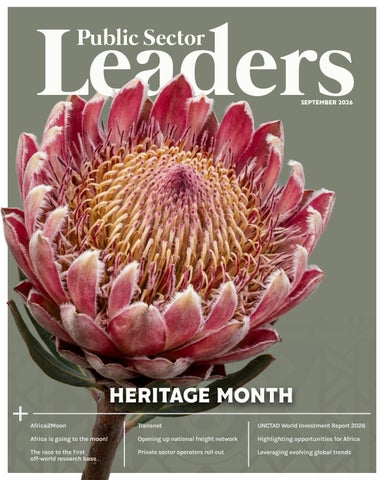
SEPTEMBER 2026
HERITAGE MONTH Africa2Moon
Transnet
UNCTAD World Investment Report 2026
Africa is going to the moon!
Opening up national freight network
Highlighting opportunities for Africa
The race to the first off-world research base
Private sector operators roll out
Leveraging evolving global trends
Connect Where It Counts
Position your brand at the centre of vibrant economies, real conversations and everyday moments that matter. From digitally enabled commuter platforms to iconic high-impact billboards and immersive social spaces, innovation is at the core of everything we do. Through a powerful network of integrated platforms including Rank TV, In-Taxi TV, roadside billboards, mall screens, Adlites and Taverns of the Future we create a seamless, 360-degree media experience that reaches audiences wherever they live, commute, work and play. This is not just media placement. This is strategic connection.
Primedia Out Of Home:
Contents
SEP TE MBER 20 26 | IS S UE 66
Editorial 30 | On to Phase 3
Government and business are scaling their partnership
32 | UNCTAD World Investment Report
Highlighting opportunities for Africa to leverage evolving global trends
40 | Heritage Month
5 heritage sites to visit in South Africa
42 | Private sector operators Transnet opens up national freight network
44 | Municipal infrastructure
Public Works puts municipalities at the heart of infrastructure drive
Features 8 | Addressing the Nation
Using our BRICS membership to improve the lives of our people
20 | Women in Leadership Patricia de Lille, Minister of Tourism, puts tourism at the heart of South Africa’s growth ambitions
22 | Trailblazer
Prof Liesl Zühlke: Putting children at the heart of global heart disease research
36 46 | National Rail Master Plan Rebuilding the backbone of South Africa’s economy
24 | Tech
How AI, technology and new leadership trends are redefining human resources management
36 | Agriculture
48 48 | Africa is going to the moon The race to the first off‑world research base
52 | Financial Fitness
Should you trust AI financial advice?
54 | Legal Matters
How South Africa can help Kenya avoid food shortage
Funeral cover versus life cover – What is the difference?
38 | In Other News
56 | Health & Wellness
50 | Regional Focus
58 | Sporting Action
Home Affairs @ home gathers pace with more digital firsts on the way
North West positions green economy as a new engine for inclusive growth
04 Public Sector Leaders | September 2026
Why healthy workplaces need healthy leadership
September/October sports calendar
86,345
Government Employees Medical Scheme (GEMS): 2026 Annual General Meeting (AGM) Notice All GEMS members have been sent the draft 2025 GEMS Annual Integrated Report and Financial Statements containing the official notice of the 2026 GEMS Annual General Meeting (AGM) taking place virtually via the Zoom platform on Friday, 31 July 2026 at 15:00. In accordance with GEMS Rule 29.6, the GEMS Board of Trustees require members wishing to attend the AGM to register online by 15:00 on Friday, 31 July 2026. Please note that online registration will close at 15:00. No registration to attend the AGM will be allowed after 15:00. Accordingly, if you wish to attend the AGM, kindly go to www.gems.gov.za, click on the relevant link embedded in the 2026 GEMS AGM section and: Complete the online registration form by 15:00 on Friday, 31 July 2026. It is important to note that only members who have registered will be admitted to the meeting; Acquaint yourself with the Zoom user guide, which details Zoom’s functionality; and Download the Zoom software for an enhanced Zoom/AGM experience, should you prefer this to the standard Zoom/AGM web experience.
Should you be unable to attend the AGM, you may appoint a proxy to attend, speak and vote on your behalf by completing the proxy form. When returning your proxy form, kindly mark it for the attention of the Principal Officer with the reference 2026 GEMS AGM Proxy. It is important to note that your proxy form must reach us by 16:00 on Friday, 24 July 2026 to be considered. Proxy forms may be sent to: • Email: enquiries@gems.gov.za; • Fax: 0861 004 367; or
• Post: GEMS, Private Bag X782, Cape Town, 8000. For copies of the following AGM meeting documents, kindly go to www.gems.gov.za and click on the relevant link embedded in the 2026 GEMS AGM section: • 2026 GEMS AGM Member Guide; • 2026 GEMS AGM Agenda;
• 2026 GEMS AGM Proxy Form;
• 2025 GEMS AGM Minutes (draft);
• 2025 GEMS Annual Integrated Report;
• 2025 GEMS Trustee Remuneration Report; and • GEMS AGM Action List.
We thank you for your ongoing support and look forward to seeing you at the AGM.
0800 00 4367 (toll-free)
enquiries@gems.gov.za www.gems.gov.za
@GEMSMEDICALAID1 @GEMSMEDICALAID Government Employees Medical Scheme
The Government Employees Medical Scheme (GEMS) is an authorised Financial Services Provider (FSP No 52861)
Use the QR Code to download the GEMS Member App
Working towards a healthier you
24
52
50
54
CREDITS PUBLIC SECTOR LEADERS The Digimag For Leaders In The South African Public Sector Fully Accredited Member of ABC
Deputy Editor Koketso Mamabolo koketso.mamabolo@topco.co.za Assistant Editor Shumirai Chimombe shumirai.chimombe@topco.co.za Contributors Jessie Taylor Wandile Sihlobo Thulani Dube Sue Ramauthur
Advertising Sales, Distribution and Subscriptions Top Media & Communications (Pty) Ltd Tel: 086 000 9590 info@topco.co.za | www.topco.co.za CEO Ralf Fletcher TOPCO STUDIO Production Director Van Fletcher van.fletcher@topco.co.za Group Editor Fiona Wakelin fiona.wakelin@topco.co.za
Design Tashwell Brown Traffic Manager Daniël Bouwer artwork@topco.co.za SALES National Project Manager Emlyn Dunn Tel: 072 1263962 emlyn.dunn@topco.co.za Brand Coordinators Sidney Phiri sidney.phiri@topco.co.za Zanele Qeqe zanele.qeqe@topco.co.za
06 Public Sector Leaders | September 2026
Kabelo Mayisa kabelo.mayisa@topco.co.za Printers LAW Print Images Freepik | Unsplash | GCIS | Flickr | Marek Studzinski Digital Publishing Platforms Issuu Magzter Media Carrier Head Office Top Media & Communications (Pty) Ltd T/A Topco Media Elkay House, 186 Loop St Cape Town Tel: +27 86 000 9590 Fax: +27 21 423 7576 Email: info@topco.co.za Website: www.topco.co.za (Scan QR code below to view website)
DISCLAIMER
All rights reserved. No part of this publication may be reproduced, stored in a retrieval system or transmitted, in any form or by any means, electronic, mechanical, photocopying, recording or otherwise, without the prior written consent of Top Media & Communications (Pty) Ltd T/A Topco Media. Reg. No. 2011/105655/07. While every care has been taken when compiling this publication, the publishers, editor and contributors accept no responsibility for any consequences arising from any errors or emissions.
EDITOR’S LETTER BY FIONA WAKELIN
Letter from the
Editor
Welcome to the September edition of Public Sector Leaders (PSL) voice to the growing call from the Global South for an inclusive world order rooted in mutual respect and shared prosperity. And we will continue to use our membership of BRICS to develop our economy and improve the lives of our people,” – His Excellency Cyril Ramaphosa. September is Heritage Month and we chose this beautiful depiction of our national flower to depict South Africa’s amazing natural heritage. It is also Tourism Month and recent tourism performance illustrates the sector’s potential. The country recorded 10.48 million international arrivals in 2025, a 17.6% increase from 2024 and the highest annual total recorded at the time. Fittingly, our Women in Leadership is Tourism Minister Patricia de Lille whose objective is to turn tourism potential into bankable projects, investment, and, ultimately, jobs.
I
n his letter penned to the nation on 14 September, His Excellency, President Ramaphosa, reported on the 18th BRICS Summit, held in New Delhi, India, which cemented the pivotal role of the group in building a more inclusive global economy and world order: “Looking ahead, our priority as South Africa is to continue to use our membership of BRICS to deepen bilateral cooperation and expand trade and investment ties. Through BRICS, we will continue to add our
September’s Trailblazer is Prof Liesl Zühlke who was named the 2026 L’Oréal-UNESCO For Women in Science International Award Laureate for Africa and the Arab States. Prof Zühlke, a paediatric cardiologist, researcher and academic at the University of Cape Town (UCT), was recognised in the Life and Environmental Sciences category for her exceptional contributions to cardiac and cardiovascular science. She was one of five women scientists selected from around the world, with one laureate representing each of five global regions. You know the sayings “Reach for the stars” and “Shoot for the moon”? Well, please turn these pages to read the
exciting article on the first allAfrican space mission, launching to the Moon in 2029. Closer to home we bring you energising updates on: the new National Radio Frequency Plan; Transnet and private rail operators; Government-Business partnerships; and Public Works unveiling a major pivot focusing on municipal infrastructure. For more positive news, please dive into the article on the UNCTAD World Investment Report 2026: Highlighting opportunities for Africa to leverage evolving global trends. As usual, our regular stalwarts bring you a cornucopia of information: In Other News takes a look at Home Affairs as the smart ID access surges by 250%, with more digital firsts on the way; Agriculture crosses borders with maize exports to Kenya; and here is an interesting question: Financial Fitness asks “Should you trust AI financial advice?”. From myself and the amazing team, we hope you enjoy the read.
FIONA WAKELIN | GROUP EDITOR
September 2026 | Public Sector Leaders 07
ADDRESSING THE NATION BY FIONA WAKELIN
Using our BRICS membership to improve the lives of our people
I
n his letter penned to the nation on 14 September, His Excellency President Ramaphosa reported on the 18th BRICS Summit, held in New Delhi, India which cemented the pivotal role of the group in building a more inclusive global economy and world order. After the 2023 Summit, the BRICS acronym was expanded by another 6 letters to include Egypt, Ethiopia, Iran, Indonesia, Saudi Arabia and the United Arab Emirates together these countries account for around half of the world’s population and around a quarter of global trade. President Ramaphosa emphasised the importance of the platform for building political and economic ties that benefit South Africa and help to build a fairer multilateral world order governed by international law with the United Nations at its centre. “Through our BRICS membership we have deepened practical cooperation in fields such as science and technology, research, education and skills development. We have led people-to-people exchange through bodies like the BRICS Youth Council, BRICS Think Tanks Council, the BRICS Network University and others. “While BRICS Summits may seem far removed from the daily lives of South Africans, the country
gains a lot from our membership of the group. “It is an important forum for investment and trade. More than a fifth of South Africa’s trade is with BRICS countries. As a shareholder in the New Development Bank – also known as the BRICS Bank – South Africa has been able to access development finance to support major energy, water and transportation infrastructure investments. Through the BRICS Contingent Reserve Arrangement, South Africa is able to access a pool of $100-billion in currency reserves in the case of a liquidity crisis. We also benefit from BRICS cooperation across areas such as health, science, agriculture and skills development,” H.E. Ramaphosa. His Excellency went on to confirm that cooperation between BRICS countries extends beyond government and includes the private sector. India is a prime example. It is South Africa’s fourth largest trading partner and more than 150 Indian companies have invested over $10-billion in our country, creating employment for over 18 000 South Africans, while a number of leading South African firms like Naspers, FirstRand Bank, Sanlam and Momentum also have significant investments in India. Building on these links, South Africa convened the South AfricaIndia CEOs Roundtable at the
Summit in New Delhi, with leaders from some of India’s leading firms and a number of South African companies. South Africa and India have complementary resources and capabilities that when combined create great value for both countries. “India’s strengths in pharmaceuticals and health technology can support our ambition to expand the local production of medicines and vaccines. It has capabilities in information technology, financial technology and digital public infrastructure that can support the modernisation of our own systems and services. Our endowment of critical minerals can feed India’s fast-growing renewable energy, battery and automotive value chains, while ensuring that more of the processing of these minerals happens on South African soil. “Looking ahead, our priority as South Africa is to continue to use our membership of BRICS to deepen bilateral cooperation and expand trade and investment ties. Through BRICS, we will continue to add our voice to the growing call from the Global South for an inclusive world order rooted in mutual respect and shared prosperity. And we will continue to use our membership of BRICS to develop our economy and improve the lives of our people,” – His Excellency Cyril Ramaphosa.
ADVERTORIAL
TECHNOLOGY INNOVATION AGENCY
Building
a TIA that turns innovation into impact Dr Zwanani Titus Mathe, CEO of the Technology Innovation Agency
2 | Public Sector Leaders | September 2026
W
hen I joined the Technology Innovation Agency (TIA), as Chief Executive Officer in April this year, I joined an organisation with a significant track record and an equally significant responsibility to South Africa. For more than 15 years, TIA, an entity of the Department of Science, Technology and Innovation (DSTI), has been working to bridge the gap between research and commercialisation, supporting innovators to take promising ideas and technologies further. In 2025, we marked our 15th anniversary, an important milestone that also prompted us to ask a bigger question: What does South Africa need from TIA for the next 15 years? The first few months of my tenure provided an opportunity to listen, assess and begin building the foundations for that next chapter. More importantly, they have reinforced my belief that TIA has a critical role to play in addressing some of the country’s most pressing challenges – from unemployment and low economic growth to competitiveness and the need to build sustainable, technology-driven industries.
Strengthening the foundations for TIA’s next chapter My immediate priority has been to ensure that TIA is delivering effectively on the mandate entrusted to us. A public institution must first get the fundamentals right. We need to be responsive to our customers, accountable for
our performance and disciplined in how we use public resources. I am pleased that TIA has met all of its targets for the first quarter of the 2026/27 financial year. We have also made significant progress in responding to customer complaints, with the majority addressed during this period. These are important measures of an organisation that is focused on becoming more efficient and responsive. But I see these achievements as a starting point, rather than an endpoint. Our focus now is on creating an organisation that can deliver more efficiently and create greater value from every rand invested in innovation. This is particularly important because TIA already has a strong platform on which to build. We support higher education institutions, science councils and research institutions, SMMEs, industry and grassroots innovators. Our funding solutions span different stages of the innovation journey, including the SEED Fund, Technology Development Fund and Commercialisation Support Fund. Together, these instruments enable us to support technologies from proof of concept through development, validation and towards commercialisation. Our role is therefore much bigger than funding.TIA is already an Active Funder, Connector, Facilitator and Enabler within the innovation ecosystem. The opportunity presented by TIA 2.0, our new corporate strategy, is to make these roles work together more deliberately and effectively.
That is the focus of the next phase. TIA 2.0: connecting capital, capability and opportunity TIA 2.0 represents a shift in how we think about our role in South Africa’s National System of Innovation. We will continue to fund innovation, but we cannot look at our role simply through the number of projects we support. We need to look at what happens to those innovations after they receive support, whether they reach the market, attract additional investment, create enterprises and ultimately contribute to economic and social impact. TIA’s 2025–2030 Strategic Plan recognises the need to select promising ideas, connect them with the right partners and resources, and help them progress more seamlessly through the innovation value chain. It also sets an ambition to build on TIA’s track record of 260 technologies commercialised, with the goal of more than doubling this effort. For me, this is what being an innovation enabler and catalyst means in practice. We need to identify where South Africa has an opportunity to solve a national challenge or build a globally competitive capability, and then bring together the people, institutions, infrastructure and capital required to make it happen. Capital is a particularly important part of this equation.
September 2026 | Public Sector Leaders
11
ADVERTORIAL
TECHNOLOGY INNOVATION AGENCY
12 Public Sector Leaders | September 2026
The government cannot and should not be expected to finance the entire innovation journey. Our Industry Matching Fund provides an example of what is possible. It was established to leverage TIA funding by sharing risk with venture capital firms, angel investors, institutional investors and industry. TIA has also partnered with the SA SME Fund and E Squared Investments on a R300-million High Impact Seed Fund of Funds. Our ambition is to build on this model, using public investment strategically to crowd in private capital, rather than operating in isolation. The same principle applies to knowledge and expertise. We need stronger connections between government, academia, industry, civil society, investors and innovators. Our strategic plan recognises that collaboration across these sectors is essential to pooling resources, expertise and infrastructure around high-impact initiatives. This is the TIA 2.0 opportunity: to make the ecosystem work more like an ecosystem. Innovation with purpose: leaving no one behind Ultimately, the success of TIA 2.0 will be measured by what innovation does for South Africa. We face an unemployment crisis, low economic growth and increasing pressure to improve our competitiveness relative to other developing economies. Innovation must be part of the response. That means moving promising technologies from laboratories and research institutions into businesses and markets. It means supporting entrepreneurs to commercialise and scale. And it means building
industries around technologies that can create jobs, strengthen local value chains and position South African companies to compete globally. Our sector focus gives us an opportunity to do precisely this.
change, healthcare, food security, energy security and agricultural productivity, cannot be solved by one organisation. They require the collective capabilities of the innovation ecosystem.
TIA supports innovation across areas including agriculture, advanced manufacturing, energy and health, sectors where technological advancement can have a direct bearing on economic resilience and quality of life. Our Technology Acquisition and Deployment Fund, for example, is designed to help locally developed technologies move into the hands of user clients, including government departments and municipalities.
That is the role I see TIA playing in its next chapter: bringing those capabilities together.
We also need to ensure that innovation is inclusive. If we are serious about building an innovation economy, we cannot leave behind the innovators who operate outside the traditional institutions and networks of the National System of Innovation. This is why TIA’s support extends to grassroots innovators. Through the Grassroots Innovation Programme, innovators can receive support ranging from idea development and intellectual property protection to business modelling, technical prototype development, mentorship, compliance and access to markets and additional funding. For me, the principle is simple: we should not leave anyone behind.
The outset of my tenure has been about establishing the foundations, strengthening performance, responsiveness and efficiency. TIA 2.0 is about what we do with those foundations. Our ambition is to become a more connected, commercially focused and inclusive innovation agency; one that does not simply fund good ideas, but helps move them into markets, scale enterprises, attract investment and create meaningful economic and social value. After 15 years, TIA has the experience, capabilities and partnerships to take on this next challenge. Now, we need to turn that potential into impact.
SCAN THE QR CODE FOR MORE INFORMATION
Innovation must reach beyond established institutions and established networks. It must create opportunities for young entrepreneurs, SMMEs, researchers, grassroots innovators and businesses with the potential to solve problems and create new markets. The challenges ahead of us, climate
September 2026 | Public Sector Leaders 13
ACTIVE FUNDER ACTIVE FUNDER
CONNECTOR
CONNECTOR
ENABLER
ENABLER
FACILITATOR FACILITATOR
www.tia.org.za www.tia.org.za
Technology Innovation Agency
chnology Innovation Agency (TIA) is an entity of the Department Innovation Agency Science, Technology Technology and Innovation that serves as the key tutional intervention to bridge the innovation chasm between The Technology Innovation Agency (TIA) is an entity of the Department ch and development from higher education institutions, science of Science, Technology and Innovation that serves as the key ouncils, institutional public andintervention private sector, and to bridge thecommercialisation innovation chasm between (beneficiation). research and development from higher education institutions, science
councils, public and private sector, and commercialisation (beneficiation). dging the innovation chasm, TIA is an active funder, connector,
facilitator and enabler.
In bridging the innovation chasm, TIA is an active funder, connector, provides financial and non-financial support for innovations in facilitator and enabler. us sectors the economy including, the bioeconomy (health, in TIA of provides financial and non-financial support for innovations culture,various industrial biotechnology, indigenous knowledge sectors of the economyand including, the bioeconomy (health, agriculture, industrial biotechnology, and indigenous s), advanced manufacturing, energy, ICT, and naturalknowledge resources systems), advanced energy, ICT, and natural resources (mining, water, manufacturing, and waste management). (mining, water, and waste management).
CLIENT INTERVIEW NATIONAL FUND FOR MUNICIPAL WORKERS
Empower, evolve, excel
Interview with National Fund for Municipal Workers CEO and Principal Executive Officer, Dr Leslie Ndawana
“B
ehind every member is a person, a family and a future. That is the responsibility we carry, and it is the responsibility that continues to guide us,” says Dr Leslie Ndwana, who leads one of the largest independent retirement funds in the country’s local government sector. The National Fund for Municipal Workers (NFMW) provides retirement and related benefits to municipal employees and councillors with a membership of more than 63 000. “Retirement planning is not something that should only become a priority when retirement is approaching. It is a journey that begins from the moment we enter the workforce,” says Dr Ndwana. “For the NFMW, the future is about ensuring that members are not simply participants in a retirement fund but are empowered partners in their own financial journeys.” The Fund has been on an upward trajectory, going from just
16 Public Sector Leaders | September 2026
over 51 000 contributing members in 2024 to more than 63 000 in 2026, with the growth continuing. This has been accompanied by asset growth with the Fund’s assets increasing from around R18.3-billion in 2020 to a current figure of R41-billion. “As we move through our five-year strategic cycle under the theme “Empower. Evolve. Excel”, our commitment is to continue strengthening the Fund, enhancing the value we deliver to members and ensuring that we remain a trusted and responsible custodian of their retirement savings.” What have been your successes and challenges? One of our greatest successes has been leading the National Fund for Municipal Workers (NFMW) through a period of growth, renewal and strategic transformation. The Fund strengthened its financial position, expanded member value, enhanced governance, improved service delivery, and successfully transitioned into a new strategic
cycle focused on long-term sustainability and impact. The Fund also continued to build its reputation as a respected voice within the retirement fund industry through active participation in industry forums, thought leadership initiatives, and representation on key industry bodies, enabling us to contribute to broader discussions on retirement reform, governance, member outcomes and the future of the retirement sector. Another significant success has been the shift towards a more purpose-driven and outcomes-based organisation. We have strengthened our focus on creating measurable impact for members, not only through retirement benefits, but also through financial education, retirement preparedness, member empowerment and improved accessibility to services. This has been supported by investments in people, technology, governance and organisational capability. The greatest challenges were associated with leading organisational transformation during a period of leadership transition. Taking over the reins of the organisation required establishing a clear vision for the future, aligning stakeholders around a new strategic direction, and introducing new ways of working while maintaining operational stability and service excellence. This involved guiding the organisation through significant change and ensuring that employees, service providers and stakeholders embraced a common purpose and shared goals. A further challenge was shifting organisational culture from a predominantly activity-focused approach towards one centred on impact, accountability and measurable outcomes. This required strengthening collaboration across teams, breaking down silos, empowering staff to take ownership, fostering leadership at all levels, and embedding a culture of continuous improvement and innovation. At the same time, we sought to place members at the centre of decision-making by focusing on improving their retirement outcomes, financial well-being and overall experience with the Fund. Change management, therefore, became one of the defining challenges and achievements of this period. Transforming mindsets, building organisational capability, empowering employees, embedding a new strategy and ensuring alignment with the Fund’s vision required consistent communication, engagement and leadership. These efforts have laid the foundation for a more agile, purpose-led and future-focused organisation that is well positioned to continue creating sustainable value for members, employers and other stakeholders.
high-performing learning organisation, and creating a culture that encourages continuous learning, innovation, accountability and leadership at every level. We believe that empowered and capable employees are the foundation of exceptional member outcomes and organisational excellence. We will continue investing in the modernisation of our systems, processes and digital capabilities to enhance efficiency, improve responsiveness and deliver superior service to our members. By embracing digitisation, automation and data-driven decision-making, we aim to create a more agile, future-ready organisation that consistently delivers excellence across every member touchpoint. A key priority will be deepening member empowerment through financial literacy, retirement education and meaningful engagement. Our goal is to equip members with the knowledge and tools to make informed decisions throughout their financial journey, ultimately improving retirement outcomes and creating lasting value. I am also looking forward to strengthening NFMW’s role as a thought leader within the retirement fund industry. Through active participation in industry forums, collaboration with stakeholders and contributions to key industry discussions, we want to help shape the future of retirement provision while sharing insights and best practices that advance member outcomes across the sector. Most importantly, I look forward to continuing our shift towards an outcomes-based organisation that measures success not only by what we do, but by the value we create, the impact we have and the difference we make in the lives of our members. By investing in our people, embracing innovation, driving operational excellence and strengthening our leadership role within the industry, we are positioning NFMW for continued growth, relevance and sustainable value creation for generations to come.
SCAN THE QR CODE FOR MORE INFORMATION
What are you looking forward to in the coming year? I am excited about the next phase of NFMW’s transformation journey and the opportunity to further embed our 2025-2030 strategy across the organisation. Our focus will be on strengthening our people, building a
September 2026 | Public Sector Leaders
17
“ B R A I N F O O D
F O R
B U S I N E S S ”
LISTEN NOW
OM ARDRO THE BORD BEYOND OF SU CC ES S IN G TH E STAN DA RE DE FIN
Master the art of leadership and digital innovation with Ralf Fletcher, CEO of Topco Media, as he interviews and gains exclusive access to high-impact conversations with influential business leaders, politicians, and innovators redefining the future of business.
ADVERTORIAL VIM CONSULTING
VIM Consulting
From ooMaskitikiti to building
a car rental and consulting business Lehlohonolo Tlali, Founder, VIM Consulting
I
n the Nguni languages vukani means “wake up” in the plural form. At the age of 13 the entrepreneurial spirit of Lehlohonolo Tlali, born into a family of business people, was awakened by selling cars he made out of wire, known as ooMaskitikiti. He was able to employ four salespeople and started developing the skills that he would need when he founded Vukani Industrial and Maintenance (VIM Consulting), which offers daily and monthly car rentals, and facilitation of fleet purchases. Lehlohonolo, who also has an interest in the energy sector, spent three years in Ghana as a marketing director and is currently an associate at TTP Consulting. A graduate of the University of Fort Hare, he has also studied at the Wits
School of Governance and Eduvos (formerly the Midrand Graduate Institute). Before he ventured into project management, brokerage, car rentals and contract rentals, he was a corporate director at an advertising agency. From there the University of Fort Hare graduate moved to Penta Publications where worked as a key account director and stakeholder manager, and then as consultant at Transnet. VIM Consulting operates in a car rental and fleet leasing market valued at $1.2-billion where growth is largely driven by corporate leasing, urban mobility, tourism (especially business tourism), and the gig economy. The corporate fleet leasing alone is expected to grow to around R5-billion in the coming years as more businesses opt out of purchasing their own vehicles and VIM Consulting’s focus on effective and efficient service makes them the perfect partner for businesses looking for tailormade solutions.
VIM’s values • Efficiency • Professionalism • Effectiveness • Quick turnaround times • Congruency
Scan the QR code for more information on VIM Consulting
September 2026 | Public Sector Leaders 19
WOMEN IN LEADERSHIP BY JESSIE TAYLOR
Patricia de Lille, Minister of Tourism, puts tourism at the heart of South Africa’s growth ambitions 20 Public Sector Leaders | September 2026
T
ourism is increasingly being positioned not simply as an industry that welcomes visitors, but as a powerful economic tool capable of attracting investment, creating jobs and opening opportunities for communities across South Africa. For Tourism Minister Patricia de Lille, that role has become even more significant following the inclusion of tourism in Phase Three of the Government-Business Partnership. Announced by President Cyril Ramaphosa in August, the new phase identifies tourism alongside agriculture and agro-processing, and mining as sectors with the potential to drive inclusive economic growth, generate foreign revenue and create jobs at scale. Tourism as economic policy Minister de Lille has welcomed the move, which comes as the government targets economic growth above 3% and shifts its emphasis from stabilisation and reform towards accelerating growth, investment and employment. The priorities include improving air access, modernising visa processing, strengthening destination marketing, enhancing tourist safety and expanding investment in tourism infrastructure. Recent tourism performance illustrates the sector’s potential. The country recorded 10.48 million international arrivals in 2025, a 17.6% increase from 2024 and the highest annual total recorded at the time. Tourism has also been identified as a major source of employment, with the sector supporting almost one million direct jobs. The Tourism Growth Partnership Plan sets targets to build on that momentum, including 15 million international arrivals by 2030, while increasing domestic and international tourism spending. Minister de Lille has repeatedly emphasised that the benefits of growth must extend beyond established tourism centres. Her department has highlighted opportunities in townships, rural areas and smaller towns, where tourism can connect local entrepreneurs and communities to wider markets.
Infrastructure is another important part of Minister de Lille’s economic vision for tourism. In August, the Department of Tourism and the Department of Public Works and Infrastructure formalised a three-year partnership to strengthen the preparation of priority tourism infrastructure projects and unlock private-sector investment. The agreement will provide specialist resources, including investment expertise and transaction advisory services, helping build a stronger pipeline of projects ready for investment. For Minister de Lille, the objective is to turn tourism potential into bankable projects, investment, and, ultimately, jobs. That emphasis is significant because tourism growth depends on more than marketing. Visitors need reliable transport connections, functioning public infrastructure, attractive destinations, safe environments and facilities that can support new tourism experiences. Digital transformation is also part of the equation. The government has been working to modernise visa processing through the Electronic Travel Authorisation, while the tourism sector is exploring artificial intelligence and other digital tools to improve how destinations are marketed and experienced. A long public service career Minister de Lille’s approach to tourism is informed by more than three decades in public life. She entered Parliament in 1994 and was involved in South Africa’s constitutional negotiations. Her political career has included work across all three spheres of government. Her political journey is unusual. She founded the Independent Democrats in 2003 and later established the GOOD Movement in 2018. According to the Department of Tourism, she is the only South African woman politician to have founded her own political party and to
have won seats in all three spheres of government twice. Before taking the tourism portfolio, Minister de Lille served as Minister of Public Works and Infrastructure from 2019 to 2023. In that role, she was involved in the Infrastructure Investment Plan and initiatives to use state land and buildings more effectively for public and economic purposes. That experience is directly relevant to her portfolio. Tourism requires both public and private investment, and unlocking suitable infrastructure can help turn destinations with economic potential into viable tourism products. The challenge is to translate strong visitor numbers and ambitious plans into broad-based economic benefits. Improved air connectivity can make South Africa more accessible to international markets. Faster and more efficient visa processes can reduce barriers to travel. Destination marketing can strengthen demand, while tourism infrastructure can create opportunities for new businesses and experiences. The emphasis on emerging destinations is equally important. South Africa’s tourism appeal extends beyond its best-known cities and attractions. Rural landscapes, heritage sites, cultural experiences, festivals, crafts and township enterprises all have the potential to contribute to the tourism economy when infrastructure, skills, finance and effective market access support them. Minister de Lille’s portfolio therefore sits at the intersection of several government priorities: economic growth, job creation, investment, infrastructure development and inclusive participation. Her task is not simply to bring more people into the country, but rather to build an ecosystem in which visitors generate opportunities for businesses, workers and communities.
Source: SA News | Department of Tourism | Government of South Africa | South African Tourism
September 2026 | Public Sector Leaders 21
TRAILBLAZER BY JESSIE TAYLOR
Prof Liesl Zühlke
Putting children at the heart of global heart disease research
W
hen Professor Liesl Zühlke was named the 2026 L’Oréal-UNESCO For Women in Science International Award Laureate for Africa and the Arab States, it placed a spotlight on decades of research aimed at improving the lives of children and families affected by heart disease. Prof Zühlke, a paediatric cardiologist, researcher and academic at the University of Cape Town (UCT), was recognised in the Life and Environmental Sciences category for her exceptional contributions to cardiac and cardiovascular science. The award acknowledges work that has advanced scientific
knowledge while improving health outcomes for vulnerable populations, particularly women and children in low- and middle-income countries. She was one of five women scientists selected from around the world, with one laureate representing each of five global regions. A career centred on children Prof Zühlke’s career has focused particularly on childhood-onset heart disease, with research spanning congenital heart disease, rheumatic heart disease, heart failure and cardiovascular health in women of childbearing age. She is Director
22 Public Sector Leaders | September 2026
of UCT’s Children’s Heart Disease Research Unit and Vice-President for Extramural Research and Internal Portfolio at the South African Medical Research Council (SAMRC). She is also a paediatric cardiologist in the Division of Paediatric Cardiology at Red Cross War Memorial Children’s Hospital. Many of the conditions she studies disproportionately affect people living in poorer and underserved communities. For Prof Zühlke, the challenge is therefore not simply understanding disease at a scientific
ty-Adjusted Life Years. This approach has helped position rheumatic heart disease not simply as a medical problem, but as one connected to broader questions about health systems, inequality and access to care. The 2026 L’Oréal-UNESCO award specifically recognised this contribution, describing her research as having repositioned rheumatic heart disease as a socio-political issue linked to health-system deficiencies and inequities. Prof Zühlke’s research portfolio stretches across several stages of the scientific process. It includes basic science, clinical research, clinical trials, translational medicine, policy engagement and communitybased initiatives. Her work has helped shape international priorities on rheumatic and congenital heart disease, while her engagement with organisations including the African Union, World Health Organisation and World Heart Federation has helped connect research with international policy discussions. level. It is important to understand why some communities experience dramatically poorer outcomes and how research can help change that reality. Childhood-onset heart disease remains neglected globally, while Prof Zühlke has consistently centred diseases of poverty affecting children, adolescents and marginalised communities. Her work has also highlighted the ways children can be overlooked in global health metrics, including measures such as Disability-Adjusted Life Years and Quali-
Connecting science with real -world change Prof Zühlke was a 2023 South African Women in Science Awards winner and is a National Research Foundation B2-rated researcher for the 2023–2027 period. Earlier distinctions include the 2018 MRC/UK Department of International Development African Research Leader Award, the 2020 NRF Public Engagement with Research Award and several honours received in 2022, including the Metrodora Award in Public Health Leadership in Science and Medicine, the American Heart Association Young Hearts Award and UCT’s Alan Pifer
Research Award. She is also recognised as one of the leading international scholars in rheumatic heart disease research and contributes to several professional and research bodies, including the World Heart Federation, the Rheumatic Heart Disease Task Force, the Global Alliance for Rheumatic and Congenital Hearts and the Strep A Vaccine Global Consortium. Her career provides an example of how scientific excellence can be rooted in local challenges while producing knowledge with international relevance. Her work demonstrates that research focused on communities that are often overlooked can influence global priorities and contribute to practical improvements in healthcare. Prof Zühlke’s achievement demonstrates the international reach of South African science and the value of research that places people at its centre. Her work is helping advance knowledge about heart disease while advocating for children, families and communities who have historically carried an unequal burden of disease. Minister of Science, Technology and Innovation Professor Blade Nzimande described Prof Zühlke’s international recognition as a source of national pride and said her work could inspire more young girls to pursue careers in science. Her award is therefore not only a celebration of an exceptional scientific career. It is also an invitation to the next generation: to ask difficult questions, pursue evidence, build partnerships and use science to make a tangible difference in people’s lives.
Sources: University of Cape Town | South African Medical Research Council | Department of Science, Technology and Innovation | UNESCO
September 2026 | Public Sector Leaders 23
TECH BY THULANI DUBE
The future of work: How AI, technology and new leadership trends are redefining human resources management
F
or the longest, Human Resources (HR) has been asked to manage the consequences of business strategy. They have been tasked with recruiting the right people, developing their capabilities, managing performance and maintaining organisational culture. That model is rapidly becoming obsolete.
Artificial intelligence (AI), automation as well as the rise of digital workplaces are changing not only how people work, but what work is, how organisations are structured and what it means to lead. HR can no longer remain primarily a support function responding to technological change. It must become one of the architects of that change.
24 Public Sector Leaders | September 2026
The 2026 HR Monitor describes HR as having a dual role in the AI transformation journey. First as an “architect” shaping how work, roles and capabilities evolve, and secondly as a “lighthouse” demonstrating what AI enabled HR can look like in practice. This represents perhaps the most important shift in the profession high-
summarise meetings, analyse information and prepare presentations without the organisation fundamentally changing. It may be argued that AI transformation progresses through three business stages, namely, enablement, automation and reinvention. Enablement gives employees the necessary AI tools, automation improves existing workflows, while reinvention fundamentally redesigns roles, workflows and operating models around human/AI collaboration. For many leaders, the state of reinvention remains as mythical as a pegasus. With this in mind, the HR agenda must fundamentally change. The question should no longer be simply how many employees are using AI tools such as Copilot or ChatGPT. Instead, HR leaders should be asking how work itself should be redesigned, which tasks are best performed by people, which can be augmented or automated by AI, where human and AI capabilities should work together, and what new opportunities become possible when routine work is transformed.
lighting that the future of HR will be less about administering the workforce and more about designing the organisation of work itself. A big mistake that many organisations make is to confuse technology adoption with transformation. Employees can use generative AI to draft emails,
Organisations creating greater value from AI are going beyond task automation and redesigning entire workflows. They are reconfiguring how people, technology and processes work together to deliver better outcomes. For HR, this means moving from headcount planning to capability planning. As such the workforce plan of the future cannot simply ask how many employees an organisation needs. It must ask what combination of human expertise, digital capability and AI agent capacity will be required to execute the strategy. One of the defining leadership challenges will be developing AI fluency across
the organisation. AI fluency is broader than technical competence. It involves knowing when and how to use AI, critically evaluating its outputs, integrating it into workflows and knowing when human judgement must override machine generated recommendations. Importantly, it also strengthens capabilities that become more valuable as AI becomes more capable. This has particular significance for Africa. In 2025, PwC conducted a “Hopes and Fears Research” which engaged over 1700 workers across five African countries and close to 50 000 worldwide. The report found that 64 percent of employees surveyed across the five African countries reported using AI at work during the previous year, compared with 54 percent globally. This highlights that African employees are not necessarily waiting for organisations to become ready. In many cases, employees are already experimenting with the technology. Furthermore, South Africa provides compelling examples. Standard Bank, for instance, has developed a five level AI and generative AI capability framework spanning foundational understanding through to advanced model development. In 2025, more than 9000 employees completed its Foundational AI Pathway, more than 12300 used its integrated prompt guide and more than 1000 leaders participated in its Decision Maker Pathway. By June 2026, the bank reported that more than 20,000 staff were active AI users, Additionally AI development had become a CEO-owned agenda supported by a Chief AI Officer and cross functional specialists. This is an important lesson for HR leaders as it highlights that AI capability cannot be delegated exclusively to the tech-
September 2026 | Public Sector Leaders 25
TECH BY THULANI DUBE
nology department. It must become an organisational capability. AI will fundamentally transform the role of the manager. The traditional manager coordinates people, allocates work, monitors performance and generally solves problems. In an AI enabled organisation, some of those activities can increasingly be performed by intelligent systems. The evolution of the workspace has seen the emergence of what will be referred to as the “agent manager”, a leader who must manage not only people, but also AI agents operating as part of the organisation’s capacity. As AI takes over more routine tasks, teams may become smaller and organisations may require fewer layers of management. Managers will increasingly focus on coordinating the strengths of people and AI, while also deciding what technology should handle and where human judgement, creativity, coaching and leadership remain essential. This does not make leadership less important. It makes it more human. When AI performs more administrative and analytical work, managers will have to become better coaches, communicators, sense makers and developers of talent. For managers this means that judgement, empathy, persuasion, creativity and relationship building will become increasingly important. The challenge is that AI may automate some of the very experiences through which future leaders develop expertise, judgement and confidence. Organisations will therefore need to deliberately redesign career pathways so that efficiency does not come at the expense of leadership development. If AI agents
undertake much of the entry level analytical work, the emerging HR challenge is therefore not merely reskilling people for AI, it is redesigning career development pathways so that employees continue to learn and grow as well as support leadership in developing the relevant capabilities. The AI revolution dictates that HR cannot credibly lead enterprise transformation while operating according to a model that belongs to the previous era. As AI becomes embedded in HR, the function will require new capabilities and in some cases new roles. HR professionals will increasingly need to act as people strategists who shape workforce direction, people technologists who connect HR with digital systems, people scientists who provide evidence and ethical oversight, and AI coaches who help employees adapt to new ways of working. Managers will also increasingly need to lead teams in which humans and AI work alongside one another. This points towards a more fluid HR operating model in which expertise moves towards strategic priorities rather than remaining locked inside the traditional functional silos. The challenge for HR leaders is to avoid what may be referred to as the “pilot trap” that happens when organisations introduce multiple AI solutions without a coherent vision for how work and the organisation itself should evolve. A more strategic approach is to define a clear future state for human/ AI collaboration and work backwards by identifying the technology, the skills, the structures and the implementation priorities required to reach it. Organisations should therefore move away from simply focusing on how many
26 Public Sector Leaders | September 2026
people the organisation needs, but how work should be designed, which capabilities should be developed, what should be automated and where human judgement should remain indispensable. The evolution of the HR function is also reflected in the growing shift from Human Resources to People & Culture. The change is more than semantics as it signals a movement away from viewing employees primarily through an administrative or resource management lens towards understanding people, culture, capability and employee experience as strategic organisational assets. This is particularly relevant as organisations become more dependent on trust, belonging and adaptability. HR must therefore become more
digital without becoming less human through using AI and data to improve how work is performed while strengthening leadership, coaching, culture and ethical decision making. The implication is that the future people function cannot simply administer the workforce but radically evolve to help design the environment in which people and technology can perform together. However, changing the name from HR to People & Culture does not, in itself, constitute transformation. A new label applied to an old operating model is merely rebranding. The real test is whether the function assumes a broader mandate encompassing workforce and capability planning, organisational design, employee experience, AI fluency, culture,
leadership development as well as the responsible integration of technology. HR will eventually be positioned as a strategic architect of the AI enabled organisation working with business and technology leaders to redesign work, anticipate changing skills, reshape organisational structures, strengthen learning and development and guide leaders through workforce transitions. The future, therefore, is not necessarily HR versus People & Culture but rather the evolution of HR from an administrative function into a strategic people, culture and organisational capability function. Yet technology alone will not determine whether the future of work succeeds. Trust will be equally critical. Employees understandably want to know what AI means for their jobs, privacy,
careers and professional identity. They need confidence that their organisation will use AI responsibly, communicate honestly about its impact and provide opportunities to develop the capabilities required for changing roles. Trust therefore becomes more than an employee relations concern. It becomes a strategic enabler of transformation. A McKinsey 2026 research report concluded that employees reporting low trust in organisational support during AI transformation were 1.5 times more likely to experience anxiety about AI related workplace change. Middle managers are particularly important because they translate organisational strategy into employee’s daily experience. Effective leadership therefore does not require certainty but
September 2026 | Public Sector Leaders 27
TECH BY THULANI DUBE
the honesty to acknowledge uncertainty while providing a credible path forward. Employees know that AI will change jobs, roles and organisational structures. Leaders therefore need to communicate honestly about what is known, what remains uncertain and how decisions will be made. Vodacom offers a useful African example. Its 2026 Human Capital reporting describes an AI-first operating model supported by responsible AI governance, leadership upskilling and an HR AI immersion programme involving 378 HR professionals across the Group. It has also established an HR/ AI studio to develop and scale solutions, while integrating AI capabilities into everyday work. The significance extends beyond the technology itself. Vodacom is treating AI enablement as workforce transformation requiring leadership, learning, governance and
organisational redesign. Trust, however, must translate into psychological safety if organisations are to realise the full potential of AI. Scholar and Author Amy Edmondson’s concept of “the Fearless Organization” is increasingly relevant to the AI enabled workplace because transformation requires employees to ask difficult questions that not only challenge established ways of working but also lead to experimenting with new technologies and acknowledging when something has not worked. Psychological safety does not mean removing accountability or creating an environment where every idea is accepted, but rather, it creates the conditions in which people can speak up, learn and take appropriate interpersonal risks without fear of humiliation or punishment. Psychological safety is crucial for adaptive and
28 Public Sector Leaders | September 2026
innovative performance, particularly in environments characterised by rapid change. In the context of AI, this becomes even more important as employees need to feel safe admitting that they do not understand a new tool or new proposed processes of working better. Employees are more likely to experiment with AI and openly share what is and is not working when they trust that leaders are interested in learning rather than judging or monitoring them. The leaders of the future will therefore need to create organisations where people are not merely encouraged to use AI, but feel safe enough to question it, learn with it and challenge it. In this sense, psychological safety becomes not simply an employee experience initiative, but a strategic capability for innovation as well as responsible AI adoption and organisational learning. For Africa, the future of work should not simply mean
importing models developed elsewhere. The continent has an opportunity to leapfrog traditional approaches to workforce management. MTN provides another instructive example. In 2025, the Group reported expanding learning opportunities in AI, machine learning, data science, fintech and emerging technologies. More significantly, MTN developed an AI CV screening tool designed for its African operating context while redesigned recruitment around a “Human-AI cycle”. This illustrates an important principle for African organisations in that successful AI transformation is not simply about acquiring advanced technology but rather adapting technology to local realities while equipping people with the skills, judgement and confidence to work alongside it. South Africa already possesses an underutilised mechanism that could become a powerful engine for preparing the workforce for this future. The Workplace Skills Plan (WSP), which is an organisational plan through which employers identify their skills needs and set out the training and development interventions required to build those capabilities. Traditionally viewed largely through the lens of skills compliance, training needs and SETA (Sector Education Training Authorities) funding, the WSP could be reimagined as a strategic workforce capability plan. One that begins not with the question of what training employees require today, but with what the organisation will need to be capable of doing tomorrow. This means mapping how AI and technology will change tasks and occupations, identifying emerging capabilities, assessing current skills
gaps and deliberately building a portfolio of digital, AI and human capabilities. Such an approach would also strengthen the connection between employers and the education and training ecosystem, helping ensure that workplace learning and occupational pathways are aligned with the skills required in a rapidly changing economy. It would also transform the WSP from an annual administrative submission into a strategic conversation between business, HR, employees, SETAs and education providers about the future workforce. The opportunity is significant as it moves away from focusing on just training people simply to perform today’s jobs more efficiently. South Africa can use the WSP to prepare people for how work itself is changing, including AI fluency, human/AI collaboration, leadership, critical thinking, creativity and the uniquely human capabilities that technology cannot simply replicate. The future HR leader will look distinctly different from the traditional HR executive. They will need technological literacy without becoming a technologist, strategic capability without losing the human perspective and commercial acumen without reducing people to productivity metrics. Above all, HR leadership will need the courage to challenge established assumptions, make deliberate choices about where AI creates value, redesign work accordingly, build the capabilities people will need as well as establish governance that protects trust. The central leadership question is no longer whether AI will change work as that question has already been answered. The question is what kind of organisation leaders will deliberately build in response. The organisations that thrive will not necessarily be those with
the most sophisticated technology, but those that combine technology with thoughtful organisational redesign, AI fluency, responsible governance, courageous leadership and a deep understanding of human potential. For HR, this is not the end of the profession. It is an opportunity to redefine its purpose and become a more strategic force in shaping the organisation of the future. The future of Human Resources will not be about managing people around technology. It will be about designing organisations in which people and intelligent technology work together to create value neither could achieve alone. Ultimately, the future of work is not simply a technology challenge. It is a leadership challenge in which HR has an opportunity to be at the centre of.
Thulani Dube, Head of Innovation and Advancement, Cornerstone Institute
September 2026 | Public Sector Leaders 29
GOVERNMENT BUSINESS PARTNERSHIP BY KOKETSO MAMABOLO
On to Phase 3
Government and business are scaling their partnership
Adrian Gore, Co-convenor of the Government-Business Partnership
T
he drive to accelerate structural reforms and interventions has hit third gear as the GovernmentBusiness Partnership expands to maximise opportunities to create jobs, inclusive growth and boost investor confidence.
top six most improved in the world, with Durban’s port coming in at the number one. The Durban Gateway Terminal partnership has unlocked R10.5-billion, and around R500-billion is in the investment pipeline for PSP transactions.
“What started as a platform to address multiple crises has evolved into a platform for growth and shared prosperity,” said President Ramaphosa in a joint statement following the launch of Phase 3 of the partnership. “This partnership has endured because our ambition for South Africa is strongly aligned. We both seek an economy that is growing, an economy that is creating jobs, and an economy that includes those who have been left outside for too long.”
The third phase is designed to convert that momentum into accelerated growth and job creation, which is becoming more of an urgent crisis with the latest unemployment figure sitting at 33.6% with little signs of improvement given the external pressures from the geopolitical climate. The 3% annual GDP growth rate is still the target, although it is not yet clear how this will be achieved given failures to do so in the past. The second quarter of 2026 has already seen a 0.2% quarteron-quarter decline. “We need to move beyond business as usual and lift growth above 3% if we are to start to create net jobs,” continued Adrian. All the initiatives in Phase 3 will be measured against the growth target and the creation of one million jobs by 2030. Business is fully committed to contributing leadership, expertise, implementation capacity and investment support alongside government.
Adrian Gore, the chairperson of BLSA and co-convenor of the partnership said that the country has world-class capabilities with natural advantages and sectors with untapped potential. “Phase 3 has been meticulously designed to unlock potential through targeted interventions in areas where South Africans can compete globally and win.” Building on success Led by the President along with senior cabinet ministers, one of the defining features of the partnership is the involvement of over 160 CEOs from some of the country’s leading companies who have been providing resources, funding, expertise and helping bridge capacity gaps.
“We believe South Africa has a significant opportunity to build a self-reinforcing cycle of an improved narrative, investment, growth, jobs and increased confidence. The inclusion of many additional CEOs to lead our work bears testimony to our approach.”
There has already been progress in the four focus areas: energy, transport & logistics, crime & punishment, and youth unemployment. In terms of crime & punishment, South Africa was recently removed from the Financial Action Task Force’s greylist. In the energy sector we have seen the end of loadshedding after a peak of a staggering 335 days in 2023. In transport & logistics three of the country’s ports were listed in the
Some of the Phase 3 targets • 550km - The total length of transmission lines to built by March 2027 • 6 - The number of private train operating companies operating by 2027 • 1.8-million - The number of work opportunities by 2030 • R50-billion - The amount capital expenditure in mining to be unlocked by February 2030
• • •
R5-billion - The export value to be recovered by the 2026/27 summer season 8.1 million- The number of visitor arrivals by land and sea by December 2027 3.8 million - The number of visitor arrivals by air by December 2027
The approach rests on three pillars, with youth employment cutting across all three. The first focuses on the enablers of growth, namely energy, transport & logistics. The second pillar is about new growth drivers: mining, tourism, infrastructure, and agriculture & agri-processing. The country is seen as having a competitive advantage in these sectors which can be leveraged. The third and final pillar focuses on the confidence multipliers i.e. the things that affect investor sentiment: the efficacy of the criminal justice system, local government challenges, and the building of an “evidencebased national growth narrative.” The new sectors are not the only way the model is being scaled up. There are now more cabinet ministers involved and more CEO sponsors, with the promise of quarterly report backs and detailed metrics. “This partnership does not transfer the responsibilities of government to business,” said the President at the Phase 3 launch. “It does not blur the distinction between public authority and private interest. Rather, it brings together the respective capabilities of government and business in pursuit of clearly defined national objectives. “It recognises that the state must govern, regulate and deliver. It recognises that business must invest, innovate, produce and create employment. And it recognises that both government and business have a shared responsibility to build a more inclusive economy and a more equal society.”
Source: The Presidency | Business 4 SA | Minerals Council SA
September 2026 | Public Sector Leaders 31
WORLD INVESTMENT REPORT 2026 BY SHUMIRAI CHIMOMBE
UNCTAD World Investment Report 2026 Highlighting opportunities for Africa to leverage evolving global trends
Key takeaways for Africa • Africa attracted about $70-billion in foreign direct investment (FDI) in 2025, the third-highest level since 1990. • Despite a decline from the exceptional $94-billion reached in 2024, inflows remained roughly one-third above the continent’s long-term average. • Greenfield project values fell by almost one third, but the number of announced projects increased, pointing to broader engagement through smaller projects. • Investors from the Gulf and other Asian economies are becoming important sources of greenfield investment, especially in energy, logistics, real estate and infrastructure. • African Least Developed Countries (LDCs) received about $33-billion in FDI, with inflows concentrated in a few economies linked to natural resources, energy, infrastructure and selected manufacturing projects. • Energy, infrastructure and critical minerals are drawing investment, but benefits remain concentrated in a limited number of countries and sectors. Source: UNCTAD World Investment Report 2026
32 Public Sector Leaders | September 2026
T
he UN Trade and Development (UNCTAD) launched its flagship World Investment Report 2026 on 7 July in Geneva, Switzerland. The annual report provides an in-depth overview of FDI trends and policies across 199 economies worldwide and examines their impact on sustainable development. With the title ‘International Investment in a Turbulent Era’ the report highlights how rising geopolitical tensions, trade policy uncertainty, economic security concerns, and technological competition are impacting and reshaping global FDI. The African launch of the report took place as a webinar on 17 July with a spotlight on the report’s findings on the continent. Moderated by Judith Ameso from UNCTAD’s regional office for Africa, it was attended by groups representing governments, regional organisations, investment promotion agencies, development finance institutions, academia, civil society, and the private sector. Welcoming the participants, Judith said that for Africa, the challenge is not only in attracting investment, but ensuring that investment contributes to productive capacity, industrialisation, technology transfer, job creation, as well as sustainable development. The webinar therefore provided an opportunity to examine what the latest trends and the latest evidence means for African policy makers, investors, development partners and how the continent can position itself to benefit from evolving global patterns. In her headline address, Nan Li Collins, Divisional Director, Investment and Enterprise at UNCTAD indicated that the report showed that FDI is recovering, but the investment landscape is becoming more strategic, more selective, and more concentrated. Global FDI increased by 6% to $1.6-trillion after two years of decline. Yet the recovery remains uneven. Investment flows to developed economies rose by 11% while
developing economies recorded a rise of only 2%, reaching $901-billion. Investment is also becoming more concentrated across countries, sectors, and large projects. “The central message of this year’s report is important”, said Nan. “The question is no longer how much investment goes across borders, but where it goes, what it builds, and who benefits. That means investing in new productive assets, stronger domestic firms, better jobs, supplier linkages, technology transfer, and access to regional and global value chains.” Around the world, investment is fast growing in strategic sectors such as digital infrastructure, critical minerals, advanced manufacturing and technologies supporting the energy and digital transition. However, investment in these sectors remains highly concentrated in a small number of economies. What does this mean for Africa? Africa attracted approximately $70-billion in FDI in 2025, representing one-third above the continent’s long-term average. Nan highlighted that beyond this overall level of investment, its composition also tells a positive story. The number of projects has increased, suggesting that investor interest in Africa remains strong and in many ways has become broader. Instead of relying on a handful of mega projects, Africa is attracting a larger number of investment projects across different countries and sectors. This is an encouraging signal because greenfield investment often provides a clear indication of investors’ long-term confidence and contributes directly to the expansion of productive capacity. Globally, the industries that will drive the next wave of growth are expanding fast but access to them is narrow. The new investment risk is concentrated among a small number of advanced economies.
“Now this does not mean developing countries have no opportunities. Some do have entry points through natural resources, green industrial value chains, digital markets, regional manufacturing platforms or specific capabilities. But these opportunities are not automatic. They require targeted policies, stronger institutions, and realistic strategies. Africa possesses many of these assets needed for this new investment landscape. The continent has abundant renewable energy resources, significant reserves of critical minerals, a rapidly growing digital economy, expanding consumer markets, and one of the world’s youngest populations. These are major comparative advantages.” According to the report, new patterns of investment are emerging alongside the traditional investors. Companies from the Gulf region and other Asian economies are becoming important partners investing in energy, logistics, infrastructure, manufacturing and real estate across the continent. This development creates significant opportunities. But they also raise an important question. How can Africa ensure that these investments become an engine of industrialisation rather than isolated investment projects? This requires investment policies that connect foreign investors with domestic firms, encourage local value addition,and foster innovation ecosystems. There needs to be a presence of reliable infrastructure, affordable energy, skilled workers, efficient investment facilitation, stronger domestic suppliers, and transparent regulatory frameworks. Regional integration will also play a decisive role through the African Continental Free Trade Area, providing countries with an opportunity to create larger integrating markets that make investment projects more competitive and attractive. Nan concluded her report by emphasising that globally, competition for investment is intensify-
September 2026 | Public Sector Leaders 33
WORLD INVESTMENT REPORT 2026 BY SHUMIRAI CHIMOMBE
in which investment, infrastructure, skills, policy certainty, the ease of doing business, and market access reinforce one another. This is perhaps the most important lesson for Africa.”
ing. Africa has an opportunity to position itself strategically within the industries which will define future growth.
He outlined five key lessons on how his could be achieved:
“The challenge now is to transform investor interest into productive investment, and industrial development into better lives for the people of Africa.”. Lessons from the South African experience As part of the panel discussion, Head of Invest SA, Mr Yunus Hoosen, spoke about the lessons from South Africa’s experience that could help other African countries attract investment into higher value-added manufacturing. He indicated that from a South African perspective, “industrialisation does not happen by attracting investment alone. It happens by creating an ecosystem
Lesson one - Move beyond resource extraction and export to value addition The continent boasts abundant mineral and agricultural resources, however exporting raw commodities captures only a fraction of their value. South Africa has demonstrated that greater economic value is created when countries develop downstream industries such as automotive manufacturing, mineral beneficiation, agroprocessing, the new industries like green hydrogen, battery manufacturing and renewable energy components for which the country has master plans for each of these. The lesson: Africa should export more finished products and fewer raw materials. This creates skills jobs, builds domestic supply chains and increases export earnings.
34 Public Sector Leaders | September 2026
Lesson two - Policy certainty attracts long-term capital Investors in advanced manufacturing make decisions over 20 to 30 years. They therefore value consistency more than incentives alone. South Africa has learned that investment is encouraged through predictable industrial policy linked to infrastructure rollout, transparent regulatory frameworks, protection of property rights, efficient investment facilitation, and a public-private dialogue and support. Across Africa, governments should prioritise stable policy environments that give investors confidence to commit long-term capital. Lesson three - Build industrial ecosystems, not isolated factories Successful manufacturing clusters rarely develop in isolation. South Africa’s automotive industries illustrate how anchor investors attract hundreds of component manufacturers, logistics providers, research institutions, technology transfer, and skills development partners. The lesson for Africa is to develop special economic zones,
industrial parks, logistics corridors, supply development programmes, and local SME participation. Rather than competing country by country, Africa should develop regional manufacturing ecosystems that integrate suppliers across borders. Lesson four - infrastructure today is linked to industrial policy Reliable electricity, transport networks, ports, rail, digital infrastructure, and water security are no longer supporting factors that are prerequisites for industrial investment. South Africa’s experiences demonstrate that infrastructure investment directly influences manufacturing competitiveness. Therefore for many African countries, improving energy reliability, decarbonisation, transport connectivity, port efficiency,
customs modernisation may deliver greater investment returns than tax incentives alone. Lesson five - regional markets matter more than national markets Many African economies are individually too small to attract large-scale manufacturing investment. The AfCFTA changes this by creating access to a market of over 1.4-billion people. South Africa’s experience shows that investment is strongest where firms can be integrated into regional and global value chains rather than producing only for domestic demand. Looking to the future Mr Hoosen added that the global transition to clean energy presents Africa with an opportunity to industrialise
differently from previous generations. South Africa is positioning itself as a renewable energy manufacturing hub, green hydrogen hub, electric vehicle value chains, battery productions, and critical minerals beneficiation. Other African countries can leverage their own comparative advantages in renewable energy resources, critical minerals, agricultural inputs, and strategic logistics to participate in these emerging industries, instead of exporting raw materials alone. “Africa can move from being a supplier of raw materials to becoming a globally competitive manufacturing destination that creates jobs, shows resilience, and drives sustainable economic growth.”
Source: UNCTAD
September 2026 | Public Sector Leaders 35
AGRICULTURE BY WANDILE SIHLOBO
How South Africa can help Kenya avoid food shortage
K
enya’s drought has devastated the maize crop. Recent data from the United States (US) Department of Agriculture shows that Kenya will not have sufficient maize to meet its annual requirements. The country must now rely on imports to fulfil its needs.
Kenya may need to import around two million tonnes of maize to meet its annual requirement of four million tonnes in the 2026-27 marketing year. Ordinarily, this would not be a challenge, as the global market is awash with maize. But Kenya and many African countries use white maize for
36 Public Sector Leaders | September 2026
human consumption. And white maize is not widely produced.The largest producers include Mexico, South Africa, and Zambia, among others. Major maize producers such as the US and South American countries generally produce yellow maize, which is used for animal feed and industrial purposes, among other uses. White maize
that ends in April 2027. We already see exports to countries in the Far East and neighbouring countries. For example, between the start of May 2026, the beginning of the current 2026-27 marketing year, and the start of September 2026, South Africa had already exported about 1.1 million tonnes of maize to markets such as South Korea, Vietnam, Taiwan, and other southern African countries. But Kenya, which imports most of its maize, may not be able to receive maize from South Africa. The challenge won’t be South Africa’s refusal to supply maize to Kenya, but Kenya’s policy rigidities. Put simply, South Africa won’t be able to export maize to Kenya because the country still bans genetically modified maize imports. Given the limited global supply of white maize and South Africa’s status as a major supplier, Kenya may suddenly struggle to secure maize imports, leading to a “self-created” shortage.
production in these countries is typically small. This leaves Kenya with few countries to source maize from, as it faces a shortage. South Africa is better placed to supply maize to Kenya, with a record maize harvest of 17.4 million tonnes (against its annual consumption of 12.0 million tonnes). In fact, South Africa can export more than three million tonnes of maize in the current marketing year
This policy rigidity in Kenya’s agricultural sector poses immense food security challenges for Kenyans; these restrictions can block access to affordable maize from South Africa, Brazil, Argentina, the US, and others. In times like these, policymakers must prioritise people’s food security needs. Ideally, Kenya should review its genetically modified maize import restrictions in seasons like this one. In South Africa, the major maize producer, roughly 85% of the maize is genetically modified. The numbers are even higher in other countries, such as the US and Brazil, although they also have very limited white maize production and wouldn’t be much help even if maize policy changed overnight. In such times, I believe the Kenyan authorities should review the country’s ban on genetically modified maize imports. After all, Kenya won’t be an anomaly on this path. Consider Zimbabwe: it doesn’t plant genetically
modified maize because it worries that small-scale farmers would struggle to procure seeds annually, among other issues. But Zimbabwe appreciates that food security is key and has opened its borders to the import of genetically modified maize so that the people of Zimbabwe don’t run into shortages. In fact, Zimbabwe remains one of South Africa’s major buyers of white maize. Kenya should consider a policy approach like Zimbabwe’s. Ultimately, countries in the region must embrace science so that we don’t run into issues like this one in Kenya. In the near term, Kenya may receive some supplies from Zambia, as Zambia has a surplus of nearly two million tonnes of non-genetically modified maize. But given the likely drought next season, it remains unclear whether Zambia would be open to longer-term exports or would limit exports, as it typically does in dry periods. South Africa won’t limit maize exports; thus, I believe Kenya would benefit from a special dispensation that permits importing genetically modified maize and creates room for procurement from South Africa. This would help address near-term food security concerns.
Wandile Sihlobo is the Presidential Envoy on Agriculture and Land. He is also the chief economist of the Agricultural Business Chamber of South Africa, and a senior research fellow in the Department of Agricultural Economics at Stellenbosch University.
Source: USDA
September 2026 | Public Sector Leaders 37
HOME AFFAIRS @ HOME BY JESSIE TAYLOR
Minister of Home Affairs Leon Schreiber
Home Affairs @ home gathers pace with more digital firsts on the way
S
outh Africa’s Department of Home Affairs is accelerating its shift towards a digital-first model, with access to Smart ID services increasing by 250% in just 19 weeks and more than 422 000 applications processed through participating banks. The milestone is part
of the department’s broader Home Affairs @ home programme, which aims to bring government services closer to citizens by leveraging technology and partnerships to reduce paperwork, queues, and the need for in-person visits to Home Affairs offices.
38 Public Sector Leaders | September 2026
Services moving beyond Home Affairs offices Home Affairs Minister Leon Schreiber recently said the expansion demonstrates how the department’s approach to service delivery is
changing. Rather than expecting citizens to travel to government offices for routine services, the department is increasingly using digital systems and partnerships to decentralise access. The latest figures show the scale of that shift. Before the banking partnership was expanded, South Africans could obtain replacement Smart ID cards at 214 Home Affairs offices. The addition of 327 participating bank branches has taken the total number of locations offering the service to 541, representing a 250% increase in access over 19 weeks. For citizens, the significance is not simply the number of additional locations. Participating bank branches allow eligible South Africans to apply for Smart IDs without completing paper forms, booking appointments or joining the queues traditionally associated with Home Affairs services. More than 422,000 applications had been processed through the partnership in a little over four months by the time of Schreiber’s July address. The model also illustrates how government can use existing infrastructure to extend public services without necessarily building an entirely new network of state offices. The department says the expansion has been achieved without an increase in headcount or budget, while the banking partnership has not created an additional cost for taxpayers. The Smart ID expansion is only one part of the Home Affairs @ home programme. The department intends to further extend the banking
partnership, with more than 750 participating branches targeted by the end of 2026, and broaden the range of services available through the participating banks. By the end of the year, citizens are expected to be able to obtain passports at participating bank branches, while those applying for Smart IDs for the first time are also expected to gain access to the service. Home Affairs is additionally planning to introduce courier delivery of identity documents and passports directly to citizens’ homes before the end of the year. The green ID book moves closer to retirement The rapid expansion of Smart ID access is also paving the way for a major change in South Africa’s identity system: the eventual discontinuation of the green barcoded ID book. Around 16 million of the old documents are still in use, making the transition a significant undertaking. Schreiber said the department would soon announce a roadmap for withdrawing the green ID book, linking the move to expanding access to the more secure Smart ID card. The green ID book relies on a physical photograph that can be manipulated, replaced or swapped, creating vulnerabilities if the document is lost or stolen. The department has previously described the green ID as particularly susceptible to fraud. Moving towards Smart IDs is therefore intended to strengthen the integrity of the National Population Register while reducing opportunities for identityrelated abuse.
The department’s ambitions extend beyond the physical Smart ID card. A second pillar of Home Affairs @ home is the development of a secure Digital Identity ecosystem. The proposed system would allow South Africans to have a trusted digital version of their identity on a mobile device, while retaining the option of using a physical Smart ID. The digital option is intended to be voluntary and would coexist with the physical card. Draft regulations for the digital identity framework have already been published for public comment, with the department considering submissions as it develops the regulatory framework. The transformation is not limited to services for South African citizens. Home Affairs is simultaneously modernising immigration through its Electronic Travel Authorisation (ETA), which the department describes as its flagship immigration reform. The ETA replaces aspects of traditional paper-based visa applications and manual verification with automated processing, machine learning, biometric verification and risk analysis. Since its pilot launch in late 2025, it has processed more than 203,000 applications and identified more than 5,700 fraudulent applications, according to Schreiber. The significance of Home Affairs @ home ultimately lies in the model it represents. The department is moving from a system in which citizens are expected to navigate centralised government infrastructure towards one in which technology, partnerships and digital platforms bring services closer to them.
Sources: The South African | Polity | BusinessTech | South African Government
September 2026 | Public Sector Leaders 39
HERITAGE MONTH BY JESSIE TAYLOR
5 heritage sites to visit in South Africa
S
outh Africa’s heritage is as diverse as its landscapes, with places that tell stories of ancient humanity, powerful kingdoms, political struggle and extraordinary natural environments. South Africa is home to 12 UNESCO World Heritage Sites that span cultural, natural and archaeological heritage, demonstrating the extraordinary breadth of the country’s history and landscapes. The sites invite visitors to learn about the past, appreciate the natural environment and understand the people and communities whose stories have
shaped the country. Heritage Month is an ideal time to discover these places, whether through a planned trip across provinces or by exploring a significant destination closer to home. Each offers a different perspective on what makes South Africa distinctive. From the political history of Robben Island and the ancient story of the Cradle of Humankind to iSimangaliso’s biodiversity, the Drakensberg’s rock art and Mapungubwe’s trading kingdom, these sites demonstrate that travel can be both enjoyable and enriching.
1. Robben Island: Robben Island is one of South Africa’s most recognisable heritage destinations. Its significance is closely associated with the country’s struggle against apartheid and the political prisoners who were incarcerated there. The island is most famous for holding Nelson Mandela, South Africa’s first democratically elected president, who spent 18 of his 27 years in prison there. But its history stretches beyond the apartheid era, with the island serving at different times as a prison, hospital and military base.
2. iSimangaliso Wetland Park: On KwaZulu-Natal’s coast, iSimangaliso Wetland Park showcases a very different dimension of South Africa’s heritage. Formerly known as the Greater St Lucia Wetland Park, it includes one of Africa’s largest estuary systems and the continent’s southernmost coral reefs. Its importance lies in the relationship between a remarkable range of ecosystems. Wetlands, lakes, coastal forests, beaches, grasslands and marine environments create a landscape where visitors can experience nature in many forms. iSimangaliso demonstrates that heritage is not limited to buildings and monuments. Natural environments can be heritage too, particularly when they contain ecosystems and biodiversity of global significance. The park offers visitors the chance to combine wildlife experiences, outdoor exploration and appreciation of conservation.
40 Public Sector Leaders | September 2026
3. Cradle of Humankind: The Cradle of Humankind in Gauteng offers a journey much further back in time. The World Heritage Site includes important hominid fossil sites at Swartkrans, Sterkfontein and Kromdraai, making it one of the most significant destinations for understanding human origins. The site provides visitors with a tangible connection to humanity’s deep history. Fossils and archaeological discoveries found in the area have helped scientists build knowledge about early human ancestors and the environments in which they lived. The destination also demonstrates the value of combining science, conservation and tourism. By making important archaeological and palaeoanthropological sites accessible, the Cradle can turn complex scientific discoveries into experiences that inspire curiosity.
4. uKhahlamba-Drakensberg Park: KwaZulu-Natal’s uKhahlamba-Drakensberg Park brings together spectacular scenery and an extraordinary cultural legacy. The government identifies the park for its natural beauty, its position within the highest mountain range in Africa south of Kilimanjaro, and its concentration of rock art. The park contains the largest and most concentrated series of rock art paintings in Africa. These artworks provide insight into the experiences and spiritual lives of San communities that have lived in the region for thousands of years.
5. Mapungubwe: In Limpopo, near the borders with Zimbabwe and Botswana, Mapungubwe Heritage Site offers a window into a sophisticated African kingdom that flourished centuries ago. Mapungubwe has been described as the country’s first kingdom. It developed into the subcontinent’s largest realm and lasted for about 400 years before being abandoned in the 14th century. Its people participated in long-distance trade, exchanging commodities including gold and ivory with markets in China, India and Egypt. Mapungubwe is also a reminder that heritage can connect archaeology, landscape and cultural memory. A visit offers both a remarkable travel experience and an opportunity to learn more about the continent’s rich history.
Heritage destinations such as these create opportunities to broaden travel beyond established attractions, encourage longer stays and showcase the diversity of provinces, communities and landscapes. They make South Africa’s history part of the journey for visitors. By experiencing South Africa’s heritage, visitors can help keep its stories visible and ensure that these exceptional places remain valued and protected for generations to come. Source: South African Government | UNESCO
September 2026 | Public Sector Leaders
41
TRANSNET BY SHUMIRAI CHIMOMBE
Transnet opens up national freight network to private sector operators Michelle Phillips, CEO of Transnet
I
n a significant milestone in South Africa’s rail reform efforts, the Transnet Rail Infrastructure Manager (TRIM) announced in May that 11 train operating companies (TOCs) have been allocated slots to operate routes on Transnet’s rail network. This achievement increases the number of active operators on the national rail network to 12 - breaking Transnet’s monopoly. While the infrastructure remains state-owned, the new players will operate across five strategic corridors, enabling producers to move more minerals, vehicles and agricultural produce to reach international markets. The move follows Cabinet approval of the National Rail Policy in 2022, which advances far-reaching rail sector reforms that enable greater private sector investment, more efficient use of the rail network, and effective economic regulation that promotes equitable access, and responsible network management. According to TRIM, the 11 allocations are expected to introduce an additional 24-million tonnes (Mt) of freight capacity to the network, and spanning key sectors such as coal, manganese, containers, fuel, and general freight, and collectively bringing diversification and competitiveness across the network. The first private TOCs are expected to begin pilot operations before the end of 2026, with the others expected to enter the mainline network from 2027 onwards. The 11 new operators are: •
• •
The African Rail Company (ARC) South Africa - transportation of fuel and bulk commodities in the region including South Africa, Mozambique and Zimbabwe The Railway Corporation - a leading private rolling stock supplier in Africa TLD Marine - a specialised logistics and marine terminal operator
•
•
•
•
•
• •
•
Menar Ports & Rail - delivering transportation of mineral commodities to major export terminals Sharp Logistics - a logistics solutions provider delivering supply chain services across local, regional, and international markets Barberry - designing, implementing, operating and managing rail supply chain solutions, encompassing materials handling, terminal and railsiding management and rail logistics flow management Grindrod - a JSE-listed company that specialises in providing cost-effective and efficient solutions to move cargo across trade corridors by road, rail, sea and air. Minrail - a heavy-engineering company specialising in the design, fabrication and refurbishment of rail wagons for mining, bulk commodity and logistics applications IRACEMA - a private freight rail operator Motheo Logistics - a market leader in the transportation and management of bulk commodities such as coal, magnetite, and manganese, operating across domestic and export corridors, connecting mines to global markets Interlinks - a specialist service provider to the retail, construction, mining and agricultural sector through transporting cargo on behalf of its partners to their requested destination
At a ceremony in Sandton on 13 May, Transnet CEO Michelle Phillips indicated that TRIM has put in place a transparent and structured slot allocation system by introducing the annual Network Statement. The statement provides details about Transnet’s operational corridors, which constitute the network, as well as the service levels to be agreed upon between the Infrastructure Manager and the TOCs.
“We have agreements in place with all 11 train operating companies, and engagements are currently taking place to onboard and assist the train operating companies with operational readiness.” In another gamechanger, in December 2025, TRIM introduced the Ad Hoc Slot application process, an innovative rules-based mechanism that enables the rapid allocation of rail capacity outside of the annual allocation cycle. This will allow operators to respond to realtime demand while maintaining the highest standards of safety, transparency, and efficiency. “Transnet remains firmly committed to the accelerated implementation of key reforms. This commitment is evidenced by the advancement of private sector participation initiatives beyond policy development into executed transactions supported by a growing pipeline of bankable opportunities,” said Michelle. “What stands before us today is not simply a programme of reform but a fundamental redefinition of South Africa’s rail future. We are moving with purpose from policy to execution; from constraint to capacity; and from ambition to measurable impact. Through open access, institutional reform and initiatives such as LeaseCo, we are unlocking new investment, enabling competition and restoring rail as the backbone of an efficient and globally competitive logistics system.” In July, TRIM announced the release of its Network Statement Version 4 on its website for public comment. In a statement, Transnet stated that as TRIM continues to refine its access framework through Network Statement Version 4, the focus remains on scaling participation, enhancing operational efficiency, and unlocking further investment into the rail sector – building a modern rail ecosystem that is competitive, accessible, and aligned with South Africa’s economic growth ambitions.
Source: South African Government News Agency | News24 | Engineering News | Mining Weekly | Railway Gazette International
September 2026 | Public Sector Leaders 43
PUBLIC WORKS BY JESSIE TAYLOR
Minister Dean Macpherson speaking at SIDSSA
From plans to pipes: Public Works puts municipalities at the heart of infrastructure drive
S
outh Africa’s infrastructure agenda is taking a stronger turn towards municipalities, with the Department of Public Works and Infrastructure putting local infrastructure at the centre of efforts to improve service delivery, unlock investment and accelerate project implementation. Public Works and Infrastructure Minister Dean Macpherson outlined the shift at the sixth Sustainable Infrastructure Development Symposium South Africa (SIDSSA). Municipalities are responsible for many of the
services that communities experience every day, including water, sanitation, electricity, roads and waste management. Strengthening these systems is therefore central to improving living conditions while creating an environment in which local businesses can grow. Minister Macpherson said the challenge is not simply about providing more money. Municipalities need stronger technical capacity, better project preparation, appropriate financing and the ability to operate and maintain infrastructure after construction.
44 Public Sector Leaders | September 2026
Supporting municipalities to unlock investment Infrastructure South Africa (ISA) is consequently increasing its support for local government. Over the past 18 months, it has committed R131 million to municipal infrastructure initiatives. One example is Matjhabeng Local Municipality, where R1.8 million was spent preparing a non-revenue-water programme covering about 1,700 kilome-
tres of network. This preparation helped unlock an R800 million debt-financing facility from the Development Bank of Southern Africa.
be particularly important for projects that require investment beyond what conventional grants and municipal budgets can provide.
billion had been completed over the preceding 18 months, while 82 projects valued at R502.7 billion were under construction.
The project demonstrates the potential of investing in preparation before construction. A relatively modest investment in developing a viable project can help municipalities attract significantly more infrastructure finance.
Preparing projects for delivery A major focus of the department’s strategy is project preparation. Infrastructure projects can become delayed when feasibility studies, land requirements, regulatory approvals, procurement arrangements or financing have not been resolved before construction is expected to begin. ISA is therefore supporting public institutions to develop projects to a stage where they can attract investment and move towards implementation.
Another 54 projects, worth about R206 billion, were in the documentation and procurement phase.
The department is also using the Presidential Adopt-a-Municipality pilot to strengthen infrastructure planning and delivery. Through the initiative, ISA is supporting the municipalities of Metsimaholo, Govan Mbeki, uMngeni, and Ramotshere Moiloa. Projects being prepared across water, sanitation, energy and waste management have the potential to unlock approximately R7 billion in investment. The intention is to support municipalities rather than take over their responsibilities. Stronger technical assistance can help local government develop projects that are properly scoped, financially viable and capable of progressing through procurement and construction. This approach also recognises that South Africa’s infrastructure requirements cannot be met through government funding alone. Minister Macpherson said public investment must work alongside development finance and responsible private capital, with appropriate public oversight. For municipalities, access to these additional sources of finance could
A R600 million project-delivery support commitment launched in 2024 is helping to do this. More than 26 projects, with an estimated capital value of about R148 billion, are receiving preparation support, while 15 have completed the preparation process. A second bid window represents a potential capital investment value of about R57.8 billion, and a third bid window opened in July. The emphasis on preparation is intended to reduce the gap between announcing infrastructure projects and their actual delivery. It can also provide greater certainty for municipalities, financiers and private-sector partners. The municipal programme forms part of a much larger infrastructure drive. South Africa has 81 Strategic Integrated Projects comprising 263 individual projects, with an estimated combined value of R1.9888 trillion. Of these, 37 projects worth approximately R69
The scale of this pipeline makes effective coordination increasingly important. Linking municipal projects to the broader national infrastructure programme can help ensure that local priorities are considered alongside major investments in transport, water, energy and other sectors. It also creates opportunities for municipalities to benefit from expertise, financing mechanisms and partnerships developed elsewhere in the infrastructure system. The department’s municipal focus ultimately reflects the importance of infrastructure that people can see and use. Reliable water and sanitation systems support public health. Functional roads connect residents with jobs and businesses with markets. Effective waste infrastructure contributes to cleaner communities, while reliable energy supports households and economic activity. With municipalities at the centre of t he new focus, Public Works and Infrastructure is positioning local infrastructure as an important driver of stronger communities, more effective public services and inclusive economic growth.
Source: South African Government
September 2026 | Public Sector Leaders 45
NATIONAL RAIL MASTER PLAN BY JESSIE TAYLOR
Transport Minister Barbara Creecy
National Rail Master Plan: Rebuilding the backbone of South Africa’s economy
W
ith the unveiling of the Draft National Rail Master Plan (NRMP), the South African government is charting an ambitious path to restore rail as a catalyst for economic growth, industrialisation and regional integration.
mode of transport for bulk freight and commuter mobility. The government estimates that full implementation of the plan will require close to R2 trillion in combined public and private investment over the next three decades.
Launched for public consultation by Transport Minister Barbara Creecy in April, the NRMP presents a long-term strategic vision extending to 2050. At its core, the plan aims to modernise, expand and integrate South Africa’s freight and passenger rail systems while positioning rail as the preferred
Rebuilding reliable rail infrastructure The NRMP seeks to rebuild rail capacity and shift more freight from road to rail. This is expected to significantly reduce transport costs, improve export competitiveness and relieve pressure on the country’s road infrastructure. Freight rail volumes are projected to increase substantially, with the government targeting
46 Public Sector Leaders | September 2026
annual freight movement of around 250 million tonnes by 2030. Improved rail reliability could support export growth and strengthen confidence in South Africa’s logistics network. One of the plan’s most important pillars is the revitalisation of freight corridors. The master plan proposes prioritising strategic economic corridors that connect mines, industrial hubs, ports and agricultural regions. By improving freight efficiency, the rail network can support faster movement of goods, reduce fuel consumption and lower carbon emissions associated
with long-distance trucking. Passenger rail forms another critical focus area. For millions of South Africans, especially lower-income households, commuter rail once provided an affordable and reliable mode of transport. The NRMP seeks to rebuild and modernise commuter services through improved infrastructure, signalling systems and rolling stock. Importantly, the plan recognises that an effective commuter rail system has broader socio-economic benefits beyond transport itself. Affordable rail services reduce household transport costs, shorten travel times and improve access to employment opportunities, healthcare and education. Partnering for rail’s future The NRMP also places strong emphasis on public-private partnerships and institutional reform. The government has acknowledged that restoring rail infrastructure on this scale cannot be achieved solely through state funding. The plan, therefore, opens the door to greater private-sector participation in freight operations, infrastructure investment, and corridor management. This collaborative approach could stimulate significant investment in associated industries such as steel, cement, engineering, manufacturing and logistics. Economic modelling cited in discussions around the plan suggests that large-scale rail investment could deliver significant multiplier effects across the broader economy.
skills losses in recent years. The NRMP identifies the need to strengthen vocational training, technical education and workforce development to support long-term rail modernisation. While the ambition of the NRMP is considerable, the government has been candid about the realities facing the sector. The draft document acknowledges that some sections of the current rail network have limited economic viability and may require strategic rationalisation. At the same
time, priority investment will focus on corridors and systems with the greatest socio-economic return. If implemented successfully, the NRMP could mark the beginning of a new era for South African rail – one in which modern infrastructure once again powers economic development, connects communities and reinforces the country’s position as a leading logistics hub on the African continent.
A snapshot of South Africa’s rail network South Africa possesses one of the largest rail networks in Africa, with approximately 23,540 kilometres of rail infrastructure spanning freight, passenger and export corridors. Historically, the network played a central role in transporting minerals and agricultural products. According to the Draft National Rail Master Plan, nearly 40% of the current network has limited or uncertain economic utility, while around 20% consists of dedicated export systems, including coal and iron ore lines that continue to perform relatively well. Freight rail currently moves approximately 165 million tonnes annually, significantly below the estimated market demand of around 280 million tonnes.
The plan also acknowledges the importance of skills development and rebuilding technical expertise within the rail sector. Historically, South Africa’s railways served as a major training ground for artisans, engineers and technical specialists. However, the sector has experienced significant Source: Engineering News | Department of Transport | Railway Gazette International | SAnews | Business Day | Railways Africa | News24 | Moneyweb
September 2026 | Public Sector Leaders 47
AFRICA2MOON BY KOKETSO MAMABOLO
Africa is going
to the moon The race to the first off-world research base
Image from Artemis II lunar flyby (NASA)
F
or astronomers trying to listen to the faintest radio waves from the early universe, the cold and unforgiving south pole of the moon is prime real estate. And while it may be a long time before we see an African on the moon, a group of African scientists and engineers are making their contribution to creating the first permanent off-world research base.
tional Space Administration confirmed that its payload had been selected to fly aboard Chang’e-8, the mission scheduled to land at the lunar south pole in 2029. This will be the first all-African space exploration mission and, if it works, the world’s first radio astronomy array on the surface of the moon.
The Africa2Moon project, led by the Foundation for Space Development Africa, has been in the works for more than a decade. Last year, at China Space Day in Shanghai, the China Na-
How we got here The first African-made satellite to be sent out into orbit in 1999 was SunSAT-1 which was built by a group of Stellenbosch postgraduate engineering students. Launched on a Delta II from
48 Public Sector Leaders | September 2026
the Vandenberg Air Force Base, it was a secondary payload that would not have been possible without NASA, who led the mission. Unfortunately, contact with the satellite was lost just two years later after the batteries succumbed to the intense heat in the dawn-dusk orbit. Despite the short-lived moment in space, SunSAT-1 represented a burgeoning space industry which has seen more engineers, companies, and eventually the country’s own space agency. SumbandilaSat came after and a year later, in 2010, the South African National
Space Agency was born. The race to space was already on in Africa. Between 1998 and 2014 Egypt launched half a dozen satellites. Nigeria, Ghana, Ethiopia, Kenya, Morocco, Rwanda and Sudan have all launched hardware into space. In 2024 Senegal joined the pack with GaindéSat‑1A bringing the total number of satellites launched by seventeen African countries to sixty. Back in South Africa, the Karoo’s remoteness and clear skies made it perfect for the 64-dish MeerKAT array, now a precursor to the Square Kilometre Array. MeerKAT has made the country a serious player in global radio astronomy and has made significant contributions to the scientific community. It also helped partner countries on the continent build their own astronomy programmes off it. In just over two decades the continent went from
sending out satellites with short lifespans to forming the African Space Agency to coordinate efforts. What are we sending? The permanently shadowed craters on the lunar south pole have water ice, making them an ideal place for the research base, despite the fact that temperatures can drop below negative 200 degrees celsius. Due to interference, low frequency signals are unobservable from Earth and the moon is the best spot we have available to explore from. What we are sending is a low-frequency radio telescope array – with three antennas called Bounced African Low Lunar Spheres (or BALLS) – which was designed and built by Africans. It was designed to pick up radio frequencies below 20 MHz which cannot easily get through Earth’s ionosphere. The focus will be on radio emissions from the
lunar surface itself, solar bursts, the glow of our galaxy, and Earth’s aurora. Coming on the back of two failed attempts by China and the US, the programme’s team of experts is guided by Africa2Moon’s founding director Dr Carla Mitchell, and theoretical physicist Dr Adriana Marais. Along with the South African National Space Agency they are collaborating with the South African Radio Astronomy Observatory, the National Institute for Theoretical and Computational Sciences, and institutions from three other countries. The 2029 launch is a proof of concept with the long-term vision being a 54-antenna array on the moon. From hitching a ride with NASA to sending out an instrument which represents all 54 African countries, looking out into the universe to discover the past and better understand our world.
‘Earthset’ image from Artemis II mission (NASA)
Source: Foundation for Space Development Africa | Defence Web | Space in Africa | EngineerIT
September 2026 | Public Sector Leaders 49
REGIONAL FOCUS BY JESSIE TAYLOR
North West positions green economy as a new engine for inclusive growth
F
or a province whose economy has long been closely associated with mining and agriculture, the North West is increasingly looking towards a new generation of economic opportunities that can create jobs while supporting environmental sustainability. The provincial government is now exploring ways to ringfence funding for green economy initiatives, with a particular focus on sustainable jobs, innovation and opportunities for young people. The commitment was announced by North West Premier Lazarus Kagiso Mokgosi at the 11th Annual Green Youth Indaba.
Renewable energy creates a growing platform The move comes as the province seeks to respond to persistent unemployment, particularly among young people, while positioning itself to participate in South Africa’s broader transition towards a lower-carbon economy. The green economy is not being framed simply as an environmental project, but as an opportunity to build businesses, develop skills and attract investment. Speaking at the two-day indaba, which brought together government, industry, development partners, entrepreneurs,
50 Public Sector Leaders | September 2026
researchers, investors and young people, Premier Mokgosi said the provincial government would explore mechanisms to ringfence resources for programmes that support inclusive growth and innovation. The areas identified include renewable energy, waste management and recycling, sustainable agriculture, water conservation and green technology. Together, these sectors offer a wide range of opportunities, from large infrastructure projects and specialised technical skills to small enterprises providing services within emerging green
value chains. The North West already has a substantial renewable-energy footprint, giving the province an important foundation for expanding its green economy. One of the latest developments is the 120MW Doornhoek solar photovoltaic project near Klerksdorp. The project became the first solar development awarded during the sixth bid window of South Africa’s Renewable Energy Independent Power Producer Procurement Programme to reach commercial operations. The project is expected to generate about 325GWh of clean electricity a year and avoid more than 330 000 tonnes of carbon dioxide emissions annually. Doornhoek is part of a much wider renewable-energy ecosystem developing across the province. The North West is home to operational solar facilities, including Bokamoso, De Wildt, Waterloo and Zeerust, while additional solar projects are being developed for commercial and industrial customers. From mining economy to greener industry The growth of renewable energy also creates opportunities beyond the construction and operation of solar plants. It can support local companies involved in electrical work, engineering, maintenance, security, transport, cleaning, construction and other services. The transition does not mean abandoning the province’s established economic sectors. Instead, there is growing potential to make existing industries more energy efficient and to develop new businesses around their transition. Mining remains central to the North West economy, and mining companies across South Africa are increas-
ingly investing in renewable energy to reduce electricity costs, strengthen energy security and meet decarbonisation commitments. For the North West, where mining is a major economic activity, this transition could create demand for new technical capabilities and local suppliers. Renewable energy installations, energy efficiency, battery storage, and other technologies can become part of the industrial ecosystem surrounding mines. Another promising element of the province’s green transition is the role of research and innovation, with NorthWest University becoming part of South Africa’s emerging hydrogen economy. In April and May, the Department of Science, Technology and Innovation handed over a mobile hydrogen refuelling station and opened a Rapid Prototyping, Testing and Training Facility at the university’s Potchefstroom campus. The facilities form part of national energy research and development programmes focused on renewable energy, storage, hydrogen and carbon technologies. The significance extends beyond the facilities themselves. Research and training infrastructure can help build the human capital required for industries that are still developing, giving
students, researchers, and entrepreneurs opportunities to work on technologies that could become increasingly important in South Africa’s energy future. Waste management offers another avenue for green growth. Instead of treating waste simply as a municipal service challenge, the circular economy approach sees discarded materials as potential inputs for new products and businesses. At the national level, the government has highlighted the potential of waste management, recycling, renewable energy and energy efficiency to generate employment and investment. The Department of Forestry, Fisheries and the Environment has also linked waste management and recycling to the circular economy, with initiatives such as the Recycling Enterprise Support Programme aimed at creating economic opportunities while addressing waste. The challenge now is to ensure that the promise of the green economy translates into practical opportunities. Ringfenced funding could help create that bridge by supporting entrepreneurs at the point where ideas need to become viable businesses. Skills development, access to finance, mentorship, procurement opportunities and partnerships with established companies will all be important.
Source: SAnews | North West Provincial Government | SABC News | PV magazine | Engineering News | Daily Dispatch | Reuters | Department of Science, Technology and Innovation | South African Government
September 2026 | Public Sector Leaders
51
FINANCIAL FITNESS BY JESSIE TAYLOR
A
rtificial intelligence has moved from being a novelty to becoming an everyday financial companion. People are asking chatbots how to budget, whether they should invest more, how to tackle debt and what to do with a salary increase. For people who cannot afford a financial adviser, an AI chatbot can also seem like an attractive alternative: it is available at any hour, costs little or nothing and can explain complicated concepts in plain language. But there is an important distinction between using AI to understand your money and allowing AI to make decisions about it. Recent research suggests that chatbots can get many financial fundamentals surprisingly right, while also showing weaknesses when circumstances become complicated or highly personal. The safest approach is therefore neither to dismiss AI nor to trust it blindly. Here are things to consider before taking financial advice from a chatbot. •
Should you trust AI financial advice? 00 Public Sector Leaders | September 2026
AI can be surprisingly good at the financial basics Research from MIT Sloan found that large language models generally encouraged sensible financial behaviour, including saving more during working years, investing in diversified stock funds and reducing investment risk as people got older. The researchers simulated the long-term effects of people following AI-generated financial recommendations and found that the advice could result in larger savings buffers for many people. AI performed reasonably well in handling broad financial principles, and people who used it reported finding it useful for managing their finances. That makes AI potentially valuable for the financial basics many people struggle to understand, and a useful starting point for improving financial literacy.
•
•
The quality of the answer depends heavily on the question One of the most important lessons from MIT research is that the way you ask can affect what you receive. The researchers found that more structured prompts containing detailed information about a person’s circumstances produced better advice. When users provided information about factors such as income, employment, savings and financial assumptions, AI’s recommendations improved. For best results, use AI as a financial researcher. Ask it what information it needs before offering an assessment, ask it to identify assumptions, and ask it to explain the reasoning behind its suggestions. Even then, the answer should be treated as a starting point rather than a personalised financial plan. AI struggles when your circumstances become complicated The biggest weakness identified by the MIT research was not the basic financial advice, but the nuances. The models did not always respond appropriately when circumstances changed. For example, they struggled with situations involving unemployment and sometimes recommended spending cuts that were too severe. The researchers also found that portfolios could drift rather than being actively rebalanced as circumstances changed. There is an important limitation: a chatbot
can only work with the information it has. If you do not know which details matter, you may not know what information to provide. •
•
•
A confident answer is not necessarily a correct answer Perhaps the most dangerous feature of AI financial advice is how convincing it can sound. A chatbot can produce a polished explanation, present calculations and confidently recommend a course of action. None of those things guarantees that the answer is correct. AI systems can make errors, make assumptions that do not apply to you or produce information that sounds plausible but is wrong. If an AI tells you that a particular investment strategy is suitable, check the underlying facts. If it cites a tax rule, verify that rule with an authoritative source. If it recommends a particular financial product, investigate the fees, risks and terms independently. Your questions can influence the advice you receive The MIT study uncovered another reason for caution: AI-generated financial advice can vary according to the person asking the question. The researchers found differences in recommendations depending on users’ gender, financial literacy and previous experience with AI. In their simulations, these differences could compound over time into meaningful differences in projected wealth. The finding demonstrates
that there is no guarantee that two people will receive identical financial guidance even when their underlying circumstances are similar. The practical lesson is to make your prompts as clear and factual as possible.
Perhaps the most dangerous feature of AI financial advice is how convincing it can sound. A confident answer is not necessarily a correct answer.
The smartest approach is to use AI as your financial co-pilot. The evidence does not suggest that people should stay away from AI when it comes to money. In fact, there is a strong case for using it more intelligently. It can explain unfamiliar concepts, help users compare options and turn complicated financial language into something easier to understand. The researchers also see AI as potentially complementary to human financial advice, particularly for people who cannot easily afford professional advice. That points to a useful rule: use AI to become better informed, not to outsource responsibility for your money. When the decision is large, irreversible or highly personal, bring in a human expert.
Source: NPR | MIT Sloan School of Management | Fortune | Moneyweb
September 2026 | Public Sector Leaders 53
LEGAL MATTERS BY JESSIE TAYLOR
Funeral cover versus life cover What is the difference?
I
nsurance can provide an important financial safety net for families, but choosing the right type of cover can be confusing. Funeral cover and life cover are sometimes used interchangeably, yet they serve different
purposes. Understanding the distinction can help you make informed decisions about how you want to protect your loved ones. The simplest way to think about it is this: funeral cover is primarily designed to deal with immediate costs after
54 Public Sector Leaders | September 2026
someone dies, while life cover is designed to provide broader, longer-term financial protection. Depending on a family’s circumstances, having one or both may make sense.
Funeral cover is designed for immediate expenses A funeral can place considerable pressure on a household, particularly when there are limited savings available. Funeral cover can help prevent relatives from having to borrow money or use their existing savings to meet immediate funeral costs. A funeral policy generally pays a lump sum when a person covered by the policy dies. The money can be used to meet expenses associated with the funeral, such as a coffin, tombstone and catering, as well as other immediate costs that may arise. Funeral benefits can potentially assist with costs beyond the basic funeral itself, depending on the policy. These can include groceries, airtime, education-related benefits or other specified benefits. It can extend beyond the policyholder to immediate family, parents, parents-in-law and, depending on the policy, extended family members. This makes funeral cover particularly useful in households where one policyholder wants to provide protection for several relatives. The central benefit is speed. Families often need money immediately after a death, at precisely the time when they may be dealing with grief and unexpected expenses. Life cover is about protecting your family’s future Life cover has a broader purpose. Rather than focusing primarily on the immediate costs of a funeral, it can provide financial support for the people who depend on the deceased’s income. Life cover can provide a lump sum or, depending
on the policy, a regular income to beneficiaries. The money can potentially be used for expenses such as home-loan repayments, education, estate-related costs and ongoing living expenses. This distinction is particularly important for a household in which one person is the main breadwinner. If that income suddenly disappears, the financial consequences may continue for years after the funeral has taken place. Life cover can therefore help a family maintain greater financial stability during a major life change. The amount of cover required will depend on factors such as income, debts, dependants, future education costs and the family’s existing assets and savings. Life cover can usually be structured to provide beneficiaries with a lump sum or regular income, while the payout can be used for longerterm needs. Different insurance, for different needs Funeral and life policies are generally structured around different financial needs, so the amount of cover can differ substantially. A funeral policy might provide a relatively modest lump sum intended to meet immediate funeral-related expenses. Life cover can provide a much larger amount because it may need to replace income or settle substantial longterm financial obligations. For instance, a funeral policy might provide R20 000 in cover compared with a life insurance policy providing R250 000. Choosing between funeral cover and life
cover does not necessarily mean choosing only one. The two forms of insurance can complement each other because they address different financial needs. Funeral cover can provide relatively quick access to money for immediate expenses, while life cover can provide a broader financial safety net for beneficiaries. A comprehensive life plan may already include funeral benefits, meaning a separate funeral policy is not necessarily required in every case. This makes it important to understand exactly what is already included in an existing policy before purchasing additional cover. There is no universal answer to whether funeral cover or life cover is “better”. The appropriate choice depends on what you need the insurance to achieve. Someone who primarily wants to ensure that their family has money available for funeral expenses may prioritise funeral cover. A household with children, a home loan, significant debts or a sole breadwinner may have a stronger need for substantial life cover. A financial needs assessment can help determine how much cover is appropriate. Both Old Mutual and Discovery recommend considering professional financial advice when assessing the appropriate combination of protection. Ultimately, funeral cover and life cover are not competing products. They are tools designed to address different financial risks. Funeral cover can help a family manage the immediate costs that follow a death, while life cover can provide a longer-term financial safety net.
Source: Old Mutual | Discovery
September 2026 | Public Sector Leaders 55
HEALTH & WELLNESS BY SUE RAMAUTHAR
Wellness starts at the top
Why healthy workplaces need healthy leadership 56 Public Sector Leaders | September 2026
E
mployees are expected to move more, eat better, manage stress, prioritise their mental health and take greater responsibility for their wellbeing. But there is a fundamental question we need to ask: Are their leaders doing the same? A healthy workplace culture cannot be built from the bottom up. It starts at the top. Employees watch what leaders do far more closely than they listen to what wellness policies tell them to do. When leaders prioritise movement, healthy habits, recovery and balance, they send the message that wellbeing is part of how we work and not an optional extra. Consider the leader who takes walking meetings, chooses the stairs, steps away during their lunch break or participates in a workplace wellness initiative. These small actions create something far more powerful than a policy ever could: permission. Permission for employees to move, to pause, to prioritise their health without feeling that doing so compromises their performance or commitment. The opposite is equally true. When leaders work through lunch, spend entire days behind a desk,
celebrate excessive hours and wear exhaustion as a badge of commitment, employees quickly understand what the organisation truly values. Culture is caught, not taught For wellness to move beyond an annual wellness day or once-off health screening, it has to become part of the everyday culture of an organisation. That means leadership needs to move from promoting wellness to modelling wellness behaviours. This is particularly relevant in a world where sedentary work has become the norm. Movement should not be treated solely as an employee responsibility. Organisations can design work differently—through walking meetings, movement breaks, active spaces and a culture that makes stepping away from the desk acceptable. But the most powerful intervention may simply be seeing the CEO, executive or manager do it first. Leaders who move more encourage, and ultimately expect, their people to move more too. The organisations that will make the greatest progress are those that stop treating wellness as a programme sitting alongside the business and start integrating it into the way the business operates. Wellness becomes sustainable when healthy behaviours are visible, supported and
normalised, not when employees are simply encouraged to participate in sporadic events. It is about creating an environment where movement, recovery, connection and healthy choices are part of the working day. Because employees don’t necessarily need another poster telling them to take the stairs. They need to see their leaders taking them. Leadership sets the tone and culture reinforces it. Employees ultimately reflect what an organisation consistently demonstrates. When leadership moves, culture moves. And when culture moves, people follow.
Sue Ramauthan is Founder of SUEDE Wellness
September 2026 | Public Sector Leaders 57
SPORTING ACTION BY KOKETSO MAMABOLO
September/October sports calendar 58 Public Sector Leaders | September 2026
CRICKET
FOOTBALL
Zimbabwe Women vs Proteas Women (T20) 11 September
Bafana Bafana vs Guinea 23 September
Namibia Men vs Proteas Men (ODI) 11 September
Bafana Bafana vs Eritrea 27 September
South Africa ‘A’ vs Bangladesh 12 September
GOLF
Zimbabwe Women vs Proteas Women (T20) 13 September
Irish Open 10 - 14 September
Namibia Men vs Proteas Men 13 September
Pearl of Africa 17 - 20 September
Zimbabwe Women vs Proteas Women (T20) 15 September
Biltmore Championship Asheville 16 - 20 September
Zimbabwe Women vs Proteas Women (T20) 17 September
BMW PGA Championship 17 - 20 September
Zimbabwe Women vs Proteas Women (T20) 19 September
La Sella Open 17 -20 September
Proteas Men vs Australia Men (ODI) 24 September
The President’s Cup 24 - 27 September
Proteas Men vs Australia Men (ODI) 27 September
Open de France 24 - 27 September
Proteas Men vs Australia Men (ODI) 30 September
NW Arkansas Championship 25 - 27 September
Proteas Men vs Australia Men (Test) 9 - 13 October
Ladies Italian Open 25 - 27 September
RUGBY
Bank of Utah Championship 1 - 4 October
Springbok Men vs New Zealand Men 12 September
Alfred Dunhill Links Championship 1 - 4 October
Australia Men vs Springbok Men 27 September
LOTTE Championship 1 - 4 October
UPCOMING EVENTS
September
BY FIONA WAKELIN
1 - 30 SEPT
1 - 30 SEPT
1 - 30 SEPT
Public Service Month 2026
Heritage Month 2026
Tourism Month 2026
September marks the Public Service Month in South Africa. The Public Service Month (PSM) is an integrated strategic national event in the calendar of the Public Service and Administration, as such all the national and provincial departments are required to participate and thereby put in place activities and campaigns to take service delivery to a higher productivity.
September is Heritage Month and during this time South Africa recognises and celebrates the rich culture and traditions of our nation. Heritage Month is this year commemorated under the theme “Reimagine our heritage institutions for a new era”. The theme emphasises the importance of leveraging heritage as a foundation for building a dynamic, socially responsive, technologically innovative and economically inclusive future.
Tourism Month is celebrated annually in September, and provides a heightened month-long focus on the importance of the sector to the South African economy. It features themed activities that are aligned to the United Nations World Tourism Organisation’s (UNWTO) World Tourism Day celebrations.
The Minister of Public Service and Administration, Honourable Inkosi Mzamo Buthelezi launched Public Service Month on 02 September 2025 This year’s programme is organised under the theme “Professionalising the Public Service to Build Trust and Restore Confidence in Government” underscoring the urgent need to strengthen the capacity, integrity, and performance of the public service as a critical lever for improving service delivery and rebuilding citizen confidence in state capacity.. The public service month serves as a reminder of what it means to serve communities and to also look at the type of impact the government has more especially around issues of service delivery. As part of the Public Service Month, public servants are expected to: • Roll up their sleeves and spring clean their service delivery points; • Visit schools, hospitals, police stations and courts, talk to citizens, mediate the delivery of services and get things done; • Unblock the bottlenecks and red tape in the delivery of services
This year’s celebration will focus on how society in particular culture continues to evolve in the light of social, economic, and technological challenges. It will also focus on Museums as they are custodians of memory and knowledge, and are uniquely positioned to lead this shift. They are at the heart of transformation as they are part of heritage sites that are traditionally tasked with the collection, preservation, and exhibition of cultural artefacts. Over the years there has been a need for museums to urgently reposition themselves as spaces of relevance, innovation, and community engagement. Heritage is about remembering the past and shaping the future. South Africans will celebrate the day with a formal event in Oudtshoorn, Western Cape Province where President Cyril Ramaphosa is anticipated to deliver the keynote address.
60 Public Sector Leaders | September 2026
This global observance day by The United Nations World Tourism Organisation aims to foster awareness of tourism’s social, cultural, political and economic value and the contribution that the sector can make towards reaching the United Nation’s Sustainable Development Goals.Tourism Month encourage South Africans to travel domestically to sustain jobs and support the recovery of tourism in line with the Tourism Sector Recovery Plan. The Department of Tourism developed the Tourism Sector Recovery Plan with the tourism sector and it contains a set of interventions to protect and rejuvenate supply, reignite demand and strengthen enabling capability to support the sector’s recovery. Tourism authorities in the provinces: • Eastern Cape Parks and Tourism Agency • Free State Tourism • Gauteng Tourism Authority • KwaZulu-Natal Tourism Authority • Limpopo Tourism and Parks • Mpumalanga Tourism • North West Province Parks and Tourism Board • Northern Cape Tourism • Western Cape Tourism
Calendar 8 SEPT
21 SEPT
24 SEPT
International Literacy Day 2026
International Day of Peace 2026
Heritage Day 2026
For over 40 years now, UNESCO has been celebrating International Literacy Day by reminding the international community that literacy is a human right and the foundation of all learning.
Each year the International Day of Peace is observed around the world on 21 September. The General Assembly has declared this as a day devoted to strengthening the ideals of peace, both within and among all nations and peoples. The United Nations Member States adopted the 17 Sustainable Development Goals in 2015 because they understood that it would not be possible to build a peaceful world if steps were not taken to achieve economic and social development for all people everywhere, and ensure that their rights were protected. The International Day of Peace was established in 1981 by resolution 36/67 of the United Nations General Assembly to coincide with its opening session, which was held annually on the third Tuesday of September. The first Peace Day was observed in September 1982.
Literacy is a cause for celebration since there are now close to four billion literate people in the world. However, literacy for all – children, youth and adults - is still an unaccomplished goal and an ever-moving target. Initiated and managed by the Department of Basic Education, Kha Ri Gude delivers across all nine provinces in a massive logistical outreach. The campaign enables adult learners to read, write and calculate in their mother tongue in line with the Unit Standards for ABET level 1, and also to learn spoken English.
In 2001, the General Assembly by unanimous vote adopted resolution 55/282, which established 21 September as an annual day of non-violence and cease-fire. The United Nations invites all nations and people to honour a cessation of hostilities during the Day, and to otherwise commemorate the Day through education and public awareness on issues related to peace. South African-born actress Charlize Theron is one of the United Nations Messengers of Peace, while past recipients of the Nobel Peace Prize include Presidents Nelson Mandela and FW de Klerk (1993), Archbishop Desmond Tutu (1994) and Albert Luthuli (1960).
Heritage Day on 24 September recognises and celebrates the cultural wealth of our nation. South Africans celebrate the day by remembering the cultural heritage of the many cultures that make up the population of South Africa. Various events are staged throughout the country to commemorate this day. Living heritage is the foundation of all communities and an essential source of identity and continuity. Aspects of living heritage include: cultural tradition, oral history, performance, ritual, popular memory, skills and techniques, indigenous knowledge system and the holistic approach to nature, society and social relationships. In South Africa the term “intangible cultural heritage” is used interchangeably with the term “living heritage”. Living heritage plays an important role in promoting cultural diversity, social cohesion, reconciliation, peace and economic development. In every community there are living human treasures who possess a high degree of knowledge, skills and history pertaining to different aspects of diverse living heritage. It is therefore important for South Africans to reclaim, restore and preserve these various aspects of living heritage to accelerate the use of living heritage to address challenges communities are facing today.
September 2026 | Public Sector Leaders 61
Stay informed about environmental, social, & governance trends, strategies & best practices. Feature in our publication to join us in shaping a better tomorrow. World-Class Editorial Expert Contributors Targeted Audience Prestigious Partnerships
20 | Public Sector Leaders | July 2024 2 3 RD E D I T I O N
IMPUMELELO TOP EMPOWERMENT
145
Subscribe to Topco Media’s official Weekly newsletter as we keep you up-to-date with the latest business blogs and articles.
topco media
60 | Public Sector Leaders | September 2025
www.topco.co.za
info@topco.co.za 186 Loop St, Cape Town City, Centre, Cape Town, 8001, 0860009590
Topco Media
Go to our website
topcomedia_
www
topco.co.za
@TopcoMedia
@Topco_Media
Topco Media