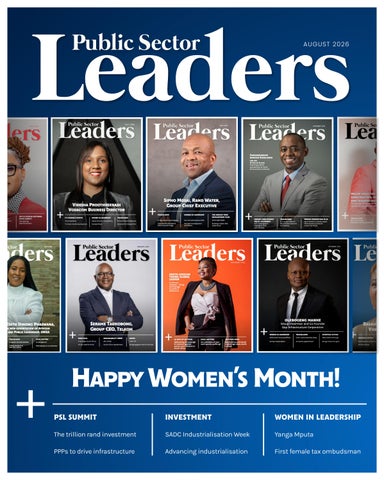
AUGUST 2026
Happy Women’s Month! PSL SUMMIT
INVESTMENT
WOMEN IN LEADERSHIP
The trillion rand investment
SADC Industrialisation Week
Yanga Mputa
PPPs to drive infrastructure
Advancing industrialisation
First female tax ombudsman
Subscribe to Topco Media’s official Weekly newsletter as we keep you up-to-date with the latest business blogs and articles.
topco media
60 | Public Sector Leaders | September 2025
www.topco.co.za
“ B R A I N F O O D
F O R
B U S I N E S S ”
LISTEN NOW
M O O R D R A O B E TH D N O Y E B S IN G TH E STAN DA RD OF SU CC ES RE DE FIN
Master the art of leadership and digital innovation with Ralf Fletcher, CEO of Topco Media, as he interviews and gains exclusive access to high-impact conversations with influential business leaders, politicians, and innovators redefining the future of business.
Contents
AU G UST 20 26 | IS S U E 65
Editorial 20 | Women in government
The women helping shape South Africa’s future
24 | Women’s month
Five meaningful ways to celebrate Women’s Day
32 | SADC Industrialisation Week Advancing industrialisation for shared regional economic prosperity
34 | Kgalema Motlanthe
Foundation Winter Seminar Dialogue as a foundation for social cohesion
Features 10 | Addressing the Nation Building an integrated, productive and prosperous Southern Africa
16 | Women in Leadership Yanga Mputa: Strengthening fairness and accountability in tax administration
18 | Trailblazer
Fundi Tshazibana Deputy Governor, South African Reserve Bank, and CEO, Prudential Authority
24 36 | International SEZ conference
World Bank review tabled at second SEZ conference
26 | Tech
Leading beyond the glass ceiling: Women shaping leadership in a technology-driven future
30 | Agriculture
The importance of trade for growth in SA agriculture
40 | In Other News
National Water Action Plan charts a course towards water security
46 | Regional Focus
New academic hospital set to transform healthcare in Limpopo
04 | Public Sector Leaders | August 2026
42 42 | The trillion rand investment PPPs to drive infrastructure development
48 | Financial Fitness Can you afford to retire?
50 | Legal Matters
Protecting your brand from copycats
52 | Health & Wellness Everyday wellness habits that actually work
54 | Sporting Action
August/September sports calendar
56 | Upcoming Events
August calendar
DEFINITELY A BAKKIE BUILT FOR EASIER LOADING MADE FOR HARD WORK
When productivity drives your business, every load counts. The new ISUZU D-MAX 1.9 Ddi Low Ride Single Cab features a purpose-built 1 700mm overall height for easier loading, a proven 1.9L turbo-diesel engine producing 110kW and 350 Nm of torque, a 2 330mm load box, and 2 100kg towing capacity. Backed by a 6-year/90 000km service plan, it’s built to keep your business moving.
26
30
54
52
CREDITS PUBLIC SECTOR LEADERS The Digimag For Leaders In The South African Public Sector Fully Accredited Member of ABC
Deputy Editor Koketso Mamabolo koketso.mamabolo@topco.co.za
Images iStock / Unsplash / GCIS | Flickr
Assistant Editor Shumirai Chimombe shumirai.chimombe@topco.co.za
Digital Publishing Platforms Issuu Magzter Media Carrier
Contributors Jessie Taylor Wandile Sihlobo Thulani Dube Sue Ramauthur
Advertising Sales, Distribution and Subscriptions Top Media & Communications (Pty) Ltd Tel: 086 000 9590 info@topco.co.za | www.topco.co.za CEO Ralf Fletcher TOPCO STUDIO Production Director Van Fletcher van.fletcher@topco.co.za Group Editor Fiona Wakelin fiona.wakelin@topco.co.za
Design Tashwell Brown
Traffic Manager Daniël Bouwer artwork@topco.co.za SALES National Project Manager Emlyn Dunn Tel: 072 1263962 emlyn.dunn@topco.co.za Brand Coordinators Sidney Phiri sidney.phiri@topco.co.za Printers LAW Print
06 | Public Sector Leaders | August 2026
Head Office Top Media & Communications (Pty) Ltd T/A Topco Media Elkay House, 186 Loop St Cape Town Tel: +27 86 000 9590 Fax: +27 21 423 7576 Email: info@topco.co.za Website: www.topco.co.za (Scan QR code below to view website)
DISCLAIMER
All rights reserved. No part of this publication may be reproduced, stored in a retrieval system or transmitted, in any form or by any means, electronic, mechanical, photocopying, recording or otherwise, without the prior written consent of Top Media & Communications (Pty) Ltd T/A Topco Media. Reg. No. 2011/105655/07. While every care has been taken when compiling this publication, the publishers, editor and contributors accept no responsibility for any consequences arising from any errors or emissions.
They helped us build our dream house
Creating special bonds for Government Employees Having a place to call home is something we all strive for. It’s a place to raise our families, grow together, and make lifelong memories. At SA Home Loans, we recognise the significance of owning a home and are committed to making this dream a reality for government employees. Here are exclusive benefits designed just for you: BUYING A HOME
We understand the unique challenges government employees face, and that’s why we offer a special deal tailored to make it easier for you to own your own home.
RENOVATING YOUR HOME
If you already own your own home, SA Home Loans empowers you to enhance your living space. By switching your current bond to us, you can not only access extra cash for renovations but also secure a better overall deal.
BUYING OR BUILDING ON COMMUNAL OR FAMILY LAND
We recognise that not all land comes with a title deed. SA Home Loans provides exclusive finance options for purchasing or building on land without a title deed.
At SA Home Loans, we ensure that you have the support and resources needed to achieve your home ownership dreams. Contact one of our dedicated consultants today and take the first step towards creating your special bond with SA Home Loans.
0860 2 4 6 8 10
www.sahomeloans.com T’s and C’s apply. See website for further details. SA Home Loans is a registered credit provider. Reg. no. NCRCP1735.
An agency of the Department of Human Settlements
EDITOR’S LETTER BY FIONA WAKELIN
Letter from the
Editor Welcome to the August edition of Public Sector Leaders (PSL)
Keeping things SADC focused, this edition covers The 9th SADC Industrialisation Week (SIW) and Exhibition which brought together leadership from the SADC countries including senior government officials, policymakers, business leaders, industry experts, and development partners, as well as the SADC Business Council and Business Unity South Africa (BUSA). Convened under the theme, “Resilient, Sustainable and Inclusive Industrialisation through Infrastructure Development, Agricultural and Critical Minerals Transformation in Pursuit of a Just World,” the event was a strategic platform for stakeholders to engage, collaborate and build partnerships.
H
appy Women’s Month – however, to be honest, I do look forward to the time when gender equality is the norm and we no longer celebrate this reminder of the ongoing struggle against systemic discrimination. In August, South Africa assumed the mantle of the SADC Chair and hosted the 46th Summit in eThekwini. President Ramaphosa’s letter penned to the nation on 20 April, focused on the importance of SADC for the region: “Our membership of SADC is not just a matter of foreign policy. It is about the creation of jobs and improving the quality of life of South Africans. It is about the growth of our industries, the development of our infrastructure and the health and well-being of our people. As a community of 16 countries with a combined population of nearly 400 million people, SADC has abundant natural resources, a youthful population and the means to produce everything that its people need,” – H.E. Ramaphosa.
Of critical importance to our economy is infrastructure development and the significant article on Public, Private Partnerships: The trillion rand investment - PPPs to drive infrastructure development – unpacks why and how the partnership between the state and the private sector is a development partnership crucial for ensuring the success of the national development agenda. In keeping with Women’s Month our Women in Leadership is Yanga Mputa, South Africa’s first female tax ombudsman and our Trailblazer is Nomfundo (Fundi) Tshazibana, the Deputy Governor, South African Reserve Bank, and Chief Executive Officer, Prudential Authority - driving resilience in South Africa’s financial system. We also bring you a snapshot of the women in government, Ministers and Deputies as well as some suggestions as to how to celebrate Women’s Day. In Other News, President Cyril Ramaphosa released the National Water Action Plan – which sets out a clear programme of interventions to address the immediate causes of water supply failures while laying the foundations for long-term water security. We also bring
you news of the important 2026 Kgalema Motlanthe Foundation Winter Seminar, where leaders from government, business, academia and civil society gathered to explore the theme of “The Continent and Migration” underscoring that, in an increasingly complex and interconnected world, meaningful dialogue has become one of the most powerful tools for strengthening democracy, fostering understanding and building social cohesion. In case you missed the gathering of national importance in July, we take a deep dive into the second International Special Economic Zone Infrastructure and Investment Conference which brought together over 1 000 delegates ranging from investors, SEZ operators, businesses, SEZ experts, universities, think tanks, financial institutions, to local communities, trade partners and government officials who shared ideas, discussed challenges and recognised success. And, in case you needed cheering up, our regular feature, Financial Fitness asks the important question, “Can you afford to retire?” From myself and the amazing team, we hope you enjoy everything Public Sector Leaders has to offer!
FIONA WAKELIN | GROUP EDITOR
August 2026 | Public Sector Leaders | 09
ADDRESSING THE NATION BY FIONA WAKELIN
10 | Public Sector Leaders | August 2026
Building an integrated, productive and prosperous Southern Africa
I
n his letter to the nation, penned on Monday, 17 August, His Excellency Cyril Ramaphosa focused on the Southern African Development Community (SADC) and what it means for trade and development, not only in South Africa but on the Continent. South Africa is the incoming SADC Chair and is hosting the 46th Summit in eThekwini. The focus of President Ramaphosa’s SADC Chairship zones in on the practical steps needed to further integrate the economies of the region and build a dynamic regional market – which is becoming increasingly important in the context of the growing instability in the global economy, which has resulted in the rising prices of fuel, grain and fertiliser, and reducing the prospects for growth. “It is precisely at such a moment that we should be clear about what SADC means for South Africans. Our membership of SADC is not just a matter of foreign
policy. It is about the creation of jobs and improving the quality of life of South Africans. It is about the growth of our industries, the development of our infrastructure and the health and well-being of our people. As acommunity of 16 countries with a combined population of nearly 400 million people, SADC has abundant natural resources, a youthful population and the means to produce everything that its people need. “Yet, trade among SADC countries only stands at around 20% of our combined total trade. Collectively, Southern Africa has abundant energy resources, minerals and land. We have skills, technology, industrial capabilities and strong financial institutions. Yet, we still import much of the goods and services we need from beyond our shores,” – H.E. Ramaphosa. While our region is rich in critical minerals, we export the ore for beneficiation elsewhere and then import the finished products at a price set by others - which is why we need a dynamic common market in which the members of SADC trade with each other, building an integrated power system, developing cross-border
corridors, and managing shared water resources. South Africa is developing the Maputo, NorthSouth, Trans-Kalahari, Beira and Lobito corridors, but we need to do more so that they become living arteries of commerce, carrying freight, electricity, data and people. “As a region, we should work together to ensure that every child has sufficient food and water, that they have quality health care and can access early childhood development. To realise their potential, we need to invest in our schools, universities, technical and vocational colleges and research institutions. “These are some of the actions that this Summit will consider as we work to achieve SADC’s Vision 2050 for an integrated, productive and prosperous region. “As South Africa takes up the Chairship of SADC, we do so in the knowledge that our own prosperity is bound up with that of our neighbours. It is now up to all of us to turn this aspiration into a reality, and to turn the enormous potential that our region has into growth, development and jobs,” – His Excellency President Ramaphosa.
Public Sector Leaders | August 2026 | 11
ADVERTORIAL HOUSING DEVELOPMENT AGENCY
Women leading the way
HDA’s new and first Chief Investment Office opens the door to transformative partnerships
A
s South Africa commemorates Women’s Month, the Housing Development Agency (HDA) celebrates not only the contribution of women in leadership but also the transformative role they continue to play in shaping the nation’s development future. A powerful example is the appointment of Ms Vinolia Mashiane as the HDA’s Chief Investment Officer (CIO), a milestone that signals a new era of innovation, investment readiness, and strategic public-private collaboration in the human settlements sector. Appointed in May 2025, Ms Mashiane leads HDA’s newly established Chief Investment Office, a strategic function dedicated to unlocking investment opportunities that support sustainable human settlements, infrastructure development, and urban regeneration.
Ms Vinolia Mashiane, Chief Investment Officer at HDA
Her appointment comes at a pivotal moment as South Africa seeks innovative financing models to address housing demand, unlock economic growth, and accelerate spatial transformation. With over 20 years of experience spanning both the public and private sectors, Ms Mashiane brings a rare combination of expertise in corporate finance, property development, investment management, and public-private partnership (PPP) structuring. Her distinguished career includes leadership roles at the Gauteng Partnership Fund, where she successfully leveraged private sector capital to support affordable housing delivery, as well as experience at Nedbank Corporate’s Affordable Housing Property Finance Unit and the South African Reserve Bank. She is also a Certified Associate of the Institute of Bankers in South Africa (CAIB), further reflecting her strong credentials in banking, investment, and financial management.
Holding a BCom and BCom Honours degree, together with qualifications in Portfolio and Investment Management, Central Banking, and executive management, Ms Mashiane embodies the calibre of leadership required to bridge the gap between public development objectives and private sector investment. Under her leadership, the HDA has taken significant steps to position itself as an investor-ready public development agency. This was recently demonstrated through the successful launch of the HDA Investment Focus 2026/27 Portfolio and Investor Engagement, which brought together institutional investors, commercial banks, development finance institutions, private equity firms, fund managers, developers, and strategic partners. The positive response to the event reflects growing market confidence in the HDA’s ability to structure bankable projects that deliver both financial returns and measurable social impact. At the heart of this strategy is the recognition that government-owned land and public assets represent some of South Africa’s most valuable yet underutilised development resources. Through rigorous project preparation, feasibility assessments, land assembly, transaction packaging, and stakeholder coordination, the HDA is creating a pipeline of investment opportunities that reduces risk and enhances investor confidence. The Agency is not seeking to replace private capital, but rather to create the enabling conditions that allow private investment to participate meaningfully in advancing national development priorities. The Chief Investment Office is central to this mission. It is building a professional investment platform that introduces
resilient, and economically vibrant communities for future generations. Through visionary leadership and strategic collaboration, the HDA is demonstrating that the future of human settlements lies in strong partnerships, sound governance, and investment-driven development that delivers value for both society and the economy.
The HDA is creating a pipeline of investment opportunities that reduces risk and enhances investor confidence. We are not seeking to replace private capital, but rather to create the enabling conditions that allow private investment to participate meaningfully. greater transparency, governance, consistency, and market readiness to public sector development opportunities. From affordable rental housing and student accommodation to mixed-use precinct developments and urban revitalisation projects, the HDA is creating pathways for investors to participate in South Africa’s growing urban economy. Importantly, this progress is underpinned by strengthened governance, improved financial management, organisational reform, and the achievement of a clean audit outcome, reinforcing the HDA’s credibility as a trusted development partner.
About the HDA The Housing Development Agency (HDA) is a national public sector development agency that inter alia has the mandate to identify, acquire, prepare, and develop suitable land for human settlements. The agency also undertakes the programme and project management for the development of housing and human settlements. The HDA carries out its functions in partnership with a range of stakeholders including national, provincial, and local government, as well as with communities, developers, and financiers. Established in 2009, the Agency was established by an Act of Parliament in 2008 and is accountable through its Board to the Minister of Human Settlements. For more information about the HDA, please visit our website: www.thehda.co.za Follow us on X @the_hda and on Facebook: The Housing Development Agency. LinkedIn @The Housing Development Agency.
This Women’s Month, the story of Ms Vinolia Mashiane and the HDA’s Chief Investment Office highlights the power of women-led leadership in driving innovation, partnership, and sustainable development. It is a story of unlocking opportunity, transforming public assets into productive capital, and building more inclusive,
Public Sector Leaders | August 2026 | 13
86,345
Government Employees Medical Scheme (GEMS): 2026 Annual General Meeting (AGM) Notice All GEMS members have been sent the draft 2025 GEMS Annual Integrated Report and Financial Statements containing the official notice of the 2026 GEMS Annual General Meeting (AGM) taking place virtually via the Zoom platform on Friday, 31 July 2026 at 15:00. In accordance with GEMS Rule 29.6, the GEMS Board of Trustees require members wishing to attend the AGM to register online by 15:00 on Friday, 31 July 2026. Please note that online registration will close at 15:00. No registration to attend the AGM will be allowed after 15:00. Accordingly, if you wish to attend the AGM, kindly go to www.gems.gov.za, click on the relevant link embedded in the 2026 GEMS AGM section and: Complete the online registration form by 15:00 on Friday, 31 July 2026. It is important to note that only members who have registered will be admitted to the meeting; Acquaint yourself with the Zoom user guide, which details Zoom’s functionality; and Download the Zoom software for an enhanced Zoom/AGM experience, should you prefer this to the standard Zoom/AGM web experience.
Should you be unable to attend the AGM, you may appoint a proxy to attend, speak and vote on your behalf by completing the proxy form. When returning your proxy form, kindly mark it for the attention of the Principal Officer with the reference 2026 GEMS AGM Proxy. It is important to note that your proxy form must reach us by 16:00 on Friday, 24 July 2026 to be considered. Proxy forms may be sent to: • Email: enquiries@gems.gov.za; • Fax: 0861 004 367; or
• Post: GEMS, Private Bag X782, Cape Town, 8000. For copies of the following AGM meeting documents, kindly go to www.gems.gov.za and click on the relevant link embedded in the 2026 GEMS AGM section: • 2026 GEMS AGM Member Guide; • 2026 GEMS AGM Agenda;
• 2026 GEMS AGM Proxy Form;
• 2025 GEMS AGM Minutes (draft);
• 2025 GEMS Annual Integrated Report;
• 2025 GEMS Trustee Remuneration Report; and • GEMS AGM Action List.
We thank you for your ongoing support and look forward to seeing you at the AGM.
0800 00 4367 (toll-free)
enquiries@gems.gov.za www.gems.gov.za
@GEMSMEDICALAID1 @GEMSMEDICALAID Government Employees Medical Scheme
The Government Employees Medical Scheme (GEMS) is an authorised Financial Services Provider (FSP No 52861)
Use the QR Code to download the GEMS Member App
Working towards a healthier you
INTERVIEW JENNIFER REDDY
Morar Incorporated Delivering practical and innovative solutions
How has your financial industry background and experience defined your leadership approach and role as CEO? My background as a Chartered Accountant and Registered Auditor has significantly influenced my leadership philosophy, emphasising accountability, integrity, and long-term value creation. My experience across both the public and private sectors has provided me with a deep understanding of the importance of strong governance, sound financial management, and the need to build trusted relationships. I firmly believe that effective leadership requires continuous learning. Throughout my career, I have actively invested in my development by pursuing further studies and obtaining professional qualifications, including an Executive MBA and my Certified Fraud Examiner (CFE) designation. These experiences have broadened my perspective beyond finance, enhancing my strategic thinking, leadership capabilities, and ability to navigate complex business challenges. They have empowered me to lead with greater confidence, make informed decisions, and position Morar Incorporated for sustainable growth. As CEO of Morar Incorporated, I understand that leadership goes beyond achieving financial results. It is about
fostering an environment where individuals can thrive, innovation is encouraged, and clients receive solutions that have a meaningful impact. My role is to provide strategic direction while empowering our people to grow, uphold the highest professional standards, and continuously adapt to the evolving business landscape.
continuous learning, and career advancement while encouraging women to pursue professional qualifications and leadership roles. To me, meaningful empowerment is measured by the opportunities we create, the leaders we cultivate, and the barriers we remove for future generations.
What products and services do you provide as Morar Incorporated? Morar Incorporated is a multidisciplinary professional services firm that offers a range of services, including audit and assurance, accounting, taxation, internal audit, forensic investigations, risk management, governance advisory, business consulting, and financial management.
What advice would you give to women about effective leadership? Lead with authenticity and never underestimate the value of your voice. Effective leadership isn’t about having all the answers; it’s about having the courage to make difficult decisions, staying true to your values, and continuing to learn throughout your career.
We collaborate with organisations in both the public and private sectors, such as national and provincial government departments, municipalities, public entities, and private businesses. Our primary goal is to deliver practical and innovative solutions that enhance governance, improve financial performance, manage risk, and support sustainable organisational growth. We are committed to partnering with our clients by providing trusted advice, technical excellence, and solutions that create lasting value. How do you champion meaningful women empowerment within your organisation? Women empowerment starts with creating opportunities, not just discussing equality. At Morar Incorporated, we intentionally develop women for leadership positions by offering mentorship, coaching, professional development, and opportunities to lead significant client projects.
Don’t wait until you feel completely ready to pursue opportunities. Growth often occurs outside your comfort zone. Build strong relationships, invest in your own development, seek mentors who challenge you, and always lead with integrity and purpose. Most importantly, remember that leadership is about the impact you have on others. When you empower those around you to succeed, your own success becomes even more meaningful.
Scan the QR code for more information on Morar Incorporated
I believe empowering women involves investing in their confidence, recognising their potential, and fostering an environment where their contributions are valued. We promote flexible leadership,
Public Sector Leaders | August 2026 | 15
WOMEN IN LEADERSHIP BY JESSIE TAYLOR
Yanga Mputa
South Africa’s first female Tax Ombud Strengthening fairness and accountability
in tax administration 16 | Public Sector Leaders | August 2026
F
or many South Africans, engaging with the tax system can be a daunting experience. Whether resolving an administrative error, disputing a delayed refund or seeking clarity on a complex assessment, taxpayers expect a system that is fair, transparent and accountable. Helping to safeguard those principles is the Office of the Tax Ombud, an independent complaints-resolution office established under the Tax Administration Act to review service, procedural and administrative complaints against SARS. Leading the Office of the Tax Ombud is Yanga Mputa, South Africa’s first female Tax Ombud. Appointed in July 2023, she brings more than two decades of experience in tax law, policy and administration to a role that sits at the intersection of public accountability and taxpayer rights. Her appointment as the first woman to lead the Office marked an important milestone in the institution’s history. An impartial avenue to raise complaints Established under the Tax Administration Act, the Office of the Tax Ombud plays an important role in strengthening confidence in South Africa’s tax system. While SARS is responsible for collecting revenue and administering tax legislation, the Ombud provides taxpayers with an impartial avenue to raise complaints relating to service, procedure and administrative matters after they have exhausted SARS’ internal complaints mechanisms. The Office does not replace the courts or decide tax disputes, but instead seeks to resolve complaints fairly, identify systemic issues and recommend improvements that enhance tax administration. For Ms Mputa, the role builds on a distinguished career spanning legal practice, tax policy and public finance. Her professional journey began with the Legal Aid Board’s Human Rights Centre and Legal Aid Clinic, where she served as a candidate attorney before moving into the specialised field of taxation. Over the years, she has held senior
positions at Arthur Andersen, SARS and National Treasury, developing expertise across virtually every aspect of South Africa’s tax system. Throughout her career, Ms Mputa has contributed to the development of South Africa’s tax policy framework, working on complex areas including international taxation, business taxation, employment taxes, retirement taxation, exchange control matters and financial sector taxation. This breadth of experience provides a strong foundation for overseeing an office that must understand not only legislation but also how tax administration affects individuals, businesses and public confidence. One of Ms Mputa’s priorities has been to strengthen the visibility and accessibility of the Office of the Tax Ombud. While many taxpayers are familiar with SARS, fewer understand that an independent body exists to investigate complaints relating to administrative or service failures. Increasing public awareness is therefore an important part of ensuring taxpayers know where to turn when normal complaint channels have been exhausted. Equally important is extending the Office’s reach to underserved communities that may face additional barriers in accessing government services. Improving efficiency, consistency and fairness Beyond resolving individual complaints, the Office of the Tax Ombud also plays an important role in improving the tax system as a whole. Through the investigation of recurring complaints and systemic issues, the Office identifies patterns that may point to weaknesses in administrative processes or service delivery. It can make recommendations to SARS aimed at improving efficiency, consistency and fairness, helping to prevent similar issues from affecting other taxpayers in future. This broader oversight function supports continuous improvement while contributing to
greater accountability across the tax administration system. An effective tax system relies not only on efficient revenue collection but also on public confidence that taxpayers will be treated fairly and consistently. Revenue collected by SARS finances essential government functions, including healthcare, education, policing, infrastructure and social protection. By providing an independent mechanism to resolve administrative complaints, the Office of the Tax Ombud helps strengthen trust in the integrity of South Africa’s tax administration while supporting good governance. Under Ms Mputa’s leadership, the Office has continued to encourage taxpayers to make use of its free complaints resolution service where appropriate. Complaints commonly relate to delays in processing refunds, prolonged administrative matters, communication challenges, the application of procedures and service-related issues. Before approaching the Office, taxpayers are generally expected to first exhaust SARS’ internal complaints process, ensuring that the Ombud serves as an independent review mechanism when those channels have not resolved the matter. The Office does not adjudicate tax liability or overturn assessments, matters that remain within the jurisdiction of the courts and specialist dispute resolution processes established under tax legislation. Her leadership reflects a broader commitment to responsive, citizen-centred public administration. In an increasingly complex fiscal environment, institutions that combine technical expertise with fairness, transparency and accountability are essential to maintaining confidence in government. By focusing on accessibility, independence and service excellence, Mputa is helping to strengthen an institution that gives taxpayers confidence that their concerns will be heard and considered impartially.
Source: Office of the Tax Ombud | South African Revenue Service | National Treasury | SAnews
August 2026 | Public Sector Leaders | 17
TRAILBLAZER BY JESSIE TAYLOR
Fundi Tshazibana driving resilience in South Africa’s financial system
M
aintaining confidence in South Africa’s banking and insurance sectors is critical to supporting economic growth, protecting consumers and ensuring financial stability. Helping to steer that effort is Fundi Tshazibana, Deputy Governor of the South African Reserve Bank (SARB) and Chief Executive Officer of the Prudential Authority, whose leadership continues to shape one of the country’s most important regulatory institutions. Safeguarding financial stability Speaking at the Prudential Authority’s annual media briefing, Ms Tshazibana reaffirmed the strength of South Africa’s financial system despite a volatile interna-
tional environment. While acknowledging that geopolitical tensions, policy uncertainty and higher energy prices continue to pose risks to the global economy, she said South African banks and insurers remain well-capitalised, financially sound and resilient. The assessment reflects years of regulatory reform and prudent supervision designed to ensure the country’s financial institutions can withstand periods of economic uncertainty. Established within the South African Reserve Bank, the Prudential Authority supervises banks, insurers, financial conglomerates, cooperative financial institutions
18 | Public Sector Leaders | August 2026
and certain financial market infrastructures. Its mandate is to promote the safety and soundness of financial institutions while contributing to financial stability. As Chief Executive Officer, Ms Tshazibana leads an organisation that plays a vital role in protecting the integrity of South Africa’s financial system and maintaining public confidence. Among the milestones she highlighted was the implementation of the Basel III banking reforms, which introduced stronger capital and liquidity requirements following the global financial crisis. The Prudential Authority has also enhanced its stress-testing
standing as a well-regulated financial centre. Ms Tshazibana has also emphasised the need for regulation to evolve alongside innovation. Artificial intelligence, digital assets and other emerging technologies are reshaping financial services, creating new opportunities while introducing new risks. The Prudential Authority is working to ensure innovation can develop responsibly without compromising financial stability or consumer protection.
Maintaining confidence in South Africa’s banking and insurance sectors is critical to supporting economic growth, protecting consumers and ensuring financial stability.
framework and implemented the positive neutral countercyclical capital buffer, further strengthening the resilience of South African banks against future economic shocks. Another significant achievement was South Africa’s removal from the Financial Action Task Force (FATF) greylist. The milestone followed coordinated efforts by regulators, government departments and financial institutions to strengthen anti-money laundering and counter-terrorism financing controls, reinforcing investor confidence and South Africa’s
A career built on sound governance Ms Tshazibana brings more than two decades of experience in economic policy and financial regulation to her current role. Before joining the Reserve Bank, she held senior positions at National Treasury, focusing on macroeconomic policy and economic forecasting. She later served as Alternate Executive Director at the International Monetary Fund in Washington, DC, representing South Africa and 22 other sub-Saharan African countries before returning to the Reserve Bank as Adviser to the Governor in 2018.
related financial risks and rapidly evolving technologies all have the potential to affect financial stability, making proactive supervision more important than ever. Under Ms Tshazibana’s leadership, the Prudential Authority has continued to adopt a forward-looking approach, encouraging financial institutions to strengthen governance, improve risk management and maintain sufficient capital buffers to withstand future shocks. This emphasis on resilience ensures that South Africa’s financial sector remains better positioned to support businesses, investors and consumers during periods of uncertainty. Her career also reflects the growing contribution of women to South Africa’s economic leadership. In a field historically dominated by men, she has established herself as one of the country’s leading voices on financial stability, macroeconomic policy and prudential regulation.
She was appointed Deputy Governor in 2019 and became Chief Executive Officer of the Prudential Authority in 2022, while continuing to serve on the Monetary Policy Committee. Her career reflects a consistent commitment to strengthening public institutions through evidence-based policymaking, sound governance and effective regulation. As financial systems become increasingly interconnected, regulators are required to manage a broader range of risks extending beyond traditional banking concerns. Geopolitical instability, cyber threats, climate-
Her progression through National Treasury, the International Monetary Fund and the South African Reserve Bank demonstrates the value of technical expertise, sound judgement and principled leadership in building strong public institutions. As South Africa navigates an increasingly complex global economy, resilient institutions will remain essential to sustainable growth. Through prudent oversight, collaboration and a commitment to international best practice, Ms Tshazibana continues to strengthen confidence in South Africa’s financial system while helping ensure it remains resilient, trusted and capable of supporting long-term economic development.
Sources: Eyewitness News | South African Reserve Bank | Prudential Authority | National Treasury | International Monetary Fund | Financial Action Task Force (FATF)
August 2026 | Public Sector Leaders | 19
WOMEN IN GOVERNMENT BY JESSIE TAYLOR
Women helping shape South Africa’s future
W
omen continue to play an increasingly influential role in South Africa’s executive leadership, heading some of the government’s most important portfolios. From education and defence to transport, labour and water security, women ministers are helping to shape policies that affect millions of South Africans while driving service delivery, economic development and social progress. South Africa remains one of Africa’s leading countries for women’s political representation. Women occupy
20 | Public Sector Leaders | August 2026
43.5% of seats in Parliament and 44% of Cabinet positions, reflecting significant progress towards gender parity, although representation has declined slightly since the 2019 administration. While women continue to lead many of the government’s most influential portfolios, official reports note that further progress is needed to achieve equal representation across all levels of political leadership, particularly among premiers and deputy ministers.
Siviwe Gwarube – Minister of Basic Education Minister Gwarube is responsible for one of the government’s largest and most important portfolios. A former Member of Parliament and education spokesperson, she has prioritised improving literacy and numeracy outcomes, strengthening school infrastructure and ensuring greater accountability across the education system.
Angie Motshekga – Minister of Defence and Military Veterans Widely recognised for overseeing major reforms in the education sector, Minister Motshekga now leads efforts to strengthen South Africa’s defence capability, support military veterans and promote regional peace and security through the South African National Defence Force.
Nomakhosazana Meth – Minister of Employment and Labour Minister Meth leads the government’s efforts to promote employment, strengthen labour relations and improve workplace protections. Having previously served in provincial government and Parliament, she oversees policies aimed at supporting job creation, enforcing labour legislation and developing skills that improve employability.
Mmamoloko Kubayi – Minister of Justice and Constitutional Development Minister Kubayi oversees one of the country’s most significant constitutional portfolios. Her responsibilities include strengthening access to justice, supporting constitutional governance and overseeing institutions that uphold the rule of law.
Stella Ndabeni-Abrahams – Minister of Small Business Development Minister Ndabeni-Abrahams is responsible for creating an enabling environment for entrepreneurs, small businesses and township enterprises to grow and create jobs. Her department focuses on improving access to finance, reducing regulatory barriers and strengthening support for small, medium and micro enterprises, recognising their vital contribution to employment and inclusive economic growth.
August 2026 | Public Sector Leaders | 21
Patricia de Lille – Minister of Tourism Minister De Lille continues to champion the sector as a key driver of economic growth, investment and job creation. Her focus includes expanding destination marketing, improving tourism infrastructure and strengthening partnerships between government and the private sector to grow both domestic and international tourism.
Barbara Creecy – Minister of Transport Minister Creecy oversees South Africa’s transport system. Her responsibilities span road, rail, aviation, maritime transport and public transport systems, all of which are central to economic growth, trade and improved mobility.
Khumbudzo Phophi Silence Ntshavheni – Minister in the Presidency Minister Ntshavheni occupies one of the government’s most strategic positions. She is responsible for coordinating communication across government, supporting Cabinet processes and communicating key policy decisions to the public. Her role places her at the centre of government coordination, ensuring policy priorities are effectively communicated and implemented.
Maropene Ramokgopa – Minister of Planning, Monitoring and Evaluation Minister Ramokgopa plays a strategic role in ensuring government programmes are effectively planned, monitored and assessed. Her department works across government to improve policy implementation, strengthen accountability and measure service delivery outcomes.
Pemmy Majodina – Minister of Water and Sanitation Water security has become one of South Africa’s most pressing priorities, placing Minister Majodina at the forefront of efforts to improve water infrastructure, expand reliable water services and strengthen the management of the country’s water resources. Her portfolio is central to economic development, public health and climate resilience.
22 | Public Sector Leaders | August 2026
Sindisiwe Chikunga – Minister of Women, Youth and Persons with Disabilities Minister Chikunga leads the government’s efforts to advance gender equality, youth development and the inclusion of persons with disabilities. Her department works across government to ensure that equality and empowerment remain integral to policymaking and service delivery.
Dina Pule – Minister of Social Development Minister Pule leads the government’s efforts to strengthen South Africa’s social protection system. The department oversees social welfare services, community development initiatives and the South African Social Security Agency (SASSA), providing essential support to millions of vulnerable citizens.
Women serving as deputy ministers Women also play an important role across South Africa’s executive through their service as deputy ministers. Supporting Cabinet ministers in policy development, oversight and programme implementation, they help strengthen government capacity across a wide range of portfolios. Current women deputy ministers include: •
Rosemary Nokuzola Capa – Agriculture
•
Alexandra Abrahams – Electricity and Energy
• • • • • • • • • • • • • • •
Reginah Mhaule – Basic Education
Judith Nemadzinga-Tshabalala – Employment and Labour Bernice Swarts – Forestry, Fisheries and the Environment Nomusa Dube-Ncube – Higher Education
Thandi Mahambehlala – Human Settlements
Anna Thandi Moraka – International Relations and Cooperation Phumzile Mgcina – Mineral and Petroleum Resources Shela Polly Boshielo – Police
Nonceba Bianca Mhlauli – The Presidency
Pinky Sharon Kekana – Public Service and Administration Nomalungelo Gina – Science, Technology and Innovation Raesetja Jane Sithole – Small Business Development Bertha Peace Mabe – Sport, Arts and Culture Makhotso Magdeline Sotyu – Tourism
Mmapaseka Steve Letsike – Women, Youth and Persons with Disabilities.
Source: Parliament of South Africa – Ministers | Government of South Africa – Executive profiles | Presidency of South Africa – Cabinet reshuffle announcement
August 2026 | Public Sector Leaders | 23
WOMEN’S DAY BY JESSIE TAYLOR
Five meaningful ways to celebrate Women’s Day
E
very year on 9 August, South Africans commemorate National Women’s Day, honouring the more than 20 000 women who marched to the Union Buildings in Pretoria in 1956 to protest against the extension of pass laws to women. Led by remarkable figures including Lilian Ngoyi, Helen Joseph, Rahima Moosa
1
and Sophia Williams-De Bruyn, the march became a defining moment in the country’s struggle for freedom, equality and human dignity. Today, Women’s Day is both a celebration of the achievements of women and an opportunity to reflect on the work that remains
to achieve gender equality and women’s empowerment.Whether through learning about South Africa’s history, supporting womenled organisations or taking time to recognise the women who make a difference in our communities, there are many meaningful ways to mark the occasion.
Visit Constitution Hill’s Women’s Jail
Constitution Hill offers one of the country’s most powerful reminders of the sacrifices made by women during South Africa’s struggle for democracy. The Women’s Jail housed both ordinary women and political activists, including Albertina Sisulu, Fatima Meer and Winnie Madikizela-Mandela, many of whom were imprisoned for resisting unjust laws. Today, the museum tells their stories through exhibitions, preserved prison cells and guided tours that encourage visitors to reflect on the importance of justice, equality and human rights. A visit provides a moving opportunity to connect with the legacy of the women whose courage helped shape modern South Africa.
24 | Public Sector Leaders | August 2026
2
Stand where history was made at the Union Buildings
3
Explore the Liliesleaf Museum
4
Support a women-led empowerment organisation
5
Celebrate women-owned businesses and local creators
Union Buildings remain one of South Africa’s most significant national landmarks. It was here that thousands of women gathered on 9 August 1956 to deliver petitions opposing pass laws in one of the largest demonstrations in the country’s history. Visitors can walk the gardens, reflect at the site of the Women’s March and learn more about the historic role women played in advancing democracy. The annual Women’s Day commemorations continue to reinforce the importance of active citizenship, equality and public participation. The Union Buildings also remain a symbol of democratic governance and public service, reminding visitors of the lasting impact ordinary citizens can have in shaping the nation’s future.
Once the secret headquarters of the ANC and Umkhonto we Sizwe leadership, Liliesleaf in Rivonia offers a fascinating insight into South Africa’s struggle for liberation, including the often-overlooked contributions of women. Through interactive exhibitions, personal stories and historical artefacts, visitors can learn about women who worked behind the scenes as organisers, couriers, activists and community leaders. Although many are less well known than their male counterparts, their courage and determination were instrumental in advancing the struggle for democracy. Visiting the museum is an opportunity to gain a deeper appreciation of the diverse women whose efforts helped shape South Africa’s history.
Women’s Day is also an opportunity to invest in the future by supporting organisations that empower women and girls. Across South Africa, numerous non-profit organisations provide skills development, entrepreneurship training, education, mentoring and support for survivors of gender-based violence. Consider donating to or volunteering with organisations such as The Character Company, which mentors young women; The Lunchbox Fund, which supports education and nutrition programmes benefiting vulnerable children and their caregivers; or Women for Change, which advocates against gender-based violence and promotes women’s rights. Even small contributions of time, skills or resources can make a meaningful difference in strengthening communities and expanding opportunities for women.
One of the simplest ways to celebrate Women’s Day is by supporting women entrepreneurs. Whether purchasing locally made products, dining at a women-owned restaurant, booking a service from a woman-led business or attending a Women’s Day market, every purchase contributes to economic empowerment. Small businesses play an important role in job creation and community development, and supporting women-owned enterprises helps promote greater financial inclusion and sustainable economic growth. It is also an opportunity to discover the creativity, innovation and resilience of South African women across sectors ranging from fashion and food to technology and the creative industries.
Women’s Day is a celebration of the women who have shaped South Africa’s past while recognising those who continue to build its future. By visiting places of historical significance, supporting organisations that empower women and investing in women-led enterprises, South Africans can honour the legacy of the 1956 Women’s March in meaningful and lasting ways. Source: Government of South Africa | Constitution Hill | Liliesleaf | South African History Online | Women for Change | The Character Company | The Lunchbox Fund
August 2026 | Public Sector Leaders | 25
TECH THULANI DUBE
Leading beyond the glass ceiling
Women shaping leadership in a technology -driven future
T
he rapid acceleration of artificial intelligence, automation, data driven decision-making and digital platforms is fundamentally changing the nature of leadership. Technology is no longer confined to specialist departments. It is reshaping strategy, operating models, customer experiences, workforce structures and the very definition of organisational competitiveness. Within this transformation lies an important leadership question of who gets to shape the future as well as whose perspectives will be represented when that future is designed.
Women are increasingly occupying influential positions across technology, business, academia, government and entrepreneurship. Yet their progress continues to occur against structural challenges that have historically limited access to leadership. This is particularly prevalent within STEM and technology intensive sectors. The contemporary leadership environment is therefore characterised by a paradox in which women are making measurable advances in skills, leadership and technological participation, while significant barriers remain in the pathway to the highest levels of
26 | Public Sector Leaders | August 2026
influence. In addition, the World Economic Forum’s Global Gender Gap Report 2025 indicated that women account for 28.1% of top management positions, up from 25.7% in 2015. This progress, however, has slowed. In STEM, the gap is more pronounced as women represent approximately 28% of the STEM workforce, while their representation at STEM C-suite level is only 12.2%. These figures demonstrate that the challenge is no longer simply about encouraging women to enter the workplace. It is about ensuring that they can progress, influence strategic decisions and lead the institutions developing the technologies that will define the future.
Leadership that builds the pipeline of skills for the future The work of Zandile Mkhwanazi, Founder and CEO of GirlCode, illustrates how this challenge is increasingly being addressed through leadership that builds the pipeline rather than simply navigating it. Through GirlCode, she has helped equip more than 80 000 girls and women with technology and coding skills, while her work through GirlCode Talent extends this focus towards connecting women in STEM with employment and career opportunities. Her leadership demonstrates that advancing women in technology is not only about increasing representation at the top but also about deliberately creating the skills, the access and pathways that enable the next generation to reach those positions. Challenging structural and cultural barriers Women entering leadership have historically had to navigate a complex combination of structural and cultural barriers. These have included gender stereotypes, unequal access to influential networks, unconscious bias in recruitment and promotion, limited representation in senior technology roles, unequal caregiving expectations and the persistent expectation that women must demonstrate competence repeatedly before being afforded the same level of authority. The proverbial leadership pipeline has consequently not always functioned as a meritocratic progression. Women may enter organisations in significant numbers but become progressively underrepresented as seniority increases. This phenomenon is particularly evident in technology, where the movement from entry level roles to executive leadership
remains disproportionately difficult. The issue is increasingly being understood as a systemic rather than individual problem. Women are not necessarily lacking ambition, qualifications or leadership capability, rather, organisational systems can determine who receives the opportunities, sponsorship, high visibility assignments and strategic exposure necessary to progress. The response emerging among successful women leaders is therefore not simply to adapt to existing leadership structures. Increasingly, women are helping to reshape those structures. This includes building professional networks, developing technological fluency, seeking sponsorship rather than relying exclusively on mentorship, creating entrepreneurial pathways, establishing communities of practice and most importantly, using leadership positions to develop other women. The result is a gradual transition from women being positioned as participants in transformation to becoming architects of transformation. Creating networks and ecosystems that support access to skills and innovation The work of Naadiya Moosajee, civil engineer and co-founder of WomHub, illustrates this shift. She has worked across Africa and internationally to expand access to skills, entrepreneurship, innovation and leadership opportunities for women in STEM. Her involvement in venture capital investing in women led technology businesses further demonstrates the importance of moving beyond developing talent to creating the networks, capital and ecosystems through which that talent can translate into influence and enterprise. What the recent Africa Tech Week Awards hosted in Cape town have shown is that
the contemporary technology leader does not necessarily need to be a programmer, data scientist or artificial intelligence specialist. However, technological literacy is rapidly becoming an essential component of executive competence. Artificial intelligence is already influencing recruitment, marketing, financial analysis, customer engagement, productivity and decision making. The World Economic Forum reports that 86% of employers expect AI and information processing technologies to transform their businesses by 2030, while 77% anticipate using reskilling and upskilling to prepare their workforces for this transition. This creates an important opportunity for women leaders. Rather than viewing technology as the exclusive domain of technical specialists, women in leadership are increasingly able to position themselves at the intersection of technology, strategy, people and organisational transformation. Krista Davidson, Executive Director at Injini, Africa’s EdTech accelerator, provides a relevant example of this approach. Her work sits at the intersection of technology, education, entrepreneurship and impact while demonstrating how technology leadership can extend beyond technical development to building programmes, partnerships and teams that enable technology driven solutions to address real societal and economic challenges. This intersection is particularly powerful because technology implementation rarely succeeds on technical capability alone. It requires leaders who can communicate change, manage resistance, interpret data, understand organisational culture and translate complex technological possibilities into meaningful business outcomes. The future therefore belongs neither
August 2026 | Public Sector Leaders | 27
TECH THULANI DUBE
exclusively to technologists nor traditional executives. It belongs increasingly to technology literate leaders who can connect innovation with people, purpose and performance. AI and emerging technologies addressing new barriers Technology is also changing the nature of the barriers women face. Some traditional barriers remain, but new ones are emerging. Artificial intelligence, for example, creates both opportunities and risks. Women are acquiring AI skills at an increasing rate and the gender gap in AI talent has narrowed across many economies according to the World Economic Forum. Yet women remain disproportionately represented in occupations more exposed to disruption and underrepresented in many of the roles shaping AI systems. Women cannot simply be prepared to use technology. They must increasingly be positioned to design, govern, evaluate and lead it. A workforce in which women primarily consume technology while men disproportionately determine its architecture, governance and strategic application risks reproducing existing inequalities through new systems. Scholar and researcher Zinhle Novazi’s work demonstrates the importance of women occupying precisely these decision making spaces. As a lawyer, technology and international trade finance lecturer and researcher examining automated decision making in financial services, her work brings together law, data protection, artificial intelligence and consumer
protection. This intersection illustrates how women can contribute not only to the adoption of emerging technologies, but to the frameworks that determine how those technologies are governed and their impact on society. Gender responsive technology leadership therefore requires women to participate in decisions about data, algorithms, AI governance, cybersecurity, digital policy, automation and the future design of work. This leadership places a firm emphasis on the importance of inclusive, safe and trustworthy AI alongside greater support for women in AI leadership and entrepreneurship. The new face of the contemporary technology leader The traditional image of the technology leader has often been associated with technical authority, individual achievement, competitiveness and decisiveness. The future demands a broader definition. Effective leadership in a rapidly changing environment requires intellectual curiosity, adaptability, emotional intelligence, ethical judgement, collaboration and the capacity to operate without complete certainty. These capabilities are not inherently feminine or masculine. However, women leaders have an opportunity to challenge the assumption that authority must always be demonstrated through traditionally masculine leadership behaviours. The contemporary leader can be decisive without being authoritarian, collaborative without being indecisive, empathetic without sacrificing accountability and ambitious without adopting an unnecessarily competitive
28 | Public Sector Leaders | August 2026
leadership style. This broader leadership model is increasingly relevant in technology environments where successful transformation depends on multidisciplinary collaboration. The most effective technology initiatives often bring together people from technology, finance, human resources, marketing, operations, academia, government and civil society. Leadership consequently becomes less about possessing the most technical knowledge and more about connecting different forms of knowledge around a shared objective. Redefining career progression for women Women who have progressed into leadership have often had to develop a particularly strong capacity for adaptability. Career trajectories are no longer necessarily linear. Women are more likely than men to experience career breaks. They are also more likely to spend longer periods away from work on average, with caregiving responsibilities being a significant factor. This makes traditional definitions of career progression increasingly inadequate. A career interruption should not automatically translate into a leadership penalty. As work becomes more fluid, organisations have an opportunity to recognise diverse career pathways, including lateral moves, entrepreneurship, portfolio careers, reskilling periods and re-entry after career breaks. This should not merely be viewed as a gender equity intervention but a talent strategy. Organisations that continue to equate leadership potential with uninterrupted career progression risk excluding experienced professionals whose capabilities have developed through different forms of work and life experience.
The value of sponsorship for women in tech One of the most important developments in women’s leadership is the movement from passive representation to active sponsorship. Mentorship provides advice, guidance and encouragement. Sponsorship goes further: sponsors advocate for individuals, create access to opportunities and use their influence to accelerate career progression. For women in technology, sponsorship can be particularly important because senior technology environments remain disproportionately male. When leadership teams are predominantly male, informal networks can unintentionally reproduce themselves. Breaking this cycle requires deliberate organisational action. Women need access to strategic projects, executive exposure, international opportunities, technology transformation initiatives and decision making forums. They also need leaders, both women and men, who actively identify emerging female talent and create pathways into senior positions. Importantly, women who reach leadership positions increasingly have a responsibility to become sponsors themselves. The objective should not simply be individual advancement. It should be the creation of a stronger leadership pipeline. Baratang Miya’s career and mentorship initiatives illustrate the value of building leadership across different contexts. From founding GirlHype, an initiative focused on advancing digital literacy and participation among women and young people, to leadership roles in AI and digital public infrastructure, her trajectory demonstrates how
experience across entrepreneurship, technology, organisational strategy and policy can accumulate into a broader form of leadership capability. A capability that was translated to talent development across different industries. The most significant opportunity for women in technology leadership is not simply to occupy existing leadership positions. It is to influence what leadership and technology will become. The technology driven organisation of the future will require leaders capable of navigating several tensions simultaneously. The future of leadership The future of leadership will ultimately be determined by the ability of organisations to move beyond representation towards genuine participation, influence and shared responsibility. Women cannot be expected merely to enter technology driven environments designed without them. They must be empowered to shape the technologies, policies, cultures and institutions that will define those environments. This requires a fundamental shift in how leadership potential is identified and developed. Organisations must look beyond traditional career trajectories and recognise capability in its broader forms such as technological curiosity, strategic thinking, resilience, creativity, adaptability, ethical judgement as well as the ability to mobilise people around a shared purpose. Leadership pipelines must become intentional rather than incidental, with sponsorship, access to strategic opportunities, continuous learning and meaningful representation embedded into organisational practice and culture.
For women already occupying leadership positions, the responsibility extends beyond personal achievement. Their most enduring contribution may be measured by the leaders they develop, the systems they change and the opportunities they create for those who follow. Leadership becomes transformational when success is no longer defined by being the exception, but by making it increasingly possible for others to succeed. The leaders who will define the next era will not necessarily be those who know the most about technology. They will be those who understand what technology makes possible, recognise what it makes necessary and possess the courage to ensure that progress remains inclusive, ethical and most importantly human centred.
Thulani Dube, Head of Innovation and Advancement, Cornerstone Institute
August 2026 | Public Sector Leaders | 29
AGRICULTURE BY WANDILE SIHLOBO
The importance of trade for growth in SA agriculture
R
ecent developments within the Southern African Customs Union (SACU) region and announcements out of the U.S. have once again reminded us that trade matters remain important. For South Africa’s agricultural sector, opening new export markets is one of the most important issues organised agriculture and various stakeholders continue to raise on various industry engagements. The government recognises the importance of trade for the growth of the sector. Export expansion has also remained a central point of discussion for the Ministers in the economic cluster. But recognition alone will not help. South Africa must build its capabilities and increase human capital in its trade portfolios. The over 100 missions and embassies the country has abroad should also be equipped with staff who focus on maximising economic opportunities for the
country. These efforts should be at the heart of the country’s economic diplomacy strategy. Without a clear focus on expanding external growth opportunities, South African businesses may be constrained and lag some competitors in export markets where the country does not yet have free trade agreements. Trade is important not just for agriculture but for other export-oriented sectors of the economy. For us in agriculture, trade is profoundly important. Already, about half of the agricultural products South Africa produces go to export markets. As the country works to expand agricultural production through various programmes such as the Agriculture and Agroprocessing Master Plan, and the government’s intention to release state-owned land to beneficiaries with title deeds, export opportuni-
30 | Public Sector Leaders | August 2026
ties will become even more urgent. We cannot increase agricultural production without matching this with efforts to open new markets. Failure to progress in opening markets will jeopardise the success of new entrant farmers. The local market is somewhat saturated with a range of agricultural products, and we must create new markets. Recent developments highlighting an increasingly unsettled global trade environment make the task of a focused economic diplomacy strategy even more urgent. Within the southern Africa region, neighbouring countries such as Mozambique and Botswana have signalled that they want to limit imports of some agricultural products from South Africa to boost local production. This is not a new and isolated development, as Namibia, Botswana, and recently
Already, about half of the agricultural products South Africa produces go to export markets. Exports are key to the long-term growth of South Africa’s agriculture.
region, a comprehensive review of the existing framework is essential. South Africa’s ultimate goals should be to have the flexibility to sign bilateral trade agreements and not always be tied up in SACU issues.
Mozambique have signalled an intention to limit the imports of vegetables and fruits from South Africa. Ordinarily, when there are plant or animal disease outbreaks, the suspension of imports would be an appropriate response. But these restrictions are typically implemented to protect local farmers and undermine the spirit of the SACU and the African Continental Free Trade Area (AfCFTA). The U.S. has yet again reminded the world that the policy the current administration started with of reorienting global trade remains its focus. The U.S. raised import tariffs against various countries, and for South Africa, from 10% to now 12.5%. While an increase in tariffs is never desirable for exporting countries, the 12.5% level remains far lower than the
30% tariffs that South African exporting businesses had to contend with before the U.S. Supreme Court ruled them illegal. What also makes this moment more tolerable is that South Africa’s competitors face the same tariff levels, making the playing field even. This means that South African agricultural exports may still compete relatively well within the U.S. market and likely maintain their existing market share. Still, lower tariffs and a more predictable trade framework would be the preferred path ahead. Essentially, what these developments remind us yet again is that South Africa must move beyond the rhetoric and place focus on measurable action when it comes to trade. Within the SACU
Equally, having human capital across South Africa’s missions that drives economic diplomacy and supports South African businesses seeking expansion into new markets is vital. The long-term growth areas remain in the greater Asia region and the Middle East. At the same time, we must work to retain existing export markets across the greater African continent, the EU, the Americas, the UK, and other parts of the world. Exports are key to the long-term growth of South Africa’s agriculture.
Wandile Sihlobo is the Presidential Envoy on Agriculture and Land. He is also the chief economist of the Agricultural Business Chamber of South Africa, and a senior research fellow in the Department of Agricultural Economics at Stellenbosch University.
August 2026 | Public Sector Leaders | 31
SADC INDUSTRIALISATION WEEK BY SHUMIRAI CHIMOMBE
Minister Parks Tau
The 9th SADC Industrialisation Week Advancing industrialisation for shared regional economic prosperity
T
he 9th SADC Industrialisation Week (SIW) and Exhibition was successfully held from 27 to 31 July at the Durban International Convention Centre. The event brought together leadership from the SADC countries including senior government officials, policymakers, business leaders, industry experts, and development partners, as well as the SADC Business Council and Business Unity South Africa (BUSA). Convened under the theme, “Resilient, Sustainable and Inclusive Industrialisation through Infrastructure Development, Agricultural and Critical Minerals Transformation in Pursuit of a Just World,” the event was a strategic platform for stakeholders to engage, collaborate and build
partnerships. This year’s programme focused on developing regional value chains in agroprocessing, pharmaceuticals, consumer goods and critical minerals beneficiation, while also promoting investment in energy, transport, logistics, water, and information and communication technology (ICT) infrastructure. The Industrialisation Week served as a high-level precursor to the 46th SADC Summit of Heads of State and Government on 17 August. Trade, Industry and Competition Minister Parks Tau said that industrialisation remains a key driver of productivity, economic diversification, technological advancement, and greater resilience against external shocks.
32 | Public Sector Leaders | August 2026
In his keynote address at the official opening of the SIW, the Minister said: “The African Continental Free Trade Area (AfCFTA) tasked us with the responsibility of confronting our challenges and focusing on our continental ambitions. We have a unique opportunity to advance industrialisation for shared prosperity. SADC helps us to create the platform where we can collectively share our ambitions and responsibilities. It is for this reason that we must channel our energies to develop our value chains, upgrade economic infrastructure and remove trade barriers.Together let us build a more industrialised, a more innovative, a more competitive Southern Africa.”
Adoption of the Durban Declaration of the 9th Industrialisation Week Delivering the closing declaration on Thursday, 30 July, chairperson of the SADC Business Council first shared seven key observations that had emerged from the week. 1.
2.
3.
4.
5.
Southern Africa possesses abundant natural resources; a growing entrepreneurial base and significant market opportunities. However industrialisation continues to be constrained by fragmented regional value chains, inadequate infrastructure, limited industrial financing, technological gaps, supply chain disruptions, and increasing global competition. Developing integrated regional value chains through complementarities in agriculture, mining, pharmaceuticals, automotive manufacturing, textiles and chemicals remains essential to increased value addition, promote beneficiation of natural resources and enhance competitiveness of the SADC industries. Digital transformation, the green transition, AI and other emerging technologies are rapidly reshaping global production systems and international trade, underscoring the urgency of investing in digital and green infrastructure, innovation systems, research and development, technology transfer and relevant skills Agriculture remains a strategic pillar for industrialisation. Strengthening agri-industrial value chains, modernising food systems, and expanding agro-processing industry are needed to improve food security, increase exports and create employment, particularly for women and young people. The region’s significant endowment of critical minerals presents a unique opportunity to reposition Southern Africa within global supply chains. The region must move beyond the export
6.
7.
of raw materials by promoting local processing, beneficiation and manufacturing that generate greater value, industrial capacity and employment. Micro and Small Enterprises (MSEs) remain the backbone of the regional economy and their access to finance, technology, markets, business development services and digital platforms must be improved to enable more effective participation in regional and global value chains. Sustainable industrial development cannot be achieved by governments alone. Strong partnerships between governments, private sector, development finance institutions, academia, research institutions and development partners remains essential for mobilising investment, supporting innovation and accelerating the implementation of regional priorities.
The Week concluded with the adoption of the Durban Declaration of the 9th Industrialisation Week outlining the region’s collective commitments and recommendations. • Accelerate the implementation of the SADC industrial strategy and roadmap through coordinated regional and national actions • Strengthen industrial value chains to increase production value addition, intra-SADC trade and industrial competitiveness • Promote beneficiation of critical minerals and agricultural products to maximise regional economic value • Mobilise greater public and private investment in industrial infrastructure including energy, transport, logistics, digital connectivity and industrial parks • Foster innovation, research, technology transfer and the responsible adoption of digital technologies including AI to improve industrial productivity and competitiveness,
•
•
•
•
•
•
•
•
Support the growth and competitiveness of MSEs by improving access to finance, markets, technology, standards and business development services Accelerate the implementation of the SADC MSE development and competitiveness strategy as a key instrument for inclusive economic growth Promote industrial policies that create quality employment opportunities particularly for women and young people Strengthen collaboration between governments, the private sector, academia, research institutions and development partners in implementing regional industrial priorities Improve the regional business environment through trade facilitation, quality infrastructure, policy and regulatory cooperation Promote sustainable and climate-resilient industrial development by encouraging resource efficiency, renewable energy, cleaner production technology and circular economy approaches while observing the principle of a just transition Invest in education, technical and vocational skills development, entrepreneurship and innovation to prepare the region’s workforce for future industries Continue strengthening the SADC Industrialisation Week as the region’s premier platform for dialogue, investment promotion, partnership building and showcasing industrial achievements. Build on the discussions to ensure visible progress towards the 10th SADC Industrialisation Week.
The declaration will be submitted to the SADC Ministerial Task Force on Regional Economic Integration and subsequently to the SADC Council of Ministers for consideration.
Source: South African Government News Agency | Department of Trade, Industry and Competition | SADC
August 2026 | Public Sector Leaders | 33
KGALEMA MOTLANTHE FOUNDATION WINTER SEMINAR BY JESSIE TAYLOR
Former President Kgalema Motlanthe
Dialogue as a foundation for social cohesion 34 | Public Sector Leaders | August 2026
I
n an increasingly complex and interconnected world, meaningful dialogue has become one of the most powerful tools for strengthening democracy, fostering understanding and building social cohesion. This was the central message of the 2026 Kgalema Motlanthe Foundation Winter Seminar, where leaders from government, business, academia and civil society gathered to explore the theme of “The Continent and Migration”. Delivering the keynote address on behalf of Deputy President Paul Mashatile, Minister of International Relations and Cooperation Ronald Lamola emphasised that open, informed discussion remains essential to addressing some of Africa’s most pressing challenges. A space for thoughtful engagement Held in honour of former President Kgalema Motlanthe’s 77th birthday, the annual Winter Seminar has become an important platform for robust debate on issues affecting South Africa and the African continent. Rather than seeking simple answers to complex questions, the seminar encourages thoughtful engagement, recognising that sustainable solutions emerge through dialogue, collaboration and evidence-based policymaking. In his address, Minister Lamola noted that migration has shaped human civilisation throughout history and continues to influence economic development, cultural exchange and regional integration. While migration is often portrayed through the lens of crisis or conflict, he argued that it should also be understood as a driver of innovation, entrepreneurship and shared prosperity when managed effectively. This perspective, he said, requires balanced public discourse that is grounded in facts rather than misinformation or fear. The address highlighted that migration is a global phenomenon rather than a uniquely African challenge. Across the world, people move in search of employment, education, safety and improved opportunities. South Africa, as one of the continent’s
largest economies, has long attracted migrants from across the region, creating both opportunities and policy challenges that require careful management. According to Lamola, these realities make constructive public engagement more important than ever. Central to the keynote was the principle that disagreement should not become division. Democratic societies depend on the ability of people with differing perspectives to engage respectfully, exchange ideas and seek common ground. In this context, dialogue serves not only as a means of resolving differences but also as a mechanism for strengthening trust between communities and institutions. Throughout the address, Minister Lamola linked dialogue to the broader goals of nation-building and continental cooperation. He argued that Africa’s development depends not only on economic growth and institutional reform but also on strengthening relationships between people, communities and countries. Constructive engagement enables societies to manage differences peacefully while identifying shared interests that support inclusive development and regional integration. Building stronger communities through conversation The message delivered at the Winter Seminar resonates beyond migration policy. Social cohesion depends on creating opportunities for citizens to participate in conversations about the issues affecting their communities. When people feel heard and respected, they are more likely to contribute positively to democratic processes and work collectively towards common goals. Forums such as the Kgalema Motlanthe Foundation Winter Seminar demonstrate the value of bringing together voices from different sectors to exchange ideas and develop practical responses to shared challenges. The keynote also reinforced South Africa’s longstanding
commitment to Pan-Africanism and regional cooperation. Minister Lamola noted that the country’s future is closely linked to that of the African continent, making collaboration on issues such as migration, economic development and social inclusion increasingly important. Building stronger partnerships among African countries can unlock opportunities for trade, investment, skills development, and shared prosperity while addressing common challenges through collective action. Equally significant was the emphasis on leadership. In a rapidly changing world, leaders have an important responsibility to encourage informed public discourse, reject polarisation and create environments where differing viewpoints can be expressed respectfully. Constructive leadership helps build confidence in democratic institutions and encourages citizens to participate actively in shaping their communities. The Kgalema Motlanthe Foundation has established the Winter Seminar as a platform for precisely these conversations. By convening leaders from government, academia, business and civil society, it promotes thoughtful engagement on issues that will influence South Africa’s future. Such dialogue not only enriches public debate but also strengthens the relationships and mutual understanding that underpin social cohesion. The message emerging from the 2026 Kgalema Motlanthe Foundation Winter Seminar is both timely and enduring. Social cohesion is not created through uniformity of opinion but through the willingness to listen, engage and work together despite differences. By creating space for these conversations, institutions such as the Kgalema Motlanthe Foundation continue to make an important contribution to strengthening democracy, promoting inclusive development and supporting a more united South Africa.
Source: Government of South Africa
August 2026 | Public Sector Leaders | 35
SEZ CONFERENCE KOKETSO MAMABOLO
Zones of growth
World Bank review tabled at SEZ conference 36 | Public Sector Leaders | August 2026
W
hen implemented and managed properly, Special Economic Zones (SEZs) can be a powerful tool for industrial development. They fit perfectly into the public-private partnership model South Africa is pursuing and intentions for greater cross-border collaboration, particularly in the current geopolitical climate, and with the implementation of the African Continental Free Trade Agreement (AfCFTA). The objective is to increase exports through industrialisation while building infrastructure which meets international standards and expanding employment opportunities. SEZs are one of the elements of the country’s Industrial Development Strategy but to date they have not been as effective as they could be, as seen in a policy review conducted by the World Bank Group at the behest of the South African government. “South Africa’s SEZs offer sectorspecific, investment-ready infrastructure that gives them a distinct advantage over conventional industrial zones, though utilisation remains below potential,” reads the policy review. Key findings from the Bank’s report were referenced by government officials at the second International Special Economic Zone Infrastructure and Investment Conference in July which brought together over 1 000 delegates ranging from investors, SEZ operators, businesses, SEZ experts, universities, think tanks, financial institutions, to local communities, trade partners and government officials who shared ideas, discussed challenges and recognised success. According to the Department of Trade, Industry, and Competition (dtic) – which SEZs fall under – these zones are “designed to create new industrial hubs, promote industrial capabilities, promote natural resource beneficiation and value addition, attract foreign direct investment, accelerate economic growth and innovate economic activities.”
August 2026 | Public Sector Leaders | 37
SEZ CONFERENCE KOKETSO MAMABOLO
With the current approach closing in on two decades, there are results which point to what is possible, as highlighted by the dtic Minister, Hon. Parks Tau, who spoke at the exhibition which showcased some of the companies who occupy the SEZs: “Ford’s expansion at the Tshwane Automotive SEZ (TASEZ) has unlocked R16-billion in private investment, alongside R5.9-billion from other TASEZ-based investors, delivering 3 333 direct jobs to date. “Richard’s Bay Industrial Development Zone has moved from slow early traction to a pipeline of 24 potential investors worth an estimated R247-billion.”
38 | Public Sector Leaders | August 2026
Performance challenges in the last few years prompted the dtic to ask the World Bank to assess the programme’s effectiveness. SEZs were implemented in response to spatial inequality and a lack of export-led growth. For communities, they offer increased economic activity which mean job opportunities and improved infrastructure. For operators the case is equally a compelling one. Firstly, they offer streamlined regulatory processes and fiscal incentives including preferential corporate tax rates, VAT exemptions, import duty rebates and building allowance. SEZs also have world-class, sector-specific infrastructure in services ecosystems with additional offerings such as data centres and fibre installation available. Despite these benefits and the success of zones such as TASEZ, the World Bank identified a few challenges. A survey found that 67% of SEZ operators believe the policy
isn’t working well (the same for tenant businesses), more than half of which point to the tax incentive eligibility criteria. The performance of Transnet and Eskom have been constraints on the reliability and expansion of the programme. In order to make them more effective, the World Bank recommended a few solutions which include increasing the number of private sector industrial parks, more non-financial incentives, municipal coordination, formal intervention process for underperforming zones, and private sector management of SEZs. “The Industrial Development Strategy aims to increase the manufacturing sector’s GDP contribution from 12%, as manufacturing has significant multipliers to reduce socio-economic issues like unemployment especially among youth and women,” said Deputy President Paul Mashatile at the conference. “The Special Economic Zones Programme is
a key mechanism for this reindustrialisation agenda, and after more than a decade, it’s crucial to evaluate its impact.” “We have 5 400 SEZs globally competing for the same capital. We cannot compete simply by being the cheapest. We compete by being the most strategic, the most reliable, and the most inclusive.”
SEZ award winners • • • •
SEZ of the Year - Coega SEZ Investment of the Year - Richards Bay Industrial Development Zone Most Improved SEZ Operator - OR Tambo Special Economic Zone Best newcomer - Tshwane Automotive Special Economic Zone
August 2026 | Public Sector Leaders | 39
IN OTHER NEWS BY JESSIE TAYLOR
F
or many South Africans, interrupted water supply, ageing infrastructure and deteriorating municipal systems have become an increasing challenge, affecting households, businesses and essential public services. The government’s latest strategy to improve this area of service delivery is the National Water Action Plan (NWAP), recently released by President Cyril Ramaphosa. A plan to address water supply failures Released following a meeting of the National Water Crisis Committee (WATERCOM), the plan sets out a clear programme of interventions to address the immediate causes of water supply failures while laying the foundations for long-term water security. Rather than focusing solely on expanding water resources, the strategy recognises that South Africa’s most pressing challenge lies in how existing water systems are managed, maintained and financed.
National Water Action Plan charts a course towards water security
The National Water Action Plan identifies several underlying causes of South Africa’s water crisis. The plan identifies deteriorating municipal water services as one of the principal causes of South Africa’s water crisis. Many municipalities struggle with ageing infrastructure, inadequate maintenance, technical skills shortages, financial constraints and weak governance, resulting in unreliable supply and increasing water losses. One of the most significant findings underpinning the plan is the way municipal water services are currently financed. Revenue generated from water sales is often absorbed into broader municipal budgets rather than ring-fenced to maintain and upgrade water infrastructure. As a result, many municipalities lack sufficient funding to replace ageing pipelines, repair treatment works or employ skilled engineers
and technical personnel. The plan argues that without addressing this structural weakness, infrastructure investment alone will not deliver sustainable improvements. The National Water Action Plan notes that responsibility for water services is frequently spread across different municipal functions, weakening oversight and making it difficult to hold individuals accountable for service failures. To address this, the government intends to introduce reforms that clearly separate municipalities’ role as water authorities from the operational responsibilities of water service providers, thereby creating greater transparency and improving performance management. Infrastructure investment forms another major pillar of the strategy. The plan calls for increased investment in bulk water infrastructure, distribution networks, reservoirs, treatment plants and pipeline systems to improve longterm resilience. Recognising the scale of funding required, the government also intends to expand partnerships with the private sector to unlock additional investment while maintaining public oversight of strategic water assets. The National Water Action Plan also prioritises legal and regulatory reform to strengthen municipal performance, improve enforcement, and create more sustainable operating models for water service providers. From policy to implementation The National Water Action Plan sets out a phased programme of interventions that balances immediate action with longerterm structural reform. In the short term, the government
will prioritise stabilising water supply in municipalities experiencing severe disruptions by accelerating maintenance programmes, repairing critical infrastructure and providing targeted technical support where local capacity is limited. Existing funding will be better coordinated to address urgent service delivery needs, while the national and provincial government will work more closely with municipalities to ensure that interventions are implemented efficiently and consistently. Over the medium- to longterm, the focus shifts towards building a more resilient and financially sustainable water sector. This includes upgrading ageing treatment works, expanding bulk water infrastructure, modernising distribution networks and increasing storage capacity to meet growing demand. The government has also committed to strengthening the role of regional water boards, improving asset management practices, and ensuring that maintenance becomes a routine component of municipal planning rather than a reactive response to infrastructure failures. A key objective of the plan is to improve the financial sustainability of water services. Municipalities will be encouraged to ring-fence water revenues so that income generated through water services is reinvested into maintaining and expanding infrastructure. Improving billing systems, strengthening revenue collection and reducing physical water losses through leak detection and pipeline replacement are expected
to increase the resources available for long-term investment while improving operational efficiency. Climate resilience is another important component of the strategy. South Africa remains one of the world’s water-scarce countries, with changing rainfall patterns, prolonged droughts and increasing temperatures placing additional pressure on already constrained water resources. The National Water Action Plan promotes a more integrated approach to water resource management, combining infrastructure development with improved conservation, demand management and longterm planning to ensure that available water can support communities, agriculture, industry and economic growth well into the future. For municipalities, the plan presents an opportunity to reverse years of declining infrastructure performance by establishing clearer accountability, improving financial management and creating a stronger culture of preventative maintenance. The National Water Action Plan provides a single framework that aligns the responsibilities of national, provincial and local government. Rather than introducing isolated interventions, it establishes measurable priorities, clearer governance arrangements and coordinated implementation mechanisms designed to accelerate delivery. If successfully implemented, the plan has the potential to strengthen service delivery, improve municipal performance and restore confidence in one of the country’s most essential public services.
Source: The Presidency | Engineering News | Department of Water and Sanitation | South African Local Government Association (SALGA) | National Water Action Plan (2026)
August 2026 | Public Sector Leaders | 41
INFRASTRUCTURE BY KOKETSO MAMABOLO
President Cyril Ramaphosa addresses delegates at the SA Investment Conference, calling for private sector partnerships to deliver on the country’s R1-trillion infrastructure pipeline.
The trillion rand investment
PPPs to drive infrastructure development 42 | Public Sector Leaders | August 2026
private party who is responsible for a significant portion of the end-to-end process as well as the operational and financial risks.
“Over the next couple of years infrastructure spend is expected to reach R1-trillion. But... the state alone cannot finance the scale of infrastructure our country needs.” — President Cyril Ramaphosa
While much of the 20th century saw growing nationalisation of assets and the tightening of control over utilities, the rise of public debt and a shift in policy sentiment towards a freemarket approach in the 70s and 80s saw government’s formalising and expanding the involvement of the private sector. This was encouraged by the World Bank and regional financial institutions which supported efforts by governments to enter into Public-Private Partnerships (PPPs).
F
rom as early as the 6th century the skills, capacity, and capital of the private sector has been used to build public infrastructure. Whether it be harbours, roads, railways, bridges, canals, or supplying water and electricity - from the Roman rulers to the modern technocrats, the private sector has been trusted with projects big and small.
While South Africa’s own foray into PPS began in the late 90s, it is only in recent times that they have been seen as one of the most viable financing solutions to the state’s problems. With an infrastructure backlog that has placed a massive strain on economic growth, PPPs are a central tool in President Ramaphosa’s administration’s attempts to bridge the gap. Why PPPs? Whether it be a large public sector institution with a national footprint like Eskom, or a municipal entity, a PPP is a contract between them and a
Much of the approach to PPPs was pioneered in the 80s and 90s by Britain and France, as the Cold War tensions began to melt and the Washington Consensus took hold. It was in this environment that South Africa’s first PPP project, the SANRAL N4 East Toll Road, was completed in 1998. A year later National Treasury formed the PPP unit. Almost three decades later the crinkles have been ironed out with clearer legislation and frameworks and an understanding of the pros and cons. They’ve also expanded beyond “hard” infrastructure and spread to social infrastructure (hospitals, schools etc.), municipal services such as waste collection, ICT services, and even environmental programmes. While PPPs in the country cover much ground, it is in the energy and infrastructure sectors that the government is placing a great deal of emphasis on. These sectors also happen to require a lot of money and technical expertise. PwC expects 63% of infrastructure investment in the country over the next ten years to go towards transport, resources, and energy. Because state budgets are limited, upfront, full-scale public investment is not always a viable option. PPPs allow the state to spread funding commitments over the long-term. For the private sector, there is the promise of reliable results, despite significant risks being transferred over to them. Competition between
August 2026 | Public Sector Leaders | 43
INFRASTRUCTURE BY KOKETSO MAMABOLO
potential private partners means cheaper and faster options for the government to choose from. The point is not privatisation (ownership of public assets is not transferred and contracts have defined lifecycles), it is more like a helping hand which everyone stands to benefit from. One success after the other The challenges of PPPs are political and social, as well as issues around who is responsible for what. In the last two decades the private sector sentiment towards the public sector was negative, with good reason:
The country was gripped by the State Capture era, infrastructure decayed, blackouts dimmed future prospects and throttled growth, credit ratings were downgraded and then COVID hit. The global pandemic forced a perspective shift. Both sides had to sit together at the table to build trust with the realisation that their combined efforts were required. With the virus tamed, energy and logistics were next on the agenda. Now infrastructure is the next big target as efforts to ensure a stable, sustainable supply of electricity and water continue. The growing relationship between the public and private sector is something Emlyn Dunn, National Project Manager for Topco Media’s Public Sector
Leaders, has seen first-hand in his work connecting leaders. “The attitude towards working with government has definitely changed over the last couple of years,” says Emlyn. “Whereas before the private sector was hesitant to put up capital there’s a clear understanding that partnering with the public sector can be a win-win for everyone. We’re seeing businesses come to the fore and pledge their skills and capital to our future.” According to the state, over the next couple of years infrastructure spend is expected to reach R1-trillion. But as President Ramaphosa has highlighted, [the state] alone cannot finance the scale of infrastructure our country needs.” The private sector’s muscle is required.
Emlyn Dunn, Topco Media Public Sector Leaders, with Hon. Inkosi Mzamo Buthelezi, Minister of Public Service and Administration at Public Sector Summit 2025
Whereas before the private sector was hesitant to put up capital there’s a clear understanding that partnering with the public sector can be a win-win for everyone.” — Emlyn Dunn, National Project Manager, Topco Media’s Public Sector Leaders country from the Financial Action Task Force Greylist – which saw over 150 chief executives from corporate giants joining National Treasury at the table – to loadshedding seemingly becoming a relic of the past. The groundwork for these partnerships have been laid through Operation Vulindlela which continues to deliver the results of restructuring that National Treasury has pinned its hopes on. Reforms have been initiated to accelerate infrastructure delivery which include removing bureaucratic inefficiencies, enhancing the attractiveness of projects for investors, and building technical capacity in the public sector. The approach of President Ramaphosa’s administration is to treat the private sector as an inseparable part of realising the state’s aspirations. The way Martin Kingston, the chair of lobby group Business For South Africa – the implementation arm of Business Unity SA – describes it is this: “The private sector is not a sectional interest which the state chooses to engage. It is the very foundation on which the developmental state
stands.” The growing relationship between the public and private sector is something Emlyn Dunn, National Project Manager for Topco Media’s Public Sector Leaders, has seen firsthand in his work connecting leaders. “The attitude towards working with government has definitely changed over the last couple of years,” says Emlyn. “Whereas before the private sector was hesitant to put up capital there’s a clear understanding that partnering with the public sector can be a win-win for everyone. We’re seeing businesses come to the fore and pledge their skills and capital to our future.” For Kingston, the current global context makes PPPs about more than just what happens within our borders, they are geopolitical imperatives and an invaluable tool in our fiscal strategy. The results are clear. From the COVID response and the removal of the
“The support that business contributed to the government partnership is not aid. It is not conditional lending. It is not infrastructure-for-resources. It is primarily domestic private resources, voluntarily mobilised and deployed through transparent governance structures in direct partnership with an elected government pursuing a national development agenda,” continues Kingston, writing in the Daily Maverick. “The partnership model that South Africa has developed is not just a domestic governance innovation. It is a prototype for a new kind of development partnership, one that mobilises private capital capital without surrendering public sovereignty, that delivers results without creating dependency, and that builds institutional credibility from inside rather than importing from outside.”
Source: Daily Maverick | PwC | SA Gov News | PPP Alliance
August 2026 | Public Sector Leaders | 45
REGIONAL FOCUS BY JESSIE TAYLOR
New academic hospital set to transform healthcare in Limpopo
L
impopo is preparing for one of the most significant healthcare investments in its history. The development of the new Limpopo Central Academic Hospital is expected to strengthen specialist healthcare services, expand medical training and improve access to quality care for communities across the province. Backed by an estimated investment of R5 billion and supported by the Development Bank of Southern Africa (DBSA), the project represents a major step towards addressing longstanding healthcare challenges while supporting broader economic and social development.
Bridging the healthcare gap As South Africa’s fifth-largest province by population, Limpopo serves more than six million people spread across vast rural areas. The provincial public health system comprises more than 40 public hospitals – including district, regional, specialised, and tertiary facilities – supported by approximately 450 clinics and community health centres that provide primary healthcare across the province’s five districts. While the province has made steady progress in expanding access to primary healthcare, many residents who require specialised treatment continue
46 | Public Sector Leaders | August 2026
to travel long distances to reach tertiary services in Gauteng or neighbouring provinces. Demand for specialist care has increased alongside population growth, placing additional pressure on existing hospitals and healthcare professionals. The Limpopo Central Academic Hospital has been designed to help bridge this gap. Planned for the Seshego area outside Polokwane, the hospital will provide highly specialised healthcare services while serving as the province’s first fully fledged academic hospital. Once completed, it will become a referral centre for complex medical cases and support the training of
future healthcare professionals in partnership with the University of Limpopo. The project will include approximately 488 beds and a wide range of specialist services, including trauma care, intensive care, surgical services, oncology, cardiology and diagnostic facilities. Modern equipment, digital healthcare systems and purposebuilt teaching facilities are expected to position the hospital among South Africa’s leading public healthcare institutions. Beyond expanding healthcare capacity, the development addresses an important gap within Limpopo’s health system. Academic hospitals play a critical role in training doctors, specialists, nurses and allied health professionals by combining patient care with teaching and research. Establishing such a facility within the province is expected to strengthen local skills development while reducing the need for students and medical professionals to relocate elsewhere for specialist training. The project also aligns with the government’s broader objective of improving healthcare infrastructure across the country. Investment in modern hospitals supports better patient outcomes, improves working environments for healthcare professionals and enhances the resilience of the public health system. For Limpopo, the hospital is expected to complement ongoing efforts to strengthen district hospitals, clinics and primary healthcare services while creating a clearer referral pathway for patients requiring advanced treatment.
The Limpopo Central Academic Hospital will help bridge the gap in specialist healthcare, bringing advanced treatment closer to communities across the province. Building a stronger provincial health system Healthcare delivery in Limpopo has continued to evolve in recent years through investment in infrastructure, equipment and human resources. Nevertheless, the province’s largely rural geography presents unique challenges. Delivering equitable healthcare across dispersed communities requires a well-coordinated network of clinics, district hospitals, regional hospitals and specialised referral facilities that can provide increasingly complex levels of care. The Limpopo Central Academic Hospital is expected to become a cornerstone of that network. By serving as the province’s highest level of referral hospital, it will support lower-level facilities by managing complex cases while enabling patients to receive advanced treatment without leaving the province. This
integrated approach strengthens continuity of care and allows district and regional hospitals to focus on the services they are designed to provide. The academic component of the hospital is equally significant. Through its partnership with the University of Limpopo, the facility will support the education and practical training of medical students, specialist registrars, nurses and other healthcare professionals. Increasing local training opportunities is expected to strengthen the province’s healthcare workforce while encouraging skilled professionals to build their careers in Limpopo. The project also reflects growing collaboration between the government and development finance institutions in delivering strategic public infrastructure. The DBSA has played a key role in supporting planning and implementation, helping advance a project with the potential to improve both health outcomes and regional development. By investing in modern public infrastructure, South Africa continues to strengthen the foundations needed for sustainable service delivery and inclusive economic growth. As demand for healthcare services continues to grow, investment in modern, well-equipped facilities will remain essential. The Limpopo Central Academic demonstrates how strategic infrastructure can improve service delivery while supporting education, job creation and regional development. It also highlights the importance of long-term planning in building a healthcare system capable of meeting the needs of future generations.
Source: Moneyweb | Development Bank of Southern Africa | SAnews | Limpopo Department of Health | National Department of Health
August 2026 | Public Sector Leaders | 47
FINANCIAL FITNESS BY JESSIE TAYLOR
R
etirement is often described as the reward for decades of hard work, but for many South Africans, it is becoming an increasingly difficult financial goal to achieve. Rising living costs, longer life expectancy and inconsistent retirement savings have created a significant gap between what people need to retire comfortably and what they are likely to have when they stop working. While retirement may seem distant for younger employees, financial experts agree that the earlier people begin planning, the greater their chances of achieving long-term financial security. Research consistently shows that South Africans are not saving enough for retirement. According to industry estimates, only around 6% of South Africans can afford to retire comfortably, leaving the vast majority dependent on family support, continued employment or state assistance.
Can you afford to retire?
Understanding how much is enough There is no single amount that guarantees a comfortable retirement. The figure depends on factors such as lifestyle expectations, debt levels, healthcare costs, inflation and the age at which someone plans to retire. Rather than focusing on a fixed amount, financial planners recommend determining the monthly income needed in retirement and calculating the capital required to generate it. Most financial advisers recommend replacing between 70% and 80% of a person’s final salary to maintain a similar standard of living after retirement. Someone earning R40 000 a month before retirement, for example, may need an income of between
R28 000 and R32 000 a month to cover ongoing expenses. This target may vary depending on whether debts have been settled, children are financially independent, and housing costs have decreased. One commonly used international planning guideline is the “4% rule”. While not a guarantee, it suggests that retirees can withdraw around 4% of their retirement savings annually, adjusted for inflation, without significantly increasing the risk of running out of money. Using this rule, a retiree hoping to generate R360 000 a year, or R30 000 a month, would need savings of approximately R9 million. Although this benchmark may seem daunting, it illustrates the level of capital often required to produce a sustainable retirement income. Inflation is another critical consideration. Even relatively modest inflation steadily erodes purchasing power over time, meaning retirees need investments that continue growing after retirement. Healthcare costs also tend to increase with age, making medical expenses one of the largest and most unpredictable components of retirement planning. A retirement income that appears sufficient today may buy significantly less in 20 or 30 years if inflation is not factored into long-term planning. One of the biggest reasons for South Africa’s retirement savings gap is the failure to preserve retirement benefits. Many employees cash in their pension or provident fund savings when changing jobs, often to settle debt or meet immediate financial needs. Industry research also shows that many
South Africans underestimate how long retirement may last. Thanks to improvements in healthcare, many people can expect to spend 20 to 30 years in retirement. Closing the retirement savings gap Although the statistics are concerning, financial experts emphasise that retirement outcomes can still be improved through consistent planning and disciplined saving. Starting early remains one of the most effective ways to build wealth, as compound growth enables investment returns to generate further returns over time. Even modest monthly contributions can accumulate into substantial retirement capital if invested consistently over several decades. Equally important is increasing retirement contributions whenever possible. Rather than allowing salary increases or annual bonuses to translate entirely into higher spending, directing a portion of additional income towards retirement savings can significantly improve long-term financial security. Many employers also offer retirement fund contribution options that employees can review as their financial circumstances change. Preserving retirement savings when changing jobs is another critical step. Recent retirement reforms have placed greater emphasis on preserving retirement savings, and financial advisers generally recommend transferring accumulated savings into an approved preservation or retirement fund rather than withdrawing the money. Remaining invested
allows retirement capital to continue growing and reduces the risk of falling short later in life. Diversification also contributes to successful retirement planning. A balanced investment portfolio spread across different asset classes can help manage market volatility while supporting long-term growth. As retirement approaches, investment strategies are often adjusted to place greater emphasis on protecting accumulated capital while still generating sufficient returns to offset inflation. Retirement planning extends beyond investment performance alone. Managing debt before retirement, maintaining an emergency savings fund and planning for healthcare expenses all contribute to long-term financial wellbeing. Entering retirement with minimal debt reduces monthly financial commitments, allowing retirement income to stretch further. Estate planning is another important consideration. Keeping wills up to date, reviewing beneficiary nominations and ensuring retirement benefits are structured appropriately can help protect family members while simplifying the administration of an estate. Building retirement security requires commitment, discipline and long-term thinking, but the reward is greater financial independence and peace of mind. By making informed decisions today, South Africans can put themselves in a stronger position to enjoy a financially secure retirement aligned with the lifestyle they hope to achieve.
Source: 10X Investments | Liberty | Moneyweb | Association for Savings and Investment South Africa (ASISA) | Financial Sector Conduct Authority (FSCA) | National Treasury
August 2026 | Public Sector Leaders | 49
LEGAL MATTERS BY JESSIE TAYLOR
Protecting your brand from copycats
A
strong brand is one of an organisation’s most valuable assets. Whether it is a government entity, a stateowned enterprise, or a private business, a recognisable name, logo, or slogan helps build trust, establish credibility, and distinguish an organisation from its competitors. However, as brands grow in value, they also become more vulnerable to imitation. Brand infringement can take many forms, from counterfeit products and unauthorised use of logos to businesses adopting confusingly similar names or visual identities. These practices can mislead customers, damage reputations and result in significant financial losses. Fortunately, South Africa’s intellectual property framework provides several mechanisms to help organisations protect their brands and enforce their rights.
Building protection from the outset Effective brand protection begins long before a dispute arises. Legal experts recommend developing a distinctive brand identity and securing the necessary intellectual property rights as early as possible. Registering a trade mark remains one of the most effective ways to protect a business name, logo, slogan or other distinctive elements associated with an organisation. A registered trade mark gives its proprietor the exclusive right to use the mark in relation to the goods or services for which it is registered and provides a strong legal basis for preventing unauthorised use. It also provides a stronger legal foundation for preventing unauthorised use by competitors
50 | Public Sector Leaders | August 2026
or counterfeiters. Although some protection may exist through common law, registration significantly strengthens an organisation’s ability to enforce its rights. Before adopting a new brand, organisations should conduct comprehensive trade mark searches to ensure that similar marks have not already been registered. This helps avoid costly disputes and reduces the risk of unintentionally infringing another organisation’s intellectual property. Brand owners should also consider protecting other valuable intellectual property. Depending on the nature of the business, this may include copyright in marketing materials, software, publications
proceedings become necessary. Where infringement occurs, South African law provides several enforcement options. Rights holders may seek court interdicts to stop unlawful use, claim damages where financial losses have occurred, or request the delivery and destruction of counterfeit goods. The appropriate remedy will depend on the nature and seriousness of the infringement. Counterfeit products present a particularly significant challenge because they not only undermine legitimate businesses but can also pose risks to public health and safety. Counterfeit pharmaceuticals, electrical goods, automotive parts and consumer products may fail to meet required standards, placing consumers at risk while damaging the reputation of legitimate manufacturers. Strengthening border protection One of the most effective tools available to trade mark owners is the ability to work with customs authorities to intercept counterfeit goods before they enter the South African market.
and creative works, as well as registered designs for distinctive product features or packaging. However, protecting a brand does not end once it has been registered. Continuous monitoring is essential to identify potential infringements before they become widespread. Many organisations routinely monitor trade mark applications, company registrations, online marketplaces and social media platforms for unauthorised use of their brands. Early detection often enables disputes to be resolved quickly through ceaseand-desist letters or negotiated settlements before formal legal
Under the Counterfeit Goods Act, trade mark owners can lodge an application with the South African Revenue Service (SARS) Customs to enable officials to identify and detain suspected counterfeit goods entering the country. This enables customs officials to identify and detain suspected counterfeit goods at ports of entry while investigations are carried out. By preventing infringing products from reaching retailers and consumers, customs enforcement provides an important first line of defence against counterfeit trade. Legal practitioners note that customs recordals are particularly valuable for organisations that import branded products or operate in industries where counterfeit goods are prevalent. Combined with regular market monitoring and prompt legal
As brands grow in value, they also become more vulnerable to imitation. Brand infringement can mislead customers, damage reputations and result in significant financial losses.
action where necessary, these measures can significantly reduce the impact of intellectual property infringement. Technology has transformed the way brands are promoted, but it has also created new opportunities for infringement. Online marketplaces, social media platforms and e-commerce websites enable counterfeit products and misleading brand identities to spread rapidly across multiple jurisdictions. As a result, organisations should develop comprehensive brand protection strategies that extend beyond traditional legal registration. These strategies may include educating employees about intellectual property, monitoring digital platforms, maintaining accurate trade mark portfolios and reviewing licensing agreements to ensure that brand assets are used consistently and lawfully. Ultimately, protecting a brand is an ongoing process rather than a once-off legal exercise. Registering trade marks, monitoring the marketplace, promptly enforcing rights, and working with customs authorities all contribute to safeguarding an organisation’s reputation and intellectual property. By adopting a proactive approach, organisations can minimise the risks posed by copycats while preserving the trust and recognition they have worked hard to build.
Source: WDT Attorneys | Go Legal | Companies and Intellectual Property Commission (CIPC) | South African Revenue Service (SARS) | Counterfeit Goods Act 37 of 1997 | Trade Marks Act 194 of 1993
August 2026 | Public Sector Leaders | 51
HEALTH & WELLNESS BY SUE RAMAUTHAR
I
n today’s workplace, we’re constantly searching for ways to become more productive. We optimise our calendars, automate our tasks and chase efficiency. Yet one of the most powerful productivity tools is often overlooked: our own wellbeing. Feeling “well” means feeling organically energised, your focus is sharp and you feel confident, calm and ready to take on your day – you don’t need an hour-long gym session or an expensive wellness retreat to feel well. In fact, some of the most effective health interventions take less than five minutes and can be seamlessly integrated into your working day. As a physiotherapist working with corporate teams for more than 15 years, I’ve seen first-hand how small, consistent habits create meaningful change. It’s not about finding more time—it’s about making better use of the moments you already have.
1. Reset your posture every hour Our bodies were designed to move, not remain fixed in one position for eight or more hours a day.
Five minutes to feel better
Everyday wellness habits that actually work
A simple posture reset can relieve tension before it becomes pain: • Sit tall with your shoulders relaxed • Gently draw your shoulder blades back and down • Lengthen your spine through the crown of your head • Place both feet flat on the floor This 30-second reset reduces strain on the neck, shoulders and lower back while encouraging better breathing and improved concentration.
2. Breathe with intention When stress rises, our breathing often becomes shallow without us even noticing, contributing to lack of focus and reduced concentration. Try this simple breathing exercise: • Inhale through your nose for four seconds • Hold for four seconds • Exhale slowly for six seconds • Repeat for one minute Slowing your breathing activates the body’s relaxation response, lowering stress levels and helping you regain mental clarity before your next meeting or decision. 3. Move every 60 minutes, movement is medicine Set a reminder to stand up once every hour. Walk to refill your water bottle, stretch your calves, perform a few squats beside your desk or simply take a brief walk around the office. These micro-movements improve circulation, reduce stiffness, increase energy, and help combat the negative effects of prolonged sitting. You don’t have to exercise harder—you simply need to sit less. 4. Rest your eyes Hours spent staring at screens contribute to eye fatigue, headaches and reduced focus. Follow the 20-20-20 rule: Every 20 minutes, look at something approximately 20 feet (6 metres) away for at least 20 seconds. It’s a simple habit that helps refresh both your eyes and your mind.
Feeling better doesn’t always require more time. Sometimes, it simply starts with five intentional minutes 5. Hydrate before you need to Even mild dehydration can affect concentration, mood and energy levels. Rather than waiting until you’re thirsty, keep a bottle of water within reach, sip consistently throughout the day and pair hydration with natural movement. For example, each refill becomes an opportunity to get up, stretch and reset.
Wellness is built in small moments There’s a common misconception that wellbeing requires dramatic lifestyle changes. In reality, health is shaped by the small decisions we make repeatedly. Five minutes may seem insignificant, but multiplied across a working week, month and year, those moments become powerful investments in your physical and mental wellbeing. For organisations, creating a culture where employees are encouraged to move, stretch, breathe and prioritise their health isn’t simply a wellness initiative—it’s a business strategy. Healthier employees are more engaged, more resilient and better equipped to perform at their best. Because feeling better doesn’t always require more time. Sometimes, it simply starts with five intentional minutes.
6. Take a mental pause Many employees move directly from one meeting into the next without giving their minds time to recover. Between tasks, take just two minutes to pause, step away from your screen, breathe deeply, stretch, or simply enjoy a few moments of quiet. These short recovery periods improve focus, creativity and decisionmaking far more effectively than working continuously.
Sue Ramauthan is Founder of SUEDE Wellness
August 2026 | Public Sector Leaders | 53
SPORTING ACTION BY KOKETSO MAMABOLO
August/September sports calendar 54 | Public Sector Leaders | August 2026
RUGBY Fiji Women vs Springboks Women 15 August Springboks U18 ‘A’ Men vs France U18 Men 15 August Springboks U18 Men vs England U18 Men 15 August Bulls Men vs New Zealand Men 15 August Springboks Men vs New Zealand Men 22 August Lions Men vs New Zealand Men 25 August
Namibia Men vs Proteas Men 4 September Proteas ‘A’ Men vs Bangladesh ‘A’ Men 6 September Proteas ‘A’ Men vs Bangladesh ‘A’ Men 9 September Namibia Men vs Proteas Men 9 September Zimbabwe Women vs Proteas Women 11 September Namibia Men vs Proteas Men 11 September
FORMULA 1
Springboks Men vs New Zealand Men 29 August
Dutch Gran Prix 23 August
Argentina Men vs Australia Men 29 August
Italian Grand Prix 6 September
Japan Men vs Canada Men 5 September
Spanish Grand Prix 13 September
Springboks Women vs New Zealand Women 5 September Springboks Men vs New Zealand Men 1 5 September Argentina Men vs Australia Men 5 September Springboks Men vs New Zealand Men 12 September
MOTO GP Aragon Grand Prix 30 August San Marino Grand Prix 13 September
GOLF CRICKET
BMW Championship 20 - 24 August
Proteas ‘A’ Men vs Bangladesh ‘A’ Men 23 - 26 August
Nexo Championship 20 - 24 August
Namibia Men vs Proteas Men 28 August
TOUR Championship 27 - 31 August
Proteas Men vs Zimbabwe Men 29 August
Husqvarna British Masters 27 - 30 August
Proteas ‘A’ Men vs Bangladesh ‘A’ Men 30 August - 2 September
Omega European Masters 3 - 6 September
Zimbabwe Men vs Proteas Men 1 September
Amgen Irish Open 10 - 14 September
August
UPCOMING EVENTS BY FIONA WAKELIN
01 - 31 AUG
06 AUG
09 AUG
Women’s Month
Deputy Minister Kenny Morolong launched Milestones of Freedom Campaign at UMfolozi TVET College
Honouring the Women of 1956
Every year, in August, our country marks Women’s Month. We also pay tribute to the more than 20 000 women who marched to the Union Buildings on 9 August 1956 in protest against the extension of Pass Laws to women. A system meant to control women even further and reduce women to passive beings, at the mercy of men. Women’s Month is a tribute not only to the thousands of women who marched on that day in 1956, but also a tribute to the pioneers of the women’s movement in this country, dating back to 1913, when women like Charlotte Maxeke led the way in establishing the ANC Women’s League and encouraging women to engage in the struggle for freedom. Pioneers include Cissy, Jaynab and Amina Gool, who were amongst the leaders of the National Liberation League and the Non-European United Front of the 1930s. The names of Ray Alexander Simons, Elizabeth Mafikeng and Elizabeth Abrahams will always be associated with the struggles of women. In the 1940s Amina Pahad and Gadijah Christopher, who were amongst the first volunteers to occupy the site of the 1946 Passive Resistance Campaign on Umbilo Road in Durban cannot go unnoticed.
Deputy Minister in the Presidency, Mr Kenny Morolong, together with provincial and local leadership, 6 August 2026 led the launch of the Milestones of Freedom Campaign at UMfolozi TVET College in the iLembe District Municipality, KwaDukuza. Part 1: 09h30 – Groutville United Congregational Church of Southern Africa Wreath-laying ceremony in honour of the late Chief Albert Luthuli, a human rights champion, an exemplary African leader, and the recipient of the 1960 Nobel Peace Prize. He led the nonviolent resistance against apartheid until his assassination. The wreath-laying ceremony was led by Deputy Ministers Kenny Morolong, the District and Local Mayors and the Reverend of the United Congregational Church, in the presence of representatives of the Luthuli family and local traditional leaders. Part 2: 10h00 – UMfolozi TVET College, Chief Albert Luthuli Campus Sportsfield The government delegation, Luthuli family and local traditional leaders toured the exhibition stalls. Part 3: 11h00 – UMfolozi TVET College Hall Commencement of the official programme.
56 | Public Sector Leaders | August 2026
On 9 August 2026, South Africa will mark the 70th anniversary of the of the 1956 Women’s March. On that day, more than 20 000 women marched to the Union Buildings to protest the extension of Pass Laws and the Urban Areas Act. The commemoration will be held under the theme: “Empowered Women Empower The Nation” and will be used to pay tribute to the women of 1956 who fought for human rights, gender equality and social justice. Led by iconic figures such as Lilian Ngoyi, Helen Joseph, Rahima Moosa and Sophia Williams-De Bruyn, the march became a defining moment in South Africa’s struggle for equality and justice. Their courageous chant “Wathint’ Abafazi, Wathint’ Imbokodo” (“You strike a woman, you strike a rock”), continues to inspire South Africa’s commitment to advancing gender equality, women’s empowerment, and social justice. The commemoration falls under the broader Milestones of Freedom Campaign under the theme: “Honouring the past, delivering the future.”
Calendar of events 09 AUG
14 AUG
President Cyril Ramaphosa leads 2026 National Women’s Day Commemoration
SADC Council of Ministers conclude deliberations ahead of the 46th SADC Summit
Sunday, 09 August 2026, President Cyril Ramaphosa delivers the keynote address at the 2026 National Women’s Day commemoration event in Union Buildings, Pretoria.
The SADC Council of Ministers, which is one of the statutory bodies of the Southern African Development Community (SADC), will conclude its meeting on Friday, 14 August 2026, ahead of the 46th SADC Summit scheduled to take place on 16 and 17 August 2026 in Durban, KwaZulu-Natal.
This occasion marks the 70th anniversary of the 1956 protest march to the Union Buildings by at least 20 000 women. The 1956 march opposed the apartheid government’s decision to extend urban pass laws to women, and was a precursor to major political changes over coming decades that led to the demise of the racist regime in South Africa.
The closing session will include remarks by the Minister of International Relations and Cooperation of the Republic of South Africa, Mr Ronald Lamola, in his capacity as the Chairperson of the SADC Council of Ministers.
This year’s celebration emphasises improving women’s access to quality healthcare, vital for sustainable development, social justice and economic growth. Women’s Month provides an opportunity for government and civil society to highlight the challenges confronting women and profile programmes and policies that advance women empowerment and gender equity. It also provides an opportunity to pay tribute to the generations of women such as Lilian Ngoyi whose struggles laid the foundations for the progress made in the democratic era in empowering women and advancing gender equality.
August 2026 | Public Sector Leaders | 57
info@topco.co.za 186 Loop St, Cape Town City, Centre, Cape Town, 8001, 0860009590
Topco Media
Go to our website
topcomedia_
www
topco.co.za
@TopcoMedia
@Topco_Media
Topco Media