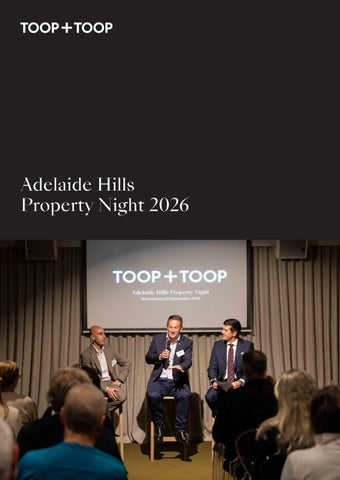
Adelaide Hills Property Night 2026
Thank you to everyone who joined us for our Adelaide Hills Property Night. It was wonderful to see the room so full, and we enjoyed the questions and conversations that carried on well after the formal part of the evening. We know many of you weren’t able to attend, and several of you have asked us to share what was discussed. We’ve brought the key points together here, from the latest market data to the panel discussion and questions from the floor. The overall picture for the Hills is a positive one, and quite different from what the national headlines suggest. More people are looking to buy here than a year ago, homes are selling faster, and the questions we’re being asked have shifted towards tax, planning and infrastructure. The evening wasn’t about selling anything. We simply believe people make better decisions about their homes when they understand what is really happening in the market, and we see sharing that knowledge as part of our role in the community.
On the Night Bronte Manuel, Owner of TOOP+TOOP, opened the evening and shared his perspective on the broader market. Alysha Brunoli from Domain presented the latest data on the Hills market. Josh Teague MP, Member for Heysen, spoke about planning, housing and infrastructure, and Ross from Moore Australia explained the recent tax changes. James Lindsay, Sales Partner at TOOP+TOOP, hosted the panel. The evening was also an opportunity to celebrate our new Hills office on the Stirling roundabout. We’re delighted to welcome Phil Crowder to TOOP+TOOP, alongside a Hills team who live locally, are raising their families here, and care deeply about the area.
The Hills Market in Numbers Presented by Alysha Brunoli, Domain
Alysha opened the evening with a comparison of this year against last, and the results were striking. Buyer searches across the Hills have risen 45%, while the number of homes listed for sale has increased by only 4%. Demand is clearly outpacing the homes available.
Average days on market
People searching each week
86
76,000
Average days to lease
41 35
68 52,000
2025
2026
2025
2026
Adelaide Hills, 2025 compared with 2026. Source: Domain.
Views of Hills rental listings are also up more than 28% on last year.
2025
2026
WHO IS LOOKING Most interest comes from within South Australia, at around 78% of people searching. Close to 9% are in Victoria and around 6.5% in New South Wales, which shows the Hills is firmly on the radar for interstate buyers as well. Enquiries are split almost evenly between people who already live in the Hills (46%) and those hoping to move here (45%). Within South Australia, interest comes from across Adelaide: around a fifth from the Hills itself, with similar numbers from both the northern and southern suburbs. WHAT BUYERS ARE SEARCHING FOR The most-searched features are a pool, a granny flat and a view, followed by a shed, a studio and character. It reflects what draws people to the Hills in the first place: space, a connection to the outdoors, and room for family, guests or a home office. THE IMPORTANCE OF SCHOOLS Local schools continue to play a significant role in where families choose to buy. The Stirling East Primary and Heathfield High catchments are two of the most-searched in our region on Domain, with close to 1,300 and 1,139 people respectively looking to buy within them. LOCAL MEDIANS OVER THE PAST 12 MONTHS Area
Home
Median
Stirling and Aldgate
4 bedrooms
$1.8m- $1.9m
Crafers
4 bedrooms
about $1.56m
3-4 bedrooms
$750k - 970k
Littlehampton and Naine
Mount Barker remains the most active market in the Hills, with close to 550 sales over the same period. For those who like to follow the market closely, Domain’s new forecasting report is a useful resource. Our team is also always happy to talk through what the data means for your particular street.
Where the Market Sits Today Perspectives from Bronte Manuel & James Lindsay, TOOP+TOOP
Bronte’s view is that Adelaide has reached the top of its cycle and is now fully priced. The Hills, however, has a number of qualities that may allow it to continue performing on its own terms. ADELAIDE AND THE EAST COAST Much of the more pessimistic coverage in recent months has focused on Melbourne and Sydney, where prices have fallen significantly. Bronte believes Melbourne is nearing the bottom of its cycle, while Adelaide is at the top, which places us in a very different position. He shared some helpful context: •
Adelaide has only recorded an annual decline twice in 42 years. Its pattern tends to be several years of steady 2–3% growth, followed by a period of double-digit growth.
•
Affordability sets the limit for Adelaide. Growth has historically levelled off once mortgage repayments reach about 40% of household income, and that figure is now around 55%.
•
He expects Adelaide to finish the year with growth of 1–2% at most, but does not anticipate an annual decline.
•
Headlines are worth reading carefully. One reported “8% decline” in Adelaide was in fact the difference between asking and sale prices, rather than a fall in values.
WHY THE HILLS CONTINUES TO PERFORM Bronte sees several reasons for this. Working from home has made the Hills far more accessible. A commute of two or three days a week is much easier to manage than five. There is also a growing focus on health, wellbeing and time outdoors, all of which the Hills offers naturally. And the sense of distance from the city has largely faded, with many families at city schools now living in the Hills. Bronte also noted data showing fewer cars on the freeway each day than in previous years, despite Mount Barker’s growth. WHAT WE’RE SEEING ON THE GROUND James described the current market as calmer and more considered than it has been in the past five or six years, but still healthy. Buyers are taking more time with their decisions, and banks are taking longer to approve finance. A year ago, around 70% of our Hills campaigns sold by the deadline. Today it is closer to half, with the remainder moving into a second phase of about three weeks. Where there were once five or six buyers competing for a home, there are now more often one or two, so each conversation matters. Open inspections are a little quieter, but the people attending are genuinely ready to buy. Most importantly, James noted, prices are holding. Sales are simply taking a little longer.
The Tax Changes Presented by Ross, Moore Australia, with market perspectives from Bronte Manuel and James Lindsay, TOOP+TOOP
The recent tax changes were the topic many guests were most interested in, and Ross explained them with great clarity. His first point was an important one: negative gearing and the capital gains discount have not been removed. Most of the changes apply to established properties purchased after budget night. For those who already own an investment property, the key date to note is 30 June 2027.
CAPITAL GAINS TAX For properties owned before budget night, any growth up to 30 June 2027 continues to receive the 50% discount. Growth from 1 July 2027 will be calculated under a new indexed method. When the property is eventually sold, the gain will therefore be divided into two parts, one with the discount and one without. This means investors will need a valuation as at 30 June 2027 to establish their starting point. Ross recommends engaging a licensed valuer, as the ATO will expect the figure to be supported by comparable sales. An agent’s appraisal letter is unlikely to be sufficient. New builds continue to receive the 50% discount. This includes adding new homes to land you already own, such as building apartments alongside an existing house. NEGATIVE GEARING Properties purchased before budget night are unaffected. Established properties purchased since can be negatively geared until 30 June 2027. After that date, losses are not forfeited. They are carried forward and can be offset against future rental income or used when the property is sold.
SUPERANNUATION From August, self-managed super funds can no longer borrow to purchase residential property. Existing arrangements are not affected. SUBDIVIDING THE FAMILY HOME Several guests asked how subdivision affects the tax-free status of the family home. If you subdivide and sell the rear block, the house remains exempt but the new block does not. If you demolish the home and subdivide, neither is exempt. Ross suggested working through the numbers before proceeding, as selling the home as it stands, tax-free, can sometimes be the better outcome. On acreage, the exemption covers the home and up to about two hectares (roughly five acres) surrounding it. Land beyond that is subject to capital gains tax. STAMP DUTY RELIEF FOR DOWNSIZERS Ross’s understanding is that the replacement home must be valued under approximately $2 million. Given Hills prices and the limited choice of downsizer homes, this may restrict how useful the concession is locally. WHAT THIS MEANS FOR THE HILLS Bronte believes the family home is now the most tax-effective asset most people own. As a result, he expects more owners to invest in renovating or upgrading their own home rather than purchasing a separate investment property. He also expects rents to continue rising, making it harder for first home buyers to save a deposit. For investors, his advice was not to base decisions on tax benefits alone. A well-located, distinctive home with good fundamentals is still likely to perform better over time than one of hundreds of similar new builds. James explained that the Hills is effectively two markets. Stirling, Crafers, Aldgate and Bridgewater are largely owner-occupied, so the changes have had little effect there. Mount Barker, Littlehampton and Nairne have a higher share of investors. Fewer investors are buying established homes in those areas, although strong demand for new builds has balanced this out.
Reviewing your Finance Perspectives from Ross, Moore Australia and Bronte Manuel, TOOP+TOOP
With the tax rules changing, the way your loans are structured has become just as important as the interest rate. Ross shared an approach some of his clients are taking. If your current home could become an investment property in future, it will still be eligible for negative gearing because it was purchased before budget night. Rather than paying that loan down completely and borrowing again for your next home, you can keep the loan in place and hold your savings in an offset account. The interest cost is the same, but you retain more flexibility for the future. Bronte encouraged everyone to review their lending regularly, noting that long-standing customers are not always rewarded for their loyalty and are often on rates that have fallen behind the market. He also suggested arranging access to funds while lenders are willing, and holding them in an offset account. That way, capital is available when the right opportunity arises, rather than needing to apply when lending conditions are tighter. These are general ideas rather than financial advice, and we’d encourage you to discuss them with your accountant or broker.
Staying in the Hills as Life Changes Presented by Josh Teague MP, with perspectives from Bronte Manuel and James Lindsay, TOOP+TOOP
This discussion resonated with many in the room. A number of long-time residents would love to stay in the Hills but no longer want the upkeep of a large garden, and at present there are very few homes that suit them. James mentioned one couple who are leaving Stirling after 50 years for exactly this reason.
HOW MUCH NEW HOUSING IS PLANNED Josh explained that relatively little is planned. The Greater Adelaide Regional Plan allows for about 810 new homes a year across the Adelaide Hills and Mount Barker council areas, around 645 of which are in Mount Barker. Apartments make up only about 1.4% of homes across both council areas. Around Stirling, Crafers, Aldgate and Bridgewater there is very little vacant land, so any new housing there will come through infill. GRANNY FLATS AND SECOND HOMES This is where there has been real change. Since December 2024 it has become much easier to build a second home on your existing block without creating a new title. Options range from a granny flat of up to 60 square metres to a fully self-contained residence attached to the main house, with its own kitchen and laundry. Local requirements such as bushfire safety and wastewater still apply. One guest is currently building a two-bedroom home on his 20 acres and shared that, with some patience through the council process, it is very achievable. For many families this opens up valuable options, whether that’s keeping parents close, helping adult children get started, or downsizing without leaving their own land. SUBDIVISION Josh explained that the former 4,000 square metre minimum in the Adelaide Hills Council area no longer applies. In country living zones, about 2,000 square metres is now the general guide, and smaller blocks can be approved where there is a strong case. James added that within the Stirling township, two blocks of around 450 square metres were recently approved through a non-complying application. LOOKING AHEAD Bronte observed that many families move from the Hills to the eastern suburbs for schooling, and then don’t return once their children have left home. It isn’t for lack of wanting to, but because there are so few low-maintenance homes to return to. He believes well-designed density that is sympathetic to the area will be part of the solution, and that more families will choose to share larger properties across generations. On a positive note, Josh has seen growing numbers of people in their 30s and 40s moving into the area, drawn in large part by our excellent local schools.
Roads, the Freeway and Stirling Presented by Josh Teague MP
For those of us who live in the Hills, roads and infrastructure are part of daily life, and they influence property here more than almost anywhere else in Adelaide. Josh noted that more than 70% of enquiries to his Stirling office relate to roads and infrastructure, so it was a natural topic for discussion. The freeway was front of mind, particularly as a truck breakdown had caused significant delays earlier that day. Josh acknowledged that the long-promised contraflow system is well overdue. In his view, the most realistic improvements are express buses, additional lanes and moving as many heavy vehicles off the freeway as possible, with the Truro freight bypass forming part of that. One guest suggested restricting trucks during peak hours, as is done overseas, and Josh was supportive of exploring the idea. A Hills rail line has been investigated, but at an estimated $7–9 billion it is not considered viable in the foreseeable future. Josh also encouraged us to keep Mount Barker’s growth in perspective. It is steady rather than rapid, and as more people both live and work in Mount Barker and Murray Bridge, pressure on the freeway may ease. Closer to home, Stirling has been through a difficult few years since the 2023 fire at the Woolworths site. The rebuild is well under way, and there is real optimism about what it will bring to the main street.
Prepare to Sell Perspectives from Bronte Manuel, TOOP+TOOP
One guest asked what is worth doing to a Hills home before selling. Bronte’s advice was to focus on what buyers can see, rather than what sits beneath the surface. A new irrigation system or updated fittings rarely return their cost, as most buyers simply don’t factor them in. What does make a difference is a well-kept garden, cleared gum leaves and inviting outdoor spaces. Buyers naturally assume a property always looks the way it does on the day they visit. Timing can help too. Spring is an ideal time to sell in the Hills, when lawns, paddocks and trees are all green at once. Buyers moving up from the eastern suburbs often pay the strongest prices, so it’s worth presenting the home with them in mind. Above all, we’d encourage you to speak with us before spending money on improvements. We would much rather help you avoid costs that won’t add value.
Thank You Our sincere thanks to Alysha, Josh and Ross for so generously sharing their time and expertise, and to everyone who attended and contributed such thoughtful questions. Evenings like this remind us how fortunate we are to be part of the Hills community. If anything here has prompted questions about your own plans, whether that’s arranging a valuation ahead of June 2027, understanding what your land may allow, or simply knowing where your home sits in today’s market, we would be glad to meet with you. There’s no obligation, just an open conversation. We look forward to seeing you at our next event. Warm regards, The TOOP+TOOP Adelaide Hills