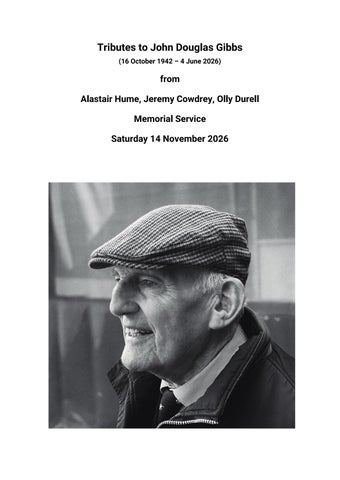
Tributes to John Douglas Gibbs (16 October 1942 – 4 June 2026)
from Alastair Hume, Jeremy Cowdrey, Olly Durell Memorial Service Saturday 14 November 2026
Tribute from Alastair Hume (FH 56-61) My name is Alastair Hume, and I had the dubious privilege – I’ll explain my use of the word “dubious” in a moment, so please, bear with, as I believe the expression is – of entering Ferox Hall on the same day as John in September 1956. Now this is a shade over 70 years ago and, in deference to those contemporaries who are here today, I will just say at this point that the memory is not what it was, if indeed it ever even was what it was, and, as somebody very famous, I can’t quite remember who, pointed out recently, “Recollections may vary”. The reason I used the word “dubious” is because it was immediately apparent that John was everything I was not. He was tall, he was slim, he was ruggedly good-looking, and he moved with the easy grace of the natural athlete. However, I quickly realised that John just did not think like this; there was no side to him, and even at that time he treated everyone with respect and courtesy, and so the privilege became absolute. We did many things together during our time at the School. As well as both singing in the choir, we also both played in the school orchestra, John a stalwart of the viola section, indeed sometimes he WAS the viola section, and I played the double bass. Tonbridge in the 1950s was understandably not the school it is today, and it would be fair to say there was not a queue of boys at the door of the Music School clamouring to learn a musical instrument. So John and I reluctantly had to conclude that our rendition of Beethoven’s 5th Symphony did not perhaps sound quite as originally envisaged by the great Ludvig van. John was a great thespian, and Ferox put on a House play during our time. It was fully staged in Big School, and produced and directed by Paddy Mac, who was inspirational. The play was called “My Three Angels”, and John had a starring role as an angel. However, the title was slightly misleading, as the “angels” in question were in fact inmates of a French penal settlement, so John got to play the ideal role for him, that of a hardened, ruthless gangster. A small group of us in Ferox, with the abundant self-belief of youth, decided we were talented enough to put on a revue. I seem to remember this was sparked off by a short line John came out with one day, which we all thought was witty, sophisticated and a bit enigmatic, and would make a great punch-line. We then had to work backwards to concoct a whole sketch which would make John’s punch-line relevant and irresistibly hilarious. We inflicted this on our fellow Ferocians, and John duly delivered the punch-line, which went down a storm, I suspect rather more because it was John delivering it rather than the line itself having any great merit. And what is the line, I hear you cry; in its entirety it was “Lo, the Pezel cometh”…..no, me neither. The then Headmaster, Rev Lawrence Waddy, was a man of deep faith. Whenever I visited him in his retirement in California, we would talk of Tonbridge days, and in particular of how he would have tunes and melodies flooding into his head as he drove around Tonbridge. He somehow recorded them, and enlisted the aid of my father to write them down, notate and harmonise them, so that he could then put words to them. He particularly loved setting the Parables, and I remember that we did the Parable of the Prodigal Son in the upstairs room in the Music School. I have the clearest picture in my mind of John, playing the son’s father, teetering precariously at the top of a tall stepladder, hand shading his eyes, as he scanned the far horizon, also known as the doors at the back of the concert hall, for what he hoped would be a prodigal son – Oscar-winning stuff. The only thing was that thereafter, on the rare occasions we were together and happened to be passing a stepladder, John would insist on
shinning up it in order to reprise his starring role, eyes shaded against the bright Middle Eastern sun as he scanned the school grounds for any random prodigal sons. Once a year, the House would gather in the dining-room after supper for an old-fashioned sing-song. We sang the same songs, and one or two of them were a bit racy. One of these was actually a folk-song by Benjamin Britten, so that was alright then. Another was very much racier, but it seemed that the racier the number, the louder Paddy Mac would roar it out in his resonant, if slightly agricultural, baritone. There was another which required us all to reproduce the sounds and actions of playing musical instruments. Now Paddy Mac suffered from hay fever, and the snorts which perhaps used to come during the season had, I think, become something of a year-round tic. Paddy always enjoyed himself thoroughly, and threw himself into renditions of his big bass drum, and bass trombone, and the more animated he got, the more snorts were heard, until there were almost as many snorts per bar as there were notes of music. John had such a gift that, although Paddy doing it was marvellously funny, John’s impression of Paddy doing it was hilarious, because it was understated, absolutely on the button, and done with great affection. On leaving School, we both went to Cambridge and read law, John at Trinity Hall and I at King’s. We therefore stayed close through university, such that John wanted to let me know in the late 60s of his plans for life and his career. He wrote to say that he didn’t think he was cut out to be an engineer at Vickers, nor a lawyer, having done a stint at a Magic Circle firm, and so he was taking a sabbatical year back at Tonbridge to work out what he was going to do next. Nearly 50 years after I left the School, my son entered Ferox as a boy. I was therefore down often as a parent, and I was so pleased that John was still there. Whenever I was and John happened to be riding past on THAT bicycle and spotted me, he would execute some unfeasibly dangerous manoeuvre, involving much wobbling and dodgy brakes, so as to end up alongside me for a chat. By this time John had been back at Tonbridge for over 40 years. These chats were always fun and invariably contained some variation on the following theme: “So, John, how’s the sabbatical year going?”, and John with that tilt of his head and slow blink would reply: “It’s going pretty well actually, Al, I’m about halfway through, and I’ll probably do the other half and see where I go from here”. One final thing from me. At the beginning of his final year at Tonbridge, my son damaged his knee in the very first rugby match of the season, playing for the School 2nd XV. It required surgery, and this meant he did no sport at all during his final year; none of the sports that John was involved with, rugby, rackets, hockey and cricket, when he was in line to be captain of the first XI. John took the trouble to send four sides of a hand-written letter, commiserating, yes, but totally empathetic and constructive. It was written as between equals, one gifted injury-plagued sportsman to another. This seemed to me to sum up a man who looked out for and had time for everybody else and never himself, immensely kind and giving and always on your side, and, except when he was lining up the opposition fly-half who was unwisely going down John’s channel, rugby ball in hand, he really was a true gentleman.
Tribute from Jeremy Cowdrey (PH 73-78) Can you remember the seat John sat in when you were last here in this chapel. Because I’d like you to picture the discomfort on his face as we talk about him and celebrate him… in particular the nervous chuckle… the Gibbo giggle. And perhaps for a few minutes we should inhabit ourselves as 13-year-olds, 15-year-olds and 18-year-olds. Extraordinary years, sometimes exhilarating, sometimes angst-ridden and often precarious. Suddenly, from the safety of our parents and family, we decide to set out on our own. And the problem is, that all too often you are on your own. You are desperate for help but won't let anyone help. Because no one understands you. Enter Mr Gibbs. For thirty years he weaved his selfless magic at Park House. Firstly, as house tutor supporting the incomparable David and Marion Kemp, and then as Housemaster. Much is made of the fact that John was given a boarding house to run as a bachelor, without the support of a wife. The Headmaster, Christopher Everett was apparently looking for a day house for him, but fortunately David Kemp persuaded him to ask Gibbo to continue at Park House. John took to it like a duck to water. He armed himself up with outstanding matrons and fantastic cooks and never looked back. Quite simply, every boy knew that Mr Gibbs had their back. He was interested in and cared about each boy. He would know everything about you… your parents, your siblings, your likes, your foibles, the lot. The expression emotional intelligence is currently all the rage. Little did we understand all those years ago that, living in the remarkable worlds of Kemp and Gibbs, we were experiencing a masterclass in emotional intelligence. John was a master of the blind eye. He always knew when to leap in and, more usually, when to let things run. Sometimes people made the mistake of thinking he was a pushover. The day boy who brazenly came into class saying that he had left his prep at home was surprised when, ten minutes into the lesson, Mr Gibbs asked the class to quietly read something and said to the boy:
"Follow me – I'll give you a lift home and we can pick up your prep. Is your Mum at home?" Halfway across the quad on the way to the car, the confession came… there was no prep. And if on occasion something serious had gone on in the house he was a genius interrogator! Suspects would be summoned one by one. He would drop in a couple of facts, bluffing all the way. The boys would become convinced he already knew everything, so they might as well spill the beans to keep in with him. Matt Seymour tells of getting a bit excited playing yard football and slicing a ferocious shot over the fence straight into Gibbo's study window, where it cracked the glass. When he sheepishly reported to Mr Gibbs’s study, he found him engrossed in paperwork. John hardly glanced up as he tossed the ball over with one hand. "Ah, Matt, missed again I see?" Of course, we all picture Gibbo on his bike. And let's think about that. He was on his bike because he was here, there and everywhere. He'd be watching first teams to Under-14 Ds and then speed off to hear a boy playing the violin… oh, and then to check up on a boy in the San. He cared. He cared so much. This humble and kind man instinctively understood that his presence on a touchline, in an audience or in a congregation would make one boy at a time know that he was special and someone cared about him. And at the same time, John’s payback was that he got to understand that boy just a little bit more. And by the way, he understood the mothers as well! Year after year a new batch of Mums would appear… thinking that they needed to look after Gibbo. He didn't need looking after. The looking after worked the other way, as they gradually realised their precious sons were in the most special of hands. What a gift. In fact, one of Gibbo's more remarkable achievements was to hold out as a bachelor despite all the scheming from generations of Park House mothers! It would be easy to think that John had no time for anything but Tonbridge, but he was a massive family man and was always looking out for his vast collection of sisters and brothers. They were incredibly close. And then there was his other family, the Harlequins. His father Clifford played for the Quins and John followed him, playing in the Centre, having had three years in the Tonbridge XV and then getting his Blue at Cambridge. John being John then worked tirelessly for the Quins in many capacities.
People speak warmly about getting John's handwritten postcards. He would write about seventy a week after Monday night’s training session, to inform people what team they were in and where to report to on Saturday. He did all that in between teaching and taking sport. Quite incredible. International rugby player, Jamie Salmon told me last week that John would sit very quietly at Harlequins committee meetings… but when he spoke everyone listened. It is no wonder that he was perfectly qualified to take the 1st XV at Tonbridge for so many happy and successful years. I might have painted Gibbo as some sort of saint? That would not be totally accurate. Those of us lucky enough to tour with him for that great cricket team the Trogs will recall how, late in the evening, he might suddenly jump up on a chair and sing unsavoury songs, presumably learnt from his rugby career. I remember my first tour to Somerset, staying at the Dunkery Beacon, a charming hotel. The proprietor had some splendid old swords on the walls above the staircase. I had only recently left Tonbridge and had managed the seamless transition from Mr Gibbs to Gibbo… but I wasn't prepared for him transitioning, after the fifth pint, into a dangerous-looking d'Artagnan challenging anyone to a duel. But equally, on tour he would be the constant voice of reason. A moderate performer on the field of play, he became a major asset if there had ever been an incident. He would be our man to “keep the fixture” – as it became known. This involved charming the opposition and drinking with them till they dropped. John played his golf predominantly at Royal St George's – always foursomes. It is fair to say… he was not a good golfer… but he was a brilliant partner and such fun to play with. Invariably as the four of us set off down the first fairway he would lob in a contentious hand grenade in his innocent way: “what do people think about…” and once he’d asked the question he’d watch as we all argued about it while he kept his counsel… quietly chuckling away. John kept reinventing himself as I’m sure we’re going to hear later. But I would like to mention the brilliant job he did engaging young OTs in the cause. I would get a photograph from my son at university in Durham, on the occasions that he bumped into Gibbo in Klute, the local nightclub. John would be dressed as though he was in the Rose and Crown in Tonbridge. Everyone just loved seeing him and he’d be mobbed.
After John died the School received a tsunami of letters from far and wide, and, in particular, from Park House alumni – many of whom are here today. One of you misquoted Churchill, in describing John as: “A modest man with absolutely nothing to be modest about.” So many used the same words: empathetic, kind, caring, great fun, our friend and a proper school legend. And more than a few from his beloved Park House, offered this same final sentiment: "No family? We were his family."
Tribute from Olly Durell (PH 03-08) JDG By the time my generation arrived at Tonbridge, John had served his years as a Housemaster and had, to use a sporting analogy early on, moved into a ‘Utility player’ role in the common room. Boys interacted with him in a variety of ways, from a Business Studies classroom, to a 3rd XV rugby training session. He had a well-established reputation within the school, embodying so many Tonbridgian values we hear of – determination, humility, competitiveness. I have thought a lot about just why Gibbo resonated so powerfully with my cohort. One conclusion I drew was that he never made anything about himself. Upon making it onto the 50 training squad to compete for a place in the 1st XV, the three main strike moves by a Tonbridge midfield in the late Naughties were Judd, Rangy and…Gibbo. He had permeated into the language, not just become a familiar old face. You were never lectured about the past, or told how to navigate a matter, whether dealing with a Housemaster you didn’t quite see eye to eye with, or how to run a backs move. But he was always there, observing and guiding boys and staff alike. His willingness to help and contribute was arguably his defining feature. Transportation was a common theme when talking to OTs ahead of today. Boys driven up to Rackets matches midweek, or on one occasion a boy who missed the bus to a cinema trip during pre-season still made the showing at the Odeon in time. Because he got a lift with Gibbo. It was a fond anecdote of the OT Rugby Football Club contingent that Gibbo would arrive at a far flung away match on his bicycle. “Come far Gibbo?”, “oh just from School.” The match was in Portsmouth. We never knew how he made it home, but he did, and he’d be there again next week. John’s contribution to the OT Cricket Club was immense. The roles he took on for years, mostly informally, kept the club bubbling away and boys enjoying hours of cricket having left school. The infamous 2-day games against the Charterhouse Friars, Cricketer Cup campaigns up and down the country and the Sevenoaks Vine 8 a side (where the OT’s were rarely beaten) were all hallmarks of John’s involvement with the club and desire to keep boys engaged with old boys sport. Following victory in the 2007 Cricketer Cup, the squad were invited to celebrate their triumph in Reims by the sponsors at the time. As all trips to Champagne do, the brief visit culminated in a singles press-up competition in the street outside a respectable restaurant. The winner, inevitably: JD Gibbs Esq. John represented that feeling of presence, of consistency. At an institution like Tonbridge which is constantly striving for excellence, a lot must and does evolve, but other elements remain lovingly consistent. Gibbo, from boy to teacher, housemaster, coach and later embodiment of the OT community, was that consistency. Gibbo was not perfect, however, and in certain areas could be a little stuck in his ways. Boys under his coaching on the rugby pitch were sometimes heard to mutter a desire for a little more attacking flare and invention than simply ‘Boys, we will pass the ball through the hands and Piers will score in the corner.’ OT’s playing in the Halford Hewitt, the Noel Bruce or the Cricketer Cup would all look to the edge of a putting green, the gallery at Queen’s or the scorebox on The Head and there he’d be. Winter was a long black sports raincoat, flat cap. Pint of Harvey’s afterwards. Summer
was an OTCC tie. Pint of Harvey’s afterwards. But this wasn’t a man of a certain generation stuck in the past, dreaming of former glories. It was an OT revelling in Tonbridge continuing to thrive, to produce GOOD boys, pushing to compete and to win, in everything we do. Just ask poor old Jamie Oliver who was on the receiving end of a JDG dump tackle during a training session in which it was deemed the boys needed to stiffen up a little in defence. And to me that is why so many of us are here today. I would imagine I speak for many OT’s when I say that a Tonbridge education was the single greatest opportunity bestowed upon me. Not simply for the facilities and the quality of teaching, but for the culture and the values it set in me and my peers. John represented a humility that I believe Tonbridge has continued to produce in boys – there is no allowance for ego, there is no sense of self – it was about Tonbridge, about the boys, about the team. I am not laying it solely at John’s door, as it is centuries in the making, but he served tirelessly to preserve and progress it. In 1934 James Hilton produced a novella about the life of a school teacher at a fictional boys boarding school. The teacher in question did not have any children of his own, outlasted a number of his peers, remained a dedicated servant to the school and acquired a fond nickname from the boys. Towards the end of his time, he is quoted as saying “I thought I heard you saying it was a pity... pity I never had any children. But you're wrong. I have. Thousands of them. Thousands of them.” In summary, we remember so fondly a man who impacted us all greatly and who displayed every value that current Tonbridge students, the Common Room and OTs could possibly hope to represent. Goodbye, Mr. Gibbs.