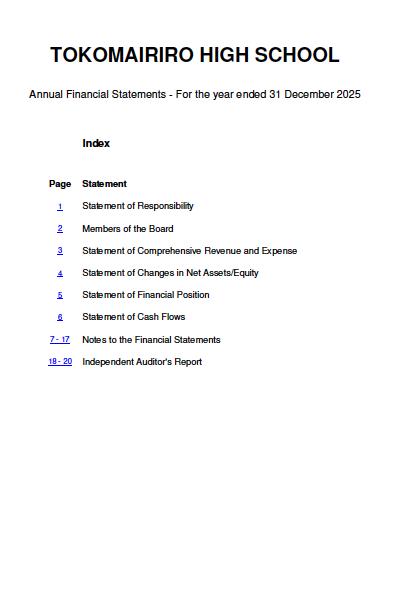
Tokomairiro High School 2025 Annual Report

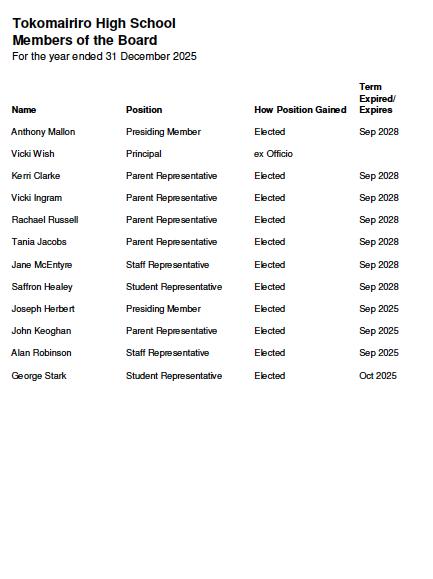
Board member names
Date that the board member’s term finishes
Tony Mallon (Presiding Member) September 2028
Kerri Clarke September 2028
Tania Jacobs September 2028
Jane McEntyre September 2028
Rachael Russell September 2028
Vicki Philip September 2028
Saffron Healey September 2026
Joeseph Herbert (Presiding Member) September 2025
John Keoghan September 2025
George Stark September 2025
Alan Robinson March 2025
Strategic Goal 1:
Excellence in Teaching and Learning so that all ākonga can find their own voice and develop the self-assurance and skills to achieve their dreams.
Annual Target/Goal:
v To accelerate student achievement in literacy and numeracy across the curriculum, while improving NCEA outcomes and attendance, with a strong focus on equity and priority learners.
Specific 2025 Targets
• At least 80% of eligible Year 11 students achieve NCEA literacy co-requisites and 75% achieve numeracy.
• NCEA achievement targets:
o Level 1: 70%
o Level 2: 85%
o Level 3: 80%
o University Entrance: 40%, with increased endorsement rates including at least one Excellence endorsement.
• Curriculum level expectations:
o Year 7: At least 75% at or above expected curriculum levels in reading, writing, and numeracy.
o Year 8: At least 75% at or above in reading and numeracy, and 70% in writing.
o Year 9: At least 80% at or above in reading and numeracy, and 75% in writing.
o Year 10: At least 80% at or above in reading and numeracy, and 75% in writing.
v Structured literacy and structured numeracy practices embedded consistently across Years 7–10.
v Improved attendance and retention across all year levels, particularly for Māori and Pacific ākonga.
Actions
List all the actions from your Annual Implementation Plan for this Annual Target/Goal.
Action 1
Priority learners identified, monitored and reported to the Board regularly
Action 2
To further embed structured literacy
Action 3
To develop explicit teaching of literacy and numeracy across the curriculum
Action 4
Develop Professional growth cycle for all teaching staff
we achieve?
What were the outcomes of our actions?
What impact did our actions have?
Priority learners were successfully identified at the start of the year and monitored throughout the four terms.
Students requiring additional support to achieve the Literacy and Numeracy CAAs were identified and given intensive intervention.
Structured literacy was taught across all of Year 7 and 8 and with selected students from Year 9 upwards.
English and Maths teachers led internal PLD to develop explicit teaching strategies for literacy and numeracy across all curriculum areas. English teachers shared writing templates and reading strategies; these are now displayed in every classroom.
All teaching staff completed their professional growth cycle, supported by dedicated time in the meeting schedule.
Evidence
This is the sources of information the board used to determine those outcomes.
Priority learner tracking lists. Board Reports. Department Reports.
Reasons for any differences (variances) between the target and the outcomes
Think about both where you have exceeded your targets or not yet met them.
N/A
Planning for next year – where to next?
What do you need to do to address targets that were not achieved.
Consider if these need to be included in your next annual implementation plan.
Continue to identify and support students through various levels of intervention to allow students to be successful.
Department reports
Structured literacy data
Department planning of structured literacy.
Class list of priority students who took both Literacy and English
Department minutes
Staff Meeting minutes
HOD meeting minutes
SLT meeting minutes
Staff on PD
Classroom wall information
Professional Growth Cycle records.
Targeted delivery ensured high-needs students in senior levels received specific support.
This was well-received in Literacy; however, Numeracy was less structured due to leadership challenges within that department. Staff feedback indicates these literacy resources are extremely useful for crosscurricular consistency.
Allocated time ensured 100% completion and more consistent engagement.
Continue to integrate structured literacy.
Embed practices during 2026.
Created a shadow coaching framework to support the PGC.
Action 5
Literacy and Numeracy Data shared with teachers of all subjects in Term 1
Action 6
Quantitative data of all students progress in relation to curriculum level is reported on to Management and the BOT.
Action 7
Teachers of all subjects’ report of literacy and numeracy teaching within their own areas
Action 8
All teachers will report, twice a year, on the progress of ākonga based on quantitative data alongside written next steps.
Action 9
Embedded structured numeracy within Year 7-8 classes.
Action 10
To incorporate and embed accelerated learning in literacy (ALL) within the Homeroom class.
Action 11
Raise student aspirations by giving them experiences that open their world to the range of opportunities, such as University trips.
Action 12
Begin to identify and address GATE students through testing, observations and support from LSC
Literacy and Numeracy data was shared with all subject teachers in Term 1 to guide differentiated planning.
Quantitative student progress data was reported regularly to Management and the Board.
The department reporting structure was revised, requiring all departments to report specifically on their literacy and numeracy teaching and student progress.
The school’s general reporting structure was changed to allow all teachers to provide written comments on all students twice a year.
Prime Numeracy was followed in Years 7 and 8, supported by specific teacher PLD.
Year 7 and 8 teachers participated in the ALL (Acceleration in Literacy) Programme and received associated PLD
Music students visited the University; however, the larger planned school trip did not take place.
The LSC trained staff on GATE criteria and identification; some students accessed opportunities in this area.
Term 1 staff meeting minutes. N/A
Board reports. Department reports.
Department reports.
Updated student reports.
Department planning.
Department planning.
Trip documentation.
Meeting minutes LSC Reports
Strategic Goal 2:
Grow cultural awareness and develop a greater sense of belonging so that all ākonga feel a sense of connection to the school. Annual Target/Goal:
All staff making measurable progress toward Level 5 in the school’s Culturally Responsive Matrix Actions
List all the actions from your Annual Implementation Plan for this Annual Target/Goal.
Action 1
Consult with the wider school community about the strategic plan 2026-2028
Data collected from staff and students; community consultation initiated.
Data collected from staff, students and caregivers.
N/A
This shift ensured that literacy and numeracy became a documented priority across all curriculum areas, not just in English and Maths.
This was implemented to ensure parents receive comprehensive, holistic feedback on student progress across the board.
While Y7/8 followed the Prime structure, school-wide numeracy was impacted by HOD organisational issues.
Participation in this national program provided teachers with specific tools for rapid progress.
The large-scale trip fell through but has been prioritised for 2026
Identification is improved, but consistent GATE programming remains a work in progress.
Adopting SMART testing so will need to develop systems to analyse this data and explain data to caregivers.
Continue to embed.
New report structure will be needed to reflect the data from the SMART testing.
SLT support to enable schoolwide numeracy to be further embedded and tracked.
To embed new learning across the Year 7/8 curriculum.
University trip planned for May 2026.
Continue to develop GATE procedures.
any differences (variances)
Planning for next year – where to next?
What do you need to do to address targets that were not achieved.
Consider if these need to be included in your next annual implementation plan.
Put on hold as the Strategic Plan deadline was pushed back a year.
Re-engage community consultation in 2026 to align with the new strategic timeline.
Action 2
Analyse data for teaching and learning.
Increased understanding of internal stakeholder needs.
Regular analysis at all levels; department reports reformatted for detail.
Teachers are better equipped to identify learning gaps and track progress accurately.
Departments used a Departmental improvement framework to identify areas for improvement.
Department reports Department Improvement Frameworks
Action 3
Analyse data for monitoring engagement through effort grades
Pastoral team meets fortnightly to review effort grades.
Rapid identification of disengaged students, allowing for timely pastoral intervention.
Minutes from meetings
Action 4
Analyse and monitor attendance data to ensure high attendance.
Action 5
Develop school wide wellbeing strategies and develop an action plan
Regular SLT analysis; data shared with Board/Community. Significant increases in 2025.
Improved school-wide attendance culture and higher visibility of attendance trends.
Wellbeing team formed; progress made toward an overarching plan.
Strategic focus on student/staff wellness is becoming more formalised.
Action 6
Collect student voice on student attitude to school
Action 7
Positive communication and celebration of learning/achievements
NCEA Level 2 Stats class analysed student voice data.
Data-informed decision-making; students feel heard through the peer-led analysis.
Audit logs Everyday matters reports Board minutes
Wellbeing team minutes
Survey data and analysis
"Stars of the Month" and sports/attendance achievements celebrated in assemblies. Past copies of Genesis Facebook
N/A - Targets met through systemic reformatting of reports.
Continue using the new format; focus on cross-departmental data sharing.
N/A - Target met via consistent meeting schedule.
Maintain fortnightly cycle; refine intervention strategies based on grade trends
Exceeded: Presence of an on-site attendance officer significantly boosted results.
Retain attendance officer role; continue transparent data sharing with the community.
For 2026 incorporate and follow Attendance Management Plan.
Plan is still in development phase; not yet fully implemented.
Finalise the overarching wellbeing plan and begin implementation phase.
Exceeded: Success of using a senior class for analysis added educational value.
Repeat and extend this model.
N/A - Consistent celebration of achievements achieved
Continue multi-channel celebrations (assemblies, entrance, and Facebook).
Increased visibility of student success; used Facebook for community celebration Action 7
Teachers participate in learning haka/waiata and karakia.
Karakia integrated into lessons and lunch; new waiata learned for competition.
Normalisation of Tikanga Māori in daily school life; high teacher participation
Action 8
Teachers professional goal to develop cultural competency as part of professional growth cycle
Action 9
Enhance the school environment to create a sense of belonging and reflect the bicultural nature of New Zealand
100% of teachers included cultural competency in their Professional Growth Cycle.
Physical environments
Classroom observation data
Youtube videos of cultural competition
Professional growth is now explicitly aligned with bicultural practice PGC documents
Phase 1 of bicultural signage installed; classrooms made more engaging
Environment better reflects the bicultural nature of New Zealand
Action 10
Relocate Te Kaika / Homeroom altogether into an area and develop this as their area.
Action 11
Give students cultural experiences that open their world view and allow them to connect with other ākonga
Relocated to a dedicated area with funded equipment and a successful camp
Strong positive community feedback and a dedicated "hub" identity
Two trips to Tokyo; nearly 20% of the school participated
Cemented a long-term relationship with a Japanese sister school
Signage
N/A - Strong staff engagement in cultural practices.
Embed these practices further into the daily school structure.
N/A - Full compliance across all staff members Review PGC outcomes to identify specific areas for deeper cultural growth
N/A - Phase 1 successfully completed Move to next phase of environment enhancement to increase sense of belonging
Exceeded: Funding and camp success improved student connection
Further develop the hub as a central point for student lunchtime activities
Report from Tokyo Facebook posts
Exceeded: Massive milestone with very high student participation
Sustain the relationship with the Japanese school for future cohorts
Explore options of a North Island trip
Reading
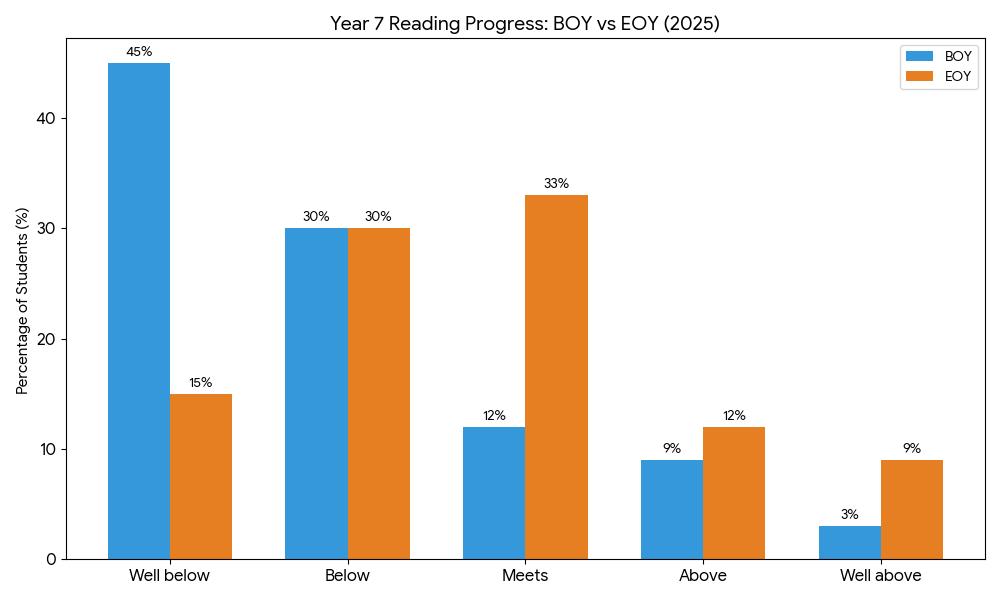
• Significant Reduction in "Well below": This cohort arrived with very low literacy levels, with nearly half (45%) starting the year "Well below." By year-end, this category was reduced significantly to 15%.
• Movement into "Meets": There was substantial growth in students reaching the expected curriculum level, with the "Meets" category increasing from 12% to 33%.
• Top-End Growth: The number of students achieving "Well above" the expected level tripled, moving from 3% to 9% by the end of the year.
• Ethnicity
o Māori Students: All Māori students showed improvement. By the end of 2025, 6 out of 10 students met the expected level, with an additional 2 students achieving "Above" or "Well above."
o Non-Māori Students: Contributed to the overall positive movement across all categories, helping to shift the cohort average toward the "Meets" and "Above" tiers.
o Strategic Focus: Maintaining the high rate of success for Māori learners while addressing the remaining students still in the "Below" categories.
• Gender
o Male Students: Showed strong recovery at the foundational level, with the number of boys in the "Well below" category dropping from 7 down to 2.
o Female Students: Similarly showed positive movement, with the number of girls in the "Well below" category decreasing from 8 down to 3.
o Strategic Focus: While both genders have increased achievement, there is an ongoing concern for the students remaining in the lower categories, requiring continued targeted support
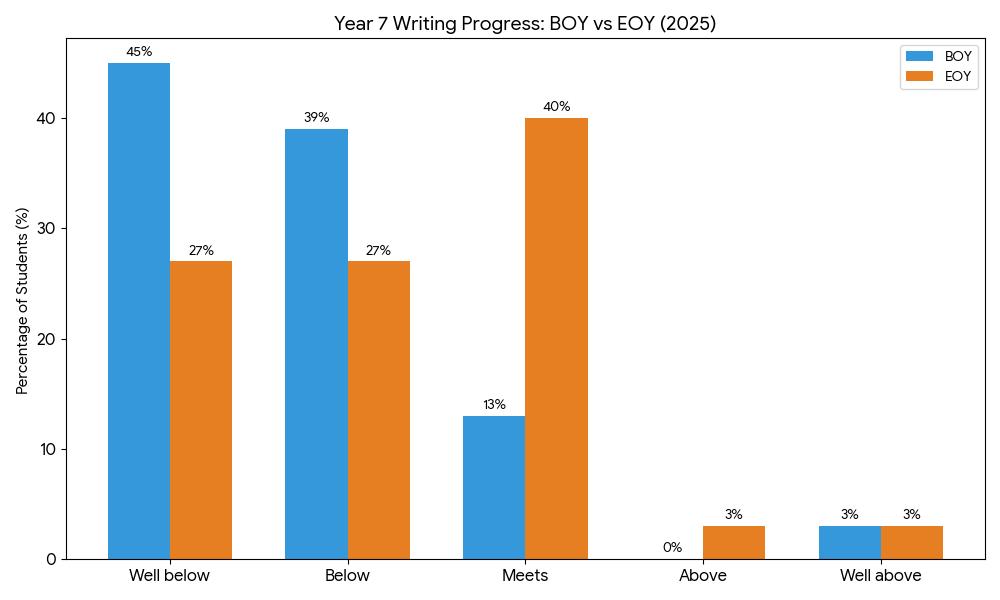
• Substantial Foundational Shift: The cohort arrived with high needs, but the "Well below" category saw a significant reduction, dropping from 45% to 27%.
• Tripling the "Meets" Category: There was a marked migration into the expected achievement band, with the "Meets" category growing from 13% to 40%.
• Overall Movement: While 54% of students remain in the "Below" or "Well below" categories, this represents a major improvement from the 84% recorded at the start of the year.
Equity Considerations
• Ethnicity
o Māori Students: Our 10 Māori students showed improvement throughout the year, with 60% (6 students)finishing the year working at the expected level.
o Strategic Focus: Continue to build on this success to move the remaining 4 Māori students into the "Meets" bracket through high-interest topics and connection-based writing.
• Gender
o Male Students: Overall, male students showed a greater degree of improvement across the year compared to their starting points.
o Strategic Focus: Addressing the specific needs of students (both male and female) who struggle with surface features punctuation and spelling and stamina for completing complex pieces.
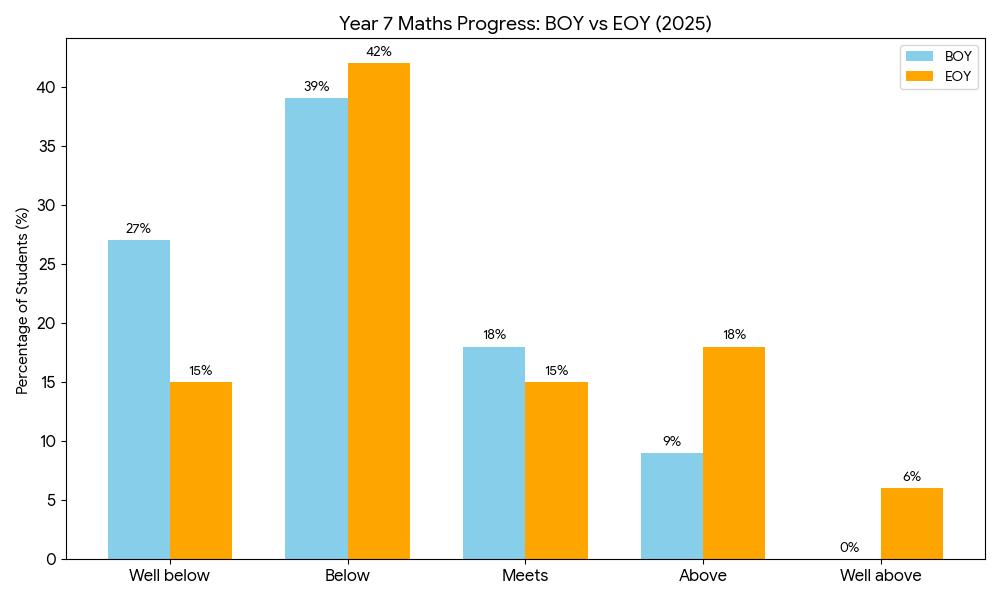
• Positive Movement at the Extremes: The most significant progress is seen in the "Well below" category, which dropped by 12%, and the "Well above" category, which grew from 0% to 6%.
• The "Above" Growth: The percentage of students working "Above" doubled during the year, moving from 9% to 18%.
• The Middle Shift: While the "Meets" category saw a slight dip of 3%, the "Below" category saw a slight increase of 3%, likely due to students moving up from the "Well below" bracket.
● Ethnicity
○ Māori Students: Maintained 0% in the "Well below" category throughout the year. There is a high concentration in the "Below" bracket (78%), but also the highest percentage of students reaching "Well above" (11%).
○ Non-Māori Students: Showed steady distribution across all levels, with 46% of the cohort finishing the year at "Meets" or higher.
○ Strategic Focus: Moving the "Below" Māori cohort into "Meets" and "Above" through targeted extension.
● Gender
○ Male Students: Demonstrated the strongest upward mobility, with 25% of the cohort moving into the "Above" category by year-end.
○ Female Students: Showed significant resilience, reducing the "Well below" group from 54% to 31%. However, they remain more concentrated in the foundational levels compared to their male peers.
○ Strategic Focus: Accelerating the transition of female students from "Well below" and "Below" into the "Meets" category.
Reading
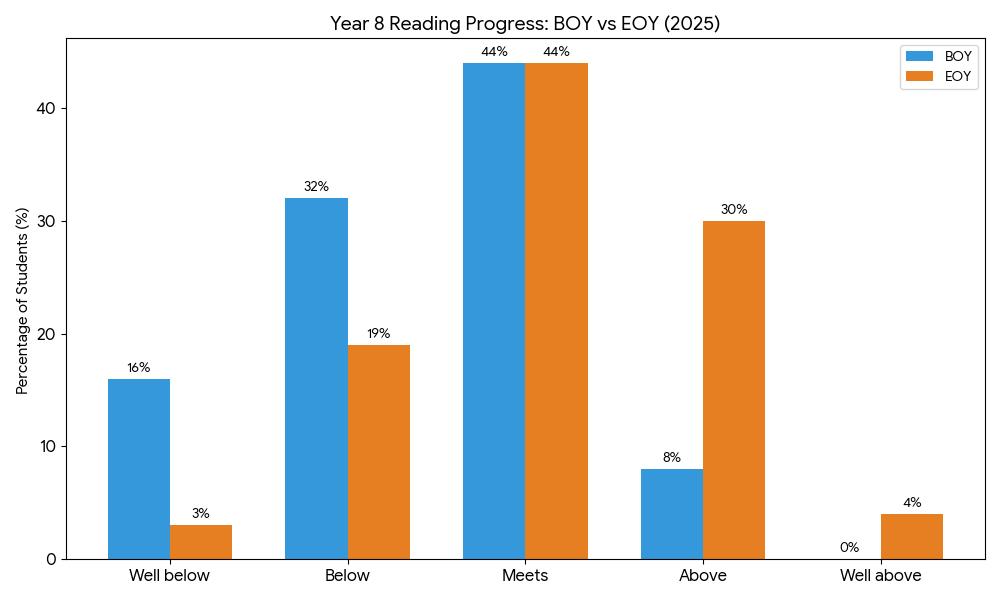
• Significant Movement from Foundations: The most substantial progress was seen in the reduction of the "Well below" category, which dropped from 16% to 3%.
• Acceleration into "Above": There was a marked increase in students exceeding curriculum expectations, with the "Above" category growing nearly fourfold from 8% to 30%.
• Stability in the "Meets" Band: The "Meets" category remained steady at 44%, but the growth in the higher brackets suggests that students previously meeting the level have successfully migrated into "Above" and "Well above."
• Ethnicity
o Māori Students: Three out of the four Māori students (2 males, 2 females) showed improved confidence and comprehension. One female student remains in the "Well below" category.
o Strategic Focus: Providing targeted support for the single Māori student remaining "Well below" to build foundational comprehension skills.
• Gender
o Male and Female Students: Both genders followed very similar trajectories in their reading progress, showing consistent movement out of the lower brackets and into higher achievement levels.
o Strategic Focus: Maintaining this balanced growth across the cohort by continuing to refine the comprehension-focused reading programme.
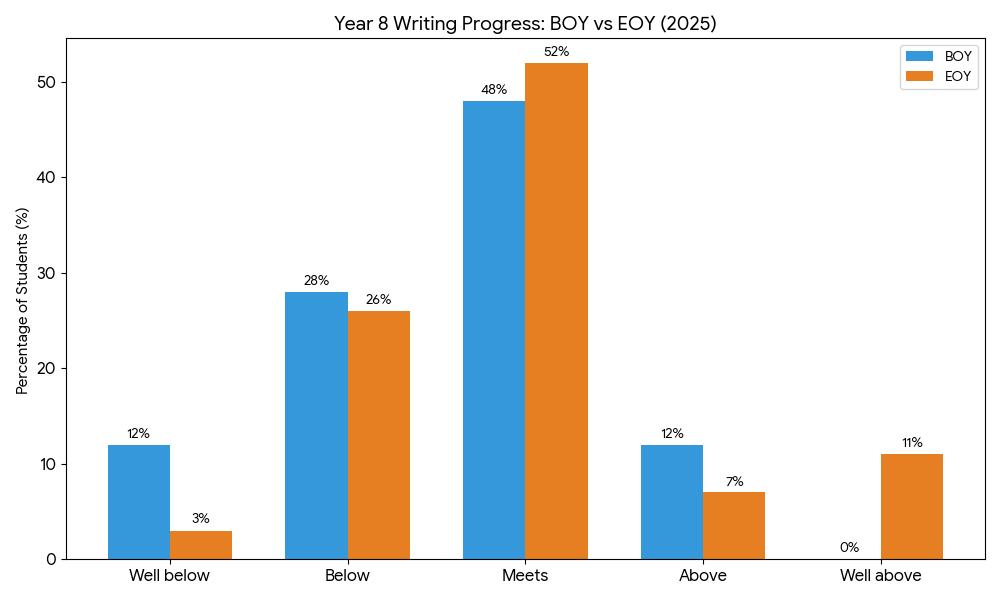
• Significant Recovery at the Foundation: The most substantial progress was the reduction in the "Well below"category, which dropped from 12% to 3%.
• Emergence of High Achievement: While no students were in the highest bracket at the start of the year, 11%reached the "Well above" category by the end of the year.
• The "Below" Challenge: Despite positive shifts, approximately a quarter of the cohort (26%) remains in the "Below" category, mirroring the concerns raised in the Year 7 cohort regarding surface features and complexity.
• Ethnicity
o Māori Students: Of the 4 Māori students, most maintained their current levels, with one Māori female making a notable positive shift from "Well below" to "Below" by year-end.
o Strategic Focus: Support the transition of Māori students into the "Meets" category by targeting the specific surface feature gaps (punctuation and spelling) identified across the cohort.
• Gender
o Male and Female Students: Both genders showed very similar patterns of movement, benefiting from the focus on recount and persuasive writing genres.
o Strategic Focus: Ensuring both groups continue to receive support in moving from "basic" to "complex" idea development.
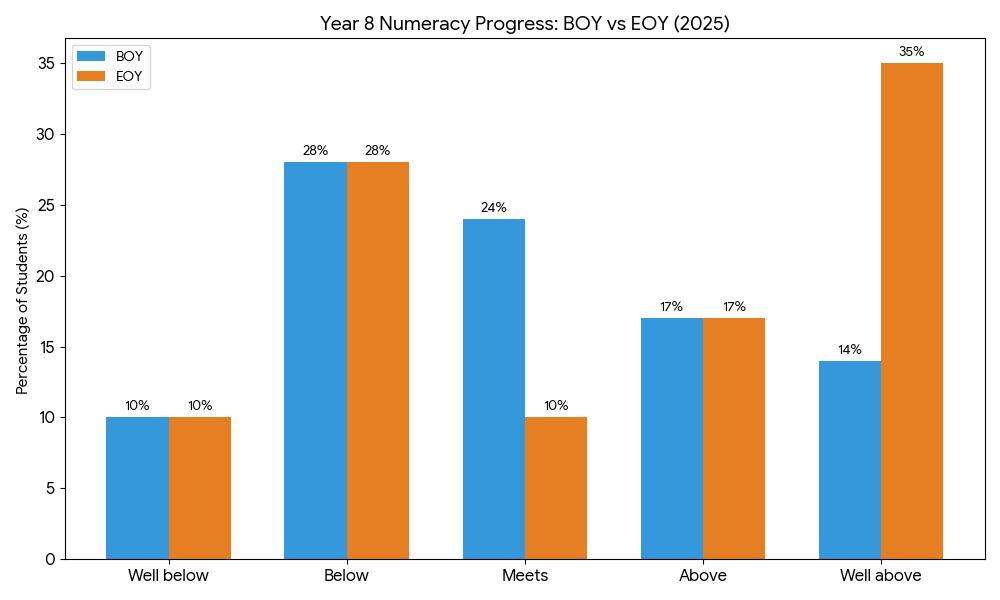
• Significant Acceleration at the High End: The most notable progress occurred in the "Well above" category, which more than doubled from 14% to 35%. This suggests that high-achieving students were successfully extended throughout the year.
• Stability at the Foundation: Unlike Year 7, the "Well below" (10%) and "Below" (28%) categories remained static in terms of total percentages. This indicates a consistent group of learners who may require a different or more intensive intervention to break through to the "Meets" level.
• The Upper-Middle Shift: The "Meets" category saw a decrease from 24% to 10%. Combined with the surge in the top tier, this suggests a "positive migration" where students previously meeting expectations successfully moved up into the "Well above" bracket.
• Cohort Consistency: While individual students within the groups may have moved, the total number of students working "Above" or "Well above" the expected level grew from 31% to 52%, meaning over half the Year 8 cohort finished the year exceeding curriculum expectations.
• Ethnicity
o Māori Students: While the group remained represented in the "Meets" and "Above" categories, there was an increase in the "Well below" cohort from 20% to 40% by year-end.
o Non-Māori Students: Showed significant acceleration at the top end, with the "Well above" category growing from 17% to 42%.
o Strategic Focus: Investigate the factors behind the "Well below" increase for Māori students and implement targeted interventions to shift this group toward the "Meets" standard.
• Gender
o Male Students: Demonstrated substantial growth in high-level achievement, with the "Well above" group increasing from 12% to 42% over the year.
o Female Students: Showed progress in the "Above" and "Well above" categories (both reaching 25%) but also saw a rise in "Well below" achievement from 8% to 17%.
o Strategic Focus: Provide additional foundational support for the female cohort to prevent movement into the "Well below" bracket while continuing to extend those already achieving "Above" the expected level.
Reading
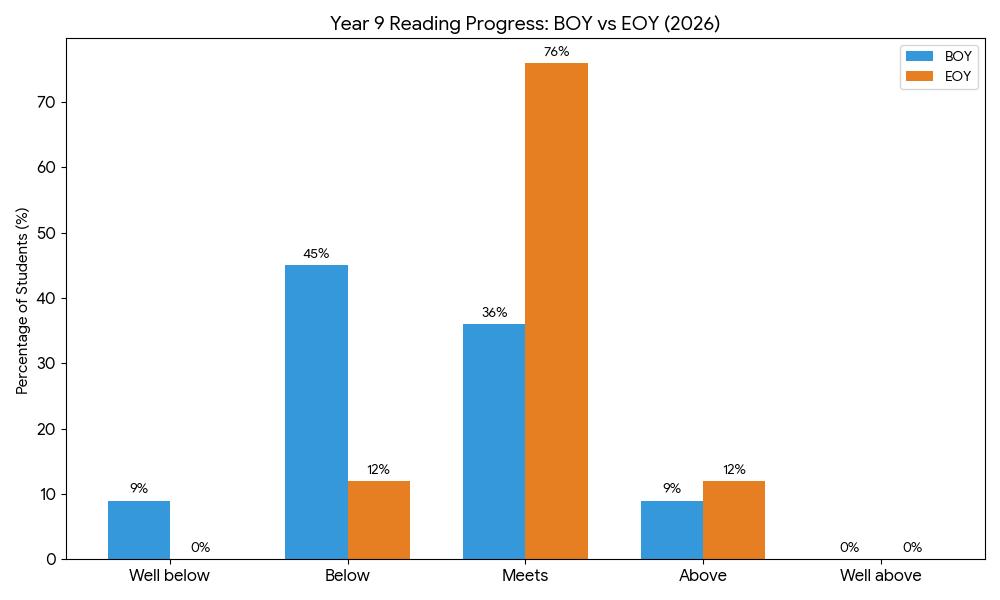
• Elimination of "Well below": The most substantial progress for the Year 9 Reading cohort was at the lower end, where the "Well below" group dropped from 9% to 0%.
• Significant Growth in "Meets": The percentage of students meeting the expected level more than doubled, moving from 36% to 76% by the end of the year.
• Internal Progression: Even for students already achieving at higher levels, internal shifts were recorded (e.g., students moving from 5P to 5A), showing that all students made progress within their respective curriculum bands.
• Ethnicity
o Māori Students: Approximately 25% of the cohort identifies as Māori. While mid-year results showed 66% achieving below the level, there was a significant turnaround; by year-end, only one Māori student remained below the expected level.
o Non-Māori Students: This group continued to show high levels of achievement, contributing to the fact that nearly the entire cohort is now at or above the expected level.
o Strategic Focus: Continue to sustain the momentum that moved the vast majority of Māori learners into the "Meets" category.
• Gender
o Male Students: Although males started the year with higher achievement rates than females, both groups saw significant closing of gaps. By end-of-year, males are heavily represented in the 76% "Meets" bracket.
o Female Students: Females are a smaller percentage of this cohort and started lower, with 60% below or well below at mid-year. This was addressed through significant end-of-year improvement, leaving only two female students below the level.
o Strategic Focus: Closing the remaining gap for the final two female students and pushing for higher representation in the "Above" and "Well above" categories.
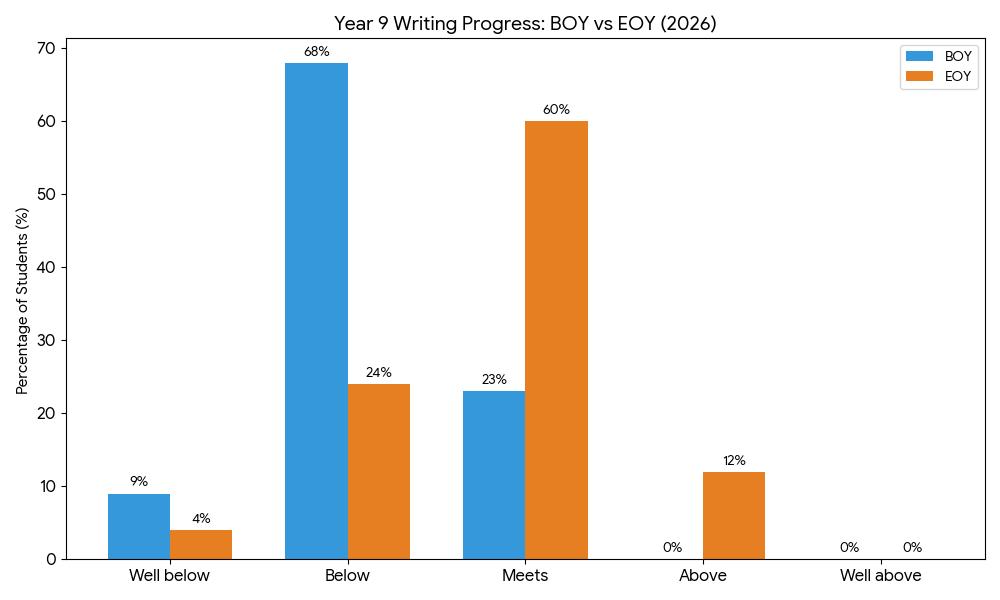
• Significant Shift to Achievement: The most substantial progress for the Year 9 cohort was the movement into curriculum expectations, with those meeting or exceeding the level rising from 22.7% to 72%.
• Establishment of "Above" Standards: While no students were achieving above the expected level at the start of the year, 12% of the cohort reached the "Above" category by the end of the year.
• Targeted Foundational Growth: The focus on grammar, punctuation, and PEEL paragraph structures successfully halved the "Well below" group, reducing it from 9% to 4%.
• Ethnicity
o Māori Students: Achievement shifted from almost all students working below the level at the start of the year to only one student remaining below the expected level by year-end.
o Non-Māori Students: This group showed strong upward mobility, contributing to the 72% total of students now meeting or exceeding expectations.
o Strategic Focus: To maintain this momentum by continuing the focus on sentence accuracy and paragraph structure to move the remaining students into "Meets" and "Above."
• Gender
o Male Students: Saw a significant turnaround in achievement; after starting the year almost entirely below the expected level, 66% of males are now achieving at or above expectations.
o Female Students: Demonstrated high entry-level performance (40% at level) and continued to grow, with only one female remaining below the expected level and another moving into the "Above" category.
o Strategic Focus: While progress is strong across both genders, the priority is to utilize the "greater positivity towards reading" to further bridge the remaining achievement gaps in writing.
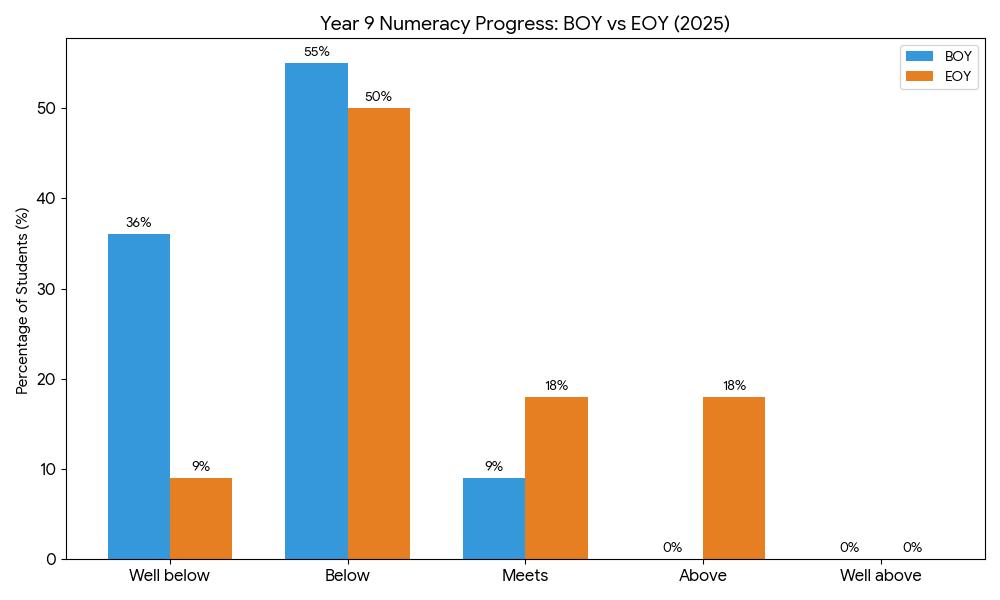
• Significant Reduction in "Well below": The most substantial progress for the Year 9 cohort was at the lower end, where the "Well below" group dropped from 36% to 9%.
• Emergence of "Above" Achievement: At the start of the year, 0% of students were working "Above" the expected level; by the end of the year, 18% reached this category.
• The "Below" Plateau: While many students shifted up, a large portion of the cohort (50%) remains in the "Below" category, suggesting a need for continued consolidation to move them into "Meets".
• Ethnicity
o Māori Students: The cohort shifted from 100% "Below" at BOY to a more distributed spread, with 20% now "Meeting" expectations.
o Non-Māori Students: This group saw the most upward mobility into the higher tiers, with 18% reaching the "Above" category by year-end.
o Strategic Focus: Supporting the 60% of Māori students currently "Below" to transition into the "Meets" and "Above" brackets.
• Gender
o Male Students: Saw a strong reduction in the "Well below" category, falling from 33% to 8%, while 17% moved into “Above"
o Female Students: Demonstrated significant growth, moving from 0% "Meets" or higher at the start of the year to 40%"Meeting" or "Exceeding" expectations by the end of the year.
o Strategic Focus: Both genders still have 50% of their respective groups in the "Below" category; the priority remains lifting this middle group into the "Meets" tier.
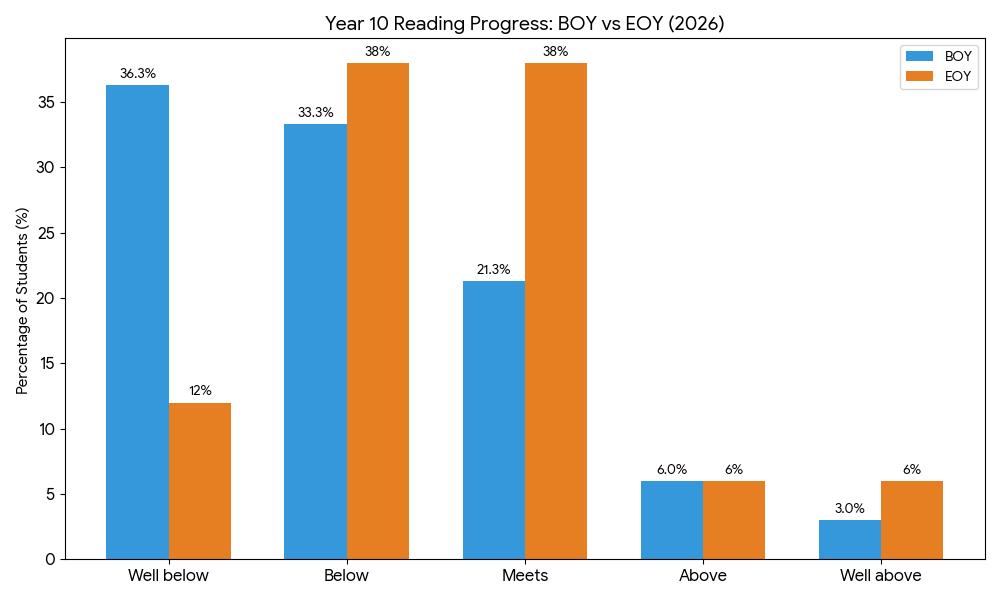
• Positive Shift to Achievement: The percentage of students meeting or exceeding the required curriculum level rose substantially from 30% to 50% over the course of the year.
• Significant Reduction in "Well below": There was a major improvement at the foundational level, with the "Well below" group dropping from 36.3% to 12%.
• Cohort Dynamics: While results differ from the previous year's cohort, this is attributed to a larger sample size (34 students vs 25) that now includes students from the SPEC class and reflects natural student movement (leavers and new arrivals).
• Ethnicity
o Māori Students: Starting from a baseline where 100% were "Well below," significant progress was made with 25% now meeting the required level and another 50% moving up into the "Below" category.
o Non-Māori Students: This group shows a higher achievement profile, with 56% achieving at or above the required curriculum level by year-end.
o Strategic Focus: Continuing to accelerate progress for Māori ākonga to transition the remaining 75% from "Below/Well below" into the "Meets" category.
• Gender
o Male Students: Demonstrated significant recovery; the percentage of males working below the required level dropped from 82% to 59%, with 41% now meeting or exceeding requirements.
o Female Students: This group (29% of the cohort) continues to outperform males at the top levels, with 70%meeting or exceeding curriculum requirements.
o Strategic Focus: Bridging the gap for the 59% of males still below the level while maintaining the high achievement standards of the female cohort.
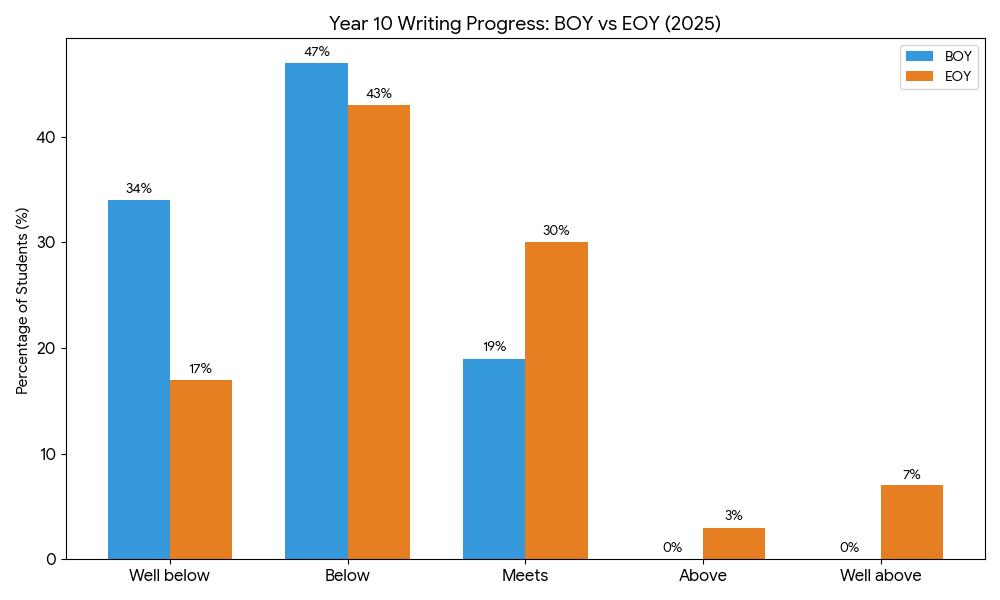
• Significant Growth in "Meets" and Above: The percentage of students achieving at or above the required curriculum level more than doubled, rising from 19% to 40% by the end of the year.
• Substantial Reduction in "Well below": There was a strong shift at the foundation level, with the "Well below" group halved from 34% to 17%.
• Cohort Composition: The 2025 data reflects a broader range of learners, including those in SPEC and Structured Literacy. While the percentage below the level (60%) is higher than the previous year (44%), the 2025 results are a more inclusive representation of the current 30-student cohort.
• Ethnicity
o Māori Students: Significant movement was recorded within the foundational levels, with a 75% shift from "Well below" into the "Below" category.
o Non-Māori Students: This group saw a marked improvement, with the percentage of students not meeting the level decreasing from 73% to 53%.
o Strategic Focus: While progress is evident, none of the Māori students met the required level by year-end; the priority is accelerating this group into the "Meets" tier.
• Gender
o Male Students: Saw a major breakthrough from a starting point where 100% were below the level; by year-end, 25% of males met or exceeded expectations.
o Female Students: Continued to be the highest-achieving group, with those meeting or exceeding expectations increasing from 60% to 70%.
o Strategic Focus: Continuing to bridge the gap for the 75% of males currently below the level while supporting the top-end growth of the female cohort.
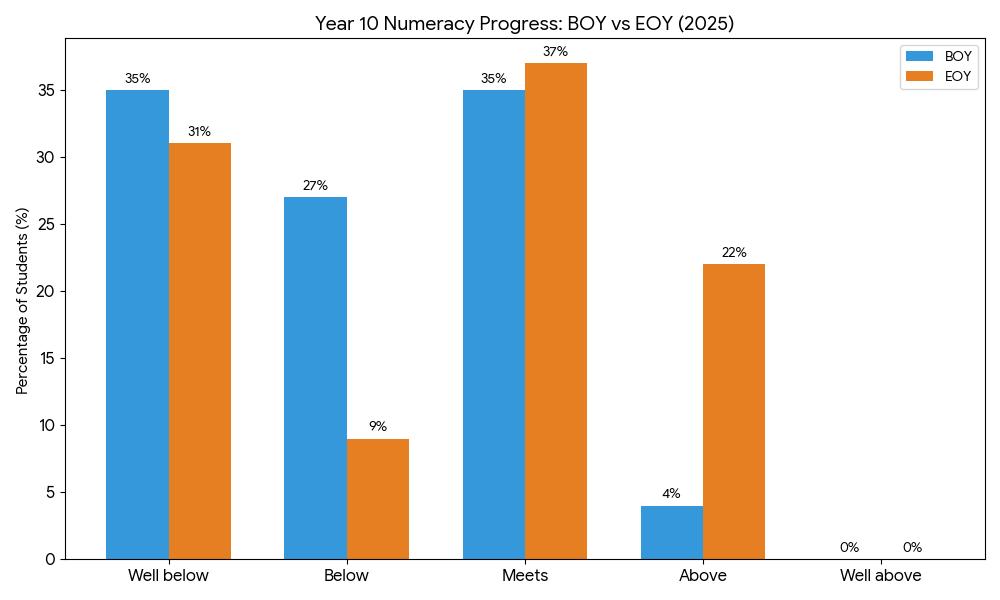
• Substantial Growth in High Achievement: The percentage of students working "Above" expectations saw the most dramatic increase, rising from 4% to 22% by year-end.
• Contraction of the "Below" Category: There was a significant shift out of the "Below" bracket, which dropped from 27% down to 9% as students migrated into the "Meets" and "Above" categories.
• Stability at the Foundation: The "Well below" category remained relatively static, showing only a slight decrease from 35% to 31%. This suggests a core group of students requiring more specialized foundational support.
Equity Consideration
• Ethnicity
o Māori Students: While half the cohort remains "Well below," there was positive movement as 25% of Māori students successfully reached the "Meets" category by EOY.
o Non-Māori Students: This group drove the high-end growth, with a significant jump to 25% achieving "Above “compared to only 4% at the start of the year.
o Strategic Focus: Investigating barriers for the 50% of Māori students in the "Well below" category while maintaining the strong acceleration seen in the Non-Māori cohort.
• Gender
o Male Students: Demonstrated strong upward mobility into the higher tiers, with 18% reaching "Above" (up from 0%) and the "Meets" category increasing to 32%.
o Female Students: Maintained high performance, with 80% of the cohort either "Meeting" or "Exceeding" expectations (50% Meets, 30% Above) by the end of the year.
o Strategic Focus: Closing the performance gap for the 36% of males who remain in the "Well below" category.
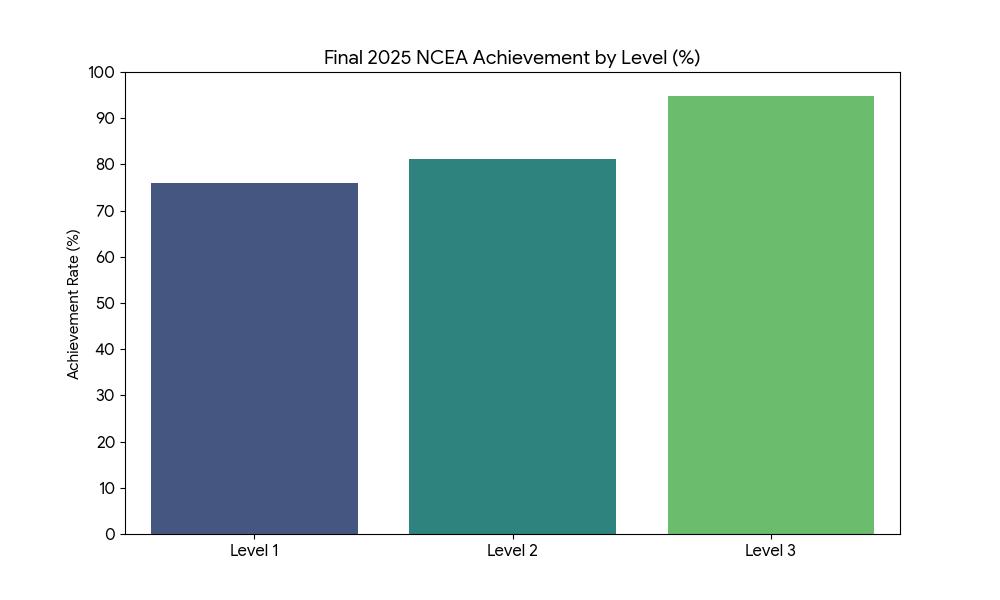
Overall NCEA data shows some pleasing increases from 2024.
• Level 1: Achievement was recorded at 76.0%, with 87.5% of students attaining literacy and numeracy.
• Level 2: The rate increased to 81.1%.
• Level 3: Attainment reached 94.7%, reflecting successful completion for the vast majority of the Year 13 cohort.
Analysis:
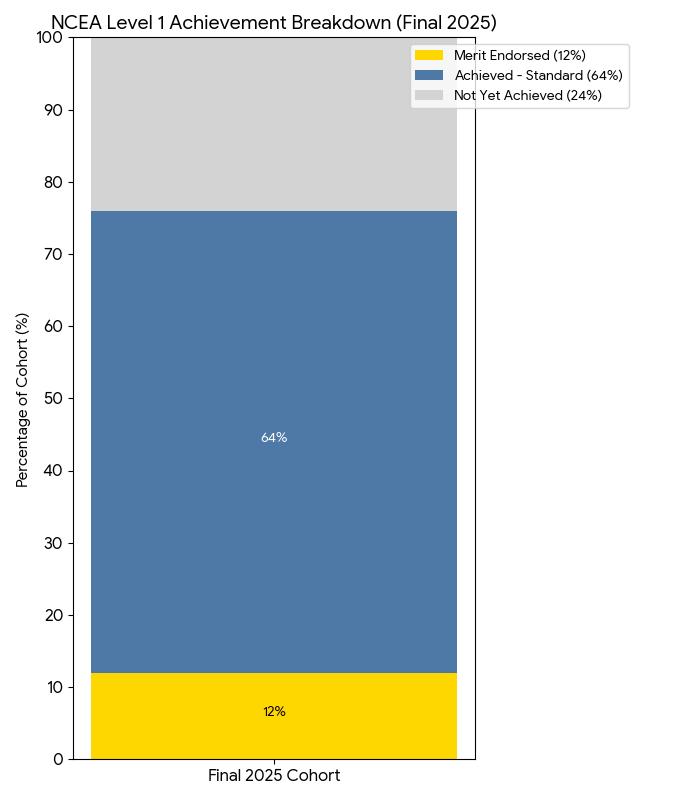
The final cohort for 2025 shows a solid foundation in the core requirements, with literacy and numeracy tracking ahead of the full certificate completion. There was a small percentage of Merit Endorsements but overall there was a large number of course endorsements with 43 Achieved, 10 Merit and 1 Excellence course endorsement.
Equity Considerations
Gender:
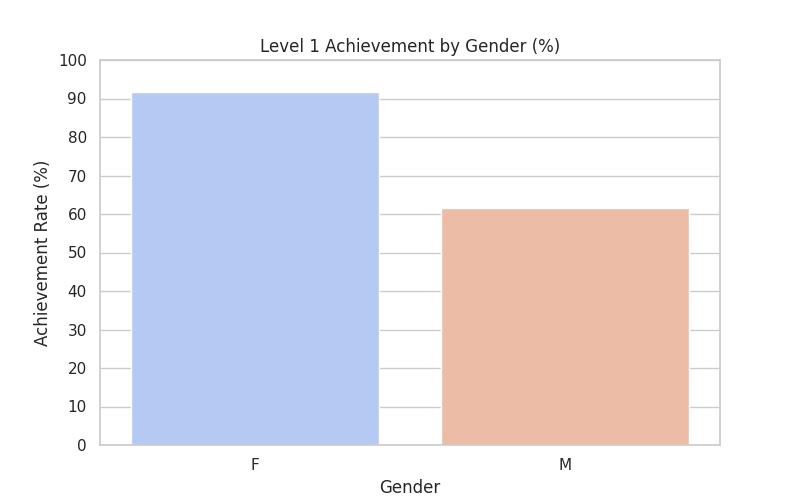
There is a notable performance gap between genders in the Year 11 cohort, with female students reaching achievement milestones significantly earlier than their male counterparts.
• Females: 91.7% achievement rate.
• Males: 61.5% achievement rate.
Ethnicity:
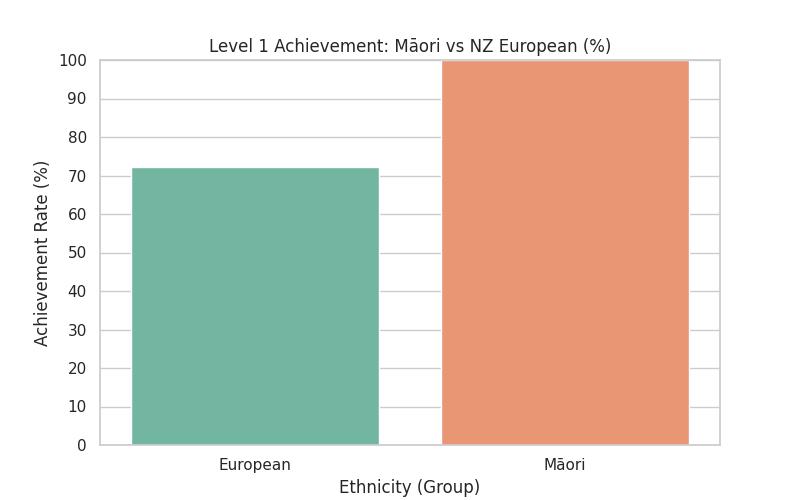
When focusing specifically on two groups of students Māori and NZ European, the data highlights exceptional success within the Māori cohort and a strong majority achievement within the NZ European group. Pasifika was not analysed due to the very small cohort.
• Māori Students: 100% achievement rate.
• NZ European Students: 72.2% achievement rate.
Analysis:
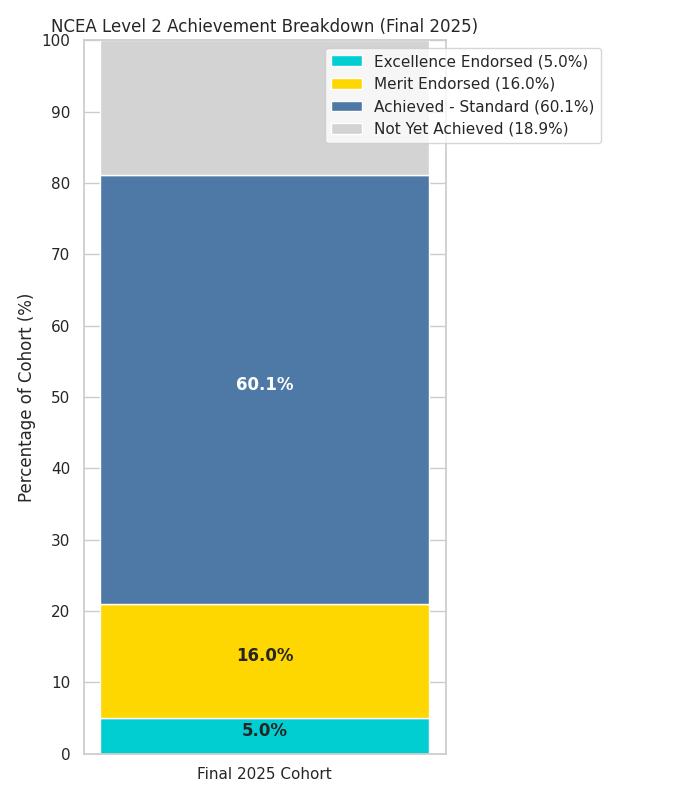
The Level 2 cohort achieved an overall pass rate of . When broken down by endorsement:
• Excellence Endorsement: 5.0%
• Merit Endorsement: 16.0%
• Standard Achievement: 60.1%
In addition there was a significant number of course endorsements attained at Level 2, 32 Achieved, 24 merit and two excellence course endorsements.
Equity Considerations
Gender:
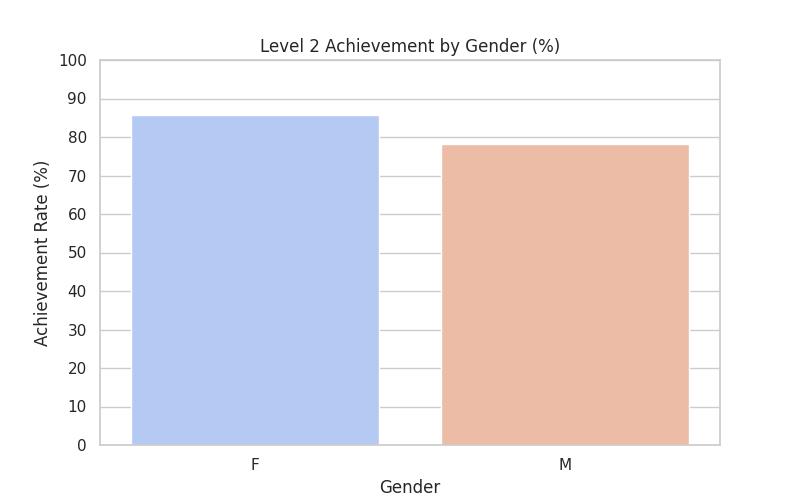
At Level 2, the gender gap is much narrower than at Level 1, though female students still maintain a slightly higher achievement rate.
• Females: 82.8%
• Males: 66.7%
Ethnicity:
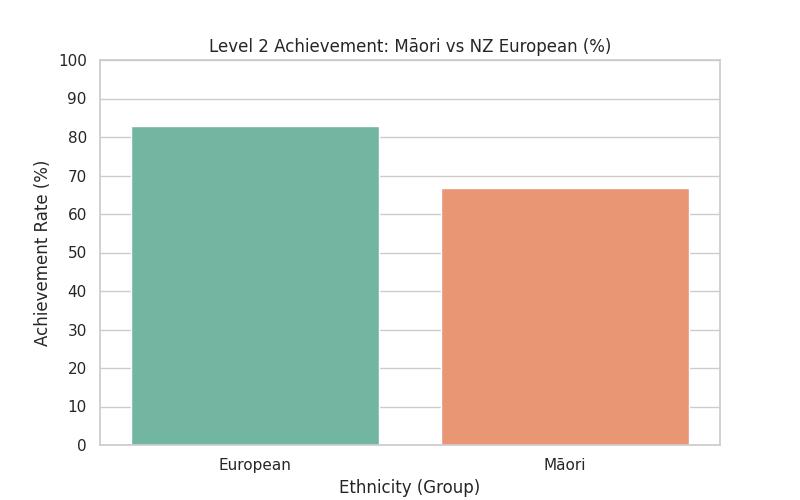
For the Level 2 cohort, the results for these two groups are as follows:
• NZ European Students: 82.8%
• Māori Students: 66.7%
It should be noted that of 100% of the Māori students who stayed at school for the full academic year attained NCEA Level 2.
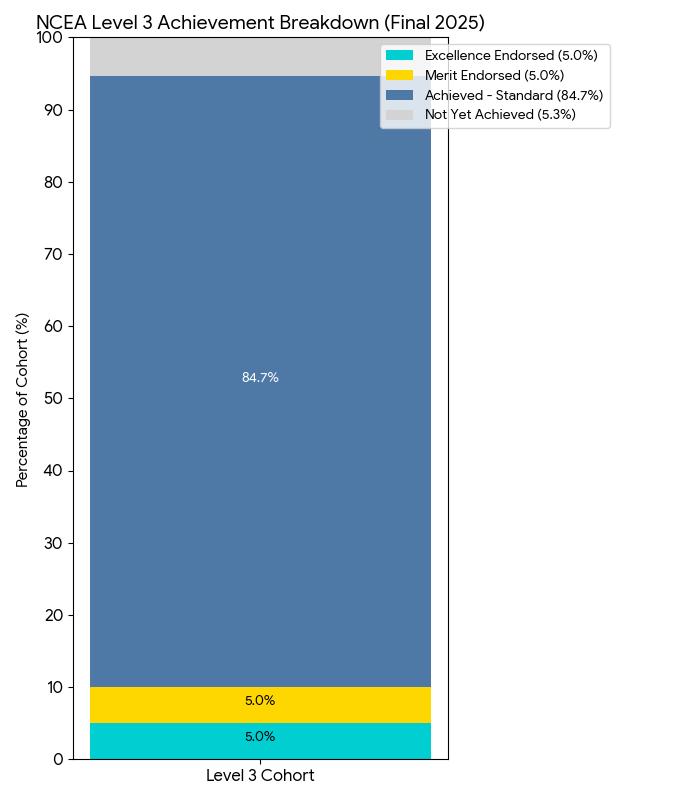
Analysis:
The Level 3 cohort shows an exceptional quality of achievement:
• Excellence Endorsement: 5%
• Merit Endorsement: 5%
• Total Achievement Rate: 94.7%
Equity Considerations
Gender:
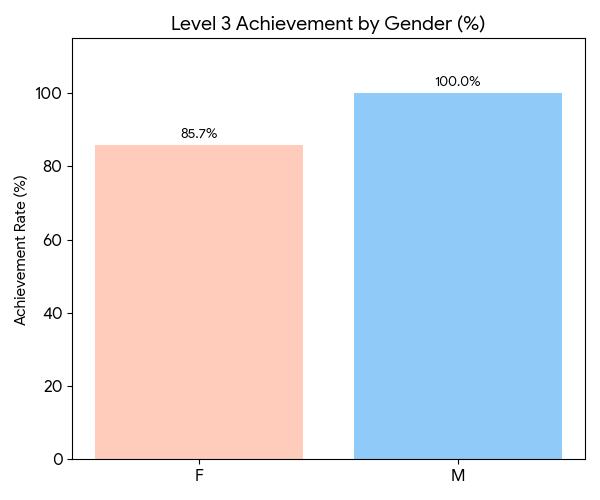
In the Level 3 cohort, we see a reversal of the trend found in earlier years, with male students achieving a perfect completion rate.
• Males: 100.0% achievement rate.
• Females: 85.7% achievement rate.
Ethnicity:
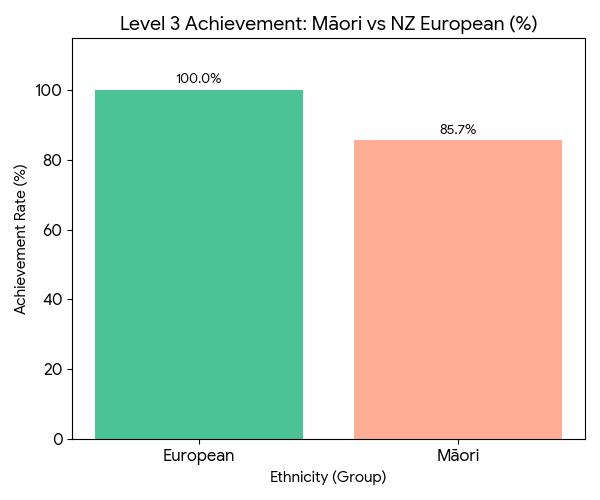
Performance remains exceptionally high across the primary ethnic groups at this level:
• NZ European Students: 100.0% achievement rate.
• Māori Students: 85.7% achievement rate.
University Entrance was much lower than NCEA Level 3 with 19% of students attaining UE. That being said 80% of students who were focussed on attaining University Entrance did attain it. Of the 19% of students who attained this 75% were female, 25% male, 50 were Māori and 50% were NZ European.
During 2025, the school has continued to embed its commitment to Te Tiriti o Waitangi, moving from foundational professional development to visible, systemic integration across our environment and daily practice.
• Professional Growth Cycle (PGC): 100% of teaching staff successfully included a specific goal to develop their cultural competency within their PGC. This has shifted cultural growth from a collective staff activity to individual professional accountability.
• Data-Informed Equity: The Senior Leadership Team (SLT) and pastoral teams have refined their analysis of attendance and academic data. This monitoring now occurs fortnightly, allowing for rapid intervention to ensure equitable outcomes for Māori students.
Tikanga and Te Reo Māori in Practice
• Normalisation of Tikanga: Karakia is now firmly embedded in the school day, moving beyond an opening ritual to a common feature in classrooms and a standard practice for karakia kai before lunch distribution.
• Staff and Student Leadership: Staff demonstrated their commitment to te ao Māori by learning and performing new waiata for the annual cultural competition. Similarly, students have expanded their repertoire of school haka and waiata, strengthening collective identity.
• Global Citizenship: Two cultural exchange trips to Tokyo involved nearly 20% of the student body. These experiences allowed students to act as ambassadors for Aotearoa, deepening their understanding of their own cultural identity through international connection.
The Physical Environment (Tūrangawaewae)
• Bicultural Signage: Phase one of the school’s signage renewal was completed. The new installations are significantly more bicultural than previous signage, reflecting the school’s values and the bicultural heritage of New Zealand.
• Te Kaika (Homeroom Hub): The successful relocation and development of the Te Kaika area have provided a dedicated space for students. Following successful funding for equipment and an inaugural start-of-year camp, the 'Hub' has received extensive positive feedback from whānau and the wider community.
• Classroom Engagement: Staff have proactively modernised classroom environments to ensure they are engaging spaces that visibly reflect biculturalism and support ākonga belonging.
• Community Consultation: Comprehensive data collection from staff, students, and the wider community was initiated to inform the 2026–2028 Strategic Plan, ensuring that whānau aspirations are at the heart of future planning.
• Student-Led Analysis: In an innovative approach to student voice, the NCEA Level 2 Statistics class was tasked with analysing student attitude data, ensuring that the findings shared with staff were authentically informed by the students themselves.
Reporting on the principles of being a Good Employer
How have you met your obligations to provide good and safe working conditions?
What is in your equal employment opportunities programme?
How have you been fulfilling this programme?
How do you practise impartial selection of suitably qualified persons for appointment?
Tokomairiro High School has an active Health and Safety Committee which oversees the school’s Health and Safety Policy and associated procedures. These are available to all staff. The policy is regularly reviewed.
Our Equal Opportunities programme and practices are framed by the school’s Employer Responsibility Policy. The programme has been fulfilled in our advertising and hiring practices. Professional development is provided to all staff based on need and personal growth requirements and aspirations. Reported incidents of discrimination, harassment and bullying are investigated and a complaints process to address concerns is followed.
Positions are advertised in as wide a range of media as possible. Applications are reviewed by more than one individual, and shortlists are drawn up based on input from a number of interested parties. Appointment committees carry out interviews and take references, Appointments are made based on suitability to perform the role, not on sexual orientation or preference, age, ethnicity, religious or political beliefs.
How are you recognising,
- The aims and aspirations of Māori,
- The employment requirements of Māori, and
- Greater involvement of Māori in the Education service?
How have you enhanced the abilities of individual employees?
Whenever possible Tokomairiro High School endeavours to ensure that local hapū and individuals have a voice in decision making and the direction of the school. The school, as part of the Community of Learning, is pursuing the creation of a cultural narrative for the area, to allow all learners to be aware of how the area’s past has been shaped. The school’s Culturally Responsive and Relational Pedagogy team actively seeks to ensure that every classroom is a safe space for students to discover their own cultural identity and to make it part of who they are and how they learn.
Māori at Tokomairiro High School are valued for their contribution as Māori, and staff are encouraged to take advantage of opportunities to incorporate tikanga into our daily operations. The school adheres to section 3.5.1 of the Secondary Teacher’s Collective Agreement.
How are you recognising the employment requirements of women?
Tokomairiro High School employs a robust professional growth cycle for small groups of staff. New and young teachers, and staff appointed to new positions of responsibility are mentored by the school’s Specialist Classroom Teacher. All staff have access to the school’s Professional Development Budget. Staff are encouraged to take advantage of additional training and skill development opportunities as they arise.
Employment requirements of women are met through flexibility when an individual (not only women!!) are required to bring children to school, for example, or
need time off to see that Parental Leave requirements laid out in the Collective Agreement are satisfied. We are flexible around things like medical appointments or other leave required for expectant mums. Planning of trips accounts for the need to be aware of the need to ensure that facilities available when carrying out teaching or supervision outside the classroom meet the requirements of women. Efforts are made through education opportunities to limit misogyny in the workplace.
How are you recognising the employment requirements of persons with disabilities? At Tokomairiro High School employment requirements of persons with disabilities are met in a variety of ways. Staff are afforded time off when required and the school works closely with organisations like ACC to ensure that the needs of individuals are met. The school site is accessible.
Good employer policies should include provisions for an Equal Employment Opportunities (EEO) programme/policy. The Ministry of Education monitors these policies:
Reporting on Equal Employment Opportunities (EEO) Programme/Policy YES NO
Do you operate an EEO programme/policy?
Has this policy or programme been made available to staff?
Does your EEO programme/policy include training to raise awareness of issues which may impact EEO?
Has your EEO programme/policy appointed someone to coordinate compliance with its requirements?
Does your EEO programme/policy provide for regular reporting on compliance with the policy and/or achievements under the policy?
Does your EEO programme/policy set priorities and objectives? x
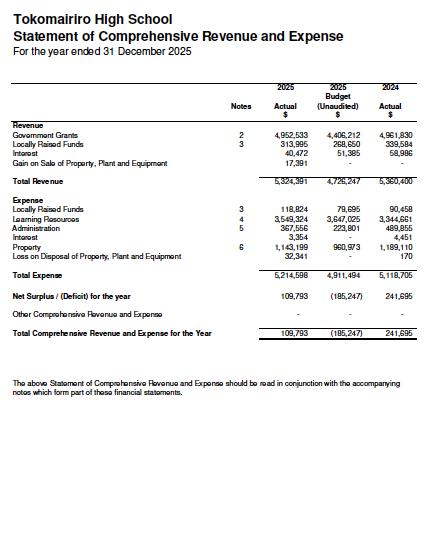
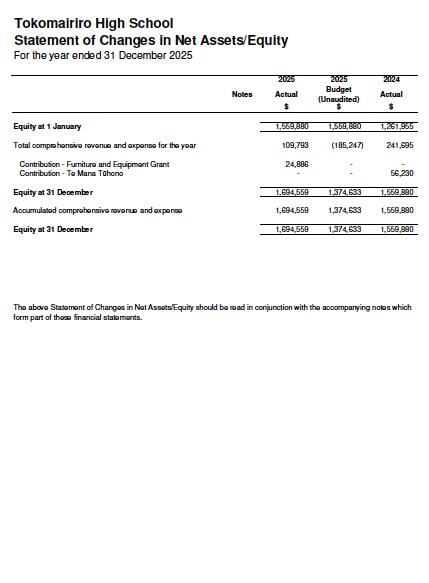
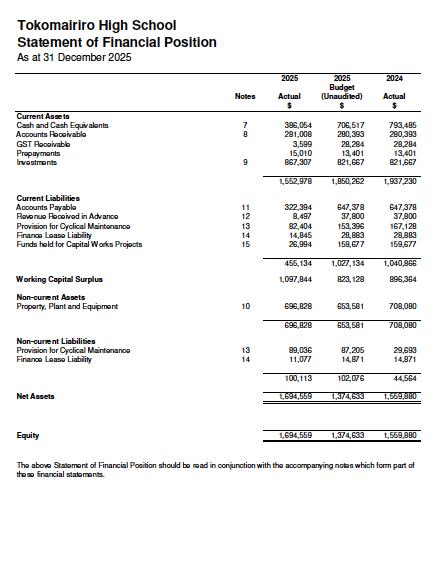
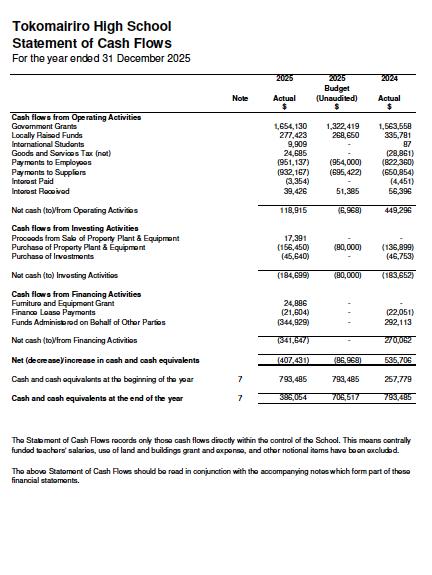
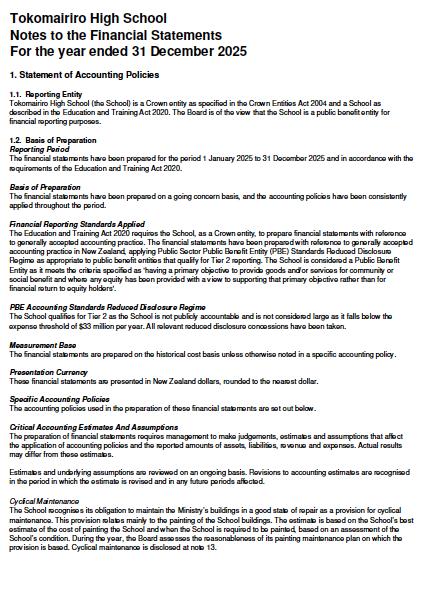
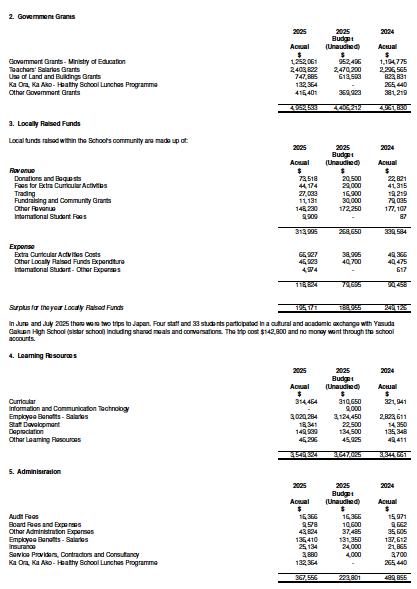
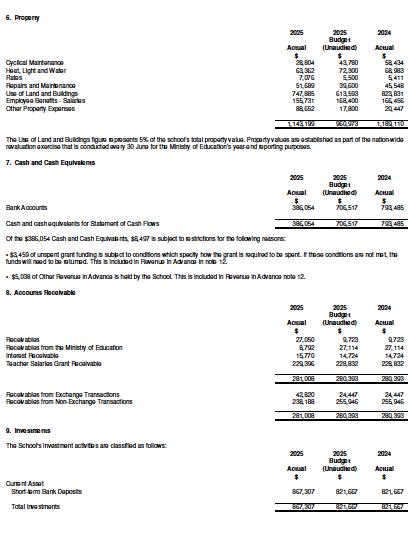
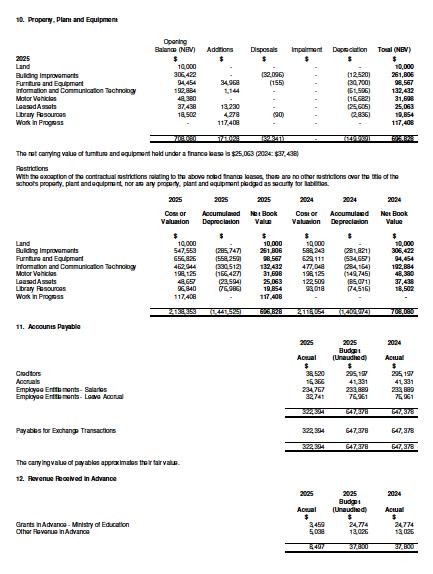
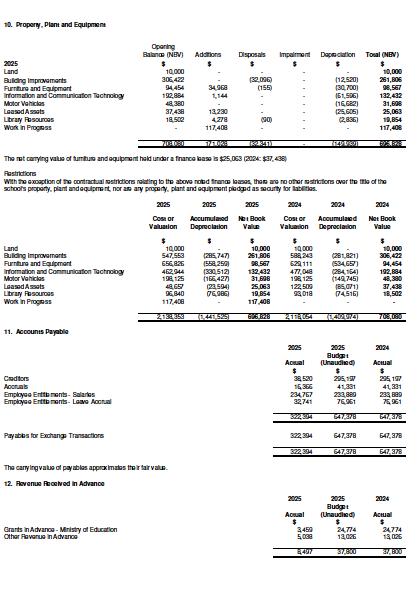
During the 2025 academic year, Tokomairiro High School received and allocated several streams of contestable and special-purpose funding to enhance student wellbeing, literacy achievement, and sporting participation.
1. Sport NZ Grant: Tū Manawa ($8,958.25)
• Purpose: To support active play and physical engagement for junior students.
• Allocation: This funding was dedicated to resourcing lunchtime active play specifically for Year 7 and 8 students.
• Impact: Investments included the purchase of new sporting equipment and the creation of permanent, vibrant games painted onto outdoor areas to encourage spontaneous and structured play.
2. Accelerated Learning in Literacy (ALL) ($4,000.00)
• Purpose: To raise achievement levels in literacy for targeted student groups.
• Allocation: Funds were used to acquire specific resources designed to enhance literacy learning in Years 7 and 8. Additionally, a portion of the grant funded professional development for staff to implement high-impact literacy strategies.
3. In-Class Support (ICS) Funding ( $15,200)
• Purpose: To provide targeted assistance for students with identified high-level learning needs.
• Allocation: This funding was primarily used for Teacher Aide hours, ensuring specific students received one-on-one or small-group support to access the curriculum effectively.
Kiwisport is a government initiative designed to increase the number of school-aged children participating in organized sport.
• Total Received: $4,796.04 excl. GST
• Allocation of Funds:
o Sports Coordination: Contribution toward the Sports Coordinator’s wages to ensure the smooth running of various sporting codes.
o Expertise: Employment of outside sports coaches to provide specialized training and skill development.
o Resources: Purchase of additional sporting equipment to facilitate wider student participation in a variety of sports.