October, 2026
Your Student Newspaper since 1931
“Talk about it”
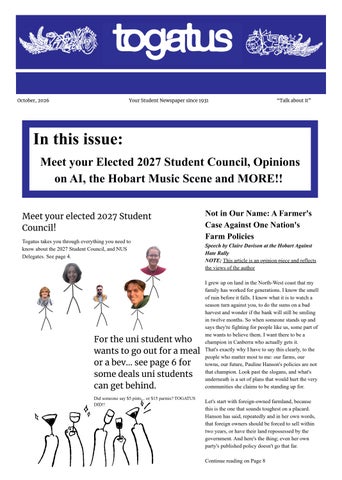
In this issue: Meet your Elected 2027 Student Council, Opinions on AI, the Hobart Music Scene and MORE!! Meet your elected 2027 Student Council! Togatus takes you through everything you need to know about the 2027 Student Council, and NUS Delegates. See page 4.
For the uni student who wants to go out for a meal or a bev... see page 6 for some deals uni students can get behind. Did someone say $5 pints... or $15 parmis? TOGATUS DID!!
Not in Our Name: A Farmer's Case Against One Nation's Farm Policies Speech by Claire Davison at the Hobart Against Hate Rally NOTE; This article is an opinion piece and reflects the views of the author I grew up on land in the North-West coast that my family has worked for generations. I know the smell of rain before it falls. I know what it is to watch a season turn against you, to do the sums on a bad harvest and wonder if the bank will still be smiling in twelve months. So when someone stands up and says they're fighting for people like us, some part of me wants to believe them. I want there to be a champion in Canberra who actually gets it. That's exactly why I have to say this clearly, to the people who matter most to me: our farms, our towns, our future, Pauline Hanson's policies are not that champion. Look past the slogans, and what's underneath is a set of plans that would hurt the very communities she claims to be standing up for. Let's start with foreign-owned farmland, because this is the one that sounds toughest on a placard. Hanson has said, repeatedly and in her own words, that foreign owners should be forced to sell within two years, or have their land repossessed by the government. And here's the thing; even her own party's published policy doesn't go that far. Continue reading on Page 8
Togatus Editorial Team Ineka Leffler, Editor-in-Chief
Ella Vanderzwan, Deputy Editor-in-Chief
Acknowledgment of Country Togatus acknowledges the Palawa people of Lutruwita. Togatus operates and is physically distributed across Lutrawita (Tasmania) and the Eora Nation (Sydney), and digitally across Australia. We recognise that sovereignty was never ceded. We deeply acknowledge, with respect, the traditional owners of both of these lands, the Palawa,
Amalie Cox,
Gadigal and Wangal peoples.
Creative Director
Jasmine Jones, Digital Editor & Content and Copy Editor
Contents
Erin Coull, Content and Copy Editor
Writers
2027 Student Council
Opinion Pieces & Creative
Announcement 4-5
Writing 7-10
Meet your elected representatives and find out
Death’s Anniversary
more about the NUS
The pervasiveness of AI is a side effect of a
Hannah Wagner
Ineka Leffler
Jasmine Jones
Alps
Lily McShane
lonely society.
Uni-Life 6-7 HASS Society Debating Maximise your UNI LIFE- savy deals and
Not in Our Name: A Farmer's Case Against One Nation's Farm Policies The Bop End
more Architecture Club Firm Crawl Christ College Formal Dinner
AI in the North West Tending to the Garden
Law Ball
Games Page 11
Jane Ball
PS. For full references and sources used throughout this edition, please see our website. The opinions expressed herein are not those of the editors, the publishers, the University of Tasmania, or the Tasmanian University Student Association. Reasonable care is taken to ensure that the content and information included is as up-to-date and accurate as possible at the time of publication, but no responsibility can be taken towards Togatus for any errors or omissions. If you have concerns or questions about anything that has been published, contact the Editor-In-Chief, Ineka Leffler, by email. Togatusmagazine@gmail.com
ANOTHER
SSAF
FUNDED INITIATIVE
SUPPORTED BY
Editorial We are BACK!! Yep... Togatus is still going strong amidst lengthy essays, uni events, and midnight meltdowns... because who doesn’t want to read their horoscope before a 9am lecture? The Togatus team has been pretty busy this semester, moderating and writing about the Student Council elections, asking random people questions on campus, going on the radio, and getting ready to head over to Sydney for the 2026 Student Journalism Conference!
INSTAGRAM: @togatus_
This is our penultimate edition of the year, and potentially the last one you’ll see around, if you’re not doing a summer subject/ having a work-life balance over summer. We hope you enjoy it, with more horoscopes, games pages, announcements, opinions, and everything in between. With love, Ineka
Here are some responses we heard: sweet treats the need to throw more house parties the dire state of crisis accommodation in Tasmania funding the Food Hub I guess you’ll have to follow us on TikTok to know what Jasmine and Ineka think... and to get inspired for the next time you may or may not see us filming...
Horoscopes Libra (Sep 23 - Oct 22) It’s coming up to assignment season around your birthday. Praying for your long-term wellbeing when it comes to self-care. Make sure to take time off for your birthday! Scorpio (Oct 23 - Nov 21) Scorpio... you could stand to be a little more patient with the people you love. They’re going through a lot too, and if you want their patience, you have to give yours first. Sagittarius (Nov 22 - Dec 21) Ignoring all your problems won’t make them go away... you should address some things soon, you’ll be better for it.
Capricorn (Dec 22 - Jan 19) Cancer (Jun 21 - July 22) Do NOT trust that recipe you see on TikTok or Instagram While old doubts are starting to resurface, don’t let them that stresses how easy it is. That will take you thirty define everything you’re doing at this time. You are a diva minutes and you know it. and you got this! Leo (Jul 23 - Aug 22) Recently you’ve had more energy and more responsibilities; make sure you’re not burning out! Virgo (Aug 23 - Sep 22) As you just had your birthday, it is a new era for you. Try to do something you never thought you’d do. It’ll turn out better than you think.
Togatus
EMAIL:
If you aren’t already following us on TikTok, now’s the time. Every so often, Jasmine and Ineka go around Hobart asking uni students a particular question. The most recent question was “What is something you think should have been in the news more, fun or silly?”
Gemini (May 21 - Jun 20) Life is stressful at the best of times, let alone right now. It’s a busy period for you, but make sure not to get so overwhelmed that you do nothing instead.
FACEBOOK:
Togatus.com.au
Tog Tuesday:
Taurus (Apr 20 - May 20) You’ve been working very hard, and being the best in the business. This upcoming time is very chaotic so you should get yourself a sweet treat... you deserve it.
@togatus_
WEBSITE:
Notably, putting this newspaper together, I got to read through quite a few articles on AI - very interesting, very topical. Read into that what you will.
Aries (Mar 21 - Apr 19) You might be tempted to make more drastic changes to your life. This is generally a positive thing, but make sure you’re not just running away from yourself.
TIKTOK:
Aquarius (Jan 20 - Feb 18) While the weather is warming up you should go and touch the sea... it’ll help you see a new perspective on something you were worried about. Pisces (Feb 19 - Mar 20) Whatever piece of media you’ve been waiting to view/watch/listen/read/experience, now is the best time to do so! Ignore your assignments, watch something that’ll ruin your life in the best way possible.
Togatusmagazine@gmail.com
The TUSA Student Council for 2027 have been elected! Who is on it? After a lengthy couple of weeks of campaigning, on Friday 11th September, the TUSA Student Council for 2027 was announced. Voting was between Friday 4th of September and Thursday 10th September. A total of 1479 eligible students voted in the election, meaning only 5.4% of UTAS students exercised their ability to vote for people they want to represent them. However, voting participation is up from last year, when 4.5% of students had they say. The Student Council sits on various university committees (13 to be exact) to ensure that student voices are in the room. Despite there being six roles with only one nominee, candidates still needed a majority of students to vote ‘yes’ on being elected, as students had the ability to vote ‘no’. If most people voted no, a vote of no confidence would have been cast. But enough of that; it didn’t happen!
President: Solomon Doyle, he/they Solomon is an activist and organiser, the current Undegraduate Education President, and ran as part of the Take Charge ticket. He sees education quality and cost of living as the most important issues for students, is passionate about the Students as Partners framework, and being answerable to the Student Council and the entire student body.
General Secretary: Molly Doon, she/they Returning for a second year, just like Belle Smith, Molly too ran as part of the Take Charge ticket. They see the role of Gen Sec. as one that primarily helps the Student Council run smoothly and thus indirectly affects students. She wants a larger social media presence for the Student Council to match the large online student base, and hopes to improve their work-life balance.
A word from the current TUSA President, Jack Oates Pryor: Howdy guys, gals and non-binary pals! After thousands of meetings and events, representing to the best of my ability the plurality of students' voices alongside beautiful teams, here are my key takeaways for you, dear reader… 1. In this era of wicked polycrises, hitting students hardest, hope matters. I keep returning to Bob Brown's words: "don't get depressed, get active." Our newly introduced Students as Partners framework demands we're treated as equals, so please don't let that power slip. 2. Get involved in, empower, and leverage your local club or society. Never underestimate collective student action. When local leaders pair with TUSA reps, backed by students on the ground, miracles happen. Collaborative clubs are the lifeblood of university life and our student leadership system, so foster their social, support and advocacy initiatives. Be kind with people, be bold against systems. Together. Yours always,
Undergraduate Education President: Sophie Moran, she/her
JOP
Sophie is a first year Bachelor of Arts student and is the current President of the HASS (humanities, arts, and social sciences) society. Next year, Sophie wants to work with academic societies, and the Students as Partners framework, to ensure that student voices are heard effectively in the numerous academic committees here at UTAS.
PS. EVENT SPOTLIGHT: Online Education President: Jaspreet Sethi (he/him) Jaspreet seeks to create regular opportunities for online students to share their concerns to try and combat the disconnection and invisibility many online students face.
Postgraduate Education President: Kashif Azeem, he/him New year, and a new role for Kashif who was the Equity President this year! Kashif sees disconnection as a major issue for postgraduate students, and wants to create a more connected HDR (higher degree by research) community for students acrross schools and campuses. He sees the value in numbers and the power students have when they come together to create much-needed change.
2027 NUS Delegates:
Equity President: Jhumu , she/they Jhumu is an international student, who you might have seen working at the TUSA Food Hub in Hobart, or at Grounded. She seeks to advocate for employment pathways for students and work with local businesses to help students amidst the cost of living crisis. She intends to open a monthly open platform, respond to students on WhatsApp, and publish a quarterly report on what she has achieved and intends to achieve moving forward.
Southern Campus President: Oliver Brancher, he/him Returning again, Oliver is passionate about Rugby, Vent Tents, and hearing students out. As a result of concerns raised in Vent Tents, he’s currently working in partnership with several hotel suppliers and the Australian Bedding Stewardship Council, on providing bedding packs for international students arriving in UTAS accommodation. Next year, he wants to continue running Vent Tents and keep student living at UTAS accountable for student needs!
Solomon Doyle He/They
Oliver Brancher He/Him
Sharzil Kabir He/Him
Cradle Coast President: Davina Smith, they/them Davina sees the cost of living as a major issue for students. They value the close-knit community offered up on the Cradle Coast, and want to advocate for increased on-site student support and creating more opportunities for students to have their voices heard.
Kashif Azeem He/Him
Northern Campus President: Maxine McLaughlin, she/her Next year, Maxine seeks to increase the number of clubs in Launceston to help everyone find their community and work on making the timing of events more accessible and purposeful for students up North.
Florence Silverstone She/Her
Rozelle Campus President: Simriti Mehra, she/her Simriti believes that because Rozelle students experience a different university life than those in Tassie, dedicated representation is needed. She wants to work on integrating the support services offered on the Rozelle campus to help make students feel seen, heard, and supported.
Molly Doon She/Her
Wait! What is the NUS? The National Union of Students (NUS), is the peak representative and advocacy body for higher education students in Australia. A majority of university student unions are affiliated with the NUS, which gives the union power and voice in numbers, allowing them to act as a semi-official spokesperson for tertiary education students in Australia. Notably, the NUS was influential in guaranteeing 40% of SSAF allocated funding be directed to student unions.
When we vote for a delegate of the NUS, it means voting for a representative of TUSA to help discuss with other student unions issues relating to quality of education, academic freedom, social security amongst others. Delegates meet multiple times a year, often hold portfolios, and are expected to frequently communicate ideas and support.
UNI LIFE
The Darchside does a firm crawl
HASS SOCIETY DEBATES!
The UTAS Architecture society did a firm crawl in Launceston - from ARTAS Architects to Philip Lighton Architects, amongst others. I think the photos show everyone had quite the (productive) blast!! Photos taken by Jack Arnold
🏆
Four teams argued whether AI should be used by the military in warfare; in both debates, the affirmative team took the win
To note: The HASS Halloween party will be held in Hobart on the 23rd of October. See their Instagram (@hass.society) for more information, and to book your tickets!
MAXIMISE YOUR SOCIAL LIFE : MON-FRI... enjoy savvy deals, fun nights, and save some pennies! For those on the Cradle Coast or up in Sydney, please let us know your favourite deals!! MONDAY For the Hobartians: Trivia at the Mayfair
THURSDAY For the Hobartians; 2 for 1 Pub meals @ The Cascade from 6pm (get in quick.. the line is long.. the food is great)
For the Launcestonians: $22 pint and Parma at Sporties
For the Launcestonians: Beer and Burger Night at the Plough Inn $22 for a burger,
TUESDAY
chips and a choice of wine, soft drink or beer.
For the Hobartians: 2-course $22 meal at Amigos all night! (And $11 margaritas...)
For the Launcestonians: $15 pasta night at Reggies ($5 wines!)
FRIDAY: For the Hobartians; 2 for the price of 1 cocktails at the Mayfair 5pm-7pm
For the Launcestonians: WEDNESDAY For the Hobartians: $5 pints at Bevs
For the Launcestonians: $15 chicken parmi and chips at the Star Bar
2 cocktails for $25 at the Pizza Pub
Law Ball 2026
Christ College Formal Dinner
This time last year, a self-described hungover UTAS student reminisced on the 2025 Law Ball. They described it as (arguably) one of the best events of the year, with a great open bar, slippery dance floors and questionable music...
“We had an incredible evening of food, drinks and celebration. Jake from Student Living and our President Willem gave speeches commemorating what has been a fun, at times challenging, progressive, and always memorable year at Christ. Thank you to everyone for coming and making the night special, and to everyone who has made the college community what it is.”
Shoutout to those who took advantage of the open bar while inevitable networking occurred, and awards (requiring multiple hours surrounded by law students to be understood) were announced.
-From the Christ College Instagram @christcollege
Opinions & Creative Writing Death’s Adversary by Hannah Wagner
As always, TULS ran at tight ship, with everything going seemingly smoothly. See more images and events @TULS.UTAS on Instagram
Jane College 2026 Ball! The first of the colleges to throw their annual ball, and they set the standard, as always. With a three-course meal, an open bar, speeches that made non-Jane residents feel like they were from Jane, and a lively dance floor... what more could a uni student want on a Saturday night?
There have been moments that have stretched into wasted years, lost to the burden of survival. Where suffering became a beast manifested; a perpetual hunger refusing space for anything else to keep me company. It forbid the wonder of purpose and future, held space only for loss to swallow memory, and imprisoned me to hope. Ribs cracked open, there is an ache that blooms. Memory serves only to bleed you of a feeling you’ve forgotten, replaced by an absence you can’t name. Still, if Death offered to take the pain and the only sacrifice be the memories that feed it, I would give it nothing. If I exist only in memory, then all I am is all I have lived, and if time is kind to me this suffering is not wasted if it means I am still becoming. It is impossible to untangle what makes something beautiful worth the pain of losing it. To allow yourself to feel things so deeply, it is as much to allow euphoria as it is pain. If I am wise, I will welcome what must be endured just to taste the rest of it. Fear is the path to courage, loss is the sacrifice of love, to be satiated I must first starve, to know joy is to know its absence. There is no purpose, only feel. The spectrum of the heart is so you understand how absence guides you. I could not give up pieces of the past or I will lose myself. Time keeps collecting me, and I existed through the waste and the flourishing so I could earn the view of it all. Hope kept dragging me along, bruised and bleeding, unwillingly. I wanted to be free of it; a prison that wouldn’t allow the peace of a true yield. And so I dragged. And it took me places worse than when I was first shackled to it, but it simply kept moving. That is the nature of it, out of our control, the primal bane of human instinct. It keeps going until it doesn’t. Memory starts to serve as an escort. Remember what Spring smells like? Just in time to see the light refract off the back of a raindrop, did you forget how once you tried to paint your room the same colour of Indigo? I missed you. I knew you once, I can learn you again. Death didn’t find you, and somewhere along the heave of Hope the walls cracked and wonder crept in now that the momentum no longer burns. Snatch a fleeting moment from thin air, greedy, because you damn well know that once upon a time this was all you ached for. Even if you only got to feel it for a second. Dig your nails into the fabric of the world and chew off what you have denied yourself. Let the memories and the making of them get stuck in your teeth. Nothing will be taken for granted again when you were forced to suffer the reality of rarity. Against your will, you learn to love again. Love exists in moments and movement, in memory, in smell and touch and taste, in the sounds that sway you, in how you’ve learned to give it away knowing you can make so much more of it. You know it is a risk—the smell of decay still lingers—but without it there is only the soundproof walls and a glass locked door. This is all you are, to love is its own purpose. Perhaps it is the only purpose. Hope is cruel, but she is suffered to find it.
Pictures from @janestudentclub on Instagram
The pervasiveness of AI is a symptom of a lonely society. Written by Jasmine Jones
It’s easy to jump straight to shaming people for using artificial intelligence. At this stage, nearly everyone is aware of the negative cultural and environmental consequences. If you make them feel embarrassed enough, they might think twice before plugging in a prompt – or, they’ll do it in secrecy. To make any real break throughs at an interpersonal level in combatting AI use, we need to think about why some people have become overly reliant on this technology. The usual anti-AI explanation positions users as lazy, anti-intellectual, and apathetic. However, research suggests that there is a positive correlation between increased social chatbot use and elevated levels of loneliness. I know both personally and anecdotally of people who feel socially isolated and frequently utilise ChatGPT and other AI variants. They feel they have no one to talk to, get advice from, or ask silly questions; the chatbot is a stand in for a friend, partner, or therapist. Evidence indicates that while a chatbot ‘companion’ can reduce feelings of loneliness in the short term, it ultimately cannot simulate real, meaningful human connection. It cannot act as a replacement for telling a partner about your day, venting about uni with your classmates, a brief exchange at the checkouts, a deep-and-meaningful with friends, a phone-call home, a walk with your sister, or a laugh with someone you just met at Friday drinks. If loneliness is indeed a driving factor, then shaming, ridiculing, and belittling people is only going to push them further away from human interaction and into the arms of the chatbot. When people turn to AI to share something they’re afraid to be judged for, and then receive judgement for using AI, it creates a never-ending cycle. We need clear and open education around why AI can be harmful, coupled with empathy for the people who feel they have no-one else to go to. There has never been a more imperative moment than now to revive our sense of community and build relationships. Yes, it takes effort. Reach out to people. Maintain meaningful connections and initiate new ones. Authentic, genuine conversation should be recognised as a basic human need. It is not one that can be artificially replaced.
Not in Our Name: A Farmer's Case Against One Nation's Farm Policies Speech by Claire Davison at the Hobart Against Hate Rally Note: This is an opinion piece written and spoken by Claire Davison
I grew up on land in the North-West coast that my family has worked for generations. I know the smell of rain before it falls. I know what it is to watch a season turn against you, to do the sums on a bad harvest and wonder if the bank will still be smiling in twelve months. So when someone stands up and says they're fighting for people like us, some part of me wants to believe them. I want there to be a champion in Canberra who actually gets it. That's exactly why I have to say this clearly, to the people who matter most to me: our farms, our towns, our future, Pauline Hanson's policies are not that champion. Look past the slogans, and what's underneath is a set of plans that would hurt the very communities she claims to be standing up for. Let's start with foreign-owned farmland, because this is the one that sounds toughest on a placard. Hanson has said, repeatedly and in her own words, that foreign owners should be forced to sell within two years, or have their land repossessed by the government. And here's the thing; even her own party's published policy doesn't go that far. What's written down is more cautious: stopping future sales, not tearing up existing ownership. So which is it? Is the real policy the calm one on the website, or the one she says on camera, in interviews, on social media, again and again? When a politician's public promise and her own party's paperwork don't match, that's not a detail, that's a warning sign. You cannot plan your future, your succession, your next loan application, around a policy that changes depending on which microphone is in front of her.
But let's take the boldest version seriously for a moment, because that's the one she keeps repeating. About thirteen to fourteen per cent of Australia's agricultural land, around fifty million hectares, is foreign owned. I can understand the belief that farms should be run and owned by local farmers rather than investors overseas who have no idea what it’s like out here on country. But force all of that land onto the market inside two years, and you are not punishing some faceless overseas investor sitting in a boardroom in London or Beijing. You are flooding the market. And every person who has ever tried to sell land in a flooded market knows exactly what happens to the price. Foreign-owned farms aren't fenced off from the rest of us, they sit next to our paddocks, they're valued by the same appraisers, financed through the same regional banks, serviced by the same machinery dealers and stock agents and contractors that keep our towns alive. Crash their value, and you crash ours right alongside it. That's not a policy that protects rural Australia. That's a policy that could gut the equity in every farm in this country, including mine, including my neighbours', all so it can look strong on a bumper sticker. Then there's her plan to cut temporary migration by more than seven hundred and fifty thousand people over three years. I know farmers who have stood in a paddock during harvest and known, with total certainty, that crop was not coming in without backpackers and working holidaymakers standing shoulder to shoulder with us. Right now, roughly one in seven people working on regional farms are exactly the kind of worker this policy targets. The National Farmers' Federation, not some inner-city lobby group, our own peak body, has warned that cuts on this scale could leave crops unharvested and push food prices even higher. Even people inside her own party have said the quiet part out loud: gut these visas, and farms and aged care in the bush go without the hands they need. Hanson says backpackers and PALM workers won't be touched. I'd ask her to put that in writing, with the same seriousness she owes the housing policy she's already had to walk back twice. Because a farmer who trusted the plan on paper over the plan in the paddock has been burned before. You cannot claim to speak for rural Australia while pushing a policy rural Australia's own advocates are warning will push up food prices and leave our paddocks unplanted. That's not standing up for us. That's standing on us. And here is the part that worries me most, the part that isn't about any single policy, it's about our voice. Every vote that goes to a party built on outrage instead of outcomes is a vote pulled away from the parties that have actually carried regional interests to the table in Canberra, decade after decade, fighting for roads, for water infrastructure, for drought funding, for the boring, unglamorous work of representation. Splinter our vote enough ways, and rural Australia doesn't end up with more power. We end up with less. We end up as a smaller voice in a louder room, dressed up in language that sounds like strength but functions like surrender. I want to be honest about something else, too. Politicians like this don't succeed by accident. They succeed, in part, because rural communities have been underfunded and underserved for years, fewer resources, thinner local media, less direct engagement from Canberra than the people in our cities get as a matter of course. When people feel unheard for long enough, a voice that sounds loud and certain can feel like relief, even when what it's selling doesn't hold up. That's not a failing in us. That's a failure of the system that left us that hungry for someone to finally shout on our behalf. We deserve better than to have that hunger used against us. The people who provide the food in your supermarket, in your restaurants, the food on your table, deserve better. The communities of rural Australia, the backbone of this country, who stop you from going hungry, deserve a voice. So here's what I'm asking, farmer’s child to farmer, neighbour to neighbour: don't let anger do the thinking for you. Ask what a policy actually does to the value of your land, to the hands you need at harvest, to the leverage our rural regions have in Canberra, not just how it sounds when you're angry and someone finally seems to be saying it out loud. We've earned the right to be taken seriously. Let's not hand our future to someone whose own party can't agree on what her policy actually is. We know the land. We know the weather. We know each other. Let's use that same hard-earned judgement when we're the ones being asked for our trust. I am the daughter of a farmer. I love this land and I love my town. And that's precisely why I can't stand behind someone who talks like she understands us, while her actual policies would gut our land values, empty our harvests, and split apart the political voice we need most. Standing up for the bush means understanding the bush, not just performing for it.
The Bop End By Alps
The funny thing is that for the longest time ever, I considered myself a sort of purist in journalism. By that, I mean solely sticking to the more traditional formats of the craft – like writing web or paper articles, being on site for interviews…the usual, you know? Yes, the term audio journalism completely flew over my head when I first heard of it. I genuinely thought it was like those audiobooks and stuff! Not my best moment at all. But as an answer, audio journalism refers to journalism that relies more on audio presentation compared to solely words and images. Traditionally this would be the radio, though in recent times formats like podcasting have also appeared. If you want to be radical, you can even throw livestreaming into the mix. I joined Edge Radio (at 99.3 FM!!) about a month and a half ago. They’re the premier youth community radio station in Tasmania. And to be honest, I wasn’t too warm with the idea of suddenly making space for something new when I’m already doing stable with the traditional format. One should have been enough, by all means. It’s no secret that I want to be a journalist once I’m out of college, despite my current degree. Which is a conundrum on its own – how do I catch up with my peers in journalism if I lack the formal education? Experience. Lots of it. Across different areas. That’s how I ended up in the studio. And I don’t regret it. I find that audio journalism is much more spontaneous than the other formats. When you step in for a talk session, you quickly realise that no matter how much you prep, you will need to keep talking. Daunting at first, but also surprisingly liberating. There is much more room for self-expression with your voice and tone that ink cannot reach. Being with a radio station means being much more versatile with delivery. Utilising new formats of journalism also means adapting to the extra needs of each new approach. For the radio, that would be our music. Sound is blood to us just as ink is blood to paper. A good sound can make or break a message before the audience even catches it. (You might have a pet peeve with the jingles, but they do catch your attention now.) Which brings me to my next point – what is the difference between the audiences of traditional and audio journalism? I’d say nothing and everything. Nothing, because we work to deliver the same facts and stories to people out there. Our audience deserves to know the truth and to stay updated with the times. We work to empower the people around us to recognise and speak up against injustices. The stories we deliver exist to give people a chance to decide for themselves what to believe in. What they think is right. Everything, because it feels like we are still half a world apart. There are realms and bubbles that we focus on catering to with our work. In the case of Edge Radio, it would be the local community in Tasmania, whereas a publication like Togatus focuses on UTAS people. There are inevitable differences when handling both communities because both have different viewpoints and constraints. In that sense, Togatus is certainly a little more serious in nature (we are a student newspaper after all), whereas Edge Radio is more well-balanced with arts, science and the community. In any case, we both strive to give new viewpoints for the people around us. And I’m no exception. Being with the radio and this whole audio journalism thing has taught me a lot. There are more ways than one to give people new perspectives and try new things. I’m glad that I’m an example of this as well. My mentors here are great too, which only keeps me excited to see how life as a radio guy might turn out while I’m with them. Whatever it is, you can’t call something a story if you just limit it to one format. That’s just a statement, and I find that to be really boring. I’m glad to be here! So let’s see how it goes.
AI in the North West By Anonymous
This article is an opinion piece and reflects the views of the author. Tasmania is next on the chopping block for an AI takeover, with corporate AI company Firmus’ ‘Project Southgate’. Premier Jeremy Rockliff has marketed the development as world leading in “sustainable artificial intelligence”. The AI firm initially plans to construct three data centres in regions across Northern Tasmania, including St Leonards in Launceston, Wesley Vale near Devonport, and Bell Bay just outside of George Town, all of which are recorded on www.datacentermap.com. According to a Firmus update post the centres are proposed to be 100% liquid cooled, utilising Tasmanian renewable energy to power the servers inside the centres. However, at the site at Bell Bay, the ABC has reported that diesel generators have been installed to be used exclusively as a backup power source. Those in the energy industry speculate that these generators will be utilised when energy prices increase, utilising the Tasmanian renewable energy grid only when prices are low and stable. Another one of the proposed locations for a data centre at the old Tas Paper mill in Wesley Vale is facing significant backlash from those on the Cradle Coast. Communities around Andrews Creek, Port Sorell and Latrobe are concerned about the impact the data centres will have on fresh water supply and the disruption of the tranquility that the region has to offer. The primary issue with this particular centre arises from its power usage relative to the region. The proposed centre in Wesley Vale, approximately 1.3km away from Andrews Creek Primary School, according to Firmus will initially use 26 megawatts in its first phase, however expanding to a maximum usage capacity of 52 megawatts. To put this into perspective, a three person household in Tasmania would typically use 18-22 kilowatts per day, that is 0.02 megawatts. Therefore at maximum capacity in the centre’s second phase it will use 2,600 times the amount of power than a three person household uses a day. It is reasonable to conclude that the problem here is glaringly obvious. From a personal perspective, we are encouraged by corporations through seemingly neverending advertisements to become heavily dependent on AI for everyday tasks, effectively outsourcing our basic thinking and decision making to AI models. Our very humanity is lost through the delegation of these cognitive tasks to AI that have been trained to harvest personal attributes for corporate gain which is what the data centres constructed by Firmus will be helping to fulfill.
The Hobart Music Scene Tending to the Garden Lily McShane writes about the Hobart music scene
Amidst venue closures and a cost of living crisis, several local efforts are inspiring growth in Hobart’s budding music scene. According to CEO of Music Tasmania K Verell, contemporary live music accounts for an estimated 40-50 per cent of all live arts income in Tasmania. Evidently a valuable industry, members of the scene are planting the necessary seeds to cultivate and invest in its prosperity. In partnership with the University of Tasmania, Youth Arts and Recreation Centre, and Creative Hobart, Music Tasmania recently hosted their annual ‘Plug-In’ music conference. Aimed at empowering young local musicians, the two-day conference featured several local music industry professionals who shared their knowledge and experience on a broad range of topics. K Verell described Tasmania’s contemporary music scene as an ‘entrepreneurial garden’.
I m a g e
s o u r c e :
L i l y
M c S h a n e
Maddie Townley from local band ‘Townie’ is excited about the diverse range of artists emerging from the scene, but insists that navigating a career in the industry is difficult.
Rarely seeing profit from streaming services, playing live shows are a local musician’s main source of revenue. For a community contingent on local venues, recent closures within Hobart’s hospitality sector have sparked major concern. Fortunately, members of the music industry are challenging the idea of the ‘traditional’ venue by exploring alternate spaces to hold live shows. Alice Cameron is a local muso, sound engineer and self described ‘gig-runner’. With grassroots and DIY music being a recurring theme across the ‘Plug-In’ conference, Ms Cameron featured on a panel titled,‘Gigs In Unknown Spaces’. Ms Cameron has become deeply involved within the local scene, volunteering for the Youth Arts and Recreation Centre, working as a sound technician and hosting several DIY house shows under the initiative ‘GenieDoes’. When asked about what makes a house show so unique, Ms Cameron explained that, “there’s this intrinsic authenticity you get with a house show. These are lived-in spaces and you can actually feel the energy that gets put into them.” With the vast majority of established music venues in Hobart having strict licensing regulations, performance opportunities for muscians under the age of 18 are limited. By allowing young musicians to finally get a foot in the door, Ms Cameron has found that an increase of regular house shows has contributed to a significant growth of artists within the scene. She insists that encouraging and maintaining that growth by providing young people with more opportunities is vital. “The scene is built on the youth, that’s my philosophy.”
Committed to creating a safe and engaging space for all young people aged 12-25, the Youth Arts and Recreation Centre offers a diverse range of creative opportunities for aspiring musos. As well as facilitating music workshops and providing access to music studios, the centre hosts monthly free gigs featuring local emerging acts. Held on-site at the Youth Arts and Recreation Centre, ‘YARC Live’, aims to provide young local musicians with an opportunity to perform live and develop their music industry skills. Alongside grassroots action and organisation-led initiatives, efforts at Hobart’s City Council are well underway. Speaking at the ‘Plug-In’ conference, senior events officer at City of Hobart, Kane Forbes, introduced an upcoming project titled ‘The 7000’. The project will work with artists, venues and music adjacent businesses that reside within the 7000+ area code to create a series of free live events next year. Mr Forbes explained that the City of Hobart understood the challenging environment members of the music industry are operating in. He added that ‘The 7000’ will act as a collaborative framework, to “help each other feel confident and take risks in different ways.” Mr Forbes said that artist-led projects will allow original live music acts to express interest in hosting shows in unusual spaces. He gave an example of how musicians could collaborate with local artists to perform a musical response to a gallery exhibition. Additionally, venue-led projects will allow venues and businesses within the 7000+ area code to submit expressions of interest for funding support to present live music events. Venues can also register to be match-made with artists who are looking for venues.
“Money is definitely the biggest obstacle in making music. I can’t think of any musician in Hobart that doesn’t have a day job. Releasing and recording music can’t result in a primary source of income for most people, even when they’re the best of the best. It’s just not financially viable.”
Mr Forbes added that ‘The 7000’ will be a direct investment into artists, expressing that industry development is its key function. Expressions of interest for ‘The 7000’ will open in October of this year.
Ms Townley spoke fondly of the community support she has received throughout her music career, adding that it’s the people involved that make the Hobart music scene so special. “The community is always so happy to help out and uplift emerging acts. We’re seeing so many local musicians taking up mentorship roles and sharing their knowledge and insight.”
Despite facing its hurdles and challenges, the community remains hopeful about the future of the Hobart music industry. Encouraging growth, planting new opportunities and sowing seeds of dedication, local efforts and initiatives are investing in its prosperity.
Whilst acknowledging that support for local musicicians can be accessed, Ms Townley fears that the necessary ‘heavylifting’ is only happening at the community level. The music industry has been a recent topic of discussion amongst Tasmanian politicians, but progress has been stalled. In July of this year, Liberal member Bridget Archer proposed a Tasmanian Live Music Excise Rebate Pilot. Soon after its announcement however, The Mercury reported that the proposal had been knocked back at a federal level.
“They are so passionate. There’s nothing they won’t do. Convenience can be a killer for passion, but these young people are so driven. They are willing to make stuff happen”.
Such a diverse industry requires a diverse cooperative effort. How can we as individuals support our local music industry? Ms Townley has the answer. I m a g e
s o u r c e :
L i l y
M c S h a n e
Ms Cameron expressed that a younger generation of emerging artists are inspiring hope for the future of the industry.
“Go to gigs! Showing up and listening is the best way you can support the industry. Just take an interest and put effort into listening to local bands. Find your favorites and engage with them on social media, go to their shows or purchase their music. Those are the best ways.”
2
Across [3] Tasmanian town, and the home of an AFL team in Melbourne. [5] Freud's first name [7] The legendary castle and court of King Arthur [8] The metal or plastic end of a shoelace [11] Former love of Hamlet. [12] Longest river in India
2
8 7
SOLUTIONS 6
7
2
4
9
6
7
5
5
8
3
2
4
1
2 3 8 1 6 9 7
8 9 5 4 2 6 3
3 7 2 6 1 8 5
5 8 1 3 7 4 9
4 1 3 8 9 7 6
1 6 7 9 4 5 2
7 9 5 4 2 3 1 8
2
3
3
2
1
9
6
8
4
[1] palawa kani name in the North of Tasmania that the South and North esk rivers flow into [2] Movie: [BLANK] and Stitch [4] The fast food chain with the most locations in Australia [6] Former planet of the solar system... current dwarf planet [9] Main protagonist in the Zelda games [10] Best-selling video game of all time
4
9
6
1
8
1
5
8
8
7
9
9
6
4
Down
8
6
5
4
2
5
1
9
6
7
5
4
6
1
7
3
1
Tasmanians Against AI Artificial Intelligence is a controversial, now-pervasive
Who exactly are Firmus?
technology, the risks of which are poorly understood,
Firmus Technologies was founded by
and now, it’s setting up on Tasmania’s doorstep.
Oliver Curtis, Tim Rosenfield and Johnathon Levee in 2019. Firmus began as a cryptocurrency mining company before redirecting into the data centre industry. Notably, Oliver Curtis, the largest shareholder of the company, served a year in prison at age 22 when he was convicted of insider trading resulting in a net profit of $1.5 million. 8
“TALK ABOUT IT” We as students must stand against the growing threat to our learning and, ultimately, to our future.
What do we do now? Keep educating other members of the public about the situation Attend local meetings and forums about the data centres Contact local politicians about your concerns Demand transparency from Firmus Technologies about water consumption and power use. Attend local actions such as protests or school strikes @circa_lutruwita
By Elliot Davis and Charlotte/Fabian Hammond