2
Heart Health 2019 / TodaysWomanNow.com
The ABCs of
HEART HEALTH By Carrie Vittitoe Photos by Melissa Donald Styling by Aubrey Hillis
“YOU GOTTA HAVE HEART, ALL YOU REALLY NEED IS
HEART.
WHEN THE ODDS ARE SAYIN’ YOU’LL NEVER WIN THAT’S WHEN THE GRIN SHOULD START. YOU’VE GOTTA HAVE HOPE. MUSTN’T SIT AROUND AND MOPE.”
W
hen Richard Adler wrote these lyrics for the 1950s Broadway musical Damn Yankees, he didn’t have women with heart disease in mind, but Danielle Archer, Katie Adams, Heather Ray, Stephanie Davis, and Susan Moss are women who, despite their health struggles, have maintained hope and HEART.
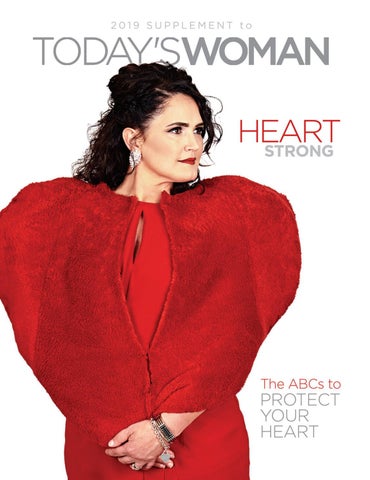
ON THE COVER, DANIELLE IS WEARING: Jacket designed by Aubrey HIllis; and dress, $54, and earrings, $20, both from Dress and Dwell.
Today’s Woman / Heart Health 2019
3
AFTER THE BIRTH OF DANIELLE ARCHER’S FIFTH CHILD in 2013, she began experiencing extreme fatigue and shortness of breath. Because she didn’t fit the profile of a person with heart disease — she was a runner training for a marathon — doctors attributed these symptoms to her being over 40, her hormones, and anxiety. Still, Danielle knew her symptoms were not just in her head. “To go up a flight of stairs almost left me in tears,” she says. “I just knew it wasn’t fatigue or my hormones. I knew it was something more.” An electrocardiogram (EKG) had been normal, but Danielle says her doctor finally agreed to an echocardiogram. Once doctors got a look at her heart, they could see that Danielle had been right all along: she had severe mitral valve prolapse, which is when the valves that control blood flow don’t pump the blood as they should. In December 2016, Danielle had open heart surgery to repair her valve. She began cardiac rehabilitation to help her heart strengthen and returned to her job at Hosparus Health and an active lifestyle, even training for the Triple Crown of Running, but she had a stroke in 2017, which doctors attributed to atrial fibrillation (rapid heartbeat caused by poor blood flow). Because of that stroke, she now has to take a blood thinner, but that is the only medication she takes.
"IT TOOK SOME PERSISTENCE ON MY PART TO HAVE MY SYMPTOMS TAKEN SERIOUSLY."
H
During the months when Danielle kept returning to her doctor about her symptoms, she really had to be her own hero, and she encourages other women to do the same. “I knew something was wrong, and it took some persistence on my part to have my symptoms taken seriously,” she says. “You’re paying [the doctors] to listen to you.”
IS FOR HERO
4
Be your own HERO by being proactive about your health and getting a second opinion when in doubt.
Heart Health 2019 / TodaysWomanNow.com
DANIELLE IS WEARING: T-Shirt, $26, wrap, $56, and earrings, $20, all from Dress and Dwell; Letter H, $10, from Architectural Salvage.
Today’s Woman / Heart Health 2019
5
IN 2017, TWO WEEKS AFTER DELIVERING HER FOURTH CHILD, Katie Adams began experiencing troubling symptoms while out with her husband. “I felt like I couldn’t breathe and had tingling sensations on the side of my neck,” she says. Her husband called 911 and was advised to take her to the hospital in Shelbyville; she was later transferred to the Jewish Hospital Rudd Heart and Lung Center in downtown Louisville.
KATIE IS WEARING: Top, $34, earrings, $20, both from Dress and Dwell; Letter E, $10, from Architectural Salvage.
Doctors determined that her left anterior descending (LAD) artery had torn, a condition called spontaneous coronary artery dissection (SCAD). In the midst of her heart attack, Katie told doctors about her prior health history: she had experienced a carotid artery dissection and mini stroke in her late 20s, and her father died at the age of 30 from a brain aneurysm. Although she didn’t otherwise “look” like a heart disease patient, her risk factors were taken seriously.
"I FELT LIKE I COULDN'T BREATHE AND HAD TINGLING SENSATIONS ON THE SIDE OF MY NECK."
E 6
SCAD is a rare condition, which means that not many physicians are experienced in treating it. Because of this, Katie is under the care of Dr. Esther Kim at Vanderbilt University Medical Center in Nashville, Tennessee. Katie was also diagnosed with Fibromuscular Dysplasia (FMD), a condition in which the blood vessels in the body are twisted rather than smooth. Despite being under quality medical care, SCAD has been life-changing for Katie. “Part of SCAD is that you’re always in pain,” she says. She takes numerous medications to help minimize the likelihood of cardiac events. The rarity of SCAD and its unpredictability makes it a scary condition. Katie is part of a Kentucky SCAD survivors group on Facebook that offers support and information to others. She has also made a point to control what she can about her heart health. She walks or runs every day in an effort to improve both her physical and emotional health. “It’s stressful to live with a chronic health condition,” she says, but exercise encourages her to push through her fears.
IS FOR ENCOURAGE
Find ENCOURAGEMENT through volunteering with the American Heart Association or similar organizations who are advocating for living a healthier life.
Heart Health 2019 / TodaysWomanNow.com
STEPHANIE DAVIS HAD HER SON, LANDON, ON JANUARY 2, 2014, after trying for three years to become pregnant and undergoing in-vitro fertilization. After delivery, her vital signs were very concerning. At first, her doctors thought she might have pneumonia, but after an echocardiogram, she was moved to the cardiac floor of the hospital, where she stayed for 11 days. Her ejection fraction, which shows how much blood the heart pumps with each beat, was 20 percent; a normal heart pumps out about 60 percent. Stephanie was diagnosed with heart failure. She was put on various medications and discharged from the hospital, but when she returned to her cardiologist, her ejection fraction was still extremely low (at 27 percent). Her doctor recommended that Stephanie have a cardioverter defibrillator implanted because she was at high risk of having another cardiac event. Her ejection fraction is now 42 percent, which is still lower than normal, but much better than when she was first diagnosed.
"ALL I EVER WANTED WAS TO BE A MOM; TO THINK THAT IT WAS GOING TO BE TAKEN AWAY FROM ME [WAS DEVASTATING}."
A
8
Stephanie says fear really hit her when her son celebrated his first birthday. Between her compensated heart failure, as well as Crohn’s disease, which she has had for many years, and the lack of sleep that comes from having a newborn in the house, Stephanie was in basic survival mode during Landon’s first year. Once things calmed down, she says, “The dust settled, and I had more time to think about everything. All I ever wanted was to be a mom; to think that it was going to be taken away from me [was devastating].” Stephanie also had to adjust to not being able to do as much physical activity as before. Prior to heart failure, she had worked as a nurse on the respiratory floor of Kosair, but she simply was not able to keep up after having her son. She now works at Norton Pediatric After Hours Access Center, providing after hours care by phone, a job she says has saved her. Her family also moved to a ranch-style house because she couldn’t carry Landon or laundry up and down stairs with ease anymore. Stephanie credits having Landon as her motivation. “He keeps me going, and he also understands when I can’t. I feel [my condition] is going to make him a caring person,” she says.
IS FOR AFRAID
Being AFRAID of heart disease puts limitations on living a happy life. Live a life of courage.
Heart Health 2019 / TodaysWomanNow.com
STEPHANIE IS WEARING: Caroline top, $46, and leather earrings, $16, both from Dress and Dwell; Letter A, $10, from Architectural Salvage.
NEARLY 20 YEARS AGO, WHEN HEATHER RAY WAS PREGNANT with her daughter, she gained 55 pounds of fluid, and her blood pressure shot up to 290/100, which caused her to have to undergo a C-section at 29 weeks of pregnancy. In the years following, Heather experienced difficulty breathing, which doctors thought was asthma. She had to sleep sitting up and frequently used a nebulizer. When she eventually ended up in the hospital with what doctors suspected might be tuberculosis, they decided to send her to U of L Hospital. It was there that Dr. Rita Coram and staff performed an ultrasound and determined that rheumatic fever during childhood had caused Heather to develop mitral valve stenosis. She was also diagnosed with pulmonary hypertension. Heather eventually went to the Mayo Clinic and was found to be a candidate for valvuloplasty. Immediately after the surgery, “I felt like I could finally breathe,” she says.
"I FELT LIKE I COULD FINALLY BREATHE."
R 10
Her diagnosis and treatment led to a renewal of Heather’s life. In addition to making her job as a hairdresser feel much easier, being able to breathe and feeling more energetic led Heather to train for and compete in an Iron Man contest. After years of her heart racing and feeling winded by the slightest activity, Heather felt a freedom she hadn’t anticipated. A valvuloplasty is typically only good for 10 years, so Heather knows she will have another surgery down the road. She is hopeful that her physical activity means she can hold off on having a mechanical valve, which is a much more involved surgery with a longer recovery. For now, though, she continues to exercise and set physical challenges for herself to celebrate her renewed ability to breathe and move.
IS FOR RENEW
Turn your heart disease into an opportunity to RENEW yourself spiritually, emotionally, and physically.
Heart Health 2019 / TodaysWomanNow.com
HEATHER IS WEARING: Shirt, $36, earrings, $16, both from Dress and Dwell; Letter R, $10, from Architectural Salvage.
Today’s Woman / Heart Health 2019
11
SUSAN MOSS REMEMBERS BEING IN THE JEWISH HOSPITAL HEART CATHETERIZATION LAB 20 years ago, watching as her mother, who had a long history of heart problems, had stents put in. “I vowed to myself this would never happen to me,” Susan says. She became a vegetarian and exercised multiple times a week. She had low blood pressure and kept tabs on her cholesterol levels. Susan had taken the time and the energy to ensure heart disease would not affect her. Five years ago, however, she began experiencing dull chest pain that woke her up at night. She didn’t tell anyone, including her brother, who is an emergency room physician. After a number of days, she looked up her symptoms on WebMD. A box popped up that said, “Go seek immediate medical attention.” Susan realized she needed to heed that advice. “I’m not going to like the answer, but I need to say something,” she recalls thinking at the time.
"I VOWED TO MYSELF THIS WOULD NEVER HAPPEN TO ME."
T 12
She reached out to her colleagues at Kindred Healthcare who helped her get in touch with a cardiologist. Susan felt like she was in a time warp because, as a precautionary measure, the physician had her go to the same catheterization lab she had gone to with her own mother 20 years prior. The catheterization showed she had a 60 percent blockage in an artery. Susan says when the surgeon opened that artery with a stent she felt relief as she lay on the cath lab table. While Susan was glad her heart condition wasn’t worse, the blockage did make her wonder whether she had wasted time by eating well and exercising over the past 20 years if she was going to end up having a heart problem anyway. Ultimately, she realized that the time she spent doing those healthy behaviors was well spent. “I didn’t have a heart attack, and I could have. I’m living my life so I don’t have the issues my mother had. You don’t want to live a compromised life,” she says, especially since she is the busy mother of three teenage and young adult children.
IS FOR TIME
Having heart disease can steal precious TIME away from you, but you can undo some of the damage by eliminating unhealthy habits that can increase your risk for a heart attack.
Heart Health 2019 / TodaysWomanNow.com
SUSAN IS WEARING: Sweater (model's own); earrings, $20, and necklace, $20, both from Dress and Dwell; Letter T, $10, from Architectural Salvage.
Go Red for Women The Circle of Red is a group of volunteers who work together to help raise funds and awareness about heart disease and stroke in the community. To become a member, contact Karrie Harper at karrie.harper@heart.org or 502.371.6014.
Photo by Melissa Donald
Circle of Red Members: Back row (l-r): Kim Huffman, Managing Partner of Neil Huffman Auto Group, Circle of Red; Kim Tharp-Barrie, System Vice President Norton Healthcare Institute for Nursing and Workforce Outreach, Circle of Red Co-Founder; Leah Eggers, Chief Operating Officer, On Plane Consulting, Circle of Red member; Pamela Alvey, APRN, Co-Owner Extended Care House Calls, Chair of Leadership Team, Circle of Red member, Planning Board Committee; Jill Joseph Bell, Vice President Chief Marketing and Communications Officer Passport Health Plan, Circle of Red member; Ruth Devore, Director of Group Administration Delta Dental of Kentucky, Circle of Red member and Planning Committee Chair. Front row (l-r): Susan E. Moss, Senior Vice President Marketing and Communication Kindred Healthcare, Circle of Red member, Go Red For Women Co-Chair; Edith Wright, Community Service Activist, Circle of Red member; Pamela Missi, DNP, RN, NE-BC, Vice President and Chief Nursing Officer Norton Women’s and Children’s Hospital, Circle of Red member, Executive Leadership Team; Jessica Pollio, Sponsorship Sales Manager, Kentucky Derby Festival, Circle of Red member; Jan Anderson, President, LifeWise, Inc., Circle of Red Chair; Stephanie Tisone, Membership Sales Director Baptist Health/Milestone Wellness Center, Circle of Red member; Andrea Romisher, Senior Vice President, Compensation & Benefits Kindred Healthcare, Go Red for Women Co-Chair. Circle of Red members not pictured: Terrian Barnes, Renee Cecil, Denise Jerome, Emily Kirby, Carol Lambert, Judie Parks, Judith Petty, Mia Phelps, Dr. Kristen Sell-Dottin, Dr. Janet Smith.
14
Heart Health 2019 / TodaysWomanNow.com
Today’s Woman / Heart Health 2019
15