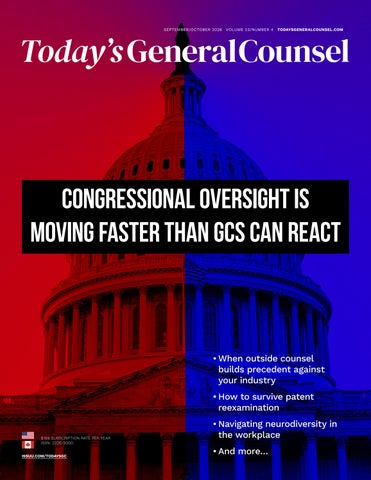
SEPTEMBER/OCTOBER 2026
VOLUME 23/NUMBER 4
TODAYSGENERALCOUNSEL.COM
CONGRESSIONAL OVERSIGHT IS MOVING FASTER THAN GCS CAN REACT
• When outside counsel builds precedent against your industry • How to survive patent reexamination $199 SUBSCRIPTION RATE PER YEAR ISSN: 2326-5000 ISSUU.COM/TODAYSGC
• Navigating neurodiversity in the workplace • And more…
EDITOR’S DESK
W
hat happens when the pace of congressional oversight moves faster than traditional legal response strategy allows? In our cover story, Jonathan Becker and Tom Perez of Mayer Brown explore why modern legal leaders are being forced to rethink reactivity in favor of real-time agility—a timely shift as political pressure intensifies ahead of the midterms. “If Democrats gain control of the House, the Senate, or both in the next election cycle, divided government will make legislation difficult. Oversight, however, requires only a committee gavel,” they write. “What is likely to follow is broad, aggressive oversight that moves faster than the regulatory proceedings most legal and compliance teams are built to manage.” As congressional oversight accelerates at an unprecedented pace, playing defense is no longer sufficient. The authors outline precisely what general counsel (GCs) must do to mitigate risk and preempt crises—particularly across highly regulated industries such as healthcare, financial services, technology, energy, airlines, consumer goods, and defense. “The question is not whether this agenda could affect the sector; it is which exposure categories apply to their company’s own history,” they note. Beyond Capitol Hill, this issue tackles the complex challenges of operational risk, internal strategy, and workforce dynamics facing in-house legal departments today. For example, consider the law firm mergers and acquisitions (M&A) boom reshaping the legal landscape and an arguably unexpected consequence: What happens when your outside counsel merges with another firm that has established litigation precedents damaging to your own industry? In his article for us, Kenneth A. Rosen looks at that very scenario and tells you what you and your team need to do to prevent it. Even if you are ahead of the curve on congressional oversight and managing outside counsel tightly, other critical risks remain. To that end, explore our articles on how to survive the patent reexamination process, choose the best paid time off (PTO) policy, support neurodiverse employees, and stay on top of the latest cybersecurity threats to your organization. As always, be sure to subscribe to our newsletters and follow us on LinkedIn and X to read even more legal insights and analysis. Thank you for reading!
Amanda Kaiser Editor-in-Chief
SEPTEMBER/OCTOBER 2026
TODAYSGENERALCOUNSEL.COM
2
contents
SEPTEMBER/OCTOBER 2026
Volume 23/Number 4
LITIGATION
9 How to Prevent Outside Counsel From Building Precedent Against Your Industry By Kenneth A. Rosen
The ongoing M&A boom is creating a quiet crisis for GCs. Read about the consolidation’s impact on conflicting industry interests and precedent. INTELLECTUAL PROPERTY
12 Surviving Patent Reexamination: Practical Strategies for In-House Counsel By Daniel B. Henry and Gabrielle Sue
Learn strategic steps, common pitfalls, and practical considerations to navigate the patent reexamination process effectively.
PAGE 6
COVER STORY COMPLIANCE
6 Congressional Oversight Is Moving Faster Than GCs Can React By Jonathan Becker and Tom Perez
Most GCs are built for regulatory and litigation risk. Congressional oversight is a different animal entirely. Learn how to be prepared when the inquiry arrives. SEPTEMBER/OCTOBER 2026
PAGE 12
TODAYSGENERALCOUNSEL.COM
3
CONTENTS LEGAL OPERATIONS
COLUMNS THE CYBER COUNSEL WITH SANDY JACOLOW
14 Don’t Let a Green Cyber Dashboard Give Your Board a False Sense of Security By Sandy Jacolow
Learn how to look past your cyber dashboard to mitigate real risk for the organization.
16 Navigating Neurodiversity: How to Address Psychological Safety in the Workplace By Kristin Follis
Learn how to embrace neurodiversity to foster inclusion, innovation, and productivity in the workplace.
EMPLOYMENT LAW IN FOCUS
19 PTO Wars: Choosing Between Unlimited, Minimum, and “Use-It-or-Lose-It” Policies By Leah M. Stiegler and Anne Bibeau
Learn how to develop an effective PTO policy and learn the key differences between unlimited, minimum, and “use-it-or-lose-it” options.
SEPTEMBER/OCTOBER 2026
PAGE 16
TODAYSGENERALCOUNSEL.COM
4
EDITOR-IN-CHIEF Amanda Kaiser
EXECUTIVE EDITOR
SENIOR EDITOR
ASSOCIATE EDITOR
Bruce Rubenstein
Barbara Camm
Jessica Bajorinas
CHIEF EXECUTIVE OFFICER Robert Nienhouse
MANAGING DIRECTOR OF CLIENT PARTNERSHIPS & INITIATIVES
CLIENT PARTNERSHIPS MANAGER
Lainie Geary
Stella Vargas
DIRECTOR OF ADMINISTRATION
DATABASE MANAGER
Catherine Nienhouse
Patricia McGuinness
ART DIRECTION & PHOTO ILLUSTRATION MPower Ideation, LLC
CONTRIBUTORS
EDITORIAL ADVISORY BOARD
Jonathan Becker Anne Bibeau Kristin Follis Daniel B. Henry Sandy Jacolow Tom Perez Kenneth A. Rosen Leah Stiegler Gabrielle Sue
David A. Katz
Dennis J. Block
GREENBERG TRAURIG LLP
WACHTELL, LIPTON, ROSEN & KATZ
Thomas W. Brunner
Nikiforos Iatrou
WILEY REIN LLP
MCCARTHY TETRAULT LLP
Mark A. Carter
Steven F. Molo
Jeffery Cross
Robert A. Profusek
Jamie Gorelick
George D. Ruttinger
DINSMORE & SHOHL LLP
MOLOLAMKEN LLP
SMITH, GAMBRELL & RUSSELL LLP
JONES DAY
WILMERHALE LLP
Robert L. Haig
KELLEY, DRYE & WARREN LLP
CROWELL & MORING LLP
Jonathan S. Sack
MORVILLO ABRAMOWITZ GRAND IASON & ANELLO PC
Robert C. Heim
Victor E. Schwartz
DECHERT LLP
SHOOK, HARDY & BACON LLP
Sheila Hollis
Jonathan D. Schiller
DUANE MORRIS LLP
BOIES SCHILLER FLEXNER LLP
SUBSCRIPTION
REPRINTS
Subscription rate per year: $199 For subscription requests, email subscriptions@todaysgc.com
For reprint requests, email Lisa Payne: lpayne@mossbergco.com Mossberg & Company Inc.
All rights reserved. No part of this publication may be reproduced or transmitted in any form or by any means, electronic or mechanical, including photocopy, recording, or any information or retrieval system, without the written permission of the publisher. Articles published in Today’s General Counsel are not to be construed as legal or professional advice, nor unless otherwise stated are they necessarily the views of a writer’s firm or its clients. Today’s General Counsel (ISSN 2326-5000) is published six times per year by Nienhouse Group Inc., 110 N Upper Wacker Dr, Chicago, IL 60606. Image source: iStockphoto | Copyright © 2026 Nienhouse Group Inc. To submit an article, go to todaysgeneralcounsel.com/submissions.
COMPLIANCE
Congressional Oversight Is Moving Faster Than GCs Can React By JONATHAN BECKER AND TOM PEREZ WHY CONGRESSIONAL OVERSIGHT SITS OUTSIDE THE GC’S USUAL TOOLKIT
T
here is a classic Wayne Gretzky insight that applies, with uncomfortable precision, to corporate political risk: the great ones skate to where the puck is going, not to where it is. Most general counsel (GCs) are well-positioned for the risks they know—Securities and Exchange Commission (SEC) investigations, Federal Trade Commission (FTC) enforcement, Department of Justice (DOJ) inquiries, civil litigation. Those proceedings are structured, bounded, and governed by recognizable rules. They are not where the puck is going. The puck is moving toward congressional oversight—the investigative BACK TO CONTENTS
and subpoena authority exercised by committee chairs. The next Congress is likely to use that authority at a scale and speed many companies have not prepared for. If Democrats gain control of the House, the Senate, or both in the next election cycle, divided government will make legislation difficult. Oversight, however, requires only a committee gavel. What is likely to follow is broad, aggressive oversight that moves faster than the regulatory proceedings most legal and compliance teams are built to manage. The companies best positioned for what is coming will be the ones whose GCs prepared the organization before Washington ever came calling.
GCs who have navigated SEC investigations or FTC proceedings often make the dangerous assumption that congressional oversight follows similar logic. It does not. Congressional investigations are not governed by the same procedural guardrails as regulatory matters. They are often driven by public concern about overreach, self-dealing, or abuse of power, and they expand quickly when control of Congress shifts. Congressional investigations move at the speed of news cycles. A hearing clip reaches millions of people within hours. For GCs accustomed to written responses and negotiated timelines, that cadence creates a different kind of risk: one bad hearing moment can outlast the investigation itself. Social media wasn’t a significant factor in the last major oversight waves. It is now. Modern committee chairs are also more media-savvy than their predecessors in ways that matter to legal strategy. Equally important: congressional oversight requires no floor vote, and no presidential signature. That asymmetry—between what it takes to initiate oversight and what it takes to defend against it—is what makes it so powerful.
SEPTEMBER/OCTOBER 2026
TODAYSGENERALCOUNSEL.COM
6
HOW A LETTER BECOMES A MULTI-FRONT LEGAL CRISIS The GC’s initial instinct when a congressional inquiry arrives is often to treat it as a discrete legal matter: respond to the document request, prepare the witness, control the testimony. That work matters. But the larger danger is the cascade the inquiry can trigger. A regulatory inquiry tends to stay within its originating agency. A congressional inquiry radiates outward. States attorneys general, federal agencies, plaintiffs’ lawyers, investors, and competitors can all use congressional narratives as roadmaps for their own actions. A committee chair letter can metastasize into a multi-front legal crisis within days, implicating parallel investigations, disclosure obligations, derivative litigation risk, and creditor or counterparty concerns. The documentary record created for Congress can also resurface years later. These are not short-tail risks.
WHAT GCS NEED TO KNOW ABOUT THE INVESTIGATIVE AGENDA TAKING SHAPE Congressional leaders have been very transparent about where they intend to focus. GCs should be translating those signals into concrete legal and operational risk assessments now. The dominant investigative frame is likely to fuse concerns around affordability and alleged corruption: Business decisions that should have turned on their own merits were allegedly shaped by political access, campaign contributions, or relationships with the administration, raising cost for ordinary Americans. The critical point for GCs: this frame requires no finding of illegality. Congressional oversight draws its BACK TO CONTENTS
power from compelled disclosure, public testimony, and the ability to reframe ordinary business decisions as evidence of something worse. That frame reaches across industries. Companies in healthcare, financial services, technology, energy, airlines, consumer goods, and defense all touch household budgets in ways that make them natural investigative targets. The question is not whether this agenda could affect the sector; it is which exposure categories apply to their company’s own history: • Regulatory approvals, merger clearances, or tariff relief obtained in connection with commitments to, or relationships with, the current administration • Contributions to inaugural funds, politically affiliated institutions, or high-visibility administration initiatives • Business relationships or transactions involving senior administration officials and their family members or politically connected individuals • Public alignment with administration priorities that are contested or highly partisan, including policy areas touching health care costs, prescription drug pricing, American Care Act (ACA) subsidies, energy prices, or housing • Operations in fast-evolving regulatory spaces—such as cryptocurrency or prediction markets— where congressional interest in who receives favorable treatment from regulators is intensifying Companies should also not assume that exposure is concentrated in the traditional oversight committees. The affordability-and-corruption frame cuts across so many sectors of
the economy that nearly every committee with industry jurisdiction has both the incentive and the standing to open inquiries. The next oversight cycle is likely to be an “all committees” environment, not a siloed one.
A FRAMEWORK FOR ACTIONABLE PREPARATION The most effective response to congressional oversight begins before any inquiry arrives. By the time a company receives a letter from a committee chair, the GC’s options have already narrowed sharply—and the cost of response has increased exponentially. GCs should organize their preparation around four distinct operational priorities:
1
Conduct a narrative exposure review (not just a compliance review) • The pitfall: Standard legal compliance reviews only ask whether the company followed the established rules. • The vulnerability: Congressional investigators do not need a legal violation to cause damage; they are hunting for a compelling public story. • The action: GCs must proactively review internal decisions, transactions, and political relationships through a partisan lens. Identify which actions—if displayed on a hearing room screen entirely out of context—would be difficult to defend or easy for an opponent to mischaracterize.
2
Commission an adversarial document-risk audit • The pitfall: GCs often rely on privilege reviews to protect data and litigation holds to preserve it, but neither tells you how the record actually reads to an investigator.
SEPTEMBER/OCTOBER 2026
TODAYSGENERALCOUNSEL.COM
7
• The vulnerability: Congressional investigations are built entirely on internal emails, presentations, board materials, and informal chats. Without context, ordinary business files can easily be reframed to look malicious. • The action: Do not wait for a committee request to force your hand. The GC must proactively commission an independent document audit of the company’s Washington-related activities to flag and understand problematic message threads before they are subpoenaed.
3
Build a cross-functional crisis protocol • The pitfall: Under normal operating conditions, corporate legal, communications, and government affairs teams operate in isolated corporate silos. • The vulnerability: When a congressional inquiry hits, timelines compress instantly. If these teams are meeting each other’s outside PR firms or advisors for the first time during a crisis, the company has already lost ground. • The action: Integrate these three functions now. Establish a unified external messaging strategy, clear decision-making authority, and a pre-existing protocol for when and how to retain specialized congressional defense counsel.
4
Engage selectively and early on both sides of the aisle • The pitfall: Companies often stay quiet until they are targeted, leaving them completely unknown to key decision makers in Washington. • The vulnerability: In a deeply divided government, failing to maintain open lines of communication BACK TO CONTENTS
with both parties makes a company an incredibly easy, defenseless target. • The action: Build relationships and establish an objective factual record with relevant committee staff and members on both sides of the aisle before the political temperature rises. Credibility now can provide a defense against a highly-charged inquiry next year.
THE GC’S ROLE IN ELEVATING THIS TO THE BOARD Boards often treat Washington risk as primarily a regulatory and legislative matter that can be delegated to legal and government affairs. Congressional oversight is different in kind, not just degree, and the board needs to understand that distinction before an inquiry forces the conversation. An investigation can affect stock price, delay transactions, complicate financing, and pull senior executives into crisis posture for months. Unlike a regulatory proceeding, there may be no clear endpoint. GCs should proactively brief audit and risk committees using a clear diagnostic framework. Do not wait for an inquiry to force the conversation. Walk the board through these four critical questions: • Exposure mapping: How has the company mapped its oversight vulnerabilities in political, rather than just strictly legal, terms? • Cross-functional integration: Are the legal, communications, and government affairs teams integrated and tested under simulated crisis timelines? • Narrative visibility: Does the board have clear visibility into the company’s Washington relationships and the public narratives they might generate?
Prefer to read this online? Click here. • Bipartisan advisor readiness: Are outside advisors with genuine, proven bipartisan credibility already retained and on standby? These are not hypothetical questions for a future contingency. They are preparation for a foreseeable event, in a political environment that has been very clear about what is coming. Skating to where the puck is going is not a metaphor. For GCs, in this heightened oversight environment, proactivity is a professional obligation.
Jonathan Becker is a Partner with Mayer Brown, where he advises corporate clients confronting congressional, regulatory, enforcement, and media risks arising from high-profile public policy disputes. His practice focuses on companies in highly regulated industries—including healthcare, financial services, technology, media, and defense. Tom Perez is a Partner with Mayer Brown and a former US Secretary of Labor and highranking White House official. Perez spent the bulk of his career at the Department of Justice, serving as a prosecutor in the Civil Rights Division during both Republican and Democratic administrations.
SEPTEMBER/OCTOBER 2026
TODAYSGENERALCOUNSEL.COM
8
LITIGATION
How to Prevent Outside Counsel From Building Precedent Against Your Industry By KENNETH A. ROSEN
T
he ongoing law firm merger boom—marked by mega-consolidations like the Herbert Smith Freehills and Kramer Levin tie-up—is usually viewed through the lens of business growth. But for general counsel (GCs), this massive consolidation presents a quiet crisis. As elite legal talent concentrates into fewer, massive entities, the risk of conflicting industry interests skyrockets. GCs facing the possibility of their own outside counsel setting systemic, industry-damaging precedents in parallel litigation. Every combination widens the roster of positions a firm holds, leaving fewer major players free from conflicts with your adversaries. The bigger a firm grows, the greater the chance that somewhere inside it, in a matter unrelated to you, it is advancing a theory your industry will have to answer for later. Consider how that plays out. Your company retains a firm for its lending and restructuring work. Months later, you learn it is pressing an aggressive lender-liability theory for another client. No one is suing you, the matters are unrelated, and none of your confidential information is in play. Yet your own counsel is helping to build precedent that may land on your desk. BACK TO CONTENTS
Most GCs have a version of this story. The instinct is to call it a conflict of interest, but under standard ethics rules, it usually is not. That gap is why in-house counsel cannot rely on professional rules to stop a firm from building adverse precedent against their industry—and why the engagement letter must become your primary tool for protection.
As elite legal talent concentrates into fewer, massive entities, the risk of conflicting industry interests skyrockets. THE LIMITS OF ETHICAL RULES AND RULE 1.7 Rule 1.7 of the American Bar Association (ABA) Model Rules of Professional Conduct on conflict of interest is built around direct adversity and around representations that materially limit a lawyer’s duties to another client. Your objection is neither. The firm is not adverse to you in any case; it is advancing a position, for someone else, that may later be
used against your industry. The rule was not written for that. The profession calls this a positional or issue conflict: a firm taking inconsistent positions for different clients in unrelated matters, one helped by a broad rule and another by a narrow one. The leading authority, ABA Formal Opinion 93-377, accepts that lawyers routinely do this and that it ordinarily creates no conflict requiring consent or withdrawal. It warns of closer scrutiny only when the positions are urged simultaneously, when the lawyer’s independent judgment may suffer, or when success for one client could “materially undercut” the position urged for another. The opinion’s own examples, though, involve directly contrary positions on the same issue in the same jurisdiction—far narrower than a firm building industry-wide precedent you dislike.
JUDICIAL SKEPTICISM AND BROAD PRECEDENT Courts have been no more receptive. They have not recognized any broad doctrine of precedent adversity, and the reported decisions are thin. In Maling v. Finnegan, Henderson, Farabow, Garrett & Dunner LLP, the Massachusetts Supreme Judicial Court ruled that a law firm does
SEPTEMBER/OCTOBER 2026
TODAYSGENERALCOUNSEL.COM
9
not have a disqualifying conflict of interest simply because it represents competing companies in patent prosecutions. The court held that competing economic interests, on their own, are not enough to create a legal conflict. On disqualification motions, courts look for direct adversity, confidential information, or material limitation, not the diffuse concern that an argument may someday cut against another client. Unified Sewerage Agency v. Jelco Inc. is one example of this. This risk is not distributed evenly across a legal practice. Instead, it intensifies where three factors align: a recurring question impacts multiple cases, the governing doctrine is unsettled enough to be shaped by active advocacy, and a single ruling could decide the issue for an entire industry. BACK TO CONTENTS
Above all, the danger depends on whether your firm operates on both sides of the debate. A firm that consistently represents only one side maintains a unified front and avoids conflict. The real issue arises when a firm argues both ways across its portfolio—advocating a legal interpretation for one client that directly contradicts the position another of your clients must defend later.
WHERE PROFESSIONAL CONFLICTS HIT HARDEST Insurance coverage is the clearest example. Insurers are the ultimate repeat players, and questions of trigger, allocation, number of occurrences, and the reach of an exclusion govern an entire book of business. A firm that represents policyholders in some cases and insurers in others routinely argues both sides of the
same legal doctrines. Consequently, a broad-coverage victory secured for a policyholder creates a binding precedent that its insurer clients must live with everywhere else. Patent work runs the same way, firms both asserting and defending infringement; Maling itself arose in patent prosecution. Antitrust and commercial litigation follow the pattern. Mass torts and environmental defense raise a subtler version. Because the plaintiff’s side in these cases is dominated by a specialized contingency bar, the most intense conflict is rarely between plaintiff and defendant. Instead, the real battle happens among the codefendants themselves, who frequently clash over liability allocation, divisibility, and the scope of successor or arranger liability. The divisibility
SEPTEMBER/OCTOBER 2026
TODAYSGENERALCOUNSEL.COM
10
argument your firm wins for one manufacturer can enlarge the share borne by another it represents down the hall—a real positional conflict, defendant to defendant rather than across the plaintiff line.
PROTECTING YOUR INTERESTS VIA THE ENGAGEMENT LETTER Standard disciplinary rules rarely compel a firm to step down. If you want true protection, you must build it directly into your engagement letter rather than relying on the Model Rules. Sophisticated clients now address this vulnerability through their outside counsel guidelines. To do this effectively, consider adding a provision that bars the firm from representing interests adverse to your legal or business strategy—not just representations where you are an opposing party. This effectively addresses “positional conflicts” that Rule 1.7 fails to cover. Additionally, include a notice-and-consultation requirement forcing the firm to alert you before accepting any matter that impacts specific, defined issues. Ultimately, you want to hear about an adverse lender-liability brief before it is filed, not after it is cited against you in court. Law firms resist these clauses, and their objection deserves a straight answer. A large firm cannot run a conflicts check against a position you haven’t explicitly named. Because their intake systems search for parties and matters—not arguments—no partner will realize that a “failure-to-warn” brief filed three offices away undermines your strategy. This highlights the core problem: the firm cannot police what you do not identify. To work effectively, your clause must be highly specific. “Adverse to BACK TO CONTENTS
our interests” is too vague to enforce. Name the theories that would hurt you—lender liability, a broader failure-to-warn standard, an expansive reading of a privacy or employment statute—and make those the subject of your notice and waiver terms. A defined list gives the firm something to flag and you something to hold it to. Advance waivers deserve particular attention, because larger firms ask for broader ones, and the sweeping versions absorb exactly the situations you care about. Read them. Where an issue is strategically important, negotiate a carve-out so your consent does not extend to matters advancing positions against your industry’s core defenses. A blanket waiver signed at intake can quietly forfeit the objection you would most want to make later. When a situation surfaces, treat it as a business conversation, not an ethics complaint. Is the issue one your company will face? Could a win there affect your exposure? Is your relationship important enough that the firm should weigh your objection against the other engagement? Firms balance representations against client tension all the time; there is no reason your view should not count.
Prefer to read this online? Click here. notice and leverage when the firm’s advocacy in an unrelated matter threatens to make law you will have to live with. As firms consolidate and the field of unconflicted alternatives narrows, that question only sharpens—and in regulated industries, where one appellate decision can reset the risk for a whole field, it is better answered in the engagement letter than after the opinion comes down.
Kenneth Rosen advises on the full spectrum of restructuring solutions, including Chapter 11 reorganizations, outof-court workouts, financial restructurings, and litigation. He works closely with debtors, creditors’ committees, lenders, landlords, and others in such diverse industries as paper and printing, food, furniture, pharmaceuticals, health care, and real estate. He can be reached at ken@kenrosenadvisors.com.
SHIFTING THE FOCUS FROM CONFLICTS TO LEVERAGE You will not win every one. Firms advance inconsistent positions as a matter of course, and you have no veto over a firm’s docket. What you are owed is a relationship with clear terms, early warning, and a firm that knows which developments in your industry you actually care about. The question, then, is not whether your firm’s other work creates a conflict; usually it does not. It is whether your engagement terms give you SEPTEMBER/OCTOBER 2026
TODAYSGENERALCOUNSEL.COM
11
INTELLECTUAL PROPERT Y
Surviving Patent Reexamination: Practical Strategies for In-House Counsel By DANIEL B. HENRY AND GABRIELLE SUE
E
ven recently granted patents are facing unprecedented scrutiny. With ex parte reexaminations already topping more than 250 filings in the second quarter of 2026, corporate intellectual property (IP) portfolios are increasingly under threat. The United States Patent and Trademark Office (USPTO) Director’s recent decision to reexamine one of Nintendo’s newly issued patents underscores the threat. For in-house counsel, waiting until a validity challenge hits your desk is a costly gamble. Below, we outline strategic steps, common pitfalls, and practical considerations to navigate ex parte reexaminations effectively. BACK TO CONTENTS
UNDERSTANDING EX PARTE REEXAMINATION Ex parte reexamination allows the USPTO to revisit the validity of an issued patent based on prior art patents or printed publications. Because it can directly affect ongoing or anticipated litigation, it is an important tool for both patent owners and challengers. Any party, including parties engaged in litigation, may request reexamination. The USPTO will grant the request if it finds at least one substantial new question of patentability. Once reexamination is ordered, the patent owner has two months from the mailing date to file an optional statement, including arguments
distinguishing the claims from cited prior art and/or non-broadening amendments. If filed, third-party reexamination requesters may respond. The examiner reviews the claims in view of the prior art and issues a first Office Action detailing which claims are allowed, which are rejected, and why. The patent owner responds, and if rejections are maintained, a final Office Action typically follows. The patent owner then has two months to respond and should ensure the response fully addresses each issue raised. If the examiner maintains any rejections, a final Office Action is typically issued. In limited circumstances, prosecution may be reopened if the final action is found to be improper. If the patent owner disagrees with the outcome, they may appeal to the Patent Trial and Appeal Board (PTAB). The process concludes with an ex parte reexamination certificate confirming, canceling, or amending claims.
STRATEGIC CONSIDERATIONS FOR RESPONSE A successful response begins with understanding the prior art in relation to the patent claims. In-house counsel should work with IP counsel and technical experts to identify gaps
SEPTEMBER/OCTOBER 2026
TODAYSGENERALCOUNSEL.COM
12
in the prior art, consider whether references can be properly combined, and determine whether meaningful distinctions exist. The strategy centers on defending the original claims or pursuing targeted amendments. Where viable, arguments should distinguish the claims from prior art. If the claims appear vulnerable, narrowing amendments may be necessary while still preserving meaningful protection. Any amendment must be considered carefully, as it may affect claim scope and enforcement. Supporting evidence is often crucial. Declarations under 37 CFR 1.132 are sworn, written statements of fact—signed under penalty of perjury by inventors or technical experts— used to provide concrete evidence to the Patent Office. These statements help establish non-obviousness through real-world proof, such as unexpected test results, a long-felt unsolved need, or the prior failure of competitors. Ultimately, they clarify what a person of ordinary skill in the art would have understood at the time of the invention and highlight critical technical distinctions that aren’t obvious from the cited references. Ultimately, even when outside IP counsel is engaged, in-house legal teams should maintain an understanding of how the prior art relates to the claims and how each strategic decision may affect the patent’s strength, scope, and enforceability.
COORDINATING WITH LITIGATION Reexamination can materially affect parallel litigation, potentially altering timing and strategy. Courts may stay proceedings pending reexamination outcomes, delaying resolution but creating an opportunity to strengthen or refine claims before trial. BACK TO CONTENTS
This overlap makes coordination essential. In-house counsel should ensure that patent prosecution counsel and litigation counsel are aligned on strategy, positions, and messaging across proceedings. Inconsistent arguments can undermine credibility and create avoidable risk. Care should be taken in developing arguments during reexamination, as statements before the USPTO may be used in litigation, including use for claim construction or challenging validity and infringement positions. Every submission should be evaluated for both its impact on the reexamination and for how it may be interpreted in court.
PROACTIVE PORTFOLIO MANAGEMENT An effective reexamination strategy often begins well before a challenge arises. Proactively managing your portfolio reduces vulnerability and positions patents more defensibly when third parties scrutinize them. A key step is identifying risk early. Prior art searches can surface vulnerabilities, allowing companies to assess exposure and take action, including pursuing continuation applications with refined claims. Claims strategy also requires balance. While demonstrating infringement may be easier with broader claims, such claims are often more susceptible to invalidity challenges. A thoughtful prosecution strategy should aim to secure claims that are both commercially meaningful and resilient under scrutiny, supported by a clear record of distinguishing from prior art. Equally important is maintaining the evidentiary record. Documentation of development timelines, technical decisions, and
Prefer to read this online? Click here. the state of the art at the time of invention can prove critical if validity is challenged. These records can support declarations under 37 CFR 1.132, including evidence of non-obviousness and the knowledge of a person of ordinary skill in the art.
CONCLUSION Reexamination is not the end of the road for a patent. It is a critical inflection point that can reaffirm or refine your IP rights. For in-house counsel, the path forward requires not only a timely response but also a clear understanding of prior art, coordination across proceedings, and alignment with broader business and litigation objectives. The key is preparation. By understanding a patent’s strengths and vulnerabilities before they are tested, legal departments can respond with confidence and protect the innovations that matter most.
SEPTEMBER/OCTOBER 2026
Daniel B. Henry and Gabrielle Sue are attorneys with Marshall, Gerstein & Borun LLP in Chicago. They may be reached at dhenry@marshallip. com and gsue@ marshallip.com.
TODAYSGENERALCOUNSEL.COM
13
COLUMN
THE CYBER COUNSEL WITH SANDY JACOLOW
Don't Let a Green Cyber Dashboard Give Your Board a False Sense of Security By SANDY JACOLOW
C
ybersecurity dashboards turn complex evidence into percentages, trends, and traffic-light colors. That clarity is useful, but it can be deceptive, offering a false sense of security. A privileged account may still lack multifactor authentication (MFA). A critical service may never have been restored from backup. A building system outside the reported scope may still interrupt operations. A green dashboard does not prove cyber risk is low. Every percentage has a denominator, and every denominator reflects a scope decision. Even if the numbers are BACK TO CONTENTS
correct, the final assessment is unreliable because critical systems were left out, controls were never tested, and significant exceptions were omitted. A green cyber dashboard is a conclusion to test, not accept. For general counsel (GCs), the dashboard is not merely an IT report. In a board book, it records what management told directors about the company’s cyber posture. In a regulatory disclosure, insurance application, customer security questionnaire, or contract, its claims may be repeated as representations on which others rely. Legal’s role is not to rerun testing; it is to ensure the
claim does not outrun the evidence. If a headline claim does not match its scope, testing, or unresolved exceptions, the mismatch creates legal and governance risk. GCs should help executives and the board committee responsible for cyber oversight press management on four questions: What is outside scope? What did testing reveal? Which material exceptions remain unresolved? Can the business recover essential services within approved time frames? The exposure is not theoretical. Following a 2022 ransomware attack, insurer Travelers alleged that electronics manufacturer International Control Services falsely claimed to use MFA for administrative and privileged access. In reality, the manufacturer only secured its firewall with MFA, leaving its servers and other digital assets unprotected. The parties stipulated to rescission, and a federal court declared the policy void from inception. Travelers’ theory was simple. The control existed; the representation about its scope did not.
START WITH THE DENOMINATOR Aggregate metrics describe only the systems selected for measurement. Legacy platforms, recent acquisitions, vendor-managed environments, and
SEPTEMBER/OCTOBER 2026
TODAYSGENERALCOUNSEL.COM
14
building systems often sit outside scope even when they underpin core operations. A 95% patching rate can mislead if the denominator disregards systems that run billing, payroll, manufacturing, or facilities. GCs and the oversight committee should know what is omitted, why, and when each gap will be brought into scope, protected by compensating controls, or documented through formal risk acceptance. Not every system requires identical controls, but gaps affecting essential operations or sensitive data must be visible. Legal should compare dashboard analytics, scope, and definitions with public disclosures, insurance applications, customer security questionnaires, and contracts. An enterprise-wide statement should not rely on internal reporting that silently excludes acquired, vendormanaged, or building systems.
ACTIVITY IS NOT ASSURANCE Most dashboard metrics measure effort: patches applied, training completed, phishing simulations passed, and tools deployed. These steps are necessary, but they do not show whether the controls will work when needed. The report should distinguish among implementation, coverage, and tested effectiveness. A dashboard may report that MFA is deployed across privileged accounts. That does not show whether MFA can be bypassed, account recovery is secure, every privileged account is covered, or service accounts have equivalent safeguards. Outcome claims require evidence from testing. Require management to test the business services most essential to operations, not merely a convenient sample, and document corrective BACK TO CONTENTS
actions. Can network segmentation contain an intrusion? Do alerts reach the right people at all hours? Can the company determine what data was accessed or transferred? Can it quickly disable a compromised vendor connection or service account? If results are repeatedly clean, ask whether the tests probe realistic failure modes or merely confirm that a control exists. For each critical control, show the date and result of the latest test and the status of corrective action. The useful measure is performance when needed, not mere deployment.
MAKE MATERIAL EXCEPTIONS VISIBLE Every material exception needs an owner, stated business impact, compensating controls, approval date, and review or expiration date. A weakness that persists quarter after quarter is no longer temporary. It is a management decision about timing, resources, or risk acceptance. Accepted risk and deferred remediation cannot disappear inside an aggregate score. The oversight committee should see which exceptions are overdue, repeatedly renewed, or tied to critical operations. A reassuring headline should not conceal a consequential decision.
MEASURE RECOVERY, NOT JUST PREVENTION Many dashboards emphasize prevention: blocked attacks, patched vulnerabilities, security-tool coverage, and employee training. Those measures matter, but no program eliminates every incident. A meaningful scorecard also demonstrates the ability to restore essential business services within agreed-upon recovery time objectives. At minimum, show the date and
Prefer to read this online? Click here. result of the latest recovery test for each critical service; whether the test covered the complete business process, not only the technology; and any unresolved actions from the latest cross-functional exercise. The key distinction is between backing up data and restoring an operating business. A successful server restoration does not mean employees can serve customers, process payments, access facilities, or meet legal obligations. Prevention reduces the likelihood of an incident. Recovery determines whether it becomes a business crisis.
TURN THE DASHBOARD INTO AN OVERSIGHT TOOL The oversight committee does not need a longer technical report. For each critical service, the dashboard should show its scope, the result of the latest control test, open exceptions and their owners, and the result of the latest recovery test. Directors should not have to infer business risk from technical activity. A dashboard that cannot surface material exposure measures comfort, not assurance.
Sandy Jacolow is the Senior Vice President, Chief Technology Officer at Empire State Realty Trust (ESRT). He oversees technology innovation supporting financial control, leasing, property management, ESG, marketing, and property technology activities. He also runs ESRT’s IT and operational technology (OT) cybersecurity programs, working closely with the compliance team to monitor and mitigate risk associated with today’s cyber threats.
SEPTEMBER/OCTOBER 2026
TODAYSGENERALCOUNSEL.COM
15
LEGAL OPERATIONS
Navigating Neurodiversity: How to Address Psychological Safety in the Workplace By KRISTIN FOLLIS
HIGH
A
t the Corporate Legal Operations Consortium (CLOC) Global Institute in Chicago that ran May 11-14, I participated in a panel with two colleagues and a room full of legal operations professionals. We did something our profession rarely does out loud: we talked honestly about how our brains work. The session was called “Navigating Neurodiversity,” and the ground rule was simple: this is a safe space. People shared lived experiences, the workarounds they’ve quietly built, and the moments they’ve thought BACK TO CONTENTS
ia l soc nces e re
IT’S MORE LIKE THIS
s t im s fid , tics get , s
FUNCTIONING
diff
LOW
ex fun ecuti ctio ve nin g
is not a straight line
sp inte ecial r es ts l on a n ot i em ulatio reg
THE NEURODIVERGENT SPECTRUM
alth e h l ges nta me allen ch
pe r
cep t
ion
y s or t y n e s itivi s sen
Image courtesy of “Welcoming the Weird and Wonderful: Creating Classroom Environments That Support Neurodiversity.” in Understanding Mental Health Across Educational Contexts: Promoting Wellness in Classrooms, 2024.
“I can’t keep this up” or struggled with imposter syndrome, burnout, or other mental health issues. I am one of those people. I am neurodivergent, and I lead legal operations. For most of my career those two facts felt like they were in tension with each other. They are not. What follows is part of what I shared in that room; for the general counsel and in-house leaders who weren’t there but lead
neurodivergent people every day. Whether they know it or not, here is what you should know if you want to advance as a leader in a changing legal landscape.
WHAT IS NEURODIVERSITY? “Neurodiversity” is a term that recognizes natural variations in how people think, learn, and behave. This perspective views conditions like autism, attention-deficit disorder/
SEPTEMBER/OCTOBER 2026
TODAYSGENERALCOUNSEL.COM
16
hyperactivity disorder (ADHD), and dyslexia as forms of human diversity rather than deficits. Embracing neurodiversity in the workplace fosters inclusion, innovation, and productivity. According to a Deloitte analysis from 2022, roughly 10%– 20% of the global population is considered neurodivergent. I was once told that neurodiversity accommodations were like physical ones: you get the accommodation you need and then everything goes back to normal, as if you were resting a broken leg. That is not how neurodiversity works. Accommodations have come a long way, with AI and apps that help us structure our days and tasks. Still, seeking an accommodation is largely an art form. Your doctor can help you adjust your daily routines to improve focus and ease stress, but these changes will not “cure” neurodiversity. To imply that an accommodation would “fix” a neurodivergent person reflects a misconception that many human resource teams/people take when approaching someone with mental health or neurodiversity. You don’t cure it. You adapt the environment to what that person needs, so they can thrive in the way their brain works.
SAME BRAIN, VERY DIFFERENT OUTCOMES Neurodivergence isn’t a single condition on a high-to-low scale. It’s a spectrum across many dimensions— executive functioning, sensory sensitivity, social differences, task avoidance, emotional regulation, perception— so two people with the same label can experience work in completely different ways. Here is the part that matters most for leaders: the same brain produces very different outcomes depending BACK TO CONTENTS
on the environment. Neurodivergent people are wired for a world built around “neurotypical” brains, so we are in a state of constant adaptation—and constant adaptation can become chronic stress. That is a large part of why neurodivergent professionals show higher rates of anxiety, depression, and burnout. Mental health and neurodiversity are deeply linked, but the lever is the environment, not the person. Day to day, that adaptation often looks like: • Masking: acting “fine” while burning through energy. • Sensory overload: noise, contextswitching, back-to-back meetings.
Mental health and neurodiversity are deeply linked, but the lever is the environment, not the person. • Cognitive load: translating, re-reading, decoding unspoken rules. • Executive dysfunction: difficulty with task initiation, working memory, emotional regulation, and time blindness. • Rejection sensitivity: “feedback freeze,” people-pleasing, and misinterpretations. • The crash: shutdowns, burnout, the “I can’t keep this up” moments. None of this shows up on a status report. It shows up as a high performer who quietly leaves, and I’m here to tell you that you are missing the boat with your soft skills if you
don’t know how to manage a person with neurodiversity. Secretly, it’s a superpower and I’ll tell you why.
WHY NEURODIVERSITY IS A GIFT I can sit down and deep dive to fix many of the back-end issues that in-house teams would otherwise have to outsource to consultants or contract lifecycle management (CLM) vendors. I can painstakingly reconstruct workflows, tweak integrations, and perform user-acceptance testing. The downside? I can spend hours doing this and I am a perfectionist at my craft. In a fastpaced world where in-house teams run at roughly 1% of company headcount, they are constantly asked to do more with less, to get contracts out the door and “find time for organizing later.” Here’s what you’ll find: later never comes. Data-hygiene projects don’t get done. Temporary workarounds become the permanent fix, and the workload never stops. General counsel (GCs) and chief legal officers need things fixed, but they must have the willingness to hand the project to someone who can do it, and then truly take their hands off the wheel and let them. I think this is something in-house leaders should examine in general: Is the amount of control you keep over your direct reports healthy, and do you truly trust them? It must be difficult to supervise an area like legal operations without a technology or project-management background. Key performance indicators (KPIs) become hard to set, and frustration sets in on both sides: leaders don’t understand that tech fails and that failure is part of implementation, and neurodivergent people don’t feel heard or seen for the work they’re truly doing. Having spent years working with engineers, I
SEPTEMBER/OCTOBER 2026
TODAYSGENERALCOUNSEL.COM
17
Prefer to read this online? Click here. can see the parallels: we think in systems, test obsessively, break things on purpose, and iterate until it works. It was only when I moved to the consultancy side of the table that I could see clearly: 1. Clients seek me out because of the tangible value my services provide. 2. My neurodiversity is exactly what allows me to spot patterns, deepdive into solutions, and explore new technology. 3. I have a better understanding of in-house teams as clients, because each business has a unique set of needs based on its quarterly and yearly goals. And finally, perfection is not the end goal. It is okay to get something to a minimum viable product or deliverable and turn it in. It will keep being iterated on, and as surely as the sun rises tomorrow, technology will change again, business priorities will be juggled, and we will pivot.
WHAT THIS MEANS FOR IN-HOUSE TEAMS AND WHAT YOU CAN DO If you lead an in-house team, the takeaway isn’t “go diagnose your people.” It’s that systems built for “neurotypical brains” leave gaps, and those gaps create silent risk. The errors, delays, and missed details that worry every GC are often design problems wearing the costume of “performance issues.” Your highest performers may be masking serious burnout right now. Legal operations is uniquely positioned to fix the system rather than blame the BACK TO CONTENTS
When We Get This Wrong
When We Get This Right
Attrition and lost institutional knowledge
Higher retention and institutional memory
Slow, fragile processes that don’t scale
More capacity without more headcount
Underused talent and “check-the-box” DEI
Better decisions from truly diverse thinking
Overuse of outside counsel spend
Scalable solutions
person, because we are the ones who design how the work actually flows. The business case is not subtle: Psychological safety from management is what makes the difference. When people don’t have to spend their energy hiding how they work, they spend it on the work, and the whole team gets the benefit of how differently we all think. Support for your team may look like:
• The Legal Neurodiversity Network • American Bar Association Commission on Disability Rights—Webinars • Chartered Institute of Personnel and Development (CIPD)— Neuroinclusion at work • Stanford Neurodiversity Project
• Having diverse employee resource groups (ERGs) available at your company, or encouraging them as an executive sponsor. • Ensuring that your company has policies and best practices for people who need to request accessibility assistance (for example: AI note-taking features for meeting recaps of action items, project management tools, putting instructions in writing, etc.). • Fostering an open-door policy where your direct reports can come to you if they are struggling with an assignment, and working with them to find the style they need to work best.
Kristin Follis is the Director of CLM & Legal Operations at CrushContracts and a member of the Corporate Legal Operations Consortium (CLOC)'s Inclusion & Social Impact Council. She has more than 15 years of in-house experience supporting innovative, fast-growing organizations across bio-technology, autonomous technology, aviation, and consumer products. Follis has built and scaled legal functions within both public and late-stage private companies, with deep hands-on experience spanning SPACs, IPOs, M&A, equity administration, and board governance.
For further information about neurodiversity, check out the following resources: SEPTEMBER/OCTOBER 2026
TODAYSGENERALCOUNSEL.COM
18
COLUMN
EMPLOYMENT LAW IN FOCUS
PTO Wars: Choosing Between Unlimited, Minimum, and “Use-Itor-Lose-It” Policies By LEAH M. STIEGLER AND ANNE BIBEAU
C
reating a paid leave program that fits your company’s culture, attracts top talent, and remains easy to administer is a major challenge for today’s legal departments. Compounding this challenge is a complex patchwork of state and federal laws. To design an effective paid time off (PTO) policy, employers must balance employee well-being with operational compliance. Here are the critical considerations for navigating the modern PTO landscape. BACK TO CONTENTS
1
Navigate the jurisdictional patchwork Before drafting any policy, review all applicable state laws and federal regulations (such as paid sick leave requirements for federal contractors). If you operate across multiple states, compliance becomes a moving target. In several jurisdictions, accrued PTO or vacation is legally treated like earned wages: it vests as it is earned, cannot be forfeited, and must be paid out upon separation. Other states grant
employers wide discretion. Rather than managing multiple conflicting policies, the most efficient approach is often to craft a single corporate policy that complies with the most generous state law under your footprint.
2
Define what your PTO replaces When transitioning to a unified PTO policy, it usually replaces distinct categories like standard vacation and sick leave. PTO consolidates these into a single bucket
SEPTEMBER/OCTOBER 2026
TODAYSGENERALCOUNSEL.COM
19
for any purpose. Your policy should explicitly state what is being replaced and how existing leave balances will be handled. Will legacy balances be cashed out, converted into the new PTO system, or maintained as a separate legacy category? If you choose the latter, establish a clear deadline by which employees must use that legacy time.
3
Establish clear guardrails A comprehensive PTO policy must eliminate ambiguity. At a minimum, the policy should address: • Eligibility: Which employee classes (full-time, part-time, exempt, or non-exempt) accrue PTO, and when benefits begin. • Accrual vs. frontloading: Whether PTO accumulates incrementally (e.g., per pay period) or is granted upfront annually. • The leave year: Define your leave year—whether it tracks the calendar year, fiscal year, or the employee’s anniversary date. • Caps and rates: The rate of accrual, which often increases with employee tenure, and any maximum accrual caps. • Request processes: Notice requirements, seasonal blackout periods, and how management resolves competing time-off requests. • Termination payouts: Dictate whether accrued, unused PTO is paid out at separation, under what specific conditions, and at what rate.
4
The pitfalls and protections of unlimited PTO While “unlimited PTO” is a powerful recruiting tool, it requires strict internal controls to prevent abuse, inconsistent enforcement, or legal BACK TO CONTENTS
disputes regarding whether the time off was genuinely available. In states like California, where accrued vacation is treated as vested wages, an “unlimited” label will not automatically eliminate payout liabilities if the program functions like an earned benefit in practice. To mitigate risk, ensure your unlimited PTO policy includes these elements: • Exempt focus: Typically, unlimited PTO is best suited for Fair Labor Standards Act (FLSA)exempt employees and upper management. • Explicit policy language: State clearly that unlimited PTO is not a form of deferred compensation or wages, but a flexibility benefit. • Performance metrics: Tie time-off flexibility directly to performance expectations; goals must still be met. • Tracking requirements: You should still track usage. This ensures equitable leave distribution, monitors for abuse, and maintains records for statutory leaves like the Family and Medical Leave Act (FMLA). Be aware that if you offer unlimited PTO, you may inadvertently find yourself obligated to pay an employee’s salary for the entirety of an otherwise unpaid FMLA leave.
5
The rise of “minimum PTO” A counterintuitive side effect of unlimited PTO is that employees often take less time off due to cultural guilt, leading to burnout. To combat this, forward-thinking employers are implementing “minimum PTO” mandates—requiring staff to take a designated number of weeks off annually to safeguard mental health and retention.
Prefer to read this online? Click here.
6
Managing the “use-it or-loseit” dilemma Allowing unlimited carryover can result in long-tenured employees amassing huge PTO banks, creating significant financial liabilities on the company’s balance sheet. Employers can curb this accumulation by implementing a “use-it-or-lose-it” system where unused leave is forfeited at year-end—provided this is legally permissible in your state. Where forfeiture is banned, capping maximum accruals or offering a year-end cash-out option is an alternative.
CONCLUSION: BALANCING FLEXIBILITY AND COMPLIANCE Ultimately, there is no one-sizefits-all approach to PTO. Under any model, the key to success lies in clarity and compliance. A well-drafted policy must do more than just attract top talent; it must explicitly define guardrails, account for jurisdictional nuances, and align with your company’s operational reality. By balancing employee well-being with robust legal protections, employers can transform their PTO policies from an administrative minefield into a driver of workplace culture and retention.
Leah M. Stiegler and Anne Bibeau are principals in the Labor & Employment practice at Woods Rogers in Virginia. They advise company leaders and their human resources departments on compliance with employment laws. Woods Rogers hosts the biweekly video series “What’s the Tea in L&E,” available on YouTube.
SEPTEMBER/OCTOBER 2026
TODAYSGENERALCOUNSEL.COM
20
UPCOMING WEBINARS The Hidden Operational Risk Inside Everyday Legal Work Tuesday, September 15 | 1:00 PM ET This webinar will explore where operational risk can hide within everyday legal work, along with a practical checklist for strengthening processes and reducing risk. IN PARTNERSHIP WITH
Register to Watch
Build or Buy AI?: Technology & Talent Choices in 2026 Thursday, September 17 | 1:00 PM ET Join senior legal leaders and TruLegal Founder & CEO Jared Coseglia for a candid discussion on how artificial intelligence is influencing “build versus buy” and “hire versus train” decisions in law department operations—and the professionals building careers within them. IN PARTNERSHIP WITH
Register to Watch
ON-DEMAND WEBINAR A Practical and Manageable Approach for Governing AI AVAILABLE ON DEMAND. Originally recorded on August 20, 2026. Join Contoural’s Mark Diamond and Tom Mighell as they break AI readiness down into practical, manageable steps to help organizations focus on the most important measures to implement now while building a strong foundation for AI adoption over time—all without having to buy new tools or dashboards. IN PARTNERSHIP WITH
Register to watch on demand webinars
Watch On Demand
View Webinars