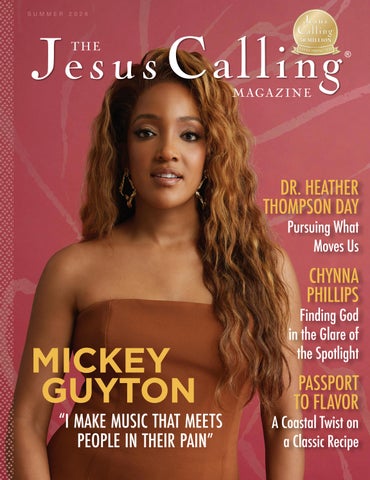
S U MME R
202 6
THE
®
MAGAZINE
DR. HEATHER THOMPSON DAY
Pursuing What Moves Us
CHYNNA PHILLIPS
MICKEY GUYTON
“I MAKE MUSIC THAT MEETS PEOPLE IN THEIR PAIN”
Finding God in the Glare of the Spotlight
PASSPORT TO FLAVOR
A Coastal Twist on a Classic Recipe
BEGIN THE SEASON OF GRATITUDE
with JESUS CALLING ®
Available Now
See something you like in the magazine? Most titles featured in this publication are available from your favorite bookstore.
Splash into Summer with Jesus Calling Books!
As we dive into a summer full of fun adventures, a moment of reflection on the source of all delightful, good things—Jesus—can enrich the season. Spare moments throughout this season—whether you’re sitting on a beach, gardening, or listening to chirping birds—become opportunities to thank Him for His provision.
An exclusive excerpt from Sarah Young’s 365-day prayer devotional
Jesus Listens: Prayers for Every Season
Jesus Calling
Gracious God,
July 5th
You are so great, glorious, and compassionate that it’s impossible to praise or thank You too much! You inhabit the praises of Your people, and I delight in drawing near You through worship. Sometimes my adoration is a spontaneous overflow of Joy—in response to rich blessings or radiant beauty. At other times my praise is more disciplined and measured—an act of my will. I’m grateful that You dwell in both types of praise. Jesus Calling, Pink Leathersoft Edition
I’ve discovered that thankfulness is a wonderful way to enjoy Your Presence. A grateful heart has plenty of room for You. When I thank You for the many good gifts You bestow, I affirm that You are the One from whom all blessings flow. Help me to thank You also in the midst of adversity—trusting in Your goodness and Your sovereignty. Please teach me how to fill up the spare moments of my life with praise and thanksgiving. This joyous discipline will enable me to live in the intimacy of Your loving Presence. In Your praiseworthy Name, Jesus, amen.
PSALM 22:3 KJV · PSALM 146:1-2 1 THESSALONIANS 5:18 · PSALM 100:4 HCSB
EXCERPTED FROM JESUS LISTENS: PRAYERS FOR EVERY SEASON, COPYRIGHT 2021 BY JESUS CALLING FOUNDATION. USED BY PERMISSION OF THE PUBLISHER. ALL RIGHTS RESERVED.
Perfect For Gifting! Look for these symbols at the end of each article to find the perfect gift for every occasion: Jesus Listens: Prayers for Every Season CHRISTMAS
GRADUATION
FAMILY
WEDDING
EASTER
BIRTHDAY
IMAGE: SALLY WILSON
Jesus Calling: 365 Devotions for Kids
Ref g to B d Mickey Guyton’s Return to Country Music’s Soul
by Michael Overholt
C O V E R
IMAGES COURTESY OF JOSEPH LLANES, MTHEORY, CAMEO CARLSON, AND MICKEY GUYTON; ISTOCK
Y
ou’re running away from everything that makes you different. Country music is three chords and the truth. Why aren’t you leaning into that?” That was the turning point for Mickey Guyton, and it didn’t come from a producer or a label executive. It came from her husband after she had spent enough nights asking the same question in different forms, circling the same frustration: Why isn’t this working? But that question only makes sense if you understand what she had been trying to do. For years, Guyton had been navigating an industry that seemed to want her, but only a version of her that fit. “The challenges,” Guyton explains, “were people trying to change who I was or trying to interpret who I was as a black woman. And I understand the cultural differences, but people were trying to make me palatable to a country music audience, which made no sense to me at the time, and it was really difficult.” The pressure showed up in the stories she was being asked to tell. Record executives wanted her to write songs about some blue-eyed, blonde-haired guy that she fell in love with even though the people she had fallen in love with didn’t look like that. It wasn’t her story. The reality is that country music, a genre built on lived experience, was asking her to step outside of her own. Unfortunately, that tension didn’t begin in Nashville. She had lived it long before she ever stepped into a writers’ room. Growing up in smalltown Texas, in predominantly white neighborhoods, she learned early what it meant to stand out, and what it cost. You hear the tension in lyrics from “Black Like Me,” a song she wrote for her own healing that she didn’t expect to ever share with her audience:
Little kid in a small town I did my best just to fit in Broke my heart on the playground When they said I was different… As a child, she had found ways to adjust, to move through the discrimination and soften the edges that created friction. She learned how to belong, even when belonging required a kind of quiet compromise.
Mickey as a child
S T O R Y
nd and son
Mickey with her husba
Mickey performing with Dolly Parton
As an adult, however, she began to see what those compromises were costing her in an industry where the currency is supposed to be truth. That tension had reached a breaking point once before. Living in Nashville, newly signed but deeply discouraged, she found herself sitting in a church on a Sunday morning not out of discipline, but desperation. Yet one line the pastor delivered stayed with her: “It’s okay to question God.” So she did. She went home and let it all out. Why am I here? Why am I doing this? Why does this feel so hard? And what came back as she looked to her Bible wasn’t comfort, but perspective. “I don’t remember the exact verse,” recalls Guyton, “but it was basically saying ‘What makes you think that you’re owed these privileges over someone else?’ That was what the verse said. And I started laughing, because it was like, ‘Are you kidding me? You’re right. I have a roof over my head. I have a car. I can put gas in that car. I can buy myself food. I have a family that I can fall back on. I still have my mom and my dad. And how dare I think that I’m owed this over somebody else?’” Going into that defining conversation with her husband, the core of her approach was rooted in his simple definition of country music: “Three chords and the truth.” Guyton continues. “[After he said that] I was like, ‘Well, okay, then I need to make sure I’m not only pursuing a career for myself, but pursuing a career for people that are after me. How can I help them? This may never happen for me, but how can I help the people that are coming up after me?’ And that’s what changed my life.” The shift revealed to Guyton where she was willing to bend and where she needed to stand firm. It helped her face the things executives were asking of her differently. Guyton recalls, “The things that came out of [label executives’] mouths: ‘Because you’re black, we need to let these people know that you really are country, that you understand this industry.’ And I’m like, ‘I grew up in the south. I grew up on gravel dirt roads in the country. If I showed you pictures of where I’m from, I’ve come from more country spaces than a lot of these country artists.’ But I was constantly having to prove myself.”
C O V E R
S T O R Y
With her new motivation, the question shifted from “Why isn’t this working?” to “What does it even mean to be country?”
“ the people How can I help that are coming up after me? The genre of country music has long positioned itself as the voice of the ordinary person, rooted in simple, authentic stories of rural life and small towns, capturing the real-life experiences of love, loss, heartache, and triumph. Yet Guyton was pressured to alter her narrative—to make it more familiar, marketable, and acceptable. Historically, country music was forged by a diverse blend of voices, traditions, and life experiences, including artists like Lesley Riddle, DeFord Bailey, and The Carter Family. This foundation was built on honesty, crossing racial lines and themes, encompassing the sacred and the secular, the rural and the restless. The question Guyton’s husband asked helped her see that the very thing she had been taught to soften was actually the point. And this epiphany gave Guyton the courage to refuse to bend any further. It was less a personal choice and more an act of correction, a necessary return to the heart and soul of country music. Consider the lyrics to Guyton’s song “Words,” where she explores the weight and power that language carries, specifically how once the truth is spoken, it can’t be taken back:
SONG CREDITS
“BLACK LIKE ME,” MICKEY GUYTON, BRIDGES, CAPITOL RECORDS NASHVILLE, 2020. “WORDS,” MICKEY GUYTON, REMEMBER HER NAME, CAPITOL RECORDS NASHVILLE, 2021.
Once they’re out, they’re out, you can’t erase ‘em No, you can’t run away and you can’t outpace ‘em’ Cause words, they’re like a bullet from a gun You can’t take ‘em back once the damage is done Speaking up and remaining authentic to yourself has always been a core tenant of country music, and this comes with a profound responsibility. And for Mickey Guyton, it is the guiding light she continues to follow.
This article has been adapted from the Jesus Calling Podcast.
To learn more about Mickey Guyton, check out her music and where to see her in concert on her website. And be sure to listen o her song “Scary Love” on the Jesus Calling: Songs for Sundays CD.
A New Book from Harry Connick, Jr.
What you’re about to read is an elaboration, an elaboratio, a swirl of truths and legends as I remember my mother... and an inside look at the music I composed to honor her.
–Harry Connick, Jr. Ava Av Available vailable Septe September ember 29th, 2026 Where books are sold
WHY CHYNNA PHILLIPS IS STILL HOLDING ON The Power of Being a Work in Progress by Michael Overholt
“I THINK I WAS USING [drugs and alcohol] to put a Band-Aid on a lot of the pain that I was pushing down. And there was a lot of it.” For Chynna Phillips, that suppressed pain was formed in the strange, disorienting space of growing up with rockstar parents, surrounded by celebrity, and not fully recognizing it. Phillips admits that she didn’t realize her parents were celebrities at all until much later in life. What she did feel—long before she could name fame—was constant movement, fragmentation, and emotional unpredictability. Childhood was marked by overwhelming change, complicated relationships, and environments no child is equipped to process. The substances and adult dynamics at a myriad of parties played out in front of her young eyes, creating trauma she didn’t have language for. So she did what many children do when life becomes too much: she morphed to shape her environment. “I had to compartmentalize everything that I experienced as a child, and for that reason, I kind of felt like maybe I was crazy because I had so many different personalities. I just felt very lost.” Despite her rock n’ roll environment, Phillips had brushes with faith that piqued her interest, letting her know something more existed to this life than the traumas she was experiencing. One pivotal moment happened at twelve years old after stealing chocolate milk off a classmate’s lunch tray. She was approached by a group of girls who did not want repayment. They wanted to pray. What followed was an awkward, unexpected, and strangely powerful experience where they handed her “this little salvation card” and told her to “just read the words.”
IMAGES COURTESY OF CHYNNA PHILLIPS BALDWIN; ADOBE STOCK
“ my ears, If God made surely God can hear me too.
Young Chynna and her mom, Michelle
Chynna, Carnie, and Wendy as Wilson Phillips
“I read the words,” Phillips relates, “and as I was reading them, I received what felt like a holy scan. I felt like a lot of things had been healed instantaneously. So I knew at that moment there was something to Jesus, but I didn’t quite get the whole memo.” It was real, but it wasn’t enough to overcome the gravitational pull of her environment where rolling joints and pouring martinis was the norm. By her teenage years, the internal pressure began to surface externally. By fifteen, Phillips was “doing some destructive stuff” that’s best described as an attempt to self-medicate a lifetime of wounds. Key to Phillips’ healing was getting sober at nineteen and forming the band Wilson Phillips with her two childhood friends, Carnie and Wendy Wilson, daughters to Brian Wilson of the Beach Boys. She wrote the smash hit “Hold On” that would cement Wilson Phillips’ legacy and become an anthem for millions. Looking back, Phillips acknowledges that the song was deeply personal despite its commercial success. Chynna performing
What happens when you choose honesty over image:
Chynna, with husband Billy Baldwin, daughters Jameson and Brooks, and son Vance
“The song was written mostly to inspire myself. Little did I know that it would end up inspiring so many people around the world.” One of the most profound personal changes came when she shifted her perspective on prayer. Prayer had always felt so distant, too abstract, a shouting into the void with no perceivable consequence. Phillips describes what felt like an epiphany when she realized that, “If God made my ears and I can hear, surely God can hear.” Small connection, massive consequences. She began to pray constantly and started seeing things happen in her life that she could have never orchestrated herself. For the first time, faith was no longer something that had happened to her, but something she was living. That private healing has over time enabled her to be increasingly public about her own mental health struggles. When she and her husband, William Baldwin, were struggling in their marriage, Phillips describes being in “a dark place” where she “just needed women.” She started an online community for women called California Healin’ with honesty being the guiding principle. Instead of giving in to the fear of protecting her image and keeping people ignorant of her personal life, she shared openly. “I just started telling it like it was and laying it all out: my marriage issues, my parenting issues, my health issues, my struggles with my faith.” In a world that often rewards polish and perfection, her willingness to be seen as a work in progress created the kind of connection that comes from recognition instead of admiration. And while Phillips knows that her platform helped her personally not feel so alone, it also helped her community “feel more human.” What better way is there to “hold on for one more day”?
You stop carrying two lives. • You give others permission to be real. • Shame loses its grip. • Your relationships deepen. • You model a healthier way forward. • You stop protecting what’s not serving you. • You build strength that’s actually sustainable.
To learn more about Chynna’s work with California Healin’, and to see where Wilson Phillips is playing next, follow her on social media.
This article has been adapted from the Jesus Calling Podcast.
From the light and bright
dishes of spring and summer to
warm, comforting recipes for fall
and winter, every recipe highlights nature’s best.
Order Your Copy Today
A LIFE FORGED F RO M F I R E by John Furr
MOST PEOPLE CAN POINT TO A MOMENT that changed the course of their existence. For John O’Leary, that moment came at nine years old and nearly took his life with it. Raised just outside St. Louis, John remembers a childhood that felt normal in all the best ways. “We had dinner together every single night as a family,” he says. His dreams were simple and certain. “I was pretty darn sure as a child I would play shortstop for the St. Louis Cardinals.” That changed in an instant. At nine years old, O’Leary was in his family’s garage, imitating what he had seen some older kids do, playing with matches and gasoline. The fuel ignited, and the container exploded, consuming the garage and throwing him backward. He was burned on 100 percent of his body, and eighty-seven percent of those burns were third-degree. “I don’t know the math, I don’t know the science, but I know I’m in trouble here.”
“ to live. You are going Keep fighting.
The prognosis was grim, but what happened next would alter the rest of his life. His father entered the hospital room first: “John, I love you, and there’s nothing you can do about it.” When O’Leary told his mother, “Mom, I don’t want to die. I want to live,” she answered, “Good, baby… do your part and fight.” What followed were months of unimaginable pain. “Simply living was agony.” Every breath, every moment, a reminder of how fragile life can be. And yet, even there, hope found a way in. It arrived through Jack Buck, the legendary voice of the St. Louis Cardinals. Buck heard about the accident and didn’t just send his regards. He showed up. Walking into a hospital room where O’Leary couldn’t even open his eyes, Buck spoke with a stern compassion: “Kid, wake up. You are going to live. Keep fighting.” For five and a half months, Buck kept coming back. He also began sending signed baseballs with a challenge: “Kid, if you want a second baseball, write a thank you letter to the man who signed the first.”
IMAGES COURTESY OF JOHN O’ LEARY & RISING ABOVE
John being celebrated at John O'Leary Day, Busch Stadium
O’Leary couldn’t hold a pen, but he found a way. “Desperately wanting another baseball, I figured it out.” With help, he learned to write, eventually receiving nearly sixty baseballs. At his college graduation, Buck gave him a deeply personal gift, his Baseball Hall of Fame crystal baseball. When O’Leary hesitated, Buck smiled: “You’re not taking it. I’m giving it to you… try not to drop it.” For years, O’Leary didn’t see himself as someone with much to offer. “I’m not a celebrity, I’m not a speaker… I have no confidence.” That began to change after hearing a pastor’s simple message: “Your life is a precious, priceless gift. You have one job: to say yes to being used for good.” He said yes to a small speaking opportunity, then another. “This awkward, introverted, nobody said yes again and again.” Over time, those yeses grew into a national platform, bestselling books, and a film based on his life, Soul on Fire. He often references the words of Ignatius of Loyola: “Go forth and set the world on fire.” For O’Leary, that idea is grounded in what sustained him from the beginning. “I knew I wasn’t by myself. I knew my parents would be with me. I knew I wasn’t alone. I knew Christ would walk with me.” That belief continues to inform his perspective on life. “Your life can be used in mighty ways,” he says. “If God can use those people, He can use me.”
John with Jack Buck
Baseballs from Jack Buck
To learn more about John O’Leary, check out his books, On Fire and In Awe, available at your favorite retailer. This article has been adapted from the Jesus Calling Podcast.
We hope you enjoyed this sample of the Jesus Calling Magazine. To read the full version, please download the Jesus Calling App. There you can check out the entire issue – plus our complete archive.
HELP TEENAGERS FIND PEACE INSTEAD OF ANXIETY IN THIS UNCERTAIN WORLD Available wherever you buy books