Munazzeel Riasat FINANCE DIRECTOR 437.371.5342 finance@tma149.ca
Jay Boehmer
MUSIC PERFORMANCE TRUST FUND (MPTF) ADMINISTRATOR 437.371.2282 trustfund@tma149.ca
Here at TMA149 we acknowledge the land we are meeting on is the traditional territory of many nations including the Mississaugas of the Credit, the Anishnabeg, the Chippewa, the Haudenosaunee and the Wendat peoples and is now home to many diverse First Nations, Inuit and Métis peoples. We also acknowledge that Toronto is covered by Treaty 13 with the Mississaugas of the Credit.
President’s Message
President’s Message
The theme for this issue of Crescendo is Music and Health. As musicians, we live with an interesting duality: we offer a service that’s a balm for life’s challenges, and people turn to us to lift their spirits in times of joy and sadness. Countless studies have shown that music, much like nature, promotes healing and wellness; and at the same time being a musician can sure take a toll on our physical and mental health as we navigate the pressures and shifting landscapes of our industry - not to mention our instruments!
I remember an Esprit concert years ago where the orchestra was playing a John Adams piece. The excellent musicians were counting like mad, sweat fairly jumping off their brows; and at the same time, the audience was swaying in gentle unison, just grooving along and probably renewing some lovely brainbody connections. It really illustrated how demanding it can be - as well as valuable - to do what we do.
One of our primary goals as your union is to support your well-being. We offer a number of resources for our members who are navigating health challenges. For example, the Member Assistance Fund (MAF) was created nearly two decades ago to help members who can’t work due to health issues. Although modest (up to $3,600 per year for up to 2 years), it can be a great help in a difficult time. Last year, eight (8) members applied, and we used $16,985.00 from the fund to support these people in the way they felt best worked for them. But we’re no less committed to promoting your general wellness before challenges develop. I hope the articles in this issue will shine a light on the subject, and direct you to resources that are relevant for you. We also have access to a wonderful meeting space, and we’d like to hear from you if you have ideas for in-person and/or online wellness workshops. Reach us at info@tma149.ca
So, and I really mean this: be well, and read on!
In solidarity, Les Allt
For more information on the Member Assistance Fund (MAF) and other financial assistance programs visit: Financial Assistance – TMA
Les Allt President, TMA
Dusty Kelly Executive Director, TMA
Dear Members,
Executive Director’s Report
This issue of Crescendo focuses on health and wellness and includes articles on resources, musician interviews, and supports for musicians’ well-being. Musicians are, in many respects, freelancers and often independent business owners. That work can be precarious, as COVID made painfully clear when live entertainment shut down. In a gig economy, setting aside enough for a rainy day has never been easy.
Still, there are steps we can all take to reduce the financial risks of gig work. TMA has focused on improving musicians’ benefits, not just wages. One recent achievement was the creation of a musicians’ sick benefit fund in the Mirvish agreement, modelled on the Stratford Festival musicians’ benefit fund. Moving forward, we will introduce language to support musicians’ mental health in other negotiations.
While we have not yet bargained health benefits for single engagements, we are a member of the Arts & Entertainment Health Plan. I encourage you to read about the plan beginning on page 19 with Jason Saulay’s interview. The plan offers benefits for varying income levels and, as a not-for-profit organization, is designed to serve its members.
You will also find articles from Unison (page 16) and AFC (page 17) highlighting the vital support they provide in times of financial and mental health crisis.
Another important financial issue is retirement security. In every new member orientation, we stress that without other income sources, government retirement income alone will not be enough. We are living longer, and that means we need to plan for more years of financial support.
TMA has been improving pension contributions across all of our agreements. However, when musicians work as independent contractors without an agreement, they miss out on employer contributions to the Canada Pension Plan. Self-employed musicians must pay both the employee and employer portions of their CPP contributions (11.9% of earnings). Unless those declared earnings are substantive or the musician has other pensionable employment, or an RRSP, they may have a modest retirement income. For example, $2,000 per year CCP contribution for 20 years would result in $365.52 per month payment at retirement. GIS and OAS would top up, for a single senior the maximum is $1,852.90. That is why it is so important for self-employed musicians to earn engager contributions to the Musicians’ Pension Fund of Canada (MPFC). How do you secure those contributions? Perform your gigs under a TMA Live Performance Contract, which allows the engager to contribute to the pension plan on your behalf. The same goes for recording work: electronic media
Executive Director’s Report
agreements also provide for pension contributions. I cannot overstate how important this is. If you need a refresher on filing contracts, please contact businessreps@tma149.ca for the date of our next “how to file a TMA contract” webinar. We are here to help.
In
solidarity,
Dusty Kelly
The Weight We Carry: Mental Health and the Working Musician
By Catherine Harrison, M.Psych.
There is a particular kind of exhaustion that musicians know and rarely name. It is not the tiredness after a long set or a good rehearsal. It is the accumulated weight of financial precarity, creative vulnerability, and the constant pressure to perform, and not just on stage, but in every space. Navigating the blurred and often tenuous lines between personal and professional lifestyles and responsibilities. The pressure to seem fine. The pressure to keep going.
We talk about mental health in the music industry more than we used to. But talking about it is not the same as doing something about it.
In 2026, Revelios published the final report of Soundcheck, a national mixed-methods study on mental health in the Canadian music industry, drawing on contributions from more than 1,250 music professionals. The findings are not subtle. 94% of respondents agree that mental health issues are widespread in the industry. 86% have personally experienced mental health challenges. 86% experience anxiety. 53% have felt at some point that life was not worth living.
These are not statistics about an at-risk minority. They are the majority experience of the people who make music in Canada.
The Soundcheck data makes something else clear: this is not primarily a personal resilience problem. It is a structural one. 84% of respondents say financial stress directly impacts their mental health. Only 5% feel a sense of job security. The music industry has evolved quickly. The support systems meant to protect the people doing that work have not kept pace.
And then there is the leadership gap. Only 10% of Soundcheck respondents strongly agree that leaders actively support mental health in the workplace. 84% felt their work environment was not conducive to mental health. We are not going to shift outcomes in this industry by giving musicians better coping tools and sending them back into environments that grind them down. The environment must change. And that requires changing how we lead.
The Soundcheck data also makes clear that the burden is not evenly distributed. Women, non-binary individuals, and racialized musicians reported the highest levels of workplace discrimination and the fewest routes to support. Many respondents live with chronic physical and neurological ailments that run alongside (and intersect with) their mental health challenges. These experiences are common. They are almost never part of the mental health conversation.
What moves the needle is well established: psychological safety, meaningful mental health literacy, peer support structures, and workplaces that treat capacity and compensation as real concerns rather than inconveniences. None of this requires a revolution per se. It requires paying attention and building it in.
For organizations like TMA, that means something concrete. Negotiate mental health coverage into agreements. Build referral networks. Create peer support infrastructure. Use the data that exists — including Soundcheck — to advocate for structural change with funders and policymakers. Provide access to, and funding for, mental health literacy and skill-building programs. Increase knowledge and capability
The Weight We Carry: Mental Health and the Working Musician
upstream, in community, instead of only waiting to support dire downstream outcomes.
97% of Soundcheck respondents agree that mental health education is critical. 95% believe the industry could do more.
The gap between knowing something needs to change and actually changing it is where leadership lives.
Catherine Harrison, M.Psych., is the President of Revelios and Founder and CEO of the Canadian non-profit Soundcheck Collective. She is the lead researcher of the Soundcheck study, and author of Leading in Stereo (2026). Revelios is the Official Music Industry Mental Health Partner of the 2026 JUNO Awards. Learn more at revelios.com.
TMA spoke with psychotherapist, mental coach and lecturer Dinka Migić, whose work focuses on helping performers manage stage fright and perform with greater confidence. Working with musicians, actors, athletes and teachers, she specializes in mental preparation, stress prevention and performance anxiety.
Born in Zagreb, Croatia, Migić played violin in youth orchestras and attended Blagoje Bersa. She later earned a master’s degree in law from the University of Zagreb, where she also studied psychology. She continued her training at the Paracelsus School in Germany and completed postgraduate work in sport psychology at Paris Lodron University in Salzburg. Her clients include musicians and performers from the United States, Japan, China, Venezuela and across Europe.
TMA: Why should musicians be aware of mental preparation techniques?
DM: Concerts, auditions and competitions can place musicians under intense pressure. Stage fright is common, but when anxiety becomes overwhelming it can create a barrier between a musician’s true ability and what they are able to express in performance. Understanding the body’s stress response is an important first step. When physical and psychological reactions feel beyond a performer’s control, they can lead to helplessness and interfere with concentration, memory and expression. Common symptoms include:
• increased heart rate
• sweating
• cold hands
• dry mouth
• shaking
• loss of focus
• memory disruption
• clenching and short breathing
When the body senses danger, it releases stress hormones known as epinephrine, norepinephrine, and cortisol. Elevated cortisol can impair memory and concentration, both of which are essential to performance. Over time, chronic stress can also weaken the immune system and contribute to other health problems. Many of the barriers musicians face are rooted in learned patterns and unhealthy habits, but those patterns can be changed.
Fight, Flight or Freeze?
How does a musician take control?
DM: Taking control begins with recognizing the beliefs that sit beneath anxiety. Self-doubt, harsh self-criticism, impostor feelings and unresolved experiences can all affect performance. The work is to identify those patterns, understand where they come from, and replace them with a healthier state of mind grounded in purpose, preparation and enjoyment rather than fear.
Beliefs such as “I am not good enough” can become selffulfilling patterns: negative thinking increases physical stress, and that stress in turn undermines performance.
As Migić notes, emotional history often shows up in the body as well as the mind.
TMA:
Dinka Migic
Fight, Flight or Freeze?
TMA: What tools do you recommend to help professional musicians build mental resilience and healthy work habits?
DM: Mental preparation should be part of a musician’s everyday practice, not something reserved only for crises. Even ten focused minutes a day can help build a stronger connection between body and mind and create a greater sense of control under pressure.
Effective tools include relaxation techniques, body-based methods such as tapping and tension awareness, visualization, and short but consistent mental-training routines. When stress hormones are elevated, physical activity such as cardio or other high-intensity movement can also help regulate the body’s response. Just as important is using honest, believable self-talk rather than affirmations that do not feel true.
TMA: Why is communication within groups so important?
DM: Clear communication is essential for musicians working in orchestras, chamber groups and schools. Understanding group dynamics can improve both individual productivity and the effectiveness of the ensemble, while also helping musicians feel more confident and supported. It is important to have awareness of the team work and team effort for the common cause of making beautiful and inspiring music.
TMA: What do you hope musicians take away from this work?
DM: I want musicians to live and work with a sense that these challenges can be changed. Mental preparation should be part of everyday practice, even if only for ten focused minutes specially before they start as a routine to play with relaxed body and mind. The goal is not to force artificial positivity, but to develop honest, useful thoughts that support concentration, energy and confidence in performance.
They can learn to stop negative thoughts and replace them with very specific thoughts of what they want and how they want to feel and perform.
TMA: Thank you, Dinka, for sharing your insights on a subject that affects so many musicians and performers.
To learn more about Migić’s work or to book a lecture, please contact her at office@dinkamv.com or website: www.dinkamv.com
Member Spotlight: Roslyn Black
A Reality Check on Mental Health
The TMA goes deep into the impact of mental health and performance-based injury and recovery from Dystonia with the resilient Roslyn Black.
TMA: Can you walk us through the moment you realized this injury was serious enough to threaten your career as a horn player?
RB: I was in a Mahler symphony cycle and what should have been a simple rehearsal turned into this dystopian battle for survival. Nothing was working the way it had for decades. I had physical pain in my jaw, but it was also the lack of sensation everywhere else that scared me. I felt physically and emotionally numb – I realized something was systemically very, very wrong with my face.
TMA: What was the immediate feeling, physically and emotionally, when you realized you had to stop playing?
RB: Initially it was denial and disbelief. I was going from gig to gig, occasionally having a good moment and those moments kept me thinking, “Maybe it will be okay and not as serious as I think. I’ll snap out of it.” It was when I was playing a show on the Sarah McLachlan tour that the realization set in. My chops (embouchure) completely failed. I remember having the distinct thought, “I need to stop now.” And then I felt emotionally disconnected and numb.
TMA: Many instrumental musicians describe their body as their instrument. How did it feel when that instrument failed you?
RB: A huge sense of betrayal, to be honest. I was in disbelief that my muscle memory, after decades of horn playing, could fail me. The word ‘abandonment’ is not too strong for what I was feeling.
TMA: What did your mental state look like in those first few weeks?
RB: Well, it was complicated time for me, because my decision to stop working coincided with the start of the COVID-19 pandemic. I was able to push aside my feelings of panic and fear and associate those feelings to the pandemic lockdown, then to my crumbling abilities as a horn player. When I started calling around to other horn players and past teachers – at first very surreptitiously – for help, the emotions became a lot stronger and undeniable. What really exacerbated my fear were those players, whom I thought must have some answers, turning me away. Not from malice but from a complete lack of knowledge of embouchure injury, particularly as a movement disorder. Most people I approached for help were quick to say, “I know nothing, I cannot help you.” Then I felt profound loneliness and despair.
Identity and Mental Health
TMA: The issue around Identity and the Inner Musician is an important question that we could spend hours dissecting, but your experience is one that I believe is what all musicians face at some point in their career. It is about Identity. How do we as musicians define ourselves?
RB: Most of us started playing our instrument, or at least an instrument, while we were still children. I started singing at five, piano at eight and French horn at eleven. This early foray into intensive instructional music education often means that by the time we go through puberty, we are already self-identifying as musicians. Some children go to specialized music grade schools, even boarding schools designed to focus heavily on musical performance. These can be wonderfully creative environments, but this early training, commitment and focus leads to us identifying as musicians long before our core identity solidifies. This can have significant impact on how we develop as people, and how we view ourselves. Commonly, our self-worth correlates
Roslyn Black
Member Spotlight: Roslyn Black
directly with our level of performance and can fluctuate day-to-day, minute-to-minute. We have a limited, narrow, and often fragile definition of ourselves.
TMA: Can you explain what you mean by fragile?
RB: Fragility occurs because when our “identity” - everything we know to be worthwhile about ourselves is eroded from our inability to perform at our highest level. When a musician is faced with a physical inability to play their instrument, there is a profound sense of loss. Feelings of shame, selfloathing and disappointment are quick to follow. Some feel betrayed by their bodies, some feel betrayed by the established systems we believed would give us healthy environments in which to develop healthy habits. Intense feelings of isolation are also extremely common. In fact, many teachers and institutions actively encourage young players to focus obsessively on their ability to physically perform, and in that light, to view their successes as worthy and their failures as shameful.
TMA: Did you feel a sense of loss or grieving for your “old self”?
RB: Absolutely. I realized that I had attached my identity and self-worth to my success on the horn and felt bereft without that status. As I descended further into embouchure dysfunction, the farther away that success felt and the more removed I felt from what I saw as my old life. I was envious of my previous self and angry at how I’d taken my abilities for granted.
TMA: Was there a fear that if you couldn’t play, you were no longer a musician?
RB: 100% yes!! And that was what surprised me the most actually, how the failure of a tiny group of muscles somehow erased for me the entirety of my musical life. As if my current inability to perform at a level I considered acceptable, negated everything I had ever done because I couldn’t currently replicate that level of playing. I completely disregarded the fact that all my knowledge remained intact. I’ve been teaching horn since 1997, none of that experience magically disappeared or my ability to help others learn. I also had not yet learned the value of what we now know to be ‘musical cross-training’. I was ignoring my abilities on other instruments like piano and voice, because those instruments were not the one, I had multiple performance degrees in. I was creating a hierarchy in my head about
what had value to my definition of musicianship. The Mental Health Journey and Rehabilitation
TMA: You are one of the most resilient musicians I have personally encountered considering the immense pressure musicians face. How did you handle the mental pressure of “performing” through recovery?
RB: This is an excellent question. So much of what we do as musicians can’t be measured objectively and neither can a recovery process. Our performance involves such complex fine-motor tasks that it is not as simple as healing a broken leg, for example. Even the simplest of physical injuries to a musician can result in years of internalized fear and doubt, so it’s hard to say a recovery is ‘complete’. The nature of neurological recovery is slow and unpredictable. You fight for every ounce of improvement one day, and the next, the gains have somehow magically disappeared.
TMA: Your story is especially wonderful, and somewhat rare, because you have been able to recover from dystonia. There are still many unknowns about the disorder and with recovery, there is no “one size fits all.” What is available to Musicians and how does medical therapy, holistic therapies, such as mindfulness meditation, or other support systems play in the healing process? Is there more to it than just physical recovery?
RB: It is never just physical recovery. I wish it were that simple, but as the great Laurie Frink said to me once, “once the physical is healed, now you have to go fix the 90% that’s mental”. Even if you just have a torn muscle that needs rest, it can cause some hefty psychological impacts, relating to identity, trust, and fear. It’s surprisingly difficult to trust that area of your body again. You need to learn that it can support your weight again, so to speak.
For me, physiotherapy healed the muscle imbalances in my face, and the severe muscle atrophy. I physically rebalanced my embouchure and worked painstakingly to eliminate the compensations that had developed one by one. It did NOT fix my damaged proprioception (ability to feel my body), nor did it remove the chronic pain in my jaw. This led me to seek additional care as it was clear to me that my issues were more than physical. Through trauma therapy, I became aware that my chronic jaw pain had an emotional source and I continue to work through years of repressed feelings and grief, due to my injury and major life events.
Member Spotlight: Roslyn Black
I researched the connection between trauma and the nervous system. In particular, I found the works of Ruth Chiles, aimed specifically at performers, to be clear and concise. I gained a much better understanding of how and why I had descended into the dysfunction I had and of the impact of a heightened nervous system on my fine motor control. Through her exercises, I was able to regain sensation in my face.
TMA: Did you ever reach a point where you wanted to give up on the horn entirely?
RB: Never. I did often feel guilty over wanting to recover so badly. I have a family and a mortgage and struggled with not earning enough money to make my continued recovery efforts “worth it”. I asked myself repeatedly, if I would be happier doing something else. If I could be peaceful leaving the horn behind. And every morning I woke up excited to try again. I love the horn; I love music and part of me was determined not to go out like that. Another part of me KNEW there was an answer.
It’s important for me to say that I never stopped playing. Even at my worst dysfunction, I picked up my horn every day. I took it on holidays. I distinctly remember the moment when I picked up my horn to practice and realized the improvements I’d had the day before were still there. After a summer of trauma therapy, I realized that, at some point over those weeks, something had shifted. I was now reliably and swiftly moving forward. That was a great realization!
Rediscovery and Rehabilitation
TMA: How has your technique, approach, or musical style changed to accommodate your body’s new limitations? Do you consider yourself “healed?”
RB: I consider myself ‘in remission’ even though the old “burnt out” neural pathways are still physically there. If I am triggered by something that relates to my trauma history, I can immediately experience face numbness and a reduced ability to play. This has happened only once since I started considering myself recovered. Luckily, I realized quickly that it was not a physical issue, but a nervous system one. I also had enough tools from my mental health work to be able to get myself back into healthy movement. Realizing I had the power to come back to healthy playing on demand was a profound moment - It was empowering!
TMA: In what ways is your music better now because of what you’ve been through?
RB: I think I have a better understanding of how my inner musician works. I understand how functional and valuable it is, even if I’m not feeling my best physically. When I was injured, I shut down that part of myself to great detriment. It’s very freeing to let the inner musician be the guiding force behind my choices. I’m not interested in holding anything back to be perfect anymore. I now have a much better understanding of my own face and physiology! This allows me more freedom in pushing myself because I now recognize the signs of safety versus the symptoms of danger. I have more range (on the horn) now!!
I am so grateful to have the horn back. I take a lot more joy in simpler successes now. Because for a few years I didn’t have that at all and I felt bereft. I have a much healthier perspective and that really lets me enjoy my music-making in a way I didn’t before.
Member Spotlight: Roslyn Black
TMA: What are you doing now?
RB: I am working on finding a way to contribute meaningfully in this new space I find myself in, recovery coaching and mentorship. This is not a career avenue I had previously considered but as there were few support resources available for me, it seems very necessary. I’ve begun a series of support sessions on Zoom for musicians currently struggling with dystonia. There is a great deal of stigma still associated with this condition so players are free to anonymize themselves and participate via text chat if that is most comfortable. Information is available on my website - https://www.roslynblack.com/dystonia-injury
I offer support, playing assessments and follow-up treatment lessons via The Embouchure Project I was recently invited to contribute a course-module to the new online certification offered by P.A.M.A in 2026. This module deals specifically with the role of mental health assessment and treatment in dystonia recovery and will be available online in May. LINK HERE
TMA: Thank you for sharing your journey with us, Roslyn. You are truly an inspiration and proof that there is Hope. What is one thing you would tell a musician who is currently struggling with a career-threatening injury?
RB: That it’s going to be ok. There is hope. You can recover from anything with the right help. I’m proof of that.
Roslyn’s Recommended Resources
There are several resources available for injured and recovering musicians. For Ontario residents with OHIP, we have access to fully covered mental health treatment through referrals to the Musician’s Clinics of Canada.
For those seeking private mental health care, the Unison Fund offers a direct-pay option for approved services under their Extended Therapy Support Program. (www.unison.ca)
The Embouchure Project is based on the physiotherapy protocol of Bronwen Ackermann and is administered by Gabe Radford, in Toronto. This initiative aims to provide injured brass players with basic assessments and then referrals to appropriate specialists all over the world. Currently, I am available for both assessments and both
Bio:
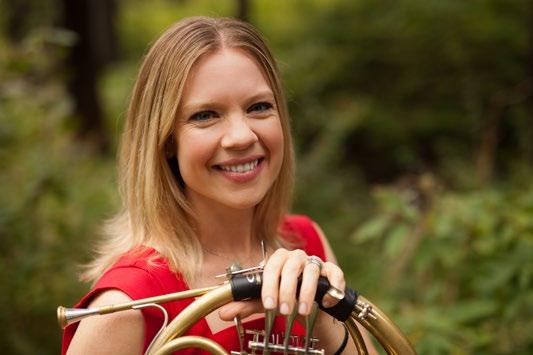
Horn player Roslyn Black is grateful to be a product of her excellent Saskatchewan public school music program! She holds degrees from the University of Victoria, and the New England Conservatory of Music, and has performed with the Cleveland Orchestra, BBC Symphony Orchestra, BBC Scottish Symphony, Opéra Comique (Paris), and the Atlanta Opera. Roslyn spent 4 wild and wonderful years with the New World Symphony in Miami before relocating to Toronto in 2010, where she maintains a busy performing schedule and is adjunct faculty at Havergal College. A dedicated member of the Toronto Concert Orchestra, Roslyn also appears regularly with the Canadian Opera Company Orchestra, Niagara Symphony, Kingston Symphony and various Mirvish musical productions. She is a founding member and Co-Director of the avant-garde Toronto ensemble, euphonia, and as backing artist has appeared on various pop albums including “The Last Rider” by Ron Sexsmith and “Evin on Earth” by Mike Evin.
private and group support through that platform. (www.theembouchureproject.org). *Please note that this is primarily for embouchure issues, and not for a broader spectrum of injuries.
The Performing Arts Medicine Association (P.A.M.A), was established in 1988. This organization works to educate medical professionals, educators and performers on the complex physical and mental needs of artists in many genres. It is a valuable resource for performers looking for support for both physical and mental health.
(www.artsmed.org)
For advanced nervous system work, I experienced quite dramatic results using the brain-spotting techniques of Ruth S.A. Chiles. She has written several books, but the one I found most helpful was the boldly titled, The Focal Dystonia Cure.
TMA: What did you do before working at Unison?
AJ: I spent about seven years working in and around the arts - as an actor, a director, a festival producer, a venue manager, and eventually the first-ever Digital Director at the Koffler Centre of the Arts. It gave me sector credibility, yes, but more importantly the lived experience of what it actually costs to build a life in a creative field. From there I moved into youth mental health at Jack.org, Canada’s largest youth mental health charity, where I helped grow the team into a national powerhouse that put youth mental health at the centre of the Canadian conversation. Then the Jane Goodall Institute, where I eventually served as Joint Interim CEO and had the privilege of working closely with Jane herself. Her commitment to a better world still shapes how I think about mission-driven leadership every single day.
TMA: When did you join Unison, and what made you stay?
AJ: I joined in August 2025. I’m just a massive fan. I love music. I never thought I’d be lucky enough to work in it. I grew up making mixtapes as a love language and marking time through albums. Unison is built for people who’ve given their lives to that feeling.
And separately, those seven years working in the arts weren’t abstract. I know what financial precarity feels like from the inside. I know the particular exhaustion of making something that matters deeply to people and having no safety net when things go wrong.
Alex Johnson Unison
The unfinished achievement I’m most proud of is the one still ahead: a Canada where no music worker falls through the cracks. That’s what keeps me here.
TMA: How has Unison evolved to meet the industry’s needs?
AJ: Unison was built as emergency financial assistance - a fast, trusted safety net for music workers in crisis. The team built something remarkable long before I arrived. What’s evolved over the years is the growing recognition that financial crisis rarely arrives alone. It comes tangled up with mental health strain, physical health challenges, and the reality that most music workers navigate their careers without benefits or sick leave. So the supports have grown to match that reality.
The pandemic made all of this impossible to ignore. When our Extended Therapy Support program launched in December 2025 - we cover the costs of longerterm mental health care for music workers - demand exceeded expectations almost immediately. We’re scaling to continue to respond to that need.
TMA: What are Unison’s proudest accomplishments?
AJ: There are so many that happened long before I arrived. The COVID years come to mind. The team leapt into action and distributed millions in funding to make sure Canada’s music workers could get through the worst of it.
But perhaps one that is less obvious is how the team has earned trust over the years. We recently worked with a program evaluator to peek under the hood of our services, and what moved me most was that many recipients don’t just cite the financial help. They cite belonging. Feeling valued. Feeling like part of a community that actually knows their world. That’s not incidental to the support. That is the support. And we’ll continue to prioritize a human-centred, dignity-based, music-informed approach in everything we do.
TMA: What’s next for Unison?
AJ: I want Unison to become undeniable. So embedded in how Canada takes care of its music workers that it’s simply part of how the ecosystem functions.
That means meeting people earlier - before crisis hitsand staying with them longer after. It means becoming truly national, with real regional presence and Frenchlanguage capacity. It means proving that a stronger Unison means a stronger music industry in Canada. When
Alex Johnson, Executive Director, Unison
About Unison
a music worker gets the support they need and stays in the field, everyone benefits.
Canada’s music workers are the heartbeat of our cultural economy. The work of making sure no one has to choose between their art and their wellbeing - that’s unfinished. But we’re here to do it.
Emergency Financial Support Program
Supporting professionals who have worked a minimum of 5 consecutive years in the Canadian music industry and who are facing an emergency situation. This program prioritizes medical support, basic living expenses and rent.
Grocery Gift Card Support
The Unison Fund is Canada’s leading non-profit supporting the well-being of music industry professionals. For more than 15 years, Unison has provided vital services — including emergency financial aid and mental health counselling — to music workers facing challenging times. Having supported more than 10,000 people across Canada’s music community, Unison remains a trusted ally, ensuring no one faces hardship alone. Learn more or donate at unisonfund.ca
The Unison Fund is open to all Canadian music industry professionals, however different financial programs have certain eligibility requirements.
Registering to access Unison benefits is free, you can register here: https://unisonfund.ca/register
To be eligible to apply to Unison’s Financial Support Programs applicants must be a Canadian Citizen or Permanent Resident or hold a valid Work Permit.
Applicants must have resided in Canada for a minimum of 6 months out of the year and also:
• Have a Canadian bank account
• Pay Canadian taxes
Applicants must provide valid government-issued photo ID.
When applicable, applicants must provide a copy of their work permit.
Available to professionals who have worked a minimum of 2 years in the Canadian music industry and are experiencing food insecurity. Approved applicants receive a one-time $500 gift card to participating grocery stores.
Extended Therapy Support Program
Available to Canadian music workers needing longer-term or specialized mental health care. This program covers therapy costs by paying your therapist directly.
The Slaight Family Foundation Legacy Program
Created to support veteran members of Canada’s music community, this program serves those who have been contributing to Canadian music for a minimum of 10 years and are over the age of 60, as well as those coping with unexpected or chronic illness.
24/7 Counselling Support with TELUS Health
Unison offers FREE access to TELUS Health, a program that offers 24/7 support for mental, financial, physical, and emotional wellbeing. Available by phone, in-person, or online/virtual, TELUS Health’s counselling is flexible and geared towards the specific individual needs. Available to all music industry professionals.
A thread running through my career has been doing what I can to support creative work. Prior to joining The AFC I had various fundraising and management roles in community radio and arts organizations in Toronto.
What got me started at The AFC 1995 and what keeps me going is the opportunity and potential to create and grow a support system for the people who do such amazing, creative work in music, film & TV, theatre and dance in Canada.
Last year, we served almost 4,000 people across all our programs but we know there are many more people out there who would benefit from what we have to offer so we’ve set our sights on doing more good for more of the people working in all aspects of the entertainment industry in Canada.
Many people know us for our Emergency Financial Aid program, which has been our flagship program since the beginning. But over the years we had so many conversations with people experiencing financial hardship who told us about other obstacles preventing them from doing their best work.
This led us to ask what else we could do that would be helpful not only to people in a moment of financial distress but also to help people to live and work sustainably over the long-term. These conversations led to the birth of our Financial Wellness, Mental Wellness and Career Sustainability programming about ten years ago. These programs continue to evolve to meet our community’s needs. We are now the entertainment industry’s leading source for Mental Health First Aid training and we have recently expanded the criteria for our counselling pilot that provides free brief mental health counselling for industry members, provided by counsellors who approach their work with an understanding of what it means to live and work in a creative profession. We continue to evolve our programming to meet our community’s needs.
David Hope AFC
I have been most proud of our team at The AFC in the moments when we have risen to meet some of the extraordinary challenges our community has faced in recent years. When we were called on to dramatically scale up our programs to provide targeted short-term assistance to the huge number of industry members sidelined during the COVID-19 pandemic and the 2023 WGA and SAG/AFTRA strikes we were there for those that needed us. Our team really went above and beyond to meet these enormous and urgent needs and, as a result, literally thousands of artists and creative workers were able to keep a roof over their heads and food on the table when their livelihood was swept out from under their feet.
David Hope, Executive Director, AFC
About AFC
About The AFC
The AFC is a national charity that supports people working in Canada’s performing arts and entertainment industry—on stage, on screen, below the line, and behind the scenes. Founded in 1958 as The Actors’ Fund of Canada, it was created by artists for artists with a mission that remains unchanged: to help entertainment professionals maintain their health, dignity, and ability to work.
Today, The AFC serves a broad community across the country, including performers, technicians, writers, designers, stage managers, musicians, film and television workers, and other industry professionals. It is widely regarded as a vital support system for people working in an industry shaped by contract work, income instability, and unique pressures.
The AFC team is often asked what the abbreviation stands for. While it refers to the organization’s original name, it can also reflect the artistry and ability of the people it serves, the foundation and future of our arts landscape, and the care, compassion, and community at the heart of its work.
Programs and Services
The AFC offers programs and services that support both urgent needs and long-term well-being:
Emergency Financial Aid: Short-term help with essential living expenses during hardship caused by illness, injury, or other unexpected challenges.
Navigator Service: Free, personalized, confidential phone consultations that connect industry professionals with mental health resources and supports.
Mental Health First Aid Training: Developed by Opening Minds/Mental Health Commission of Canada, this training helps industry members recognize mental health distress and provide support until professional help is available.
Workshops and Events: Programming in financial literacy, mental health, wellness, and career sustainability tailored to the realities of the entertainment industry.
Counselling Pilot: A pilot program offering short-term counselling at no cost to eligible performing arts and entertainment professionals facing anxiety, stress, depression, and life transitions.
Personal Support and Advocacy: One-on-one support and case management to help individuals navigate complex situations and build coping strategies.
A Vital Resource for the Industry
With contract-based work and limited access to traditional benefits and mental health supports, the performing arts and entertainment industry can present significant challenges. The AFC helps bridge those gaps, offering immediate relief and long-term support so industry professionals can continue doing the work they love.
For more information or to access support, please visit afchelps.ca
AFC may also be followed on social media: Facebook: AFChelps Instagram: @afchelps Bluesky: @afchelps.bsky.social
Individuals seeking support are encouraged to contact AFC directly at 1-877-399-8392 or by email at contact@afchelps.ca
Jason Saulay AFBS
TMA: What did you do before working at AFBS?
JS: Before joining the team here, I spent about 5 years in the pension space working for a third-party administrator as well as a large pension company.
TMA: When did you start working at AFBS, and what led your decision to stay?
JS: I started with AFBS in 2007 and fell in love with the culture. It’s very rewarding to know that the work you do impacts real lives that you interact with daily. Beyond that, AFBS has always given me the space to grow and take on new challenges, so I’ve never felt stagnant.
TMA: How has AFBS changed over the years to meet the demands of the industry?
JS: AFBS has always been on the forefront of change and proactiveness. We seem to always be ahead of the crowd when it comes to taking care of our members. We’ve done well at anticipating what our member’s need and want but have also listened when they asked:
• Members Insurance Program is modified every 3 years based on Member feedback and input
• Continually looks for gaps in the creative life of our members i.e. Accident On Set (AOS) for performers not covered by provincial Workers Comp
• Adapt benefits for ‘need’, i.e. Gender Affirmation Medical Benefit, Parental Benefits, virtual care…
• The development of the Arts & Entertainment Plan was in response to the arts community asking for access to affordable, accessible health care
TMA: What are some of your proudest accomplishments/moments?
JS: The Arts & Entertainment Plan is near and dear to my heart as I have been involved in some capacity or another since its inception. To know that I had a hand in growing this part of the business while helping artists maintain their health is truly rewarding. On a daily basis, having the opportunity to work alongside a fantastic group of people, for a great company for so long is something I don’t take for granted and I’m proud to say I’ve been here for almost 20 years – that’s an accomplishment this day and age.
TMA: What do you see for the future of AFBS?
JS: I see us continuing to expand our footprint across Canada. As we adopt new technology I think we’re going to become even more agile. The foundation here is solid, so the future looks like smart growth, deeper partnerships, and continuing to lead the way in our industry. We need to get the word out to all artists, we are here for you, and we want to hear from you – how can we help?
Jason Saulay, Assistant Director Benefit Operations, AFBS
About Arts & Entertainment Plan
Safeguarding Creativity: A Guide to Canada’s Arts & Entertainment Plan®
For independent artists, writers, filmmakers, and musicians, the creative freedom of gig work is liberating. However, that freedom often comes with a distinct disadvantage: the lack of a traditional, corporate employer benefits package. When you are self-employed, an unexpected dental emergency or a recurring prescription cost can directly impact your livelihood.
To bridge this gap, the Arts & Entertainment Plan® provides a personal health insurance solution designed explicitly for the Canadian creative community.
What is the Arts & Entertainment Plan?
The Arts & Entertainment Plan is a unique health insurance program managed by Actra Fraternal Benefit Society (AFBS), a Member-owned, not driven by profit insurance provider that has supported Canadian creators since 1975. Because AFBS insurance operates on a not-for-profit model, the plan is built around the ethos of “artists helping artists,” reinvesting its resources into affordable, comprehensive coverage rather than corporate profits.
The plan is designed for self-employed professionals across coast-to-coast creative organizations, giving independent workers access to collective-style benefits.
Core Plan Options: Standard vs. Comprehensive
The program is structured into two main tiers to suit different budgets and medical requirements: Standard and Comprehensive.
Both options feature a pay-direct e-card for prescription drugs and dental visits, eliminating the need to pay fully out-of-pocket and wait weeks for a refund.
Prescription Drugs
Dental Care (Basic & Major)
Extended Health Care
Vision & Paramedical
70% coverage up to $400/year 70% coverage; scaling from $1,000 (Year 1) up to $3,000 (Subsequent Years)
50% coverage up to $400/year 60% coverage; scaling from $800 (Years 1–2) up to $1,250 (Subsequent Years)
Up to $5,000 maximum per benefit year
Up to $7,500 maximum per benefit year
70% coverage up to $350/year 70% coverage; scaling from $500 up to $750/year
About
Arts & Entertainment Plan
Extended Health & Paramedical Services
Both tiers provide vital coverage for practitioners that provincial healthcare typically doesn’t cover. This includes 70% coverage for paramedical specialists such as:
• Physiotherapists and Chiropractors
• Registered Massage Therapists (RMTs)
• Acupuncturists and Naturopaths
• Registered Psychologists
Added Protection: Beyond Basic Health
Understanding that an artist’s lifestyle involves unpredictable schedules, travel, and stresses, the plan bundles several built-in safety nets at no extra cost:
• Travel Emergency Medical Insurance: Covers 100% of eligible expenses up to $2 million for emergency medical situations outside your home province (up to 30 or 90 days per trip depending on age).
• Member and Family Assistance Program (MFAP): Offers 24/7/365 confidential counseling services, legal advice, financial consultation, and wellness coaching to support creators through the psychological pressures of the gig economy.
• Group Term Life and AD&D Insurance: Includes standard $10,000 life insurance and Accidental Death & Dismemberment coverage for members under age 65.
The Biggest Perk: Guaranteed Acceptance
Perhaps the most significant advantage of the Arts & Entertainment Plan is its Guaranteed Acceptance policy. Traditional private health insurance plans often require long medical questionnaires and may deny coverage or increase premiums for pre-existing medical conditions. With this plan, as long as you meet the basic criteria, you are automatically accepted with no medical exams or questionnaires.
Who is Eligible?
You can enroll in the plan if you meet the following requirements:
1. You are a professional working in the arts and entertainment industry in Canada.
2. You are a Canadian resident with a valid Provincial Health Card.
3. You are under 71 years of age at the time of enrollment.
Tax Tip: Because the plan is designed for self-employed professionals, your monthly or annual insurance premiums may be applied as a legitimate business expense on your Canadian income tax return.
How to Get Started
Signing up is streamlined to accommodate busy freelance schedules. Creators can visit the Arts & Entertainment Plan website to generate a custom price quote in a couple of quick steps, choose between monthly or annual payment structures, and complete their enrollment entirely online.
Canadian Network for Musicians Health and Wellness
The Canadian Network for Musicians Health and Wellness was launched in 2020 by Dr. Gilles Comeau, following the creation of the Musicians’ Wellness Centre at the University of Ottawa in fall 2019.
The Network’s goal is to improve the health and wellness of musicians in every genre and at every stage of life—from those playing or singing for the first time to students, amateurs, and professionals working throughout their careers. Many members are post-secondary educators with a particular interest in supporting post-secondary music students and professional musicians, including (but not only) those who are studying or working in Western Art Music.
My own experience with injury while completing a BMus in oboe performance led me to become an occupational therapist, and that commitment to musicians’ wellbeing eventually led to my PhD and ongoing research in this underserved area. I joined the Network in April of 2020, shortly after its launch. Seeing the dedication of people across the Network—and the potential of a national group to accomplish more than isolated individual efforts—made me want to be part of its next stage. In 2023, Jennifer Johnson, A Body Mapping Teacher Trainer and violinist, and I became Co-Director of the Network.
Since then, we launched a year of listening sessions to hear directly from members about where the Network should focus next. These listening sessions led to the formation of two working groups, Education and Performance, and Mental Health and Healthcare, as well as a group who recently created our website. Jennifer continues to lead the MHRI Research Initiative on musicians’ health, but is stepping down as Co-Director, and a search is currently underway for a new Co-Director. The Network is not presently funded, though we have applied for support through the Social Sciences and Humanities Research Council. Our aim is to offer strong value to members, establish a membership fee in the future, and eventually received donations as charitable organization. We are also proud to have partnered, since 2023, with the annual conference of MusCan, the scholarly society for post-secondary music programs in Canada.
Today, the Network includes music educators at all levels, music students, health professionals who care for musicians, and musicians themselves across genres and career stages. I look forward to speaking with delegates at the Canadian Conference in Ottawa about what the Network is doing now, what we hope to do next, and how we can ensure our work reflects the needs of musicians across Canada.
We especially hope to welcome more professional musicians as members, so that their needs and priorities are reflected in the Network’s activities. Membership is currently free and offers opportunities to meet others with shared interests at quarterly Zoom meetings, as well as to contribute to working groups.
Professor Christine Guptill
Canadian Network for Musicians Health and Wellness
Our goal for the future is that the Network will be known as a resource and advocate for organizations across Canada and beyond who seek to improve the health of musicians.
Crescendo readers are invited to visit our new website (Cnmhw-rscbm.uottawa.ca) and join our Facebook page (https://www.facebook.com/ groups/198431289678000/) for more information and useful resources.
Please feel free to reach out to me directly at cguptill@uottawa.ca
Christine Guptill, Local 180
Bio:
Professor Christine Guptill received her occupational therapy training at Western University, and her PhD in rehabilitation sciences at Western University. During her post-doctoral fellowship, she completed a threeyear training program in work disability prevention at the University of Toronto’s Dalla Lana School of Public Health, in partnership with the Institutes for Work and Health. She holds an adjunct appointment in the Faculty of Rehabilitation Sciences at the University of Alberta. She is co-director of the Canadian Network for Musicians Health and Wellness, a co-founder of Mental Performance in Arts Canada, and a member of the Performing Arts Medicine Association. She was a founding member of both the Performing Arts Medicine Clinic at the Glen Sather Sports Medicine Clinic in Edmonton, Alberta, and of the Health Advisory Team for the National Youth Orchestra of Canada (NYOC). She has provided primary care occupational therapy to the NYOC, and in 2012, she was honoured to receive a Queen’s Diamond Jubilee Medal in recognition of this work. She is a member of the Canadian Federation of Musicians, and in her spare time, she performs as a freelance oboist.
Member Lead Initiatives
The Embouchure Project (TEP)
The Embouchure Project seeks to build community, inspire research, and inform musicians and medical professionals about embouchure problems that can arise over the course of a playing life. It was founded by TSO hornist Gabriel Radford following his own recovery from Musician’s Dystonia.
The project is organized around the concept of Embouchure Syndrome, a term proposed by neurologist Dr. Xenos Mason to describe the overlapping physical, neurological, and psychological factors behind embouchure breakdown. Framing these problems as a syndrome rather than a single diagnosis reflects what recovery actually requires: a multidisciplinary approach rather than one fix.
The Embouchure Project is collaborative and evidencebased, drawing on the work of researchers and clinicians including Prof. Bronwen Ackermann (University of Sydney), Dr. Mark Edwards (King’s College London), and Dr. Xenos Mason (USC). There are no miracle methods on offer and no gurus. The goal is to give concerned musicians accurate information, realistic expectations, and a credible path back to playing. The project also aims to educate healthy musicians about best practices for avoiding trouble.
Embouchure problems are more common in the profession than most players admit, and silence makes them worse. Musicians who are struggling, or who know a colleague who is, should know that they are not alone and that help exists.
Visit www.theembouchureproject.org for more information on The Embouchure Project.
Support for Musicians
If you are a musician in need of help, TEP can offer you a bit of advice, a quick chat or a 15-minute zoom call to get you oriented on the path to health.
Gabriel Radford is Third Horn of the Toronto Symphony Orchestra, where he is in his 23rd season. He teaches at the Glenn Gould School of the Royal Conservatory of Music and serves as Music Director of Interprovincial Music Camp. He is the founder of The Embouchure Project, an educational initiative supporting musicians dealing with embouchure problems, which grew out of his own recovery from Musician’s Dystonia. He holds an MBA from the Schulich School of Business. He lives in Toronto with his wife and two children.
Gabriel Radford, Third Horn, TSO
Member Lead Initiatives
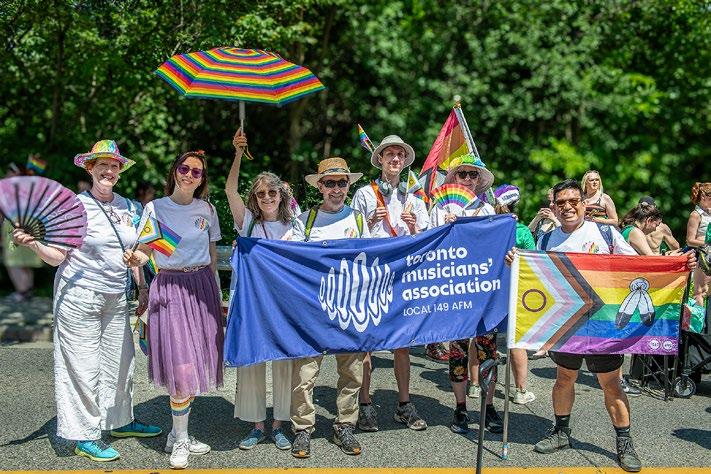
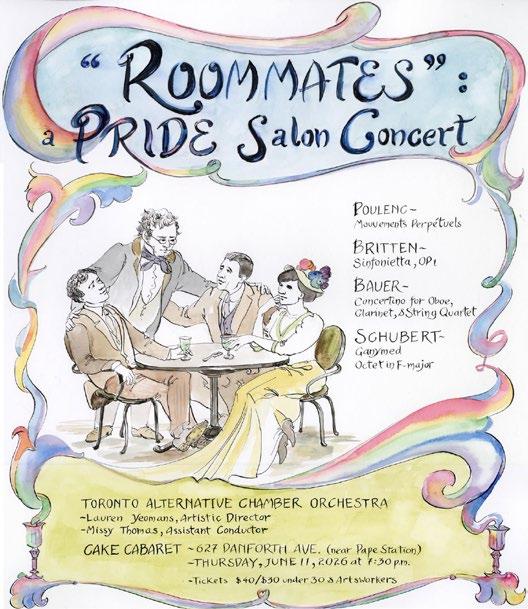
Celebrating Pride Month TACO
Toronto Alternative Chamber Orchestra (TACO) is a vibrant, forward-thinking ensemble led by Artistic Director Lauren Yeomans, dedicated to reimagining the concert experience for today’s audiences. By pairing the excellence of a professional classical orchestra with a welcoming, relaxed atmosphere, TACO invites both seasoned listeners and curious newcomers to share in the joy, connection, and community of live music—without the barriers that can make classical music feel out of reach.
TACO recently celebrated Pride Month by exploring LGBTQ+ composers, featuring works by Poulenc, Britten, Bauer, and Schubert, with host Carl Jackson guiding an evening of wit, intrigue, and festive flair.
Find out more about TACO http://torontoalternativechamberorchestra.ca
Bio:
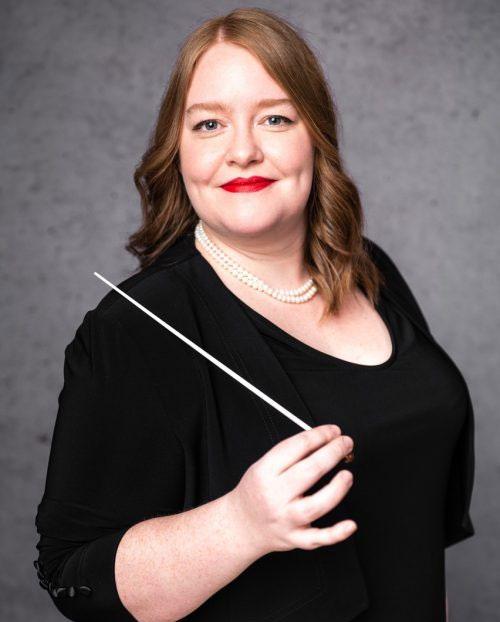
Artistic Director Lauren Yeomans is a Toronto-born conductor and flautist known for providing bold and robust interpretations to the worlds of solo, chamber and orchestral music. She founded the Toronto Alternative Chamber Orchestra to provide her hometown with an inclusive way to connect to the world of classical music as well as provide a stage for voices that may have been traditionally excluded from the concert hall.
Lauren Yeomans, Artistic Director, TACO
MPTF Report
The start of the Music Performance Trust Fund (MPTF) fiscal year on May 1st is always a busy time, but this year I have been inundated with requests. This includes new, old and occasional cosponsors. I average 20 applications per month; I am currently at 60 applications for May and June at the current time.
The MPTF fiscal year, ending April 30, 2026, is now complete with 263 performances in the books. (34 performances more than the previous year - Our past allocation was $204,000.) For the first time in many years, MPTF could not assist L149 with any additional funding in March and April. The new allocation for L149 is set at $206,500; a slight increase of 2% over last year.
Performances in seniors’ residences continue to be an important part of the MPTF budget. Live music has several benefits from a health and wellness perspective. The residents are always keen to see a live performance and hear some of their favourite songs. They love to sing along and often thank the musicians personally following the performance. Caregivers and other staff also benefit from these performances and often participate with dancing and applause.
The MPTF continues to put an emphasis on several programs and will fund these concerts at 100%: Educational Performances in Schools, Black History Month (February), International Women’s Day (March 8), and Jazz Appreciation Month (April). We are also offering a “discounted” rate for Seniors Residences for solo and duo performances. Other Community Performances will be funded at 50% as usual.
As always, please provide a minimum of 6 weeks notice for your MPTF request. More information about the MPTF program at: https://public.tma149.ca/music-performance-trust-fund/
Jay Boehmer, MPTF Administer, TMA
Jay Boehmer MPTF Administer, TMA
25 Year Pins
Craig R Martin
Kevin Vienneau
Kelly Jefferson
Csaba Koczo
Arthur Wallace Halladay
David Bradden Myers
Pins & New Life Members
50 Year Pins
Roberto Bacci
Simon Wallis
Sean Fitzsimons
Elizabeth Acker
Robert F Becker
Abbey Leon Sholzberg
Tony Padalino
Gary Kulesha
Stacey Hersh
Randy James
Admitted: 1998-04-20
Died: 2026-05-15
John Douglas Clark
Admitted: 1969-07-22
Died: 2026-05-11
Life Members
Donald George Breithaupt
Nicholas Harcourt Dyer
Paul Rene Widner
Stephen T Gardner
Allen Richard Cole
Roger S Williams
Mark Duggan
In Memoriam
Enoch Kent
Admitted: 1978-05-12
Died: 2026-04-28
Chris Bodanis
Admitted: 1957-11-03
Died: 2026-04-15
Edmund H. (Ted) Warburton
Admitted: 1961-01-10 Died: 2026-03-25
Kevan Staples
Admitted: 1969-09-11
Died: 2026-03-24
Edwin B Perry
Admitted: 1973-05-31
Died: 2026-03-03
Richard Armin
Admitted: 1968-03-28
Died: 2026-02-25
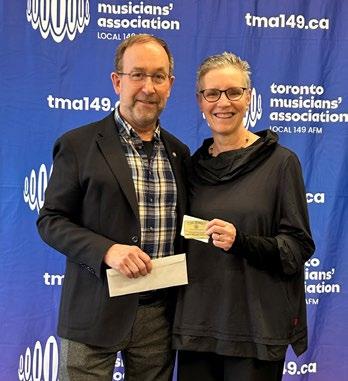
New Life Member Dianne Elisabeth Aitken receiving thier Life Member Gold Card from President Leslie Allt at the February 2026 General Meeting.
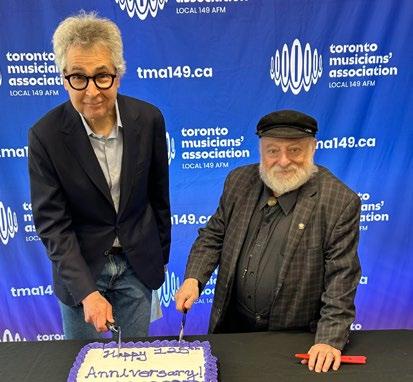
New 50-year pin members Abbey Leon Sholzberg and Stacey Hersh cutting our 125th anniversary cake.