Clinical UM Guideline
Subject: Spinal Orthoses:Thoracic-Lumbar-Sacral (TLSO), Lumbar-Sacral (LSO), and Lumbar
Guideline #: CG-OR-PR-06
Status: Reviewed
Publish Date: 04/13/2022
Last Review Date: 02/17/2022
Description
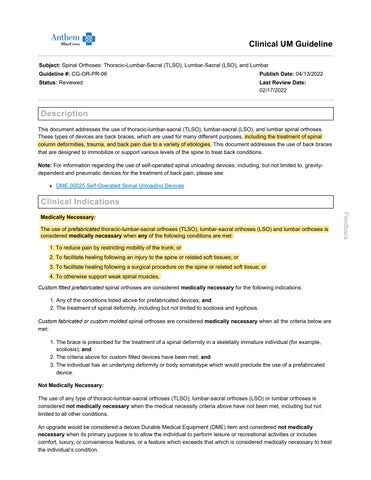
This document addresses the use of thoracic-lumbar-sacral (TLSO), lumbar-sacral (LSO), and lumbar spinal orthoses. These types of devices are back braces, which are used for many different purposes, including the treatment of spinal column deformities, trauma, and back pain due to a variety of etiologies. This document addresses the use of back braces that are designed to immobilize or support various levels of the spine to treat back conditions.
Note: For information regarding the use of self-operated spinal unloading devices, including, but not limited to, gravitydependent and pneumatic devices for the treatment of back pain, please see:
DME.00025 Self-Operated Spinal Unloading Devices
Clinical Indications
Medically Necessary:
The use of prefabricated thoracic-lumbar-sacral orthoses (TLSO), lumbar-sacral orthoses (LSO) and lumbar orthoses is considered medically necessary when any of the following conditions are met:
1. To reduce pain by restricting mobility of the trunk; or
2. To facilitate healing following an injury to the spine or related soft tissues; or
3. To facilitate healing following a surgical procedure on the spine or related soft tissue; or
4. To otherwise support weak spinal muscles.
Custom fitted prefabricated spinal orthoses are considered medically necessary for the following indications:
1. Any of the conditions listed above for prefabricated devices; and 2. The treatment of spinal deformity, including but not limited to scoliosis and kyphosis.
Custom fabricated or custom molded spinal orthoses are considered medically necessary when all the criteria below are met:
1. The brace is prescribed for the treatment of a spinal deformity in a skeletally immature individual (for example, scoliosis); and
2. The criteria above for custom fitted devices have been met; and 3. The individual has an underlying deformity or body somatotype which would preclude the use of a prefabricated device.
Not Medically Necessary:
The use of any type of thoracic-lumbar-sacral orthoses (TLSO), lumbar-sacral orthoses (LSO) or lumbar orthoses is considered not medically necessary when the medical necessity criteria above have not been met, including but not limited to all other conditions.
An upgrade would be considered a deluxe Durable Medical Equipment (DME) item and considered not medically necessary when its primary purpose is to allow the individual to perform leisure or recreational activities or includes comfort, luxury, or convenience features, or a feature which exceeds that which is considered medically necessary to treat the individual’s condition.
Coding
The following codes for treatments and procedures applicable to this document are included below for informational purposes. Inclusion or exclusion of a procedure, diagnosis or device code(s) does not constitute or imply member coverage or provider reimbursement policy. Please refer to the member's contract benefits in effect at the time of service to determine coverage or non-coverage of these services as it applies to an individual member
When services may be Medically Necessary when criteria are met:
HCPCS
Prefabricated Orthoses
L0450 TLSO, flexible, provides trunk support, upper thoracic region, produces intracavitary pressure to reduce load on the intervertebral disks with rigid stays or panel(s), includes shoulder straps and closures, prefabricated, off-the-shelf
L0455 TLSO flexible, provides trunk support, extends from sacrococcygeal junction to above T-9 vertebra, restricts gross trunk motion in the sagittal plane, produces intracavitary pressure to reduce load on the intervertebral disks with rigid stays or panel(s), includes shoulder straps and closures, prefabricated, off-the-shelf
L0457 TLSO, flexible, provides trunk support, thoracic region, rigid posterior panel and soft anterior apron, extends from the sacrococcygeal junction and terminates just inferior to the scapular spine, restricts gross trunk motion in the sagittal plane, produces intracavitary pressure to reduce load on the intervertebral disks, includes straps and closures, prefabricated, off-the-shelf
L0458 Thoracic-lumbar-sacral orthosis (TLSO), triplanar control, modular segmented spinal system, two rigid plastic shells, posterior extends from the sacrococcygeal junction and terminates just inferior to the scapular spine, anterior extends from the symphysis pubis to the xiphoid, soft liner, restricts gross trunk motion in the sagittal, coronal, and transverse planes, lateral strength is provided by overlapping plastic and stabilizing closures, includes straps and closures, prefabricated, includes fitting and adjustment
L0462 TLSO, triplanar control, modular segmented spinal system, three rigid plastic shells, posterior extends from the sacrococcygeal junction and terminates just inferior to the scapular spine, anterior extends from the symphysis pubis to the sternal notch, soft liner, restricts gross trunk motion in the sagittal, coronal, and transverse planes, lateral strength is provided by overlapping plastic and stabilizing closures, includes straps and closures, prefabricated, includes fitting and adjustment
L0464
L0467
L0469
L0470
L0472
TLSO, triplanar control, modular segmented spinal system, four rigid plastic shells, posterior extends from the sacrococcygeal junction and terminates just inferior to the scapular spine, anterior extends from the symphysis pubis to the sternal notch, soft liner, restricts gross trunk motion in the sagittal, coronal, and transverse planes, lateral strength is provided by overlapping plastic and stabilizing closures, includes straps and closures, prefabricated, includes fitting and adjustment
TLSO, sagittal control, rigid posterior frame and flexible soft anterior apron with straps, closures and padding, restricts gross trunk motion in sagittal plane, produces intracavitary pressure to reduce load on intervertebral disks, prefabricated, off-the-shelf
TLSO, sagittal-coronal control, rigid posterior frame and flexible soft anterior apron with straps, closures and padding, extends from sacrococcygeal junction over scapulae, lateral strength provided by pelvic, thoracic, and lateral frame pieces, restricts gross trunk motion in sagittal and coronal planes, produces intracavitary pressure to reduce load on intervertebral disks, prefabricated, off-the shelf
TLSO, triplanar control, right posterior frame and flexible soft anterior apron with straps, closures and padding, extends from sacrococcygeal junction to scapula, lateral strength provided by pelvic, thoracic, and lateral frame pieces, rotational strength provided by subclavicular extensions, restricts gross trunk motion in sagittal, coronal, and transverse planes, provides intracavitary pressure to reduce load on the intervertebral disks, includes fitting and shaping the frame, prefabricated, includes fitting and adjustment
TLSO, triplanar control, hyperextension, rigid anterior and lateral frame extends from symphysis pubis to sternal notch with two anterior components (one pubic and one sternal), posterior and lateral pads with straps and closures, limits spinal flexion, restricts gross trunk motion in sagittal,
coronal, and transverse planes, includes fitting and shaping the frame, prefabricated, includes fitting and adjustment
L0488 TLSO, triplanar control, one piece rigid plastic shell with interface liner, multiple straps and closures, posterior extends from sacrococcygeal junction and terminates just inferior to scapular spine, anterior extends from symphysis pubis to sternal notch, anterior or posterior opening, restricts gross trunk motion in sagittal, coronal, and transverse planes, prefabricated, includes fitting and adjustment
L0490 TLSO, sagittal-coronal control, one piece rigid plastic shell, with overlapping reinforced anterior, with multiple straps and closures, posterior extends from sacrococcygeal junction and terminates at or before theT-9 vertebra, anterior extends from symphysis pubis to xiphoid, anterior opening, restricts gross trunk motion in sagittal and coronal planes, prefabricated, includes fitting and adjustment
L0491
TLSO, sagittal-coronal control, modular segmented spinal system, two rigid plastic shells, posterior extends from the sacrococcygeal junction and terminates just inferior to the scapular spine, anterior extends from symphysis pubis to the xiphoid, soft liner, restricts gross trunk motion in sagittal and coronal planes, lateral strength is provided by overlapping plastic and stabilizing closures, includes straps and closures, prefabricated, includes fitting and adjustment
L0492 TLSO, sagittal-coronal control, modular segmented spinal system, three rigid plastic shells, posterior extends from the sacrococcygeal junction and terminates just inferior to the scapular spine, anterior extends from symphysis pubis to the xiphoid, soft liner, restricts gross trunk motion in sagittal and coronal planes, lateral strength is provided by overlapping plastic and stabilizing closures, includes straps and closures, prefabricated, includes fitting and adjustment
L0625
L0628
Lumbar orthosis, flexible, provides lumbar support, posterior extends from L-1 to below L-5 vertebra, produces intracavitary pressure to reduce load on the intervertebral discs, includes straps, closures, may include pendulous abdomen design, shoulder straps, stays, prefabricated, off-the-shelf
Lumbar-sacral orthosis, flexible, provides lumbo-sacral support, posterior extends from sacrococcygeal junction toT-9 vertebra, produces intracavitary pressure to reduce load on the intervertebral discs, includes straps, closures, may include stays, shoulder straps, pendulous abdomen design, prefabricated, off-the-shelf
L0635 Lumbar-sacral orthosis, sagittal-coronal control, lumbar flexion, rigid posterior frame/panel(s), lateral articulating design to flex the lumbar spine, posterior extends from sacrococcygeal junction toT-9 vertebra, lateral strength provided by rigid lateral frame/panel(s), produces intracavitary pressure to reduce load on intervertebral discs, includes straps, closures, may include padding, anterior panel, pendulous abdomen design, prefabricated, includes fitting and adjustment
L0641
L0642
L0643
L0648
L0649
Lumbar orthosis, sagittal control, with rigid posterior panel(s), posterior extends from L-1 to below L-5 vertebra, produces intracavitary pressure to reduce load on the intervertebral discs, includes straps, closures, may include padding, stays, shoulder straps, pendulous abdomen design, prefabricated, off-the-shelf
Lumbar orthosis, sagittal control, with rigid anterior and posterior panels, posterior extends from L1 to below L-5 vertebra, produces intracavitary pressure to reduce load on the intervertebral discs, includes straps, closures, may include padding, shoulder straps, pendulous abdomen design, prefabricated, off-the-shelf
Lumbar-sacral orthosis, sagittal control, with rigid posterior panel(s), posterior extends from sacrococcygeal junction toT-9 vertebra, produces intracavitary pressure to reduce load on the intervertebral discs, includes straps, closures, may include padding, stays, shoulder straps, pendulous abdomen design, prefabricated, off-the-shelf
Lumbar-sacral orthosis, sagittal control, with rigid anterior and posterior panels, posterior extends from sacrococcygeal junction toT-9 vertebra, produces intracavitary pressure to reduce load on the intervertebral discs, includes straps, closures, may include padding, shoulder straps, pendulous abdomen design, prefabricated, off-the-shelf
Lumbar-sacral orthosis, sagittal-coronal control, with rigid posterior frame/panel(s), posterior extends from sacrococcygeal junction toT-9 vertebra, lateral strength provided by rigid lateral frame/panels, produces intracavitary pressure to reduce load on the intervertebral discs, includes straps, closures, may include padding, stays, shoulder straps, pendulous abdomen design, prefabricated, off-the-shelf
L0650 Lumbar-sacral orthosis, sagittal-coronal control, with rigid anterior and posterior frame/panel(s), posterior extends from sacrococcygeal junction toT-9 vertebra, lateral strength provided by rigid
lateral frame/panel(s), produces intracavitary pressure to reduce load on the intervertebral discs, includes straps, closures, may include padding, shoulder straps, pendulous abdomen design, prefabricated, off-the-shelf
L0651 Lumbar-sacral orthosis, sagittal-coronal control, rigid shell(s)/panel(s), posterior extends from sacrococcygeal junction toT-9 vertebra, anterior extends from symphysis pubis to xiphoid, produces intracavitary pressure to reduce load on the intervertebral discs, overall strength is provided by overlapping rigid material and stabilizing closures, includes straps, closures, may include soft interface, pendulous abdomen design, prefabricated, off-the-shelf
Custom fitted Prefabricated Orthoses
L0454
TLSO flexible, provides trunk support, extends from sacrococcygeal junction to above T-9 vertebra, restricts gross trunk motion in the sagittal plane, produces intracavitary pressure to reduce load on the intervertebral disks with rigid stays or panel(s), includes shoulder straps and closures, prefabricated item that has been trimmed, bent, molded, assembled, or otherwise customized to fit a specific patient by an individual with expertise
L0456 TLSO, flexible, provides trunk support, thoracic region, rigid posterior panel and soft anterior apron, extends from the sacrococcygeal junction and terminates just inferior to the scapular spine, restricts gross trunk motion in the sagittal plane, produces intracavitary pressure to reduce load on the intervertebral disks, includes straps and closures, prefabricated item that has been trimmed, bent, molded, assembled, or otherwise customized to fit a specific patient by an individual with expertise
L0460 TLSO, triplanar control, modular segmented spinal system, two rigid plastic shells, posterior extends from the sacrococcygeal junction and terminates just inferior to the scapular spine, anterior extends from the symphysis pubis to the sternal notch, soft liner, restricts gross trunk motion in the sagittal, coronal, and transverse planes, lateral strength is provided by overlapping plastic and stabilizing closures, includes straps and closures, prefabricated item that has been trimmed, bent, molded, assembled or otherwise customized to fit a specific patient by an individual with expertise
L0466 TLSO, sagittal control, rigid posterior frame and flexible soft anterior apron with straps, closures and padding, restricts gross trunk motion in sagittal plane, produces intracavitary pressure to reduce load on intervertebral disks, prefabricated item that has been trimmed, bent, molded, assembled or otherwise customized to fit a specific patient by an individual with expertise
L0468
TLSO, sagittal-coronal control, rigid posterior frame and flexible soft anterior apron with straps, closures and padding, extends from sacrococcygeal junction over scapulae, lateral strength provided by pelvic, thoracic, and lateral frame pieces, restricts gross trunk motion in sagittal and coronal planes, produces intracavitary pressure to reduce load on intervertebral disks, prefabricated item that has been trimmed, bent, molded, assembled or otherwise customized to fit a specific patient by an individual with expertise
L0626 Lumbar orthosis, sagittal control, with rigid posterior panel(s), posterior extends from L-1 to below L-5 vertebra, produces intracavitary pressure to reduce load on the intervertebral discs, includes straps, closures, may include padding, stays, shoulder straps, pendulous abdomen design, prefabricated item that has been trimmed, bent, molded, assembled or otherwise customized to fit a specific patient by an individual with expertise
L0627
Lumbar orthosis, sagittal control, with rigid anterior and posterior panels, posterior extends from L1 to below L-5 vertebra, produces intracavitary pressure to reduce load on the intervertebral discs, includes straps, closures, may include padding, shoulder straps, pendulous abdomen design, prefabricated item that has been trimmed, bent, molded, assembled or otherwise customized to fit a specific patient by an individual with expertise
L0630 Lumbar-sacral orthosis, sagittal control, with rigid posterior panel(s), posterior extends from sacrococcygeal junction toT-9 vertebra, produces intracavitary pressure to reduce load on the intervertebral discs, includes straps, closures, may include padding, stays, shoulder straps, pendulous abdomen design, prefabricated item that has been trimmed, bent, molded, assembled, or otherwise customized to fit a specific patient by an individual with expertise
L0631 Lumbar-sacral orthosis, sagittal control, with rigid anterior and posterior panels, posterior extends from sacrococcygeal junction toT-9 vertebra, produces intracavitary pressure to reduce load on the intervertebral discs, includes straps, closures, may include padding, shoulder straps, pendulous abdomen design, prefabricated item that has been trimmed, bent, molded, assembled, or otherwise customized to fit a specific patient by an individual with expertise
L0633
L0637
L0639
Lumbar-sacral orthosis, sagittal-coronal control, with rigid posterior frame/panel(s), posterior extends from sacrococcygeal junction to T-9 vertebra, lateral strength provided by rigid lateral frame/panels, produces intracavitary pressure to reduce load on intervertebral discs, includes straps, closures, may include padding, stays, shoulder straps, pendulous abdomen design, prefabricated item that has been trimmed, bent, molded, assembled, or otherwise customized to fit a specific patient by an individual with expertise
Lumbar-sacral orthosis, sagittal-coronal control, with rigid anterior and posterior frame/panels, posterior extends from sacrococcygeal junction to T-9 vertebra, lateral strength provided by rigid lateral frame/panels, produces intracavitary pressure to reduce load on intervertebral discs, includes straps, closures, may include padding, shoulder straps, pendulous abdomen design, prefabricated item that has been trimmed, bent, molded, assembled, or otherwise customized to fit a specific patient by an individual with expertise
Lumbar-sacral orthosis, sagittal-coronal control, rigid shell(s)/panel(s), posterior extends from sacrococcygeal junction toT-9 vertebra, anterior extends from symphysis pubis to xiphoid, produces intracavitary pressure to reduce load on intervertebral discs, overall strength is provided by overlapping rigid material and stabilizing closures, includes straps, closures, may include soft interface, pendulous abdomen design, prefabricated item that has been trimmed, bent, molded, assembled, or otherwise customized to fit a specific patient by an individual with expertise
Custom fabricated Orthoses
L0452 TLSO, flexible, provides trunk support, upper thoracic region, produces intracavitary pressure to reduce load on the intervertebral disks with rigid stays or panel(s), includes shoulder straps and closures, custom fabricated
L0480
TLSO, triplanar control, one piece rigid plastic shell without interface liner, with multiple straps and closures, posterior extends from sacrococcygeal junction and terminates just inferior to scapular spine, anterior extends from symphysis pubis to sternal notch, anterior or posterior opening, restricts gross trunk motion in sagittal, coronal, and transverse planes, includes a carved plaster or CAD-CAM model, custom fabricated
L0482 TLSO, triplanar control, one piece rigid plastic shell with interface liner, with multiple straps and closures, posterior extends from sacrococcygeal junction and terminates just inferior to scapular spine, anterior extends from symphysis pubis to sternal notch, anterior or posterior opening, restricts gross trunk motion in sagittal, coronal, and transverse planes, includes a carved plaster or CAD-CAM model, custom fabricated
L0484 TLSO, triplanar control, two piece rigid plastic shell without interface liner, with multiple straps and closures, posterior extends from sacrococcygeal junction and terminates just inferior to scapular spine, anterior extends from symphysis pubis to sternal notch, lateral strength is enhanced by overlapping plastic, restricts gross trunk motion in sagittal, coronal, and transverse planes, includes a carved plaster or CAD-CAM model, custom fabricated
L0486
L0629
TLSO, triplanar control, two piece rigid plastic shell with interface liner, with multiple straps and closures, posterior extends from sacrococcygeal junction and terminates just inferior to scapular spine, anterior extends from symphysis pubis to sternal notch, lateral strength is enhanced by overlapping plastic, restricts gross trunk motion in sagittal, coronal, and transverse planes, includes a carved plaster or CAD-CAM model, custom fabricated
Lumbar-sacral orthosis, flexible, provides lumbo-sacral support, posterior extends from sacrococcygeal junction toT-9 vertebra, produces intracavitary pressure to reduce load on the intervertebral discs, includes straps, closures, may include stays, shoulder straps, pendulous abdomen design, custom fabricated
L0632 Lumbar-sacral orthosis, sagittal control, with rigid anterior and posterior panels, posterior extends from sacrococcygeal junction to T-9 vertebra, produces intracavitary pressure to reduce load on the intervertebral discs, includes straps, closures, may include padding, shoulder straps, pendulous abdomen design, custom fabricated
L0634
Lumbar-sacral orthosis, sagittal-coronal control, with rigid posterior frame/panel(s), posterior extends from sacrococcygeal junction to T-9 vertebra, lateral strength provided by rigid lateral frame/panel(s), produces intracavitary pressure to reduce load on intervertebral discs, includes straps, closures, may include padding, stays, shoulder straps, pendulous abdomen design, custom fabricated
L0636 Lumbar-sacral orthosis, sagittal-coronal control, lumbar flexion, rigid posterior frame/panels, lateral articulating design to flex the lumbar spine, posterior extends from sacrococcygeal junction to T-9
L0638
L0640
L1000
L1001
vertebra, lateral strength provided by rigid lateral frame/panels, produces intracavitary pressure to reduce load on intervertebral discs, includes straps, closures, may include padding, anterior panel, pendulous abdomen design, custom fabricated
Lumbar-sacral orthosis, sagittal-coronal control, with rigid anterior and posterior frame/panels, posterior extends from sacrococcygeal junction toT-9 vertebra, lateral strength provided by rigid lateral frame/panels, produces intracavitary pressure to reduce load on intervertebral discs, includes straps, closures, may include padding, shoulder straps, pendulous abdomen design, custom fabricated
Lumbar-sacral orthosis, sagittal-coronal control, rigid shell(s)/panel(s), posterior extends from sacrococcygeal junction toT-9 vertebra, anterior extends from symphysis pubis to xiphoid, produces intracavitary pressure to reduce load on intervertebral discs, overall strength is provided by overlapping rigid material and stabilizing closures, includes straps, closures, may include soft interface, pendulous abdomen design, custom fabricated
Scoliosis procedures
Cervical-thoracic-lumbar-sacral orthosis (CTLSO) (Milwaukee), inclusive of furnishing initial orthosis, including model
Cervical-thoracic-lumbar-sacral orthosis, immobilizer, infant size, prefabricated, includes fitting and adjustment
L1005 Tension based scoliosis orthosis and accessory pads, includes fitting and adjustment
L1200 Thoracic-lumbar-sacral (TLSO) orthosis (low profile), inclusive of furnishing initial orthosis only
L1300 Other scoliosis procedure, body jacket molded to patient model
L1310 Other scoliosis procedure, postoperative body jacket
L1499 Spinal orthosis, not otherwise specified
Additions/Accessories
L0970-L0982 Additions to spinal orthoses [includes codes L0970, L0972, L0974, L0976, L0978, L0980, L0982]
L0999 Addition to spinal orthosis, NOS
L1010-L1120
Additions to scoliosis CTLSO [includes codes L1010, L1020, L1025, L1030, L1040, L1050, L1060, L1070, L1080, L1085, L1090, L1100, L1110, L1120]
L1210-L1290 Additions to scoliosisTLSO (low profile) [includes codes L1210, L1220, L1230, L1240, L1250, L1260, L1270, L1280, L1290]
ICD-10 Diagnosis
All diagnoses
When services are Not Medically Necessary:
For the procedure codes listed above when criteria are not met or for situations designated in the Clinical Indications section as not medically necessary.
Discussion/General Information
Thoracic-lumbar-sacral orthoses (TLSO) and lumbar-sacral orthoses (LSO) have the following characteristics:
1. Used to immobilize the specified areas of the spine;
2. Intimate fit and generally designed to be worn under clothing;
3. Not specifically designed for individuals in wheelchairs.
For an item to be classified as aTLSO, the posterior portion of the brace must extend from the sacrococcygeal junction to just inferior to the scapular spine.This excludes elastic or equal shoulder straps or other strapping.The anterior must, at a minimum, extend from the symphysis pubis to the xiphoid process. Some TLSOs may require the anterior portion to extend up to the sternal notch.
Aspinal orthosis can be designed to control gross movement of the trunk and intersegmental motion of the vertebrae in one or more planes of motion: lateral/flexion (side bending) in the coronal/frontal plane, flexion (forward bending) or extension (backward bending) in the sagittal plane, and axial rotation (twisting) in the transverse plane. Each type of movement is controlled by a placement of specific types of brace sections:
Sagittal control is achieved by a rigid posterior panel.
Coronal control is achieved by a rigid panel in the mid-axillary line which is either an integral part of a posterior or anterior panel or a separate panel.
Transverse control is achieved by one of several possible structural features:
Arigid panel in the upper sternal area which is an integral part of an anterior shell; or
Arigid panel in the upper sternal area which is rigidly attached to a rigid abdominal or posterior panel; or
Rigid extensions from a rigid posterior panel to the upper anterior chest bilaterally
The documentation must show that the brace will immobilize the specific areas of the spine that are being treated. If the product does not provide control of motion in one or more planes or does not provide intracavitary pressure, then the item is not considered a spinal orthosis.
A prefabricated orthosis is one that is manufactured in quantity without a specific individual in mind. Prefabricated spinal braces may not require the placement or adjustment by a trained orthotist. Examples of prefabricated orthoses include lumbosacral corsets, Knight spinal braces, and the CASH (cruciform anterior spinal hyperextension) brace.
A custom fitted orthosis is a particular type of prefabricated orthosis which is manufactured in quantity without a specific individual in mind, typically as a plastic torso shell, which has been trimmed, bent, molded (with or without heat), or otherwise modified for use by an appropriately licensed and trained medical professional subsequent to the taking of appropriate body measurements.An orthosis that is assembled from prefabricated components is considered prefabricated.
A preformed orthosis is considered prefabricated even if it requires the attachment of straps and/or the addition of a lining and/or other finishing work. Multiple measurements of the body part may be taken to determine which stock size of a prefabricated orthosis will provide the best fit.An orthosis that is assembled from prefabricated components is considered prefabricated. Examples include the Milwaukee scoliosis brace, the Boston scoliosis brace, the Charleston scoliosis brace, and the Wilmington brace.Any orthosis that does not meet the definition of a custom fabricated orthosis is considered prefabricated.
A custom fabricated or custom molded orthosis is one which is individually made for a specific individual by a trained medical professional starting with basic materials including, but not limited to plastic, metal, leather, or cloth. It involves substantial work, such as vacuum forming, cutting, molding, sewing, etc. It involves more than trimming, bending, or making other modifications to a substantially prefabricated plastic shell.Amolded-to-individual orthosis is a specific type of custom fabricated or molded orthosis in which an impression of the specific body part is made by a trained medical professional using one of several methods, including plaster casting, anthropometric measurements, or computerized modeling.These methods are all used to create a model of the individual that is used to make a positive model of the body part being fitted with an orthosis.This positive model is used to custom fit a prefabricated orthosis.
In a guideline for the diagnosis and treatment of degenerative lumbar spinal stenosis that was last revised in 2011, the NorthAmerican Spine Society (NASS) stated, “The use of a lumbosacral corset is suggested to increase walking distance and decrease pain in patients with lumbar spinal stenosis.There is no evidence that results are sustained once the brace is removed.”A2020 NASS guideline on the diagnosis and treatment of low back pain stated that, “There is conflicting evidence that bracing results in improvements in pain and function in patients with subacute low back pain.”
Asystematic review of literature performed by McAviney and colleagues (2020) assessed research regarding the use of spinal orthoses by adults with idiopathic or degenerative scoliosis. Their search identified 10 studies that had outcomes relating to these forms of scoliosis, 4 case reports and 6 cohort studies. They found no randomized or other controlled trials. Of those that included an assessment for pain, all reported either modest or significant pain reduction after the application of a spinal orthosis.The use of a variety of brace designs in this study limits the ability to draw conclusions about the benefits of any one design compared to others.
Two systematic reviews published in 2020 assessed studies on the use of spinal orthoses for osteoporotic fractures (Hofler, 2020; Kweh, 2020). Of the seven studies that met criteria for review by Kweh and colleagues, four were randomized controlled trials.The studies they reviewed found the use of spinal orthoses benefited individuals diagnosed with osteoporotic fractures. Hofler and colleagues included 16 studies in their review, five of which were randomized controlled trials (RCT). Of the RCTs, three overlapped with those reviewed by Kweh and colleagues, and two demonstrated that the use of spinal orthoses benefited individuals diagnosed with osteoporotic fractures.
References
Peer Reviewed Publications:
1. AnthonyA, Zeller R, Evans C, Dermott JA.Adolescent idiopathic scoliosis detection and referral trends: impact treatment options. Spine Deform. 2021; (9):75–84.
2. Climent JM, Sanchez J. Impact of the type of brace on the quality of life of adolescents with spine deformities. Spine (Phila Pa 1976). 1999; 24(18):1903-1908.
3. Coillard C, Leroux MA, Zabjek KF, Rivard CH. SpineCor-a non-rigid brace for the treatment of idiopathic scoliosis: post-treatment results. Eur Spine J. 2003; 12(2):141-148.
4. Corradin M, Canavese F, DimeglioA, Dubousset J. Cervical sagittal alignment variations in adolescent idiopathic scoliosis patients treated with thoraco-lumbo-sacral orthosis. Eur Spine J. 2017; 26(4):1217-1224.
5. Gabos PG, Bojescul JA, Bowen JR, et al. Long-term follow-up of female patients with idiopathic scoliosis treated with the Wilmington orthosis. J Bone Joint SurgAm. 2004; 86-A(9):1891-1899.
6. Gepstein R, LeitnerY, Zohar E, et al. Effectiveness of the Charleston bending brace in the treatment of singlecurve idiopathic scoliosis. J Pediatr Orthop. 2002; 22(1):84-87.
7. Guo J, LamTP, Wong MS, et al.Aprospective randomized controlled study on the treatment outcome of SpineCor brace versus rigid brace for adolescent idiopathic scoliosis with follow-up according to the SRS standardized criteria. Eur Spine J. 2014; 23(12):2650-2657.
8. Gutman G, Benoit M, Joncas J, et al. The effectiveness of the SpineCor brace for the conservative treatment of adolescent idiopathic scoliosis. Comparison with the Boston brace. Spine J. 2016; 16(5):626-631.
9. Hofler RC, Jones GA. Bracing for acute and subacute osteoporotic compression fractures: a systematic review of the literature. World Neurosurg. 2020; 141: e453-e460
10. HowardA, Wright JG, Hedden D.Acomparative study ofTLSO, Charleston, and Milwaukee braces for idiopathic scoliosis. Spine (Phila Pa 1976). 1998; 23(22):2404-2411.
11. Janicki JA, Poe-Kochert C,Armstrong DG, et al.Acomparison of the thoracolumbosacral orthoses and providence orthosis in the treatment of adolescent idiopathic scoliosis: results using the new SRS inclusion and assessment criteria for bracing studies. J Pediatr Orthop. 2007; 27(4): 369-374.
12. Katz DE, Richards BS, Browne RH, Herring JA.Acomparison between the Boston brace and the Charleston bending brace in adolescent idiopathic scoliosis. Spine (Phila Pa 1976). 1997; 22(12):1302-1312.
13. Kweh BTS, Lee HQ, TanT, et al.The role of spinal orthoses in osteoporotic vertebral fractures of the elderly population (age 60 years or older): systematic review. Global Spine J. 2021; 11(6):975-987.Available at: https://journals.sagepub.com/doi/pdf/10.1177/2192568220948036.Accessed on December 17, 2021.
14. Lou E, Hill D, Raso J, et al. Smart brace versus standard rigid brace for the treatment of scoliosis: a pilot study Stud HealthTechnol Inform. 2012; 176: 338-341.
15. McAviney J, Mee J, FazalbhoyA, et al.Asystematic literature review of spinal brace/orthosis treatment for adults with scoliosis between 1967 and 2018: clinical outcomes and harms data. BMC Musculoskelet Disord. 2020; 21(1):87.
16. Palazzo C, Montigny JP, Barbot F, et al. Effects of bracing in adult with scoliosis: a retrospective study Arch Phys Med Rehabil. 2017; 98(1):187-190.
17. Plewka B, Sibinski M, Synder M, et al. Clinical assessment of the efficacy of SpineCor brace in the correction of postural deformities in the course of idiopathic scoliosis. Pol Orthop Traumatol. 2013; 78: 85-89.
18. Resnick DK, ChoudhriTF, DaileyAT, et al.;AmericanAssociation of Neurological Surgeons/Congress of Neurological Surgeons. Guidelines for the performance of fusion procedures for degenerative disease of the lumbar spine. Part 14: brace therapy as an adjunct to or substitute for lumbar fusion. J Neurosurg Spine. 2005; 2(6):716-724.
19. Rowe DE, Bernstein SM, Riddic MF, et al.Ameta-analysis of the efficacy of non-operative treatments for idiopathic scoliosis. J Bone Joint SurgAm. 1997; 79(5):664-674.
20. Rowe DE. Results of Charleston Bracing in skeletally immature patients with idiopathic scoliosis. J Pediatr Orthop. 2002; 22(4):555.
21. Shindle MK, KhannaAJ, Bhatnagar R, Sponseller PD.Adolescent idiopathic scoliosis: modern management guidelines. J Surg OrthopAdv. 2006; 15(1):43-52.
22. Weinstein SL, Dolan LA, Wright JG, Dobbs MB. Effects of bracing in adolescents with idiopathic scoliosis. N Engl J Med. 2013; 369(16):1512-1521.
23. Wong MS, Cheng JC, Lam TP, et al.The effect of rigid versus flexible spinal orthosis on the clinical efficacy and acceptance of the patients with adolescent idiopathic scoliosis. Spine (Phila Pa 1976). 2008; 33(12):1360-1365.
24. YeeAJ,Yoo JU, Marsolais EB, et al. Use of a postoperative lumbar corset after lumbar spinal arthrodesis for degenerative conditions of the spine.Aprospective randomized trial. J Bone Joint SurgAm. 2008; 90(10):20622068.
GovernmentAgency, Medical Society, and OtherAuthoritative Publications:
1. AmericanAcademy of Orthopedic Surgeons (AAOS). Idiopathic scoliosis in children and adolescents. Copyright 1995-2021 by theAAOS. 2015; last reviewedApril 2021.Available at: https://orthoinfo.aaos.org/en/diseases-conditions/idiopathic-scoliosis-in-children-and-adolescents/Accessed on December 20, 2021.
2. Centers for Medicare and Medicaid Services. National Coverage Determination for Durable Medical Equipment Reference List. NCD #280.1. Effective May 5, 2005.Available at: https://www.cms.gov/medicare-coveragedatabase/view/ncd.aspx?ncdid=190&ncdver=2&bc=0.Accessed on December 17, 2021.
3. NorthAmerican Spine Society (NASS). Evidence-Based Clinical Guidelines for Multidisciplinary Spine Care. Available at: https://www.spine.org/Research-Clinical-Care/Quality-Improvement/Clinical-Guidelines.Accessed on December 17, 2021.
Diagnosis andTreatment of Low Back Pain. Revised 2020. Diagnosis andTreatment of Degenerative Lumbar Spinal Stenosis. Revised 2011.
4. QaseemA, WiltTJ, McLean RM, Forciea MA.; Clinical guidelines Committee of theAmerican College of Physicians. NoninvasiveTreatments forAcute, Subacute, and Chronic Low Back Pain: a clinical practice guideline from theAmerican College of Physicians.Ann Intern Med. 2017; 166(7):514-530.
5. Scoliosis Research Society (SRS). Information available at: https://www.srs.org/.Accessed on January 3, 2022.
Index
Body Socks
Boston Braces
Charleston Braces
Copes Scoliosis Brace Lumbar Orthoses
Lumbar-Sacral Orthoses (LSO)
Milwaukee Braces
Providence Scoliosis System
Scoliosis Braces
SpineCor Dynamic Corrective Brace Thoracic-Lumbar-Sacral Orthoses (TLSO)
Trunk Support Devices
Wilmington Braces
The use of specific product names is illustrative only. It is not intended to be a recommendation of one product over another, and is not intended to represent a complete listing of all products available.
History
Status Date Action
Reviewed 02/17/2022
Reviewed 02/11/2021
Medical Policy &TechnologyAssessment Committee (MPTAC) review. References were updated.
MPTAC review. Updated Discussion/General Information and References sections. Reformatted Coding section.
Reviewed 02/20/2020 MPTAC review. Updated References section.
Reviewed 03/21/2019 MPTAC review. Updated References section.
Reviewed 03/22/2018 MPTAC review.The document header wording updated from “Current Effective Date” to “Publish Date.” Updated References section.
Reviewed 05/04/2017 MPTAC review. Updated Background and References sections.
Revised 05/05/2016 MPTAC review. Clarified the medically necessary statement to address the specific types of devices available. Clarified the necessary statement for custom fitted prefabricated braces to state that criteria for a prefabricated brace must also be met in addition to the criteria requiring underlying deformity or body somatotype which would preclude the use of a prefabricated brace.Added criteria to custom fabricated or custom molded spinal orthoses to require that the brace is prescribed for the treatment of a spinal deformity in a skeletally immature individual (for example, scoliosis). Updated Background section.
Reviewed 02/04/2016 MPTAC review. Updated Discussion section. Removed ICD-9 codes from Coding section.
Reviewed 02/05/2015 MPTAC review.
Reviewed 02/13/2014
MPTAC review. Changed document # from CG-DME-11 to CG-OR-PR-06. Updated References section.
01/01/2014 Updated Coding section with 01/01/2014 HCPCS changes.
Reviewed 02/14/2013 MPTAC review
Reviewed 02/16/2012 MPTAC review
Reviewed 02/17/2011 MPTAC review
Reviewed 02/25/2010 MPTAC review
Reviewed 02/26/2009 MPTAC review. Coding updated.
Reviewed 02/21/2008 MPTAC review
Reviewed 03/08/2007
New 03/23/2006
MPTAC review. Updated reference section. No change to clinical indications. Coding updated; removed HCPCS K0618, K0619, K0634-K0636, K0637-K0649 deleted 12/31/2005.
MPTAC review. Initial document development.
Pre-Merger Organizations Last Review Date Document Number Title
Anthem Connecticut
10/01/2004
Anthem West
Anthem MidWest
WellPoint Health Networks, Inc.
10/29/2004
04/05/2005
DME.705
DME.013
CTDurable Medical Equipment Coverage
Criteria Guidelines: Spinal Orthoses: Thoracic-Lumbar-Sacral Orthoses (TLSO) and Lumbar-Sacral Orthoses (LSO) (Section J)
West regional MDE Policy: Spinal Orthotics,TLSO and LSO
Midwest Medical Review and Utilization
Management Criteria: Spinal Orthoses: Thoracic-Lumbar-Sacral Orthoses (TLSO) and Lumbar-Sacral Orthoses (LSO)
None
Federal and State law, as well as contract language, and Medical Policy take precedence over Clinical UM Guidelines. We reserve the right to review and update Clinical UM Guidelines periodically. Clinical guidelines approved by the Medical Policy &TechnologyAssessment Committee are available for general adoption by plans or lines of business for consistent review of the medical necessity of services related to the clinical guideline when the plan performs utilization review for the subject. Due to variances in utilization patterns, each plan may choose whether to adopt a particular Clinical UM Guideline.To determine if review is required for this Clinical UM Guideline, please contact the customer service number on the member's card.
Alternatively, commercial or FEPplans or lines of business which determine there is not a need to adopt the guideline to review services generally across all providers delivering services to Plan’s or line of business’s members may instead use the clinical guideline for provider education and/or to review the medical necessity of services for any provider who has been notified that his/her/its claims will be reviewed for medical necessity due to billing practices or claims that are not consistent with other providers, in terms of frequency or in some other manner
No part of this publication may be reproduced, stored in a retrieval system or transmitted, in any form or by any means, electronic, mechanical, photocopying, or otherwise, without permission from the health plan.
© CPTOnly -American MedicalAssociation