MEDICAL DIRECTOR BRIEF | AFC URGENT CARE
October 10, 2026
Low Back Pain in Urgent Care When to X-ray and When to use LSO Samrah Mansoor, MD, FAAFP, FCUCM | Medical Director, AFC Urgent Care Wichita
From the Medical Director We see many patients with low back pain in urgent care, and most do not need an X-ray. I believe we need to be more selective about imaging and focus on what matters most: a good history, a thorough exam, and recognizing the warning signs of a serious condition. Our job is to find the patients who may have a fracture, infection, cancer, or a neurologic emergency. We should order imaging when it is clinically indicated, not because a patient is in pain or asks for an X-ray. Good care means making the right decision, and often that means not ordering the film.
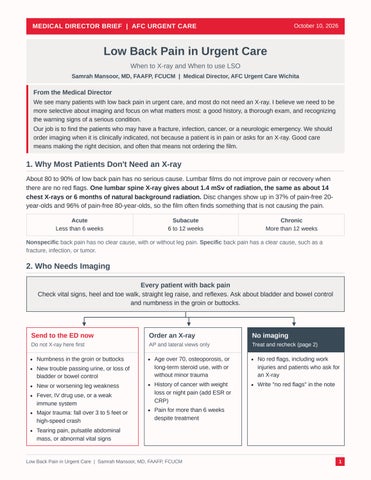
1. Why Most Patients Don't Need an X-ray About 80 to 90% of low back pain has no serious cause. Lumbar films do not improve pain or recovery when there are no red flags. One lumbar spine X-ray gives about 1.4 mSv of radiation, the same as about 14 chest X-rays or 6 months of natural background radiation. Disc changes show up in 37% of pain-free 20year-olds and 96% of pain-free 80-year-olds, so the film often finds something that is not causing the pain. Acute Less than 6 weeks
Subacute 6 to 12 weeks
Chronic More than 12 weeks
Nonspecific back pain has no clear cause, with or without leg pain. Specific back pain has a clear cause, such as a fracture, infection, or tumor.
2. Who Needs Imaging Every patient with back pain Check vital signs, heel and toe walk, straight leg raise, and reflexes. Ask about bladder and bowel control and numbness in the groin or buttocks.
Send to the ED now
Order an X-ray
No imaging
Do not X-ray here first
AP and lateral views only
Treat and recheck (page 2)
Numbness in the groin or buttocks New trouble passing urine, or loss of bladder or bowel control New or worsening leg weakness Fever, IV drug use, or a weak immune system Major trauma: fall over 3 to 5 feet or high-speed crash
Age over 70, osteoporosis, or long-term steroid use, with or without minor trauma
No red flags, including work injuries and patients who ask for an X-ray
History of cancer with weight loss or night pain (add ESR or CRP)
Write "no red flags" in the note
Pain for more than 6 weeks despite treatment
Tearing pain, pulsatile abdominal mass, or abnormal vital signs
Low Back Pain in Urgent Care | Samrah Mansoor, MD, FAAFP, FCUCM
1
MEDICAL DIRECTOR BRIEF | AFC URGENT CARE
October 10, 2026
What to Say When a Patient Asks for an X-ray “Your exam shows no sign of a broken bone, an infection, or a pinched nerve. An X-ray shows bone, not the strained muscle, so it would not change today’s treatment. If you are not better in 2 to 4 weeks, or you notice any warning signs, come back and we will look again.”
3. Treatment for Strain and Spasm Do
Avoid
Stay active; no bed rest.
Opioids and oral steroids
NSAID if safe: ibuprofen 600 mg every 6 hours or naproxen 500 mg twice daily, 7 to 10 days.
Benzodiazepines, gabapentin, pregabalin Muscle relaxants over age 65 or in drivers
Heat or ice; topical diclofenac or menthol. Spasm: cyclobenzaprine, methocarbamol, or tizanidine for 5 to 7 days.
4. Back Support (Lumbar Sacral Orthosis) Offer a LSO for strain or spasm when pain limits walking, work, or sleep. Code
Device
Best for
L0642
Semi Rigid panels, L1 to below L5
Most Patients, Smaller Torso
Diagnosis codes: S39.012A lumbar strain, M54.59 low back pain, M62.830 back spasm Document Every Time
Brace image courtesy of TLC DME
Do Not Give a Brace If
Diagnosis code
Going to the ED
Why it is needed and the activity it helps
Broken skin under the brace
Brace code and size
Pregnancy
Fitted and patient taught
Significant lung disease
Wear plan and stop date (1 to 2 weeks)
Recent abdominal surgery
Signed proof of delivery How to Fit the Brace 1. Back panel centered, bottom edge at the top of the buttocks
2. Front below the ribs, above the pubic bone
3. Pull the side straps snug and fasten
4. Seated deep breath: two fingers fit under the edge
Work injuries: a rigid brace is medical treatment, so the case is OSHA-recordable but not reportable. Recheck work injuries in 5 to 7 days. Sources: ACP low back pain guideline (2017); ACR and RSNA, RadiologyInfo.org: Radiation dose in X-ray and CT exams; ACR Appropriateness Criteria; Chou, Lancet 2009; Brinjikji, AJNR 2015; Earwood, Am Fam Physician 2025; OSHA 29 CFR 1904.7. Disclosure: For educational purposes only. No company or sponsor paid for this material. It does not replace clinical judgment.
2