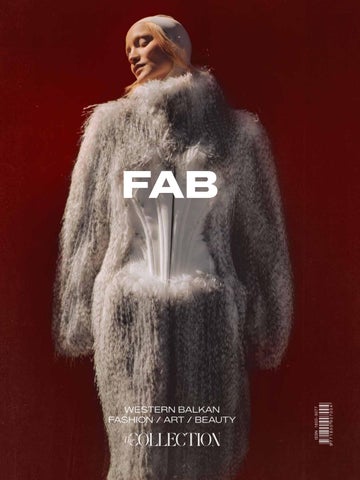
SLOVENIA
WESTERN BALKAN FASHION / ART / BEAUTY
(1)
(2)
SLOVENIA
(3)
FASHION
(4)
SLOVENIA
(5)
FASHION
(6)
Let Yourself Shine sifjakobs.com
FASHION
IMPRESSUM Editor-in-Chief & Creative Director ZINA PUSEP
Executive Director MIODRAG SPAHIĆ
Graphic Design ZINA PUSEP MIA BULATOVIĆ
DESIGN, PREPRESS DesignBox.me
Photography ANASTASIA IZGAGINA VLADIMIR JANIĆ BENNY GAŠI EMILIJA STANIŠIĆ MARKO EDGE VILIM TAVCAR The copyright of all images used in FAB are reserved by the magazine, advertiser’s or photographers and may not not be used without prior consent of the image owner.
ADVERTISING SALES Miodrag Spahić miodrag.spahic@rlcmontenegro.com Zina Pusep zina@thecollectionmags.com Ana Milojević anakv@thecollectionmags.com By decision of the Ministry of Culture and Media of Montenegro, the magazine was entered in the Media Registry under No. 037. CIP - Cataloging in Publication Central National Library of Montenegro, Cetinje 338 48 (497. 16) (05)
Cover Photo (c) ANASTASIA IZGAGINA
Founders Rade Ljumović, Kieran Kelleher
Cover Photo Model VIKTORIIA KAZANTSEVA
ISSN 1800-9077 = The Collection, Montenegro (Podgorica) COBISS.CG-ID18421264
Texts ELIZAVETA LIVADA MILAN BAURANOV SIMONA ĐUKANOVIĆ ZINA PUSEP
The Collection d.o.o. Podgorica Bulevar 21. maj, Podgorica 81000 Podgorica
Contributors MARKO BRUN ANASTASIA IZGAGINA JELENA IVOVIĆ SVEN HARAMBAŠIĆ DRAGANA LAZAREVSKA ANNA YANKOVSKA VIKTORIIA KAZANTSEVA MILJANA BOŽOVIĆ MARIJA MAŠENKA ROGANOVIĆ Technical Editor DOLORES ILIĆ
www.thecollectionmags.com
Printing by DPC - GRAFOTISAK, Grude Copies 4500
Powered & Published by THE COLLECTION (8)
www.thecollectionfab.com
SLOVENIA
Mercedes-Benz
TIMELESS LOOKS GOOD ON US!
Ljetopis Automotive Kralja Nikole 357 Podgorica, Montenegro T. +382 20 648 841 www.mercedes-benz-ljetopis.me (9) mercedesbenz_cg Mercedes-Benz Crna Gora
FASHION
(10)
2
FROM THE EDITOR
FRO M T H E E D I TO R [NEW]
WAYS OF SEEING For decades, the Balkans have been described as a region of potential. An interesting word. It suggests promise, but also something perpetually unfinished. Today, the region is increasingly in the global spotlight. International brands are entering the market, businesses are growing more ambitious, and the cultural landscape is evolving. Porto Montenegro, featured prominently in this edition, is one of its most tangible examples. In his 1972 book Ways of Seeing, John Berger explored how our perception is shaped by what we know and believe. More than fifty years later, artificial intelligence is giving us new reasons to question what we see. Remember life before AI? It was only a few years ago. Now we treat it as perfectly ordinary. Berger probably didn’t anticipate we’d eventually ask a chatbot to be our therapist. I am proud to introduce our collaboration with Elizaveta Livada, whose AI-generated visuals reinterpret the cultural heritage from Serbia and Slovenia, exploring both creative and commercial possibilities. FAB is investing in these technologies, aiming to pioneer their application in the region. Meanwhile, scientists are experimenting with transmitting scents digitally. Imagine receiving an email carrying the scent of flowers from someone’s garden halfway across the world. The possibilities are expanding at a remarkable pace, and I find that enormously exciting. Our Kolašin editorial, photographed between a traditional mountain village and the contemporary Swissôtel Resort just five minutes apart, presents another way of seeing. Both approaches have a place in FAB. We are also pleased to welcome new clients and partners, while strengthening our relationships with those who continue to place their trust in our work.
Photographed by Jelena Čejović Vukčević
As FAB develops, we continue exploring new formats and what publishing can become. Editorial and creative excellence remain our standard, with curiosity and experimentation at the centre of everything we do. The world is changing. So is the way we see it. And there is still quite a lot worth looking at. Zina Pusep Editor-in-Chief & Creative Director, FAB
(11)
FASHION
© Elizaveta Livada
(12)
ABOUT US
The Collection magazine is a leading regional publication focused on luxury lifestyle sector for 15+ years, known for its premium distribution, clients and print. www.thecollectionmags.com | @thecollectionmags
FAB is a multichannel platform and magazine, powered by and distributed with The Collection magazine, dedicated to fashion, art, beauty and the creative industry in the Western Balkans. Through print, digital channels and creative production, FAB spotlights the best talents & businesses from the region. www.thecollectionfab.com | @thecollectionfab
FROM THE
DISTRIBUTION
PUBLISHER
SCAN THE QR CODE
Building on The Collection’s established presence in the regional media landscape, FAB carries that legacy forward while developing an identity and perspective of its own.
7+
Dedicated to fashion, art, beauty, design, and beyond, FAB expands our editorial platform. Rooted in Southeastern Europe with an international outlook, the publication reflects the region’s diverse creative identities, introducing new perspectives and talent deserving recognition beyond geographical borders.
3 100+
50K
With each edition, I am particularly proud of FAB’s strong visual identity, thoughtful editorial content, and distinctive aesthetic, which together define a publication designed to be collected. Our vision extends beyond traditional publishing. The next phase of the creative industries will be shaped by artificial intelligence, emerging technologies, and digital transformation. FAB stands precisely at the intersection of creativity and technology.
MARKETS
Through investment in digital development, new media formats, and international collaborations, we aim to establish FAB as a contemporary, internationally oriented platform.
ISSUES PER YEAR
PREMIUM DISTRIBUTION LOCATIONS
READERSHIP PER ISSUE
Rade Ljumović | Co-founder The Collection
(13)
FASHION
TABLE OF CONTENTS ART, LIFESTYLE & INNOVATION The Porto Effect FAB x Livada | Unlocking new possibilities with AI Cover Editorial Joškin Šiljan | Art Dragstor Sven Harambašić | In Conversation
14 22 34 52 54
FASHION & SHOPPING Where to Shop Arte & Bellezza | Serbia Inside Something | Albania URMA Concept Store | North Macedonia Rey Gold: A new Era of Diamonds | Montenegro Raw Bag | Croatia Tyche: Something New in Montenegro’s Fashion Landscape | Montenegro Milena Đuriđić’s Fashion Manifesto
(14)
62 64 66 68 70 72 75 77
CULTURE & BEYOND John Newman | Back to Montenegro Regis | Beyond The Sound of The Balkans Vladimir Janić | Talent Spotlight BeefBar | Balkan Debut in Belgrade 8th Edition of International Fashion Festival in Porto Montenegro The Mind Behind The Making | Talent Spotlight Creative Education in The Region | Faculty of Design Ljubljana
78 82 84 90 93 94 98
BEAUTY & WELLNESS Maia | The First Beauty, Wellness & Lifestyle Concept in Montenegro’s Historic Royal Capital Walk of Shame | Morning Routine
100 102
SLOVENIA
© Sven Harambašić (15)
P
THE PORTO EFFECT
TH E
ORTO
E F F E C T FROM A DECOMMISSIONED NAVAL SHIPYARD TO AN INTEGRATED LUXURY WATERFRONT LIFESTYLE DESTINATION - THE STORY OF HOW PORTO MONTENEGRO TRANSFORMED THE ADRIATIC’S LUXURY LANDSCAPE.
(16)
MONTENEGRO
Can one destination change the way an entire country is perceived? On the shores of the Bay of Kotor, Porto Montenegro has spent nearly two decades demonstrating just how much influence a single development can have. Located in Tivat, Montenegro, Porto Montenegro is an award-winning superyacht marina and one of the Mediterranean’s leading luxury waterfront destinations that has played a defining role in the country’s emergence on the international luxury map. What was once a naval shipyard in a small Adriatic town is now home to internationally recognised fashion houses, five-star hotels, luxury residences, restaurants and a thriving waterfront community. When Porto Montenegro opened its first marina berths in 2009, Montenegro’s luxury tourism sector was still taking shape. The project introduced a different vision of what the country’s coastline could offer, helping establish a market for international retail, premium hospi-
tality and sophisticated lifestyle experiences. Its influence extended well beyond the waterfront, generating hundreds of jobs, attracting international businesses and creating opportunities for local companies. In doing so, Porto Montenegro has played an important role in reshaping Tivat and Montenegro’s international profile. Its international significance extends beyond tourism. In June 2026, Porto Montenegro hosted the EU-Western Balkans Summit, bringing European leaders, including French President Emmanuel Macron, German Chancellor Friedrich Merz, European Commission President Ursula von der Leyen and European Council President António Costa, to Tivat for one of Montenegro’s most important political gatherings. The destination also hosted prominent regional industry summits, including the Adria Future Summit and Infintech, bringing together leading figures from politics, business, finance and tech.
(17)
FASHION
MONTENEGRO
FASHION AND LIFESTYLE ON THE WATERFRONT From Rolex, Bvlgari, Bottega Veneta, Brunello Cucinelli and Celine to carefully curated high-end multibrand boutiques, niche perfumeries and contemporary fashion, Porto Montenegro has established itself as one of the Adriatic’s most distinctive shopping destinations. Less than two decades ago, the idea of shopping for some of the world’s leading luxury houses in Tivat would have seemed unlikely. Today, international fashion sits alongside an expanding selection of multibrand boutiques, contemporary labels and independent lifestyle concepts. Porto Montenegro currently comprises 200 commercial units, including 159 retail units and 41 premium office spaces across Arsenal, Ozana, Adriatic and Nautica Business Clubs. Its portfolio includes more than 60 fashion and accessories stores, around 30 monobrand stores and over 50 specialty and lifestyle concepts, spanning jewellery, watches, beauty, wellness, design, sports and technology. The retail landscape continues to evolve, with the arrival of Bottega Veneta, Brunello Cucinelli and ZEGNA through Global Fashion in July 2026 marking another significant expansion of Porto Montenegro’s luxury retail offering. Equally important are the retailers who helped intro(18)
duce international designer fashion to Montenegro. Among the pioneers is Fashion Gallery, which opened in Porto Montenegro in 2015, with a selection including Balenciaga, Saint Laurent, Dolce & Gabbana, Fendi, Valentino and Jacquemus. Samms, one of the country’s leading fashion distributors, represents more than 20 international labels across its wider portfolio, including Max Mara, Boss, Pinko, Elisabetta Franchi, Paul & Shark, Liu Jo and Twinset. Tenero Fashion brings another dimension of Italian luxury with Kiton, Moorer, Jacob Cohën and Santoni, while Twenty Two Concept Store offers a contemporary selection featuring Victoria Beckham, Farm Rio, Alemais and other international labels. From designer collections to resort dressing, contemporary fashion and activewear, the selection reflects the different lifestyles of Porto Montenegro’s residents and visitors. With restaurants, cafés and the marina just steps away from the boutiques, shopping may be the reason you arrive, but it rarely remains the only reason to stay. And Porto Montenegro’s expansion is far from over. With Vero and Versa, two new residential developments taking shape, the destination is set to introduce additional retail, dining and lifestyle spaces, creating opportunities for more international brands to join its growing portfolio.
MONTENEGRO
60+
30
STORES
STORES
MONOBRAND
FASHION AND ACCESSORIES
40+ PREMIUM OFFICE SPACES
150+
RETAIL UNITS
50
SPECIALTY AND
LIFESTYLE CONCEPTS
(19)
THE PORTO EFFECT
(20)
MONTENEGRO
EVERYTHING WITHIN REACH Few places on the Adriatic offer so much within walking distance. You can walk from one end of the marina to the other in approximately 10–15 minutes, passing international fashion houses, five-star hotels, restaurants, cafés and wellness facilities along the way. What might require crossing an entire city elsewhere is available here within a short stroll, making it easy to move between shopping, dining, leisure and everyday life. Hospitality has played a particularly important role in shaping this experience. With luxury accommodation, restaurants, wellness and leisure facilities within easy reach, Porto Montenegro brings together the elements of a distinctive waterfront lifestyle, welcoming residents, guests and visitors throughout the year. Porto Montenegro is also home to SIRO Porto Montenegro, the first SIRO hotel in Europe, introducing Kerzner International’s fitness and recovery-focused hospitality concept to the Adriatic. Built around movement, nutrition, sleep and wellbeing, SIRO offers another way to experience the destination, where an active routine fits naturally alongside waterfront dining, shopping and leisure. A morning workout or coffee along the promenade can turn into an afternoon of shopping, a long waterfront lunch or a few hours at AURA Beach & Restaurant, one of Porto’s favourite poolside gathering spots. With more than 40 restaurants, cafés and bars, deciding where to spend the evening might be the day’s most difficult decision. Tivat International Airport is just a ten-minute drive away and was connected to approximately 50 destinations during summer 2026, making Porto Montenegro easily accessible to visitors from across Europe and beyond.
WHEN THE WATERFRONT BECOMES A STAGE Music brings a different atmosphere to the destination. The Made in New York Jazz Festival draws musicians and audiences together for open-air performances, adding a dimension to Porto Montenegro’s summer cultural calendar. During the International Fashion Festival, Porto Montenegro’s waterfront becomes a runway, with designers such as Paris-based Weinsanto and Italian couturier Antonio Grimaldi bringing their collections to the Adriatic. The 2026 edition also welcomed Chinese designer Liwen Liang, highlighting the festival’s increasingly international outlook. Cinema has its own place here. The Adriatic Film Awards, a two-day celebration of regional film and television, brings something of the Cannes atmosphere to the Montenegrin coast on a more intimate scale. With more than 800 members of the Film and TV Academy of the Adriatic Region involved in selecting the winners, the event combines industry recognition with screenings, red-carpet appearances and gatherings of actors, directors and producers. (21)
FASHION
A COMMUNITY OF ITS OWN For all the international attention Porto Montenegro attracts, there is something less expected about life here: the familiarity of a small neighbourhood. Despite its prestigious surroundings and international clientele, becoming part of the social circle can happen almost effortlessly. Residents, entrepreneurs, yacht owners, international visitors and locals cross paths in the same cafés, restaurants and waterfront spaces. With everything so close together, running into someone you know is almost inevitable, even if you’ve only just met. You might arrive knowing nobody, strike up a conversation over lunch and, by the following morning, already find yourself exchanging greetings along the promenade. The people you met just hours earlier become familiar faces, introductions turn into invitations, and suddenly you have plans for the evening.
WHERE TO SHOP IN PORTO MONTENEGRO
Explore the complete list
www.portomontenegro.com (22)
SLOVENIA
(23)
EXCLUSIVE
X LIVADA HOW AI IS PUSHING THE BOUNDARIES AND UNLOCKING NEW POSSIBILITIES ACROSS ALL INDUSTRIES
Artificial intelligence can generate an image in seconds. Developing a visual language worth looking at is another matter entirely. Following a creative dialogue with FAB Editor-in-Chief Zina Pusep, multidisciplinary artist and creative director Elizaveta Livada explores the intersection of technology, fashion and cultural heritage in this exclusive feature. Drawing inspiration from traditional elements of Serbia and Slovenia, Livada reimagines regional visual identi(24)
ties through a contemporary, AI-driven language. From sculptural garments to surreal architectural compositions, the series challenges conventional boundaries between disciplines. Beyond the images, Livada offers an insight into her creative process, the evolving relationship between artist and machine, and how artificial intelligence is transforming not only art and fashion, but the wider creative industries.
SLOVENIA
(25)
EXCLUSIVE
This project is a bold, avant-garde interpretation of the visual cultures spanning Slovenia to Serbia. I began with the shape of a garment or the line of an embroidered motif, then followed each form as it changed material, scale and context. Through that process, familiar cultural references enter strange, sometimes surreal territory while retaining a connection to their origins. (26)
Mixed media makes the relationship between tradition and contemporary interpretation visible within the work itself. Archival and contemporary photography, fabric, embroidery and digital textures meet across different surfaces and moments in time. Fashion, architecture, craft and graphic imagery take on unexpected forms; together, the works create a single cultural tapestry.
SLOVENIA
(27)
EXCLUSIVE
A New Dialogue Visual culture is undergoing a profound shift. Artificial intelligence has introduced a new way of creating images, reshaping creative practice and expanding the possibilities available to an author. Its arrival recalls the early years of the internet, when a technology began to change how people worked, communicated and imagined the future. What makes this moment particularly compelling is its openness: the methods, formats and conventions are still taking shape. Language has become central to this new creative process. An idea is articulated in words, translated into an image, then refined through further exchanges. A dialogue unfolds between artist and machine, with each response offering material for the next decision. (28)
The image can reveal an unexpected possibility, and the original idea can evolve through the encounter. This accessibility has brought renewed attention to questions of authorship, artistic value and the place of technology in art. These questions run through my practice. Working with AI offers a way to investigate them through the act of making: developing projects, testing the medium and discovering how it changes the relationship between an idea and its expression.
EXCLUSIVE
From Design to an Artistic Practice My background is in visual communication. As a designer, art director and photographer, I have worked across different disciplines, with a continuing interest in the relationship between concept, medium and audience. Studying Media and Communication Design at the University of Westminster established the foundation for this approach. Ideas were explored through typography, photography, moving image and space, each offering a different way to communicate meaning. Design, illustration, photography, 2D and 3D content, and animation all became part of my practice. The projects ranged from branding and book design to installations. Working across these formats encouraged
an ongoing exploration of tools and visual expression. AI entered that process naturally, first as part of my design workflow, then as a medium around which an independent practice began to develop. Over the past two years, that practice has taken several directions. An early turning point came through conceptual reels: short artistic videos that attracted a strong response online. Their brevity became an interesting creative condition. A few seconds could establish an atmosphere, introduce a visual world and evoke an emotion, leaving the viewer to complete the interpretation.
(29)
FASHION
(30)
SLOVENIA
(31)
FASHION
Research and the Alchemy of Styles These films also became a form of cultural exploration. Travel provides much of the starting material: architectural details, traditional dress, local crafts, textures and the ways people inhabit a place. Those observations return in my work through the interplay of culture, fashion, art and craft. Gradually, they become imagined worlds in which familiar references acquire new forms. Last year, one of these reels was presented in a museum exhibition. Seeing a work originally created for social media enter a museum changed my understanding of the format. It suggested a broader context for the work and encouraged further exploration of AI within art, including the possibilities of presenting digital imagery beyond the phone screen. A subsequent media installation in Bali explored escapism through image, sound, light and space. Here, the work became an environment the viewer could enter. This introduced new considerations: the relationship between imagery and its surroundings, the presence of the viewer, and the ways sound and light influence perception. The experience extended my research into the spatial possibilities of the medium. (32)
Every project begins with research. Immersion in a subject creates the conditions for an idea to emerge. Visual references, cultural context and connections between different fields gradually suggest a direction. The process has the character of a journey, with discoveries along the way shaping both the concept and its eventual form. Working across visual styles is central to this approach. The vast datasets behind generative models offer access to references from many traditions within human visual culture. Developing a distinctive visual language within that breadth requires a deliberate method. For each project, I assemble references, examine their colours, forms and materials, and progressively teach the model the relationships and combinations I want to explore. This is an alchemy of visual content: styles, textures and forms are brought into contact, and their interaction becomes part of the work's meaning. An unexpected contrast can create visual tension and provoke an emotional response. A connection between two materials may become the starting point for a series. What matters is how these elements develop together within the idea.
Experience and visual judgement guide the process of selection and refinement. Research provides material for experimentation; experimentation, in turn, reveals new aspects of the subject. This exchange is the foundation of my approach to both artistic and commercial projects. The collaboration presented in this magazine draws on the visual cultures of Slovenia and Serbia. Traditional costumes, jewellery, lace, textile patterns and architecture provided the starting points for a series exploring the relationship between cultural heritage and contemporary fashion imagery. The focus was on how these references could move between disciplines and take on new forms. Across the series, motifs migrate between the body, objects and space. The geometry of a woven pattern becomes architectural. Lace expands into a structure surrounding a figure, while metallic ornaments form sculptural garments. Long textile drapes extend from a wooden house, transforming the familiar building into
an imagined installation. Changes in scale, material and context introduce an element of the surreal while preserving a connection to the original references. Collage and mixed media bring these different modes of image-making into a single composition. Archival imagery meets contemporary portraits; red stitches connect separate fragments; faces repeat and overlap. Postage-stamp borders and the textures of paper, fabric and metal suggest a visual archive assembled by hand. Through AI, the series also explores the appearance of materiality, moving between images that evoke photography, textile work, collage and installation documentation. Each form of expression reveals another aspect of the subject. Together, they create a more layered visual narrative. Fashion, architecture, craft and graphic design offer different perspectives on the same cultural material, allowing the series to develop through a range of images connected by a shared visual language. (33)
EXCLUSIVE
(34)
EXCLUSIVE
An Artistic Approach to Commerce
A Continuing Exploration
Commercial projects remain an important part of my work alongside the creation of artworks. Working with AI allows me to develop creative ideas across different contexts, from independent artworks to commercial campaigns for brands. The format, audience and objectives may change, but the process remains rooted in concept development, visual research and the search for compelling ways to engage the viewer. The ability to work at the intersection of art and commerce is one of the defining qualities of my approach. An artistic idea can interact with architecture, shape the atmosphere of a place, become part of a visitor’s experience or address a brand’s specific communication objectives. Each context opens up new ways to develop an idea and explore the potential of visual language. Experience gained in one direction often becomes a starting point for another. In commercial projects, I draw on an artistic sensibility and my background in design. The process begins with a close understanding of the brand: its philosophy, character, visual language and objectives. From there, a concept takes shape and can be developed across different formats, expressing the brand’s identity through a range of visual solutions. Research and experimentation remain essential to the process, with each creative decision aligned with a specific communication goal. The demand for visual content has grown considerably. Social platforms, their algorithms and the multitude of communication channels require brands to constantly renew their imagery. Traditional photo shoots involve significant costs, time and coordination. For projects suited to this approach, AI can streamline production, accelerate the development and testing of ideas, and reduce costs, opening up possibilities that might otherwise be difficult to realise. At the same time, standing out still requires a creative approach combined with thoughtful artistic execution. The capabilities of the medium must be matched to the requirements of each project. Its value lies in the range of approaches it makes possible, from expressive artistic concepts to visual solutions centred on a particular product. Finding the right balance between the idea, the format and the objective remains an integral part of my creative work.
The technology is evolving rapidly, and each development brings new possibilities for creative practice. Our understanding of the medium develops alongside the tools themselves. New formats, unexpected combinations and experiments in different settings continue to expand the field. Shared curiosity has become an important part of that exploration. As my experience grew, the desire to exchange knowledge led to the creation of Livada School. Teaching became a continuation of the practice: a place to investigate ideas with others and help students develop their own creative direction. The school's emphasis is on visual thinking. Research, concept development, visual awareness and creative decision-making form the basis of the learning process. Technical skills support that foundation, enabling students to turn their ideas into work. Understanding visual language helps them recognise possibilities, make informed choices and develop an approach that reflects their own interests. The aim is to cultivate the curiosity and willingness to experiment that have shaped my own path across design, photography, art and commercial communication. AI has opened another chapter in that journey. Its conventions are still emerging, and participating in their development remains one of the most compelling aspects of the work.
(35)
FASHION
COVER EDITORIAL
THE THINGS WE CANNOT KEEP Photographer: Anastasia Izgagina Producer: Zina Pusep Model : Viktoriia Kazantseva Styling : Anna Yankovska Make Up : Miljana Božović Fashion : Samms, HIT Firma, iBlues, Effeti Concept Store Location: Eko Katun Vranjak Bjelasica & Swissôtel Kolašin
(36)
MONTENEGRO
Coat Elisabetta Franchi (37)
FASHION
According to the traditional account, on moonlit nights, two jets of water would suddenly break the surface of the lake. From the dark water would emerge a magnificent white horse with blue eyes and enormous wings.
(38)
SLOVENIA
Skirt | iBlues Jacket | Stand Studio Gloves | Max Mara
(39)
FASHION
(40)
SLOVENIA
(41)
FASHION
The fairies would gather among the trees to watch it fly. They admired the creature, but one fairy became obsessed with the idea of having it only for herself.
(42)
(43)
(44)
Skirt | iBlues Jacket | Stand Studio Gloves | Max Mara Boots | Högl (45)
FASHION
(46)
MONTENEGRO
She danced and sang until she attracted the horse’s attention, eventually persuading it to follow her into the cave. For a brief moment, she had everything she wanted. But the other fairies grew jealous. They captured the horse and covered its wings with resin, leaving it unable to fly.
Dress | Self-Portrait Cardigan | ROTATE Shoes | UGG
(47)
FASHION
Sweater | Weekend Max Mara Skirt | Elisabetta Franchi
(48)
SLOVENIA
(49)
SLOVENIA
Shorts & Bomber | Ganni Boots | A.W.A.K.E. MODE Polo | ROTATE Ring | Something The Brand
(51)
FASHION
(3)
(2)
(1)
(4)
(7) (6)
(8)
(5)
SHOP
T H E E D I TO R I A L (9) (11)
(12)
(13)
(10)
(14)
(17)
(16) (15)
1. Aya Jacket - Stand Studio 2. Polo Shirt - ROTATE 3. Windbreaker - ROTATE 4. Dress - Self Portrait 5. Bomber - Ganni 6. Shorts - Ganni 7. Cardigan - ROTATE
10. Wrap Skirt 11. Coat 12. Skirt
8. Sweater
Weekend Max Mara | Podgorica
9. Elara Ring
Something The Brand | Tirana
(52)
Elisabetta Franchi | Podgorica & Porto Montenegro
13. Gloves MaM | Podgorica
iBlues | Podgorica
14. Boots - Högl 15. Clogs - UGG
Max Mara | Podgorica & Porto Montenegro HIT Firma | Podgorica
16. Sandals - A.W.A.K.E. MODE 17. Boots - A.W.A.K.E. MODE Effeti Concept Store | Podgorica
SLOVENIA
Serbia
Hungary
Croatia
Montenegro
Bulgaria
North Macedonia
Bosnia and Herzegovina
belodore.official (53)
FASHION
JOŠKIN ŠILJAN Photo: Kristina Simić Portrait Photo: Nebojša Babić (54)
ART
In an effort to bring Joškin Šiljan’s work closer to art lovers, we have selected some of the artist’s most compelling thoughts on inspiration, painting and life.
THE PAINTING PAINTS ITSELF
Following a highly successful 2025, during which he held a major solo exhibition at the Salon of the Belgrade City Museum, marking the culmination of his exhibition activities over the past several years, Joškin Šiljan has been awarded the “Longin” Prize, one of the most significant recognitions for an artist’s overall achievement in the visual arts. During this period, he has exhibited in numerous important galleries in his native Serbia and throughout the region, as well as in Ljubljana, Slovenia, Porto Montenegro, Montenegro, Paris and Budapest. Numerous experts from the art world have written and spoken about his work, which is held in many private, institutional and corporate collections around the world. Šiljan literally inspires love from audiences and attracts the attention of the art world on every continent, wherever his works appear, while remaining authentic and true to himself and to a creative practice surrendered to freedom and uncompromising experimentation. “He employs the principle of free psychic automatism, allowing himself to be guided towards his goal by a reliable instinct and a powerful desire to discover the unknown. His painting is therefore dynamic, both in its brushwork and in its use of colour, while he assembles contexts in accordance with the principles of the stream of consciousness, capturing them on the fly from the surrounding reality or summoning them from the depths of the subconscious. Yet he does not allow instinct to lead him into dead ends. On the contrary, he connects it to reality through precisely that linguistic quality for which he has become known. This is the authentic local language of the south, so that we experience the words written in it as the unadulterated truth, both in terms of facts and emotions, rather than as fabrications and stereotypes produced by the mass media. This is precisely why Šiljan occupies a distinctive place in our culture, realising Bonito Oliva’s celebrated maxim: local-global.” -Slavko Timotijević, curator
I didn’t enter painting. Painting entered me. I consciously joined the dance of creation, and I’m not crazy enough to leave it. Let it keep spinning. My artistic nature is what it is. Neither do I know it, nor does it know me. We keep playing hide-and-seek all over again. When I’m absent, my artistic nature appears; when I appear, it hides. And so it goes, time and again. The painting paints itself. A line, a colour, a shape appears only if I am the line, the colour, the shape. If I am present. I am a tiny cog in the process of creation, or rather, in the process of self-creation. Nothing more and nothing less. Just enough for the painting to appear on its own. From somewhere. Who could possibly know where. And an artist is more of a mediator than a creator. I’m more of a midwife than an on-call gynaecologist. I simply open my mouth. The painting creates itself, and I am here to convey it. To be connected to the source. My job is to find the source, and the water knows how to flow by itself. The artist does not belong to this world; the artist is invisible, has no nationality or gender, and does not ask whether your body can endure what it compels you to do. The artist is a force that drives you to bring the work into being. We all participate in creation. The artist draws one line, then someone adds another, someone else a third. The living and the dead, people and nature alike, all take part in creating a painting. Everything around us is filled with information—a cliff, a stone, a mountain, a bird, a tree, a human being. You have to be connected to the source in order to create. One of the very good things about art is being honest with yourself. And honesty tolerates no censorship. Only a free, creative being creates—creates itself. Time is what it is; it wants to swallow us whole. My way of escaping that trap is through serious messing around. I create when I feel like it, when I have the energy, when I have enough joy to create, and then time doesn’t matter. And the titles of the paintings? They name themselves. If they could give birth to themselves, surely they can baptise themselves, too. Šiljan is there merely to take the minutes. When it comes to Joškin Šiljan, one thing is certain: nothing is certain. Neither what he wants nor what he doesn’t. He doesn’t even know that he knows something. He simply exists. Joškin Šiljan. Invented.
ART DRAGSTOR Belgrade | Serbia www.dragstor.art (55)
FASHION
IN CONVERSATION Conducted by Zina Pusep
SV Photography & Artwork: Sven Harambašić (56)
SLOVENIA
EN HARAMBAŠIĆ
Croatian artist and visual director Sven Harambašić has built a practice that resists conventional artistic categories. Moving between photography, collage, fashion, music and fine art, his work explores the increasingly complex relationship between physical and digital realities. His distinctive visual language, combining analogue experimentation with conceptual research, has led to collaborations with international names including Boy Harsher, Amenra, Nike, Tokyo Marathon, and the ballet opera GENESIS by Maison Enclave and Rick Owens, regional stars Senidah and Coby, as well as exhibitions in Paris, Osaka and Berlin. Holding a PhD focused on authenticity and identity in digital environments, Harambašić approaches image-making with both artistic intuition and academic curiosity. For FAB, he discusses his multidisciplinary practice, the ideas behind his work and the evolving role of the artist in contemporary visual culture.
(57)
FASHION
Zina: Your work spans photography, music, fashion and fine art, yet your ideas seem to dictate the medium. Is this a conscious approach, or has it developed naturally? Sven: I have never been particularly attached to a single medium, nor do I consider it a form of artistic identity. Collage is perhaps the closest thing to a constant in my practice, although I perceive it more as a way of thinking than a medium. It allows me to approach existing images, objects, and structures as material that can be recontextualized or made to provoke another function. This logic can operate within a photograph just as naturally as within a sculptural object; thus the transition from ’zines to stage design, for instance, feels like a natural extension of image-making rather than a departure from it. All of these forms belong to the same visual system, where the dynamic between bodies, objects, and space remains central; only the conditions and scale change. This relationship between theory and artistic production is also reflected in my academic background. My doctoral research focused on identity construction and the authenticity of representation in digital environments, questions that continue to inform my artistic interests. Theoretical research and material experimentation are different methods of raising similar questions, rather than separate activities. Zina: Despite working across very different disciplines, there's a remarkably consistent visual identity throughout your work. What do you consider the defining elements of your aesthetic, and how did you develop them? Sven: The consistency in my work comes from a particular way of thinking, rather than a conscious effort to maintain a recognizable aesthetic. Certain elements recur, but I see them as methods rather than stylistic signatures. Over time, these decisions have naturally developed into a visual language of their own. In VEILED NOISE, industrial noise operates as a structural logic, a system for fashion image-making, rather than simply an aesthetic reference. That is one example of how I approach constructing images. I value having developed a recognizable visual language, but remain conscious of the danger of reducing it to an automated formula. A visual language becomes a formula when its characteristics are repeated without the thinking that originally produced them. Preserving its integrity doesn't mean keeping it unchanged, but continuously challenging and refining it, sometimes through subtle shifts in material, method or context. I think this is particularly relevant in 2026, when we are constantly bombarded with platitudes about the importance of taste in the age of AI, while allowing algorithm-driven platforms to act as intermediaries of that very taste, drawing from pools of content they themselves select and circulate. Historically, commercial interests would appropriate and exploit subcultures that developed largely outside their influence. Today, the
(58)
same platforms that appropriate cultural movements also shape the conditions under which they emerge and become recognized as good taste. The distinction between cultural production and its commercial exploitation becomes increasingly difficult to identify, while passive doomscrolling turns everything from pseudo-intellectualism to archive fashion into temporary aesthetics of identity. Equally important, AI-generated content returns to the internet as source material, producing a form of informational cannibalism. The problem is not only that AI might reproduce its own flaws, but that people use such output without any critical engagement, gradually contaminating the cultural archive with content derived from other synthetic content and simulations of human behavior, rather than direct human experience.
SLOVENIA
Senidah (59)
FASHION
(60)
SLOVENIA
Creative Direction & Photography: Sven Harambašić Fashion: Dingyun Zhang (61)
FASHION
Zina: I’m particularly curious about your Balkan heritage. Has your cultural background influenced your aesthetic or artistic perspective, even in ways that might not be immediately obvious in your work? Sven: My cultural background is inseparable from how I developed and has inevitably shaped my perspective, although I have never felt an obligation to translate it into an identifiable aesthetic, nor do I consider it a framework within which my work must be understood. Geography can explain the conditions of a practice without necessarily explaining the practice itself. There is a certain asymmetry in the relationship between the Balkans and the West. We grow up with an intimate understanding of Western cultural references and narratives, while the Balkans are frequently approached through a certain exoticism or a relatively narrow understanding of our history and identity, often reduced to an aesthetic, neologisms and buzzwords. We are expected to understand the West, while the West does not necessarily feel the same obligation to understand us, or anyone for that matter, and continues to act as a gatekeeper in determining what is perceived as success. Regardless, I do not feel the need to neutralize my origins to participate internationally, quite the contrary.
(62)
SLOVENIA
(63)
FASHION
© Lara Buljubašić (64) RAW BAG
FASHION
WHERE TO Discover FAB’s selection of stores and brands worth exploring across the Western Balkans, from established favourites to unexpected finds.
SHOP? ARTE & BELLEZZA SOMETHING THE BRAND URMA CONCEPT STORE REY GOLD RAW BAG TYCHE
EXPLORE MORE ONLINE www.thecollectionfab.com (65)
FASHION
ART, GEOMETRY AND ITALIAN LEATHER
ARTE & BELLEZZA Fashion tends to treat the handbag as a finishing touch. Arte & Bellezza starts with the bag itself: an object of design, with its own proportions, structure and point of view. Working with premium Italian leather, the brand draws inspiration from art, architecture and geometric forms, translating them into contemporary accessories that balance functionality with visual expression. Unexpected silhouettes, carefully considered proportions and an interplay of textures define a design language that moves beyond the conventional handbag. Behind Arte & Bellezza is founder and creative director Dragana Mircetic, whose vision brings together traditional craftsmanship, innovative design and a thoughtful approach to sustainability. Her philosophy centres on creating pieces that retain their relevance beyond seasonal trends, with an emphasis on natural materials and quality.
(66)
Handcraftsmanship remains central to the brand’s identity. Each design reflects an appreciation for traditional techniques, reinterpreted through a contemporary aesthetic. The interaction between geometry, texture and the natural characteristics of leather gives each piece a distinctive presence, while maintaining the practicality expected of an everyday accessory. For Arte & Bellezza, sustainability is closely connected to longevity. Rather than following the constant turnover of fashion, the brand prioritises enduring construction, considered materials and designs intended to be worn repeatedly. The result is a collection that invites a more individual approach to accessorising. Sculptural yet wearable, understated yet recognisable, Arte & Bellezza treats the handbag as more than a functional necessity, allowing form, craftsmanship and personal style to exist on equal terms.
Photos by: Emilija Stanišić
SLOVENIA
SHOP ONLINE AT WWW.ARTEANDBELLEZZA.COM (67)
FASHION
INSIDE SOMETHING FASHION & JEWELLERY DESTINATION IN TIRANA, ALBANIA (68)
ALBANIA
In the heart of Tirana's Blloku neighbourhood, Something has established itself as a destination for those with an appreciation for thoughtful design, beautiful materials and a personal approach to shopping. Its boutique, with its distinctive minimalist architecture, reflects the vision of founder Ester Nuriu, who built the brand from scratch, shaping its identity, collections and the space in which they are presented. What began with jewellery has evolved into a broader world of fashion and accessories. Today, Something offers an extensive selection spanning different materials and price points, from contemporary fashion jewellery to creations featuring lab-grown diamonds, natural diamonds and precious stones. Whether an understated piece for everyday wear or something more exceptional, the collections cater to different tastes and occasions. Alongside its jewellery, Something has developed capsule clothing collections centred on quality and longevity. Working with fine materials, including cashmere, silk and leather, the brand focuses on wardrobe essentials, from classic shirts and tailored blazers to soft cardigans and versatile everyday pieces. Designed to be worn season after season, the collections prioritise functionality and genuinely timeless style over passing trends. At the boutique on Rruga Vaso Pasha, these different sides of Something. come together. The minimalist, concrete-led interior provides a striking setting for clothing and jewellery, from everyday essentials to fine diamond pieces. Beyond the design, the boutique maintains a distinctly personal approach, with individual attention and guidance that make shopping a more considered experience.
Rruga Vaso Pasha 3/1, Ish-Blloku | Tirana, Albania www.somethingthebrand.com | @something.thebrand
(69)
UR MA FASHION
CONCEPT STORE
Founded by sisters Aleksandra Bela Atanasovska and Anastasia Bela Mijalkova, URMA Concept Store was born from a shared vision of creating a space that celebrates individuality, creativity and the stories behind the brands we choose. In a world where trends come and go, URMA celebrates independent design, authentic expression and contemporary lifestyle. What started as a shared idea
(70)
has grown into a curated destination bringing together fashion, jewellery, beauty, accessories and home décor. At its heart, URMA is about discovering something different. The concept brings together a carefully selected mix of established and emerging brands, with a special focus on Macedonian designers and women-led businesses. Each brand has its own identity, story and creative perspective, contributing to a selection that feels
NORTH MACEDONIA
personal, authentic and constantly evolving. More than a retail concept, URMA is a platform that creates opportunities for local talent, connects creative people and introduces customers to brands they might not otherwise discover. From statement jewellery and contemporary fashion pieces to beauty essentials and thoughtfully designed lifestyle objects, every selection reflects a distinctive approach to modern living. Through its online platform and physical concept store and pop-up space at Skopje City Mall, URMA continues to build a community around independent creativity, individuality and a more personal approach to shopping. For its founders, the philosophy is simple: style is not just about what we wear or own, but also about the stories, people and values behind the choices we make. URMA is where local creativity meets contemporary lifestyle. Ljubljanska, Skopje | North Macedonia www.urma.mk
(71)
FASHION
DIAM REY GOLD BRINGS A FRESH PERSPECTIVE TO FINE JEWELLERY, INTRODUCING ITS COLLECTION OF LAB-GROWN DIAMOND PIECES TO THE MONTENEGRIN MARKET. (72)
MONTENEGRO
A NEW ERA OF
ONDS The world of diamonds is entering a new chapter. Advances in technology have made it possible to create lab-grown diamonds that share the same physical, chemical and optical properties as natural diamonds, while offering a different perspective on their origin and production. For those who value innovation, transparency and ethical considerations, lab-grown diamonds represent an appealing choice. Their production does not require mining, making them an alternative for consumers who place importance on more responsible sourcing. Their more accessible price point also offers greater freedom when choosing the design and character of a piece of jewellery. This evolving approach is reflected in Rey Gold, a family-owned jewellery house from Nikšić, Montenegro, with a heritage dating back to 1978. Nearly five decades of experience and dedication to fine jewellery form the foundation of a brand that continues to embrace new technologies and the evolving language of contemporary luxury. As part of this new chapter, Rey Gold introduces its new collection of engagement rings featuring lab-grown diamonds, alongside a wider selection of jewellery incorporating these stones. The offering also includes natural diamonds. Through its own jewellery production, Rey Gold also creates bespoke pieces tailored to individual preferences, from the choice of diamond to the final design, resulting in unique creations with personal meaning. Almost five decades of heritage, with an eye firmly set on the future. Rey Gold brings together jewellery-making tradition and contemporary possibilities, allowing every piece to tell its own story.
rey GOld jewellery
Trg Slobode br. 29 | Niksic, Montenegro @rey.gold | reygold.nk@gmail.com | +382 69 204 100
(73)
FASHION
MADE TO CHANGE
R AW B AG SHAPED BY WATER. FORMED BY SUN.
For Croatian designer Mirjam, the beauty of a handbag lies not in preserving its original appearance, but in allowing it to change, age and acquire a character of its own. Her label, RAW BAG, challenges conventional ideas of perfection through handcrafted leather bags designed to evolve with their owners. Made from naturally tanned leather without harmful chemical treatments or coatings, each piece gradually develops its own patina. Sunlight darkens the leather, daily use softens its structure, and even an accidental wine stain becomes a permanent reminder of a particular moment. (74)
“In a world where everything is plastic and filtered, the goal was to create a bag that isn't afraid to live a real life,” explains the designer. Inspired by the imperfect forms of crumpled paper bags, Mirjam embraces wrinkles, irregularities and the natural ageing process as essential elements of her design language. Rather than concealing imperfections, RAW BAG celebrates them, transforming each accessory into an object that reflects the habits, experiences and lifestyle of its owner. No two bags are expected to age in quite the same way.
CROATIA
© Lara Buljubašić
Sustainability is equally central to the brand's philosophy. Working with a made-to-order production model, RAW BAG aims to minimise unnecessary waste while encouraging a more considered relationship with the objects we own. For Mirjam, however, sustainability extends beyond the use of materials or conventional recycling. Her approach questions entire production processes, from energy consumption and carbon emissions to the potential of transforming waste into new resources within a circular economy. Balancing everyday practicality with an unconventional design aesthetic, RAW BAG has already attracted attention beyond Croatia. Its collections are available in concept boutiques across Paris, Amsterdam, Verona, Florence, Milan and Berlin. Guided by the philosophy Shaped by Water / Formed by Sun, RAW BAG proposes a different understanding of luxury: one in which time, nature and personal experience contribute to the design itself. A bag that doesn't simply accompany your life, but carries the evidence of it. www.raw-bag.com @raw__bag ©Matteo Bagini
(75)
FASHION
NEW ESTETIK Official distributor for Montenegro
RETAIL | FACE, BODY & HAIR TREATMENTS Expert Centar Biologique Recherche Tivat | Porto Montenegro Pomorska 9/2b @expertcentarbr.portomontenegro +382 67 698 885 (76)
Beauty for you Podgorica | Capital Plaza Šeika Zaida 19/1 @new__estetik + 382 67 523 222
MONTENEGRO
SOMETHING NEW IN MONTENEGRO’S FASHION LANDSCAPE TYCHE Why should discovering an interesting fashion label require a trip abroad? Located in Portonovi, Montenegro’s luxury waterfront resort, TYCHE is a multi-brand boutique introducing an international selection of fashion labels rarely found in the local market. From quality resortwear and swimwear to accessories and jewellery, the boutique offers an alternative to the familiar names and styles. For founder Ingrid Bokan, the idea originated from a personal passion for fashion and a desire to bring something new to the country of her roots. Having grown up between Athens and London, she moved to Montenegro, recognising a gap in the market for the brands and styles she had discovered while travelling from a young age and living in different countries. Starting with Greek labels, TYCHE gradually expanded its portfolio to include independent brands from around the world. Turning this personal vision into a business, however, meant navigating an unfamiliar market. With no previous experience in retail, Ingrid faced the challenges of introducing lesser-known labels to a new audience, understanding local shopping habits and balancing her fashion instincts with the various demands of running a boutique. That experience continues to shape how TYCHE approaches its selection, with an emphasis on discovery rather than following an established formula or trend. While resortwear remains central to TYCHE’s identity, its portfolio continues to expand with fresh discoveries and unexpected brands. TYCHE is a boutique best experienced in person, where browsing, trying on and discovering something unfamiliar are all part of the appeal. AGUA BENDITA | DE SIENA | DI GAIA | FWI BY IVANA KORAB | GREEK ARCHAIC KORI | HONEST THE LABEL ISABEL BEACHWEAR | LA MOME BIJOU | MARCH TO SHINE | MASINKA | MISS JUNE | PEARL & CAVIAR PIER ST BARTH | PQ SWIM | RDOSOL | REINA OLGA | SOLANGE SANDALS | SORBET ISLAND | YSABEL MORA Portonovi | Herceg Novi Montenegro | @tyche_portonovi (77)
FASHION
CONSIDER YOURSELF ATTACHED.
(78)
Hotel Ami, Petrovac na moru, Budva, Montenegro www.amihotel.me +382 67 005 009
FASHION
For women and men who want their clothes to express character, Milena Đurđić’s “Light over Stone” offers a wardrobe built around individuality. Inspired by Montenegrin heritage and the idea of freedom, the latest collection brings together 50 looks with a contemporary, unmistakable point of view. Milena Đurđić designs for people with an independent sense of style, who appreciate construction, quality and detail, and enjoy wearing something with presence, and her latest show displayed exactly that. Discover sharply tailored suits, sculptural jackets, statement coats, trousers with oversized pockets and elegant dresses that move with the body. Some pieces command attention through bold shoulders and generous proportions; others reveal their strength through clean lines, softer silhouettes and subtle sensuality.
UNTAMED FORM: MILENA ĐURĐIĆ’S FASHION
The collection moves from striking black and white to earthy neutrals, vivid cobalt blue and luminous lighter shades. There are structured pieces for an urban wardrobe, enveloping alpaca and mohair coats, and flowing silk dresses for evenings that call for something special. Designed as wearable ready-to-wear, these pieces invite personal interpretation. Choose a distinctive jacket to elevate everyday separates, build a look around a cut suit, or let a dress become the centerpiece of an occasion. Hats, gloves, bags and jewelry complete the vision, offering possibilities for individual styling. Explore the collection at her Podgorica atelier and on the brand’s official social media. More at milenadjurdjic.com | @milena_djurdjic (79)
FASHION
Photo by: Marko Edge
(80)
IN CONVERSATION
JOHN BACK TO MONTENEGRO
NEWMAN Conducted by ZINA PUSEP
B
efore John Newman stepped onto the main stage of EXIT's Sea Dance Festival, we had already seen him perform that evening, this time for a much smaller audience. Our evening began at the restaurant Nammos Montenegro, near Sveti Stefan, the centuries-old fortified island whose stone houses and terracotta rooftops have become one of the Adriatic's most recognisable sights. We were attending United for Kids, a charity dinner organised by the EXIT Foundation, the Municipality of Budva and Sveti Stefan Resort. Over dinner with Dušan Kovačević, founder and CEO of EXIT Festival, we discussed the initiative, which was raising funds for a rehabilitation house for children recovering from cancer treatment and a day centre for children and young people with disabilities. Newman was also part of the evening, giving guests a private, intimate performance before taking to the Sea Dance stage later that night. The British singer-songwriter is the voice behind Love
Me Again, the Rudimental collaboration Feel the Love, and Calvin Harris's Blame. His distinctive, soul-inflected vocals have been a fixture of international pop and dance music for well over a decade. But the Newman returning to Montenegro in August 2026 was not quite the same artist who had performed at Sea Dance back in 2017. His latest live format brought together the singer, producer and DJ, combining his familiar voice with an increasingly electronic approach to performance. Sea Dance, part of the EXIT festival family and one of the Adriatic's best-known music events, had itself returned to Budva after several years away. For Newman, the occasion marked a reunion with a festival audience he hadn't performed for in almost a decade. We met backstage shortly before his performance on Bečići Beach. With his team nearby and preparations underway, our conversation touched on the peculiar experience of hearing his own songs described as historic, the changing role of fashion in his artistic identity, and whether he could imagine a life away from music altogether.
(81)
IN CONVERSATION
Zina: Welcome back to Montenegro! It's been almost a decade since you performed here in 2017. How does it feel to return, and how do you see the festival today compared to back then? John Newman: I think in today's industry and climate, it's amazing to see people keep going for so long and create such a legacy, which EXIT and Sea Dance have here, obviously. It's a proud moment for myself and for the people who put on the festival to see it still here. It's such a pleasure to come back and play it. Zina: You've spent much of your life immersed in music, but I'm curious about what might exist beyond it. If music were completely taken out of your life, what do you think would take its place? John Newman: Therapy, for quite a long time, I think. I'm an ADHD perfectionist, obsessed with my job, but I hate every second of it. And I think that's potentially what makes me a good artist. It's a question I ask myself every single day, because it comes in waves. I hate it some days, I love it some days. And on the days I don't like it, I'm thinking, well, I could just leave it all. What would I do? My wife tells me something amazing. She says, "You'd be successful in three weeks at something else." It's really nice to know that. I think I would find happiness elsewhere. I can feel my manager, who's currently staring at me.
Photo by: Marko Edge
(82)
Zina: I was literally 12, I think, when Love Me Again came out. When you look back at the John Newman who released that song, what do you still recognise in yourself, and what feels completely different today? John Newman: When that song came out... It's such a crazy thing. I was talking to somebody the other day, and he said, "Man, that song, you know, it's really historic." I thought that was a weird thing to hear. Because it's kind of like you making a video, and then it goes really, really viral, and suddenly it's this big, famous, historic video. And you're thinking, "Oh, I just kind of did the same as all the rest of the music that I make." The reality was that I'd come from being a kid working in a bar. I grew up in the north of England, so everything was completely new to me. We couldn't afford to go on holidays when I was a kid, so I didn't see the world. I remember going to America for the first time and being amazed by it all. Now I've travelled the world more, and I think I've found a way to enjoy the job without it being just this overstimulating thing. I can enjoy the creativity of it and the reward that comes from it. There's a whole world of difference between me now and that kid back then. I mean, just watch a video of me at the time. I look completely different.
IN CONVERSATION
I'M AN ADHD PERFECTIONIST, OBSESSED WITH MY JOB.
Zina: Fashion is central to what we do at FAB, and your visual identity has evolved quite significantly throughout your career. How consciously do you approach fashion, and how important is it in shaping the different versions of yourself as an artist? John Newman: I think asking me about fashion is kind of like asking me political questions, where I'm like, "Yeah, I just sing songs, man.” But no, I do believe that conceptually being an artist is a thing. When you're going into an album campaign, or when you're becoming a new evolution of yourself, the attire, the dress, the feeling, and what you look like at that time are all part of it. You can see that throughout my career. There was the suit with the blonde streak and the loafers. Then, for the second record, it was more of a rockabilly look because I was in L.A. It's something that has been considered throughout my career. I think it's part of watching an artist's evolution. We also need something unique in how we look as artists. So yes, it's something I consider. But I don't expect to be on the front page of a fashion magazine anytime soon. Zina: Well, you never know. Maybe we'll have you on the cover of FAB one day! John Newman: YES! Get me on the cover! Zina: It's been a long time since your last visit, and hopefully we won't have to wait another decade. Do you see yourself coming back to Montenegro anytime soon? John Newman: I really like it here, actually. I'd love to come back for a holiday. I don't know when you'll see me again, but I look forward to it.
Photos by: Benny Gaši
(83)
MONTENEGRO
R
E G
BEYOND THE SOUND OF THE BALKANS Regis is a Montenegrin composer and artist. His practice spans film scoring, contemporary art, performance, installations, theatre, dance, and fashion—rooted in Balkan musical heritage translated into a contemporary language. Influenced by regional song traditions, Regis reimagines these sounds through electronics, vocals, and acoustic instruments. His ongoing Gateway Program has been presented at Ghost:2568 in Bangkok with Notep, Cité internationale des arts in Paris, and Basel Social Club. This dynamic audiovisual and multisensory live experience embodies Regis’ musical trajectory, his journey of self-discovery, and the development of his artistic style. Relja explores the limits of human knowing and music as a lived experience through social and anthropological methods, focusing on contemporaneously induced emotions in the Balkans. Nostalgia, pain, and suffering remain central muses. His background in bass-driven dance music informs his approach to rhythm, texture, and space.
(84)
IS
This sensibility runs through his score for Kukla’s debut feature Fantasy, which premiered at the Locarno Film Festival; the score won the Vesna Award for Best Original Music. Recent projects include Katunian Elegy for Daisies, curated by Paige Silveria at Dover Street Market Paris and discussed in an 032c interview, and a series of installations by Korakrit Arunanondchai. Regis has recently completed the score for Maja Smrekar’s film SPASM, produced by A/POLITICAL and set to premiere in London. Regis is also a member of New York–based Rap Rave, a label and organization seeking to unify international sounds and dancefloors. Relja currently spends most of his time in an old Montenegrin village house, where he built a Dolby Atmos studio.
SLOVENIA
(85)
TALENT SPOTLIGHT
VLADIM JAN Vladimir Janić (b. 1998, Subotica) is a visual artist based in Novi Sad, Serbia. In his artistic practice he explores themes of uncertainty and violence. His work brings into question whether we are witnessing a threatening or threatened subject.
Whether we are looking at a representation of an injured or performative body, how a figure or structure relates to the other, and whether this dynamic results in resistance or conformity.
(86)
SLOVENIA
IR IĆ (87)
FASHION
(88)
SLOVENIA
(89)
FASHION
(90)
SLOVENIA
Movement becomes a space of diverse interpretative possibilities in which the relations between control, resistance, and vulnerability are in a constant state of flux.
(91)
FASHION
BEEFBAR MAKES ITS BALKAN DEBUT IN BELGRADE
(92)
SERBIA
From Monte-Carlo to Belgrade, the international dining concept brings its distinctive culinary philosophy to Square Nine Hotel. Belgrade has no shortage of restaurants, but its newest arrival comes with a particularly international address book. Founded by Riccardo Giraudi in Monte-Carlo in 2005, Beefbar has spent two decades taking its distinctive approach to dining to more than 40 locations worldwide, including Paris, London, New York, Dubai and Hong Kong. In September 2026, the brand opened its first Balkan destination at Square Nine Hotel in Belgrade. Designed by Brazilian architect Isay Weinfeld, Square Nine sits in the city's historic centre, just steps from Knez Mihailova and Kalemegdan. Beefbar occupies the hotel's ground floor, extending into a secluded garden terrace. With 110 seats across its indoor and outdoor spaces, the setting combines understated design with Belgrade's lively social atmosphere. At the centre of the concept is an interesting contrast: premium ingredients served without the formality traditionally associated with them. Japanese and Australian Wagyu and Kobe beef appear alongside Croque Sando, Mini Smashed Burgers, Rock Corn, Crispy Crab Tacos and Bao Buns. Beefbar's signature mashed potatoes with black truffle, seafood, vegetarian creations and a curated cocktail selection complete the menu.
There is a certain creative freedom in this approach to gastronomy. Much like fashion or design, food can become a form of self-expression, reflecting cultural influences, individual preferences and a willingness to challenge conventions. At Beefbar, familiar dishes are reinterpreted through unexpected combinations of ingredients and techniques, blurring the boundaries between fine dining and comfort food. Belgrade also brings something of its own to the concept. An exclusive interpretation of burek, developed especially for this location, introduces a familiar Serbian culinary reference into Beefbar's international menu, demonstrating how local identity can find expression within a global concept. Designed to transition naturally from lunch to late evening, the restaurant offers a setting equally suited to business meetings, long dinners and cocktails on the terrace. For Beefbar, Belgrade marks an important first in the region, introducing a dining destination where gastronomy, cultural identity and contemporary design meet.
Hotel Square Nine | Belgrade, Serbia www.beefbar.com @beefbar_belgrade
(93)
FASHION
8TH EDITION OF INTERNATIONAL FASHION FESTIVAL PORTO MONTENEGRO
INNOVATION, NEW GENERATIONS & HAUTE COUTURE
Liwen Liang
Victor Weinsanto
Organised by FABRIKA Agency and Porto Montenegro, the eighth International Fashion Festival brought two days of experimental design, emerging talent and Italian haute couture to Porto Montenegro. The opening evening featured Chinese designer Liwen Liang, whose innovative ceramic textile draws on Jingdezhen’s centuries-old porcelain craftsmanship to create a flexible, wearable material. French designer Victor Weinsanto followed with a theatrical presentation combining couture, performance and contemporary culture, bringing to Tivat an unconventional aesthetic that has attracted international attention and stars including Beyoncé and Madonna. The festival culminated in a runway show by Antonio Grimaldi, whose collections feature on the official Paris Haute Couture Week calendar. Sculptural silhouettes, architectural asymmetry and intricate embroidery defined his presentation, alongside designs from his ready-to-wear line, culminating in a standing ovation. International guests included Sara Sozzani Maino, Creative Director of Fondazione Sozzani and IFF Honorary President, and Giorgia Virzi, the festival’s Lead Event Advisor. This year’s edition was also marked by an unexpected production challenge. Strong winds prompted a last-minute relocation from Porto Montenegro’s Jetty (94)
Antonio Grimaldi
1 to Dom Vojske in Tivat. Nevertheless, all three runway shows went ahead, while mini-exhibitions at Gayo Gallery, Twenty2 Concept Store and Regent Porto Montenegro extended the programme beyond the catwalk. Founded eight years ago by FABRIKA Agency, led by Vesna Mandić, in partnership with Porto Montenegro, IFF was supported by principal partner Regent Porto Montenegro, alongside SIRO Boka Place, BMW and Voli Motors, 1664 Blanc, Hipotekarna Banka, Hotel Magnolia Place, Restaurant Marea by Moments, B.A.B.O. Hair, and other partners. Eight editions on, IFF Porto Montenegro has established itself as an international fashion event, bringing some of the most compelling creative talent, designers and respected fashion industry professionals to the Adriatic. www.iffportomontenegro.com @iffportomontenegro
SLOVENIA
(95)
TALENT SPOTLIGHT
THE MIND BEHIND
THE MAKING Designer: Ana Majdandžić Photographer: Vilim Tavčar Model: Tanita Dević Stylist: Martina Raić Makeup artist: Lara Perički Nail artist: Buga Ordanić Studio: Sjenka Studio
The Mind Behind The Making explores the inner world of an introverted creative woman who transforms her home into a space of self expression. Like every creative individual, she moves through a wide spectrum of emotions during the creative process. These emotional states
(96)
are translated into four distinct looks, each representing a phase of her inner journey. From calm and grounded, through impostor syndrome and self doubt, to an intense manic surge of inspiration. Finally, the cycle closes as she returns to calmness and composure.
SLOVENIA
(97)
TALENT SPOTLIGHT
She reconnects with the peaceful state from he beginning, suggesting that creativity is not linear but cyclical. (98)
CROATIA
(99)
FAB EDUCATION
CREATIVE
EDUCATION IN THE REGION With FAB EDUCATION, we introduce a new series exploring the institutions and programmes shaping the next generation of creative talent across Southeast Europe.
Fashion collection by Ela Pušnik presented at LJFW 2026 in Ljubljana Photography: Jure Makovec/LJFW Design: Ela Pušnik Mentor: prof. Matea Benedetti
(100)
SLOVENIA
Awarded fashion collection by Hana Krnc presented at LJFW 2026 in Ljubljana Photography: Jure Makovec/LJFW | Design: Hana Krnc | Mentor: prof. Matea Benedetti
FACULTY OF DESIGN From traditional craftsmanship to contemporary design innovation The Faculty of Design (FD) is an independent higher education institution dedicated to advancing contemporary design education through innovation, sustainability, and engagement with society and industry. It offers undergraduate (BA) and master’s (MA) programmes in Interior Design, Visual Communications, Fashion and Textiles, and Design Management, alongside undergraduate studies in Jewellery Design. FD connects creative practice, research and industry through project-based learning and international collaboration. It promotes sustainability and social innovation through international platforms and events. The faculty initiated GOINGREENGLOBAL (GGG), a platform addressing sustainability, digitalisation, user-centred design, and socially responsible innovation. It also organises Urban October, an interdisciplinary programme exploring sustainable urban development, and the ALICE international scientific conference, con-
necting architecture, design, culture, and sustainability. FD is an active member of EMUNI University and several internationally recognised organisations and initiatives, including WDO, CUMULUS, BEDA, EAAE, Pact for Skills, the New European Bauhaus (NEB) and the European Climate Pact. The Fashion and Textiles programme explores the design of clothing, textiles, fashion accessories, interior textile products, textile art and fashion styling. Sustainability is a core principle embedded throughout the curriculum and design process. Students develop projects from concept and material research to prototypes, collections, and fashion communication. The curriculum combines creative exploration with practical skills in patternmaking, garment making and digital design, incorporating traditional and contemporary textile techniques. Students regularly present their work at fashion shows, exhibitions, and cultural events, including Ljubljana Fashion Week (LJFW) and the Biennial of Textile Art (BIEN), connecting their creative practice with the wider design and cultural community. Dunajska cesta 129 | Ljubljana, Slovenia www.fd.si @fakulteta_za_dizajn (101)
FASHION
+382 69 10 20 30 | info@maiabeauty.me | 4. jula 8b, Cetinje, Montenegro | @maia_world.beauty | maiabeauty.me (102)
MONTENEGRO
THE FIRST BEAUTY, WELLNESS & LIFESTYLE CONCEPT IN MONTENEGRO’S HISTORIC ROYAL CAPITAL. The world constantly asks more of us. That is why, in the very heart of Cetinje, a concept was born that sees beauty and self-care not as obligations, but as a way of reconnecting with yourself. MÁIA is a reminder of a simple truth: you deserve time to rediscover what it means to feel comfortable in your own skin, exactly as you are. The moment you step inside, your day begins to feel different. The atmosphere invites you to slow down and take a deep breath: soft lighting, gentle music, the aroma of coffee or a glass of wine, and a team that doesn't offer ready-made solutions, but takes the time to listen first. Here, decisions about your care are made through conversation, guided by what you truly need in that moment. Under one roof, MÁIA brings together everything you need to completely unwind: Hair Studio, Nail Studio, Facial & Skin Care, SPA & Wellness, Makeup Studio, and Advanced Beauty Technology. From hair styling and nail care to authentic Thai spa massages and advanced aesthetic treatments, every service is built on the expertise and experience of professionals in aesthetics, cosmetology, and wellness. And everything is designed with your comfort and well-being in mind. Behind the MÁIA concept is Maja Martinović and her belief that self-care is the foundation of everything: only when we take care of ourselves can we give our best to others. Inspired by a blend of ancient mythology and Māori tradition, MÁIA embodies the strength of the goddess of spring and renewal, as well as the courage that comes from within. The decision to step into the world of MÁIA comes easily. The feeling you leave with is priceless. Lighter. Calmer. Completely yourself. Welcome.
(103)
BEAUTY
WALK OF MORNING ROUTINE by Milan Bauranov & Simona Đukanović
EVERY IT GIRL KNOWS THAT THE BEST NIGHTS OUT RARELY END WHEN THEY'RE SUPPOSED TO. One drink turns into several, the night spontaneously continues at an after-party, and getting home becomes a problem for another morning. And just like that, we find ourselves in an all-too-familiar situation: waking up at an unfamiliar address, running on a few hours of sleep, still wearing last night's makeup and, of course, without the beauty arsenal usually waiting for us in our bathroom. But don't panic. A few clever beauty tricks can save your morning, even in someone else's bathroom. If you're lucky, there's a facial cleanser by the sink. If not, his soap or 5-in-1 body wash will do. Just don't remove your mascara - that would be the end! You've removed last night's foundation, but his body wash has left your skin feeling dry. The secret to reviving your skin is glycerin, often found in aftershave products. As you apply it, give yourself a quick lymphatic drainage massage, moving from your nose towards your ears, then down your neck. This can help reduce puffiness, boost circulation and bring some much-needed colour back to your face.
(104)
Model: Marija Stakić
BEAUTY
THE SECRET? GLYCERIN Now that your skin is hydrated, it's time to work on your complexion. Unfortunately, there's nothing else in his bathroom that's going to help you here. Which is why you never go out completely unprepared.
HIS 5-IN-1 BODY WASH WILL DO.
SHAME YOUR ESSENTIALS
01
02
03
YSL Touche Éclat Brightening Pen
N°1 de Chanel Lip and Cheek Balm Shade 6 Berry Boost
Diego Dalla Palma lip pencil Cool nude shade 72.
(105)
FASHION
A curated world of Murano glass and contemporary art.
(106)
Portomontenegro, Obala bb, 85320 Tivat info@muranoartgallery.me
SLOVENIA
www.thecollectionfab.com
@thecollectionfab
(107)
(108)
BVLGARI BOUTIQUE TIVAT, PORTO MONTENEGRO, BLAŽA JOVANOVIĆA 1, 00382 67 165846