SHOW GUIDE INSIDE / Page 28
TÜRKIYE Strong in a turbulent region Move to improve trade balance as exports surge MARKETISSUES $3.4bn Arbex targets global tissue leadership EUROPEAN TISSUE INDUSTRY Essential, evolving ... under pressure DISTRIBUTION Intralogistics – vital for long-term performance EXITISSUES Sustainability – how much of a competitive edge?
TW26-SO-FrontCover_v008.indd TW26-SepOct.indb 1 1
31/10/2026 28/10/26 13:31 12:17
YOUR SINGLE SOURCE FOR TISSUE Bath Tissue | Facial Tissue | Napkins | Kitchen Towel | Industrial Towel | Center Pull Towel | TAD Bath and Towel | NTT Bath and Towel | Carrier and Specialty Tissue | Airlaid | Nonwovens | and more
THE GLOBAL LEADER IN T I S S U E The Power of Leadership Since 1976, Convermat has been the leading global supplier of parent rolls of tissue to more than 80 countries worldwide. Our unparalleled market intel and strong network of strategic alliances, resources, and insider knowledge can further grow and strengthen your business to achieve higher profits.
There When You Need Us We consistently maintain capacity balance for many of the leading global tissue players. Our extensive network of global suppliers and customers enables us to deliver a continuous flow of tissue at the most competitive prices in any market condition and to any destination with speed, reliability, and integrity.
At Your Service Our experienced team of seasoned professionals is equipped to handle all of your needs including inland and ocean transportation, import/export protocol, technical specifications, testing lab facilities, proprietary product development, foreign currency management, credit risk, and all relevant sales services.
More Than Tissue In addition to our complete line of tissue, towel, napkins, and specialty paper we supply a comprehensive line of nonwoven substrates for medical, wipes, automotive, filtration, hygiene applications, and more.
Vi
si
D 50
t u TW sa M t o iam ur i bo o
th
www.convermat.com T: 516.487.7100 F: 516.487.7170
TW26-SepOct.indb 2
31/10/2026 12:17
Tissue World Magazine | Contents
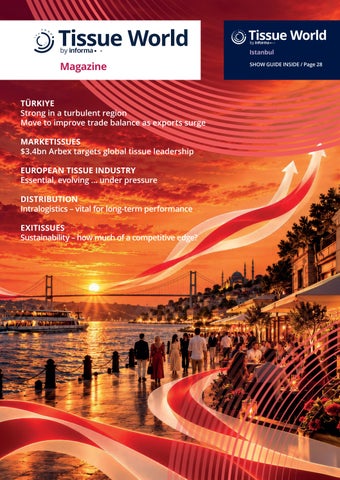
Cover image: Türkiye’s expanding tissue markets driven by a young, dynamic population and ongoing urbanisation - have fuelled an export surge that now rivals domestic volumes, prompting tissue producers to rebalance trade as new challenges emerge. Image by Stefano Vuga, Founder, PurplePrint Creative, Spain/ Italy,www.purpleprint.eu
IN THIS ISSUE... 03 04 08 11 17 20 26
FRONTISSUES
Türkiye: as exports surge, trade balance becomes crucial.
MARKETISSUES
Arbex - the $3.4bn Suzano and Kimberly-Clark joint venture targets global leadership in tissue. Currently with 24-25% of the global market, Chief Executive Ehab Abou-Oaf explains the model of ‘focus and pure play’.
FOCUS ON
Europe’s tissue industry: essential, evolving, and under pressure. By Carlos Reinoso, Director General, European Tissue Symposium.
TÜRKIYE: COUNTRY REPORT
Home market consumer tissue capacity increases imminent as Türkiye moves to improve export-import imbalance.
TÜRKIYE: COUNTRY REPORT
A solid mid-priced range, a few products with a clear extra, and supply to discounters and AfH buyers are key in shifting market.
HAYAT KIMYA: OPERATIONS REPORT
Hayat Kimya expands with Algerian investment as Türkiye’s tissue overcapacity pushes the industry outward. Şahin Civelek, Global Tissue Production Director, discusses how export orientation is intensifying.
LILA KAĞIT: OPERATIONS REPORT
Moving east: Erzurum hub and TM5 signal a shift from tonnage to “the right capacity”. General Manager Alp Öğücü discusses starting up production in Erzurum.
28
A WARM WELCOME TO TISSUE WORLD ISTANBUL 2026
35
CONVERTING: TECHNICAL THEME
47
DISTRIBUTION: SPECIAL FEATURE
51
EXITISSUES
56
AD INDEX
Your Show Guide to Tissue World Istanbul 2026: don’t miss … the conference, the keynote, the exhibition, and the drinks reception!
BW Converting’s Cristian Giuliani, Futura’s Sergio Tonarelli, Gambini’s Nicola Romagnani, Giotto Technologies’ Guido Finocckì, ICM Makina’s Hazar Ulusoy, Maflex’s Vladimir Tchernichov, United Converting Tissue’s Lorenzo Lupi, and Valmet’s Giovacchino Giurlani talk to TWM about their latest technical innovations.
Intralogistics – how software is essential in building continuity into long-term performance. William Nelson, President of E80 Group North America, explains why performance depends on designing the whole system, not simply selecting its individual parts. A TWM report.
Sustainability – how much of a competitive edge is it? Low carbon in particular could become an advantage for any player - but only where the buyer cares, and most probably only when it comes as a co-benefit to the consumer. By AFRY Management Consulting.
www.tissueworldmagazine.com
TW26-SepOct.indb 1
Sep/Oct | 1
31/10/2026 12:17
Dressed by Valmet Advantage NTTe
Tissue that feels like it shouldn’t exist The proof of a machine is never in the spec sheet. It’s in the moment a consumer picks up a product, feels something unexpected, and reaches for it again. Valmet’s Advantage NTT evolution is engineered to create that exact moment: a textured tissue with unprecedented handfeel and appearance. A new reference point for the industry. Softer. More distinctive. Visually different. Valmet Advantage NTTe
www.valmet.com/NTTe
TW26-SepOct.indb 2
31/10/2026 12:17
Tissue World Magazine | FrontIssues
Türkiye: as exports surge, trade balance becomes crucial Helen Morris, Senior Editor, Tissue World Magazine Türkiye’s geographical gateway status brings a unique sequence of commercial benefits and challenges for its robust tissue industry. To the immediate south Syria, Iraq and Iran. Further south Lebanon and Israel. To the north across the Black Sea, Ukraine and Russia. Türkiye’s trade thrives despite instability.
among consumers … who are still demanding
Historic market growth is 10% while individual
better cleaning, better softness from the products.
consumption in 2004 was 1.6kg – and 9kg today,
Innovation is going to be a great vector to allow us to
driven largely by the country’s young and dynamic
grow. The focus and pure play as a separate entity will
population and ongoing urbanisation. Demand in
enable Arbex to operate with speed, to make the right
some sectors is stronger than pre-Covid levels and
investments at the right time.”
now consumers expect new products and higher
That vector will push up Arbex’s share of the
standards, all of which is resulting in a fast-evolving
global market, already at 24-25%, towards the stated
category mix. Demand is expected to continue rising.
ambition of "undisputed global leader.”
Export success has raised associated problems. and Operations Reports analyse how producers are
European tissue: managing sustainability and regulatory pressures
maintaining trade balance. Hayat Kimya, a 2004 tissue
Tissue is deeply embedded in Europe’s economic and
sector entrant, has grown enough to now launch
social infrastructure. TWM’s Focus On and ExitIssues
an Algerian operation. Şahin Civelek, Global Tissue
make that clear, and raises fundamental challenges.
Tonnage volume is close to domestic volume. Country
Industry performance is impressive: €36.6bn value
Production Director, says: “The real challenge is managing through a period of domestic overcapacity
added, 421,100 jobs supported, €16.4bn annual tax
and cost pressure … compounded by regional
revenue and €19.7bn sales. €0.91 of every €1 spent
conflicts affecting energy prices and availability,
remains in Europe. Will current conditions allow producers to sustain
logistics disruptions, and similar issues.”
Global tissue leadership is the stated aim for Arbex
investment at scale? Carlos Reinoso, Director General of the European Tissue Symposium, calls for “competitive access to energy, greater regulatory
In MarketIssues Ehab Abou-Oaf, Chief Executive
predictability and a level playing field between
of Arbex, the newly formed $3.4bn joint venture
products manufactured under Europe’s demanding
between Suzano and Kimberly-Clark, outlines what
standards and those entering the European market.”
he means by ‘the pure play on tissue and hygiene’
With carbon neutrality by 2050 targeted, AFRY
propelling its growth model.
Management Consulting looks at the performance
"Contrary to common wisdom,” he says, “there is
of mills and answers the basic question … what do
still a lot to improve and innovate in our categories,
consumers really think of sustainability, and how
even in bath tissue, which has 100% penetration
much of a sales edge does it provide?
EDITORIAL HEADQUARTERS
ADVERTISING ENQUIRIES
TISSUE WORLD MAGAZINE
Informa, 240 Blackfriars Road, London, SE1 8BF, UK
Europe & North America
is published bi-monthly. The subscription price is US$400 per year for 6
Tel: +44 (0)20 7017 5000
Silvio Arati
issues. Subscription is free for qualified subscribers in the tissue industry.
Senior Editor
T: +39 02 4851 7853 / sarati@studioarati.it
Helen Morris: helen.morris@informa.com
South and Central America
Events Director – Tissue World Portfolio
Selma Ugolini
Natalie Diaz-Martin: natalie.diaz@informa.com
Portfolio Director & Special Projects Ryan O'Donnell
Campaign Director
T: +55(11)99904 5350 / selma@gova.com.br
China, Hong Kong & Macau Rolle He T:+86-20-3895 1670 / rolle.he@informa.com
Informa, 240 Blackfriars Road, London, SE1 8BF, UK Tel: +44 (0)20 7017 5000 / info@tissueworld.com
Subscription online at www.tissueworldmagazine.com In Tissue World all measures are metric and all dollars ($) are US dollars, unless otherwise stated. Copyright 2026 by Informa Connect. All rights reserved. All materials printed in Tissue World Magazine is owned by Informa and protected under the copyright act. No material may be reproduced in
Roxanna Kashfi: roxanna.kashfi@informa.com
part or in whole without the prior written consent of Informa.
www.tissueworldmagazine.com
TW26-SepOct.indb 3
Please send address corrections to:
Sep/Oct | 3
31/10/2026 12:17
Tissue World Magazine | MarketIssues
Arbex – the $3.4bn Suzano and KimberlyClark joint venture targets global leadership in tissue Currently with 24-25% of the global market, Chief Executive Ehab Abou-Oaf explains the model of ‘focus and pure play’ behind the newly launched independent hygiene giant. He spoke to TWM Senior Editor Helen Morris.
L
ittle more than four months after launching,
including Andrex, Hakle and Scottex, and holds a
independent hygiene giant Arbex is making
long-term licence to use global brands including
no secret of its ambition. Following its launch
Kleenex, Cottonelle and Scott.
on 1 July 2026, the $3.4bn joint venture
between Kimberly-Clark (K-C) and Suzano – where
Before the launch Ehab Abou-Oaf had most recently
K-C has 49% ownership, and Suzano 51% – aims to be
worked as President of International Family Care
“the undisputed global leader in tissue and hygiene”.
& Professional at K-C as well as Procter & Gamble.
Its 22 tissue manufacturing facilities span 14 markets
Speaking over a Teams call taken during Abou-Oaf’s
across Europe, Asia, the Middle East, Africa, South
relocation to London, the new Arbex Chief Executive
America, Central America and Oceania, with installed
is welcoming and affable, and keen to detail his
capacity of around one million tonnes of tissue a
ambitious growth vision.
year including production and conversion. Its toilet paper, napkins, paper towels and facial tissues are sold in more than 70 countries. Arbex took ownership of K-C’s portfolio of more than 40 regional brands,
“The tissue market has evolved quite a bit recently, it’s quite dynamic,” he says. “The aim was to create an entity that is a pure play on tissue and hygiene, and which allows us to better compete, be faster, be more focused and agile.” 4 | Sep/Oct
TW26-SepOct.indb 4
With the significant changes in recent years – Essity’s strategic review of its consumer tissue business, and Sofidel’s expansion into the US over the past decade – why is now the right time to launch Arbex? “The tissue market has evolved quite a bit recently, it’s quite dynamic,” he says. “The aim was to create an entity that is a pure play on tissue and hygiene, and which allows us to better compete, be faster, be more focused and agile.” Given all the changes globally, he adds that it was “a very opportune time” to create an entity like Arbex: “Our vision is to be the undisputed global leader in tissue and hygiene, setting up on great foundations, with great brands, with products that resonate with consumers all around the world. The focus and pure
www.tissueworldmagazine.com
31/10/2026 12:17
Tissue World Magazine | MarketIssues
other things. So I think the time is right, given all that
Tissue markets are growing at different rates around the world. Where does Abou-Oaf see the most potential?
is going on, and we are well placed to realise this
“There are definitely different rates of growth, and
ambition of being the global leader in our space.”
also by sub-category it’s also a little bit different. Latin
play as a separate entity will enable Arbex to operate with speed, to make the right investments at the right time, and not be traded off or distracted with
Arbex currently has a 24-25% share of the global market. Will future growth come from M&A, organic growth or new tissue investment?
America is an area where we continue to see growth for our industry. We are growing at double digits there and it’s a very exciting and vibrant space. In Asia, in several of our markets the category itself is growing, and we are growing faster than the category. In parts
“Starting from the top, if we’re true to the vision of
of Europe like the UK, our share gains continue to drive
being the undisputed global leader, by definition
our growth. We believe there is still more room for our
it will need to be a combination of organic and
brands to grow, behind the innovation we are bringing
inorganic global growth. Having said that, there is
to the marketplace. There are a number of areas that
space – or the headspace – for growth organically,
excite us from where we are.”
and this is still humongous for us.”
There are also white space opportunities: “We
Such growth will come from multiple areas: “Firstly,
have a growing play in India with our B2B business
our starting position is strong. We are the number
in particular, and we look forward to expanding that
one or number two player in the 70 countries in
into the B2C side of the house. India is really starting
which we operate. We already start from a point
to come into focus for us as we play there.”
of strength. Our brands resonated and continue
With the right brands, he says, the business is also
Arbex’s 22 mills are its “pure play Arbex tissue manufacturing facilities, as well as for converting into finished products”. Are there plans for a 23rd?
playing in areas that are still expansive: “Contrary to
“We continue to invest across our 22 sites. We have
common wisdom, there is still a lot to improve and
space to grow them and we have capacity to support
innovate in our categories, even in bath tissue, which
our growth, but we will invest behind innovation
has 100% penetration among consumers. Consumers
primarily, invest behind continuing to make our mills
are still demanding better cleaning, better softness
around the world more effective, more efficient. We
from the products. Innovation is going to be a great
are investing behind energy solutions that makes us
vector to allow us to grow.”
more sustainable.”
to resonate with consumers, in fact in many cases they defined the categories in which we operate. The number of markets I go and visit and the word Kleenex is synonymous with facial tissue…”
Facial tissue is still under-penetrated, he adds, and
Arbex has an annual capital budget of close to $100-
there is room to grow there. Arbex also has a “very
120m, he adds, which is being put to work around the
vibrant B2B business which also provides a great
world: “That’s just a capital budget, it doesn’t include
headspace” for growth across the various sectors:
the advertising or commercial investments to support
“We talk about providing a one-stop-shop for our
our brands. They normally are divided a third behind
washroom solutions for our customers. We have a
innovation, bringing new solutions to life, a third
very vibrant wipers business which is also still under
behind driving quality and cost efficiencies, and a third
penetrated. There’s a lot of conversion going on across
behind driving our mills to be better places for our
the sectors where we operate. It’s not just about the
customers and our consumers.”
share of steal; it’s about growing the pie. Hopefully if
In May 2026, Essity announced a strategic review
we do that, and we continue to execute and innovate
of its Consumer Tissue business area’s global
better than our competitors, we will also gain in share.”
operations, a move it said will evaluate different
Organically, Abou-Oaf says Arbex “still has a lot
alternatives that “may lead to separation, although no
to do”, but it won’t exclude inorganic moves to
such decisions have yet been taken.” As of October
complement its activities: “In an industry where scale
2026, Essity confirmed to TWM that the review was
matters, this will all help us accelerate towards that
“still ongoing”.
vision of being the undisputed global leader.” www.tissueworldmagazine.com
TW26-SepOct.indb 5
Sep/Oct | 5
31/10/2026 12:17
Tissue World Magazine | MarketIssues
Could this be an opportunity for a business with the scale of K-C and Suzano?
two capabilities and bottling them in Arbex has become a very powerful combination that enables the expansion we’ve been talking about.”
“What I can say is that our focus ... we have got a lot
we want to stay focused on driving the business. But
With K-C’s world-famous brands, will private label become a bigger focus?
of course, we’re not unaware that this is being played
“Right now, private label is not a huge percent, 5-6%
and that it has an impact in some form or shape. In
of our production goes towards it. We absolutely have
the short term, we believe our focus is our benefit,
positive relationships, and some of these are more
and maybe it’s a bit distracting for them, and that’s
strategic and longer-term, with some of the retailer
not going to be great and so we want to make sure
brands that we service. In countries like South Africa
we continue to drive our growth. It’s definitely a big
for example, we have been in multi-year relationships
play, depending on how it’s executed, and we’re
that are strategic in nature. So we see it more as a
monitoring it closely.”
strategic, multi-year partnership opportunity that we
on our plate. The 70 countries our products are active in, we have a lot of growth opportunities there and
value and we continue to retain.”
Arbex pairs a pulp producer with a tissue manufacturer. Is this the future direction of the tissue market?
While the business is open to supporting private label, he emphasises that the main focus will remain on branded products: “In our branded business we have significantly higher margins, and we see
“Arbex operates and is managed as an independent
the demand going forward. Consumers continue
company, that happens to have two owners, Suzano
to demand a branded relationship. We see it still
and K-C. But there are Chinese walls between us,
even in Europe, which has been the heart of private
and that’s intentional because we believe it is for
label execution and the geography with the highest
the best of Arbex. If we are making our decisions
private label presence in the category. Even here,
independently and focusing our energy and the
branded categories are growing, and this tells us that
criteria for our decision-making on what’s right
consumers want to have that. That’s our focus, hence
for Arbex, we will be maximising the value for our
our continued investment behind innovations and
shareholders, Suzano and K-C. That’s the concept
behind the brands in terms of building equity. The
and it’s critical we stay that way. There’s no free pulp
famous puppy, our famous puppy, is alive and kicking
coming from Suzano into Arbex. We will continue to
everywhere. The Andrex puppy is on mThis iost of our
make decisions that are meant to be in the best of
bath tissue brands around the world, it’s a common
interests of Arbex. If that means we have to make a
feature of what identifies our bath tissue business.”
decision of sourcing differently, we will do it. That’s the framework for our operation.
“We are very excited about where we are. It’s been a smooth transition; it’s not often the case when you’ve
“As for whether such a set-up could be the future
had such a major carve-out and created a standalone
for tissue, your observation is correct – there are
business. We are proud of the fact that we have
more pulp companies like Suzano showing interest
continued to serve our customers and consumers
in downstream. Other players have – and they
and haven’t had a blip, since 1 July when Arbex came
may operate differently; they may have a different
into creation.
form of integration – the benefits we have from the
“The future is bright, and we are looking forward to
ownership structure, which is really having the best of
being a force for good within the tissue and hygiene
both worlds. Operating as an independent company,
categories around the world, and hopefully our
while at the same time benefiting from the mind-set
consumers and customers will see that. I’m looking
and the efficiency and effectiveness of a player like
forward to sharing more of this in due course.”
Suzano, which has been a leader in the thinking and execution of a very cost-efficient supply base, and similarly the K-C side where we have many years of history, and many, many years of being the leaders in the commercial and branding side. Bringing these
6 | Sep/Oct
TW26-SepOct.indb 6
www.tissueworldmagazine.com
31/10/2026 12:17
TW26-SepOct.indb 7
31/10/2026 12:17
Tissue World Magazine | Focus On
Europe’s tissue industry: essential, evolving, and under pressure By Carlos Reinoso, Director General, European Tissue Symposium
T
here is a tendency, in policy circles
rigorously and comprehensively, what this industry
and beyond, to treat tissue paper as a
actually contributes. The findings should reframe
commodity – a background product so
the conversation.
mundane it barely warrants strategic
Europe’s tissue sector generates €36.6bn in value
attention. That assumption is wrong, and increasingly,
added, supports 421,100 jobs, and produces €16.4bn
the data to challenge it is compelling.
in tax revenues annually. Annual sales reach €19.7bn.
The European Tissue Symposium commissioned
For every €1 spent within the industry, €0.91 stays
an independent socioeconomic impact study –
in Europe. This is not a marginal activity. It is a
carried out by Steward Redqueen and covering
deeply embedded part of Europe’s economic and
42 countries across the continent – to assess,
social infrastructure.
Figure 1: The European tissue sector generates €36.6 billion in value added, supports 421,100 jobs and contributes €16.4 billion in tax revenues annually, alongside €19.7 billion in annual sales. Source: ETS Socioeconomic Impact Study, Steward Redqueen.
8 | Sep/Oct
TW26-SepOct.indb 8
www.tissueworldmagazine.com
31/10/2026 12:17
Tissue World Magazine | Focus On
And yet the industry finds itself at a difficult
and fewer sick days. While this modelling relates
intersection: essential in practice, but too often
specifically to hand drying, it illustrates the broader
overlooked in strategic and policy discussions,
societal value created by a product category that is
while being squeezed from multiple directions
too often taken for granted.
simultaneously. Understanding that tension – and the
The industry’s value chain is also a model of European
forces currently reshaping the market – is what this
resilience. Upstream forestry, pulp, packaging, energy
article is about.
and logistics connect directly into tissue manufacturing,
Why this industry matters more than it appears
which in turn feeds a downstream network of distributors, wholesalers and retailers. The study found that the industry spends €13.5bn
Tissue products occupy a paradoxical position:
with European suppliers, representing 90% local
they are part of the fabric of everyday life, yet their
sourcing, while €0.91 of every €1 spent remains
importance is often most visible when they are
within Europe. In an era of renewed interest in
suddenly unavailable. The pandemic brought that
strategic autonomy and resilient European supply
reality sharply into focus, as unprecedented consumer
chains, that local economic footprint deserves
demand and pressure on supply chains demonstrated
greater recognition.
just how fundamental products such as toilet tissue and kitchen towel are to households and hygiene. That shift in perception matters. The socioeconomic
The pressure points are real and cumulative
study confirms what those of us inside the industry
Acknowledging the industry’s strengths does not
have long argued: tissue is not simply a product.
require minimising its challenges. The pressures
It contributes to hygiene, public health and the
facing European tissue producers today are
functioning of homes, workplaces, healthcare
structural, not cyclical – and they are compounding. Energy affordability remains one of the most
environments and public spaces. The study also explores the potential societal
significant concerns for European producers. Tissue
benefits associated with paper hand towels. Its
manufacturing is inherently energy-intensive, and the
exploratory modelling estimates that switching EU
ability to access energy at internationally competitive
public bathrooms to paper towels could prevent up to
prices has become increasingly important to
9.8m influenza infections annually and generate up to
decisions about investment, capacity and the long-
€1.47bn in GDP benefits through higher productivity
term competitiveness of European production.
Figure 2: Europe’s tissue value chain is deeply rooted in the region: €0.91 of every €1 spent remains in Europe, while the sector supports 421,100 jobs across its wider economic footprint. Source: ETS Socioeconomic Impact Study, Steward Redqueen.
www.tissueworldmagazine.com
TW26-SepOct.indb 9
Sep/Oct | 9
31/10/2026 12:17
Tissue World Magazine | Focus On
This concern is shared across the industry. In
and in the expectations retailers place on suppliers. At
discussions with European tissue manufacturers,
the same time, cost-of-living pressures mean that value
affordable energy, efficiency, carbon reduction and
remains a powerful consideration.
the need for predictable and harmonised regulation
This creates a more complex market for both
consistently emerge as interconnected priorities.
branded and private-label products. Manufacturers
Companies can and are investing in transformation, but
must balance performance and affordability with
the conditions surrounding those investments matter.
demands around responsible fibre sourcing, resource
Global competition is intensifying. Non-European
efficiency, packaging and lower-impact production.
producers are moving quickly, often operating within
These are not necessarily competing objectives, but
different cost and regulatory environments. The
achieving them simultaneously requires continuous
risk of gradual European underinvestment is real.
innovation and investment. The response is already
Underinvestment tends to precede closures – and
visible across European manufacturing: diversification
once industrial capabilities, skills and know-how
of fibre sources, greater use of recycled and
migrate, they are extremely difficult to rebuild.
alternative fibres where appropriate, investment in
The regulatory environment adds a further layer of
energy efficiency and decarbonisation, improved
complexity. The industry is firmly committed to the EU’s
water management, and continued work to maximise
overarching ambitions on climate, circular economy,
resource efficiency throughout production. What
packaging, deforestation and the energy transition. At
matters now is ensuring that European producers
the same time, a constructive and pragmatic approach
have the economic and regulatory conditions to
to the policy instruments, implementation timelines
continue making those investments while remaining
and sequencing will be essential to ensure that these
competitive in their home market.
ambitions can be delivered effectively. The sector also enters this transition with a substantial
Europe’s competitiveness question
sustainability foundation. The socioeconomic study
Taken together, these pressures point to a more
reports that 62% of energy used by the pulp and paper
immediate question than predicting what the tissue
sector comes from renewable sources, CHP efficiency
industry will look like a decade from now: can Europe
reaches 95.7%, 92% of process water is reused, and
maintain the conditions necessary for a strong
most fibres originate from FSC or PEFC-certified
domestic tissue manufacturing base today? The
sustainable sources and paper for recycling. The sector
challenge, therefore, is not a lack of willingness to
is firmly working towards carbon neutrality by 2050.
adapt, but whether the conditions described above
The problem is not ambition. The problem is the
allow European producers to sustain that investment at
cumulative weight and coherence of what is being
scale. Competitive access to energy, greater regulatory
asked, and the speed at which it is arriving. Climate,
predictability and a level playing field between products
energy, circularity and industrial policy are not always
manufactured under Europe’s demanding standards
moving in coordination. Regulatory layering without
and those entering the European market will be central
sufficient alignment raises complexity and uncertainty
to maintaining a strong European production base.
precisely when producers need long-term investment
The European tissue industry supports more
confidence. The debate in Brussels should not be
than 421,000 jobs. It contributes to public health, to
framed as ambition versus industry. It should be
local economies and to the circular bioeconomy. It
about how to deliver both together.
keeps value within Europe. It is, in every meaningful sense, part of the continent’s everyday resilience
Consumer expectations are shifting the terrain
infrastructure. Europe will continue to consume tissue products. The question – and it is the right question
Regulation is not the only external pressure reshaping
to be asking urgently – is who will produce them?
the industry. Consumer expectations are evolving in
This article was written for TWM by Carlos Reinoso,
ways that are both an opportunity and a challenge. For
Director General of the European Tissue Symposium
tissue paper producers, the challenge is increasingly one
(ETS), the trade association representing the majority
of delivering more on several fronts at once. Consumers
of European tissue manufacturers. More information
continue to expect softness, strength, absorbency and
on the ETS Socioeconomic Impact Study, carried out by
reliable performance, while sustainability considerations
Steward Redqueen, can be found at europeantissue.com/
are becoming more prominent in purchasing decisions
exploratory-socio-economic-study/
10 | Sep/Oct
TW26-SepOct.indb 10
www.tissueworldmagazine.com
31/10/2026 12:17
Tissue World Magazine | ResourceWise
Home market consumer tissue capacity increases imminent as Türkiye moves to improve export-import imbalance Hygiene awareness from the Covid-19 pandemic continues to underpin tissue growth, but challenges from regional turbulence remain. Report by Bruce Janda, Senior Consultant, ResourceWise.
W
hen we last visited Türkiye in this
Türkiye has 14 tissue sites as shown on the map
column two years ago, its domestic
in Figure 1. The blue pins represent non-integrated
tissue demand appeared to be
sites using market pulp and the green pins represent
slowing in the post-pandemic period.
tissue production sites integrated with recycled
Türkiye’s electric grid included coal power resulting
fibre processing. These sites support a total of 26
in higher carbon emissions compared to other
operating tissue machines, spread through the
countries. The Ukraine War resulted in stress at
western half of the country near the Black Sea and
the Black Sea entry point through Türkiye. Now the
Mediterranean coasts.
Ukraine War continues while a new Middle East war
Türkiye’s population growth has slowed since 2018
has brought the country to the periphery of another
as shown in the blue line in Figure 2. The economy
conflict as it shares borders with Iran, Iraq, and Syria.
has expanded since 2020 as shown in the GDP/ capita gold bars. Note that this chart is adjusted for
Türkiye has become a major tissue exporting powerhouse while domestic tissue demand at about 6kg per capita consumption has lagged Western
purchasing power parity (PPP). Figure 2 is relatively supportive of developing domestic tissue demand. Figure 3 shows that inflation peaked at almost 80%
Europe (16kg) and North America (26kg). Türkiye’s
in 2022 and is coming down below 50%. This price
tissue export business continues to be strong but new
excursion starting with Covid-19 has placed a lot of
capacity additions planned for Saudi Arabia and others
stress on Türkiye’s tissue consumers. Unemployment
in the Middle East could displace some business.
has returned to the typical range below 10% last seen
Türkiye has very limited virgin pulp capacity that
in 2011-2013. The result is a slightly unfavourable
is used on site at Packaging and Specialty grade
environment for further development of domestic
mills. There is no Market Pulp production. Its tissue
tissue consumption. News reports suggest that
business depends mostly on imported virgin pulp for
domestic consumers have increasingly turned to
tissue exports. This makes Türkiye’s tissue exports
private label tissue products to reduce costs. A positive
subject to market pulp price swings while other tissue
note for domestic consumption is the increase seen
exporting countries like Brazil and Indonesia have
in paper towel consumption that started during the
mostly internal pulp supplies.
pandemic but now continues to grow. www.tissueworldmagazine.com
TW26-SepOct.indb 11
Sep/Oct | 11
31/10/2026 12:17
Tissue World Magazine | ResourceWise
Figure 1: Türkiye Tissue Sites
Figure 2: Türkiye Population and GDP (PPP) Trend
Figure 3: Türkiye Inflation and Unemployment Trend
Figure 4: Türkiye Tissue Exports Trend
Figure 6: Türkiye Tissue Line Count Changes
Figure 5: Türkiye Tissue Import Trend
Tissue export and import trends are shown in Figures 4 and 5. Exports have grown up to the last data point for 2025. This could be a data timing issue as trade reporting tends to run late. The United Kingdom continues to lead the chart with smaller amounts to the United States, Romania, Bulgaria, and Greece. We have already seen the new capacity forecasted for the United Kingdom and Saudi Arabia. The all-others bar segment at the top of each bar is growing and represents a group of export destinations that each have 5% or less share of the total. This diverse group is growing to almost half of the total export volume. Türkiye is gaining new fragmented share while losing 12 | Sep/Oct
TW26-SepOct.indb 12
Unemployment has returned to the range below 10%. The result is an unfavourable environment for development of domestic tissue consumption. News reports suggest domestic consumers have turned to private label tissue products to reduce costs.
www.tissueworldmagazine.com
31/10/2026 12:17
Tissue World Magazine | ResourceWise
Figure 7: Türkiye Tissue Site Fibre Integration
Figure 8: Türkiye Tissue Production by Product Format and Fibre Description
Figure 9: Türkiye TM Quality Comparison
Figure 10: Türkiye Comparison Average Cash Cost of Tissue Production
volume at traditional customers. This may indicate more competition from other tissue exporters. Figure 5 shows the tissue imports trend on the
Several older commercial and consumer tissue machines were taken out in 2024 as shown in Figure 6. New consumer tissue capacity is planned to come
same scale as the exports to exhibit the large
online in 2026 through 2028. This will probably drive
imbalance of tissue trade. Tissue exports are about
more capacity balancing.
50 times greater than imports. However, Türkiye’s
Türkiye’s tissue mills are about 80% non-integrated
tissue production is about 10 times the export
and dependent on imported market pulp as shown
amount. If exports were to continue to shrink,
in Figure 7. The remainder are at least partially
domestic demand increases will be needed to keep
integrated with recycled fibre resulting in a lower
the system balanced.
cost structure. This configuration offers good product flexibility to meet expectations of importing
Türkiye’s tissue mills are about 80% nonintegrated and dependent on imported market pulp as shown in Figure 7. The remainder are at least partially integrated with recycled fibre resulting in a lower cost structure.
companies but leaves 80% of Türkiye’s production at risk to current market forces lifting raw material and transportation costs. Figure 8 provides a more detailed view of fibre usage by tissue product grade and format. Consumer bath is the largest category with greater volume than consumer facial and consumer towel added together. Eucalyptus pulp is used in most consumer products, bath, facial, and towel, but not in consumer napkin. Commercial grade products represent a much smaller volume than retail. Commercial fibre mixes include recycled fibre but not at a rate greater than in the retail products.
www.tissueworldmagazine.com
TW26-SepOct.indb 13
Sep/Oct | 13
31/10/2026 12:17
Tissue World Magazine | ResourceWise
A comparison set was selected from potential tissue export competitors Brazil and Indonesia with strong fibre cost position. Saudi Arabia has embarked on a tissue production building program and could threaten Türkiye’s business in the Middle East. The United Kingdom has been a long-term customer of Türkiye’s tissue that appears to be reinvesting in tissue production. This comparison group allows us to benchmark the average quality of Türkiye’s tissue machine fleet. Figure 9 charts the tissue machine fleet averages using bubble charts to compare tissue-machine quality, with bubble size indicating production capacity. The X-axis shows average technical age. The Y-axis plots average machine speed. Machine speed not only provides more production from the machine and crew, but it also indicates the type of drying equipment required to handle the capacity. These
Türkiye’s average tissue machine is rated the highest viability while the UK is rated weakest. Looking at individual bar segments, the UK and Saudi Arabia rank as requiring more capital spending, but their announced new capacity has yet to come online to move the score.
factors will be seen in Figure 11 in the tissue machine viability comparisons.
Viability risk is expressed as an index with higher
Figure 10 shows how sharply tissue-production
numbers indicating higher risk. All of the countries’
costs vary across Türkiye’s comparison group based
tissue machine fleets in this plot are ranked as
on potential tissue export competitors, with each bar
moderate viability but there are some differences.
measuring average cash cost per ton and its width
Türkiye’s average tissue machine is rated the highest
reflecting production capacity. Indonesia and Brazil
viability (lowest index score) while the UK is rated
have the low-cost position and over half of the total
weakest. Looking at individual bar segments, the
tissue production included in the total comparison
UK and Saudi Arabia rank as requiring more capital
group. The United Kingdom has the high-cost
spending, but their announced new capacity has yet
position, but Türkiye is not too far away while Saudi
to come online to move the score. Both the UK and
Arabia has lower costs not much different than Brazil.
Türkiye have the highest cost positions as seen in
The stacked bars in the chart allow a more detailed
Figure 10. Indonesia shows a high risk due to its many
view of cost pressures. The bottom two bar segments
older tissue machines in spite of newer construction
represent fibre costs to integrated mills and purchased
at integrated sites.
market pulp. Türkiye has the highest average cost in
Figure 12 shows a focus on energy costs per ton of
this area. The yellow bands across the bars represent
the comparison set. This time the chart breaks energy
average energy costs. Here we see the United Kingdom’s
costs down further, from fuel, steam, and grid power
energy cost issues in the size of the impact on average
to internally generated versus purchased steam and
tissue costs. The UK also has higher overhead costs than
electric power. Direct fuel onsite is broken down
the sum of all the others. Türkiye’s overall unfavourable
into oil versus gas. These figures were measured in
tissue production cost position is a risk.
mid-2026, as the Gulf war energy costs started to
Figure 11 shifts the comparison from immediate
take effect and could shift significantly as regional
cash costs to a broader test of long-term
energy markets respond. Indonesia holds the lowest
competitiveness, measuring the average viability
energy cost position, and the United Kingdom has
of tissue machines across several countries. The
the highest cost position. Indonesia is using more
FisherSolve viability module factors in estimated
oil as the onsite fuel compared to others. Purchased
capital requirements, production costs, machine size,
electricity is a much higher cost for the UK and Saudi
technical age, local economic risk by grade, internal
Arabia. Additionally, the much higher costs in the
company risk, manufacturing competitiveness, tons
UK are also driven by gas fuel and steam generated
produced per unit of trim and export fees. Taken
onsite. These costs have continued to increase and
together, those indicators offer a five-year view of
where they will land is not clear.
which tissue fleets are best positioned to compete. 14 | Sep/Oct
TW26-SepOct.indb 14
www.tissueworldmagazine.com
31/10/2026 12:17
Tissue World Magazine | ResourceWise
Figure 11: Average Tissue Machine Viability Comparison
Figure 12: Average Energy Cost per Ton Comparison
Figure 13: Average Energy Units Consumed per Ton Comparison
Figure 14: Average Scope 1 and Scope 2 Emissions per Ton Comparison
Figure 13 displays the energy cost breakdown
for a direct engineering view of energy efficiency.
into actual heat or energy units used per ton. This
The differences seen in the price-based chart are
eliminates local price advantages or disadvantages
significantly reduced. The UK still shows much higher
Türkiye’s tissue industry continues to be exportfocused but strong global players are growing, and export customer regions (Middle East) and the UK have tissue production growth plans. Türkiye’s domestic tissue demand has grown slowly as consumers struggled with very high inflation during several decades of tissue production.
gas and oil consumption but many of the other differences appear to be more price determined. These energy charts should be seen as a snapshot from this summer, and prices and energy mix can be expected to evolve throughout the energy crisis. Figure 14 adds an emissions lens to the regional comparison, showing Scope 1 emissions from onsite fuel use in red and Scope 2 emissions from grid electricity in tan, each measured per ton of finished tissue. Scope 2 results depend heavily on the carbon intensity of the local power grid. Indonesia benefits from a relatively low-carbon grid and lower fuelrelated emissions, helped by a larger share of tissue machines located at integrated pulp sites where heat and electricity can be generated from carbon-neutral biomass. The underlying energy units detail is shown in Figure 13. Saudi Arabia has the largest carbon footprint due to high carbon fuel on site and purchased electricity carbon content. Türkiye is in a middle range with the UK and Indonesia and Brazil continues to enjoy lower carbon content energy.
www.tissueworldmagazine.com
TW26-SepOct.indb 15
Sep/Oct | 15
31/10/2026 12:17
Tissue World Magazine | ResourceWise
New capacity in Saudi Arabia, elsewhere in export customer regions (Middle East) and the UK have tissue production growth plans. Türkiye’s domestic the Middle East, and tissue demand has grown slowly as consumers the United Kingdom struggled with very high inflation during several decades of tissue production capacity build-out. Domestic threatens Türkiye’s consumers have been looking to private label products. export outlets over A bright spot in the development of consumer demand is the consumer towel segment that developed during 2026– 2028, so building the pandemic to clean and dispose of household domestic demand is the messes. Türkiye has a very low commercial tissue demand that is surprising given the relative industrial practical hedge. Türkiye’s tissue industry continues to be export-
focused but strong global players are growing, and
and economic development. Both consumer towels and the commercial tissue segments appear to be
opportunities for developing further domestic demand to back up the export tissue business. Global volatility is intensifying those pressures. Shifts in fibre prices, exchange rates, energy markets and environmental regulation are reshaping the economics of tissue production across the region. Türkiye’s mills are likely to see further ownership changes and consolidation, while new tissue making investment in neighbouring countries could alter the country’s import and export flows in the years ahead.
Key points and conclusions
• Türkiye is a tissue export powerhouse, but the export base is narrowing in quality: traditional customers are shrinking while a fragmented “all others” group now accounts for almost half of export volume. • Domestic demand remains the weak link at about 6kg per capita, far below Western Europe (16kg) and North America (26kg), after years of inflation that peaked near 80% in 2022 and pushed consumers toward private label. • Consumer towel and commercial tissue are the two clearest domestic growth openings towel demand built during the pandemic and continues to grow, and commercial demand is unusually low for an economy at Türkiye’s level of development. • Fibre position is the structural vulnerability: roughly 80% of the 14 sites and 26 machines are non-integrated with no market pulp production in-country, leaving exports exposed to imported pulp price swings that Brazil and Indonesia are insulated from. • Cost position is unfavourable. Türkiye carries the highest average fibre cost in the
16 | Sep/Oct
TW26-SepOct.indb 16
comparison set and sits close to the high-cost United Kingdom overall, while Indonesia and Brazil hold the low-cost position and Saudi Arabia is not far behind them. • Machine quality is a genuine strength — Türkiye’s fleet rates the best average viability in the comparison group, ahead of the UK, Saudi Arabia, Brazil, and Indonesia. • Energy is now a live variable. Measured mid2026 as Gulf war costs began to bite, the UK carries the highest energy cost and Indonesia the lowest; on a physical energy-units basis most of those gaps narrow, confirming the spread is largely price-driven and unsettled. • On emissions, Türkiye sits mid-pack with the UK. Saudi Arabia has the largest footprint, while Indonesia and Brazil benefit from lower-carbon grids and biomass energy at integrated sites. • New capacity in Saudi Arabia, elsewhere in the Middle East, and the United Kingdom threatens Türkiye’s export outlets over 2026– 2028, so building domestic demand is the practical hedge. • Expect further consolidation and ownership change among Türkiye’s mills as fibre, currency, energy, and environmental costs reshape regional tissue economics.
www.tissueworldmagazine.com
31/10/2026 12:17
Tissue World Magazine | EuroMonitor
A solid mid-priced range, a few products with a clear extra, and supply to discounters and AfH buyers are key in shifting market As inflation in Türkiye eases, value sales remain strong as volume growth stays modest. Report by Isam Arshad, Consultant, Euromonitor International.
T
ürkiye’s tissue and hygiene market remained
both the kitchen and the bathroom and can stand
one of the more resilient consumer
in for napkins or boxed facial tissue. Boxed facial
categories in 2025. Demand held because
tissue is the category most able to lean on wellness
the products are non-discretionary and
positioning and maintains the volume demand. Paper
hard to substitute. What changed was the way the
towels formats are increasingly treated as essential
growth showed up. Value sales stayed very strong
rather than optional.
while volume growth stayed modest. Shoppers split between big economy packs on one side and more ply, softness or brand on the other.
Value and premium now share the same shelf Price sensitivity has not gone away; instead, the
That mix of everyday need, inflation that is still high
path to purchase is evolving. Discounters remain the
but no longer at the 2024 peak, and a large urban
centre of gravity for volume, with BIM still the volume
household base is the starting point for 2026.
leader in retail tissue and private label a structural,
Value ran ahead of volume
not cyclical, part of the mix. E-commerce is no longer a side channel; it is where pack (bulk, multipack,
Retail tissue value sales rose 45% to TRY68.0bn in
subscription-style repeat buy) and price transparency
2025 while volume grew only 3% year-on-year. AfH
are being rewritten. According to Euromonitor
tissue value rose 34% to TRY16.0bn in 2025, indicating
VOC Lifestyle survey, 35% of Türkish shoppers will
that demand did not fall away. Türkiye is a market
pay more for household essentials when quality is
in which households still buy, but they buy more
obvious, 22% for a known brand and multi-use help,
carefully: multipacks, promotions, discounter private
while local origin and fragrance-free barely move the
label, and where the benefit is obvious, a step-up in
price they will accept.
ply, softness or “clean label”.
At the same time, premium is not frozen. Launches
Toilet paper remains the core of retail tissue
in 2025 show manufacturers testing whether a
accounting for more than 65% of retail volume.
clearly communicated benefit can still command a
Paper towels take about 25% and continue to
higher ticket. Discounters and branded players are
punch above their weight because they are used in
competing on pack size as much as on brand.
www.tissueworldmagazine.com
TW26-SepOct.indb 17
Sep/Oct | 17
31/10/2026 12:17
Tissue World Magazine | EuroMonitor
Path to Purchase: Willingness to Pay More for Household Essentials, 2026
% of Türkiye respondents
•The Consumer
0%
20%
40%
Unscented/fragrance free
Multi-functional
Locally sourced or manufactured locally
• In Türkiye, households are still budgetconscious, but they will pay more for everyday essentials that feel higher quality, carry a trusted brand, and do more than one job.
Strong or well-known brand
High Quality
Source: Euromonitor International Voice of the Consumer: Lifestyle Survey.
The winning retail tissue range is an economy line
shipments and converted packs the rest. If Türkish
that can live at BIM and A101, a mid-tier that can
households add only 1% to 3% more tonnes a year,
hold supermarket feature space, and a short list of
exports will remain how mills keep machines running.
products with a clear extra, more ply, more softness, a towel that does more than one job. Those are the SKUs that still justify a premium price.
Discounters lead in retail tissue volume, while e-commerce gains a little more each year. Most retail tissue is still bought in grocery stores and discounters sell the largest share of volume.
Retail still leads value – AfH leads the commercial mix
Private label is now a normal part of toilet paper and paper towel sales, not a short reaction to high
Retail still accounts for most of what households
prices. Supermarkets still matter for mid-priced
spend on tissue. When retail and AfH volume are
packs and for products that need more explanation.
added together, AfH already makes up about 43% of
Hypermarkets have only a small share, and that share
Türkiye’s tissue volume in 2025. The product mix in
is falling.
AfH is different from retail, with much more weight on towels and wipers than on toilet paper. Wipers
Ecommerce is growing, but it has not taken over. Online retail sales were about 6% of retail tissue
take more than half of AfH volume. Paper towels take about 21%. Toilet paper, which dominates retail, is only about 15% of what operators buy. In short, the commercial market runs on towels and wipers. The home market runs on toilet paper.
Local production, exports and a change of ownership Türkiye is not only a tissue market, it is also a tissue producer and exporter. Domestic volume has been growing in low single digits. Mill capacity has grown faster. That gap is why parent rolls and finished packs are sold abroad, not only at home. Türkiye’s export tonnage volume is now close to domestic volume, with jumbo rolls making up most of the 18 | Sep/Oct
TW26-SepOct.indb 18
Most retail tissue is still bought in grocery stores and discounters sell the largest share of volume. Private label is now a normal part of toilet paper and paper towel sales, not a short reaction to high prices.
www.tissueworldmagazine.com
31/10/2026 12:17
Tissue World Magazine | EuroMonitor
Volume sizes split across retail tissue, Türkiye 2025 % of total retail tissue volume
Paper Tableware
Facial Tissues
Paper Towels
Toilet Paper
0
10
Toilet Paper
20
30
40
Paper Towels
Facial Tissues
50
60
Paper Tableware
Source: Euromonitor International Passport
value in 2025, after rising by about 49% that year. A
faster than in Western Europe. Inflation is no longer
family pack of toilet paper is bulky and heavy, so most
at the 2024 peak, but it is still high, so most shoppers
people still buy it on the weekly shop. That is why the
will not move up the range unless the extra benefit
online share stays small even when growth looks fast.
is clear. In summary, 2026 to 2030 points to a few
Online does change pack size as larger packs, multipacks, and repeat orders are easier to compare
simple conclusions. Volume growth should stay in low single digits. This
on a screen. Companies that can supply both an
is not a return to a period when extra machines could
economy roll for discounters and a larger pack for
count on fast home market tonnes. Toilet paper will
ecommerce fit the way tissue is bought now.
still do most of the retail volume. Paper towels will
Outlook: single-digit volume, mix-led value, more disciplined portfolios
do more of the value work because they are used in more than one room and can replace napkins or boxed facial tissue.
The future for tissue is positive. The population and
Value growth in lira will slow as inflation eases.
households are still growing in cities and people use
Price increases alone will do less of the job. Mix will
tissue every day. Retail use per person is still only
do more of it, like ply, softness, pack size, and where
about 5.4kg, below typical levels in Western Europe,
the pack is sold. Discounters will remain the main
so there is room to grow. Real GDP should keep rising
volume channel. Ecommerce will keep adding a little more each year, especially in larger packs.
Volume growth should stay in low single digits. This is not a return to a period when extra machines could count on fast home market tonnes. Toilet paper will still do most of the retail volume.
AfH should stay the second engine. Operators already buy a different mix from households. Wipers and paper towels take most AfH volume. Professional ranges that make washrooms and kitchens easier to run should keep taking a larger share of that spend. Türkiye’s tissue market is no longer only an inflation story. Households still buy the essential roll, and they pay more only when quality, brand or extra use is obvious. The companies that keep a strong economy line, a solid mid-priced range and a few products with a clear extra, and that can supply both discounters and AfH buyers, are the ones that fit how this market now buys tissue.
www.tissueworldmagazine.com
TW26-SepOct.indb 19
Sep/Oct | 19
31/10/2026 12:17
Tissue World Magazine | Operations Report
Hayat Kimya expands with flagship Algerian investment as Türkiye’s tissue overcapacity pushes the industry outward Şahin Civelek, Global Tissue Production Director, discusses how export orientation is intensifying and the opportunities in converting, AfH, and renewable energy fit into its plan to join the handful of truly global tissue players. Report by TWM Senior Editor Helen Morris.
W
e are already ready for the future,
of local consumption. Hayat’s answer is a mix of
Şahin Civelek, Hayat Kimya’s Global
greenfield expansion abroad, targeted converting
Tissue Production Director, had said
investment at home, and growing exports.
when TWM last visited the company’s
The most significant recently announced project
Kocaeli tissue plant, back in October 2024. He had
is in Algeria, where Hayat’s planned investment will
detailed the many opportunities the business was
initially consist of a tissue machine with a capacity of
taking advertence of, not least export potential, the
70,000tpy and the necessary converting production
growth in local and regional AfH markets, attention to
lines. Start-up is targeted for 2028.
energy efficiencies, and implementing steady growth and technology upgrades.
Civelek says: “Algeria is our current flagship project, and the country is a natural fit for us as we already have a long-standing presence there in detergents
Now in November 2026, the continuity of his words
and other categories. This tissue investment builds
– and Hayat’s ambition to strengthen its position as
on infrastructure and market knowledge we’ve had
one of the truly global players in tissue – are coming
for years, rather than starting from zero. Across the
into fruition.
African continent, there are the unserved markets of
Hayat started tissue production in 2006 and has
North and Sub-Saharan Africa which have low per-
since become one of the world’s leading producers.
capita consumption and strong demographic growth,
It now runs 11 full-width tissue machines across six
and hold opportunities.”
sites, with combined capacity of 770,000tpy, placing
The business is also evaluating other countries
it among the largest tissue manufacturers globally
through feasibility studies: “Where we identify the
and making it the largest in the Middle East, Eastern
right conditions, we do not hesitate to commit to new
Europe and Africa.
capacity,” he adds. “Our main goal remains to keep
However, its home market of Türkiye is crowded – the country has around 1.4m tonnes of tissue
growing in tissue and to establish ourselves among the handful of truly global players in this sector.”
papermaking capacity against roughly 750,000 tonnes 20 | Sep/Oct
TW26-SepOct.indb 20
www.tissueworldmagazine.com
31/10/2026 12:17
October 2027 Ho Chi Minh City, Vietnam
Tap Into Asia's FastestGrowing Tissue Market For over 30 years, Tissue World has united the industry's leading minds under one roof. Our next edition returns to Ho Chi Minh City in October 2027, bringing that same world-class gathering closer to Asia's booming markets. Come for the connections. Stay for the business.
Register Your Interest
TW26-SepOct.indb 21
31/10/2026 12:17
Tissue World Magazine | Operations Report
The growth lever: converting is turning jumbo reels into finished, branded products more efficiently, rather than adding to the market’s overcapacity
At home, Hayat’s approach is organic and
Civelek is adamant that Türkiye will see continued
disciplined: “In each market we aim to consume
demand growth. Per-capita tissue consumption has
80-85% of our own tissue production in our own
risen from around 1.6kg when Hayat entered the
converting operations and to sell the remaining
sector to roughly 9kg today, and the market has
jumbo reels to other converters. This enables us
historically grown around 10% a year. Growth this
to maintain a strong competitive position in every
year is expected to be lower, partly because basis
market in which we are available.”
Growth in Türkiye will continue to come mainly than acquisitions: “That has always been our model. We prefer to build up capacity increases by state-offrom machinery and the-art technologies, as this approach brings us many converting investment benefits such as technology advantage, efficiency increase, and easy integration to our existing system.” rather than acquisitions: With papermaking capacity so far ahead of consumption, the near-term priority is new converting “That has always been lines, plus further converting capacity in Egypt: “The our model. We prefer growth lever right now is converting – turning jumbo to build up capacity reels into finished, branded products more efficiently and closer to demand, rather than adding more tissue increases by state-ofproduction capacity into an already overcapacity the-art technologies, as market.” Hayat is also in discussions with several industrial zones about land for future expansion, to this approach brings us be activated as supply and demand normalise. many benefits.” Growth in Türkiye will continue to come mainly
from machinery and converting investment rather
22 | Sep/Oct
TW26-SepOct.indb 22
www.tissueworldmagazine.com
31/10/2026 12:17
Tissue World Magazine | Operations Report
weights have fallen by around 10% and consumers are moving to more economical products. The country’s category mix is also shifting. Toilet
Hayat is launching a soft-pack V-Fold product which Civelek says reflects the gradual substitution of folded formats for napkins in some uses,
paper still accounts for more than 50% of per-capita
although rolled products still dominate. Hygiene
consumption, while kitchen towel, at around 25%,
awareness also “remains structurally higher” than
is growing as households adopt more absorbent,
before 2020, supporting demand for AfH paper and
multi-use products – a pattern already seen in mature
antibacterial wipes.
Western European markets. Tissue is also increasingly
“AfH is becoming an important export and
used for general cleaning, not just personal hygiene.
investment driver,” he adds. “As domestic retail
Competitors continue to invest despite the
tissue demand faces some pricing pressure from
overcapacity and several tissue machines, converting
overcapacity, AfH – both domestically and for export
lines, and integrated facility investments are
– is an area where quality and reliability of supply
currently underway or in the planning stage across
really matter.”
the industry.
Private label’s share of European retail tissue sales
Civelek says that Hayat sees growth driven by
has “risen markedly” over the past decade, and
more than market expansion: “Rising consumer
Türkiye is following suit: “While price remains an
expectations and higher product quality standards”
important factor in consumers’ purchasing decisions,
are also pushing it to develop innovative branded
quality expectations are just as influential. Although
products, supported by its global R&D centre.
private label products continue to gain share,
The AfH market also holds substantial potential
we observe a similar trend toward higher quality
in Türkiye. He says it has “fully recovered from the
expectations within this segment as well. As the
Covid period”, and is now “seeing genuinely strong
visibility and consumer acceptance of private label
demand – stronger, in some segments, than before
products increase across retail channels in Türkiye,
the pandemic.” Folded products are leading the
retailers are also raising their quality requirements.”
way and V-Fold and Z-Fold formats are seeing “a
Economic conditions are accelerating the
significant increase” in demand: “We’ve had to revise
transformation of the sector: “Consumers have
and upgrade our machinery quickly to keep up,” he
become more conscious and selective in their
adds. Economy-tier products are gaining share here
spending habits, resulting in a shift from premium
too, as in retail.
products toward mid-tier and value-oriented
Accelerating the transformation: Rising consumer expectations are pushing Hayat to develop innovative branded products
www.tissueworldmagazine.com
TW26-SepOct.indb 23
Sep/Oct | 23
31/10/2026 12:17
Tissue World Magazine | Operations Report
Overcapacity is pushing Türkish producers abroad: Hayat ships jumbo rolls and finished products from its existing sites
segments. This trend is supporting demand for
Energy costs will remain a key factor: “We expect
value-focused offerings across both private label
energy prices to remain an important cost factor for
and branded product categories. But expectations
the industry, with continued volatility and uncertainty
of quality and reliability have not fallen. In fact, they
in the coming years. For energy-intensive industries
have increased. Long-term success will be determined
such as tissue, managing energy costs is becoming
not only by price, but by the overall value delivered
increasingly critical, not only from a cost perspective
to consumers.”
but also in terms of long-term competitiveness and
The shift to economy tiers is likely to remain a
business sustainability.”
key opportunity: “It is cyclical rather than structural,
Renewables are therefore “no longer simply an
as purchasing power stabilises,” he says. “I expect
option, but a necessity.” Hayat has accelerated
demand to rebalance toward higher-quality,
its solar investments, covering available rooftops
multi-ply products.”
with panels and building ground-mounted solar
Overcapacity is also pushing Türkish producers
plants in Türkiye, to meet a growing share of its
abroad: “Türkish producers – including us – are all
electricity demand from renewable sources. It is also
leaning further into export markets such as the UK,
following green hydrogen: “We believe that energy
Europe, US, Middle East, and Africa, as a release valve
diversification will be an increasingly important
for domestic overcapacity,” Civelek says. Hayat ships
competitive advantage for the tissue industry.”
jumbo rolls and finished products from its existing
Efficiency is the second strand: “With many years
sites, and he adds that Türkish producers “have a
of operational experience, our own engineering
genuine” cost advantage: “Competitive energy pricing
teams have developed and actively use AI-supported
versus Europe, modern high-speed machinery, and
optimisation software. These systems help us
strong logistics access to the Mediterranean. That
optimise energy consumption and production
combination lets us export competitively while we
processes in real time, allowing us to produce more
wait for domestic and regional demand to catch up
efficiently while reducing energy intensity.”
with the industry’s installed capacity.” 24 | Sep/Oct
TW26-SepOct.indb 24
www.tissueworldmagazine.com
31/10/2026 12:17
Tissue World Magazine | Operations Report
Consumer-focused: rising hygiene awareness, AfH growth and export opportunities support market growth
Together, he says these measures support
a whole,” he says. “The real challenge is managing
Hayat’s carbon reduction strategy, with the aim of “a
through a period of domestic overcapacity and cost
significant reduction in our carbon emissions while
pressure, now compounded by regional conflicts
maintaining the competitiveness and reliability of
affecting energy prices and availability, logistics
our production.”
disruptions, and similar issues.”
Over the next few years, he says per-capita growth
He expects the market to keep growing: “Despite
remains a key opportunity: “Consumption still has
short-term economic fluctuations, Türkiye’s young
room to rise toward Western European levels and
and dynamic population, ongoing urbanisation,
into broader uses such as household cleaning.
and potential for increased per capita consumption
And with private label and converting-led growth,
remain key factors supporting the sector’s growth.
we’re seeing private label’s rising share creates an
While volume growth is expected to be more
opportunity alongside Hayat’s own brands.”
moderate compared to previous periods, we believe
Yet the challenges remain. Domestic overcapacity is “the single biggest structural issue”, he says.
demand for tissue products will continue to increase over the medium and long term.”
“Competitors keep investing, which keeps domestic
Rising hygiene awareness, AfH growth and export
pricing under pressure. I expect supply and demand
opportunities all support this view, with “innovation,
to take another three to four years to rebalance.”
efficiency, and consumer-focused product
Input cost inflation is squeezing energy, pulp and packaging costs margins globally: “The companies
development capabilities” set to decide who benefits. Civelek’s closing message is one of continuity:
that manage their cost base most tightly, through co-
“The story of Hayat Kimya in tissue has always been
generation, efficient water use, and energy-conscious
one of steady, disciplined growth rather than short-
production, will hold a clear advantage.”
term opportunism. We’ve built our position over two
The currency and macroeconomic volatility is also
decades through organic investment, technology
directly feeding into consumer purchasing power
upgrades, and staying close to what consumers
and product mix, driving the shift to economy-tier,
actually need in each market we operate in. We
lower-basis-weight products. He adds that sanctions-
believe in the tissue business and that it will remain
related constraints in some countries also currently
genuinely strong and keep growing.
limit Hayat’s ability to expand capacity, even where consumer demand is strong.
“Algeria represents the next major chapter for us, but our ambition remains the same as it’s always
“Overall, I’d say the fundamentals are genuinely positive for us and for the Türkish tissue industry as
been – to keep strengthening our position as one of the truly global players in tissue.”
www.tissueworldmagazine.com
TW26-SepOct.indb 25
Sep/Oct | 25
31/10/2026 12:17
Tissue World Magazine | Operations Report
Lila Kağıt moves east: Erzurum hub and TM5 signal a shift from tonnage to “the right capacity” Türkiye’s tissue sector is swamped with capacity and squeezed by Far East competition. Lila Kağıt has started up production in Erzurum and is lining up a 70,000tpy Valmet machine for 2027. Alp Öğücü, General Manager, Lila Kağıt, speaks to TWM Senior Editor Helen Morris.
“W
hen we spoke to Tissue World Magazine two years ago, we were outlining the plans for our next phase of growth,”
Alp Öğücü, General Manager of Lila Kağıt explains from his office in Erzurum, Türkiye. “Today, we have already put a significant part of those plans into action. Our focus now is to build Lila Kağıt’s next 20 years on this foundation.” In 2024, Lila Kağıt’s planned plant in Erzurum, eastern Türkiye, was still under discussion. Today the first phase is running: “The most important development since we last spoke has been the completion of the first phase of our Erzurum investment,” says Öğücü. “As of June 2026, we started production and sales operations at our facility.” He explains that the site matters for reasons beyond tonnage: “This investment is highly strategic not only in terms of additional capacity – we have doubled the scale of the investment – but also because it extends our production footprint into eastern Türkiye and brings us closer to markets in the Caucasus, the Middle East, and, in the longer term, Central Asia.”
26 | Sep/Oct
TW26-SepOct.indb 26
www.tissueworldmagazine.com
31/10/2026 12:17
Tissue World Magazine | Operations Report
“When we first discussed the project two years supplied tissue machine. The scope covers a complete Valmet Advantage DCT 200 tissue production line ago, we had announced with stock preparation equipment. The machine approximately 30,000will have a width of 5.6m and a design speed of 2,200mpm, adding 70,000tpy of tissue for domestic 35,000 tonnes of and export markets. additional capacity. After That is roughly double what was initially announced: “When we first discussed the project two reassessing regional and years ago, we had announced approximately 30,000international market 35,000 tonnes of additional capacity,” Öğücü says. “After reassessing regional and international market needs, we increased the needs, we increased the scale of the investment to scale of the investment 70,000 tonnes of gross annual capacity.” Start-up is targeted for 2027, lifting gross annual to 70,000 tonnes of gross tissue paper capacity from 271,000 tonnes to annual capacity.” approximately 341,000 tonnes. TM5: doubling the plan
Phase two centres on TM5, Lila Kağıt’s fifth Valmet-
At the same time, Lila Kağıt continues to invest in and smart warehousing at its Ergene facility in
Capacity discipline in a crowded market
Tekirdağ Province. “Our approach to growth is not
Established in 2006 with production ramping up in
simply about adding new capacity; it is also about
2007, the company will keep growing in Türkiye, but
making our existing production infrastructure more
not simply by adding tonnes: “The Türkish tissue
efficient, flexible and technology-driven.”
industry has already reached a significant level of
automation, modernisation, capacity optimisation
Growth lever: Lila Kağıt’s Ergene, Tekirdağ Province-based plant, where converting is turning jumbo reels into finished, branded products
www.tissueworldmagazine.com
TW26-SepOct.indb 27
Sep/Oct | 27
31/10/2026 12:17
Istanbul
Welcome to Istanbul Get the NEW event app for a live view of everything going on at Tissue World! To access, enter the app code: EVENTS2026 and request a PIN using the same email address with which you registered, then enter the PIN and select the event.
TW26-SepOct.indb 28
31/10/2026 12:17
Welcome! On behalf of the entire team, welcome to Tissue World Istanbul. It is an honour to serve as your Event Director and to witness the incredible collaboration that defines our network. This event is designed to connect the entire supply chain; a mission we proudly continue every day through Tissue World Magazine. As the trusted voice of our global community, the magazine provides the essential industry coverage and leadership perspectives that spark tomorrow’s innovations. Thank you for your continued support, dedication, and passion. Have a wonderful and successful exhibition! Natalie Diaz, Event Director
Don’t miss...
TW26-SepOct.indb 29
The Conference
The Keynote
Two days of market intelligence, case studies and open discussion from leading industry players.
Alp Öğücü, General Manager of Lila Kağıt, opens the conference on day one.
The Exhibition
The Drinks Reception
Meet a selection of suppliers showcasing the latest machinery, converting equipment and finished products.
Join delegates, speakers, exhibitors and visitors in the Sophia ballroom at the end of day one for a drink with contacts old and new.
#TWIstanbul
www.tissueworld.com/istanbul
31/10/2026 12:17
Tissue World Magazine | Operations Report
production capacity,” he says. “Going forward, it will
and performance rather than premiumisation. The
be much more important to build the right capacity,
business is shaping development around that, with
in the right location, and close to the right market.”
segmentation and innovation across its Sofia, Maylo,
The company “does not want to create capacity
UltraBerrak and Nua brands.
simply for the sake of capacity.” to increase Türkiye’s total capacity, but to move closer
AfH: quality is king, but price decides
to markets in eastern Anatolia and neighbouring
In AfH, purchasing decisions are “primarily driven by
export geographies, create logistics efficiencies and
price”, and sensitivity is even sharper than at retail.
establish a new regional production hub.” Value-
With costs rising in Türkiye, businesses increasingly
added products are the other priority: “Innovation
see this category as a place to save: “Demand for
is not easy in our industry, but it is certainly an area
premium products is more limited. Certain hotels and
where we need to differentiate ourselves.”
restaurants see tissue quality as part of their overall
Erzurum is his example: “Our objective is not simply
service proposition, but this does not represent the
Consumers: value over premium
broader market.”
For suppliers and brand owners, the domestic
The company’s response is to meet the need “at the
consumer story is about price-performance. “In
right quality level and at the most efficient possible
Türkiye, purchasing power and price sensitivity
cost”. Domestically, it serves the segment through
have been the most important factors shaping
its private label strength. Internationally, it targets
consumer behaviour in recent years,” says Öğücü.
more selective, value-added niches with its Nua
“Price matters more than ever. But consumers are
Professional brand.
not simply looking for the cheapest product; they are paying much closer attention to what they receive in
Private label: stable, not surging
return for what they spend.” Promotions and larger
Contrary to the European narrative, Öğücü does not
pack formats are becoming more prominent, while
see a continuous shift to private label in Türkiye.
absorbency and softness still matter.
“Looking at the past decade, we see that private label
Premium and differentiated products retain a
has generally remained at around 40% of the market,
place, particularly in niche segments, but he says
fluctuating by approximately five percentage points
the market is driven by the balance between price
in either direction depending on price sensitivity.” It is, he says, “a strong channel that remains in balance
alongside brands.” “Purchasing power and Each offers a different kind of value: “Brands create price sensitivity have trust, innovation and product performance, while label offers a price advantage to both retailers been the most important private and consumers.” Lila Kağıt works in both, developing factors shaping its own brands while manufacturing private label for domestic and international customers: “We develop consumer behaviour customer-specific solutions ranging from product in recent years. Price formulations and packaging to pallet and logistics This flexibility is one of our important matters more than ever. optimisation. competitive advantages.” But consumers are not Volatility as the new normal simply looking for the The operating environment is the main challenge: cheapest product; they “One of the most important lessons our industry has learned over the past few years is that volatility is no are paying much closer longer temporary; it has become part of the way we attention to what they do business,” Öğücü says. “Pulp, energy and freight costs can change much more rapidly than in the receive in return for past. When geopolitical developments, trade policies what they spend.” and risks affecting ports and transport routes are 30 | Sep/Oct
TW26-SepOct.indb 30
www.tissueworldmagazine.com
31/10/2026 12:17
First phase investment: Production underway since June in Erzurum
added to the equation, the environment becomes
demand. The result has been pressure on utilisation
significantly more dynamic.”
and margins, with Far East competition adding to it.
Energy and freight pressures eased somewhat
Lila Kağıt’s first-half 2026 sales tonnage was broadly
in the second quarter of 2026, and international
in line with the previous year, but up 6.3% on the
trade flows partially normalised. “However, this does
first quarter. Converting volumes grew 13.5% and
not mean that the risks have disappeared. Global
converting exports rose 35.4%. June brought the
overcapacity, particularly supply pressure from the
highest monthly sales volume in the county’s history
Far East, together with intense price competition,
for branded converting exports.
continues to put pressure on industry margins.” Türkiye’s dependence on imported pulp adds to the
“While the figures are improving in tonnage terms, the industry’s main challenge is profitability,” Öğücü
challenge. Lila Kağıt’s answer is to pair cost control
says. “In the past, competition was primarily between
with supply chain resilience: “Our use of certified pulp
a limited number of companies in Europe, Türkiye
and our comprehensive sustainability programme
and the Middle East. Today, partly as a result of
enable us to build long-term relationships with customers, particularly in Europe, who are highly
Lila Kağıt’s first-half 2026 sales tonnage was broadly Profitability, not tonnage in line with the previous Domestic volume growth has flattened. Türkiye’s year, but up 6.3% on the tissue market frequently posted double-digit annual growth between 2000 and 2020, although some first quarter. Converting years saw no growth or contraction: “Howevr, since volumes grew 13.5% and 2020 picture has changed. The domestic market in tonnage terms is now far removed from the growth converting exports rose rates we were accustomed to and is following a flatter 35.4%. June brought the trajectory.” Growth has not stopped altogether, he adds. Demographics, smaller households, rising highest monthly sales hygiene awareness and the potential for per-capita volume in the county’s consumption to converge towards more developed markets all leave room to grow. history for branded Much of the new capacity built in this period has converting exports. been export-driven rather than aimed at domestic sensitive to these issues, while also helping us differentiate ourselves.”
www.tissueworldmagazine.com
TW26-SepOct.indb 31
Sep/Oct | 31
31/10/2026 12:17
Tissue World Magazine | Operations Report
Capacity optimisation: the company continues to invest in automation and modernisation
tariff measures introduced in the US, the influence
the industry today is not simply increasing tonnage,
of producers from the Far East has increased
but achieving profitable and sustainable growth.”
significantly. Their lower operating costs, scale considerable pressure in the market. Margins are
Sustainability: from commitments to metrics
declining, excess capacity is emerging and, as a result,
Lila Kağıt says it has “transformed sustainability” from
companies that can no longer compete are being
an area of commitments into a performance area
forced out of the market. Therefore, the key issue for
that it measures and manages. Two years ago, it had
advantages and government incentives are creating
commissioned a 12.5MW solar installation at Ergene and set a target of 50MW of renewable capacity. “We
Öğücü stresses that sustainability goes beyond energy: “We address energy efficiency, carbon emissions, water management, certifi d raw materials, sustainable supply chains, packaging transformation, occupational safety and social impact within the same framework.” 32 | Sep/Oct
TW26-SepOct.indb 32
remain committed to that target and aim to exceed 50MW of renewable energy generation capacity by 2030, while sourcing at least 25% of our electricity needs from renewable sources.” Solar projects in Bitlis and Erzurum are awaiting approval, and two wind projects at Ergene have completed their technical assessments. But Öğücü stresses that sustainability goes beyond energy: “We address energy efficiency, carbon emissions, water management, certified raw materials, sustainable supply chains, packaging transformation, occupational safety and social impact within the same framework.” The first-half 2026 results include:
• Water: consumption in tissue production fell to 4.02m³ per tonne, which already meets the 10% improvement target set for 2030 against a 2024 baseline. • Raw materials: the share of certified raw materials has reached 100%.
www.tissueworldmagazine.com
31/10/2026 12:17
TW26-SepOct.indb 33
31/10/2026 12:17
Tissue World Magazine | Operations Report
• Packaging: production suitability tests have
Öğücü sees three opportunities over the next
been carried out for materials containing postconsumer recycled content. • Efficiency: progress continues through new technologies, Six Sigma projects and renewable energy investments. “In line with our ambition to become carbon neutral, we have now translated our sustainability efforts into tangible investments and measurable performance indicators,” he adds.
Exports and internationalisation Exports remain central, and in the first half of 2026, 76% of total sales tonnage was generated in international markets, rising to approximately 97% for parent reel sales. The company now reaches over 80 countries across five continents. Erzurum is designed to deepen that reach: “With our Erzurum investment, we aim to further strengthen our presence particularly in Azerbaijan, Georgia, Iraq, the Turkic Republics and the Middle East. We believe that bringing production closer to the market is becoming increasingly important, both
two years:
• Geography: “Türkiye’s ability to combine its geographic advantage with its manufacturing and sustainability capabilities. We have the potential to be a very strong production and logistics hub between Europe, the Middle East, North Africa, the Caucasus and Central Asia.” Erzurum is “a very good example”: “We are moving from being a producer that exports only from western Türkiye to a structure that can also access new markets from the east of the country.” • Value-added products: Competition will no longer rest solely on tonnes and price. “Brand strength, product innovation, sustainability performance, service levels and the flexibility offered to private label customers will become increasingly important.” • Growth beyond Türkiye: the company’s Nua brand was recently included in the TURQUALITY programme, which supports the international growth of Türkish brands
in terms of logistics and customer service levels.” “Geographic reach, a value-added product portfolio
The same thinking extends beyond Türkiye’s borders, and the company has signed a letter of
and disciplined capacity management will be the
intent regarding an opportunity in the tissue sector
three core elements of our growth strategy.”
in Romania: “The process continues to be evaluated
Öğücü is candid about the headwinds, as high
subject to the necessary financial, legal and tax
capacity brings intense price competition, now
due diligence, and no transaction has yet been
amplified by global overcapacity. He says that
completed.” Öğücü says. “We view internationalisation
cost competitiveness is also harder when inflation
not simply as exporting more products, but as
outpaces the exchange rate, particularly for
internationalising our brands, our commercial
export-oriented manufacturers.
network and, when the right opportunities arise, our
manufacturing capabilities, relative energy
production footprint as well.”
“We view internationalisation not simply as exporting more products, but as internationalising our brands, our commercial network and, when the right opportunities arise, our production footprint as well.” 34 | Sep/Oct
TW26-SepOct.indb 34
He points to Türkiye’s industrial infrastructure, advantages, logistics position and skilled workforce as the way forward: “The key is not simply to react to current conditions, but to build a more resilient business through investments in efficiency, automation, renewable energy and geographic diversification.” The longer view is ambitious: “We became a strong producer in our first 20 years; in our second 20 years, we want to become a leading company both in our industry and in our region. We want to take this vision further through technology, sustainability, brandbuilding and investment.”
www.tissueworldmagazine.com
31/10/2026 12:17
Tissue World Magazine | Converting Technical Theme
CONVERTING: TECHNICAL THEME Intuitive human-machine interaction, truly distinctive products, more complex demands, greater flexibility, reducing energy and resource consumption. Finding the right balance has never been more vital. A TWM report.
TWM/1: How is your business using AI to set new benchmarks?
Cristian Giuliani, Vice President Global Hygiene Engineering, BW Converting: “AI is setting new benchmarks in two main areas. First, it improves engineering productivity by accelerating technical research, patent and competitive analysis, software development, troubleshooting, and the retrieval and use of knowledge. Second, it embeds process intelligence directly into converting equipment. “By combining machine data with decades of process knowledge, AI can interpret changing materials and operating conditions. Our adaptive winding and tension-control work helps machines estimate conditions in real time, recommend or apply settings, and improve continuously within known physical limits. Our patent-pending Go2Roll system uses available measurements to understand process conditions and translate them into useful responses. “These capabilities can increase throughput and quality, speed product setup, reduce waste, detect deteriorating components earlier, and reduce reliance on individual operator experience. This is especially important as the skilled workforce undergoes a generational transition.
Sergio Tonarelli, Chief Sales Officer, Futur “Futura’s business is growing rapidly thanks to our focus on current industry challenges.
1. A large portion of the backbone of the industry workforce is made by persons born in the 60’s and early 70’s that today are coming to the retirement age. This “Great retirement wave” is making the industry lose know how. The T&T industry – except for a few forward-thinking companies – has relied mainly on human knowledge and experience. We need to change. 2. Today personnel turnover is an issue in every country, the new generations are looking for more attractive, cleaner, and safer environments free form heavy manual tasks, dust contamination and equipped with userfriendly machinery. We need to change the perspective and give our industry workers a supervisory role. 3. Automation, data collection and analysis, selflearning, self-adjusting machinery are keys to the success of companies that are looking at long term investment. AI will be a key partner in data collection, analysis and automatic process correction.”
“AI also helps our engineers use more than 100 globally, develop faster, and focus on higher-
Nicola Romagnani, Marketing & Product Manager, Gambini: “A confession, first: at Gambini
value equipment development and customer
we are not using AI to set any benchmark. Not
support. However, industrial AI requires reliable
yet. I’d rather say it like this, than call a well-made
measurements, secure data, proper validation, and
spreadsheet “artificial intelligence” (it happens…)
years of existing and new knowledge, collaborate
operator trust. Effective systems combine data-driven
“The real AI shake-up will come from the other
methods with machine physics, process physics,
end of the chain: the shelf! In the not-so-distant
and domain expertise. They must also clearly show
future, a good share of toilet paper will be bought by
what the machine is detecting and connect those
software agents, shopping on behalf of lazy or busy
observations to specific actions. We are following
consumers. Since algorithms cannot squeeze rolls,
this approach by embedding intelligence directly into
they will just read the pack, compare what they can
the equipment.”
measure and ignore the rest. For a roll sold only by www.tissueworldmagazine.com
TW26-SepOct.indb 35
Sep/Oct | 35
31/10/2026 12:17
Tissue World Magazine | Converting Technical Theme
sheet count, this could be bad news. But for a roll
“Our R&D activities include exploring AI applications,
that can tell how it was made and why it is better,
camera-assisted monitoring systems and intelligent
it’s an opportunity: that’s why we want an AirMill
machine control technologies. One particularly
Technology badge printed on packs.”
promising area is the use of large language models
Guido Finocckì, Giotto Technologies Chief Sales Office “AI is creating interesting opportunities for
(LLMs) to enable operators to interact with machines
the tissue converting industry, particularly in process
using natural language. “Such systems could allow operators to ask
optimisation, predictive maintenance, quality control and
questions in everyday language, obtain technical
production planning. By analysing machine data in real
guidance, better understand machine alarms
time, AI-based systems can help identify inefficiencies,
and receive support with troubleshooting and
anticipate potential machine failures, reduce waste and
setup procedures. When connected to machine
improve overall production performance.
documentation and verified technical information,
“For Giotto Technologies, we see AI as a valuable
these assistants could make machine knowledge
tool to complement our long expertise in converting
more accessible and help operators and maintenance
technology and support the continuous improvement
teams resolve issues more efficiently.
of our solutions. The opportunity lies in combining
“In parallel, combining camera systems, sensor
intelligent data analysis with innovative mechanical
data and intelligent control algorithms could improve
solutions to achieve higher product quality, greater
process monitoring, help identify quality deviations
production flexibility, and lower energy consumption.
and reduce material waste.
“However, some challenges remain. These include
“However, applying these technologies in industrial
the availability and quality of production data, the
environments presents several challenges. The accuracy
integration of AI into existing machinery and control
of technical information, data security, integration with
systems and the need to demonstrate a clear return
existing machine systems and operator safety must
on investment. AI must deliver measurable benefits
all be carefully considered. AI-based assistants should
on the production floor, rather than simply add
provide guidance and decision support within clearly
technological complexity.”
defined limits, while safety-critical machine functions
Hazar Ulusoy, AP Management, ICM Makina: “We see artificial intelligence as one of the technologies
must remain under the control of validated systems. “At ICM Makina, we aim to combine these emerging
that will shape the future of tissue converting
technologies with our engineering expertise to
machinery. For us, its real value lies not simply in
address real production needs. We believe that more
digitalising machines, but in making production
intuitive human-machine interaction, easier access
processes smarter, more accessible and more efficient.
to technical knowledge and smarter production processes will play an increasingly important role in the future of the tissue industry.”
“A large portion Vladimir Tchernichov, Sales Manager, Maflex “At Maflex, we are taking a pragmatic approach to of the backbone artificial intelligence. We do not use AI to directly of the industry control our machines: process control remains based workforce is made on deterministic logic, designed and validated to ensure predictable and reliable operation. Instead, by persons born we see AI as an important opportunity to improve software development efficiency and, progressively, in the 60’s and early 70’s the interaction between people and technology. that today are coming to “Today, we already use AI tools internally within our software engineering department to support the retirement age. This debugging, code development, and the optimisation ‘Great retirement wave’ is of repetitive workflows. Our goal is to reduce the making the industry lose risk of errors, streamline certain development activities, and free up engineering resources for know how.” higher-value tasks. Sergio Tonarelli, Futura 36 | Sep/Oct
TW26-SepOct.indb 36
www.tissueworldmagazine.com
31/10/2026 12:17
TW26-SepOct.indb 37
31/10/2026 12:17
Tissue World Magazine | Converting Technical Theme
“Innovation starts with the converter’s needs and turns them into practical engineering solutions,” Vladimir Tchernichov, Maflex
documentation and service records to find an answer. A secure customer platform, supported by an AI assistant, could make that information easier to find and use. “The opportunity is practical: less time spent searching, quicker access to relevant guidance and more time available to keep production running effectively. We do not intend to replace the online technical support provided by our team with a chatbot. Direct access to our specialists remains essential. The assistant would complement that service,
“Looking ahead, one of the most promising
helping customers find routine information while our
areas is the evolution of User Experience (UX) and
technicians provide the experience and judgement
Human-Machine Interfaces (HMIs). Modern tissue
needed to resolve more complex issues.
converting lines generate large amounts of data, and
“The main challenge is reliability. Information must
AI could help turn this information into contextual
be accurate, relevant to the customer’s installed
suggestions that support operators, for example
equipment and handled securely. Our trials are
when troubleshooting an issue or performing more
helping us assess these requirements and identify
complex operations such as product changeovers.
where the technology can deliver useful results.
“From this perspective, AI does not take control
“For UCT, the benchmark is how effectively AI helps
of the machine but becomes a tool that supports
customers work. It is another step in our commitment
human expertise. It can help operators handle
of “Simplifying Tissue Converting”.”
routine situations more independently while allowing specialised technicians to focus more on process
Giovacchino Giurlani, Valmet, Tissue Converting business unit: “AI is the buzz word of
analysis, optimisation, and improvement rather than
the moment, and Valmet has been strongly investing
routine troubleshooting.
in it for many years. Especially in the machine learning field, we have been active with SAM (Self
“The opportunity is therefore twofold: making technology more accessible to those working on the
Adjusting Machines) products and Factory PAL. These
production line every day while making better use
products allow to find the best settings of the lines,
of specialised technical expertise. Achieving this,
increasing the performance and OEE.
however, requires a solid foundation: data quality
“Lately we have also developed chat bots that allow
and availability, reliable connectivity, cybersecurity,
an easier and more flexible access to the information
and a clear distinction between tasks that can be
they need. Examples are:
• better access to production history,
supported by AI and functions that must remain under deterministic machine control.
understanding the correlation between
“For Maflex, the benchmark is not a machine that replaces people, but technology that uses AI to help operators and technicians work more effectively, make better-informed decisions, and apply their
performance and events. In summary a more powerful root cause analysis
• access to all the documentation we deliver (thousands of pages) in an easier and faster way.”
expertise where it delivers the greatest value.”
Lorenzo Lupi, Vice President Sales and Marketing, United Converting Tissue: “Our company’s journey follows a clear path: simplification. Just as we have done with our converting lines, our
TWM/2: Identify the top areas of technology in which your systems have stood out in 2026, and your R&D efforts for 2027?
approach to AI starts with the simple things that can
Giuliani: “In 2026, our strongest technology
make our customers’ daily work easier, freeing up
differentiation came from equipment that better
their time to be more productive.
understands and responds to changing process
“We are currently running trials to explore how
conditions. Key advances included adaptive winding
AI can improve access to technical information.
and tension control, improved process measurement,
Operators and maintenance teams often need
and clearer communication between machines
to search across machine manuals, component
and operators.
38 | Sep/Oct
TW26-SepOct.indb 38
www.tissueworldmagazine.com
31/10/2026 12:17
“Go2Roll supports intelligent process control
“2027 will run on many fronts, let me just tell you
by using machine measurements to understand
some. AirMill leaves the rolls and enters the folded
the finished log and apply appropriate winding
tissue realm: placed upstream of an interfolder, it
responses instead of relying only on fixed recipes and
brings premium wet embossing into AfH towels. Then
manual tuning.
a new unwinder for the core-maker, the machine
“Our patent-pending Amplifiber technology advances embossing and bulk building by controlling the mechanical and thermal behaviour of the
nobody talks about (but everybody notices when it stops).”
Finocckì: “Giotto Technologies was founded with
embossing interface while using significantly less
the aim of developing innovative tissue converting
energy than traditional methods. It efficiently builds
solutions. One of our key technological achievements is
bulk while better preserving base-sheet properties.
the Tripler embosser, featuring three embossing rolls
It also improves safety and reduces downtime by
operating simultaneously. During 2026 this innovative
removing roll-cooling delays, avoiding unintended
technology has enabled us to introduce DECO2, a new
adhesive heating, requiring no special or cooled
embossing concept that allows tissue converters to
bearings, and using standard steel engraved rolls.
create truly distinctive products by combining different
“We also advanced our patented INVISIBLE-O
embossing patterns on the inner and outer plies, with
Coreless technology by redesigning the motion
one or more micro-embossed plies in the middle.
method, adding key subsystems, and introducing a
“This opens up new design possibilities and
new clasp design. These changes increased reliability,
provides converters with a valuable competitive
throughput, and mandrel life while supporting
advantage, helping their products stand out on
environmental sustainability.
retail shelves.
“In 2027, we will expand adaptive technologies,
“Looking ahead to 2027, our R&D efforts will
improve automated threading and restart functions,
continue to focus on improving every stage of the
modernise the HMI and data architecture, and
converting process. We believe there are multiple
standardise successful technologies across our global
opportunities to introduce targeted technological
portfolio. Our goal is equipment that is easier to
improvements that deliver real benefits in terms
operate, faster to commission, more consistent across
of product quality, process flexibility and reduced
products and shifts, and better able to optimize product
consumption. Our goal is to develop solutions that
quality as conditions change.
enable converters to respond more effectively to
“These efforts move us toward a “lights out” model
TAD roll. It is patented and anyone with an AirMill can
“Our patentpending Amplifi er technology advances embossing and bulk building by controlling the mechanical and thermal behaviour of the embossing interface while using significantly less energy than traditional methods.”
make it today.
Cristian Giuliani, BW Converting
with fewer interventions, more automated recovery, and greater consistency.”
Tonarelli: “Futura is working at the “zero manual task converting line” and we will present the evolution of the current Andromeda line next year. The main features will be: Andromeda, Autopilot, Integrated packaging. “Andromeda and Autopilot represent the “Automation”, Futura’s “big brother” that investigates every aspect of the converting process. Eliminate manual tasks, prevent process issue, correct process deviation, self-tune the line at the best possible production speed, and harmonise every line component up to the palletiser.”
Romagnani: “Our 2026 has a name on it: Deco Booster. A Concept Roll (we build machines, not rolls) embossed independently on both sides, with no back-embossing and only 0.4% of the sheet glued. Softer and more beautiful, yet less expensive than a
www.tissueworldmagazine.com
TW26-SepOct.indb 39
Sep/Oct | 39
31/10/2026 12:17
Tissue World Magazine | Converting Technical Theme
evolving market demands while improving production
maintenance, help identify potential problems and
efficiency and sustainability.”
recommend preventive measures. Our longer-term
Ulusoy: “At ICM Makina, our approach to
vision is to develop an intelligent digital support
technology development is guided by a simple
centre that brings together the machine’s technical
principle: “Simple is the Best.” We believe that
knowledge and operating information, providing
technological progress is not just about developing
guidance throughout the production line.
more sophisticated systems, but about making
“Of course, reliable data is essential to achieving
complex processes simpler, more intuitive and
this. AI systems can only provide meaningful and
accessible to the people who use them.
dependable guidance when they have access to
“No-code and low-code technologies are already
accurate technical documentation, sufficient machine
changing the way software is developed. With the help
data and a clear understanding of operational
of AI, people with limited coding knowledge or even no
processes. That is why collecting and evaluating
traditional programming experience can now develop
reliable, relevant data is a key part of our R&D efforts.
software by describing what they need in natural
“We see AI not as a replacement for people or
language and using well-defined prompts. This shows
engineering expertise, but as a tool that makes
just how much technology is lowering the barriers to
technical knowledge more accessible and helps people
development. We believe a similar transformation is
work more effectively. “Our goal is not simply to make
possible in industrial machinery.
machines smarter, but to make them easier for people
“With this in mind, we are carrying out R&D activities
to understand and operate. Ultimately, we believe the
focused on artificial intelligence and large language
real value of technology lies not only in what it can do,
models (LLMs). Our ambition is to make our machines
but also in how easily people can put it to use.”
so intuitive that even someone who has never seen
Tchernichov: “Innovation starts with the converter’s
a particular machine before could learn to operate
needs and turns them into practical engineering
it with the right guidance. This does not mean
solutions. In 2026, our development efforts have
compromising on safety or technical requirements. It
focused primarily on advancing existing technologies to
means making the machine easier to understand and
further improve performance, process stability, product
ensuring that users can access the right information
quality, and machine accessibility. A significant example
when they need it.
is LADON Evo, the evolution of our log saw platform
“We are exploring how AI-powered systems could
for industrial tissue rolls. The project is the result of an
guide operators through machine operation, provide
extensive engineering review involving several machine
step-by-step assistance during breakdowns and
components, from the redesigned machine structure
“As part of the upgrade to our automation platforms, we took the opportunity to further simplify our humanmachine interface (HMI), making line setup more intuitive and improving the operator’s interaction with the equipment. ” Lorenzo Lupi, United Converting Tissue 40 | Sep/Oct
TW26-SepOct.indb 40
and cutting orbit to the blade sharpening system and product handling during cutting, including newly designed smart clamps that increase the number of contact points with the logs during the cutting process. The objective was not simply to increase speed, but to create more stable mechanical conditions to maintain cutting precision, quality, and production continuity, even at high operating speeds in industrial tissue converting lines. “Product handling and control represent another important area of development. Throughout the year, we have worked on new universal clamps, also redesigning solutions for Consumer lines and fourchannel log saws. These improvements stem from analyzing how the product behaves throughout the converting process and the need for more precise control, particularly at higher speeds and when processing products with different characteristics. “At the same time, we continue to develop production line flexibility, reflecting our approach to the specific
www.tissueworldmagazine.com
31/10/2026 12:17
Tissue World Magazine | Converting Technical Theme
requirements of each converter. Products, formats, volumes, and production objectives can vary significantly. This is why we focus on modular architectures and automation solutions that allow production lines to be configured around current needs and adapted over time. “Another important area is energy efficiency, through the development and application of technologies such as MERS, which recovers part of the energy generated during machine deceleration and makes it available for reuse within the production process. “Looking toward 2027, we will continue focusing on process control and stability, automation, accessibility,
“Since algorithms cannot squeeze rolls, they will just read the pack, compare what they can measure and ignore the rest.” Nicola Romagnani, Gambini across that product mix, from setup and changeovers to day-to-day operation.
production flexibility, and energy efficiency, with
“We have also made progress in paper forming
increasing attention to the long-term value of
through our Form IQ project, sustainable packaging
machinery. This means considering component
is a fast growing niche, with the solutions we are
availability, spare parts management, and the ability
developing more plastic containers will be replaced
to maintain and improve equipment performance
by paper ones.
throughout its service life from the earliest design
“Looking towards 2027, we are not planning to
stages. These priorities reflect our approach to R&D:
reinvent the wheel. Our priorities are practical:
rather than developing technology for its own sake, we
refining proven technology, strengthening technical
start with the specific needs of tissue converters and
support and improving spare parts availability.
translate them into practical engineering decisions,
The goal is to help customers get more from their
both when developing new solutions and when
equipment and ultimately make their businesses
improving existing machine platforms.”
more competitive. That is what “Simplifying Tissue
Lupi: “We have achieved several milestones in 2026 that we are particularly proud of, bringing together
Converting” means to us.”
Giurlani: “We at Valmet have changed our
production flexibility, finished-product quality and
approach to the tissue mill, we don’t think converting
simpler operation.
any more. We think process from the fibre to the
“As part of the upgrade to our automation
finished product. This is a path that started back
platforms, we took the opportunity to further simplify
when the acquisition began and it is starting to bring
our human-machine interface (HMI), making line
the first results. The digital jumbo roll is an example.
setup more intuitive and improving the operator’s
In 2027 this path will continue with further integration
interaction with the equipment. Feedback from
between the tissue machine and converting.”
production and service activities has been central to this work, helping us focus on improvements that make a practical difference on the factory floor. “UCT has long been renowned for its expertise
TWM/3: What customer trends / demands are shaping this?
Giuliani: “Customers increasingly expect measurable
in industrial log saws, and we are pushing the
outcomes: higher production, more consistent quality,
boundaries again with our upgraded UNICO365
fewer manual adjustments, faster changeovers, less
TWIN. This development builds on our experience
waste, easier maintenance, and less reliance on highly
in industrial roll cutting and our commitment to
experienced operators.
making the process more efficient, reliable and
“Product demands are also becoming more complex. Customers want greater softness, bulk, and absorbency
straightforward for our customers. “Our Nexus Industrial platform follows the same
while often using less fibre, changing fibre mixes, and
philosophy. Independent converters often need to
controlling energy and material costs. This increases the
manufacture a wide range of products and respond
need for embossing, winding, and control technologies
quickly to changing orders. The value of a line
that preserve sheet properties and adapt to variation.
therefore depends on how effectively it performs
“Flexibility is another priority. Converters need equipment that can support broader product
www.tissueworldmagazine.com
TW26-SepOct.indb 41
Sep/Oct | 41
31/10/2026 12:17
Tissue World Magazine | Converting Technical Theme
“AI is the buzz word of the moment, and Valmet has been strongly investing in it for many years,” Giovacchino Giurlani, Valmet, Tissue Converting
converters to explore new embossing patterns, innovative ply combinations and more sophisticated product designs, such as those made possible by our DECO2 technology. “Another key trend is the need for greater production flexibility. Converters must respond quickly to changing market demands, manage a wider variety of products and adapt production to different customer requirements without compromising production efficiency and quality of the final product. “Finally, reducing energy and resource consumption
portfolios and changing market requirements
is becoming increasingly important, both to control
without sacrificing efficiency. At the same time,
operating costs and to improve environmental
systems must remain standardised, supportable,
performance. These demands are shaping our
and understandable throughout their lifecycle.
approach to innovation at Giotto Technologies: we
Advanced features have limited value if they cannot be
focus on developing technologies that combine
commissioned consistently, validated during checkout,
product differentiation with greater flexibility,
and maintained effectively. Overall, customers do not
improved quality and energy consumption reduction,
want technology simply because it is new. They want
helping our customers remain competitive in a rapidly
technology that makes production more predictable
evolving market.”
Ulusoy: “At ICM Makina, we believe that current
and helps their people and assets perform better.”
Tonarelli: “Please see this as part of my
trends and customer expectations in tissue converting
first answer.”
are increasingly shaped by the need for higher
Romagnani: “Retail buyers are asking for something
machine performance and capacity. Product quality,
that, until recently, had no name: a textured tissue
investment cost and energy efficiency are also
sitting between conventional and TAD. We call it C-TAD
important considerations. Other expectations, such as
(Comparable TAD). Thirty years ago, asking a barman
reliable technical service, strong after-sales support,
for an energy drink would have earned you his blank
proven machine references and reasonable delivery
stare: the category simply did not exist. Then Red Bull
times, continue to play a role in how customers assess
came and now everybody knows what that kind of
different solutions. For tissue producers, one of the
drink is. Rolls made with AirMill are on the same path:
main challenges is finding the right balance between
at first, only we talked about them; now consumers
production capacity, consistent product quality and
look for them. On top of that, consider that since the
operating costs. With energy and raw material costs
end of September the EU directive on empowering
remaining important considerations, we believe
consumers for the green transition bans vague words
customers are looking beyond the initial purchase
like “eco-friendly” on packs, unless proven. A C-TAD
price and paying closer attention to long-term value
made with AirMill takes about half the energy of a TAD
and total cost of ownership. Machine reliability,
product and that saving can be measured: solid ground
maintenance requirements and production continuity
for producers who want on their pack a green claim to
are also important in this respect.
stand on.”
“Ease of operation and maintenance is another
Finocckì: “Customer demands in the tissue
key expectation. A machine’s value is not measured
converting sector are increasingly driven by the
by its production capacity alone, but also by how
need to differentiate products, improve production
easily operators can manage day-to-day production,
flexibility and optimise manufacturing costs while
make adjustments, change products and respond
maintaining high-quality standards. Consumers
to unexpected issues. User-friendly control systems,
are looking for tissue products that offer a better
clear interfaces, easy access to technical information
combination of softness, absorbency, strength
and reliable service support can all help reduce
and visual appeal. At the same time, brand owners
downtime and improve overall production efficiency.
and retailers are seeking distinctive products that
“Digitalisation and artificial intelligence may
stand out on the shelves and create added value in
also create new opportunities to simplify machine
an increasingly competitive market. This is driving
operation, make technical information more
42 | Sep/Oct
TW26-SepOct.indb 42
www.tissueworldmagazine.com
31/10/2026 12:17
GOL
GOLD_MillDuty_TissueWorldMagazine_220x307mm_031626.indd 1 TW26-SepOct.indb 43
3/16/26 9:31 AM 31/10/2026 12:17
Tissue World Magazine | Converting Technical Theme
“We are supporting customers in combining innovation, sustainability and measurable economic benefi s.”
integration, and finished-product value. They are not necessarily separate objectives and can be combined within the same project according to each converter’s specific goals. At the same time, production continuity is becoming increasingly important. Speed and capacity remain essential, but customers are paying greater attention to what happens around the production process: changeover times, machine accessibility, maintenance, data availability, remote support, and response times. We are also seeing growing attention to energy consumption and
Guido Finocckì, Giotto Technologies
total operating costs. For this reason, mechanical accessible and improve maintenance processes.
engineering, automation, energy management,
We believe customers will increasingly look for
and service can no longer be considered separate
technologies that deliver practical benefits on the
aspects. They must be approached as interconnected
factory floor, rather than simply adding new features.
elements of the same production system.”
“At ICM Makina, we aim to meet these expectations
Lupi: “Our customers ask us for the flexibility to
through our engineering expertise, machine solutions
serve different market requirements while maintaining
tailored to customer needs and a commitment to
consistent quality and controlling production costs. For
continuous improvement. In our view, a successful
independent converters, this often means switching
converting machine should combine high performance,
between roll formats, paper grades, paper suppliers and
consistent product quality, efficient use of energy and
finished-product specifications. They need equipment
raw materials, operational reliability and ease of use.
that handles this variety without lengthy adjustments or
Ultimately, the goal is not simply to invest in a high-
reliance on one particularly experienced operator. Ease
capacity machine, but to achieve reliable, efficient and
of use is therefore a recurring theme. Customers value
sustainable production over the long term.”
intuitive controls, repeatable settings and easy access
Tchernichov: “One of the requests we encounter
for maintenance. Training and dependable technical
most frequently is the ability to produce more with
support are also important factors in their investment
the same line. Tissue converters need to manage
decisions. Close collaboration with our customers is
broader product portfolios and respond to rapidly
essential. Understanding what they need to produce,
changing markets. We address this need through
and the conditions in which they operate, gives our
MAX-Flexible solutions, offering hybrid and combined
engineering work a clear purpose and helps us deliver
converting configurations that expand the range of
improvements that matter to their business.”
products that can be manufactured while allowing
Giurlani: “Different markets request different products. The development is similar but there are
production to adapt to different requirements. “However, production flexibility is only one of the
cultural differences that condition also the products.
trends we are observing. Every project starts with
The deep knowledge of what can be done and what
specific operating conditions. MAX-Access solutions
are the limits of the full process benefits everybody.
address the need to integrate a production line into
Customers want better products for their specific
the customer’s manufacturing environment, with
markets, to be competitive and that allow them to
configurations designed to optimize available space,
differentiate. We as Valmet can support them in
plant layout, and accessibility while meeting specific
supplying not only the best technology but also the
technical requirements. With MAX-Premium solutions,
best expertise in tissue making and converting. This
the starting point is the value of the finished product.
reflects in our ‘tissue performance for life’ philosophy.
Quality, softness, embossing, lamination, perceived
It’s about helping our customers during all the
bulk, and consistent product characteristics may
lifecycle of the Valmet technologies.”
require specific technologies and line configurations, particularly when converters aim to develop products for higher-value market segments. “These different needs are increasingly shaping our engineering approach: production flexibility, line 44 | Sep/Oct
TW26-SepOct.indb 44
TWM/4: What opportunities and challenges in 2026 have had the biggest impact on your business, and how are you dealing with them?
www.tissueworldmagazine.com
31/10/2026 12:17
Tissue World Magazine | Converting Technical Theme
Giuliani: “The biggest challenge in 2026 has been
Council was born. We all know Vespa clubs or Ferrari
managing cost pressure while expectations continue to
clubs: this one-of-a-kind, instead, gathered around an
rise. Customers face volatile fibre, energy, component,
industrial machine. The room at TissueHub in Lucca
and logistics costs, while retailers and consumers
was full of people from four continents, some of them
still demand value. As a result, capital projects need
competitors. One company, among the many there,
stronger justification. Sustainability follows the same
even asked permission to print the AirMill Technology
pattern. Customers increasingly expect measured
badge on its packs that same day. In the end, joining is
improvements rather than general claims. Advanced
easy: you just need to buy an AirMill!”
converting technology can create major opportunities
Finocckì: “In 2026, the biggest challenges have been
by delivering the desired softness, bulk, and absorbency
customer margin pressure, higher operating costs and
with less fibre, less waste, and more efficient use
strong price competition, making tissue converting
of energy and consumables. This can improve both
companies increasingly selective about capital
environmental performance and margins. We are
investments and focused on shorter payback periods.
responding by working with customers to identify
At the same time, this is creating opportunities in
equipment and process choices that are most likely to
automation, energy efficiency, productivity and
deliver measurable results. Priorities include sustained
machine flexibility, as converters look to reduce labour
production, less waste, fewer manual interventions,
and operating costs while improving competitiveness.
faster changeovers, and greater product consistency.
“Innovation and sustainability are becoming
“Cybersecurity, data governance, and compliance
increasingly important in our offering at Giotto
are also becoming part of machine architecture as
Technologies, as we develop converting lines
equipment becomes more connected and the EU’s
designed to deliver higher productivity, lower
MR and CRA move toward enforcement. Customers
energy consumption and greater flexibility. We are
want the benefits of data, diagnostics, and remote
supporting customers in combining innovation,
support without unmanaged operational risk.
sustainability and measurable economic benefits,
Meeting these requirements while maintaining
helping companies improve both their operational
performance, maintainability, and lifecycle support
performance and long-term competitiveness.”
is increasingly essential to providing a complete
Ulusoy: “2026 has been a challenging year for the tissue converting industry, with inflation, rising raw
converting system.”
Tonarelli: “Every potential challenge raises at least one opportunity for the companies that have the courage to invest. In the end it is always a question
material and energy costs, higher logistics expenses and continued pressure on customer margins. “At ICM Makina, we are focused on managing these
of industrial margins. Today the market is more
challenges carefully while maintaining the quality
competitive, new players are arriving from Asia, private
and reliability of our machines. For our customers,
label is forcing prices (and sometime quality) down, and
production efficiency, lower operating costs and ease
our customer are increasingly demanding. What can
of maintenance are becoming increasingly important.
make the difference? While some of our competitors
We see automation and digitalisation as practical
work to make their products more cost effective with
ways to address these needs. At the same time, the
cheaper simpler lines, Futura is concentrating in making
customisable line, equipped with TouchMax, the King
“We believe that current trends and customer expectations in tissue converting are increasingly shaped by the need for higher machine performance and capacity. ”
of Embossers. Then, in October, the AirMill Technology
Hazar Ulusoy, ICM Makina
our customer product more competitive increasing quality, machine performance and OEE.”
Romagnani: “It sounds incredible, I know, but 2026 is set to become the second record year in a row for Gambini: almost €80m in revenue! Brazil surely weighed. For years that market had one dominant supplier: now it has two. We delivered the first AirMill built entirely there a year ahead of our business plan. Moreover, from 23 – 27 November we’re opening our Joinville plant to show the first complete Brazilian line: a Seicento, our fully
www.tissueworldmagazine.com
TW26-SepOct.indb 45
Sep/Oct | 45
31/10/2026 12:17
Tissue World Magazine | Converting Technical Theme
EU Machinery Regulation (EU) 2023/1230, which will
availability, spare parts, upgrades, and technical
apply from 20 January 2027, requires machinery
support. In an environment where some markets are
manufacturers to prepare for changes in areas such
slowing down while others are resuming investment,
as machine safety, risk assessment and technical
maintaining a diversified international presence is
documentation. This brings additional engineering and
also essential. This allows us to pursue opportunities
documentation work.
across different regions while maintaining close
“Sustainability is another important consideration,
technical and commercial relationships with our
particularly in terms of improving energy and raw
customers. The challenge is therefore to find the right
material efficiency and reducing waste. Despite these
balance between performance, flexibility, investment
challenges, we remain positive about the future
sustainability, and long-term value, responding to a
of the industry. Continued demand for hygiene
market that is evolving not only technologically, but
products, together with manufacturers’ efforts to
also economically and geographically.”
Lupi: “Uncertainty and energy costs are certainly
improve efficiency, modernise existing lines and expand their product ranges, creates opportunities
the elephants in the room. For some of our customers,
for further growth. We aim to respond to these
these pressures have put significant strain on cash
changing needs through our engineering expertise
flow. We have been able to help identify alternative
and continuous improvement, developing reliable and
financing solutions, enabling them to move forward
efficient machinery that delivers long-term value to
with investments needed to regain competitiveness.
our customers.”
Uncertainty also changes the discussion around
Tchernichov: “One of the main challenges in
investment and productivity. Customers need
2026 has certainly been investment uncertainty.
confidence that equipment will deliver dependable
Geopolitical tensions continue to affect certain
results under changing market conditions. Maximum
markets, slowing down or postponing new projects
speed is one measure, but the amount of saleable
and making medium – and long-term investment
product delivered consistently over a shift, a month
planning more difficult. At the same time, we are
or a year is what ultimately determines the return on
seeing changes in the structure of certain markets. In
investment. Setup time, production interruptions and
South America, for example, mergers, acquisitions,
product quality all contribute to that result.
and consolidation are leading to greater production
“Our response is to keep engineering, automation
concentration among large industrial groups, while
and service focused on these everyday operating
the presence of independent small and medium-sized
conditions. We use feedback from installations and
converters is gradually decreasing.
customer production to guide improvements, and we
“This shift is also changing the nature of
work closely with customers during testing to assess
investments, with larger-scale projects, production
the products they actually need to manufacture.
strategies involving multiple facilities, and greater
The aim is to help them make better use of
attention to technology standardization and
their resources and remain competitive in a less
integration. For Maflex, this evolution creates new
predictable market.”
Giurlani: “We all see the global trend of energy prices
opportunities to apply our expertise to complex, multi-line projects while maintaining the flexible,
and the lack of labour force in many markets. This has
customized approach that characterizes our work.
increased the attention of our customers to certain
“Adding to these challenges are cost pressures and
subjects like sustainability and higher automation. We,
the need for converters to protect their margins. As
as Valmet, have been working for these subjects very
a result, new machinery is no longer evaluated solely
actively. In the sustainability side we have presented
on nominal production capacity. Operating costs,
solutions in tissue making such as ViscoNip, NTTe and
energy consumption, changeover and maintenance
full electric mills to answer to these demands, and other
times, equipment uptime, and the ability to adapt
innovations are coming soon! In converting during MIAC
to future requirements are becoming increasingly
we presented our Advanced Factory that combined
important factors in investment decisions.
digitalisation and innovative machines bringing our
“This means working on several fronts: developing
customers closer to the autonomous mill.”
modular, automation-ready systems, improving energy efficiency, and engineering machines that retain their value over time through component 46 | Sep/Oct
TW26-SepOct.indb 46
www.tissueworldmagazine.com
31/10/2026 12:17
Tissue World Magazine | Distribution
Intralogistics – how software is essential in building continuity into long-term performance As source-to-shelf challenges become ever more demanding, longer-term planning must replace isolated interventions. William Nelson, President of E80 Group North America, explains why performance depends on designing the whole system, not simply selecting its individual parts. A TWM report.
T
is not necessarily the one with the largest
Design the system before selecting the single solution
initial investment. It may be the one that
A future-ready intralogistics project starts with
solves today’s problem perfectly and
a simple question: “What must the operation be
prevents the operation from adapting to tomorrow’s
capable of doing five, ten, fifteen years from now?”
he most expensive automation decision
needs. Tissue manufacturers know that their plants
The answer requires a detailed understanding of
will not stand still: volumes change, product formats
the business, the specific goals of the plant, and the
multiply, new converting or packaging lines are added
possible ways this may change.
depending on market needs, warehouses need to be
For a greenfield facility, this means establishing the
flexible and expand. At the same time, service and
desired end state before individual investments are
continuity are non-negotiable: production, storage,
approved. For an existing plant, it means understanding
and shipping must operate as one uninterrupted flow.
current constraints without allowing those constraints to define the future. In both cases, the process
Yet many intralogistics projects are still approached
begins with data: throughput, SKU profiles, seasonal
as isolated interventions, such as a vehicle fleet
peaks, storage requirements, labour needs, material
selected to perform one task from A to B, a palletiser
movements, production schedules, and service levels.
added to one line, a warehouse designed around
The next step is to translate those inputs into an
current volumes. Each investment may perform well
operating concept. How should parent rolls move
on its own, but tissue operations do not behave like
from storage to converting? How will packaging
a collection of unrelated islands. A decision made at
materials reach the lines? Where will finished pallets
one point in the flow affects every process upstream
go? Which storage method best fits the product mix
and downstream.
and available space? How will orders be prepared and
Technology alone does not solve complexity. The
trailers loaded? Where do manual operations remain
companies that obtain lasting value from automation
appropriate, and where will they create a bottleneck
are those that begin with a clear end-state design,
or safety risk as volumes grow?
choose technology that can evolve within that
These questions need to be addressed together,
design, and support the complete system throughout
to establish a roadmap in which every phase
its lifecycle.
contributes to the same long-term system. A mill may www.tissueworldmagazine.com
TW26-SepOct.indb 47
Sep/Oct | 47
31/10/2026 12:17
Tissue World Magazine | Distribution
automate finished-goods handling first and address
E80 Group’s proprietary software platform connects
raw materials later or expand its warehouse before
production systems, automated equipment,
introducing automatic trailer loading. Phasing is
warehouse operations, and the customer’s ERP, it
entirely reasonable; fragmentation has a high cost.
coordinates demands in real time, manages traffic,
At this stage simulation technology is essential
maintains traceability, and provides one view of
because it allows the project team to test decisions
system performance from receiving through shipping.
before committing capital. Multiple scenarios can
This approach is based on a security-and-safety
show how a proposed design responds to higher
by design framework: our solutions comply with
volumes, a different SKU mix, additional production
international standards and regulations and integrate
lines, altered shifts, or new warehouse requirements.
advanced technologies that work together as
E80 Group’s discrete-event simulation approach
complementary safety layers to help reduce risks
can validate expected system performance with
arising from unpredictable behaviours. In highly
up to 95% accuracy. More importantly, it exposes
interconnected ecosystems, cybersecurity measures
interactions that are difficult to see when each
further strengthen protection of data and industrial
technology is evaluated separately. This is where
systems, supporting operational continuity.
automation begins to deliver value before the first
This common foundation also makes expansion
machine is installed: it helps test assumptions and
more practical as new vehicles, production lines,
supports investment decisions, giving the companies
storage capacity, or functions can be incorporated in
a scalable and flexible plan for reaching a defined
a second stage without creating a new control island
operational goal.
every time the plant changes. Different generations of equipment can coexist, and existing assets can
Build on an integrated and flexible technology foundation
take on new tasks through revised logic rather than wholesale replacement.
Once the operating concept is clear, the technology
The benefit is operational predictability: when the
must serve it. A tissue plant may need robotic
complete flow is coordinated, the plant can reduce
palletisers, stretch wrappers, labellers, laser-
manual handling, enable people to focus on tasks
guided vehicles, parent-roll handling systems, block
where human judgement adds greater value, respond
storage, drive-in racking, or an automated high-bay
more consistently to production demand, and
warehouse. The specific combination varies, but
measure performance against meaningful system-
the principle remains the same: each asset should
wide KPIs. Accountability also becomes clearer: there
function as part of one coordinated environment.
is one system outcome to manage, not a series of
The decisive layer is software. Hardware performs
disconnected equipment results.
the movements, while software determines what should move, when, where, and with what priority.
Long-term performance: the real test begins when the system encounters changing demand
48 | Sep/Oct
TW26-SepOct.indb 48
www.tissueworldmagazine.com
31/10/2026 12:17
Efficiency by design
PUT THE FUTURE OF PACKAGING IN YOUR LINE OF SIGHT
Our new wrapper features a reciprocating design with fast, small-pack production and change-overs. Innovatively designed with shorter mechanical movements and a telescoping unwind, the new Vision G3 wrapper is revolutionizing the industry with faster speeds on small formats, while also being able to produce large packs. Our Infinity engineers re-imagined the G3 from the ground up, setting the global stage with a new standard in tissue packing production. Every detail has been meticulously designed for increased production, accessibility, maintainability, and fast set-up. Take a virtual tour at visionG3.com.
TW26-SepOct.indb 49
31/10/2026 12:17
Tissue World Magazine | Distribution
Plan for the lifecycle, not only the go-live
responsible for understanding how the parts interact and for helping the system continue to meet its
A successful start-up is important, but it is not the final measure of an automation project: as we experienced
performance objectives.
with many long-term projects, the real test begins after
A long-term performance
the go-live, when the system encounters changing
Automation projects are often compared through the
demand, new operating requirements, component
fastest payback calculation. Payback matters, but speed
obsolescence: industrial automation should be
alone is a poor measure of a system intended to serve
designed to operate for decades. That requires durable
the plant for many years. A lower-cost intervention can
equipment, continuity across product generations, and
become expensive if it restricts expansion, requires
a deliberate strategy for updates. E80 Group’s laser-
repeated integration work, depends on unsupported
guided vehicle systems regularly remain in operation
components, or forces premature replacement.
for 15 years or more. Their useful life is supported by
Long-term ROI should include uptime, predictable
vertically integrated design, retrofit options, and the
throughput, deferred capital expenditure, reduced
ability to run multiple generations within the same fleet
product damage, safer material flows, more efficient
– this allows customers to expand or replace assets
use of space and energy, and the ability to respond
gradually instead of disrupting the entire operation.
to business change without redesigning the plant
Software extends that life even further because
from the beginning. Extending the life of equipment
it allows continuous optimisation and preventive
also reduces scrapped components and avoids
maintenance. Furthermore, regular audits can identify
unnecessary replacement.
wear, usage patterns, and future availability risks early
We can’t predict the future – no one can know exactly
enough to schedule interventions and budget for
what its product mix or distribution model will look
them. Planned modernisation changes the meaning
like fifteen years from now – but we can build the
of service: while reactive support focuses on individual
capacity to respond: a validated roadmap, an integrated
assets and fixes what breaks, lifecycle support
control architecture, scalable equipment, measurable
manages the performance of the complete system.
performance, and a service model that improves the
It combines Service Level Agreements, defined KPIs,
system over time. For tissue decision makers, the
continuous monitoring, remote and on-site technical
question is therefore no longer simply, “What should
support, training, spare-parts planning, software
we automate?” but, also, “What kind of operation are
updates, and periodic optimisation.
we building, and will today’s decisions allow it to keep
The distinction is crucial: reactive service may
evolving?” When design, technology, and lifecycle
protect equipment, while integrated lifecycle service
support are considered together, automation does
protects throughput and continuity, and it also
more than solve a current constraint: it gives the
creates a single line of accountability; one partner is
plant room to grow.
Continuous optimisation: software extends the life even further, allowing for preventive maintenance
50 | Sep/Oct
TW26-SepOct.indb 50
www.tissueworldmagazine.com
31/10/2026 12:17
Tissue World Magazine | ExitIssues
Sustainability in a tightening tissue market – how much of a competitive edge is it? The European tissue market is tightening, sustainability, and low carbon in particular, could become an advantage for any player – but only where the buyer cares, and most probably only when it comes as a co-benefit to the consumer. By AFRY Management Consulting’s Hampus Mörner, Principal, Tino Mäkelä, Senior Consultant, Christoph Euringer, Senior Principal
T
he first half of this decade put the tissue
Economy and demographics weigh on the outlook. In
industry through a stress test few would
short, Europe is becoming a slower and more mature
have designed: hoarding, reduced AfH
tissue market, where new volumes increasingly must
demand, record-high energy and fibre costs
be won from someone else.
and consumers with squeezed wallets. The industry But calmer waters are not necessarily easier waters.
More players, more imports – competition is up
How can sustainability actually help producers hold
Slower growth would be easier to handle in a
their ground?
consolidating industry, but European tissue has
came through it in better shape than many feared.
moved the other way. Measured by the Herfindahl-
A growing, but maturing market
Hirschman Index (HHI) based on total installed tissue
Tissue remains a growth market, which should not
paper capacity, concentration in both Western and
be taken for granted among paper grades. European
Eastern Europe has decreased between 2015 and
demand grew from 7.9m tonnes in 2015 to about
2026 and remains low (Figure 2). Resilient demand,
9.1m tonnes in 2025, or 1.4% per year, and is
local markets for bulky products and, until recently,
expected to approach 9.9m tonnes by 2035 (Figure
cheap capital have attracted a broad range of
2). Growth, however, slows to about 0.9% per year.
investors historically. At the same time, pressure
Million tonnes European tissue demand CAGR
2015
2019
2023
2025
2030
2035
7.9
8.5
8.5
9.1
9.5
9.9
2015-2025
2025-2035
Europe total
1.4%
0.9%
Eastern Europe
4.6%
1.2%
Western Europe
0.7%
0.8%
Figure 1: European tissue demand 2015–2035, million tonnes. Russia and Belarus excluded (Source: AFRY analysis)
www.tissueworldmagazine.com
TW26-SepOct.indb 51
Sep/Oct | 51
31/10/2026 12:17
Tissue World Magazine | ExitIssues
Figure 2 – HHI index based on installed JR capacity Europe 2015
Concentration
2026
Low
Medium
High
Western Europe
Eastern Europe
0
500
1 000
1 500
2 000
2 500
3 000
HHI Index
Figure 2: Tissue market concentration (HHI based on installed capacity) 2015 vs. 2026 (Source: AFRY analysis)
1000 metric tonnes
Copyright AFRY AB
0
100
1
200
300
400
Türkiye
Indonesia
China
Egypt
Brazil
Algeria 2022
2023
2024
2025P
Figure 3: Main trade flows into Europe 2025. Russia and Belarus excluded (Source: UN Comtrade, AFRY analysis) Figure 3: Main trade flows into Europe 2025 (1000 metric tonnes). Russia and Belarus excluded (Source: UN Comtrade, AFRY analysis) Copyright AFRY AB
2
from outside Europe has grown. Trade data shows
the question is what else can make the difference.
Türkiye and Indonesia among the largest sources of
Sustainability is one lever where many European
jumbo reels traded into European markets, with Egypt
producers claim an edge.
and China also present in jumbo reels and finished more imports add up to a crowded market. Being
Low carbon – a European strength, but not a monopoly
cost-competitive and efficient is the right to play –
One area where Europe clearly stands out is carbon
products. Lower concentration, slower demand and
WR TH
footprint. Comparing CO₂ emissions per tonne of
Trade data shows Türkiye and Indonesia among the largest sources of jumbo reels traded into European markets, with Egypt and China also present in jumbo reels and finished products. 52 | Sep/Oct
TW26-SepOct.indb 52
Co ne op wr na
jumbo reels at tissue machine level, Europe shows both the lowest levels and the narrowest range, (Figure 3). The Middle East, China and Southeast Asia show the widest spreads. The top emitters rely heavily on coal and fossil-based purchased electricity.
Fe WR op 1,3
Still, low-carbon production is not exclusive to Europe. The lowest emitters in Southeast Asia, where biogenic fuels play a large role, fall within the European range, and European mills still have
TIS Hil 18
fossil fuels in the system too. Europe is good, but not always the best. This will remain a priority as the European industry pursues its ambitious decarbonisation targets. The comparison shows
inf
www.tissueworldmagazine.com
im
31/10/2026 12:17
NXT-GEN WRAPPING
WRAP250-NXT THE NEW FRONTIER IN TISSUE PACKAGING Completely redesigned to redefine industry standards, the new WRAP250-NXT combines high performance, maximum operational flexibility, and reliability. Engineered for high-speed wrapping of single and multiple tissue rolls, it represents the natural evolution of modern packaging. Featuring a compact, intuitive, and easily accessible platform, WRAP250-NXT maximizes production efficiency, simplifies operations, and delivers outstanding results at speeds of up to 1,300 rolls per minute. TISSUE WORLD ISTANBUL 2026 Hilton Istanbul Bosforus 18 - 19 November 2026 • Stand D11 info.tmc@ima.it imagroup.com
TW26-SepOct.indb 53
31/10/2026 12:17
Tissue World Magazine | ExitIssues
30
Biogenic purchased Biogenic internal
25
Purchased electricity Other fossils
20
Waste/RDF Natural gas
15
Coal Fuel oil
10 5 0 Lowest
Middle
Highest
Europe
Lowest
Middle
Highest
Lowest
Middle East
Middle
China
Highest
Lowest
Middle
Highest
Southeast Asia
Figure 4: CO₂ emissions per tonne of tissue jumbo reel, tissue machine level, lowest, middle and highest emitters per region. Russia and Belarus excluded (Source: AFRY analysis) Figure 4: CO₂ emissions per tonne of tissue jumbo reel, tissue machine level, lowest, middle and highest emitters per region. Russia and Belarus excluded (Source: AFRY analysis)
that continued improvement is essential not only
caterers and workshops. Producers typically sell through
for compliance, but also to remain competitive
intermediaries, such as facility managers, rather than
for European tissue buyers seeking stronger
directly to end customers, so purchasing behaviour
sustainability ratings.
varies by case. Some buyers want a green profile, but
Copyright AFRY AB
3
for many, tissue is simply a bulky necessity where
Who decides? Two segments, two very different gatekeepers
shortcuts are taken. For those defending their position, this makes AfH the weakest link; for those entering
Whether a low footprint turns into an advantage
from outside without a low-carbon track record, it is the
depends on who decides what is used. Here, the two
easiest way in. If carbon footprint is to matter in AfH, a
main segments behave very differently. Of the roughly
good story needs to be told to these buyers.
nine million tonnes of European tissue demand in 2024, consumer tissue accounted for about 75% and AfH for 25%.
Sustainability will not sell alone – but it works as a co-benefit If consumers ultimately steer consumer tissue, what
Consumer tissue: The consumer has the final say and the shelves follow what shoppers buy, with
do they actually want? Public surveys data give a
the retailer acting as gatekeeper. Retailers manage
nuanced picture. Some 58% of consumers* say they
many categories, and tissue is only one of them. To
actively look for more sustainable products. But once
demonstrate green shelf space, carbon footprint is
they put their shopper hat on and walk into the store,
a convenient one-size-fits-all KPI that can be applied
the link breaks. The top barriers are price (42%), not
across the portfolio, while carbon-intensive or
knowing which products are sustainable (32%) and
deforestation-linked products invite criticism from
limited availability (26%).
consumers and NGOs. A demonstrably low footprint
More telling is which claims motivate a purchase:
can therefore be the route into retail – regardless of
“better for your health” (20%), “feeds my family and
whether the supplier is European or not – and help win
one in need” (17%) and “fair wages and safe working
and keep shelf space, for brands and private label alike.
conditions” (16%) – all with a personal benefit, not an
AfH: Here the B2B buyer decides, while the end user simply uses whatever is in the dispenser. The customer
The consumer has the final say and the shelves follow what shoppers buy, with the retailer acting as gatekeeper. Retailers manage many categories, and tissue is only one of them.
TW26-SepOct.indb 54
To tell the full sustainability story in the very short moment when the actual buying decision is made
base spans hotel chains, institutions, restaurants,
54 | Sep/Oct
abstract environmental one.
by the consumer is among the hardest challenges for tissue companies. Packaging space is limited and too much information on the packs may dilute the message to be conveyed. The Ipsos work suggests positioning sustainability as a co-benefit to the consumer – e.g. higher safety, cleaner air, etc. Improved performance connected to sustainability, not sustainability as the core reason to buy, may connect best with consumers. *Footnote: Source: Ipsos 2026
www.tissueworldmagazine.com
31/10/2026 12:17
Tissue World Magazine | ExitIssues
Getting high-white volumes directed to example of sustainability and economics pulling tissue and not losing it in different directions. RCP-based tissue tells a strong sustainability story and is important in AfH into the packaging or in particular, but its raw material base is shrinking. Since 2007, European graphic paper consumption has other paper streams is dropped by about 28 million tonnes, with newsprint a key challenge. If the down 77% (Figure 4). This means wider collection overall amount of sorted areas, rising RCP prices, lower yields, making RCP both a supply constraint and a cost challenge. white paper decreases Getting high-white volumes directed to tissue in the tissue sector, then and not losing it into the packaging or other paper streams is a key challenge. If the overall amount of it is forced to source sorted white paper decreases in the tissue sector, volumes which have then it is forced to source volumes which have not traditionally been directed to this sector. not traditionally been The financial challenge is to be compensated directed to this sector. sufficiently for putting recycled products on the The recycled fibre puzzle
Recycled fibre (RCP) is perhaps the clearest
market – and here buyers and consumers have been educated for years to expect recycled tissue being
The road ahead
cheaper than virgin. Which is becoming increasingly
The European tissue industry has come through a
challenging when already today recycled fibre on the
turbulent period in solid shape, but the coming years
paper machine can be as or even more expensive
are expected to be more competitive than the last.
than virgin fibre.
In a market where growth alone will no longer do the job, sustainability may well be what separates the
Plastics shows it does not have to be this way. Historical prices show that recycled PET can carry a premium of 30-40% or more over virgin material,
winners from the rest. Three takeaways stand out:
which is supported by EU recycled content mandates,
• Competition is tightening. Demand keeps
brand commitments and constrained supply. And,
growing, but more slowly. And lower industry concentration plus rising imports from outside Europe add pressure to the sector. At the same time, availability of high-quality and highwhite recycled fibre is decreasing and selected competitors outside Europe are in stronger positions when it comes to CO2 track record than many are anticipating. • Sustainability is a gatekeeper – and an enabler that needs to be nurtured. Emphasizing the benefits of how tissue improves the sustainability track record also with AfH B2B customers and how they can leverage that advantage with the final “user” will be important. • Sustainability works best as a co-benefit. Developing easy shortcuts for how a sustainable product supports during the buying decision is the lower hanging fruit.
perhaps most importantly, by consumers never having been taught to expect a lower price for recycled. If RCP is to keep its role in the tissue fibre mix, changing the consumer perception that RCP is valuable is a key task.
Figure 4 – Graphic paper decline
45
Mechanical Woodfree Newsprint
40 35 30 25 20 15 10
2025
2024
2023
2022
2021
2020
2019
2018
2017
2016
2015
2014
2013
2011
2012
2010
2009
2008
0
2007
5
Figure 5: European graphic paper consumption 2007–2025, million tonnes, and recycled plastic price premium over virgin plastic. Russia and Belarus excluded (Source: AFRY analysis) 4
www.tissueworldmagazine.com
TW26-SepOct.indb 55
Sep/Oct | 55
31/10/2026 12:17
ADVERTISER'S INDEX www.tissueworld.com
21
www.convermat.com IFC
Tissue World Awards www.tissueworld.com
IBC
Futura
www.futuraconverting.com 33
Tissue World Lisbon
www.tissueworld.com
37
Goldenrod
www.goldenrodcorp.com 43
Toscotec
www.toscotec.com OBC
IMA-TMC
www.imagroup.com 53
Valmet
www.valmet.com
Infinity
www.infinitymec.com
Baosuo
www.baosuo.com
Convermat
7
Tissue World Asia
2
49
SUBSCRIPTION
Tissue World Magazine (TWM) is free to qualified members of the tissue industry. Two of the six annual TWMs are printed and distributed on site at Tissue World's exhibitions. Sign up to the bi-monthly Tissue World Magazine Enewsletter and six annual digital magazines here: www.tissueworldmagazine.com/newsletter/
56 | Sep/Oct
TW26-SepOct.indb 56
www.tissueworldmagazine.com
31/10/2026 12:17
TW26-SepOct.indb 42
31/10/2026 12:17
toscotec.com
One technology, engineered around your process. Simply AHEAD.
High-performance dry crepe tissue machines designed for maximum operational flexibility and efficiency.
TW26-SepOct.indb 43
31/10/2026 12:17