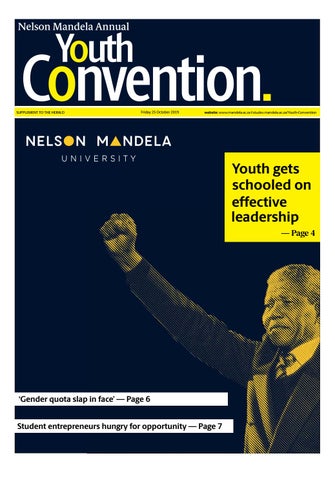
Nelson Mandela Annual
Youth
Convention.
SUPPLEMENT TO THE HERALD
Friday 25 October 2019
website: www.mandela.ac.za I studev.mandela.ac.za/Youth-Convention
Youth gets schooled on effective leadership — Page 4
‘Gender quota slap in face’ — Page 6 Student entrepreneurs hungry for opportunity — Page 7
Friday 25 October 2019
2
SUPPLEMENT TO THE HERALD
SA youth need to chart development path Students urged to be active participants in building the society they want to see Two days of critical reflection on progress made, challenges encountered, and an overall objective analysis of the state of youth development in SA and, particularly, the Eastern Cape, characterised the second instalment of the Nelson Mandela University’s annual youth convention. The convention, held at the university in July and spearheaded by the Student Governance and Development arm of the student affairs division, was a gathering of young people, eminent scholars, speakers and panellists from across the country that effectively zoomed in on youth development since the dawn of democracy. It sought to unpack the complexities that have characterised youth development under the daring theme of “25 Years of Democracy: Learning from the Past. The Making of the next 25 Years of Democracy: Learning from the Future”. “This is a very fitting theme ... [which] captures two principal aims of the convention,” vice-chancellor Professor Sibongile Muthwa said in opening deliberations. “First, to provide a reflective space on the state of youth in the last 25 years of democracy, as well as a space to learn from the mistakes of this past period. “Second, the convention provides a platform to learn from the future through anticipating where the current trends and changing contexts may drive development over the next 25 years, and how that would impact young people.” The Nelson Mandela Youth Convention was launched at the university in 2018, as part of the institution’s year-long centenary celebrations programme in commemoration of the 100th year of the birth of its namesake. It was conceptualised with the aim of placing young people firmly at the centre of defining and advocating for the creation of enabling conditions for young people to thrive. Such conditions fall broadly within the rubric of economic and social base; political will and legislation; access to knowledge, information and skills; equitable resource allocation; a stable environment of equality, peace democracy and positive value system; and ethical leadership. With the world, in general, and the country’s higher education sector, in particular, in transition, young people have been key participants and contributors to conversations around the deepening of transformation therein, as witnessed during the campaigns for access, transformation and decolonisation in the last few years.
TAKE ACTION: Kgalema Motlanthe proposed the establishment of a youth ministry to tackle issues affecting young people, including job opportunities and investing in youth-related matters
REFLECT AND REGROUP: Prof Sibongile Muthwa said it was important to contemplate the state of youth over the past 25 years of democracy and learn from mistakes made
Muthwa said the convention, as an annual conversation, was an opportunity for reflection and cocreation of a national youth-centric agenda. “As [Nelson] Mandela University, we stand ready in championing research, evidence-informed policy discourse, and knowledge-based catalytic, game changing and innovative youth programmes in collaboration with partners,” she said. “We see this as part of our contribution, indeed our obligation, as a university in service of society.” Delivering the keynote address, former SA president Kgalema Motlanthe said youth affairs should not be confined to an agency or a desk of advisers in the presidency. He proposed the establishment of an apex youth ministry to effectively tackle issues affecting SA youth, including the handling of job opportunities for the youth and spending money on youth-related matters. “Let us face it, all of our efforts, intervention after intervention, are failing miserably by not producing the required outcomes and addressing the underlying issues. “Apparent structures, frameworks depend on a delivery model founded on a disconnected state and even the implementation de-
text within which it functioned. “This period calls for unbounded leadership, young people who are prepared to work beyond the narrow boundaries of their institutions ... a new generation of leaders driven by a deep sense of commitment to serve a cause much larger than themselves.” Sports, Recreation, Arts and Culture MEC Fezeka Bayeni, attended on behalf of Premier Oscar Mabuyane, echoed Muthwa’s sentiments and urged young people to take lessons from current leadership challenges. “I plead with you to learn from the leadership challenges we face, the challenges of corruption, lawlessness and unethical conduct among many people that have been given positions of leadership in our country, in other African countries and the world at large,” she said. “I dare say to you of all the challenges we face as a country and the continent at large, the question of ethical and morally upright leadership stands tall.” Bayeni also reiterated Mabuyane’s sentiments shared at the 2018 inaugural convention. “Nelson Mandela University is blessed to have a management
tails are lost due to the dependency on multi-layers of state agencies. “The hegemony of the state is stifling development and implementation of a comprehensive and integrated youth development strategy.” Motlanthe said he envisioned that the ministry would be responsible for youth affairs, implementation of youth programmes and ensuring a more integrated approach. Several critical issues were raised by youth attendees, who included representatives of student leadership from various higher education institutions across SA; many of whom decried the slow pace of progress with regard to the economic inclusion of young people and a perceived dismissal of the youth voice in national decisionmaking. Muthwa touched on a need to rethink youth development, which she posited should be about developing youth capabilities and letting young people thrive: “Most importantly, the cultivation of ideas that propel them to the front and influence scheduled change in society.” She said this phase of development required consistent, transcendental leadership that had an appreciation for the dynamic con-
and student community that has foresight to gather us in this fashion so that we can dialogue about everyday challenges, particularly those that affect our young people,” she said. “We are not surprised by this kind of posture from this university as this is the kind of leadership that we expect from a university that is named after the legend of our struggle for freedom, the late former president Nelson Mandela. “This university is making giant strides to claim its rightful place as a hub of knowledge and innovation to solve complex societal problems. “As the provincial government, we are proud to be associated with this university that is named after our global icon.” She charged young people to be active participants in building a society they would love to see and that would be conducive to their growth. “For this work to happen, we need builders, not destroyers, and we don’t need spectators,” she said. “It is important that you see yourselves as builders and in the depths of your souls see yourselves building a perfect province for yourselves and your future.”
Friday 25 October 2019
SUPPLEMENT TO THE HERALD
3
About the Nelson Mandela Youth Convention In her inaugural address in 2018, Muthwa made a critical observation that “we are a world, a continent and a nation in transition”. “Both the higher education sector and our university are also in a state of change. “We, as Nelson Mandela University, stand on the threshold of the next exciting stage of our evolution. “It is up to us to define the trajectory we take into the future in the context of national, continental and global challenges.” The annual youth convention constitutes a flagship programme that serves as a reflective platform for young people on progress, milestones and setbacks in driving youth development. It is also a platform to connect young people with the wider environment so
they may be able to seize opportunities available for their own development. In 2019, SA celebrated 25 years of democracy. The second instalment of the convention sought to take a closer look at what has been achieved for young South Africans since the advent of democracy. It built on the work of the inaugural convention, which enjoined all participants to continually reflect deeply on issues including that: ● Youth development remains a stubborn challenge facing our society, manifests itself mainly in the form of youth exclusion, thus the convention aims to encourage the youth voice and activism to respond to and address this challenge. ● There is need for the sculpting of a young African intelligentsia for Africa’s renewal.
● Co-create a gender transformation
agenda, with a particular focus on gender-based violence. ● Fashion a Women in Leadership programme whose target should be the development of young women in and for leadership positions. ● Build capabilities to cope in the everchanging world which has been described as the “certainty of uncertainty” by one of the 2018 speakers. ● Elaborate a theoretical framework on decolonisation and Africanisation of education. ● Engage on critical reflection on the efficacy of youth institutions created to champion the development of young people. ● Deliberately enact intergenerational and generational dialogues around specific themes and sub-themes of the con-
❡●● youth convention in pictures Thandeka Tshabalala, Noxolo Koko, Ntombovuyo Linda and Nangamso Mabusela attended the Annual Nelson Mandela Youth Convention this year Picture: NIKOLAAS DU PLOOY
vention, and expand the participation of young professionals in the activities of the convention. Dean of Students Luthando Jack said the convention’s primary purpose was to engender intergenerational dialogue on progress and challenges in the area of youth development. “It was a discursive platform aimed at — on the basis of evidence and knowledge — influencing policy and strategy aimed at accelerating youth development as well as activating young people as agents of own development,” he said. A formal report of the convention will be circulated to other higher education institutions, businesses, and research institutes inside and outside the university interested in youth development. It will also be tabled to the local, provincial and national government.
Youth called out as ‘Renta-crowd’ Nomazima Nkosi
Andiswa Baartman, Kananelo Khoetsa, Motshabi Segopolo and Asanda Koyo at the Madibaz Indoor Centre at NMU’s South Campus Picture:WERNER HILLS
Lonele Zukiso, Nqubela Genuka and Neo Sephuhle at the convention Picture:WERNER HILLS
Political instability at national level creates havoc in the economy, a speaker at Nelson Mandela University’s annual youth convention said on Tuesday. Black Management Forum president Andile Nomlala said the factional battles between ANC secretary-general Ace Magashule’s camp and those aligned to President Cyril Ramaphosa had grave consequences for SA, and the youth were unable to speak up due to their alignments. Nomlala described the youth as a “rent-a-crowd”. “The senseless, reckless and unnecessary squabbles are compromising our country.” Directing his comments at the students present, Nomlala said: “None of you here are None of you able to call them off and say here are able to ‘enough is enough’ because political instability – particucall them off larly within the ruling party – and say ‘enough amounts to instability [in] is enough’ our own society. “Instead, you are particibecause pants, agents and a rent-apolitical crowd youth that gets used by those politicians for nothing. instability – “They don’t even give you particularly the deals. “You only drive the expenwithin the sive cars, go fetch women ruling party – somewhere, and you’re given amounts to a glass of alcohol and you’ve sold an entire generation for instability [in] that.” our own Political analyst and researcher Ralph Mathekga said society. there was a practice where the youth were used as a tool to disrupt meetings and burn tyres during protests. He questioned whether the youth were an asset or a liability in the country. “We have failed to turn the youth into an asset. “We have failed to harness that demographic dividend and what inevitably happens is that the youth becomes a cost to society and the economy,” Mathekga said.
Friday 25 October 2019
4
SUPPLEMENT TO THE HERALD
Youth gets schooled on effective leadership The ability to learn, listen, think and engage critically, and have the courage to accept criticism, are just some of the important traits aspiring young leaders should espouse and hone while still in student leadership spaces. Leadership development in young people is crucial as, historically, the youth have been agents of social change and key players in some of the world’s greatest revolutions. Indlulamthi Scenarios convener Professor Somadoda Fikeni and political analyst Professor Mcebisi Ndletyana told students at the Nelson Mandela Annual Youth Convention that some of the leadership characteristics they may have been exposed to of late were detrimental to good leadership development. Fikeni called for the training and emergence of young leaders to be a deliberate exercise when they assume Student Representative Council (SRC) office or leadership positions in student societies.
“This should include basics such as how to chair a meeting without suppressing other voices; how to raise issues while also listening to what the other has to say. “The biggest challenge we have as society is that we listen while we already have a response in our mind,” he said. “You need to learn how to interpret group dynamics because there are times where, when there is a certain group domineering the space around the table, people opt to keep quiet and not voice their views. “This runs the risk of having an undemocratic system repeating itself.” Fikeni cautioned the young people against a concerning culture of unhealthy practices by some leaders as a result of an inability to listen and critically engage. “The one who shouts the most, imposes themselves, humiliates others or has a vast vocabulary of insults will always prevail, not because others around have nothing
The leader, as we have seen in all the greatest leaders, has the courage to accept criticism
to offer. “So, those group dynamics are very important to observe because once [you] have graduated, [you] will take these autocratic tendencies to other settings — such as church, family gatherings and even branch political structures,” he said. He said good leaders were confident and allowed — and even insisted on — engaging with people who had opposing views so as to help them see things from different perspectives. “The leader, as we have seen in all the greatest leaders, has the courage to accept
criticism. “Once a leader thinks that criticism poses an existential crisis and starts insulting, you must know that that person is not a leader but a demagogue,” he said. “We therefore need to be deliberate in training people in that if you rise through logical democratic processes and have the courage to be vulnerable; that is when the crucible of leadership emerges.” In discussions, some students alluded to a perceived dismissal of the youth voice on critical matters affecting them, with some highlighting a challenge of effectively engaging older leaders on issues. Student Methembe Ndlovu, quoting from a song by Ladysmith Black Mambazo, said the older generation often complained about the younger generation being easily agitated while the youth were of the view that their elders were slow in effecting change. “Where do we then draw the line between when we should take you on and chal-
lenge you, and when we should sit down and listen?” he said. Ndletyana said young people’s concerns spoke to a need for intergenerational conversations. “First, one has to acknowledge that youthfulness comes with a certain degree of bravado and impatience — that’s natural. “It is important to get into intergenerational conversation as there are times when the older generation gets comfortable with their own reality, partly because they believe they are right by virtue of their age when at times they are wrong,” he said. “There is also a certain degree of acceptance of the status quo and conservativeness that comes with age. “It is always useful to pit the old and the young in challenging the status quo, and often older folks learn a lot of things and start challenging their own assumptions. “So there is a need for an affirming way of deliberating
that says ‘I accept what you are saying, but there is another way of looking at it’. “You therefore open a debate in an inviting manner because people generally want to be respected and affirmed.” Nelson Mandela University, through its Student Governance and Development (SGD) arm of the Student Affairs division, has various leadership development programmes in place for aspiring student leaders. These include the Beyond the Classroom (BtC) leadership programme, which introduces students to the requirements of effective and ethical leadership in a practical and creative manner. “The programme explores and addresses the importance of diversity in daily interactions, encourages teamwork with others from diverse backgrounds, enhances skills in conflict resolution and communication, and encourages intellectual growth,” says SGD director Dr Bernard Sebake.
Friday 25 October 2019
SUPPLEMENT TO THE HERALD
5
‘Decolonisation must begin in our minds’ Some Africans look down on their own languages and traditions, says activist Zamandulo Malonde If you fight a system that is based on violence it will respond with violence. This is one of the consequences of a revolution as highlighted by Black Consciousness movement activist Veli Mbele at the annual Nelson Mandela Youth Convention held in July. The arrests that Fees Must Fall activists encountered during the student uprising were one of the inevitable consequences of that particular revolution, Mbele said. The social commentator was responding to a student who had expressed difficulty continuing with student activism for fear of its consequences, citing examples of violence encountered during the Fees Must Fall protests in universities across SA. “The arrests suffered by the Fees Must Fall generation are because they are not in a picnic but they are fighting against a system based on anti-black violence, so the only way the system knows to deal with opposition is through violence.” Mbele said every revolution had its own casualties and students needed to understand the nature of the system they were dealing with. “This is why, when he was addressing students at the university of Fort Hare, [assassinated Black Consciousness and anti-apartheid activist] Onkgopotse Tiro said there is no struggle without casualties,”
TAKING A STAND: Nelson Mandela University students took to the streets of Port Elizabeth during the countrywide Fees Must Fall protests Picture:EUGENE COETZEE
Mbele said. He touched on Fees Must Fall as one aspect relating to Africanisation and the decolonisation of education. Likewise, those who led the project of decolonisation had to be prepared to tackle colonisation in the manner it articulates itself, he said. Mbele called for decolonisation
of the minds of Africans from within and beyond the borders of institutions of higher learning. He said decolonisation sought to strip down the European colonial system in which SA universities are deeply rooted. “SA universities were constructed in accordance with a Eurocentric world view that sets being white as the universal standard-bearer for
all human progress,” he said. It is, therefore, the responsibility of Africans to be the principal agents of the project of decolonisation and Africanisation, he said. “The project of colonising Africa has not ended, it has simply mutated and in some cases it assumes a black face.” There are many ways in which Africans remained colonised, with
some becoming evident in the way they look down on their own indigenous languages and traditions, Mbele said. “Part of being a product of a colonial system [is that it] creates in you a psychosis where you regard your own history and processes as backward, and you adopt the ones of the people who define the content of your education,” he said.
‘Give women chance to take lead’ Why is it that the same women who competently govern their households are not trusted with decisionmaking positions in the workplace? This was the daring question posed by the Elilox Group MD Prof Bridgette Gasa at Nelson Mandela University’s annual youth convention in July. Gasa challenged current and future employers to be intentional about placing women in positions of leadership in the workplace to concretely dismantle gender inequalities in SA. “There are critical, practical steps that need to be tak-
en to dismantle gender inequality and, while some strategies may differ in implementation tools, they at least must be similar in content,” Gasa said. “I’m not going to make a competition about who makes the most decisions in the household, but in areas of governance we need to be intentional in placing women in areas that allow them to be the decisionmakers that they are.” She called for transparency, trust, strategic support and having consideration for life, work and family. Women were more comfortable in spaces that oper-
BRIDGETTE GASA
In areas of governance we need to be intentional in placing women in areas that allow them to be the decisionmakers that they are.
ated in transparency, she “Any employer who sees said. “We feel better when en- my capabilities beyond the gaging in an environment fact that I’m a woman and creates an enabling environwhere there is transparency.
ment for me in which to plant, I will do far more for.” While acknowledging the vast nature of gender inequality, Gasa said she appreciated the progress the country had made over the years. “It’s a pity that our biology is used as a disincentive in the workplace,” she said. Gasa’s talk came after that of Wits University chancellor Dr Judy Dlamini, who referenced several successful youth enterprises as examples of innovative ideas the youth ought to be inspired by. “Young people should do away with the idea that they need to come up with this
idea to be recognised,” Dlamini said. “I use the likes of The Lazy Makoti author and chef, Mogau Seshoene, who founded her business based on her passion for cooking. “You can use your talent to create a business and create jobs.” Dlamini encouraged the youth to make use of government and private incentives such as the SA SME Fund and Harambee which were there to create jobs and assist budding entrepreneurs. “In spite of many challenges we have as a country, we have come a long way,” she said.
Friday 25 October 2019
6
SUPPLEMENT TO THE HERALD
❡●● in conversation Rhodes University student Catherine White poses a question at the Annual Nelson Mandela Youth Convention at the Madibaz Indoor Sport Centre at NMU South Campus Pictures: WERNER HILLS
NMU Student leader Jonathan de Graaff at the Madibaz Indoor Sport Centre at NMU South Campus
Student and entrepreneur Sandile Mjamba speaks at the Annual Nelson Mandela Youth Convention
‘Gender quota slap in face if masculine culture not dismantled’ Mentorship programme to help develop female leaders “In order for [men and women] to coexist, we need to first be able to recognise the oppression that exists and acts as a barrier to the coexistence we aspire to.” So said Nelson Mandela University student leader Yandisa Jubase at the Nelson Mandela University’s inaugural Women in Leadership seminar, which was themed “expanding influence and leading change in memory of Lillian Ngoyi”. “I’m a firm believer in the aspiration to coexist, but we cannot do so if we are not willing to first rectify the things that hinder our efforts to coexist,” the young leader said while addressing the subject of inclusive leadership and understanding diversity dynamics. The seminar was part of the Women in Leadership programme — aimed at developing young women in existing leadership positions as well as those aspiring to lead — that emerged as one of the outcomes of the inaugural Nelson Mandela Youth Convention in 2018. It took place at the university’s Port Elizabeth and George campus-
es in August — a month dedicated to celebrating the efforts of women in the liberations struggle, while foregrounding some of the strides made in SA towards gender transformation. “We are quick to speak about the gender quota when we talk inclusivity. “While we recognise and appreciate what the gender quota has opened the door to — mainly the representation of women in leadership positions — we also need to look critically at the environment in which women are expected to exist and lead,” Jubase said. “It is all good and well to say we have a gender quota, but if we were to get a thorough perspective of the historic and structural oppression that women are subjected to in this environment, we would then understand that a gender quota is actually a slap in the face. “The degree of historical and structural oppression we are faced with as women goes far beyond thinking that representation is enough.” Jubase was one of the panellists
in a discussion on present-day women’s struggles, particularly with regard to professional, political and other leadership. The panellists echoed each other’s and the audience’s sentiments that, even 25 years into democracy, women still had a long way to go in achieving true emancipation. Jubase is a young activist who has held leadership position at the university’s Sasco (South African Students Congress) branch and is part of the #ActivistConnexions group that has been pushing for gender transformation and advocating against gender-based violence at the institution. At the George Campus, the seminar was held at the George Museum, under the theme “Accelerating Women Empowerment and Inclusion”, with attendees including students from the South Cape College and the Garden Route District municipality. In her keynote address, sports, recreation, arts and culture MEC Fezeka Bayeni urged young women to espouse the traits of Ngoyi, who was part of the group who led a march of more than 20,000 wom-
en to the Union Buildings to hand over a petition decrying the oppressive pass laws in 1956. Bayeni said Ngoyi, after whom the university recently named one of its female residences, bore two characteristics that she wished all women could engender. “She was defiant. As young women, particularly in leadership, we need to be defiant. “We either succumb to the system or defy it. “I choose to be defiant to all the innuendo that suggests that, as a woman, I’m not enough,” Bayeni said. “She [Ngoyi] was a great orator. She was never apologetic about her views. “She put her points across and, in her sense of defiance, she was never ill-disciplined. “It is with great pride that history records that young women were at the forefront of movements such as #FeesMustFall, for the greatness of the nation is in its ability to equip its youth, more importantly the greatest builders, who are women.” “We really stand on the shoul-
ders of giants and those whose names we may ever even come to know. “Their never-say-die spirit propels us to tirelessly pursue the cause for women emancipation. “Their just cause and fearless confrontation of that devilish apartheid system are tattooed in our consciousness. “Though our struggles may differ, their foundation is set from their endeavours.” Bayeni is among a host of female leaders earmarked to be part of the university’s women mentorship programme. In a bid to help develop young women leaders, NMU vice-chancellor, Prof Sibongile Muthwa, in conjunction with the Student Affairs division, has established a mentorship programme. “This takes the form of a mentorship coaching programme focusing on women leaders in the Student Representative Council as part of giving more meaning to the constitutional provision of the SRC, which calls for 50/50 gender representation in the structure,” Dean of Students Luthando Jack said.
Friday 25 October 2019
SUPPLEMENT TO THE HERALD
7
Student entrepreneurs hungry for opportunity Youth seek guidance, support to get start-ups off the ground Zamandulo Malonde University policies need to be revised to consider the practical disadvantages faced by young black entrepreneurs. This is one of the calls made by a Nelson Mandela University student in a bid to improve entrepreneurship on and beyond campuses. Umbhako catering company founder and Kobiso refrigerator rental company co-founder Nkululeko Mbatha said an inclusive system was essential to the success of student entrepreneurs. He believes entrepreneurs should be nurtured at university level so they may be better prepared for the real world. Policy changes that included black entrepreneurs needed to start at tertiary education level, Mbatha said. “I support the call for the establishment of a legislation [that will prioritise black businesses] because the policies we are currently met with are some of the reasons start-ups don’t even get off the ground. “For example, Umbhako, as a catering business, has to meet health and safety requirements that force me to have a fully functioning commercial kitchen, but I don’t have a commercial kitchen. “That means I need to rent one and, as a start-up business, I cannot afford that,” Mbatha said. He said most standards businesses were expected to meet did not consider the black community’s disadvantages. “Black-owned businesses are more likely to start from scratch than white-owned businesses, considering [white people’s] generational financial advantage and historical access to wealth,” he said. While he understood entrepreneurship requires hard work, he called on the NMU to follow through on its stance of encouraging entrepreneurship by implementing a system allowing entrepreneurs to benefit from the institution’s day-to-
PERFECT PITCH: The Perfect Smoothie founder Teboho Zongola operates his business from the NMU's Second Avenue cafeteria Pictures: WERNER HILLS
day operations while preparing them to operate outside the institution. Some of Mbatha’s suggestions include: Allocating a certain percentage of events, big or small budgets, to student entrepreneurs to render services; Implementing a taxing service to prepare student entrepreneurs for the inevitable expenses they will face when they start operating outside the institution, and consequently; Allowing the university to benefit from on-campus businesses to motivate the institution to assist student entrepreneurs. Mbatha started his business on campus by baking and selling muffins from the student residence. As the business grew into supplying tuck-shops and handling events catering, he found it difficult to meet requirements. “When a business is operating on campus, it has access to free Wi-Fi, computers and several on-campus facilities that don’t have to come out of the business’s budget, so there is no way of preparing entrepreneurs for the expenses they will be faced with once they start operating in the ‘real’ world. “That’s how some businesses crash the minute they move beyond universi-
ty spaces,” Mbatha said. He urged the university to engage students in seeking solutions. This, after Black Management Forum (BMF) president Andile Nomlala called on the government to implement legislation that prioritised black entrepreneurs, saying young black entrepreneurs could not succeed with the current policies hindering their progress. Nomlala was speaking at the Nelson Mandela Youth Convention at the NMU in July. He spoke on youth activism and entrepreneurship development, highlighting factors preventing the black youth from participating in SA’s economy. He said a system of policies that sought to include black entrepreneurs in the country’s economy needed to be put in place. He also called on the government to implement a legislation that prioritises black entrepreneurs and business owners. “If you are a typical black entrepreneur and you are presented with an economy that is structured in the manner ours is, and asked to thrive, you are practically swimming against a tide because there is no money for a typical black entrepreneur to be able to participate in
COOKING UP A STORM: Student entrepreneur Nkululeko Mbatha founded his catering business, Umbhako, two years ago
the retail space, for instance. “It’s daydreaming to think that, with the current structural position of our economy, we will have a black
youth that is able to participate in particularly the productive side of our economy,” Nomlala said. He urged the youth to
take charge of changing the status quo. “I implore the few of us who are enjoying the privilege of access to university to start taking the responsibility to make the economic future and economic prospects of our people in the manner we want to see ourselves,” he said. The Perfect Smoothie founder Teboho Zongola also supported Nomlala’s call for legislation, saying it would help eradicate the unfortunate reality of barriers that hindered the growth of black-owned businesses. “A more inclusive legislation is needed with much lower barriers to entry,” Zongola said. “This will encourage entrepreneurship among the youth as it creates more opportunities for product distribution.” He said access to capital was a major challenge faced by young entrepreneurs, along with the right knowledge to pair with a set of skills. While barriers were a part of every entrepreneur’s journey, Zongola urged fellow entrepreneurs to exercise their problem-solving abilities to conquer systems designed to oppress them. “Being an entrepreneur by nature, I believe in making things happen. “Despite barriers that might exist, an entrepreneur is a problem-solver and should therefore find a way around existing legislation to achieve their goal. “The true hunger and drive of the entrepreneur to succeed will break barriers any day,” he said. “Entrepreneurs today have way more opportunities than the generations before us had to start and grow their businesses. “We just need the right knowledge and business acumen to take advantage of the opportunities at our disposal,” he added. The Perfect Smoothie is a healthy fruit and vegetable smoothie business operating from NMU’s 2nd Avenue campus cafeteria as an alternative to fast foods. Zongola recently took part in an entrepreneurship intervarsity pitching competition and made it to regional finals. “Such opportunities did not exist a few years back, so I do think we in at a better and advantaged place more than any other generation to ‘make it’,” he said.
Friday 25 October 2019
8
SUPPLEMENT TO THE HERALD
CODING IS COOL: Diaz Primary School pupils, from left, Jadewon Thorne, Zeenat Lee, Keyron Septoo and Christiano Ryneveld explore TANKS with NMU Professor Jean Greyling Picture:SUPPLIED
‘Future-proofing’ needed from young age Zamandulo Malonde There is a need for a radical overhaul of the education system for SA to catch up on global trends and stay afloat, especially in the context of the Fourth Industrial Revolution, says Indlulamithi Scenarios convener and social commentator Professor Somadoda Fikeni. Soon, many of the skills students obtained from institutions of higher learning under the current system would be obsolete, he said at the annual Nelson Mandela Youth Convention at the Nelson Mandela University in July. “Universities need to adopt a system where you do not just focus on the content issues, area specialisation or profession but you focus on the broader range of skills such as solution-based thinking and the ability to reinvent yourself,” Fikeni said. He said subjects such as history could be downloaded on the internet for self-teaching. Therefore, universities needed to focus on skills that could not be easily replaced by machines. “If you are going to spend time teaching students about Karl Marx,
they could easily download that information from YouTube. “They could even download a professor cleverer than you and listen,” he quipped. With science, technology, engineering and mathematics being the foundation of the Fourth Industrial Revolution, NMU computing sciences professor Jean Greyling is one of the university’s staff at the forefront of preparing a tech-savvy generation from ground level by teaching coding to young children. Greyling has been leading the award-winning coding app TANKS, which was developed by former NMU student Byron Batteson. The app is designed to teach coding to youngsters at developing schools across the country with hopes that they consider a future career in computing. TANKS provides 35 challenges that use puzzle pieces and an animated tank to build code that can be used by a pupil or teacher on their cellphones once the app is downloaded. A prototype TANKS is fully functional on both Android and Apple devices.
It’s [imperative] that we introduce as many kids to computer science as there is a shortage of skilled workers in those fields, especially in the context of the Fourth Industrial Revolution Jean Greyling
NMU COMPUTING SCIENCES PROFESSOR
“We already have some students, mostly from New Brighton, who have said they want to pursue software development as a career after having been exposed to this app. “And that’s what our plan is — to access rural and disadvantaged schools who have no computers and expose kids to [these possibilities],” Greyling said.
The app was launched in 2017, and has reached more than 10,000 pupils through workshops countrywide. Greyling and his team’s plan is to have reached 100,000 pupils by 2022. “It’s [imperative] that we introduce as many kids to computer science as there is a shortage of skilled workers in those fields, especially in the context of the Fourth Industrial Revolution,” Greyling said. TANKS has received critical acclaim locally and overseas. Earlier in October, Greyling won R400,000 for reaching the top 10 at the finals of the 2019 SAB Foundation Social Innovation Awards. In March, Greyling and Batteson presented TANKS at the UN Educational, Scientific and Cultural Organisation’s annual Mobile Learning Week in Paris, where it was the only gadget featured from Africa. The professor has now been nominated for the Institute of Information Technology Professionals awards in both the institute’s 2019 Personality of the Year and its Social Responsibility/Community categories.
The NMU computer science department has partnered with the Mandela Bay Development Agency and S4 Integration to carry out TANKS and BOATS — another app focused on raising awareness about marine pollution — to pupils through workshops. BOATS was developed by Bay computer programming company Avocado Chocolate. Greyling said he his team was preparing to launch another mobile app, RANGERS, meant to raise awareness on wildlife poaching in Africa while teaching children coding. In his address, Fikeni also advised for the nurturing of soft skills such as creativity, emotional intelligence, empathy and human leadership as they could not be easily performed by machines. “It is very important that we start focusing on things machines cannot replace. “The soft skills will still be very necessary even in the era of the Fourth Industrial Revolution. “All these things need to be done with a sense of urgency because changes are upon us,” Fikeni said.