THE HIMALAYA SESSIONS PIANIST LOST: SEHNSUCHT
VOLUME IV
Peter Halstead

VOLUME IV
VOLUME IV
Half of the pieces on this album (by Chopin, Barber, Bach, Palmgren, Mendelssohn, Schumann, the Rachmaninoff E Minor Prelude) convey a Buddhist sense of stillness, of entropy, of a world in balance, the music of the spheres. The other half (two Rachmaninoff preludes, Strauss, Scriabin, Debussy, Fibich, a Bach chaconne) are the opposite: celebrations of the momentum of an endlessly fruitful universe.
Hegel developed, in his 1807 Phenomenology of Spirit, the notion of systematic pluralism, where the human mind can entertain (if entertain is the word) two contradictory beliefs simultaneously. So in the spirit of opposites that are also true, another seven pieces on this album are from entirely different worlds. However, I’d like to discuss instead the seven still pieces (by Chopin, Barber, Bach, Palmgren, Mendelssohn, Schumann,
and Rachmaninoff) which live in a serene world of single notes, like the very low B-flat with which black holes vibrate (which you can hear on the NASA website).
Palmgren’s May Night is an example of this tranquility. Although chords glide here and there, the same notes repeated throughout give it steadiness and peace. It’s very hard to suggest calm in an art form dependent on movement. But as Pico Iyer says in The Art of Stillness, movement makes most sense when grounded in stillness:
In an age of distraction, nothing could feel more luxurious than paying attention. And in an age of constant movement, nothing is more urgent than sitting still.
Iyer mentions that Leonard Cohen’s Buddhist name is Jikan, the silence between two thoughts. Thoughts arise out of space, out of having time to contemplate, which of course we rarely do.
Consciousness is about production, creation. And yet creation often comes out of a dreamlike trance, in my experience, a kind of semi-consciousness. Iyer points out that out of Cohen’s meditations on nothingness came the song that reached the world, “Hallelujah.”
Walking in the wilderness, skiing, being outside, is another form of stillness. Monks celebrate it with Gregorian chant, as does Arvo Pärt with his monastic tintinnabuli, using Poe’s word for noise as a meditative mantra.
Pärt has said, “Tintinnabuli is the rule where the melody and the accompaniment [accompanying voice] ... is one. One and one, it is one —it is not two.” He says that the three notes which form a unity in a triad are like bells. The limited palette of a carillon, the bells in a steeple, form a unity of sound. Bells symbolize peace, Christmas. Mompou owned a bell foundry. Rachmaninoff was haunted by the bells from ancient Mongol churches which reverberated over the steppes, and which can be heard in his E Minor Prelude.
His 1913 symphony The Bells is based on Poe’s poem “The Bells,” woven together with the Dies Irae motif. Sleigh bells, alarm bells, wedding bells, and the ecclesiastic iron bells are the four stages of life. Poe’s “bells, bells, bells, bells” have a repetition which Palmgren’s May Night uses to induce a midsummer trance.
This stasis in music is epitomized by the great requiems, whether those of Brahms, Mozart, and Bach, or Mahler’s Das Lied von der Erde. It is found in the second movement of Ravel’s Concerto for the Left Hand, in the second movements of guitar concertos by Vivaldi, Rodrigo, Giuliani. Ravel’s Pavane, despite its flow, has the same Buddhist stillness.
Time stops on a midsummer night, in the Forest of Arden, where the moon’s glimmer on the leaves contains an inexplicable magic that Shakespeare felt the need to dramatize, to turn into parables of a world that acted not on logic, but on whim. As did Woody Allen in Magic in the Moonlight and John Patrick Shanley in Moonstruck.
My teacher Russell Sherman felt that the structure of a Beethoven sonata came out of time stopping, out of the rests, the pauses. Like the butterfly effect, a short rest in the first movement of a sonata would turn into a much more meaningful silence in the third movement.
Schumann wrote his sphinxes, his silent markings in Carnaval, as silences meant to be somehow played, in the buildup to the magisterial finale. Sherman felt you could create scoops in music (a crescendo from one note to another) from timing, even when the intervening notes themselves were absent.
In 1961 John Cage wrote a book of essays called Silence, which includes a lecture on “Nothing,” all of it an explication of his piece 4’33”, which has three movments of silence. My 1975 essay, Methexis, discusses nothingness in Shakespeare.
Barber’s Adagio for Strings, another slow movement where the time is out of joint, is often played as a requiem, as it was at JFK’s funeral. Here a sense of sadness and eternity combines with stasis to create a work that defies the traditional confines of minutes and seconds.
I use the word stasis to describe the kinds of creative stillness embodied in certain music. However, there is an adverse side to stasis, which is entropy.
Entropy, the draining of energy from a fading universe as the initial shove of the Big Bang dissipates, is almost a negative of stillness. It is the heat death of the universe, outlined by Lord Kelvin in 1851.
Stillness, on the other hand, contains the warmth of life, a sense of celestial order, planets suspended in an eternal hum, a haze of affirmation, a benign universe. Every work of art created in the 16th and 17th centuries shares this trusting quiescence, this pervasive calm.
Chopin’s posthumous Nocturne in C-sharp Minor, raindrops dripping off wet boughs, soundless sounds, is a wormhole to a lost century, with its own unique way of stopping time.
Schumann’s Romanze shares the same wistful desire from 1849 when Schumann had been married to Clara for nine years, to stop the clock. He was possibly worried about losing his childhood love, his past, to the future, to the madness that would come between him and Clara.
The two Bach pieces from the Well-Tempered Clavier on this album rest on an assumption of sureness, a belief in society organized around a benevolent deity. (The Chaconne is a very different piece, filled with secular spirits: Bach sometimes finds his way into the lyrical future of the coming Enlightenment.) The astronomer John Wheeler’s view of a contracting universe implies a belief in a kind of scientific God, a force that imparts a knowable shape to existence. Wheeler also believed that observers were necessary to complete the universe (the participatory anthropic principle). Both ideas are commensurate with the concept of an élan vital, a life force, something half spiritual, half scientific, some supremely intelligent black hole or dark matter that has ulterior, vaguely affable reasons for equalizing molecules, for preserving the balance of nature, that has some cosmic or comic sense of justice, a world swirling around some forgotten deity from an overlooked culture who favors equal temperament, perfect symmetry, and rom-coms.
The Art of Stillness, Pico Iyer, Simon & Schuster, New York, 2014.
Evening in the Palace of Reason: Bach Meets Frederick the Great in the Age of Enlightenment, James R. Gaines, Harper Collins, New York, 2005.
1. Johann Sebastian Bach: Fugue No. 2, Das Wohltemperierte
Klavier, Teil I, No. 2, BWV 847, C Minor, 1722, edition G. Henle Verlag, ed. Von Irmer 2:07
2. Johann Sebastian Bach: Prelude No. 3, Das Wohltemperierte
Klavier, Teil I, No. 3, BWV 848, C-sharp Major, 1722, edition G. Henle Verlag, ed. Von Irmer 1:30
3. Samuel Barber: Adagio for Strings, 2nd Movement, String Quartet No. 1, Opus 11, 1937, Transcribed by Lawrence Rosen from E-flat Minor to D Minor 6:38
4. Frédéric Chopin: Nocturne Opus Posthumous No. 21, “KK Iva No.16, B49, CT.127, Lento con gran espressione, C-sharp Minor, 1830, edition Narodowy Instytut Fryderyka Chopina XVIII, Minor Works, ed. Paderewski 5:25
5. Claude Debussy: “Doctor Gradus ad Parnassum,” “Le coin des enfants,” Petite Suite pour piano seul, C Major, 1908, 2:20
6. Zdeněk Fibich: Poem,” Opus 41, No. 4, B-flat Major, 1894 1:27
7. Selim Palmgren: May Night (Kevätyö), Opus 27, No. 4, E Major, 1907 3:10
8. Sergei Rachmaninoff: Prelude, Opus 3, No. 2, C-sharp Minor, 1892, Boosey & Hawkes Revised 1992, ed. Threlfall 4:26
9. Sergei Rachmaninoff: Prelude, Opus 32, No. 12, G-sharp Minor, 1910, Boosey & Hawkes Revised 1992, ed. Threlfall 2:39
10. Sergei Rachmaninoff: Prelude, Opus 32, No. 4, E Minor, 1910, Boosey & Hawkes Revised 1992, ed. Threlfall 6:02
11. Alexander Scriabin: Étude, Opus 8, No. 12, D-sharp Minor, 1894, Edition Urtext Könemann Music Budapest, Sämtliche Werke III 2:57
12. Felix Mendelssohn: Lieder ohne Worte, Book 1, Opus 19, No. 1, E Major, 1832 5:53
13. Richard Strauss: Also sprach Zarathustra, Tondichtung für grosses Orchester, Opus 30, C Major, 1896, transcription Schmalz-Halstead 1:22
14. Johann Sebastian Bach: Chaconne for unaccompanied violin, arranged by Ferrucio Busoni, after Movement No. 5 from the Partita in D Minor for solo violin, BWV 1004, 1717–1723 [note: 5-channel is 19:57]
15. Robert Schumann: Romanze, from Drei Romanzen, Opus 28, No. 2, F-sharp Major, 1839, ed. G. Henle Verlag, ed. Von Irmer [note: 5-channel is 3:59]
1. Johann Sebastian Bach: Prelude No. 2, Das Wohltemperierte Klavier, Teil I, No. 2, BWV 847, C Minor, 1722, edition
2:09
Based on a turn, a lower or inverted mordent, many popular songs have used this simple three-note slow trill: John Williams’s theme from Jurassic Park, Alex North’s theme for the film Who’s Afraid of Virginia Woolf.
This same lolling turn is used quite aggressively by Bach in the first three notes of his Toccata and Fugue in D Minor, as if to say, “en garde!” John Williams uses it in that same threatening way in his 2018 Jurassic Park: Fallen Kingdom iteration. Bach’s Brandenburg Concerto No. 3, as played at an extraordinary virtuoso tempo by Matthias Maute and the Ensemble Caprice, uses the initial inverted mordent as a virtual attack.
In Bach’s Prelude No. 2, the ornament is followed by an ironic two-note commentary on it, a sardonic “why not?” which contradicts the seriousness of the first ornament. This combination of protagonist-antagonist motifs repeats three times with minor variations. The theme then continues, but with a scale underneath it, adding richness and significance to the original figure.
As the slap and dribble of each wave in the ocean is a separate voice crying or laughing inside the surge, so these scales
contain in them each note of the prelude. I try to accent different echoes of the theme inside each scale, so that the run hasn’t lived in vain, but represents its diverse contents, like a trunk of clothes, plain Jane on the outside and inside a dazzling heap of colored sweaters. As my teacher Russell Sherman said, a scale is never just a scale.
The short prelude trails away in the major key, having been minor throughout, ending not on the fundamental note of C but a third above it in a surprisingly modern non-ending. It suggests “to be continued….”
Of course this final two-note “turn” has in fact been preceded by a four-note expanded version in the earlier Praeludium in C Minor, where the morning sunbreak of the fugue has become a fuliginous afternoon storm, boorishly repeating its bagpipe drone until it forces the captive notes to break out into a freeform cadenza which ends the Prelude in a more rhapsodic, unstructured way, leading to the aria-like song of the fugue.

That is, the prelude is more like a fugue and the fugue like a free-form sarabande, a witty way to introduce the 48 pairs of preludes and fugues which make up The Well-Tempered Clavier. This first book was published in 1722.
Equal temperament had been around since 1567, 122 years earlier, but many other ways of tuning an instrument had prevailed: meantone, circulating or Vallotti temperament, Pythagorean tuning, the irregular Kirnberger temperament, and just intonation (which John Luther Adams uses to achieve a medieval structure surviewing his more freeform channelings of oceans, deserts, skies, and land).

Equal tuning harmonized society. Music based on it was calming, soothing. God was in His heavens, and discordance and dissent were banished from court. Emotions were orderly, structured, systematic.
The Wolf or Procrustean Fifth, the wolf tone, was a tritone, or devil in music, whose tuning was outside the comfortable harmonics of the normal tuning system, an outsider note which grates on the ear, flawing the attempted perfection of early systems of tuning.
In celebrating equal temperament, Bach was praising the religious beliefs which had banished the diabolical from church music, so that any note could be played safely without rousing the devil or causing sleeping children to wake. The church was now cleansed of musical temptations, of ungainly and unseemly inclinations, although rock and roll was later blasphemous to the ears of hymn-singing Puritans, originating as it did in the “wild notes” and blue notes of African music in slave camps, jump blues and honking saxophones in jazz clubs, adopted by white musicians like Elvis Presley, Jerry Lee Lewis, and Bill Haley, along with younger black musicians like Chuck Berry, Little Richard, and Bo Diddley.
Energy was back in music, and it changed the world.
2.
Johann Sebastian Bach: Prelude No. 3, Das Wohltemperierte Klavier, Teil I, No. 3, BWV 848, C-sharp Major, 1722, edition G. Henle Verlag, ed. Von Irmer 1:30
There was almost never a time when J.S. Bach was considered just the thing; he was always outmoded, passé. When he died, the authorities of Leipzig declared, “What the school needs is a cantor, not a Kapellmeister.” That is, not a composer, but a functionary. They appointed the best mediocrity they could find.
After Bach, easy listening prevailed, until gradually his son, C.P.E. Bach, today nearly forgotten, witty and iconoclastic, became the most famous composer in Europe.
J.S. Bach’s son Friedemann sold his father’s manuscripts, so much of Bach’s work has disappeared. Friedemann and Carl refused to support their mother, Anna Magdalena, who died an almswoman.
After the certitude of J.S. Bach’s world and the divinity that shaped our ends came the Enlightenment, where reason prevailed over intuitive belief. The universe revealed its perfect order. The great wit and poet Alexander Pope wrote in 1733:
All Nature is but Art, unknown to thee; All chance, Direction, which thou canst not see; All Discord, Harmony, not understood; All partially Evil, universal Good; And, spite of Price, in erring Reason’s spite, One truth is clear, Whatever is, is right.
But overnight an earthquake and tidal wave demolished Lisbon, and the perfect world was gone. Voltaire made the point in his 1759 satire Candide. Coupled with the French Revolution, all was chaos.

The 1913 Encyclopedia Britannica had been considered the ultimate compendium of knowledge that would prevent all further human irrationality, such as war. After the slaughter of so many of Europe’s idealists, nihilism prevailed. The great canon of Western learning was discounted.
Johann Herder made the point that every culture has its own
truths. Immanuel Kant made the point that order came from the mind, not the universe. It was an early “Me” generation.
Giambattista Vico invented the idea of the Ideal Eternal History, the cycles of human behavior which dictated the course of the world: “Men first felt necessity, then look for utility, next attend to comfort, still later amuse themselves with pleasure, thence grow dissolute in luxury, and finally go mad and waste their substance.” This is a more cynical version of the seven Buddhist cycles of enlightenment.
Scheibe declared that music carried no meaning. But Beethoven, by studying Bach, infused music again with metaphor. Mendelssohn said of C.P.E. Bach, “it was as if a dwarf had appeared among the giants.” Mendelssohn and the Romantics revived Bach, some 80 years after his death, with a performance of the St. Matthew Passion in Berlin in 1829. Wagner said that Bach was “himself the history of the German spirit through that horrible century during which the light of the German people was completely extinguished.”
Men came to believe that the artist was a Romantic Hero, his own work of art, epitomized by Oscar Wilde, who said: Be yourself; everyone else is already taken. He described nature as a place where birds fly around uncooked. He wrote that “One touch of nature may make the whole world kin, but two touches of nature will destroy any work of art.” (Later, Woody Allen would add, “I am at two with nature.”)
Vienna waltzed its way to the grave, regarding war as a good story for cocktail parties, until World War I eradicated the promise of all that indifference. And it happened again, in World War II, which was really a continuation of World War I, postponed by the Spanish flu. The pride of Europe, its writers, teachers, composers, architects, painters, and scientists who survived World War I, during World War II fled to America and partly to Israel.
America became the heart of optimism, determined to erase the horrors of war with the pleasures of family. Everyone in the 1950s wanted to have a house with a white picket fence, a Ford, two kids, and a good game of golf (which Shaw had earlier called “a good walk ruined”). We became the land of invention, of the madcap comedy, of the rebellious novel. The great artists were now American. European pianists played and livedmostly in America.

History had repeated itself. In 1900 Planck presented his theory of quantum mechanics, which made the point, among many others, that the world is like fractals, a snowball rolling down the hill, revealing order, then chaos, then order. Underneath there is a universal order. The world is held together by gravity and magnetism, neither of which we entirely understand. As Pope said, “All Discord, Harmony, not understood.”
The poet Pope and the composer J.S. Bach were finally contemporary thinkers.

Very few people played Bach on the piano after Glenn Gould seemed to reveal all the voices simultaneously with a touch he got from his teacher, Alberto Guerrero (whom he never credited). The virtuosity needed to maintain evenness of touch while singing individual voices, along with the exposed nature of Bach’s structure, where every note matters and any dropped note creates a chasm, mandates Bach as a terrifying rite of passage, to be recorded once and thus solved forever, rarely to be dredged up in concert. A few pianists risked him (Edwin Fischer, Schiff, Barenboim, Hewitt, Nikolayeva, Richter, Ashkenazy, Peter Serkin), but the tradition has never caught on generally. Horowitz, Argerich, and Grimaud played Busoni adaptations, Romantic transcriptions of Bach.
Despite the fear surrounding his perfection, which tends to emphasize any imperfection, Bach remains the energy grid which recent science acknowledges as underlying and uniting the universe: he is omnipresent, if not audible. He was the only inspiration Chopin ever acknowledged; he was the basis for Schoenberg’s system of serialism.
Two of Bach’s greatest works, the Toccata and Fugue in D Minor and the Passacaglia and Fugue in C Minor, were written in 1707, when Bach was 22, just before he left

Mühlhausen for Weimar, the town which Liszt later made into the center of learning in Germany.
22 Himalaya Sessions
The ruler of this city-state was the literate and gifted Prince Johann Ernst of Saxe-Weimar, known not only for commissioning works from Bach, but also for composing some 19 instrumental works over a period of nine months, some of which were then transcribed and played on the organ and harpsichord by Bach. Johann Ernst died at age 18. His descendant Ernst-August V, head of the House of Hanover, Duke of Brunswick-Luneberg, married Caroline Grimaldi of Monaco in 1999.
(Lüneberg was where Bach apprenticed with his brother, who had studied with Pachelbel. Beethoven had been in love with Josephine von Brunswick, his Immortal Beloved, for 17 years; Brunswick was one of the important towns of the Hanseatic League from the 13th century until 1862; more recently, it has been the birthplace of the Bösendorfer piano, Volkswagen, and Jägermeister.)
In 1717 Bach left Weimar for Köthen. In 1721 he wrote the Brandenburg Concertos there, as well as Book I of The Well-Tempered Clavier in 1722.
There were dozens of tuning methods until the “well-tempered” technique was adopted in the Baroque era. John Luther Adams uses one of them, just intonation, to create a medieval sound. Earlier tunings resulted in organs always sounding too flat or too sharp, a feature of their later Gothic character as the ungodly vehicle of Lon Chaney’s Phantom of the Opera. The well-tempered style abolished the dissonant vibrations of the diabolus in musica, the forbidden chord, or tritone
(notes six semitones apart, such as F and B) revived by Liszt and further popularized by Wagner. This was the blare of the devil; Liszt used it, for example, as demonic waves under Saint Francis de Paul in his Legend. In heavy metal it was used by Black Sabbath, Judas Priest, Metallica, Slayer, Marilyn Manson, and Slipknot as a “power chord.” Hendrix used it in “Purple Haze,” Rush in “YYZ,” and King Crimson in “Red”; the notes in Leonard Bernstein’s song “Ma-ri-a” are a tritone.
But in our well-tempered system, it doesn’t invoke the chasm in established harmonics which it used to.
Bach was happy and prolific at Köthen, until the prince’s uncultured new wife drove Bach to Leipzig in 1723. Here, as organist of the Thomaskirche, he wrote the St. John Passion, the Mass in B Minor, and, in 1740, the second book of the Well-Tempered Clavier.

Musicologists speak of musical onomatopoeia, or pictorial symbolism, in Bach, where a rising scale might be an entry into a room or into heaven, and a descending scale a descent into hell. Noam Chomsky proposed a transformational grammar in 1957, which Leonard Bernstein later adapted to music in his Norton Lectures, The Unanswered Question, at Harvard in 1973. Patterns in music are codes. They can be deciphered.
A Bach prelude is a story in a foreign language. (See An Evening Walk in these notes.) Images flash and disappear. Notes appear in the Magic 8 Ball. There are jigs. Ideas are taken back. There have been emotions. Discussions. Good times. Bad times. No judgments. But maybe answers. The patterns are the point. One short skip and it’s over. Nothing has happened. But something has been said.

Sam Barber was the second person to enter The Curtis Institute of Music, in 1924. Its founder, Mary Louise Curtis Bok Zimbalist, funded the purchase of Capricorn, the house in Mount Kisco where Barber and Menotti spent 40 years writing much of their work. It was on Haines Road, just west of the Croton Lake reservoir in a wooded and lake-filled wilderness, a few miles down the street where I lived.
In 1967, with money from his opera Anthony and Cleopatra and support from Mary Zimbalist, Barber built a traditional chalet in Santa Cristina in Val Gardena, in the accessible Italian Dolomites; he loved the mountains, as much for hiking and composing as for skiing. Mary Zimbalist encouraged him to write to her often to preserve the history of his composing; her nephew threw it all out after she died.
Thirty years before that, in 1937, Barber had won the Rome Prize, and lived for a summer in a chalet in St. Wolfgang in the mountains outside of Salzburg. Barber had a 30-year-old Bechstein there that he found in Milan, on which he composed the Adagio for Strings and its surrounding movements when he was 26, enclosed in the forbidding mountains of the Saltzkammergut, where he hiked, as Brahms had before him. He heard Fürtwangler conduct Lohengrin at Bayreuth and formed a new opinion of Wagner, copying out the Siegfried
Idyll by hand, a piece whose chromatic progressions parallel those in Barber’s Adagio.
As Howard Pollack writes, “Gregorian chant moreover was in the air among Italian composers during the interwar period, with plainsong holding special importance to such leading composers as Respighi….”
Brahms enjoyed being frei aber froh, FAF, free but happy in the freedom of the hills, free of his own identity so that he could create new ones. Brahms used the frei aber froh motif in the sublime slow movement of his Symphony No. 3, combined with fragments of a Phrygian theme from the final incantation of the chorale, exuding the charm of mountain paths in Wiesbaden. (See my sketch Brahms in the Mountains on this site.)
Barber’s goal with the Adagio was to re-create the lost elegance of Brahms through a combination of Gregorian chant and Renaissance cantilena, using the various modes developed by monks to worship the vast silence of creation.
Like the Schubert Notturno (also an adagio), Barber’s slow movement uses a “stepwise” melody, advancing from one key to the next, never resting, always moving on: a stateless, landless Roma. That is, a canon form, an offspring of La Folía or the Bergamask, the ancient cadence which underlies basso continuo, modes, and modern harmonic chord modulations.
Lully, Corelli, Scarlatti, Vivaldi, Geminiani, Handel, Bach, Purcell, even Salieri all wrote pieces using this primal pattern. Liszt used it in his Rhapsodie espagnole, and Rachmaninoff in his Variations on a Theme by Corelli. Half of Scandinavian folk music uses the Folía bass progression. Respighi adapted the progression as the final movement in Suite No. 2 of Ancient Airs and Dances.

Older composers were skilled in the modes; Corelli was drawn to the Phrygian. Modern composers like John Luther Adams and Arvo Pärt have used modes to bypass the baggage, the symbols of European music and return to a groundswell, a Pythagorean music of the spheres. The Adagio uses the recurring Folía clausula to create an otherworldly distance, a
mystical, unidentifiable identity beyond the harmonic routines that modern society had generally accepted.
Barber uses other techniques as well. One rhythm is syncopated and superimposed on another (the hemiola effect), creating an illusion of progress, when in fact the hiker, the lower theme, disguised by the confused birds flying overhead, keeps to his same slow pace. Thus the Adagio moves through time, but simultaneously seems timeless.
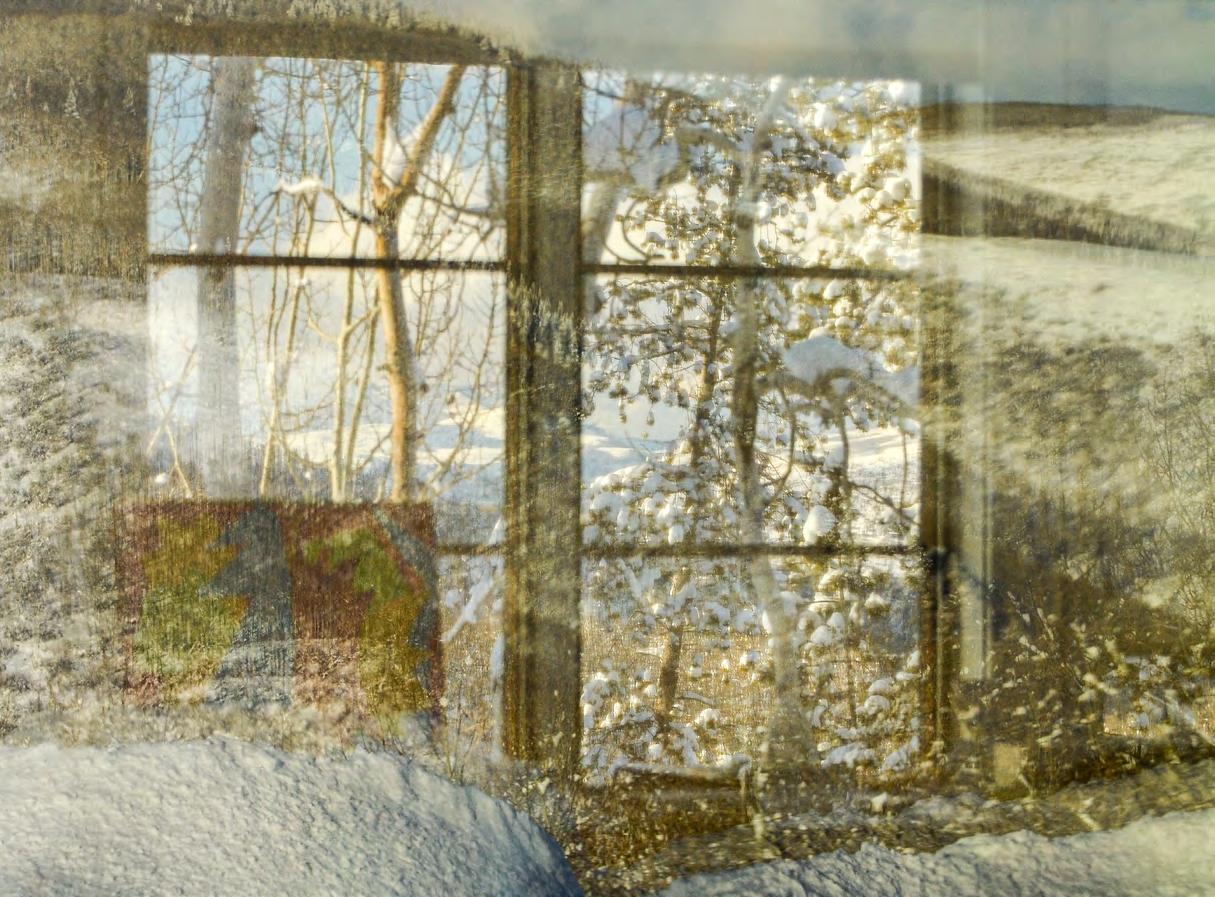
As Aaron Copland suggested, Barber created an arch, The Sheltering Sky of Paul Bowles, which hides the terror beyond it. But summer also breathes through it, as Elisabeth von Herzogenberg said of the slow movement from Brahms’s Symphony No. 4, another model for the Adagio. As William Schuman said, “You are not aware of any technique at all…. It seems quite effortless and quite natural.”
Its monkish modes free it from later Classical and Romantic musical hints, from symbolism or program music, creating a kind of Arvo Pärt purity, harking back to music at the time of Bach and William Bird.
Other pieces whose timelessness is woven into the Adagio include the Fantasia on a Theme by Thomas Tallis by Vaughan Williams; Purcell’s Fantasia for Strings; Beethoven’s Lento from the String Quartet No. 16, Op. 135; Beethoven’s “Lydian Holy Song of Thanksgiving,” the third movement of his String Quartet No. 15, Op. 132; Schubert’s String Quartet in C; Palestrina’s motets; Pachelbel’s Canon in D. All of these can be found in Barber’s pseudo-Renaissance motet, either in their slow tempos, their dependence on simple templates, their slow but escalating modulations, their combination of acceptance and regeneration. Howard Pollack mentions the “cumulative form” of the Adagio, incorporating what Leonard Slatkin called “the entire canon of symphonic history into a remarkable piece of music.”

All art seems to be referential; every work builds on what inspires it; there are echoes of Mahler throughout Bernstein, and Brahms through Lerner and Loewe. Composers have written variations on Mozart arias and Paganini’s famous theme; on the Dies Irae, on La Folía, on folk songs. Although it’s easy to spot the ancestors of the Adagio, only one person had the genius to select just those notes out of the piñata of music history.
Barber was, like Bach and Rachmaninoff, a throwback. Such recidivists are disparaged by their ages because they ignore the trends, but their perspective allows them to perfect forms which came before them, and ultimately produces works which have proved persistently popular, to the horror of musical gatekeepers.
Thomas Larson speculates that Barber’s “homelessness in modern music [was] a source for the Adagio’s purgative emotion.” He wrote lyrical music “ever more complicated by the dread of what he would become.” The “West Chester way [was] a well-oiled façade protecting private depravity.”
The Rome Prize allowed him to escape his fate in uptight Pennsylvania; it was through the Adagio that this liberation took shape.
When Toscanini took the Adagio on tour to England and Buenos Aires, he was criticized for “regressing” from the more modern idioms in American music (represented by Roy Harris, Roger Sessions, Charles Ives, and Aaron Copland).
Menotti defended Barber passionately:
If Mr. Barber dares to defy the servile imitation of that style (which has been called American music) and experiments successfully with melodic line and new form, is he not to be praised for his courage?
…It is time for someone to make a reaction against a school of composition that has bored concert audiences
for twenty years. All through Europe there are signs of this healthy reaction among the younger generation…
If Mr. Barber’s music is not startingly original, surely that is not to his discredit. He is young. The early Michelangelo accepted the influence of Signorelli, Beethoven that of Mozart, and some of Leonardo’s early work is scarcely distinguishable from Verrocchio.
It was very amusing for [the older] generation to be revolutionists. But now let them recognize that the younger generation is left with the thankless job of building on their ruins.
….Isn’t it high time that a young David appeared and struck on the forehead that inflated monster which still parades under the anachronistic name of modern music.
It was Toscanini who first performed the piece on November 5, 1938, possibly in its greatest performance. As Barber wrote,
Imagine! Primrose was the first violist, and Alfred Wallenstein was the principal cellist. Wallenstein has always said to me that he felt this was one of Toscanini’s great performances. What luck for a young composer to have such a first performance!

Barber over time played the Adagio slower and slower, as did many of the conductors who played it, notably Celibidache, Slatkin, and Bernstein.
Baryshnikov famously devised a dance to the Adagio; he esteemed it for being arhythmic. Its stillness preserves it from being identified with any tempo, really.
Barber had viewed Michelangelo’s ceiling for the Sistine Chapel a few months before writing the Adagio, so its gestation was bound up with the Creation of Man. Sofia Coppola in her 2021 film Solo used it to symbolize waking into life from the quarantines of the Covid-19 pandemic. Earlier, Jacob Bronowski had used it to represent evolution in his 1973 documentary The Ascent of Man (as Kubrick had used Strauss’s Also Sprach Zarathustra to the same purpose in 2001: A Space Odyssey).
Gustavo Dudamel felt that the Adagio was more about being in outer space, having an out-of-the-planet experience.
In October of 1967 there was a major march against the Vietnam War at the Pentagon. Barber expanded the Adagio into the choral Agnus Dei for the movement: Lamb of God, give us peace.

The Adagio embodies that peace. After 9/11, Leonard Slatkin played the Adagio at Royal Albert Hall for the London Proms. He was in tears by the end, saying, “I’m shattered. I came off the stage and I collapsed in the dressing room…. It had truly gotten to me in a way that no other music ever had.
A 600-page treatise by Wayne Wentzel has catalogued the various uses of the Adagio theme, devoting 100 pages to its presence in Oliver Stone’s Platoon and other films. The great French film composer Georges Delerue conducted the piece for Platoon; his version is the most popular to date. Oliver Stone used the Barber because Peter Weir had used Albinoni’s Adagio for his 1981 war film Gallipoli. Andrew Niccol’s satirical film Simone uses both the Barber and the Albinoni to accompany pompous films by the fictional director Viktor Taransky (satirizing Andrei Tarkovsky).
The poet Robert Horan, who lived in a ménage with Barber and Menotti for many years, said the Adagio “has an equal isolation; one imagines this music at home in Chirico’s deserted courtyards and pink buildings, among those shadowy children that disappear suddenly under archways and around corners like startled animals.”
Barber’s friend Paul Wittke cautioned that “We bring to the Adagio our own meaning.” It has meant everything and its opposite to millions of people since its emergence, played by Toscanini during radio broadcasts of Franklin D. Roosevelt’s death.
The theme has been overexposed in the media, at the Academy Awards, in video games, in electronic dance music, at the summer Olympics, enough for it to become the opposite of itself, as all memes eventually do.
The Adagio was later played for the funerals of JFK, MLK, Anwar Sadat of Egypt, Princess Grace, Princess Diana,
Einstein, and Pope John Paul II, among many others. Barber was horrified at what the piece had come to signify, and specifically requested that it not be played at his funeral (although it was).
The piece has been transcribed for every instrument, and every grouping of instruments. It is at its most exposed and vulnerable for solo piano, which has none of the tricks of the strings it was intended for: no vibrato, no ability to amplify the volume of a note, no swell like the organ or the human voice or a wind instrument. The piano is limited to the clucking of chickens.
In Albinoni’s Adagio in G (actually written by Remo Giazotto), to the plucking of cellos, the violins descend and are answered by a commensurate ascending mirror image, as happens in the slow movement of Brahms’s Symphony No. 4. Half of the theme is simply a turn, an inverted mordent, whose three notes are expanded into five or six, an example Brahms also used.
Barber takes these mordents and slows them down, weaving them around each other until the central note has become 16 notes, slowing down at the end of each phrase. The La Folía accompaniment becomes in fact the long notes of the theme (as happens in Bach’s Chaconne). This pattern repeats in different keys (the constant modulation of La Folía).
Like Bach (whose Air on a G String is one of the great precedents to Barber’s work), as well as Bach’s meditative Prelude in C-sharp Minor (BWV 849 from The Well-Tempered Clavier),
the Adagio’s structure must compensate for the poor percussive hammer, whose knocks on the door fade immediately into the void. There is no legato God behind that door to preserve the knocks like the voices of chanting monks. As Hilary Hahn said, “You can’t fake things in Bach.” Or in the piano version of Barber. The music fades to black like the end of a film, an unsolved universe extending into unseeable infinity.
Samuel Barber: The Composer and His Music, Second Edition, Barbara Heyman, Oxford, NY, 2020. (This revision benefits from Barber’s diary and letters recovered from a suitcase found in a dumpster.)
Samuel Barber: His Life & Legacy, Howard Pollack, University of Illinois, 2023.
Samuel Barber, Nathan Broder, 1956. (Only Broder and Gruen had access to Barber.)
Menotti, John Gruen, 1978.
The Rest Is Noise, Alex Ross, 2007.
Samuel Barber Remembered: A Centenary Tribute, Peter Dickinson, ed., 2010.
The Saddest Music Ever Written: The Story of Samuel Barber’s Adagio for Strings, Thomas Larsen, Pegasus, NY, 2010.
4. Frédéric Chopin: Nocturne Opus Posthumous No. 21, KK IVa No.16, B49,
Paderewski 5:25
When the pianist Wladyslaw Szpilman played this piece on the radio on September 23, 1939, it was the last sound anyone heard before the Germans bombed the power station and took all Polish radio off the air.
On the same date and at the same hour six years later, in 1945, Spilman played the same piece to open the same Warsaw radio station, now named after him.
His life had been saved when Captain Wilm Hosenfeld, discovering him in the Warsaw ghetto, asked him to play a piece on the piano. It was this nocturne. Hosenfeld saw he was starving. So Szpilman became one of several Jews that Hosenfeld, a former schoolteacher, fed and protected during the war. Szpilman tried to save him later, when Hosenfeld himself was captured by the Russians, but Szpilman didn’t know his name. Hosenfeld died in captivity after seven years. He never took credit for saving anyone’s life.
In the film Polanski made of this story, The Pianist, Szpilman plays a more impressive piece, Chopin’s Ballade No. 1. This is called the “Nanny” Ballade, because any nanny can supposedly play it (pianists are cruel), but it is still harder than the Nocturne No. 21.
The Ballade also has a gorgeous central melody, but the Nocturne is the piece that will save your life.
It was also played by the pianist Natalia Karp in a concentration camp, after which Commandant Amon Goeth spared her life.
On September 23 at Tippet Rise, at the same hour and on the same day as Szpilman played both times at Polish Radio, the Russian pianist
Yulianna Avdeeva, now living in Berlin, played this same piece. We figured out the coincidence and quickly broadcast it to her 600,000 fans on social media. Yulianna also played that day Szpilman’s witty Life of the Machines, which could have been written by George Antheil or Francis Poulenc. Both recordings are on this site.
Ingrid Fliter played all the nocturnes at Tippet Rise; they are also on this site.
There are many gorgeous Chopin nocturnes, all of them life-changing. This one is, however, the only one that has been successfully tested.
There are many pieces that end with a virtuosic rush to glory, such as Barber’s Violin Concerto. But here the music climbs
those same well-worn stairs slowly, a weary person going upstairs to bed. That is what sets it apart.
I am reminded of Paul Muldoon’s equally stunning and slow epiphany:
Think of this gravestone as a long, low chair strategically placed at a turn in the stair.
Both Muldoon’s wraith and Chopin’s scale end up in heaven, by circuitous routes.
Petite Suite pour piano seul, C Major, 1908, 2:20
Here Debussy’s small daughter, Chouchou, his little cabbage, in 1908, when she was three, is playing Clementi exercises on the piano: rudimentary scales. She seems to fall asleep and dream during the Impressionistic midsection. When she comes out of her trance, a warning octave in the bass announces the birth of a real concert pianist, and she merges zher sleep melody with Clementi’s scales, faster now, in an explosion of beginning virtuosity. The final octave is Debussy saying, “There’s the proof that Chouchou is a musician: Q. E. D. It has been demonstrated.”
Chouchou’s dream moves into D-flat, half a tone up from the home key of the piece, C major. The first album in this series is all in D-flat, the key of countryside, calm, and fantasy. Of sleep and imagination. Each key has its own character. D-flat has been enlisted for night; breath; dirt roads; high meadows; raindrops; sleep; and, in this case, the creative trance where music is born.
Maybe keys gain their identity because of the way like attracts like—one piece attracts others of its kind until a tradition is born. Or maybe because of the intrinsic DNA of its frequencies. The key of D-flat has many flats, where tones are
hushed, softened, tires with the air let out of them. Canopies of leaves that float over backcountry roads.
Debussy’s own dream was that Chouchou would represent his music into the next century, but, a year after her father was buried, Chouchou died, from diphtheria. They are buried in the same grave.
All of Beethoven’s girlfriends, the countesses he taught and flirted with, his patrons, his rivals, his friends, are buried within 200 feet of one another in the cemetery in Vienna, the Schubertpark. Schubert is there, obviously, who never dared come into Vienna to pit his genius against Beethoven’s; Schubert remained in the suburbs, playing dance music for his friends’ parties, content to invent in a vacuum, happy not to know who the world might think he was. How would it have changed anything?
When the dance stops, the vast pageantry of Viennese society fits into half an acre. The heroes and villains are all there, in the same place. We spend our lives distancing ourselves from our births; our deaths bring us back to where we started.
I play this piece twice as fast now; 20 years ago, I had the nerve to play it like a three-year-old. Of course, it sounded too much like a three-year-old. We see ourselves as others see us, as Freud said, reflected in their eyes, and are desperate to make ourselves up to be something we’re not. When I was younger I was oblivious to the communal eye; I was genuinely indifferent. I suppose innocence, when you’re older, is achieved not by default, but by determination.
6.
Zdeněk Fibich: “Poem,” Opus 41, No. 4, B-flat Major, 1894 1:27
Zdeněk Fibich was a contemporary of the greater Czech composers Dvořák and Smetana. Fibich was the first to write a Czech tone poem, which served as Smetana’s inspiration for the great Má Vlast. Fibich was a piano student of Ignaz Moscheles, who prepared the piano score of the opera Fidelio for Beethoven. (Moscheles’s granddaughter married Dickens’s son. Moscheles also taught Mendelssohn briefly.)

Fibich’s “Poèm” is from a cycle of 396 pieces called Moods, Impressions, and Reminiscences, composed for Anežka Schulzová. In 1895 Fibich left his wife for Anežka, his composition student. She wrote the librettos for his three final operas (Hedy, Sarka, and Pád Arkuna), all of which revolve around strong women. His mother being German, Fibich was a Wagnerian, which ruined his future in nationalistic Czechoslovakia.
The “Poèm” hopes for larger shape which never arrives, resolving to a short Franz Léhar aria before evaporating.
Fibich’s strident apologist Nejedly, in a 1925 article, “Zdeněk Fibich’s Erotic Diaries,” painted his diary as a programmatic chronicle of his love for Anežka, depicting feelings, events, and musical correlations to her body.
“Poèm” is known mostly in its ruinous orchestration by Bohuslav Leopold and versions for violin and piano and violin alone, which append a lengthy introduction, an unrelated Grieglike cadenza, and a self-important three-note finish to this simple Viennese fragment, tripling its length (but not its impact).

7. Selim Palmgren: May Night (Kevätyö), Opus 27, No. 4, E Major, 1907 3:10
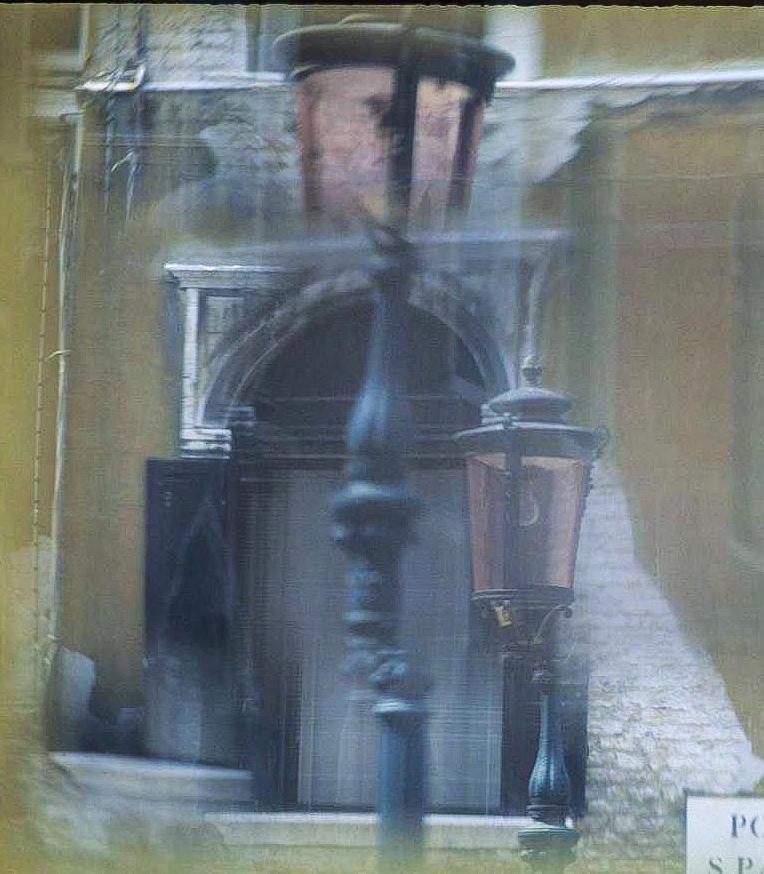
Selim Palmgren studied with a student of Liszt. He later taught at the Eastman School in Rochester, and later still at the Sibelius Academy in Helsinki.
He uses chords to express the ambience of a Finnish spring night, while Debussy and Ravel in 1907 were using more frenetic notation for similar portrayals.
As novels gradually lost the wordy Victorian excesses of Smollett, Joyce, and Proust in favor of Goethe’s spare roman and the French nouveau roman, they took on May Night ’s and Raindrops’ earlier concision of notation. Mood was more important than notes for Palmgren, at least during this brief nocturnal interlude.
His Op. 9, En Route, however, is a virtuoso tour de force, and his five piano concertos are intense and demanding. Conversely, this brief encounter with the night, hardly indicative of his life’s work, has become its representative. Along with Sibelius, Palmgren was Finland’s great postRomantic composer. He wrote more than 300 pieces for the piano, although he is remembered today for the 37 measures of May Night.
Its “open chords” (chords with one note missing, so the sound becomes more ethereal) remind me of the kind of music I heard at summer music camp when I was young. They summon up for me not only the Finnish spring but the American summer camp. This is the way spring should be remembered.
8. Sergei Rachmaninoff: Prelude, Opus 3, No. 2, C-sharp Minor, 1892, Boosey & Hawkes Revised 1992, ed. Threlfall 4:26
R achmaninoff was beginning his career as an artist when he wrote the Prelude in C-sharp Minor. In 1892 he had just graduated from the Moscow Conservatory. But in this, one of his earliest pieces, his life resounds, as if music could be anticipatory: his love for the vast, unspoiled steppes, his humanity, his feeling for all the people of his homeland, his later loss of his beloved family home Ivanovka (into which he had put all his earnings), his loss of meaning, his emotional displacement, the loss of his entire country after the revolution. He never spoke of it. No one can understand what it is to lose your country, your identity. Exiled princes became doormen, jewelry salesmen. They were no longer seen. People were terrified it could happen to them. (Marx thought the Revolution would happen in England.)
Many of Rachmaninoff’s preludes imitate bells, and this one begins with the sound of the Kremlin carillon. It has been nicknamed “The Bells of Moscow.” The way the left and right hands interlink with an emphasis on the inner voices of the huge chords creates an iron-like resonance, what Poe called a tintinnabulation in his poem “The Bells.”
This unusual inweaving of chords has instilled in generations of pianists a kind of visual harmony, like a poème concrète where the shape plays a large part in the sense. The low organ octaves stand apart from the bells, as if they’re in a different piece.
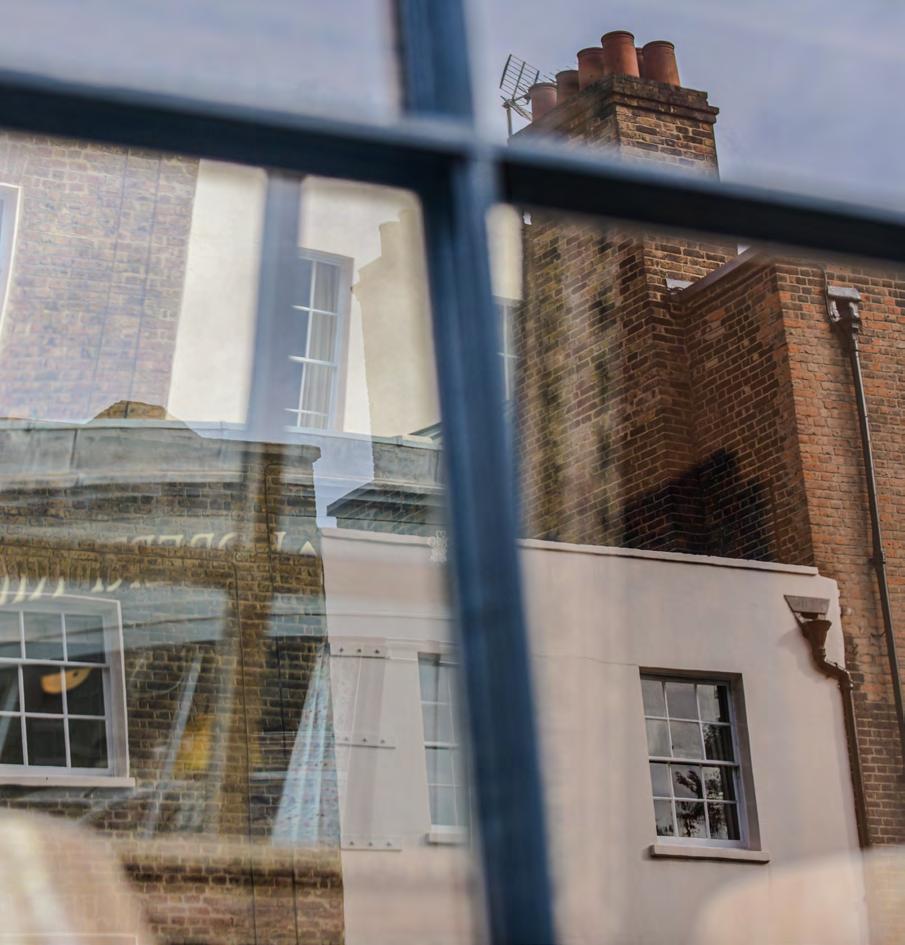
After the frenzied cadenza in the middle, the bells return, written on four staff lines rather than two, accentuating the immensity of the theme, like Mussorgsky’s “Great Gates of Kiev.” Rachmaninoff’s concertos also feature immense chords during the climactic restatement of his main melodies. By choosing to separate the left- and right-hand chords onto four staves, Rachmaninoff forms an analogy with his enormous hands, although many other sizes of hands can play these chords. No one to date had required such brute athleticism, or written music so monumental, both visually and sonically. This became a trademark of his compositions.
The markings of sffff (quadruply loud and szforzando as well), heavily accented, are juvenile, but capture the animal spirits of simply pounding away, which all young pianists love. At the time, households featured pianos, and concerts were filled with amateur pianists who came to see the pieces they knew so well played even better.

Beneath his Apollonian façade, Rachmaninoff was in fact humble, domestic, shy, and immensely kind. When he was successful in California and his fellow emigrés had lost their livelihoods, their history, he helped as many of them as he could. He sent money to his friend Vladimir Nabokov so that the writer could take care of his mother, starving in Berlin. As the linguist Mario Pei has noted, things come to mean their opposite. Rachmaninoff had sold the rights to this prelude for 40 rubles; he never received a penny in royalties when anyone played it, and it was considered the standard for his concerts: if he played it, the concert was a success; if he didn’t play it, people felt cheated. The piece came to judge him, in a way. So he played it with conflicted feelings.
And Rachmaninoff was a man of great feeling, driven from the beginning by immense depths of sorrow. He embodied his country’s resigned grief, its intrinsic melancholy, the continuing hardship after the revolution. He was unfailingly kind to the people who depended on him for their survival.
He speaks through the music, and you can hear everything he says in it. You can hear in it how music is about more than music, how it speaks of pain and anguish, how it says things which can barely be said. It contains the coming dislocations of the revolution.
Rachmaninoff was 19 when he wrote it. It changed his life.
9.
Sergei Rachmaninoff: Prelude, Opus 32, No. 12, G-sharp Minor, 1910, Boosey & Hawkes Revised 1992, ed. Threlfall 2:39
A ll 13 of the Opus 32 preludes were written over a period of 19 days, as if Rachmaninoff sensed he had only a few years left of the paradise he had inherited, and had to make use of each minute.
After his Symphony No. 1 was savaged by critics in 1897, Rachmaninoff lost the ability to compose for more than two years, until the hypnotist Nikolai Dahl, to whom the Piano Concerto No. 2 is dedicated, talked the composer into believing in himself once again. After 1900 Rachmaninoff never looked back.
The Prelude in G-sharp Minor features one of his great Russian harmonic signatures, the sudden switch from major to minor, a motif which we hear today in science fiction film scores. Sibelius used it at the beginning of Finlandia as a clarion call, a fanfare announcing a great event.
This same theme of major-minor is repeated throughout the melody in the left hand. It contains an immense sadness, the sorrow of the steppes, the Chekhovian mourning for lost Russia which every Russian seems to carry in his blood.
Above the falling sadness, bells peal across the moors from the Moorish onion domes of the church carillons, signaling the moments of prayer in the Russian orthodox day. Rachmaninoff called the effect of the arpeggios and octaves together “peaceful funeral bells.”
The main falling motif of the prelude imitates snow falling from pillowed dacha roofs in winter, from cathedral balustrades in Moscow, as well as the sudden gusts of wind that cause the falling snow.
These gusts sweep the soul from elation to fear in half a second, the thrill of nature unleashed partnered with an unexpected fibrillation of insecurity in the face of cosmic forces. We know instinctively that the scoop of wind comes from atmospheric layers beyond our reach, from the turning of the earth, from the wobbling precession of planetary axes, from the vast imbalances between overpopulated thermal zones and voids spread throughout space.

This cosmic pulse, this skip down the energy levels of electrons in atoms causes atomic reactions, energy exchanges, gravity, solar storms, and, on our less dramatic level, changes in barometric pressure, snow clumps that drift and fall from wheat fascicles to the blanket of snow beneath. It’s a small phenomenon, like snow itself, but it is ripe with divinity, with forces beyond our comprehension.
It’s a metaphor by which our understanding of the world transitions from the observable to the unknowable. We register this with a sudden muscular throb, a skip of the heart, a holding of the breath, a gap into which adrenalin courses, physiology that alerts our minds to miracles, to acts of nature whose shadows we notice, but whose instigators—numina, umbras, specters, demons—remain just beyond our vision.
This same spectral falling theme recurs in the second section.
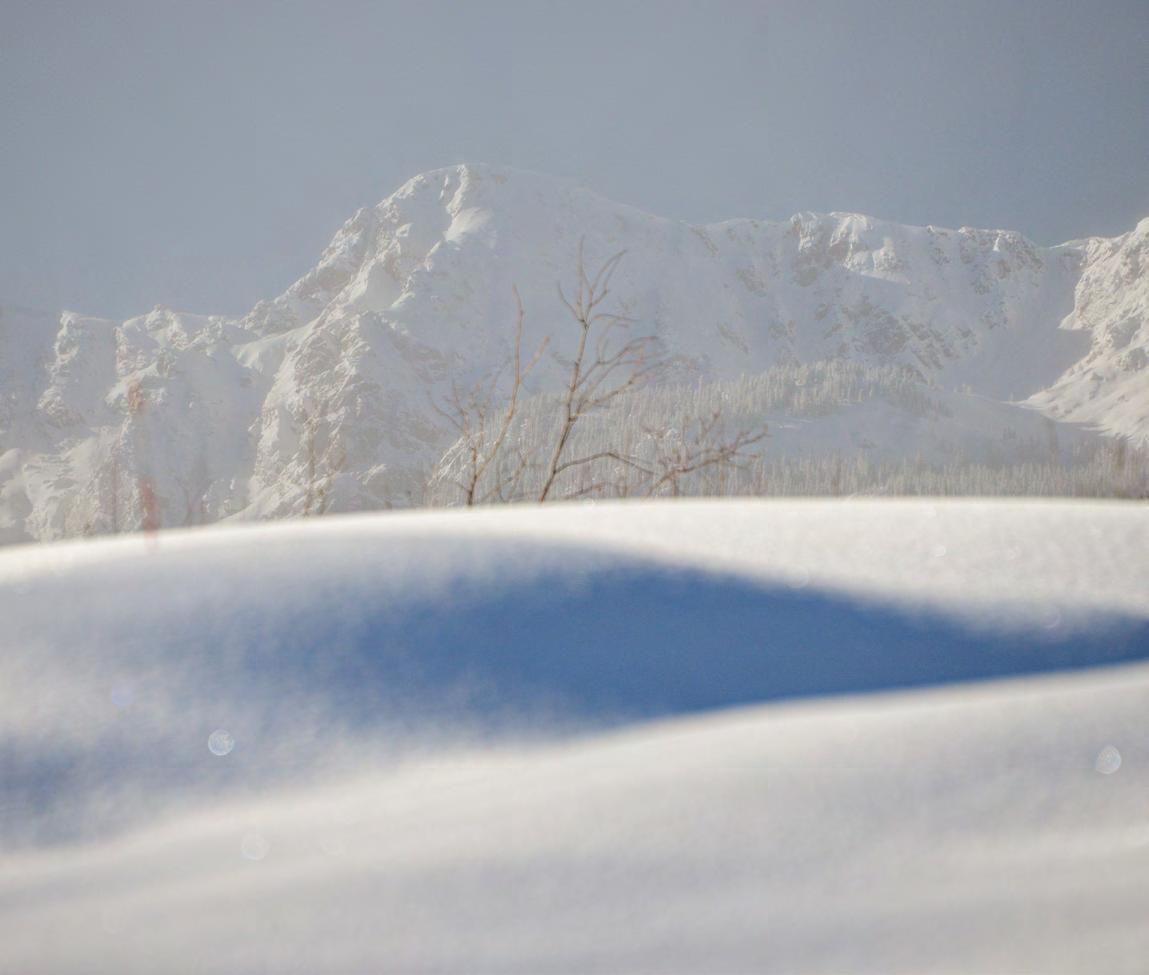
The third section fills in the missing notes in the falling motif to flesh out the vision with a more discernible descending scale of the melody, as if the wind, the energy, were made visible.
The fourth section puts that descending
spectral hint in the left hand, while a figure in the treble, the imagination, climbs upward toward the heights even as the feet disappear into the snow.
Rachmaninoff, despite his tendency to depression and selfabnegation, is brought along despite his modesty by a talent outside himself into unconscious heights his ego would deny but which his creative spirit entertains. We are brought outside our own bodies by elements in us that respond magnetically, chemically, spiritually to a transfiguring universe.
In the middle of the ostinato figures in the treble are hidden the sinking fourth notes which imitate the closer one or two-note spectral down drafts between notes in the beginning of the piece. These wider drifts approximate the Dies Irae, the Day of Wrath melody which connotes doomsday. But Rachmaninoff doesn’t go that far; he keeps the tonalities anchored to the primal modes of bells, the Byzantine harmonies to which bells are tuned. Bells appear to speak in pidgin tones, handicapped by missing notes. And yet Gregorian chant, restricted as it is to only churchly harmonies, resonates with the primal power of its prim vocabulary.
In the fifth section a rising modal scale emerges out of the bass to bring the piece back to its beginnings, and in so doing to its ends.
Instead of single notes bemoaning the leaden sky of the flat Russian horizon, now enormous bells ring out the plagal theme in the bass.
The descending six-note scale in the bass is inverted into the subtle climbing scale hidden in the midrange, usually not heard in the rush of concert performances. Bringing out this inner scale in the midst of its surrounding voices is difficult. It requires a dedication to the deeper innards of the piece, rather than just to its coruscating surface.
In the end, the tolling of the Angelus subsides; its Ave Maria della Sole bells go silent with the coming of evening. The bells of evening are dedicated to St. Gabriel, who announced to Mary that she was going to be the mother of the son of God: ave Maria, gratia plena, Dominus tecum, benedicta tu in mulieribus, et benedictus fructus ventris tui: Iesus. These Ave bells hailed the divine in humanity, and wrote over the earlier pagan curfew bells that warned the community to seal the gates of the village against the demons and goths of night. War was written over with peace.
The presence of the church spire and its hidden carillon of bells dominated the flat landscape of the Russian steppes and was a grounding (and uplifting) feature of the countryside in which Rachmaninoff and Nabokov grew up, and to which they returned as often as possible before the revolution destroyed their estates and erased their identities in the most brutalof ways, with beloved serfs themselves torching the houses in which their own families had entwined for generations with those of the owners, eliminating with a match the spirit of community which was the trellis on which the countryside grew.
Rachmaninoff had put all his concert earnings, all the spoils of his genius, into his family’s lands, which went back into the prehistory of Tatar and Kazak conquests, seemingly immortal proof of the stewardship of land and community with which great Russian genius was entwined, which gave it social resonance, meaning beyond mere words and notes.
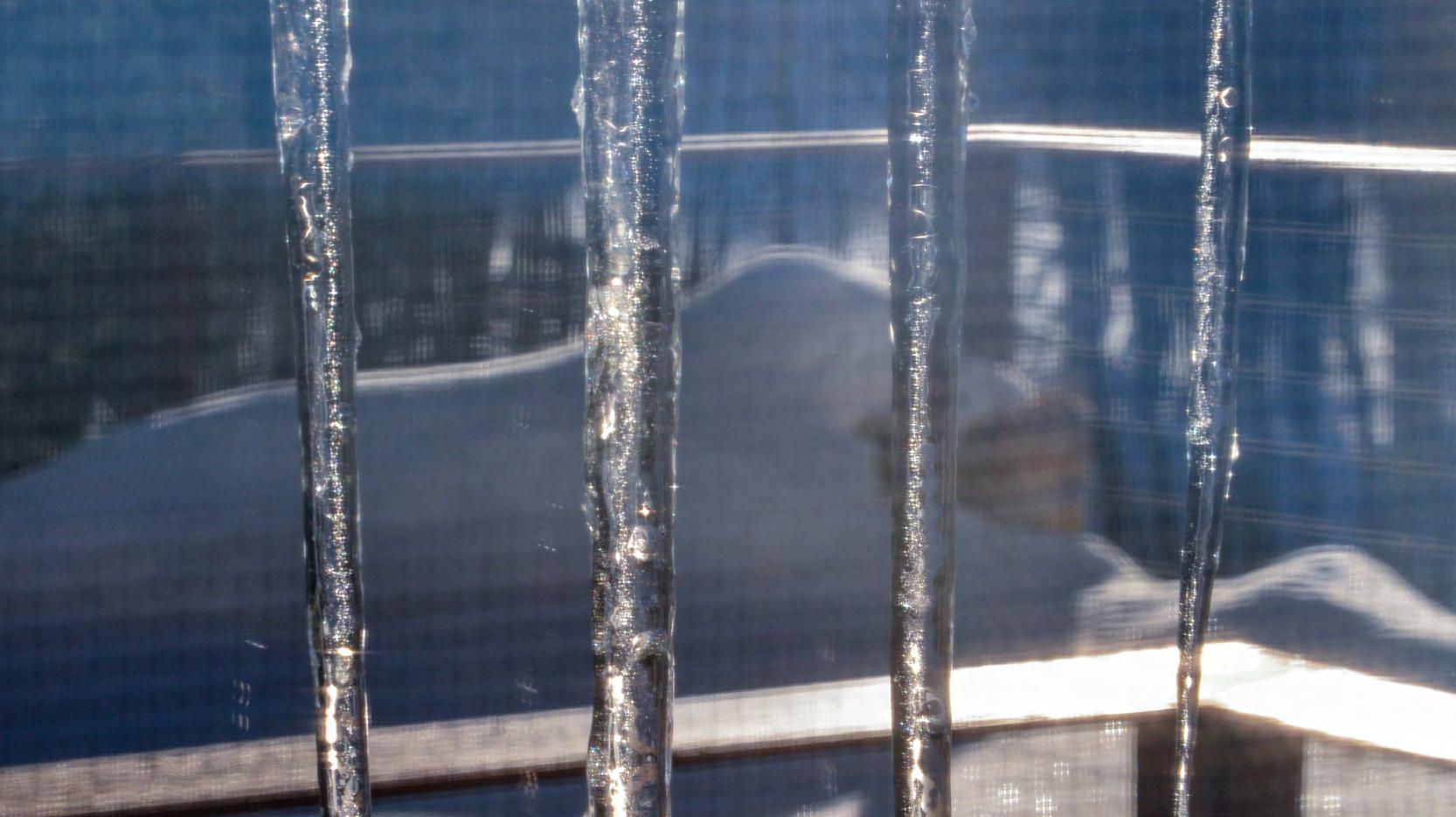
It is this inextricable alliance among the trees, streams, soil, and villages of the vast countryside outside Moscow and St. Petersburg which weaves the intricate labyrinth of Russian inspiration into the writings of Tolstoy, Chekhov, Turgenev, Bely, Goncharov, and Nabokov, and into the music of the great Russian composers: Glinka, Rimsky, Balakirev, Borodin, Mussorgsky, Tchaikovsky, and Rachmaninoff, which continued on in coded references in Prokofiev and Shostakovich and in Stravinsky, who escaped the Stalinist terror and was free to integrate European influences into his identity.
We are distanced by time and geography and temperament from the significance of bells sounding over the vast ragged wastelands where the great Russians wrote most of their music, but their exile from their inspiration and the pain which that loss entailed was omnipresent in Europe between the World Wars.
After World War II, the survivors of Hitler learned to hide their immense grief. Two great examples of this are Nabokov’s novel Pale Fire, where the author puts his own history into the raving footnotes of a megalomaniac academic pretender, aware how his own reality was seen by a New World which was so distant from the immense disruptions in Russia and Europe; and Rachmaninoff’s Rhapsody on a Theme of Paganini, written at Villa Senar in Switzerland, which served Rachmaninoff as a surrogate Swiss outpost of his lost kingdom.
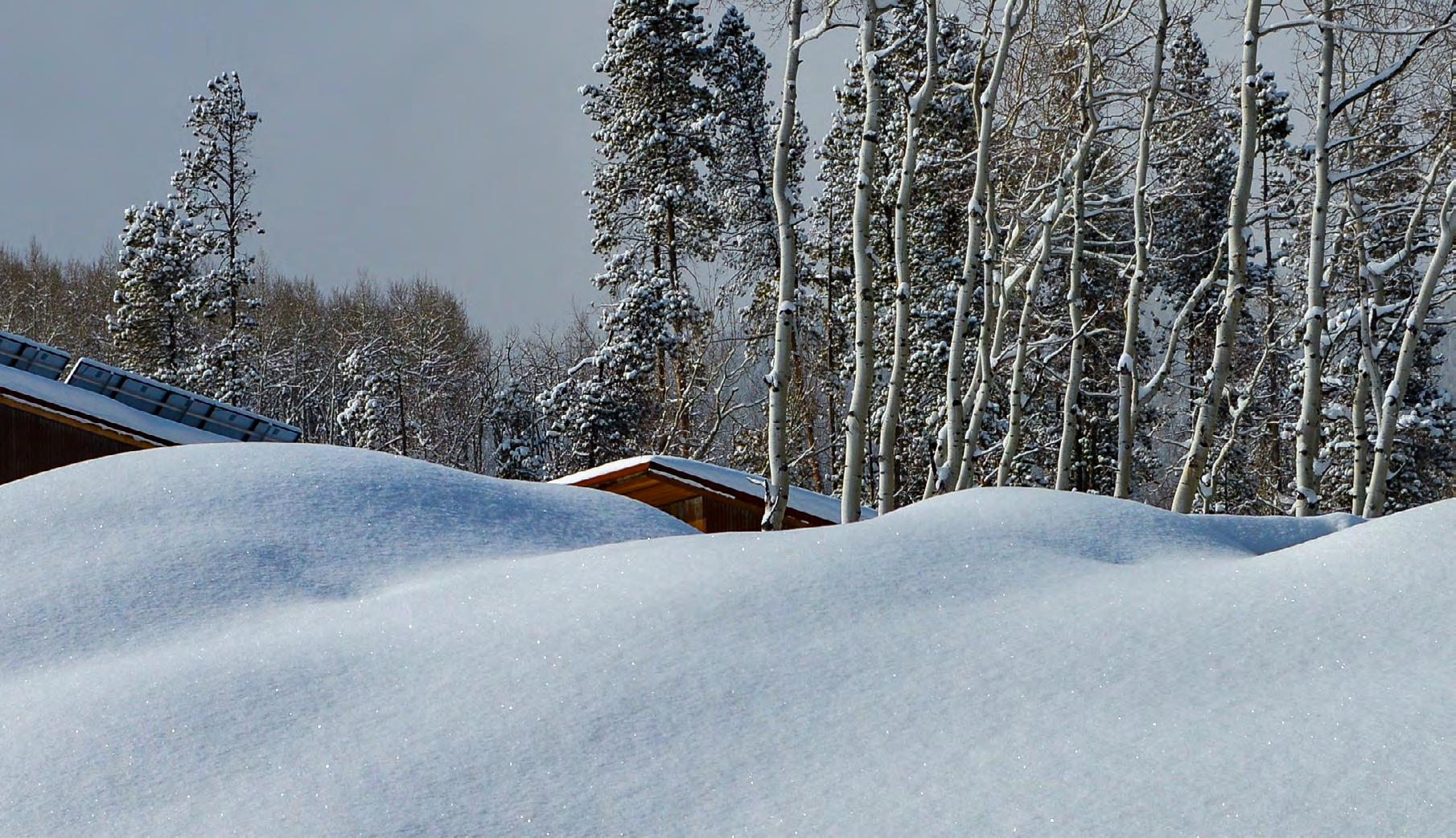
The only genuine niche Russians had carved out for themselves in America was as geniuses. Bellow, Gershwin, Nabokov, Piatigorsky, Rostropovich, and Rachmaninoff moved through society without really being part of it, imposing their own visions gently on the artistic future of the New World, where the profound snowscapes of their lost culture remain visible in The Nutcracker Suite each Christmas, in Nabokov’s Speak, Memory, in every performance of Rachmaninoff’s piano concertos, and in the smaller windows opened by his Études Tableaux and his Preludes.
So now, as the sun sets over the snowing steppes, the sparkling overtones of the bells fade away, but one final scale rushes up into the sunset toward the similar sparkles of the night sky. The inner scale developed over the last few pages has become the deep point of the prelude’s vision of a wintry countryside cloaked in peace.
Hidden inside the figures that swirl like Van Gogh’s solar thermals is a very Craftsman-like, utilitarian ascension which contradicts the eddies, the chaos, the Walpurgisnacht of the whirling leaves of the early notes. The heat waves of fall are giving way to the more directed cold fronts of winter.
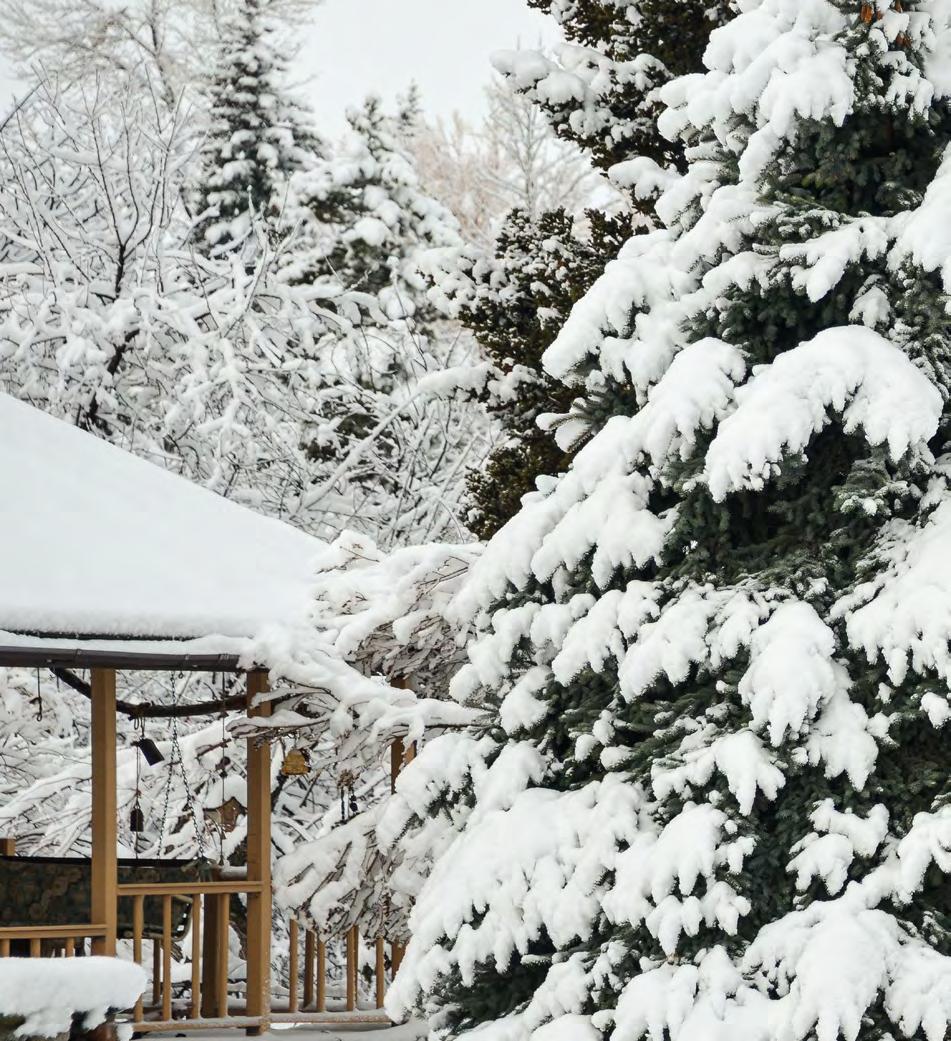
Notes stand in for breezes and harmonies borne on the wind, as if the sky is painted by numbers, and the mathematics of vortices finally compresses abstract and disconnected wraiths into a very linear template of thermodynamics. The pagan spirals of the opening arpeggios have been exorcised by the midsection’s benediction into the final resurrection of the ending.
Interestingly, the great virtuosos Horowitz and Hamelin are the most detailed in their performances at bringing out the different voices lurking in the lacy filigree of the themes. Their initial wild arpeggios are structured, and each resounding echo in the sky, at the top of each arpeggio, has a grounding bass note below.
It is beneath this disfigured dance, this gnomenreigen, that the bells of Russian history mournfully begin to state the sorrow of the human condition which, although burdened with the sins of Stalin, the flaws of the Tsars, will through sheer dogged energy emerge into the Fabergéd New World sky of rust and redemption.
This is to make Proust out of a short prelude, but it follows from my teacher’s insistence that each note is life and death, each chord is a story, each phrase a history that must radiate in its intensity the immense connotations it contains.
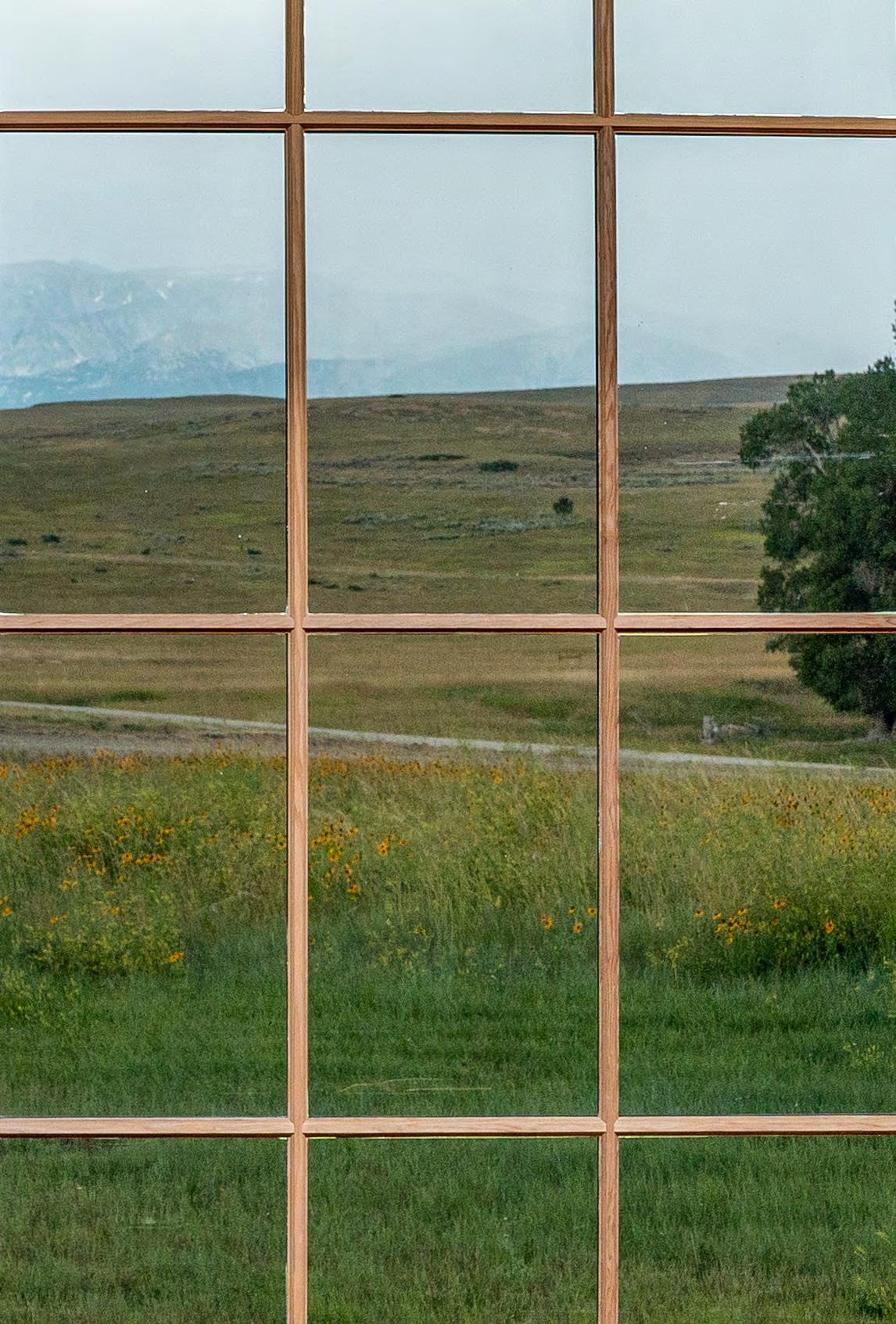
The wheat fields just beyond the concert barn at Tippet Rise are a bit more rolling, but they share the distant sadness of Rachmaninoff’s steppes.
Sergei Rachmaninoff: Prelude, Opus 32, No. 4, E Minor, 1910, Boosey & Hawkes
Revised 1992, ed. Threlfall 6:02
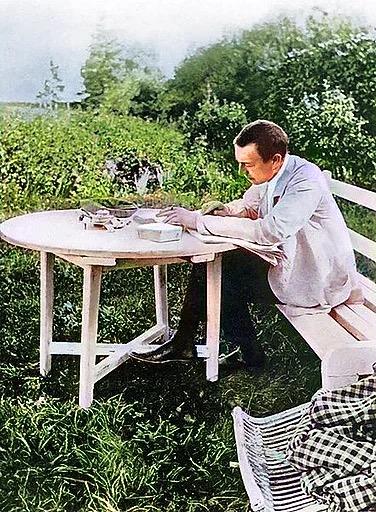
How wonderful to be allowed to be briefly in the same space with Rachmaninoff, on the piano, on the page: everything I admire about music in one spot—modesty, kindness, patience, tolerance, the perspicacity to see through his age’s blindness. He poured his lifetime earnings (120,000 rubles) into his serfs, who then burned his house down: Ivanovka, the estate his wife inherited from the Satins, some 300 miles and three days’ journey from Moscow, where he wrote most of his works. Below he is proofing the Piano Concerto No. 3 at Ivanovka: He wrote his pieces walking down the “red alley” there, a reddish soil path lined with elms, maples, anpoplars. The estate was surrounded as far as the eye could see with rye, wheat, oats, flax, millet, and sunflowers. There were ponds, gardens, ochards, summerhouses, copses.
In 1909 he was working secretly at Ivanovka on the Piano Concerto No. 3, one of the great monuments in musical history, and in 1910 he returned to Ivanovka and composed the 13 preludes of Op. 32, of which this one is No. 10. He said of his shorter pieces:
Young composers are apt to look condescendingly upon the smaller forms of music…A small piece can become as lasting a masterpiece as a large work. As a matter of fact, I have often found that a short piece for the piano has always given me much more pain, and has presented to me many more problems, than a symphony or a concerto. Somehow, in writing for the orchestra, the variety of colors provided by the instruments brings me many different ideas and effects. But when I write a small piece for the piano, I am at the mercy of my thematic idea, which must be presented concisely and without digression.
The constant swirl of notes around his great lyrical melodies is like butterflies around a flower, each ornament as lucid and obscure as the flower around which it flies. These aren’t melody clusters, where 10 notes take the place of one; they’re like the dishes at Pierre Gagnaire in Paris, where each choice comes with five antiphonal companions, ambrosial metaphors, all of them essential to and reflective of the central succulent.
Geoffrey Norris says this Prelude is by far the finest of all the 24 preludes, with its close-knit structure (based entirely on the opening figure), its imaginative piano writing, and its intensity of emotions, towards which the more introspective of the Moments musicaux and the Op. 23 preludes had been progressing.
Max Harrison writes: (photo goes here from original Word Docx)
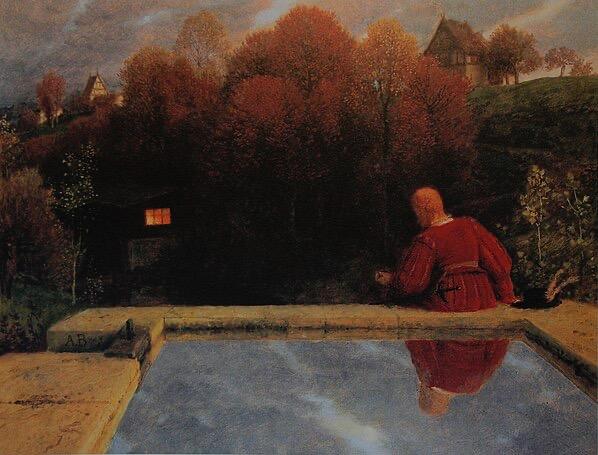
Having played it for many years, the great pianist Moiseiwitsch, a friend of the composer, came to the idea that it
had been prompted by Böcklin’s picture The Return. This shows a man looking towards a cottage to which he is returning, presumably after a long absence, and Moiseiwitsch was able to get Rachmaninoff to admit that this had been the source of his inspiration, also that this was his favorite among the preludes.
…These six minutes of closely wrought music, perfectly judged in scale, end with the melancholy regret of the last three bars, which sound like an allusion, probably unconscious, of the Chant hindou from Rimsky-Korsakof’s Sadko.
Note that Arnold Böcklin’s painting The Isle of the Dead inspired Rachmaninoff’s 1909 symphonic poem of that name: The Prelude No. 10 in B minor shifts from major to minor throughout its short run, as it does in the Prelude No. 12 in
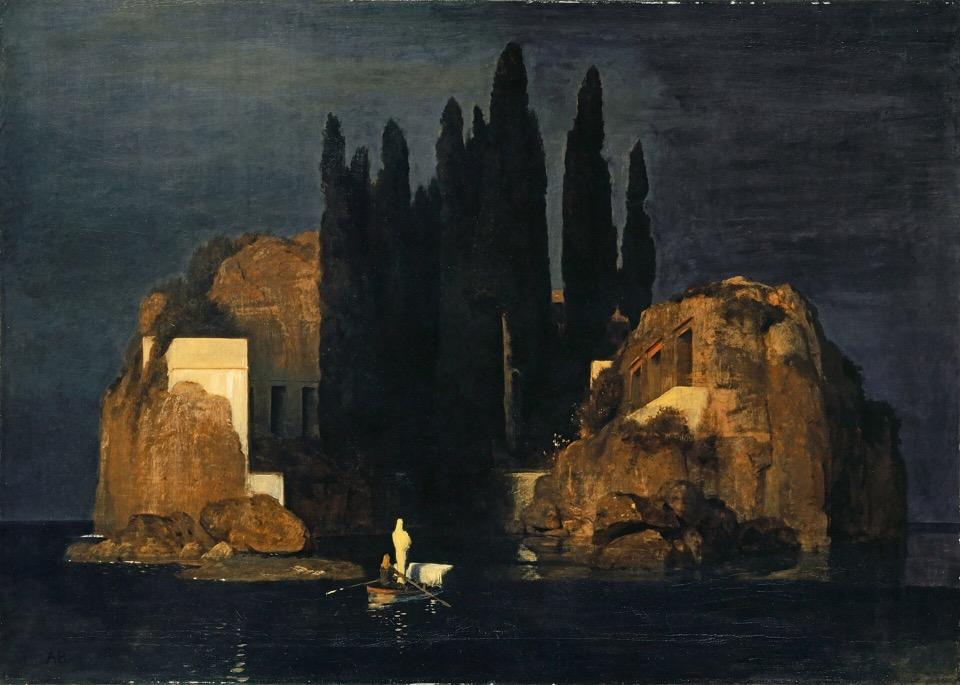
The simple three-note melody (really the note, the note above it, and a return to the original note—a turn, the inversion of Bach’s similar melody to his Fugue No. 1 in C minor on track 1 of this album), this melody becomes overwhelmed with massive chords, Rachmaninoff’s signature in many of his pieces, leading to a brief mournful cadenza up and down the piano, before the tolling falls away like a decaying echo across the steppes. The measure moves from B major to B minor in five resigned chords, the Cyrillic transformation from certainty to resignation.
Throughout the middle note of the B minor chord becomes prominent and falls chromatically in three steps down to the fundament, the organ point which grounds the piece in the tundra. Rachmaninoff has exhausted the few ways he can unearth the sonorities of this three-note B minor chord without disrupting its essential repose. No matter what happens around it, it’s still there: intact, inexorable.
The bells ring out across the steppes with their limited peal, the desolate shrubs of the tundra revealing the paucity of the land, neglected by government, providing solitude for the dachas of the aristocracy, but little solace for the peasants, who would soon revolt.
Bells figure throughout Rachmaninoff, in the choral symphony, The Bells, Op. 35; “dancing bells” in the E Major Prelude; “strokes of bells” in the C Major Prelude; “sounds of little frozen bells” in the A Minor Prelude.
Rachmaninoff said:
The sound of church bells dominated all the cities of the Russia I used to know—Novgorod, Kiev, Moscow. They accompanied every Russian from childhood to the grave, and no composer could escape their influence…. All my life I have taken pleasure in the differing moods and music of gladly chiming and mournfully tolling bells.
Despite spending all his earnings (120,000 rubles) during his early career in Russia on his serfs and the lands they tended, Rachmaninoff made little headway with them. He wrote, “The impressions I received from my contact with the peasants, who felt themselves masters of the situation, were unpleasant. I should have preferred to leave Russia with friendlier memories.”
When the land soon became lawless, the peasants burned Ivanovka to the ground, not that it did them any good. Rachmaninoff had left for the spa town of Cimeiz in Yalta in August, near where his friend Chaliapin, the great basso profundo, was working on his autobiography with Alexei Gorky in the Kuznetsov Palace. Today the palace is a sanatorium.
Rachmaninoff returned to Moscow to play a few concerts, and in December he received an offer from Scandinavia that saved his life. Without this exigency he would have remained in Russia.
He left on December 23, 1918, with his family on the train to Finland, entering, as Lenin had, at the Finland Station, from which the only route across the country was in an open sleigh. Such rides sound exotic but are in fact freezing, as the body is inert, not moving like a skier to counter the cold. Blankets offer little protection. And this wasn’t a pleasure ride; the Rachmaninoff family crossed all of Finland, a distance of approximately 300 miles. At 8 miles per hour, that would be 37 hours, or a day-and-a-half. He arrived in Scandinavia on Christmas Eve. He and his family were detached from the Christmas around them, displaced—Rachmaninoff, who was scared to meet anyone new, scared of bugs, of rain, of wind, of night.
He wasn’t allowed to take more than 2,000 rubles with him. But, as a friend pointed out, he had his hands.
Rachmaninoff was worried that he wouldn’t be able to earn money in America. As it turned out, he concertized incessantly and made the modern-day equivalent of millions of dollars. On a national tour in 1922, when he was 49, he played 71 concerts. He sent much of the money, along with food and clothes, back to Europe to help musicians, friends, and family. He lent money to the writer Nabokov, to the staff of the Kiev Conservatory, the chorus of the Mariinsky in Petrograd, to Stanislavsky and the Moscow Arts Theatre.
He never returned to Russia.
Rachmaninoff was gone, Nabokov was gone, and because of it, Russia was gone. It would now exist only in their memories of it, in Nabokov’s Speak, Memory, in the music of old Russia that Rachmaninoff had created in the 27 years between 1891 and 1918.
Rachmaninoff, Geoffrey Norris, J.M. Dent, London, 1976. Rakhmaninov, Andreas Wehrmeyer, Haus, London, 2000.
Sergey Rakhmaninov: A Lifetime in Music, Sergey Bertensson and Jay Leyda with Sophia Satin, New York, 1956.
Rachmaninoff: A Biography, Victor Seroff, Simon & Schuster, London, 1950.
Rachmaninoff: The Last of the Great Romantics, Michael Scott, The History Press, Stroud, 2008.
Rachmaninoff: Life, Works, Recordings, Max Harrison, Continuum, London, 2005.
Rachmaninoff and His World, ed., Philip Bullock, University of Chicago, 2022.
Rachmaninoff’s Recollections Told to Oskar von Riesemann, MacMillan, New York, 1924 [Rachmaninoff felt Riesemann embroidered many of the recollections]
Könemann Music Budapest, Sämtliche Werke III 2:57
This is Horowitz’s well-known encore; Rachmaninoff played it also (although Rachmaninoff and Scriabin didn’t get along, they agreed to band together when they were first exiled in America, a terrifying experience for both of them for the first few years).
They both had studied with Zverev and Taneyev at the Moscow Conservatory. At a certain point, Scriabin claimed, “I am the apotheosis of world creation. I am the aim of aims, the end of ends.” This is pure Nietzsche. Scriabin was anything but Russian. He was building his identity through Western novels like Also Sprach Zarathustra.
Rachmaninoff, on the other hand, was formed in the heart of the steppes. His later attempts to put Gershwin into his Piano Concerto No. 4 were superficial.
Scriabin started out imitating Chopin but rapidly moved into more obscure harmonic worlds. His early pieces are a mixture of Chopin and Mussorgsky. His music never had Russian influences. He was 22 when he wrote these études.
As Scriabin took up mysticism and the Russian fascination with the cosmic, he believed his role was to create transcendence through music.
In his early years, the attempt to create a universal harmony with the cosmos manifested itself by veering toward the atonal, while still maintaining his French lyricism. He added

extra notes to chords, especially the seventh (which is the major signature of this étude), massive chord clusters, fireworks explosions, where rising Lisztian octaves were the stem of the rocket trail. Both Scriabin and Rachmaninoff were massing chords to create effects at this time, independently of the other.
Scriabin conceived of the Mysterium in 1902. It was to be a magical event where music would combine with different forms of ecstasy and transfiguration, resulting in the abolition of time and space. Out of the ashes of existence would rise a joyful communion of all things, as matter was reconstituted.
You can hear the ecstasy building toward transfiguration even at this early stage, although the sensual conflagration of the Mysterium was still to be invented. I could speculate that this longing was always there, and that the cosmos just played into who Scriabin already was. His idea of a universalized emotion was a more extreme version of Wagner’s Gesamtkunstwerk, a synthesis of all the arts, as practiced in his operas at Bayreuth.
Like Rachmaninoff, Scriabin builds suspense and meaning out of massive chords. Like Rachmaninoff in the 10th Prelude, Scriabin here uses a chromatic decay as an almost atomic disintegration down the scale into the earth.
This piece vibrates with excitement and physicality, the opposite of Scriabin’s later structures. It owes nothing to anyone; it is an original and lyrical outburst of old-fashioned ecstasy.
,
Book 1, Opus 19, No. 1, E Major, 1832
5:53
I’m not sure if the fact that Mendelssohn, Liszt, and Rachmaninoff were kind had any effect on their music, or on why I play it.
But if the first Song Without Words can’t be encompassed by the word “kind” (a little more than kin, and less than kind), it is suffused with calm, acceptance of the status quo, and a kind of forbearance against the slings and arrows of outrageous men. It is an idyll of the king, the lullaby of a young man endowed with every gift there was: he was an inventive composer, an amazing pianist, the greatest conductor of his age, an egalitarian aristocrat, liked by everyone, aware of who he was and comfortable with it. His uncle Jakob bought the Bartholdy dairy to distance the family from its Jewish origins, but the family disliked using the name. Mendelssohn regarded himself as a Lutheran, but the oratorios he wrote in the last year of his life were Elijah and Christus, from the Old and New Testaments.
Tom Stoppard recalls a story when the great philosopher Ludwig Wittgenstein’s brother, a senior member of the family (and they were millionaires when it meant something to be a
millionaire), came into the house white-faced, ashen, and told the family, “We count as the Jews! We count as Jews!”
This was the epiphany which Mendelssohn was trying to avoid amid the rampant antisemitism in Germany during his lifetime.

Between the ages of 12 and 14, he wrote 13 string symphonies. He knew Beethoven’s nine symphonies and could play them on the piano. He wrote the great octet at 16. By this time he had already written four operas, along with cantatas and piano music. At 17 he wrote his most famous work, the Overture to a Midsummer Night’s Dream. He wrote the Piano Concerto No. 1, in G minor, when he was 22. He conducted Don Giovanni and Handel’s Israel in Egypt (he had discovered the
manuscript in London) when he was 24. At 26 he became the conductor of the great Leipzig Gewandhaus. That same year he conducted the debut of Clara Schumann (she was 16) and Robert Schumann’s Symphony No. 1. He secured a pension for the orchestra musicians. He introduced Chopin, Liszt, Rossini, Schumann, and Schubert to Leipzig.

He founded the Leipzig Conservatory at 34. Goethe compared him favorably to Mozart. He translated Terence into German. He studied aesthetics with the great philosopher Hegel. His piano teacher had studied with Clementi, who himself became organist of his parish church at 14. When he was 20, Mendelssohn revived interest in Bach’s forgotten St. Matthew Passion (his grandmother had the manuscript). Virtually unplayed since Bach’s day, it kindled a Bach revival.
Schumann discovered the manuscript of Schubert’s Symphony No. 9 and the Great C Major Symphony, both of which Mendelssohn premiered a decade after Schubert died (Schubert never heard it).
Schumann wrote in the Neue Zeitschrift für Musik, of which he was the editor, “I consider Mendelssohn to be the first musician of our time, and take off my hat to him as a master.” Harold Schonberg has written that “his playing was like his music—clear, elegant, precise, logical.” This might describe the man as well. His wife was apparently wonderful, “bright and natural,” according to his sister, Fanny.

Fanny knew Bach’s entire Well-Tempered Clavier from memory by the time she was 13. She wrote some 250 songs and 125 pieces for the piano, and was considered as good a pianist as her brother. Mendelssohn asked her advice on all his compositions. But aristocratic women did not play professionally (although Fanny gave three concerts in her lifetime, the first being her brother’s Piano Concerto No. 1, my favorite Mendelssohn piece). Queen Victoria sang
Mendelssohn her favorite song of his; it was Fanny’s. Her Easter Sonata was misattributed to her brother until 2010. Her songs are more adventurous than her brother’s, although his have become well-known.
This song, the first from his six books of wordless songs, a form Mendelssohn invented, was admired by Liszt, who used it in his Grosses Konzertstück über Mendelssohns Lieder ohne Worte for two pianos. You come in when the conversation is already going, and leave it before it finishes. It is like singing in the shower, a baritone humming an instinctive melody which sounds like it’s been around forever.
As Schonberg said, “now that serial and post-serial music has run its course and neo-Romanticism is returning, Mendelssohn’s music, like Liszt’s, is being revalued, and Mendelssohn is again beginning to be recognized as the sweet, pure, perfectly proportioned master he was.”
Felix was dead at 38, of a stroke induced by the death of his sister, Fanny, six months earlier.
Gentle Genius: The Story of Felix Mendelssohn, George Marek, New York, 1972
Mendelssohn, Philip Radcliffe, London, 1954
The Lives of the Great Composers, Harold Schonberg, W. W. Norton, New York, 1981
Richard Strauss: Also sprach Zarathustra, Tondichtung für grosses Orchester, Opus 30, C Major, 1896, transcription Schmalz-Halstead 1:22
I play the piano reduction of this piece (which I’ve fancied up only slightly) because of Leonard Bernstein.
In 1971 Bernstein had described the opening of this piece as the sun rising (Strauss’s name for the first section). When I attended the Norton Lectures at Sanders Theater in Cambridge, back in 1973, Bernstein had a new idea: the notes signified the three ages of man: theocracy, aristocracy, and democracy, or Gods, Heroes, and Men, as set forth in Vico’s cyclical theory of history, and on which James Joyce based his brilliant Roman-Fleuve Finnegans Wake (which took him 17 years to write).

Each note is an entry into a new level of consciousness, much as Claude Lelouch’s 1984 film Viva la vie progresses between layers of enlightenment, as the entire ecosystem of the narrative changes every few minutes, and you have to reevaluate the basis of your perceptions. The plot has changed abruptly, and everything you thought you knew is false.
Vico and Spengler believed that civilization was like that, changing the plot every millennium.
After the first three notes of the trumpet fanfare for the dawn of humanity (used by Kubrick in his 1968 film 2001: A Space Odyssey, to signify the awakening of civilization with an obelisk emerging from the ground), Strauss brings “the eternal note of sadness in,” as Matthew Arnold says in his poem “Dover Beach.” It is a minor cadence, which contradicts the joyful fanfare: with paradise comes the snake.
The theme repeats, and this time the codicil is successful, leading to an even greater apotheosis in the home key of C major.
The third time (mimicking the trinity of the first three notes), the fanfare leads to a new key, the subdominant, which enters like a revelation, an even higher state of being. Mozart used the subdominant to signal that a piece was ending, as Nabokov used a butterfly to symbolize death and the dénouement of a story.
Here the special key signifies the transcendence of existence onto a higher plane, from which it climbs note by note, until the last three chords (A, B, C) are the plagal cadence of A minor, G seventh (the dominant), and C (the tonic), the traditional ending of many pieces. In Strauss’s case, it is the beginning, the progression of society into a fantasy world where Zarathustra searches for truth in the land of illusions.
But it is here that we leave the piece, having introduced the listener to music itself. When the noise of the crescendo dies down, what is left is an organ playing four notes of the C chord. The world has been created in those four notes: Gods, Heroes, Men, and Art. The bottom C and the top C are the same note an octave apart, as if the fundamental origins of life have been transmogrified into a form (art) that surpasses life itself. It is through art that the inhumanity of man can be sidestepped, erased, transcended. It is through art that people escape unbearable conditions.
Farquhar, the hero of Ambrose Bierce’s 1890 short story “An Occurrence at Owl Creek Bridge,” escapes hanging when the rope breaks and he walks back all night to his plantation. It turns out that this is his life flashing in front of him, as he dies when he reaches home. The whole story has taken place in the second before death. Through madness, or invention, or imagination, we escape the human condition.
It is this top note on the Zarathustra C chord where art has been created by the history of suffering leading up to it. Strauss’s piece, Nietzsche’s novel-poem Also sprach Zarathustra, Joyce’s Finnegans Wake, poetry—they all live in that final chord emerging through the cacophony of the coda. Strauss has created the world. More, he has created art.
This is of course just an introduction to the larger world that follows the opening fanfare.
But to me it is a metaphor for what Tippet Rise is: a series of expanding consciousnesses, where the lessons of one sculpture make it possible to arrive at the next sculpture, which in turn provides a revelation, an escape into a higher level.
The Unanswered Question, Leonard Bernstein, Harvard, 1981.
Knowledge of Things Human and Divine: Vico’s New Science and Finnegans Wake, Donald Verene, Yale, 2003.
14. Johann Sebastian Bach: Chaconne for unaccompanied violin, arranged by Ferrucio Busoni, after Movement No. 5 from the Partita in D Minor for solo violin, BWV 1004, 1717–1723 [note: 5-channel is 19:57]
We heard Hélène Grimaud play this at the La Jolla Music Festival. It was stately, its organ stops dignified. It wasn’t virtuosic, it was mimetic: its voicings were orchestral. It didn’t rush like a piano; its scales came from bellows, where there had to be a separation between notes, to let the immense breath of the pipes decay before the next note from the bourdon overwhelmed the cathedral. Because of Grimaud’s playing, I had a revelation: overly pianistic versions of this organ piece lose the majesty of the nave to the clatter of the keys.
More than anyone else, Busoni turned Bach into a pianist. Liszt adapted him as well, but Busoni had the touch.
Like some of the young musicians on this album, I was the organist of our church and choirmaster when I was 14. The famous Toccata in D Minor was then known as the theme of Lon Chaney’s film The Phantom of the Opera, and I would sway like the phantom as I played it; I could hear gasps from
the Catholic congregation. The priests hated it, and told me God hated Bach. (The Protestant God down the street had no trouble with him.)
The great Russian virtuoso Yevgeny Sudbin has written descants, mirages of overtones, Georges Delerue melodies that metabolize out of Bach’s great chorale “Die Seele ruht in Gottes händen” (BWV 127): https://www.youtube.com/ watch?v=qaUykI84XGo which confirms my belief that just out of sight, over the horizon, of many Bach pieces lurks a majestic Tchaikovskian version beyond the Baroque swells of great cathedral organs, formed (at 05:38) out of the innate sublimity of the original notes, like the orchestral swelling as Lemmy Caution drives to Alphaville in Godard’s 1965 film or as Fritz Lang’s camera sweeps out over the Adriatic in Godard’s 1963 Le Mépris.
Ferruccio Busoni was one of the great pianists of history as well as a composer and conductor who brought not only diversity but also an enormous maturity to his virtuosity. Samuel Beckett said of Proust’s characters that they were like giants buried in the ages, touching the past and the future at the same time. Busoni was like that. He transcribed for piano some of Bach’s choral preludes, the Chromatic Fantasia and Fugue, the Toccata and Fugue in D Minor, and a vast arrangement of Bach’s incomplete final fugue from The Art of the Fugue, called the Fantasia contrappuntistica.
He also transcribed Liszt, Mozart, and even Schoenberg.
He was friends on one hand with Schnabel and Sorabji, and on the other with Varèse and Schoenberg. He wrote atonal music, and taught composition to the witty and underappreciated cabaret composer Kurt Weill.
So what he brought to Bach’s monumental Chaconne was more than just Bach, and more than bravura. He gets the orchestral splendor of this cathedral of a piece, from its meditative recitative to its organlike summits. His use of octaves and scales is only what Bach would have done, had Bach had a modern piano. Busoni understands the concept of organ stops—that is, the ability to play on pipes that sound like flutes, violins, reeds, a celeste, the oboe, the bombarde, a clarinet, the diapason, and the giant bass bourdon. Bach’s own organ at the Thomaskirche was a typical Baroque organ with only around 63 stops (knobs that you pull out to unblock or unstop the attached pipe to create a specific sound). Busoni certainly pulls out all the stops
and finds at the end of 31 variations and the D minor storm a simple, clear day.

The great miracle is that Bach originally assembled an entire orchestra, an organ, the entire spectrum of a concert piano, on the four strings of a violin.
Bach wrote the Chaconne around 1720–23. Busoni transcribed it in 1891–92. He spent 30 years transcribing almost everything Bach wrote (for voice, violin, organ, and orchestra). Busoni wrote a 36-page book describing the technique he used to transcribe Bach’s organ pieces. As with the Toccata and Fugue in D Minor, his building of crescendos is an effect only made possible by the pedal and by the sotto voce of tone necessary to begin such vast setups as subtly as possible.
Busoni was inspired by the thought that the Chaconne was a requiem for Bach’s wife, Barbara, as Bach added it later to the Partita and it is longer than normal. This is no dance; it is a dirge, of magisterial languors. In Bach’s day a chaconne was the dance of a grief-stricken mourner; so it was both the Buddhist ecstasy of accepting stoically the arc of life and death, and the Romantic concept of emoting (long before
Romanticism appeared around 1789: Alfred de Vigny said that Romanticism was conceived between battles, between the French Revolution and the Napoleonic Wars). Goethe’s Jungen Werther of 1770 was the first and possibly the most seminal of the initial models, combining as it did nature, traveling, and the juvenile concept of ending it all.
It was easy for Busoni in retrospect to accentuate the hidden romantic concepts conceived by Bach: for instance, the recurring fall of the melody down a diminished seventh became quite popular later in Liszt’s tone poems such as “Mazeppa,” and even in the vocal lines of Philip Glass operas. As William Kimmel has written (in his article “The Phrygian Inflection”) of this sinking (and then rising) motif:
From earliest times the spiral gestalt has appeared along with the labyrinth as a symbol of transformation of the life and death cycle: generation-growth-decay-deathrebirth or regeneration. The ascending clockwise spiral is associated with creative power, growth, and life; the descending counterclockwise spiral with decay, destruction, and death. The combination of the two, the double spiral, symbolizes the perpetual transformation from life to death and from death to life.
The serious intonations of the melody are like bells tolling, an effect which fascinated Busoni (along with Rachmaninoff, Mussorgsky, and Mompou). The piece is schizophrenic: Baroque in its lower Gregorian-like melody, and Romantic in its wandering descant above. Below is solid, sacred Bach; above is distracted, wandering, lost Busoni.
The concept of the Wanderer was popularized both by Goethe and by the Romantic painter Caspar David Friedrich. Maturin’s of 1820 inspired both of them, and later Mary Shelley and Oscar Wilde (Maturin was his great-uncle).
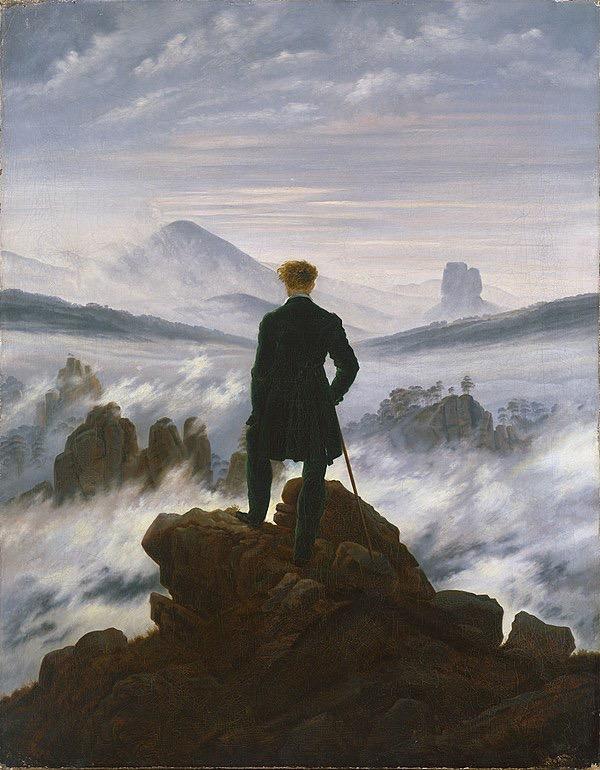
As Robert Freeman wrote in Melmoth is a gothic matryoshka of fictions inside one another, and the common thread is the Wanderer, moving through every level, never present but alwaysthere – spoken of in
whispers and hearsay. He is terrifying in his absence, moving through a Daedeliannightmare of narrative strands that twine into one another.
This is a very good description of the Chaconne.
The concept of the slow dirge gives the piece the largesse it needs to add details to its theme without becoming frenetic. That it is the most personal of confessions has led to its being transcribed by an enormous number of great artists: Brahms, Schumann, Mendelssohn, Segovia, even in a ballet by Balanchine.
Busoni, like Liszt, was an intellectual and embodied philosophies in the passion of the notes. As Liszt turned to the church to vindicate his unholy talent, Busoni turned to Bach, to cleanse himself of the “amoral” music of Schoenberg, Berg, and Webern. So the Chaconne is a recidivist step into religion, as Rachmaninoff’s use of bells and Tatar harmonies harked back to Glinka and the folk roots of Russian music, maybe especially because of its disintegration under the Bolsheviks.
This was the same time period in which Brahms was writing his nostalgic love songs, the Intermezzi, to Clara Schumann. There was a certain wistful invocation of the past in Busoni’s obsession with the safety of transcribing Bach during an era that saw the emergence of Stravinsky. Interestingly, during this time Busoni was living in Boston, and was no doubt nostalgic himself for the rigors of European formalism.
As Liszt had done with the Transcendental Études, Busoni perfected and simplified the difficulties of the Chaconne over four different editions.
Hilary Hahn has said of the Chaconne:
It’s like a theme and variations, except the theme is really the harmony….
You don’t feel alone on stage, because you have all of these different voices that are interweaving. You don’t feel exposed; you feel like part of a larger performance experience that’s going on.
What’s the freedom in it? People say it’s already written down. But if you give five different painters the same subject and the same colors, the same brushes, and the same canvas, they’re not going to paint the same picture. You have all these guidelines, but each guideline that’s added to the mix gives you more freedom for interpretation.
15.
Robert Schumann: Romanze, from Drei Romanzen, Opus 28, No. 2, F-sharp Major, 1839, ed. G. Henle Verlag, ed. Von Irmer [note: 5-channel is 3:59]
The story of Robert Schumann’s Romanze is the story of music’s long flirtation with Romanticism. It is also the story of Schumann’s long dance with the young daughter of his piano teacher.
Clara Wieck had written a theme when she was 14, five descending notes in the lento or slow section of her Romances variées, which later her husband, Robert, reshaped into what he called the Andantino and integrated into many of his compositions.
This “Clara” theme became a major building block for many of Robert’s pieces, such as his Piano Concerto and, later, for the Intermezzi of Johannes Brahms.
Here is a podcast about this love triangle and its musical consequences: https://tippetrise.org/podcasts/peter-at-the-piano-robert-schumanns-clara-theme.
If this album begins in the harmonic, God-fearing world of Bach, it ends in the Enlightenment and beyond, in Rachmaninoff’s backwards-looking celebration of
traditional Russian folk music, and in Barber’s invocation of medieval plainsong. In a way it ends before it begins. It’s the story of musical throwbacks.
The swan song of the Romantic era, Schumann’s Romanze was written nine years after Robert met Clara. It wouldn’t be until the end of his life that a third musical genius, Johannes Brahms, would weave her Romances variées into his own compositions.
It was not only an homage, Schumann’s Romanze; it was an evocation of what became over the years the consummate romance in music history, spread out over the lifetimes of three supreme masters. Their contributions to the history of Western society have since been diluted in the ocean of music which has surged around us over the last 60 years, but during their lifetimes they were at the center of the Romantic era.
Clara’s Romances variées in C Major, Opus 3, written in 1833, has a lento a piacere movement with theme and variations, which Robert Schumann turned into the quasi variazione, the slow movement of his Piano Sonata No. 3.
When Brahms came into the Schumann household, he understood how this theme had become the catalyst around which much of the couple’s music spun, and it began to incubate in Brahms until it burst out 40 years later in a summation of a lifetime of passion, shame, and contrition, bundled up around that simple theme.
Although Johannes Brahms began writing his intermezzi as early as 1879, the majority of them began to appear 40 years after he met Clara. The last four intermezzi were written in 1892 and 1893; three years later, Clara would be dead; a year after that, Brahms would be dead.
He and Clara would play the intermezzi together in those last three years of their repressed lives together, renewing their lifelong passion through the many ways Brahms integrated Robert Schumann’s love theme of four descending notes, based on Clara’s variations, into every intermezzo. Although that
passion was entirely virtuous, it was Clara after all who had made his reputation and who had inspired so much of his music. She was the only person he ever really loved, the only person he could talk to, although they went for many years pursuing serious careers apart from each other. While she was away, he raised her children. He put food on their table.
Robert and Clara had been madly in love ever since he came to tutor her in her family home when she was 11. The history of music is the history of young ingenues falling in love with their tutors.
In exchange, Friedrich Wieck taught Robert composition. It is hard to believe that either Clara or Robert required much tutelage; education was the mask under which many carnivals frolicked.
Clara had given her debut at the age of nine. That same year she met Robert Schumann at a concert she gave at the Leipzig house of the director of the mental hospital at Colditz Castle, later a high-security dungeon for foreign soldiers who had broken out of other German prisons. Mental hospitals were a theme of “the Schumanns’ lives.”
The captive soldiers later broke out of Colditz prison, the subject of a book by Pat Reid, one of the British escapees, and a film starring John Mills (father of Hayley) and Eric Portman (Soames in The Forsyte Saga of 1967, the first viral TV series, so popular that no one went out on Saturday nights, when it was broadcast).
But the musicians were trapped in Clara’s theme all their lives.
Schumann admired Clara so much that he asked her father, Friedrich Wieck, if he could study with him. As so often happened in those days, tutelage came with room and board, and Schumann moved into Wieck’s house in 1830, when he was 20. Schumann was nine years older than Clara; it was her talent, her aura, which convinced him to give up the law and pursue music.
He and Clara began a platonic relationship which culminated in their marriage seven years later, in 1840, when Clara turned 21. (During that time, Schumann became engaged unsuccessfully to Ernestine von Fricken. Because of this, Wieck had demanded Clara break off with Robert.)
But in 1837 Robert asked Wieck for Clara’s hand, which Wieck refused. Robert and Clara ultimately sued her father for permission to marry. They married one day before she turned 21, to make the point to Robert’s former mentor that they didn’t actually need his permission.
Those were fraught years in music, when the greatest achievements of Western society sprang from the bedroom
farces captured later by Arthur Schnitzler in his 1897 banned play Reigen. 1897 was the year it was all over. Brahms died that year. (It was incidentally the year in which the piano, Seraphina, on which I recently recorded the Brahms intermezzi, was built.) The affairs of Reigen were cynical liaisons dangereuses, unlike the innocent crushes of both Schumann and Brahms on Clara.
At that time, musicians, writers, poets, and painters were the focus of Europe; they made up the body of the culture which America later came to regard as the canon, the standard against which all future art would be judged. This was partly because of World War II, which drove the European intelligentsia to America, where they taught in liberal arts colleges for the next 40 years, modeling American musical traditions after the way they had been in Vienna.
Both world wars were born out of the failure of empire, its disintegration sprung from the boredom of a frivolous society
and human need for change. Social unrest sprung from class inequalities, from new philosophies of government such as Marxism, from the birth of the unconscious with Freudianism, even from atonality in music. But possibly all those causes are in fact effects of what André Malraux called la condition humaine.
Despite Wieck’s feeling that Schumann was too unstable to succeed, Robert was to become the greatest German composer between Beethoven and Brahms, and Clara one of the great pianists of the 1800s throughout her six-decade career. Brahms, who was to become Robert’s protégé, came to live with the Schumanns in 1853, when he was 20. Clara was 34, and Robert was 43. Schumann had also been 20 when he
moved into Wieck’s house and became his protégé. Brahms and Schumann both understood each other’s genius, and both idolized Clara as a person and as a pianist.
Wieck was right about Schumann’s instability, and in 1854, after trying to drown himself in the Rhine (which he had been considering for many years), Schumann committed himself to a sanatorium in Bonn. From that day on, Clara never saw him again, not until the day he died. On that day she was 36, and Brahms was 22.
A sanatorium was in a way an ivory tower from which people could coddle their genius at a safe distance from demanding soirées and salons. These health resorts were effectively the last resort, as in Thomas Mann’s novel The Magic Mountain, where abandoned and fragile people, shunted aside by families, rode out their lives until death or a more acceptable madness freed them.
Many patients had undiagnosable diseases. In Schumann’s case, later critics called it psychotic melancholia (which any artist might affect to rid himself of the concrete routines which distracted him from his single-minded pursuit of intangibles); vascular dementia (strokes brought on by hypertension); schizophrenia; syphilis; bipolar disorder.
Richard Kogan, in Music and the Mind: The Life and Works of Robert Schumann, felt that Schumann’s vast fantasy Carnaval, with its schizophrenic narrators Florestan and Eusebius, “could not have been written by someone who did not suffer from bipolar disorder.” (The descendants of madmen were often
at pains to solicit medical diagnoses after the fact about their insane forebears, certificates which proved that they themselves did not suffer inherited madness, allowing them to marry into bourgeois society with the mad money they had inherited.)
Brahms’s attentions to Clara had grown as Robert’s had withdrawn. Brahms needed an unreachable love, having grown up playing background music in bordellos, where the residents regarded him as a mascot. Lust was something active and reprehensible; love was its opposite: passive, platonic, reserved for pure affections.
Brahms was awkward with women, busy repressing the impure thoughts they inspired. But with a maternal musician (Clara had seven children and was 14 years older than Brahms), he could speak of music alone, and allow passion to bloom outside the pressures of sensuality.
Johannes and Clara agreed that after Robert died, they would marry. But after Schumann died in 1856, Brahms left town. He was already married—to music. Clara had seven children. It was too much for Johannes. And so Clara realized she was truly alone.
Brahms had other loves, all of whom were also lifelong friends: Julie Schumann (Clara’s daughter); Ilona Eibenschütz (a pupil of Clara’s; Brahms privately premiered Op. 118 and Op. 119 to Ilona); Agathe von Siebold; Elisabeth von Herzogenberg, who died in 1892, the year Brahms began his last intermezzi. Hermine Spies, an early obsession, died in 1893, the year Brahms finished the intermezzi.
Brahms was engaged to Agathe von Siebold but broke it off; he couldn’t bear to have her see his first musical failure (for the great Piano Concerto No. 1). He could forgive himself, but to see his failure exposed to someone married to him would be to have the real world eavesdropping; he would have to give out-
side voices too much weight, which he desperately needed to avoid if he were to focus entirely on his own soul. He knew he was malleable, and he needed to protect himself.
Brahms had problems with women. It took him 23 years to begin to apologize to Clara for the way he had treated her. When he did, it was through music, with his first four intermezzi: short, matter of fact, with slight but as yet hidden deviations into Robert Schumann’s Clara motif. In these early efforts, the great Brahms is muted.
Brahms lived to be 64. It wasn’t until 1892, when he was almost 60, that he was far enough away to be able to look back on the Clara theme, in deeper ways than Schumann’s.
Schumann had woven the Clara theme into the Piano Concerto, into the Carnaval, even into his F-sharp Romanze in 1839, written when he was only 29. Never was the Clara theme more integrated, more heartbreaking. The entire piece is only 34 measures long. It is the piece around which the intermezzi whirl.
Brahms, more than 50 years later, figured out how to do the same thing Robert did at 29. By that time, Brahms had already composed his folk songs, his love songs, his gypsy songs, his waltzes, his Hungarian dances, his chamber works, his two great concertos, even his symphonies.
In his four last collections (Opus 116, 117, 118, and 119), written at the end of his life, he wrote the 14 great intermezzi, filled with everything he knew how to put into music. Simple notes, simple technique, and yet modulations that are heartbreaking 150 years later.
In these pieces he no longer hid the Clara theme: he celebrated it, with as much invention as his Handel Variations or his German Requiem. Each version of the theme used exactly the same four notes, and yet each version was entirely new, wrenching.
He and Clara would play them together in their last years, reminiscing. Only Clara knew how clever they were, and the meaning they bore. Her children would have paid no attention. But a great history, both in music, in affection, in a strange kind of loyalty, was unfolding. This was a marriage, borne aloft after the fact by notes alone, but creating all the passion, warmth, nostalgia of any intense, lifelong love.
Johannes and Clara had three years of this Wagnerian idyll, brewed over a lifetime of tragedy and betrayal, steeped in Schumann’s near-suicide, incubated over the length of the most romantic epoch in creative history: Liszt, Chopin, Brahms, Schumann, Wagner, Schubert, Mendelssohn, Berlioz, Goethe, Byron, Coleridge, Keats, Schiller, Hugo, de Musset, Lamartine, Gautier, Stendhal, Turner, Friedrich, Constable, Lorrain, Blake, Church, Bierstadt, the Brontës, Jane Austen.
Never had so many young prodigies been so in love with love. The world wars, disease, disillusionment, anomie, noise, atonality, irony led to a very different world soon after Brahms and Clara died. (Brahms died in 1897, Clara in 1896.)
On her deathbed, Clara asked her grandson Ferdinand to play her husband’s F-sharp Major Romanze for her. This is the piece whose repercussions end the long melody between the canticles of 1722 and the dirges of 1900.
In the Romanze is a muted waltz that might be played by musicians outdoors under the trees of the Prater gardens in Vienna, as small children ran around the bandstand and midges danced in the long twilight. The midsection is the Clara theme; this time only three notes descend.
Brahms died 11 months after Clara. It was the fin de siècle, the end of a century, of an era. Oscar Wilde died of meningitis in 1900 at a cheap hotel in Paris. The world would never be as carefree, as indolent. Lazy afternoons on the river, in the park, music played in the drawing room, the drawing room itself, all would be gone in a few decades of disease and death: World War I, brought to an end by the Spanish Flu, so called because only Spain reported its existence; Europe died from it because they denied it.

But the paradise lives on, in the intermezzi, in this Romanze, in the afternoons they all bring back, in the insouciance, the clean air, carriages on cobblestones, in the last minutes of sheer Romantic love. Proust would catalogue it in the Faubourg St.-Germain, Robert Musil in Vienna.
And here, for a few minutes, you can hear its heartbeat. You can be alone with Robert, Clara, and Johannes, share in their ruined, wrong, tragic love. You can marvel at how much time and pain is embedded in such simplicity.
Pianists like Volodos try to find the Russian bells smelting among the ashes of Brahms’s passion, of his attempt to write his way out of his guilt in having left Clara at the altar.
Volodos drives the notes before him like sheep, filled with the horizontal rush to glory.
Seong-Jin Cho’s approach is wiser, free of performative nerves and posturing, infused with the languor of Viennese summers in the park
Glenn Gould focuses on the vertical, the interlacing of notes in each chord, voicings from forgotten cultures. He is intent on singing Clara’s lament by stressing the pain of the melody,
of the inner voices, as if the split personalities of Schumann howl through the trees of the Prater. Each note is about life, or death.
How you play the Romanze, or the intermezzi, depends on which versions captured your heart at an early age. I have tried to add my own sense of how the conflicting melodies, les paroles confus, les visions fugitives, swirl around the constant anchor of Clara’s theme. To me it’s a placeholder for all the sadness we have in our lives, for everything we regret, for everyone and everything we’ve lost.
There’s an inner melody which I stress in the repeat. When it repeats the third time, I try to make both voices equal.
My teacher Russell Sherman studied with Eduard Steuermann, who taught Alfred Brendel, Theodor Adorno, Gunther Schuler, and Menahem Pressler. So I have possibly absorbed the Hegelian pluralism, the Freudian neurosis, the scratched records of an old Viennese coffeehouse.
That Austrian School believed in analyzing the vertical, to the point of coming to a complete halt. So many things were happening up and down the tower of the chord that you lost the momentum of the street.
My first piano was a 1928 Steinway, which refused to play fast. It brought out all the voices, the trios and quartets in the chords. It didn’t play single notes. It played 1928. I regret that we ever let it go. Its darkness led Cathy and me on a quest,
once I sold the piano, to find instruments which could reproduce the twilight of those golden years, the piano sounds I remembered coming from Victrolas in Victorian houses in my childhood.
While I feign wariness, I am probably implicated in the last gasps of Romanticism, before the wars brought in atonality, entropy, and atrophy.
Rather than spying on Brahms, it is maybe more wholesome to put yourself in his place: Brahms looking out of a window. What did he see? What influenced him? What ripped music was he holding? Was it nostalgia for the sepia afternoon outside that none of us ever knew, because we were stuck inside practicing, or mourning for “the music that meant so much to so many people,” as Harold Schoenberg said of Strauss?
Eric Kandel’s The Age of Insight: The Quest to Understand the Unconscious in Art, Mind, and Brain.
Frederic Morton’s Thunder at Twilight: Vienna 1913/1914.
Morton’s A Nervous Splendor: Vienna 1888–1889.
Philip Blom’s The Vertigo Years.
Carl Schorske’s Fin-de-Siècle Vienna: Politics and Culture.
To say that a Disney princess has permission to pass sentence on the Caliban who lives to serve her is to denigrate the skein of secrets, the history of private disasters, the inner life of dreams, the childhood of monsters, the iceberg which towers beneath its tip in our crazed, wild-eyed pianos.

A pianist once said to me, “Why worry about the concert? Give the piano its head. Let it do the talking. It’s been there before; it knows where to go.”
Much of a performance rests with the moment itself. Lightning strikes randomly (assuming the electricity is there in
the first place). A great concert happens more often in a practice session than onstage. The novels which we write nightly are sometimes better than the ones we read before sleep. Pianists play differently in every concert. What is a piano to do? They serve fickle masters.
Fortunately, pianos do not talk back, so we can blame everything on them, and they will treat us beautifully tomorrow.
But we all know when there is something special in the air, when the sunset is filled with tropical drinks, when everything —the light, the night, the music, the mood—just clicks. There is more to those moments than any string, any key, or any
finger. Old records here and there freeze that sublime moment in the amber Parisian light. Sometimes everyone can feel the shiver in the sky, but other times you hope that someone in the audience heard what just happened, that it will change their life, as some musician at some time has changed ours.
The piano I used for all five albums was our first D, which Cathy and I got from Dan Micheli at Steinway when it was still on 57th Street. We eventually moved it from New York out to Bedford, where we had built a barn in which we recorded Russell Sherman’s Transcendental Études and some Schubert sonatas on it.
In Colorado we built a music room up against the Holy Cross Wilderness and used Imperial plaster in a kind of lumpy irregular adobe spackle on the walls, which themselves we angled so they weren’t straight. We still put fabric-covered TubeTraps in the corners. The floor was white oak with radiant heat and gypcrete under-flooring, so there was something of a solid bounce.
We used the piano there to record the album Chris O’Riley’s Liszt, and Schumann’s Carnaval with David Deveau.
After Cathy’s father, Sidney, died, I realized we’d be going back to New York for years, and decided I should preserve the pieces I knew at the time on the D. I used five Neumann omni M-50 tube mics, a Grace mic preamp, and the old Sonic Solutions digital audio workstation on a G5 Mac, and recorded the five albums released here without any equalization, reverb, or further adjustments, so the albums are unadorned, naked, really, without any of the finery that professional producers bring to their recordings.
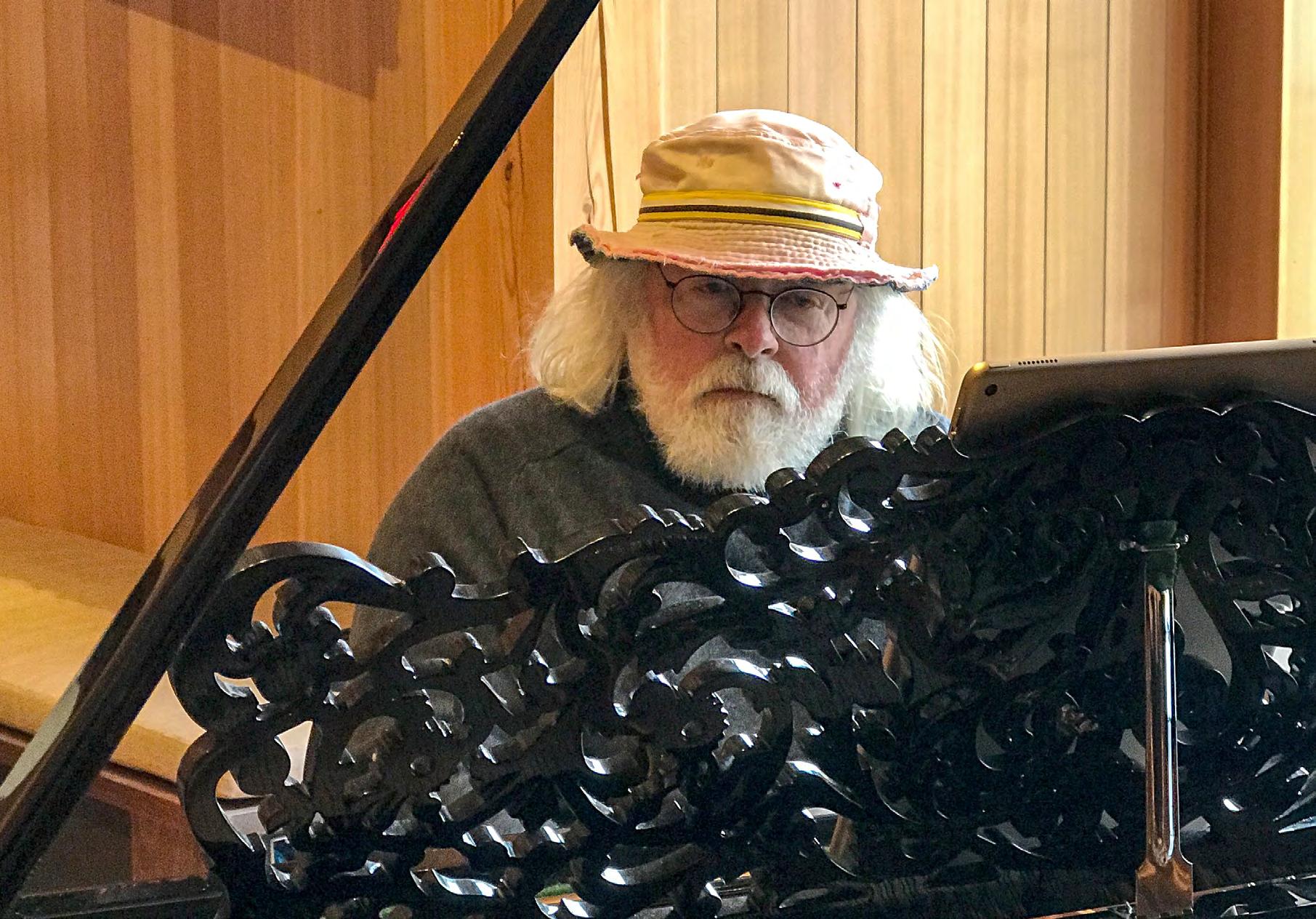
This is a descent from the heights of harmony into the ratty back alley of prose, a transcription into words of the first six measures from the Third Solo Cello Suite by J.S. Bach.
It could equally apply to the first 10 measures of Fugue No. 2 from the Well-Tempered Clavier.
One evening a young man thought he’d take a walk. Let’s call him John. Well, this was an important event, I’ll tell you, worthy of a 21-gun salute. But with only a slight grunt for a fanfare, John began the walk. Oh yes, he will.
Oh no he won’t. Maybe not. Two notes beg to differ. Back to the beginning.
But now one foot in front of the other. The voyage of a thousand miles begins with a single step.
And now three notes beg to differ. With a certain grumpy charm.
But his Maoist trajectory was straight downhill into an alley, turned by gravity into a somewhat depressing slide, rather than a boulevardier’s saunter.
But from the dumpster at the bottom of the alley—it wasn’t really
a very serious encounter—things began to look up for John. Off he went, repeating his steps on the way up the hill, even to the point of grunting at the top, the same way he had grunted when he began.
So it’s a palindrome, then! His day is Groundhog Day, a mirror image. The exact opposite of what he started to do. We all have days like that. As the Red Queen says to Alice about her race, “Now, here, you see, it takes all the running you can do, to keep in the same place. If you want to get somewhere else, you must run at least twice as fast as that!”
So far he hasn’t gotten very far. In fact, he stumbles, goes backwards a bit, and then climbs uphill quickly, stumbles again, and runs uphill to get to where he started, like Alice. Quite comic.
And this is the way he will walk, he determines. He will fool fate, and pretend to go downhill, but then scoot a bit upwards, each time gaining a foot or two. And so he continues for a few minutes of crazy running (but in a distinguished fashion) from goal to goal. Only he knows what those goals are. He is on a mission of his own making, fighting already against the forces which would thwart him, disguised as they might be by gravity. He is Debussy’s General Lavine, an old man out for a walk, avoiding buses, delicately belching.
And so you would say that John was a man of his own mind. But he was in fact a creature of another John, a Johann Bach of Cöthen.
So far he had only gone 10 measures in that particular prelude, a harbinger to what was to come, and the light was remaining steady. Although evening was sure to fall. There were another 18 measures left, so if he had walked for an hour, it would take him another two hours to get where he was going. Even if it was only back home.
And that was, of course, only the beginning.
There would be many encounters along the way, with derelict sharps and somewhat suggestive flats and even an extremely annoying discordance. A fall? A flat tire? Then that awkward gavotte. Back to the dumpster!
Was he taking out the garbage and suddenly it was a bit of an adventure? Or was there someone else there? A second walker. A doppelganger. A hallucination on the mountain. Nitrogen narcosis! Drugged for part of the route, like any good top he rights himself and whirls off, with a few pauses for breath. Back to the safety of the alley.
But there were no clues left by Mr. Bach as to his intent. Everything was written quite simply in basic code. Notes involving one single scale, the same thing coming and going.
Nothing could be more modest than that, nothing could be more noncommittal. And yet much had happened. Now and then there was beauty. Once it almost seemed as if a decision might have been reached. Before the stranger interfered and distracted John.
But although much might have been gathered, nothing could be proved. There were no plots, no programs, no language. Just those eight twists, in a minor way. And yet even in math, there is drama. At least for cellists on vacation.
And now it was time for a dance.

Peter Halstead is a pianist, photographer, novelist, and poet. He studied piano with Russell Sherman in Boston, Irma Wolpe in New York, and organ with Charles Courboin at St. Patrick’s Cathedral, New York.
Peter and his wife, Cathy, are trustees of the Sidney E.Frank Foundation, the Tippet Rise Foundation, and the Adrian Brinkerhoff Poetry Foundation. They are founders of the Sidney Frank Digital Studio in the Rockefeller Library at Brown University, and of Tippet Rise Art Center.
Sea Sun
Sublimation
The World Luciferined
Paris Poems: I
Paris Poems: II
Eyes as Light as Light: Poems for Cathy
Fluorescence (Drawings by Mark Di Suvero)
Blinds
Poems of Earth
Face Your Dreams
Postcard Poems
Poems 2015 – 2017
Poems 2019 – 2022
Castaways
Sunrise at the Equinox: Poems 2023 – 2024
Organized Rhyme: Poems 2024- 2025
BrinkerhoffPoetry.org
Tippet Rise Beginnings (in two volumes)
Prisms in the Air, Grenfell Press
Fluorescence (with Mark di Suvero)
Tippet Rise (Princeton Architectural Press)
Into the Window
A Winter Ride
Bug the Great Window Dressing
The Tempest Moonlight (The Pianist Lost Series) pianistlost.com
Excesses and Excuses
Sunken Cathedrals
Boatsongs
Sehnsucht
The Gift To Be Simple
The Yeti (Metronome, Zarathustra, Parnassus, Schumann’s Clara, Brahms’ Clara, Moonlight, Making of Yeti)?
Fissures in the Snow
https://indd.adobe.com/view/fd8e3a47-96bc-436d-b295d5329e1239bd
Snows and Songs and Ghosts
https://indd.adobe.com/view/8832c77a-95bc-444e-94ff69d0aa9a80ba