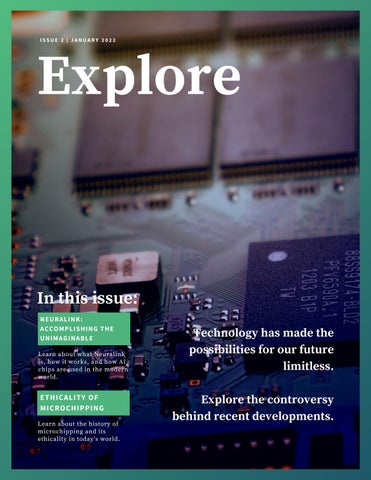
ISSUE 2 | JANUARY 2022
Explore
In this issue: NEURALINK: ACCOMPLISHING THE UNIMAGINABLE Learn about what Neuralink is, how it works, and how AI chips are used in the modern world.
ETHICALITY OF MICROCHIPPING Learn about the history of microchipping and its ethicality in today's world.
Technology has made the possibilities for our future limitless. Explore the controversy behind recent developments.
Contents. 1
Procrastination: Is it truly harmful to students?
4
Procrastination - we've all been culprits of it. This article describes, defines, and explains the effects of procrastination, both positive and negative, on day-today work outcomes and productivity.
2
Virtual and In-Person Learning
Elon Musk's new brain microchip company, Neuralink, could have important applications in helping treat brain disorders, such as Parkinson's and Alzheimer's. This article describes the technology behind this gamechanging innovation. 5
After nearly two years of remote learning, schools across the nation are making a transition back to an entirely in-person learning format. Through this article, explore how the effects of this transition have impacted learning.
3
"Legally" Shampoo: What's in a Shampoo Bottle? Shampoo is a staple in our everyday lives, but rarely do we take the time to contemplate the science behind it. This article describes how shampoos are made, and how they keep our hair healthy.
Neuralink: Accomplishing the Unimaginable
Vaccinations for Children While COVID-19 is known to have harsh effects on older populations, younger children can also be high-risk due to conditions such as MIS-C. This article explains the importance, efficacy, and science behind vaccinating youth against COVID-19.
6
The Ethicality of Microchipping While microchipping can have incredible implications, such as reuniting lost pets with their owners, it can also come with ethical concerns. This piece explains and addresses the benefits, consequences and history of microchipping.
We hope you enjoy Tino Explore Magazine's second issue of the 2021-2022 school year!
Interested in joining our staff? Email tinoexplore@gmail.com or reach out to one of our existing staff members for more information. We'd love to have you!
Procrastination Is it truly harmful to students? By Rishik Buneti and Shreyas Gossakan “If you do it last minute it will only take a minute to do it.” This quote by Shikuri Tinebu, an expert procrastinator, summarizes the thought process of the average procrastinator. To many, procrastination is seen through a negative lens; however, upon closer examination, studies have shown that procrastination is more beneficial than we all take it to be. What exactly is procrastination? As cited from the Oxford dictionary, procrastination is the act of unnecessarily postponing decisions or actions. Procrastination is a fairly common practice, seeing as over 60% of all students do it on a daily basis. But this begs the question: Is procrastination beneficial or not? You may be surprised by the results… To start off, procrastination allows for more time to think before acting. Waiting before starting, is much better than starting and having to redo because of an error that could’ve been prevented with a little more thought or time. Oftentimes procrastination allows for more time to collect information which can prove to be far more efficient. Additionally, delaying an assignment task or decision can relieve stress — at least until the assignment is due. Furthermore, procrastination can help you work in a more efficient manner. This is related to Parkinson’s law, which proclaims that “work expands so as to fill the time which is available for its completion.” Seeing as procrastination forces our brains to function in timeconstrained scenarios, finding the quickest possible solution is almost always necessary. Similarly, procrastination can potentially lead to creative solutions for a problem. Several modern-day inventions are a result of procrastination. A wise man once said, “Diamonds are born under pressure.”
Inversely, procrastination can backfire in the face of the user. Postponing actions will almost always lead to more mistakes; worst case, it can even cause you to miss a deadline. Moreover, procrastination can lead to immense stress and work, which heavily impacts cognitive behavior. In the most extreme cases, procrastination can have detrimental effects such as depression, anxiety, and fear. All in all, the effects of procrastination ultimately depend on several factors, such as the extent of procrastination, and the person who’s attempting to procrastinate. Procrastination, in contrast to other abstract strategies, is subjective. You may delay; however, time will not.
Virtual and InPerson Learning Sarthaki Agrawal | Carrie Chen | Cecilia Huang With the sudden and gradual transition back to in-person learning as a result of the COVID-19 pandemic, there is an obvious difference when it comes to a student’s education. According to an article by writers Cathy Li and Farah Lalani, there are “more than 1.2 billion students in 186 countries”, that are experiencing the change in education. This, of course, raises the question on whether virtual or in-person learning is more beneficial when it comes to teaching a class.
When schools were forced to make students take classes completely online, this came with several consequences; one of them was noticeably a lack of participation. Due to the ability for students to mute themselves and turn off their cameras, this would affect how well they could take in information; this is coupled with the lack of “training, insufficient bandwidth, and little preparation”, and for “students without reliable internet”. Students, in addition, find it much more difficult to reach out for help when they have trouble learning something. The limitations of Zoom are staggering, and on top of that, the screensharing system can feel inefficient compared to its real-life counterpart.
Another impact of online learning is that the curriculum heavily relies on self-study. Despite having breakout rooms where students can hold discussions, this often backfires and results in a scenario where everyone does their own thing. Cheating on tests is also another feature that comes with being on technology--as stated by Derek Newton in the article Another problem with shifting education online: cheating, a survey revealed that “93% of instructors believed that students [were] more likely to cheat online than in person”. However, schools are working to implement anti-cheating software to prevent this in the future.
On the other hand, being in-person means that it will be more obvious if students do not pay attention, and there are little to no opportunities to cheat during exams. In-person learning also places an emphasis on teambased collaboration, which can prove excellent for students that learn more effectively when working with others.The article Benefits of Collaborative Learning points out that individuals can “[work] together to solve a problem” and “complete a task”, while simultaneously fostering “higher achievement and greater productivity.” However, this doesn't mean that there are downsides. The obvious necessity to drive back and forth from school creates traffic problems, and not to mention the fact that students lose hours of sleep from the early start times if they happen to live further away.
After looking at both options for school, it becomes problematic when determining the criteria for a finalized standard on what platform schools can teach on. Virtual learning has a focus on solitary, self-guided learning and study -- which most likely speaks to those who prefer learning on their own and have the capability to prevent themselves from getting distracted by others. However, in-person learning tailors to a collective group-based learning, where students can communicate better and can instantly receive assistance if they need it. In general, while some people prefer online because of the freedom it comes with, it might be hard for others to focus on their work too -- especially with online learning, where spending around six hours takes a toll on one’s attention span greatly. As both types have their respective pros and cons, it simply comes down to personal work ethic, style, and preference.
As we await a day when we can officially deem COVID-19 an event of the past, the experience from spending a year of learning online raises the possibility of it happening again, though this does not necessarily need to be a result of a global pandemic. The applications are limitless: for example, a student who misses a day of school due to an illness or a broken leg can still attend class if they wish to instead of returning with tons of work to accomplish. Further incorporation of online learning for schools could be integrated in the future, but more work will need to be done in order to accommodate each student’s preferences when learning.
"Legally" Shampoo What's in shampoo bottle?
Have you ever wondered how shampoo cleans your hair? What ingredients allow shampoo to clean hair, and how? What is the purpose of the other ingredients? And why are there so many lawsuits for shampoo companies? While the average person uses up to 10 bottles of shampoo each year, how shampoo actually cleans the hair is still a mystery to many. Let’s dive into the science of shampoo and learn how it cleans your hair. After many days of not washing hair, it becomes oily and greasy. This is because the scalp; the skin covering the head, produces a substance called sebum, which is used to coat and protect the hair. Sebum is hydrophobic, meaning it is afraid of water. However, shampoo contains detergent, which is also found in the laundry. In these detergents, there are surfactants, which stands for “surface active agent”. These surfactants, unlike sebum, are both hydrophobic and hydrophilic, meaning both water hating and water loving. Because of this, surfactants can use its hydrophilic properties to remove the sebum and rinse it away with water. Next let’s dive into two lawsuits against famous shampoo brands that can show the consequences of using harmful shampoo ingredients.
In January of 2021, Larissa Whipple filed a lawsuit for Johnson & Johnson OGX shampoos and conditioners. The class action complaint informed that the reason she had purchased the product was due to “false representation that the Products would smooth, nourish, soften, repair, and/or revive her hair.” The concern surrounded a specific ingredient: DMDM hydantoin. This ingredient caused harmful effects including: “itchiness, red rashes on the skin, brittle hair, loss of hair and even dermatitis” as claimed by Whipple. Stated by classaction.org: “DMDM hydantoin works to prevent harmful mold and bacteria growth and extend the shelf life” but there are also many safer alternatives. In addition, the company advertised the product to have nourishing ingredients such as argan oil, biotin, and coconut oil that the product failed to fulfill. In order to learn more about what is truly inside a shampoo bottle, let’s explore further on the DMDM hydantoin the product contained as well as each of the ingredients that were advertised but not in the product.
So far, we already know that DMDM hydantoin is detrimental to consumers’ hair. But why? And to what extent is this antimicrobial harming people’s hair? The United States National Toxicology Program and the International Agency for Research on Cancer recognize formaldehyde, a strong-smelling, and colorless gas, as being a “human carcinogen”. This means it is able to cause cancer in living tissue. In 2009, “a review of the literature on occupational exposures and formaldehyde shows a link between formaldehyde and leukemia.” DMDM hydantoin is a “formaldehyde donor known to slowly leach formaldehyde when coming into contact with water.” DMDM hydantoin is an antimicrobial, or an agent that hinders the growth of microorganisms. The intention was to use a formaldehyde-releaser in order to repel microbes from growing in the water-based product. A consumer purchasing shampoo will use a single bottle on multiple occasions, applying its contents to their hair repeatedly. Concerningly, research shows that as a person is subjected to an irritant over time (this includes DMDM hydantoin), the gravity of the effects escalates. But what about the ingredients the product claimed to contain, such as argan oil, biotin, coconut oil, and more? Are these ingredients softening and nourishing, and, if so, how? Firstly, argan oil is popularly used for the effects of hydration, repairing fibers, and nourishment. According to the International Journal of Trichology, the oil “improves the conductivity of the hair and neutralizes the static charge.” Argan oil reduces frizziness by protecting the hair from humidity. Biotin is also known as Vitamin B7, Vitamin B8, or Vitamin H, found in small amounts in common foods such as salmon, carrots, whole-grain cereals or bread, nuts, chicken, and more. Biotin deficiencies can be genetic or acquired. Its benefits include preventing shedding and providing scalp health, allowing people to have healthier nails and hair. Coconut oil is commonly used as a formula stabilizer that nourishes the hair.
However, the lawsuits do not end with the Johnson & Johnson lawsuit. In 2013, California’s Center for Environmental Health filed a lawsuit against four shampoo manufacturers. Another toxic chemical, cocamide diethanolamine(DEA), an ingredient found in various shampoo bottles which has been found to cause cancer due to the fatty acids in its chemical structure. Michael Green, the executive director of the Center for Environmental Health(CEH) says, “Most people believe that products sold in major stores are tested for safety, but consumers need to know that they could be doused with a cancer-causing chemical every time they shower or shampoo.” Large companies including Walgreens and Kmart were on the list for selling products that included cocamide diethanolamine. Although having DEA in cosmetics and in shampoo is not illegal, CEH warns that these chemicals sharply increase the risk of cancer. Studies in laboratories have found that this chemical specifically increases the risk of kidney cancer and liver cancer. DEA is also found in many cosmetic products and even in sunscreen. However, because of the lawsuit, most products containing cocamide DEA have been removed from shelves. Replacements for cocamide DEA include other hair conditioning agents such as cocamidopropylamine oxide, which have been deemed safe by lab research. Let’s now step back from lawsuits and take a close look at custom shampoo brands.
Recently, there has been a rise in popularity of a new introduction to the hair-care and shampoo industries: customized shampoo. Two companies, Prose and Function of Beauty, are especially prominent. To explain, these brands allow consumers to fill out lengthy online questionnaires about topics such as their diet, hair type, age, living area, stress-level, and more. The unique and recently developed idea, that also costs much more, is making some ask, “Do these products truly work?” And, if so, how do these questions allow custom shampoos to be more beneficial than others?
The personalized questions consumers answer make the formula they receive more suited to their hair. However, according to the cosmetic chemist David Petrillo, “it depends on the manufacturer and how effectively the algorithm of the questions matches up to what actually goes into the products … [because] to be effective, the product must include the right ingredients to address the user's specific issues.” For example, questions
about diet, how often a person will use the product, stress, humidity, styling, or temperature can reveal a person’s individual sebum production. And this information can be used to create a formula catering towards preventing dryness or oiliness in the hair. Previously, we learned about biotin deficiencies. One cause of this can be pregnancy, which is why a question about this topic can lead to the formula including ingredients that will prevent thinning hair. It is always important to research a brand and make sure that the answers to the targeted questions are actually reflected in the product. In conclusion, hopefully, you have a better understanding of how shampoos clean your hair and the effects different ingredients have through the various lawsuits that shampoo brands have faced. We hope you also learned a lot from the custom shampoo brands on how different factors such as diet, mental health, or environment can affect your hair.
Written by: Aahelie Bhattacharya Emily Tsai Designed by: Clarabelle Wang
Neuralink: Accomplishing the Unimaginable Introduction Until the 1880s, gas-powered cars did not exist, and it was only around three decades ago that smartphones were invented. As technology rapidly improves, our world seems to change and flash by our very eyes everyday. And though controlling technology with our minds and vice versa would have been considered completely out of the question only a decade ago, people have already started to work on an invention to make this vision possible: introducing- the Neuralink AI chip. The chip is designed to allow users to control computers and phones with their minds as well as give way for a cure to spinal cord injuries and neurological diseases like dementia, long since considered incurable. In 2016, Elon Musk, the founder of Tesla, co-founded a neural tech startup called Neuralink that aims to create an age where AI develops the potential to aid the human brain. The company is currently working on a project to create this AI chip that would fit perfectly inside the human skull. This article covers the basic structure of the Neuralink AI chip and how it functions, the progress made so far, the applications of the device, as well as the controversy surrounding the chip.
Components of the AI Chip Since 2016, Neuralink has set out on a journey to engineer a “brain-machine interface” chip that would have the ability to write and process brain activity. Designed to be approximately the size of a coin as of 2020, the chip is made up of micro thin wires, each 5 microns wide, that have 1,024 electrodes to spread out within the brain. These electrodes, connected to 1,000 flexible inner threads ten times thinner than a human hair, stimulate neurons in order to read brain activity and write recordings for around 1,000 brain neurons. Then, these recordings are sent to an external device, worn behind the ear, that is controlled by an app. These electrodes not only read brain activity but also fix broken circuits. They stimulate neurons, greatly increasing the capacity of the brain. In addition to the N1 chipset, scientists have developed a surgical precision robot that implants the chip into its host by drilling a small hole into the skull. The robot is specially designed to cautiously puncture blood vessels to minimize scarring.
Applications of the AI Chip So far, Neuralink has come a long way, already having made considerable progress. The chip has already been implanted and tested on a monkey, rat, and pigs. During one of the animal trials, the monkey gained the ability to play video games and ultimately control a computer with its brain. And during the August 2020 live demonstration, Elon Musk presented a pig, Gertrude, who has had the chip for two months and another, Dorothy, whose chip was safely removed. Gertrude’s neurolink could send signals in real time that show sudden spikes in brain activity when she would sniff food nearby and could predict the pig’s movements according to the brain activity the chip sensed.
As the demonstration has shown, the progress the AI chip has made to this day is a sign of great potential of what could come in the future. Musk aspires to implement the chip to restore nerve function, which will help people with paralysis or neurological issues, in addition to curing brain diseases like Parkinson’s and Alzheimer’s. The company states that it hopes to one day cure blindness and epilepsy. With help of the chip, Neuralink also aims to allow humans to recall all of their life memories vividly enough to play the moment like a movie; it will also be made possible to simply download a program to acquire knowledge or learn to speak a specific language.
Controversy
Recently, the development of the AI chip has brought about a great deal of controversy. In response to Musk’s live demonstration, many scientists have argued that it would be far too ambitious to claim that the success with animals would be reflected in human trials because of the enigmatic, intricate nature of the human brain. While Neuralink does plan on utilizing the recordings to decode neurons, Ari Benjamin from the University of Pennsylvania’s Kording lab, points out that more thorough understanding of the mechanics of the brain is necessary, stating that “decoding goals and movement plans is hard when you don’t understand the neural code in which those things are communicated.” In addition, some scientists are skeptical about how the company will decide to handle dementia, which is marked by complex behavior, learning, and memory, fields that are not currently clearly fathomable.
Others are more concerned with the privacy of the people and have urged the government to enforce how data from these technological devices can be safely collected and stored. But aside from how Neuralink plans to take on these hopes and aspirations, the company also faces numerous challenges, such as discovering a way to prevent deterioration and infections on the chip inside the brain, creating a chip that is highresolution and fast-reading, and designing one that combats ethical issues and the consequences that may result from the technology being in the wrong hands. In addition, researchers have also critiqued the slow pace of scientific progress the company has been making in regards to the strained deadlines. Despite the criticism from other scientists Neuralink has faced, hope for invention still remains, as many still support the chip, agreeing that it could possibly be the key to solving neurological problems including spinal cord injuries. Additionally, the FDA has approved the chip as a “breakthrough device,” allowing continual development and research to advance medical technology. Others have expressed awe and wonder at the invention; In fact, in response to the surgical robot, Andrew Hires, an assistant professor of neurobiology at the University of California has said, “Doing this stuff by hand, these are very fine things… it’s very hard to have a steady enough hand to do these things, manually.” And in the midst of all this controversy, still lies the AI chip, currently in the process of potentially becoming a world-altering invention that makes history and life-changer for many. But regardless of whether or not the invention will succeed, it will leave a lasting mark on the history of technological advancements, serving as a learning experience for future generations to come and a symbol of persistence and innovation for humanity.
Written and Designed by Grace Cho, Edited and Designed by Ally Nguyen
Vaccinations for Children Meghana, Joan, Archana Vaccines for children between five to eleven years old have been long-awaited since the start of school reopenings and in-person learning. Scientists have conducted clinical trials with about 3,000 children, and the FDA has determined that the Pfizer-BioNTech COVID19 Vaccine has met the safety and efficacy standards. On November 2, 2021, federal health officials approved the COVID-19 vaccine for approximately 28 million children across the United States ages five to eleven. Many students at Cupertino High School have at least one sibling who falls into this age group. The main difference between the dosage for these children is that although they are still required to receive two vaccines, they only get half the dosage each vaccination. Nearly 1 million children were vaccinated by the end of November 10, 2021, when these vaccines were open to the public. The main reason is that COVID-19 cases in children can result in hospitalizations, deaths, and long-term implications. The spread of the Delta variant resulted in a surge of cases in children throughout the summer. During six weeks between June and August, COVID-19 hospitalizations among children exponentially increased. Elementary school-aged students are getting the Pfizer COVID-19 vaccine because children infected with COVID-19 can also develop multisystem inflammatory syndrome (MIS-C). MIS-C is a condition where different body parts become inflamed, including the heart, lungs, kidneys, brain, skin, eyes, or gastrointestinal organs. Since the pandemic began, more than 2,300 cases of MIS-C have been reported in children ages 5 through 11 years. Children with underlying medical conditions are more at risk for severe illness from COVID-19 compared with children without underlying medical conditions.
Similar to what was seen in adult vaccine trials, the vaccinations were nearly 91 percent effective in preventing COVID-19 among children aged 5-11 years. In clinical trials, vaccine side effects were mild and similar to those seen in adults and with other vaccines recommended for children, the most common symptom being a sore arm. On a side note, cases of myocarditis and pericarditis have been reported after the Pfizer-BioNTech COVID-19 vaccination. Myocarditis is inflammation of the heart muscle, and pericarditis is inflammation of the heart's outer lining. However, these reactions are rare. After the second dose in the week following the vaccination, the risk of myocarditis was around 54 cases per million doses administered to males aged 12–17 years.
The Pfizer-BioNTech COVID-19 vaccination does not pose severe risks for individuals from ages five to eleven. On the other hand, not taking the vaccine makes children more prone to being infected by COVID-19 and the long-term implications that follow the disease. Although the vaccine isn't mandatory, it's highly recommended due to the many benefits it has.
Sources. 1. Benefits of collaborative learning - ScienceDirect. (n.d.). Retrieved January 25, 2022, from ScienceDirect.com | Science, health and medical journals, full text articles and books. website: https://www.sciencedirect.com/science/article/pii/S1877042811030205 2. Kay, G. (2021, April 12). Elon Musk’s Brain-Chip Startup Could Test on Humans This Year. Retrieved January 25, 2022, from Business Insider website: https://www.businessinsider.com/elon-musk-predicts-neuralink-chip-human-brain-trials-possible-2021-2021-2 3. News. (2020, August 29). Neuralink: Elon Musk unveils pig with chip in its brain - BBC News. Retrieved January 25, 2022, from BBC News website: https://www.bbc.com/news/world-us-canada-53956683#:~:text=Musk%27s%20team%20implanted%20a%20chip%20in%20the%20brain 4. Online testing and education led to a rise in cheating, data shows. (2020, August 7). Retrieved January 25, 2022, from The Hechinger Report website: https://hechingerreport.org/another-problem-with-shifting-education-online-cheating/ 5. Pd. (2021, September 18). The Neuralink Brain Chip | Elon Musk Neuralink. Retrieved January 25, 2022, from Elon Musk Neuralink website: https://elonmuskneuralink.com/the-neuralink-brain-chip-elon-musk-neuralink/ 6. Sonnemaker, T. (2020, August 28). Elon Musk Revealed Neuralink’s AI Brain Chip: Here’s What Happened. Retrieved January 25, 2022, from Business Insider website: https://www.businessinsider.com/watch-elon-musks-big-neuralink-announcement-2020-8 7. The rise of online learning during the COVID-19 pandemic | World Economic Forum. (n.d.). Retrieved January 25, 2022, from World Economic Forum website: https://www.weforum.org/agenda/2020/04/coronavirus-education-global-covid19-online-digital-learning/ 8. Tiwari, S. (n.d.). Neuralink Explained: Merging Humans With AI. Retrieved January 25, 2022, from Bingedaily : Stories On Trends, Culture, Food and Sex. website: https://www.bingedaily.in/article/neuralink-explained-merging-humans-withai#:~:text=Neuralink%20connects%20the%20human%20brain%20to%20computers%20through 9. Vavra, K. (2020, July 21). What is Elon Musk’s brain chip neuralink and what will it do? – The US Sun. Retrieved January 25, 2022, from The US Sun website: https://www.the-sun.com/news/1174237/what-is-elon-musks-brain-chip-neuralink/ 10. SIROIS, FUSCHIA M. PROCRASTINATION, HEALTH, AND WELL-BEING. http://www.library.deep-bluesea.net/Procrastination/Fuschia%20M%20Sirois,%20Timothy%20A%20Pychyl-Procrastination,%20Health,%20and%20Well-BeingAcademic%20Press%20(2016).pdf. 11. About the Author: Mill Creek Animal Hospital. (2020, December 1). Should my pet be microchipped? 5 reasons why microchipping is important for pets. Mill Creek Animal Hospital. Retrieved December 6, 2021, from https://millcreekah.com/should-my-pet-be-microchipped-5-reasons-why-microchipping-isimportant-for-pets/. 12. Daniel Allen Animal Geographer. (2020, November 5). Compulsory cat microchipping is great in theory -- but the system is flawed. The Conversation. Retrieved December 6, 2021, from https://theconversation.com/compulsory-cat-microchipping-is-great-in-theory-but-the-system-is-flawed-130084. 13. DVM 360. (2020, April 27). Veterinarians wrestle with legal ethical concerns over microchips and ownership. DVM 360. Retrieved December 6, 2021, from https://www.dvm360.com/view/veterinarians-wrestle-with-legal-ethical-concerns-over-microchips-and-ownership. 14. Microchips dump legal, ethical baggage on Veterinarians. News. (n.d.). Retrieved December 6, 2021, from https://news.vin.com/default.aspx? pid=210&Id=3902953. 15. California's Office of Environmental Health. (n.d.). Alternatives to Cocamide DEA. Retrieved November 27, 2021, from https://www.stepan.com/content/dam/stepan-dot-com/webdam/website-product-documents/literature/agricultural-solutions/Copy-of-EWBrochurev.5.pdf. 16. Wikimedia Foundation. (2021, October 23). Cocamide Dea. Wikipedia. Retrieved November 27, 2021, from https://en.wikipedia.org/wiki/Cocamide_DEA#:~:text=Safety,on%20a%20dermal%20animal%20bioassay. 17. Ivan Boyer, C. L. B. (n.d.). Safety assessment of pegs cocamine and related ingredients as used in cosmetics - Ivan Boyer, Christina L. Burnett, Wilma F. Bergfeld, Donald v. Belsito, Ronald A. Hill, Curtis D. Klaassen, Daniel C. Liebler, James G. Marks, Ronald C. Shank, Thomas J. Slaga, Paul W. Snyder, Lillian J. Gill, Bart Heldreth, 2018. SAGE Journals. Retrieved November 27, 2021, from https://journals.sagepub.com/doi/10.1177/1091581818794417. 18. Oliver, D. (2021, July 19). Johnson & Johnson hair products cause hair loss, lawsuit claims. WebMD. Retrieved November 15, 2021, from https://www.webmd.com/beauty/news/20210719/johnson-johnson_shampoo-hair-loss. 19. Formaldehyde. American Cancer Society. (n.d.). Retrieved November 15, 2021, from https://www.cancer.org/cancer/cancercauses/formaldehyde.html. 20. Formaldehyde and formaldehyde-releasing preservatives. Safe Cosmetics. (n.d.). Retrieved November 15, 2021, from https://www.safecosmetics.org/getthe-facts/chemicals-of-concern/formaldehyde/. 21. Our commitment to health and safety. J&J Consumer Health. (n.d.). Retrieved November 15, 2021, from https://safetyandcarecommitment.com/ingredients/preservatives. 22. How does anti-bacterial shampoo work. HealthyHairPlus.com. (n.d.). Retrieved November 15, 2021, from https://www.healthyhairplus.com/how_anti_bacterial_shampoo_work_s/4191.htm#:~:text=Antibacterial%20shampoos%20work%20to%20rid,of%20b acterial%20and%20fungal%20groups. 23. Lawsuit alleges Johnson & Johnson Ogx Shampoo Products Cause hair loss. AboutLawsuits.com. (2021, July 14). Retrieved November 15, 2021, from https://www.aboutlawsuits.com/johnson-johnson-ogx-shampoo-cancer-lawsuit-185774/. 24. Scribd. (n.d.). Class action lawsuit against Johnson & Johnson. Scribd. Retrieved November 15, 2021, from https://www.scribd.com/document/514525168/Class-Action-Lawsuit-Against-Johnson-Johnson#from_embed. 25. Anne Marie Helmenstine, P. D. (2019, September 8). How shampoo works and the chemistry behind it. ThoughtCo. Retrieved November 15, 2021, from https://www.thoughtco.com/how-shampoo-works-607853. 26. MediLexicon International. (n.d.). Daily hair washing: Recommendations and alternatives. Medical News Today. Retrieved November 15, 2021, from https://www.medicalnewstoday.com/articles/319848#why-shampoo-your-hair. 27. Anne Marie Helmenstine, P. D. (2019, March 31). What is a surfactant? ThoughtCo. Retrieved November 15, 2021, from https://www.thoughtco.com/definition-of-surfactant-605928. 28. Buddies, S. (2014, June 26). Surface tension science: Build a raft powered by soap. Scientific American. Retrieved November 15, 2021, from https://www.scientificamerican.com/article/surface-tension-science-build-a-raft-powered-bysoap/#:~:text=When%20detergent%20is%20added%20to,water%20molecules%20from%20one%20another. 29. Water treatment solutions. Lenntech Water treatment & purification. (n.d.). Retrieved November 15, 2021, from https://www.lenntech.com/aquatic/detergents.htm#:~:text=Surfactant%20detergents%20are%20implicated%20in,easily%20absorbed%20by%20the %20fish. 30. Segran, E. (2019, October 2). The future of packaging could be as simple as a bar of soap. Fast Company. Retrieved November 15, 2021, from https://www.fastcompany.com/90412294/the-future-of-packaging-could-be-as-simple-as-a-bar-of-soap.
administration. EDITOR-IN-CHIEF + PRES / ASHWIKA AGRAWAL VICE-PRES / JESSICA XIAO ADMIN ASSISTANT / TIFFANY HO ADMIN ASSISTANT / NAVYAA GUPTA ADVISOR / MRS. PLAT LEAD CONTENT MANAGER / JOAN THYAGARAJAN CONTENT MANAGER / SARTHAKI AGRAWAL CONTENT MANAGER / SWAPNIL DAS CONTENT MANAGER / MAISHA GUPTA CONTENT MANAGER / HYUNJUN KIM CONTENT MANAGER / JENNA LEE PUBLICITY DIRECTOR / RISHIK BUNETI PUBLICITY DIRECTOR / SHREYAS GOSAKAN BRANDING DIRECTOR / CECILIA HUANG BRANDING DIRECTOR / ARCHANA KRISHNAN BRANDING DIRECTOR / MEGHANA VINJAMURY
staff. Sarthaki Agrawal, Aahelie Bhattacharya, Rishik Buneti, Carrie Chen, Grace Cho, Shreyas Gosakan, Maisha Gupta, Cecilia Huang, Hyunjun Kim, Archana Krishnan, Ally Nguyen, Joan Thyagarajan, Emily Tsai, Meghana Vinjamury, Clarabelle Wang, Sarah Zuo
socials.
tinoexplore@gmail.com @tinoexplore tinyurl.com/chsexplorewebsite facebook.com/tinoexploremagazine
THANK YOU FOR READING!
TECH
EVOLUTION We hope you've enjoyed reading the second 2021-2022 issue of the Tino Explore Magazine. If you find any typos or errors, or if you have suggestions for future issues, email us at tinoexplore@gmail.com. Interested in joining our staff? We're always looking for writers, editors, and designers, so DM us on Instagram or Facebook, or send us an email to get information on becoming a staff member.