$8.00
JANUARY 2015
Vol. 23 No. 2
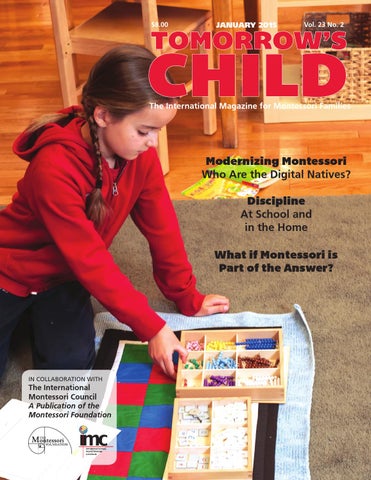
Modernizing Montessori Who Are the Digital Natives? Discipline At School and in the Home What if Montessori is Part of the Answer?
IN COLLABORATION WITH
The International Montessori Council A Publication of the Montessori Foundation
TOMORROW'S CHILD Š w JANUARY 2015 w WWW.MONTESSORI.ORG
1
603
E Suite
102
77062
Custom support and service enhancement
Premium hardwood Montessori materials
D r.
H o u s t o n , Te x a s
Solutions for all classrooms designed to meet your needs Requirements & design
Chedwor th
Te l
877-409-2929
Fax
877-409-7402
ETC
MONTESSORI
Personal assistant
Authentic Montessori curriculum
YourYour satisfaction howwewe measure our success. No one your plans and needs than you do. satisfaction is is how measure our success. No one knows yourknows plans and needs better than you do.better However, However, when ittocomes to asetting up and a classroom and that using materials that our name, when it comes setting up classroom using materials carry our name, wecarry need to make surewe thatneed you to make completely ed. To do this every one packages materials, and complete, up-to-date surearethat you aresatisfi completely satisfied. Toofdoourthis every contains one of premium our packages contains premium materials, and Montessori curricula. Montessori We also begincurricula. by listeningWe carefully, to listen throughout our relationship. Oncethroughout complete, up-to-date beginand bycontinue listening carefully, and continue to listen we understand your needs for today and the future, we can show you how using our classroom set-ups can improve our relationship. Once we understand your needs for today and the future, we can show you how using our your educational processes while allowing you to maintain a competitive edge. materials and full classroom solutions can improve your educational processes while allowing you to maintain a competitive edge.
Existing Classrooms - Innovative curriculum solutions
Materials and Full Classroom Solutions for New and Existing Environments
Scan here
New Classrooms - Full classroom solutions
For our clients who wish to open a new classroom with new Montessori curriculum and new hardwood materials. Elementary I (Level 6-9) complete classroom solutions Elementary II (Level 9-12) complete classroom solutions
www.ETCMontessori.com
2 ETCmontessori.com
www.ETCMontessriOnline.com
our online store
our clients EarlyFor Childhood (Levelwho 3-6)wish to simply update their Montessori curriculum while keeping their existing hardwood materials. Elementary I (Level 6-9) - includes 12 months of free update assurance Elementary II (Level 9-12) - includes 12 months of free update assurance Elementary I (Level 6-9)- includes complete solutions Elementary I & II (Level 6-12) 12curriculum months of free update- includes assurance12 months of free update assurance Elementary Middle School II (Level 9-12) complete curriculum solutions - includes 12 months of free update assurance
to visit
www.ETCConsulting.org
TOMORROW'S CHILD Š w JANUARY 2015 w WWW.MONTESSORI.ORG
Tomorrow’s Child (ISSN 10716246), published four times a year, is the official magazine of The Montessori Foundation, a non-profit organization. The opinions expressed in Tomorrow’s Child editorials, columns, and features are those of the authors and do not necessarily represent the position of the magazine or The Montessori Foundation. Acceptance of advertising does not represent the Foundation’s endorsement of any product or service. It is policy of The Montessori Foundation, a non-profit organization, to encourage support for the organization by discounting the sale of bulk order shipments of Tomorrow’s Child in order that schools may make the magazine available to their families. The Montessori Foundation does NOT grant permission to reprint material from Tomorrow’s Child in any other form (e.g., book, newsletter, journals). Copies of this issue or back issues are available for purchase through our online bookstore: www.montessori.org. For Standing Bulk Orders, call 800-655-5843 (toll free), use the order form on page 38, or place your order at www. montessori.org. The Montessori Foundation does not provide refunds for cancelled standing bulk orders. Send all correspondence to: The Montessori Foundation 19600 E State Road 64 . Bradenton, FL 34212-8921 Phone: 941-729-9565/1-800-655-5843 Fax:941-745-3111 WWW.MONTESSORI.ORG EDITOR Joyce St. Giermaine PRESIDENT Tim Seldin PROGRAM DIRECTOR Lorna McGrath EVENTS & MEMBERSHIP Margot Garfield-Anderson ADVERTISING Chelsea Howe BOOKKEEPER Don Dinsmore FULFILLMENT Michael Anderson GRAPHIC DESIGN Katrina Costedio PRINTED BY InterPrint Note: InterPrint is now FSC,SFI and PEFC Chain-of-Custody Tri-Certified. Chain-of-custody certification offers paper that has been harvested from responsibly managed forests, then verifiably traced through all stages of print production. Conferences & Workshops IMC Margot Garfield-Anderson: Phone: 941-309-3961/Toll Free:800-632-4121 Fax: 941-359-8166 email: margot@montessori.org Past Issues, Books & CD Orders For immediate service, use our secure online bookstore at www.montessori.org. For questions regarding an order, email: margot@ montessori.org or Phone 941-309-3961/Toll Free: 800-632-4121 Subscriptions & Bookkeeping Don Dinsmore Phone: 941-729-9565/1-800-655-5843 Fax: 941-745-3111 dondinsmore@montessori.org Classified & Display Advertising Chelsea Howe Phone: 941-729-9565/Fax: 941-745-3111 tcmag@montessori.org Parenting Center Lorna McGrath Phone: 941-922-4949/1-800-655-5843 Fax: 941-745-3111 lornamcgrath@montessori.org
JANUARY 2015
7
What if Montessori Is Part of the Answer? by Dennis Shapiro
10
Discipline in the Montessori Classroom and in the Home by Dr. Paul Epstein
15
Teaching Children to Care: Coming of Age in a Culture of “Me” by Cindy Acker
17
Stay the Course: The Importance of the Kindergarten Year in the Montessori Classroom by Tim Seldin
19
Good Things Come in Small Packages: Why Small Schools Work by Tim Seldin
24
Living with Adolescents: Understanding How They Move by Patricia de Leon
30
The Smile by John Long
31
Modernizing Montessori: Who Are the Digital Natives? by Mark Powell
6 CALENDAR
26 DEAR CATHIE
21 MONTESSORI 101
Challenging Behavior
What Teachers Wish You Knew
27 GRANDPARENT’S CORNER
22 BOOK REVIEWS
The Montessori Way
24 LIVING WITH ADOLESCENTS
28 CLASSIFIEDS
Understanding How They Move
38 TC ORDER FORM
TOMORROW'S CHILD © w JANUARY 2015 w WWW.MONTESSORI.ORG
3
JANUARY 2015
a
Letter from the President S
everal months ago, my colleague and friend, Mark Powell, sent me an email asking if I would share my thoughts on computers, other digital technology, and children. Mark reached out to several of us, gathering insight and reflection as he prepared an article that was eventually entitled “Modernizing Montessori: Using Digital Technology to Engage Learners in 21st Century Montessori Classrooms.” An excerpt of Mark’s article appears in this issue of Tomorrow’s Child on page 31. The entire article will appear in the next issue of Montessori Leadership magazine.
Tim Seldin President of the Montessori Foundation
Mark began by asking the question: Is Montessori Technophobic? I answered that, to the very best of my knowledge, Maria Montessori was anything but technophobic. Computers had not yet been invented during her lifetime, but she lived in a world transformed by the inventions of ingenious men and women, and she was both a scientist and a futurist. Over the years, people who knew Dr. Montessori told me that she was fascinated with movies that showed news, cities, natural phenomena, and attempts to portray historical events. Very early in her career, she arranged for movies to be made of the children at work in the first Montessori schools in Italy, and she showed them as part of her public lecture series in Europe and in the United States. I was told that she envisioned a day when elementary children could load film themselves and view a library of images and sound. Since the 1970s, I’ve had a long love affair with digital technology , but it didn’t start that way. As a college student, computers were rare, filled entire rooms, and ran on punch cards. They were completely foreign to me. I was intimidated. It was my son, Marc, and his friends who led me into the world of computers and other digital miracles. Thanks to Marc, I became one of those pioneers who, in the 1970s and 80s, dared to introduce computers into our school (the Barrie school, in Silver Spring, MD), when none of us on faculty or staff knew much about them ourselves. We followed Dr.
4
Montessori’s process of observing what the children did, recording what we witnessed, learning as much as we could along the way, and conducting informal experiments in our classrooms. Dr. Seymour Papert, a professor of mathematics and computer scientist at MIT, was one of the pioneers of artificial intelligence, as well as an inventor of the Logo Programming language, which became immensely popular during the 1980s. In his book, Mindstorms, Dr. Seymour Pappert described the computer as the children’s machine. My son, Marc (now 44), and his generation were the first to grow up in a world where the personal computer came of age and became widely available. This generation (and the generations that have followed) have a completely different relationship with computers than those of us who were introduced to them as adults. How I Overcame Technophobia I must have grown up with undiagnosed learning disabilities. Although I was an early reader, my eyehand coordination was poor, and my handwriting was almost illegible. At age five, I learned to type by hunt-and-peck on a Swiss ultra-light portable typewriter that I carried through high school and university. In graduate school, I was given special permission to take my comprehensive exams on my heavy weight Adler electric typewriter. When IBM Selectric typewriters came out with a built in white-out strip, I was in love. My first exposure to a computer was playing Tic Tac Toe in one of our Children’s House classes in the early 1970s on a portable terminal that was connected by acoustic modem to the mainframe computer at American University. Marc and I went to our first computer show in Philadelphia in 1977, and both of us were hooked. At Barrie, our very first computer was a DEC PD8 that was the size of a small refrigerator. It cost $15,000, and another Montessori colleague and I
TOMORROW'S CHILD © w JANUARY 2015 w WWW.MONTESSORI.ORG
flew to the Mall of New Hampshire in Manchester, where the first computer retail store had just opened. We bought three, rented a truck, dropped one off at the American Montessori Society offices in New York, and took the other two to Maryland. I remember the technician who came to Barrie to install it in the ‘dust-free’ glass room that we built to house it. I called that first computer OSWALD. The letters stood for “Oh S*#% We Lost All the Data.” I am working on OSWALD #23 right now. At Barrie, we started buying TRS-80s, Ataris 800s, and Apple IIs in the late 1970s. We ran computer camps in the summer to fund them. No adults knew a thing about them, including me. It was the children who figured them out and taught us. By 1980, we had more than one hundred Apple IIs (actually, they were Syscoms, a knock-off brand that was half the price). I remember using one as my own, working with the early word processor (The Electric Pencil) and some early spreadsheet and database software. In 1982, I bought an Apple Lisa, the first digital icon-based operating system sold by Apple. It was a revelation, and to me, it was worth every penny of the $12,000 that it cost at the time. A few years later, I traded it in for one of the early Macintoshes. I had a backpack and lugged that thing everywhere. Apple MacIntosh computers spread throughout Barrie just as the Apple II did. Today at NewGate School, our Lab School in Sarasota (FL), the entire campus is wired, and students are encouraged to use tablets or laptops from Upper Elementary through Secondary. Most Upper Elementary students use them heavily, and by the Secondary level, the computer is an essential tool. Yes, we live in the age of digital connectivity, and the computer offers a wealth of information and wonderful tools to facilitate learning and the creative process. I Love Computers, But Not For Very Young Children At the same time, like most Montessori educators, I do not believe that tablets and computers have a place in our Infant, Toddler, or Early Childhood Classrooms.
We strongly encourage parents to strictly limit children’s time spent in front of the TV and to avoid allowing young children ready access to computers and tablets. Why? Today many children spend several hours a day engaged with digital media: television, computers, tablets, smart phones, and other electronic devices. Throughout the US, Canada, and other techdeveloped countries, experienced teachers describe many of their students as having
“Never give more to the mind than you give to the hand.” Maria Montessori considerably shorter attention spans, limited ability to think analytically and express their thoughts, and are more challenged when asked to solve complex problems than in the past. This widespread concern led to the development of the Common Core curriculum, which was intended to address this set of critical skills, but the question remains: What factors might be contributing to this trend? Brain research strongly suggests a major factor might be the ever-present access to digital media and technology at an early age. Dr. Montessori often said that the mind is built by the hand. Children learn best by doing real things, not by watching. They learn by exploring, trial and error, and the manipulation of real things in three-dimensional space. The four strategic goals of Montessori for the young child are the development of an inner sense of order, the ability to concentrate, a strong sense of independence (“I can do it for myself!”), and an excellent sense of coordination of both the fine muscles of the hand and the balance and agility of movement of the whole body. When children build the Pink Tower, learn to pour water into a glass from a pitcher without spilling, and can carry a tray with several objects across the room without dropping or tripping, they are developing stronger brains.
TOMORROW'S CHILD © w JANUARY 2015 w WWW.MONTESSORI.ORG
Learning is not simply the memorization of the names of objects or the right answers. It involves many different activities. When children are very young, much of this has to do with working with their hands and moving their bodies in space. Whatever positive benefits TV sets, computers, and tablets might offer, they are two-dimensional and do not offer that possibility, at least not at this point in the evolution of technology. As a child carries a chair across the room, attempts to walk along the line heel to toe, or attempts to build the tower of cubes, they are experiencing the size, the shape, and the feel of real objects and of the balance of their own bodies in three-dimensional space. No computer simulation can replace that learning opportunity. And in the long run, these experiences help the child’s brain understand place in space and how to control and refine their movements in ways that last for a lifetime. It doesn’t mean that there are not valuable skills that can be learned from computers. Using a tablet, or even a mouse or a trackpad, all involve refined movements of the hand. Our position is simply that those skills are better learned later. When the child is very young, it’s far better to work with real objects than images of them. Brain research confirms Dr. Montessori’s insight that children construct themselves through direct hands-on experiences. We know that children’s brains are developed through the combined factors of a child’s genetic inheritance (potentialities, gifts, predispositions, and limitations) and by his or her experience, especially during the first six years of life. While the brain continues to develop all the way through young adulthood, it is during those first critical months and years that the human brain is particularly sensitive to certain kinds of impressions and experiences. If stimulated, the brain develops neurological connections that will last for a lifetime. If the child’s early environment and experience do not provide the right stimulation, that part of his or her human potential is likely never to develop. During the years of sensitivity, the child unconsciously absorbs impressions and experience from the environment. As Montessori parents, you’ve almost certainly heard your children’s teachers discuss the
5
idea of Sensitive Periods and the Absorbent Mind. These concepts, originally identified by scientists like Dr. Montessori, are now widely recognized around the world. As digital technology has become omnipresent, scientists and physicians have become increasingly concerned at how overexposure to digital media and technology may be affecting children’s brain development.
Likewise, there is a growing concern that children are becoming exposed to digital content that is violent, sexualized, and wholly inappropriate. Cyber-bullying and the use of the Internet by sexual predators are still other concerns. Clearly, this is something that we cannot simply take for granted. It requires careful
As digital technology has become omnipresent, scientists and physicians have become increasingly concerned at how overexposure to digital media and technology may be affecting children’s brain development. Pediatric neuroscientists, like Dr. Stephen Hughes and Dr. Jane Healy, specialize in this field of research. They stress the importance of how a child’s early experiences literally affect the brain’s biological development, as certain neurons are strengthened through stimulation and use, while others are pruned through lack of stimulation and disuse. This has led them and others to conclude that very highquality early childhood educational programs, such as Montessori, build better brains. Increasingly, scientists believe that computers, television, and other digital devices, as we know them today, do not contribute to optimal brain development in young children. The American Academy of Pediatrics (AAP) recommends that infants and children under age two not be exposed at all to television and other entertainment media. Their concern, and ours as well, is that during these all-important early years, a young child’s brain is developing rapidly. They need experience with people and real things, not with digital images. They need to be active, not passive, observers. Studies suggest a link between excessive screen time in young children and attention problems, difficulties in school, sleep and eating disorders, and obesity.
6
thought, consideration, and the development by each family and school of guidelines that they feel are appropriate. Children need to be taught how to understand the mass media and what they are likely to encounter online. They need to be taught how to avoid risky behavior. As a result, even though I recognize the many ways in which digital technology can enhance learning and facilitate the creative process with older children, I do not recommend them for children under age six. We present Mark Powell’s article on page 31 as food for thought about how technology is an important tool of today’s world and how we can help students expand their horizons while staying safe.
Tim Seldin President of the Montessori Foundation
CALENDAR March 12 – 15, 2015 AMS Life. Liberty. Montessori! AMS 2015 Annual Conference Philadelphia, PA www.amshq.org/Events June 28 - August 1, 2015 NAMTA The AMI Montessori Orientation to Adolescent Studies Huntsburg, Ohio www.montessori-namta.org November 5- 8, 2015 IMC & MF Montessori Foundation and IMC 18th Annual International Conference Sarasota, FL www.montessori.org
Order today and take advantage of our Early Bird Discount for the 2015/16 school year. Provide Tomorrow’s Child to your school’s families with a Standing Bulk Order. Compare our Early Bird price of $13.75 per family to our regular price of $16.00 per family … and then compare that to our individual subscription price of $30! Wow! Standing Bulk Orders are just for Montessori schools. The minimum order is 50; however, if your school has fewer than 50 families, please let us know by calling our office (toll free) at 800-655-5843. Tomorrow’s Child is the only magazine created just for Montessori parents, and we want to help you grow your school! See page 38 for more information or visit our website: www.montessori.org. Special offer ends May 31, 2015. For schools outside the US, please call our office (1+941-729-9565) or email Don Dinsmore (dondinsmore@montessori.org) to calculate shipping and handling costs.
TOMORROW'S CHILD © w JANUARY 2015 w WWW.MONTESSORI.ORG
What If Montessori is Part of the Answer? by Dennis Shapiro
Editor’s Note This article by Dennie Shapiro was originally published in our very first issue of Tomorrow’s Child in 1992. Twenty-two years later, the statistics have changed but not the need, and because of this, Dennie’s article is as relevant today as it was so many years ago. In preparing this article (and I had to re-type it because it was pre-digital), we have updated some facts to reflect today’s numbers and years. Unfortunately for the world of Montessori, especially Montessori in the public sector, Dennie passed away this year. As publisher of Public School Montessorian, Dennie was a staunch advocate for bringing Montessori to children of all socioeconomic levels. He was a voice of hope and reason and he will be so greatly missed. – Joyce St. Giermaine
INTRODUCTION
T
he corporate executive drops a child at a Montessori preschool, cuts a healthy check for tuition, then goes into a seminar discussing the daunting prospects for educational reform. The school board member bemoans the fact that the board cannot get down to the nitty-gritty of reinventing schools until it can quiet down the angry delegation of parents on the waiting list for the district's Montessori magnet school. The college of education is positioned on the cutting edge of teacher education, spotlighting a professor who has discovered cooperative
teaming, another who promotes manipulatives for math, another doing whole language, another consulting on multi-age grouping. A couple of miles away, a Montessori-education trainer,who has been doing all of these for more than two decades, checks her account books to see if her center will be able to pay this month's payroll. What's wrong with these pictures? You need not embrace the notion that the Montessori Method holds the cure for all that ails American education to regret that it has never been given a fair chance to prove just how much it can do.
TOMORROW'S CHILD © w JANUARY 2015 w WWW.MONTESSORI.ORG
We talk about needing a systematic rather than piecemeal reform. The Montessori approach is integrated across the curriculum and through the ages from preschool through secondary. The benefit may be greatest for those children from chaotic homes. By creating respectful, stable, and integrated learning environments for children from early years and beyond, Montessori schools can provide a sense of order in an otherwise disordered world.
7
T
oday about 3,000 independent schools and about 130 public schools (some starting with preschools, some reaching eighth grade) describe themselves as "Montessori schools." [Editor’s Note: Today, the total is more like 5,000 independent Montessori schools and 500 public Montessori schools, some of which go all the way through the twelfth grade.] Where Montessori has been accepted in the public sector, it has often been as a desegregation tool. The Montessori Method, painstakingly developed by Maria Montessori in the early years of this century, was built on the needs of the neediest children. It is the advocacy of white, middle-class women that revived the movement and kept it alive in the United States. Thus, for city school systems like those in Cincinnati, Dallas , Denver, Kansas City, and Milwaukee, Montessori schools become an obvious strategy: Montessori magnets, if done well are effective with the neediest and draw children of the middle class. Nearly everywhere it has been implemented in the public sector, the waiting lists are long, and the signs of parent approval are clear. Is it out of line to ask if there is some larger contribution this approach could make? Expansion of programs is limited by several factors, including the shortage of trained Montessori teachers, the up-front costs of starting a program, and most important, the discomfort key players both Montessorians and those in the public sector, have in making the leap of faith necessary to move forward. Some background on the Montessori movement is important. Here's a quick tour:
Maria Montessori, born in 1870 and one of the first female physicians in Italy, focused her attention on the way young children learn. Her approach was scientific and inductive. She watched and developed materials and procedures that built on children's capacities and proclivities. She was a system builder before the term was used. She looked to develop an approach that worked on a given day and provided a basis of continuity that would work with children years later. Materials were designed to be selfcorrecting, emphasizing children's contact with learning rather than judgments or interventions of teachers. The entire curriculum is linked in many ways, including
8
materials that are used at different levels of sophistication as the children grow. The experience is built upon the intellectual and spiritual potential of the children and their connections to other people and the natural world. By 1914, Montessori had written about her successful school in Rome and her vision. With some assistance from the American media, she became a celebrity, traveling to the United States for lectures and consultation. Even then, Americans were looking for panaceas. Montessori was not a compromiser. Her distrust of others to carry on or interpret
icy, although policymakers did take to shipping their children off to private Montessori schools. Some observers question the relationship between this lack of acceptance and the fact that the movement was revived by a grassroots campaign made up almost entirely of women. Over the past 30 years [now 50 years], the movement has become fractioned in the United States. The Association Montessori Intemationale (AMI), based in Holland, is the organization Montessori established to protect her vision. It has a branch in the United States. Although it resists ‘Americanization,’ the AMI is a significant factor in this coun-
Satisfied parents and young people are the basis for the judgment. Unfortunately, traditional research is not. Some conventional research has been done, but the best of it is only suggestive. her work may have preserved her Method's purity, but it undermined its effectiveness in the United States. The American educational establishment would have nothing to do with her ‘all-or-nothing’ offer. In a 1914 book, The Montessori System Examined, William Heard Kilpatrick gave American educators carte blanche to reject the approach out of hand, and they did for almost 50 years. As the approach withered in the United States, it survived reasonably well in the rest of the world. Then in the1960s, Nancy Rambusch (then a professor of early-childhood education at SUNY-New Paltz) and a band of other mothers led a revival. In essence, they countered a major objection to Montessori's Method—Montessori herself! They were commit ted to taking the principles of the approach and adapting them to the American experience. Montessori had died in 1952, but those who had risen to protect her work, and some would say in the process elevated the woman to the status of a cult figure, no longer had a monopoly. The principles she espoused (not simply her personality and extrapolations of her archival material) would play a vital role in the Montessori movement in the United States. Even in the revived form, the approach could not penetrate mainstream educational pol-
try, and at least four successful public school systems follow its lead closely. The American Montessori Society (AMS), founded by Dr. Rambusch, is the largest Montessori organization in the United States and most active in the public schools. Dozens of smaller groups and individuals provide Montessori training. Although a new, voluntary organization was founded in 1995 to accredit teacher training [MACTE] programs and provide some agreed-upon standards, there is no single nationally accepted model of a ‘Montessori school’ or a ‘Montessori training’ regimen. Given the difficulty in standardizing Montessori-based education and the outsider status to which it has been relegated, one thing must be said: If done with any reasonable amount of integrity, it works. Satisfied parents and young people are the basis for the judgment. Unfortunately, traditional research is not. Some conventional research has been done, but the best of it is only suggestive. Lacking a standard of definition of a Montessori school, or classroom, there is no reliability of measurement. Each study of Montessori programs begins with a different set of classroom conditions, making generalizations impossible.
TOMORROW'S CHILD © w JANUARY 2015 w WWW.MONTESSORI.ORG
Research problems go beyond that. Children in good Montessori classrooms have usually done quite well on standardized tests, but it appears that they show even greater advantages over their peers when measured years later. This suggests that these children may be building a strong base for later learning, whether or not they reach the year's districtwide learning objectives. For that reason, research would need to be long term. Also, the goals of a Montessori-based education go beyond the easily measurable. How do you measure the uneven evolution of children who grow into adults who respond creatively to new challenges, resolve conflicts effectively, understand their relatedness to others, and take responsibility for their own lives? It’s not surprising that the university-based research community has shied away from Montessori education. By now, it is a vicious circle. Few university researchers study the approach, and without research, we have no proof that it is effective, no way to justify its place in higher education. Without formal acceptance, bits and pieces of Montessori’s Method have become standard fare in schools: manipulatives for math; a literature-based approach to reading;
multi-age grouping; worldview social science curriculum; emphasis on the developmental levels of children and; structured observation by the teacher. What is missing in this piecemeal borrowing is the integrated whole. It is that integration of all the pieces that carries much of the approach's potential, especially for those young people in disintegrating families. And it is our unwillingness to try a total package that has made so limited the potential of Montessori-based education. But are these times when (for investigational purposes, if no other), we ought to consider giving the approach a fair test? To make it work several things would need to happen: Educational leaders and reformers must pledge to give the approach a fair trial. If a public Montessori magnet exists only to provide good desegregation numbers, that is one thing; if it is there to do a remarkable job of educating children, it needs support in terms of funding, admissions policies, teacher training, student assessment, preschool components, and other factors. The integrity of the total approach must be respected.
Researchers must make a commitment not only to study the phenomenon but to understand it. That means not only agreement on a definition of a Montessori school but a willingness to respect its aims that goes beyond simple measures of academic achievement. Concerned educators must forge a common definition of a Montessori educational experience. Ideally, the definition would be the work of Montessori teachers and trainers, but given the fractionation, it may require the incentives that can be provided only by other educators and foundations. Montessori teacher trainers must expand their scope. These educators, now working almost entirely outside major colleges and universities, must bring their work into traditional teacher-training institutions and find a way to expand the number of people qualified to train. It may not be easy. But why not give an idea that has endured and thrived through decades of challenges the chance to contribute to the solutions we all seek? ¢
Integrated Services +
ADMISSIONS & ENROLLMENT BILLING & TUITION MANAGEMENT FINANCIAL AID ASSESSMENT
= One Interface, Happy Families & Happy Schools Contact us for Montessori School References See what we can do for you at tads.com/montessori 1.800.477.TADS | www.tads.com | info@tads.com TOMORROW'S CHILD © w JANUARY 2015 w WWW.MONTESSORI.ORG
9
Discipline in the
Montessori
Classroom and in the Home
AN EXCERPT FROM DR. EPSTEIN’S UPCOMING BOOK: THE MONTESSORI SYSTEM
M Dr. Paul Epstein is an international speaker and has worked in Montessori education as an administrator, teacher, researcher, consultant, and author. Paul is excited about transformative, learning experiences. He is grateful that his work offers tremendous opportunities to observe children and adults as they learn. These experiences provide him with both inspiration and data to share, engage and help teachers and parents. Paul’s goal is to help them bring about transformative learning in their environments.
10
aria Montessori held children in high esteem as creators of themselves through self-discipline. She also heralded the child’s power of love, which can motivate adults to construct a more peaceful society. Simply, children evoke a love from adults, who will then put aside their differences and work together to better lives. Montessori’s understanding of children and the purpose of childhood differs markedly from today’s more restrictive and fear-based focus on children’s test scores as indicators of teacher performance. Given the fervor of high-stakes testing, the child’s purpose is seldom heard today. [The child] has the power to develop everything which is man. He creates a being who can orient himself in the environment. Without language, he learns to speak; without intelligence, he constructs it; he coordinates his movements and learns to walk; he becomes interested in things. Nothing existed. Everything has been constructed by him. In him we are confronted by the mysterious, miraculous fact of creation. – Maria Montessori, The Child, Society and the World
The “mysterious, miraculous fact of creation” is an inner plan or directive that propels the child towards adulthood. It is their plan of self-development, and children become more fully capable and educated as
by Dr. Paul Epstein
they become self-disciplined. Curiously, children are not consciously aware of themselves; they are unable to articulate their inner needs. These are, Montessori wrote, the child’s “secret.” This secret “is the principle of their own growth which they cannot possibly explain to anyone...” The role of an adult is to appropriately nurture and guide the child, who is never conscious of her or his inner plan for growth. Today, a child’s education is typically defined in terms of test scores; the score is believed to represent academic achievement. A Montessori education, indeed, embraces academic achievement, but in our experience, academic achievement occurs to the extent that children become self-disciplined. Discipline in our Montessori settings is not a verb. We do not discipline children. Discipline is an achievement; discipline is a celebration of independence heard in the joyful cry of the child who proclaims, “I can do it!” Becoming self-disciplined is an active and a natural process. Children immerse in unceasing activity. Children naturally work repeatedly with objects, and their work takes place through movement. A child’s purposes for work differ from those of an adult. A child thinks with objects; an adult thinks with words. A child is energized by work; unlike an adult, a child is refreshed by work.
TOMORROW'S CHILD © w JANUARY 2015 w WWW.MONTESSORI.ORG
A child possesses a driving force that is different from that of an adult. The adult always acts for some external motive that demands his strenuous efforts and arduous sacrifices….A child, on the other hand, does not become weary with toil. He grows by working and, as a consequence, his work increases his energy. – Maria Montessori, The Secret of Childhood
The work of an adult is to accomplish an external purpose. Adults work to produce; adults are product or results oriented. By comparison, the work of the child is to become an adult. The child
Discipline and Freedom
Montessori’s understandings of discipline and freedom were innovative. Freedom is achieved through discipline, and discipline is necessary for true freedom. Both occur as a child’s achievement. Discipline is not punishment. Discipline occurs as children develop self-control which enables orderly behavior. Self-control is necessary for mastery of skills and comprehension. A master craftsperson is someone who understands and can implement the standard practices of her or his discipline. A master craftsperson can also innovate and create new practices. We call an individual disciplined when
Discipline is a result of the development of coordination and the ability to self-control movement and desire. Coordination also develops conscious intelligence. is oriented to the process of perfecting him/herself and becoming an adult through constant growth. A child’s desire to work represents a vital instinct since he cannot organize his personality without working: a man builds himself through working. There can be no substitute for work, neither affection nor physical well-being can replace it. – Maria Montessori, The Secret of Childhood
At first, a child’s movements may lack coordination. In time, and with repeated uses of the objects, the child’s movements become coordinated. Discipline is a result of the development of coordination and the ability to self-control movement and desire. Coordination also develops conscious intelligence. Becoming self-disciplined requires support and assistance from adults who may need to obtain new knowledge and skills. With respect to discipline, the Montessori classroom guide learns to (1) understand the meaning of discipline and the necessity for freedom; (2) recognize the stages children grow through as they become disciplined; (3) offer children necessary and appropriate guidance, and (4) know how to prepare an age-appropriate environment. Parents can replicate this in the home.
he is master of himself, and can, therefore, regulate his own conduct when it shall be necessary to follow some rule of life. Such a concept of active discipline is not easy either to comprehend or apply. But certainly it contains a great educational principle, very different for the old-time absolute and undiscussed coercion to immobility. – Maria Montessori, The Montessori Method
Montessori challenged a common belief that freedom is doing whatever, and whenever, one feels like doing. She noted that even trees, animals, the oceans, and stars enjoy freedom only to the extent that each obeys cosmic laws. We believe that the stars are free. The stars seem the symbol of freedom because they have all this space around them and we think that the idea of space is equal to freedom. The fact that they emit light seems to us a sign of glory, so great as to be a coronation of freedom. And yet these stars are destined to eternally following the same orbit. Were they to deviate in the slightest degree they would head for destruction. – Maria Montessori, The 1913 Rome Lectures
Freedom cannot be given because freedom is not a privilege. Instead, freedom requires
TOMORROW'S CHILD © w JANUARY 2015 w WWW.MONTESSORI.ORG
Teaching / Learning Right from Wrong MEMORIES FROM DR. ANN EPSTEIN At least once each semester, I talk with my undergraduate students about how they learned right from wrong. My students are learning to be teachers. They will be certified to teach children from birth through age 11 in Wisconsin’s public schools. Most want to teach kindergarten, some aim for preschool or the early elementary grades, and a few decide to pursue Montessori. Each one is committed to becoming the best teacher he or she can possibly be. I start by sharing an example of how I learned the difference between right and wrong. I grew up in Iowa in the 1950s and went to Catholic schools. I have two brothers; I am in the middle. We were taught by the Sisters of Mercy at All Saints School in Cedar Rapids, Iowa. The nuns told us in first grade that we all had a conscience, and that our conscience was a voice in our head. As a little girl, that made sense to me. I did have a voice in my head. I definitely talked to myself. The nuns said that voice tells us what is right and what is wrong. (This was before the days of ‘inappropriate’ and ‘appropriate’ behaviors. Something was either ‘right’ or it was ‘wrong.’) My teachers-to-be have had different experiences learning right from wrong. Almost every one, semester after semester, respond that they learned from being punished. My students are between 19 and 21 years old. They grew up with spankings, time-outs, loss of privileges, and threats. They were afraid of being caught. Most of my students are surprised to hear about my experience, because the only time I was spanked was by a baby-sitter, and she only baby sat for us once. My brothers and I were not angels. We needed guidance and reminders, but we did not need spankings. My parents were clear, firm, and consistent with the nuns: “You know the difference between right and wrong. Follow your conscience.” I quickly realized that the right thing almost always meant being kind, gentle, and generous to those around me. I am grateful to this day for those early admonishments from the Sisters of Mercy. They (and my parents) taught me to think for myself and, consequently, to take good care of those around me. Ann Epstein is currently an assistant professor and program director at the University of Wisconsin – La Crosse in the Department of Educational Studies. She teaches courses addressing early childhood language and literacy and learning in Kindergarten. She also coordinates a Professional Development School field experience and supervises student teachers.
11
self-mastery. Freedom can only occur within laws and limits. Freedom requires discipline. Discipline, acting obediently with respect to laws and limits, is a necessary condition of freedom. Freedom so understood is a freedom founded on absolute limits and on absolute laws. Without laws not only does freedom not exist but even the forces of nature do not exist. The road of freedom then merges into the road of discipline from the fact that freedom is absolute obedience to law, though these laws are not the arbitrary dictates of any man but are laws of the universe. – Maria Montessori, Basic Ideas of Montessori’s Educational Theory
Children become disciplined when adults define and maintain limits. In her 1913 Lectures, Montessori reiterated, “freedom does not mean doing what one wants, but being master of oneself.” Children work to develop self-mastery and to become self-reliant within the context of limits. “Freedom within limits” is an often-heard Montessori classroom expression. The expression implies that freedom in the prepared environment is not a free-for-all. The consequences of behaving without limits are dire. A free person is not a person without any laws. No, a free person has but one law: the law which animates all created beings. Any other law beyond this is slavery, restriction of life, impoverishment, or the road to death. If this law does not include discipline, inner control, we instead look at rebellion, disaster and destruction. – Maria Montessori, The 1913 Rome Lectures
Montessori understood the “law which animates all created beings” as that which makes each individual unique. In the Montessori setting, we expect each child can only become her or himself. This requires respect for the child, respect for the child’s unique capabilities and potentials. And this requires understanding that children must become disciplined if they are to fulfill their unique capabilities and potentials.We understand discipline as the achievement of self-mastery. And what do we see once all that is accomplished? When we see humanity realizing obediently the harmony that renders it free, we see it is full of joy …. Joy can be seen as a universal sign of harmony, and it may show us that we are on the road to freedom - for example, with regard to the child we would like to educate. – Maria Montessori, The 1913 Rome Lectures
12
Becoming Self-Disciplined
Freedom begins when we teach children right from wrong. The work of the adult—the classroom guide or parent—is to establish firm limits against harmful acts. Montessori described her own experience. [I] had to intervene to show with what absolute rigour it Is necessary to hinder, and little by little suppress, all those things which we must not do, so that the child may come to discern clearly between good and evil … The first idea that the child must acquire, in order to be actively disciplined, is that of the difference between good and evil; and the task of the educator lies in seeing that the child does not confound good with immobility, and evil with activity, as often happens in the case of old-time discipline. And all this because our aim is to discipline for activity, for work, for good, not for immobility, not for passivity, not for obedience. – Maria Montessori, The Montessori Method
Children are not free to behave however they want. Children in the Montessori classroom are not at liberty to use the materials however they please. Children are not at liberty to throw the materials, run through the room, scream or talk really loud, or push or hurt others. Instead, children are shown how to appropriately behave in the prepared environment, including how to care for oneself, care for another; use the materials; and even how to care for the environment itself. Freedom is also limited by the needs of the community.
Children grow through stages to achieve discipline. When children first come to the Montessori classroom, their movements may be disorderly. They may struggle initially to focus and direct their attention to their learning activities. Montessori called this the stage of initial disorder. In the classroom we will see a child go from one activity to the next with, perhaps, a passing interest. These children distract easily; their impulses command. They hear or see something, and they want that. A day does come, however, when a child finds a particular activity that she or he becomes compelled to work with. Montessori called this stage the polarization of attention. The child has to investigate and explore the objects. Profound and deep interest in one activity leads the child to take interest in many other activities. The child now works with the activities with considerable repetition and with concentration. With each repetition children discover in the materials perceptual distinctions, patterns, and relationships such as size, color, shape, number, or letter. Intelligence develops as distinctions, patterns, and relationships become understood. Children develop memory, comprehension, and reasoning. In time the child’s movements become increasingly coordinated and refined; the acquisition of self-discipline enables the child to engage in inquiry, in learning. After long periods of concentration, children become peaceful and pleased. They are not fatigued. Instead, children are calm and invigorated. There is a noted
TOMORROW'S CHILD © w JANUARY 2015 w WWW.MONTESSORI.ORG
absence of aggression and covert or overt hostility. They are kind and courteous. The child has acquired discipline; the child is capable of self-reliance. They explore with tremendous focus and with purposeful movements. The transformation in children is often immediate. In the surroundings we provide for them we see these children immediately attach themselves to some task. Their excited fantasies and restless movements disappear and they calmly face reality and begin to perfect themselves through their work. They become normal children. Their aimless actions become directed. Their arms and their legs become the instruments of minds eager to know and to penetrate the reality of their environment. A search for knowledge now replaces their aimless curiosity. – Maria Montessori, The Secret of Childhood.
is an achievement, and that there is a difference between setting limits and controlling children. Adults must refrain from imposing their will over children. Domination and submission to authority result with an imperfect development. [There] is another and more profound means through which freedom can be realized, demonstrating the difference between our school and others. This is to free the child from the constant external influence of one who wishes to instruct him. To free the child of the teacher is the second important step in the conquest of freedom. How can we say that children who must grow up under the constant outward influence of some person, are free, in the truest sense of the word, when the principle of freedom is absolute obedience to the creative laws.... Freedom consists of liberating children from adult
A Montessori education is much, much more than only academic achievement. It is about becoming a complete person. Montessori called self-directed children normalized. Montessori regarded normalization as “The most important single result of our work. Normalization occurs worldwide and in all socio-economic circumstances. Normalization is an indication that children are working to fulfill their individual potential and to becoming contributing members of society. The Montessori educator Kathleen Futrell in her book, The Normalized Child, described the characteristics of normalized children as follows: [Normalized] children have a love of order, a love of work, and profound spontaneous concentration; they are attached to reality, they have a love of silence and working alone, they have sublimated the possessive instinct, they are cheerfully obedient, and they possess independence and initiative. They are cooperative and mutually helpful. They possess self-discipline and joy.
influence and their dependence on the bond which has the greatest influence upon creation. To give children freedom we must free them from the direct adult influence in order that they may be spontaneously free with regard to the laws of their inner nature. – Maria Montessori, The 1913 Rome Lectures
Montessori classroom guides assist. They show children how to do for themselves. A Montessori dictum states, never do for a child anything that she or he can be shown how to do it for her- or himself. To do this, adults must understand how to prepare an environment for children. Adults must also understand their role in it. The Prepared Environment
Necessary Adult Understandings
A prepared environment replaces adult control. However, the Montessori guide does provide limits in the form of behavioral ground rules, such as do not run or do not hurt others. Freed from adult dependence, children move freely throughout the prepared classroom environment.
The achievement of discipline requires adult understanding. Specifically, adults must understand that discipline
The prepared environment also houses a large number of meaningful learning
TOMORROW'S CHILD © w JANUARY 2015 w WWW.MONTESSORI.ORG
What To Do When Enough Is Enough! The following tips are from Parents Magazine Online www. parents.com. (a great, free, online resource. Check it out!) Keep Your Cool Yes, it can get frustrating when your child debates nearly everything you do or say. However, getting angry, raising your voice, or being defensive won't ease the conflict and may lead to a power struggle, says Annie Fox, author of Teaching Kids to Be Good People: Progressive Parenting for the 21st Century. Or worse, your child may shut down and feel he should never disagree with you or express his feelings. If you notice your emotions starting to rise, give yourself a few minutes to calm down, take a deep breath, and collect your thoughts. Then construct a level-headed way to address the situation at hand. Make "Yes" Easy Instead of asking open-ended questions, such as, "What do you want for a snack?" or "When do you want to take your bath?" offer two specific options like, "You can choose either yogurt or fruit" or "You can take your bath now or in 30 minutes. Which would you prefer?" Using this approach will make your child feel as if she has a choice in the matter — plus, she'll go along with a Mom-approved pick with little or no fuss. Be Firm It's important to be firm and consistent when letting your child know that certain things, such as wearing a seat belt, brushing his teeth, and taking prescribed medication, are nonnegotiable. If your child tries to argue about something that you have already explained is a firm rule, Fox suggests that you simply repeat the original instructions and not get into a debate about it. When an issue isn't as serious but you still don't want the back-and-forth bickering, Dr. Paone recommends using the ACT limit-setting technique: Acknowledge the feeling ("I know you want to go to the park"), Communicate the limit ("but it's too cold to play outside today"), and Target the alternatives ("so you can read a book or we can play a board game together instead"). Encourage Compromise Although you may feel your child gets enough practice trying to get you to do things her way, helping her practice negotiation skills at home can increase the chance that she will use them with peers, teachers, and other adults in her life, explains Erik A. Fisher, Ph.D., a psychologist and the author of The Art of Empowered Parenting: The Manual You Wish Your Kids Came With. For instance, if she wants to take her favorite toy along on vacation but you're afraid she'll lose or break it, ask her to state her case before you'll agree. Gently guide her by asking her to explain why she wants to take the toy, how she'll keep it safe, and what other solution she can think of to satisfy both of you. As she gets more experience, she'll be able to work through the negotiation process without your lead. Originally published in the September 2013 issue of Parents magazine.
13
materials and activities, which assist children with acquiring knowledge, understanding, skills, and self-discipline. The Montessori classroom guide shows children how to use the materials. The presentation is a lesson that both teaches the child a concept or skill and shows the child how to independently choose and use the materials. This allows children to then freely explore and investigate the materials to satisfy their personal interests and needs. Because children engage with the materials with tremendous interest, excessive external directions, motivations, and rewards are not necessary. Instead, these thwart children’s intentions for purposeful development. Children develop more completely when they have choice. Choice is neither random nor capricious. Children seek to choose activities that satisfy their inner needs and learning purposes. Children choose discipline. Our little children are constructing their own wills when, by a process of self-education, they put in motion complex internal activities of comparison and judgment, and in this way make their intellectual acquisitions with order and clarity; this is a kind of “knowledge” capable of preparing children to form their own decisions, and one which makes them independent of the suggestions of
14
others; they can then decide in every act of their daily life; they decide to take or not to take; they decide to accompany the rhythm of a song with movement; they decide to check every motor impulse when they desire silence. The constant work which builds up their personality is all set in motion by decisions; and this takes the place of the primitive state of chaos, in which, on the other hand, actions were the outcome of impulses. A voluntary life develops gradually within them; and doubt and timidity disappear, together with the darkness of the primitive mental confusion. –Maria Montessori, The Advanced Montessori Method
understanding how something works instead of having to possess it. They treat objects carefully and delicately. “Instead of possessiveness,” Montessori wrote in The Absorbent Mind, “there is, in this higher interest, an aspiration to know, love and serve.” ¢ References Epstein, P. (2010). Testing the test. Tomorrow’s Child, 18(4), 10 – 16. Epstein, P. (2013). An observer’s notebook. Learning from children. Sarasota, FL: The Montessori Foundation Press. Futrell, K. (1998). The normalized child. Cleveland: N.A.M.T.A. Montessori, M. (1909/1964). The Montessori method. New York: Schocken Books, Inc. Montessori, M. (1913/2013) The 1913 Rome lectures. Amsterdam:
Acquired self-discipline, Montessori wrote, is a point of departure. The disciplined, normalized child expresses a deep love of order, work, profound concentration, silence, sharing, obedience, self-discipline, independence, and joy. A Montessori education is much, much more than only academic achievement. It is about becoming a complete person. Disciplined or normalized children demonstrate a tremendous ability for perseverance. When children first concentrate, they use a material repeatedly. In time, repetition becomes a habit of completing self-initiated activity. Normalized children become less possessive. They become more interested in
Montessori-Pierson Publishing Company. Montessori, M. (1918/1995). The advanced Montessori method – I. Oxford, England: Clio Press. Montessori, M. (1936/1972). The secret of childhood. New York: Ballantine Books. Montessori, M. (1946/2012). The 1946 London lectures. Amsterdam: Montessori-Pierson Publishing Company. Montessori, M. (1949/1994). The absorbent mind. Oxford, England: Clio Press. Montessori, M. (1996). The child, society and the world. Unpublished speeches and writings. Oxford, England: Clio Press. Montessori, M. (1997). Basic ideas of Montessori’s educational theory. Oxford, England: Clio Press. Standing, E. M. (1957). Maria Montessori: Her life and work. London: Hollis & Carter.
TOMORROW'S CHILD © w JANUARY 2015 w WWW.MONTESSORI.ORG
Teaching Children to Care
Coming of Age in a Culture of “Me” by Cindy Acker
A
t the time I wrote this, we were preparing for Harvest Meal, an event we began several years ago at The Child Unique, in an effort to assist the children to think outwardly—to do something for someone else. Psychologists believe that compassion and caring are attributes that fall within the continuum of human development. Children begin as beings who are the center of their own universe, initially treated that way by their parents. By the time they are three or four years old, the child tends to believe that their needs are tantamount to the needs of others, which must be met upon demand. This takes the form of behaviors from acting out when the adult is on the telephone, tantrums or unusual behavior; to insistence on purchasing particular items at the store. In whatever way it manifests
itself in the early years, the ‘me disease’ does not simply go away. It lies dormant for a little while until pre-teen years, in which ‘me-
century learners who can thrive in a world environment that will require local and global partnerships. In a Montessori environment,
peers. When the product results not in what one receives, but in what one gives, the field is ripe for caring. When satisfaction results
When joy results from giving that has emerged from within the child, they have moved to another developmental level in which they begin to naturally think of others. ism’ has the potential to return, disguised as apathy. If children are not involved in a sufficient number of exercises that teach caring and compassion, they will not be able to truly learn the lesson. If children do not see their parent role modeling compassion and caring, children can only emulate what is present around them. Wrapped around academic learning, there has been a recent emphasis on socio-emotional development. Children must learn ‘soft skills’ and character development in order to be 21st
Dr. Montessori included exercises for Practical Living, which serve as stepping stones for academic areas of learning, such as mathematics, but have a focus of teaching care and respect for self, others, and the environment. Skills like cutting, pouring and grating, taught in preschool, become complex in the elementary years with the intersection of mathematics, cooking, and serving others. Even in the Primary (preschool) class, older children commonly present lessons, assist with tying shoes, and serve snack to their
TOMORROW'S CHILD © w JANUARY 2015 w WWW.MONTESSORI.ORG
from giving or doing something for someone else, the stage is set. When joy results from giving that has emerged from within the child, they have moved to another developmental level in which they begin to naturally think of others. Nancy Carlson-Paige, a university professor, believes that children are responding to a changing ‘me’ culture. She writes that “a child may begin to identify herself with what she has, wears, and plays with, rather than what she accomplishes from using her internal resources.”
15
A Montessori Story... It is so important to continue teaching our children kindness after school at home within the circle of friends and family, too. I know that many do not think that Montessori makes a big impact on their life and behavior. Let me tell you a little story: A woman was at a gas station, buying some last-minute grocery in the gas station shop. At the register she did not have enough cash to pay for the things she needed. There were many people standing in line, her two children were crying, and her credit cards were out in the car. The girl standing in line behind the woman said, “I've got it,” and paid the difference. Then the girl, a freshman in college, helped the woman with her bags to the car and stayed with her children while the woman filled up the car with gas. The woman was so thankful that she paid for the girl’s gasoline with her credit card, too. And because the girl was wearing a t-shirt with the sorority Kappa Delta logo, the woman drove to the sorority house the next day to tell this story and thank the girl again. The girl was my older daughter, Kimberly, and it just happened a few weeks ago at UCF, Orlando. I am proud to be her dad and happy she got a Montessori education. —Guenther Edelsbacher
16
Other children, I believe, rebel against the culture of forced caring, rather than learning from the example of caring. Requiring children to share, rather than assisting them to be courteous may ricochet, resulting in refusal and a negative ripple effect of unintended actions against the other child. Instead, children need to see the model of giving and caring modeled by their parents and others. Harvest Meal at The Child Unique, began years ago with the story of Stone Soup, in which a pot and a stone became an incredible meal of soup, with the help of a community of people making a contribution of one food item. At The Child Unique, the teachers decide on a recipe, and the children are asked to bring in an item to prepare the soup as a gift for their parents. We expanded this thought by asking all families to be a part of the giving, by making Harvest Meal a potluck, every family adding to the meal with their contribution of food. In the story of Stone Soup, through the giving of each, there was enough for all. I have shared ways in which we teach caring at our school, and here
are some ways you can bring more sharing and caring into your school and children’s lives. Speak with your child about making soup for their family, letting them select ingredients at the store. Let them know that you are also showing care for others by offering/sharing part of a meal. Making a conscious choice with your child about something to place in the food bank barrel or basket you will often see at the front of stores. Allow your child to select a food item that they would want to see on the dinner table and allow them to place the item in the basket. Finally, I am reminded of a situation that occurred when I was in Florida, speaking at The Montessori Foundation’s Annual International Conference. Three secondary students from NewGate Montessori School were present, selling Montessori T-shirts as a fundraiser for a research trip. I had to leave to the airport immediately, at the conclusion of my last workshop. There were many comments and questions, and the workshop was quite lively. I was unaware of the time, and the taxi arrived early. The front desk didn't know in which room I was speaking; however, one of the students was near the front desk and overheard the conversation. "I'll find her!" he apparently said, and my understanding is that he ran off, going into every room on the first floor of the hotel. As I was speaking, a young boy in a red shirt appeared, saying very urgently but respectfully,
“I'm here to remind you that you have to end; your taxi is waiting, and he will have to end work at 3:00 (which was in ten minutes).” I drew my part to an end, passing the remainder of the workshop onto my co-presenter. The young man hurried with me down the hall, and wheeled my bags out to the front of the hotel, the bellmen looking on surprised. As I got into the taxi, the driver asked if the young man was getting into the car. “No,” I replied. “He just came out to help me.” “Do you know him?” he asked. “No, I don't,” I answered. “I just know of his caring heart and willing spirit.” I don't know that I will ever see that young man again. But I am left with an indelible impression. That young Montessori student has the earmarks of a caring child who made the leap from self to others. ¢ Cindy Acker is the founder and principal of The Child Unique Montessori School and The Montessori Elementary School of Alameda (MESA) (California). She has served as principal for over 31 years. Cindy holds degrees in education, human development and cultural studies, and is a doctoral candidate in Educational Leadership at UC Berkeley. Cindy is former VP of the National Child Care Association, a published author, keynote speaker and a seven time award winner for outstanding representation in advocacy, education and volunteerism. Additionally, Cindy is a public policy adviser, representing schools in California. She is a graduate of the Alameda County Leadership Council, and serves on the Alameda Collaborative for Children, Youth and Families, for which she chairs the committee on children and poverty. Apart from her passion for education, Cindy is a singer, choir director and a parent of adult children.
TOMORROW'S CHILD © w JANUARY 2015 w WWW.MONTESSORI.ORG
Stay the Course:
THE IMPORTANCE OF THE KINDERGARTEN YEAR IN THE MONTESSORI CLASSROOM by Tim Seldin, President of the Montessori Foundation
Every year about this time, one of us will write an article about the importance of children who are turning five completing the three-year cycle of the Montessori Early Childhood program. We do this because this is a decision that is truly important for any child who has grown up thus far in a Montessori program.
W
e understand how tempting it is, for parents who have their children enrolled in a non-public Montessori school, to make the switch at Kindergarten to avoid another year of tuition. However, having invested in Montessori thus far, the long-term benefits of staying, at least through the third year, if not beyond, cannot be stressed often enough.
of expectations for five-year-olds than most Montessori programs, severely cuts into the learning that could occur during this crucial year of their lives. As children begin their third year in Montessori, their understanding of the decimal system, place value, mathematical operations, and similar information is usually very sound. With reinforcement, as they grow older, these concepts become internalized and a permanent part of who they are. When they leave Montessori before they have had the time to internalize these early concrete experiences, their early learning often evaporates because it is neither reinforced nor commonly understood.
The third year is critical in the Early Childhood Montessori program. This is the year when children’s earlier experiences are normally internalized and reinforced and when children begin to take the first steps of moving from very concrete learning to learning that is more abstract. When children leave Montessori for traditional Kindergarten, much of what they have been learning fades away because they have not yet made the passage to abstract understanding. The advantages of using the local schools often seem obvious, while those for staying in Montessori are often not at all clear. When you can use the local schools for free, why would anyone want to invest thousands of dollars in another year’s tuition? It’s a fair question, and it deserves a careful answer. Obviously, there is no one right answer for every child. Often the decision depends on where each family places its priorities and how strongly parents sense that one school or another more closely fits in with their hopes and dreams for their children. Naturally, to some degree, the answer is also often connected to the question of family income as well; although, we are amazed at how often families with very modest means,
What would be the most important advantages of keeping my five-yearold in Montessori?
but who place a high enough priority on their children’s education, will scrape together the tuition needed to keep them in Montessori. So here are a few answers to some of the questions parents often ask about Montessori for the Kindergarten-age child. In a nut shell, what would be the most important short-term disadvantage of sending my five-year-old to the local schools?
When a child transfers from Montessori to a new Kindergarten, she spends the first few months adjusting to a new class, a new teacher, and a whole new system with different expectations. This, along with the fact that most Kindergartens have a much lower set
TOMORROW'S CHILD © w JANUARY 2015 w WWW.MONTESSORI.ORG
Montessori is an approach to working with children that is carefully based on what we’ve learned about children’s cognitive, neurological, and emotional development from more than one hundred years of research. Although sometimes misunderstood, the Montessori approach has been acclaimed as one of the most developmentally appropriate models by America’s top experts on early childhood and elementary education. One important difference between what Montessori offers the five-year-old and what is offered by many of today’s Kindergarten programs has to do with how it helps the young child learn how to learn. Educational research has increasingly shown that students in many schools don't really un-
17
But won’t my five-year-old spend her Kindergarten year taking care of younger children instead of doing her own work?
No, not at all! When older children work with younger students, they tend to learn more from the experience than their ‘students.’ Experiences that facilitate development of a child’s independence are often very limited in traditional schools. Five-year-olds are normally the leaders and role models in the Primary Montessori classroom. They help to set the tone and serve as examples of appropriate behavior for the class. They often help younger children with their work, actually teaching lessons or correcting errors. Most five-year-olds have been waiting for the longest time to be one of the ‘big kids.’ The experience of playing the leadership role does wonders to reinforce the five-year-olds’s sense of autonomy and self-confidence.
THE MONTESSORI MATERIALS GIVE THE CHILD CONCRETE SENSORIAL IMPRESSIONS OF ABSTRACT CONCEPTS, SUCH AS LONG DIVISION, THAT BECOME THE FOUNDATION FOR A LIFETIME OF UNDERSTANDING. derstand most of what they are being taught. As Howard Gardner, leading educational psychologist and advocate of school reform, wrote: “Many schools have fallen into a pattern of giving kids exercises and drills that result in their getting answers on tests that look like understanding. Most students, from as young as those in Kindergarten to students in some of the finest colleges in America, do not understand what they’ve studied, in the most basic sense of the term. They lack the capacity to take knowledge learned in one setting and apply it appropriately in a different setting.” Montessori is focused on teaching for understanding. In an Early Childhood Montessori classroom, three- and four-year-olds receive the benefit of two years of sensorial preparation for academic skills by working with the
18
concrete Montessori learning materials. This concrete sensorial experience gradually allows the child to form a mental picture of concepts, such as: How big is a thousand? How many hundreds make up a thousand? and What is really going on when we borrow or carry numbers in mathematical operations? The value of the sensorial experiences that the younger children have had in Montessori has often been underestimated by parents and educators. Research is very clear that young children learn by observing and manipulating their environment, not through textbooks and workbook exercises. The Montessori materials give the child concrete sensorial impressions of abstract concepts, such as long division, that become the foundation for a lifetime of understanding.
Five-year-olds are beginning to reflect upon the world. They pay closer attention, notice more details, ask more questions, and begin to explain the world in their own terms. The Kindergarten year is a time when the child begins to integrate everything she learned in the first few years. Academic progress is not our ultimate goal. Our real hope is that they will feel good about themselves and enjoy learning. Mastering basic skills is a side goal. The key concept is readiness. If a child is developmentally not ready to go on, he or she is neither left behind nor made to feel like a failure. Our goal is not ensuring that children develop at a predetermined rate, but to ensure that whatever they do, they do well and feel good about themselves as learners. ¢
A Hands on Marine Biology Camp for students & teachers 3rd-12th Grade. Teacher/Administrator Camps Family Camps Leadership Camps Located on the island of St. Croix U.S. Virigin Islands www.montessorimarinecamp.com 480-560-0432
TOMORROW'S CHILD © w JANUARY 2015 w WWW.MONTESSORI.ORG
ter prepare young people for the world of work, whether or not they had any interest in going on to college.
Why Small Schools Work
by Tim Seldin
A hundred years ago most schools were very small in comparison with the large elementary schools and enormous middle and high schools that we find across America and in much of the rest of the world.
T
he one-room schoolhouse was the traditional American classroom model. Classes were multi-aged. Students learned from each other, especially the older students in the class, as well as from their teachers. Junior and senior high schools were typically combined and commonly had enrollments of less than 400 students. With small enrollments, the choice of friends was limited. One benefit was that school friendships tended to grow strong and last for a lifetime. Over the last hundred years, this tradition changed, and the one with which we are familiar became the norm. It is worth remembering how this came to be. Before 1900, less than 10 percent of all students attended high school. Most began school at age six and left after the eighth grade. By 1910, the percentage attending high school had risen to 35 percent, but only 4 percent of American youth went on to college. In the past, high school was seen as preparation for college, and college was simply not seen as being needed for employment in most professions.
As the 20th century dawned, several social movements came together to transform the American educational system, and ultimately influence education throughout the world. The first was the vigorous progressive drive to improve wages and working conditions in the increasingly urbanized and industrial economy of North America. One aspect was the campaign to discourage businesses and industries from employing children. The goal was both child protection and the elimination of this tremendous and inexpensive pool of labor. This laudable goal was accomplished by making child labor illegal and by requiring parents to send children to school. The second great impetus to build even larger schools was the great wave of immigrants who came to the United States and Canada from Europe during the 1890s and early years of the twentieth century. This was also a period of major growth in many industries, from mining to manufacturing, and the labor movement began to organize in response to low wages, long hours, and poor working
conditions. This influx of immigrants and labor unrest led to a growing fear of socialism and foreign influences. As immigrant populations gathered in large cities and around industrial and mining communities, free (but compulsory) education was seen as the surest way to turn for-
Thus, with both a growing population, and a burgeoning number of young people between the age of 6 and 16 required to attend public schools, our cities began to find ways to house and educate a rapidly growing number of students. Finally, to understand how schools grew from small neighborhood settings to modern shopping-mall-sized buildings that can house five hundred and more elementary students, and thousands of middle and high school students, under one roof, we have to remember that in the first half of the twentieth century most of North America was fascinated with industrial efficiency. Henry Ford popularized the idea of the assembly line, but many management experts contributed to the idea of standardization of
Whatever reasons explain (and perhaps once justified) the creation of large schools, today there is a strong case to reverse the trend. eigners into loyal citizens. The public schools became the great ‘American Melting Pot’ and were idealized as a central part of the shared American experience. Whatever the positive outcomes of this trend, it also led to a movement from small independent local schools to large bureaucratic school systems. As the economy began to shift, young teenagers who did not live on farms began to find it increasingly difficult to find a job, and social and economic pressure led many to stay in school longer. At the same time, educational reformers saw the need to bet-
TOMORROW'S CHILD Š w JANUARY 2015 w WWW.MONTESSORI.ORG
parts, setting performance expectations, and laying out plans for making entire organizations more efficient. Many good things came from this process, primarily greater output, technological innovation, and many more household goods and major purchases that have come to shape our lives. There is a direct line from the start of the modern industrial revolution to the cars that we drive, the modern kitchen, the entertainment industry, our cell phones, and the internet. The is also a direct connection between it and climate change, the pollution of our oceans, and the depersonaliza-
19
tion of our society, which begins with our schools. Whatever reasons explain (and perhaps once justified) the creation of large schools, today there is a strong case to reverse the trend. From both studies and the experience of thousands of smaller public and nonpublic schools, we find that in these more personalized settings, students get a better education and feel more connected to the school community than in the large settings that many of us take for granted. This is true in inner cities and affluent suburban communities. It is true at every level, from elementary to high school. Major education reform groups, such as the Bill and Melinda Gates Foundation, have come to the same conclusion and invest vast sums into supporting the development of new small high school models. As Jordan Hylden at Harvard University observed in 2004: “Students in small schools perform better academically, graduate at higher levels, are more likely to attend college, and earn higher salaries later on in life. They participate more in extracurricular activities, have better rates of attendance, report greater positive attitudes towards learning, and are less likely to face school-related crime and violence. Their teachers report greater job satisfaction, and are more likely to feel as if they are succeeding in their work. Their administrators and teachers are often more able to identify problems, respond innovatively and effectively, and adapt to change.
20
Their parents and relatives are more likely to become involved in the school. Small schools are often characterized by personalized attention, curriculum integration and specialization, relational trust and respect, a student sense of belonging, a strong positive ethos, greater accountability, and a sense of communal mission.” The point that I want to make is that bigger is not necessarily better, especially when it comes
to be found in American public education. Some districts have much greater resources, and some schools are grossly under funded. But the evidence of the last several decades is that much of the money invested had led to modest outcomes in terms of overall student learning and the emotional climate within our schools. We have many more large modern buildings, Ipads, laptops, Smartboards, and educational technology that looks and sounds good but is not the direct link to deeper learning. Education is still centered around the direct relationship of children
It is time to go back to the good old days, when schools were small, and everyone knew your name. to designing schools. But large schools have become the norm.
and adults who know how to facilitate their learning.
Endless numbers of movies and television sitcoms showcase large public middle and high schools. Children take for granted that this is the way things are supposed to be. All through elementary school, many children long for the day when they can make the rite of passage and go to a big school. In affluent communities, the modern secondary level campus is shiny and new, and costs enough to keep property tax rates higher than ever.
We hear snide jokes about the wasteful spending of the government, forgetting that the biggest spending arm of our government is typically right in our own community, where the public school system is often the largest employer in town and usually spends almost as much on centralized administration as on its classroom programs.
Public education enjoys almost universal support from the American public. We take pride in our large schools. On the other hand, we hear conflicting messages from all sides, most commonly that our country’s students are falling further and further behind those of much of the rest of the world. We decry the state of schools today in America as a whole, while reassuring each other that our local schools are among the best in the nation. The seemingly obvious solution is to spend still more money on our schools. There are inequities still
In recent years, technology is often seen as the answer, forgetting the wisdom of this old truth: ‘Tell me about something and I may quickly forget. Show me and I may remember and understand. But lead me to do something on my own, to experience it firsthand, and I will almost certainly remember it for a lifetime.’
connected to their teachers and fellow students. This is very difficult to do in a school system that is obsessed with state-mandated standards, constantly changing curriculum, high-stakes testing, and students who are trained to follow instructions rather than think deeply and become engaged in their education. Smaller School Size Is Not Enough
There are obvious trade-offs with a smaller enrollment. With fewer students and teachers, it becomes difficult to offer as many extracurricular programs and widely varying courses of study. But how much is enough? Which is more important: a choice among thirty different social studies courses or a school in which you find your own voice, live and work within a strong supportive community, and, as a young person, feel that adults really listen and treat you with kindness, warmth, and respect? Today many public charter and private independent schools are increasingly specialized, offering families a greater range of choice. Smaller schools that put children at the center, rather than the teachers’ lesson plans, tend to create far more humane, kind, and effective educational outcomes in the long run, not only in terms of what can be measured on test scores, but in terms of the quality of relationships, character, and ability to work together to get things done. It is time to go back to the good old days, when schools were small, and everyone knew your name. ¢
Children learn best by doing, and they learn best of all within a school setting in which they feel safe, respected, and emotionally
TOMORROW'S CHILD © w JANUARY 2015 w WWW.MONTESSORI.ORG
Montessori 101
What Teachers Wish Parents Knew by Maren Schmidt
A
t a teachers’ conference a couple of years ago, we broke into groups to answer the following question: What are the most important ideas you’d like to communicate to parents of the children you teach? Here are the thoughts from over one hundred teachers and school administrators. RESPECT THE WORK OF YOUR CHILD. Children are involved in
a huge task of trying to build an adult to live in a world that we cannot begin to imagine. BE A HELP TO LIFE. When we
assist children by creating a place where children can grow to be unique individuals, we not only help that particular child but we help all life on our planet. ANY UNNECESSARY HELP IS A HINDRANCE. Use it or lose
it. When we offer to do for our children anything they can do for themselves we slow down their progress of building strong independent people. YOU DON’T HAVE TO REACT TO POPULAR CULTURE. Step
back and think about what your child really needs. Does the pop world of toys, movies, and teen celebrities support the developmental needs or personality of your child and your family? For example, are cartoons the best way to spend Saturday morning? Is a certain video game important to your family’s long-term goals? PARENTS NEED TO BE THE ADULT IN THE RELATIONSHIP. Parenting is not about
being your child’s best buddy. It’s about leadership and guiding your child to adulthood.
Help your children become the unique human beings they are working hard to build minute by minute, activity by activity, day by day. DON’T BE AFRAID TO SET BOUNDARIES. Sometimes we
have to be the bad guy by calling our children back to a safe path. Setting firm expectations for behavior helps our children learn to be responsible and understand the relationship between freedom and responsibility. HAVE CHILDREN TAKE RESPONSIBILITY. Our children are
much more capable than we give them credit. Give your children responsibility and the freedom to make mistakes within the boundaries that you’ve set.
hours of sleep per night, more in the range of 10 to 14 hours. Children’s diets require complex carbohydrates versus simple sugars. Invest some time to understand dietary and sleep needs of children and how they differ from adults. KIDS NEED QUIET AND TRANSITION TIMES. Modern-day
children seem to have their days, weeks, months, and years programmed from getting up to bedtime. ‘Do nothing’ time and adequate time to move from one activity to another helps make for a happier, healthier child.
LET KIDS BE KIDS. On the other
hand, children aren’t little adults. Their needs are much different. Understand, developmentally, what your child needs, and let your children be kids, not miniature grown-ups.
GIVE YOUR CHILD YOUR QUALITY TIME. And lots of
it! Children require one-on-one adult time to thrive and survive. Today our children have to compete with cell phones, computers, jobs, etc. for parent attenUNDERSTAND SLEEP AND tion. Block off time each day to NUTRITION FOR CHILDREN. focus only on your child’s and Children need more than eight your relationship. Amazingly
TOMORROW'S CHILD © w JANUARY 2015 w WWW.MONTESSORI.ORG
ten minutes of focused time per day can make a huge difference in both your lives. Teachers have an outside window into the parent/child relationship. As parents, we should think about these points and change our thinking and behavior to help our children become the unique human beings they are working hard to build minute by minute, activity by activity, day by day. ¢ Maren Stark Schmidt founded a Montessori school and holds a Masters of Education from Loyola College in Maryland. She has over twenty-five years experience working with children and holds teaching credentials from the Association Montessori Internationale. She writes the weekly syndicated news columns, Kids Talk and is author of Understanding Montessori: A Guide for Parents and Building Cathedrals Not Walls. Contact her at Maren_Schmidt@me.com or visit www.KidsTalkNews.com.
21
By Lorna McGrath
BOOK REVIEWS
Bug Wars: Deadly Insects and Spiders Go Head-To-Head
Evolution: Why Did Fish Grow Feet? by Anne Rooney
by Steve Parker Illustrated by Simon Mendez
Anne Rooney does a great job of explaining evolution from a scientific point of view. The information is clear and concise. The illustrations of plants and animals are large and colorful. This book could easily be used in Montessori Elementary classrooms as an accompaniment to the Time Line of Life. Elementary-age children are fascinated with how things began: the earth, humans, animals, plants. I can remember in my childhood, my older brother was quite taken with the evolution of humans. As a class project, he drew each of the stages of the human evolution. He was very engaged in the project. This fascination with the world and its beginnings is age old. This book would be a great addition to a school library or at home. Available at Amazon.com.
This insect book is full of information. I am not one to be captured by the study of insects. However, Steve Parker has done a terrific job putting together facts which, supplemented by incredible illustrations by Simon Mendez, look like they could be photographs. It’s an amazing book— complete with a glossary. This would be a wonderful resource book for students who are already in love with the insect world or the students who are just beginning to get the “bug.” I would recommend Bug Wars for Elementary classroom or home libraries. Available at Amazon.com.
the
WORLD
the
WORLD
Eye to Eye: How Animals See the World by Steve Jenkins
The Genius of Leonardo
by Guido Visconti Illustrated by Bimbi Landmann
At our annual Barnes and Noble/NewGate Book Fair last weekend, I found this book that the teachers chose to place in the Lower Elementary box of books they wished to have in the classroom. When I sat down to read it and look at the illustrations I couldn’t put it down!
history v.4 history v.3
PROUST
Melville
MOBY DICK
Leonardo da Vinci was one of the world’s most talented, brilliant, and ahead-of-his-time individuals in history. Leonardo writes, he draws, he thinks, he invents. Visconti chose to begin and end this book with reprints of pages from Leonardo’s manuscripts, which capture the reader’s attention right away. Visconti based this It is a fascinating book for 5-9 year story on passages from Leonardo’s olds! Any child who is curious about manuscripts, which included things the natural world will get excited about Giacomo, his love of nature, about this book. Having it at home his understanding of art, the flight of for outdoor adventures or having it birds, and much more. at school in the science area are both great places for children to learn and The illustrations in this book are outresearch amazing things about the standing in style and coloring. They animal world. add the feeling of what things looked like in Leonardo’s time: how people As Cheryl Allen, a NewGate Lower dressed; methods of transportation; Elementary teacher so aptly put it, what the market place might have “I love Steve Jenkins’ books because been; and more. they are scientifically accurate, easy for students to digest, and beautifully If you have students or children who are illustrated!” imaginative, who like to invent things, who are interested in building or paintYou can get Steve’s books at Barnes ing, this book may spark their interest in and Noble. these areas and in the life of an amazing man. Available at Amazon.com.
READ ANY GOOD BOOKS LATELY? The Montessori Foundation is always looking to share great reads with parents and teachers. If you have a book you would like us to review, please send your review and a 300dpi photo to lornamcgrath@montessori.org. Or send a book for review to: Lorna McGrath c/o The Montessori Foundation 19600 East SR 64, Bradenton, Florida 34212 (books cannot be returned) Content of books should be relevant to all things Montessori and good parenting. Please remember to include either the website or publisher’s information, indicating where this title can be purchased.
22
TOMORROW'S CHILD © w JANUARY 2015 w WWW.MONTESSORI.ORG
Many of Rev. Arnold’s ideas are very much in line with Dr. Maria Montessori’s when it comes to respect, attention, discipline, the child’s work, and materialism. He is an advocate for free time to imagine, to create, and to play.
Their Name Is Today: Reclaiming Childhood in a Hostile World by Johann Christoph Arnold
Rev. Arnold and his wife have 8 children, 44 grandchildren, and 1 greatgrandchild. I found his insights to be thought provoking and, in our day and time in America, a bit controversial. His book is definitely worthy of our time and consideration, as our children are at stake.
Our most popular product...ever!
The Montessori Foundation pamphlet series. 50 pamphlets of each title per bundle for just $15USD + shipping. Go to http://store.montessori.org/main.sc and click on Montessori Foundation Pamphlets (on the left side) to view and order all 9 titles (3 now in Spanish!). IMC members, call 800 632 4121 for your discount on this product. We refer to them as candy wrappers, just enough digestable bits of information for anyone interested in Montessori. Personalize them with your school’s contact details on the space we’ve left for you to fill in. Here’s a sample of our most ordered titles:
Copies are available, free of charge, at communityplaythings.com.
This latest book by award-winning author, Johann Christoph Arnold, is heartfelt and poignant in stating his beliefs and concerns regarding our society’s treatment of children and childhood.
TOMORROW'S CHILD © w JANUARY 2015 w WWW.MONTESSORI.ORG
23
LIVING LivingWITH with ADOLESCENTS Adolescents a Montessori Approach
Understanding How They Move by Patricia de León
I
n the previous article, we discussed the importance of learning to observe. Let’s keep practicing this skill. Stop your movement for a moment, stop your internal and external movement, stop your mind and your body, and observe your favorite teenager. Regarding the process of learning to observe, Dr. Montessori emphasized that from her scientific background, a teacher must not only work in order to acquire this skill, but also must show a genuine interest in observing the natural phenomenon occurring in the student. It is imperative for teachers to learn, to understand and to appreciate their position as observers (The Secret of Childhood). The ability to learn to observe takes time and practice; hence, it is an ability that any adult, any human being, is able to develop. Let’s start working on developing this skill. If you are a mom or a dad, look for a photo of your teen when he or she was eight or nine years old. If you are a teacher, look for a photo of your teenage students from the beginning of the school year, just five or six months ago. Now, look carefully at the picture, then put it aside and find at least five differences between the photo that you just looked at and the teen that you have in front of you. Surely, the first difference you’ll find is his/her size. Yes, his body is growing! Moreover, his body grows disproportionately: his arms are usually the first to be noticeably longer or sometimes his ears and/ or nose. During adolescence the body grows significantly. Dr. Cattani (Department of Pediatrics, Catholic University of
24
Chile) defined adolescence as the continued growth and development of the individual, which begins at conception and ends at the end of puberty, during which the human being reaches maturity in his physical, social, and reproductive components. This transformation involves changes in size, space organization, and functional differentiation of tissues and organs. The increase in the size and body mass is the result of the multiplication and cell hyperplasia, known as growth process. During puberty, the maximum growth rate can reach up to 5 inches per year in men and 3.5 inches per year in women. (http://escuela.med.puc. cl/paginas/OPS/Curso/Lecciones/ Leccion01/M1L1Leccion.html) These physical changes are obvious, and they are the result of internal changes or hormonal changes that occur during adolescence. The internal movement of hormones is such that we could say that there is a revolution happening inside a teenager; this explosion causes both physical and emotional changes. In addition, you probably have noticed that the physical movements of an adolescent seem awkward, but really they are not. What happens is that his body is bigger, and now the place where he used to move without any difficulty, now looks small for him. Then, he throws the chair, drops the vase, the glass tips, he stumbles easily, sometimes he stumbles even with you easily. Be next to him with love and patience; he is learning his new dimensions! Let’s reflect a bit. If he stumbles or drops objects at home, it is manageable. But let’s imagine for a moment that we put ten teenag-
ers with the same characteristics of growth and movement in a “reduced” space: the classroom. Now let’s add the factor that some of these fellow students may be less tolerant than others. What do you think will happen? We might ask ourselves: How do I help him? The answer to this question is not easy, but you can start with something very simple: gently provoking him to stumble with you. Stop your walk and see if he stumbles with you or fumbles with an object. If that happens, tell him gently, “I know that your body is growing up, now go back and walk again by my side (or by the side of the object), but now, try to do it without tripping.” This will help raise his awareness of the space he needs or how to move his body to pass by another person. He will also learn how to respect both his and your personal space. At the same time, he will start to understand why he is a bit clumsier than before. The fact is, it is only due to the physical changes his body is experiencing, which he can control if he is conscious of them. Adolescence is the stage where his/ her clothes seem to have shrunk overnight, like shirts, pants, skirts,
blouses, jackets or shoes. In the end everything is just a physical space and since his body is getting bigger, he needs larger spaces to move around gently. In the adolescent’s life, there are so many changes happening at the same time that is very difficult to be aware of each of these changes, which is why our teens need our support to help them move with ease among society and peers. In schools, as in some other places, many teens might meet at the same time. To have a lot of teenagers in the same place at the same time is an important factor to consider. Everyone is growing. The growth may be at a different pace, true, but they are all growing. Despite the fact that they are all growing, they are rarely aware of it among each other, which may result in frequent conflicts. Furthermore, their tolerance levels and maturity are still in development, which causes more tension among them. In many cases, such conflicts may result in great upset if adults are not aware of this reality and seek to help them. The adolescent’s body is growing, just as the strengths in boys
TOMORROW'S CHILD © w JANUARY 2015 w WWW.MONTESSORI.ORG
Living with Adolescents a Montessori Approach
and sensitive areas in girls. This is why, seeking balance through awareness and reflection is the best strategy. Remember that each adolescent, every gender, is learning his/her role in society at this stage called adolescence. Encouraging grace and courtesy skills, both of which are emphasized in Montessori classrooms, is of vital importance at this stage. In spaces of coexistence among adolescents, grace and courtesy skills play an important role. A simple ‘pat’ on the shoulder, now, could become a hit and, therefore, hurt. A little push, now could be a sharp drop. A simple yes or no, now, could hurt feelings. In a Montessori environment, it is interesting to see how, gradually, through the practice of grace and courtesy skills, the students understand how to build a community that behaves as such. Once they have reached this level, students will no longer act without thinking, but rather act to achieve intentional harmony in the community: as a group putting the group benefit first before his own. Maria Montessori would describe this ultimate goal as learning to live in harmony and peace. A thank you a please, respecting the turn of the person who is speaking, respecting the other person’s space, listening carefully, respecting the point of view of others, asking for something we need to borrow, cleaning one’s working or eating place, taking care of one’s tone and voice volume, smiling, etc. are examples
of grace and courtesy skills that could help to achieve a harmonious coexistence with adolescents. Hormones move, wake, and generate physical and emotional changes. Both changes are new to teenagers and sometimes new to adults who live with them. That eight- or nineyear-old child that we once knew, has suddenly grown and now behaves and moves differently, but inside, he is the same human being. He is involved in a transformational process: metamorphosis. In this stage, exercise is very important. It not only helps them to strengthen their bodies but also helps them to accept, recognize, and value this transformation. Exercise also helps them to have more control of their physical bodies, improving the fluidity of movements, balance, and agility. Exercise will also help adolescents be more aware of the strength that they are acquiring. Exercise helps oxygenate their blood; thus, their minds will tend to be clearer. Perseverance will require a healthy diet and an adequate sleep schedule. If you live with a teenager you’ve also noticed that he has been sleeping more. And who can blame him? With all of these changes that are happening to him! His body is growing and using energy while he is growing. Help your favorite teenager to value his sleeping time. Help him to establish a proper sleep schedule. Help him to put his sleep among his priorities. The teenager knows and feels that he needs to sleep, but, on the other
hand, he also wants to listen to music and to watch his favorite TV shows. He also wants to keep checking on what is happening in the social networks. This is when the teen needs an adult to help
In the beginning of the dialogue, tone or voice volume may seem too high. This is when it is important that you, as an adult, modulate your own volume and tone to sound low, friendly and with love.
Your adolescents are growing! They are now bigger and stronger; appreciate and acknowledge their support or help. Make them feel proud of their changes. him to keep balance in this life. You do this by showing him respect and understanding through meaningful conversations. This is the moment when we, the adults, as I said in the previous article, can truly value the importance of developing a positive dialogue with the adolescent. Remember, during this dialogue, you have to listen first. Listen twice as much as you are going to speak. Try to understand and analyze before expressing any suggestion, and then do so with respect and love. Even this dialogue comes with physical and hormonal changes and with a change in the movement of the sound waves produced by his throat. This is the stage in which it seems that they are screaming all the time. In the same way that you’re helping them to manage their physical movement, now you will have to help them control their tone and voice volume. After all, the voice volume is just another air movement generated by the strings in the throat.
With patience, you can demonstrate volume and tones that are more appropriate to creating harmonious communication. In the beginning, you will need to be very aware of your volume and tone, but take a deep breath and with practice and love, you’ll eventually do it naturally. Your adolescents are growing! They are now bigger and/or stronger; appreciate and acknowledge their support or help. Make them feel proud of their changes. Help them to get involved in activities where being bigger or stronger is very valuable. For example: moving a table; bringing down something you need from the top of the closet; helping decorate the house or school; preparing food; mowing the lawn; washing the car; or doing laundry by themselves. Now is an opportunity to discuss privileges versus responsibilities. How do you work through privileges and responsibilities? This will be the theme of my next article: Living With Adolscents... Handling Limits. ¢
Patricia (Patty) de León is an Adolescent Montessori Guide and International Baccalaureate (IB) Diploma Program Director at NewGate School, The Montessori Foundation’s Lab School in Sarasota, Florida. Patty grew up in Monterrey, Mexico, and attended Montessori as a child. She grew up to work with elementary, middle school, and high school students, as well as serving as the Director of a Montessori Middle School in Leon, Mexico, and as the Coordinator of a large International Baccalaureate (IB) Diploma Program in Monterrey. Like most Montessori educators, Patty is adept in many areas of the curriculum, including Mathematics and Science. She is a member of The Montessori Foundation’s team of Montessori School Consultants, specializing in Secondary Montessori program development and the establishment of new Montessori-IB programs. TOMORROW'S CHILD © w JANUARY 2015 w WWW.MONTESSORI.ORG
25
DEAR CATHIE
Dealing with Challenging Behavior
DEAR CATHIE, My children attend a Montessori school. While we like many parts of the school and its philosophy, we wonder why we, as parents, are not able to take from the school the parts that we want just as the children do from the classroom? While we really like the art, cooking, cultural activities, and socialization opportunities, we are not interested in having our children exposed to high-level academics at such an early age. The starting time is not really convenient for our family, and we want to drop off and pick up our children when it works for us. It shouldn’t really matter as Montessori is individualized anyway, isn’t it? Is Montessori really all or nothing? —A LUKEWARM MOM
Dear Mom,
T
hank you for sharing your thoughts and questions about the Montessori Method. Your child and family will get the maximum benefit from her Montessori classroom and school if she experiences it fully. This means attending regularly for all of the days and hours that the class is in session. The Montessori classroom subscribes to a well-defined philosophy and a core set of values. The children and adults in your child’s classroom come together each day for a school year and form a community of caring and learning individuals. Within this community, the learning happens. Children (spanning a three-year age span) connect on a variety of levels. Through shared social, physical, and intellectual activities, children get to know each other, bond, and grow. They learn to work together, care about each other, care about the environment, and have others care about them. They learn to accept lessons, give lessons to younger children, ask for help when they need it, and notice when others might need help and offer that help to them. Children do, indeed, learn and
26
grow at their own pace. They practice skills until they have mastered them and ask for new lessons when they feel ready. So part of the learning in the classroom is, indeed, individual, but it is how that individualism fits into the community classroom that makes the Montessori Method successful and desired! The community part of the classroom, though, is not quite as linear. That part unfolds with time spent together and with shared experiences. During much of the class time, your child is working on activities of her own choosing. At other times, she is working on an activity with a friend. Some of those activities span more than one work period. Some lessons are given to small groups or sometimes even to the entire class. The timing of these lessons is based on the attendance of all the children who need these lessons. Sometimes children ‘buddy up’ to perform a task in the classroom or outside. Perhaps they plan that task for the next day. “Let’s cut the dead leaves off of all the plants tomorrow. You want to do that first thing together?” If a family is irregular in their attendance or is often spontaneously keeping their children out of school for a family fun day, these sorts of experiences are compromised. Classrooms often build in time for children
The short-term value in disturbing your child’s daily routine really detracts from the consistency necessary to reach long-term goals academic and social goals. to welcome each other and socialize before work time begins. If your child regularly arrives after that welcoming period has past, she may not feel as included and welcomed as others in the classroom. This socialization period is a necessary part of her growth and helps her appreciate others and allows others to appreciate her. Children who regularly arrive late miss the ‘circle time’ and all the group lessons and class announcements. These children feel ‘out of the loop’ and are always asking the questions, the answers of which everyone else already knows. This makes them feel insecure. The short-term value in disturbing your child’s daily routine really detracts from the consistency
necessary to reach long-term academic and social goals. I understand your need for shared experiences with your child, and there are weekends, vacations and days off from school that can fill those needs for your family. I encourage you to embrace the Montessori experience fully! ¢ Much luck!
Cathie Cathie Perolman is an experienced Montessori guide at the 3-6 level. She is a Montessori teacher educator and publisher of educational materials. Cathie lives in Columbia, Maryland. She can be contacted through Tomorrow’s Child at: tcmag@montessori.org.
Mobile - Montessori We’re On Your Site Accepting Proposals for Training At Your School Now For: Early Childhood Courses Elementary Level Courses
Southwestern Montessori Training Center, Incorporated A Non-Profit Educational Organization Est. 1974 Post Office Box 310947, N.T. Station, Denton, TX 76203 Phone/Fax: 940-566-1640 swest4smtc@aol.com MACTE Accredited
TOMORROW'S CHILD © w JANUARY 2015 w WWW.MONTESSORI.ORG
Grandparent's Corner
Grandparenting the Montessori Way by Margot Garfield-Anderson
Instead of spoiling your grandchildren with material things, try creating lasting memories by planning engaging activities and outings. What your grandchildren really need is your time, attention and focus. The special time they spend with you will create warm memories that will last a lifetime.
T
he best times I have with my granddaughters are spent creating lasting memories. When I became a grandparent, I promised myself that I would not fall into the trap of spoiling my grandchildren as a way of life. I didn’t do that with my children, and I had no intention of doing it with them. Instead, I would always focus on devoting quality time and energy, being totally present and just enjoying them whenever I could. Living 1,500 miles away doesn’t always allow me to have visits as often as I’d like, but when we do, it’s always a wonderful time. Blakely Jayne (now 4 ½) and sister, Raegan (almost 2), recently came down from Rochester, New York, for their annual weekend alone with us while my son-inlaw spent the weekend with his granddad. I look forward to this weekend all year long, and it’s a win-win for everyone.
Here in Southwest Florida, we have mild weather during the beginning of December, so lots of outdoor activities are always planned. And, we don’t need to spend money to have a fun time. This year, my friend Eileen, a long-time Montessori directress and recently retired owner of several schools, planned a scavenger hunt for us on Sunday morning. Blakely had never gone on one before and was most intrigued by the activity. When we arrived at Eileen’s house, she bent down to their level, shook hands with them both, and introduced herself. It had been over a year since Blakely had seen Eileen, and this helped her reconnect. This also helped when Eileen began to explain what we were doing. She then handed them each a shopping bag with a handle for all the items we’d be scavenging. On each bag, she had drawn the outlines of the items. Then she wrote out the word next
to it. Since Blakely is just beginning to recognize words and read a bit, we went over each item before we headed out. Eileen kept the list just long enough to hold their attention and had made sure that it was not so complicated that they’d never be able to find what was on the list. She had scoped out the area around her block to ensure the girls would be able to locate the items so that the experience would be a joyful one. Everyone was most excited to get started, and off we all went. Raegan took notice that Blakely was jumping up and down, anxious to get under way, and her enthusiasm was most contagious and she, too, started to jump up and down. Blakely is a wonderful role model for her younger sister, and Raegan just loves doing all the things older sister does as well. Along the way, we explained that the berries we were finding were from a holly tree, that twigs were
TOMORROW'S CHILD © w JANUARY 2015 w WWW.MONTESSORI.ORG
small branches that had fallen off of trees and, that some of the items didn’t have to be real, such as the frog—since lawn ornaments are quite popular here in Florida! There were two kinds of leaves on the list, smooth and serrated. Each time we found a leaf, we discussed whether it was smooth-edged or serrated, being careful not to prick ourselves. Blakely loved saying the word, “serrated” and kept seeing if each bush or plant or tree we passed had this kind of leaf. We walked for about 40 minutes before we had collected all of the items on the list. This was just long enough that both girls were totally engaged in the hunt, asked a lot of great questions, pointed out many things, and had a great time. We thanked Eileen and went home. When we got home, Blakely decided that she wanted to spread out all the items in her bag and
27
decorate them with paints. So we just let her creativity take over and again, Raegan followed suit. She decided that all of her treasures would be her gifts to her mom and dad for giving her all the things she had in this world. She then packed her things up so she could give them to mom when she arrived back home. It did my heart a world of good to know that she was thinking along the lines of being grateful.
The next morning, when we went on our morning stroll, she asked if we could do another scavenger hunt. She then proceeded to recall every item on the list (including Eileen’s name) and asked if we could start back at her house, so she’d be sure to find all the items once again. This is, in my opinion, a wonderful gauge as to whether or not a time together has been successful with a grandchild: we engaged in wonderful dialogue about nature; we were outside
in the fresh air; Blakely helped her younger sister collect all the items without resistance; they both learned some fun facts about leaves, trees, and rocks; they were both grateful to their parents; and our time together was fun for all.
sons or a week or month of school. Grandparents may have that option, and I hope that instead of a gift that is ripped open, played with for a few minutes, and then discarded, you will consider other options when it comes to interacting with your grandchildren. ¢
Even though I don’t spoil my grandchildren with ‘things’ and don’t rush to buy the biggest or shiniest toys for holidays, I do love to buy what I can for them, so I help pay for things like swim les-
Margot GarfieldAnderson has worked for the Montessori Foundation for the past 15 years in many capacities.
CINCINNATI, OH, HEAD OF SCHOOL
tessori education for ages 18 months to
Ideal candidates will provide a depth of
LEAD ELEMENTARY MONTESSORI
POSITION (BEGINS JULY, 2015)
15 years. He or she will hold Montessori
complementary skills, experience, and
TEACHER/GUIDE:
Candidates should have a strong
credentials and, at minimum, a bache-
passion while nurturing the school’s
Montessori Lower Elementary Credential
personal Catholic faith life and prior
lor’s degree in education. He or she will
mission and cultivating a thriving, co-
(AMS, AMI, IMC, or MACTE), along with
experience in Montessori education
work with teachers to ensure an excel-
hesive, authentic Montessori program.
a minimum of 3-year Lower Elementary
The Good Shepherd Catholic Montes-
lent program, meet with parents and
Whether you are a seasoned teacher
teaching experience.
sori integrates Catholic and Montessori
teachers in support of students, ensure
or just embarking on your Montessori
education and utilizes the Catechesis of
the safety of our students, advise the
career, Newport and Irvine Montes-
ASSOCIATE ELEMENTARY MONTES-
the Good Shepherd for children’s spiritual
Board on the operations of the school,
sori Schools welcome dedicated, fun
SORI TEACHER/GUIDE: Must have BA,
formation. GSCM serves 200 students,
and make sure our facilities provide
loving, and hardworking individuals
either just completed AMS, AMI, IMC, or
ages 3 to 14, with an atmosphere of joy
for a strong Montessori program. The
to bring their talents and skills to our
MACTE Elementary Montessori teacher
among children and adults; an active
Co-Director will work alongside and be
children and families!
education program certification or is en-
parent community; and a talented, stable
trained by our current Director, as she
staff. Fifteen minutes from downtown
transitions
Cincinnati, the school has a beautiful13-
Enrollment Coordinator.
CLASSIFIEDS
into
the
position
of
Must have a BA,
rolled in an accreditedElementary MontesNewport and Irvine Montessori Schools
sori Teacher Education Program.
offer a competitive salary, benefits, vaca-
acre campus. Candidates may request a full packet of Cincinnati is an established community
information about this position by email-
for Montessori and Catholic education.
ing directorsearch@scms.org.
The Head of School position is being va-
tion, generous child care discount and a
We are a year-round school. This allows
supportive and collegial atmosphere.
our staff to take vacation when it is convenient for them. We offer competitive
Please email letter of interest, salary history
salaries, medical, dental, vacation and
and resume to Mary Mellone at irvinemon-
holiday. Working with a group of people
cated by the school’s founder, who will
DELAND, FL, MIDDLE SCHOOL GUIDE
tessorischool@yahoo.com For more infor-
who are truly committed to the child and
remain on staff as a collaborator for the
Immediate opening for an experienced
mation about our schools, please visit
authentic Montessori brings many perks
incoming Head of School.
Middle School Guide in a lovely small pri-
www.newportmontessorischool.com and
and benefits to the person who shares
vate well established Montessori School.
www.irvinemontessorischool.com
the same commitment.
Contact
Good
We are located steps away from Stet-
Shepherd Catholic Montessori, 4460 Ber-
son University and about 20 miles south
The Montessori School of Silicon Val-
Ideal candidates will be organized,
wick St., Cincinnati, Ohio 45227 // 513-
west of Daytona Beach. Position requires
ley has 3 schools in Milpitas, Califor-
friendly, self-reliant, computer-savvy, reli-
271-4171, dteller@gscmontessori.org
Montessori Certification and some expe-
nia, offering Primary, Infant and Toddler
able, excellent at leading their own class,
rience. Salary Commensurate with expe-
Programs. After 14 years in the Milpitas
enjoy being active in the community
APTOS, CA, CO-DIRECTOR Santa Cruz
rience. Send resumes to: administration@
community, the time has come to begin
and work well with others. The school
Montessori School (SCM) is pleased to
delandmontessori.com.
a Montessori Lower Elementary Pro-
requires all classes be conducted in a
announce an Executive Leadership Op-
gram. With The Montessori Foundation
manner true to the Montessori Method
portunity beginning in June 2015. SCM
IRVINE, CA, MONTESSORI CERTIFIED
as mentors, we are building a beautiful
and consistent with the principles of The
is seeking a dynamic and committed Co-
GUIDES Newport and Irvine Montessori
Elementary classroom. This is a won-
Montessori Foundation.
Director who will work with staff, the
Schools are seeking Montessori certified
derful opportunity and a great position
community and the Board of Trustees to
guides at the Toddler, Primary and Lower
for a go-getter with a positive attitude
Please reply with a cover letter, which in-
foster excellence in Montessori education.
Elementary levels. We are looking for in-
and ability to cooperate and lead effec-
cludes your Montessori certification pro-
dividuals to join our team who will con-
tively! We have two full time open-
gram and level and your contact informa-
The successful candidate will be a proven
sistently work toward making the school
ings: Classroom opens June 2015
tion: colleen@svmontessori.com
academic leader who is deeply knowl-
environment the very best place for chil-
edgeable about current trends in Mon-
dren to learn and grow.
28
Dan
Teller,
The
TOMORROW'S CHILD © w JANUARY 2015 w WWW.MONTESSORI.ORG
The Montessori Leadership Institute
The Montessori Leadership Institute 12 WEEK COURSES Building a World Class Montessori School Jan 17 - May 9, 2015 UPATED AND REVISED! Overview of Montessori Principles & Curriculum Jan 17 - May 9, 2015
6 WEEK COURSES
An excellent and convenient way to gain new leadership skills and understanding, no matter what your current level of experience and Montessori background happens to be. Learn on your computer, in your own office or home. Special discounts for IMC member schools’ staff and for multiple attendees from the same school. For more information: www.montessori.org.
INFANT/TODDLER
EARLY CHILDHOOD
Building Enrollment & Community Jan 17 - Feb 28, 2015 Starting a Montessori School from the Ground Up Jan 17 - Feb 28, 2015 Montessori School Boards Jan 17 - Feb 28, 2015
ELEMENTARY
Become a Montessori Teacher
The LAB SCHOOL of THE MONTESSORI FOUNDATION 18 MONTHS TO 12TH GRADE
... without missing work
ACCESSIBLE FLEXIBLE AFFORDABLE VALUABLE
The convenience of distance education Start any time on your own schedule Montessori Diploma Programs and Curriculum Advance your Montessori Teaching Career Toll-free: 1.877.531.6665 info@montessoritraining.net www.montessoritraining.net
TOMORROW'S CHILD © w JANUARY 2015 w WWW.MONTESSORI.ORG
5237 Ashton Road, Sarasota, FL 34232 (941) 922-4949 | www.newgate.edu
29
With a little help. She looked up and smiled. Her teacher and the other two children walked away. She opened the box and took out the blocks again. She rebuilt the puzzle. She looked up again and smiled. She walked over to her teacher to report her success and her teacher matched her smile. She went back to the table and took out the blocks again. She rebuilt the puzzle and smiled again. She took out the blocks a fourth time and rebuilt the cube. And a fifth.
The Smile
by John Long
Nestled inside this hinged wooden box are eight wooden blocks; turns out it also contains independence, perseverence, self-confidence, and discipline. This is a story about eight wooden blocks and a five-year-old girl. The eight wooden blocks are nestled in a hinged wooden box. The five-year-old girl is sitting alone at a small wooden table. She is very good at arithmetic, her teacher tells me, but rarely chooses to work with this kind of spatial, three-dimensional puzzle. That’s interesting because, in an expression of her mathematical genius, Dr. Montessori developed learning materials integrating arithmetic, geometry, and algebra. It’s also interesting to note that there is a significant body of contemporary research exploring the relationship of spatial ability, mathematical achievement, and gender: 687,000 Google hits. These eight wooden blocks are called The Binomial Cube because they are a concrete representation of the algebraic binomial (a + b)3, although our five-year-old will not encounter the algebraic presentation until she reaches upper elementary four years from now. The blocks include one small and one large cube and six prisms of two different sizes. You stack them in two layers to form a composite cube. There is one right way to put them together. I watched as she built the bottom layer of the cube inside the hinged box. She knew it was not right (I could tell from her body
30
language) but even so, she attempted to fold up the sides of the box, checking to see if the blocks fit. They did not, so she tried again. And again. And again. She turned sideways in her chair and looked across the classroom. She turned back and tried again. Still no better. From the other side of the observation window, I could see her error. I was only six feet away from her. I wanted to reach out and fix it, to show her how to do it, to make her problem go away. At the same time, I knew that to do so, to rescue her, would rob her of the chance to handle it herself. She had been working at this for eight or nine minutes and was stuck. She stopped again, got up, and went to talk to her teacher. Her teacher came to the table and sat down. Two other children came to watch, holding their hands behind their backs in ‘observation pose.’ The child explained her dilemma. The teacher spoke a few words. One of the two observers, another five-year-old girl, reached out and turned one of the cubes. The sun emerged from behind the clouds. The teacher and the other children watched as she put the fourth piece in place on the bottom layer and quickly put the four blocks in place on the top layer. She closed the box and put the lid on. It all fit. It was right. She had done it. Herself.
Finally, she was done, satisfied for now that she knew how to build this puzzle. She looked around the classroom. Next to her was a friend holding a chart of numbers showing sums. This is work she knows well. Her friend asked her a question, looking at the chart, and she was able to help, showing how to slide her index fingers down and across to find the answer. She was ready now, so she carried the box back to the shelf and returned it to the place it belonged. She went on to other work. What did she learn while honing her spatial ability? She chose this work herself and initially experienced frustration. She could have been defeated by that, given in to her negative feelings, and simply avoided that work or anything like it in the future. Instead, she persevered in the face of difficulty. She asked for help when she needed it, and this simply reaffirmed her image of herself as resourceful. She repeated the construction successfully, experiencing the emotional satisfaction that comes from mastering something difficult. Next time she encounters an intellectual or physical challenge, she will know that she is capable of mastering it. She will know that she has resilience and resourcefulness as well as intelligence at her command. She has advanced the construction of her own brain for a lifetime of success. ¢ John Long, (Head of School, Post Oak School, Houston, TX) This is John’s twentieth year as head of school. His career as an educator began with the United States Peace Corps in Kabul, Afghanistan. In Montessori schools, he worked first as a classroom assistant, and then as a lead teacher in Lower Elementary, Upper Elementary, and Middle School. He writes a blog titled Education by Design.
TOMORROW'S CHILD © w JANUARY 2015 w WWW.MONTESSORI.ORG
MODERNIZING MONTESSORI_ by Mark Powell
Who Are the Digital Natives?
L
ike all children born in the new millennium, my daughter is a “digital native,” someone whose comfort with digital technology has been imprinted from birth. She was fascinated the first time she watched television at four, but she couldn’t accept that a cartoon show she’d just seen couldn’t be replayed over and over like the short clips I’d played for her on YouTube! Having to be in the right place at the right time to watch something of someone else’s choosing is a 20th-Century limitation! Those of us born in the analog past, who worry about where all this is going, are “digital immigrants.” It’s a question of particular concern to Montessorians: How does this new world of cheap, ubiquitous information, and the new ways of relating to one another which digital technology promotes, change the ways children learn and think? Some argue that digital natives are the “dumbest generation,” that over-exposure to digital media has made them “a bunch of dull, celebrity-obsessed, net-addicted, shopaholic exhibitionists with a taste for violence,” who are “woefully ill-prepared for work.”1 Don Tapscott and others believe that growing up with digital devices and the Internet at their fingertips has made the digital natives the antithesis of the passive television generation 1
of their parents. Tapscott sees cause for optimism: “While there are many concerns… overall, the kids are more than alright.…With their reflexes tuned to speed and freedom, these empowered young people are beginning to transform every institution of modern life. From the workplace to the marketplace, from politics to education to the basic unit of any society, the family, they are replacing a culture of control with a culture of enablement.” In Tapscott’s view, the nature of digital technology has molded this generation of youth into active initiators, collaborators, organizers, readers, writers, authenticators, and even strategists (in the case of video games), who don’t just observe but participate. On the Web, children have had to search for, rather than simply look at information, forcing them to developing critical-thinking and investigative skills. Accustomed to scrutinizing websites, whether buying a product or chatting with a teenage movie star, this generation expects transparency, and they are not afraid to use the leverage their market power gives them. They take freedom for granted in everything they do, from freedom of choice to freedom of expression. They value corporate integrity and openness in companies they buy from and work for.
They love to customize, having grown up able to change the media world around them, from their desktop screensaver and ring tones to news and entertainment sources. Early and long experience with video games has promoted their ‘outside-the-box’ thinking skills and led them to expect entertainment and play in their work, education, and social lives. They are at home with the brisk and accelerating pace of technological change and are always on the lookout for innovative ways to collaborate and entertain themselves. They inhabit a world where email is already too slow as a means of communication among their global networks of friends, colleagues and superiors. Denied the streets and woods by overprotective boomer parents and banned from malls and 7-Elevens (unless accompanied by their parents), the digital natives have colonized cyberspace, where they network en masse and reclaim virtual private spaces of their own. MOTIVATING MILLENNIALS What motivates these young learners? There are four attributes that have always been important for inspiring learners of all ages. They can motivate separately or in tandem in different learning activities. Their appearance changes as children get older, but they can be seen most clearly in the way a toddler learns:
Don Tapscott, Grown Up Digital: How the Net Generation is Changing Your World. (New York: McGraw Hill, 2009.
TOMORROW'S CHILD © w JANUARY 2015 w WWW.MONTESSORI.ORG
31
1. Autonomy: Toddlers are not shy about demanding the freedom to choose. All human beings thrive when allowed some control over their own activities, especially when their attention is not compromised by distractions. 2. Authenticity: Toddlers want to do things that matter, things that their parents do. All human beings want to feel that their work counts, and digital natives are especially attuned to making a difference in the world. 3. Connection: Toddlers crave interaction and connection with their parents, but as children get older, they increasingly value connection with their peers over parents and teachers. 4. Inquiry: Learning is inherently interesting when it involves a higher-order problem or question posed in a way that is compelling or relevant to children of a certain age or when it arises from their own experience. Growing up digital has made these four attributes more important, not less, for digitalnative learners. However, the presence of digital technology in a learning environment does
sori principles. Bringing digital experiences thoughtfully into the Montessori Elementary classroom brings our students’ classroom experience in line with their experience of the world outside; it gives the world to the child. In Dr. Montessori’s words, it fits our students to take part in a civilization that is increasingly based on machines! 1. Technology can motivate with Autonomy: How can digital technology empower students with greater freedom and choice in managing their own learning? Interactive books for iPad take audiobooks to a whole new level for emerging readers! Along with photography, this is one use of digital technology that may be appropriate for younger children before they have keyboarding skills. Their flexibility allows emergent readers autonomy in reading books at their level. Children can read them like traditional still books, with still or animated illustrations; they can listen to them like an audiobook, while they follow along in the text; they can record themselves reading the book, so their peers or teachers can listen to them later; and
_The presence of digital technology in a learning environment does not automatically make an activity engaging to a digital native._ not automatically make an activity engaging to a digital native. Digital technology can be used to engage learners of all ages in activities that have one or more of these four attributes, even in Montessori classrooms. Of course young learners can experience these attributes when using traditional Montessori materials, and digital tools are not usually a good substitute for concrete materials for children under six (with some exceptions). [Editor’s Note: See Tim Seldin’s thoughts on this subject beginning on page 4.] But just as digital learning tools can be used in ways that don’t engage students, so can traditional Montessori materials. What follows are examples of uses of digital technology that can complement and even add to the Montessori Elementary curriculum without competing with or detracting from it and without compromising Montes-
32
some interactive books allow readers to create their own illustrations with a simple paint program. An iPad™ is not necessary to do all this, but the touch screen makes it more accessible for younger children. [Editor’s Note: Thirty years ago way before tablets or personal computers, we were concerned about our son’s reluctance to read and rented an old-fashioned tape recorder with pre-recorded books that could be played at different speed levels so that the young reader could follow along with that specific book at his own speed.] iOS recording apps [http://youtu.be/kprswGZdmkQ] also allow young readers to make their own audiobooks without all the distractions that sometimes accompany commercial interactive books. This method may require a little more training for students to use, but is more appropriate for Montessori Elementary
classrooms. Students can record themselves reading on iPads™ or iPods™ using one of the many free memo apps. Students can listen to themselves reading, or their recordings can be used by teachers for diagnostic purposes. With a few more steps, these recordings can be downloaded into a folder on iTunes™ and then synced with a classroom iPod™, where they are available for peers to use as audiobooks. For better sound quality a USB microphone can be plugged directly into a computer and the recording made in a quiet room using a sound recording application, such as Audacity™ [http://audacity.sourceforge.net]. Google Sites™ [https://sites.google.com/] offers a free and easy way for teachers and/or older elementary students to create classroom websites. These sites can serve as portals for parents to view photos of students working in the classroom or on field trips, weekly newsletters, homework suggestions, a class calendar, and other information. With dozens of pre-built templates and sharing permission settings that allow various degrees of privacy, this tool can be used by older elementary children to take on some of the management of their classrooms. This tool may also motivate students with authenticity and connection. Rosetta Stone™ [http://www.rosettastone. com] is a computer-assisted language learning software that makes it possible for secondlanguage study to be individualized in Montessori elementary and adolescent classrooms. This system, known as “dynamic immersion,” uses photos, video, text, and voiceovers to prompt repeated responses from learners in the target language. Vocabulary and grammar are taught without translation as the software analyzes the learner’s responses for accuracy. The Montessori Foundation offers a group rate, which makes it affordable for Montessori students, teacher, and even parents to choose their own second language and have greater autonomy over their own progress. iTunesU ™[https://itunes.apple.com/app/ itunes-u/id490217893?mt=8&ls=1] (the U stands for University) is an example of a trend towards online college-level courses that make it possible for anyone with a computer and an Internet connection to get a free college-level education from the Web right from home. The iTunesU app gives access to more than 750,000 free courses taught by instructors from leading universities and other schools. More and more K-12 materials are also now
TOMORROW'S CHILD © w JANUARY 2015 w WWW.MONTESSORI.ORG
available on iTunesU from museums, school districts and other institutions. Curriki.org [http://www.curriki.org] (combining the words ‘curriculum’ and ‘wiki’) was started by Sun Microsystems™ founder Scott McNealy to develop and distribute free quality learning resources to educators, parents, and students around the world. Taking online courses may also motivate students with authenticity and inquiry. Khan Academy™ [https://www.khanacademy.org] pioneered the concept of free online tutoring through an expanding library of short videos on an increasingly wide variety of subjects covered in schools. Some schools have used this resource as a way to “flip” the traditional relationship between classwork and homework. In “flipped classrooms,” students watch a video at home as their introduction to the material (what Montessorians would call their “1st period”), leaving more time for collaborative projects with peers in the classroom (“2nd period”). Montessori students might use such sites as a resource for independent learning or for pursuing extensions, or when a teacher is not available with expertise in an area of interest to them. 2. Technology can motivate with Authenticity: How can technology promote real experiences or activities that feel genuine and matter to students? Video as a reference resource is perhaps the most underutilized, low-hanging digital resource available to Montessori Elementary classrooms. A well-chosen video can bring alive topics that are too ancient, too far, or too small to be experienced directly. Of course, watching a video is not as effective as experiencing something directly, but watching a video about FDR’s Presidency is a richer experience than listening to someone try to describe it! Many educational videos are inappropriate for Montessori classrooms because they are either too passive or too distracting; however, there are a few gems out there too. Appropriate videos let the viewer witness their topic audiovisually with minimal background music or distracting voiceovers that try to force conclusions on them. (One of my favorites is the 1996 movie Microcosmos by French directors Claude Nuridsany and Jacques Perrin. See a short clip at http://youtu.be/_HbJC-
Figure 1. Montessori’s Inaugural Lecture, Poona 1948 as a tag cloud image. Conversion done at http://www.tagcrowd.com
zh9VYk, which includes 40 seconds of narration, the only speaking in the whole 75 minute movie.) Discovery Education™ [http://www. discoveryeducation.com] is an online media library for educators, featuring thousands of short educational videos on demand for just about any topic. Productivity tools can motivate students with authenticity once cursive handwriting and reading are fluent. Children find these tools motivating for the same reasons adults use them: they make editing and revising easier; it’s simpler to store and search digital text; and typed work can be shared easily and printed multiple times. Seeing adults use the same productivity applications gives them authenticity in students’ eyes. Late Lower Elementary is often a good time for students to start using a keyboarding tutor such as Type to Learn 4™ [http://ttl4.sunburst.com] so that they can learn basic touch typing in time to use these applications in Upper Elementary. By Upper Elementary, students are generally quite ready to learn to use multimedia presentation software. Delivering an engaging presentation to an audience with images, video, and sound is a very different skill than reading a paper in front of a group. Posterboards with glued-on pictures work for science fairs, where small groups mill around, but don’t work for large audiences, where only the first row can see.
Upper Elementary and older students in Montessori classrooms may also be ready for Google Docs™ [https://docs.google.com/], a web-based suite of productivity applications that are essentially wikis – applications that allow multiple users to edit the same document from different computers. Google Docs allows students to collaborate from anywhere at any time on the same document and also makes it easier for teachers to monitor their progress. And it means students will never forget to bring in files they’ve been working on at home! A short video [https://www. youtube.com/watch?v=muVUA-sKcc4] 2 explains the advantages of Google Docs using stop-motion video with paper cutouts, a technique that Upper Elementary students can easily use themselves in the classroom as a follow-up activity. Digital storytelling is a new multimedia genre pioneered by Joe Lambert at the Center for Digital Storytelling [http://storycenter.org] in Berkeley CA and inspired by the storytelling tradition of Studs Turkel. With advances in computer-processing speeds over the last decade, it is now accessible to Elementary children as a publishing option for their writing. In this process, children follow the same steps in the writing process they’re used to (think, write, share, revise, edit), but instead of publishing their story on paper, they go through another process of creating a multimedia presentation that weaves together three elements (voiceover, still images, and background music), using easy-to-use software such as Apple’s iMovie™ [https://www.apple. com/mac/imovie/] or Adobe Premiere Elements™ [http://www.adobe.com/products/ premiere-elements.html]. From their edited draft, students first create a storyboard on paper that sketches out how these elements will weave together. They then record and edit their narrative, using soundediting software (such as Audacity™ or Sound Studio™) and collect digital or scanned photos. Background music can be downloaded free from production music sites such as FreePlayMusic.com or custom created by students using Apple’s GarageBand™ [https://www. apple.com/mac/garageband/] application. With smartphones now capable of editing video, being able to craft multimedia stories is arguably the “new paper and pencil.” This form of digital literacy gives a more intimate
Commoncraft™ [http://www.commoncraft.com] make a series of 3-minute “explainer” videos to introduce complex subjects. Many videos in the Commoncraft library can be found on YouTube, and are an excellent “first- period” resource on a variety of topics.
TOMORROW'S CHILD © w JANUARY 2015 w WWW.MONTESSORI.ORG
33
window into the personality and viewpoint of the author and is very empowering and motivating for children. And yet it takes nothing away from the traditional Montessori Elementary curriculum! See My Best Friend Moira [http://youtu.be/oFpFM_5OjjI] by ten year-old Montessori student, Nina Brady. For an example from an older student, see Beyond the 50 States by 13 year-old Nathaniel Solley [http://youtu.be/nwzs-cyUWoU]. Clay animation is now relatively easy to do in classroom with a cheap video camera or iPad™ and stop-motion software, such as iStopMotion™ [http://boinx.com/istopmotion/ipad/]. Clay figures are made over wire frames, then moved incrementally. The software runs the photos together at set intervals like a flip book to tell a short visual story, like Chomp! [http://youtu.be/8vepQc2PCA]. Sound and music can be added in postproduction using video editing software like Apple’s iMovie ™or Adobe Premiere Elements.™ Animation is highly motivating for Upper Elementary students, and these skills can be used in Montessori classrooms to show understanding of topics as diverse as how a snake moves, the evolution of the horse, or the Battle of Bunker Hill. The burgeoning array of cheap USB devices offers another area where technology brings authenticity by allowing students to cheaply and easily measure and observe their surroundings with scientific accuracy. A favorite USB device of Elementary children is the Proscope™ [https://www.bodelin.com/proscope]. Previously, good quality microscopes were prohibitively expensive. The Proscope costs around $280 for a basic unit, which plugs into a laptop, making it easy for a group of children to view onscreen. It’s internal light means that specimens don’t have to be killed and mounted; children particularly enjoy seeing into their own nose or ear! Lenses of various powers can be attached to capture still images, video, or time-lapse sequences with a stand, and these images can then be used in reports or presentations. There are many other scientific USB devices now available (e.g., sensors to measure water quality used for local pollution studies) that can help make science projects accessible and easy to manage. Photography provides a cheap and easy way to introduce technology to students before they can touch type. Digital photography is a worthwhile activity for Montessori stu-
34
The Web is also full of primary source documents which can add authenticity to research on any topic. For example, Congress.gov [https://beta.congress.gov] allows students to go directly to the source in following the progress of a bill through Congress.
Figure 2. Photograph taken by a first grade student using a Kodak point-and-shoot digital camera. Her spontaneity and six year-old interests drew her attention to something that may have been missed by an older child or adult. The reflection of the trees, the focused stare of the cat, and the texture created on the window pane by the dust all make this a beautiful composition.
dents of any age because, as Dorothea Lange once said, “The camera is an instrument that teaches people how to see without a camera.” Young children often have quite a different view on the world than those of us who have become used to seeing it in a particular way (see Figure 2 for example). Photography can be offered as a follow-up activity after a geometry lesson on angles or leaf shapes, for example, where children take photographs of their environment and download them as illustrations in a book of angles or leaves. In another example project, my Lower Elementary students wrote simple copycat verses based on the book Today I Feel Silly by Jamie Lee Curtis, then took photographs of one another expressing the feeling they wrote about. The photos and poems were published as Apple Books™ [https://www.apple.com/mac/printproducts/] as keepsakes for families. The Web also provides easy access to authentic locality-specific information. For example, if students are studying the Midwest floods of the early 1990s the best resources are available online through the midwest agricultural coops. Every state has an official website which can be found by typing its two-letter abbreviation before the suffix .gov.
The Globe Program [https://www.globe.gov] is another way of bringing authenticity to the Montessori elementary classroom. Students can take measurements of their local environment and contribute to data collection for US government scientists. Another website, Journey North [https://www.learner.org/ jnorth/], engages citizen scientists in a global study of wildlife migration and seasonal change. Students share their own field observations with classmates across North America as they track the coming of spring through the migration patterns of monarch butterflies, robins, hummingbirds, gray whales, bald eagles and other birds and mammals; the budding of plants, the changing sunlight patterns; and other natural events. Other worthwhile and authentic experiences for Montessori elementary students on the Web include simulation games such as the Stock Market Game [http://www.stockmarketgame.org] and the Model UN Program™ [http://www.nmun.org]. 3. Technology can motivate with Connection: Every human needs to feel connected with others, either personally or with a cause greater than themselves. One of the most important reasons we communicate is to affect the behavior of others. Inexpensive global communication is the next great potential offered by the Internet. There are two kinds of communication possible through the Internet: synchronous (at the same time) and asynchronous (or not at the same time). Asynchronous Communication doesn’t require users to be online at the same time, so it offers the opportunity to reflect on another’s message before responding. There are various types that may provide invaluable experiences for Montessori classrooms: 1. Email is a great way to get Elementary students writing to others across the globe because it is more immediate than surface mail. ePals ™ [http://www.epals.com] is a website that connects classrooms around the world with matching interests. For
TOMORROW'S CHILD © w JANUARY 2015 w WWW.MONTESSORI.ORG
example, a student or class studying Chinese language in America can connect with a student or class studying English in China or Taiwan. Email can also be a useful means of communication between teachers and their older students, who might respond differently to a personal email than to a verbal communication! 2. Email Discussion Lists and Forums are “digital message boards” that allow users to interact online with large or small groups of people sharing common interests. They can be open to the interested public or limited to a closed group who want to keep their discussions private. Messages can be read as emails (“listservs”) or online (“forums”). Google Groups™ [https://groups.google.com/] is a free service that lets anyone with a Gmail account apply to join a wide variety of open-discussion groups or start their own. VoiceThread.com™ [http:// voicethread.com] is a fee-based service that facilitates asynchronous discussion of photos, video, or audio files in any format in a secure, collaborative online environment. Online discussions groups may seem superfluous in a Montessori environment since students are generally allowed freedom to interact at will during class time; however, these interactive online environments offer Montessori classrooms venues for focused discussion from anywhere at any time about particular topics that may not get attention if left to face-to-face meetings. Email discussion groups also offer teachers an opportunity to coach students on the “netiquette” of online written communication. 3. Blogs are “web logs” or web pages containing a log of entries listed chronologically, with the most recent entries at the top, making it easier for return readers to skim through the most recent additions. Blogs can be used as a collaborative, class diary, where students and teachers share photos and reflections of their classroom activities for their community on their classroom website. Blogger.com™ [https://www.blogger.com] is a free blog-publishing service hosted by Google™.
Synchronous Communication is a live event where people interact online at the same time, offering opportunities for spontaneity. 1. Instant Messaging (IM) gives computerto-computer communication the relative immediacy of a phone call, while still giving both parties time to consider their responses. It can be done with various degrees of privacy: text only, voice only, or audio-visual. IM messages tend to be brief and more conversational than the leisurely formality of email. IM requires that both parties be online at the same time and have accounts with the same IM service. SMS (“short message service” or “text messaging”) occurs between textenabled phones and is universal, needing only a phone number to find its recipient. Apple’s recent updates to its Messages application have integrated IM and SMS services across their iPhone™, iPad™, iPod™ and Mac™ platforms. IM and/or SMS are favored for casual conversation outside of school by digital natives, who leave email to their digital immigrant parents still living in the slow lane! 2. Skype™ video calls between computers and/or smartphones are free anywhere in the world. This technology provides unprecedented opportunities for promoting global awareness in schools, especially for foreign-language learners. Skype in the Classroom™ [https://education.skype. com] offers a library of suggested lessons involving Skype, a directory of teachers around the world interested in connecting their classrooms with others via Skype, lists of virtual field trips that students can witness using Skype, and a rotating list of experts, guest speakers, and authors willing to present to classrooms via Skype. There are several other websites dedicated to global networking of classrooms and educators using technology, including Skype in Schools™ [http:// sky p e i n s cho ol s .pbwork s . com / w / page/11008318/FrontPage], Kidlink™ [http://www.kidlink.org], iEarn.org, and Teacher Tap: Ask An Expert™ [http://eduscapes.com/tap/topic14. htm]. Scholastic™ [http://www.scholastic.com/livewebcasts/webcast_tips.htm] also runs virtual field trips and author visits via Skype, and Jason Learning™
[http://www.jason.org/live] offers live interactive webcasts focused on science and engineering including talks with STEM role models. These and many other powerful Internet tools have taken the World Wide Web beyond the more passive, read-only nature of the first generation of websites. Web 2.0, as this new use of the Web has come to be known, allows users to interact and collaborate with one another in a social-media dialogue. This Commoncraft stopmotion video [https://www.youtube.com/
_One of the most important reasons we communicate is to affect the behavior of others. Inexpensive global communication is the next great potential offered by the Internet._ watch?v=FOKJk-7K9gY] explains how these Web 2.0 communication and collaboration tools together (Google Docs, Email, Moodle, Wikis, and blogs)3 have promoted greater collaboration and attention to individual needs in conventional classrooms. Couldn’t this technology also be useful in Montessori Upper Elementary and Adolescent classrooms, where collaboration and individualization are already core attributes? 4. Technology can motivate with Inquiry: The Web’s hypertext environment means that users can jump around tangentially and discover things they might never run into accidentally in reference books or traditional card catalogues. There’s bound to be something for everyone on the Web, so it offers opportunities for bringing students’ personal interests into classroom projects like never before! But this strength— its “flatness” or the absence of a gatekeeper— is also a weakness. It’s sometimes difficult to find reliable information, especially for those of us raised in the hierarchical world of books!
3 Moodle ™ is an online course environment that makes it possible for older students to manage their own learning from anywhere. Students in traditional classrooms can safely distribute documents, collaborate on projects, drop off assignments, discuss readings, seek help, and share experiences. Previously found only at the college level, it is now common in US high schools and is starting to be used in many conventional middle schools.
TOMORROW'S CHILD © w JANUARY 2015 w WWW.MONTESSORI.ORG
35
Finding answers on the Web is made easier by using the right search tool. Search Engines index resources on the Web (including web pages, images and other types of files) automatically by running mathematical algorithms on an Internet bot that crawls the web searching for useful content. Google Search is the most popular engine because it is simple and accurate, but Google’s Advanced Search page allows a more targeted search that will narrow down results more precisely. Google’s Related Searches tool automatically breaks down search results into categories. Google Search can even classify the reading level of each result it finds! Metasearch engines such as Dogpile [http://www.dogpile.com] aggregate the results of several other search engines into a single list of results.
information about its reading level. Educational portals, such as 42eXplore.com, provide pathfinders or limited doorways into the Web which direct students to appropriate resources on particular topics, often with background, definitions, search strategies, and activity ideas.
Directories or Indexes organize information into categories or lists, which can either be created by people or sometimes by
Robotics and programming make up a burgeoning field of inquiry-based science that have become accessible to children with
The Web also offers a smorgasbord of collaborative inquiry-oriented projects such as WebQuests™, which allow students around the world the opportunity to work together toward a single goal. They emphasize higherorder thinking skills, rather than just acquiring information and may include writing projects, creating travel guides, building databases of information for experiments, or creating polls or surveys.
_Digital technology is a form of intelligence, a medium for the expression and communication of information far more pliant and malleable than traditional media._ computers. These are essentially attempts to impose a hierarchy of meaningful order onto the Web. This was feasible back when the Web had fewer high quality unique pages. Google used to maintain its own directory but quietly dropped it in 2011, noting that, since the Web now has more than a trillion pages, it's impossible to maintain a useful directory, so algorithmic search engines are the only ones that can manage this scale. For children however, directories can be a useful starting point. There are many, but DMOZ [http://www.dmoz.org] is perhaps the largest human-edited directory of the Web and is maintained by a community of volunteer editors. Subject Guides display resources that have been selected and organized by people. They are good for large, unfocused topics and will show fewer resources than algorithmic search engines. KidsClick! [http:// www.kidsclick.org] is a child-friendly subject search site designed by librarians that allows subject searches by Dewey Decimal number. The Internet Public Library [http://www.ipl. org] will categorize topics with many meanings (e.g. “tigers”) and list a limited set of results with a brief description of each with
advances in digital technology. With Lego Mindstorms™ [http://www.lego.com/en-us/ mindstorms/?domainredir=mindstorms. lego.com], even Lower Elementary children can build then program their robots to interact with their environment in intelligent ways. In the Information Age, programming is increasingly becoming part of what it means to be “literate.” Freeware programs like Scratch™ [http://scratch.mit.edu] allow children to learn programming concepts by building computer games of their own design without having to learn a coding language. Intelligent Tools For Intelligent Classrooms “Visual technologies offer extraordinary potential as brain accessories, coaches for certain types of skills, and motivators. Educators have no choice but to come to grips with their power in the worlds of our children.”4 These are a few of the myriad ways that our modern Montessori “children may be fitted to take part in a civilization which is entirely based on machines.” Many are concrete hands-on experiences, others more abstract;
what distinguishes them all from the passive, dulling experience of television and screen games is that they are interactive and involve creativity on the child's part and not just on the part of the software designer. Digital technology is a form of intelligence, a medium for the expression and communication of information far more pliant and malleable than traditional media. It can be used to augment and extend real-world experiences for children in exciting and motivating ways. This is hard for digital immigrants to comprehend because books and television deliver messages in one direction through a limited number of modes (text and pictures / images and sound). Digital technology can deliver information in a variety of ways that is limited only by the infinite creativity of the human mind. Like modern battery-powered toys, however, many digital experiences that children are exposed to are essentially passive events that allow only slivers of interactivity. It is these slivers that children crave as they try to squeeze their desire for creativity through windows not designed with their needs in mind. Ignoring digital technology because of a lack of understanding of the child on the part of designers is to blame the medium for the message and grossly underestimates the potential of this medium for enhancing Montessori education in the Information Age. If Maria Montessori were alive today, I've got to believe that, like the scientist she was, she would not be resting on assumptions but would instead be using her iPad™ to explore many of the new ways that digital information technology can motivate children to be creative, communicative, collaborative, and curious. ¢ Mark Powell has been an educator for 20 years, 17 of those in Montessori elementary classrooms in the Boston area and more recently in the San Francisco Bay area where he now lives with his wife and five year-old daughter. Spending three years as technology coordinator at a large traditional independent school in Oakland CA allowed him to think deeply about the place of digital technology in Montessori classrooms. He is currently Teaching Head of School at LePort School in Emeryville, California. He can be reached at mpowell@leportschools.com.
Jane Healy, “Visual Technology: Vacuous or Visionary?” in, Holistic Education Review, June, 1993. Healy is a great admirer of Montessori in the world of traditional education and the author of Endangered Minds and other books on the risks of technology with children.
4
36
TOMORROW'S CHILD © w JANUARY 2015 w WWW.MONTESSORI.ORG
Now There Are Three Ways to Purchase Tomorrow’s Child: The Magazine with Benefits! The Montessori Foundation always strives to help schools and parent organizations provide the most cost effective ways to get Tomorrow’s Child magazine into the hands of parents. At the same time, in our effort to conserve natrual resources and save trees, we’d like to introduce Tomorrow’s Child, the electronic version.
1 Standing Bulk Orders for 2 Individual Orders (Print) the 2015/16 School Year
Tomorrow’s Child magazine is the best way for schools to help parents stay connected on key issues in Montessori. Articles on parenting, research, how Montessori is done internationally, schools showcasing their uniqueness, graduate acheivements and valuable calendar of events make this one of the most widely read Montessori resources worldwide. Administrators who put the cost of the magazine into their tuition understand that the benefits far exceed the minimal cost. When parents are informed and embrace the time tested & proven results that a Montessori education can bring to their families they will thank you! We greatly discount the print version to our schools. In the US a standing bulk order costs just $16.00 per family per year. 50 minimum in a standing bulk order. That’s just $800 annually! (Should your school have fewer than 50 families call our main office at 800-655-5843 to get approval for a smaller quantity.) Standing Bulk Order subscribers will also have access to Tomorrow’s Child OnLine (see insert).*
You may purchase our regular print version, same as always or you may sign up for the electronic version by using this form or by going through our publication center’s online bookstore at www.montessori.org Those with current print subscriptions will continue to receive the publication mailed to their address on file. (Have you moved? Remember to notify us.)
3 Individual Orders (Electronic) When you subscribe to the electronic version you will be emailed a link to Tomorrow’s Child Online’s parent resource center along with a user name and password. Remember, the electronic version is not for our current standing bulk order subscribers, but for those who wish to have an indvidual subscription sent electronically.
Tomorrow’s Child OnLine *Free Benefit for Standing Bulk Order & Electronic Subscribers Tomorrow’s Child OnLine, the parent resource center provides you with many other free articles and video presentations on effective parenting and how to incorporate a Montessori Way of life into your daily family routines. Hosted by the Foundation’s Parent Educational Director, Lorna McGrath, there are many short video clips on critical issues of parenting. This added benefit is available to bulk subscribers and electronic subscribers.
Contact Information:
Each time we publish an issue simply log back in and see what’s new. Log on, go to TCOL pages and you’re ready to read. Just turn the pages using the arrow. It’s that easy and sounds just like you are flipping pages in a print magazine.
Make checks payable to: The Montessori Foundation. Mail to: 19600 E State Road 64, Bradenton, FL 34212
Electronic subscribers subscribers will also have access to Tomorrow’s Child OnLine (see insert).*
Fax: 941 745 3111 Schools needing invoices please contact: dondinsmore@montessori.org
The Foundation always strives to keep printing costs under control as well as conserve resources and, therefore, we no longer keep an inventory of back issues nor large quantities of the most current issue. We will always try and fulfill new standing bulk orders with the most current released issue. If that isn’t possible, we’ll start your order with the next one in the cycle and pro-rate your order. TOMORROW'S CHILD © w JANUARY 2015 w WWW.MONTESSORI.ORG
37
Order Form
Standing Bulk Orders (SBO) for the 2015/16 school year. Order now and take advantage of our Early Bird Special (Offer expires 5/31/15) r For USA Orders___subscriptions x $16 $13.75 USD funds. TOTAL DUE______ Your SBO will start with the September 2014 issue (subject to availability). SBO’s are for schools with 50 or more families. Schools with fewer than 50 families need to call our main office at 800-655-5843 for approval. Schools requesting a PO or located outside of the USA please call 800-655-5843 or email: dondinsmore@montessori.org for pricing information.
Individual Subscriptions: Print Version
Tomorrow’s Child ...
is published four times per year: September, November, January and April.
r I would like an individual subscription starting with the most current issue. For USA Orders_subscriptions x $30.00 per year. USD funds For Outside USA Orders___ subscriptions x $45 per year. USD Funds TOTAL DUE_____
Individual Subscriptions: Electronic Version
r Yes, please, send me electronic version of Tomorrow’s Child magazine. I understand I will need to provide a unique email address that will accept the notice of how to log in and obtain the magazine. For anywhere, worldwide a single subscription is $20 USD annually. TOTAL DUE_____
Special Expanded 101 Issue ... On Sale Now!
Our special double issue that combines our two most popular publications: Montessori 101: What Every Montessori Parent Should Know and A Guided Tour of the Montessori Classroom. 72 pages with more than 200 pictures.
Montessori 101: Special Expanded Issue USA Outside USA
1-34 Copies $15 Now $7 (plus s/h) $15 Now $7 (plus s/h)
35+ Copies $10 Now $5 (plus s/h) $10 Now $5 (plus s/h)
# Copies________ x General Price $_____________ = TOTAL DUE _____
For your convenience, we continue to accept payment by credit card: VISA, MASTERCARD, AMEX & DISCOVER. Please remember: Tomorrow’s Child is a copyright-protected publication. Duplication of the magazine in any form without permission is prohibited by law and prevented by your integrity.
38
Credit Card Number:________________________________Exp Date:___________ Email Address (please print):_____________________________________________ Name on Card:_______________________________________________________ Shipping address: (for bulk orders couriers such as FEDED or UPS cannot deliver to a PO BOX):___________________________________________________________ ___________________________________________________________________ Contact Person’s Name:_________________________________________________ School Name:_________________________________________________________ Mailing Address if different:______________________________________________ City:______________________________State:___________Zip Code:___________ Daytime phone number, in case we cannot reach you by email: (We never sell your information. But if we have a question regarding your credit card or order we will call.) ___________________________________________________________________ TOMORROW'S CHILD © w JANUARY 2015 w WWW.MONTESSORI.ORG
TOMORROW'S CHILD © w JANUARY 2015 w WWW.MONTESSORI.ORG
39
The Montessori Foundation 19600 E SR 64 • Bradenton, FL 34212
Non-Profit Org U.S. Postage PAID St. Petersburg, FL PERMIT # 597
Online Montessori Record Keeping Software Classroom Management | School Administration | Parent Communication *Includes Comprehensive Scope & Sequence with Common Core Alignment!
Record daily classroom activity & observations in mere seconds from ANY web-enabled device! No cumbersome steps, no needlessly long learning curve. MC is a great solution for busy Montessori Educators who are seeking a record keeping solution that just works. All record keeping data is saved and tagged to student profiles in real-time. Progress reports can be generated instantly and parent communication has never been easier. MC includes a comprehensive Montessori Scope & Sequence (Infant - Age 12) with CCSS alignment. In addition, parentfriendly descriptions & photos of Montessori materials are available to help educate the parent alongside the child.
Classroom Management Features: Record Keeping Classroom Observations Attendance Lesson Plans Customized Trackers & Much More!
iPad
Montessori Compass is the user-friendly online record keeping system you have been searching for!
School Management Features: Student Profiles Messaging School Calendar Real-Time Student Metrics Standards Alignment & Much More!
Parent Communication Features: Online Parent Portal Classroom Photos Daily/Weekly Activity Reports Comprehensive Progress Reports School Directory & Much More!
888-619-2229 | www.MontessoriCompass.com www.facebook.com/MontessoriCompass.com | www.twitter.com/MontCompass 40 TOMORROW'S CHILD Š w JANUARY 2015 w WWW.MONTESSORI.ORG