$8.00
SEPTEMBER 2016
Vol. 24 No. 3
A Day in the Life of a Montessori Student The Work of the Adolescent Nutrition for Learning
IN COLLABORATION WITH
The International Montessori Council and the Montessori Family Alliance A Publication of the Montessori Foundation
TOMORROW'S CHILD © § SEPTEMBER 2016 § WWW.MONTESSORI.ORG
1
2
TOMORROW'S CHILD © § SEPTEMBER 2016 § WWW.MONTESSORI.ORG
Tomorrow’s Child (ISSN 10716246), published four times a year, is the official magazine of The Montessori Foundation, a non-profit organization. The opinions expressed in Tomorrow’s Child editorials, columns, and features are those of the authors and do not necessarily represent the position of the magazine or The Montessori Foundation. Acceptance of advertising does not represent the Foundation’s endorsement of any product or service. It is policy of The Montessori Foundation, a non-profit organization, to encourage support for the organization by discounting the sale of bulk order shipments of Tomorrow’s Child in order that schools may make the magazine available to their families. The Montessori Foundation does NOT grant permission to reprint material from Tomorrow’s Child in any other form (e.g., book, newsletter, journals). Copies of this issue or back issues are available for purchase through our online bookstore: www.montessori.org. For Standing Bulk Orders, call 800-655-5843 (toll free), use the order form on page 37, or place your order at www. montessori.org. The Montessori Foundation does not provide refunds for cancelled standing bulk orders. Send all correspondence to: The Montessori Foundation 19600 E State Road 64, Bradenton, FL 34212-8921 Phone: 941-729-9565/800-655-5843 Fax: 941-745-3111 WWW.MONTESSORI.ORG EDITOR Joyce St. Giermaine PRESIDENT Tim Seldin PROGRAM DIRECTOR Lorna McGrath EVENTS & MEMBERSHIP Margot Garfield-Anderson ADVERTISING Joyce St. Giermaine BOOKKEEPER Don Dinsmore FULFILLMENT Michael Anderson GRAPHIC DESIGN Katrina Costedio PRINTED BY InterPrint Note: InterPrint is now FSC,SFI and PEFC Chain-of-Custody Tri-Certified. Chain-of-custody certification offers paper that has been harvested from responsibly managed forests, then verifiably traced through all stages of print production.
Conferences & Workshops IMC Margot Garfield-Anderson: Phone: 941-309-3961/Toll Free: 800-632-4121 Fax: 941-359-8166 email: margot@montessori.org Past Issues, Books & CD Orders For immediate service, use our secure online bookstore at www.montessori.org. For questions regarding an order, email: margot@ montessori.org or Phone 941-309-3961/Toll Free: 800-632-4121 Subscriptions & Bookkeeping Don Dinsmore Phone: 941-729-9565/800-655-5843 Fax: 941-745-3111 dondinsmore@montessori.org
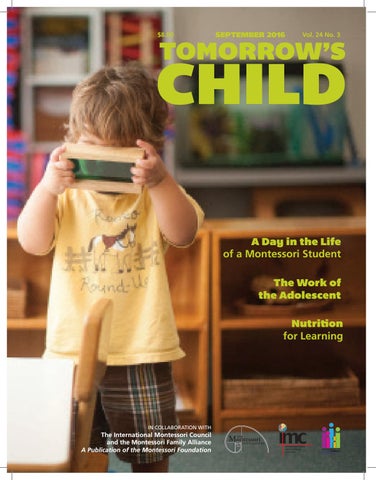
Cover photo Featured on page 18
5
Do You Have a Story to Tell?
6
A Day in the Life of a Montessori Student by Tim Seldin
9
Sacred Geometry by Greg Hicks
11
The Lessons of Yoga by Wendy Elwell
13
Montessori Research
18
Montessori Schools in Focus: Renaissance Montessori
15
Tips for Encouraging and Supporting the Developmental Needs of Your Elementary Child by Claire Salkowski
19
The Work of the Adolescent by Dr. Paul Epstein
22
Grandparent’s Corner: Grandparenting from Near and Far by Margot Garfield-Anderson
25
Food Balancing and the Staying Power of Eating by Jan Katzen
28
Providing Opportunities for Risk-Taking by Teresa Gonoski
35
Montessori at Home: Children & Music by Mercedes Paine-Castle
Classified Advertising Chelsea Blanco Phone: 941-729-9565/Fax: 941-745-3111 tcmag@montessori.org Display Advertising Joyce St. Germaine Phone: 941-729-9565/Fax: 941-745-3111 joycestgiermaine@montessori.org Montessori Family Alliance Lorna McGrath Phone: 941-922-4949/800-655-5843 Fax: 941-745-3111 lornamcgrath@montessori.org
26 CLASSIFIEDS 27 MONTESSORI JOURNEY Our First Day 30 MONTESSORI IN ACTION Rebuilding Warriors
32 BOOK REVIEWS 34 DEAR CATHIE Choosing Books for Your Child 37 TC ORDER FORM
We just realized there was a typo in the April issue of the magazine that our spell check didn’t pick up, and we apologize to Maria for the error.
TOMORROW'S CHILD © § SEPTEMBER 2016 § WWW.MONTESSORI.ORG
3
An all-in-one parent communication and school management platform that saves time and money.
Finally, you can stop spending hours managing systems and ever-growing piles of paper!
Reduce your workload by centralizing all communication into one user-friendly system. Give parents the ability to RSVP, fill out forms, sign-up for events, etc. easily and conveniently. Use the Hubbli database for complex searches, community and classroom directories, and admissions/enrollment/ program development.
Learn more at http://hubbli.com or call 1-888-415-4450 4
TOMORROW'S CHILD © § SEPTEMBER 2016 § WWW.MONTESSORI.ORG
SEPT 2016
DO YOU HAVE A STORY TO TELL ? Tomorrow’s Child magazine is always looking for inspiring stories to share with readers. Has your school done an amazing charitable work, artwork, fund-raising, outdoor play scape building, interesting theatre production, had a great moving up ceremony?
With our digital issues we can share video experiences for those who aren’t comfortable writing. For those who are first-time writers, send us photos with nice captions.
Did you capture it on video or take photos? Do you do something special with your schools’ grandparents?
It’s great bragging rights and PR for your school. We’ve featured many schools on our covers; imagine your school being featured this coming year!
Hearing from you is important; it’s a new feature we’d love to develop. Please share your story.
Send stories to: timseldin@ montessori.org or margot@ montessori.org
For example: How many generations of Montessorians are in your family?
For our print version we suggest 500-1000 words for the novice writer with photos at 300 dpi. If you have too many photos or they are too big we can arrange to invite you to a Dropbox to transport them. Please remember, all photos must have permission slips on file before we can print them.
Over the years we’ve met many Montessori families; children of teachers become Montessori teachers or heads of school, Montessori children who now have their own children in Montessori programs, etc. We’d love to hear your stories.
We look forward to your Submissions!
The WHO, WHAT, WHEN and WHERE These are the questions most novice writers can answer when penning something for our magazine. We recently featured a photo essay about the Toddler’s International Preschool in Kathmandu, Nepal. Head of School, Subash Lama answered these questions and just emailed us these kind words: “Hope you are doing great and you may be busy for preparing for the conference anyway just want to share you that there were visitors from Montessori school of USA to our school since they have read an article about our school in the magazine Tomorrow’s Child so we were very happy to welcome them and also they were happy to visit us so its was possible just because of your great effort so we would like to thank you and your entire team.” Subash is now applying for a travel visa to join us at our conference in Sarasota, Florida, November 3-6th. Truly an example of what telling your story in Tomorrrow’s Child magazine can do for your school and a shining example of Dr. Montessori’s vision of the Global Citizen.
TOMORROW'S CHILD © § SEPTEMBER 2016 § WWW.MONTESSORI.ORG
5
A Day in the Life
of a Montessori Student It’s dark at 7:05 am on this mid-winter’s morning when Jeanne Saunders pulls up to the drop-off circle at the Montessori school that her three children have attended since each was two years old. by Tim Seldin
J
eanne has made this trip so often over the years that the school feels like her second home. She works downtown and typically can’t leave work until after 5:00 pm. Her husband teaches in the local public schools and leaves work much earlier. He’ll pick the children up from the afterschool program by 4:30 pm, but if he’s late, he knows that they’ll be fine until he arrives. Like most Montessori schools, Jeanne’s school prides itself on being family-friendly. Working families appreciate its extended day and summer camp programs. Amy, Josh, and Jennifer definitely think of the school as their second family. Jennifer is one of those children who, after ten years in Montessori, speaks about Montessori with affection and conviction. Visitors often find her coming up to greet them and offer a cup of coffee or campus tour without a moment’s hesitation. When people ask her if she likes Montessori, she will smile and say “Sure, how could anyone not love it here? Your teachers are your best friends, the work is interesting, and the other kids are like my brothers and sisters. It’s a family. You feel really close to everyone.”
6
every so often, and gradually the number of children in the early morning program grows to 15. After eating his breakfast and cleaning up, Amy meanders over to the easel and begins to paint with Teresa, a little girl just 3, who has only joined the class over the last few weeks. They paint quietly, talking back and forth. Eventually, Amy tires of painting and cleans up. She is tempted for a moment just to walk away and leave the easel messy, but she carefully cleans up and puts her materials away as she has learned from more than two years in Montessori. At 8:30 am, her two teachers arrive, along with several more children. Others follow over the next few minutes until all 30 students and two teachers quietly move around the room. Montessori children work with hands-on learning materials that make abstract concepts clear and concrete. They allow young students to develop a clear inner image of concepts in mathematics, such as how big is a thousand, what we mean when we refer to the ‘hundreds’ column, and what is taking place when we divide one number by another. This approach makes sense to children.
Jennifer walks Amy, age 4, and Josh, who’s 7, up to morning supervision. After dropping them off, she walks to the Upper School where she is a 7th grader. She joins two of her friends in the commons, and sits and talks quietly while waiting for her first class to start.
Through this foundation of concrete experiential learning, operations in mathematics, such as addition, become clear and concrete, allowing the child to internalize a clear picture of how the process works.
Amy’s morning supervision is in his normal classroom. After hanging up his coat, he walks over to Judy, the staff member in charge of his room until school officially begins at 8:30am. He asks if there is anything ready to eat. Judy suggests that he help himself. He scoops out a bowl of cereal from a small bin and adds milk. He takes his morning snack over to a table and eats. Children and their parents drift in to the room
Amy and another child have begun to work together to construct and solve a mathematical problem. Using sets of number cards, each decides how many units, tens, hundreds, and thousands will be in his addend. The cards showing the units 1 to 9 are printed in green, the cards showing the numbers from 10 to 90 are printed in blue, the hundreds from 100 to 900 are printed with red ink, and the
TOMORROW'S CHILD © § SEPTEMBER 2016 § WWW.MONTESSORI.ORG
Amy moves freely around the class, selecting activities that capture her interest. In a very real sense, Amy and her classmates are responsible for the care of this child-sized environment. cards showing the numbers 1000 to 9000 are printed in green again (because they represent units of thousands). As Amy and her friend construct their numbers, they decide how many units they want, find the card showing that quantity, and place it at the upper right-hand corner of their work space. Next they go to the bank, a central collection of golden bead materials, and gather the number of unit beads that corresponds with the number card selected. This process is repeated with the tens, hundreds, and thousands. The two addends are combined in the process we call addition. Beginning with the units, the children count the combined quantities to determine the result of adding the two together. If the result is nine or less, they simply find the large number card that represents the answer. If the addition has resulted in a quantity of ten beads or more, the children stop at the count of ten and carry these unit beads to the bank to exchange them for a ten-bar: ten units equals one unit of ten. This process is repeated with the tens, hundreds, and thousands.
Its 10:00 am now, and Amy is hungry. She walks over to the snack table and prepares several pieces of celery stuffed with peanut butter. She pours herself a cup of apple juice, using a little pitcher that is just right for her small hands. When she is finished, Amy wipes off her place mat. Clearing up her snack has put Amy in the mood to really clean something, and she selects table washing. She gathers the bucket, little pitcher, sponge, scrub brush, towel and soap needed and proceeds to slowly and methodically scrub down a small table. As she works, she’s absorbed in the patterns that her brush and sponge made in the soap suds on the table’s surface. Amy then returns everything to its storage place. When she is finished, the table is clean and dry; a four-year-old washes a table for the sheer pleasure of the process; that it leads to a cleaner surface is incidental. What Amy is learning above all else is an inner sense of order, a greater sense of independence, and a higher ability to concentrate and follow a complex sequence of steps. Amy moves freely around the class, selecting activities that capture her interest. In a
TOMORROW'S CHILD © § SEPTEMBER 2016 § WWW.MONTESSORI.ORG
very real sense, Amy and her classmates are responsible for the care of this child-sized environment. When they are hungry, they prepare their own snacks and drinks. They go to the bathroom without assistance. When something spills, they help each other clean up. We find children cutting raw fruit and vegetables, sweeping, dusting, washing windows. They set tables, tie their own shoes, polish silver, and steadily grow in selfconfidence and independence. Now its 11:00 am, and one of her teachers, Ann, comes over and asks her how the morning has been going. They engage in conversation about her latest enthusiasms, this leads Ann to suggest another reading lesson. She and Amy sit down at a small rug with several wooden tablets on which the shapes of letters are traced in sandpaper. Ann selects a card and slowly traces out the letter d, carefully pronouncing the letter’s phonetic sound: duh, duh, duh. Amy traces the letter with her tiny hand and repeats the sound made by her teacher. Amy doesn’t know this as the letter d. For the next year or so, she will only call it by its
7
In the afternoon she does some more art, listens to selections from a recording of the Nutcracker Ballet, works on her shape names with the geometry cabinet, and completes a puzzle map of the United States. phonetic sound: duh. This way, she never needs to learn the familiar process of converting from the letter name, d, to the sound it makes, duh. Continuing on with two or three additional letters, Ann slowly helps Amy build up a collection of letters that she knows by their phonetic sounds. Ann leads Amy through a three-step process. “Amy, this is duh. Can you say duh? Terrific! Now, this is a buh (the letter b). Amy, can you show me the buh? Can you give me the buh? Fine. Okay, what is this? (holding up one of the sandpaper letters just introduced)Amy responds, and the process continues for another few minutes. The entire lesson is fairly brief; perhaps fifteen minutes. Before long, Amy will begin to put sounds together to form simple three-letter words. Amy’s day continues just like the morning began. She eats her lunch with the class at 11:45 am, after which she goes outside with her friends to play in the snow. After lunch, the Spanish teacher comes into the room and begins to work with small groups of students. Eventually, she taps Amy on the shoulder and asks her if she would like to join her for a lesson. She smiles, but graciously declines. She is too engaged in the project that she’s chosen.
8
In the afternoon she does some more art, listens to selections from a recording of the Nutcracker Ballet, works on her shape names with the geometry cabinet, and completes a puzzle map of the United States. When the day is over, Amy has probably completed twenty to thirty different activities,
most representing curriculum content quite advanced for someone who just turned four two months ago. But when her dad picks her up at 4:50 pm, her response to the usual question of “What did you do in school today?” is no different from many children, “Oh, I don’t know. I guess I did a lot of stuff!”
TOMORROW'S CHILD © § SEPTEMBER 2016 § WWW.MONTESSORI.ORG
SACRED GEOMETRY by Greg Hicks
I
t was Plato who said, “Geometry is the experience of the eternally existent. The study of the ‘One’ is among those that lead the mind on and turn it to the vision of reality.” This is the basis of the sacred work of geometry. It is the study of the universe, the world we live within, and our interconnected relationship with it. It is called ‘sacred’ not because it adheres to a specific religious or spiritual ideology but, rather, because it offers the practitioner a way to appreciate the world with wonder and to explore life’s most fundamental questions. This is done through physical means, through the practice of geometry. Maria Montessori shared in this vision of geometry in speaking of, “the reciprocal relationship between man and the objects of the environment.” It is this geometric exploration into the interconnectedness of the universe and themselves that truly speaks to the child. Children look upon the world to explore, discover, and reveal who they are: psychologically, emotionally, physically, and spiritually. This happens through their interactions with, and observations of, this relative, physical world. It is in this pursuit that sacred geometry entices the child. It offers the child a spiritual exploration through physical means, that guides and leads the
It is this geometric exploration into the interconnectedness of the universe and themselves that truly speaks to the child. child to the mystical wholeness they find within their own hearts and minds. In the child, Sacred Geometry fosters wonder, keen observation and a holistic understanding of the universe and the environment where they live. It begins with the study of the ‘One,’ as Plato suggests. This is shown through the circle. Children will find delight in using the compass to form all sorts and sizes of circles. The circle manifests as the image of oneness and is well represented in the art and architecture of the world’s great spiritual traditions, as in the “O of Giotto,” the Zen “Enso,” or in the stained glass of the famous Chartres Cathedral in Paris, France. Through the meditative practice of creating the circle, and reflect-
ing on it, the image of wholeness is reflected back as the child’s own completeness. The child then discovers how the ‘One’ becomes two. This is represented through creating an exact emanation of the original circle, formed on the circumference of the original. This precise emanation creates the birthplace of geometric shapes, the coming of duality and the construction of the world as we experience it. This space, within the intersecting points of the two circumferences sharing the same radius is called the “Vesica Piscis,” or “Bladder of the Fish.” The “Vesica Piscis” holds the pure creative potentiality of the universe. It is at this point that children’s creative energy will flow freely and their
TOMORROW'S CHILD © § SEPTEMBER 2016 § WWW.MONTESSORI.ORG
minds are “turned to the vision of reality” as they discover the many shapes, images and artwork that arises within the “Vesica Piscis” and, ultimately, from the original circle or oneness. They discover a line and its division, the constructive triangle, the manifest square, rectangle, and the many polygon constructions. Children’s sensitive periods for imagination are stimulated and come to life as they construct and observe each shape and experience the structures of the world. The child finds familiarity in these shapes through observing their environment and within themselves. As children continue creating polygons within the original, with more and more sides through the bisection of the
9
As we gaze upon these shapes and observe our world, we see that geometry is everywhere; it is this life itself and in and through each and every one of us. constructions is helpful. This is truly a journey of self-exploration and it is through the child’s selfdiscovery that Maria Montessori’s vision of peace in the world becomes a reality of humankind’s future.
constructive triangles, they find something quite extraordinary: the many has returned to the “One.” How is this possible? We experience it in geometry as the polygon slowly becomes the circle again, as more and more sides are added to it. The child might even say, “Look, it’s becoming the circle again!” But how does the “eternally existent” manifest in our own lives? This is the real question of Sacred Geometry and one for each of us to discover through our own practice, as the child does quite naturally through concentrated work. (Please note that this is a very brief introduction and overview of this topic and process, and is in no way meant to be taken as an exhaustive account.) Each step along this geometric journey affords the child the opportunity to realize something about themselves and the envi-
10
ronment in which they live. This ultimately manifests in beautiful artwork and mandalas that the children create from the spark in their heart/mind. Not just art work on paper but the beautiful artwork of their being. It is important that children are able to discover of their own accord and not be told what they might find or experience through this work. While this description is quite abstract, the child’s experience is real and actual and devoid of such unneeded intellectualizing. Any such explanation would only serve to diminish the child’s interest and wonder. The study is also one that will take time and patience. No specific timeline should be set, it will come when it is ready. Some guidance on the process is all that is needed; a direction into the use of the compass and straightedge and how to create the basic
Now, for the Montessori guide, the practice of Sacred Geometry leads us into our own inquiry. It offers us a medium for the internal work and preparation necessary to follow and guide the child with fresh eyes; within our classrooms and in the world. Working with the compass and straightedge, we find a meditation on the building blocks of our life. Like the child, we begin with the circle and move step-by-step. We encounter our edges as we bump up against our own challenges. We must learn and practice patience and focus as we come to the work each time. It gives us insight into the child’s challenges as well, as we realize our own limitations. Perhaps we notice our own insecurities in our ability to create the work as we would like. Or, we struggle with our desire for perfection, and with our comparisons to others. Ultimately, through practice, we come to see the shapes as complete as they are and realize that we, too, are complete as we are. As we gaze upon these shapes and observe our world, we see that geometry is everywhere; it is this life itself and in and through each and every one of us. It is nature and the whole of the universe. Like the child, we discover things about ourselves that helps us appreciate
our children and the wonder they experience in the world. I encourage each and every one us to join in this exploration of the fascinating and awe-inspiring practice of Sacred Geometry. Learn and guide your children in how to utilize the geometer’s tools, the compass and straight-edge, to create inspiring geometric works, and take a personal journey of self-discovery, as we explore the structures and building blocks of the world in which we live. Greg Hicks will be presenting this topic at the Montessori Foundation’s November conference. He is in his 7th year teaching and 6th as a guide in the upper elementary Montessori Classroom. Greg has had the opportunity to be a Montessori guide in both a charter Montessori school and in the private sector, each providing unique experiences and perspectives. He completed Montessori 6-12 training through the Center for Guided Montessori Studies and is currently the lead upper elementary guide at Beach Park School in Tampa. Greg is also a co-instructor for the Center for Guided Montessori Studies summer residency program, for math and geometry. In addition, he brings to his workshops many years of experience as a former business owner, yoga and Qigong instructor and leader of the Lakeland Zen Center (Hokori-ji), all of which have greatly influenced his work in Sacred Geometry.
TOMORROW'S CHILD © § SEPTEMBER 2016 § WWW.MONTESSORI.ORG
by Wendy Elwell
Y
ogi Bhajan, known for bringing Kundalini Yoga to the west in the late 1960s, said, “if you want to understand something, write about it, if you want to master something, teach it.” So what happens then, when we make yoga part of education? Perhaps to best understand some of the many benefits of practicing yoga within our schools to help our students learn, we’ll start with a “lesson!” Yoga, comes from the Sanskrit word and means “to yoke together” or union of body, mind, and spirit. While its exact origins are not fully clear, historians agree that its roots go back at least 5,000 years to Northern India. Although yoga is not a religious practice, its origins can be traced back to Hinduism, Buddhism, and Jainism. References to yoga can be found in the oldest text called the RigVeda, a composition of hymns. Yoga was first used as a means of understanding the world and became a way to understand the world through the understanding of self. The history of yoga is classified into four periods of time: the Pre-Classical period (dating back 5,000 to possibly 10,000 years ago); the Classical Period, which marks the first systematic presentation of the teachings in Patanjali’s Sutras; the Post-Classical Period, which was the first time the physical practice of yoga (the postures) were the predominant aspect of the practice. This brings us up to date with the Modern Period, which began in the late 1800s, early 1900s and includes more than a dozen ‘types’ of yoga including: Amrit; Anusara; Ashtanga; Bikram; Hatha; Hot; Iyengar; Jivvamikti; Kids; Kripalu; Kundalini, Laughing; Prenatal; Vinyasa; Yin; and Yoga Nidra. Within the types there are eight limbs (or branches) that contain the importance, the elements of the teachings of yoga. The first is Yama (the moral code), which includes truthfulness and non-harm. The second is Niyama, personal behavior. The third is Asana, the postures. The fourth is Pranayama, breath. The fifth is Pratyahara, withdrawal of the senses for focus. The sixth is Dharama, concentration. The seventh is Dhyana, meditation. The
Children under the age of seven spend a lot of time in theta; they are very open. Because of this, they will benefit from even a practice of a few minutes a day. eighth is Samadhi, the transcendence of self, the interconnectedness of all living things, and the merging with the divine. So, how does all this relate to education? The first two, a moral compass and a sense of self responsibility, are essential to creating an environment that is safe and open to learning. Research shows the connection between physical activity and learning. So when we add in the third element (or branch) as part of the way to start the day in the classroom, we are opening space for our children to learn. A few postures, even while sitting at the desks or standing beside them, is enough to set the
TOMORROW'S CHILD © § SEPTEMBER 2016 § WWW.MONTESSORI.ORG
tone for the entire day. Later in the day, as attention spans begin to wane, the power of four (breath, five, focus, and six, concentration) are essential to success in learning. Seven and eight are great tools for stress relief. Speaking of stress relief, the practice of Yoga Nidra is a powerful sleep-based stress-relief technique that can be practiced in a chair, at a desk, or lying down in Savasana pose. The beauty of this type of yoga is anyone can do it. It’s accessible and inclusive for all! While it’s completely non physical, the physical benefits to and for the body are incredible. Fifteen to twenty minutes a day is the equivalent to three hours of sleep! Just imagine the ben-
11
efit this could have not only for students but for teachers who are overworked, tired, and would benefit from some deep rest. Yoga Nidra takes you gently from beta, down into alpha, theta and even delta brainwaves, and then back to beta. Kamini Desai, Education Director for the Amrit Yoga Institute, reminds us that children under the age of seven spend a lot of time in theta; they are very open. Because of this, they will benefit from even a practice of a few minutes a day. Just enough to form a habit—to create a space beyond the mind, beyond the emotions. From age eight to preteen, 7 to 11 minutes supports their ability to focus while relieving stress and tension. Karena Virginia, Author, lifestyle expert and Kundalini Yoga teacher concurs, “Children are like sponges. They need to learn healthy outlets for the energy they are picking up.” Imagine, if that ‘healthy outlet’ could be part of their curriculum. Kamini agrees: “Even young kids experience stress, too. Yoga Nidra is a great touchstone for them to be able to manage their emotions and to help them have an active role in creating their sense of self. As they grow into their teenage years, it’s a great tool for peer pressure and creates a great foundation for a healthy life. And besides that, they love it and, therefore, respond to it really well.” As our children approach the teenage years, with the foundation from their early development, yoga is a great ‘go-to’ for managing the developmental changes associated with transitioning into young adulthood. Karena knows it’s an essential tool, saying, “The frontal lobe on teens is not developed yet, so teens often make impulsive decisions. With yoga, we can show them how to pause before they act. It’s very powerful.” Roger Cole, Ph.D., Iyengar Instructor and graduate of Stanford University and the University of California, writes, “Yoga is varied and powerful. Many yoga communities are passing along great aspects of the yoga tradition or developing wonderful new practices that people outside the community are not aware of. In my travels teaching throughout the US and over the world, I find little gems of wisdom and skill everywhere.” In sharing yoga with our students, not only are we, together, mastering the practice of yoga, we are giving our students tools they can use to master life—and well-being. The alpha and theta brainwave states are associated with increased retention of learned material and long-term memory as published in the March,
12
2014 issue of The Journal of Neuroscience: Slow-Wave Sleep-Imposed Replay Modulates Both Strength and Precision of Memory. Researchers at The University of California, Los Angeles, published a study in the April 2016 Journal of Alzheimer’s Disease, that found that yoga and meditation had equaled and then topped the benefits of twelve weeks of brain training in a study that divided the volunteers into two groups: one group that experienced Kundalini Yoga (Kirtan Kriya) and the other group that participated in a braintraining class. Brain scans before and during the twelve-week timeframe, showed yoga and meditation as more beneficial than the brain training over the three-month period. A 2008 study at Bridgeport Hospital found that yoga and meditation created significant reductions in blood pressure, heart rate, and Body Mass Index (BMI), while the exercise participants showed no change in those that just came for laboratory work. While all the studies and research are impressive, in my experience of teaching yoga in the classroom daily for six months as part of my volunteer hours for my own certification,
first-hand, the results were amazing. The director of the school noticed a marked improvement in both behavior and test scores. Parents noticed changes in their childrens’ attitudes and motivation. What stood out most for me, though, was what the kids themselves had to say about their own well-being, their confidence, their self-esteem. At the end of each class when they bowed to themselves and each other speaking, namasté—the light in me sees the light in you. That’s a lesson that speaks for itself and lasts a lifetime. Wendy Elwell is the mother of two teenage sons who attended Montessori schools from preschool through early elementary school. As a communications consultant, Wendy has worked with organizations and individuals to create environments where health, well-being and transformation can thrive. Wendy is certified to teach Kundalini Yoga and is an Amrit Method certified Yoga Nidra teacher as well. You can find her at wendywrites@comcast. net, and www.wendywelwell.us.
We are seeking IMC Partners! www.wowfactorle.com
Add excitement, pizzazz, and revenues to your fundraisers. It’s no risk to you, easy, and just two simple steps. 1) See our range of exotic travel packages at www.wowfactorle.com. 2) Enter the product/s you wish to sell at www.wowfactoradmin.com Entice your Board Members, Parents and Alumni, with a travel experience of a lifetime, and at the same time raise funds for your Montessori School!
TOMORROW'S CHILD © § SEPTEMBER 2016 § WWW.MONTESSORI.ORG
MONTESSORI : DOES IT WORK? WHAT RESEARCH SAYS ABOUT MONTESSORI AND STUDENT OUTCOMES
Editor’s Note: Our thanks to the National Center for Montessori In The Public Sector for sharing this brief summary of some of the growing body of research that directly or indirectly supports the effectiveness of the Montessori approach. Montessori parents know first-hand how this approach to education supports and nurtures children’s development in all areas: physical, intellectual, language, and social-emotional. Scientific research confirms that Montessori children have an advantage not only academically, but also in social and emotional development. Here are some ongoing studies you may find interesting: Dohrmann, K., “Outcomes for Students in a Montessori Program: A Longitudinal Study of the Experience in the Milwaukee Public Schools” (AMI/USA May, 2003) DOWNLOAD FULL PDF: tinyurl.com/mont-study-1
This longitudinal study of Milwaukee high school graduates showed that students who had attended Montessori preschool and elementary programs significantly outperformed a peer control group on math/science scores. “In essence,” the study found, “attending a Montessori program from the approximate ages of three to 11 predicts significantly higher mathematics and science standardized test scores in high school.
Donabella, M.A. & Rule, A.C., “Four Seventh Grade Students who Qualify for Academic Intervention Services in Mathematics Learning MultiDigit Multiplication with the Montessori Checkerboard,” TEACHING Exceptional Children Plus, 4(3) Article 2 (January 2008) DOWNLOAD FULL PDF: tinyurl.com/mont-study-2
This article describes the positive impact of Montessori manipulative materials on four seventh grade students who qualified for academic intervention services because of previous low state test scores in mathematics. The article presents a brief
introduction to the Montessori approach to learning, an overview of Montessori mathematics, and an explanation of the Checkerboard for Multiplication with related multiplication manipulatives. Pre-test/post-test results of the four students indicated that all increased their understanding of multiplication. The results of an attitude survey showed students improved in enjoyment, perceived knowledge, and confidence in solving multiplication problems.
start school without speaking any English, 100% of the children test as fluent in English by the end of the third grade.
East Dallas Community Schools: Montessori Outcomes DOWNLOAD FULL PDF: tinyurl.com/mont-study-3
Angeline Lillard examines the impact of Montessori implementation fidelity. Her study found that children in classrooms with high fidelity implementation showed significantly greater school- year gains on outcome measures of executive function, reading, math, vocabulary, and social problem-solving, than children in low fidelity or conventional classrooms.
A comprehensive review of the scientific literature that demonstrates how current research validates Dr. Montessori’s observations about how children learn, particularly with regard to movement and cognition, the detrimental effect on motivation of extrinsic rewards, the beneficial effect of order in the environment, and the academic and emotional benefits of freedom of choice.
Lillard, A.S. & Else-Quest, N., “Evaluating Montessori Education,” Science 131: 1893-94 (Sept. 29, 2006) DOWNLOAD FULL PDF: tinyurl.com/mont-study-5
Rathunde, K., “A Comparison of Montessori and Traditional Middle Schools: Motivation, Quality of Experience, and Social Context,” The NAMTA Journal 28.3 (Summer 2003): pp. 12-52 DOWNLOAD FULL PDF: tinyurl.com/mont-study-7
East Dallas Community Schools operates two inner-city Montessori schools that serve an ethnically and culturally diverse group of primarily low-income families. In over 30 years of using the Montessori approach to education, EDCS has proved that all children, regardless of race or income, can succeed in school when you start young and involve parents. In a neighborhood in which the high school dropout rate is over 50%, children who attend EDCS have graduated from high school at a rate of 94%, with 88% of those graduates attending college. A ten-year study of standardized test scores found that third grade students’ average scores were in the top 36% nationwide in reading and math. Even though many of these children
Lillard, A.S.,”Preschool Children’s Development in Classic Montessori, Supplemented Montessori, and Conventional Programs,” Journal of School Psychology 50:379-401 (June 2012) DOWNLOAD FULL PDF: tinyurl.com/mont-study-4
Researchers compared Montessori students with students in other school programs, and found that 5-year-old children who completed the three-year cycle in the Montessori preschool program scored higher on both academic
TOMORROW'S CHILD © § SEPTEMBER 2016 § WWW.MONTESSORI.ORG
and behavioral tests than the control group. The study also found that 12-year-old Montessori students wrote more sophisticated and creative stories and showed a more highly developed sense of community and social skills than students in other programs.
Lillard, A.S., Montessori: The Science Behind the Genius, New York: Oxford UP, 2005 DOWNLOAD FULL PDF: tinyurl.com/mont-study-6
This study compared middle school students in Montessori programs with students in traditional middle schools, and found significantly higher student
13
motivation and socialization among the Montessori students. “There were strong differences suggesting that Montessori students were feeling more active, strong, excited, happy, relaxed, sociable, and proud while engaged in academic work. They were also enjoying themselves more, they were more interested in what they were doing, and they wanted to be doing academic work more than the traditional students.”
Diamond, A. & Lee, K., “Interventions Shown to Aid Executive Function Development in Children 4 to 12 Years Old,” Science 333:959-964 and Supporting Online Material (Aug. 19, 2011) DOWNLOAD FULL PDF: tinyurl.com/mont-study-8
To be successful takes creativity, flexibility, self-control, and discipline. Central to all those are executive functions, including mentally playing with ideas, giving a considered rather than a compulsive response, and staying focused. This review compares research results from various activities and curricula that have been shown to improve children’s executive function, including computerized training, aerobic exercise, martial arts and mindfulness practices, and classroom curricula including Montessori education. In a comparison of curricula and curricula add-ons, the Montessori approach is shown to meet more criteria for the development of executive function for a more extended age group.
Diamond, A., “The Evidence Base for Improving School Outcomes by Addressing the Whole Child and by Addressing Skills and Attitudes, Not Just Content.” Early Education and Development, 2: 780-793 (2010) DOWNLOAD FULL PDF: http://tinyurl.com/mont-study-9
Dr. Adele Diamond, Professor
14
of Developmental Cognitive Neuroscience at the University of British Columbia, Canada, is one of the world’s leading researchers on the development of cognitive function and a supporter of Montessori education. In this article she discusses effective strategies for advancing academic achievement, and advises: “Programs that address the whole child (cognitive, emotional, social and physical needs) are the most successful at improving any single aspect – for good reason. For example, if you want to help children with academic development, you will not realize the best results if you focus only on academic achievement (though at first glance doing that might seem the most efficient strategy); counterintuitively, the most efficient and effective strategy for advancing academic achievement is to also nurture children’s social, emotional, and physical needs.”
ABOUT THE NATIONAL CENTER FOR MONTESSORI IN THE PUBLIC SECTOR
The mission of the National Center for Montessori In The Public Sector (NCMPS) is to advance Montessori education in the public sector through the support of a robust network of practitioners, researchers, parents, and leaders committed to
realizing Maria Montessori’s vision of education as the great work of realizing the child’s potential. National Center for Montessori in the Public Sector (NCMPS) is a knowledge-centered organization. Our work revolves around the development and dissemination of information that can advance excellent Montessori education in the public sector. Through the creation of a tightly linked and supportive network of schools and a set of comprehensive technical support services, the Center aims to serve as both a convener of a vibrant community of practice and a provider of effective support and solutions for practitioners. NCMPS is governed by a theory action that places knowledge at the center of the enterprise. A continuous cycle of generating, using, evaluating, and refining knowledge drives our work. The figure above provides an example of how that cycle works to strengthen and expand Montessori education in the public sector. 1.
2.
Advocacy: Drawing attention to key issues affecting fully implemented Montessori in the public sector. Coaching and School Services: Providing start-up,
professional development,
and quality assurance support for schools and districts. 3.
Research and Dissemination:
Collecting data, analyzing trends, and sharing results with the wider community 4.
Convening and Networking:
Building a strong professional community by convening and networking public sector Montessorians from around the country. The National Center for Montessori in the Public Sector began as an affiliated entity of the American Montessori Society (AMS). In 2015 NCMPS became an independent 501(c)3. It collaborates and communicates with all of the American Montessori organizations. For more information about NCMPS go to public-montessori.org.
Mobile - Montessori We’re On Your Site Accepting Proposals for Training At Your School Now For: Early Childhood Courses Elementary Level Courses
Southwestern Montessori Training Center, Incorporated A Non-Profit Educational Organization Est. 1974 Post Office Box 310947, N.T. Station, Denton, TX 76203 Phone/Fax: 940-566-1640 swest4smtc@aol.com MACTE Accredited
TOMORROW'S CHILD © § SEPTEMBER 2016 § WWW.MONTESSORI.ORG
Make it Montessori
TIPS FOR ENCOURAGING AND SUPPORTING THE DEVELOPMENTAL NEEDS OF YOUR ELEMENTARY CHILD
A
bout the time my son turned six or so, I vividly recall wondering who took my sweet little boy and replaced him with this foreign being! Much to my chagrin, I remember remarking to my son that I didn’t know who this new creature was, and I wanted the old one back! Some thirty years later, I deeply regret that callous statement, but such was the nature of this mammoth developmental change, as he moved from early childhood into the elementary years. The little boy, who previously enjoyed staying close to home and liked to be close to his sisters (“sandwiched between two girls,” as he used to say), now wanted more than anything to be the explorer and shunned girls, wanting to be with his male friends rather than just the family. The child, who happily played in the tub with his sisters as a threeand four-year-old now had to be coerced to bathe or shower. Where before tears came easily, now it was a mark of toughness not to cry at all, no matter what the injury or insult. Rather than wanting to know what something was he wanted to know the why or how of it all. “Why do I have to take a bath or make the bed when I’m just
by Claire Salkowski
going to get dirty and get in it tonight? How do scientists know how old the universe is? Why did the dinosaurs disappear? “ Where before he worshipped his father, now there were other heroes that captivated his admiration and imagination. Sports heroes and ‘super heroes’ were all the rage. He would spin a tale rife with pure imagination, fanciful journeys, and wild adventures and then spend hours writing it down to create his own adventure books. Once he was determined to write numbers “all the way to a billion” and created a number line that circled the house! He would roam the neighborhood collecting objects and items that would be carefully classified and squirreled away in drawers and hidden shelves. Everything had to be ‘fair,’ and he always had a reason and specific logic for when it wasn’t. I remember once, when his sister and he were in the throes of some mighty squabble, he bounced on my bed and said with adamant fervor, “we needed a mediation.” Such was the quest for justice! As a talented young gymnast, people often commented on his prowess, remarkable strength, and endurance. He seemed to need to prove how tough he could be and was willing to take risks to succeed
at gymnastic feats that sometimes made his parents cringe. He practiced for hours on end, as maximum effort gave a feeling of conquest and accomplishment. As a young male, in a sports-crazed
TOMORROW'S CHILD © § SEPTEMBER 2016 § WWW.MONTESSORI.ORG
American society, athletic achievement provided easy entry into the path of peer approval. He was also sensitive to the plight of others and, on more than one
15
occasion, he and his sisters ventured out and marched with us to protest the injustices of war and collected food for the poor and clothes for the needy. He felt deeply that these things were not ‘fair’ and wondered aloud, “How could people treat each other that way?” He hoped that one day he could invent a machine that would allow us to make enough food to feed the world! As I look back on those years, as a Montessori parent, teacher, and school administrator, it warms my heart to remember those days within the framework of time and the lens of development. That dear little boy, who graced our family and our first Montessori classrooms, just like his two amazing sisters, is a wonderful compassionate, caring and creative human being, all grown up with a son of his own. And now, as a Montessori grandmother (or “Gram”), we both get to watch as he now moves into this marvelous time of life when the small child becomes a ‘real boy.’ My daughters exhibited the same pattern of development that Montessori observed so keenly over a hundred years ago. They, too, became social beings, demonstrating what Montessori refers to as the “herding instinct,” spending hours with girlfriends roaming the neighborhood making up their own games. They began to reason and ask why, challenging the way things were and remarked on the ‘fairness’ of just about everything. Their curiosity reached into many areas of interest, each with their own eagerness to find out why. They also demonstrated that tendency for elementary children to become ‘territorial,’ and each desperately wanted their own space. Sometimes it was literally drawing a line down the center of the room; or guarding a special drawer in the dresser; or keeping a secret
16
box in the closet. They used their imaginations to create plays and shows, complete with costumes and handmade scenery, much to the delight of aunts and uncles at every holiday or special occasion. They collected My Little Ponies™, while their brother collected Super Heroes, Star Wars™ action figures, and rocks. They were each able to act on that natural impulse of the elementary child for collecting and categorizing. I fondly remember my own childhood, as the eldest, directing my
make sure I appeared at his office at the appointed time; otherwise, I was expected to walk home and keep an eye on the younger ones. I am grateful for the fact that my own parents were willing to trust me with such responsibilities and freedoms. By the time I was twelve, I was babysitting the children of neighbors and was thrilled to be able to earn my own money on a regular basis. And now my grandsons have a lemonade and cookie stand, complete with the requisite façade at
During the week they recently spent at ‘Gram and Grandad’s Camp on the Creek,’ they devised their own job chart, so that they could all take responsibility for managing mealtime with the most efficiency and fairness. Each meal was divided into five tasks, including: meal prep; setup; table clearing; dishes; checking the crab pots; and watering the plants when all their crab catch had been consumed. Given the opportunity, elementary children will take on great responsibility, meeting the highest of
LOOK FOR WAYS FOR CHILDREN TO TAKE GREATER RESPONSIBILITY WITHIN THE FAMILY. LET THEM JOIN CLASSES, CLUBS, AND TEAMS, SO THAT THEY CAN SATISFY THAT ‘HERD INSTINCT’ AND FIND THEIR PLACE IN THE SOCIAL STRUCTURE OF THEIR PEERS.
younger sisters in a host of ‘plays’ performed in our garage and hosting ‘fairs’ with my siblings and neighborhood friends to make some extra pocket money, another fascination of the elementary child. With a mere ten cents in my pocket, I could then walk to the Pollyette, a small old-time store that boasted a large pennycandy display. Feeling quite satisfied and rather excited, we could walk back to the neighborhood with a small paper bag full of our favorite sweets. As a young little Catholic girl, my own ‘heroes’ were the saints, and I was captivated by their biographies, reading every book on saints in the public library. My childhood collections began with small statues, which I then used to create my own creative and much protected ‘altar!’ After school, I walked to the library, read on my own, and then waited for a ride home from my father, who worked around the corner. It was my responsibility to
every family yard sale, while eagerly earning the coveted cash. The others also spend hours sorting through, researching, then pricing their own toys and books, deciding which ones to sell, which to give away, and which to retain. They write their own adventure stories and make them into ‘books,’ and all five happily took part in a recent three-day ‘treasure hunt,’ complete with pirate chest and padded lock.
expectations. It never ceases to amaze me how much (and how well) they can do so many things socially, intellectually, emotionally, and morally. Sometimes, we simply need to set the parameters and then stand back and watch. For sure, personality puts its own mark on each child, but there is, no doubt, a pattern of development that unfolds in the form of each unique individual, generation after generation.
Each day, they had a series of clues they had to solve in order to collaboratively work out the math problem to find the numbers of the combination lock that held the treasures within. My eldest grandson suggested the hunt, following our years of storytelling about the ‘Fearsome Five,’ my nickname for the band of cousins, whose pirate adventures became the stuff of nighttime stories before bed and continue on, even now, as we create the story of the evolution into the ‘Sensational Six’ to accommodate the latest addition to the family.
As parents and grandparents, you can certainly encourage and support these wonderful traits that evolve in the elementary years. Look for ways for children to take greater responsibility within the family. Let them join classes, clubs, and teams, so that they can satisfy that ‘herd instinct’ and find their place in the social structure of their peers. Answer their questions about the why and how of things, as you listen to the news, read the paper, or follow local and global events. Let them research their own
TOMORROW'S CHILD © § SEPTEMBER 2016 § WWW.MONTESSORI.ORG
interests, discover what entices them in the vast universe, and help them turn it into something that informs their days and their lives. You’ll find that they will willingly invest hours of hard work into creating a final ‘product’ that they will proudly want to share or display. Let them test their strength, both physically (with challenging tasks or games) and emotionally (with the expectation to ‘work things out’ when something becomes difficult or the problem seems unsolvable). Offer help and assistance only when needed or requested. Remember that the need for independence is great, and, by working through difficulties, they gain that all-important sense of success. Don’t be tempted to rescue them when things get tough, as they inevitably will, since that is the very nature of life. Give them their own space in the house or yard, both literally and figuratively. Over fifty years later, I still remember how my mother gave each of us a small space to create our own garden and how proud I was of the flowers and
vegetables I was able to grow. I spent hours carefully cultivating each tiny plant and was amazed when seeds blossomed into green shoots and plants ripened into something I could share with the family. That love of the outside and gardening is still with me today. Allow your elementary children to take responsibility for helping with all the tasks of running the household and being part of a family and community. Let them cook, clean, do laundry, mow the lawn, walk dogs, or make and sell things. Let them earn their own money by working in earnest. Teach them how to manage it well, by setting up a bank account or running a small ‘business.’ Allow them to take responsibility for caring for pets or younger siblings. Have them take responsibility for their own belongings, and give them a role in choosing what to recycle, give away, sell or carefully keep. Most of all, indulge their curiosity and encourage creativity in all its forms: from putting on plays to creating their
own videos; writing; telling stories; painting; programming the computer; or exploring the myriad other electronic devices that are part of their world. Remember that children are far more capable than we believe, so set the bar high and expect to be proud and amazed! This was Montessori’s message to us more than a century ago, as she, too, marveled at the ingenious way human beings evolve, develop, and find their place in the world. Although the personalities are different, as are the social times, this way of developing continues from generation to generation, and what was true about this age of 6-12 year-olds remains true today. Elementary children need to test their wings, solve their own problems, and, ultimately, find
TOMORROW'S CHILD © § SEPTEMBER 2016 § WWW.MONTESSORI.ORG
their own place in the social order of their society. Our job is to nurture; encourage with opportunity; and support without suffocating their curiosity, creativity, and ways of reasoning. When we do our part well, we are able to witness the evolution of the child into the competent and capable adult, who contributes to us all. For me, there is no greater gift. Claire J. Salkowski is a member of the International Montessori Council’s (IMC) Board of Trustees; Co-Chair of the IMC Accreditation Commission; founder and former Head of Freestate Montessori, Fork, MD.
17
This toddler is looking through a colored lens to see the world through a new perspective.
New Feature! Sometimes a picture is worth more than 1,000 words. So we asked some of our MFA/IMC member schools to send us photos and captions that help illustrate the essence of their schools. We are delighted that September’s Spotlight School is The Renaissance Montessori School, Fort Myers, FL. A long-time IMC member, the Renaissance Montessori School in Fort Myers, FL, provides programs for toddlers, preschool and elementary children throughout the Southwest Florida community. Renaissance Montessori School serves families from Lee County, Sanibel, Fort Myers Beach, Cape Coral, Estero, Buckingham, Lehigh Acres, as well as the City of Fort Myers.
Their Vision Renaissance Montessori School envisions a community that embraces timeless values, awakens the human spirit and ignites a lifelong love of learning. Their Mission Renaissance Montessori School inspires individuals to express their unique potential with purpose, passion and vision. Renaissance Montessori School nurtures curious, creative, and gifted thinkers. At Renaissance Montessori School, we believe that all children carry within themselves unique gifts.
With these gifts, each child, in a very real sense, creates the adult that is to be. We feel honored to guide children in their natural creative process of education; to help them bring forth their gifts, and realize the unlimited potential that is all their own. 1. Exploration in the toddler environment allows for self discovery. 2. Giving students a sense of wonder received from the environment should be part of the guides environmental design. 3. Collaborative art projects give
students opportunities to work on compromise strategies and teamwork skills. 4. Opportunities for movement in toddlerhood are important for gross motor development. 5. Allowing toddlers to explore with materials freely opens up opportunities for conversation and increased vocabulary development. 6. The exercises of practical life help build concentration and can be an extension of global studies. 7. Snack preparation is a welcome routine in every classroom. 8. When teachers engage in
meaningful ways with students, relationships are built that facilitate trust in the teacher and in the environment. 9. The sense of accomplishment toddlers feel in mastering a task help grow self confidence. 10. Concentration in the primary room comes in many forms. 11. Some more introverted students benefit from individual work and may avoid group or social situations. 12. Students may enjoy creating their own extensions of work.
Want your school to be featured in an upcoming issue of Tomorrow’s Child? You can follow the same format as this MFA/IMC school and send us your high resolution photos and captions. Please make certain that you have photo releases for any of the children featured in your photos. Send to TCmag@montessori.org or Margot@montessori.org
18
TOMORROW'S CHILD © § SEPTEMBER 2016 § WWW.MONTESSORI.ORG
The Work of the Adolescent Adolescent development is guided by self-expression, trust, commitment, and new ways of thinking. The ideal environment for the adolescent is a small learning community which mirrors adult society. by Dr. Paul Epstein
I
spoke recently with a friend about a course I led in Warsaw, Poland for teachers. The focus of the course concerned the design and implementation of Montessori education for adolescents. I then listened to his concerns about his teenage daughter. She’s not who she once was, he lamented. I asked, how is she different? His answer was that of a person in mourning, mourning how she used to share her enthusiasm to understand bugs and math problems and geographical land and water forms. He missed riding bikes together and reading bedtime stories. They used to do just about everything together. As he continued, he focused on one difference in particular: she used to love to learn in school. Now all she wants to do is talk and text with friends, and, as far as he could tell, these distract from her school work. I asked him to describe her school work, and, not too surprisingly, it mostly involved memorization. Sadly, too many children today are learning to memorize when they must learn to think. Most of us (parents) memorized throughout our school years, and most of us did really well. We memorized because the world we grew into required compliance, and the world we would occupy as adults was supposed to resemble that of our parents. So, what they memorized would serve us well, too. But we now live in an ever-changing future. The world now requires creativity and innovation. We live in a world of planned and conducted disruption. Most professions today are not conducting their business or practices the way they did just a few months ago. And
many of these professions may actually disappear during the next few months. At the same time, there is more information than there is time for its consumption. We must ask ourselves now, “memorize why?” Why when everything is but a Google and Siri away?
place during specific developmental stages. She called these stages the planes of development, and she thought of each plane as a new birth. Each stage takes places across six years: birth to age six; age six to age twelve; and age twelve to age eighteen. Montessori also described briefly an adult plane, ages eighteen to twenty-four.
In a world of massive and relentless change, learning to think is essential. Thinking differs from memorization. Thinking involves a host of skills such as creativity, problem solving, implementing ideas, communication,
Learning to think occurs in developmentally specific ways. Children during the first plane (birth to six) are concerned primarily with be-
Planes of Development birth 6 early childhood
childhood
3
9
persistence, applying understanding to new situations, and much more. Learning to think means knowing how to create a future. The Montessori understanding about learning is stated simply: Children work constantly, and the purpose of their work is to become an adult. Remarkably, no two children do their work in the same way or in the same time. And, children will always develop only when they are ready. Montessori understood that certain features of development take
TOMORROW'S CHILD © § SEPTEMBER 2016 § WWW.MONTESSORI.ORG
12
adolescence
15
18
adulthood
24
21
coming independent, with doing “everything” by themselves. They do this by developing coordination. Without coordination, in other words, they cannot become independent. A new born gradually develops strength and coordinates physical movements such as sitting, rolling over, crawling, walking, running, jumping. The development of coordination evolves brain structures. The newborn and the toddler render heard sounds into comprehensive language and speech. Curiously, adults would never ask toddlers to stop mov-
19
and much more. We expect appropriate behavior for each role. Appropriate occurs when we follow social rules for when to talk, what to talk about, with whom, for how long, and how to signal a change in roles. For example, we usually restrict loud yelling, screaming, and jumping up on our feet to stadiums rather than coffee shops. Adults are both socialized and able to create new social forms. Children and adolescents are figuring all of this out.
In the Montessori environment children choose and explore, investigate, and make discoveries using a large variety of learning activities. ing, although they once did. Adolescents are also movement oriented, and they learn—and develop their brains—by talking. Oddly, too many adults still ask adolescents to stop talking. Children during the second plane (ages six to twelve) seek to understand “everything” there is to know about the entire universe including their place, purpose, and contribution to it. They do this with a profound capability of imagination and wonderment. Elementary children continue to evolve their ability to be independent along with learning to collaborate, make shared decisions, and learn with others. Adolescents during the third plane (ages twelve to eighteen) seek to enter society and take their place alongside of adults. They do this by learning to make economic decisions. Montessori also understood that optimal development occurs when children and adolescents work in environments prepared specifically for their developmental tendencies. Children and adolescents learn to think with objects, and they learn best from experience. In the Montessori environment children choose and explore, investigate, and make discoveries using a large variety of learning activities. Children during the first plane explore nearly one hundred activities that
20
strengthen fine motor coordination and introduce the concepts of number and arithmetic operations, geographical and science concepts, and begin to write and read. Children in Montessori classrooms during the second plane build upon these foundations and also explore a larger collection of activities organized into five Great Lessons which integrate anthropology, biology, chemistry, earth science, geography, history, languages and literature, mathematics, and more. The Montessori elementary classroom resembles a handson museum; the Great Lessons take six years to complete. The Montessori classroom for adolescents represents the society into which they are growing and will contribute. Their academic studies take them out into the larger community and even throughout the world as they travel for study and participate in community service activities. A Montessori education is an education of the whole person. The adolescent, by design, evolves from childhood to adulthood. But adolescence is not a transitional life stage to pass through; it is a stage that establishes the foundational capabilities of the adult. Adults occupy numerous social roles—employer, employee, colleague, coworker, producer, consumer, healer, educator, spouse, parent, child, sibling, friend,
Montessori described the adolescent as a “social newborn.” They must begin again as they are immersed in tremendous physical, cognitive, emotional, and spiritual growth. Throughout puberty they learn newly about the adult world of work and economic decision-making, decisions which can contribute to and support life as well as decisions that may destroy the world. Adolescent development is guided by selfexpression, trust, commitment, and new ways of thinking. The ideal environment for the adolescent is a small learning community which mirrors adult society. The adolescent engages in study, business decision-making, community service, travel, and more. Self-Expression Adolescent talk is a primary means for developing conscious awareness of self and others. The expression of self is an essential developmental experience, and adolescents need multiple forms. Self-expression occurs in art, drama, music, sports, and more. Although students may display finished art, compete in a sport, or perform in a drama or musical production before a live audience, the purposes are much greater. The process of producing art or a sport involves nurturing creativity. The adolescents engage in expressions that sponsor the gradual creation of an adult self. Adolescents (and children) require environments that sponsor safe explorations of materials and activities. Drama, for example, gives adolescents opportunities to try on a variety of roles and modes of expression that may not be available to them in everyday life. Students can be someone from another time or culture1. Students can safely explore the circumstances others faced, the decisions they made, as well as the results of those decisions. We learn
TOMORROW'S CHILD © § SEPTEMBER 2016 § WWW.MONTESSORI.ORG
how to develop ourselves as we learn about others. The adolescent may ask, what would I do? Would I have done what they did? Trust The adolescent looks to adults for guidance, mentorships and possibility. The adolescent asks, “Who am I becoming?” “What does it mean to be an adult?” Regretfully, they find too often an answer in the stereotypes portrayed in the media, television, and movies. But this is not what adolescents want. They yearn to trust themselves and others. They want adults to be present and to be honest and sincere. They search for adults who can and will listen without judgment while offering guidance. Adolescents are, at the same, “realistic.” They know adult lives may be difficult and filled with challenges and obstacles. Nevertheless, the adolescent seeks vision and possibility. Their lives may be awkward and uncomfortable; they also confront and are confronted by others. How, they ask, do adults understand their challenges? What, they ask, are their strategies for dealing with everyday stress? They want to learn from adults how to influence and be effective in the world. And, they search in the adult for possibilities of what it means to be human. Commitment The adolescent understands that commitment defines them as reliable and dependable. They learn that these qualities also define being responsible which, in social life, establishes and maintains trust. In its simplest form, commitment involves giving and keeping your word. Adolescents learn that they and everyone matter. Service to others and operating a business are two essential components of the prepared environment for the adolescent. Montessori adolescent programs throughout the world have student businesses such as farm management, bicycle repair shops, food services, manufacturing learning materials, and more. Marketplace realities are powerful teachers. Adolescents learn that business have needs greater than their own. They learn to attend to production and sales regardless of personal issues and feelings. Montessori adolescents are challenged to get along with others as they cre-
ate their business vision and mission, plan and implement procedures, design and implement marketing, and attend to customer expectations and needs. As they come into direct contact with economic realities, adolescents learn about interdependence, organization, and procedure. And they learn commitment sponsors influence: they can address concerns and change situations. New Ways of Thinking The redesign of the child during adolescence brings about capabilities of abstract thought, reason, and creativity. But not all at once. Their growth process continues for several years during which adolescents experience intense, compelling, and even competing thoughts and feelings. The content of courses for adolescents may be prescribed by governmental requirements and the standards of academic disciplines. But the format of instruction that best serves adolescents is known as structured inquiry. Content drawn from the academic disciplines are interrelated and presented thematically and with a focus on key concepts and essential questions. In general, structured inquiry guides explorations of enduring human opportunities and challenges. Students may consider general questions such as, What are my capabilities? What is worth pursuing, what is wanted and needed? With whom will I collaborate? How will I do this? What is my contribution? A historical study of the industrial era and modern technology, for example, asks students to explore the effects of innovative ideas on humanity. An essential question that guides this inquiry asks adolescents to investigate, “How might my ideas change society?” The work of the child and adolescent is to become an adult. The adolescent truly wants meaningful work with which to fully develop. A graduate described her Montessori adolescent experience: “In order to gain a global perspective, you need to have a really strong foundation …. So if you know how to trust, and you know how to respect, and you know how to question - once you have these main principles, once
TOMORROW'S CHILD © § SEPTEMBER 2016 § WWW.MONTESSORI.ORG
you are unleashed into the world, you are a little more prepared and ready to take on what it has to offer.” The work of the adolescent requires opportunities for self-expression, forming trust, making commitments, and developing new abilities for thought. They need adults who understand them, and who also understand what it means to be human. Having raised two children who became adolescents and then adults, I do miss reading them bedtime stories. But I am so amazed by who they are today. References 1. McNees, D. (2015). Exploring the adolescent’s creative pathways: Mindfulness, role fluidity, story, and the dramatic curriculum. The NAMTA Journal 40 (3):55-74. 2. The development of the Montessori adolescent. https://www.youtube.com/ watch?v=WYUbsZtyE_Q
Dr. Paul Epstein is an international speaker and works in Montessori education as an administrator, teacher, researcher, consultant and author. Paul is excited about transformative, learning experiences. He is grateful that his work offers tremendous opportunities to observe children and adults as they learn. These experiences provide him with both inspiration and data to share, engage and help teachers and parents. Paul’s goal is to help them bring about transformative learning in their environments. He holds a certification in early childhood and secondary levels one and two from the American Montessori Society. His work as a speaker and educational consultant has taken him to conferences and schools throughout the United States and also Canada, Great Britain, Russia, Sweden, Mexico, Japan, China, Australia, Nepal and South Africa. Paul is a keynote speaker at this year’s 20th Annual International Montessori Conference in Sarasota, Florida, USA. For more information visit: mfconferences.org.
21
Grandparent's Corner
How to Grandparent from Both Near and Far by Margot Garfield-Anderson, Montessori Foundation
n I’m not always available to be there. n I feel guilty at times because I’m not there. n I feel as if my grandchild only knows me from the voice over the phone or a short SkypeTM or FacetimeTM conversation. n I don’t want to be remembered as the typical Floridian grandparent they only saw once a year. I wrestle with these emotions as much as I do about not seeing my daughters, so how did I make certain I was an integral part of the lives of my grandchildren when I lived so far away? When my first grandchild, Blakely, came along I spent the first month of her life at my daughter’s, helping to support she and her husband during those first critical weeks at home. I then made a commitment to myself, my daughters, and my husband that this would be a big priority in my life. We’ve given up trips that we might have otherwise taken, but I’ll never have a second’s regret for using these dollars to purchase plane tickets. It’s a big trip, but I do it as often as I can (sometimes monthly), so that I can be involved and create memories with them. One day in the distant future, they will look back and say, “Yeah, remember when grammie was here and we...” How I Interact When I Am There
When I’m there with them I want to be with them, doing and watching and most importantly, listening to where they want a conversation to go. That’s not always an easy thing to do with an active toddler or preschooler
22
One day in the distant future, they will look back and say, “Yeah, remember when grammie was here and we...” who is always on the go. Have you observed that your 2-4 year old grandchild just can’t sit still? That’s perfectly normal, they don’t yet possess the inner discipline they will master in their Montessori school to be able to control this, so don’t try to pin them down. When this is at it’s peak in the day, plan an activity that allows for lots of running around or energy to be released. My oldest granddaughter, Blakely, has just completed Kindergarten so I can’t ask mom and dad to keep her out of school when I’m there. Now I wait until she’s home from school and has had some time to wind it down. Trying to engage her in a lot of meaningful dialogue when she’s been at school all day is usually not a good idea, so again, I take my cues from her. My two 3.5 year olds (cousins) love to play dress up, and (with or
without Blakely) they love to play BarbieTM and beauty parlor. Yes they are all very girlie girls. But we go out, and I show them how to draw a hopscotch board on the driveway and we play. I’ve pushed them in their car trikes 1,000 miles so far. We take nature hikes. We go to the zoo, museums, the library, park, and the YMCA to swim. We read. We play Goldfish, endlessly! We play board games and Legos™. We cook, we clean, we bounce balls, we do yoga. We watch the Nutcracker ballet and dance to Frank Leto. We look at lots of family pictures, so they know where they’ve come from. Sometimes, we just sit and snuggle, while I rub a back or tickle a tummy. We hug and we kiss. How I Interact When I Am Not There
When we aren’t on a visit in person, we have to satisfy ourselves with
today’s technology. When Blakely was little we SkypedTM while I was on my first trip to Hong Kong. At three, she asked me, “Grammie, why you in China? Why you not in Florida?” I bought her a laminated map with the world on one side and the US on the other. She quickly learned where Rochester, New York and Sarasota, Florida were on that map, and each time I travel, we get the map out and review where I am. It’s helping her gain a real sense of how big the world is and what it means to travel. She’s been on a plane often enough now to have something relatable to talk about. Now that Aubrey and Raegan are conversational, they love to show me what they are painting or eating (occasionally still trying to feed me cherry tomatoes through the computer), or sing me a song.
TOMORROW'S CHILD © § SEPTEMBER 2016 § WWW.MONTESSORI.ORG
I love to hear about what books Blakely is reading in her class or with mom and dad at night. If she’s had a great soccer practice or game, she likes to tell me about it. She has an amazing memory and shares past things we have done together as our little secrets. She’ll run and show me she’s lined up all the Naturalist-in-a-Box™ animals just so I know she still loves them. Again, I take my cues from her. Recently, I noticed they were not in the mood to talk and almost resented the intrusion of the call. I asked mom to perhaps figure out a time when they weren’t in the middle of something they wanted to be doing. Instead, I suggested, “Can you wait to call during a meal when eating didn’t take them from something they were playing with and they were sort of in a fixed position?” My daughter took that advice (it’s all in how you phrase it) and next time called during lunch. They were delighted to talk and see me and show me what they were eating. They were nice and relaxed and we had a great visit. It’s often difficult not to be offended by some of their actions but I’ve learned to put all that aside and realize that I do respect them and if they don’t want to talk it’s not a great idea to force them to do so. They will only end up resenting these visits and then it’s not a good experience for anyone. A Bond That Will Always Be There
Blakely went through a phase from about 4.5 years old to just recently when she would cry hysterically when I’d be leaving to go home, she’d be leaving to go home or we were talking on the phone. She’d call me crying, saying she missed me. It tore me up inside to think that she was so sensitive to the situation. Instead of feeding on that feeling, (since my next visit was assuredly already on the books!), I’d tell her to start the countdown all over again and each time we talked she had to tell me how many more days it was until we saw each other again. The other three haven’t yet reached that age. I wonder if they will go through the same thing, but I know how to ease that pain now. I try not to be sad myself so they don’t sense it from me. Inside I’m conflicted. I hate to see her so upset, and yet, I am secretly flattered she loves me so much that she misses me that intensely. Finally, her other grandmother, who does live right around the corner is wonderful at sending me photos and video clips of our girls in action or FaceTiming™ with me if time allows. It makes me feel included and she loves to share her time with me. I’m fortunate enough to have one foot in the door with them and not so fortunate because I’m not a constant everyday presence. But by figuring all this out with my Montessori background, I’ve found what I think to be a middle ground for all of us. This is how I cope with being an away grandparent.
Chicken Soup
by Margot Garfield-Anderson
Blakely, my six-year-old granddaughter has been working in the kitchen sideby-side with her mom and me since she was two years old. She’s come a long way from tearing lettuce! Last month while we were Facetiming™, she announced that she knew what cooking project she wanted to do with me when I visited over the summer; “I want to learn how to make chicken broth.” I thought that was an excellent idea and we began to plan it out. I arrived at her home for my annual summer visit and, thankfully, upstate NY was not blistering hot like the rest of the country. She wrote out the shopping list of ingredients we needed and off we went to market.
TOMORROW'S CHILD © § SEPTEMBER 2016 § WWW.MONTESSORI.ORG
The next day we began with younger sister Raegan in her cooking apron at the ready to help. We spread out all of our ingredients and separated the vegetables from the spices and smelled, tasted and arranged them all after we thoroughly washed our hands and put up our hair. While I did the dicing they decided to nibble away on the carrots. Hey, whatever works for getting children to eat their vegetables, right? I taught them how to carefully wash the chicken, season it and add all the vegetables. They got a tiny bit heavy handed with the garlic but that works for us! Our soup is now simmering as I pen this article. It takes about 4-5 hours before we can begin to cool it down.
23
Tonight, we are going to strain the broth from all the other ingredients and put it in the refrigerator so that tomorrow we can skim the fat that will rise to the top. Tonight we’ll roast the part of the chicken we don’t need and have that for dinner. The remaining veggies will be used when we make our Italian Meatball Wedding Soup. This was Raegan’s request for the broth and Blakely wholeheartedly agreed.
We went to Wegmans.com to use their recipe since this was the kind the children loved best. Teach your children your family’s traditional recipes. It’s a great way to introduce so many topics of discussion with them. I often tell stories of my grandmother who was a fabulous cook and our times together in the kitchen. Enjoy this time with your children and grandchildren. Teaching cooking basics will assure that they will be able to fend for themselves later in life!
Our Family Chicken Stock Recipe INGREDIENTS § § § § § § § §
1 whole plump chicken with packet containing gizzards, liver, etc. 1 lb organic carrots washed, trimmed and cut into ½” slices 1 stalk celery hearts washed, trimmed and cut into ½” slices 1 small sweet onion peeled but left whole 1 small turnip and/or parsnip trimmed but left whole Garlic, pakrika and black pepper to taste. Don’t be afraid to season with lots as the liquid will thin it out. 12-14 dill sprigs kosher salt. Probably a good handful but keep tasting in the process and add as needed. We try to keep to a minimum but it does need some!
DIRECTIONS Wash the chicken very thoroughly inside and out. Put chicken and packet with contents removed into a large soup pot or Dutch oven pot. Add all the vegetables. Add the seasoning. Add enough water to cover all the ingredients. Put on high until all comes to a boil. Then turn to simmer for 4-5 hours. Let cool for a while. Strain three-quarters of the liquid out of the pot into a separate container and use as your chicken stock for all your recipes. Put the broth in the fridge overnight. In the morning, skim off most of the fat which should be yellow with a waxy consistency by then. Leave a little bit for some flavor. Freeze some in an old ice cube tray to have smaller portions for later on or in a container. De-bone and skin the chicken. Or, if you plan on roasting the chicken for dinner that night keep whole and put into a roasting pan with some of the vegetables and cook at 350º for approximately 20 minutes or until the skin is crunchy and the fat has rendered. Serve!
24
TOMORROW'S CHILD © § SEPTEMBER 2016 § WWW.MONTESSORI.ORG
Nutrition
Food Balancing and the Staying Power of Eating by Jan Katzen
Editor’s Note: This is a snippet from Jan’s book along with a graph from Ellyn Satter that illustrates her point. In her book, Jan provides meal mapping exercises and samples for further explanation. This information demonstrates the impact sugar and carbs can have on your young learner.
L
et’s begin with Ellyn Satter, an authority on feeding infants and children. In her book, Child of Mine: Feeding with Love and Good Sense, she talks about food balancing, and the staying power from eating when the meal or snack is high in sugar, starch, protein, or fat. She provides the reader with a series of charts that illustrate how quickly a child feels satisfied after eating certain foods and using a time line, she shows when they will be hungry again. The first graphs shows the satisfaction from consuming a sugar-only meal, or snack. The satisfaction response is quite fast, because sugar enters into the bloodstream very quickly with little or no digestion required. It causes an increase in blood glucose. Looking at the graph, you see the instant surge of satisfaction drop down just as quickly as it shoots up. The child who has eaten a sugar-only snack or meal will soon be hungry and may even become unmanageable as a result of it.
The final graph illustrates the satisfaction from consuming sugar, starch, protein, and fat. The presence of fat in a snack or a meal slows down the rate in which the whole meal is used. Fat retards the emptying of the stomach. It makes the meal stay around considerably longer. In fact, if you look at the change, it has well over six times the staying power of a sugar-only meal or snack. Jan Katzen, AMI, CFP, CN is a former AMI (Association Montessori Internationale) educator. Her students inspired her to change careers. Now she is a nutritional therapist and educator on a mission - to widen the lens in our viewfinders to include nutrition education in every curriculum for all ages. She works for a developmental pediatrician and maintains a private practice in Phoenix, Arizona. She specializes in individualized and sustainable meal plans for optimal mental
and physical health for children, teens, and adults. Jan is the nutrition instructional guide for The Center for Guided Montessori Studies and consults with schools for meal/snack adequacy programs, continuing education for staff, and parent education. She’s Eating Junk, So She’s Humdrum Hannah is Jan’s new children’s book available soon. Visit Jan’s website, www.nutritionforlearning.com to learn more.
Fe ed in g
th e Hu ng ry
Br ai n
Nutriti Develo on for and Le pment arning Gu id e an d Wor kb oo
Jan Katz
From Se
k
en, AMI, CF
ed to Pros
P, CN
perous
Satiety from Consuming Sugar, Starch, Protein, and Fat
The second graph shows the satisfaction from consuming a sugar and starch meal or snack. The satisfaction response is slightly slower than sugar, only because the starch has to be digested before it can be absorbed into the bloodstream. However, the staying power is limited (around twice that of sugar), and the child will soon be hungry. And, if this is an active child (what child isn’t?), it will even be shorter. The third graph shows the satisfaction from consuming sugar, starch, and a protein. Adding a protein to a snack or meal makes it last longer. It takes awhile for the protein to be satisfying, because it has to be broken down into amino acids before it can be absorbed into the bloodstream. It has about three times the staying power of a sugar-only meal or snack.
Copyright © 2008 by Ellyn Satter. Reproduced with permission from Secrets of Feeding a Healthy Family, How to Eat, How to Raise Good Eaters, How to Cook. Kelcy Press, Madison, WI
TOMORROW'S CHILD © § SEPTEMBER 2016 § WWW.MONTESSORI.ORG
25
CLASSIFIEDS ELEMENTARY TEACHER, TRINIDAD, TOBAGO Our home-away-from-home Montessori, Montessori Academy of Trinidad and Tobago seeks Montessori trained Elementary teacher for 1 studio ages 6-12. Both our country and school are rich with diverse cultural backgrounds. Packages competitive/negotiable depending upon experience/qualifications. Interested applicants please email montessoriacademytt@gmail.com
HEAD OF SCHOOL, BAY FARM MONTESSORI ACADEMY, DUXBURY, MA Bay Farm Montessori Academy, an independent school in Duxbury, MA that provides an engaging, Montessori-based educational environment for students from age 12 months through grade 8, seeks an energetic and creative educational leader to serve as its next Head of School beginning in July 2017.
The next leader will be an upbeat, confident and will enthusiastically embrace the School’s mission, community, and culture. The next Head of School does not need to be Montessori trained but will need to be a progressive educator who both highly respects and will welcome the opportunity to delve into learning Montessori philosophies and practices, and who shares the School’s commitments to the arts, global education, and diversity.
For consideration, please forward electronically a resume, letter of interest, and a personal statement to: Independent Thinking, it@independent-thinking.com
Your Ad Here.
To place a classified ad, send your ad to tcmag@montessori.org. $2 per word with a $50 minimum.
CALENDAR MONTESSORI FOUNDATION/IMC SCHEDULE 2nd Annual Montessori Hong Kong Conference October 7 & 8, 2016 Open to all levels of Montessori including administrators More info Montessoriconference.org.hk, margot@montessori.org or (800) 632-4121/(941) 309-3961 20th Annual International Conference of the Montessori Foundation/IMC November 3-6, 2016 at the Hyatt Regency, Sarasota, FL, USA More info Mfconferences.org, margot@montessori.org or (800) 632-4121/(941) 309-3961
NAMTA CONFERENCE SCHEDULE Finding the 'Hook': Montessori Strategies to Support Concentration October 6-9, 2016, Columbia, MD Montessori Mathematics for the Adolescent (Ages 12-18) presented by Michael Waski October 27-29, 2016
26
AMI Montessori Orientation to Adolescent Studies (Ages 12-18) Closing weekend October 26-30, 2016, Gothenburg (Sätila) Sweden NAMTA Montessori WholeSchool ManagementSM: Tier One Plus November 9-13, 2016, San Jose, CA Loving Literacy: Truth and Beauty Through Words November 10-13, 2016, San Jose, CA For more information about the NAMTA schedule: 13693 Butternut Road Burton, OH 44021 Phone: (440) 834-4011 Fax: (440) 834-4016 staff@montessori-namta.org
AMERICAN MONTESSORI SOCIETY Utah Montessori Council’s 14th Annual Conference January 27 - 28, 2017 in Salt Lake City, UT More info duna@soaringwings.org AMS 2017 Annual Conference Montessori Beyond Borders March 9 – 12, 2017 at the Town & Country Resort in San Diego, CA, USA More info ams@amshq.org
The Montessori Leadership Institute An excellent and convenient way to gain new leadership skills and understanding, no matter what your current level of experience and Montessori background happens to be.
For more information visit montessori.org.
12 WEEK COURSES Starting September 2016
Building a World Class Montessori School UPDATED AND REVISED An Overview of Montessori Principles and Curriculum: Infant-Toddler Through High School Finding the Perfect Match: Recruit & Retain Your Ideal Enrollment 6 WEEK COURSES Starting September 2016
How to Start a New Montessori School Attracting, Developing and Retaining Superstar Faculty
TOMORROW'S CHILD © § SEPTEMBER 2016 § WWW.MONTESSORI.ORG
Montessori Journey
Our First Day by Katrina Costedio
I
remember clearly the crunch of the gravel under the tires as I pulled into the NewGate parking lot for the first time. Dylan was eighteen months old and I was in the middle of a divorce. We had never spent a day apart, and I was starting a new job. I didn’t know it then, but walking into Ms. Lauren’s classroom that day would unfurl a thread that would weave itself so indelibly into the tapestry of our lives that, nine years later, I’m still hearing the same gravel crunch under my tires every day. It was rough leaving him. He reached for me from Ms. Lauren’s arms, his face smeared with tears. She was calm and authoritative, urging me to go. It will be better for him, she said. For the first time ever, I ignored his pleas. I put my faith in her and Montessori, and I left my crying child in her arms and walked away. It was hard, but it was probably the best decision I ever made for him. I’m not going to lie, drop-off was tough for awhile; we both had difficulty adjusting to being apart. I can’t tell you how many times during the day I had to suppress the urge to call the school to make sure he was alive. But day-by-day, soothed by Lauren’s calm authority, Dylan and I settled into this new routine, and began to thrive in our new environments. Before long, Dylan was dismissing me with a quick kiss and hug and disappearing into the fold of his classroom each morning. To this day, I am captivated by the sight of a smoothly running Montessori classroom— everything so tiny and orderly— small children working with a focus most adults don’t often display. I learned that, while from the outside a Montessori classroom may
seem to lack the structure you’d expect to see in a traditional classroom, the structure of a Montessori classroom is in the planned environment. Each classroom is carefully crafted and structured, so that the children can follow their interests and foster their own independence. I began to see my ‘helpless child’ become capable in ways previously unimaginable. In his classroom, he would prepare a snack for himself and his friends,
I learned that, while from the outside a Montessori classroom may seem to lack the structure you’d expect to see in a traditional classroom, the structure of a Montessori classroom is in the planned environment. then carefully wipe the table and dishes. He could select a lesson from among the dozens on the tiny shelves and then work quietly at it for long stretches of time.
found to be acceptable. “Dylan, stop jumping on the couch,” “No thank you, Mommy!” “Dylan, please put on your pajamas” “No thank you, Mommy!” Lauren laughed when I asked if she knew Lauren taught me ways to be more the origin of this charming new Montessori at home. I put his phrase. She did, of course, because cereal, snacks, and dishes in low it originated with her. cabinets at home, and watched, amazed, as he poured his own One day at drop-off, Lauren told cereal the next morning. I orga- me that Dylan had begun to exnized his toys onto shelves, so that press interest when other children he could see and reach everything. used the toilet. She told me to We had fewer meltdowns, we had send him to school with four clean more peace. pairs of underwear and shorts. By the end of the week, my child was Montessori made its way into completely out of diapers. It was a our home in other ways, too. For painless transition for us at home, I instance, Dylan started to tell joke with my friends that this alone me sternly, No, thank you! (in a was worth the tuition that year. tone remarkably similar to Ms. Lauren’s) anytime my suggestions Dylan and I walked into NewGate or behavior deviated from what he that first day alone and scared; we
TOMORROW'S CHILD © § SEPTEMBER 2016 § WWW.MONTESSORI.ORG
only had each other. By the end of the year, we had a community— a family. Some people send their children to school to receive an education, and that is enough for them. When I send my child to school, he’s receiving an education, but he’s also receiving love, support, and guidance. In fact, both of us are, and we are better people because of it. ¢ Katrina Costedio is a graphic designer on the staff of the Montessori Foundation. She has a son, Dylan, who is an upper elementary student at NewGate school in Sarasota, Florida. She has been a Montessori parent for 9 years. Katrina received a BA in Liberal Arts from St. John’s College, Santa Fe, New Mexico.
27
Providing Opportunities for Risk-Taking The Importance of Creating a “Yes” Environment for Children
Article courtesy of Community Playthings www.communityplaythings.com
by Teresa Gonsoski
hen was the last time you took a risk? How did you feel? When children take risks and succeed, they feel proud and self-confident. When things don’t go as planned, they feel frustrated, learn that things don’t always happen as predicted, and maybe even decide to try it again. Risk is a vital component of children’s play. It allows children to be challenged, to face uncertainty, to problem solve, to work with others to find a solution, and to think outside the box. All of these qualities serve to expand children’s cognitive, physical, and social-emotional abilities. They become the building blocks for later learning and managing of experiences, both throughout school and as an adult. Allowing children to take risks in their play gives them the opportunity to develop the use of their judgment. When a child starts to climb the side of the play structure, our first instinct might be to say, “Don’t go up that high.” In taking away the experience from the child, however, he never learns what might be unsafe about climbing. He also never learns to balance his feet, grip tightly, and steady himself if he slips. He definitely doesn’t get the opportunity to figure out how to climb down after going up. He may later find
28
himself in a situation—perhaps his friends are climbing a tree in the neighborhood, out of view of an adult’s eye—in which he doesn’t feel comfortable participating because he never learned to climb. Or maybe he does climb and falls because he never learned how to do it! Risk-taking can also occur in activities that are less gross motorcentered. A child can take a risk and explore gooey sensory materials. Perhaps a child who has never wanted to get her feet wet finally does, shoes and all. Risks can happen when exploring real tools, such as scissors or a mallet, that are a bit beyond the child’s developmental level. When the child decides to give it a try, even when the adults present don’t think he has the capability to do it, he is taking a risk. When we support children in taking risks, we give them the chance to learn something new about themselves, their physical abilities, and their thought processes. The Role of the Teacher When creating a “yes” environment in the classroom, the most challenging thing for the teacher to provide may be opportunities for risk-taking. We may not feel at ease being taken out of our comfort zones to allow for activities
TOMORROW'S CHILD © § SEPTEMBER 2016 § WWW.MONTESSORI.ORG
A Peek Inside a Montessori Classroom
www.buildingthepinktower.org
“Building the Pink Tower” is a documentary film in production that reimagines schools and learning through the lens of Montessori education. We want to share this video which shows the magic of Montessori education. Feel free to use this video on your website, but please add a link to our website to www.buildingthepinktower.org in the description. Thank you for helping us build a network of supporters to make this film. Like them on Facebook www.facebook.com/buildingthepinktower.
When we support children in taking risks, we give them the chance to learn something new about themselves, their physical abilities, and their thought processes. we feel aren’t safe. We might want to step in and move the child, or say, “Don’t do that. It’s not safe.” Doing these things, though, tells the child she is not competent and cannot be trusted to figure out how to complete the task on her own. If she is not allowed to fall or push the limits of her abilities, she also never learns the feeling of pride she’ll achieve when she accomplishes the challenging activity all by herself.
In the event that a child does get hurt, it’s important to remember that scrapes and bruises are a part of childhood. All children experience these small injuries. Children are still small, and if they fall, they’re not so far from the ground. Their bodies are resilient, and a bump doesn’t stop them for long. We remain nearby to comfort, give first aid, and encourage the child to think about what happened and perhaps try again.
The teacher’s role is to create a safe space in which children can take risks. We check the yard for hazardous objects, like broken glass or exposed nails, and we remove broken toys and equipment. We step in if it looks like a child might hurt himself or hurt another child. We stay close to a child who is climbing or balancing and remain calm to show the child that we trust her abilities. The main thing we have to do is to accept that there will be some risks in children’s play. Allowing those risks helps to expand their confidence, their thought-processes, their creativity, and their fine and gross motor abilities.
Opportunities for Risk-Taking It’s important that we include spaces in our environments where children can challenge their physical abilities. They need to be able to learn to balance, hang, climb, and build the necessary muscles to do these things. When climbing areas are created with intention, they can also be created with safety in mind, by including tumbling mats or pillows to cushion children when they fall. There are ways to promote risk in play that don’t involve gross
motor. Giving children opportunities to experience messy play, whether it’s with water, mud, or paint, allows children to take risks through experimentation of materials. Letting a child get wet or muddy shows that you trust them to manage themselves and use the materials in a way that is comfortable for their bodies. (It also shows you understand that hands, feet, and clothing are washable!) Including open-ended materials is another way to promote risk. Simple wooden blocks, loose parts such as craft sticks and cardboard tubes, and costume items such as scarves and fabric remnants give children the chance to experiment with how they can be manipulated and to apply their creativity in new ways. Children can take risks by trying out different ideas, seeing if they work, and trying again if it doesn’t work the first time. Items from nature, such as sticks, rocks, or pinecones, can also be used in this way. Just as crucial is the use of real tools in the classroom. Giving children an opportunity to use scissors on paper or mallets on clay helps them to learn how to use these tools properly. Putting them out in the classroom environment may be more about the process, how to hold scissors, rather than the product, paper cut into strips. Perhaps using real tools
TOMORROW'S CHILD © § SEPTEMBER 2016 § WWW.MONTESSORI.ORG
only happens when there is an adult available to supervise the activity, but allowing for these sorts of risk-taking opportunities helps the child build self-confidence and develop new skills. When we allow children to take risks, not only do we give them opportunities to experience how much we trust them, we also allow them to learn how to trust themselves when trying out new things. Children can have safe experiences with risk-taking if we’re doing our jobs to guide them. We as teachers have to be open and willing to push the boundaries of our comfort zones at the same time that the children are testing out the limits of their own cognitive and gross motor abilities. ¢ TERESA GONOSKI has been teaching in the field of early childhood education for twelve years and has worked with all age groups, from infants to preschoolers. She has a Master of Arts in Human Development from Pacific Oaks College. Teresa currently teaches in the two-year-old program at the Children’s Center of the Stanford Community, a parent cooperative. She also organizes weekend campouts for the families in her classroom and volunteers as a leader for backpacking trips.
29
Montessori in Action
Pebblecreek Montessori is Rebuilding Warriors by Pebblecreek Montessori, Allen, Texas, USA
C
ommunity service is very important for our students: it engages children in civic-minded activities from a young age. It provides young people with the sense of being a part of a community, and teaches them responsibility, empathy and also empowers them. When Pebblecreek Montessori decided last school year to raise funds to sponsor The Rebuilding Warriors, 501(c)3 non-profit organization, it became far from the ordinary project. Students learned to appreciate what they have, to be grateful for the sacrifice somebody made for them, and to understand that they have the ability to help others. The Rebuilding Warriors is the organization that saves dogs from animal shelters, and trains them for returning veterans. These service dogs become a great source of support: they are trained to open doors, turn on light switches, and retrieve anything you drop. The dogs provide comfort and companionship for those who are suffering from the physical and emotional side effects of warfare: like amputees, or people who have post-traumatic stress disorder or traumatic brain injuries. Pebblecreek Montessori’s entire upper elementary planned, and executed this project. Students chose their leadership and created bulletins; they brainstormed different types of fund-raising, and created written communication with the community. They had meetings every week since the fall 2015 to keep track of the progress, celebrating achievements and sharing the bitterness of disappointment. By spring, students raised enough money to support the rescue and training of two dogs. With the help of the Jackie Konold, a professional Rebuilding Warriors trainer, they carefully selected and placed for training German Shepherd dogs named Shaye and Trooper. Pebblecreek Montessori plans to carry on with this project to spread awareness about Rebuilding Warriors’ mission and what they do for veterans. Raising funds for a cause, which is outside of children’s immediate circle, has a lot more benefits than just collecting money. It helps students have a
30
Raising funds for a cause, which is outside of children’s immediate circle, has a lot more benefits than just collecting money. greater sense of self-worth, self-esteem, and empathy, which can lead to better life choices in general, and it can make a huge impact for generations to come! ¢ Rebuilding Warriors provides highly trained and socialized Service/Companion Dogs to Veterans diagnosed as Amputees as well as those with PTSD, (Post Traumatic Stress Disorder) and TBI (Traumatic Brain Injury). Most of our dogs are bred especially for this mission and have a highly sought after demeanor. They provide these dogs to Honorably Discharged Veterans from any branch of the Armed Forces or from any service era meeting our eligibility standards.
They purchase dogs from reputable breeders, and rescue dogs from breed rescues and local animal shelters. These young dogs will be trained by us and have a good foundation of obedience and manners so as to easily bond with their new owner and family. We will sponsor these Wounded Veterans with their companion/mobility dog, provide training and home set up of equipment. These dogs become great confidence builders aiding these men and women as they return to society. It becomes a challenge for the participants to raise and care for these world-class animals. The unconditional love given and received by these dogs teaches these warriors to ignore their own self-imposed limitations.
TOMORROW'S CHILD © § SEPTEMBER 2016 § WWW.MONTESSORI.ORG
INFANT/TODDLER
EARLY CHILDHOOD
ELEMENTARY
Become a Montessori Teacher
The LAB SCHOOL of THE MONTESSORI FOUNDATION 18 MONTHS TO 12TH GRADE
... without missing work
ACCESSIBLE FLEXIBLE AFFORDABLE VALUABLE For more information or to schedule a tour...
The convenience of distance education Start any time on your own schedule Montessori Diploma Programs and Curriculum Advance your Montessori Teaching Career Toll-free: 1.877.531.6665 info@montessoritraining.net www.montessoritraining.net
(941) 922-4949 5237 Ashton Road, Sarasota, FL 34232 www.newgate.edu
Integrated Services +
ADMISSIONS & ENROLLMENT BILLING & TUITION MANAGEMENT FINANCIAL AID ASSESSMENT
= One Interface, Happy Families & Happy Schools Contact us for Montessori School References See what we can do for you at tads.com/montessori 1.800.477.TADS | www.tads.com | info@tads.com
TOMORROW'S CHILD © § SEPTEMBER 2016 § WWW.MONTESSORI.ORG
31
BOOK REVIEWS
by Lorna McGrath
A Moment in Time Ordinary People Change the World written by Brad Meltzer illustrated by Christopher Eliopoulos This is a great set of books! I checked with our elementary teacher and she said definitely for Lower Elementary age children (6-9 years old). The four books that are in this gift set are: I am Rosa Parks; I am Amelia Earhart; I am Abraham Lincoln; and I am Albert Einstein. Quite a line up, right? The author says these were all ordinary people who became world changers.
Baby Massage: The Calming Power of Touch
I have to say that this book was a challenge for me. Our elementary teacher brought it to me and said by Dr. Alan Heath and that the children in her Lower Nicki Bainbridge Elementary class just loved it! I said, This a great little book for parents “Great. I’ll review it.” of newborn babies and older. It’s the kind of book I wish I had Well. I read it and, honestly, I didn’t when my children were born. I get why the children liked it. The actually did have a baby massage characters didn’t seem connected. book but it wasn’t as easy to learn They were just doing random the steps to the massages. This things. I figured I must be missbook has helpful photographs ing something. So I read it again. that illustrate how to put the It wasn’t that different the second time around. I went back to the words into actions. teacher, shaking my head and I really appreciate the section saying, “I don’t get it.” that explains how to adjust your massage for different ages: She told me that her students newborn; older baby; toddler. It related to the ‘moments’ that each also has a section for babies with character played out. They loved special needs and another sec- that each character was so differtion about some of the common ent. They loved the illustrations. problems that babies may have They wanted her to read it again and again. like colic or teething.
Each book tells the story of the person’s life from the beginning. Each person had something very strong about themselves. Rosa Parks stood up for herself her whole life. Albert Einstein was not afraid to be different and ask questions. Amelia Earhart loved adventure and never let anyone talk her out of trying new things, and Abraham Lincoln stood up to You don’t have to be a licensed bullies and sought fairness for all. I massage therapist to use these found the stories to be fascinating. massage techniques to bond and calm yourself and your baby. It is The illustrations are cartoons that available for purchase online. elementary children will really like. At the end of each book there is a timeline of the person’s life and actual photographs of some times in their lives. I wish that the author would write even more children’s books like these. They are available in book stores and online.
32
written by Jennifer Butenas illustrated by Charlotte Cheng
Half Upon A Time by James Riley This book is a chapter book for eight to twelve-year-olds. There are three main characters in this book, much like Harry Potter. Their names are Jack, May and Philip. This story is loosely based on Jack and the Beanstalk and Snow White. Jack is a poor farm boy who lives with his Grandfather who in his old days rescued princesses. Jack does not want anything to do with adventures, but when a mysterious girl lands in their yard they might have their own princess right in front of their faces. May claims to be from the real world (our world) and Jack is from the fairy tale world. They set off on a journey to find the girl’s guardian and maybe find a new friend. On their epic journey they have tons of adventures, such as flying brooms, a dragon, a wolf king, and a magic mirror. They find themselves in the forces of evil. They must work together to find their way out of where they got stuck. If you liked this book there are two others in the series.
Ok. Now I’m thinking that’s it! It is a family having a regular day at home probably on a weekend. They don’t have anything planned or any place they have to go. They each can do whatever they want in a ‘moment Review by Kaia, third grade, A in time.’ Wow! What a concept! Child’s Place Montessori School, You might want to get this book Jacksonville, Florida. and try it out on your children at home or in your classroom. See if they have the same reaction. Let us know what you think.
TOMORROW'S CHILD © § SEPTEMBER 2016 § WWW.MONTESSORI.ORG
BOOK REVIEWS
Escape From Mr. Lemoncello’s Library by Chris Grabenstein Kids ages six to twelve will enjoy Chris Grabenstein’s Escape From Mr. Lemoncello’s Library. This book has references to other books. The main characters are Mr. Lemoncello, Mrs. Tobin, Dr. Zinchenko, and twelve sixthgraders. This story is mainly about Kyle. Twelve-year-old Kyle loves to play games. Then his life changed when his class had an essay competition to do. The twelve winners get to spend the weekend at the new library, which is not as ordinary as you think it will be. Kyle gets chosen as the twelfth winner of the contest. When they get in, they realize they have to find the way out. Mr. Lemoncello said the way in wasn’t the way out. And they weren’t allowed to use the emergency exit doors, so where was it? The kids enjoy playing games in the library and finding clues to find the way out. I think this book is great for following the rules. If you enjoy this book, there’s a sequel called Mr. Lemoncello’s Library Olympics.
Love That Dog
Runny Babbit by Shel Silverstein
by Sharon Creech This book would be great for ages eight to twelve. The book is written like a journal. It is in the boy’s point of view. He is in an elementary class and the class is doing a unit on poetry. Jack’s teacher reads poetry to the class. He thinks it’s for girls. Jack hates poetry at first and then he loves it. The book is called Love That Dog because the boy loved his dog and wrote a poem about him with that title. Love That Dog has no illustrations, but it does have a section of the poems that Miss Stretchberry reads to the class. There are three characters in the book Jack, Sky, and Miss Stretchberry. Jack is inspired by Walter Dean Myers, a poet, so he wrote a letter to him and he came to their school. There’s a sad part in the book, that’s why I recommend it for eight to twelve year olds. Love That Dog has a sequel that’s called Hate That Cat.
Runny Babbit is a poetry book written and illustrated by Shel Silverstein. The special thing about this book is Runny Babbit talk. Runny Babbit talk is where you switch the first letters of two words, so instead of saying purple hat, you’d say hurple pat. This book of poetry is different than any other, because of Runny Babbit talk. The characters’ names are in Runny Babbit talk just like some of the words in the poems. The main characters names are Millie Woose, Snerry Jake, Runny Babbit, Skertie Gunk, Goctor Doose, Toe Jurtle and Bumping Jean. Each poem is accompanied by a simple funny illustration. The dialogue in the illustrations is funny to read and makes the poems the silly dilly poems we know and love. I believe the age group this book would be best for is four to seven, but it’s good for anyone that enjoys Shel Silverstein’s poems.
Review by Kensey, third grade, A Child’s Place Montessori School, Jacksonville, Florida.
Review by Matthew, fifth grade, A Child’s Place Montessori School, Jacksonville, Florida. ¢
“A children’s story that can only be enjoyed by children is not a good children’s story in the slightest.”
—C.S. Lewis
Calling all teachers, parents, & children! We would love to publish your reviews of your favorite books. Please send them to lornamcgrath@ montessori.org. Thank you!
Review by Sharon, fourth grade, A Child’s Place Montessori School, Jacksonville, Florida.
TOMORROW'S CHILD © § SEPTEMBER 2016 § WWW.MONTESSORI.ORG
33
DEAR CATHIE
CHOOSING BOOKS FOR YOUR CHILD
DEAR CATHIE, I hear that Montessori schools recommend books that are realistic and do not have talking animals. My preschooler loves books with animals as main characters, and many of these do talk. Is it negative to read such literature to her at this stage of her development? —A CONCERNED PARENT
Dear Concerned Parent, I encourage you, in your own home, to follow the lead of
I
applaud your proactive approach in choosing literature for your young child. Indeed the Montessori Method does advocate realistic literature for young children. The appropriate age for the introduction of books containing fictional characters and animals that take on human characteristics is dependent on her interest and ability to discern reality from fiction. This time frame varies widely in young children. For many children, this does begin to happen during the preschool years. Books for babies and toddlers need to be consistently realistic. This is important as children create their initial sense of the world. Each child needs to form an accurate and realistic impression of the world that comes from the sum of his experiences in life, on the screen and in literature. For example, we strongly recommend
34
your child and read books containing fictional characters if it seems appropriate.
that a child’s first impression of a horse to be realistic. We want her to know that it is an animal that eats grass and does not speak. We want our youngest children to understand that animals do not say human words but only make animal sounds. Thus, their books have simple, realistic, easy-tounderstand pictures on each page. But as children move into their preschool years and their realistic impressions have solidified, many are able to embrace more fantasy in the literature they enjoy. When you read a book containing fantasy, though, it is important to point out the difference between reality and fantasy in the book as you read the story. Make it clear that raccoons do not really go to school like children when you read The Kissing Hand by Audrey Penn.
Make a point to explain that animals do not talk when you read Llama, llama and the Bully Goat by Anne Dewdney. In a direct but caring way, tell your child that these authors are just pretending that the animals are like people in the story. You will need to gauge the maturity and readiness of your particular child for such literature. Children are very drawn to rhyming books such as Hop on Pop and How the Grinch Stole Christmas by Dr. Seuss as they are full of nonsense words and nonsense characters. As children learn to actually decode and read these words, they will understand that the characters in these books are simply whimsical. Montessori classrooms and teachers each have their own conventions on this topic and it is largely guided by the culture of the school and the group of
children in their particular classes. I encourage you, in your own home, to follow the lead of your child and read books containing fictional characters if it seems appropriate. Let your child choose books that appeal to her and read them as long as she remains interested and has some concept of the difference between reality and fantasy in that particular story. ¢ Cathie Perolman is an experienced Montessori guide at the 3-6 level. She is a Montessori teacher educator and publisher of educational materials. She can be contacted through Tomorrow’s Child at: tcmag@ montessori.org.
TOMORROW'S CHILD © § SEPTEMBER 2016 § WWW.MONTESSORI.ORG
Montessori at Home
Children & Music by Mercedes Paine-Castle
C
hildren under six are developing basic music competence; that is, they are developing a sense of rhythm, which seems instinctual. If we consider the origins of recorded history, we don’t have to look far to see the importance that rhythm has played in social life. As humans, we are oriented towards rhythm; the first familiar rhythm is the beating of our mother’s heart, which serves as a point of reference and a comfort to the newborn. In the young child we see rhythm emerge as clapping, moving, head shaking, bouncing; any motor response to the rhythm is a step on the journey to rhythmic proficiency. Parents are their child’s most important music teacher, because their attitudes and actions profoundly influence how a child approaches music. Here are three ways to support the development of basic rhythm competence at home:
Share music you love with your child; there is no evidence that suggests one type of music is superior than another when it comes to supporting your child’s music development. The most important thing when sharing music with your child is that you love it. Observe your child for signs that they also enjoy the music and adjust according to your observations.
One:
As humans, we are oriented towards rhythm; the first familiar rhythm is the beating of our mother’s heart, which serves as a point of reference and a comfort to the newborn. the micro-beat!” or “Can you hear the rhythm of the drum?”or“ I love listening to music with you” or just make eye contact and smile. Three: Create opportunities for spontaneous music expression by having materials that make sounds in your child’s home environment. These can be simple objects you could pick up at the thrift store, like a stainless steel colander and a wooden spoon. If you want to get a little more invested, you might put a half dozen plastic egg shakers in a basket for exploration, or pick up a basket of real rhythm instruments. When introducing new instruments, be sure to know the name of each one so you can share it with your child.
Two: Move your own body when you sing or hear music. Tap your child on the back in rhythm to the music as a way to isolate the beat. Listen for the micro-beat and isolate that with your movement. Look for ways that your child expresses their sense of rhythm, and when you see it, say Older children can make their own things like, “You are dancing to rhythm sticks with some adult help
by sawing a ⁵/8 inch dowel (48in.) into lengths of 8 inches which makes about three pairs. This is a perfect opportunity for your young child to do some big carpentry work. By providing a small sanding block, safety glasses, and a space to make sawdust, they can sand the rough edges.The sticks can then be ‘sealed’ by layering coats of watercolor (about three). The thing to keep in mind is that nothing fancy is needed to support your child’s rhythmic development. The most important first step is simply sharing music you love and you want to sing or play. Here’s to making music together! ¢ Mercedes Paine-Castle is the Pedagogical Director and Lead Infant/ Toddler Guide at Portland Montessori Collaborative, which she co-founded in 2012.
TOMORROW'S CHILD © § SEPTEMBER 2016 § WWW.MONTESSORI.ORG
Mercedes was the founder, director, and lead guide at All Roads Learning Community, which began in 2003 as one of the first Montessori programs as a certified family child care home. All Roads grew to sixteen infants and toddlers and in 2009 expanded into the All Roads Casa, a certified family child care home for children 2 ½ though 6. Mercedes holds a B.A. in Biology from the University of California at Santa Cruz as well as an Infant and Toddler Montessori Teaching Credential from the American Montessori Society. Mercedes will be a presenter at the 20th Annual International Montessori Conference in Sarasota, Florida, November 3-6, 2016.
35
Tomorrow’s Child Magazine and Montessori Family Alliance The Montessori Foundation strives to provide schools and parent organizations with up-to-date, meaningful information and resources. Tomorrow’s Child has been around for more than 24 years and is still going strong! And now, it comes with all the benefits of the Montessori Family Alliance, hosted by Lorna McGrath, The Montessori Foundation’s Parent Educational Director. The cost has not changed, even with all the added benefits we’ve added! At the same time we are conserving natural resources and trees by using digital technology to offer a members-only website with weekly webcasts, courses for parents, articles, a resource library, and more.
Still not sold? Want to see a sample before ordering? Go to www.montessori. org. You’ll be able to read (through the wonders of digital technology) the first 10 pages of the most current issue of Tomorrow’s Child magazine. You will then be pointed to the SIGN UP information to get you started. (PLEASE NOTE, Schools wanting Standing Bulk orders will need to use our secure Bookstore to order for the coming year. Cut and paste this link into your browser: http://www.store. montessori.org/1-Tomorrows-ChildMFA-Bulk-orders-USA-TCMFA-BULK-USA. htm or under the Resources tab on the homepage pull down the menu and go to the Bookstore.)
Standing Bulk Orders for the 2016/17 School Year
Individual Orders (print)
Tomorrow’s Child magazine is the best way for schools to help parents stay connected on key issues in Montessori. Articles and courses on parenting, research, how Montessori is done internationally, schools showcasing their uniqueness, Montessori in the home, graduate acheivements and valuable calendars of events make this package one of the most significant Montessori resources worldwide. Administrators who put the cost into their tuition understand that the benefits far exceed the minimal cost. When parents are informed and embrace the time tested & proven results that a Montessori education can bring to their families they will thank you! Standing bulk orders receive greatly discounted subscriptions to Tomorrow’s Child and membership for your school’s families in the Montessori Family Alliance. In the US a standing bulk order is only $16 per family per year (50 minimum). That’s just $800 annually! (Schools with fewer than 50 families can call 800-655-5843 to get approval for a smaller quantity, but no fewer than 20 at this price.)
36
You may purchase the print version of Tomorrow’s Child/membership to the Montessori Family Alliance by using this form or by visiting our online bookstore at www.montessori.org. Those with current print subscriptions will continue to receive the publication mailed to their address on file. (Have you moved? Remember to notify us.)
Individual Orders (digital) When you subscribe/become a member to the digital version you will be emailed a username, password, and a link to the Montessori Family Alliance site that will allow you to view Tomorrow’s Child digitally and access the Montessori Family Alliance. Digital subscriptions are $20USD, annually. Remember, the digital version is not for our current standing bulk order subscribers, but for those who wish to have an indvidual subscription sent electronically. Each time we publish an issue simply login to see what’s new. Navigate the digital issue with the arrows, just like flipping the pages in a print magazine.
We’ve got Montessori experts, parents, and some fantastic bloggers on board. It will be interactive and exciting. New content will be added daily, and we are busy loading over 20 years of resources into our library. Check it out! WIth membership, everything we’ve accumulated for decades is available to you and your families. A great deal for Montessorians—a lot of work for us, but we think you’ll be amazed!
Make checks payable to: The Montessori Foundation Mail to: The Montessori Foundation 19600 E State Road 64, Bradenton, FL 34212 Fax: (941) 745-3111 If your schools needs an invoice for bulk orders only, please contact dondinsmore@montessori.org
TOMORROW'S CHILD © § SEPTEMBER 2016 § WWW.MONTESSORI.ORG
ORDER FORM
Tomorrow’s Child AND Montessori Family Alliance Standing Bulk Orders (SBO) for the 2016/17 school year. r For USA orders subscriptions/membership x $16 USD TOTAL DUE Individual Subscriptions (Print + Digital Subscription) r I would like an individual subscription/membership starting with the most current issue.
TOMORROW’S CHILD Four issues per year September, November, January & April
For USA orders subscriptions x $30 USD per year. For orders outside the USA subscriptions x $45 USD annually. TOTAL DUE Individual Subscriptions (Digital-Only Subscription) r Yes, please, send me the digital version of Tomorrow’s Child magazine and access to the MFA website. I understand that I need to provide an email address that will accept the notice of how to log in and obtain the magazine. For anywhere, worldwide a single digital-only subscription is $20 USD annually. TOTAL DUE
Special Expanded 101 Issue ... On Sale Now! Our special double issue combines our two most popular publications: Montessori 101: What Every Montessori Parent Should Know and A Guided Tour of the Montessori Classroom. 72 pages with 200+ pictures. # Copies USA & International # Copies
MONTESSORI FAMILY ALLIANCE 365 days per year 24 hours per day
1-34 Copies $15 Now $7 (plus s/h)
x General Price $
35+ Copies $10 Now $5 (plus s/h) = TOTAL DUE
For your convenience, we continue to accept payment by credit card: VISA, MASTERCARD, AMEX and DISCOVER Exp Date:
Credit Card Number: Email Address (please print): Name on Card:
Shipping address: (for bulk orders couriers such as FEDEX or UPS cannot deliver to a PO BOX):
Contact Person’s Name:
School Name:
Mailing Address if different: City:
State:
Zip Code:
Daytime phone number:
(in case we cannot reach you by email).
We never sell your information. If we have a question regarding your credit card or order we will call.
37
Please remember: Tomorrow’s Child is a copyright-protected publication. Duplication of the magazine in any form without permission is prohibited by law and prevented by your integrity.
TOMORROW'S CHILD © § SEPTEMBER 2016 § WWW.MONTESSORI.ORG
Ever wish for something to hand out at community events or open houses that easily explained or visually showed some aspect of Montessori that didn’t overwhelm the reader? Who better than the people who wrote the book, The Montessori Way, to introduce such a product!
Our 3 best t) h g i r ( s r e l l e s in e l b a l i a v a also Spanish!
NINE Montessori titles now available. Use the form below to order & stock up now.
Each pamphlet bundle contains 50 of the same title and is incredibly affordable at $15 USD per bundle plus postage. The items are in stock and ready to ship. They may be purchased the following ways: 1. Through our online publication center located at the Foundation’s website: www.montessori.org (go right into the ‘bookstore’ tab) 2. By calling Margot at 800 632 4121 (IMC school members receive a discount on this item and will need to call with credit card. Should your IMC school membership need to be renewed, we will do that at the same time.) 3. Use this order form and either mail or fax your order. Make checks payable to: The Montessori Foundation and mail to: 19600 E State Road 64, Bradenton, FL 34212 USA. Or Fax us at 941 359 8166. To obtain shipping-cost information for orders outside US email: margot@montessori.org. Expedited courier service, such as FEDEX/UPS is substantially more expensive (price is determined by weight and location by the courier). We will estimate this for you if USPS can not deliver to your area, before charging out). Fed Ex and UPS cannot deliver to a PO BOX. 1. What is Montessori? ❑ English ❑ Spanish
_____#of bundles @$15
Total due $_______
2. Why Would You Start Your Three-year-old in School? ❑ English ❑ Spanish
_____#of bundles#of @$15 Total due $_______ bundles@$15 Total due $
3. Montessori Nurtures Curiosity, Creativity & Imagination
bundles@$15 Total due $ _____#of bundles#of @$15 Total due $_______
4. What can Montessori Offer Our Infants & Toddlers?
_____#of bundles @$15
Total due $_______
5. Creating a Culture of Partnership, Kindness, Respect & Peace
_____#of bundles @$15
Total due $_______
6. The Importance of Montessori for Kindergarten ❑ English ❑ Spanish
_____#of bundles @$15
Total due $______
7. Joyful Scholars: Montessori for the Elementary Years
_____#of bundles @$15
Total due $______
8. Research & Montessori
_____#of bundles @$15
Total due $______
9. Montessori in the Home
_____#of bundles @$15
Total due $______
Shipping Method: ❑ USPS FLAT RATE PRIORITY ❑ COURIER (FedEx/UPS)
❑ 1 - 3 bundles $6.95 over 24 call. $7.45 ❑ 4 - 12 bundles $12.95 $13.45 ❑ 13-24 bundles $15.95 Call for pricing
$ TOTAL DUE $
Shipping Amount Shipping Amount $______ TOTAL DUE $______
IMC membership number ___________ for discounted pricing of $12.50 per bundle. To obtain shipping-cost information for orders outside US, call 941-309-3961 or email: margot@montessori.org. Credit card#____________________________________ Name on Card____________________________________Exp. date_________ EMAIL address for receipt_________________________(please print clearly) Phone number in case we have a question(_____) ____________ Mailing address and name of contact person___________________________________________________________________________ SAMPLES ARE $1.00 EACH PLUS $1.44 S&H (US) ($2.44 CANADA) (S&H APPLIES FOR UP TO NINE BROCHURES). CIRCLE: 1 2 3 4 5 6 7 8 9
38
TOMORROW'S CHILD © § SEPTEMBER 2016 § WWW.MONTESSORI.ORG
TOMORROW'S CHILD © § SEPTEMBER 2016 § WWW.MONTESSORI.ORG
39
The Montessori Foundation 19600 E SR 64 • Bradenton, FL 34212
SILVER SPONSOR
SILVER SPONSOR
Non-Profit Org U.S. Postage PAID St. Petersburg, FL PERMIT # 597
GOLD SPONSOR
SILVER SPONSOR
BRONZE SPONSORS
Hubbli
Join as we traverse the globe for the 2nd Annual Hong Kong Conference, October 7 and 8, 2016.
20th Annual International Conference in Sarasota, Florida, USA, November 3-6, 2016.
A bigger event is planned for this year because the response to our first conference was so well-received.
3 AMAZING Keynote speakers and over 80 workshops
Mark your calendars and start saving your frequent flyer points to join us at the International Montessori School campus for this incredible opportunity. For more information on this event keep checking www.montessori.org or email: Margot@montessori.org. Registration now open. Seating is limited. CONFERENCE PARTNERS:
over the course of this transformational weekend. Frank Leto is a world famous Latin Musician and Montessori music maker. Frank was this year’s recipient of the Ursulua Thrush AMS Peace Grant. Sam Chaltain is a partner at WONDER, a global design studio. His work focuses on how individuals and organizations can find and tell stories; build and sustain an audience of supporters; and leverage both traditional and new media to expand an ideological base of support. Paul Epstein is one of Montessori’s most entertaining Keynote speakers. Paul works in Montessori education as an administrator, teacher, researcher, consultant and author whose goal is to help bring about transformative learning. Registration now open. Keeping checking montessori.org for more information or email Margot@montessori.org.