$8.00
2024
Vol. 31 No. 1
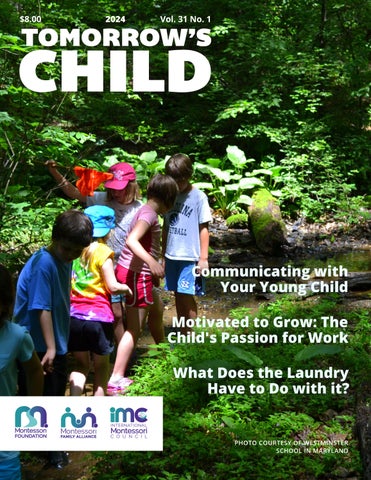
Communicating with Your Young Child Motivated to Grow: The Child's Passion for Work What Does the Laundry Have to Do with it?
PHOTO COURTESY OF WESTMINSTER SCHOOL IN MARYLAND
Tomorrow’s Child (ISSN 10716246), published four times a year, is the official magazine of The Montessori Foundation, a non-profit organization. The opinions expressed in Tomorrow’s Child editorials, columns, and features are those of the authors and do not necessarily represent the position of the magazine or The Montessori Foundation. Acceptance of advertising does not represent the Foundation’s endorsement of any product or service. It is policy of The Montessori Foundation, a non-profit organization, to encourage support for the organization by discounting the sale of bulk order shipments of Tomorrow’s Child in order that schools may make the magazine available to their families. The Montessori Foundation does NOT grant permission to reprint material from Tomorrow’s Child in any other form (book, newsletter, journals). Copies of this issue or back issues are available for purchase through our online bookstore: montessori.org. For School Group Memberships, call 800-6555843 (toll free), or place your order at montessori.org. The Montessori Foundation does not provide refunds for canceled School Group Memberships. Send all correspondence to: The Montessori Foundation | 19600 E State Road 64, Bradenton, FL 34212-8921 MONTESSORI.ORG EDITOR Joyce St. Giermaine PRESIDENT Tim Seldin PROGRAM DIRECTOR Lorna McGrath EVENTS & MEMBERSHIP Kristi Antczak DISPLAY ADVERTISING Joyce St. Giermaine BOOKKEEPER Don Dinsmore PRINTED BY InterPrint Note: InterPrint is now FSC,SFI and PEFC Chain-of-Custody Tri-Certified. Chain-of-custody certification offers paper that has been harvested from responsibly managed forests, then verifiably traced through all stages of print production.
NOW AVAILABLE ON MONTESSORI.ORG! Montessori 101: What Every Parent Needs to Know This 80-page full-color publication is a wonderful resource for anyone seeking to de-mystify Montessori. It addresses topics such as the history and philosophy of Montessori; offers a guided tour of the Montessori classroom; and serves as an illustrated guide to dozens of wonderful Montessori materials. This mini-encyclopedia of Montessori is newly redesigned and contains new sections on Infant/Toddler and Montessori Secondary programs. It is a must-have resource for anyone interested in Montessori, and one that parents will surely refer to throughout their child’s Montessori experience.
Workshops, IMC Memberships, Past Issues & Orders or Questions about an Order Phone: 800-632-4121 info@montessori.org Subscriptions, Bookkeeping, & Classified Ads Don Dinsmore Phone: 941-729-9565/800-655-5843 Fax: 941-745-3111 dondinsmore@montessori.org Display Advertising Don Dinsmore Phone: 941-729-9565/Fax: 941-745-3111 dondinsmore@montessori.org Montessori Family Alliance Lorna McGrath Phone: 941-729-9565/800-655-5843 lornamcgrath@montessori.org Executive Director of the IMC Kathy Leitch Phone: 941-729-9565/800-655-5843 kathyleitch@montessori.org Director of Development Maly Peña malypena@montessori.org
ORDER NOW ONLINE tinyurl.com/the-new-101
2
TOMORROW'S CHILD © § 2024 VOLUME 31: ISSUE 1 § WWW.MONTESSORI.ORG
from the Program Director 5 Aby Note Lorna McGrath
Inside the Issue
with Your Young Child 6 Communicating by Sarah Moudry to Grow: The Child's Passion for Work 8 Motivated by Paul Epstein Pursuit of the Correct Answer: The Role of Process and Dis14 In covery in Montessori by Paula Lillard Preschlack & Roll Story 19 Aby Rock Chad Wilson Does the Laundry Have to Do with it? 21 What by Lorna McGrath a Grand Environment 24 Preparing by Duna Strachan Your School: Westminster School in Maryland 26 Highlighting by Suzanne Radcliffe and Water Sorting 28 Land by Sarah Moudry Cathie: Building Concentration at Home 29 Dear by Cathie Pearlman a Book: Book Reviews 30 Grab by Lorna McGrath
“Education should not just be preparation for university, but preparation for life.” — WHAT DOES FOLDING LAUNDRY HAVE TO DO WITH IT?, PG.21 TOMORROW'S CHILD © § 2024 VOLUME 31: ISSUE 1 § WWW.MONTESSORI.ORG
3
Peacing it all together. This updated edition of the popular course, The Parenting Puzzle, led by Lorna McGrath, shares the secrets of Family Leadership—the Montessori way. Over the course of five weeks, Lorna provides strategies and practical examples that you can use right away to bring peace and ease into your home, creating a haven for the whole family, where power struggles fall away and give rise to joy. Discount for MFA members. Now offering a monthly payment plan.
REGISTER OR LEARN MORE tinyurl.com/parenting-puzzle-2
4
TOMORROW'S CHILD © § 2024 VOLUME 31: ISSUE 1 § WWW.MONTESSORI.ORG
A Note from the Director
Montessori Family Alliance
Dear Montessori Family Alliance Members, Welcome to 2024! Thank you for being part of our international community of Montessori families! Join us for our weekly Tuesday Family Life Webinar Series and our monthly Wit & Wisdom: Family Chat Sessions. Both broadcasts are live on Zoom to facilitate conversation and community. They are free and open to anyone whether or not they have children in a Montessori school. So, feel free to invite friends and family. If you can’t make it to our live sessions, just be sure to open your Montessori Family Alliance account and get The Montessori App to view the archived recordings of our Family Life Webinars. If you are not sure how to open your account, ask your school administrator or send us an email at info@montessori.org. I always get excited when the new year comes around. It’s such an adventure since we have no way to see exactly what is in store for us in our relationships, our work, or our world. One thing we do know for sure in life — change is inevitable. This year as every year, we will see and experience change which will cause us and others around us to react or respond in different ways. Our children need us to help them learn to navigate changes in their lives. Over 20 years ago, Dr. Spencer Johnson wrote a little book called Who Moved My Cheese? In this story, each of the four characters handle change in different ways. • Those who look for change and get prepared; • Those who spring into action and incorporate the necessary change into their routine; • Those who don’t expect it and are frightened into inaction for a while. Eventually, they overcome their fear, let go, and get going; • Those who are stuck in the comfort of the known and are left behind. Since change is inevitable, here are a few ways to support our children as changes occur: • Give them warning. Life is dynamic. It never stays the same. Let them know that so they are not surprised when changes happen. • Remember that you are their model for how to deal with change. • Talk about and explore feelings about change: fear, excitement, frustration, adventure, challenge, anger, pleasure. Let them know that those feelings are natural. • Support their effort in dealing with new situations, their progress in developing coping skills, and their positive attitude and creativity. I hope these tips help now and throughout the new year.
Lorna McGrath
MFA Program Director, lornamcgrath@montessori.org TOMORROW'S CHILD © § 2024 VOLUME 31: ISSUE 1 § WWW.MONTESSORI.ORG
5
0-3 Years
Right from the Start
Communicating with Your Young Child by Sarah Moudry
young child’s receptive language develops sooner than their expressive language. This means they are capable of understanding much more than they can express. Honoring this intellectual development can be difficult when you feel you are constantly met with the one-word answer (“no!”) or a temper tantrum. You may feel like you just asked a simple question, or you just suggested a meal of their favorite food and you look down to find your child flailing on the floor. How did this happen?
A
Staying calm and clear can be difficult to remember when your young child has dropped to the floor and is crying and neither of you know why. Although this situation may not always be avoidable, often it is. You can prepare for this moment by using clear, honest, and positive communication from the start. That’s right, from the moment they are born, you can start communicating your trust in their development. And it is never too late to start! Children of all ages respond well to positive and honest communication.
Communicating with your young child with respect is what lays the foundation for how they will relate and communicate with others as they get older. Using a calm and clear voice helps them feel your sincerity and honest nature. They look to you for guidance as they build their personality.
Using consistent positive phrasing as your communication style helps your child understand when they have the opportunity for choice and input. Young children often feel everything is decided for them and out of their control. They are newly aware that they have choice, can contribute to family life, and they are seeking autonomy. They express
6
TOMORROW'S CHILD © § DECEMBER 2023 § WWW.MONTESSORI.ORG
it by saying, “no!” even when they may really want to say yes. We can support them as they learn that their contribution matters and that they truly have an important voice by not putting them in a situation where they can say no. We can invite them to participate in community life whenever possible and set them up for seeing their role as a contributor not a bystander. Whenever possible, give your child a choice of two options: “Would you like to walk around the block or play in the backyard?” “Would you like to wear brown pants or blue pants?” These are moments where they feel a sense of control and that build their trust in your relationship. This foundation of trust allows you to make the bigger decisions with their cooperation (and without tantrums). “I will give you one more push on the swing and then we are leaving the park,” rather than, “Are you ready to leave?”
Sarah Moudry (@sarahmoudry) is an education innovator whose work is focused on creating education environments and experiences that inspire growth and joy. Her work is rooted in Montessori philosophy and paired with her extensive experience as a designer. Recently, her projects included the founding of StudioJune (@thestudiojune), a Montessori parent and child education center, and Family Friendly Home (@ familyfriendlyhome), an interior design company that creates inspirational home and school interiors. Sarah is the author of books and online courses that help parents, childcare professionals, and grandparents to incorporate Montessori practice into their lives. She has an M.Ed in Montessori education, a B.S.
Below is a chart of seven common situations with young children. By changing just a few words you may find that your young child is much more cooperative and engaged in family life. And you may even see fewer tantrums!
in environment and design, AMI Montessori certification for birth to six years, and is an Associate Member of ASID.
Communication: Try This Rather Than That SCENARIO:
Your child has just completed something.
Your child passes a toy to a friend.
Your child's truck is stuck under a chair.
Your child is crying and you don't know why.
Your child needs help with their shoe.
Your child is climbing on a chair.
Your child hits their siblings out of frustration.
WHAT TO DO:
Acknowledge the effort rather than praise the outtcome.
Name your child's effort rather than label them.
Encourage problem solving.
Offer language for what they may be feeling.
Use correct pronouns.
Phrase instructions in a positive tone.
Talk through frustrating interactions.
INSTEAD OF:
"Good job. You are great."
"You are a good boy."
Pulling the car out for them.
"You are OK."
"Mommy do it."
"Don't stand on the chair."
"Don't hit your brother."
TRY THIS:
"I see you were very focused."
"Giving Ana a turn is very generous."
"It looks like your truck is stuck. What can we do to get it outt?"
"I hear you crying. Are you hurt or frustrated?"
"I can help you take off your shoe."
"Please put your feet on the floor."
"I see how upset you are. What did you want to tell your brother?"
Visit www.studiojune.com to learn more! ©2024 sarahmoudry
TOMORROW'S CHILD © § 2024 VOLUME 31: ISSUE 1 § WWW.MONTESSORI.ORG
7
3-6 years
A New Level of Independence
Motivated to Grow
THE CHILD’S PASSION FOR WORK
by Paul Epstein, Ph.D., Education Director, Designs for Lifelong Learning
8
TOMORROW'S CHILD © § 2024 VOLUME 31: ISSUE 1 § WWW.MONTESSORI.ORG
Independent work begins with choice, and choice is a necessary work element for self-development.
L
ook in a Montessori classroom with twenty or more very busy children between the ages of almost three and six, and you will see children who are passionate about their work. They are focused, self-directed, and persistent. Three-year-old John cuts an apple and then shares apple slices with his friends. Four-year-old Peter traces metal shapes with colored pencils. Five-year-old Sara counts colored wooden squares and then writes numerals on a math paper. When children work with passion, they are curious, creative, inquisitive, imaginative, constructive, thoughtful, orderly, and more. Children love to work. This is how they grow.
Children’s work has both practical and developmental purpose.
“Work” refers to the practical purpose found in each learning activity. For example, a child works with the subtraction strip board and learns a subtraction process. Another child works with the bow-tying dressing frame and learns a bow-tying process. Work has yet another meaning. The child’s process of self-development is also called work. For this reason, we do not interrupt children when they work. They are developing their potential within themselves. The work of the child is to become an adult.
Children’s “work” has many meanings.
For example, three-year-old Martha transfers dried beans from one bowl to a second with a wooden tong. The practiIn a Montessori setting, the word “work” conveys several cal purpose for this work is to learn to use tongs. The develmeanings. Work identifies a learning activity. For example, opmental purpose is to learn to concentrate and strengthen a food preparation work, a writing work, or a math work. and develop hand coordination, a necessary preparation for When a child uses a learning activity, he may say, “This is learning to write when she is older. my work.” Children’s work has several more characteristics.
Work activities occur during the “work period.” The classroom schedule may include a 2 ½ to 3 hour morning work period. The schedule may also include a shorter afternoon work period. During the work period, children may choose work that is for one child; other works may be used by two or more children. Some works are designed to be used on a table. Other work is used on a floor. Before bringing it to the floor, children will unroll a work rug. The work rug assists the young child with keeping the learning objects together on the rug. The work rug also announces to the other children, “Please walk around my work.” “Work” also describes a child’s responsibilities for taking care of the work materials. It can happen that a child finishes her work, and then she may decide to go to the shelf and choose another work, another learning activity. The teacher will offer the child a gentle reminder, “Please put your work away before you choose another work.”
Several more characteristics describe children engaged in purposeful, self-development work. Children will work independently from others. They become absorbed and concentrate for long periods of time. Children will use learning activities with tremendous repetition; they complete a work task, and then they do it all over again. And they are not concerned about making mistakes; mistakes are children’s recipes for learning. Children make independent choices when they work.
Remarkably, young children are compelled to engage in activities by themselves. They are not directed by teachers. In the Montessori classroom, a teacher will not do anything for children if they are ready for us to show them how to do it themselves.
TOMORROW'S CHILD © § 2024 VOLUME 31: ISSUE 1 § WWW.MONTESSORI.ORG
9
3- 6 Years | A New Level of Independence Independent work begins with choice, and choice is a necessary work element for self-development. When children make independent choices, they learn to become self-directed and self-disciplined. Children choose their own work. Each child will also choose how to use it and how long to use it. When children choose their own work, they are choosing what they need for their growth and development. They choose what they need to develop their unique potential. Consequently, no two children learn at the same time or in the same way, and each child will only learn when she is ready.
is rough because it is not smooth. Something is sweet because it is not sour. For example, four-year-old Martin arranges a set of ten wooden rods. A practical purpose for this material is to understand length. Each rod is painted in the same red color. The shortest red rod is 10 cm. long; the next is 20 cm. long; and the next rods progress in length by ten more centimeters to the longest red rod which is 100 cm. or 1 meter long. Martin places the red rods randomly on his work rug. He then places two rods side-by-side, compares their lengths, and in this way arranges all ten rods from shortest to longest. Martin now mixes the rods and sorts them by length again. Martin repeats his work with the red rods six times. Children prefer the process of work and not results.
Children are not result oriented. They are, instead, process oriented, and they are compelled to work with repetition. Children may prefer process because they are not interested in perfection. Perfection is a final state; there is no further growth after becoming perfect. The child’s purpose is to develop his or her unlimited potential, and repetition is how they do this. Children who are independent can choose their own work and work with concentration. They can persist, overcome For example, two-year-old Beth has been working with an challenges, and self-correct. They have developed habits of apron for about ten minutes. She puts it on over her head, learning. and then she takes it off. She looks at the apron, turns it sideways, and then puts it on over her head. And then takes Children develop understanding when they work. it off, and then puts it back on. At any moment an adult could help Beth, but Beth does not ask for help. ApparentWork with the Montessori materials assists children with ly, she is not interested in wearing the apron. Beth’s choice developing conceptual understanding. For example, size is is developmental. She is purposefully practicing putting it an abstract concept. If young children could reason and on and taking it off. learn solely with language, we could tell them the meaning of size, and they would understand. Instead, young chil- Three-year-old Tommy picks up a pitcher containing dren are perceptual learners. Young children learn with red-colored water. Tommy places a funnel into an empty their senses (sight, sound, touch, taste, and smell) and from jar, he pours the colored water into the funnel and watches what they can do with objects. the water drain into the jar. Now he places the funnel into a second jar, pours water into the funnel, and again watches Perceptual learners “think” with objects. They understand the water drain. Some water spills onto the table. He places concepts by arranging and comparing objects. Something the pitcher on the table, picks up a small sponge, wipes the 10
TOMORROW'S CHILD © § 2024 VOLUME 31: ISSUE 1 § WWW.MONTESSORI.ORG
water spill, and squeezes the sponge into the pitcher. He now pours the jar water back into the pitcher. Then he does it all over again, and then again. Tommy busies himself for some 25 minutes with this activity. Sometimes he pours slowly, sometimes quickly, sometimes with the funnel, and sometimes without. The practical purpose of this work is to learn to pour liquids through a funnel and to decide to stop pouring when the jars are filled. The developmental purpose is to develop coordination, concentrate, and make judgments. Children develop both practical skills and satisfy developmental purposes from repetition and practice. They develop their abilities to concentrate, observe, compare, make decisions, innovate, and more. For example, four-year-old Michelle has been sorting and building with 27 colored blocks already for 15 minutes. The colored blocks make up ten different combinations of sizes and colors. When put together, the blocks form a trinomial cube. Michelle is absorbed. She sorts the blocks by sizes and colors, builds the cube, and then takes it apart. Then she builds the cube all over again, each time beginning with a different block. Perhaps she is fascinated with the size and color patterns; perhaps she is fascinated with how these blocks always come together and form a cube. Children’s work includes making many mistakes.
Children are mistake oriented; they are not afraid to make many, many mistakes. We should celebrate the necessity of making mistakes because this is how children learn. Their work process is to explore, investigate, make mistakes, discover, and then do It again. For example, learning to pour requires developing eye and hand coordination that prevents spilling. Learning to spell requires developing writing coordination and knowledge of English phonemes that prevent writing pear as pair or writing see as sea. The Montessori learning materials are designed to guide children to learn to recognize and then self-correct their mistakes. For example, Tammy works with the Knobbed Cylinder Block. The purpose of this material is to learn TOMORROW'S CHILD © § 2024 VOLUME 31: ISSUE 1 § WWW.MONTESSORI.ORG
11
3- 6 Years | A New Level of Independence
about size and to develop the ability to reason and make judgments. There are ten cylinders in the block. The ten cylinders are the same length, and they differ in diameter. Each cylinder fits exactly into one hole in the block. Tammy takes out each cylinder and then puts them back into the block. Sometimes she puts cylinders in the wrong places — the cylinders do not fit into the wrong places. Once the cylinders are properly returned, she repeats and does it all over again. Some children will repeat this work process 15, 20, or more times.
and weights of each cube, and arrange the cubes in order from largest to smallest or from smallest to largest.
Erin builds a block tower, and the tower falls. She tries again, and she stacks the blocks in a different way. The tower falls again. From these building mistakes, Erin gains valuable experiential knowledge about cause and effect, balance, creative problem solving, and the value of learning from trial and error. This work is called the Pink Tower. This is a set of ten cubes, and the cubes are painted in an identical pink color. The cubes are not the same size. They are graded in size from 1 cm3 to 10 cm3. The purpose of this work is for the child to develop an understanding of size. Children develop this understanding with their senses. They hold and see each cube, compare the sizes
Children’s work differs from adults’ work.
12
When children work, their repetition guides them to learn how to self-correct. Although the cubes differ in size, the child may place some of the cubes in the wrong size order. Should this happen, the teacher will merely observe and patiently wait and see what the child will do next. Will the child notice the sequence of cubes is not in a size order? Will the child self-correct and rearrange the cubes?
Remarkably, work does not tire children. Instead, they become energized from engaging in work they have chosen. Adults, of course, also work, and we also develop ourselves from our work. For example, we go to the gym and “workout.” We can work to master some knowledge and skills and better ourselves. We also work to produce results. We often work efficiently and effectively to produce the most results we can, in the least amount of time, and with the least amount of effort. We love results, and we feel satisfied when we check it off the list. We adults are motivated
TOMORROW'S CHILD © § 2024 VOLUME 31: ISSUE 1 § WWW.MONTESSORI.ORG
to work for intrinsic and extrinsic rewards. We work out their personalities and walking, running, climbing; unat the gym for the benefit of health and strength. And we derstanding and speaking language; socializing and may work at work for the benefit of a salary. expressing emotions; reasoning and creating; overcoming obstacles and persisting; solving problems, being creative, Children work for the benefit of growing up and becoming and more. adults, and they do this without a contract or promise of salary in exchange for their time and the value they pro- Children passionately engage in work because they are pasduce. When young children finish an activity, they do not sionate to grow and become themselves. When they work, check it off a list. Instead, they may do their work all over they are scientists, filled with wonder and curiosity. They again. Children’s work often lacks efficiency and effective- are intent on investigating the world and developing themness. They may make unpredictable movements, and they selves. They are not afraid to experiment and see what will may make many messes. Unlike an adult, young children happen when they try this and then that. For children, it’s do not work with minimal effort. They are “all in!” They all in a day’s work. love to work! Dr. Maria Montessori described a child’s work process: [The] child has a personality which he is seeking to expand; he has initiative, he chooses his own work, persists in it, changes it according to his inner needs; he does not shirk effort, he rather goes in search of it, and with great joy overcomes obstacles within his capacity. (Dr. Montessori’s Own Handbook, pp.77- 78.) For children, work is a continuous process of self-development, and children must work to develop everything:
Paul Epstein is the educational director of Designs for Lifelong Learning. He has worked in education as an administrator, university professor, teacher trainer, classroom teacher, researcher, consultant, and author. Paul brings transformative learning experiences to educators and parents throughout the world. He is the author of numerous articles and books including An Observer’s Notebook: Learning from Children with the Observation C.O.R.E. He is also the co-author of The 60-Day Montessori Observation Workbook and The Montessori Way, a definitive work on the Montessori experience. His administrative experiences include working as a head of Montessori schools, and he brought the International Baccalaureate Middle Years Program to one of the schools. Paul also works as a director and instructor of Montessori teacher education programs. He has been a Montessori classroom teacher in Montessori early childhood, middle, and high school programs. Paul holds Montessori teacher certification in early childhood and secondary levels one and two from the American Montessori Society and his doctorate is in Cultural Anthropology.
TOMORROW'S CHILD © § 2024 VOLUME 31: ISSUE 1 § WWW.MONTESSORI.ORG
13
6-12 years
The Imagination Years
In Pursuit of the Correct Answer by Paula Lillard Preschlack, Forest Bluff School
The Role of Process & Discovery in Montessori
14
TOMORROW'S CHILD © § 2024 VOLUME 31: ISSUE 1 § WWW.MONTESSORI.ORG
Changing our View of Education: A Positive Approach The positive nature of the Montessori approach, with its emphasis on process and discovery, is central to why it works so well for children in their development. When Dr. Montessori lectured in London in 1946, she pointed out that conventional education focuses on mistakes.
Montessori’s view was that there is exactness in mathematics and science, which gives our universe balance and beautiful symmetry. Realizing this is truly awe-inspiring for children! But instead of having this phenomenon of exactitude dominate the whole educational approach (by trying to stuff answers into children’s minds), Montessori sought to awaken their wonder for exploration and to help children discover pathways of thinking that lead to correct answers. A prime example of this is the way elementary-aged children explore math through the specially designed materials that require several steps and attention to detail. The children ultimately arrive at the correct answer and are often quite satisfied with themselves after much effort; all the while, they are developing cognitive processes and character traits that contribute to future learning and problem solving.
Think of your own experiences and how your schooling was structured; you will probably remember that there was constant attention given to your errors. Avoiding errors was the thrust of the system. Even with a few enlightened, kind teachers here and there, who emphasized process and exploring bravely, the main message for how you were to learn things was by having your mistakes pointed out to you daily in the form of testing, performing in front of classmates, and reaching for the one “correct” answer to Discovery and Ownership each question. This emphasis, by design, encourages children to lose confidence in their originality. And, yet, we Through the materials and how they are presented by the know that developing unique perspectives is invalutrained teacher, Montessori children in an Elementary able. Thus, the very thing that makes society classroom search for the paths to find the true prosper is being discouraged on a daily answers; when they get there, the results are "…the very basis in our conventional school model. their own discovery, just as if they were the first mathematicians to discover thing that makes You may be wondering how there them. The result of this repeated exsociety prosper is could be another way to teach, perience makes children view mathebeing discouraged on when there are certain areas in life matics as the wonderful puzzle that where there really is just one correct a daily basis in our it is. The idea of being embarrassed answer. Mathematics and science are at arriving at an incorrect answer is conventional school not a matter of opinion, for instance. foreign to these children, for whom model." There are facts that children must learn the taste of finding the right answer is so in order to succeed in some areas. Which is sweet that they want to explore other avemore important: the process, which leaves room nues and learn more. Mistakes are integral steps for originality, or the answer, which must be consistent in every journey, and this reality becomes familiar and acwith the truth? The answer is both, and Montessori’s ap- ceptable through repeated experience. proach allows for this interesting dynamic to play out in the classroom, as it does in real science laboratories and The Montessori materials guide children to find the ways in sophisticated math discussions. Dr. Montessori discov- that work, making the adult corrector obsolete in many ered that there is an alternative way that children learn cases. For instance, when two children do long diviabout exact answers. sion problems together with a material called Racks and Tubes, there are many places they might err. They could TOMORROW'S CHILD © § 2024 VOLUME 31: ISSUE 1 § WWW.MONTESSORI.ORG
15
6-12 Years | The Imagination Years start off incorrectly by placing the tens board to the right of the units and work through the whole problem incorrectly, only to find at the end that their answer is incorrect (either by bringing it to an older friend who can do the problem longhand on paper, to the teacher who can check it, by using another math material to do the inverse problem and see if it matches, or by checking it themselves against a calculator). They go back to their work—puzzled—and like two detectives, they re-examine how they set up the problem (which is often when they will identify this first mistake), or they employ a friend to see if they can identify where they may have lost the path. In my experience as a Montessori Elementary teacher, this is when the fun really begins if the adult supports an attitude of curiosity about finding the error. Children will repeat a problem over and over, sometimes eliminating just one of several mistakes at a time in the same math equation or process. The important thing is for the teacher and community to support the quest to get to the end, so that the children do not fall into a habit of giving up too easily or repeat making the same mistake so many times that it gets ingrained! By keeping tabs on their progress, the teacher can see when to step in and point children in the right direction, perhaps making an observation and/or asking a question: “Oh! Wait, I see—look where your units board is. Do you remember where it belongs?” This is usually all that is needed to get an “Ah-ha!” and a delighted, re-energized effort to try the whole thing again. Children are remarkably resilient, especially when working with a friend and being allowed to own the whole process of the math equation. When they finally, leaning over the calculator with suspense, find that they have achieved the correct answer by their own efforts, it is an excited triumph that feeds the urge to tackle more and more problems. Very rarely have I seen children want to get to the answer easily so they can quit. There are some who will be tempted to use a calculator 16
to find the answer and just write it in, sometimes several times, to create the illusion that they have accomplished a lot of “work.” You may be surprised to hear that in a Montessori environment, that is the exception and not the norm. Teachers usually catch that pretty quickly, but even if they didn’t, and even if other children did not point to it and demand that the child work honestly and just as hard as them, the child who does this often abandons the practice after watching others glean the internal rewards of sustained efforts and true glory of finally getting that answer. As children experience this quest again and again, they hone their skills each time. Eventually, the exercise becomes too easy for them, and they are ready to advance to another math process that brings them to their next level of challenge.
Developing Persistence To describe all the ways children might error in the process of long division with Racks and Tubes would take too long here, but I’ll give you a sense: One child may write the problem down differently than their companion and, therefore, lay out some incorrect amounts when distributing the beads to be used (a mere flipping of two numbers, perhaps). This carelessness will eventually be discovered, and both children will realize the importance of double-checking with each other before they begin. They also might place the working number of beads in the wrong category or confuse the order of the categories (units, tens, hundreds, etc). Again, these are mistakes that reflect the need to double-check their layout before they begin the process.
TOMORROW'S CHILD © § 2024 VOLUME 31: ISSUE 1 § WWW.MONTESSORI.ORG
Another place they may err is in physically dropping a bead or beads, losing them as they spring across the floor and losing count of how many were in the bowl to be distributed. This reminds them to slow down, be careful, and focus on their physical movements. They could also lose count or forget a step if they are interrupted by conversation or stop what they are doing to attend to something else in the middle of their process. This would illustrate the importance of sustaining their focus on the task at hand until finished. Finally, they might write the numbers down in the wrong order at the end, showing again a need for more careful, focused attention and awareness.
Montessori teachers tend to inspire a sense of wonder and nurture children’s curiosity and imagination. Sometimes, two children have two different answers written down, and they’ll be perplexed about which one is correct, garnering more discussion and a backtracking of their steps. Watching all this is incredible; the amount of teamwork, social interaction, struggle, humor, fun, and agony
that can accompany such a process as doing long division is positively brilliant in the sense of integrating all aspects of a child’s development as a person and a mathematician. For a Montessori teacher, bearing witness to such self-discoveries is joyful. It is a special experience to spend one’s days in an Elementary Montessori classroom with children working with the Racks and Tubes! It can take more than an hour for children to complete a challenging problem (if you account for the self-correcting, they may need to do), but the learning that occurs is immeasurable. And the more children work with such processes, the faster they achieve success each time, fueling their desire to tackle more challenges all over the classroom. This is just one example of how Montessori fuels the development of children’s resilience and perseverance in a very direct and effective way. And because a Montessori classroom is a vibrant community where everyone is working simultaneously on different things and seeing what others are doing, the practice of pushing oneself until achieving success is contagious. Children will stop and help each other, discuss, and share a conundrum, and sometimes get intrigued with each other’s experiences of learning. The learning is, therefore (in economic terms), a positive externality, meaning that the network of students spreads newfound information via witnessing and sharing experiences; this happens naturally in a Montessori Elementary classroom because of children’s gregarious social behavior at these ages. This is another example of where Dr. Montessori designed an approach that employs (rather than fights against) the developmental characteristics of children in this stage of life between ages six and twelve, specifically, their tendency to be very social and to always want to find out what their peers are doing. In the above example, students may use the mantras they learned in their Primary years (ages five and six), such as “The units always go on the RIGHT” and “We always begin with the UNITS” (“except in division, when we begin with the highest category present”). Students love these little cues, and when the Primary teacher says them
TOMORROW'S CHILD © § 2024 VOLUME 31: ISSUE 1 § WWW.MONTESSORI.ORG
17
6-12 Years | The Imagination Years each time, she is with children in a math presentation, the children often chant along. There are just a few such mantras that carry over from Primary to Elementary, so children tend to remember these. We have found that children benefit from having such important points of interest brought to their attention regularly, so that they can commit them to memory.
Paula Lillard Preschlack is a writer and a speaker. She has spent 25 years as a teacher and the head of school at Forest Bluff School. She just released her first book about Montessori education, The Montessori Potential. Paula Preschlack has given over 100 talks at Forest Buff School and at other Montessori schools, teacher training courses, and conferences. Her work focuses
When working on math and science, the children in a Montessori classroom don’t just value the exactness of a true answer; they love that there are answers to find, and they see each exact answer as a part that connects to a greater whole, creating a universal balance in which each component matters. With the Montessori approach (where the processes of discovery appeal to our children’s developmental characteristics at each age), finding correct answers is fun, sometimes eventful, and always intrinsically rewarding.
on the principles and successes of the Montessori approach, learned from over 25 years of teaching and observing children from birth to adulthood. Paula is a graduate of Hampshire College and has a master’s degree in education from Loyola University, Baltimore, MD. She is AMI certified for all Montessori age levels: Assistants to Infancy, Primary, and Elementary, and she audited the NAMTA/AMI Orientation to Adolescent Studies in 2018.
Ari �"" 'ldfirvt tfie tn<>Sf frot,i, �""' Morite,ssori fattiifJt AUJ� �ersfJp? As an international network of Montessori parents, teachers. and friends, you have access to:
• • Montessori
FAMILY ALLIANCE
We have been a well-k of practical and reliabl information, answers, and advice for for families worldwide for more than 30 years.
800-655-5843 1 941-729-9565 I montessori.org/mfa
18
TOMORROW'S CHILD © § 2024 VOLUME 31: ISSUE 1 § WWW.MONTESSORI.ORG
Finding Their Own Voice
A
12-18 years
ROCCKK && RROOLLLL Story
by Chad Wilson
Note from the Director: You may notice that this issue of Tomorrow’s Child has articles that reference both the practical and developmental purposes of the lessons in Montessori schools. This uplifting article about a rock band in a Montessori school is no exception. Chad Wilson Bailey could have named this article “What Does a Rock Band Have to Do with It?”. As you read this article you will notice that not only the students but also the musician benefits from the experience. The practical experience of practicing together to gain instrumental skills and vocal presentation, setting up equipment at the venue, and actual performance are obvious and important, no doubt. However, as you read the article and look at the developmental/hidden lessons, you will find that they are enormous. You’ll always find independence, order, concentration, and coordination at the core. Then if you keep looking you will see even more lessons including collaboration, respect, and confidence. Music is an undeniable source of pleasure and learning.
A
s a professional musician, I never really considered myself to be a teacher. I was made aware of the need for a band director at the school through a parent and mutual friend at Desert Garden Montessori School (DGM). I interviewed for the position and was apprehensive about taking on the role until I met the children and saw the space. I was immediately drawn to them and felt, instantly, that I needed to take on the opportunity. I quickly realized that there was limited musical equipment with no budget for new equipment. I became worried about how I was going to conduct a rock band program without the items that the students needed. Through generous contributions from the Phoenix community and members of DGM I was able to buy new equipment for the program and, from there, we were off and running. I started working with the students twice a week for an hour and fifteen minutes for each class. The students quickly brainstormed a list of songs they wanted to learn and began working hard to prepare them for performance. They had a few smaller shows at the DGM campus throughout the semester, but they were shocked when they found out they had been invited to perform for an audience of 250+ teachers at the Montessori Foundation/International Montessori Council Annual Conference held here
TOMORROW'S CHILD © § 2024 VOLUME 31: ISSUE 1 § WWW.MONTESSORI.ORG
19
12-18 Years | Finding Their Own Voice
It was almost 4 hours of setting up and taking down equipment and countless hours of practice, but by the end of the day, I would do it 100 times over if I could. in Phoenix. They were honored by the gesture and quickly accepted the invitation. After the performance, I collected some feedback from the students about their experience. Jack, 15 years of age and the drummer of DGM Rock Band, shared, “My favorite moments were when everyone started clapping to the beat of Mr. Brightside, which as a drummer is a huge compliment, and I think I speak for the whole band when I say that having everyone wave their phone lights on This Love was awesome. My favorite moment in the performance was the instrumental solo in You Know I’m no Good. It was almost 4 hours of setting up and taking down equipment and countless hours of practice, but by the end of the day, I would do it 100 times over if I could. I love playing drums and I love our band and I am so looking forward to playing more songs with them in the future.” Makayla, the bass guitarist of our Rock Band, shared several insights from her experience: “For the past three years that I have been in a rock band, we have only performed in front of our school community, so you could only imagine how exciting performing at an exclusive outside event was for our group. The venue was beautiful, the audience was vibrant, and the music felt perfect. The preparation for concerts is always nerve-wracking for me. My mind constantly twists and turns thinking about the set list, gear, and the overall presence we bring to an event. To my surprise, once our band was on the stage, I felt truly comfortable and confident. All my worries about messing up a note or playing the wrong song left me. It felt amazing just to relax and perform to an audience that didn't know me and 20
to people that I had never met before. I believe that may have been my favorite part of the entire event. The audience was so supportive, and after the show, many of the members sprinkled our band with plenty of compliments that made us feel like celebrities. I am extremely excited for any new adventures our band plans to take on.” From my perspective, it was exciting for me to guide the students through the event, which was a legitimate gig; a gig that involved an hour of travel time to and from, a large setup, a large crowd of people (from outside of their school site), the performance of multiple songs and even an encore performance! I was beyond proud of the students, their work ethic, their professionalism, and their ability to rise to the occasion. Going forward, I am hoping to purchase a professional-grade PA system for the school, continue to guide the students through new music and more challenging songs, help students with future performances, and recruit new members into the Rock Band so that we can continue this great program. I feel grateful and blessed to have the opportunity to work at DGM with these incredible students. I have already witnessed so much growth in every member of our Rock Band and I look forward to watching each of these great musicians step into their full potential as artists. My heart is full every day because of them. Chad Wilson Bailey is a Professional singer/ songwriter and rock Band director at Desert Garden Montessori School, Phoenix, AZ.
TOMORROW'S CHILD © § 2024 VOLUME 31: ISSUE 1 § WWW.MONTESSORI.ORG
All Ages
What Does Folding Laundry Have to Do with It? by Lorna McGrath
P
ractical Life is a fundamental part of the Montessori curriculum. Dr. Maria Montessori wrote, “Education should not just be preparation for university, but preparation for life.” We want our children to have the skills and knowledge to function very well independently: capable of caring for themselves and their environments; knowing how to behave in a manner that will lead them to success in all aspects of their personal, educational, and professional lives. Our responsibility as parents is to help them to be ready for successful, independent living.
areas: Care of Oneself; Care of One’s Environment; Food Preparation; and Grace and Courtesy. Just as at every level in our classrooms children become more and more abstract thinkers and have less need of pre-made materials to demonstrate skills and concepts, so a similar evolution occurs in our homes.
In the early years children work with activities, all very neatly ordered and on the shelves. The activities are specifically designed for them to learn all sorts of Practical Life skills, such as dishwashing; preparing for their own snack; In Montessori classrooms, at every level from toddlers to using utensils; and resolving conflicts using their words. young adults we divide Practical Life into the following The Practical Life area is quite obvious in a Toddler or TOMORROW'S CHILD © § 2024 VOLUME 31: ISSUE 1 § WWW.MONTESSORI.ORG
21
All Ages | Practical Life Early Childhood classroom. In the Elementary years practical life materials are not always designated to an area or grouping of shelves. They tend to be placed around the indoor and outdoor environments where they can be accessed when needed. For example, you may find them in a garden shed, a kitchen area, or at a workbench with cabinets for tools. At the Adolescent level students may be helping with projects in the larger community such as Habitat for Humanity; traveling across town to the public library or the local college to do research; writing their resume and cover letters to set up internships for themselves in local businesses; or designing costumes for a performance. Throughout their home and school years these kinds of activities are important because they have dual purposes within each activity. The obvious purpose is the skill that they learn from each activity like how to use a dustpan and brush, how to plan and prepare a meal, how to interrupt politely, how to peel and cut bananas, how to get across town on a bus, or how to fold the laundry, etc. The other purpose is what we like to call the “hidden lessons” which
are as, or more important than the actual skill attained. These hidden lessons are independence, order, concentration, and coordination. So when we think about folding laundry, and we observe children doing that activity we can easily see that knowing how to fold it helps them to develop a skill that will allow them to be more independent. At the same time, they are learning to sort and categorize laundry items to create order, to pay attention and carefully fold clothing neatly, and to coordinate their hands and minds as they complete the activity. These are essential skills that apply to many aspects of their adult life. The beauty of it is that children do this work throughout their growing years without being conscious of all that they are learning. So next time your child tells you about folding the laundry at school, or you watch your child folding and putting laundry away at home, notice the sparkle in their eye and the pride in their work that your children have when they participate in these everyday activities.
“The child who has felt a strong love for his surroundings, and for all living creatures, who has discovered joy and enthusiasm in work, gives us reason to hope that humanity can develop in a new direction.” Maria Montessori 22
TOMORROW'S CHILD © § 2024 VOLUME 31: ISSUE 1 § WWW.MONTESSORI.ORG
Here are some of the activities for home and school, at each level of development. Toddler Level
Elementary Level
• • • • • • • •
• • • •
Dressing and undressing oneself Feeding oneself Toileting oneself Saying hello and good-bye Sharing Cleaning up spills Putting work away Washing hands and bathing oneself
Primary Level • • • • • • • • • • • • • • • • • •
Sewing Hand Washing Dressing and undressing oneself Preparing snacks and appetizers Baking Following simple recipes Manners Watering plants Arranging flowers Sweeping the floor Washing dishes Folding laundry Gardening Woodworking Conflict resolution Greeting and welcoming guests Doing Laundry Making the bed
• • • • • • • • • • • • •
Preparing more complex recipes Planning and preparing family meals Writing invitations and thank you’s Choosing appropriate clothing for different occasions Telephone and texting manners Running a business Gardening Managing money Greeting and welcoming guests Introducing people and oneself Conflict resolution Participating in team activities Understanding rules and games Planning “get togethers” and parties Learning to dance Allowances and chores Cleaning and organizing their room
Secondary Level • • • • • • • • • • • • •
Social networking etiquette and safety Understanding body changes Interacting appropriately with different genders Dressing for the occasion Planning events and trips Community service Bank accounts and debit cards Reconciling check books Check writing Mind trust Understanding advertising and it effects Recognizing everyone’s contribution to the whole Using public transportation
TOMORROW'S CHILD © § 2024 VOLUME 31: ISSUE 1 § WWW.MONTESSORI.ORG
23
Enjoying the Next Generation
Preparing a “Grand” Environment by Duna Strachan
I
n a Montessori school, step one is preparing the environment. Teachers spend days, sometimes weeks, preparing their classrooms for the new school year. They consider every student, what they love, what they need, and find a place for that in the room. Everything is arranged in precise sequence and according to the skills being developed. A teacher makes sure anything a child may need is somewhere in that room, and we often learn much about our students by observing what it is that they seek. When everything is in place, we 24
make sure the room is also clean, fresh, beautiful, and enticing. There should be plants, animals, art, and music to create a space of inspiration and peaceful learning. An advantage to having spent one’s career in a Montessori school is the attention to detail we develop, along with our understanding of child development and how to prepare a beautiful learning environment. My husband, Bruce, and I have Infant/Toddler, Early Childhood, Lower and Upper Elementary Montessori
TOMORROW'S CHILD © § 2024 VOLUME 31: ISSUE 1 § WWW.MONTESSORI.ORG
teaching credentials between us and have run our school for 36 years in Park City, Utah. Our grandchildren are now 13, 9, 5, 3 and 9 months. They have all attended our school, and they are all classic Montessori children, which, of course, means they are all different! When our grandchildren come to our house they get right to work, just as if they were walking into class. Finley likes to bake or build with her uncle’s enormous Lego brick collection, Mara likes to draw and read her mom’s comic books, Luna likes puzzles and games, Elliott likes the trains and Strider likes books and things that roll. They know where all those things are and need no help getting started or putting things away. They can go outside and swing, play on the small beach by the pond or (in the winter) clear a skating path on the pond. We have inadvertently collected skates in every size, since those little grandfeet grow so fast! In the summer we like to ride bikes to the neighborhood pool or to a park for a picnic. If it’s to be a sleepover, forts will be constructed of blankets and pillows, and someone will likely stay up too late – often me! Of course, when they were all babies, it was trial and error to make sure our environment was properly prepared. We scoured the place for baby dangers and retrofitted every room so the grand ones could reach their cooking, crafting, reading, puzzling and building materials. Yes, there is a rocking horse in the living room, a push car in the family room, a child-sized rocking chair in the office, a unicorn in the bedroom, sand toys on the beach, small rakes, and shovels in the garden. Every part of our home has something for the young ones. Just as we prepare our classrooms as teachers, we plan activities in every part of the house as grandparents so the children can always find something interesting to do. We make sure they can access everything they need and put it all away when they are done. And just like in the classroom, they arrive and get right to work. Which leaves us free to sit down and watch them work. Or join them!
the grandchildren. As soon as they can reach the microwave, they can heat the water, select the tea, fill the sugar bowl and creamer, and place cookies on a small china plate. When they are done, whoever can reach the sink washes all these special dishes and puts them carefully back, ready for the next tea party. Between parties there is the silver to polish and the cookies to bake. And, sometimes, there is nothing more special than a cousin outing — to the aquarium, the museum, skiing, the pool, the beach, biking, hiking — the world is our classroom. We have seen how successful these children are in school. They can be just as successful in our homes and on field trips with some thoughtful preparation.
Duna Strachan, MEd, is Founder and Executive Director of Soaring Wings International Montessori School in Park City, Utah, mother of two grown, happy, and successful Montessori children and grandmother of five Montessori grandchildren with
I picked up a child-sized silver tea set in a vintage shop several years ago and that has been a favorite of each of
all kinds of potential!
TOMORROW'S CHILD © § 2024 VOLUME 31: ISSUE 1 § WWW.MONTESSORI.ORG
25
Montessori Family Alliance
Local Spotlight
HIGHLIGHTING YOUR SCHOOLS 50 YEARS OF MONTESSORI EDUCATION
Montessori School of Westminster by Suzanne Radcliffe, Director of Admissions
F
or more than a decade, I’ve watched as parents approach our front entry. As Director of Admissions, I can tell by the looks on our visitors’ faces that our hilltop campus has already made a favorable impression. Within sight of the nearby Blue Ridge mountains, the Montessori School of Westminster’s 27-acre campus assures families that children from age two through Middle School will embrace nature, explore wooded trails, and find friends under wide blue skies while experiencing a quality Montessori education.
Elementary program since 2007, and has her two children attending the school.
Fifty years ago, the area surrounding the school in north-central Maryland was a place where people retreated from the growing city of Baltimore. In 1973, a group of dedicated parents—doctors, attorneys, entrepreneurs, educators, and professors from the nearby liberal arts college—formed the Montessori Society of Westminster to establish a fresh, new preschool dedicated to Montessori ideals. Their efforts created the Montessori School of We welcome our new Head of School, Lauren Welsh-Baer, Westminster. the Montessori School of Westminster’s (MSW’s) third in a trio of great women who have led the school for half The Society rented two rooms for the new program in a a century. She is a former student, taught in our Lower rural church. The church’s wide lawns, open fields, and 26
TOMORROW'S CHILD © § 2024 VOLUME 31: ISSUE 1 § WWW.MONTESSORI.ORG
even its historic gravestones provided a quiet and fitting construction of a dedicated new building. Excitement grew setting for a school emphasizing movement for students as space devoted specifically to the Montessori Method both indoors and out. was designed. Both the architect and the builder of the school were parents of MSW students. The plan for the An experienced Montessori guide from Illinois was hired. new school building included direct outdoor access from During the school’s first year in 1973, the school offered each classroom. Low window sills invited sunlight and morning and afternoon Primary classes for about 50 stu- green landscapes into each room. Kitchenettes, child-sized dents. Society members served as school registrar and pro- toilets, and multiple playgrounds were anticipated features vided support with marketing, accounting, and fundraising. of the new campus. The new education building featured clean, modern lines and spacious classrooms designed speAs the area population steadily grew, MSW followed in cifically for the Montessori Method. The first group of kind. Parents, committed to the Montessori Method, students crossed the threshold in September 2001. clamored for additional grades, and Elementary programs were added. In 1994, room for the school’s As the Montessori School of Westminexpanded programs was provided by rentster celebrates 50 years, in addition to nine ing space at a second church. classrooms, the school includes a popular program for two-year-olds named BeginThe second location housed the school’s nings; the expansive 5,000-square-foot much-anticipated Middle School, which UTZ Field House; a separate Middle opened in 1999, after the dedicated School building; outdoor education program guide (a public-school teachspaces; expanded playgrounds with uper convert) traveled repeatedly between dated equipment; before- and after-school Maryland and Texas to complete her care programs; extensive trails, gardens, training. Since its inception, students in woods, and a stream that students love to MSW’s Middle School class have visited explore. We recently added bus transporcities and landmarks from coast to coast tation service. Instrumental and choral and places in-between, experiences that music, visual arts, language instruction, foster independence and encourage students to explore physical education, and MSW’s one-of-a-kind environcultures across the globe. mental education program complement our curriculum known for its fidelity to Montessori principles. Our MonIn ensuing years, the surrounding demographic shifted tessori-certified faculty has a combined 93 years of Montesto a bedroom community for those commuting to Balti- sori teaching experience and almost 150 years in education. more and Washington, D.C. By 2000, after 17 years of op- MSW is accredited by the American Montessori Society, eration, about 140 students attended MSW. The school the Association of Independent Maryland Schools, and is community was surprised when the church housing the licensed as a Maryland “Green School.” Primary program announced it was developing its own school. MSW stakeholders were tasked with quickly find- For two-year-olds through Middle School, MSW instills ing options for relocating the school. qualities of mutual respect, independence, creativity, collaboration, and a love of learning. Near-capacity enrollA downtown Westminster location seemed most advanta- ment of 180, including more than a dozen legacy students, geous; however, as sites were considered, a 27-acre parcel suggests we are on the right path as we prepare for the next five minutes from the city center became the choice for 50 years! TOMORROW'S CHILD © § 2024 VOLUME 31: ISSUE 1 § WWW.MONTESSORI.ORG
27
Montessori in Your Home
land & water
sorting
Help your child develop independence in caring for self and their environment. by Sarah Moudry
Purpose
Vocabulary Enrichment for 30 months and up
Materials
Brown Construction Paper . Basket . Blue Construction Paper . Land and water items to sort Cardstock . Vehicles: Boats and Cars . Scissors . Animals . Glue . Plants . Laminate (optional)
Preparation
5. Remove one of the objects from the basket and name
1. Cover the cardstock with ½ blue and ½ brown con-
it. For example, “whale.” Then say, “The whale lives in water,” and place the whale on the blue side of the mat.
struction paper. 6. Repeat with an object for land.
2. Glue in place.
7. Continue to do this with your child until they get the
3. Laminate if desired.
idea. Then allow them to continue the sorting. Give the names of the objects that are new to them.
Show Your Child 1. Show your child the laminated land and water mat
and the basket of objects.
8. When they are all done, help them to put the basket
of objects and mat away on a shelf. Once you show them this activity, they should be free to take it out whenever they have time to play at home.
2. Point to the brown side and say, “this is brown like
soil. This represents the land. What are some things we do on land?” Have a short conversation and discuss things like walking, driving, riding bikes… 3. Point to the blue side and say, “This is blue like water.
This represents the water.” Continue with a conversation about water and all that we do in the water. 4. Point to the brown again and say, “land.” Point to the
blue again and say “water.” 28
Note: If your child places an object incorrectly, you do not need to correct them right away. It may take more time and experience for your child to understand how to sort them. If you notice this, at another time, read books about animals that live in water and live on land, or vehicles in the water and vehicles on the land. Then, represent the activity. Resources: Inexpensive collections of plastic objects can be found on Amazon.com/Safari-Ltd
TOMORROW'S CHILD © § 2024 VOLUME 31: ISSUE 1 § WWW.MONTESSORI.ORG
Dear Cathie Concentration and Focus
by Cathie Perolman
DEAR CATHIE— WE ARE SENDING OUR CHILD TO A MONTESSORI SCHOOL TO LEARN HOW TO CONCENTRATE, AMONG OTHER THINGS. WE ALSO WANT TO ENCOURAGE HER TO CONCENTRATE AND FOCUS AT HOME. WE SEE IT IN SCHOOL MUCH MORE THAN WE DO AT HOME. ANY ADVICE TO HELP US WORK ON THIS IMPORTANT SKILL? — SOMEWHAT FRAZZLED PARENTS
It is not unusual for the school day to get the best part of your child’s concentration. That is when they are at their freshest, most rested, and are often putting their best selves forward. When they return home after a full (or even a partial) day at school, they have mostly used up their focus energy and have little left to give. Educators and psychologists say that this is often when children show their worst behavior, as it is safe to let their guard down in the place of unconditional love. You can indeed foster concentration at home through both your home environment and when you interact with your child through your shared experiences. Within your home, be sure there is a quiet place for your child to play that minimizes noise or distractions. This can be as simple as a mat or a small table and chairs away from the hustle and bustle of the rest of the family. Obviously, if your child is very young, you need to be sure you can see them to ensure their safety. Be certain that a group of activities are available to your child so that they can make individual choices without you. Concentration develops when a child gets “lost in play” or is deeply engrossed in an activity of their own choosing. While it is positive to introduce your child to
something new and offer new experiences, avoid doing so, as this can break their concentration on an activity previously chosen. It is constructive to offer suggestions as to the activities you place in their space and what you offer to them. Rotate those activities regularly as their interests and developmental level constantly are in flux. Be sure favorite activities are always available and maybe something new and interesting for a holiday or birthday. Talk to your child about what activity is calling to them now. New books, activity kits, and building materials can be part of the ongoing family discussion and can enter their space. It is also appropriate to model concentration for your child by having them see you focused on tasks they can understand and to which they can relate. You can participate in shared experiences with your
child that encourages concentration. Activities like peeling an entire potato, rolling, and cutting out cookies with a cookie cutter, making meatballs or emptying all the garbage cans in all of the rooms in your home build both motor skills and concentration, as well as helping your child contribute to the family. These activities also work on many other executive functioning skills that are important for all aspects of a successful school career and a successful life. Concentration builds over time. Toddlers, Primary, Lower Elementary, and Secondary students will have ever-increasing concentration spans. Nevertheless, we can encourage through modeling ourselves, offering conducive spaces, and sharing experiences that require concentration (both new and repeated) that build concentration.
Cathie Perolman is a reading specialist, Elementary educator, author, consultant, and creator of educational materials. For over three decades, she has dedicated her energies to improving reading for all youngsters. She is the author of Practical Special Needs for the Montessori Method: A Handbook for 3-6 Teachers and Homeschoolers (available through montessori.org). She is a regular contributor to Tomorrow’s Child and Montessori Leadership magazines. Cathie holds a BS in Early Childhood Education and a MEd in Elementary Education, with a concentration in reading. She is credentialed as a Montessori teacher. Check out her new downloadable materials on her website cathieperolman.com.
TOMORROW'S CHILD © § 2024 VOLUME 31: ISSUE 1 § WWW.MONTESSORI.ORG
29
Grab a Book
Book reviews by Lorna McGrath
around the world. Children ages 4-8
my
own
children
were
growing
years will love this book!
and changing but there are many similarities to the parent stages. You are probably in the midst of a parenting stage or stages, depending on whether you have one or more children. This book may help you sort out and better understand your own feelings and thoughts as well as your parenting partner’s.
water land: Land and Water Forms Around the World Written by Christy Hale I love this book for the classroom or
The Six Stages of on our land and water forms from the Parenthood at home! Christy Hale based this book cultural area of Montessori classrooms. She not only wrote the text (of which
Written by Ellen Galinsky
there are just the names of each land
Once in a Full Moon
or water form on that page) but also,
Have you ever wondered if there are
she is an artist and did a wonderful
stages to parenthood like there are for
Written by Carolinda Goodman
job with the colors and illustrations.
childhood? The answer is, “Yes. There
Illustrated by Mariia Luzina
The way she designed the book is so
are.” Ellen Galinsky did an in-depth
clear and crisp. Children will not be
study of parents during different
Carolinda Goodman’s book is written
distracted by too many words as they
times from when their children were
as a poem. She describes in a rhythmic
discover this part of our natural world.
“imagined” to when their children were
way all the full moons around the year.
It's so much fun, like magic, when the
grown and leaving home.
She gives the name of the moon and
reader carefully turns the page and
why it got that name. Mariia Luzina
sees how each water form has an
My children are in their 30s and I now
beautifully illustrates each moon and
opposite land form.
have a grandson who is seven years
the earthly surroundings according to
old. It was interesting to me to think
the name and season. The illustrations
To top it all off, Ms. Hale has included
about him when my daughter-in-law
really enhance the poetry from the
a fold out chart at the back of the
was pregnant, then in the first months
author. Wonderful for at home or
book with more information about the
after he was born, and on into the
school for children ages 4-8 years.
land and water forms and a map to
elementary years. As a grandparent
see where the large ones are located
I can see him differently than when
30
TOMORROW'S CHILD © § 2024 VOLUME 31: ISSUE 1 § WWW.MONTESSORI.ORG
All the Colors We Are: The Story of How We Get Our Skin Color Todos los colores de nuestra piel: La historia de por qué tenemos diferentes colores de piel
Amy Wu and the Patchwork Dragon Written by Kat Zhang Illustrated by Charlene Chua This would be a great book for
Be You!
four- to 7-year-olds, especially when studying Asia. The story begins in an
Written by Peter H. Reynolds
Written by Katie Kissinger
Early Childhood or Lower Elementary
Photographed by Chris Bohnhoff
classroom when their teacher reads
Peter H. Reynolds is a favorite chil-
them a story about dragons and then
dren’s book writer who has started a
On every page of this book the text is
asks them to make dragons of their
social change agency called FableVi-
in English and Spanish. What a joy! This
own. Amy became frustrated because
sion with his brother, Paul. Their idea
book was written in a way that 4-year-
the dragons were not turning out as
was to help “create stories that matter,
olds to 8-year-olds will get something
she wished they would. After school
stories that move.” This book is full of
age appropriate from it. For the 4-year-
she and her friends went to her house
words that describe different charac-
olds, they’ll learn something they may
and her grandmother read them a
teristics that lead humans to their own
not have known about each other and
story about dragons. Gramma’s story
uniqueness. They are phrases that
for the 8-year-olds it may spark some
triggered a memory of something up
always start with “be.” What a wonder-
interest in further research about
in the attic. Teachers will love this story
ful verb. He uses phrases such as be
biology or maybe genealogy. Oh… and
for cultural studies, art projects, and
ready, be kind, be okay with reaching
the photographs are magnificent! The
developing reading skills. Parents will
out, be persistent, and many more.
author has also included activities for
like it, too.
This is an enjoyable and inspiring book
children at the back of the book. Again,
for people of all ages.
I think this book would be good for home or school.
Calling all teachers, parents, & children! We would love to publish reviews of your favorite books. Send book reviews to Lorna at: lornamcgrath@montessori.org TOMORROW'S CHILD © § 2024 VOLUME 31: ISSUE 1 § WWW.MONTESSORI.ORG
31
The Montessori Foundation 19600 E SR 64 • Bradenton, FL 34212
Non-Profit Org U.S. Postage PAID St. Petersburg, FL PERMIT # 597