November 2026 - Vol 52 - No 11
NOVEMBER
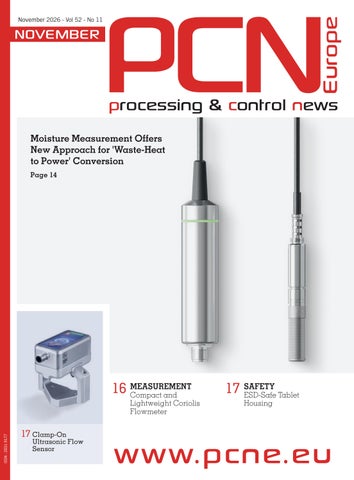
Moisture Measurement Offers New Approach for 'Waste-Heat to Power' Conversion Page 14
16 MEASUREMENT Compact and ISSN : 2031-9177
Lightweight Coriolis Flowmeter
17 SAFETY ESD-Safe Tablet Housing
17 Clamp-On
Ultrasonic Flow Sensor
002_017_IEN Europe_November 2026.indd 13
27/10/26 09:28
14 measurement&instrumentation Moisture Measurement Offers New Approach for 'Waste-Heat to Power' Conversion As JTEC prepares its hydrogen-based waste-heat-to-power conversion technology for field deployment, Vaisala sensors provide the humidity and dew point measurements needed to protect critical components, simplify control and build customer trust. JTEC Energy has developed a waste-heat recovery technology that generates electricity efficiently at relatively low temperatures using hydrogen as the working fluid. Precise moisture control is critical, requiring highly accurate measurement across a wide humidity range. The sensors must operate reliably in hydrogen, withstand varying pressures and flows, integrate with control systems, and meet hazardous-area requirements. Protecting a Critical System in a Demanding Hydrogen Environment JTEC’s waste-heat-to-power system combines two subsystems with different moisture requirements: an electrochemical stack that needs moisture for efficient operation and metal hydride reactors that must be protected from excess humidity. Waste heat is supplied to metal hydride reactors, which absorb hydrogen when cooled and
release it at higher pressure when heated. JTEC uses this temperature-driven pressure increase as part of its process for converting waste heat into electrical power. The pressurized hydrogen is sent to electrochemical stacks, where its expansion generates electricity. Afterward, the low-pressure hydrogen is returned to a separate metal hydride reactor, where it can be reheated, repressurized and reused. This closed-loop process continuously recirculates a single hydrogen charge, with no hydrogen consumption and waste heat as the system’s only energy input. Because hydrogen is humidified as it passes through the stacks, JTEC must carefully control moisture levels. Adequate humidity is required for stack performance, while excess moisture can impair reactor efficiency, making hydrogen drying essential before recirculation. “At its core, humidity measurement is so important to JTEC because we have two parts of
our system that work really well, but for them to work well together, we have to ensure that we can control humidity passing back and forth between them really tightly,” said Julian Bell, Vice President of Engineering at JTEC Energy. JTEC first piloted a Vaisala dew point sensor in an internal R&D project in 2023. As the company worked toward its first production system and field pilot, Vaisala became the preferred option based on low dew point performance, calibration stability, availability, integration flexibility and technical support. “The honest truth is that we had not found a good sensor option before we came to Vaisala,” Bell said. Vaisala sensors support three critical moisture measurement points for JTEC The first measurement point is located after the initial dehumidification stage, where hydrogen leaving the electrochemical stack has already had most of its moisture removed. JTEC
Re Co
pep com
In an Confidence in measured values is key if you go from R+D to the field. DMT143 Dew Point Transmitter. Picture: Vaisala
Vaisala Relative Humidity and Temperature Probe HMP7. Picture: Vaisala
N° 11 - NOVEMBER 2026
002_017_IEN Europe_November 2026.indd 14
FREE DIGITAL SUBSCRIPTION
27/10/26 09:28
15
uses a Vaisala HMP7 humidity and temperature probe to verify performance and help prevent condensation. The second point measures low dew point levels before hydrogen returns to the metal hydride reactors. A Vaisala DMP370 Ex-rated sensor ensures accurate, stable measurements and supports future hazardous-area requirements. The third measurement point is in the maintenance manifold, where a Vaisala DMT143 dew point transmitter confirms that moisture is not transferred into dry hydrogen circuits during startup, shutdown and maintenance. The sensors were installed and integrated easily with JTEC’s control system. In a process with widely varying pressure, temperature and flow conditions, measurement reliability, data accessibility and technical support were critical factors. “Vaisala’s auto-calibration is a key feature that improves confidence in the number coming back to us, which has been a huge benefit,” Bell said. “At the same time, we have been able to integrate pressure compensation routines into our dew point measurements with support from Vaisala engineers, and that expertise really shines through.” Vaisala support extends beyond product selec-
tion. The company provides access to Vaisala’s doctoral-level scientists who are global experts in humidity metrology. Their continued guidance helps the team evaluate moisture measurement in hydrogen at varying pressures and low dew point levels. This was especially important because moisture measurement in hydrogen at pressures substantially different from atmospheric conditions is not fully understood across the scientific community or industry. Vaisala's technical expertise helped JTEC make informed decisions about how to approach pressure compensation and measurement confidence in those conditions. “Vaisala helped educate us about what is known, what we can confidently say and where confidence drops off," Bell said. “It is because Vaisala has experts like that and is willing to make them accessible to customers that we were able to make intelligent decisions about how to perform these measurements." Measurement Confidence for Field Deployment As JTEC prepares its first production system for deployment in a field pilot, Vaisala measurement technology gives the company con-
fidence that it can monitor moisture closely enough to protect critical reactor components. For example, JTEC must tightly control moisture content in the hydrogen gas as it returns to the reactors, making measurement accuracy, “I would have to have the highest level of certainty in my moisture measurements in order to feel comfortable running a reactor system of this scale in a field pilot, and Vaisala provides this certainty,” Bell said. “The investment in the reactor system is too great to justify running it if you are not 100 percent confident that you know what kind of moisture content you are putting back into the reactors.” Enabling the Next Stage of Waste-Heat-to-Power Conversion By standardizing on Vaisala, JTEC has established a moisture measurement foundation that supports field deployment, system reliability and future growth. In an application where moisture can determine reactor health, control reliability and customer confidence, accurate measurement is a core enabler of bringing a new waste-heat-to-power conversion technology into the field. 67152 at www.pcne.eu
Revolutionizing Communication!
pepperl-fuchs.com/pr-industrialcommunication-and-interfaces
Industrial Communication and Interfaces
67124 at www.ien.eu
002_017_IEN Europe_November 2026.indd 15
27/10/26 09:28
16 new products DIGITAL PH/ORP SENSOR
COMPACT CORIOLIS FLOWMETER
Reliable measurements for harsh process conditions
Mass flowmeter for standard gas and liquid applications
The Emerson Rosemount™ 350A High Performance pH/ORP Sensor is designed to deliver reliable measurements in harsh processes while simplifying installation and maintenance through a digital, plug-and-play sensor connection. Many demanding pH applications, especially high-temperature, high-pressure and retractable installations, can challenge conventional analogue sensors with signal noise, wiring complexity and limited diagnostic insight. The Rosemount 350A digital sensor addresses these issues by converting and transmitting pH/ORP data digitally, reducing susceptibility to electrical noise and helping teams get to a stable measurement faster. With a digital Modbus interface and M12 quick-connect cabling, the sensor supports plug-and-play commissioning and can help eliminate common installation errors associated with manual wiring. The digital design also enables interoperability across Rosemount digital liquid analysis sensors, supporting simplified spares and standardisation across sites. By capturing sensor health indicators and event history, the sensor can support more proactive maintenance planning and faster root-cause analysis. Built for harsh applications, the sensor supports retractable mounting styles and is offered with titanium body options and selectable reference electrolytes to match challenging process chemistries.
The KROHNE OPTIMASS 5400 is a new Coriolis mass flowmeter designed for standard process applications with gases and liquids. Thanks to its compact design, the flowmeter is also particularly suited for skid-mounted systems and portable process installations. In addition to direct measurement of mass flow, density and temperature, it provides valuable information on volume flow, concentration and flow velocity. It handles process temperatures up to +180°C and pressures up to 100 barg, while the sensor housing provides a typical burst case pressure resistance of up to 200 barg, offering an additional layer of protection and enhanced plant safety. The instrument also delivers excellent mass flow and density measurement accuracy, with an optional mass flow accuracy of ±0.1% for flow rates above 10% of nominal flow. Equipped with modular electronics, the flowmeter supports a comprehensive range of communication protocols, including HART® 7, Modbus, FOUNDATION™ Fieldbus, PROFIBUS-PA/DP, PROFINET, PROFINET over Ethernet-APL and EtherNet/IP™. Three configurable 4...20 mA outputs are available, complemented by integrated Bluetooth® connectivity for wireless access. Built-in OPTICHECK diagnostics continuously monitor both instrument health and application conditions, providing operators with detailed insights.
67024 at www.pcne.eu
67085 at www.pcne.eu
EX-PROTECTED PNEUMATIC VALVE ACTUATOR
MODULAR ENERGY DISTRIBUTION PANEL
ATEX-certified and corrosion-resistant versions available
New platform reduces engineering and installation effort
The EP3 is designed for the control of single-acting and double-acting pneumatic EBRO actuators and is used for on/off and modulating control applications on industrial valves. Key features include automatic calibration, precise setpoint positioning, and integrated diagnostic and monitoring functions for continuous assessment of operating conditions. With the introduction of the ATEX-certified version, EBRO extends the EP3's range to hazardous areas classified as Zones 2 and 22. This allows users to benefit from the full functionality of the positioner in explosion-protection applications. Certification for Equipment Categories 3G and 3D ensures compliance with the relevant standards and regulations for use in these hazardous environments, without compromising the proven performance and functionality of the EP3. A CS5M version has been developed to meet the requirements of applications in close proximity to seawater as well as other highly corrosive environments. Both versions offer the same functionality as the standard model, including automatic calibration, precise setpoint positioning, and integrated diagnostic and monitoring capabilities. All available interfaces and communication options remain fully supported.
BARTEC has launched its new configurable Ex de Modular Energy Distribution Panel Series, a power distribution solution for hazardous areas designed to simplify engineering, installation and maintenance while providing the safety and reliability required in demanding industrial environments. Certified according to ATEX and IECEx requirements and suitable for installation in Zone 1/21 and Zone 2/22 hazardous areas, the new platform combines explosion protection, modular scalability and project-specific flexibility in a single solution. The new platform com- bines BARTEC's explosion protection expertise with greater flexibi- lity and efficiency, helping customers address both current project requirements and future expansion needs. The panel series supports applications up to 690 V and 1,000 A and can be configured with a wide range of switching, circuit protection, control, signaling and cable entry options. Available in corrosion-resistant GRP or robust stainless-steel enclosures, the panels are designed for operation in ambient temperatures from-20°C to +55°C, -40°C to +55°C with optional heater. Integrated BARTEC ComEx Global control and signaling devices further simplify system design and operation across the oil and gas, chemical, pharmaceutical, energy and process industries.
67035 at www.pcne.eu
67067 at www.pcne.eu N° 11 - NOVEMBER 2026
002_017_IEN Europe_November 2026.indd 16
FREE DIGITAL SUBSCRIPTION
27/10/26 09:28
17 ESD-SAFE TABLET HOUSING
CLAMP-ON ULTRASONIC FLOW SENSOR
Certified for use of standard tablets in ATEX Zone 2 and 22
Easy installation with automatic wall thickness detection
Armadex Explosion Protection has introduced the Ex UniCase, a universal tablet housing certified to ATEX and IECEx for Zone 2 (gas) and Zone 22 (dust). It allows standard tablets to be used in parts of refineries, chemical plants, tank farms and powder-handling plants where ordinary electronics are not permitted. The housing accepts current 10 to 11 inch tablets from Apple, Samsung and Microsoft, including the iPad (A16), iPad Air (M3), iPad Pro (M4 and M5), Galaxy Tab S11, Galaxy Tab S10 FE, Galaxy Tab A11+ and Surface Go 4. Until now, a certified tablet has been a fixed combination of one device and one housing. When the tablet model was replaced, the certified housing had to be replaced with it. The UniCase separates the two: the housing carries the certification, four device-specific corner inlays hold the tablet in position, and a new tablet generation is accommodated by changing the inlays, with no recertification required. Physical buttons, cameras, microphone, speaker and the USB-C port remain usable. The housing consists of a milled frame of ESD-safe POM-C with an impact-resistant polycarbonate display window. Marking: II 3G Ex nR IIC T6 Gc and II 3D Ex tc IIIC T85 °C Dc; EU type examination certificate OBAC 26ATEX0194X, IECEx certificate IECEx OBAC 26.0005X.
The ifm SUC300 clamp-on ultrasonic sensor significantly simplifies flow measurement, users simply position the sensor on the pipe, attach the counterpart and tighten it in place. During commissioning, the sensor determines the actual pipe wall thickness and incorporates this information into the flow measurement calculation. This considerably simplifies parameter setting, particularly in existing industrial facilities where pipe specifications are often not fully documented. At market launch, the sensor is available for DN40 and DN50 nominal pipe sizes, with additional variants already under development. The SUC300 is designed for measuring water-based media and can be used on pipes made of steel, stainless steel and plastic materials such as PVC. A standardised M12 connector is used to achieve integration, an intelligent wizard guides through the installation process step by step. For integration into existing infrastructures, the device offers IO-Link, an analogue output as well as pulse, switching and diagnostic outputs. Its stainless-steel housing is certified to IP67 and IP69 protection ratings, making it suitable for applications with demanding cleanliness and hygiene requirements. Thanks to its clamp-on design, the flow sensor is suitable not only for permanent installation in existing systems but also for temporary measurement tasks.
67149 at www.pcne.eu
67141 at www.pcne.eu
REAL-TIME MONITORING SENSOR FAMILY
COMPACT HYGIENIC LASER DISTANCE SENSOR
Precise measurement of density, viscosity & temperature
FDA-compliant time-of-flight sensor with high sensitivity
WIKA has introduced a series of sensors that monitor in real-time the fundamental properties of gases and liquids. The models DTG-30, DTL-30 and VTL-30 are particularly notable for their compact and robust design. This allows them to be embedded into a wide range of applications, whether in OEM products and systems or in industrial environments, even with limited mounting space. This compact design is made possible by innovative MesoScale® technology, which is a patented combination of sensor design, sensor actuation and software. MesoScale® combines the benefits of sensor miniaturisation with a proven stainless-steel construction. WIKA has therefore developed instruments that measure the density, viscosity and temperature of liquids and gases with high precision in process applications. Typical applications are the identification and quality monitoring of fuels. With the DTL-30, misfuelling can be detected, the mixing of additives monitored and volume converted into mass flow. The VTL-30 measures the viscosity and density of amine solutions, thereby helping to ensure the performance of this core carbon capture technology. The instruments are certified for use in hazardous areas in accordance with ATEX, IECEx and FM. The sensors deliver accurate measuring results across the entire calibration range and offer high repeatability.
With the P2PY111 laser distance sensor time-of-flight, wenglor is expanding its portfolio with a powerful solution for measurement and detection tasks in hygienically sensitive areas. Thanks to wintec (wenglor interference-free technology) and a seal-to-counter design, the sensor prevents contamination from accumulating in the housing area and is suitable for food, beverage and pharmaceutical applications. The high reception sensitivity enables reliable detection even with very weak signals. As a result, the sensor also reliably detects dark or shiny objects as well as objects at extreme angles. As there are no gaps in the housing, potential dirt nests are consistently avoided. Every detail of the P2PY111 is designed for use in hygienic areas: permanently easy-to-read labeling by direct lasering, a special TPE cable that is robust and resistant to cleaning agents, a teach-in key made of FDA-compliant silicone and an immovable optical lens made of robust PMMA. The cable connection is equipped with an IP69K cable gland and a food-grade blue seal. Suitable clamps and holders are available for hygienic mounting. The sensor has a working range of 50-10,000 mm and is highly insensitive to ambient light of up to 100,000 lux. The sensor has high temperature resistance in the range of -40 °C to +55 °C and has ECOLAB® approval for use in washdown areas.
67107 at www.pcne.eu FREE DIGITAL SUBSCRIPTION
002_017_IEN Europe_November 2026.indd 17
67145 at www.pcne.eu N° 11 - NOVEMBER 2026
27/10/26 09:28