September 2026 - Vol 52 - No 9
SEPTEMBER INDUSTRIAL ENGINEERING NEWS & Drives: 10 Motors Functional Safety in Modern Factory Automation Europe: 14 PCN How Non-Contacting Radar Improves Reliability in Solids Level Measurement Automation: 20 Smart Reduced Complexity is a Great Tool for Implementing Innovations Automation: 24 Smart From Craft Production to Automation. Retrofitting for Machine and Process Monitoring.
ISSN : 2031-9193
Exclusive Interview: Mastering Custom Lens Design for a Broad Range of Markets page 8
001_IEN Europe_September 2026.indd 1
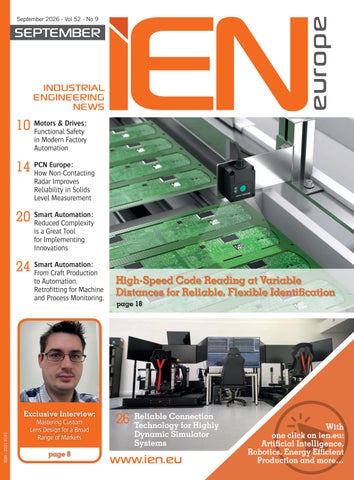
High-Speed Code Reading at Variable Distances for Reliable, Flexible Identification page 18
Connection 26 Reliable Technology for Highly Dynamic Simulator Systems
www.ien.eu
With one click on ien.eu: Artificial Intelligence, Robotics, Energy Efficient Production and more…
03/09/26 17:52
October 15, 2026 - Hi! Site! Brussels / Grimbergen
REGISTER NOW https://industrial-cybersec.com/
THE BELGIAN INDUSTRIAL CYBER EVENT YOU CANNOT AFFORD TO MISS.
67004 at www.ien.eu
002_017_IEN Europe_September 2026.indd 2
04/09/26 14:13
3
Editorial Director:
Orhan Erenberk o.erenberk@tim-europe.com
Editor:
Kay Petermann k.petermann@tim-europe.com
Editorial Support Energy Efficiency:
Flavio Steinbach f.steinbach@tim-europe.com
Production & Francesca Lorini Order Administration: f.lorini@tim-europe.com Website & Newsletter:
Marco Prinari m.prinari@tim-europe.com
Marketing Manager: Marco Prinari m.prinari@tim-europe.com President:
Orhan Erenberk o.erenberk@tim-europe.com
editorial
TIM Global Media BV Chaussée de la Hulpe 177 - Ground Floor 1170 Watermael Boitsfort (Brussels), Belgium o.erenberk@tim-europe.com - www.ien.eu
Kay Petermann k.petermann@tim-europe.com
Dear Readers, I hope you had a wonderful summer and were able to recharge your mental batteries. There are more than enough challenges in European industry that demand our full attention and energy. The implementation of the European Machinery Directive and the Cyber Resilience Act are just two areas that will require a significant amount of work, regardless of the industrial sector. There is uncertainty about the status of the industry’s preparations for the newly adopted regulatory requirements. However, the general consensus is that a large number of companies will not meet the deadlines unless the pace of implementation accelerates once again.
ADVERTISING SALES OFFICES EUROPE AUSTRIA/SWITZERLAND Monika Ailinger Tel.: +41 41 850 44 24 m.ailinger@marcomedia.ch BENELUX, SCANDINAVIA Nadia Liefsoens Tel.: +32-(0)11-224397 Fax: +32-(0)11-224397 n.liefsoens@tim-europe.com FRANCE Roxanne Akbulut Tel: + 33 06 52 31 41 56 r.akbulut@tim-europe.com Raphael Erenberk +32 494 652 741 r.erenberk@tim-europe.com GERMANY Simone Ciolek Tel: +49-(0)9771-1779007 s.ciolek@tim-europe.com ITALY, SLOVENIA Andrea Rancati Tel: +39-02-7030 0088 arancati@rancatinet.it
UNITED KINGDOM, IRELAND Aodhan Dunican +44 (0)7594 239182 a.dunican@tim-europe.com NORTH AMERICA Hamilton-Murphy Global, LLC John Murphy Tel: +1 616 682 4790 Fax: +1 616 682 4791 john@hamiltonmurphymedia.com JAPAN Ichiro Suzuki Incom Co. Ltd. Tel: +81-(0)3-3260-7871 Fax: +81-(0)3-3260-7833 isuzuki@INCOM.co.jp OTHER COUNTRIES Cristian Son c.son@tim-europe.com
So what needs to be done to speed up implementation? One answer may be to select experienced project partners. The articles on page 10 covering the Motion & Drives sector and the interview on page 20 on hardware and software for automation illustrate how this can be done and the benefits involved. This issue also includes a supplement from PCN Europe for the process industry. The article on page 14 discusses the advantages of contactless radar sensors for level monitoring of bulk materials in large storage tanks. I hope you find this issue interesting.
Kay Petermann Editor IEN Europe
TURKEY Onur Dil Tel: +90 212 366 02 76 Fax: +90 212 366 58 02 E-mail: o.dil@tim-europe.com
Digital File Requirements available at: www.ien.eu/technical-guidelines/ © 2026 TIM Global Media BV Production by design3, Milano, Italy Printing by Logo Srl - Padova, Italy
FREE Digital Subscription
POSTMASTER Send address changes to: Industrial Engineering News Europe Marco Prinari - m.prinari@tim-europe.com
FREE DIGITAL SUBSCRIPTION
002_017_IEN Europe_September 2026.indd 3
N° 9 - SEPTEMBER 2026
04/09/26 14:13
N° 9 - SEPTEMBER 2026
contents
4 In the next issue: Industrial Safety & Cybersecurity Vision & Identification Decentralized Motion and Drives
6
5 Industry News 6 New Products 8 Exclusive Interview: Mastering Custom Lens Design for a Broad Range of Markets. An IEN Europe interview with Rob Watkinson, Sales Manager at Resolve Optics Ltd, on custom lenses and the upcoming vision show in Stuttgart
8
10 Motors & Drives Functional Safety in Modern Factory Automation 12 Motors & Drives Smart BLDC-Motor Series. Integrated commutation electronics for simplified OEM drive configuration. product lifecycle.
12
13 Processing & Control News Europe Supplement: 14 Measurement & Instrumentation: How Non-Contacting Radar Improves Reliability in Solids Level Measurement 16 New Products
16
Smart Automation 18 High-Speed Code Reading at Variable Distances for Reliable, Flexible Identification. 20 Reduced Complexity is a Great Tool for Implementing Innovations. An IEN Europe Interview with Bernhard Günthner, EVP Cyber Solutions, Kontron AG, about cybersecurity and a holistic CRA Approach. 24 From Craft Production to Automation
18
26 Electronics & Electricity: Reliable Connection Technology for Highly Dynamic Simulator Systems 28 New Products 30 Index & Events
29 N° 9 - SEPTEMBER 2026
002_017_IEN Europe_September 2026.indd 4
FREE DIGITAL SUBSCRIPTION
04/09/26 14:13
5 As part of its ONE Tech Company strategy, Siemens will bring together its four automation business units into a single organization effective October 1, 2026 business to help industrial customers build more flexible, productive and resilient production systems. Customer Services, Factory Automation, Motion Control and Process Automation will be consolidated into one unified organization: Automation. Rainer Brehm has been appointed President of Automation by the Managing Board of Siemens AG. He will assume the role on October 1, 2026, reporting to Cedrik Neike, Member of the Managing Board of Siemens AG and CEO Digital Industries. “The future of industry lies at the intersection of automation, software and AI, enabling faster innovation, greater scalability and more tailored customer solutions. That is exactly why we are creating the Automation unit,” said Cedrik Neike. “I am pleased that Rainer Brehm will lead this new organization. He understands the technologies, markets and customer needs and has been deeply committed to automation throughout his career. Together with our strong team, he will further develop and strengthen this business.”
Building a Sustainable MultiProvider Cloud-Edge Continuum
Synapticon and Stabilus Form Strategic Partnership
In the project ApeiroRA, the Fraunhofer Institutes for Software and Systems Engineering ISST and for Applied and Integrated Security AISEC are supporting software company SAP in safeguarding Europe’s technological and economic independence in the cloud and edge computing sector. The partners are developing an open-source blueprint for a European, vendorneutral cloud-edge infrastructure that guarantees interoperability between different providers. “Europe has fallen behind in the global market for public cloud services,” says Heinrich Pettenpohl, Head of IT Service Providers at Fraunhofer ISST. “That’s not the case in the area of cloud-edge computing. This is why the European Commission is pursuing a strategy of promoting smaller, decentralized data centers, known as cloud edges, giving European companies direct access to infrastructure for storing their data.” The advantage is that data processing is shifted from large-scale data centers directly to the edge of the network, i.e., close to the data source. ApeiroRA is creating a secure, vendor-neutral European cloud-edge continuum that integrates central data centers and decentralized edge resources, automatically directing workloads to the most efficient location.
Synapticon GmbH, a specialist in integrated drive technology and functional safety in robotics, and Stabilus SE, global manufacturer and provider of motion control solutions, have entered into a strategic partnership. Together, the two companies will develop and manufacture a joint product line of integrated actuators for humanoid robots and other robotics applications. The partners' roles complement each other perfectly: Synapticon delivers the intelligence of the actuator - software, functional safety, electronics, sensor design, and the drive technology. Stabilus contributes mechanical design, sourcing, industrialization, manufacturing, assembly, and logistics. For the automotive industry alone, Stabilus has already delivered millions of electromechanical actuators. It is only the interplay of both competencies that turns individual components into a production-ready, scalable product. The joint product line covers humanoid joints across all size classes - from head and wrist joints to hips and knees. From the outset, manufacturing is designed for high-volume production, modeled on automotive manufacturing and quality standards.
industrynews
Rainer Brehm Takes Charge of Siemens’ Newly Established Automation Division
TSUBAKI Strengthens Unified Brand Identity in Europe Since July 1, the newly established TSUBAKI EUROPE HOLDINGS B.V. in Dordrecht, the Netherlands, has been bringing its European subsidiaries together under one umbrella. The newly established holding primarily comprises TSUBAKIMOTO EUROPE (Dordrecht, NL), TSUBAKI KABELSCHLEPP (Wenden-Gerlingen, D), MAYFRAN EUROPE (Landgraaf, NL), and TSUBAKI JUNGBLUTH (Bad Hersfeld, D). In addition, the European TSUBAKI subsidiaries, as well as the European KABELSCHLEPP and MAYFRAN subsidiaries, including the international companies in India and China, are part of the new organizational structure. The president and CEO of the holding company is Henning Preis, who also serves as managing director of TSUBAKIMOTO EUROPE and TSUBAKI KABELSCHLEPP, among other roles. With the new holding company, the firm aims to further harmonize cooperation among its European subsidiaries and expand their organizational networking. By pooling expertise, know-how, and resources, the group will be even better positioned than before to offer its customers tailored, comprehensive solutions from a single source. The existing structure will remain in place for customers and business partners in their day-to-day operations. Contact persons, products, and established brands will remain unchanged.
FREE DIGITAL SUBSCRIPTION
002_017_IEN Europe_September 2026.indd 5
N° 9 - SEPTEMBER 2026
04/09/26 14:13
6 SAFE LIQUID LEVEL SENSORS AND SWITCHES
MULTI-PROTOCOL IO-LINK MASTER
Designed for direct contact to fuel and explosive liquids
Flexible fieldbus connectivity for scalable automation
SST Sensing Ltd, a DwyerOmega brand introduces a range of intrinsically safe optical liquid level switches approved for hazardous areas. They are designed for use in demanding applications where direct contact with hydrocarbons, fuels, and flammable or explosive liquids is required. Using innovative infrared technology and the principle of total internal reflection, these hazardous approved switches are suitable for a wide range of applications, including presence or absence of any liquid, petrochemicals/oil and gas, tank/container level-control, and downstream analyzer protection. The switches offer an almost instantaneous response time and switch point repeatability of +/- 1 mm, providing highly accurate readings, and require no calibration. These liquid level switches are highly robust and resistant to chemical attack, with an operating temperature range between -30 and +80°C. The switches are housed in 316 stainless steel and come with a choice of sensing tip materials. Certified to meet stringent ATEX and IECEx safety standards, this sensor is suitable for use in hazardous area zones 0, 1 & 2 and ensures intrinsic safety by maintaining energy levels low enough to avoid ignition risks, even in faulty conditions, making it ideal for a wide range of applications.
The IO-Link master is the central interface between the controller and the sensors in the field. With the new generation of its AutomationLine AL1602 IO-Link master ifm is taking IO-Link integration to a new level of performance. It offers a multiprotocol interface with eight IO-Link ports (Class A/B) and a total of 16 flexibly configurable inputs and outputs. With a current rating of up to 2 A per output, it is particularly suitable for powerful actuators such as those used in the logistics sector. The housing and the fully overmoulded circuit board ensure a high level of durability, making the AL1602 resistant to both condensation and vibration. With IP67 protection rating and a temperature range of -40 to 70°C, the device is suitable even for use in harsh industrial environments. The new plastic ports offer higher tightening forces than the previous metal ports of the AL14 series. The common ground concept enables simple and flexible port configuration, supporting compact and cost-efficient device operation. The integrated daisy-chain function allows multiple IO-Link masters to be supplied with power easily, significantly reducing wiring effort. Of particular practical relevance is the integrated multiprotocol interface, which allows the IO-Link master to be easily integrated into various fieldbus architectures.
66957 at www.ien.eu
66970 at www.ien.eu
ULTRASONIC SENSORS WITH 3 METER RANGE
UPGRADE FOR ALL-IN-ONE FLOW METER
For reliable detection of up to 5 objects
For higher accuracy and expanded multi-gas capability
The U1KM ultrasonic sensors in miniature design (32 × 16 × 12 mm) from wenglor is a powerful solution for applications that require long ranges in the smallest installation space. The compact sensors enable reliable object detection of up to three meters and are therefore suitable for a wide range of tasks in logistics, packaging or mechanical engineering. Up to five objects can be detected at the same time, allowing even complex applications to be precisely monitored. Multiplex and synchronous operation are available for the flexible use of several sensors. This prevents mutual influences and ensures stable measurement results. The innovative MEMS transducer also ensures high EMC stability and reliable performance. Since the sensors work completely silently for the human ear, they are particularly suitable for use at assembly workstations and in areas where a quiet working environment is required. With the U1KM series, wenglor combines compact format, high range and intelligent diagnosis functions in a future-proof ultrasonic solution for modern automation applications.
VPInstruments introduces a powerful new firmware upgrade for the VPFlowScope M all-inone flow meter. The release significantly improves measurement accuracy, expands multigas capabilities, and adds new functionality for even more flexibility in the field. Simultaneously VPStudio 4.1 with enhanced tools for configuration and data readout is launched. For plant managers, energy managers, and compressed air specialists, accurate flow data is the foundation for reducing energy costs and making the right investment decisions. With this upgrade, the meter delivers even greater confidence in compressed air and industrial gas measurements. The VPFlowScope M is designed to measure the complete compressed air system, from compressor room to machine level. The sensor measures bi-directional flow, pressure, temperature, and total flow simultaneously, giving users real-time insight into system performance and energy consumption. With the optional built-in data logger, the VPFlowScope M is ideal for both permanent monitoring and temporary air audits. The upgrades offer higher measurement accuracy across the full operating range. The VPFlowScope M features the unique VPSensorCartridge concept. Instead of removing and shipping the entire flow meter for recalibration, users simply replace the sensor cartridge.
67014 at www.ien.eu
67021 at www.ien.eu N° 9 - SEPTEMBER 2026
002_017_IEN Europe_September 2026.indd 6
FREE DIGITAL SUBSCRIPTION
04/09/26 14:13
7 PRODUCTION DATA ANALYTICS APP
MODULAR PANEL-HMIS WITH AI SUPPORT
For evaluation of machine performance and energy data
Versatile GPU card expansion for Edge AI environments
Many production facilities generate the data they need for anaysis already but make only limited use of its potential. The Mitsubishi Electric DataNavigateApp provides direct access to production and energy data through a standard web browser, making it available for analysis and optimization without additional engineering or programming. The data is accessed directly from the machine. Running directly on the MELSEC iQ-R C Intelligent Function Module, the software turns the controller into a plug-and-play analytics tool that provides real-time insights. Installation is carried out using an SD memory card. Once installed, the analytics functions can be accessed through a standard web browser on a PC, tablet or other browser-enabled device. No additional HMI hardware or knowledge of PLC, ladder logic or C programming is required. Preconfigured graphical dashboards present production and energy data clearly and support comparisons between different periods, machines or operating conditions. This helps users identify causes of downtime, reveal energy losses and prioritize targeted optimization measures. The solution also supports predictive maintenance strategies by detecting changes in plant behavior at an early stage.
Advantech has expanded its modular HMI lineup with the introduction of TPC-B620, a new GPU-supported model designed to deploy Edge AI applications directly on the factory floor. By enabling localized computing at the edge, this new model ensures maximum data sovereignty by keeping proprietary production know-how on-site. TPC-B620 delivers ultra-low latency for instant decision-making, and significantly reduces bandwidth costs by eliminating the need to transmit massive amounts of raw data. The system features versatile GPU expansion capabilities, supporting dedicated graphics cards, including the NVIDIA RTX series, with up to 70W power delivery. Furthermore, the TPC-B620 offers superior multi-port connectivity with up to 11 LAN ports (3 built-in as standard, with support for up to 8 additional ports via half-size add-on cards), providing the high-bandwidth interface required to run localized AI vision workloads on-site without performance bottlenecks. The fanless design with advanced thermal management enables the CPU to operate continuously at its full 65W performance level while avoiding thermal throttling. An optional active cooling kit is available for GPU-intensive applications. The system can be paired with 12 modular display options from 15" to 24", including highbrightness and slim-bezel models.
67008 at www.ien.eu
67040 at www.ien.eu
DECENTRALISED FREQUENCY INVERTERS
CONFOCAL CHROMATIC SENSORS
Extended functional safety features for use in automation
For precise non-contact distance measurement
Nord's decentralised NORDAC ON frequency inverter receive an extensive safety upgrade. In addition to STO and SS1, the safe motion functions SLS, SMS and SSM are now also integrated for fail-safe control of the rotary movement. The NORDAC ON thus not only features safe standstill functions (Safe Torque Off and Safe Stop 1) but also enables safe control of a drive solution's speeds (Safety Limited Speed, Safe Maximum Speed and Safe Speed Monitor). The future variant of the decentralised frequency inverter can be integrated into a fail-safe application within an existing Industrial Ethernet network via PROFIsafe or FSoE. The desired Ethernet dialect is simply parameterised during commissioning. Stand-alone use is possible as well. The safe digital inputs and outputs of the inverter can be used to incorporate fail-safe peripheral components or functions. This enables the connection of, for example, emergency stop buttons, safety door switches or photoelectric sensors. Two safe one-channel digital inputs can be combined into one safe two-channel digital input and two safe outputs can be combined into one safe two-channel output. It also features PLC on board for PLC and drive-related functions. NORDAC ON is available for a power range from 0.37 kW to 3.7 kW.
Micro-Epsilon is expanding the world's largest product portfolio for confocal chromatic sensor systems with new sensors from the confocalDT IFS2404 series. The sensors enable high-precision, non-contact displacement and distance measurements on a wide variety of surfaces, from reflective and diffuse to transparent. With the IFS2404-18, the IFS2404 series is being expanded with a variant featuring an 18 mm measuring range. The sensor closes the gap between the previous 10 mm and 28 mm measuring ranges. It combines a large offset distance of approx. 61 mm with a sufficiently large measuring range for typical component and process variations. This makes it especially suitable for applications with limited installation space, for example for level measurements in microtiter vessels or in narrow containers and openings. A key advantage of the IFS2404-18 lies in its optical design. The numerical aperture of 0.17 creates a particularly narrow light cone that enables measurements even in hard-to-access areas. With a maximum measuring angle of ±9°, the sensor is also less sensitive to tilted components and mounting deviations. This reduces adjustment effort and ensures stable signals, even on slightly curved surfaces or shallow flanks.
66996 at www.ien.eu FREE DIGITAL SUBSCRIPTION
002_017_IEN Europe_September 2026.indd 7
67030 at www.ien.eu N° 9 - SEPTEMBER 2026
04/09/26 14:13
8
exclusive interview
Mastering Custom Lens Design for a Broad Range of Markets An IEN Europe interview with Rob Watkinson, Sales Manager at Resolve Optics Ltd, on custom lenses and the upcoming vision show in Stuttgart Rob Watkinson, Sales Manager – Resolve Optics Ltd
IEN Europe: Why is Resolve Optics a regular exhibitor at the biennial Vision shows in Stuttgart, Germany? Rob Watkinson: High-quality optics underpin the performance of any vision system. They capture light, form the physical image, and define the raw data quality delivered to the sensor. If the optics in your vision set-up fails to capture sharp details or proper contrast, software cannot fix or recreate that lost information. As a developer and supplier of application optimised lenses - Resolve Optics have exhibited at this international event for many years now because we find it attracts people from a large variety of industries that require some form of optics in their vision application. IEN Europe: Do you have any new product / service / capabilities that you will be highlighting on your stand? Rob Watkinson: Resolve Optics is a leading supplier of radiation tolerant lenses into the nuclear power and space industries. Traditionally these industries used relatively low-resolution tube cameras for moni-
toring purposes. In recent years, radiation resistant camera developers are increasingly turning to CMOS sensors. To meet the higher resolution demands of CMOS sensors, we have been developing a range of High Definition (HD) radiation tolerant fixed focus lenses. At Vision 2026, we are showing for the first time, a new 9mm f/2.1 radiation tolerant HD lens (the Model 419) with more focal lengths to follow shortly.
Resolve Optics has over 20 years design experience for lenses that are used in aircraft and satellites and their requirements to survive the temperature, mechanical, radiation and vacuum challenges in this environment.
IEN Europe: What benefits can visitors get from visiting your Vision show stand? Rob Watkinson: Resolve Optics specialise in application optimised lenses. So, if your vision application is out of the ordinary or particularly challenging it is worth speaking to us to see if a custom designed solution may solve your problems. We are always happy to discuss applications and try and point you towards the best solution. Taking advantage of cutting-edge optical design expertise, our vision lens design service ensures top imaging performance for vision systems used in a wide array of applications.
N° 9 - SEPTEMBER 2026
002_017_IEN Europe_September 2026.indd 8
FREE DIGITAL SUBSCRIPTION
04/09/26 14:13
9 All Resolve Optics radiation resistant non-browning lenses are made from 100% radiation hard materials to guarantee a long product life.
IEN Europe: What are the key market areas that Resolve Optics specialises in? Rob Watkinson: Though we supply custom lenses and optical systems to customers operating in an ever-expanding range of different markets – we are internationally renowned for our expertise and knowledge of the aerospace / space and nuclear industries. Designing high-performance optical systems for aerospace projects is something that we have done for over 20 years. Lenses that are used in aircraft and satellites must meet certain basic requirements to survive the temperature, mechanical, radiation and vacuum challenges that space places upon components and systems working in this remote environment. Our expertise in radiation resistant optical materials has made Resolve Optics the leading supplier of fixed and zoom lens for monitoring applications in nuclear reprocessing and power generation. IEN Europe: Why should developers of optical products consider a bespoke rather than an off-the-shelf lens? Rob Watkinson: If there is an off-the-shelf lens that meets all your vision needs, then this is the way you should go. However, if there is no off-the-shelf solution available, maybe you have harsh environmental requirements, are limited on space or have a non-standard format sensor. This is where a bespoke solution comes into play. Also, unlike an off-the-shelf lens which can be discontinued at any time (leaving you to find a replacement), we guarantee security of supply of the lenses we supply for your optical product. All application optimised lenses we design and manufacture on your behalf, are guaranteed to be available for as long as they are required, giving you guaranteed security of supply. If required we can also offer you design exclusivity, meaning nobody else can purchase the lens securing you a competitive edge not possible with an ‘off-the-shelf’ solution. FREE DIGITAL SUBSCRIPTION
002_017_IEN Europe_September 2026.indd 9
Non Browning Fixed Focus Lens Designed specially for a 2/3” format. All Resolve Optics radiation resistant non-browning lenses are made from 100% radiation hard materials
IEN Europe: Do you have an interesting optical design and manufacture case study you can share with us. Rob Watkinson: We regularly publish case studies illustrating custom lens design projects we have completed for customers operating in nuclear, space, defence, aerospace, industrial and medical applications – see https://www.resolveoptics.com/case-studies/. While most optical design and manufacture projects undertaken by Resolve Optics Ltd. are subject to confidentiality undertakings we can share the following case study with IEN readers. We were approached by a satellite camera core manufacturer to develop a new 6mm lens for use in space. The lens needed to be radiation resistant to withstand prolonged use in space, athermalized to deliver consistent performance across a wide temperature range and ruggedised to withstand the rigors of launch. Due to the camera core manufacturers tight delivery requirements designing a new optimised lens from scratch was not an option. Using the pre-existing optical design from our 6mm fixed focus radiation tolerant nuclear lens, we redesigned the mechanics to produce a new space ready lens which would be suitable. This approach allowed us to develop a new camera optimised lens in a fraction of the time that would have been required for designing a lens from the ground up. Resolve Optics at Vision 2026: Hall 10, Booth 10G44 66904 at www.ien.eu
N° 9 - SEPTEMBER 2026
04/09/26 14:13
10 motors & drives Functional Safety in Modern Factory Automation Many automation systems still rely on a simple binary safety model: a machine is either running or completely stopped. When operators need access for loading, inspection, cleaning, or adjustments, power is cut and all motion ceases until the area is cleared and the system reset. While effective, this approach can limit productivity. Frequent stop-start cycles reduce throughput and can increase mechanical wear in applications requiring regular human interaction. As automation systems become more capable and more closely integrated with human activity, there is growing interest in ‘functional safety’ – concepts that allow controlled operation rather than complete shutdown. These work by defining how machines should behave under fault conditions or when people are present, rather than treating safety as an all-or-nothing state. Functional safety as engineered behavior Traditional safety measures such as fences, interlocks, and emergency stops are simple, effective, and easy to audit. By removing motion entirely, they eliminate risk. However, in many modern production environments, stopping a machine every time an operator needs access can significantly reduce efficiency.
Functional safety takes a different approach. Rather than asking whether a machine should run or stop, it focuses on how the machine can continue operating safely under changing conditions. For example, an axis may slow to a safe speed, movement may be restricted to a defined range, or a motor may be held safely at standstill while remaining energized and controllable. Standards such as IEC 61508 provide the framework for this approach. Through structured risk assessments, hazards are identified and evaluated, leading to the definition of a required Safety Integrity Level (SIL). Safety functions must then be designed, tested, and validated to meet that level with predictable and verifiable performance. In practice, functional safety enables machines to reduce speed, limit motion, or
Functional safety focuses on how the machine can continue operating safely under changing conditions without endangering humans. N° 9 - SEPTEMBER 2026
002_017_IEN Europe_September 2026.indd 10
maintain controlled standstill instead of coming to a complete stop. Functions such as Safe Limited Speed, Safe Operating Stop, and Safe Position Monitoring allow operators to perform tasks such as loading, inspection, adjustment, or maintenance while equipment remains active within tightly controlled limits. The result is improved productivity, reduced downtime, and safe human-machine interaction without relying on full shutdowns as the default response. Over time, these small differences begin to matter. Reduced downtime, smoother workflows, and fewer full restarts can all add up to tangible performance gains. Safety remains non-negotiable, of course, but with the right planning, equipment, and software, it no longer has to come at the expense of output. Why feedback matters more than ever Achieving this balance depends on how reliably a system can monitor and control motion. Many safe motion functions require precise information about an axis’s position and speed. If that data is inaccurate, the safety function can fail, potentially creating serious risks. Safety-rated feedback devices are therefore essential. Unlike standard encoders, they incorporate continuous diagnostics to detect faults and trigger a defined safe state when problems occur, preventing operation based on unreliable data. As machine performance increases, the importance of accurate feedback grows. Applications such as linear motors, direct drives, and precision printing systems demand highly accurate motion control, even while FREE DIGITAL SUBSCRIPTION
04/09/26 14:13
11
Different scenarios need to be assessed individually to deliver more flexibility without unnecessary complexity
operating within strict safety constraints. Recent updates to Kollmorgen’s Safe Motion Monitor (SMM) software platforms reflect this reality. The company has expanded support for additional safety-rated encoder protocols, including high-accuracy and linear feedback systems, allowing engineers to apply functional safety principles in applications that were previously difficult to cover without compromise. Matching safety integrity to real risk A key principle of functional safety is that not every machine requires the highest safety rating. In many industrial applications, SIL 2 provides the right balance between risk reduction and system complexity. Higher levels such as SIL 3 are typically reserved for high-risk scenarios, such as stage lifting systems, where heavy loads move above people and every component must meet the same integrity requirements. Engineers therefore need flexible solutions that match safety performance to actual risk without overengineering. Advances in safe motion technology support this proportional approach. As a result, functional safety has evolved from a regulatory requirement into a global industry standard, driven not only by legislation but also by growing customer demand for consistent, standards-based safety solutions that reduce human, legal, financial, and reputational risks.
functions reduce the need for additional hardware, simplify validation, and improve transparency of system behavior. Platforms such as Kollmorgen’s SMM software implement safety directly at the drive level rather than adding it later. Modern configuration tools further streamline development by enabling safety functions to be configured, tested, and documented within the overall machine design process. New capabilities, including support for advanced feedback technologies or higher safety integrity levels, can often be added through software updates instead of major hardware changes. Recent advances in safe motion software are less about radical innovation and more about addressing practical machine design needs. By extending proven functional safety concepts to a wider range of applications, they enhance flexibility while maintaining established engineering workflows.
Designing safety in, not adding it on The most effective functional safety solutions are designed into machines from the start. Drives with integrated safe motion
A practical view of safe automation Safety is often seen as a barrier to productivity, but functional safety increasingly enables it. By allowing machines to operate
FREE DIGITAL SUBSCRIPTION
N° 9 - SEPTEMBER 2026
002_017_IEN Europe_September 2026.indd 11
safely rather than simply stop, it supports closer collaboration between people and automation while maintaining compliance and protection. As automation becomes more advanced and widespread, managing risk through controlled machine behavior is becoming essential. The goal for engineers is not to maximize safety features, but to apply the right ones for the actual risk. This requires selecting appropriate safety functions and integrating them effectively into the motion system. Software-based safe motion solutions, such as those within Kollmorgen’s automation platforms, support this approach by embedding functional safety directly into drive and control architectures. Recent updates to Kollmorgen’s SMM software reflect this industry trend. Rather than introducing new concepts, the latest version expands existing safe motion capabilities to better meet the performance, precision, and integrity demands of modern machinery, delivering greater flexibility without unnecessary complexity. 67029 at www.ien.eu
04/09/26 14:13
12 motors & drives
Smart BLDC-Motor Series Integrated commutation electronics for simplified OEM drive configuration Modern automation systems often include auxiliary motion axes that require reliable speed control but do not need advanced positioning, synchronized multi-axis motion or an Industrial Ethernet connection. Using a fully programmable servo drive for every conveyor roller, pump or secondary machine axis can increase hardware cost, wiring effort and commissioning time without adding practical value to the application. Dunkermotoren dGo motors bridge this gap by combining a brushless DC motor with integrated commutation electronics and application-oriented control functions. Depending on the version, motor speed can be adjusted via supply voltage, analog input or PWM signal, while digital inputs support functions such as start, stop and direction selection. The result is a compact and easy-to-integrate drive solution for repeatable motion tasks. Three Product Families for Different Requirements ThedGo portfolio comprises the BGA 22 dGo, BG 42 dGo and BG 45 dGo series, allowing machine builders to select the most suitable solution according to available installation space, power requirements and operating conditions. Across the dGo portfolio, machine builders can select from a range of performance and integration options tailored to their application requirements: • BGA 22 dGo with up to 24 W continuous output power and up to 236 W peak output power, • BG 42 dGo with up to 96 W continuous output power and up to 214 W peak output power, N° 9 - SEPTEMBER 2026
002_017_IEN Europe_September 2026.indd 12
• BG 45 dGo with same output but added protection ratings up to IP65. Straightforward Control via Standard I/O A key advantage of the dGo concept is its focus on essential functionality. Supported variants accept analog or PWM speed references, while digital inputs provide basic control commands such as start, stop and direction selection. Because these signals can be supplied directly by standard PLC I/O, switches or simple control logic, there is no need for fieldbus configuration, network addressing or motion-profile programming. This simplifies machine architectures that incorporate multiple independent, speed-controlled axes. 67034 at www.ien.eu FREE DIGITAL SUBSCRIPTION
04/09/26 14:13
ISSN : 2031-9177
Integrated electronics for simplified machine design BLDC motors require electronic commutation to generate the rotating magnetic field that drives the rotor. In conventional systems, this function is performed by an external controller connected to the motor through separate power and feedback wiring. dGo integrates these electronics directly into the motor. For machine builders, this means fewer components, reduced wiring effort and simplified installation. The integrated architecture is particularly suitable for standardized OEM applications where compactness, reliability and efficient assembly are more important than freely programmable motion functionality. dGo is designed for applications requiring dependable speed control rather than complex positioning tasks.
September 2026 - Vol 52 - No 9
SEPTEMBER
How Non-Contacting Radar Improves Reliability in Solids Level Measurement Page 14
16 SAFETY Digital Safety ISSN : 2031-9177
HMI Solution
17 VALVES Fully Welded Ball Valve
17 IE6 Motors
for Hazardous Areas FREE DIGITAL SUBSCRIPTION
002_017_IEN Europe_September 2026.indd 13
N° 9 - SEPTEMBER 2026
04/09/26 14:13
14 measurement&instrumentation How Non-Contacting Radar Improves Reliability in Solids Level Measurement Advanced non-contacting radar technology addresses the challenges of solids level measurement – helping to eliminate costly maintenance and downtime, as demonstrated in a recent waste-to-energy application. Automation has significantly improved safety, efficiency and productivity in the process industries, yet further performance gains are possible. Unplanned downtime still affects overall equipment effectiveness, with lost production and maintenance costs impacting profitability. While pumps, motors, fans and compressors are often viewed as the main risks, process automation and measurement instrumentation are equally critical. Improving the reliability and long-term performance of field devices is therefore essential. These instruments often operate in harsh environments, facing extreme temperatures, pressure, corrosive materials, vibration and dust. Bulk solids applications are particularly challenging. Challenges Measuring solids is far more complex than measuring liquids. Unlike liquids, which form a flat surface, solids create uneven profiles, adhere to vessel walls, and change shape during filling and emptying. Ratholing can leave material along the walls, causing operators to overestimate available capacity and increasing the risk of overfills. These conditions affect signal reflection and measurement accuracy. Reliable level measurement therefore requires technologies that can cope with uneven surfaces, unpredictable flow patterns, and low-dielectric materials that provide weak signal reflections. Dust Generation Significant amounts of dust can be generated during solids filling and discharge. In sufficient concentrations, airborne dust can present serious respiratory hazards and reduce vis-
002_017_IEN Europe_September 2026.indd 14
Typical ash storage tanks offer a difficult monitoring environment with uneven surfaces, fast filling and a high level of dust. Picture: shutterstock_1454277722
ibility. Many dusts are also combustible; when combined with oxygen and an ignition source, dust clouds can lead to flash fires or explosions. Even minor overfills or uncontrolled discharge can increase dust concentrations, raising the likelihood of ignition from static electricity, hot surfaces or mechanical sparks. Dust and electrostatic charges can also affect level measurement accuracy and reliability. High dust concentrations may attenuate signals, create false echoes or lead to build-up
on sensor surfaces. Over time, this can result in signal loss or inaccurate readings, making robust instrument selection critical.
N° 9 - SEPTEMBER 2026
FREE DIGITAL SUBSCRIPTION
Equipment Overload and Structural Stress Solids can impose significant mechanical stress on vessels, handling equipment and instrumentation, increasing the risk of failure. Overfilling further exacerbates these forces, potentially overloading feeders, screw conveyors, rotary valves and discharge gates,
04/09/26 14:13
15 Rosemount 3408 Non-Contacting Radar Level Transmitters have been installed on the three storage vessels storing treated fly ash from the waste-to-energy incineration facility.
highlighting the need for reliable and accurate level measurement. Material movement during filling and discharge can also place physical strain on contacting measurement devices, affecting their reliability and service life. For example, the probes of guided wave radar level transmitters may be subjected to bending, tensile or dragging forces as solids shift and settle, increasing the likelihood of damage or measurement degradation. Benefits of Non-contacting Radar Non-contacting radar devices are well suited to a wide range of solids level measurement applications. They transmit electromagnetic signals that reflect from the material surface back to the antenna, enabling level measurement without physical contact. This makes them particularly effective in dusty environments and over long distances. Modern noncontacting radar transmitters based on frequency modulated continuous wave (FMCW) technology offer high accuracy and sensitivity, while requiring minimal wiring for power and communication. Advanced signal processing allows these devices to ignore false echoes from internal obstructions, ensuring reliable measurements. They can also accommodate uneven and constantly changing surface profiles caused by phenomena such as bridging and ratholing. Specialised solids algorithms enable a representative average level to be calculated across a broader surface area, rather than relying on a single-point reading. For highly dusty environments, air purging systems can FREE DIGITAL SUBSCRIPTION
002_017_IEN Europe_September 2026.indd 15
be used to prevent antenna build-up, maintaining signal strength and reducing maintenance requirements. Minimised Maintenance Requirements Modern non-contacting radar transmitters are designed for reliable, low-maintenance operation, helping to reduce downtime. Built to withstand shock, temperature extremes and outdoor exposure, they continue to perform in demanding environments such as silos, crushers and conveyors. Because the device does not come into contact with the material, there are no components exposed to wear, bending or damage from abrasive solids, heavy loads or vibration. This eliminates common failure modes associated with contacting technologies. Coating and build-up are also less problematic, as the antenna is positioned above the process and can continue operating even in dirty conditions. As a result, the need for cleaning and maintenance shutdowns is significantly reduced. With no moving parts, these devices offer improved long-term reliability while keeping maintenance requirements and costs to a minimum. Measuring the Level of Fly Ash A good example of how non-contacting radar has eliminated downtime in a challenging solids level measurement application can be found at a waste-to-energy plant in Europe. Compressed fly ash produced from the incinerator is used as a construction material in road building. After chemical treatment, the
ash is stored in three large (16 metres high) vessels ready for collection by trucks. The plant operator must continuously monitor ash levels to prevent overfilling, manage inventory, and schedule refilling, maintenance and cleaning when necessary. Monitoring fly ash levels is difficult due to uneven surfaces, fast filling, and a highly dusty environment. The ash tends to stick to surfaces, creating build-up within the vessel and on instrumentation. The company had been using guided wave radar devices from another vendor, but ash accumulated on the probes, causing clogging after five or six days and leading to unreliable measurements. Weekly maintenance was required to clean the probes, exposing personnel to dust and taking vessels out of service for up to two hours. This interrupted operations and reduced overall process efficiency. Emerson provided a replacement solution by installing a Rosemount™ 3408 Non-Contacting Radar Level Transmitter on each vessel. Key factors in the selection included ease of integration, fast commissioning and a strong return on investment. Although fly ash has a low dielectric constant, the FMCW technology used in the Rosemount 3408 maximises sensitivity to ensure accurate measurement. A smart solids algorithm enables reliable readings despite uneven material surfaces, while an advanced air purging system prevents antenna build-up. Signal quality diagnostics provide additional assurance by alerting operators to abnormal conditions or build up on the antenna. The transmitters have delivered trouble-free operation, eliminating unplanned stoppages and improving both treatment and loading processes. Increased vessel availability has enabled more efficient truck loading, resulting in annual savings of approximately $80,000 and a return on investment in just one month. 67028 at www.pcne.eu
N° 9 - SEPTEMBER 2026
04/09/26 14:13
16 HYGIENIC OVAL GEAR FLOWMETERS
AI-SUPPORTED PIPELINE MONITORING
More performance without changing dimensions
For continuous monitoring, leak and theft detection
Titan Enterprises has released a newly engineered design for its OG3 and OG4 oval gear flowmeter models. Designed for use in industries where cleanliness, accuracy and reliability are critical, the new flowmeters feature an electropolished stainless-steel finish that provides a smooth, easy-to-clean surface suitable for food and beverage, pharmaceutical, biotechnology, cosmetics and personal care manufacturing environments. A key advancement in the redesign is the transition from a cast body construction to a fully machined, engineered design. The precision-machined construction not only enhances mechanical strength but also supports the high levels of measurement accuracy and repeatability for which Titan's oval gear flowmeters are recognised. While delivering enhanced performance for hygienic processing applications, the models still maintain the original dimensions of the previous oval gear products to allow interchangeability within customers' existing systems. The new OG flowmeter design with Hall effect detection, also benefits from an upgraded circuit board with added protection from mis-wiring or electrical surges, as well as offering both NPN and PNP outputs as standard (up to 100°C max). The OG3 and OG4 flowmeters provide precise volumetric measurement of liquids across a wide viscosity range.
Krohne introduces PipePatrol NEO, a new comprehensive solution for leak detection, theft detection and pipeline monitoring. The core of the system is the NEPM (Neural Engine Pipeline Monitoring) next-generation technology for continuous internal pipeline monitoring. It combines artificial intelligence with proven physical models, providing an effective way to manage the complex risks of modern pipelines - from corrosion and equipment failure to third-party interference, illegal tapping, and environmental impacts. It is designed for a wide range of applications, including oil and gas pipelines, chemical processes, water and wastewater networks, as well as district heating and hydrogen infrastructure. PipePatrol NEO applies NEPM, an AI-enhanced multi-method approach which integrates advanced hydraulic modelling, statistical pattern recognition and real-time measurements of flow, pressure and temperature. By continuously comparing a "virtual pipeline" model with actual operating data, the system detects deviations and analyses them using AI-based pattern recognition. It continuously learns from operational data, adapts to changing conditions and delivers precise, reliable pipeline information in real time. This enables faster detection, highly accurate leak localisation and minimal false alarms, even under complex and transient operating conditions.
67027 at www.pcne.eu
67020 at www.pcne.eu
DIGITAL SAFETY HMI SOLUTION
12-PORT-ETHERNET-APL SWITCH
For functional safety in accordance with IEC 61508
Compact design with approvals for worldwide operations
The certification of the Deuta IconTrust® HMI confirms that the system can display safety-related data up to SIL 3 and process safety-related touch inputs up to SIL 2. The digital human-machine interface - IconTrust® HMI - is designed for safety-related display and control tasks. This globally unique SIL3 solution is certified to EN 61508 and offers 'Security by Design'. The solution is particularly relevant for applications where functional safety, traceable process versioning and efficient adaptability to changes throughout a plant's lifecycle come together. In many process industry plants illuminated panels, switches and individually wired signals are still in use. Whilst these have long proved their worth, they quickly reach their limits when changes, maintenance or retrofitting are required. IconTrust® HMI transfers these tasks to a digital interface. Safety-related display and control elements can be created there via a web-based configuration and adapted to specific projects. Useful information for day-to-day operations can be made available digitally, without any loss of time caused by working with analogue manuals. The system is designed as a PROFINET/PROFIsafe field unit and is used as a fixed-location safety control unit. The PLC remains in control: the safety controller determines which information is displayed securely through independent monitoring of the defined display areas.
Phoenix Contact is expanding its Ethernet-APL portfolio to include two managed switch versions with twelve ports for process automation. The Ethernet-APL switches enable the two-wire Ethernet connection of devices and sensors in the Ex zones of process technology applications. This allows sensors and devices from the field level to be connected directly to the system's Ethernet network. The data from the field level can be used in real time for process control, monitoring, and diagnostics. The devices feature optimized firmware user guidance for intuitive configuration, simple startup, and improved diagnostic functions. Their compact, lightweight design enables space-saving installation and in-line mounting in the control cabinet. With support for Ethernet-APL power class A, the switches provide an efficient power supply for field devices. In addition, both versions are approved worldwide and can therefore be used globally in applications for potentially explosive areas. The twelve-port switches help customers use Ethernet-APL in a wider range of greenfield applications - particularly in the chemical and pharmaceutical industries, marine and offshore applications, oil and gas applications, mining, and biomass plants, including demanding Ex environments.
66988 at www.pcne.eu
66944 at www.pcne.eu N° 9 - SEPTEMBER 2026
002_017_IEN Europe_September 2026.indd 16
FREE DIGITAL SUBSCRIPTION
04/09/26 14:13
17 2G MIGRATION FOR THE WATER INDUSTRY
IE6 MOTOR FOR HAZARDOUS AREAS
Modernise existing installations with reduced investment
Certification to ATEX and IECEx for global deployment
In view of the upcoming shutdown of the 2G mobile network in Germany, Panasonic Industry and INSYS icom are combining their expertise to support operators in the water and environmental sectors with the migration to future-proof communication solutions. Deutsche Telekom plans to shut down its 2G network by no later than June 30, 2028, in order to free up frequencies for more powerful technologies such as 4G (LTE) and 5G. Without timely migration, outages may occur, as devices that only support 2G will no longer be able to establish network connections after the shutdown. Existing systems must be migrated to future-ready technologies in good time to ensure long-term operational reliability. At the heart of the solution is Panasonic Industry's FP-I4C communication controller, combined with industrial routers and gateways from INSYS icom. The FP-I4C enables existing serially connected controllers to be integrated into modern networks without requiring a complete system replacement. This retrofit strategy not only helps companies reduce costs but also supports sustainability by extending the life of existing hardware. By migrating to modern mobile communication technologies, companies benefit not only from higher bandwidth and lower latency but also from enhanced security mechanisms.
ABB offers an IE6 Hyper-Efficiency motor certified to ATEX and IECEx requirements for use in hazardous areas. The new IE6 Increased safety motor, based on ABB's magnet- and rare earthfree synchronous reluctance (SynRM) technology, offers up to 60 percent lower energy losses than the IE3 induction motors commonly used in Zones 1 and 2. This enables operators to realize a major boost in energy efficiency and avoided carbon emissions in industries where gas, vapor or dust might be present, such as chemicals, marine, oil & gas, pharmaceuticals and food & beverage. The IE6 SynRM Increased safety motor is certified for use with variable speed drives (VSDs) to offer accurate control and high efficiency throughout the whole speed range, even at partial loads. The new IE6 SynRM Increased safety motor covers ratings from 110 kW, with IE5 versions available for up to 90 kW. As well as increased reliability and reduced maintenance, SynRM technology enables a more cost-effective installation. In Zone 1, cooler running can allow the use of an Increased safety SynRM motor where a Flameproof motor with a special enclosure would be the traditional choice. Furthermore, in Zone 2, the improved loadability of SynRM motors enables more power from the same size as an equivalent induction motor. This could enable a smaller, lower-cost motor to fulfil the same duty.
67017 at www.pcne.eu
66872 at www.pcne.eu
COMPACT RADAR LEVEL SENSOR
FULLY WELDED BALL VALVE
Continuous measurement in a range of up to 100 °C
Floating or trunnion ball design for critical infrastructures
WIKA has expanded its level measurement portfolio with the addition of the ILT radar sensor. The free-beam sensor enables non-contact level measurement, even through the walls of plastic containers. Its compact design makes the ILT particularly suitable for applications where space is limited. Manufacturers can, for example, install the sensor in mobile working machines or heating systems. Furthermore, non-contact technology enables high-precision measurement of the level of particle-containing, highly viscous or solid materials. Possible applications range from wastewater plants to all types of raw material containers and fuels. The ILT-C01 version is designed for a temperature range of -40 to 100 °C, while the ILT-C05 version also covers high temperatures up to 150 °C. Metal shielding protects the sensor from interference caused by electrical fields in the environment. The instrument operates reliably even under adverse conditions such as dust, moisture and heat, and can tolerate vibrations and shocks of up to 100g. With up to two additional switch points, further switching outputs can be integrated, for example for overflow or dry run protection. Last but not least, the radar sensor ensures low operating costs, as it is maintenance-free thanks to its non-contact measuring principle and wear-free design.
VIS VANA has developed its Fully Welded Ball Valve series to meet expectations for higher levels of safety, reliability and lifecycle performance in transmission pipelines, district heating networks, power plants, LNG terminals and other critical industrial applications. The fully welded body design eliminates potential external leakage paths while significantly increasing structural integrity. It also reduces maintenance requirements and improves resistance against vibration, thermal expansion and external mechanical loads. The valve is designed in accordance with API 6D and can be supplied in pressure classes ranging from ASME Class 150 to Class 2500, with sizes extending to DN1200 (48") depending on project requirements. Various body materials including carbon steel, stainless steel, duplex and super duplex stainless steels are available for corrosive and severe service environments. According to operating conditions a floating or trunnion-mounted ball design can be selected. Soft seated and metal seated configurations are available, enabling reliable shut-off in both standard and high-temperature applications. Fire-safe construction, anti-static devices, double block and bleed functionality, emergency sealant injection systems and stem extension options are available.
66967 at www.pcne.eu FREE DIGITAL SUBSCRIPTION
002_017_IEN Europe_September 2026.indd 17
67015 at www.pcne.eu N° 9 - SEPTEMBER 2026
04/09/26 14:13
18 smart automation High-Speed Code Reading at Variable Distances for Reliable, Flexible Identification Automatic object identification is essential in production and logistics. As 2D codes increasingly replace barcodes, capturing additional data has become more important. Pepperl+Fuchs’ CleverReader stationary code reader ensures reliable code reading with outstanding depth of field, even at high conveyor speeds and varying distances. Features such as automatic error image storage and extensive functionality enable a wide range of advanced applications. CleverReader is a camera-based sensor that recognizes all common 1-D and 2-D codes. It enables reliable performance even on reflective surfaces and displays. The base model VOI1000 provides reliable identification data for stationary objects. For more challenging applications, the VOI1100 version is available, which can read codes even when they are moving very quickly. This sensor not only reads adhesive labels but also DPM codes stamped onto metal objects in the automotive industry, as well as laser-etched DPM codes. The latter are used, among other things, in microelectronics to mark printed circuit boards. The CleverReader VOI1100 can also read very small codes on printed circuit boards. A key factor behind this strong reading performance is the sensor’s exceptional depth of field. At 55–460 mm, the VOI1100 achieves a value that surpasses all other devices in this price range. Within this distance range, the sensor reads the codes without any adjustment to the optics.
Triggers and Reading Modes Code reading can be triggered by external triggers or automatically. Five different reading modes are available, covering all common application scenarios: In Pulse Mode, a defined trigger activates reading for a specified duration. This can be a signal from the controller or another sensor. In Level Mode, scanning occurs continuously as long as the trigger is active until a code is read. Reading begins as soon as the trigger sensor’s light beam is interrupted. It detects the code regardless of its position on the object. This ensures reliable reading even with high variability on the conveyor belt, such as in package logistics. In Continuous Mode, the trigger is permanently activated. In Sense Mode, reading begins without an external trigger in response to movement within the detection range. For example, you can hold a code in front of the sensor to trigger a subsequent process—such as requesting a specific medication in a pharmacy stock based on a prescription. The sensitivity is adjustable. In Multiple Session Mode, the code reader behaves
Easy Access CleverReader sensors are designed for easy setup and operation. They can be configured using control codes directly on the device or via the intuitive graphical user interface of the CleverReader Configurator. The SCAN button allows you to trigger a read even without a PC connection; the read is confirmed by an audible signal. The result can be verified on the screen in the Configurator. The integrated Matchcode function automatically compares scanned codes with either a previously programmed code or a reference code specified by the controller. The device checks for both complete and partial matches, and enables the differentiation of various pieces of information stored within a single code. Faulty codes and incorrect assignments are reported immediately. Production can be stopped before scrap is produced; the sensor output can trigger control and corrective process steps. Unlike simple code scanners, the camera-based sensor can save an error image if a code is damaged, obscured, or incomplete and therefore cannot be recognized. This supports root cause analysis and ensures traceability for the quality process. Toolbox for Intuitive Operation The intuitive parameterization interface minimizes the need for customization. Using a toolbox, the formatting of the output string can be “clicked together”; configuration is easily handled via drag-and-drop. A live simu-
CleverReader VOI1000 and VOI1100. Picture: Pepperl+Fuchs N° 9 - SEPTEMBER 2026
018_029_IEN Europe_September 2026.indd 18
similarly to Level Mode. Unlike Level Mode, however, it can read multiple different codes on the same object.
FREE DIGITAL SUBSCRIPTION
03/09/26 17:57
19
lation allows you to verify whether the code content is read and transmitted as intended. This ensures that the data can be transferred to higher-level systems, including ERP, with the appropriate formatting. The data is available for further processing in downstream processes without any additional steps, significantly reducing integration effort. Thanks to the device’s compact design, this also applies to the mechanical side: at 24.3 × 41.5 × 49.5 mm, its dimensions are only slightly larger than a matchbox. It connects via an RS-232 interface using a 24 V/5 V converter cable. The cable handles both power supply and signal transmission and is available in various versions: with open cable ends or with DB9, M12, and M8 connectors. The latter allows for the direct connection of a trigger sensor. When used with a Device Master gateway from Pepperl+Fuchs, the sensor can be integrated into a fieldbus environment. Versatile Applications CleverReader sensors provide a solid foundation for identifying and tracking objects
In the event of a reading error, the CleverReader automatically saves an image. Picture: Pepperl+Fuchs
throughout the process. With reliable code capture, customizable parameterization, space-saving design, and a wide range of functions, they are suitable for many different applications. At the same time, the sensor family offers a price-performance ratio
Reliable code reading at speeds up to 3.5 m/s. Picture: Pepperl+Fuchs FREE DIGITAL SUBSCRIPTION
018_029_IEN Europe_September 2026.indd 19
that is unique in this product category. A typical area of application is intralogistics, where the demand for detailed information is increasing and 1-D codes continue to be replaced by 2-D technology. Here, CleverReader devices play a central role in controlling material flow. Flexible code reading enables the detection of objects, packages, containers, and transport units regardless of their position on the conveyor belt. Multiple codes on a single object are processed reliably. While 1 m/s is already considered a fast conveyor speed in this sector, the CleverReader VOI1100 can read codes at speeds of up to 3.5 m/s, thus providing a substantial safety margin. CleverReader also supports precise identification processes in microelectronics. In this field, printed circuit boards are often marked with very small laser-etched DPM codes. The code reader reliably captures these markings as well, enabling both seamless process control and end-to-end product traceability. 67031 at www.ien.eu
N° 9 - SEPTEMBER 2026
03/09/26 17:57
that vive s in this
20 smart automation Reduced Complexity is a Great Tool for Implementing Innovations An IEN Europe Interview with Bernhard Günthner, EVP Cyber Solutions, Kontron AG, about cybersecurity and a holistic CRA Approach IEN Europe: The EU Cyber Resilience Act will come into full effect in December 2027. There is just over a year to go until then. What are the most important steps on the path to compliance, and where should a company be today in order to face the deadline with a degree of confidence? B. Günthner: Ultimately, the Cyber Resilience Act is not just a security project; it is a transformational project that will change the entire product development process. Many companies initially focus on individual technical requirements. However, in practice, it becomes apparent that the real challenge lies in rethinking processes, responsibilities, and the entire product lifecycle. In our view, companies should already have a clear overview of which of their products are affected by the CRA and which requirements they have yet to meet. Based on this, development processes must be adapted to 'secure-by-design' principles, vulnerability management must be implemented, and the groundwork for a comprehensive software bill of materials must be laid. Update capability is also particularly important. The CRA requires not only the development of secure products, but also the ability to operate them securely over a period of at least five years and to respond to new threats. It is precisely here that many manufacturers face organisational and technical challenges. Companies wishing to approach the December 2027 deadline with confidence should already have defined a CRA roadmap, implemented initial measures and actively involved their suppliers in the process. Those who only begin implementation in 2027 will have hardly any time left to make the necessary organisational adjustments. IEN Europe: Why is CRA Compliance so crucial and what are the main criteria to ensure it? B. Günthner: For the first time, the CRA will make cybersecurity a mandatory product characteristic. From now on, it will no longer be enough to simply implement security functions. Manufacturers will need to demonstrate that they systematically ensure security throughout the entire product lifecycle. This is particularly important for companies, as compliance with the CRA will soon be a prerequisite for marketing many products in Europe. At the same time, customer expectations are rising. We are already seeing cybersecurity become an integral part of tenders and procurement processes.
Bernhard Günthner, EVP Cyber Solutions, Kontron AG. Picture: Kontron
In our view, the key prerequisites for compliance are a structured secure development process, complete transparency regarding the software components used, robust vulnerability management, and the ability to provide security updates throughout the intended lifecycle. The CRA thus transforms cybersecurity into an ongoing management task rather than a purely technical discipline. IEN Europe: What can Kontron, as a hardware and software manufacturer, do to support customers in this complex environment? B. Günthner: In our view, reducing complexity for the customer offers the greatest leverage. Many manufacturers are challenged by the need to implement new regulatory requirements, develop existing products further and drive innovation projects forward. That is why we are committed to a holistic 'CRA-ready' approach: a comprehensive ecosystem of hardware, software and services that considers key requirements from the outset. This is based on robust and secure hardware platforms that already align with the technical component requirements of IEC 62443-4-2 up to Security Level 2. This means that cybersecurity is considered not only at the level of the operating system and customer application, but also during the selection, development and configuration of the underlying hardware platform.
N° 9 - SEPTEMBER 2026
018_029_IEN Europe_September 2026.indd 20
FREE DIGITAL SUBSCRIPTION
03/09/26 17:57
21 This is the foundation upon which KontronGrid is built: our IoT device and fleet management application that enables the centralised management and secure operation of large device fleets. It enables edge devices distributed worldwide to be centrally registered, configured, monitored and managed throughout their entire lifecycle. Software and security updates, as well as native and container-based applications, can be rolled out in a controlled manner across entire device fleets. Encrypted remote connections are also available for operation, maintenance, servicing and fault analysis. This allows the security measures required by the Cyber Resilience Act to be implemented in a scalable and traceable way. The KontronOS operating system enhances this infrastructure by providing key security features, including Secure Boot, secure update mechanisms, role-based access control, and containerisation. Together, these features provide customers with a technical foundation that already meets many CRA requirements. While the individual solutions work very well on their own, they are at their most powerful when working together: the hardware, KontronGrid, KontronOS and AI Shield are all seamlessly integrated. We are also experiencing a significant increase in demand for consultancy and integration services. While many companies have excellent product expertise, they need help translating regulatory requirements into concrete development and operational processes. Using our CRA scoring system, we work with customers to assess their current status. In accompanying CRA workshops, we develop practical 'security-bydesign' concepts and support the efficient integration of compliance requirements into existing development environments. IEN Europe: At Hannover Messe 2026, a cyber-secure, scalable, preconfigured industrial hardware gateway solution was introduced. The partners in this collaboration are TeamViewer (software), Kontron (hardware and operating system) and Bechtle (service). Can we expect more developments like this in the near future? (https://bit. ly/46mQ37k) B. Günthner: We certainly expect so. The requirements of modern industrial environments are becoming increasingly complex. Issues such as cybersecurity, remote access, lifecycle management, compliance and cloud integration must now be considered as an integrated whole. The gateway project presented at Hannover Messe is a great example of how different areas of expertise can collaborate. While Kontron provides the hardware and operating system, TeamViewer contributes secure remote access technology and Bechtle contributes its service and integration expertise. This results in a pre-configured, end-to-end solution for customers that can be implemented much more quickly than a bespoke system. We are generally observing a trend towards such ecosystems. Customers are increasingly expecting fully integrated solutions that consider security, management, operation and compliance from the outset. This approach will be especially important in the CRA environment, where regulatory requirements affect the entire product life cycle. FREE DIGITAL SUBSCRIPTION
018_029_IEN Europe_September 2026.indd 21
Thanks to its compact design, powerful processors and exceptional flexibility, the KBox A-251-AML/ADN Industrial Box PC based on a 2.5" SBC is ideal for edge gateway applications. Picture: Kontron
IEN Europe: Once the 'CRA-summit' has been reached successfully, how should digital product manufacturers position themselves to keep up with current requirements and also to prepare for future changes and further regulatory requirements? B. Günthner: The CRA should not be viewed as an end goal, but rather as the starting point for a new generation of digital products. Companies that successfully implement the requirements are simultaneously laying the foundations for future regulatory developments. We believe that the focus will increasingly shift from ad hoc to continuous compliance. Issues such as vulnerability management, secure updates, lifecycle protection and security monitoring will become permanent aspects of product responsibility. At the same time, new regulatory requirements are emerging. In addition to the CRA, we are observing developments relating to the NIS2 Directive, the AI Act, the Machinery Regulation (EU 2023/1230) and the EU Data Act, as well as other sector-specific requirements. Companies will therefore benefit from an integrated ecosystem comprising hardware, software, services, platforms and processes that can respond flexibly to new requirements. In the long term, cybersecurity will become a key quality indicator. Customers will expect security, transparency, and the capacity for updates to be standard features of a product. IEN Europe: As an experienced manufacturer of hardware and software: Could you give our readers an educated guess as to how physical AI will change industrial production environments in the coming years? B. Günthner: We are currently witnessing a development in which artificial intelligence is being integrated directly into machines, industrial processes and plants. Physical AI enables machines to actively interact with the physical world and support real-time decision-making by analysing data. High-performance edge platforms are becoming increasingly important in this context. Data must be processed where it is generated, whether that be in a machine, a production system or a vehicle. This reduces latency, meets data protection requirements more effectively and enables processes to be designed to be more autonomous. We expect Physical AI to lead to significant advances, particularly in areas such as predictive maintenance, quality control, robotics, and autonomous production processes. However, as autonomy increases, so does the importance of cybersecurity. When AI systems are making operational decisions, it is crucial that companies can ensure the underlying data, models and software components are trustworthy. This is why issues such as cyber resilience, secure software updates and lifecycle management will become increasingly important in future. IEN Europe: Thanks for these insights! 67010 at www.ien.eu
N° 9 - SEPTEMBER 2026
03/09/26 17:57
22 smart automation INDUSTRIAL CAMERA WITH IP69K PROTECTION
INTEGRATED HMI AND MACHINE CONTROL
Equipped with STARVIS 2 sensors for high image quality
Panel PC for visualisation & machine operation
The uEye FA series from IDS Imaging has been specifically designed for demanding industrial environments, featuring IP69K protection. The range is expanded to include new models equipped with Sony STARVIS 2 rolling shutter sensors, covering resolutions from 2 to 12.5 megapixels. This provides users with high-performance cameras for a wide range of industrial applications with varying or difficult lighting conditions - from manufacturing automation to quality inspection. The new models incorporate sensor variants IMX662 (2 MP), IMX664 (4 MP), IMX675 (5 MP), IMX678 (8 MP) and IMX676 (12.5 MP). All are GigE Vision-compliant, allowing easy integration into existing systems. The STARVIS 2 sensors impress with their exceptional light sensitivity extending into the near-infrared (NIR) range, very low noise levels and the Clear HDR process for an extended dynamic range. This enables the capture of detailed, sharp images even in demanding environmental conditions. An asynchronous exposure trigger further ensures the sensors are ideally suited for industrial use. Thanks to the IP69K-protected housing, lens tube and corresponding cabling, the cameras operate reliably even under high pressure, heavy contamination or temperatures down to -20°C. This provides the foundation for stable and reliable processes in harsh industrial settings.
MATCH CONTROL expands WACHENDORFFs MATCH product line with a specialised platform for industrial panel PCs that integrates control and operation functions within a single system. The solutions are aimed at machine and plant manufacturers as well as operators of industrial production facilities requiring compact, robust and flexible HMI solutions. The series combines panel PCs with control elements for efficient HMI concepts in machine and plant engineering. The panel PCs integrate high-performance computing technology with physical control elements such as push-buttons, switches or emergency stop functions. The available display sizes are between 15,0 and 21,5" with TFT-LCD, they offer projected capacitive touchscreens and Intel CPUs from Celeron J6412 to Intel® Core i5 11. Generation, with up to 64 GB DDR4. The systems are designed for industrial environments and are suitable for direct installation on machines or support arm systems through their anodized aluminium housing and fanless cooling. The various display sizes and form factors enable precise integration. The modular control elements offer a variety of options: illuminated push-buttons, selector switches, emergency stop and more. There is a maximum of nine integrable features for the 21.5" size. The units can operate from 0 °C to +50 °C and in humidity between 5 to 95 % at 40 °C.
67013 at www.ien.eu
66994 at www.ien.eu
SAFETY-CERTIFIED 3D ULTRASONIC SENSOR
EDGE EXTENSION FOR IIOT PLATFORM
Safe detection of humans in robot interaction areas
For a consistent data foundation in heterogenous systems
Sonair's ADAR One is designed for autonomous mobile robots and industrial automation and delivers 180°×180° 3D spatial awareness, detecting people and obstacles at all heights. It eliminates the limitations and blind spots that define today's 2D safety systems. Easy integration with a tiny footprint enables ADAR (acoustic detection and ranging) technology to be embedded flush into virtually any robot form factor, including humanoids. The sensor is already in series production and shipping on deployed industrial robots. Since the introduction of the beta version of ADAR one year ago, more than 80 global robotics companies have rigorously evaluated ADAR through Sonair's test program within. For many, safety certification is the moment they have been waiting for. ADAR One was assessed as a human protection sensor according to the very demanding IEC 61496 standard for electrosensitive protection devices. In addition, the product meets two foundational standards: IEC 61508, the functional safety standard for electronic safety systems in high-risk industrial environments, and ISO 13849, the universal standard for safety-related parts of control systems. The result: ADAR is rated SIL 2, (Safety Integrity Level 2) and PL d (Performance Level d) with a probability of dangerous failure (PFH) below 1.5 x 10⁻⁷ per hour.
TURCK is expanding its IIoT and service platform, the TURCK Automation Suite, with the TAS Edge module for the structured collection, processing, and forwarding of machine data. TAS Edge can run on edge controllers such as TURCK's TX-series HMIs or systems running Windows or Linux. The solution collects OT data at the machine, processes the information, and makes it available via an external MQTT broker or directly to cloud, analytics, and IT systems. This creates a consistent data foundation for end-to-end industrial data flows, even in heterogeneous system landscapes and retrofit scenarios. TAS Edge also simplifies the integration of IO-Link devices through a web-based configuration interface, IODD files, and templates. Users can configure the collection and forwarding of device data without any programming effort. For more complex requirements, a low-code environment based on Node-RED is available. Features such as a central connection manager, integrated MQTT communication, and certificate management enable transparent data transfer between OT and IT systems. Status indicators, monitoring mechanisms, and live views support ongoing operations. In upcoming releases, TAS Edge will expand its data collection capabilities to include digital, analog, RFID, and roller motor data.
66980 at www.ien.eu
67038 at www.ien.eu N° 9 - SEPTEMBER 2026
018_029_IEN Europe_September 2026.indd 22
FREE DIGITAL SUBSCRIPTION
03/09/26 17:57
23 Accelerate Scaling of AIInspection with AI-Vision Software to Cognex announced the general availability of OneVision™, its collaborative AI vision development environment designed to simplify and scale AI-powered inspection across manufacturing operations. Since its beta launch in June 2025, more than 100 customers worldwide have used OneVision to accelerate AI-powered vision development and deployment, with many progressing from single-line applications to multi-site rollouts in days instead of months. This momentum reflects a broader shift as manufacturers move beyond isolated AI pilots toward connected, enterprise-wide inspection strategies. Scalable Cloud-to-Edge Architecture OneVision addresses a persistent challenge in industrial AI: deploying advanced vision applications at enterprise scale without adding complexity or slowing production. This introduces a cloud-to-edge architecture, where AI models are trained, managed, and governed in the cloud, while inspection runs at the edge on Cognex vision systems for real-time, reliable execution. Customers can now manage the entire AI lifecycle centrally, from collecting and labelling production images to refining models and deploying consistent updates across global fleets of devices. OneVision is optimized to work with Cognex’s latest systems, including the In-Sight® 3900 and In-Sight® 6900. While OneVision leverages the cloud for development and management, runtime inspection remains fully edge-based. Once a model is deployed, no connectivity to the cloud is required. Production images stay local and latency is a non-issue. By centralizing model development and management, OneVision helps manufacturers to standardize inspection processes across sites, reduce duplication of work across teams and scaling costs by up to 50%. FREE DIGITAL SUBSCRIPTION
018_029_IEN Europe_September 2026.indd 23
AI models are trained, managed, and governed in the cloud, while inspection runs at the edge on Cognex vision systems for real-time, reliable execution. Model deployments and updates can be can easily be handled for global device fleets.
Customer Success: From Pilots to Global Scale Across industries including automotive, electronics, food and beverage, and healthcare, customers are seeing faster AI application development, improved throughput, and more consistent inspection results—while reducing reliance on specialized expertise and scaling deployments globally. Essity – AI inspection development: from one year to one day • “With our previous approach, developing a reliable sealing inspection application took more than a year of iteration and tuning, and quality issues could lead to full batch returns and significant material waste,” said Amin Tajeddine, Operational Technol-
ogy and Digitization Manager. “Using OneVision, we were able to build and demonstrate a viable solution in less than a day.” Schneider Electric – Standardizing AI inspection for global scale • “OneVision allowed us to develop and validate AI inspection standards centrally and then deploy those same models across our worldwide operations,” said Christophe Ernis, Smart Operation Manager, Product Power Division. “That approach helped us double yield, dramatically reduce false rejects, and reduce our dependence on specialized vision expertise. Most importantly, it gives us a repeatable way to scale best practices reliably across our factories.” 66941 at www.ien.eu
N° 9 - SEPTEMBER 2026
03/09/26 17:57
24 smart automation
From Craft Production to Automation These days, everyone is talking about digitalisation. In practice, however, retrofits often fail due to overburdened IT or OT departments lacking the necessary networking and IT expertise. Plug-and-play modular solutions that allow plant digitalisation and energy management to be retrofitted without significant effort or specialist knowledge could be a game-changer. After more than a decade of waterjet research, Novajet was founded in 2019 as a spin-off from Chemnitz University of Technology. The company developed micro-waterjet systems capable of reliably cutting extremely small structures and also provides waterjet cutting services. As demand grew for additional applications, Novajet began operating systems from other manufacturers and identified significant optimisation and energy-saving potential. They concluded that condition monitoring, preventive maintenance and energy consumption would also benefit from such a solution. However, the effort and costs involved in integration would need to be proportionate to the benefits. Novajet found this capability in in.hub, whose IoT and IIoT devices enable simple retrofitting for machine and process monitoring. Digitising expertise The cutting nozzle is a critical and costintensive component in waterjet cutting, as it is subject to continuous wear from water and abrasive materials. Experienced operators can often detect nozzle condition by sound, but this knowledge is difficult to scale and automate. Digitising such expertise is increasingly important due to skilled labour shortages and the need for reliable 24/7 operation. According to Novajet owner Markus Dittrich, the company had already developed extensive expertise in assessing machine condition through process parameters and sought a partner to industrialise this knowledge. In.hub supported the project with plug-andplay IIoT gateways for process and energy
monitoring, as well as specialised solutions such as the HUB-VM102, which continuously monitors machine and component vibrations in industrial environments. Gradual retrofitting of digitalisation using a modular approach Christian Groß, Managing Director of in.hub GmbH, explains: “Energy management is often the starting point for digitalisation projects, but at Novajet the initial requirement was vibration monitoring. In both cases, effective retrofitting requires the right digitalisation tools.” To capture and analyse machine and process data, Novajet uses the HUB-GM200 gateway, connected to the Siemens S7 controller via its integrated S7 PLC client. Together with additional sensors, it
Novajet precision waterjet cutting machines. Picture: in.hub N° 9 - SEPTEMBER 2026
018_029_IEN Europe_September 2026.indd 24
monitors critical machine components. Integration is straightforward and largely independent of machine age or controller type, thanks to standard plug-and-play interfaces. This seamless integration is enabled by the in.hub operating system, developed specifically for IIoT applications. Pre-installed on the gateway and also available as an app, it provides ready-to-use functions that require no coding. Data can be stored locally or in the cloud, depending on requirements. Novajet visualises machine data with MaDoW (Monitor and Downtime Watch), enabling real-time monitoring of performance, downtime, anomalies and efficiency. Dittrich notes: “What impressed me most was how quickly and easily the system was installed and visualisation set up.”
FREE DIGITAL SUBSCRIPTION
03/09/26 17:57
25
Retrofit of structure-borne noise measurement for cutting nozzle The waterjet experts had more work to do when analysing the structure-borne noise measurement data. This data is complex and requires specialist knowledge. Dittrich's many years of research were an asset here. Combined with real-world operational data, it allowed Novajet to develop parameters for determining wear and tear on the cutting nozzles. This allows alarms to be triggered when the cutting nozzles are no longer functioning properly, enabling production to be halted immediately to avoid scrap. On the other hand, it enables preventive maintenance. Dittrich explains: 'Without analysis, it is difficult to say how long a cutting nozzle will last. Their lifespan varies significantly, ranging from around 15 to 50 hours. Now, the nozzles no longer need to be replaced preventatively, but only once they are actually worn out. This brings immense savings.' However, as analysing structure-borne sound data is complex and requires specialist expertise, in.hub is currently developing an app for standard applications involving pumps and fans to simplify this process. In the meantime, the waterjet cutting experts are offering their retrofitting expertise to other operators of waterjet cutting systems.
( HUB-EN200_Titel_ST_0000): The HUB-EN200 is an add-on module for energy monitoring. Picture: in.hub
Energy management and more Novajet also found the modular approach, which allows various digitalisation solutions to be introduced step by step, to be extremely useful. Once the structure-borne noise measurement had been implemented, the question arose as to how energy efficiency could be improved. To this end, they installed the HUB-EN200, an add-on module for energy
Siineos – Intuitive and flexible I/O management – With just a few clicks, you can easily integrate, configure and use in.hub gateway interfaces, all types of machines and sensors and all in.hub devices. Picture: in.hub FREE DIGITAL SUBSCRIPTION
018_029_IEN Europe_September 2026.indd 25
monitoring. Only by comparing process and energy data can one decide whether high consumption levels are technically justified or indicate anomalies. The air management system (AMS from SMC), which was already in use for the compressed air systems, was also integrated into the analysis via the EN200. As SMC is an in.hub partner, this integration works via simple plug-and-play. This information makes it possible to see precisely when specific energy consumption occurs and to cross-reference it with the control data, thereby enabling discrepancies to be detected at an early stage. Compressors are often situated out of the way due to the noise they generate, making them easily overlooked. However, leaks can quickly lead to significant compressed air losses. As the production of compressed air is energyintensive, this leads to high energy losses. These can now be detected directly using the digitalised solution. Christian Groß sums up: "Many users are unaware of the condition and productivity of their plant because they cannot record the relevant OEE metrics. However, they shy away from digitalisation because they are put off by the effort involved. With our solutions, you can get started with little effort.” Many plant operators start with digital solutions for energy management, then develop further ideas about what else they could monitor once digitalisation has been implemented in one area. However, it is also possible to take a different approach, as Novajet has done. No matter which starting point you choose, in.hub’s modular solutions enable you to create a digitalised system in a short space of time and with minimal effort as part of a retrofit. 66977 at www.ien.eu
N° 9 - SEPTEMBER 2026
03/09/26 17:57
26 electronics & electricity Reliable Connection Technology for Highly Dynamic Simulator Systems When engines roar on the legendary Le Mans race track, milliseconds decide between victory and defeat. In the immediate vicinity, the French company Prosimu develops motion simulators for demanding applications in motorsport, aviation and industry. However, the high dynamics of the systems and the closely integrated electronics place high demands on electromagnetic compatibility and signal quality. With LAPP, Prosimu chose a partner whose tailor-made connection solutions and pre-assembled cable sets fully meet these high demands. In industries such as motorsport, aviation, industry and research, motion simulator systems have long been more than just training equipment. They serve as a development platform, test bench and analysis tool. Whether racing drivers, pilots or engineers – they all rely on realistic motion sequences, reproducible conditions and reliable technology to optimise processes, increase safety and precisely determine performance limits. This is exactly where Prosimu comes in. The French company develops highly dynamic motion simulators that realistically simulate complex physical situations. The aim is maximum precision, high resilience and uncompromising reliability, because these characteristics determine the success of training, development and
research in all of Prosimu's target industries. Prosimu also places correspondingly high demands on the connection technology for its simulators. To ensure long-term, trouble-free operation, the company relies on connection solutions from LAPP, the global market leader for integrated solutions in the field of cable and connection technology. Holistic system expertise for realistic simulators Since its founding 15 years ago, Prosimu has pursued a holistic development approach. All components of the simulators – from the mechanics and electronics to the control software – are developed in-house and coordinated with each other. This consistent control
The French company Prosimu develops highly dynamic motion simulators for motorsport, aviation and industry. Picture: LAPP
N° 9 - SEPTEMBER 2026
018_029_IEN Europe_September 2026.indd 26
over the value chain enables high-precision simulator systems with precisely synchronised processes. „Our goal is to replicate real-life situations as accurately as possible. This is the only way to create a valid basis for development and training," explains Patrick Kubieniec, CEO & Founder PROSIMU® Motion Simulation Systems. Prosimu's headquarters and production centre are located in Le Mans. This is where chassis, actuators and electronic systems are developed and assembled. „The proximity to the race track is no geographical coincidence,“ says Patrick Kubieniec. „It represents our practical approach and a technical environment in which precision, resilience and reliability are a matter of course.“ In addition to its location in France, Prosimu has a branch in Canada and an international partner network that supports users worldwide. At the heart of the product portfolio are powerful actuators that combine high dynamics with fine-resolution precision. These are complemented by rigid, low-vibration chassis designs, robust electronics and specially tuned control software. All components work together seamlessly to form the technical backbone of the simulators. Depending on the application, the systems can be scaled from static configurations to fully mobile platforms with multiple degrees of freedom. They are thus designed to meet the ever-growing demands of professional use. When EMC becomes a key issue The high dynamics of the simulator systems challenge not only the mechanics and software, but above all the electrical connection technology. FREE DIGITAL SUBSCRIPTION
03/09/26 17:57
27
Multiple actuators, sensors and electronic components work together in a confined space. High currents, fast switching operations and constant movement encounter sensitive signal transmission and precise control loops. In this environment, electromagnetic compatibility becomes a design necessity. Even minor interference can distort measured values or impair the synchronisation of the motion axes. It became clear to Prosimu that connection technology is not a downstream component here, but an integral part of the system architecture. „Initially, we found that conventional solutions did not meet all of our requirements,“ explains Patrick Kubieniec. Electromagnetic interference in particular showed how sensitive highprecision motion systems are to the quality of cables and cable assemblies. „It became clear to us that we needed to ensure EMC and signal quality with specialised connection technology,“ says Patrick Kubieniec. The company was looking for a solution that would reduce electromagnetic interference, withstand continuous mechanical stress and be manufactured to a consistent quality – for long-term reliable operation.
Among other things, Prosimu uses cables from the ÖLFLEX® CLASSIC 110 series as well as pre-assembled cable harnesses from LAPP Harnessing Solutions. Picture: LAPP
in series production. In addition to the technical quality, Prosimu values LAPP's consistently high quality of execution and delivery reliability. „This is the only way to ensure stable manufacturing processes and professional use of our simulators,“ adds Patrick Kubieniec.
Customised connection technology for maximum system stability In order to permanently meet the defined requirements for EMC, mechanical resilience and consistently high quality, Prosimu relies on connection solutions from LAPP. Among other things, ÖLFLEX® CLASSIC 110 series cables and pre-assembled cable sets from LAPP Harnessing Solutions are used, which are specially designed for dynamic applications and the compact design of the sys-
tems. Optimised shielding concepts help to minimise electromagnetic interference. At the same time, robust designs and structured cable routing ensure the mechanical stability of the systems, which is crucial to the success of projects involving moving, space-critical architectures. „LAPP's solutions give us the assurance that signal quality and reliability are consistently guaranteed even under high dynamic loads,“ comments Patrick Kubieniec. „At the same time, we benefit from consistent execution quality and close technical coordination with our dedicated contacts at LAPP.“ The pre-assembled cable sets reduce potential sources of error, support efficient assembly processes and ensure reproducible results
FREE DIGITAL SUBSCRIPTION
N° 9 - SEPTEMBER 2026
018_029_IEN Europe_September 2026.indd 27
Precision begins in the details What is barely visible in the overall view of a motion simulator determines its performance in detail: high-quality connection technologies create the conditions for stable control loops, clean signal transmission and long-term operational reliability. For Prosimu, this means combining the high dynamics of its systems with an equally reliable electrical infrastructure. This requirement was constructively implemented with tailor-made solutions from LAPP Harnessing Solutions. For Prosimu, the collaboration with LAPP went beyond the mere delivery of products. Together, the two companies analysed the specific requirements of the simulator systems, particularly with regard to electromagnetic compatibility, dynamic loads and reproducible quality. This resulted in connection solutions that are precisely tailored to the architecture and operating conditions of Prosimu's simulators and effectively reduce the previously existing EMC challenges. 66959 at www.ien.eu
03/09/26 17:57
28 PRECISE BIDIRECTIONAL FORCE SENSORS
TORSION-RESISTANT DEVICENET CABLE
With integrated electronics for forces from 50 N to 10 kN
±360°/m torsion for highly dynamic robotic applications
MEGATRON is launching two new S-beam force sensors with integrated analogue amplifiers: The KT1405 and KT1505 measure switching and actuation forces between 50 N and 10 kN with the highest accuracy via a full-bridge strain gauge circuit. The KT1405 S-Beam force sensor is ideal for applications involving small to medium force ranges, from 50 N to 1 kN. The KT1505, on the other hand, measures forces between 1 kN and 10 kN. Both sensors can measure compressive or tensile forces, and bidirectional compressive and tensile forces can be measured using just a single sensor if required. This is made possible by the integrated analogue electronics, which provide a bipolar voltage output ranging from −10 V to +10 V, in addition to the 0-10 V and 4-20 mA output signal options. The force transducer provides information on the direction of the force via this output: compressive forces generate a positive signal (0 to +10 V) and tensile forces generate a negative signal (0 to −10 V). The new S-Beam force sensors boast an impressive response time of under 1 ms and a cut-off frequency of 1,600 Hz. As they feature an analogue amplifier, there is no need for bulky external electronics and their cabling requirements are significantly lower than those of sensors with a separate amplifier.
High flexibility, a long service life and no data transmission failures: in modern robot systems cables must deliver top performance. CFROBOT8.PLUS series cables from igus meet precisely these requirements. It is designed for torsional movements of up to ±360°/m and has a guaranteed service life of ten million cycles. In addition the outer diameter of the cable was significantly reduced compared with the previous CFROBOT8 series by up to 21 per cent, depending on the model. A decisive advantage, particularly for applications in confined spaces. The CFROBOT8.PLUS.030 is expanding the series to include a bus cable for the established DeviceNet system. It was developed for use in highly dynamic applications such as six-axis robots, handling systems and lead screw drives. The torsion-resistant overall shield made from tinned copper braiding provides reliable shielding and ensures strong data transmission without disruptions - even under extreme mechanical loads. Furthermore, the cable is resistant to oil and UV radiation, which makes it suitable for use both indoors and outdoors. Apart from traditional robotics applications, the cables can also be used in machine tools or other applications subject to torsional stress. Free-hanging applications, e.g. mobile terminals, can also be implemented. This means that users now have access to a range of products covering all common bus systems and Ethernet applications up to CAT7. 67023 at www.ien.eu
67019 at www.ien.eu
ENTRY-CLASS MOTOR CONTROL UNIT
FLEXIBLE DIGITAL DISPLACEMENT SENSOR
Compact controllers for single-motor control applications
Configuration allows multiple measurement ranges
Toshiba Electronics Europe announced the start of mass production of the TXZ+™ Family Entry-Class M4L Group, a new series of Arm® Cortex®M4 based microcontrollers with floating-point unit (FPU) operating at up to 80MHz. The devices are available with 128KB or 256KB of code flash memory in four compact package options. Designed to meet the real-time processing requirements of single-motor control applications, the M4L Group combines dedicated motor control hardware, security features, functional safety measures and firmware update support on a single chip. This integration helps reduce external component count, minimise PCB area and simplify system design for a wide range of applications, including industrial equipment and factory automation systems The M4L Group incorporates the latest versions of Toshiba's dedicated motor control hardware. By offloading computationally intensive motor control tasks from the CPU, these hardware accelerators enable efficient real-time field-oriented control (FoC), reduce processor utilisation and free additional processing resources for application software. The microcontrollers also integrate security functions, functional safety measures and firmware-over-the-air (FOTA) and remote firmware update capabilities.
INELTA Sensorsysteme has played a key role in advancing the digitization of proven LVDT technology, particularly in hydraulic applications. Applying this concept to additional designs and areas of use opens up new possibilities for industrial displacement measurement. Users will benefit from greater flexibility, reduced procurement effort, and simplified inventory management. The Digital Linear Variable Differential Transformers (LVDTs) can be configured via software. To achieve this, INELTA stores multiple customer-specific measuring ranges within a single sensor type. Users can parameterise the sensor on-site to the measuring range required for a given application. In addition, the characteristic curve can be shifted to compensate for installation tolerances. This eliminates the need for system recalibration when replacing a sensor. Signal inversion is also possible. Thanks to its scalable preconfiguration, a single displacement sensor replaces multiple variants and combines different specifications in a single housing. This enables INELTA to make the advantages of digital LVDT displacement sensors available for additional application areas and industries. Significant cost-saving potential exists, particularly in automation technology, but also in other industrial sectors where different measurement ranges and a minimal number of variants are required.
67025 at www.ien.eu
66992 at www.ien.eu N° 9 - SEPTEMBER 2026
018_029_IEN Europe_September 2026.indd 28
FREE DIGITAL SUBSCRIPTION
03/09/26 17:57
29 90° PCB SOCKET METALLIC CONNECTOR
ALL-IN-ONE NEMA 4X OUTDOOR ENCLOSURES
Angled socket with IP68 protection in numerous variants
PoE-solution with switch, power supply & surge protection
Yamaichi is expanding its T-Series metallic push-pull circular connectors with a new 90° PCB socket (WE). The right-angled PCB solution has been specially developed for applications requiring a space-saving design, high reliability and easy PCB integration. The new socket is available for all T-Series sizes 09, 12, 15 and 18 - and enables direct 90° mounting on the printed circuit board. This makes it easier to design compact devices without compromising on electrical or mechanical performance. The new 90° PCB socket features printed contacts and achieves an IP68 protection rating when mated. A permanently integrated flange design with an O-ring seal ensures a reliable seal against dust and water, making this connector solution ideal for industrial applications, automation technology, and measurement and test systems. To meet a wide range of design requirements, Yamaichi Electronics offers various connection and mounting options. Customers can choose between harpoon pins, screw mounting or solder pins. Furthermore, the new socket is available in different sizes and with various numbers of pins. This gives developers greater design freedom when creating compact and robust devices.
The Antaira LANOBOX has been designed as an easy to install enclosure for use in deploying network infrastructure outdoors with protection against moisture and extreme temperatures. The series has two distinct models to serve different outdoor industrial networking demands. Both models share the same IP68/NEMA 4X enclosure, 20kA surge protection, and wide-temperature rating (-30° to 75°C). The LANOBOX-105-T is designed for straightforward PoE connectivity. Inside its enclosure is an Antaira FNP-0500G-T unmanaged five-port Gigabit flat switch with four PoE+ outputs at up to 30W per port and a 120W total budget, backed by a 200W power supply. The system is ready to support IP cameras, access points, and sensors at the network edge. The LANOBOX-212-T is ideal for installs involving high-power devices such as PTZ cameras, smart LED lighting, and wireless radios. It combines Antaira's managed LMP-1204G-SFP-bt-T 12-port PoE++ switch with 240W PoE budget and a 350W power supply. Four of the PoE ports deliver 802.3bt PoE++ up to 100W per port, four ports with 802.3af/at support for 30W per port, plus four SFP fiber slots.The LMP-1204G-SFP-bt-T offers network redundancy with Spanning Tree and ERPS, as well as user-friendly configuration via Web Console, Telnet or CLI Command. 67033 at www.ien.eu
67022 at www.ien.eu
THREE-PHASE POWER ANALYSIS SOFTWARE
HYBRID CABLE SERIES FOR DRAG CHAIN USE
For faster debugging of three-phase AC systems
Power and signal transmission in one robust cable
Rohde & Schwarz introduces the new R&S MXO-K333 software option for three-phase power analysis on its MXO series oscilloscopes. It adds in-depth measurement and analysis functions for testing and debugging three phase power systems, drives and inverters. It is available for all four and eight channel models of the MXO 3, MXO 4, MXO 5 and 5C oscilloscopes and supports the analysis of voltage and current signals in three-phase AC systems. The solution keeps the captured waveforms visible during measurement, allowing engineers to review power values and check transient behavior in the same instrument. Other oscilloscope remain available for further analysis. A setup wizard assigns the oscilloscope channels to the voltage and current probes used for the threephase analysis. After setup, the software provides cycle-by-cycle calculations for RMS values, power factor, active power, reactive power and total power. By defining the input and output configuration, users can also calculate the system's three-phase efficiency. Additional analysis views include phasor display, harmonic analysis and THD measurements in line with IEC 61000-3-2 and MIL-STD1399. As an oscilloscope-based solution, the R&S MXO-K333 enables engineers to correlate three-phase power results directly with the underlying voltage and current waveforms in real time.
The assembly of drag chains is considered challenging. Different cables for different media must operate side by side, and under heavy continuous use. TKD Kabel offers solutions based on One Cable Technology (OCT). This technology combines the transmission of energy and digital feedback signals in a single cable. This saves space, time, and costs, as only one cable needs to be ordered, laid, and stored. The KAWEFLEX® 5288 OCT hybrid cable series from TKD Kabel is designed for use in drag chains, where it serves as a connection between servo controllers and motors, among other applications. As low-capacitance cables, they ensure stable feedback transmission over long distances without signal distortion. A tinned copper braid reliably shields the cores against electromagnetic interference. Thanks to their compact design and special stranding technology, the cables are not only lightweight. Compared to conventional servo cables, KAWEFLEX® 5288 OCT can reduce installation requirements by up to 50 percent. The OCT design is built for robust use. It is temperature-resistant up to 90°C and stable against oil and, to a large extent, against greases, coolants, and lubricants. The service life of these RoHS-compliant cables is high, with up to 10 million bending cycles and comprises types, which enable minimum bending radii of up to 5x d.
67037 at www.ien.eu FREE DIGITAL SUBSCRIPTION
018_029_IEN Europe_September 2026.indd 29
67011 at www.ien.eu N° 9 - SEPTEMBER 2026
03/09/26 17:57
30 ORANGE FOR COMPANIES ADVERTISING IN THIS ISSUE
A
C D
E G H I
K
M
ABB
17
MEGATRON ELEKTRONIK
28
ADVANTECH
7
MICRO-EPSILON
7
ANTAIRA TECHNOLOGIES
29
MITSUBISHI ELECTRIC
7
COGNEX
23
PANASONIC
17
DEUTA-WERKE
16
PEPPERL + FUCHS
18
DUNKERMOTOREN
12
PHOENIX CONTACT
16
DWYEROMEGA
6
RESOLVE OPTICS
8, 9
EMERSON
14
ROHDE & SCHWARZ
29
GETRIEBEBAU NORD
7
SONAIR
22
HANS TURCK
22
TITAN
16
IDS IMAGING DEVELOPMENT SYSTEMS 22
TKD KABEL
29
IFM ELECTRONIC
6
TOSHIBA
28
IGUS
28
U.I. LAPP
26
INELTA
28
VIS VANA
17
IN.HUB
24
VPINSTRUMENTS
6
INNOMOTICS
32
WACHENDORFF
22
KOLLMORGEN
10
WENGLOR SENSORIC
6
KONTRON
20
WIKA
17
KROHNE
16
YAMAICHI ELECTRONICS
29
MARKCOM
2
P
R S T
U V W
Y
OCTOBER
NOVEMBER
Automa 05 – 06 Amsterdam www.automacongress.com
ADIPEC 02 – 05 Abu Dhabi www.adipec.com
Motek 06 – 08 Stuttgart www.motek-messe.de
SPS 24 – 26 Nuremberg www.sps.mesago.com
vision 06 – 08 Stuttgart www.messe-stuttgart.de/vision/ N° 9 - SEPTEMBER 2026
030_032_IEN Europe_September 2026.indd 30
FREE DIGITAL SUBSCRIPTION
03/09/26 17:58
WWW.IEN.EU Fast loading time Responsive design Relevant contents On-demand Webinars & Podcasts Clear request form Integration of X live feed
030_032_IEN Europe_September 2026.indd 31
03/09/26 17:58
Replace the turbine. With electric drive systems.
Electrify existing compressor trains for higher efficiency and lower emissions.
25+
years of experience.
70+
successful projects.
Discover Turbine Replacement. Get in touch with us. innomotics.com
66997 at www.ien.eu
030_032_IEN Europe_September 2026.indd 32
03/09/26 17:58