October 2025 - Vol 51 - No 10
OCTOBER INDUSTRIAL ENGINEERING NEWS Maintenance: 08 Smart Data as an Early Warning System Maintenance: 10 Smart Early-Stage Discovery
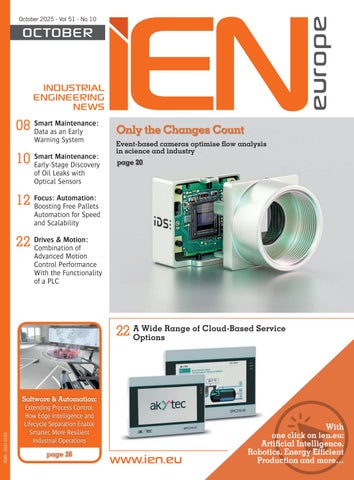
Only the Changes Count Event-based cameras optimise flow analysis in science and industry page 20
of Oil Leaks with Optical Sensors Automation: 12 Focus: Boosting Free Pallets Automation for Speed and Scalability & Motion: 22 Drives Combination of Advanced Motion Control Performance With the Functionality of a PLC
ISSN : 2031-9193
Wide Range of Cloud-Based Service 22 AOptions
Software & Automation: Extending Process Control: How Edge Intelligence and Lifecycle Separation Enable Smarter, More Resilient Industrial Operations page 26
001_IEN Europe_October 2025.indd 1
www.ien.eu
With one click on ien.eu: Artificial Intelligence, Robotics, Energy Efficient Production and more…
23/09/25 11:01
N° 10 - OCTOBER 2025
002_011_IEN Europe_October 2025.indd 2
23/09/25 11:04
3
Editorial Director:
Orhan Erenberk o.erenberk@tim-europe.com
Editor:
Kay Petermann k.petermann@tim-europe.com
Editorial Support Energy Efficiency:
Flavio Steinbach f.steinbach@tim-europe.com
Associate Publisher:
Marco Marangoni m.marangoni@tim-europe.com
Production & Francesca Lorini Order Administration: f.lorini@tim-europe.com Website & Newsletter:
Marco Prinari m.prinari@tim-europe.com
Marketing Manager: Marco Prinari m.prinari@tim-europe.com President:
Orhan Erenberk o.erenberk@tim-europe.com
ADVERTISING SALES OFFICES EUROPE AUSTRIA/SWITZERLAND Monika Ailinger Tel.: +41 41 850 44 24 m.ailinger@marcomedia.ch BENELUX, NORWAY, SWEDEN Nadia Liefsoens Tel.: +32-(0)11-224397 Fax: +32-(0)11-224397 n.liefsoens@tim-europe.com FRANCE Roxanne Akbulut Tel: + 33 06 52 31 41 56 r.akbulut@tim-europe.com M’fumu Tiya Mindombe Tel: +32 465 443 530 m.mindombe@tim-europe.com GERMANY Simone Ciolek Tel: +49-(0)9771-1779007 s.ciolek@tim-europe.com ITALY, SLOVENIA Andrea Rancati Tel: +39-02-7030 0088 arancati@rancatinet.it
UNITED KINGDOM/DENMARK/ FINLAND Dave Harvett Tel: +44 (0)121 705 21 20 daveharvett@btconnect.com NORTH AMERICA Hamilton-Murphy Global, LLC John Murphy Tel: +1 616 682 4790 Fax: +1 616 682 4791 john@hamiltonmurphymedia.com JAPAN Ichiro Suzuki Incom Co. Ltd. Tel: +81-(0)3-3260-7871 Fax: +81-(0)3-3260-7833 isuzuki@INCOM.co.jp OTHER COUNTRIES Cristian Son c.son@tim-europe.com
editorial
TIM Global Media BV Chaussée de la Hulpe 177 - Ground Floor 1170 Watermael Boitsfort (Brussels), Belgium o.erenberk@tim-europe.com - www.ien.eu
Kay Petermann k.petermann@tim-europe.com
Dear Reader, As we all know, data is a valuable resource. Modern sensor technology enables data to be generated with ever greater accuracy and resolution in more and more places. While this can be a major advantage, it is not necessarily so. After all, data can only be used to achieve benefits if it reliably records and evaluates a condition. Depending on how critical the data is, it should be recorded and evaluated promptly or in real time, so that adjustments or maintenance measures can be initiated as early as possible in the event of deviations. How this can be implemented as easily as possible is shown in the two articles on smart maintenance starting on page 8. We present a starter kit for vibration monitoring that provides an easy introduction to predictive maintenance, and we show a practical example in which optical sensors monitor drive seals and detect oil leaks. Another example of the optimal utilisation of data in research and industry is presented in the article on page 20. This article demonstrates how cameras with event-based sensors can analyse the flow movements of gases or liquids, for example. Since only changes are recorded, less data is generated than with conventional image recording. With the right software, very high frame rates can be achieved without the need for expensive high-speed cameras. I hope you have an interesting read!
Kay Petermann Editor IEN Europe
TURKEY Onur Dil Tel: +90 212 366 02 76 Fax: +90 212 366 58 02 E-mail: o.dil@tim-europe.com
Digital File Requirements available at: www.ien.eu/technical-guidelines/ © 2025 TIM Global Media BV Production by design3, Milano, Italy Printing by Logo Srl - Padova, Italy
FREE Digital Subscription
POSTMASTER Send address changes to: Industrial Engineering News Europe Marco Prinari - m.prinari@tim-europe.com
FREE DIGITAL SUBSCRIPTION
002_011_IEN Europe_October 2025.indd 3
N° 10 - OCTOBER 2025
23/09/25 11:04
N° 10 - OCTOBER 2025
contents
4 In the next issue: November: Special sps Automation: Intelligent Components & Solutions
6
5 Industry News 6 New Products Smart Maintenance: 8 Maintenance 4.0: Data as an Early Warning System 10 Early-Stage Discovery of Oil Leaks with Optical Sensors A space-saving, robust solution with fibre-optic sensors detects seal failures, preventing greater transmission damage and enabling reliable controlled shutdowns.
10
Focus: Automation: 12 Boosting Free Pallets Automation for Speed and Scalability Flexible, modular workpiece transport can bring valuable extra speed to automated assembly with free pallets. Scalability is also enhanced, while built-in tracking provides traceability data to meet the requirements of demanding industries such as automotive. 14 A Wide Range of Cloud-Based Service Options 16 Safeguarding Danger Zones for Machines, AGVs and Robots
16
18
18 New Products 20 Vision & Identification: Only the Changes Count Event-based cameras optimise flow analysis in science and industry. 22 Drives & Motion: Combination of Advanced Motion Control Performance With the Functionality of a PLC
22
24 Software & Automation: Cutting Hardware Costs and Project Time at SCADA-Modernisation Project 26 Software & Automation: Extending Process Control: How Edge Intelligence and Lifecycle Separation Enable Smarter, More Resilient Industrial Operations 29 New Products
29
30 Index & Events N° 10 - OCTOBER 2025
002_011_IEN Europe_October 2025.indd 4
FREE DIGITAL SUBSCRIPTION
23/09/25 11:04
5 The partnership with Sereact focuses on integrating robotic solutions for single item picking into automated production and distribution solutions. When it comes to picking a wide variety of items reliably, quickly, and without time-consuming training, conventional automation systems often reach their limits. This is where the Sereact Pick and Place solution comes in, and it is now becoming part of the Körber supply chain ecosystem. “Our customers face the challenge of remaining competitive in a dynamic market. As a result, demand for flexible, scalable automation solutions is growing,” explains Michael Heidu, Product & Solution Manager at Körber. “With Sereact, we offer a technology that adapts to changing market requirements while further increasing the efficiency of the overall solution.” “Our solution enables companies to pick a wide variety of different items flexibly and efficiently – without the need for time-consuming advance training,” explains Ralf Gulde, CEO and co-founder of Sereact. The AI-supported control system analyzes visual and object-related data in real time and automatically adjusts the picking strategies. This means that even complex or unknown products can be handled with precision.
Endress+Hauser Acquires Full Ownership of CodeWrights
Alliance to Promote the SelfAware and Self-Protecting Plant
Endress+Hauser is now the sole owner, Germany. The Swiss specialist in measurement and automation technology acquired the remaining 33 percent of the Karlsruhe-based software company CodeWrights GmbH, from Pepperl+Fuchs. Since 2002, Endress+Hauser held two-thirds of the shares, while Pepperl+Fuchs owned the remaining third. CodeWrights was founded in 2002 as a joint venture between Endress+Hauser and Pepperl+Fuchs and employs nearly 50 people. As a service provider, the company develops customized software solutions for providers of measurement and automation technology, for example apps and cloud applications, software for industrial automation and embedded software for devices. This has contributed to CodeWrights’ profitable growth and its reputation as a trusted software partner. “We are excited to assume full ownership of CodeWrights. At the same time, we would like to thank Pepperl+Fuchs for more than 20 years of constructive partnership,” says Dr Rolf Birkhofer, MD of Endress+Hauser Digital Solutions, the Group’s product center for the Industrial Internet of Things (IIoT). “We believe strongly in the expertise of the team and the strength of the business model. Together, we look forward to driving further growth and success.”
G.M. International (GMI) specialist in intrinsic and functional safety hardware for Operational Technology (OT), and AINEXXO, a deep-tech pioneer in AI-powered OT, have announced a strategic alliance to deliver a transformative industrial innovation: the Self-Aware and Self-Protecting Factory. This alliance fuses GMI’s SIL-certified safety hardware with AINEXXO’s cognitive AI stack, laying the foundation for a new class of safety-embedded, self-aware industrial systems that redefine the future of operational resilience. The companies are creating a new industrial paradigm where Operational Safety and Operational Integrity Levels expand upon traditional Functional Safety (SIL) and Cyber Safety. At the heart of this transformation is the integration of AINEXXO’s DaVinci Edge-AI Engineer into GMI’s new X product line, evolving it into a Safety Processing Unit (SPU). Unlike conventional control components, these next-generation platforms act as autonomous, self-aware agents capable of prediction and prevention of failures before they occur and collaboration between machines (M2M cognition) to optimize performance. “Together, we are bridging the gap between safety and intelligence,” said Zdravko Petkovic, Chairman of the Board of Directors and Group General Manager of G.M. International and Founder of AINEXXO.
industrynews
Körber Expands Portfolio with AI-Based Pick-andPlace Technology
Using Plastic Waste as Feedstock for new Materials The Hungarian MOL Group has achieved a significant milestone in its SHAPE TOMORROW Strategy by successfully completing its first ISCC PLUS-certified production run using circular feedstock at its MOL Petrochemicals site in Tiszaújváros. The pilot test demonstrates MOL’s ability to convert circular feedstock, namely post-consumer plastic waste-based feedstock into high-quality polyethylene (PE) and polypropylene (PP). This marks a major step in MOL Group’s SHAPE TOMORROW strategy to integrate circular economy into production and establish itself as a leader in sustainable petrochemicals in Central and Eastern Europe. “This successful test shows that MOL Group can now process circular feedstocks according to ISCC PLUS certified process, turning plastic waste into new, high-value products,” said Péter Császár, Senior Vice President, MOL Group Chemicals. During the pilot, circular feedstock based on post-consumer waste was introduced to MOL’s steam cracker. This process allows the production of circular-based monomers (the smallest building block of plastics) and then converts them into polymers. MOL Group will continue testing additional circular feedstocks and developing new processes to expand the role of waste as a raw material for plastics production.
FREE DIGITAL SUBSCRIPTION
002_011_IEN Europe_October 2025.indd 5
© Picture: MOL Group
N° 10 - OCTOBER 2025
23/09/25 11:04
6 OPTIMIZED SWIR LENS FOR RECYCLING
CONNECTOR FOR DATABASE INTEGRATION
Optimized lenses enable higher recovery rates
Accelerated PLC integration withoutprogramming
The ability of SWIR spectroscopy to identify and distinguish various types of plastics including lowand high-density polyethylene, polypropylene, PTFE, polystyrene and PVC found in automotive, electronic and household product waste is well known. However not all SWIR lenses offer the performance to match the higher resolution Indium Gallium Arsenide (InGaAs) detectors used for this application. A large proportion of off-the-shelf SWIR lenses not account for the way the glass transmits in the SWIR region and as such the final image quality can often be compromised, particularly with higher resolution SWIR sensors. Using off-the-shelf SWIR lenses in sorting instrument design may appeal due to lower cost but often comes with compromises such as poorer performance, lower resolution and a bulkier less attractive product design. Consequently, demand for instrument optimized version of Resolve Optics Model 363 SWIR lens that exactly meet the needs of plastics recycling applications are rising. The 16mm focal length Model 363 lens uses carefully selected glass types and AR coatings to ensure maximum transmission, colour correction and best image quality throughout the SWIR waveband. Operating at f/1.6, with less than 2 per cent geometric distortion, the Model 363 lens produces a clear crisp 12.8mm diameter image.
Softing Industrial announces feature enhancements to its tManager product line, enabling seamless, bi-directional communication between Siemens PLCs and SQL databases. The latest update introduces symbol browsing capabilities for Siemens S71200 and 1500 controllers, significantly reducing integration time and eliminating the need for manual tag creation. The enhanced Siemens connector builds on Softing's proven tManager in-chassis connectivity platform and expands tManager ControlLogix and IPC (Industrial PC) to support Siemens controllers in addition to Rockwell and Modbus PLCs. Users can now browse PLC symbols and SQL database fields directly, set up triggers and deploy industrial applications such as track and trace, quality monitoring, KPI dashboards and recipe downloads. Previously, Siemens integration required time-consuming, manual symbol setup. With this new functionality, browsing and mapping symbols from Siemens S7 1200 and 1500 controllers is now just as streamlined as it is with Rockwell PLCs. The update also maintains support for legacy symbol creation with Siemens S7 300, 400, 1200 and 1500 controllers, ensuring full backward compatibility for existing installations. The robust in-chassis and IPC-based architectureof the solution offers a reliable and supportable path to digital transformation. 66008 at www.ien.eu
65976 at www.ien.eu
COST-EFFECTIVE POWER SUPPLY FAMILY
SCALABLE INDUSTRIAL CONNECTOR SERIES
Compact DIN-rail power supplies from 36-480 W
Hybrid inserts for a wide applicational range
The PIANO product family from PULS has been designed for customers who need reliable, easy-to-use and cost-effective and future-proof DIN rail power supplies. The focus of the product family is on providing basic functionality without making compromises on efficiency, lifetime, reliability and small size. Additional and more complex features - such as power reserves - have deliberately omitted. This provides a cost-oriented design with no compromises on quality. The growing PIANO product family includes more than 17 different DIN rail power supplies offering a range of specifications, such as the input voltage range. This gives customers the opportunity to choose only what is actually required by the specific application. Regional versions are available to cater for systems to be installed exclusively in Europe, China or India (e.g. in a building) where a wide range input (AC 100-240 V) is not required. PIANO versions marked with "C" at the end of the part number (e.g. PIC240.241C) feature an AC input voltage of only 200-240 V and have a cost saving simpler circuit design with fewer components. The PIANO Mini-series (PIM), offers users the choice between push-in and screw terminals.
Harting offers additions to its circular connector series ICC (Industrial Circular Connectors) in size 20. The ICC 20 4/3 ("4Slash3") represents an attractive solution for the supply and control of drives in robotics and automation, for example, handling power up to 40A in combination with signal contacts. The circular connector features the proven Han® C and Han D® contacts. Four power contacts, three signal contacts (up to 10A/250V) and one PE contact are accommodated in the insulator. Another expansion to the series is a single pole, so that users can also transmit significantly higher power for their machines and devices. A single connector transmits up to 400A/600V, making it suitable for energy-intensive applications such as robot arms for heavy load handling or welding robots. All of the series housings offer a high degree of protection against the ingress of dust and water (IP67/IP69), making them ideal for deployment in harsh industrial environments. The housings reliably shield electromagnetic fields (EMC), thereby ensuring the signal integrity of the system. The number of potential applications for the ICC 20 design is also multiplied by the integration of insulating bodies, which were previously reserved for the Han® 3A format. A multitude of especially efficient solutions for power, signal and data transmission are possible.
65994 at www.ien.eu
65790 at www.ien.eu N° 10 - OCTOBER 2025
002_011_IEN Europe_October 2025.indd 6
FREE DIGITAL SUBSCRIPTION
23/09/25 11:04
7 REAL-TIME MACHINE MONITORING SOLUTION
COMPACT SERVO SYSTEM IN 200V AND 400V
Production monitoring & analytics for data decisions
Servo drives address need for cost-effective automation
Designed to streamline and optimise your production processes, Monitora by Siskon enables manufacturers to lead the digital transformation by making every stage of production traceable, analysable and manageable. Monitora enables businesses to instantly monitor production performance, detect deviations and identify areas for improvement. Its user-friendly interface and flexible architecture transform field data into actionable insights, supporting fast and effective decision-making. Real-time data collection enables the tracking of all machines, stations and processes on the production line. Direct integration with PLCs and control systems from various brands is supported. Time- and event-based data records enable root cause analysis and performance comparisons, allowing recurring issues to be eliminated quickly. Trend analysis of process data can be used to optimise and proactively shape maintenance plans and quality strategies. Monitora seamlessly integrates with existing systems, eliminating the need for additional investments or lengthy implementation processes. Based on open, secure, and standards-compliant communication via OPC UA, the solution offers a web-based, multilingual user interface with live monitoring dashboards, as well as role-based user management and authorisation.
Mitsubishi Electric has introduced MELSERVO-JET, a new line of servo drive systems that enables manufacturers to implement advanced automation without significant investment. MELSERVO-JET is designed for companies looking to make targeted automation improvements, for example faster more flexible production machines that maintaining or improve the production quality and whilst maintaining machine or production costs. The system delivers high positioning accuracy through encoders with resolution up to 24 bits and fast response (up to 3.2 kHz) for precise motion control. High overload capacity (up to 450%) and high inertia ratio (up to 1:25) allow for smaller drives while maintaining required performance, directly translating to cost savings. Features like automatic motor detection and auto-tuning make the system accessible even for companies taking their first steps in advanced automation. The One-Touch Tuning function is particularly valuable, as it adjusts system settings in just 0.3 seconds, requiring less specialist knowledge and helping companies cope with skilled worker shortages. MELSERVO-JET features a compact design, simplified setup and flexible implementation options. The system offers power ranging from 0.1 kW to 3.0 kW for 200V versions and the 400V versions are available from 0.6kW to 7kW, making it suitable for various industrial applications.
65993 at www.ien.eu
66079 at www.ien.eu
ETHERNET REMOTE I/O MODULES
1200W INDUSTRIAL AC-DC POWER SUPPLY
Embedded RESTful API for easy web-service development
High power in compact, low-noise package
Acromag's BusWorks® NT series remote I/O modules now offer a RESTful API (Representational State Transfer Application Program Interface) to simplify development of web-based services. The NT I/O module system firmware embeds the API to support reading/writing of I/O data. Web services can use HTTP POST and GET requests to exchange information with the NT's I/O server. This approach allows devices to easily and securely communicate with each other over the world-wide web along a common Ethernet interface. Applications for BusWorks NT Ethernet I/O modules include remote data acquisition, status monitoring, actuator control, predictive maintenance, energy management, and more. REST API is a very popular web interface method because it relies solely on the shared universal HTTP protocol standard on Ethernet. The RESTful API is very fast and lightweight. It is also very cost-effective since developers can use the same API request across many environments without third-party tools. NTE Ethernet I/O models have dual RJ45 ports and a webserver allowing remote system controllers to read or write data on connected sensors and actuators. Each I/O module offers up to 16 input or output channels for voltage, current, temperature, and relay control signals.
TDK Lambda announces the addition of 1200 W rated models to the CUS-M series of AC-DC power supplies with a 187 x 93 mm footprint and a low 42.5 mm profile. The CUS1200M features a variable speed fan with audible noise as low as 30 dBA at 20 % load and 42 dBA at full load. The power supplies can be used in a wide range of applications, including medical, test and measurement, and industrial equipment. The series accepts an 85 to 265 Vac input, delivering full power at 90 Vac, and is available with 24 V, 36 V, and 48 V outputs. A 5 V 2 A standby voltage, remote on/off, remote sense and a power good signal are fitted as standard. With efficiencies of up to 95.5 %, internal heating is reduced, allowing reliable operation in the compact size. The off-load power consumption is typically <0.6 W when the supply is put into standby mode. The CUS1200M models can operate in ambient temperatures between -20 oC and +70 oC, derating linearly at elevated temperatures. The CUS1200M series has an input to output isolation of 4000 Vac (2 x MoPP), an input to ground isolation of 2000 Vac (1 x MoPP), and an output to ground isolation of 1500 Vac (1 x MoPP) for B and BF rated medical equipment. The leakage current is <250 µA, with a maximum operating, transportation, and storage altitude of 5000 m.
65684 at www.ien.eu FREE DIGITAL SUBSCRIPTION
002_011_IEN Europe_October 2025.indd 7
66117 at www.ien.eu N° 10 - OCTOBER 2025
23/09/25 11:04
8 smart maintenance Maintenance 4.0: Data as an Early Warning System Predictive maintenance prevents unplanned downtime. Fixed maintenance intervals, however, are preventive in nature, as true prediction requires realtime system status information and intelligent data evaluation. The Digital Twin Starter Kit from Bosch Digital Twin Industries and Pepperl+Fuchs offers an easy way to get started. With conventional maintenance strategies, generous buffers are unavoidable. It is better to replace a bearing three months too early than one hour too late. Nevertheless, there is no guarantee that a critical element will not fail. Minimal assembly errors and unexpected impacts from external mechanical forces can trigger what you wanted to avoid at all costs: unplanned downtime and its costly consequences. Sensors for Real-Time Monitoring Intelligent, networked sensor systems can be used to monitor plant components that require maintenance in real time. For example, vibration sensors can detect vibration patterns that change under the influence of
wear, increasing contamination, and other influences. The evaluation of the sensor data provides a detailed and up-to-date picture of the actual condition, including a data-based calculation of the expected remaining service life. This not only enables proactive maintenance, but also predictive maintenance. In addition to the vibration patterns of shafts and bearings, many other parameters can be monitored using appropriate sensors. Temperature values and curves can also indicate mechanical changes; changes in pressure values allow early detection of leaks and sealing problems; flow measurement, in combination with other data, can provide information about the condition of pumps, valves, and piping systems.
Components and functional diagram of the Digital Twin Starter Kit. Picture: Pepperl+Fuchs SE N° 10 - OCTOBER 2025
002_011_IEN Europe_October 2025.indd 8
Digital Twin for Precise Maintenance The decisive factor now is the intelligent combination and evaluation of all relevant data. A digital twin makes this step particularly efficient, as it provides a virtual representation of the physical system in real time and with a high level of detail. With targeted implementation, it becomes the central basis for predictive maintenance. It is therefore often incorporated into new systems from the outset. However, if you also want to take advantage of its benefits in existing systems, there is no way around retrofitting. The principle of "never change a running system" is a sum of financial, technical, and psychological factors. All three are taken into account in the Starter Kit concept from Bosch Digital Twin Industries and Pepperl+Fuchs. Its aim is to make the integration of a digital twin as simple and cost-effective as possible, including in existing systems. The user not only receives a complete package conceptually, but also physically: In a compact cardboard box, they will find a powerful 12 kHz vibration sensor that performs condition monitoring on a moving machine part, an ICE2 or ICE3 IOLink master, and a BTC22 embedded PC from Pepperl+Fuchs. Plug and Play These components are simply installed according to the supplied wiring diagram and connected to the network. As soon as the power is switched on, the system configures itself. The vibration sensor transmits its measured values to the IO-Link master, which forwards them to the Box Thin Client BTC22 for pre-processing and aggregation. This fanless computer also acts as an edge gateway FREE DIGITAL SUBSCRIPTION
23/09/25 11:04
9
A 12 kHz vibration sensor records relevant status data. Picture: Pepperl+Fuchs SE
and is designed for robust industrial use. After a short teach-in phase, it transmits the processed data to the so-called "Intelligence Core", Bosch's digital twin platform. The digital twin analyzes and processes the collected system data to create a clear status picture from which options for action can
Complete solution in a compact packet: the Digital Twin Starter Kit. Picture: Pepperl+Fuchs SE
now be derived. A simulation model with the IAPM tool (Integrated Asset Performance Management) enables real-time analysis, which is based on established cloud platforms such as AWS or MS Azure and also uses machine learning algorithms and artificial intelligence.
Customization and Scaling The data can also be called up on the dashboard in the browser. Existing and future mechanical problems are visualized in detailed 3-D models. The evaluation software calculates remaining running times and offers differentiated predictions of predictable failures. This makes it possible to plan maintenance based on the condition of the system and actual requirements. At the same time, the evaluation can be used to further optimize processes. If a threshold value is exceeded or a critical situation occurs, a corresponding notification can be sent as a push message by email, text message, and other communication tools to specified recipients. As a modular system, the Digital Twin Starter Kit can be individually adapted to the requirements of the respective system and scaled up as needed. Experts from Bosch Digital Twin Industries and Pepperl+Fuchs support users with coordinated advice on custom-fit integration and upgrades in line with IIoT and Industry 4.0.
Picture: Pepperl+Fuchs SE 66048 at www.ien.eu FREE DIGITAL SUBSCRIPTION
002_011_IEN Europe_October 2025.indd 9
N° 10 - OCTOBER 2025
23/09/25 11:05
10 smart maintenance Early-Stage Discovery of Oil Leaks with Optical Sensors A space-saving, robust solution with fibre-optic sensors detects seal failures, preventing greater transmission damage and enabling reliable controlled shutdowns. A wide variety of fibre optic sensor heads and cables are available for a wide range of applications.
The optoCONTROL CLS1000 series of fibre optic sensors from MicroEpsilon reliably and precisely detect oil leaks in the event of seal failure. At Linde Material Handling, for example, a shaft seal ring (WDR) protects the oil-lubricated gearbox from the electric drive motor. A failure of the WDR would go unnoticed and could cause the motor compartment to fill with gearbox oil, resulting in massive gearbox damage. The endurance test benches carry out their work unattended, often over the weekend or during long holiday periods. Fault detection is essential in order to switch off the test bench in the event of a fault and prevent serious consequential damage. In particular, detecting oil leaks as a result of seal failure is always a challenge here. Preventing transmission damage A shaft seal ring seals the oil-lubricated gearbox against the electric drive motor. As this WDR is installed in an axle housing, a failure would not be recognised. The motor compartment would fill up with transmission oil unnoticed, the transmission would run dry and result in massive transmission damage. Existing capacitive-based sensors are far too large for this application. Due to the space constraints, a fibre optic sensor from Micro-Epsilon was selected. The sensor head has a diameter of only 6 mm and can simply be screwed into a hole just behind the end shield.
If gear oil enters the engine compartment, it collects at the lowest point on the light sensor. As soon as the optics are wetted with oil, the sensor reacts and the test stand is safely switched off via a relay circuit, without the risk of consequential damage. The simple configuration, the extremely robust design and the very flexible fibre optic cable enable quick and easy installation, even in difficult locations.
The optoCONTROL CLS1000 controllers and CFS fibre optic sensors from Micro-Epsilon detect oil leaks in the event of seal failure.
Sensors to suit every application The optoCONTROL CLS1000 optoelectronic system consists of a controller and a sensor (sensor head and glass fibre optic cable). A wide variety of fibre optic sensor heads and cables are available. Fibre optics
N° 10 - OCTOBER 2025
002_011_IEN Europe_October 2025.indd 10
FREE DIGITAL SUBSCRIPTION
23/09/25 11:05
11
The optoCONTROL CLS1000 controller comprises of a compact transmitter and receiver unit with integrated signal evaluation
types of sensor are available for reflex (one-way) mode, reflex mode Varrangement (two-way system), transmission mode (two-way system), and multiple reflex mode (transmitting and receiver units are statistically mixed in two or more separate sensor heads). November A range of cable sheaths (e.g. PVC, metal, Silicone-metal, VA stainless steel) are provided in various fibre bundle diameters (0.6mm to 3mm), lengths (0.3m up to 2.4m) and aperture angles. Special versions of the sensors are available with increased vibration resistance (VS), special bonding for high temperatures (T250/T400), and pressure-tight variants with vacuum feed-through (up to 10-5 mbar). Sensor heads are available as straight output, 90-degree output for confined installation spaces, with wide light band, with and without external thread, or as thin sensor heads with bendable head. 66103 at www.ien.eu
are offered in different form factors and with focusing lens options, which means the optoCONTROL CLS1000 system can be adapted to operate in a wide variety of demanding applications and environments, including high temperatures, aggressive chemicals, vacuums and for the detection of very fine structures. The optoCONTROL CLS1000 controller comprises of a compact transmitter and receiver unit with integrated signal evaluation. The infrared light is transmitted to the object and back via a high quality glass fibre optic cable that works on the principle of total reflection. The received light intensity is used for evaluation. Due to their large sensing range of up to 2,000 mm, the sensors can detect components at great distances. The controller also has an extremely high resistance to ambient light of up to 50,000 lux, which increases process reliability when used in production plants and systems where intensive lighting is required. With a robust, compact design, the optoCONTROL CLS1000 is particularly suitable for use in confined installation spaces on machines, robots and production lines. The controller has an OLED display for fast, easy configuration and parameter set up. All programming steps, status displays and set/actual values are visualised via two 4-digit digital displays. The optoCONTROL CLS1000 has numerous teach-in methods including switching output functions, on/off delays, pulse output and adjustable hysteresis. CLS1000 controllers are available in five different versions: CLS1000QN with antivalence function (normally open/normally closed), CLS1000-2Q with two switching outputs, CLS1000-OC with optocoupler, CLS1000-AU with voltage output and CLS1000-AI with current output. Each model is available in NPN, PNP or push-pull versions. All controllers are also available with or without triggers. Fibre optic sensor range The optoCONTROL CFS range of fibre optic sensors (sensor heads and cables) can be adapted to meet customer-specific applications. Special FREE DIGITAL SUBSCRIPTION
002_011_IEN Europe_October 2025.indd 11
35
65425 at www.ien.eu
N° 10 - OCTOBER 2025
23/09/25 11:05
12 focus Automation Boosting Free Pallets Automation for Speed and Scalability Flexible, modular workpiece transport can bring valuable extra speed to automated assembly with free pallets. Scalability is also enhanced, while built-in tracking provides traceability data to meet the requirements of demanding industries such as automotive. Manufacturing companies often need to scale their capabilities and capacity quickly to meet the demands of customers serving highvolume markets such as automotive components, building automation, and IoT. Winning a tender to supply original components to a big automotive brand is a major coup for a parts maker and is a cause for celebration. On the other hand, the win also challenges the supplier to meet obligations that are often complicated and can demand careful investment in new automation. The customer may order a relatively small number of units to test the water before placing major orders, and there may also be a ramp-up period. A small business needs to be smart to manage the transition from being the winning tender to becoming a trusted long-term partner. Financially, making a large up-front investment
in new equipment may not be feasible and risks being left with over-capacity if the business ultimately goes in a different direction. On the other hand, they need to be ready to deliver according to the agreed schedule as soon as they get the green light. Free pallets automation Free pallets is a flexible and scalable approach to automated manufacturing processes. Using free pallets automation is widely appreciated as a flexible approach to manufacturing products continuously, in high volume. The workpieces are mounted on pallets that move independently between workstations, usually on a conveyor or track system. They are not rigidly fixed and can be stopped, rerouted, or buffered as needed. In a typical free pallets process, automated
Free pallets is a widely used technique for automating industrial manufacturing processes. N° 10 - OCTOBER 2025
012_029_IEN Europe_October 2025.indd 12
equipment at each station performs a specific task on the workpiece carried by the pallet, such as welding, assembly, or inspection. The pallets move asynchronously, each at their own pace, depending on the time taken to complete the process or availability of the next station. Pallets can be diverted to different paths or stations based on the product type, quality checks, or production logic. Because the pallets can queue between stations, upstream and downstream processes can operate at different speeds. There are inherent advantages in this approach that are of particular benefit to small manufacturers. Extra stations can be added quickly and cost effectively, or unneeded stations removed, without redesigning the whole line, thereby easing scalability and letting businesses adapt as customers evolve their requirements. Also, by directing different products to follow different paths, small businesses can support mixed-model production and customise individual units if required. In addition, by decoupling the process timing between stations, automation with free pallets minimises bottlenecks and ensures resilient and maintenance-friendly manufacturing. If one station stops working for any reason, other stations can continue. Automation with standard conveyors Automotive components, smart heating controls, and other engineering assemblies are often produced this way, enabling manufacturers to optimise flexibility and uptime. In an EV battery assembly line, for example, the battery modules are placed individually on their pallets and move through the sequence of processes. The first process may FREE DIGITAL SUBSCRIPTION
23/09/25 11:08
13 Modular unit: up to 25,5 m long with up to 64 simultanously controlled sliders.
The modules support heavy loads and allow assembly processes directly on the slider. perform an automated inspection before the pallet moves to the next station for automated screwdriving. The final station then completes the sequence by laser welding the battery pack. If the welding station is busy, the pallet can wait or can be rerouted to an alternate welding cell. Upgrading the concept Free pallets has proved effective in numerous manufacturing scenarios. Yamaha Robotics has worked with the systems integrator El.Mec, from northern Italy, which has created modular manufacturing cells for free-pallets processing using robots from the extensive Yamaha SCARA portfolio. The cells leverage an innovative design with standardised external electrical and mechanical interfaces that can be connected directly to other cells when the time is right to extend the production line for increased production output or faster throughput. This lets equipment operators scale-up their production lines even more quickly and easily than is possible in a conventional free pallets line. The cellular concept helps manufacturing companies bid for large contracts despite having only limited capacity, confident that FREE DIGITAL SUBSCRIPTION
012_029_IEN Europe_October 2025.indd 13
they can accelerate throughput and adapt individual processes as needed to fulfil their obligations throughout the lifetime of the project. Each cell contains a set of production stations and, by integrating Yamaha SCARA robots, these stations ensure fast and efficient cycle times when assembling and handling workpieces such as valves and small mechanisms. The stations can be manually withdrawn for maintenance, adjustment, or adaptation if required. Faster and more flexible By also integrating the Yamaha LCMR200 linear transfer system, the latest generation of this standardised cell can operate at a higher line rate than is possible when transporting the workpieces using conventional conveyors. Powered by linear motors, the LCMR200 sliders travel at up to 2500mm per second. The speed, acceleration/deceleration, and stop positions are programmable, and therefore easy to setup, fine-tune, and adapt as needed. The sliders can carry up to 30kg and can hold the workpiece accurately to let the robots perform processes such as screwdriving, glue dispensing, or palletising without dedicated
tooling. The cells are thus easier to use and setup, throughput is enhanced, and the system is also extremely quiet, even when operating at full speed. The sliders are driven independently and encoders feed back position information continuously to the main controller. In addition to letting the system optimise throughput and prevent collisions, the position and timing data can drive quality control and process improvement. Moreover, the information also enables per-unit traceability thereby simplifying compliance with automotive industry requirements. The position data is captured automatically with no user intervention or reliance on conventional identifications systems such as RFID, thereby helping avoid extra costs and engineering effort. By integrating the linear transfer system, the assembly cells can be interconnected with extreme accuracy as the production line is scaled up. The mechanical tolerance between the sliders is closer than ±30 micron and circulation units installed at the end of the line utilise high-rigidity guides and a closed-loop system to eliminate any deviation due to ambient temperature variations. Conclusion Free pallets automation is a proven manufacturing technique that delivers flexibility for operators and can scale when needed to increase production capacity and throughput. Further enhancement, introducing standardised, interconnectable production cells and Yamaha’s linear transfer system unleashes extra speed and faster scalability, to let small manufacturers handle big contracts more confidently. 66113 at www.ien.eu
N° 10 - OCTOBER 2025
23/09/25 11:08
14 focus Automation A Wide Range of Cloud-Based Service Options In order to save costs and time, more and more industrial companies are focussing on the possibility of monitoring and controlling devices and systems remotely. Web and cloud-based services are ideal for this: an internet connection makes it possible to control and operate industrial systems as if you were on site and long journeys by service personnel are no longer necessary. At SPS 2024, akYtec launched akYtec Cloud, a free online service designed to make remote industrial monitoring and control more accessible than ever. The platform includes tools for visualizing processes, such as mnemonic diagrams, graphs, tables, reports, a library of animated symbols, and more. akYtec Cloud is optimized for both PCs and mobile devices. The platform features instant notifications, enabling users to receive unlimited messages about custom events or alarms via email or Telegram bot, ensuring they stay informed promptly. The platform supports connections with both akYtec and third-party devices through network gateways from the Gx24-Cloud series. All data collected from field-level devices is
stored on servers located within the EU and meets current Tier III security standards, ensuring data security and integrity. With its builtin OPC UA client and open API, akYtec Cloud can communicate with external systems. This functionality allows it to serve not only as a web-based SCADA system but also as a data layer for custom industrial applications, providing flexibility for various industrial needs. Examples of applications akYtec Cloud provides real-time monitoring and automated control, allowing users to define customizable setpoints and event-driven responses based on their specific operational needs. These setpoints are not fixed but fully adjustable, enabling precise tuning
Securely access your data from virtually anywhere. Picture: akYtec N° 10 - OCTOBER 2025
012_029_IEN Europe_October 2025.indd 14
The PR103 programmable relay from akYtec is a ‘mini PLC’ with an Ethernet interface. Picture: akYtec for different applications. For example, in data centers, users can configure ventilation to activate when server room temperatures exceed a specified threshold, such as 27 °C, or set alerts for power anomalies if UPS voltage drops below 210 V. However, these values can be adjusted to match the requirements of a particular facility. Similarly, in boiler houses, heating systems can be programmed to increase fuel supply when temperatures fall below 80 °C, but operators can modify this range depending on process efficiency and safety requirements. Gas pressure monitoring is also adaptable, with alerts set for pressure drops below 1.5 bar or any other threshold deemed critical. For water treatment and pumping stations, users can define operational pressure ranges, such as maintaining system pressure between 3-6 bar, with backup pumps automatically engaging if it drops below a user-set threshold. Leak detection is based on unexpected flow rate changes, but sensitivity can be tailored to different pipe networks and operational FREE DIGITAL SUBSCRIPTION
23/09/25 11:08
15
conditions. In agriculture and irrigation, automated watering systems can be configured to activate at soil moisture levels below 30 %, but this setpoint can be modified according to crop type, soil conditions, and local climate. These examples illustrate just a few possibilities of what can be configured within akYtec Cloud. The system is designed for flexibility, allowing operators to define and modify thresholds, automation rules, and notifications to best suit their specific processes and requirements. Ready for the cloud The PR103 programmable relay is the first device of its kind from akYtec with integrated Ethernet. akYtec has designed its ‘mini PLC’ primarily for use in smaller automated systems: The compact relay can be used in ventilation and heating systems as well as in automatic pumps and many other devices. With its functionality, it comes close to a programmable logic controller. The Ethernet interface enables the PR103 to be integrated into distributed systems. It is ready for integration into the akYtec Cloud and can therefore be used for remote control and management of devices. The PR103 has two RS-485 interfaces for data transmission to the higher level. PRM expansion modules can be connected via the internal bus to expand its own inputs/outputs. Algorithms are written by the user in FBD language with support for function blocks on ST in the free ALP programming environment. Algorithms are loaded and configured via microUSB, Ethernet or RS-485.
The SPC210 from akYtec combines the functionalities of a PLC and an HMI in a single compact device with space-saving design. Picture: akYtec
to Ethernet, 2 x RS485 ports are available and connection via USB is also possible. The akYtec ALP software required for programming is free of charge. It enables programming with Function Block Diagrams (FBD) with support for blocks within ST programmes.
Versatile connection options Further specifications: The PR103 has ten digital inputs, four of which are fast digital inputs (up to 100 kHz) suitable for connecting encoders and other high-speed devices. Users can also choose from six universal analogue inputs (4 - 20 mA / 0 - 10 V) and up to ten digital outputs, and the PR103 is also available with up to two analogue outputs. In addition
PLC and HMI in one device The SPC210 is a compact, all-in-one solution that integrates the functionality of a Programmable Logic Controller (PLC) and a HumanMachine Interface (HMI) into a single device. Designed to streamline automation systems, the SPC210 eliminates the need for separate PLC and HMI hardware, reducing installation time, costs, and complexity. This space-saving design is particularly advantageous in automation cabinets with limited space, allowing for more flexible installation and efficient system architecture. One of the key features of the SPC210 is its wide connectivity options. With RS-232, RS-485, and Ethernet interfaces, it supports widely used industrial protocols such as Modbus RTU/TCP, OPC UA, and MQTT, enabling easy integration into industrial networks and cloud-based solutions. The
FREE DIGITAL SUBSCRIPTION
N° 10 - OCTOBER 2025
012_029_IEN Europe_October 2025.indd 15
SPC210 is fully compatible with akYtec’s Mx110 and Mx210 I/O modules, allowing for system expansion without compatibility concerns. Programming the SPC210 is done using CODESYS V3.5, a well-known and flexible development environment. The SPC210 is ideally suited for applications in heating, ventilation, and air conditioning (HVAC) systems, as well as water treatment plants and other utility and infrastructure projects. Thanks to its built-in visualization capabilities, operators can monitor and control processes directly from the device without the need for an external HMI. Furthermore, SPC210 can be connected directly to akYtec Cloud, providing remote access, real-time monitoring, and automated control, making it a future-proof solution for modern industrial automation. Powerful partner for industry and utilities With the akYtec Cloud and the innovations in the field of programmable relays and controllers, the Hanover-based company is proving to be a competent and powerful partner for industry and utility companies 66118 at www.ien.eu
23/09/25 11:08
16 focus Automation Safeguarding Danger Zones for Machines, AGVs and Robots In industrial automation, efficiency and safety must go hand in hand: People, machines and processes must be reliably protected without impairing production processes. However, space is limited in narrow production lines, on automated guided vehicles and robots. This is where the new ultra-compact RSL 200 safety laser scanner from Leuze scores points: With its compact dimensions, it can be integrated effortlessly and used flexibly to safeguard danger zones and access points. Safety laser scanners are increasingly in the limelight in almost every industry. This is because the versatile devices are indispensable in many cases to ensure the highest safety standards for the protection of people. Thanks to configurable protective and warning fields, they can be used very flexibly for danger zone and access guarding - for both stationary and mobile applications. A typical area of application is protecting a machine´s dangerous working ranges against access and the presence of persons. Laser safety scanners are also ideal for safeguarding autonomous mobile robots (AMRs) and driverless transport systems, also known as automated guided vehicles (AGVs). Maximum safety in the smallest space Modern safety laser scanners have to meet
012_029_IEN Europe_October 2025.indd 16
a wide range of requirements at once: Besides their main task of safely shutting down machines or systems, they must not impair machine availability or lead to unnecessary downtimes. In addition, laser scanners are expected to have an impressive operating range and scanning angle, while the system operator takes safety classifications in accordance with Type 3, SIL 2 and PLd as given. The system operator must also be able to rely on convenient configuration and diagnostics, which can be carried out effortlessly and intuitively via various interfaces such as Bluetooth, USB or Ethernet TCP/IP. Last but not least, modern safety laser scanners are selected based on their device size. That´s because increasing automation is making spatial efficiency ever more important in many production environments. Systems are
becoming more complex, while the space available for safety technology is shrinking. There is often little room for this, especially in mobile use on AGVs. The ultra-compact RSL 200 safety laser scanner combines state-of-the-art LiDar technology in a minimal space of just 80 x 80 x 86 millimeters. This makes it easy to integrate even in extremely confined spaces, whether in stationary or mobile applications.
N° 10 - OCTOBER 2025
FREE DIGITAL SUBSCRIPTION
Simple installation The compact safety scanner from Leuze gives the user more options for simple and more flexible installation, especially in confined environments, thanks to its space-saving mounting bracket or connection technology. The right mounting accessories are key to quick integration: Leuze has developed its own innovative mounting bracket for the RSL 200 to provide effortless fastening and allow the safety laser scanner´s scan level to be aligned horizontally and vertically. Simple servicing is also ensured: The RSL 200 can be replaced quickly and easily with just four screws, and the sensor parameters can be transferred from the old to the new sensor via a memory card without any sensor knowledge required. Rotatable M12 connections on the RSL 200 laser scanner allow extremely flexible cable routing for I/Os, power supply and data transmission. These are essential criteria, particularly for use on small AGVs. Leuze also offers a new mobile diagnostics app that allows status information to be conveniently retrieved even if the laser scanner is installed in locations that are difficult or impossible to access.
23/09/25 11:08
17
Aligned to your every requirement For a safety laser scanner to work optimally, its ´inner´ values are also important. For example, the scanning angle must be large enough to reliably fulfill the applicationspecific safety task, e.g., to completely cover blind spots or hard-to-see zones behind machines or conveyor belts. It must also be able to safeguard small omnidirectional AGVs/ AMRs in every direction - for example, the RSL 200 from Leuze offers a 275-degree scanning angle at an operating range of three meters. The large scanning angle allows the user to ensure all-round protection with just two diagonally positioned devices, even taking mounting tolerances into account.
32 switchable sets of protective and warning fields enable the AGV/AMR user to continuously adjust the speed and direction of travel. The monitored areas can thus be
optimally adapted to curved paths, different speeds and various load conditions. 65944 at www.ien.eu
ELECTRONIC IO-LINK SWITCH
THERMAL CAMERA WITH APP FUNCTIONALITY
Rugged switch with easy-to connect M12 connector
Structured data for faster workflows and better decisions
With the MSS-IO, SCHURTER is entering the field of bidirectional communication via switches in industrial automation. The MSSIO is based on the SCHURTER MSS electronic switch, which has been expanded to include an IOLink module. The switch is based on wear-free resistance measurement and completely avoids mechanical components. Instead of capacitive technology, a precise change in electrical resistance is used for switch detection: sensitive enough to detect the smallest changes in pressure, robust enough for industrial series processes. Thanks to the closed surface, the switch is insensitive to water, dirt and cleaning substances. This is a clear advantage in hygienically sensitive areas such as food processing or laboratory automation. The absence of moving parts minimizes the maintenance effort and increases the service life enormously. The IO-Link interface allows bidirectional communication, parameterization during operation and real-time diagnostics. The connection is made via standard M12 connectors. Predictive maintenance and simple integration into existing Industry 4.0 environments are guaranteed. Typical fields of application are automation technology, robotics and hygiene-critical applications. The MSS IO-Link switch is particularly suitable for scenarios with high demands on precision, process reliability and digital communication.
Flir introduces the iXX-Series of next-generation app-enabled thermal cameras that are set to transform inspection tasks in a multitude of asset condition monitoring, building inspection, and other applications. Built on Flir's new ACE platform, the iXX combines the power of apps with a high-performance thermography inspection tool, enabling scalable, intuitive, and connected condition monitoring. Notably, direct integration with Flir Assetlink browser-based software automatically connects Flir radiometric images to an asset hierarchy structure, speeding workflows and delivering critical insight. Traditional thermal inspections are often complex, inconsistent, and disconnected. Scaling traditional thermography programs can be difficult, yet failing to do so results in safety and productivity related costs. The new Flir iXX solves these challenges with a high-quality, app-driven platform that simplifies inspections, standardizes data, and scales effortlessly across teams and sites. Around 60% of maintenance teams report a shortage of skilled thermographers. To help overcome this issue, intuitive, app-guided workflows on the new Flir iXX-Series enable maintenance workers of any skill level to undertake efficient and secure inspections.
65938 at www.ien.eu FREE DIGITAL SUBSCRIPTION
012_029_IEN Europe_October 2025.indd 17
66119 at www.ien.eu N° 10 - OCTOBER 2025
23/09/25 11:08
18 focus Automation
MODULAR ROBOTICS SYSTEM
7-INCH MULTITOUCH PANEL
Flexible industrial robots with PC-based control platform
Compact HMI for visualization in smaller machines
Beckhoff presents a modular robotics solution, ready for series production, with ATRO (Automation Technology for Robotics). ATRO combines modularity and flexibility in an industrial robot system with an internal media feed and endless rotation in all axes, seamlessly integrated into the PC-based machine control system with TwinCAT. The ability to (re)use identical module types across various configurations helps cut storage costs and reduces the need for spare parts. With the ATRO modular industrial robot system, optimal robot configurations can be created for a wide range of assembly and handling applications on an individual and flexible basis. Standardized motor modules with integrated drive functionality, together with link modules in various designs and lengths, allow for virtually limitless mechanical combinations. Full integration into TwinCAT, the comprehensive Beckhoff control platform, also provides direct access to a wide range of proven automation functions - covering everything from machine control, robot control, safety, vision, condition monitoring, to connection to edge devices or cloud systems. The end-to-end modularity of the ATRO system - both in its hardware modules and software for configuration, programming, operation, and safety monitoring opens up a whole new level of flexibility.
SIGMATEK's new ET 0710 HMI combines compact plastic design with the latest processor architecture and a high-resolution 7-inch multitouch display. This slim operating panel is therefore ideal for smaller machines with limited space and price-sensitive applications that want to enhance with modern HTML5 visualisation. At its heart is a quad-core EDGE3 technology processor with four cores (4x 1.6 GHz), 2 GB LPDDR4 RAM, and 8 GB microSD memory. This allows even memory-intensive web HMI applications to be displayed smoothly. Thanks to its projected capacitive glass surface, the fanless HMI can be operated precisely and intuitively using multi-finger gestures. The 7-inch widescreen with a resolution of 1.024 x 600 pixels displays colours and visualisations brilliantly. The LASAL VISUDesigner Tool (HTML5) offers a wide range of ready-to-use operating elements and controls for creating visualisations. The different models offer a variety of interfaces, starting at the ET 0710 with one Ethernet, one CAN, one USB 2.0 Type A, one USB 2.0 Type C, and one RS485 interface. This allows users to select the panel or interfaces that best suit their requirements and achieve cost efficiency. The web HMI is developed for installation in control cabinets and has IP65 protection on the front.
66115 at www.ien.eu
66116 at www.ien.eu
ENCLOSURE CONCEPT FOR OUTDOOR USE
CUSTOMIZABLE ROTARY CLAMPING SYSTEM
For wireless, embedded and instrumentation systems
Pneumatic clamping for machines with custom needs
The advanced BoVersa enclosure concept from BOPLA offers customers an innovative modern design suitable for a wide range of applications. Flexible and customer-specific design options include a lighting concept, wireless communication and maximised cooling technology. For wireless systems a die-cast aluminium enclosure body with moulded-in cooling fins can be combined with a plastic cover, allowing unhindered radio transmission while providing an optimal combination for cooling. For efficient heat dissipation, BoVersa has integrated cooling fins into the die-cast aluminium enclosure. The point-symmetrical design of the fins optimises airflow and ensures cooling of the enclosure when mounted horizontally or vertically. The uniform airflow maximises the efficiency of cooling and provides even and stable temperature distribution in the enclosure, increasing the service life and reliability of the built-in electronics. BoVersa has a three-part enclosure structure consisting of a lower part, a functional lid and design cover which can be combined with each other as required. Colour accents can be added by combining enclosure parts in different colours to suit an application or branding requirement. Features of the new BoVersa enclosure system also include transparent function lid providing a view inside the enclosure or built-in displays and open versions for integration of keyboards and displays.
RotoClamp from HEMA is a pneumatic clamping system that, with its two directions of action, enables a wide range of applications. Specifically designed for rotary position clamping, it is available in internal and external clamping versions and is compatible with all common industry shaft sizes. HEMA's customized adaptations enable the integration of RotoClamp clamping systems into any production machine with rotating guides or drives if the standard does not fit. After proper testing, customized mounting, or connection hole patterns, as well as housing shape modifications, are possible if the specific requirements of a machine assembly space require them. HEMA also implements alternative positioning of the pneumatic connection and customized series with clamping diameters different from standard products. The functional principle of the RotoClamp remains unchanged despite all possible adaptations. This is based on a spring-loaded mechanism in which a spring diaphragm is pressurized with compressed air; this shortens it, and the clamping elements release the shaft. When the compressed air is removed, the spring plates at once return to their original position and clamp the shaft with great force. A booster function and additional compressed air supply can further increase the clamping force.
66007 at www.ien.eu
66105 at www.ien.eu N° 10 - OCTOBER 2025
012_029_IEN Europe_October 2025.indd 18
FREE DIGITAL SUBSCRIPTION
23/09/25 11:08
19 ALL-IN-ONE ELECTRONIC PRESSURE SENSOR
LATENCY-FREE ETHERNET COUPLERS
Flexible sensor for safety and condition monitor ing
Transmission distance of up to 10 mm
OMRON has introduced the E8Y-L series of compact pressure displays that combine easy installation with flexible features suited to a variety of industrial process control and equipment monitoring applications. The 31mm × 30mm × 30mm units display sensed pressure on a 3-digit, 7-segment LED panel as well as open-collector 2-output connections. Some types have a standard industrial 4-20mA analog output. Four options allow designers to select the measurement range, from 0-200Pa, 0-500Pa, 0-2kPa and 0-5kPa. There is also a choice of 4.5mm barb pressure port connection or a 1/8" BSPT die-cast threaded connector for standard pipe fittings, available with the two high-pressure variants. The flexible options let these sensors monitor pressure in diverse scenarios and different zones, such as maintaining the regulated pressure in a clean room, and automatically regulating ducts or valves. Users can easily set thresholds for upper and lower limits of measurement pressure, which can simplify detecting machinery faults such as clogged exhaust or blocked vents. Special features include zero-point adjustment that lets users set the zero point to any value and simplify tracking pressure changes. In addition, automatic teaching lets the user set the pressure at which the sensor turns on or off.
Turck's NIC-Q86-ETH inductive Ethernet multiprotocol coupler is opening up the possible range of application fields for contactless power and data transmission. The coupler transmits up to 50 W of power as well as 100 Mbit/s full duplex latency-free (<1 µs) data in all Ethernet protocols. This makes the new system the ideal interface between moving components or mobile applications and machine parts for particularly high real-time, performance or data rate requirements, especially when they are connected via Turck's multiprotocol and EtherCAT I/O modules and controllers that operate automatically in Profinet, Ethernet/IP, Modbus TCP and EtherCAT networks. Turck continues to offer the compact and robust NIC couplers with IO-Link COM3 and 230.4 kbit/s for applications in the IO-Link environment and for up to 18 watts of power. The Fast Startup function (ramp-up time: 450 ms) enables the coupler to be used optimally in applications with frequent tool changes or production processes with fast cycle times. The combination of IP65 protection, the maximum transmission distance of 10 mm and the independence of the transmitted Ethernet protocol makes the NIC an efficient solution for OEMs and users with changing system requirements. Typical areas of application for the couplers are mobile load carriers, rotary indexing tables, rotating tools or mobile pick-to-light systems.
65945 at www.ien.eu
66015 at www.ien.eu
SCALABLE SAFETY CONTROLLER Enabling SIL2 designs with pre-built templates Emerson has announced the new PACSystems™ RX3i CPS400 Safety Controller, designed to enable Safety Integrity Level 2 (SIL2) strategies for emergency shutdown systems. The PACSystems Safety Controller is a compact, high-performance solution with robust security measures and a scalable architecture with 2,000 available I/O points, ideal for complex projects with evolving requirements. As project automation becomes more sophisticated and datadriven, OEMs and systems integrators need a range of more powerful hardware and software products to ensure compliance with standards and regulations for protecting workers, whether onboard a single piece of equipment or distributed throughout a much larger process. A large 64-megabyte memory capacity and scalable digital architecture enables the PACSystems Safety Controller to support a diverse range of mission-critical applications. Using built-in industrial communications protocols, including OPC UA, Ethernet Global Data (EGD), and Modbus TCP, the RX3i CPS400 controller is ready to connect peer-to-peer and with higher level hosts, providing complete operational visibility. Safety-certified function blocks and pre-configured templates simplify overall system certification in accordance with the IEC 61511 standard. 66104 at www.ien.eu FREE DIGITAL SUBSCRIPTION
012_029_IEN Europe_October 2025.indd 19
66027 at www.ien.eu N° 10 - OCTOBER 2025
23/09/25 11:08
20 vision & identification
Only the Changes Count Event-based cameras optimise flow analysis in science and industry Today, modern measurement technologies enable high-precision detection of the movement of liquids and gases - and thus provide valuable data for numerous applications. How does the air flow around an aeroplane? How does the blood move through our veins? And how can pollutant emissions in combustion processes be minimised? For this purpose, speed, direction, pressure and turbulence within a flow are analysed in order to increase efficiency, ensure safety and drive innovation in a wide variety of areas. A range of methods are available to measure these flows, including visual ones such as particle image velocimetry (PIV). High-resolution cameras are used to track marked particles within a flow and analyse their movement. iLA_5150 GmbH from Aachen (Germany) now also relies on EBIV. The abbreviation stands for Event Based Particle Image Velocimetry and is a new optical method for the qualitative and quantitative visualisation of flows and flow velocities. It combines PIV with event-based cameras, here with a uEye EVS from IDS Imaging Development Systems GmbH. The innovative sensor technology of the industrial camera enables highly dynamic and energy-efficient detection, especially of fast and turbulent movements. Application In the EBIV method, tiny particles are added to a flowing fluid and illuminated in a plane, the so-called light section plane. They generate individual light pulses as they enter and exit the LED light section. This change in local brightness is recorded independently by the camera pixels and transmitted to the PC as a data stream of "change events". In contrast to conventional cameras, event-based
012_029_IEN Europe_October 2025.indd 20
uEye EVS - industrial camera with event-based vision sensor © 2025 IDS Imaging Development Systems GmbH
models therefore only react to the changes in brightness registered in the image field. Stationary scattered light, such as background or a non-changing illuminated surface, does not generate a measurement signal. This reduces the amount of data considerably. Frame rates of up to 10,000 frames per second The data stream essentially contains information about what happens, when and where. In detail, these are the pixel coordinates on the sensor, microsecond time stamps of the pixel events and the information about the events: ON or OFF. This allows a distinction to be made between increasing intensity (ON event) and decreasing intensity (OFF event). Using suitable software, the stream can be converted into an image matrix in which both the spatial information and the linear time base of the stream are available. The result is
comparable to the extremely high frame rate of a high-speed camera. "The EBIV measurement method differs fundamentally from conventional imaging methods. They usually generate very large amounts of data and require powerful peripherals that can process them. For exceptional frame rates of 1000 Hertz and more, the image-based cameras required are themselves very complex and expensive. With the help of event-based camera technology, comparable frame rates of 10,000 frames per second are possible, whereby only standard PC interfaces such as USB with a few gigabits per second are required. The price of the event-based models themselves is significantly lower than that of corresponding high-speed cameras and is therefore also very interesting for smaller teaching and research institutions," explains Dr André Brunn - Head of Development at iLA_5150 GmbH.
N° 10 - OCTOBER 2025
FREE DIGITAL SUBSCRIPTION
23/09/25 11:08
21
Further processing The data stream is converted into image data and displayed in a front end - the so-called EBIV viewer - for direct online flow visualisation. The user can also select the integration time, which corresponds to the exposure time of an image camera, as well as the time increments of the sequence, i.e. the period between two consecutive shots. Classic image filters can also be used. With the help of these settings, the user can optimise the display of the movement paths and adapt them to individual examination objectives. Both fine flow details and large-scale patterns can be made more clearly recognisable. This ability to readjust the measurement results is another advantage of the event-based approach. In the qualitative visualisation of the flow in the EBIV-View, particles are continuously illuminated so that they are visible as luminous traces. The method is therefore very well suited to visualising the flow. However, it does not provide exact measurements of its speed or direction. For a precise, numerical analysis of the flow properties, individual particles are illuminated for a moment using short, timedefined light pulses. This allows their exact position to be recorded and their movement quantified. By comparing the particle positions in successive images, the speed and direction of the flow can be precisely calculated using PIV, for example. The result is a transient 2D vector field that changes over time - in other words, the vectors do not remain constant. As with classic PIV, the image sequences of the event-based camera can also be statistically analysed, for example to determine mean values and fluctuations in the flow velocity.
Experimental setup with flow channel, flow model, illumination source, control unit and uEye EVS camera © 2025 IDS Imaging Development Systems GmbH
grated event-based vision sensor (EVS) was developed by Sony and Prophesee. It is supported by the Metavision SDK, a seamlessly integrated suite of software tools and models, APIs and other training and development resources from Prophesee for efficient analysis, visualisation and customisation. Building on this, the EBIV viewer from iLA_5150/PIVTec is specially tailored to flow visualisation applications.
Camera and software On the camera side, iLA relies on a uEye XCPE from IDS. The small, lightweight industrial camera offers event-based sensor technology in a robust die-cast zinc housing (29 × 29 × 17 mm) with screw-on USB Micro-B connection. It is compatible with all standard Cmount lens sizes. This makes it ideal for both industrial and non-industrial areas. The inte-
Outlook The optimisation of fluidic systems and processes requires detailed knowledge of the flow conditions. A qualitative flow visualisation is often sufficient to understand effects and develop suitable control mechanisms. Until now, however, imaging fast flows with high temporal resolution was usually only possible with expensive high-speed cameras. Event-based camera technology offers a cost-effective alternative that requires significantly less technical effort. These “simple” methods have been lacking in teaching and research in particular. Thanks
FREE DIGITAL SUBSCRIPTION
N° 10 - OCTOBER 2025
012_029_IEN Europe_October 2025.indd 21
to the extreme data reduction, this technology also allows the use of several cameras or large camera arrays without the periphery becoming a limitation for data transfer. The compact design of the uEye EVS models also makes them ideal for mobile applications. This means that real application environments can be analysed directly for the first time - without having to rely on artificial flow models or channels. In short: Event-based cameras enable efficient, cost-effective and high-resolution visualisation and quantification of flows. Due to the small amounts of data generated, many processes can be analysed almost in real time, which also makes them interesting for use in fully automated systems. Established flow measurement methods such as Particle Image Velocimetry (PIV) can be seamlessly integrated and expanded. The technology can be used wherever flow information is captured by changes in scattered light intensity - be it from moving particles or vibrating surfaces. 65985 at www.ien.eu
23/09/25 11:08
22 drives & motion Combination of Advanced Motion Control Performance With the Functionality of a PLC The new class of controller from Trio combine high-performance motion control over EtherCAT with logic and I/O expansion to enable faster, simpler machine development. The first models in the controller range comprise the MCS 30, the MCS 40, and the MCS 50 Flexible Machine Controllers. The three controllers scale machine and motion requirements up to eight axes over high-speed EtherCAT. The controllers feature up to two Ethernet ports with fieldbus support for HMI and upstream devices, including Modbus TCP, PROFINET I/O, and Ethernet I/P, as well as extensive I/O integration to expand machine connectivity. The first controllers in Trio’s Motion-PLC range provide the machine and motion control requirements for stand-alone machines and submachines for applications such as pick-and-place, gantries, glue laying, and flying shear. The MCS 40 and MCS 50 feature a multi-tasking operating system that performs motion and logic
control in parallel. The motion control capability is built on Trio’s Motion-iX motion engine, based on more than 30 years’ development. Motion-iX includes a variety of pre-programmed features that simplify development, from point-topoint moves through to complex motion. To make access to Trio’s motion specialisation even easier, Motion-PLC can be programmed in familiar PLC languages that follow the IEC 61131-3 standard, and the controllers also include a PLCopen motion library. With the MCS 40 and MCS 50 controllers, developers also have access to TrioBASIC, Trio’s high-level, Englishbased motion programming language.
Trio provides a licence-free approach, and access to the Motion Perfect software for programming and commissioning is also free of charge, significantly reducing the cost of machine development. Extending device integration, the Motion-PLC controllers can integrate ‘click in’ I/O slices via the MS-Bus interface, Trio’s local communication protocol that provides high efficiency and throughput of data. The controllers can support up to 16 of Trio’s new MS I/O slices, including any combination of digital or analogue inputs or outputs. I/O can be optionally increased to achieve 1024 digital ports and 128 analogue ports through Trio’s new MS EC I/O coupler that provides a bridge between EtherCAT and the MS-Bus system. To optimise installation and ensure a compact footprint, whether machine- or cabinetmounted, the first controllers in Trio’s MotionPLC range measure just 100mm high, 75mm deep, and 23mm wide. The MCS 30, MCS 40, and MCS 50 will be joined by additional models in the MotionPLC range that increase the scale of control to manage larger stand-alone machines. Designated All-in-One Controllers, the ultimate devices in the Motion-PLC range will add a Serial Port, a Flexible Axis Port, plus NPN or PNP On-board I/O. The Motion-PLC controllers can be combined with Trio’s servo drives & motors and HMI to create a fully integrated, motion-first machine automation solution. 66114 at www.ien.eu
N° 10 - OCTOBER 2025
012_029_IEN Europe_October 2025.indd 22
FREE DIGITAL SUBSCRIPTION
23/09/25 11:08
23 COMPACT LINEAR AXIS WITH TWO CARRIAGES
MODULAR CABLE CARRIER
Optimization of space requirements and cycle times
Robust and flexible solution for modern machines
Bosch Rexroth is expanding its CKR series of compact linear motion modules with an innovative dual belt axis, offering dynamic handling and a total load capacity of up to 770 kg. The new CKR-280 heavy-duty axis integrates the functionality of two linear axes into a single system. Its two independently driven carriages in a single frame enable dynamic applications with high drive torques and short cycle times. This is ideal for applications in battery production, intralogistics and machine tool automation. With the CKR compact modules in size 280, Bosch Rexroth offers a heavy-duty axis that optimises space and can handle two payloads of up to 385 kg each, as well as drive torques of up to 250 Nm. The two carriages can move independently within the sturdy aluminium frame of the compact module. Thanks to the two integrated drive chains, a variety of tasks can now be performed using just one linear axis instead of two. This saves time, costs and installation space. The compact modules can be configured online in lengths of up to 5.50 metres to enable fast and easy engineering. Bosch Rexroth can also deliver longer travel ranges on request. High accelerations of up to 5 g and a maximum speed of 5 m/s provide optimal conditions for achieving short cycle times with high precision and repeatability of ±0.05 mm.
The Tsubaki Kabelschlepp UNIFLEX Advanced 1775 has recently been significantly enhanced. New width options between 100 and 400 mm and different frame variants (closed or with folding crossbars inside or outside) turn the cable carrier into a universal solution for a wide range of applications, from the automotive industry and machine tool manufacturing to intralogistics. The UA1775 also offers practical advantages from an assembly point of view: The crossbars can be opened and closed in just two easy steps. A simple screwdriver is the only tool required. Should a crossbar stay open, it is still firmly attached to the chain link. If needed, the crossbars can easily be released with a simple twisting motion. The four-part chain link design ensures quiet running while also saving storage space: Fewer parts, many options - that is the essence of the modular solution. Combining the cable carrier with the TS3 divider system opens up new application scenarios, for example for extended travel lengths or tight spaces. The cable carrier is made with up to 35 % regranulate. The UA1775 series is part of the modular UNIFLEX Advanced system. It can be supplemented with a variety of accessories: from robust standard guide channels made of steel or aluminum and universal end connectors to condition monitoring components.
65936 at www.ien.eu
66046 at www.ien.eu
40 MM BLDC SLOTLESS MOTOR Powerful motor with integrated fan Portescap introduces the 40ECPro PowerTool (PT) brushless slotless motor to the market. This motor comes in two lengths, the 40EC-Pro PT 44 at 44mm and the 40EC-Pro PT 55 at 55mm. Notably, the 40EC-Pro PT 55 is Portescap's first motor to feature an integrated fan, which actively cools the motor and boosts its continuous power from 150W to 425W. Both models are cost-optimized through an innovative assembly process, ensuring premium performance at an affordable price. With its slotless design, the 40EC-Pro PT achieves speeds up to 30,000 rpm, ensuring high performance even at low voltage. The advanced electromagnetic design allows it to sustain a peak torque of up to 1.1 Nm for 2 seconds. Weighing just 230 grams and having a compact 40mm diameter, it not only supports application miniaturization but also enhances tool ergonomics. Compatible with R32 and R40 gearheads and the M-Sense encoder, the 4-pole BLDC motor offers higher torque at lower speeds and more accurate positioning. Portescap also provides customization of the motor's electrical parameters and mechanical interface to meet specific application requirements. Battery-powered hand tools, especially those using 18V batteries, benefit immensely from the 40EC-Pro PT motor. This includes tightening, strapping and cutting hand tools. 65984 at www.ien.eu FREE DIGITAL SUBSCRIPTION
012_029_IEN Europe_October 2025.indd 23
66100 at www.ien.eu N° 10 - OCTOBER 2025
23/09/25 11:08
24 software & automation Cutting Hardware Costs and Project Time at SCADAModernisation Project The largest oil producer in the Caribbean used Cogent DataHubTM software in a recent project to modernize their SCADA systems and integrate new IoT-enabled well-monitoring devices. A reorganization in 2018 of Petrotrin, the state oil company of Trinidad and Tobago, resulted in the formation of a new company, Heritage Petroleum Company, Ltd., to conduct exploration and production of oil and gas both onshore and offshore. It soon became clear that the SCADA system they inherited needed an upgrade, and could benefit from digitization and IoT technologies. To develop the project, Heritage called upon a team at TOSL Automation and Technology Limited (TATL - under the name ANSA Technologies Limited (ATL) at the time of the project start), with Keone Jackman, General Manager and Aneesa Mohammed, ICE Engineer responsible for overseeing the work. They collaborated closely with two Costa Rican companies, AVEVA partner Incentro S.A. for software support, and Soati for system integration expertise. The project consisted of two phases: 1) Upgrading the existing SCADA system (AVEVA InTouch, Historian and Web Client) and 2) Integrating remote sensor monitoring. For the first phase, the TATL team soon re-
alized they could save significant time and resources by using existing equipment and software. Ensuring data flow and compatibility “The original plan was to rip out the entire installation and start from scratch,” said Jackman. “Fortunately, because we became involved with AVEVA and Incentro just as Heritage was finalizing plans, we suggested upgrading their SCADA system to revitalize their assets, gain visibility into production, and feed the data into the ERP system to better manage operations.” The second phase expanded the project significantly. “Heritage was also talking about bringing in electrical substations, compression monitoring, and remote sensors using MQTT,” continued Jackman. “There was a clear need for an MQTT Broker, and that’s where Skkynet got involved through Incentro, as a trusted partner whose DataHub software supports MQTT and works well with the AVEVA suite.” In tests, the DataHub Smart MQTT Broker proved to be compatible with both AVEVA
From sensor data to insights: DataHub MQTT Smart Broker collects and integrates the MQTT data streams from sensors and sends the results by OPC to AVEVA InTouch. Pictures: Skkynet
Building redundancy With the basic data flow established, the team next had to consider interface design
Monitoring the data flow quality of each of the two MQTT servers a script switches path of the MQTT servers, to preserve the data connectivity and ensure full data integrity.
N° 10 - OCTOBER 2025
012_029_IEN Europe_October 2025.indd 24
InTouch and HiberHilo equipment, whose LoRaWAN networking uses the MQTT protocol. Typically, a LoRaWAN-enabled sensor is connected by MQTT to the cloud, and from there to corporate offices. But Heritage wanted a way to feed the incoming MQTT data from HiberHilo devices directly into their SCADA system, as well as broker it to other systems in the future. The Heritage team installed HiberHilo sensors throughout their offshore production facilities where monitoring was required, and sent the data stream from each sensor to a LoRaWAN network server. That server was connected to a DataHub instance as an MQTT client by the TATL team. They then used the DataHub MQTT Smart Broker to collect and integrate the MQTT data streams and send the results by OPC to AVEVA InTouch, Historian, and Web Client, supplementing the rest of the process data.
FREE DIGITAL SUBSCRIPTION
23/09/25 11:08
25
and protocol conversion. “This project was unique,” said Mohammed. “It wasn’t just plug and play. We had to pick out the specific data points that we wanted to display in InTouch, then create tags in InTouch and build the screens from scratch. And the data coming in from the gateways was in different JSON formats for several different types of sensors and devices. The DataHub software had to take this information, process it, and send it to InTouch in a way that would make sense. The Skkynet support team helped us build out custom scripts for JSON conversions.” In addition to handling the various JSON inputs, the system had to be redundant. The project was well underway when the TATL team came upon an unforeseen problem. The HiberHilo servers could not support a parallel connection scenario that they had envisioned. “We had to change the configuration,” said Jackman. “With the help of Soati, Incentro, and Skkynet we came up with a way to monitor a quality-of-service parameter from the data flow of each of the two MQTT servers. A DataHub script assesses the quality of both data paths and switches which InTouch system it goes to, as needed. This ensures that whenever the server misses a signal from one of the detectors, the path of the MQTT servers gets switched, to preserve the data connectivity.” “Those are two real-world scenarios that we had to deal with,” Jackman continued. “Fortunately, the flexibility and versatility of the DataHub solution gave us room to manoeuvre around the problem.” “So far what we implemented has been successful,” said Mohammed. “Heritage was looking for modernized dashboards, increased availability, user friendliness, stability, and security. The MQTT connections improved analytics, alarm management, integration FREE DIGITAL SUBSCRIPTION
012_029_IEN Europe_October 2025.indd 25
with third party applications, and the ability to scale and add more devices. All of this was achieved by using DataHub software.” Saving time and money Many of these cost benefits came from keeping existing hardware and software wherever possible. “The savings were significant because we were able to reuse what Heritage already had,” said Jackman. “They did not need to immediately rip out their communication infrastructure, for example. That alone easily saved them six months.” To assist Heritage with the ongoing project maintenance and development, Skkynet provided a series of knowledge transfer training sessions for their IT department. These sessions focused on the DataHub scripts,
and how to add new devices. “The Skkynet support team was always available for meetings, producing scripts and making changes to them,” said Mohammed. “The turnaround time to produce changes was within one day, or two to three days maximum. There were also times where we needed them for troubleshooting with Soati and they were always available. This project would not have been a success without them.” Heritage has plans for further expansion for their onshore business units, to integrate additional sensors and screens in InTouch for monitoring. The team at TATL is standing by, ready to assist with additional DataHub installations and scripts, as needed. 66096 at www.ien.eu
N° 10 - OCTOBER 2025
23/09/25 11:08
26 software & automation Extending Process Control for Smarter and More Resilient Industrial Operations Real-time handling of process data at its point of production is an integral aspect of tomorrow’s automation system, enabling a more resilient operating environment for plant owners. ABB’s Kim Fenrich, Global Product Marketing Manager - DCS Platform, explains how edge computing complements the functional separation of core operations from a parallel layer of digital applications for monitoring and performance optimization. On the journey to greater efficiency, agility and sustainability, the process industries are being transformed by two distinct yet complementary technology trends. Together, they represent a new architectural approach that’s making control infrastructures smarter, safer, more autonomous, and more reliable. As key enablers for plant owners’ wider digitalization strategies, they’re also paving the way for a flexible, freely scalable automation future. The first of these technological enablers is edge computing. An increasingly important element of today’s automation system and industrial producers’ wider digitalization strategies, edge computing brings real-time
processing power, the hosting of applications and data storage closer to where they deliver the greatest value – at the point of data production. Enabled by technological advances in infrastructure, containerization, connectivity, and AI, edge affords a host of benefits in industrial automation environments. These include greater performance, faster response times, reduced latency and improved resilience, as well as more efficient use of available network resources and strengthened cybersecurity. Rapid response, greater resilience By enabling real-time data processing directly at the source, near sensors, actuators,
and other devices, edge computing allows control and monitoring systems to respond quickly to changing conditions. By processing data locally, it avoids delays caused by sending information to distant servers or data centers, ensuring near-instantaneous responses for safety-critical and time-sensitive operations. Processing data at the source significantly reduces the need for high-bandwidth connections and lowers the cost of transferring large volumes of data to cloud-based applications. Edge systems can also operate independently, providing resilience during network disruptions or cloud service outages. This makes edge computing especially
The future of automation: What a panoramic control room could look like.
N° 10 - OCTOBER 2025
012_029_IEN Europe_October 2025.indd 26
FREE DIGITAL SUBSCRIPTION
23/09/25 11:08
27
Open system architecture of a plant.
valuable in remote industrial sites or mobile environments, where internet connectivity may be limited or unreliable. Placing computing resources at the site where data is generated – such as a mine, offshore windfarm or oil platform – helps reduce cybersecurity risks associated with transmitting industrial facility data over public networks to remote data centers. While both private and public clouds offer strong built-in security, keeping commercially sensitive data on-site ensures it remains under direct control of plant operators, minimizing the risk of unauthorized access or data exfiltration. In addition, processing data locally allows faster containment of cyber threats. If one edge node is compromised, the impact can be isolated without affecting the broader network. This localized approach also helps organizations avoid potential legal or regulatory complications related to storing or processing sensitive data in other jurisdictions.
Responding to the voice of process industry end-users Since its introduction in the 1970s, the Distributed Control System (DCS) has revolutionized industrial operations by improving efficiency, safety and reliability. While technology has evolved over the decades, its core purpose remains the same: reducing the need for constant human oversight in control and monitoring tasks. During this time plant owners have faced growing challenges, from global competition and stricter safety regulations to rising cybersecurity threats. At the same time, they have been forced to adapt to meet rapidly changing customer demands which require flexible, scalable production systems capable of delivering customized products quickly. The pressure to produce more with less continues to intensify as the process industries respond to the demands of energy transition and decarbonization. Plants must become leaner, cleaner and more en-
FREE DIGITAL SUBSCRIPTION
N° 10 - OCTOBER 2025
012_029_IEN Europe_October 2025.indd 27
ergy efficient, while minimizing waste and shifting to renewable power sources. Compounding these challenges are the realities of a changing workforce; where experienced engineers are retiring and being replaced by digital-native employees that lack the decades of ‘traditional’ and expert knowledge of their predecessors. By accelerating decision-making and supporting a more responsive, resilient control paradigm that can integrate new capabilities without disrupting existing operations, edge computing addresses these challenges by offering plant owners a powerful way to maximize the value of their process data. Re-appraising the decades-old automation paradigm From an automation standpoint, industry’s ongoing push toward digitalization is driving the convergence of operational technology (OT) and information technology (IT). This integration enables the deploy-
23/09/25 11:08
28 software & automation
Data drives digitalization: Today an average plant uses less than 20% of the data it generates. ment of value-added digital applications that can reside either on-premises or in the cloud. For existing facilities, it’s essential that these new automation capabilities be introduced with minimal disruption to current processes and operations. In response to growing demands from process industry customers for greater efficiency, flexibility, interoperability, security, and sustainability, there is a fundamental rethinking of long-standing automation system models. Plant owners are seeking to modernize and future-proof their operations while maintaining continuity and minimizing production downtime. Building on decades of experience delivering process control solutions worldwide, ABB’s response to these evolving needs is an automation system that embraces advances in digital technology while preserving the ultra-reliable performance industrial users depend on. Towards modularization and a separation of concerns ABB’s vision for a future-proofed automa-
tion system centers on providing a separation of concerns; two distinct but interconnected software environments designed to balance reliability with innovation. This division supports dependable, real-time process operations while enabling open access to process and equipment data for monitoring and optimization. These environments – termed the control and digital environments – provide a modular, scalable architecture that encourages innovation by simplifying the introduction of new technologies and services to meet evolving operations demands. The control environment forms a robust, cyber-secure foundation for executing critical automation functions. It includes the physical hardware, software configurations, and network infrastructure required to ensure deterministic, real-time control of industrial processes. Crucially, it leverages edge computing to process and store data locally, allowing for immediate responses to operational changes. Operating alongside this is the digital environment, which provides secure access N° 10 - OCTOBER 2025
012_029_IEN Europe_October 2025.indd 28
to process data for higher-level Monitoring and Optimization (M&O) applications. Hosted either on-premises or in the cloud, these applications can analyze performance, predict maintenance needs and drive efficiency improvements without interfering with core control functions. This digital layer also acts as a sandbox for deploying emerging technologies, such as AI-powered analytics, incrementally and safely via software-defined methods, avoiding costly plant shutdowns or disruptions. This dual-environment architecture reflects industry’s broader shift toward digitalization, where operational and informational technologies (OT and IT) converge to unlock new automation possibilities. For existing installations, it’s essential that these innovations be integrated with minimal disruption to ongoing operations. A vision for smarter, more resilient industrial operations In response to growing demands for efficiency, flexibility, interoperability, security, and sustainability, process industries are rethinking traditional automation models. Plant owners seek to modernize and future-proof their systems while maintaining continuity and control. ABB’s vision of an automation ecosystem addresses these needs by embracing advances in cloud native technology and connectivity, without compromising the ultra-reliable performance that industrial users expect. Built on decades of experience, this approach enables seamless integration of new capabilities while preserving the integrity of core operations. The commitment to continuity allows process industry users to meet today’s challenges, including sustainability, energy transition and a new generation workforce, while adapting to evolving market opportunities. 66050 at www.ien.eu FREE DIGITAL SUBSCRIPTION
23/09/25 11:08
29 STAINLESS-STEEL ENCODERS
HIGH-PERFORMANCE DRIVE
SPE NETWORK EXTENDER
Ethernet, SSI and analogue versions
For applications up to 300W
For 1 km network range extension
Lika Electronic launches a new line of stainless-steel encoders designed for the food and beverage, chemical, pharmaceutical and medical industries. All parts are made of stainless steel with a robust construction that ensures protection up to IP67 and an operating temperature range from -40°C to +100°C. They are available in hollow shaft versions with diameters from 6 to 15 mm. The EXO58/EXM58 encoders can be fitted with the most popular Ethernet interfaces. Singleturn versions offer resolutions up to 18 bits, while multiturn versions offer up to 30 bits. EMC59K encoders offer SSI or programmable analogue interfaces. The SSI version can be singleturn or multiturn with resolutions up to 27 bits. The analogue version is fully programmable and is available in a full range of voltage and current analogue signals: 0-5V, 0-10V, -5/+5V, -10/+10V, 4-20mA, 0-24mA and 4-24mA.
Nanotec introduces the N6, a compact and powerful controller/ drive for stepper motors (NEMA 14 to 34) and BLDC motors up to NEMA 23. With field-oriented control (FOC), the N6 ensures smooth operation and high energy efficiency. The sensorless closedloop control provides precise management of torque and speed. The controller/drive supports Hall sensors, incremental encoders (QEI), and SSI encoders. An external braking resistor can also be connected. Rated at 6 A continuous and up to 18 A peak, the N6 is ideal for applications up to 300W. It features six digital and two analog inputs, three feedback channels, and a brake output, making it easy to integrate into complex systems. The N6 can be programmed and parameterized with Nanotec's free software Plug&Drive Studio, and supports EtherCAT, CANopen, Ethernet/IP, Modbus TCP, and Modbus RTU. The controller/drive is designed for demanding applications.
Wiesemann & Theis presents the new Network Extender SPE. It enables the transmission of Ethernet data over distances of up to 1 km and more, based on the new Single Pair Ethernet (SPE) technology. The converter set can be used to connect any Ethernet devices over long distances. The connection can be implemented using any two-conductor cable, with maximum length depending on the cable used. SPE can bridge distances of up to 1000m, with two extender sets even further. The Network Extender SPE is designed for industrial use and supports applications in areas such as building automation, manufacturing and traffic engineering. Thanks to the Power-over-Ethernet supply, the device allows both data transmission and power supply via a single cable. Commissioning is quick and easy via Plug & Play and without the need for IP configuration. The device has high interference immunity.
65770 at www.ien.eu
65939 at www.ien.eu
66017 at www.ien.eu
IO-LINK DEVICE I/O BOXES
COMPACT 10 W CONVERTER
GEARLESS IO-LINK ENCODERS
For decentralized field installation
With wide 4:1 input voltage range
Batteryless, as single- & multiturn
The new IO-Link device I/O boxes from Phoenix Contact add robust devices to the portfolio for the Axioline E product family. They offer digital signal processing and flexible connection options for demanding environments. The two new IO-Link device I/O boxes (AXL E IOL DIO8 M12 3M and AXL E IOL DI8 M12 3M) extend the new generation Axioline E series for controlcabinet-free automation to include devices for digital signal processing. Featuring increased IP65/IP67/IP69 degree of protection and a fully encapsulated zinc die-cast housing in a narrow overall width of just 30 mm, the devices are designed for direct use in a machine under harsh ambient conditions. Both devices enable flexible field wiring with proven M12 screw connectors or the new M12 push-pull fast-connection technology.
The Traco MR 10 WIR series offer ruggedized 10 Watt DC/DC converters for highest reliability in harsh environments. The converters come in a SIP-8 metal package and have a wide 4:1 input range, increased resistance against electromagnetic interference, vibration and thermal shock. The innovative design provides high efficiencies up to 89% and enables operation from -40 up to +75°C without derating. The approvals according to standards EN 50155 and EN 61373 qualify them for railway and transportation systems. Additional qualification for the fire behaviour of components according to EN 45545-2 and the safety approval according to IEC/- EN62368-1, UL62368-1 support a potential compliance test of the application. Built-in features like input under-voltage-lockout, short circuit protection and remote On/Off make this series suitable for almost any application demands and thus facilitate the design-in process.
Wachendorff Automation is expanding its portfolio of absolute encoders in the WDGA series with variants featuring an IO-Link interface. They are based on proven EnDra® technology - a maintenance-free multiturn principle without gears or batteries. They offer high resolution of up to 16 bits (singleturn) and 43 bits (multiturn) and are equipped with the fast IO-Link COM3 interface. The devices are ideal for use in packaging machines or roll-to-roll processes. The encoders offer a Smart Sensor Profile (SSP) for straightforward integration and constantly display the operating state and potential errors via an LED. They are compatible with standard IO-Link masters and unshielded cables, and parameterisation via IO-Link master is possible. Depending on type, the devices are available with IP65, IP67 or IP69K protection. Integrated condition monitoring helps to minimise downtime and maximise machine availability.
65940 at www.ien.eu FREE DIGITAL SUBSCRIPTION
012_029_IEN Europe_October 2025.indd 29
65937 at www.ien.eu
66062 at www.ien.eu
N° 10 - OCTOBER 2025
23/09/25 11:08
30 ORANGE FOR COMPANIES ADVERTISING IN THIS ISSUE
A
26
ACROMAG
P
PEPPERL + FUCHS
8
7
PHOENIX CONTACT
29
AKYTEC
14
PORTESCAP
23
BECKHOFF
18
PULS
6
BOPLA-GEHÄUSE
18
RESOLVE OPTICS
6
BOSCH REXROTH
23
RIKO FLOAT TECHNOLOGY
23
C
CIRCUIT DESIGN
19
SANTEST
11
E
EMERSON
19
SCHURTER
17
F
FLIR SYSTEMS
17
SIGMATEK
18
H
HANS TURCK
19
SISKON
7
HARTING
6
SKKYNET
24, 32
HEMA
18
SOFTING
6
TDK-LAMBDA
7
B
ABB
R S
I
IDS IMAGING DEVELOPMENT SYSTEMS 20
L
LEUZE ELECTRONIC
16
TRACO ELECTRONIC
29
LIKA ELECTRONIC
29
TRIO MOTION
22
MICRO-EPSILON
10
TSUBAKI KABELSCHLEPP
23
MITSUBISHI ELECTRIC
7
WACHENDORFF
29
N
NANOTEC ELECTRONIC
29
WIESEMANN & THEIS
29
O
OMRON
19
YAMAHA MOTOR
12
M
T
W Y
OCTOBER
NOVEMBER
Solids 01 – 02 Rotterdam solidsrotterdam.nl
ADIPEC 03 – 06 Abu Dhabi adipec.com
Automa 13 – 14 Amsterdam automacongress.com
Formnext 18 – 21 Frankfurt formnext.mesago.com SPS 25 – 27 Nuremberg sps.mesago.com
N° 10 - OCTOBER 2025
030_032_IEN Europe_September 2025.indd 30
FREE DIGITAL SUBSCRIPTION
23/09/25 11:09
030_032_IEN Europe_September 2025.indd 31
23/09/25 11:09
Connect securely to the cloud
65287 at www.ien.eu
The DataHub IoT Gateway streams real-time OPC UA, DA and MQTT industrial data directly into cloud-based AI, as well as Manufacturing Execution Systems (MES), device clouds, and Big Data analytics platforms. With DataHub IoT Gateway you can keep your plant isolated, connect any number of devices, and ensure that your data model stays intact, unlike other gateway solutions.
Learn more at
CogentDataHub.com SkkynetTM DataHubTM, Cogent DataHubTM, the Skkynet and DataHub logos are either registered trademarks or trademarks used under license by the Skkynet group of companies (“Skkynet”) in the USA and elsewhere. All other trademarks, service marks, trade names, product names and logos are the property of their respective owners.
030_032_IEN Europe_September 2025.indd 32
23/09/25 11:09