November 2026 - Vol 52 - No 11
NOVEMBER INDUSTRIAL ENGINEERING NEWS Efficiency: 10 Energy Energy per Unit: When Plant Energy and Production Data Combine Coating 12 Barrier Against Chemical Sensor Contamination SPS: 18 Special One Platform, Every Protocol: A Platform for Future-Proof Encoders SPS: 20 Special From Assistance to Agentic AI in Automation SPS: 24 Special Simpler Deployment and Operation of Secure OT Networks
ISSN : 2031-9193
Exclusive Interview:
Engineers Share not Just Code, but Customised Tools page 8
001_IEN Europe_November 2026.indd 1
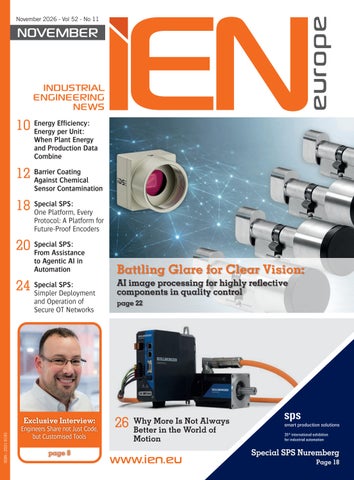
Battling Glare for Clear Vision: AI image processing for highly reflective components in quality control page 22
More Is Not Always 26 Why Better in the World of Motion
www.ien.eu
Special SPS Nuremberg Page 18
27/10/26 09:19
INDUSTRY’S VOICE AND SOLUTIONS 67176 at www.ien.eu
+33(0)5.53.36.78.78 contact.globalindustrie@gl-events.com www.global-industrie.com
002_017_IEN Europe_November 2026.indd 2
N° 11 - NOVEMBER 2026
27/10/26 09:28
3
Editorial Director:
Orhan Erenberk o.erenberk@tim-europe.com
Editor:
Kay Petermann k.petermann@tim-europe.com
Editorial Support Energy Efficiency:
Flavio Steinbach f.steinbach@tim-europe.com
Production & Francesca Lorini Order Administration: f.lorini@tim-europe.com Website & Newsletter:
Marco Prinari m.prinari@tim-europe.com
Marketing Manager: Marco Prinari m.prinari@tim-europe.com President:
Orhan Erenberk o.erenberk@tim-europe.com
ADVERTISING SALES OFFICES EUROPE AUSTRIA/SWITZERLAND Monika Ailinger Tel.: +41 41 850 44 24 m.ailinger@marcomedia.ch BENELUX, SCANDINAVIA Nadia Liefsoens Tel.: +32-(0)11-224397 Fax: +32-(0)11-224397 n.liefsoens@tim-europe.com FRANCE Roxanne Akbulut Tel: + 33 06 52 31 41 56 r.akbulut@tim-europe.com Raphael Erenberk +32 494 652 741 r.erenberk@tim-europe.com GERMANY Simone Ciolek Tel: +49-(0)9771-1779007 s.ciolek@tim-europe.com ITALY, SLOVENIA Andrea Rancati Tel: +39-02-7030 0088 arancati@rancatinet.it
UNITED KINGDOM, IRELAND Aodhan Dunican +44 (0)7594 239182 a.dunican@tim-europe.com NORTH AMERICA Hamilton-Murphy Global, LLC John Murphy Tel: +1 616 682 4790 Fax: +1 616 682 4791 john@hamiltonmurphymedia.com JAPAN Ichiro Suzuki Incom Co. Ltd. Tel: +81-(0)3-3260-7871 Fax: +81-(0)3-3260-7833 isuzuki@INCOM.co.jp OTHER COUNTRIES Cristian Son c.son@tim-europe.com
TURKEY Onur Dil Tel: +90 212 366 02 76 Fax: +90 212 366 58 02 E-mail: o.dil@tim-europe.com
editorial
TIM Global Media BV Chaussée de la Hulpe 177 - Ground Floor 1170 Watermael Boitsfort (Brussels), Belgium o.erenberk@tim-europe.com - www.ien.eu
Kay Petermann k.petermann@tim-europe.com
Dear Readers, For years, the self-driving car has symbolized the AI-powered future. Yet while autonomous vehicles continue to face the challenges of public road traffic, industrial AI is advancing rapidly toward a different destination: the autonomous factory. The difference lies in the environment. Roads are inherently unpredictable, shaped by changing weather, traffic conditions, pedestrians, and human behaviour. Industrial operations, by contrast, take place in controlled settings with defined processes, equipment, and safety parameters. This creates favourable conditions for AI-driven decision-making. The transition is already underway. Industrial copilots are helping engineers generate code, analyse operational data, troubleshoot faults, and access knowledge more efficiently. The next step is agentic AI. Unlike conventional assistants, these systems can perform predefined tasks autonomously, such as initiating maintenance workflows, optimising production schedules, or responding to quality deviations. Several examples featured in this issue demonstrate how quickly this technology is moving from concept to implementation. Adoption is likely to be faster than in autonomous driving because automation can be introduced gradually. Manufacturers can start with individual use cases, monitor results, and expand autonomy as confidence grows. Human oversight remains an integral part of the process. Equally important is the business case. While autonomous vehicles primarily promise convenience, industrial AI delivers measurable operational benefits. Reduced downtime, improved asset utilisation, lower energy consumption, and higher productivity provide clear incentives for investment. The question is therefore no longer whether industrial autopilots will emerge, but how quickly today's copilots will evolve into autonomous agents. The autonomous factory may become reality long before the fully autonomous car. Enjoy the read!
Digital File Requirements available at: www.ien.eu/technical-guidelines/ © 2026 TIM Global Media BV Production by design3, Milano, Italy Printing by Logo Srl - Padova, Italy
Kay Petermann Editor IEN Europe
POSTMASTER Send address changes to: Industrial Engineering News Europe Marco Prinari - m.prinari@tim-europe.com
FREE DIGITAL SUBSCRIPTION
002_017_IEN Europe_November 2026.indd 3
FREE Digital Subscription
N° 11 - NOVEMBER 2026
27/10/26 09:28
N° 11 - NOVEMBER 2026
contents
4 WebMag December: Highlights 2026: Products and Solutions SPS Show: Highlights & Trends
5 5 Industry News 6 New Products 8 Exclusive Interview: Engineers Share not Just Code, but Customised Tools An interview with Darren Henry, Onshape by PTC's Senior Vice President of Operations.
8
10 Energy per Unit: When Plant Energy and Production Data Combine Connecting energy and production data makes efficiency measurable per product, line, and machine. 12 Barrier Coating Against Chemical Sensor Contamination 13 PCN Europe Supplement
16
14 Moisture Measurement Offers New Approach for 'Waste-Heat to Power' Conversion 16 New Products SPECIAL SPS 18 One Platform, Every Protocol: A Platform for FutureProof Encoders. Interview with Florian Sauter, Product Manager Industrial Ethernet Sensor Systems.
18
20 From Assistance to Agentic AI in Automation 22 Battling Glare for Clear Vision AI image processing for highly reflective components in quality control. 24 Solutions for Simpler Deployment and Operation of Secure OT Networks
24
26 Why More Is Not Always Better in the World of Motion Right-sizing motion components can reduce cost and complexity without compromising performance. 28 AI Comes to Industrial Supervisory Applications
29
30 Index & Events N° 11 - NOVEMBER 2026
002_017_IEN Europe_November 2026.indd 4
FREE DIGITAL SUBSCRIPTION
27/10/26 09:28
5 OMRON Corporation has entered into a definitive agreement to acquire industrial and rugged computing specialist OnLogic, a move aimed at expanding its industrial automation portfolio with advanced edge computing capabilities. The transaction is expected to close around January 2027, subject to regulatory approval. The acquisition reflects growing demand for data processing and AI-enabled computing directly at the industrial edge, where manufacturers increasingly require computing resources alongside real-time automation systems. By combining OnLogic’s configurable industrial computing platforms with OMRON’s expertise in sensing, control, motion, robotics and safety technologies, the companies aim to support more complex industrial applications that require increased processing power, connectivity and intelligent decision-making. Following completion of the transaction, OnLogic will continue operating as an independent business within the OMRON Group, retaining its brand identity, headquarters in Vermont, global office network and existing management team. According to the companies, the combination is intended to strengthen the connection between machine data, edge computing and AI technologies within industrial environments.
New COO for LAPP's EMEA Region
NexGeM: Fair for Digitalization in Machine Tool Building
Timo Köchel has taken up the role of Chief Operations Officer (COO) EMEA at LAPP on October1 2026. He succeeds Michael Seddig, who previously held a dual role as CEO and COO. Timo Köchel has been responsible for global procurement at LAPP since March 2024. Before joining LAPP he held various management positions at industrial companies in Germany and Asia. As COO EMEA, Köchel will take charge of LAPP’s production plants, logistics network and procurement organisation in the EMEA region. Michael Seddig, CEO EMEA at LAPP: “Over the past two years, Timo Köchel has steered our global procurement organisation through an extremely challenging market environment. Together with his team, he has ensured that we can reliably supply our customers despite ongoing supply chain disruptions and geopolitical uncertainties. Going forward, as part of the EMEA management team, he will take responsibility for our entire supply chain – I wish him every success in this role.” Timo Köchel: “I look forward to working with the entire supply chain team to contribute to the further development of the EMEA region. Together, we will continue to focus all our efforts on being a strong and reliable partner for our customers.”
The German Machine Tool Builders’ Association (VDW) and HANNOVER MESSE are joining forces: From 5 to 8 April 2027, the VDW will launch Next Generation Metalworking (NexGeM), a new trade fair for digitalization in machine tool building, that runs parallel with HANNOVER MESSE. Applying concrete use cases, NexGeM demonstrates how digital technologies make manufacturing more efficient and cost-effective. The focus is on the role of networked machine tools and their contribution to data-driven manufacturing processes. Visitors gain comprehensive insights into current developments and experience firsthand how mechanical engineering, IT and software increasingly interact within the metalworking industry. “With NexGeM, digital manufacturing technology now also finds its place in Hannover. The emphasis is on the machine’s role as a data provider in an increasingly networked manufacturing environment. Together with the VDW, we are demonstrating how this data can connect with AI, automation and digital platforms to unlock new potential across the entire industrial value chain,” says Dr. Jochen Köckler, Chairman of the Managing Board, Deutsche Messe AG.
industrynews
OMRON Acquires Industrial Computing Specialist OnLogic
Exaktera Launches Global Vision Technology Brand Exaktera unites niche market leaders including Advanced Illumination, autoVimation, LUMIMAX, ProPhotonix, VisioCablePro and Z-LASER, putting LED lighting, lasers, optical measurement systems and protective camera enclosures in one portfolio. The move allows manufacturers and OEMs to streamline the design of complex machine vision and photonics systems, tailoring solutions to each application and tap into deeper engineering expertise. As manufacturers increasingly turn to automation to improve efficiency, productivity and safety, Exaktera draws on expertise from across the group to work alongside customers’ engineers, understand their applications and help them choose the right technology with confidence. As part of the move, Exaktera has restructured its sales and engineering teams across North America and Europe, making it easier for customers worldwide to reach the right specialists when they need them and get advice on the best approach for their application. Cindy Ye, CEO of Exaktera, said: “People have known many of these businesses for decades, and several of them pioneered the technologies used across industry today. We are bringing all of that together and making it much easier for customers to access.”
FREE DIGITAL SUBSCRIPTION
002_017_IEN Europe_November 2026.indd 5
N° 11 - NOVEMBER 2026
27/10/26 09:28
6 TEMPERATURE PROBE WITH DISPLAY
SMALL HYBRID CONNECTORS FOR ROBOTICS
User-friendly probes in steel and plastic versions
Delivering power and signals in space-constrained joints
The new JUMO DELOS T02 is an innovative temperature probe with display. It combines precision, connectivity, and user-friendliness in a wide range of industries. It combines 3 important features measurement, switching, and display - in a single device. Its rotatable, integrated display housing is available in either stainless steel or plastic and allows for quick installation as well as optimal positioning of the display. With its outstanding accuracy of 0.3 K it can be used for applications that need precise temperature acquisition to ensure maximum process reliability and consistently high product quality − a decisive advantage for users in the food industry, mechanical engineering, and chemical process technology. Thanks to modern interfaces such as IO-Link, Bluetooth, SPE and NFC, the JUMO DELOS T02 is optimally equipped for versatile integration options into existing automation systems. With Single Pair Ethernet (SPE), seamless Ethernet communication down to the field level is possible, and the integrated cloud gateway securely transfers the measured value to the JUMO Cloud without the need for additional edge gateways. Wireless Bluetooth communication enables convenient startup, parameterization, and maintenance in hard-to-reach places. Further advantages include UL certification and H2 readiness for international and future-oriented applications.
Molex introduces the MiniMix Hybrid Power and Signal Connectors, an interconnect platform designed to solve manufacturing and packaging challenges in next-generation humanoid robotics, AMRs and advanced industrial automation systems. Combining 15.0A power and 1Gbps 1000BASE-T1 Ethernet communication within a single, ultra-compact interface, MiniMix streamlines installation in space-constrained joints, actuators and robotic mechanisms, reducing connector count, cabling complexity and assembly effort. Integrating power and signal connectivity into increasingly compact joints, actuators and articulated mechanisms without sacrificing performance is a major hurdle for the robotics industry. Design engineers face severe space and assembly constraints in multi-axis articulated joints, where actuator motion systems must route high power and high-speed control data through extremely tight channels. Featuring an ultra-compact 5.65mm routing profile, MiniMix is the industry's smallest hybrid connector, requiring up to 50% less routing area than alternative options. Offered in vertical and right-angle mating orientations, the Molex MiniMix Hybrid Power and Signal Connectors can accommodate diverse layout requirements while optimizing space utilization and reducing cable strain.
67127 at www.ien.eu
67146 at www.ien.eu
KIT ENCODER WITH SELF-OPTIMIZATION
HARDWARE-INDEPENDENT CONTROL APP
Compensation of alignment errors for improved accuracy
Industrial applications for software-defined automation
MEGATRON Hall-effect rotary encoders with incremental or SSI outputs precisely detect rotary movements, angular positions and rotational speed. A special feature of the ETI/ ETS and HTI/HTS series is their integrated self-optimization function: With each complete revolution, the angular measurement is further optimized, gradually increasing accuracy. At room temperature, angular accuracies of up to ±0.1° are possible. The self-optimization function therefore provides an additional accuracy advantage over conventional Hall-effect rotary encoders. It only takes effect after complete revolutions: In applications operating within an angular range of less than 360°, the encoder operates at its standard measurement accuracy. The self-optimization function is particularly beneficial for the kit versions of the ETx25 and HTx25 series, where the user mounts and positions the magnet relative to the sensor. Mechanical installation tolerances can affect angular measurement in this configuration. Self-optimization reduces this influence during operation, thereby ensuring high angular accuracy even in the presence of installation-related deviations.
Phoenix Contact with Virtual PLCnext Control extends its portfolio with a software-based control solution that decouples automation functions from dedicated hardware. The solution makes it possible to run control applications flexibly on industrial PCs, edge devices, and server infrastructures, thereby creating new opportunities for the convergence of IT and OT. Virtual PLCnext Control combines industrial real-time capabilities with the advantages of modern IT architectures. Users can run control applications independently of the hardware, scale them flexibly, and continue to use existing engineering workflows. The IEC 61131-3 programming languages are supported, as are high-level languages such as C++ and C#. In addition, established communication standards such as Profinet, OPC UA, Modbus/TCP, MQTT, and REST API are available. With the container-based architecture, applications can be easily deployed, updated, and adapted to new requirements. Virtual PLCnext Control can be integrated directly into devices, used for edge computing tasks close to the process, and operated centrally in data centers. Multiple virtual control instances can be run in parallel on a shared infrastructure. In addition, the solution meets the requirements on cybersecurity, data consistency, and real-time processing.
67142 at www.ien.eu
67129 at www.ien.eu N° 11 - NOVEMBER 2026
002_017_IEN Europe_November 2026.indd 6
FREE DIGITAL SUBSCRIPTION
27/10/26 09:28
7 IP67-RATED INDUCTIVE ROTARY ENCODER
LOW-POWER LC DISPLAYS
Encoder for Harsh and Space-Constrained Environments
Compact displays for industrial & Ex/ATEX applications
FLUX has announced the launch of IND-ROT-G, a guarded, IP67-rated addition to its encoder series. The new series gives design engineers true absolute position feedback in a compact format, with the environmental protection needed to operate in dusty, wet and contaminated conditions. The IND-ROT series has built its reputation on compact, lightweight absolute encoders with the robustness of FLUX's inductive technology. The IND-ROT-G gives engineers a compact encoder option for systems exposed to moisture, liquids and heavy contamination, without moving to a larger encoder format. It is available in four sizes, with outer diameters ranging from 55 mm to 96 mm and delivers true absolute position feedback with up to 21-bit resolution. It is built to perform reliably under high shock, vibration and demanding temperatures. Stators weigh from just 22 g, so it adds protection without adding meaningful weight to a system. The encoder offers plug-and-play installation with no calibration required and industry-standard interfaces including BiSS-C, SSI and incremental A/B/Z. That makes the IND-ROT-G well suited to applications where space and weight are limited but the operating environment is challenging, including UAVs, stabilized platforms and gimbals, robotic joints, medical robotics, and industrial automation equipment.
With the EA DOG series, DISPLAY VISIONS offers particularly energyefficient chip-on-glass LCDs for industrial equipment. They combine a compact design with an exceptionally low current consumption from just 150 µA. This makes the modules suitable for battery-powered devices, mobile measurement systems and energy-efficient controls. This also applies to displays and systems used in potentially explosive atmospheres. The exceptionally low power consumption of the EA DOG series can make a valuable contribution to the development of equipment used in potentially explosive environments which is required to comply with ATEX requirements. Typical areas of application include mining, the chemical industry and environments with explosive gas or dust atmospheres. Due to their exceptionally low power consumption, the displays offer an attractive basis for corresponding equipment concepts and support the realisation of energy-efficient operating and display units. The product range includes text and graphic displays up to 240x128 pixels resolution. Developers can choose from 12 different display sizes from 1.7 to 3.9 inches with various backlights and are operated with a 3.3 V DC. 67159 at www.ien.eu
67173 at www.ien.eu
67131 at www.ien.eu
FREE DIGITAL SUBSCRIPTION
002_017_IEN Europe_November 2026.indd 7
N° 11 - NOVEMBER 2026
27/10/26 09:28
8
exclusive interview
Engineers Share not Just Code, but Customised Tools We interviewed Darren Henry about the integration of artificial intelligence into the cloud-native product development platform Onshape. He is Onshape by PTC's Senior Vice President of Operations and holds a Bachelor of Science in Mechanical Engineering from the University of Florida. He has over 25 years' experience in construction and manufacturing technologies. Darren Henry, Senior Vice President of Operations Onshape by PTC. Picture: PTC
IEN Europe: Since not all readers are equally familiar with this topic, could you please briefly introduce Onshape and explain how it differs from a traditional CAD structure? D. Henry: Onshape is a cloud-native CAD and product data management platform that runs in a browser or on a mobile device. There is no software to install, update, or maintain locally, which virtually eliminates the IT overhead associated with traditional CAD deployments. Conventional CAD relies on files, often with a separate system to manage revisions and access. Onshape was built around a central database. Engineers work on the same current design, with version history, permissions, and collaboration built in. Multiple people can work concurrently without passing files back and forth. Another distinction is FeatureScript, the programming language behind Onshape’s modeling features. We make it available to users and the broader community so engineers can create their own parametric tools. AI makes it much easier to tailor those tools to a company’s products and processes. IEN Europe: Artificial intelligence is being integrated into a wide variety of software areas. What are the advantages and disadvantages of the current options for engineers in product development using CAD? D. Henry: AI is showing up in CAD in several ways. AI advisors can answer questions and help people learn a system. Assistants or agents can perform tasks using the software's tools and APIs. Discrete capabilities,
such as Onshape's AI Quick Render, can accelerate a specific part of the workflow. I think we will see more of these in every CAD product. They save time, though each addresses a particular task. There is a lot of interest in generating geometry directly from a prompt. The challenge is that a plausible shape is not necessarily an engineering-ready design. If the geometry is not constructed with the relationships, parameters, and design intent that a human engineer would use, it can be difficult to change, validate, or reuse. Engineers need to make controlled changes as requirements evolve. What excites me most is text-to-code-to-CAD: using AI to help engineers create customized, deterministic design tools. The engineer contributes knowledge and evaluates the results; the code applies those rules consistently within the CAD system. That can change how a whole team develops products. IEN Europe: Could you please explain how the FeatureScript MCP Server differs from this and what changes this might bring to an engineer's workflows? D. Henry: The FeatureScript MCP Server connects an AI
AI advisors can answer questions and help users familiarise themselves with a system. Picture: PTC N° 11 - NOVEMBER 2026
002_017_IEN Europe_November 2026.indd 8
FREE DIGITAL SUBSCRIPTION
27/10/26 09:28
9
Company-specific rules can be converted into tools for generating shapes, as illustrated here using the example of a wire basket geometry. Picture: PTC
coding assistant to the tools it needs to write, test, and refine FeatureScript for Onshape. An engineer can describe what a design tool should do, inspect the result in CAD, identify what needs changing, and iterate with the assistant. The output is not a one-off shape produced by a prompt. It is a native custom feature that other engineers can apply, edit, and reuse. This could be a specialized thread or fillet, but it can go much further. It can generate fully defined component geometry or coordinated systems of parts, apply engineering calculations and produce information such as cut lists. FeatureScript also gives the feature a native user interface: inputs can be presented in a dialog, checked for valid values, and refined so colleagues can use the tool without knowing its underlying code. If an input is invalid or a model fails, the feature can tell the engineer what went wrong, right where they are working. Instead of modeling the same type of design over and over, an engineer can build a tool for that whole class of designs. The engineer still has to test the feature and decide whether it does the job. Once the feature works as intended, the expertise behind it can be applied again and again, with consistent results and an editable model. IEN Europe: What advantages do the new capabilities and workflows offer when considering the entire company rather than just the individual engineer? D. Henry: Companies have long captured their intellectual property in product designs: the models, drawings, and specifications. Now they can also capture it in the tools used to create and evaluate those designs. A custom feature can encode preferred construction methods, product standards, and manufacturing constraints, then make that knowledge available to the whole team. And this goes beyond geometry. A company could build tools that calculate fluid volume, locate a center of mass, or assess acoustic reflections in a proposed space. It could combine those checks with configurable FREE DIGITAL SUBSCRIPTION
002_017_IEN Europe_November 2026.indd 9
parts or systems of parts, guiding engineers as they make design decisions. A specialist can develop and validate the method; colleagues can then use it through an approachable interface. That helps newer employees contribute sooner and gives experienced engineers a common, repeatable starting point. The payoff is that the next project does not have to start from scratch, or depend on finding the one person who knows how something was done. Teams can share and improve a library of tools as products and processes evolve. Each improvement becomes something the whole team can build on. Engineers spend less time repeating routine work and more time on problems that need their judgment. IEN Europe: So, on the one hand, the text-to-code-to-CAD approach increases flexibility, lowers barriers to entry, and helps make existing knowledge systematically accessible. What might that look like in a concrete example? D. Henry: Consider a manufacturer of garden accessories. Its engineers need hose threads across many injection-molded products and 3Dprinted prototypes, with different lead-ins, lead-outs, and manufacturing requirements. If the standard CAD tools do not cover those variations, an engineer can use the FeatureScript MCP Server to develop a custom thread feature and share it with the team. Everyone can then apply the same rules while keeping the geometry editable. A manufacturer of wire shelves, racks, and baskets could go further. Its engineers could create a tool that takes a selected shape and dimensions, applies the company’s spacing and bending rules, and generates the wire layout, cut lists, and bend tables. That tool could serve an entire product line. These are two fairly simple examples. The broader opportunity is to tailor CAD to the products a company makes and the processes it uses, without waiting for a software vendor to build every specialized tool. AI puts that kind of customization within reach of far more manufacturers. It is almost like having a CAD development team working on your specific engineering needs, with your own engineers defining and validating what the tools must do. 67156 at www.ien.eu
N° 11 - NOVEMBER 2026
27/10/26 09:28
10 energy efficiency Energy per Unit: When Plant Energy and Production Data Combine The revised EU Energy Efficiency Directive expects manufacturers to show, with data, how their energy is used. Most plants cannot state which line, machine, or product used that energy, because energy and production data are often kept in separate systems. Connecting them and measuring energy per unit produced, makes energy efficiency a key part of production performance. Authors: David Ricks, Manager, Solutions – Ecosystem Partners (Americas) & Philip Logan, Manager, Solutions – Ecosystem Partners (EMEA) at Belden Under the recast Energy Efficiency Directive, a company’s energy obligations depend on how much energy it uses, not its size. Any business that consumes over 10 TJ (about 3 GWh) a year on average now requires an energy audit at least every four years unless it runs an energy management system. The first audit was due 11th October 2026. Companies above 85 TJ (about 24 GWh) must implement an energy management system by October 2027. Each audit must also lead to an action plan and be published in the annual report with its implementation rate. A utility bill shows how much energy the site used, but not which line, machine, shift or product used it, nor the operational or equipment states that drive consumption. The solution is to connect energy and production data, which is where most plants struggle. Why energy data is scattered Most plants have grown over decades and use equipment from many vendors. Meters report over Modbus, M-Bus or OPC UA, PLCs use their vendors' own protocols, and MES keep orders and part counts in a database. Each system has its own owner and naming convention, so the same line can be "L3" in one system and "Line_03" in another. The custom scripts that connect them often break when something changes upstream. Take a simple question: How much does Line 3 cost us to run today? The answer needs information from four different sources: the energy meters, the PLC, the MES and the utility's time-of-use tariff. None of them share the same semantic structure, so assembling the answer manually can take hours.
002_017_IEN Europe_November 2026.indd 10
Energy per good unit: the key metric The most useful metric is energy per good unit, which is the total energy consumed divided by the number of products that pass QC. Part of a machine's energy consumption relates to its output, but part does not. This is because hydraulics, heating, cooling, and controls draw power whether or not parts are made, so every OEE loss has an energy cost. What are the links between the four data sources? The first link is an asset model that records which meter measures which machine, line, and product. Without it, the same KPI means different things. One site's kWh per part might include compressed air, while another's does not, so shared loads need an agreed allocation rule. The second is a common time base. Meters are read at fixed intervals while PLCs and the MES record events, so all sources need one synchronized clock before a meter interval can be split at each state change or order boundary. With both links in place, the PLC's machine state shows how much energy a line uses while producing, idle, in set-up or stopped. The Line 3 question then becomes a query: metered consumption, split by the orders, and states recorded over the same intervals, priced at the tariff that applied at the time. Metering the line feeder and the largest consumers is often enough to start. Imagine a shift on a line that draws 30 kW whenever it is switched on, plus 0.04 kWh per part. At 100% OEE, the 3,400 good parts would have needed 306 kWh but the actual shift used 380 kWh. This is because an hour of stoppage and 30 minutes set-up time with the line switched on used an extra 45 kWh, while
running at 90% speed used 19.5 kWh, and 110 rejected parts used 9.9 kWh - totaling 74 kWh of extra energy due to OEE losses. At an OEE of 71%, each good part used 0.112 kWh instead of 0.090 kWh - roughly a quarter more. When measured per unit, cutting energy waste and raising throughput becomes the same problem. ISO 50001 expects energy performance indicators to be normalized for relevant variables that significantly affect consumption. In manufacturing, the main variable is usually output. A plant that doesn’t link energy to production cannot normalize, which makes it impossible to tell whether lower consumption came from an efficiency measure or from a quieter month.
N° 11 - NOVEMBER 2026
FREE DIGITAL SUBSCRIPTION
Why spreadsheets are not scalable Plants that report energy per line often do it manually, where an engineer downloads interval data from the meter vendor's portal, matches the timestamps against an MES export, and assembles the result in Excel. Any gaps, renamed tags, and daylight-saving shifts are corrected by hand. This is manageable if preparing for an audit, but the numbers are hard to trace. The manual approach fails when weekly reports are required, or when management asks why consumption spiked at 3 a.m. on a Tuesday. New software platforms are supposed to fix this, but many add complexity instead. Someone has to connect the plant systems, build the asset models, define the KPIs and keep the integration running when a machine is replaced or a PLC program changes. That work commonly falls to OT teams, whose main job is keeping production running, but few are staffed for cloud operations. Every new report then becomes an-
27/10/26 09:28
F H
11 Reference architecture for line-level energy data. Smart meters and the PLC connect through Ethernet switches to an edge gateway. Source: Belden
An analytics application calculates energy and cost per unit alongside OEE. Machines without a digital interface can use secondary sensors, so nothing needs to be replaced or reprogrammed.
other project for the same people. IT security teams are also wary of anything that opens the control network. What works is a setup that can be installed on existing equipment, runs without constant attention, defines the data model once, and lets the people closest to the process build their own views without code. Collecting data at the edge The graphic shows a reference architecture in which an edge gateway reads meters, sensors,
and devices on a plug-and-play basis. The edge data layer handles data access, normalization, and integration: reading values, converting units and names into one model and adding context such as asset, line, and product. The gateway sends the data over an encrypted, outbound MQTT or HTTPS connection, so no inbound access to the control network is needed. In the cloud, the IoT platform receives and stores the data as time series mapped to asset models. Access control limits who can make changes, and an audit log records the changes.
What line-level data makes possible With energy and production data combined into one model, anomalies show up in realtime rather than on the next energy bill. This could be a line drawing power at the weekend, a compressor running with no production, or a machine using more energy per part than last month. Using a standard KPI definition means all lines and sites can be directly compared, and a model built for one line can be reused on others. The same data serves compliance. Emissions can be calculated from the measured consumption per line and product data. An audit shows what a plant can document at one point in time, while an energy management system requires the same evidence all year. With energy per unit tracked like OEE, production can be planned with energy targets in mind. 67155 at www.ien.eu
FUNCTIONAL SAFETY – HASSLE-FREE JUMO Safety Performance (JSP) The brand for greater safety in SIL and PL applications Modern technologies, comprehensive expertise, and compliance with applicable standards – plant safety is that simple with JUMO.
• Safety-related control of temperature, pressure, and level JUMO
SIL Come visit us: Hall 7, Booth 498
002_017_IEN Europe_November 2026.indd 11
SAFETY
PL
P ER F O R M A N C E
jsp.jumo.info
• Validated measuring chains up to SIL 3/PL e • Excellent flexibility through a comprehensive SIL portfolio • No SIL calculation required when using JUMO safetyM with matching pressure and temperature sensor technology • Customized assessment and consulting by the JUMO Safety Performance team
66972 at www.ien.eu
You benefit from:
27/10/26 09:28
12 new products Barrier Coating Against Chemical Sensor Contamination
Dust, humidity, corrosive media and chemical contamination can impair the measurement performance of industrial sensors. Depending on the application, these stresses affect different sensor areas and can cause measurement drift or increase maintenance requirements. E+E Elektronik addresses these challenges with applicationspecific protection concepts for sensor elements, connections and other sensitive areas. With ChemShield, E+E Elektronik is now adding a protective barrier specifically developed for chemically demanding applications. Chemical exposure places particularly high demands on the sensor element in humidity measurement. Process media can change, oils age or oxidise, and residues from production and cleaning processes can affect sensitive sensor areas. This can lead to measurement drift and reduced long-term stability. ChemShield forms an additional barrier against these influences. This extends the application range of selected E+E Elektronik humidity and moisture in oil sensors to environments with increased chemical exposure.
impact of these changes and supports longterm stable moisture measurement. The technology is used, among other products, in the EE360 and EE364 moisture in oil sensors. Depending on the application and product configuration, this also makes them suitable for demanding lubricating, hydraulic and insulating oils as well as selected natural ester oils. ChemShield also provides additional protection against chemical exposure in contaminated turbine, compressor and hydraulic oils.
Long-term stable moisture measurement in oil One key area of application is moisture measurement in oil. Ageing, oxidation and contamination can change the chemical properties of an oil and place additional stress on the sensor element. ChemShield reduces the
Enhanced protection for industrial humidity applications In industrial humidity measurement, chemical contaminants can also affect sensor performance. Typical applications include test and climate chambers, fume cupboards, pharmaceutical environments with intensive N° 11 - NOVEMBER 2026
002_017_IEN Europe_November 2026.indd 12
cleaning, biofilters, fertiliser environments, and specialised drying and fermentation processes. For selected applications, E+E Elektronik combines ChemShield with SensShield, a technology to reduce the impact of dust, dirt, oily contamination, salts, humidity and corrosive exposure. In the EE310 humidity and temperature sensor, this combination supports long-term stable measurement performance even under increased chemical exposure. The specific configuration is matched to the respective process conditions. E+E Elektronik does not take a onesize-fits-all approach to sensor protection. What matters is which components are exposed to which stresses in the respective application to achieve the best result possible. 67130 at www.ien.eu FREE DIGITAL SUBSCRIPTION
27/10/26 09:28
ISSN : 2031-9177
Specially developed barrier coating reduces the impact of chemical contamination and supports long-term stable measurements under demanding process conditions.
November 2026 - Vol 52 - No 11
NOVEMBER
Moisture Measurement Offers New Approach for 'Waste-Heat to Power' Conversion Page 14
16 MEASUREMENT Compact and ISSN : 2031-9177
Lightweight Coriolis Flowmeter
17 SAFETY ESD-Safe Tablet Housing
17 Clamp-On
Ultrasonic Flow Sensor
002_017_IEN Europe_November 2026.indd 13
27/10/26 09:28
14 measurement&instrumentation Moisture Measurement Offers New Approach for 'Waste-Heat to Power' Conversion As JTEC prepares its hydrogen-based waste-heat-to-power conversion technology for field deployment, Vaisala sensors provide the humidity and dew point measurements needed to protect critical components, simplify control and build customer trust. JTEC Energy has developed a waste-heat recovery technology that generates electricity efficiently at relatively low temperatures using hydrogen as the working fluid. Precise moisture control is critical, requiring highly accurate measurement across a wide humidity range. The sensors must operate reliably in hydrogen, withstand varying pressures and flows, integrate with control systems, and meet hazardous-area requirements. Protecting a Critical System in a Demanding Hydrogen Environment JTEC’s waste-heat-to-power system combines two subsystems with different moisture requirements: an electrochemical stack that needs moisture for efficient operation and metal hydride reactors that must be protected from excess humidity. Waste heat is supplied to metal hydride reactors, which absorb hydrogen when cooled and
release it at higher pressure when heated. JTEC uses this temperature-driven pressure increase as part of its process for converting waste heat into electrical power. The pressurized hydrogen is sent to electrochemical stacks, where its expansion generates electricity. Afterward, the low-pressure hydrogen is returned to a separate metal hydride reactor, where it can be reheated, repressurized and reused. This closed-loop process continuously recirculates a single hydrogen charge, with no hydrogen consumption and waste heat as the system’s only energy input. Because hydrogen is humidified as it passes through the stacks, JTEC must carefully control moisture levels. Adequate humidity is required for stack performance, while excess moisture can impair reactor efficiency, making hydrogen drying essential before recirculation. “At its core, humidity measurement is so important to JTEC because we have two parts of
our system that work really well, but for them to work well together, we have to ensure that we can control humidity passing back and forth between them really tightly,” said Julian Bell, Vice President of Engineering at JTEC Energy. JTEC first piloted a Vaisala dew point sensor in an internal R&D project in 2023. As the company worked toward its first production system and field pilot, Vaisala became the preferred option based on low dew point performance, calibration stability, availability, integration flexibility and technical support. “The honest truth is that we had not found a good sensor option before we came to Vaisala,” Bell said. Vaisala sensors support three critical moisture measurement points for JTEC The first measurement point is located after the initial dehumidification stage, where hydrogen leaving the electrochemical stack has already had most of its moisture removed. JTEC
Re Co
pep com
In an Confidence in measured values is key if you go from R+D to the field. DMT143 Dew Point Transmitter. Picture: Vaisala
Vaisala Relative Humidity and Temperature Probe HMP7. Picture: Vaisala
N° 11 - NOVEMBER 2026
002_017_IEN Europe_November 2026.indd 14
FREE DIGITAL SUBSCRIPTION
27/10/26 09:28
15
uses a Vaisala HMP7 humidity and temperature probe to verify performance and help prevent condensation. The second point measures low dew point levels before hydrogen returns to the metal hydride reactors. A Vaisala DMP370 Ex-rated sensor ensures accurate, stable measurements and supports future hazardous-area requirements. The third measurement point is in the maintenance manifold, where a Vaisala DMT143 dew point transmitter confirms that moisture is not transferred into dry hydrogen circuits during startup, shutdown and maintenance. The sensors were installed and integrated easily with JTEC’s control system. In a process with widely varying pressure, temperature and flow conditions, measurement reliability, data accessibility and technical support were critical factors. “Vaisala’s auto-calibration is a key feature that improves confidence in the number coming back to us, which has been a huge benefit,” Bell said. “At the same time, we have been able to integrate pressure compensation routines into our dew point measurements with support from Vaisala engineers, and that expertise really shines through.” Vaisala support extends beyond product selec-
tion. The company provides access to Vaisala’s doctoral-level scientists who are global experts in humidity metrology. Their continued guidance helps the team evaluate moisture measurement in hydrogen at varying pressures and low dew point levels. This was especially important because moisture measurement in hydrogen at pressures substantially different from atmospheric conditions is not fully understood across the scientific community or industry. Vaisala's technical expertise helped JTEC make informed decisions about how to approach pressure compensation and measurement confidence in those conditions. “Vaisala helped educate us about what is known, what we can confidently say and where confidence drops off," Bell said. “It is because Vaisala has experts like that and is willing to make them accessible to customers that we were able to make intelligent decisions about how to perform these measurements." Measurement Confidence for Field Deployment As JTEC prepares its first production system for deployment in a field pilot, Vaisala measurement technology gives the company con-
fidence that it can monitor moisture closely enough to protect critical reactor components. For example, JTEC must tightly control moisture content in the hydrogen gas as it returns to the reactors, making measurement accuracy, “I would have to have the highest level of certainty in my moisture measurements in order to feel comfortable running a reactor system of this scale in a field pilot, and Vaisala provides this certainty,” Bell said. “The investment in the reactor system is too great to justify running it if you are not 100 percent confident that you know what kind of moisture content you are putting back into the reactors.” Enabling the Next Stage of Waste-Heat-to-Power Conversion By standardizing on Vaisala, JTEC has established a moisture measurement foundation that supports field deployment, system reliability and future growth. In an application where moisture can determine reactor health, control reliability and customer confidence, accurate measurement is a core enabler of bringing a new waste-heat-to-power conversion technology into the field. 67152 at www.pcne.eu
Revolutionizing Communication!
pepperl-fuchs.com/pr-industrialcommunication-and-interfaces
Industrial Communication and Interfaces
67124 at www.ien.eu
002_017_IEN Europe_November 2026.indd 15
27/10/26 09:28
16 new products DIGITAL PH/ORP SENSOR
COMPACT CORIOLIS FLOWMETER
Reliable measurements for harsh process conditions
Mass flowmeter for standard gas and liquid applications
The Emerson Rosemount™ 350A High Performance pH/ORP Sensor is designed to deliver reliable measurements in harsh processes while simplifying installation and maintenance through a digital, plug-and-play sensor connection. Many demanding pH applications, especially high-temperature, high-pressure and retractable installations, can challenge conventional analogue sensors with signal noise, wiring complexity and limited diagnostic insight. The Rosemount 350A digital sensor addresses these issues by converting and transmitting pH/ORP data digitally, reducing susceptibility to electrical noise and helping teams get to a stable measurement faster. With a digital Modbus interface and M12 quick-connect cabling, the sensor supports plug-and-play commissioning and can help eliminate common installation errors associated with manual wiring. The digital design also enables interoperability across Rosemount digital liquid analysis sensors, supporting simplified spares and standardisation across sites. By capturing sensor health indicators and event history, the sensor can support more proactive maintenance planning and faster root-cause analysis. Built for harsh applications, the sensor supports retractable mounting styles and is offered with titanium body options and selectable reference electrolytes to match challenging process chemistries.
The KROHNE OPTIMASS 5400 is a new Coriolis mass flowmeter designed for standard process applications with gases and liquids. Thanks to its compact design, the flowmeter is also particularly suited for skid-mounted systems and portable process installations. In addition to direct measurement of mass flow, density and temperature, it provides valuable information on volume flow, concentration and flow velocity. It handles process temperatures up to +180°C and pressures up to 100 barg, while the sensor housing provides a typical burst case pressure resistance of up to 200 barg, offering an additional layer of protection and enhanced plant safety. The instrument also delivers excellent mass flow and density measurement accuracy, with an optional mass flow accuracy of ±0.1% for flow rates above 10% of nominal flow. Equipped with modular electronics, the flowmeter supports a comprehensive range of communication protocols, including HART® 7, Modbus, FOUNDATION™ Fieldbus, PROFIBUS-PA/DP, PROFINET, PROFINET over Ethernet-APL and EtherNet/IP™. Three configurable 4...20 mA outputs are available, complemented by integrated Bluetooth® connectivity for wireless access. Built-in OPTICHECK diagnostics continuously monitor both instrument health and application conditions, providing operators with detailed insights.
67024 at www.pcne.eu
67085 at www.pcne.eu
EX-PROTECTED PNEUMATIC VALVE ACTUATOR
MODULAR ENERGY DISTRIBUTION PANEL
ATEX-certified and corrosion-resistant versions available
New platform reduces engineering and installation effort
The EP3 is designed for the control of single-acting and double-acting pneumatic EBRO actuators and is used for on/off and modulating control applications on industrial valves. Key features include automatic calibration, precise setpoint positioning, and integrated diagnostic and monitoring functions for continuous assessment of operating conditions. With the introduction of the ATEX-certified version, EBRO extends the EP3's range to hazardous areas classified as Zones 2 and 22. This allows users to benefit from the full functionality of the positioner in explosion-protection applications. Certification for Equipment Categories 3G and 3D ensures compliance with the relevant standards and regulations for use in these hazardous environments, without compromising the proven performance and functionality of the EP3. A CS5M version has been developed to meet the requirements of applications in close proximity to seawater as well as other highly corrosive environments. Both versions offer the same functionality as the standard model, including automatic calibration, precise setpoint positioning, and integrated diagnostic and monitoring capabilities. All available interfaces and communication options remain fully supported.
BARTEC has launched its new configurable Ex de Modular Energy Distribution Panel Series, a power distribution solution for hazardous areas designed to simplify engineering, installation and maintenance while providing the safety and reliability required in demanding industrial environments. Certified according to ATEX and IECEx requirements and suitable for installation in Zone 1/21 and Zone 2/22 hazardous areas, the new platform combines explosion protection, modular scalability and project-specific flexibility in a single solution. The new platform com- bines BARTEC's explosion protection expertise with greater flexibi- lity and efficiency, helping customers address both current project requirements and future expansion needs. The panel series supports applications up to 690 V and 1,000 A and can be configured with a wide range of switching, circuit protection, control, signaling and cable entry options. Available in corrosion-resistant GRP or robust stainless-steel enclosures, the panels are designed for operation in ambient temperatures from-20°C to +55°C, -40°C to +55°C with optional heater. Integrated BARTEC ComEx Global control and signaling devices further simplify system design and operation across the oil and gas, chemical, pharmaceutical, energy and process industries.
67035 at www.pcne.eu
67067 at www.pcne.eu N° 11 - NOVEMBER 2026
002_017_IEN Europe_November 2026.indd 16
FREE DIGITAL SUBSCRIPTION
27/10/26 09:28
17 ESD-SAFE TABLET HOUSING
CLAMP-ON ULTRASONIC FLOW SENSOR
Certified for use of standard tablets in ATEX Zone 2 and 22
Easy installation with automatic wall thickness detection
Armadex Explosion Protection has introduced the Ex UniCase, a universal tablet housing certified to ATEX and IECEx for Zone 2 (gas) and Zone 22 (dust). It allows standard tablets to be used in parts of refineries, chemical plants, tank farms and powder-handling plants where ordinary electronics are not permitted. The housing accepts current 10 to 11 inch tablets from Apple, Samsung and Microsoft, including the iPad (A16), iPad Air (M3), iPad Pro (M4 and M5), Galaxy Tab S11, Galaxy Tab S10 FE, Galaxy Tab A11+ and Surface Go 4. Until now, a certified tablet has been a fixed combination of one device and one housing. When the tablet model was replaced, the certified housing had to be replaced with it. The UniCase separates the two: the housing carries the certification, four device-specific corner inlays hold the tablet in position, and a new tablet generation is accommodated by changing the inlays, with no recertification required. Physical buttons, cameras, microphone, speaker and the USB-C port remain usable. The housing consists of a milled frame of ESD-safe POM-C with an impact-resistant polycarbonate display window. Marking: II 3G Ex nR IIC T6 Gc and II 3D Ex tc IIIC T85 °C Dc; EU type examination certificate OBAC 26ATEX0194X, IECEx certificate IECEx OBAC 26.0005X.
The ifm SUC300 clamp-on ultrasonic sensor significantly simplifies flow measurement, users simply position the sensor on the pipe, attach the counterpart and tighten it in place. During commissioning, the sensor determines the actual pipe wall thickness and incorporates this information into the flow measurement calculation. This considerably simplifies parameter setting, particularly in existing industrial facilities where pipe specifications are often not fully documented. At market launch, the sensor is available for DN40 and DN50 nominal pipe sizes, with additional variants already under development. The SUC300 is designed for measuring water-based media and can be used on pipes made of steel, stainless steel and plastic materials such as PVC. A standardised M12 connector is used to achieve integration, an intelligent wizard guides through the installation process step by step. For integration into existing infrastructures, the device offers IO-Link, an analogue output as well as pulse, switching and diagnostic outputs. Its stainless-steel housing is certified to IP67 and IP69 protection ratings, making it suitable for applications with demanding cleanliness and hygiene requirements. Thanks to its clamp-on design, the flow sensor is suitable not only for permanent installation in existing systems but also for temporary measurement tasks.
67149 at www.pcne.eu
67141 at www.pcne.eu
REAL-TIME MONITORING SENSOR FAMILY
COMPACT HYGIENIC LASER DISTANCE SENSOR
Precise measurement of density, viscosity & temperature
FDA-compliant time-of-flight sensor with high sensitivity
WIKA has introduced a series of sensors that monitor in real-time the fundamental properties of gases and liquids. The models DTG-30, DTL-30 and VTL-30 are particularly notable for their compact and robust design. This allows them to be embedded into a wide range of applications, whether in OEM products and systems or in industrial environments, even with limited mounting space. This compact design is made possible by innovative MesoScale® technology, which is a patented combination of sensor design, sensor actuation and software. MesoScale® combines the benefits of sensor miniaturisation with a proven stainless-steel construction. WIKA has therefore developed instruments that measure the density, viscosity and temperature of liquids and gases with high precision in process applications. Typical applications are the identification and quality monitoring of fuels. With the DTL-30, misfuelling can be detected, the mixing of additives monitored and volume converted into mass flow. The VTL-30 measures the viscosity and density of amine solutions, thereby helping to ensure the performance of this core carbon capture technology. The instruments are certified for use in hazardous areas in accordance with ATEX, IECEx and FM. The sensors deliver accurate measuring results across the entire calibration range and offer high repeatability.
With the P2PY111 laser distance sensor time-of-flight, wenglor is expanding its portfolio with a powerful solution for measurement and detection tasks in hygienically sensitive areas. Thanks to wintec (wenglor interference-free technology) and a seal-to-counter design, the sensor prevents contamination from accumulating in the housing area and is suitable for food, beverage and pharmaceutical applications. The high reception sensitivity enables reliable detection even with very weak signals. As a result, the sensor also reliably detects dark or shiny objects as well as objects at extreme angles. As there are no gaps in the housing, potential dirt nests are consistently avoided. Every detail of the P2PY111 is designed for use in hygienic areas: permanently easy-to-read labeling by direct lasering, a special TPE cable that is robust and resistant to cleaning agents, a teach-in key made of FDA-compliant silicone and an immovable optical lens made of robust PMMA. The cable connection is equipped with an IP69K cable gland and a food-grade blue seal. Suitable clamps and holders are available for hygienic mounting. The sensor has a working range of 50-10,000 mm and is highly insensitive to ambient light of up to 100,000 lux. The sensor has high temperature resistance in the range of -40 °C to +55 °C and has ECOLAB® approval for use in washdown areas.
67107 at www.pcne.eu FREE DIGITAL SUBSCRIPTION
002_017_IEN Europe_November 2026.indd 17
67145 at www.pcne.eu N° 11 - NOVEMBER 2026
27/10/26 09:28
18
SPS Smart Production Solutions
One Platform, Every Protocol: A Platform for Future-Proof Encoders Shortly before the SPS IPC Drives trade show, we spoke with Florian Sauter, Product Manager Industrial Ethernet Sensor Systems about the latest developments in Kübler’s encoder products. IEN Europe: Kübler’s product portfolio covers the areas of measurement, transmission, and evaluation in the field of automation. Which product areas and industries are the most important? Are safety-certified products also offered in any of these areas? Kübler: Our established core markets include elevator technology, motors and drives, and the packaging, food and beverage industries. We are systematically expanding our position in these markets. At the same time, we are opening new core markets and sub-segments, such as mobile robotics as well as segments of intralogistics and mobile automation. Our current innovations show where our product focus lies: a new series of large hollow-shaft encoders that, for the first time in this size class, are also programmable, based on our latest, very robust Sendix platform; an extensive Industrial Ethernet absolute encoder portfolio including functional safety and cybersecurity for axis applications; new slip ring solutions, for example for filling and radar systems; and a comprehensive new range of inclination and radar sensors.
Florian Sauter, Product Manager Industrial Ethernet Sensor Systems. Picture: Kübler Group Safety-certified products are an important part of this portfolio. Our SIL encoders are used mainly in general automation, that is, in machine building. The most important industries here are foil wrapping, converting machines and logistics. Demand for SIL encoders is growing worldwide.
Step towards a uniform safety standard. Ethernet encoders for different protocols. Picture: Kübler Group
IEN Europe: Some time ago, Kübler launched a new series of Industrial Ethernet encoders. What was the user response, and what advantages does using such an encoder platform offer? Kübler: There has been little direct feedback from users so far, but the indirect signals show a good market response. We see several reasons for this. The new encoders fit more applications, so more competitor products can be replaced with Kübler encoders. We receive fewer feature requests. Delivery issues have also decreased: we no longer face obsolete components as with the older versions, and we benefit from a faster time to market and faster production.
N° 11 - NOVEMBER 2026
018_029_IEN Europe_November 2026.indd 18
FREE DIGITAL SUBSCRIPTION
27/10/26 09:22
19
The main advantage is for customers with a dual-supplier strategy or flexible machine concepts. They can choose any protocol and always get the same set of encoder functions. In addition, the new encoders offer CRA conformity, easy-to-use functions and the latest protocol versions. IEN Europe: Safety and security are currently key issues that no one can ignore. Nevertheless, their practical implementation remains complex and is not always easy to understand. A practical example of this can be seen in the classifications. From a security perspective, Kübler encoders are classified at the lowest formal security level, Level 1, in accordance with IEC 62443-4-2. Nevertheless, they meet the highest criteria in terms of personal safety. As a specialist, could you briefly outline the context and explain why this classification is sufficient? Kübler: Our encoders are designed for the defense-in-depth concept. Under this concept, the integrator is responsible for designing the entire machine network in conformance with the IEC standards. The encoder typically sits at the bottom plant level, inside an existing security zone. At this position, Security Level 1 is sufficient. It allows integrators to achieve security conformity for the machine, even if the targeted security level of the machine as a whole is higher. Going beyond SL1 at the encoder level would require considerable time and money on the manufacturer’s side. Our customers are not prepared to pay extra for this, and conformance to the standard meets their requirements. Higher measures such as encryption would also slow down process data output and make the product more complicated to use.
Safety and Cybersecurity inside. Picture: Kübler Group
tomers will be looking for in two to three years. That is why our development work is designed to stay ahead of time. New sensor technology will form the backbone of all Kübler’s new standard encoders. It will enable smaller designs, new housing concepts and additional hardware features. On the software and firmware side, we aim to optimize functionality and streamline commissioning workflows. New multipurpose tools will support customers during interaction with the encoder and commissioning. IEN Europe: Thank you for these insights. Hall 3A, 466 67169 at www.ien.eu
Protect your electrical enclosures from overheating! Our FF series filter fans ensure consistent airflow and efficient ventilation, keeping your equipment running reliably.
IEN Europe: How do you view the prospects for the further development of the product ranges in Kübler’s portfolio, once the major regulatory challenges in Europe posed by the CRA and the Machinery Directive have been overcome? Kübler: Our main goal is to bring the products to market that our cus-
ABOUT KÜBLER: Headquartered in Villingen-Schwenningen, Germany, the Kübler Group develops and manufactures components and systems for the measurement, transmission and evaluation of data and signals. Founded in 1960, the family-owned company offers products including encoders, slip rings and counting technologies for industrial automation applications. With more than 600 employees and an international presence spanning over 50 countries, Kübler serves customers across a wide range of industries worldwide.
Follow us:
66546 at www.ien.eu FREE DIGITAL SUBSCRIPTION
018_029_IEN Europe_November 2026.indd 19
N° 11 - NOVEMBER 2026
Adv IEN Europe uscita novembre 2026.indd 1
16/10/26 10:24
27/10/26 09:22
20
SPS Smart Production Solutions
From Assistance to Agentic AI in Automation The automation platform ctrlX AUTOMATION is AI-ready by design, with Artificial Intelligence becoming an active part of its architecture. A central AI agent accesses automation knowledge, data, and functions and uses the necessary skills and tools depending on the job. The user specifies the objective, and the agent takes over the necessary tasks. This step from assistive AI to agentic AI creates the technological basis for the use of AI throughout the entire automation life cycle. Bosch Rexroth is integrating agentic AI at the platform level. AI is able to access the engineering tools, apps, documentation, as well as data and functions of ctrlX AUTOMATION and use them according to the context. This creates an architecture in which AI no longer works as an assistant alongside automation, but now works with it. From assistant to agent A classic AI assistant, such as the Ask iXi chatbot from Bosch Rexroth, is able to answer questions, explain documentation, or generate code. The capabilities of the new Agent iXi go far beyond this: The AI agent is able to translate tasks into individual steps and use the necessary functions of the automation environment. This difference becomes especially clear when it comes to coding: Through high-level languages, open APIs, and the ctrlX AUTOMATION SDK (Software Development Kit), ctrlX AUTOMATION already provides the basis for AI-assisted app and program development with coding assistants such as GitHub Copilot. With the new Model Context Protocol interfaces to the software tools ctrlX PLC Engineering and ctrlX I/O Engineering, Agent iXi enables much more: The AI agent generates IEC-61131-3 code directly in the engineering context and configures I/Os automatically. Assisted code generation thus becomes agentic engineering. The AI agent thus becomes the link between the user and the automation environment. It can take on different tasks and access the required knowledge and functions for each of these tasks. These range from assisted component and topology selection, motion and drive setup, and I/O and HMI design, all the
018_029_IEN Europe_November 2026.indd 20
The automation platform ctrlX AUTOMATION enables end-to-end agentic AI throughout the entire life cycle of machines and systems. (Image: Bosch Rexroth AG)
way to programming, system monitoring, and documentation. The new possibilities can be illustrated with the example of a three-axis handling system. In classic engineering, axes have to be designed, kinematics configured, and the PLC program created. This requires many individual steps, such as configuring the coordinate system, motion limits, and axis weightings. In the new approach, Agent iXi receives a simple specification in the form of a drawing of the structure containing the key details, along with a description of the task in natural language. Based on this, it creates axes and kinematics and generates the PLC program for the desired motion. "Users' work changes fundamentally: Instead of performing each technical step themselves, they increasingly only need to describe the
desired result. The agent handles the necessary engineering steps and transforms them into a functioning automation solution, in a way that is always fully transparent to the user," explains Steffen Winkler, Senior Vice President Sales, Business Unit Automation & Electrification Solutions at Bosch Rexroth.
N° 11 - NOVEMBER 2026
FREE DIGITAL SUBSCRIPTION
MCP provides the agent with secure access to automation Bosch Rexroth uses the Model Context Protocol (MCP) to enable the agent to interact with the automation environment. The open standard connects large language models or AI agents with software and systems. Bosch Rexroth integrates this approach into ctrlX AUTOMATION and thus creates standardized access for AI to different areas of automation. For example, Agent iXi can access engineer-
27/10/26 09:22
21
ing tools, the operating system ctrlX OS, and the apps running on it. Within this process, the ctrlX Data Layer provides continuous and secure access to data and functions within the platform. Communication via MCP is encrypted and authenticated, and the agent also takes into account the permissions of the user that is logged in. This ensures precise control over which data and functions the agent, or the connected AI model, can access. This creates the technical connection that allows the agent to not only receive information but also work with the automation environment. One agent – many skills Skills provide the key context for automation. They give the agent the specific knowledge and rules it needs for a particular task. For example, if a motion application is to be created, the agent uses the corresponding curated skill and thus knows how to create axes and kinematics within ctrlX AUTOMATION. Bosch Rexroth follows the principle of "one agent – many skills." Instead of using a separate agent for each task, the central agent accesses the precise capabilities it needs, depending on the task. This means it does not have to be provided with extensive context for every task. The key scaling effect is that the architecture is designed to allow each app to bring its own skills. New or enhanced features within an app can thus simultaneously expand the agent’s capabilities. Third-party apps, too, can make their specific expertise available for use by AI in this way. This expands the range of available and validated AI capabilities with the open ecosystem of ctrlX AUTOMATION.
Curated skills provide rules and knowledge, but the user verifies results and approves them for use. (Image: Bosch Rexroth AG)
Open for agents, models, and inference For Bosch Rexroth, AI-ready by design also means not restricting users to a particular AI world. In addition to its own agent, third-party agents can also be connected. The same prin-
ciple applies to the underlying large language models. ctrlX AUTOMATION is not bound to a specific model. Companies can connect different models according to their requirements and existing AI infrastructure. Bosch Rexroth is also committed to freedom of choice when it comes to the location of inference. In addition to cloud-based models, there are plans to enable the local execution of high-performance AI models in the future. Together with AMD, Bosch Rexroth is working on a hardware base on which AI can be run locally with ctrlX OS. This will enable sensitive engineering and machine data to be processed on site without necessarily having to leave the local environment for inference. “For use, agentic AI must not end up in a new technological lock-in. Users should be able to decide whether and how they use AI, which agent and AI model they use, and where the inference takes place. We combine this freedom of choice with the automation context of ctrlX AUTOMATION. Thanks to the modular app concept, functions can be expanded flexibly at any time. And if you don't want to use artificial
FREE DIGITAL SUBSCRIPTION
N° 11 - NOVEMBER 2026
018_029_IEN Europe_November 2026.indd 21
intelligence, you can simply choose not to install the feature," says Steffen Winkler. From engineering to additional phases of the machine life cycle Engineering is already showing just how fundamentally agents can transform interaction with automation. However, Bosch Rexroth’s approach goes even further. ctrlX AUTOMATION is designed to make AI usable across different tasks and phases of the automation life cycle. Apps, data, and automation functions are interconnected in an AI-ready architecture. Bosch Rexroth is thus transforming AI from a support tool to a key player in automation – thereby creating the basis for agentic automation throughout the entire life cycle. Agent iXi is already being used by ctrlX AUTOMATION customers as part of a beta test. The test is expected to be expanded to include further customers over the next few months, and the AI agent is expected to be available in early 2027. 67151 at www.ien.eu
Hall 7, 450
27/10/26 09:22
22
SPS Smart Production Solutions
Battling Glare for Clear Vision AI image processing for highly reflective components in quality control Metallic, highly reflective surfaces are among the most challenging objects to inspect in machine vision applications. Reflections obscure details, defects often only become apparent from certain angles, and the quality of manual visual inspections varies throughout the working day. The Austrian company Danube Dynamics, in collaboration with EVVA, a manufacturer of mechatronic access solutions, demonstrates how these challenges can be managed with an AI-supported testing system. The system captures components placed in an orderly manner in a box in one step, automatically assesses surface defects, and integrates quality control reproducibly into the production process.
Mechanical locking cylinder with a high-precision metal surface – test object of the AI inspection. Picture: EVVA Sicherheitstechnologie GmbH. Background: Challenging surfaces, high requirements At EVVA, metallic components undergo several process steps and must meet strict quality specifications. These include, among others, locking cylinders, cylinder cores, and other finely machined or galvanised precision parts from access technology. Mechanical defects such as scratches under 0.1 mm and galvanisation errors must be detected – deficiencies that are often hardly visible to the naked eye. The central difficulty: Highly reflective surfaces reflect light and may conceal relevant features. For a reliable assessment, multiple viewpoints are often necessary. In practice, this complicates maintaining a consistently high quality of manual inspections. A solution was sought that reliably detects defects, supports employees, and integrates stably into the production process.
AI-based Inspection System: Arranged components in the Eurobox during optical inspection. Picture: EVVA Sicherheitstechnologie GmbH.
Solution: Closed test box, coordinated lighting, AI To reliably solve these challenging inspection tasks, an AI-powered inspection system was developed in collaboration with Danube Dynamics. The system captures components arranged in a 400 × 300 mm Eurobox in one step, automatically assesses surface defects, and integrates quality control reproducibly into the production process. Up to 126 components are arranged in the box and are tested in one pass. To create constant conditions despite reflections, a closed test box
N° 11 - NOVEMBER 2026
018_029_IEN Europe_November 2026.indd 22
FREE DIGITAL SUBSCRIPTION
27/10/26 09:22
23 with customised lighting is employed. Four individually controllable RGBW bars allow for different colours and lighting angles to make various defect patterns visible. The coordinated interplay of lighting, image quality, and AI evaluation was crucial. The image capture is performed by a monochrome industrial camera of the type IDS uEye U3-36P0XCP-M-GL Rev. 1.2. It is based on the 19.80 MP sensor AR2020 from onsemi, delivers 5K UHD resolution with 5136 × 3856 pixels, and is suitable for inspecting the finest surface details. The 1/1.8-inch rolling shutter sensor in a 4:3 aspect ratio supports detailed imaging of even the smallest defects. The system is complemented by an IDS lens with a focal length of 8.5 mm (Type 20M11-C08528). “For us, it was crucial that we could capture many arranged components on a large testing area in one step while still reliably detecting the smallest surface defects. Only the interplay of lighting, high-resolution image capture, and AI evaluation makes this quality control robustly manageable,“ underlines Edwin Schweiger, Co-Founder and COO at Danube Dynamics. The camera captures the entire Eurobox in high resolution. The image data obtained in this manner enables the detection of the smallest defects in each individual component using AI. What is crucial is not only the pixel count but also the repeat accuracy under defined lighting conditions. The monochrome version additionally supports a highcontrast representation of relevant surface features. “Especially with highly reflective surfaces, it is essential to depict fine differences stably and in detail,“ emphasises Jürgen Hejna, Product Owner 2D Cameras at IDS. “The camera's high sensor resolution and easy integration provide a solid foundation for industrial applications.“ Ease of integration was also a decisive factor for Danube Dynamics. The camera can be integrated into the overall system via a standard interface. This reduces the development effort and ensures stable testing results during ongoing operations. Measurable benefit The potential of the solution became evident during the first live deployment: The AI detected deviations that even experienced professionals hardly noticed. Above all, the significantly reduced testing time made the benefit immediately measurable. The previously manual visual inspection of more than 30 seconds per Eurobox has been reduced to under five seconds. The basis for this consists of four defined lighting scenarios, from which four images per component are generated. The subsequent AI inference occurs with a runtime of approximately 10 milliseconds per cylinder. At the same time, the testing process has been fully digitised. Testing results are now systematically documented and statistically evaluated. Scrap and deviations that were previously not recorded are now transparently traceable. Manual quality control is therefore not replaced but specifically supported. Employees are relieved, testing processes are reproducible, and quality is measurably integrated into the production process. Another milestone is the ability to retrain the AI independently. EVVA FREE DIGITAL SUBSCRIPTION
018_029_IEN Europe_November 2026.indd 23
The camera model used is a U3-36P0XCP Rev.1.2 of the IDS uEye XCP camera family. Picture: IDS Imaging Development Systems GmbH
can integrate new product variants and error patterns into the system by itself. This enhances the future viability of the solution and allows for adjustments to growing requirements without altering the fundamental system structure. Outlook The demands for automated quality control are increasing. At the same time, awareness is growing regarding what is possible with coordinated image capture and AI-based evaluation. While standard applications are relatively simple to implement today, this project demonstrates the potential in the inspection of demanding surfaces. It illustrates how even optically challenging, safety-relevant components can be reliably inspected using lighting, high-resolution camera technology, and AI. Hall 4A, 167
67148 at www.ien.eu
EHO36 EHM36
HALL 4A • 226
EHO36 and EHM36 NEW-GEN absolute encoders Compact housing Ø 36mm Multiturn EHG technology (Energy Harvesting Generator) Magnetic sensing or precise optical sensing Resolution up to 18 bit (EHM36) or 24 bit (EHO36)
SCAN FOR TECHNICAL SPECIFICATIONS 66618 at www.ien.eu
N° 11 - NOVEMBER 2026
04/11/26 14:45
24
SPS Smart Production Solutions
Solutions for Simpler Deployment and Operation of Secure OT Networks At sps 2026 Moxa demonstrates how companies can make their OT networks more resilient and manage, operate, and modernize them more easily. A comprehensive portfolio of switches, device servers, next-generation firewalls, intrusion prevention systems, serial-to-Ethernet gateways, and remote I/O systems designed to support IEC 62443-4-2 requirements will be displayed. They support companies in implementing technical cybersecurity measures in line with NIS2 and meet the requirements of the Cyber Resilience Act (CRA). New products for future-proof networks in small and medium-sized enterprises With the RKS-G4000-PL (Premium Level) Series, Moxa is introducing a new fanless rackmount switch at SPS. It features up to twelve fixed 10GbE SFP+ ports—more than any other industrial switch on the market. Its LAN and power supply modules can be replaced during operation. With IEC 62443-4-2 Security Level 2 certification, 10 Gbps MACsec encryption, and Secure Boot, it supports the deployment of resilient networks and the implementation of cybersecurity measures in accordance with NIS2. The new NPort 6600-G2 Series serial device servers with secure-bydesign architecture are certified according to IEC 62443-4-2 Security Level 2. With Secure Boot, role-based authentication, and data stream protection, they allow users to extend the service life of existing serial infrastructures and meet cybersecurity requirements. Visitors can see how the browser-based troubleshooting visualizes serial and Ethernet traffic sorted by port without additional tools. That way, incidents can be pinpointed in a matter of minutes. This not only supports network availability and security but can also significantly reduce the time and administrative effort required for diagnosis and maintenance. Thanks to a proprietary chip, Moxa guarantees a longterm availability of ten years.
Operational simplicity and security down to the field level The new ioLogik 1400 Ethernet remote I/O platform is designed to easily and securely integrate sensors, actuators, and other field devices into industrial networks. With this solution, Moxa demonstrates how the growing complexity of industrial infrastructures can be managed efficiently at the field level while also supporting cybersecurity and reliability. The platform simplifies planning, commissioning, and operation thanks to its compact design with high I/O density, front-panel wiring, and push-in terminals. It is designed to comply with IEC 62443-4-1 and equipped with security functions in line with IEC 62443-4-2. Features such as Secure Boot and a secure user and firmware management further increase protection. In addition, dual Ethernet ports and RSTP support ensure high availability, while the wide operating temperature range and ATEX and C1D2 certifications ensure reliable operation even in demanding industrial environments. For larger industrial networks, Moxa will demonstrate how managed switches, secure routers, and firewalls work together with a network management platform. The focus will be on central management, network visibility, and segmentation as well as the protection of communications. In this way, Moxa supports key tasks involved in implementing NIS2 in OT environments. Hall 5, 419 67160 at www.ien.eu
N° 11 - NOVEMBER 2026
018_029_IEN Europe_November 2026.indd 24
FREE DIGITAL SUBSCRIPTION
27/10/26 09:22
25 CONTROL CABINET DRIVE PLATFORM
EXTENDED PROFINET NETWORK MONITORING
Inverter series combines motion and control tasks
i3X-compatible REST API for data integration and export
NORD has expanded its drive electronics portfolio with the NORDAC PRO SK 500P, a control cabinet frequency inverter designed for a broad range of industrial drive applications. The unit supports both asynchronous and synchronous motors and can operate with or without encoder feedback. The inverter provides overload capacity of up to 200%, enabling use in demanding applications such as lifting systems. Integrated motor control functions are intended to maintain stable, load-independent speed control while supporting dynamic starting and stopping operations. An integrated POSICON positioning function allows absolute positioning and incremental feed movements on continuous-loop axes. The device also supports synchronisation of multiple drives on a common axis and can perform sequential control of several axes with encoder evaluation. For communication, the inverter incorporates a multi-protocol Ethernet interface that can be configured for PROFINET, EtherNet/IP or EtherCAT via parameter settings. An integrated PLC operates as a soft PLC for drive-related control tasks, enabling local processing functions within machine architectures. The inverter series covers power ratings from 0.25 kW to 160 kW. Models up to 22 kW are available in a book-size format intended to reduce control cabinet space requirements.
Softing Industrial Automation has released version 2.10 of its plantPerfect Monitor software for monitoring PROFIBUS and PROFINET networks. The webbased application consolidates device inventories, status information, diagnostics and network statistics in a central view using data collected by Softing smartLink gateway components. A new notification function enables maintenance personnel to receive network event messages via email or Microsoft Teams. The software also includes an enhanced event list that records previous status changes, helping users trace network events and investigate faults more efficiently. For PROFINET installations, version 2.10 introduces support for GSDML files, allowing more detailed diagnostic information to be displayed. Users can assign custom names to devices, networks and servers to simplify identification within larger installations. The release also adds an i3X-compatible REST API that enables asset and network data from plantPerfect Monitor to be integrated into external applications. In addition, asset inventories can be exported to Microsoft Excel for reporting, documentation or further analysis. The monitoring system operates together with Softing's smartLink hardware. Data is transferred to plantPerfect Monitor via MQTT. Operation of the software requires the appropriate smartLink gateway components.
67157 at www.ien.eu
Hall 3A, 431
67162 at www.ien.eu
Hall 5, 258
EVENT CAMERA FOR REMOTE DIAGNOSTICS
DRIVE CONTROL WITH INTEGRATED STO
Process monitoring with event-driven images or videos
Modular drive solution certified for SIL 3/PL e
The Pepperl+Fuchs VOC event camera enables event-driven recordings with up to 900s before and after the event via various trigger options such as software, hardware, or motion inputs. This allows problems and their triggers to be identified and documented. Due to the integrated circular buffer, videos are continuously buffered and stored in the integrated memory for a definable length when a trigger signal is received. The live stream and the option of recording with a timestamp and individual additional text ensure transparency and simplify analysis. Various functions such as blanking out defined image areas, deactivating the circular buffer for maintenance work, and face softening ensure a high level of data protection and encrypted data transmission using the HTTPS protocol ensures comprehensive cybersecurity. Thanks to the high temperature range of -30 ... +50 °C and the degree of protection of IP65, the event camera is suitable for a wide range of applications. The camera can be easily integrated into IT systems via REST API. Live streams can be called up for web interfaces via WebRTC or for standard HMI displays via RTSP streams.
Kendrion introduces the FIO Drive Control STO, marking its first integration of a SIL 3/PL e-certified Safe Torque Off (STO) function into the modular FIO drive solution. The compact 4-quadrant servo drive for stepper and BLDC motors incorporates the dual-channel STO directly into the module, allowing safe torque shutdown without needing an extra STO module. The module, measuring only 25 × 120 × 90 mm, can be compactly mounted on a DIN rail. In the event of a safety trigger, output power is safely cut off within a few milliseconds through two independent channels. EtherCAT communication and logic power remain operational, maintaining position and communication status. After the safety circuit is released, the drive can restart immediately without rebooting or rehoming, reducing restart times after a safety stop and minimizing machine downtime. Besides the certified STO function, the FIO Drive Control STO offers extra features for compact drive systems. It includes an integrated power output that allows direct control of holding magnets, locking mechanisms, or parking brakes, minimizing the need for additional electronics. Depending on the application, the drive can function sensorlessly or employ standard encoder interfaces for applications requiring higher positioning accuracy.
67167 at www.ien.eu FREE DIGITAL SUBSCRIPTION
018_029_IEN Europe_November 2026.indd 25
Hall 7A, 330
67133 at www.ien.eu
Hall 4, 418
N° 11 - NOVEMBER 2026
27/10/26 09:22
26
SPS Smart Production Solutions
Why More Is Not Always Better in the World of Motion When engineers specify motion systems, choosing the most capable option often feels like the safest course. After all, a larger motor provides more torque in reserve, a premium drive offers more functions, and a high-end feedback device promises greater accuracy. While each of these choices can make sense in isolation, when applied across a whole machine the result can be a system with far more capability than it will ever use. That excess doesn’t only impact the specification sheet. It can add cost, weight and inertia, expand the bill of materials, complicate configuration and increase the number of parts to be stocked and supported. As well as this, it may also create work elsewhere, from thermal management and safety validation to software setup and commissioning. Multiply those effects across dozens of axes and things become very noticeable, and what felt like a modest safety margin ends up as a significant engineering and financial burden. Of course, the alternative is not to strip every system back to its cheapest possible form, but to specify each axis with the same care used to design the motion profile itself.
tion never calls on may still demand time to configure, document and validate. Customized products can also increase lead times while making spares and long-term service costlier and harder to access. Energy use is another consideration. Pursuing maximum performance or efficiency at every possible operating point can increase cost and complexity without producing a proportionate return in the real application. These additional costs are easy to miss because they do not all appear in the component price, but emerge through engineering hours, larger inventories, delayed commissioning and more challenging maintenance. That is why right-sizing should not be seen as a simple cost-cutting exercise. Rather, it is a key piece of engineering, designed to keep the machine focused on what it must achieve.
The hidden cost of “just in case” Over-specification is often driven by uncertainty. Machine requirements may change during development, customers may request future variants, and engineers want to avoid discovering too late that a component is undersized or underpowered. The difficulty is separating useful headroom from unused capability. An oversized motor may add mass and inertia to the mechanism it must move. A specialist feedback option can introduce extra interfaces, part numbers or setup work. A drive packed with functions that the applica-
Start with the work the axis must do Right-sizing begins as soon as specification does, and a good place to start is by looking at each axis separately. After all, a machine may contain many servo axes, but they rarely face identical demands. One may control a cutting head that requires tightly synchronized motion. Another may index a product between stations. A third may operate a diverter gate or adjust the position of a guide. Using the same top-end motion package for all three may simplify an
Separating over-specification from useful headroom is one of the key challenges in machine design. Picture: AdobeStock_115573518
The aim is not to remove engineering choice, but to focus on decisionmaking where it adds value. Picture: GettyImages-1182469238
N° 11 - NOVEMBER 2026
018_029_IEN Europe_November 2026.indd 26
FREE DIGITAL SUBSCRIPTION
27/10/26 09:22
27 early purchasing decision, but it rarely produces the best machine. Instead, good specification begins with the axis rather than the product catalogue. How much continuous and peak torque does it require? At what speed and duty cycle? How closely must it coordinate with other axes? Does it need high-speed registration, absolute position after a power loss or only repeatable point-to-point movement? This axis-by-axis approach preserves a sensible engineering margin without turning every possible future requirement into a design rule. Vitally, it also recognizes that specialist technology still has an important place – a demanding direct-drive axis, severe environment or unusual mechanical envelope may genuinely justify the use of a highly customized solution. Choosing advanced motion is not a bad thing when needed but treating it as the default can cause problems. From selected components to a working system Once the requirements are clear, engineers still face another challenge: the motor, drive, feedback device and cabling must operate as a coherent system. A collection of individually suitable components does not guarantee easy integration. Someone must confirm the electrical and mechanical interfaces, load the right motor data, configure communications, tune the axis and establish that everything performs as expected. This is where pre-matched and validated motion systems can deliver real value. They retain the benefits of right-sized components while reducing the engineering work needed to turn them into a functioning axis. The Kollmorgen Essentials system was developed around this idea. Each system combines a performance-matched servo motor and drive with integrated multi-turn absolute feedback and a combined power and data cable. The range covers common industrial power requirements while avoiding the configuration options associated with fully customized motion. The aim is not to remove engineering choice, but to focus decision-making where it adds value. Motors and drives from the system are selected from a curated set of sizes and performance options intended to address the requirements of typical industrial axes. More specialized systems remain available for applications with unusual performance, mechanical or environmental demands, and all can operate within the same wider motion ecosystem. This range is not a universal replacement for advanced motion technology. Rather it gives machine builders a practical way to deploy the best technology for each axis. Reducing work around the motion task The benefits of a matched system extend beyond initial selection. Single-cable technology reduces the number of cables and connections that must be routed and checked. Motor parameter data and guided setup tools can also reduce manual configuration and tuning work. Communication flexibility matters too. Drives capable of supporting common protocols such as EtherCAT, EtherNet/IP and PROFINET allow the same core platform to operate with several controller environments. For machine builders supplying customers in different industries or regions, this can reduce the need to maintain separate drive variants and bills of materials. FREE DIGITAL SUBSCRIPTION
018_029_IEN Europe_November 2026.indd 27
These features do not make the axis more powerful in the traditional sense. Instead, they make selection clearer, reduce the interfaces needed for installation, and give machine builders confidence that the combination is designed and validated to work together. Applying performance where it creates value A well-designed machine does not need every axis to use the same level of technology. Rather, it needs each axis to perform its role reliably while contributing to an architecture that remains practical to build, commission and support. November The same logic applies throughout machine design. Use specialist protection where the environment demands it, premium feedback where extreme accuracy is required, and high-end torque density, customization and control where they produce a measurable machine benefit. The best-engineered machine is not the one that uses the most advanced component at every opportunity. It is the one that knows where advanced performance matters, where standardized motion is sufficient, and how to bring both together without unnecessary effort. Hall 3,368 67150 at www.ien.eu
35
66393 at www.ien.eu
N° 11 - NOVEMBER 2026
27/10/26 09:22
28
SPS Smart Production Solutions
AI Comes to Industrial Supervisory Applications Scheduled for February 2027, the next Inition release will combine development assistance, AI agents, a new historian and visualization tools. A preview of the capabilities announced for industrial applications. Unveiled at the Ignition Community Conference in September 2026, Ignition 2027 marks another step in the development of Inductive Automation’s industrial application platform. The announcements cover engineering workflows, historical data, visualization and system management. They describe an upcoming release whose final scope remains to be confirmed at launch. Two Approaches to Artificial Intelligence Ignition Catalyst will comprise two modules. Catalyst Core will provide contextual assistants within the Designer development environment, while offering diagnostic capabilities to identify configuration errors and operational issues. Catalyst Agent will enable teams to build and embed custom agents within industrial applications. It will include a chat interface for Perspective and bidirectional capabilities based on the Model Context Protocol, or MCP, to connect agents with tools and data. Users will retain a choice of models, including external services and locally hosted models through Ollama. These capabilities address two distinct uses: assisting developers and creating applications that incorporate their own agents. A Historian Developed with Tiger Data A new Enterprise Historian Module will integrate with TimescaleDB, a database technology designed for time-series workloads. The partnership with Tiger Data will also introduce TimescaleDB for Ignition, an edition sold and supported directly by Inductive Automation. The stated objective is to accommodate growing data volumes, longer retention periods and increasing analytical demands, with an architecture designed for high availability. Visualization and Multi-Site Deployment Perspective will gain sixteen new chart components, including radar and Sankey visualizations. Power Chart will also evolve to simplify tag searching and chart pen management. Native on-screen keyboards are planned for Perspective Workstation.
The Ignition Catalyst Assistant automatically configures a grouped bar chart component from a quick prompt. Picture: Inductive Automation
For deployment, an official Ansible Collection is intended to help standardize installations. Multi-site management and redundancy capabilities will also be expanded. These developments are particularly relevant to teams maintaining multiple applications or replicating configurations across sites. A native ADS driver is also planned to connect Ignition to Beckhoff TwinCAT controllers without a third-party OPC server. This adds direct equipment connectivity alongside the new application capabilities. A New Release Cadence The published roadmap schedules a public beta for November 2026, followed by general availability in February 2027. Annual major releases will be complemented by long-term support versions, with five years of updates announced. Users will therefore be able to select an adoption schedule suited to their operational requirements. Hall 5, 120 67170 at www.ien.eu
N° 11 - NOVEMBER 2026
018_029_IEN Europe_November 2026.indd 28
FREE DIGITAL SUBSCRIPTION
27/10/26 09:22
29 SAFE DYNAMIC TILT SENSING
IMAGE-BASED READER FOR 1D AND 2D CODES
MEMS sensor fusion for reliable inclination data
Reliable code capturing in distances from 100 to 300 mm
TWK has redesigned its established NIT/S3 tilt sensor platform to improve measurement reliability in applications exposed to vibration, acceleration and dynamic motion. The new NIT inclination sensor combines six-axis MEMS technology with a digital sensor fusion algorithm to generate inclination and rotational-rate data while supporting functional safety requirements. The device uses a three-axis gyroscope and threeaxis accelerometer whose outputs are processed through a Kalman filter. By combining acceleration and rotational information, the sensor compensates for disturbances that can affect conventional inclination measurements, including vibration, transient acceleration and long-term drift. Available in a one-axis version with a 360° measuring range or a two-axis version offering 180° per axis, the sensor can provide both processed values and raw MEMS data. Interfaces include PROFIsafe, EtherCAT FSoE and CANopen Safety. To support safety applications, TWK supplements sensor fusion with proprietary plausibility and consistency monitoring functions. Defined amplitude and timing thresholds continuously validate calculated results. If limits are exceeded, the system reports an error state while making diagnostic information available to the controller. The platform has also been developed in accordance with IEC 62443 cybersecurity principles.
SensingCam SEC200 from SICK is an image-based code reader designed to simplify the identification of 1D and 2D codes in logistics and industrial environments. The device combines barcode reading functionality with straightforward installation, browserbased configuration and industrial communications interfaces to support identification tasks in manufacturing, assembly and material handling processes. At the core of the system is a 1.3-megapixel camera module capable of reliably reading 1D and 2D codes at distances from 100 to 300 mm. The reader captures codes independently of their alignment or rotational position, helping maintain consistent identification performance in manual and semi-automated applications. The device is intended for applications where operators require immediate confirmation of successful reads. A green LED indicator and integrated acoustic signal provide direct feedback during scanning operations. According to the manufacturer, these features can support operator acceptance and reduce training requirements, particularly at manual picking stations and assembly workstations where scanning tasks are performed frequently. To ensure suitability for industrial environments, the code reader is housed in an IP65-rated enclosure to withstand exposure to dust, water spray and mechanical stress.
67168 at www.ien.eu
Hall 7A, 342
67154 at www.ien.eu
Hall 7A, 340
CONFOCAL 3D MEASUREMENT SENSOR
PROFIBUS PROTOCOL CONVERTER
Sensor combines advantages of different technologies
DIN rail module for direct integration
With the confocal chromatic line sensor confocalLINE CLI8500, Micro-Epsilon offers 3D measurement technology with highest precision, exceptional point density and impressive dynamics in a compact system. With 2,624 measuring points per profile and a Z-axis resolution of 0.2 µm, the confocalLINE CLI8500 reliably detects even the finest structures in great detail. Large tilt angles of up to ±80° along the line further expand the range of applications for complex geometries and challenging surfaces. Since only the focused wavelength is evaluated, the measurement results remain largely independent of colour and surface properties. This opens up a wide range of applications, from the semiconductor industry, electronics and battery production to machine building and medical technology. As the most compact confocal chromatic line sensor in its class, the CLI8500 offers a large measuring range of 7 mm despite its small size. Data evaluation takes place directly in the sensor, reducing system complexity and data load. In SMART mode, measurement programs are stored directly on the sensor and executed autonomously, allowing final measurement results to be output without an additional evaluation computer. Interfaces such as PROFINET, EtherCAT, EtherNet/IP, GenICam and GigE Vision support flexible integration.
The UNIGATE FALCON ECO PROFIBUS protocol converter expands Deutschmann's established series available in variants for PROFINET and EtherCAT. All modules for different bus variants have an identical mechanical design and can therefore be used flexibly or replaced without additional effort. The compact DIN rail module series with IP20 rating has dimensions of 25x95x91 mm and can be integrated directly in existing end products. The PROFIBUS - DP - Slave interface of the UNIGATE FALCON ECO - PROFIBUS protocol converter is suited for up to 244 Byte input and output data. The automatically Baud rate detection ranges from 9600bit/s to 12Mbit/s. The PROFIBUS address can be set using a rotary switch or a WebApp. PROFIBUS configuration is carried out via a GSD file. All modules of the series integrate serial RS422, RS485 and RS232 interfaces as standard. Serial protocols such as Modbus RTU (master & slave) and ASCII (master & slave) and a generically configurable protocol are pre-installed. The serial standard protocols can be configured user-friendly via the web interface. Flexible programming of a script from Deutschmann Automation enables the implementation of further standard and proprietary protocols. Scripts can be created with the free Protocol Developer software tool.
67144 at www.ien.eu FREE DIGITAL SUBSCRIPTION
018_029_IEN Europe_November 2026.indd 29
Hall 7A, 130
67158 at www.ien.eu
Hall 5, 328
N° 11 - NOVEMBER 2026
27/10/26 09:22
30 ORANGE FOR COMPANIES ADVERTISING IN THIS ISSUE
A
ARMADEX
17
KROHNE
16
B
BARTEC
16
KÜBLER
18
BELDEN
10
L
LIKA ELECTRONIC
23
BOSCH REXROTH
20
M
MEGATRON ELEKTRONIK
6
DEUTSCHMANN AUTOMATION
29
MICRO-EPSILON
29
DISPLAY VISIONS
7
MOLEX
7
E+E ELEKTRONIK
12
MOXA
24
EBRO ARMATUREN
16
EMERSON
16
PHOENIX CONTACT
6
FANDIS
19
PTC
8
FLUX
7
SANTEST
27
GETRIEBEBAU NORD
25
SICK
29
GL EVENTS
2
SKKYNET CLOUD SYSTEMS
32
SOFTING
25
D E
F G I
P
S
IDS IMAGING DEVELOPMENT SYSTEMS 22
PEPPERL+FUCHS
IFM ELECTRONIC
17
T
TWK-ELEKTRONIK
29
INDUCTIVE AUTOMATION
28
V
VAISALA OYJ
14
6, 11
W
WENGLOR SENSORIC
17
WIKA
17
J
JUMO
K
KENDRION
25
KLEMSAN ELEKTRIK
7
NOVEMBER
FEBRUARY
SPS 24 – 26 Nuremberg www.sps.mesago.com
A&T Automation & Testing 10 – 12 Turin www.aetexpo.it
2027
MARCH
JANUARY
MECSPE 03 – 05 Bologna www.mecspe.com
Sepem 26 – 28 Rouen www.rouen.sepem-industries.com
N° 11 - NOVEMBER 2026
030_032_IEN Europe_November 2026.indd 30
15, 25
FREE DIGITAL SUBSCRIPTION
27/10/26 09:21
WWW.IEN.EU Fast loading time Responsive design Relevant contents On-demand Webinars & Podcasts Clear request form Integration of X live feed
030_032_IEN Europe_November 2026.indd 31
27/10/26 09:21
We move your data from the edge to anywhere, securely.
66625 at www.ien.eu
Releasing v11.1
Our version 11.1 released by Skkynet, includes new features like an AVEVA CONNECT interface, auditing capabilities, and better data diode support for secure networking.
Learn more at CogentDataHub.com
Working with AVEVA? Write to and read from AVEVA CONNECT using a new External Historian option. Concerned about compliance? Monitor and record every DataHub configuration change with an all-new Audit feature. Track every detail of who made which changes at what times. Need airtight security? Lock down your OT system completely with UDP support for Tunnel/Mirroring.
SkkynetTM DataHubTM, Cogent DataHubTM, the Skkynet and DataHub logos are either registered trademarks or trademarks used under license by the Skkynet group of companies (“Skkynet”) in the USA and elsewhere. All other trademarks, service marks, trade names, product names and logos are the property of their respective owners.
030_032_IEN Europe_November 2026.indd 32
27/10/26 09:21