SEPARATE ANSWER KEY & DETAILED
EXPLANATIONS

Below are the comprehensive solutions, step-by-step mathematical workings, and grammatical/literary explanations for all 30 questions.
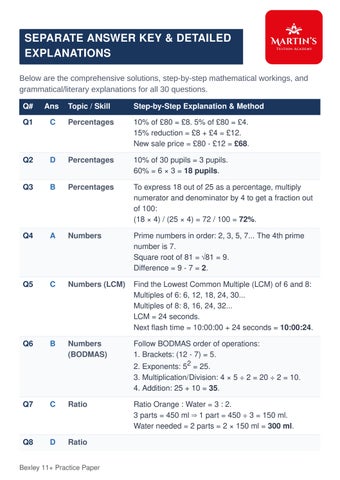
Q#AnsTopic / SkillStep-by-Step Explanation & Method
Q1 C Percentages
10% of £80 = £8. 5% of £80 = £4. 15% reduction = £8 + £4 = £12.
New sale price = £80 - £12 = £68
Q2 D Percentages 10% of 30 pupils = 3 pupils. 60% = 6 × 3 = 18 pupils .
Q3 B Percentages To express 18 out of 25 as a percentage, multiply numerator and denominator by 4 to get a fraction out of 100: (18 × 4) / (25 × 4) = 72 / 100 = 72% .
Q4 A Numbers
Prime numbers in order: 2, 3, 5, 7... The 4th prime number is 7.
Square root of 81 = √81 = 9.
Difference = 9 - 7 = 2
Q5 C Numbers (LCM) Find the Lowest Common Multiple (LCM) of 6 and 8: Multiples of 6: 6, 12, 18, 24, 30... Multiples of 8: 8, 16, 24, 32... LCM = 24 seconds.
Next flash time = 10:00:00 + 24 seconds = 10:00:24
Q6 B Numbers (BODMAS) Follow BODMAS order of operations:
1. Brackets: (12 - 7) = 5.
2. Exponents: 5 2 = 25.
3. Multiplication/Division: 4 × 5 ÷ 2 = 20 ÷ 2 = 10.
4. Addition: 25 + 10 = 35 .
Q7 C Ratio
Ratio Orange : Water = 3 : 2.
3 parts = 450 ml ⇒ 1 part = 450 ÷ 3 = 150 ml. Water needed = 2 parts = 2 × 150 ml = 300 ml .
Q8 D Ratio
Q#AnsTopic / SkillStep-by-Step Explanation & Method
Total parts = 5 + 3 = 8 parts.
Value of 1 part = £240 ÷ 8 = £30.
Maya's share (5 parts) = 5 × £30 = £150 .
Q9 C Ratio
Q10 B Time
Q11 D Time & Speed
Total parts = 4 + 5 = 9 parts.
Value of 1 part = 36 pupils ÷ 9 = 4 pupils.
Number of girls (5 parts) = 5 × 4 = 20 girls
Start time = 14:35.
Add 2 hours = 16:35.
Add 15 minutes = 16:35 + 15 mins = 16:50
Time = 2 hours and 30 minutes = 2.5 hours.
Distance = Speed × Time = 18 km/h × 2.5 hours = 45 km
Q12 B Time & Speed
45 minutes = 3/4 (0.75) of an hour.
Speed = Distance ÷ Time = 15 miles ÷ 0.75 hours = 20 mph
Q13 B Weight
Q14 D Weight Units
Convert cardboard box weight to kilograms: 450 g = 0.45 kg.
Net weight = Total weight - Box weight = 3.4 kg - 0.45 kg = 2.95 kg .
Convert 850 grams to kilograms = 0.85 kg.
Add all weights together: 2.5 kg + 0.85 kg + 1.25 kg = 4.60 kg .
Q15 C Weight
Q16 B Grammar (Subjunctive)
Q17 C Grammar (Agreement)
Convert bag of flour to grams: 1.5 kg = 1,500 grams. Amount remaining = 1,500 g - 400 g = 1,100 g .
B correctly uses inverted subjunctive condition ("Were she to accept..."). Option A incorrectly uses "was" instead of "were", C uses standard indicative, D uses "was" instead of "were", and E has tense mismatch.
C is completely correct ("Each... brought her own"). A errs with "were" (should be "was persuasive"). B errs with plural verb "have" for singular collective "group". D errs with pronoun "I" (should be "between you and
Q#AnsTopic / SkillStep-by-Step Explanation & Method
me"). E errs with "are" (subject is singular "headmaster").
Q18 B Grammar (Relative Pronoun)
Q19 A Punctuation (Semicolon)
which is the relative pronoun introducing the nonrestrictive parenthetical clause describing the oak tree.
A correctly joins two complete main clauses with a semicolon followed by the conjunctive adverb "however" and a comma. B incorrectly places a semicolon after a dependent clause, C uses a semicolon before a conjunction, and E misplaces the semicolon.
Q20 C Grammar (Passive Voice)
Q21 D Grammar (Dangling Modifier)
Q22 A Cloze (Vocabulary)
C ("had been caught") uses the correct past perfect passive construction ("had been" + past participle). A is active voice, B is simple past passive, and D is present perfect passive.
D correctly attaches the introductory participle "Approaching..." to the pronoun "we". In A, B, C, and E, the modifier incorrectly describes the non-human noun immediately following (ruins, television, letter, landscape).
vigilant means keeping careful watch for possible danger or difÏculties, perfectly opposing "negligence". Indolent = lazy; complacent = overly self-satisfied; boisterous = noisy/energetic.
Q23 B Cloze (Vocabulary)
Q24 B Cloze (Vocabulary)
Q25 B Comprehension (Detail)
falter means to lose strength or momentum. The phrase "did not falter" indicates that their determination remained strong despite harsh conditions.
feeble means weak or faint, fitting the context of a single small lantern attempting to pierce through a heavy mountain blizzard.
The text contrasts its former state ("symbol of aristocratic opulence", "vibrant estate") with its current condition ("sombre decay", "desolate ruin").
Q26 B Comprehension (Inference)
Q27 C Comprehension (Vocabulary)
Q28 B Comprehension (Detail)
Q29 B Comprehension (Tone)
The woodsmoke indicates recent fire/human presence, directly supporting the sentence: "The smoke suggested that despite years of reputed abandonment, the manor was not entirely devoid of life."
Opulence denotes great wealth, ostentatious luxury, and grandness, as evidenced by the mention of grand halls and dignitaries.
The text explicitly states: "...yet his solemn promise to Julian’s dying mother compelled him forward."
Words such as "shroud of autumnal mist", "sombre decay", "perilous undertaking", and "haunting walls" create a rich, tense, atmospheric, and reflective mood.
Q30 C Comprehension (Detail)
The second paragraph mentions: "Rumours had long circulated in the neighboring village of a reclusive figure who prowled the grounds after dusk..."