
Restoring Local Legend’s Place on the Wharf
Community Celebrates Harry Hooper’s Contributions to Capitola
With the Capitola Wharf restoration now complete, Harry Hooper’s plaque at the entrance to the wharf was rededicated on Saturday, July 11.
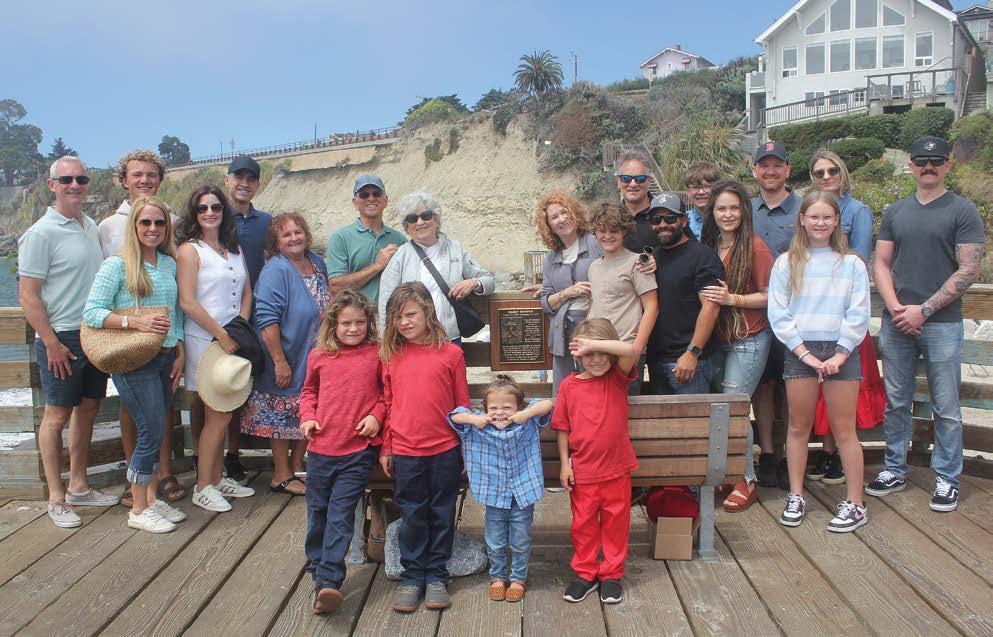
Friends and family gathered in front of the plaque for the rededication. Those gathered listened to speeches from
Hooper’s granddaughter, Donna Hooper Danza; former Capitola Historical Museum curator Frank Perry, and Rick Moran, one of the people who helped get the plaque back on the wharf.
... continues on page 4

www.tpgonlinedaily.com

54th Annual Wharf to Wharf Race
It’s a six-mile rolling carnival of a road race. A motivating musical experience with 30+ bands. A community event with 16,000 friends old and new. Call it what you want, the 54th running of the Wharf to Wharf Race on the morning of Sunday July 26 was once again more fun than a pair of running shoes should be allowed to have.
For the second year in a row “The Best Little Road Race in California” started at 30th Street and Portola Drive on the east side instead of the traditional start at the Santa Cruz Municipal Wharf and the Boardwalk due to ongoing construction and closure of the Murray Street Bridge.
Full Story page 6
Teen Lifeguard Invited to White House
Full Story page 8
Capitola Woman Killed in Senseless Attack
A 19-year-old Santa Cruz man accused of fatally stabbing a Capitola woman outside Capitola Mall planned the attack in advance, purchased two switchblade knives and then randomly selected his victim ...
Full Story page 12


Harry Hooper’s relatives gather to celebrate the rededication of his memorial plaque on the Capitola Wharf.



Cover
Restoring Local Legend’s Place on the Wharf: Community Celebrates Harry Hooper’s Contributions to Capitola
Community News

6 54th Annual Wharf to Wharf Hits Its Stride: Competition and Fun Propel Event’s Success, By Tad Stearn
7 EMBER to Present BESS Research at Science Symposium: Saturday Aug. 7
– 9 a.m. – 4 p.m., By Claudia Iseman • County Shelves BESS Ordinance: Asks State to Consider Draft and Public Response, By Jon Chown
8 Teen Lifeguard Invited to White House: Video of Dramatic, Heroic Rescue Goes Viral • Coastal Commission Expected to Approve Capitola Amendments: By Jon Chown
9 Friends of Santa Cruz State Parks Celebrates 50 Years • Kids2Parks Accepting Ap-plications for Free Field Trips
10 Property Owners in Unincorporated Areas of County Put on Notice
11 County Explores New Funding Options for Road Repairs: Backlog is Growing Annu-ally as Costs Far Outweigh Budget
12 Capitola Woman Killed in Senseless Attack: Murder Suspect Allegedly Admitted to Homicidal Fantasy, By Jon Chown
16 Sheriff’s K9 Finds Pipe Bomb in Car • BSA Troop 599 Celebrates 100 Years of Ex-cellence and Community Service
17 Capitola Beach Festival: Make Plans for September 26 and 27, By Laurie Hill
19 Santa Cruz METRO Launches ‘Art in Transit’ Bus Wrap Photo Contest: Community Members Invited to Submit Original Photography Inspired by Nature, Sustainability, and Wildlife in the Monterey Bay
20 True Love Christian Festival Continues to Grow: Sixth Annual Event Held at Aptos Village Park
22 Growing Volunteerism in the Forest: Nisene Marks Non-Profit Gives Nature Lovers Chance to Show It, By Jon Chown
23 Soquel District Names Heather Herbst Principal of Main Street Elementary
24 Live Oak Landing Opens: Expands Interim Housing and Pathways to Permanent Housing in Santa Cruz County
25 Cabrillo Festival of Contemporary Music: ‘We the Dreamers’ to Explore Themes on Democracy and Freedom July 26
27 Firefighter Moonlights as Marine Biologist: Wonders of the Ocean Have Always Drawn Fascination, By Jon Chown
Capitola History
4 Harry Hooper: A Hall of Fame Player and a Capitola Leader, by Deborah Osterberg, Curator, Capitola Historical Museum
Letters to the editor
9 Capitola is Being Bullied • Glad to See Roundabouts Taken Off the Table
Monthly Horoscope • Page 26 – South & North Nodes | Direction & Destiny — Past & Present/Future, By Risa D’Angeles Community Calendar | Arts & Entertainment • Pages 28, 29
Featured Columnists
15 Aristotle: The Three-Act Structure — Beginning, Middle, End, By Joe Ortiz
21 Building on Progress, Planning for Tomorrow, By Rebecca Gold Rubin, Public Out-reach Coordinator, Soquel Creek Water District
30 When Your Child Is Afraid to Go Back to School, By Dr. Lori Butterworth, Child & Adolescent Psychotherapist
31 Humidity is the Other Weather, By Tony Tomeo


Times Publishing Group, Inc.
9601 Soquel Drive, Aptos, CA 95003
The Times Publishing Group, Inc., publishers of the Aptos Times, a bi-monthly publication, the Capitola Soquel Times and Scotts Valley Times, each printed monthly, Coastal Weddings Magazine, Coastal Home and Garden Magazine, Aptos’ Fourth of July Parade Official Program Guide and Capitola’s Summer Festivals Official Program Guide, is owned by Patrice Edwards. Entire contents ©2026. All rights reserved. Reproduction in any form is prohibited without the publisher’s written permission
PHONE: (831) 688-7549
FAX: (831) 688-7551
GENERAL E-MAIL: info@cyber-times.com
Patrice Edwards: patrice@cyber-times.com
Publisher’s Assistant: assistant@cyber-times.com
Editor: info@cyber-times.com
Calendar Listings: www.tpgonlinedaily.com
Graphics Department: graphics@cyber-times.com
Billing Inquiries: cathe@cyber-times.com
Classified Sales: sales@cyber-times.com
Production: production@cyber-times.com
CHECK OUT OUR WEB SITE
CAPITOLA HISTORY

HHarry Hooper
A Hall of Fame Player and a Capitola Leader by DEBORAH OSTERBERG, Curator, Capitola Historical Museum
arry Hooper played right field for the Boston Red Sox (1909-1920) and was a key player in the team’s extraordinary run of World Series victories (1912, 1915, 1916, and 1918).
Hooper, a member of Boston’s famed “MillionDollar Outfield,” was considered one of the best defensive right fielders in baseball history and one
COVER STORY
“Harry Hooper” from page 1
“We’re here today for the rededication of this plaque to the Wharf where Harry fished and to honor the man that did so much for baseball and Capitola,” Moran said in his speech.
The plaque has been kept in safekeeping ever since the last major storm to significantly damage the Capitola Wharf struck on Jan. 5, 2023, causing severe harm to the 166-year-old structure and prompting extensive repairs and reconstruction. During this work, Hooper’s dedication plaque was removed.
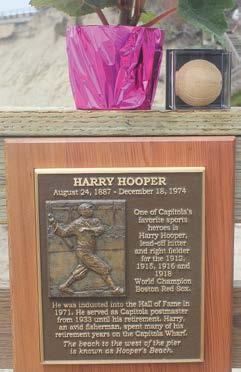
Hooper, a beloved Capitola resident, played for the Boston Red Sox from 1909 to 1920 and the Chicago White Sox from 1921 to 1925. He is a member of the National Baseball Hall of Fame. In his later years, he sold real estate, served as Capitola’s postmaster, and became an important community leader during the city’s early development.
The plaque’s new home is on the railing of the Wharf, facing a small stretch of Capitola’s beach west of the wharf, which honors his legacy as Hooper Beach.
“During this journey to have
We
of the top leadoff hitters of the Deadball Era. Hooper concluded his impressive professional baseball career playing five seasons with the Chicago White Sox (1921-1925).
On Aug. 9, 1971, Harry Hooper was inducted into the National Baseball Hall of Fame in Cooperstown, New York.
Harry’s plaque returned to the wharf, I had the privilege to meet Donna, Harry’s granddaughter, right here in Capitola,” said Moran. “Donna, listening to you recall your times with Harry, I could feel the reverence and love you have for the man you call Pop. A great ball player and a great man.” n

Chown
Bill Pooley, Erik Long
Michael Oppenheimer
Michael Oppenheimer, Ward Austin
Camisa Composti
Teri Huckobey, Brooke Valentine
Cathe Race
Michael Oppenheimer, Camisa Composti
Michael Oppenheimer
The plaque and a baseball signed by Harry Hooper, brought to the event by Deborah Osterberg, curator of the Capitola Historical Museum.
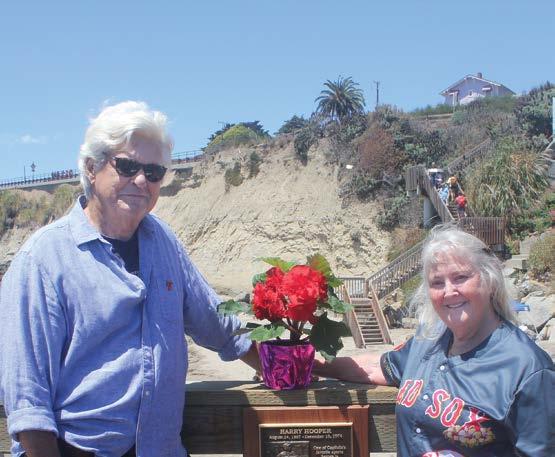
Rick Moran and wife Chris, 50 years after getting married on Hooper Beach, which the plaque now overlooks.
Harry Hooper, 1916
CAPITOLA HISTORY
In Capitola, Hooper was a respected civic leader who played an important role in the seaside community’s development throughout much of the 20th century.
“Although his play at times achieved the spectacular, he eschewed flamboyance for simplicity, exaggeration for modesty. … Hooper practiced his profession quietly, skillfully, and confidently.” — Paul J. Zingg, 1993, Harry Hooper: A Baseball Life Hooper was born on Aug. 24, 1887, at Bell Station in Santa Clara County. A decade later he played his first baseball game during a visit to Pennsylvania. In 1902 he embarked upon a five-year civil engineering program at St. Mary’s College in Oakland, California. While at college he continued his love of baseball by playing not only on the school’s team but also for Alameda in the California League.

While working as a surveyor in California’s capital, Hooper played ball on the weekends for the Sacramento Senators. The owner of the Sacramento team was also a scout for the Boston Red Sox. Recognizing talent, the scout signed Hooper to a contract with the Red Sox for $2,800 for the 1909 season. Even back home in Capitola during the off-season, Hooper played ball. In 1913 he played for the Holy Cross Diamond Stars of the Santa Cruz City League.
Hooper was noted for his speed and strong arm. He collected 2,466 hits for a .281 career average. He had 3,981 putouts and 344 assists with a lifetime fielding average of .966. In addition to being a member of the World Champion Red Sox, Hooper also held the World Series hitting streak record of 13, which was not broken until 1957 by Hank Bauer.
After an outstanding sixteen-year major league career, Harry Hooper retired in 1925. Returning home to Capitola, Hooper became an active and respected member of his community.
In 1906, Harry Hooper’s parents moved into a home on Stockton Avenue in Capitola. After the 1912 baseball season, Hooper married Esther Henchy of Capitola. Between his 1915 and 1916 World Series wins, the young couple moved into a Capitola Depot Hill home at 106 Cliff St.
In 1926, Hooper opened a real estate office at 137 Bay Ave. (now Monterey Avenue). The same year he purchased 19 acres west of Watsonville, naming it Sunset Beach. By 1929, he began subdividing the coast-side property and sold some of his land, which later became Sunset State Beach. But baseball was never far from Harry’s heart — even on his real estate business card.
In 1927, Hooper served as player/ manager for the San Francisco Mission Bells of the Pacific Coast League. In 1930 he joined the Santa Cruz Padres of the California League. During the 1931 and 1932 seasons, Hooper coached the Princeton University baseball team. The year 1933 was eventful for Hooper. He managed and played with the Santa Cruz Padres and toured the country with the Old Timers’ Team, but most importantly for his hometown, Hooper was appointed Capitola Postmaster by President Franklin Delano Roosevelt. Starting with an annual salary of $1,500, Hooper continued to serve as Capitola’s Postmaster until his retirement in 1957.
In 1940, he purchased the small beach adjacent to the Capitola Wharf – now “Hooper’s Beach.” As a founding board member of the Capitola Improvement Club, Hooper became deeply involved in community affairs. He served as chairman of the Capitola Progress Club and played a vital role in the 1949 incorporation of Capitola as Santa Cruz County’s third city.
In 1962, Hooper moved into a home on Opal Cliff Drive. Shortly afterwards Capitola Beach began to change. Construction of the new Santa Cruz Small Craft Harbor caused a shift in sand deposition resulting in severe beach erosion at Capitola. As a civil engineer graduate, Hooper came up with the idea of building a groin at the [east] end of Capitola Beach to hold the sand that had been restored to the beach.
Harry Hooper passed away on Dec. 18, 1974, at the age of 87. On June 4, 1985, the Hooper family sold “Hooper’s Beach” to the City of Capitola. A plaque honoring Harry Hooper was placed at the beach in 2002 and was rededicated on Capitola Wharf in 2026. •••
https://takemeouttocapitola.weebly. com/quotes.html — The companion website to the 2014 exhibition remains active, featuring pictures of the exhibit, more information about Hooper, and quotes by and about him from various publications and from his Hall of Fame speech.








54th Annual Wharf to Wharf Hits Its Stride Competition and Fun Propel Event’s Success
By TAD STEARN
It’s a six-mile rolling carnival of a road race. A motivating musical experience with 30+ bands. A community event with 16,000 friends old and new. Call it what you want, the 54th running of the Wharf to Wharf Race on the morning of Sunday, July 26, was once again more fun than a pair of running shoes should be allowed to have.
For the second year in a row “The Best Little Road Race in California” started at 30th Street and Portola Drive on the east side instead of the traditional start at the Santa Cruz Municipal Wharf and the Boardwalk due to ongoing construction and closure of the Murray Street Bridge. The course traveled north toward the harbor before turning back south and connecting with the traditional route for the final four miles.
Fun and festivities aside, the W2W is a competitive racing event with an international draw and prize money at stake for the top finishers. Twenty-six-year-old Latvian runner Arturs Medveds repeated his 2025 victory as the men’s winner with a time of 27:22, chased by Anthony Raftis and Nicolas Brichta finishing second and third, respectively. Flagstaff AZ resident Paige Wood, 30, sealed her victory in the women’s bracket with a time of 30:34, followed by Lauren Hagans and Rebecca Rader.
Top finishing local men included Sean Riedel of Santa Cruz running a 30:12 and Matthew Quinn of Aptos, finishing at 30:26.
Recent Aptos High graduate Maya Schiro of Corralitos was the top local women’s finisher, running a very impressive 35:12 in her third W2W.
While race organizers hope to return to the traditional starting line next year, the start on Portola Drive provided some unique

opportunities for local businesses between 30th and 41st avenues. Restaurants, bars and coffee shops were open early providing raceday specials for the thousands of runners stretching, hydrating and loading into their numbered corrals waiting for the starting gun.
Pete Cirina, owner of the Over the Hill Gang Saloon for the past 35 years, had “breakfast shots” lined up for those who wanted to start the party early. Really early.
“It’s a great business day for us, it really is” he says. “I was debating whether to open or not, but with my liquor license I can open at 6 a.m. So we went ahead and opened up early today. This is awesome for us.”
Beyond the scenic seaside course and cool summer weather, another major draw of the W2W is the festive, welcoming atmosphere for athletes of all ages and abilities. Individuals, friends, families, school groups, co-workers and others get together to share the experience of improving health, setting goals, meeting challenges and testing what is possible. That positive experience is at the core of W2W’s mission.
“Wharf to Wharf” page 14
A Ukulele Team performs on the Wharf to Wharf course to entertain the participants.
CrossFit Aptos
EMBER to Present BESS Research at Science Symposium
Saturday Aug. 7 • 9 a.m. – 4 p.m.
By CLAUDIA ISEMAN
Like a glowing ember reignited from a fire, EMBER (Estuary Monitoring of Battery Emissions and Residues) is releasing a firestorm of research following the Moss Landing lithium battery fire in January 2025.
On Aug. 7 EMBER will hold a science symposium presenting its research on the impact of the blaze at the Vistra battery energy storage system. Also known as BESS.
“Folks are welcome to just tune in to the topics that interest them, or they can watch the recording later, which allows them to skip over the boring parts,” said Kirsten Wasson. Wasson is a core member of the research team known as EMBER studying metal concentrations in plants and animals. She’s also preparing and coordinating the presentation for the symposium.
(MLML) and The Monterey Bay Aquarium Research Institute (MBARI), UCSC and Elkhorn Slough, who are all collecting data from the Elkhorn Slough post lithium battery fire.
John Hunt has been an Aquatic Toxicologist researching the Monterey Bay for 20 years. “EMBER is a good example of science in action by people who care,” says Hunt.

The symposium features a variety of presentations by various experts and runs all day from 9a to 4p. at https:// elkhornslough.org/visit/ calendar/ember-symposium/
”The public should tune in to this symposium if they want a good presentation about science and what materials got into the environment after the fire,” says Hunt. He says research will not be looking at impacts on human health.

EMBER is a coalition of scientists from the Moss Landing Marine Laboratories
“EMBER” page 14
County Shelves BESS Ordinance
Asks State to Consider Draft and Public Response
By JON CHOWN
SANTA CRUZ The Santa Cruz County Board of Supervisors, at their June 30 meeting, voted to stop work on a proposed ordinance to regulate large battery energy storage projects and instead ask the California Energy Commission to use the county’s draft safety and land-use standards when reviewing the proposed Seahawk Battery Energy Storage System near Watsonville.
The board’s decision follows more than a year of indecision regarding the regulation of utility-scale battery storage facilities. Supervisors had been reviewing on an ordinance that has been under development for nearly two years, but decided to drop the matter for now after developer New Leaf Energy withdrew its county application for the Seahawk project and sought approval through a state process.
Besides sending a letter to the CEC, the Board also directed county staff to negotiate a community benefits agreement with New Leaf Energy and continue participating in
the California Energy Commission’s environmental review of the project.
County staff recommended the change after concluding there was little reason to spend time and money completing the ordinance now that there are no battery storage applications pending before the county.
“The benefits of finalizing the Draft Ordinance appear to be limited,” staff wrote in a report to the board. The report said preparing the required Environmental Impact Report would be expensive, was not included in the county’s budget and could expose the county to legal challenges. Staff also noted that the California Energy Commission is not legally required to follow local ordinances when reviewing projects under Assembly Bill 205, the state law New Leaf is using to seek approval.
The board directed Chair Monica Martinez to draft a letter asking the Energy Commission to consider the county’s draft ordinance as it reviews the Seahawk proposal.
“BESS Ordinance” page 14
Hire us to paint your interior or exterior by August 31, 2026, and we will buy the paint.




Teen Lifeguard Invited to White House
Video of Dramatic, Heroic Rescue Goes Viral
SANTA CRUZ Ryder Williams, the teenage lifeguard who heroically rescued a 10-year boy from massive waves at Seabright Beach on July 25 has been invited to the White House to receive an award.
President Donald Trump made the invitation public on social media Tuesday. Williams and his family have all been invited to Washington D.C.
“We›re going to bring this heroic young man, and his family, into the White House with, perhaps, the boy he saved, to give him a High Civilian Honor. Very brave, he deserves it!” Trump posted to social media.
The rescue was captured on video by local resident Scott Vander Dussen and quickly went viral after being posted to Instagram and Facebook. The video shows the rescue already underway as Williams clings to the boy as a huge wave envelopes the two and they disappear under it. Seconds later they reappear as others on the beach try to pull them in, but are forced to retreat when
another wave equally as large crushes the two again.
Despite the danger, Williams holds on to the boy as wave after wave crashes against the two. Others trying to help are nearly swept away themselves. Eventually a second lifeguard joins the effort, and with the help of others, the child and lifeguard were brought safely back to the beach.
Vander Dussen, who recorded the video and shared it through his social media account, said on social that the ocean conditions changed quickly and caught people off guard. He said the lifeguard’s actions saved the child’s life.
The child’s name and family information have not been publicly released.
Local resident Brittany Conley said she saw the entire incident. She said the whole scene unfolded between two lifeguard towers, both waving red flags reading “danger.”
“Teen Hero” page 10
Coastal Commission Expected to Approve Capitola Amendments
By JON CHOWN
The California Coastal Commission, at its Aug. 12 meeting in Scotts Valley, is expected to clear up two big issues in Capitola, clearing the way for more housing development.
The first issue is an amendment to Capitola’s Local Coastal Program that would make it easier to build accessory dwelling units and allow higher-density multifamily housing at five sites in the city’s coastal zone.
In a report, Commission staff determined the proposed revision qualifies as a “de minimis” change, meaning it would have no significant effect on coastal resources and could be approved without a full public hearing unless at least three commissioners object. The proposal is scheduled to be considered Aug. 12 during the commission’s meeting in Scotts Valley.
The amendment would update Capitola’s coastal zoning rules to match recent state housing laws and help the city meet its state-required housing goals. The city must plan for 1,336 new housing units between 2023 and 2031, including hundreds of units affordable to low- and very lowincome households.
Among the proposed changes, the city would remove homeowner association approval requirements for ADU applications, limit historic resource standards to ADUs associated with designated historic properties in the coastal zone, allow up to eight detached ADUs on parcels with multifamily housing instead of two, and require ADUs to be rented for periods longer than 30 days. Staff described most of the remaining changes as clarifications needed to bring the city’s Local Coastal Program into compliance with state law.
The proposal also would create two new multifamily residential zoning districts allowing up to 30 and 40 housing units per acre. Those designations would be applied to five locations: 600 Park Ave., the Rosedale Avenue and Hill Street area, the Capitola Avenue and Hill Street area, Capitola Cove and Capitola Gardens. The sites are currently zoned for between 10 and 20 units per acre.
Coastal Commission staff concluded the changes would not weaken existing protections for environmentally sensitive habitat, coastal bluffs, public access or scenic views.
“Capitola Amendments” page 18
COMMUNITY BRIEFS
Friends of Santa Cruz State Parks Celebrates 50 Years
SANTA CRUZ Friends of Santa Cruz State Parks is marking its 50th anniversary this year with a public celebration and a fundraising campaign as the nonprofit looks back on five decades of supporting state parks and beaches in Santa Cruz and San Mateo counties.
Founded in 1976, the organization has grown from a small grassroots group into an operating partner of California State Parks. Today, Friends supports 34 state parks and beaches, providing funding for educational programs, visitor services, accessibility projects, disaster recovery and capital improvements.
The nonprofit is based in downtown Santa Cruz and employs about 100 people during the peak visitor season, including visitor service aides stationed at parks and beaches throughout the region.
“Our legacy is written in the redwoods and along the coastline,” Executive Director Bonny Hawley said in a statement. “For 50 years, we have been so much more than park supporters; we’ve been a conduit for community-driven action to sustain the beloved natural and cultural resources that belong to us all.”
The organization will celebrate its anniversary with a free public Birthday Bash from noon to 3 p.m. Sept. 19 at Wilder Ranch State Park. The event will feature music, dancing, food, drinks and a silent auction.
Former staff members, board members and California State Parks employees are encouraged to attend as part of a reunion. Sponsorship opportunities are also available.
Along with the celebration, Friends is launching its Golden Anniversary Resources for Resilience fundraising campaign. Supported by a matching fund, the campaign aims to raise $50,000 and recruit 50 new members.
Several milestones are planned or underway this year. They include the opening of San Gregorio Ranch State Beach, welcoming the 250,000th visitor to Big Basin Redwoods State Park since the CZU Fire, completing restoration work at Pigeon Point Lighthouse and continuing planning efforts to improve environmental resilience at Seacliff State Beach.
Friends said those projects reflect its continuing commitment to protecting and improving local parks and beaches as it begins its next 50 years of service.
Kids2Parks Accepting Applications for Free Field Trips
Friends of Santa Cruz State Parks is accepting applications through Aug. 14 for its Kids2Parks program, which provides free transportation for field trips to California state parks for students at eligible Title I elementary schools.
“Briefs” page 12
LETTERS TO THE EDITOR
Capitola is Being Bullied
Did you know?
The City of Capitola is being accused of disenfranchising its citizen’s by what seems to be a gangster law firm, Shenkman & Hughes of Malibu. It’s a lie and an insult to our community. The law firm’s demand letter states, “Capitola is outwardly disturbing and fundamentally hostile....”
Our City disputes the allegations of dilution of a protected class. Yet, the City is unable to defend our reputation because of the prohibitive costs to fight this threatening lawsuit.
Consider, when we are talking about dividing our unique City into small voting districts, we are being forced, threatened and extorted into districting because of legal loopholes.
Districting creates an attitude of separation through division. Unnecessary districting is a costly unwarranted diversion from the real concerns of our small City. The cities “hands are tied” echoes throughout many issues in our state. Housing, battery storage sites, off shore oil drilling and now districting. We are losing the power of local jurisdictions.
Ask why Capitola is being sent such a demand lawsuit letter at this time? Renounce bullying.
— Cheryl Ban, Capitola










Glad to See Roundabouts Taken Off the Table
Regarding the article “Roundabouts Taken Off the Table” in the June 2026 issue of the Capitola Soquel Times:
I applaud the Capitola City Council on their decision to scrap the roundabout idea as a solution to traffic control on Bay Ave.
Although Melinda Orbach emphasized that the data shows that roundabouts are safer, this has not been my experience.
The reality is that drivers tend to look to their left at oncoming traffic as they enter the roundabout & do not give a final glance to their right to look for bicyclists or pedestrians.
As a result, I know several people who while riding a bicycle or walking have been hit by cars in roundabouts.
Some of the incidents have been quite serious, as drivers tend to accelerate hard, to get ahead of oncoming vehicles, as they enter the roundabout.
The reality is, roundabouts are not a good solution in areas with heavy pedestrian and bicyclist presence.
Thank you for canceling the roundabout plans.
— Debbie Schultz, Capitola





Beneficial Plants for California’s Mediterranean Climate
• Edibles and Fruit Trees
• Native and appropriate plant varieties
• 2 Acre Display & Sculpture Garden


• Gift Certifi cates
• Family Owned & Operated for 30 Years


Property Owners in Unincorporated Areas of County Put on Notice
The Santa Cruz County Department of Community Development & Infrastructure today began notifying property owners who are not complying with the Universal Service Ordinance, which requires all developed properties in unincorporated areas to subscribe to waste collection service or register as a self-hauler.
The outreach effort marks the start of a countywide compliance campaign ahead of the Nov. 1 enforcement deadline. Noncompliant property owners will receive letters in the mail explaining how to comply. To meet the requirement, property owners must:
• Subscribe to garbage, recycling, and organics collection service through GreenWaste Recovery, the County’s exclusive franchise hauler.
• Register with the County as a selfhauler and meet program requirements, including transporting separated waste materials to County approved waste management facilities.
The ordinance supports California’s waste reduction, recycling, and organics diversion requirements by ensuring waste is
“Teen Hero” from page 8
“Between those towers were two rip currents and about 20 to 30 people hanging at the waters edge, playing in the water. No one was swimming in the water as it was clearly too dangerous. I saw three kids get pulled in by the waves throughout the day that were helped by guards and parents. It seemed very ignorant to have kids anywhere near the water this day,” she said.
She said the young boy that was saved on the video had been pulled in by a rip current, but the waves weren’t huge. He began to panic, trying to swim in, but was getting sucked further out by the rip current. He then waved for help.
“This is when people began screaming for the lifeguard,” she said. “As the guard was coming, the kid was tossed in a couple huge waves. By the time the guard came, the boy was completely limp. The guard was struggling to get in, so people began to attempt to help. It was doing more harm than good, and they were instructed to get out,” she said.
Conley said it was clear that most of the visitors were from out of town. Most local beaches would have had a dozen
The outreach effort marks the start of a countywide compliance campaign ahead of the Nov. 1 enforcement deadline. Non-compliant property owners will receive letters in the mail explaining how to comply.
properly collected and managed throughout the community.
Property owners who fail to comply by Nov. 1 may face administrative penalties, including fines of $100 for a first violation, $200 for a second violation and up to $500 per day for third and subsequent violations. n •••
Property owners can find more information about service options, self-hauler registration, and frequently asked questions at: Santacruzcountyca. gov/universalservice.
“I love that the focus was on the lifeguard and his heroic actions that day. Our summer program, Junior Guards, has taught thousands of kids how to navigate the ocean and how to help others when needed. The lifeguard is an absolute hero.” — Brittany Conley
experienced swimmers and surfers eager to help. The waters were rough, but if visitors had the knowledge of what to do in a rip current, or even basic sense to dive under the waves, it would have helped tremendously.
“I love that the focus was on the lifeguard and his heroic actions that day. Our summer program, Junior Guards, has taught thousands of kids how to navigate the ocean and how to help others when needed,” she said. “The lifeguard is an absolute hero.” n
COMMUNITY NEWS
County Explores New Funding Options for Road Repairs
Backlog is Growing Annually as Costs Far Outweigh Budget
SANTA CRUZ Santa Cruz County supervisors heard a range of potential funding options June 30 for addressing the county’s growing road maintenance needs, including possible sales taxes, parcel taxes, special assessment districts and development fees, as officials try to figure out how to pay for road repairs now and in the future.
After the supervisors were given a presentation from the County Executive Office outlining possible revenue strategies, the Board then directed staff to complete a transportation funding and financing analysis and return in January with some answers.
“I’m glad we’re moving on this,” said District 1 Supervisor Manu Koenig. “We probably should have started moving a lot sooner.”
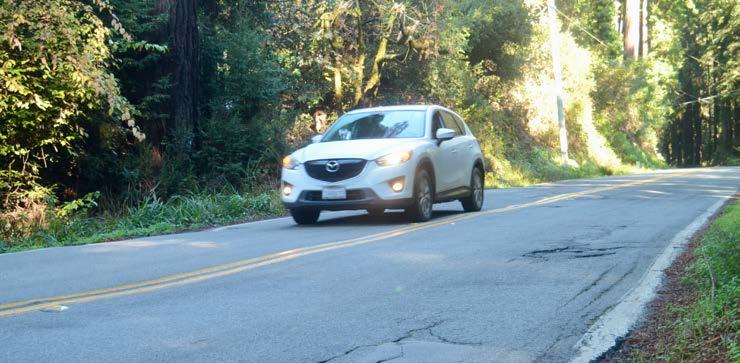
The county faces a significant gap between available funding and the cost of maintaining the county’s road network. The county’s 2025 Pavement Management Program estimates it would cost about $29.5 million annually to maintain roads at an average Pavement Condition Index score of 57. The score measures cracks and splits on the road, surface damage and ride smoothness. A score of 85-100 is good, 55-84 is fair and a score of under 55 means the road has heavy damage, deep holes and requires a rebuild.
Currently, Santa Cruz County roads average a mere 57.8, but the county projects the average pavement condition could decline to about 36 by fiscal year 2034-35 and deferred maintenance costs could grow from about $294 million to about $683 million if corrections aren’t made. Currently, the annual budget only allows about $6.3 million for repairs, leaving a gap of roughly $21 million.
Without additional funding, the county projects the average pavement condition could decline from its current level of about 57.8 to approximately 36 by fiscal year
2034-35, while deferred maintenance costs could grow from about $294 million to about $683 million.
Ryan Friedrich, principal analyst in the County CEO’s office, said two issues are growing the backlog. “First is inflation, cost, and the second is deterioration of the roads,” he said. “It’s about half each.”
Friedrich went through a variety of options to address the deficit, starting with development impact fees. Increasing those would be easy, he said, because it doesn’t require a public vote. However, he pointed out, using that money requires a nexus to new development.
“So it doesn’t help our deferred backlog, but it does relieve pressure on current funding sources that are being used for things like capital improvement matches,” he said, but estimated the county could get about $5 million more annually with an increase.
Friedrich also discussed assessment districts, community facility districts, and other ideas that would all require voter approval. One option discussed was a dedicated local sales tax. A half-cent sales tax in the county’s unincorporated areas could generate an estimated $10.7 million annually, according to preliminary estimates. However, because the tax would be dedicated to transportation purposes, it would require approval from two-thirds of voters.
Friedrich also noted that unincorporated Santa Cruz County is already at the state limit for local sales tax increases and additional authority from the Legislature would be needed before a new sales tax could be implemented.
Another potential option is a parcel tax, which could generate an estimated $9.2 million annually based on a preliminary model of about $200 per improved parcel and $100 per unimproved parcel.
“Road Repairs” page 23



Valencia Road is one of many roads in the county in need of repair.

Sunday, August 16
2 p.m.
Tickets: $10
($5 Children under 10)

Mid-County Social Center
829 Bay Avenue, Capitola, CA 95010 (Off Bay Avenue, behind the Party Store) 831-476-4711
COMMUNITY NEWS
Capitola Woman Killed in Senseless Attack Murder Suspect Allegedly Admitted to Homicidal Fantasy
By JON CHOWN
SANTA CRUZ
A 19-year-old Santa Cruz man accused of fatally stabbing a Capitola woman outside Capitola Mall planned the attack in advance, purchased two switchblade knives and then randomly selected his victim, according to a criminal complaint filed by the Santa Cruz County District Attorney’s Office.
A photo of Rachell Summers from a GoFundMe page raising a memorial fund for her grandson.
Capitola police said officers were dispatched at about 12:47 p.m. on July 20 to reports of a stabbing near the food court exit at Capitola Mall.
Officers arrived within minutes and found a woman on Clares Street near the west exit of Macy’s suffering from multiple stab wounds. Police and later firefighters and paramedics performed life-saving measures, but the victim, 73-year-old Rachell Summers died at the scene. Tyler Leibelt, 19, was arrested a short

time later on the 1400 block of 41st Avenue. According to the complaint, Leibelt contacted 911 after the stabbing, identified himself as the suspect and remained in the area until officers took him into custody.
Leibelt has been charged with one count of murder. According to the criminal complaint, Leibelt told investigators he left a sober living environment, took an Uber to Cabrillo College, where he was studying accounting, and later decided to kill someone.
He purchased two knives and then went to Capitola Mall, where he waited for an opportunity to carry out the attack.
Leibelt admitted experiencing homicidal fantasies before the attack and told detectives he had decided to kill someone that day. The filing also alleges investigators recovered a letter expressing an intent to kill multiple people before taking his own life.
While the murder was planned, the complaint alleges Leibelt selected Summers at random. Authorities say they’ve found no indication that Leibelt and Summers knew each other before the attack.
Summers worked at the mall and was the manager of Art of Santa Cruz, a nonprofit store that sells the work of local artists. According to social media, she was a mom and grandmother. A GoFundMe page has
“Briefs” from page 9
The program, offered in partnership with California State Parks, is open to second- through fourth-grade classes at Title I elementary schools in Santa Cruz County and select schools in San Mateo and Santa Clara counties.
Teachers can apply online at thatsmypark.org/k2p through Aug. 14 and will be notified by early September if their applications are approved.
Kids2Parks covers transportation costs, including bus rental, driver time and fuel, removing a major barrier for schools seeking outdoor education opportunities.
Friends of Santa Cruz State Parks also funds program coordination, California State Parks staff time and supplies for the field trips.
Since launching in 2015, the program has provided state park experiences for more than 20,000 students.
“A trip to a state park or beach can open up a whole new world for young students,” said Lauren Kitayama, program coordinator for Friends of Santa Cruz State Parks. “We hope these experiences continue to inspire curiosity, connection and a lasting appreciation for the outdoors — encouraging

been created to raise college funds for her grandson, who is soon to turn one.
“Rachell was a loving and devoted grandmother, mom, and friend who loved her community,” wrote organizer Mya McLelan.
Leibelt was being held without bail while his arraignment was scheduled July 29, the day this publication was sent to print. The Capitola Police Department continues to investigate the case with assistance from the Santa Cruz County Sheriff’s Office Forensic Services Unit, the Santa Cruz County District Attorney’s Office and the Santa Cruz AntiCrime Team. n
Police are asking anyone who witnessed the stabbing or has photographs, video or other information to contact the Capitola Police Department at (831) 475-4242.
students and their families to return again and again.”
Participating parks include Castle Rock State Park, Castro Adobe State Historic Park, Half Moon Bay State Beach, Henry Cowell Redwoods State Park, Natural Bridges State Beach, Santa Cruz Mission State Historic Park, Seacliff State Beach, The Forest of Nisene Marks State Park and Wilder Ranch State Park. Schools are paired with parks based on location.
Rhiannon Sims, interpreter III for California State Parks’ Santa Cruz District, said the program helps expand access to outdoor education.

“Kids2Parks gives students the opportunity to connect more deeply with the natural, cultural and historic resources protected within our parks,” Sims said. “These programs continue to play an important role in expanding equitable access to outdoor education and helping more young people experience the parks throughout the Santa Cruz District.”
The program is funded through grants and donations. Organizers estimate it costs about $15 to send one student on a Kids2Parks field trip. Donations and additional program information are available at thatsmypark. org/k2p. n
Capitola Police officers take suspect Tyler Leibelt into custody on July 20.













The letter states that Santa Cruz County supports battery storage as part of California’s efforts to improve grid reliability and expand renewable energy, but believes projects must be developed under strong public safety and environmental protections.
The letter asks the commission to evaluate the Seahawk project using standards that are at least as protective as those proposed by the county, particularly in areas involving fire safety, environmental monitoring, local oversight and agricultural protection.
Proposed Ordinance Has A Long History
Battery energy storage systems store electricity produced during periods of high renewable energy production, such as sunny or windy days, and release that energy later when demand increases. Supporters say the facilities are an important part of California’s transition away from fossil fuels because they help stabilize the electrical grid, reduce the need for natural gas power plants and lower the risk of blackouts during periods of heavy electricity use.
The county began working on its ordinance in 2024 after supervisors directed staff to develop rules governing where large battery storage facilities could be built and how they would operate. The proposed ordinance would have created a new Energy Storage System Combining District covering qualifying properties adjacent to existing electrical transmission substations outside the coastal zone. Only parcels of at least 10 acres would have been eligible, and projects would have required approval from the Board of Supervisors through a conditional use permit after public hearings and recommendations from the Planning Commission. Projects affecting farmland also would have required review by the Agricultural Policy Advisory Commission.
The draft ordinance also included
extensive safety, environmental and operational requirements. Among them were minimum setbacks of 300 feet from sensitive receptors and 1,000 feet from schools, hospitals, daycare centers and residential care facilities for older adults. Battery modules also would have been required to remain at least 100 feet from public roads and neighboring property lines.
The ordinance also proposed requiring independent studies of thermal runaway risk, smoke drift and toxic plume modeling, fire risk assessments and failure analysis before any project could be approved. Operators would have been required to coordinate emergency response plans with local fire agencies, provide annual emergency response training, install air quality monitors and weather stations around project sites, maintain dedicated fire water supplies unless waived by fire officials and provide financial guarantees to cover cleanup, environmental damage and decommissioning costs.
The proposal also included agricultural protections. Projects built on commercial agricultural land would have been required to study whether the land was economically viable for farming and, in many cases, permanently protect other farmland through agricultural conservation easements to offset the loss of productive soils.
County officials spent months revising the ordinance after receiving comments from residents, emergency responders, agricultural interests and the battery storage industry. New Leaf Energy initially praised the county’s effort.
During earlier discussions, company representatives described the proposal as one of the strongest battery storage ordinances in the country and said they intended to wait for the county process before seeking approval. That changed after the Board of Supervisors approved additional amendments to the ordinance in January.
In a May letter notifying the county that
New Leaf would withdraw its application, Senior Developer Max Christian wrote that the changes created “significant commercial risks, as well as critical delays” that made the county approval process no longer practical.
Christian specifically objected to a new requirement that future ownership transfers receive approval from the Board of Supervisors, calling it unprecedented. He noted that New Leaf’s business model is to develop projects and eventually sell them rather than operate them long term.
Christian also pointed to repeated delays in completing the ordinance, saying they increased uncertainty for the project. Utilityscale energy projects must secure positions in the state’s electrical interconnection process years in advance, and delays can increase costs while threatening those positions.
Instead of continuing with the county, New Leaf submitted the Seahawk proposal to the California Energy Commission under Assembly Bill 205. In his letter, Christian said the state process would still require extensive environmental review, review by battery safety experts, coordination with local fire agencies, preparation of emergency response plans and opportunities for public participation.
Public is Wary of Project
The project has drawn strong opposition from many South County residents and elected officials. Last year, the Watsonville City Council voted to send a letter to Santa Cruz County opposing the proposed battery storage facility. Council members cited concerns about locating a large battery energy storage project near neighborhoods and agricultural land and urged the county to adopt strict safety standards before approving any proposal.
Those concerns helped shape many of the provisions later added to the county’s draft ordinance, particularly those involving emergency response planning, environmental
monitoring, financial responsibility and protections for farmland.
Although the county will no longer complete the ordinance, supervisors said they want the work that went into developing it to influence the state’s review of the Seahawk project. The letter to the California Energy Commission asks commissioners to ensure that any battery storage project approved in Santa Cruz County meets standards that are at least equivalent to those proposed by the county.
Justin Cummings, county supervisor for District 3, said he wished the county would have completed the ordinance, noting that the public had demanded stricter provisions than the current draft and supervisors had agreed. One glaring omission was the county’s oversight of any ownership transfers, the issue that New Leaf found most untenable. “I think part of what isn’t clear is whether or not the board has any ability to deny an ownership transfer,” he said. “If Vistra comes along and wants to buy this facility and we know that they’re a bad actor, do we really want to allow that type of transfer and that operator to come into our community when they have a history of negligence?”
District 2 Supervisor Kimberly De Serpa said she had concerns about losing agricultural land to the BESS plant, nor did she like the location. She said she was told by New Leaf that PG&E needed the plant to store energy for the “west side.”
“Having the people of Watsonville take the risk so that we could push energy to the west side doesn’t seem right, just or fair to me,” she said.
After some more discussion, Cummings moved to approve the staff recommendation to send the letter to the state, along with the ordinance, but with the addition that the board must approve a transfer of ownership, as well as additional considerations when a BESS plant is proposed on agricultural land. n
“Wharf to Wharf” from page 6
Debby Tuck, owner of the Capitola Sands vacation rental in Capitola Village, led a group of about 20 friends on the run. “Most of us are connected from our work and our kids growing up together, and a few of us have homes here in Capitola and Santa Cruz. I saw the race was coming, so I reached out to everyone and said let’s do the Wharf to Wharf together. So here we all are!” Debby’s group of “Salty Striders” were having a blast decked out in color-coordinated gear and cheeky T-shirts.
It was the first race together for the Salty Striders, and the first of its kind for Debby’s husband Brian. Brian’s participation was all the more impressive considering he recently received a liver transplant and has been working through healing and rehabilitation to get to this point.
“He’s never done anything like this,” said Debby. “I’m so proud of Brian for doing this race. It was a huge accomplishment for him to even try, and to finish in 1:45!”
In Brian’s case, he said he wants to “motivate others, encourage others to be organ donors, and keep moving and smiling.” n
The W2W is produced and administered by Wharf to Wharf Race Inc., a California nonprofit corporation chartered

to promote running as a means to health and fitness. In service of this mission, the Race has, since its inception in 1973, contributed more than $6 million dollars to Santa Cruz County youth sports programs in general and the running community in particular, according to its website. W2W is a boost to local business, annually infusing more than 8 million dollars into the Santa Cruz County economy.
“EMBER” from page 7
The research scientists have a specific agenda when it comes to protecting one of the Central Coast’s most environmentally sensitive areas.
• Measure and map distribution of metals before and after the battery fire in Elkhorn Slough sediments.
• Track movement from the surrounding watershed into the Slough via stormwater runoff.
• Characterize movement and chemical transformations of battery fire metals between sediments, porewater, and the water column in Elkhorn Slough.
• Create a box model of metals in various reservoirs of Elkhorn Slough.
• Evaluate the potential for uptake and accumulation of metals into common plants, invertebrates, and fish in Elkhorn Slough, including edible species. Wasson admits the scientific jargon is not for everyone. “It will be nerdy. This is a look into the sausage making of science,” says Wasson. “We’ll make sure the start and ending of our talks are general,” she adds. The biota expert hopes to break down the symposium and simplify it for a broader audience in the future. n The Moss Landing Battery Fire Science: https://elkhornslough.org/ visit/calendar/ember-symposium/
Salty Striders
Aristotle: The Three-Act Structure — Beginning, Middle, End
“For Sale, Baby Shoes, Never Worn.”
— Ernest Hemingway
According to Ernest Hemingway, the above six words is the shortest example of a story imaginable. It exemplifies a barebones model of the three-act structure, defined by Aristotle more than two-thousand years ago. Aristotle stated in his Poetics that a play should imitate a single whole action comprised of a beginning, middle, and end. And this iconic and archetypal story structure still holds true today.
For some primal reason this simplification of structure appeals to our innate sense of dramatic development: The beginning sets up a problem, question or quest; the middle develops the action and often heightens the conflict by posing roadblocks, which must be overcome; and the end represents the climax and the obligatory resolution.
Whether it be in a movie, a short story or a novel, most writers would agree that the beginning and end are relatively short compared to the middle, which—as the crux of the story’s development—often commands a larger portion of the action.
By thinking in three-stages of development we not only

By JOE ORTIZ

work inside a form which innately resonates with audiences, but it also provides certain guardrails for composition. Remember, three-act structure is simply an armature on which to build a narrative. The series of events that the writer

attaches onto the structure is the fleshing out. If God and Aristotle reside in the mechanical structure, the Devil is in the details. And thus, the patina is where the creator of the work can express the art and emotion.
But what about Shakespeare’s five-act structure or the two-act structure of many plays and musicals? Smart writers know that placing an “inciting incident” somewhere near the beginning of their story helps to launch the audience into Act Two’s demand for developing the story’s ever-escalating conflict.
So, the concept of Beginning, Middle, and End can often appear right on top of any other story-act structure. Even on an important email or business letter.
What We Can Do
The next time you compose an important email, consider placing your “ask,” request, or significant information at the end of Act Two. And allow your final paragraph (act-three) to be the most well-crafted statement that will most effectively yield the response you’re looking for. n
Reader response: I’d love to hear your comments and questions. Email me at joe@gocapitola.com.
Humankindness lives here.
At Dominican Hospital, we’ve grown alongside you and your family for generations with an unparalleled commitment to the health of our community. Serving Santa Cruz County with the most advanced, award-winning care, you can count on us—from our innovative Wellness Center programs, to our Level III Neonatal ICU, to our expert cardiac, oncology and orthopedic care. We’re proud to have served as your health partner for more than eight decades. And we’re honored to continue supporting you in the years to come. Learn more about us at DignityHealth.org/Dominican.







Sheriff’s K9 Finds Pipe Bomb in Car
ASanta Cruz County Sheriff’s K9 unit discovered more than drugs on the afternoon of July 21 leading to the closure of a large section of Freedom Boulevard in Watsonville for nearly four hours in the afternoon and evening.
According to the Santa Cruz County Sheriff’s Office, around 4 p.m. deputies conducted a traffic stop near the 2600 block of Freedom Boulevard when one of the dogs from a K9 unit alert police to search the vehicle.
The suspect, apparently aware of what was in the car attempted to flee, but after a brief struggle, was detained without further incident. During the search, a loaded gun, suspected narcotics and a pipe bomb were located.
Freedom Boulevard from Bowker Road to Corralitos Road was closed while the bomb team responded to help dispose of the device. It was detonated safely and the road was reopened around 8 p.m. n
BSA Troop 599 Celebrates 100 Years of Excellence and Community Service
WATSONVILLE — Scouts BSA Troop 599 is proud to celebrate its 100th year of continuous Scouting service, leadership development, and community involvement in the Watsonville area.

Founded in 1926, Troop 599 began under the sponsorship of the American Legion. The Watsonville Rotary Club is the current sponsoring organization.
While the troop was founded and met in Watsonville, they moved to Corralitos when the building they were meeting in was closed. The Corralitos Padres welcomed Troop 599 and offered the Corralitos Community Center (Padres Hall) to them as a new home.

has also made a lasting impact on the community, with Scouts contributing thousands of hours of service to Watsonville and surrounding communities.

Over the past century, many local youth have participated in Troop 599, gaining valuable outdoor, leadership, citizenship, and life skills that have prepared them for success throughout their lives.
The troop’s commitment to service
A hallmark of Troop 599’s legacy has been its tradition of excellence in leadership and achievement. Since its founding, 93 Scouts from Troop 599 have earned the rank of Eagle Scout, the highest rank attainable in Scouting America. Among these distinguished Eagle Scouts, two served in the United States Army during World War II, while another currently serves in the United States Marine Corps.
To commemorate this historic milestone, Troop 599 will host a 100th Anniversary Celebration on Sunday, Aug. 9, from 3 p.m. to 5 p.m. at Padres Hall (Corralitos Community Center).
“Troop 599” page 23
Capitola Beach Festival Make Plans for September 26 and 27
By LAURIE HILL
The Capitola Beach Festival invites you to Soquel Creek, surf, sand, and the wharf for a fun-filled weekend. Plan to immerse yourself in activities that encourage you to linger and play at Capitola Beach.
Some of these 14 activities require some advance planning, such as decorating a barge for the Lighted Nautical Parade. Gather friends and family, rummage through your strings of holiday lights, design and decorate a barge and float it down the creek in the dark. Add music, a whimsical story and enjoy the applause. You have a chance to win the $1,000 Grand Prize for your favorite charity. Your parade entry guarantees bragging rights and memories of a unique Capitola experience. The festival provides a barge, building site and a great sound system. Space is limited.
There are also events to compete in:
• The Lil 3 Miler: A family friendly threemile fun run. Sign up at WharftoWharf. com
• Paddleboard Races: Both standup and

prone, long course or just a jaunt around the wharf. How about a timed swim around Capitola Wharf? Sign up at paddleguru.com
• Horseshoes in the Sand: A free tournament is free that fills up quickly. Sign up at capitolabeachfestival.com.
Do you prefer to be spontaneous? On Sept. 26 you can build a sand sculpture and compete for a prize, play corn hole on the beach, children’s art, or challenge your brain with a Scavenger Hunt. The Beach Cowboys


band performs on the Esplanade stage. The Nautical Parade’s lights and laughs commence at 7 p.m., capped off with a drone show in front of the Venetians.
The Sept. 27 come-as-you-are events include a Fishing Derby (bring your poles), Ukuleles in Esplanade Park, and Chalk Art for all on the Seawall. The festival ends with Rowboat Races on Soquel Creek, which are fun to watch or compete in.
Capitola Beach Festival is coming. Plan ahead or just drop in for the fun. n
For event details: Capitolabeachfestival.com.







“Capitola Amendments” from page 8
The higher-density zoning would primarily affect sites near the inland edge of the coastal zone rather than shoreline neighborhoods such as Depot Hill and Capitola Village. Any future development would still have to meet Coastal Act requirements and Local Coastal Program standards.
The Coastal Commission is also expected clear up how local coastal rules apply to the future redevelopment of Capitola Mall, even though the mall property is outside the coastal zone.
In its report on the proposal, the commission’s staff determined that the amendment is only a “minor” change because it does not change what can be built on the site. Instead, it is meant to remove confusion between the city’s Local Coastal Program and newer city rules that were written specifically for the mall redevelopment.
The Capitola Mall property is one of the city’s top redevelopment priorities. The City Council has approved future development at the site, including housing that will help Capitola meet its state-required housing goals. Capitola’s 2023-2031 Housing Element requires the city to plan for 1,336 new housing units, including 430 units for very low-income households and 282 units for low-income households.
According to the Coastal Commission staff report, some language in the city’s certified Local Coastal Program could be interpreted to mean that older zoning rules also apply to the mall redevelopment. The amendment, according to the report’s conclusions, would only clarify that those
Coastal Commission staff concluded the changes would not weaken existing protections for environmentally sensitive habitat, coastal bluffs, public access or scenic views. The higher-density zoning would primarily affect sites near the inland edge of the coastal zone rather than shoreline neighborhoods such as Depot Hill and Capitola Village.
coastal program sections do not apply to the project because the property lies entirely outside the coastal zone. Because of that, Executive Director Dan Carl determined the proposal qualifies as a minor amendment under state regulations.
The City of Capitola determined the proposal is exempt from review under the California Environmental Quality Act because it supports implementation of the city’s state-approved Housing Element.
If fewer than one-third of the commission’s appointed members object to the Coastal Commission’s staff reports on these issues, the amendments will automatically become part of the city’s certified Local Coastal Program on Aug. 22 without a separate public hearing.
If four or more commissioners object, the amendments would instead be scheduled for a future public hearing as a major Local Coastal Program amendment. Staff is also recommending that commissioners extend the deadline for final action by one year if that occurs. n

Zoning changes to Capitola Mall to allow for redevelopment are expected to get a final approval when the Coastal Commission meets in August in Scotts Valley.
Santa Cruz METRO Launches
‘Art in Transit’ Bus Wrap Photo Contest
Community Members Invited to Submit Original Photography Inspired by Nature, Sustainability, and Wildlife in the Monterey Bay
Santa Cruz Metropolitan Transit District (METRO) is inviting the public to participate in the new Bus Wrap Photo Contest, a creative competition that celebrates the beauty, wildlife, and landscapes of the Monterey Bay through original photography.
As part of METRO’s One Ride at a Time initiative, the contest will give participants the opportunity to submit original photography that reflects the region’s natural beauty, environmental stewardship, and the role public transit plays in connecting the community. Selected winning submission(s) will be featured on a full METRO bus wrap and highlighted in official METRO marketing materials. This competition and resulting bus wraps are funded entirely through METRO’s Transit and Intercity Rail Capital Program (TIRCP) grant. These restricted capital funds cannot be used to operate bus service or pay other operating expenses.
The contest builds on METRO’s existing One Ride at a Time bus wrap series, which features imagery from local photographers showcasing iconic scenes from across the

“We are excited to invite the community to help shape this campaign in a new and meaningful way,” said Danielle Frost, Chief Communications & Marketing Officer. “This contest is an opportunity to celebrate local creativity while highlighting the places, ecosystems, and everyday experiences that make the Monterey Bay and Santa Cruz County so special.”
The contest includes a community
photography category and an employee photography category. Proposed submission themes include nature, sustainability, transit, and environmental stewardship.
Photography submissions are expected to include high-resolution horizontal images taken within the Monterey Bay and Santa Cruz County, along with a title, location, and brief artist statement. Final submission requirements, contest rules, and waiver details are available on METRO’s website scmetro. org/artintransit.Contest closes Aug. 21.
Winning artists will receive public recognition through having their photo featured as a bus wrap that will be seen throughout the county, social media channels, and press outreach, with their work featured as part of the One Ride at a Time marketing campaign.
Contest details, submission instructions, and deadlines will be announced at scmetro. org/artintransit. To learn more about the One Ride at a Time initiative, visit scmetro.org/ onerideatatime. n
Monterey Bay, from redwood forests to coastal wildlife.



Mid-County Social Center
829 Bay Avenue, Capitola, CA 95010 (Off Bay Avenue, behind the Party Store) 831-476-4711 www.mcsc-capitola.org
CTrue Love Christian Festival Continues to Grow
Sixth Annual Event Held at Aptos Village Park
hristian churches from all over the region joined together to host the sixth annual True Love Christian Festival held July 18 at Aptos Village Park.
According to organizers, the event continued to grow with more non-profits and ministries than ever before. More than 25 churches and faith leaders across all Christian denominations attended, such as Father John Warburton from St. Joseph Catholic Church in Santa Cruz, who currently serves as the administrator of St. Vincent de Paul Church in Davenport; Pastor Jerry Morales from Victory Outreach Santa Cruz in Capitola; and Pastor Tom Meyers from Aptos Calvary Chapel Church.
In addition to the churches, more than 28 local ministries shared resources, support, and testimonies of from believers. Ministries represented included Teen Challenge, Women of Welcome, Foster the City, Golden Age Life, Pregnancy Resource Center, Giving Grace Thru Joy, Salvation Army, Celebrate


Recovery, Samaritan’s Purse, YWAM and more.
“Santa Cruz means ‘Holy Cross.’ What better place to show the world that unity and holiness are still possible?” said Simon Cassar, one of the members of the True Love Team.
The entire community was invited to the free event, billed as a celebration of faith, hope and love. There was music, food and free services. The festival provided more than 1,000 free meals.
The live music included rock, country, reggae, indie, and other genres. The food included a whole roasted pig, Marianne’s
ice cream, hot dogs, Rustic Table’s awardwinning clam chowder, TOGO sandwiches and pancakes.
Services provided included rides, prayers, haircuts, free baby clothes and funfilled baby activities like feeding fathers in a big highchair by their blind-folded children, a climbing wall to get the 10 Commandments and win a prize, a bucking bull that you just hang onto to Jesus so as to not fall, foot washing as Jesus did to serve with humility, making pottery to show how God molds us, to even breaking pottery to show how God can put us back together again and make us even stronger, with so much more. n

Building on Progress, Planning for Tomorrow
By REBECCA GOLD RUBIN, Public Outreach Coordinator, Soquel Creek Water District
Later this summer, Soquel Creek Water District will release an updated Community Water Plan, showcasing the significant progress our community has made over the past decade and outlining priorities that will guide our work in the years ahead.
Water planning is not a one-time effort, it is a continuous commitment to ensuring a safe, reliable, and sustainable water supply for current and future generations.

As our community grows, regulations and climate conditions change, the District regularly evaluates how best to protect our local groundwater basin while continuing to provide high-quality drinking water every day.
This year marks an important milestone in that journey.
Planning for the Next 20 Years

testing, PWS has been operating since early December. PWS produces highly purified water that replenishes the groundwater basin through three seawater intrusion prevention wells, creating a freshwater barrier that protects our drinking water supply from seawater intrusion.
Unlike many communities that rely on imported water, Soquel Creek Water District depends entirely on groundwater from the Santa Cruz Mid-County Groundwater Basin. That makes long-range planning especially important. Every decision we make today — from infrastructure investments to water supply development — is made with future generations in mind.
Restoring Our Groundwater Basin
One of the greatest accomplishments of the Community Water Plan has been bringing Pure Water Soquel (PWS) from concept to reality. After years of planning, environmental review, design, construction, and
One of the most significant planning efforts was the adoption of the District’s 2025 Urban Water Management Plan at the June 16, 2026 Board Meeting. Updated every five years as required by the State of California, this plan evaluates projected water supplies and customer demands over the next 20 years. It considers changing water use patterns, conservation trends, climate variability, population growth, and the longterm reliability of our local water resources.
While this represents a major milestone, our work is far from complete. The District continues to optimize operations, collect performance data, and refine how groundwater is managed throughout the basin.
This includes strategically shifting groundwater pumping farther inland whenever possible, reducing stress on coastal wells while maximizing the benefits of groundwater replenishment. These operational improvements help strengthen the long-term health of the basin while improving system reliability.
Investing in Reliable Infrastructure
Maintaining a reliable water system requires ongoing investment in the infrastructure that delivers water to your homes and businesses every day. Over the next several years, the District will continue
investing in critical infrastructure improvements throughout the water system. These projects include seismic upgrades and rehabilitation of storage facilities such as the Fairway Tank, continued maintenance of other water storage tanks throughout the system, design of the Huntington Drive water main replacement project, completion of treatment facilities for the new Cunnison Well, and replacement of aging pipelines and equipment. While these projects may not always be visible to the public, they play a vital role in ensuring reliable service, improving system resilience, and preparing our infrastructure for future generations.
Meeting Tomorrow’s Water Quality Standards
Providing safe drinking water also means preparing for tomorrow’s water quality standards. As state and federal regulations continue to evolve, the District is investing in advanced treatment technologies to meet new requirements, including the State’s chromium-6 drinking water standard.
“Water Wisdom” page 26
ShowerGuard ™ Glass Stays Beautiful For Life



Growing Volunteerism in the Forest Nisene Marks Non-Profit Gives Nature Lovers Chance to Show It
By JON CHOWN
Most days, you’ll find Andrea Lee sitting in front of a computer at her job at UC Santa Cruz, but she’s a weekend warrior and looked the part on Sunday, June 21, marching along a trail at the Forest of Nisene Marks State Park with a large chainsaw slung over her shoulder.
Lee was one of 50 local volunteers who showed up for a trail cleaning day hosted by the Advocates for Nisene Marks State Park.
“I love this park,” she said.
Lee, who lives in Felton, also works with a Big Basin volunteer trail crew. She got more involved in the work after the CZU Lightning Complex Fires in 2020.
She took a Cal Fire Wildland Firefighting Chainsaw class through the Santa Cruz Mountain Trail Stewards soon afterward and then continued her education through handson work and more instruction.
“I won’t do anything outside of my comfort zone, and that’s why I always work with an assistant,” she said, while strapping on a pair of kevlar chaps. “And I’ve got a stop-bleed kit if something goes bad.”
Lee and her assistant, Ryan Brady, came to a rotted tree that has fallen across the trail. She inspects it and looks at the other trees near it.
“Oh gosh, she’s hollow,” Lee said while looking inside a dead limb. “I could stick my whole hand in there, but something might bite me.”
She looks this tree over, still standing, and decides that when it falls, it won’t hit the trail and leaves it be. Then turns her attention to the tree blocking the trail.
“You have to figure out what you’re going to do and what could happen,” she said. “I’ll cut the high side first. This should be a pretty easy cut here, and then I’ll cut it there,” she said, pointing. “I’ll probably have to do a cut in the middle and then we can kind of roll them into the abyss.”
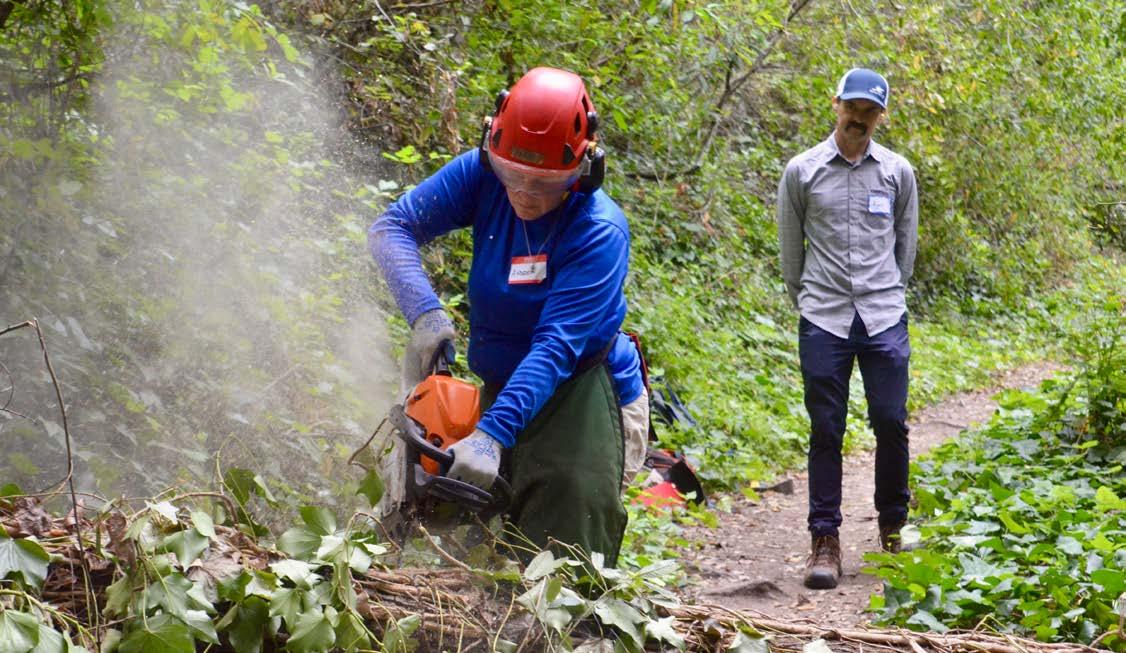
She made three cuts, turned the obstruction into short logs, and she and Ryan rolled them off the trail.
“There they go, into the sea of ivy,” she said. The ivy is what the other 48 volunteers were working on.
“Ivy tends to choke out native ferns and other native plants and then when it climbs trees, it’ll choke a tree eventually,” said Robin Stockwell, president of the board of directors of Advocates for Nisense Marks State Park. “And when it climbs a tree, it

gets to a maturity that it’s dropping seed from there down into the lower forest area, and then birds spread the seed. So if we can kill the ivy on the trees, we can eliminate that propagator. And if we pull the ivy on the ground, eventually we’re making progress clearing the ground of ivy.”
Stockwell said the group began Native Forest Restoration program just over a year ago, on June 6, and the results are already evident. “You can see where we removed the ivy over the last year, you can really see the sword fern is starting to blossom more. The sword fern really appreciates that exposure, plus they’re
not competing for the nutrients and water and all that.”
The Advocates nonprofit has been in existence for about 35 years, Stockwell said, but it’s been recently rejuvenated. He came to the board three years ago. After he’d joined, he discovered the Advocates had lost its 501(c)(3) status.
“It’s been a rebuilding process,” he said. “We’ve rebuilt the vision of what the Advocates is for, what we do and we’re rebuilding the relationship with the park. It’s required a lot of work.”
“Nisene Marks Volunteers” page 24
Andrea Lee of Felton and Ryan Brady of Santa Cruz remove a tree that was blocking a trail at Forest of Nisene Marks State Park on June 21.
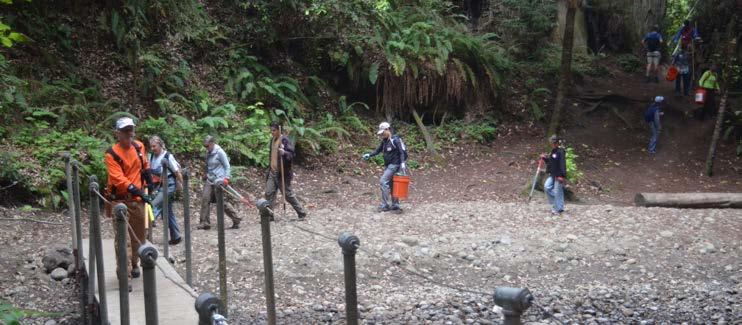
Volunteers cross a seasonal bridge that was recently erected by the volunteer group.
Soquel District Names Heather Herbst Principal of Main Street Elementary
SOQUEL — The Soquel Union Elementary School District has appointed Heather Herbst as the new principal of Main Street Elementary School.
Herbst, who has more than 27 years of public education experience, officially began her position July 1 following approval by the district’s Board of Trustees.
She most recently served as principal of Rose Avenue Elementary School in Modesto City Schools, where she spent the past nine years leading the campus with a focus on student achievement, instructional leadership, staff development and fostering positive school communities.
Before becoming a principal, Herbst served as a vice principal, instructional coach, Title I coordinator and classroom teacher, giving her experience in multiple aspects of elementary education.

Superintendent Scott Turnbull said Herbst’s background and leadership approach made her a strong fit for the district.
“Troop 599” from page 16
Current and former 599 Scouts and Leaders, their families, and community supporters are invited to attend and celebrate a century of Scouting memories, accomplishments, and service, a RSVP is required for this event.
The event will feature opportunities to reconnect with former troop members,
“Road Repairs” from page 11
Unlike a sales tax, a parcel tax would be paid by property owners rather than consumers and could provide a more stable source of transportation funding. It also would require voter approval.
“There’s a lot of different tools at the county’s disposal to look at augmenting
“Heather brings a wealth of leadership experience, a clear commitment to student success, and a passion for building strong partnerships with families, staff and the broader community,” Turnbull said in a statement. “We are confident she will be an exceptional leader for Main Street Elementary.”
District officials said Herbst stood out during the selection process for her student-centered leadership, collaborative approach and commitment to building strong relationships with students, staff and families. They said her emphasis on creating a positive and inclusive school culture aligns with the values of Main Street Elementary and the district.
The district said it is working with Herbst to support her transition from Modesto to Santa Cruz County and provide opportunities to connect with school staff and families before the start of the 2026-27 school year.
Herbst is expected to welcome students to campus when classes begin in early August. n
share stories from across the decades, and honor the many volunteers, families, and community partners who have helped make Troop 599 a lasting institution in the Pajaro Valley. n




For additional information and to register for the event, please visit t599. org. Questions may also be directed to celebrate100@t599.org.
current transportation funding,” Friedrich said. No new revenue source was recommended in the report. Staff said the upcoming consultant analysis will evaluate potential revenue yields, approval requirements, implementation timelines and community impacts before returning to the board. n
Heather Herbst
Live Oak Landing Opens
Expands Interim Housing and Pathways to Permanent Housing in Santa Cruz County
SANTA CRUZ After planning, renovations, and a lengthy permitting process, Housing Matters is proud to announce the opening of Live Oak Landing, a new interim housing community that will provide shelter, support, and on-site services for individuals experiencing homelessness who are currently living in encampments in the Harvey West neighborhood.
The opening marks an important milestone in Santa Cruz County’s ongoing efforts to address unsheltered homelessness by creating safe, dignified places for people to stabilize while working toward permanent housing.
While renovations at Live Oak Landing were completed months ago, the community experienced an extended delay before participants could move in due to the time required to complete final permitting and occupancy approvals. Although these delays postponed the opening, Housing Matters remained committed to ensuring the project met all regulatory requirements and safety standards.
“We appreciate the collaboration of everyone who worked to bring this project across the finish line, said Phil Kramer, Housing Matters CEO. Today, our focus is on welcoming participants and helping them take the next step toward permanent housing.”
Live Oak Landing represents a significant investment by the State of California through the Encampment Resolution Fund, in partnership with the City of Santa Cruz and Housing Matters. Participants will have access to private accommodations, meals, case management, behavioral health support, housing navigation, employment assistance, and connections to healthcare and other critical services. The goal is not simply to
“Nisene Marks Volunteers” from page 22

provide a safe place to stay, but to empower each participant to successfully transition into permanent housing. Interim housing is a proven strategy for reducing unsheltered homelessness because it offers immediate safety and stability while giving service providers the opportunity to build relationships, address barriers to housing, and connect participants with the resources they need to move into permanent homes. Live Oak Landing is one important part of Santa Cruz County’s broader homelessness response system, complementing permanent supportive housing, affordable housing development, and homelessness prevention efforts.
Brady, who joined the organization two years ago, is an ultra marathon runner who lives in Santa Cruz. He likes to run the trails, but noticed they needed work. He said when he first started coming to help on trail days there were less than a dozen people. “And now it’s like 50 people; it’s grown a lot.”
Volunteers used to meet at kiosk at the park entrance, where a few parking spots would be saved. Now they meet every third Sunday of the month at the Santa Cruz Community Foundation in Aptos at 9:30 a.m. and carpool to the park to claim about 10 spots that are saved.
“Our goal has been to increase numbers,” said Stockwell. “Today we had 50 signed up, so our productivity has gone way up. Our trail day is a fun, exciting event and what we’re tapping into right now is that a lot of people love this park and they’ve never had an avenue to share that. We’re that avenue. We’re the boots on the ground.”
Stockwell said among the Advocates’ future goals are to map the trails and create better signage, improve the interpretive section of the park. n
The project was made possible through the collaboration of public agencies, community partners, funders, neighbors, and advocates who shared a commitment to improving outcomes for people experiencing homelessness.
“We are deeply grateful to the funding partners, project team, neighbors, elected leaders, and community members who remained committed to this project throughout the process,” said Larry Imwalle, City of Santa Cruz, Director of Homelessness Response & Community Programs. “Live Oak Landing demonstrates what is possible when a community invests in practical, compassionate solutions that
help people move from homelessness toward housing.”
Housing Matters will begin welcoming participants immediately, with move-ins occurring in phases over the coming weeks. n
Housing Matters is the largest provider of homelessness services in Santa Cruz County. Through shelter, street outreach, supportive services, interim housing, and permanent supportive housing programs, Housing Matters helps empower people on their pathway from homelessness to permanent, stable housing while advancing solutions that strengthen the entire community. Learn more at www.housingmatterssc.org or connect with us on Facebook, Instagram, or LinkedIn.
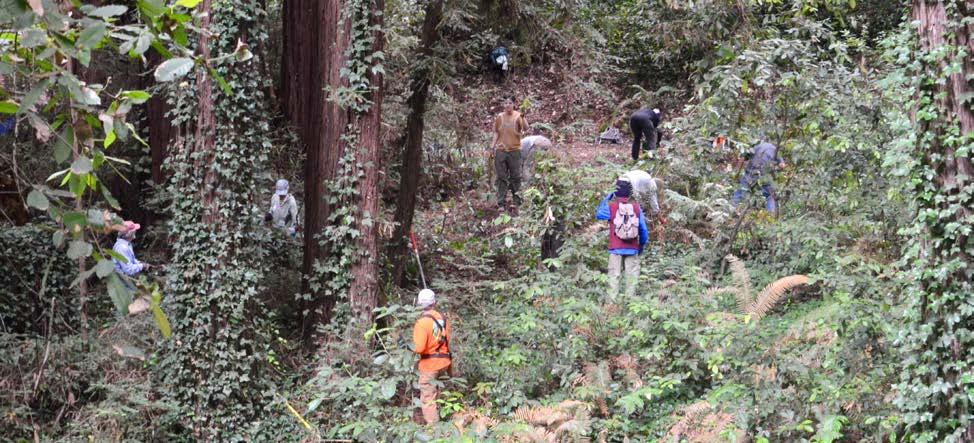
Santa Cruz Inn before being converted to Live Oak Landing
Volunteers remove invasive ivy at Forest of Nisene Marks State Park on June 21.
Cabrillo Festival of Contemporary Music
‘We the Dreamers’ to Explore Themes on Democracy and Freedom July 26
As the United States marks its 250th anniversary, the Cabrillo Festival of Contemporary Music is preparing a season that asks audiences to consider not only the nation’s history, but its future.
The internationally recognized festival will return to Santa Cruz from July 26 through Aug. 9 with “We the Dreamers,” a two-week exploration of identity, democracy, memory and belonging through the work of some of the world’s leading contemporary composers.
Now in its 64th season, the Cabrillo Festival is a premier showcase for new orchestral music, known for bringing composers and audiences together in a uniquely collaborative environment. This year’s festival will feature four world premieres commissioned by the organization, eight West Coast premieres and two U.S. premieres, along with appearances by more than 20 composers and a diverse roster of guest artists.
Festival leaders say the season’s title was inspired by both the nation’s semiquincentennial celebration and contemporary debates about who is included in the American story.
“We the Dreamers is both an invitation and a responsibility,” Music Director Cristian Măcelaru said in announcing the season. “At this historic moment, we are asking how music can help us imagine a more expansive ‘we’ — one that listens deeply, embraces complexity and dares to hope.”
The season opens July 31 with “On Freedom,” a program examining the distance between America’s democratic ideals and lived realities.
Among the most anticipated works is the West Coast premiere of Philip Glass’s “Symphony No. 15 Lincoln,” a six-movement work incorporating the words of Abraham Lincoln, including passages from the Emancipation Proclamation and writings on law, democracy and political division. The performance, featuring Grammy Award-winning baritone Zachary James, comes at a moment when questions about civic unity and democratic institutions remain at the forefront of public life.
The concert also includes two world premieres. Composer Vivian Fung will unveil a new work inspired by “The Star-Spangled Banner” and informed by her experiences as a Canadian-American citizen with Chinese family roots. Portuguese composer Pedro Emanuel Pereira’s new Clarinet Concerto, featuring soloist Carlos Ferreira, blends traditional musical influences with contemporary techniques.

The following evening’s concert, “Defiant Dreams,” centers on resistance, cultural continuity and perseverance.
The program opens with Leilehua Lanzilotti’s “of light and stone,” inspired by Hawaii’s “Heavenly Four” monarchs and their role in preserving Native Hawaiian culture. Pianist Alexandra Dariescu will then perform James Lee III’s “Shades of Unbroken Dreams,” a work reflecting on Martin Luther King Jr.’s “I Have a Dream” speech and its enduring call for justice and equality.
A centerpiece of the concert will be the world premiere of a new work by Sarah Hennies, commissioned through the festival’s Creative Lab initiative. Drawing on studies of psychology and cognition, the composition uses the orchestra to explore questions of identity, memory and human consciousness.
The festival’s third major orchestral program, “Control,” takes place Aug. 8 and examines the forces that shape contemporary life.
A highlight will be the world premiere of “Kontrol” by Clarice Assad, a multimedia work combining narration, projections, solo violin and orchestra to investigate the relationship between technology and human autonomy. Violinist Philippe Quint will serve as featured soloist.
The program also includes “Defending Greenwood (Movement III: June 1, 1921)” by Jackson A. Waters, winner of the 2026 Cabrillo Emerging Black Composers Prize. The composition memorializes the Tulsa Race Massacre and seeks to counter historical erasure through music.
Another West Coast premiere, Hannah Ishizaki’s “Spin,” merges elements of Viennese waltz traditions with electronic dance music influences. The concert concludes with the U.S. premiere of Romanian composer Dan Dediu’s “Concerto for Orchestra,” dedicated to Măcelaru and celebrating the artistic partnership between conductor and composer.
The season concludes Aug. 9 with “Hope as Our Banner,” a program focused on resilience, possibility and belonging.
“Music Festival” page 27

Kids’ Classics

subordinate
Snail mail replacement
Says “What?”
As opposed to yeses
*Mystery solver
Half of NFL
Rugged rock
Cecum, pl.
Lion sounds
Relating to anode

South & North Nodes | Direction & Destiny — Past & Present/Future

“Water Wisdom” from page 21
There are many potent changes occurring in the heavens these days, signifying many changes, transformations and challenges precipitating here on earth, too (Earth reflects the heavens).
Last Sunday, in the heavens, the Nodes of Destiny (south/north nodes-direction) changed signs. From Virgo/Pisces to Leo/Aquarius. The nodes are points in space where the Moon’s orbit crosses the Earth’s orbit around the Sun. In astrology the nodes represent the energies of yin/yang, reflective/expressive, receptive/radiating, Moon/Sun, past/present-future. The nodes, naturally retrograde, are always opposite each other.
The South Node holds our talents, gifts and abilities cultivated in previous lifetimes. The North Node gathers, recapitulates and renews the South Node talents, moving us forward into our present/future purpose. The North Node (along with our rising sign) lead us to the work (dharma), talents and abilities to be unfolded in this lifetime. The North Node is our North Star. In Vedic astrology, North Node is called Rahu, the South Node Ketu.
As the nodes shifted into Aquarius North Node and Leo South Node, we note the significance of Aquarius North Node. Our Sun is presently entering the atmosphere and air of Aquarius, remaining in Aquarius for the next 2,500 years.

When nodes change (every 18 months), new learnings, tasks, responsibilities and developments are presented to humanity. Humanity’s interests and patterns of behavior change, too. A new tone, sound, vibration and color enter the Earth.
ARIES (Mar 21 – Apr 9)
The focus of intention and aspiration is on communication (how) and values (what are they?). The two are linked. There is also possibly a wound around each. The more we value self and others, the more ability we have to communicate with kindness and benevolence. It would be good to consider yourself a World Server. One who always acts from Goodwill which creates compassion and Right Relations. A new identity, perhaps.
TAURUS (Apr 10 – May 20)
You deeply influence others. There’s a magnetic appeal and charm radiating from you that many are attracted to. You’re like a light in the darkness, harmony calming chaos, beauty easing the storms. When there’s a problem, when the general state of affairs is disrupted, it’s to Taurus that all eyes turn for direction and understanding. New projects need initiating. However, before doing so, you need a deep, healing rest in solitude.
GEMINI (May 21 – Jun 20)
You may encounter various interactions that include contracts, superiors, officials, parents, leadership and work responsibilities. While interacting with important people, your leadership skills are recognized and applauded. Many things hoped for come into focus. If parents are alive, be very aware of their needs. If they are no longer in physical form, recite Ohm Mani Padme Hum (Tibetan Mantram of Compassion). Do not disregard rules, laws, orders, your credit or a mountain far away that beckons.
CANCER (Jun 21 – Jul 22)
Some group or groups are very vital to your well-being now. They provide initiating ideas, a new sense of identity, a social milieu leading to opportunities where visions can be shared. Over time, new people may come into your life or perhaps community projects will emerge, with tasks only you can successfully complete. Whatever the situation, determine your ideals, hopes, wishes and dreams. And move towards them with a one-pointed,, focused mind. Do not ignore friends.

The North Node of Aquarius thus aligns with the new path appearing. Aquarius, the sign of humanity, focuses on freedom and cooperation, offering the new tool and language and study needed by humanity — astrology. Leo’s South Node calls humanity to recognize and cultivate its creativity. Aquarius will ask each of us what talents, gifts and abilities will we offer to the unfolding new world. Aquarius calls humanity to re-enter the Garden. What will you bring to the Garden this time? What will your tasks be?
As for the Aquarian tool of astrology — Astrology, the purest presentation of occult truth. It’s scientific. Describing the energies within the space we live in. Everything we learn in astrology helps us develop our awareness. Astrology has an inherent language based on symbols, geometries and numbers. Knowing and studying astrology removes all opinions and criticisms and judgments of self and others. We realize nothing is wrong with this paradise we live in. Everything is perfect, in right timing, magical and love underlies all happenings. n
LEO (Jul 23 – Aug 22)
This is your birthday month. We hope for you friends and frivolity, cakes and cupcakes, games, parties and intelligent conversation to celebrate (more than one day is best) your new year. Birthdays aren’t really felt and don’t actually occur until we contact our protecting angels, presenting them with a coming-year job description of our hopes, wishes and needs and ending our birth day with deep gratitude. Happy Birthday, in advance. Solitude and retreat in community are best. Partying, too!
VIRGO (Aug 23 – Sep 22)
Reality appears in ways different than before. Your perception alters, becoming more refined. This continues through the coming months. Let confusion become a potential for growth, defining new daily structures. Be aware of the quality of your communication. Virgos talk continuously in order to understand and integrate their thoughts to themselves. Listen to yourself more. What are you trying to say? Then try a bit of silence. See what it tells you. Listen to the birds at dawn as you sit in the new morning’s sunlight.
LIBRA (Sep 23 – Oct 22)
You have many secret talents hidden behind your charm and smile. Libra is always and forever charming. Charm is Libra’s main virtue. However, behind the charm is a power which many don’t realize. This power shows itself as discipline, responsibility, and a deep seriousness sometimes misunderstood as gloom. A restructuring of your self-identity is occurring. This is then shifting your creativity – a new creativity is appearing. We know ourselves by what we create. Should a wound appear, conserve your strength, paint, draw, dance, and play more. It’s cherry season.
SCORPIO (Oct 23 – Nov 21)
Family is most important. Are they your allies, intimates and friends? Do you have partners and/or competitors? Are you considering a change of environment due to a shift in interests, a call to a new state of livingness, a new foundation of new values? What are others requesting of you? Do you have the strength for this or must you gather different friends and acquaintances to help you? Through daily life demands, you find yourself developing emotional poise and making certain life decisions. You are always the warrior.
SAGITTARIUS (Nov 22 – Dec 21)
So much work to do, so many people to communicate with, so many things to create, fulfill, so many demands, everyone depending on you for things great and small, here and there. At times you sense the past drifting about, in the ethers, the air, the shadows. It can be exhausting without reprieve. Everything is a focus for you — from surroundings to people to daily work methods to nourishment to a state of stability — a central concern. Let everything fall away. Stand still, be still. Something else is there.
CAPRICORN (Dec 22 – Jan 19)
What are the main objects of your affection? What do you value the most? What calls forth your interests, creative talents and activities? You are a leader. Answers to these questions are important for your identity in the world. A good leader always is curious about, promotes and strengthens the interests of others. This produces within a love that others, in gratitude, have for you. Define your new daily goals for health and well-being. Write more. Especially about what you value and what you need.
AQUARIUS (Jan 20 – Feb 18)
Everything for a while concerns communication, friends, neighbors, home and family, children, property and foundations, parents and elders, creating and nurturing things that make up your life. The foundations referred to concern daily life achievements. Think in practical ways how to improve all environments you find yourself in. Pay attention to what sustains, comforts and soothes you. And what allows you to be creative? Home needs an expansion.
PISCES (Feb 19 – Mar 20)
You need communication that is kind and giving, contacts that sustain a home and its comforts, environments inviting your knowledge and wisdom to come forth. Should you find yourself with people and places that do not provide these or understand you, change your environment. There’s no more proving yourself, no more offering and giving of self to those who cannot see, understand, hear, or receive. You’re called elsewhere. It’s a religious sort of place, maybe an ashram, or a village community that’s Aquarian, with a warm swimming pool. I can see it. Can you?
Planning and designing these treatment facilities today ensures the District can continue delivering water that meets or exceeds all drinking water regulations while protecting public health for decades to come.
Strengthening Regional Partnerships
Water reliability goes beyond individual service area boundaries, and regional collaboration is becoming increasingly important throughout California.
The District continues working with neighboring agencies to explore opportunities for emergency interties, operational coordination, and potential water transfer agreements that could improve regional resilience during droughts, emergencies, or other unforeseen events.
By working together, local agencies can create a stronger, more flexible water system that benefits the entire community.
Looking Ahead

The District’s Board of Directors is also considering updates to several longrange planning documents and water shortage declarations to reflect today’s conditions. These actions recognize the progress our community has made through conservation, infrastructure investments, and the implementation of Pure Water Soquel, while acknowledging that responsible water use remains essential.
Conservation continues to be one of the most valuable tools for protecting our groundwater basin, and the District’s permanent Rules of Water Waste remain in effect regardless of water shortage stage.
The updated Community Water Plan is more than a summary of completed projects — it is a roadmap for the future. It reflects years of thoughtful planning, community investment, scientific research, and regional collaboration.
Most importantly, it demonstrates that protecting our local water supply requires continual improvement, innovation, and long-term stewardship.
As we look ahead to the next three to five years, the District remains focused on implementing projects that strengthen water reliability, maintain high water quality, modernize critical infrastructure, restore our groundwater basin, and build partnerships that benefit the entire region.
Our community has accomplished a great deal together over the past decade. While there is still important work ahead, the updated Community Water Plan reflects a simple but meaningful message: by continuing to plan ahead and invest wisely today, we are building a resilient water future for the generations that will call this community home. n
Firefighter Moonlights as Marine Biologist Wonders of the Ocean Have Always Drawn Fascination
By JON CHOWN
He’s no scientist, but Eric Mailander, 60, has learned a lot about marine life during his years. In fact, he’s learned so much that scientists from the Shark Lab at California State University Monterey Bay have come to him for information and now he helps their research.
Mailander owns a cabin Ben Lomond and has worked for the San Jose Fire Department as a firefighter/paramedic for 20 years. He is also an amateur photographer and loves wildlife, especially Marine life. It’s been a passion of his since watching the Undersea World of Jacques Cousteau on TV as a child. At age 11 he was already scuba diving.
“I wanted to be a marine biologist,” he said. “I went a separate route, but it’s still a hobby.”
Mailander is often out in the water taking photos of sharks and other marine life. He’s been studying most everything that swims the Monterey Bay for many years. He would often send photos to the Shark Lab, and then he started doing drone surveys on his own and relaying that information. Eventually he was invited to help with a scientific paper the lab was working on. After that, more work, all of it as a volunteer, followed.
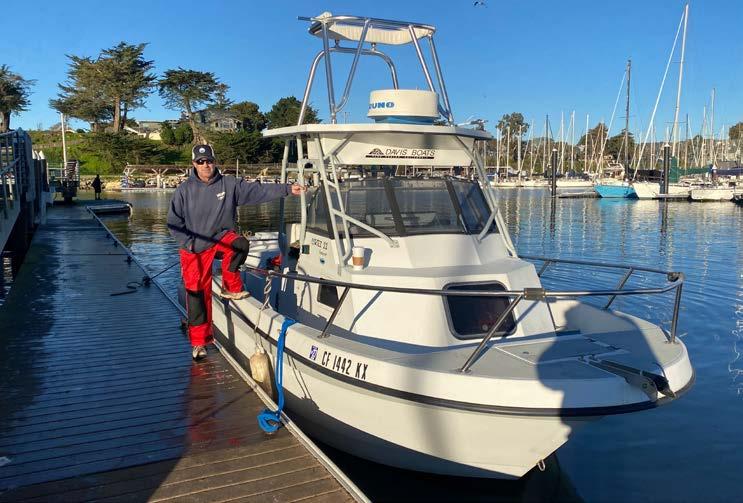

Mailander said that if you are in the water and see a shark, stay calm. Don’t paddle or kick. “Don’t go crazy. The shark will check you out and leave.”
Mailander was recently at Ano Nuevo Island helping to tag sharks and complete DNA studies. He was even asked once by the Discovery Channel to take part in a
“I get to work under their permits. I get to take pictures and help science. It’s very rewarding,” he said.

“Music Festival” from page 25
Featured works include Indonesian composer Eunike Tanzil’s “Ascending Creatures,” inspired by the synchronized movement of birds in flight, and Lisa Bielawa’s violin concerto “Pulse,” performed by acclaimed violinist Tessa Lark. Drawing on Appalachian fiddle traditions and contemporary orchestral writing, the work explores themes of shared movement and momentum.
The evening also includes the U.S. premiere of Elena Kats-Chernin’s “Rainbow Promise,” a celebration of marriage equality that reflects on both triumph and struggle, and Sean Shepherd’s “Wanderlust,” a musical meditation on travel, identity and the search for home.
Following the Grand Finale, former U.S.
Poet Laureate Rita Dove will present a special performance of original poetry honoring the life and legacy of Martin Luther King Jr., accompanied by Samuel Barber’s “Adagio for Strings.” The presentation marks the West Coast premiere of the work and serves as a reflective conclusion to the season.
Beyond its headline concerts, the festival continues its longstanding commitment to education and artistic development.
This year’s Conductors/Composers Workshop will bring together four emerging composers — Oswald Huynh, Kai KubotaEnright, Paul Novak and Zoe Verduin who will work with resident composers and members of the Festival Orchestra before presenting new works during the workshop’s culminating “In the Works” concert.
The workshop has expanded this year
project for Shark Week, but he said it would have interfered with his real job.
Readers might recognize his name from social media. He is often posting photos of sharks and other animals on Aptosia and other local pages. He will occasionally get his friend Chris Guillarte to help him. Guillarte owns Specialized Aviation in Watsonville and will fly the two up in his helicopter to look at what’s in the ocean. Mailander said he wants to educate people about the ocean and sharks. People should not fear them, he said.
“People really fear our sharks. They get really close, but they’re not here to attack people,” he said. “When people see these sharks I want them to feel privileged to see them, not to fear them.”
through a partnership with Luna Composition Lab, the national organization founded by composers Missy Mazzoli and Ellen Reid to support young female and nonbinary composers.
The festival will also present its popular free Family Concert on Aug. 2. Led by Conductor-in-Residence Octavio Más-Arocas, the event features Paul Dooley’s interactive “The Conductor’s Spellbook,” Gala Flagello’s fanfare “Bravado,” and opportunities for audiences to learn about orchestral instruments. Students from El Sistema Santa Cruz/ Pajaro Valley will also perform alongside festival musicians.
Executive Director D. Riley Nicholson said the festival’s mission extends beyond presenting new music.
“Dreaming isn’t passive,” Nicholson said. “Across orchestral concerts, free
One way to be safer is to not swim among seals and sea lions, where you might get mistaken for their prey. Also, Mailander said most shark attacks happen in the fall or winter, when sharks are returning from the deep ocean hungry, looking for food.
There’s no reason to shorten your summer fun because of sharks, he said.
This summer is especially interesting, Mailander said, due to the extreme El Niño. With the ocean being so warm in Southern California, a lot of marine life is moving up to the Monterey Bay that we would not normally see.
“The abundance of sea life out there is incredible. We’re getting a lot of vagrants in the area: leather back turtles from New Guinea, tropical birds, bluefin tuna, blue whales. It’s a sure sign El Niño is hitting,” he said. “The water is warmer, so everything that’s usually down there, we are going to see up here. We might even see marlin and sail fish.” n
public events and community-centered programming, ‘We the Dreamers’ brings together visionary composers, rising voices, performers and audiences in a shared commitment to envisioning futures grounded in equity, curiosity and creative freedom.”
For Santa Cruz County audiences, the season offers a rare opportunity to hear works that are often being performed for the first time anywhere in the world while engaging with artists exploring some of the defining questions of contemporary life. n
The Cabrillo Festival of Contemporary Music runs July 26 through Aug. 9 at the Santa Cruz Civic Auditorium, 307 Church St., Santa Cruz. Many events are free and open to the public. Tickets and information are available by calling 831-426-6966.
Eric Mailander and his boat.
COMMUNITY CALENDAR
ANNOUNCEMENTS
MARY ALTIER’S PHOTO EXHIBIT AT APTOS LIBRARY
Mary Altier’s photo exhibition, Around the World with Color Photography is on display at the Aptos Library until Sept. 30.
The show includes 60 images taken in Papua New Guinea, China, Italy, India, several countries in Africa, and more.
A reception promoting the exhibit will take place Sat., Aug. 1, 1:30-4:30 p.m.
Refreshments, wine and waters, and ongoing slide show of recent work. Free and the public is invited.
Aptos Branch Library, 7695 Soquel Dr. Hours: M-Th 10-7, F-Sat, 10-5. Closed Sunday.
SENIORS SOUGHT FOR THEATER GROUP
Seniors are being sought to join the Market Street Theater Group.
Whether you love being on stage or helping behind the scenes, there’s a place for you in their community.
Discover the power of music, dance, and performing by calling 831-423-6640 or email marketstreettheater@ gmail for more information.
ONGOING EVENTS
Mondays
BRIDGE CLUB
10:30 a.m.-Noon, 7695 Soquel Dr, Aptos, CA 95003
The Aptos Branch Library hosts Bridge Club sessions on Mondays (except holidays).
Bridge Club is a partnership between Santa Cruz County Parks and Santa Cruz Public Libraries.

Register at scparks.com or in-person the day of the event.
OVEREATERS ANONYMOUS
7 p.m., Congregational Church Preschool Meeting Room, 4951 Soquel Ave., Soquel
Overeaters Anonymous welcomes any type of eating disorder or problems with food.
No dues, fees or weigh-ins.
Meetings take place at Congregational Church in the preschool meeting room. All are welcome.
Overeaters Anonymous (OA) has meetings daily both in-person and on-line in Santa Cruz County at santacruzoa.org.
Fourth Mondays (Third Monday in May due to Memorial Day) THE SPOKEN EXPERIENCE
Noon – 1 p.m., Capitola Branch Library, 2005 Wharf Rd
Each month a community of readers gather to share selections from a featured poet.
Join local poets Paola Bruni, Elaine Fletcher Chapman and Jessica Cohn as they lead the discussion.
Upcoming poet focus:
August 24: Lucile Clifton
September 28: Sharon Olds
October 26: Juan Felipe Herrera
November 23: Ada Limon
December 28: Jericho Brown
Tuesdays
TUESDAY NIGHT SALSA SOCIAL
7 – 10 p.m., Abbott Square Market, 725 Front St., Santa Cruz
Join a midweek salsa social at Abbott Square Market with salsa, cumbia, merengue, and bachata.
Free and open to all skill levels—just bring energy and dancing shoes.
More information: www.abbottsquaremarket.com
BINGO AT MCSC
Have a virtual or live event you want to promote? E-mail info (no PDFs please) to info@cyber-times.com
1-3 p.m., Mid County Senior Center, 829 Bay Avenue, Capitola (behind the Party Store)
Hot Dogs, Chili and snacks available for purchase courtesy of our Snack Shack. A lot of fun for all and a possible big win!

Door opens at 12:15 p.m.
Tuesdays and Fridays
NORTH BOOKMOBILE AT PAJARO PARK
Tues.: 3 –5 p.m. | Fri.: 2-3:30 p.m., Pajaro Community Park, 24 San Juan Rd.
The Monterey County Free Libraries North Bookmobile serves Pajaro with scheduled visits, offering books, audiobooks, DVDs, magazines, and bilingual materials in English and Spanish.
Upcoming Dates:
Tues: Aug. 4, 11, 18, 25 Fri: Aug. 7, 14, 21, 28.
For full schedule, visit https://tinyurl.com/Pajaro-Parkbookmobile-visits.
Thursdays
SCOTTISH COUNTRY DANCING
7:15-9:15 p.m., Peace United Church 900 High St, Santa Cruz. Beginners welcome, partners not required. $10 each. Come dance!
HAPPY HOUR
5-7 p.m., California Coffee, 9105 Soquel Drive, Aptos California Coffee in Redwood Village hosts an open mic happy hour every week.
Thursdays in August
CROW’S NEST FREE BEACH BBQ CONCERT SERIES
5:30–8 p.m., Santa Cruz Harbor Beach, 2222 E Cliff Dr.
The Crow’s Nest Free Beach BBQ Concert Series features live music, BBQ food and drinks for purchase, and oceanfront views at Santa Cruz Harbor Beach.
Aug. 6: The Houserockers
Aug. 13: The Joint Chiefs
Aug. 20: La Familia
Aug. 27: Alex Lucero Band Free admission. Parking is limited; a free water taxi is available from nearby lots. More info at https://www.santacruz.org/upcoming-events/.
Third Thursdays
SIP AND STROLL
6-9 p.m. (check-in 5 p.m.), Seacliff Inn, 7500 Old Dominion Court, Aptos Come to the Seacliff Inn: Tapestry Collection by Hilton, for a Sip & Stroll event where local artists to show and sell their works.
SANTA CRUZ DINNER CLUB
First Sundays
5 p.m., various member homes throughout county Looking to make new friends while enjoying amazing food and great wine?
The SC Dinner Club is welcoming new members! Each month, we gather in homes throughout Santa Cruz County for delicious dinners, fine wine, lively conversation, and lots of laughter.
Wines are 30% off, and the featured winery will offer tastings of three varietals for $10 per person. Details of this and more Sevy’s events at www.sevysbarandkitchen.com/events
Fridays (except First Friday of the Month) LA SELVA BEACH LIBRARY BRIDGE GROUP
10:30-Noon, La Selva Beach Public Library, 316 Estrella Ave. Come for bridge from 10:30 to noon at the La Selva Beach library. Call La Selva Beach Library to reserve your seat: 831-427-7710.
First and Third Fridays
JIM GREINER’S HANDS-ON! DRUMMING
7-8:30 p.m., Congregational Church of Soquel, 4951 Soquel Dr. Percussionist/educator Jim Greiner continues his Community Rhythms Class on the first and third Fridays of every month at the Congregational Church of Soquel. All levels of experience are very welcome to this family-friendly community gathering. Jim provides percussion instruments and you are welcome to bring your own.
Come play, socialize and reinforce Jim’s fundamental themes of communicating, collaborating and celebrating through rhythm!
$10 donation is requested. Doors open at 6:30.
Last Friday of the Month thru October FOOD TRUCK FRIDAY AT SKYPARK
5–8 p.m., Skypark, 361 Kings Village Road, Scotts Valley Food Trucks A Go Go presents an evening of local eats, live music and activities for all ages.

The monthly event supports Scotts Valley schools through beverage sales and offers a welcoming community gathering. Admission is free.
For details, visit foodtrucksagogo.com.
First Saturdays
CAPITOLA BEACH CLEANUP
9-10 a.m., Esplanade Park
Help preserve and maintain the coastal beauty of Capitola. Join a beach cleanup every month at Esplanade Park.
Keep Capitola Salty is a grassroots movement dedicated to responsible efforts helping to maintain and preserve the environment, scenic beauty and coastal recreational activities of Capitola.
This movement is always looking for volunteers. Email KeepCapitolaSalty@gmail.com.

Whether you love to cook, enjoy entertaining, or simply want to meet friendly people who share your interests, our dinner club is a fun way to build new friendships and create memorable evenings.
Come join us at the table! For more information, contact Rhonda Mills at rhondaloves2paint@gmail.com.
Second Saturdays
HISTORICAL AIRCRAFT DISPLAY
10 a.m.-4 p.m., Watsonville Municipal Airport, 100 Aviation Way Watsonville Municipal Airport hosts a Historical Aircraft Display every second Saturday. Admission is free.
Third Saturdays thru August
MUSIC ON THE GREEN
2-5 p.m., Aptos Village Patio (Behind New Leaf Market)
A new tradition is starting in the new Aptos Village. Music on the Green Summer Concert Series is making its debut this month.

Enjoy a live band for three hours on the third Saturday of July and August. Bring a lawn chair or just wander through the mini park behind New Leaf Market at the end of Parade Street as the bands play on the stage.
July 18: Suns of Surf (Coastal Roots Groove and Reggae) Aug 15: Alecia Haselton Band (Americana/Folk/Rock) Look for specials at the surrounding markets. Free to attend.
Saturdays and Sundays
ELKHORN SLOUGH: FREE TOUR OF THE PRESERVE
10 a.m. | 11 a.m., Elkhorn Slough Reserve, 1700 Elkhorn Rd., Watsonville
Docent-led tours offer visitors a guided introduction to Elkhorn Slough’s remarkable landscapes, wildlife, and tidal wetlands. Each walk is tailored to participants’ interests and abilities, creating an engaging, educational experience. Space is limited, and tours are first-come, first-served. Guests can sign up at the Visitor Center front desk or call ahead the same morning at (831) 728-2822 for availability.
First Sundays
SANTA CRUZ DINNER CLUB
5 p.m. at various member homes throughout county Love to cook, entertain and socialize? Our monthly dinner club events will be held in several homes throughout Santa Cruz County where members enjoy delicious meals, fine wine and conversation.
Joining the club provides a great opportunity to cook, to entertain, and to meet locals that share your interests. Want to join us? Learn more about the SC Dinner Club and the fun we have by contacting Rhonda Mills at rhondaloves2paint@gmail.com.
DATED EVENTS
Friday July 31
Saturday August 1
FIRST ALOHA MUSIC & ARTS FESTIVAL SANTA CRUZ 12–6 p.m. daily (gates open 11 a.m.), Santa Cruz County Fairgrounds, 2601 E. Lake Ave., Watsonville The inaugural Aloha Music & Arts Festival Santa Cruz is a free two-day celebration of Hawaiian, Polynesian, and Pacific Island cultures featuring local musicians, hula schools, artists, food vendors, and community organizations. Produced by Victor Ohana Productions LLC, the event highlights Santa Cruz County talent and cultural connections to the Pacific.
Attendees can expect Pacific-inspired cuisine, arts and crafts vendors, nonprofit information booths, and family-friendly cultural activities throughout the weekend. Admission is free, though donations are welcome. Parking is $20 per vehicle with no in-and-out privileges. Re-entry requires an additional fee.
More info available through Victor Ohana Productions LLC.
Saturday August 1
SANTA CRUZ MOUNTAINS BREWGRASS FESTIVAL Noon–6 p.m., Roaring Camp Railroads, 5401 Graham Hill Road, Felton
The sixth annual Santa Cruz Mountains Brewgrass Festival brings together live bluegrass music, local craft breweries and food trucks in the redwood forests of Roaring Camp. Featured performers include Sam Bush, Rainbow
Girls, Crying Uncle Bluegrass Band, Dominique and the Diamonds, Deep Thicket Dwellers and Wild Iris.
General admission includes access to music and festival activities, while VIP tasting train tickets are available. Children 11 and younger are admitted free. For tickets and information, visit scmbrewgrassfest.com.
Saturday August 1
Sunday August 2
WATSONVILLE STRAWBERRY FESTIVAL
11 a.m.–8 p.m. Saturday; 11 a.m.–7 p.m. Sunday, Downtown Watsonville
The Watsonville Strawberry Festival returns to downtown Watsonville for two days of family-friendly entertainment celebrating the Pajaro Valley’s most important crop.
Founded in 1994 to help revitalize downtown after the Loma Prieta earthquake, the festival features community groups, nonprofit fundraisers, food, entertainment and activities.
The weekend begins Saturday morning with the Strawberry Jam Fun Run and Walk, including 1K and 5K events.
Festival organizers encourage visitors to review road closures and event rules before attending.
For details, registration information and updates, visit watsonville.gov.
Thursday August 6
thru Sunday August 9
SECOND ANNUAL SANTA CRUZ JUG BAND FESTIVAL
Thu 5:45–7:15 p.m., Pono Hawaiian Grill, 120 Union St., Santa Cruz • Fri 6–9 p.m., Abbott Square Market & MAH, 725 Front St., Santa Cruz • Sat 12–9 p.m., Abbott Square Marketplace, 705 Front St., Santa Cruz • Sun 2–5 p.m., Shanty Shack Brewing, 138 Fern St., Santa Cruz
The Second Annual Santa Cruz Jug Band Festival takes place at multiple locations with free performances, workshops, and sing-alongs across downtown Santa Cruz venues.
Highlights include a kickoff jam at Pono Hawaiian Grill, MAH presentations, Abbott Square concerts featuring five bands, and a Sunday finale at Shanty Shack Brewing. Contact thetrolleydrops@gmail.com for information.
Saturday August 8
JAM AND THE BUTTERED BISCUITS
8 p.m.–12 a.m., The Sand Bar Capitola, 211 Esplanade The Monterey Bay–based JAM and the Buttered Biscuits bring bluesy funk rock to Capitola, featuring songs from Jeffrey A. Meyer’s albums “Wilder Times” and “Colors of the Mind,” plus new material.
The lineup includes bass, drums, guitar, harmonica and vocals, delivering a high-energy coastal sound.
Sunday August 9
SANTA CRUZ ANTIQUE FAIRE
9 a.m.–5 p.m., Downtown Santa Cruz, Lincoln Street between Pacific Avenue and Cedar Street
The Santa Cruz Antique Faire returns with dozens of vendors offering antiques, vintage clothing, collectibles, unique finds and more.
The monthly event takes place the second Sunday of each month, weather permitting. Visitors can browse one-of-a-kind treasures and vintage items. For more information, visit www.facebook.com/santacruz antiquefaire/#.
COMMUNICATING WITH NATURE: A MAGICAL EXPERIENCE
2:30–4 p.m., Capitola Public Library, 2005 Wharf Road
Biologist and nature communicator Coleen Douglas leads a free 90-minute experience featuring a discussion and outdoor walk focused on connecting with trees and nature.
The author of “Nature Spirits Want To Talk With Us” shares practical guidance, magic and fun. Reserve a free spot at tinyurl.com/3fcutmjb.
COMMUNITY CALENDAR

FARM TO FORK BENEFIT DINNER AT UCSC FARM
Saturday August 29
4 p.m. reception and farm tours; dinner follows, 7 p.m. dancing, UCSC Farm, 152 Farm Rd, Santa Cruz This benefit evening at the UCSC Farm features a reception with tours, followed by a locally sourced dinner highlighting produce from the Center for Agroecology and partners. Guests then move to the Hay Barn for live music and dancing. Proceeds support Farm to Fork and agroecology programs. More info: eefoley@ucsc.edu or https://events.ucsc.edu/event/farm-to-fork-2026/.
Tuesday August 11
VIDEO GAME TOURNAMENTS
4:30 p.m.–5:30 p.m., Watsonville Public Library Main Library
Meeting Room, 275 Main Street Suite #100, Watsonville Monthly teen video game tournaments at the Watsonville Main Library invite students in grades 7–12 to compete and socialize using Nintendo Switch games. Winners receive prizes in a friendly, supervised environment designed to build community and gaming skills.
Future 2026 Dates: Sept. 8, Oct. 13, Nov. 10, and Dec. 8. More information: https://www.watsonville.gov/2327/Library.
Wednesday August 12 thru Friday 14
CALIFORNIA COASTAL COMMISSION MEETING
9 a.m., Hilton Santa Cruz/Scotts Valley, 6001 La Madrona Dr., Santa Cruz
The California Coastal Commission holds a three-day public meeting to consider coastal development permits, planning issues, enforcement matters and other business affecting California’s coast.
The meeting is open to the public. For agendas and details, visit coastal.ca.gov.
Thursday August 13
FREE BEACH BBQ PARTY WITH THE JOINT CHIEFS
5:30 p.m., Crow’s Nest, 2218 East Cliff Drive, Santa Cruz
The Crow’s Nest hosts a free beach BBQ party featuring live music from The Joint Chiefs, delicious barbecue and frosty beverages.
Guests can enjoy an evening of music, food and fun along the Santa Cruz waterfront. For details, visit crowsnest-santacruz.com.
Friday August 14
MOE’S ALLEY PRESENTS: AFROLICIOUS
8 p.m., Moe’s Alley, 1535 Commercial Way, Santa Cruz Bay Area funk-fusion collective Afrolicious brings a high-energy live performance featuring funky bass lines, powerful horns and sounds inspired by funk, disco, Latin and Afrobeat.
Doors open at 8 p.m., with music at 9 p.m. Tickets are $20 in advance or $25 day of show. For details, visit moesalley.com.
her new novel, a family-centered murder mystery about two sisters solving a crime while rafting the Grand Canyon.
The event follows her bestselling “Mother-Daughter Murder Night” success and includes audience discussion. Co-sponsored by The Humanities Institute at UC Santa Cruz.
More information at https://bookshopsantacruz.com.
Thursday August 20
SONS & DAUGHTERS OF ITALY WATSONVILLE MONTHLY DINNER MEETING
5–8 p.m., Watsonville Woman’s Club, 12 Brennan Street The Sons & Daughters of Italy Watsonville Lodge hosts its monthly dinner meeting featuring a catered meal by Busy Bees of Capitola.
The lodge also sponsors special events, including Festa Italia Monterey and Festa Italia Salinas. Dinner is $20 for members and $25 for nonmembers. Reservations are required by the Sunday before the meeting.
For details, contact the lodge at www.watsonvillesonsofitaly.org/.
Saturday August 22
BOULDER CREEK FIRE DEPARTMENT SUMMER BBQ DINNER & DANCE
Saturday August 15
CIVIC AUDITORIUM CONCERT: DIFRANCO & JUNE
7 p.m.–12 a.m., Santa Cruz Civic Auditorium, 307 Church St. Grammy-nominated singer-songwriters Valerie June and Ani DiFranco share the stage for an evening of genreblending folk, soul, and Americana. Known for powerful vocals and socially conscious songwriting, the concert highlights two acclaimed artists with distinct styles.
Expect an energetic live performance at the Santa Cruz Civic Auditorium, featuring songs spanning their acclaimed careers and collaborations.
LATE NIGHT @ THE MAH: BLACK TIE ROLLER BALL
7 –11 p.m., Santa Cruz Museum of Art & History, 705 Front St. This 21+ roller skate and dance party transforms the Solari Gallery at the Santa Cruz Museum of Art & History into a pop-up rink for a night of music, performance, and costumes. Guests must wear skates with toe stops or plugs; waivers required. Drinks and vendors available. Visit www.santacruzmah.org for details.
Sunday August 16
DOWNTOWN SANTA CRUZ MAKERS MARKET
10 a.m.–5 p.m., 1100 block Pacific Avenue, Santa Cruz
The Downtown Santa Cruz Makers Market features local artists, craftspeople and creators offering handmade goods, artwork, food and unique finds.
The free community event showcases the creativity of Santa Cruz makers in the heart of downtown.
For more information and upcoming market dates, visit https:// scmmakersmarket.com/downtown-santa-cruz-makers-market/.
COMMUNITY FUNDRAISER BINGO
2:30 p.m.–8 p.m., Aptos Grange, 2555 Mar Vista Dr.
Local nonprofit American Sign Language Services
Community hosts a bingo fundraiser at Aptos Grange supporting community programs and services.
Players of all ages participate in multiple rounds of bingo with prizes, social time, and refreshments available. Funds support ASL access and outreach efforts.
Monday August 17
NINA SIMON — MY SISTER IS GOING TO KILL ME
7 p.m.–8 p.m., Bookshop Santa Cruz, 1520 Pacific Avenue
Author Nina Simon presents a reading and signing of
5:30–11 p.m., Boulder Creek Fire Station, 13230 Central Ave. The Boulder Creek Volunteer Fire Department hosts its annual Summer BBQ Dinner & Dance featuring tri-tip and chicken dinners, live music from three bands, dancing, a bounce house and face painting. Proceeds support rescue and medical equipment for the all-volunteer department.
Tickets are $30. For details, visit bcfd.com.
REDWOOD GROOVE
8 p.m., Crow’s Nest, 2218 East Cliff Drive, Santa Cruz Redwood Groove brings an evening of live music designed to move and groove audiences at the Crow’s Nest. Enjoy a night of music and dancing at this Santa Cruz waterfront venue.
Tickets are $8. For details, visit https://crowsnest-santacruz. com/.
Sunday August 23
MIGHTY MIKE SCHERMER AND FRIENDS 60TH BIRTHDAY CELEBRATION
2 p.m., Moe’s Alley, 1535 Commercial Way, Santa Cruz Mighty Mike Schermer celebrates his 60th birthday with a special performance featuring friends and fellow musicians at Moe’s Alley.
The afternoon show highlights Schermer’s blues, soul and rock influences in a festive celebration of his career and music. Doors open at 2 p.m., with the show beginning at 3 p.m. For details, visit moesalley.com.
Saturday August 29
FARM TO FORK BENEFIT DINNER
4–9 p.m., UC Santa Cruz Farm, 100 McLaughlin Drive
The Farm to Fork Benefit Dinner features a reception, farm tours, local wine, appetizers and a seasonal meal highlighting produce from the UCSC Farm and local partners. Guests can enjoy music, dancing and dessert in the Hay Barn.
Proceeds support farm programs. For details, visit farm.ucsc.edu.
Sunday August 30
KOASTRONG FISHING DERBY AT CAPITOLA WHARF 7 a.m.–12 p.m., Capitola Wharf
This free, family-friendly fishing derby at Capitola Wharf invites anglers of all ages to compete in a weigh-and-release format with prizes for biggest, smallest, and most fish. The event honors KoaStrong’s mission supporting childhood cancer prevention and community connection through outdoor recreation. For details, visit koastrong.org or registration page. n
FEATURED COLUMNIST
When Your Child Is Afraid to Go Back to School
By DR. LORI BUTTERWORTH, Child & Adolescent Psychotherapist
Ilove the nostalgic smell of fresh pencils, new backpacks, and crisp notebooks. New clothes are folded and ready, calendars are filling up, and suddenly summer gives way to routines, homework, sports practices, and earlier bedtimes. Fall is here, and with it comes back-to-school season.
For many kids, going back to school brings excitement, seeing friends, meeting teachers, joining teams, and settling into familiar routines. But for others, the return to school can feel overwhelming.
Maybe your eight-year-old suddenly develops stomachaches every morning. Maybe your middle-schooler cries at bedtime or begs to stay home. Or perhaps your teenager becomes withdrawn, sleeps all day, insists school is “stupid,” or spends hours in their room avoiding conversations about the upcoming year.
As a child and adolescent psychologist, I often remind parents that school avoidance is rarely about laziness, lack of motivation, or defiance. More often, it’s anxiety wearing a disguise.
Anxiety is clever. It convinces us that avoiding something uncomfortable is the safest option. Staying home brings immediate relief, and our brains learn, “That worked. I feel better now.” The problem is that avoidance teaches the brain that school is dangerous, making it feel even harder to return the next day.
Whether your child is six or sixteen, one of the most important messages they need to hear is:
I understand this is hard.
And, I know you can do hard things.
Kids need empathy, and they also need confidence borrowed from the adults around them.
For younger children, anxiety might show up as tears, clinginess, or physical complaints. For teens, it looks different. They may get irritable, argue, isolate themselves, avoid friends, procrastinate, or insist they don’t care about school at all.
Beneath the surface, many are worrying about academics, social pressures, bullying, fitting in, changing friend groups, sports performance, or simply the fear of not measuring up.


Try validating the feeling without validating the fear.
Instead of saying, There’s nothing to worry about, try, I can see this feels really stressful right now
Instead of, Fine, you can stay home, try, I know your anxiety is really loud today, but I believe you can handle this, and I’ll help you through it.
Parents often ask me, Shouldn’t I let them stay home if they’re struggling? It depends. Of course, there are times when children truly are sick or need a mental health day. But when anxiety is the driver, repeated avoidance tends to make anxiety stronger over time. Confidence doesn’t come from feeling ready. Confidence comes from discovering, I was nervous, and I still did it.
If your child is struggling, get curious. What’s underneath the fear? Academic pressure? Friendship changes? Perfectionism? Separation from parents? A difficult experience last year? Fear of judgment? Sometimes kids can tell us exactly what they’re worried about. Many times, all they

can say is, I don’t know. I just don’t want to go.
Try for small wins. Getting dressed. Walking onto campus. Staying for first period. Making it through the day. Reaching out to one friend. Progress is gradual; it’s rarely all-or-nothing.
And parents, take care of yourselves too. Watching your child struggle can be heartbreaking. Our instinct is to protect, rescue, reassure, or negotiate. But one of the greatest gifts we can give our kids is the belief that they are capable, resilient, and stronger than anxiety wants them to believe.
Most back-to-school jitters settle within a few weeks. But if your child or teen is missing school, experiencing frequent physical symptoms, becoming increasingly isolated, or showing signs of significant distress, it may be time to seek additional support.
Evidence-based treatments such as Cognitive Behavioral Therapy (CBT), Exposure and Response Prevention (ERP), Acceptance and Commitment Therapy (ACT), and SPACE (Supportive Parenting for Anxious
Childhood Emotions) can help young people learn to face fears, tolerate discomfort, and build lasting confidence
At the Center for Youth Mental Health, we know that caring for an anxious child or teen can feel isolating. You don’t have to figure it out alone. We offer free monthly Parent Drop-In sessions where parents can ask questions, get practical guidance, and connect with youth mental health experts in a supportive environment . What kids need most isn’t reassurance that things won’t be hard. It’s the steady confidence of a parent saying, I know this feels hard right now. And I know you can handle hard things.
•••
Dr. Lori Butterworth is the founder of the Center for Youth Mental Health and Jacob’s Heart Children’s Cancer Support Services. For more information about mental health support for your child and family, contact Lori at 831-222-0052 or visit CYMH.org. The Center offers evidencebased youth mental health care and free resources for parents.

SCCAS Featured Pet

‘Old Man’ Thomas
Tomas (A271928) is a typical 7-year-old Border Collie — he has a lot of energy despite being a “middle-aged” pup!
His ideal family will provide daily exercise and mental stimulation to keep him happy and healthy. Some of his favorite activities include playing fetch, going on “sniffaris,” and nosing around a soccer ball.
Tomas previously lived with three children (ages 5, 7, and 9) and was a wonderful, loving companion. He is a sweet, social guy who is adored by all our volunteers. With proper introductions, he also makes friends with other dogs.
Tomas is fully potty-trained. Although he mostly lived outdoors in his first home, he is incredibly social and craves human attention, so he truly wants to live indoors with his new family.
Please note that Tomas has a typical herding prey drive and loves to chase squirrels, so a home without cats is highly recommended.
Tomas’s adoption fee has been sponsored by a good Samaritan.
The Santa Cruz County Animal Shelter Foundation is now offering “Pawsitivity Bucks” with every dog adoption. This $200 training voucher is a way for newly adopted canines and their guardians to connect with local positive reinforcement based behavior consultants and get their relationship started off on the right paw!
The Santa Cruz County Animal Shelter is full of adoptable animals. Fostering animals is an awesome way to improve a Shelter animal’s life and fill your home with love and fun! If you are interested in fostering any kind of animal please email jillian.ganley@santacruzcounty.us. You can also Follow SCCAS on Instagram and/or Facebook to stay up-to-date on shelter news and where to find adoptable pets around town at breweries, stores and events. All adoptions are first come, first served.
Santa Cruz County Animal Shelter’s full-service, open-admission shelter 1001 Rodriguez St., Santa Cruz, 95062 • Hours: Daily 11 a.m. – 6 p.m. (Arrive before 4 p.m. for “meet and greet” Please ring bell for stray animal drop-off from 7 a.m. – 11 a.m.) 580 Airport Blvd., Watsonville, 95076 • Hours: Tues.-Sat. 9:30 a.m.–noon; 1–5 p.m. (Closed Sun/Mon — Please ring bell for stray animal dropoff 9:30 a.m.-noon; 1-5 p.m.) Website: www.scanimalshelter.org
SCCAS Main line: 831-454-7200. Animal Control: 831-454-7227. After-Hours Emergency: 831-471-1182 • After Hours: jillian.ganley@santacruzcounty.us

FEATURED COLUMNIST
Humidity is the Other Weather
By TONY TOMEO

It is difficult to always ignore the weather.
Regardless of how pleasant it typically is here, it sometimes gets warm or cool. It occasionally gets hot or cold. Rain is wet and perhaps messy. A breeze is comforting while the weather is warm. Strong wind can be damaging. However, humidity is one major component of local weather that gets little consideration.
Humidity gets more consideration in climates that are either uncomfortably humid or arid. Some parts of Florida get famously humid and hot simultaneously during summer. Some flora and insects enjoy such weather. Unfortunately for the rest of us, humidity enhances the already unpleasant heat. Locally, hot or warm weather is rarely bothersomely humid.
Similarly, local weather is rarely unpleasantly arid (lacking humidity). This is a chaparral climate, which is “semiarid.”

finely textured foliage, such as astilbe, ferns, grasses and some Japanese maples, are particularly susceptible.
Some tropical and subtropical plants, such as split leaf philodendron and fuchsia, prefer to be understory plants here, even if they would prefer more exposure within their natural ecosystems. The shelter provided by more resilient vegetation compensates for deficient humidity. Furthermore, adequate irrigation promotes healthy hydration of delicate foliage.
Nasturtium
Whether feral or planted intentionally, nasturtium, Trapaeolum majus (which is actually a hybrid with two other species) is a delightful flower that just about everyone appreciates. Its eagerness to self sow and possibly naturalize in riparian situations attest to how easy it is to grow. Seed for many varieties is readily available. Feral plants provide feral seed.
Bloom of domestic nasturtium can be various shades, tints and hues of yellow, orange or red. Flowers can be striped or blotched with colors of the same range. Some are double. The palest yellow is almost creamy white. The darkest red is almost brown. Feral plants, after a few generations, generally revert to blooming with simple bright orange or yellow.
Plants are more or less annual, but can replace themselves almost as readily as they die out. Those that perform through spring and summer succumb to cooling autumn weather, as their (feral) seedlings begin to replace them for autumn and winter. Those that perform through winter may succumb to frost where winters get cool, but also self sow feral seed for next spring. n
© Statepoint Media

Relatively minimal humidity makes heat a bit more tolerable than it would be with more humidity. Yet, humidity is generally sufficient to sustain foliage that would desiccate in a more arid desert situation. Actually, this is an excellent climate.
Although, it is not perfect. Flora and fauna have different standards for exemplary climate and weather. The relatively minimal humidity that makes uncomfortably warm weather a bit more tolerable for people and animals is much less appealing to some plants. Except for those that are native to desert or chaparral climates, most plants prefer more humidity.
Many popular plants are understory plants, that naturally live in the partial shade of taller vegetation. With shelter from desiccating arid wind and harsh sunlight (to enhance heat), most do not mind heat. Otherwise, foliage might roast. Those with
Horticulturist Tony Tomeo can be contacted at tonytomeo.com

Some delicate foliage prefers more humidity.
Nasturtium bloom is sensitive to aridity.
1