INQUIRIES: California Firing Line is sent to all CRPA members as a membership benefit. The magazine may also be purchased at the subscription rate of $35 per year or $8.95 for a single copy. Inquire at contact@crpa.org or (714) 992-2772.
ADVERTISING INQUIRIES: Contact us at advertising@firebrandmediainc.com
COPYRIGHT NOTICE: The entire contents of this magazine are copyrighted, and all rights are reserved. In accordance with Title 17 U.S.C. Section 107, any copyrighted work in this publication is distributed under Fair Use without profit or payment to those who have expressed a prior interest in receiving the included information for non-profit research and educational purposes only. law.cornell.edu/uscode/text/17/107
PERMISSION TO REPRODUCE: No portion of the magazine may be reproduced in whole or in part without written consent.
DISCLAIMER: Caution: All technical data in this publication may reflect the limited experience of individuals using specific tools, products, equipment and components under specific conditions and circumstances not necessarily herein reported, over which the California Rifle & Pistol Association, Inc. has no control. The data has not been tested or verified by the CRPA. The CRPA membership, its Board of Directors, Agents, Officers, Employees and Publisher accept no responsibility for the results obtained by persons using such data and disclaim all liability for any consequential injuries or damages.
Opinions expressed herein are those of the writers and are not to be construed as those of the Publisher nor as the official views of the CRPA or any of its agencies, unless otherwise made manifest by writers or spokespersons acting on behalf of the foregoing. Advertising of products and services herein does not imply endorsement or approval by the Publisher or CRPA
POSTMASTER: Send address changes to California Firing Line c/o California Rifle & Pistol Association, Inc., 271 E. Imperial Highway, Suite #620, Fullerton, CA 92835 or email the CRPA at contact@crpa.org. Periodical postage paid at Fullerton, CA and additional mailing offices.
CRPA Firing Line
California Rifle & Pistol Association, Inc. 271 E. Imperial Highway, Suite 620 Fullerton, CA 92835 (714) 992-2772 CRPA.org
The California Rifle & Pistol Association, Inc. (CRPA) is a nonprofit association governed by an independent Board of Directors. CRPA’s mission is to promote civilian marksmanship and qualifying state championship competitions; educate the public about firearms and the right to keep and bear arms; protect the right to choose to own a gun to hunt, for sport and to defend yourself and your family; and promote the shooting sports.
EXECUTIVE EDITOR Chuck Michel, CRPA President
CONTRIBUTORS
Don Barnes
Lloyd Billingsley
Sean Brady
Chris Cheng
Tiffany D. Cheuvront
Jerry Clark
Matthew D. Cubeiro
Brian Fitzpatrick
Alex Frank
Kevin Small
Thomas E. Gift, MD
Steve Helsley
Sarah Keller
Daonald Kilmer
Konstadinos Moros
David Kopel
William McLaughlin
Chuck Michel
Sam Paredes
Robert B. Young, MD
Guy Smith
Craig Stowers
Rick Travis
Nick Villa
Ryan Watts
Josh Wayner
Knox Williams
Doris Wise
Dan Gifford
Tarryn Small
OFFICIAL MAGAZINE OF THE CALIFORNIA RIFLE & PISTOL ASSOCIATION
PRESIDENT’S MESSAGE
BY C.D. MICHEL / CRPA PRESIDENT & GENERAL COUNSEL
THE SECOND AMENDMENT DOES NOT PROTECT A SKELETON GUN THE NINTH CIRCUIT HAS GIVEN CALIFORNIA GUN OWNERS ANOTHER REMINDER OF WHY CRPA’S LITIGATION WORK MATTERS.
In United States v. DeBorba, the court rejected a Second Amendment challenge involving a firearm suppressor. But the real danger in the decision goes far beyond suppressors. The panel embraced a theory that firearm components and accessories fall outside the Second Amendment unless they are “necessary to the ordinary operation” of the firearm.
That phrase should alarm every gun owner.
Under that test, the Second Amendment protects only the bare mechanical minimum needed for a firearm to discharge. If the gun can technically “go bang,” the government can argue that everything else is unprotected: magazines over an arbitrary limit, suppressors, optics, slings, adjustable stocks, pistol grips, lights, improved sights, and other features that make firearms safer, more accurate, more useful, and more effective.
That is not a serious understanding of firearms. And it is not a serious understanding of the Constitution.
The Second Amendment protects the right to keep and bear “arms.” It does not protect only stripped-down museum pieces. It does not limit Americans to the least effective version of a
PRESIDENT’S MESSAGE
firearm a legislature is willing to tolerate. And it does not allow judges to divide a working firearm into protected and unprotected fragments until the right itself becomes meaningless.
This problem did not begin with DeBorba. It is part of the same flawed reasoning the Ninth Circuit created in Duncan v. Bonta, CRPA’s challenge to California’s ban on magazines holding more than ten rounds. There, a divided en banc court upheld the ban and concluded that larger-capacity magazines are not protected “arms.” The court treated magazines above ten rounds as optional accessories, even though detachable magazines are integral to the operation of countless modern firearms.
Judge Lawrence VanDyke’s dissent in Duncan exposed the problem. He did something highly unusual: he released a video dissent demonstrating the basic mechanics of firearms and magazines. Predictably, some commentators focused more on the format than the substance. But the point was hard to miss. Judges who decide Second Amendment cases should understand how firearms actually work before they announce constitutional rules that affect millions of gun owners.
That video dissent was not a gimmick. It was a warning
The Ninth Circuit is deeply divided in its approach to Second Amendment cases. Some judges take the Supreme Court’s decisions in Heller, Bruen, and Rahimi seriously. Others appear determined to preserve as
BY CHUCK MICHEL / CRPA PRESIDENT & GENERAL COUNSEL
many gun-control laws as possible by narrowing the right, redefining the protected item, or treating ordinary firearms and components as if they are outside the constitutional text. The split is not merely academic. It determines
whether Californians get the benefit of the constitutional right the Supreme Court has repeatedly recognized.
This is why DeBorba matters. Once a court says that only items “necessary” for ordinary
operation are protected, it gives anti-gun legislators a roadmap. They do not have to ban firearms outright. They can attack the parts and features that make firearms practical.
Ban the magazine capacity that makes the firearm useful for self-defense.
Ban the suppressor that protects hearing and reduces noise.
Ban the optic that helps a hunter or homeowner identify a target.
Ban the stock or grip that makes the firearm controllable.
Ban the sling that helps carry and retain the rifle safely.
Ban the training, the ammunition, the purchase method, the roster, the carry permit, and every practical incident of exercising the right.
Then, when challenged, they argue that the firearm still technically fires, so the Second Amendment has not been burdened.
That is how a constitutional right is hollowed out
The Supreme Court’s language is broader. In Bruen, the Court recognized protection for modern instruments that facilitate armed self-defense. “Facilitate” does not mean barely possible. It does not mean reduced to the most primitive form. It means the right protects the practical tools by which law-abiding citizens exercise the right in the real world.
History supports that understanding. At the founding, arms were not understood as isolated metal objects disconnected from their necessary equipment. Militia laws required citizens to appear not only with muskets, but with ammunition, flints, belts, pouches, and related gear. The idea that the
Constitution protects the musket but not the equipment needed to carry, load, aim, maintain, or effectively use it is a modern invention designed to shrink the right.
California politicians understand this very well. Their strategy is rarely limited to one sweeping ban. It is death by a thousand regulations. They restrict what firearms can be sold. They restrict magazines. They restrict features. They restrict ammunition. They restrict carry. They restrict training. They restrict where lawful gun owners may go. They restrict young adults, retailers, instructors, and ranges. And then they insist that because some narrow version of firearm ownership remains technically possible, the Second Amendment has been respected. CRPA exists to fight that strategy.
Our cases are connected. The fight over magazines is connected to the fight over so-called “assault weapons.” The fight over suppressors is connected to the broader question of what counts as protected arms. The fight over rosters, carry restrictions, ammunition rules, and range access is connected to whether the right exists in practice or only on paper.
The Ninth Circuit’s internal divide shows why persistence matters. Every bad decision must be challenged. Every flawed test must be exposed. Every attempt to redefine “arms” into uselessness must be resisted. And when lower courts refuse to follow the Supreme Court’s guidance, CRPA must be ready to take the fight higher.
Our opponents want a Second Amendment that protects only a skeleton gun: unloaded, unimproved, impractical, and
STATEMENT OF CRPA’S FINANCIAL PRACTICES
No other pro-2A association is more scrupulous about avoiding financial improprieties than CRPA and its sister, The CRPA Foundation. Donations and membership dues are closely monitored, budgeted, and reinvested into fighting for the rights of California gun owners. The CRPA has a Finance Committee that oversees bookkeeping and expenses, a fully informed Board of Directors, and accountants that scrutinize bookkeeping and expenses. CRPA also has a conflict-of-interest disclosure and review policy, a vendor fraud prevention policy, an expenses review and limitation policy and review process, and multiple other safeguards in place to make sure every donation is spent wisely and frugally. CRPA’s volunteer President, Chuck Michel, is paid nothing for his many hours of work because he believes in the cause and donates all of that time. Any legal work for the CRPA or CRPA Foundation is done at significantly reduced, hourly, non-profit rates.
surrounded by restrictions. That is not the right the people ratified. That is not the right the Supreme Court recognized. And that is not the right CRPA will accept.
The Second Amendment protects real firearms for real people in the real world. Hopefully, the Supreme Court will accept the Duncan case, overturn the en banc ruling, and set the record straight.
CRPA will continue fighting until the courts recognize that.
LAW & POLITICS
BY TIFFANY CHEUVRONT
THE NEXT FRONT IN THE SECOND AMENDMENT FIGHT: STATES TARGET 3D-PRINTED FIREARMS
While California gun owners continue to battle some of the nation’s most restrictive firearm laws, a new front in the fight over the Second Amendment is rapidly emerging across the country: the regulation of privately made firearms, including those produced with 3D printers. Where elected officials continue to make it harder and more expensive to exercise their rights, some are turning to making their own defensive firearms to ensure their safety.
Several states, however, are advancing legislation aimed at restricting or outright banning the manufacture and possession of so-called “ghost guns” and 3D-printed firearms. Supporters argue these measures are necessary to combat crime and keep firearms out of the hands of prohibited persons. Second Amendment advocates, however, warn that these laws threaten a longstanding American tradition— the right of law-abiding citizens to make firearms for personal use.
The ability of Americans to manufacture their own firearms is not a new phenomenon created by modern technology. Private firearm making predates the Constitution itself. For generations, Americans built, assembled, modified, and repaired their own firearms. Early gunsmiths, hobbyists, and citizens routinely crafted firearms without government registration or serial numbers. The federal government did not require serial numbers on firearms until the Gun Control Act of 1968, and even then, those requirements generally applied to commercial manufacturers—not individuals building firearms for personal use.
Today, technological advances such as computer-controlled milling machines and 3D printers have made firearm construction more accessible. What was once accomplished with hand tools and machine shops can now be achieved using modern manufacturing methods. The legal principle, however, remains the same: Americans have historically possessed the right to manufacture firearms for lawful personal use.
In recent years, anti-gun lawmakers have increasingly focused on privately made firearms as a means of restricting firearm ownership beyond traditional gun control measures. Several states have enacted laws requiring serialization of homemade firearms, prohibiting the distribution of digital design files, or banning certain components used in home firearm construction. These efforts often rely on emotionally charged terminology such as “ghost guns,” despite the fact that the vast majority of firearm owners who build firearms at home do so lawfully and responsibly. Many of these laws attempt to criminalize conduct that was legal for most of
American history.
The constitutional debate surrounding these restrictions has intensified following the U.S. Supreme Court’s landmark decision in New York State Rifle & Pistol Association v. Bruen (2022). Under Bruen, firearm regulations must be consistent with the Nation’s historical tradition of firearm regulation. Governments can no longer justify restrictions simply by claiming they promote public safety. Instead, they must demonstrate that similar regulations existed during the relevant historical periods surrounding the adoption of the Second and Fourteenth Amendments. This presents a significant challenge for laws targeting privately made firearms. There is little historical evidence of widespread laws prohibiting individuals from manufacturing firearms for personal use during the Founding Era. In fact, the opposite appears true: firearm ownership and self-manufacture were common and often encouraged. As courts continue applying the Bruen framework, challenges to state restrictions on privately made firearms are likely to increase.
California has been among the most aggressive states in regulating privately made firearms. The state requires individuals to obtain a serial number from the California Department of Justice before manufacturing a firearm and imposes numerous restrictions on firearm parts and unfinished receivers. California has also pursued regulations affecting firearm design files and homemanufacturing equipment. These laws have generated ongoing litigation, with plaintiffs arguing that California’s restrictions are inconsistent with the historical tradition recognized in Bruen. We can anticipate more litigation over these issues as the state continues to find new ways to infringe on
Second Amendment rights.
For California gun owners, the stakes are significant. If the government can prohibit the manufacture of a firearm for personal use, it raises broader questions about the scope of the Second Amendment and whether constitutional rights can be limited simply because technology evolves. Throughout history, technological advancements have changed how Americans exercise constitutional rights, but this does not give the government the arbitrary ability to enforce additional restrictions on that basic right.
The fundamental question remains unchanged: Does the Constitution protect the right of
law-abiding citizens to keep and bear arms, including the ability to make those arms for lawful purposes?
As anti-gun advocates continue to target privately made firearms, Second Amendment supporters should recognize what is truly at stake. Today’s battle over 3D printers and homemade firearms may determine tomorrow’s limits on firearm ownership itself. For organizations like the California Rifle & Pistol Association, the issue is clear: constitutional rights do not become less worthy of protection simply because the means of exercising those rights have evolved. Do we have these same conversations with other natural rights? The answer is simple: “No.”
LAW & POLITICS
BY C.D. MICHEL & JASON DAVIS
SUPREME COURT STRIKES DOWN HAWAII’S “NO CARRY BY DEFAULT” RULE
The Supreme Court has now issued its decision in Wolford v. Lopez, and it is a major win for gun owners, carry permit holders, and the continuing force of Bruen.
In a 6 to 3 decision, the Court reversed the Ninth Circuit and held that Hawaii’s law prohibiting licensed concealed-carry permit holders from carrying handguns on private property open to the public without the owner’s express authorization violates the Second and Fourteenth Amendments. Justice Alito wrote for the Court, joined by Chief Justice Roberts and Justices Thomas, Gorsuch, Kavanaugh, and Barrett. Justice Barrett also wrote separately, joined in part by Justices Thomas and Gorsuch. Justices Kagan, Jackson, and Sotomayor dissented.
The case concerned Hawaii’s attempt to flip the traditional rule for private property open to the public. Under the ordinary common-law rule, when a business opens its doors to the public, people may enter unless the owner tells them otherwise. Hawaii reversed that rule for
licensed carry. A permit holder could not carry into a store, gas station, restaurant, coffee shop, drug store, grocery store, or similar place unless the owner first gave express permission.
The Court saw the rule for what it was: a severe burden on the right of ordinary citizens to carry arms for self-defense as they go about daily life.
A PERMIT THAT WORKS NOWHERE IS NOT A RIGHT
The Court’s practical discussion is one of the strongest parts of the opinion. It explained that Hawaii’s law would expose a licensed woman, carrying for self-defense during an ordinary day, to criminal liability simply for stopping at routine places like a gas station, restaurant, drug store, dry cleaner, or grocery store unless each location displayed a “Guns Welcome” sign or otherwise gave advance authorization.
The Court understood that default rules matter. Many business owners may have no objection to lawful concealed carry but may avoid posting a sign for fear of alienating some
customers. Under Hawaii’s rule, that silence becomes a criminal prohibition.7
That is the heart of the case. Hawaii was not merely regulating trespass. It was turning silence into a statewide gun ban across ordinary public-facing private property.
THE COURT REAFFIRMED BRUEN
The Court reaffirmed the Bruen framework. First, courts ask whether the challenged law falls within the Second Amendment’s plain text. If it does, the law is presumptively unconstitutional. The government then bears the burden of showing that the restriction is consistent with the Nation’s historical tradition of firearm regulation.
That first step was easy here. The petitioners are part of “the people,” they sought to “bear” arms, and they wanted to carry handguns for self-defense. The Court held that the Second Amendment’s plain text protects that conduct.
Justice Barrett’s concurrence sharpened that point. Hawaii
argued that this was only a property-law case. Justice Barrett rejected that framing. When a state enacts a property law that regulates arms-bearing conduct, the Second Amendment applies. She gave a powerful analogy: a state could not avoid First Amendment scrutiny by making it a crime to wear religious head garb onto private property open to the public without express authorization.
That matters beyond Hawaii. Governments cannot avoid constitutional scrutiny by changing labels. A law that burdens arms-bearing conduct is subject to the Second Amendment.
THE COURT REJECTED HAWAII’S HISTORICAL ANALOGUES
Hawaii relied on old hunting and anti-poaching laws to defend its modern carry ban. The Court rejected that analogy. Those laws were aimed at unauthorized hunting, theft of game, damage to crops or livestock, and the risks created by firing guns on another person’s land.
That is a very different “why” and a very different “how” from Hawaii’s rule. The historical laws applied to land where game could be found. Hawaii’s rule applied to grocery stores, coffee shops, gas stations, and other places people routinely visit.
The Court put the point plainly: because it was accepted that governments could prohibit unauthorized hunting on private land, it does not follow that they may ban a law-abiding person from carrying a concealed handgun for self-defense into a gas station, coffee shop, grocery store, or other private property
open to the public without express permission.
That holding is significant. It confirms that Bruen is not a historical scavenger hunt. Governments cannot find a few old laws that mention firearms and property, strip them of context, and use them to justify broad modern carry bans.
THE BLACK CODES ARGUMENT FAILED
The Court also rejected Hawaii’s reliance on an 1865 Louisiana statute enacted as part of the Black Codes. That law made it unlawful to carry firearms on another person’s premises or plantation without consent.
The Court held the statute carried no weight because it was neither widespread nor widely accepted. The Court also recognized the deeper problem: the statute was part
of Louisiana’s Black Code and functioned as a tool for disarming Black citizens and leaving them defenseless.
This is an important part of the ruling. The right to keep and bear arms was central to the protection of freedmen after the Civil War, and the Fourteenth Amendment was adopted against that background. A law rooted in racial subjugation cannot justify modern restrictions on the very right the Fourteenth Amendment was designed to protect.
Justice Barrett made the point even more directly. She explained that many of the midto-late 19th-century laws Hawaii cited were designed to restrict newly freed Black citizens, control Black labor, and push freedmen into plantation work by limiting their ability to hunt, feed themselves, and defend themselves.
WHAT WOLFORD MEANS FOR SENSITIVE PLACES
Wolford directly decided Hawaii’s private-property default rule. It did not decide every “sensitive places” question now moving through the courts. But the opinion sends a clear signal to states that responded to Bruen by making carry permits functionally useless.
The Court noted that Hawaii already bans firearms in large categories of places, including government property, hospitals and medical facilities, restaurants serving alcohol, stadiums, theaters, concert halls, libraries, schools, beaches, playgrounds, parks, banks, museums, amusement parks, zoos, public gatherings, and special events.
That matters because Hawaii’s private-property rule operated
The Court described the result as a “tight web of laws” severely restricting carry for self-defense.
on top of those categorical bans. The Court described the result as a “tight web of laws” severely restricting carry for self-defense. Justice Barrett also observed that Hawaii already prohibits carry in places it deems sensitive, so the private-property default rule could not credibly be defended as targeting a specific risk beyond general opposition to public carry.
This is where Wolford may have its biggest future impact. States cannot issue carry permits after Bruen and then destroy the right through sweeping location bans, default rules, and creative re-labeling. A place does not become “sensitive” simply because the government dislikes
lawful carry there. A restriction must be justified by historical tradition, not modern policy preference.
WHAT COMES NEXT FOR CRPA’S MAY V BONTA CASE
Gun owners should expect immediate consequences in states that adopted Hawaii-style default rules, including states that tried to make ordinary private property off-limits unless the owner affirmatively opts in. The Court identified similar post-Bruen laws in California, Maryland, New Jersey, and New York.
The decision will also shape litigation like CRPA’s May v. Bonta case over expansive
sensitive-place laws. The Court has now made clear that a state cannot use broad defaults to accomplish indirectly what Bruen forbids directly. That principle should apply when states over-designate ordinary places as “sensitive” in an effort to make public carry impractical. CRPA will be back in court using this decision to further attack California’s overbroad sensitive places designations.
The Second Amendment protects a right to carry arms for self-defense in daily life. Wolford confirms that governments may not reduce that right to a theoretical privilege that disappears the moment a lawabiding person leaves home.
LAW
&
POLITICS
BY STEPHEN HALBROOK, COURTESY THEREASON.COM
SECOND AMENDMENT ROUNDUP: GUN BAN FOR POT USERS UNCONSTITUTIONAL
On June 18, in United States v. Hemani, the Supreme Court unanimously held that the prohibition under 18 U.S.C. § 922(g)(3) of firearm possession by a person who is «an unlawful user of» a controlled substance violates the Second Amendment as applied to one who used marijuana «about every other day.» Justice Gorsuch delivered the opinion, joined by Chief Justice Roberts and Justices Thomas, Sotomayor, Kavanaugh, Barrett, and Jackson. Justice Alito concurred in the judgment, joined by Justice Kagan.
The Court found it necessary to distinguish, in footnote 6, certain other provisions of § 922(g), including felon ban in (g)(1) and the categories in (g)(4) concerning any person “adjudicated as a mental defective” or “committed to a mental institution.”
Unlike subsection (g)(3), they “involve some manner of pre-deprivation process before an individual’s Second Amendment rights are lost,” and (repeating Heller) “nothing in our opinion should be taken to cast doubt” on them. (Other than the alien provision, the other § 922(g) provisions also entail predeprivation process.) The Court’s reference to “pre-deprivation” actually speaks to, among other things, so-called red flag laws.
Hemani describes how at the Founding and thereafter, a habitual drunkard was someone who was regularly intoxicated so as to deprive him of his ordinary reasoning faculties.
“Had habitual drunkard laws applied to those who simply drank regularly, many notable early Americans could have faced
trouble.” The Court’s examples verge on the humorous: John Adams took “a tankard of hard cider” with his “daily breakfast,” James Madison “consumed a pint of whiskey daily” (although another author argued that Madison “championed wine … as a healthier and more respectable choice”), “George Washington often drank three glasses of madeira in the evening,” and Thomas Jefferson enjoyed “3 or 4 glasses [of wine] at dinner.”
Just before the Framers signed the Constitution, a farewell party was thrown for General Washington consisting of 55 guests at Philadelphia’s City Tavern where they were served 54 bottles of madeira, 60 bottles of wine, 8 bottles of “Old stock,” 22 bottles of porter, 8 bottles of cider, 12 bottles of beer, and 7 large bowls of punch!
With detail like that, the government’s attempt to equate mere pot use with being a habitual drunkard appeared almost laughable. Not to mention that laws focused on habitual drunkards because they were virtually
incapacitated and incapable of managing their affairs. Yet no evidence existed that Mr. Hemani’s pot use every other day made him unable to manage his affairs or caused him to be physically-violent or be a risk to himself or his family.
Under the government’s theory, it does not matter if he “use[s] a mild gummy as a sleep aid a few times a week,” or if as applied to others a husband “regularly takes his wife’s prescription Ambien to sleep” or a college student “routinely uses a friend’s Adderall to cram for exams.”
Moreover, the government misunderstood the purposes of the historical analogues it cited, which “had little to do with protecting the public from categorically violent and unusually dangerous persons.” The vagrancy laws were directed against those who failed to fit in with the culture of working. The civil-commitment laws sought to protect habitual drunkards from themselves and their families from financial ruin. Imposing a surety of good behavior protected society from scandals “against good morals.”
The “why” or purpose of the above laws were thus not motivated to protect society from physical violence, and so the “why” of the Bruen methodology did not line up. And neither did the «how» of the government›s purported analogues, for those analogue laws «usually provided some form of process before an individual lost any of his liberties, even temporarily.» But § 922(g)(3) «automatically divests an individual of his constitutional right to bear arms the moment he becomes an unlawful user and until he ends his drug use—all without any predeprivation process.»
Look for lack of process to be a bone of contention in future prohibited person challenges.
Hemani next turns to the government›s argument that the unlawful user provision disarms persons who as a category are violent and unusually dangerous. (Recall the 1936 movie Reefer Madness?) First, the ban is keyed to the Controlled Substances Act, to which drugs can be included without any association with violence, although “some unlawful users of controlled substances can pose a risk of violence.”
Second, when this case started, marijuana was listed on Schedule I, which includes drugs with “a high potential for abuse” with “no currently accepted medical use.” But after oral argument, some marijuana products were declassified to Schedule III, which includes drugs with low potential for abuse and for which there is a “currently accepted medical use.”
All of that leaves the government “awkwardly positioned to suggest that the millions of Americans who now regularly use marijuana are categorically and unusually dangerous.”
The Court notes that use of
marijuana or other controlled substances may render a person dangerous, but the government insists that no such showing is necessary for a valid conviction.
The following passage adopts the principle that the government’s ipse dixit will not suffice where constitutional rights are at stake:
[The government] asks us to conclude that anyone who regularly uses marijuana is categorically violent and dangerous without any further showing. All based on little more than its current say-so, one at odds with its own regulatory actions. And affording the government that kind of “broad power to designate any group as dangerous and thereby disqualify its members from having a gun” would risk allowing it to “quickly swallow” the Second Amendment. (Quoting thenJudge Barrett’s dissent in Kanter v. Barr (7th Cir. 2019).)
Hemani concludes that the decision is narrow. It does not address the «addicted to any controlled substance» prong of (g)(3) or (g)(1)›s provision where the felony is drug-related. “We do not even address whether the government could bring a prosecution under § 922(g)(3) accompanied by individualized proof that the defendant’s use of marijuana (or any other drug) renders him a danger to himself or others. Or proof that a certain drug always renders its users dangerous because of its potency or for some other reason.”
At bottom, Hemani strictly applies Bruen’s principle of reasoning by historical analogy without any departure from that principle. As the Court did in Rahimi, it relies on the “why” principle that a valid deprivation of the arms right must apply to persons who pose a danger of
violence and the “how” principle of pre-deprivation process.
Justice Thomas concurred in the opinion, adding that Congress has exceeded its powers under the Commerce Clause. Section 922(g)(3) criminalizes possession of a firearm by a drug user “in or affecting commerce,” which courts read to mean having crossed state lines at some point in history.
As Lopez held, that would «convert congressional authority under the Commerce Clause to a general police power of the sort retained by the States.»
Justice Jackson, joined by Justice Sotomayor, concurred, but wanted to remind us that “Bruen is unworkable,» and that «meansend scrutiny—the approach courts applied before we adopted Bruen’s ‘history and tradition’ metric—offers a more rational way of assessing the constitutionality of firearm regulations.” In practice, that means that all firearm regulations are always constitutional.
Finally, Justice Alito, joined by Justice Kagan, concurred in the judgment. He agreed with the Court that the government’s historical analogues are not “relevantly similar” to § 922(g) (3) “as applied to respondent,” reminding us that this is an “asapplied” challenge, not a facial one. He repeated that nothing in the opinion casts doubt on provisions like §§ 922(g)(1) and (4), which concern felons and the mentally ill. But reality tells us that “marijuana use today is like alcohol use at the founding. It is widespread and increasingly considered socially acceptable in many quarters. And from a practical standpoint, law enforcement widely tolerates the use of marijuana.”
He seems to suggest that prosecuting pot-using gun owners today is like beating a dead horse.
LAW & POLITICS
BY SEAN FITZGERALD, COURTESY VOX CIVIC COMMUNICATIONS
WHAT THE SUPREME COURT’S NEW GUN RIGHTS DECISION MEANS FOR OTHER PROHIBITED PERSONS
Today’s Supreme Court’s decision in United States v. Hemani is a significant Second Amendment ruling, but it is also a narrow one.
Today’s Supreme Court’s decision in United States v. Hemani is a significant Second Amendment ruling, but it is also a narrow one.
The case involved a man who used marijuana a few times a week and kept a gun in his home. The federal government prosecuted him under 18 U.S.C. § 922(g)(3), which bars unlawful users of controlled substances from possessing firearms. The government did not claim he was addicted, dangerous, intoxicated while armed, or that he had ever misused the gun.
The Court held that this prosecution violated the Second Amendment. The reason was straightforward: the government tried to justify the ban by comparing marijuana users to “habitual drunkards” under old historical laws, but the Court found that analogy too weak. Those older laws generally applied to people whose drinking made them incapacitated,
unable to manage their affairs, or dangerous. They did not apply simply because someone regularly used an intoxicant.
The decision matters because the Court rejected the idea that the government can simply label a broad group of people “dangerous” and take away their gun rights. The Court warned that giving the government broad power to designate groups as dangerous could swallow the Second Amendment.
That reasoning may help other people challenge firearm bans, especially nonviolent felons or others who are prohibited from possessing firearms even though they have not shown themselves to be violent, dangerous, or irresponsible with guns. The strongest future cases will likely be asapplied challenges brought by individuals with old, nonviolent, or regulatory convictions.
But the decision does not automatically invalidate other possession bans. The Court specifically said it was not deciding the constitutionality of the federal felon-in-possession law, 18 U.S.C. § 922(g)(1). It
also did not decide whether the government may disarm addicts, people who are presently intoxicated, or people whose drug use is proven to make them dangerous.
So the practical takeaway is this: Hemani is narrow as a holding, but potentially broad as a tool. It will not by itself strike down every prohibitedperson law. It does, however, give lawyers and courts a stronger way to test whether the government has real historical support for disarming an entire class of people.
For nonviolent felons and other prohibited persons, the ruling is an opening. It is not the final word.
CRPA will continue to fight for the Second Amendment rights of our members and supporters, and this decision will help us to advance that cause. And we need your help!
We still have the Wolford decision to be announced in the next couple weeks AND a decision on cert for Duncan. There’s so much yet to accomplish!
STAND WITH US!
TWO PHASE CRIME CONTROL:
GETTING TOUGH ON CRIMINALS WORKS IN TERMS OF REDUCING VIOLENCE
We saw two waves of such in the late 20th century, and their combined stories tell us many interesting things, including why some of the numbers look a little odd.
TAKE-AWAYS
• Two waves of tough-on-crime laws suppressed gun violence but in different ways.
• The first wave made reductions via the second wave look less effective than they otherwise would have appeared.
• Federal initiatives to get all states to enact certain toughon-crime laws helped more crime-lenient states catch up to more restrictive states in terms of reducing violent crime.
The issue and the reaction Violent crime in America started a steady and steep upward climb in the 1970s and 1980s and into the first few years of the 1990s.
And Americans got damn sick of it all.
In response to seemingly out-ofcontrol crime, states and even the federal government began looking at the data and noticed a few disturbing facts.
• Habitual criminals committed a disproportionately large share of crimes.
• Judges were not sending criminals to jail for the amount of time that laws required.
• Teenagers who committed heinous crimes, such as murder, were often released into the wild, once they turned eighteen, and resumed committing heinous crimes.
• The criminal use of guns tended to go hand in hand with other violent crimes
In response/reaction to these realities, states began passing a variety of “tough on crime” laws. This included everything from “truth in sentencing” laws that forced judges to follow legislated sentencing guidelines, mandatory minimum sentences, and extended sentences for using guns in the commission of crimes.
This had an effect but not enough of one for the general public’s taste.
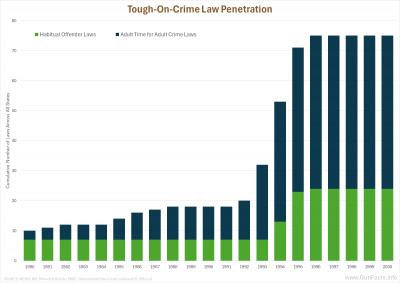
Despite the longer sentences, the issue of habitual criminals and teenage thuggery continued to be a statistical reality. Hence, in 1993 citizens dropped some tough-oncrime nukes. They aggressively passed habitual offender laws and started treating juvenile gangsters as adults.
But this trend was not universal across all states; and mostly the states that did pass those post1992 criminality nukes were the same states that had passed previous tough-on-crime laws.
The question then is how much of an impact did the pre- and post1992 legislative response to violent crime actually reduce violent crime, particularly gun homicides?
THE PRE-1992 RAMP UP
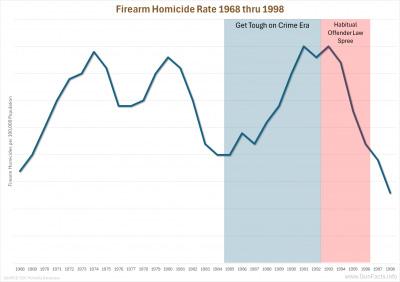
For years, we have noted the rapid decline in firearm homicide rates that occurred during the era of passing habitual offender laws starting in 1993.
But that did not explain why the
firearm homicide rate started to level off before 1993.
States had started enacting get-tough-on-crime laws as violent crime began to surge in the late 1980s. Among the laws rapidly being enacted in the 1980s to fight violent crime were:
MANDATORY MINIMUM SENTENCING
• Determinate Sentencing / Sentencing Guidelines
• Parole Abolition or Severe Restriction For Violent Crimes
• Firearm Sentencing Enhancement For Other Crimes
• Truth in Sentencing (imposing legislated sentences in court and parole)
After grinding some numbers 1 we concluded two different, yet complementary things.
• States that enacted mandatory minimum sentencing laws averaged 0.663 fewer gun homicides per 100,000
people compared to states that did not (after controlling for state and year differences). That is significant when you consider that the average firearm homicide rate in those states was 4.89 in 1985, which translates to a 13% reduction.
Adding more tough-on-crime
laws after that increases the effectiveness but at a diminishing rate of returns. For example, once states added truth-in-sentencing and sentencing guidelines, the additional reduction is only another 0.34 gun homicides for a 100,000 population.
A strong case can be made that “get tough on crime” laws caused a rapidly rising gun homicide rate to level off even before threestrike laws were enacted. Do understand, it takes a little time for minimum sentencing laws, truth-in-sentencing laws, and other get-tough-on-crime laws to peel enough violent criminals off the street for the effect to show. But it did show, and this possibly created some confusion when the next phase of get-tough-on-crime laws started.
THE POST-1992 PHASE
The unanswerable question is, if the preexisting get-tough-on-crime laws had been left in place with no additions, would a decline in gun homicide rates as well as other
violent crimes have started on their own?
We’ll never know, because starting in 1993 people in America had had more than enough of rising violence rates. Within four short years 24 states, with more than half of the country’s population, passed habitual offender laws and started to treat teenage violent criminals as adults, removing youthful parole and perhaps keeping them from escalating and amplifying their modes of violence.
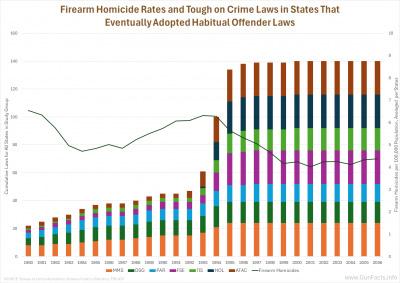
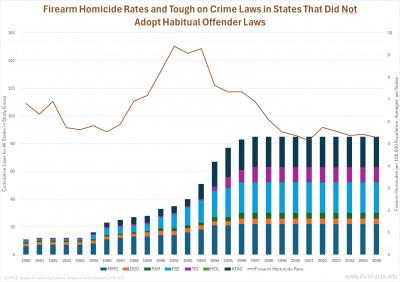
States that entered 1993 with more preexisting tough-on-crime laws had significantly lower gun homicide rates throughout the study window. That’s a testament itself but it causes confusion because the rate of decline due of habitual offender laws (aka three-strike laws) would be muted compared to other states that did not enact similar habitual offender laws. They had less room to fall.
Regardless of that differential, habitual offender laws did have a statistically measurable impact. The situation is clouded by the fact that every state that enacted habitual offender laws had already, or enacted at the same time as habitual offender laws, Adult Time for Adult Crime (ATAC).
Which gets to a juicy bit of speculation. ATAC laws were so broadly enacted (all 50 states), and so quickly, that the effects are inseparable from the national crime decline—which is not necessarily proof of cause and effect. But it is impossibly hard to ignore.
Then we get to 1994 and when the federal government caused even the laggards to start incarcerating more violent people.
The Violent Crime Control and Law Enforcement Act 2 of 1994 was, at that point, the largest federal crime legislation enacted in US history. Congress bribed the states with over $30 billion to do a number of things including abiding by the terms of the Violent Offender Incarceration and Truthin-Sentencing Incentive Grants Program. Consequently, the majority of states (30) adopted Truth in Sentencing laws that put violent offenders in the pokey for at least 85 percent of their sentences. It also put $30 billion into state and local law enforcement agency budgets to hire community policing officers, increasing police presence.
It worked. Eight states had truthin-sentencing laws before the 1994 federal legislation, and by the turn of the century it was 30.
But like the entire get-toughon-crime spree, we saw other jumps in this era. Passing habitual offender law were 24 more states that add to the previous seven. And all 50 states enacted minimum mandatory sentences, firearm sentencing enhancements, and juveniles-as-adults laws.
Let’s not dismiss the habitual offender laws just yet. States that enacted HOL laws showed average homicides and nonnegligent manslaughter sentences that were 2.25 years longer after enactment. Less than two and a half years may not sound like a lot, but that’s for all homicides and manslaughters, and not just those that triggered a second or third
strike penalty. And keep in mind that states that had past habitual offender laws had, by and large, already enacted other get-toughon-crime laws, such as truth-insentencing. The incremental added value of habitual offender laws was less than it would have been if it had been the only corrective measure.
But that’s also the average of all states that did pass habitual offender laws. The application in those states was not consistent. Among the heavy hitters were Washington State, which saw increased average sentences of 3.89 years (30.6%), Pennsylvania 4.01 (21.7%), Nevada 4.39 (17.9%), Arkansas 3.60 (19.7%), and Tennessee 2.72 (14.7%). But eight states showed decreases, with Virginia (−6.38 years, −27.8%) and North Carolina (−3.36, −16.0%) dragging the average back down substantially.
WHAT DOES THIS ALL MEAN?
Let’s stitch some of this together.
Before 1993 among the gettough-on-crime laws, mandatory minimum sentencing had a significant effect on firearm homicide rates, reducing those rates by over 0.6 people per 100,000.
After 1993, expanding truth-insentencing laws had a statistically significant effect for all the states that did not previously pass much in the way of get-tough-on-crime laws.
Right off the bat we see that expansion having a definitive and significant effect on sentences for violent crimes and making sure that those sentences were served effectively.
But after 1993 we also saw a huge jump in the number of states treating juvenile violent criminals like adults, culminating in all states doing so by 1996. Habitual offender laws didn’t apply to juveniles before then, but they did now. Some jurisdictions went even further, counting juvenile adjudications as strikes if the offense would have constituted a felony had it been committed by an adult (California courts determined that juvenile convictions can count as strike offenses under Proposition 184).
BUT THE RESULTS WOULD HAVE BEEN BETTER …
A funny thing happened on the way to prison…
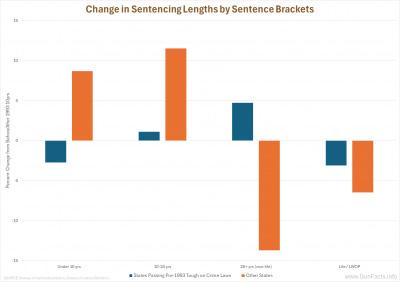
When the nation greatly expanded truth-in-sentencing laws along with habitual offender laws. In a lot of places, the length of these sentences became shorter, not longer.
On the surface it looks like a hell of a paradox. But it can be explained by judges and
prosecutors and perhaps a lack of funding in states for their legal systems.
Before truth-in-sentencing in habitual offender laws, judges would often sentence violent criminals to the maximum extent of the law, knowing that parole boards would radically shorten the sentence. For example they would put somebody away for 25 years, knowing that the parole board
would release them after eight.
After truth-in-sentencing and habitual offender laws became predominant, judges stopped issuing lengthy sentences, knowing that convicts would serve at least 85% of their sentence under truth-in-sentencing laws or would be receiving the same treatment via habitual offender laws. (Under normal circumstances, inmates can reduce their sentences by earning credits for good behavior and program participation. Habitual offender statutes frequently carve out an exception, ensuring that a person sentenced as a repeat offender serves at or close to the full minimum term. But this is inconsistent from state to state.)
Right or wrong, prosecutors have broad discretion in charging decisions, including charging people under habitual offender laws. A prosecutor can decline to file a second or third strike charge even when the defendant has qualifying prior convictions. Prosecutors might do this because they believe the mandatory sentence is disproportionate to
the current offense, because they want to use the strike threat as leverage in plea negotiations, or simply because their office has an informal policy against applying the law to certain offense types.
In short, prosecutors often decide who will go to prison for a long period of time, regardless of the will of the voters.
It gets even a little stranger. Though many states initially stripped judges of any discretion under habitual offender laws, the courts pushed back. For example, a case in California (People v. Romero) ended up with the California Supreme Court declaring that trial courts have discretion to dismiss or strike prior strike allegations in Three Strikes cases, either on the court’s own motion or on motion of the prosecutor (even over the prosecutor’s objection).
Stated more bluntly, trial judges can creatively thumb their noses at three-strike law requirements.
That’s providing that it goes that far. Many offenses that qualify
as second or third strikes can be charged as either felonies or misdemeanors at the prosecutor’s discretion (“wobblers”). A prosecutor who wants to avoid a mandatory strike sentence on a sympathetic defendant can simply charge the qualifying offense as a misdemeanor, which removes it from strike eligibility entirely. If done routinely a repeat felonious offender might never come under the edicts of a habitual offender law.
The California Conundrum California entered 1980 with four tough-on-crime laws already in place — mandatory minimum sentences, determinate sentencing / sentencing guidelines, parole abolition or severe restriction, and adult time for adult crime — all enacted in 1976–1977, years before anyone else. By the start of the 1993-1996 habitual offender law spree, California had already done more than any other state to get tough on crime.
But unlike other proactive states, their gun homicide rate
skyrocketed.
Despite having more pre-existing laws than almost any state in the country, California’s gun homicide rate was rising throughout the first phase — from 6.7 in 1982 all the way up to 9.8 in 1992. Every other proactive state was declining or flat.
And since they made up 23% of the population of all of the proactive states, this artificially depressed the effectiveness of that group of states in terms of lowering gun homicide rates. But they bounced back starting in 1994. First, they passed their habitual offender law, a three strikes variant. Next, they enacted a series of parole tightening measures, dramatically expanded use of parole revocations for technical violations, and strengthened the 10-20-Life firearm enhancement (10 years for using a firearm in a crime even if not discharged, 20 years for discharging the firearm, 25 to life if the bullet hits somebody).
The cumulative effect was staggering. California’s prison population jumped 30% in five years after the 1994 Three Strikes law, growing by almost net 50,000 inmates (39%) when it peaked in 2007. According to the Assembly Analyst Office report on the first decade of the three strikes law, over 80,000 people had been processed for second- or thirdstrike charges.
So just in case you haven’t been creating your own scorecard, here’s the basic chronological process with its various mishaps and outcomes:
• A variety of tough-on-crime
laws were started in the 1980s and they effectively suppressed a national rise in gun homicides.
• Because of this, states that had added these tough-on-crime laws and later added habitual offender laws started with lower gun homicide rates and had less distance for those crime rates to fall.
• In the 1990s many states passed habitual offender laws and, thanks to federal government funding, a bunch of states also passed truthin-sentencing laws (as well as treating juvenile violent perpetrators as adults).
• But as for habitual offender laws, they were mainly enacted by states who had already gotten tough on crime.
• Sentencing lengths were artificially high before 1993, especially in states that had not passed tough-on-crime laws, because judges wanted to extend sentences to compensate for early parole.
Once truth-in-sentencing laws were more widespread, prosecutors in habitual offender law states often plea bargained or reduced charges in order to avoid lengthy and costly trials, which in turn shifted sentencing lengths down into lower brackets.
And thus, sentencing lengths did not radically go up. Total time served did not radically go up either; but the worst of the worst did get the toughest sentences, and that helped.
THE SUMMARY:
America doesn’t like violent crime and starting in the late 1980s they did something about it. It occurred in two waves, pre-
and post-1993. The laws passed leading up to 1993 had an effect, and so did the laws passed after 1993, but for different reasons.
Among the get-tough-on-crime laws passed in either of those phases, we see these solution sets:
Have a significantly long sentence for violent crime. Make inmates serve their entire sentence.
Make repeat offenders serve longer sentences. Make juvenile violent crime subject to adult charges.
And we also saw that states who started taking action in the 1980s put a lid on the growing violent crime epidemic; whereas states that did not suffered greatly, with soaring firearm homicide rates, until they too realized that prisons exist for a reason and started putting the reasons behind bars.
METHODOLOGIES
Pre-1993 estimates were produced using two-way fixed effects OLS regression with state and year fixed effects and state-clustered standard errors, applied to an unbalanced panel of 46 states across 1980–1992. Treatment variables represent cumulative law adoption indicators for seven tough-on-crime policy categories, tested both individually and as theory-driven subsets.
DATA SOURCES OUTCOME VARIABLE:
CDC WONDER, National Center for Health Statistics (NCHS). Compressed Mortality File. National Center for Health Statistics. Vital Statistics of the United States, annual volumes. National firearm homicide rates 1960–1980. U.S. Department of
Health and Human Services.
INCARCERATION DATA:
Bureau of Justice Statistics. National Corrections Reporting Program (NCRP), 1991–2017. ICPSR Study Numbers 37951 and 39234. Individual-level records of prison admissions, releases, offense type, and sentence length used to measure incarceration rates and actual time served for violent crimes.
CONFOUNDING VARIABLES:
U.S. Bureau of Labor Statistics. Local Area Unemployment Statistics (LAUS). State-level annual unemployment rates, 1991–2006.
U.S. Census Bureau. Small Area Income and Poverty Estimates (SAIPE) Program. State-level poverty rates, 1991–2006.
KIDS COUNT Data Center. Nonmarital birth rates by state and year, 1991–2006. datacenter. kidscount.org.
Integrated Public Use Microdata Series, Current Population Survey: Version 11.0 [dataset]. Minneapolis, MN: IPUMS, 2023.
Used to construct: (1) gang-age population share (ages 15–29) and (2) percent of adults ages 20–25 without a high school diploma, 1991–2006.
FBI Uniform Crime Reports. Law Enforcement Officers Killed and Assaulted / Police Employee Data. Police Officers per 1,000 population by agency and population group, 1991–2006.
LAW & POLITICS
BY STEPHEN HALBROOK, COURTESY THEREASON.COM
SECOND AMENDMENT ROUNDUP: ARMS AND ACCOUTREMENTS
United States v. DeBorba, decided on June 3, is the latest Ninth Circuit decision that seeks to exclude firearm parts from protection in the reference to the “arms” that the people have a right to keep and bear. The court held that “’optional accessories’ to firearms—such as gun slings, scopes, and, importantly, silencers—fall outside of the Second Amendment’s plain text because they are ‘accoutrements’ and not arms.” The test for whether an object is included in “arms” is supposedly based on whether it “is necessary to the ordinary operation of the weapon.” “Ordinary” means anything you want it to mean.
That conclusion derives from the Ninth Circuit’s 2025 en banc decision in Duncan v. Becerra, which claimed that a ten (or fewer) round magazine is necessary to operate a semiautomatic firearm and is thus protected, but a magazine that holds over ten is not necessary and therefore has no protection. For the basis for this illogic, see my post here.
It’s no surprise that the DeBorba court applied that “test” to the much-derided suppressors, but gun slings and scopes? Perhaps the court is laying the groundwork for the California legislature to ban “assault slings” and “assassin scopes.” After all, slings may be used in the standing (off-hand) position to shoot more accurately, as they often are at shooting matches. But that could make spray firing more accurate as well. And despite their use in hunting, scopes
are inherently “military-style” as depicted in the movie American Sniper, making them adaptable to political assassinations.
Absurdities aside, slings and scopes should be considered within the term “arms” as they are very much part of the arms on which they are used. Bruen held that the “general definition [of ‘arms’] covers modern instruments that facilitate armed self-defense.” The Court said “facilitate,” not just barely essential for a shot to go off. That necessarily includes instruments equipped with various features, whether characterized as so-called “accoutrements” or not, that enhance or otherwise affect the functionality of a firearm.
Under the Militia Act of May 8, 1792, a citizen was required to “provide himself with a good musket or firelock, a sufficient bayonet and belt, two spare flints,
and a knapsack, a pouch, with a box therein, to contain not less than twenty four cartridges.” Reference was made to “the arms, ammunition and accoutrements, required as aforesaid.” Taken together, these items constituted “arms.” A musket would not fire without a flint, even though Duncan listed flints as accoutrements, not arms. And ammunition was necessary to fire a shot. There was nothing about use of the term “accoutrements” that excluded items from Second Amendment protection.
That brings us to the facts in DeBorba, which involved an unregistered suppressor. It is noteworthy that the Gun Control Act itself defines “firearm” to include a “firearm silencer or firearm muffler.” And in DeBorba, “When the ATF attached DeBorba’s device to a portable firearm and fired the gun, the device ‘reduced sound reporting by at least twelve decibels.’” That certainly made it, to use Bruen’s terms, an instrument that could “facilitate” armed selfdefense.
The Ninth Circuit’s test is that anything that the legislature may ban that is not absolutely necessary for a gun to go bang is a mere accessory excluded from the term “arms.” If that includes a scope, it
also includes just regular sights. Indeed, that’s been the antigun argument all along, that features (like a pistol grip or adjustable stock) that make a firearm more accurate and comfortable to fire make it “unusually dangerous” and thus subject to prohibition. Under that logic, a firearm could be stripped of every feature other than the barrel and firing mechanism, and since it would still go bang, that’s all that is protected by the Second Amendment.
Even if suppressors have Second Amendment protection, DeBorba continues, footnote 9 in Bruen creates a presumption of constitutionality for permitting processes that “do not require applicants to show an atypical need for armed self-defense” and for which “’narrow, objective, and definite standards’ guid[e] licensing officials.” The NFA is a “shall-issue” scheme under which one need only file a written application with fingerprints and photograph and await ATF to register the suppressor.
But that overlooks that footnote 9 concerns permits to carry firearms, not authorization merely to possess a firearm as
does the NFA. Licensing involves checking whether a person is disqualified from possessing arms, while registration involves the government tracking who possesses what guns. No national consensus has ever existed that mere possession of a firearm warrants permanent registration with the government, including the persons’ fingerprints, photograph, and address. Carrying firearms in public has always been distinguished by law from possession of firearms in the home. Whatever the historical justification for the “shall-issue” permitting schemes, no historical analogues exist for NFA-type restrictions as applied to the private keeping of arms.
In Heller II (D.C. Cir. 2011), D.C.’s witnesses admitted that no crimes were ever solved with the District’s registration scheme. As thenJudge Brett Kavanaugh wrote in his dissent:
D.C.’s articulated basis for the registration requirement is that police officers, when approaching a house to execute a search or arrest warrant or take other investigative steps, will know whether the residents have guns. But that is
at best a Swiss-cheese rationale because police officers obviously will assume the occupants might be armed regardless of what some central registration list might say. So this asserted rationale leaves far too many false negatives to satisfy strict or intermediate scrutiny with respect to burdens on a fundamental individual constitutional right.
The Ninth Circuit’s devotion to excluding various firearm features from being included in protected “arms” recalls the pre-Heller days when some federal courts were only too happy to exclude actual people from “the people” in the Second Amendment, when it would have sufficed to hold that some people, like violent felons, lose their rights under the Amendment. João Ricardo DeBorba’s real crimes included repeated violations of restraining orders, being an illegal alien, and lying on firearm forms, all the while being in unlawful possession of firearms based on such status. Nothing in the court’s coverage of those issues raise any red flags for purposes of the Second Amendment. Inventing “tests” that infringe on the rights of law-abiding citizens does a disservice to the Constitution.
Stephen Halbrook is a Senior Fellow with the Independent Institute. His latest books are America›s Rifle: The Case for the AR-15 and The Right to Bear Arms: A Constitutional Right of the People or a Privilege of the Ruling Class? He is also author of The Founders› Second Amendment, Securing Civil Rights, Gun Control in the Third Reich, and Gun Control in NaziOccupied France. He has written over 30 law review articles and has testified in Congressional hearings on firearm law bills.
DMITRI T/SHUTTERSTOCK.COM
PROGRAM REPORTS
BY RICK TRAVIS, LEGISLATIVE DIRECTOR
LEGISLATIVE REPORT
SECURING CALIFORNIA’S HUNTING HERITAGE AND RIGHT TO SELF-DEFENSE: CRPA LEADS
THE CHARGE ON KEY 2026 LEGISLATION
ASSEMBLY – 2A - MONITOR
• AB 1615 - Firearms: unsafe handguns.
Position – Monitor
Last Amend: 5/18/2026
Status: 6/10/2026-Referred to Com. on PUB. S.
Location: 6/10/2026-S. PUB. S.
Legislator – Nguyen – D
Brief - This bill would authorize a peace officer employed by a county probation department and using an unsafe handgun as a service weapon to satisfy the above-described training requirement by completion of the firearm portion of a training course prescribed by POST and who qualifies with the handgun, as specified, at least every 3 months.
• AB 1943 – Pupil safety: notifications: firearms.
Position – Monitor
Status: 6/15/2026-In
committee: Referred to APPR. suspense file.
Location: 6/15/2026-S. APPR. SUSPENSE FILE
Legislator – Gipson - D
Brief – This bill would revise and recast those requirements
by, among other things, (A) instead requiring those local educational agencies to inform parents or guardians of each enrolled pupil of the importance of practicing secure firearm storage for all homes in which firearms are present through a notice entitled “Secure Firearm Storage Notification“ that contains, among other
things, a description of the risks of children accessing unsecured firearms in the home and California’s child access prevention laws and laws relating to the safe storage of firearms, (B) for all local educational agencies that maintain a website, requiring the notice to be additionally be posted, and annually updated,
on the local educational agency’s internet website, as specified, (C) requiring the department, on or before July 1, 2027, to provide formatting and content options for local educational agencies to post the notice on their respective internet websites and for posting other relevant information and resources about secure firearm storage using other internet-based communication options, and (D) requiring the department to encourage each local educational agency to adopt a policy and practice of providing the notice to parents, guardians, and caregivers when otherwise providing notice to parents, guardians, or caregivers of disciplinary actions or support s given related to threats against other pupils or threats of self-harm.
2026 LEGISLATIVE SESSION ASSEMBLY – 2A – OPPOSE
• AB 1743 – Firearms.
• Position – OPPOSE
Last Amend: 6/4/2026
Status: 6/16/2026-From committee: Do pass and re-refer to Com. on APPR. (Ayes 5. Noes 1.) (June 16). Re-referred to Com. on APPR.
Location: 6/16/2026-S. APPR.
Legislator – Wicks - D
Brief - This bill would clarify that the information be available, upon request, to any California town, city, county, or state government agency, the California State University, the University of California, or any private nonprofit university in California, under guidelines and format options set forth by the Attorney General, as specified.
• AB 1753 – Protective order: firearms and ammunition.
Position – OPPOSE
Last Amend: 6/17/2026
Status: 6/17/2026-Read second time and amended. Re-referred to Com. on JUD.
Location: 6/16/2026-S. JUD.
Legislator – Stefani - D
Brief –This bill would make clarifying and conforming changes to the procedures relating to the protective or restraining orders described above by explicitly requiring the restrained person to relinquish, in addition to any firearm, any ammunition in that person’s immediate possession or control.
• AB 1810 – Firearms: centralized list.
POSITION – OPPOSE – CRPA ONLY 2A GROUP TO DO SO
Last Amend: 5/18/2026
Status: 6/16/2026-In committee: Hearing postponed by committee.
Location: 6/3/2026-S. PUB. S.
Legislator – Berman - D
Brief – This bill would require the department to remove from the list a person who fails to comply with the requirements to be on the list and authorize the department to remove a person from the list who fails to remedy specified violations discovered as a result of the abovedescribed inspections. The bill would subject a person removed from the list for failure to remedy specified violations to a fine and make that person ineligible to be placed on the list for a period of 2 years.
• AB 1974 – Firearms: voluntary firearm storage program.
Position – OPPOSE – CRPA Only
2A group to do so
Last Amend: 5/28/2026
Status: 6/10/2026-Read second time. Ordered to third reading.
Location: 6/10/2026-S. THIRD READING
Legislator – Stefani - D
Brief – This bill would authorize a law enforcement agency, as defined, to create a voluntary firearm storage program that allows a person to voluntarily transfer custody of their firearm to the local law enforcement agency for temporary safekeeping purposes to prevent firearm violence, suicide, and other injury. The bill would authorize a law enforcement agency adopting this program to provide clear instructions on the procedure to voluntarily transfer custody of a firearm and to provide explicit instructions on the process for requesting return of the firearm, as specified.
• AB 2047 – Firearms: 3-dimensional printing blocking technology.
Position – Oppose
Last Amend: 6/15/2026
Status: 6/15/2026-From committee chair, with author’s amendments: Amend, and rerefer to committee. Read second time, amended, and re-referred to Com. on JUD.
Location: 6/3/2026-S. JUD.
Legislator – Bauer-Kahan - D
Brief – The bill would require, on or before June 1, 2029, the department to publish a list of all the makes and models of 3-dimensional printers whose manufacturers have submitted complete self-attestations and would require the department to update the list no less frequently than on a quarterly basis and to make the list available on the department’s internet website.
BY RICK TRAVIS
2026 LEGISLATIVE SESSION ASSEMBLY PROGRAM REPORTS
The bill, beginning on December 1, 2029, would prohibit the sale or transfer of 3-dimensional printers that are not equipped with firearm blocking technology and that are not listed on the department’s list, except as specified. The bill would authorize a civil action to be brought against a person who sells, offers to sell, or transfers a printer without the firearm blocking technology.
2026 LEGISLATIVE SESSION
ASSEMBLY – 2A – SUPPORT
• AB 1589 - Firearms: silencers.
- DEAD
• Position – Support
• Status: 5/27/2026-Ordered to inactive file at the request of Assembly Member Chen.
• Legislator – Chen - R
• AB 1948 – Firearms: concealed carry licenses. On Governor’s Desk
Position – SUPPORT
Last Amend: 3/19/2026
Status: 6/15/2026-Read third time. Passed. Ordered to the Assembly. (Ayes 38. Noes
0.). In Assembly. Ordered to Engrossing and Enrolling.
Location: 6/15/2026-A.
ENROLLMENT
Legislator – Ramos - D
Brief - This bill would extend the duration of those licenses to 3 years from the date of the license.
• AB 2584 – Self Defense.DEAD
• Position – SUPPORT
• Legislator – Flora - R
SENATE -2A – OPPOSE (2 BILLS)
• SB 948 - Firearms: safety certificates.
Last Amend: 5/14/2026
Status: 6/8/2026-Referred to Com. on PUB. S.
Location: 6/8/2026-A. PUB. S.
Legislator – Arrequin - D
Position – Oppose
Brief –This bill would extend the above-described time period to within 180 days and would also require that personal firearm importer to obtain a valid firearm safety certificate and include a copy of the valid firearm safety certificate within the report and make a violation
of this provision a misdemeanor. The bill would prohibit a person from bringing a firearm into this state without obtaining a valid firearm safety certificate within 180 days, except as specified, and make a violation of this provision a misdemeanor.
NOTE: Repeat of last session’s bill by Assemblymember Rodriguez AB1187.
• SB 1220 – Firearms: prohibited persons.
Position – Oppose
Status: 6/4/2026-Referred to Com. on PUB. S.
Location: 6/4/2026-A. PUB. S.
Legislator – Hurtado - D
Brief - This bill would prohibit a person, who is convicted on or after January 1, 2027, of the above prohibition, from owning, purchasing, receiving, or having in their possession or under their custody or control any firearm within 10 years of the conviction. By expanding the scope of an existing crime, the bill would create a state-mandated local program.
2026 LEGISLATIVE SESSION
ASSEMBLY – HUNTING/ CONSER. MONITOR
2026 LEGISLATIVE SESSION ASSEMBLY – HUNTING/ CONSER. - SUPPORT
• AB 1673 - County fish and wildlife propagation fund: expenditure.
Position – Support
Last Amend: 6/11/2026
Status: 6/18/2026-In committee: Set, first hearing. Hearing canceled at the request of author.
Location: 6/15/2026-S. N.R. & W.
Legislator – Hadwick – R
Brief – This bill would additionally authorize expenditures from a county fish and wildlife propagation fund for costs incurred by a county sheriff for investigating, issuing citations, or making arrests for a civil or criminal violation relating to fish and wildlife, by a county for land use planning, design, and construction necessary to mitigate a specific environmental impact to a particular fish or wildlife species, and for wildlife coexistence programs to prevent human-wildlife conflict.
• AB 1722 – California
Endangered Species Act: take prohibition: self-defense.
Position – SUPPORT
Last Amend: 4/16/2026
Status: 6/10/2026-Referred to Coms. on N.R. & W. and JUD.
Location: 6/10/2026-S. N.R. & W.
Legislator – Hadwick - R Brief - This bill would prohibit the imposition of a civil, administrative, or criminal penalty for a violation of the
take prohibition if the defendant committed the act based on a good faith belief that they were acting to protect themselves, a member of their family, or any other individual from bodily harm from an animal listed under the act.
• AB 1912 – Deer: archery season: concealed firearms.
Position – SUPPORT
Last Amend: 3/25/2026
Status: 6/9/2026-From committee: Do pass and rerefer to Com. on PUB. S. with recommendation: To Consent Calendar. (Ayes 7. Noes 0.) (June 9). Re-referred to Com. on PUB. S.
Location: 6/9/2026-S. PUB. S.
Legislator – Hadwick - R Brief –This bill would instead authorize any person to carry a firearm capable of being concealed on their person while engaging in taking or attempting to take a deer with a bow and arrow, as specified.
• AB 1987 – Departmentmanaged lands: wildlife areas: hunting.
Position – SUPPORT
Last Amend: 6/11/2026
Status: 6/11/2026-Read second time and amended. Re-referred to Com. on APPR.
Location: 6/9/2026-S. APPR.
Legislator – Aguiar-Curry - D
Brief Summary: This bill would authorize the department to enter into contracts or other agreements for the management and operation of the department-managed lands for the purposes of administrating hunting or other public use programs.
•
• AB 2207 – Hunting tags: transfer: youth participation programs.
Position – SUPPORT
Last Amend: 6/8/2026
Status: 6/8/2026-From committee chair, with author’s amendments: Amend, and rerefer to committee. Read second time, amended, and re-referred to Com. on N.R. & W.
Location: 5/27/2026-S. N.R. & W.
Legislator – Hadwick - R
Brief Summary: The bill would require the department to establish a hunting tag transfer program that authorizes a person to transfer a tag issued for the take of one of those species to their child or grandchild, subject to specified conditions. In addition, the bill would require the department to establish a hunting tag transfer program that authorizes a person to transfer a tag issued for the take of one of those species to a nonprofit hunting organization for that organization to provide a hunting opportunity with that tag to a child with a life-threatening medical condition or permanent physical disability, subject to specified conditions..
2026 LEGISLATIVE SESSION
SENATE – HUNTING/CONSERV. - OPPOSE
• SB 1135 – Human and wildlife coexistence.
Position – Oppose
Last Amend: 6/3/2026
Status: 6/3/2026-From committee with author’s amendments. Read second time and amended. Re-referred to Com. on W., P., & W.
Location: 6/1/2026-A. W.,P. &
W.
Legislator – Blakespear - D
Brief – Would state the intent of the Legislature to reestablish and enact a statewide program to manage and promote human and wildlife coexistence.
• SB 1152 – Fish and wildlife. (DEAD)
• Position – Oppose
• Legislator – McGuire - D
• SB 1305 – Wildlife: bears.
• Position – Oppose
Last Amend: 5/18/2026
Status: 6/4/2026-Referred to Com. on W., P., & W.
Location: 6/4/2026-A. W.,P. & W.
Legislator – Richardson - D
Brief – Existing law classifies “black and brown or cinnamon bears (genus Euarctos)” as a game mammal for purposes of managing, taking, or hunting that species. Existing law makes it unlawful to take a bear using a firearm, trap, or bow and arrow without first procuring a tag authorizing the taking. Existing law also makes it unlawful for a person to take a bear with an iron or steel-jawed or any type of metal-jawed traps. In any part of a district within the Counties of San Bernardino and Riverside, existing law authorizes the taking of bears at any time
with traps within a good and substantial fence surrounding beehives, as specified. This bill would exclude grizzly bear from the application of the abovedescribed provisions.
2026 LEGISLATIVE SESSION SENATE – HUNTING/CON
SERV. - SUPPORT
• SB 893 - State parks: facilities pass: Gold Star Family members. Support - DEAD
Legislator – Seyarto - R
• SB 1021 – Fishing and hunting: youth program.
Position – SUPPORT
Last Amend: 6/17/2026
Status: 6/17/2026-Read second time and amended. Re-referred to Com. on APPR.
Location: 6/16/2026-A. APPR.
Legislator – Choi - R
Brief - This bill would require the commission to, on or before January 1, 2028, adopt regulations, as provided, to increase opportunities to fish, and to hunt big game, wild pigs, upland game birds, and migratory game birds, for resident youth with lifethreatening illnesses. The bill would require the commission, in adopting those regulations, to ensure reasonable accommodations for participants
in accordance with federal and state disability are incorporated into the regulations and to consider authorizing special hunts, as prescribed. The bill would authorize the commission to include in the regulations additional reasonable accommodations consistent with safe, ethical, and science-based wildlife management practices.
• SB 1232 – Mountain Lions. (DEAD)
Position – SUPPORT – SPOT BILL
Legislator – Alvarado-Gil - R
• SB 1397 – Mountain Lions: human-mountain lion conflicts program: scientific research. Position – SUPPORT
Last Amend: 5/14/2026
Status: 6/4/2026-Referred to Com. on W., P., & W.
Location: 6/4/2026-A. W.,P. & W
Legislator – Alvarado-Gil - R
Brief – This bill would require the department, contingent upon an appropriation by the Legislature, to maintain, enhance, and expand its humanmountain lion conflicts program in a specified region of the state in order to protect public health and safety, including by exercising its authority to authorize nonlethal procedures.
PROGRAM REPORTS
BY TIFFANY CHEUVRONT
LITIGATION REPORT
SECOND AMENDMENT LITIGATION REPORT
DEFENDING GUN RIGHTS: A NEW ERA IN THE FIGHT FOR THE SECOND AMENDMENT
This report highlights just a few of the ongoing efforts to protect the rights of gun owners in California—and beyond. While litigation remains a cornerstone in defending the right to keep and bear arms, it’s only one piece of a much larger effort. Across California and the nation, countless individuals and organizations are engaged at every level to safeguard the Second Amendment.
In California alone, this fight stretches across all 58 counties, 482 municipalities, and the many state and local agencies tasked with interpreting and enforcing an ever-growing web of gun laws. It’s a massive undertaking requiring significant resources, coordination, and constant vigilance.
Duncan v. Becerra: The Supreme Court Case That Would Not Move Forward!
Few Second Amendment cases have experienced a procedural journey as unusual as Duncan v. Becerra, a challenge to California’s ban on firearm magazines capable of holding more than ten rounds. After years of litigation, the case reached the U.S. Supreme Court’s doorstep in a posture rarely seen: the Court repeatedly postponed
consideration of whether to grant review, placing the petition on its conference calendar 21 separate times! (The record for being relisted is 22 times)
A petition for certiorari is ordinarily considered after briefing is complete and then either granted, denied, or held for another case. In Duncan, however, the repeated relistings signal that the case remains under active consideration by the Justices. Each relisting means the Court is not immediately rejecting review and continued to evaluate the petition’s significance.
The case began when California gun owners and advocacy organizations challenged Penal Code section 32310, arguing that the state’s prohibition on possession of standard-capacity magazines violated the Second Amendment. A federal district court agreed, finding that the law burdened a protected Second Amendment right. The Ninth Circuit later reversed, leading petitioners to seek Supreme Court review.
The procedural history became especially notable after the Supreme Court’s decision in New York State Rifle & Pistol Ass’n v. Bruen (2022), which changed the constitutional framework for Second Amendment cases. Bruen rejected the traditional means-
end scrutiny approach and held that firearm regulations must be justified by historical tradition. Because Duncan involves a longstanding dispute over whether large-capacity magazines are protected “arms” or protected accessories, the case attracted renewed attention after Bruen. The 21 relistings create significant speculation among observers. Historically, repeated relistings can indicate that the Court is working through complex issues, waiting for related developments, or considering whether a case provides a suitable vehicle to address an important constitutional question. While relisting does not guarantee that certiorari will be granted, a case repeatedly returning to conference like this is uncommon. Should the Court not grant certiorari this session, the case will remain on the Court’s docket until the “long conference,” which is the first conference of the new term usually held in September. The key point is that failure to act by the end of the term does not constitute a denial. A denial only occurs when the Court affirmatively enters an order denying the petition.
Ultimately, Duncan v. Becerra illustrates how Second Amendment litigation evolved after Bruen. The Duncan case sits
PROGRAM REPORTS LITIGATION REPORT
at the intersection of historical tradition, firearm technology, and the Supreme Court’s renewed focus on constitutional text and history. Regardless of the final procedural outcome, the extraordinary number of relistings
demonstrate that the Justices view the issues presented as worthy of extended consideration.
CRPA remains committed to leading this charge—from the courtroom to the Capitol, and everywhere in between as our
attorneys continue the work and our members support the efforts. Will this summer bring what we have all been waiting for with the Supreme Court finally taking up Duncan?
CALIFORNIA CASES
Boland v.
Bonta
Renna v.
Bonta Does California’s Unsafe Handgun Act (the Roster) violate the Second Amendment?
United States District Court Central District of California 9th Circuit
Rhode v.
Becerra Does California’s law requiring background checks for ammunition violate the Second Amendment?
United States District Court Southern District of California 9th Circuit
The court granted the plaintiffs’ motion for preliminary injunction on March 20, 2023 in Boland, enjoining the microstamping, loaded chamber indicator, and magazine disconnect requirements.
California appealed, and the 9th Circuit stayed the ruling, except for the microstamping requirement.
Judge Benitez ruled in favor of Plaintiffs, kicking off an ammunition “freedom week”.
The Ninth Circuit stayed the injunction however, so now the regulations are back in effect for the time being.
The 9th Circuit heard oral arguments on August 23, 2023, but then vacated the oral argument it heard to instead hold the decision pending Duncan.
After Duncan, the panel ordered supplemental briefing, the CRPA briefing was submitted in April and the State’s briefing in May. We are waiting for more from the court.
Rupp v.
Becerra Does California’s Assault Weapons prohibition violate the Second Amendment?
Duncan v. Bonta Does California’s prohibition on large-capacity magazines violate the Second Amendment?
United States District Court Central District of California
The trial court entered summary judgment in favor of the State, and Plaintiffs have appealed.
CRPA was handed a big win in Rhode after almost a decade of litigating!
WIN In Ninth Circuit!
Waiting on court to rule on en banc request from the state.
Supplemental Briefing for Wolford filed in July 2026.
The 9th Circuit had stayed this matter pending Duncan. A joint status report is was filed and we will ask the court to remove the stay in light of the Duncan ruling.
United States District Court Southern District of California 9th Circuit Supreme Court
Judge Benitez ruled in favor of CRPA for a second time, case appealed.
The Ninth Circuit, unsurprisingly, reached the exact same 7-4 result as last time.
CRPA is waiting for the Supreme Court review of the long-running case.
It could take several months to hear if the Supreme Court will decide to take up the case in the fall session.
PWGG (formerly Jones)
CALIFORNIA CASES
v. Bonta Does California’s under-21 firearm prohibition violate the Second Amendment?
Miller v. Bonta
United States District Court Southern District of California
Does California’s assault weapons prohibition violate the Second Amendment?
United States District Court Southern District of California 9th Circuit
The District Court issued summary judgment to the State.
Judge Benitez again struck down the California “assault weapons” ban.
Currently on appeal in the Ninth Circuit. Reply brief filed December 2025.
Parties held oral arguments June 2026 and supplemental briefs in light of Wolford were filed July 8, 2026.
Junior Sports Magazines v. Bonta Does California’s new law prohibiting the marketing of firearms products to youth violate various constitutional principles, including the 1st Amendment?
United States District Court Central District of California 9th Circuit
9th circuit ruled for plaintiffs, overturning the district court. California then petitioned for en banc review.
En banc review was denied, so the matter went back to the district court for issuance of a preliminary injunction.
The 9th Circuit heard oral argument, but then immediately stayed the matter pending Duncan v. Bonta.
B&L Productions v. Newsom (Southern District) Does the ban on gun shows at the Del Mar Fairgrounds violate the First and Fourteenth Amendments?
B&L Productions v. Newsom (Central District) Does the ban on gun shows at the Orange County Fairgrounds and Statewide violate the First, Second, and Fourteenth Amendments?
United States District Court Southern District of California 9th Circuit
Plaintiffs appealed the district court’s motion to dismiss, but the Ninth Circuit affirmed the District Court.
United States District Court Central District of California 9th Circuit District Court ruled in favor of the Plaintiffs on October 30, 2023, gun shows ordered to resume. The Ninth Circuit reversed the District Court.
The Ninth Circuit handed us a win regarding a challenge to the lower court refusing to issue an injunction against the state. Now we go back to the lower court to get that injunction which will stop the enforcement of AB 2571.
WIN on Injunction!
State Agreed to Settlement based on our win with multiple orders from the court.
Youth Shooting is saved in California!
Plaintiffs petitioned the Supreme Court for certiorari, but unfortunately, the petition was denied.
(Connected to the next case)
Plaintiffs petitioned the Supreme Court for certiorari, but unfortunately, the petition was denied.
The case now goes back to the Central District. Amended Complaint to be filed.
Stayed until ruling in Rhode or Yukutake
Baird v. Bonta Does California’s ban on open carry violate the Second Amendment?
May v. Bonta
Carralero v. Bonta May California ban carry, even with a CCW permit, in almost all public places?
CRPA vs. LASD A number of issues related to CCW permits including:
- Long wait times
- High fees.
- Psychological examination
- Suitability determinations
- Interstate reciprocity
Nguyen v. Bonta
(1 in 30)
Federal Second Amendment constitutional challenge to California’s ban on purchasing more than one firearm in a 30-day period.
Jaymes et al v. Maduros
Refiled and Renamed Poway Weapons v. CDTFA Challenge to California’s new 11% tax on guns and ammunition.
Blank v. County of Santa Clara Challenge to the high fees for CCWs and other requirements.
United States District Court for the Eastern District of California 9th Circuit
United States District Court for the Central District of California 9th Circuit
Plaintiffs lost their preliminary injunction at the district court, but on September 7, 2023, a 9th circuit panel remanded the case back because the district court made serious errors in its analysis.
The district court, in a lengthy ruling, upheld the law.
Plaintiffs achieved an injunction as to every place they challenged where California attempted to ban carry.
The 9th Circuit partially affirmed and partially reversed that injunction.
United States District Court for the Central District of California
United States District Court for the Southern District of California 9th Circuit
The Judge issues a mixed ruling as to Plaintiffs’ motion for preliminary injunction, granting relief to the plaintiffs as to the long wait times and forcing California to issue permits to nonresidents.
Plaintiffs have appealed and completed their briefing.
Oral Arguments held on June 24, 2025.
Supplemental authority filed September 2025.
Oral Argument held with en banc panel.
Supplemental briefing filed for Wolford and Hemani
Plaintiffs will pursue final judgment in the district court.
In June 2025 was combined with a related case of Carralero v. Bonta. Case stayed pending other cases.
Superior Court of California, County of San Diego
Plaintiffs prevailed in the district court, with judgment entered in their favor, but stayed the ruling for 30 days so the State could try and get a stay from the Ninth Circuit.
Plaintiffs dismissed this complaint due to a procedural issue, and will re-file it following exhaustion of administrative remedies.
Plaintiffs will pursue a final judgment in the district court. Discovery has begun. Second Amended Complaint filed in August 2025.
U.S. DOJ also filed lawsuit against LASD.
Currently in settlement discussions and agreement that the wait times will come into compliance.
In a surprise move, the 9th Circuit lifted the stay after oral argument, indicating its ruling will be favorable.
Plaintiffs Win in 9th!
State has requested extension for filing petition for rehearing.
Supplemental briefs filed.
Refiled and renamed with new plaintiffs due to standing issues.
Court adopted their tentative ruling stating that the plain text of the Second Amendment does not cover the excise tax and allowing Plaintiffs to file amended complaint.
Filed in Northern District of CA San Jose Division of the federal court September 2025
Defendants filed a Motion to Dismiss. Plaintiffs opposing with that motion to be heard in February 2026.
Court continued the case pending the Attorney General joining the case.
Wolford v. Lopez
Does Hawaii State’s post-Bruen permit issuance program violate Bruen, particularly by making nearly everywhere in the State a “sensitive place” where carry is forbidden?
HAWAII CASES
United States District Court District of Hawaii 9th Circuit Supreme Court
Pinales v. Lopez Is Hawaii’s gun purchases to persons under 21 years of age. 9th Circuit
The district court granted a temporary restraining order, and the 9th circuit refused to stay that order for now, but may reconsider after the district judge rules on a motion to stay.
Counter Motions for Summary Judgement have been filed. Case continued until after the MSJ issues are resolved.
NEW YORK CASES
Antonyuk v. Hochul
(a number of similar cases also filed and being heard jointly on appeal)
Does New York State’s post-Bruen permit issuance program violate Bruen, particularly by making nearly everywhere in the State a “sensitive place” where carry is forbidden?
Khan v. NYC Challenge on gun seizures- Military personnel wrongfully detained and guns seized. Plaintiff was a CCW holder.
Koons v. Platkin
United States District Court Northern District of New York
2nd Circuit
The Judge ruled mostly in Plaintiffs’ favor.
In a December ruling, the Second Circuit upheld most of the law but struck down a couple of pieces of it, including the private property default rule.
Appealed on April 30, 2026 and still in process
NEW JERSEY CASES
Does New Jersey State’s post-Bruen permit issuance program violate Bruen, particularly by making nearly everywhere in the State a “sensitive place” where carry is forbidden?
ANJRPC v. Platkin Assault Weapons Ban in New Jersey
United States District Court District of New Jersey 3rd Circuit
3rd Circuit
The 9th Circuit issued its ruling, which was a split decision.
WIN! Vampire Rule and state’s attempts to limit Second Amendment activity ruled unconstitutional.
Stipulation to dismiss has been filed as of July 7, 2026.
Plaintiffs filed a petition for certiorari with the Supreme Court, which was granted, and the Court remanded the matter back to the 2nd Circuit for further consideration in light of Rahimi, after which the Second Circuit issued essentially the same ruling once again.
Supreme Court denied review, so the case heads back down for final judgment. Briefing occurring.
Briefing file in June 2026
The Judge ruled mostly in Plaintiffs’ favor. The case is now on appeal.
On appeal and oral arguments have been held.
Oral arguments heard on October 25, 2023. Still awaiting a ruling well over a year later.
Plaintiffs petitioned for en banc rehearing in October 2025.
Oral Arguments Held Feb 2026
En banc oral arguments held.
Supplemental briefing filed July 8, 2026.
Maryland Shall Issue v. Montgomery County
Ghost Gun Challenge
MARYLAND CASES
United States District Court District of Maryland
Benson v. United States
Court denied motion for preliminary injunction. Appeal pending. CRPA filed an amicus brief in support of plaintiffs in their appeal.
Appeal is being held pending the resolution of a state court action regarding the same dispute. Case has been consolidated
WASHINGTON, D.C. CASES
Challenge to Washington, D.C. ban on magazines holding more than 10 rounds.
D.C. Circuit The Judge ruled in Plaintiffs’ favor.
In a 2-1 decision the D.C. Court of Appeals held that Large Capacity Magazines violate the Second Amendment.
Appeal to the Supreme Court was denied due to status of not having a final determination.
En banc review reversed decision.
We now wait to see if the case goes back to the Supreme Court in next session.
FLORIDA CASES
As of January 2026 waiting on Answer to be filed after time extension.
Attorney General settled and made offer of judgement. Permanent Injunction issued in favor of plaintiffs.
ILLINOIS
CASES
Case Name Issue Court Status What’s Next
Federal Firearms Licensees of Illinois v. Jay Robert Pritzker (consolidated with Barnett v. Raoul and a number of other cases dealing with state and local assault weapon bans in Illinois) Is Illinois’ Assault Weapons Ban Constitutional under Bruen?
United States District Court District of Illinois
7th Circuit
United States Supreme Court
The court granted Plaintiffs’ motion for preliminary injunction on April 28, 2023, but the Seventh Circuit reversed in November. The 7th Circuit denied en banc review.
Trial completed in September, and Plaintiffs prevailed with Judge McGlynn issuing a final judgment. The matter now goes up for appeal in the 7th Circuit.
Oral Arguments took place in September. 7th Cir decision on July 9, 2026, ruling that the state’s ban on AR-15, magazines holding more than 10 rounds are consistent with Second Amendment.
BY TIFFANY D. CHEUVRONT
LOCAL ADVOCACY LOCAL ADVOCACY REPORT
The Local Advocacy Project actively monitors all of California’s 58 counties and 482 municipalities to support or oppose any proposed ordinance, law, or policy likely to impact Second Amendment rights. Local efforts include developing and working with a network of professionals, citizens, local government officials and law enforcement professionals to effectively oppose local threats to California gun owners. These efforts also serve as the foundation for litigation efforts against municipalities that enact anti-gunowner legislation.
JURISDICTION AND ISSUE DESCRIPTION
GUN SHOWS
STATEWIDE PUBLIC RECORD REQUESTS
For years CRPA has fought along side promoters to keep gun shows in California. Gun Shows are more than just a place to purchase firearms and beef jerky, they are a cultural experience of like-minded people coming together to discuss politics and their freedoms. CRPA regularly seeks and obtains public records in connection with any anti-gun efforts in California. Such efforts include proposed anti-gun ordinances, gun buyback programs and other anti-gun regulatory enforcement issues.
After a long wait from the Orange County Court, the judge enjoined the state ban on gun shows (no selling firearms, ammunition, or parts on state property) This WIN covered the state-wide law and the specific law for Orange County.
The state has now appealed the case to the Ninth Circuit and the OC and State law cases have now been joined with our challenge to the AB 893 out of San Diego. Both cases will be heard together in March 2024 oral argument.
The gun shows returned to the Orange County Fairgrounds in January to record crowds of people happy to welcome them back!
This case is now back in the district court and is moving forward. We have requested that the court allow an amended complaint. Stay tuned for more information
Responses to these requests often yield valuable results, such as which members of a local government entity are working with anti-gun groups, sources of funding and other important information.
Ongoing. CRPA attorneys monitor and review thousands of pages of public records requests each month.
*Public Records Requests have been submitted for the DOJ leak of gun owner information.
Currently we are waiting on a renewed public records request from the state regarding an arbitrary rule that gun raffles and auctions are somehow banned from state property. This is not a current law or regulation and was not part of the original B & L Productions (Crossroads of the West Gun Shows) lawsuit.
We are also waiting on public records for wait times with LAPD CCW Process.
CRPA COALITION WORK
The CRPA has been working with other groups across the state for years to influence and advance pro-2A work in the state. We believe in leveraging our combined strength to get things done.
Coalitions are built from other non-profit groups with similar missions coming together. We work with local chapter leaders, elected officials and legislative teams to push support and protection of the Second Amendment.
Watch for joint letters from coalition groups to fight harmful legislation in the state and for work with other groups during this election cycle.
To sign up for the Range Coalition, send an email to ranges@crpa.org.
To become a CRPAF Alliance Partner or a CRPA Business Affiliate with a 2A Action Center for your customers, email us at contact@crpa.org
JURISDICTION AND ISSUE
CCW Issuance Issues
DESCRIPTION
We understand that there are issues with jurisdictions having enough training classes and issuance of CCWs
CRPA is working with jurisdictions to make sure that the regulations imposed are followed.
CRPA is working with trainers to get them the correct information to meet the new standards.
It is not a requirement of the law that a coworker be listed as a reference. We know that some police departments are trying to force this issue in the application process. If you run into this, go through your county Sheriff instead. If you still are getting the same requirement, please let us know at contact@ CRPA.org
County of Los Angeles- Still under lawsuit by CRPA and U.S. DOJ over long wait times. They refuse to use an outside group to process due to concerns about union workers.
City of Santa Clara- currently being sued by CRPA for high fees and psychological exam requirements.
More information at https://crpa.org/ccwissues-in-california/
Ghost Gun Bans
CALL FOR PLAINTIFFS
Gun Control groups are busy pushing to try to get local jurisdictions to pass restrictions on the possession, sale, transfer, or manufacturing of “ghost guns” including precursor parts
San Diego, Los Angeles, and San Francisco have all passed the same basic ordinance in the last few weeks. The problem with these ordinances is that they address areas of concern that are controlled by the state AND there is no clear definition of what a precursor part is at the moment- these cities just made every piece of metal illegal to own and created criminals out of citizens with lawful products overnight.
CRPA is currently fighting in the courts on this issue. Please follow CRPA news for more information.
Fight for Catalina Deer
If you are a CRPA member, we need you!
CRPA has been working with other conservation groups in an epic battle to save the herd on Catalina and manage it responsibly.
When local ordinance issues do not go well, we have to fight for your rights in court. We need members just like you who are negatively affected by these unconstitutional laws to step up as named plaintiffs in the
Members and elected officials have responded in support of our efforts but we are fighting against Newsom, bad science, and big money on the island with the Wrigley family heiress attempting total eradication of the herd
If you are interested in serving as a plaintiff in any of our upcoming litigation, please contact us at potentialplaintiffs@ michellawyers.com.
Please follow on YouTube and Facebook for updated information and reports as they happen.
GRASSROOTS ENGAGEMENT
BY JERRY CLARK CRPA TRAINING AND SHOOTING SPORTS DIRECTOR
2026: AN EXCITING YEAR FOR CRPA TRAINING!
What an exciting time it has been for the CRPA Training Department. Not only have we developed our own outstanding curriculum, but we’ve also earned approval from the California Department of Justice Bureau of Firearms for our CCW Instructor Certification program. There are so many great things happening, and we can’t wait to share them all with you.
Spring kicked off with a bang at our 4th Annual CRPA Range Convention.
We had the wonderful opportunity to visit the fantastic hosts at Pajaro Valley Rod & Gun Club and Paradise Rod & Gun Club in April. Ranges and dealers enjoyed updates on new regulations, insightful Q&A sessions with our attorneys, and terrific networking opportunities. A huge thank you to both clubs for their warm hospitality and for making the event such a success. We’re already buzzing with plans for the fall Range Con— stay tuned for details.
After a quick breather, it was straight into our spring and summer youth events. These gave our dedicated Range Safety Officers/ Instructors (and our newly credentialed ones) the chance to coach and mentor the next generation in firearm safety. What a joy it was to see.
We continued with our 3rd Annual CRPA Youth Cup Rifle Tournament in conjunction with CRPA’s Development Dept, a resounding success. The youth had a blast and received top-notch coaching from our skilled RSOs/ Instructors. I’m proud to say a few of
them showed skills worthy of earning their awards.
Next up was the always-anticipated Raahauges Youth Adventure Day 2026. This event is a highlight every year, giving youth a fantastic day enjoying the great outdoors. We had fifteen range safety officers on the firing line, with the Chief RSO close by for support. We welcomed at least 1,000 young shooters through the range that day—pure shooting sports magic.
Just one week later, we hosted the 3rd Annual CRPA Youth Cup Shotgun Tournament in conjunction with CRPA’s Development Dept. It was wonderful to see many returning faces eager to try their hand at clay target shooting. Every shooter had their own personal coach/ mentor. The looks of surprise and delight when they hit their first clay bird said it all. We know they’ll be back next year with even bigger smiles.
The CRPA Training Department couldn’t be prouder of our incredible Volunteer Range Safety Officers/ Instructors and all the enthusiastic children who came out to compete and participate in these spring and-summer events!
We also must boast a little about our brand-new CRPA California-specific curriculum. Whether you’re a beginner looking to get started, an experienced shooter wanting to sharpen your skills, or someone thinking about becoming an instructor, we’ve got you covered. CRPA offers a wide range of firearm safety certifications and instructor programs. Check out our full training event calendar and instructor information on the website—we hope to see you in class soon or at the next CRPA event. For over 150 years, the California Rifle & Pistol Association has delivered the highest quality firearms training. We’re dedicated to teaching safe, responsible, and enjoyable shooting—and we’re excited for many more years to come!
If you have any questions about events or training, feel free to call, visit the website, or reach out directly to the training department. We’re here to help and look forward to hearing from you
Links:
Training and Education ArchivesCRPA
Become An InstructorCRPA training@crpa.org
BY THE CALIFORNIA RIFLE & PISTOL ASSOCIATION
MORE THAN A RIGHT:
WHY RESPONSIBLE FIREARM OWNERSHIP BEGINS WITH EDUCATION
For many Californians, purchasing a firearm is about more than simply acquiring a piece of equipment. It is a decision rooted in personal responsibility, selfreliance, and a desire to protect what matters most.
Whether motivated by personal safety, recreational shooting, hunting, competitive shooting sports, or a commitment to preserving constitutional freedoms, firearm ownership carries both significant rights and equally significant responsibilities. At the California Rifle & Pistol Association (CRPA), we believe that responsible gun ownership begins with education and continues through a lifetime of training, practice, and safe handling.
In today’s world, discussions about firearms often focus on politics, legislation, and regulation. Far less attention is given to the individuals who make the conscious decision to become informed, trained, and responsible firearm owners. Yet those individuals represent the vast majority of California’s gun-owning community. All too often, it is the elected officials with agendas that make gun ownership into a
political battle, as individuals from all walks of life and all beliefs are avid gun owners.
The reality is that owning a firearm is not simply about possessing a tool. It is about understanding how to safely and responsibly exercise a constitutional right.
The decision to own a firearm for self-defense is deeply personal. Every individual faces different circumstances, challenges, and concerns. For some, it is about protecting a family. For others, it is about personal security while traveling, recreating, or living alone. One reason firearms remain a popular choice for self-defense is their effectiveness as an equalizer. Physical size, strength, age, or mobility limitations often place individuals at a disadvantage when confronted by a violent attacker. A firearm can provide a lawful means of defending oneself against a threat that might otherwise be impossible to overcome.
In many cases, the mere presence of a firearm may deter criminal behavior before violence occurs. However, a firearm’s effectiveness depends entirely on the person using it. Responsible gun owners have been proven to protect communities even
though the federal government tried to hide the real statistics on defensive gun use and the successes in stopping criminals and neutralizing situations.
The true defensive value of a firearm lies not only in the equipment itself, but in the knowledge, judgment, and skill of its owner. New firearm owners are often surprised to learn that responsible gun ownership has less to do with shooting and more to do with decision-making. Safe firearm handling begins with understanding and consistently applying the fundamental rules of firearm safety. These principles are simple, but they form the foundation of safe firearm ownership:
• Always treat every firearm as if it were loaded.
• Never point a firearm at anything you are unwilling to destroy.
• Keep your finger off the trigger until you are ready to shoot.
• Be certain of your target and what lies beyond it. These rules apply whether a firearm is being carried, transported, cleaned, stored, or used at the range. Responsible firearm owners understand that safety is not something practiced
occasionally—it is a mindset that must be maintained every time a firearm is handled.
California firearm owners face unique challenges. The state’s firearm laws are among the most complex in the nation and are subject to frequent legislative and regulatory changes.
Understanding these laws is an essential part of responsible firearm ownership.
Firearm owners should familiarize themselves with laws governing:
• Firearm purchases and transfers;
• Transportation requirements;
• Safe storage obligations;
• Concealed carry permits;
• Self-defense laws; and
• Restrictions on certain firearms and accessories.
Ignorance of the law is never a defense, which is why CRPA works continuously to educate California gun owners and advocate for the
protection of their constitutional rights. We offer all types of classes that are California-specific and focused on keeping firearm owners knowledgeable in an everchanging political environment. You can check out some of those courses at www.CRPA.org
The more informed firearm owners are, the better equipped they are to exercise their rights responsibly and confidently. One of the most common misconceptions among new firearm owners is that once a firearm has been purchased, the learning process is complete. In reality, the purchase is only the beginning. Like any skill, firearm proficiency requires regular practice and continuing education. Safe and effective firearm use involves much more than hitting a target. It includes understanding how a firearm functions, developing safe handling habits, learning to make sound decisions
under stress, and understanding the legal implications of using force. Professional instruction can help firearm owners build confidence while avoiding bad habits that are difficult to correct later.
CRPA encourages all firearm owners—whether new or experienced—to seek quality instruction and ongoing training. California is home to outstanding ranges, shooting clubs, instructors, competitions, and educational programs that help firearm owners develop safe handling skills and improve proficiency.
To learn more about firearm education, training opportunities, legislative advocacy, and protecting you Second Amendment rights in California, visit our website. Supporting your Second Amendment rights and getting involved with the oldest California gun rights organization is a great place to start.
JOHN HENNIGAN/SHUTTERSTOCK
CRPA TV BROUGHT ELECTION NIGHT
LIVE TO CALIFORNIA GUN OWNERS
On the evening of June 2nd, while California’s primary election results slowly trickled in from counties across the state, CRPA members and Second Amendment supporters didn’t have to sit alone refreshing a news website and hoping for the best. They had a front-row seat — together.
CRPA TV, the association’s official YouTube channel, went live that night with a full election coverage stream, giving viewers a real-time look at the races that matter most to California gun owners. If you tuned in, you know what it felt like to watch those results come in alongside people who understood exactly what was at stake. And if you missed it — well, that’s exactly why we’re writing this.
What Is CRPA TV?
For those who haven’t yet discovered it, CRPA TV is the California Rifle & Pistol Association’s home on YouTube, and it has become one of the most valuable resources available to California gun owners who want to stay informed, stay engaged, and stay ahead of the fight.
The channel covers the full spectrum of what CRPA does. Legal updates from the attorneys at Michel & Associates break down the landmark court cases — Duncan v. Bonta, Rhode v. Bonta, and others — in plain language that doesn’t require a law degree to follow. Legislative deep-dives with CRPA’s Lobbyist to track the bills moving through Sacramento
that could affect your rights, your firearms, and your way of life. CRPA TV hosts segments that connect the courtroom fights and the legislative battles to what they actually mean for everyday California gun owners.
The channel is educational, it is timely, and it is unapologetically pro-Second Amendment. It is built for people who want more than headlines — people who want to understand the why behind the news and what they can do about it. And on June 2nd, it went live.
Election Night on CRPA TV
The June 2nd primary live stream was something different. Rather than a produced, scripted segment, it was a genuine community event — a space where CRPA supporters across California could gather in real time, watch the results roll in, and hear informed analysis on what those results meant for the Second Amendment movement in the state. While also discussing other pertinent subjects in the Second Amendment Community.
The races on the ballot weren’t abstract. They involved candidates who have stood with gun owners and candidates who have worked against them. They involved
incumbents backed by the gun control lobby and challengers who have made the restoration of Second Amendment rights a centerpiece of their campaigns. For CRPA members who follow this work closely, election night isn’t just a civic ritual — it’s a progress report. And the news was encouraging. CRPA-Endorsed Candidates Had a Strong Night
The June 2nd primary results were, broadly speaking, a good evening for the candidates CRPA had put its name behind. CRPA-endorsed candidates performed well across a range of competitive races, demonstrating that pro-Second Amendment candidates can and do succeed in California when they are organized, well-supported, and making the case directly to voters.
This matters beyond any single election cycle. Every endorsed candidate who advances is a potential vote against the next round of unconstitutional gun control legislation. Every race where a pro-gun candidate outperforms expectations is evidence that the political calculus in California is not as fixed as Sacramento would like gun owners to believe. The primary results were a reminder that this fight is winnable — that showing up, supporting the right people, and making your voice heard at the ballot box produces results.
CRPA’s endorsement process is built on exactly that belief. The association evaluates candidates on their records, their positions, and their commitment to defending the rights of California gun owners — and when CRPA puts its name behind someone, it means something. The June 2nd results affirmed that the process is working.
The Channel That Keeps You in the Fight
What the election night stream illustrated, more than anything else, is what CRPA TV is really for. It is not simply a repository of legal explainers and legislative updates, though it is both of those things. It is a gathering place — a space where the California gun rights community can come together, stay informed, and feel the weight of shared purpose. And over 20,000 shared in that purpose while the channel was live that night.
Viewers who had never tuned in before found the stream and stayed for the whole night. Longtime subscribers brought friends and family members who had been curious about CRPA but hadn’t yet found a way in. The comment section was alive with people who cared about the same things, watching the same numbers, and thinking about the same future.
That is what the channel does at its best. And it is available to you, right now, for free.
Don’t Miss the Next One California’s November election is coming, and CRPA TV will be there — live, in real time, with the analysis and the community that June 2nd subscribers already know.
The general election will bring its own set of consequential races. Candidates who made it through the primary will face their November matchups, and the
stakes will be higher. CRPA will once again be endorsing candidates, tracking the results, and bringing that coverage directly to you through the channel.
If you were there on June 2nd, you already know you don’t want to miss November. If you weren’t — now is the time to make sure you’re ready.
Subscribe to CRPA TV on YouTube today. Search “CRPA TV” and hit that subscribe button so you never miss a live stream, a legal update, or a legislative alert. Turn on notifications so you’re the first to know when we go live. And when November rolls around and the results start coming in, join us on the channel — because the fight for California gun rights is better when we watch it together.
The next live stream is coming. Make sure you’re in the room
CRPA MEMBERSHIP LEVELS
& BENEFITS
ALL NEW CRPA members of every level receive these benefits:
■ Subscription to CRPA’s California Firing Line magazine
■ CRPA membership card with Know Your Rights notice
■ CRPA decal or sticker
■ Legislative & litigation updates and information bulletins
■ Exclusive access to timely and informative webinars, podcasts and other resources
Upgraded members receive additional benefits as listed below. To sign up for membership, please visit crpa.org.
■ Student 1-Year Membership: $30 / Year
■ 1-Year General Membership: $55 / Year
■ 5-Year General Membership: $225 ($5 savings a year on annual membership)
■ 2A Sustaining Membership: $17.91 / month
CRPA LIFE MEMBERSHIPS*
■ Life Member Hat
■ Life Member Velcro Patch
■ CRPA Life Member Decal or Sticker
■ Pocket Constitution
■ CRPA Challenge Coin
*Active military and veterans get a 10% discount on 1year, 5-year, and full lifetime membership (not on discounted or enhanced life memberships) Please choose the Veteran Options upon checkout.”
■ Life Member: $1000
■ Senior Life Member (65 and older): $550 ENHANCED LIFE MEMBERSHIPS
CRPA’s Enhanced Life Members are 2A supporters, hunters and shooters committed to the CRPA’s mission and success. In addition to ALL the above-listed member benefits, CRPA Enhanced Life Members also receive:
■ Defender Life Member: $1000 upgrade for CRPA Life Members
■ CRPA Defender Life Member Hat
■ CRPA Defender Life Member Lapel Pin
■ CRPA Custom-Engraved Defender Life Member Buck Knife
■ Defender Life Member Certificate
■ Invitations to Exclusive VIP Events, Briefings and Tours
■ Personal Recognition from CRPA President
■ Activist Life Member (Silver/Patron): $1500 upgrade for CRPA Defender Life Members
■ Activist Life Member Embroidered Patch
■ Activist Life Member Outerwear / Jacket
■ Activist Life Member Hat
■ Activist Life Member Lapel Pin
■ CRPA Custom Engraved Life Membership Buck Knife
■ Activist Life Member Certificate
■ Invitations to Exclusive VIP Events, Briefings and Tours
■ Personal Recognition from CRPA President
■ Patriot Life Member (Gold/Benefactor): $1500 upgrade for CRPA Activist Life Members
■ Custom Engraved Pistol (For First 50 Members)
■ CRPA Patriot Life Member Hat
■ CRPA Patriot Life Member Lapel Pin
■ CRPA Custom Engraved Life Member Buck Knife
■ CRPA Patriot Life Member Challenge Coin
■ Special Patriot Life Member Recognition Wall Plaque
■ Patriot Life Member Certificate
■ Invitations to Exclusive VIP Events, Briefings and Tours
■ Personal Recognition from CRPA President
■ Custom logo jacket
CRPA MEMBERSHIP APPLICATION
GRASSROOTS ENGAGEMENT
EVENTS & TRAINING
July 8th 2026
STOP THE BLEED
Huntington Beach, CA
July 11th 2026
PISTOL SHOOTING BASICS
Huntington Beach, CA
July 18th 2026
CRPA PERSONAL PROTECTION IN THE HOME
Huntington Beach, CA
July 22nd 2026
CRPA GUIDE TO FIREARMS OWNERSHIP
Huntington Beach, CA
July 25th 2026
CRPA PISTOL INSTRUCTOR COURSE
Huntington Beach, CA
July 29th 2026
STOP THE BLEED
Huntington Beach, CA
August 1st 2026
CRPA PERSONAL PROTECTION
INSIDE THE HOME
INSTRUCTOR
Huntington Beach, CA
August 7th 2026
CRPA PISTOL SHOOTING BASICS
Sonoma County
August 8th 2026
CRPA PERSONAL PROTECTION
OUTSIDE THE HOME INSTRUCTOR
Huntington Beach, CA
August 8th – 9th
CRPA PPIH, PPOH, PISTOL INSTRUCTOR
Sonoma County
August 12th 2026
STOP THE BLEED
Huntington Beach, CA
August 15th 2026
CRPA SHOTGUN SHOOTING BASICS
Huntington Beach, CA
August 22nd 2026
CRPA CHIEF RANGE SAFETY OFFICER
Huntington Beach, CA
August 26th 2026
CRPA GUIDE TO FIREARMS OWNERSHIP
Huntington Beach, CA
September 5th 2026
CRPA PERSONAL PROTECTION IN THE HOME
Huntington Beach, CA
September 9th 2026
STOP THE BLEED
Santa Ana, CA
September 12th 2026
CRPA PISTOL SHOOTING BASICS
Santa Ana, CA
September 19th 2026
CRPA CHIEF RANGE SAFETY OFFICER
Huntington Beach, CA
September 26th 2026
CRPA RANGE SAFETY OFFICER
Huntington Beach, CA
October 1st 2026
CRPA RIFLE INSTRUCTOR
Santa Ana, CA
October 3rd 2026
CRPA SHOTGUN SHOOTING BASICS
Santa Ana, CA
October 10th / October 11th 2026
CRPA PPOH / PPIH / PISTOL INSTRUCTOR
Santa Ana, CA
October 24th 2026
CRPA PISTOL SHOOTING BASICS
Santa Ana, CA
October 31st 2026
CRPA SHOTGUN INSTRUCTOR SO Santa Ana, CA
November 7th 2026
CRPA PISTOL SHOOTING BASICS
Santa Ana, CA
November 14th 2026
CRPA CHIEF RANGE SAFETY
OFFICER
Santa Ana, CA
November 21st 2026
CRPA RIFLE SHOOTING BASICS
Santa Ana, CA
November 28th 2026
CRPA PERSONAL PROTECTION OUTSIDE THE HOME INSTRUCTOR
Santa Ana, CA
December 5th 2026
CRPA PERSONAL PROTECTION INSIDE THE HOME INSTRUCTOR Santa Ana, CA