West Franklin just became a lot more connected, with two new train stations and new bus routes to help you get to them.
Now, trains can take you to destinations up and down the Southern Line (soon to be the South City Line); from Pukekohe in the South, to Waitematā Station in the city centre, including interchanges at Puhinui and Ōtāhuhu.
Even better, when the City Rail Link (CRL) opens soon, your new South City Line will be able to take you to the two amazing new underground stations in the central city, and connect you to rapid train and bus services to all over Tāmaki Makaurau.
When Ngākōroa Station opens, planned in 2027, you’ll have even more travel choices.
New bus services
Route 42 runs between Paerātā Rise and Paerātā Station every 15 minutes from 6am to 7pm weekdays and 7am to 7pm weekends. Outside these times it runs every 30 minutes until 11:45pm on weekdays and 11:15pm on weekends.
Route 384 runs between Ramarama and Drury Station at least once every 30 minutes from 5:20am to 11:17pm weekdays (every 15 minutes at peak times in the peak direction).
Route 379 started service in April, running between Clarks Beach, Waiau Pa, Kingseat, Karaka and Papakura Station at least once every 60 minutes from 5:20am to 8pm weekdays, and every 30 minutes during peak times.
For peak time, weekend and public holiday timetables, see Journey Planner or the AT Mobile app.
What else is new?
Existing bus routes 394, 395 and 396 have been improved, and there are many new or upgraded bus stops to make your journey better.
When Ngākōroa Station opens, route 40 buses will run from Papakura Station to Drury Station.
South City Line
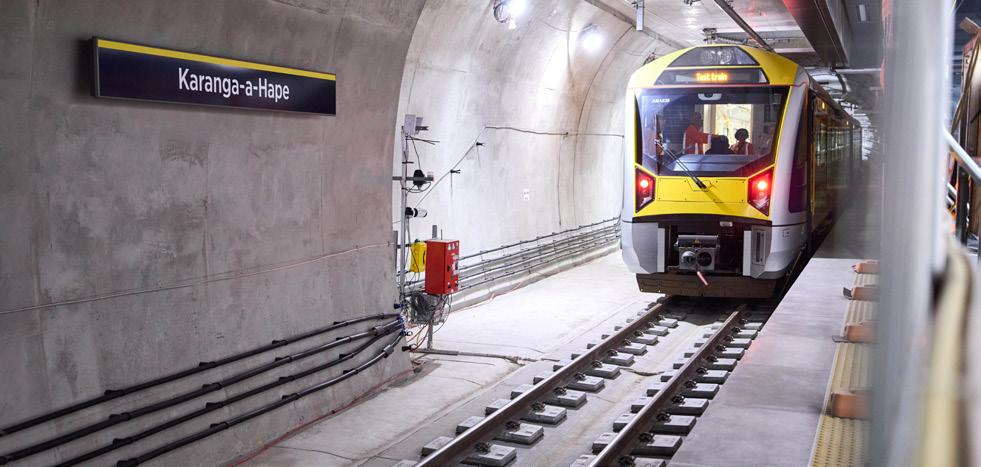
When CRL opens, the Southern Line will be replaced by the South City Line. South City Line trains will stop at the new Karanga-a-Hape and Te Waihorotiu Stations, making it easier to access more of the city centre.
Karanga-a-Hape
Te Waihorotiu
Grafton
Waitematā
Newmarket
Remuera
Parnell Greenlane
Ellerslie
Penrose Platforms 1 & 2
Ōtāhuhu
Middlemore
Papatoetoe
Puhinui
Homai
Manurewa
Te Mahia
Takaanini
Papakura
Drury
Paerātā
Pukekohe
How to get on board your new ways to move
Here’s a quick, easy guide to getting around your city on public transport – and making the most of West Franklin’s brilliant new travel choices.
Turn up & go
It’s that easy. Just turn up at your station or bus stop, raise your arm to stop your bus, ‘tag-on’ with whatever smart card or device you have on hand, and enjoy your trip. Most buses will announce the next stop just before you get there, so you know where to get off. Don’t forget to ‘tag-off’ as you do.
Trains and ferries will stop at every station or terminal automatically.
Ways to pay
There are more ways to pay for bus, train and most ferry services than ever.
You can use any smart debit or credit card, watch or device, or use a pre-paid HOP card from Auckland Transport.
Just hold your card or device near the reader and the start and end of the journey to tag on and off. A ‘beep’ tells you it worked. Always use the same card or device to tag on and off to make sure you’re always charged the right fare. If you transfer between services in the same fare zone within 30 minutes, you’ll be charged as if it’s one trip – so long as you remember to use the same card or device.
Suss
your bus, train or ferry
Don’t know which bus to take, or where the bus stop is? We’ve got you covered. Download the AT Mobile app from the App Store or Google Play, or go to Journey Planner on the AT website.
They’ll help you plan your journey end-to-end, including departure and estimated arrival times, and will tell you how much your journey will cost too.
You can even get the AT Mobile app to message you with updates on important travel information.
Discounts & fare cap
Your smart cards or devices are the most convenient way to pay for occasional trips, but getting an AT HOP card and registering it online can give you access to a range of discounts and the 7-day fare cap.
Check at.govt.nz/concessions for a full list of discounts available.
It’s as easy at that. Now you have more choices, just grab your card and GO!
Plan your journey on your AT Mobile app
EDITOR FOOL’S GOLD...
There are “lies, damn lies and statistics,” there “is no truth only perception,” and sometimes there are pure and simple mistooks... sorry, I mean mistakes!
The truth is slippery at best. With this considered, it’s not so strange that people distrust ‘the media.’ I might argue that errors by doctors have led to many, many more deaths than errors by journalists, but that’s a race to the bottom mentality. Also, their job is hard, or so I hear.
I’m not saying errors are acceptable, but they are often understandable. As I was advised by an old scribbler:
“If you’re making too many mistakes, you’re working too hard; if you’re not making many, you’re not working hard enough.”
Then there’s perception. Truth is often mistaken for point of view and, in fact (in
truth), the truth is often simply a case of majority rules.
If this wasn’t true, Einstein wouldn’t have found the need to improve on work by Newton. I could make a crack about an apple not falling far from a tree, but there’s no evidence Newton was ever bopped on the bonce by an apple, although he probably did see one fall.
In any case, why let the truth get in the way of a good story, especially when most believe it to be true? We’d then have to concede that champagne glasses weren’t modelled on the anatomy of Marie ‘never said let them eat cake’ Antoinette either and where’s the fun in that?
Journalists are trying to input information, sift it, reorder it, angle it for their readers and try (often failing) to present a truth as close to the truth as soon as possible, before it becomes old news.
We’re panning for gold in a world of pyrite.
In case anyone is thinking they should give us a break, please don’t! Unlike in the Wild West version of media, known (ironically?) as ‘social media’, we can be held accountable so we should be. Anyway, spinning excrement doesn’t do us any favours.
“These boots weren’t made for walking, the Marquis de Sade never made no boots like these... I know the truth and I know what you’re thinking” –Fool’s Gold, The Stone Roses.
Too true – anyone who’d seek their fortune, or even just their daily bread, in pursuit of truth must be a tad sadomasochistic.
Yours truly (if sometimes accidentally untruthful),
Jon Rawlinson
New to team Times
By ISABELLA ROOT
Hi Franklin readers, I’m the newest journalist in our Pukekohe office.
After a few weeks of finding my feet, learning the ropes and remembering everyone’s names, I can confidently say I’m getting stuck
into life at Franklin Times
I’m stoked to be part of the Times Media team, writing community stories and hopefully making our editor’s life just a little bit easier.
My byline has been in publications across the central North Island, including the Waikato Times and I’m
now looking forward to making it familiar in Franklin too.
So, if you’re up to something interesting, know someone who is, or you have a yarn that’s too good to keep to yourself, email – isabella@ franklintimes.co.nz.
NEWS ROOM
Editor Jon Rawlinson Ph 021 02469998
editor@franklintimes.co.nz
ADVERTISING 09 271 8000 advertising@times.co.nz 210 King Street, Pukekohe
In a way, I’m the newest professional gossip, except I put it in the newspaper and call it journalism.
Local stations now online
By ISABELLA ROOT
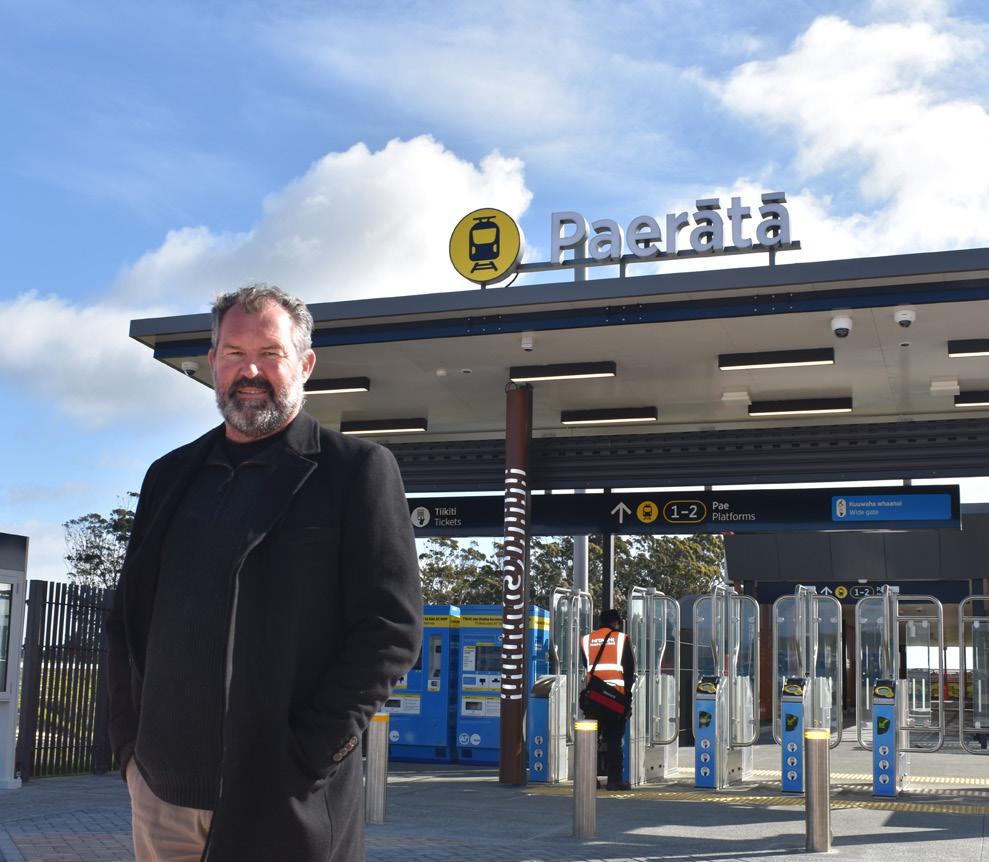
The wait is over for Franklin commuters, with Drury and Paerata’s new railway stations officially opened at the weekend.
The platforms were buzzing on Saturday as people gathered to trial the new rail connection ahead of the first passenger services scheduled for the following day.
Paerata Rise’s executive director, Chris Johnston is pleased to see the station supported and open for business.
“Pulling into and out of our own train station for the first time was quite exciting,” Johnston says.
With growth in the pipeline for both Paerata and Drury, Johnston says the stations will be essential in supporting that growth for businesses while also giving residents a realistic alternative to driving when travelling elsewhere in the region.
“We have wanted to be more centred around the railway rather than being so reliant on the roads,” he says.
“The ease of hopping on an efficient rail system is going to be absolutely brilliant!”
The services connect to
Auckland’s Southern Line, with new bus routes linking communities including Paerata Rise, Ramarama, Waiuku, Glenbrook and Pukekohe.
Franklin Ward Councillor Andy Baker says the opening sees a welcome return to pas-
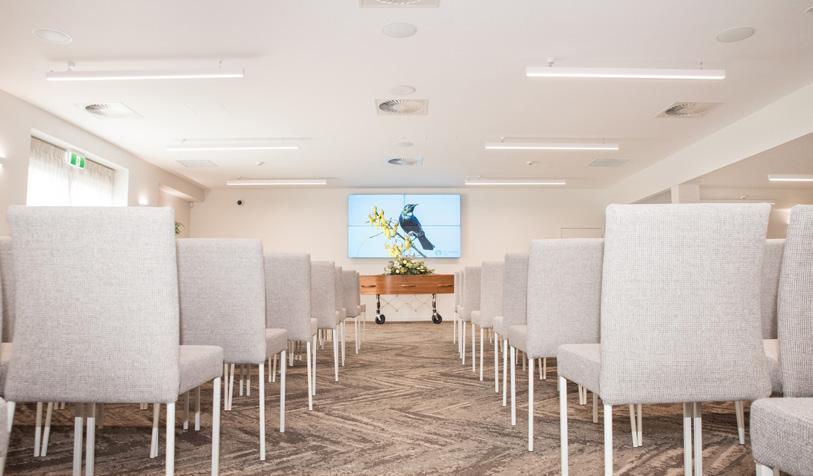
Personal Farewells, Done Your Way
Talk to us today – to talk through your options
senger rail travel in the area after more than five decades without a local station.
“It’s been more than 50 years since there was a train station in Drury and since then we’ve seen a huge transformation on Auckland’s rail network, as well as in our communities,” Baker says.
With the City Rail Link opening in the coming weeks, commuters from Drury and Paerata can expect a train every 10 minutes during peak times – which Baker says will make more journeys across Auckland easier.
The opening of the stations coincides with improvements to bus services and routes connecting communities to the rail network.
Both Drury and Paerata stations have 350 park-andride spaces, with room for more in the future, as well as pick-up and drop-off areas and facilities for cyclists and motorcyclists.
Executive director of Paerata Rise, Chris Johnston Photo Isabella Root
CRL previews ready to run
While two of Franklin’s new stations are now online, Auckland rail travel is set to take an even greater step forward when the City Rail Link (CRL) launches.
Until then, passengers can take a ‘First Look’ at CRL stations and a new Journey Planner tool is intended to help navigate the enhanced network including its South City Line (SCL).
The CRL will reshape rail travel, Auckland Council Transport and Infrastructure Delivery Committee chair, Andy Baker asserts.
“It will be possible to get a direct train from Panmure to Kingsland, from Pukekohe and Papatoetoe direct to the city centre or Karangahape Road,” he says.
“To help customers prepare for the changes, Auckland Transport (AT) has added a new Journey Planner feature that allows users to switch between today’s
network and the future CRL-enabled network.”
Auckland’s train timetable will change with three new train lines – East West, South City and Onehunga West –and three new city stations.
At peak, trains will run every 5–10 minutes and every 15 minutes throughout the day, including weekends.
The SCL will run from Pukekohe to the city centre. Unlike on the Southern Line, SCL trains may arrive at and depart from differ-
their direction, so passengers should check boarding information before travelling.
The new Journey Planner is intended to help users better understand such changes, AT’s Mark Lambert expects.
“We want people to get familiar with the new lines and where the new stations sit. Even a small change, such as [a train] arriving a few minutes earlier or later, can have a big impact and we want to help people plan ahead,” he says.
Come and Visit our New Showhome
travel will look like on a Monday, you can select that option. If you’re looking to see how you can connect with bus services near new train stations, the tool will show you the options.”
New stations at Maungawhau (Mount Eden), Karanga-a-Hape and Te Waihorotiu in the city centre are hosting First Look events from August 8.
Visitors will be able to learn more about the stations and how the new network will operate. While the events are free, tickets are limited.
“This will mark the first time the public will be able to enter Auckland’s newest stations and we’re excited to give people the opportunity to experience them before passenger services begin,” Lambert adds.
Visit at.govt.nz to access the Journey Planner preview or for more information about First Look events.
Photo Auckland transport
It’s been a long and winding road, but Franklin now has two new rail stations up and running with another still in the works. As Minister for Rail (and a former Hunua MP), Winston Peters has had some involvement in the projects, as this original illustration by Roger Smith suggests.
Parking…
What’s in a name? A park by any other name – at least the plants in it – would smell just as sweet.
Following a hui earlier this year, the Papakura Local Board has renamed 25 local parks with new monikers all intended to highlight and celebrate their unique identity and culture.
It is an honour to adopt the kete (basket) of new names, board chair Kelvin Hieatt says.
“It is a real privilege to enrich the historic value of many more of our public open spaces with these new park names,” he confirms.
“Each name has a significant meaning and narrative associated with its geography and local history, providing an opportunity for residents to learn te reo and about Māori history and values that are locally relevant.”
The new park names are also intended to strengthen council’s relationship with mana whenua while also honouring its commitment to Te Tiriti o Waitangi.
“Existing names will co-exist alongside new te reo Māori names as dual titles,” Hieatt adds. “The exceptions are Hingaia Esplanade Reserve, which has adopted Te Waongaro, and Hingaia Reserve will become Waipaatiki Reserve. Hingaia Park, which is down the road, will retain its name.”
Signs will be replaced when they are due for renewal to minimise environmental impacts and costs. However, to mark the change, the history behind Te Kirikiri (Keri Downs Park) will be shared through a QR code on updated signage.
Details are available via aucklandcouncil.govt.nz.
Slippery street strikes again
By ISABELLA ROOT
While options are being explored with a view to improve King Street’s slippery surface, soon after the Times raised concerns, the hazardous footpath claimed another casualty.
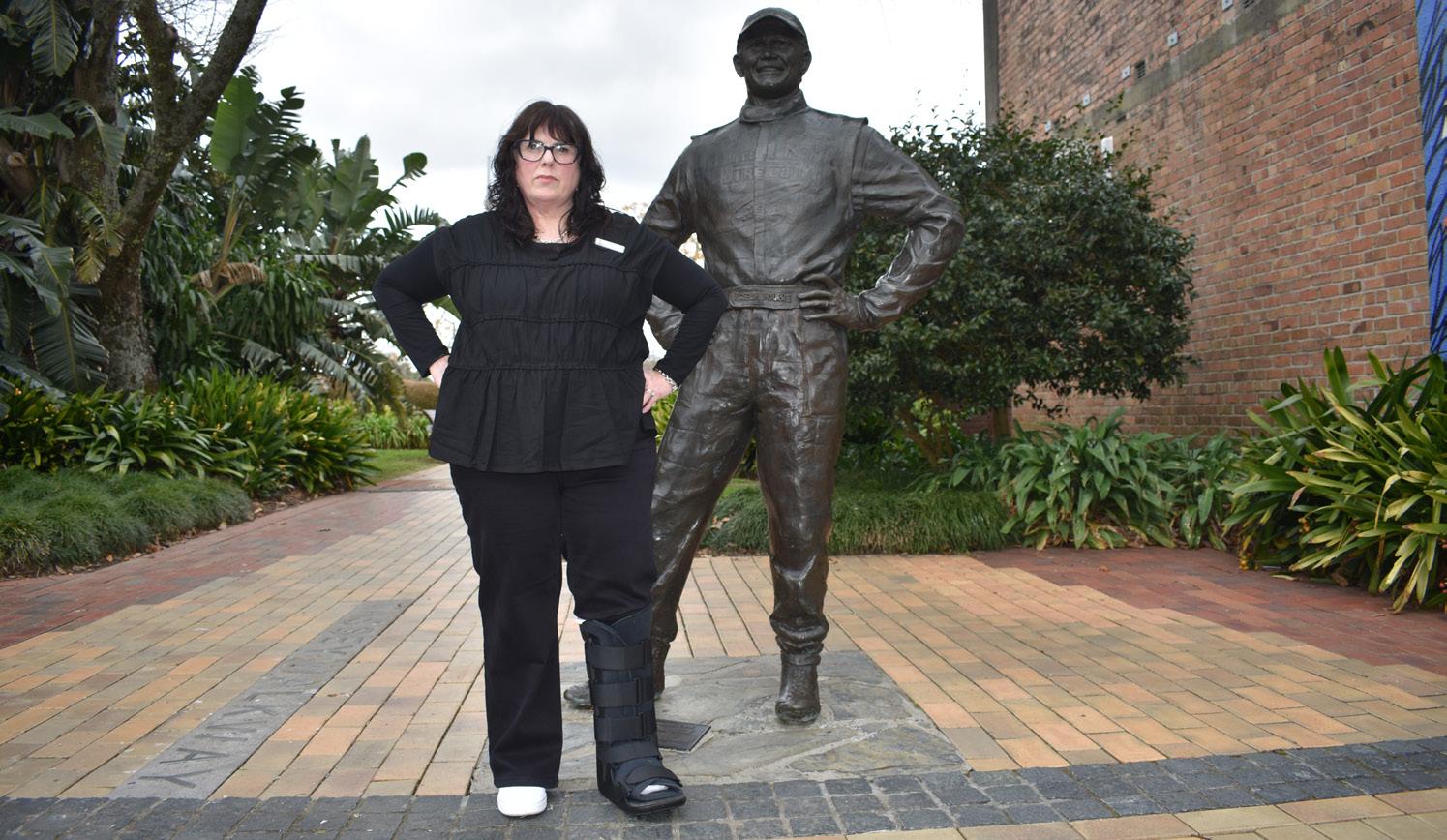
Claire Scott, who works at King Street’s Bendon Outlet Pukekohe, was on her way to work recently when her foot slipped on the damp footpath, fracturing her ankle and leaving her shaken.
After five hours at an A&E, Scott went home with a moon boot, a medical certificate and two weeks of ACC leave – a burden she says was not only physical.
“I managed to hobble inside but it hurt so much that when I rang my manager, I just burst into tears,” she says. “Also, financially it’s not ideal because we all have bills and mortgages to pay.”
Scott has warned others to be careful on the footpath – she now knows the importance of this all too well.
“Over the years, we’ve heard that customers have broken arms, ankles and legs from slipping, especially older people.”
Other locals have also contacted the Times following our last issue, all sharing similar concerns about the slippery street.
Lesley Kidd (68) says she didn’t have any trouble walking down King Street before the tiles were installed, but she has since been avoiding
the street when she can.
“Even with running shoes on, it seems to be too slippery,” she says. “I’ll often put things off, so I don’t have to go down King Street especially when it’s wet.”
They are not alone. Feedback collected by Pukekohe Business Association (PBA) in 2022, found that 82 per cent of respondents had slipped or knew someone who had. In addition, 50 per cent said they keep clear of the CBD during wet weather to prevent slipping, PBA GM, Shawna Coleman confirms.
“We’ve advocated for a solution for several years, working with the Franklin Local Board and technical experts. Previous trials have not delivered a lasting result, but recent testing has [been]
encouraging. We are hopeful a long-term solution is within reach soon.”
While his comments do not necessarily reflect those of the Franklin Local Board, board member Merritt Watson agrees that the footpath has been a recurring problem, particularly in winter.
“Although people may not see obvious activity on King Street, there has been work happening behind the scenes,” he says. “We are trying to find a practical solution because we recognise this is a genuine safety issue.”
Options are being explored, but it is not an easy fix. One attempt involved applying a non-slip coating on sections of the pavers, which was relatively inexpensive, but it wore away
within weeks. Other methods have been considered, including abrasive blasting to improve grip. Digging up and replacing the tiles would involve a disruptive reconstruction of Pukekohe’s main street as well as surrounding roads and an “eye-watering sum” to cover the cost.
“Without [enough] feedback, it becomes much harder for the local board to justify prioritising funding for a project of [such a] scale over many other competing demands across Franklin,” Watson adds.
“If we can significantly improve the existing pavers without replacing an entire streetscape that is only around 25 years old, that would be a much better outcome for the community.”
Pukekohe’s Claire Scott, injured during a recent fall on King Street.
Photo Isabella Root
Let’s Talk Hearing
With Wolfe Hearing Audiologist Kathrin Baer
This month’s question: “Why do some people love their hearing aids while others leave them in a drawer?”
Two people can buy hearing aids at around the same time. One says they have transformed everyday life. Conversation is easier, television is clearer and family gatherings are enjoyable again. The other wears theirs for a few days, becomes frustrated and eventually puts them in a drawer.
Why can the experiences be so different?
The answer is rarely as simple as one person buying a “better” hearing aid. While today’s technology is remarkable, success also depends on choosing the right hearing aid, fitting it correctly, providing ongoing support and ensuring it suits the person’s lifestyle and goals.
Hearing aids aren’t off-the-shelf products
Modern hearing aids can be programmed in thousands of different ways. Someone who mainly wants to hear conversations at home has very different needs from someone who works in noisy environments, enjoys restaurants or attends regular meetings.
The type of hearing loss, shape of the ear, dexterity, eyesight, phone use and personal preferences all influence which hearing aid is most appropriate. The most advanced or expen-
sive device isn’t always the best choice. If your Audiologist can select from all available technology and brands, there’s a higher chance you’ll be recommended the product that best suits your needs.
Motivation matters
One of the biggest predictors of success isn’t technology, it’s the person’s readiness to improve their hearing.
Many people gradually adapt to hearing loss without realising how much it affects their relationships, confidence and quality of life. Some purchase hearing aids mainly to please others. If they are not ready and their first
experience isn’t immediately positive, they’re more likely to stop wearing them and return to familiar habits.
Good audiologists spend time understanding a person’s motivation, setting realistic expectations and supporting them through the adjustment process. Research consistently shows that addressing hearing loss earlier leads to better outcomes for both communication and longterm quality of life.
Expectation and follow-up are critical
Hearing aids don’t restore hearing to exactly what it was years ago, nor can they eliminate all
background noise. What they can do is improve speech clarity, reduce listening effort and make everyday communication much easier.
It’s also normal for everyday sounds, such as running water, footsteps or even your own voice, to seem different at first. Often this reflects the brain becoming reacquainted with sounds it hasn’t heard clearly for years.
That’s why follow-up appointments are so important. Fine-tuning based on real-life experiences often makes the difference between frustration and long-term success.
The person fitting your hearing aids matters
A hearing-aid fitting is just the beginning and the expertise of your Audiologist throughout the process makes a difference. At Wolfe Hearing, we believe successful hearing care starts with understanding the person, not simply selling a product. We take the time to understand your lifestyle, explain your options and continue supporting you after your fitting, because our goal isn’t just to provide hearing aids, it’s to help you hear better in the moments that matter most.
Wolfe Hearing. Your Local, independent Audiologist, celebrating 20yrs of providing exceptional hearing care. 40 King Street Pukekohe and at ‘The Doctors”, Drury. www.wolfehearing.co.nz
Taking the plunge
By KUSHLA CLARKE, Acting Senior Sergeant of Youth Services and Whāngaia Ngā Pā Harakeke (Family Harm).
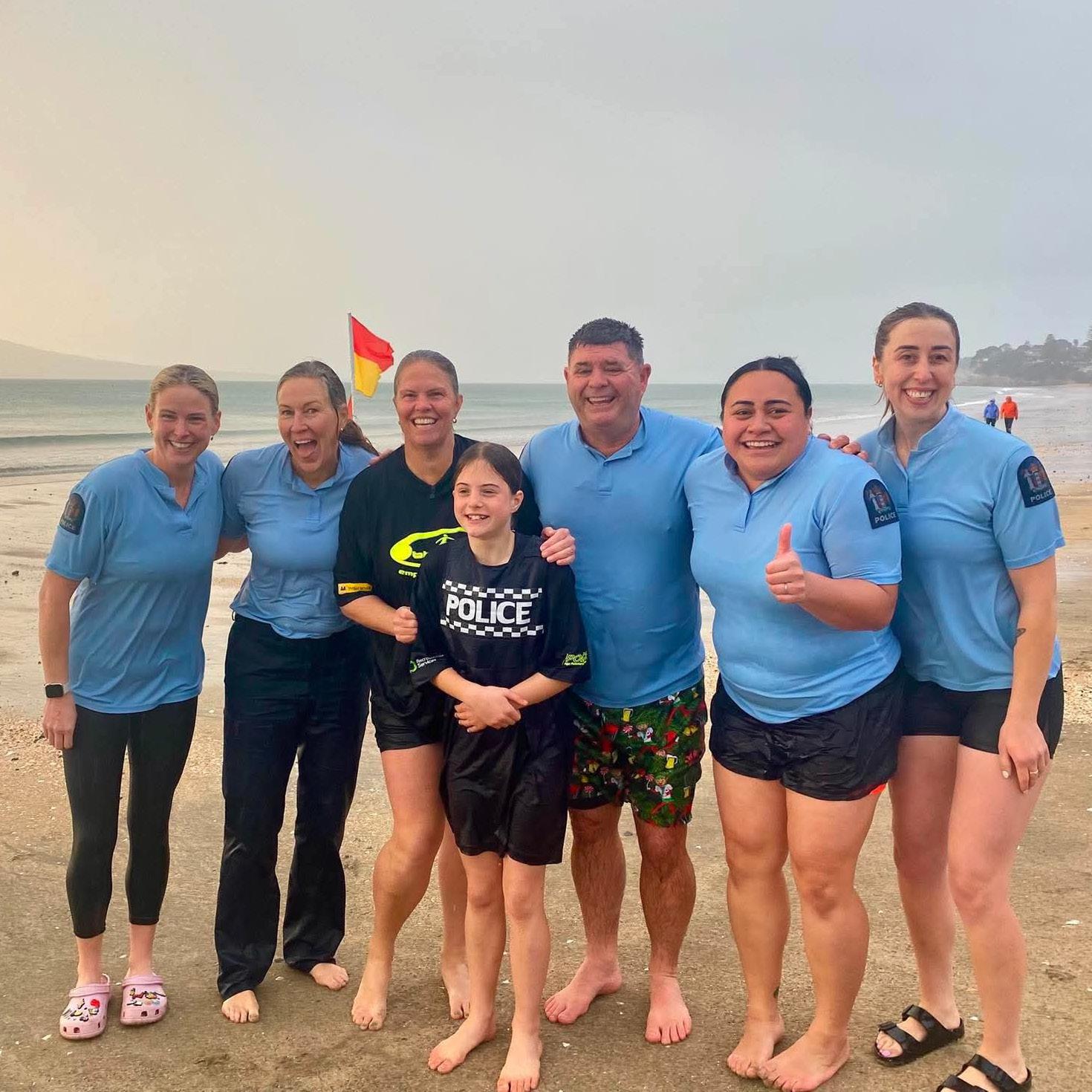
On Saturday, July 25, police staff and families joined athletes and supporters at Takapuna Beach for the Special Olympics New Zealand Polar Plunge, braving the icy winter waters to raise funds for a fantastic cause.
The event, organised through the Law Enforcement Torch Run (LETR), encouraged participants to “take the plunge and be part of something special on a good old fashioned mid-winter morning” while supporting Special Olympics athletes across Aotearoa New Zealand.
Despite the freezing conditions, the atmosphere was full of energy, laughter, and community spirit. Police personnel enjoyed meeting and interacting with athletes from
our local area, strengthening relationships and celebrating the achievements of Special Olympics participants.
A highlight of the morning was watching police district commanders make a splash by jumping from a police boat into the ocean, much to the delight of the crowd.
Polar Plunge Auckland was a nationwide success, raising an impressive $46,677 to support Special Olympics athletes in pursuing their sporting goals and opportunities.
After the chilly dip, participants were treated to warm food and hot drinks, providing a welcome chance to thaw out and reflect on a memorable morning of community engagement, inclusion, and support.
Police are proud to support events such as the Polar Plunge, which bring communities together and help create positive opportunities for athletes across the motu (country).
All those pictured in operational shirts are police staff from the Counties Manukau District; the child is Georgia Lauder (daughter of police officer Dean Lauder) and pictured in the Bluelight shirt is Lauder’s partner Michelle Hunt.
Photo supplied
SAS: Your building specialist
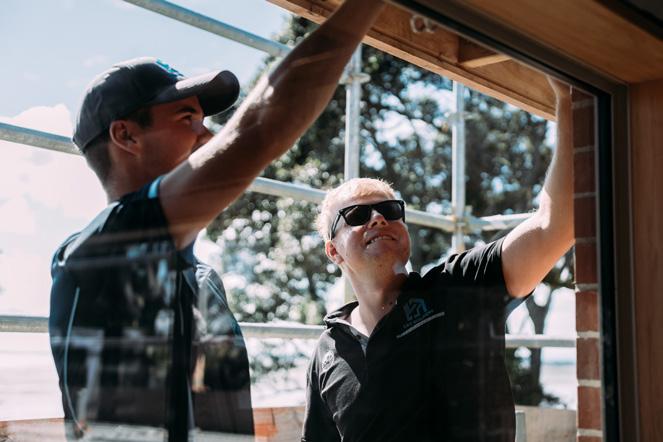
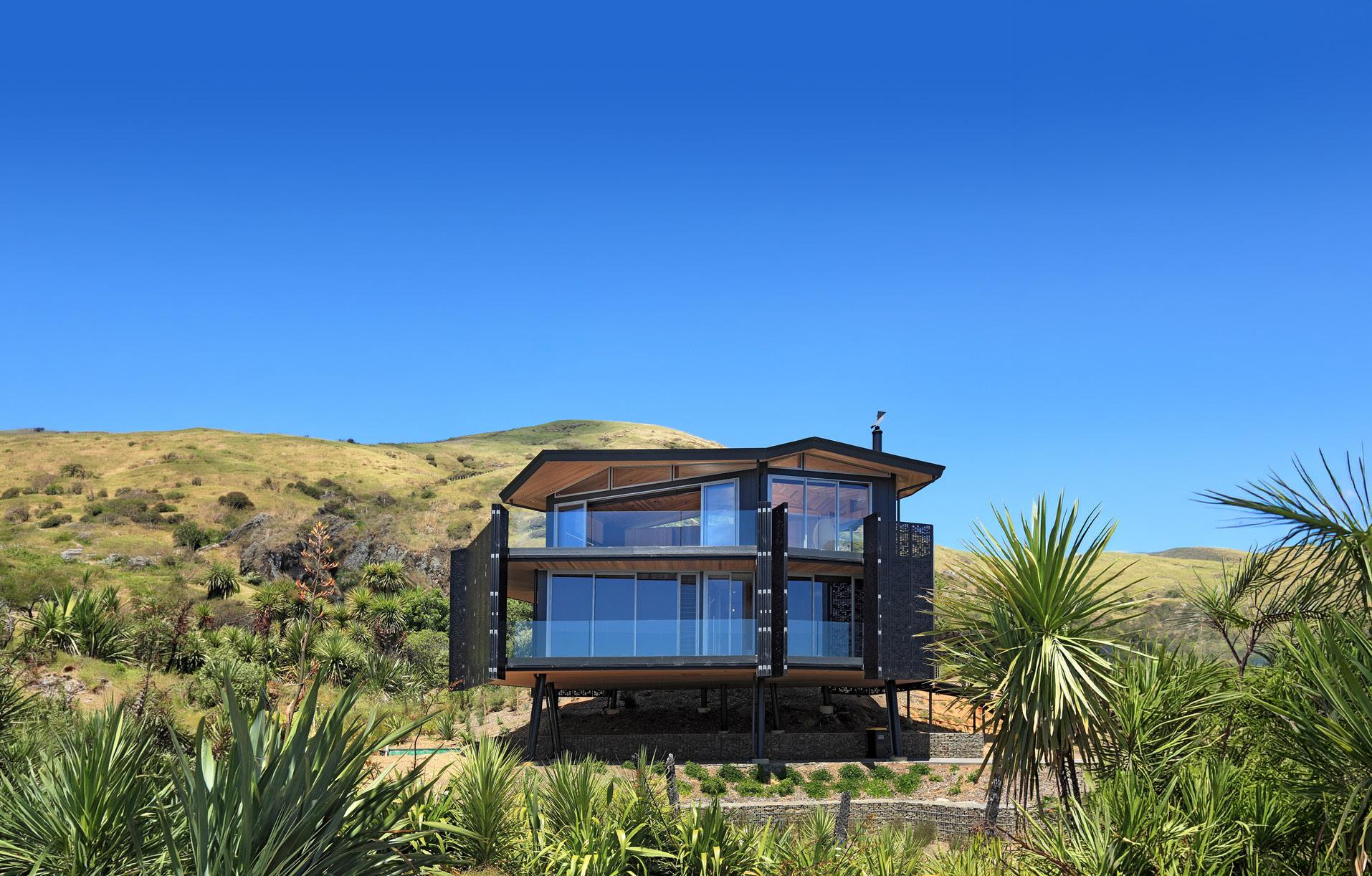
SAS Builders was created by Shaun with a simple but deliberate goal: to build a company clients could genuinely trust and enjoy working with. SAS stands for Specialised Architectural Solutions, and that’s always reflected the type of work the business is passionate about, Shaun says.
“While we build everything from new homes to renovations, our focus has always been on bespoke architectural projects and complex renovations. We enjoy the challenge of taking a client’s vision and turning it into something truly unique, rather than simply building the same home over and over again.”
The best homes aren’t designed around trends; they’re designed around the people who live in them.
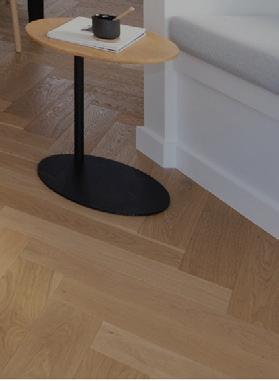
“We encourage clients to think about how they use their home every day, from where they drop their keys when they walk in the door to the flooring that best suits their family. A beautiful home should also be practical, comfortable, and easy to live in.
The projects that stand the test of time are the ones where every design decision has been made with everyday living in mind.”
With more than a decade spent on the tools, Shaun brings a hands-on understanding of residential construction and a deep respect for doing things properly. His attention to detail and pride in workmanship shape every project and set the standard for the team he leads. Each builder is carefully selected not just for skill, but for their commitment to quality and accountability.
What Shaun loves the most about building is helping clients bring their vision to life.
“Every project is unique, particularly the complex renovations and architectural homes we specialise in, and I enjoy working alongside clients to navigate that journey together. Seeing an idea become a home that completely transforms how a family lives and knowing we’ve made the process enjoyable along the way, is what makes the job so rewarding.”
Under Shaun’s guidance, SAS Builders has developed a repu-
tation for reliability, clear communication and consistently high standards. Strong relationships with local architects, designers, and specialist trades ensure every project benefits from a collaborative, well-aligned team.
Shaun stays closely involved throughout each build, from early conversations through to final handover. With one point of contact and a structured, transparent process, clients are supported at every stage, resulting in a smooth experience and a home built with care.
“The biggest piece of advice I’d give is to involve a builder as early as possible. Too often we see people invest significant time and money into architectural plans, only to discover later that the design doesn’t align with their budget.”
Bringing a builder into the conversation early means your budget, design, and construction costs can all be considered together. It creates a much smoother process, avoids costly redesigns, and gives you confidence that what you’re planning
is actually achievable.
Some of the most rewarding projects are renovations and extensions to old villas and farmhouses, Shaun says. These homes are full of character, but they also come with unknowns. Once you start opening walls, you never quite know what you’ll uncover after decades of alterations and ageing. The key is being upfront with clients about those possibilities from the beginning, allowing for contingencies and working through any surprises together.
“It’s challenging work but preserving the character of these homes while bringing them up to modern living standards is incredibly satisfying.”
With 20 staff (and counting) including a full-time quantity surveyor, project manager, and experienced administration support, SAS Builders provides clear communication, accurate information and the ability to work efficiently and adapt quickly when required.
Let us kickstart your dream home today!
Drug testing hits new high
By JIM BIRCHALL
Drivers across Franklin and northern Waikato could be stopped and tested at any time as New Zealand’s new roadside drugtesting regime rolls out further nationwide.
The expanded programme is expected to have particular relevance in Franklin, where state highways and busy rural roads connect, carrying thousands of commuters and freight operators every day.
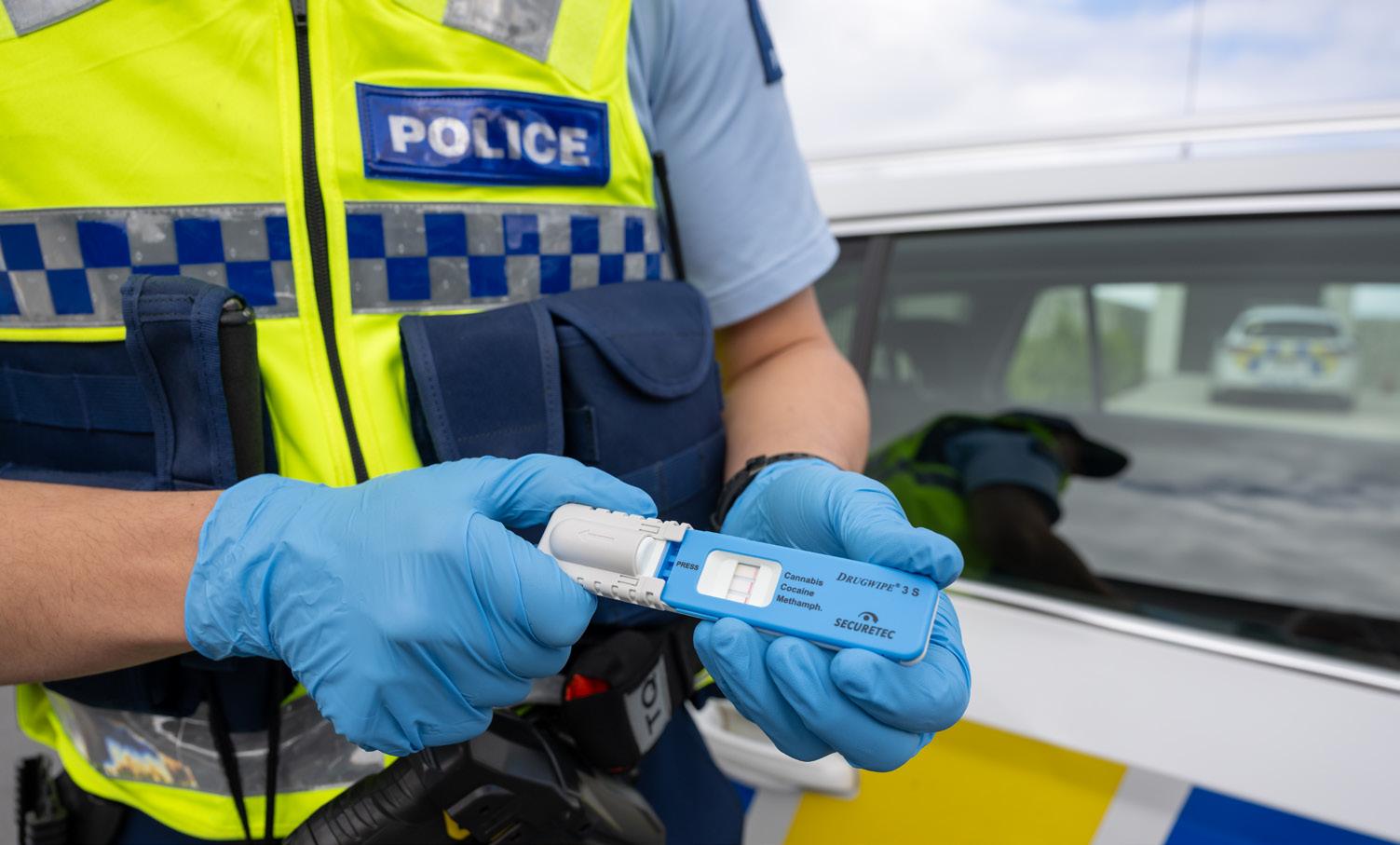
Police have begun using roadside saliva screening devices to detect recent use of drugs including cannabis (THC), methamphetamine, MDMA and cocaine, alongside existing alcohol breath-testing operations.
Road Policing Senior Sergeant John McCarthy told the Times that the ongoing drug screening will be:
“Randomly conducted at checkpoints alongside breath testing and can also occur following the detection of a road safety offence, including speeding, or a crash.”
If a driver returns a positive result, a second saliva sample is collected and sent to a laboratory for evidential testing. Drivers who return two positive roadside tests can be prohibited from driving for 12 hours while further analysis is completed.
The new powers address a significant road safety issue, as Transport Minister Chris Bishop explains.
“[Approximately] 30 per cent of road deaths involve
an impairing drug. If you take drugs and drive, you are putting innocent lives at risk, and we will not tolerate it.”
Police Minister Mark Mitchell says officers have spent months training staff and refining procedures.
“Rolling out drug tests is a practical step toward safer roads,” he adds.
According to the Ministry of Transport, alcohol and drugs continue to play a major role in serious crashes.
In 2024, there were 119 fatal crashes, 463 serious injury crashes and 959 minor injury crashes where alcohol and/or drugs were identified as contributing factors nationwide.
These resulted in 143 deaths, 620 serious injuries and 1459 minor injuries.
Road safety experts say impairment can significantly reduce reaction times, affect judgement and increase the likelihood of a crash.
However, some advocacy groups have raised concerns as tests can detect drugs after an impairment ‘high’ has passed. This appears to be confirmed by the NZ Drug Foundation, which notes roadside saliva testing identifies recent exposure rather than measuring actual impairment at the time.
Detection times can vary significantly depending on such factors as the substance and frequency of use. Cannabis may be detectable for around 12 hours in occasional users and up to several days in frequent users, while methamphetamine
and MDMA may be detected for one to four days after use.
Police can randomly test any driver. Refusing a roadside saliva test results in an infringement offence carrying a $400 fine, 75 demerit points and an immediate 12-hour driving prohibition.
Medicinal cannabis users may also return positive roadside tests if their medication contains THC.
While a medical defence may be available for prescribed use, drivers can still be prohibited from driving for 12 hours.
The government has set an initial target of 50,000 roadside drug tests annually nationwide as part of its broader strategy to reduce deaths and serious injuries caused by impaired driving.
Roadside drug testing.
Photo supplied NZ Police
New blues join local beat
By ISABELLA ROOT
Four new faces have recently joined the front line across Pukekohe and Papakura as the one of the latest groups of New Zealand Police graduates begin their careers.
With their initial training now completed, these new officers are all bringing fresh blood to the police force, fresh boots to the beat and a new generation of support to the community.
The recruits are part of a wider deployment of 53 new constables who are now beginning their duties at various stations throughout the Auckland region.
Constable Greggory Fisher, who is to be stationed in Papakura, says he joined the force so that he could be there for people when they need it most.
to real-world situations and make a positive difference in people’s lives each day,” Fisher says. Wing 396 graduated 49 new constables from the Royal New Zealand Police College (RNZPC) in Porirua, while Wing 397 graduated 34 recruits from the Auckland Police campus.
The new constables come from all sorts of diverse backgrounds. Some have served in the military, others are tertiary graduates and some are following in the footsteps of family members who have also been on the front line of New Zealand policing.
For Fisher, one of the biggest appeals of policing is the
“It is a privilege to support people through those [tough] moments,” he says. “I hope that by treating everyone with compassion and respect, I can make a positive difference locally.”
variety it offers – no two days are the same when serving on the thin blue line.
“Every day brings new challenges, the opportunity to work with many members of the community, respond
Since the officers have been deployed, they have been out patrolling streets, breaking in their new blues and getting to know the communities they now serve.
For residents of Papakura and Pukekohe, these new police officers will soon become familiar as they settle into their roles.
From left: Constables Greggory Fisher, Brewster Fifita and Sam Roberston.
Photo NZ Police
Something in the air/water...
By JON RAWLINSON
The dust has settled since alarm bells rang in Tuakau, first sparked by a strong chemical smell in the air.
Firefighters rushed to the town on July 21, discovering wastewater needed to be flushed to clear a hazardous, unknown substance since identified as either a “petroleum or oil-based product.”
As this issue of the Times went to print, questions remain as to the exact nature of the substance, how it found its way into the wastewater system and who might be held responsible.
Answers will come, Keith Martin from Waikato District Council (WDC) water company, IAWAI, expects.
“Investigations into the substance which entered the wastewater network are continuing,” he says. “Samples have been taken and these are being processed for test-
Photo Jon Rawlinson
unknown substance,” FENZ’s acting assistant district commander for Counties, Brad Harvey said. “We’re working to flush the substance to the water treatment plant where it can be dealt with.”
Five fire appliances, a HAZMAT unit and an ambulance were at the scene although no one required serious medical treatment.
ing. At this stage, we cannot precisely confirm the product which entered the system.”
When and if a culprit is uncovered, they can expect hefty consequences with penalties of up to $200,000. Costs for dealing with damage can be recovered from people or businesses responsible, IAWAI has confirmed.
“[We] will determine whether test results and other information supports
That feels personal Care
enforcement under the bylaw and, if so, to what level,” Martin says.
When Fire and Emergency NZ (FENZ) responded to the incident, it soon became apparent that there was a problem.
Residents of a dozen properties were evacuated while others were warned to stay inside, the Times was told when arriving on site.
“We’re dealing with an
Later that night, after atmospheric readings confirmed air quality had returned to safe levels, locals were able to return home.
IAWAI thanked emergency services personnel and residents for their help and understanding. How understanding IAWAI, emergency services and residents will be if a perpetrator is confirmed remains to be seen.
“Final decisions are still weeks away,” Martin adds. “We will be taking advice and working with WDC on the next steps.”
Farm footing firm, Fed says
By ISABELLA ROOT
Kiwi farmers are using strong returns to pay off debt and invest. The latest Federated Farmers Banking Survey and Reserve Bank data shows national agricultural lending has fallen by $1.4 billion over the past year.
Auckland Federated Farmers president, Rosemarie Costar says farmgate prices have allowed farmers to borrow less while preparing for future challenges. This includes farmers across Franklin, the Onewhero local told the Times.
“There’s been a lot of debt repaid, which has put them in a position of having much stronger balance sheets. It’s important because you have to be prepared to weather the next storm or drought, or whatever issues are to come.”
CABINS LIMITED
Based on responses from almost 540 farmers, the
survey also found that relationships between farmers and banks are continuing to improve, with satisfaction levels rising to 69 per cent –a record high in the survey’s eight-year history.
“Banks understand farming, they know it’s very cyclical and how you can have a good year but next year may not be fantastic,” Costar says.
“When the pressure is off a little bit, because you’re able to pay off debt, it certainly makes things easier.”
Farmers are benefiting from better farmgate prices and a Fonterra payout, Feds’ banking spokesperson, Mark Hooper says.
“A capital redistribution of $2 per share to Fonterra suppliers, combined with record beef and sheep farmgate prices, has likely allowed farmers to meaningfully reduce loan principal.”
Positive signs for dairy and livestock are offset by tough times for growers.
“The outlier is arable
farms,” Hooper says. “That sector is in near-crisis mode, with weak grain prices, rising costs, tough growing conditions and competition from lower-cost imports.”
Of added concern is Waikato Regional Council’s proposed Plan Change 1 (PC1). As previously reported, PC1 relates to water use in the Waikato, but it could also have a knock-on impact on Franklin growers too.
PC1 has growers on both sides of the Waikato border unsure about the future, Costar says.
“We talk about a costof-living crisis, well no one wants vegetables to become any more expensive.”
Despite challenges, overall reduction in debt shows farmers are making sensible financial decisions, making hay while the sun shines.
“It shows people are being wise with their money and paying off debt,” Costar adds.
Notice of AGM
Date: Tuesday 25 August 2026
Time: 5:30pm
Venue: Navigation Homes Stadium (CMRFU) 21 Stadium Drive, Pukekohe
Trustees hold 100% of the shares in Counties Energy’s electricity distribution lines network on behalf of its connected consumers.
The network runs coast to coast between southern Papakura and Mercer, and west of the Waikato River from Mercer to Waikaretu.
The Trustees warmly invite you to attend the AGM which will be followed by light refreshments.
This is your opportunity to meet and ask questions of the Trustees, Directors, and Management Team.
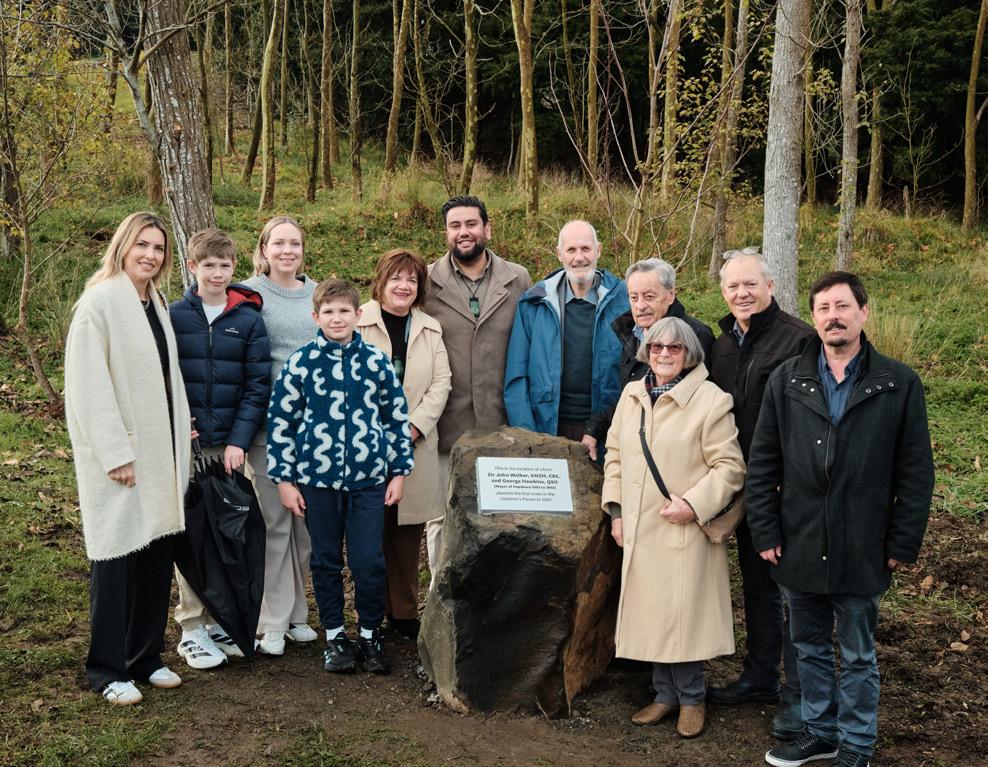
Part of Papakura’s living history was celebrated in Red Hill recently.
Each year parents and whanau of children born in Papakura in the past year were invited to commemorate their child’s birth by planting a tree.
The first trees to be planted were by the thenmayor of Papakura, George Hawkins, and sporting great Sir John Walker in the Children’s Forest in 1985.
Sir George Hawkins Senior was Papakura Mayor from 1983 to 1992. Together with the town clerk Graham Tagg, he was part of the driving force behind the creation of the Papakura Children’s Forest.
“The land here wasn’t suitable for development. We found that there was movement at the foot of the hill and the land needed to
be stabilised ... the first trees planted were fast-growing exotics,” Hawkins says.
While the first few years involved planting exotic trees, they instead began planting natives like rimu,
kauri, kowhai, and totara.
“The children’s forest had many purposes – the maternity hospital was going to be closed, and we wanted to show that the hospital was important. Acknowledging
Sir John Walker as a hero, a New Zealand hero, achieved the purpose of making a piece of land that wasn’t planned to be suitable for housing into something that something positive, and [the forest] would keep on growing for years and years.”
Hawkins and his wife Jan also planted trees when their two sons were born. Their eldest son George is currently a member of the Papakura Local Board.
Representatives from the board were joined by members of the Hawkins and Walker families in July, to unveil a plaque to mark the replanting of two trees first planted in 1985.
Papakura Local Board chair Kelvin Hieatt says the forest is a very significant site for the residents and community of Papakura.
Residents can access the planting maps at council service centres.
Members of the Walker and Hawkins families alongside Papakura Local Board members. George Hawkins, second row, third from right. Photo supplied
Community approach for local rural libraries
By HELENA O’NEIL
Across Franklin is a network of rural libraries run by their own communities.
Community-led (sometimes called rural) libraries have their own membership and borrowing and returning systems which are separate to Auckland Libraries’ membership. There are currently 11 across the Auckland
Franklin’s rural libraries
Auckland Libraries works in partnership with 11 rural libraries in the wider Auckland region, with seven in Franklin: Beachlands Library: (soon moving to Beachlands Memorial Hall)
Clarks Beach Library: Tuesdays and Thursdays 9.30am to 11.30am, Saturdays 1pm to 3pm.
Clevedon Library: Tuesdays from 1.30pm-3.30pm, Fridays from 2.30pm-5.30pm, and Saturday from 10am-12pm.
Drury Library: Monday to Thursday 2pm to 4pm, Fridays and Saturday 10.30am to 12.30pm.
Kawakawa Bay Library: Mondays, Tuesdays, Thursdays, Saturdays 10am to 12pm.
Maraetai Library: Reopening on Saturday, August 15, 10am to 12pm.
Orere Point Library: Tuesdays, Wednesdays, Saturdays 10am to 12pm, Fridays 4pm to 6pm. *These hours may change
region, with seven of these in Franklin.
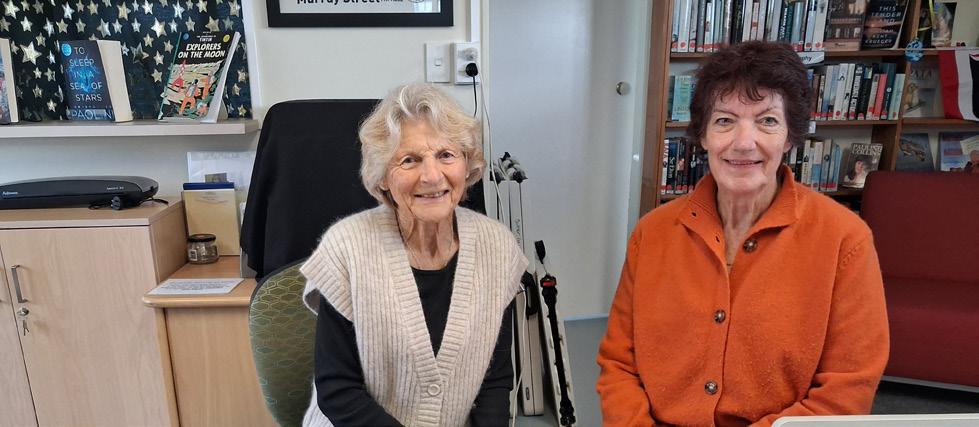
Amongst the ongoing construction and roadworks, a passionate group of volunteers keeps Drury Library up and running.
The community-led library opened in 1992, with resident Sue Hudson joining as a volunteer 15 years ago.
“The library has always been here next to the hall and always run by volunteers. We are looking for ways to make the local community more aware of our existence and the hundreds of modern and exciting books we have available to borrow.”
Each school holiday period volunteers run a ‘Children’s Day.’ These events comprise a three-hour programme offering a different theme each time.
Fellow volunteer Annette Williams has lived in Drury for 35 years. The library has more than 100 people on its mailing list, and 15 volunteers running the service.
“I began as a volunteer here about a year ago. I’m
also the treasurer for the Drury Community Committee and both roles are a great way to meet people and give back to the community.”
Last month, access to Tui Street via Waihoehoe Road closed while work to realign Tui Street is underway. Access to the Drury Community Library, Drury Hall, and Drury Rugby Club is off Great South Road next to the Mobil garage. It is “left in, left out” access so anyone coming from the motorway or Drury roundabout needs to follow the signage and find a safe place to turn around.
Hazel Audain is Auckland Council’s community-led (rural) library coordinator and says each community library’s operations tailor to the differences in each community. Some libraries like Drury also run their own fundraisers to help purchase more books.
“Volunteers know what works for their communities, and they really take ownership of these libraries.”
Community-led libraries
also have access to bulk loans from Auckland Libraries, allowing members to access a wider range of books.
Recently community-led libraries gained access to the Auckland Libraries’ online request system, offering residents a chance to collect books closer to home. Books are already checked out through Auckland Libraries accounts and are delivered to community-led libraries by Audain. Returns are only collected from community-led libraries once a week.
Earlier this year, the Clevedon Village Library moved into a new space inside the Clevedon District Centre, at 2 Papakura-Clevedon Road. The move to its new location was supported by the Franklin Local Board and the Clevedon Association.
Audain says the move has been a “massive change, a really positive one,” in a better location and safer access for families.
The chance to learn more about books from authors, We Read Auckland sees libraries across the region (including Pukekohe and Takanini) help share the stories behind our stories.
The programme showcases the creativity and diversity of the city’s literature, Auckland Council Community Committee chair, councillor Julie Fairey explains.
“We Read Auckland celebrates the stories connecting our communities and shares the many local voices that make our region unique,” she says.
“It is a wonderful opportunity for Aucklanders to read our local authors and discover the vast range of topics on offer which range from poetry, prison reform to the best potato salad recipes.”
Locally, events are set for Pukekohe and Takanini.
Hosted by comedian Michèle A’Court, Elisabeth Easther and Megan Nicol Reed discuss their novels Seed and Other People’s Bodies in Pukekohe on August 8. On August 25, renowned Māori writers Witi Ihimaera Smiler and Eugene Bingham interview each other about their most recent works at the Takanini Library.
This year, the Bestie Collection features 24 recently published titles by Auckland authors spanning fiction and non-fiction, including poetry and even a cookbook.
Initiated in 2021, the programme aims to champion regional talent, helping to encourage readers to read and writers to write.
The initiative includes
the Taiohi Writing Competition for writers aged 13-18. Last year’s winning submissions will be published later this month in the anthology Surface: Emerging Voices of Tāmaki Makaurau.
There is plenty in this year’s collection to inspire, Auckland Council’s head of library and learning services, Catherine Leonard, adds.
“Whether you’re discovering your next favourite book, meeting an author whose work you admire, encouraging your teenager to become a published author or taking part in a writing workshop,
We Read Auckland offers something for everyone.
“Across Tāmaki Makaurau, our library network continues to champion local writers, connect communities through stories, and inspire a lifelong love of reading and learning.”
All events are free to attend, but bookings are recommended. Titles are now available to borrow from any Auckland library. Visit aucklandlibraries.govt.nz for more information about the Pukekohe and Takanini events, as well as others not too far afield.
As Franklin’s population booms, the region’s infrastructure must grow with it. To this end, land secured in Karaka by Auckland Council will ensure the region is well covered when it comes to burial space. However, not everyone has been on board with the plan every step of the way.
Purchased for $16 million, the 100-hectare site consists of two adjacent properties at Linwood Road and Biddick Road, Te Hihi. Settlement is set for October.
Despite some local opposition, purchasing the land was the right call, asserts Franklin Ward Councillor Andy Baker.
“It was a tough decision, but with our increasing population we have an increasing number of people who need to be buried somewhere,” he told the Times
“If we had to go through compulsory acquisition or keep looking for the magic location, we would have a shortfall of capacity.
“[This would mean] people may not be able to be buried near where they may have lived and we would have some pretty unhappy families, unhappy for good reason.”
Despite recognising the need for a new cemetery, Franklin Local Board did
South Auckland requires more cemetery capacity
not support acquisition of the site. The board’s concerns relate to land use, rural amenity, traffic and road safety, proximity to Te Hihi School and alternative site options.
Initially, Baker and local board chair Alan Cole objected because some of the land is classified as highly productive according to the National Policy Statement (NPS) on Highly Productive Land. However, after further consultation and discussions with legal and planning staff, Baker’s position shifted.
“The NPS allows for regionally significant infrastructure to be located on highly productive land, so
Stock image
we didn’t have a leg to stand on with our original opposition,” he explains.
“Alan and I discussed this. He said the board would retain their view but respected the fact that I had a tricky decision to make. Our initial opposition was found to have no legal basis [so] I made a decision based on regional need.”
Concerns were also raised by some mana whenua – Ngati Tamaoho and Whātāpaka Marae objected for cultural reasons.
A statement from Auckland Council reads:
‘While differing views remain, the council is committed to engaging openly,
respectfully and constructively. We will work closely with [mana whenua] throughout the planning, development and establishment of the cemetery.’
Baker confirms this.
“I was made aware that one of three iwi were opposed [and the other two] supported the stance of the one that opposed. Collectively, we are working together with staff and the concerned iwi,” he says.
“I also had conditions put into the decision regarding design, how we inter bodies and ashes, working with neighbours including [Te Hihi School], an environmentally focused approach and road safety improvements. [The decision] also sets out that the local board and iwi will be involved in all of this.”
Securing the land is just the beginning. Planning will begin later this year, but development of the cemetery will be a multi-year process.
“South Auckland requires more cemetery capacity to meet the needs of this fast-growing region. Finding a suitable location was a challenging and lengthy process,” Baker adds.
“The land meets the criteria for a cemetery, and this is a sensible and timely acquisition by council with appropriate cemetery land in Auckland being hard to find.”
Courthouse takes shape
By HELENA O’NEILL
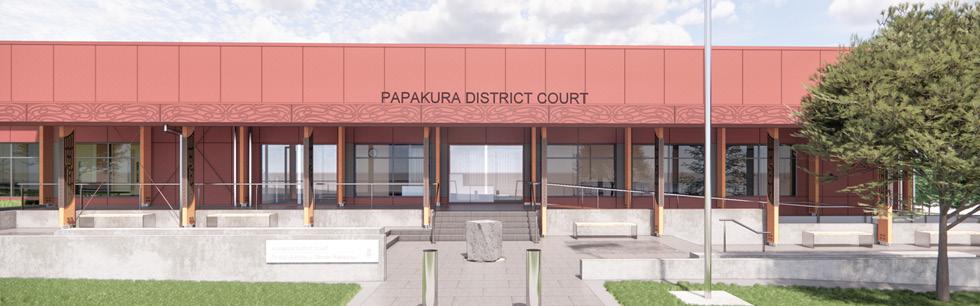
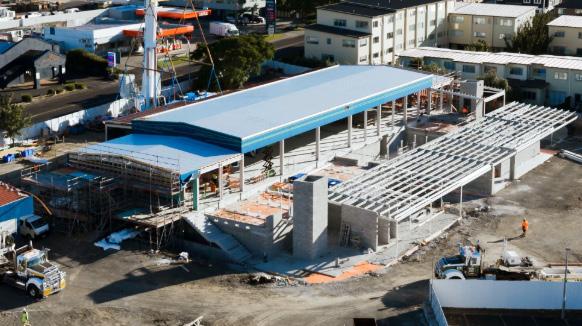
Construction of Papakura’s new courthouse is powering ahead.
Ministry of Justice corporate deputy secretary Kelvin Watson says that construction of the new Papakura District Courthouse is progressing well.
“The project is on track to open in early 2027,” he says. “The internal fit-out is currently taking place.”
As previously reported, Justice Minister Paul Goldsmith said the current Papakura courthouse was a leaky building, which has been
fully covered in plastic wrap since 2021 in order to stop moisture getting in.
The Ministry of Justice
bought its new 7925sqm section for $11 million. The Elliot Street property used to house the Papakura Returned and
Services Association (RSA) until the organisation had to close the clubrooms in 2022.
The current courthouse at 250-260 Great South Road is covered in scaffolding and plastic building wrap to prevent further water damage until the new courthouse is completed. Watson says the existing courthouse is on leased land, and the building will be demolished before being handed back to the landowner.
» In 2025, the Papakura District Court sat on 241 days, averaging 20 sitting days per month. The Registrar’s Court continues to sit once a week.
Work is underway on the Papakura District Courthouse. Photo supplied
Wynyard Wood Eastern Times
Lake to ocean: council selects preferred amalgamation model
During the government’s permitted three-month window, we held targeted consultation and received nearly 13,500 community interactions over five weeks. This included social media, web feedback, and 36 in-person events across the district. A big thank you to everyone who had their say!
We also spoke with iwi, regional council, Federated Farmers, catchment and other key stakeholder
groups to better understand the regional functions that would need to transfer along with existing Treaty settlements already in place.
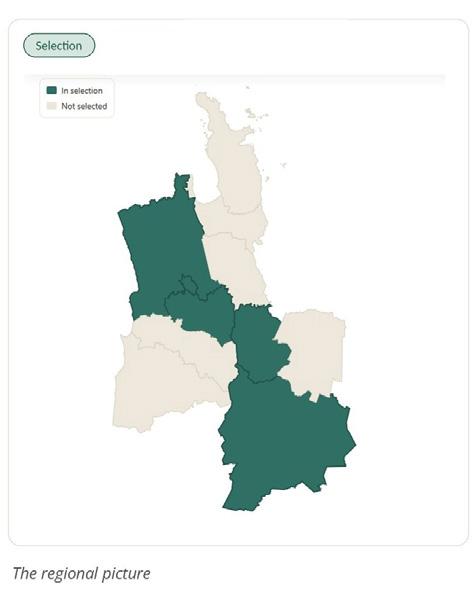
From this work a preferred five-council, all-ofriver model, has emerged stretching from the Waikato River headwaters at Taupo through South Waikato, Waipa and Hamilton City to Port Waikato in our district. It covers the river’s full journey from lake to ocean so is catchment based as the river must be managed as one and as such is also known as the Waikato Western Catchment model.
The community’s top priorities were protecting local voice and decision-making and ring-fencing the legacy debt of councils joining together.
Much work remains on the governance structure to achieve that, but feedback
was clear: smaller communities must retain a strong voice in any larger structure so as to learn from the Auckland super-city local board model where not enough funding and decision making is delegated to the local community itself.
Taupo is not Tuakau, and Pirongia is not Pokeno so community boards and committees, with stronger delegation and budgets, will be crucial.
The governance model must protect local representation, decision-making and funding – not leave communities relying on decisions from a distant, large unitary council.
We believe the Lake to Ocean, or Roto ki te Moana, model will benefit our communities now and for generations, so it is our preferred model and is formally put for adoption at our next council
meeting.
However, the other councils also need to support it. Waipa and South Waikato have already backed the model; Taupo has not yet chosen any model, and Hamilton City is still deciding. Support from the initial three councils is enough for a viable Head Start proposal under government criteria so we are confident of submitting an eligible proposal by the August 9 deadline.
Paved with good intentions
Politics is, unavoidably, consuming an increasing portion of public dialogue as we head to the election. With approximately three months until the election the good intentions for our future are being espoused from every political corner.
Having had the privilege of being an MP since November 2023, I know that intention must be accompanied by practical common sense and a commitment to working hard.
In other words, you’ll hear a lot of promises, and some may sound pretty good. But as we’ve seen too many times, some ideas that sound good simply don’t work. One of NZ First’s great strengths is that we care about how things work in practice.
Our policies, and the way we work in government, are
about getting results for New Zealand and New Zealanders.
My path to politics was different to many, as a first term MP straight to being a cabinet minister. This has been an honour and I cannot adequately express my gratitude. I have been given the opportunity to travel this country to listen, engage, and thankfully deliver in many areas.
I know there is so much more that needs doing so I was very grateful to be announced, at New Zealand First’s annual conference, as the candidate for our electorate, Port Waikato.
It was great to host the conference in South Auckland; this is where I have lived and worked most of my life. I am excited about the opportunity to represent our community as an electorate
MP.
As a former police officer, working most of my career in Counties-Manukau, what I learned was how to connect with people, how to listen and how to solve problems. I understand the frustration of many in our community trying to advocate for common sense but hitting unnecessary barriers.
That is why being an MP for New Zealand First, the party of common sense, is important.
I look forward to the campaign trail, answering questions, and finding solutions.
There are many big things still to be delivered in this term of government and I am continuing to work on aged care reform, response to organized crime, medicines reform, improving the later life for seniors, maternity care, ambulance services, police frontline and border security.
But, as I have seen, sometimes it is the small shifts to make the lives of hardworking Kiwi battlers a bit easier. That is what I believe is the role of the electorate MP, delivering common sense where it counts, not just having good intentions.
Waikato District Mayor Aksel Bech
NZ First MP based in Port Waikato
Casey Costello
What’s next for Franklin?
Firstly, a huge thank you to everyone in Franklin who submitted feedback on our draft local board plan. To those who came out to our in-person events, I thoroughly enjoyed our discussions and listening to your input.
This year’s consultation was our biggest effort in gathering submissions to date as we attended more community-led events than ever before. The number of submissions processed so far has already exceeded 2023’s consultation by more than 930 percent.
It’s humbling to see this level of participation as it will help us consider the range of views in our diverse area and finalise a well-informed plan that is shaped by real, meaningful insights from the people it is written for.
Over the next couple of months, we will be reviewing your feedback to finalise
the plan before adopting it in October.
As we work through your feedback, I’m pleased to report progress on the Franklin Paths Targeted Rate programme – a fine example of a series of projects that demonstrate the value of long-term planning and community advocacy.
You might have heard, construction on the longawaited Sandspit Reserve Coastal Path is finally underway and is expected to open
this summer.
The state-of-the-art coastal boardwalk, which kickstarted the Franklin Paths Targeted Rate programme, will transform access to Waiuku’s waterfront. It will connect locals and hopefully more visitors to key destinations such as Sandspit Reserve, the Riverside Drive Recreation Reserve and the Waiuku Yacht Club, with unobstructed views of the Waiuku River.
The project has been championed since 2017 by my fellow board member Gary Holmes, who represents the Waiuku subdivision, along with Ngaati Te Ata Waiohua, the Waiuku Trails Committee, Waiuku Business and Development Association and Waiuku Yacht Club. It’s encouraging to see the Franklin Paths programme gaining momentum and showing return on invest-
Building a future
National has a long-term plan to fix the basics and build the future. At the heart of that plan are dedicated mums and dads, who balance long hours at work with the excitement and pressure that comes with raising young kids.
In June, we announced that a re-elected National Government will make unconditional KiwiSaver contributions for working mums and dads who choose to take paid parental leave, whether they are contributing themselves or not.
That’s because we know that many parents choose not to contribute to KiwiSaver during this often-expensive time, and we want to support them to keep building their savings, so they are more financially secure when they get to retirement.
Now we are taking the next step to modernise the paid parental leave system itself.
The arrival of a new baby should be one of the happiest times for families – but we know that it also comes with higher costs and tough choices. Many parents are forced to juggle the financial impact of taking time away from work alongside a real desire to spend more time at home with their newborn.
A modern economy depends on parents being able to take the time they need with a new baby and then return to work with confidence.
That’s why, if re-elected, National will gradually increase paid parental leave to 30 weeks by 2029. We will start with taking it to 27 weeks in July 2027, followed by increases in 2028 and 2029 to lift the entitlement to 30 weeks before the end of our second term.
Our long-term vision is to extend paid parental leave to nine months, or 40 weeks.
ment for ratepayers.
These achievements are only possible through strong partnerships and an engaged community. Thank you to everyone who continues to contribute their ideas, time and passion to making Franklin an even better place to live, work and play.
On the topic of pathways and connections, I recently attended the official opening ceremony for the new Drury and Paerata train stations. Many of you will be pleased to hear each station has 350 park and ride spaces, as well as bicycle and motorcycle parking. The completion of these stations is timed perfectly to service south Auckland’s expected growth and to connect into the upcoming opening of the City Rail Link. It’s a very exciting time for Franklin as we work to futureproof our growing area.
We’re also making paid parental leave more flexible, recognising that every family’s circumstances are difference.
Right now, mums and dads can split their 26 weeks of paid parental leave, but they can’t take their parental leave at the same time. Under our policy, parents will have that choice.
For example, instead of one parent taking 30 weeks of paid leave, both parents could take paid leave together for up to 15 weeks. Or both parents could take paid leave together for four weeks; one parent could then take paid leave for 10 weeks, and then the other parent could take leave for 12 weeks.
National will also protect changes in the new Employment Leave Act that remove an unfair penalty on working mums and dads who take paid parental leave.
Annual leave is currently
paid based on average weekly earnings over the previous 12 months. That means a parent who takes a holiday in the months after returning to work from parental leave could see their holiday pay reduced because they had spent time at home caring for their child – a penalty that fell overwhelmingly on working mums.
National has pushed for changes to ensure working mums and dads receive their full holiday pay when they take annual leave in the months after returning to work, and we will ensure they take effect as legislated from July 1, 2027.
Franklin Local Board chair Alan Cole
Prime Minister Christopher Luxon
Licence changes – are rookie drivers cruising for a bruising?
By KERRY LEE
Major changes are ahead for New Zealand’s driver’s licensing system, but some are worried they will come at the cost of driver safety.
From January, drivers on restricted licences will no longer have to sit a practical test to earn their full license. Instead, a clean driving record will allow them to move on to a full license after 12 months behind the wheel.
While the government expects the new system will be cheaper and simpler, Glen Connelly of Glen’s Driving School says he and other driving instructors in Pukekohe are wondering how safe new drivers will be.
“The problem is that students get their restricted licences, drive around for
three or four months and then disappear to university or their OE (Overseas Experience),” he told the Times “They’ll have limited driving experience, or none at all, and they could then come back after two or three years and [gain] their full even if they haven’t driven a car in the meantime.”
Connelly believes more
WELCOMETO THETEAM DEANSHEPPARD
testing should be required before new, younger drivers hit the roads.
“I’d like to see an assessment before they give them their full, or records about how often they’ve been driving,” he adds. “Or, they could go from a learner’s test straight to a full one – while making that test more difficult – like they do in the UK.”
While restricted licence holders may be able to avoid another test under the new rules, learners aged under 25 years will have to wait twice as long – from six months to 12 – before they can sit their restricted test.
These younger drivers also face a reduced restricted period, from 18 to 12 months. There is no change for drivers aged over 25 who will continue to clock up driving experience over six months before becoming eligible to apply for a full licence. However, with no test required, obtaining a full licence should become cheaper with fees reduced to $25.90, down from almost $100. The NZ Transport Agency is still working through the details so the exact requirements may change before they come into effect in January.
Time to call time on driving?
By KERRY LEE
When can we know it’s time to get out from behind the wheel due to our age?
For many, giving up driving also means a loss of freedom, independence and connection to family, friends and our community.
There is no legal age limit when it comes to holding a driver’s licence in New Zealand, however mandatory medical checks are required for drivers aged 75 and over.
Doctors can help people decide whether or not they are still capable of driving, but many may avoid this option, Franklin Driving School’s Jane Frew confirms.
“There seems to be a variety of things that can be done, but they can be quite challenging and worrying for older people, and quite expensive as well,” she says.
“A lot of people won’t decide to stop driving them-
selves as it’s difficult to get around without a car.”
Self-imposed limitations can reduce the risk of accidents without this spelling an end to driving altogether.
“Sometimes there could be a limit on how far they should be driving, such as no more than 20 kilometres
• 17 Lifestyle Lots ranging from 3200m2 to 3ha
• Town supply water and wastewater connections
• Fully post and rail fencing
• Extensively landscaped with native planting
• Flat land with specified building areas
• Works have commenced with Titles due early 2027
from home, and maybe they should avoid motorways, but it could be okay to pop down to the shops, for example.”
As people age, cognitive decline while slower reflexes and hearing and vision loss can all have an impact, increasing the likelihood of accidents occurring.
While there is no substitute for experience, Ministry of Transport data shows those aged 80 and over are the second-highest age group involved in fatal crashes, second to teenagers aged 15–19.
AA research confirms this. Older drivers are 2.5 times more likely to be involved in fatal or serious accidents at intersections, and a report recommends more roundabouts, more right turn support and signs warning about upcoming intersections.
While the government plans to change how New Zealand issues driving licenses, including scrapping practical tests to obtain full licenses, the rules for older drivers will not change.
New Zealand drivers’ licenses expire at age 75, after which medical assessments are needed. Licences expire again at age 80 and they must then be renewed every two years.
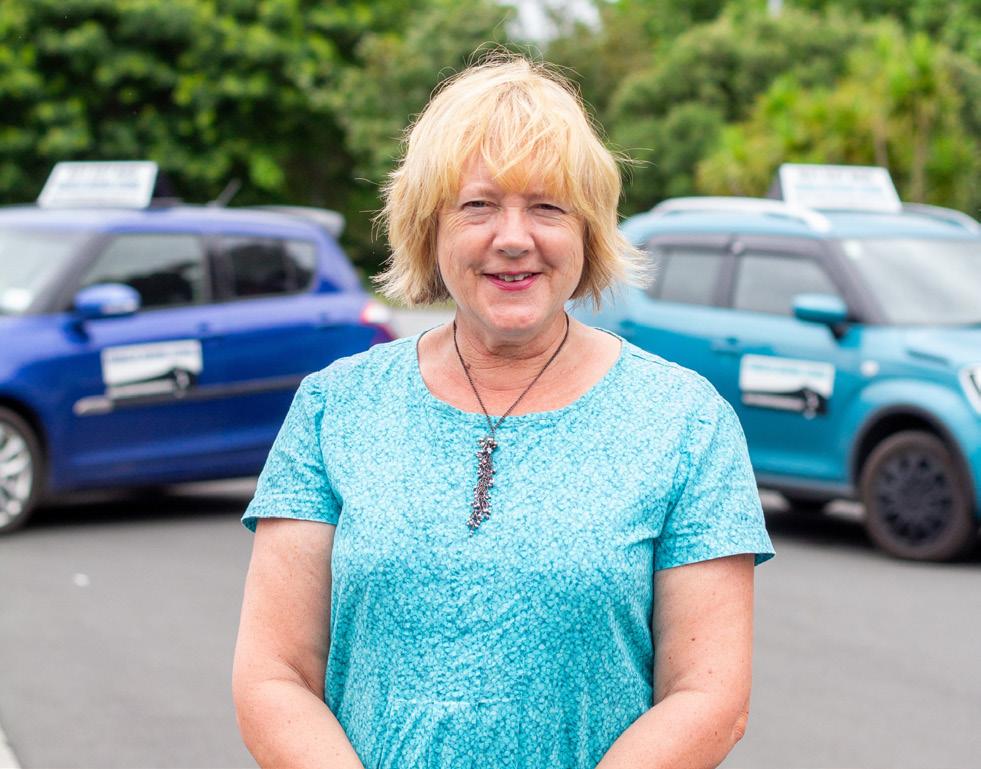
Jane Frew, Franklin Driving School
Photo supplied.
WHY REGULAR WHEEL ALIGNMENTS SAVE MONEY
Many drivers don’t think about wheel alignments until they notice their car pulling to one side or the steering wheel sitting off-centre. However, keeping your wheels properly aligned is one of the simplest ways to improve your vehicle’s performance and reduce long-term running costs.
Everyday driving over potholes, speed bumps and uneven roads can gradually knock your wheels out of alignment. Even a small change can cause tyres to wear unevenly, meaning you’ll need to replace them much sooner than expected.
A correctly aligned vehicle also handles better. It tracks straight on the road, making driving more comfortable and reducing the effort needed to steer. This is particularly noticeable on longer trips, where good alignment can help reduce driver fatigue.
Another benefit is improved fuel efficiency. When the wheels are pointing in the correct direction, the tyres create less rolling resistance, allowing the vehicle to move more efficiently. While the savings may seem small, they can add up over thousands of kilometres.
If you notice uneven tyre wear, your
steering wheel isn’t centred, or the car drifts left or right on a straight road, it’s worth booking an alignment check. Many workshops recommend having your alignment inspected whenever new tyres are fitted or after striking a large pothole or kerb.
Regular wheel alignments help protect your tyres, improve handling, and may even save you money at the fuel pump. It’s a quick maintenance check that can deliver benefits every time you get behind the wheel.
Local ‘playstations’ now online
By KERRY LEE
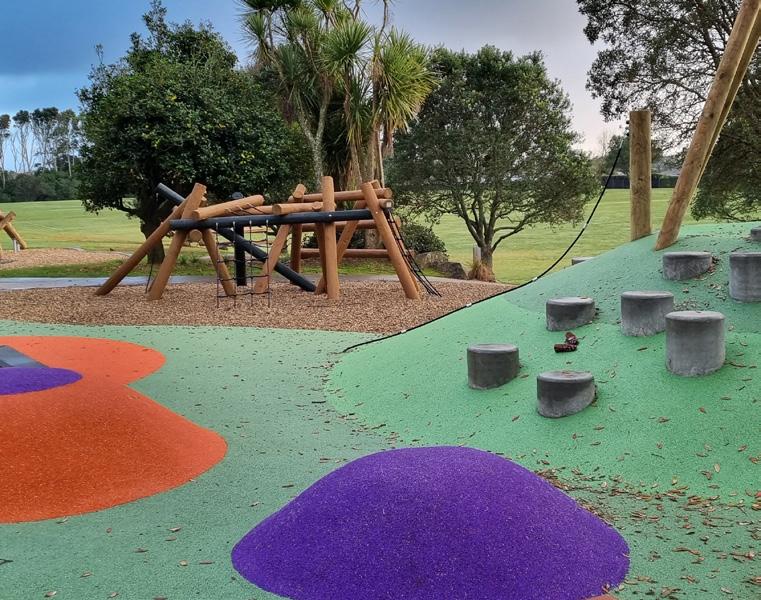
A fully revamped park on Clive Howe Road is now open for the serious business of fun. Located next to Patumahoe School, Fulton Swim School and the Patumahoe Presbyterian Church, the playground received an upgrade as part of wider efforts directed by Auckland Council to provide more places across the region for recreation.
The playground had reached the end of its useful life and the equipment and the way the area was used no longer reflected current playarea design, Franklin Local Board member Merritt Watson told the Times
“This project is about renewing an ageing asset so that it continues to serve a growing community like Patumahoe well into the future,” he says.
“But this wasn’t about fixing a problem, it was about reinvesting in a valued community space. Playgrounds evolve and this upgrade allows us to refresh the area with a more modern, engaging design that supports learning through play and a wider range of ages.”
Public submissions were sought before work began
and the playground’s neighbours have provided input from the outset, Watson adds.
“Local neighbours played an important role in shaping the final design. Their feedback helped inform how the playground would be laid out, which play elements were included, and how the space connects with the surrounding area,” he says.
“The school already has a well-equipped playground, so rather than duplicating that, the design for Clive Howe was approached as a complementary space, adding more variety and choice for children.
“The result is a refreshed, modern playground that complements existing facilities and continues to serve as a focal point for the local community.”
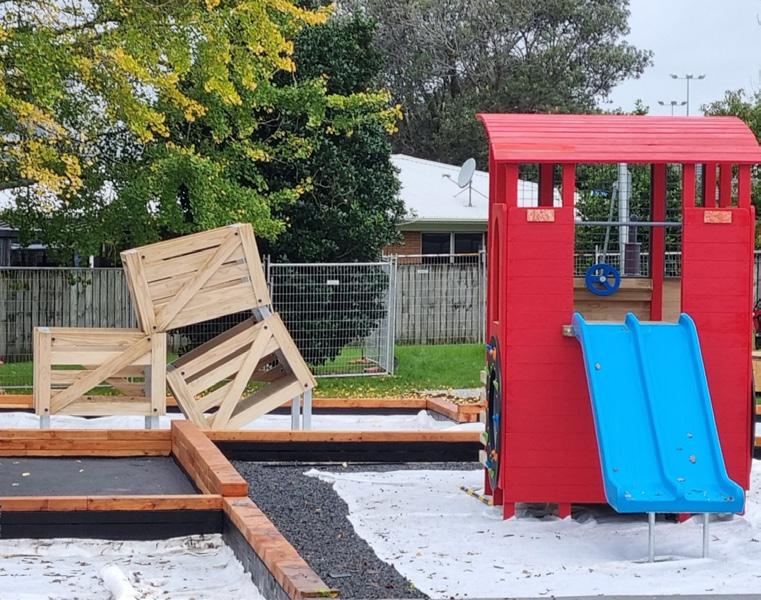
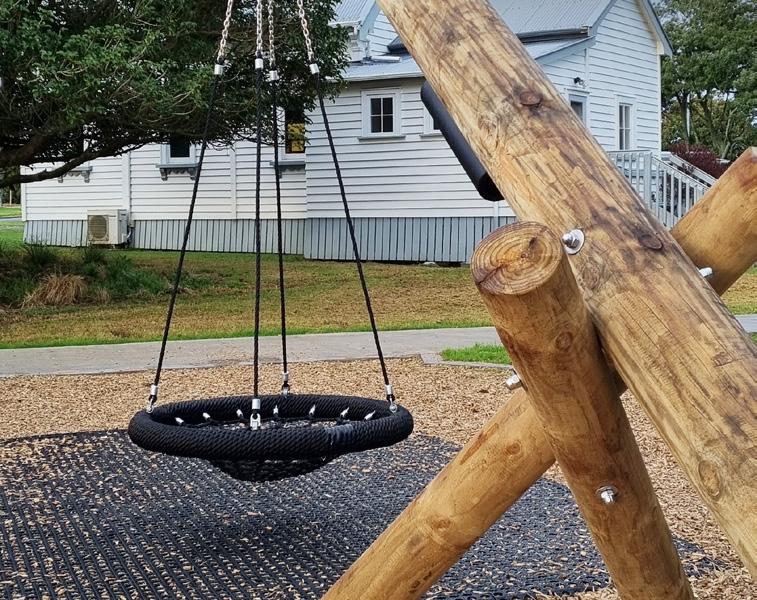
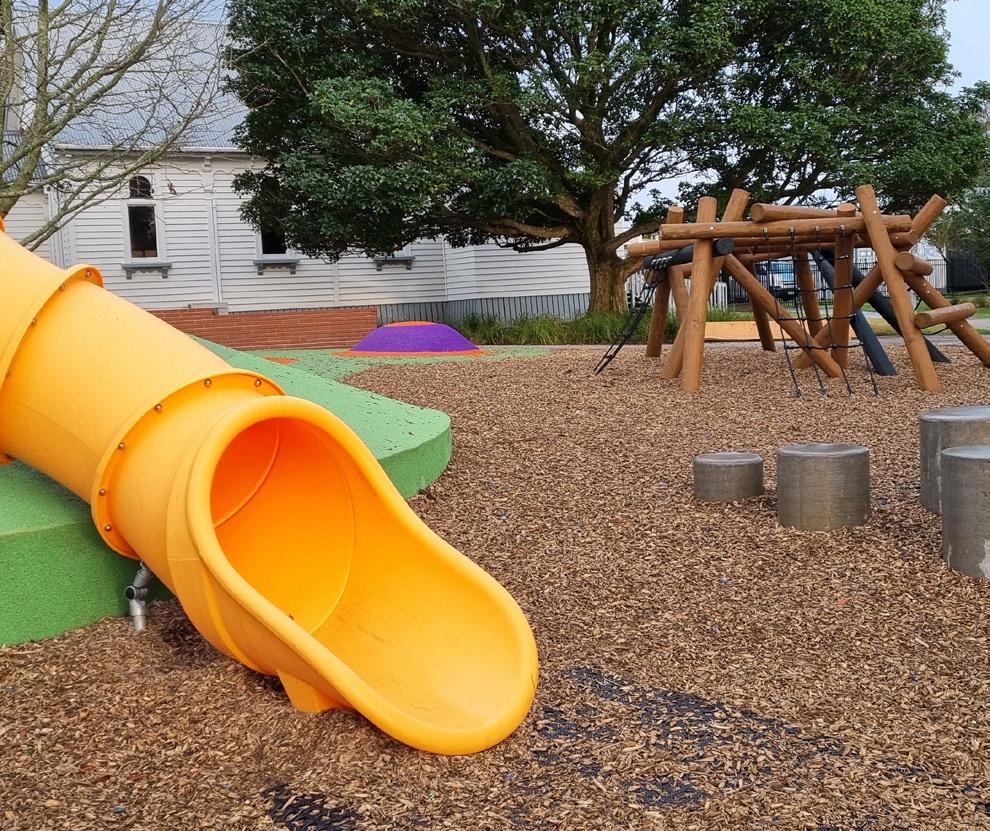
The park features various apparatus including a slide, a swing and climbing frames. Walkways have been improved and bricks from the original path have been repurposed in order to form a low wall between the playground and the walkway, which meets safety and sustainability aims.
Overall, the park is intended to work in harmony with its natural environment
– it retains large specimen trees, ensuring both a comfortable and inviting space, council confirms.
Other local parks – both on Jutland Road, Pukekohe – are also intended to bring more scope for recreation to the town. The Jutland Reserve park now features new playground equipment, paths, fencing and landscaping. It too was nearing the end of its operational lifespan, local board chair Alan Cole says.
“We’re excited to see the Jutland Reserve playspace reach completion. It opens up new opportunities for more of the community to have fun, catering to a wider range of ages while still retaining the open, green space.
“Just a short walk from Jutland Reserve is Ray Fausett Reserve playspace [also on Jutland Road]. Work at this site is expected to be completed by summer,” Cole adds. “Together with Jutland Reserve’s transformation, both sites will significantly enhance Pukekohe’s amenities including for the growing community within the Belmont subdivision.”
Another new park at Glenbrook Beach Reserve is also now open for the serious business of leisure.
QUICK
Photos Times Media
Winter warmer Sunday lunches
Join us at Ōtau Ridge in Clevedon this August for a series of cosy Sunday lunches. Whether you’re a local or just passing through, you’re always welcome.
Available Sundays 9, 16, 23 and 30 August, 12–2pm. Seats are limited and bookings are essential. Call now to book your table on 09 222 2832.
Find a village that feels like home
Call Jo Ashby on 09 222 2833 | joa@metlifecare.co.nz 2 Kumekume Way, Clevedon | otauridge.co.nz
Choose from two sumptuous courses for $38 or three courses for $45 per person. Scan QR code for menu.
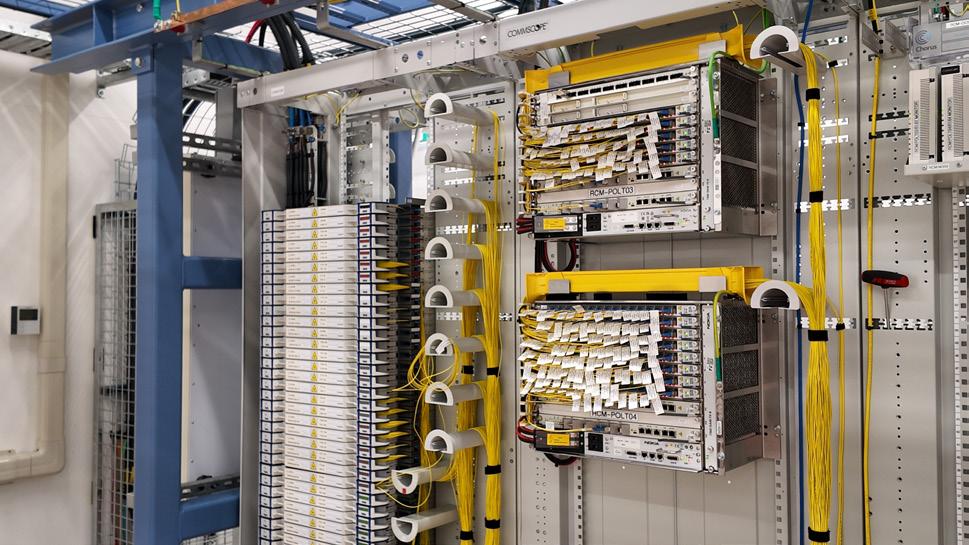
Drury’s fibreonly exchange
Chorus recently commissioned its first purpose-built fibre exchange, marking a major digital infrastructure milestone for one of New Zealand’s largest and fastest growing developments.
As demand for highspeed internet continues to increase, the exchange provides fit-for-purpose fibre broadband for households and businesses moving into the wider Drury area.
The exchange fibre footprint covers Drury, Runciman, Karaka, Ramarama and Ararimu, with connections available for more than 2300 households and businesses and room for more as the area develops.
Chorus general manager of network operations Marcus Wofinden says the exchange has been designed specifically to support the future needs of a rapidly transforming region – delivering sustainable energy use, reduced carbon emissions, stronger resiliency to extreme weather events and the capacity to scale in line with population growth and economic activity.
“Drury is being built for the future and having futureready digital infrastructure in place from day one is a critical part of that. This exchange connects Kiwis with faster, more resilient internet for their everyday essential needs, while giving long-term confidence for businesses, developers, the council and infrastructure partners that connectivity will scale as the area grows.”
Historically, Chorus exchanges housed copper-based telephone and broadband equipment and connected local homes and businesses to the national network. Fibre was added over time as demand grew for the technology.
“Our first exchange built for fibre marks a defining moment in the transition away from copper. The move signals a shift towards modern, more efficient and scaleable infrastructure that supports what Kiwis are doing online today, and anticipates the opportunities high-speed connectivity will unlock in the years ahead,” he says.
The old Chorus exchange building at Drury had to be moved to make way for the realignment of State Highway 1 (SH1) and the Drury southbound on-ramp as part of the SH1 Papakura to Drury (P2D) project, currently being constructed by the NZ Transport Agency (NZTA). A new exchange building was built in agreement with Chorus by the P2D project.
“Completing the replacement building was a milestone for the P2D project, providing an opportunity for Chorus to upgrade their facility as part of the move,” says Stephen Collett, NZTA regional manager of infrastructure delivery.
With no copper to maintain, Chorus says the exchange is more sustainable to run, more resilient in weather events and serves a much larger footprint across south Auckland.
Profit from our Knowledge
A fortnightly series helping local homeowners get the most from their biggest asset.
Part 3: The Entrance & Foyer
By KELLY Found & Co
Last fortnight we walked from the footpath to the front door. This week, we step inside.
Your entryway is the first glimpse people get once they’re through the door, so it’s worth making it feel welcoming from the very first moment. This space plays a surprisingly big role in creating that all-important first impression — and in helping potential buyers picture themselves living there.
It doesn’t need to be large to make an impact. A well-placed console, a mirror to lift the light and open up the space, a touch of greenery, some artwork, and a few carefully chosen accessories can instantly add warmth and style. When preparing a home for sale, it’s often the small details that make the biggest difference. A clutterfree, thoughtfully styled entrance showcases your home’s personality and sets the tone for everything beyond it.
Whether it’s a spacious foyer or a simple hallway, your entryway is a chance to welcome people in and create an emotional connection. After all, you only get one chance to make a great first impression.
Next time in Profit from our Knowledge: we move through to the heart of the home — the living areas. Reading the series is a great start — but every home is different. Book a free, no-obligation Profit from our Knowledge consultation with Diana and get tailored advice on presenting your home to achieve the best result the market will pay. Practical guidance from someone who knows what local buyers respond to.
GJ Gardner Homes with 10 Year Master Build
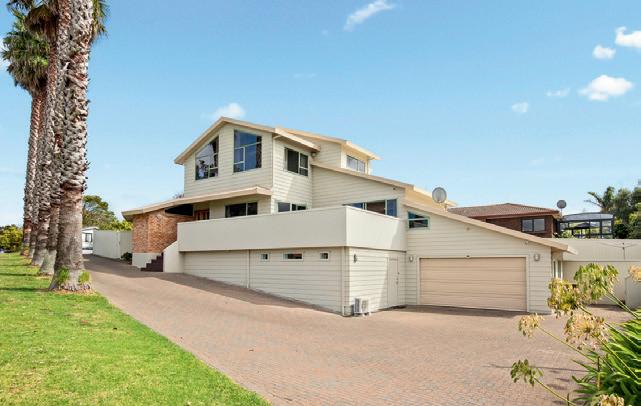
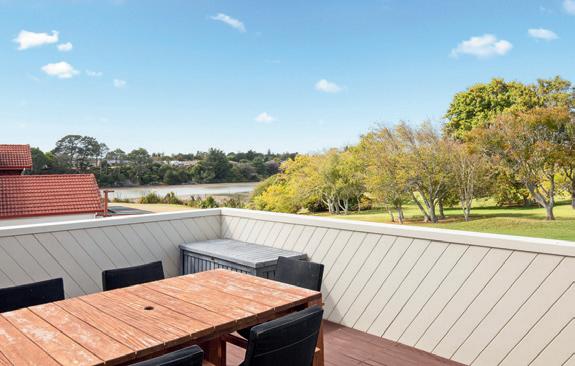
10B Cronshaw Rd, Karaka
Perfectly positioned near the motorway and the fast-growing Drury South Growth Hub, which is currently undergoing one of the largest master-planned urban transformations in New Zealand’s history. With upcoming rail stations, the future Drury Metropolitan Centre, a brand-new shopping mall, and Costco all moving forward rapidly, this is a golden opportunity you’ll want to act on quickly before this pocket becomes the hottest market in town.
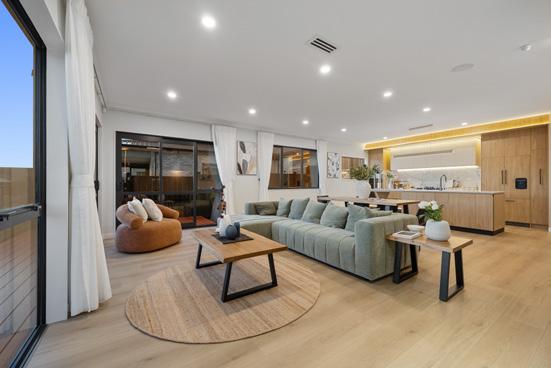
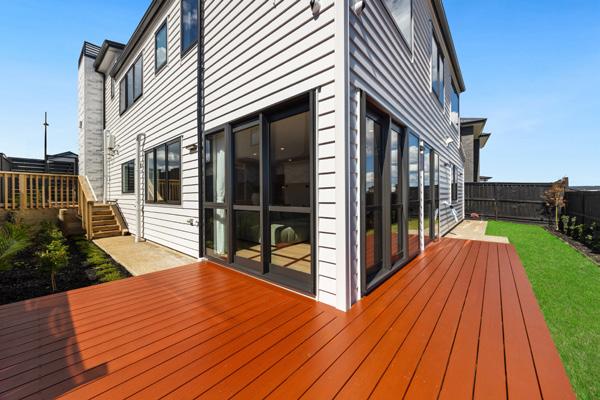
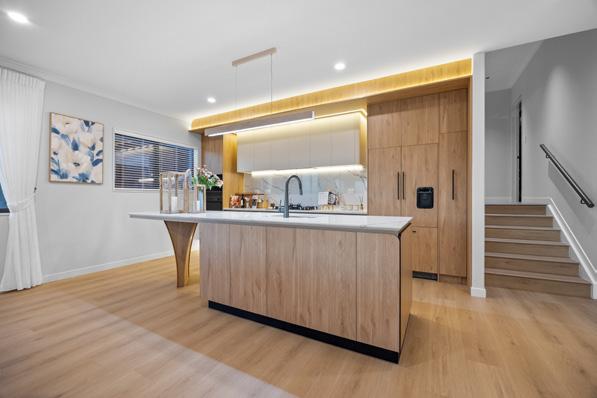
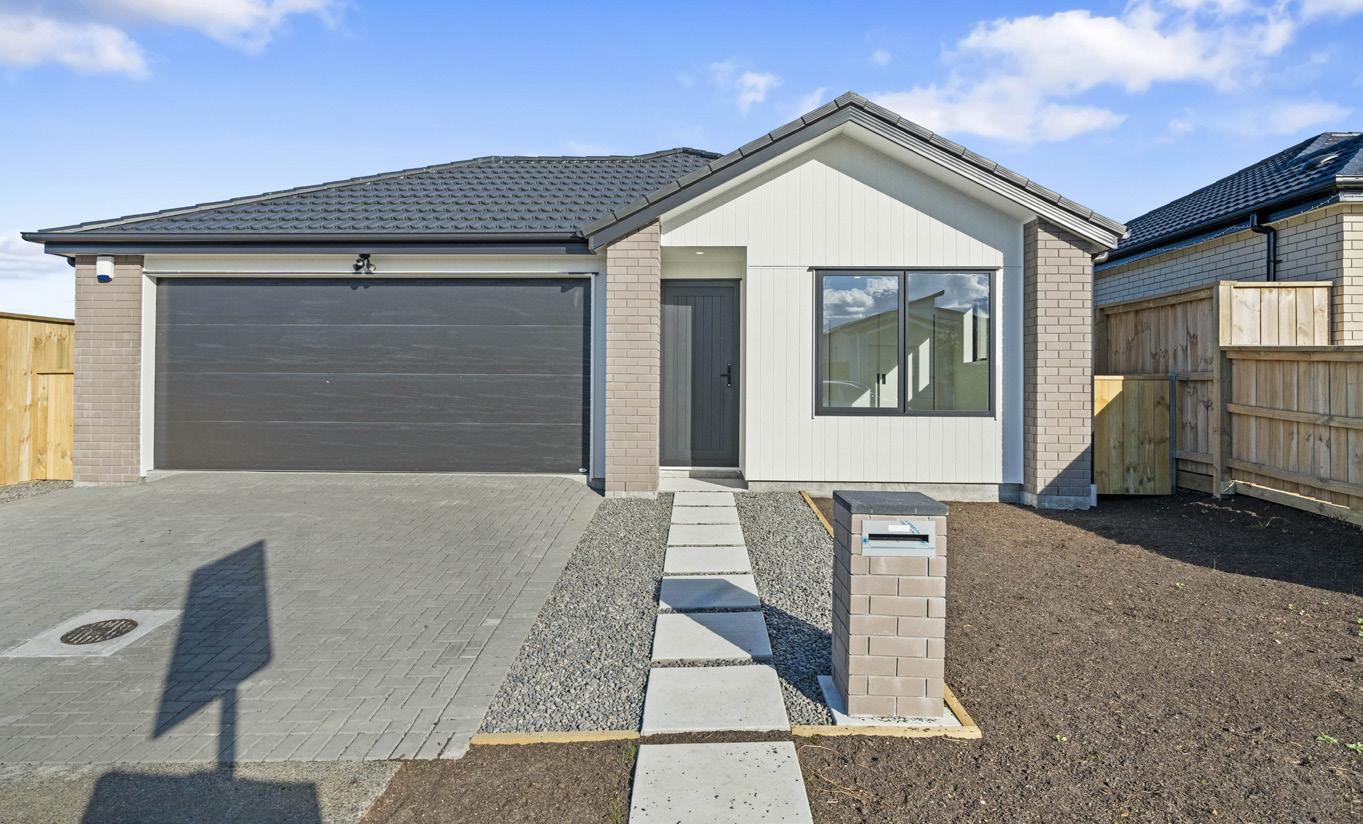
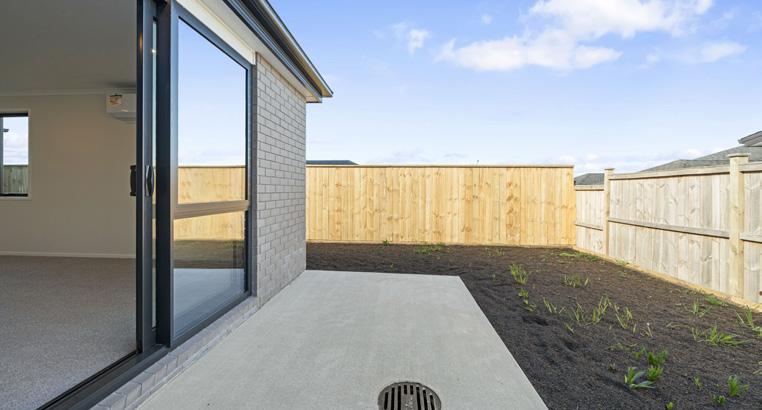
This single-level brick beauty is complete and ready for you today, comes with a 10-Year Master Build Guarantee, and is packed with features. It offers four generous bedrooms, including a master with an ensuite and walk-in wardrobe, a designer kitchen with stone benchtops, and a spacious open-plan living area. You’ll love how the living space flows out to a private, fully fenced backyard that provides a very safe and sunny spot for family gatherings.
Best of all, it features a rare double garage, two off-street parking spaces, and an installed heat pump for year-round comfort. This is your chance to get in early and secure an incredible asset before everyone else catches on. Call us today for a private viewing to secure this lovely home.
Open homes: For Sale: Property ID: Saturday / Sunday 1:15pm-2:00pm
$979,000 935743 Eric
022 587 3340
Plant your pot of joy
“Many gardeners wait until they see strawberries in the shops before planting their own,” says Harry from Pots of Joy. “But by then you’ve missed the best window – the ideal time to plant is now, in winter.” It sounds counterintuitive, but strawberry plants thrive on a bit of winter chill. That cold snap is exactly what triggers an abundance of fruit in summer.
And while you’re out there getting your strawberries in, it’s worth tackling the bigger jobs too. Winter is the best time to plant trees – especially deciduous fruit, shelter, and ornamental
varieties – along with hedges and perennials. Cooler soil gives roots the chance to properly establish before summer heat puts them to the test.
“The added bonus,” says Maria, “is you barely have to water anything!”
Winter isn’t just for planting, though; it’s also when Harry and Maria are hard at work planning for spring. By June, Maria is deep in the seed catalogues, choosing the varieties that will fill the greenhouse in the months ahead.
“My husband jokes I just like looking at pretty flowers,” she
says. “But really, we’re choosing the best varieties so we can offer people a wide range of quality plants.”
That planning pays off. Come spring, the greenhouse bursts at the seams with over 150 varieties of summer crops, herbs, and annual flowers, plus their “non-stop veggies” (perfect for planting year-round) like lettuce, brassicas, and leafy greens.
Beyond seedlings, Pots of Joy also stocks hedging, fruit trees, perennials, and palms. Drop by for friendly advice and get your pot of joy today!
importer. 2005. andre@karelia.co.nz the importer. since 2005. andre@karelia.co.nz
Pots of Joy is a family-run nursery in Kingseat. Backed by over 30 years of experience, Harry and Maria provide quality plants for wholesale customers as well as home gardeners. Visit them at 754 Glenbrook Road, Kingseat
PROLAPSES
Often referred to as “bearings”; prolapsed vaginas occur in sheep and, less commonly, cattle.
This occurs in pregnant ewes (most commonly) in the terminal stages of pregnancy. The exact causes are unknown, and the prevalence varies from season to season.
Affected ewes are fre-
ful lush food leading to her taking minimal exercise. The tendency is to be down for extended periods, and while doing so, the bladder becomes distended with urine to a degree that makes urination difficult when she eventually rises to her feet.
Straining occurs, which forces the uterus over the bladder and into the pelvis, continuing to force the
During late pregnancy, hormones soften the reproductive tract. At the same time, abdominal pressure can be increased due to a full rumen, a large pregnant uterus, and internal body fat. These factors also combine with straining from a full bladder, resulting in prolapse. It can also occur in poorly conditioned ewes; the poor diet leads to loss of muscle tone and consequent prolapse. Genetics may also be a contributing factor, as may clover-containing oestrogenic substances.
Incidence increases in sloping paddocks when ewes will often face uphill to relieve pressure from the pregnant uterus on the diaphragm.
The earlier treatment is attempted, the better. The use of a vaginal retention device such as a bearing retainer or harness is beneficial when the prolapse is small. In more severe cases, seek veterinary attention immediately.
Depending on how far away from lambing she is and the viability of the lambs, either a Buhner suture plus or minus induction, caesarean section, or euthanasia may be required. If a retainer or suture is used, the ewe will require careful monitoring as assistance with lambing will be required.
Govt releases dog control guidelines
New dog control guidelines will help keep Kiwis safer while the government reviews laws, Local Government Minister Simon Watts says.
“Too many Kiwis have been victims of disgusting attacks from dogs in recent years. Every New Zealander should be able to walk around their neighbourhood without worrying about being attacked by a dangerous and uncontrolled dog.
“Dog owners are personally responsible for their animals. They need to ensure their animals pose no threat, and councils need the right tools to crack down on individuals who could be putting others at risk.”
As reported previously, according to Auckland Coun-
cil more than 2500 reports of dog attacks on people and animals were recorded from July 1, 2024 to June 30, 2025.
Nationally, the figures are equally sobering.
“Last year alone, ACC recorded more than 14,000 claims related to dog bites and attacks,” Watts confirms.
“That’s why getting dog control right matters.”
Karaka local (and former chief executive of Auckland Business Chamber), Michael Barnett recently called for stricter penalties; these may be included in new laws.
“Whether stronger penalties for irresponsible owners are necessary, or more powers for council officers to deal with threatening animals, all options are on the table as we look to strengthen dog
control laws to keep communities safe,” Watts says.
Guidelines have not been updated since 2015.
“Updating guidelines under the current legal framework is the first part of that review. [They provide] practical and up-to-date guidance to help councils make full use of tools available under the Dog Control Act. They promote responsible ownership and inform councils on how to respond effectively when problems arise.”
The guidelines will also improve data collection, Watts expects.
“Better information will help build a clearer picture of issues across New Zealand and support better decision-making,” he adds.
“This is the first step in our
efforts to strengthen dog control laws, crack down on dangerous dogs and hold owners accountable. We are backing councils with better tools and guidance so they can help keep their communities safe.”
Provisional tax: Stop dreading it, start owning it
Provisional tax does not need to be something business owners dread. The key is to plan early, know your payment dates, and connect with your accountant before each instalment. If your income has changed, the standard uplift method may not be the best option, and you could end up overpaying or underpaying tax. Overpayments tie up cash
unnecessarily, while underpayments can quickly lead to IRD interest and penalties.
Tax pooling is a practical, IRD-approved tool that can help manage cash flow, reduce exposure to IRD interest, and avoid late payment penalties. At Engine Room, tax pooling has been a big winner for our clients who want more flexibility around their tax payments, especially where income is uneven or cash flow is tight.
Do not leave provisional tax until the last minute or assume last year’s figures still apply. A short conversation before the due date can give you better options and potentially save thousands.
Get in touch with Engine Room to make sure provisional tax is working for you, not against you, at info@engineroomca. co.nz or 09 238 5939.
Buying your next vehicle?
BRAD WISEMAN, Director and founder of Finance Worx, Pukekohe DON’T OVERLOOK PRIVATE SALES
Did you know you don’t have to buy from a dealership to arrange vehicle finance?
Many people find the right car, ute or motorbike through Trade Me, Facebook Marketplace or word of mouth, but assume finance isn’t an option.
In reality, financing a private purchase can be straightforward, allowing you to buy the vehicle you want while still having access to competitive lending options.
Just as importantly, having finance pre-approved gives you confidence when negotiating and lets sellers know you’re a
genuine buyer.
Whether you’re upgrading the family car, buying your first vehicle, or finally purchasing that dream motorbike, it’s worth speaking with a finance specialist before you start shopping.
At Finance Worx, we help everyday Kiwis secure finance for vehicles purchased both privately and through dealerships, making the process as simple and stress-free as possible.
If you’re thinking about your next purchase, get in touch for a no-obligation chat before you start looking – you may be surprised by what’s possible.
Contracting out agreements in New Zealand: Practical protection for modern relationships
In New Zealand, what many people call a “prenup” is more commonly known as a contracting out agreement.
Under the Property (Relationships) Act 1976, married couples, civil union partners, and de facto couples can choose to “contract out” of the default rules that would otherwise divide relationship property equally if the relationship ends. While often associated with wealthy individuals, these agreements are increasingly relevant for everyday New Zealanders navigating modern relationships.
A contracting out agreement is especially useful in second marriages or relationships where one or both partners have children from a previous relationship. In these situations, people often want to protect certain assets — such as a family home, savings, or an inheritance — for their children. Without an agreement in place, those assets could
be divided equally if the relationship ends, regardless of how they were originally acquired.
For example, someone entering a second marriage may already own a home they intend to pass on to their children. A contracting out agreement can clearly state that the property remains separate, helping to avoid disputes down the track. This can provide peace of mind not just for the couple, but for their wider family as well.
These agreements are also valuable for people bringing unequal assets into a relationship — such as a business, investments, or KiwiSaver balances. Rather than relying on default rules that may not reflect
Partner at Franklin Law Sarah Hagenson
their individual circumstances, couples can create a tailored arrangement that feels fair to both parties from the outset.
Importantly, contracting out agreements are not about expecting a relationship to fail. They are a practical form of finan-
cial planning — much like insurance. Having open conversations early and documenting intentions clearly can significantly reduce stress and legal costs if circumstances do change in the future.
To be legally valid, both partners must receive independent legal advice, and the agreement must be in writing, signed, and witnessed by each party’s lawyer. This process ensures that both people fully understand their rights and the implications of what they are agreeing to.
Contracting out agreements are not just for the wealthy. They are a sensible, accessible tool that can help everyday New Zealanders protect their assets, provide for their children, and begin a relationship with clarity and confidence.
For more information visit www.franklinlaw.co.nz or contact Sarah on (09) 552 0622 sarahh@franklinlaw.co.nz
Coffee grounds into gold
By ISABELLA ROOT and KERRY LEE
Innovation Franklin’s AUT Youth Shark Tank has proved to be an amazing event for the region’s young entrepreneurs.
Pukekohe High School students Hannah Baillie, Hayley Newton and Dacie Duke proudly took home the winning title with their skincare business Second Shot.
“We were over the moon, very pleased and excited,” Newton says. “So, we celebrated with cake.”
The trio developed a range of exfoliating soap bars, repurposing used coffee grounds from Pukekohe cafe, Your Local Coffee – teaming up with the cafe was an exciting opportunity for the girls and one that paid off.
“We were confident in our idea but there was strong competition,” Baillie says. “Your Local are very popular
and have a great community behind them so we wanted to support that.”
Among 17 strong entries, narrowed to five finalists, Second Shot stood out to the judges for its innovative concept and presentation. The team was awarded a $1000 cash prize and a business support package to continue developing their project.
The soaps are available at Your Local Coffee until
December. The group plans to sell Christmas-themed fragrances at local markets.
The trio would like to keep their business going beyond the end of the school year.
“We’re all going different places next year after school, so we just have to navigate that and work out how we’d continue,” Baillie adds.
Innovation Franklin board member Merritt Watson says the students’ real-
world knowledge and expertise made this year’s youth competition feel no different from the version for adults.
“Our main Shark Tank is always a massive hit, but to see the younger generation come through at the level that they have is phenomenal,” he says.
“Judging would have been very difficult and it’s shown the calibre of people we have coming through the ranks here in Franklin.”
Watson, who is also a member of the Franklin Local Board, says the competition is an investment in the region’s future.
“We try to get people thinking outside the box, to encourage the next generation to think about how they innovate, enable them to do well and become those businesses in the future.”
More details about this year’s entrants are accessible at innovationfranklin.org.nz.
The 2026 AUT Youth Shark Tank winners, left to right: Hayley Newton, Dacie Duke and Hannah Baillie.
Photo supplied
Your insurer
ask: Is your business cyber-secure?
By SHIV NARAYAN, founder of ClearEdge
Most business owners believe their company is reasonably secure. They use passwords, have antivirus software and pay someone to look after their computers. The problem is that insurers and larger customers increasingly want evidence. That is where SMB1001 comes in.
SMB1001 is a cybersecurity standard designed specifically for small and medium-sized businesses. Unlike enterprise frameworks such as ISO 27001, it provides a practical, tiered pathway that allows businesses to improve progressively rather than attempting an expensive, allor-nothing compliance project. The standard examines real controls across technology, people, and processes. These include multi-factor authentication, secure backups, staff training, access management, incident planning and protection against email impersonation.
Certification matters because businesses are increasingly connected. A supplier with weak security can become the doorway into a much larger customer. Insurers are also scrutinising whether common controls were genuinely operating before agreeing to cover a risk or pay a claim.
SMB1001 gives a business a structured way to demonstrate that these controls exist and that its cybersecurity maturity has been independently assessed. The standard is updated regularly and offers multiple certification levels, allowing an organisation to start with essential protections and progress as its risk, size and customer expectations increase.
WHY SHOULD A SMALL BUSINESS CARE?
Certification may make cyber-insurance applications and renewals easier because the business can provide evidence instead of repeatedly answering lengthy security questionnaires. It may help retain or win work. Government agencies, corporate customers and larger contractors increasingly ask suppliers how they protect customer data and manage cyber risk.
The certification process identifies gaps before a criminal does. A failed backup, missing multi-factor authentication or absent incident-response plan is far cheaper to address before an attack.
Money Month: Small steps that make a big difference
Mai Lighthouse is the leading social services agency across Franklin and North Waikato
By MAI LIGHTHOUSE
August is Sorted Money Month — a nationwide invitation to pause, take stock, and take one small step toward a more financially secure future. Supported by Te Ara Ahunga Ora Retirement Commission, this year’s theme is simple but powerful: the difference is an emergency fund.
Because life doesn’t warn you before it gets expensive. A car breaks down. A child gets sick. The hot water cylinder gives up in the middle of winter. For whānau already stretching every dollar across rent, power, and groceries, those moments can feel impossible.
Financial resilience isn’t about having thousands of dollars saved overnight. It’s about small, consistent steps that help you feel more prepared, more in control, and a little less at the mercy of whatever comes next.
One of the most practical places to start? The food budget. That’s why this August, Mai Lighthouse is running a free Community Cooking Programme — and we’d love to see you there. Each week we’ll be sharing simple, affordable recipes, practical cooking skills, and ideas for reducing food waste, so your household can eat well and spend less. Every dollar saved at the supermarket is a dollar that could become the beginning of your emergency buffer.
It’s not about perfection. It’s about progress.
If you’d like to join a cooking class or find out more about the free financial mentoring and budgeting support available through Mai Lighthouse, we’d love to hear from you.
Ph: 09 238 6233 | admin@mailighthouse.org.nz and follow us on Facebook this month — we’ll be sharing tips, resources, and encouragement to support you and your whānau through Money Month and beyond.
SMB1001 will not guarantee that a business is never breached. No certification can. What it provides is a credible, practical way to show that cybersecurity is being managed rather than assumed.
Soon, “Are you cyber-secure?” may not be the important question. The question will be: Can you prove it?
Powerful friends connect
Anew connection promises to deliver more power to the people, Counties Energy’s chief executive, Judy Nicholl, asserts.
“This is exactly the type of outcome we envisioned when we announced our partnership earlier this year,” she says about a move to partner with King Country-based distributor, The Lines Company (TLC).
“It brings together the strengths of two organisations, enables teams to learn from one another and proves that collaboration can deliver real benefits in months rather than years.”
One such benefit began earlier this year as the two companies pooled skills to develop a new outage portal for TLC based on Counties Energy’s tried and true model. The result is that both organisations now have modern platforms providing real-time information.
“This project is a great
example of what’s possible when organisations focus less on ownership and more on outcomes,” Nicholl says.
“The Outage Portal provides a strong foundation for future
shared platform initiatives across both organisations.”
More collaboration is expected, TLC’s chief executive Mike Fox confirms.
“Beyond the outage por
tal, our partnership model is scalable and transferable. The same principles that enabled this project can be applied to other initiatives and, potentially, across other businesses.”
This includes welcoming expertise from other EDB (electricity distribution business) partners too.
“Since launching our outage portal, we’ve received interest from other EDBs wanting to learn more about how such an approach can benefit them,” adds Fox. “That’s encouraging, not because it’s about the technology itself, but because it’s evidence that collaboration done well can create momentum across the sector.”
By sharing platforms, knowledge and capability, these organisations will reduce duplication, lower development costs and accelerate delivery while delivering the best possible value for customers, the pair expects.
The Lines Company’s Mike Fox and Counties Energy chief executive, Judy Nicholl. Photo supplied
Counties Energy Continues Support for Local Winter Warmth Initiative
With winter well underway, Counties Energy has continued its partnership with Mai Lighthouse (formerly Franklin Family Support Services) to deliver practical support to local whānau through its Winter Warmer Packs initiative.
As a customer-owned electricity distribution network serving South Auckland and Northern Waikato, Counties Energy is committed to helping customers stay safe, warm and connected.
Since 2022, Counties Energy has worked alongside grassroots social services agency Mai Lighthouse to fund and develop the Winter Warmer Packs. With strong community connections, Mai Lighthouse plays a key role in distributing these packs to whānau who would benefit most from additional support during winter.
The initiative focuses on providing simple, essential items that help families stay warm, eat well and better manage their energy use during the colder months.
This year’s Winter Warmer Packs included energy-saving eco-bulbs, energy-efficient slow cookers and fresh produce from local grower Wilcox, with additional items supplied by The Warehouse Group (The Warehouse Pukekohe) and Mitre 10 MEGA Pukekohe. The packs also featured recipe cards and non-perishable goods provided by Pukekohe Christian School.
Counties Energy Chief Customer and Operations Officer Dale Carline, says easing energy hardship in the community is important to the organisation.
“Addressing energy hardship is a priority for us, and these packs provide practical, immediate support for whānau during winter, while also helping build longerterm, energy-efficient habits that can help ease financial pressure. It’s encouraging to see local organisations working together to support our community through the Winter Warmer Packs.”
Mai Lighthouse Chief Executive Robyn Driver says the Winter Warmer Packs initiative continues to have a meaningful impact.
“Winter can be a challenging time for many households, and each year these packs provide valuable support to families across our community throughout the colder months.”
In addition to the Winter Warmer Packs, Counties Energy also co-funds the Warmer Kiwi Homes programme, which offers free heat pumps and insulation to eligible households. This initiative helps improve home warmth, energy efficiency and overall health and wellbeing. For more information on eligibility and how to apply, visit www.eeca.govt.nz.
Students from Pukekohe Christian School with representatives from The Warehouse Group, Mai Lighthouse and Counties Energy, supporting the Winter Warmer Packs initiative for local whānau.
Secure your place at Franklin Village
Exceptional value. Limited villas remain.
This is your final opportunity to secure a brandnew villa in the first stage at Franklin Village.
These thoughtfully designed two-bedroom villas are priced from $1,120,000, offering an increasingly rare chance to join this boutique Pukekohe community at an exceptional entry point.
Set within a peaceful country setting, Franklin Village combines relaxed living with refined amenities including a welcoming café and bar, spa, pool, and private cinema.
Enjoy the peace of mind of care on site and with easy access to local shops and transport, everything you need is close at hand*.
With limited villas left, now is the time to act. Enquire today and experience the lifestyle for yourself.
*For residents 70 years and above. Access to Aged Care not guaranteed and subject to availability. Villas are sold under a license to occupy.
Art show brings community together
Artistic talent and flair were proudly on display for all to see at Karaka Lifestyle Estate last month.
Karaka Lifestyle Estate Sales Manager Stephanie Rodgers says more than 100 people attended a special opening night on Friday, July 24.
“It was our inaugural competition, and we’re so happy with how everything turned out. It was a real community effort and such a wonderful atmosphere on opening night.”
Thirty residents entered the Karaka Lifestyle Estate Residents Art Exhibition with 76 pieces across four categories. The exhibition was judged by artist Caroline Burton and Franklin Arts secretary Deb Bell (visual arts), Tom Logan of Franklin Woodturners (hard craft), with soft textile tutor Lenore Smart and Rae Baxton (soft craft).
Overall People’s Choice winner Trevor Warrington was stunned to win the most votes. He started working with matchsticks to create art in 1980, when his cousin left a piece unfinished. After completing that work, Trevor was hooked.
His award-winning design used a total of 6861 matches – a mix of half and whole matches, with 75 black match heads in the
centre of the table.
“I’m already planning my next piece,” Trevor laughs.
Lead resident coordinator Lorraine Churchman says it was an incredible experience, with the exhibits sparking plenty of lively conversations.
“We had a lot of visitors over the weekend, and residents’ feedback was largely around how it made them feel very connected with the community here.”
Karaka Lifestyle Estate staff each awarded two rosettes to their favourite pieces.
Coordinator and exhibitor Chris Howett says it was a very satisfying event and was pleased to have won an award and rosette for her soft craft pieces.
The exhibition was held in the village’s clubhouse extension which opened in December. The
grand Parnell mansion dates back to 1907 has been carefully restored and reimagined as the social heart of the village, joined by the contemporary new extension. Inside and out, it’s a place built for good times: a heated outdoor swimming pool, residents’ bar, games and recreation room, library, wellness room, catering kitchen and plenty of quiet spaces for a quiet coffee or a proper catch-up.
The clubhouse extension has been architecturally designed for greater accessibility and acoustics, so it feels easy, comfortable, and genuinely usable. Future plans include the addition of an indoor pool and spa complex.
Karaka Lifestyle Estate offers a range of two-and three-bedroom homes, including standalones, duplexes and elevated
apartment living. On completion, the village will include approximately 270 homes, all with the added benefit of capital gains.
For more information or to book a private tour, contact Stephanie at sales@karakalifestyleestate.co.nz or phone 027 243 4469.
Opening Night Award winners
Visual Arts Excellence Award to Jane Smith for House and Garden with other notable awards to Gail Whittle, Lorraine Churchman, Val Blyleven, and Gus Smith. Hard Craft Excellence Award to Brian Nicholls with other notable awards to Jim Brown and Yvonne Bray.
Soft Craft Excellence Award to Chris Howett with other notable awards to Lynn Kurtovich, Ticia Reitsma, and Heather Scott. Poetry award to Sue Neems for her book of poetry called Live Lines.
People
Choice Award winners
Visual Arts: Gus Smith, Spitfire Glory.
Hard Craft: Trevor Warrington, Matchstick Coffee Table.
Soft Craft: Marlene Hudd, London Skyline Cross-stitch. Poetry: Sue Neems. Overall winner: Trevor Warrington.
PRINCIPAL IN PERSON
with Catherine Bamber-O’Malley, St Ignatius of Loyola Catholic College
How long have you been an educator, and where did you train?
I have been an educator for more than 25 years and have had the privilege of teaching and leading in schools across New Zealand, the United Kingdom and the Philippines.
I began my teaching journey after training in the UK and have continued my own learning throughout my career. I recently completed a Master of Educational Leadership at the University of Auckland.
What’s special about St Ignatius?
St Ignatius is much more than a school; it is a faith-filled community grounded in the rich tradition of Ignatian spirituality. One of the things that makes St Ignatius truly unique is that we are part of the Jesuit Global Network of Schools, spanning more than 80 countries and educating around 1.7 million students. Together, we share a common mission inspired by St Ignatius of Loyola: to form young people of competence,
conscience, compassion and commitment who seek to find God in all things and use their gifts in service of others.
When did you become the principal of St Ignatius of Loyola Catholic College?
I was appointed principal in 2026, having previously served as the foundation deputy principal since 2023. Being part of establishing and now leading the college into its next chapter has been one of the greatest privileges and most rewarding opportunities of my career.
What’s the best thing about being an educator and principal?
For me, the best part of my role is working with young people and helping them discover the gifts and talents they have been given, and how they can use those gifts in service of others and make a positive difference in the world.
I am passionate about Catholic education because I believe we are not simply preparing students for
Catherine Bamber-O’Malley
examinations or careers – we are helping them discover who God is calling them to become.
Is there anything you’d like improved in the education sector?
I would love to see every young person equipped not only with strong academic
knowledge, but also with the character, resilience and adaptability needed to thrive in an ever-changing world.
Just as importantly, I want every young person to have a genuine sense of hope – to believe they can make a positive difference and be agents of change in our world. I hope that through their education young people are empowered not only to be successful but to be of service.
How is the relationship between St Ignatius and its community?
St Ignatius has a story and a history that began long before we welcomed our first students in 2024. I believe that is one of the things that makes our college so unique. Our existence is the fulfilment of a long-held dream shared by generations of families, parishioners and community members who hoped for Catholic education in the Ignatian tradition in this part of south Auckland.
• Read the full article at www.franklintimes.co.nz.
A FAMILY HOME FOR THE GENERATIONS WHO’LL FOLLOW YOU.
THEY’LL THANK YOU FOR YOUR DECISION TO BUILD A FABULOUS BARN-STYLE HOME.
to’s world-first Bachelor of Climate Change continues to attract students from around the globe, with two of the three 2026 Tower Climate Change Scholarship recipients hailing from outside of New Zealand.
Students Lagi Talalupe, Genifer Tadielo and Ayla Montgomerie have each received a $5000 scholarship from Tower to support their studies.
Lagi Talalupe (19) plans to return to her home country of Samoa once she has completed her degree. “Samoa is still a developing country, and the availability of resources to address climate issues affecting Pacific nations is very limited, with other issues being prioritised,” she says.
“There’s a Samoan proverb that says E lele le toloa ae ma’au lava i le vai, which translates to, the bird may fly far away, but it will always return to the water. The proverb reminds us that no matter how far we travel, we remain connected to our home. I want to do something to care for and nurture that home, contributing and helping my country in that way,” says Talalupe.
“In all honesty, I did not expect that I would get the scholarship, so it took me by surprise. It was such a rollercoaster of emotions. It really
serves as a testament to my studies and the sleepless nights I’ve spent working on assignments. I’ve had to be disciplined in a lot of spheres in my life and make sacrifices to be able to invest in this degree.
“It’s a huge source of motivation to have something like the scholarship that serves as support and recognition of my work.”
Tower has supported the University of Waikato’s Bachelor of Climate Change programme since 2021, providing three scholarships annually to help grow the next generation of climate leaders. Tower operates in New Zealand and five Pacific countries: Samoa, American Samoa, Tonga, Rarotonga
and Fiji. Scholarship recipient Genifer Tadielo, who moved to New Zealand from Brazil 13 years ago and has now become a New Zealand citizen, is studying environmental science and hydrology within the Bachelor of Climate Change programme.
As part of the scholarship application process, Tadielo wrote an essay on how the insurance sector in New Zealand will be affected by climate change. “Climate change will fundamentally reshape the insurance industry in Aotearoa. It will lead to more frequent and severe claims, higher costs,
nology and highlight the importance of education and sustainability. While the challenges are significant, they also present an opportunity for the industry to adapt and contribute to a more resilient future.”
Joining Talalupe and Tadielo as a 2026 scholarship recipient is Ayla Montgomerie, who has spent the first part of the year studying abroad at Cardiff University in Wales.
The University of Waikato’s Bachelor of Climate Change was the first degree of its kind in the world and equips students with the
Tower Bachelor of Climate Change Scholarship recipients from left to right: Ayla Montgomerie, Lagi Talalupe, and Genifer Tadelio.
Photo Anne Paar
SCHOOL ENROLMENT
PUKEKOHE TOM with Q&A
FLEETWOOD FORSYTH BARR INVESTMENT
ADVISER,
Forsyth Barr recently opened its new Pukekohe office. Helena O’Neill caught up with Tom Fleetwood about his new role.
Where were you born, and where did you grow up?
I was born in the small North Canterbury township of Waikari. Not long afterwards, my family moved to Oxford, about 40 kilometres northwest of Christchurch, where I grew up on a small beef property with my three brothers.
We enjoyed a very rural upbringing, spending much of our time outdoors. Sport was a big part of our lives, particularly rugby, and we also rode our horses at A&P shows throughout Canterbury. Growing up in that environment taught me the value of hard work, resilience and being part of a close-knit community.
What schools did you attend?
Oxford Primary Schools before heading to boarding school at Christchurch Boys’ High School for my secondary education.
Can you tell us about your tertiary qualifications?
I have always had a passion for rural New Zealand and the farming sector. However, our family property was never large enough for me to pursue farming as a career. Instead, I attended Lincoln University, where I completed a Bachelor of Agricultural Science. The degree opened many opportunities within the agricultural industry.
I began my career with Ravensdown as a fertiliser representative in Northland before moving into rural banking with ANZ. I then spent the next 14 years with Rabobank in Pukekohe, working closely with farming businesses across a wide range of agricultural sectors.
It was during my banking career that I was introduced to financial markets and investment management. The opportunity to work alongside clients on their financial strategies sparked a strong interest in the investment industry and ultimately inspired my transition into wealth management.
Did you embark on an OE/extended working holiday abroad?
I was very fortunate to have an incredible overseas experience. I started by playing a season of rugby in Argentina before travelling throughout South America for three months. From there, I moved to Oviedo in northern Spain, where I played another rugby
I then relocated to London, where I joined a rugby club with a great group of Kiwis and took on a role as a turf grass seed specialist. It was a fantastic job that combined my agricultural background with my love of sport. I travelled throughout England, advising clients on turf grass species for some of the country’s most iconic sporting venues, including Wimbledon, Lord’s Cricket Ground, and Emirates Stadium.
After three memorable years on my OE, I returned to New Zealand and accepted a position with ANZ in Whangārei, marking the beginning of my career in rural banking.
Why did you join Forsyth Barr?
I have always had a keen interest in financial markets, so when the opportunity to join Forsyth Barr arose, it felt like a natural next step in my career. I was particularly impressed by the firm’s history and values. With more than 90 years of experience, majority New Zealand ownership, and one of the country’s leading investment research teams, Forsyth Barr provides advisers with the insights and support needed to make informed decisions for clients.
The opportunity to help establish the Pukekohe office was one I couldn’t pass up. It allows me to work close to home while building strong relationships within Franklin and the wider rural community.
Having spent my career working alongside farming families and rural businesses, I understand the unique challenges and opportunities they face. I am passionate about helping clients grow and protect their wealth,
whether through their business, personal investments or a combination of both. I also believe there are significant benefits in building wealth outside the farm or business. Diversified investments can provide greater financial flexibility, reduce risk and create more options when it comes to succession planning and achieving longterm family goals.
What’s the special anniversary Forsyth Barr is celebrating in 2026?
This year marks a huge year for Forsyth Barr as we celebrate our 90th Birthday. As a majority staff-owned firm, it is something we are all immensely proud of. There are not many NZ businesses that can say that they have hit the 90-year milestone – or that are so well positioned for the next 90.
Why would a person seek expert investment advice from Forsyth Barr?
Today’s investment environment is increasingly complex, and having a trusted adviser can provide clarity and confidence when making important financial decisions. Having grown up on a small beef property in North Canterbury and spent more than 17 years working with farming families and rural businesses, I understand the values and challenges that are unique to rural New Zealand.
In Pukekohe, I work alongside an experienced team, including Preyesh Master and David Morgan, who together bring more than 35 years of financial services experience. Backed by Forsyth Barr’s award-winning research team, we provide personalised investment advice tailored to each client’s goals, whether they are growing wealth, planning for retirement, managing succession, or
diversifying beyond their business or farm.
I believe successful investing is about building long-term relationships based on trust, sound advice and a disciplined approach. My goal is to help clients make informed decisions, protect their wealth, and create opportunities for future generations.
In your downtime, where are some of your favourite places to visit in Franklin and what activities?
One of the things we love most about living in Franklin is the fantastic lifestyle and strong sense of community. Outside of work, you’ll often find me at Iron Yard with my three boys. It’s a great new facility and the perfect place for us to spend time together while trying to improve our golf. We also spend plenty of weekends at both the Pukekohe Rugby Club and the Pukekohe AFC, supporting our boys and enjoying the community spirit that makes the area so special.
Franklin is also home to some outstanding cafés and restaurants. It’s hard to pick favourites, but for coffee I regularly visit The Daily Goods, C3, Town Mouse and Your Local. SuMei is my go-to lunch spot, while The Monarch, Seddon 64, and Bracu in Bombay are all favourites when my partner and I get the chance to enjoy a meal out.
It’s a wonderful place to live and raise a family, with the perfect balance of rural lifestyle, vibrant local businesses and easy access to Auckland.
If there was one thing you’d like to see change in New Zealand society, what would it be?
I’d like to see a greater focus on financial literacy and long-term saving. Throughout my career working with farming families, business owners and now investment clients, I’ve seen first-hand the difference that good financial knowledge can make. Equally, I’ve seen how a lack of understanding can prevent people from making the most of the opportunities available to them.
Too many young New Zealanders leave school without a solid understanding of budgeting, debt, investing or the power of compounding over time. These are fundamental life skills that can have a lasting impact on financial security, confidence and overall wellbeing.
I believe the gradual increase in KiwiSaver contribution rates is a positive step in the right direction. As people live longer and the cost of retirement continues to rise, many New Zealanders risk not having enough saved to maintain the lifestyle they want in retirement. Encouraging higher levels of long-term saving will help individuals build greater financial independence while also creating a larger pool of domestic capital that can be invested in New Zealand businesses, infrastructure and innovation, strengthening our economy for future generations.
More broadly, I’d like to see financial literacy become a core part of every young New Zealander’s education. If we can help people understand the value of saving early, investing wisely and making informed financial decisions, we’ll create stronger families, more resilient communities and a more prosperous New Zealand.
The Pukekohe Forsyth Barr team: Preyesh Master, Tom Fleetwood, David Morgan, Sarah Farrell. Photo supplied
WE’VE TURNED MENTAL HEALTH INTO A WAITING LIST
By MIKE KING, founding AMBASSADOR, I Am HOPE FOUNDATION
A few weeks ago, I spoke to a young person who’d finally worked up the courage to ask for help. They had spent months convincing themselves they were fine. Months pretending everything was okay while quietly falling apart. When they finally reached out, they were told they have to wait. Not because nobody cared. Not because the people working in the system weren’t trying their best. There simply weren’t enough resources available when they needed them most. That story isn’t unusual. It’s become normal.
Somewhere along the way, we’ve convinced ourselves that a mental health system is working as long as people eventually get help. We measure waiting lists, appointment numbers and service targets, but what about the people who never make it that far? The young person who decides asking for help was a mistake. The teenager who withdraws while waiting for an appointment. The parent who watches their child struggle and feels powerless to help. We’ve built a system
that often waits until people are in crisis before support becomes available. Yet when it comes to mental health, we’ve become strangely comfortable with waiting.
Over the years, through Gumboot Friday and I Am Hope, I’ve met thousands of young people. Most weren’t experiencing severe mental illness. They were dealing with challenges that, left unaddressed, became something much bigger. Self-worth, family conflict, bullying, grief, loneliness, identity, relationships. What they needed wasn’t years of therapy. They needed someone to talk to early. Someone who could help them understand what they were feeling before those feelings became overwhelming.
The frustrating thing is we already know this works. Every counsellor knows it’s easier to help someone who seeks support early than someone who has spent years suffering in silence. Every teacher knows it’s easier to support a student before they disengage from school. Every parent knows it’s easier to solve a problem when it first appears than when it’s ignored. Yet we continue to pour most of our effort into responding to
crises instead of preventing them. We need hospitals, specialist services and acute care, but we should be investing just as heavily in making sure fewer people need them in the first place.
We’ve come a long way in talking about mental health, but talking isn’t the same as supporting it. Real progress won’t be measured by how efficiently we respond to crises.
It’ll be measured by how many we prevent. Because by the time someone ends up on a waiting list, there’s a good chance they’ve already been waiting far too long.
Under 25 and need someone to talk to? Book a free counsellor at gumbootfriday. org.nz – no GP referral needed.
Mike King
STAYING SANE WHEN IT ALL FEELS TOO MUCH
MICHELLE KEENAN empowers people and organisations to achieve optimal wellbeing by providing customised wellness coaching programmes tailored to their unique goals.
Right now it’s easy to feel overwhelmed by the state of the world. You open your phone and there’s another disaster, another crisis, another thing to worry about. The cost of living, politics in NZ and overseas, petrol prices, wars. It never stops, and it can leave you feeling pretty hopeless.
It’s not just you – a lot of people are feeling it right now. Here are a few small ways to stay informed without living in a constant state of anxiety.
Put some walls around it.
The biggest problem with the news today is that it’s always right there –on your phone, in your pocket, pinging you at 10pm when you’re trying to wind down. So, try this – give yourself a set time to catch up. Maybe 15 minutes in the morning with a coffee. Maybe 10 minutes at lunch. When that time is up, you’re done. The news will still be there tomorrow, and minute-by-minute updates aren’t helpful for your wellbeing.
Remember what you can control.
Most of what the news covers is stuff you can’t do a single thing about. A war on the other side of the world. Political decisions we have no say in. Worrying about it doesn’t change things, it just drains you. Ask yourself what you CAN do. Maybe it’s donating to a local cause. Maybe it’s voting. Maybe it’s just being kind to the people around you. Do what you can, where you can, with what you’ve got, and you’ll feel more empowered and less hopeless.
Look for the good stuff too.
The news is designed to grab your attention, and unfortunately bad news grabs it best. Good things are happening all the time; they just don’t get the same headlines. Follow good news sites or pages on social media. There are good people doing good things, in your community and in the world – you might just have to look a little harder to find them! Remember your algorithm gives you more of what you look at, so scroll past the clickbait and look for the positive, uplifting things you want to see more of.
The world is always going to have problems – that’s a constant. But you don’t have to carry all of them on your own shoulders. Be realistic, focus on what’s within your power to change, and look after yourself and those around you.
www.michellekeenan.com
Bariatric surgery and its effect on bone health
Bariatric surgery is an effective treatment for obesity and can significantly improve obesity-related conditions such as type 2 diabetes, hypertension and obstructive sleep apnoea.
However, it is also associated with adverse effects on bone health, potentially reducing bone mineral density (BMD) and increasing the risk of fracture and osteoporosis.
The type of procedure performed influences the risk factor, with malabsorptive procedures having the most effect. The Roux-en-Y gastric bypass and biliopancreatic diversion procedures both reduce calcium absorption by bypassing sections of the small bowel where calcium is primarily absorbed. Vitamin D deficiency is also common after surgery, further impairing calcium absorption and contributing to secondary hyperparathyroidism, a condition that accelerates bone resorption. In addition, rapid weight loss reduces mechanical loading on the skeleton, leading to decreased bone formation, while hormonal changes following surgery may further disrupt normal bone remodelling. The gastric sleeve procedure is considered less malabsorptive, but decreased bone density can still occur.
The greatest decline in BMD occurs during the first two years after surgery, although it can continue for years afterwards. Individuals at highest risk include post-menopausal women, older adults and those with vitamin D deficiency and low bone mass.
Regular monitoring of bone health is essential after bariatric surgery. A DXA bone density scan is the gold standard for assessing BMD and provides early identification of low bone density before fractures occur. Tracking calcium, vitamin D and parathyroid hormone levels can help identify nutritional deficiencies and metabolic changes that contribute to bone loss. In addition, adequate protein intake, regular weight-bearing and resistance exercise will help maintain muscle mass, preventing sarcopenia (low muscle mass). A DXA body composition scan can assess lean muscle mass, helping identify those at risk of sarcopenia post-surgery.
If you are planning a bariatric procedure a baseline DXA bone density scan should be considered, particularly if you have other risk factors such as rheumatoid arthritis, overactive thyroid or have been through menopause.
Ensure follow-up with your healthcare provider and reduce the long-term risk of osteoporosis and sarcopenia.
Next time: Optimising bone health in children
HEALTH & WELLBEING
DR WHO? TIME FOR A CHANGE?
By ISABELLA ROOT
While I know people stick with good GPs, which is why it can be difficult to find a place at a local practice, I stayed with the same family doctor for years simply because switching felt like a hassle.
He once told me a nagging headache was “probably nothing” and sent me home with the first antibiotic he could rattle off. A week later, I was in an A&E, swollen head to toe like Violet Beauregarde from Charlie and the Chocolate Factory only not so purple.
It turned out I had glandular fever and, as I learned the hard way and despite doctor’s orders, penicillin is the last thing I should’ve taken. If only a medical professional had warned me… now I have a lifelong allergy to penicillin, which is no joke.
But I still went back to that doctor, not because I trusted him, but because changing felt like more effort than it was worth. I’m not alone having such strange loyalty.
Many of us settle, sticking with a doctor the way we’d stick with a hairdresser even though they’ve given us bad haircuts a few too many times – except the stakes here are
health, not merely a fringe.
Part of the resistance is the admin, having to find a new practice, fill out the forms, be on the waitlist and then re-explain your history to someone new.
Another part is a weird sense of obligation. A doctor is meant to be an expert, so it feels rude to say that your GP isn’t getting it right.
Eventually I did switch. My new doctor asked better questions, offered helpful advice and gave me referrals I had been requesting for
years. I left appointments feeling healthier. Some might say this is a placebo effect; I’d call it catharsis.
The right doctor won’t just treat symptoms; they’ll look after you. Switching GPs can feel like a hassle, but so too is having to explain your symptoms to someone who has ears painted on.
Another reason for sticking with a GP is that they really are good. For this reason, it can be tough to find a place at such popular practices, especially in Pukekohe – Ed.
A WINTER WEEKEND WALK DESTINATION
By DAVID MALLOWES
The Tasman Holiday Park Miranda hot pools are our favourite weekend away destination, about 45 minutes from Pukekohe. Yes, the public hot pools are long gone, but the park pools are superb and there are numerous family activities and some short walks waiting.
Explore further along the coast – a 1km birdwatching loop track at the Robert Findlay Wildlife Reserve, maybe continue along the 10km of coastline Hauraki Rail Trail path past the Pukorokoro Shorebird Centre to Kaiaua, even take time for kayaking or fishing. The seaside village of Kaiaua is a great rest stop to sample the excellent Kaiaua Fisheries burgers, or relax at the often-busy classic pub.
So much to see and do, all within a two-hour return drive from Pukekohe.
Walkers, keep the regional parks on your radar too: Waharau, Tawhitokino, Tapapakanga, Waitawa, Duder, Omana, Clevedon Scenic Reserve. Then there are the beaches to stroll along – Kaiaua, Orere Point, Kawakawa Bay,
Motorhomers, you may choose one night at the park and another at the Kaiaua NZMCA park which we rate as one of the best, or freedom camp at Ray’s Rest.
What else do we love about the holiday park aside from three or four swims in a day (you do need to stay to enjoy these and the pools)?
Cabins large and small, motorhome sites, camping in summer, a huge kitchen and indoor dining area, large outdoor barbecue area and tables, and then all of the activities – mini golf, frisbee golf, pickleball court, outdoor chess, outdoor table tennis, skate ramp, enchanted forest walk, open areas for games and picnics, flying fox, children’s playground, BMX/pump track, 1km jogging
and cycling track, pedal carts, bike hire, private hot tubs, awesome burgers and coffee (check open hours). And none of these facilities ever seem to be overcrowded, we love it!
For more information and printable maps, visit Facebook page WalksOutEast.
Mataitai Bay, Umupuia, Maraetai, Omana, Sunkist and more.
WHY DOESN’T MY MAKEUP LOOK LIKE IT DOES ONLINE?
By SARAI ELORA, Bonita ARTISTRY
We’ve all been there. You save a makeup tutorial, buy the exact same products, follow every step, and somehow your finished look still doesn’t resemble what you saw on your screen.
It’s easy to assume you’re doing something wrong, but the truth is much simpler: makeup is never one-size-fits-all.
As professional makeup artists, one of the biggest things we explain to our clients is that techniques often matter far more than the products themselves. The same foundation, blush or eyeshadow can look completely different depending on the person wearing it.
Your features are unique
Every face is beautifully different. Eye shape, bone structure, skin tone, lip shape and facial proportions all influence how makeup appears.
A winged eyeliner that beautifully elongates one person’s eyes may overwhelm another. The blush placement that lifts one face shape may make another appear wider. Makeup isn’t about copying someone else’s face; it’s about enhancing your own.
Skin changes everything
Your skin is the canvas for every product you apply.
Dry skin, oily skin, mature skin and combination skin all interact differently with makeup. The finish you see online may be achieved on a completely different skin type than yours, which means the same foundation
or concealer may perform very differently.
Great makeup almost always begins with good skincare and proper preparation.
Lighting isn’t always reality
Professional lighting, camera settings, and filters can dramatically change how makeup appears.
Soft lighting smooths texture, brightens skin, and enhances colour, while studio editing can minimise pores, fine lines and imperfections. Even natural daylight can make makeup look completely different from bathroom lighting.
When comparing your makeup to what you see online, remember you’re often comparing yourself to a carefully created image rather than everyday reality.
Technique beats expensive products
One of the biggest misconceptions in beauty is that better products automatically create better makeup.
While quality products certainly help, how you apply them usually makes the biggest difference. Using thinner layers, blending well, placing products where they naturally flatter
your features and building colour gradually creates a more polished result than simply buying the latest viral product.
Makeup should look like you
The most beautiful makeup doesn’t disguise who you are; it enhances what already makes you
Rather than trying to recreate someone else’s face, focus on learning what complements your own features. Once you understand your skin, colouring and facial structure, applying makeup becomes less about following trends and more about creating a look that feels authentically you.
That’s when makeup becomes effortless.
For more professional beauty education, makeup tips and personalised makeup lessons follow @bonitartistry or explore our website: bonitartistry.co.nz/makeup-packages for Makeup Your Way lessons, designed to help you discover the techniques that work specifically for you.
This winter, many families brace themselves for the cold, challenging months ahead. This winter, you can provide food support, practical help, and emotional care to those who are struggling. Please give to our Winter Appeal.
Overlooking Waiuku and the Karioitahi hills sits a small slice of history. In 1883, the Auckland Education Board (AEB) erected a single-classroom school consisting of a former Wesleyan chapel relocated from Waiuku. This was built on a three-acre site overlooking the Karioitahi settlement. In 1886 the schoolteacher’s house (now privately owned) was added nearby and has been restored as short-stay accommodation on Airbnb.
A new school opened in 1931, with Kariaotahi the spelling used by the education board in all documentation.
The school closed in 1968 and became a community hall now owned by Waikato District Council and managed by the Kariaotahi Hall Society on behalf of the council for its targeted ratepayers and the community.
Kariaotahi Hall Society secretary Kay Vincent says the former school has had ongoing upgrades and restoration over the past few
years. “On July 31, we officially opened our newly sealed carpark – which is a huge improvement. Thank you to the Waikato District Council for organising contractors to do that work for us. Our previous carpark limited how we could hire the hall, and it’s a much safer area now.”
The carpark upgrade also led to further improvements in drainage and landscaping and coincided with a significant water-system upgrade, also completed in conjunction with the council.
The hall’s small size makes it a good option as a venue for workshops, regular meetings, and small-scale functions, and the new sealed area adds further possibilities, she says.
“One of our regular bookings during school
terms is an agricultural school, and we also have a booking for WaiArt Art Group’s exhibition for the upcoming Franklin Arts Trail in October.”
Vincent says the hall society continues to work on the restoration of the building and grounds to improve its facilities and usage as a hired venue. The society is looking forward to celebrating the centenary of the Kariaotahi School site in 2031 and are keen to hear from anyone who may have photos or local history to share.
Those interested in booking the hall can email kariaotahihallcommittee@gmail.com.
PFCC SHOWCASE
Shutterbugs from the Pukekohe Franklin Camera Club have been on such fine form lately that it’s been tough to keep up. From winning entries into the Mawhera National Salon of Photography competition to pictures capturing club awards, their work is rapidly making them… frame-ous! To view our full gallery, see Photos via the Lifestyle section at franklintimes.co.nz.
Photos Pukekohe Franklin Camera Club
LOCAL ARTIST OPENS NEW GALLERY
Award-winning photographer Lisa Kearns has opened a top-notch art gallery, Lisa Kay Photography, in nearby Rangiriri.
Kearns, a member of the Pukekohe Franklin Camera Club (PFCC), says she has long dreamt of owning her own gallery.
“Opening a photography gallery has been a dream of mine since I attended my very first market [selling artwork] around six years ago. I have loved sharing my photography and I began imagining a space of my own where I could display and sell my work.”
She has loved photography since childhood, but it was during the Covid lockdowns that Kearns’ passion began to morph into a career. Now, further down the track, she shares some insight into what made her take her entrepreneurial leap of faith.
“A friend, Keely Muir, opened The Stable Light Gallery in Waiuku. Seeing her take the leap and create a gallery of her own was incredibly inspiring. Watching her live her dream gave me the confidence to pursue mine and to take the next step of opening Lisa Kay Photography.”
Kearns has incorporated a range of designer products from other small businesses in her shop as well as her own artworks.
“I am selling A4 and A3 photographic prints,
both framed and unframed, featuring my own landscape, wildlife and creative fine art photography from around New Zealand,” she says.
“Alongside my work, I also stock a small selection of pieces from other creatives, including fellow photographers and makers of unique handmade gifts.
“I wanted the shop to be more than just a place to buy a print – my goal was to create a
space that celebrates creativity and supports local artists while offering visitors something special to discover. By including a carefully selected range of artwork and handmade items, there is something for everyone.”
Although set in a petite building, Lisa Kay Photography is far from mundane, with quality and variety on display throughout the store. The gallery is curated by an industry expert with a true passion for her trade.
One of Lisa’s award-winning photos, titled Becoming, was featured in our June 5 edition – Ed.
RILEY COBHAM FRANKLIN
DISMAL DAYS NO PIPE DREAM
By ISABELLA ROOT
Local artist Lahaina Limaco is taking a leap forward in her creative career as she launches her first solo exhibition, on now at the Franklin Arts Centre.
Dismal Days features a collection of paintings marking a proud milestone in Limaco’s growth as an artist.
“It took me a long time to really see my collection as a serious art collection, but I feel like I’m now ready to show my work to people in a more professional setting,” she told the Times.
“Dismal Days is a self-reflection on humour found in the mundane and sad times.”
Inspired by the Bread song, Dismal Day, the collection explores human behaviour in moments of discomfort and anxiety. Limaco says the exhibition is a way to give back to her community.
“We’ve been here in Pukekohe for seven years, but I feel like I haven’t contributed as much as I could – it’s like I just use the train station!” she laughs. “But it really feels like
I’m officially part of the community now, so it’s good to contribute.”
Creativity has been woven into Limaco’s life from an early age – both her parents have been working in animation.
Her background in fashion has also influenced her artistic practice – she has qualifications in garment pattern making and a bachelor’s degree in fashion design.
While studying, she was drawn to painting. Although she says pursuing her art professionally was just a pipe dream to begin with, preparing for her first exhibition has helped confirm that she’s made the right choice.
“I was in denial because I know it
can be a bit financially unrealistic – not everybody is able to [make a living from] art, but I think I have a chance, so now I’m really giving it my
“I planned everything, did all the advertising and printing the little pamphlets myself, so the preparation has made me feel like I’m making this
Limaco also plans to complete a painting live in the gallery, giving visitors the chance to see her creative
“I’m a little nervous, but if the painting isn’t great then I’m just going to have to accept it as part of the process,” she adds.
Dismal Days is on at the Franklin Arts Centre until Aug 19. Paintings from the collection are available for purchase.
Lahaina Limaco. Photo Isabella Root
FEAST IN FRANKLIN
EAT STREET A TREAT
By ISABELLA ROOT
Back and buzzing with collaboration, Kai Franklin’s latest Eat Street was a total delight.
Run by The Kitchen Project, Eat Street traded its intimate Chef’s Table (last on in April) dynamic for a relaxed evening where 80 guests wandered between food stations, sampling dishes from local eateries.
The Kitchen Project aims to support the Franklin economy – especially growers and eateries – while bringing the community to the table, organiser Connie Clarkson says.
“It ticks the wealth-building box because it returns all the revenue back into the community [and] we’re putting people together to create an event for everybody to enjoy,” she says. “I loved it and I couldn’t be more pleased with the result.”
Once again, Pukekohe High School students tended to guests, gaining valuable, hands-on hospitality experience in the process. Their contributions were recognised at the end of the night with certificates.
“We’re particularly proud of our relationship with the school – we see these bright students
gaining skills to go into hospitality if they choose,” Clarkson says.
With the success of Eat Street still fresh, planning is already underway for the next event, Moveable Feast. This progressive dining experience will begin at 1 Roulston Street (Kai Franklin’s Pukekohe home base) before guests set off on a culinary tour.
“They will trek around the town centre and visit some of the best restaurants in the region,” Clarkson says. “All going well, we will be working with six vendors that haven’t participated in Chef’s Table or Eat Street yet.”
Connecting diners with Franklin’s hospitality scene, Moveable Feast has already led guests to discover places they never knew existed. Clarkson hopes to pencil the event onto the menu for September, although an exact date is yet to be confirmed.
KA PAI, PUKEKOHE PIE!
By JON RAWLINSON
What came first? The bacon and the egg. Judges at the Bakels NZ Supreme Pie Awards rated a bacon and egg effort from Levain Bakery of Blockhouse Bay as this year’s Supreme Award winner.
However, a Pukekohe bakery also rated highly in the fiercely contested category. Target Bakehouse and Cafe’s bacon and egg entry scored strongly, noted as Highly Commended.
The Manukau Road bakery’s owner, Nap Ly confirms that when a pie has just two key ingredients, there’s nowhere to hide. He says he is proud to have placed so prominently.
“I’m happy that we were in the top 10 [Vegetarian] and the top four [Bacon and Egg] again,” he told the Times. “We have won awards before but not last year so it was good [to do
well again].”
The bakery’s Vegetarian entry – creamy white sauce with spinach, sweet corn, mushroom, pumpkin and kumara – placed a more than respectable eighth.
Papakura’s Clevedon Bakery also managed a top 10 finish, placing fifth in another highly competitive section, Steak and Cheese.
This year’s entries were among the best yet, says Brent Kersel from NZ Bakels.
“The bakers who entered pulled out all stops to showcase their baking skills and innovation,” he says.
“The result was an incredible journey of global and classical flavours paired with eye-catching presentation.”
The popular contest was initiated 30 years ago in effort to improve standards at New Zealand’s bakeries, Kersel adds.
“This judging day [was] historic in marking 30 years since the competition’s inception, but also in showing the world that if you want a pie beyond anything you have ever tasted before, then it has to be a New Zealand pie, baked here!”
20 YEARS IN THE BAKING
By JON RAWLINSON
July 1 began much like any other day at Your Local Bakery in Pukekohe – another batch of Sourdough 29 was completed. However, this loaf wasn’t destined to be served across the business’ counter. Instead, it was delivered to Wellington where it dazzled judges in the 2026 Baking NZ Artisan Bread Competition.
Weighed, measured and not found wanting, when a total of 40 bakeries from throughout the country attempted to prove the worth of their daily bread, Ria Lingad’s sourdough served up the sweet taste of success.
“We thought that if we could make the top ten it would be something we could tell our customers about,” Lingad told the Times “So, when we found out that we had actually placed third, we were so incredibly blown away!”
While Your Local Bakery has been in business for less than a year, its sourdough has been decades in the making – it required 28 attempts and 20 years for Lingad to perfect her recipe, known as Sourdough 29.
“We’re really happy, very proud of what we’ve
come up with and everyone seems to rave about our bread,” she says. “The best part about [the competition result] is feeling validated – it’s not just us and our customers who are saying that it’s a great loaf of bread, the experts agree.”
A key ingredient is specialisation. “We do croissants, danishes, focaccia, sandwiches, cookies and, of course, sourdough, but that’s about it,” Lingad says. “Because we have a more limited range, we can focus on these and make them all as best as we can.”
For approximately 20 years, Lingad has been inspired by breadmaking. She has travelled the world exploring a wide range of techniques and recipes. However, despite drawing on such vast experience, good taste can always be refined.
“[Placing third] means we may still have some room for improvement,” Lingad adds. “So, we’ll try again next year and hopefully we will place again or even win next time.”
In the meantime, the team at this Glasgow Road bakery will continue to serve Sourdough 29 across their counters knowing that the proof of their baking is well established.
Your Local Bakery team: Jade Rudolph, Ira Hastings, Ria Lingad and Carrie Chitty.
Photo supplied
SIMON GAULT’S ROAST CHICKEN GRAVY
This is the gravy I make every time I roast a chicken at home. Don’t throw those resting juices away, because that’s where the real flavour comes from. Add a splash of white wine and a few simple ingredients, and you’ve got a gravy that’s hard to beat.
INGREDIENTS
• Juices collected from the roast chicken while it rests
• 150ml dry white wine
• 250ml water
METHOD
• 2 to 3 tbsp Gault’s Chicken Stock Concentrate
• 2 tbsp cornflour
• 2 tbsp cold water
• Freshly cracked black pepper
Rest the cooked chicken on a cake rack over a plate for 30 minutes to catch the juices. Pour the resting juices and white wine into a saucepan. Bring to the boil and reduce by one third. Add the water and 2 tablespoons of Gault’s Chicken Stock Concentrate, stir well and bring back to boil. Combine the cornflour and cold water to make a smooth slurry. Add cracked black pepper, whisk in the slurry, then simmer for two minutes until the gravy is smooth and glossy. Taste and, if needed, stir in the remaining tablespoon of Gault’s Chicken Stock Concentrate. Serve hot in a warmed jug.
SIMON SAYS: This gravy will vary depending on how you season the chicken. I use Gault’s Mexican, Moroccan or Italian Seasoning, and those flavours infuse the resting juices, creating incredible gravy. Never waste those juices – every drop adds flavour. After adding the cornflour slurry, simmer for two minutes so the gravy thickens properly. While it cooks, return the chicken to a 220°C oven for two minutes to crisp the skin. Always rest the chicken uncovered, as foil traps steam and softens the
WHY EVERY KITCHEN NEEDS A CAST IRON PAN
If there’s one piece of cookware that earns its place in every kitchen, it’s a cast iron pan. Durable, versatile and built to last for generations, a good cast iron skillet is one of the best investments any home cook can make.
Unlike non-stick pans that wear out over time, cast iron develops a natural non-stick surface through regular use. The more you cook with it, the better it performs. It also retains heat exceptionally well, making it ideal for achieving perfectly seared steaks, crispy roast vegetables, golden pancakes, and even homemade pizzas.
Another advantage is its versatility. A cast iron pan can go from the stovetop straight into the oven, allowing you to start a dish on the hob and finish it under the grill or in the oven. It’s equally at home cooking breakfast, baking cornbread or preparing a hearty winter casserole.
Looking after cast iron is simpler than many people think. Wash it with hot water, dry it thoroughly, and wipe it with a light coating of cooking oil before storing. Avoid leaving it soaking in water, as this can encourage rust.
While cast iron is heavier than modern cookware, many cooks say the extra weight is well worth it for the outstanding cooking results. With proper care, a quality cast iron pan can last a lifetime and often becomes a treasured family heirloom passed down through generations.
Whether you’re an experienced home chef or just starting your cooking journey, adding a cast iron pan to your kitchen is a simple step that can elevate everyday meals and inspire confidence in the kitchen.
WATCH
MOVIE REVIEW BY JACK WATSON
SPIDER-MAN: BRAND NEW DAY
DIRECTOR: Destin Daniel Cretton
GENRE: Superhero
STARRING: Tom Holland, Zendaya, Sadie Sink, Jacob Batalon, Jon Bernthal, Tramell Tillman, and Mark Ruffalo.
RATING: Three and a half stars
Spider-Man: Brand New Day sees a record-breaking return for the friendly neighbourhood superhero in every way fans could possibly want. After the events of No Way Home, Peter is all by himself and that’s for the best. As much as I liked his best friend Ned, the Marvel Cinematic Universe’s (MCU) rendition of MJ never gripped like other Spider-Man love interests, aside from Holland and Zendaya’s obvious chemistry.
But due to this isolation, it allows for Spider-Man to play off of new characters. Whether that’s Bernthal, Colón-Zayas or Ruffalo, this street-level story feels massive.
Spider-Man’s best relationship is with Sadie Sink’s MCU debut. Through this interpretation of Sink’s character, the film is able to connect our hero and villain through grief and pain, forming an unlikely bond. The film also looks better than previous Holland SpiderMan movies. After working on The Odyssey, Holland took that experience to make Brand New Day as good as possible. The colour grading looks less washed out, the cinematography is more inspired, and the swinging is more immersive. Overall, everything about Brand New Day feels more passionate.
> Jack Watson saw Spider-Man: Brand New Day at Monterey Howick.
LISTEN
NOTEWORTHY PODCASTS
PRECIPICE: STORIES OF CYCLONE GABRIELLE
February 2023: Cyclone Gabrielle engulfed the North Island, leaving a path of destruction and devastation in its wake. Over the night of February 13, the small, coastal community of Muriwai was ripped apart by landslides tearing through its landscape – destroying homes, uprooting families and claiming the lives of two local firefighters.
Hosted by Muriwai’s Mandy Jakich, the 26-episode podcast Precipice provides a window into what happened on that fateful night and, in the days, months and years that followed. Told through the voices of residents, volunteers and those involved in the emergency response and recovery effort, Jakich threads together a story of shared loss, upheaval and the community-led initiatives that helped Muriwai find a way forward. The final eight episodes go live on August 17.
THREE GALS, ONE BEEHIVE
Join Georgina Stylianou, Brigitte Morten and Esther Robinson as they buzz through the spin, the jargon and the pointy-heads of New Zealand politics so you don’t have to. The self-confessed political geeks will bring you a weekly update of all things politics but will try and make it sexy. Stylianou is a former journalist who has worked in Parliament for both National and NZ First and is now a managing director of a government relations and public affairs firm. Robinson was a ministerial adviser in the most recent Labour Government and now works in government relations. Morten is a lawyer, National Party adviser and go-to political commentator
WISE WORDS 6 AUGUST
BEST NEW BOOKS
ORCHIDS AND CAMELLIAS, RRP $36.99
Nelson, New Zealand, 1869. Ginny Yang is on the run from her murderous, Chinese hating Father. Newly widowed, Ginny has to fight to have any sort of future for herself and her unborn child. New Zealand is changing, there is talk of banning the demon drink and giving women the vote. But what never seems to change, is the discrimination towards the Chinese, and anyone associated with them. In search of safety, Ginny moves around the country; Christchurch, Nelson, Dunedin. But the shadows of her past follow them wherever they go; a haunted hotel, a woman’s welfare home, the muddy streets of Dunedin, a robbery, an art gallery and an old friend in a gold rush town. Ginny can never be sure who is watching ...
THE THINGS WE NEVER SAY, RRP
$38
Artie Dam is a man with a secret. He goes about his days teaching American history to high schoolers, correcting their casual ignorance, and lending a kind word to those who need it most. He spends his free time sailing the beautiful Massachusetts Bay, or with his adult son and his wife of more than three decades – and as Artie does these things, he plans the event that will forever change the world he inhabits. But when a startling accident awakens a new perspective in Artie, and he realises that life has its own secret it’s been keeping from him. He charts another course full of grief, hilarity, and heart,
Good health refers mainly to the complete health of body and mind, not brute physical strength
Longevity refers mainly to the continuity of wisdom, not to the actual life span
What's on in Franklin
Brought to you by the Rural and Lifestyle Sales Team
Barfoot & Thompson Pukekohe | Tuakau | Pokeno
August 26
Saturday, August 8 and Saturday, August 22, Lions Stations Waiuku and Pukekohe
The films will be screened in Waiuku at the War Memorial Town Hall, 80 Queen Street, on August 8 and in Pukekohe at Parkside Specialist School Hall, 184 Wellington Street, on August 22. Online ticket sales via Eventfinda. For additional information, regular updates and promotional info on each film included, follow either of the Waiuku Lions or Pukekohe Tramping Club Facebook pages.
Saturday, August 15, 2pm to 8pm, 833 Kingseat Road, Kingseat
A place where local artists and small businesses showcase an enchanting range of crystals, jewellery, ceramics, artwork, home decor, and handcrafted treasures. Set against the unique backdrop of Spookers, the market offers a fun and atmospheric shopping experience
Sunday, August 9, 4pm to 7pm, Waiuku Cosmopolitan Club, 4 Victoria Avenue, Waiuku
This is your chance to immerse yourself in the country spirit! Get ready to tap your boots to some amazing country tunes and show off your best moves with lively line dancing that will keep you on the dance floor all night long. Test your skill with some fun contests with prizes up for grabs! This is a free family-friendly event.
Te Awa River Ride: Light Night
Saturday, August 15, 5pm to 8pm, The Point, Lower Waikato Esplanade, Ngaruawahia
Grab your wheels and winter woollies and join us for a walk or ride on the lit-up Te Awa River Ride. Food trucks will be on site from 5pm, with the lights turned on at 6pm and turned off at 8pm. Parts of the 1km section will be lit up after dark. Everyone must have lights or something bright! More info at www.te-awa.org.nz.
NZ Mountain Film Festival National Tour
Hoedown at the Ranch
Moon Bloom Markets
Ryan Young Branch Manager Chris Hirini Assistant Manager
PLEASE NOTE: information regarding times & dates of these events was correct at the time this issue went to print. However, readers are advised to check events online for updates.
Barking Mad Winter Edition
Saturday, August 15, 1pm to 3pm, NZ Dogs Auckland Exhibition Centre, 743 Papakura-Clevedon Road, Ardmore
The event will feature interactive dog activities, dog shows and competitions, a dog market showcasing local brands, food trucks, entertainment, giveaways, puppy cuddles, and educational talks. Visitors can also enter the Mega Barking Mad Podium Dog Show and Barking Mad Dog Races. Dogs are welcome but must remain on-leash unless competing.
Chicken Run 2 – Tailgates and Mates
Sunday, August 30, 11.30am to 3.30pm, 1799A Great South Road, Ramarama
A relaxed community gathering for vehicle enthusiasts and families alike. Check out a variety of cars, enjoy the friendly atmosphere, and spend the afternoon connecting with fellow motoring fans. Whether you’re passionate about classic cars, modified vehicles, or simply enjoy a casual day out, this event is a great opportunity to admire unique vehicles and meet like-minded people in a welcoming setting.
Scan me for more local events
The
Creation Voyages, NZ String Quartet
Saturday, August 15, 1.30pm to 2.20pm, Takaanini Library and Community Hub, 30 Walters Road, Takanini
Across 45 minutes, a string quartet will meet live storytelling. NZSQ violinist Peter will narrate Ranginui and Papatuanuku’s embrace, their separation and the rise of the Atua, while accompanied by live sound effects and music played by the NZSQ on their unique instruments. There’s no need to register for this event ahead of time; just show up on the day.
Swinging 60s
Sunday, August 30, 2.30pm to 5pm, Crossroads Methodist Church, 25 Broadway, Papakura
Get ready to relive the soundtrack of the 1960s with South Auckland Choral. From irresistible pop tunes and soulful ballads to sunshinefilled harmonies and swinging favourites, this feel-good concert is packed with music that defined a generation. Tickets via Eventfinda.co.nz.
BLACK (RED AND WHITE) IN ACTION
Following a preseason taming of the Southland Stags, the Counties Manukau Steelers never quite had the Bulls by the horns at the weekend. The Steelers opened their NPC season with a loss to the Taranaki Bulls (20–5) at Navigation Homes Stadium. Pukekohe Franklin Camera Club’s (PFCC) Susie Hare and Rikki Coulthard were there to capture the action. To view our full photo gallery, see the Lifestyle section at franklintimes.co.nz.
PUZZLE SOLUTIONS
Photos Susie Hare and Rikki Coulthard, PFCC
Three trick pony rides again
By JON RAWLINSON
An accident on Tuakau Bridge–Port Waikato Road may have left him a little dented, and put a spanner in the works, but triathlete Thomas Williams has been undeterred.
“I was training on the road out to Sunset Beach when some guy decided he wanted to overtake me around a corner which didn’t work out too well,” he says.
While his bike bore the brunt of the crash, his body took a blow too.
“The bike was no good. It was a bit of a nightmare, just an extra process I had to go through. There’s a lot of custom set-ups with [bikes], so it takes time to adjust.
“I didn’t break any bones, but a few bruises kept me out of the water for a bit. You never really know with the body, but mentally feeling good and consistent, that really counts whenever you’re training for an endurance event.”
Endurance is crucial for triathletes, especially when tackling such events as the Ironman 70.3 Hradec Králové in the Czech Republic. On later this month, the event sees competitors swim, ride and run a gruelling (combined) 70.3 miles, or 113.14 kilometres. The Olympic standard is a cakewalk by comparison, covering a ‘mere’ 32 miles (51.5 km).
Williams will need to draw on even more endurance just to make the starting
lines for the remainder of his schedule, which includes three races over successive weekends in Europe and others are also on the cards.
“I’m definitely trying to round out the season if I can and see if I can make it go on for as long as possible.”
Triathletes may still have their strengths and weaknesses, but the distance between the two has narrowed at the top level.
“I’m a pretty good rider and runner, but it’s taken a long time to get where I am
now with my swimming and, to be honest, I still have a way to go,” Williams says.
“These days, you need to be world-class in all three of the disciplines. You have to be an excellent swimmer, rider and runner – it’s definitely not a sport for onetrick ponies anymore.
There is still some space for strategy, but flat tack is the preferred tactic.
“Even just five or ten years ago, you could get away with relaxing a little in the water and then really putting your
energy into what you’re best at, riding or running. Now, if you’re not with the race, not in touch with the leaders at the end of the swim, you’re not going to win. You have to have your foot on the gas for the entire time.”
Originally from Buckland, this former Pukekohe High School student grew up playing cricket and hockey. It wasn’t until he attended university that his sporting abilities directed him along another course.
“No one in my immediate family did any cycling, running or swimming,” he says. “At university, a friend had his bike set up indoors as a trainer. I gave it a go and thought it was quite cool. Then, I bought my own bike and started running and it all snowballed from there.”
Looking further down the road, unlike many athletes, Williams doesn’t see the Olympics as the pinnacle in his sport, at least not for him.
“I do middle-distance triathlons, but the Olympics only has short-course events,” he explains. “I would love to make it into the top 20 at a 70.3 World Championships. I think it’s realistic that, in the next five years, I could do so. I would have to be racing and continually making progress, but it’s possible.”
It’s this pursuit of whatever’s possible that keeps Williams going, even when wayward Port Waikato drivers crash his party.
“Exactly. That’s the ethos. I want to see how far I can go.”
Sports shorts…
Who likes sports shorts? For those who like their sports brief – to the point, that is, not unnecessarily revealing! – we have a few short shots to share. If you think we’re not playing fair, and other teams deserve a mention, email editor@franklintimes. co.nz and he’ll look into them… the teams that is, not their shorts.
AMAZING GRACE…
Forget lions and tigers and bears (oh, my!), the recent Unified Schools basketball competition saw the fearsome Go Go Bananas go toeto-toe with the rip-roaring Red Rockets.
In the inaugural competition, six students from Pukekohe’s Parkside Specialist School teamed up with young athletes from Onewhero Area School, Pukekohe High School and Tuakau College.
While the Go Gos won 30–10, proving a banana skin team for the Rockets, the real victory came through seeing young people with and without intellectual disabilities competing together.
“This is something I wish I’d had when I was younger,” says Special Olympian, Grace Payne. “I wanted to introduce the Unified Schools [programme] to New Zealand because I wanted inclusion to be normalised earlier in life. The earlier young people experience inclusion, the more natural it becomes.”
A successful Special Olympics powerlifter and basketball player, Payne (from Waiuku) has become a determined advocate for athletes
with intellectual disabilities.
“There were plenty of challenges along the way, but every step brought us closer to seeing students encouraging each other, celebrating together and simply enjoying being part of the same team,” she adds. “I hope this is just the beginning and that schools across New Zealand will have the opportunity to be part of Unified Schools.”
See specialolympics.org for more information about Unified Schools.
NOT SHORT ON SUPPORT
It’s time to stick a fork in it and turn it over, sports fans – the Sal’s NBL is done for another season… well, it may as well be! Despite some valiant efforts, our Franklin Bulls could roar as loud as we’d have hoped, finishing ninth from 11.
Although this photo was taken earlier in the year when there was still hope their heroes would make the playoffs, Jensen (9) and Evie Fletcher (6) will be back in the stands next season at the Stockyard cheering them on.
For those who can’t get enough of basketball, there’s one more game to come. See nznbl.basketball for details of Sunday’s Grand Final.
By HEAD-KNOCKED NICK
Head-knocked Nick.
Bulls’ fans Evie and Jensen Fletcher with Corey Perry. Photo Cassie Fletcher
Special Olympics champion, Grace Payne. Photo supplied
PUZZLE TIME
PUZUP PUZZLE NO. 14
HOW TO PLAY PUZUP® 5X5
• Use only the numbers 1-5, with each number appearing exactly five times.
• Fill each outlined rectangle with a palindrome (the same number forwards and backwards i.e. 52425 or 1441).
• The numbers in each rectangle must add up to the total shown on the edge of the grid.
• No palindrome may be used more than once.
• Each main diagonal must contain all five numbers (1-5) once. The centre square is shared by both diagonals and must be the same number.
• Solution on page 66
The puzzles (a webapp) are available online by scanning the QR code and the books are available at Poppies in Howick. PUZUP is suitable for all ages, comes in three sizes, and three difficulty levels. Scan me
PUZZLE TIME
CRYPTIC PUZZLE NO. 8209
ACROSS
7. Shot in the head (6,6).
8. The car rolled over the woman and the old soldier (6).
9. Gave out about having bars (6).
10. Called on Dell to give assistance in return (7).
12. He’ll get, say, about two thousand (5).
15. Has upset me and that’s a pity (5).
16. Incarcerates and says no more (5,2).
18. In that case, say nothing about the vehemence (6).
20. Tell you about getting behind schedule (6).
22. He does business in the stock market (6,6).
1. Help to carry and don’t get impatient (4,4).
2. Long to have the one-time church (4).
3. Said without thinking “It’s a smear on the man” (7).
4. If rattled, are coming out blazing (5).
5. The prevailing or main difficulty, don’t conceal (8).
6. The pen yesterday started leaking (4).
11. Continues to shield a doctor one criticises (8).
13. Some nut I found struggling with the police (8).
14. What might a bottled tea drink be called? (That’s a riddle!) (7).
To be held at the offices of Franklin A & P Society, 58 Station Road, Pukekohe.
Nominations for the positions of President, Senior Vice President, Junior Vice President and Executive Member must be received at the office prior to 3pm, Thursday 20 August 2026
Nomination forms are available from the Franklin A & P Society office.
Notice of herbicide use
Waikato Regional Council advises that herbicide may be used on public and coastal reserves throughout the Waikato region from now until July 2027 for the control of exotic weeds as part of the Coastcare restoration programme.
This includes (but is not limited to) the Port Waikato area. The work will be carried out by contractors in accordance with the Waikato Regional Plan. A spray plan is available on request. Herbicides which may be used, and their HSNO classes, include (but are not limited to):
Are you retired or semiretired? We welcome you to come along for some ‘fun’ and ‘friendship’ initially as a guest to see what we are about or join on your first visit. We meet on the fourth Monday of each month at the Pukekohe Cosmopolitan Club at 10.00am to listen to a guest speaker, learn of planned outings, etc and chat over morning tea. Enquiries: Joy Walker 027 919 7711 or email franklincombinedprobusclub @gmail.com
U3a clubs keep ‘third agers’ learning, laughing
and living
U3a Franklin caters for people who are no longer working full time and would like to continue learning and living a life of interest? If this is you, then join us in your next stage of life. We are a group of people from all sectors of society, who meet to share our life skills and knowledge with other members through our wide range of interest groups: Art Appreciation, Aspects of NZ, Book Club, Classical Guitar, Current Affairs, Environmental Studies, Gallivanting, History, Literature Application, Mah Jong, Music Appreciation, Photography, Tech Talk, Transport, Traveler’s Tales, Trivial Pursuit and World Geography. These groups range in size from 8 to 20 members; then on the third Tuesday of every month, we get together at the Cosmopolitan Club, 9.45am to 11.45am, to socialise and
listen to a presentation from a guest speaker. We invite you to one of our monthly meetings to see if this might interest you. Contact: Murray Trenberth - 02108686569 or visit u3a.nz
Organic House Cow Owners
My family and I are looking to speak to someone who has reared a house cow on organic principles in the Franklin area or nearby. Please contact Martin Jelley on 022 492 9834 or martinjelleynz@gmail.com.
Franklin Historical Society
The presentation at Franklin Historical Society’s meeting on 22 August will be by Kerrie Marks, a teacher at Pukekohe Intermediate School, on ‘‘The timeline of the Intermediate School”, starting with some description of the Pukekohe West School in the Paddock settlement on the side of Pukekohe Hill in the late 1800s, through to the move to the present Queen St site in the early 1900s, and to its shape today. More information on our Facebook page www.facebook.com/ franklinhistsociety.co.nz
Karaka Women’s Institute
Karaka Women’s Institute has been the fastest-growing Women’s Institute group in New Zealand for the past two years. We hold our dinner meetings at Urban Soul at 7pm on the third Wednesday of each month. Check out our website karakawi.org.nz, search us on Facebook, or email karakawomeninstitute@ gmail.com for more info.
Send your free community events to info@times.co.nz. Due to limited space, we can’t guarantee every listing will run. This section is reserved for not-for-profit community groups.
COMMUNITY SERVICES
POLITICIANS
COUNCILLORS:
• Andy Baker 021 283 2222
- Franklin Ward Councillor
• Daniel Newman 021 518 796
- Manurewa-Papakura Ward Councillor
• Matt Winiata 027 261 6354
- Manurewa-Papakura Ward Councillor
FRANKLIN LOCAL BOARD:
• Alan Cole 021 923 719
– Chairperson
• Amanda Hopkins 027 216 2452
– Deputy Chairperson
• Clare Alder 027 301 2785
– Board Member
• Gary Holmes 027 256 2849
– Board Member
• Andrew Kay 027 216 1819
– Board Member
• Alix Bonnington 027 216 4698
– Board Member
• Hunter Hawker 027 238 1942
– Board Member
• Lesieli Oliver 027 237 8646
– Board Member
• Merritt Watson 027 243 7277
– Board Member
MPs: Andrew Bayly Port Waikato MP Andrew.Bayly@parliament.govt.nz
JUSTICE OF THE PEACE
• Terry Stanbridge 027 320 0013
• Stuart Britnell 027 475 6251
• Jean (Jofejean) Kiely JP 021 180 6743
• Anthony Searle 027 474 7593
• Roger Goulstone 021 180 1472
• Kamaldeep Singh 022 045 0077
• Jane (Hilary) Hancock 021 963 603
• Paul Brown 09 238 6827
• Heather Maloney MNZM 027 723 5328
• Trinity Jourdain 021 269 6138
• Joanna Blomfield 09 238 8188
• Jim (James) Carpenter 022 074 7017
• Dianne Glenn ONZM 027 428 4779
• Dr Siham El-Kafafi 021 323 662
• Sheryl Hazelwood 027 411 0584
• Alex Robinson 09 238 7653
• Kevin Birch 09 237 0780
• Helen Pulman 027 632 0924
• Peter Amies 027 298 6437
• Marie Appleton MNZM 09 238 5545
BUSINESS ASSOCIATIONS
• Pukekohe Business Association 09 910 0137
• Waiuku Business & Development Association 09 235 6231
• Clevedon Community & Business Association 09 292 8046
• Manurewa Business Association 09 2695252
• Papakura Business Association 022 099 7331
CHARITY SHOPS
PUKEKOHE:
• Franklin Hospice Shop, 29 King St, Pukekohe 09 238 5082
• Pukekohe Anglican Op Shop, cnr Queen St & Wesley St 09 238 7228
• Salvation Army Family Store, 7 King St, Pukekohe 09 238 6800
• St John Op Shop, 4b Harris St, Pukekohe 09 238 7000
WAIUKU:
• St Andrew’s Op Shop, 79 Queen St, Waiuku 09 235 7914
• St John Waiuku Store, 4 Court St, Waiuku 09 235 8954
TUAKAU:
• Mai Light House Op Shop, 5 George St, Tuakau 09 2386233
• Tuakau Union Parish Op Shop, 5 Madill St, Tuakau 09 237 8098
PAPAKURA:
• SPCA Op Shop, 178 Greet South Rd, Papakura 09 299 6671
• Salvation Army Family Store, 69 O’Shannessey St, Papakura 09 298 9485
• St John Op Shop, 138 Great South Road, Papakura 09 296 2333
• St Vincent de Paul, 275 Great South Road, Papakura 09 296 5052
• Papakura Anglican Op Shop, 40 Coles Cres, Papakura 09 299 8086
EMERGENCY SERVICES
• Ambulance 111
• Fire 111
• Police 111 Non emergency: 105
• Franklin Local Board 09 237 1317
• Civil Defense 0800 22 22 00
TRANSPORT:
• Auckland Transport 0800 10 30 80
• AT – HOP 09 366 4467
• Go Bus Transport 09 257 7688
• Train Services 09 366 6400
COUNCIL COMPLAINTS:
• Animal Control 09 301 0101
• Noise Control 09 301 0101
• Water Care 09 442 2222
• Illegal Dumping 0800 663 867
• Parks/Beaches 09 301 0101
• Pollution/Environmental
COMMUNITY FACILITIES
• Franklin Pool and Leisure Centre
• Jubilee Swimming Pool and Aquatic Centre 09 238 5240
• Massey Park Pools 09 298 8526
LIBRARIES & SUPPORT
• Pukekohe Library 09 377 0209
• Tuakau Library 09 236 9823
• Waiuku
•
•
•
• Pukekohe Badminton 021460578
• Pukekohe Netball Centre –pukekohenetball@xtra.co.nz
•
•
• Pukekohe East Indoor Bowling Club 021 1179632
franklintimes.co.nz/ subscribe
Open Days
Make yourself at home while you explore our lifestyle and care options, tour our show homes and see the premium amenities on offer. It’s all taken care of at Ryman.
Fri 7 & Sat 8 August | 10am–2pm
RSVP at ryman.co.nz or 0800 000 290 5 Lisle Farm Drive, Pukekohe