C4: THE CH0RAL COMPOSER/CONDUCTOR COLLECTIVE Sopranos Franny Geller Tina Goldstein Jamie Klenetsky Adria LeBoeuf Karen Siegel Jieun Yang
Altos Rachel Dowell Tatiana Kochkareva Erica Lowe Elizabeth Marker Naoko Masui Malina Rauschenfels Deborah Skydell
Tenors Christopher Baum Jonathan David Nate Graham Steve Lanser David Rentz
Basses Daniel Andor James Bilodeau Timothy Brown Phillip Cheah Christian Smythe
C4: The Choral Composer/Conductor Collective
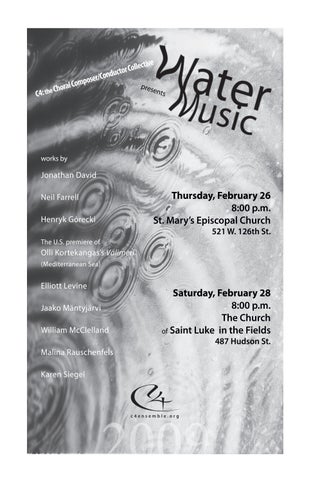
water music
Thursday, 26 February 2009, St Mary’s Episcopal Church, New York, NY Saturday, 28 February 2009, Church of St Luke in the Fields, New York, NY Aguas puras del Nilo (2004)
Elliot Z. Levine (b. 1948)
Malina Rauschenfels and Naoko Masui, soloists Phillip Cheah, conductor
C4 C4 Venice (2008) †
Karen Siegel (b. 1980)
Jonathan David, conductor
C4, the world’s first Choral Composer/Conductor Collective, is a unique vocal ensemble in New York City dedicated to performing music by living composers. A collaborative project of its singing members, it functions not only as a presenting ensemble in its own right, with a three-concert season, but also as an ongoing workshop and recital chorus for the emerging composers and conductors who form the core of the group. It is, as far as we know, the first ensemble of its kind, and the largest choral group in the nation to focus entirely on the music of our time.
The Kraken (2008) †
Jonathan David (b. 1965)
Välimeri (2000) ‡ I. Merikuva II. Aamulaulu III. Aeneas, marmorissa IV. Chiaroscuro V. Venetsia
Olli Kortekangas (b. 1955)
David Rentz, conductor
Steve Lanser, soloist Phillip Cheah, conductor
We in C4 wish to express our heartfelt thanks and appreciation to the following organizations and individuals for their support and assistance: Akin Gump Strauss Hauer & Feld, LLP St Mary’s Episcopal Church Rev. Earl Kooperkamp The Church of St Luke in the Fields David Shuler Michael David and Lauren Mitchell Nan Bases Zachary Cummings Elizabeth Marker Martin Geller and Carol Garner Annabel Gordon Clara Longstreth Benjamin Niemczyk Ellen Rentz Ira Rosenblatt
c4ensemble.org
TEN-MINUTE INTERMISSION
Dark Clouds Bring Waters (2000) §
Christopher Baum, conductor
William McClelland (b. 1950)
c4ensemble.org
Drop, Drop, Slow Tears (1997) Karen Siegel, conductor
Raindrop Diaries (2008) †
Malina Rauschenfels (b. 1978)
David Rentz, conductor
Wisło moja, wisło szara (1981)
Henryk Górecki (b. 1933)
Malina Rauschenfels, conductor
Canticum calamitatis maritimae (1997) Karen Siegel and Phillip Cheah, soloists Christopher Baum, conductor
† World premiere
Neil Farrell (b. 1959)
‡ North American premiere
Jaakko Mäntyjärvi (b. 1963)
§ New York premiere
Program Notes & Texts Aguas puras del Nilo Pure Waters of the Nile “Aguas puras del Nilo” is the third movement of a four-part suite, Un prodigio les canto. This setting of villancico texts by Sor Juana Inés de la Cruz was commissioned in 2004 by New York-based Cerddorion in celebration of the choir’s 10th anniversary. Levine writes, “I have been aware of the brilliant life of Sor Juana for over fifteen years. What has impressed me was her quest for self-fulfillment and her thirst to learn and transcend traditional gender roles in 17th century Mexico. After reading many different poems, I decided on these villancico texts from 1691, which were designed for music of her time that is still lost. I was attracted by their vivid imagery which leaped off the page and demanded music out of me. “The poem I chose is for St. Catherine of Alexandria. I think Sor Juana identified with St. Catherine, who converted many Romans (including the Emperor’s wife) and dazzled a court of scholars convened to discredit her. As Catherine was about to be tortured on the wheel, it flew apart; after this she was beheaded. “I was intrigued by the challenge of writing for double chorus. In these pieces I have tried to capture some of the flavor of Spanish and Latin-American 17th century music while using a conservative contemporary harmonic language.” – Phillip Cheah ELLIOT Z. LEVINE has been the baritone for the Western Wind Vocal Ensemble since its inception in 1969. He has appeared as a soloist with such groups as Musica Sacra, the Rome Opera, La Fenice, the Mannes Camerata, Music at Ascension, the Ensemble for Early Music, the Folger Consort and the Kalamazoo Bach Festival. He received his MM from the Manhattan School of Music, his BA from Queens College and has also studied at the Orff School in Salzburg and
with Alfred Deller in France. In addition, he studied conducting with Robert Hickok and composition with Robert Starer at Brooklyn College. Levine has been awarded five Meet-the-Composer Grants. For over twenty five years he has been a conductor and coach at Western Wind Workshops at such institutions as Dartmouth and Smith Colleges, U. Mass, and ACDA choral conferences around the country. He has been composer-in-residence at the Church of St. Thomas More in NYC, and the schools of Delmar, NY. He is the Cantorial soloist at Temple Emanuel in Great Neck. NY. His latest large work, recently commissioned by the ICU Chorus of Tokyo, was Music, based on a poem of Emerson and performed in October 2008. Other recent large works are Panim al Panim - the Death of Moses for the Glass Menagerie, Requiem for the Living for the Central City Chorus of N.Y. and Un Prodigio les Canto for Cerddorion. Levine is published by Shadow Press, Harold Flammer Inc., Transcontinental, E. Henry David, Plymouth, Colla Voce and Willis Music Co.
No, no, flow no more you could not have desired greater joy than these joys; subside, subside. Coplas Verses Sosiega, Nilo undoso, tu líquida corriente; tente, tente, párate a ver gozoso la que fecundas, bella, de la tierra, del Cielo, Rosa, Estrella. Billowy Nile, slow your current down, stay still, stay still, let your joy be crowned with the Rose of the earth and Heaven’s Star, whose lifestream you are. Tu corriente oportuna, que piadoso moviste, viste, viste, que de Moisés fue cuna, siendo arrullo a su oído la onda, la espuma, el tumbo y el sonido .... How hushed was the measure your awed current kept, as it flowed past the rushes where Moses slept and lulled his sleep well with foam and wave, ripple and swell ... No en frágil hermosura, que aprecia elloco abuso, puso,puso esperanza segura, bien que excedió su cara la de Ruth, Bethsabé, Thamar y Sara. She fastened no hopes on fragile beauty, much prized by the world and still so futile, yet of face she was fairer than Ruth, Bathsheba, Tamar, and Sarah. A ésta, Nilo sagrado, tu corriente sonante cante, cante,
y en concierto acordado tus ondas sean veloces sílabas, lenguas, números y voces. To her, sacred Nile, may the sound of your flowing be as a song in harmony growing till your water rejoices in syllables, tongues, measures, and voices. Sor Juana Inés de la Cruz Translated by Alan Trueblood
C4 C4 Estribillo Refrain Aguas puras del Nilo, parad, parad y no le llevéis el tributo al Mar, pues él vuestras dichas puede envidiar. Pure waters of the Nile, subside, subside, do not carry the tribute to the seagoing tide: the sea might rob you of the joys that abide. ¡No, no, no corráis, pues ya no podéis aspirar a más! ¡Parad, parad!
c4ensemble.org
Venice
Watermark, Joseph Brodsky’s reflections on his time in Venice, was given to me by a friend after we had searched for (and eventually found) the author’s grave in that city. Even outside the cemetery, Venice struck me at the time as strangely depressing. The beautiful architecture and magical, winding canals were pit against the knowledge that the city itself was sinking and the magnificent facades often held decay within. In 2001 the historical center was close to becoming a ghost town museum; the gondoliers, ferry operators, and store owners mostly commuted from the modern sections of the city that are actually on the mainland. The Venice of 1972 of which Brodsky writes holds parties in palazzos and is largely devoid of tourists, but only because he avoids the city in summertime. “Beauty in low temperatures is beauty,” he writes; and thus the New Year’s rumination on water, of which I have set excerpts. A waterlike accompaniment continually rises like the waves lapping against a set of disappearing stairs. Above, the melody hovers, as on an ancient bridge. — Karen Siegel
c4ensemble.org
...I simply think that water is the image of time, and every New Year’s Eve...I try to find myself near water...to watch the emergence of a new helping, a new cupful of time from it. I am not looking for a naked maiden riding on a shell; I am
looking for either a cloud or the crest of a wave hitting the shore at midnight. That, to me, is time coming out of water, and I stare at the lace-like pattern it puts on the shore, not with a gypsy-like knowing, but with tenderness and with gratitude. This is the way, and in my case the why, I set my eyes on this city...The upright lace of Venetian façades is the best line time-alias-water has left on terra firma anywhere...It is as though space, cognizant here more than anyplace else of its inferiority to time, answers it with the only property time doesn’t possess: with beauty. And that’s why water takes this answer, twists it, wallops and shreds it, but ultimately carries it by and large intact off into the Adriatic. Joseph Brodsky (1940-1996)
The Kraken
About his shadowy sides: above him swell Huge sponges of millennial growth and height; And far away into the sickly light, From many a wondrous grot and secret cell Unnumbered and enormous polypi Winnow with giant arms the slumbering green. There hath he lain for ages and will lie Battening upon huge sea-worms in his sleep, Until the latter fire shall heat the deep; Then once by man and angels to be seen, In roaring he shall rise and on the surface die. Alfred, Lord Tennyson (1809-1892)
OLLI KORTEKANGAS is one of the leading Finnish composers of today. He studied music theory and composition at the Sibelius Academy in Helsinki under the direction of Einojuhani Rautavaara and Eero Hämeenniemi, and continued his studies in West Berlin with Dieter Schnebel. Subsequently Kortekangas has worked as a teacher, including periods at the National Theatre Academy and the Sibelius Academy, and has taken part in a number of educational projects with children and young people, both in Finland and abroad. Throughout his career, Kortekangas has been interested in collaboration with other arts and artists. Kortekangas’s oeuvre consists of more than 100 works from solo pieces and chamber music to orchestral works and operas. His latest opera, Daddy’s Girl, commissioned jointly by the Savonlinna Opera Festival and the Finnish Parliament, was premiered in Savonlinna in 2007, and a new production was staged by the Finnish National Opera in January 2009. Of his earlier operas, Grand Hotel and Messenius and Lucia are also available on CD (Ondine Records). Kortekangas has worked with some of the best Finnish choirs, the Tapiola Choir and Candomino in particular, resulting in such popular works as MAA (“Earth”), A, Ikikaiku (“Eternal Echo”), Verbum, and Three Romances. His most recent choral works include Shadows and The Way to the Woods (commissioned in 2007 by the Syracuse Vocal Ensemble). Most of his choral works are available on a CD by Candomino (Alba Records). Kortekangas’s music is published by Fennica Gehrman, and represented in the USA by Boosey & Hawkes.
Välissä meri: kaukana takana kevyt liplatus, sitten aallot valkoharjat, pimeä taivas, ärjyvä tuuli ja huikaiseva valo, keskipäivän kiitävät tuulet, ja kohta horisonttiin piirryvä tumma juova. Far behind, the calm verdant shore Where the voyage began. Ahead, quite near, another shore, Sand, rocks, twilight. Between, the sea: far behind A low rippling, then White-topped breakers, dark sky, roaring wind And dazzling light, The whirling winds of midday, and soon, Tracing the horizon, A dark streak. Kapea meri, avara: elämän mittainen. A narrow sea, broad; Large as life.
C4 C4
I love Tennyson, the vividness of the imagery, internal rhymes, the sheer density. But frankly much of it is rather overripe for modern tastes. The influence of heavy metal, my favorite overripe contemporary music genre, should be apparent in my setting of Tennyson’s The Kraken. The foreboding, thick men’s voices tell of the long-sleeping sea monster whom we really don’t want to wake (think “Fluffy” in the first Harry Potter film). The undulating waters and myriad spongy, throbbing creatures therein are suggested by the 12-part women’s chorus. The women don’t sing actual words until the Day of Judgment (the “latter fire”) arrives. The whole chorus then finally sings in concert for the first time as the now boiling waters send the Kraken “roaring” to the surface to die. –Jonathan David
Välimeri Mediterranean Sea
The Candomino Choir, the poetry of Lassi Nummi, the culture of the Mediterranean – all these are things that I have become closely acquainted with over the years. These are also the anchor points for my Välimeri suite. It is my most extensive a cappella work to date, written with my “heart on my sleeve”; challenging to sing but, I believe, gratifying to listen to. Of its five movements, the odd-numbered ones are settings of poems by Lassi Nummi, while the even-numbered ones are vocalises, wordless mood pieces. Each movement has a distinct theme and appearance. “Merikuva” is a serious and epic movement that yields to the whimsical “Aamulaulu”. “Aeneas, marmorissa” evokes antiquity, while “Chiaroscuro” is reminiscent of Renaissance art. The final movement, “Venetsia”, summarises the cycle and pays homage to what is perhaps the most mythical city in the Mediterranean. Välimeri was commissioned for the anniversary festivities of the Candomino Choir, and it is dedicated to the choir and its conductor, Tauno Satomaa. – Olli Kortekangas (trans. Jaakko Mäntyärvi)
c4ensemble.org
Below the thunders of the upper deep; Far, far beneath in the abysmal sea, His ancient, dreamless, uninvaded sleep The Kraken sleepeth: faintest sunlights flee
II. Aamulaulu Aubade
III. Aeneas (Marmorissa, Berninin mukaan) Aeneas (In marble, after Bernini) [Troija, Troija, Troija.] [Troy, Troy, Troy.] Kasvot tyhjät, täydet: valmiit kohtaloon. Harteilla menneisyys, jumalat, isä, jaloissa poika Askanius Uhrituli kädessä valppaasti tähyämässä eteenpäin. Takana kaupunki leimuaa, edessä meri, valkeat tyrskyt haaksirikot askel nojaa maahan laivan kanteen, ympärillä ilma kantaa eieenpäin. Meren takana odottaa rakkaus, joka leimahtaa. Kuolinroviot.
c4ensemble.org
I. Merikuva Sea Picture Kaukana takana tyven vehmas ranta josta putjehdus alkoi. Edessä, aivan lähellä, toinen ranta, hiekka, kalliot, hämärä.
Tuhatvuotisen kaupungin. kohoavat muurit. A face empty, full: prepared for destiny. Shouldering the past, the gods, a father, At his feet his son Ascanius, Staring forward alert, holding the sacrificial fire. Behind, the blazing city, Ahead, the sea, white foam shipwrecks A firm tread upon the deck, Around, the air Bears him onward. Beyond the sea awaits A blazing love. Funeral pyres. The towging walls Of a city Built to last a thousand years.
particularly well as a choral setting by my good friend, Diane Marazzi, to whom the piece is dedicated. – William McClelland Composer and pianist WILLIAM MCCLELLAND was born in Detroit and grew up near Goodison, Michigan. Acclaimed by Donald Rosenberg in Gramophone Magazine for his “vivid music,” “appealingly direct manner of expression” and “fertile contrapuntal imagination,” he writes a wide variety of music in many styles and forms. Albany Records recently released The Revenge of Hamish, a recording of his choral works performed by William Appling Singers & Orchestra. McClelland’s music has been performed and commissioned by organizations throughout North America, and he has been the recipient of grants from Meet the Composer, ASCAP, the Copland Fund, Massachusetts Council on the Arts, and others. McClelland has collaborated as composer on a number of works with author Ian Frazier as well as projects with Russian artists Komar & Melamid. As a performer McClelland gives frequent concerts with his wife, soprano Jean McClelland, in programs of classic American theater songs. He has played keyboards for productions at the New York Shakespeare Festival, Theatre for the New City, and has premiered works by Cage, Ruggles, David Patterson, and other composers. He has conducted choral groups and been musical director for theater productions in New York City and Massachusetts and has served on the piano faculty of the University of Massachusetts (Boston), and the Elizabeth Seeger School (NYC). For many years, he has also been the leader of a swing/jazz ensemble, The Feetwarmers. Dark Clouds bring Waters, when the bright bring none. Yea, dark or bright, if they their Silver drops Cause to descend, the Earth, by yielding Crops,
Gives praise to both, and carpeth not at either, But treasures up the Fruit they yield together; Yea, so commixes both, that in her Fruit None can distinguish this from that: they suit Her well, when hungry; but, if she be full, She spues out both, and makes their blessings null. John Bunyan (1628-1688)
Tonight” and of the TV theme songs for The Flintstones and Underdog, have become audience favorites. He has performed in the Bronx Arts Ensemble’s “Two Irish Tenors” concerts every summer since 2004, including several of his arrangements written expressly for that program. Drop, drop, slow tears, and bathe those beauteous feet, which brought from heaven the news and Prince of Peace. Cease not, wet eyes, his mercies to entreat; to cry for vengeance sin doth never cease. In your deep floods drown all my faults and fears; nor let his eye see sin, but through my tears. Phineas Fletcher (1582-1650)
C4 C4
IV. Chiaroscuro Light and Shadow
V. Venetsia Venice Gondola, maailman sydän, kevyesti sykkivä! En liiku enää, olen perillä. Liikkuu Venetsia itse, lipuu silmien ohitse hetki. Vuodet. Elämä. Gondola, heart of the world, gently throbbing! I move no longer, I have arrived. Venice itself is moving, Passing before my eyes The moment. The years. A life. Lassi Nummi (b. 1928) Translated by Jaako Mäntyjärvi
c4ensemble.org
Dark Clouds Bring Waters “Dark Clouds bring Waters” is a short passage taken from the Apology to John Bunyan’s great allegory, The Pilgrim’s Progress. It was suggested that it might work
Drop, Drop, Slow Tears
Drop, Drop, Slow Tears subtly reflects Neil Farrell’s diverse musical interests. A romantic sense of tonal ambiguity colors the harmonies, which range from medieval simplicity to jazz flavors and modern dissonance. Phineas Fletcher’s sacred text is set in a texture equally varied, alternating between delicate accompaniment, counterpoint, and hymn-like homophony. Tying all this together is a singer’s sense of natural, soaring melody, and a genuine expression of the poetry.— Karen Siegel NEIL FARRELL is first and foremost a singer. Having trained at Oberlin College Florida State University, he has been a fixture in the NYC choral scene for 25 years, and performs frequently in music of all periods from the middle ages through the 20th century, including popular and folk styles. He can be heard in Voices of Ascension, Pomerium, Musica Sacra, the NY Virtuoso Singers, and many other NYC ensembles. Neil’s lifelong involvement in church music and his interest in arranging pop and jazz standards for a cappella voices eventually led to the composition of many choral works. Neil’s arrangements and compositions have been performed by Voices of Ascension, Equal Voices, Canticum Novum, the Western Wind Vocal Ensemble, Talisman, and the Men’s Glee Club at Florida State University, among others. His big-band-flavored arrangements of “The Way You Look
Raindrop Diaries
Raindrop Diaries was inspired by looking at pictures of the Amazon River and its tributaries. It follows a raindrop from a melting snow pile through streams, pristine lakes, stagnant waters choked with algae, polluted tributaries, huge rivers, and finally into the ocean. — Malina Rauschenfels
c4ensemble.org Wisło moja, Wisło szara My Vistula, Grey Vistula
Written in 1981, Wisło moja, Wisło szara is Górecki’s setting of a traditional patriotic folk song about the Vistula, a river which runs through Poland. This work sounds similar to other works of his in this style which use entirely original material. It is entirely diatonic and repetitive, like a folk song. Like many of his other works, it seems to portray a deep sense of sadness mixed with hope. – Malina Rauschenfels HENRYK GÓRECKI was born in the village of Czernica, near Auschwitz, in southwest
Poland in 1933. His mother died when he was two. Although both of his parents had a love of music and were amateur musicians, his father and his stepmother discouraged him from music, even barring him from playing his mother’s old piano. At his insistence, he finally was allowed to take violin beginning in 1943. In 1952 he began training to be a teacher, studying clarinet, violin, piano and music theory. From there he went to music school in Katowice, studying composition with Szabelski, and then for post-graduate study in Paris. His first writing style was known as dissonant modernism, and he was influenced by Stockhausen and Penderecki. He found himself a leader in the Polish avant-garde during the post-Stalin cultural thaw of the 1950s and 60s. His Symphony No. 3 is a turning point towards what some people call a sacred minimalist sound.— Malina Rauschenfels
Although fragments of the Requiem text are quoted, the work is not really intended for liturgical use, but rather as a meditation involving three distinct elements: firstly, the individual aspect — the ‘folk song’ soprano solo that begins and ends the work (and that can, but does not have to be, interpreted as the keening or lament of a sailor’s widow); secondly, the objective aspect — the ‘precentor’ intoning the bare facts of the event in newsreader style; and thirdly, the collective aspect — the extensive setting of the psalm text Qui descendunt mare in navibus (‘They that go down to the sea in ships’). The opening and closing sound background, consisting of a text fragment repeated in prayer style, introduces an element of stylized realism. The musical material is almost exclusively based on the pentatonic ‘folk song’ and a symmetrical scale (alternating half- and whole-steps). The news text is from reports in the Nuntii Latini, the weekly news broadcasts in Latin by the Finnish Broadcasting Company. The ‘folk song’ theme is not a genuine folk song. It is intended to sound like a generic folk tune that could. be from any country, albeit more probably from the north than from the south. The tune is in fact a highly corrupted version of Nearer, my God, to thee, the hymn tune traditionally (though falsely) held to be the last tune played by the band of the Titanic. — Jaakko Mäntyjärvi JAAKKO MÄNTYJÄRVI studied English and Linguistics at the University of Helsinki, and music theory and choral conducting at the Sibelius Academy. As a composer, Mäntyjärvi describes himself as an eclectic traditionalist: eclectic in that he adopts influences from a number of styles and periods, fusing them into his own idiom; traditionalist in that his musical language is based on a traditional approach and uses the resources of modern music only sparingly. He has been active as an amateur and semi-professional musician, mainly as
a choral singer with a number of Finnish choirs, including the Savonlinna Opera Festival Choir, the professional Sibelius Academy Vocal Ensemble and the Tapiola Chamber Choir. He conducted the Savolaisen Osakunnan Laulajat student choir from 1988 to 1993. He was also deputy conductor of the Tapiola Chamber Choir from 1998 to 2004, and composer-inresidence of that group from 2000 to 2005. Canticum calamitatis maritimae received 3rd prize in the European composition competition for cathedral choirs in 1997. — Jaakko Mäntyjärvi
Qui descendunt mare in navibus They that go down to the sea in ships, facientes operationem in aquis multis, that do business in great waters, ipsi viderunt opera Domini et mirabilia eius in profundo. These see the works of the Lord, and his wonders in the deep. Dixit et stetit spiritus procellae et exaltati sunt fluctus eius; For he commandeth, and raiseth the stormy wind, which lifteth up the waves thereof. ascendut usque ad caelos et descendunt usque ad abyssos. They mount up to the heavens, they go down again to the depths; Anima eorum in malis tabescebat; their soul is melted because of trouble. turbati sunt et moti sunt sicut ebrius They reel to and fro, and stagger like a drunken man, et omnis sapientia eorum devorata est. and are at their wits’ end. Et clamaverunt ad Dominum cum tribularentur Then they cry unto the Lord in their trouble, et de necessitatibus eorum eduxit eos and he bringeth them out of their distresses. et statuit procellam eius; He maketh the storm a calm, in auram et siluerunt fluctus eius so that the waves thereof are still. et laetati sunt quia siluerunt Then are they glad because they be quiet; et deduxit eos in portum voluntatis eorum. so he bringeth them unto their desired haven. Psalm 106 (107):23-30
C4 C4
Wisło moja, Wisło szara, Gdzie tak cicho płyniesz? Skąd swe wody nazbierałaś, Mów, nim w morzu zginiesz. My Vistula, grey Vistula, Where are you flowing so quietly? Where did your water come from? Tell me, before you vanish into the sea. Nazbierałam swoje wody Z tej polskiej krainy, Z tej krainy ukochanej, Nie ma nad nią innej. I have gathered my water From the Polish countryside. From my most beloved country. There is no other better. Traditional Polish words and melody Translated by Krystyna Carter
c4ensemble.org
Canticum calamitatis maritimae This work is dedicated to the memory of those who lost their lives in the shipwreck of the Estonia on September 28, 1994.
Lux aeterna luceat eis, Domine, et lux perpetua luceat eis. May the eternal light shine upon them, O Lord, and may perpetual light shine upon them. Miserere Domine. Lord, have mercy. Traditional Latin texts
Plus octingenti homines vitam amiserunt calamitate navali in Mari Baltico septentrionali facta. Over eight hundred people perished in a shipwreck in the northern Baltic Sea. Navis traiectoria nomine Estonia, cum Tallinno Stockholmiam versus navigaret, saeva tempestate orta eversa et submersa est. The car ferry Estonia, en route from Tallinn to Stockholm, was overturned in a severe storm and sank. In navi circiter mille vectores erant. There were about one thousand passengers on board. Calamitate Estoniae nongenti decem homines perierunt, centum undequadraginta sunt servati. 910 people lost their lives in the wreck of the Estonia; 139 were saved. Nuntii Latini
c4ensemble.org
Requiem aeternam... Eternal rest... Traditional Latin text
C4: The Choral Composer/Conductor Collective Daniel Andor started playing piano at four and studied composition and piano at The Purcell School of Music, London. His compositions won a number of awards and have been performed internationally, and he was featured by the Society for the Promotion of New Music during 2000–2002. As he felt drawn to making music with others, he took up trombone and conducting. Orchestral conducting kept him busy during his years at the University of Cambridge, where he lingered vigorously until he received his PhD in physics in 2005. Daniel now finds himself in New York, contemplating the receiving end of music: researching hearing and its neuro-physiology.
Timothy Brown completed his BA from the University of North Texas and has been a choral professional for over 20 years, directing high school and community choirs and singing with chamber and church choirs. As a composer, Tim focused for a time on music for the theatre. Hi’s Curious George toured nationally for over ten years and his songs were showcased at the West Bank Theatre, the BMI Workshop, and in the Donnell Library ‘Songbook’. Tim later studied at the Manhattan School of Music with Nils Vigeland. His Incidental Dance Suite was premiered at Merkin Concert Hall, and his Epitaph (Songs on Poems of Dorothy Parker) was recorded by Metropolitan Opera mezzo, Theadora Hanslowe. Tim’s church music includes Christ Our Passover and Eloi, Lama Sabbachtani, both commissioned and premiered through The Church of the Heavenly Rest, New York.
School (Vermont) and Cathedral High School (NYC) where he was the Director of Music. He is presently in charge of Choral and Performance Promotions at Oxford University Press, having worked previously as the personal assistant to Peter Schickele, discoverer and perpetrator of that infamous mini-meister, P.D.Q. Bach. Composer, conductor, and tenor Jonathan David is active in the worlds of choral music, music-theatre, and art song. He has served as Composer-in-Residence for The Greenwich Village Singers, and Music Director for the Morningside Heights-based chorus, Howl! He has been recognized as a “major new composer who must be regarded as one of the important emerging musical voices of the future.” (East Hampton Star, 12/11/07) Recent choral commissions have come from the New York Treble Singers, the Thanks-giving Foundation of Dallas and the Greenwich Village Singers, with upcoming commissions from Packer Collegiate Institute and Glass Menagerie. David’s music has also been performed by Princeton Singers, the Glen Ellyn Children’s Chorus, Cerddorion Vocal Ensemble, and the Western Illinois University Singers, among others. Stage works include Bronx Express, which ran to critical acclaim at the 2005 New York International Fringe Festival. He continues work on a large-scale song cycle for sopranist Phillip Cheah, to texts by N.C. poet David Brendan Hopes. David studied with John Bavicchi and Don McDonnell at the Berklee College of Music, and is published by Oxford University Press.
can also be counted on to sing in the shower and hum in her sleep. By day (and many evenings, nights and weekends), Rachel, an RN, can be found coordinating kidney and pancreas transplants for The Rogosin Institute at New York Presbyterian Weill Cornell Medical Center. Franny Geller is a Manhattan native and choral-music addict who would gladly sing the Mass in B-minor as a daily morning exercise routine. After fostering her love for Early Music at LaGuardia High School, she moved on to complete a BA in music at Queens College, and now enjoys quality choral time with the Bach Vespers Choir at Holy Trinity Lutheran Church, Guildsingers, and C4. By day she administrates arts-ineducation programs with Manhattan New Music Project, watches birds in Central Park, and cuts small pieces of paper into interesting shapes.
C4 C4
Christopher Baum holds degrees in Classical Guitar (from San Jose State University) and Orchestral Conducting (from the University of Denver). His recent conducting appearances outside of C4 have included world premieres of chamber works by Patrick Castillo and Steven Ebel. In May 2009, he will be performing with the F.R.E.D. Chamber Players in a program including works for voice and guitar by Tippett, Henze and Britten.
Phillip Cheah is a member of the New York Choral Artists, the Concert Chorale of New York, and the renowned Bach Choir at Holy Trinity Lutheran Church. He has sung under the batons of Lorin Maazel, Riccardo Muti, Kurt Masur, and Esa-Pekka Salonen, and performed with Olympia Dukakis, Barbara Bonney, Thomas Quasthoff, Angela Brown, members of Anonymous 4, NY Polyphony, and Alarm Will Sound. Phillip has conducted the Pocket Opera Players of Chicago, the Handel Society of Dartmouth, Cerddorion Vocal Ensemble, the Indiana University Opera Theatre, and the Amato Opera, where he was also a répétiteur. As an accompanist, he has given recitals with the Aguavã New Music Studio, the Millennium Wagner Opera Company, and the Opera Collective of New York. He has recorded on the Pro Organo and Tzadik labels. Phillip is a guest lecturer at the Manhattan School of Music and Barnard College, and has held teaching positions at the Putney
c4ensemble.org
James Bilodeau grew up in the Adirondacks. He spent his youth singing in church choirs, school choruses and several musicals. He earned a Bachelor of Music degree in Music Production and Technology from the Hartt School of Music in West Hartford, CT. At Hartt he also studied choral arts and conducting with Dr. Edward Bolkovac and voice with Janine Hawley and Janet Alcorn. Since moving to New York, James has sung with the Empire City Men’s Chorus under Dr. Jonathan Babcock and with C4. Professionally, he works as a Talk Radio Imaging Producer for Sirius XM Radio.
Tina Goldstein is a modern dancer, choreographer and vocalist. As a dancer, Tina has worked with many choreographers and dance companies, among them Doug Varone & Dancers, Aviva Geismar and Underfoot Dance. As a vocalist, Tina has performed choral music with C4 since its inception and she also currently sings Hindu devotional music or “chant” in the “kirtan” band Japa, performing often around the metropolitan area. Tina has performed with Meredith Monk in several of her works including Quarry at Spoleto Festival USA. Tina’s vocal and dance piece Cause For Alarm has been presented by Tonic, Chashama’s Oasis Festival and at the American Living Room Festival at the 3LD Art & Technology Center, produced by Here Arts Center. Tina can be seen in Meredith Monk’s latest work, Ascension Variations, on March 5, 2009 at the Guggenheim Museum.
c4ensemble.org
Rachel Dowell grew up in Ohio loving choral music and thanks C4 for opening up the world of new music to her. She currently sings more traditional fare with the Holy Trinity Choir and the St. Cecilia Chorus. Past memberships include the Soharmoniums, a SoHo-based women’s chorus, and the Continuo Singers, an a cappella octet in Wayne, New Jersey. She
Nate Graham is a composer and singersongwriter originally from the Philadelphia area. He holds a Bachelor of Music degree in
Music Composition from The Hartt School of Music in Hartford, CT, and has had his pieces performed in the United States and Spain. He currently lives in Yonkers, NY, and performs his songs all over the Northeast. www.TheGrahamStandard.com Jamie Klenetsky is an award-winning composer and singer who resides in Morristown, NJ. She has sung in multiple college choirs while obtaining her BA in Music/Composition at Rutgers University, including the Kirkpatrick Choir. While in college, she performed a the Festival 500 Choral Festival in Newfoundland, Canada, and toured Taiwan, performing at various sites throughout the country. Jamie was the second-place winner of the San Fransisco Choral Artists’ 2007 “New Voices” competition, and a finalist in the Karen Sokolof Javitch 2008 “Emerging Jewish Composer” competition. Currently, Jamie sings professionally with the Seton Hall Chapel Choir. Her “other career” is web design; she currently works as the web designer of the government of Morris County, NJ.
main singing interest was folk music. Along the way, he earned a BA in History from Brooklyn College and an MA in History from the University of Michigan. He has more than 30 years of choral experience in ensembles of various sizes. Steve currently sings with The Dessoff Choirs as well as C4. Steve works professionally as a Federal employee of the Social Security Administration. He is a long-time participant in the Western Wind Vocal Ensemble’s Workshops in Ensemble Singing. He is particularly grateful to Amy Kaiser, the former music director of The Dessoff Choirs, and to the Western Wind Vocal Ensemble for assistance in his development as an ensemble singer. He met his wife, also an active choral singer in New York, through a singing connection.
Ignatius of Antioch Church in New York City. She studied voice with Ho-Do Yung and Bruce Gladstone and presently studies with Kristine Kalina. She also studied choral conducting with Bruce Gladstone. By day, she manages a vocational English as a Second Language program for adult immigrants. Elizabeth Marker is an accomplished musician who has devoted the major portion of her career to the advancement of choral music. She holds a Master of Music in Voice Performance from Boston University where she studied with Mary Davenport and coached with Alan Rodgers. In New York she studies with Maria Farnworth. She has sung with many notable choral groups including Tanglewood Festival Chorus, the Russian Chamber Chorus and Cantori New York. In 1987, Elizabeth was invited to sing with the Oregon Repertory Singers representing the United States at the 26th Choral Singing Festival in Kärnten, Austria where the group won both the Folk and Classical Repertoire competitions. Elizabeth performed in many Robert Shaw Choral Workshops at Carnegie Hall and was a member of the Robert Shaw Festival Singers. She has served as section leader at The Church of the Good Shepherd (Episcopal) and been a member of the professional choir at St. Ignatius of Antioch (Episcopal). As a soloist, Elizabeth can be heard on two recordings: My Heart is Ready, music of Yuri Yukechev (Russian Chamber Chorus), and, as the Mother of Iseut, in Le vin herbé by Frank Martin (I Cantori di New York).
She looks forward to taking many precious memories back to Japan with her when she returns this April. Even back in Minnesota, Malina Rauschenfels always had a short attention span. Although she has spent nearly a quarter century playing the cello at Eastman (BM), Juilliard (MM), and around town, large chunks of that time were also spent playing violin, viola, flute, composing “serious” music, collaborating/writing with choreographers, dancing, doing handstands, and singing while walking down the street. When not teaching nonstop, Malina is generally creating some sort of performance art and collaborating with other artists. Check out her MySpace page for performance clips and information about upcoming concerts. Malina has written for/collaborated with Airelise, Laura Flowers, Nicole Speletic, Pat Catterson, and scored Jody Oberfelder’s film ‘LineAge’. She has danced with Jody Oberfelder Dance Projects as a dancing violinist in both Serbia and Pennsylvania and performed her own choreography at the Southern Theater, Zenon Dance in Minneapolis, MN, and at the City Center Studios in NY. www.myspace.com/malinamorethanmusic
C4 C4
Tatiana Kochkareva is a singer/songwriter born and raised in Moscow, Russia. Tatiana began at young age studying theory and composition with Irina Vladimirovna, who studied under Dmitri Shostakovich. At 16 she was offered a full scholarship and a position within the Studio Music and Jazz Program in the School of Music at the University of Miami, and was a part of an award winning University of Miami jazz vocal ensemble. Tatiana is currently living in New York City and working on releasing her next album under her stage name Nancy Newlis. www.nancynewlis.com
Adria Le Boeuf grew up in California, acting, singing and dancing on every stage available to her. At one point, she attempted to bid fairwell to the arts and focus purely on science. While studying molecular neuroscience and evolution were quite interesting, they couldn’t keep her from the arts. Now, in addition to working on her PhD on the biophysics of hearing at the Rockefeller University, she directs an improvisational theater group for scientistsin-need, dances tango and sings with C4.
c4ensemble.org
Steve Lanser, a lifelong New Yorker, was born and raised in Brooklyn. He studied classical piano in childhood and always liked to sing. As a child and adolescent, his
Erica Lowe started singing in choirs when she was six and is now an active singer and conductor of various groups in New York and Hong Kong, her hometown. She is the founder of an eight-voice ensemble, I Cantanti, which gave its debut performance in Hong Kong in September 2007. While attending college in Madison, Wisconsin, she co-directed Museko, a 20-voice multicultural group that performs choral music from all over the world, and sang with the University of Wisconsin Concert Choir and Choral Union, both directed by Beverly Taylor. She was also a professional chorister at the eight-voice Choir of St.
c4ensemble.org
Naoko Masui was born and lives in Osaka, Japan. She came to New York in April 2008 to work for a year as a volunteer at a nursing home in Brooklyn. In Japan, she directed a senior choir and worked as a pianist and voice trainer for several choirs and as a church organist. She enjoys her musical life in New York as a singer in C4, the Columbia Collegium Musicum, Polyhymnia and the Park Slope United Methodist Church Choir.
In addition to his work with C4, David Rentz directs Guildsingers, an early music ensemble. He also directs the choruses at the Brearley School and serves as assistant conductor for the New Amsterdam Singers. He has earned graduate degrees in choral conducting from the University of Wisconsin - Madison and, most recently, Yale University, where he was co-director of the University Chapel Choir. David is also an active composer whose works have been performed by, among others, the Madison (WI) Youth Choirs, the Washington University Chamber Chorus, the Milwaukee Young Artists Festival Ensemble, and the Yale Camerata.
Karen Siegel grew up harmonizing doowop tunes with her family, and went on to study voice, piano, cello, and eventually composition. She holds a Master’s degree in Composition from NYU, where she studied with Marc Antonio Consoli, and a Bachelor’s degree in Psychology from Yale. Additional studies include coursework with Conrad Cummings at the Juilliard Evening Division and vocal instruction with Lavinia Bertotti and Claudine Ansermet at the Fondazione Italiana di Musica Antica in Urbino, Italy. Her works have been commissioned by the Manhattan Choral Ensemble, Trio Eos, and the Matrix Music Collaborators, and performed by the new music ensemble Cygnus. Currently, Karen is a PhD candidate in composition at the CUNY Graduate Center, where she studies with Tania León. She is also Adjunct Lecturer in Music at City College.
Big Apple Corps Symphonic Band, and the critically acclaimed ensemble Cerddorion. He has worked as vocal music teacher at Talent Unlimited High School since 2001, directing choirs, teaching solo repertoire, music theory and keyboarding, and being an all-around accompanist. His choirs have performed several of his choral arrangements and his student soloists have consistently received high scores at the annual NYSSMA festival. Christian holds a BS in Music Education from NYU and an MFA in Vocal Performance from Hunter College. He also enjoys trying to live a little greener every day
C4
Deborah Skydell is Co-Director of the New York City Children’s Choir. She holds a BA from Haverford College, and an MM in choral music from the University of Illinois at Urbana-Champaign. While in Illinois, Deborah was the director of the Chicago Chamber Choir, as well as Arava, a Jewish choir, and Amasong, a women’s chorus. Since moving to New York, she has been the Director of Lower School Music at the Berkeley Carroll School and Director of Music at Tuxedo Park School. She is also a fully certified Kodály music educator with a strong interest in world music. Her arrangements of folk songs for women’s choir have been performed by groups around the country.
Jieun Yang grew up playing piano and violin. While attending college in Connecticut, she fell in love with choral singing, where she sang with Yale Freshman Chorus, Yale Recital Chorus, Yale Glee Club, and Yale Camerata. She holds a BA in Architecture from Yale and a Master of Architecture from Columbia University. By day, she works as an architect and researches urban-suburban conditions of US and the world.
We hope to see you at our next concert:
c 4 e n s e m b“New l e American . o r gVoices”
Christian Smythe hails from Danbury, CT. Since high school, Christian has been active in the Connectictut and New York areas as singer, actor, and oboist, appearing with local groups like the New York Metro Vocal Arts Ensemble, Chelsea Opera, The
Join C4 for an evening of new American choral music, featuring works by John Harbison, Jason Bahr, Mark Francis, Fenno Heath, Paul Leary, Meredith Monk, and C4 composers Jonathan David, Jamie Klenetsky, David Rentz and Karen Siegel. Thursday, 4 June 2009, 8:00 p.m. Church for All Nations, Midtown (417 W. 57th Street)
Saturday, 6 June 2009, 8:00 p.m.
St. Mary’s Episcopal Church, Manhattanville (521 W. 126th Street)