C4 Acknowledgements
The activities of C4 are funded, in large part, by grants and generous contributions. We wish to thank and acknowledge: Nan Bases Kit Smyth Basquin Mary S. Basquin Michael David & Lauren Mitchell Tracy and Stanley Shopkorn Daniel and Ellen Stafford-Sigg Meet the Composer/Cary New Music Performance Fund Feryal Algosaibi Tammie L. Murphy Phoebe Abelow Zorana Andrea Daniel Andor Helen Biggs Bell Jan Bilodeau Jerome Blake Jennifer Borum Ramona Bouzard Jeffrey Brown Timothy Brown Roy J. Byrd Denise Caputo Sandra C. Carlson Grace Check Alex DeLuca Nicholas DiDomizio Hugh D. and Kathryn Klein Eddy Kim and Steve Erle Reena Esmail Jonathan Fisher Lily Friedman Reiko Fueting Tami Gallotte Jill Garland Steven Gerber Alex Guerrero Brook Hersey
Vicki Haydon David Hayward Don and Sally Hayward Ira and Becky Horowitz Elsie Hunter Linnea Johnson Steve Jones Sharon Albert Kaplan Ellen Kanter Amanda Keil Farah Kidwai Janet Klump Susan H. Koshewa Phyllis Kubey Katherine Lee Linda and Leslie S. Libow Stanley and Nanette Lieblein Paul Loesel Peter Luyre Sara Lynch Beth Marker David J. MacDonald Ruth Mueller-Maerki Robinson McClellan Molly McEneny Betsey Mcgee and Mark Pecker Edward & Rose Mermelstein Bernard and Rochelle Natt
Friends of C4
Thomas L. and Constance B. Newberry Susan Obel John Pagapiou James Primosch Hedy Roma Jonathan and Suzanne Rosenzweig Joseph Rubinstein Bonnie Scarborough Christine Schadeberg Linda Schrank Clare Shore Peter Strauss Justin Stein Karen Siegel and Charles Natt Larry and Pat Siegel Milton Sonday Caroline Stinson Thomas Stumpf Severn Taylor Kenneth L. and Jean M. Telljohann Mary Tsimenoglou Joseph Upham Matt van Brink Jennifer Wendy Jason Wible
Byron Gibbs Vincent FitzGerald Ernest Hood David McCorkle Zahra Partovi Linda Schrank Anne Thulin Susan Weill (speak to a C4 member about becoming a Friend)
SPECIAL THANKS
We also wish to express our heartfelt thanks and appreciation to the following Zahra Partovi, Baruch College, The Church of St. Luke in the Fields The Activities of C4 are Funded in Part With Generous Support From
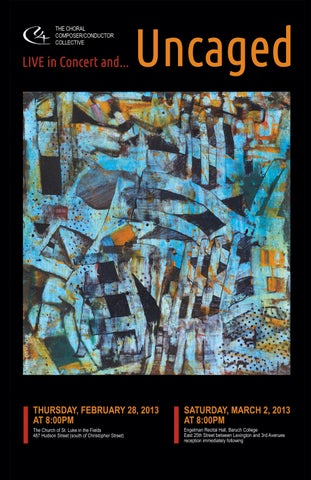
UnCaged
Thursday, February 28, Church of St. Luke in the Fields, New York, NY Saturday, March 2, Engelman Recital Hall, Baruch College, New York, NY
Seven Line Supplication to Guru Rinpoche * Fahad Siadat, conductor
Harry Einhorn (b. 1986)
The Caged Skylark
Hayes Biggs (b. 1957)
Eu Sou Que Eu Sou* 1. Não sou nada 2. Nasce Para O Conquistar
Fahad Siadat (b. 1982)
Hannah Carr, conductor
Timothy Brown, conductor
Pitter patter, pitter patter; and then *
Daniel Andor-Ardó (b. 1978)
Torch Song (For a Reason to Live) * Daniel Andor-Ardó, conductor
Timothy Brown (b. 1963) and lyric by
Hannah Carr, conductor
David Harris, soloist
Love Is Anterior to Life Melissa Wozniak, conductor
George H. Gorham (1955)
Bettina Sheppard (b. 1964)
Intermission
O Sacrum Convivium Daniel Andor-Ardó, conductor
Steven Stucky (b. 1949)
My Kiss is a Journey. . . *
Christian Carey (b. 1965)
Laus Trinitati
Jocelyn Hagen (b. 1980)
Without Words
Huang Ruo (b. 1976)
Hee oo oom ha ∞
Toby Twining (b. 1958)
Michael Conley, conductor Karen Siegel, conductor
Timothy Brown, conductor David Harris, conductor
Fahad Siadat, soloist
* World Premiere ∞ New Version premiere
Program Notes and Texts Our
opening
supplication
references
that in order to create, a composer must
lingo, has varied meanings.
Some say
but spaces the bars in his cage wider than
“Siddhi”, a word that, like so many in belief “perfection,” others “achievement,” to some it suggests levitation or magical powers,
but to all it is an unhinging of a previous reality and an awakening to a new one.
Religion typically claims jurisdiction over enlightenment, spiritual freedom, release, but C4’s “UnCaged” stakes a claim for the musical arts as spiritual potentate.
To be “Un-” one must first be the thing
negated. The cages that bind artists have a peculiarity all their own. On one hand,
musicians are fulfilling their life dream of sonic creation with talented artists who
limit. Twining leverages melodic repetition,
some through frequent but subtle shifts in rhythmic and metric expectation. Here, in
the music, the composer wrestles most with
how to free themselves through limitation. Whether caught in Hayes’ tonal/atonal
explosions or Fahad’s rhythmic grooves, Daniel’s overpowering texture, Bettina’s canonic layering or Tim’s cabaret-meets-
choral jazz chord stacks, the composers each had to choose their answers, and choice
fulfilled is our Valhalla. The artist’s prayer,
understand them and strive after perfection
Seven Line Supplication to Guru Rinpoche
often translates into baby sitting entitled 4th
Orgyen yul gyi nub jang tsam
in community.
On the other, that vision
graders, waiting tables, and/or wondering how you are going to pay rent to your
slumlord. Or worse, the rough acceptance that you won’t be getting a call from The Met tomorrow.
Like religious practitioners, composers
look both inwardly and outwardly for release from their cages.
In the Stucky-
Carey-Hagen trinity, we see three religious
texts, each seeking to describe the ecstatic joy of interconnection with deity. Huang
Ruo, Fahad and Daniel’s texts focus more on
the conflict than on the resolution, whereas
Hayes’ and Tim’s authors wander through their challenge before finding a way out, and Harry’s and Bettina’s poets offer
the quieting power of meditation on the sublime. The last piece, Twining’s untexted frolic through mixed meter and yodels,
questions the musical cage, the conundrum
Pema gesar dongpo la Yatsen chok gyi ngodrub ne Pema jungne she su drak Kor du khandro mangpo kor Kye kyi jesu dak drub kyi Jin gyi lob chir shek su sol OM AH HUM VAJRA GURU PEMA SIDDHI HUM OM MANI PADME HUM In the Northwest of the Land of Uddiyana On a blooming lotus flower You have attained supreme, wondrous siddhi You are renowned as Padmakara Surrounded by your retinue of many Dakinis We practice following your example Please approach and grant your blessings Guru Padma Siddhi Hum (Translation by Nalanda Translation Committee)
if there were one, would be “damn it, I need
responsible for taming the forces that were
we’re cooking, the cage around us stretches
from taking root in Tibet. It is said that in
the artist’s gift to enlightenment, that beauty
this prayer, when uttered with devotion
options, and setting a nice beat that you can
effective
~David Harris
uncompounded nature as pristine awareness,
Seven Line Supplication to Guru Rinpoche Harry Einhorn
himself. Included are the mantras of
to get started,” for we all know that when
preventing the teachings of the Buddha
out beyond the universe. And herein lies
this current age of rampant materialism
lies in releasing yourself by hemming your
and compassionate intention, is especially
dance to.
that prevent us from experiencing our
The Seven-Line Supplication to Guru Rinpoche
for
removing
Padmasambhava and Avalokiteshvara, the
Buddha of Compassion, of whom he is an emanation. For more information, one could read “Crazy Wisdom” by Trungpa Rinpoche. ~Harry Einhorn
the master from Uddiyana (the region now
The Caged Skylark Hayes Biggs
known as Swat Valley in Pakistan) who was
obstacles
which is no different than Padmasambhava
is an ancient Tibetan Buddhist prayer that
invokes the blessing of Padmasambhava,
the
The Caged Skylark
My setting of Gerard Manley Hopkins’s
As a dare-gale skylark scanted in a dull cage
spring of 2011 and completed in August
Man’s mounting spirit in his bone-house, mean house, dwells– That bird beyond the remembering his free fells;
The Caged Skylark was begun in the of the same year. The piece is dedicated
to Gregg Smith, in honor of his eightieth
This in drudgery, day-labouring-out life’s age.
birthday and with deepest thanks for his
Though aloft on turf or perch or poor low stage,
of American composers over the past
Both sing sometímes the sweetest, sweetest spells, Yet both droop deadly sómetimes in their cells
unflagging commitment to and support several decades.
Hopkins (1844-1889), besides being
Or wring their barriers in bursts of fear or rage.
possessed of a vision that made much
Not that the sweet-fowl, song-fowl, needs no rest–
possible, was a convert to Roman
Why, hear him, hear him babble and drop down to his nest,
of twentieth-century English poetry Catholicism and a Jesuit priest. The
But his own nest, wild nest, no prison.
Caged Skylark begins darkly, its first
Man’s spirit will be flesh-bound when found at best,
the brave, “dare-gale” skylark chafing
But uncumbered: meadow-down is not distressed
two stanzas juxtaposing the image of against the confines of his “dull
For a rainbow footing it nor he for his bónes rísen.
cage,” with the workaday drudgery
~Gerard Manley Hopkins
earthly bodies. My setting begins with
of humans, imprisoned in their own
a duet for the sopranos and
altos that seems to suggest
the aimlessness of the bird in his futile struggle against his incarceration,
culminating
Não sou nada Nunca serei nada. Não posso querer ser nada. À parte isso, tenho em mim todos os sonhos do mundo.
in chordal “bursts of fear or
rage” in the full choir, with the altos hanging on stubbornly after the other voices have abruptly been cut off.
Hopkins changes the affect
completely for the last two stanzas. The skylark, even when flying free and high,
still needs a resting place, a “wild nest” to which he
can rapidly descend at will
from the heights. Likewise, humans freed—in Hopkins’s
view—by the fact of Christ’s resurrection still require their
own dwellings, but their
bodies are now transformed into something much lighter,
no more an encumbrance than would be a rainbow alighting upon a meadow. From a musical standpoint, my
interpretation
of
the
second half of the poem takes
on a decidedly more tonal
O mundo é para quem nasce para o conquistar E não para quem sonha que pode conquistá-lo, ainda que tenha razão. Tenho sonhado mais que o que Napoleão fez. Tenho apertado ao peito hipotético mais humanidades do que Cristo, Tenho feito filosofias em segredo que nenhum Kant escreveu. Mas sou, e talvez serei sempre, o da mansarda, Ainda que não more nela; Serei sempre o que não nasceu para isso; Serei sempre só o que tinha qualidades; Serei sempre o que esperou que lhe abrissem a porta ao pé de uma parede sem porta, E cantou a cantiga do Infinito numa capoeira, E ouviu a voz de Deus num poço tapado.
cast, but it is a tonality hard
won and not without ambivalence.
Eu Sou Que Eu Sou Fahad Siadat Pessoa fantastically embodies the existential crisis of adolescence. His characters live in a rich internal world filled with the heights and depths of feeling, but do virtually
I am nothing I shall never be anything I cannot want to be anything. And yet, I have within me all the dreams of the world. The world is for those born to conquer And not for those who dream they can conquer it, though they may be right. I have dreamt more than Napoleon accomplished; I have clasped to my hypothetical chest more humanity than Christ; I have made secret philosophies that no Kant ever wrote. But I am, and perhaps shall always be, he from the attic, though I don’t live in one; I shall always be the one who was not born for that; I shall always be only the one who had quality; I shall always be the one who waited for the door to open by a wall without doors, And sang the song of the Infinite in a hen-house, And heard the voice of God inside a filled well. ~Fernando Pessoa Translation by Fahad Siadat
nothing with their lives. And yet, these feelings linger into adulthood and are so
sincere that I cannot help but get caught
up in their energy. His poems translate the
inherent multiplicity each individual feels,
the struggle of being nothing and all things at once, the conflict between actions and potential. For those interested in more of
Pessoa’s writings, I recommend The Book of Disquiet.
~Fahad Siadat
Pitter patter, pitter patter; and then Daniel Andor-Ardó
rhythm is subtle, soft; hardly noticeable at
I had read the fairy tale about Dwarf Nose, whose
then, shifting into hurricane gear. Hurricane
My mother pretended that had happened to me.
change, history –or contemporary politics.
first. A mere summer drizzle. Hitting a leaf,
here and there. Playfully. And then. And
nose gets so long nobody recognizes him anymore.
gear, be it in the realm of fairy tales, climate
I still vividly recall the blind terror with which
And then.
Hannah.
Zsuzsanna Ardó is an artist, curator and
(political theorist, in her letter to Martin
and Heidegger for the Short Play Festival at
I kept crying: but I am your child, I am your
~Zsuzsanna Ardó
~Hannah Arendt
writer. She directed her play about Arendt
Heidegger after their break-up)
Harvard University in 2003. www.ardo.org
Why is Dwarf Nose upset when nobody identifying with Dwarf Nose make Hannah
Torch Song (For a Reason to Live) Music by Timothy Brown Lyric by George H. Gorham
why should she vividly remember it over
If you’ve seen my bio in C4 programs,
it mean to be “recognised” by the other?
compositional fence-sitter; my attention has
How does it all relate to the private and
and classical worlds. Though written with
Pitter patter, pitter patter; and then is inspired
is something of an experiment in crossing
tale about Dwarf Nose, as experienced by
arranged for a theatre soloist and a vocal
as an adult. Yet it is as much—or indeed
were wondering), and I asked my longtime
Bluebeard’s Castle is in Béla Balázs’ libretto.
text on my notion that the song should be
tale’ ending. It’s not about a walk into the
meaning in his life. I hope you’ll agree it
brick road. Inspired by Hannah Arendt’s
for a lost love - his own life.
patter; and then is about false hopes and
Many Thanks to George for enduring an
persecution at a personal level. The shape-
on the song, and to soloist David Harris for
rejection, from rejection to exclusion, from
recognises him anymore? Why should
Arendt cry in “blind terror” as a child, and two decades later as an adult? What does
you might recall that I refer to myself as a
What has it got to do with ‘being accepted’?
been split over the years between the theatre
the political, the intimate and the social?
C4 in mind, Torch Song (For a Reason to Live)
by these questions embodied in the fairy
the two styles; an actual cabaret song
Hannah Arendt as a child, and reexperienced
arts ensemble. Music came first (in case you
as little—about a ‘fairy tale’ as Bartók’s
collaborator, George Gorham to base the
Certainly not fairy tale in the sense of ‘fairy
about a character struggling to find renewed
sunset, over the rainbow, along the yellow
makes a lovely torch song for a man pining
experience of Dwarf Nose, Pitter patter, pitter the experience of rejection, exclusion, and
unusually difficult back and forth process
shifting of these states: from false hope to
bringing the character to life so beautifully.
exclusion to persecution. The shape-shifting
~Timothy Brown
Pitter patter, pitter patter... And then. Pitter-patter. Pitter-patter. Pitter-patter. Then. Then. Then. Pitter-patter. Pitter-patter. Pitter-patter. Then. Then. Then. Pitter-patter. Pitter-patter. Pitter-patter. Then. Then the dwarf looked. Then looked in the puddle.
No. Pitter-patter. Oh, what big nose you have. Peek-a-boo. You. I don’t know you. Pitter-patter. Pitter-patter. Pitter-patter. Then. Then. And then. ~Zsuzsanna Ardó
Pitter-patter. Pitter-patter. Pitter-patter.
Torch Song
Rainbow. Clouds. Trees. Leaves in the puddle. Gazed at the puddle. Gazed at herself.
For a reason to live... Something says, find a reason to live. Find a reason to get up and Somehow get out of this haze. But the days go on.
Then. Then. Then. Days, days, days. Month, months. And a year and a half. Came and went. Pitter-patter. Pitter-patter. Pitter-patter. One night. The sky. Opened... wide. Wide. Wide. WIDE. Flood. Flood. FLOOD. Pitter-patter. Pitter-patter. Pitter-patter. The sky barked. Barked an army of scars. And the scars flooded the forest. Pitter-patter. Pitter-patter. Pitter-patter. The dwarf gazed again. The dwarf gazed at the rainbow. Pitter-patter. Pitter-patter. Pitter-patter. Will you take me?
Find a reason to care. Somewhere out there’s a reason to care. All the things I once shared, maybe They’re a way out of this maze. Still the days go on. Watching sunlight crawl ‘Cross the bedroom wall All day, day after day. Staring out all night At a traffic light Night after night ‘Til the dawn. What would I give? For a reason to live! And somehow escape this spell, This hell! I know only too well What it takes to break out of this shell. I need something or someone to show me, To set me free! Someone who’ll wake me, And shake me, Who’ll make me see! For a reason to live, That just has to be me. ~George H. Gorham
Love is Anterior to Life Bettina Sheppard
series of works from Meet The Composer
Love is Anterior to Life is part of a larger song
the National Endowment for the Arts, the
Commissioning
cycle of Emily Dickinson poetry settings
originally performed at Hunter College.
Excerpts have since been included in
concerts at Lincoln Center’s Alice Tully Hall and at City Center. The
poem
appears
in
Dickinson’s
Music/USA,
which
made possible by generous support from Helen F. Whitaker Fund, and the Target
Foundation. They were first performed on January 19, 2006, in Kansas City, with Charles Bruffy conducting. ~Steven Stucky
idiosyncratic style of broken textual lines
O sacrum convivium
separate and concise while allowing a sense
O sacrum convivium, in quo Christus sumitur: recolitur memoria passionis eius; mens impletur gratia et futurae gloriae nobis pignus datur.
interrupted by dashes. Each line is brilliantly of flow and eternity. Sopranos, altos and
tenors are each assigned one line with its
own melody and metrical form, which is then repeated throughout. Only the basses
sing the entire poem, while the second alto simply sings the word “love.” We feel the
choppy nature of the poem with its distinct thoughts, but also the repetitive, eternal cycle of life and death.
Love—is anterior to Life— Posterior—to Death—
is
O sacred banquet, in which Christ is received: the memory of His Passion is renewed; the mind is filled with grace and a pledge of future glory given to us.
My Kiss is a Journey. . . Christian Carey
Initial of Creation, and
Christian Carey’s My Kiss is a Journey ...
The Exponent of Breath
delicate poem. The few precious lines on,
~Emily Dickinson
O Sacrum Convivium Steven Stucky Three New Motets, of which we are performing O Sacrum Convivium tonight, were written for the Kansas City Chorale, the Grinnell Singers, the Seattle Pro Musica,
and the Phoenix Bach Choir. The project was commissioned as part of a national
(2011) is a tender setting of an exquisitely
essentially, “the breath of life,” are rendered
in fleeting passages, often homophonic and
easy on the ears, but underlined with subtle and complex harmony. The piece flirts on
the edges of tonality, the first five words of the text setting up a cadence in E flat major
that has to wait for an answer until the final chord. In the interim, there is significantly
quick shifting of keys and chord structures, including phrases that are essentially atonal, but always coming to rest in E flat, first on the word “being,” then “beyond” and then
on the passage “the sound of creation.”
second section is aleatoric and includes
in imitation, with a very beautiful tune first
The melodies they sing are inspired by chant
That same phrase is given to all four parts, heard earlier on the words “you can hear a faint echo.” Christian says of his work:
“My Kiss is a Journey … is a setting of a poem by my friend Stephen John Kalinich. Stevie
is a wonderful wordsmith: his own album A World of Peace Must Come captures the
zeitgeist of the late sixties countercultural movement and he’s well known as a lyricist for the Beach Boys. I’m so honored that he has consented to let me set his words to music.”
~Michael Conley
several soloists from each section of the choir.
and sung over and over again at various
tempi, while the choir sustains lush chords. The climax of the piece introduces the third section, and the choir again sings together in
hushed wonder. The tender ending is one
of exhaustion and enlightenment after such strong musical devotion. —Jocelyn Hagen
Laus Trinitati Laus Trinitati, in vita ipsorum est, que sonus et vita ac creatrix omnium. Et que laus angelice turbe et mirus splendor archanorum,
My Kiss is a Journey. . . My Kiss is a journey from God’s lips, Who blew me into being. You can hear a faint echo If you listen intently Beyond the silence is the hum The sound of Creation continuing. ~Stephen John Kalinich
Laus Trinitati Jocelyn Hagen Laus Trinitati was composed for and
que hominibus ignota sunt, est, Et que in omnibus, vita est. Praise to the trinity! You are sound and life, maker of all things in their very life, you, praise of the angel throng and lofty splendor of the hidden mysteries unknown to humankind, yet you are, and you are life in all things. ~Hildegard von Bingen (1098-1179)
Without Words Huang Ruo
subsequently won the first annual Yale Glee
Without Words is written for double a cappella
Competition in 2005. The text was written
Bass I, and Soprano II, Alto II, Tenor II, Bass
Club Emerging Composer Composition
by female poet and composer Hildegard von Bingen (1098-1179). This setting of the text
is not an arrangement of Bingen’s original
melody, but an entirely new composition. The piece can be divided into three sections,
the first being a chorale for full choir. The
choir in eight parts: Soprano I, Alto I, Tenor I,
II, with four pairs of finger bells. The entire piece runs around six and a half minutes. The text is from a poem written by Li Hou Zhu (937-978) in the Tang Dynasty. ~ Huang Ruo
Wu Yan Du
Without words, alone …
Walking up to the Western
Hayes Biggs was born in Huntsville,
The moon is as a fading
He holds the Doctor of Musical Arts degree
Ji Muo Wu Tong The Lonesome Wutong
His teachers have included Don Freund,
Shen Yuan
In the deep courtyard,
Lerdahl and Donald Erb. Biggs has been
Autumn.
Conference and Chamber Music Center
Shang Xi Lou,
pavilion.
Alabama and raised in Helena, Arkansas.
hook …
in composition from Columbia University.
tree,
Mario Davidovsky, Jack Beeson, Fred
Enclosed with dismal
a fellow in composition at the Composers
Unbreakable;
at Wellesley, at the Tanglewood Music
Yue Ru Gou.
Suo Qin Qiu. Jian Bu Duan,
Center, at Yaddo, the Virginia Center for the Creative Arts, the Millay Colony for the
Hee•oo•oom•ha Toby Twining
Arts and at the MacDowell Colony. Among his honors are a John Simon Guggenheim
In 1987, the choreographer Melanie Bales
Memorial Fellowship, as well as the 2001
used my voice. I had recently become taken
him the opportunity to live and compose at
of the BaBenzele Pygmies and Mongolian
the summer of 2002. Since 1992 he has been
the seemingly infinite variety of sounds
Music. His Symphonia brevis, commissioned
range of orchestral color.
performance under the direction of George
asked me to compose a piece for her that
Aaron Copland Award, which afforded
with world vocal music, particularly that
Copland House in upstate New York during
throat singers. Further, I wanted to exploit
on the faculty of the Manhattan School of
possible for the human voice to achieve a
by the Riverside Symphony, received its first
These
inspired
Rothman in Lincoln Center’s Alice Tully
unaccompanied voices, which set me on a
performances of a setting of Gerard Manley
~Toby Twining
2011. Biggs’s song cycle on religious poetry,
were
the
ideas
that
Hee•oo•oom•ha, my first large work for
Hall in February of 2010. C4 gave the first
lifelong creative path in choral music.
Hopkins’s The Caged Skylark in November of
Composers
Psalms, Hymns and Spiritual Songs, was premiered at Manhattan School of Music in
January 2012 by soprano Susan Narucki and pianist Christopher Oldfather. That same
month his Three Hymn Tune Preludes were Harry Einhorn is a singer, composer, and
given their first performance by Gail Archer
Heart Sutra and Samaya, his multimedia
In December of 2006 his String Quartet: O
Treuille primarily based on Buddhist texts
premiere at New York City’s Merkin Concert
Museum, and La Sala in Williamsburg.
of the 2006-2007 season of the Washington
theater director based in New York City.
at St. Paul’s Chapel at Columbia University.
chamber music collaborations with Philippe
Sapientia/Steal Away (2004) was given its
have been performed at the Cell, the Rubin
Hall by the Avalon String Quartet as part
Square Contemporary Music Society; it was
was featured by the Society for the Promotion
2008, and was recently released on Albany
drawn to making music with others, he took
recorded by the Avalon String Quartet in Records. Biggs’s music is published by C. F.
Peters Corporation, APNM (Association for the Promotion of New Music) and Margun Music, Inc. www.hayesbiggs.com
Fahad Siadat specializes in theatrical music for vocal ensembles. He holds a Master of Fine Arts from the California Institute of the Arts in Music Performance and Composition,
and a Bachelor’s of Music in Theory and
of New Music during 2000–2002. As he felt
up trombone and conducting. Orchestral conducting kept him busy during his years at the University of Cambridge, where he
lingered vigorously until he received his
PhD in physics in 2005. Daniel continued his research at the Rockefeller University in
New York, contemplating the receiving end
of music: researching hearing and its neurophysiology.
Composition from Vanderbilt University’s
Timothy Brown completed his BA at the
for: the California EAR Unit, New Century
choral professional for more than 30 years,
Blair School of Music. Fahad has composed Players,
CalArts
Singer’s
Collective,
TOCCATA Orchestra, and Warrior Poet
Theater Group. He regularly performs in
contemporary opera, most recently Josh Ollswang’s Juniper Tree, Britten’s Curlew
River, and Saharava: A Ritualized Dance Opera produced by the Resonance Collective, an
interdisciplinary production company of
which he is Artistic Director. Fahad is the president of See-A-Dot Music Publishing,
a new company dedicated to the advocacy
of new choral music; it’s first catalog
comes out this spring. He is also an active performer of Brazilian music and dance and has performed with Capoeira Narahari
and Raizes do Brasil, is a rock-climbing enthusiast, and a tri-athlete. For more
information about his current work visit www.fahadsiadat.com
Daniel Andor-Ardó started playing piano at four and studied composition and piano at The Purcell School of Music, London. His
compositions won a number of awards and have been performed internationally, and he
University of North Texas and has been a
directing and singing with high school, community, and chamber choirs.
As a
composer, Tim focused for a time on music for the theatre. His Curious George toured
nationally for over ten years and his songs have been showcased at the BMI Workshop,
the Laurie Beechman Theatre, the Donnell Library ‘Songbook,’ and – most recently – in
A Trace of Love, an evening devoted entirely to
his music with 6 collaborating lyricists. Tim did masters degree work at The Manhattan School of Music, studying composition with Nils Vigeland.
His Incidental Dance Suite
was premiered at Merkin Concert Hall, and
Epitaph: Songs on Poems of Dorothy Parker was recorded by Metropolitan Opera mezzo,
Theadora Hanslowe. Tim’s Christ Our Passover, and Eloi, Lama Sabbachtani were commissioned by and premiered at The
Church of the Heavenly Rest, New York. Tim is proud to have had C4 premiere his Drip Dream and In So Many Words, and wishes to
HEARTILY THANK his C4 colleagues for tonight’s premiere of Torch Song.
George H. Gorham, along with composer
created the jazz harmony group Satin Dolls.
Change in the Heir, which they are currently
Open Center, and a member of The Sound
Dan Sticco, wrote the Broadway musical A reworking for a London production. For the
last several years he has been writing cabaret material with Timothy Brown.
Bettina Sheppard works extensively now
as a singer, pianist, and composer, after many years spent in dramatic and musical
theatre. She holds graduate degrees from both University of Virginia and CUNY,
where she studied composition with Chris Theofanidis and Shafer Mahoney, as well
She is the in-house composer for New York
and Music Institute, an innovative group of multicultural musicians who are exploring
the effects of both archaic and modern
music in today’s world. Members include Grammy Award winner David Darling, the late Don Campbell, John Beaulieu, Silvia
Nakkach, Layne Redmond, and Pat Moffit Cook. Bettina is the author of The Everything Singing Book, published by Adams Media, and is on faculty at City College CUNY.
as composition studies at Juilliard with
Steven Stucky is one of America’s most
include a song cycle of Emily Dickinson
living composers and winner of the 2005
Conrad Cummings. Some completed works
poetry performed at Lincoln Center’s Alice Tully Hall; settings of Millay poetry
commissioned for the American Cathedral
in Paris; a song cycle of Kaneko poetry; stage productions, including TraumNovela (Barrow Street Theatre, Barcelona, Dallas); 365 Days/365 Plays by Suzan-Lori Parks at Barrow Street Theatre and The Public Theater; Hell (dance production at City
Center); The Picture of Dorian Grey; Kindly Direct Me To Hell: An Evening With Dorothy
Parker. She created the new group Bridges
Vocal Ensemble, presenting her compositions of various cultures and time periods, in
venues such as Carnegie Hall and City Center. Bettina is presently working on the
new opera Stillwaters. Also in the works is an opera based on Welsh folk tales of
The Mabinogian. Solus, her CD of original
material was released under her Welsh name,
Brythonwen. Serving as musical director for numerous theatrical productions, she has also directed and performed with many
vocal groups from madrigal to rock, and
highly regarded and frequently performed
Pulitzer Prize for his Second Concerto for Orchestra. Notable recent premieres include
the piano quartet Rain Shadow (2012) by Opus One, Silent Spring (2011) by the Pittsburgh
Symphony (Manfred Honeck), Chamber
Concerto (2010) by the Saint Paul Chamber Orchestra (Roberto Abbado), Rhapsodies (2008) by the New York Philharmonic at the BBC Proms (Loren Maazel), and August
4, 1964 (2007-08) by the Dallas Symphony Orchestra (Jaap van Zweden). For the 2011-
12 season, Mr. Stucky was the Pittsburgh Symphony’s Composer of the Year; this
season, he is the Berkeley Symphony’s Music Alive Composer-in-Residence. For 21 years he served as resident composer
and new music advisor to the Los Angeles
Philharmonic under Esa-Pekka Salonen (the longest such association in American
orchestral history), and from 2005 to 2009 as host of the New York Philharmonic’s
“Hear and Now” new-music series. He is in residence this season at the Curtis Institute of Music in Philadelphia.
In addition his new Symphony for the Los
Angeles and New York Philharmonics, other notable premieres in the current 2012-13
season include a Symphony (New York and
Los Angeles philharmonics); Take Him, Earth,
chorus and chamber ensemble marking the fiftieth anniversary of the assassination of John F. Kennedy (American Choral Directors Association); and a song cycle on poems of Czesław Miłosz entitled The Stars and the Roses (tenor Noah Stewart and the
Berkeley Symphony under Joana Carneiro). The Dallas and Pittsburgh symphonies and
London’s Philharmonia Orchestra will also tour Europe this season with his music.
Mr. Stucky has won the ASCAP Deems Taylor Award for his path-breaking study
Lutosławski and His Music (Cambridge, 1981) and the Gold Medal of the Lutosławski Society in Warsaw. He is series consultant
this season for the Philharmonia Orchestra’s Lutosławski centennial celebration, Woven Words: Music Begins Where Words End.
writer, and musicologist specializing in music theory, Postwar, and American
music. He is Assistant Professor of Music
at Westminster Choir College in Princeton, New Jersey. He is also Managing Editor of
the contemporary classical website Sequenza 21 (www.sequenza21.com/carey).
Contemporary
Music
Ensemble, Atlantic Chamber Orchestra, Cassatt String Quartet, Locrian Chamber Players, Aspen Contemporary Ensemble loadbang
have
Underground at Cornelia Street Cafe, Grace Church Newark, and Princeton Chapel. He
has upcoming performances by Manhattan
Choral Ensemble, Righteous Girls, and the Choristers of Grace Church in Newark. www.christiancarey.wordpress.com
Jocelyn Hagen a native of Valley City,
North Dakota, composes music that has
been described as “dramatic and deeply
moving” (Star Tribune, Minneapolis/St. via songwriting, and this is very evident in
her work. Her music is melodically driven,
boldly beautiful, and intricately crafted. Since her graduation from St. Olaf College in 2003,
Jocelyn has received over 40 commissions, 50 premieres, and 100 performances.
In 2010 Jocelyn was awarded a McKnight Artist Fellowship. She has also received
American Composers Forum, Minnesota Music Educators Association, VocalEssence, the Yale Glee Club, the Lotte Lehman Foundation,
Competition,
performed
his
the
the
Sorel
Cincinnati
Medallion
Camerata,
the University of Minnesota, and the San
Francisco Song Festival. Her commissions include the American Choral Directors Association
Ensemble (ACME), New York New Music
and
Patrick’s Cathedral, Riverside Church, Serial
grants and awards from ASCAP, the
Christian Carey is a composer, performer,
American
June in Buffalo, the Aspen Music Festival, St.
Paul). Her first forays into composition were
A noted authority on Witold Lutosławski,
The
compositions at venues such as Joe’s Pub,
of
Minnesota,
the
North
Dakota Music Teacher’s Association, The
Singers – Minnesota Choral Artists, Trio
Callisto, Cantus, the St. Olaf Band, NDSU
Gold Star Band, and the Copper Street Brass Quintet. Her work is published by
Graphite Publishing, Santa Barbara Music
Publishing and Boosey and Hawkes. www. jocelynhagen.com
Awarded First Prize by the prestigious
Records with his own singing in 2008; and
Prize, Huang Ruo has been cited by the
in 2009. Huang Ruo’s latest CD To The Four
Luxembourg
International
Composition
New Yorker as “one of the most intriguing of
the
new
crop
of
Asian-American
composers.” His vibrant and inventive musical voice draws equal inspiration
from Chinese folk, Western avant-garde, rock, and jazz to create a seamless, organic integration using a compositional technique
Divergence came out on Koch International
Corners, performed by Future In REverse, was recently released on NaxosRecords. Huang Ruo is currently a member of the
composition faculty at SUNY Purchase. For
more information about Huang Ruo and his music, please visit huangruo.com.
he calls “dimensionalism.” Huang Ruo’s
Raised in Texas, with family roots in
music, opera, theater, and modern dance,
has traveled musically from playing for rock
writing spans from orchestra, chamber to
sound
installation,
multi-media,
experimental improvisation, folk rock, and
film. Ensembles who have premiered and
performed his music include the New York Philharmonic, Philadelphia Orchestra, San Francisco Symphony, Seattle Symphony,
Hong Kong Philharmonic, Chamber Music Society of Lincoln Center, Asko Ensemble, Nieuw Ensemble, Quatuor Diotima, Dutch Vocal Laboratory, and the Tang Quartet,
and under conductors such as Wolfgang
Sawallisch, James Conlon, Dennis Russell Davies, Ed Spanjaard, Xian Zhang, and Ilan
Volkov. Huang Ruo has received awards
country-swing and gospel, Toby Twining and jazz bands to experimental composition
at the University of Illinois in Urbana, where he earned his Bachelor of Music degree in 1985. His group Toby Twining Music has
performed in music halls and festivals across the United States and parts of Europe.
Their recordings include Shaman (BMG Classics, 1994), The Little Match Girl and Emily Dickinson’s Birthday Pizza on A Prairie
Home Companion 20th Anniversary Album (Highbridge, 1996), Chrysalid Requiem
and Eurydice (Cantaloupe Music, 2002 and 2011).
and grants from the ASCAP Foundation,
Twining’s instrumental works have been
Argosy Foundation, Greenwall Foundation,
Blues, Anthem, Oxingale, 2002) and pianist
Presser Foundation, Jerome Foundation,
Meet The Composer, NYSCA, Chamber Music America, American Music Center, Aaron Copland Award, and Alice M.
Ditson Award. New York Times critic Allan
Kozinn listed his concert as the second on the list of his “Top Ten Classical Moments
of 2003.” Huang Ruo’s Chamber Concerto Cycle was released on Naxos in February 2007; Leaving Sao, a work for orchestra and
Chinese Folk Voice, was released on Albany
recorded by cellist Matt Haimovitz (9:11
Margaret Leng Tan (Satie Blues, The Art of Toy Piano, Point/Universal 1997 and An American in Buenos Aires, She Herself Alone, Mode, 2011).
Twining is the recipient of a Pew Fellowship, the Barrymore Award for Outstanding
Original Music, a Guggenheim Fellowship
and a Meet the Composer Commissioning Music/USA award.
C4: The Choral Composer/Conductor Collective Daniel Andor-Ardó (see above)
the Manhattan School of Music. An active
Hayes Biggs (see above)
scene since she was a student, Melissa
James Bilodeau James Bilodeau grew up
New York Choral Artists and the New
causing a ruckus in church and school
Opera Orchestra of New York, American
School of Music. Since moving to New York,
Company, Mostly Mozart Festival, St.
but thinks that C4 could be the one.
Orchestra Society.
as an audio producer for Sirius XM Radio.
Hannah Carr took her undergraduate
or sitting in a small dark room editing audio,
College Dublin, where she won first prize for
out of planes.
diploma in Choral Conducting at the Kodály
Timothy Brown (see above)
classical music as an organist, pianist and
Kristopher Burke has earned degrees in
Irish music to Funk and other popular styles
and Vocal Performance from Shenandoah
Dalton School and The Diller-Quaille School
member of New York’s professional choral
has performed with Voices of Ascension,
in the Adirondacks. He spent his youth
York Philharmonic Orchestra, Pro Arte,
choirs. He earned a BM degree at the Hartt
Symphony Orchestra, Mark Morris Dance
he’s flirted with various choral ensembles
Ignatius Loyola Concert Series and Little
Professionally, he rocks interstellar airwaves
When he’s not working on Karen’s rhythms
degree in Music and French from Trinity
he’s seeking balance and peace by jumping
her composition portfolio, and an advanced Institute in Hungary. She has performed in singer, as well as in groups from Traditional
music education from Shepherd University
and teaches chorus and music theory at the
Conservatory. Kristopher sang as soloist
of Music.
in Leesburg, VA for five years and as a
Michael Conley has earned a notable
under conductor Robert Shafer. He has also
as a conductor, pianist, organist, singer,
Street Scene, Don Basilio in Mozart’s Le Nozze
the West Village Chorale and the Hudson
Night’s Dream. Kristopher moved to New
Director at Judson Memorial Church. From
and currently works for the the Brooklyn
School Chorus at the Dalton School. For five
and section leader with the St. James Choir chorister with the City Choir of Washington
reputation in the United States and abroad
performed the roles of Sam Kaplan in Weill’s
and composer. He is Artistic Director of
di Figaro, and Flute in Britten’s A Midsummer
Chorale in Westchester, and the Music
York over two years ago from West Virginia,
2004-2012 he was the Director of the High
Youth Chorus as a Chorus Manager.
seasons he was the Assistant Conductor of
Melissa Bybee received her BM in piano
as the Chorus Master for the Connecticut
and her MM in vocal performance from
been a soloist with various prestigious
performance from Louisiana State University
the Collegiate Chorale and has also served Grand Opera. As a singer, Mr. Conley has
ensembles. He is the composer of numerous works in a range of mediums.
Karen Devine completed a B.A. in Music
at Kenyon College, studying voice and conducting
with
Dr.
Benjamin
Locke.
Choral music remained an important part of her life in NYC as she explored various
careers that actually paid. Finally settling
into massage therapy, she has become quite
with C4, The Brearley Singers, Columbia
Glee Club, Brooklyn Youth Chorus, See-aDot Music Publishing Inc., the efforvescent 7/8 Chorus of Collegiate School, and other
random engagements. His compositions are
represented by See-A-Dot Music Publishing, and he has recently signed with the Dutch company ChorusOnline as one of their arrangers. www.davidharrismusic.net
successful - perhaps, in part, because of her
Leslie Ann Lopez has been singing since the
thinks about practicing her accordion often.
playing “Julie” in Carousel in high school.
strict “no bad spa music” policy. She also
Elizabeth Derham is an avid performer of new music as both a violinist and
singer. She plays frequently with the New Juilliard Ensemble and AXIOM. She has
worked with artists such as David Lang, Magnus Lindberg, Robert Wilson, and Bill T. Jones, and has premiered numerous
works by composers at Juilliard, Aspen, and Fontainebleau.
Harry Einhorn (see above) Mario Gullo has been seen in various places around New York, such as: Alice Tully Hall, City Center, Theatre 80, Barrow Street
age of 16. She began with her first lead role
She earned her music education degrees from Iona College and SUNY Purchase.
She has been a music educator for 20 years and has enjoyed teaching students how to
sing and perform. She also performed in over 25 musicals throughout Westchester
and the Bronx. She became a church cantor at the age of 21 and has done most of her performing and solos in this venue and in
various recitals throughout her career. She was a founding member of the NYC Master
Chorale and is currently the cantor at the Church of St. Bernard in White Plains. She
is honored to be making her debut with The C4 ensemble this season.
Theater, and Arlene’s Grocery. His favorite
Elizabeth Marker is a dedicated choral
in concert at Carnegie Hall. Regionally, he
Festival Chorus, the award winning Oregon
so far has been appearing with Barbara Cook
has performed at Artpart, the Theater of
Youth, Tri-State Center for the Performing Arts and the Hudson Valley Philharmonic.
He music has been performed by the New
York City Master Chorale and Bridges Vocal Ensemble.
David Harris enjoys a a mutlifacited work week singing, conducting and composing
singer having sung with Tanglewood
Repertory Singers, the Russian Chamber Chorus and Cantori New York. She has
performed for Robert Shaw in workshops and with the Festival Singers. Many New York churches have heard her and she is
featured on two recordings: My Heart is Ready, music of Yuri Yukechev ; Le Vin Herbé by Frank Martin
Joe Redd moved to New York City in June
as Suse in Marschner’s Der Vampyr with the
2010. Since then, Joe has contributed his
ASO under Leon Botstein.
number of ensembles in NYC, including
Composer, soprano and conductor Karen
Canticum Novum Singers. He will also have
in her creation of innovative choral and vocal
in Arthur Honegger’s King David with the
awards include the 2009 Starer Award for
2013. When he isn’t singing on stage, Joe
where she is a PhD candidate. Karen recently
actor for the Internet, mobile application,
Imaginary Timescapes, on the Composers Now
Suzanne Schwing was trained for the stage
León at the CUNY Graduate Center. She also
musical training at Boston University (Mus.B)
and NYU Steinhardt (MM in composition),
A sought-after mezzo-soprano, Suzanne
Erdei at the Kodály Institute in Kecskemét.
voice as soloist and choral member to a Polyhymnia, Sing We Enchanted, and The
Siegel draws on her experience as a vocalist
the pleasure of performing as Tenor soloist
works. A founding member of C4, Karen’s
Columbia County Choral Society in April
Composition at the CUNY Graduate Center,
works the microphone as a narration voice
presented a concert of her vocal music,
film, and video industries.
Festival in NYC. Karen studies with Tania
at LAMDA and subsequently received her
holds degrees from Yale (BA in psychology)
and Manhattan School of Music (MM).
and she studied choral conducting with Péter
performs frequently with the New York
www.karensiegel.com
the American Symphony Orchestra (ASO).
Bettina Sheppard (see above)
York Virtuoso Singers, the Pro Arte Singers,
Fahad Siadat (see above)
Great Music series at St. Bart’s Church, and on
Melissa Wozniak is a teaching artist and the
Mehta in Tel Aviv, Haifa, and at the Salzburg
She holds a BME from SUNY Fredonia and an
premiere compositions with the New York
Mississippi. Non-musical interests include
returns to NYCO for Moses in Egitto and La
and her husband, David.
Virtuoso Singers, the Collegiate Chorale, and
In 2012, she appeared as soloist with the New the Choral Society of the Hamptons, the tour with the Israel Philharmonic and Zubin
School Program Administrator at NYC Opera.
Festival. In early 2013, she records 25 world-
almost MM from the University of Southern
Virtuoso Singers and Harold Rosenbaum,
TV shows about forensics, Scottish culture,
Périchole, and makes her Carnegie Hall debut
Yet to Come in C4’s RELEASE THE FUTURE Season April, 2013
C4 is in the studio working on our first album
May 16th, 2013 C4 Rediscovered!
in collaboration with MATA and Contemporaneous at Galapagos Art Space in Brooklyn
June 9th SAI Women’s Composers Concert June 11th, 2013 C4 Released!
CD release concert at St. Peter’s Church on Lexington and 58th
C4: The Choral Composer/Conductor Collective Sopranos Hannah Carr Elizabeth Derham Karen Siegel Melissa Wozniak Leslie Lopez
Altos Melissa Bybee Karen Devine Elizabeth Marker Bettina Sheppard Suzanne Schwing
Tenors Kris Burke Harry Einhorn Mario Gullo Joe Redd Fahad Siadat
Basses
Daniel Andor-Ardó Jim Bilodeau Hayes Biggs Timothy Brown Michael Conley David Harris
C4, the world’s first Choral Composer/Conductor Collective, is a unique vocal ensemble in New York City dedicated to performing music written in the last twenty-five years. A collaborative project of its singing members, it functions not only as a presenting ensemble in its own right, with a three-program, six-concert season, but also as an ongoing workshop and recital chorus for the emerging composers and conductors who form the core of the group. It is, as far as we know, the first ensemble of its kind. www.c4ensemble.org.
“Spacecatcher” by Linda Schrank is for auction this weekend. Proceeds benefit C4, so place your bid tonight. Special thanks to the artist for her generous gift.