C4 Acknowledgements The activities of C4 are funded, in large part, by grants and generous contributions. We wish to thank and acknowledge: For their major support: Nan Bases Kit Smyth Basquin Michael David & Lauren Mitchell Tracy and Stanley Shopkorn Daniel and Ellen Stafford-Sigg Meet the Composer/Cary New Music Performance Fund Phoebe Abelow Mary S. Basquin Francine Belkind Nathan Berkoff Michael Biello and Dan Martin Jennifer Borum Sandra Carlson Richard and Gillian Champlain Zachary P. Cummings Hugh D. and Kathryn Klein Eddy Vincent Fitz Gerald Jonathan David Nancy and Don Derham Mary Tacciole Devine Trevor Doherty Orianne Yin Dutka Kim Erle David Harris D.B. and S.M. Hayward Ira and Becky Horowitz Albert James Hudspeth Linnea C. Johnson Andrew Kadel & Paula Schaap Jeffrey M. and Kuniko K. Katz
Deborah Kilmer Jeanne and Paul Klainer Pamela Klainer Sarah Lynch Linda and Leslie Libow Stanley Lieblein David J. Macdonald Patricia Marino Elizabeth Marker Rose Caiola & Edward Mermelstein Peter and Christine Metz Ruth Mueller-Maerki Jon Minikes and Sue Backstrom Ian David Moss Bernard and Rochelle Natt Thomas L. and Constance B. Newberry Susan Obel Raymond Penn Jonathan & Suzanne Rosenzweig Bruce Saylor Ann & Richard Sarnoff Pat & Larry Siegel Martha Sullivan
Friends of C4 (watch for details on membership and perks... coming soon!)
Byron Gibbs Vincent Fitz Gerald Ernest Hood David McCorkle Zahra Partovi Linda Schrank Anne Thulin Susan Weill
SPECIAL THANKS
We also wish to express our heartfelt thanks and appreciation to the following organizations and individuals for their support and assistance: Zahra Partovi, St. Luke in the Fields and The DiMenna Center
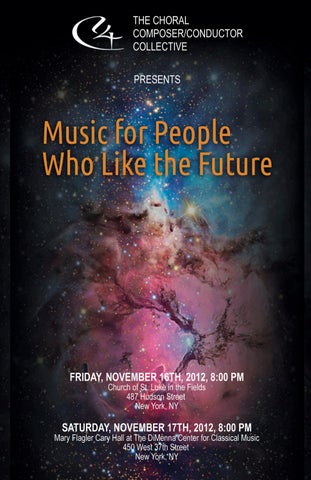
Music For People W h o L i k e t h e F u t u re
Friday, November 16, Church of St. Luke in the Fields, New York, NY Saturday, November 17, DiMenna Center for Classical Music, New York, NY
Incantations
Hannah Carr, conductor
Michael McGlynn (b. 1964)
....................please hold applause until after the 2nd piece....................
To See A World
Melissa Wozniak, conductor
Saguaro
David Harris, conductor Elizabeth Derham and Melissa Wozniak, soloists
Spring Dreams
Timothy Brown, conductor
Stabat Mater •
Hannah Carr, conductor Karen Siegel, soloist
Sven-David Sandström (b. 1942) Karen Siegel (b. 1980)
Chen Yi (b. 1953) Jonathan David (b. 1965)
Intermission
Music For People Who Like the Future ∞ Dan Whitener, conductor
Ballad of Culinary Frustration* Karen Siegel, conductor
Lack One Lacks Both*
Fahad Siadat, Daniel Andor, Timothy Brown, Jonathan David, Hannah Carr, Elizabeth Derham, David Harris, Dan Whitener, Melissa Wozniak, conductors Mario Gullo, soloist
Allégories 1. Enfance III 2. Jeunesse III (vingt ans) 3. Départ
Andrew Hamilton (b. 1977) Mario Gullo (b. 1973) David Harris (b. 1974)
Philippe Hersant (b. 1948)
David Harris, conductor
We Cannot Leave (mvt. 5 from Privilege) Daniel Andor, conductor
Ted Hearne (b. 1982)
* World Premiere ∞ North America Premiere • East Coast Premiere
Program Notes and Texts Who doesn’t like the future? Some, you
not need the text, as seen in Chen Yi’s bird
change or the passage of time, and that
and it does, Jonathan’s stop-start technique
might argue; those, perhaps, who fear
pretty much defines most people. The pushpull of the Wagner text set by Hamilton, with an eye to the melodrama that only Wagner could conceive, defines tonight’s set list. Slashing sarcastically through the
heart of the program, Hamilton challenges
sounds and pentatonic chant. As time goes,
rife with appoggiaturas, and Ted’s drifting, sustain-ridden finale seem as good a musical challenge to time as there is, each, in it’s
own way, awaiting a revival of the future. ~David Harris
waste at our own expense. The other pieces,
Alleluia: Incantations Michael McGlynn
will to append the past to what is to come,
The first of a set of 7, Michael McGlynn’s
suits, questioning whether they are better
and fleeting glimpse of Irish style in a
not time, but humanity, and the passion we
in their ways, reach out as far as their arms
yanking the hair of cave people into space off for tomorrow. Karen’s noble guardians
of the desert who stand quietly guarding strip mall destruction echo
the wooden planks that stand as a backdrop to Jacapone
da Todi’s “grieving mother.” Meng
Hao-ran’s
time
upon
McGinley’s
terrapin
forgotten lands like a cherry
mousse, and Ted Hearne’s South African antiapartheid quotation settles the concert
experience with hope for the
future: melancholy wrapped in faith, like bacon.
Their
music sometimes reflects the
text’s longing, as in Karen’s setting of her own poetry with of
interlinking
wandering
chains
stasis,
or
Mario’s whimsical borrowed harmonies and choral-opera regalia. Sometimes it paints a backdrop that may or may
brief and joyful incantation give a us fresh contemporary choral genre, preserving the flare, lively dance rhythm and playfulness
Incantations ‘S Tusa an dámh, ‘s Tusa an éan, ‘s Tusa an t-iasc, aililú. ‘S Tusa an ghrian, ‘s Tusa an fuacht, ‘s Tusa an mhuir, aililú. ‘S Tusa an ghrian, ‘s Tusa an réalt, ‘s Tusa an spéir, aililú. ‘S Tusa an féar, ‘s Tusa an bláth, ‘s Tusa na crainn, aililú. Aililú mo íosa, aililú mo chroí, aililú mo Thiarna, aililú mo Chríost. You are the stag, you are the bird, you are the fish, alleluia. You are the wind, you are the cold, you are the sea, alleluia. You are the sun, you are the star, you are the sky, alleluia. You are the grass, you are the flower, you are the trees, alleluia. Alleluia my Jesus, alleluia my heart, alleluia my Lord, alleluia my Christ.
that
characterizes
much of Irish music, fused with parallel
motion and harmony less typical to the
genre, but more of medieval or Eastern European polyphonic
folk styles. McGlynn imposes
a
choral
format that is not overly
complicated,
and thus preserves the
primal
aspects
of Irish music, its natural freedom and
the rawness of Irish melody.
The
piece
representation
of
is
an
exemplary
the quest of many
classical trained Irish
musicians to reconcile the two different
in a poem that would become the text for this
they have grown up on, and to elevate the
cactus described in the first stanza, as well as
respected art form.
to which this cactus has given its name.
styles of classical and traditional music
piece. The title “Saguaro” is the name of the
status of Irish traditional music to a highly
the national park in the Catalina mountains
~Hannah Carr
These cacti are the kind seen in old Western
movies, and they are often hundreds of
from Auguries of Innocence
years old. The seemingly endless expanses
of this beautiful desert are reflected in the
music’s evocation of space. Saguaro was To see a world in a grain of sand,
commissioned by the Manhattan Choral Ensemble, as a result of my being a winner
And a heaven in a wild flower, Hold infinity in the palm of your hand,
of their 2006 Commissioning Competition.
And eternity in an hour.
~Karen Siegel
~William Blake
Saguaro This cactus has been here longer
To See A World Sven-David Sandström All are like grass the Psalmist murmured, Whitman reminisced and Blake revisited
Than my family has been in this country. Waiting. Watching The slow blooming of pink yellow white wildflowers, The quick building of Marriot, No Tell Motel,
on the beach, each one fading in quick
The invisible dying of Mexicans on foot.
the concept, though. Instead of blowing by
Tell me,
succession. Sandström reverses the table on the soon-to-perish wildflower, he encourages the pause that led to the author’s meditative discovery, and therein lies the paradox of time. We use measurement to prove to us
Saguaro. Do you remember when the ground was soft, Before men and cattle trampled through?
what has happened, yet, we only feel life
Did the sunrise look the same then?
Once entranced by calm, the world opens,
The rock bounces off your weathered skin.
when we forget we are being measured. eternity, truly but a flash.
~David Harris
Saguaro Karen Siegel Inspired by a visit to Tucson, Arizona in the
spring of 2006, I expressed my awe of the landscape, history, and people of this desert
Too weary to be annoyed, Too strong to fall, You maintain your post in a silent army, Defending the Catalinas against time. Watching. Waiting. ~Karen Siegel
Spring Dreams Chen Yi
melody, which appears at 5 points during the piece, proceeds here uninterrupted, as a
Spring Dreams was commissioned by the Ithaca College School of Music, where it premiered in 1997. In the beginning of the
piece, several groups of ostinati are brought in gradually in various tempos, imitating
the vivid pulse of birds singing. There is a turning point in the middle of the poem when the poet clearly wakes up from his sweet dream by hearing a bird singing, and he realizes that
many flowers must have been ruined by a night of wind and
showers. He sympathizes with
the fallen petals as he treasures the beautiful springtime. ~Chanticleer
Stabat Mater Jonathan David I set 8 of the 20 verses of the
original text. They were chosen for their focus of intense empathy
for the mourning Mother at the cross. The driving musical force behind my work is the
appoggiatura, an accented grace
voice from the ether, but the words of those
still on earth are as broken as they themselves are. I wanted to avoid the reflexive option of a grand apotheosis at the climactic “paradisi gloria”. These last two words of the piece
never rise above mp and gradually fade away to ppp at the end. The effect aimed for is uplift by way of “lightness”, as a balloon drifting up and off into the heavens. Paradise may
Spring Dreams Chun mián bu jué xiao Chu chu wén tí niao Ye lái feng yu sheng Hua luo zhi duo shao I slumbered this spring morning, and missed the dawn From everywhere I heard the cry of the birds. That night the sound of wind and rain had come, Who knows how many petals then had fallen? ~Meng Hao-ran (AD 689-740)
note. I’ve interpreted it here as
a “sighing” figure in somewhat
the manner of madrigal tone painting. When
used maximally, it transforms into more of a sob and pierces the texture with profound
be
glorious
but is also a leavetaking.
The work
was Commissioned by
the Carroll University Concert Choir, Music Director
Kristina
Boerger, as a gift to
the people of Todi, Italy, burial place of
Frater Jacopone (ca. 1230-1306),
author
of the “Stabat mater dolorosa” text. It was premiered
in
April
2012 in Waukesha, WI, with a subsequent tour of Italy in May. ~Jonathan David
music for people who like the future
Andrew Hamilton
sorrow. I’ve also made considerable use
Andrew Hamilton’s music for people who like
where it underlines the “stunned” stage
last year by another contemporary Irish
of silence, primarily in the introduction,
of mourning. The futility of speech is also conveyed in the splitting up of words among
different voice parts. The original plainchant
the future reminds me of a piece I conducted composer, Donnacha Dennehy.
You may
feel aesthetically bombarded at the start of
the piece; take it all in, but fear not. The way
Artwork of the Future” from
Stabat Mater
Stabat Mater translation
Stabat Mater dolorosa
The grieving Mother stood
Iuxta crucem lacrimosa
weeping
Dum pendebat Filius
where her Son was hanging
beside
the
which he derives the text.
cross The second thing you will
notice, once you get past the Cuius animam gementem
Through her weeping soul,
Contristatam et dolentem
compassionate and grieving, a
Pertransivit gladius
sword passed.
front door, is the larger patterns that emerge when you are able to comprehend more of the piece at a time. Just when we get used
Quis est homo qui non fleret,
Who is the person who would
Matrem Christi si videret
not weep seeing the Mother of
In tanto supplicio?
Christ in such agony?
to one rhythm and settle in, it
changes. Phrases become longer than you might expect, and our
understanding of the German Quis non posset contristari,
Who would not be able to
Christi Matrem contemplari
feel compassion on beholding
Dolentem cum Filio?
Christ’s Mother suffering with
gain a greater understanding implications, of Wagner’s words.
Eia Mater, fons amoris Me sentire vim doloris
O Mother, fountain of love,
Fac, ut tecum lugeam
make me feel the power of sorrow, that I may grieve with you.
In amando Christum Deum Ut sibi complaceam
same time, though, perhaps we of the meaning, and the fearful
her Son?
Fac, ut ardeat cor meum
text goes out the window. At the
Grant that my heart may burn
Or maybe not.
~Dan Whitener
The Ballad of Culinary Frustration Mario Gullo
in the love of Christ my Lord, Christe, cum sit hinc exire,
that I may greatly please Him.
Ad palmam victoriae
This piece began its life as a bet.
While working at the Buffalo and
Da per Matrem me venire Christ, when it is time to pass away, grant that through your Quando corpus morietur,
Mother I may come to the palm
Fac, ut animae donetur
of victory
Erie Public Library, a co-worker, friend
and
great
composer,
Herbert Tinney, saw the poem
and bet me to set it to music. Sufficed it to say, I won. It went
Paradisi gloria. When my body dies, grant that ~Frater Jacopone da Todi
to my soul is given the glory of
(ca. 1230-1306)
paradise.
on to become the first movement of a larger work called Dinner With Friends: a Five Course Song-Cycle for Chorus.
it makes you feel to be yelled at, very quickly and loudly and unrelentingly, is certainly
I have always liked the idea of comedy
a satirical critique of Richard Wagner’s
a crowd of people trying to make another
part of the intention of the composer, as
for chorus; not just wit or a quick joke but
ridiculously authoritative essay on “The
crowd of people laugh through music.
Das Kunstwerk der Zukunft Das Kunstwerk in diesem Sinne, als unmittelbarer Lebensakt, ist somit die vollständige Versöhnung der Wissenschaft mit dem Leben, der Siegeskranz, den die besiegte, durch ihre Besiegung erlöste, dem freudig von ihr erkannten Sieger huldigend darreicht. The Art-work, thus conceived as an immediate vital act, is therewith the perfect reconcilement of Science with Life, the laurel-wreath which the vanquished, redeemed by her defeat, reaches in joyous homage to her acknowledged victor. ~Richard Wagner
The Ballad of Culinary Frustration The world is full of wistful ones who hoard their souvenirs. The spinster keeps a faded rose through all the faded years, A travel folder lures the clerk while he dreams of a foreign sky, But I preserve the recipes I’ll never dare to try. Vichyssoise, bouillabaisse, Terrapin mousse, Cucumber hollandaise, Staffordshire goose, Oh, the ginger, the clove, Oh, the sauces well-shaken! But here on my stove Lies the liver-and-bacon. On idle days, on rainy days, when all the world is shut out, I don the yellow clippings of the recipes I’ve cut out.
And lovingly I memorize directions neatly pasted, For scones and soups and savories I’ve never even tasted. With eggs and with syrup, With herbs and with cream, In fancy I stir up An epicure’s dream Of Netherland crumb cakes, Of sweetbreads-in-mustard; Of pasties and plumcakes And Devonshire custard. Oh, some folks dote on serious tomes, some read romances rippling, But a cookbook is my Odyssey, my Shakespeare, and my Kipling. For while I baste the leg of lamb or stir the tapioca, I’m visioning a a vol-au-vent, or a nougat à la Mocha — Some gossamer trifle That gourmets adore, As French as the Eiffel (And probably more), Like mushrooms with spices And artichoke hearts, And aspics and ices And shortbreads and tarts, With crusts that are thinner Than sea foam on top . . . My menu for dinner? We’re having a chop. ~Phyllis McGinley
Speaking of it, I mean the music, it is not
overly complicated (except for measure 49 (Melissa W., you may punch me in the face)).
This piece, with its pedantic, non-varying rondo, is meant to highlight the banal nature of the poets current cooking ability. The middle sections interrupt with moments
of joy, apprehension, resignation and, of
course, frustration. Please let me know if it
works. I love feedback! Did you walk away
sated or could you use something a little more satisfying?
to Whitman as well, and to C4. He never promises that life is easier for recognizing the beauty of all, he simply says that it is,
~Mario Gullo
and is therefore worthy. ~David Harris
Lack One Lacks Both David Harris This is the one piece on the program that leads
with the present, though, Whitman’s “now” (and the copious repetitions of the word in
my setting) seems to grip all time with the
same hand shake. Time isn’t so much a delineation, to Whitman. Rather, like with
most things our creative godfather shared
with us, time simply is. His impenetrable optimism has a way of encapsulating all
things while simultaneously elevating them. As such, he rarely takes issue with others, which is one reason I like this poem. In it,
he starts and ends by criticizing the process of creating superfluous definitions.
more than I had expected. This seems fitting
“The
talkers were talking of the beginning and
the end” connects to the end of the poem’s
“exactly the value of one. . .”. Though he recognizes that all have a place, he pushes
back against those who would define his place through the guise of hyper-limiting
systems like capitalism. He chooses instead to value the perfection of connection with his lover.
I’ve found that Whitman’s poems don’t like cooperating with music, unless you push the
music to encapsulate as much as the text tries to and are willing to be equally aggressive
and sensitive. Hence, this piece is multi-
layered, many-conductored and samples as many genres as I could tuck in. The difficulty of coordinating so many conductors proved
Allégories Philippe Hersant Allégories is a focused exploration of the mind of one of history’s most curious poets, the surrealist, Aurthur Rimbaud (1854-1891). As a child he suffered under a confining
fundamentalist upbringing. When a teen
he ran from home and became a symbol of Paris’ decadent movement, liveing a libertine life into his early 20s, and breaking the boundaries of poetic form in his wake. He was one of the first poets ever to write in free
verse. He is also known as a symbolist for his expansive use of contrasting conceptual images. Yet, after he put his pen down in 1876 he never wrote again.
Hersant’s trio uses Rimbaud’s artistic/life
aspirations as its departure and Rimbaud’s images as structure. Hersant
picks
an
In each movement,
image
that
recurs
throughout. In “Enfance III” he uses the
phrase “there is” as a wide-eyed child’s thought at the discovery of the strange
world around them where cathedrals stand upside down and lakes leap into the air.
“Jeunesse III” claims the adolescent
loiterer’s least favorite occasion, waiting, with the word “adagio” or “slowly.” The
artist, now awakened, must wade tediously
through his craft, trying new expressions to effectuate the call of nocturnal melodies.
In the final movement the artist moves on
Song of Myself #3 I have heard what the talkers were talking, the talk of the beginning and the end But I do not talk of the beginning or the end. There was never any more inception than there is now, Nor any more youth or age than there is now, And will never be any more perfection than there is now, Nor any more heaven or hell than there is now. Urge and urge and urge, Always the procreant urge of the world. Out of the dimness opposite equals advance, always substance and increase, always sex, Always a knit of identity, always distinction, always a breed of life. To elaborate is no avail, learn’d and unlearn’d feel that it is so. Sure as the most certain sure, plumb in the uprights, well entretied, braced in the beams, Stout as a horse, affectionate, haughty, electrical, I and this mystery here we stand. Clear and sweet is my soul, and clear and sweet is all that is not my soul. Lack one lacks both, and the unseen is proved by the seen, Till that becomes unseen and receives proof in its turn. Showing the best and dividing it from the worst age vexes age, Knowing the perfect fitness and equanimity of things, while they discuss I am silent, and go bathe and admire myself. Welcome is every organ and attribute of me, and of any man hearty and clean, Not an inch nor a particle of an inch is vile, and none shall be less familiar than the rest. I am satisfied—I see, dance, laugh, sing; As the hugging and loving bed-fellow sleeps at my side through the night, and withdraws at the peep of the day with stealthy tread. Leaving me baskets cover’d with white towels swelling the house with their plenty, Shall I postpone my acceptation and realization and scream at my eyes, That they turn from gazing after and down the road, And forthwith cipher and show me to a cent, Exactly the value of one and exactly the value of two, and which is ahead? ~Walt Whitman
Allégories Enfance III
Childhood III
Au bois il y a un oiseau, son chant vous arrête et
There’s a bird in the woods, its song makes you
vous fait rougir.
stop and blush.
Il y a une horloge qui ne sonne pas.
There’s a clock that never chimes.
Il y a une fondrière avec un nid de bêtes blanches.
There’s a hollow with a nest of white creatures.
Il y a une cathédrale qui descend et un lac qui
There’s a cathedral that descends, and a lake that
monte.
rises.
Il y a une petite voiture abandonnée dans le taillis,
There’s a little carriage abandoned in the copse, or
ou qui descend le sentier en courant, enrubannée.
running down the lane, beribboned.
Il y a une troupe de petits comédiens en costumes,
There’s a troupe of little players in costume,
aperçus sur la route à travers la lisière du bois.
glimpsed on the road through the edge of the
Il y a enfin, quand l’on a faim et soif, quelqu’un qui
woods.
vous chasse.
There’s someone, at last, when you’re hungry and thirsty, who drives you away.
Jeunesse III (Vingt ans)
Youth III
Les voix instructives exilées... L’ingénuité physique
(Twenty Years)
amèrement rassise... - Adagio - Ah ! l’égoïsme
The instructive voices exiled…physical
infini de l’adolescence, l’optimisme studieux : que
ingenuousness bitterly stale…Adagio. Ah, the
le monde était plein de fleurs cet été ! Les airs et
infinite egoism of
les formes mourant... - Un choeur, pour calmer
adolescence, the studious optimism: how full the
l’impuissance et l’absence ! Un choeur de verres
world was of flowers, that summer! The airs and
de mélodies nocturnes... En effet les nerfs vont
the
vite chasser.
forms dying…A choir, to calm impotence and absence! A choir of glass with nocturnal melodies…Indeed
Départ
the nerves will soon be on the hunt.
Assez vu. La vision s’est rencontrée à tous les airs.
Depart
Assez eu. Rumeurs des villes, le soir, et au soleil,
Enough seen. Visions have been met in every
et toujours.
respect.
Assez connu. Les arrêts de la vie. — Ô Rumeurs
Enough has been. Rumors of towns, at night, and
et Visions!
in the light of day, and always.
Départ dans l’affection et le bruit neufs!
Enough known. The decrees of life. O rumors and visions!
~Arthur Rimbaud
Depart in new affection and new noise.
Composers
from his life of exploration with the phrases “enough seen, enough has been, enough known.”
These words dance around a
chant-like explosion found in the other
voices, a return, perhaps, to earlier truths
and a call to “depart in new affection and
new noise.” This trajectory, Rimbaud’s life, reflects the creative process. . .each time it is
undertaken: wide-eyed feasting of the world
around, tedious waiting for something to work, zealous release into the next creative moment.
~David Harris
We Cannot Leave (Mvt. 5 from Privilege) Ted Hearne
1964. His harmonic language combines
elements of traditional Irish music such as modal melodic lines and ornamentation,
fixed and shifting drones and jazz-tinged chordal clusters.
His best-known choral
work is “Dúlamán” (1995), a setting of the traditional Irish poem of the same name. This work has been performed and recorded extensively. It features another
characteristic aspect of his musical language in its use of multiple alternating rhythms.
In 1987 he founded the Irish choral group
Privilege is a collection of five short pieces,
of which the final piece is being performed tonight. We Cannot Leave is set to the translation of As’ Kwaz’ uKuhamba, a black
South African Anti-Apartheid song, the original words of which are in Xhosa (the native language of Nelson Mandela). South
Africa has a strong tradition of music being
Anúna. Anúna have released fourteen
albums, almost exclusively featuring his
arrangements and original works. Michael
is much in demand as a vocal coach, specializing in work with choral groups.
He was a guest-judge and vocal advisor on Finland’s version of the X Factor in 2010. In 2011 he led workshops in the USA, Poland,
Japan and Sweden, and in the latter part of 2012 he will undertake a major workshop
We Cannot Leave
series across the Netherlands. He lives in
We cannot leave this land of our ancestors on this earth. We are being killed by the monster on this earth. I want to get on the train in the morning. Oh mother, it’s leaving me behind. ~traditional Xhosa anti-apartheid lyrics translated by Patiswa Nombona and Mollie Stone used as a tool to fight societal oppression and inequality. The setting is a tribute to that practice.
Michael McGlynn was born in Dublin in
~Ted Hearne
Dublin with his family where his interests include sea swimming, horse riding and sleeping.
No composer has made such an impression
on contemporary Swedish musical life as Sven-David Sandström. of
works,
which
His catalogue
includes
some
300
compositions, gives proof not only of an impressive productivity, but also contains
an amazingly wide range: everything from
magnificent operas and oratorios to intimate choral and chamber music. With his unlikely combination of creativity and diligence in the
craft of composition, restless curiosity and
Karen holds a MA in music composition
alternates, to all appearances unconcerned,
studied with Marc Antonio Consoli, and
firmly-rooted mastery of form, Sandström between a sophisticated orchestral texture
and musical melodies, film music and music for the church. In the 2000s he has focused especially on sacred choral music.
Chen Yi serves as the Cravens/Millsap/ Missouri Distinguished Professor at the
Conservatory of the University of MissouriKansas City and is the recipient of the
prestigious Charles Ives Living Award (2001-
04) from the American Academy of Arts and
from NYU’s Steinhardt School, where she
a BA in Psychology from Yale University. Karen has also studied composition with
Conrad Cummings at the Juilliard Evening Division and choral conducting with Péter
Erdei at the Kodály Institute in Kecskemét. A founding member of C4, Karen has benefitted from years of mentoring by her conductor colleagues in the ensemble. Karen
lives in Hoboken, NJ with her husband and son. www.karensiegel.com
Letters. Dr. Chen was elected to the American
The 2011-12 season featured 8 world
holds bachelors and masters degrees in Music
including five commissions: tonight’s Stabat
Academy of Arts and Sciences in 2005. She
Composition from the Central Conservatory
in Beijing and a Doctor of Musical Arts degree from Columbia University.
She
served as Composer-in-Residence for the Women’s Philharmonic, Chanticleer, and
Aptos Creative Arts Center (1993-96), and as a member of the composition faculty at Peabody Conservatory of Johns Hopkins University. Chen Yi has received fellowships from the Guggenheim Foundation, the
American Academy of Arts and Letters, and the National Endowment for the Arts.
Composer, soprano and conductor Karen
Siegel draws on her experience as a vocalist in her creation of innovative choral and vocal works.
In June 2008 Karen was a
winner of the Manhattan Choral Ensemble Commissioning Project Competition, which resulted in the work Saguaro, inspired by
the desert landscape and history of Tucson,
Arizona. She is currently a PhD candidate in composition at the CUNY Graduate Center, where she studies with Tania León.
premieres for composer Jonathan David, Mater for Carroll University (WI); a 9/11 memorial work for Central City Chorus,
The Tightened String, (NYC); Little Drops of
Water for Marble Collegiate Church (NYC); Gitchee Gumee, for baritone Daniel Neer
and harp (NYC) and Azrael, a song for Jay Barksdale to honor the 10th anniversary of
the Sylvia Townsend Warner Foundation
(NYC; Dorchester, England). In May C4 and the Fireworks Ensemble premiered
Jonathan’s extended work, The Hounds of
Spring, for chorus, electric guitar, electric bass, and drums. In September 2012, his Könnyek, Almák és Kövek (Tears, Apples
and Stones), a wordless motet for women’s trio, debuted (on tape loop) in Šamorín,
Slovakia as part of artist Zsuzsanna Ardo’s eponymous installation, where it runs until Dec. 2. Commissioners for 2012-13
include the Manhattan Wind Ensemble,
and saxophonist David Wozniak. His choral music has also been performed by the
Princeton Singers, the Glen Ellyn Children’s Chorus, Cerddorion Vocal Ensemble, the
New York Treble Singers (commission), Cascadian Chorale, and the Thanks-Giving
Foundation (commission) et al. He has
by the New York City Master Chorale and Bridges Vocal Ensemble.
served as Composer-in-Residence for The
David Harris (DMA) writes, conducts and
Director for the chamber chorus, Howl! He
Chamber Orchestra, Columbia Glee Club,
Greenwich Village Singers and Music was on the judging panel for the 44th Annual ASCAP/Deems Taylor Awards for the best
music writing of 2011. Jonathan was the Classical Editor for Napster from 2004 until
the service closed its doors in December 2011.
His music is published by Oxford University Press and also available through his website, www.jonathandavidmusic.com.
Andrew Hamilton was born in Dublin and studied at the Royal Irish Academy
of Music and Chetham’s School of Music, Manchester. Following studies at Oxford
University and the Royal Northern College of Music in Manchester he undertook a PhD
in composition at the University of York with
the assistance of the Elizabeth Maconchy Composition Fellowship awarded by the Arts
Council/An
Chomhairle
Ealaíon.
From 2002 to 2004 he studied at the Royal Conservatory, The Hague. His composition
teachers have included Kevin Volans, Roger Marsh, Anthony Gilbert and Louis Andriessen.
© Contemporary Music Centre, Ireland Mario Gullo has been seen in New York at
sings with C4, The Brearley Singers and Brooklyn Youth Chorus and the effervescent
7/8 Chorus of The Collegiate School.
His composition career stems from his performance ensembles, as he prefers seeing projects from start to finish. As such, he is
jazzed about C4 and that they let him dump
the more recessed contents of his mind into their laps now and again. “Lack One Lacks Both” is the fifth such effort. As a composer/
performer, he has written hundreds of compositions and arrangements for all of
the groups he’s worked with, recorded several of them and consistently enjoyed the creation process with his colleagues. His
music, from simple pop arrangements to orchestral pieces, has been heard all over the
country, in prestigious rooms like Carnegie Hall and on street corners.
Walking the
dog this morning he thought, in his most
Whitmonian tone, “there is no good or bad music, only music that moves you, and
music that might one day move you if the circumstances were different.” And so he
plays with ways to stop time for people as often as possible, which feels like a good thing.
www.davidharrismusic.net
Alice Tully Hall, City Center, the Dramatist’s
The French composer, Philippe Hersant,
favorite so far has been appearing with
literature as well as music and he took
Guild and the Barrow Street Theater. His
Barbara Cook in concert at Carnegie Hall. Regionally, he has performed at Artpart,
the Theater of Youth, Tri-State Center for the Performing Arts and the Hudson Valley Philharmonic. He has had pieces performed
was born in Rome. His studies included harmony classes with Georges Hugon before
entering André Jolivet’s composition class at the Paris Conservatory in 1968, receiving
his undergraduate degree in literature that same year.
From 1970 to 1972, Philippe Hersant went on to teach music and to become a producer
at the radio station France Musiques. In 1978 he became a resident at the Villa Médicis. It
was during this period that he truly came
into his own as a composer. Stances for
orchestra thus became his new first opus and
is the earliest work in his catalogue. He is currently working on an opera based on a
Chekhov story, The Black Monk, and this will be premiered by the Leipzig Opera in 2005.
Today, Philippe Hersant defines himself as
a tonal composer willing to turn music’s entire heritage – from Monteverdi to Janacek
to Stockhausen – to his advantage. As a composer, he lives by a few precepts : to be
personal rather than to seek innovation at all costs, to avoid greyness and to surprise.
Ted Hearne is a composer, conductor and performer of new music. His work Katrina Ballads is the recipient of the 2009 Gaudeamus Prize in composition, and his
piece Cordavi and Fig was recently praised by Allan Kozinn of the New York Times as “fresh and muscular.” Ted’s music has been
performed by the Minnesota Orchestra, Calder Quartet, The Knights, and New York
City Opera; heard at the MATA Festival, Bang on a Can Marathon, Carlsbad Music
Festival, and LPR’S Sleeping Giant; and commissioned by Chicago’s Third Coast
Percussion, San Francisco’s Volti Choral Arts Laboratory, Charleston’s New Music
Collective, Newspeak, Huntsville Symphony, Albany Symphony and Ensemble ACJW. Ted is the artistic director of Yes is a World,
resident conductor of Red Light New Music, and for five years was composer-
in-residence of the Chicago Children’s
Choir. He served as music director for the
premieres of David Lang’s opera Anatomy
Theatre (performed by ICE, 2005), Michael Gordon’s Lightning at our Feet (BAM Next
Wave Festival, 2008), and Bryan Senti’s From
the margins, this, unmentioned (Brooklyn
Lyceum, 2009); as well as the American premieres of Constantine Koukias’s Prayer
Bells and Beat Fürrer’s Gaspra. His album Katrina Ballads was released in August 2010 on New Amsterdam Records.
C4: The Choral Composer/Conductor Collective Daniel Andor started playing piano at
premieres - Incidental Dance Suite at Merkin
at The Purcell School of Music, London.
C4.
and were featured by the Society for the
Kristopher Burke has earned degrees in
Drawn to making music with others, he took
and Vocal Performance from Shenandoah
four and studied composition and piano
His compositions won numerous awards, Promotion of New Music during 2000–2002. up trombone, conducting and singing.
Hayes Biggs studied with Don Freund, Mario
Davidovsky,
Fred
Lerdahl
and
Donald Erb. A 1998 Guggenheim Fellow, he
Hall; Drip Dream and In So Many Words by
music education from Shepherd University Conservatory. Kristopher has also sung as a
church soloists and on stage. He now works for the Brooklyn Conservatory of Music and the Brooklyn Youth Chorus.
has had residencies at Copland House and
Melissa Bybee received her BM in piano
is published by C. F. Peters and APNM,
and her MM in vocal performance from
the Tanglewood Music Center. His music and has been recorded on the Albany and Ravello labels. www.hayesbiggs.com
James Bilodeau James Bilodeau grew up in the Adirondacks. He spent his youth
causing a ruckus in church and school choirs. He earned a BM degree at the Hartt
School of Music. Since moving to New York, he’s flirted with various choral ensembles
but thinks that C4 could be the one. Professionally, he rocks interstellar airwaves
performance from Louisiana State University
the Manhattan School of Music. An active
member of New York’s professional choral
scene since she was a student, Melissa has performed with Voices of Ascension, New
York Choral Artists and the New York
Philharmonic Orchestra, Pro Arte, Opera
Orchestra of New York, American Symphony Orchestra, Mark Morris Dance Company, Mostly Mozart Festival, St. Ignatius Loyola Concert Series and Little Orchestra Society.
as an audio producer for Sirius XM Radio.
Hannah Carr took her undergraduate degree
or sitting in a small dark room editing audio,
Dublin, where she won first prize for her
When he’s not working on Karen’s rhythms
he’s seeking balance and peace by jumping out of planes. Composer,
Singer,
Conductor
Timothy
Brown: 30 year veteran of the choral music world. A compositional fence-sitter.
Theater: Curious George national tour; songs showcased at BMI, Beechman Theater,
Donnell Songbook, and showcase “A Trace of Love.” Classical: Masters work at MSM;
in Music and French from Trinity College composition portfolio, and an advanced diploma in Choral Conducting at the Kodály Institute in Hungary. She has performed in
classical music as an organist, pianist and singer, as well as in groups from Traditional Irish music to Funk and other popular styles and teaches music at the Chapin School. Jonathan David (see above)
Karen Devine completed a B.A. in Music
York churches have heard her and she is
conducting
Ready, music of Yuri Yukechev ; Le Vin Herbé
at Kenyon College, studying voice and with
Dr.
Benjamin
Locke.
Choral music remained an important part of her life in NYC as she explored various
careers that actually paid. Finally settling
into massage therapy, she has become quite
successful - perhaps, in part, because of her
strict “no bad spa music” policy. She also thinks about practicing her accordion often.
Elizabeth Derham is an avid performer of new music as both a violinist and
singer. She plays frequently with the New Juilliard Ensemble and AXIOM. She has
worked with artists such as David Lang, Magnus Lindberg, Robert Wilson, and Bill T. Jones, and has premiered numerous
works by composers at Juilliard, Aspen, and Fontainebleau.
Harry Einhorn is a singer, composer, and theater director based in New York City.
Heart Sutra and Samaya, his multimedia chamber music collaborations with Philippe Treuille primarily based on Buddhist texts
have been performed at the Cell, the Rubin
Museum, and La Sala in Williamsburg. This is debut season with C4.
Mario Gullo (see above) David Harris (see above) Elizabeth Marker is a dedicated choral singer having sung with Tanglewood Festival Chorus, the award winning Oregon
Repertory Singers, the Russian Chamber Chorus and Cantori New York. She has
performed for Robert Shaw in workshops and with the Festival Singers. Many New
featured on two recordings: My Heart is by Frank Martin
Joe Redd moved to New York City in June 2010. Since then, Joe has contributed his
voice as soloist and choral member to a
number of ensembles in NYC, including Polyhymnia, Sing We Enchanted, and The Canticum Novum Singers. He will also have
the pleasure of performing as Tenor soloist
in Arthur Honegger’s King David with the
Columbia County Choral Society in April 2013. When he isn’t singing on stage, Joe works the microphone as a narration voice
actor for the Internet, mobile application, film, and video industries.
Suzanne Schwing was trained for the stage
at LAMDA and subsequently received
her musical training at Boston University (Mus.B) and Manhattan School of Music (MM).
A sought-after mezzo-soprano,
Suzanne performs frequently with the New York Virtuoso Singers, the Collegiate Chorale,
and the American Symphony Orchestra
(ASO). In 2012, she has appeared as soloist with the New York Virtuoso Singers, the
Pro Arte Singers, the Great Music series
at St.Bart’s Church, and on tour with the Israel Philharmonic and Zubin Mehta in Tel Aviv, Haifa, and at the Salzburg Festival. In December 2012, she performs with the New
York Virtuoso Singers Sextet and as soloist
with the Choral Society of the Hamptons.
In early 2013, she will record 25 worldpremiere compositions with the New York
Virtuoso Singers and will return to NYCO for Moses in Egitto and La Périchole. Karen Siegel (see above)
Bettina
Sheppard’s
compositions
and
commissions include opera, Stillwaters; Emily Dickinson song cycle; TraumNovela,
Dance- Opera at the NY Fringe Festival. For more info visit www.fahadsiadat.com
Barrow Street Theatre, Barcelona; Millay
Melissa Wozniak is a teaching artist and
365 Days/365 Plays, Suzan-Lori Parks, the
NYC Opera. She holds a BME from SUNY
settings for American Cathedral in Paris;
Public Theater; The Picture of Dorian Grey, Stageworks. Singing credits: Lincoln Center; Carnegie Hall; St Sulpice, Paris; Public
Theatre; Barrow Street. Recordings: Solus (as
Brythonwen), Satin Dolls jazz trio, musical theatre cast recordings.
Also numerous
the
School
Program Administrator
at
Fredonia and an almost MM from the
University of Southern Mississippi. Nonmusical interests include TV shows about forensics, Scottish culture, and her husband, David.
television, film, and theatre credits. Studied
Dan Whitener is a recent graduate of the
College.
degree in choral conducting. He is excited to
with Chris Theofanidis. Faculty CUNY, City
Fahad Siadat is a composer/performer specializing in theatrical works for the voice
that incorporate improvisation and extended technique. He regularly writes for theater, film, and dance, and recently premiered
his one act work SAHARAVA: A Ritualized
Bard and the recipient of its first M.M. have the opportunity to work with C4 as an
emerging conductor and aspiring composer.
At Bard, he collaborated with the student-
run ensemble Contemporaneous, He sings with the Schola Cantorum quartet every Sunday at St. Mary’s Church in Nutley, NJ and is an avid and active banjo player.
C4: The Choral Composer/Conductor Collective Sopranos Hannah Carr Elizabeth Derham Karen Devine Karen Siegel Melissa Wozniak
Altos Melissa Bybee Jonathan David Elizabeth Marker Bettina Sheppard Suzanne Schwing
Tenors Kris Burke Harry Einhorn Mario Gullo Joe Redd Fahad Siadat
Basses Daniel Andor Jim Bilodeau Hayes Biggs Timothy Brown David Harris Dan Whitener
C4, the world’s first Choral Composer/Conductor Collective, is a unique vocal ensemble in New York City dedicated to performing music written in the last twenty-five years. A collaborative project of its singing members, it functions not only as a presenting ensemble in its own right, with a threeprogram, six-concert season, but also as an ongoing workshop and recital chorus for the emerging composers and conductors who form the core of the group. It is, as far as we know, the first ensemble of its kind. Please visit our website, www.c4ensemble.org.
Yet to Come in C4’s 2012-13 RELEASE THE FUTURE Season
C4 In The Studio:
In April, 2013, C4 will take to the studio for the first time, recording works by Jonathan David, Karen Siegel, Hayes Biggs, Toby Twining, Huang Ruo and Ted Hearne. Special thanks to these people who contributed to the project. Keep your eyes peeled for forthcoming details.
Feryal Algosaibi Tammie L. Murphy Peter Lurye Brook Hersey and Alex DeLuca Steven Gerber Pat and Larry Siegel John Tyler Evans Christine Schadeberg Jill Garland Helen Biggs Bell Zahra Partovi Bob and Jan Klump Thomas Stumpf Tami Gallotte Jerome Blake reikofueting Bonnie Scarborough Joseph Upham John Agapiou
Robinson McClellan Paul Loesel Vincent FitzGerald Hedy Roma Zorana Andrea Justin Stein Matt Van Brink Reena Esmail Amanda Keil Jenn Borum Ramona and Chip Bouzard Peter Strauss Jonathan Fisher Sharon and Matt Kaplan Roy Byrd Carrie Stinson Denise Caputo Grace Check Vicki and Jon Haydon Severn Taylor