C4 Acknowledgements We wish to thank and acknowledge:
Nan Bases Kit Smyth Basquin Michael David & Lauren Mitchell Tracy and Stanley Shopkorn Daniel and Ellen Stafford-Sigg Meet the Composer/Cary New Music Performance Fund Feryal Algosaibi* Tammie L. Murphy* Phoebe Abelow John Agapiou* Zorana Andrea* Daniel Andor Helen Biggs Bell* Jan Bilodeau Jerome Blake* Jennifer Borum* Ramona Bouzard* Jeffrey Brown Timothy Brown Roy J. Byrd* Denise Caputo* Sandra C. Carlson Grace Check* Alex DeLuca* Nicholas DiDomizio Hugh D. and Kathryn Klein Eddy Kim and Steve Erle Reena Esmail* John Tyler Evans* Jonathan Fisher* Lily Friedman Reiko Fueting* Tami Gallotte* Jill Garland* Steven Gerber* Alex Guerrero
Brook Hersey* Vicki Haydon* David Hayward Don and Sally Hayward Ira and Becky Horowitz Elsie Hunter Linnea Johnson Steve Jones Sharon Albert Kaplan* Ellen Kanter Amanda Keil* Farah Kidwai Janet Klump* Susan H. Koshewa Phyllis Kubey Katherine Lee Linda and Leslie S. Libow Stanley and Nanette Lieblein Paul Loesel* Peter Luyre* Sara Lynch Beth Marker David J. MacDonald Ruth Mueller-Maerki Robinson McClellan* Molly McEneny Betsey Mcgee and Mark Pecker Edward & Rose Mermelstein
Friends of C4
Bernard and Rochelle Natt Thomas L. and Constance B. Newberry Susan Obel John Pagapiou James Primosch Hedy Roma* Jonathan and Suzanne Rosenzweig Joseph Rubinstein Bonnie Scarborough* Christine Schadeberg* Linda Schrank Clare Shore Peter Strauss* Justin Stein* Karen Siegel and Charles Natt Larry and Pat Siegel* Milton Sonday Caroline Stinson* Thomas Stumpf* Severn Taylor* Kenneth L. and Jean M. Telljohann Mary Tsimenoglou Joseph Upham* Matt van Brink* Jennifer Wendy Jason Wible
Nathan Allman Stephen Burrow Peter and Katharine Darrow Byron Gibbs Vincent FitzGerald Ernest Hood Ellen Kruger David McCorkle Ivana Mestrovic Ain Noa Zahra Partovi Ami Ronnberg Linda Schrank Gina Speirs Ross Tana Anne Thulin Judith Walz Susan Weill (speak to a C4 member about becoming a Friend)
We also wish to express our heartfelt thanks and appreciation to Church of the Transfiguration and Mark Morris Dance Company. * donated to “C4 Volume I: Uncaged”
The Activities of C4 are Funded in Part With Generous Support From
Heritage
Thursday, Nov. 21, Church of the Transfiguration, New York, NY Saturday, Nov. 23, Duffy Performance Space at Mark Morris Dance Center, New York, NY
Siin mu rõõmumaa
Ester Mägi (b. 1922)
Shirei Shira * Daniel Andor-Ardó, conductor
Karen Siegel (b. 1980)
Karen Siegel, conductor
Lulajże, Jezuniu from Cradle Songs
Stephen Stucky (b. 1949)
Timothy Brown, conductor Elizabeth Derham, soloist
A Bird Is Singing *
Judith Bingham (b. 1952)
Perry Townsend, conductor Mario Gullo, Karen Siegel, Elizabeth Derham, soloists
Muié Rendêra
Daniel Andor-Ardó, conductor
C.A. Pinto Fonseca (1933-2006)
Intermission
Könnyek, Almák és Kövek (Tears, Apples and Stones), Vocalise for Somorja ∞
Jonathan David (b. 1965)
Melissa Wozniak, conductor
Ramkali (an Indian Raga) Timothy Brown, conductor
The Un-Covered Wagon Michael Conley, conductor
arr. Ethan Sperry (b. 1971) Brent Michael Davids (b. 1959)
Caerphilly *
Bettina Sheppard (b. 1962)
How She Went to Ireland
Joseph Rubinstein (b. 1986)
Martha Sullivan, conductor Elizabeth Derham, Melissa Wozniak, Susanna Su, soloists Michael Conley, conductor
She’ll Be Comin’ Round the Mountain Fahad Siadat, conductor
arr. Emma Lou Diemer (b. 1927)
* New York Premiere ∞ North American Premiere
Program Notes and Texts For this concert, C4 chose to ask questions
prominent major harmonies focus on the
families and our cultures, and how does this
land that I love.”
about heritage: What do we inherit from our play out in our music? What stories can we
poem’s uplifting conclusion: “Fair is the ~Karen Siegel
offered strikingly different answers to these
Shirei Shira Karen Siegel
representation of Welsh cultural conflicts
Shirei Shira, meaning “songs of song” or
Karen Siegel’s joyful layering of traditional
joyful Ashkenazi Jewish songs. Three of the
tell in our songs? The composers in C4 have
questions, ranging from Bettina Sheppard’s through the tunes of competing groups, to
Jewish songs onto each other until they
create wild but coherent polyrhythms, to Joe Rubinstein’s journey to a mythical Ireland of the mind, to Jonathan David’s poignant evocation of cultural loss, achieved by taking
away everything textual except the vowels.
C4 has also chosen music by composers outside the group to create a large tapestry of
cultural representation: there are evocations
of the struggle between Native Americans and Europeans in North America, of
“songs of poetry,” is a collage of traditional,
four songs are folksongs, two of unknown
(likely European) origins, and one (Hatov) originating in Boston. The fourth song, Yasis Alayich, is so commonly heard at Jewish
American weddings that many will be surprised to hear that unlike most traditional
songs it has a specific composer, Ben Zion Shenker, who composed many songs for
the Modzitzer Hassidic community in Brooklyn.
Estonia’s Singing Revolution, of Poland,
In Shirei Shira, I present these songs in
classical music, and of the voice of America
other, usually either fragmented or in
of Belarus, of Brazil, of the ragas of Indian
itself. We welcome you to this concert and all its stories of struggle and celebration, of history and heritage.
~Martha Sullivan
Siin mu rõõmumaa Ester Mägi
alternation and layered on top of each some type of rhythmic variation from their
original form. At one point, the same tune is heard in a different meter in each voice part. The rhythmic and textural complexity
changes throughout, becoming a structural component in and of itself.
In Siin mu rõõmumaa (Here is the Land of
Thank you to Tara Publications for granting
text in the lilting rhythms of the Estonian
Jenny Labenz for assistance with translation
My Joy), Ester Mägi sets this bittersweet
folk song tradition. While the text expresses great sorrow as well as great joy, the music only fleetingly acknowledges the sorrow.
The repeated ascending melodic lines and
permission for the use of Yasis Alayich, to and the title, and to C4 and Daniel AndorArdó for embracing the polymeter with enjoyment.
~Karen Siegel
Siin mu rõõmumaa Here’s the land of my joy,
Siin mu rõõmumaa, siin see muremaa
Here’s this land of sorrow
Pigitraadiga pandud,
My heart is fastened here
koormaköidetud,
With a pitched thread,
suure sõlmega seotud,
Tied with a rope,
süda siia-maa paika
Into my heart they grew
kiviklibude vahele,
Tormenting my young days.
mulla sõmera sekka,
This torment
päeva palava paistele,
This pain
vihmaviirgude alla.
Seemed to grow into my love. Siin mu rõõmumaa, Here’s the land of my joy,
siin see muremaa.
Here’s this land of sorrow.
Tuliohakad
Spear thistles
taldu torgivad.
Pricking my feet.
Ümberringi on tühjad jutud,
Empty words everywhere
ümberringi siin kõrged kiidud—
High prize everywhere—
kõik nad südame sisse mul kasvasid,
Fixed with a knot,
noored päevad mul ära piinasid.
Here, among pebbles,
Vist neist piinadest,
Here, in this gritty soil,
vist neist vaevadest
Here, in hot sun,
sai mu armastus.
Under lashing rain. Me liigume loogeldes loojangu poole, Our winding road takes us to the sunset
me mõõdame päevaga määratu tee,
The journey we make in a day is long.
me liigume loogeldes loojangu poole,
Our winding road takes us to the sunset
me süda on rahul, meid rõõmustab see,
Our hearts are at peace, and we’re happy to know
et loojangu kannul käib noorendav hommik,
That the morning that follows
et hommikust algab uus päikese tee,
the sunset brings new life,
et koit tuleb taevasse loojangu kannul
That the sun will then start his journey once more,
veel enne kui kustuda jõuabki see.
That dawn starts to colour the edges of heaven Even before the last light is gone.
Ilus, ilus, ilus on maa, ilus on maa mida armastan.
Fair, fair, fair is the land, Fair is the land that I love.
Lulajże, Jezuniu Steven Stucky
A Bird Is Singing Judith Bingham
This second movement of Stucky’s set of
Judith Bingham’s A Bird Is Singing was
simple, plaintive song of adoration for the
Chorus to celebrate the 40th wedding
three Cradle Songs, Lulajże, Jezuniu
is a
Christ child which we might imagine being sung by his mother. The text compares the
baby to a pearl, an angel, and various delicate flowers.
Mr. Stucky avoids traditional
functional harmony, using a first inversion
add 9 as the “home” chord, and a solo that
gives the impression of being in another key. Yet the piece is fully accessible.
commissioned by the Saint Louis Chamber anniversary of her friends John and Barbara
Uhlemann, who are devotees of Eastern European folk music. It is scored for chorus
and three soloists: a tenor, soprano, and whistler. The whistler’s haunting melody, repeated in several keys from several locations, is taken from a Belarus folk song.
~Timothy Brown
Shirei Shira Yasis Alayich !"# "$ %&' ()(*# +,!"- +,"$ (,(, Yasis alayich elohayich kimsos chatan al kallah. May God rejoice over you as a bridegroom rejoices over a bride. — Lekhah Dodi, Sabbath prayerbook, based on Isaiah 62:5 Melody by Ben Zion Shenker (Modzitz)
Yism’chu Hashamayim ./-! "0&) 1,*(! )'*(, Yism’chu hashamayim v’tagel ha-aretz The heavens shall be glad and the land shall rejoice. )-"*) 1,! 1$/, Yir-am hayam um’lo-oh The sea and all within it shall thunder.
— Psalms 96:11
Hatov +" )2,)# 1")$* ,# +,34' )*& -" ,# 1'/*!) +,*'/ )"# -" ,# 5)6! Hatov ki lo chalu rachamecha, v’ham’rachem ki lo tamu chasadecha, ki me-olam kivinu lach The one who is good, for your compassion has not ended, and compassionate, for your kindness has not ceased, for we have always trusted in you. — Daily liturgy (prayerbook) Ashreinu )2,"/)0 1,$2 !*) )2,7"' 5)6 !* )2,/(Ashreinu mah tov chelkeinu umah na-im goraleinu We are fortunate! How good is our portion, and how lovely is our lot! — Daily liturgy (prayerbook) Translations by Jenny Labendz
In writing the piece, Bingham recalls
Lampa, é Lampa, é Lampeão, into a transparent
wife and himself as bride and groom floating
synchronously, the two melodies remain
thinking of Marc Chagall’s paintings of his
over a village, in which a mysterious shade of blue prevails. The images of whistler as
bird, and the other soloists as lovers, inform Bingham’s musical dream world. She describes them wandering through a forest,
musical texture. Despite being presented readily identifiable.
A touch of theater
completes this celebration of Northeast Brazilian folk music.
~ Daniel Andor-Ardó
to find each other. They think back to when
Tears, Apples and Stones Jonathan David
only two people in the world. In Bingham’s
Könnyek, Almák és Kövek (Tears, Apples
at first, the tenor echoed by male voices and
commissioned by Zsuzsanna Ardó for her
two people who are in love but are trying
they first met, when it felt like they were the treatment, each soloist calls out separately
the soprano by female voices, then toward the end they call out together. ~Perry Townsend
and
Stones),
Vocalise
for
Somorja
was
eponymous installation at the At Home Gallery in Šamorín, Slovakia. The gallery is housed in a former synagogue in this
Lulajże Jezuniu
ethnic Hungarian city. The fact that the
Lulajże, Jezuniu, moja Perełko, Lulaj ulubione me Pieścidełko.
speaks to the tragic history of Jews in the
Lulajże piekniuchny nasz Aniołeczku, Lulajże wdzieczniuchny świata Kwiateczku. Lulajże Różyczko najozdobniejsza, Lulajże Lilijko najprzyjemniejsza. Lullaby, Jesus, my pearl Lullaby, my beloved darling. Lullaby, our beautiful little angel, Lullaby, the world’s graceful flower Lullaby, fanciest little rose,
Muié Rendêra Carlos Alberto Pinto Fonseca Using the rhythmic baião as a basis, Carlos
Alberto Pinto Fonseca weaves a pair of
well-known tunes, Olê, Muié Rendêra and É
building is no longer used as a synagogue city, and this history was the subject matter
A Bird Is Singing Blue, blue… A bird is singing. Where? She is your soul, your singing soul. How tenderly she sings! Listen. She bewitches me, all the night long. The night is silent, starlit. Where are you? I am walking along, where are you? I am walking alone, where are you? Your soul is a song in the sleeping woods. Your heart is the dark starlit sky. A bird is singing. People are whispering about us, But we know we love each other. The bird is as blue as the blue heart of my love. Sing again, blue bird! The days and nights of our love flow by, Love as blue as the heart itself. Sing again, blue bird! ~Judith Bingham, based on Belarus folk songs and “Un oiseau chante” by Guillaume Apollinaire
Muié Rendêra
informed the concept for the music. I chose a
Olê, muié rendêra olê, muié renda tu me ensina a fazê rendá que eu te ensino a namorá.
slightly, to use as a cantus firmus. The
Virgulino é Lampeão. É Lampa, é Lampa, é Lampa, é Lampeão. O seu nome é Virgulino, o apelido é Lampeão. Hey, lacemaker woman, hey, lacemaker woman, if you teach me how to weave, I’ll teach you how to court. Virgulino is Lampeão. He’s Lampa, he’s Lampa, he’s Lampa, He’s Lantern. His name is Virgulino, His nickname is Lantern. of the installation. The concrete materials of tears, apples and stones reflect present
different vantage points. Dozens of glass
popular Jewish high holiday melody, altered
structure is that of an elaborated isorhythmic motet, Jewish wine in a Gentile bottle, so to
speak. The overall texture speaks of the early Renaissance…though the harmonies and
ever-present glissandi would have seemed rather alien to 15th-century ears! The tune emerges only reluctantly, unable to fully
express itself. It appears clearly in the top voice only in the final iteration, and here it is accompanied by the piece’s first out-of-key note, a sort of modal phantom.
The work is a “vocalise,” the text
consisting solely of vowel sounds, taken from the Hungarian words of the title. The
lack of consonants lends the piece some of its haunting quality. But it also expresses a sense of rootlessness, of a home that’s been
lost. The piece was originally performed by solo voices.
~Jonathan David
the ceiling. Apples, also of glass, are placed
Ramkali Ethan Sperry
together that walking through them requires
Ethan Sperry’s Ramkali is an arrangement
tears, a symbol of profound loss, hang from all over the floor, spaced tightly enough
real care. Apples are a traditional food of Rosh Hashanah, the Jewish new year, and are are metaphors of hope and future.
Stones carry a dual meaning as instruments of death but also of building blocks. Real stones from the Danube river are placed in
a mound at the front of the room. At the
opening visitors were asked to participate in a ritual in which each person takes two
stones, places one next to an apple, and take the other home to be placed on a shelf as a symbol of memory.
As a rather last-minute commission,
the need to find a framework quickly
for men of a “raga” by that name from Indian music tradition based on a perfectly
Ramkali Hoon tho vari vari jawoon thumuhre guseiyan Huhmuhri bath kachu maan pyare Thumuhre milanuh ki ahsuh pyare Chayan na parat mare pyare I am entirely devoted to you my lord. At least heed my pleas, my love. I hope to be united with you, my love. Peace of mind is not mine, my love. ~Traditional quasi-religious text
symetrical scale: G, Ab, B, C, D, Eb, F#, G
a familiar footpath shared daily by humans
step - half step - minor third - 1/2 step). He
existed. To reveal this musically, I super-
(1/2 step - minor 3rd - half step - whole
follows a traditional approach in using a slow introduction to the tonality (allap), then bursting forth in the fast, driving main body
of the piece (tintal). The voices are used not only to deliver the melody, but to take turns
in sung and spoken percussion solos and accompaniment figures (sollakattu). ~Timothy Brown
The Un-Covered Wagon Brent Michael Davids One of the first epic Westerns, the silent film
The Covered Wagon (Paramount, 1923), based on Emerson Hough’s novel, portrays the
pioneers crossing what they saw as an open territory, free for the taking. But obviously,
and animals alike—long before “America” imposed an imperialist hymn, Faith of Our
Fathers, one half-step apart in tuning from an Indian tonal background to create a new
way of hearing that hymn. The end of the work calls for three different Indian singing
styles to be sung simultaneously. The text
is entirely Mohican (except for Faith of Our Fathers) with American Indian vocal effects that tell of the existential reciprocity Indians have with the earth.
The Un-Covered Wagon, as music and message, urges us to reconsider the seasoned and intelligent tradition of keeping good
familial relationships with the earth—a path that may in fact suit us better—and to finally
chuck that out-dated chuck wagon called progress. Life is for sharing, not controlling.
there were other people already living in
With Respect,
Indians.
Mohican Nation
this so-called “untamed wilderness”—The I am struck by how one-sided
Brent Michael Davids
this American expansion is continually
The Un-Covered Wagon
era, but in today’s America too. America
Ka Akai ke scheech ko naap Nenangpe ke shceech ko wa Po ma yik Ga mao we
portrayed, not only by the old black & white
creates and sustains an unenlightened legacy
of trampling across the continent for its own uses. Sanctioned by all sorts of religious
dispensations where a glorious “end of time” reigns care-free and supreme, like
protective salvation, this ratified conquering is highly prevalent even today. I wrote the
The Un-Covered Wagon in order to uncover
an alternate view—that America was never empty nor free for the taking.
The American continent has always
been filled with others, people, stories and history, and has been known as intimately as
You Earth make us We People make you We all live here Always, Ever Faith of our fathers, we decree, To win all nations unto thee; And through the truth that comes from thee, Mankind shall then indeed be free. Faith of our fathers, we decree, To win all nations unto thee.
earthy, playful quality of the women’s choir.
Caerphilly Bettina Sheppard
The choirs are layered in different tonal and rhythmic structures, as well as separate
textual material. The opposing dissonance
Caerphilly, a Welsh town near Cardiff,
gradually melds into the unified Dorian
is my family hometown, and source of
mode of Dacw ‘Nghariad. ~Bettina Sheppard
folksongs, Sua Gan, Ar Hyd Y Nos, and Dacw ‘Nghariad. For centuries in Wales, there has
How She Went To Ireland Joseph Rubinstein
Druidry and Christianity after the church
Thomas Hardy’s mysterious poem “How
musical setting in the beginning of this piece
piece about a woman named Dora, who may
tradition, which gives way to the conflict
sea-voyage to Ireland.
the text taken from the traditional Welsh
been an underlying struggle between pagan The
She Went to Ireland” is a short and rhythmic
represents the survival of the ancient druid
or may not have boarded a ship for a wintry
between the traditional men’s choir and the
explain whether the trip actually happened,
banned druid religious practices.
Hardy does not
or whether it was an internal psychological
Caerphilly
Caerphilly
Paid ag ofni, dim ond deilen Gura, gura ar y ddôr; Paid ag ofni, ton fach unig Sua, sua ar lan y môr; Huna’n dawel, annwyl blentyn, Huna, blentyn Ond dacw… Holl amrantau’r sêr ddywedant Ar hyd y nos Dyma’r ffordd i fro gogoniant, Ar hyd y nos
Fear you not, ‘tis but a leaf Beating, beating at the door Fear you not, a lone wave is Murmuring, murmuring on the seashore Sleep in peace dear child Sleep, my child But over there… Sleep, my love, and peace attend thee All through the night Guardian angels God will send thee All through the night
Dacw ‘nghariad i lawr yn y berllan Tw rym di ro rym di radl didl dal O na bawn i yno fy hunan Dacw’r tŷ, a dacw’r ‘sgubor Dacw ddrws y beudy’n agor Dacw’r delyn, dacw’r tannau Beth wyf well heb neb i’w chwarae? Dacw’r feinwen hoenus, fanwl Beth wyf nes heb gael ei meddwl? Ffaldi radl didl dal, ffaldi radl didl dal, Tw rym di ro rym di radl didl dal.
See my love over there down in the orchard Oh I wish I were there myself There is the house, and there is the barn There is the open door of the barn There is the harp, there are her strings What good is it to play with no one to hear? Over there is the lively, beautiful maiden What’s the point without getting her attention?
voyage, but the poem implies that either way,
of Dora’s trip, I used musical material that
She’ll Be Comin’ Round the Mountain Emma Lou Diemer
but which remains rooted in the same fixed
This is a new twist on a classic American
also made use of thick and heavy voicings to
Americanism hard to repeat. She’ll be
the journey was misguided. To illustrate the vague and possibly meaningless nature
seems to change and evolve on its surface, harmonies for the majority of the piece. I evoke the “drift and darkness” that Hardy
so vividly describes. The “Irish” element of the poem made its way into the music through a very slow compound meter that I imagined sounding like a glacial Irish jig. ~Joseph Rubinstein
folk tune, and its history has a quintessential
Coming Round the Mountain is often taught to children in grade school today, but it’s origins are from the Negro Spiritual
When the Chariot Comes. The original version is about the coming of Christ using the
image of a driving chariot. During the late 1800s the song spread through Appalachia where the lyrics were changed into their current form. This modern twist takes the
traditional melody and adds an underlay of
How She Went To Ireland Dora’s gone to Ireland Through the sleet and snow; Promptly she has gone there In a ship, although Why she’s gone to Ireland Dora does not know. That was where, yea, Ireland, Dora wished to be: When she felt, in lone times, Shoots of misery, Often there, in Ireland, Dora wished to be. Hence she’s gone to Ireland, Since she meant to go, Through the drift and darkness Onward labouring, though That she’s gone to Ireland Dora does not know. ~Thomas Hardy
harmonies not commonly associated with
the tune. From there, it catapults through a series of ear bending key changes until settling into an exhaltant hallelujah, bringing
back the original theme of the piece. It was commissioned and premiered originally by the Dale Warland Singers.
~Fahad Siadat
She’ll Be Comin’ Round the Mountain She’ll be comin’ ‘round the mountain when she comes, She’ll be drivin’’ six white horses when she comes, Oh we’ll all go to meet her when she comes We’ll be singin’ “Halleluja” when she comes! ~American Traditional
Composers
honorary
Ester Mägi, born in Tallinn on 10 January
1922, has quietly built up a body of works
that can be seen as among the most directly representative of Estonian national music;
at the same time they also reflect the basic musical trends of the late twentieth century.
Although her music has never been at the
centre of any of the stylistic disputes that characterised the music of the past century
– the onset of the avant-garde in the 1950s, for example, or the post-modern changes towards consonant, minimalist music in the
1970s – she has been recognised throughout her career as a sovereign, serious and sincere
composer. The abrupt modernisation of musical language that took place in Estonian music in the 1960s left Mägi to one side,
but her individual style has absorbed new elements and changed much over the years.
She studied piano at the Tallinn
Conservatory but, after 1946, continued as a composition student of the founder of
the national school in Estonian music, Mart Saar (1882–1963). Saar had collected folk melodies in his youth and was famous for
choral compositions in which he combined folk melodies with complex and advanced
harmonies. Mägi inherited her professor’s interest in folk music and his love for the national musical heritage, and for several
years she participated in the field trips This
involvement can be traced all through her music, even in the late 1950s and 1960s,
when the use of folk-motives was considered rather old-fashioned.
by
the
Estonian
Academy of Music and she has received
From her emergence in the 1950s onwards,
organised by the folklore archives.
doctorate
In 1999 she was awarded an
several state prizes for her compositions. Her large-scale orchestral works, piano and
chamber pieces, as well as numerous choral and solo songs have found a steady place in the concert repertory. In recent years, now
that her compositions have been taken into
the catalogues of several German publishers (not least Eres, Sikorski and Edition 49), she
is enjoying performances all over the world, especially in Germany and the Nordic
countries. Ester Mägi received her first state prize only in 1980 and slowly but firmly established her position among the leading
lights of contemporary Estonian music, retaining the same degree of affection in
independent Estonia as she had enjoyed in earlier years.
Composer, soprano and conductor Karen
Siegel draws on her experience as a vocalist in her creation of innovative choral and vocal works. Her humorous a cappella choral work
Confessions from the Blogosphere, composed for C4 in 2006, was recently awarded first prize
in the New York Virtuoso Singers Choral
Composition Competition. Sponge Squeezed
Dry, her 2008 piece for mixed chorus and horn, was awarded the 2009 Starer Award
for Composition at the City University of New York Graduate Center, where she is
a PhD candidate. Like many of her choral works, Sponge Squeezed Dry is a setting of an original text. In June 2008 Karen was a winner of the Manhattan Choral Ensemble Commissioning Project Competition, which resulted in the work Saguaro, inspired by
the desert landscape and history of Tucson, Arizona. Saguaro was recorded by C4 on
the recent album Volume 1: Uncaged. Other
honors include twice being a semi-finalist
his Second Concerto for Orchestra. Notable
honorable mention for the IAWM Libby
Rain Shadow (2012) by Opus One, Silent
in the Sorel Competition (2008 and 2011),
Larsen Prize (2009), and a residency at the Kimmel Harding Center for the Arts (2008). Karen presented a concert of her vocal music,
Imaginary Timescapes, on the Composers Now Festival in NYC in February 2013.
Karen is currently a PhD candidate
in composition at the CUNY Graduate Center, where she studies with Tania León.
She is writing a dissertation on timbral transformations in the vocal music of Kaija
Saariaho under the direction of David
Olan. Karen holds degrees from Yale (BA in psychology) and NYU Steinhardt (MM in
composition), where she studied with Marc
Antonio Consoli. Additional studies include
Juilliard Evening Division coursework in composition with Conrad Cummings; choral conducting studies with Péter Erdei at the Kodály Institute in Kecskemét, Hungary;
and vocal studies with Lavinia Bertotti and Claudine Ansermet at the Musica Antica festival in Urbino, Italy. A founding member
recent premieres include the piano quartet
Spring (2011) by the Pittsburgh Symphony (Manfred Honeck), Chamber Concerto (2010) by the Saint Paul Chamber Orchestra (Roberto Abbado), Rhapsodies (2008) by the
New York Philharmonic at the BBC Proms
(Loren Maazel), and August 4, 1964 (2007-
08) by the Dallas Symphony Orchestra (Jaap van Zweden). For the 2011-12 season, Mr
.Stucky was the Pittsburgh Symphony’s Composer of the Year; this season, he is
the Berkeley Symphony’s Music Alive Composer-in-Residence. For 21 years he
served as resident composer and new music advisor to the Los Angeles Philharmonic
under Esa-Pekka Salonen (the longest such association in American orchestral history), and from 2005 to 2009 as host of the New
York Philharmonic’s “Hear and Now”
new-music series. He is in residence this season at the Curtis Institute of Music in Philadelphia.
In addition his new Symphony
of C4, Karen has benefitted from years of
for the Los Angeles and New York
the ensemble.
in the current 2012-13 season include a
mentoring by her conductor colleagues in Karen
is
an
accomplished
soprano, specializing in new music and frequently performing her own works.
She has performed in recent years with
the Contemporary Ensemble of the CUNY Graduate Center, premiering student works. She lives in Hoboken, New Jersey with her husband and son. www.karensiegel.com
Steven Stucky (born 1949) is one of America’s
most
highly
regarded
and
frequently performed living composers
and winner of the 2005 Pulitzer Prize for
Philharmonics, other notable premieres Symphony (New York and Los Angeles
philharmonics); Take Him, Earth, chorus and chamber ensemble marking the fiftieth anniversary of the assassination of John
F. Kennedy (American Choral Directors
Association); and a song cycle on poems of Czesław Miłosz entitled The Stars and the Roses (tenor Noah Stewart and the Berkeley Symphony under Joana Carneiro). The Dallas and Pittsburgh symphonies and London’s Philharmonia Orchestra will also tour Europe this season with his music.
A noted authority on Witold
Lutosławski, Mr. Stucky has won the
ASCAP Deems Taylor Award for his path-
breaking study Lutosławski and His Music (Cambridge, 1981) and the Gold Medal of the Lutosławski Society in Warsaw. He is series consultant this season for the Philharmonia
Orchestra’s
Lutosławski
centennial celebration, Woven Words: Music Begins Where Words End.
Born in Nottingham in 1952, and raised in Mansfield and Sheffield, Judith Bingham began composing as a small child, and then studied composing and singing at the
Royal Academy of Music in London. She was awarded the Principal’s prize in 1971,
and 6 years later the BBC Young Composer award. Recent composition prizes include:
the Barlow Prize for a cappella music in 2004, two British Composer Awards in 2004 (choral and liturgical) one in 2006 (choral) and the instrumental award in 2008.
Judith Bingham was a member of the BBC
Singers for many years, and between 2004
and 2009 she was their “Composer in Association”, during which time she wrote a series of choral works. Several of these
were for the BBC Singers, but there were also pieces for other professional, amateur
and collegiate choirs, including Salt in the Blood, written for the BBC Symphony
Chorus to perform at the 1995 Proms, a
Magnificat and Nunc Dimittis for King’s College Cambridge, and diverse anthems
and church works for many UK cathedrals. A CD of some of her choral works –‘Remoter
Worlds’ by the BBC Singers was released
in 2009 on the Signum label. In 2007 she was made a Fellow of the Royal School of
Church Music for distinguished services to
church music.
Although Bingham’s output is
marked by the number and variety of its choral works, she has always been seen as an all-rounder, and the scope of her
activities has included pieces for brass band,
symphonic wind ensemble and various chamber groups and solo instruments, concertos for trumpet and bassoon and tuba, and several impressive works for large
orchestra. She has written a substantial body
of pieces for organ including Jacob’s Ladder, a concerto written for Stephen Cleobury and
Philip Brunelle. A CD of her organ music performed by Tom Winpenny was released in 2010. A carol God Would Be Born In Thee was
performed at the King’s College Cambridge Nine Lessons and Carols at Christmas 2004
and was released by EMI on the CD On
Christmas Day. Recently her works have
included See and Keep Silent for the BBC
Singers and Guy Johnston, and Shadow
Aspect for choir, organ and timpani, written for the Edinburgh Royal Choral Union.
Pinto Fonseca has had a very successful career as a conductor. He has won several
conducting competitions, not only in Brazil, but also in Argentina and Italy. Under his
direction, the Madrigal Ars Nova toured in South America and Europe and achieved international recognition as one of the best
Brazilian Choral Groups. Pinto Fonseca is well known for his arrangements of folk
music. The Missa Afro-Brasilieria (1976) won the “Best Vocal Work” prize of the
Associação dos Críticos de São Paulo, and
later became his most popular choral work in the United States.
Jonathan David was raised in New York City and currently lives in Chapel Hill, NC. He has
been commissioned by the New York Treble Singers, Marble Collegiate Church, Carroll
University, Central City Chorus, and the
Thanks-Giving Foundation, among others. His current projects are commissions for the
Manhattan Wind Ensemble and baritone
performed at major venues in the United States
including
the
Kennedy
Center,
The Washington National Cathedral, St. Patrick’s Cathedral in New York City, The
Nassau Coliseum, Cincinnati’s Music Hall, and Boston’s Symphony Hall. Ethan Sperry is currently a Professor of Music at Portland State University.
Daniel Neer, both scheduled for premieres
Brent Michael Davids is an enrolled citizen
Two Kingsongs for the Cheah Chan Duo and
career spans 36 years. He has received awards
in Spring, 2014. His most recent works are St. John’s Dance for alto saxophone and piano
for David Wozniak. His choral music has also been performed by the Princeton Singers, Brooklyn Youth Chorus Academy, Glen
Ellyn Children’s Chorus, Cerddorion Vocal
Ensemble, and Cascadian Chorale, among
others. Jonathan has served as Composer-
in-Residence for The Greenwich Village Singers and Music Director for the chamber
chorus, Howl! He serves on the judging
panel for the Annual ASCAP/Deems Taylor Awards for best classical music writing.
Jonathan’s music is published by Oxford University Press and See-A-Dot Music, and
is also available through his website, www. jonathandavidmusic.com.
Born in New York City, Ethan Sperry began
studying conducting at the age of eight,
cello at the age of twelve, and singing at the
age of eighteen. He has earned a bachelor’s degree in Philosophy from Harvard College
and Masters and Doctoral degrees in
Choral Conducting from the University of Southern California. Ensembles under his direction have toured to Bermuda, Estonia, Finland, France, Germany, Guadeloupe,
Italy, Jamaica, Japan, Korea, Luxembourg,
Puerto Rico, Russia, and Taiwan, and have
of the Mohican Nation whose compositional
from ASCAP, NEA, Rockefeller Foundation, In-Vision, Joffrey Ballet, Chanticleer, Kronos
Quartet, Meet-The-Composer, Miró Quartet, National
Symphony
Orchestra,
Bush
Foundation, McKnight Foundation, and
Jerome Foundation, among others. Davids’ work, Powwow Symphony (for Powwow
M.C. and Orchestra), was premiered by New Mexico Symphony and Phoenix
Symphony to rave reviews. Commissioned by the National Symphony, his Canyon Sunrise premiered at the Kennedy Center to
commemorate the 25th Anniversary of the Kennedy Center and the 60th Anniversary of the NSO.
Garrison Keillor asked Davids for
an orchestral work, Prayer & Celebration, that
premiered
on
“A Prairie
Home
Companion” in Indiana. Davids has also been commissioned by Grammy Award-winning,
Chanticleer — Night Chant, Mohican Soup,
and Un-Covered Wagon (Teldec). In 2006,
the NEA named Davids among the nation’s preeminent choral composers in its project
“American Masterpieces: Three Centuries
of Artistic Genius,” supporting festivals and tours in all 50 states. As one of only
29 composers named by the NEA, Davids
was selected along with Leonard Bernstein,
Harry T. Burleigh, Libby Larsen, Stephen
periods, in venues such as Carnegie Hall and
and Masters degrees in Music Composition
the new opera Stillwaters. Also in the works
Foster and others. Davids holds Bachelors
from Northern Illinois University and Arizona
State
University
respectively,
trained at Redford’s Sundance Institute, and apprenticed with film composer Stephen Warbeck (Shakespeare In Love) on the TV-
Miniseries Dreamkeeper (Hallmark and Abc).
Davids’ film scores include: Opal,
Valor’s Kids, Raccoon and Crawfish, The 1920
Classic Myth: Last of the Mohicans, The World of American Indian Dance, The Business of
Fancy Dancing, The Silent Enemy and Bright Circle.
Bettina Sheppard works extensively now
as a singer, pianist, and composer, after many years spent in dramatic and musical theatre. She holds graduate degrees from both University of Virginia and CUNY,
where she studied composition with Chris Theofanidis and Shafer Mahoney, as well
City Center. Bettina is presently working on is an opera based on Welsh folk tales of
The Mabinogian. Solus, her CD of original
material was released under her Welsh name,
Brythonwen. Serving as musical director for numerous theatrical productions, she has also directed and performed with many
vocal groups from madrigal to rock, and
created the jazz harmony group Satin Dolls. She is the in-house composer for New York Open Center, and a member of The Sound
and Music Institute, an innovative group of multicultural musicians who are exploring
the effects of both archaic and modern
music in today’s world. Members include Grammy Award winner David Darling, the
late Don Campbell, John Beaulieu, Silvia
Nakkach, Layne Redmond, and Pat Moffit Cook. Bettina is the author of The Everything Singing Book, published by Adams Media, and is on faculty at City College CUNY.
as composition studies at Juilliard with
Emma
include a song cycle of Emily Dickinson
Master degrees in music from Yale School
Conrad Cummings. Some completed works
poetry performed at Lincoln Center’s Alice Tully Hall; settings of Millay poetry
commissioned for the American Cathedral in Paris; a song cycle of Kaneko poetry;
stage productions, including TraumNovela (Barrow
Street
Theatre,
Barcelona,
Dallas); 365 Days/365 Plays by Suzan-Lori Parks at Barrow Street Theatre and The
Lou
Diemer
is
an American
composer who received her Bachelor and
of Music and later her PhD from Eastman
School of Music. She taught for more than 20 years at UCSB where she remains Professor
Emeritus. In addition to her many choral works, she has written numerous hymns, several of which appear in church hymnals today.
Public Theater; Hell (dance production
Joseph N. Rubinstein grew up in Newport
Kindly Direct Me To Hell: An Evening With
City. Joseph’s music is particularly concerned
at City Center); The Picture of Dorian Grey; Dorothy Parker. She created the new group Bridges Vocal Ensemble, presenting her
compositions of various cultures and time
News, VA and currently resides in New York
with dramatic narrative and storytelling, and his work is defined by vivid musical
characterizations and striking juxtapositions.
C4: The Choral Composer/Conductor Collective His music has been performed by groups
Foundation Commission. Recent works
/ South Consonance, Boston Metro Opera,
for soprano Susan Narucki and pianist
including the Society for New Music, North
the Norfolk Contemporary Music Ensemble,
The Columbia University Bach Society, C4, the Young New Yorker’s Chorus, DETOUR New Music, and the International Vocal
Arts Workshop in Croatia. He received his BA in Music from Columbia University,
where his primary teachers in composition were Joseph Dubiel and Sebastian Currier.
At Columbia, he pursued additional studies in voice with Jane McMahan and Robert
include Psalms, Hymns & Spiritual Songs, Christopher Oldfather, Three Hymn Tune Preludes, commissioned by organist Gail
Archer, The Caged Skylark, composed for C4, and The Trill Is Gone, for solo tenor saxophone. Current projects include Reveries. Passions,
a quartet for piano and strings. His String Quartet: O Sapientia/Steal Away, recorded by
the Avalon String Quartet, is available on Albany Records. www.hayesbiggs.com
Osborne. From 2011 to 2013 Joseph was a
James Bilodeau James Bilodeau grew up
The Juilliard School, studying with Robert
causing a ruckus in church and school
masters degree student in composition at
Beaser. He is currently a fellow in American
Opera Projects’ “Composers and the Voice” program.
Daniel Andor-Ardó started playing piano
at four and studied composition and piano
at The Purcell School of Music, London.
His compositions won numerous awards,
and were featured by the Society for the Promotion of New Music during 2000–2002.
Drawn to making music with others, he
in the Adirondacks. He spent his youth
choirs. He earned a BM degree at the Hartt School of Music. Since moving to New York, he’s flirted with various choral ensembles
but thinks that C4 could be the one. Professionally, he rocks interstellar airwaves
as an audio producer for Sirius XM Radio. When he’s not working on Karen’s rhythms
or sitting in a small dark room editing audio,
he’s seeking balance and peace by jumping out of planes.
took up trombone, conducting and singing.
Composer, singer, and conductor Timothy
C4, Daniel was thrilled to have his choral
music world. A compositional fence-sitter,
An enthusiastic and long-time member of composition Pitter Patter, Pitter Patter, And Then premiered by C4 in 2013.
Hayes Biggs, born in Huntsville, Alabama and raised in Helena, Arkansas, has taught
at Manhattan School of Music since 1992. His awards include a Guggenheim Fellowship, a residency at Copland House and a Fromm
Brown is a 30+ year veteran of the choral he has written for the theatre are well as
church and concert music. His Curious George toured nationally for 10 years, and his songs in the theatre style have been performed at
the BMI Lehman Engel Workship, the Lori
Beechman Theater, the Donnell Songbook, and in the showcase “A Trace of Love.”
Tim completed work toward his masters
degree at the Manhattan School of Music.
the West Village Chorale and the Hudson
premiered at Merkin Concert Hall. For C4,
Director at Judson Memorial Church. From
Words, and For a Reason to Live.
School Chorus at the Dalton School. For five
His Incidental Dance Suite for piano was
Chorale in Westchester, and the Music
Tim has contributed Drip Dream, In So Many
2004-2012 he was the Director of the High
seasons he was the Assistant Conductor of in
the Collegiate Chorale and has also served
State University and her MM in vocal
Grand Opera. As a singer, Mr. Conley has
of Music. An active member of New York’s
ensembles. He is the composer of numerous
Melissa
Bybee
received
her
BM
Louisiana
as the Chorus Master for the Connecticut
performance from the Manhattan School
been a soloist with various prestigious
professional choral scene since she was a
works in a range of mediums.
of Ascension, New York Choral Artists and
Karen Devine completed a B.A. in Music
Pro Arte, Opera Orchestra of New York,
conducting with Dr. Benjamin Locke. Choral
Morris Dance Company, Mostly Mozart
in NYC as she explored various careers that
and Little Orchestra Society.
therapy, she has become quite successful -
Natalie Chamat was born and raised in Des
bad spa music” policy. In addition to C4,
arts and theatrics starting at a young age.
Novum Singers, and is occasionally spotted
piano
performance
from
student, Melissa has performed with Voices
the New York Philharmonic Orchestra,
at Kenyon College, studying voice and
American
Mark
music remained an important part of her life
Festival, St. Ignatius Loyola Concert Series
actually paid. Finally settling into massage
Symphony
Orchestra,
perhaps, in part, because of her strict “no
Moines, Iowa where she was involved in the
Karen currently sings with The Canticum
She is a national winner of the AuditionPlus
on stage in Brooklyn with her accordion.
roles as Cousin Hebe in H.M.S. Pinafore,
Elizabeth Derham is an avid performer
Suor Angelica, and Spirit in Cendrillion. She
singer. She plays frequently with the New
Iowa State University where she graduated
worked with artists such as David Lang,
Performance from the University of North
Bill T. Jones, and has premiered numerous
Competition of 2013 and has held operatic
Cinderella in Jacks are Wild, Suor Dolcina in
of new music as both a violinist and
possesses a BM in Voice Performance from
Juilliard Ensemble and AXIOM. She has
cum laude with honors and a MM in Voice
Magnus Lindberg, Robert Wilson, and
Carolina at Greensboro.
works by composers at Juilliard, Aspen, and
Michael Conley has earned a notable
Fontainebleau.
reputation in the United States and abroad
Mario Gullo has been seen in various places
and composer. He is Artistic Director of
Hall, City Center, Theatre 80, Barrow Street
as a conductor, pianist, organist, singer,
around New York, such as: Alice Tully
photographer: Keith Goldstein
Theater, and Arlene’s Grocery. His favorite
Joseph N. Rubinstein (see above)
in concert at Carnegie Hall. Regionally, he
Suzanne Schwing was trained for the stage
Youth, Tri-State Center for the Performing
her musical training at Boston University
so far has been appearing with Barbara Cook has performed at Artpart, the Theater of Arts and the Hudson Valley Philharmonic. He music has been performed by the New
York City Master Chorale and Bridges Vocal Ensemble.
Liz Hanna graduated from Berklee College of Music in 2011 with a degree in Music
Therapy. In addition to her clinical work, she serves as administrative assistant to
the Western Wind Vocal Ensemble, whose renowned workshops in ensemble singing
teach the power of choral music in building community.
A
multi-instrumentalist,
songwriter, and choral composer, Liz also
sings with Choral Chameleon and the choir at the Church of the Heavenly Rest.
at LAMDA and subsequently received
(Mus.B) and Manhattan School of Music (MM).
A sought-after mezzo-soprano,
Suzanne performs frequently with the New York Virtuoso Singers, the Collegiate
Chorale, and the American Symphony
Orchestra (ASO). In 2012, she appeared as soloist with the New York Virtuoso Singers,
the Pro Arte Singers, the Choral Society of
the Hamptons, the Great Music series at St.
Bart’s Church, and on tour with the Israel Philharmonic and Zubin Mehta in Tel Aviv,
Haifa, and at the Salzburg Festival. In 2013, she recorded 25 world-premiere choral
compositions with NYVS (the 2-disc set
“25 x25” on the Soundbrush label, released on October 8, 2013) and she sings on C4’s
debut album, C4 Volume 1: Uncaged on the 4Tay label. With the American Symphony
Orchestra under Leon Botstein, Suzanne
first sparked her curiosity. Her fascination
Blunt in Marschner’s Der Vampyr in March,
music by NEC student composers, and her
in Taneyev’s Oresteia in July and August.
and Stephen Drury. Recent performances
Egypt and La Périchole at City Center in April
Sheng’s Three Chinese Love Songs, Oliver
in the American premiere of Anna Nicole at
Pooh, Mathias Spahlinger’s Musica impura,
sing the world premiere of Bruce Adolphe’s
a BM from Rutgers, the State University of
made her Carnegie Hall solo debut as Frau
grew
through
performing/premiering
and returned to Bard SummerScape as a Fury
collaborations with Ms. Saffer, John Heiss
She also returned to NYCO for Moses in
include songs by Igor Stravinsky, Bright
and as a member of the Meat Rack Quartet
Knussen’s Hums and Songs of Winnie-the-
BAM in September. In May 2014, she will
and Steve Reich’s Tehillim. Susanna holds
The End of Tonight at The Greene Space.
New Jersey, and MM from New England Conservatory.
Karen Siegel (see above)
Martha Sullivan has written for America’s
Bettina Sheppard (see above)
leading choral groups, including the Dale
Fahad Siadat is a regular chorister and
and the Esoterics (Seattle). She has won
and
in
the Dale Warland Singers and commissions
techniques. He is co-artistic director of The
sings professionally in the New York area,
music/dance ensemble in New York and is a
Highlights: Operas at Bard Summerscape
Conductor Collective, the Brooklyn Youth
work; premieres by Toby Twining and John
Club. In 2012, he founded See-A-Dot Music
in music composition at Rutgers, studying
Warland Singers, the Gregg Smith Singers,
soloist, but specializes in the contemporary
awards from the Sorel Organization and
improvisation and the use of extended vocal
from groups across the country. She also
Resonance Collective, an interdisciplinary
with a focus on the new and the obscure.
co-conductor of C4: The Choral Composer/
and City Opera’s VOX showcase for new
Chorus and the Columbia University Glee
Zorn. She is currently pursuing her PhD
Publishing, Inc., a company devoted to the
with Charles Fussell.
composers. For more information about his
Perry Townsend’s music can be heard on
experimental,
particularly
advocacy of new choral works and emerging current work visit www.fahadsiadat.com
American Modern Recordings and Ravello
Combining
and
“brilliantly intertwined,” “a journey through
is dedicated to performing new, challenging
against the vast array of contemporary
studied with new music champion Lisa
performances
technical
precision
Records. Critics have described his music as
intelligent musicality, soprano Susanna Su
sounds rich in surprises,” and “stands out
and unusual music. She most recently
music recordings available today.” Past
Saffer at New England Conservatory, which
Recital Hall, Steinway Hall, Bowdoin Music
include
Carnegie’s
Weill
Festival, Barbad Chamber Orchestra, and
Melissa Wozniak is a teaching artist and
He conducts the Angelic Voices Youth
NYC Opera. She holds a BME from SUNY
Cover Image: “Spacecatcher” by Linda Shrank Special thanks to Linda for the use of her image
Choir, has sung at Church of St. Mary the
the
Digitally mastered, April 2013 Peter Karl Studios, Brooklyn, NY
ppIANISSIMO Festival (Sofia, Bulgaria).
School
Program Administrator
Fredonia and an almost MM from the
C4 is a collectively run vocal ensemble that seeks to enrich artists and audiences alike through passionate advocacy of new choral works: performing pieces written within the last 25 years, premiering in concert and commissioning new choral works, and mentoring emerging singers, composers, and conductors of today’s choral music. C4’s adventurous programming seeks to emulate the vibrant and diverse cultural life of New York, and the ensemble is committed to presenting exciting new music in a welcoming atmosphere.
Virgin, and holds degrees from Copland
School of Music and N.C. School of the Arts. Currently, Perry is working with acclaimed
mezzo Tichina Vaughn to create an opera about Christine Miller, the lone dissenter at
University of Southern Mississippi. Non-
musical interests include TV shows about forensics, Scottish culture, and her husband, David.
C4: The Choral Composer/Conductor Collective
Jim Jones’ Guyana commune in 1978.
The reviews are coming in that C4’s first studio album is a hit. Find out for yourself–CDs available at tonight’s concert and at www.c4ensemble.org. “This is, quite simply, an amazing and excellent disc.” ~Fanfare Magazine
CD 4038
C4
at Mater stnutoak ng Ruo 2004), 7/2013), A World
Christine rsey and n Gerber, osaibi
at
Volume 1: Uncaged
Ensemble Dance Dancers
Mary Balzer Carole Biers Gabriella Blaney Allie Harris Cretia Lewis Lindsey Mandolini Chloe Markewich
Charles Arthur Milliken Jenna Rifkind Kyleigh Sackandy Claire-Marine Sarner Amy Elizabeth Thurmond Bridget Wright
Choreography by Pilar Castro Kiltz, in collaboration with the Dancers Ensemble Dance is a group of dancers, actors, writers, and musicians, who experiment, create and perform together. Through a creative process founded on improvisation and collaboration, Ensemble Dance, led by Artistic Director Pilar Castro Kiltz, explores the many possible intersections of dance, music and theater, aiming to synthesize both the abstract and the narrative powers of each medium. The company was founded in the Summer of 2011, and since its inaugural performance at The Ailey CitiGroup Theater, the Joan Weill Center for Dance, the company has been performing throughout New York City at a variety of festivals, venues and theaters including being twice presented by Dixon Place with brand new original works of tanztheater, plus the DanceNOW Raw Studio, DanceNOW Joe’s Pub Festival, amongst many others. Always focused on collaborating with artists to craft completely original pieces of dance theater, Ensemble Dance has created with composers, musicians, and writers from all over the world, including Pulitzer-Prize winning poet Paul Muldoon. Ensemble Dance is fiscally sponsored by Fractured Atlas, has created new work thanks to The Field’s Artist Subsidized Block Rental Program, and is currently part of The Field’s Emerging Artist Residency program. For more information, and to join our mailing list, please visit www.EnsembleDancePilar.com. Pilar Castro Kiltz, Artistic Director of Ensemble Dance, graduated with honors from Princeton University with a Bachelors Degree in Music and a double minor in Theater and in Dance, and in May 2012, Pilar earned a Master of Fine Arts in Dance from NYU Tisch School of the Arts. Her first play, Liminal, was fully produced at Princeton University in April 2010. Pilar’s work has been seen at Radio City Music Hall, Joe’s Pub at the Public Theatre, Dixon Place, the New York Musical Theater Festival, The Miller Theatre at Columbia University, and many other festivals and shows in the tri-state area since 2011. In Fall 2012, Pilar earned an SDC Foundation Observership with Rob Ashford on Broadway’s Cat on a Hot Tin Roof, and that same year had her first scholarly article published in the musicology journal Three Oranges. Pilar is a choreographer, director, writer, dancer, actor, singer and violinist. In all of her work, she seeks to synthesize the many elements of the performing arts including dance, music and theater.
C4: The Choral Composer/Conductor Collective Sopranos Natalie Chamat Elizabeth Derham Liz Hanna Karen Siegel Susanna Su Melissa Wozniak
Altos Melissa Bybee Karen Devine Suzanne Schwing Bettina Sheppard
Tenors Mario Gullo Joseph N. Rubinstein Fahad Siadat Perry Townsend
Basses Daniel Andor-Ardó Hayes Biggs Jim Bilodeau Timothy Brown Michael Conley
C4, the world’s first Choral Composer/Conductor Collective, is a unique vocal ensemble in New York City dedicated to performing music written in the last twenty-five years. A collaborative project of its singing members, it functions not only as a presenting ensemble in its own right, with a three-program, six-concert season, but also as an ongoing workshop and recital chorus for the emerging composers and conductors who form the core of the group. It is, as far as we know, the first ensemble of its kind. www.c4ensemble.org.
Still to Come in C4’s “Innovate | Elevate Season”
C4x4
New Music for Chorus and String Quartet March 6th and 8th
Judson Memorial Church/Issue Project Room
Upward
Exploring the Spiritual May 29th and 31st
Baruch Performing Arts Center/St. Luke In The Fields
details at c4ensemble.org
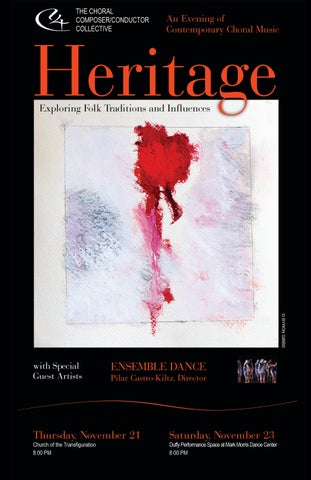
C4 is pleased to be continuing what we hope will become a tradition in featuring the beautiful artworks by members of our “Friends of C4.” This season, we’re pleased to feature the works of Byron Gibbs in our publicity and concert materials for the entire season. Byron has also agreed to donate prints of the pieces which will be available for sale by auction late in the season. We hope you’ll watch for your opportunity to own one (or all!) of his beautiful works and help C4 at the same time.
“Season” by Byron Gibbs
“Heritage” by Byron Gibbs
“Upward” by Byron Gibbs
“Strings” by Byron Gibbs