§ Pitter patter, pitter patter; and then
Daniel Andor-Ardó (b. 1978)
* The Agony and Ecstasy
Colin Britt (b. 1985)
Tales from the Bizarro World
Chris Opperman (b. 1978)
§ Allégories
Philippe Hersant (b. 1948)
Conductor: Timothy Brown Soloists: Martha Sullivan, Melissa Bybee, Nate Barnett, Hayes Biggs
Conductor: Melissa Wozniak
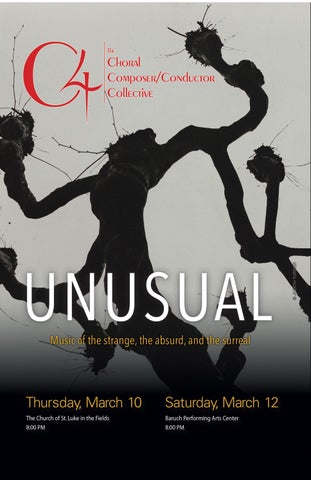
Cornerstones: Unusual
Music of the Strange, the Absurd, the Surreal March 10, 2016, The Church of Saint Luke in the Fields, NYC March 12, 2016, Engelman Recital Hall at Baruch College, NYC § Tyger, Tyger
Martha Sullivan (b. 1964)
Conductor: Nate Barnett Soprano Soloist: Melissa Wozniak
§ Tape Recorder 1st Prize, C4 Commissioning Competition, 2015
Gordon Williamson (b. 1974)
Conductor: Perry Townsend Soloists: Melissa Wozniak, Jamie Klenetsky Fay, Bettina Sheppard, Nate Barnett, Daniel Andor-Ardó
Karl Saint Lucy (b. 1987)
* Or Delirium
Conductor: Martha Sullivan Soloists (in order of appearance): Timothy Brown, Lorena del Mar, James Bilodeau, Melissa Wozniak, Karen Siegel, Karl Saint Lucy, Bettina Sheppard, Colin Britt, Melissa Bybee Conductor: Daniel Andor-Ardó Lector: James Bilodeau Autoharp: Brian Mountford Frontispiece Air Allegiance Apologize Battle (Melissa Wozniak and David See, soloists) Circus (Nate Barnett, soloist) Duty (Karl Saint Lucy, soloist) Envelope Kilt Mayonnaise Meekness (Brian Mountford and Karl Saint Lucy, soloists) Patience (Colin Britt, soloist) Philosophy Positive Reverence Year Colophon
Intermission
Conductor: Colin Britt 1. Enfance III 2. Jeunesse III (vingt ans) 3. Départ Soloists, Movement 1: Lorena del Mar, Timothy Brown, Karen Siegel, Nate Barnett
Brian Mountford (b. 1964)
* The Devil’s Dictionary
Conductor: Benjamin Arendsen Cast (in order of appearance): Bizarro No. 1, Brian Mountford; Bizarro Luthor, Perry Townsend; Bizarro Perry, Mario Gullo; Bizarro Jimmy, Bettina Sheppard; Bizarro Jazz Singer, Hayes Biggs; Bizarro Lois, Martha Sullivan; Bizarro Lana, Maya Ben-Meir
Soloists, Movement 2: Elizabeth Marker, Timothy Brown, Melissa Bybee, Nate Barnett, Martha Sullivan, Mario Gullo
* Premiere § Included on our upcoming recording, Cornerstones
Cornerstones: Unusual Program Notes and Texts
—Martha Sullivan
Tyger, Tyger Music: Martha Sullivan
Tyger Tyger, burning bright,
Text: William Blake
In the forests of the night:
Blake often used images of blacksmithing as
One cornerstone of C4’s programming is, of course, the unusual. We strive to bring our audiences works that surprise and intrigue. For this program, we have chosen works that are strange in diverse apects. Some claim oddness on the basis of their texts: Ambrose Bierce’s The Devil’s Dictionary provides the sardonic clarity for Brian Mountford’s piece of the same name; Symbolist imagery prompts Philippe Hersant’s musical gestures in Allégories; and Chris Opperman derives “Tales from the Bizarro World” from the topsy-turvy Bizarro World of early Superman comics. Some of the music on this program is set to texts that are not unusual in themselves but refer to strange things, or reenchant the ordinary: Martha Sullivan’s “Tyger, Tyger” reinforces William Blake’s idea that it is a strange God who creates both the Lamb’s softness and the Tyger’s fearful symmetries; Daniel Andor-Ardó’s “Pitter
patter, pitter patter; and then” uses familiar musical and textual tropes to create a powerful meditation on shapeshifting and outsider status; and Karl Saint Lucy opens up conventional allusions to desire in classic films—curtains, cigarettes, greyscale images—with lush sonorities and recitatives that support Emily Claman’s taut verse in “Or Delirium”. Gordon Williamson’s “Tape Recorder” invites human voices to recreate and explore the meanings embedded in recorded sound; and Colin Britt’s “The Agony and Ecstasy” offers an encounter with the mystical longing at the heart of Rumi’s poetry. The music on this program always asks the listener to regard the subject matter in some new way—unusual, absurd, surreal. As champions of new music, the members of C4 hope that everything we do will offer fresh perspectives and compelling ways to engage the music of our time. —Martha Sullivan
a metaphor for Creation; in his own personal mythology, Los is the blacksmith Creator-God, and sometimes a stand-in for Blake himself. Such a god would naturally forge a creature as dangerous and full of fire as the tiger (the spelling “Tyger”, archaic even in Blake’s day, adds a tinge of danger and mystery).
The
pivotal question here is “Did he who made the Lamb make thee?”—the music highlights it by setting it at the end of a soaring but slightly slower section for solo soprano. Neither the poem nor the music answers that question, since it’s up to the individual to come to his or her own conclusions. As for the music, I wrote it mostly to be fun to sing. The music had to be challenging but manageable, and it had to have an interesting text. The challenges come from thick harmonies and fleet rhythms. All the notes fall within an unchanging mode (called Lydian Flat 7, or the Harmonic Series Mode), but this mode is a bit unusual and creates a few odd harmonies. Since the mode does not change, I reasoned, the notes should be easy to learn; a steady common-time meter also makes the music manageable, as does a catchy melody. I honored the strangeness of the text by using odd harmonies (the mode allows for minor/major sevenths and augmented/major sevenths) and an unsettled canon at the end, before finishing with a chord that simply lays an E major right on top of a D major chord in the same voicing ... this is a nod to Blake’s ambivalence about beauty and danger being knit into the same sinews by the same Creator. I am very grateful to C4 for its continued engagement with “Tyger! Tyger!”
What immortal hand or eye, Could frame thy fearful symmetry? In what distant deeps or skies, Burnt the fire of thine eyes? On what wings dare he aspire? What the hand, dare seize the fire? And what shoulder, & what art, Could twist the sinews of thy heart? And when thy heart began to beat, What dread hand? & what dread feet? What the hammer? what the chain? In what furnace was thy brain? What the anvil? what dread grasp, Dare its deadly terrors clasp! When the stars threw down their spears And water’d heaven with their tears: Did he smile his work to see? Did he who made the Lamb make thee? Tyger Tyger, burning bright, In the forests of the night: What immortal hand or eye, Dare frame thy fearful symmetry?
Tape Recorder Music: Gordon Williamson Text: Zoë Skoulding I got to know Zoë Skoulding and her work at a recent artist residency in Paris, where I attended several of her readings. She has a distinctive delivery, almost stream of consciousness, that I found striking but really couldn’t imagine how to set to music. Within a few months I found that the idea of this challenge was still nagging at me, and so I took it up in working on this new piece for the C4 Ensemble. Skoulding’s poem “Tape
Recorder” is ripe with clear musical themes
and illuminates Claman’s text by outlining the
how they ache of leaving
started as occasional newspaper items with
and images, but also in its poetic description
mercurial nature of longing, set against the
but serve only
satirical redefinitions of common words. Many
of sound which, for me, relates back to the
ever-present possibilities of alienation and
as symbols for consummation in black
of them are still quoted; it was Bierce who first
particular experience of hearing her readings.
abandonment. His dense harmonies and free
and white movies. where sex
defined the Conservative as “a statesman who
In treating her text musically, I have borrowed
recitatives form a perfect complement to the
some techniques from writing tape pieces:
first-person confession of loneliness and desire
still punctuates with sultry inhales
from the Liberal, who wishes to replace them
focusing on the sounds of consonants and
in the poem, leaving space for the solo singers’
off of cylinders now shown to
with others.” Some definitions are accompanied
vowels, replicating the depth of sound inherent
voices and the reader/listener’s imagination to
carry deterioration’s catalyst.
by doggerel rhymes showing appropriate usage
in the tape medium, as well as using references
connect with the place in everyone that admits,
so smooth the tug and how
of the word. Eventually, the definitions were
to cutting, splicing, changes of speed and other
“We just want so much.”
elements of tape music. The resulting work is a roughly five-minute soundscape based on a
is unspoken and the heroine
anchored in pillowed lips
is enamoured of existing evils, as distinguished
collected and published in book form.
we are moved against our Emily Claman writes of her text:
ca. 15- to 20-second imagined reading by the
“Or Delirium” is part of an upcoming
poet, a time-stretch that allows for a closer
collection by Emily Rosamond Claman, entitled
examination of the various sound moments and
Or Delirium and Other Sprung Aches. Ms. Claman
images in a reading.
is a local artist and academic working towards
—Gordon Williamson
an aesthetics kept multifaceted and irony-free,
For music nerds who want to follow
better intentions to want.
along, the rhyme sections are accompanied by
even fed in only greys
an autoharp retuned to an octatonic scale, so
and half-lit scenarios of what is possible still we just want so much.
that some of the chord buttons play dissonant chords instead of the usual major, minor and dominant. The other sections use a form of twelve-tone serialism. You can hear the main
pulling from a shared nostalgia, while remaining
The Devil’s Dictionary
reel to reel beginning with
committed to the disruption of the status quo.
Music: Brian Mountford
Patience, but hopefully you will catch snatches
your own voice returning un-
To that end, collaboration is a crucial element of
Text: Ambrose Bierce
of it throughout. In one direction, the row
like itself heavier and
her overall goals, and one of many reasons she
thicker in rustles and clicks
is so very excited about Mr. Saint Lucy’s musical
Ambrose Bierce (1842–1914) was born in
other direction, with a pair of thirds (C, E, D, F). A
of words outside the head where
presentation of “Or Delirium.”
Ohio, enlisted in the Union Army at the age
chromatic scale serves as a second “tone row”. I
tone row most clearly as the solo melody in
begins with a pair of fourths (G, D, F, C); in the
a life may be erased with
Ms. Claman’s website contains art,
of 19, and fought in a number of bloody and
thought whimsical serialism would be a suitable
its own sound replaying in
poetry, and art that has poetry on it; the URL is
horrifying battles. After the war, he moved to
tribute to Bierce’s uncompromising combination
another room relatives
www.emilyclaman.com.
San Francisco, where he lived on and off for the
of extreme distrust and hopeless idealism.
rest of his life, working as a writer, satirist and
—Brian Mountford
freeze up in the occasion addressing a future that
sparsely put i was open
journalist for the Hearst newspapers, and gained
doesn’t know them or a child
calves aching of climbing.
a reputation as a vehement critic. He divorced
Air
close to mic go on it’s like
flatly the birds drew shadows
his wife after discovering evidence of her
A nutritious substance supplied by a bountiful
a telephone but it won’t
on the sun.
infidelity. Of his three children, one committed
Providence for the fattening of the poor.
say anything back hello
Or Delirium Music: Karl Saint Lucy Text: Emily Claman
haunting new fates
suicide after a failed romance, and another
with their indiscernible laments.
died of alcoholism and pneumonia. At the age
Allegiance
to begin the day
of 71, Bierce traveled to Mexico to observe the
This thing Allegiance, as I suppose,
in tears
Revolution, and was never seen again.
Is a ring fitted in the subject’s nose,
is worse than ending it so. but
Roughly contemporary with Mark
Whereby that organ is kept rightly pointed
march fearless of woe into it.
Twain, Bierce also wrote satirically about
Karl Saint Lucy’s collaboration with Emily
into this. go.
human foibles. But unlike Twain’s gentle humor,
Claman draws from the two artists’ shared
blind the sunspot back. repay
Bierce’s was biting and vitriolic, dismissive of
Apologize
commitment to emotional authenticity. In
what kindness is shown in these
politicians, generals, women, the church, and
To lay the foundation for a future offence.
“Or Delirium,” Saint Lucy’s music supports
billowing days. tethered curtains
the human race generally. The Devil’s Dictionary
To smell the sweetness of the Lord’s anointed.
Battle
Patience
A method of untying with the teeth a political
A minor form of despair, disguised as a virtue.
In this way the music mirrors the process of
Oh, what big nose you have.
social exclusion, which can start innocuously and
Peek-a-boo.
Philosophy
morph imperceptibly into an unrecognizable,
You.
tragic new reality.
I don’t know you. Pitter-patter. Pitter-patter. Pitter-patter.
knot that would not yield to the tongue. Circus
A route of many roads leading from nowhere to
A place where horses, ponies and elephants
nothing.
—Daniel Andor-Ardó
Positive
Pitter patter, pitter patter... And then.
are permitted to see men, women and children acting the fool.
Then. Then. And then.
Mistaken at the top of one’s voice.
Pitter-patter. Pitter-patter. Pitter-patter.
The Agony and Ecstasy
Then. Then. Then.
Music: Colin Britt
That which sternly impels us in the direction of
Reverence
Pitter-patter. Pitter-patter. Pitter-patter.
Text: Rūmī
profit.
The spiritual attitude of a man to a god and a
Duty
Then. Then. Then.
dog to a man.
Pitter-patter. Pitter-patter. Pitter-patter.
Jalāl ad-Dīn Muhammad Rūmī, a 13th-century
Then.
Sufi mystic poet from Persia, has become in
Was wroth at his master, who’d kissed Lady Port.
Year
Then the dwarf looked.
recent years one of the most popular and widely
His anger provoked him to take the king’s head,
A period of three hundred and sixty-five
Then looked in the puddle.
translated poets in history. His style, at times
But duty prevailed, and he took the king’s bread,
disappointments.
Pitter-patter. Pitter-patter. Pitter-patter.
spiritual, erotic, and visceral but always very human, seems to capture a timelessness and
Gazed at the puddle. Gazed at herself.
immediacy that speak to the most vulnerable
Envelope
Pitter patter, pitter patter; and then
Rainbow. Clouds. Trees. Leaves in the puddle. Then. Then. Then.
part of us.
The coffin of a document; the scabbard of a bill;
Music: Daniel Andor-Ardó
the husk of a remittance; that bed-gown of a
Text: Zsuzsanna Ardó
Month, months.
“The Agony and Ecstasy” depicts a profound
And a year and a half.
longing for the recipient of the poet’s affections.
I composed the piece over three years ago,
Came and went.
While it is not explicitly clear whether this
Pitter-patter. Pitter-patter. Pitter-patter.
addressee is of divine or mortal being, there
One night.
exists in Rūmī’s words an apparent blurring
The sky.
between spiritual and erotic love. The desire
with the ongoing refugee crisis today.
Opened... wide.
to see, kiss, and love may indeed refer to a
Wide. Wide. WIDE.
romantic partner or perhaps, as the poet says,
One of the sauces which serve the French in
The music follows the story of the character of
Flood. Flood. FLOOD.
a divine, “Supreme Lover.” It is my intention to
place of a state religion.
the Dwarf, which falls into three sections. At
Pitter-patter. Pitter-patter. Pitter-patter.
retain this uncertainty and to allow the listener
The sky barked.
to infer which meaning is more likely.
Sir Lavender Portwine, in favor at court,
Instead.
love-letter. Kilt
based on a poem by Zsuzsanna Ardó that was
A costume sometimes worn by Scotchmen in
in turn inspired by events nearly a century ago.
America and Americans in Scotland.
And yet, the narrative has a strong resonance
Mayonnaise
first, the Dwarf finds herself caught in a storm Meekness
that floods the forest and is threatening to
Uncommon patience in planning a revenge that
drown her. Then, in desperation, she appeals
is worthwhile.
to the Rainbow for refuge: “Will you take me?”
Days, days, days.
Barked an army of scars. And the scars flooded the forest.
When setting this text, I found a number of lines of
Pitter-patter. Pitter-patter. Pitter-patter.
poetry that could be used as a rhythmic ostinato
The dwarf gazed again.
and sort of mantra, underscoring the melodic
know you.”
The dwarf gazed at the rainbow.
setting of the full poem. These fragmented
Pitter-patter. Pitter-patter. Pitter-patter.
lines evolve gradually as the piece unfolds,
No monument shows his postmortem inscription.
Starting with the “pitter patter” of a summer
Will you take me?
arriving first at the declaration, “By Allah! I long
But M is for Moses, who slew the Egyptian.
drizzle, the piece builds and shifts rhythmic gears
And then, we hear the answer: “No. I don’t M is for Moses, who slew the Egyptian. As sweet as a rose is the meekness of Moses.
multiple times before reaching hurricane force.
to escape the prison of my ego...” The poem No. Pitter-patter.
becomes increasing ecstatic, declaring, “You are
the Essence of the Essence, the intoxication of Love.” But the limitations that hinder the poet, whether human or transcendental, finally take hold, and we are left with a pained acceptance, the “agony of wishing.” —Colin Britt In the orchard and rose garden I long to see your face. In the taste of Sweetness I long to kiss your lips. In the shadows of passion I long for your love. Oh! Supreme Lover! Let me leave aside my worries. The flowers are blooming with the exultation of your Spirit. By Allah! I long to escape the prison of my ego and lose myself in the mountains and the desert. These sad and lonely people tire me. I long to revel in the drunken frenzy of your love and feel the strength of Rustam in my hands. I’m sick of mortal kings. I long to see your light. With lamps in hand the sheiks and mullahs roam the dark alleys of these towns not finding what they seek. You are the Essence of the Essence, The intoxication of Love. I long to sing your praises but stand mute with the agony of wishing in my heart.
Tales from the Bizarro World Music and Text: Chris Opperman The composer writes: “Ladies and gentleman of the jury, over the course of this trial you have heard countless uncorroborated lies from the witness stand, heard admissions of procedural malfeasance by the police, and heard ‘expert’ witnesses who received their doctorates from the Online School of Just Give Us Your Money. Therefore, you have no choice but to find my clients, the defendants, GUILTY OF ALL CHARGES! GUILTY! GUILTY! GUILTY!!!” Conductor Ben Arendsen, however, counters with: “Stop! The composer is fired! His piece, ‘Tales from the Bizarro World,’ riffs on the binary tropes of aesthetic value judgments by positing a school in the Bizarro World of opposites first introduced in the Superman comics of the 1950s and later taken up into popular culture by the television show Seinfeld...” Class: Far out in space, there exists the wackiest planet in the entire universe! The square Bizarro World! We am recite the Bizarro Code: Us do opposite of Earthly things! Us hate beauty! Us love ugliness! Is great crime to make anything perfect on Bizarro World! Bizarro No. 1: Now it is time for today’s last lesson on vocabulary. Class: Bizarro-zarro Bizarro-zarro world! Bizarro Luthor: A walnut am an idiot what stares at walls. Class: Bizarro-zarro. Bizarro Perry: Strawberries am pink berries which taste like straw.
Class: Bizarro-zarro. Bizarro Jimmy: A chestnut am someone who is always showing off their chest! Class: Ha ha ha ha! Bizarro-zarro. Bizarro Jazz Singer: A sidewalk am a peculiar way of walkin’. Class: Oh Yeah! Bizarro-zarro. Bizarro Lois: Jealousy am when you wish you were as fat and ugly as your sister! Class: Bizarro-zarro. Bizarro Lana: Yesterday was the day that came before today. Class: Bizarro-zarro WHAT!? Bizarro No. 1: Bizarro Lana, why am you using correct grammar? Class: Shame! Biz. No. 1: And giving correct answers? Class: Naughty girl! Biz. Lana: I’m very sorry mister Bizarro number one, it won’t happen again. Class: It better not! You get an A and have brought great shame, stupid, to your entire family! Biz. No. 1: Now it is time for the previous lesson. Class: Musick! Biz. No. 1: Bizarro Lana, why don’t you sing us a pretty C scale? Biz. Lana: (sings beautiful scale) Class: (cries of agony are heard) Shame! Very bad girl! Is big crime to make anything perfect on Bizarro World! Biz. No. 1: Lana, please tell us the name of one of the greatest composers who am ever lived? Lana: Beethoven? Class: So very wrong! Us do opposite of earthly things! Us hate beauty! Us love ugliness! Biz. No. 1: Now class, what am the most wonderful music the world has ever known? Class: Post-Schoenbergian American serialism! Charles Edward Ives! Yoko Ono! Tom Waits! Beyork! Threnody (Penderecki) for the lucky
people of Hiroshima. John Cage. Lana: Ok, I think I get it now... (sings animalistic, out of tune sounds) (Class applauds) Biz. No. 1: Bizarro Lana, you am the worst singer in the whole school! You am get big prize. All: Blue Kryptonite! Lana: (dying of Kryptonite poisoning) Oh, me am so happy! Me… feel… so strong (falls) Hello? Class? Hello?
Allégories Music: Philippe Hersant Text: Arthur Rimbaud French composer Philippe Hersant’s music is both mystifying and accessible. His work Allégories, based on three of Rimbaud’s “Illuminations,” captures three varying stages of life in emotional and metaphorical expressions. The first, Childhood, is presented with a string of images observed in the world around us, depicted vividly with the composer’s haunting, nostalgic sound palette. The sound of the clock tolling provides a sonic carpet, over which the voices recite the various images. The second movement, Youth, uses a repeating, warm refrain of the word “Adagio,” while the solo voices incant recitative-like wisps of the melodies. The movement seamlessly links to the third, moving into a jaunty triplet rhythm at the description of the hunt, which links thematically with the declamatory entrance of the final movement, Departure. In the final portion of the piece, the poet embraces death as the beginning of a new adventure – “departure into new affection and noise!” —Colin Britt
Childhood III There’s a bird in the woods, its song makes you stop and blush. There’s a clock that never chimes. There’s a hollow with a nest of white creatures. There’s a cathedral that descends, and a lake that rises. There’s a little carriage abandoned in the copse, or running down the lane, beribboned. There’s a troupe of little players in costume, glimpsed on the road through the edge of the woods. There’s someone, at last, when you’re hungry and thirsty, who drives you away.
in (1994) and the Prix Maurice Ravel (1996),
Singers, and as the assistant music director at
as well as three SACEM awards, including the
the Cathedral of St. Joseph in Hartford, and he
Grand Prix de la Musique Symphonique (1998).
currently serves as music director for Grace
He also acted as composer-in-residence for the
Daniel is a long-time member of C4 and has
Church Van Vorst in Jersey City, New Jersey. He
Orchestra National de Lyon between 1998 and
written two compositions for the group. Pitter
is pursuing a DMA in Choral Conducting with
2000, and for the Orchestre de Bretagne for
patter, pitter patter; and then was premiered
Patrick Gardner at the Mason Gross School of
three seasons, starting in 2008.
by C4 in 2013, and DADA NY ’15 was written in
the Arts at Rutgers University, where he also
celebration of C4’s tenth anniversary season,
teaches undergraduate conducting and directs
himself as a tonal composer willing to turn
in 2015. Daniel studied composition and piano
the Rutgers University Choir. He and his wife,
music’s entire heritage – from Monteverdi to
at The Purcell School of Music, London. His
Victoria, live in Jersey City.
Janáček to Stockhausen – to his advantage. As
(in alphabetical order)
Daniel Andor-Ardó
compositions won numerous awards, and were featured by the Society for the Promotion of New Music during 2000–2002. While studying
voices
exiled…physical
ingenuousness bitterly stale…Adagio. Ah, the infinite egoism of adolescence, the studious optimism: how full the world was of flowers, that summer! The airs and the forms dying… A choir, to calm impotence and absence! A choir of glass with nocturnal melodies… Indeed the nerves will soon be on the hunt. Departure Enough seen. The vision was encountered under all skies. Enough had. Sounds of cities, evening, and in the light, and always. Enough known. The decisions of life. —O Sounds and Visions! Departure into new affection and
Philippe Hersant The French composer Philippe Hersant was born in Rome. His studies included literature as
Philippe
Hersant
defines
a composer, he lives by a few precepts: to be personal rather than to seek innovation at all costs, to avoid greyness, and to surprise.
Brian Mountford
Georges Hugon before entering André Jolivet’s
Brian Mountford studied music and electrical
composition class at the Paris Conservatory
engineering at UC Berkeley, and sang in the
in 1968, receiving his undergraduate degree
Yale Glee Club as an undergraduate. He sings
in literature that same year. Resident at the
with the New York City Master Chorale as well
Casa de Velásquez from 1970 to 1972, Philippe
as C4, and plays piano and organ. He spends his
Hersant went on to teach music and to become
time as a computer programmer and composes
hand and making music with C4 on the other..
a producer at the radio station France Musiques.
occasionally, dreaming of the day that his
Colin Britt
In 1978 he became a resident at the Villa
chamber opera will receive the reception it
Médicis thanks to the support of Henri Dutilleux
deserves, or perhaps a better one.
the university ensemble Sforzando Brass as well
instructive
colinbritt.com
Today,
well as music and he took harmony classes with
engagements included regular appearances with
20 years
noise!
the conductor of the Hartford Chorale Chamber
at the University of Cambridge, his conducting
Youth III
The
Composers
as his college orchestra. His other big passion— besides music—is science. He moved to New York City to work in neuroscience research at the Rockefeller University and currently realizes his dual passions by working at Google on the one
Colin Britt, originally from Maine, holds a
and Gilbert Amy. It was during this period that
bachelor’s degree in music composition from
he truly came into his own as a composer.
Chris Opperman
the Hartt School and a master’s degree in choral
Stances for orchestra thus became his new first
Since debuting on his own Purple Cow Records
conducting from the Yale School of Music and
opus and is the earliest work in his catalogue.
label in 1998, composer Chris Opperman has
Yale Institute of Sacred Music. His compositions
This piece was followed by several other, more
been carving his own niche in today’s pop-
have
in
melancholic works such as the Missa brevis, the
saturated music world, having released five full
Connecticut, including Voce, CONCORA, and the
chamber opera les Visites espacées (Avignon,
studio albums including 2010’s The Lionheart,
Yale Schola Cantorum, and by ensembles across
1983) and the opera le Château des Carpathes
an EP, and a digital single called “Aphrodite
the country and on four continents. Also active
(1982), based on a work by Jules Verne. He
Nights” (2011), which was composed on the
in musical theater, Mr. Britt has directed music
composed a number of shorter and more
gourd tree, a unique instrument invented by
for productions with the West Hartford Summer
dynamic works for small instrumental ensembles
Harry Partch. Opperman has also performed
Arts Festival, the Summer Place Players, and
before returning to the orchestral and greater
with and/or orchestrated music with many
Playhouse on Park in Connecticut. He has served
forms with his Second Concerto for cello and
industry luminaries, such as Grammy-award
as music director of Marquand Chapel at Yale,
the ballet Hurlevent (Palais-Garnier, 2002). .
winning guitarist Steve Vai. His association
on the adjunct conducting faculty at Hartt, as
Over the course of his career, he has won many
with Vai resulted in two Grammy-nominated
awards, including the Prix Arthur Honegger
recordings: 2006’s “Lotus Feet” and 2008’s “The
been
performed
by
ensembles
Attitude Song” with Holland’s Metropole Orkest.
sings, composes, and conducts in C4: The Choral
ASCAP. His music has been broadcast on SWR,
Opperman’s orchestration of Vai’s seminal piece
Composer/Conductor Collective. She has been
Swedish Radio, Danish Radio, CBC, and NPR.
“For the Love of God” has nearly 22 million
commissioned to write choral music for groups
views on YouTube. He also has over a dozen
around the country as well as in Tokyo and
composition at the Hochschule für Musik
years of experience working in the major music
Zurich. Her most recent commissions have been
und Theater (HMTM) Hannover, the Royal
industry. He now teaches courses on music
for choir and chamber ensemble (for C4 and the
Danish Academy of Music, Indiana University
business, music history, music technology, and
Canite Quartet, and for Counterpoint [Vermont]
Bloomington, and Dalhousie University, and
music theory/composition at Montclair State
and the Vermont Symphony Brass Quintet),
his main teachers were Johannes Schöllhorn,
University and Rutgers University. All of his
and on a larger scale, for the Orange County
Sven-David Sandström, Bent Sørensen, Hans
albums are available for sale on iTunes and
Symphony, under conductor David Rentz. Her
Abrahamsen and David Dzubay. He has taught
other digital platforms.
works have been recorded by the Esoterics
composition at the Hochschule für Musik,
(Seattle, WA), Chicago A Cappella, and C4. She is
Medien und Theater Hannover since 2010 and
Karl Saint Lucy
Gordon
Williamson
studied
published by G. Schirmer, Laurendale, and See
since October, 2015 he is Guest Professor of
Karl Saint Lucy is a New York–based composer–
A Dot. She has achieved national recognition
Composition and Director of the HMTM Incontri
lyricist, pianist, vocalist, and music director. He
as a winner of competitions sponsored by
Institute for New Music. He also serves as vice-
wrote music for a musical—F**king Identical
both the Dale Warland Singers and the Sorel
chairman of the Hannover Society for New Music
Twins (words and lyrics by Josh Sharp and Aaron
Organization.
(HGNM) since 2014 and his works have been
Jackson)—that was featured as a “Best of UCB Sketch” show in the 2014 New York Comedy Festival. He wrote music for a full-length musical, Class, with playwright/lyricist Maria
Martha Sullivan is an ASCAP composer.
Gordon Williamson Gordon Williamson (b. 1974, Ottawa) is
Alexandria Beech. His songs have been featured
a Canadian composer currently based in
at Barrington Stage Company, 54 Below, and
Hannover, Germany. Recent activities include
New World Stages. He is a Cycle 21 graduate of
commissions and performances by Radio
the Graduate Musical Theatre Writing Program
Sinfonieorchester Stuttgart, Swedish Radio
at New York University’s Tisch School of the Arts.
Choir, International Ensemble Modern Academy,
Martha Sullivan
published by Edition Gravis since 2012.
Ensemble Contemporain de Montréal and the Kairos Quartet, as well as artist residencies at
Composer Martha Sullivan writes pieces that
Künstlerhof Schreyahn, Schloss Wiepersdorf,
explore how music tells its stories. She is
the Styria Artist-in-Residence Program (Graz)
pursuing a PhD in Music Composition at Rutgers,
and the Centre Récollets (Paris).
exploring various genres, including music for
The recipient of several awards and
dance, instrumental chamber music, electronic
prizes for his work, Williamson most recently
music, and music for theatre (she composed
won the 2014 C4 Commissioning Competition in
all the incidental music for Rutgers’ production
New York and a prize at the Südwestdeutsche
of Cyrano de Bergerac in 2013), as well as
Rundfunk (SWR) Orchestra Workshop in 2012.
the choral repertoire she is best known for.
Further awards and recognition include grants
Sullivan’s first works for voice were composed
and artist stipends from the Ministry of Science
during the seven years she sang with the Gregg
and Culture of Lower Saxony, the Canada Council
Smith Singers, who have championed new
for the Arts, and young composer awards from
choral work for over half a century. She now
CBC/Radio-Canada, SOCAN and A
v
v
v
v
Cornerstones Recording The members of C4 are grateful to the following people, who have made our current recording project possible by donating either through our Indiegogo campaign or directly, earmarking their donations for this project. Cornerstones Recording Sponsor Bruce Saylor & Constance Beavon Daniel Sigg & Ellen Stafford-Sigg Cutting-Edge Circle Kit Smyth Basquin* Innovative Circle Susan M. Orzel-Biggs R. Crispino, Jr. Tammie Murphy David Wozniak Creative Circle Ted and Carol Barnett Jim Bilodeau Timothy Brown Joseph Fong Americanna Magness Joan Malczewski Contemporary Circle Arianne M. Abela Richard Elder Adams Isabel Aleman Nick Allardice Aaron Alter Daniel Andor-Ardó László Andor Katherine Ardó Nathaniel Barnett Maya Ben-Meir Shareeza Bhola Michael Biello & Dan Martin Nina S. Bitton Vicki Borah Bloom Michael Blumenfeld Linda Britt
Jeffrey Brown Maggie E. Brown Margaret Brown Danielle Buonaiuto Lisa Burns Melissa Bybee Ching Chang Jessica Chen Brooke Collins Michael Dellaira Adam & Tara Levin Delson Dr. Alex DeLuca Mary & David Dreyfus Hugh & Kathy Klein Eddy Sue Jacobs Feingold Kenny Felder Jessica Foster Visha Fox Byron Gibbs* Mimi Goodman Beth Gordon Diane Gottlieb Martha Minetree Grasty Catherine Guthrie Rob Gutmann Brook Hersey Rochele Hirsch Maddie & Joe Hogan David Hurd Ling Hsaio Kamilah Jackson Jeffrey James David Keyes Jordan Kinsey Janet & Robert Klump Kermit Komm Jim & Lynne Kruszka Miriam & John Lafferty Patricia Larkin Cheryl Krugel-Lee & Jacob Lee The Levin-Delsons Deborah Linehan Kellyn Loftus Donald McCloskey Maria McCumiskey Stella McKeown
Angela Menghraj Mary Meyer Juliet Milhofer Mackenzie Millar Jean K. Monroe & Jay D. Lane Michele Taft Morris & Kate Dillingham Ian David Moss & Debby Katz Brian Mountford Louis & Sharon Mountford Ruth Mueller-Maerki Bernard & Rochelle Natt Lisa Niedermeyer Valerie Norton Tarik O’Regan Lois & George Orzel Leslie Palmer Janet B. Pascal Robert Paterson Jane Penn Helen E. Price Zahra Partovi* Eddie Quaid Bethany Reeves Debra Rich Mona Ring Brett Roelofs Suzanne & Jonathan Rosenzweig Joseph Rubinstein Maria E. Santos Peter Schmitt Gail Seiden Patricia Siegel Ike M. Silver Nancy Smardz Carolyn Smith Marcia Sofley Martin & Barbara Solomon Thomas Stumpf Martha Sullivan Anne Thulin* Mary Ellen Townsend Socrates James Triantafillou Bill Tribby Ludmila Trigos & Paul Judicke Joseph Upham* Jennifer Wentworth
Ira Wolfman & Ronda Small Alice Wu Ruth Zeiner Cornerstones Recording Sponsor, $1,000– $4,999; Cutting-Edge Circle, $600–999; Innovative Circle, $350-599; Creative Circle, $125–349; Contemporary Circle, $1–$124.
C4 would like to thank and acknowledge its donors: Concert Sponsor Michael David & Lauren Mitchell Nan Bases Cutting-Edge Circle Charles Natt Innovative Circle Feryal Algosaibi David Hurd Ian David Moss & Debby Katz Patricia Siegel Richard Tucker Creative Circle Helen Bell Vic & Jan Bilodeau Jennifer Blessing Lewis & Brenda Brown Lee & Nancy Corbin John Tyler Evans Don & Sally Hayward Ira & Becky Horowitz Jeannie Im Phyllis Kubey Sue Backstrom & Jon Minikes Bosiljka Raditsa Katherine Schoonover Linda Schrank* Kenneth & Jean Telljohann Ira Wolfman & Ronda Small Contemporary Circle Richard Elder Adams Daniel Andor-Ardó
Ben Arendsen Kit Smyth Basquin* Susan M. Orzel-Biggs James Bilodeau Craig & Loren Blum Margaret Brown Melissa Bybee Barbara Charles Martin & Lisa Cohen Charles Crow John Tyler Evans Jonathan Fisher Vincent FitzGerald* Ellen Gesmer Grace Goodman Diane Gottlieb Jeanine Hartnett Ernest Hood & David McCorkle* Kamilah Jackson Jeffrey James Charles Katz & Reyna Franco Janet Keogan Susan Koshewa Jim & Lynne Kruszka Tania León Linda & Leslie Libow Nanette & Stanley Lieblein Evelyn Liston James Stephen Longo Peter Lurye Beth Marker Angela Menghraj Peter & Christine Metz Juliet Milhofer Louis & Sharon Mountford Ruth Mueller-Maerki Wendy Murphy Bernard & Rochelle Natt Marjorie Naughton Valerie Norton Francesco Piattelli Palmarini Zahra Partovi* David Rentz Joseph Rubinstein Christine Schadeberg Ronnie Scharfman Phillip Schroeder
Board of Directors
Ronnie Scharfman Phillip Schroeder David See Mark Shapiro Bettina Sheppard Nancy Smardz Milton Sonday Marie-Louise Stegall Neil Sumner Anne Thulin* Mary Ellen Townsend Perry Townsend Mary Tsimenoglou
Jonathan David (Chair) Melissa Wozniak (Treasurer) Hayes Biggs Fahad Siadat Karen Siegel Larry Siegel
Advisory Board
This list includes donations since July 2015. Concert Sponsor, $1,000–$4,999; Cutting-Edge Circle, $600–999; Innovative Circle, $350– $599; Creative Circle, $125–349; Contemporary Circle, $1–$124. * Friend of C4
Eric Banks Lisa Bielawa David Harris David Hurd Aaron J. Kernis Tania León Harold Levine Clara Longstreth Ian David Moss (C4 Founder) Tarik O’Regan Kent Tritle Toby Twining
’s 2015-16 Featured Artist
!! !! !! !! ! !
Judith Turner!
!
C4 is pleased to continue showcasing the art of individual contributors each season, utilizing the pieces in publicity materials, program covers, and album covers (the second coming out this spring). !
!
This year we feature the art of Judith Turner which has been graciously donated by ‘Friend of C4,’ Vincent FitzGerald. Ms. Turner’s photogravures reveal her intricate point of view. The details in her stark architectural and ßoral subjects become hyper clear and informative.!
!! !! !! ! !! !! !! !! !! ! !
Special Thanks C4 would like to give special thanks to The Church of Saint Luke in the Fields and Baruch College for providing our venues; to Gait Sirguey for French coaching; to Keith Goldstein for many wonderful portraits of C4, and Kovács Márton for some recent images; to Patrick Neitz of Bits & Bytes Creative Design for our logo (http://www.bitsbytesdesign.com); to Judith Turner for her stunning art; to James Bassi for his many musical gifts; and to everyone who by sharing their talent and expertise has helped us grow. C4’s activities are funded in part with the generous assistance of:
Ms. Turner resides in New York City. She began taking photographs in 1972 and has had many solo exhibitions in various cities in the United States, Europe, Israel, and Japan. She has been awarded grants and fellowships from The Graham Foundation, Mobil's Artist-in Residence Program, The Lila Acheson Wallace Fund, and The Asian Cultural Council. In 1994, she received an Honor Award from The American Institute of Architects.!
! !
Her photographs are in the permanent collections of many institutions which include: The Getty Center, ! Los Angeles; The Guggenheim Museum, The Whitney Museum, The International Center of Photography, New York City; The George Eastman House Collection, Rochester; The Portland Museum of Art, Maine; The Canadian Center for Architecture, Montreal; Bibliothèque Nationale, Paris; Museum Ludwig, Köln; The Tel Aviv Museum; Tokyo Metropolitan Museum of Photography.!
Ms. Turner’s work is featured in After, and in Parables and Piece, both limited edition artist books produced by Vincent FitzGerald & Co. Her latest book is just out, Zaha Hadid, Judith Turner: A Dialogue, published by Axel Menges.!
!
These works have also been contributed for the beneÞt of C4 through our annual auction which will take place at season’s end. We hope you’ll be watching for your opportunity to own one or more of these pieces and to support C4 at the same time.
C4: The Choral Composer/Conductor Collective Sopranos
Lorena Del Mar Rebecca Ehren Priya Patil Karen Siegel Martha Sullivan Melissa Wozniak
Altos
Maya Ben-Meir Melissa Bybee Jamie Klenetsky Fay Elizabeth Marker Karl Saint Lucy Bettina Sheppard
Tenors
Ben Arendsen Nate Barnett Colin Britt Mario Gullo Perry Townsend
Basses
Daniel Andor-Ardó Hayes Biggs James Bilodeau Timothy Brown Brian Mountford David See
C4 exists to enrich artists and audiences alike, through passionate advocacy of new choral works, performing pieces written within the last 25 years, premiering and commissioning new choral works, and mentoring emerging singers, composers, and conductors of today’s choral music. www.c4ensemble.org
photographer: Keith Goldstein
For information on C4 members, visit c4ensemble.org/theensemble.html