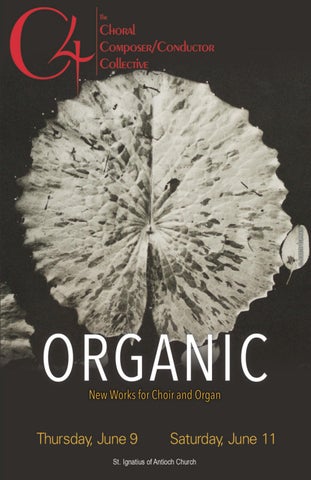
Cornerstones: Organic Music for Choir and Organ
June 9 and 11, 2016, St. Ignatius of Antioch Episcopal Church, NYC Special Guest Artist: James Kennerley, Organist Laudate Dominum
Conductor: Daniel Andor-Ardó Soloists: Karen Siegel, soprano, and Maya Ben-Meir, mezzo-soprano
Care, Charminge Sleepe
Conductor: Nate Barnett Soloist: Martha Sullivan, soprano
Perry Townsend (b. 1965)
Tarik O’Regan (b. 1978)
* Fortunes Pantoum
Hayes Biggs (b. 1957)
§ Impermanence
Karen Siegel (b. 1980)
* O Oriens
Mario Gullo (b. 1973)
Conductor: Perry Townsend Soloist: Martha Sullivan, soprano Instruments: Brian Mountford, VibraSlap; Martha Sullivan, Chinese Opera Gong
Conductor: Benjamin Arendsen
Conductor: Karen Siegel
Intermission
* Tomaraji na kumo
Jamie Klenetsky Fay (b. 1984)
Cantos Sagrados
James MacMillan (b. 1959)
Conductor: Melissa Wozniak
I. II. III.
Identity Virgin of Guadalupe Sun Stone
Conductor: Colin Britt
The Beatitudes
Arvo Pärt (b. 1935)
Conductor: Martha Sullivan
* Premiere § Premiere of the version for organ and choir; Impermanence also exists in a version for choir and electric chamber ensemble
Cornerstones: Organic Program Notes and Texts “Organic” is the third concert in C4’s Cornerstones year. Our cornerstones, from the standpoint of repertoire, are the things we value. These include: • Important repertoire that is underperformed, such as MacMillan’s Cantos Sagrados—this work is very difficult, and its text is merciless, so performances require bravery; • Beauty, as in Tarik O’Regan’s “Care, Charminge Sleepe”, whose sumptuous harmonies demand that we find as much beauty as we can in our own voices; • Nurturing composers’ individual voices, as heard in works premiered on this concert: Hayes Biggs, Jamie Klenetsky Fay, Mario Gullo, Karen Siegel, and Perry Townsend sound nothing like each other, and yet their works draw out the best in C4 as we strive to bring their works fully alive.
features several pieces with secular texts, or dialogues between sacred and secular, and sometimes the organ drops away entirely to allow space for music outside the Western tradition. We place “Care, Charminge Sleepe” immediately after “Laudate Dominum,” and we follow the harrowing Cantos Sagrados with a sacred piece, Arvo Pärt’s “The Beatitudes.” “Sometimes you worry too much about death,” the text of “Fortunes Pantoum” warns, and then we are caught up in the waves of “Impermanence.” Listeners will find many such threads in this program. C4 is not a church choir, and its membership claims no common creed; juxtaposing these works in concert suggests that it may be worthwhile to ask what role the sacred plays in the discourse of our time. We cannot answer that question, but we can offer this music as an invitation to exploration.
While this concert draws its name— “Organic”—from the simple fact of our collaboration with organist James Kennerley, the word points to something more subtle: in programming a C4 concert, we strive to put together works that contrast greatly yet speak to each other in some natural way, as if sprung from a common seed. The organ is generally used for sacred music, yet this concert
—Martha Sullivan
Laudate Dominum Music: Perry Townsend Text: Psalm 117 Blake often used images of blacksmithing a“Laudate Dominum” takes the frequently set Psalm 117 text and re-imagines it as a passionate, even aggressive, declaration
of praise. Its harmonic world leans away
et nunc et semper
from traditional tonality, yet occasionally
et in saecula saeculorum.
flirts with it. More than one person has
Amen.
commented that it seems a bit French. Maybe I was feeling French that year? It
Sing praise to God, all nations;
was composed in 1998, for the Church of St.
praise Him all people.
Mary the Virgin choir (of which I was then
For He has shown His kindness toward us,
a member) and organist Ken Cowan, on the
His love and merciful kindness,
occasion of Corpus Christi.
and the truth of God lasts for eternity.
The organ is no mere accompanist here, but an equal partner with the choir, going
Glory to the Father and the Son
long stretches by itself, both introducing
and the Holy Spirit,
material and commenting on the sung text.
as it was in the beginning
Centrally featured in the organ part are the
and will be now and always,
refracted trumpet fanfares that dance about
world without end.
crunchily, producing frenetic energy and
Amen.
firing off echoes. Against this, the choir’s phrases are at times ecstatic, strident, lyrical,
Care, Charminge Sleepe
or wistful.
Music: Tarik O’Regan
The middle section is a Gloria Patri, which
Text: John Fletcher
(atypically perhaps for that text) is the most gentle and childlike music of all, an
The text of “Care charminge Sleepe” is
inner world contemplated by two soloists
drawn from the play “Valentinian,” a
nestled in fluteness. Toward the end, as the
revenge tragedy by the English playwright
trumpets return, crashing into one another,
John Fletcher. It is prefaced in the text by the
a wall of sound mounts up, leading the
words, “Musick and Song,” and is delivered
chorus into a swirling headwind that breaks
over the title character’s frail body, an appeal
out into something resembling A major. At
to easy, uninterrupted sleep, “brother to
least, the organ seems to think so.
death.”
—Perry Townsend
Tarik
O’Regan’s
setting
mesmerically
reveals the text through the slow unfolding Laudate Dominum omnes gentes,
of its dense, double-choir texture. The piece
laudate eum omnes populi.
begins with hushed voices in rhythmic
Quoniam confirmata est super nos,
canon displaced by the eighth note, creating
misericordia ejus,
a sense of quiet tumult, unanchored by
et veritas Domini manet in aeternum.
a clear beat. This opening is followed by hypnotic sections of chant by each choir,
Gloria patri et filio
adorned by a lone soprano voice, as if to
et spiritui sancto,
conjure the mysterious powers of sleep.
sicut erat in principio
The central section of the piece, beginning
“Or painful to his slumbers,” is a massive
Jonah’s prayer from inside the whale and
double canon at the octave and fifth, set,
Rochelle Jewel Shapiro’s poem The fireflies
as at the beginning, with unevenly spaced
have barely winked their neon green
entrances that unfold into a mounting chaos
involve similar, though opposite, shifts
of sound. Tones from the organ gradually
in perspective and mood. Jonah recounts
pile up and crescendo, leading to a soaring
his near-death, a dark time for sure. Yet,
soprano climax on the text, “Thou son of
his overall expression is one of gratitude.
Night, Pass by his troubled senses, singe
Shapiro’s
his pain.” The voices then quickly fade to a
depictions of nature through the passing
volatile homophonic texture, as the melodic
seasons that seem peaceful, until the final
subject is sung one last time by the altos
line reveals an underlying anxiety about
and tenors of the first choir. To conclude,
these changes.
O’Regan sets the final two lines to music
I have split the choir into two, with the men
based closely upon the opening, with
singing the biblical text and the women
identical sonorities and contrapuntal shapes.
singing Shapiro’s poem.
It grows briefly intense, and then collapses
organ stops are also divided into two
to a barely audible E-flat in octaves.
groupings, with a different color for each.
Organ is used sparingly throughout the
The alternating men’s and women’s voices
piece, employed during transitions and as
inhabit very different sound-worlds at first,
support for choral climaxes. The writing
singing in different textures and modes.
is texturally similar to vocal writing, and
They gradually influence each other, and
serves to extend and enrich the choral sound,
eventually do come together, though they
rather than to operate as an accompaniment.
never merge completely.
—Nate Barnett
C4 and Fireworks premiered the version
poem
consists
of
beautiful
The choices of
with electroacoustic ensemble in 2012, and Care-charming Sleep, thou easer of all woes,
I am very glad that C4 is now returning to
Brother to Death, sweetly thyself dispose
Impermanence to premiere the original
On this afflicted prince; fall like a cloud
version with organ.
In gentle showers; give nothing that is loud,
Arendsen and C4 for bringingImpermanence
Or painful to his slumbers; easy, sweet,
to life with thoughtfulness, attention to
And as a purling stream, thou son of Night,
detail (how exactly does one pronounce
Pass by his troubled senses; sing his pain,
“rhododendron” and “pachysandra”?), and
Like hollow murmuring wind or silver rain;
beauty.
Into this prince gently, oh, gently slide,
—Karen Siegel
Thank you to Ben
And kiss him into slumbers like a bride. The fireflies have barely winked their neon
Impermanence
green
Music: Karen Siegel
when the tiny tulips
Text: Excerpts from the book of Jonah;
in their orange flame skirts
poetry by Rochelle Jewel Shapiro
have fallen from the arms of the yellow poplar.
The rhododendron petals have fallen, too,
Waters nearly choked me to death.
leaving clumps of pea-like pods
The darkness encircled me,
and brown shafts.
weeds tangled in my hair.
Not long ago, the flowering pear showered
Those who cling to hollowness have lost your trust.
its flurry of snowy blossoms When my soul died within me I remembered and the pink bunched crepe paper
you.
flowers of the cherry tree drifted down, exposing
I have turned away, but I keep looking for you.
dark scarred bark
—Jonah 2:4-10, translated and altered order
and gnarled branches.
of lines by Karen Siegel
Just beyond the adamant
Fortunes Pantoum
white bloom of the Korean Dogwood,
Music: Hayes Biggs
the pines will begin to drop
Text: Jane Shore
their dried needles
In 1984 I wrote a three-minute song—a mini variation set, really—called Northeast
onto beds of shivering pachysandra
Reservation Lines, on a poem by Jane Shore,
and the impatiens, stricken by a sudden
based on an airline’s recorded “on hold”
night frost,
message: “Northeast Reservation Lines are
will be felled against the spotted grass.
busy. As soon as an agent becomes available, we will connect you. Thank you for waiting.
Hold me.
This message will be repeated.” As in the old “telephone” game, the original message
—Rochelle Jewell Shapiro
becomes hopelessly garbled over a series of attempted repetitions, a state reflected in the
You threw me into the heart of the ocean,
metamorphoses of the musical setting. After
and water swirled around me,
hearing Northeast Reservation Lines, Jane
your waves washed over me.
suggested Fortunes Pantoum (her “only other Found Poem,” as she describes it) as a
I went down into the depths of the
possible candidate for a choral setting. Many
mountains,
years later, I finally have gotten around to
trapped forever in this underworld.
it. Shore’s note on her poem follows, which she prefaces with a quotation from Lewis
But you saved me.
Turco’s The New Book of Forms.
I am grateful.
A Malayan form. Accentual Syllabic. Lines can be of any single length in any particular meter.
A Pantoum consists of an indefinite number of
finger-snapped rhythms, divided between
quatrain stanzas with particular restrictions:
two groups within the ensemble; 2) the
lines two and four, in their entirety, are repetons,
intriguingly named Vibra-Slap, heard nearly
(repeating lines)—they become lines one and
every time the word “you” is sung; and 3) a
three of the following stanza, and so on. The
Chinese Opera Gong with an upward pitch
rhyme scheme (if any is used) is interlocking. The
bend, reserved for the second iterations
poem can end in a quatrain whose repetons are
of the words “life” and “death” (the latter
lines one and three of the first stanza in reversed
complete with its own obligatory Dies irae
order, or in a repetons couplet consisting of line
quotation), and for both occurrences of
one and three in reversed order.
the word “news.” The melodic modules of which the piece is comprised are specific
“In other words,” Shore writes, “a Pantoum
to the individual lines and their later
is a dance in which you take two steps
repetitions; sometimes their returns are
forward and one step back. For this
nearly literal, other times more varied.
verse form to work, I needed to use short sentences that were complete in themselves,
—Hayes Biggs
and the fortunes in fortune cookies seemed the perfect uniform line length. To start, I
You will go on a long journey
bought several boxes of fortune cookies at
You will have a happy and healthy life
Sages in Harvard Square, hoping to have
You will recover valuables thought lost
lots of good lines to pick and choose from.
You will marry and have many children
When I got home, I couldn’t wait to break open the cookies and begin to arrange the
You will have a happy and healthy life
fortunes on the table, and make a story.
Your sweetheart will always be faithful
This was a time-consuming process—in
You will marry and have many children
the 1970s, before computers could cut and
You will have many friends when you need
paste for you automatically. While writing
them
‘Fortunes Pantoum’ I discovered that when I used the line from a fortune the first time it
Your sweetheart will always be faithful
meant one thing, but when it was repeated a
Soon you will come into a large inheritance
second time, its meaning changed. I had not
You will have many friends when you need
expected a second darker, a more haunting,
them
provocative poem to arise out of the original
You will succeed in your line of work
one. And in that eerie prophetic voice that all fortunes have! So I rearranged and
Soon you will come into a large inheritance
reordered the fortunes over two days. By
You will travel to many new places
the time ‘Fortunes Pantoum’ was finished,
You will succeed in your line of work
I’d eaten all the cookies.”
Be suspicious of well-meaning strangers
In my setting I have employed three
You will travel to many new places
percussive
A message from a distance is soon to be
elements:
1)
interlocking
received
in Vermont.
Be suspicious of well-meaning strangers Important news from an unexpected source!
O Oriens Music: Mario Gullo
A message from a distance is soon to be
Text: Vespers antiphon for December 21
received You will meet a dark and handsome
During the final seven days of Advent,
foreigner
December 17th–23rd, the antiphons heard
Important news from an unexpected source!
during evening prayer all begin with ‘O’
Do not take unnecessary chances
followed by a different Old Testament prophesy of the coming Messiah. They are
You will meet a dark and handsome
known as the O Antiphons.
“O Oriens”
foreigner
occurs on December 21st, the Winter
You have a fear of visiting high places
Solstice.
Do not take unnecessary chances
and all-encompassing about a Christian
Your misunderstanding will be cleared up
event, marked by the use of Jewish
in time
prophesies, intoned during an astronomical
There is something satisfying
phenomenon marking the shortest day of You have a fear of visiting high places
the year.
Grasp at the shadow and lose the substance
“O Oriens” is the third, and final, movement
Your misunderstanding will be cleared up
of a larger piece called Meditation for
in time
Christmas. It is preceded by “Ave Maria”
Sometimes you worry too much about death
and “Gloria” (heard on C4’s November 2015 concert). The piece is one long crescendo
Grasp at the shadow and lose the substance
from a quiet beginning to the final rush of
You will recover valuables thought lost
sound in the organ. It is meant to elicit the
Sometimes you worry too much about death
stillness of the longest night with plenty of
You will go on a long journey
sustained notes. The opening statement is repeated at the end but raised in key and
Jane Shore’s six books of poems have
with an ever quickening motive in the organ,
garnered
the
borrowed from the “Ave Maria,” to denote
Juniper Prize (1977), the Lamont Prize
many
prizes—including
the sound of the first whispers of light as the
(1986) and the 2010 Poets Prize. She’s been
night is finally dispelled.
a Guggenheim Fellow, a Radcliffe Institute
Thank you as always to C4 for the amazing
Fellow, and a Hodder Fellow at Princeton,
performance and to Karen Siegel for the
and twice received fellowships from the
very sensitive and thoughtful preparation.
National Endowment for the Arts. THAT
Also, thanks to Bettina Sheppard and the
SAID, New and Selected Poems, was
Composer Salons held over the summer.
published by Houghton Mifflin Harcourt in 2012. A Professor at the George Washington
O Oriens,
University, she lives in Washington, DC and
splendor lucis aeternae, et sol justitiae:
veni, et illumina sedentes in tenebris, et
late, old, ready to disappear.” In my mind,
umbra mortis.
the poet both recognizes the beauty of this moment while mourning summer’s passing.
O Dawn of the East,
My goal was to express these disparate
splendor of eternal light and sun of justice:
feelings - loss, perhaps nostalgia, the
come and shine on those who dwell in
vastness of the sky, and the ever-changing,
darkness and in the shadow of death.
but seemingly static, nature of cloud cover. The piece at once feels static and active,
Then shall we know, if we follow on to
and heavy emphasis is placed on the word
know the Lord: his going forth is prepared
“kumo” (cloud).
as the morning; and he shall come unto us as the rain, as the latter and former rain unto
For various reasons, I’d taken a hiatus from
the earth (Hosea 6:3)
composing for nearly 7 years. A former C4 member, I was elated to rejoin the ensemble,
She’s the brightness that shines forth from
and when I was asked to write for our 2015-
eternal light. She’s a mirror that flawlessly
16, I jumped at the chance. I am incredibly
reflects God’s activity. She’s the perfect
grateful to C4 for giving me the opportunity
image of God’s goodness (Wisdom 7:26)
to compose this work, and wish to thank conductor Melissa Wozniak for making
But unto you that fear my name shall the
Tomaraji na kumo come alive!
Sun of righteousness arise with healing in his wings; and ye shall go forth, and grow
tomaraji na kumo no hatete ni shitau tomo
up as calves of the stall (Malachi 4:2)
amatsu sora naru aki no wakare wa
The people that walked in darkness have
Yearn as I might for the edge of the ceaseless
seen a great light: they that dwell in the land
clouds
of the shadow of death, upon them hath the
The parting of autumn is the vast open sky
light shined (Isaiah 9:2)
-- trans. Samhitha Sreenivasan
Tomaraji na kumo (The Cantos Sagrados Ceaseless Clouds) Music: James MacMillan Music: Jamie Klenetsky Fay
Texts: Ariel Dorfman, Ana Maria Mendoza,
Text: Fujiwara no Tameie
and sacred texts
I have always been amazed by Japanese
James MacMillan’s Cantos Sagrados responds
poetry, especially short poems which are
to the victims of the corrupt regime during
able to convey such complex emotion in one
the Argentinian Dirty War, in which political
or two phrases. In this poem, the breaking of
dissidents were imprisoned, executed, or
the clouds signifies the coming of autumn.
“disappeared.” The libretto is macaronic,
As one translator of this poem noted, “The
with a combination of English and Latin
key is here that the poet has an attachment
texts in each of the three movements.
to the autumn, even though it is already
MacMillan begins the first movement,
“Identity,”
with
nearly
panicked
governments.
exclamations from the choir, shouting, “What
The final movement, “Sun Stone,”
did you say? They found another one” on
sets the other poem of Dorfman, in which a
two stacked fifth chords one half-step apart,
soldier reluctantly carries out the execution
against bursts of violent, dissonant organ
of a political prisoner, saying, “Forgive me,
chords. The English text, translated from a
compañero.” As with the other movements,
poem by Ariel Dorfman, depicts a confused
MacMillan pairs the English text with a
scene in which [presumably local] people
Latin one, three lines from the Credo of
discuss the discovery of “another” victim
the Ordinary of the Mass. Unlike the more
of the corrupt government, “floating in the
rhythmically active and varied first and
river.” At the line, “They turned him over
second movements, there is an unrelenting
and looked at his face, his hands/they’re all
slow pulse from the organ and sustained
waiting together, silent and mourning,” the
voices (on the Latin text) that permeates the
texture shifts abruptly to an eerie stasis with
entire final movement. The juxtaposition
sustained cluster chords in the upper voices.
between these two texts is in many ways
As they express the hopelessness of the
more biting than that of the pairings from
situation (“If the captain’s the same one as
the first two movements; the slow boil
last time, he knows what will happen”), the
of the Dormfan text builds towards the
desperate utterances return in full rhythmic
shared climax between “Crucifixus” and
unison, contrasting with the exchanged
“he almost does not hear the sound of the
dialogue earlier in the movement. Following
shots,” in a jarring revelation that is both
a final defiant exclamation from the choir
accusatory and redemptive. In this moment,
(“I can bury my own dead”), MacMillan
MacMillan seems to imply that the victim
concludes the movement with a quietly
of this execution is Christ-like, or perhaps
intoned portion of the Offertory from the
Christ himself. The phrase, “Forgive me,
Requiem Mass: “Libera animas omnium
compañero” is then repeated in short
fidelium defunctorum de poenis inferni, et
phrases that gradually fade away, until the
de profundo lacu.”
final whispered plea from the choir.
In the second movement, “Virgin of
As in Britten’s War Requiem, MacMillan
Guadalupe,” the lower voices slowly recite
uses the overlap and combination of
“Salve mater coeli porta Virga florens,” while
disparate texts for dramatic effect and in a
the upper voices sing the poem by Mendoza.
highly critical manner. The pairing of texts
Unlike the specificity of the first movement,
in Cantos Sagrados, however, is perhaps less
which deals with the disappearance of
a specific criticism of the violence carried
political prisoners, Mendoza’s poem deals
out by the corrupt Argentinean government
with a “more fundamental cultural and
and more a way of holding up a lens to the
historical question,” namely the issue of
perpetuation of violence and victimization
colonialism and cultural oppression. The
of “the other.” The Latin texts employed are
analogy then is between the abuse of natives
not archaic remnants of religious beliefs that
by foreign conquerors and the abuse of
have lost their immediacy, but rather living
political prisoners and dissidents by corrupt
dramas that continue to have ritual.
I. Identity What did you say—they found another one? —I can’t hear you—this morning another one floating in the river? talk louder—so you didn’t even dare no one can identify him? the police said not even his mother not even the mother who bore him not even she could they said that? the other women already tried—I can’t understand what you’re saying, they turned him over and looked at his face, his hands they looked at, right, they’re all waiting together, silent, in mourning, on the riverbank, they took him out of the water he’s naked as the day he was born, there’s a police captain and they won’t leave until I get there? He doesn’t belong to anybody, you say he doesn’t belong to anybody? tell them I’m getting dressed, if the captain’s the same one as he knows I’m leaving now last time what will happen that body will have my name – my son’s my husband’s my father’s name I’ll sign the papers tell them tell them I’m on my way, and don’t let that captain touch him don’t let that captain take one step closer to him. Tell them not to worry: I can bury my own dead. Libera animas omnium fidelium defunctorum de poenis inferni, et de profundo lacu: Libera eas de ore leonis ne absorbeat eas tartarus, ne cadant in obscuram.
Deliver the souls of all the faithful departed from the pains of hell and from the depths of the pit: deliver them from the lion’s mouth, that hell devour them not, that they fall not into darkness. II. Virgin of Guadalupe Sweet Virgin of Guadalupe, oh virgin of the gentle eyes, dark-eyed virgin, good Lady, my love, painted by God’s own hand on the cloak of the Indian Juan Diego, Sweet virgin, my love, who commanded the bishop to build you a shrine, where my brothers the Indians lived in Tapeyepac in Mexico, outside the city. Flogged and burned were these poor little ones, despised, deceived and mocked, my brothers the Indians. A thousand times mistreated, a thousand thousand killed. What did you say to the bishop? “You will build me a house where I can hear the cries, outside the city, where I will wait, the pleas of my Indian children.” Sweet Virgin of Guadalupe, oh virgin of the gentle eyes, dark-eyed virgin, my girl, my love, I want to ask you this question, dear mother: Why is it that in Spain, on the far side of our hills and valleys, why is there another Virgin of Guadalupe, across the sea, Patron Saint of the Conquerors? men with great beards, men on horses, who crush and burn our homes, men with swords and fire, and the Indians, your children, still inside?
Why is it. Sweet Virgin, sweet mother, why is there another Virgin of Guadalupe, ‘Patroness of the Conquerors’?
answer structure of the music, which
Salve Mater coeli porta Virga florens et exorta David ex prosapia.
composition also involved a kind of binary:
Hail Mother, portal of heaven Flowering Virgin, sprung from the line of David.
altos sings conjunct lines that are chant-
responds to the text: “Blessed are…” is answered by “for they shall…” throughout. Pärt’s trademark tintinnabuli method of the tenors and sopranos together sing notes that outline triads, while the basses and like in their simplicity. There is no other type of musical gesture in the choral parts
III. Sun stone
of this work. The general vocal range of the
They put the prisoner against the wall. A soldier ties his hands. His fingers touch him—strong, gentle, saying goodbye. —Forgive me, compañero— says the voice in a whisper. The echo of his voice and of those fingers on his arm fills his body with light I tell you his body fills with light and he almost does not hear the sound of the shots.
a crescendo to the final “Amen”; the organ
Et incarnatus est de spiritu sancto. Ex Maria Virgine, et homo factus est. Crucifixus etiam pro nobis.
Hailed as “a great organist” displaying
He became incarnate of the Virgin Mary, and was made man. For our sake he was crucified.
parts rises slowly throughout, suggesting supports with this with extremely long pedal tones, which ascend chromatically, one half step at a time, from the D-flat at the start to a G-sharp (a fifth higher) at the climax. To close, the organ plays a postlude of arpeggiated chords, simple but dense, which make a slow diminuendo over the pedals descending step by step to a quiet finish, the end of a long journey. —Martha Sullivan
Guest Artist Biography “phenomenal musicality”
technique
and
sheer
(Bloomberg
News),
James
Kennerley is a multi-faceted musician, working as a conductor, keyboardist, singer, and educator.
The Beatitudes
Mr. Kennerley was a prizewinner at the
Music: Arvo Pärt
2008 Albert Schweitzer International Organ
Text: Matthew 5:1-12
Competition, and a finalist at the inaugural
Arvo Pärt’s setting of the Sermon on the
(2013) Longwood Gardens International
Mount, or Beatitudes, takes care to set the
Organ Competition. In addition to solo
music precisely to the stresses of the text—
concerts in the US and Europe, Mr.
which is in English, a rare language in
Kennerley frequently collaborates with
the composer’s output. Pärt’s attention to
groups such as the Voices of Ascension,
detail also manifests itself in the question–
New York City Master Chorale, and
Greenwich Choral Society. He has studied
A composer of note, he specializes in music
the organ with David Sanger, Thomas
for choral ensembles, and for works that
Trotter and McNeil Robinson, and holds
incorporate historic instruments. His 2012
the Fellowship of the Royal College of
piece Lauda novella was featured as part
Organists diploma. He has given concerts at
of the Twelfth Night Festival at Trinity
Carnegie Hall, The Metropolitan Museum,
Church, Wall Street. He was first-prize
Washington National Cathedral, The Frick
winner of the Association of Anglican
Collection, Saint Patrick’s Cathedral, the
Musicians Composition Competition. 2016
Royal Albert Hall, Saint Paul’s Cathedral,
will see several premières of his choral
Westminster Abbey, London, and many
compositions. Please contact Mr. Kennerley
other major organ venues in the USA and
directly for perusual scores.
Europe. A renowned specialist in the art of improvisation, Mr. Kennerley is frequently
A recognized specialist in the realm of early
in demand as a performer and educator in
music, he has collaborated with the likes of
this regard. He studied improvisation with
William Christie, Richard Egarr, Nicholas
Robert Levin, McNeil Robinson, and Noam
McGegan, Christopher Hogwood, Monica
Sivan at the Juilliard School.
Huggett, Julian Wachner, and many others. He has given solo harpsichord and organ
A native of the United Kingdom, Mr.
concerts throughout the United States and
Kennerley is Organist and Choirmaster
Europe to great acclaim. He is currently
at Saint Ignatius of Antioch Episcopal
enrolled in the Historical Performance
church, New York City, where he directs
program at the Juilliard School, where he
the professional choir and coordinates the
studies with Kenneth Weiss, Peter Sykes,
church’s extensive concert series. From 2008
and Richard Egarr. Plans for 2016–17
he held a similar position at the Church of
include the performance of the complete
Saint Mary the Virgin, Times Square.
harpsichord and organ works of J. S. Bach.
Mr.
Kennerley
made
his
New
York
Lauded as an “excellent, true-toned tenor”
conducting debut at Lincoln Center in 2009
by New Yorker critic Alex Ross, Mr.
in two performances of a contemporary
Kennerley was a prizewinner in the 2015
operetta, The Velvet Oratorio. Reviews
New York Oratorio Society competition.
cited Mr. Kennerley’s “impeccable musical
He has performed as a soloist with many
direction” and “particular sensitivity with
groups, including New York Polyphony,
regard to the interaction of the drama and
the Choir of Trinity Church, Wall Street,
the musical score.” Equally at home with the
Saint Thomas Choir of Men and Boys, the
direction of early music and contemporary
American Classical Orchestra, TENET, and
compositions, he recently conducted a
the Clarion Music Society. As a member of
concert of world première music from
Sonnambula, Mr. Kennerley has performed
eighteenth-century Cuba at New York’s
at the Metropolitan Museum, The Frick
Hispanic Society.
Collection, Princeton University, and the Hispanic Society. Plans are afoot for the
participation in a recording of the complete
Center, at Yaddo, the Virginia Center for
works of Leonora Duarte. He has studied
the Creative Arts, the Millay Colony for
with David Lowe, Robert Rice, Braeden
the Arts and at the MacDowell Colony.
Harris, and Maureen O’Flynn. Mr. Kennerley
Among his honors are a John Simon
made his BAM/Mark Morris Dance Company
Guggenheim Memorial Fellowship, as
soloist début in 2010 in Beethoven’s “Choral
well as the 2001 Aaron Copland Award,
Fantasy” and his Alice Tully Hall solo début
which afforded him the opportunity to
in Handel’s Messiah in 2015.
live and compose at Copland House in upstate New York during the summer of
Mr. Kennerley was born in 1984 and became
2002. Since 1992 he has been on the faculty
a chorister of Chelmsford Cathedral under
of the Manhattan School of Music. Recent
Dr. Graham Elliott and Barry Rose. He was
works include Symphonia brevis (2010),
educated at Harrow School and Cambridge
composed
University, where he was Organ Scholar at
Psalms, Hymns & Spiritual Songs (2011),
Jesus College. He was then appointed Organ
for soprano Susan Narucki and pianist
Scholar of Saint Paul’s Cathedral, London,
Christopher Oldfather, Three Hymn Tune
where he worked daily with the choir of men
Preludes (2010), commissioned by organist
and boys under the direction of Malcolm
Gail Archer, The Caged Skylark (2011), and
Archer, and had the honour of performing
Goe lovely Rose (2014), both composed for
in the presence of HM the Queen on several
C4, Prelude & Freund’s Fuguing Tune in E
occasions. Mr. Kennerley was subsequently
(Noch einmal nach Bach) (2012), for solo
Associate Director of Music and Director of
piano, The Trill Is Gone (2013), for solo
the Choir of Men and Boys at Christ Church,
tenor saxophone, and Inquieto (attraverso
Greenwich, Connecticut. There, he directed
il rumore) (2015), composed for violinist
the choirs on two successful tours to England,
Rolf Schulte. Current projects include
and established an organ recital series, now
Reveries. Passions, a quartet for piano
in its eighth year.
and strings, and a work for singers and
Composers (in alphabetical order)
Hayes Biggs
for
Riverside
Symphony,
chamber orchestra based on Keats’s The Eve of St. Agnes. In 2006 Biggs’s String Quartet: O Sapientia/Steal Away (2004) was given its premiere at New York City’s Merkin Concert Hall by the Avalon
Hayes Biggs was born in Huntsville, Alabama
String Quartet on a Washington Square
and raised in Helena, Arkansas. He holds the
Contemporary Music Society concert; it
Doctor of Musical Arts degree in composition
was recorded by the Avalon String Quartet
from Columbia University. His teachers have
in 2008, and released on Albany Records.
included Don Freund, Mario Davidovsky,
Biggs’s music is published by C. F. Peters
Jack Beeson, Fred Lerdahl and Donald Erb.
Corporation, APNM (Association for the
Biggs has been a fellow in composition at the
Promotion of New Music) and Margun
Composers Conference and Chamber Music
Music, Inc. www.hayesbiggs.com
Center at Wellesley, at the Tanglewood Music
Mario Gullo
composer of his generation. He first
Mario Gullo has performed in and around New York City at Alice Tully Hall, City Center, Theatre 80, Barrow Street Theater, La MaMa, the Slipper Room, and Arlene’s Grocery. By far, his favorite was appearing with Barbara Cook at Carnegie Hall. Regionally, he has performed at Artpark, the Theater of Youth, Tri-State Center for the Performing Arts, the Depot Theater, and with the Hudson Valley Philharmonic. His music has been performed by the New York City Master Chorale, the Larchmont Avenue Church
Chancel
Choir,
Bridges
Vocal
attracted attention with the acclaimed BBC Proms premiere of The Confession of Isobel Gowdie (1990). His percussion concerto Veni, Veni Emmanuel (1992) has received close to 500 performances worldwide by orchestras including London Symphony Orchestra, New York and Los Angeles Philharmonics and Cleveland Orchestra. Other major works include the cantata Seven Last Words from the Cross (1993), Quickening (1998) for soloists, children’s choir, mixed choir and orchestra, the operas Inès de Castro (2001) and The Sacrifice (2005-06), and St John
Ensemble, and C4.
Passion (2007).
Jamie Klenetsky Fay
He was featured composer at Edinburgh
A composer, singer, and lover of new classical composition, Jamie Klenetsky Fay’s work spans the creative spectrum. She sings professionally with C4 and as an Artist-inResidence at the Continuo Arts Foundation, and is a founding member of the Red Oak Contemporary Ensemble. This summer, she’ll be participating in Silkroad Ensemble’s Global Musician Workshop as a vocalist. Previous engagements include Rhymes With Opera’s new music workshop and the select ensemble of Schola Cantorum on Hudson. Jamie’s compositions have been performed by a number of ensembles, including C4 and the Seton Hall Chapel Choir. She was a finalist in the San Francico Choral Artists’ New Voices competition in 2007 and the Javitch Emerging Composers Competition in 2008. Jamie is the Digital Media Manager of the government of Morris County, NJ. www.jamieklenetsky.com
James MacMillan James MacMillan is the pre-eminent Scottish
Festival (1993), Southbank Centre (1997), BBC’s
Barbican
Composer
Weekend
(2005) and Grafenegg Festival (2012). His interpreters include soloists Evelyn Glennie, Colin Currie, Jean-Yves Thibaudet and Vadim Repin, conductors Leonard Slatkin, Sir Andrew Davis, Marin Alsop and Donald Runnicles, and choreographer Christopher Wheeldon. His recordings can be found on BMG/RCA Red Seal, BIS, Chandos, Naxos, Hyperion, Coro, Linn and Challenge Classics. Recent highlights include premieres of Woman of the Apocalypse, St Luke Passion, Little Massand Percussion Concerto No.2. Future plans include a Requiem and a Stabat Mater, alongside works for leading international orchestras.
Tarik O’Regan Tarik
O’Regan
has
composed
music
for a wide variety of ensembles and organizations;
these
include
the
BBC
Symphony Orchestra, Royal Philharmonic
artistic crisis that lasted for several years.
Orchestra, Australian Chamber Orchestra,
He withdrew from composing concert
BBC National Orchestra of Wales, Estonian
music and devoted himself to the study
Philharmonic Chamber Choir, Sydney
of Gregorian chant, the late-medieval
Dance Company, Chamber Choir Ireland,
Notre Dame school of polyphony, and
BBC Proms at the Royal Albert Hall, and
Renaissance polyphony, having to learn
the Royal Opera House, London.
to walk all over again, as he put it. From this study came Pärt’s new method of
Projects coming to fruition in 2016/17
composing, which he called tintinnabuli,
include the DVD release of Mata Hari, a
or “little bells.” Technically, this method
full-length ballet commissioned by the
involves the juxtaposition of triads in one
Dutch National Ballet, and a new album
or more voices with chantlike melodic
of orchestral music recorded by the Hallé
lines in other voices. This results in a
Orchestra. Currently, he is working on a
very concentrated music, stripping away
full-scale opera commissioned by Houston
anything that is not essential. The result
Grand Opera for 2019.
has a pure asceticism that has been the hallmark of his many works composed
Born in London in 1978, Tarik O’Regan lives
since 1976.
in New York City. His work, recognized
During the last decade, Pärt has rearranged
with
nominations
approximately 50 of his earlier works
and two British Composer Awards, has
and has composed about 25 new pieces,
been recorded on over 30 albums and is
among them “Vater unser” (2005/2011) for
published exclusively by Novello (Music
Pope Benedict XVIl, “La Sindone” (2005),
Sales Classical).
commissioned for the 2006 Olympic
two
GRAMMY®
Winter Games in Turin, Symphony No. www.tarikoregan.com
4 (commissioned by Esa-Pekka Salonen and the Los Angeles Philharmonic in
Arvo Pärt
2008), “Silhouette. Hommage à Gustave Eiffel” (commissioned by l’Orchestre
Estonian composer Arvo Pärt was born in
de Paris in 2009/2010), and “Swansong”
1935, grew up in Rakvere, and eventually
(commissioned
studied in Tallinn under Veljo Tormis.
Foundation Salzburg and premiered at
His compositions prior to 1968 employed
the Mozartwoche 2014).
many of the methods of modernism,
by
the
Mozarteum
including serialism, aleatoric techniques,
Karen Siegel
neoclassicism, and collage, always used
Composer
Karen
to propel the drama of the music forward.
the
of
In 1968, though, Pärt’s success with Credo
composition. Her works are frequently
(whose strong affirmation of Christian faith
performed by the New York City-based
was frowned upon by the authorities of
ensemble C4: the Choral Composer/
then-Communist Estonia) threw him into an
Conductor Collective, of which she was
limits
Siegel
explores
contemporary
vocal
a founding member in 2005. She is the
benefitted from years of mentoring by her
winner of the 2014–2015 POLYPHONOS
conductor colleagues in the ensemble and
Choral
in
is active as a conductor both within C4 and
Composition
Competition,
the National Composer category.
This
in performances of her own works. Karen
prize is awarded by the Esoterics vocal
received a PhD in composition from the
ensemble, and resulted in the commission
CUNY Graduate Center, where she studied
and premiere of Clouds, Ephemeral by the
with Tania León, in 2014. Her dissertation
ensemble in Seattle. She was also a winner
was on timbral transformations in Kaija
of the Khorikos ensemble’s 2015 ORTUS
Saariaho’s vocal work From the Grammar of
competition.
Karen was awarded first
Dreams, under the direction of David Olan.
prize in the New York Virtuoso Singers
She also holds degrees from Yale (BA in
2013 Choral Composition Competition
psychology) and NYU Steinhardt (MM in
for her humorous a cappella choral work
composition), where she studied with Marc-
from 2006, Confessions from the Blogosphere,
Antonio Consoli.
which sets excerpts from online blogs.
includes
Sponge Squeezed Dry, her 2008 piece for
coursework in composition with Conrad
mixed chorus and horn, was awarded the
Cummings; vocal studies with Jacqueline
2009 Robert Starer Award for Composition
Horner-Kwiatek; vocal studies with Lavinia
at the City University of New York
Bertotti and Claudine Ansermet at the
Graduate Center.
Juilliard
Additional education Evening
Division
In 2007 Karen was a
Musica Antica festival in Urbino, Italy;
winner of the Manhattan Choral Ensemble
and choral conducting studies with Péter
Commissioning
Erdei at the Kodály Institute in Kecskemét,
Competition,
which
resulted in the work Saguaro, inspired by
Hungary.
the desert landscape and history of Tucson,
College of New York and Drew University.
Arizona.
Karen’s works are published by See-A-Dot
Other honors include five
Karen has taught at the City
works accepted into the Project: ENCORE
Music
database and a residency at the Kimmel
and self-published through Chestnutoak
Harding Nelson Center for the Arts (2008).
Press (www.KarenSiegel.com). She lives in
Karen’s choral work Saguaro was recorded
Hoboken, New Jersey with her husband
by C4 and released on their album Volume 1:
and two sons.
Uncaged in 2013. She is currently composing
Publishing
(www.SeeADot.com),
a chamber opera in collaboration with the
Perry Townsend
playwright Zsuzsanna Ardó; the opera
Perry Townsend has been playing piano
is an adaptation of Ms. Ardó’s short play
and singing since age 6, and composing
The Hat: Arendt Meets Heidegger, about
since age 8. His music can be heard
the meeting of Hannah Arendt and Martin
on American Modern Recordings and
Heidegger.
Opera On Tap premiered a
Ravello Records. 21st Century Music
scene from The Hat in April 2014, at Barbès
magazine remarked that his Capstone
in Brooklyn, NY.
debut disc, no suggestion of silence,
A founding member of C4, Karen has
“stands out against the vast array of
contemporary music recordings available today.” Other critics have called his music “brilliantly intertwined” and “a journey through sounds rich in surprises.” Past performances have included Carnegie’s Weill Recital Hall, Steinway Hall, Tenri Cultural Institute, and Roulette. He has been commissioned by the Bowdoin International Music Festival, Barbad Chamber Orchestra, Goliard Chorale, and Raleigh Boychoir. Perry has also premiered works at the ppIANISSIMO Festival in Sofia, Bulgaria, and the Fontainebleau Summer Festival in France. As a conductor, he leads the Angelic Voices Youth Chorus, Community Singers of Queens, Immaculate Conception Contemporary Ensemble, and is Music Director at Incarnation parish in Hollis, NY. As a vocalist, he has sung with the Choir of the Church of St. Mary the Virgin and with Canticum Novum. He received an MA from Copland School of Music/Queens College, where he studied composition with Thea Musgrave, and a BM from N.C. School of the Arts, where he studied with Sherwood Shaffer. Currently, Perry is working with acclaimed mezzo Tichina Vaughn to create an opera about Christine Miller, the lone dissenter at Jim Jones’ Guyana commune in 1978. He is thrilled to be completing his 3rd season with C4.
C4 would like to thank and acknowledge its donors: Concert Sponsor Michael David & Lauren Mitchell Nan Bases Charles Natt Cutting-Edge Circle Melissa Bybee Innovative Circle Feryal Algosaibi James Bilodeau David Hurd Ian David Moss & Debby Katz Patricia Siegel Richard Tucker Creative Circle Anonymous Daniel Andor-Ardó Helen Bell Vic & Jan Bilodeau Jennifer Blessing Lewis & Brenda Brown Lee & Nancy Corbin John Tyler Evans Don & Sally Hayward Ira & Becky Horowitz Phyllis Kubey Beth Marker Sue Backstrom & Jon Minikes Brian Mountford Phil & Pat Morehead Bosiljka Raditsa Katherine Schoonover Linda Schrank* Kenneth & Jean Telljohann Ira Wolfman & Ronda Small Contemporary Circle Richard Elder Adams Ben Arendsen Kit Smyth Basquin* Brian Baum
Susan M. Orzel-Biggs Craig & Loren Blum Margaret Brown Barbara Charles Martin & Lisa Cohen Charles Crow Jerry Hirniak & Harriet Davidson John Tyler Evans Jonathan Fisher Vincent FitzGerald* David Gelber Ellen Gesmer Grace Goodman Diane Gottlieb Jeanine Hartnett Ernest Hood & David McCorkle* Kamilah Jackson Jeffrey James Charles Katz & Reyna Franco Janet Keogan Susan Koshewa Jim & Lynne Kruszka Tania León Linda & Leslie Libow Nanette & Stanley Lieblein Evelyn Liston James Stephen Longo Peter Lurye Angela Menghraj Peter & Christine Metz Juliet Milhofer Louis & Sharon Mountford Ruth Mueller-Maerki Wendy Murphy Bernard & Rochelle Natt Marjorie Naughton Valerie Norton Francesco Piattelli Palmarini Zahra Partovi* David Rentz Joseph Rubinstein Christine Schadeberg Ronnie Scharfman
Phillip Schroeder David See Mark Shapiro Bettina Sheppard Nancy Smardz Milton Sonday Marie-Louise Stegall Neil Sumner Anne Thulin* Mary Ellen Townsend Perry Townsend Mary Tsimenoglou This list includes donations since July 2015. Concert Sponsor, $1,000– $4,999; Cutting-Edge Circle, $600–999; Innovative Circle, $350–$599; Creative Circle, $125–349; Contemporary Circle, $1–$124. * Friend of C4
Board of Directors
Fahad Siadat (Chair) Melissa Wozniak (Treasurer) Hayes Biggs Karen Siegel Larry Siegel
Advisory Board
Eric Banks Lisa Bielawa David Harris David Hurd Aaron J. Kernis Tania León Harold Levine Clara Longstreth Ian David Moss (C4 Founder) Tarik O’Regan Kent Tritle Toby Twining
Special Thanks C4 would like to give special thanks to James Kennerley and St. Ignatius of Antioch Church; to Keith Goldstein for many wonderful portraits of C4; to Patrick Neitz of Bits & Bytes Creative Design for our logo (http://www.bitsbytesdesign.com); to Judith Turner for her stunning art; to James Bassi for his many musical gifts; and to everyone who by sharing their talent and expertise has helped us grow.
C4’s activities are funded in part with the generous assistance of:
’s 2015-16 Featured Artist
!! !! !! !! ! ! !
Judith Turner!
!
Silent Auction Underway!!
C4 is pleased to continue showcasing the art of individual contributors each season, utilizing the pieces in publicity materials, programs and - this season - the cover of our second album, Cornerstones.!
!
This year we feature the art of Judith Turner which has been graciously donated by ‘Friend of C4,’ Vincent FitzGerald. Ms. Turner’s photogravures reveal her intricate point of view. The details in her stark architectural and ßoral subjects become hyper clear and informative.!
!! !! !! ! !! !! !! !! !! ! !
Ms. Turner resides in New York City. She began taking photographs in 1972 and has had many solo exhibitions in various cities in the United States, Europe, Israel, and Japan. She has been awarded grants and fellowships from The Graham Foundation, Mobil's Artist-in Residence Program, The Lila Acheson Wallace Fund, and The Asian Cultural Council. In 1994, she received an Honor Award from The American Institute of Architects.!
!
Her photographs are in the permanent collections of many institutions which include: The Getty Center, ! Los Angeles; The Guggenheim Museum, The Whitney Museum, The International Center of Photography, New York City; The George Eastman House Collection, Rochester; The Portland Museum of Art, Maine; The Canadian Center for Architecture, Montreal; Bibliothèque Nationale, Paris; Museum Ludwig, Köln; The Tel Aviv Museum; Tokyo Metropolitan Museum of Photography. !
!
!
Ms. Turner’s work is featured in ‘After,’ and in ‘Parables and Piece,’ both limited edition artist books produced by Vincent FitzGerald & Co. Her latest book is just out, ‘Zaha Hadid, Judith Turner: A Dialogue,’ published by Axel Menges.!
These works are available NOW through our Silent Auction. We hope you’ll visit the image display and bid high in support of C4. Bidding ends at the June 11 concert reception.
C4: The Choral Composer/Conductor Collective Sopranos Lorena Del Mar Rebecca Ehren Artemisz Polonyi Karen Siegel Martha Sullivan Melissa Wozniak
Altos Maya Ben-Meir Melissa Bybee Jamie Klenetsky Fay Elizabeth Marker Karl Saint Lucy Bettina Sheppard
Tenors Basses Benjamin Arendsen Daniel Andor-Ardó Nate Barnett Hayes Biggs Colin Britt James Bilodeau Mario Gullo Jacob Gelber Casey Rule Brendan Littlefield Perry Townsend Timothy Brown Brian Mountford David See
C4 exists to enrich artists and audiences alike, through passionate advocacy of new choral works, performing pieces written within the last 25 years, premiering and commissioning new choral works, and mentoring emerging singers, composers, and conductors of today’s choral music. www.c4ensemble.org
photographer: Keith Goldstein
For information on C4 members, visit c4ensemble.org/theensemble.html