C4 Acknowledgements We wish to thank and acknowledge:
Vic and Jan Bilodeau Peter and Katherine Darrow Linda and Leslie Libow Beth Marker Tammy Murphy Edward and Rose Mermelstein Kit Smyth Basquin Milton Sonday Kenneth and Jean Telljohann Linnea Johnson Phoebe Abelow Friends of C4 Susan Kochewa Richard Adams Noa Ain Peter Luyre Bruce Saylor Nathan Allman David McCorkle Constance Beavon Stephen Burrow Juliet Milhofer Sara Blumenthal Peter and Katharine Ruth Mueller-Maerki Margaret Brown Darrow Michael Nassau Brenda Brown Vincent Fitzgerald Bernard and Rochelle Natt Melissa Bybee Byron Gibbs Tarik O’Regan Ill Cantori di New York Ernest Hood Susan Obel Sandra Carlson Fran Kaufman Wilma Pagan Henry Clapp Ellen Kruger Zahra Partovi Martin and Lisa Cohen David McCorkle Raymond Penn Hugh D. and Kathryn Klein Eddy Ivana Mestrovic Jane Penn Vincent Fitzgerald Zahra Partovi Jeffrey Ramras Reyna Franco Ami Ronnberg Daniel Reid Lily Friedman Tana Ross Jonathan and Suzanne Rosenzweig Ellen Gesmar Linda Schrank Christine Schadeberg Leila Ghaznavi Kit Basquin Linda Schrank Byron Gibbs Milton Sonday Philip Schroeder Mike Haller Gina Speirs Bob Sweeney Jeanine Hartnett Anne Thulin Mary Tsimenoglou Don and Sally Hayward Judith Walz Ira Wolfman Eileen and Arthur Hirsh Susan Weil
C4 Board of Directors
Gregory Eaton - Chair Hayes Biggs Jonathan David
David Hurd Ian Moss Karen Siegel Melissa Wozniak
We also wish to express our heartfelt thanks and appreciation to Judson Memorial Hall and Issue Project Room. The Activities of C4 are Funded in Part With Generous Support From
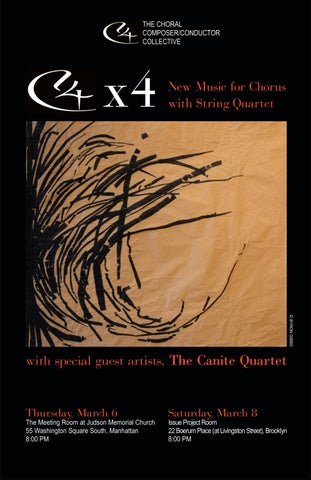
C4X4
C4 and The Canite Quartet New Music for Chorus With String Quartet
Thursday, March 6, 2014, The Meeting Room at Judson Memorial Church, New York, NY Saturday, March 8, 2014, Issue Project Room, Brooklyn, NY
Just *
Martha Sullivan (b. 1964)
Perry Townsend, conductor Martha Sullivan, Natalie Chamat, Suzanne Schwing, soloists
[Untitled] or, Hot Pink and Robin’s Egg Blue *
Mario Gullo (b. 1973)
One Brief Hour * Daniel Andor-Ardó, conductor
David Harris (b. 1974)
1. It’s Not Real 2. Saw You Once 3. The Other Day Martha Sullivan, conductor
Jim Bilodeau, beatbox
Dies Irae from “Appalachian Requiem”
1. Dies Irae: “Twilight in West Virginia: Six O’clock Mine Report” 2. Lachrymosa: “Appalachia, Where Are Your Hills?” Fahad Siadat, conductor Elena Belli, piano, Natalie Chamat, soloist
Michael Conley (b. 1970)
Intermission
Language Of The Birds
Veronika Krausas (b. 1963)
The Ecstasies Above
Tarik O’Regan (b. 1978)
1. Bird-song 2. At a very still spot 3. I saw one of them 4. The light of San Francisco 5. I put my cap in the cage Michael Conley, conductor Timothy Brown, conductor Natalie Chamat, Karen Siegel, Martha Sullivan, and Melissa Wozniak, Suzanne Schwing and Bettina Sheppard, Bill Heigen (Thursday), and Mario Gullo (Saturday), soloists C4 Alumni, guest vocalists * Premiere
Program Notes and Texts Writing for string quartet is a rite of passage
Take up justice
types of ensemble bring challenges that
Take up justice, bring it home
for composers, as is writing for choirs. Both demand thoughtful answers: How do we vary texture? How do we create different
(When?)
(When, oh when?)
(How long will it be?)
colors, when the instruments all belong
It will be
follows? Combining the two ensembles
When the now becomes a then,
to the same family? Who leads, and who raises additional questions, including: Who
accompanies whom? And: How does adding text change our perceptions of string music,
When the moments cease to roam, When the stars all from their dome Drop down again.
which has such a long history of crystalline
I would like to dedicate this performance
Welcome to this concert, in which the Canite
who was killed by a shot to the head during
purity, speaking but not symbolizing? Quartet and C4 explore these questions together, in works ranging from pure whimsy
to lamentations to exuberant celebrations of what gives our lives meaning. ~Martha Sullivan
Just Martha Sullivan The year 2013 posed some difficult moral questions, particularly around issues of gun regulation and race, separately and together. The day after the verdict in the Trayvon
Martin/George Zimmerman case, I found
myself in a dark mood and a sunny practice
to the memory of my cousin Meg Jordan, a domestic dispute a little over a year ago.
It has taken this long for the courts to deal with her murder; I will finally sing her to
rest in a May funeral. So hoping for justice may not be as futile as my words suggest, and perhaps there is some hope echoing in
the music. I do not mean this to be a polemic
about gun control; there are no clear answers about that issue. Ideally, any cry for justice should be about something bigger, namely, what one must do to be a responsible person
in the larger community of human beings. I
believe music makes that cry easier to hear. ~Martha Sullivan
copyrighted words I really wanted: “The arc
[Untitled] or, Hot Pink and Robin’s Egg Blue Mario Gullo
towards justice.” I am no rhetorician and
Sitting in a friend’s dorm room, in my
mix of grace and power, but here is what I
had scribbled in a notebook and found them
cubicle on a small college campus upstate, trying to wrestle words and notes into
something forceful, but unable to use the of the moral universe is long, but it bends
cannot hope to match Martin Luther King’s wrote:
undergrad days, I saw some writings that he to be very dramatic. We were both perusing
degrees in theater so everything we did was
into this world. Using this if-I-had-known-
more and obliged with two more angst-
to revise these 3 short pieces. Now I can
dramatic, right? I asked him if he had any
ridden quasi-poems. I told him some day that I would set them to music. After almost 20 years, the end result is finally here. I believe the document was dated 1994. Now
then-what-I-know-now mentality, I set off see my “dramatic” youth thru the eyes of someone approaching middle age and can chuckle.
I am showing my age.
Special thanks to Karen Siegel for her helpful
I set to work and found that they were
for his patience in showing me some Finale
not quite right so I put them away “in the
vault” to be revised at a later date. Finally, while approaching the age of 40 and going over unfinished projects, I realized that
the writings were not quite as dramatic as I thought.
In fact, they were more
comments while in development, Tim Brown tricks and his extreme patience, Martha
Sullivan for her thoughtful approach to conducting the piece, and Brian Mountford for helping to come up with the title (such as it is).
~Mario Gullo
early twenty year-olds, we humans have a
One Brief Hour David Harris
with our own insecurities and our desire
In Whitman’s finest moments, he writes love
melodramatic.
Sometimes, as teens and
heightened sense of fatalism; mostly to do
to figure out who we are and how we fit
poems to humanity that are directly inspired
by personal experience. One Brief Hour To Madness And Joy has long been a favorite
It’s Not Real It’s not real, they say, as they begin again, To unravel all that seems to be missing. None of them know what is missing. It’s just emptiness inside of him That needs to be filled with something He cannot find.
of mine for this reason.
In it, Whitman
captures the sensation of release; those moments when we are beyond our self, functioning on a seemingly different plane
where everything feels inevitable, taut and energized. He calls it the “mystic deliria”,
The Other Day Saw You Once Saw you once It came to me in the dark Just as the light went As I laid there waiting For everything to end Waiting For everything just to explode
The other day I was walking and I stopped. You actually stopped? Yes, I actually stopped. And looked down at the sidewalk and it was staring up at me. I wondered if I was backwards or upside down. So maybe we are all just nuts! Then I wondered if I was walking on the sidewalk Or was the sidewalk walking on me. Then I wondered does the anger of being walked over ever really go away. All this because I actually stopped. You actually stopped?
and describes it as a sensation found in the
build on one another and push forward
a new couple, a communing with nature in
somewhat reckless, firmly grounded, and
electricity of storms, the sensual freedom of
the beginning of time (paradise), the feeling as if “to have a gag removed”, and the sheer
with the sung parts. The whole should feel on edge.
~David Harris
necessarily intended to be understood, but
Dies Irae from “Appalachian Requiem” Michael Conley
patter. The sung music is repetitive, simple
I had had in mind the idea of writing a large-
power of feeling “sufficient as I am”. Much of the text in this piece is spoken and not
to act more as a bizarre, mindless, energetic and driving, while the strings play riffs that
scale work, using as supporting material
One Hour To Madness and Joy One hour to madness and joy! O furious! O confine me not! (What is this that frees me so in storms? What do my shouts amid lightnings and raging winds mean?) O to drink the mystic deliria deeper than any other man! O savage and tender achings! (I bequeath them to you, my children, I tell them to you, for reasons, O bridegroom and bride.) O to be yielded to you, whoever you are, and you to be yielded to me, in defiance of the world! O to return to Paradise! O bashful and feminine! O to draw you to me—to plant on you for the first time the lips of a determin’d man! O the puzzle—the thrice-tied knot—the deep and dark pool! O all untied and illumin’d! O to speed where there is space enough and air enough at last! O to be absolv’d from previous ties and conventions—I from mine, and you from yours! O to find a new unthought-of nonchalance with the best of nature! O to have the gag remov’d from one’s mouth! O to have the feeling, to-day or any day, I am sufficient as I am! O something unprov’d! something in a trance! O madness amorous! O trembling! O to escape utterly from others’ anchors and holds! To drive free! to love free! to dash reckless and dangerous! To court destruction with taunts—with invitations! To ascend—to leap to the heavens of the love indicated to me! To rise thither with my inebriate Soul! To be lost, if it must be so! To feed the remainder of life with one hour of fulness and freedom! With one brief hour of madness and joy.
traditional Southern hymns and folk music,
After reading and researching a great deal
article in, of all places, GQ magazine, on the
and culture of the region, and making a
for many years. But it wasn’t until I read an subject of mountaintop removal mining in
Appalachia, that the work started to take
shape. I was so appalled and disheartened by what I read that the idea of turning this
piece into a sort of requiem first occurred to me. Not a requiem in the traditional sense, with the intent of consoling the living on the
death of a fellow human being, but with the idea in mind of lamenting the loss of an old
and enduring culture, and a natural heritage that continues to be under assault.
The following is a succinct explanation
of this practice, published by an excellent resource called EarthJustice:
Mountaintop removal mining is a form of strip
mining in which coal companies use explosives
to blast as much as 800 to 1000 feet off the tops of mountains in order to reach the coal seams that
lie underneath. The resulting millions of tons of waste rock, dirt, and vegetation are then dumped
into surrounding valleys, burying miles and miles of streams under piles of rubble hundreds
of feet deep (well over 1,500 miles of streams to date). Mountaintop removal is devastating
on both the current situation and the history trip to West Virginia, where I enjoyed the
cool, green bliss of its hills and valleys, I stumbled on an amazing collection of poetry
by Appalachian women—an anthology of works dating from the 1800’s to the present,
and representing poets from a wide range of backgrounds, races, and cultures. It proved
to be just the treasure trove of inspiration
I was looking for. I decided to combine a number of poems with a few traditional
hymn tunes and texts, and to frame it all in an outline that followed the normal course of a Latin requiem mass, minus the Latin. The
Dies Irae excerpt which you will hear tonight began to gestate when I was inspired by
one particular passage of Irene McKinney’s powerful poem: “Above Slipjohn a six-
ton lumbers down the grade, its windows
curtained with soot. No one is driving.” The
idea of a menacing, out of control freight truck careening down mountain roads in the
dark was a metaphor that seemed to echo our modern relationship to the environment: out of control and no one is driving!
hundreds of square miles of Appalachia;
The original piece was scored for string
drinking water to millions of Americans; and
and Canite for this opportunity to expand
polluting the headwaters of rivers that provide destroying a distinctly American culture that has
endured for generations. While the economic and
environmental
consequences
of
mountaintop removal mining are staggering
trio and piano, and I am grateful to C4 the accompaniment with an additional violin to form a proper string quartet. ~Michael Conley
for the people—the farmers and miners
Language Of The Birds Veronika Krausas
traditions, and physical environments have
Language of the Birds was written in 2010 for
in their own right, it is the wanton disregard
and families whose homes, lives, hopes, been permanently erased—that makes this a tragedy that diminishes us all.
Magen Solomon, the San Francisco Chorale
Artists, and the Alexander String Quartet
to celebrate the 25th anniversary of the San
The Language of the Birds, an illuminated
inspired by the San Francisco artist Brian
open books with bindings positioned
Francisco Chorale Artists. The piece was
Goggin’s site-specific sculptural installation,
Dies Irae “Twilight in West Virginia Six O’Clock Mine Report” from Six O’Clock Mine Report (1989) ~Irene McKinney Bergoo Mine No. 3 will work: Bergoo Mine No. 3 will work tomorrow. Consol No. 2 will not work: consol No. 2 will not work tomorrow. Green soaks into the dark trees. The hills go clumped and heavy over the foxfire veins at Clinchfield, One-Go, Greenbrier. At Hardtack and Amity the grit abrades the skin. The air is thick above the black leaves, the open mouth of the shaft. A man with a burning carbide lamp on his forehead swings a pick in a narrow corridor beneath the earth. His eyes flare white like a horse’s, his teeth glint. From his sleeves of coal, fingers with black half-moons: he leans into the tipple, over the coke oven staining the air red, over the glow from the rows of fiery eyes at Swago. Above Slipjohn a six-ton lumbers down the grade, its windows curtained with soot. No one is driving. The roads get lost in the clotted hills, in the Blue Spruce maze, the red cough, the Allegheny marl, the sulphur ooze. The hill-cuts drain; the roads get lost and drop at the edge of the strip job.
flock of twenty-three translucent, suspended
to simulate the wings of birds in flight.
The fires in the mines do not stop burning. Hymn-tune: “Tribulation” (Sacred Harp) In vain to heav’n she lifts her eyes, For guilt, a heavy chain, Still drags her downward from the skies To darkness, fire, and pain.
Lachrymosa “Appalachia, Where are your Hills?” from Headwaters (1995) ~Sidney Saylor Farr Thank God for the mantling snow He sends to caress the ravaged hills. It covers the smell of the slag heap burning, it hides the scars that mar the mountains, and makes a shroud for murdered trees. I wish the snow would never stop. When father was a young boy the mountains were like nurseries for the creeks and the young rivers. They were rich in green-gold bounty and strong with wide black bones. They held and nourished our people. Now the people sit, slack-handed, from chill, dark dawn to hopeless night. They sit, dreamless and passive, waiting for a sedative sleep to come riding down on the snowfall— I pray the snow will never stop. Hymn-tune: “Winter” (Southern Harmony) His hoary frost, His fleecy snow, Descend and clothe the ground; The liquid streams forbear to flow, In icy fetters bound.
Words, taken from books by neighborhood
create a serene counterpoint, with long,
are scattered and embedded in the plaza as
voices bringing to life the shrouded, foggy
authors, including Lawrence Ferlinghetti, if the words have fallen from the pages. It is the first, permanent solar-powered public art piece in the United States.
static arching phrases in both strings and atmosphere of the texts. ~Michael Conley
Inspired by the Ferlinghetti snippet used
The Ecstasies Above Tarik O’Regan
fragments from Ferlinghetti’s “San Francisco
The Ecstasies Above takes for its title a phrase
the other two with trees and fog. Krausas
Allan Poe (1809 – 1849) which was first
in the installation, Krausas selected five Poems,” three of which deal with birds, and writes “I imagined walking from the lovely old trees in Marin County, across the Golden
Gate Bridge, through the fog into San Francisco where one might encounter all
found in the lyric poem, Israfel, by Edgar published in 1831 in The Southern Messenger.
The poem is set in its entirety with the exception of one stanza.
sorts of the interesting personalities, who
Through his creative description of the
with birds on their heads.”
a virtuous image of the supernatural. Poe
perhaps put their caps in a cage and go out
These five relatively brief movements are
almost like musical still-lifes, capturing a visual scene in a succinct, aurally descriptive
sound picture. They have the ambience of early twentieth century French composers like Poulenc and Satie:
quirky, with a certain musical
“je
ne
sais
quois” combined with
an emotional remove
that creates a mood of thoughtful, almost amused observation.
Movements 1, 3 & 5 are
lively, with sudden shifts
of dynamic, tempo, and
tessitura, and angular,
crisp rhythmic figures in the strings, while movements 2 and 4
angel, Israfel, and the heavens, Poe creates compares this heavenly vision to the harsh
reality of human existence. Whilst the
beauty of Israfel’s voice and lyre can silence even the moon and the stars in the heavens, Poe suggests that if Israfel were placed in
an earthly environment, he would not sing
with such zest. From the Koranic source
(full chorus, solo octet and string quartet).
is refashioned by Poe into an homage of
almost childlike in its playfulness and
of the name for the protagonist, the story ecumenicity to an all-encompassing angel of music.
Musically the score makes much use of
textural variation between the three groups
The tug of war between material that is
sections that seem more sombre reflect
my own thoughts on Poe’s œuvre. As a
European transplanted to North America, I am intrigued in the seeming disparity
between the quasi-adulation of Poe’s poetry
Language of the Birds Five fragments from San Francisco Poems and How to paint sunlight no. 1 Bird-song is not made by machines. Give your poem wings to fly to the treetops. ~from Great American Waterfront Poem no. 2 at a very still spot where the trees dreamed and seemed to have been waiting thru all time ~from In Golden Gate Park That Day… no. 3 I saw one of them I saw one with a bird on his shoulder ~from I Saw one of Them no. 4 The light of San Francisco is a sea light an island light And the light of fog blanketing the hills drifting in at night through the Golden Gate to lie on the city at dawn ~from The Changing Light no. 5 I put my cap in the cage And went out with the bird on my head ~from Quartier Libre ~ Lawrence Ferlinghetti
in Europe and the much cooler reaction
land first settled in the late 18th century by
environs.
Revolution. Visitors to Barhyte’s estate
he has always encountered in his native
I wrote The Ecstasies Above at Yaddo, a mansion now used as an artists’ retreat in Saratoga Springs, New York. Before Yaddo took its present form, it was an area of
Jacobus Barhyte, a soldier in the American included John Quincy Adams and Martin Van Buren, Washington Irving, James Fenimore Cooper and, most importantly in
the context my work, Edgar Allan Poe. He
visited in the early 1840s where he scripted
Israfel And the angel Israfel, whose heart-strings are a lute, and who has the sweetest voice of all God’s creatures. —KORAN In Heaven a spirit doth dwell “Whose heart-strings are a lute”; None sing so wildly well As the angel Israfel, And the giddy stars (so legends tell), Ceasing their hymns, attend the spell Of his voice, all mute. Tottering above In her highest noon, The enamoured moon Blushes with love, While, to listen, the red levin (With the rapid Pleiads, even, Which were seven,) Pauses in Heaven. And they say (the starry choir And the other listening things) That Israfeli’s fire Is owing to that lyre By which he sits and sings— The trembling living wire Of those unusual strings. But the skies that angel trod, Where deep thoughts are a duty, Where Love’s a grown-up God, Where the Houri glances are Imbued with all the beauty Which we worship in a star.
[Therefore, thou art not wrong, Israfeli, who despisest An unimpassioned song; To thee the laurels belong, Best bard, because the wisest! Merrily live, and long!]* The ecstasies above With thy burning measures suit— Thy grief, thy joy, thy hate, thy love, With the fervour of thy lute— Well may the stars be mute! Yes, Heaven is thine; but this Is a world of sweets and sours; Our flowers are merely—flowers, And the shadow of thy perfect bliss Is the sunshine of ours. If I could dwell Where Israfel Hath dwelt, and he where I, He might not sing so wildly well A mortal melody, While a bolder note than this might swell From my lyre within the sky. ~Edgar Allen Poe *omitted stanza
part of an early version of his most famous poem, The Raven.
The Ecstasies Above was commissioned from
the Robert Baker Commissioning Fund for Sacred Music by Yale Institute of Sacred
Music for Yale Schola Cantorum, Simon Carrington, Conductor.
~ Tarik O’Regan
Composers
Tri-State Center for the Performing Arts, the Depot Theater and with the Hudson Valley Philharmonic. He music has been performed by the New York City Master Chorale, Bridges Vocal Ensemble and C4.
David Harris is a conductor, composer and singer who specializes in new music,
American music, and the intricacies of
communication in choral singing and conducting. In addition to leading the Choirs
Martha Sullivan writes mostly for the human voice; sung words allow the
composer something concrete to hang
a story on. She has written for groups including the Dale Warland Singers, the
Esoterics, the Gregg Smith Singers, Voices of Ascension, and many others; her recent works have included a cappella pieces for
the Manhattan Choral Ensemble and the Pro Arte Singers (CT), a piece for choir and organ for the American Guild of Organists, and a work for choir and orchestra for Ars Musica
(NJ). Her awards include the Dale Warland Singers’ Choral Ventures prize and the Sorel
Medallion (bronze). Her works have been heard as far away as Tokyo and Zürich, and as close to home as Carnegie’s Zankel Hall. In addition to working with C4, Sullivan is
a freelance singer in NYC and is currently
pursuing her PhD in Music Composition at Rutgers. She is a member of ASCAP.
Mario Gullo has performed in and around
New York City at Alice Tully Hall, City Center, Theatre 80, Barrow Street Theater,
at College of the Holy Cross in Worcester,
MA, he is continually involved in new music productions. David has premiered
hundreds of pieces, and has championed long-forgotten works. As a composer, he
writes primarily for the voice, a cappella or with instrumental accompaniment.
Until
the past fall, he was a member of C4 and lived and worked in the City, conducting the
Brearley Singers and Chamber Orchestra, Brooklyn Youth Chorus, and the Columbia
University Glee Club, all of whom performed his compositions. Prior to life in New York, David lived in Colorado where he received
a DMA in choral conducting from CU, and began an a cappella touring choir for which
he wrote and conducted. Originally from Birmingham, David prepared the chorus
this past fall for the Alabama Symphony Orchestra’s celebrated premiere of Yotam
Haber’s A More Convenient Season, a work that
commemorated
the
Civil
Rights
movement through the story of the Four Little Girls on the 50th anniversary of their murder.
www.davidharrismusic.net.
By far,
Michael Conley has earned a notable
Cook at Carnegie Hall. Regionally, he has
for his multifaceted career as conductor,
La MaMa and Arlene’s Grocery.
his favorite was appearing with Barbara performed at Artpart, the Theater of Youth,
reputation in the United States and abroad pianist, organist, singer, and composer. The
New York Times has said of his work, “first-
rate conducting,” and of his compositions, “tuneful,”
“handsome,”
“ambitious,”
“piquant,” and “surprising.” He is in his
and musicals. He is currently writing an
opera on the subject of Frank Lloyd Wright, entitled Fallingwater.
14th season as Artistic Director of the West
The Globe & Mail (Toronto) writes that
Hudson Chorale in Westchester. He is the
lyrical sense of storytelling are supported by
Village Chorale and also conducts the Music Director at Judson Memorial Church,
where his also active as an accompanist and vocal coach. From 2004-2012 he was the Director of the High School Chorus
at the Dalton School, leading them in performances in Italy, Austria, Hungary, the Czech Republic, Germany and Spain. For
five seasons he was the Assistant Conductor
of the Collegiate Chorale and has also served as the Chorus Master for the Connecticut Grand Opera.
with The Gregg Smith Singers, The Dessoff Choirs, the Woodstock Fringe Festival, with the professional chamber chorus Manhattan
Voices, the caroling ensemble The Yuletide and
he
recently
joined
the
professional choir C4: The Choral Composer,
Conductor Collective (C4ensemble.org). As a member of the famed Westminster Choir,
he performed all over the world, including
Taiwan, South Korea, France, the Spoleto Festival USA, and on numerous recordings, including
Honneger’s
Jeanne
d’Arc
au
Bûcher with the New York Philharmonic,
and Dvorak’s Stabat Mater with the NJ Symphony.
a rigid formal elegance, give her audiences
a sense that nature’s frozen objects are springing to life.”
She has had commissions and performances by the Penderecki String Quartet, San Francisco Choral Artists and the Alexander String Quartet, Ensemble musikFabrik, Esprit Orchestra, The Vancouver Symphony,
ERGO Projects, Continuum Music, Toca
Loca, and Motion Music. She has music
As a singer, Mr. Conley has been a soloist
Singers,
Veronika Krausas’ “works, whose organic,
He completed his graduate
studies at Westminster Choir College, where he was a student of renowned choral
conductor Joseph Flummerfelt. He is the composer of numerous works in a range of mediums from chorus, orchestra, and
chamber ensemble to hymns, cabaret songs,
composition degrees from the University of Toronto, McGill University in Montreal,
and a doctorate from the Thornton School
of Music at the University of Southern California in Los Angeles. Krausas
has
directed,
composed
for,
and produced multi-media events that
incorporate her works with dance, acrobatics and video. Her chamber opera The Mortal
Thoughts of Lady Macbeth, based on Shakespeare’s Macbeth, was premiered at the New York Opera’s VOX 2008 festival.
Of Lithuanian heritage, she was born in
Australia, raised in Canada, and lives in Los Angeles. Krausas is an Assistant Professor in the Composition Department and the Assistant Director of Undergraduate Theory
at the Thornton School of Music, a lecturer at the Los Angeles Philharmonic, and an artist with Catalysis Projects.
Tarik O’Regan is “one of the leading British
composers of his generation” (Gramophone) who is writing “music of startling beauty”
unheard sound worlds with astonishing effect” (The Philadelphia Inquirer).
(The Observer), grew up in London, where
Recorded
childhood in Morocco and Algeria. Since
Music Sales Classical, O’Regan’s work has
he was born in 1978, spending some of his
2007 he has divided his time between New York City and Cambridge, England.
His recent projects include Suite from Heart
of Darkness for the Royal Philharmonic Orchestra
(2013);
two
North African-
influenced compositions: Raï, for the Dutch National Ballet, and Chaâbi, commissioned by the Australian Chamber Orchestra (2012);
a third solo album on the Harmonia Mundi
label, Acallam na Senórach; the premiere of
his first opera Heart of Darkness at the Royal Opera House, London (2011); and Latent
Manifest with the Royal Philharmonic Orchestra (BBC Proms commission, 2010).
Currently O’Regan is working on a full-
length ballet, commissioned by the Dutch National
Ballet;
and
large-scale
new
works for the Hallé Orchestra, Sydney
Dance Company, SOUK at the Royal Concertgebouw, American Opera Projects, and the University of Michigan. In 2014 he is the featured composer in the Vale
of Glamorgan Festival (BBC National
Orchestra of Wales, Chamber Choir Ireland) and New Music for a New Age (Washington Chorus).
His music is described as “exquisite
and delicate” (The Washington Post); “beautifully-imagined, holding the audience
rapt” (The Financial Times); “sublime: a
piece that you didn’t want to end” (The Times, London); and generating “previously
on
over
25
albums,
and
published exclusively by Novello & Co./
been recognized with: two GRAMMY® nominations (including Best ClassicalAlbum)
for Threshold of Night; a Gramophone
Award nomination for Scattered Rhymes;
the NEA Artistic Excellence Award, and a South Bank Sky Arts Award nomination for Heart of Darkness; and two British Composer Awards.
Guest Artists Elena Belli, Pianist, has appeared nationally
Opera and Orchestra, and the Music in the
chamber
musician,
with
prestigious
and an MA from Manhattan School of Music.
ensembles,
including
the
Metropolitan
and internationally as both a soloist and instrumentalists and vocalists from leading
Opera, the New York City Opera, the New
York Philharmonic, the Orchestra of St. Luke’s, and the Berlin Philharmonic. She has had residencies at St. Mark’s Church
in the Bowery and the Empire Center for the Performing Arts in Albany, performed
Mountains Festival Orchestra. She has a BA Ms. Belli is Chairperson and Coordinator of the AMTL Young Musicians Concert
at Carnegie Recital Hall. Piano faculty
positions include the Manhattan School of Music Precollege Division, Concordia College, and the Hoff-Barthelson Music School.
at Merkin Hall, CAMI Hall, Weill Recital
C4 Alumni
and played multiple broadcasts on WQXR
around the City and across the country who
Hall at Carnegie Hall, and Lincoln Center,
and WNYC-FM Radio. She has played a
broad array of world premieres, some of
them written expressly for her. She has also performed as a soloist with the Columbia Festival Orchestra, the Hudson Valley Philharmonic,
the
Connecticut
Grand
C4 has an extensive network of alumni
continue to act generously toward the group with their time and talents. Special thanks to C4 alumns Chris Baum, Melissa Bybee,
Franny Geller, David Harris, Amanda Keil,
and Joe Redd for their participation in The Ecstasies Above.
Canite!
Elizabeth Derham, violin Alex Shiozaki, violin Isabel Hagen, viola Sofia Nowik, cello. The Canite Quartet specializes in playing music with voice: Canite means Sing!. The
idea for this distinctive quartet came about after their performance of Samuel Barber’s Dover Beach at The Juilliard School. Since then the quartet has performed Arnold
Schoenberg’s String Quartet No. 2 op. 10, and participated in the premiers of several other works for string quartet and voice, including an arrangement of excerpts of Claudio
Monteverdi’s L’incoronazione di Poppea. Last year Canite premiered two new works for String Quartet and soprano by C4 composer Karen Siegel, Reflections on Espionage and
October in Galicia. Earlier this year they premiered Mark Adamo’s new arrangements of arias from his operas The Gospel of Mary Magdelene and Lysistrata in a concert for Opera
America. Beyond vocal repertoire, the quartet also enjoys playing 20th and 21st century string quartets, including the quartets of György Ligeti and Benjamin Britten.
Christine ersey and en Gerber, lgosaibi
“This is, quite simply, an amazing and excellent disc.” ~Fanfare Magazine
Volume 1: Uncaged
bat Mater estnutoak ang Ruo y, 2004), 87/2013), A World
C4 CD 4038
details at c4ensemble.org Baruch Performing Arts Center/St. Luke In The Fields
May 29th and 31st
Exploring the Spiritual
Upward
C4: The Choral Composer/Conductor Collective C4 is a collectively run vocal ensemble that seeks to enrich artists and audiences alike through passionate advocacy of new choral works: performing pieces written within the last 25 years, premiering in concert and commissioning new choral works, and mentoring emerging singers, composers, and conductors of today’s choral music. C4’s adventurous programming seeks to emulate the vibrant and diverse cultural life of New York, and the ensemble is committed to presenting exciting new music in a welcoming atmosphere.
Still to Come in C4’s “Innovate | Elevate Season” Digitally mastered, April 2013
Cover Image: “Spacecatcher” by Linda Shrank
C4: The Choral Composer/Conductor Collective Sopranos Natalie Chamat Liz Hanna Leslie Lopez Karen Siegel Martha Sullivan Melissa Wozniak
Altos Karen Devine Beth Marker Suzanne Schwing Bettina Sheppard Lisa Whitson-Burns
Tenors Mario Gullo Bill Heigen Eric Lamp Fahad Siadat Perry Townsend
Basses Daniel Andor-Ardó Hayes Biggs Jim Bilodeau Timothy Brown Michael Conley Brian Mountford
C4, the world’s first Choral Composer/Conductor Collective, is a unique vocal ensemble in New York City dedicated to performing music written in the last twenty-five years. A collaborative project of its singing members, it functions not only as a presenting ensemble in its own right, with a three-program, six-concert season, but also as an ongoing workshop and recital chorus for the emerging composers and conductors who form the core of the group. It is, as far as we know, the first ensemble of its kind. www.c4ensemble.org.
photographer: Keith Goldstein
For information on C4 members, visit our website c4ensemble.org/theensemble.html
C4 is pleased to be continuing what we hope will become a tradition in featuring the beautiful artworks by members of our “Friends of C4.” This season, we’re pleased to feature the works of Byron Gibbs in our publicity and concert materials for the entire season. Byron has also agreed to donate prints of the pieces which will be available for sale by auction late in the season. We hope you’ll watch for your opportunity to own one (or all!) of his beautiful works and help C4 at the same time.