THE CHORAL COMPOSER/CONDUCTOR COLLECTIVE
© BYRON GIBBS
1^ 5fU^Y^W _V >Ug 3X_bQ\ =ecYS 5h`\_bY^W dXU C`YbYdeQ\
4HURSDAY -AY
3ATURDAY -AY
Engelman Recital Hall/Baruch Performing Arts Center 55 Lexington Avenue (enter on east 25th between Lex/3rd Aves)
Church of St. Luke in the Fields 487 Hudson Street (south of Christopher Street) 8:00 PM
8:00 PM
(reception to follow)
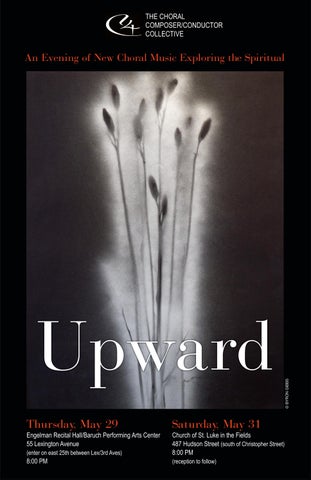
Silent Auction Benefit... Currently Underway! C4 is pleased to be continuing what we hope will become a tradition in featuring the beautiful artworks by members of our “Friends of C4.” We’ve been honored this season for the opportunity to feature the art of Byron Gibbs.
A born and bred New Yorker and graduate of Cooper Union, Byron made a career for himself in the advertising business, finishing that phase of his life as an Associate Creative Director for Saatchi & Saatchi. His most recent works include manipulation of color tissue paper in various ways. From this collection, we selected this piece for our season brochure and splashed it across the home page of our website. Images we selected from past phases of Byron’s work included pastel and pencil,
black paper on paper bag “canvas,”
and spray painted flowers.
We are now making Byron’s donated, one-of-a-kind prints of these pieces available for purchase in a silent auction with all proceeds going to benefit C4. Please take the opportunity to see these beautiful pieces and place your bids. Own your own Gibbs and support C4 at the same time! The auction continues through the evening of our final concert of the season, May 31. All of us in C4 THANK Byron, as well as past artwork contributors Linda Schrank and Anne Thulin, and the Friends of C4 for their ongoing support.
C4 Upward Thursday, May 29, Engelmann Recital Hall/Baruch Performing Arts Center Saturday, May 31, Church of St. Luke in the Fields The Spheres at Play
Bruce Saylor (b. 1946)
O Magnum Mysterium*
Fahad Siadat (b. 1982)
O Sacrum Convivium
Steven Stucky (b. 1949)
1. There Came a Wind Like a Bugle 2. Put Up My Lute 3. Musicians Wrestle Everywhere Michael Conley, conductor Colin Britt, conductor
from “Three New Motets” Melissa Wozniak, conductor
Wedding Motet: Tota pulchra es/Set me as a seal upon thine heart
Hayes Biggs (b. 1957)
Michael Conley, conductor Melissa Wozniak, Melissa Bybee, Colin Britt, Hayes Biggs, soloists
Anamnesis*
Liz Hanna (b. 1988)
Joseph Rubinstein, conductor
Two Devotions and a Heresy*
1. He Wishes for the Cloths of Heaven 2. To the Buddha 3. Troilet on a Line Apocryphally Attributed to Martin Luther Daniel Andor-Ardó, conductor Elizabeth Derham, violin, David Wozniak, saxophone
Perry Townsend (b. 1965)
Intermission
They That Wait Upon the Lord
David Hurd (b. 1950)
Martha Sullivan, conductor Melissa Wozniak, soloist
season of sorrow*
Timothy Brown, conductor Karen Siegel, Melissa Bybee, Joseph N. Rubinstein, Michael Conley, soloists; Bill Heigen, Hayes Biggs, cantors * Premiere
Thomas Stumpf (b. 1950)
We Kindle This Fire This Day
Ian David Moss (b. 1980)
Fahad Siadat, conductor
Sarasvati: A Hymn To The Goddess
Eric Banks (b. 1969)
Perry Townsend, conductor
Bar xizam (Upward I Rise)
Colin Britt, conductor Bettina Sheppard, Martha Sullivan, Bill Heigen, soloist
Abbie Betinis (b. 1980)
Program Notes and Texts Upward
tran·scend·ent, adj. 1. going beyond ordinary limits; surpassing; exceeding. 2. superior or supreme. 3. Theology (of the Deity): transcending the universe, time, etc. Compare immanent.
Why is there so much sacred music? Perhaps humans have always longed for
transcendence, have always reached for
something beyond this world, whether or not they believed that the Deity is immanent here below. The poetry chosen for this concert suggests that this is so. There are Latin texts,
each treated differently: Steven Stucky’s O Sacrum Convivium uses driving rhythms
to embody the longing for the Christian sacred banquet, unifying the human with the divine; Fahad Siadat’s dismemberment
and reassembling of many Marian texts of the early Church serves not to rob them of
power but to highlight their commonalities; and Hayes Biggs’ setting of texts from the
Song of Songs, a wedding gift for his wife on
their wedding day, is a gorgeous expression
of the joy of desire fulfilled. Using the English of the King James Version, the choir
in David Hurd’s They That Wait Upon the Lord
richly affirms Isaiah’s vision of rising up by the grace of God. There are of course many
rituals beyond those of the Judeo-Christian tradition; Ian David Moss’ modern pagan We
Kindle This Fire This Day, while assuming an immanent Holy One, nevertheless calls us to
notice the divine in this world. The best of sacred music also acknowledges the pain of
separation. Thomas Stumpf’s season of sorrow
combines the original Hebrew of Psalm 130 (Out of the depths have I cried to Thee) and its
German version with parts of De Profundis, Oscar Wilde’s letter from Reading Gaol
(where Wilde was incarcerated for sodomy); to be separated from the beloved, whether
God or a human beloved, creates immense longing. And still, the first words of Stumpf’s setting are the subtitle of the Hebrew psalm:
A song of ascents. Perry Townsend’s Two Devotions and a Heresy limn a variety of
longings: Yeats’ for his beloved; a Buddhist practitioner’s for wisdom and freedom
from the suffering of this world; and Martin
Luther’s (apocryphal) one for a compelling music. Music, of course, can point the way to
transcendence: Liz Hanna’s warm Anamnesis begins with her own words, “A bird flew
by me on the wing, and told me of worlds unknown; I longed for such a view.” Bruce Saylor’s The Spheres at Play sets three restless
Emily Dickinson poems about music. There is always a disconnect between this world
and the next, and music reaches across it,
final piece on the program is Abbie Betinis’
with energy and directness. Responding
century Sufi mystic Shams Hâfez-e Shirazi,
tantalizingly; Saylor’s music conveys this to a very different tradition, Eric Banks invokes the Hindu deity Sarasvati, goddess of music and all learning, in Sarasvati; the constant rhythms and use of traditional
scales draw the listeners away from the
mundane and toward the transcendent. The
The Spheres at Play There came a wind like a bugle There came a Wind like a Bugle; It quivered through the Grass, And a Green Chill upon the Heat So ominous did pass We barred the Windows and the Doors As from an Emerald Ghost; The Doom’s electric Moccasin That very instant passed. On a strange Mob of panting Trees, And Fences fled away, And Rivers where the Houses ran Those looked that lived that Day. The Bell within the steeple wild The flying tidings told, How much can come And much can go, And yet abide the World! Put up my lute! Put up my Lute! What of my Music! Since the sole ear I cared to charm, Passive as Granite, laps My Music, Sobbing, will suit as well as psalm! Would that the Memnon of the Desert Teach me the strain That vanquished Him When He surrendered to the Sunrise. Maybe that would awaken them!
Bar xizam, to a lyric poem of the fourteenthwho expresses the desire for transcendence perfectly, and so names this program: “On the day that I die … grant me but a glimpse of you, and then … free from the desires of life and this world: upward, I rise!” ~Martha Sullivan
The Spheres At Play Bruce Saylor I
wrote
“The
Spheres
At
Play”
a
cappella choruses in 2001, in the stand-alone version we hear tonight, in response to a
commission from the Nashville Symphony for a chorus and orchestral work, premiered in April of 2002. In my libretto for the Nashville piece, these Emily Dickinson
Musicians wrestle everywhere Musicians wrestle everywhere: All day, among the crowded air, I hear the silver strife; And—waking long before the morn— Such transport breaks upon the town I think it that “New Life”! It is not Bird, it has no nest; Nor Band, in brass and scarlet dressed, Nor Tambourine, nor Man; It is not Hymn from pulpit read,— The “Morning Stars” the Treble led On Time’s first Afternoon! Some say it is the Spheres at play! Some say that bright Majority Of vanished Dames and Men! Some think it service in the place Where we, with late, celestial face, Please God, shall Ascertain! ~Emily Dickinson
O Magnum Mysterium O Magnum Mysterium O Nata Lux de lumine Plena gloria sunt viscera tua O Maris Stella (Plena gloria sunt) Coeli et terra sunt tecum Coeli et terra sunt cum mysterio tuae aquae profundae. Nos membra confer effici tui corporis, Admirabile sacramentum. Monstra te esse matrem mundo. (ave gratia plena dominus tecum) (benedicta tu in mulieribus) O Great Mystery O Light born of Light Your womb is full of glory. O Ocean Star (full of glory) Heaven and Earth are with you Heaven and Earth are with the mystery in your deep waters. Let us be a part of your holy body That worthy sacrament. (Hail, full of of grace, the lord is with you) (Blessed are you among women) poems about music and sound open like
“windows” onto my selections from the vast Civil War visions of Walt Whitman’s “Proud
O Magnum Mysterium Fahad Siadat Not growing up as a Christian, I’ve felt conflicted by my attraction to liturgical poetry. I love that Latin is a ‘dead’ language,
its non-spoken aspect lends a sense of abstraction and mystery to the words, yet many maintain a perfect understanding of the text. The traditional metaphors
around the Nativity are equally compelling.
“Ocean Star” and “light born of light” have a transcendent quality that compelled me since I first heard them, but the direct references to a dogma I do not personally follow left me cold.
So I’ve appropriated my favorite parts of these texts for my own. The poetry references the most poignant metaphors and images from the Nativity, but removes any direct reference to Jesus or Mary. What remains is a
poem in veneration of childbirth’s mystery. I have tried to infuse the text with music that will convey my own feelings towards our
life-creating capacity: curiosity, awe, horror, shock, and deep respect. I hope you enjoy. ~Fahad Siadat
Music of the Storm.” In Dickinson’s astonishing poetic evocation of the furies of
O Sacrum Convivium
from Pharaonic Colossi of Memnon which
O sacrum convivium in quo Christus sumitur: Recolitur memoria passionis eius: Mens impletur gratia: Et futurae gloriae nobis pignus datur.
nature, of the mysterious sounds emanating might awaken a fallen beloved, and of her “music of the spheres”--the invisible form of vibrations coursing through both air and
matter, the poet creates a sound-world of her own, which I have had the privilege to set
to music and hear in the intricately crafted performances of C4. ~Bruce Saylor
O sacred banquet, In which Christ is received: The memory of His Passion is renewed; The mind is filled with grace, And a pledge of future glory given to us.
Tota pulchra es
Set Me As a Seal Upon Thine Heart
Tota pulchra es, amica mea, et macula non est in te. Vox dilecti mei, en dilectus meus loquitur mei: Surge, amica mea. You are all beautiful, my love, and there is no flaw in you. The voice of my beloved! Behold, my beloved speaks to me: Arise, my love.
O Sacrum Convivium Steven Stucky
Many waters cannot quench love, neither can the floods drown it.
The main material of the motet is the opening words Tota pulchra es, amica mea (“You are
Kansas City Chorale, the Grinnell Singers, the Seattle Pro Musica, and the Phoenix Bach Choir. The project was commissioned as part
of a national series of works from Meet The Commissioning
For love is strong as death: jealously is cruel as the grave.
unison melody for altos and tenors set to the
These Three New Motets were written for the
Composer
Set me as a seal upon thine heart, as a seal upon thine arm:
Music/USA,
which is made possible by generous support from the National Endowment for the Arts, the Helen F. Whitaker Fund, and the Target
Foundation. They were first performed on January 19, 2006, in Kansas City, with Charles Bruffy conducting.
all beautiful, my love”). The piece begins in a style that I would loosely describe as
neo-medieval, at times tinged with some influences of the sacred polyphony of the Renaissance. A solo quartet joins, continuing the Latin text. The first major stylistic shift in the piece is the reappearance of the initial
melody (with one octave-displaced note)
and words, now sung by the full choir in a much more lush, romantic harmonization.
This introduces the English text beginning with the words, Set me as a seal upon thine
~Melissa Wozniak
Anamnesis
Wedding Motet: Total pulchra es/ Set me as a seal upon thine heart Hayes Biggs
A bird flew by me on the wing, and told
This motet was composed in celebration of my marriage to Susan Orzel-Biggs, and is dedicated to her with all my love. It was
premiered at our wedding on January 16, 1999 by the Choir of All Saints Church, New York City, under the direction of Gail Archer.
me of worlds unknown;
I longed for such a view: the sun through my window was all I knew.
I yearned to follow where he flew, to
feel the rush of air in more than just my dreams.
Yet, dreaming, I came to remember the
song in the free bird’s eyes was always mine.
To claim the liberty of life, I give my life to love.
heart. The culmination of the piece is a mind and spirit may not actually destroy restatement of the romantic harmonization the physical wall, but they will profoundly of the initial Latin text a half step higher, transform one’s experience of it. My choice with the initial English words presented is to place the highest value on love and as a countermelody in the altos and second kindness, and in that striving, I am free tenors. A gradual winding down ensues, from so many of the tensions and struggles
and at the end of the motet a solo tenor voice that would otherwise chain my spirit. remains, singing a much slower variant of the Anamnesis is my declaration of that lesson. opening melody on the words “pulchra es.” ~Liz Hanna ~Hayes Biggs
Anamnesis Liz Hanna
Two Devotions and a Heresy Perry Townsend This piece utilizes the odd combination of
Just as we can choose to be or to create the choir, violin and saxophone, for the same things we wish to exist in the world, we can reason people climb mountains – because
Thankfully, C4 has an choose our lessons. What we learn from a they’re there. extended family which includes tonight’s given experience or trial is up to us. Anamnesis (the term comes from classical philosophy guest performers. The piece began with a and refers to a great remembering, as from a search for poetry that addresses spirituality past life) is, to me, about these choices. The in ways not yet represented on this program. words and music developed together, each What I found surprised and amazed me.
informing the other in a chain of listening Yeats’ familiar ode springs, perhaps, from a and experimenting. The story occurred to me notion dating back to Song of Solomon and
symbolically – the archetypes of bird and cage Francis Quarles, where the intertwining spoke strongly to me as I reflected on my own of God’s and man’s love for each other is seemingly insurmountable walls, seeking the compared to romantic love. Indeed, the way out but not fully understanding their instruments engage in much intermingling true nature.
The speaker in these lyrics is trapped in a
before the chorus intones Yeats’ plea to treat his heavenly dreams with care.
material cage, and wistfully regards the free I was immediately taken with the second bird in the air beyond, painfully conscious poem’s lyricism, honesty, and simplicity of the barrier between them and of the loss of expression. In it, a boddhisatva asks to associated with it. But the great remembering, “achieve some moments” of transcendence Not lots of which comes in a dream, is that freedom is beyond earthly suffering. about more than just physical circumstance. moments, just some. In my setting, a The cage and all its power is primarily a layering of voices opens up, lotus-like, into mental one, the experience of suffering based the gentle back and forth of her appeal. The
on unchallenged beliefs and fears. A free instruments’ intertwining motif now seems
1. He Wishes for the Cloths of Heaven
less romantic, more aspiring. Earth’s “ever-
Had I the heavens’ embroidered cloths, Enwrought with the golden and silver light, The blue and the dim and the dark cloths Of night and light and half-light, I would spread the cloths under your feet: But I, being poor, have only my dreams; I have spread my dreams beneath your feet; Tread softly because you tread on my dreams… ~William Butler Yeats
layer by layer. The author, a young English
2. To the Buddha May I devote my life to learning from you. I may be slow, I will stumble, But if I use my breath to move closer to you, And if I use my mind to glimpse you, And if I use my heart to Soften to you, Then perhaps I will achieve Some moments Free from, and beyond, These ever-turning realms In which we are embedded, And some change, At least, To this being, this form, That lies here. ~Wendy Stern
3. Triolet on a Line Apocryphally Attributed to Martin Luther Why should the Devil get all the good tunes, The booze and the neon and Saturday night, The swaying in darkness, the lovers like spoons? Why should the Devil get all the good tunes? Does he hum them to while away sad afternoons And the long, lonesome Sundays? Or sing them for spite? Why should the Devil get all the good tunes, The booze and the neon and Saturday night? ~A. E. Stallings
turning realms” undulate, then melt away, woman named Wendy Stern, has been
completely bedridden with a debilitating
illness for 15 years. Her poetry and Buddhist practice are her life’s focus. Working without
the ability to physically write, the poetry is dictated, and is thus vocal at its core. I was
especially struck by the contrast between
Wendy’s physical reality and the richness of
her inner life. As C4 composer Liz Hanna states, limitations aren’t always as powerful as they may seem.
Using the word heresy to describe the third movement is facetious at best. It’s really no heresy at all, nor a devotion, but a delightful
bit of poetic fun by A. E. Stallings, around Martin Luther’s famous reflection on the
Devil’s taste in music. In Stallings’ treatment, Luther seems to wish that God’s music had the captivating allure of the Devil’s “booze,
neon, and Saturday night.” My setting uses the instruments, especially the saxophone, to
illustrate this. In fact, several famous “good tunes” often associated with the Devil make
rollicking (and shameless) appearances here. A preacher once said he hoped God has a sense of humor. I agree. ~ Perry Townsend
“To the Buddha”, copyright © 2013 by Wendy Stern. Published 2013 by Buddhist Poetry Review. All rights reserved. Used by permission. “Triolet on a Line Apocryphally Attributed to Martin Luther” from Olives: Poems, copyright © 2012 by A. E. Stallings. Published 2012 by TriQuarterly Books/Northwestern University Press. All rights reserved. Used by permission.
They That Wait Upon the Lord David Hurd
season of sorrow Thomas Stumpf
David Hurd’s They That Wait Upon the Lord
The Psalms are thought to have been written
Saints Episcopal Church in Manhattan,
1400BCE and 530BCE. They are included in
The piece uses the richness of an eight-voice
Islamic Zabur. They are prayers of praise, of
in God. This modern setting exemplifies the
of wisdom. Psalm 130 combines expressions
4031, in the King James translation):
and of a genuine desire for redemption in
premiered on Easter Sunday, 1990, at All
(by mostly unknown authors) between
where Hurd was music director at the time.
the Jewish Tanakh, the Christian Bible, and the
choral sound to represent the joy of trusting
lamentation, of hope, of thanksgiving, and
tone of the prophet Isaiah’s words (Isaiah
of despair, of a deep trust in the divine,
They That Wait Upon the Lord
an ineffably moving manner and with a
They that wait upon the Lord shall renew their strength; They shall mount up with wings as eagles; They shall run, and not be weary; They shall walk, and not faint. Hurd opens the piece with slow and gentle
staggered entries of a pandiatonic chord— one with no notes outside the mode of the piece (D major). They sound clean and
warm, and the chord serves as a unifying
motif throughout. As the verbs change from
the static (“wait”) to more active, the music begins to move faster and to add more
notes outside of the D major scale. Musical lines ascend through strange whole-tone
sonorities to “mount up with wings”, and move quickly in eighth notes to “run and not be weary.” The rhythm eventually
slows, and the texture thins out to one solo
soprano voice, to exemplify walking. And at the end, the music unfolds into the opening chord of the piece with the same warmth
it embodied at the beginning, to confirm Isaiah’s reassurances in a long “Alleluia.” ~Martha Sullivan
wisdom that transcends eras and cultures.
My composition uses three separate texts sung by three separate groups. Two cantors sing the Hebrew psalm (v.1-6) in a kind of
quietly fervent non-tonal chant. A small SATB chorus sings Martin Luther’s 1524 translation of the psalm (v.1 and 5) in a kind
of non-tonal chorale that aspires to a deep simplicity. Four soloists sing excerpts that I put together from Oscar Wilde’s passionate
letter from Reading Gaol, known as De Profundis (the opening words of the Latin
translation of the psalm) - theirs is a slightly more tonal and more operatically expressive music. The various combinations of these groups are intended to create interesting
though hopefully never cluttered textures, harmonies, and contrapuntal structures. Just before the end all three groups combine to sing Oscar Wilde’s words: “Where there is sorrow, there is holy ground.”
Though I used some of the musical material in a previous composition, “season of
sorrow” is performed here for the first time, and is dedicated to C4 with affection and deep respect.
~Thomas Stumpf
We Kindle This Fire This Day Ian David Moss
to the canon, because those texts originate
When I was growing up, my mother used to
the Solstice prayers that my mother would
and the winter at friends’ houses. These were
“fire” referred to in this particular prayer
could sometimes top 60 or 70 people at their
sacred woods, which my Mom would pass
but feel an obvious pull to set sacred music,
explaining the significance of each one. Each
singing comes from a sincere expression of
branches given to them (and their energies,
to add yet another Ave Maria or Magnificat
~Ian David Moss
from a religious tradition that is not my own. Finally, I hit upon the idea of setting
lead Solstice celebrations for both the summer
recite every year at our friends’ houses. The
elaborate all-day events, and the attendance
is made possible by the collection of nine
peak. As a choral composer, one cannot help
around to the gathered participants while
since so much of the great tradition of choral
of those present then gets to add the sticks or
spiritual beliefs. Yet I felt a certain reluctance
if one so believes) into the fire.
season of sorrow Psalm 130 (in Latin, “De Profundis”) 1 shir hama`alot mima`amakim keraticha adonai 2 adonai shima vekoli tiyenah oznecha kashuvot lekol tachanunai 3 im avonot tishmoryah adonai mi ya`amod 4 ki imcha haslicha lema`an tivarei 5 kiviti adonai kivtah nafshi velidvaro hochalti 6 nafshi ladonai mishomrim laboker, shomrim laboker. Translation: 1 Out of the depths have I cried unto thee, O Lord. 2 Lord, hear my voice: let thine ears be attentive to the voice of my supplications. 3 If thou, Lord, shouldest mark iniquities, O Lord, who shall stand? 4 But there is forgiveness with thee, that thou mayest be feared. 5 I wait for the Lord, my soul doth wait, and in his word do I hope. 6 My soul waiteth for the Lord more than they that watch for the morning: I say, more than they that watch for the morning. Psalm 130 (in German, poetic) Aus tiefer Not schrei’ ich zu dir, Herr Gott, erhör’ mein Flehen! Dein gnädig’ Ohr neig her zu mir, Laß, was ich bitt, geschehen! Denn so du willst das sehen an, Was Sünd’ und Unrecht ist getan, Wer kann, Herr, vor dir bleiben? Ob bei uns ist der Sünden viel, Bei Gott ist viel mehr Gnade; Sein Hand zu helfen hat kein Ziel, Wie groß auch sei der Schade. Er ist allein der gute Hirt, Er, der sein Volk erlösen wird Von seinen Sünden allen. Translation: From deep affliction I cry out to you, Lord God, hear my pleading; incline your merciful ear to me and be open to my prayer! For if you want to look at what sin and injustice is done, who, Lord, can stand before you? Although there is much sin among us, with God is much more mercy; his helping hand has no limit, however great the harm may be. He is alone the good shepherd who can free his people from all their sins. (continued on next page)
De Profundis for us there is only one season: the season of sorrow of seedtime or harvest, of reapers bending over the corn, of grape-gatherers threading through the vines, of the grass in the orchard made white with broken blossoms or strewn with broken fruit of these we know nothing and can know nothing for us there is only one season: the season of sorrow where there is sorrow there is holy ground behind sorrow there is always sorrow, pain wears no mask: behind sorrow there is always a soul at the birth of a child or a star there is pain; out of sorrow have the worlds been built: built by the hands of love nature will have clefts in the rocks where I may hide and secret valleys in whose silence I may weep undisturbed she will hang the night with stars so that I may walk abroad in the darkness without stumbling she will send the wind over my footprints so that none may track me to my hurt: she will cleanse me in great waters and with bitter herbs make me whole ~from Oscar Wilde’s “De Profundis” (a letter he wrote to Lord Alfred Douglas while he was imprisoned in Reading Gaol)
We Kindle This Fire This Day We kindle this fire this day in the presence of the Holy One with nothing to fear beneath the Sun Thee we invoke O light of fire
O that which is life Be thou a bright flame before us Be thou a smooth path between us Be thou a guiding star above us Kindle within our hearts a flame of love to all who walk upon this good broad Green Earth.
Sarasvati: A Hymn to the Goddess Eric Banks
learn. She is often depicted with four hands
Sarasvati is the daughter of the Hindu god
in one hand, a lotus in another, and carries
that she endows humankind with the
and fourth arms. She often wears white, and
symbolizing four aspects of the human personality. She holds the sacred scriptures
Shiva and the goddess Durga. It is believed
the stringed instrument, the vina, in her third
powers of speech, wisdom, and the ability to
rides upon a swan.
She glows as brightly as the pearly winter moon, Her garments waft with aromatic jasmine in the morning dew. She bears her instrument, the vina, on her arm, And takes her seat upon a throne of lotus flower purest white.
She comes to us when we seek the truth, And answers the questions that we bring. She opens our eyes with morning light, And raises our voices when we sing. She polishes every tarnished heart, And clarifies every clouded mind.
She reigns, encircled and respected by the gods, Her ever-reaching wisdom is exceeded only by her grace.
She motivates every stagnant soul, And stimulates art of every kind.
O Sarasvati: Remove my apathy, Destroy my ignorance, Protect me.
To you we make our dedication. O wash us with your inspiration. Accept our humble meditation.
O Sarasvati! O mighty ocean!
Although Sarasvati is best-known as the
the Sarasvati vandana that I incorporated
many ancient texts as the goddess of all the
based on a performance by a Marathi singer
goddess of music, she is also referred to in arts, the dispenser of knowledge, the arbiter of abstract thought, and the custodian of the
river in India that bears her name. Sarasvati
vandana is the Hindu mantra that is sung on Sarasvati’s birthday, Vasant Panchami, five days after the first day of spring.
Since Sarasvati represents the free flow of
wisdom and consciousness, she is known as ‘the mother of the Vedas,’ and her vandana is recited as a prayer for higher understanding
at the beginning and end of all Vedic
lessons. In India, everyone from musicians
to scientists pray to her for guidance and knowledge.
Ever since my first trip to India in 2005,
into this piece is in raga Basant. It is
named Ninad Anil Shukla. I first heard Mr Shukla’s rendition of this mantra on
YouTube, and found it compellingly sincere,
so I transcribed it and adapted it for my piece.
The “groove” in this piece is based on a
layering of the nine lines of Vedic chant on top of each other, and extracting
unvoiced and voiced consonants (for vocal percussion), nasals (for droning), and vowels (for a whirling, “oceanic” effect toward the end of the piece). The translations of these
Sanskrit texts into English are my own, and are meant for the specific meter of this piece, 11/8.
~Eric Banks
I have wanted to compose a choral piece
Bar xizam (Upward I Rise)
that she represents. For my piece, I have
Waiting, where is the harmony of your voice,
blended two different musical influences
I am a dove from paradise, but out of this worldly cage:
vandana (mentioned above), and three
If, in your devotion, you call upon me to serve you,
that would honor this goddess and all incorporated
two
different
texts,
and
as well. The texts I chose are the Sarasvati
So that free from the desires of this life: I might rise? I shall rise.
verses from Vedic hymn (Rig Veda 1:3:10-12)
Then I promise, from the desires of life and this world:
from the Rig Veda with a pitch contour that
O Lord, from the cloud of your grace, let your rain fall
of chant, there are only three pitches: high,
Before it falls, from the midst of it all,
set the nine lines of Vedic chant with the
O rise up, with sweet gesture, and show me your
of Basant, one of the oldest ragas that still
With dancing feet: I rise.
that praises Sarasvati. I chose to set the text is used in ancient Vedic chant. In this type
medium, and low. In this piece, I elected to pitches E G# and A#, the first three pitches
I will rise. over and over. like a handful of dust: Let me rise. stature: lofty, like the cypress.
continues to be sung today.
With clapping hands: I rise.
Basant raga, which is associated with
Grant me but a glimpse of you,
Sarasvati and her birthday. The melody of
and this world: upward, I rise!
spring, provides the perfect association with
On the day that I die, in the span of a single breath, And then, like Hâfez, free from the desires of life
Bar xizam (Upward I Rise) Abbie Betinis
Composers
Minnesota-based composer Abbie Betinis
Bruce Saylor has received major awards
contemporary American choral music. Her
Merrill, and Mellon Foundations, from the
is quickly becoming an influential voice in style is diverse and eclectic, often balancing Middle
Eastern
and Asian
influences
with American shape-note singing and
traditional hymnody. Written in 2007 for Eric Banks’ ensemble, The Esoterics, Bar xizam is Betinis’ rapturous and rhapsodic setting
of one of the Persian mystic poet Shams
Hâfez-e Shirazi’s nearly 400 ghazals, or lyric
poems. Hâfez’ text is at once desperate and resolute, expressing the assurance that out of “this worldly cage,” the speaker will rise.
The poem excerpted for Bar xizam is also the one written on Hâfez’ tombstone.
Betinis captures this spirit of breaking free
from
earthly
bonds
with
three
primary compositional devices: first, the repeated modulation upward and increase
in dynamics at each new line of text; second, the gradual opening from vocal
confinement (humming through closed lips) to unrestricted sung melody; and
third, a repeated ascending glissando figure that imitates the Shepard scale, an auditory
illusion that implies perpetual ascent. The music builds dramatically through each stanza of the poem until, at last, the chorus
breaks through in a glorious exultation, as if finally standing in the presence of the
divine. After such a euphoric climax, all that can be uttered is a simple yet reverent
prayer for even a glimpse of that divinity. ~Colin Britt
from the Guggenheim, Fulbright, Ingram National Endowment for the Arts and the
New York State Council on the Arts, and from the American Academy of Arts and Letters and the National Society of Arts and Letters.
His orchestral works have
been commissioned and performed by
the Houston, Saint Louis, San Francisco, Nashville, and Yale symphony orchestras. He teaches composition at the Aaron Copland School of Music at Queens College and at the City University of New York Graduate Center.
Fahad Siadat specializes in contemporary and experimental music, particularly in improvisation and the use of extended
vocal techniques. As a composer, he focuses on music for the voice, but has written for
just about everything from Brazilian handpercussion to works for the symphony.
He is co-artistic director of The Resonance Collective in New York, an interdisciplinary
music/dance ensemble with collaborator
Andre Megerdichian and is a co-conductor of C4: The Choral Composer/Conductor Collective. He also conducts the Columbia University Glee Club and is voice faculty
at the Capezio Dance Center. In 2012, he
founded See-A-Dot Music Publishing, Inc., a company devoted to the advocacy of new choral works and emerging composers.
Fahad holds a Master of Fine Arts from the
California Institute of the Arts in Music
Performance and Composition with a focus
Festival and School, the Eastman School
in Theory and Composition from Vanderbilt
(Berkeley). A world-renowned expert on
on Vocal Music, and a Bachelor’s of Music University’s Blair School of Music.
He has written music for: C4: The Choral Composer/Conductor Collective, Smitten
Kitten Film Productions, the California
EAR Unit, New Century Players, CalArts
of Music, and the University of California Lutosławski’s music, he is a recipient of the
Lutosławski Society’s medal. He is a frequent guest at colleges and conservatories, and his
works appear on the programmes of the world’s major orchestras.
Singer’s Collective, TOCCATA Orchestra,
Hayes Biggs was born in Huntsville,
as public schools along the west coast. He
He holds the Doctor of Musical Arts degree
and Warrior Poet Theater Group, as well has also worked and performed with such
artists as Toby Twining, Frank Denyer, David Childs, Don Moye, John Lindberg, Amina Claudine Myers, and Meredith Monk. He is
an active performer of Brazilian music and dance and has performed with Capoeira
Narahari and Raizes do Brasil, is a rockclimbing enthusiast, and a tri-athlete.
Steven Stucky, born in 1949, has an extensive
catalogue of compositions ranging from large-scale orchestral works to a cappella miniatures for chorus. He is also active as a
conductor, writer, lecturer and teacher, and
for 21 years he enjoyed a close partnership
with the Los Angeles Philharmonic: in 1988 André Previn appointed him composer-inresidence of the Los Angeles Philharmonic, and
later
consulting
he
became
composer
the
for
orchestra’s
new
music,
working closely with Esa-Pekka Salonen. Commissioned by the orchestra, his Second Concerto for Orchestra brought him the Pulitzer Prize in music in 2005.
Steven Stucky has taught at Cornell
University since 1980 and now serves as Given Foundation Professor of Composition.
He has also taught at the Aspen Music
Alabama and raised in Helena, Arkansas.
in composition from Columbia University.
His teachers have included Don Freund, Mario Davidovsky, Jack Beeson, Fred Lerdahl and Donald Erb. Biggs has been
a fellow in composition at the Composers Conference and Chamber Music Center
at Wellesley, at the Tanglewood Music Center, at Yaddo, the Virginia Center for
the Creative Arts, the Millay Colony for the Arts and at the MacDowell Colony. Among his honors are a John Simon Guggenheim
Memorial Fellowship, as well as the 2001 Aaron Copland Award, which afforded
him the opportunity to live and compose at
Copland House in upstate New York during the summer of 2002. Since 1992 he has been
on the faculty of the Manhattan School of Music. brevis
Recent works include Symphonia
(2010),
composed
for
Riverside
Symphony, Psalms, Hymns & Spiritual
Songs (2011), for soprano Susan Narucki and pianist Christopher Oldfather, Three
Hymn Tune Preludes (2010), commissioned by organist Gail Archer, The Caged Skylark (2011), composed for C4, and The Trill Is Gone (2013), for solo tenor saxophone. Current
projects include Reveries. Passions, a quartet for piano and strings, and a work for violin
and piano for violinist Rolf Schulte. In 2006
Biggs’s String Quartet: O Sapientia/Steal Away
journey through sounds rich in surprises.”
City’s Merkin Concert Hall by the Avalon
Weill Recital Hall, Steinway Hall, Tenri
(2004) was given its premiere at New York
String Quartet on a Washington Square
Contemporary Music Society concert; it was
recorded by the Avalon String Quartet in 2008, and was recently released on Albany Records. Biggs’s music is published by C. F.
Peters Corporation, APNM (Association for the Promotion of New Music) and Margun Music, Inc. www.hayesbiggs.com Liz
Hanna
began
composition
after
(taught
the
exploring
attending
her
choral first
workshop in ensemble singing in 2009 by
Western
Wind
Vocal
Ensemble, for whom she now serves as Administrative & Workshop assistant).
Her work draws on her experiences as an improviser, instrumentalist, vocalist, and songwriter, and seeks to describe the awe and beauty of the human experience
and the natural world through harmonic expressivity. A graduate of Berklee College of Music and a licensed music therapist, Liz
has been the composer in residence for the NY-based community choir Chameleonic
during their 2013–2014 season, and has had several pieces premiered at Western Wind workshops in Northampton, MA.
Perry Townsend has been playing piano and singing since age 6, and composing since
age 8. These days, his music can be heard on
American Modern Recordings and Ravello Records. 21st Century Music magazine
remarked that his Capstone debut disc, no suggestion of silence, “stands out against the
vast array of contemporary music recordings available today.” Other critics have called his music “brilliantly intertwined” and “a
Past performances have included Carnegie’s Cultural Institute, and Roulette. He has been
commissioned by the Bowdoin International Music Festival, Barbad Chamber Orchestra,
Goliard Chorale, and Raleigh Boychoir. Perry has also premiered works at the ppIANISSIMO Festival in Sofia, Bulgaria,
and the Fontainebleau Summer Festival
in France. As a conductor, he leads the Angelic Voices Youth Chorus, Community
Singers of Queens, Immaculate Conception
Contemporary Ensemble, and is Music Director at Incarnation parish in Hollis, NY.
As a vocalist, he has sung with the Choir of the Church of St. Mary the Virgin and with
Canticum Novum. He received an MA from Copland School of Music/Queens College, where he studied composition with Thea Musgrave, and a BM from N.C. School of
the Arts, where he studied with Sherwood Shaffer. Currently, Perry is working with
acclaimed mezzo Tichina Vaughn to create
an opera about Christine Miller, the lone dissenter at Jim Jones’ Guyana commune in 1978.
A native of Brooklyn, David Hurd is one of the most respected church musicians of his
generation. He studied at Juilliard, Oberlin, and the University of North Carolina,
Chapel Hill, and has taught at Duke, Yale, and the General Theological Seminary in New York (where he is Professor of Church
Music and Organist). He has served as organist and/or choir director at several churches in New York, including Trinity Church, Wall Street; All Saints Church; and
The Church of the Holy Apostles. He is a highly regarded recitalist and improviser,
and has performed many times at regional
and national conventions of the American Guild of Organists. A well-known composer
C4 has previously performed three other of his compositions.
of liturgical music, Hurd has received many
He is Director of Music at Follen Church
choral works. He is widely published;
where he has conducted choral repertoire
commissions for instrumental, organ, and his music appears in many hymnals. His authority is respected: he served on the
Standing Commission on Church Music of the Episcopal Church from 1976 to 1985,
and he holds several honorary doctorates.
In addition, David Hurd serves on C4’s Board of Directors.
Thomas Stumpf received his degrees in
piano performance from the Mozarteum
in Salzburg, Austria, and the New England Conservatory of Music in Boston. He was
awarded the Bösendorfer Prize and the Lilli Lehmann Medal. He has appeared with the
Hong Kong Philharmonic and the Boston
(Unitarian-Universalist) in Lexington MA, ranging from Bach’s Magnificat to the Mozart and Fauré Requiems to the Sacred Concerts of Duke Ellington. He also conducts the
Follen Youth Choir, with whom he directs a
Gilbert and Sullivan production every June. His experience at Follen has led to his first
book: A Sounding Mirror: Courage and Music in Our Time, published by Higganum Hill Books in 2005. He is also the co-founder
and Artistic Director of Prism Opera, and has conducted and directed Mozart’s La
Clemenza di Tito (in his own translation), as well as operas by Britten, Vaughan Williams and Holst.
Pops Orchestra (under Arthur Fiedler).
Stumpf has taught piano at the New England
pianist, and in that role, he has performed
he was Chair of the Collaborative Piano
Stumpf is a well-known collaborative with Rita Streich, Edith Mathis, D’Anna Fortunato, Richard Stoltzman, Jack Brymer, Walter Trampler and Leslie Parnas, among
Conservatory and Boston University (where
Department from 1990 to 1997). He is presently on the faculty of Tufts University.
many others.
Ian David Moss is co-founder of C4: The
He has premiered many compositions by
He began his musical studies at the age
contemporary American composers and is a composer himself. His compositions have appeared on programs throughout the U.S. as well as in Russia and Germany;
he won the Kahn Award for his music theater project “Dark Lady,” one section of
which was recorded by Joan Heller for the Albany label. Choral works of his have been
performed by the Master Singers (Lexington, MA), the Oberlin Women’s Chorale, and in New York City by the Pharos Music Project.
Choral Composer/Conductor Collective. of 12 by transcribing classics from the
Wee Sing songbook for his computer’s monophonic PC speaker with the help of
his violin-teacher downstairs neighbor.
Despite not receiving any formal musical training before the age of 17 (he didn’t even know what a chord was), he graduated
from Yale University with distinction in the music major, intensive track, serving
as the Undergraduate Assistant Conductor
of the Yale Glee Club and for two years as
founder and president of the Yale College Composers’ Group.
Moss’s music unabashedly combines the ethereal with the gutteral, as demonstrated
by the long-held lush harmonies in his
choral works and the intense metrical
of his graduate study, Banks was awarded a Fulbright Fellowship to study Swedish contemporary choral culture. While in
Stockholm, Eric sang as a soloist in several
ensembles, including the Swedish Radio Choir and the Eric Ericson Chamber Choir.
syncopation found in his pieces for electric
In 1992, Banks founded the professional-
an experimental rock band Capital M,
Now celebrating its twenty-first season
chamber ensemble. In 2004, Ian founded which sought real and total integration of the instruments and sounds from rock
music with the conceptual underpinnings
of contemporary classical. In addition to Capital M, Ian’s music was performed or
read by ensembles including the Princeton Singers, Forecast Music, Cerddorion, Due
East, the Choral Arts Society of Philadelphia, the Yale Symphony Orchestra, and the Way Blue Bucket. His piece Miniatures for violin
and marimba premiered in Alaska at the
20th Annual Juneau Jazz & Classics Festival in May 2006.
Ian has been on hiatus from composing since receiving an MBA with an emphasis in
arts and public policy from the Yale School
of Management. He is currently Research Director for Fractured Atlas, a national
arts service organization that empowers
caliber chamber chorus, The Esoterics.
under Banks’ direction, Seattle’s most innovative chorus has drawn international
praise for performing new and rarely-heard compositions of contemporary music for
unaccompanied voices, and for performing
settings of poetry, philosophy, and spiritual writings from around the world.
The
Esoterics has performed over 400 concerts
throughout the Pacific Northwest, has toured internationally to compete three times, has mastered many of the most
virtuosic choral works of the last century, and has commissioned and premiered
over 200 new works for a cappella voices in dozens of languages. The Esoterics has
also released sixteen CD recordings, and has
been honored four times with the ASCAP/ Chorus America Award for the Adventurous Programming of Contemporary Music.
artists, arts organizations, and other cultural
Eric has been awarded grants from the Arch
barriers to artistic expression. Ian writes
Seattle City Artists, the San Francisco
sector stakeholders by eliminating practical regularly about the arts in a creative society at his blog Createquity.
Hailing from Roscoe NY, Eric Banks completed his BA in Music at Yale University (1990). He then relocated to
Seattle for graduate study at the University of Washington. In 1997, at the conclusion
and Bruce Brown Foundation, 4Culture, Arts
Commission,
New
Music
USA’s
Composer Assistance Program, Artist Trust,
the Washington State Arts Commission, ASCAP Plus, and three Creativity grants from the NEA. In 2010, Eric was granted
the prestigious Dale Warland Singers Commission Award from Chorus America
and the American Composers Forum. Eric has been commissioned by the Atlanta
Young Singers, Boston Children’s Chorus, Clerestory, Conspirare, Kitka, the Philippine Madrigal Singers, the Singapore Youth
Ensemble Singers, the Verge Ensemble, and Voces Nordicæ. Last year, Eric completed
a series of three chamber operas on Pacific Northwest native ecosystems for Seattle Opera; these will be remounted by Seattle Symphony in 2014.
Winner! C4 Recognized by Chorus America/ASCAP for Outstanding Programming We’re proud to announce that C4 has been honored with a 2014 Chorus America/ASCAP Award for Adventurous Programming. The awards recognize choruses that demonstrate a sustained commitment to adventurous programming through performances of choral music written in the last 25 years. We thank Chorus America for this honor, validating the importance of our mission. And it couldn’t be a better fit: forwarding great choral music of the last 25 years is what we do!
C4: The Choral Composer/Conductor Collective Sopranos Natalie Chamat Liz Hanna Karen Siegel Martha Sullivan Melissa Wozniak
Altos Melissa Bybee Karen Devine Beth Marker Bettina Sheppard Lisa Whitson-Burns
Tenors Colin Britt Mario Gullo Bill Heigen Joseph Rubinstein Fahad Siadat Perry Townsend
Basses Daniel Andor-Ardó Hayes Biggs Jim Bilodeau Timothy Brown Michael Conley Brian Mountford
C4, the world’s first Choral Composer/Conductor Collective, is a unique vocal ensemble in New York City dedicated to performing music written in the last twenty-five years. A collaborative project of its singing members, it functions not only as a presenting ensemble in its own right, with a three-program, six-concert season, but also as an ongoing workshop and recital chorus for the emerging composers and conductors who form the core of the group. It is, as far as we know, the first ensemble of its kind. www.c4ensemble.org.
photographer: Keith Goldstein
C4 Board of Directors
Gregory Eaton - Chair Hayes Biggs Jonathan David David Hurd Ian Moss Karen Siegel Melissa Wozniak
For information on C4 members, visit our website c4ensemble.org/theensemble.html
C4 is a proud member of the New York Choral Consortium
C4 “Volume I: Uncaged” Is a Hit! CD 4038
C4
abat Mater hestnutoak uang Ruo ny, 2004), 987/2013), s A World
l, Christine Hersey and ven Gerber, Algosaibi
Volume 1: Uncaged
“This is, quite simply, an amazing and excellent disc, featuring six new choral works conducted by various members of the group... I found this disc so stunning and enjoyable…” ~ Lynn René Bayley, Fanfare Magazine “C4 has already built a steady following for their live performances, and “Uncaged” is hopefully just the first in a long line of recordings.” ~ Molly Yeh, WQXR, Q2 Album of the Week Article “I must say that the programming grabbed my attention – they certainly delivered in terms of their niche! ... executed well throughout with nuance and a keen sense of musicianship.” ~ Audiophile Audition available for purchase after the concert or at http://www.c4ensemble.org/c4-uncaged-release.html
C4 Acknowledgements We wish to thank and acknowledge:
Vic and Jan Bilodeau Melissa Bybee Don and Sally Hayward Susan Koshewa Linda and Leslie Lebow Ruth Mueller-Maerki Beth Marker
Edward and Rose Mermelstein Tammie Murphy Betsy Magee and Mark Pecker Jonathan and Suzanne Rosenweig Daniel Sigg and Ellen Stafford-Sigg Kenneth and Jean Telljohann
Stanley and Nanette Lieblein Phoebe Abelow Peter Luyre Richard Adams Sara Lynch Laura Barger David J. Macdonald Bruce Saylor and Constance Molly McEneny Beavon Juliet Milhofer Sara Blumenthal Michael and Roberta Nassau Kristina Boerger Bernard and Rochelle Natt Lewis and Brenda Brown Charles Natt and Karen Siegel Margaret Brown Thomas L. and Constance B. Sandra Carlson Newberry Henry Clapp Tarik O’Regan Martin and Lisa Cohen Susan Obel Bill and Lauren Crow Raymond Penn Nicholas DiDomizio Jane Penn Kim and Steve Erle Jeffrey Ramras Reyna Franco Daniel Reid Lily Friedman Christine Schadeberg Ellen Gessmer Katherine Schoonover Leila Ghaznavi Phillip Schroeder Jeanine Hartnett Edward Shiner David Heyward Patricia and Lawrence Siegel Arthur and Eileen Hirsch Mr. and Mrs. Bob Sweeney Ira and Becky Horowitz Mary Tsimenoglou Elsie Hunter Ira Wolfman Linnea Johnson Kathryn Klein Eddy
FRIENDS OF C4 Noa Ain Nathan Allman Stephen Burrow Peter and Katherine Darrow Vincent Fitzgerald Byron Gibbs Ernest Hood Fran Kaufman Ellen Kruger David McCorkle Ivana Mestrovic Zahra Partovi Ami Ronnberg Tana Ross Linda Schrank Kit Smyth-Basquin Milton Sonday Gina Speirs Anne Thulin Judith Walz Susan Weil
We also wish to express our heartfelt thanks and appreciation to Baruch Performing Arts Center and Church of St. Luke in the Fields, Suzanne Schwing for her work on social media this concert cycle and David Harris for designing and producing our programs
The Activities of C4 are Funded in Part With Generous Support From