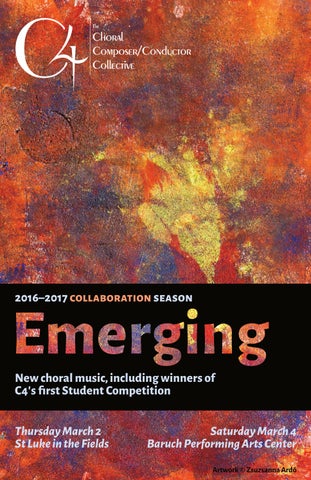
Emerging 2016–2017 collaboration season
New choral music, including winners of C4's first Student Competition
Thursday March 2 St Luke in the Fields
Saturday March 4 Baruch Performing Arts Center Artwork © Zsuzsanna Ardó
C 4 : T h e C h o r a l C o m p o s e r / C o n d u c t o r C o l l e c t i ve
Collaborations: Emerging Wi n n e r s o f C 4 ’ s F i r s t S t u d e n t C o m p e t i t i o n , a n d O t h e r W o r k s Thursday, March 2 and Saturday, March 4, 2017, at 8:00pm Church of Saint Luke in the Fields and Baruch Performing Arts Center, New York, NY
Canciones para una cosa y otra* Melissa Wozniak, conductor Noele Flowers, soprano
Carlos Pérez Tabares (b.1993)
Undergraduate Student Competition Winner
Consent
Ted Hearne (b.1982)
Seawall*
Jamie Klenetsky Fay (b.1984)
Seikilos*
Perry Townsend (b.1965) Poem: Zsuzsanna Ardó
Jacob Gelber, conductor
Karen Siegel, conductor Daniel Andor-Ardó, conductor Christina Kay, Rebecca Ehren, sopranos; Erin Halpin, Leonore Nelson, altos; Benjamin Arendsen, Nathaniel Barnett, Grant Yosenick, tenors; Hayes Biggs, Brendan Littlefield, basses
Be on Time!*
David See (b.1958)
Casey Rule, conductor
Intermission The Garden Mother*
Ben Arendsen, conductor Christina Kay, Rebecca Ehren, Karen Siegel, sopranos; Maya Ben-Meir, alto; Grant Yosenick, tenor Mioi Takeda, violin Jane Lawson, cello Nicholas Schwasman, hand percussion
Time Passes
Perry Townsend, conductor Noele Flowers, Karen Siegel, sopranos; Elizabeth Marker, Leonore Nelson, altos; Benjamin Arendsen, Joseph Prestamo, tenors; Jacob Gelber, Brian Mountford, basses
Nature is What We See*
Nathaniel Barnett (b.1992)
Ben Zucker (b.1993)
Graduate Student Competition Winner
Filip Holacký (b.1993)
Nathaniel Barnett, conductor
Pre-College Student Competition Winner
Messages to Myself
Christopher Theofanidis (b.1967)
Ben Arendsen, conductor
* Premiere
Program Notes and Texts Collaborations: Emerging As always, C4 loves you. We are grateful to you for showing up for new music for voices, whether it is your first time here or your 25th. As always, you are about to hear some premieres, some music that nobody has yet heard live, as well as recent works we consider important. This concert is different, though. We are making music in a time of arguments, when many public voices lay claim to “truth” but none can agree, even if some objective truth existed. Left and Right clamor to be heard. Artists do not always know how to respond, or whether response is possible. Legislation may change our funding or our status as non-profits—we do not know what’s coming next, and it’s hard to know what to say or how to say it. That’s why this concert is particularly important. Tonight we sing the winning pieces from our first Student Composer Competition, by composers Filip Holacký, Carlos Pérez Tabares, and Benjamin Zucker. Each brings to his work a clear and distinctive voice, one that cuts through the confusion of voices on air and online to create music that transcends politics. These pieces are for now and for the future, and we hope that our advocacy for them leads to new performances and new compositions by these composers. Listen to them. Works by C4 composers vary widely in theme and style, from the overtly political “Seawall” of Jamie Klenetsky Fay to David See’s more wry take on what foreign can mean, and from the personal music of Nathaniel Barnett’s “The Garden Mother” to Perry Townsend’s fusion of ancient Greek
funeral poetry with Zsuzsanna Ardó’s original text. We round off the program with masterworks by Ted Hearne and Christopher Theofanides—“Consent” and “Messages to Myself”—that evoke in one case the struggle between force and partnership, and in the other, the universal ideas put forward in poetry by Rumi, Whitman, and others. Nothing can compare with massed voices joining together to sing these words. Again, listen to them. C4 does not support one political position or another. However, we are committed to making art and supporting people who create new music. In a time of distraction and noise, we need new voices, new sounds, new clarity. Thank you for being here to hear them. —Martha Sullivan
Canciones para una cosa y otra Carlos Pérez Tabares
My parents always supported me in my decision of becoming a musician. Especially my father, who is an artist himself. Anyway, finding myself in the midst of the struggle, I wondered how such a strong, down-toearth and strict person could be the first one encouraging me to keep going down this uncertain path. One day I bumped into one of his old poetry notebooks and the mystery was solved: I was able to see a more human and sensitive side of him, and most importantly, I was able to see myself and trace the spiritual bond that connects us. From that notebook I have chosen the three
poems that are part of this cycle. All of them are short, acting almost as aphorisms, yet full of color and beautiful images that connect divinity with the deepest human angst: cosmos and microcosmos. The first song depicts a blurred humanity mingling with light and colors of the motherland. The second one sets a storm free in that kingdom of light succumbing to one’s innermost angst. The third one sublimates the effect of the first two by having the moon (the soloist) sing a song that leads one’s return to God. —Carlos Pérez Tabares Text: I. La luz de mi país es uno de mis atributos Hablo con azules Me entiendo con la espuma Sueño en tonos chillones y resucito cantando Digo soy porque lo sol
Consent
Ted Hearne
text culled by Ted Hearne, from the following sources: love letters I wrote in 2006 love letters my father wrote in 1962 The Catholic Rite of Marriage Traditional Jewish Ketubah (Wedding contract) text messages by Trent Mays and Lucas Herrington, used as evidence in the Steubenville Rape Trial, 2013 “The purpose of these untranslated and mystical utterances was to sidestep the Devil and to reach God directly.” - Teju Cole, in an essay about Loquebantur Variis Linguis and the tradition of “speaking in tongues.”
The light of my country is one of my attributes I speak with blue shades I get along with foam I dream in loud tones And I’m reborn singing Digo soy, porque lo sol* (I say sun because I’m so)
“There is a gestalt that orders things together, and if you pull back further, there’s another order there; the things are arranged they are for some reason, it might not be a rational reason, but there is a reason.” - David Byrne, regarding his album with Talking Heads, Speaking in Tongues
II. Huele a nubes en el sol Llueve y no sé hasta qué lugar de adentro
I originally wrote Consent to be paired with a performance of the remarkably beautiful motet Loquebantur Variis Linguis by Thomas Tallis, in which the composer sets the text “the apostles spoke in different tongues.”
It smells like clouds in the sun It rains and I don’t know whither inside III. Canta la luna en el recuerdo Huele a Dios cuando respiro The moon sings in the memory It smells like God when I breathe
The above ideas — that to communicate with the holy spirit one had to bypass language entirely, that the structure and meaning of language is inextricably linked to the power structures and hierarchies that created it — set me on a journey to explore language that might have a duplicitous role in my own life. The text for Consent is a juxtaposition of
passages from five different sources: love letters I wrote in 2002, love letters my father wrote in 1962, the Catholic Rite of Marriage, the Traditional Jewish Ketubah (wedding contract), and text messages by high-school students Trent Mays and Lucas Herrington that were used as evidence in the infamous Steubenville Rape Trial in 2013. I set these words in order to explore my personal relationship to gender inequality and our connection to language that justifies sexual violence. —Ted Hearne Text: i want you i want to I do. I was thinking penetrating thoughts about you It will be good, we can do it, and we need it. It can be taken from me - even from the shirt on my back. I was thinking penetrating thoughts about you It will be good, we can do it, and we need it I miss you too, in a heart-aching kind of way. All of it shall be mortgageable and bound as security It can be taken from me - even from the shirt on my back. I do. I just took care of your daughter. *** Declare your consent The missing you hurts You’ll be in it soon What a way to feel Who gives this woman *** i want you i want to All of it shall be mortgageable I just took care of your daughter and bound as security she said you could take a picture
i want you i want to I just took care of your daughter and made sure she was safe she was so in love with me that night I ask you to state your intentions All of it shall be mortgageable and bound as security it can be taken from me, even from the shirt on my back during my lifetime and after this lifetime, this day and forever. I just took care of your daughter and made sure she was safe she said you could take a picture she looks dead lmao *** I do. I was thinking penetrating thoughts about you It will be good, we can do it, and we need it. I miss you too, in a heart-aching kind of way I’m really looking forward to adding to it All of it can be mortgageable and bound as security it can be taken from me - even from the shirt on my back during my lifetime and after this lifetime this day and forever How have you been holding out on me with that picture for so long? she said you could take a picture oh i am looking at all my pictures of you You don’t even want to know what I’m imagining you doing right now she was so in love with me that night Declare your consent before God I just took took care of your daughter when she was drunk
*** This original amount, I accept upon myself and my heirs after me It can be paid from the best part of my property and possessions that I own under all the heavens. All of it shall be mortgageable and bound as security it can be taken from me even from the shirt on my back during my lifetime and after this lifetime from this day and forever. even from the shirt on my back she said you could take a picture I refuse to get excited Will you accept children lovingly from God? Declare your consent before God and the church. I felt knowing what was right she looks dead lmao i just took care of your daughter but i also know we are equal to almost any… she said you could take a picture Who gives this woman?
Seawall
Jamie Klenetsky Fay Seawall is a reaction to an article I read about possible seawall construction in Lower Manhattan, meant to stave off the rising oceans due to climate change. The idea of building a seawall brings up many important questions - where is it built? What neighborhoods won’t be protected? What other infrastructure needs to be improved (bridges, tunnels)? Who do we protect, and how do we protect them? And assuming
sea level rise is an inevitability, do we simply leave New York behind? Is that, too, inevitable? I didn’t attempt to answer these questions in Seawall, but simply raise them, and reflect on the enormity of the situation, the starkness of our changing climate. The piece focuses on dynamics - ocean swells - and a sense of stillness. It reflects an individual’s emotional reckoning with a problem that is much, much larger than one person. —Jamie Klenetsky Fay
Text: The seas are rising How soon we forget that we’re on an island The tracks go on for miles The shoreline creeps into the tunnels It will rise. And who will we protect? The numbers on the ledger? The people in the station? They will rise. It will rise. We must rise.
Seikilos
Perry Townsend Poem: Zsuzsanna Ardó, Seikilos Once upon a time, around the first century A.D., a Greek man carved a short song onto a tombstone, probably his wife’s, and signed it Seikilos. We know it’s a song because above the poetry are symbols of ancient Greek music notation. Since the song was set in stone, it has survived, while most other ancient Greek scores disintegrated with the papyrus they were written on. Thus, the Seikilos Epitaph is the oldest surviving complete piece of
notated music we have. Fittingly for a song appearing on a tombstone, its message is basically “Carpe Diem.” Or as he puts it, “While you live, shine.”
advisements are reassuring, such as that it’s fine to laugh open-mouthed in public, or that it may be easier here than it is back home to recover from failure and start again.
When Zsuzsanna Ardó showed me her poem last year, I was fascinated. She weaves the Seikilos text through a gorgeous swirl of thoughts on composers old and new, on their craft and their dreams, on their common goal throughout many centuries “to express the inexpressible.”
A few of the sources seem to be semi-official travel guides. Others are bloggers venting sardonically about the day’s frustrations. Yet others are random commenters on internet chat forums. The nationality of each writer is not always flagged in the course of this piece (or even sometimes in the original forums), but their known origins include England, Germany, Japan, China, India and France. Because the advice is coming from all different directions, it sometimes contradicts itself, but that is part of the fun.
My piece is a meditation on all this. One of the first things we hear is Seikilos’ ancient song, delivered in both Greek and English. Zsuzsanna’s text then leads us through a chattering of musical minds across the ages, creating enormous sound edifaces over extended drones. Throughout, Seikilos permeates in the form of reminders between her verses. By the end, the song itself is transformed harmonically and its echoes refract, as if people from past and present were all singing it, each at their own unique pace. —Perry Townsend
Be on Time! David See
The text of Be On Time! is taken from web pages offering advice to foreigners about visiting or immigrating to the United States, with a particular interest in cultural differences that readers are likely to encounter. The title, of course, is one of the most commonly offered imperatives: don’t be late for appointments! Many of these cultural differences provoke only temporary embarrassment or annoyance. Others stem from more complex confusion of the boundary between polite and familiar relationships, which is studiously maintained in other cultures and built into the grammar of many languages, but can take a different, perhaps blurrier shape here. A few
The lyrics given here are lightly adapted and paraphrased for scansion and clarity in English. They hold close to the meaning of the authors, even in rhyming quatrains. There is not much in the lyrics (apart from a few sarcastic glosses) that is not from the original posts. (It helps to have sources that are already good writers who deliver effective punchlines.) The musical style emulates jazz choruses from PSAs on television in the 1960s and 70s, though with more dissonance and more ironic distance. The emotional arc of the piece runs something like this: at the start, we are overwhelmed by the stupid and confusing new rules; then suddenly we are in a ruminative mood as if drawn up short; this leads to a yearning for connection; and finally, acceptance and a degree of mastery over the stupid and confusing rules. Whether that end result is really all for the best is an interesting question but one left unexplored in the sources. Text: Ba-zoop (wah) ba-zoop Ba-zoop (wah) ba-zoop
SEIKILO S – 4C4 Ὅσον ζῇς φαίνου
Hóson zêis phaínou
While you live, shine
μηδὲν ὅλως σὺ λυποῦ
mēdén hólōs sy lypoû
have no grief at all
πρὸς ὀλίγον ἐστὶ τὸ ζῆν
pros olígon estí to zên
life exists only for a short while
τὸ τέλος ὁ χρόνος ἀπαιτεῖ.
to télos ho chrónos apaiteî.
and time demands an end.
composers extroverted individualists, motivated enthusiast… of old inspired by inaudible whispers of time, life and art carving the score in stone: Seikilos composers extroverted individualists, motivated enthusiast… of old marble sheet music of a Greek column traces of notation and poetry: song composers extroverted individualists, motivated enthusiast… of old from monophonic to polyphonic melody lines rules of proportion and balance divine the discipline of disciplined expression to express the inexpressible: life composers extroverted individualists, motivated enthusiast… of old weaving choices tempos, motifs, chords and phrases textures of sounds sustained insane how it keeps you sane choices knock, and knock again, on the brain composers introverted team players, motivated enthusiasts… of new a conducting composing choir community an oxymoron albeit with acuity an ensemble of individualists playing scores on vocal chords: harken — behold — recall
While you live, shine
have no grief at all
life exists only for a short while
and time demands an end.
While you live, shine have no grief at all life exists only for a short while and time demands an end.
poem©Z s u zs a n n a A r d ó w w w.ar d o.or g
Ga-zoo ba-too va whee hah Don’t be late for your appointments! In America (Yeah!) you’ve got to be on time Make it a point to call ahead should you be running behind. Skib-bi-ti hoo-ba Don’t lean on a lamppost in a crummy neighborhood. They’ll think you’re up to no good! It’s illegal to pee on a public road in many places. You’ll see people crossing their legs with an ankle way up on the opposite knee. This is acceptable form here Although it may cause dismay in other countries. It’s startling how Americans just laugh like horses, They laugh like horses, They just open their mouths and belt. (It’s perfectly normal) You don’t have to cover your laughter. Don’t turn your face aside, Or else they’ll think there’s something shameful That you thought you’d better hide. When you visit a friend, don’t just show up before calling. He may have even said “Come on over any time” (Don’t take it literally). And when you’re invited for dinner A gift of wine or flowers is in order, (Even if the host has politely demurred), A gift is in order. Don’t offer cash. It is not appropriate. So go and have good time, but it’s important for party loving ex-pats not to think they can hang around somebody’s place all night. Your American host may not like it as much as you do.
Ba-zoop (wah) ba-zoop [etc.] Most Americans think we Japanese look like Chinese or Koreans. Try to not be too offended. You might be questioned now and then regarding whether there are TVs in India (Swakkity hoo bang a wang a tang a loop bop) or whether there are cars in India (Try to be patient and explain). We’d caution every visitor to respect the American culture And try to suppress the impulse to educate the people you talk to, zoo be doo. Guests at your party may raid your fridge without first asking. That’s where the beer is, typically. Americans nearly always wear their shoes inside (Clop, clop, clip, clop, it’s so convenient) And having them tromp over your nice clean carpet you needn’t abide. (Clop, clop, clip, clop, at least we wipe them off) Who knows what grime they’ve picked up in bathrooms and out in the street? (Scum dee dum!) So you’re permitted to ask them kindly to remove them from their feet. (Clop, clop, clip, clop, and hand out slippers) Ba-zoop (wah) ba zoop [etc.] When you meet a friend Sporting her new baby, You smile admiringly, tilt your head, and say “How cute!” Even if you think it’s ugly. * * * * A smile from a stranger is just a goodwill gesture.
They give empathizing looks, say hi, strike up random chats, share stories. It can throw you for a loop. When people ask “How are you?” It sounds very personal But they may not care about the answer. Don’t believe it when they say “We ought to get together” Unless the person persists. People talk about their personal business In open public places for all the world to eavesdrop on (We would never do that in the U.K.). They disclose things on first meeting about intimate matters of health and relationships. It has left me amazed and blushing. I wouldn’t open up like that unless we knew each other for years, or were both very drunk. Don’t give a kiss on the cheek. Kissing’s too intimate. Don’t be overly physical when you meet someone. A handshake is the best greeting. Return hugs when given but do not initiate unless you know the person well. Their hugs have nothing to do with real hugging. In case you have to return one, here are directions. Approach to a distance of about eight inches, Open your arms and lean forward, lean to the left, Tighten your arms around the other (Squee-ah!), Hold the position for a second or two (ooh, ooh, ooh…) And during this time it’s okay if you pat gently and briefly on the back, But don’t rest your head on his shoulder, or close your eyes
As your point might not be entirely clear, And you can say “It was so good to see you!” And finally detach, smiling and nodding as you back away. “Uh-huh” (wah) “Uh-huh” [etc.] is an appropriate response to “Thank you.” Some Americans may find it offensive (may not like it much) When a Russian (as Russians often do) Quits a telephone conversation without warning and hangs up. * * * * In Japan failure is shameful We’re afraid of losing face for taking bad risks, Our shortcomings exposed to friends and colleagues. We may go through life regretting the times we played it safe. But over here, we put flubs behind us. They don’t make you hide under a rock. We can stay curious, put our ideas on the line and say… Let’s try anyway, It’s a lesson for tomorrow if we fail today, Just heed the admonition that began this song, And we’ll all work together and we’ll all be strong: Be on time! Be on time! Make mistakes, just be sure to show up. Pay the tip! ‘Cause punctuality is a virtue, don’cha know. And the tax! “Island time” isn’t going to fly, Don’t be late! Unless it’s a private party, But otherwise be on time! Or just wait until the last minute and cancel. And don’t go naked at a public beach. Whoo!
INTERMISSION The Garden Mother Nathaniel Barnett
The Garden Mother was written as a gift to my dear friend and devoted mother, Kimberley Dashiell. The poem is primarily based on her own experience raising children, and the beautiful, complicated stories that surround it. It is also born of my personal belief in the vital importance of mothers and nurturers. Especially in this time, when it is as necessary as ever to devote ourselves to empowering those disenfranchised by our social and political systems, it is important to remember that there is great power in the root of things - in the daily work of deeply devoted people, which can appear small but have profound effects. The arc shape is used as a structural element throughout the piece, most notably on three levels: in the whole composition, as its meter expands from 2/4 to 9/8 through a variety of gradually lengthening bars, and then contracts; in sectional phrases, which rise and fall dynamically; and in individual musical lines, which themselves swell and decrease in volume throughout. This layered undulation is inspired by the rising and falling of things in nature, from the great arcs of life in individuals and over generations, to the smaller arcs of friendships and relationships, to the daily arcs of emotion in our selves. In doing this, I attempt to create a musical world in which the poetic story can live freely, finding its own arcs in harmony with its musical setting. —Nathaniel Barnett Text: she wished to be a gardener and carve out these stone walls a tiny, hidden plot to hold the sturdy green veins and plump
red fruit, a place where sun would radiate through the canopy, a place to pray for rain. in spring her small hands would tear up the old roots from the soil and plant the fresh seed, in summer she would sing, in fall her sturdy arms would gather the bright harvest, in winter she’d pluck the string, and, like the garden, she found meaning in the passing of the seasons. why then, does she weep? “the seed that was my child is born and scattered, it tends its own, it chooses its earth, and sets down its roots alone. how that which I teach is only now taught to me, that which I give is only now received, oh how the blessing of the earth is paid in sacrifice, how the pain of my years is etched on the face of my child.” these were the days when the walls which once oppressed her became her sanctuary, when the songs of her youth rang out and held her they told her that tears can water a garden, that she was the water of the stream, the radiance of the sun, that she was the mother of the earth. and here, in her small, tidy garden she would stay and feed the earth. she would fill it with life, breathe into it love,
and sleep beneath the rolling canopy, beneath the vast, glittering, star-filled night. “I will go on.”
Time Passes
Ben Zucker Text: Virginia Woolf Perhaps it is ironic or perverse that the smallness of the items in this passage express their presence in a dramatic musical climax, or that the piece works with loneliness as a core word in place of Woolf’s loveliness from interpretive slippage. But small things, fragments, that stick with you, accumulate, happen on a scale beyond that of our daily life or the two surrounding chapters, make up a power it is frequently difficult to articulate. It wasn’t a goal of mine to create a straightforwardly narrative setting of this paragraph. But already, Woolf’s writing is much more than narrative, it is an opening, and this work aspires to that condition as well. —Ben Zucker Text: So loveliness reigned and stillness, and together made the shape of loveliness itself, a form from which life had parted; solitary like a pool at evening, far distant, seen from a train window, vanishing so quickly that the pool, pale in the evening, is scarcely robbed of its solitude, though once seen. Loveliness and stillness clasped hands in the bedroom, and among the shrouded jugs and sheeted chairs even the prying of the wind, and the soft nose of the clammy sea airs, rubbing, snuffling, iterating, and reiterating their questions —“Will you fade? Will you perish?”— scarcely disturbed the peace, the indifference, the air of pure integrity, as if the question they asked scarcely needed that they should answer: we remain.
~Virginia Woolf, “To The Lighthouse”
Nature is What We See Filip Holacký Text: Emily Dickinson
Nature is What We See is a setting of the poem by Emily Dickinson (1830-1886) and was one of the winning entries in C4’s first Student Competition. Written during the spring of 2016, it is one of my latest choral works related to the topic of nature and love, together with other work based on texts by A. Tennyson and W. Whitman. Using tonal language, the piece tries to explore varied texture possibilities for multiple voice groupings with the SSAATTBB choral setting. —Filip Holacký Text: “Nature” is what we see— The Hill—the Afternoon— Squirrel—Eclipse— the Bumble bee— Nay—Nature is Heaven— Nature is what we hear— The Bobolink—the Sea— Thunder—the Cricket— Nay—Nature is Harmony— Nature is what we know— Yet have no art to say— So impotent Our Wisdom is To her Simplicity.
Messages to Myself
Christopher Theofanidis Text: Walt Whitman, Jalal ad-Din Rumi, Amy Beth Kirsten, W.B. Yeats I wrote these four unaccompanied choral works at the request of my friend, Robert Simpson, and his excellent group, The Houston Chamber Choir. I had been thinking of all of the poetry that had been meaningful to me personally over the years, and I decided
to choose four of those poems which seemed to have particular staying power in my life and have become a resonating chamber for my way of thinking. The first is an excerpt from a poem of Walt Whitman’s Leaves of Grass. The second was written by Jellaludin Rumi, the Medieval Persian mystic whose work I have set before in my large scale work, The Here and Now, for chorus and orchestra (translation by Coleman Barks). The third poem is from Amy Kirsten, a kindred spirit whose words and generosity have meant an enormous amount to me personally in recent years. The final poem is an excerpt of one of my favorite by William Butler Yeats- When you are old. I dedicate this work to my daughter, Isabella. —Christopher Theofanidis Text: I. Whitman Have you reckon’d a thousand acres much? Have you reckon’d the earth much? Have you practiced so long to learn to read? Have you felt so proud to get at the meaning of poems? Stop this day and night with me, And you shall possess the origins of all poems. You shall possess the good of the earth and sun (there are millions of suns left) You shall no longer take things at second or third hand, Nor look through the eyes of the dead, Nor feed on the specters in books. You shall not look through my eyes either, Nor take things from me. You shall listen to all sides And filter them from yourself. II. Rumi All day and night music. A quiet, bright reed-song. If it fades, we fade. God picks up the reed-flute world and
blows. Each note is a need coming through one of us, A passion, a longing pain. Remember the lips where the wind-breath originated And let your note be clear. Don’t try to end it. Be your note. Be your note. I’ll show you how it’s enough. Go up on the roof tonight In this city of the soul. Let everyone climb on their roofs And sing their notes! Sing loud. III. Kirsten Let love come in whatever way it will. In music, in friendship, in love for myself, For others, for my family. To all who are my family. Strangers. Friends. Friends on the street. To the homeless, the broken, Let love come in whatever way it will. Let love come. To the thankful who know how to love, To the calm, to the awake, To the joyful, Let love come. And when it does (that gigantic, magnificent mirror) it will tell us at all times we are one, how beautiful we are. How Beautiful We are. Let love come in whatever way it will. IV. Yeats When you are old and grey and full of sleep And nodding by the fire, Take down this book and slowly read and dream Of the soft look your eyes had once And of their shadows deep.
How many loved your moments of glad grace, And loved your beauty with love false or true, But one man loved the pilgrim soul in you And loved the sorrows of your changing face And bending down beside the glowing bars, Murmured a little sadly how love fled And paced upon the mountains overhead And hid his face amid a crowd of stars.
Composers (in alphabetical order)
Nathaniel Barnett
Nathaniel Barnett is a composer, conductor, and tenor from Rochester, New York. He graduated from Yale University in 2015 with a Bachelor of Arts in Music, where his composition, A Peace Prayer, was awarded the Beekman Cannon Prize for best senior project in music. Since graduating, he has directed choral activities at the Birch Wathen Lenox School in New York and worked as a freelance music director and tenor throughout the city. Nathaniel is the co-founder and co-director of the Uncommon Music Festival, an annual festival in Sitka, Alaska that is dedicated to breaking the boundaries of standard concert repertoire with performances of early music, contemporary music, and under-performed repertoire of any age. Check them out at uncommonmusicfest.org.
Ted Hearne
Ted Hearne (b. 1982, Chicago) is a Los Angeles-based composer, singer and bandleader noted for his “voracious curiosity” (NewMusicBox), “tough edge and wildness of spirit,” and “fresh and muscular” music (The New York Times), who “writes with...technical assurance and imaginative scope” (San Francisco Chronicle). Pitchfork called Hearne’s work “some of the most expressive socially engaged music in recent
memory -- from any genre.” Hearne’s newest theatrical work, The Source, sets text from the Iraq and Afghanistan War Logs, along with words by Chelsea Manning (the U.S. Army private who leaked those classi ed documents to WikiLeaks), and was premiered to rave reviews last October at the BAM Next Wave Festival in Brooklyn. Katrina Ballads (2007), another modern-day oratorio, was awarded the 2009 Gaudeamus Prize in Composition. Recent and upcoming commissions include orchestral works for the San Francisco Symphony, Los Angeles Philharmonic, New World Symphony, Los Angeles Chamber Orchestra and A Far Cry, chamber works for eighth blackbird, Ensemble dal Niente and Alarm Will Sound, and vocal works for Volti, The Crossing and Roomful of Teeth.
Filip Holacký
Filip Holacký is both a composer and an accomplished violist. From 2010 to 2016, he studied viola at Conservatory Brno, the Czech Republic, with Emil Machain. At the same time he started attending private piano and harpsichord lessons with Soňa Kovářová and Monika Šujanová. Since then he has been a member and leading player of many chamber music ensembles and orchestras (Baroque Orchestra of Conservatory Brno, Holacký Trio) and played with several orchestras as a soloist (W. A. Mozart: Sinfonia Concertante with the Tišnov Chamber Orchestra). Although he has been composing since childhood, his compositional debut happened only in 2014 (String Quartet and Piano Trio). As a result, he was commissioned to write several compositions for music festivals (Ztichlé Budovy [Silent Buildings] 2015, 2016) and student movies (Janáček’s Academy of Performing Arts, Brno). Since September 2016 he has been studying at the Royal Conservatoire of Scotland with Duncan Ferguson (viola) and David Fennessy (composition). His compositional output mainly includes chamber and choral music
as well as musical theatre works. Visit https:// soundcloud.com/fholacky.
Jamie Klenetsky Fay
Jamie Klenetsky Fay is a vocalist and composer. A graduate of Rutgers University, she sings professionally with C4 and as an Artist-in-Residence at the Continuo Arts Foundation, is a founding member of the Red Oak Contemporary Ensemble, and has had roles in Eastern Opera of New Jersey’s Suor Angelica and Cavalleria Rusticana. This summer, she’ll be participating in the Walden School’s Creative Musicians’ Retreat. Jamie’s compositions have been performed by a number of ensembles, including C3LA, C4 and the Seton Hall Chapel Choir. She was a finalist in the San Francisco Choral Artists’ New Voices competition in 2007 and the Javitch Emerging Composers Competition in 2008. Jamie lives in Morristown with her husband Brendan. http://jamieklenetsky.com.
Carlos Pérez Tabares
Carlos Pérez Tabares is a Venezuelan composer and pianist. He began his music studies at the National Conservatory of Music “Juan José Landaeta”, where he earned a degree in Piano Performance under the guidance of Alejandro Slobodianik. He also studied Composition with Miguel Astor, Gerry Weil and Maria Eugenia Atilano (Venezuela), as well as Juan Pinera and Roberto Valera (Cuba). He currently attends the Mannes College of Music (NYC), where he is pursuing a Bachelor’s degree under the guidance of Lowell Liebermann. He has taken part in master classes and had lessons from such renowned international composers as Kaija Saariaho. Mr. Perez’s compositions and arrangements have been performed and recorded by various soloists and ensembles in the United States, Venezuela, Cuba, Serbia, and the United Kingdom. Visit http://www. soundcloud.com/pereztcarlos.
Christopher Theofanidis
Christopher Theofanidis (b.1967 in Dallas, Texas) has had performances by many leading orchestras from around the world, including the London Symphony, the New York Philharmonic, the Philadelphia Orchestra, the Atlanta Symphony, the Moscow Soloists, the National, Pittsburgh, Baltimore, St. Louis, and Detroit Symphonies, among many others. Other engagements have included the American Ballet Theatre, the Orpheus Chamber Orchestra, and the San Francisco and Houston Grand Opera companies. Mr. Theofanidis holds degrees from Yale, the Eastman School of Music, and the University of Houston, and has been the recipient of the International Masterprize, the Rome Prize, a Guggenheim fellowship, a Fulbright fellowship to France to study with Tristan Murail at IRCAM, a Tanglewood fellowship, and two fellowships from the American Academy of Arts and Letters. He has served as a delegate to the US-Japan Foundation’s Leadership Program, and he is a former faculty member of the Peabody Conservatory of Johns Hopkins University and the Juilliard School. Mr. Theofanidis is currently a professor at Yale University.
Perry Townsend
Perry Townsend is a composer and performer, whose work has been hailed as “a journey through sounds rich in surprises.” His music can be heard on American Modern Recordings and Ravello Records, and has been performed at Carnegie’s Weill Recital Hall, Steinway Hall, Tenri Cultural Institute, Roulette, and Duplex Cabaret Theater. He has been commissioned by Bowdoin International Music Festival and Barbad Chamber Orchestra, and has premiered works at the ppIANISSIMO Festival in Sofia, Bulgaria, and the Fontainebleau Summer Festival. As a conductor, he leads the Angelic Voices Youth Chorus, Community
Singers of Queens, Immaculate Conception Contemporary Ensemble, and is Music Director at Incarnation parish in Hollis, NY. As a vocalist, he has sung with the Choir of the Church of St. Mary the Virgin and Canticum Novum. He received an MA in composition from Copland School of Music, studying with Thea Musgrave, and a BM from N.C. School of the Arts, studying with Sherwood Shaffer. Currently, Perry is working with acclaimed mezzo Tichina Vaughn to create an opera about Christine Miller, the lone dissenter at Jim Jones’ Guyana commune in 1978.
David See
David See is pianist with Mannes School of Music at The New School, as well as for Tapestry Choir, Highbridge Voices and Apotheosis Opera. Before moving to New York City in 2014 from Tennessee, he worked variously as collaborative pianist for singers, instrumentalists and musical theater, piano teacher, composer/arranger, organist, and keyboardist for the Symphony of the Mountains (Kingsport TN). He is a member of New York Composers Circle, under whose auspices his work for viola and pano, “The Argument Rag” was given its New York premiere last month. Other works include a set of variations for cello and piano, Scrapbook Suite for chamber ensemble, a Piano Concerto (premiered by the Symphony of the Mountains in 2001 with pianist Gary Hammond) and a series of twopiano pieces performed with his wife Lynn. He was adjunct professor of composition and staff accompanist at Middle Tennessee State University from 2005 to 2014, and holds a Bachelor of Music from Oberlin College.
Ben Zucker
Ben Zucker is a composer, improviser, sound designer, and multi-instrumentalist. Recent phrases he has begun using in describing his work include “object relations”, “situation creation”, and “human algorithms”.
Said work includes chamber music, improvisation, electronica, songwriting, and performance art, which has been premiered at venues around the world, including the Berlin Audio Branding Academy, New York Fringe Festival, Vortex Jazz Club in London, and the Banff Centre, among many others. He has also collaborated with numerous creative individuals in over a dozen films, plays, and dances (including music for the world premiere of The Last Days Of The Old Wild Boy by Rinde Eckert). Wherever he can, Ben likes to perform as a percussionist, pianist, singer, and brass player, including as a founding member of the world-groove band Don Froot, the Improvers’ Choir in London, and the Après-Garde Ensemble in New Haven, Connecticut. Ben is a recent graduate of Wesleyan University, where he studied composition with Anthony Braxton, David Behrman, Paula Matthusen, and Neely Bruce, vibraphone with Jay Hoggard, and received the Leavell Memorial Prize for “outstanding work in music”. He currently resides in London, where he studies with Jennifer Walshe and Christopher Fox at Brunel University. Visit http://www. benzuckersounds.com/. v v v v
We wish to thank and acknowledge our donors: Concert Sponsors Susan M. Orzel-Biggs & Hayes Biggs Lauren Mitchell & Michael David Innovative Sponsors Kit Smyth Basquin* Melissa Bybee David Hurd Elizabeth Marker Debby Katz & Ian David Moss Charles Natt Patricia Siegel Anonymous (1) Creative Circle Daniel Andor-Ardó Nan Bases Nancy & Lee Corbin John Tyler Evans Don & Sally Hayward Ira & Becky Horowitz Charles Katz The Levin-Delsons Russell Maltz Sue Backstrom & Jon Minikes Brian Mountford Linda Schrank* Richard Tucker Kenneth & Jean Telljohann Contemporary Circle Aaron Alter Ben Arendsen Nathaniel Barnett Nicole Belmont Maya Ben-Meir Lauren & Michael Blumenfeld Gregory Brown Sandra Carlson Sue Feingold Joseph Fong* Grace Goodman
Contemporary Circle (con’t) Diane Gottlieb Brook Hersey Jeffrey James Janet Keogan Susan Koshewa Linda & Leslie Libow Nanette & Stanley Lieblein James Stephen Longo Peter Lurye Edward & Rose Mermelstein Peter & Christine Metz Howard Miller Philip Morehead Ruth Mueller-Maerki Valerie Norton Lois & George Orzel Chip Prince Michelle Quirk Jonathan & Suzanne Rosenzweig Joseph Rubinstein Constance Beavon & Bruce Saylor Christine Schadeberg Phillip Schroeder David See Bettina Sheppard Nancy Smardz Carolyn Smith Martha Sullivan Neil Sumner Anne Thulin* Perry Townsend
Includes donations from 7/1/16-2/27/17. Concert Sponsor: $1,000-$4,999; Cutting-Edge Circle: $600-999; Innovative Circle: $350-599; Creative Circle: $125-349; Contemporary Circle: $1-$124. If we have made an error, please accept our apologies and notify us at info@c4ensemble.org. * Friend of C4
C4 Board of Directors C4 could not function without the dedicated work of its board of directors. We are very grateful to: Fahad Siadat, Chair Maya Ben-Mier Colin Britt Karen Siegel Larry Siegel Melissa Wozniak, Treasurer
Special Thanks Timothy Brown
Support Us! Please consider joining C4’s family of supporters by donating online at c4ensemble.org/support-c4 or sending a check, made out to C4: the Choral Composer/Conductor Collective, to: C4: The Choral Composer/Conductor Collective Att: Treasurer P.O. Box 633 New York, NY 10163
C4’s activities are funded in part with the generous assistance of:
C4: The Choral Composer/Conductor Collective Sopranos
Rebecca Ehren Noele Flowers Christina Kay Karen Siegel Martha Sullivan Melissa Wozniak
Altos
Maya Ben-Meir Erin Halpin Jamie Klenetsky Fay Jane Lawson Elizabeth Marker Leonore Nelson
Tenors
Ben Arendsen Nate Barnett Mario Gullo Joseph Prestamo Casey Rule Richard Tucker Grant Yosenick
Basses
Daniel Andor-Ardó Hayes Biggs Jacob Gelber Brendan Littlefield Brian Mountford David See Perry Townsend
C4 exists to enrich artists and audiences alike, through passionate advocacy of new choral works, performing pieces written within the last 25 years, premiering and commissioning new choral works, and mentoring emerging singers, composers, and conductors of today’s choral music. www.c4ensemble.org.
photographer: Nadia Mian
For information on C4 members, visit our website: c4ensemble.org/theensemble.html