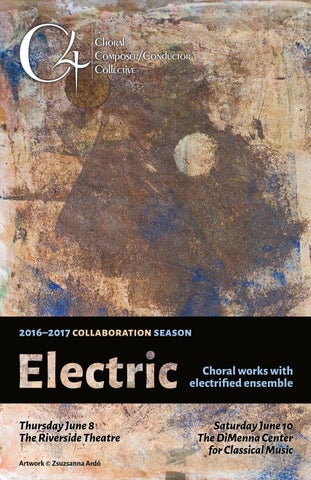
2016–2017 collaboration season
Electric Thursday June 8 The Riverside Theatre Artwork © Zsuzsanna Ardó
Choral works with electrified ensemble Saturday June 10 The DiMenna Center for Classical Music
Zsuzsanna Ardó
The Auction Is On!!!
C4’s 2016-17 Season Artist-In-Residence
C4 is thrilled to have had the opportunity throughout this season to work with Arts Council award-winner, Zsuzsanna Ardó, as our 2016-17 Artist-in-Residence creative collaborator. Zsuzsanna contributed the beautiful pieces from her series, Polar Self Portraits - The Artist and the Curious Case of the Vanishing Ice Caps, which you’ve seen on our publicity and program materials all season. These works ARE NOW AVAILABLE TO YOU in our annual silent auction! About this series, Zsuzsanna wrote: “This is a visual expedition through the relationship of two iconic art genres: the landscape of the face – the self-portrait – and the face of the land, aka the landscape. How can we re-imagine the boundaries of these classical genres in art, in the context of climate change?” See more about Polar Self Portraits and C4 in Zsuzsanna’s article in openDemocracy.net.
www.ardo.org
From the Therianthropic Self set:
…from the Hudson Valley Self sub-group. In addition to this generous gift, Zsuzsanna’s residency has been multi-faceted: C4 was pleased to present her companion Þlm for Polar Self Portraits in our “Visual” concerts in March. Zsuzsanna collaborated with several C4 composers (again) this season, providing texts for three world premieres. She spread the word about C4, spearheading the European premiere of C4 Alum, Jonathan David’s Mirror, Mirror, and featuring our own Daniel Andor-Ardó’s Pitter, patter, pitter patter, and then… alongside her art installation at the EU Parliament in Brussels. We wholeheartedly thank Zsuzsanna for her generosity and creative dedication to C4.
Take this opportunity to own one of Zsuzsanna’s beautiful paintings. Bid now!
C 4 : T h e C h o r a l C o m p o s e r / C o n d u c t o r C o l l e c t i ve
Collaborations: Electric
Choral Works with Electrified Ensemble
Thursday, June 8, at 8:00pm: The Riverside Theatre, New York, NY Saturday, June 10, at 8:00pm: The DiMenna Center for Classical Music, New York, NY
Invictus*
Casey Rule (b. 1989)
Cantata
Anthony Korf (b. 1951)
Jacob Gelber, conductor Ben Arendsen, conductor I. Recuerdo Bettina Shepard, Grant Yosenick, Maya BenMeir, Artemisz Polonyi, Casey Rule, Martha Sullivan, soloists II. i carry your heart with me Casey Rule, baritone Karen Siegel, soprano III. Dear Andy Artemisz Polonyi, Maya Ben-Meir, soloists IV. Love is Not All Grant Yosenick, Perry Townsend, Hayes Biggs, soloists
Poemas de Amor
Stephen Paulus (b. 1949)
Casey Rule, conductor
Intermission TE*
Artemisz Polonyi (b. 1981)
Erin Halpin, conductor Karen Siegel, soprano Bettina Shepard, alto
Suspicious Persons*
Karen Siegel (b. 1980)
Standing Still at Dusk
Nicholas Rich (b. 1984)
The Hounds of Spring
Jonathan David (b. 1965)
Martha Sullivan, conductor
Perry Townsend, conductor
Nathaniel Barnett, conductor Leonore Nelson, alto
* Premiere
Program Notes and Texts Collaborations: Electric Welcome to the final concert of our season of collaborations! Tonight we pair our choral sound with amplified instruments— C4 is thrilled to perform multiple works using electric guitar, bass, percussion, and other instruments. Anthony Korf’s innovative reworking of his Cantata for a new set of instruments has allowed us to bring back Jonathan David’s electrified The Hounds of Spring, a long-time favorite by one of our founding members. Korf’s orchestration also prompted us to research choral works that use similar instruments, which led us to Stephen Paulus’ set Poemas de Amor, lush and sonorous; we are grateful for the chance to perform this piece by one of America’s great choral composers, a generous man who died far too young. C4’s Artemisz Polonyi used the opportunity to compose a new work, TE, to a text of Zsuzsanna Ardó, playing on the conceit of Hungarian text that uses no vowel other than e. Polonyi responds to the text with a mashup of jazz and Hungarian traditional singing styles, written out and improvised, guaranteed to wake up your ears. A cappella repertoire on this concert includes Nicholas Rich’s Standing Still at Dusk, delicately evocative of the sounds of wildlife as the evening draws on; Casey Rule’s Invictus, an anthem to perseverance set over driving rhythms; and the premiere of Karen Siegel’s Suspicious Persons, which plays with unexpected rhythms to evoke a sense of wrongness. As ever, we are grateful to you for coming to hear the variety of styles available in contemporary choral music—
since you cannot know what to expect, you must listen with fresh ears. We are grateful to you for rising to the challenge! —Martha Sullivan
Invictus
Casey Rule
poem by William Ernest Henley This piece is a setting of the famed Victorian poem of the same name by William Ernest Henley. Henley grew up in poverty, the son of a struggling bookseller who died when Henley was a teenager. As a child, Henley was diagnosed with tuberculosis of the bone which necessitated an amputation of one of his legs. Later, in his twenties, Henley was told he would have to lose the other leg as well, but instead sought an alternative treatment. Over the course of the next few years, Henley was treated at Edinburgh Royal Infirmary, where he began to write poetry, including this thenuntitled poem. Decades later, Sir Arthur Quiller-Couch, when including it in his Oxford Book of English Verse, would title the poem “Invictus”, which in Latin means “unconquered”. —Casey Rule Text: Out of the night that covers me, Black as the pit from pole to pole, I thank whatever gods may be For my unconquerable soul. In the fell clutch of circumstance
I have not winced nor cried aloud. Under the bludgeonings of chance My head is bloody, but unbowed. Beyond this place of wrath and tears Looms but the Horror of the shade, And yet the menace of the years Finds and shall find me unafraid. It matters not how strait the gate, How charged with punishments the scroll, I am the master of my fate, I am the captain of my soul.
Cantata
Anthony Korf
poems by Edna St. Vincent Millay, e.e. cummings, Anonymous Dating from 1992, my Cantata was commissioned and premiered by the Koussevitsky Foundation for The New York Virtuoso Singers, who premiered the work in its original form the following year. Invoking an earlier form (with a highly impressive resume, no less), the title refers simply to the work’s embrace of both choral and solo vocal music against an instrumental backdrop, thematically unified by four texts based—in this case—on love in its lesscomplicated, more innocent guises. Indeed, the initial idea for the work presented itself in the form of a letter to a close high school—and now lifelong—friend, Andy, from a special-needs student whom Andy and I would frequently visit on our lunchtime schoolyard “rounds.” Written the semester following our graduation, the letter expressed a simple and undisguised longing for those brief visits, indeed a nobility of sentiment which I found both personally sobering and artistically inspiring. The timeof-life mise-en-scene immediately suggested a pop element—in particular the B52s, whose
eerily beguiling use of two female vocalists in unison, created a sort-of “tunnel” sound which I associated with the letter’s author, as if she were listening to her own thoughts through an echo. Thus “Letter to Andy” would become the Cantata’s third movement, since I felt the need to open the work in a less expressively ambiguous place. Seeking an anticipatory musical complement in Edna St. Vincent Millay’s Recuerdo, unpretentious and sweetly nostalgic, furnished text both ideal in language and cadence—in short, the perfect opening. The second movement, courtesy of one of e.e.cummings seemingly inexhaustible supply of love poetry, is similarly frank, with the summative “Love is not All” concluding the work in a fitting return to Millay. The Cantata’s pop and jazz flavorings reflect a deep affection for those “other” genres, music that has consumed me throughout life on a footing nearly comparable to my own professional métier, and in this regard Bill Frisell, Quincy Jones, Arthur Prysock are well to mention alongside the B52s as inspiration. Surely there are others, but that handful I hear clearly, as a listener. —Anthony Korf Text: I. Recuerdo Edna St. Vincent Millay We were very tired, we were very merryWe had gone back and forth all night on the ferry. It was bare and bright, and smelled like a stableBut we looked into a fire, we leaned across a table, We lay on a hilltop underneath the moon; And whistles kept blowing and the dawn
came soon. We were very tired, we were very merryWe had gone back and forth all night on the ferry; And you ate an apple, and I ate a pear, From a dozen of each, we had bought somewhere: And the sky went wan, and the wind came cold, And the sun rose dripping, a bucketful of gold. We were very tired, we were very merry, We had gone back and forth all night on the ferry. We hailed, “Good morrow, mother!” to a shawl-covered head, And bought a morning paper, which neither of us read; And she wept, “God bless you!” for the apples and the pears, And we gave her all our money but our subway fares. II. i carry your heart with me e.e. cummings i carry your heart with me (i carry it in my heart) i am never without it (anywhere you go i go, my dear; and whatever is done by only me is your doing, my darling) i fear no fate (for you are my fate, my sweet) i want no world (for beautiful you are my world, my true) and it’s you are whatever a moon has always meant and whatever a sun will always sing is you here is the deepest secret nobody knows (here is the root of the root and the bud of the bud and the sky of the sky of a tree called life; which grows
higher than soul can hope or mind can hide) and this is the wonder that’s keeping the stars apart i carry your heart (i carry it in my heart) III. Letter to Andy Text by a friend Dear Andy, How’s things going on at your places? We are just fine over here. Say Andy I was just thinking about why you don’t come to school and visit me one of these days, you could come around at lunch time. And I will be at the same place on the stairs. I miss you already so much, that every day I sit at the same place where you and Tony are all the time. I wish you and Tony haven’t left high school yet, until I get up there with you. Andy I like you so much that I wish you haven’t left high school. Well it’s time to go to school. So write back soon. IV. Love is not all Edna St. Vincent Millay Love is not all; it is not meat nor drink Nor slumber nor a roof against the rain; Nor yet a floating spar to men that sink And rise and sink and rise and sink again; Love cannot fill the thickened lung with breath, Nor clean the blood, nor set the fractured bone; Yet many a man is making friends with death Even as I speak, for lack of love alone. It may well be that in a difficult hour, Pinned down by pain and moaning for release; Or nagged by want past resolution’s power, I might be driven to sell your love for peace, Or trade the memory of this night for food.
It may well be. I do not think I would.
Poemas de Amor Stephen Paulus
Stephen Paulus (1949-2014) was one of the best-known composers of his time, writing in a variety of styles from choral music to operas to orchestral works. His recent passing from the complications of a stroke occasioned broad mourning in the musical community. His unique musical voice has been described as “original, often gorgeous, moving, and uniquely American.” The short texts for Paulus’ Poemas de Amor are Renaissance Spanish lyrics collected by the Costa Rican-American poet, musician and painter Alvaro Cardona-Hine from cancioneros, the troubadour songbooks of the era. Paulus must have been moved by the musical rhythms of these words to set them back to music again in his own style. The five poems cover the full range of love’s emotions: pining, amorous, heartbroken, earnest, and finally even happy.
moreno mío. There’s a boat sailing from your bed to mine; take a chance and come over, my sunburnt lover. III. Pasas por mi Calle Pasas por mi calle, no me quieres ver; corazón de acero debes de tener. You pass down my street but won’t look my way; you must have a heart of steel. IV. Si lo dicen, digan Si lo dicen, digan, alma mía, si lo dicen, digan. Dicen que vos quiero y por vos me muero; dicho es verdadero, alma mía, si lo dicen, digan.
—Brian Mountford Text (translation by Alvaro Cardona-Hine): I. Soñaba Soñaba yo que tenía alegre mi corazón, mas a la fe, madre mía, que los sueños, sueños son. I dreamt that my heart was happy, but by my faith, Mother, dreams are just dreams. II. De tu Cama a la Mía De tu cama a la mía pasa un varquillo; aventúrate y pasa,
If they say it, let them, dear soul, if they say it, let them. They say I love you to death; true enough, dear soul, if they say it, let them. V. Mano a Mano Mano a mano los dos amores, mano a mano. El galán y la galana ambos vuelven el aqua clara, mano a mano.
Hand in hand the two lovers, hand in hand. The young man and his girl, they turn the water into light, hand in hand.
way. Just like in the above mentioned jokes: We see them first as a Hungarian noticing the “typical” things they do, like a caricature. Hopefully later we are able to see the person too.
INTERMISSION
I put this idea into the music by giving the chorus rhythms and melodies inspired by Hungarian folk melodies and restricting their tone to a straight, edgy sound.
TE
Artemisz Polonyi
Poem: Zsuzsanna Ardó I wrote this music for Zsuzsanna Ardó’s cunning love poem in Hungarian: “Estelente, s reggelente – Kedves Ne Feledd” (see next page). If you are good at noticing details, you might have spotted that the only vowel in the title is the letter “e”. There is more to this. The whole poem consists of words that only use “e”. This is a literary game, or I should say sub-language within Hungarian, called Eszperente. Since “e” is the most common sound in Hungarian, (which is pronounced like the sound in “yes” in English) with some training you can actually talk or write in eszperente, and express anything. Funnily enough, the over-abundance of “e” sounds is also how the neighbouring nations like to tease us with when they mock how our language sounds. Don’t worry, we mock them back. My native tongue is Hungarian and I spent my last 9 years speaking mostly English, in various countries. I took inspiration from the one-dimensionality of a poem with one type of vowel, because it reminded me of how we often view foreigners in a one-dimensional
Sometimes the singers are imitating the sound of bowed folk violas, and sometimes they’ll “csujjogat”, which is a kind of musical yelling that appears in Hungarian folk music. During the process Zsuzsanna and I wanted to add a linguistic counterpoint and decided to add the English translation of the line “Kedves, Ne Feledd”, which is: “Darling, Don’t Forget”. I gave a jazzy, smooth feel to the words “Darling, don’t” as another one-dimensional element, expressing the New World. At first the folky “e”-abundant music and the smooth “a-i-o” sounds appear independently from each other. Things come to a full circle by the appearance of the word: “forget” at the very end of the piece, with the “e” sound migrating into the English text, appearing smooth and folky at the same time. Over this underlying meaning, my main goal in the composition process was to provide the musicians and singers with an interactive game where sounds, consonants, silences are given just as much of importance as melodies. Sáry László, a Hungarian composer and musical game-inventor, has been one of my inspirations for this. The part of the musicians is often improvised
TE
Kedves, ne feledd ~ Darling, don’t forget Te. Te? Te, te, te! Kedves, te. Te kedves. Kegyetlen kedvesem. Kedves kegyetlenem. Te. Estelente, s reggelente
Kedves. Ne feledd.
Te. Te. Te kedves. Kegyetlen. Kegyetlen kedves, te. Eszemet veszted. Szeretlek. Eszeveszetten.
darling, don’t
Estelente s reggelente.
Kedves. Ne feledd.
Felejhetetlen szerelmem. te. Egyetlenem. Te hetyke, te, kerek-perec nevetsz? Eltekeregsz? Elhesegets? Erre vetemedsz te lelketlen? Nem…merengek. Ez nem lehet kelepce. Lehet-e? Lehetne? Hevesen epekedem esztelen. Estelente, s reggelente.
Estelente, s reggelente.
Remegve, rettegve szemtelen kerge reszketeg kezemmel, cselesen, kezed keresem s sebesen meglelem. Egyetlenem. Egyetlen egy percet sem vesztegetve, eszesen neveletlen kezem nevetve szende s megszeppent testedre teszem.
Estelente, s reggelente.
Estelente, s reggelente.
Kedves. Ne feledd.
Te, te. te, te, te. te. Te kedves,te.
darling, don’t darling, don’t darling, don’t darling, don’t
Kedves. Ne feledd.
darling, don’t darling, don’t
Kedves. Ne feledd. Esdekelve lelkesen szentelem eszem, s teljes testem lelkem-velejem megfejthetetlen remek delejes szemednek.
darling, don’t
darling, don’t darling, don’t darling, don’t
Kedves. Ne feledd.
darling, don’t forget
©Zsuzsanna Ardó www.ardo.org TE — Kedves, ne feledd is a lipogram in Eszperente, a Hungarian univocalic language game. Greek literary texts avoided the sigma; Hungarian Eszperente uses exclusively ‘e’.
with only guidelines indicated, such as chords, note choices or feelings. —Artemisz Polonyi Text (in translation): You, Darling, Cruel darling, you. You make me lose my mind, I’m loving you madly. Every evening, every morning… You are my unforgettable, My only one. You, proud one, are you just laughing at me? Sneaking away? Shooing me away? You dare to be this soulless? No…I’m contemplating…this can’t be a trap. Is it possible? Could it be? I am lusting for you madly. My only one. Without wasting a single moment, Cunningly, I put a laughing and naughty hand onto your shy body. I’m trembling, fearful, shameless, crazy. My shaking hand are searching for yours, They quickly find them. Pleading with all my heart, I sanctify my mind, My whole body, and all of my soul To your indecipherably great Hypnotic eyes.
Suspicious Persons Karen Siegel
Text Compiled by Karen Siegel, from the following
public documents: Division of Capitol Police, “Suspicious Persons in the Workplace;” New Mexico State University, “Suspicious People;” San Diego Police Department Neighborhood Policing Resource Team, “Tips for Reporting Suspicious Persons, Activities, Vehicles, Etc. to Prevent Terrorism;” Los Angeles Police Department, “What Suspicious Behaviors and Activities Should You Report?”; Michigan Technological University, “Information Security Plan;” United States Computer Emergency Readiness Team, Department of Homeland Security, and Federal Bureau of Investigation Department of Justice, “Report Suspicious Behavior and Activity;” State of Oklahoma Office of State Finance, “Information Security Policy: Procedures, Guidelines;” and United States Department of Justice Bureau of Justice Assistance, “Communities Against Terrorism: Potential Indicators of Terrorist Activities Related to Shopping Malls and Centers,” “Communities Against Terrorism: Potential Indicators of Terrorist Activities Related to Financial Institutions,” “Communities Against Terrorism: Potential Indicators of Terrorist Activities Related to Bulk Fuel Distributors,” “Communities Against Terrorism: Potential Indicators of Terrorist Activities Related to Construction Sites,” “Communities Against Terrorism: Potential Indicators of Terrorist Activities Related to Farm Supply Stores,” “Communities Against Terrorism: Potential Indicators of Terrorist Activities Related to General Aviation Airports,” “Communities Against Terrorism: Potential Indicators of Terrorist Activities Related to Hotels and Motels,” “Communities Against Terrorism: Potential Indicators of Terrorist Activities Related to Peroxide and Explosives,” and “Communities Against Terrorism: Potential Indicators of Terrorist Activities Related to Rental Cars.” I’ve become accustomed to seeing a young man or woman in full military camoflage, holding a semiautomatic machine gun,
in subway stations, but it still makes me uneasy. I don’t mind the alerts to “say something” if we see something, but when I do call the emergency number to report a suspicious bag at the Port Authority Bus Terminal it would be nice if someone picked up. We no longer pay attention to whether the city or country is in “code orange” or a hue of more or less fear, but the messages that we are supposed to be afraid keep coming. Suspicious Persons is about the barrage of fear orchestrated in a misguided attempt at protection, about the extent to which everyone is potentially a cause for suspicion, and the harm that such ongoing fear can provoke. —Karen Siegel Text: Suspicious persons… …May appear nervous… …Wearing odd clothing… ‘Hiding’ in shadows… Suspicious persons… ‘Hiding’ in shadows… …Carrying items… …Being evasive… Suspicious persons… …Being evasive… …Just makes you feel ‘weird’…
…Unusual odors… …Unusual luggage… …Unusual items… …Unusual questions… …Unusual inquiries… …Unauthorized vehicles… …Unusual quantities… …Unscheduled deliveries… …Strangers asking questions… …Nervous or impatient… …Series of transactions… …Questionable…reasons… …Nervous, sweating,…mumbling …Wearing heavy objects… …Loose or bulky clothing… …Stiff, or awkward manner… …Briefcase, suitcase, backpack… …Ammunition out of season… Anyone attempting to improperly acquire explosives. Anyone…receiving suspicious emails. Anyone who does not appear to belong. Anyone. Suspicious persons… …May appear nervous… …Wearing odd clothing… ‘Hiding’ in shadows…
…Out of place, Not quite right, …Entering…after work… …Bursts of activities… …Damage to…power lines… …Loitering, vandalism… …Efforts to…“case” the…center… …Calm and detached behavior…
Suspicious persons… ‘Hiding’ in shadows… …Carrying items… …Being evasive… Suspicious persons… …Being evasive… …Just makes you feel ‘weird’… …Out of place,
Not quite right.
Standing Still At Dusk Nicholas Rich
haiku by Matsuo Bashō “Standing Still at Dusk” examines a Bashō haiku at the microscopic level, contrasting a famously concise poetic genre with stretched and smeared music. Phonemes are explored one-by-one, each generating a different color and texture in the choir. —Perry Townsend Text: Standing still at dusk Listen ... in far distances the sound of young frogs!
Hounds of Spring Jonathan David
Chorus from Atalanta in Calydon, by Algernon Charles Swinburne Swinburne’s chorus from his verse drama, Atalanta in Calydon, is one of the great poetic odes to springtime. The narrative context is the myth of the Calydonian boar hunt but this chorus is mostly a love song and a tale of sexual pursuit told through the imagery of the hunt and of the coming of spring. It is also a paragon of Romantic excess and wild fancy. The sheer density of the sonic texture, the frank sensuousness, the unapologetic nostalgia all conjure up a scene with a visceral impact that borders on the absurd. It is also, to my ears, absurdly beautiful. My setting turns to the similarly over-thetop and often mannered spirit of 1970’s progressive rock, of the musical, Jesus Christ Superstar, and Jethro Tull’s Thick as a Brick, to name just a couple examples.
Bald theatricality, elaborate structure, stark juxtapositions, irregular and frequently changing meters are all hallmarks of the piece. It is rich in melodic material, but the germ for much of it is present in the music for the iconic first line. And wide-ranging though it may be, one should still be able to detect a classical ABA form, with A generally louder and faster (cue the fuzzbox), and B softer and slower (doo-wop back-up singers). An alto solo introduces an extended coda which describes an intimate encounter before the chase starts up again, finally fading into the night. The Hounds of Spring was written for C4 and the Fireworks Ensemble, and premiered in May, 2012. —Jonathan David Text: When the hounds of spring are on winter’s traces, The mother of months in meadow or plain Fills the shadows and windy places With lisp of leaves and ripple of rain; And the brown bright nightingale amorous Is half assuaged for Itylus, For the Thracian ships and the foreign faces, The tongueless vigil, and all the pain. Come with bows bent and emptying of quivers, Maiden most perfect, lady of light, With a noise of winds and many rivers, With a clamour of waters, and with might; Bind on thy sandals, O thou most fleet, Over the splendour and speed of thy feet; For the faint east quickens, the wan west shivers, Round the feet of the day and the feet of the night.
Where shall we find her, how shall we sing to her, Fold our hands round her knees, and cling? O that man’s heart were as fire and could spring to her, Fire, or the strength of the streams that spring! For the stars and the winds are unto her As raiment, as songs of the harp-player; For the risen stars and the fallen cling to her, And the southwest wind and the west wind sing. For winter’s rains and ruins are over, And all the season of snows and sins; The days dividing lover and lover, The light that loses, the night that wins; And time remembered is grief forgotten, And frosts are slain and flowers begotten, And in green underwood and cover Blossom by blossom the spring begins. The full streams feed on flower of rushes, Ripe grasses trammel a travelling foot, The faint fresh flame of the young year flushes From leaf to flower and flower to fruit; And fruit and leaf are as gold and fire, And the oat is heard above the lyre, And the hoofed heel of a satyr crushes The chestnut-husk at the chestnut-root. And Pan by noon and Bacchus by night, Fleeter of foot than the fleet-foot kid, Follows with dancing and fills with delight The Maenad and the Bassarid; And soft as lips that laugh and hide The laughing leaves of the trees divide, And screen from seeing and leave in sight The god pursuing, the maiden hid. The ivy falls with the Bacchanal’s hair Over her eyebrows hiding her eyes; The wild vine slipping down leaves bare Her bright breast shortening into sighs; The wild vine slips with the weight of its
leaves, But the berried ivy catches and cleaves To the limbs that glitter, the feet that scare The wolf that follows, the fawn that flies.
Composers (in alphabetical order)
Jonathan David
Composer Jonathan David was raised in New York City and currently lives in Chapel Hill, NC. In May the Atlanta Young Singers premiered his Hic Sunt Dracones (Here Be Dragons) for treble chorus, male trio and solo contrabass. He has also been commissioned by the New York Treble Singers, Duke University, Marble Collegiate Church, Carroll University, and the Manhattan Wind Ensemble, among others. Jonathan’s first commercial CD will be released in 2017, featuring the complete solo vocal works with piano. Highlights of 2016 include a setting of Zsuzsanna Ardó’s Mirror, Mirror which debuted at the European Parliament; Sederunt, commissioned for DePauw University, had its European premiere at the Cathedral of Notre Dame-Paris. All My Heart This Night Rejoices debuted as the winning work in the New England Carol Contest. Jonathan has served as Composer-inResidence for The Greenwich Village Singers, and was a founding member of the pioneering new music chorus, C4. He serves on the judging panel for the ASCAP/ Deems Taylor Awards. From 2005-2011 he was the Classical Editor for the internet music service, Napster. Jonathan’s music is published by Oxford University Press, See-A- Dot Music, and Paraclete Press, and is also available through his website, www.
jonathandavidmusic.com.
Anthony Korf
Anthony Korf (b. December 14, 1951 in NYC) is a composer whose singular voice evokes the strength of a powerful musical legacy. He has established a distinct and substantial language, a lexicon of emotion and drama that finds expression in a wide array of inventive, harmonically rich scores for solo instruments, chamber and vocal ensembles and large-scale symphonies. Korf has drawn inspiration from a remarkable array of composers and musical idioms, though these influences are seldom detectable in his music. His life-long passion for jazz and popular music, for example, lends an unmistakably American flavor to his work, though only rarely does their vernacular pedigree surface. As early as Korf’s Symphony No. 2 “Blue Note,” from 1987, New Yorker critic Andrew Porter perceived this vanguard spirit in the “imaginative sounds and striking ideas” resulting in “the impression of a composer finding his own way, pursuing a personal vision, following his own ear.” Korf has been commissioned by the San Francisco Symphony, American Composers Orchestra, Koussevitsky Music Foundation, and the National Endowment for the Arts, and has been honored with a Guggenheim Fellowship in 2008 and a Godard Lieberson Fellowship in 1988 and an Arts and Letters Award in Music in 2014 from the American Academy of Arts and Letters. A leading figure on the New York music scene for more than thirty years, Korf founded the acclaimed contemporary chamber ensemble Parnassus, which he led as artistic director and conductor for 27 years. He currently
serves as Artistic Director and Composerin-Residence for Riverside Symphony which he co-founded with conductor George Rothman in 1981. Korf resides in New York City with his wife.
Stephen Paulus
Stephen Paulus was a prolific American composer of classical music. He wrote over 600 works for chorus, opera, orchestra, chamber ensemble, solo voice, concert band, piano, and organ, receiving premieres and performances throughout the world as well as a Grammy nomination for Best Contemporary Classical Composition in 2015. His musical style has been described by the New York Times as “lush and extravagant,” and critics from the New York Times, Los Angeles Times, Opera News, and many others have praised his work. The New Yorker described him as a “bright, lyrical inventor whose music pulsates with a driving, kinetic energy.” He won both NEA and Guggenheim Fellowships. Born August 24, 1949 in Summit, NJ, Paulus lived most of his life in Saint Paul, where he earned his doctorate in music composition from the University of Minnesota in 1978. A passionate advocate for the works and careers of his colleagues, Paulus co-founded the Minnesota Composers Forum in 1973; it grew to become the American Composers Forum, the largest composer service organization in the U.S. He also served as the Symphony and Concert Representative on the board of ASCAP from 1990 until 2014. His music has been commissioned, recorded, and performed by the New York Philharmonic, Cleveland Orchestra, Atlanta Symphony Orchestra, Minnesota Orchestra, Opera Theater of Saint Louis, Washington Opera, Los Angeles Master Chorale, The Dale Warland Singers, VocalEssence, Doc Severinsen, Thomas Hampson, Leo Kottke,
Robert McDuffie, William Preucil, and Deborah Voight. Stephen Paulus passed away in October, 2014 from complications of a stroke, but his music continues to be frequently performed; it has been described by critics as rugged, angular, lyrical, lean, rhythmically aggressive, original, often gorgeous, moving, and uniquely American.
Artemisz Polonyi
Artemisz Polonyi is a singer originally from Hungary, currently living and performing in New York City. She has studied jazz and early music at The Royal Conservatorium of The Hague and received her Masters degree in Jazz Voice from William Paterson University, NJ as a recipient of the Fulbright Scholarship. Her musical training includes classical, jazz, improvisation, and folk and early music. She gets a kick out of bringing all these styles together in her performing and teaching, developing the voice as a flexible and fun tool that enables us to play with other human beings. These human being include Asaran Earth Trio, a vocal group performing folk songs in 3-part arrangements; The Delegation, a 13-piece indie- jazzcontemporary orchestra; and her students at the Met Opera Guild’s Students Compose Opera and the 92Y’s Musical Introduction Series. TE is her first choral composition. It’s directly influenced by the writing techniques of her 3 rd grade students, Hungarian folk melodies, folk rhythms from the Balkan and jazz.
Nicholas Rich
Nick Rich, guitarist and composer, works at the intersections of music, memory,
language, and culture. He came from a family of musicians who played CountryWestern, Bluegrass, Folk, Rock, and Pop, and he still performs frequently in Bluegrass and Folk. Nick received a Master of Music degree from UNCSA, studying with Lawrence Dillon, and a Bachelor of Music from UNCG, studying with Alejandro Rutty and Mark Engebretson.
Casey Rule
Casey Rule is a programmer by day and musician by night, working as a software engineer for Morgan Stanley and writing music when he’s not writing code. Among his awards for composition are the 2012 Singing City Prize for Young Composers, the Musical Chairs Chamber Ensemble’s 2014 Composer Search, the 2014 ACDA-PA Choral Composition Competition, and the Robert Campbell Choral Composition Prize at the Ithaca College Thirty-Sixth Annual Choral Composition Contest, and The Esoterics 2016 POLYPHONOS Choral Composition Competition. Casey is a graduate of Lehigh University, where he was part of the first class of students in the interdisciplinary honors program called IDEAS (Integrated Degree in Engineering, Arts & Sciences), studying music composition and computer science, and staying for an additional year with a scholarship to continue his studies of composition and conducting with Steven Sametz and Paul Salerni. He was the youngest and longest running director of the Lehigh University Melismatics and served as director of the Lehigh men’s choir in 2014. Casey is also the business and technical director of NoteNova Publishing, a choral music publisher with whom composers earn the majority of the profit and retain full ownership of their music.
Karen Siegel
Composer Karen Siegel draws on her experience as a vocalist in her creation of innovative vocal and choral works. Hailed as “complex and wonderful,” (TheatreScene. net) and “colorful and at times groovy” (WQXR.org), her works have been commissioned or performed by ensembles across the US including C3LA, C4, Clerestory, the Esoterics, Khorikos, the Manhattan Choral Ensemble, the New York Virtuoso Singers, the Santa Fe Women’s Ensemble, Triad, Trio Eos, and Whateverandeveramen. Karen has won awards from Khorikos (2015), the Esoterics (2014-2015), Boston Metro Opera (2014), the New York Virtuoso Singers (2013), the CUNY Graduate Center (2009), the Manhattan Choral Ensemble (2007) and NYU Steinhardt (2005); other honors include seven works accepted into the Project: ENCORE database and a residency at the Kimmel Harding Nelson Center for the Arts (2008). Karen’s new one-act chamber opera The Hat: Arendt Meets Heidegger was performed this February in a concert version on the Composers Now Festival at The Lounge at Dixon Place. This opera, in collaboration with librettist Zsuzsanna Ardó, is about the meeting of Hannah Arendt and Martin Heidegger. Her choral work Saguaro was recorded by C4 and released on their album Volume 1: Uncaged in 2013. A founding member of C4, Karen has benefitted from years of mentoring by her conductor colleagues in the ensemble and is active as a conductor both within C4 and in performances of her own works. Karen received a PhD in composition from the CUNY Graduate Center, where she studied with Tania León, in 2014. She also holds degrees from Yale (BA in psychology) and
NYU Steinhardt (MM in composition); and she studied composition with Conrad Cummings at the Juilliard Evening Division, and choral conducting with Péter Erdei at the Kodály Institute in Kecskemét, Hungary. Karen has taught at the City College of New York and Drew University. Karen’s works are published by See-ADot Music Publishing (www.SeeADot. com), and self-published through Chestnutoak Press (www.KarenSiegel. com). She lives in Hoboken, New Jersey with her husband and two sons.
Join C4 at the
New York City Electroacoustic Music Festival
C4 joins the lineup of this year’s New York City Electroacoustic Music Festival, reprising two pieces from our November concerts: Kajia Saariaho’s Tag des Jahrs and Brian Mountford’s Downfall with live electronics and video. Abrons Art Center 8:00 pm June 19, 2017 For more information, visit www.nycemf.net/2017-festival.
We wish to thank and acknowledge our donors: Concert Sponsors Susan M. Orzel-Biggs & Hayes Biggs Lauren Mitchell & Michael David Ellen Stafford-Sigg and Daniel Sigg Cutting-Edge Circle Elizabeth Marker Innovative Circle Kit Smyth Basquin* Melissa Bybee David Hurd Debby Katz & Ian David Moss Charles Natt Patricia Siegel Anonymous (1) Creative Circle Nan Bases Nancy & Lee Corbin Gayann Cotner John Tyler Evans Don & Sally Hayward Ira & Becky Horowitz Charles Katz The Levin-Delsons Russell Maltz Sue Backstrom & Jon Minikes Constance Beavon & Bruce Saylor Linda Schrank* Kenneth & Jean Telljohann Perry Townsend Richard Tucker David Wozniak David See Contemporary Circle Aaron Alter Daniel Andor-Ardó Ben Arendsen Nathaniel Barnett Nicole Belmont
Contemporary Circle (con’t) Lauren & Michael Blumenfeld Gregory Brown Sandra Carlson Elizabeth Clark Sue Feingold Joseph Fong* Andrea Gelber Grace Goodman Diane Gottlieb Brook Hersey Jeffrey James Janet Keogan Susan Koshewa Jon and Miriam Lafferty Linda & Leslie Libow Nanette & Stanley Lieblein James Stephen Longo Peter Lurye Edward & Rose Mermelstein Peter & Christine Metz Howard Miller Philip Morehead Ruth Mueller-Maerki Valerie Norton Lois & George Orzel Zahra Partovi Chip Prince Michelle Quirk Jonathan & Suzanne Rosenzweig Joseph Rubinstein Christine Schadeberg Phillip Schroeder Mina K. Seeman Bettina Sheppard Nancy Smardz Carolyn Smith Martha Sullivan Neil Sumner Anne Thulin* Mary Ellen Townsend
Includes donations from 7/1/16-5/23/17. Concert Sponsor: $1,000-$4,999; Cutting-Edge Circle: $600-599; Innovative Circle: $350-599; Creative Circle: $125-349; Contemporary Circle: $1-$124. If we have made an error, please accept our apologies and notify us at info@c4ensemble.org. * Friend of C4
C4 Board of Directors C4 could not function without the dedicated work of its board of directors. We are very grateful to: Fahad Siadat, Chair Maya Ben-Mier Colin Britt Karen Siegel Larry Siegel Melissa Wozniak, Treasurer
Special Thanks Timothy Brown
Support Us! Please consider joining C4’s family of supporters by donating online at c4ensemble.org/support-c4 or sending a check, made out to C4: the Choral Composer/Conductor Collective, to: C4: The Choral Composer/Conductor Collective Att: Treasurer P.O. Box 633 New York, NY 10163 C4’s is proud to be a part of
C4’s activities are funded in part with the generous assistance of:
C4: The Choral Composer/Conductor Collective Sopranos
Noele Flowers Christina Kay Artemisz Polonyi Karen Siegel Martha Sullivan Melissa Wozniak
Altos
Maya Ben-Meir Jamie Klenetsky Fay Erin Halpin Jane Lawson Leonore Nelson Bettina Sheppard
Tenors
Ben Arendsen Nate Barnett Mario Gullo Mark Rossnagel Carlos Pérez Tabares Richard Tucker Grant Yosenick
Basses
Hayes Biggs Jacob Gelber Quinn Kimball Brian Mountford Casey Rule Perry Townsend
C4 exists to enrich artists and audiences alike, through passionate advocacy of new choral works, performing pieces written within the last 25 years, premiering and commissioning new choral works, and mentoring emerging singers, composers, and conductors of today’s choral music. www.c4ensemble.org
photographer: Nadia Mian
For information on C4 members, visit our website: c4ensemble.org/ the-ensemble.html