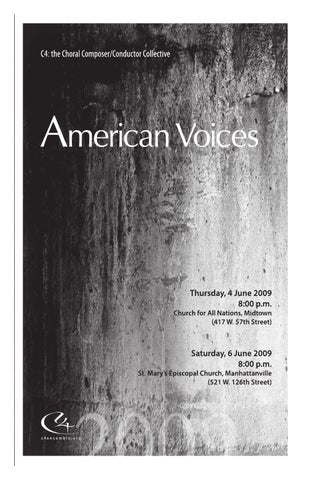
C4: The Choral Composer/Conductor Collective
American Voices
C4: THE CH0RAL COMPOSER/CONDUCTOR COLLECTIVE Sopranos Amy Jisun Ahn Juliane Dowell Reena Esmail Adria LeBoeuf Taeko Ota Karen Siegel Jieun Yang
Altos Rachel Dowell Jamie Klenetsky Tatiana Kochkareva Erica Lowe Elizabeth Marker
Tenors Christopher Baum Jonathan David Steve Lanser David Rentz Joseph Rubinstein
Basses Daniel Andor James Bilodeau Timothy Brown Phillip Cheah Jonathan Scott Christian Smythe
Thursday, 4 June 2009, Church for All Nations, New York, NY Saturday, 6 June 2009, St Mary’s Episcopal Church, New York, NY O magnum misterium (short setting) (1992)
John Harbison (b. 1938)
Do Not Turn Back (1994) §
Mark Francis (b. 1958)
Timothy Brown, conductor
C4 C4 Adria LeBoeuf and Erica Lowe, soloists David Rentz, conductor
Psaume 1 (1999) §
C4, the world’s first Choral Composer/Conductor Collective, is a unique vocal ensemble in New York City dedicated to performing music written in the last twenty-five years. A collaborative project of its singing members, it functions not only as a presenting ensemble in its own right, with a three-concert season, but also as an ongoing workshop and recital chorus for the emerging composers and conductors who form the core of the group. It is, as far as we know, the first ensemble of its kind, and one of the largest choral groups in the nation to focus entirely on the music of our time.
We in C4 wish to express our heartfelt thanks and appreciation to the following organizations and individuals for their support and assistance: Akin Gump Strauss Hauer & Feld, LLP St Mary’s Episcopal Church Rev. Earl Kooperkamp The Church for All Nations Jennifer Rosa Michael David and Lauren Mitchell Nan Bases Zachary Cummings Elizabeth Marker Martin Geller and Carol Garner Annabel Gordon Clara Longstreth Benjamin Niemczyk Allison Sniffin Peter Sciscioli Timothy DeWerff Jeffrey Douma Carol Quimby Heath Sarah Sedgwick Heath T. Sean Maher
c4ensemble.org
Christopher Baum, conductor
Wedding Triptych (2009) † As Long as I Live Beautiful One Tomorrow
Jason Bahr (b. 1972)
David Rentz (b. 1977)
Christopher Baum, conductor
O nata lux (2007) §
Phillip Cheah, conductor
O magnum misterium (long setting) (1992) Christopher Baum, conductor
Paul Leary (b. 1974) John Harbison
TEN-MINUTE INTERMISSION
Jewish Storyteller/Dance/Dream from Book of Shadows (1988)
Meredith Monk (b. 1942)
The Temple Bells (2009) †
Jamie Klenetsky (b. 1984)
c4ensemble.org
Karen Siegel, conductor
David Rentz, conductor
Sleeping at Last (2007)
Zachary Wadsworth (b. 1983)
Phillip Cheah, conductor
Wildlife Spotting (2009) †
Karen Siegel (b. 1980)
O’Neill Portrait (1988) §
Fenno Heath (1926-2008)
Mirabile Mysterium (2007)
Jonathan David (b. 1965)
Juliane Dowell, Erica Lowe, David Rentz, Christian Smythe, solo quartet David Rentz, conductor
Phillip Cheah, conductor
† World premiere
§ New York premiere
Program Notes & Texts O magnum misterium Music scholars have often pointed out in writing on the work of composer John Harbison that he covers all of the stylistic bases, that he constantly surprises and refuses to repeat himself. This is evident in comparing Harbison’s two motet settings of the same Christmas text, O magnum misterium. In the first, “short setting,” Harbison uses stark harmony over modern, 5-count rhythms which, in combination, create a sense of meterless, neo-medieval/renaissance progress through the text. It is notable that, as in the longer version (to be heard at the end of the first half ), Harbison places unusual emphasis on the word jacentem, that is, lying (in the manger). Following a pattern common in medieval/ renaissance motets, he creates an entirely new mood for the first mention of the Blessed Virgin. And, purists may note, he exchanges the standard Alleluia ending with the Hail Mary, again in a different mood, before returning to the opening motive for the final Amen. – Timothy Brown JOHN HARBISON won the prestigious BMI Foundation’s Student Composer Awards for composition at the age of sixteen in 1954. He studied music at Harvard University, where he sang with the Harvard Glee Club, and later at Princeton. He is an Institute Professor of Music at the Massachusetts Institute of Technology. He is a former student of Walter Piston and Roger Sessions. His works include several symphonies, string quartets, and concerti for violin, viola, and bass viol (double bass). He won the Pulitzer Prize for music in 1987 for The Flight into Egypt. He was nominated for a 2006 Grammy Award for Best Small Ensemble Performance for his Mottetti di Montale. Harbison was jointly commissioned by the Pontifical Council for the Promotion of
Christian Unity and the Pontifical Council for Inter-religious Dialogue to write a piece for the historic “Papal Concert of Reconciliation.” The event was co-officiated by the Chief Rabbi of Rome, Rav Elio Toaff, the Imam of the Mosque of Rome, Abdulawahab Hussein Gomaa, and His Holiness Pope John Paul II. Abraham, a six-minute composition for brass and antiphonal choirs, had its world premiere on January 17, 2004 performed by members of the Pittsburgh Symphony Orchestra, and a choir made up of members of the Mendelssohn Choir of Pittsburgh, the London Philharmonic Choir, the Krakow Philharmonic Choir, and the Ankara Polyphonic Choir, under the baton of Sir Gilbert Levine. When asked for his “artistic credo” Harbison replied: “to make each piece different from the others, to find clear, fresh large designs, to reinvent traditions.” – Wikipedia
Do Not Turn Back Mark Francis wrote Do Not Turn Back in 1994 for the chorus of the Louisiana School for Math, Science, and the Arts, where he was a music teacher. In it, he sets a short poem by Bengali poet Rabindranath Tagore, the first Asian Nobel laureate (1913, Literature). Francis captures the poem’s tone of quiet reverence with shimmering quartal harmony and smooth, flowing melodic lines. – David Rentz MARK FRANCIS is Director of Education for the Mississippi Symphony Orchestra. He has previously taught at Mississippi State University, Louisiana School for Math, Science and the Arts, Centenary College, Northwestern State University and Power Academic and Performing Arts Complex. He holds a DMA in composition from the University of Kentucky, and has received nine ASCAP Standard Awards for his compositions, which include chamber, orchestral, choral and electronic works as well as over 65 art songs.
Psaume 1 Psalm 1 Psaume 1 is based on a four-note motive, first sung by the sopranos: Eb-Bb-D-A. This idea is developed throughout the work. The motive is passed from voice to voice, and the text is set with very lush harmonies. The work reaches a high point at the end of verse three, where this motive is repeated by the choir in octaves. In verse four there is a shift in the text, focusing now on the wicked. The four-note motive is again used, but this time in retrograde. This is to be sung very harshly and without vibrato. At verse six, the text again speaks of the blessed, and the music is more consonant. The second half of the verse six returns to the retrograde motive. Of course the story does not end there, and I have added a coda-like Alleluia and Amen. This is set with soft, lush chords, ending with the four-note motive as a harmony. –Jason Bahr JASON BAHR received his BM from the University of Missouri-Kansas City, including study at Kingston University in London, England, and went on to get his MM and DMA from Indiana UniversityBloomington. He has studied with Samuel Adler, Claude Baker, David Dzubay, Eugene O’Brien, Don Freund, James Mobberley and Gerald Kemner. He is currently an Assistant Professor of Music Theory and Composition at Ohio Wesleyan University. Bahr has received over two hundred performances of his works, including performances in 30 states and eight foreign countries. He was a finalist for the 2nd International Frank Ticheli Composition Contest for band music (2009) for Anderson’s Animals, a recipient of a MacDowell Colony Residency (2006), a Fromm Foundation commission (2005), has won the Northridge Prize for Orchestral Composition (2005) for Golgotha, third prize in the Renee B. Fischer Piano Competition (2003), Region V winner in the SCI/ASCAP Competition (2002), Cambridge Madrigal Singers Choral
C4 C4 O magnum mysterium, et admirabile sacramentum, ut animalia viderent Dominum natum, jacentem in praesepio! Beata Virgo, cujus viscera meruerunt portare Dominum Christum. Ave Maria, gratia plena, Dominus tecum. Amen. O great mystery, and wonderful sacrament, that animals should see the new-born Lord, lying in a manger! Blessed is the Virgin whose womb was worthy to bear Christ the Lord. Hail Mary, full of grace, The Lord is with you. Amen! Medieval Christmas responsory
c4ensemble.org
If the portals of my heart are ever closed, Burst them and come into my soul. Lord, do not turn back. If any day the strings of my harp Resound not with thy name, In thy pity tarry awhile, Lord, do not turn back. If when thou callest, the drowsiness of my sleep passeth not, Smite and awake me with thy thunder. Lord, do not turn back. If at any time on thy throne I seat another without thought, My King for all time, do not turn back. Rabindranath Tagore (1861-1941)
c4ensemble.org
Composition Competition (1999) with Psaume 1, and annual ASCAP awards since 1998. Commissions include Mysteries of Light (violin and piano) for the Fromm Foundation, Brevard Invocation (timpani and horn) for the Mountain Chamber Players, Soliloquy (English horn) for Krista Riggs, When We Are Going (treble choir, violin and organ) for Theresa Spencer, Strikes and Resonance (marimba) for Grant Braddock, and Tipping Point (alto sax and piano) for the Mississippi Music Teachers Association. When not composing, Bahr frets over his student loan debt and the fate of the Kansas City Royals. SDG
Il n’en est pas ainsi des méchants: Ils sont comme la paille que le vent dissipe. It is not this way with the wicked: They are as straw that the wind scatters. C’est pourquoi les méchants ne résistent pas au jour du jugement, Ni les péchants dans l’assemblée des justes; That is why the wicked do not stand at the day of judgment, Or the sinners in the company of the just; Car l’Éternel connaît la voie des justes, Et la voie des pécheurs mène a la ruine. Alléluia. Amen. For the Lord knows the way of the just, And the way of the sinners leads to ruin. Alleluia. Amen. Edition française de Louis Segond, 1910 Translated by Jason Bahr
Beautiful One Beautiful one, who holds my life captive in your eyes, Who ravishes my soul with your gracious smile, Come quickly and rescue me, or I will die. Thoinot Arbeau (1519-1595) Translated by David Rentz
de lumine’ with chant-like episodes inserted after each section of the text. Descants also cap both parts of the text, the soaring lines intended, surely, with the accoustics of the Duke University Chapel (whose Vespers Ensemble had premièred the work) in mind. The beauty of this work lies in its earnest simplicity, a trait that is wonderfully showcased in the closing Amens. – Phillip Cheah Originally a Southern California native, PAUL LEARY attended the University of Michigan and in 1999 received his Bachelor’s Degree in Music Composition. There he studied with William Albright, Erik Santos, and Michael Dougherty. His graduate work brought him to the Cleveland Institute of Music (CIM), where he received his Master’s Degree in Music Composition in May 2002. He also attended the summer program, Schola Catorum in Paris, France under the direction of Phillip Lasser. During his studies at CIM, Leary taught music theory for non-majors at Case Western Reserve University (CWRU). He was one of the contributing orchestrators for Contemporary Youth Orchestra concert Classical Nash. In the fall of 2003, the Contemporary Youth Orchestra commissioned his Concerto for Trumpet, Turntables, and Orchestra for their December concert. Leary’s Horn Sonata was premiered by Richard King, principal horn of the Cleveland Orchestra, in the spring of 2003. Since then, this work has been played all around the world. In April 2004, Leary orchestrated, arranged and transcribed the Contemporary Youth Orchestra’s concert with Jon Anderson, lead singer of Yes. In 2005, Leary orchestrated and arranged a concert with four time Grammy Award winning artist Pat Benatar. Leary’s music has also appeared in the concert series at Mather Dance Center in Cleveland, Ohio, from 2002-6, contributing works for string quintet, electronics, cello and piano, clarinet and piano, and solo piano. Leary’s most recent work, I have a Past Life Memory of the War that Blew the Fifth
C4 C4
Heureux l’homme qui ne marche pas selon le conseil des méchants, Qui ne s’arrête pas sur la voie des pécheurs, Et qui ne s’assied pas en compagnie des moqueurs. Blessed is the man who does not walk in accordance with the counsel of the wicked, Who does not stand in the way of the sinners, And who does not sit in the company of the mockers. Mais qui trouve son plaisir dans la loi de l’Éternel, Et qui la médite jour et nuit! But who finds his pleasure in the law of the Lord, And who meditates on it day and night! Il est comme un arbre planté près d’un courant d’eau, Qui donne son fruit en sa saison, Et dont la feuillage ne se flétrit point: Tout ce qu’il fait lui réussit. He is like a tree planted near a stream of water, Who gives its fruit in its season, And gives foliage that does not wither. All that this man does will succeed.
Wedding Triptych
I wrote Wedding Triptych for my wife, Ellen, to celebrate our wedding, which took place in March 2007. The original settings of all three texts—Tant que vivray (Claudin de Sermisy) Belle qui tiens ma vie (Thoinot Arbeau), and Morgen (Richard Strauss)— were performed as part of the ceremony, and served as inspiration (both musical and otherwise) for my pieces. – David Rentz
c4ensemble.org
As Long as I Live As long as I live in the prime of my life, I will serve the powerful god, Love, In word, in deed, in melody and in harmony. To be with her, that is my pledge, As long as I live in the prime of my life. Down with sadness, long live joy, Since there is so much good in love. Clément Marot (1496-1544) Translated by David Rentz
Tomorrow And tomorrow the sun will shine again, And on the path I will take, It will unite us again, we happy ones, Upon this sun-breathing earth. And to the shore, wide with blue waves, We will descend calmly and slowly, We will look mutely into each other’s eyes, And the great silence of happiness will settle upon us. John Henry Mackay (1864-1933) Translated by David Rentz
O nata lux
The hymn O nata lux is appointed to be sung at Lauds (the Office of Aurora or Dawn) on the Feast of the Transfiguration. The twin images of light and flesh conveys at once the divinity and mortality of this ‘light of light’, born into the world as the great and wonderful mystery so beautifully depicted in two other pieces on this concert, O magnum misterium and Mirabile mysterium. Paul Leary’s hauntingly beautiful setting of this text, with its flowing chant-like melodies and quasi-imitative counterpoint, harkens back to the Renaissance – a nod, perhaps, to the celebrated setting (also for 5 voices) by Thomas Tallis. Yet the harmonic language is distinctly Leary’s, with tightly held dissonances releasing into scintillating moments of beauty that avoid any postRomantic saccharine indulgences. The bipartite text is bookended by a ritornellolike setting of the opening line ‘O nata lux
c4ensemble.org
Planet into the Asteroid Belt for sax quartet and electronics was chosen as a finalist at the 2007 International Computer Music Conference in Copenhagen, Denmark, and won the Look and Listen composition competition in New York City. In 2005, Leary became a part-time lecturer at Case Western Reserve University, where he teaches computer music. In that same year, he also began working towards his PhD in Music Composition at Duke University. He took a leave of absence to teach theory, composition, and music history full time at Denison University in Granville, Ohio for the 2007-8 academic year, but he is now back in North Carolina finishing his PhD.
MEREDITH MONK is a composer, singer, and creator of new opera and music theater works. A pioneer in what is now called “extended vocal technique,” Monk has been hailed as “a magician of the voice,” and “one of America’s coolest composers.” During a career that spans more than 40 years, she has been acclaimed by audiences and critics as a major creative force in the performing arts. She has received numerous awards including a MacArthur “Genius” Fellowship, two Guggenheim Fellowships, sixteen ASCAP Awards for Musical Composition, the 2005 ASCAP Concert Music Award, the Demetrio Stratos Award in 2007, and was inducted into the American Academy of Arts and Sciences in 2006. In 1965 Monk began her innovative exploration of the voice as a multi-faceted instrument and subsequently composed and performed many solo pieces for unaccompanied voice and voice/ keyboard. In 1978 she formed Meredith Monk & Vocal Ensemble to further expand her musical textures and forms. She has since been commissioned to write for Michael Tilson Thomas’s New World Symphony, and for Kronos Quartet, among others. In 2000, the Lincoln Center Festival celebrated her music with a three-concert retrospective titled Voice Travel, and in 2004 a 4 ½ hour marathon was presented at Carnegie’s Zankel Hall. Another marathon, Meredith Monk Music @ The Whitney, was presented at the Whitney Museum in 2009, followed by the site-specific Ascension Variations at the Guggenheim. Several of Ms. Monk’s scores, including her Piano Album, are available through her publisher, Boosey & Hawkes. Monk’s latest CD, impermanence, was released on the ECM label in March 2008 and nominated for a 2008 Grammy Award. Her new music theater work, Songs of Ascension, premiered in October 2008 and will be performed at BAM’s Next Wave Festival in October 2009. Ms. Monk is an ASCAP composer. – Meredith Monk Music
The Temple Bells This piece attempts to do two things: evoke the arrival to a temple, and explore the emotions of the person entering. She is struck with the realization “The mirror calls to me, and in it is nothing at all” – looking at herself and seeing the superficial. Full of fear, she sees herself “soaring away”, wishing to flee, but realizes that only “here, inside,” lies her true nature, “the soul”. The titular “Temple Bells” resound continuously throughout. This piece also chronicles a personal “journey”; much of who I am is in this work. The Temple Bells is inspired by my love of East Asian music, and was written especially for C4. – Jamie Klenetsky
the sounds below. This piece is dedicated to Michael Kerschner and the Young New Yorkers’ Chorus. – Zachary Wadsworth A native of Richmond, Virginia, ZACHARY WADSWORTH is an active young composer. His works have been performed by the Long Leaf Opera, the Buffalo Philharmonic Orchestra, the Atlanta Philharmonic Orchestra, the Boston Choral Ensemble, the Pacific Chorale, the Young New Yorkers’ Chorus, the Yale Philharmonia and Schola Cantorum, and the Eastman Chorale, among others. Recordings of his choral works O Saving Victim and Beati Quorum Remissae are now available on the Gothic record label, and the latter has been published by Alliance Publishing. He has received several composition awards, including first place in the ASCAP/ Lotte Lehmann Art Song Composition Competition, the Long Leaf Opera One Act Opera Competition, the Boston Choral Ensemble Composition Competition, and the Pacific Chorale Young Composer Competition. Other awards include a Charles Ives Scholarship from the American Academy of Arts and Letters, three Morton Gould Young Composers Awards from ASCAP, the Howard Hanson Large Ensemble Prize and the Simon Rose Memorial Scholarship from the Eastman School of Music, and the Frances E. Osborne Kellogg Memorial Prize from the Yale School of Music. Zachary has studied at the Eastman School of Music (BM, 2005) and Yale University (MM, 2007), and he is currently pursuing a DMA in music composition at Cornell University. His composition teachers have included Syd Hodkinson, David Liptak, Robert Morris, Ezra Laderman, Martin Bresnick, Roberto Sierra, and Steven Stucky. He has also studied at the Boston University Tanglewood Institute and the Aspen Music Festival and School.
C4 C4
O nata lux de lumine, Jesu redemptor saeculi, Dignare clemens supplicum Laudes precesque sumere. O Light born of Light, Jesus, redeemer of the world, with loving-kindness deign to receive suppliant praise and prayer. Qui carne quondam contegi Dignatus es pro perditis, Nos membra confer effici Tui beati corporis. Thou who once deigned to be clothed in flesh for the sake of the lost, grant us to be members of thy blessed body. Medieval Transfiguration hymn
c4ensemble.org
Jewish Storyteller/Dance/Dream Jewish Storyteller/Dance/Dream is from Meredith Monk’s 1988 film, Book of Days. Folk-like melodies repeat and layer over each other, building three collages of sound that are unique yet made from the same cloth. While Monk resists the minimalist label for her works, this piece does make maximal use out of a minimal amount of melodic material.
the mirror calls to me and in it is nothing at all nothing nothing at all yet, i see myself soaring away i see myself soaring away far, so far away far away from here but where is there to go? here. here, inside, is the soul. i am i Jamie Klenetsky
c4ensemble.org
Sleeping at Last In “Sleeping at Last,” Christina Rossetti ponders a unique kind of afterlife. Her mystical vision paints a quiet, still death, marked not by heraldic trumpets, but rather by eternal sleep. This silent repose is painted in my piece with gently undulating chords in the lower voices; though they rock in every direction, they are always held fast by an unchanging bass note. Above these chords floats a soprano melody, wide-ranging and expressive, but eerily disconnected from
Sleeping at last, the trouble and the tumult over, Sleeping at last, the struggle and the horror past, Cold and white, out of sight of friend and of lover, Sleeping at last. No more a tired heart downcast or overcast, No more pangs that wring or shifting fears that hover, Sleeping at last in a dreamless sleep locked fast. Fast asleep. Singing birds in their leafy cover Cannot wake her, nor shake her the gusty blast. Under the purple thyme and the purple clover Sleeping at last. Christina Rossetti (1830-1894)
Or so I think. Has anyone actually seen it, Or is it just a myth? Where is the tapir? Over there! You mean that pig buried in the mud? Well, yes. Oh. Karen Siegel
Peace, the end of the quest The last harbor, the joy of belonging I should have been a seagull or a fish Not a stranger who never feels at home Not wanting or really wanted. I am a little in love with death. Eugene O’Neill (1888-1953) Paraphrased by George White
C4 C4
Wildlife Spotting
Hiking in Corcovado National Park in Costa Rica was a treasure hunt, but not for the gold that is found in the region. Our guide set his sights on finding a tapir, a mammal that no one in the international group of tourists we were with had ever seen. Wildlife Spotting pokes fun at the experience, while drawing on Japanese mythology about the animal. – Karen Siegel
O’Neill Portrait
Fenno Heath wrote O’Neill Portrait, commissioned by the Eugene O’Neill Theater in Waterford, Connecticut, for the unveiling of a bronze statue of the playwright as a young boy. The sculpture, by Norman Legassie, was commissioned to celebrate the centennial of O’Neill’s birth, and was unveiled in New London, Connecticut at a ceremony in October 1988. The text is paraphrased from a monologue in Act IV of O’Neill’s Long Day’s Journey Into Night, and Heath’s richly expressive musical language captures the speaker’s yearning for his past life at sea. – David Rentz FENNO HEATH was Director of the Yale Glee Club from 1953-1992, and was active as a composer, guest lecturer and teacher throughout his Yale career and long into his retirement years. He received many awards for his work, including the Yale Medal, the Sanford Medal, The Yale Glee Club Medal, the University Glee Club of New York City Medal, the Mory’s Cup, and the Vernon Prize for composition. Heath passed away in December 2008, after a long illness.
c4ensemble.org
Where is the tapir? I hear it’s as big as a rhinoceros But more like a pig. It’s a rare, enigmatic creature, So they say. Will it roar like a lion, Or grunt like a wild turkey? Where is the tapir? Is it chocolate brown or grey with spots? Will lots of them be there? They say it can eat people’s dreams,
Full moon in the trades Square-rigger driving fourteen knots Dissolve in the sea I am white sails and flying spray Black smoke astern And dawn like a painted dream Over sky and sea
Mirabile Mysterium
Many 19th-century composers exploited the “exotic” sound of the augmented chord (two major thirds) to convey a sense of mystery, and I have followed that tradition through much of Mirabile Mysterium. There’s a bit of text painting as well in the cluster chords on the word ‘mysterium’. Another conceptual feature of the work is derived from the last line, “…suffering neither mixture nor division.” The men and the women remain rhythmically distinct from one another throughout the work until the final words: “neque divisionem.” The piece ends as it began, humming, an important element of the opening of the work, where hums morph in and out of the delectable ‘M’’s of the title words. – Jonathan David
c4ensemble.org
Mirabile mysterium declaratur hodie, innovantur naturae: Deus homo factus est, id, quod fuit, permansit, et quod non erat, assumpsit, non commixtionem passus neque divisionem. A wondrous mystery comes to light today: natures are transformed, God has become man. That which was, remains, and that which was not, was assumed, suffering neither mixture nor division. Medieval hymn
C4: The Choral Composer/Conductor Collective Composer Amy Jisun Ahn started studying piano at six and grew up singing in various church choirs in Seoul, her hometown. She holds a Bachelor’s degree in music theory and law from Seoul National University. Now she finds herself in New York to expand her musical and academic career. Her chamber and orchestral compositions has been performed by the new music ensemble Cygnus, the InterContemporary Ensemble (ICE) and the Second Instrumental Group, among others. She holds a Master’s degree in composition from Queens College, where she studied with Dr. Bruce Saylor. Currently, she is a PhD candidate in music composition at the CUNY Graduate Center and performs as an accompanist in various venues. She also serves as an Adjunct Lecturer in music at City College of New York. She enjoys being an advocate of a greener earth and the healing power of creativity.
is also the conductor of the Manhattan Wind Ensemble, and is active as freelance conductor and classical guitarist. In May, he performed with the F.R.E.D. Chamber Players in a program featuring music for guitar and voice by Tippett, Henze and Britten.
Phillip Cheah is a member of the New York Choral Artists, the Concert Chorale of New York, and the renowned Bach Choir at Holy Trinity Lutheran Church. He has sung under the batons of Lorin Maazel, Riccardo Muti, Kurt Masur, and Esa-Pekka Salonen, and performed with Olympia Dukakis, Barbara Bonney, Thomas Quasthoff, Angela Brown, members of Anonymous 4, NY Polyphony, and Alarm Will Sound. A tireless champion of contemporary music, he has performed works by Ralph Shapey, Joe Manieri, John Eaton, and David Lang, as well as the US premières of Paul McCartney’s Ecce Cor Meum and John Tavener’s monumental all-night vigil The Veil of the Temple. Phillip has conducted the Pocket Opera Players of Chicago, the Handel Society of Dartmouth, Cerddorion Vocal Ensemble, the Indiana University Opera Theatre, and the Amato Opera, where he was also a répétiteur. As an accompanist, he has given recitals with the Aguavã New Music Studio, the Millennium Wagner Opera Company, and the Opera Collective of New York. He has recorded on the Pro Organo and Tzadik labels. Phillip teaches at the Manhattan School of Music and Barnard College, and has taught previously at the Putney School (Vermont) and Cathedral High School (NYC) where he was the Director of Music. He has worked for the Music Department at Oxford University Press and has also been the personal assistant to Peter Schickele, discoverer and perpetrator of that infamous mini-meister, P.D.Q. Bach.
Singers, the New York Treble Singers, the Glen Ellyn Children’s Chorus, Cerddorion Vocal Ensemble, and the Western Illinois University Singers, among others. He has upcoming choral commissions from Packer Collegiate Institute and Glass Menagerie. Stage works include Bronx Express, which ran to critical acclaim at the 2005 New York International Fringe Festival. His current projects are two large-scale song cycles: Winter Birds, for countertenor Phillip Cheah, to texts by North Carolina poet David Brendan Hopes; and Hopkins Songs, an expansion of an earlier cycle, for soprano Amy Bartram, to texts by Gerard Manley Hopkins. Jonathan studied with John Bavicchi and Don McDonnell at the Berklee College of Music, and is published by Oxford University Press.
Composer, conductor, and tenor Jonathan David is active in the worlds of choral music, music-theatre, and art song. He has served as Composer-in-Residence for The Greenwich Village Singers, and Music Director for the Morningside Heights-based chorus, Howl! Jonathan has been recognized as a “major new composer who must be regarded as one of the important emerging musical voices of the future.” (East Hampton Star, 12/11/07) His music has been performed by Princeton
Rachel Dowell grew up in Ohio loving choral music and thanks C4 for opening up the world of new music to her. She currently sings more traditional fare with the Holy Trinity Choir and the St. Cecilia Chorus. Past memberships include the Soharmoniums, a SoHo-based women’s chorus, and the Continuo Singers, an a cappella octet in Wayne, New Jersey. She can also be counted on to sing in the shower and hum in her sleep. By day (and many
C4 C4
Daniel Andor started playing piano at four and studied composition and piano at The Purcell School of Music, London. His compositions won a number of awards and have been performed internationally, and he was featured by the Society for the Promotion of New Music during 2000–2002. As he felt drawn to making music with others, he took up trombone and conducting. Orchestral conducting kept him busy during his years at the University of Cambridge, where he lingered vigorously until he received his PhD in physics in 2005. Daniel now finds himself in New York, contemplating the receiving end of music: researching hearing and its neuro-physiology.
James Bilodeau grew up in the Adirondacks. He spent his youth singing in church choirs, school choruses and several musicals. He earned a Bachelor of Music degree in Music Production and Technology from the Hartt School of Music in West Hartford, CT. At Hartt he also studied choral arts and conducting with Dr. Edward Bolkovac and voice with Janine Hawley and Janet Alcorn. Since moving to New York, James has sung with the Empire City Men’s Chorus under Dr. Jonathan Babcock and with C4. Professionally, he works as a Talk Radio Imaging Producer for Sirius XM Radio.
Timothy Brown completed his BA at the University of North Texas and has been a choral professional for over 20 years, directing and singing with high school, community, and chamber choirs. As a composer, Tim focused for a time on music for the theatre. His Curious George toured nationally for over ten years and his songs were showcased at the West Bank Theatre, the BMI Workshop, and in the Donnell Library ‘Songbook’ . Tim later studied at the Manhattan School of Music with Nils Vigeland. His Incidental Dance Suite was premiered at Merkin Concert Hall, and Epitaph (Songs on Poems of Dorothy Parker) was recorded by Metropolitan Opera mezzo, Theadora Hanslowe. Tim’s church music includes Christ Our Passover and Eloi, Lama Sabbachtani, both commissioned and premiered through The Church of the Heavenly Rest, New York.
c4ensemble.org
Christopher Baum received his BA in Classical Guitar from San Jose State University and his MM in Orchestral Conducting from the University of Denver. In addition to conducting, singing and occasionally composing for C4, Chris
Juliane Dowell is a graduate of Westminster Choir College in Princeton, NJ, where she recently earned a Bachelor of Music in Music Education. She has performed many great choral works with such orchestras as the New York Philharmonic, the Berlin Philharmonic, the Lucerne Festival Orchestra, and the New Jersey Symphony Orchestra. She has also sung with various small ensembles dedicated to premiering the works of current composers such as Jaakko Mantyjarvi, Eric Whitacre, James Whitbourn, and Gerald Custer. Currently she teaches general music and chorus in Ridgewood, New Jersey. Juli is delighted to be a part of C4 for the Spring 2009 season!
c4ensemble.org
evenings, nights and weekends), Rachel, an RN, can be found coordinating kidney and pancreas transplants for The Rogosin Institute at New York Presbyterian Weill Cornell Medical Center. Composer and pianist Reena Esmail graduated from Juilliard in 2005 where her principal teachers were Samuel Adler and Christopher Rouse. She currently studies with Susan Botti and she will be starting her masters degree at Yale this fall. Reena has taught composition, theory and ear training on the precollege faculty of Manhattan School of Music since 2006. In her spare time, she plays the violin, does yoga and of course, sings with C4!
Steve Lanser, a lifelong New Yorker, was born and raised in Brooklyn. He studied classical piano as a child and adolescent and always liked to sing. His principal singing interest early in life was folk music and he subsequently became a classical choral singer. Along the way, he earned a BA in history from Brooklyn College and an MA from the University of Michigan. He has more than 30 years of experience singing in ensembles of various sizes, and he works professionally as a Federal Government employee. Steve met his wife, also an active choral singer in New York, through a singing connection. Steve currently sings with The Dessoff choirs as well as C4, and is a longtime participant in the Western Wind Vocal Ensemble’s workshops in ensemble singing. He is particularly grateful to Amy Kaiser, the former music director of The Dessoff Choirs, and to the Western Wind Vocal Ensemble for his development as an ensemble singer.
Concert Choir and Choral Union, both directed by Beverly Taylor. She was also a professional chorister at the eight-voice Choir of St. Ignatius of Antioch Church in New York City. She studied voice with Ho-Do Yung and Bruce Gladstone and presently studies with Kristine Kalina. She also studied choral conducting with Bruce Gladstone. Professionally, she manages an English as a Second Language program for adult immigrants at LaGuardia Community College.
a singing career, and earned her BFA degree in classical voice at the City College of New York. Her performance experience includes membership with Grace Congregational Church in Harlem, the Queen’s Chamber Band, Las Sirenas, and Aedea, women’s a cappella chorus. Apart from classical voice, she is a jazz singer and composer. In addition to his work with C4, David Rentz directs Guildsingers, an early music ensemble. He also directs the choruses at the Brearley School and serves as assistant conductor for the New Amsterdam Singers. He has earned graduate degrees in choral conducting from the University of Wisconsin - Madison and, most recently, Yale University, where he was co-director of the University Chapel Choir. David is also an active composer whose works have been performed by, among others, the Madison (WI) Youth Choirs, the Washington University Chamber Chorus, the Milwaukee Young Artists Festival Ensemble, and the Yale Camerata.
C4 C4
Jamie Klenetsky is an award-winning composer and singer who resides in Morristown, NJ. She has sung in multiple college choirs while obtaining her BA in Music/Composition at Rutgers University, including the Kirkpatrick Choir. While in college, she performed at the Festival 500 Choral Festival in Newfoundland, Canada, and toured Taiwan, performing at various sites throughout the country. Jamie was the second-place winner of the San Fransisco Choral Artists’ 2007 “New Voices” competition, and a finalist in the Karen Sokolof Javitch 2008 “Emerging Jewish Composer” competition. Currently, Jamie sings professionally with the Seton Hall Chapel Choir. Her “other career” is web design; she currently works as the web designer of the government of Morris County, NJ.
Adria Le Boeuf grew up in California, acting, singing and dancing on every stage available to her. At one point, she attempted to bid fairwell to the arts and focus purely on science. While studying molecular neuroscience and evolution were quite interesting, they couldn’t keep her from the arts. Now, in addition to working on her Ph.D. on the biophysics of hearing at the Rockefeller University, she directs an improvisational theater group for scientistsin-need, dances tango and sings with C4.
c4ensemble.org
Tatiana Kochkareva is a singer/songwriter born and raised in Moscow, Russia. At 16 she was offered a position within the Studio Music and Jazz Program in the School of Music at the University of Miami. Tatiana is currently living in New York City and working on releasing her next album.
Erica Lowe started singing in choirs when she was six and has been a singer and conductor of various groups in New York, Wisconsin and Hong Kong, her hometown. She is the founder of a six-voice ensemble, I Cantanti, which gave its debut performance in Hong Kong in September 2007. While attending college in Madison, Wisconsin, she co-founded/co-directed Museko, a 20voice multicultural group that performs choral music from all over the world, and sang with the University of Wisconsin
Elizabeth Marker is an accomplished musician who has devoted the major portion of her career to the advancement of choral music. She holds a Master of Music in Voice Performance from Boston University where she studied with Mary Davenport and coached with Alan Rodgers. In New York she studies with Maria Farnworth. She has sung with many notable choral groups including Tanglewood Festival Chorus, the Russian Chamber Chorus and Cantori New York. In 1987, Elizabeth was invited to sing with the Oregon Repertory Singers representing the United States at the 26th Choral Singing Festival in Kärnten, Austria where the group won both the Folk and Classical Repertoire competitions. Elizabeth performed in many Robert Shaw Choral Workshops at Carnegie Hall and was a member of the Robert Shaw Festival Singers. She has served as section leader at The Church of the Good Shepherd (Episcopal) and been a member of the professional choir at St. Ignatius of Antioch (Episcopal). As a soloist, Elizabeth can be heard on two recordings: My Heart is Ready, music of Yuri Yukechev (Russian Chamber Chorus), and, as the Mother of Iseut, in Le vin herbé by Frank Martin (I Cantori di New York).
Joseph Rubinstein sings with C4 and the Young New Yorkers’ Chorus. He is a passionate supporter of contemporary music and has been involved in many premieres of pieces by young and emerging composers. A composer himself, his works have been featured at festivals such as the Bowdoin International Music Festival and The Yale Summer Festival at Norfolk, and by groups including the Columbia University Bach Society, the International Vocal Arts Workshop, and WorldMuse. He graduated with a BA in Music from Columbia University in 2008, and currently works on composer and new music promotion for a major music publisher.
Born in Tokyo and raised in Yokohama, Japan, Taeko Ota was musically active from age of four. She learned to play the piano for many years and joined school choruses. In 2004, she moved to New York to pursue
Karen Siegel grew up harmonizing doowop tunes with her family, and went on to study voice, piano, cello, and eventually composition. She holds a Master’s degree in Composition from NYU, where she studied
c4ensemble.org
with Marc Antonio Consoli, and a Bachelor’s degree in Psychology from Yale. Additional studies include coursework with Conrad Cummings at the Juilliard Evening Division and vocal instruction with Lavinia Bertotti and Claudine Ansermet at the Fondazione Italiana di Musica Antica in Urbino, Italy. Her works have been commissioned by the Manhattan Choral Ensemble, Trio Eos, and the Matrix Music Collaborators, and performed by the new music ensemble Cygnus. Currently, Karen is a PhD candidate in composition at the CUNY Graduate Center, where she studies with Tania León. She is also Adjunct Lecturer in Music at City College.
Christian Smythe hails from Danbury, Connecticut. Since high school, Christian has been active in the Connecticut and New York areas as singer, actor, and oboist, appearing with local groups like the New York Metro Vocal Arts Ensemble, Chelsea Opera, The Lesbian and Gay Big Apple Corps, and Cerddorion. He has worked at Talent Unlimited High School since 2001, directing choirs and solo repertoire classes, teaching music theory and keyboarding, and being an all-around accompanist. His choirs have premiered several of his choral arrangements and he has twice had the honor of being included in Who’s Who Among American Teachers. Christian holds a BS in Music Ed from NYU and a MFA in Vocal Performance from Hunter College. He also enjoys trying to live a little greener every day.
C4
Jonathan Scott has been singing in choirs since preschool, and has had some form of instrument in his hands for about as long. He hails from northwest Georgia where he received his BM in vocal performance from Shorter College in Rome. After spending time traveling, volunteering and organic farming, he came to New York to expand upon his music. He has been a part of many wonderful professional performance opportunities, including the role of Judas in Bach’s St. Matthew Passion at the Brooklyn Academy of Music under the direction of Sir Jonathan Miller in 2006, and again in April 2009. He is proud to be the bass section leader at St. Ann and the Holy Trinity in Brooklyn Heights. He is a strong advocate of the energetic power of music and hopes to always explore and promote it.
Jieun Yang grew up playing piano and violin. While attending college in Connecticut, she fell in love with choral singing, where she sang with Yale Freshman Chorus, Yale Recital Chorus, Yale Glee Club, and Yale Camerata. She holds a BA in Architecture from Yale and a Master of Architecture from Columbia University. By day, she works as an architect and researches urban-suburban conditions of US and the world.
c4ensemble.org