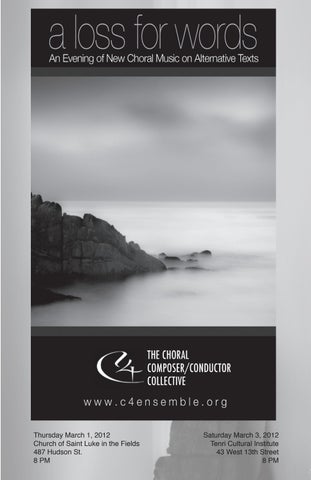
Thursday March 1, 2012 Church of Saint Luke in the Fields 487 Hudson St. 8 PM
Saturday March 3, 2012 Tenri Cultural Institute 43 West 13th Street 8 PM
Acknowledgements Benefactors The activities of C4 are funded, in large part, by grants and generous contributions. We wish to thank and acknowledge: For their major support: Nan Bases Kit Smyth Basquin Michael David & Lauren Mitchell Tracy and Stanley Shopkorn Ellen Stafford-Sigg Meet the Composer/Cary New Music Performance Fund Francine Belkind Nathan Berkoff Michael Biello and Dan Martin Jennifer Borum Sandra Carlson Richard and Gillian Champlain Zachary P. Cummings Hugh D. and Kathryn Klein Eddy Jonathan David Nancy and Don Derham Mary Tacciole Devine Trevor Doherty Orianne Yin Dutka Kim Erle David Harris D.B. and S.M. Hayward Linnea C. Johnson Andrew Kadel & Paula Schaap Jeffrey M. and Kuniko K. Katz
Deborah Kilmer Jeanne and Paul Klainer Pamela Klainer Stanley Lieblein Patricia Marino Elizabeth Marker Edward Mermelstein Peter and Christine Metz Ruth Mueller-Maerki Jon Minikes and Sue Backstrom Ian David Moss Bernard and Rochelle Natt Susan Obel Raymond Penn Jonathan & Suzanne Rosenzweig Bruce Saylor Ann & Richard Sarnoff Pat & Larry Siegel Martha Sullivan Kenneth and Jean Telljohann
SPECIAL THANKS We also wish to express our heartfelt thanks and appreciation to the following organizations and individuals for their support and assistance: Zahra Partovi Dodger Theatricals The Church of St. Luke in the Fields David Shuler Tenri Cultural Institute
a loss for words
Thursday March 1, 2012 Church of Saint Luke in the Fields, New York, NY Saturday March 3, 2012 Tenri Cultural Institute, New York, NY
Four2
John Cage (1912-1992)
Besh Besh Besh-m Sh’mo (Village Music for C4)* David Harris, Conductor Soloists: Timothy Brown, Karen Devine Fahad Siadat, Melissa Wozniak
Nursery Miniatures*
Martha Sullivan (b. 1964)
Karen Siegel (b. 1980)
No 1: Play No 2: Lullaby No 3: Sleep
Daniel Andor, Conductor
Catch*
Timothy Brown, Conductor Soloists: Jonathan David, David Harris, Rachel Samet, Suzanne Schwing
The Blue of Distance ‡
David Harris (b. 1974)
Žibuoklė Martinaitytė (b. 1978)
Hannah Carr, Conductor
Intermission Pseudo Yoik NT
Fahad Siadat, Conductor
Painting On a Square Canvas 1 Prelude, Chorale and Fugue*
Jaakko Mäntyjärvi (b. 1963) Thomas Stumpf (b. 1950)
Hannah Carr, Conductor
Without Words †
Rachel Samet, Conductor
Huang Ruo (b. 1976)
In So Many Words*
Timothy Brown (b. 1963)
Hee•Oo•Oom•Ha
Toby Twining (b. 1958)
Rachel Samet, Conductor
David Harris, Conductor Guest Soloist: Toby Twining
* World premiere † East Coast Premiere ‡ US Premiere
Program Notes and Texts When C4 began to rehearse this repertoire,
Four2
language. Singers typically take significant
O-r-e-g-o-n
singer how to engage emotionally, how loud
[We recommend reading the following
it became clear how tied people are to cues from the words in music. Words tell the to sing, phrase articulation, note color, etc. Without text, the language of music becomes
John Cage
program note after you’ve heard the piece.]
a different animal to a singer, even different
Four2 belongs to a body of works called the
text to a vocalist becomes an abstraction, as
last 6 years of his life. There are over 50 of
than for an instrumentalist. Music without
the same mechanism used to create sound with words (the mouth,
“number pieces” which Cage wrote in the them. The number four refers to the number of performers or sections. The superscript two designates this as the
larynx,
second number piece written
etc.) is used when
for four parts. There are 6 pieces
no
words
are
the
context
of
the
range
of
The chorus sings from parts;
as
part contains anywhere from 3
entitled “Four.” There are 13
present. Without text,
called “One”. There’s a “108”.
however,
there is no unified score. Each
potential sounds increases
to 6 isolated single notes. Most
does the way we
of the number pieces utilize
approach making these
sounds.
The interest of
Cage’s “time bracket” method.
from “Catch” by David Harris The brackets can either be
the sounds themselves leaps to the fore,
fixed or, in this case, flexible. Each note is
Jackson Pollock painting or the color impact
1’00”-1’45”. The elegantly simple concept
offering a similar effect to the rhythm of a
of a Raushenburg. The compositions on this
program all disregard an essential ingredient in the typical communication process to delve into what makes communication
happen in the first place. Whether through the use of phonemes, created language,
metaphoric poetry or densely-layered text,
the pieces magnify the subtlety of language’s constrution points and turn our ears on their sides for the sake of understanding a little more deeply how we are put together.
assigned two sets of duration ranges, e.g., is that each section must begin each of its
notes anywhere within that note’s first set of durations and must end anywhere within
its second set. Cage leaves no instructions as to how these timing choices should be
made nor who should make them. They may be arrived at spontaneously during
performance, or pre-determined before performance by the section together, by a section leader, or by a single “director”
(though this last choice seems somewhat
counter to both the spirit of the piece and this particular collective ensemble…).
Though Cage’s selection of notes certainly plays a role, the precise harmonies, and the length of their sounding, not to mention the inevitable silences, will depend largely
on the duration choices of the ensemble. As it’s highly unlikely any two ensembles will
make the same choices across all 4 sections, the results will differ from performance
to performance, a variability that was a hallmark of Cage’s philosophy.
The syllables sung are derived from the name of the state of Oregon, the home of the
high school chorus the piece was written for. Happy John Cage Centennial! ~Jonathan David
from the classic recordings of more arranged
material such as the song Polegnala e Todora, the most obvious influence on Besh Besh Besh-m Sh’mo.
The piece was written for C4 specifically for
this program of invented or absent texts, so I created syllables designed to make this
style of singing easier. At times they sound
Italian, at times country Bavarian, at times Japanese, but seldom do they use consonant
clusters or sounds uncommon in English. The piece should be fun to sing, and not too hard, and maybe slightly danceable.
It is written as a celebration and subtitled “Village Music for C4” with my thanks to this very special group for bringing so much that’s good to life. ~Martha Sullivan
Besh Besh Besh-m Sh’mo Martha Sullivan
Nursery Miniatures Karen Siegel
Besh Besh Besh-m Sh’mo plays with rhythms
Nursery Miniatures is inspired by my infant
that are skewed for dancing, because the Bulgarian dance music
son Ari, born last June, and was composed
I love takes its swing
from making some beats slightly
longer
than
others. If you know the genre, a
you
standard
will
hear
kopanica
rhythm as well as a
lesnoto. If not, you may find the
from “Nursery Miniatures No. 1” by Karen Siegel
very bright vocal style intriguing, and
when he was five months old.
the Mystère des Voix Bulgares phenomenon
and I make when playing together, including
vaguely familiar from sources like NPR or of the 1980s and 90s, or even the opening theme song of the old Xena: Warrior Princess
show. The singing back and forth between soloists and chorus is a direct steal both from rural singing styles in Bulgaria and
The first
miniature reflects the sounds that the baby
laughter. The second miniature is a lullaby
sung by the women. The simple melody is passed around from one part to another,
while the vowels gradually transform. The third miniature is loosely based on my
imagining of Ari’s dreams, and also involves
settling and soothing. By contrast, the more
focuses on a different musical element—first
and ordered sets like a tone row) feel
vowel transformations.
Each miniature
rhythm, then melody, and then harmony. ~Karen Siegel
Catch
David Harris
Freedom, sponteneity, self expression are
all inspiring concepts integral to personal life philosophy, politics, business and art
(as I write this, I’ve been singing Free Bird all morning and puzzling over the freqent
desire among artists to “be traveling on
now”). Restriction is often viewed as an enemy to living freely. Yet, no matter how hard people try to relieve themselves of restriction, it always comes back in some
way, generally more powerfully when ignored (e.g. the Republican party line on
heath care. By not paying for it up front, it costs more in the end).
As I played with verbal and musical language and the systems on which they
are built, I found that the physical feeling
restricting elements (explosive consonants,
slightly forced, constraining and difficult. I set about to force these contrasting feelings
into an abstract relationship by isolating and layering phonemes, and choosing a tone
row organized in three pentatonic scales.
In the 17th-century catch (also known as a round or canon), word combinations that
didn’t appear in the poetry would pop out from the canonic texture. An example being a catch by Henry Purcell in which the words “glass,” “the Pope” and “the
Devil” appear opposite one another and when sung in canon yield the prodestant slight “the Pope’s the Devil.” Though the sounds in my Catch are not complete words, the hope is that the abstraction of sounds
will yield some intelligable information,
all within the delightfully obtuse attempt
to comment on humanity’s arrogance and joyfulness, while making a nice tune. The phonemes are not completely random, but
are based on words suggested by friends on Facebook when asked “what are your
favorite words,” yielding
“paperclip,” “Sasquatch”
and the like. Thanks to all who participated.
Pseudo-Yoik NT Jaakko Mäntyjärvi This from “Psuedo Yoik” by Jaako Mäntyjärvi
created by the freest part of
Pseudo-Yoik
has
nothing to do with the genuine
traditional
Lappish or Saame Yoik
our verbal and musical systems (vowels and
(most directly translated as song), and
pentatonic scale) felt generally warmer, more
degree of authenticity as local color in bel
hummed consonants, and open sets like the
should thus be considered to have the same
canto opera. If a connection must be sought,
street signs, lyrics... a whole lot of blah blah
impression of a stereotype–the stereotype
give voice to the character who comments
I would prefer to describe this piece as an that most Finns associate with Lapland and its people.
The text exists merely to give form to the
blah which tries to overwhelm. The singers in exasperated strings of notes and chords
which are sometimes looped or delivered in a confused ad lib.
music and is meaningless, although the laws
I’m grateful that, in the end, I found my way
obscure South American Indian language in
humor in the work, allowing the character
of probability dictate that there must exist an which it makes perfectly good sense. ~Jaakko Mäntyjärvi
In So Many Words Timothy Brown The inspiration for In So Many Words came
back from near depression to the sense of
(read: all of us) to find relief from the cacophony and find a quiet place, free from words, except for one final punch line. ~Timothy Brown Sung text
from a t-shirt my daughter, Evann, brought
Oh, Ah! Blah!!
of my piece, “Your Lips Are Moving, But All
Babble, Gab
back from a trip. I took its text as the “hook”
I Can Hear Is Blah, Blah, Blah.” It’s a phrase that, though not new to most, is made no less hilarious to an 8-year-old!
This choice of text made it seem clear: I
Talk, Talk, Talk Jabber, Jaw
Yak, Blather
Your lips are moving, but all I hear is Blah, Blah, Blah!
would write a joke piece which would take
a completely different approach from the
other works on this “wordless” concert. Though there would be ‘No Lack of Words’
(the working title), the piece would be about a failure to communicate. However,
as I started to compile text snippets from
the massive amounts of verbiage out there,
it dawned on me how not funny this fact of every day life can seem. It was almost
overwhelming to delve into the sheer volume of words.
The character in In So Many Words endures
it all: bits from television, newspapers, magazines, e-mails, household packaging,
from “In So Many Words” by Timothy Brown
Run on, Blab
the ear’s familiarity with development
Talk, Talk, Talk
bring us the pendulum-like rocking of
Ramble, Jaw
and forward motion in music, to instead
Chat, Banter
movement without melody and a deep inner pulse to which patterns of color and
Natter, Gnaw
Talk, Talk, Talk Rattle, Blab
Chit Chatter The words
keep coming,
but all I can see is Blah, Blah, Blah!
from “The Blue of Distance” by Žibuoklė Martinaitytė
Jabber, Rattle on
rhythm are subservient, creating what
Chatter on, Natter
self contained and existing without sense of
Blather, Babble, Gab
might be described as a sound sculpture,
Talk, Talk , Talk, Talk, Talk
beginning or end. ~Hannah Carr
Oh... AH!!!
When searching for the lyrics for my choral
(exhale)
piece, I encountered an alluring phrase “the
blue of distance.” It remained just a poetical-
Aaaah... (etc.)
philosophical hint since the text itself doesn’t
The Blue of Distance Žibuoklė Martinaitytė A
significant
shift
from
(2010)
conventional
poetic settings to music, The Blue Of Distance explores the deep murmurs of the
subconscious and mirrors the subtlety and
constancy of the mind’s meditation on this calm and beautiful poem. The layered pillars
of cluster chords create a rich sound wall in
get utilized at all. Instead, the function of the lyrics is given to a set of speech sounds
– mostly humming or the sung open vowels “a-e-i-o-u”. In one part of the piece these vowels-letters appear as chords, they determine the succession of entrances of choral voices and their interrelationships. ~Žibuoklė Martinaitytė The Blue of Distance (from Rebecca Solnit A Field Guide to Getting Lost)
which musical patterns and rhythms vary
The world is blue at its edges and in its
deep magnetism of the sea and the melting
mountain ranges, of anything far away.
in swells and pulls, masterfully evoking the of sea and sky into one rolling blue.
Overall, the effect of the work challenges
depths… that color of horizons, of remote
The color of that distance is the color of an emotion, the color of solitude and of desire,
the color of there seen from here, the color of
wholly coherent musical language to a
you can never go. For the blue is not in the
that masterfully marries system and aurally
where you are not. And the color of where
place those miles away at the horizon, but in
the atmospheric distance between you and
the mountains… Blue is the color of longing for the distances you never arrive in, for the blue world…
Painting On A Square Canvas 1: Prelude, Chorale and Fugue Thomas Stumpf The title came from a long conversation I had
with a very good friend of mine, a painter
named David Fullam, who had just started painting on square canvases. He explained to me how much more focus that form requires
from both painter and spectator - there’s much less “narrative” and therefore there has to be something that keeps you more forcefully inside
conceptionally strict musical form in a way daring aesthetics. The contrived motives of the work turn on themselves in various
sequences of inversion and retrograde,
where self-contained figures playfully chain together in shifting melodic phrases, layered on a vertical harmony that hinges on an
excitingly dissonant, but structurally fluent contrapuntal texture. These compositional
choices reflect the idea behind the piece’s inception of the closed square canvas and creates a mood that is charged with energy,
starting from the tense sprung melodies of the prelude, to their development in the
twisting melodic clips of the choral. These
angular motivic figures appear in full fruition in the fugue, whose dual subject
and mirroring countersubject combine to playfully disguise the boundaries of theme
the canvas... Of course will
music
always
have a certain “narrative” form because it has to unfold in the dimension
of
time, but I was
really interested in the idea of that
relatively
from “Painting on a Square Canvas” by Thomas Stumpf
tight focus David was aiming for. Which is
and accompaniment, leaving the listener
boring theory classes... ~Thomas Stumpf
of melody and harmony, but a compositional
why I wrote my first fugue since the days of
The prelude, chorale and fugue explore the concept of focus in form without narrative by subjecting a highly original, and yet
with a nagging familiarity as to the patterns ingenuity that never quite lets us pin down its formula. ~Hannah Carr
Without Words Huang Ruo
Hee•oo•oom•ha Toby Twining
Without Words is written for double a
In 1987 the choreographer Melanie Bales
Alto I, Tenor I, Bass I, and Soprano II, Alto
used my voice. I had recently become taken
cappella choir in eight parts: Soprano I,
II, Tenor II, Bass II, with four pairs of finger bells. The entire piece runs around six and
a half minutes. The text is from a poem written by Li Hou Zhu (937-978) in the Tang Dynasty.
~ Huang Ruo
Wu Yan Du
Without words, alone …
Shang Xi Lou,
Walking up to the Western
Yue Ru Gou.
The moon is as a fading
pavilion. hook …
Ji Muo Wu Tong The Lonesome Wutong
Shen Yuan
Suo Qin Qiu.
throat singers. Further, I wanted to exploit the seemingly infinite variety of sounds possible for the human voice to achieve a range of orchestral color. These
were
the
ideas
that
inspired
Hee•oo•oom•ha, my first large work for
unaccompanied voices, which set me on a lifelong creative path in choral music. ~Toby Twining
Enclosed with dismal Autumn.
Shi Li Chou.
Is this sorrow of
Bie Shi Yi Fan
of the BaBenzele Pygmies and Mongolian
In the deep courtyard,
Unbreakable;
with world vocal music, particularly that
tree,
Jian Bu Duan, Li Hai Luan,
asked me to compose a piece for her that
yet, impossible to sort, leaving…
Deepening in my heart,
Zi Wei Zai Xin Tou.An unspeakable feeling
from “Hee-oo-oom-ha” by Toby Twining
Composers Europe, USA and Asia by Nouvel Ensemble
J-o-h-n C-a-G-e
Moderne (Canada), The Smith Quartet (UK), ERGO Ensemble (Canada), The Orchestra
Žibuoklė Martinaitytė
of Mons Royal Conservatoire (Belgium),
(zhih-BWAH-kleh martin-ay-TEE-teh)
The Lithuanian Chamber Orchestra, The
Residing in New York City, Lithuanian-born Žibuoklė Martinaitytė is a composer on an
international scale. Although primarily
centralized in Europe, her activity is gaining
momentum in the USA. In 2008, she was commissioned by MATA festival on their 10th
anniversary premiering her piece Polarities by The Knights Chamber Orchestra. In 2009
and 2011 she was awarded a fellowship for residency at the MacDowell Colony for Artists
in
New
Hampshire
and
was
granted the award for residency at the
Lithuanian National Symphony Orchestra and others. Her scores are published by
Musikproduktion Hoflich and Karthause-
Schmülling (Germany). Her most current
work for symphony orchestra A Thousand Doors To The World (2009) was commissioned
by Lithuanian Radio on the occasion of “Vilnius – Culture Capital of Europe 2009”
and was broadcast by Euroradio in many European countries. It also received the Lithuanian Composers Union Award as Best Orchestral Performance for 2009.
Aaron Copland house in 2010. Her most
Jaakko Mäntyjärvi
Composer Fellowship (San Francisco, CA)
Jaakko Mäntyjärvi, born 1963 in Turku,
“Look&Listen”
the University of Helsinki, graduating with
recent activities include the “Other Minds” for the spring of 2011 and receiving the Composers
Competition
Prize (NYC) for the piece Driving Force.
Martinaitytė studied composition at the Lithuanian Music Academy (BM, MA) with
Bronius Kutavičius and Julius Juzeliūnas. Since 1998 she has participated in numerous
composition courses in Europe including
the Darmstadt New Music Summer Course, Centre
Acanthes/Ircam,
Royaumont,
The 6th International Academy for New
Composition and Audio Art, Stavanger and others studying with Brian Ferneyhough,
Boguslaw Schaffer, Magnus Lindberg, Tristan Murail and Jonathan Harvey. In 2001 she received a creative residency at Kunstlerhaus
Lukas der Stiftung Kulturfonds, Germany.
Her music has been performed throughout
Finland, studied English and Linguistics at
a MA degree in 1991. He has studied music theory and choir conducting at the Sibelius Academy in Helsinki, completing a level B
examination in choir conducting in 1992. He is a timpanist, a pianist, a choral singer, and a conductor. As a composer, Jaakko Mäntyjärvi describes himself as an eclectic
traditionalist: eclectic in that he adopts
influences from a number of styles and
periods, fusing them into his own idiom; traditionalist in that his musical language is
based on a traditional approach and uses the resources of modern music only sparingly.
Because he is himself active in making music, his music is extremely practically oriented.
Huang Ruo
Chinese Folk Voice, was released on Albany
Awarded First Prize by the prestigious
Divergence came out on Koch International
Prize, Huang Ruo has been cited by the
Corners, performed by Future In REverse,
of
Asian-American
Huang Ruo is currently a member of the
musical voice draws equal inspiration
more information about Huang Ruo and his
Records with his own singing in 2008; and Composition
in 2009. Huang Ruo’s latest CD To The Four
New Yorker as “one of the most intriguing
was recently released on NaxosRecords.
composers.” His vibrant and inventive
composition faculty at SUNY Purchase. For
from Chinese folk, Western avant-garde,
music, please visit huangruo.com.
integration using a compositional technique
Toby Twining
writing spans from orchestra, chamber
Raised in Texas, with family roots in
to
multi-media,
has traveled musically from playing for rock
film. Ensembles who have premiered and
at the University of Illinois in Urbana, where
Philharmonic, Philadelphia Orchestra, San
1985. His group Toby Twining Music has
Hong Kong Philharmonic, Chamber Music
the United States and parts of Europe. Their
Nieuw Ensemble, Quatuor Diotima, Dutch
1994), The Little Match Girl and Emily
and under conductors such as Wolfgang
Home Companion 20th Anniversary Album
Davies, Ed Spanjaard, Xian Zhang, and Ilan
and Eurydice (Cantaloupe Music, 2002 and
Luxembourg
the
new
International
crop
of
rock, and jazz to create a seamless, organic
he calls “dimensionalism.” Huang Ruo’s music, opera, theater, and modern dance,
country-swing and gospel, Toby Twining
experimental improvisation, folk rock, and
and jazz bands to experimental composition
performed his music include the New York
he earned his Bachelor of Music degree in
Francisco Symphony, Seattle Symphony,
performed in music halls and festivals across
Society of Lincoln Center, Asko Ensemble,
recordings include Shaman (BMG Classics,
Vocal Laboratory, and the Tang Quartet,
Dickinson’s Birthday Pizza on A Prairie
Sawallisch, James Conlon, Dennis Russell
(Highbridge, 1996), Chrysalid Requiem
Volkov. Huang Ruo has received awards
2011).
Presser Foundation, Jerome Foundation,
Twining’s instrumental works have been
Meet The Composer, NYSCA, Chamber
Blues, Anthem, Oxingale, 2002) and pianist
Aaron Copland Award, and Alice M.
Piano, Point/Universal 1997 and An American
Kozinn listed his concert as the second on
Twining is the recipient of a Pew Fellowship,
of 2003.” Huang Ruo’sChamber Concerto
Original Music, a Guggenheim Fellowship
2007; Leaving Sao, a work for orchestra and
Music/USA award.
sound
installation,
and grants from the ASCAP Foundation, Argosy Foundation, Greenwall Foundation,
recorded by cellist Matt Haimovitz (9:11
Music America, American Music Center,
Margaret Leng Tan (Satie Blues, The Art of Toy
Ditson Award. New York Times critic Allan
in Buenos Aires, She Herself Alone, Mode, 2011).
the list of his “Top Ten Classical Moments
the Barrymore Award for Outstanding
Cycle was released on Naxos in February
and a Meet the Composer Commissioning
C4: The Choral Composer/Conductor Collective Daniel Andor started playing piano at
by the Riverside Symphony, received its first
The Purcell School of Music, London. His
Rothman in Lincoln Center’s Alice Tully
four and studied composition and piano at
compositions won a number of awards and have been performed internationally, and he
was featured by the Society for the Promotion of New Music during 2000–2002. As he felt
drawn to making music with others, he took
up trombone and conducting. Orchestral conducting kept him busy during his years at the University of Cambridge, where he lingered vigorously until he received his
PhD in physics in 2005. Daniel continued his research at the Rockefeller University in
New York, contemplating the receiving end of music: researching hearing and its neurophysiology. He recently joined the research group of a New York tech startup.
Hayes Biggs was born in Huntsville, Alabama and raised in Helena, Arkansas.
He holds the Doctor of Musical Arts degree in composition from Columbia University.
His teachers have included Don Freund, Mario Davidovsky, Jack Beeson, Fred Lerdahl and Donald Erb. Biggs has been
a fellow in composition at the Composers
performance under the direction of George
Hall in February of 2010. C4 gave the first performances of a setting of Gerard Manley
Hopkins’s The Caged Skylark in November of 2011. Biggs’s song cycle on religious poetry,
Psalms, Hymns and Spiritual Songs, was premiered at Manhattan School of Music in
January 2012 by soprano Susan Narucki and pianist Christopher Oldfather. That same
month his Three Hymn Tune Preludes were given their first performance by Gail Archer at St. Paul’s Chapel at Columbia University.
In December of 2006 his String Quartet: O Sapientia/Steal Away (2004) was given its premiere at New York City’s Merkin Concert
Hall by the Avalon String Quartet as part of the 2006-2007 season of the Washington
Square Contemporary Music Society; it was
recorded by the Avalon String Quartet in 2008, and was recently released on Albany Records. Biggs’s music is published by C. F. Peters Corporation, APNM (Association for the Promotion of New Music) and Margun Music, Inc. www.hayesbiggs.com
Conference and Chamber Music Center
Timothy Brown completed his BA at the
Center, at Yaddo, the Virginia Center for
choral professional for more than 30 years,
at Wellesley, at the Tanglewood Music the Creative Arts, the Millay Colony for the
Arts and at the MacDowell Colony. Among his honors are a John Simon Guggenheim Memorial Fellowship, as well as the 2001 Aaron Copland Award, which afforded
him the opportunity to live and compose at Copland House in upstate New York during the summer of 2002. Since 1992 he has been
on the faculty of the Manhattan School of Music. His Symphonia brevis, commissioned
University of North Texas and has been a
directing and singing with high school,
community, and chamber choirs. As a
composer, Tim focused for a time on music for the theatre. His Curious George toured
nationally for over ten years and his songs were showcased at the West Bank Theatre, the BMI Workshop, and in the Donnell Library
‘Songbook,’ and - most recently - in A Trace
of Love, an evening devoted entirely to his music with 6 collaborating lyricists. Tim also
studied at the Manhattan School of Music
(first prize) for her composition portfolio.
Suite was premiered at Merkin Concert Hall,
in Choral Conducting with Peter Erdei at
with Nils Vigeland. His Incidental Dance and Epitaph: Songs on Poems of Dorothy
Parker was recorded by Metropolitan Opera
mezzo, Theadora Hanslowe. Tim’s church
music includes Christ Our Passover, and
Eloi, Lama Sabbachtani, both commissioned and premiered through The Church of the Heavenly Rest, New York.
Kristopher Burke has earned degrees in
music education from Shepherd University
and Vocal Performance from Shenandoah Conservatory. Kristopher sang as soloist
She went on to take an advanced diploma the Kodály Institute in Hungary and was given a presentation upon completion for
outstanding academic acheivement. She has won various prizes for piano performance
and received the highest bursary prize awarded by the Irish Arts Council to an
individual for travel and training in both
2009 and 2010. She has performed in classical music as an organist, pianist and singer,
as well as in groups from Traditional Irish music to Funk and other popular styles.
and section leader with the St. James Choir
New York composer Jonathan David has
chorister with the City Choir of Washington
2011-12 season, five of these commissions:
in Leesburg, VA for five years and as a under conductor Robert Shafer. He has also performed the roles of Sam Kaplan in Weill’s Street Scene, Don Basilio in Mozart’s
Le Nozze di Figaro, and Flute in Britten’s A Midsummer Night’s Dream. Kristopher moved to New York a year ago from West Virginia,
and now works as an arts administrator for the Brooklyn Conservatory of Music and the Brooklyn Youth Chorus.
Hannah Carr’s interest in music began with writing pop songs on the piano for
no one to hear. She was chorister and head girl in a cathedral choir for six years in her native Limerick, Ireland while still in
school, and here she developed a love of choral and sacred music. She then took her
undergraduate degree in Music and French
with a composition major under Donnacha Dennehy at Trinity College Dublin, where she
cofounded and conducted the official Music Department Chamber Choir, Campanile Consort and won the Gerard Victory prize
eight world premieres scheduled during the
The Tightened String, a 9/11 memorial work for NYC’s Central City Chorus (Dec. 2011);
a Stabat Mater for Carroll University (WI) (April 2012; Italian tour in May); Little Drops of Water for the Marble Collegiate Church
Cherub Choir (May 2012); Azrael, a song for Jay Barksdale to honor the 10th anniversary
of the Sylvia Townsend Warner Foundation (Oct. 2011, UK premiere in June 2012); and Gitchee Gumee, for baritone Daniel Neer and
harp (April 2012). Cantaria, the Gay Men’s Chorus of Asheville premiered A Shepherd’s
Nativity in December, 2011. Jonathan also has premieres upcoming by the Young Men’s Ensemble of the Brooklyn Youth
Chorus Academy, and C4 with members of the Fireworks Ensemble. The 2010-11
season featured premieres by the Juilliard Pre-College Chorus, Mountainside Master
Chorale (CA), Pueri Cantores San Gabriel Valley, and the Shoreline Community Chorale
(finalist
in
the
“Celebrating
Connecticut’s Composers” competition).
Jonathan’s choral music has also been
Mario Gullo has been seen in New York at
Glen Ellyn Children’s Chorus, Cerddorion
Guild and the Barrow Street Theater. His
Singers (commission) and the Thanks-
Barbara Cook in concert at Carnegie Hall.
has served as Composer-in-Residence for
the Theater of Youth, Tri-State Center for
Director for the chamber chorus, Howl!, His
Philharmonic. He has had pieces performed
Americas Vocal Ensemble, and the Global
Bridges Vocal Ensemble.
Wesleyan University, Jonathan studied with
David
Berklee College of Music. He is published
himself that he is a rare find in the musical
also available through his website, www.
nature whose unique talents rattle the cage
performed by the Princeton Singers, the
Alice Tully Hall, City Center, the Dramatist’s
Vocal Ensemble, the New York Treble
favorite so far has been appearing with
Giving Foundation (commission) et al. He
Regionally, he has performed at Artpart,
The Greenwich Village Singers and Music
the Performing Arts and the Hudson Valley
music has received awards from ASCAP, the
by the New York City Master Chorale and
Network of Conservatories. A graduate of
Harris,
like
most
conductor/
John Bavicchi and Don McDonnell at the
composer/singers, would like to say of
by Oxford University Press. His music is
world,
jonathandavidmusic.com.
of tradition and establish a new line of
Karen Devine has been fortunate to sing with
truth is that he’s pretty good at what he does,
an
industry-changing
force
demarcation for time immemorium.
of
The
many esteemed choruses and conductors
enjoys making a living as a musician and
to the list this year. Highlights include: Mrs.
in a range of groups (C4, The Brearley
Chamber Singers under the direction of Dr.
Youth Chorus and the efforvescent 7/8
voice and conducting while completing
other engagements). Music is about people,
Amuse. She currently studies voice with
by our definition, and accomplishment,
believes that her (two) accordion(s) will
happens one experience at a time. www.
throughout her life, and is thrilled to add C4
working with some delightful performers
Comber’s 4th grade choir, Kenyon College
Singers, Columbia Glee Club, Brooklyn
Benjamin Locke (with whom she also studied
Chorus of Collegiate, plus some random
her B.A. in Music), Cantori New York, and
after all, for without us there is none, at least
Evelyn Troester and, like most Brooklynites,
to
undoubtably lead to fame and fortune. After
davidharrismusic.net
(helping to bring the world Britney Spears
Mezzo-soprano Amanda Keil is a current
atone for her sins by becoming a massage
been seen as Nerone in L’Incoronazione di
therapist - perhaps, in part, because clients
Queen in Iolanthe, and as Hillary Clinton
or Yanni during their massage.
Say it Ain’t so Joe, by Curtis K. Hughes,
dabbling a bit in the business side of music
this
conductor/composer/singer,
and The Backstreet Boys), Karen decided to
Resident Artist with Dicapo Opera, and has
therapist.
She is now a highly-regarded
Poppea, Orlofsky in Die Fledermaus, the Fairy
can rest assured they will never hear Enya
and Gwen Ifill in the world premiere of which will be released on CD in 2011. In
2008 she toured with The Boston Camerata,
As Research Director for Fractured Atlas,
and Isolde in Paris and Boston. Amanda
agencies, and others support the arts more
performing the medieval story of Tristan is the founder of Musica Nuova, which invigorates
early
music
performances
with staging, movement, and storytelling. Amanda holds a masters degree in voice and historical performance from Boston University and a bachelors degree in French horn performance from The Hartt School.
Elizabeth Marker is an accomplished musician who has devoted the major portion of her career to the advancement of choral
Ian David Moss helps funders, government effectively by harnessing the power of
data to drive informed decision-making. A serial entrepreneur, Ian is the founder of
the acclaimed arts policy blog Createquity, a hybrid electric chamber group/experimental
rock band called Capital M, and C4 itself. He has twice been named by his peers among the
“25 most powerful and influential leaders”
in the nonprofit arts sector, and holds BA and MBA degrees from Yale University.
music. She holds a Master of Music in Voice
Rachel Samet spent the last four years
she studied with Mary Davenport and
served as Director of Choral Activities at
Performance from Boston University where coached with Alan Rodgers. In New York she studies with Maria Farnworth. She has sung with many notable choral groups including
Tanglewood Festival Chorus, the Russian Chamber Chorus and Cantori New York. In 1987, Elizabeth was invited to sing with
the Oregon Repertory Singers representing
the United States at the 26th Choral Singing
Festival in Kärnten, Austria where the group won both the Folk and Classical Repertoire
competitions. Elizabeth performed in many Robert Shaw Choral Workshops at Carnegie Hall and was a member of the Robert Shaw
Festival Singers. She has served as section leader at The Church of the Good Shepherd
(Episcopal) and been a member of the professional choir at St. Ignatius of Antioch (Episcopal). As a soloist, Elizabeth can be
heard on two recordings: My Heart is Ready,
music of Yuri Yukechev (Russian Chamber
Chorus), and, as the Mother of Iseut, in Le vin herbé by Frank Martin (I Cantori di New York).
in the middle of the Pacific, where she
the University of Hawai`i at Mānoa. She
coordinated and led the UH Chamber Singers’
first
educational/performance
tour of the Hawaiian Islands, and prepared
the Chamber Singers to perform with the Honolulu Symphony Orchestra and Chorus
for several Masterworks concerts, including Duruflé’s
Requiem,
and Carmina Burana.
Fauré’s
Requiem,
She has led choral
workshops with dozens of choirs from across the U.S. and Canada, and is sought after as a
clinician and adjudicator with festivals such as Heritage Festivals.
At the University
of Colorado at Boulder, she prepared the
Collegiate Chorale to perform Britten’s War Requiem under the baton of Marin Alsop, and
was invited to conduct the same ensemble at the American Music Research Center’s
International Musicological Symposium: Nadia
Boulanger
& American
Music.
Equally at home in the world of theater, she has served as musical director for numerous
stage productions such as Menotti’s Amahl
and the Night Visitors at the Rocky Mountain
Center for Musical Arts in Colorado and
Singers, she has also recorded for the Sony
The Opera House at Boothbay Harbor in
Classics, and Parma labels.
I Love You, You’re Perfect, Now Change! at Maine. She contributed several biographies
Classical, RCA Victor, Koch International
of African American choral musicians to
The 2010-2011 season brought Suzanne
New Grove Dictionary of American Music.
of Leonard Bernstein’s A Quiet Place,
the forthcoming updated edition of The Rachel holds degrees from the University
of Colorado at Boulder (DMA), Boston University (MM), and Oberlin College (BA). Mezzo-soprano Suzanne Schwing was
originally trained for the stage at LAMDA and subsequently received her musical training
at Boston University and Manhattan School of Music. Having begun her professional
performing arts career in the theatre at the age of 13, Suzanne is now active as an actress, classical singer, opera critic, stage director, and Shakespeare coach.
back to NYCO for the New York premiere
followed by a return to the Choral Society
of the Hamptons as Alto soloist for Part 1 of Bach’s Christmas Oratorio.
Other
projects of note in 2011 were performances
as Alto soloist in Rachmaninoff’s Vespers, choral concerts at the Verbier Festival under
Gábor Takács-Nagy, Manfred Honeck, and
Gianandrea Noseda, and Handel’s Messiah as Alto soloist with the Choral Society of the Hamptons.
Upcoming performances
include appearances with the New York
Virtuoso Singers and the Collegiate Chorale Singers at Bard College and Carnegie Hall.
As an actress, she has performed in the US
Karen Siegel grew up harmonizing doo-
as Rosalind in As You Like It, Lady Bracknell
to study voice, piano, cello, and eventually
and the UK, appearing in such diverse roles
in The Importance of Being Earnest, and as the Marquise de Merteuil in Les Liaisons Dangereuses.
As a singer, Suzanne has
performed in solo and/or choral capacities at such venues as New York City Opera
(NYCO), Carnegie Hall, Avery Fisher Hall, Boston’s Symphony Hall, Tanglewood,
the Kennedy Center, the “Kitara” Concert Hall in Sapporo, Japan, and in the General
Assembly Hall of the United Nations with conductors Seiji Ozawa, Kurt Masur,
Mstislav Rostropovich, James Levine, Rafael Frühbeck de Burgos, George Manahan, Keith Lockhart, James Conlon, Sir Simon
Rattle, and many others. As a member of
the Tanglewood Festival Chorus, the John Oliver Chorale, and the New York Virtuoso
wop tunes with her family, and went on
composition. She holds a Master’s degree in Composition from NYU, where she studied
with Marc Antonio Consoli, and a Bachelor’s degree in Psychology from Yale. Additional
studies include coursework with Conrad Cummings at the Juilliard Evening Division
and vocal instruction with Lavinia Bertotti and Claudine Ansermet at the Fondazione Italiana di Musica Antica in Urbino, Italy. Her works have been commissioned by
the Manhattan Choral Ensemble, Trio Eos, and the Matrix Music Collaborators, and
performed by the new music ensemble Cygnus. Currently, Karen is a PhD candidate
in composition at the CUNY Graduate Center, where she studies with Tania León. www.KarenSiegel.com
Bettina Sheppard works extensively now as
He holds a Master of Fine Arts from the
years spent in dramatic and musical theatre.
Performance and Composition with a focus
a singer, pianist, and composer, after many She holds graduate degrees from both
University of Virginia and CUNY, where she
studied composition with Chris Theofanidis and Shafer Mahoney, as well as composition
studies at Juilliard with Conrad Cummings.
Some completed works include a song cycle of Emily Dickinson poetry performed at Lincoln Center’s Alice Tully Hall; settings
of Millay poetry commissioned for the American Cathedral in Paris; a song cycle of Kaneko poetry; stage productions, including TraumNovela
(Barrow
Street
Theatre,
Barcelona, Dallas); 365 Days/365 Plays by Suzan-Lori Parks at Barrow Street Theatre
and the Public Theater; The Picture of Dorian
Grey; Kindly Direct Me To Hell: An Evening
With Dorothy Parker. She created the new group Bridges Vocal Ensemble, presenting her compositions of various cultures and
time periods, in venues such as Carnegie Hall and City Center. Bettina is presently
working on the new opera Stillwaters. Also
in the works is an opera based on Welsh folk tales of The Mabinogian. Solus, her CD
California Institute of the Arts in Music on Vocal Music, and a Bachelor’s of Music in Theory and Composition from Vanderbilt
University’s Blair School of Music. Fahad has composed for a variety of ensembles,
dance, and theater companies: the California
EAR Unit, New Century Players, CalArts Singer’s Collective, TOCCATA Orchestra,
and Warrior Poet Theater Group, as well as public schools along the west coast. He
has most recently performed with the C4 Vocal Ensemble, Choral Chameleon, and
Polyhmnia in New York, the TOCCATA Orchestra and as a guest vocalist with
PARTCH in Los Angeles. He serves as
composer-in-residence for the TOCCATA Orchestra in Lake Tahoe and Warrior Poet
Theater Productions in Los Angeles. He is
also an active performer of Brazilian music and dance and has performed with Capoeira Narahari and Raizes do Brasil, is a rockclimbing enthusiast, and a tri-athlete. For more information about his current work visit www.fahadsiadat.com
of original material was released under her
Martha Sullivan has written for many of
and performed with numerous vocal groups
the Dale Warland Singers, the Gregg Smith
Welsh name, Brythonwen. She has directed from madrigal to rock, and created the jazz harmony group Satin Dolls.
Bettina is
the author of The Everything Singing Book, published by Adams Media, and is on faculty at City College CUNY.
Fahad Siadat specializes in theatrical music for vocal ensembles. His work explores the
differing sound possibilities of the voice, using
both
standard
notation/singing
as well as extended vocal techniques.
America’s leading choral groups, including
Singers (with whom she was a resident
composer for several years), and the Esoterics (Seattle). Her work has been published by Laurendale and G. Schirmer, and recorded by the Esoterics and Chicago A Cappella. She was one of three winners of the Sorel
Medallion for women composers in 2009, so
her music was performed at Carnegie Hall’s Zankel Hall, and she won the Dale Warland Singers’ Choral Ventures competition in 2003.
She is also a professional singer in the New
York area, with a focus on the new and the
Candide. In 2009, Melissa was the recipient of
Bard Summerscape, and new operas on City
Grant which enabled her to live and study
obscure—she has sung neglected operas for Opera’s VOX showcase for new work. Other highlights as a soloist include premieres
by Toby Twining (Chrysalid Requiem, performances and recording on Cantaloupe) and John Zorn (several premieres and a
recording). She has also performed Steve
Reich’s Tehillim with the Boston Modern
Orchestra Project and Morton Feldman’s Rothko Chapel with Vox Vocal Ensemble.
She has also sung as a chorister with many of New York’s professional choral groups
and opera companies over the last decade, allowing her the chance to travel widely
(Switzerland, Israel, Japan) and to sing under many notable conductors, including Robert Shaw, Robert Spano, Zubin Mehta, and James Levine.
Melissa Wozniak is working as the School Programs Administrator at New York City
Opera while she works on her thesis for her M.M. in Music History and Literature from the University of Southern Mississippi. Her thesis topic concerns settings of Emily Dickinson poetry. In addition to teaching
Music Appreciation in Mississippi, she
appeared as a soprano soloist in Bach’s Magnificat, Mozart’s Coronation Mass, and Derr’s I Never Saw Another Butterfly. Melissa has performed with the Southern Chorale,
the Southern Mississippi Chamber Singers,
and the Hattiesburg (MS) Civic Chorale The Meistersingers, as well as the USM Vocal Jazz Ensemble. In 2005 Melissa earned a
B.M.E. in Music Education from SUNY Fredonia. Onstage performances include L’Orfeo (Fury), and choral roles in I Pagliacci,
The Merry Widow, L’Elisir d’Amore, and
both the DAAD Intensive Language Course in Berlin for 8 weeks, and the Sigma Alpha Iota
Professional
Development
Grant,
which provided assistance for three weeks
of musicological study in Vienna with
her mentor Edward Hafer. Melissa’s past
voice teachers include J. Taylor Hightower, Kimberley Davis and Margaret Kuhl. She
is a member of the American Musicological Society and Sigma Alpha Iota International
Music Fraternity. She is now living and teaching on Long Island with her husband David, a saxophonist.
C4: The Choral Composer/Conductor Collective Sopranos Hannah Carr Rachel Samet Karen Siegel Martha Sullivan Melissa Wozniak
Altos Karen Devine Amanda Keil Elizabeth Marker Suzanne Schwing Bettina Sheppard
Tenors Kris Burke Jonathan David Mario Gullo David Harris Fahad Siadat
Basses Daniel Andor Hayes Biggs Timothy Brown Ian David Moss
C4, the world’s first Choral Composer/Conductor Collective, is a unique vocal ensemble in New York City dedicated to performing music written in the last twenty-five years. A collaborative project of its singing members, it functions not only as a presenting ensemble in its own right, with a threeprogram, six-concert season, but also as an ongoing workshop and recital chorus for the emerging composers and conductors who form the core of the group. It is, as far as we know, the first ensemble of its kind. Please visit our website, www.c4ensemble.org.
Upcoming C4 Concerts
C4 in collaboration with the indie-classical band, The Fireworks Ensemble June 2nd Manhattan Movement and Art Center 8:00 PM Second venue and date TBD Featuring an evening of world premieres including Brian Coughlin’s Requiem and works by C4 composers Jonathan David (The Hounds of Spring), Karen Siegel (Impermanence), and Martha Sullivan (Dia | Logos)