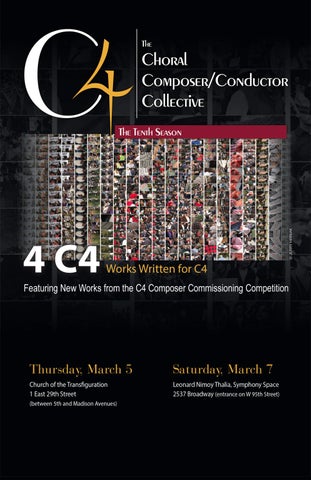
C4: The Choral Composer/Conductor Collective
4C4
Thursday, March 5, 2015, Church of the Transfiguration, New York, NY Saturday, March 7, 2015, Symphony Space, New York, NY Featuring World Premieres from Winners of the 2014/2015 C4 Commissioning Competition
Seven Line Supplication to Guru Rinpoche Karen Siegel, conductor
*Goe, Lovely Rose
Harry Einhorn (b.1986) Hayes Biggs (b.1957)
Colin Britt, conductor
Devastation
Malina Rauschenfels (b.1978)
Colin Britt, conductor
Narciso
Ian David Moss (b1980)
Michael Conley, conductor
Four Bright Seasons (selections) III. Wash of Cold River IV. A Summer Love Song Daniel Andor-Ardó, conductor Melissa Wozniak, soprano
Joseph N. Rubinstein (b.1986)
*Intermission* *Stre----tch!!! 3rd Prize
Texu Kim (b. 1980)
Michael Conley, conductor Susanna Su, narrator
*Through the Cumberland 2nd Prize
Carlo Vincetti Frizzo (b.1979)
*Tape Recorder 1st Prize
Gordon Williamson (b.1974)
I. Last night’s rain II. Today, the sunrise Timothy Brown, conductor Marisa Karchin, soprano Colin Britt, tenor Fahad Siadat, tenor Karl Michael Johnson, baritone Perry Townsend, conductor
*Three Haiku
Bora Park (b.1992)
Melissa Wozniak, conductor
Sublunary
Matthew Brown (b.1978)
Fahad Siadat, conductor * Premiere
Program Notes and Texts 4C4 The members of C4: The Choral Composer/
just how much repertoire has been written
be celebrating our tenth year in the special
the voices of our composers are. Tonight
Conductor Collective are very grateful to nexus of new music and choral art. We— this group, others similar to it, the many
composers who have written us music, and you, our audience—together form
an amazing community. This community constantly produces brand-new pieces, many written expressly for C4 (hence the punning title of this concert).
Such pieces have come from members of
for C4 in the last decade, and how diverse you will hear music as dense and complex as any you know, but also songs as simple as haiku; some of this music will make you
cry, some will make you smile, some will
make you uncomfortable, some will make
you want to dance. The composers include students, teachers, alumni of C4, current
members, and even a past winner of our commissioning competition.
C4, past and present, but also from the
We also thank you, our audience, for your
composers who connect with our mission
community by filling the house for these
wider new-music community, written by
and our eclectic repertoire. We have
also made a formal commitment to this community of composers by running the C4
Commissioning
Competition
every
couple of years. This concert showcases the
work of our 2014–2015 winners, Gordon
support. You make a huge difference to this
concerts, and also by helping fund our competition and outreach programs. We are thrilled to have you here to experience what we can achieve together. Thank you. -Martha Sullivan
Williamson (1st Prize, “Tape Recorder”),
v
the Cumberland”), and Texu Kim (3rd Prize, “Stre-----tch!”). Their winning pieces
Seven Line Supplication to Guru Rinpoche
material that is funny, smart, or simply
The Seven Line Supplication to Guru
Carlo Vincetti Frizzo (2nd Prize, “Through
show off each composer’s voice, presenting beautiful in clearly individual styles. We
are very grateful to these three composers for allowing us to be the first to bring their music to life.
While choosing the repertoire for the rest of this concert, we were very excited to discover
v
v
v
Harry Einhorn
Rinpoche is a traditional Tibetan prayer invoking
Padmasambhava,
the
Tantric
Buddhist master who helped establish
Buddhism in Tibet sometime in the 8th Century and gave numerous teachings
which are still being discovered today. This prayer is said to clear outer, inner, and
secret obstacles on the path to full, complete awakening.
The English translation is used with the
kind courtesy of the Nalanda Translation Committee
(nalandatranslation.org)
and
was produced under the guidance of
You are renowned as Pad Makara
Surrounded by your retinue of many dakinis We practice following your example
Please approach and grant your blessings
-Traditional Tibetan prayer. Translation courtesy of Nalanda Translation Committee
Chogyam Trungpa Rinpoche.
Goe, Lovely Rose
Contained within is a sacred text still
“Goe lovely Rose” was begun some years
practiced and revered by many people around the world. In Himalayan culture and
Buddhist practice in general, it is customary
that such texts are not placed directly on the ground, stepped on or stepped over, or carelessly thrown away.
For those who wish to learn more about
Padmasambhava and his activities, one place to start could be the book Crazy
Wisdom by Chogyam Trungpa Rinpoche.
This piece is dedicated as an offering to the Karmapa, Orgyen Trinle Dorje, head of the Karma Kagyu school of Tibetan Buddhism. -Harry Einhorn Text: Orgyen yool gee nub jang tsam Pema gesar dong po la
Ya-tsen chok gee ngo drub ne
Hayes Biggs
ago, I don’t now remember how many. It
was originally intended for six solo singers
as opposed to a choir, hence the lack of
choral divisi, an unusual condition in my choral music. The poem, by the 17th century
English poet Edmund Waller, is a familiar
one to many singers, as it has been set to music many times. My setting is basically
tonal, with nods to 17th-century dissonance treatment (clashes between major and minor thirds, caused by simultaneous use of
raised and lowered forms of the same scale degree), with a generous dose of the 19th as well, in the overall richness of the harmony.
It was hard to avoid invoking Wagner’s
Motive of Desire when setting poetry that is so much about desire. My thanks to C4 for yet another opportunity to hear my choral music beautifully performed. -Hayes Biggs
Pema jung ne she soo drak
Goe lovely Rose—
Kor dü khandro mangpo kor
Tell her that wasts her time and mee, That now shee knowes, When I resemble her to thee, How sweet and fayr shee seems to bee.
Kye key je soo dak drub key Jin jee lob chir shek soo sol Guru pema siddhi hum
In the Northwest of the land of Uddiyana On a blooming lotus flower
You have attained supreme wondrous siddhi
Tell her that’s young, And shuns to have her graces spide, That hadst thou sprung In deserts where no men abide,
Thou must have uncommended dy’d.
reflection in the lake. To me, the poem, with
Small is the worth Of beauty from the light retir’d: Bid her come forth, Suffer herself to be desir’d, And not blush so to be admir’d.
nearly every line, represents Narcissus at
Then dye—that shee The common fate of all things rare May read in thee; How small a part of time they share That are so wondrous sweet and faire! -Edmund Waller
Devastation
Malina Rauschenfels
This piece was written as an aural response
its ultra-short stanzas and an end stop at his most self-absorbed—drinking in his own
image and practically drowning in self-love. Thus, the thick harmonies at the beginning
are designed to seem almost decadent, with no end in sight. After some contemplation, Narcissus’s
lustful
the corresponding music, until he whips
himself into a delirious frenzy. Upon his return to sobriety, his emotions swing to the
other extreme as he realizes that he has only himself. Text:
earth be opened and send forth a Savior”) or
Narciso. Tu Olor Y el fondo del rio
Die Nachtricht vom Fall Trojas.
Narciso
Ian David Moss
I fell in love with Imant Raminsh’s Ave Verum
Corpus during the Yale Glee Club’s summer 2002 tour to Africa. Even more than its lush
harmonies and melodic undulations, what
struck me most about the piece was a certain
sense of floating timelessness engendered
by having continuous lines that stretched long past the length of a breath, and final notes of phrases that sometimes lingered a
full three measures past their expected point
of termination. In Narciso, I wanted to take this idea even further by exploring minute
adjustments of impossibly rich harmonies with hardly any sense of hurry or even beat. I chose a poem that was uniquely
suited to this particular technique: Federico García Lorca’s “Narciso,” depicting the mythological Narcissus speaking to his
builds,
with dance-like rhythms popping up in
to the paintings of Anselm Kiefer (such as Aperiatur terra et germinet salvatorem (“Let the
excitement
Quiero quedarme a tu vera. Flor del amor. Narciso. Por tus blancos ojos cruzan ondas y peces dormidos. Pájaros y mariposas japonizan en los míos. Tú diminuto y yo grande. Flor del amor. Narciso. Las ranas ¡qué listas son! Pero no dejan tranquilo el espejo en que se miran tu delirio y mi delirio. Narciso. Mi dolor. Y mi dolor mismo. -Federico García Lorca
translation:
friend and mentor Jane McMahan, and was
Narcissus. Your fragrance. And the depth of the stream.
- Joseph N. Rubinstein
I would remain at your verge. Flower of love. Narcissus. Over your white eyes flicker shadows and sleeping fish. Birds and butterflies lacquer mine. You so minute and I so tall. Flower of love. Narcissus. How active the frogs are! They will not leave alone the glass which mirrors your delirium and mine. Narcissus. My sorrow. And my sorrow’s self.
-translation by William Jay Smith
Four Bright Seasons Joseph N. Rubinstein
One thing I like about the northeast is the
distinctiveness of the four seasons. The varying weather and quality of light in
spring, summer, winter and fall imbue each season with a particular and characteristic
written specifically for C4 in 2011.
Text: III. Wash of Cold River Wash of cold river in a glacial land Ionian water, chill, snow ribbed sand, drift of rare flowers, clear, with delicate shelllike leaf enclosing frozen lily leaf colder than a rose. Wind, flower that keeps the breath of the north wind, these and none other. Intimate thoughts and kind reach out to share the treasure of my mind. Intimate hands and dear drawn garden-ward and sea-ward all the sheer rapture that I would take to mould a clear and frigid statue. Marble to grace your inaccessible shrine -Hilda Doolittle
to distill a particular emotional state in as
IV. A Summer Love Song Clouds float by on a summer sky Rainbows arch from ground to gold Thunder grumbles, lightning tumbles Sun beams back and catches me Smiling over at you. I hop-scotch over to you I climb over to you
Bright Seasons is dedicated with love to my
I’m smiling over at you
feeling. I decided that I wanted to write
a piece that explored at least some of the range of emotions I associate with each season. I called the piece four “bright”
seasons because each movement attempts direct and vivid a manner as possible. Four
And I bounce over to you -Nikki Giovanni
Stre----tch!! Texu Kim
It was while taking a choral conducting class in the 2013 summer semester with Professor Dominick DiOrio (at Indiana University) that I became truly fascinated by the
intimacy and sheer fun involved in the process of making music with a choir. It was also around the same time that I got the idea
to write a choral work about warm-up and stretch exercises: I much enjoyed the warmup exercises with which we always began
the class, and that summer was one of the rare periods in my life when I went to the gym regularly.
Drawn to this idea, I took a “postural alignment for musicians” class in spring 2014,
hoping to acquire a deeper understanding in
Text: OK, C4! Why don’t we begin this with a couple of warm-up stretches? Good! Stretches, to wake up your body. You will feel much more grounded and ready for singing? Fa, la, la, ma, ma, ma, my voice. It also keeps your voice from hacking, cracking, and croaking. So let’s do it! Stretch your neck, bend your head down and upwards, hold, exhale, and release after ten seconds. Now tilt your head to one side with looking straight ahead. To other side! Outwards. To intensify, grasp side of head with one hand. Return. Now to the left. Right. And roll. Great. How does it feel? Great! A little dizzy? Positive! Excellent!
the text includes nonsense syllables that can
Shall we stretch the upper back? Clasp your hands behind your back and pull your arms upward. Let’s move on to triceps. Grab your elbow with the other hand and pull arms upward. Arms! Bring an arm across your body and pull it with your other hand. And hold it. And up! Breathe. And now, keep your feet a shoulder width apart, straighten up your body, and lock your knees. Click! Do you feel the tension? The other way around, bend your knees, slump your shoulders, shake your legs, hips, upper body, and arms, move around, and release.
multi-dimensional stretch, musical ideas
Once again! Let’s review.
are used. I hope this work will stretch your
Shall we sway? A little faster! And sing! Wow.
stretching exercises. Although we did much less stretching than I had expected, the class
still allowed me to become a better person, and more important, to capture ideas to incorporate in the piece.
All my personal experiences I mentioned above (warm-ups in choir, stretch exercises at the gym, and activities in postural alignment
class) are combined in this 5-6 minute
theatrical/self-referential piece, in the form of
a mock class. The choir does numerous stretch exercises in tandem with the narrator. They
also hum, echo the narrator, and most of the time, sing what they are doing. Additionally, be heard in warm-up sessions. To achieve a
such as glissandi, scales, and spatialization musical pleasure. -Texu Kim
Neck! And upper back!
And cool down. Good job, everyone!
Through the Cumberland Carlo Vincetti Frizzo
My dear and longtime friend Britton
Shurley was the inspiration of this work.
The setting of his poem “Two Haiku from
the Cumberland Mountains” was a chance
Two Haiku from the Cumberland Mountains I. Last night’s rain, ten thousand tiny fingers drumming on the old, tin roof. Cumberland Gap (selected lines for adaptation) Cumberland Gap, Cumberland Gap Mmmm… ‘way down yonder in Cumberland Gap.
to collaborate with an artist who has on so
Lay down, boys, and take a little nap, Fo’teen miles to the Cumberland Gap.
world in a different light. I have always
welcomed his artistic insight as I welcomed
Me an’ my wife an’ my wife’s pap, All raise hell in Cumberland Gap.
musically. Shurley’s poems serenely depict
II. Today, the sunrise and haze softly pooling in the mountain’s cupped palms.
many occasions awakened me to view the
the opportunity to connect with his poetry
two scenes from the Cumberland Mountains. The first haiku conjures up images and sounds of an evening shower. Falling
raindrops bouncing off an “old tin roof” evokes the allusion of my home state’s past.
In those pellets rapidly smacking against
an abandoned building, I hear jaunty and exciting rhythms found in so much of our
folk music. I envisioned a dance among the first pioneers to cross the Cumberland Gap
John Riley (selected lines with additional text by composer in bold) As I walked out one morning early To breathe the sweet and pleasant air, and feel this cold, crisp break of day, that awakens me to a land so deep and fair.
American folk song, “Cumberland Gap” to
I will go with you. -Britton Shurley “Two Haiku from the Cumberland Mountains” with extra material by the composer
sets the second of the haiku and includes
Tape Recorder
of “John Riley”. This folksong is the story
I got to know Zoë Skoulding and her work
settlers who migrated for the promises
I
freedoms led these folk westward drifting
of consciousness, that I found striking but
eventual disappearance into the wilderness
Within a few months I found that the idea of
-Carlo Vincetti Frizzo
so I took it up in working on this new piece
towards their new settlements in Kentucky.
I included adaptations from the text of the further paint this picture. The last movement some of the text and music from the ballad
Gordon Williamson
of so many poor Scottish, Irish, and English
at a recent artist residency in Paris, where
of the colonies. The desire for land and
has a distinctive delivery, almost stream
towards the hills of Appalachia and their
really couldn’t imagine how to set to music.
of backwoods America.
this challenge was still nagging at me, and
attended several of her readings.
for the C4 Ensemble.
She
Skoulding’s poem Tape Recorder is ripe
Copyright 2013, Zoë Skoulding, used by
but also in its poetic description of sound
www.zoeskoulding.co.uk
with clear musical themes and images, which, for me, relates back to the particular experience of hearing her readings.
In
treating her text musically, I have borrowed
some techniques from writing tape pieces:
focusing on the sounds of consonants and vowels, replicating the depth of sound inherent in the tape medium, as well as using references to cutting, splicing, changes
of speed and other elements of tape music. The resulting work is a roughly five-minute
soundscape based on a ca. 15-20 second imagined reading by the poet, a time-stretch
that allows for a closer examination of the
various sound moments and images in a reading.
—Gordon Williamson tape recorder reel to reel beginning with
your own voice returning unlike itself heavier and
thicker in rustles and clicks
of words outside the head where a life may be erased with
its own sound replaying in another room relatives
freeze up in the occasion addressing a future that
doesn’t know them or a child close to mic go on it’s like
permission
Three Haiku Bora Park
The three haiku are short, modest choral pieces based on three beautiful haiku poems
by the late author Richard Wright (1908-
1960). The first piece, “The Day is So Long,” was composed in October 2013, and the
other works, “Like a Spreading Fire” and
“A Spring Sky So Clear,” were completed
the following month. C4 graciously offered to perform the three works after reading
“The Day is So Long” at Tufts University. In the pieces, the composer simply sought
to translate the images in the poems into musical language – in other words, create musical illustrations of the haiku. Text: 1. The day is so long that even noisy sparrows fall strangely quiet. 2. Like a spreading fire Blossoms leap from tree to tree In a blazing spring 3. A spring sky so clear That you feel you are seeing into Tomorrow -Richard Wright
a telephone but it won’t
Sublunary
-Zoë Skoulding
Most composers immediately turn to the
say anything back hello
from The Museum of Disappearing Sounds, Seren Books
Matthew Brown
public domain in their search for a text to
set to music, mostly so that they don’t have to go searching—perhaps in vain—for
permission to use a text that is still under
held pitch. There is a wordless interlude
this commission my initial search came up
depict where the fleeting eclipse takes place
copyright. I am no exception, although for empty. For whatever reason, poems written in the eighteenth and nineteenth centuries
just didn’t jibe this time for me; I felt needed
something more contemporary in order to write a piece that was more connected to the
time in which I live. Archaic language is fine
sometimes, but I wanted something more direct and relatable to today.
poetryfoundation.org
in the narrative. I’ve always been a very
visual composer, and I strove to capture
the very “cinematic” nature of the poem. I
love how the last line of the poem is so open to interpretation, and so the music I tried to express both a sense of uncertainty and timeless truth. Text:
I found the poetry of A. E. Stallings on the website
toward the middle of the piece, meant to
and
was
immediately and powerfully drawn to
it. I emailed her and received a gracious response granting me permission to set her poem. Her words have an innate musicality
to them, follow traditional forms, combine
contemporary settings with many allusions to Classicism (Stallings lives in Athens with
her family), and evoke potent, universal emotions with a great tenderness, intimacy, and immediacy. This combination of new
and old fascinates me, and has informed much of my work as a composer. I have since set several of her poems to music.
The “sublunary sphere” is a concept from Greek astronomy, and refers to that part of the cosmos situated between the earth
and the moon, and made up of the four classical elements: earth, air, water, and
fire. In the poem, two quarreling lovers share a fleeting epiphany during a symbolic lunar eclipse they witness together, which goes unnoticed by others in the city. In my
setting, voices often move in strict contrary
motion, symbolic of the lovers at odds. Voices often “eclipse” each other as well, in
which parts pass above and below a central
Mid-sentence, we remembered the eclipse, Arguing home through our scant patch of park Still warm with barrel wine, when none too soon We checked the hour by glancing at the moon, Unphased at first by that old ruined marble Looming like a monument over the hill, So brimmed with light it seemed about to spill, Then, there! We watched the thin edge disappear— The obvious stole over us like awe, That it was our own silhouette we saw, Slow perhaps to us moon-gazing here (Reaching for each other’s fingertips) But sweeping like a wing across that stark Alien surface at the speed of dark. The crickets stirred from winter sleep to warble Something out of time, confused and brief, The roosting birds sang out in disbelief, The neighborhood’s stray dogs began to bark. And then the moon was gone, and in its place, A dim red planet hung just out of reach, As real as a bitter orange or ripened peach In the penumbra of a tree. At last We rose and strolled at a reflective pace Past the taverna crammed with light and smoke And people drinking, laughing at a joke, Unaware that anything had passed Outside in the night where we delayed Sheltering in the shadow we had made. -A.E. Stallings
v
v
v
v
Composers
a work for singers and chamber orchestra based on Keats’s The Eve of St. Agnes. In 2006 Biggs’s String Quartet: O Sapientia/
(in alphabetical order)
Steal Away (2004) was given its premiere at New York City’s Merkin Concert Hall by
Hayes Biggs
Hayes Biggs was born in Huntsville,
Alabama and raised in Helena, Arkansas.
He holds the Doctor of Musical Arts degree in composition from Columbia University.
His teachers have included Don Freund, Mario Davidovsky, Jack Beeson, Fred Lerdahl and Donald Erb. Biggs has been
a fellow in composition at the Composers
the Avalon String Quartet on a Washington Square
Contemporary
Quartet in 2008, and released on Albany
Records. Biggs’s music is published by C. F.
Peters Corporation, APNM (Association for the Promotion of New Music) and Margun Music, Inc.
www.hayesbiggs.com
at Yaddo, the Virginia Center for the Creative
Matthew Brown
Arts, the Millay Colony for the Arts and at
the MacDowell Colony. Among his honors
are a John Simon Guggenheim Memorial Fellowship, as well as the 2001 Aaron
Copland Award, which afforded him the
opportunity to live and compose at Copland House in upstate New York during
the
summer of 2002. Since 1992 he has been on
the faculty of the Manhattan School of Music. Recent works include Symphonia brevis (2010), composed for Riverside Symphony, Psalms, Hymns & Spiritual Songs (2011), for soprano Susan Narucki and pianist
Christopher Oldfather, Three Hymn Tune
Preludes (2010), commissioned by organist
Gail Archer, The Caged Skylark (2011), and
Goe lovely Rose (2014), both composed for C4, Prelude & Freund’s Fuguing Tune in
E (Noch einmal nach Bach) (2012), for solo piano, The Trill Is Gone (2013), for solo tenor saxophone, and Inquieto (attraverso il rumore) (2015), composed for violinist Rolf
Schulte. Current projects include Reveries. Passions, a quartet for piano and strings, and
Society
concert; it was recorded by the Avalon String
Conference and Chamber Music Center at
Wellesley, at the Tanglewood Music Center,
Music
A native of Southern California, Matthew
Brown completed his masters and doctoral studies in music composition at the USC
Thornton School of Music, where he studied with Morten Lauridsen, Frank Ticheli, Donald
Crockett,
Frederick
Lesemann,
Randy Newman, and Tamar Diesendruck. His awards include the 2003 Hans J. Salter
Endowed Music Award, the 2007 Jimmy
McHugh Composition Prize, the 2007 VocalEssence Welcome Christmas! Carol
Contest, the 2010 VocalEssence Essentially
Choral Commission, and the 2011 C4 Composition Competition. His works have been performed throughout the United
States and internationally, by groups such
as VocalEssence, the Antioch Chamber Ensemble, the Young New Yorker’s Chorus,
the Cincinnati Boychoir, the Gay Men’s
Chorus of Los Angeles, Midnight Winds, the USC Chamber Choir, the Los Robles
Master Chorale, the De Angelis Vocal
Ensemble, the USC Thornton Symphony,
and C4. He remains active in Los Angeles
as a composer, copyist, arranger, performer,
music summer festival at the Conservatory
professional choral ensembles, including
for Double Exposure, an experimental new
and teacher, and currently sings with many
the L.A. Master Chorale, the L.A. Chamber Singers & Cappella, the De Angelis Vocal Ensemble, and Horizon Music Group.
Harry Einhorn is a singer, composer, and
theater director based in New York City. His last work, Samaya, a multimedia live
meditation based on a series of Buddhist written
in
collaboration
with
Philippe Treuille premiered at La Sala in Williamsburg.
program between composers from the
Jacobs School of Music and IU film students. He is one of the founders of the New Tertian
Composers Collective as well as a member of
Harry Einhorn
texts
of Cincinnati. He was also the conductor
HIs other musical pieces
have been performed at the Cell, the Rubin
Museum. A graduate of Northwestern
University, outside of classical music Harry
has directed and performed in site specific theater work throughout New York City,
at locations including the high line and the staten island ferry.
Carlo Vincetti Frizzo
is currently pursuing his doctorate degree
in both choral conducting and composition at Indiana University. During his studies,
he has been the associate conductor for NOTUS: Indiana University Contemporary
ASCAP, NACUSA, and SCI. Currently, Mr.
Frizzo is the music director of New Voices Opera (NVO), an opera company focused on
the creation and production of new operas by upcoming composers. Mr. Frizzo’s music has been played nationally and abroad
including concerts at the Charles E. Gamper Festival, MTNA National Conference, and
Heinz Hall with the Pittsburgh Symphony
Orchestra. His works have been recorded on Magni Publications and New Tertian
Recordings. He has been both a first and
second place winner of the MTNA National
Student Composition Competition, and his work “Nightscapes” was the winner of the
IU Contemporary Vocal Ensemble Choral
Composition Contest. Mr. Frizzo holds degrees in Keyboard Studies, Composition, and French. Prior to his arrival to Indiana
University, he taught theory and composition at Sam Houston State University.
Vocal Ensemble as well as associate chorus
Texu Kim
of Le Nozze di Figaro and L’Italiana in
by
master for the IU Opera Theater production Algeri. Last, December, he was the chorus
master for the IU Ballet Theater production of The Nutcracker. Most recently, he
conducted IU Conductors’ Orchestra with
University Chorale, a 120 member chorus, in a performance of Mendelssohn’s Die
erste Walpurgisnacht. A strong advocate of
new music, Mr. Frizzo was the New Music Assistant for Accent12, a chamber and new
Texu Kim’s works have been performed Ensemble
Intercontemporain,
Modern,
Alarm
Will
Ensemble
Sound,
Ensemble Reconsil Vienna, Seoul Philharmonic Orchestra, Ensemble TIMF, and at Aspen
Music Festival and School, American Guild of Organists National Convention, American
Choral Directors Association Central Division
Conference, GAMMA-UT Conference and
Concert, Midwest Composers Symposium, etc.
His music has earned awards and honors from
ASCAP/SCI Commissioning Competition,
chemistry. In 1998 he was a silver medal
Competition, the American Prize, Minnesota
Olympiad in Melbourne, Australia. For
OSSIA
NEW
MUSIC
Composition
Orchestra Composer Institute, Tongyeong
International Music Festival, Isang Yun
International Composition Prize, and Joong-
winner at the International Chemistry more information, please visit www.texukim.com.
Ang Music Concours. Appointed Composer-
Ian David Moss
and Ensemble 212, he will get two world
Ian David Moss helps funders, government
in-Residence at Korean Symphony Orchestra premieres of his orchestral pieces and three New York premieres, respectively.
Along with his contemporary music, Mr. Kim’s arrangement/orchestration works have been performed widely, as in the
Opening Ceremony of the 2014 Paralympic Winter Games, in Insbrook Music Festival, by New York Classical Players, and by Ensemble Mode, to name a few.
His
arrangements are featured on three albums
of soprano Sumi Jo – “Libera”, “Ich Liebe Dich”, and “Missing You”.
He has also
As Research Director for Fractured Atlas, agencies, and others support the arts more
effectively by harnessing the power of
data to drive informed decision-making. A serial entrepreneur, Ian is the founder of
the acclaimed arts policy blog Createquity, a
hybrid
electric
chamber
group/
experimental rock band called Capital M,
and C4 itself. He has twice been named by
his peers among the “25 most powerful and
influential leaders” in the nonprofit arts
sector, and holds BA and MBA degrees from Yale University.
participated as an arranger in albums
Bora Park
pianist Yeol-Eum Son, harpist Jung Kwak,
minored in music at Tufts University and
of violinists Chee-Yun and Suyoen Kim, Violist Richard Yongjae O’Neill, Daegum (Korean
traditional
wind
instrument)
player Jeong-Seung Kim, etc. Additionally, he wrote more than 50 songs for toddlers.
Texu’s principal teachers are Claude Baker,
Unsuk Chin, Sven-David Sandström, David Dzubay, and Sangjick Jun. He is pursuing
a doctorate in composition with minor in
electronic music under Jeffrey Hass and John Gibson as well as in music theory at
Indiana University, where he serves as an Associate Instructor in music theory. He
holds a master’s and a bachelor’s degree in composition from Seoul National University,
where he also earned a bachelor’s degree in
Bora Park is an amateur composer who studied composition with Professor John
McDonald from 2013-2014. Under his
tutelage, she composed several short works for the piano, a string quartet, and a flute
and cello duet. The three haiku are some of her earlier compositions. She is honored to collaborate with the prestigious C4 group
for the performance of her pieces. Bora, who graduated Tufts University in 2014, is currently working as a research intern in
South Korea and plans to apply to medical
school in the future. Nevertheless, music will continue to be an important part of her life, as it always has been.
Malina Rauschenfels
News, VA and currently resides in New
improvised, she did not begin to approach
concerned with dramatic narrative and
Although Malina has always actively the art of writing it down until auditioning
for the Perpich Center for Arts Education Arts High School. After high school, she continued studying composition at the
Eastman School of Music while pursuing a composition and cello performance major.
Liptak,
Her
teachers
Augusta
Read
included
Thomas,
David
and
Sydney Hodkinson. During her four years
at Eastman, nearly 20 of her pieces were premiered. Following undergrad work, Malina attended The Juilliard School where she began working and collaborating with
dancers and choreographers. She has had pieces premiered at Carnegie Hall, Alice
Tully Hall, Juilliard Theater, and MASS MoCA, and composed for Jody Oberfelder
Dance Projects, airelise, Doorknob Dance Company, Laura Flowers, and Dodge Dance Company, among others. Malina scored the
dance film LineAge, which has played at
numerous film festivals around the world, and received multiple premieres by new
York City. Joseph’s music is particularly
storytelling, and his work is defined by vivid musical characterizations and striking juxtapositions. His music has
been performed by groups including the Society for New Music, North / South Consonance, Boston Metro Opera, the
Norfolk Contemporary Music Ensemble,
The Columbia University Bach Society, C4, the Young New Yorker’s Chorus, DETOUR
New Music, and the International Vocal Arts Workshop in Croatia. He received his BA in Music from Columbia University,
where his primary teachers in composition were Joseph Dubiel and Sebastian Currier.
At Columbia, he pursued additional studies in voice with Jane McMahan and Robert
Osborne. From 2011 to 2013 Joseph was a masters degree student in composition at
The Juilliard School, studying with Robert
Beaser. He is currently a fellow in American Opera Projects’ “Composers and the Voice” program.
music choir C4. She has been commissioned
Gordon Williamson
Ensemble, Janus Trio, Rebecca Danard, and
currently based in Hannover, Germany.
to write for In Extensio, Cadillac Moon many others. In 2008 she was a Bang on a Can Composition Fellow where she had the
opportunity to premiere her own work as well as perform the new works of others. She has curated, produced and performed
in four full-length concerts in New York
City, promoting live music of her own and others in collaboration with dancers and choreographers.
Joseph N. Rubinstein
Joseph N. Rubinstein grew up in Newport
Gordon Williamson is a Canadian composer
Recent activities include commissions and performances by the RSO Stuttgart, Swedish Radio
Choir,
International
Ensemble
Modern Academy, Ars Nova Copenhagen,
Ensemble Contemporain de Montréal and the Kairos Quartet, as well as residencies at the Centre Récollets in Paris, Künstlerhaus
Worpswede, Kunsthof Dahrenstedt and
the Banff Centre for the Arts in Canada.The recipient of several awards and prizes for his work, Williamson’s recent awards include a
2014 Schreyahn Residency Scholarship and
an SWR Meisterkurs Orchesterkomposition Prize.Further
awards
and
recognition
include grants and artist stipends from the
Ministry of Science and Culture of Lower Saxony, the Canada Council for the Arts,
young composer awards from SOCAN and ASCAP as well as being selected as a finalist for the 2009 CBC/Radio-Canada National Young Composers Prize.
Gordon Williamson studied composition at the Hochschule für Musik und Theater Hannover, the Royal Danish Academy of Music, the Jacobs School of Music (Indiana)
and Dalhousie University, and his main teachers were Johannes Schöllhorn, SvenDavid Sandström, Bent Sørensen, Hans
Abrahamsen and David Dzubay. He has
taught composition at the Hochschule für
Musik, Medien und Theater Hannover since
2010 and serves as Vice-Chairman of the Hannover Society for Contemporary Music. v
v
v
v
We wish to thank and acknowledge our donors: Concert Sponsor Contemporary Circle (con’t.) Michael David and Lauren Mitchell Daniel Sigg and Ellen Stafford-Sigg
Cutting-Edge Circle Nathan Berkoff
Innovative Circle
Kit Smyth Basquin* Susan M. Orzel-Biggs Ian David Moss and Debby Katz Patricia Siegel
Creative Circle
Amanda Almon Helen Bell Saul Ostrow and Susan Bowman Melissa Bybee Andy Loose and Jill Garland Don and Sally Hayward Ira and Becky Horowitz Albert Hudspeth Leslie and Linda Libow John Lovegreen Beth Marker Edward and Rose Mermelstein Mile Square Insurance Agency Sue Backstrom and Jon Minikes Bob and Helen Natt Charles Natt George and Lois Orzel Linda Schrank* Martha Sullivan Kenneth and Jean Telljohann
Contemporary Circle Shawn Aller
Daniel Andor-Ardó
Jim Bilodeau Beth Blatt Judith Blazer Craig and Loren Blum Mr. and Mrs. Lewis R. Brown Sandra C. Carlson Henry Clapp Martin and Lisa Cohen Lee and Nancy Corbin Elissa Desani John Evans
Vincent Fitzgerald* Reyna Franco Ellen Gesmer Byron Gibbs* Grace Goodman Lisa Gwasda Jeanine Hartnett John Hastings Brook Hersey Justin and Renee Herz Arthur and Eileen Hirsh Ernest Hood* Linnéa Johnson William Barto Jones Charlie Katz Amanda Keil Hugh and Kathy Klein Eddy Susan Kokot Susan Koshewa Jacob Lee and Chery Krugel-Lee Jon and Miriam Lafferty Tania León Steven and Jodi Leone Stanley Lieblein Sara Linger Evelyn Liston Peter Lurye Peter and Christine Metz Mary Meyer Juliet Milhofer Nancy Morrison Brian Mountford Ruth Mueller-Maerki Akemi Naito Bernard and Rochelle Natt Marge Naughton Lisa Niedermeyer Tarik O’Regan Ronnie Scharfman Zahra Partovi* Inna Patterson Jeffrey Ramras Jonathan and Suzanne Rosenzweig
Includes donations from July 1, 2014 through June 30, 2015. Concert Sponsor-$1,000-$4,999; Cutting-Edge Circle-$600-899; Innovative Circle-$350-599; Creative Circle-$125-349; Contemporary Circle-$1-$124 If we have made an error, please accept our apologies and notify us by emailing info@c4ensemble.org.
Contemporary Circle (con’t.) Ronnie Scharfman Mina K. Seeman Barry and Allison Shapiro Bettina Sheppard Fahad Siadat Carolyn Smith Lynda Spongberg Neil Sumner Mary Ellen Townsend Mary Watkins Jennifer Wentworth *indicates Friends of C4
C4 Board of Directors
C4 could not function without
the dedicated work of its board of directors. We are very grateful to: Jonathan David, Chair Hayes Biggs
Karen Siegel Larry Siegel
Melissa Wozniak, Treasurer
Special thanks: Jerry Hirniak, contributing artist for the 10th Season Linda Schrank, The Church of the Transfiguration, and The Leonard Nimoy Thalia, Symphony Space C4 would like to wholeheartedly thank Patrick Neitz of Bits & Bytes Creative Design for his kind contribution of time and talent in the creation of our new logo. This new design has served us beautifully for our tenth season, and will live on in seasons to come. Learn more about Bits & Bytes at http://www.bitsbytesdesign.com/
C4’s activities are funded in part with the generous assistance of:
C4 and the Artist We’re is pleased to continue the tradition of featuring the artworks of our “Friends of C4.” The contributing artist for our “By The Numbers” tenth season, Jerry Hirniak, uses contact sheets containing literally thousands of photographic images to produce completely scalable works that range from palm-sized to larger than life. Over the course of the season, four of Jerry’s works will grace publicity and concerts materials. Of those, three have been “released” thus far. The Manhattan skyline from the top of the Empire State Building was featured on our season brochure and on the home page of our web site.
5 Pointz, comprised of images of the former graffiti-covered factory complex in Queens once renowned as a “mecca” for graffiti artists, just prior to its demolition.
And, Occupy Wall Street.
We hope you’ve also taken the opportunity to view Jerry’s pieces another way: the “movie” on display at the entrance to this evening’s venue streams the individual images that make up the total images you see here. These pieces and the one to follow in June will be available for sale by auction for the benefit of C4. We hope you’ll watch for your opportunity to own one (or all!) of these beautiful works and help us grow!
C4: The Choral Composer/Conductor Collective Sopranos
Danielle Buonaiuto Marisa Karchin Jamie Klenetsky Fay Karen Siegel Susanna Su Melissa Wozniak
Altos
Maya Ben-Meir Melissa Bybee Karl Michael Johnson Rachael Lansang Beth Marker Bettina Sheppard
Tenors
Colin Britt Mario Gullo Billy Janiszewski Fahad Siadat Perry Townsend
Basses
Daniel Andor-Ardó Hayes Biggs Timothy Brown Michael Conley Brian Mountford
C4, the world’s first Choral Composer/Conductor Collective, is a unique vocal ensemble in New York City dedicated to performing music written in the last twenty-five years. A collaborative project of its singing members, it functions not only as a presenting ensemble in its own right, with a three-program, six-concert season, but also as an ongoing workshop and recital chorus for the emerging composers and conductors who form the core of the group. It is, as far as we know, the first ensemble of its kind. www.c4ensemble.org.
photographer: Keith Goldstein
For information on C4 members, visit our website c4ensemble.org/theensemble.html