TIMBRE — LANDSCAPE ARCHITECTURE + DESIGN
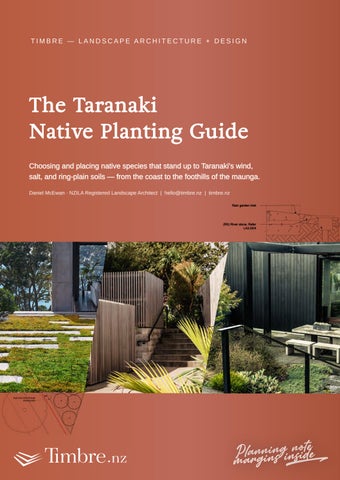
The Taranaki Native Planting Guide Choosing and placing native species that stand up to Taranaki’s wind, salt, and ring-plain soils — from the coast to the foothills of the maunga. Daniel McEwan · NZILA Registered Landscape Architect | hello@timbre.nz | timbre.nz
P larngninins ginnsoidtee ma
Why Taranaki Needs Its Own Planting Playbook Taranaki is one of the most distinct growing regions in the North Island. A single symmetrical maunga rising straight from the coast creates a compressed set of microclimates you won't find written up in generic New Zealand gardening guides -from salt-laden onshore winds on the coastal terraces, to rich volcanic ring-plain soils inland, to cooler, wetter conditions as you climb toward the bush line. This guide is built around those three zones. Rather than a generic native plant list, it's organised the way a landscape architect actually thinks about a Taranaki site: by exposure, soil, and elevation - so you can match species to what your section is really doing, not what a nationwide list assumes.
How to use this guide: Find the zone that matches your site (most properties are Zone 1 or 2). Use the species tables as a starting shortlist, then check the design notes for spacing, shelter strategy, and sequencing. If your site sits across two zones - common on sloped Taranaki sections - treat it as a transition and blend adjoining lists.
The three Taranaki growing zones Zone 1 — Coastal & Exposed Coastal terraces, New Plymouth's foreshore, Ōākura, Ōkato, Waitara. Salt-laden onshore wind, free-draining sandy or gravelly soils, high UV, minimal shelter.
Timbre Landscape Architecture + Design
Zone 2 — Ring Plain & Suburban
Zone 3 — Foothill & Bush Margin
Most of urban New Plymouth, Inglewood, Stratford, lifestyle blocks on the ring plain. Rich free-draining volcanic loam, moderate wind, reliable rainfall.
Higher-altitude lifestyle blocks, bush-edge properties toward Egmont National Park. Cooler, wetter, more frost-prone, often heavier or peaty soils.
timbre.nz
PAGE 2
Zone 1 — Coastal & Exposed Sites Salt spray, wind, and sandy or rocky low-nutrient soils. Prioritise tough pioneer species first; more delicate plants come later, once shelter is established. Species
Māori name
Form
Role in the garden
Phormium cookianum
Wharariki
Arching clump, 1–1.5m
Structure, dune stabilisation, wind-resistant
Phormium tenax
Harakeke
Upright clump, 2–3m
Strong vertical anchor, very salt- and windhardy
Coprosma repens
Taupata
Dense shrub, 2–4m
Hedging and windbreak, glossy salt-tolerant foliage
Olearia solandri
Coastal tree
Twiggy shrub, 2–3m
First-line wind filter — plant on the exposed
daisy Muehlenbeckia
edge
Pōhuehue
Groundcover/climber
Erosion control on banks, low-fertility tolerant
Tī kōuka
Small tree, 3–6m
Vertical accent, very wind-firm once
complexa Cordyline australis
established Coprosma acerosa
Sand coprosma
Low sprawling groundcover
Sand/bank binding, full sun and salt tolerant
Design note — layering for shelter
Plant your toughest, twiggiest species (Olearia, Coprosma) as the outer layer facing the prevailing wind. This "nurse" layer knocks down wind speed enough for softer species to establish behind it - don't try to plant a finished-looking garden on an exposed site in one go.
Timbre Landscape Architecture + Design
timbre.nz
PAGE 3
Zone 2 - Ring Plain & Suburban Sites The most common Taranaki condition — rich volcanic loam, reliable rainfall, moderate wind. The widest plant palette and the most forgiving zone to design in. Species
Māori name
Form
Role in the garden
Griselinia littoralis
Kāpuka / Broadleaf
Shrub/small tree, 3–6m
Hedging, screening, tolerates coastal influence inland
Pittosporum tenuifolium
Kōhūhū
Small tree, 4–8m
Fast shelter, fine foliage texture, good for hedging
Corokia cotoneaster
Corokia
Small shrub, 1–2m
Textural feature planting, low maintenance
Astelia banksii / A.
Kōkaha
Architectural clump
Silver-leaved feature/accent, part shade to full sun
Hoheria populnea
Houhere / Lacebark
Small tree, 5–8m
Fast-growing canopy tree, attractive summer flower
Carex secta / C. testacea
Carex sedges
Grass-like clump
Wet-tolerant edges, rain garden and swale planting
Libertia ixioides
Mikoikoi
Low clump, 0.4– 0.6m
Border and mass planting, orange winter foliage tone
chathamica
Design note - using the ring plain's fertility
Ring-plain loam grows fast - plan for mature size, not the size the plant is at point of sale. A common Taranaki mistake is overplanting Griselinia or Pittosporum hedging too close together; on this soil it will close in 18–24 months, not the 3+ years often assumed.
Timbre Landscape Architecture + Design
timbre.nz
PAGE 4
Zone 3 — Foothill & Bush Margin Sites Cooler, wetter, higher rainfall, more frost risk. Often heavier or peaty soils. Design toward a more forest-margin character that sits comfortably against the bush edge. Species
Māori name
Form
Role in the garden
Griselinia littoralis
Kāpuka
Shrub/small tree
Bush-margin transition planting, frost hardy
Pseudopanax
Horoeka /
Small tree, 4–
Distinctive vertical form, understorey to canopy
crassifolius
Lancewood
6m
stage
Coprosma grandifolia
Kanono
Shrub, 2–4m
Shade-tolerant understorey, fast establishing
Blechnum novaezelandiae
Kiokio
Fern
Damp shaded banks, bush-edge ground layer
Melicytus ramiflorus
Māhoe
Small tree, 5–
Fast pioneer canopy, good for re-establishing
10m
shelter
Upright clump
Damp-tolerant, works well along stream margins
Phormium tenax
Harakeke
Design note — frost pockets
Cold air pools in low points on foothill sections. Keep frost-tender species (many Astelia and Cordyline cultivars) on upper slopes or near structures, and reserve valley floors for genuinely frosthardy bush-margin species.
Timbre Landscape Architecture + Design
timbre.nz
PAGE 5
Before You Plant — A Site Checklist A short walk-through before buying a single plant will save far more money than any discount at the garden centre. Work through this list for your section: Identify your prevailing wind direction and whether it carries salt (generally onshore/westerly on the Taranaki coast) Note any frost pockets — low points, valley floors, or areas that hold cold air on still mornings Check drainage — does water pool after rain, or does the site dry out quickly? Establish your zone (coastal, ring plain, or foothill) and cross-check against a transition if the site spans two Plan shelter planting first — protect the site before placing feature or specimen plants Allow for mature size, not nursery size, especially on ring-plain soils where growth is fast Sequence planting — pioneer/shelter species first, softer specimen planting 12–24 months later once shelter is established Consider maintenance access — mowing strips, irrigation lines, and future pruning access
Want a plan tailored to your actual site? This guide gives you a strong starting shortlist — but every Taranaki section has its own wind lines, soil quirks, and slope. If you'd like a planting plan matched specifically to your property, Timbre offers fixed-fee site walkovers and planting plans built around exactly this kind of local knowledge.
hello@timbre.nz | +64 21 769 779 | timbre.nz
Timbre Landscape Architecture + Design
timbre.nz
PAGE 6