www.SurfacesInternational.com
ISSN2039-8301
economy
n e ws interviews trends
IMAGINE YOUR SPACE
Imagine a space where your inspiration can run free. A world that tells your own story, every single day.
At RAK Ceramics we help create the perfect living space, for you and your loved ones.
Imagine your space. RAKCERAMICS.COM
Schlüter ®-BEKOTEC-THERM
Schlüter®-DITRA-HEAT-E
Energiesparen mit nachhaltigen Heizsystemen von Schlüter-Systems Saving energy with sustainable heating systems
from Schlüter-Systems Kombinieren Sie moderne Fliesen mit der effizienten Fußbodenheizung Schlüter-BEKOTECTHERM – für Ihren nachhaltigen Keramik-Klimaboden. Oder schaffen Sie wohlige Wärme an Boden und Wand mit der elektrischen Boden- und Wandbeheizung Schlüter-DITRA-HEAT-E. Übrigens: Beide Systeme lassen sich auch sinnvoll miteinander kombinieren, um etwa bestimmte Flächen gezielt als Ergänzung zur vollwertigen Heizung zu erwärmen oder um besondere Wohlfühlzonen zu schaffen. Combine modern tiles with the efficient Schlüter-BEKOTEC-THERM floor heating system – for your sustainable ceramic thermal comfort floor. Or create cosy warmth on floors and walls with the Schlüter-DITRA-HEAT-E electric floor and wall heating system. By the way: Both systems can also be combined with each other in a sensible way, for example to eat certain areas specifically as a supplement to the full-fledged heating system or to create special feel-good zones.
bekotec-therm.com
schluetersystems
Restaurant, Wokingham - UK
Private residence, Lisbon - Portugal
Largo da Estação, 8 - 2º Fte - 2750-340 Cascais • Portugal Tel. +351 214 844 788 • Email:
Multipurpose Hall Wetzikon - Switzerland
Rua do Monte Grande, 10 Zona Industrial de Oiã - 3770-068 Oiã • Portugal Tel. +351 234 722 395 • Email:
UNGLAZED PORCELAIN CERAMIC TILES
ADVERTISING
ABOUT US PUBLISHER: Kairos Media Group S.r.l. Capitale Sociale: Euro 51.400,00 R.E.A. 329775 Periodico bimestrale registrato presso il Tribunale di Modena al n. 22/17 in data 10/08/2017 Iscrizione al ROC n. 9673
OFFICE: Kairos Media Group S.r.l. Via Fossa Buracchione 84 41126 Baggiovara (Modena) - Italy Tel. +39 059 512 103 - Fax +39 059 512 157 info@kairosmediagroup.it - www.surfacesinternational.com EDITOR: DAVIDE MISERENDINO - d.miserendino@kairosmediagroup.it © 1989 Tile Italia
stale presso la Filiale di Modena. L’IVA sugli abbonamenti, nonché sulla vendita dei fascicoli separati, è assolta dall’Editore ai sensi dell’art 74 primo comma lettera C del DPR 26.10.72 N. 633 e successive modificazioni.
CO-EDITOR: Sabrina Tassini CONTRIBUTING EDITORS: Sara Falsetti Paola Giacomini Chiara Poggi Sabrina Tassini
ADVERTISING: Kairos Media Group Tel. +39 059 512 103 Fax +39 059 512 157
SECRETARIAT: info@kairosmediagroup.it GRAPHIC LAYOUT: Sara Falsetti EACH COPY: Euro 4 SUBSCRIPTION: https://kairosmediagroup.it/en/shop/subscription-tile-international • 1 year: Euro 20 • 2 years: Euro 35 L’abbonamento decorre dal mese di distribuzione. Tariffe speciali per gli abbonamenti collettivi sono disponibili su richiesta Conto Corrente Postale 20026415 intestato a Kairos Media Group srl. Spedizione in abbonamento po-
• Paola Giacomini p.giacomini@kairosmediagroup.it · +39 335 186 4257 • Teresa Contissa t.contissa@kairosmediagroup.it · +39 342 092 8002 • Elisa Verzelloni e.verzelloni@kairosmediagroup.it · +39 338 536 1966 PRINT: Faenza Printing Industries SpA Via Vittime Civili di Guerra, 35 48018 Faenza (RA) - Italy
http://www. .com
I N T E R N A T I O N A L . C O M
Tutti i diritti di riproduzione e traduzione degli articoli pubblicati sono riservati. E’ vietata la riproduzione anche parziale senza l’autorizzazione dell’Editore. Manoscritti, disegni, fotografie e altro materiale inviato in redazione, anche se non pubblicato, non verrà restituito. L’Editore non accetta alcuna pubblicità in sede redazionale. I nomi, le aziende e i prezzi eventualmente pubblicati sono citati senza responsabilità a puro titolo informativo per rendere un servizio ai lettori. La Direzione non assume responsabilità per opinioni espresse dagli autori dei testi redazionali e pubblicitari. Entire contents Copyright Kairos Media Group srl All right reserved. Opinions expressed by writers are not necessarily those held by the publisher who is not held responsible.
Discover the E-MAG about NEW MATERIALS for DESIGN & ARCHITECTURE
Super professional tile cutters
Support with double adjustment (height and weight)
Elastic protection for Power5 tile cutters
AUTHENTIC ITALIAN TILING TECHNOLOGY montolit.com
CONTENTS 7
EDITORIAL - Welcome to 2026
8
NEWS
Davide Miserendino
ECONOMICS
12 16
World sanitaryware imports and exports
Luca Baraldi, MECS
Geberit maintains growth in 2025
PHOTONEWS
18 20 26 30 34
Ceramic surfaces for the Lotte World Tower in Seoul
PROJECTS Villa Pomona, Ahrensburg The Renovation of Westmalle’s Historic Brewhouse Hotel Europa Palace, Sanremo Nesting Rooms at Enterprise Hotel, Milan
TRENDS
38
The new language of Ceramic: texture, formats and design vision
48
WHAT ’S NEW - Ceramic tiles & laying technologies
Sabrina Tassini
POWERED BY
INTERVIEW:
56 60
Inside the world of GIANAdesign
Chiara Poggi
PROJECT: Casa Vidalverde, Santiago De Compostela
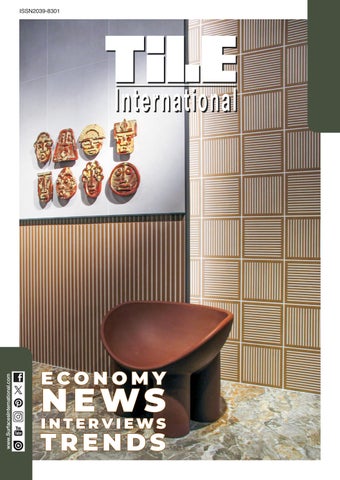
COVER PICTURE: VIVES CERAMICA PHOTO BY GIANCARLO PRADELLI @ CERSAIE 2025
5 T I L E I N T E R N AT I O N A L 3 / 2 0 2 5
PP LEVEL DUO MAXI
S 28-39 mm
MAXI IN EVERYTHING. PP level DUO MAXI for ceramic floors
M 38-57 mm
PP level DUO MAXI is the new range of adjustable supports for outdoor raised floors. MAXI flexibility: thanks to the practical Fixed Head Ring, you can transform the tilting head, able to compensate for surface slopes up to 5%, into a fixed head, directly during installation.
L 56-91 mm
MAXI versatility: numerous accessories are available for any installation requirement, from extensions to aluminium joists, rubber mats and steel clips.
PP level DUO MAXI system for decking floors XL 87-150 mm
PP level DUO MAXI system for single- and multi-format ceramic planks
MAXI strength: the new support guarantees excellent resistance to heavy loads and weather elements.
XXL 148-211 mm
With PP level DUO MAXI the installation of the raised floor will be easy, fast and perfect.
WELCOME TO 2026 Davide Miserendino d.miserendino@kairosmediagroup.it
What has 2025 taught us? First and foremost,
of Cersaie, illustra-
that we need to get used to living with uncertain-
te this without any
ty. “Uncertainty” has been the most widely used
need
word by far, throughout the economic world. Bu-
From large-format
siness people have used it because uncertainty is
panels to small de-
bad for business; journalists have used it becau-
corative tiles, from
se they’ve repeatedly found themselves denying
natural effects to
news, while still trying to work out if it’s true; and
the
working people have used it because they’ve se-
sticated
decora-
en their career prospects – or their prospects of
tions,
everything
simply holding onto their job – turn bleak. To put
is a hymn to taste and craftsmanship; and to the
an optimistic spin on it, we could say that 2025 has
know-how that has put Italy on top of the world.
been a challenging year.
So know-how is what we need to re-start from.
To overcome the challenges, the people and
The best thing we can wish for ourselves and for
companies who produce ceramic and turn it in-
Italy as a country, a culture and an economy, is
to art for everyone, have shown us two funda-
that, despite all the obstacles, we keep on culti-
mental pathways: innovation and beauty. And the
vating and passing on skills, a sense of practicali-
photos you’ll find on page 38, taken by our pho-
ty and a sense of beauty. Simple as it may sound,
tographer Giancarlo Pradelli at the latest edition
this could be the recipe for a happy 2026.
most
words.
sophi-
✕
Discover the E-MAG about NEW MATERIALS for DESIGN & ARCHITECTURE
7 T I L E I N T E R N AT I O N A L 3 / 2 0 2 5
EDITORIAL
for
NEWS
Ideal Standard renews Roberto Palomba’s role as Chief Design Officer Ideal Standard, a member of the Villeroy & Boch Group, has renewed its collaboration with the Italian designer Roberto Palomba, by re-appointing him to the role of Chief Design Officer. Palomba and his Milan-based studio, Palomba Serafini Associati, have defined the DNA of the brand’s contemporary design since 2018, through a design philosophy aimed at creating enduring products that combine form with function. The renewal of the collaboration highlights ideal Standard’s commitment to innovative design, which has been a stand-out feature of its work throughout its history. The brand has a long tradition of collaborations with pioneering designers and visionaries such as Achille Castiglioni, who created the Linda and Aquatonda series; Paolo Tilche, creator of the iconic Conca washbasin; and Gae Aulenti and Mario Bellini, whose architectural and industrial design work has left a lasting mark on modern design culture. Palomba’s leadership honours and embraces this legacy, while at the same time pushing the boundaries of bathroom design in line with Ideal Standard’s signature style. One of Palomba’s latest creations, La Dolce Vita® – part of the award-winning Atelier Collections – draws inspiration from the “historic” collections of the masters of design, such as the iconic Zeta washbasin from the 1950s, whose streamlined silhouette Palomba reinter-
prets in a contemporary style. Similarly, the i.life collection – with its latest addition, i.life O – illustrates how smart, versatile solutions can be adapted to every lifestyle, making good design accessible, regardless of a bathroom’s size or layout.
Neolith earns EcoVadis Gold Medal For the fourth year running, Neolith, a specialist in sintered stone surfaces, has been awarded the EcoVadis Gold Medal – the most prestigious international environmental sustainability certification. The award testifies to the Spanish brand’s status as one of the highest-scoring global enterprises, and demonstrates its commitment to sustainability, innovation and excellence across the entire supply chain. EcoVadis is the world’s best-known certification system for corporate sustainability and is based on four key themes: environment, employment and human rights, ethics and sustainable procurement. The results of the analyses carried out in these four areas enable businesses to measure and benchmark their progress, as a basis for drawing up strategic action plans. This gold medal testifies to Neolith’s ranking in the 97th percentile, making it one of the highest-scoring companies, with a score approaching the maximum that EcoVadis can award. The Spanish brand has taken numerous initiatives aimed at strengthening this vocation in recent years. These include investing in cleaner, more efficient production processes; integrating renewable energy into its plants, gradually cutting emissions, promoting a circular economy, and implementing a rigorous selection procedure to ensure that its suppliers meet the highest standards of responsibility. These efforts have boosted Neolith’s
8 T I L E I N T E R N AT I O N A L 3 / 2 0 2 5
commitment to promoting the sustainable transformation of design and architecture, while keeping a close focus on innovation, to generate positive impact. The large-format sintered stone surfaces that are the flagship of the brand’s product range have some of the lowest levels of crystalline silica on the market, and incorporate recycled materials into every model, in proportions of up to 98% for certain colours in the standard range.
Energy and sustainability: Florim raises the bar Florim has reached a new milestone in its sustainability strategy as it accelerates towards full energy independence. A Benefit Corporation and certified B Corp, the company has announced an investment of more than €3.5 million to expand its photovoltaic installations and introduce an innovative 5 MWh energy storage system capable of optimising energy flow management and increasing the operational autonomy of its production site in Fiorano Modenese (MO). The area covered by photovoltaic panels currently totals 127,000 square metres, with an annual production of 14,317 MWh. The new investment includes the installation of additional photovoltaic modules covering 48,000 square metres, which by December 2025 will bring the total surface area to 175,000 square metres and total annual production to 17,930 MWh. One of the key features of the project is the construction of a latest-generation 5 MWh battery system designed to store
bustness and coherence of its roadmap to climate neutrality.
SICIS opens a new showroom in the Dubai Design District SICIS officially opened its new showroom in the Dubai Design District (d3) during Dubai Design Week 2025, marking a major milestone in its long-standing relationship with the Middle East. Located in the district’s Building 5, the new 600m2 showroom features architecture defined by a harmonious sequence of arches opening inwards from the outside, creating a dynamic interplay of lights and perspectives that welcome visitors and usher them into the world of SICIS. Inside, every room reflects a different facet of the brand. Vetrite and mosaic rub shoulders with the new collections of upholstery, kitchens, lighting, interior design fabrics and wallpapers. The showroom also hosts an elegant SICIS Jewels boutique, showcasing the micro-mosaic creations that have brought the brand worldwide fame. This permanent site further strengthens the company’s bond with the Arabic market, which has a growing appreciation of the beauty and value of Italian know-how. By opening this showroom, SICIS intends to consolidate its role in the international design sector, by offering not only products but also complete environments, made up exclusively of the brand’s surfaces, furnishings, lighting, fabrics and jewellery.
9 T I L E I N T E R N AT I O N A L 3 / 2 0 2 5
GROHE SPA meets Buster + Punch At the World Architecture Festival hosted by the Miami Convention Center from 12 to 14 November, GROHE SPA, in collaboration with Buster + Punch, presented a fully integrated bathroom concept in the form of a painstakingly designed space where metal components, lighting and taps dovetail into a single aesthetic language. Conceived as a full-blown “creative toolbox”, the collection gives architects, designers and users the opportunity to design impeccably coordinated interiors in terms of form, finish and texture. The collaboration kicks off with four of GROHE SPA’s timeless finishes – Brushed Gold, Brushed Rose Gold, Ultra Matt Black and Brushed Chrome – applied to a selection of items by Buster + Punch, such as lamps, sockets and switches, and accessories for vanity units and doors. Shared details – such as the signature knurled finish of both brands – amplify the tactile experience, while ensuring visual and material harmony between all the elements. The World Architecture Festival (WAF), of which GROHE is a founding sponsor, provided the ideal backdrop for the presentation of this new line, aimed at providing a coordinated solution for the most contemporary, detail-focused bathroom design.
NEWS
surplus energy that is not used immediately. This solution will optimise energy flows and increase the plant’s self-sufficiency, further improving the overall efficiency of the production site. “Despite today’s challenging context, Florim continues to invest with an eye to the future, focusing on people, the environment and the community,” says the company’s chairman Claudio Lucchese. “Sustainability is not a tactical choice for us, but a genuine commitment that we have communicated transparently for more than 17 years through our Sustainability Report. This new project marks another step forward in a coherent, long-term programme that transforms sustainability into tangible and enduring industrial value.” Since the first photovoltaic panels were installed in 2011, Florim has invested more than €77 million in environmental sustainability and energy efficiency at its Fiorano (MO) and Mordano (BO) facilities. The company has adopted a wide range of energy saving solutions, including heat recovery systems that reuse hot air from the kilns to power the dryers. Under optimal weather conditions, it already generates up to 100% of the electricity it needs and since 2021 any remaining requirement has been met exclusively through certified renewable sources. Between 2012 and the end of 2026, Florim’s energy efficiency systems will have enabled the company to avoid the emission of more than 185,000 tonnes of CO₂, a result that underscores the ro-
NEWS
World Ceramic Tiles Forum shines the spotlight on the sustainable transition The 32nd edition of the World Ceramic Tiles Forum (WCTF) was held in Yogyakarta, Indonesia, from 9 to 12 November. Hosted by ASAKI, Indonesia’s Ceramic Industry Association, the event was attended by 47 representatives from Brazil, China, Germany, Indonesia, Italy, Japan, Mexico, Spain, Turkey, Ukraine and the United States. To kick off the Forum, each delegation gave a presentation of its national industry’s performance statistics and key topics relating to its home market. Aggregate production for 2024 amounted to 11.31 billion square metres, down 10.8% on 2023. On the subject of international trade, delegates discussed the complex situation relating to multilateral and bilateral free trade negotiations, technical barriers to trade (compulsory certification, export licenses, etc.), and the revision of the Harmonised System (HS) of tariff nomenclature. The ceramic tile industry is a trade-intensive sector, whose exports fell by 8% in 2024 compared with the previous year, and which in 2025 expects to see the negative impact of distortions to world trade, stemming primarily from the reciprocal tariffs imposed by the United States. In this respect, it was agreed that the necessary returns on investment by companies in the sector require firm global protection of fair trade, intellectual property and copyright, and effective rules to ensure transparency around the origin of products. The other main items on the agenda included the challenges facing the industry at worldwide level in relation to current trends in sustainability and circularity, embodied carbon, climate and energy. As far as decarbonisation technologies are concerned, the WCTF discussed the latest industrial research in-
to the electrification of processes and the use of green fuels (hydrogen and ammonia). While reaffirming its commitment to decarbonisation, it noted that, at present, technological availability and the prices of alternative energy carriers pose major obstacles to an effective transition in the medium term. In terms of communication, lastly, the Forum emphasised the need to focus on the strengths of ceramic tiles – such as their durability, energy efficiency and fire safety – and agreed to work more closely together on these aspects. The Forum’s next meeting is scheduled to be held in the Americas in November 2026.
Q3 upturn for Mohawk Industries Despite facing slowing demand and rising costs in the first half of the year, Mohawk Industries is now back on track. From July to September 2025, the multinational flooring giant reported sales of USD 2.8 billion (up 1.4% on the same period in 2024) and net profit of USD 108 million. Although the outlook remains delicate, the green shoots that emerged over the summer are now looking more solid. President and CEO Jeff Lorberbaum explained that, despite weakening economic conditions across the geographical areas it works in, the company has managed to “over-perform” by expand-
10 T I L E I N T E R N AT I O N A L 3 / 2 0 2 5
ing its premium lines and making progress on efficiency-enhancement and restructuring initiatives. “In all our markets, material and energy prices are now falling from the peaks they reached, but the costs we incurred in the first part of the year will continue to affect our results into fourth quarter,” the President added. Overall, revenues were down 1.4% to USD 8.1 billion (8.2 billion in 2024) in the first nine months of the year, while net profit reached USD 328 million as against USD 424.5 million in the same period last year. The Global Ceramic division ended the third quarter with sales of USD 1.1 billion, up 4.4% year-on-year, and an operating margin of 6.5%. In the first nine months, its revenues reached USD 3.22 billion, remaining broadly unchanged compared to the same period in 2024. Mohawk reckons that, over time, housing shortages in all its markets, combined with falling interest rates worldwide, should bring a boost to both the newbuild market and the renovation segment. The company also notes that the recent fall in interest rates in the US and globally may gradually pave the way for an increase in house sales and renovation work. Against this backdrop, we’ll stay focused on the levers within our control – in other words, sales strategies, innovation, productivity and restructuring – which are already boosting our efficiency and cutting our costs,” stressed Lorberbaum. “Our premium portfolio and commercial sales are underpinning the mix, and we’re still responding to the impact of tariffs by revising prices and optimising our supply chain. Based on current regional trends, we believe that market volumes will remain weak until the end of this year.”
The awards ceremony for the BigMat International Architecture Award 2025 (BMIAA ’25) was held in Warsaw on 7 November, during BigMat Group’s annual international conference. Now in its seventh edition, the initiative this year saw the introduction of the Proximity Award, aimed at showcasing projects originating from collaboration between architects and local firms, using materials purchased from BigMat stores. The Group intends to use this new award as a way of celebrating architecture as an authentic expression of the different cultural identities of the seven countries that host BigMat, namely Belgium, France, Italy, Portugal, Czech Republic, Slovakia and Spain. Over 600 projects were submitted and underwent assessment by an international jury chaired by Jesus Aparicio (Spain) and made up of Anne Lacaton (France), Oana Bogdan (Belgium), Francesca Torzo (Italy), José Neves (Portugal), Martin Jančok (Czech Republic + Slovakia), Maria Langarita (Spain) and Jury Secretary Jesus Donaire (Spain). The Architecture Grand Prix was awarded to Portugal for TIC Terminal Intermodale di Campanhã by Brandão Costa Arquitectos. The project consists of a vast transport terminal in the city of Porto, organised into a rational sequence of porticoes, which simplify its intrinsic complexity. The Proximity Architecture Grand Prix was awarded to Spain for Birgit’s home by Ted’A Arquitectes. The focal point of the project is a house perched on cliffs in Mallorca, characterised by two imposing parallel walls that frame the sea view and screen the home from the neighbouring buildings. The heavy brick walls, with their exposed tectonic structure, support a green roof and provide shelter for the pursuit of domestic
life beneath a monumental portico, giving rise to a home that is reminiscent of both a dolmen and a cave. The Young Architect Award was won by Portugal for Educational Pavilion and Chicken Coop - Serralves Foundation – DEPA architects. Two modest but poetic structures enhance the educational farm with granite walls, wooden canopies and zinc roofs. While putting a fresh slant on farm architecture, the pragmatic simplicity of these features underscores the educational and playful role of the buildings within the park. BigMat Group also assigned 12 national awards.
Winners of 13th Casalgrande Padana Grand Prix announced Casalgrande Padana has announced the winners of the 13th edition of its Grand Prix, an international architecture competition that has been promoting design culture since 1990, through the innovative use of porcelain tile. The winning projects were selected by an international jury of architects, critics, academics and journalists, chaired by the company’s President, Franco Manfredini. The winning projects in the “Large surfaces and façade cladding” category , were: Interior design of the Colosseo – Fori Imperiali Metro Station, Line C (Rome) by Andrea Grimaldi, Filippo Lambertucci, Department of Architecture and Design at La Sapienza University; redevelopment of residences at the former infantry college
11 T I L E I N T E R N AT I O N A L 3 / 2 0 2 5
in Montpellier, Cyber Place – Innovation Hub in Cesson-Sévigné Rennes, student residences and accommodation in Asnières-sur-Seine and Milan 3.0 residential district in Milan, by Alfonso Femia Atelier(s); Busca school complex (Cuneo) by Daniele Rangone of Studio Settanta7. The winners of the “Retail, Office, Public and Service Buildings” category were: Facchinelli-Daboit-Saviane for the new secondary school in Puos d’Alpago (Belluno); Arcos B for the Tournesol Aldebert Bellier swimming pool in Taverny; SAUNA 360 for Ironmonger Row Bath Spa in London. Lastly, the winners of the “Residential Buildings” category were: Jacopo Mascheroni, JM Architecture for Villa Dellago in Torri del Benaco (Verona); Anna and Krzysztof Paszkowscy-Thurow of Anna Thurow Architecture and Interiors for House RS in Siadło Dolne and House KD in Szczecin, Poland; Martha Mezzèdimi of MEZZ Design Bureau for the Podere Necione swimming pool in Asciano (Siena). Special mentions were given to an array of other architectural projects in the various categories, at the awards ceremony held in the auditorium of Casalgrande Padana’s headquarters on 5 December. Attracting the submission of over 1000 projects from all over the world, the Grand Prix again confirmed the important role it plays as a permanent observatory of contemporary architecture.
NEWS
BigMat International Architecture Award 2025: the winners
WO R L D S A N I TA RYWA R E IMPORTS AND EXPORTS Luca Baraldi, MECS / Acimac Research Centre (l.baraldi@mecs.org)
3.72 million tonnes, equivalent to a compound annual growth rate of 4%. After a decade of almost
ECONOMICS
Between 2010 and 2024, global trade in ceramic sanitaryware grew by 72% from 2.16 million to
With 2.68 million tonnes exported in 2024 (+15.4% on 2023), Asia saw its share of global sanitaryware exports increase to 72%. This result was almost entirely attributable to China, which reached exports of 2.17 million tonnes (+19.7% on 2023). This figure, an alltime high for China, accounted for 81% of Asian exports and 58.4% of the global total. India, the world’s third largest exporter, experienced a 4.6% decline (253,000 tonnes), while Thailand also saw a slight contraction (-2.4%). By contrast, exports from Iran and Vietnam increased (+22.2% and +9.8%, respectively). Exports from the European Union remained broadly in line with 2023 levels at 432,000 tonnes (-0.3%). The region’s three largest exporting countries – Poland, Germany and Portugal, which alone account for half of EU exports – all recorded small declines of between -1.7% and -2.4%. After a positive 2023, North America (NAFTA) experienced a sharp fall in exports in 2024 to 276,000 tonnes (-28.5%). This decline was almost entirely attributable to Mexico (253,000 tonnes; -28%), which nonetheless remained the world’s second largest exporter (tied with India) after China. Non-EU European countries also saw a fall in exports in 2024 (-10.9% to 177,000 tonnes). Turkey, the main
consistently positive growth, global sanitaryware exports peaked in 2021 (+17.3% due to the post-
exporter in this area and the world’s fourth largest exporter overall, recorded a 16.5% decline in foreign sales to 128,000 tonnes. Finally, Africa and South America have fairly similar export volumes. Africa remained at roughly the same level as in the previous four years, at 79,000 tonnes (-1.5%), while South America’s exports grew by 9.3% to 76,000 tonnes. Taken together, the 10 largest sanitaryware exporting countries accounted for 86% of global exports. An analysis of the variations in exports from each individual area of production over the last 14 years clearly reveals the growth of Asia. The continent’s exports have grown by over 140% over the period, increasing from 1.1 million tonnes in 2010 to 2.68 million tonnes in 2024 (CAGR 2024/2010 +6.6%) and eroding the global export shares of almost all other areas. The EU’s share of world exports fell from 24.2% in 2010 to 11.6% in 2024; the NAFTA region’s share declined from 12.4% to 7.4%; South America’s share dropped from 4.6% in 2010 to 2%, with volumes trending down over the period. Non-EU European countries were able to limit the decline in their share of world ex-
2010
2017
2018
2019
2020
2021
2022
2023
2024
% 24/23
CAGR 24/10
% on 2024 world exports
TAB. 1 - EXPORTS OF SANITARYWARE BY AREA (TONS)
1,100,506
1,756,791
1,988,977
2,222,549
2,130,425
2,534,883
2,447,474
2,320,496
2,677,636
15.4%
6.6%
72.0%
EUROPEAN UNION
522,118
570,549
585,034
541,584
477,931
539,775
519,758
433,459
432,128
-0.3%
-1.3%
11.6%
OTHER EUROPE
132,132
203,077
220,127
237,166
246,162
291,352
253,113
199,051
177,360 -10.9%
2.1%
4.8%
NAFTA
268,401
366,973
375,412
365,828
368,508
402,166
284,032
385,924
275,899 -28.5%
0.2%
7.4%
SOUTH AMERICA
100,043
79,513
89,375
86,782
78,814
99,853
84,479
69,362
75,830
9.3%
-2.0%
2.0%
AFRICA
35,861
65,933
66,113
75,238
64,605
79,237
79,787
79,814
78,655
-1.5%
5.8%
2.1%
OCEANIA
1,960
411
583
580
315
364
867
902
1,824
102.2%
-0.5%
0.0%
2,161,021
3,043,247
3,325,621
3,529,727
3,366,760
3,947,630
3,669,510
3,489,008
3,719,332
6.6%
4.0%
100.0%
5.1%
9.3%
6.1%
-4.6%
17.3%
-7.0%
-4.9%
6.6%
ASIA
TOTAL WORLD % var y-o-y
Source: Mecs / Acimac Research dept. on BSRIA and ITC data
12 T I L E I N T E R N AT I O N A L 3 / 2 0 2 5
Entire contents Copyright MECS - Machinery Economics Studies by ACIMAC - ALL RIGHTS RESERVED
pandemic boom) before declining over the following two years. A fresh recovery came in 2024
with a +6.6% increase on 2023, driven almost exclusively by the performance of China.
Overall in 2024, the ten largest sanitaryware importing countries accounted for 48.3% of global imports (1.80 million tonnes). The ranking shows several changes in position compared to the previous year. The United States confirmed its status as the world’s largest sanitaryware importer with 851,000 tonnes (+4.7% on 2023). This volume represented 23% of global imports, the same share as in 2010. Other importing countries trailed some way behind: Germany and South Korea each imported 123,000 tonnes, the United Kingdom and France 116,000 tonnes, Spain and Saudi Arabia between 106,000 and 111,000 tonnes, and Vietnam, Mexico and Canada between 78,000 and 93,000 tonnes. Among the 10 largest importing countries, only France and Canada saw a decline in imports in 2024 (by 5.4% and 18% respectively). Of the remaining eight, five recorded double-digit growth, the highest being that of Vietnam (+27%). Mexico, Germany and Vietnam appear in the rank-
ports (from 6% to 4.8%) thanks to a 34% increase in exported volumes. Africa was the sole exception, with an increase in share of global trade from 1.7% to 2.1% on the back of 119% growth in export volumes over the period. An analysis of sanitaryware imports in 2024 by continent not only confirms Asia and North America as the two main destination regions but also reveals that their imported volumes were almost level: Asia imported 1.13 million tonnes (+13.3% on 2023), equivalent to 30% of world imports, while North America imported 1 million tonnes (+3.4% on 2023), corresponding to 27% of the total. The European Union followed a short way behind with imports of 753,000 tonnes in 2024 (+6.8% on 2023), accounting for 20.3% of the global total. The remaining 23% of world imports were shared between Africa, South America, non-EU European countries and Oceania.
2010
2017
2018
2019
2020
2021
2022
2023
2024
% 24/23
CAGR 24/10
% on 2024 world exports
TAB. 2 - THE TOP EXPORTING COUNTRIES (TONS)
CHINA
901,962
1,378,951
1,532,833
1,747,579
1,698,152
1,968,003
1,917,768
1,814,586
2,171,280
19.7%
6.5%
58.4%
MEXICO
226,569
326,289
342,666
335,997
333,366
351,835
251,566
352,146
253,310 -28.1%
0.8%
6.8%
INDIA
15,076
137,717
182,691
199,371
171,698
264,253
251,195
265,110
252,934
-4.6%
22.3%
6.8%
TURKEY
94,354
140,759
154,285
164,809
166,370
203,467
186,656
153,712
128,401 -16.5%
2.2%
3.5%
POLAND
67,572
76,620
78,617
77,470
82,537
91,206
91,397
76,529
74,657
-2.4%
0.7%
2.0%
IRAN
25,895
35,206
46,573
46,469
48,893
52,869
57,865
58,728
71,756
22.2%
7.6%
1.9%
THAILAND
57,189
86,512
96,067
92,094
87,129
111,703
88,218
72,382
70,626
-2.4%
1.5%
1.9%
GERMANY
63,742
75,478
81,952
80,382
75,861
88,863
84,735
71,424
70,180
-1.7%
0.7%
1.9%
PORTUGAL
75,049
94,164
101,654
81,574
65,438
82,200
82,012
68,165
66,925
-1.8%
-0.8%
1.8%
VIETNAM
19,590
40,457
41,292
52,982
51,986
67,565
57,669
41,449
45,508
9.8%
6.2%
1.2%
2,974,231 3,205,577
7.8%
5.3%
TOTAL % on total world exports
1,546,998 71.6%
2,392,153 2,658,630 2,878,727 2,781,430 3,281,964 3,069,081 78.6%
79.9%
81.6%
82.6%
83.1%
Source: Mecs / Acimac Research dept. on BSRIA and ITC data
13 T I L E I N T E R N AT I O N A L 3 / 2 0 2 5
83.6%
85.2%
86.2%
Entire contents Copyright MECS - Machinery Economics Studies by ACIMAC - ALL RIGHTS RESERVED
ings of both the top 10 exporters and the top 10 importers, although only Mexico exports more sanitaryware than it imports.
ican exports stay within Latin America; 79% of European Union exports are destined for EU markets; and 69% of Oceania’s exports remain in Oceania. At the other extreme, 83% of exports from non-EU Europe are sold in other regions, mainly the EU, which is Turkey’s leading export market. Similarly, 76% of African exports are shipped to destinations outside Africa and 60% of Asian exports are sold outside the Asian continent, reflecting China’s capacity to sell its products in almost every region of the world. ✕
ECONOMICS
Finally, an analysis of the main export destinations according to the geographical areas of production shows that in four out of seven regions the vast majority of exports remain within the same geographical area or continent. Some 97.5% of exports from the NAFTA region (mainly Mexico) remain in North America (effectively the United States); 77% of South Amer-
2010
2017
2018
2019
2020
2021
2022
2023
2024
% 24/23
CAGR 24/10
% on 2024 world imports
TAB. 3 - THE TOP IMPORTING COUNTRIES (TON)
USA
500,415
738,424
811,329
817,904
837,646
954,238
831,538
812,909
851,394
4.7%
3.9%
22.9%
GERMANY
107,509
140,282
148,431
150,445
144,325
155,331
149,626
117,201
123,351
5.2%
1.0%
3.3%
KOREA REPUBLIC OF
84,543
142,706
142,732
142,658
127,185
156,902
141,505
97,845
123,124
25.8%
2.7%
3.3%
UNITED KINGDOM
103,815
151,904
138,454
143,764
119,104
131,784
112,302
113,132
116,442
2.9%
0.8%
3.1%
FRANCE
115,108
116,870
125,738
135,313
125,226
150,811
130,060
122,535
115,864
-5.4%
0.0%
3.1%
SPAIN
83,634
89,036
108,096
104,981
86,835
118,467
103,707
98,576
111,169
12.8%
2.1%
3.0%
SAUDI ARABIA
33,592
58,100
51,814
74,034
82,903
70,855
88,088
88,765
105,762
19.1%
8.5%
2.8%
VIETNAM
3,866
20,855
32,342
55,237
68,354
75,538
84,719
73,062
92,918
27.2%
25.5%
2.5%
MEXICO
15,404
22,188
32,887
42,018
41,451
62,218
48,980
67,601
79,478
17.6%
12.4%
2.1%
CANADA
104,680
106,137
103,682
107,464
107,013
138,487
108,422
95,347
78,173 -18.0%
-2.1%
2.1%
TOTAL
1,152,566
1,586,502
1,695,505
1,773,818
1,740,042
2,014,631
1,798,947
1,686,974
1,797,675
53.3%
52.1%
51.0%
50.3%
51.7%
51.0%
49.0%
48.4%
48.3%
% ON TOTAL WORLD IMPORTS
Source: Mecs / Acimac Research dept. on BSRIA and ITC data
14 T I L E I N T E R N AT I O N A L 3 / 2 0 2 5
6.6%
3.2%
G E B E R I T M A I N TA I N S G R OWT H I N 202 5
In the period January to September 2025, the Geberit Group posted positive results, confirming its financial solidity and ability to grow even in a challenging global economic
environment. Net sales rose by 2% year on year to CHF 2.45 billion (€2.6 billion). Adjusted for negative currency effects, the increase was 4.4%, driven by strong volume growth
and the continued good performance of newly introduced products. EBITDA totalled CHF 753 million (+3.1% at constant exchange rates). Excluding one-off costs relating to the
Net sales by markets and product areas
ECONOMICS
An analysis of markets and product areas reveals mixed performances within an overall positive picture. In Europe, currency-adjusted net sales increased by +3.9%, with significant growth in Austria (+10%), Benelux (+6%), Eastern Europe (+6%) and Germany (+5.6%). Growth was more modest in Northern Europe (+2.1%), Italy (+1.1%) and Switzerland (+0.3%), while Western Europe recorded a 1.1% decline. Outside Europe, results were particularly strong in the Middle East/Africa region (+21.7%) and the Americas (+5.9%), while the Far East/Pacific region saw a 6% decline, mainly due to the slowdown in China’s residential sector. As for the various product areas, the Bathroom Systems division achieved a 5% increase in currency-adjusted net sales, while Piping Systems and Installation & Flushing Systems recorded growth of +3.2% and +4.9% respectively.
16 T I L E I N T E R N AT I O N A L 3 / 2 0 2 5
closure of a ceramic sanitaryware plant in Germany announced in January 2025, the EBITDA margin remained stable year on year at 30.8%.
Net sales in the third quarter reached CHF 783 million, an increase of 2.7% in Swiss francs compared to the same quarter in 2024. Adjusted for currency effects,
Outlook for 2025 Although the market outlook remains uncertain due to geopolitical risks and macroeconomic volatility, Geberit sees signs of stabilisation in construction industry demand. In Europe, a slight decline in new construction activities is expected to continue until the end of 2025, reflecting the 2% drop in building permits in 2024 and the further 3% decline in the first half of 2025. However, this should be offset by growth in the renovation segment, which currently accounts for around 60% of Geberit’s sales. Outside Europe, demand is expected to remain strong in India and the Gulf countries, while the Chinese market is likely to remain subdued due to the weakness of the residential sector. In the United States, Geberit will be largely unaffected by import tariffs, as the company mainly sells products that are also manufactured locally. Regardless of market conditions, Geberit’s strategic priorities in 2025 remain unchanged and include the continued development of growth initiatives outside Europe, expansion of the shower and toilet business, and optimisation of its ceramic production plants. For 2025 as a whole, the group expects to see net sales growth in local currencies of around 4.5% and an EBITDA margin of around 29%. ✕
17 T I L E I N T E R N AT I O N A L 3 / 2 0 2 5
this corresponds to an increase of 5.4%, following +2.5% in the second quarter and +5.3% in the first quarter. Net income fell by 1.2% to CHF 494 million.
PHOTONEWS
18 T I L E I N T E R N AT I O N A L 3 / 2 0 2 5
CERAMIC SURFACES FOR THE LOTTE WORLD TOWER IN SEOUL
The renovation of the Signiel Residence, designed by Kim Sangyoon, takes place in the upper levels of Seoul’s Lotte World Tower and translates the city’s cultural identity into a domestic landscape. Here, architecture opens up to a new vision of living: a composed balance between craftsmanship, Korean identity, and contemporary language. Ceramic surfaces by Caesar are integrated through formats and thicknesses selected according to function and structure, where every element is part of a cohesive whole. The floor features the Ice variant from the Slab2 collection, a reinterpretation of the essence of slate. The 120×120 cm format ensures striking continuity and high aesthetic impact. The walls mirror the same material in the large 120×278 cm format, creating a continuous spatial rhythm. In the kitchen, the countertop is made using a product from Olos, the Ceramiche Caesar brand offering 12 mm-thick slabs for furniture applications. The chosen top is in the Comblanchien colour, inspired by a bright French stone. It forms a compact, distinctive block in harmony with the overall space design. In the bathroom, the furniture volume is clad with a 6 mm Caesar slab in the 120×278 cm format. The material follows the design, contributing to the unitary reading of the space. In the Signiel Residence, living takes shape as a quiet gesture, rooted in materials and daily rituals. Ceramic surfaces are part of this vision, in direct dialogue with contemporary architecture, Korean culture, and the rhythm of urban life. ✕
19 T I L E I N T E R N AT I O N A L 3 / 2 0 2 5
V I L L A P OMONA , AHRENSBURG
PROJECTS
Attention to details is regaining relevance in current architectural styles – especially at the intersection of function, aesthetics and customization. A recently completed construction project in the Schleswig-Holstein town of Ahrensburg is an impressive example of this trend.
The renovation of the historic Villa Pomona, once part of an agricultural estate administration, not only complied with listing requirements but also turned the headquarters of a construction company into a model of modern design and high-quality building work. The interior design, which appears minimalist at first sight, turns out to be a precisely orchestrated coordination of materials, lines and colours that are consistently matched – right down to the skirtings.
Design begins with details That’s where MyDesign by Schlüter-Systems comes into play. The skirting profiles of the type SchlüterDESIGNBASE-SL were powder-coated in matte graphite black (MGS) to precisely reflect the matte deep black colour used in the door frames, jambs and fittings. This results in a consistent colour concept in which functional components such as the
20 T I L E I N T E R N AT I O N A L 3 / 2 0 2 5
Chiara Bruzzichelli c.bruzzichelli@tiledizioni.it
skirtings become a harmoniously integrated part of the architectural concept and contribute to the calm, powerful impression of the interior. The key is that the profile technology remains functionally unaffected as the customising process is additive, with full control over the design within a precisely matched system.
21 T I L E I N T E R N AT I O N A L 3 / 2 0 2 5
“For us, the colour choice was not an afterthought, but an integral part of our architectural language,” explains Norbert Lüneburg, Managing Director of GfG Hoch-Tief-Bau GmbH & Co. KG. “The skirting plays an important role in this concept. It enhances the presence of materials and offers visual guidance within the space.” Three technologies for setting architectural accents
PROJECTS
MyDesign by Schlüter-Systems is not a single product, but a modular design programme that is available for a large portion of the Schlüter portfolio. It provides architects, interior designers and technical planners with a wide range of options for conceptually integrating technical components into their aesthetic designs. The programme comprises three customisable technologies. The first is RAL colour coating. With 190 colours to choose from, customers can
22 T I L E I N T E R N AT I O N A L 3 / 2 0 2 5
precisely adapt profiles, skirtings, borders or wall panels to existing colour concepts – be it for tone-on-tone arrangements, room designs in corporate colours or deliberate contrasts.
As a third option, laser engraving creates permanently and precisely placed logos, ornaments or lettering in the KERDI-LINE stainless steel drainage system. The flexibility of the production output is remarkable by itself. The service is available for small quantities or even individual projects – a rare option in industrial component production. All of this offers extensive freedom of design for those who prefer to consistently
In a second method, individual designs – from natural textures such as wood or stone to logos, patterns or graphic elements – can be transferred directly to selected profiles with digital printing technology.
23 T I L E I N T E R N AT I O N A L 3 / 2 0 2 5
SCHLÜTER-SYSTEMS PRODUCTS USED •
COLOUR-COORDINATED SKIRTING PROFILES (SCHLÜTER-DESIGNBASE-SL) COLOUR COATING USING MYDESIGN BY SCHLÜTER-SYSTEMS
•
ILLUMINATED SKIRTING PROFILES (SCHLÜTER-DESIGNBASE-QD)
PROJECTS
•
implement their architectural intent in great detail instead of relying on off-the-shelf solutions.
ble in very small quantities translates into enormous advantages, especially for high-end interior design.”
“Many architects nowadays consider it essential to create functional designs with a high level of design consistency,” notes Kora Karstens, regional consultant at Schlüter-Systems. “MyDesign gives designers the option to precisely integrate profiles and technical components into their designs – in terms of colour, tactile experience and shape. The fact that these components are availa-
Illumination meets architecture: Schlüter-DESIGNBASE-QD as a design element The hallway areas of Villa Pomona also feature Schlüter-DESIGNBASE-QD, an illuminated skirting profile that elegantly blends functionality and architectural light design. The anodised aluminium profile
24 T I L E I N T E R N AT I O N A L 3 / 2 0 2 5
orative element. Architects particularly appreciate the sustainability of the system, as the modular LED components require little maintenance and are designed for long-term use in interior spaces. As a result, a skirting is much more than a functional component – it becomes part of an integral spatial concept in which light, materiality and architecture are precisely coordinated. Planning reliability and individuality are not mutually exclusive In the Villa Pomona project, the skirting was not only used as a visual element but deliberately turned into a showcase for demanding customers. The owner, who specialises in building high-end architect homes, uses the design as a reference point for potential builders: “Many of our customers are looking for solutions that go beyond standard styles. The possibility of precise colour matches, even including profile connectors, often provides a door opener,” explains Jan Hendrik Bestmann, the company’s Deputy Managing Director. For designers, that turns colour into an integrated design layer. Custom colours, which for a long time required special solutions or subsequent painting, are now available as part of a system – complete with technical consulting and binding colour specification samples. An invitation to those who prefer consistent spatial design Although the effects of colour in architectural designs is undisputed, they are often overlooked in the area of technical construction components. MyDesign by Schlüter-Systems eliminates this contradiction. The complete colour integration of profiles, skirtings and accessories opens up new worlds of design and implementation. The offer is not a niche product – it is an invitation to all architects who perceive interiors as system performance.
was mounted on the wall and is fitted with LED modules of the LIPROTEC-ES product line. Interchangeable diffuser lenses either generate linear light accents or broad, indirect lighting – depending on the desired spatial effect. Designers deliberately set up a restrained lighting concept in the villa to not only highlight the hallway but also to create atmospheric brightness. The illuminated profile offers subtle spatial flow and serves both as a guiding and dec-
MyDesign is an effective companion strategy for projects that require CI colours, contrasting materials or specific design concepts, delivering exactly what modern interior design demands: comprehensive customisation without compromise. ✕
25 T I L E I N T E R N AT I O N A L 3 / 2 0 2 5
T H E R E N O VAT I O N OF WESTMALLE’S HISTORIC BREWHOUSE
PROJECTS
The 1930s brewhouse of the Trappist Abbey of Westmalle is one of Belgium’s most recognisable industrial heritage buildings. Its recent transformation by LAVA architecten into a contemporary workspace demanded materials that could honour its legacy while supporting modern technical functions. Topcer tiles were chosen as a defining element of this renewal, providing the perfect balance between durability, aesthetics, and architectural sensitivity.
Their superb resistance to wear ensures endurance in high-circulation areas, while long-term colour stability maintains the visual integrity of the spaces even under fluctuating light conditions. Combined with minimal maintenance needs, these characteristics support the building’s overall operational efficiency.
High-performance surfaces for a demanding setting Today, the renovated brewhouse accommodates laboratories, offices, and workshops. Topcer tiles were introduced throughout offices, staircases, circulation areas and workshops. Topcer range met these requirements, thanks to its exceptional compressive and tensile strength, extremely low water absorption, ideal for humidity-prone zones, and chemically inert surfaces suitable for laboratory environments.
A material that honours history, not imitates it The brewhouse’s original Art Deco tilework and the restored copper kettles are defining historical ele-
26 T I L E I N T E R N AT I O N A L 3 / 2 0 2 5
PH. PIETER RABIJNS
Photos: Pieter Rabijns
27 T I L E I N T E R N AT I O N A L 3 / 2 0 2 5
PROJECTS
28 T I L E I N T E R N AT I O N A L 3 / 2 0 2 5
ments, both carefully preserved in the renovation. Instead of replicating the old patterns, LAVA architecten developed a contemporary interpretation, extending the historical ‘game of tiles’ into the new floors and walls. This was made possible through the chromatic depth and precision of Topcer tiles. LAVA architecten chose Topcer consciously because of its durable character and the colour palette that fits seamlessly with the existing material. Five colours from Topcer range were selected and applied with precision to floors, stairs, and walls following detailed pattern drawings. Pattern as structure
architectural
Using detailed pattern drawings, the design team implemented Topcer tiles across floors, staircases, and vertical surfaces, creating a continuous material flow throughout the building. These patterns guide move-
29 T I L E I N T E R N AT I O N A L 3 / 2 0 2 5
ment and mark transitions, echoing the role the historical tilework once played in the old brewhouse. A sustainable, long-life material choice The monks of Westmalle have long embraced stewardship and careful resource management; values reflected in the renovation process. Topcer, with their long lifecycle and minimal environmental impact, support this ethos. Old tile fragments discovered on-site were transformed into new terrazzo tablets, now colouring the tasting room and other areas. Topcer precision-made ceramics allow the renovated brewhouse to maintain its architectural identity while reaching the durability standards of a 21st-century brewery facility. The result is a project where materiality is not decorative but structural; a space where craft, functionality, and heritage coexist naturally. ✕
H O T E L E U R O PA PA L A C E , SANREMO
PROJECTS
The Q-BIC studio renovates the spaces of the historic Ligurian hospitality structure, focusing on high-performance Marazzi ceramic surfaces in multiple aesthetic variations.
Since the nineteenth century, the Hotel Europa Palace has been one of the most significant hotel structures on the Ligurian Riviera, a benchmark for clientele seeking contemporary elegance and excellent comfort. Founded in 1874 as “Hotel de l’Europe et de la Paix,” it has undergone extensive renovations over the years, now reborn as a charming 5-star design hotel. It preserves its original spirit with rigorous forms, Ligurian shutters, and a stone base, complemented by current and sophisticated features. The new identity is striking: seventy-one rooms – from classic rooms with Casino views to panoramic suites with terraces, gardens, or jacuzzis – characterized by pastel palettes and selected furnishings, a spa with a pool, sauna, hammam, emotional showers, treatment cabin, and Technogym gym, a rooftop overlooking the Riviera dei Fiori, and an independent restaurant-Bistro also open to external guests. “The hotel’s location is unique, close to the Casino and some of the most beautiful beaches in the area,” says Matteo Pasquini, head architect and project manager of the Q-BIC studio, who oversaw the interior restyling. “The architectural part was renovated based on a design by the Calvi Ceschia Viganò studio in Sanremo. For the furniture contract, we relied on Hi Contract Brugnotto Group.” The interior concept aims to define a balance between the historical context and today’s hospitality needs: the spaces are enhanced by high-end furnishings, artisanal fabrics, valuable accessories, and sometimes scenic lighting systems, all en-
30 T I L E I N T E R N AT I O N A L 3 / 2 0 2 5
Chiara Bruzzichelli c.bruzzichelli@tiledizioni.it
livened with well-dosed touches of color and customized materials that reinforce a welcoming and eclectic atmosphere. “A very accurate and custom design work for many of the finishes, including the ceramic surfaces,” Pasquini continues. Renovated Finishes The Marazzi collections stand out as the material protagonists of the project, chosen in different variations and formats to achieve a harmonious and coherent scheme. For the ground floor paving, the designers opted for Ph. Diego Laurino
31 T I L E I N T E R N AT I O N A L 3 / 2 0 2 5
PROJECTS
Cementum porcelain stoneware in Sand and Olive shades, with a customized laying pattern; the slabs were cut to design and laid on-site in three custom formats. “We have been using Marazzi products for a long time,” confirms Project Manager Pasquini, “the variety of textures and formats allows us to always meet the most diverse requests from our clientele and to work with different languages, buildings, and environments with varying purposes. There is no doubt about the performance and quality of the slabs, and the proprietary technologies guarantee unique resistance and safety characteristics.”
For the staircase, which the studio wanted to give a minimal and rigorous image, the Metal look collection was chosen, in the Iron Dark variant, for both the flooring – including the corridors – and the parapet. Full compositional freedom in the rooms and a wide choice of colors. On the bedhead walls, reflected in the corner breaks, five shades of the Crogiolo Lume porcelain stoneware collection found their place, with the typical luster of handmade majolica bricks: China, Forest, Pink, Turquoise, and Musk. In the same intense colors, characterized by slight imperfections, the small format of Lume also makes the bathroom walls vibrant.
32 T I L E I N T E R N AT I O N A L 3 / 2 0 2 5
Marazzi ceramic finishes were also used inside the basement spa, as the studio recounts: “the client had already seen and appreciated the Travertino Classico collection, in the Navona shade, and suggested it to us. We therefore decided to lay the large fullheight slabs on the walls and floors. The result is surprising, as is the aesthetic quality of these surfaces, which, in their stony compactness, refer to the Italian constructive tradition and the spaces of ancient thermal baths.” ✕
33 T I L E I N T E R N AT I O N A L 3 / 2 0 2 5
N E S T I N G R O O M S AT ENTERPRISE HOTEL, MILAN Suites that redefine the rules of hospitality, featuring a distinct chromatic identity and contemporary terrazzo-effect ceramic surfaces.
PROJECTS
With the recent restyling of its eight Nesting Rooms, the Enterprise Hotel in Milan-a 4-star superior establishment part of the Planetaria Hotels Group-reaffirms its vision of hospitality as an immersive experience, where design, technology, and well-being merge into a contemporary and recognizable language. The Nesting Rooms represent a new concept of hotel room: an enveloping and personalized space designed to welcome guests into an atmosphere that is simultaneously relaxing, stimulating, and visually engaging. The project, developed in collaboration with a selection of excellence in design and furnishing, offers a concept of hospitality attentive to material quality, meticulous detail, sensory experience, and a well-thought-out color palette. Each Nesting Room is defined by its own chromatic identity, carefully selected to evoke emotions, stimulate the senses, and create ever-new settings. Full, fresh, and intense tones-aqua green, ochre yellow, reddish orange, dusty blue-form a lively yet elegant scheme that modulates the perception of space and influences its brightness. In this context, the Deconcrete collection by Ceramica Sant’Agostino integrates coherently and with character. It was chosen as the ceramic material for the floors and wall coverings within the suites. This product combines aesthetics and technical performance, making a decisive contribution to the visual identity of the spaces. An expression of sophisticated aesthetic research, Deconcrete by Ceramica Sant’Agostino reinterprets the timeless charm of Venetian terrazzo in a contemporary key. It presents itself as a composition of mosaic flakes immersed in a base with a strong concrete-effect material impact. The result is a studied balance between solids and
PH. LEONARDO DUGGENTO
34 T I L E I N T E R N AT I O N A L 3 / 2 0 2 5
Chiara Bruzzichelli c.bruzzichelli@tiledizioni.it
35 T I L E I N T E R N AT I O N A L 3 / 2 0 2 5
voids, neutral colors and graphic details, allowing the material to adapt to even very diverse projects without ever being mundane.
PROJECTS
Available in four color variations and three different flake formats, the stoneware collection offers great design freedom, opening up original and personalized solutions. Beyond its aesthetic value, the choice of Deconcrete meets precise needs in terms of technical performance, which are fundamental in a hotel context: durability, wear resistance, ease of clean-
36 T I L E I N T E R N AT I O N A L 3 / 2 0 2 5
ing and maintenance, color stability, and safety. The intensive use of spaces requires reliable materials capable of preserving beauty and functionality over time. In this journey, the Deconcrete collection stands out as a choice that is both coherent and distinctive: a material capable of adapting and, at the same time, adding character, supporting the practical needs of hospitality without sacrificing refined and contemporary style. ✕
37 T I L E I N T E R N AT I O N A L 3 / 2 0 2 5
Sabrina Tassini
THE NE W L ANGUAG E OF CERAMIC: TEXTURE , F O R M AT S A N D D E S I G N V I S I O N
CERAMIC TRENDS
Offering ever higher levels of performance and technology, ceramic provides creatives with a blank canvas they can paint in infinitely varying ways, from the most minimalist to the most opulent. As contemporary taste cements its preference for attention to detail and added value, ceramic opens itself up to reinterpretations of form and style that push research well beyond the bounds of mere functionality. As a result, the seamlessness of large format panels juxtaposes an intriguingly varied and eclectic range of small decorative formats, featuring anything from intricate patterns to deeply complex monochromatic finishes. Bursting with three-dimensionality, the most advanced surfaces stimulate the senses with hints of tactility that invite interaction, while warm and sophisticated stone effects use the most porous and imperfect textures to forge
welcoming domestic or contract scenarios that gently caress a more intimate dimension of dwelling. Creative flair also finds expression through the medium of terracotta and clay tiles, whose sincere beauty pays tribute to eternal traditions, while designers continue to develop enchanting graphics and ornamental motifs designed to catch the eye in the spaces they embellish. There is also an abundance of ceramics inspired by multi-coloured marble and reinvented jalousies, which draw upon the vernacular structures of the past and have now been rediscovered and returned to the limelight. This gallery of photos from Cersaie 2025 retraces some of the most interesting macro-trends rippling through the world of international contemporary ceramic. Pictures: Giancarlo Pradelli @ Cersaie 2025 ✕
CERAMICA DEL CONCA
38 T I L E I N T E R N AT I O N A L 3 / 2 0 2 5
CERAMICA BARDELLI
39 T I L E I N T E R N AT I O N A L 3 / 2 0 2 5
CERAMIC TRENDS
WOW DESIGN
40 T I L E I N T E R N AT I O N A L 3 / 2 0 2 5
COTTOVIETRI
41 T I L E I N T E R N AT I O N A L 3 / 2 0 2 5
CERAMIC TRENDS
DANILO RAMAZZOTTI – ITALIANHOUSEFLOOR
42 T I L E I N T E R N AT I O N A L 3 / 2 0 2 5
VIVES CERAMICA
43 T I L E I N T E R N AT I O N A L 3 / 2 0 2 5
CERAMIC TRENDS
TERRATINTA GROUP
44 T I L E I N T E R N AT I O N A L 3 / 2 0 2 5
LEA CERAMICHE
45 T I L E I N T E R N AT I O N A L 3 / 2 0 2 5
CERAMIC TRENDS
CERAMICHE REFIN
46 T I L E I N T E R N AT I O N A L 3 / 2 0 2 5
CERAMICA MEDITERRANEA
47 T I L E I N T E R N AT I O N A L 3 / 2 0 2 5
ABK X MOOOI
W H AT ’ S N E W ?
A collaboration between ABK and Moooi has spawned a new ceramic vision built on a combination of dreams and nature. The well-known lifestyle brand has just launched its first collection of porcelain floor and wall tiles, called Nesting Room, which provides an antidote to an endlessly moving world. The surfaces embrace the silence of nature’s most tranquil creatures, to build oases of peace, designed to nourish body and soul. In line with Moooi’s customary creative process, the range draws inspiration from organic, animal forms, including extinct species. The Nesting Room collection features three motifs – Hypnotic Owl, Reiki Rhea and Cloistered Dove – all of which are imbued with silent, elementary powers that reflect the cycles of nature. “This collection by Moooi Ceramic Surfaces turns natural inspiration into a lasting, tactile experience,” explains Marcel Wanders, Moooi’s founder and creative director. “Nesting Room is about more than just surfaces; it’s about creating sanctuaries of peace where people can reconnect with themselves and the world around them. Every aspect of this new collection is a perfect fit for hotels, major projects and residential spaces.”
48 T I L E I N T E R N AT I O N A L 3 / 2 0 2 5
P R O F I L PA S Outdoor raised floors are the ideal solution for both renovation projects and new constructions thanks to their many advantages: quick and easy installation, easy tile removal for maintenance and waterproofing checks, and the ability to absorb structural movements and expansions. PP Level DUO MAXI is the range of adjustable supports for outdoor raised floors by Profilpas. This complete range meets every installation need, from ceramic floors to single- and multi-format planks, and even decking. PP Level DUO MAXI is perfect for those looking for MAXI flexibility, MAXI strength, and MAXI versatility in one solution: • MAXI flexibility, with the option to choose between a fixed or self-leveling head directly during installation thanks to the Fixed Head Ring, already integrated into the base and positioned between the head and the screw. • MAXI strength, the support guarantees excellent resistance to heavy loads and weather conditions; • MAXI versatility, thanks to the numerous accessories available, the support meets any installation requirement. This range covers every installation need with three available heads: a self-leveling head for the installation of ceramic floors, a crisscross head for laying ceramic planks with joists, and an L-shaped head for decking installations with joists. To complete this versatility, the Profilpas support range now includes the new XXL size, bringing the total number of solutions to five and covering a height range from 28 to 211 mm. In addition, thanks to the special extension, it is possible to reach even greater heights. The dedicated adjustment key allows height changes even after the floor has been laid, ensuring maximum flexibility and precision during installation.
49 T I L E I N T E R N AT I O N A L 3 / 2 0 2 5
CE R A SARDA
W H AT ’ S N E W ?
The new Porto Rotondo collection pays tribute to the understated and refined luxury of the Costa Smeralda, transforming ceramics into a sensory experience where color becomes a defining and distinctive element. Inspired by the light, colors, and landscapes of the region, interpreted according to the latest trends in interior and fashion design, Porto Rotondo is presented in a rich and sunny palette. Its surfaces reflect the crystalline sea, ochre lands, endless skies, and Mediterranean scrub. Each color is a window into the nature of Sardinia, each finish a bridge between craftsmanship and innovation. The shades of Porto Rotondo are designed to harmonize with each other, creating complex and refined graphic patterns, up to evocative tartan effects in the 6x25 cm format, and decorative walls with 3D effects in the 15x15 cm format. The shapes and finishes of the collection adapt to contemporary spaces, offering versatile aesthetic solutions full of identity, bringing authentic, fresh, and vibrant luxury to architecture that inspires and excites. Porto Rotondo in the 6x25 cm format is available in two extraordinary finishes. The first, glossy, is perfect for internal coverings and medium-traffic floors. The second, Galuchat, inspired by the texture of manta ray skin, once used for rare luxury objects, delivers a sophisticated, tactile surface evoking marine worlds and artisanal know-how. Exclusive too is the 3D effect offered in the 15x15 cm format. Each element acts as a ceramic pixel, allowing the creation of three-dimensional decorative walls with a strong visual impact. In the same format, the refined decoration featuring the Cerasarda monogram in relief is also available, to be used as a background or an insert, enhancing walls with the iconic graphic signature.
50 T I L E I N T E R N AT I O N A L 3 / 2 0 2 5
PROGRESS PROFILES During winter, it is important to heat spaces in a balanced way. It is necessary to avoid humidity formation, which compromises living comfort, as well as overheating rooms to prevent respiratory problems, high energy consumption and costs. All these needs can be met by relying on innovative “tailor-made” solutions such as the PRODESO® HEAT GRIP 5 SYSTEM, which allows pleasant warmth to be distributed only where it is needed, even remotely, by eliminating radiators and heaters. The electric heating system patented by Progress Profiles — world leader in the production of technical and decorative profiles, as well as installation systems — is designed to be installed only in areas of the home that require heating, without affecting entire surfaces. This concept offers several advantages: rooms reach the desired temperature faster and the time and cost of construction or renovation are reduced. The system can be easily turned on and off remotely, avoiding energy waste. PRODESO® HEAT GRIP 5 SYSTEM is extremely thin and ideal for both floors and coverings, leaving plenty of room for interior design creativity. This innovative solution consists of three elements: PRODESO® HEAT GRIP 5 MEMBRANE, PRODESO® HEAT GRIP 5 CABLE, and the PRODESO® HEAT GRIP 5 THERMOSTAT KIT. The membrane’s geometry, with a thickness of just 5 mm, ensures excellent performance.
Thanks to its uncoupling and waterproofing properties, it can be installed on cracked substrates or those undergoing hygroscopic shrinkage. The latest generation of cables, with resistances mounted in parallel, have been designed so that even if they were to be damaged, the operation of the entire system would not be interrupted. Finally, the digital thermostat connects directly to Android or Apple devices via a WiFi network and allows you to conveniently regulate the system from a smartphone or tablet. The system is also available in a self-adhesive version, the PRODESO® HEAT GRIP 5 STICK SYSTEM, which achieves perfect results when used with pre-existing flooring, plywood or metal. This system’s unparalleled tile pull-off resistance offers safety for any type of covering and flooring. Thanks to its compression resistance, it provides substrates with stability that withstands the test of time and wear. Another innovative feature is the use of polyethylene, which eliminates the memory effect — a common issue with polypropylene that requires the use of weights or mechanical fixings to prevent the membrane from rolling back up during application. Finally, the PRODESO® HEAT GRIP 5 SYSTEM can be powered by renewable energy sources, responding to consumers’ growing interest in the responsible use of resources.
51 T I L E I N T E R N AT I O N A L 3 / 2 0 2 5
AT L A S C O N C O R D E Designed by architect Alberto Apostoli for Atlas Concorde, the Nyra collection translates inspiration from nature, classical culture, and wellness-focused architecture into a versatile range of stone-effect surfaces for hospitality, contract, and residential projects.
W H AT ’ S N E W ?
Nyra showcases the material’s decorative potential through varied tones, finishes, and textures. Vibrant colour variations, polychrome inclusions, subtle opacity shifts, and chiaroscuro effects create a lively, immersive material that transforms spaces into welcoming environments reminiscent of ancient craftsmanship. Suitable for indoor and outdoor applications - including walls, floors, furniture, worktops, 3D structures, mosaics, and bespoke décor - Nyra blurs the line between interior and exterior, delivering a seamless aesthetic. “Nyra is a vision where material, colour, and texture work in harmony to create new spatial scenographies,” says Alberto Apostoli. “The realistic surfaces, rich colours, and tactile effects evoke welcoming spaces while giving designers creative freedom and users a memorable experience. Nyra is not just a collection - it’s the cornerstone of Nyra World, a programme that will guide Atlas Concorde’s future stone-effect innovations.”
52 T I L E I N T E R N AT I O N A L 3 / 2 0 2 5
R E P U B L I C O F I I B Y I V F O R V I Ú VA L A M E G O Founded by Dan Menchions and Keith Rushbrook, the international industrial design studio REPUBLIC OF II BY IV launches two new tile collections in collaboration with VIÚVA LAMEGO, Portugal’s historic ceramic tile manufacturer. This unprecedented collaboration offers a contemporary interpretation that honors tradition, while engaging the spirit of the present. Colinas collection is inspired by the sculptural folds of pleated textiles and evokes the rhythmic layering of woven fabric and rolling hills. Its name-Portuguese for “small hills-is reflected in the tiles’ subtly carved forms, where vertical and horizontal striations create a layered, dimensional surface. Offered in three modular formats (10x10cm, 10x20cm, and 20x20cm), Colinas allows for endless combinations and creative compositions. The result is a surface that feels fluid and tactile, catching light in soft gradients and shadowed relief. Suitable
for both interior and exterior applications, Colinas brings a refined textural sophistication to hospitality, retail, and residential environments alike. The second collection Marola, named after the Portuguese word for “wave,” draws inspiration from the delicate lines left in sand as water recedes-each tile designed to evoke the feeling of a fossilized artifact. Its asymmetrical carvings and glaze-filled grooves create a rippling effect that comes alive in composition, forming soft, organic rhythms across largescale surfaces. Crafted as a modular system in two tile formats (10x10cm and 10x20cm), Marola’s flowing patterns and bold simplicity make it ideal for serene architectural facades or immersive interior installations. The result is a collection that feels both contemporary and timeless, expressive yet effortlessly restrained. Both collections are available in a palette of white, green, blue, ochre, and black.
photo courtesy Viúva Lamego
53 T I L E I N T E R N AT I O N A L 3 / 2 0 2 5
VITRA TILES
W H AT ’ S N E W ?
Highlighting its close focus on real-world sustainability, VitrA Tiles is proud to present “100% Recycled Porcelain Tile – nova vita”, a line of tiles made entirely of recycled material that reasserts the company’s commitment to responsible manufacturing. Embodying strong contemporary design, the five new ranges of surfaces made from recycled ceramic balance aesthetic appeal with rigorous functionality, in a harmonious colour palette. NovaDust offers a soft, refined texture that pairs perfectly with residential and commercial environments; NovaDot is a large-format covering with a richly complex visual texture, characterised by micro-granules and nuanced tones; NovaFlake stands out for its “macro-flake” look, while NovaPetra draws inspiration from slate, faithfully replicating its intricate textures and natural depth; lastly NovaMarmo redefines the classic vision of marble, offering a realistic tactile and visual experience.
54 T I L E I N T E R N AT I O N A L 3 / 2 0 2 5
RAK CERAMICS Maximus collection has introduced its expanded range of solutions, now available in striking 162x324 cm, 120x280 cm, 120x120 cm, 60X120 cm and 60x120 cm 20 mm. These new dimensions bring a blend of aesthetic sophistication and technological advancement to contemporary interiors, offering solutions for porcelain stoneware countertops, large indoor and outdoor surfaces, and even as cladding for ventilated facades. The adaptability of Maximus extends to bespoke furniture elements, such as bathroom and kitchen worktops. The Maximus surfaces are notable not only for their vast scale but also for their exceptional durability. Designed to endure even the harshest conditions, these tiles offer long-lasting beauty, making them ideal for both residential and commercial applications. The range includes surfaces with thicknesses of 6 mm, 9 mm, 12 mm and 20 mm, aligning with the latest design trends and professional needs. Furthermore, Maximus offers a broad spectrum of design possibilities: with options inspired by natural elements such as wood, stone, granite, and marble, these tiles provide a luxurious canvas for creative expression. In addition to their visual and functional benefits, Maximus surfaces are an eco friendly choice. Crafted from premium materials like clay, silica, and quartz, they feature a dense core and a smooth surface. Their low water absorption rate of less than 0.5% makes them highly resistant to water damage, making them ideal for bathrooms and kitchens. Maintenance is another area where Maximus excels. Its large format reduces the number of tiles needed, simplifying cleaning and upkeep. Its robust surface is resistant to scratches and stains, ensuring long-term durability and ease of maintenance.
55 T I L E I N T E R N AT I O N A L 3 / 2 0 2 5
POWERED BY
INSIDE THE WORLD OF GIANAdesign Chiara Poggi
Viviana Del Naja, architect, designer, and founder of GIANAdesign, is pursuing a project born from the intersection of visual perception, material, and color theory, transforming design into an experience that evolves over
time. Through profound research into culture, light, and materials, Viviana reinterprets traditional elements with a contemporary twist, creating furnishing products that stimulate the mind and senses. She told us
about her journey, the philosophy that guides her work, and the innovative Madeira project, a three-dimensional decoration that challenges perception and invites us to experience space in a new way.
SURFACES INTL: Let’s start with you. How would you define your approach to design today, and what was the path that led you to found GIANAdesign? VIVIANA DEL NAJA: I always say, “The whole is greater than the sum of its parts,” to quote the Gestalt school where I began my study of perception theory; this has become my mantra, my approach to design. The search for Beauty and for what made me feel good in a place, following my perceptions, all accompanied by the research work I was conducting for my PhD thesis in Materials Technology between Portugal, Morocco, and Italy, led me to found Giana Design.
SURFACES INTL: GIANAdesign was born as a container for research into visual perception, material, and color theory. How do these three elements interact in your projects? VIVIANA DEL NAJA: Giana Design is a container for products linked to perception theory, furnishing and finishing products that stimulate the mind of those who inhabit the space, but without the use of technology. The material dialogues with light by reflecting it, passing through it, and creating plays of light and decorations in the surrounding environment, all associated with colors that generate memories and sensations. The roles of the designer and the architect are constantly evolving; it is no longer enough to design to meet a function, but we must also respond to the intangible component, to needs not explicitly requested but desired by people for their well-being.
Viviana Del Naja
VIVIANA DEL NAJA: This gets to the key point of the Giana Design project, which brings the fourth dimension of design, Time, into play. The two faces of Janus represent past time and future time, passing through the present moment. In relation to Giana’s products, such as Madeira, this means that the product changes depending on the observer’s point of view and how they move through the environment. We are talking about static and analog furnishing products that nonetheless interact with the user as their point of view changes. By moving around
SURFACES INTL: The name Giana is a tribute to Janus, the two-faced god, a symbol of transformation and duality. What “two faces” coexist in your objects and spaces? And what does the “third face” you often refer to represent?
56 T I L E I N T E R N AT I O N A L 3 / 2 0 2 5
POWERED BY
Chiara Bruzzichelli c.bruzzichelli@tiledizioni.it
the product, one discovers different faces that can be identified with the past moment and the future moment, but passing through the present moment where the past and future intersect.
VIVIANA DEL NAJA: Giana Design’s products are experiential because they are lived through time. If you don’t experience them, you can’t fully understand them because they change continuously depending on the point of view, the passage of time, the movement of the sun whose light passes through the environment; it is time that defines the perception of the object.
SURFACES INTL: Time, light, perception, emotion. In a world dominated by digital stimuli, how can we stimulate user attention and engagement through analog and experiential design? VIVIANA DEL NAJA: The great master who can answer this question is surely Escher, who with simple 2D drawings deceived the human mind with his perspectives, tessellations, and impossible staircases, as well as the play of optical illusions. Going back even further, to the Romans, we remember the beautiful Trompe l’oeil, 2D wall drawings that gave you the illusion that the room continued beyond the wall, depicting gardens or starry skies. These are just a few examples of how easy it is to deceive the mind and create engagement in people. Why not bring all this into furnishing products through material, light, shape, and color to give value and an experience to be lived in environments and to offer ourselves intellectual, playful stimuli and sensations. SURFACES INTL: Your work moves in the so-called “fourth dimension”: Time. How is this translated into your objects and spaces?
SURFACES INTL: Gestalt theory, Escher, Portuguese azulejos, Moroccan mashrabiyas. How important is the psychology of perception to you in shaping a project? And what role does the interaction between light, material, and movement play in this process? VIVIANA DEL NAJA: For a long time, I have been studying and carrying on research on the interaction between the finish of materials and light, to understand the sensations and perceptions. As an architect, creating a good project means improving the quality of life from both a physical and mental point of view, and through research, I understood that studying form and space was not enough. The intangible must be integrated with the material; it is important to involve the senses, frequencies, and vibrations to make an environment or a furnishing product unique, one must enter the neuroscientific field. Traveling between Morocco and Portugal, I was captivated by the charm of the azulejos for their vitreous fin-
57 T I L E I N T E R N AT I O N A L 3 / 2 0 2 5
POWERED BY
ish and by the patterns of the mashrabiyas which, with their play of solids and voids, repeat themselves in the surrounding environment and change depending on the position of the sun. What light provokes stimulates and attracts the user, bringing them into a vibrational dimension. We remember Escher, who with his 2D drawings was able to take the observer into two “parallel worlds” thanks to visual perception, creating effects of illusion and spatial ambiguity. In short, what I always tell the students at the Academy is: listen to how your skin reacts when you enter a place, a public space, a house, a restaurant. The skin is our largest sensory organ and communicates information about the external world to our brain; if it’s a “good place,” it will surely let you know.
We worked with color, with dimensions, using an MDF support. The first uses of boiserie date back to 17th-century France, a concept I wanted to revisit in a modern key, adapting it to the needs of today’s society, which seeks more attention to user well-being.
SURFACES INTL: Colors, surfaces, optical illusions. How does Madeira manage to transform the perception of space and emotionally activate its inhabitants? VIVIANA DEL NAJA: An immobile, static, analog but interactive and engaging object, Madeira manages to interact with and stimulate the minds of those who experience and observe it through its pleated shape and the alternation of color. I applied the technique of anamorphosis: a distorted image that reassembles into a recognizable image when viewed from a certain point of view or reflected in a curved mirror. It is an optical illusion process that uses mathematics and perspective to create a surprising visual effect. Escher was the master of it!
SURFACES INTL: Madeira is a three-dimensional modular element that reinterprets boiserie in a contemporary way. How did this project come about and what makes it so current? VIVIANA DEL NAJA: Madeira is the first furnishing product patented at a European level and developed according to the theory of anamorphosis and optical illusions; a three-dimensional wooden boiserie, customizable in its choice of two colors, that introduces the user to a new way of experiencing space, prioritizing well-being and living the fourth dimension of design. A project that was born thanks to a contest I participated in that called for an idea for a wall decoration, and in that case, I wanted to launch a provocation with a 3D decoration never seen before. Subsequently, Falegnameria Nacchia embraced my project idea and we began to create the first prototypes.
SURFACES INTL: You have lived and worked in Naples, Portugal, and Morocco. How have these cultures, deeply linked to light and material, influenced your way of thinking and making design? VIVIANA DEL NAJA: I am fortunate because my eyes have always been immersed in beauty. Living in Naples with the coast just a stone’s throw away and always traveling a lot since I was a child, it was easy for me to gather information and to propose, as an architect, what made me feel good. I understood that light and colors are two essential elements; I studied them and made them a rule of style and design. The cities where I lived, like Marrakesh and Porto, with their tradi-
58 T I L E I N T E R N AT I O N A L 3 / 2 0 2 5
POWERED BY
tional architecture, patterns, and geometries, have enriched and influenced my style, leading me also into the world of design and furnishing products.
SURFACES INTL: GIANAdesign also has a strong ethical component: local production, sustainable materials, responsible supply chain. How important is it for you today to combine aesthetic research, user well-being, and environmental responsibility? VIVIANA DEL NAJA: The supply chain is a fundamental point for those who do research and design. Reuse, product circularity, are considerations that make the product today, just as it is important to consult local technicians and suppliers. The dialogue with those who master the material allows you to enter the essence of the project; Giana Design experiments with material and brings out, through the product, the relationships between light, finish, and form. Well-being in living spaces is also given by the quality of the product and the material used, its reuse, and its adaptability in another environment.
explore?
VIVIANA DEL NAJA: For those who have a “hunger” for knowledge and discovery, evolution and new ideas are a daily occurrence; Giana design evolves thanks to curiosity, dialogue, the desire to live well in spaces and to make people who rely on architects and designers live in well-being. Prototypes in sheet metal and fabric, created with parametric tools,
SURFACES INTL: The project has also transformed into a teaching path at the IUAD Academy in Naples. How does the interaction with students enrich your work and open up new research perspectives? VIVIANA DEL NAJA: There was a 7-year research journey before reaching this point and the creation of Madeira, and I told myself: if I learned all this by studying, why not make it a teaching project and help future aspiring architects and interior designers understand that beyond the physical and spatial world to manage, there is also an intangible and perceptual one. The role of the designer and architect must evolve, adapting to new demands and new user needs; we must compete with a world full of stimuli and tecnology, but mental well-being must not be neglected.
SURFACES INTL: Looking to the future, are you already imagining new evolutions for GIANAdesign? Other materials, other forms, other perceptions to
59 T I L E I N T E R N AT I O N A L 3 / 2 0 2 5
are in the pipeline thanks to the collaboration with VAHA - Virtual Architecture Handicraft Art, and other collaborations are emerging with the aim of expanding the Giana project to include various neuroscientific information. As with all good things, it takes time. GIANAdesign is open to experimentation and collaboration.
✕
POWERED BY
C A S A V I DA LV E R D E , SANTIAG O DE COMP OSTELA Casa Vidalverde, near Santiago de Compostela (Galicia), is designed by Paco Galiñanes studio as a home completely integrated into its surroundings and vegetation.
The house is extensively developed on a single floor, with a surface of 700 square meters, within a large plot of 3,000 square meters, in which all the rooms face outwards. ‘The owners wanted a ground floor house, with the best possible orientation and in direct connection with the surroundings. For this reason, we opted to fragment the volumetry, to reduce the scale and facilitate integration in a fluid way with the garden,’ explains architect Paco Galiñanes. The family home comprises a day area with kitchen, dining room, living room, study and gym; and a night area with 4 bedrooms with dressing room and bath-
room. The main rooms have direct access to the garden, where the selection of floral and tree species contribute to personalize every corner. The large porches provide protection from the persistent rain in winter and act as sun protection in summer. The continuity of the roofs and paving allows the spaces to extend outwards. ‘Given the considerable size of the house, the owners were looking for an architectural studio with sufficient scope to take on a project of this nature, and our previous work gave them guarantees in this respect. The biggest challenge consisted of combining the family’s wide-ranging program of needs with a domestic scale,
60 T I L E I N T E R N AT I O N A L 3 / 2 0 2 5
POWERED BY
Chiara Bruzzichelli c.bruzzichelli@tiledizioni.it
PH: ROI ALONSO
61 T I L E I N T E R N AT I O N A L 3 / 2 0 2 5
POWERED BY
62 T I L E I N T E R N AT I O N A L 3 / 2 0 2 5
POWERED BY
so that it would be very welcoming’, emphasizes the architect.
of the whitewashed walls of traditional constructions. All the openings in the house are carried from floor to ceiling, leaving the profiles of the carpentry concealed, to enhance the feeling of continuity between the home and the garden.
In terms of materials, Casa Vidalverde blends perfectly into the landscape through the use of traditional techniques and materials such as stone and wood, typical of popular architecture.
The interior is made of warm materials such as wood, present in the flooring, joinery and furniture. The integral design of all the elements that make up the house by the Paco Galiñanes studio contributes to giving unity to the interior space, maintaining the same idea of harmony with the landscape and fluidity present throughout the project. Chiara Bruzzichelli ✕ c.bruzzichelli@tiledizioni.it
A powerful stone plinth puts the house in contact with the terrain and takes into account the irregularities of the topography. The masonry of wild granite is masoned without using cement or mortar. The roof is conceived as a light element resting on the robust stone walls, and its white finish is reminiscent
63 T I L E I N T E R N AT I O N A L 3 / 2 0 2 5
Discover the E-MAGAZINE about NEW MATERIALS for DESIGN & ARCHITECTURE
INDIA'S NO.1 TILE COMPANY 37 YEARS OF EXCELLENCE 115 MSM ANNUAL SALES VOLUME 12 STATE-OF-THE-ART MANUFACTURING PLANTS DIVERSE PORTFOLIO, BATHWARE & ADHESIVES
Scan to explore
Follow us on:
www.kajariaceramics.com
info@kajariaceramics.com
Profiles for terraces in line with the latest architecture and exterior design trends.