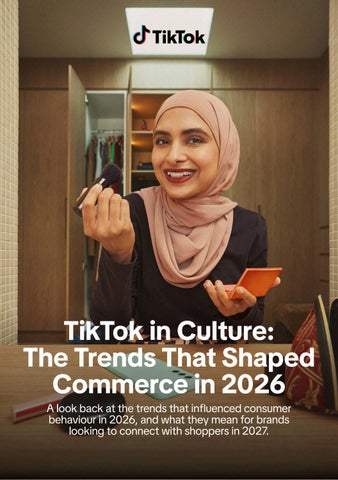
TikTok in Culture: The Trends That Shaped Commerce in 2026 A look back at the trends that influenced consumer behaviour in 2026, and what they mean for brands looking to connect with shoppers in 2027.
Shopping doesn’t start at the shelf The most interesting shopping trends don’t begin with products, but with people. A recipe becomes a ritual. A beauty technique inspires a new routine. An unexpected fashion find becomes an obsession. What begins as a moment of curiosity can influence what people want, how they shop and, ultimately, what they buy. On TikTok, people are doing far more than discovering products. They’re developing tastes, learning new skills, exchanging recommendations and finding new ways to participate in culture. And in the process, they’re shaping the trends that define entire categories. For brands, the opportunity goes beyond knowing what’s popular. It’s about understanding why something captures people’s imagination, how they make it their own and what that behaviour might tell us about what they’ll want next. Drawing on TikTok search and hashtag signals, alongside leading consumer research, this report examines the shopping behaviours shaping beauty, fashion, home & living, and food & beverage in 2026. More importantly, it explores what those behaviours mean for brands and the products of tomorrow.
From discovery to desire
How to read this report
People rarely arrive on TikTok with a shopping list. They come to be entertained, inspired, informed or simply to pass the time. But somewhere along the way, they might find something they didn’t know they wanted.
Across four categories, we examine the signals and behaviours behind emerging trends, and consider what they might mean for brands. Each category is explored through five questions.
‘Watch it. Love it. Want it.’ captures that moment when content creates desire. What follows is rarely straightforward. People search, compare, ask questions, seek recommendations and share their own experiences, often moving between discovery and consideration several times before making a purchase.
1. What we’re seeing The emerging trends, supported by the signals and data behind them. 2. How people are participating The behaviours, conversations and communities giving each trend momentum. 3. Brands already doing it Examples of brands recognising and responding to these shifts. 4. What this means for brands Where the opportunities lie, and how brands might respond. 5. Product Development takeaway What today’s behaviours might reveal about the products people will want tomorrow.
And a purchase isn’t necessarily the end of the story. A product might inspire a new routine, a creative interpretation or a recommendation that sets someone else off on their own journey.
Beauty
Beauty has always been a space for experimentation and self-expression. But on TikTok, the pace of discovery has changed. New looks, techniques and rituals are emerging, spreading and evolving as people find inspiration and make it their own.
What we’re seeing We see three shifts that are reshaping the category: 1. The product is becoming the content. For the fastest-moving beauty products, how the product behaves is now part of the appeal. Jelly masks stretch, capsules burst into serum, wrapping masks dry and peel away, glossy formulas leave a finish you can recognise on sight. These formats work because they give creators something to demonstrate rather than describe the product formula becomes the creative itself. 2. The search bar is becoming the beauty counter. People are looking beyond familiar beauty claims toward skin longevity, prevention, and ingredients and increasingly using search to make decisions. UK TikTok searches for peptides rose more than 2,000% YoY, with related searches including “what are peptides”, “peptides before 1 2
TikTok Shop Beauty Crush Boots releases 2026 Beauty & Wellness Trends Report
after” and “peptides side effects”. People are taking a closer interest in ingredients, from what they do to how well they suit their individual needs. The wider market reflects this shift too. Boots’ 2026 Beauty & Wellness Trends Report found that 80% of adults have adopted a preventative approach to their routines, while 60% prioritise healthy ageing. The UK facial skincare market also grew 8.6% in 2025, driven by increased interest in skin health and scientifically credible skincare.2 3. Trends are becoming full aesthetic systems. The question is shifting from “what should I buy?” to “what look am I building?” K-beauty is the clearest example: K-beauty searches on TikTok Shop rose 125% YoY and Korean skincare searches 94% YoY, moving Korean beauty from niche into the mainstream1, with Boots reporting a fivefold increase in K-beauty sales2.
The shift goes beyond products. UK TikTok searches for “Korean lashlift” rose 1,000% YoY, showing how a beauty aesthetic can extend into treatments as people build the look across different parts of their routine. The same idea is appearing across skin, hair and fragrance. The “glass” aesthetic smoothness, shine and visible health - is becoming a visual language of its own. Searches for “glass skin care routine” rose 91% YoY, pointing to a shift from chasing a one-off glow to building the routine that creates and maintains it.
How people are participating People are putting what they see into practice. People compare textures and finishes, recreate routines, test whether products behave the way creators show them, and reuse the same descriptive language when they search and review. Terms like “glazed”, “bouncy” and “jelly” now do more than describe a formulation - they give people a
shorthand to recognise, search for and reproduce an experience. The strongest products create a loop: see the behaviour, understand the product, try the ritual, then recreate or review it.
What this means for brands Develop with the camera in mind. For texture and application-led products, ask during development: what will someone actually be able to show? If capsules burst or a texture transforms, make that behaviour part of the product story, and give distinctive experiences an ownable name people can search for. Build content around the search. The queries - what it is, who it’s for, how to use it, what not to mix it with - are a ready-made content calendar. Answer them where people ask them, and enter through the concern (clearer skin, a stronger barrier) rather than the ingredient.
Sell the pathway, not just the hero. Help people get more from your hero products with personalised advice, product pairing guides and layering kits. Where search trends reveal an appetite for DIY, show them how. Don’t confuse spectacle with efficacy. A satisfying application wins attention, but the product still has to earn the benefit it demonstrates.
NPD takeaway
Design products people can watch, answer the questions people are searching, and build the routine around the hero rather than selling it alone.
Brands already doing it The Ordinary Built its proposition on making actives understandable, with dedicated products around azelaic acid and retinoids answering the questions people are already searching.
Medicube Collagen Night Wrapping Mask The format has a built-in story arc - apply, leave overnight, peel away - so the process becomes content before the result is judged. #Medicube TikTok views rose more than 2,000% YoY, with growth across #MedicubeCollagen, #MedicubeMask and #MedicubeZeroPorepad.
Laneige Bouncy & Firm Serum Visible SmoothTech capsules put an element of the formulation on camera, rather than hiding the science in the bottle.
Glow Recipe Watermelon Glow Jelly Sheet Mask The translucent hydrogel format gives creators an immediately recognisable visual and tactile product.
Beauty of Joseon A single hero SPF sits inside a broader K-beauty proposition of routine, prevention and skin health, pulling one purchase into a full regimen.
L’Oréal Paris Glass Skin Routine Turns a look into a step-by-step regimen (hydration, radiance, smoothing, protection), with Skin Genius AI routing people to the right products. The consumer isn’t buying “a glass skin product” - they’re given a pathway to recreate the look.
Fashion
Fashion is becoming more closely tied to the things people are passionate about. Sport, music, entertainment and fandom have always influenced how people dress, but on TikTok those connections are becoming faster, more visible and more fluid. A niche interest or cultural moment can quickly become an aesthetic, a styling cue or a wider fashion trend.
What we’re seeing Discovery is becoming culturally led and occasion-driven. Search interest in fashion rose around 11% YoY, and demand for everyday outfit inspiration keeps growing, with searches for outfit ideas up 22% YoY. The more interesting signal is where that inspiration now comes from. Occasions are driving discovery. Festival dressing has become bigger than the festivals themselves - festival outfit searches rose 160% YoY, with specific events also climbing (Reading Festival +198%, Parklife +111%). Even with Glastonbury taking a fallow year in 2026, festival fashion discovery kept growing. TikTok functions less like a catalogue and more like a styling tool for a specific moment. Sport is another route in. Football shirts and athletic details are moving beyond match day into everyday wardrobes, and the 2026 World Cup became one of TikTok’s biggest cultural moments, generating 22M+ 1 2 3
TikTok Marketing Science World Cup Survey via AYTM Love Story fervor and Carolyn Bessette style Spring/Summer 2026 Fashion Trends
tournament-related videos and 12M+ #FIFAWorldCup posts globally. TikTok’s own research shows how far that travels: 44% of users discovered new traditions around the tournament and 48% discovered new creator voices, while 63% said brands involved seemed more relevant to their interests1. And culture works backwards through time. The Love Story series has reignited interest in Carolyn Bessette-Kennedy’s minimalist 1990s style, her looks recreated across TikTok - a decades-old aesthetic becoming a fresh source of inspiration2. And Spring/ Summer 2026 didn’t point to one definitive look - British Vogue’s trend edit spans utility, bohemian influences, sportswear and soft femininity3, so the opportunity isn’t to name the next look but to understand how people combine different ones.
How people are participating Fashion inspiration comes from everywhere. A film character, a football shirt or a cultural moment can spark a new look, with people borrowing from different influences to develop their own sense of style. On TikTok, vintage, Y2K, sportswear and festival fashion sit comfortably alongside one another. Communities overlap, tastes evolve and creators offer fresh interpretations of familiar looks. Rather than subscribing to a single aesthetic, people are increasingly comfortable mixing references and making them their own.
Signals to watch out for: •
Everything’s getting bedazzled. Rhinestones and crystal embellishments are everywhere heading into autumn - not just on clothes, but on coffee cups, phone cases, hair clips and skincare bottles, under the “whimsymaxxing” banner. On the fashion side it’s showing up as embellished going-out pieces, sequinned knits and DIY-bedazzled denim and jackets, and it’s landing on the AW26 trend lists as part of a broader maximalism moment. It sits at the crossover of fashion and beauty, so it’s worth watching as a crosscategory aesthetic rather than a single-category drop.
•
Poetcore. Dark academia’s softer, cosier cousin - relaxed, literary, knitwear-led dressing tipped as a defining autumn/winter 2026 aesthetic as the colder months set in.4
•
Indie-chic boho. Boho with a ‘90s grunge twist - Kate Moss-era “undoneness”, hardware, leather and clashing textures - is forecast as one of the defining 2026 fashion aesthetics. Its imperfect, undone feel taps into a growing appetite for things that look human rather than hyper-polished, a useful counterpoint to an increasingly AI-perfect visual culture4.
https://www.teenvogue.com/story/biggest-fashiontrends?lang=en-US&
4
Brands already doing it
Poetcore, done by a high-street brand - COS COS has built its autumn 2026 range around exactly the quiet, craft-led dressing Poetcore is about - funnel-neck knits, brushed wool and layered cardigans positioned as elevated, “expensive-looking” pieces rather than throwaway trend buys. It’s a clear example of a mainstream brand meeting an emerging aesthetic with products people can style straight into an autumn wardrobe - an opportunity around cosy, considered basics rather than another loud seasonal drop. https://www.whowhatwear.com/fashion/ trends/y2k-body-gems-trend-2026
1
Embellishment goes mainstream - the “bedazzling” moment.1 Brands are leaning into crystal and rhinestone embellishment as an accessible way to tap the maximalist mood. Fashion press is explicitly pulling the trend from consumer objects into the wardrobe - “if everything is getting bedazzled, your wardrobe may as well join in” and it’s being framed as a defining Gen Z spend of the moment. For fashion brands, the lowlift play is embellished capsule pieces, add-on rhinestone accessories, or customisation/ DIY moments that let shoppers bedazzle what they already own - turning a beauty-and-objects craze into an apparel opportunity heading into party season.
What this means for brands Find where fashion is happening next. The strongest opportunities may not begin with fashion at all they start with what people are watching, listening to, following or collecting, then move into what they wear. Ask: what is our audience already obsessed with, and how could that interest become wearable?
NPD takeaway Use adjacent culture as an early signal. The next fashion opportunity may emerge first in sport, music, entertainment or fandom on TikTok. Look at which references are gaining traction, how they’re being translated into style, and where that could shape future product, partnerships or merchandising.
Show the product in context. Connect products to the cultural moments your audience already cares about, and show multiple ways to style the same piece across occasions rather than one prescribed look. Give people more than one way in. Leave creators room to interpret rather than reproduce, so a single piece can travel across vintage, sportswear and festival worlds.
Home & Living
Homes are becoming more personal. People are decorating less around a single look and more around the feeling they want to create. That is showing up in bolder colour, richer texture, nostalgic references and more playful combinations, with interiors becoming a clearer expression of personality rather than a perfectly coordinated aesthetic.
What we’re seeing Home discovery is growing, and getting more specific. Search interest in “home decor” grew 72% YoY. As people turn to TikTok for inspiration beyond traditional interiors, the 2026 trend cycle is getting more playful, from skirted furniture and “grandma decor” to broken-plan layouts and cabbagecore.1 On the hashtag side, #InteriorDesign views grew 24% YoY while #ColourDrenching surged 244% - appetite for inspiration alongside a clear pull towards more expressive interiors. Taste is fragmenting into specific worlds. The shift isn’t simply that people are using more colour - it’s that there are more ways than ever to define what “your” home looks like. Small but distinct communities are forming around specific looks - colourful homes, gallery walls, vintage and deliberately quirky decor, 1 2 3
TikTok Interior Design Trends IKEA Life at Home Report 2026 John Lewis How We Shop Live and Look 2025
each with its own language and creators. This extends beyond TikTok: IKEA’s Life at Home research links homes that reflect personal identity with higher enjoyment and wellbeing2, while John Lewis reported a sevenfold increase in searches for metal shelving - storage that works harder while still looking good3.
How people are participating They decorate for a feeling, and treat the transformation as entertainment. People use TikTok to find interiors that match a feeling or point of view, then adapt those references to their own spaces - a colour palette becomes a mood, a nostalgic reference becomes a room, a niche aesthetic becomes a way of expressing identity. Interior inspiration becomes less about recreating one perfect room and more about building a space that feels recognisably theirs; the question is less “what’s the trend?” and more “could this work for me?”
Alongside taste, the process itself has become content. Practical home content (storage, storage hacks and decluttering) is now a genre in its own right, with creators showing the messy cupboard, the process and the satisfying reveal rather than only the finished space. Practical home content is already a sizeable community: #Storage has 35.3K posts, with #StorageHacks and #Declutter each at 12.1K so far this year.4 The pattern for home brands: problem, hack, transformation, product.
Brands already doing it
Give people a starting point: IKEA. IKEA’s 2026 Style Guide shows the same products across different interior styles and trends, giving people multiple ways to interpret them rather than presenting one room to replicate1. That reflects the fragmented nature of home taste on TikTok: one product can work across many different personalities and aesthetics1.
4
TikTok hashtag source
1
IKEA 2026 Style Guide
Sell the feeling, not just the product: Dunelm & Farrow & Ball. Dunelm’s creator partnerships start with the mood of the room, with colour and transformation taking centre stage before the products come into view. In one collaboration, a creator transforms a snug using Dunelm’s Baked Earth and Parchment shades, showing how the finished space comes together and feels1.
Start with the problem: IKEA & The Home Edit. IKEA’s IKEA + you series starts with a familiar frustration: a cluttered garage. The transformation then shows how shelving, pegboards and wall storage can solve the problem1.
Farrow & Ball takes a similar approach to colour drenching, framing one shade across the walls, ceiling and woodwork as a way to create “depth and unity” in a room. The focus is on the atmosphere the colour creates, rather than simply selling the paint2.
The Home Edit has built its content around the same principle. Overwhelming closets and pantries become satisfying, organised spaces, with the before-and-after transformation providing the hook2.
2 2
IKEA Clutter Free Garage Transformation The Home Edit closet transformation
1 2
Dunelm snug colour transformation The TikTok home and lifestyle trends experts love - and loathe
What this means for brands Make the feeling the story. Build content around the mood a product creates - not only its functional attributes so people can imagine how it will make a space feel. Make the problem the hook. Start with the frustration a product solves rather than the product itself, and use the transformation as the content. Give people a starting point, not a finished look. Show products across different aesthetics and personalities so people can see themselves personalising them.
NPD takeaway
Design for the way people actually live, not the showroom. Create products that solve a real problem, create a feeling and adapt to different expressions of personal style.
Food & Beverage
From elaborate dinner parties to everyday café rituals, the way we enjoy food is as much a source of inspiration as what’s on the plate. On TikTok, recipes, seasonal traditions and new dining experiences capture people’s imaginations, inspiring them to experiment in their own kitchens, discover new places and put a personal spin on the latest food trends.
What we’re seeing Familiar food is getting a new spin. TikTok is giving familiar ingredients and rituals new life through unexpected serves, pairings and occasions. The combinations can be deliberately unusual: frozen pickle in Sauvignon Blanc became a viral 2026 trend, following the frozen-jalapeño version that emerged the year before1. This is also showing up in what people search for. TikTok searches for “Concerto Reggiano Lambrusco” rose 300% YoY, linked to BBQs and summer hosting, while searches for “Hugo spritz” more than quadrupled on Waitrose23. Function is finding its way into familiar foods. Protein is a clear example: protein coffee, high-protein breakfasts, protein pancakes, snacks and even protein ice cream! The format stays familiar - coffee is still coffee, ice cream is still ice cream - but a functional benefit gives it a new reason to choose it.
Frozen pickle Sauvignon Blanc trend Sparkling red wine goes viral on TikTok Raise a glass to Hugo spritz 4 UK Menu Trends Spring/Summer 2026 1
2
3
TikTok’s 2026 hashtag data shows communities around protein coffee (4.8K posts), high-protein breakfast (3.6K), protein pancakes (1.7K), high-protein snacks (705) and protein ice cream (644). And some ingredients become a world of their own. Matcha is finding its way into everything from desserts and home baking to daily rituals, with its distinctive green hue becoming as recognisable as its flavour. Matcha video views grew around 31% YoY and creator participation rose 53%, now spanning drinks, desserts, recipes and everyday rituals. It is also showing up as part of themed hosting, from summer BBQs and pasta nights to Greek-inspired menus. The wider market is moving in a similar direction. Whole Foods Market highlights premium athome experiences and globally inspired flavours among its 2026 trends, while Mintel’s UK Menu Trends points to globally inspired drinks, seasonal menus and experience-led dining4.
How people are participating People are bringing the TikTok experience home and taking food discovery offline. Food content is inspiring everything from new recipes and dinner party menus to everyday rituals. Easy recipes, café-style treats and hosting ideas become things to recreate at home, with communities like #CafeAtHome and #CookingHacks helping people put ideas into practice. Dinner parties are becoming something people make, not just watch. The number of videos published around #DinnerParty rose 67% YoY, while engagement rate increased from 5.1% to 6.1%. The conversation is becoming more participatory, with people
Brands already doing it
Retailers are finding new relevance in familiar products. Not every trend needs a new product - sometimes the opportunity is to connect something people already buy with a moment they’re excited about. In recent years Lidl linked its strongest-ever Christmas sales to the rise of the Negroni Sbagliato trend1, Nando’s tapped into the “corn kid”2 moment to spotlight its corn on the cob, and Asda turned the viral #FetaPasta3 trend into a ready-made meal kit. 1 2 3
Lidl sales Negroni Sbagliato Nando’s corn kid Asda feta pasta bundle
Give people a reason to care about the product: M&S Food. M&S Food’s Kathryn Turner, Director of Product Development, used TikTok to take audiences behind the scenes of product development, farm visits and the Foodhall, putting the people and process behind familiar products at the centre of the story1. The lesson isn’t to put employees on TikTok - it’s that the story behind a product gives people another reason to care about it. 1
ow an M&S product development director built a viral TikTok H account
sharing their own ideas, setups and occasions. But the experience can go beyond the kitchen. Dinnerparty content brings together food, drinks, tablescapes and themes, helping people recreate the feeling of going out at home, rather than simply copying a recipe. Food content is also helping people decide where to go and what to do. Communities around #DateNight, #Brunch and #HiddenGems sit alongside #FoodChallenge, #FoodSpots and #RestaurantReview, turning recommendations into plans: a hidden restaurant becomes somewhere to visit, a food challenge becomes something to try, and a brunch recommendation becomes a weekend plan. In 2026, TikTok communities around #DateNight, #Brunch and #HiddenGems generated 45.6K, 36.5K and 26.4K posts respectively.
What this means for brands Build the occasion, not just the product. Give the product something to do - the serve, recipe, pairing or ritual that gives people a reason to use it - and make an existing product feel new before assuming innovation needs a new SKU. Put the benefit inside familiar rituals. Add function to occasions people already enjoy - coffee, breakfast, snacks, treats - rather than asking them to choose between health and enjoyment. Give people something to take part in. Design for recreating, reviewing, visiting and sharing, so the product becomes the start of an experience rather than the end of it.
NPD takeaway
Don’t only ask “what should we make?” Ask “what will people do with it?” Develop products with a clear occasion, ritual or behaviour around them - a new serve for an existing drink, a functional twist on a familiar food, or a product designed for hosting, recreating or sharing.
What it all means for brands in 2026
Across beauty, fashion, home & living and food & beverage, the opportunity is the same: understand what people are doing, why it matters to them, and give them a reason to take part.
1
2
Follow the behaviour, not just the trend. Look past what’s trending to the rituals, communities and occasions forming around a cultural moment.
Build for participation, not just discovery. Don’t stop at helping people find your product. Give them something to do with it try it, recreate it, personalise it, share it.
3
Find your role in culture. Use creators, communities and cultural moments as routes into relevance, then give your brand a genuine role in the conversation rather than an ad around it.
Don’t predict what’s next. Take part in what’s happening now.
All TikTok search and hashtag figures are UK, YoY, comparing 01/01/25 - 01/07/25 with 01/01/26 - 01/07/26 unless stated otherwise.
More ways to make an impact on TikTok Explore these resources to discover how brands can unlock opportunities, connect with shoppers and drive growth on TikTok. Discover the impact of LIVE Shopping Explore the TikTok Shop LIVE Shopping Report for insights into how real-time retail is reshaping UK commerce, influencing consumer behaviour and creating new opportunities for businesses. Read the LIVE Shopping Report
Turn shopping trends into commerce Discover how TikTok’s commerce solutions can help brands connect with shoppers throughout the shopping journey, from discovery and consideration through to purchase. Explore TikTok Commerce Solutions